<?xml version="1.0" encoding="ISO-8859-1"?><article xmlns:mml="http://www.w3.org/1998/Math/MathML" xmlns:xlink="http://www.w3.org/1999/xlink" xmlns:xsi="http://www.w3.org/2001/XMLSchema-instance">
<front>
<journal-meta>
<journal-id>1017-8546</journal-id>
<journal-title><![CDATA[Revista Médica del Hospital Nacional de Niños Dr. Carlos Sáenz Herrera]]></journal-title>
<abbrev-journal-title><![CDATA[Rev. méd. Hosp. Nac. Niños (Costa Rica)]]></abbrev-journal-title>
<issn>1017-8546</issn>
<publisher>
<publisher-name><![CDATA[Editorial Nacional de Salud y Seguridad Social]]></publisher-name>
</publisher>
</journal-meta>
<article-meta>
<article-id>S1017-85461996000100001</article-id>
<title-group>
<article-title xml:lang="es"><![CDATA[Inversión paracéntrica en el brazo corto del cromosoma 1, en un paciente con problemas de obesidad y aprendizaje]]></article-title>
</title-group>
<contrib-group>
<contrib contrib-type="author">
<name>
<surname><![CDATA[Sánchez]]></surname>
<given-names><![CDATA[María Adilia]]></given-names>
</name>
<xref ref-type="aff" rid="A01"/>
</contrib>
<contrib contrib-type="author">
<name>
<surname><![CDATA[Venegas]]></surname>
<given-names><![CDATA[Patricia]]></given-names>
</name>
<xref ref-type="aff" rid="A01"/>
</contrib>
</contrib-group>
<aff id="A01">
<institution><![CDATA[,Hospital Nacional de Niños Dr. Carlos Sáenz Herrera Sección de Citognética Laboratorio Clínico]]></institution>
<addr-line><![CDATA[San José ]]></addr-line>
<country>Costa Rica</country>
</aff>
<pub-date pub-type="pub">
<day>00</day>
<month>00</month>
<year>1996</year>
</pub-date>
<pub-date pub-type="epub">
<day>00</day>
<month>00</month>
<year>1996</year>
</pub-date>
<volume>31</volume>
<numero>1-2</numero>
<fpage>5</fpage>
<lpage>7</lpage>
<copyright-statement/>
<copyright-year/>
<self-uri xlink:href="http://www.scielo.sa.cr/scielo.php?script=sci_arttext&amp;pid=S1017-85461996000100001&amp;lng=en&amp;nrm=iso"></self-uri><self-uri xlink:href="http://www.scielo.sa.cr/scielo.php?script=sci_abstract&amp;pid=S1017-85461996000100001&amp;lng=en&amp;nrm=iso"></self-uri><self-uri xlink:href="http://www.scielo.sa.cr/scielo.php?script=sci_pdf&amp;pid=S1017-85461996000100001&amp;lng=en&amp;nrm=iso"></self-uri><abstract abstract-type="short" xml:lang="es"><p><![CDATA[Se presenta el estudio de cariotipo con bandeo de un caso con problemas de obesidad y aprendizaje en el que se encontró una aparente inversión paracéntrica en el brazo corto del cromosoma 1. Se discute lo poco frecuente de este rearreglo cromosómico y la necesidad de efectuar rutinariamente estudios citogenéticos con bandeo, en los casos con sospecha clínica de problema genético.]]></p></abstract>
</article-meta>
</front><body><![CDATA[ <CENTER><B><FONT FACE="Arial">Inversi&oacute;n parac&eacute;ntrica en el brazo corto del cromosoma 1, en un paciente con problemas de obesidad y aprendizaje</FONT></B></CENTER>      <CENTER><B><FONT FACE="Arial">&nbsp;</FONT></B></CENTER>      <CENTER><B><FONT FACE="Arial">&nbsp;</FONT></B></CENTER>      <CENTER><B><FONT FACE="Arial"><FONT SIZE=-1>Dra. Mar&iacute;a Adilia S&aacute;nchez<A NAME="*a"></A><A HREF="#*">*</A>&nbsp; y Dra. Patricia Venegas<A HREF="#*">*</A></FONT></FONT></B></CENTER> <FONT SIZE=-1>&nbsp;</FONT>      <P><B><FONT FACE="Arial"><FONT SIZE=-1>&nbsp;</FONT></FONT></B>     <BR><B><FONT FACE="Arial"><FONT SIZE=-1>Introducci&oacute;n</FONT></FONT></B>      <P><FONT FACE="Arial"><FONT SIZE=-1>Una inversi&oacute;n ocurre cuando un cromosoma sufre dos quiebras y es reconstitu&iacute;do con el mismo segmento que fue quebrado pero en forma invertida. Las inversiones pueden ser de dos tipos: parac&eacute;ntrica, en la cual los dos puntos de quiebra se dan en un mismo brazo cromos&oacute;mico; peric&eacute;ntrica, en la cual ocurre un punto de quiebra en cada brazo cromos&oacute;mico involucrando el centr&oacute;metro. Debido a que la inversi&oacute;n parac&eacute;ntrica no cambia el tama&ntilde;o de los brazos del cromosoma, solo puede ser detectada al realizar la t&eacute;cnica de bandeo; mientras que la inversi&oacute;n peric&eacute;ntrica, al cambiar el tama&ntilde;o de los brazos del cromosoma, puede ser identificada sin bandeo<SUP>(<A HREF="#2">2</A>)</SUP>. Una inversi&oacute;n no produce usualmente anormalidades fenot&iacute;picas ya que es un rearreglo cromos&oacute;mico balanceado. La importancia m&eacute;dica de esta alteraci&oacute;n cromos&oacute;mica es para la progenie, ya que ambas inversiones pueden producir gametos anormales; esto podr&iacute;a llevar a una descendencia no balanceada lo que los afectar&iacute;a en una forma severa en su fenotipo.</FONT></FONT>     <BR><B><FONT FACE="Arial"><FONT SIZE=-1>&nbsp;</FONT></FONT></B>     <BR><B><FONT FACE="Arial"><FONT SIZE=-1>&nbsp;</FONT></FONT></B>     <BR><B><FONT FACE="Arial"><FONT SIZE=-1>Material y M&eacute;todos</FONT></FONT></B>     ]]></body>
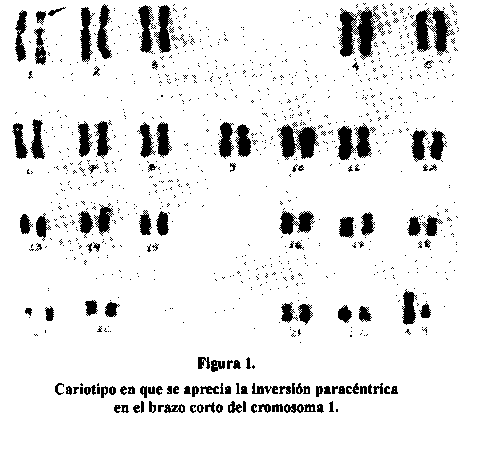
<body><![CDATA[<BR><FONT SIZE=-1>&nbsp;</FONT>     <BR><FONT FACE="Arial"><FONT SIZE=-1>A este laboratorio fue remitido un paciente var&oacute;n quien a los cinco a&ntilde;os de edad hab&iacute;a ingresado al hospital por presentar un cuadro de apendicitis aguda grado II. Cinco a&ntilde;os despu&eacute;s es de nuevo referido por presentar obesidad y problemas de aprendizaje. Ten&iacute;a antecedentes familiares de: obesidad, diabetes mellitus, problemas de aprendizaje, retardo mental, drogadicci&oacute;n. Fue producto de un parto normal, pes&oacute; 7 libras, midi&oacute; 52 cm, camin&oacute; a los 2 a&ntilde;os y 6 meses por su obesidad y no tuvo problemas de lenguaje. En la actualidad tiene 10 a&ntilde;os, talla 1,60 m y pesa 85 kg. Los ex&aacute;menes de laboratorio fueron normales (funci&oacute;n tiroidea, glucosa, colesterol, triglic&eacute;ridos, pruebas metab&oacute;licas en orina), electrocardiograma normal, los rayos x demostraron maduraci&oacute;n &oacute;sea acelerada. El paciente fue referido a nuestro laboratorio para la realizaci&oacute;n del cariotipo. La muestra fue sangre perif&eacute;rica heparinizada, se cultiv&oacute; por 72 hr a 37&deg;C en c&aacute;mara con 5% de CO<SUB>2</SUB>, en el medio RPMI 1640 estimulado con fitohemaglutinina. El bandeo fue realizado con tripsina-Giemsa. Se analizaron al microscopio 20 mitosis.</FONT></FONT>     <BR><B><FONT FACE="Arial"><FONT SIZE=-1>&nbsp;</FONT></FONT></B>     <BR><B><FONT FACE="Arial"><FONT SIZE=-1>&nbsp;</FONT></FONT></B>     <BR><B><FONT FACE="Arial"><FONT SIZE=-1>Resultados</FONT></FONT></B>     <BR><FONT SIZE=-1>&nbsp;</FONT>     <BR><FONT FACE="Arial"><FONT SIZE=-1>Se encontr&oacute; una aparente inversi&oacute;n parac&eacute;ntrica en el brazo corto del cromosoma 1 : 46, XY, inv(1) (p. 31, p. 36); seg&uacute;n clasificaci&oacute;n ISCN, <A HREF="#figura1">Figura 1</A>.</FONT></FONT>      <P><FONT FACE="Arial"><FONT SIZE=-1>&nbsp;</FONT></FONT>     <CENTER><A NAME="figura1"></A><IMG SRC="/img/fbpe/rmhnn/v31n1-2/0113i01.GIF" HEIGHT=454 WIDTH=480></CENTER> <FONT SIZE=-1>&nbsp;</FONT>      
<P><B><FONT FACE="Arial"><FONT SIZE=-1>&nbsp;</FONT></FONT></B>     ]]></body>
<body><![CDATA[<BR><B><FONT FACE="Arial"><FONT SIZE=-1>Discusi&oacute;n</FONT></FONT></B>     <BR><FONT SIZE=-1>&nbsp;</FONT>     <BR><FONT FACE="Arial"><FONT SIZE=-1>Parte del inter&eacute;s de la presentaci&oacute;n de este hallazgo es que dicho arreglo es poco frecuente ya que es dif&iacute;cil que ocurran rearreglos cromos&oacute;micos en un mismo brazo<SUP>(<A HREF="#1">1</A>)</SUP>. Y, adem&aacute;s, son &uacute;nicamente detectables por t&eacute;cnicas de bandeo y no por t&eacute;cnicas de tinci&oacute;n convencionales. Se han reportado inversiones parac&eacute;ntricas del cromosoma 1 asociadas a hipopituitarismo<SUP>(<A HREF="#6">6</A>,<A HREF="#7"> 7</A>, <A HREF="#8">8</A>)</SUP>; tambi&eacute;n se ha asociado con esterilidad en varones, por lo que el seguimiento en cuanto a desarrollo sexual se hace necesario<SUP>(<A HREF="#3">3</A>, <A HREF="#5">5</A>)</SUP>. Sin embargo, es importante destacar que la mayor&iacute;a de las inversiones parac&eacute;ntricas familiares resultan en una descendencia saludable<SUP>(<A HREF="#1">1</A>)</SUP>.</FONT></FONT>      <P><FONT FACE="Arial"><FONT SIZE=-1>En estos casos, se debe realizar estudio citogen&eacute;tico a los progenitores para destacar que esta alteraci&oacute;n no se haya producido <I>de novo</I> sino que fue heredada<SUP>(<A HREF="#3">3</A>, <A HREF="#4">4</A>)</SUP>.</FONT></FONT>     <BR><B><FONT FACE="Arial"><FONT SIZE=-1>&nbsp;</FONT></FONT></B>     <BR><B><FONT FACE="Arial"><FONT SIZE=-1>&nbsp;</FONT></FONT></B>     <BR><B><FONT FACE="Arial"><FONT SIZE=-1>Resumen</FONT></FONT></B>     <BR><FONT SIZE=-1>&nbsp;</FONT>     <BR><FONT FACE="Arial"><FONT SIZE=-1>Se presenta el estudio de cariotipo con bandeo de un caso con problemas de obesidad y aprendizaje en el que se encontr&oacute; una aparente inversi&oacute;n parac&eacute;ntrica en el brazo corto del cromosoma 1. Se discute lo poco frecuente de este rearreglo cromos&oacute;mico y la necesidad de efectuar rutinariamente estudios citogen&eacute;ticos con bandeo, en los casos con sospecha cl&iacute;nica de problema gen&eacute;tico.</FONT></FONT>     <BR><B><FONT FACE="Arial"><FONT SIZE=-1>&nbsp;</FONT></FONT></B>     ]]></body>
<body><![CDATA[<BR><B><FONT FACE="Arial"><FONT SIZE=-1>&nbsp;</FONT></FONT></B>     <BR><B><FONT FACE="Arial"><FONT SIZE=-1>Bibliograf&iacute;a</FONT></FONT></B>     <BR>&nbsp;     <!-- ref --><BR><A NAME="1"></A><FONT FACE="Arial"><FONT SIZE=-1>1. Farrel S. &amp; Chow G.: Prental detection of new familial paracentric inversions. Applied Cytogenetics. 19: 1, 1993.</FONT></FONT>    &nbsp;&nbsp;&nbsp;&nbsp;&nbsp;&nbsp;&nbsp;&nbsp;[&#160;<a href="javascript:void(0);" onclick="javascript: window.open('/scielo.php?script=sci_nlinks&ref=1038473&pid=S1017-8546199600010000100001&lng=','','width=640,height=500,resizable=yes,scrollbars=1,menubar=yes,');">Links</a>&#160;]<!-- end-ref --><!-- ref --><P><A NAME="2"></A><FONT FACE="Arial"><FONT SIZE=-1>2. Geleherter T. &amp; Collins F.: Principles of Medical Genetics. Williams and Wilkins Eds. Baltimore. MD, 1990.</FONT></FONT>    &nbsp;&nbsp;&nbsp;&nbsp;&nbsp;&nbsp;&nbsp;&nbsp;[&#160;<a href="javascript:void(0);" onclick="javascript: window.open('/scielo.php?script=sci_nlinks&ref=1038474&pid=S1017-8546199600010000100002&lng=','','width=640,height=500,resizable=yes,scrollbars=1,menubar=yes,');">Links</a>&#160;]<!-- end-ref --><!-- ref --><P><A NAME="3"></A><FONT FACE="Arial"><FONT SIZE=-1>3. Meschede D. &amp; Froster U.: Familial pericentric inversion of chromosome 1 (p34q23) and male infertility with stage specific spermatogenic arrest. J. Med. Genet. 31: 573, 1994.</FONT></FONT>    &nbsp;&nbsp;&nbsp;&nbsp;&nbsp;&nbsp;&nbsp;&nbsp;[&#160;<a href="javascript:void(0);" onclick="javascript: window.open('/scielo.php?script=sci_nlinks&ref=1038475&pid=S1017-8546199600010000100003&lng=','','width=640,height=500,resizable=yes,scrollbars=1,menubar=yes,');">Links</a>&#160;]<!-- end-ref --><!-- ref --><P><A NAME="4"></A><FONT FACE="Arial"><FONT SIZE=-1>4. Nora &amp; Fraser. Medical Genetics. IV edition. Lea and Febiger. Pennsylvania, USA, 1993.</FONT></FONT>    &nbsp;&nbsp;&nbsp;&nbsp;&nbsp;&nbsp;&nbsp;&nbsp;[&#160;<a href="javascript:void(0);" onclick="javascript: window.open('/scielo.php?script=sci_nlinks&ref=1038476&pid=S1017-8546199600010000100004&lng=','','width=640,height=500,resizable=yes,scrollbars=1,menubar=yes,');">Links</a>&#160;]<!-- end-ref --><!-- ref --><P><A NAME="5"></A><FONT FACE="Arial"><FONT SIZE=-1>5. Robinson A. &amp; Lindon M.: Clinical Genetics Handbook. II edition. Blackwell Scientific Publication, 1993.</FONT></FONT>    &nbsp;&nbsp;&nbsp;&nbsp;&nbsp;&nbsp;&nbsp;&nbsp;[&#160;<a href="javascript:void(0);" onclick="javascript: window.open('/scielo.php?script=sci_nlinks&ref=1038477&pid=S1017-8546199600010000100005&lng=','','width=640,height=500,resizable=yes,scrollbars=1,menubar=yes,');">Links</a>&#160;]<!-- end-ref --><!-- ref --><P><A NAME="6"></A><FONT FACE="Arial"><FONT SIZE=-1>6. Siegel S. &amp; Ahdab B.: Ectopic posterior pituitary tissue and paracentric inversion of the short arm of chromosome 1 in twins. Eur. J. Endocrinol. 133:87, 1995.</FONT></FONT>    &nbsp;&nbsp;&nbsp;&nbsp;&nbsp;&nbsp;&nbsp;&nbsp;[&#160;<a href="javascript:void(0);" onclick="javascript: window.open('/scielo.php?script=sci_nlinks&ref=1038478&pid=S1017-8546199600010000100006&lng=','','width=640,height=500,resizable=yes,scrollbars=1,menubar=yes,');">Links</a>&#160;]<!-- end-ref --><!-- ref --><P><A NAME="7"></A><FONT FACE="Arial"><FONT SIZE=-1>7. Therman &amp; Millard. Human Chromosomes. III editions. Springer-Verlag, 1993. New York, 1993.</FONT></FONT>    &nbsp;&nbsp;&nbsp;&nbsp;&nbsp;&nbsp;&nbsp;&nbsp;[&#160;<a href="javascript:void(0);" onclick="javascript: window.open('/scielo.php?script=sci_nlinks&ref=1038479&pid=S1017-8546199600010000100007&lng=','','width=640,height=500,resizable=yes,scrollbars=1,menubar=yes,');">Links</a>&#160;]<!-- end-ref --><!-- ref --><P><A NAME="8"></A><FONT FACE="Arial"><FONT SIZE=-1>8. Thompson &amp; Thompson. Genetics in Medicine. V edition. WB Sanders Philadelphia, 1991.</FONT></FONT>    &nbsp;&nbsp;&nbsp;&nbsp;&nbsp;&nbsp;&nbsp;&nbsp;[&#160;<a href="javascript:void(0);" onclick="javascript: window.open('/scielo.php?script=sci_nlinks&ref=1038480&pid=S1017-8546199600010000100008&lng=','','width=640,height=500,resizable=yes,scrollbars=1,menubar=yes,');">Links</a>&#160;]<!-- end-ref --><BR>&nbsp;     <BR>&nbsp;     <BR><A NAME="*"></A><FONT FACE="Arial"><FONT SIZE=-1><A HREF="#*a">*</A> Secci&oacute;n de Citogen&eacute;tica, Divisi&oacute;n Hematolog&iacute;a. Laboratorio Cl&iacute;nico Hospital Nacional de Ni&ntilde;os</FONT></FONT>     <BR><FONT FACE="Arial"><FONT SIZE=-1>Dr. Carlos S&aacute;enz Herrera. Caja Costarricense de Seguro Social, San Jos&eacute;, Costa Rica.</FONT></FONT>      ]]></body><back>
<ref-list>
<ref id="B1">
<label>1</label><nlm-citation citation-type="journal">
<person-group person-group-type="author">
<name>
<surname><![CDATA[Farrel]]></surname>
<given-names><![CDATA[S]]></given-names>
</name>
<name>
<surname><![CDATA[Chow]]></surname>
<given-names><![CDATA[G]]></given-names>
</name>
</person-group>
<article-title xml:lang="en"><![CDATA[Prental detection of new familial paracentric inversions]]></article-title>
<source><![CDATA[Applied Cytogenetics]]></source>
<year>1993</year>
<volume>19</volume>
<page-range>1</page-range></nlm-citation>
</ref>
<ref id="B2">
<label>2</label><nlm-citation citation-type="book">
<person-group person-group-type="author">
<name>
<surname><![CDATA[Geleherter]]></surname>
<given-names><![CDATA[T.]]></given-names>
</name>
<name>
<surname><![CDATA[Collins]]></surname>
<given-names><![CDATA[F]]></given-names>
</name>
</person-group>
<source><![CDATA[Principles of Medical Genetics.]]></source>
<year>1990</year>
<publisher-loc><![CDATA[Baltimore ]]></publisher-loc>
<publisher-name><![CDATA[Williams and Wilkins]]></publisher-name>
</nlm-citation>
</ref>
<ref id="B3">
<label>3</label><nlm-citation citation-type="journal">
<person-group person-group-type="author">
<name>
<surname><![CDATA[Meschede]]></surname>
<given-names><![CDATA[D]]></given-names>
</name>
<name>
<surname><![CDATA[Froster]]></surname>
<given-names><![CDATA[U]]></given-names>
</name>
</person-group>
<article-title xml:lang="en"><![CDATA[Familial pericentric inversion of chromosome 1 (p34q23) and male infertility with stage specific spermatogenic arrest]]></article-title>
<source><![CDATA[J. Med. Genet]]></source>
<year>1994</year>
<volume>31</volume>
<page-range>573</page-range></nlm-citation>
</ref>
<ref id="B4">
<label>4</label><nlm-citation citation-type="book">
<collab>Nora & Fraser</collab>
<source><![CDATA[Medical Genetics]]></source>
<year>1993</year>
<edition>IV</edition>
<publisher-loc><![CDATA[Pennsylvania ]]></publisher-loc>
<publisher-name><![CDATA[Lea and Febiger]]></publisher-name>
</nlm-citation>
</ref>
<ref id="B5">
<label>5</label><nlm-citation citation-type="book">
<person-group person-group-type="author">
<name>
<surname><![CDATA[Robinson]]></surname>
<given-names><![CDATA[A]]></given-names>
</name>
<name>
<surname><![CDATA[Lindon]]></surname>
<given-names><![CDATA[M]]></given-names>
</name>
</person-group>
<source><![CDATA[Clinical Genetics Handbook]]></source>
<year>1993</year>
<edition>II</edition>
<publisher-name><![CDATA[Blackwell Scientific Publication]]></publisher-name>
</nlm-citation>
</ref>
<ref id="B6">
<label>6</label><nlm-citation citation-type="journal">
<person-group person-group-type="author">
<name>
<surname><![CDATA[Siegel]]></surname>
<given-names><![CDATA[S.]]></given-names>
</name>
<name>
<surname><![CDATA[Ahdab]]></surname>
<given-names><![CDATA[B.]]></given-names>
</name>
</person-group>
<article-title xml:lang="en"><![CDATA[Ectopic posterior pituitary tissue and paracentric inversion of the short arm of chromosome 1 in twins]]></article-title>
<source><![CDATA[Eur. J. Endocrinol.]]></source>
<year>1995</year>
<volume>133</volume>
<page-range>87</page-range></nlm-citation>
</ref>
<ref id="B7">
<label>7</label><nlm-citation citation-type="book">
<person-group person-group-type="author">
<name>
<surname><![CDATA[Therman]]></surname>
</name>
<name>
<surname><![CDATA[Millard]]></surname>
</name>
</person-group>
<source><![CDATA[Human Chromosomes]]></source>
<year>1993</year>
<edition>III</edition>
<publisher-name><![CDATA[Springer-Verlag]]></publisher-name>
</nlm-citation>
</ref>
<ref id="B8">
<label>8</label><nlm-citation citation-type="book">
<person-group person-group-type="author">
<name>
<surname><![CDATA[Thompson]]></surname>
</name>
<name>
<surname><![CDATA[Thompson]]></surname>
</name>
</person-group>
<source><![CDATA[Genetics in Medicine]]></source>
<year>1991</year>
<edition>V</edition>
<publisher-loc><![CDATA[Philadelphia ]]></publisher-loc>
<publisher-name><![CDATA[WB Sanders]]></publisher-name>
</nlm-citation>
</ref>
</ref-list>
</back>
</article>
