<?xml version="1.0" encoding="ISO-8859-1"?><article xmlns:mml="http://www.w3.org/1998/Math/MathML" xmlns:xlink="http://www.w3.org/1999/xlink" xmlns:xsi="http://www.w3.org/2001/XMLSchema-instance">
<front>
<journal-meta>
<journal-id>1017-8546</journal-id>
<journal-title><![CDATA[Revista Médica del Hospital Nacional de Niños Dr. Carlos Sáenz Herrera]]></journal-title>
<abbrev-journal-title><![CDATA[Rev. méd. Hosp. Nac. Niños (Costa Rica)]]></abbrev-journal-title>
<issn>1017-8546</issn>
<publisher>
<publisher-name><![CDATA[Editorial Nacional de Salud y Seguridad Social]]></publisher-name>
</publisher>
</journal-meta>
<article-meta>
<article-id>S1017-85461995000100005</article-id>
<title-group>
<article-title xml:lang="es"><![CDATA[Pacientes con componente alérgico y su relación con la presencia de agentes micóticos]]></article-title>
</title-group>
<contrib-group>
<contrib contrib-type="author">
<name>
<surname><![CDATA[Muñoz]]></surname>
<given-names><![CDATA[Silvia]]></given-names>
</name>
<xref ref-type="aff" rid="A01"/>
</contrib>
<contrib contrib-type="author">
<name>
<surname><![CDATA[Herrera]]></surname>
<given-names><![CDATA[Marco L]]></given-names>
</name>
<xref ref-type="aff" rid="A01"/>
</contrib>
<contrib contrib-type="author">
<name>
<surname><![CDATA[Montero]]></surname>
<given-names><![CDATA[Alfonso]]></given-names>
</name>
<xref ref-type="aff" rid="A01"/>
</contrib>
<contrib contrib-type="author">
<name>
<surname><![CDATA[Umaña]]></surname>
<given-names><![CDATA[Cecilia]]></given-names>
</name>
<xref ref-type="aff" rid="A02"/>
</contrib>
</contrib-group>
<aff id="A01">
<institution><![CDATA[,Hospital Nacional de Niños Dr. Carlos Sáenz Herrera Laboratorio Clínico ]]></institution>
<addr-line><![CDATA[San José ]]></addr-line>
<country>Costa Rica</country>
</aff>
<aff id="A02">
<institution><![CDATA[,Caja Costarricense de Seguro Social Laboratorio-Clínica de Coronado ]]></institution>
<addr-line><![CDATA[ ]]></addr-line>
</aff>
<pub-date pub-type="pub">
<day>00</day>
<month>00</month>
<year>1995</year>
</pub-date>
<pub-date pub-type="epub">
<day>00</day>
<month>00</month>
<year>1995</year>
</pub-date>
<volume>30</volume>
<numero>1-2</numero>
<fpage>31</fpage>
<lpage>34</lpage>
<copyright-statement/>
<copyright-year/>
<self-uri xlink:href="http://www.scielo.sa.cr/scielo.php?script=sci_arttext&amp;pid=S1017-85461995000100005&amp;lng=en&amp;nrm=iso"></self-uri><self-uri xlink:href="http://www.scielo.sa.cr/scielo.php?script=sci_abstract&amp;pid=S1017-85461995000100005&amp;lng=en&amp;nrm=iso"></self-uri><self-uri xlink:href="http://www.scielo.sa.cr/scielo.php?script=sci_pdf&amp;pid=S1017-85461995000100005&amp;lng=en&amp;nrm=iso"></self-uri><abstract abstract-type="short" xml:lang="es"><p><![CDATA[Se presenta en este informe los casos en los cuales se relaciona la presencia de eosinófilos en moco nasal, con agentes micóticos, produciendo posibles patologías en las vías respiratorias superiores. Los pacientes fueron estudiados en la consulta de alergología del Hospital Nacional de Niños, por presentar rinitis alérgica o asma bronquial de origen desconocido. A estos pacientes se les solicita el estudio de eosinófilos en moco nasal y además la misma secreción fue cultivada por hongos. En las edades comprendidas entre los 6 y los 9 años, se obtuvo el mayor número de casos positivos en cuyos diagnósticos predominaba la rinitis alérgica, siendo Candida albicans y Penicillium sp. los agentes etiológicos más frecuentemente encontrados.]]></p></abstract>
<abstract abstract-type="short" xml:lang="en"><p><![CDATA[In this report, cases are presented, in wich the presence of eosinophils in nasal mucus with etiology of mycotic infections is involved, producing possible pathologies in the superior respiratory tract. The patients were studied by the allergology consult of the Hospital Nacional de Niños, because they presented rinitis, allergy or bronchial asthma of unknown origin. A study for eosinophils in nasal mucus was required for these patients and the same secretion was cultivated by fungus. The largest amount of positive cases in wich allergic rinitis prevailed was obtained in the ages between 6 and 9 years old, being Candida albicans and Penicillium sp. the most frequently found agents.]]></p></abstract>
</article-meta>
</front><body><![CDATA[ <CENTER><B><FONT FACE="Arial">Pacientes con componente al&eacute;rgico y su relaci&oacute;n con la presencia de agentes mic&oacute;ticos</FONT></B></CENTER>      <CENTER><I><FONT FACE="Arial"><FONT SIZE=-1>&nbsp;</FONT></FONT></I></CENTER>      <CENTER><I><FONT FACE="Arial"><FONT SIZE=-1>&nbsp;</FONT></FONT></I></CENTER>      <CENTER><B><FONT FACE="Arial"><FONT SIZE=-1>Dra. Silvia Mu&ntilde;oz<A NAME="*a"></A><A HREF="#*">*</A>;&nbsp; Dra. Marco L. Herrera<A HREF="#*">*</A>;&nbsp; Dr. Alfonso Montero<A HREF="#*">*</A> y&nbsp; Dra. Cecilia Uma&ntilde;a<A HREF="#**">**</A></FONT></FONT></B></CENTER> <B>&nbsp;</B>     <BR>&nbsp;      <P><FONT FACE="Arial,Helvetica"><FONT SIZE=-1>&nbsp;<B>Introducci&oacute;n</B></FONT></FONT>      <P><FONT FACE="Arial,Helvetica"><FONT SIZE=-1>Desde hace muchos a&ntilde;os se considera a las esporas de hongos como una causa importante de alergia respiratoria (<A HREF="#2">2</A>). Sin embargo, es indispensable el reconocimiento de los agentes antig&eacute;nicos que desencadenan la hipersensibilidad, tipo I, para facilitar su detecci&oacute;n. Pero en el caso de los hongos se dificulta un poco, ya que son muy corrientes en los humanos, y no poseen un patr&oacute;n definido relacionado con la &eacute;poca del a&ntilde;o en que m&aacute;s se presentan, principalmente en los pa&iacute;ses con climas tropicales o subtropicales (<A HREF="#5">5</A>).</FONT></FONT>      <P><FONT FACE="Arial,Helvetica"><FONT SIZE=-1>Existen diversos factores que favorecen el crecimiento de los hongos, como son: el grado de precipitaci&oacute;n, viento prevalente, patrones circadianos de luz solar y oscuridad, disponibilidad de sustratos y grado de humedad atmosf&eacute;rica (<A HREF="#9">9</A>).</FONT></FONT>      <P><FONT FACE="Arial,Helvetica"><FONT SIZE=-1>Las infecciones mic&oacute;ticas que producen patolog&iacute;as en las v&iacute;as respiratorias superiores han sido descritas por varios autores (<A HREF="#6">6</A>). Uno de los primeros en notar la relaci&oacute;n existente entre los hongos del ambiente y los s&iacute;ntomas de alergia fue Moses Maimonides en el siglo XII, posteriormente en 1726 Sir John Flojer, not&oacute; el desencadenamiento de una crisis intensiva de asma en una vinater&iacute;a (Cit. en (<A HREF="#2">2</A>)).</FONT></FONT>      <P><FONT FACE="Arial,Helvetica"><FONT SIZE=-1>Existen diferentes procedimientos para valorar la antigenicidad de los agentes mic&oacute;ticos y su papel en la inducci&oacute;n de fen&oacute;menos al&eacute;rgicos, pero &eacute;stos han topado con barreras para poder realizar este estudio in vitro (<A HREF="#1">1</A>).</FONT></FONT>      ]]></body>
<body><![CDATA[<P><FONT FACE="Arial,Helvetica"><FONT SIZE=-1>Quiz&aacute;s los m&eacute;todos m&aacute;s precisos son aquellos aplicados in vivo, los que nos dan la especificidad al desarrollar los s&iacute;ntomas, pero para esto tambi&eacute;n existen ciertas limitantes, como ser&iacute;an la estandarizaci&oacute;n del alergeno y los riesgos de tener s&iacute;ntomas intensos secundarios a la exposici&oacute;n (<A HREF="#1">1</A>).</FONT></FONT>      <P><FONT FACE="Arial,Helvetica"><FONT SIZE=-1>Revisando la literatura existente, se encontr&oacute; que no exist&iacute;a ninguna publicaci&oacute;n en la cual se mencionara la posible relaci&oacute;n entre la presencia de agentes mic&oacute;ticos como posibles inductores de procesos al&eacute;rgicos. Esto nos motiv&oacute; a realizar la presente investigaci&oacute;n ya que las infecciones mic&oacute;ticas, especialmente las formas cr&oacute;nicas contin&uacute;an siendo tema de confusi&oacute;n y controversia en la b&uacute;squeda de un tratamiento efectivo y adecuado (<A HREF="#7">7</A>).</FONT></FONT>     <BR><B><FONT FACE="Arial,Helvetica"><FONT SIZE=-1>&nbsp;</FONT></FONT></B>     <BR><B><FONT FACE="Arial,Helvetica"><FONT SIZE=-1>&nbsp;</FONT></FONT></B>     <BR><B><FONT FACE="Arial,Helvetica"><FONT SIZE=-1>Materiales y M&eacute;todos</FONT></FONT></B>      <P><FONT FACE="Arial,Helvetica"><FONT SIZE=-1>Se procesaron 100 muestras de pacientes de la consulta externa del Hospital Nacional de Ni&ntilde;os, con edades comprendidas entre los 8 meses hasta los 15 a&ntilde;os, referidos por sospecha de rinitis al&eacute;rgica, asma bronquial u otra patolog&iacute;a de tipo al&eacute;rgica en los cuales pudiera estar involucrado alg&uacute;n agente mic&oacute;tico.</FONT></FONT>      <P><FONT FACE="Arial,Helvetica"><FONT SIZE=-1>Se escogieron s&oacute;lo aquellos que tuvieran suficiente secreci&oacute;n, y que fuera compatible con alguna rinopat&iacute;a al&eacute;rgica con el fin de estandarizar el estudio.</FONT></FONT>      <P><FONT FACE="Arial,Helvetica"><FONT SIZE=-1>A cada paciente se le tom&oacute; el frotis de eosin&oacute;filos en moco nasal utilizando para ello, torundas est&eacute;riles, una para cada fosa nasal; as&iacute; como tambi&eacute;n portaobjetos o l&aacute;minas nuevas, con el fin de evitar en lo posible la contaminaci&oacute;n de hongos del ambiente.</FONT></FONT>      <P><FONT FACE="Arial,Helvetica"><FONT SIZE=-1>Las muestras fueron cultivadas por hongos, utilizando los medios de Sabouraud Dextrosa y agar Mycosel, uno para cada fosa nasal. Las placas se incubaron a 22&ordm;C por un periodo de 22 d&iacute;as con revisi&oacute;n semanal.</FONT></FONT>      <P><FONT FACE="Arial,Helvetica"><FONT SIZE=-1>Los agentes mic&oacute;ticos levaduriformes fueron identificados utilizando una tinci&oacute;n de Gram e identific&aacute;ndolos hasta g&eacute;nero y especie, en base al equipo automatizado Vetek y con las "tarjetas yeast" incubadas a 30&ordm;C por 24 a 48 horas. Los agentes miceliales, fueron clasificados utilizando criterios morfol&oacute;gicos, para lo cual se us&oacute; la tinci&oacute;n de azul de lactofenol.</FONT></FONT>      ]]></body>
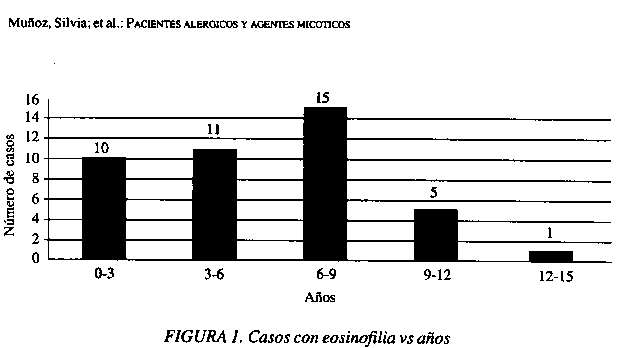
<body><![CDATA[<P><FONT FACE="Arial,Helvetica"><FONT SIZE=-1>Los frotis se ti&ntilde;eron con eosina, utilizando como contraste el azul de metileno.</FONT></FONT>      <P><FONT FACE="Arial,Helvetica"><FONT SIZE=-1>Se estandariz&oacute; el reporte utilizando para ello el sistema de cruces en cada uno de los par&aacute;metros observados (secreci&oacute;n, leucocitos, bacterias y % de eosin&oacute;filos); para lo cual se usaron cuatro categor&iacute;as:</FONT></FONT>      <P><FONT FACE="Arial,Helvetica"><FONT SIZE=-1>+ escasa</FONT></FONT>     <BR><FONT FACE="Arial,Helvetica"><FONT SIZE=-1>++ poca</FONT></FONT>     <BR><FONT FACE="Arial,Helvetica"><FONT SIZE=-1>+++ mucha</FONT></FONT>     <BR><FONT FACE="Arial,Helvetica"><FONT SIZE=-1>++++ abundante</FONT></FONT>     <BR><B><FONT FACE="Arial,Helvetica"><FONT SIZE=-1>&nbsp;</FONT></FONT></B>     <BR><B><FONT FACE="Arial,Helvetica"><FONT SIZE=-1>&nbsp;</FONT></FONT></B>     <BR><B><FONT FACE="Arial,Helvetica"><FONT SIZE=-1>Resultados</FONT></FONT></B>      <P><FONT FACE="Arial,Helvetica"><FONT SIZE=-1>De los 100 casos estudiados se encontr&oacute; que el mayor porcentaje de eosin&oacute;filos en moco nasal se presenta en las edades de 7 a los 9 a&ntilde;os, como se observa en la <A HREF="#figura1">Figura 1</A>.</FONT></FONT>      ]]></body>
<body><![CDATA[<P><FONT FACE="Arial,Helvetica"><FONT SIZE=-1>De un total de 42 casos con eosinofilia, se encuentran 18 con frotis y cultivo positivos por hongos, siendo m&aacute;s frecuentes entre los pacientes con sospecha de rinitis al&eacute;rgica.</FONT></FONT>      <P><FONT FACE="Arial,Helvetica"><FONT SIZE=-1>Los hongos que crecieron con m&aacute;s frecuencia: <I>Candida albicans, Penicillium sp., Aspergillus niger, Rhodotorula glunitis, Candida guillermondii, Microsporum</I> sp. Al analizar la presencia de estos hongos por padecimientos en los pacientes con rinitis al&eacute;rgica predomin&oacute; la <I>Candida albicans y Penicillium sp</I>. De 22 casos con sospecha de rinitis al&eacute;rgica, en un caso cultiv&oacute; <I>Candida albicans</I>. De estos mismos pacientes, 6 cultivaron <I>Penicillium sp</I>.,los cuales presentaron m&aacute;s del 20% de eosin&oacute;filos en moco nasal.</FONT></FONT>     <BR><FONT FACE="Arial,Helvetica"><FONT SIZE=-1>&nbsp;</FONT></FONT>     <BR><FONT FACE="Arial,Helvetica"><FONT SIZE=-1>&nbsp;</FONT></FONT>     <CENTER><A NAME="figura1"></A><IMG SRC="/img/fbpe/rmhnn/v30n1-2/0108i01.GIF" HEIGHT=348 WIDTH=622></CENTER> <B><FONT FACE="Arial,Helvetica"><FONT SIZE=-1>&nbsp;&nbsp;</FONT></FONT></B>     
<BR><B><FONT FACE="Arial,Helvetica"><FONT SIZE=-1>&nbsp;</FONT></FONT></B>     <BR><B><FONT FACE="Arial,Helvetica"><FONT SIZE=-1>Discusi&oacute;n</FONT></FONT></B>      <P><FONT FACE="Arial,Helvetica"><FONT SIZE=-1>La rinitis al&eacute;rgica es una enfermedad que puede ser causada por m&uacute;ltiples factores, dentro de los que podemos mencionar hiperreactividad al polen, a diversos alimentos, a &aacute;caros y a condiciones ambientales de temperatura y humedad atmosf&eacute;rica. Otra posibilidad es la inducci&oacute;n al&eacute;rgica debido a la presencia de hongos en la secreci&oacute;n nasal. Dentro de los agentes mic&oacute;ticos relacionados con el desarrollo de alergias respiratorias est&aacute;n <I>Curvularia sp., Penicillium sp.,</I> <I>Aspergillius sp. y Rhizopus</I> sp.</FONT></FONT>      <P><FONT FACE="Arial,Helvetica"><FONT SIZE=-1>El estudio de los eosin&oacute;filos en moco nasal, es un importante indicador del componente al&eacute;rgico en el desarrollo de rinitis, asma, y en la mezcla de ambos padecimientos. Durante el an&aacute;lisis de estas muestras se observ&oacute; la presencia de estructuras mic&oacute;ticas y levaduriformes por lo que decidimos realizar el presente estudio.</FONT></FONT>      <P><FONT FACE="Arial,Helvetica"><FONT SIZE=-1>De los 100 ni&ntilde;os estudiados, en el 18% creci&oacute; alg&uacute;n agente mic&oacute;tico. Cabe destacar que <I>Penicillium sp. y Candida albicans</I>, fueron los hongos m&aacute;s encontrados y que esto contrasta con lo encontrado en la literatura, donde no se menciona a la <I>Candida albicans</I> como un posible inductor de procesos al&eacute;rgicos. Este &uacute;ltimo agente, podr&iacute;a encontrarse como parte de la flora normal o como un colonizante, sin que necesariamente est&eacute; involucrado en el desarrollo de procesos al&eacute;rgicos; estas dudas hay que esclarecerlas con estudios m&aacute;s amplios.</FONT></FONT>     ]]></body>
<body><![CDATA[<BR><B><FONT FACE="Arial,Helvetica"><FONT SIZE=-1>&nbsp;</FONT></FONT></B>     <BR><B><FONT FACE="Arial,Helvetica"><FONT SIZE=-1>&nbsp;</FONT></FONT></B>     <BR><B><FONT FACE="Arial,Helvetica"><FONT SIZE=-1>Resumen</FONT></FONT></B>      <P><FONT FACE="Arial,Helvetica"><FONT SIZE=-1>Se presenta en este informe los casos en los cuales se relaciona la presencia de eosin&oacute;filos en moco nasal, con agentes mic&oacute;ticos, produciendo posibles patolog&iacute;as en las v&iacute;as respiratorias superiores.</FONT></FONT>      <P><FONT FACE="Arial,Helvetica"><FONT SIZE=-1>Los pacientes fueron estudiados en la consulta de alergolog&iacute;a del Hospital Nacional de Ni&ntilde;os, por presentar rinitis al&eacute;rgica o asma bronquial de origen desconocido.</FONT></FONT>      <P><FONT FACE="Arial,Helvetica"><FONT SIZE=-1>A estos pacientes se les solicita el estudio de eosin&oacute;filos en moco nasal y adem&aacute;s la misma secreci&oacute;n fue cultivada por hongos. En las edades comprendidas entre los 6 y los 9 a&ntilde;os, se obtuvo el mayor n&uacute;mero de casos positivos en cuyos diagn&oacute;sticos predominaba la rinitis al&eacute;rgica, siendo <I>Candida albicans y Penicillium</I> sp. los agentes etiol&oacute;gicos m&aacute;s frecuentemente encontrados.</FONT></FONT>     <BR><B><FONT FACE="Arial,Helvetica"><FONT SIZE=-1>&nbsp;</FONT></FONT></B>     <BR><B><FONT FACE="Arial,Helvetica"><FONT SIZE=-1>&nbsp;</FONT></FONT></B>     <BR><B><FONT FACE="Arial,Helvetica"><FONT SIZE=-1>Abstract</FONT></FONT></B>      <P><FONT FACE="Arial,Helvetica"><FONT SIZE=-1>In this report, cases are presented, in wich the presence of eosinophils in nasal mucus with etiology of mycotic infections is involved, producing possible pathologies in the superior respiratory tract.</FONT></FONT>      ]]></body>
<body><![CDATA[<P><FONT FACE="Arial,Helvetica"><FONT SIZE=-1>The patients were studied by the allergology consult of the Hospital Nacional de Ni&ntilde;os, because they presented rinitis, allergy or bronchial asthma of unknown origin.</FONT></FONT>      <P><FONT FACE="Arial,Helvetica"><FONT SIZE=-1>A study for eosinophils in nasal mucus was required for these patients and the same secretion was cultivated by fungus.</FONT></FONT>      <P><FONT FACE="Arial,Helvetica"><FONT SIZE=-1>The largest amount of positive cases in wich allergic rinitis prevailed was obtained in the ages between 6 and 9 years old, being <I>Candida albicans</I> and <I>Penicillium </I>sp. the most frequently found agents.</FONT></FONT>     <BR><B><FONT FACE="Arial,Helvetica"><FONT SIZE=-1>&nbsp;</FONT></FONT></B>     <BR><B><FONT FACE="Arial,Helvetica"><FONT SIZE=-1>&nbsp;</FONT></FONT></B>     <BR><B><FONT FACE="Arial,Helvetica"><FONT SIZE=-1>Bibliograf&iacute;a</FONT></FONT></B>      <!-- ref --><P><A NAME="1"></A><FONT FACE="Arial,Helvetica"><FONT SIZE=-1>1. Alphin A., Strauss M. &amp; Abdul-Karim F.: Allergic fungal sinusitis; problems in diagnosis and treatment. Laryngoscope 101:815, 1991.</FONT></FONT>    &nbsp;&nbsp;&nbsp;&nbsp;&nbsp;&nbsp;&nbsp;&nbsp;[&#160;<a href="javascript:void(0);" onclick="javascript: window.open('/scielo.php?script=sci_nlinks&ref=1032751&pid=S1017-8546199500010000500001&lng=','','width=640,height=500,resizable=yes,scrollbars=1,menubar=yes,');">Links</a>&#160;]<!-- end-ref --><!-- ref --><P><A NAME="2"></A><FONT FACE="Arial,Helvetica"><FONT SIZE=-1>2. Baeza, B., Ginebra F. &amp; Bastarrachea G.: Alergia respiratoria inducida por hongos. Bol. Med. Hosp. Infant. M&eacute;x. 44:214, 1987.</FONT></FONT>    &nbsp;&nbsp;&nbsp;&nbsp;&nbsp;&nbsp;&nbsp;&nbsp;[&#160;<a href="javascript:void(0);" onclick="javascript: window.open('/scielo.php?script=sci_nlinks&ref=1032752&pid=S1017-8546199500010000500002&lng=','','width=640,height=500,resizable=yes,scrollbars=1,menubar=yes,');">Links</a>&#160;]<!-- end-ref --><!-- ref --><P><A NAME="3"></A><FONT FACE="Arial,Helvetica"><FONT SIZE=-1>3. Couti&ntilde;o B.: Importancia de los hongos en las alergias de tipo respiratorio y su estudio en M&eacute;xico. Bol. Soc. M&eacute;x. Mic. 13:215, 1979.</FONT></FONT>    &nbsp;&nbsp;&nbsp;&nbsp;&nbsp;&nbsp;&nbsp;&nbsp;[&#160;<a href="javascript:void(0);" onclick="javascript: window.open('/scielo.php?script=sci_nlinks&ref=1032753&pid=S1017-8546199500010000500003&lng=','','width=640,height=500,resizable=yes,scrollbars=1,menubar=yes,');">Links</a>&#160;]<!-- end-ref --><!-- ref --><P><A NAME="4"></A><FONT FACE="Arial,Helvetica"><FONT SIZE=-1>4. Ence B., Gourley D., Jorgensen N. et al.: Allergic fungal sinusitis. Amer. J. Rhinol. 4:169, 1990.</FONT></FONT>    &nbsp;&nbsp;&nbsp;&nbsp;&nbsp;&nbsp;&nbsp;&nbsp;[&#160;<a href="javascript:void(0);" onclick="javascript: window.open('/scielo.php?script=sci_nlinks&ref=1032754&pid=S1017-8546199500010000500004&lng=','','width=640,height=500,resizable=yes,scrollbars=1,menubar=yes,');">Links</a>&#160;]<!-- end-ref --><!-- ref --><P><A NAME="5"></A><FONT FACE="Arial,Helvetica"><FONT SIZE=-1>5. Hyde H.: Atmospheric pollen and spores in relation to allergy. Clin. Allergy 2:153, 1972.</FONT></FONT>    &nbsp;&nbsp;&nbsp;&nbsp;&nbsp;&nbsp;&nbsp;&nbsp;[&#160;<a href="javascript:void(0);" onclick="javascript: window.open('/scielo.php?script=sci_nlinks&ref=1032755&pid=S1017-8546199500010000500005&lng=','','width=640,height=500,resizable=yes,scrollbars=1,menubar=yes,');">Links</a>&#160;]<!-- end-ref --><!-- ref --><P><A NAME="6"></A><FONT FACE="Arial,Helvetica"><FONT SIZE=-1>6. Manning S., Schaefer S., Close L. et al.: Culture positive allergic fungal sinusitis. Arch. Otolaryngol. Head, Neck Surg. 117:174, 1991.</FONT></FONT>    &nbsp;&nbsp;&nbsp;&nbsp;&nbsp;&nbsp;&nbsp;&nbsp;[&#160;<a href="javascript:void(0);" onclick="javascript: window.open('/scielo.php?script=sci_nlinks&ref=1032756&pid=S1017-8546199500010000500006&lng=','','width=640,height=500,resizable=yes,scrollbars=1,menubar=yes,');">Links</a>&#160;]<!-- end-ref --><!-- ref --><P VALUE="7"><A NAME="7"></A><FONT FACE="Arial,Helvetica"><FONT SIZE=-1>7. Morpeth J., Rupp N., Dolen W. et al.: Fungal sinusitis: an update. Ann. Allergy Asth. Immunol. 76:128, 1996.</FONT></FONT>    &nbsp;&nbsp;&nbsp;&nbsp;&nbsp;&nbsp;&nbsp;&nbsp;[&#160;<a href="javascript:void(0);" onclick="javascript: window.open('/scielo.php?script=sci_nlinks&ref=1032757&pid=S1017-8546199500010000500007&lng=','','width=640,height=500,resizable=yes,scrollbars=1,menubar=yes,');">Links</a>&#160;]<!-- end-ref --><!-- ref --><P><A NAME="8"></A><FONT FACE="Arial,Helvetica"><FONT SIZE=-1>8. Shazo R. &amp; Swain R.: Diagnostic criteria for allergic fungal sinusitis. J. Allergic Clin. Immunol. 96:24, 1995.</FONT></FONT>    &nbsp;&nbsp;&nbsp;&nbsp;&nbsp;&nbsp;&nbsp;&nbsp;[&#160;<a href="javascript:void(0);" onclick="javascript: window.open('/scielo.php?script=sci_nlinks&ref=1032758&pid=S1017-8546199500010000500008&lng=','','width=640,height=500,resizable=yes,scrollbars=1,menubar=yes,');">Links</a>&#160;]<!-- end-ref --><!-- ref --><P><A NAME="9"></A><FONT FACE="Arial,Helvetica"><FONT SIZE=-1>9. Sienra J.: Hongos ambientales como causantes de alergia. Bol. Med. Hosp. Infant. M&eacute;x. 44:190, 1987.</FONT></FONT>    &nbsp;&nbsp;&nbsp;&nbsp;&nbsp;&nbsp;&nbsp;&nbsp;[&#160;<a href="javascript:void(0);" onclick="javascript: window.open('/scielo.php?script=sci_nlinks&ref=1032759&pid=S1017-8546199500010000500009&lng=','','width=640,height=500,resizable=yes,scrollbars=1,menubar=yes,');">Links</a>&#160;]<!-- end-ref --><BR><FONT FACE="Arial,Helvetica"><FONT SIZE=-1>&nbsp;</FONT></FONT>      <P><FONT FACE="Arial,Helvetica"><FONT SIZE=-1>&nbsp;</FONT></FONT>     <BR><A NAME="*"></A><FONT FACE="Arial,Helvetica"><FONT SIZE=-1><A HREF="#*a">*</A> Laboratorio Cl&iacute;nico, Hospital Nacional de Ni&ntilde;os "Dr. Carlos S&aacute;enz Herrera", Caja Costarricense de Seguro Social, San Jos&eacute;, Costa Rica.</FONT></FONT>     <BR><FONT FACE="Arial,Helvetica"><FONT SIZE=-1>&nbsp;</FONT></FONT>     <BR><A NAME="**"></A><FONT FACE="Arial,Helvetica"><FONT SIZE=-1><A HREF="#*a">**</A> Laboratorio-Cl&iacute;nica de Coronado, Caja Costarricense de Seguro Social.</FONT></FONT>     ]]></body>
<body><![CDATA[ ]]></body><back>
<ref-list>
<ref id="B1">
<label>1</label><nlm-citation citation-type="journal">
<person-group person-group-type="author">
<name>
<surname><![CDATA[Alphin]]></surname>
<given-names><![CDATA[A]]></given-names>
</name>
<name>
<surname><![CDATA[Strauss]]></surname>
<given-names><![CDATA[M]]></given-names>
</name>
<name>
<surname><![CDATA[Abdul-Karim]]></surname>
<given-names><![CDATA[F]]></given-names>
</name>
</person-group>
<article-title xml:lang="en"><![CDATA[Allergic fungal sinusitis: problems in diagnosis and treatment]]></article-title>
<source><![CDATA[Laryngoscope]]></source>
<year>1991</year>
<volume>101</volume>
<page-range>815</page-range></nlm-citation>
</ref>
<ref id="B2">
<label>2</label><nlm-citation citation-type="journal">
<person-group person-group-type="author">
<name>
<surname><![CDATA[Baeza]]></surname>
<given-names><![CDATA[B]]></given-names>
</name>
<name>
<surname><![CDATA[Ginebra]]></surname>
<given-names><![CDATA[F]]></given-names>
</name>
<name>
<surname><![CDATA[Bastarrachea]]></surname>
<given-names><![CDATA[G]]></given-names>
</name>
</person-group>
<article-title xml:lang="es"><![CDATA[Alergia respiratoria inducida por hongos]]></article-title>
<source><![CDATA[Bol. Med. Hosp. Infant. Méx]]></source>
<year>1987</year>
<volume>44</volume>
<page-range>214</page-range></nlm-citation>
</ref>
<ref id="B3">
<label>3</label><nlm-citation citation-type="journal">
<person-group person-group-type="author">
<name>
<surname><![CDATA[Coutiño]]></surname>
<given-names><![CDATA[B]]></given-names>
</name>
</person-group>
<article-title xml:lang="es"><![CDATA[Importancia de los hongos en las alergias de tipo respiratorio y su estudio en México]]></article-title>
<source><![CDATA[Bol. Soc. Méx. Mic]]></source>
<year>1979</year>
<volume>13</volume>
<page-range>215</page-range></nlm-citation>
</ref>
<ref id="B4">
<label>4</label><nlm-citation citation-type="journal">
<person-group person-group-type="author">
<name>
<surname><![CDATA[Ence]]></surname>
<given-names><![CDATA[B]]></given-names>
</name>
<name>
<surname><![CDATA[Gourley]]></surname>
<given-names><![CDATA[D]]></given-names>
</name>
<name>
<surname><![CDATA[Jorgensen]]></surname>
<given-names><![CDATA[N]]></given-names>
</name>
</person-group>
<article-title xml:lang="en"><![CDATA[Allergic fungal sinusitis]]></article-title>
<source><![CDATA[Amer. J. Rhinol]]></source>
<year>1990</year>
<volume>4</volume>
<page-range>169</page-range></nlm-citation>
</ref>
<ref id="B5">
<label>5</label><nlm-citation citation-type="journal">
<person-group person-group-type="author">
<name>
<surname><![CDATA[Hyde]]></surname>
<given-names><![CDATA[H]]></given-names>
</name>
</person-group>
<article-title xml:lang="en"><![CDATA[Atmospheric pollen and spores in relation to allergy]]></article-title>
<source><![CDATA[Clin. Allergy]]></source>
<year>1972</year>
<volume>2</volume>
<page-range>153</page-range></nlm-citation>
</ref>
<ref id="B6">
<label>6</label><nlm-citation citation-type="journal">
<person-group person-group-type="author">
<name>
<surname><![CDATA[Manning]]></surname>
<given-names><![CDATA[S]]></given-names>
</name>
<name>
<surname><![CDATA[Schaefer]]></surname>
<given-names><![CDATA[S]]></given-names>
</name>
<name>
<surname><![CDATA[Close]]></surname>
<given-names><![CDATA[L]]></given-names>
</name>
</person-group>
<article-title xml:lang="en"><![CDATA[Culture positive allergic fungal sinusitis]]></article-title>
<source><![CDATA[Arch. Otolaryngol. Head, Neck Surg]]></source>
<year>1991</year>
<volume>117</volume>
<page-range>174</page-range></nlm-citation>
</ref>
<ref id="B7">
<label>7</label><nlm-citation citation-type="journal">
<person-group person-group-type="author">
<name>
<surname><![CDATA[Morpeth]]></surname>
<given-names><![CDATA[J]]></given-names>
</name>
<name>
<surname><![CDATA[Rupp]]></surname>
<given-names><![CDATA[N]]></given-names>
</name>
<name>
<surname><![CDATA[Dolen]]></surname>
<given-names><![CDATA[W]]></given-names>
</name>
</person-group>
<article-title xml:lang="en"><![CDATA[Fungal sinusitis: an update]]></article-title>
<source><![CDATA[Ann. Allergy Asth. Immunol]]></source>
<year>1996</year>
<volume>76</volume>
<page-range>128</page-range></nlm-citation>
</ref>
<ref id="B8">
<label>8</label><nlm-citation citation-type="journal">
<person-group person-group-type="author">
<name>
<surname><![CDATA[Shazo]]></surname>
<given-names><![CDATA[R]]></given-names>
</name>
<name>
<surname><![CDATA[Swain]]></surname>
<given-names><![CDATA[R]]></given-names>
</name>
</person-group>
<article-title xml:lang="en"><![CDATA[Diagnostic criteria for allergic fungal sinusitis]]></article-title>
<source><![CDATA[J. Allergic Clin. Immunol]]></source>
<year>1995</year>
<volume>96</volume>
<page-range>24</page-range></nlm-citation>
</ref>
<ref id="B9">
<label>9</label><nlm-citation citation-type="journal">
<person-group person-group-type="author">
<name>
<surname><![CDATA[Sienra]]></surname>
<given-names><![CDATA[J]]></given-names>
</name>
</person-group>
<article-title xml:lang="es"><![CDATA[Hongos ambientales como causantes de alergia]]></article-title>
<source><![CDATA[Bol. Med. Hosp. Infant. Méx]]></source>
<year>1987</year>
<volume>44</volume>
<page-range>190</page-range></nlm-citation>
</ref>
</ref-list>
</back>
</article>
