<?xml version="1.0" encoding="ISO-8859-1"?><article xmlns:mml="http://www.w3.org/1998/Math/MathML" xmlns:xlink="http://www.w3.org/1999/xlink" xmlns:xsi="http://www.w3.org/2001/XMLSchema-instance">
<front>
<journal-meta>
<journal-id>0256-7024</journal-id>
<journal-title><![CDATA[Revista Geológica de América Central]]></journal-title>
<abbrev-journal-title><![CDATA[Rev. Geol. Amér. Central]]></abbrev-journal-title>
<issn>0256-7024</issn>
<publisher>
<publisher-name><![CDATA[Universidad de Costa Rica]]></publisher-name>
</publisher>
</journal-meta>
<article-meta>
<article-id>S0256-70242011000100009</article-id>
<title-group>
<article-title xml:lang="en"><![CDATA[The &#8220;Tambla&#8221; (Humuya) Gomphothere (Honduras): The first report of fossil vertebrates in Central America]]></article-title>
<article-title xml:lang="es"><![CDATA[El Gonfoterio de &#8220;Tambla&#8221; (Humuya , Honduras): El primer registro de un vertebrado fósil en América Central]]></article-title>
</title-group>
<contrib-group>
<contrib contrib-type="author">
<name>
<surname><![CDATA[Lucas]]></surname>
<given-names><![CDATA[Spencer G]]></given-names>
</name>
<xref ref-type="aff" rid="A01"/>
</contrib>
<contrib contrib-type="author">
<name>
<surname><![CDATA[Bonta]]></surname>
<given-names><![CDATA[Mark]]></given-names>
</name>
<xref ref-type="aff" rid="A02"/>
</contrib>
<contrib contrib-type="author">
<name>
<surname><![CDATA[Rogers]]></surname>
<given-names><![CDATA[Robert]]></given-names>
</name>
<xref ref-type="aff" rid="A03"/>
</contrib>
<contrib contrib-type="author">
<name>
<surname><![CDATA[Alvarado]]></surname>
<given-names><![CDATA[Guillermo E]]></given-names>
</name>
<xref ref-type="aff" rid="A04"/>
</contrib>
</contrib-group>
<aff id="A01">
<institution><![CDATA[,New Mexico Museum of Natural History and Science  ]]></institution>
<addr-line><![CDATA[Albuquerque New Mexico]]></addr-line>
<country>USA</country>
</aff>
<aff id="A02">
<institution><![CDATA[,Delta State University Division of Social Sciences ]]></institution>
<addr-line><![CDATA[Cleveland Mississippi]]></addr-line>
<country>USA</country>
</aff>
<aff id="A03">
<institution><![CDATA[,California State University Department of Physics and Geology ]]></institution>
<addr-line><![CDATA[Turlock California]]></addr-line>
</aff>
<aff id="A04">
<institution><![CDATA[,Universidad de Costa Rica Escuela Centroamericana de Geología ]]></institution>
<addr-line><![CDATA[ ]]></addr-line>
</aff>
<pub-date pub-type="pub">
<day>00</day>
<month>06</month>
<year>2011</year>
</pub-date>
<pub-date pub-type="epub">
<day>00</day>
<month>06</month>
<year>2011</year>
</pub-date>
<numero>44</numero>
<fpage>141</fpage>
<lpage>151</lpage>
<copyright-statement/>
<copyright-year/>
<self-uri xlink:href="http://www.scielo.sa.cr/scielo.php?script=sci_arttext&amp;pid=S0256-70242011000100009&amp;lng=en&amp;nrm=iso"></self-uri><self-uri xlink:href="http://www.scielo.sa.cr/scielo.php?script=sci_abstract&amp;pid=S0256-70242011000100009&amp;lng=en&amp;nrm=iso"></self-uri><self-uri xlink:href="http://www.scielo.sa.cr/scielo.php?script=sci_pdf&amp;pid=S0256-70242011000100009&amp;lng=en&amp;nrm=iso"></self-uri><abstract abstract-type="short" xml:lang="en"><p><![CDATA[In 1858, American geologist Joseph LeConte published the first scientific report of vertebrate fossils (mastodon, bison and horse) from Central America a brief record of a &#8220;mastodon bed&#8221; near the old village of Tamblain Honduras. In 1859, American archaeologist Ephraim George Squier also mentioned these fossils, illustrating a lower jaw fragment with a molar and providing specific clues to the location of the bonebed. J. M. Dow subsequently gave a gomphothere molar from the locality to Joseph Leidy at the Academy of Natural Sciences in Philadelphia , USA. Leidy published on the fossil, which still remains in the collection of the Academy, as Mastodon ohioticus&#8221; or as M. andium, and it was later referred to Rhynchotherium by Osborn and others. This molar is best identified as Cuvieronius hyodon, and the bonebed from which it was derived is near the modern village of Humuya (Tambla in the 1800s), not near the village currently called Tambla. The Tambla &#8220;mastodon bed&#8221; has never been relocated, though data provided here should make that possible. Its discovery in the 1850s did not encourage further exploration for vertebrate fossils in Honduras, probably because &#8220;mastodon&#8221; fossils were already commonplace in the USA, so the Tambla bonebed did not constitute a remarkable discovery.]]></p></abstract>
<abstract abstract-type="short" xml:lang="es"><p><![CDATA[En 1858, el geólogo estadounidense Joseph LeConte publicó el primer reporte científico de una fósil vertebrado en América Central, registrado como una &#8220;capa de mastodonte&#8221; cerca del pueblo de Tambla en Honduras. En 1859, el arqueólogo estadounidense Ephraim George Squier también mencionó estos fósiles, ilustrando un fragmento de la mandíbula inferior con un molar y aportó las claves específicas de la localización de la capa de huesos. J.M. Dow subsecuentemente donó el molar de mastodonte a Joseph Leidy, de la Academia de Ciencias Naturales de Filadelfia, identificado como &#8220;Mastodon ohioticus&#8221; o como M. andium, y que fue más tarde referido como Rhynchotherium por Osborn y otros. Leidy publicó sobre el fósil, el cual todavía permanece en la colección de dicha academia. Así este molar es mejor identificado, al día de hoy, como un Cuvieronius hyodon, y la capa fosilífera del cual proviene se localiza cerca del rebautizado pueblo de Humuya (llamada Tambla en el siglo XIX), lejos del actual pueblo de Tambla. La &#8220;capa de mastodonte&#8221; de Tambla nunca ha sido relocalizada; por ello, los datos acá aportados deberían de hacerlo posible. Su descubrimiento en los mediados de la década de los cincuenta del siglo antepasado no motivó mayores exploraciones de fósiles de vertebrados en Honduras, quizás debido a que los mastodontes eran en ese entonces hallazgos frecuentes en EE.UU, así que la capa fosilífera de Tambla no constituyó un descubrimiento sobresaliente]]></p></abstract>
<kwd-group>
<kwd lng="en"><![CDATA[Honduras]]></kwd>
<kwd lng="en"><![CDATA[Tambla]]></kwd>
<kwd lng="en"><![CDATA[Humuya]]></kwd>
<kwd lng="en"><![CDATA[gomphothere]]></kwd>
<kwd lng="en"><![CDATA[mastodon]]></kwd>
<kwd lng="es"><![CDATA[Honduras]]></kwd>
<kwd lng="es"><![CDATA[Tambla]]></kwd>
<kwd lng="es"><![CDATA[Humuya]]></kwd>
<kwd lng="es"><![CDATA[gonfoterio]]></kwd>
<kwd lng="es"><![CDATA[mastodonte]]></kwd>
</kwd-group>
</article-meta>
</front><body><![CDATA[ <div style="text-align: justify;">     <div style="text-align: left;">     <div style="text-align: center;"><font  style="font-family: verdana; font-weight: bold;" size="4">The &#8220;Tambla&#8221; (Humuya) Gomphothere (Honduras): The first report of fossil vertebrates in Central America </font><br  style="font-weight: bold;"> <br style="font-weight: bold;"> <font style="font-family: verdana; font-weight: bold;" size="4">El Gonfoterio de &#8220;Tambla&#8221; (Humuya , Honduras): El primer registro de un vertebrado f&oacute;sil en Am&eacute;rica Central    <br> </font></div>     <br> <font style="font-family: verdana;" size="2">Spencer G. Lucas<a  href="#autor1"><sup>1</sup></a>, Mark Bonta<a href="#autor2"><sup>2</sup></a>, Robert Rogers<a href="#autor3"><sup>3</sup></a> &amp; Guillermo E. Alvarado<a href="#autor4"><sup>4</sup></a></font>     <br>     <br> <font style="font-family: verdana;" size="2"><a name="autor1"></a>1. New Mexico Museum of Natural History and Science, 1801 Mountain Road N. W., Albuquerque, New Mexico 87104 USA, <a href="mailto:spencer.lucas@state.nm.us">spencer.lucas@state.nm.us</a>     <br> <a name="autor2"></a>2. Division of Social Sciences, Delta State University, Cleveland, Mississippi 38733 USA    <br> <a name="autor3"></a>3. Department of Physics and Geology, California State University, Stanislaus, One University Circle, Turlock, California 94382    <br> <a name="autor4"></a>4. Escuela Centroamericana de Geolog&iacute;a, Universidad de Costa Rica, Apdo. 214, 2060, San Jos&eacute;, Costa Rica</font><font style="font-family: verdana;" size="2">     ]]></body>
<body><![CDATA[<br>     <br> <a name="correspondencia2"></a>*<a href="#correspondencia1">Direcci&oacute;n para correspondencia</a></font>    <br> </div> <hr style="width: 100%; height: 2px;"><font  style="font-family: verdana; font-weight: bold;" size="3">Abstract</font>    <br>     <br> <font style="font-family: verdana;" size="2">In 1858, American geologist Joseph LeConte published the first scientific report of vertebrate fossils (mastodon, bison and horse) from Central America a brief record of a &#8220;mastodon bed&#8221; near the old village of Tamblain Honduras. In 1859, American archaeologist Ephraim George Squier also mentioned these fossils, illustrating a lower jaw fragment with a molar and providing specific clues to the location of the bonebed. J. M. Dow subsequently gave a gomphothere molar from the locality to Joseph Leidy at the Academy of Natural Sciences in Philadelphia, USA. Leidy published on the fossil, which still remains in the collection of the Academy, as <span style="font-style: italic;">Mastodon ohioticus</span>&#8221; or as <span style="font-style: italic;">M. andium</span>, and it was later referred to <span  style="font-style: italic;">Rhynchotherium</span> by Osborn and others. This molar is best identified as <span  style="font-style: italic;">Cuvieronius hyodon</span>, and the bonebed from which it was derived is near the modern village of Humuya (Tambla in the 1800s), not near the village currently called Tambla. The Tambla &#8220;mastodon bed&#8221; has never been relocated, though data provided here should make that possible. Its discovery in the 1850s did not encourage further exploration for vertebrate fossils in Honduras, probably because &#8220;mastodon&#8221; fossils were already commonplace in the USA, so the Tambla bonebed did not constitute a remarkable discovery. </font>    <br>     <br> <font style="font-family: verdana;" size="2"><span  style="font-weight: bold;">Keywords</span>: Honduras, Tambla, Humuya, gomphothere, mastodon </font>    <br>     <br> <font style="font-family: verdana;" size="3"><span  style="font-weight: bold;">Resumen</span></font>    <br>     ]]></body>
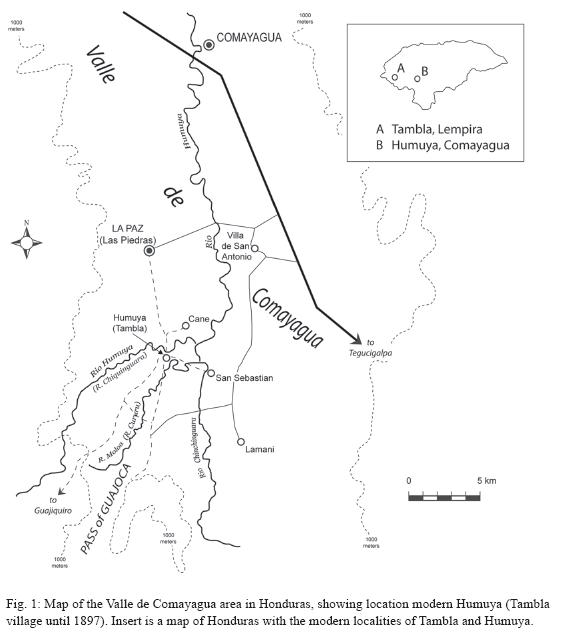
<body><![CDATA[<br> <font style="font-family: verdana;" size="2">En 1858, el ge&oacute;logo estadounidense Joseph LeConte public&oacute; el primer reporte cient&iacute;fico de una f&oacute;sil vertebrado en Am&eacute;rica Central, registrado como una &#8220;capa de mastodonte&#8221; cerca del pueblo de Tambla en Honduras. En 1859, el arque&oacute;logo estadounidense Ephraim George Squier tambi&eacute;n mencion&oacute; estos f&oacute;siles, ilustrando un fragmento de la mand&iacute;bula inferior con un molar y aport&oacute; las claves espec&iacute;ficas de la localizaci&oacute;n de la capa de huesos. J.M. Dow subsecuentemente don&oacute; el molar de mastodonte a Joseph Leidy, de la Academia de Ciencias Naturales de Filadelfia, identificado como &#8220;<span  style="font-style: italic;">Mastodon ohioticus</span>&#8221; o como <span style="font-style: italic;">M. andium</span>, y que fue m&aacute;s tarde referido como <span style="font-style: italic;">Rhynchotherium</span> por Osborn y otros. Leidy public&oacute; sobre el f&oacute;sil, el cual todav&iacute;a permanece en la colecci&oacute;n de dicha academia. As&iacute; este molar es mejor identificado, al d&iacute;a de hoy, como un <span style="font-style: italic;">Cuvieronius hyodon</span>, y la capa fosil&iacute;fera del cual proviene se localiza cerca del rebautizado pueblo de Humuya (llamada Tambla en el siglo XIX), lejos del actual pueblo de Tambla. La &#8220;capa de mastodonte&#8221; de Tambla nunca ha sido relocalizada; por ello, los datos ac&aacute; aportados deber&iacute;an de hacerlo posible. Su descubrimiento en los mediados de la d&eacute;cada de los cincuenta del siglo antepasado no motiv&oacute; mayores exploraciones de f&oacute;siles de vertebrados en Honduras, quiz&aacute;s debido a que los mastodontes eran en ese entonces hallazgos frecuentes en EE.UU, as&iacute; que la capa fosil&iacute;fera de Tambla no constituy&oacute; un descubrimiento sobresaliente. </font>    <br> <br style="font-weight: bold;"> <font style="font-family: verdana;" size="2"><span  style="font-weight: bold;">Palabras clave</span>: Honduras, Tambla, Humuya, gonfoterio, mastodonte </font>    <br> <hr style="width: 100%; height: 2px;"><font  style="font-family: verdana; font-weight: bold;" size="3">Introduction </font>    <br>     <br> <font style="font-family: verdana;" size="2">The fossil record of vertebrates in Central America encompasses hundreds of localities </font><font style="font-family: verdana;"  size="2">of late Cenozoic age. Most of these yield fossil mammals of Pleistocene age, and most of what we know about these fossils has been published since the 1980s (e. g., Ibarra, 1980; Webb &amp; Perrigo, 1984; Alvarado, 1986; Laurito, 1988; Lucas et al., 1997, 2007, 2008; Cisneros, 2005, 2008; MacFadden, 2006; Lucas &amp; Alvarado, 2010; Woodburne, 2010). These fossils are particularly significant to documenting the great American interchange&#8212;the extensive mixing of North and South American mammals that took place via Central America after the Panamanian isthmus closed during the Pliocene (Woodburne, 2010). Discoveries of fossil vertebrates (mammals) in Central America began in the 1800s and initiated our current knowledge of a diversity of Miocene-Pleistocene taxa (Alvarado, 1994). Here, we detail the first discovery of fossil mammals in Central America (cf. Alvarado, 1994, p. 82), that of gomphothere proboscidean fossils near &#8220;Tambla,&#8221; Honduras (<a href="#fig1">Fig. 1</a>).     <br>     <br>     <br>     <br> </font>     <div style="text-align: center;"><a name="fig1"></a><img alt=""  src="/img/revistas/rgac/n44/a09i1.jpg"  style="width: 561px; height: 633px;">    ]]></body>
<body><![CDATA[<br>     <br>     <br> </div> <font style="font-family: verdana; font-weight: bold;" size="2">Leconte at Tambla </font>    <br>     <br> <font style="font-family: verdana;" size="2">LeConte (1858) presented the first published mention of a fossil vertebrate from </font><font style="font-family: verdana;" size="2">Central America. Joseph LeConte (1823-1901) was an American geologist who visited Honduras in 1858 while he was a professor at South Carolina College in the USA. LeConte (1858) presented a brief account of proboscidean fossil he encountered in Honduras to the Academy of Natural Sciences in Philadelphia during its meeting of February 2, 1858: </font>    <br>     <br> <font style="font-family: verdana;" size="2"><span  style="font-style: italic;">Dr. LeConte said that while he was recently in Honduras, he had examined the Mastodon bed at the village of Tambla, in one of the passes leading from Comayagua to the Pacific. He was satisfied of the identity of the remains with M. Mastodon] giganteus. He had found there a molar of Bos and two or three of</span> Equus (LeConte, 1858, p. 7).</font>    <br>     <br> <font style="font-family: verdana;" size="2">Significantly, LeConte refers to &#8220;the Mastodon bed,&#8221; as if it were an already known location, and mentions finding &#8220;Bos&#8221; (if fossil, should be <span style="font-style: italic;">Bison</span>) and horse (<span  style="font-style: italic;">Equus</span>) at the bed. We know of no fossils in collections (for example, the Academy of Natural Sciences of Philadelphia) that voucher LeConte&#8217;s identifications, but if correct they suggest a late Pleistocene (Rancholabrean) age for the bone bed near Tambla. </font>    <br> <br style="font-weight: bold;"> <font style="font-family: verdana;" size="2"><span  style="font-weight: bold;">Squier at Tambla</span> </font>    ]]></body>
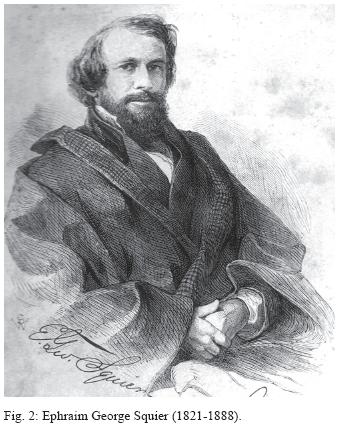
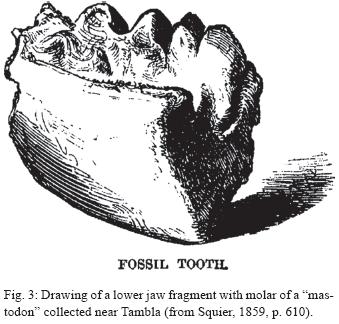
<body><![CDATA[<br>     <br> <font style="font-family: verdana;" size="2">Ephraim George Squier (1821-1888) was an American journalist and diplomat (<a href="#fig2">Fig. 2</a>). </font><font  style="font-family: verdana;" size="2">As an amateur archaeologist, he began in the 1840s to collaborate with another amateur, Edwin Davis (1811-1887) on the study of Native American mound builders in the Mississippi Valley, especially in Ohio, USA. The book on the mound builders published by Squier and Davis in 1848 established Squier as an important American archaeologist. To both support himself financially (publication of the book with Davis left Squier destitute) and to continue his pursuit of archaeology, Squier sought a diplomatic post in Central America, in order to study the rich archaeology of that region. In April 1849, helped by the influence of powerful friends in Washington, Squier was appointed &#8220;Charge d&#8217;Affaires of the United States to the Republics of Central America&#8221; and assumed that post in Nicaragua, holding it for about one year. After his diplomatic mission ended, Squier remained in Central America and became the secretary of the Honduras Interoceanic Railway Company. He subsequently published important contributionsto knowledge of the archaeology, ethnography and geography of Central America, especially Honduras, El Salvador and Nicaragua (Barnhart, 2005).    <br>     <br>     <br>     <br> </font>     <div style="text-align: center;"><a name="fig2"></a><img alt=""  src="/img/revistas/rgac/n44/a09i2.jpg"  style="width: 343px; height: 427px;">    <br>     <br>     <br> </div> <font style="font-family: verdana;" size="2">Squier wrote at least three unsigned articles on Central America for Harper&acute;s New Monthly Magazine, including &uml;San Juan de Nicaragua&uml; (1854), &uml;A Visit to the Guajiquero Indians &uml;(1859), and &uml;The Volcanoes of Central America&uml; (1859). His only signed article on Central America was &uml;Nicaragua: An Exploration from Ocean to Ocean&uml; (1855).. Barnhart (2005) attributes the article on the Guajiquero Indians of Honduras to Squier, and, in it, Squier, (1859, p. 610) referred to the &#8220;mastodon&#8221; bones near Tambla and provided the first illustration of a fossil from the locality (<a href="#fig3">Fig 3</a>):     ]]></body>
<body><![CDATA[<br>     <br>     <br>     <br> </font>     <div style="text-align: center;"><a name="fig3"></a><img alt=""  src="/img/revistas/rgac/n44/a09i3.jpg"  style="width: 339px; height: 324px;">    <br> </div>     <br>     <br> <font style="font-family: verdana;" size="2"><span  style="font-style: italic;">The</span> huesos grandes, <span  style="font-style: italic;">or big-bones, of which we had heard, occur about a league from Tambla, in a sandstone formation, and consist of a large deposit of the fossilized bones of the mastodon. They are not simply the remains of a single skeleton, but of several, and are well worthy of the study of naturalists. We carried away a single tooth as a trophy, regretting only that our limited means of transport did not enable us to contribute more largely to the collections illustrative of natural history of which our country may so justly boast</span>. </font>    <br>     <br> <font style="font-family: verdana;" size="2">Barnhart (2005) places Squier studying the Guajiquero Indians near Tambla in June of 1853, which became the basis of his 1859 article. It thus seems certain that Squier knew about the fossils near Tambla before LeConte, though his published report appeared later. </font>    ]]></body>
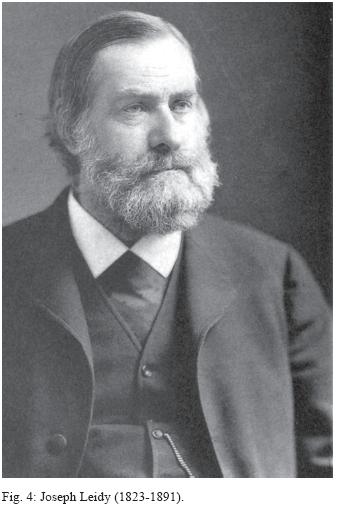
<body><![CDATA[<br> <br style="font-weight: bold;"> <font style="font-family: verdana; font-weight: bold;" size="2">Leidy and the Tambla molar</font>    <br>     <br> <font style="font-family: verdana;" size="2">Joseph Leidy (1823-1891) (<a href="#fig4">Fig. 4</a>) is considered the father of American vertebrate paleontology and was a professor at the University of Pennsylvania and a Curator at the Academy of Natural Sciences in Philadelphia (Warren, 1998). Because of his expertise in vertebrate anatomy and paleontology, fossils from many locations were sent to Leidy for study. Thus, Leidy (1859, p. 91) announced receiving a single molar of a gomphothere proboscidean from Tambla at the 22 March 1859 meeting of the Academy of Natural Sciences in Philadelphia, stating that &#8220;Dr. Leidy called the attention of the members to the tooth of the <span style="font-style: italic;">Mastodon</span>, from Tambla, Honduras, presented by Capt. J. M. Dow, this evening.&#8221; This tooth, which we term the &#8220;Tambla molar,&#8221; is the only fossil from the Tambla fossil locality now extant in a collection-</font><font  style="font-family: verdana;" size="2">--it is catalogued in the collection of the Academy of Natural Sciences of Philadelphia (see below). Leidy&#8217;s (1859, p. 91) report went on to conclude that the Tambla molar &#8220;probably belongs to the species <span style="font-style: italic;">&#8216;Mastodon ohioticus</span>.&#8217;&#8221;     <br>     <br>     <br>     <br> </font>     <div style="text-align: center;"><a name="fig4"></a><img alt=""  src="/img/revistas/rgac/n44/a09i4.jpg"  style="width: 337px; height: 507px;">    <br>     <br>     ]]></body>
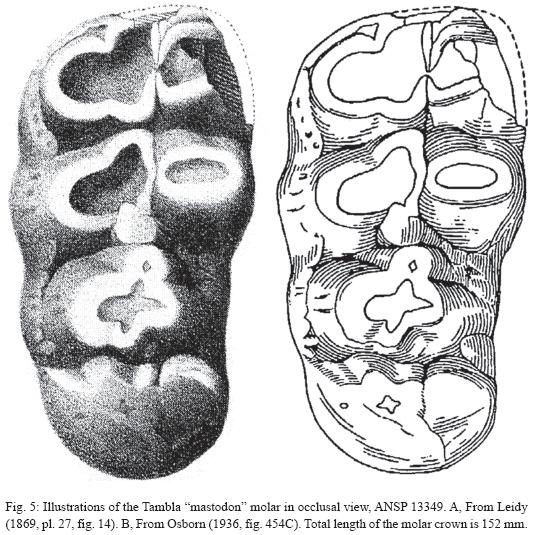
<body><![CDATA[<br> </div> <font style="font-family: verdana;" size="2">John Melmouth Dow (1827-1892) was an American shipmaster, shipping agent and naturalist who first went to the Central American coast in 1851 and worked there in association with the Panama Railroad Company (Udovic et al., 1974). He remained involved in the coastal trade of Central and South America until 1876 and also worked for the Panama Railroad Company. Dow&#8217;s activities as a naturalist focused on collecting extant fishes, and catalogues and information about his collections were published by various authorities. Dow was also a correspondent of the Academy of Natural Sciences in Philadelphia. How Dow acquired the Tambla molar is unknown; perhaps it was the &#8220;single tooth as a trophy&#8221; that Squier (1859, p. 610) says he collected, but we know of no way to confirm this possibility. Dow&#8217;s association with the Academy of Natural Sciences and with Leidy no doubt led him to donate the molar to the Academy. </font>    <br>     <br> <font style="font-family: verdana;" size="2">In his classic monograph on the fossil mammals of the Dakota and Nebraska territories, Leidy (1869, p. 242-243, pl. 27, fig. 14) described and illustrated the proboscidean molar from Tambla (<a  href="#fig5">Fig. 5A</a>). Leidy (1869, p. 240) stated that &#8220;perhaps the <span  style="font-style: italic;">Mastodon andium</span> is indicated by a molar tooth, obtained at Tambla, Honduras, by Capt. J. M. Dow, and presented by him to the Academy.&#8221; Leidy (1869, p. 242-243) based this tentative identification on the similarity of the Tambla molar to a molar of <span style="font-style: italic;">M. andium</span> from Tarija, Bolivia described and illustrated by Gervais (1855, p. 20, pl. 5, fig. 3). In current taxonomy, the gomphothere from Tarija would be identified as <span style="font-style: italic;">Cuvieronius hyodon</span> (Lucas, 2008a, b; Ferretti, 2008).    <br>     <br> &nbsp;    <br>     <br> </font>     <div style="text-align: center;"><a name="fig5"></a><img alt=""  src="/img/revistas/rgac/n44/a09i5.jpg"  style="width: 536px; height: 535px;">    <br>     <br>     ]]></body>
<body><![CDATA[<br> </div> <font style="font-family: verdana; font-weight: bold;" size="2">The Tambla molar as <span style="font-style: italic;">Rhynchotherium</span> </font>    <br>     <br> <font style="font-family: verdana;" size="2">In describing proboscidean fossils from the Valley of Mexico, Edward Drinker Cope (1884, p. 7) referred to the Tambla molar, allying it to the taxon he called &#8220;<span style="font-style: italic;">Dibelodon shepardi</span>,&#8221; a species later referred to <span style="font-style: italic;">Rhynchotherium</span> by various authors, but now regarded as a <span style="font-style: italic;">nomen dubium</span> based on undiagnostic type material (Lucas &amp; Morgan, 2008). Indeed, in his comprehensive monograph on the Proboscidea, Henry Fairfield Osborn (1936, p. 482) referred to the Tambla molar illustrated by Leidy (1869) as &#8220;certainly a member of the Rhynchorostrinae and allied to <span style="font-style: italic;">Rhynchotherium browni</span> of Sonora. &#8220; Osborn (1936, fig. 454C) illustrated the molar as <span style="font-style: italic;">Rhynchotherium</span> (<a href="#fig5">Fig. 5B</a>) </font><font  style="font-family: verdana;" size="2">and also stated (p. 535) that it is &#8220;more primitive than <span style="font-style: italic;">Rhynchotherium falconeri</span>&#8230;it resembles <span style="font-style: italic;">R. browni</span> of Sonora, Mexico.&#8221; Laurito &amp; Valerio (2005) also mentioned the Tambla molar as <span  style="font-style: italic;">Rhynchotherium</span>. </font>    <br> <br style="font-weight: bold;"> <font style="font-family: verdana; font-weight: bold;" size="2">Identification of the Tambla MOLAR </font>    <br>     <br> <font style="font-family: verdana;" size="2">The Tambla molar (<a  href="/img/revistas/rgac/n44/a09i6.jpg">Fig. 6</a>), catalogued as ANSP (Academy of Natural Sciences of </font><font style="font-family: verdana;" size="2">Philadelphia) 13349, is a left lower third molar (m3) that has a maximum crown length of 152 mm and a maximum crown width of 79.5 mm. It has four lophids, single trefoils, a relatively low crown and ptychodont enamel. The tooth is moderatelyworn, so that dentine is exposed across the first three lophids, and it has a distinct labial cingulid. </font>    <br>     <br> <font style="font-family: verdana;" size="2">The &#8220;mastodon&#8221; fossils from Tambla have been assigned a variety of taxonomic names: <span style="font-style: italic;">Mastodon giganteus</span> by Le Conte (1858), <span style="font-style: italic;">Mastodon ohioticus</span> by Leidy (1859), <span style="font-style: italic;">Mastodon</span> (= <span style="font-style: italic;">Haplomastodon</span>) <span  style="font-style: italic;">andium </span>by Leidy (1869), <span style="font-style: italic;">Dibelodon shepardi</span> by Cope (1884), <span style="font-style: italic;">Rhynchotherium</span> by Osborn (1936) and Laurito &amp; Valerio (2005), and <span  style="font-style: italic;">Cuvieronius hyodon</span> by Lucas et al. (2007). The relatively bunodont crown with trefoils excludes identification as &#8220;<span style="font-style: italic;">Mastodon</span>&#8221; (= <span style="font-style: italic;">Mammut </span>in North American usage), and the isolated tooth cannot be assigned with certainty to either<span style="font-style: italic;"> Haplomastodon</span>, <span  style="font-style: italic;">Rhynchotherium </span>or <span  style="font-style: italic;">Cuvieronius</span> (cf. Lucas, 2008a; Lucas &amp; Morgan, 2008). Given that <span style="font-style: italic;">Haplomastodon</span> and <span style="font-style: italic;">Rhynchotherium </span>are not otherwise known from Central America (Lucas &amp; Alvarado, 2010), and if we accept in the probable determination of <span  style="font-style: italic;">Bison</span> (see previously comment based on LeConte, 1858), indicating a Pleistocene age (in apparent agreement with the regional geology briefly describe below), it seems most parsimonious to assign the Tambla molar to<span  style="font-style: italic;"> Cuvieronius</span>, which is the most common Pleistocene gomphothere known from Central America (<a href="/img/revistas/rgac/n44/a09i7.jpg">Fig. 7</a>).</font>    <br>     <br> <font style="font-family: verdana; font-weight: bold;" size="2">Location of the Tambla Gomphothere bonebed </font>    ]]></body>
<body><![CDATA[<br>     <br> <font style="font-family: verdana;" size="2">On current maps of Honduras, Tambla is a town located in the Department of Lempira in western Honduras (14&deg;12&#8217;N, 88&deg;43&#8217;W). Indeed, University of Florida paleontologist David Webb attempted to locate the Tambla fossil locality near that village, stating that in 1969 he &#8220;visited that remote village in the hope of finding further fossils, but no leads nor even promising sediments within the ignimbrite mass were discovered. Presumably the &#8216;Tambla <span  style="font-style: italic;">Mastodon</span>&#8217; came from a limited Pleistocene deposit in that area&#8221; (Webb &amp; Perrigo, 1984, p. 238).</font>    <br>     <br> <font style="font-family: verdana;" size="2">The actual location of the Tambla being referred to by LeConte, Dow, Leidy and Squier in the 1850s is much different. It is in the Comayagua Valley, and is modern Humuya, a village on the lower R&iacute;o Curur&uacute; in the department of Comayagua, 120 km east of Tambla, Lempira (<a href="#fig1">Fig. 1</a>). Squier&#8217;s map of his expedition reveals that (<a href="/img/revistas/rgac/n44/a09i8.jpg">Fig. 8</a>). In fact, the village of Tambla changed its name to the municipality of Humuya (also known as Humaya) after January 26, 1897, while contemporaneously, the former village of Tomal&aacute; in Lempira changed its name to the municipality of Tambla on September 11, 1896. The R&iacute;o Chiquinguara is now the R&iacute;o Humuya. Thus, it is easy to understand the confusion and mistake of Webb &amp; Perrigo (1984) as to the location of the fossil site. </font>    <br>     <br> <font style="font-family: verdana;" size="2">Squier&#8217;s (1859) account of the bonebed can also be used to determine its more precise location. Thus, on the first day of his visit to Guajiquiro (in the present-day department of La Paz), Squier visited the ruins of Yarumela and ended at the town of La Paz (also called Las Piedras), which is on the west side of the Comayagua Valley. The following morning, he and his companions were on horseback at dawn and arrived at the fossil locality by breakfast, thus probably riding for no more than three hours. After that, they continued to Guajiquiro, though it is not clear if the bone locality was off the main trail from La Paz to Guajiquiro. Squier (1859, p. 610-611) describes the trip after the bonebed as &#8220;a simple scramble up the mountains&#8221; and notes that &#8220;the temperature became sensibly cooler.&#8221; We take this as a strong clue that the bonebed itself is below 1000 meters in elevation. </font>    <br>     <br> <font style="font-family: verdana;" size="2">Squier (1859) mentions the plain near the town of Tambla; clearly, the plain is the Comayagua Valley, so it seems likely that the bonebed was located on the edge of the plain, most likely on an alluvial fan at the base of a ridge. Pleistocene fossil bone localities are common in the Valle de Agalta in the department of Olancho northeastern Honduras) in these types of areas, where streams have dissected the alluvium. Squier&#8217;s (1859) statement that the bones were a league from Tambla seems misleading. Most likely, somebody in Tambla told him they were &#8220;una legua&#8221; and he wrote that down. This measurement can vary by several km. LeConte&#8217;s (1858) reference to the bonebed being &#8220;in one of the passes leading from the plain of Comayagua to the Pacific,&#8221; suggests that this is the &#8220;Pass of Guajoca,&#8221; an extremely low pass on the way to the coast (<a href="#fig1">Fig. 1</a>). This indicates that the bonebed is southwest of modern Humuya, north of the Rio Moloa and south of the R&iacute;o Humuya (<a href="#fig1">Fig. 1</a>). The sediments in this area are fluvial deposits (channel and overbank fines) mixed with a significant amount of ashfall tuffs. These fluvial strata, presumably of Quaternary age, overlie with angular unconformity the main beds of the mid-Miocene ignimbrite flare-up. Cursory exploration by one of us (RR) of this area, and inquiries of local residents, however, have so far not turned up a fossil bonebed. </font>    <br> <br style="font-weight: bold;"> <font style="font-family: verdana; font-weight: bold;" size="3">Conclusion</font><br  style="font-weight: bold;">     <br> <font style="font-family: verdana;" size="2">What remains from this historical review of the discovery of gomphothere fossils near </font><font style="font-family: verdana;"  size="2">Tambla in the 1850s is a mystery---where is the &#8220;mastodon bed&#8221; (LeConte, 1858, p. 7) </font><font style="font-family: verdana;"  size="2">near the village of Tambla? In the 1850s at least three naturalists who visited Tambla were aware of an assemblage of proboscidean and other fossils located near the village. Rediscovery of this important fossil deposit should be pursued. </font>    ]]></body>
<body><![CDATA[<br>     <br> <font style="font-family: verdana;" size="2">Perhaps a smaller mystery is why has there been no attempt to relocate the Tambla bonebed other than the misguided effort of Webb in 1969. In other words, why didn&#8217;t the discovery of vertebrate fossils in Honduras during the 1850s lead to further exploration, or even a &#8220;bone rush,&#8221; much as happened in the American West at about the same time? We think the answer to this question lies partly in the remote and challenging terrain that Central America posed to the fossil hunters of the late 1800s. In addition, by the 1850s fossils of &#8220;mastodon&#8221; were common in the USA, having been some of the first fossils recognized in North America (e.g., Thomson, 2008). The discovery of &#8220;mastodon&#8221; fossils in Honduras during the 1850s was thus merely another record of what were by then known to be common fossils, not an exciting discovery that drove further exploration. </font>    <br>     <br> <font style="font-family: verdana; font-weight: bold;" size="3">Acknowledgments</font>    <br>     <br> <font style="font-family: verdana;" size="2">Ted Daeschler and Ned Gilmore allowed access to the ANSP fossil collection. William Davidson provided helpful insight into the 1850s location of Tambla in Honduras. </font>    <br> <hr style="width: 100%; height: 2px;"><font  style="font-family: verdana; font-weight: bold;" size="3">References</font>    <br>     <!-- ref --><br> <font style="font-family: verdana;" size="2">Alvarado, G.E. 1986: Hallazgos de megamamm&iacute;feros f&oacute;siles de Costa Rica.-Rev. Geol. Am&eacute;r. Central, 4: 1-46.    &nbsp;&nbsp;&nbsp;&nbsp;&nbsp;&nbsp;&nbsp;&nbsp;[&#160;<a href="javascript:void(0);" onclick="javascript: window.open('/scielo.php?script=sci_nlinks&ref=979093&pid=S0256-7024201100010000900001&lng=','','width=640,height=500,resizable=yes,scrollbars=1,menubar=yes,');">Links</a>&#160;]<!-- end-ref --> </font>    ]]></body>
<body><![CDATA[<br>     <!-- ref --><br> <font style="font-family: verdana;" size="2">Alvarado, G.E., 1994: Historia Natural Antigua.- 232 p&aacute;gs., Cartago, Ed. Tec. de Costa Rica.    &nbsp;&nbsp;&nbsp;&nbsp;&nbsp;&nbsp;&nbsp;&nbsp;[&#160;<a href="javascript:void(0);" onclick="javascript: window.open('/scielo.php?script=sci_nlinks&ref=979096&pid=S0256-7024201100010000900002&lng=','','width=640,height=500,resizable=yes,scrollbars=1,menubar=yes,');">Links</a>&#160;]<!-- end-ref --> </font>    <br>     <!-- ref --><br> <font style="font-family: verdana;" size="2">Barnhart, T.A. 2005: Ephraim George Squier and the development of American anthropology.- 426 p&aacute;gs., Lincoln, Univ. of Nebraska Press.    &nbsp;&nbsp;&nbsp;&nbsp;&nbsp;&nbsp;&nbsp;&nbsp;[&#160;<a href="javascript:void(0);" onclick="javascript: window.open('/scielo.php?script=sci_nlinks&ref=979099&pid=S0256-7024201100010000900003&lng=','','width=640,height=500,resizable=yes,scrollbars=1,menubar=yes,');">Links</a>&#160;]<!-- end-ref --> </font>    <br>     <!-- ref --><br> <font style="font-family: verdana;" size="2">Cisneros, J.C., 2005: New Pleistocene vertebrate fauna from El Salvador.- Rev. Brasil. Paleont. 8: 239-255.    &nbsp;&nbsp;&nbsp;&nbsp;&nbsp;&nbsp;&nbsp;&nbsp;[&#160;<a href="javascript:void(0);" onclick="javascript: window.open('/scielo.php?script=sci_nlinks&ref=979102&pid=S0256-7024201100010000900004&lng=','','width=640,height=500,resizable=yes,scrollbars=1,menubar=yes,');">Links</a>&#160;]<!-- end-ref --> </font>    <br>     ]]></body>
<body><![CDATA[<!-- ref --><br> <font style="font-family: verdana;" size="2">Cisneros, J.C., 2008: The fossil mammals of El Salvador.- New Mex. Mus. Nat. Hist.Sci. Bull. 44: 375-380.    &nbsp;&nbsp;&nbsp;&nbsp;&nbsp;&nbsp;&nbsp;&nbsp;[&#160;<a href="javascript:void(0);" onclick="javascript: window.open('/scielo.php?script=sci_nlinks&ref=979105&pid=S0256-7024201100010000900005&lng=','','width=640,height=500,resizable=yes,scrollbars=1,menubar=yes,');">Links</a>&#160;]<!-- end-ref --> </font>    <br>     <!-- ref --><br> <font style="font-family: verdana;" size="2">Cope, E.D., 1884: The extinct Mammalia of the Valley of Mexico.- Proc. Amer. Phil. Soc. 22: 1-21.    &nbsp;&nbsp;&nbsp;&nbsp;&nbsp;&nbsp;&nbsp;&nbsp;[&#160;<a href="javascript:void(0);" onclick="javascript: window.open('/scielo.php?script=sci_nlinks&ref=979108&pid=S0256-7024201100010000900006&lng=','','width=640,height=500,resizable=yes,scrollbars=1,menubar=yes,');">Links</a>&#160;]<!-- end-ref --> </font>    <br>     <!-- ref --><br> <font style="font-family: verdana;" size="2">Ferretti, M.P., 2008: A review of South American proboscideans.- New Mex. Mus.Nat. Hist. Sci. Bull. 44: 381-391.    &nbsp;&nbsp;&nbsp;&nbsp;&nbsp;&nbsp;&nbsp;&nbsp;[&#160;<a href="javascript:void(0);" onclick="javascript: window.open('/scielo.php?script=sci_nlinks&ref=979111&pid=S0256-7024201100010000900007&lng=','','width=640,height=500,resizable=yes,scrollbars=1,menubar=yes,');">Links</a>&#160;]<!-- end-ref --> </font>    <br>     <!-- ref --><br> <font style="font-family: verdana;" size="2">Ervais, P., 1855: Recherches sur les mammif&egrave;res fossiles d l&#8217;Am&eacute;rique m&eacute;ridionale.- In: Castelnau, F.L. (Ed.): Animaux nouveaux ou rares recueillis pendant l&#8217;exp&eacute;dition dans les parties centrals d l&#8217;Am&eacute;rique du Sud, de Rio de Janeiro &agrave; Lima, et de Lima au Para: Paris: 1-63.    &nbsp;&nbsp;&nbsp;&nbsp;&nbsp;&nbsp;&nbsp;&nbsp;[&#160;<a href="javascript:void(0);" onclick="javascript: window.open('/scielo.php?script=sci_nlinks&ref=979114&pid=S0256-7024201100010000900008&lng=','','width=640,height=500,resizable=yes,scrollbars=1,menubar=yes,');">Links</a>&#160;]<!-- end-ref --> </font>    <br>     <!-- ref --><br> <font style="font-family: verdana;" size="2">H&eacute;bert, J.R., 1972: Maps by journalist, scholar and diplomat Ephraim George Squier.-Quart. J. Lib. Congr. 29: 14-31.    &nbsp;&nbsp;&nbsp;&nbsp;&nbsp;&nbsp;&nbsp;&nbsp;[&#160;<a href="javascript:void(0);" onclick="javascript: window.open('/scielo.php?script=sci_nlinks&ref=979117&pid=S0256-7024201100010000900009&lng=','','width=640,height=500,resizable=yes,scrollbars=1,menubar=yes,');">Links</a>&#160;]<!-- end-ref --> </font>    <br>     <!-- ref --><br> <font style="font-family: verdana;" size="2">Ibarra, J.A., 1980: Paleontolog&iacute;a en Guatemala.- 52 p&aacute;gs, Guatemala. Editorial &#8220;Jose de Pineda Ibarra.    &nbsp;&nbsp;&nbsp;&nbsp;&nbsp;&nbsp;&nbsp;&nbsp;[&#160;<a href="javascript:void(0);" onclick="javascript: window.open('/scielo.php?script=sci_nlinks&ref=979120&pid=S0256-7024201100010000900010&lng=','','width=640,height=500,resizable=yes,scrollbars=1,menubar=yes,');">Links</a>&#160;]<!-- end-ref --> </font>    <br>     <!-- ref --><br> <font style="font-family: verdana;" size="2">Laurito, C.A., 1988: Los probosc&iacute;deos f&oacute;siles de Costa Rica y su contexto en la Am&eacute;rica Central.- V&iacute;nculos, 14: 29-58.    &nbsp;&nbsp;&nbsp;&nbsp;&nbsp;&nbsp;&nbsp;&nbsp;[&#160;<a href="javascript:void(0);" onclick="javascript: window.open('/scielo.php?script=sci_nlinks&ref=979123&pid=S0256-7024201100010000900011&lng=','','width=640,height=500,resizable=yes,scrollbars=1,menubar=yes,');">Links</a>&#160;]<!-- end-ref --> </font>    ]]></body>
<body><![CDATA[<br>     <!-- ref --><br> <font style="font-family: verdana;" size="2">Laurito, C.A. &amp; Valerio, A.L., 2005: First record of <span style="font-style: italic;">Rhynchotherium blicki </span>(Frick,1933) for the late Cenozoic of Costa Rica.- Rev. Geol. Am&eacute;r. Central, 33: 75-82.    &nbsp;&nbsp;&nbsp;&nbsp;&nbsp;&nbsp;&nbsp;&nbsp;[&#160;<a href="javascript:void(0);" onclick="javascript: window.open('/scielo.php?script=sci_nlinks&ref=979126&pid=S0256-7024201100010000900012&lng=','','width=640,height=500,resizable=yes,scrollbars=1,menubar=yes,');">Links</a>&#160;]<!-- end-ref --> </font>    <br>     <!-- ref --><br> <font style="font-family: verdana;" size="2">Leconte, J. 1858: Mastodon bed in Honduras.- Proc. Acad. Nat. Sci. Phila. 10: 7.    &nbsp;&nbsp;&nbsp;&nbsp;&nbsp;&nbsp;&nbsp;&nbsp;[&#160;<a href="javascript:void(0);" onclick="javascript: window.open('/scielo.php?script=sci_nlinks&ref=979129&pid=S0256-7024201100010000900013&lng=','','width=640,height=500,resizable=yes,scrollbars=1,menubar=yes,');">Links</a>&#160;]<!-- end-ref --></font>    <br>     <!-- ref --><br> <font style="font-family: verdana;" size="2">Leidy, J., 1859: Mastodon tooth from Honduras.Proc. Acad. Nat. Sci. Phila. 11: 91.    &nbsp;&nbsp;&nbsp;&nbsp;&nbsp;&nbsp;&nbsp;&nbsp;[&#160;<a href="javascript:void(0);" onclick="javascript: window.open('/scielo.php?script=sci_nlinks&ref=979132&pid=S0256-7024201100010000900014&lng=','','width=640,height=500,resizable=yes,scrollbars=1,menubar=yes,');">Links</a>&#160;]<!-- end-ref --></font>    <br>     ]]></body>
<body><![CDATA[<!-- ref --><br> <font style="font-family: verdana;" size="2">Leidy, J., 1869: The extinct mammalian fauna of Dakota and Nebraska, including an account of some allied forms from other localities, together with a synopsis of the mammalian remains of North America.- J.Acad. Nat. Sci. Phila. 7: 1-472.    &nbsp;&nbsp;&nbsp;&nbsp;&nbsp;&nbsp;&nbsp;&nbsp;[&#160;<a href="javascript:void(0);" onclick="javascript: window.open('/scielo.php?script=sci_nlinks&ref=979135&pid=S0256-7024201100010000900015&lng=','','width=640,height=500,resizable=yes,scrollbars=1,menubar=yes,');">Links</a>&#160;]<!-- end-ref --> </font>    <br>     <!-- ref --><br> <font style="font-family: verdana;" size="2">Leidy, J., 1886: <span  style="font-style: italic;">Toxodon</span> and other remains from Nicaragua.- Proc. Acad. Nat. Sci. Phil. 1886: 275-277.    &nbsp;&nbsp;&nbsp;&nbsp;&nbsp;&nbsp;&nbsp;&nbsp;[&#160;<a href="javascript:void(0);" onclick="javascript: window.open('/scielo.php?script=sci_nlinks&ref=979138&pid=S0256-7024201100010000900016&lng=','','width=640,height=500,resizable=yes,scrollbars=1,menubar=yes,');">Links</a>&#160;]<!-- end-ref --> </font>    <br>     <!-- ref --><br> <font style="font-family: verdana;" size="2">Lucas, S.G., 2008a:<span  style="font-style: italic;"> Cuvieronius</span> (Mammalia, Proboscidea) from the Neogene of Florida.- New Mex. Mus. Nat. Hist. Sci. Bull. 44: 31-38.    &nbsp;&nbsp;&nbsp;&nbsp;&nbsp;&nbsp;&nbsp;&nbsp;[&#160;<a href="javascript:void(0);" onclick="javascript: window.open('/scielo.php?script=sci_nlinks&ref=979141&pid=S0256-7024201100010000900017&lng=','','width=640,height=500,resizable=yes,scrollbars=1,menubar=yes,');">Links</a>&#160;]<!-- end-ref --> </font>    <br>     <!-- ref --><br> <font style="font-family: verdana;" size="2">Lucas, S.G., 2008b: Taxonomic nomenclature of <span style="font-style: italic;">Cuvieronius</span> and <span style="font-style: italic;">Haplomastodon</span>, proboscideans from the Plio-Pleistocene of the New World.- New Mex. Mus. Nat. Hist. Sci. Bull. 44: 409-415.    &nbsp;&nbsp;&nbsp;&nbsp;&nbsp;&nbsp;&nbsp;&nbsp;[&#160;<a href="javascript:void(0);" onclick="javascript: window.open('/scielo.php?script=sci_nlinks&ref=979144&pid=S0256-7024201100010000900018&lng=','','width=640,height=500,resizable=yes,scrollbars=1,menubar=yes,');">Links</a>&#160;]<!-- end-ref --> </font>    <br>     <!-- ref --><br> <font style="font-family: verdana;" size="2">Lucas, S.G. &amp; Alvarado, G.E. 2010: Fossil Proboscidea from the upper Cenozoic of Central America: Taxonomy, evolutionary and paleobiogeographic significance.- Rev. Geol.. Am&eacute;r. Central, 42: 9-42.    &nbsp;&nbsp;&nbsp;&nbsp;&nbsp;&nbsp;&nbsp;&nbsp;[&#160;<a href="javascript:void(0);" onclick="javascript: window.open('/scielo.php?script=sci_nlinks&ref=979147&pid=S0256-7024201100010000900019&lng=','','width=640,height=500,resizable=yes,scrollbars=1,menubar=yes,');">Links</a>&#160;]<!-- end-ref --> </font>    <br>     <!-- ref --><br> <font style="font-family: verdana;" size="2">Lucas, S.G. &amp; Morgan, G.S., 2008: Taxonomy of <span style="font-style: italic;">Rhynchotherium </span>(Mammalia, Proboscidea) from the Miocene-Pliocene of North America.- New Mex. Mus. Nat.Hist. Sci. Bull. 44: 71-87.    &nbsp;&nbsp;&nbsp;&nbsp;&nbsp;&nbsp;&nbsp;&nbsp;[&#160;<a href="javascript:void(0);" onclick="javascript: window.open('/scielo.php?script=sci_nlinks&ref=979150&pid=S0256-7024201100010000900020&lng=','','width=640,height=500,resizable=yes,scrollbars=1,menubar=yes,');">Links</a>&#160;]<!-- end-ref --> </font>    <br>     <!-- ref --><br> <font style="font-family: verdana;" size="2">Lucas, S.G., Alvarado, G.E. &amp; Vega, E., 1997: The Pleistocene mammals of Costa Rica.- J. Vert. Paleont. 17: 413-427.    &nbsp;&nbsp;&nbsp;&nbsp;&nbsp;&nbsp;&nbsp;&nbsp;[&#160;<a href="javascript:void(0);" onclick="javascript: window.open('/scielo.php?script=sci_nlinks&ref=979153&pid=S0256-7024201100010000900021&lng=','','width=640,height=500,resizable=yes,scrollbars=1,menubar=yes,');">Links</a>&#160;]<!-- end-ref --> </font>    ]]></body>
<body><![CDATA[<br>     <!-- ref --><br> <font style="font-family: verdana;" size="2">Lucas, S.G., Garc&iacute;a, R., Espinoza, E., Alvarado, G.E., Hurtado de Mendoza, L. &amp; Vega, E., 2008: The fossil mammsl of Nicaragua.- New Mex. Mus. Nat. Hist. Sci. Bull. 44:417-429 </font>    &nbsp;&nbsp;&nbsp;&nbsp;&nbsp;&nbsp;&nbsp;&nbsp;[&#160;<a href="javascript:void(0);" onclick="javascript: window.open('/scielo.php?script=sci_nlinks&ref=979156&pid=S0256-7024201100010000900022&lng=','','width=640,height=500,resizable=yes,scrollbars=1,menubar=yes,');">Links</a>&#160;]<!-- end-ref --><br>     <!-- ref --><br> <font style="font-family: verdana;" size="2">Lucas, S.G., Alvarado, G.E., Garc&iacute;a, R., Espinoza, E., Cisneros, J.C. &amp; Martens, U., 2007: Vertebrate paleontology.- In: Bundschuh, J. &amp; Alvarado, G.E. (Eds): Central America: Geology, resources and hazards. Taylor &amp; Francis, London: 443-451.    &nbsp;&nbsp;&nbsp;&nbsp;&nbsp;&nbsp;&nbsp;&nbsp;[&#160;<a href="javascript:void(0);" onclick="javascript: window.open('/scielo.php?script=sci_nlinks&ref=979158&pid=S0256-7024201100010000900023&lng=','','width=640,height=500,resizable=yes,scrollbars=1,menubar=yes,');">Links</a>&#160;]<!-- end-ref --></font>    <br>     <!-- ref --><br> <font style="font-family: verdana;" size="2">Macfadden, B.J., 2006: North American Miocene land mammals from Panama.- J. Vert. Paleont. 26: 720-734.    &nbsp;&nbsp;&nbsp;&nbsp;&nbsp;&nbsp;&nbsp;&nbsp;[&#160;<a href="javascript:void(0);" onclick="javascript: window.open('/scielo.php?script=sci_nlinks&ref=979161&pid=S0256-7024201100010000900024&lng=','','width=640,height=500,resizable=yes,scrollbars=1,menubar=yes,');">Links</a>&#160;]<!-- end-ref --> </font>    <br>     <!-- ref --><br> <font style="font-family: verdana;" size="2">Osborn, H. F., 1936: Proboscidea Volume I: Moeritheroidea Deinotheroidea Mastodontoidea.- 802 p&aacute;gs., New York, The American Museum Press.    &nbsp;&nbsp;&nbsp;&nbsp;&nbsp;&nbsp;&nbsp;&nbsp;[&#160;<a href="javascript:void(0);" onclick="javascript: window.open('/scielo.php?script=sci_nlinks&ref=979164&pid=S0256-7024201100010000900025&lng=','','width=640,height=500,resizable=yes,scrollbars=1,menubar=yes,');">Links</a>&#160;]<!-- end-ref --></font>    <br>     <!-- ref --><br> <font style="font-family: verdana;" size="2">Squier, E.G. 1859: A visit to the Guajiquero Indians.- Haper&#8217;s New Monthly Mag. 19 (113): 602-619.    &nbsp;&nbsp;&nbsp;&nbsp;&nbsp;&nbsp;&nbsp;&nbsp;[&#160;<a href="javascript:void(0);" onclick="javascript: window.open('/scielo.php?script=sci_nlinks&ref=979167&pid=S0256-7024201100010000900026&lng=','','width=640,height=500,resizable=yes,scrollbars=1,menubar=yes,');">Links</a>&#160;]<!-- end-ref --> </font>    <br>     <!-- ref --><br> <font style="font-family: verdana;" size="2">Thomson, K. 2008: The legacy of the mastodon: The golden age of fossils in America.- 386 p&aacute;gs, New Haven, Yale University Press.    &nbsp;&nbsp;&nbsp;&nbsp;&nbsp;&nbsp;&nbsp;&nbsp;[&#160;<a href="javascript:void(0);" onclick="javascript: window.open('/scielo.php?script=sci_nlinks&ref=979170&pid=S0256-7024201100010000900027&lng=','','width=640,height=500,resizable=yes,scrollbars=1,menubar=yes,');">Links</a>&#160;]<!-- end-ref --> </font>    <br>     <!-- ref --><br> <font style="font-family: verdana;" size="2">Udovic, R., Morrison, M. &amp; Hickerson, T. 1974: John Melmoth Dow, 1827-1892.- 40 p&aacute;gs. Papers, 1798-1918. Cornell University, Department of Manuscripts and Archives.    &nbsp;&nbsp;&nbsp;&nbsp;&nbsp;&nbsp;&nbsp;&nbsp;[&#160;<a href="javascript:void(0);" onclick="javascript: window.open('/scielo.php?script=sci_nlinks&ref=979173&pid=S0256-7024201100010000900028&lng=','','width=640,height=500,resizable=yes,scrollbars=1,menubar=yes,');">Links</a>&#160;]<!-- end-ref --> </font>    ]]></body>
<body><![CDATA[<br>     <!-- ref --><br> <font style="font-family: verdana;" size="2">Warren, L., 1998: Joseph Leidy: The last man who knew everything.- 303 p&aacute;gs. Yale University Press.    &nbsp;&nbsp;&nbsp;&nbsp;&nbsp;&nbsp;&nbsp;&nbsp;[&#160;<a href="javascript:void(0);" onclick="javascript: window.open('/scielo.php?script=sci_nlinks&ref=979176&pid=S0256-7024201100010000900029&lng=','','width=640,height=500,resizable=yes,scrollbars=1,menubar=yes,');">Links</a>&#160;]<!-- end-ref --> </font>    <br>     <!-- ref --><br> <font style="font-family: verdana;" size="2">Webb, S.D. &amp; Perrigo, S.C., 1984: Late Cenozoic vertebrates from Honduras and El Salvador.- J. Vert. Paleo. 4: 237-254.    &nbsp;&nbsp;&nbsp;&nbsp;&nbsp;&nbsp;&nbsp;&nbsp;[&#160;<a href="javascript:void(0);" onclick="javascript: window.open('/scielo.php?script=sci_nlinks&ref=979179&pid=S0256-7024201100010000900030&lng=','','width=640,height=500,resizable=yes,scrollbars=1,menubar=yes,');">Links</a>&#160;]<!-- end-ref -->&nbsp; </font>    <br>     <!-- ref --><br> <font style="font-family: verdana;" size="2">Woodburne, M.O., 2010: The great American biotic interchange: dispersals, tectonics, climate, sea level and holding pens.- J. Mammal. Evol. 17: 245-264.    &nbsp;&nbsp;&nbsp;&nbsp;&nbsp;&nbsp;&nbsp;&nbsp;[&#160;<a href="javascript:void(0);" onclick="javascript: window.open('/scielo.php?script=sci_nlinks&ref=979182&pid=S0256-7024201100010000900031&lng=','','width=640,height=500,resizable=yes,scrollbars=1,menubar=yes,');">Links</a>&#160;]<!-- end-ref --><br>     <br>     ]]></body>
<body><![CDATA[<br> <a name="correspondencia1"></a><a href="#correspondencia2">*</a>Correspondencia a: </font><font style="font-family: verdana;" size="2">Spencer G. Lucas. </font><font style="font-family: verdana;" size="2">New Mexico Museum of Natural History and Science, 1801 Mountain Road </font><font  style="font-family: verdana;" size="2">N. W., Albuquerque, New Mexico 87104 USA, </font><a href="mailto:spencer.lucas@state.nm.us"><font  style="font-family: verdana;" size="2">spencer.lucas@state.nm.us</font></a>    <br> <font style="font-family: verdana;" size="2">Mark Bonta. </font><font style="font-family: verdana;" size="2">Division of Social Sciences, Delta State University, Cleveland, Mississippi 38733 USA    <br> </font><font style="font-family: verdana;" size="2">Robert Rogers. </font><font  style="font-family: verdana;" size="2">Department of Physics and Geology, California State University, Stanislaus, One University Circle, Turlock, California 94382    <br> </font><font style="font-family: verdana;" size="2">Guillermo E. Alvarado. </font><font style="font-family: verdana;" size="2">Escuela Centroamericana de Geolog&iacute;a, Universidad de Costa Rica, Apdo. 214, </font><font style="font-family: verdana;" size="2">2060, San Jos&eacute;, Costa Rica</font> <hr style="width: 100%; height: 2px;">     <div style="text-align: center;"><font style="font-family: verdana;"  size="2">Recibido: 15/02/2011; aceptado: 01/06/2011</font>    <br> </div> </div>      ]]></body><back>
<ref-list>
<ref id="B1">
<nlm-citation citation-type="journal">
<person-group person-group-type="author">
<name>
<surname><![CDATA[Alvarado]]></surname>
<given-names><![CDATA[G.E]]></given-names>
</name>
</person-group>
<article-title xml:lang="es"><![CDATA[Hallazgos de megamammíferos fósiles de Costa Rica]]></article-title>
<source><![CDATA[Rev. Geol. Amér. Central]]></source>
<year>1986</year>
<volume>4</volume>
<page-range>1-46</page-range></nlm-citation>
</ref>
<ref id="B2">
<nlm-citation citation-type="book">
<person-group person-group-type="author">
<name>
<surname><![CDATA[Alvarado]]></surname>
<given-names><![CDATA[G.E]]></given-names>
</name>
</person-group>
<source><![CDATA[Historia Natural Antigua]]></source>
<year>1994</year>
<page-range>232</page-range><publisher-loc><![CDATA[Cartago ]]></publisher-loc>
<publisher-name><![CDATA[Ed. Tec. de Costa Rica]]></publisher-name>
</nlm-citation>
</ref>
<ref id="B3">
<nlm-citation citation-type="book">
<person-group person-group-type="author">
<name>
<surname><![CDATA[Barnhart]]></surname>
<given-names><![CDATA[T.A]]></given-names>
</name>
</person-group>
<source><![CDATA[Ephraim George Squier and the development of American anthropology]]></source>
<year>2005</year>
<page-range>426</page-range><publisher-loc><![CDATA[Lincoln ]]></publisher-loc>
<publisher-name><![CDATA[Univ. of Nebraska Press]]></publisher-name>
</nlm-citation>
</ref>
<ref id="B4">
<nlm-citation citation-type="journal">
<person-group person-group-type="author">
<name>
<surname><![CDATA[Cisneros]]></surname>
<given-names><![CDATA[J.C]]></given-names>
</name>
</person-group>
<article-title xml:lang="en"><![CDATA[New Pleistocene vertebrate fauna from El Salvador]]></article-title>
<source><![CDATA[Rev. Brasil. Paleont]]></source>
<year>2005</year>
<volume>8</volume>
<page-range>239-255</page-range></nlm-citation>
</ref>
<ref id="B5">
<nlm-citation citation-type="journal">
<person-group person-group-type="author">
<name>
<surname><![CDATA[Cisneros]]></surname>
<given-names><![CDATA[J.C]]></given-names>
</name>
</person-group>
<article-title xml:lang="en"><![CDATA[The fossil mammals of El Salvador]]></article-title>
<source><![CDATA[New Mex. Mus. Nat. Hist.Sci. Bull]]></source>
<year>2008</year>
<volume>44</volume>
<page-range>375-380</page-range></nlm-citation>
</ref>
<ref id="B6">
<nlm-citation citation-type="journal">
<person-group person-group-type="author">
<name>
<surname><![CDATA[Cope]]></surname>
<given-names><![CDATA[E.D]]></given-names>
</name>
</person-group>
<article-title xml:lang="en"><![CDATA[The extinct Mammalia of the Valley of Mexico]]></article-title>
<source><![CDATA[Proc. Amer. Phil. Soc]]></source>
<year>1884</year>
<volume>22</volume>
<page-range>1-21</page-range></nlm-citation>
</ref>
<ref id="B7">
<nlm-citation citation-type="journal">
<person-group person-group-type="author">
<name>
<surname><![CDATA[Ferretti]]></surname>
<given-names><![CDATA[M.P]]></given-names>
</name>
</person-group>
<article-title xml:lang="en"><![CDATA[A review of South American proboscideans]]></article-title>
<source><![CDATA[New Mex. Mus.Nat. Hist. Sci. Bull]]></source>
<year>2008</year>
<volume>44</volume>
<page-range>381-391</page-range></nlm-citation>
</ref>
<ref id="B8">
<nlm-citation citation-type="">
<person-group person-group-type="author">
<name>
<surname><![CDATA[Ervais]]></surname>
<given-names><![CDATA[P]]></given-names>
</name>
</person-group>
<article-title xml:lang="fr"><![CDATA[Recherches sur les mammifères fossiles d l&#8217;Amérique méridionale]]></article-title>
<person-group person-group-type="editor">
<name>
<surname><![CDATA[Castelnau]]></surname>
<given-names><![CDATA[F.L]]></given-names>
</name>
</person-group>
<source><![CDATA[Animaux nouveaux ou rares recueillis pendant l&#8217;expédition dans les parties centrals d l&#8217;Amérique du Sud, de Rio de Janeiro à Lima, et de Lima au Para]]></source>
<year>1855</year>
<page-range>1-63</page-range><publisher-loc><![CDATA[Paris ]]></publisher-loc>
</nlm-citation>
</ref>
<ref id="B9">
<nlm-citation citation-type="journal">
<person-group person-group-type="author">
<name>
<surname><![CDATA[Hébert]]></surname>
<given-names><![CDATA[J.R]]></given-names>
</name>
</person-group>
<article-title xml:lang="en"><![CDATA[Maps by journalist, scholar and diplomat Ephraim George Squier]]></article-title>
<source><![CDATA[Quart. J. Lib. Congr]]></source>
<year>1972</year>
<volume>29</volume>
<page-range>14-31</page-range></nlm-citation>
</ref>
<ref id="B10">
<nlm-citation citation-type="book">
<person-group person-group-type="author">
<name>
<surname><![CDATA[Ibarra]]></surname>
<given-names><![CDATA[J.A]]></given-names>
</name>
</person-group>
<source><![CDATA[Paleontología en Guatemala]]></source>
<year>1980</year>
<page-range>52</page-range><publisher-name><![CDATA[Editorial &#8220;Jose de Pineda Ibarra]]></publisher-name>
</nlm-citation>
</ref>
<ref id="B11">
<nlm-citation citation-type="journal">
<person-group person-group-type="author">
<name>
<surname><![CDATA[Laurito]]></surname>
<given-names><![CDATA[C.A]]></given-names>
</name>
</person-group>
<article-title xml:lang="es"><![CDATA[Los proboscídeos fósiles de Costa Rica y su contexto en la América Central]]></article-title>
<source><![CDATA[Vínculos]]></source>
<year>1988</year>
<volume>14</volume>
<page-range>29-58</page-range></nlm-citation>
</ref>
<ref id="B12">
<nlm-citation citation-type="journal">
<person-group person-group-type="author">
<name>
<surname><![CDATA[Laurito]]></surname>
<given-names><![CDATA[C.A]]></given-names>
</name>
<name>
<surname><![CDATA[Valerio]]></surname>
<given-names><![CDATA[A.L]]></given-names>
</name>
</person-group>
<article-title xml:lang="en"><![CDATA[First record of Rhynchotherium blicki (Frick,1933) for the late Cenozoic of Costa Rica]]></article-title>
<source><![CDATA[Rev. Geol. Amér. Central]]></source>
<year>2005</year>
<volume>33</volume>
<page-range>75-82</page-range></nlm-citation>
</ref>
<ref id="B13">
<nlm-citation citation-type="journal">
<person-group person-group-type="author">
<name>
<surname><![CDATA[Leconte]]></surname>
<given-names><![CDATA[J]]></given-names>
</name>
</person-group>
<article-title xml:lang="en"><![CDATA[Mastodon bed in Honduras]]></article-title>
<source><![CDATA[Proc. Acad. Nat. Sci. Phila]]></source>
<year>1858</year>
<volume>10</volume>
<page-range>7</page-range></nlm-citation>
</ref>
<ref id="B14">
<nlm-citation citation-type="journal">
<person-group person-group-type="author">
<name>
<surname><![CDATA[Leidy]]></surname>
<given-names><![CDATA[J]]></given-names>
</name>
</person-group>
<article-title xml:lang="en"><![CDATA[Mastodon tooth from Honduras]]></article-title>
<source><![CDATA[Proc. Acad. Nat. Sci. Phila]]></source>
<year>1859</year>
<volume>11</volume>
<page-range>91</page-range></nlm-citation>
</ref>
<ref id="B15">
<nlm-citation citation-type="journal">
<person-group person-group-type="author">
<name>
<surname><![CDATA[Leidy]]></surname>
<given-names><![CDATA[J]]></given-names>
</name>
</person-group>
<article-title xml:lang="en"><![CDATA[The extinct mammalian fauna of Dakota and Nebraska, including an account of some allied forms from other localities, together with a synopsis of the mammalian remains of North America]]></article-title>
<source><![CDATA[J.Acad. Nat. Sci. Phila]]></source>
<year>1869</year>
<volume>7</volume>
<page-range>1-472</page-range></nlm-citation>
</ref>
<ref id="B16">
<nlm-citation citation-type="journal">
<person-group person-group-type="author">
<name>
<surname><![CDATA[Leidy]]></surname>
<given-names><![CDATA[J]]></given-names>
</name>
</person-group>
<article-title xml:lang="en"><![CDATA[Toxodon and other remains from Nicaragua]]></article-title>
<source><![CDATA[Proc. Acad. Nat. Sci. Phil]]></source>
<year>1886</year>
<month>18</month>
<day>86</day>
<page-range>275-277</page-range></nlm-citation>
</ref>
<ref id="B17">
<nlm-citation citation-type="journal">
<person-group person-group-type="author">
<name>
<surname><![CDATA[Lucas]]></surname>
<given-names><![CDATA[S.G]]></given-names>
</name>
</person-group>
<article-title xml:lang="en"><![CDATA[Cuvieronius (Mammalia, Proboscidea) from the Neogene of Florida]]></article-title>
<source><![CDATA[New Mex. Mus. Nat. Hist. Sci. Bull]]></source>
<year>2008</year>
<volume>44</volume>
<page-range>31-38</page-range></nlm-citation>
</ref>
<ref id="B18">
<nlm-citation citation-type="journal">
<person-group person-group-type="author">
<name>
<surname><![CDATA[Lucas]]></surname>
<given-names><![CDATA[S.G]]></given-names>
</name>
</person-group>
<article-title xml:lang="en"><![CDATA[Taxonomic nomenclature of Cuvieronius and Haplomastodon, proboscideans from the Plio-Pleistocene of the New World]]></article-title>
<source><![CDATA[New Mex. Mus. Nat. Hist. Sci. Bull]]></source>
<year>2008</year>
<volume>44</volume>
<page-range>409-415</page-range></nlm-citation>
</ref>
<ref id="B19">
<nlm-citation citation-type="journal">
<person-group person-group-type="author">
<name>
<surname><![CDATA[Lucas]]></surname>
<given-names><![CDATA[S.G]]></given-names>
</name>
<name>
<surname><![CDATA[Alvarado]]></surname>
<given-names><![CDATA[G.E]]></given-names>
</name>
</person-group>
<article-title xml:lang="en"><![CDATA[Fossil Proboscidea from the upper Cenozoic of Central America: Taxonomy, evolutionary and paleobiogeographic significance]]></article-title>
<source><![CDATA[Rev. Geol.. Amér. Central]]></source>
<year>2010</year>
<volume>42</volume>
<page-range>9-42</page-range></nlm-citation>
</ref>
<ref id="B20">
<nlm-citation citation-type="journal">
<person-group person-group-type="author">
<name>
<surname><![CDATA[Lucas]]></surname>
<given-names><![CDATA[S.G]]></given-names>
</name>
<name>
<surname><![CDATA[Morgan]]></surname>
<given-names><![CDATA[G.S]]></given-names>
</name>
</person-group>
<article-title xml:lang="en"><![CDATA[Taxonomy of Rhynchotherium (Mammalia, Proboscidea) from the Miocene-Pliocene of North America]]></article-title>
<source><![CDATA[New Mex. Mus. Nat.Hist. Sci. Bull]]></source>
<year>2008</year>
<volume>44</volume>
<page-range>71-87</page-range></nlm-citation>
</ref>
<ref id="B21">
<nlm-citation citation-type="journal">
<person-group person-group-type="author">
<name>
<surname><![CDATA[Lucas]]></surname>
<given-names><![CDATA[S.G]]></given-names>
</name>
<name>
<surname><![CDATA[Alvarado]]></surname>
<given-names><![CDATA[G.E]]></given-names>
</name>
<name>
<surname><![CDATA[Vega]]></surname>
<given-names><![CDATA[E]]></given-names>
</name>
</person-group>
<article-title xml:lang="en"><![CDATA[The Pleistocene mammals of Costa Rica]]></article-title>
<source><![CDATA[J. Vert. Paleont]]></source>
<year>1997</year>
<volume>17</volume>
<page-range>413-427</page-range></nlm-citation>
</ref>
<ref id="B22">
<nlm-citation citation-type="journal">
<person-group person-group-type="author">
<name>
<surname><![CDATA[Lucas]]></surname>
<given-names><![CDATA[S.G]]></given-names>
</name>
<name>
<surname><![CDATA[García]]></surname>
<given-names><![CDATA[R]]></given-names>
</name>
<name>
<surname><![CDATA[Espinoza]]></surname>
<given-names><![CDATA[E]]></given-names>
</name>
<name>
<surname><![CDATA[Alvarado]]></surname>
<given-names><![CDATA[G.E]]></given-names>
</name>
<name>
<surname><![CDATA[Hurtado de Mendoza]]></surname>
<given-names><![CDATA[L]]></given-names>
</name>
<name>
<surname><![CDATA[Vega]]></surname>
<given-names><![CDATA[E]]></given-names>
</name>
</person-group>
<article-title xml:lang="en"><![CDATA[The fossil mammsl of Nicaragua]]></article-title>
<source><![CDATA[New Mex. Mus. Nat. Hist. Sci. Bull]]></source>
<year>2008</year>
<volume>44</volume>
<page-range>417-429</page-range></nlm-citation>
</ref>
<ref id="B23">
<nlm-citation citation-type="book">
<person-group person-group-type="author">
<name>
<surname><![CDATA[Lucas]]></surname>
<given-names><![CDATA[S.G]]></given-names>
</name>
<name>
<surname><![CDATA[Alvarado]]></surname>
<given-names><![CDATA[G.E]]></given-names>
</name>
<name>
<surname><![CDATA[García]]></surname>
<given-names><![CDATA[R]]></given-names>
</name>
<name>
<surname><![CDATA[Espinoza]]></surname>
<given-names><![CDATA[E]]></given-names>
</name>
<name>
<surname><![CDATA[Cisneros]]></surname>
<given-names><![CDATA[J.C]]></given-names>
</name>
<name>
<surname><![CDATA[Martens]]></surname>
<given-names><![CDATA[U]]></given-names>
</name>
</person-group>
<article-title xml:lang="en"><![CDATA[Vertebrate paleontology]]></article-title>
<person-group person-group-type="editor">
<name>
<surname><![CDATA[Bundschuh]]></surname>
<given-names><![CDATA[J]]></given-names>
</name>
<name>
<surname><![CDATA[Alvarado]]></surname>
<given-names><![CDATA[G.E]]></given-names>
</name>
</person-group>
<source><![CDATA[Central America: Geology, resources and hazards]]></source>
<year>2007</year>
<page-range>443-451</page-range><publisher-loc><![CDATA[London ]]></publisher-loc>
<publisher-name><![CDATA[Taylor & Francis]]></publisher-name>
</nlm-citation>
</ref>
<ref id="B24">
<nlm-citation citation-type="journal">
<person-group person-group-type="author">
<name>
<surname><![CDATA[Macfadden]]></surname>
<given-names><![CDATA[B.J]]></given-names>
</name>
</person-group>
<article-title xml:lang="en"><![CDATA[North American Miocene land mammals from Panama]]></article-title>
<source><![CDATA[J. Vert. Paleont]]></source>
<year>2006</year>
<volume>26</volume>
<page-range>720-734</page-range></nlm-citation>
</ref>
<ref id="B25">
<nlm-citation citation-type="book">
<person-group person-group-type="author">
<name>
<surname><![CDATA[Osborn]]></surname>
<given-names><![CDATA[H. F]]></given-names>
</name>
</person-group>
<source><![CDATA[Moeritheroidea Deinotheroidea Mastodontoidea]]></source>
<year>1936</year>
<volume>I</volume>
<page-range>802</page-range><publisher-loc><![CDATA[New York ]]></publisher-loc>
<publisher-name><![CDATA[The American Museum Press]]></publisher-name>
</nlm-citation>
</ref>
<ref id="B26">
<nlm-citation citation-type="journal">
<person-group person-group-type="author">
<name>
<surname><![CDATA[Squier]]></surname>
<given-names><![CDATA[E.G]]></given-names>
</name>
</person-group>
<article-title xml:lang="en"><![CDATA[A visit to the Guajiquero Indians]]></article-title>
<source><![CDATA[Haper&#8217;s New Monthly Mag]]></source>
<year>1859</year>
<volume>19</volume>
<numero>113</numero>
<issue>113</issue>
<page-range>602-619</page-range></nlm-citation>
</ref>
<ref id="B27">
<nlm-citation citation-type="book">
<person-group person-group-type="author">
<name>
<surname><![CDATA[Thomson]]></surname>
<given-names><![CDATA[K]]></given-names>
</name>
</person-group>
<source><![CDATA[The legacy of the mastodon: The golden age of fossils in America]]></source>
<year>2008</year>
<page-range>386</page-range><publisher-loc><![CDATA[New Haven ]]></publisher-loc>
<publisher-name><![CDATA[Yale University Press]]></publisher-name>
</nlm-citation>
</ref>
<ref id="B28">
<nlm-citation citation-type="book">
<person-group person-group-type="author">
<name>
<surname><![CDATA[Udovic]]></surname>
<given-names><![CDATA[R]]></given-names>
</name>
<name>
<surname><![CDATA[Morrison]]></surname>
<given-names><![CDATA[M]]></given-names>
</name>
<name>
<surname><![CDATA[Hickerson]]></surname>
<given-names><![CDATA[T]]></given-names>
</name>
</person-group>
<source><![CDATA[John Melmoth Dow, 1827-1892]]></source>
<year>1974</year>
<page-range>40</page-range><publisher-name><![CDATA[Cornell University, Department of Manuscripts and Archives]]></publisher-name>
</nlm-citation>
</ref>
<ref id="B29">
<nlm-citation citation-type="book">
<person-group person-group-type="author">
<name>
<surname><![CDATA[Warren]]></surname>
<given-names><![CDATA[L]]></given-names>
</name>
</person-group>
<source><![CDATA[Joseph Leidy: The last man who knew everything]]></source>
<year>1998</year>
<page-range>303</page-range><publisher-name><![CDATA[Yale University Press]]></publisher-name>
</nlm-citation>
</ref>
<ref id="B30">
<nlm-citation citation-type="journal">
<person-group person-group-type="author">
<name>
<surname><![CDATA[Webb]]></surname>
<given-names><![CDATA[S.D]]></given-names>
</name>
<name>
<surname><![CDATA[Perrigo]]></surname>
<given-names><![CDATA[S.C]]></given-names>
</name>
</person-group>
<article-title xml:lang="en"><![CDATA[Late Cenozoic vertebrates from Honduras and El Salvador]]></article-title>
<source><![CDATA[J. Vert. Paleo]]></source>
<year>1984</year>
<volume>4</volume>
<page-range>237-254</page-range></nlm-citation>
</ref>
<ref id="B31">
<nlm-citation citation-type="">
<person-group person-group-type="author">
<name>
<surname><![CDATA[Woodburne]]></surname>
<given-names><![CDATA[M.O]]></given-names>
</name>
</person-group>
<article-title xml:lang="en"><![CDATA[The great American biotic interchange: dispersals, tectonics, climate, sea level and holding pens]]></article-title>
<source><![CDATA[]]></source>
<year>2010</year>
</nlm-citation>
</ref>
</ref-list>
</back>
</article>