<?xml version="1.0" encoding="ISO-8859-1"?><article xmlns:mml="http://www.w3.org/1998/Math/MathML" xmlns:xlink="http://www.w3.org/1999/xlink" xmlns:xsi="http://www.w3.org/2001/XMLSchema-instance">
<front>
<journal-meta>
<journal-id>0253-2948</journal-id>
<journal-title><![CDATA[Revista Costarricense de Ciencias Médicas]]></journal-title>
<abbrev-journal-title><![CDATA[Rev. costarric. cienc. méd]]></abbrev-journal-title>
<issn>0253-2948</issn>
<publisher>
<publisher-name><![CDATA[Editorial Nacional de Salud y Seguridad Social]]></publisher-name>
</publisher>
</journal-meta>
<article-meta>
<article-id>S0253-29482001000100006</article-id>
<title-group>
<article-title xml:lang="es"><![CDATA[Cierre Asistido con Presión Negativa (VAC), en el tratamiento de esternotomía infectada: primer caso en Latinoamérica]]></article-title>
</title-group>
<contrib-group>
<contrib contrib-type="author">
<name>
<surname><![CDATA[Elizondo Almeida]]></surname>
<given-names><![CDATA[Jorge]]></given-names>
</name>
<xref ref-type="aff" rid="A01"/>
</contrib>
<contrib contrib-type="author">
<name>
<surname><![CDATA[Pucci Coronado]]></surname>
<given-names><![CDATA[Juan]]></given-names>
</name>
<xref ref-type="aff" rid="A02"/>
</contrib>
<contrib contrib-type="author">
<name>
<surname><![CDATA[Soto- Pacheco]]></surname>
<given-names><![CDATA[Longino]]></given-names>
</name>
<xref ref-type="aff" rid="A02"/>
</contrib>
</contrib-group>
<aff id="A01">
<institution><![CDATA[,CCSS Hospital México Clínica de Heridas, Servicio y Cátedra Dermatología- Alergología]]></institution>
<addr-line><![CDATA[ ]]></addr-line>
<country>Costa Rica</country>
</aff>
<aff id="A02">
<institution><![CDATA[,CCSS Hospital México 2Servicio y Cátedra de Cirugía de Tórax y Cardiovascular]]></institution>
<addr-line><![CDATA[ ]]></addr-line>
<country>Costa Rica</country>
</aff>
<pub-date pub-type="pub">
<day>00</day>
<month>06</month>
<year>2001</year>
</pub-date>
<pub-date pub-type="epub">
<day>00</day>
<month>06</month>
<year>2001</year>
</pub-date>
<volume>22</volume>
<numero>1-2</numero>
<fpage>59</fpage>
<lpage>64</lpage>
<copyright-statement/>
<copyright-year/>
<self-uri xlink:href="http://www.scielo.sa.cr/scielo.php?script=sci_arttext&amp;pid=S0253-29482001000100006&amp;lng=en&amp;nrm=iso"></self-uri><self-uri xlink:href="http://www.scielo.sa.cr/scielo.php?script=sci_abstract&amp;pid=S0253-29482001000100006&amp;lng=en&amp;nrm=iso"></self-uri><self-uri xlink:href="http://www.scielo.sa.cr/scielo.php?script=sci_pdf&amp;pid=S0253-29482001000100006&amp;lng=en&amp;nrm=iso"></self-uri><abstract abstract-type="short" xml:lang="es"><p><![CDATA[Una nueva técnica utilizando el cierre asistido con vacío o presión negativa (VAC, por sus siglas en inglés) se utilizó exitosamente en un paciente masculino de 57 años, con una herida de esternotomía dehiscente e infectada. Posterior a su desbridamiento y drenaje de absceso, el tratamiento regular con gasa iodoformada que utilizó por 10 días, fue sustituido con la aplicación de presión negativa con succión controlada durante 7 días. Esta novedosa técnica, para el cierre de heridas, utilizada por primera vez en Latinoamérica, en este tipo de lesión, hizo posible reducir el tiempo de cicatrización y los costos hospitalarios inherentes a este tipo de complicación infecciosa.]]></p></abstract>
<abstract abstract-type="short" xml:lang="en"><p><![CDATA[A new technique using vacuum assisted closure (VAC) was succesfully applied to a 57 year old, male patient, with a dehisced infected sternotomy wound. After debridment and abscess drainage, a standard treatment with iodorform gauze strip was applied during 10 days, then it was substituted with by the application of negative pressure by controlled suction through a porous derssing, during 7 days. This novel technique, the first time applied in Latinamerica in this kind of lesion, has made possible to reduce healing time and hospital costs.]]></p></abstract>
<kwd-group>
<kwd lng="es"><![CDATA[Cierre asistido con presión negativa]]></kwd>
<kwd lng="es"><![CDATA[costos de hospitalización]]></kwd>
<kwd lng="en"><![CDATA[Vacuum assisted closure]]></kwd>
<kwd lng="en"><![CDATA[hospital costs]]></kwd>
</kwd-group>
</article-meta>
</front><body><![CDATA[  <B><FONT FACE="Arial,Helvetica">Casos Cl&iacute;nicos</FONT></B>     <CENTER><B><FONT FACE="Arial,Helvetica">Cierre Asistido con Presi&oacute;n Negativa (VAC), en el tratamiento de esternotom&iacute;a infectada.</FONT></B></CENTER>      <CENTER><B><FONT FACE="Arial,Helvetica">Primer caso en Latinoam&eacute;rica.</FONT></B></CENTER>      <CENTER><B><FONT FACE="Arial,Helvetica">&nbsp;</FONT></B></CENTER>      <CENTER><B><FONT FACE="Arial,Helvetica">&nbsp;</FONT></B></CENTER>      <CENTER><FONT FACE="Arial,Helvetica"><B><FONT SIZE=-1>Jorge Elizondo Almeida<A NAME="¹"></A></FONT></B><A HREF="#1a">&sup1;</A><B><FONT SIZE=-1>&nbsp;&nbsp;&nbsp; Juan Pucci Coronado<A NAME="²"></A></FONT></B><A HREF="#2a">&sup2;</A><B><FONT SIZE=-1>&nbsp;&nbsp;&nbsp; Longino Soto- Pacheco<A NAME="²b"></A></FONT></B><A HREF="#2a">&sup2;</A></FONT></CENTER>       <P><B><FONT FACE="Arial,Helvetica"><FONT SIZE=-1>Resumen</FONT></FONT></B>      <P><FONT FACE="Arial,Helvetica"><FONT SIZE=-1>Una nueva t&eacute;cnica utilizando el cierre asistido con vac&iacute;o o presi&oacute;n negativa (VAC, por sus siglas en ingl&eacute;s) se utiliz&oacute; exitosamente en un paciente masculino de 57 a&ntilde;os, con una herida de esternotom&iacute;a dehiscente e infectada. Posterior a su desbridamiento y drenaje de absceso, el tratamiento regular con gasa iodoformada que utiliz&oacute; por 10 d&iacute;as, fue sustituido con la aplicaci&oacute;n de presi&oacute;n negativa con succi&oacute;n controlada durante 7 d&iacute;as. Esta novedosa t&eacute;cnica, para el cierre de heridas, utilizada por primera vez en Latinoam&eacute;rica, en este tipo de lesi&oacute;n, hizo posible reducir el tiempo de cicatrizaci&oacute;n y los costos hospitalarios inherentes a este tipo de complicaci&oacute;n infecciosa.(</FONT><I><FONT SIZE=-2>Rev Cost Cienc Med 2001; 22(1,2):59-64)</FONT></I></FONT>     <BR>&nbsp;      <P><B><FONT FACE="Arial,Helvetica"><FONT SIZE=-1>Palabras clave</FONT></FONT></B>      ]]></body>
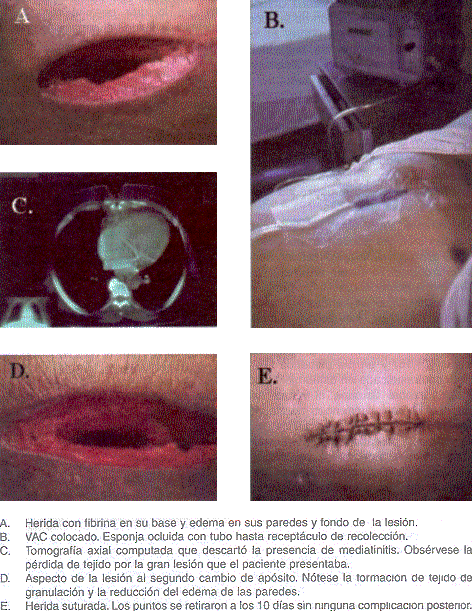
<body><![CDATA[<P><FONT FACE="Arial,Helvetica"><FONT SIZE=-1>Cierre asistido con presi&oacute;n negativa, costos de hospitalizaci&oacute;n</FONT></FONT>     <BR>&nbsp;      <P><B><FONT FACE="Arial,Helvetica"><FONT SIZE=-1>Abstract</FONT></FONT></B>      <P><FONT FACE="Arial,Helvetica"><FONT SIZE=-1>A new technique using vacuum assisted closure (VAC) was succesfully applied to a 57 year old, male patient, with a dehisced infected sternotomy wound. After debridment and abscess drainage, a standard treatment with iodorform gauze strip was applied during 10 days, then it was substituted with by the application of negative pressure by controlled suction through a porous derssing, during 7 days. This novel technique, the first time applied in Latinamerica in this kind of lesion, has made possible to reduce healing time and hospital costs.</FONT></FONT>     <BR>&nbsp;      <P><B><FONT FACE="Arial,Helvetica"><FONT SIZE=-1>Key Words</FONT></FONT></B>      <P><FONT FACE="Arial,Helvetica"><FONT SIZE=-1>Vacuum assisted closure, hospital costs</FONT></FONT>     <BR>&nbsp;      <P><B><FONT FACE="Arial,Helvetica"><FONT SIZE=-1>Introducci&oacute;n</FONT></FONT></B>      <P><FONT FACE="Arial,Helvetica"><FONT SIZE=-1>Los procesos infecciosos de la esternotom&iacute;a luego de cirug&iacute;a cardiaca, pueden involucrar no solo a la piel y tejidos blandos, sino tambi&eacute;n hueso esternal y mediastino. La incidencia de procesos infecciosos en este tipo de heridas oscila entre el 1 al 5 % <A HREF="#img1">(1)</A>. Su manejo depende de la severidad de la infecci&oacute;n, necesitando en ocasiones lavados quir&uacute;rgicos repetidos, desbridaci&oacute;n, drenaje de abscesos, irrigaciones, nueva sutura o cirug&iacute;a reconstructiva. El manejo tradicional posee un resultado en ocasiones incierto, comprometiendo al paciente y prolongando su estancia hospitalaria. La mortalidad en casos donde se progresa a mediastinitis puede llegar al 40 % <A HREF="#autor1">(1)</A>.</FONT></FONT>      ]]></body>
<body><![CDATA[<P><FONT FACE="Arial,Helvetica"><FONT SIZE=-1>El uso de cierre asistido de heridas con presi&oacute;n subatmosf&eacute;rica o presi&oacute;n negativa, que por sus siglas en ingl&eacute;s tambi&eacute;n se le conoce como VAC, ha sido empleado para el manejo de heridas esternales infectadas o en casos de mediastinitis en el Reino Unido y en Holanda <A HREF="#autor2.">(2</A><A HREF="#autor3">,3)</A>.</FONT></FONT>      <P><FONT FACE="Arial,Helvetica"><FONT SIZE=-1>Se describe el primer paciente en Latinoam&eacute;rica, donde se utiliza esta terapia, en una herida esternal dehiscente e infectada.</FONT></FONT>      <P><B><FONT FACE="Arial,Helvetica"><FONT SIZE=-1>Presentaci&oacute;n del caso</FONT></FONT></B>      <P><FONT FACE="Arial,Helvetica"><FONT SIZE=-1>Paciente masculino, de 57 a&ntilde;os de edad, con antecedente de tabaquismo moderado, hipertensi&oacute;n arterial de 10 a&ntilde;os de evoluci&oacute;n, diabetes mellitus tipo 2, de tres a&ntilde;os de evoluci&oacute;n y cardiopat&iacute;a isqu&eacute;mica documentada por ecocardiograma, que mostr&oacute; una hipertrofia exc&eacute;ntrica moderada de ventr&iacute;culo izquierdo, con una fracci&oacute;n de eyecci&oacute;n del 55 % en reposo, insuficiencia mitral moderada con mega atrio izquierdo, estenosis de v&aacute;lvula a&oacute;rtica leve calcificada e hipoquinesia leve apical y confirmada por cateterismo cardiaco que evidenci&oacute; enfermedad severa de tres vasos.</FONT></FONT>      <P><FONT FACE="Arial,Helvetica"><FONT SIZE=-1>Este paciente fue sometido a un tetrabypass coronario. Egres&oacute; del hospital siete d&iacute;as despu&eacute;s, para una semana despu&eacute;s con historia de supuraci&oacute;n a trav&eacute;s del tercio inferior de la herida quir&uacute;rgica, document&aacute;ndose absceso en tejidos blandos. Se realiz&oacute; un lavado quir&uacute;rgico y drenaje de colecci&oacute;n de la herida quir&uacute;rgica. (<A HREF="#img1">Figura 1 A</A>).</FONT></FONT>      <P><FONT FACE="Arial,Helvetica"><FONT SIZE=-1>A su ingreso se realizaron curaciones con irrigaciones con yodo y agua oxigenada y posteriormente empacamiento con gasa yodoformada.</FONT></FONT>      <P><FONT FACE="Arial,Helvetica"><FONT SIZE=-1>Se observ&oacute; cocos gram-positivos en el frotis de la herida y se aisl&oacute; <I>Staphylococcus aureus</I> sensible solo a vancomicina, gentamicina, ciprofloxacina y levofloxacina. Se trat&oacute; con vancomicina, y gentamicina por siete d&iacute;as. La cobertura previa se sustituy&oacute; por rifampicina por deterioro de la funci&oacute;n renal del paciente, manteni&eacute;ndose el antibi&oacute;tico por siete d&iacute;as m&aacute;s.</FONT></FONT>      <P><FONT FACE="Arial,Helvetica"><FONT SIZE=-1>Diez d&iacute;as despu&eacute;s, al continuar la herida con secresi&oacute;n sero-sanguinolenta y mucha fibrina en su base, se decidi&oacute; utilizar el VAC (<A HREF="#img1">Figura 1 B</A>). Luego de que el paciente dio su consentimiento, se inici&oacute; la terapia con presi&oacute;n negativa a 125 mm Hg de presi&oacute;n continua, con cambio de esponjas cada 48 horas, debido a que el tejido blando perilesional no mostraba actividad inflamatoria o infecciosa franca. La dimensi&oacute;n original de la herida fue de 9 cm. x 2 cm., con una profundidad de 5,5 cm.</FONT></FONT>      <P><FONT FACE="Arial,Helvetica"><FONT SIZE=-1>La tomograf&iacute;a axial computada no revel&oacute; colecci&oacute;n mediastinal (<A HREF="#img1">Figura 1 C</A>).</FONT></FONT>      <P><FONT FACE="Arial,Helvetica"><FONT SIZE=-1>Los ex&aacute;menes de laboratorio del paciente a su ingreso mostraron una concentraci&oacute;n de hemoglobina (Hb) de 9,3 g/dl, el hematocrito (Hto) de 27,7 %, glicemia de 123 mg/dl, creatinina de 1,3 mg/dl, el hemograma mostr&oacute; 10,500 leucocitos /mm</FONT><SUP><FONT SIZE=-2>3</FONT></SUP><FONT SIZE=-1>, con diferencial normal. Los hemocultivos tomados a las 24 y 48 horas de su admisi&oacute;n al hospital resultaron negativos. Luego de una transfusi&oacute;n la Hb subi&oacute; a 11,8 g/dl y el Hto a 36 %.</FONT></FONT>      ]]></body>
<body><![CDATA[<P><FONT FACE="Arial,Helvetica"><FONT SIZE=-1>El paciente complet&oacute; 145,3 horas de terapia VAC, obteni&eacute;ndose 275 ml de l&iacute;quido sero-sanguinolento en los recipientes de recolecci&oacute;n que se cambiaron cada 48 horas. La dimensi&oacute;n final de la herida fue de 8 cm x 2 cm x 4,5 cm. y el paciente no refiri&oacute; ning&uacute;n tipo de inconveniente por el uso de la presi&oacute;n negativa, que incluso le permit&iacute;a estar sentado dentro de la misma habitaci&oacute;n.</FONT></FONT>      <P><FONT FACE="Arial,Helvetica"><FONT SIZE=-1>A los siete d&iacute;as de terapia VAC se realiz&oacute; el cierre terciario de la herida sin complicaciones (<A HREF="#img1">Figura 1 E</A>). El paciente egresa al d&iacute;a siguiente de haberse suturado, quince d&iacute;as despu&eacute;s de haber ingresado. Recibi&oacute; cobertura antibi&oacute;tica adicional a base de ciprofloxacina por 10 d&iacute;as, al cabo de los cuales se retiraron las suturas. El seguimiento del paciente al mes de su egreso, no mostr&oacute; ninguna complicaci&oacute;n, obteni&eacute;ndose un adecuado cierre de la herida.</FONT></FONT>     <BR>&nbsp;      <P><B><FONT FACE="Arial,Helvetica"><FONT SIZE=-1>Discusi&oacute;n</FONT></FONT></B>      <P><FONT FACE="Arial,Helvetica"><FONT SIZE=-1>El cierre asistido de una herida o VAC por sus siglas en ingl&eacute;s, se desarroll&oacute; en Carolina del Norte, USA, por los doctores Louis Argenta y Michael Morykwas, quienes originalmente lo utilizaron solo en &uacute;lceras cr&oacute;nicas. Su uso se hizo frecuente en Europa en 1994 y se introdujo a Estados Unidos en 1995, con la aprobaci&oacute;n de la Food and Drug Administration (FDA). En el a&ntilde;o 2000 el sistema de seguridad social norteamericano: el Medicare, lo aprob&oacute; para su uso en ese pa&iacute;s.</FONT></FONT>      <P><FONT FACE="Arial,Helvetica"><FONT SIZE=-1>En Latinoam&eacute;rica, Costa Rica ha sido el pa&iacute;s que ha asumido el liderazgo en el uso del VAC, utiliz&aacute;ndolo desde finales del 2000 en pacientes con heridas quir&uacute;rgicas abdominales dehiscentes, en pie diab&eacute;tico, en &uacute;lceras venosas y en pacientes politraumatizados con heridas agudas infectadas.</FONT></FONT>      <P><FONT FACE="Arial,Helvetica"><FONT SIZE=-1>La terapia VAC esta indicada en heridas cr&oacute;nicas donde han fracasado otras alternativas terap&eacute;uticas, en heridas cr&oacute;nicas venosas, arteriales de presi&oacute;n o neurop&aacute;ticas <A HREF="#autor4.">(4-</A><A HREF="#autor6">6)</A>. Tambi&eacute;n se puede utilizar en heridas agudas o subagudas <A HREF="#autor7.">(7</A><A HREF="#autor8">,8)</A>, incluyendo quemaduras <A HREF="#autor9">(9)</A>, heridas dehiscentes <A HREF="#autor10">(10</A><A HREF="#autor11">,11)</A>, injertos cut&aacute;neos <A HREF="#12">(12</A>,<A HREF="#autor13.">13</A>), heridas infectadas (<A HREF="#autor14.">14,</A><A HREF="#autor15.">15)</A> y en pie diab&eacute;tico <A HREF="#autor16">(16)</A>. Esta contraindicada en osteomielitis no tratada, sobre arterias o venas expuestas o en presencia de tejido necr&oacute;tico. En c&aacute;ncer o en f&iacute;stulas se recomienda precauci&oacute;n y criterio m&eacute;dico. Tambi&eacute;n se debe tener precauci&oacute;n en casos con sangrado activo, pacientes con terapia anticoagulante o donde sea dif&iacute;cil obtener hemostasia.</FONT></FONT>      <P><B><FONT FACE="Arial,Helvetica"><FONT SIZE=-1>Mecanismo de acci&oacute;n</FONT></FONT></B>      <P><FONT FACE="Arial,Helvetica"><FONT SIZE=-1>El sistema VAC consta de una esponja reticulada que se recorta al tama&ntilde;o de la herida, donde se inserta un tubo no colapsable que provee la presi&oacute;n negativa desde una bomba de presi&oacute;n negativa (vac&iacute;o). Un reservorio recibe el exceso de fluido extra&iacute;do de la herida. La presi&oacute;n negativa se puede regular en ciclos continuos o intermitentes y en un &aacute;mbito de presi&oacute;n que se ajusta al tipo y caracter&iacute;sticas de la lesi&oacute;n. La presi&oacute;n subatmosf&eacute;rica (negativa) se distribuye homog&eacute;neamente en toda la herida, lo que permite remover el exceso de fluido del espacio intersticial de la herida, permitiendo un mayor flujo a trav&eacute;s de los vasos comprimidos por este exceso de fluido. La remoci&oacute;n del exudado cr&oacute;nico de la herida, es un proceso beneficioso, ya que remueve metalo-proteinasas o factores inhibitorios de la cicatrizaci&oacute;n <A HREF="#autor17">(17)</A>.</FONT></FONT>      <P><FONT FACE="Arial,Helvetica"><FONT SIZE=-1>Este sistema disminuye la colonizaci&oacute;n bacteriana. Se ha demostrado que el tratamiento con presi&oacute;n negativa en el lecho de la herida reduce la carga bacteriana de heridas infectadas deliberadamente, en m&aacute;s de 1 000 veces en cuatro d&iacute;as <A HREF="#autor4.">(4)</A>. El sistema favorece la contracci&oacute;n de la herida y hay un aumento en la proliferaci&oacute;n celular y en la s&iacute;ntesis proteica al modificarse el cito-esqueleto celular por alteraci&oacute;n en los puentes de integrinas intercelulares debido a las fuerzas mec&aacute;nicas de estiramiento por la presi&oacute;n negativa que sufre la herida <A HREF="#autor18.">(18</A><A HREF="#autor20.">-20</A>). Tambi&eacute;n provee un ambiente h&uacute;medo propicio para la cicatrizaci&oacute;n y protege de contaminaci&oacute;n externa y puede permitir la reducci&oacute;n de medicamentos contra el dolor.</FONT></FONT>      ]]></body>
<body><![CDATA[<P><FONT FACE="Arial,Helvetica"><FONT SIZE=-1>El VAC en heridas esternales dehiscentes debe de utilizarse en la modalidad de ciclo continuo a 125 mmHg con la esponja de poliuretano, cambiando la esponja cada 48 horas (o cada 12 horas cuando la herida este francamente infectada).</FONT></FONT>      <P><FONT FACE="Arial,Helvetica"><FONT SIZE=-1>Este caso ilustra no solo el resultado sorprendente en preparar la herida para el cierre terciario quir&uacute;rgico, sino tambi&eacute;n la reducci&oacute;n en el tiempo de resoluci&oacute;n del proceso infeccioso y consecuentemente en los costos de atenci&oacute;n, tal y como ha sido descrito por otros autores <A HREF="#autor21.">(21)</A>. De esta forma, el paciente en aproximadamente una semana de utilizar el sistema de presi&oacute;n negativa pudo ser egresado, evitando los costos de estancias hospitalarias prolongadas que generalmente producen este tipo de lesiones, disminuyendo tambi&eacute;n el riesgo de infecci&oacute;n intrahospitalaria, al egresar tempranamente al paciente.</FONT></FONT>     <CENTER><A NAME="img1"></A><IMG SRC="/img/fbpe/rccm/v22n1-2/1052i1.GIF" HEIGHT=611 WIDTH=472></CENTER> &nbsp;     
<BR>&nbsp;     <BR>&nbsp;      <P><B><FONT FACE="Arial,Helvetica"><FONT SIZE=-1>Referencias</FONT></FONT></B>      <!-- ref --><P><A NAME="autor1"></A><FONT FACE="Arial,Helvetica"><FONT SIZE=-1>1.Raudat C.W, Pagel J, Woodhall D et al. Early intervention and aggressive management of infected median sternotomy incision: a review of 2242 open-heart procedures. <I>Am Surg</I> 1997; 63: 238-241.</FONT></FONT>    &nbsp;&nbsp;&nbsp;&nbsp;&nbsp;&nbsp;&nbsp;&nbsp;[&#160;<a href="javascript:void(0);" onclick="javascript: window.open('/scielo.php?script=sci_nlinks&ref=777324&pid=S0253-2948200100010000600001&lng=','','width=640,height=500,resizable=yes,scrollbars=1,menubar=yes,');">Links</a>&#160;]<!-- end-ref --><!-- ref --><P><A NAME="autor2."></A><FONT FACE="Arial,Helvetica"><FONT SIZE=-1>2.Tang A, Ohri S and Haw M. Novel application of vacuum assisted closure technique to the treatment of sternotomy wound infection. <I>Eur J Orthop Surg Traumatol</I> 2000; 17: 482-84.</FONT></FONT>    &nbsp;&nbsp;&nbsp;&nbsp;&nbsp;&nbsp;&nbsp;&nbsp;[&#160;<a href="javascript:void(0);" onclick="javascript: window.open('/scielo.php?script=sci_nlinks&ref=777325&pid=S0253-2948200100010000600002&lng=','','width=640,height=500,resizable=yes,scrollbars=1,menubar=yes,');">Links</a>&#160;]<!-- end-ref --><!-- ref --><P><A NAME="autor3"></A><FONT FACE="Arial,Helvetica"><FONT SIZE=-1>3.Obdeijn M, Lange M, Lichtendahl D, et al . Vacuum-assisted closure in the treatment of poststernotomy mediastinitis. <I>Ann Thorac Surg</I> 1999; 68: 2358-60.</FONT></FONT>    &nbsp;&nbsp;&nbsp;&nbsp;&nbsp;&nbsp;&nbsp;&nbsp;[&#160;<a href="javascript:void(0);" onclick="javascript: window.open('/scielo.php?script=sci_nlinks&ref=777326&pid=S0253-2948200100010000600003&lng=','','width=640,height=500,resizable=yes,scrollbars=1,menubar=yes,');">Links</a>&#160;]<!-- end-ref --><!-- ref --><P><A NAME="autor4."></A><FONT FACE="Arial,Helvetica"><FONT SIZE=-1>4.Morykwas M. J, Argenta L.C, Shelton-Brown E, McGuirt W. Vacuum-assisted closure: a new method for wound control and treatment: animal studies and basic foundation. <I>Ann Plast Surg</I> 1997; 38:553-562.</FONT></FONT>    &nbsp;&nbsp;&nbsp;&nbsp;&nbsp;&nbsp;&nbsp;&nbsp;[&#160;<a href="javascript:void(0);" onclick="javascript: window.open('/scielo.php?script=sci_nlinks&ref=777327&pid=S0253-2948200100010000600004&lng=','','width=640,height=500,resizable=yes,scrollbars=1,menubar=yes,');">Links</a>&#160;]<!-- end-ref --><!-- ref --><P><A NAME="autor5"></A><FONT FACE="Arial,Helvetica"><FONT SIZE=-1>5.Morykwas M.J, Argenta. Vacuum-assisted closure: a new method for wound control and treatment: Clinical Experience. <I>Ann Plast Surg</I> 1997; 38:563-577.</FONT></FONT>    &nbsp;&nbsp;&nbsp;&nbsp;&nbsp;&nbsp;&nbsp;&nbsp;[&#160;<a href="javascript:void(0);" onclick="javascript: window.open('/scielo.php?script=sci_nlinks&ref=777328&pid=S0253-2948200100010000600005&lng=','','width=640,height=500,resizable=yes,scrollbars=1,menubar=yes,');">Links</a>&#160;]<!-- end-ref --><!-- ref --><P><A NAME="autor6"></A><FONT FACE="Arial,Helvetica"><FONT SIZE=-1>6. Joseph E, Hamori C.A, Bergman S, Swann N.F, Anastasi G.W. A prospective, randomized trial of vacuum-assisted closure versus standard therapy of chronic nonhealing wound<I>. Wounds</I> 2000;12 (2): 60-67</FONT></FONT>    &nbsp;&nbsp;&nbsp;&nbsp;&nbsp;&nbsp;&nbsp;&nbsp;[&#160;<a href="javascript:void(0);" onclick="javascript: window.open('/scielo.php?script=sci_nlinks&ref=777329&pid=S0253-2948200100010000600006&lng=','','width=640,height=500,resizable=yes,scrollbars=1,menubar=yes,');">Links</a>&#160;]<!-- end-ref --><!-- ref --><P><A NAME="autor7."></A><FONT FACE="Arial,Helvetica"><FONT SIZE=-1>7. Meara J, Guo L, Smith J. et al. Vacuum-Assited Closure in the treatment of degloving injuries. <I>Ann Plast Surg</I> 1999; 42:589-594.</FONT></FONT>    &nbsp;&nbsp;&nbsp;&nbsp;&nbsp;&nbsp;&nbsp;&nbsp;[&#160;<a href="javascript:void(0);" onclick="javascript: window.open('/scielo.php?script=sci_nlinks&ref=777330&pid=S0253-2948200100010000600007&lng=','','width=640,height=500,resizable=yes,scrollbars=1,menubar=yes,');">Links</a>&#160;]<!-- end-ref --><!-- ref --><P><A NAME="autor8"></A><FONT FACE="Arial,Helvetica"><FONT SIZE=-1>8.Greer S.E, Duthie E, Cartolano B. et al. Techniques for applying subatmospheric pressre dressing to wounds in difficult regions of anatomy. <I>J WOCN</I> 1999; 26:250-253</FONT></FONT>    &nbsp;&nbsp;&nbsp;&nbsp;&nbsp;&nbsp;&nbsp;&nbsp;[&#160;<a href="javascript:void(0);" onclick="javascript: window.open('/scielo.php?script=sci_nlinks&ref=777331&pid=S0253-2948200100010000600008&lng=','','width=640,height=500,resizable=yes,scrollbars=1,menubar=yes,');">Links</a>&#160;]<!-- end-ref --><!-- ref --><P><A NAME="autor9"></A><FONT FACE="Arial,Helvetica"><FONT SIZE=-1>9. Morykwas M.J, David L.R, Schneider A.M, Whang C, Jennings D.A, Canty C.H, Parker D, White W.L, Argenta L.C. Use of subatmospheric pressure to prevent progression of Partial- Thickness Burns in a Swine Model. <I>J Burn Care Rehabil</I> 1999; 20:15-21</FONT></FONT>    &nbsp;&nbsp;&nbsp;&nbsp;&nbsp;&nbsp;&nbsp;&nbsp;[&#160;<a href="javascript:void(0);" onclick="javascript: window.open('/scielo.php?script=sci_nlinks&ref=777332&pid=S0253-2948200100010000600009&lng=','','width=640,height=500,resizable=yes,scrollbars=1,menubar=yes,');">Links</a>&#160;]<!-- end-ref --><!-- ref --><P><A NAME="autor10"></A><FONT FACE="Arial,Helvetica"><FONT SIZE=-1>10. Argenta L.C., Morykwas M.J. Non-surgical modalities to enhance healing and care of soft issue wound. <I>J South Orthop Assoc</I> 1997; 6 (4):279-288</FONT></FONT>    &nbsp;&nbsp;&nbsp;&nbsp;&nbsp;&nbsp;&nbsp;&nbsp;[&#160;<a href="javascript:void(0);" onclick="javascript: window.open('/scielo.php?script=sci_nlinks&ref=777333&pid=S0253-2948200100010000600010&lng=','','width=640,height=500,resizable=yes,scrollbars=1,menubar=yes,');">Links</a>&#160;]<!-- end-ref --><!-- ref --><P><A NAME="autor11"></A><FONT FACE="Arial,Helvetica"><FONT SIZE=-1>11. Rohrich R.J, Lowe J.B, Hackney F.L, Bowman J.L, Hobar P.C. An algoritm for abdominal wall reconstruction. <I>Plast Reconstr Surg</I> 105:202-216, 2000</FONT></FONT>    &nbsp;&nbsp;&nbsp;&nbsp;&nbsp;&nbsp;&nbsp;&nbsp;[&#160;<a href="javascript:void(0);" onclick="javascript: window.open('/scielo.php?script=sci_nlinks&ref=777334&pid=S0253-2948200100010000600011&lng=','','width=640,height=500,resizable=yes,scrollbars=1,menubar=yes,');">Links</a>&#160;]<!-- end-ref --><!-- ref --><P><A NAME="autor12"></A><FONT FACE="Arial,Helvetica"><FONT SIZE=-1>12.Genecov D.G, Schneider A.M, Morykwas M.J, Parker D, White W.L, Argenta L.C. A Controlled Subatmospheric Pressure Dressing Increases the Rate of Skin Graft Donor Site Reepithelialization. <I>Ann Plast Surg</I> 1998; 40:219-225.</FONT></FONT>    &nbsp;&nbsp;&nbsp;&nbsp;&nbsp;&nbsp;&nbsp;&nbsp;[&#160;<a href="javascript:void(0);" onclick="javascript: window.open('/scielo.php?script=sci_nlinks&ref=777335&pid=S0253-2948200100010000600012&lng=','','width=640,height=500,resizable=yes,scrollbars=1,menubar=yes,');">Links</a>&#160;]<!-- end-ref --><!-- ref --><P><A NAME="autor13."></A><FONT FACE="Arial,Helvetica"><FONT SIZE=-1>13.Schneider A.M, Morykwas M.J, Argenta L.C. A New and Reliable Method of Securing Skin Grafts to the Difficult Recipient Bed. <I>Jour Plastic &amp; Re-constructive Surgery </I>1998;102 (4 ): 1195-98.</FONT></FONT>    &nbsp;&nbsp;&nbsp;&nbsp;&nbsp;&nbsp;&nbsp;&nbsp;[&#160;<a href="javascript:void(0);" onclick="javascript: window.open('/scielo.php?script=sci_nlinks&ref=777336&pid=S0253-2948200100010000600013&lng=','','width=640,height=500,resizable=yes,scrollbars=1,menubar=yes,');">Links</a>&#160;]<!-- end-ref --><!-- ref --><P><A NAME="autor14."></A><FONT FACE="Arial,Helvetica"><FONT SIZE=-1>14.Rosser Ch, Morykwas M, Argenta L, et al. A new technique to manage perineal wounds. <I>Infections in Urology</I> 2000; March /April 45-47.</FONT></FONT>    &nbsp;&nbsp;&nbsp;&nbsp;&nbsp;&nbsp;&nbsp;&nbsp;[&#160;<a href="javascript:void(0);" onclick="javascript: window.open('/scielo.php?script=sci_nlinks&ref=777337&pid=S0253-2948200100010000600014&lng=','','width=640,height=500,resizable=yes,scrollbars=1,menubar=yes,');">Links</a>&#160;]<!-- end-ref --><!-- ref --><P><A NAME="autor15."></A><FONT FACE="Arial,Helvetica"><FONT SIZE=-1>15. Mendez-Eastman S. Negative Pressure Wound Therapy Plastic. <I>Surgical Nursing</I> 1998; 18 (1):27-37</FONT></FONT>    &nbsp;&nbsp;&nbsp;&nbsp;&nbsp;&nbsp;&nbsp;&nbsp;[&#160;<a href="javascript:void(0);" onclick="javascript: window.open('/scielo.php?script=sci_nlinks&ref=777338&pid=S0253-2948200100010000600015&lng=','','width=640,height=500,resizable=yes,scrollbars=1,menubar=yes,');">Links</a>&#160;]<!-- end-ref --><!-- ref --><P><A NAME="autor16"></A><FONT FACE="Arial,Helvetica"><FONT SIZE=-1>16.Mc Callon S, Knight C, Valiulus J, et al. Vacuum-assisted closure versus saline-moistened gauze in the healing of postoperative diabetic foot wounds. <I>Ostomy/Wound Management</I> 2000;46 (8):28-34.</FONT></FONT>    &nbsp;&nbsp;&nbsp;&nbsp;&nbsp;&nbsp;&nbsp;&nbsp;[&#160;<a href="javascript:void(0);" onclick="javascript: window.open('/scielo.php?script=sci_nlinks&ref=777339&pid=S0253-2948200100010000600016&lng=','','width=640,height=500,resizable=yes,scrollbars=1,menubar=yes,');">Links</a>&#160;]<!-- end-ref --><!-- ref --><P><A NAME="autor17"></A><FONT FACE="Arial,Helvetica"><FONT SIZE=-1>17.Wyoscki A.B. Wound fluids and the pathogenesis of cronic wounds. Journal of WOCN. 1996;23 (6)283-290.</FONT></FONT>    &nbsp;&nbsp;&nbsp;&nbsp;&nbsp;&nbsp;&nbsp;&nbsp;[&#160;<a href="javascript:void(0);" onclick="javascript: window.open('/scielo.php?script=sci_nlinks&ref=777340&pid=S0253-2948200100010000600017&lng=','','width=640,height=500,resizable=yes,scrollbars=1,menubar=yes,');">Links</a>&#160;]<!-- end-ref --><!-- ref --><P><A NAME="autor18."></A><FONT FACE="Arial,Helvetica"><FONT SIZE=-1>18. Letsou G.V, Rosales O, Maltz S, Vogt A, Sumpio B.E. Stimulation of Adenylate Cyclase Activity in Cultured Endothelial Cells Subjected to Cyclic Strech. <I>J Cardiovasc Surg</I> 1990; 31: 634-39.</FONT></FONT>    &nbsp;&nbsp;&nbsp;&nbsp;&nbsp;&nbsp;&nbsp;&nbsp;[&#160;<a href="javascript:void(0);" onclick="javascript: window.open('/scielo.php?script=sci_nlinks&ref=777341&pid=S0253-2948200100010000600018&lng=','','width=640,height=500,resizable=yes,scrollbars=1,menubar=yes,');">Links</a>&#160;]<!-- end-ref --><!-- ref --><P><A NAME="autor19"></A><FONT FACE="Arial,Helvetica"><FONT SIZE=-1>19.Vandenburgh H.H. Mechanical Forces and their second Messengers in Stimulating Cell Growth in Vitro. <I>Am J Physiol</I> 1992; 262: R350-355.</FONT></FONT>    &nbsp;&nbsp;&nbsp;&nbsp;&nbsp;&nbsp;&nbsp;&nbsp;[&#160;<a href="javascript:void(0);" onclick="javascript: window.open('/scielo.php?script=sci_nlinks&ref=777342&pid=S0253-2948200100010000600019&lng=','','width=640,height=500,resizable=yes,scrollbars=1,menubar=yes,');">Links</a>&#160;]<!-- end-ref --><!-- ref --><P><A NAME="autor20."></A><FONT FACE="Arial,Helvetica"><FONT SIZE=-1>20.Sadoshima J, Jahn L, Toshiyuki T, Kulik T.J, Izumo S. Molecular Characterization of the Strech-induced Adaptation of Cultured Cardiac Cells <I>J Biol Chem</I> 1992; 267 (15): 10555-10560</FONT></FONT>    &nbsp;&nbsp;&nbsp;&nbsp;&nbsp;&nbsp;&nbsp;&nbsp;[&#160;<a href="javascript:void(0);" onclick="javascript: window.open('/scielo.php?script=sci_nlinks&ref=777343&pid=S0253-2948200100010000600020&lng=','','width=640,height=500,resizable=yes,scrollbars=1,menubar=yes,');">Links</a>&#160;]<!-- end-ref --><!-- ref --><P><A NAME="autor21."></A><FONT FACE="Arial,Helvetica"><FONT SIZE=-1>21.Philbeck T.E, Whittington K.T, Millsap M.H, Briones R,B, Wight D.G, Schroeder W.J. The Clinical and Cost Effectiveness of Externally Applied Negative Pressure Wound Therapy in the Treatment of Wounds in Home Healthcare Medicare Patients. <I>Ostomy/Wound Management</I> 1999;45 (11):41-50.</FONT></FONT>    &nbsp;&nbsp;&nbsp;&nbsp;&nbsp;&nbsp;&nbsp;&nbsp;[&#160;<a href="javascript:void(0);" onclick="javascript: window.open('/scielo.php?script=sci_nlinks&ref=777344&pid=S0253-2948200100010000600021&lng=','','width=640,height=500,resizable=yes,scrollbars=1,menubar=yes,');">Links</a>&#160;]<!-- end-ref --><P><A NAME="1a"></A><FONT FACE="Arial,Helvetica"><SUP><FONT SIZE=-2><A HREF="#¹">1</A></FONT></SUP><FONT SIZE=-1> Cl&iacute;nica de Heridas, Servicio y C&aacute;tedra Dermatolog&iacute;a- Alergolog&iacute;a,</FONT></FONT>     <BR><FONT FACE="Arial,Helvetica"><FONT SIZE=-1>Hospital M&eacute;xico; Escuela de Medicina, Universidad de Costa Rica.</FONT></FONT>     <BR><FONT FACE="Arial,Helvetica"><FONT SIZE=-1>Correspondencia: e-mail: <FONT COLOR="#808000"><A HREF="mailto:jelizond@racsa.co.cr">jelizond@racsa.co.cr</A></FONT> Fax: (506) 232 0473</FONT></FONT>     ]]></body>
<body><![CDATA[<BR>&nbsp;     <BR><A NAME="2a"></A><FONT FACE="Arial,Helvetica"><SUP><FONT SIZE=-2><A HREF="#²">2</A></FONT></SUP><FONT SIZE=-1>Servicio y C&aacute;tedra de Cirug&iacute;a de T&oacute;rax y Cardiovascular, Hospital M&eacute;xico;</FONT></FONT>     <BR><FONT FACE="Arial,Helvetica"><FONT SIZE=-1>Escuela de Medicina, Universidad de Costa Rica.</FONT></FONT>      ]]></body><back>
<ref-list>
<ref id="B1">
<nlm-citation citation-type="journal">
<person-group person-group-type="author">
<name>
<surname><![CDATA[Raudat]]></surname>
<given-names><![CDATA[C.W]]></given-names>
</name>
<name>
<surname><![CDATA[Pagel]]></surname>
<given-names><![CDATA[J]]></given-names>
</name>
<name>
<surname><![CDATA[Woodhall]]></surname>
<given-names><![CDATA[D]]></given-names>
</name>
</person-group>
<article-title xml:lang="en"><![CDATA[Early intervention and aggressive management of infected median sternotomy incision: a review of 2242 open-heart procedures]]></article-title>
<source><![CDATA[Am Surg]]></source>
<year>1997</year>
<volume>63</volume>
<page-range>238-241</page-range></nlm-citation>
</ref>
<ref id="B2">
<nlm-citation citation-type="journal">
<person-group person-group-type="author">
<name>
<surname><![CDATA[Tang]]></surname>
<given-names><![CDATA[A]]></given-names>
</name>
<name>
<surname><![CDATA[Ohri]]></surname>
<given-names><![CDATA[S]]></given-names>
</name>
<name>
<surname><![CDATA[Haw]]></surname>
<given-names><![CDATA[M]]></given-names>
</name>
</person-group>
<article-title xml:lang="en"><![CDATA[Novel application of vacuum assisted closure technique to the treatment of sternotomy wound infection]]></article-title>
<source><![CDATA[Eur J Orthop Surg Traumatol]]></source>
<year>2000</year>
<volume>17</volume>
<page-range>482-84</page-range></nlm-citation>
</ref>
<ref id="B3">
<nlm-citation citation-type="journal">
<person-group person-group-type="author">
<name>
<surname><![CDATA[Obdeijn]]></surname>
<given-names><![CDATA[M]]></given-names>
</name>
<name>
<surname><![CDATA[Lange]]></surname>
<given-names><![CDATA[M]]></given-names>
</name>
<name>
<surname><![CDATA[Lichtendahl]]></surname>
<given-names><![CDATA[D]]></given-names>
</name>
</person-group>
<article-title xml:lang="en"><![CDATA[Vacuum-assisted closure in the treatment of poststernotomy mediastinitis]]></article-title>
<source><![CDATA[Ann Thorac Surg]]></source>
<year>1999</year>
<volume>68</volume>
<page-range>2358-60</page-range></nlm-citation>
</ref>
<ref id="B4">
<nlm-citation citation-type="journal">
<person-group person-group-type="author">
<name>
<surname><![CDATA[Morykwas]]></surname>
<given-names><![CDATA[M. J]]></given-names>
</name>
<name>
<surname><![CDATA[Argenta]]></surname>
<given-names><![CDATA[L.C]]></given-names>
</name>
<name>
<surname><![CDATA[Shelton-Brown]]></surname>
<given-names><![CDATA[E]]></given-names>
</name>
<name>
<surname><![CDATA[McGuirt]]></surname>
<given-names><![CDATA[W]]></given-names>
</name>
</person-group>
<article-title xml:lang="en"><![CDATA[Vacuum-assisted closure: a new method for wound control and treatment: animal studies and basic foundation]]></article-title>
<source><![CDATA[Ann Plast Surg]]></source>
<year>1997</year>
<volume>38</volume>
<page-range>553-562</page-range></nlm-citation>
</ref>
<ref id="B5">
<nlm-citation citation-type="journal">
<person-group person-group-type="author">
<name>
<surname><![CDATA[Morykwas]]></surname>
<given-names><![CDATA[M.J]]></given-names>
</name>
<name>
<surname><![CDATA[Argenta]]></surname>
</name>
</person-group>
<article-title xml:lang="en"><![CDATA[Vacuum-assisted closure: a new method for wound control and treatment: Clinical Experience]]></article-title>
<source><![CDATA[Ann Plast Surg]]></source>
<year>1997</year>
<volume>38</volume>
<page-range>563-577</page-range></nlm-citation>
</ref>
<ref id="B6">
<nlm-citation citation-type="journal">
<person-group person-group-type="author">
<name>
<surname><![CDATA[Joseph]]></surname>
<given-names><![CDATA[E]]></given-names>
</name>
<name>
<surname><![CDATA[Hamori]]></surname>
<given-names><![CDATA[C.A]]></given-names>
</name>
<name>
<surname><![CDATA[Bergman]]></surname>
<given-names><![CDATA[S]]></given-names>
</name>
<name>
<surname><![CDATA[Swann]]></surname>
<given-names><![CDATA[N.F]]></given-names>
</name>
<name>
<surname><![CDATA[Anastasi]]></surname>
<given-names><![CDATA[G.W]]></given-names>
</name>
</person-group>
<article-title xml:lang="en"><![CDATA[A prospective, randomized trial of vacuum-assisted closure versus standard therapy of chronic nonhealing wound]]></article-title>
<source><![CDATA[Wounds]]></source>
<year>2000</year>
<volume>12</volume>
<numero>^s2</numero>
<issue>^s2</issue>
<supplement>2</supplement>
<page-range>60-67</page-range></nlm-citation>
</ref>
<ref id="B7">
<nlm-citation citation-type="journal">
<person-group person-group-type="author">
<name>
<surname><![CDATA[Meara]]></surname>
<given-names><![CDATA[J]]></given-names>
</name>
<name>
<surname><![CDATA[Guo]]></surname>
<given-names><![CDATA[L]]></given-names>
</name>
<name>
<surname><![CDATA[Smith]]></surname>
<given-names><![CDATA[J]]></given-names>
</name>
</person-group>
<article-title xml:lang="en"><![CDATA[Vacuum-Assited Closure in the treatment of degloving injuries]]></article-title>
<source><![CDATA[Ann Plast Surg]]></source>
<year>1999</year>
<volume>42</volume>
<page-range>589-594</page-range></nlm-citation>
</ref>
<ref id="B8">
<nlm-citation citation-type="journal">
<person-group person-group-type="author">
<name>
<surname><![CDATA[Greer]]></surname>
<given-names><![CDATA[S.E]]></given-names>
</name>
<name>
<surname><![CDATA[Duthie]]></surname>
<given-names><![CDATA[E]]></given-names>
</name>
<name>
<surname><![CDATA[Cartolano]]></surname>
<given-names><![CDATA[B]]></given-names>
</name>
</person-group>
<article-title xml:lang="en"><![CDATA[Techniques for applying subatmospheric pressre dressing to wounds in difficult regions of anatomy]]></article-title>
<source><![CDATA[J WOCN]]></source>
<year>1999</year>
<volume>26</volume>
<page-range>250-253</page-range></nlm-citation>
</ref>
<ref id="B9">
<nlm-citation citation-type="journal">
<person-group person-group-type="author">
<name>
<surname><![CDATA[Morykwas]]></surname>
<given-names><![CDATA[M.J]]></given-names>
</name>
<name>
<surname><![CDATA[David]]></surname>
<given-names><![CDATA[L.R]]></given-names>
</name>
<name>
<surname><![CDATA[Schneider]]></surname>
<given-names><![CDATA[A.M]]></given-names>
</name>
<name>
<surname><![CDATA[Whang]]></surname>
<given-names><![CDATA[C]]></given-names>
</name>
<name>
<surname><![CDATA[Jennings]]></surname>
<given-names><![CDATA[D.A]]></given-names>
</name>
<name>
<surname><![CDATA[Canty]]></surname>
<given-names><![CDATA[C.H]]></given-names>
</name>
<name>
<surname><![CDATA[Parker]]></surname>
<given-names><![CDATA[D]]></given-names>
</name>
<name>
<surname><![CDATA[White]]></surname>
<given-names><![CDATA[W.L]]></given-names>
</name>
<name>
<surname><![CDATA[Argenta]]></surname>
<given-names><![CDATA[L.C]]></given-names>
</name>
</person-group>
<article-title xml:lang="en"><![CDATA[Use of subatmospheric pressure to prevent progression of Partial- Thickness Burns in a Swine Model]]></article-title>
<source><![CDATA[J Burn Care Rehabil]]></source>
<year>1999</year>
<volume>20</volume>
<page-range>15-21</page-range></nlm-citation>
</ref>
<ref id="B10">
<nlm-citation citation-type="journal">
<person-group person-group-type="author">
<name>
<surname><![CDATA[Argenta]]></surname>
<given-names><![CDATA[L.C]]></given-names>
</name>
<name>
<surname><![CDATA[Morykwas]]></surname>
<given-names><![CDATA[M.J]]></given-names>
</name>
</person-group>
<article-title xml:lang="en"><![CDATA[Non-surgical modalities to enhance healing and care of soft issue wound]]></article-title>
<source><![CDATA[J South Orthop Assoc]]></source>
<year>1997</year>
<volume>6</volume>
<numero>^s4</numero>
<issue>^s4</issue>
<supplement>4</supplement>
<page-range>279-288</page-range></nlm-citation>
</ref>
<ref id="B11">
<nlm-citation citation-type="journal">
<person-group person-group-type="author">
<name>
<surname><![CDATA[Rohrich]]></surname>
<given-names><![CDATA[R.J]]></given-names>
</name>
<name>
<surname><![CDATA[Lowe]]></surname>
<given-names><![CDATA[J.B]]></given-names>
</name>
<name>
<surname><![CDATA[Hackney]]></surname>
<given-names><![CDATA[F.L]]></given-names>
</name>
<name>
<surname><![CDATA[Bowman]]></surname>
<given-names><![CDATA[J.L]]></given-names>
</name>
<name>
<surname><![CDATA[Hobar]]></surname>
<given-names><![CDATA[P.C]]></given-names>
</name>
</person-group>
<article-title xml:lang="en"><![CDATA[An algoritm for abdominal wall reconstruction]]></article-title>
<source><![CDATA[Plast Reconstr Surg]]></source>
<year>2000</year>
<volume>105</volume>
<page-range>202-216</page-range></nlm-citation>
</ref>
<ref id="B12">
<nlm-citation citation-type="journal">
<person-group person-group-type="author">
<name>
<surname><![CDATA[Genecov]]></surname>
<given-names><![CDATA[D.G]]></given-names>
</name>
<name>
<surname><![CDATA[Schneider]]></surname>
<given-names><![CDATA[A.M]]></given-names>
</name>
<name>
<surname><![CDATA[Morykwas]]></surname>
<given-names><![CDATA[M.J]]></given-names>
</name>
<name>
<surname><![CDATA[Parker]]></surname>
<given-names><![CDATA[D]]></given-names>
</name>
<name>
<surname><![CDATA[White]]></surname>
<given-names><![CDATA[W.L]]></given-names>
</name>
<name>
<surname><![CDATA[Argenta]]></surname>
<given-names><![CDATA[L.C]]></given-names>
</name>
</person-group>
<article-title xml:lang="en"><![CDATA[A Controlled Subatmospheric Pressure Dressing Increases the Rate of Skin Graft Donor Site Reepithelialization]]></article-title>
<source><![CDATA[Ann Plast Surg]]></source>
<year>1998</year>
<volume>40</volume>
<page-range>219-225</page-range></nlm-citation>
</ref>
<ref id="B13">
<nlm-citation citation-type="journal">
<person-group person-group-type="author">
<name>
<surname><![CDATA[Schneider]]></surname>
<given-names><![CDATA[A.M]]></given-names>
</name>
<name>
<surname><![CDATA[Morykwas]]></surname>
<given-names><![CDATA[M.J]]></given-names>
</name>
<name>
<surname><![CDATA[Argenta]]></surname>
<given-names><![CDATA[L.C]]></given-names>
</name>
</person-group>
<article-title xml:lang="en"><![CDATA[A New and Reliable Method of Securing Skin Grafts to the Difficult Recipient Bed]]></article-title>
<source><![CDATA[Jour Plastic & Re-constructive Surgery]]></source>
<year>1998</year>
<volume>102</volume>
<numero>^s4</numero>
<issue>^s4</issue>
<supplement>4</supplement>
<page-range>1195-98</page-range></nlm-citation>
</ref>
<ref id="B14">
<nlm-citation citation-type="journal">
<person-group person-group-type="author">
<name>
<surname><![CDATA[Rosser]]></surname>
<given-names><![CDATA[Ch]]></given-names>
</name>
<name>
<surname><![CDATA[Morykwas]]></surname>
<given-names><![CDATA[M]]></given-names>
</name>
<name>
<surname><![CDATA[Argenta]]></surname>
<given-names><![CDATA[L]]></given-names>
</name>
</person-group>
<article-title xml:lang="en"><![CDATA[A new technique to manage perineal wounds]]></article-title>
<source><![CDATA[Infections in Urology]]></source>
<year>2000</year>
<page-range>45-47</page-range></nlm-citation>
</ref>
<ref id="B15">
<nlm-citation citation-type="journal">
<person-group person-group-type="author">
<name>
<surname><![CDATA[Mendez-Eastman]]></surname>
<given-names><![CDATA[S]]></given-names>
</name>
</person-group>
<article-title xml:lang="en"><![CDATA[Negative Pressure Wound Therapy Plastic]]></article-title>
<source><![CDATA[Surgical Nursing]]></source>
<year>1998</year>
<volume>18</volume>
<numero>^s1</numero>
<issue>^s1</issue>
<supplement>1</supplement>
<page-range>27-37</page-range></nlm-citation>
</ref>
<ref id="B16">
<nlm-citation citation-type="journal">
<person-group person-group-type="author">
<name>
<surname><![CDATA[Mc Callon]]></surname>
<given-names><![CDATA[S]]></given-names>
</name>
<name>
<surname><![CDATA[Knight]]></surname>
<given-names><![CDATA[C]]></given-names>
</name>
<name>
<surname><![CDATA[Valiulus]]></surname>
<given-names><![CDATA[J]]></given-names>
</name>
</person-group>
<article-title xml:lang="en"><![CDATA[Vacuum-assisted closure versus saline-moistened gauze in the healing of postoperative diabetic foot wounds]]></article-title>
<source><![CDATA[Ostomy/Wound Management]]></source>
<year>2000</year>
<volume>46</volume>
<numero>^s8</numero>
<issue>^s8</issue>
<supplement>8</supplement>
<page-range>28-34</page-range></nlm-citation>
</ref>
<ref id="B17">
<nlm-citation citation-type="journal">
<person-group person-group-type="author">
<name>
<surname><![CDATA[Wyoscki]]></surname>
<given-names><![CDATA[A.B]]></given-names>
</name>
</person-group>
<article-title xml:lang="en"><![CDATA[Wound fluids and the pathogenesis of cronic wounds]]></article-title>
<source><![CDATA[Journal of WOCN]]></source>
<year>1996</year>
<volume>23</volume>
<numero>^s6</numero>
<issue>^s6</issue>
<supplement>6</supplement>
<page-range>283-290</page-range></nlm-citation>
</ref>
<ref id="B18">
<nlm-citation citation-type="journal">
<person-group person-group-type="author">
<name>
<surname><![CDATA[Letsou]]></surname>
<given-names><![CDATA[G.V]]></given-names>
</name>
<name>
<surname><![CDATA[Rosales]]></surname>
<given-names><![CDATA[O]]></given-names>
</name>
<name>
<surname><![CDATA[Maltz]]></surname>
<given-names><![CDATA[S]]></given-names>
</name>
<name>
<surname><![CDATA[Vogt]]></surname>
<given-names><![CDATA[A]]></given-names>
</name>
<name>
<surname><![CDATA[Sumpio]]></surname>
<given-names><![CDATA[B.E]]></given-names>
</name>
</person-group>
<article-title xml:lang="en"><![CDATA[Stimulation of Adenylate Cyclase Activity in Cultured Endothelial Cells Subjected to Cyclic Strech]]></article-title>
<source><![CDATA[J Cardiovasc Surg]]></source>
<year>1990</year>
<volume>31</volume>
<page-range>634-39</page-range></nlm-citation>
</ref>
<ref id="B19">
<nlm-citation citation-type="journal">
<person-group person-group-type="author">
<name>
<surname><![CDATA[Vandenburgh]]></surname>
<given-names><![CDATA[H.H]]></given-names>
</name>
</person-group>
<article-title xml:lang="en"><![CDATA[Mechanical Forces and their second Messengers in Stimulating Cell Growth in Vitro]]></article-title>
<source><![CDATA[Am J Physiol]]></source>
<year>1992</year>
<volume>262</volume>
<page-range>R350-355</page-range></nlm-citation>
</ref>
<ref id="B20">
<nlm-citation citation-type="journal">
<person-group person-group-type="author">
<name>
<surname><![CDATA[Sadoshima]]></surname>
<given-names><![CDATA[J]]></given-names>
</name>
<name>
<surname><![CDATA[Jahn]]></surname>
<given-names><![CDATA[L]]></given-names>
</name>
<name>
<surname><![CDATA[Toshiyuki]]></surname>
<given-names><![CDATA[T]]></given-names>
</name>
<name>
<surname><![CDATA[Kulik]]></surname>
<given-names><![CDATA[T.J]]></given-names>
</name>
<name>
<surname><![CDATA[Izumo]]></surname>
<given-names><![CDATA[S]]></given-names>
</name>
</person-group>
<article-title xml:lang="en"><![CDATA[Molecular Characterization of the Strech-induced Adaptation of Cultured Cardiac Cells]]></article-title>
<source><![CDATA[J Biol Chem]]></source>
<year>1992</year>
<volume>267</volume>
<numero>^s15</numero>
<issue>^s15</issue>
<supplement>15</supplement>
<page-range>10555-10560</page-range></nlm-citation>
</ref>
<ref id="B21">
<nlm-citation citation-type="journal">
<person-group person-group-type="author">
<name>
<surname><![CDATA[Philbeck]]></surname>
<given-names><![CDATA[T.E]]></given-names>
</name>
<name>
<surname><![CDATA[Whittington]]></surname>
<given-names><![CDATA[K.T]]></given-names>
</name>
<name>
<surname><![CDATA[Millsap]]></surname>
<given-names><![CDATA[M.H]]></given-names>
</name>
<name>
<surname><![CDATA[Briones]]></surname>
<given-names><![CDATA[R,B]]></given-names>
</name>
<name>
<surname><![CDATA[Wight]]></surname>
<given-names><![CDATA[D.G]]></given-names>
</name>
<name>
<surname><![CDATA[Schroeder]]></surname>
<given-names><![CDATA[W.J]]></given-names>
</name>
</person-group>
<article-title xml:lang="en"><![CDATA[The Clinical and Cost Effectiveness of Externally Applied Negative Pressure Wound Therapy in the Treatment of Wounds in Home Healthcare Medicare Patients]]></article-title>
<source><![CDATA[Ostomy/Wound Management]]></source>
<year>1999</year>
<volume>45</volume>
<numero>^s11</numero>
<issue>^s11</issue>
<supplement>11</supplement>
<page-range>41-50</page-range></nlm-citation>
</ref>
</ref-list>
</back>
</article>
