<?xml version="1.0" encoding="ISO-8859-1"?><article xmlns:mml="http://www.w3.org/1998/Math/MathML" xmlns:xlink="http://www.w3.org/1999/xlink" xmlns:xsi="http://www.w3.org/2001/XMLSchema-instance">
<front>
<journal-meta>
<journal-id>0253-2948</journal-id>
<journal-title><![CDATA[Revista Costarricense de Ciencias Médicas]]></journal-title>
<abbrev-journal-title><![CDATA[Rev. costarric. cienc. méd]]></abbrev-journal-title>
<issn>0253-2948</issn>
<publisher>
<publisher-name><![CDATA[Editorial Nacional de Salud y Seguridad Social]]></publisher-name>
</publisher>
</journal-meta>
<article-meta>
<article-id>S0253-29482000000100007</article-id>
<title-group>
<article-title xml:lang="es"><![CDATA[Tumor de Koënen, presentación de un caso y tratamiento quirúrgico]]></article-title>
</title-group>
<contrib-group>
<contrib contrib-type="author">
<name>
<surname><![CDATA[Lara-Villagrán]]></surname>
<given-names><![CDATA[Aida]]></given-names>
</name>
<xref ref-type="aff" rid="A01"/>
</contrib>
</contrib-group>
<aff id="A01">
<institution><![CDATA[,Clínica Marcial Fallas  ]]></institution>
<addr-line><![CDATA[Montes de Oca ]]></addr-line>
</aff>
<pub-date pub-type="pub">
<day>00</day>
<month>06</month>
<year>2000</year>
</pub-date>
<pub-date pub-type="epub">
<day>00</day>
<month>06</month>
<year>2000</year>
</pub-date>
<volume>21</volume>
<numero>1-2</numero>
<fpage>81</fpage>
<lpage>85</lpage>
<copyright-statement/>
<copyright-year/>
<self-uri xlink:href="http://www.scielo.sa.cr/scielo.php?script=sci_arttext&amp;pid=S0253-29482000000100007&amp;lng=en&amp;nrm=iso"></self-uri><self-uri xlink:href="http://www.scielo.sa.cr/scielo.php?script=sci_abstract&amp;pid=S0253-29482000000100007&amp;lng=en&amp;nrm=iso"></self-uri><self-uri xlink:href="http://www.scielo.sa.cr/scielo.php?script=sci_pdf&amp;pid=S0253-29482000000100007&amp;lng=en&amp;nrm=iso"></self-uri><abstract abstract-type="short" xml:lang="es"><p><![CDATA[Los tumores de Koënen constituyen uno de los signos mayores de la Esclerosis Tuberosa y se encuentran en un 50% de los pacientes con esta enfermedad. Son proliferaciones típicas periungüeales que causan trastornos en la tableta ungüeal. Se consideran la variante hereditaria del fibroqueratoma que se origina del repliegue ungüeal proximal o del tejido conectivo de la zona. En el abordaje quirúrgico se debe pediculizar el tumor y llegar hasta su base de implantación, lo cual requiere de la reflexión del repliegue ungüeal proximal. Se describe e ilustra el abordaje quirúrgico de un caso.]]></p></abstract>
<abstract abstract-type="short" xml:lang="en"><p><![CDATA[Koënen tumor represents one of the main signs of the Tuberous Sclerosis, they are present in 50% of the patients with this illness. They are common ingrowings around the nail tissue which causes dysfunction in the nail. They are considered an hereditary variant of the fibrokeratoma which originates in the proximal nail fold or in the surrounding connective tissue. In the surgical approach, the tumor needs to be dissected up to its base, this requires the reflection of the proximal nail fold. The surgical procedure of a case is described and illustrated.]]></p></abstract>
<kwd-group>
<kwd lng="es"><![CDATA[Tumor de Koënen]]></kwd>
<kwd lng="es"><![CDATA[fibroqueratoma hereditario]]></kwd>
<kwd lng="es"><![CDATA[esclerosis tuberosa]]></kwd>
<kwd lng="es"><![CDATA[enfermedad de Pringle-Bourneville]]></kwd>
<kwd lng="es"><![CDATA[tumor fibroepitelial]]></kwd>
<kwd lng="en"><![CDATA[Koënen Tumor]]></kwd>
<kwd lng="en"><![CDATA[hereditary fibroqueratoma]]></kwd>
<kwd lng="en"><![CDATA[tuberous sclerosis]]></kwd>
</kwd-group>
</article-meta>
</front><body><![CDATA[ <CENTER><B><FONT FACE="Arial,Helvetica">Tumor de Ko&euml;nen, presentaci&oacute;n de un caso y tratamiento quir&uacute;rgico</FONT></B></CENTER>      <CENTER><B><FONT FACE="Arial,Helvetica">&nbsp;</FONT></B></CENTER>      <CENTER><B><FONT FACE="Arial,Helvetica">&nbsp;</FONT></B></CENTER>      <CENTER><B><FONT FACE="Arial,Helvetica"><FONT SIZE=-1>Aida Lara-Villagr&aacute;n<A NAME="1b"></A><SUP><A HREF="#1a">1</A></SUP></FONT></FONT></B></CENTER> &nbsp;<B><FONT FACE="Arial,Helvetica"><FONT SIZE=-1></FONT></FONT></B>      <P><B><FONT FACE="Arial,Helvetica"><FONT SIZE=-1>&nbsp;</FONT></FONT></B>     <BR><B><FONT FACE="Arial,Helvetica"><FONT SIZE=-1>Resumen</FONT></FONT></B>      <P><FONT FACE="Arial,Helvetica"><FONT SIZE=-1>Los tumores de Ko&euml;nen constituyen uno de los signos mayores de la Esclerosis Tuberosa y se encuentran en un 50% de los pacientes con esta enfermedad. Son proliferaciones t&iacute;picas periung&uuml;eales que causan trastornos en la tableta ung&uuml;eal. Se consideran la variante hereditaria del fibroqueratoma que se origina del repliegue ung&uuml;eal proximal o del tejido conectivo de la zona. En el abordaje quir&uacute;rgico se debe pediculizar el tumor y llegar hasta su base de implantaci&oacute;n, lo cual requiere de la reflexi&oacute;n del repliegue ung&uuml;eal proximal. Se describe e ilustra el abordaje quir&uacute;rgico de un caso.</FONT></FONT>      <P><B><FONT FACE="Arial,Helvetica"><FONT SIZE=-1>Palabras clave</FONT></FONT></B><FONT FACE="Arial,Helvetica"><FONT SIZE=-1></FONT></FONT>      <P><FONT FACE="Arial,Helvetica"><FONT SIZE=-1>Tumor de Ko&euml;nen, fibroqueratoma hereditario, esclerosis tuberosa, enfermedad de Pringle-Bourneville, tumor fibroepitelial</FONT></FONT>     <BR>&nbsp;     ]]></body>
<body><![CDATA[<BR><B><FONT FACE="Arial,Helvetica"><FONT SIZE=-1>Abstract</FONT></FONT></B>      <P><FONT FACE="Arial,Helvetica"><FONT SIZE=-1>Ko&euml;nen tumor represents one of the main signs of the Tuberous Sclerosis, they are present in 50% of the patients with this illness. They are common ingrowings around the nail tissue which causes dysfunction in the nail. They are considered an hereditary variant of the fibrokeratoma which originates in the proximal nail fold or in the surrounding connective tissue. In the surgical approach, the tumor needs to be dissected up to its base, this requires the reflection of the proximal nail fold. The surgical procedure of a case is described and illustrated.</FONT></FONT>      <P><B><FONT FACE="Arial,Helvetica"><FONT SIZE=-1>Key words</FONT></FONT></B><FONT FACE="Arial,Helvetica"><FONT SIZE=-1></FONT></FONT>      <P><FONT FACE="Arial,Helvetica"><FONT SIZE=-1>Ko&euml;nen Tumor, hereditary fibroqueratoma, tuberous sclerosis, Pringle-Bourneville disease, fibroepitelial tumor</FONT></FONT>     <BR>&nbsp;<B><FONT FACE="Arial,Helvetica"><FONT SIZE=-1></FONT></FONT></B>      <P><B><FONT FACE="Arial,Helvetica"><FONT SIZE=-1>Introducci&oacute;n</FONT></FONT></B>      <P><FONT FACE="Arial,Helvetica"><FONT SIZE=-1>Los tumores fibroepiteliales del aparato ung&uuml;eal son condiciones dermatol&oacute;gicas benignas que pueden ser adquiridas o asociadas a la Esclerosis Tuberosa o a la Neurofibromatosis (<A HREF="#1">1</A>). Su aspecto difiere seg&uacute;n su localizaci&oacute;n (superficial o profunda), pueden ser &uacute;nicos o m&uacute;ltiples</FONT></FONT>      <P><FONT FACE="Arial,Helvetica"><FONT SIZE=-1>Los tumores de Ko&euml;nen constituyen uno de los signos mayores de la Esclerosis Tuberosa o enfermedad de Pringle-Bourneville. En la mitad de los casos aparecen durante o despu&eacute;s de la pubertad (<A HREF="#2">2</A>, <A HREF="#3">3</A>). Se encuentran en un 50% de los pacientes con esta enfermedad (<A HREF="#3">3</A>).</FONT></FONT>      <P><FONT FACE="Arial,Helvetica"><FONT SIZE=-1>Estos tumores son proliferaciones t&iacute;picas periung&uuml;eales color piel, alargadas, con una extremidad libre cornificada, que se desarrollan por debajo del repliegue ung&uuml;eal proximal y descansan sobre el plato. Cuando son m&uacute;ltiples, a menudo se disponen en semic&iacute;rculo en la base de la u&ntilde;a. Su crecimiento a nivel del aparato ung&uuml;eal causa una presi&oacute;n excesiva que a nivel de la matriz ung&uuml;eal da como resultado depresiones longitudinales en la tableta ung&uuml;eal, o al localizarse debajo pueden levantarla e incluso destruirla (<A HREF="#2">2</A>). A las formas frustras cuya presencia solo es revelada por la existencia de una depresi&oacute;n canalicular longitudinal discreta, se oponen las lesiones fibromatosas exuberantes m&uacute;ltiples (<A HREF="#4">4</A>).</FONT></FONT>      <P><FONT FACE="Arial,Helvetica"><FONT SIZE=-1>Desde el punto de vista histol&oacute;gico se observan generalmente dos partes distintas: un segmento distal estrecho formado por fibras de col&aacute;geno laxo y rico en vasos sangu&iacute;neos, y una zona proximal formada por haces de col&aacute;geno denso orientados en el eje del tumor, menos rico en capilares (<A HREF="#4">4</A>).</FONT></FONT>      ]]></body>
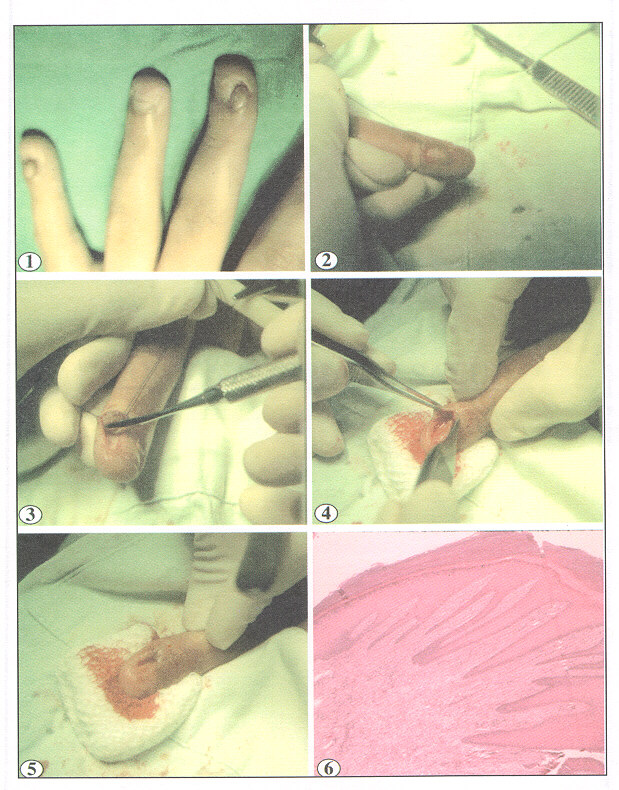
<body><![CDATA[<P><FONT FACE="Arial,Helvetica"><FONT SIZE=-1>Estos tumores se prestan a un diagn&oacute;stico diferencial con otras patolog&iacute;as como las verrugas vulgares, los granulomas pi&oacute;genos, los cuernos cut&aacute;neos, pero la histolog&iacute;a y el contexto cl&iacute;nico permiten diferenciarlos (<A HREF="#5">5</A>).</FONT></FONT>     <BR>&nbsp;      <P><B><FONT FACE="Arial,Helvetica"><FONT SIZE=-1>Presentaci&oacute;n del caso</FONT></FONT></B>      <P><FONT FACE="Arial,Helvetica"><FONT SIZE=-1>Paciente femenina de 15 a&ntilde;os, sin antecedentes de patolog&iacute;a similar en la familia, con una y &uacute;nica hermana 3 a&ntilde;os mayor y sana.</FONT></FONT>      <P><FONT FACE="Arial,Helvetica"><FONT SIZE=-1>Present&oacute; estenosis de v&aacute;lvula a&oacute;rtica tratada a los 4 a&ntilde;os mediante dilataci&oacute;n a trav&eacute;s de cat&eacute;ter. Diagnosticada portadora de Esclerosis Tuberosa mediante biopsias y estudio histol&oacute;gico de lesiones en piel y estudios radiol&oacute;gicos de Sistema Nervioso Central, ha presentado crisis de epilepsia desde el a&ntilde;o y medio de edad, tratada con valproato de sodio, sin crisis desde hace 10 a&ntilde;os. Con manifestaciones de angiofibromas en la cara, m&aacute;culas hipocr&oacute;micas m&uacute;ltiples a nivel del tronco, fibroqueratomas digitales y retraso mental leve a moderado.</FONT></FONT>      <P><FONT FACE="Arial,Helvetica"><FONT SIZE=-1>En la actualidad la paciente presenta tumores de Ko&euml;nen &uacute;nicos a nivel de dedos 3 y 5 de la mano izquierda y m&uacute;ltiples en varios ortejos de ambos pies. Presenta adem&aacute;s procesos inflamatorios y sangrados post-traum&aacute;ticos a repetici&oacute;n, molestias funcionales con uso de calzado y con la utilizaci&oacute;n de las manos en las labores cotidianas. Razones que motivaron la solicitud de intervenir para su eliminaci&oacute;n.</FONT></FONT>     <BR>&nbsp;     <BR>&nbsp;     <BR><B><FONT FACE="Arial,Helvetica"><FONT SIZE=-1>Descripci&oacute;n del procedimiento quir&uacute;rgico</FONT></FONT></B>      <P><FONT FACE="Arial,Helvetica"><FONT SIZE=-1>Se efectu&oacute; la ex&eacute;resis quir&uacute;rgica del tumor de Ko&euml;nen del tercer dedo izquierdo de localizaci&oacute;n sobre el surco lateral interno, de 0,5 cm. de ancho por 0,8 de largo, que ha impreso una depresi&oacute;n canalicular sobre el margen lateral de la tableta ung&uuml;eal (<A HREF="#fig1">foto 1</A>)</FONT></FONT>      ]]></body>
<body><![CDATA[<P><FONT FACE="Arial,Helvetica"><FONT SIZE=-1>Previa asepsia de la mano izquierda se efectu&oacute; la anestesia troncular del tercer dedo y aplicaci&oacute;n de torniquete a nivel de la base para mantener el sitio operatorio exang&uuml;e. Se efectu&oacute; una incisi&oacute;n longitudinal del repliegue cut&aacute;neo sobre el tumor, se aplicaron puntos para tracci&oacute;n y separaci&oacute;n de ambas mitades del repliegue (<A HREF="#fig1">foto 2</A>), se efectu&oacute; una disecci&oacute;n roma a lo largo del tumor y en toda su periferia hasta obtener la separaci&oacute;n completa (<A HREF="#fig1">foto 3</A>). Se efectu&oacute; la disecci&oacute;n y corte de la base del tumor mediante bistur&iacute; con la precauci&oacute;n de no lastimar la matriz ung&uuml;eal que se visualizaba por debajo del tumor (<A HREF="#fig1">foto 4</A>). Se efectu&oacute; la reconstrucci&oacute;n del repliegue supra-ung&uuml;eal mediante la aplicaci&oacute;n de un punto simple distal con Nylon 5-0 (<A HREF="#fig1">foto 5</A>).</FONT></FONT>      <P><FONT FACE="Arial,Helvetica"><FONT SIZE=-1>La histopatolog&iacute;a del tumor mostr&oacute; una hiperplasia epitelial con proliferaci&oacute;n de fibroblastos orientados en el eje mayor del tumor (<A HREF="#fig1">foto 6</A>).</FONT></FONT>      <P><FONT FACE="Arial,Helvetica"><FONT SIZE=-1>La evoluci&oacute;n posoperatoria inmediata no tuvo complicaciones, el repliegue ung&uuml;eal proximal present&oacute; una buena cicatrizaci&oacute;n, manteni&eacute;ndose a&uacute;n la deformidad canalicular sobre la tableta a dos meses posex&eacute;resis. A ocho meses de la cirug&iacute;a no ha habido recidiva del tumor y la tableta ung&uuml;eal ha restablecido en un 80%.</FONT></FONT>     <BR>&nbsp;     <BR>&nbsp;     <BR><B><FONT FACE="Arial,Helvetica"><FONT SIZE=-1>Discusi&oacute;n</FONT></FONT></B>      <P><FONT FACE="Arial,Helvetica"><FONT SIZE=-1>La patolog&iacute;a del aparato ung&uuml;eal y su manejo siguen siendo un campo poco conocido en la formaci&oacute;n del m&eacute;dico general y del dermat&oacute;logo, a pesar de ser &eacute;sta muy amplia tanto como manifestaci&oacute;n de enfermedad sist&eacute;mica, como tambi&eacute;n de enfermedad cut&aacute;nea ya sea localizada o generalizada.</FONT></FONT>      <P><FONT FACE="Arial,Helvetica"><FONT SIZE=-1>Los tumores de Ko&euml;nen pueden ser considerados una variante hereditaria del fibroqueratoma que se origina del repliegue ung&uuml;eal proximal o del tejido conectivo de la zona (<A HREF="#3">3</A>)</FONT></FONT>      <P><FONT FACE="Arial,Helvetica"><FONT SIZE=-1>Estos tumores a pesar de ser lesiones benignas causan molestias de &iacute;ndole funcional para las labores cotidianas, dolor por la presi&oacute;n del calzado, sangrado y patolog&iacute;a infecciosa agregada por su traumatismo, repercuten en la salud de la persona. Razones que justifican su conocimiento y abordaje.</FONT></FONT>      <P><FONT FACE="Arial,Helvetica"><FONT SIZE=-1>En cuanto al tratamiento, la excisi&oacute;n quir&uacute;rgica completa de la lesi&oacute;n pareciera ser la m&aacute;s recomendada (<A HREF="#2">2</A>, <A HREF="#3">3</A>, <A HREF="#6">6-9</A>). La destrucci&oacute;n del tumor mediante electrofulguraci&oacute;n u otras t&eacute;cnicas que producen extensa necrosis pueden afectar negativamente la estructura de la matriz ungueal y producir secuelas en la arquitectura normal de la u&ntilde;a, por lo que estos procedimientos no se recomiendan. El tratamiento quir&uacute;rgico es el recomendado y debe ser amplio, debe resecarse el tumor, pediculizarlo y llegar hasta su base de implantaci&oacute;n, lo cual requiere la reflexi&oacute;n del repliegue ung&uuml;eal proximal (<A HREF="#10">10</A>). No es necesario hacer una resecci&oacute;n del tejido cut&aacute;neo en relaci&oacute;n al tumor.</FONT></FONT>      ]]></body>
<body><![CDATA[<P><FONT FACE="Arial,Helvetica"><FONT SIZE=-1>El reconocimiento de estos tumores es f&aacute;cil, su abordaje plantea dudas por la falta de conocimiento, a pesar de que la t&eacute;cnica quir&uacute;rgica es sencilla y est&aacute; al alcance de todos.</FONT></FONT>     <BR>&nbsp;<B><FONT FACE="Arial,Helvetica"><FONT SIZE=-1></FONT></FONT></B>      <P><B><FONT FACE="Arial,Helvetica"><FONT SIZE=-1>Agradecimientos</FONT></FONT></B>      <P><FONT FACE="Arial,Helvetica"><FONT SIZE=-1>Al Dr. Miguel Mel&eacute;ndez por haberme permitido intervenir en su paciente. Al Dr. Enrique Freer por el an&aacute;lisis y sugerencias al manuscrito.</FONT></FONT>     <BR>&nbsp;     <BR>&nbsp;     <CENTER><A NAME="fig1"></A><IMG SRC="/img/fbpe/rccm/v21n1-2/0905i1.JPG" HEIGHT=790 WIDTH=619></CENTER>       
<P><B><FONT FACE="Arial,Helvetica"><FONT SIZE=-1>&nbsp;</FONT></FONT></B>     <BR><B><FONT FACE="Arial,Helvetica"><FONT SIZE=-1>Referencias</FONT></FONT></B>      <!-- ref --><P><A NAME="1"></A><FONT FACE="Arial,Helvetica"><FONT SIZE=-1>1 Baran RL, Dawber RR. Guide medico-chirurgical del onychopaties, 2 ed., Paris Francia: Arnette Blackwell SA.,1995:80-81.</FONT></FONT>    &nbsp;&nbsp;&nbsp;&nbsp;&nbsp;&nbsp;&nbsp;&nbsp;[&#160;<a href="javascript:void(0);" onclick="javascript: window.open('/scielo.php?script=sci_nlinks&ref=791182&pid=S0253-2948200000010000700001&lng=','','width=640,height=500,resizable=yes,scrollbars=1,menubar=yes,');">Links</a>&#160;]<!-- end-ref --><!-- ref --><P><A NAME="2"></A><FONT FACE="Arial,Helvetica"><FONT SIZE=-1>2 Baran R, de Berker D, Dawber R. Nails: appearance and therapy, United Kingdom: Martin Dunitz Ltd, 1993:48.</FONT></FONT>    &nbsp;&nbsp;&nbsp;&nbsp;&nbsp;&nbsp;&nbsp;&nbsp;[&#160;<a href="javascript:void(0);" onclick="javascript: window.open('/scielo.php?script=sci_nlinks&ref=791183&pid=S0253-2948200000010000700002&lng=','','width=640,height=500,resizable=yes,scrollbars=1,menubar=yes,');">Links</a>&#160;]<!-- end-ref --><!-- ref --><P><A NAME="3"></A><FONT FACE="Arial,Helvetica"><FONT SIZE=-1>3 Berger RS, Spielvogel RL Dermal papule on a distal digit. Acquired digital fibrokeratoma. <I>Arch Dermatol </I>1988;124:1559-1560,1562-1563.</FONT></FONT>    &nbsp;&nbsp;&nbsp;&nbsp;&nbsp;&nbsp;&nbsp;&nbsp;[&#160;<a href="javascript:void(0);" onclick="javascript: window.open('/scielo.php?script=sci_nlinks&ref=791184&pid=S0253-2948200000010000700003&lng=','','width=640,height=500,resizable=yes,scrollbars=1,menubar=yes,');">Links</a>&#160;]<!-- end-ref --><!-- ref --><P><A NAME="4"></A><FONT FACE="Arial,Helvetica"><FONT SIZE=-1>4 Chin FE, McCarthy DJ. The cytological and biochemical implications of periungual fibroma. <I>J Foot Surg</I> 1992;31:486-497.</FONT></FONT>    &nbsp;&nbsp;&nbsp;&nbsp;&nbsp;&nbsp;&nbsp;&nbsp;[&#160;<a href="javascript:void(0);" onclick="javascript: window.open('/scielo.php?script=sci_nlinks&ref=791185&pid=S0253-2948200000010000700004&lng=','','width=640,height=500,resizable=yes,scrollbars=1,menubar=yes,');">Links</a>&#160;]<!-- end-ref --><!-- ref --><P><A NAME="5"></A><FONT FACE="Arial,Helvetica"><FONT SIZE=-1>5 Freedberg IM, Eisen AZ, Wolf K, et al. Fitzpatrick’s dermatology in general medicine, 5 ed., United States of America: McGraw-Hill, 1999:2148-2151</FONT></FONT>    &nbsp;&nbsp;&nbsp;&nbsp;&nbsp;&nbsp;&nbsp;&nbsp;[&#160;<a href="javascript:void(0);" onclick="javascript: window.open('/scielo.php?script=sci_nlinks&ref=791186&pid=S0253-2948200000010000700005&lng=','','width=640,height=500,resizable=yes,scrollbars=1,menubar=yes,');">Links</a>&#160;]<!-- end-ref --><!-- ref --><P><A NAME="6"></A><FONT FACE="Arial,Helvetica"><FONT SIZE=-1>6 Kint A, Baran R. Histopathologic study of K&ouml;enen tumors.Are they different from acquired digital fibrokeratoma? <I>J Am Acad Dermatol </I>1988;18:369-372.</FONT></FONT>    &nbsp;&nbsp;&nbsp;&nbsp;&nbsp;&nbsp;&nbsp;&nbsp;[&#160;<a href="javascript:void(0);" onclick="javascript: window.open('/scielo.php?script=sci_nlinks&ref=791187&pid=S0253-2948200000010000700006&lng=','','width=640,height=500,resizable=yes,scrollbars=1,menubar=yes,');">Links</a>&#160;]<!-- end-ref --><!-- ref --><P><A NAME="7"></A><FONT FACE="Arial,Helvetica"><FONT SIZE=-1>7 Pasyk KA, Argenta LC. Argon laser surgery of skin lesions in tuberous sclerosis. <I>Ann Plast Surg </I>1988;20:426-433.</FONT></FONT>    &nbsp;&nbsp;&nbsp;&nbsp;&nbsp;&nbsp;&nbsp;&nbsp;[&#160;<a href="javascript:void(0);" onclick="javascript: window.open('/scielo.php?script=sci_nlinks&ref=791188&pid=S0253-2948200000010000700007&lng=','','width=640,height=500,resizable=yes,scrollbars=1,menubar=yes,');">Links</a>&#160;]<!-- end-ref --><!-- ref --><P><A NAME="8"></A><FONT FACE="Arial,Helvetica"><FONT SIZE=-1>8 Tisa LM, Iurcotta A. Solitary periungual angiofibroma.An unusual case report.<I> J Am Pediatr Med Assoc</I> 1993;83:679-680.</FONT></FONT>    &nbsp;&nbsp;&nbsp;&nbsp;&nbsp;&nbsp;&nbsp;&nbsp;[&#160;<a href="javascript:void(0);" onclick="javascript: window.open('/scielo.php?script=sci_nlinks&ref=791189&pid=S0253-2948200000010000700008&lng=','','width=640,height=500,resizable=yes,scrollbars=1,menubar=yes,');">Links</a>&#160;]<!-- end-ref --><!-- ref --><P><A NAME="9"></A><FONT FACE="Arial,Helvetica"><FONT SIZE=-1>9 Vinson RP, Angeloni VL.Acquired digital fibrokeratoma. <I>Am Fam Physician</I> 1995;52:1365-1367.</FONT></FONT>    &nbsp;&nbsp;&nbsp;&nbsp;&nbsp;&nbsp;&nbsp;&nbsp;[&#160;<a href="javascript:void(0);" onclick="javascript: window.open('/scielo.php?script=sci_nlinks&ref=791190&pid=S0253-2948200000010000700009&lng=','','width=640,height=500,resizable=yes,scrollbars=1,menubar=yes,');">Links</a>&#160;]<!-- end-ref --><!-- ref --><P><A NAME="10"></A><FONT FACE="Arial,Helvetica"><FONT SIZE=-1>10 Ward PE, McCarthy DJ. Periungual fibroma. <I>Cutis</I> 1990;46:118-124.</FONT></FONT>    &nbsp;&nbsp;&nbsp;&nbsp;&nbsp;&nbsp;&nbsp;&nbsp;[&#160;<a href="javascript:void(0);" onclick="javascript: window.open('/scielo.php?script=sci_nlinks&ref=791191&pid=S0253-2948200000010000700010&lng=','','width=640,height=500,resizable=yes,scrollbars=1,menubar=yes,');">Links</a>&#160;]<!-- end-ref --><BR>&nbsp;      ]]></body>
<body><![CDATA[<P><A NAME="1a"></A><FONT FACE="Arial,Helvetica"><SUP><FONT SIZE=-2><A HREF="#1b">1</A></FONT></SUP><FONT SIZE=-1> Cl&iacute;nica Marcial Fallas, CCSS</FONT></FONT>     <BR><FONT FACE="Arial,Helvetica"><FONT SIZE=-1>Enviar correspondencia a: Aida Lara Villagr&aacute;n. Apartado Postal 134-2070. Sabanilla de Montes de Oca.</FONT></FONT>     <BR><FONT FACE="Arial,Helvetica"><FONT SIZE=-1>E-mail: <A HREF="mailto:mudarte@medicos.sa.cr">mudarte@medicos.sa.cr</A></FONT></FONT>     <BR><FONT FACE="Arial,Helvetica"><FONT SIZE=-1>Tel: (506) 3859157 Fax: (506) 2839285</FONT></FONT>      ]]></body><back>
<ref-list>
<ref id="B1">
<nlm-citation citation-type="book">
<person-group person-group-type="author">
<name>
<surname><![CDATA[Baran]]></surname>
<given-names><![CDATA[RL]]></given-names>
</name>
<name>
<surname><![CDATA[Dawber]]></surname>
<given-names><![CDATA[RR]]></given-names>
</name>
</person-group>
<source><![CDATA[Guide medico-chirurgical del onychopaties]]></source>
<year>1995</year>
<edition>2</edition>
<page-range>80-81</page-range><publisher-loc><![CDATA[Paris ]]></publisher-loc>
<publisher-name><![CDATA[Arnette Blackwell SA]]></publisher-name>
</nlm-citation>
</ref>
<ref id="B2">
<nlm-citation citation-type="book">
<person-group person-group-type="author">
<name>
<surname><![CDATA[Baran]]></surname>
<given-names><![CDATA[R]]></given-names>
</name>
<name>
<surname><![CDATA[de Berker]]></surname>
<given-names><![CDATA[D]]></given-names>
</name>
<name>
<surname><![CDATA[Dawber]]></surname>
<given-names><![CDATA[R]]></given-names>
</name>
</person-group>
<source><![CDATA[Nails: appearance and therapy]]></source>
<year>1993</year>
<page-range>48</page-range><publisher-name><![CDATA[Martin Dunitz Ltd]]></publisher-name>
</nlm-citation>
</ref>
<ref id="B3">
<nlm-citation citation-type="journal">
<person-group person-group-type="author">
<name>
<surname><![CDATA[Berger]]></surname>
<given-names><![CDATA[RS]]></given-names>
</name>
<name>
<surname><![CDATA[Spielvogel]]></surname>
<given-names><![CDATA[RL]]></given-names>
</name>
</person-group>
<article-title xml:lang="en"><![CDATA[Dermal papule on a distal digit: Acquired digital fibrokeratoma]]></article-title>
<source><![CDATA[Arch Dermatol]]></source>
<year>1988</year>
<volume>124</volume>
<page-range>1559-1560,1562-1563</page-range></nlm-citation>
</ref>
<ref id="B4">
<nlm-citation citation-type="journal">
<person-group person-group-type="author">
<name>
<surname><![CDATA[Chin]]></surname>
<given-names><![CDATA[FE]]></given-names>
</name>
<name>
<surname><![CDATA[McCarthy]]></surname>
<given-names><![CDATA[DJ]]></given-names>
</name>
</person-group>
<article-title xml:lang="en"><![CDATA[The cytological and biochemical implications of periungual fibroma]]></article-title>
<source><![CDATA[J Foot Surg]]></source>
<year>1992</year>
<volume>31</volume>
<page-range>486-497</page-range></nlm-citation>
</ref>
<ref id="B5">
<nlm-citation citation-type="book">
<person-group person-group-type="author">
<name>
<surname><![CDATA[Freedberg]]></surname>
<given-names><![CDATA[IM]]></given-names>
</name>
<name>
<surname><![CDATA[Eisen]]></surname>
<given-names><![CDATA[AZ]]></given-names>
</name>
<name>
<surname><![CDATA[Wolf]]></surname>
<given-names><![CDATA[K]]></given-names>
</name>
</person-group>
<source><![CDATA[Fitzpatrick’s dermatology in general medicine]]></source>
<year>1999</year>
<edition>5 ed</edition>
<page-range>2148-2151</page-range><publisher-name><![CDATA[McGraw-Hill]]></publisher-name>
</nlm-citation>
</ref>
<ref id="B6">
<nlm-citation citation-type="journal">
<person-group person-group-type="author">
<name>
<surname><![CDATA[Kint]]></surname>
<given-names><![CDATA[A]]></given-names>
</name>
<name>
<surname><![CDATA[Baran]]></surname>
<given-names><![CDATA[R]]></given-names>
</name>
</person-group>
<article-title xml:lang="en"><![CDATA[Histopathologic study of Köenen tumors: Are they different from acquired digital fibrokeratoma?]]></article-title>
<source><![CDATA[J Am Acad Dermatol]]></source>
<year>1988</year>
<volume>18</volume>
<page-range>369-372</page-range></nlm-citation>
</ref>
<ref id="B7">
<nlm-citation citation-type="journal">
<person-group person-group-type="author">
<name>
<surname><![CDATA[Pasyk]]></surname>
<given-names><![CDATA[KA]]></given-names>
</name>
<name>
<surname><![CDATA[Argenta]]></surname>
<given-names><![CDATA[LC]]></given-names>
</name>
</person-group>
<article-title xml:lang="en"><![CDATA[Argon laser surgery of skin lesions in tuberous sclerosis]]></article-title>
<source><![CDATA[Ann Plast Surg]]></source>
<year>1988</year>
<volume>20</volume>
<page-range>426-433</page-range></nlm-citation>
</ref>
<ref id="B8">
<nlm-citation citation-type="journal">
<person-group person-group-type="author">
<name>
<surname><![CDATA[Tisa]]></surname>
<given-names><![CDATA[LM]]></given-names>
</name>
<name>
<surname><![CDATA[Iurcotta]]></surname>
<given-names><![CDATA[A]]></given-names>
</name>
</person-group>
<article-title xml:lang="en"><![CDATA[Solitary periungual angiofibroma: An unusual case report]]></article-title>
<source><![CDATA[J Am Pediatr Med Assoc]]></source>
<year>1993</year>
<volume>83</volume>
<page-range>679-680</page-range></nlm-citation>
</ref>
<ref id="B9">
<nlm-citation citation-type="journal">
<person-group person-group-type="author">
<name>
<surname><![CDATA[Vinson]]></surname>
<given-names><![CDATA[RP]]></given-names>
</name>
<name>
<surname><![CDATA[Angeloni]]></surname>
<given-names><![CDATA[VL]]></given-names>
</name>
</person-group>
<article-title xml:lang="en"><![CDATA[Acquired digital fibrokeratoma]]></article-title>
<source><![CDATA[Am Fam Physician]]></source>
<year>1995</year>
<volume>52</volume>
<page-range>1365-1367</page-range></nlm-citation>
</ref>
<ref id="B10">
<nlm-citation citation-type="journal">
<person-group person-group-type="author">
<name>
<surname><![CDATA[Ward]]></surname>
<given-names><![CDATA[PE]]></given-names>
</name>
<name>
<surname><![CDATA[McCarthy]]></surname>
<given-names><![CDATA[DJ]]></given-names>
</name>
</person-group>
<article-title xml:lang="en"><![CDATA[Periungual fibroma]]></article-title>
<source><![CDATA[Cutis]]></source>
<year>1990</year>
<volume>46</volume>
<page-range>118-124</page-range></nlm-citation>
</ref>
</ref-list>
</back>
</article>
