<?xml version="1.0" encoding="ISO-8859-1"?><article xmlns:mml="http://www.w3.org/1998/Math/MathML" xmlns:xlink="http://www.w3.org/1999/xlink" xmlns:xsi="http://www.w3.org/2001/XMLSchema-instance">
<front>
<journal-meta>
<journal-id>0253-2948</journal-id>
<journal-title><![CDATA[Revista Costarricense de Ciencias Médicas]]></journal-title>
<abbrev-journal-title><![CDATA[Rev. costarric. cienc. méd]]></abbrev-journal-title>
<issn>0253-2948</issn>
<publisher>
<publisher-name><![CDATA[Editorial Nacional de Salud y Seguridad Social]]></publisher-name>
</publisher>
</journal-meta>
<article-meta>
<article-id>S0253-29481999000200009</article-id>
<title-group>
<article-title xml:lang="es"><![CDATA[Leiomiomas del músculo piloerector]]></article-title>
</title-group>
<contrib-group>
<contrib contrib-type="author">
<name>
<surname><![CDATA[Freer]]></surname>
<given-names><![CDATA[Enrique]]></given-names>
</name>
<xref ref-type="aff" rid="A01"/>
</contrib>
</contrib-group>
<aff id="A01">
<institution><![CDATA[,Universidad de Costa Rica Unidad de Microscopia ]]></institution>
<addr-line><![CDATA[San José ]]></addr-line>
<country>Costa Rica</country>
</aff>
<pub-date pub-type="pub">
<day>00</day>
<month>12</month>
<year>1999</year>
</pub-date>
<pub-date pub-type="epub">
<day>00</day>
<month>12</month>
<year>1999</year>
</pub-date>
<volume>20</volume>
<numero>3-4</numero>
<fpage>231</fpage>
<lpage>235</lpage>
<copyright-statement/>
<copyright-year/>
<self-uri xlink:href="http://www.scielo.sa.cr/scielo.php?script=sci_arttext&amp;pid=S0253-29481999000200009&amp;lng=en&amp;nrm=iso"></self-uri><self-uri xlink:href="http://www.scielo.sa.cr/scielo.php?script=sci_abstract&amp;pid=S0253-29481999000200009&amp;lng=en&amp;nrm=iso"></self-uri><self-uri xlink:href="http://www.scielo.sa.cr/scielo.php?script=sci_pdf&amp;pid=S0253-29481999000200009&amp;lng=en&amp;nrm=iso"></self-uri><abstract abstract-type="short" xml:lang="es"><p><![CDATA[El leiomioma del músculo piloerector es un tumor benigno poco frecuente, que se presenta en adultos jóvenes. Puede ser solitario o formar agrupaciones de lesiones como el caso que se reporta en este trabajo. Pueden ser asintomáticos pero generalmente el paciente refiere dolor al tacto o espontáneo, por lo que consulta. No se ha descrito la malignización de este tipo de tumor. El diagnóstico se realiza por análisis histológico el cual es característico. En este artículo se presenta el caso de un paciente de 28 años con lesiones nodulares firmes de color eritenatocafé en brazos y región escapulares, de ocho años de evolución que han crecido lentamente y algunas son dolorosas al tacto. Se le realizó biopsia y el estudio histológico reveló tumoraciones de células fusiformes, rectas, localizadas en la dermis que corresponden a células de músculo liso del músculo piloerector.]]></p></abstract>
<abstract abstract-type="short" xml:lang="en"><p><![CDATA[The pilar leiomyoma is an uncommon benign skin tumor diagnosed more frequently in young adults. lt appears as single lesion or more often multiple lesions, which have their onset early in the life on the second decade. They could be nonsymptomatic but more often they are tender or slightly painful. Malignancy of these tumors is uncommon. Diagnosis is often done by histology characteristics of the lesion. We report in this paper a 28 years old patient having smooth, firm, slow growing nodules during the last 8 years, pink to yellowbrown color with tendency to coalesce in the extensor part of the arms and upper back. Some of them were tender. Histology analysis of the biopsy showed interweaving bundles of spindle-shaped cells localizad in the dermis which were strongly eosinophilic having long and thin nuclei and corresponding to the arrector pilorum muscles.]]></p></abstract>
<kwd-group>
<kwd lng="es"><![CDATA[Leiomioma]]></kwd>
<kwd lng="es"><![CDATA[leiomioma pilar múltiple]]></kwd>
<kwd lng="en"><![CDATA[Leiomyoma]]></kwd>
<kwd lng="en"><![CDATA[multiple pilar leiomyoma]]></kwd>
</kwd-group>
</article-meta>
</front><body><![CDATA[ <CENTER><B><FONT FACE="Arial,Helvetica">Leimiomas del m&uacute;sculo piloerector</FONT></B></CENTER>      <CENTER><B><FONT FACE="Arial,Helvetica"><FONT SIZE=-1>&nbsp;</FONT></FONT></B></CENTER>      <CENTER><B><FONT FACE="Arial,Helvetica"><FONT SIZE=-1>&nbsp;</FONT></FONT></B></CENTER>      <CENTER><B><FONT FACE="Arial,Helvetica"><FONT SIZE=-1>&nbsp;Enrique Freer&nbsp;<A NAME="*a"></A><A HREF="#*">*</A></FONT></FONT></B></CENTER>      <CENTER><B><FONT FACE="Arial,Helvetica"><FONT SIZE=-1></FONT></FONT></B>&nbsp;</CENTER>      <CENTER><B><FONT FACE="Arial,Helvetica"><FONT SIZE=-1></FONT></FONT></B>&nbsp;</CENTER>      <CENTER><B><FONT FACE="Arial,Helvetica"><FONT SIZE=-1></FONT></FONT></B></CENTER> <FONT SIZE=-1><B><FONT FACE="Arial,Helvetica">Resumen</FONT></B></FONT>     <BR><FONT SIZE=-1>&nbsp;</FONT>     <BR><FONT SIZE=-1><FONT FACE="Arial,Helvetica">El leiomioma del m&uacute;sculo piloerector es un tumor benigno poco frecuente, que se presenta en adultos j&oacute;venes.&nbsp; Puede ser solitario o formar agrupaciones de lesiones como el caso que se reporta en este trabajo.</FONT></FONT>     <BR><FONT SIZE=-1><FONT FACE="Arial,Helvetica">Pueden ser asintom&aacute;ticos pero generalmente el paciente refiere dolor al tacto o espont&aacute;neo, por lo que consulta.&nbsp; No se ha descrito la malignizaci&oacute;n de este tipo de tumor.&nbsp; El diagn&oacute;stico se realiza por an&aacute;lisis histol&oacute;gico el cual es caracter&iacute;stico.&nbsp; En este art&iacute;culo se presenta el caso de un paciente de 28 a&ntilde;os con lesiones nodulares firmes de color eritenatocaf&eacute; en brazos y regi&oacute;n escapulares, de ocho a&ntilde;os de evoluci&oacute;n que han crecido lentamente y algunas son dolorosas al tacto.&nbsp; Se le realiz&oacute; biopsia y el estudio histol&oacute;gico revel&oacute; tumoraciones de c&eacute;lulas fusiformes, rectas, localizadas en la dermis que corresponden a c&eacute;lulas de m&uacute;sculo liso del m&uacute;sculo piloerector.&nbsp;</FONT></FONT><FONT SIZE=-1></FONT>      ]]></body>
<body><![CDATA[<P><B><FONT FACE="Arial,Helvetica"><FONT SIZE=-1>Palabras claves</FONT></FONT></B><FONT FACE="Arial,Helvetica"><FONT SIZE=-1></FONT></FONT>      <P><FONT SIZE=-1><FONT FACE="Arial,Helvetica">Leiomioma,</FONT> <FONT FACE="Arial,Helvetica">leiomioma pilar m&uacute;ltiple.</FONT></FONT>     <BR><FONT SIZE=-1>&nbsp;</FONT>     <BR><B><FONT FACE="Arial,Helvetica"><FONT SIZE=-1>Abstract</FONT></FONT></B><FONT SIZE=-1></FONT>      <P><FONT SIZE=-1><FONT FACE="Arial,Helvetica">The pilar leiomyoma is an uncommon benign skin tumor diagnosed more frequently in young adults. lt appears as single lesion or more often multiple lesions, which have their onset early in the life on the second decade.</FONT></FONT>     <BR><FONT SIZE=-1><FONT FACE="Arial,Helvetica">They could be nonsymptomatic but more often they are tender or slightly painful.&nbsp; Malignancy of these tumors is uncommon.&nbsp; Diagnosis is often done by histology characteristics of the lesion.&nbsp; We report in this paper a 28 years old patient having smooth, firm, slow growing nodules during the last 8 years, pink to yellowbrown color with tendency to coalesce in the extensor part of the arms and upper back.&nbsp; Some of them were tender.&nbsp; Histology analysis of the biopsy showed interweaving bundles of spindle-shaped cells localizad in the dermis which were strongly eosinophilic having long and thin nuclei and corresponding to the arrector pilorum muscles.</FONT></FONT>     <BR><FONT SIZE=-1>&nbsp;</FONT>     <BR><B><FONT FACE="Arial,Helvetica"><FONT SIZE=-1>Key words</FONT></FONT></B><FONT FACE="Arial,Helvetica"><FONT SIZE=-1></FONT></FONT>      <P><FONT SIZE=-1><FONT FACE="Arial,Helvetica">Leiomyoma, multiple pilar leiomyoma.</FONT></FONT>     <BR><FONT SIZE=-1>&nbsp;</FONT>     ]]></body>
<body><![CDATA[<BR><FONT SIZE=-1>&nbsp;</FONT>     <BR><FONT SIZE=-1><B><FONT FACE="Arial,Helvetica">Introducci&oacute;n</FONT></B></FONT><FONT SIZE=-1></FONT>      <P><FONT SIZE=-1><FONT FACE="Arial,Helvetica">La dermis contiene fibras musculares lisas en los m&uacute;sculos piloerectores, la pared de los vasos sangu&iacute;neos y en el m&uacute;sculo dartos del escroto, areola, vulva y pez&oacute;n (<A HREF="#1">1</A>, <A HREF="#2">2</A>).&nbsp; Podemos encontrar tres tipos de lesiones tumorales musculares lisas: hamartomas, leiomiomas y leiomiosarcomas (<A HREF="#3">3</A>), aunque estos &uacute;ltimos son muy infrecuentes.&nbsp; Las c&eacute;lulas musculares lisas se caracterizan histol&oacute;gicamente por ser fusiformes, eosin&oacute;filas, con citoplasma fibrilar y n&uacute;cleo en forma de cigarro.Histoqu&iacute;micamente podemos demostrar la presencia de alfa actina y desmina (<A HREF="#2">2</A>, <A HREF="#3">3</A>).</FONT></FONT><FONT SIZE=-1></FONT>      <P><FONT SIZE=-1><FONT FACE="Arial,Helvetica">Los leiomiomas de la piel los podemos clasificar en tres categor&iacute;as: a) leiomioma m&uacute;ltiple o solitario del m&uacute;sculo piloerector, b) angioleiomiomas del m&uacute;sculo liso de la t&uacute;nica media de las venas y c) leiomiomas del m&uacute;sculo dartos en genitales, areola o pez&oacute;n (<A HREF="#2">2</A>, <A HREF="#4">4</A>).&nbsp; Los leiomiomas pilares son los m&aacute;s frecuentes (<A HREF="#4">4</A>-<A HREF="#6">6</A>), tienen un tama&ntilde;o variable desde varios mil&iacute;metros hasta 1 cent&iacute;metro.&nbsp; Son n&oacute;dulos lisos, firmes de color eritematoso a caf&eacute; claro o pardo (<A HREF="#5">5</A>).&nbsp; Los tumores tienen tendencia a agruparse formando placas de lesiones localizadas, generalmente en tronco, parte proximal extensora de extremidades, cara y cuello (<A HREF="#1">1</A>, <A HREF="#3">3</A>, <A HREF="#4">4</A>).&nbsp; Los grupos de lesiones generalmente se localizan en varias &aacute;reas.&nbsp; Las lesiones son generalmente sensibles al tacto y algunas son dolorosas espont&aacute;neamente (<A HREF="#1">1</A>-<A HREF="#3">3</A>, <A HREF="#5">5</A>) por lo que el paciente tiende a consultar.</FONT></FONT>     <BR><FONT SIZE=-1>&nbsp;</FONT>     <BR><FONT SIZE=-1><FONT FACE="Arial,Helvetica">Cuando los leiomiomas pilares son m&uacute;ltiples, estos aparecen en etapa de adulto joven y contin&uacute;an form&aacute;ndose hasta llegar a ser muy numerosos (<A HREF="#6">6</A>).&nbsp; En pacientes con cientos de tumores se ha descrito una transmisi&oacute;n autos&oacute;mica dominante de penetrancia variable (<A HREF="#3">3</A>).</FONT></FONT><FONT SIZE=-1></FONT>      <P><FONT SIZE=-1><FONT FACE="Arial,Helvetica">La histolog&iacute;a de todos los tipos de leiomioma es similar y de f&aacute;cil diagn&oacute;stico, pues, presentan haces de c&eacute;lulas de m&uacute;sculo liso poco delimitados (<A HREF="#1">1</A>), entrelazadas con fibras col&aacute;genas localizadas en la dermis que a veces infiltran el subcutis (<A HREF="#2">2</A>).&nbsp; Generalmente la tumoraci&oacute;n est&aacute; separada de la epidermis y tiene origen en el m&uacute;sculo arrector del pelo (<A HREF="#1">1</A>, <A HREF="#2">2</A>). Las c&eacute;lulas musculares se ti&ntilde;en de rosado con hematoxilina-eosina y contienen n&uacute;cleos alargados localizados centralmente.</FONT></FONT>     <BR><FONT SIZE=-1>&nbsp;</FONT>     <BR><FONT SIZE=-1>&nbsp;</FONT>     <BR><B><FONT FACE="Arial,Helvetica"><FONT SIZE=-1>Presentaci&oacute;n del caso</FONT></FONT></B><FONT SIZE=-1></FONT>      ]]></body>
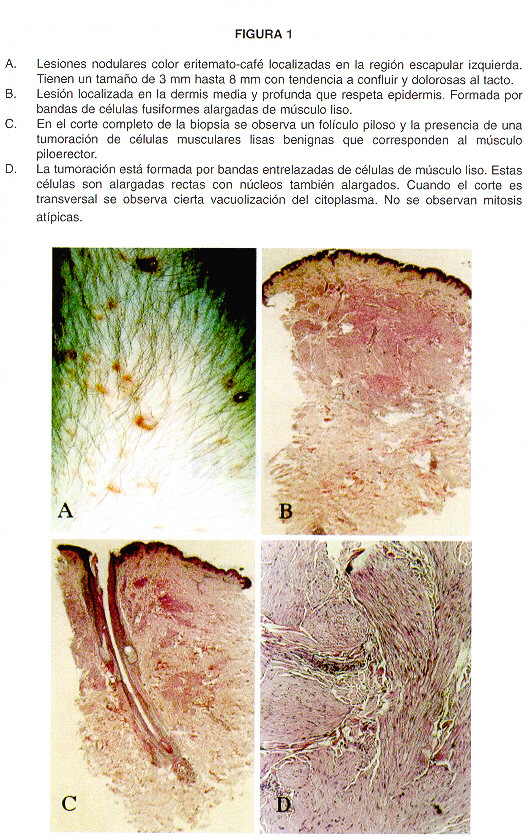
<body><![CDATA[<P><FONT SIZE=-1><FONT FACE="Arial,Helvetica">Paciente masculino de 28 a&ntilde;os de edad, empleado de una Agencia de Turismo, sin antecedentes familiares de tumores y sin antecedentes personales patol&oacute;gicos de importancia.&nbsp; Se presenta a consulta con lesiones en piel de tipo nodular que iniciaron su aparici&oacute;n 8 a&ntilde;os antes, localizadas en el dorso de ambos brazos y regiones escapulares.&nbsp; El crecimiento de las lesiones ha sido lento pero progresivo.&nbsp; Algunas lesiones son dolorosas al tacto y ocasionalmente presentan dolor espont&aacute;neo leve.&nbsp; A la exploraci&oacute;n f&iacute;sica se observa piel de tipo III y la presencia de n&oacute;dulos color eritematosos o caf&eacute; claro de</FONT> <FONT FACE="Arial,Helvetica">3mm hasta 8mm de di&aacute;metro con tendencia a agruparse en las regiones antes mencionadas (<A HREF="#fig1">Fig. 1 A</A>).&nbsp; La consistencia de los n&oacute;dulos es firme, no adheridos a planos profundos y la superficie de la piel es normal.&nbsp; No se observan datos de inflamaci&oacute;n o m&aacute;culas en el resto de la piel.</FONT></FONT>     <BR><FONT SIZE=-1>&nbsp;</FONT>     <BR><FONT SIZE=-1>&nbsp;</FONT>     <BR><FONT SIZE=-1><B><FONT FACE="Arial,Helvetica">Discusi&oacute;n</FONT></B></FONT><FONT SIZE=-1></FONT>      <P><FONT SIZE=-1><FONT FACE="Arial,Helvetica">Este tumor es muy poco frecuente en Costa Rica.&nbsp; A pesar de ser un tumor benigno de muy baja incidencia el diagn&oacute;stico cl&iacute;nico de leiomioma pilar debemos tenerlo presente en el caso de n&oacute;dulos solitarios o m&uacute;ltiples cuando se presentan en gente joven y estas personas aducen dolor de las lesiones (<A HREF="#6">6</A>).&nbsp; El diagn&oacute;stico cl&iacute;nico es dif&iacute;cil inicialmente porque no se piensa en este tumor (<A HREF="#5">5</A>).&nbsp; El diagn&oacute;stico diferencial debe hacerse con neurofibromas pero usualmente estos tienen una consistencia m&aacute;s suave, son de color piel, la distribuci&oacute;n es m&aacute;s generalizada y se asocian a la presencia de m&aacute;culas color caf&eacute; con leche de la neurofibromatosis tipo I. Otra lesi&oacute;n puede considerarse como diagn&oacute;stico diferencial es el hidrocistoma (<A HREF="#4">4</A>).&nbsp; Hay muy poca evidencia de transformaci&oacute;n maligna de los leiomiomas cut&aacute;neos (<A HREF="#1">1</A>, <A HREF="#3">3</A>).&nbsp; El tratamiento de elecci&oacute;n en los tumores solitarios es la excisi&oacute;n quir&uacute;rgica (<A HREF="#4">4</A>, <A HREF="#6">6</A>).&nbsp; En este paciente que desea la eliminaci&oacute;n de los tumores debe evaluarse el beneficio cosm&eacute;tico de resecarlos quir&uacute;rgicamente contra las posibles</FONT> <FONT FACE="Arial,Helvetica">cicatrices del procedimiento.&nbsp; Debido a la profundidad de los tumores y de su localizaci&oacute;n, la</FONT> <FONT FACE="Arial,Helvetica">criocirug&iacute;a y la cirug&iacute;a con radiofrecuencia pueden dejar cicatrices similares.&nbsp; La ablaci&oacute;n con l&aacute;ser no se recomienda.</FONT></FONT><FONT SIZE=-1></FONT>      <P><FONT SIZE=-1><FONT FACE="Arial,Helvetica">El diagn&oacute;stico histol&oacute;gico en este caso no presenta dificultad.&nbsp; El corte histol&oacute;gico de la lesi&oacute;n observada a bajo aumento muestra que est&aacute; localizada en la dermis media y profunda respetando la epidermis (<A HREF="#fig1">Fig 1B</A>) y formada por bandas de c&eacute;lulas fusiformes alargadas de m&uacute;sculo liso.&nbsp; Se puede observar un corte completo de un fol&iacute;culo piloso y la presencia de una tumoraci&oacute;n de c&eacute;lulas musculares lisas benignas que corresponden al m&uacute;sculo piloerector (<A HREF="#fig1">Fig. 1 C</A>).&nbsp; D. La tumoraci&oacute;n est&aacute; formada por bandas entrelazadas de c&eacute;lulas de m&uacute;sculo liso.&nbsp; Estas c&eacute;lulas son alargadas rectas con n&uacute;cleos tambi&eacute;n alargados.&nbsp; Cuando el corte es transversal se observa cierta vacuolizaci&oacute;n del citoplasma.&nbsp; No se observan mitosis at&iacute;picas (<A HREF="#fig1">Fig. 1 D</A>).</FONT></FONT><FONT SIZE=-1></FONT>      <P><FONT SIZE=-1><FONT FACE="Arial,Helvetica">En algunas tumoraciones es dif&iacute;cil diferenciar las fibras musculares de las col&aacute;genas pues ambas se ti&ntilde;en de rosado con hematoxicilina-eosina.&nbsp; Pero la forma del n&uacute;cleo en las fibras musculares es mucho m&aacute;s alargado que en los fibroblastos que pudieran estar presentes, adem&aacute;s en un corte transversal las fibras musculares presentan microvacuoiizaci&oacute;n.&nbsp; En caso de duda en el tipo de c&eacute;lula de la tumoraci&oacute;n puede realizarse una tinci&oacute;n con azul de anilina donde las fibras</FONT> <FONT FACE="Arial,Helvetica">col&aacute;genas se ti&ntilde;en de azul y las musculares de rojo.&nbsp; La tinci&oacute;n de Masson ti&ntilde;e las fibras musculares de rojo oscuro y las col&aacute;genas de verde (<A HREF="#3">3</A>).</FONT></FONT>     <BR><FONT SIZE=-1>&nbsp;</FONT>     <BR><FONT SIZE=-1>&nbsp;</FONT>     <BR><FONT SIZE=-1><B><FONT FACE="Arial,Helvetica">Referencias</FONT></B></FONT><FONT SIZE=-1></FONT>      ]]></body>
<body><![CDATA[<!-- ref --><P><A NAME="1"></A><FONT SIZE=-1><FONT FACE="Arial,Helvetica">1. G&oacute;mez Orbaneja J. <I>Dermatolog&iacute;a</I>.&nbsp; Edit.&nbsp; Aguilar.&nbsp; Madrid. 1976:516-517.</FONT></FONT>    &nbsp;&nbsp;&nbsp;&nbsp;&nbsp;&nbsp;&nbsp;&nbsp;[&#160;<a href="javascript:void(0);" onclick="javascript: window.open('/scielo.php?script=sci_nlinks&ref=772783&pid=S0253-2948199900020000900001&lng=','','width=640,height=500,resizable=yes,scrollbars=1,menubar=yes,');">Links</a>&#160;]<!-- end-ref --><BR><FONT SIZE=-1>&nbsp;</FONT>     <!-- ref --><BR><A NAME="2"></A><FONT SIZE=-1><FONT FACE="Arial,Helvetica">2. Lever WF and Schaumburg Lever G. Histopathology of the Skin. 6th edition.&nbsp; Ed.&nbsp; J. B. Lippincott Co. Philadelphia. 1983:658-659.</FONT></FONT>    &nbsp;&nbsp;&nbsp;&nbsp;&nbsp;&nbsp;&nbsp;&nbsp;[&#160;<a href="javascript:void(0);" onclick="javascript: window.open('/scielo.php?script=sci_nlinks&ref=772785&pid=S0253-2948199900020000900002&lng=','','width=640,height=500,resizable=yes,scrollbars=1,menubar=yes,');">Links</a>&#160;]<!-- end-ref --><BR><FONT SIZE=-1>&nbsp;</FONT>     <!-- ref --><BR><A NAME="3"></A><FONT SIZE=-1><FONT FACE="Arial,Helvetica">3. Albrecht S. <I>Neoplasias and hyperplasias of neural and muscular origin</I>.&nbsp; En: Fitzpatrick's Dermatology in General Medicine.&nbsp; Editors: Freedberg l.M, Eisen A.Z, Wolff K, Austen K.F, Golsmith L.A, KatzS.I, Fitzpatrick T.B. 5th Edition.&nbsp; McGraw-Hill, New York. 1999:1210-1212.</FONT></FONT>    &nbsp;&nbsp;&nbsp;&nbsp;&nbsp;&nbsp;&nbsp;&nbsp;[&#160;<a href="javascript:void(0);" onclick="javascript: window.open('/scielo.php?script=sci_nlinks&ref=772787&pid=S0253-2948199900020000900003&lng=','','width=640,height=500,resizable=yes,scrollbars=1,menubar=yes,');">Links</a>&#160;]<!-- end-ref --><BR><FONT SIZE=-1>&nbsp;</FONT>     <!-- ref --><BR><A NAME="4"></A><FONT SIZE=-1><FONT FACE="Arial,Helvetica">4. Rook A, Wilkinson D.S, Ebling F.J.G. <I>Textbook of Dermatology</I>.&nbsp; Erd Edition.&nbsp; Blackwell Scientific Publication.&nbsp; Oxford. 1979:2228-2229.</FONT></FONT>    &nbsp;&nbsp;&nbsp;&nbsp;&nbsp;&nbsp;&nbsp;&nbsp;[&#160;<a href="javascript:void(0);" onclick="javascript: window.open('/scielo.php?script=sci_nlinks&ref=772789&pid=S0253-2948199900020000900004&lng=','','width=640,height=500,resizable=yes,scrollbars=1,menubar=yes,');">Links</a>&#160;]<!-- end-ref --><BR><FONT SIZE=-1>&nbsp;</FONT>     <!-- ref --><BR><A NAME="5"></A><FONT SIZE=-1><FONT FACE="Arial,Helvetica">5. Moschella S.L, Hurley H.J. <I>Dermatology</I>. 2nd Edit.&nbsp; W.B. Saunders Co. Philadelphia. 1985:1619-1620.</FONT></FONT>    &nbsp;&nbsp;&nbsp;&nbsp;&nbsp;&nbsp;&nbsp;&nbsp;[&#160;<a href="javascript:void(0);" onclick="javascript: window.open('/scielo.php?script=sci_nlinks&ref=772791&pid=S0253-2948199900020000900005&lng=','','width=640,height=500,resizable=yes,scrollbars=1,menubar=yes,');">Links</a>&#160;]<!-- end-ref --><BR><FONT SIZE=-1>&nbsp;</FONT>     ]]></body>
<body><![CDATA[<!-- ref --><BR><A NAME="6"></A><FONT SIZE=-1><FONT FACE="Arial,Helvetica">6. Braun.Falco O, Plewig G, Wolff H.H and R.K <I>Winkelmann. Dermatolog&iacute;a</I>. Ed.&nbsp; SpringerVerlag.&nbsp; Barcelona. 1995:10801081.</FONT></FONT>    &nbsp;&nbsp;&nbsp;&nbsp;&nbsp;&nbsp;&nbsp;&nbsp;[&#160;<a href="javascript:void(0);" onclick="javascript: window.open('/scielo.php?script=sci_nlinks&ref=772793&pid=S0253-2948199900020000900006&lng=','','width=640,height=500,resizable=yes,scrollbars=1,menubar=yes,');">Links</a>&#160;]<!-- end-ref --><BR><FONT SIZE=-1>&nbsp;</FONT>      <P><A NAME="*"></A><FONT FACE="Arial,Helvetica"><FONT SIZE=-1><A HREF="#*a">*</A> Unidad de Microscopia Electr&oacute;nica.</FONT></FONT>     <BR><FONT FACE="Arial,Helvetica"><FONT SIZE=-1>Universidad de Costa Rica.&nbsp; CP-2060, San Jos&eacute;, Costa Rica.</FONT></FONT>     <BR><FONT FACE="Arial,Helvetica"><FONT SIZE=-1>Tel&eacute;fono: (506) 207-3207.&nbsp; Fax: (506) 207-3182.</FONT></FONT>     <BR><FONT FACE="Arial,Helvetica"><FONT SIZE=-1>Correo electr&oacute;nico: <A HREF="mailto:efreer@cariari.ucrac.cr">efreer@cariari.ucrac.cr</A></FONT></FONT>      <P>&nbsp;     <BR>&nbsp;     <CENTER><A NAME="fig1"></A><IMG SRC="/img/fbpe/rccm/v20n3-4/0672i1.JPG" HEIGHT=837 WIDTH=529></CENTER>      
 ]]></body><back>
<ref-list>
<ref id="B1">
<nlm-citation citation-type="book">
<person-group person-group-type="author">
<name>
<surname><![CDATA[Gómez Orbaneja]]></surname>
<given-names><![CDATA[J]]></given-names>
</name>
</person-group>
<source><![CDATA[Dermatología]]></source>
<year>1976</year>
<page-range>516-517</page-range><publisher-loc><![CDATA[Madrid ]]></publisher-loc>
<publisher-name><![CDATA[Edit. Aguilar]]></publisher-name>
</nlm-citation>
</ref>
<ref id="B2">
<nlm-citation citation-type="book">
<person-group person-group-type="author">
<name>
<surname><![CDATA[Lever]]></surname>
<given-names><![CDATA[WF]]></given-names>
</name>
<name>
<surname><![CDATA[Schaumburg Lever]]></surname>
<given-names><![CDATA[G]]></given-names>
</name>
</person-group>
<source><![CDATA[Histopathology of the Skin]]></source>
<year>1983</year>
<edition>6th</edition>
<page-range>658-659</page-range><publisher-loc><![CDATA[Philadelphia ]]></publisher-loc>
<publisher-name><![CDATA[Ed. J. B. Lippincott Co]]></publisher-name>
</nlm-citation>
</ref>
<ref id="B3">
<nlm-citation citation-type="book">
<person-group person-group-type="author">
<name>
<surname><![CDATA[Albrecht]]></surname>
<given-names><![CDATA[S]]></given-names>
</name>
</person-group>
<article-title xml:lang="en"><![CDATA[Neoplasias and hyperplasias of neural and muscular origin]]></article-title>
<person-group person-group-type="editor">
<name>
<surname><![CDATA[Freedberg]]></surname>
<given-names><![CDATA[l.M]]></given-names>
</name>
<name>
<surname><![CDATA[Eisen]]></surname>
<given-names><![CDATA[A.Z]]></given-names>
</name>
<name>
<surname><![CDATA[Wolff]]></surname>
<given-names><![CDATA[K]]></given-names>
</name>
<name>
<surname><![CDATA[Austen]]></surname>
<given-names><![CDATA[K.F]]></given-names>
</name>
<name>
<surname><![CDATA[Golsmith]]></surname>
<given-names><![CDATA[L.A]]></given-names>
</name>
<name>
<surname><![CDATA[KatzS]]></surname>
<given-names><![CDATA[I]]></given-names>
</name>
<name>
<surname><![CDATA[Fitzpatrick]]></surname>
<given-names><![CDATA[T.B]]></given-names>
</name>
</person-group>
<source><![CDATA[Fitzpatrick's Dermatology in General Medicine]]></source>
<year>1999</year>
<edition>5th</edition>
<page-range>1210-1212</page-range><publisher-loc><![CDATA[New York ]]></publisher-loc>
<publisher-name><![CDATA[McGraw-Hill]]></publisher-name>
</nlm-citation>
</ref>
<ref id="B4">
<nlm-citation citation-type="book">
<person-group person-group-type="author">
<name>
<surname><![CDATA[Rook]]></surname>
<given-names><![CDATA[A]]></given-names>
</name>
<name>
<surname><![CDATA[Wilkinson]]></surname>
<given-names><![CDATA[D.S]]></given-names>
</name>
<name>
<surname><![CDATA[Ebling]]></surname>
<given-names><![CDATA[F.J.G]]></given-names>
</name>
</person-group>
<source><![CDATA[Textbook of Dermatology]]></source>
<year>1979</year>
<edition>Erd</edition>
<page-range>2228-2229</page-range><publisher-loc><![CDATA[Oxford ]]></publisher-loc>
<publisher-name><![CDATA[Blackwell Scientific Publication]]></publisher-name>
</nlm-citation>
</ref>
<ref id="B5">
<nlm-citation citation-type="book">
<person-group person-group-type="author">
<name>
<surname><![CDATA[Moschella]]></surname>
</name>
<name>
<surname><![CDATA[Hurley]]></surname>
<given-names><![CDATA[H.J]]></given-names>
</name>
</person-group>
<source><![CDATA[Dermatology]]></source>
<year>1985</year>
<edition>2nd</edition>
<page-range>1619-1620</page-range><publisher-loc><![CDATA[Philadelphia ]]></publisher-loc>
<publisher-name><![CDATA[W.B. Saunders Co]]></publisher-name>
</nlm-citation>
</ref>
<ref id="B6">
<nlm-citation citation-type="book">
<person-group person-group-type="author">
<name>
<surname><![CDATA[Braun.Falco]]></surname>
<given-names><![CDATA[O]]></given-names>
</name>
<name>
<surname><![CDATA[Plewig]]></surname>
<given-names><![CDATA[G]]></given-names>
</name>
<name>
<surname><![CDATA[Wolff]]></surname>
<given-names><![CDATA[H.H]]></given-names>
</name>
<name>
<surname><![CDATA[Winkelmann]]></surname>
<given-names><![CDATA[R.K]]></given-names>
</name>
</person-group>
<source><![CDATA[Dermatología]]></source>
<year>1995</year>
<page-range>1080-1081</page-range><publisher-loc><![CDATA[Barcelona ]]></publisher-loc>
<publisher-name><![CDATA[Ed. SpringerVerlag]]></publisher-name>
</nlm-citation>
</ref>
</ref-list>
</back>
</article>
