<?xml version="1.0" encoding="ISO-8859-1"?><article xmlns:mml="http://www.w3.org/1998/Math/MathML" xmlns:xlink="http://www.w3.org/1999/xlink" xmlns:xsi="http://www.w3.org/2001/XMLSchema-instance">
<front>
<journal-meta>
<journal-id>0253-2948</journal-id>
<journal-title><![CDATA[Revista Costarricense de Ciencias Médicas]]></journal-title>
<abbrev-journal-title><![CDATA[Rev. costarric. cienc. méd]]></abbrev-journal-title>
<issn>0253-2948</issn>
<publisher>
<publisher-name><![CDATA[Editorial Nacional de Salud y Seguridad Social]]></publisher-name>
</publisher>
</journal-meta>
<article-meta>
<article-id>S0253-29481999000200008</article-id>
<title-group>
<article-title xml:lang="es"><![CDATA[Síndrome de Guillain-Barré: análisis de 36 pacientes]]></article-title>
</title-group>
<contrib-group>
<contrib contrib-type="author">
<name>
<surname><![CDATA[Quintero]]></surname>
<given-names><![CDATA[Teodoro]]></given-names>
</name>
<xref ref-type="aff" rid="A01"/>
</contrib>
<contrib contrib-type="author">
<name>
<surname><![CDATA[Boza]]></surname>
<given-names><![CDATA[Ricardo]]></given-names>
</name>
<xref ref-type="aff" rid="A02"/>
</contrib>
</contrib-group>
<aff id="A01">
<institution><![CDATA[,Hospital San Juan de Dios Sección de Medicina ]]></institution>
<addr-line><![CDATA[ ]]></addr-line>
</aff>
<aff id="A02">
<institution><![CDATA[,Hospital San Juan de Dios Servicio de Infectología ]]></institution>
<addr-line><![CDATA[San José ]]></addr-line>
<country>Costa Rica</country>
</aff>
<pub-date pub-type="pub">
<day>00</day>
<month>12</month>
<year>1999</year>
</pub-date>
<pub-date pub-type="epub">
<day>00</day>
<month>12</month>
<year>1999</year>
</pub-date>
<volume>20</volume>
<numero>3-4</numero>
<fpage>217</fpage>
<lpage>230</lpage>
<copyright-statement/>
<copyright-year/>
<self-uri xlink:href="http://www.scielo.sa.cr/scielo.php?script=sci_arttext&amp;pid=S0253-29481999000200008&amp;lng=en&amp;nrm=iso"></self-uri><self-uri xlink:href="http://www.scielo.sa.cr/scielo.php?script=sci_abstract&amp;pid=S0253-29481999000200008&amp;lng=en&amp;nrm=iso"></self-uri><self-uri xlink:href="http://www.scielo.sa.cr/scielo.php?script=sci_pdf&amp;pid=S0253-29481999000200008&amp;lng=en&amp;nrm=iso"></self-uri><abstract abstract-type="short" xml:lang="es"><p><![CDATA[Describe las características clínicas y epidemiológicas, métodos diagnósticos y la terapéutica empleada en los pacientes con síndrome de Guillain-Barré atendidos en el Hospital San Juan de Dios durante el período comprendido entre el 1 de enero de 1994 y el 31 de diciembre de 1998. Se revisaron en forma retrospectiva un total de 36 expedientes de pacientes que egresaron con el diagnóstico de síndrome de Guillain-Barré del Hospital San Juan de Dios. Todos los pacientes fueron valorados por médicos del servicio de neurología y cumplieron con los criterios diagnósticos de Asbury y Cornblath. El 64% de los pacientes fueron hombres. El grupo etario más frecuente fue el de 30 a 49 años de edad, sin embargo la distribución en todos los grupos de edad fue similar. La incidencia fue mayor durante los meses de mayo a diciembre, época de mayor precipitación lluviosa en el país. Una patología previa se identificó en 25 casos (70%). La infección previa de las vías respiratorias superiores ocurrió en 13 pacientes (36 %) y el antecedente de enfermedad diarreica fue observado en 6 pacientes (17%). Se realizó punción lumbar al 94,5% de los pacientes; el 50% presentó disociación albúmino citológica en el líquido cefalorraquídeo inicial. Los estudios electrofisiológicos fueron realizados en el 72% de los casos y todos fueron compatibles con una neuropatía periférico aguda desmielinizante. Todos los pacientes presentaron manifestaciones clínicas motoras, el 97% presentó afección de miembros inferiores, el 81% fue de predominio distal y en el 78% la progresión fue ascendente. El 36% presentó compromiso sensitivo, 31 % autonómico y el 31 % afectación de pares craneales. El síndrome de Miller Fisher se presentó en el 5.5 % de los casos. En el 42 % de los pacientes se utilizó la gammaglobulina como terapia específica. El 25% de los pacientes requirieron ventilación mecánica. La mortalidad fue del 8%. Las características clínicas de los pacientes con síndrome de Guillain Barré encontradas en nuestro estudio son similares a lo reportado por varios autores. Es de resaltar el hecho que la mayoría de los casos se presentaron durante los meses de mayo a diciembre, época en que se observa en Costa Rica con gran frecuencia infecciones de vías respiratorias superiores y que en una población pediátrica y en un grupo de pacientes adultos se han demostrado picos epidémicos de infecciones por el virus de la Influenza A y Parainfluenza. El estudio del líquido cefalorraquídeo fue el método diagnóstico más utilizado, el 50% presentó disociación albúmino citológica. Los estudios electrofisiológicos mostraron una neuropatía periférico aguda desmielinizante. La gammaglobulina fue la terapia específica más usada.]]></p></abstract>
<abstract abstract-type="short" xml:lang="en"><p><![CDATA[To describe clinical and epidemiological characteristics, diagnosis and treatment of patients with Guillain-Barré syndrome seen at the Hospital San Juan de Dios in San José, Costa Rica, from january 1994 to december 1998. A retrospective analysis was realized on the medical files from 36 patients discharged with the diagnosis of Guillain-Barré syndrome. All patients met the previousiy published criteria from Asbury and Combiath and were evaluated by the Neurology Service. The annual incidence of the Guillain-Barré syndrome was 1.2 cases per 100.000 inhabitants. We found 36 patients with the inclusion criteria, 64% of them were men. lt was more frequent in patients between 30-49 years old and in the rainy months from May to December. A recent infection was demonstrated in 70% of patients. The most frequent infectious processes were respiratory tract ínfections (36%) and diarrhea (17%). In 50% of the patients we found albumino-cytologic dissociation in the Cerebro Spinal Fluid. We performe electrophysiologic studies in 72% of patients and were abnormal in alí of them. All patients presentes clínical motor manifestations and in 78% an ascendent progressive course was observed. The Miller Fisher syndrome was observed in 5.5% of the patients. The patients were treated in 42% with High Doses of IV Gammaglobulin. Twenty five percent of the patients required assisted mechanical ventilation. The mortaiity rate was 8%. The clinical and epidemiological characteristics of patients in this study were similar to those described in medical literature except for a high incidence of the syndrome in the rainy months from May to December. With the knowledge of the high incidence of influenza virus infection in this season in our country, we need more studies regarding the relationship of influenza A virus and Guillain-Barré syndrome in Costa Rica.]]></p></abstract>
<kwd-group>
<kwd lng="es"><![CDATA[Síndrome de Guillain Barré]]></kwd>
<kwd lng="es"><![CDATA[polirradiculoneuritis]]></kwd>
<kwd lng="es"><![CDATA[Síndrome de Miller Fisher]]></kwd>
<kwd lng="es"><![CDATA[influenza]]></kwd>
<kwd lng="es"><![CDATA[Campylobacter jejuni]]></kwd>
<kwd lng="en"><![CDATA[Guillain Barre Syndrome]]></kwd>
<kwd lng="en"><![CDATA[polyradiculoneuropathy]]></kwd>
<kwd lng="en"><![CDATA[Miller Fisher Syndrome]]></kwd>
<kwd lng="en"><![CDATA[Influenza]]></kwd>
<kwd lng="en"><![CDATA[Campylobacter jejuni]]></kwd>
</kwd-group>
</article-meta>
</front><body><![CDATA[ <CENTER><B><FONT FACE="Arial,Helvetica">S&iacute;ndrome de Guillain-Barr&eacute;:</FONT></B></CENTER>      <CENTER><B><FONT FACE="Arial,Helvetica">an&aacute;lisis de 36 pacientes</FONT></B></CENTER>      <CENTER>&nbsp;</CENTER>      <CENTER>&nbsp;</CENTER>      <CENTER>&nbsp;<B><FONT FACE="Arial,Helvetica"><FONT SIZE=-1>Teodoro Quintero<A NAME="1a"></A><SUP><A HREF="#1">1</A></SUP>, Ricardo BoZa<SUP><A HREF="#2*">2*</A></SUP></FONT></FONT></B></CENTER> &nbsp;     <BR><B><FONT FACE="Arial,Helvetica"><FONT SIZE=-1>Resumen</FONT></FONT></B>     <BR><FONT SIZE=-1>&nbsp;</FONT>     <BR><FONT FACE="Arial,Helvetica"><FONT SIZE=-1>Describe las caracter&iacute;sticas cl&iacute;nicas y epidemiol&oacute;gicas, m&eacute;todos diagn&oacute;sticos y la terap&eacute;utica empleada en los pacientes con s&iacute;ndrome de Guillain-Barr&eacute; atendidos en el Hospital San Juan de Dios durante el per&iacute;odo comprendido entre el 1 de enero de 1994 y el 31 de diciembre de 1998.</FONT></FONT>      <P><FONT FACE="Arial,Helvetica"><FONT SIZE=-1>Se revisaron en forma retrospectiva un total de 36 expedientes de pacientes que egresaron con el diagn&oacute;stico de s&iacute;ndrome de Guillain-Barr&eacute; del Hospital San Juan de Dios.&nbsp; Todos los pacientes fueron valorados por m&eacute;dicos del servicio de neurolog&iacute;a y cumplieron con los criterios diagn&oacute;sticos de Asbury y Cornblath.</FONT></FONT>      <P><FONT FACE="Arial,Helvetica"><FONT SIZE=-1>El 64% de los pacientes fueron hombres.&nbsp; El grupo etario m&aacute;s frecuente fue el de 30 a 49 a&ntilde;os de edad, sin embargo la distribuci&oacute;n en todos los grupos de edad fue similar.&nbsp; La incidencia fue mayor durante los meses de mayo a diciembre, &eacute;poca de mayor precipitaci&oacute;n lluviosa en el pa&iacute;s.&nbsp; Una patolog&iacute;a previa se identific&oacute; en 25 casos (70%).&nbsp; La infecci&oacute;n previa de las v&iacute;as respiratorias superiores ocurri&oacute; en 13 pacientes (36 %) y el antecedente de enfermedad diarreica fue observado en 6 pacientes (17%).&nbsp; Se realiz&oacute; punci&oacute;n lumbar al 94,5% de los pacientes; el 50% present&oacute; disociaci&oacute;n alb&uacute;mino citol&oacute;gica en el l&iacute;quido cefalorraqu&iacute;deo inicial.</FONT></FONT>      ]]></body>
<body><![CDATA[<P><FONT FACE="Arial,Helvetica"><FONT SIZE=-1>Los estudios electrofisiol&oacute;gicos fueron realizados en el 72% de los casos y todos fueron compatibles con una neuropat&iacute;a perif&eacute;rico aguda desmielinizante.&nbsp; Todos los pacientes presentaron manifestaciones cl&iacute;nicas motoras, el 97% present&oacute; afecci&oacute;n de miembros inferiores, el 81% fue de predominio distal y en el 78% la progresi&oacute;n fue ascendente.&nbsp; El 36% present&oacute; compromiso sensitivo, 31 % auton&oacute;mico y el 31 % afectaci&oacute;n de pares craneales.&nbsp; El s&iacute;ndrome de Miller Fisher se present&oacute; en el 5.5 % de los casos.&nbsp; En el 42 % de los pacientes se utiliz&oacute; la gammaglobulina como terapia espec&iacute;fica.&nbsp; El 25% de los pacientes requirieron ventilaci&oacute;n mec&aacute;nica.&nbsp; La mortalidad fue del 8%.</FONT></FONT>      <P><FONT FACE="Arial,Helvetica"><FONT SIZE=-1>Las caracter&iacute;sticas cl&iacute;nicas de los pacientes con s&iacute;ndrome de Guillain Barr&eacute; encontradas en nuestro estudio son similares a lo reportado por varios autores.&nbsp; Es de resaltar el hecho que la mayor&iacute;a de los casos se presentaron durante los meses de mayo a diciembre, &eacute;poca en que se observa en Costa Rica con gran frecuencia infecciones de v&iacute;as respiratorias superiores y que en una poblaci&oacute;n pedi&aacute;trica y en un grupo de pacientes adultos se han demostrado picos epid&eacute;micos de infecciones por el virus de la Influenza A y Parainfluenza.</FONT></FONT>      <P><FONT FACE="Arial,Helvetica"><FONT SIZE=-1>El estudio del l&iacute;quido cefalorraqu&iacute;deo fue el m&eacute;todo diagn&oacute;stico m&aacute;s utilizado, el 50% present&oacute; disociaci&oacute;n alb&uacute;mino citol&oacute;gica.&nbsp; Los estudios electrofisiol&oacute;gicos mostraron una neuropat&iacute;a perif&eacute;rico aguda desmielinizante.&nbsp; La gammaglobulina fue la terapia espec&iacute;fica m&aacute;s usada.</FONT></FONT>      <P><B><FONT FACE="Arial,Helvetica"><FONT SIZE=-1>Palabras clave</FONT></FONT></B>      <P><FONT FACE="Arial,Helvetica"><FONT SIZE=-1>S&iacute;ndrome de Guillain Barr&eacute;, polirradiculoneuritis, S&iacute;ndrome de Miller Fisher, influenza, <I>Campylobacter jejuni</I>.</FONT></FONT>     <BR><FONT SIZE=-1>&nbsp;</FONT>     <BR><FONT SIZE=-1>&nbsp;<B><FONT FACE="Arial,Helvetica">Abstract</FONT></B></FONT>      <P><FONT FACE="Arial,Helvetica"><FONT SIZE=-1>To describe clinical and epidemiological characteristics, diagnosis and treatment of patients with Guillain-Barr&eacute; syndrome seen at the Hospital San Juan de Dios in San Jos&eacute;, Costa Rica, from january 1994 to december 1998.</FONT></FONT>      <P><FONT SIZE=-1><FONT FACE="Arial,Helvetica">A retrospective analysis was realized on the medical files from 36</FONT> <FONT FACE="Arial,Helvetica">patients discharged with the diagnosis of Guillain-Barr&eacute; syndrome.&nbsp; All patients met the previousiy published criteria from Asbury and Combiath and were evaluated by the Neurology Service.</FONT></FONT>      <P><FONT FACE="Arial,Helvetica"><FONT SIZE=-1>The annual incidence of the Guillain-Barr&eacute; syndrome was 1.2 cases per 100.000 inhabitants.&nbsp; We found 36 patients with the inclusion criteria, 64% of them were men. lt was more frequent in patients between 30-49 years old and in the rainy months from May to December.&nbsp; A recent infection was demonstrated in 70% of patients.&nbsp; The most frequent infectious processes were respiratory tract &iacute;nfections (36%) and diarrhea (17%).&nbsp; In 50% of the patients we found albumino-cytologic dissociation in the Cerebro Spinal Fluid.&nbsp; We performe electrophysiologic studies in 72% of patients and were abnormal in al&iacute; of them.&nbsp; All patients presentes cl&iacute;nical motor manifestations and in 78% an ascendent progressive course was observed.&nbsp; The Miller Fisher syndrome was observed in 5.5% of the patients.&nbsp; The patients were treated in 42% with High Doses of IV Gammaglobulin.&nbsp; Twenty five percent of the patients required assisted mechanical ventilation.&nbsp; The mortaiity rate was 8%.</FONT></FONT>      ]]></body>
<body><![CDATA[<P><FONT SIZE=-1><FONT FACE="Arial,Helvetica">The clinical and epidemiological characteristics of patients in this study were similar to those described in medical literature except for a high incidence of the syndrome in the rainy months from May to December.&nbsp; With the knowledge of the high incidence of influenza virus</FONT> <FONT FACE="Arial,Helvetica">infection in this season in our country, we need more studies regarding the relationship of influenza A virus and Guillain-Barr&eacute; syndrome in Costa Rica.</FONT></FONT>     <BR><FONT SIZE=-1>&nbsp;</FONT>     <BR><B><FONT FACE="Arial,Helvetica"><FONT SIZE=-1>Key words</FONT></FONT></B>      <P><FONT FACE="Arial,Helvetica"><FONT SIZE=-1>Guillain Barre Syndrome, polyradiculoneuropathy, Miller Fisher Syndrome, Influenza, <I>Campylobacter jejuni</I>.</FONT></FONT>     <BR><FONT SIZE=-1>&nbsp;</FONT>     <BR><FONT SIZE=-1>&nbsp;</FONT>     <BR><B><FONT FACE="Arial,Helvetica"><FONT SIZE=-1>Introducci&oacute;n</FONT></FONT></B>      <P><FONT FACE="Arial,Helvetica"><FONT SIZE=-1>En 1859, Landry describi&oacute; una par&aacute;lisis aguda, r&aacute;pidamente ascendente, en ocasiones asim&eacute;trica y progresiva, que compromet&iacute;a inclusive los m&uacute;sculos respiratorios (<A HREF="#R1">1</A>).&nbsp; En 1876 se le dio el nombre de par&aacute;lisis ascendente de Landry (<A HREF="#R2">2</A>).</FONT></FONT>      <P><FONT FACE="Arial,Helvetica"><FONT SIZE=-1>En 1916 Georges Guillain, J. A. Barr&eacute; y A. Strohi describieron en dos soldados franceses del Batall&oacute;n de los H&uacute;sares un s&iacute;ndrome similar a la par&aacute;lisis ascendente de Landry; pero, adem&aacute;s, con una importante contribuci&oacute;n relacionada con un aumento de las prote&iacute;nas del l&iacute;quido cefalorraqu&iacute;deo (LCR), mientras las c&eacute;lulas se encontraban normales (disociaci&oacute;n alb&uacute;minocitol&oacute;gica) (<A HREF="#R2">2</A>, <A HREF="#3">3</A>).&nbsp; Posteriormente Haymaker y Kemohan en 1949 (<A HREF="#R1">1</A>, <A HREF="#4">4</A>) estudiaron por primera vez la patolog&iacute;a del s&iacute;ndrome, y encontraron que la lesi&oacute;n primaria se situaba en el n&uacute;cleo de las ra&iacute;ces motoras y sensitivas, donde se unen para formar el nervio espinal.</FONT></FONT>      <P><FONT FACE="Arial,Helvetica"><FONT SIZE=-1>Las observaciones cl&iacute;nicas generales se atribuyeron a Guillain y Barr&eacute; y es probable que Andr&eacute; Strohi se encargara de los aspectos electrofisiol&oacute;gicos de la enfermedad (<A HREF="#3">3</A>).</FONT></FONT>     ]]></body>
<body><![CDATA[<BR><FONT SIZE=-1>&nbsp;</FONT>     <BR><FONT FACE="Arial,Helvetica"><FONT SIZE=-1>El s&iacute;ndrome de Guillain Barr&eacute; se define como una polirradiculoneuropat&iacute;a inflamatoria de origen inmunol&oacute;gico, con afectaci&oacute;n predominantemente motora, de evoluci&oacute;n aguda o subaguda (<A HREF="#4">4</A>).&nbsp; Se ha convertido en la primera causa de par&aacute;lisis fl&aacute;cida despu&eacute;s de la erradicaci&oacute;n de la poliomielitis (<A HREF="#R2">2</A>, <A HREF="#5">5</A>, <A HREF="#6">6</A>).&nbsp; Se caracteriza por debilidad sim&eacute;trica en las extremidades, p&eacute;rdida de los reflejos osteotendinosos, signos o s&iacute;ntomas sensitivos leves y una disfunci&oacute;n auton&oacute;mica variable.&nbsp; Afecta a pacientes de todas las edades y de uno u otro sexo (<A HREF="#R1">1</A>, <A HREF="#4">4</A>, <A HREF="#7">7</A>, <A HREF="#8">8</A>)</FONT></FONT>      <P><FONT FACE="Arial,Helvetica"><FONT SIZE=-1>Se ha descrito el antecedente de una infecci&oacute;n respiratoria o gastrointestinal en las cuatro semanas previas al inicio de los s&iacute;ntomas neurol&oacute;g&iacute;cos en 50-75% de los casos (<A HREF="#4">4</A>, <A HREF="#5">5</A>, <A HREF="#8">8</A>-<A HREF="#12">12</A>).&nbsp; El diagn&oacute;stico es cl&iacute;nico y puede ser confirmado por las caracter&iacute;sticas del l&iacute;quido cefalorraqu&iacute;deo y por estudios electrofisiol&oacute;gicos (<A HREF="#3">3</A>, <A HREF="#4">4</A>)</FONT></FONT>      <P><FONT FACE="Arial,Helvetica"><FONT SIZE=-1>La incidencia mundial var&iacute;a entre 1 y 2 casos por 100 000 habitantes y la mortalidad puede superar el 10% (<A HREF="#4">4</A>, <A HREF="#6">6</A>, <A HREF="#8">8</A>, <A HREF="#13">13</A>).&nbsp; Debe considerarse como una emergencia m&eacute;dica y ser manejada en un hospital que posea una Unidad de Cuidados Intensivos, ya que hasta un 20 % de los pacientes podr&iacute;an requerir ventilaci&oacute;n mec&aacute;nica (<A HREF="#3">3</A>).&nbsp; Entre el 70 y 85% de los casos se recuperan al a&ntilde;o y dejan un 20 % con secuelas funcionales (<A HREF="#R1">1</A>-<A HREF="#4">4</A>).&nbsp; La probabilidad de discapacidad perrllanente aumenta con la severidad y duraci&oacute;n de la enfermedad (<A HREF="#4">4</A>,<A HREF="#7">7</A>).</FONT></FONT>      <P><FONT FACE="Arial,Helvetica"><FONT SIZE=-1>El objetivo de este estudio es describir las caracter&iacute;sticas cl&iacute;nicas y epidemiol&oacute;gicas, los m&eacute;todos diagn&oacute;sticos y la terap&eacute;utica empleada en los pacientes con s&iacute;ndrome de Guillain Barr&eacute; atendidos en el hospital San Juan de Dios durante el per&iacute;odo comprendido entre enero de 1994 y diciembre de 1998.</FONT></FONT>     <BR><FONT SIZE=-1>&nbsp;</FONT>     <BR><FONT SIZE=-1>&nbsp;</FONT>     <BR><B><FONT FACE="Arial,Helvetica"><FONT SIZE=-1>Materiales y m&eacute;todos</FONT></FONT></B>      <P><FONT SIZE=-1><FONT FACE="Arial,Helvetica">Se revisaron en forma retrospectiva todos los expedientes de pacientes que egresaron del hospital San Juan de Dios con el diagn&oacute;stico de s&iacute;ndrome de Guillain-Barr&eacute; durante el per&iacute;odo comprendido entre el 1 de enero de 1994 y el 31 de diciembre de 1998.&nbsp; Todos los pacientes fueron valorados por los m&eacute;dicos del servicio de neurolog&iacute;a y cumplieron con los criterios diagn&oacute;sticos de Asbury y Cornblath, (<A HREF="#R2">2</A>, <A HREF="#4">4</A>, <A HREF="#5">5</A>) a saber, debilidad motora progresiva de m&aacute;s de un miembro y arreflexia o hiporreflexia.&nbsp; Adem&aacute;s se consideraron otras caracter&iacute;sticas para apoyar el diagn&oacute;stico tales como progresi&oacute;n en d&iacute;as o semanas, simetr&iacute;a relativa, signos o s&iacute;ntomas sensitivos leves, ausencia inicial de fiebre, compromiso de nervios craneales, disfunci&oacute;n del sistema nervioso aut&oacute;nomo, inicio de la recuperaci&oacute;n dos o cuatro semanas despu&eacute;s de cesar la progresi&oacute;n, prote&iacute;nas en LCR mayores de 50 mg/dl y pleocitosis mononuclear menor de 50 c&eacute;lulas/mm (disociaci&oacute;n albumino-citol&oacute;gica), despu&eacute;s de la primera semana de</FONT> <FONT FACE="Arial,Helvetica">evoluci&oacute;n y disminuci&oacute;n de la velocidad de conducci&oacute;n nerviosa o bloqueo.</FONT></FONT>      <P><FONT FACE="Arial,Helvetica"><FONT SIZE=-1>Se evaluaron las variables edad, sexo, fecha de aparici&oacute;n de los s&iacute;ntomas,estancia intrahospitalaria, estudios electrofisiol&oacute;gicos, an&aacute;lisis del LCR,complicaciones y tratamiento espec&iacute;fico instaurado.</FONT></FONT>     ]]></body>
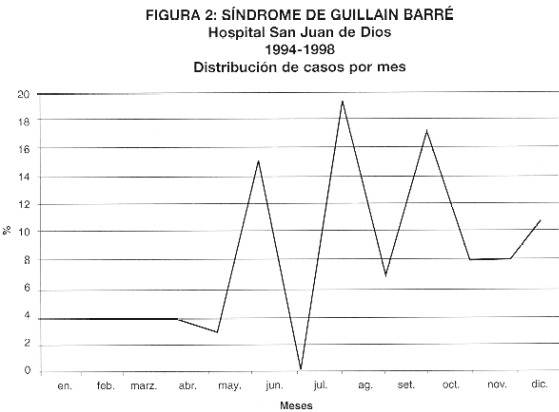
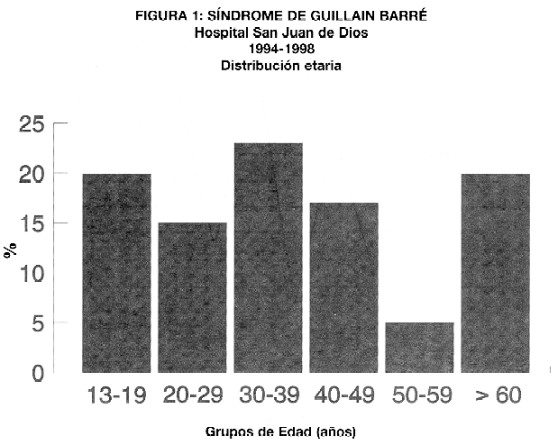
<body><![CDATA[<BR><FONT FACE="Arial,Helvetica"><FONT SIZE=-1>Los estudios electrofisiol&oacute;gicos fueron realizados en el servicio de Neurolog&iacute;a del hospital y se utiliz&oacute; un electromi&oacute;grafo DANTEC Counterpoint MK-2.</FONT></FONT>     <BR><FONT SIZE=-1>&nbsp;</FONT>     <BR><FONT SIZE=-1>&nbsp;</FONT>     <BR><FONT SIZE=-1>&nbsp;<B><FONT FACE="Arial,Helvetica">Resultados</FONT></B></FONT>     <CENTER><FONT SIZE=-1>&nbsp;</FONT></CENTER> <FONT FACE="Arial,Helvetica"><FONT SIZE=-1>Un total de 36 pacientes cumplieron los criterios diagn&oacute;sticos establecidos, lo cual lleva a una incidencia anual del S&iacute;ndrome de Guillain Barr&eacute; en el Hospital San Juan de Dios entre el 0,7 y 1,5 casos por 100 000 habitantes en los &uacute;ltimos cinco a&ntilde;os, para un promedio de 1,2 casos por 100 000 habitantes.</FONT></FONT>      <P><FONT FACE="Arial,Helvetica"><FONT SIZE=-1>La edad de los pacientes estuvo en un &aacute;mbito de 13 a 82 a&ntilde;os; y se encontr&oacute; con mayor frecuencia en el grupo etario de 30 a 49 a&ntilde;os, para una edad promedio de 39.5 a&ntilde;os.&nbsp; No obstante la incidencia fue similar en todos los grupos de edad (<A HREF="#fig1">fig 1</A>).&nbsp; La distribuci&oacute;n por sexo fue de 23 hombres (64 %) y 13 mujeres (36 %).</FONT></FONT>     <BR><FONT FACE="Arial,Helvetica"><FONT SIZE=-1>&nbsp;</FONT></FONT>     <BR><FONT FACE="Arial,Helvetica"><FONT SIZE=-1>Al relacionar la edad con el sexo, las mujeres presentaron una mayor frecuencia en el grupo etario de 30 a 39 a&ntilde;os, en los hombres fue uniforme a trav&eacute;s de los a&ntilde;os.</FONT></FONT>      <P><FONT SIZE=-1><FONT FACE="Arial,Helvetica">En 25 casos (70%) se identific&oacute; alg&uacute;n tipo de patolog&iacute;a previa en las</FONT> <FONT FACE="Arial,Helvetica">cuatro semanas antes del inicio de los s&iacute;ntomas neurol&oacute;gicos.&nbsp; La infecci&oacute;n de las v&iacute;as respiratorias ocurri&oacute; en 14 pacientes (36%) y la enfermedad diarreica aguda en 6 (17%).&nbsp; Cinco enfermos (14%) presentaron otras manifestaciones previas como fiebre y linfadenopat&iacute;as (<A HREF="#3">3</A>), varicela</FONT> <FONT FACE="Arial,Helvetica">(<A HREF="#R1">1</A>) e hipertiroidismo (<A HREF="#R1">1</A>).</FONT></FONT>      <P><FONT SIZE=-1><FONT FACE="Arial,Helvetica">La distribuci&oacute;n anual demostr&oacute;</FONT> <FONT FACE="Arial,Helvetica">una mayor incidencia durante los meses de mayo a diciembre, con un pico en el mes de julio (19%).&nbsp; No se observaron pacientes durante los meses de junio estudiados (<A HREF="#fig2">fig 2</A>). Trece de los 14 enfermos con el antecedente de infecci&oacute;n de v&iacute;as respiratorias se presentaron en los meses de mayo a diciembre.&nbsp; Los casos con antecedente de enfermedad diarreica o aquellos sin patolog&iacute;a previa se presentaron a lo largo del a&ntilde;o.</FONT></FONT>      ]]></body>
<body><![CDATA[<P><FONT FACE="Arial,Helvetica"><FONT SIZE=-1>Se realiz&oacute; una punci&oacute;n lumbar a 34 pacientes (94,5%) cuatro semanas posteriores al inicio de los s&iacute;ntomas neurol&oacute;gicos.&nbsp; El LCR de 17 pacientes (50%) present&oacute; disociaci&oacute;n alb&uacute;mino-citol&oacute;gica.&nbsp; No se tomaron muestras de control a los pacientes que presentaron el estudio negativo.&nbsp; No se encontr&oacute; relaci&oacute;n entre la presencia de disociaci&oacute;n alb&uacute;mino-citol&oacute;gica con el antecedente de patolog&iacute;a previa o la aparici&oacute;n de complicaciones.</FONT></FONT>      <P><FONT FACE="Arial,Helvetica"><FONT SIZE=-1>La electromiografia y los estudios de conducci&oacute;n nerviosa fueron realizados en 26 pacientes (72%); todos fueron compatibles con una neuropat&iacute;a perif&eacute;rico aguda desmielinizante.</FONT></FONT>      <P><FONT SIZE=-1><FONT FACE="Arial,Helvetica">Todos los pacientes presentaron manifestaciones cl&iacute;nicas motoras y</FONT> <FONT FACE="Arial,Helvetica">el 36% tuvo compromiso sensitivo y en 31% de los casos se observ&oacute; disautonom&iacute;a (<A HREF="#CUADRO1">cuadro 1</A>)</FONT></FONT>      <P><FONT FACE="Arial,Helvetica"><FONT SIZE=-1>En dos pacientes (5,5%) se present&oacute; la variante denominada s&iacute;ndrome de Miller Fisher (leve cuadriparesia arrefl&eacute;xica, oftalmoplejia y ataxia).&nbsp; Ninguno de ellos requiri&oacute; ventilaci&oacute;n mec&aacute;nica ni falleci&oacute;.</FONT></FONT>      <P><FONT FACE="Arial,Helvetica"><FONT SIZE=-1>No se encontraron normas para el inicio de un tratamiento espec&iacute;fico, el cual dependi&oacute; de la disponibilidad del tratamiento y de la experiencia de los m&eacute;dicos tratantes con su uso.</FONT></FONT>      <P><FONT FACE="Arial,Helvetica"><FONT SIZE=-1>La terapia con gammaglobulina se utiliz&oacute; en 15 casos (42%), los esteroides en 8 (22%), la plasmaferesis en 3 (8%), la plasmaferesis y la gammaglobulina en 3 (8%) y no se indic&oacute; terapia espec&iacute;fica a 7 pacientes (20%).</FONT></FONT>      <P><FONT FACE="Arial,Helvetica"><FONT SIZE=-1>Dentro de las complicaciones, la insuficiencia respiratoria se present&oacute; en 9 pacientes (25%).&nbsp; Cinco de ellos presentaron el antecedente de infecci&oacute;n de v&iacute;as respiratorias y uno diarrea y en los otros tres no se identific&oacute; alg&uacute;n tipo de patolog&iacute;a previa. (p=0,05).&nbsp; Todos requirieron ventilaci&oacute;n mec&aacute;nica.</FONT></FONT>      <P><FONT FACE="Arial,Helvetica"><FONT SIZE=-1>Fallecieron 3 enfermos (8%); 2 de ellos ten&iacute;an el antecedente de infecci&oacute;n de v&iacute;as respiratorias previo al inicio del s&iacute;ndrome y la causa de muerte en cada caso fue shock hipovol&eacute;mico secundario a sangrado por la traqueostom&iacute;a, shock s&eacute;ptico secundario a bronconeumon&iacute;a severa y arritmia fatal.&nbsp; Dos hab&iacute;an recibido gammaglobulina endovenosa.</FONT></FONT>      <P><FONT FACE="Arial,Helvetica"><FONT SIZE=-1>No se demostr&oacute; relaci&oacute;n entre la edad y la aparici&oacute;n de complicaciones.</FONT></FONT>      <P><FONT FACE="Arial,Helvetica"><FONT SIZE=-1>La estancia hospitalaria estuvo en el &aacute;mbito de 5 a 83 d&iacute;as, y se encontr&oacute; con mayor frecuencia en el grupo de 15 a 29 d&iacute;as (45%), para un promedio de 32 d&iacute;as.&nbsp; Veinticuatro pacientes (67%), ameritaron su ingreso a una unidad de cuidados intensivos, dada su evoluci&oacute;n.&nbsp; No se demostr&oacute; relaci&oacute;n entre la presencia de patolog&iacute;a previa y la duraci&oacute;n de la estancia intrahospitalaria.</FONT></FONT>     ]]></body>
<body><![CDATA[<BR><FONT SIZE=-1>&nbsp;</FONT>     <BR><FONT SIZE=-1>&nbsp;</FONT>     <BR><B><FONT FACE="Arial,Helvetica"><FONT SIZE=-1>Discusi&oacute;n</FONT></FONT></B>     <CENTER><FONT SIZE=-1>&nbsp;</FONT></CENTER> <FONT FACE="Arial,Helvetica"><FONT SIZE=-1>La incidencia anual del s&iacute;ndrome de Guillain Barr&eacute; a escala mundial var&iacute;a entre 1 a 2 casos por 100 000 habitantes (<A HREF="#R2">2</A>,<A HREF="#6">6</A>,<A HREF="#13">13</A>).&nbsp; Sittenfeld y Guti&eacute;rrez (<A HREF="#14">14</A>) encontraron una incidencia anual en Costa Rica de 2,2 casos por 100 000 habitantes en 1988 y 1,7 casos por 100 000 habitantes para 1989, similar a lo encontrado en este informe.</FONT></FONT>      <P><FONT FACE="Arial,Helvetica"><FONT SIZE=-1>Los estudios epidemiol&oacute;gicos (<A HREF="#6">6</A>, <A HREF="#13">13</A>, <A HREF="#15">15</A>, <A HREF="#16">16</A>) muestran que el S&iacute;ndrome de Guillain Barr&eacute; ocurre en todas las edades, con una distribuci&oacute;n bimodal, y alcanza su m&aacute;xima frecuencia en adultos j&oacute;venes y entre los 50 y 79 a&ntilde;os de edad, adem&aacute;s afecta m&aacute;s a hombres que a mujeres, datos corroborados en este estudio.</FONT></FONT>      <P><FONT SIZE=-1><FONT FACE="Arial,Helvetica">Algunos autores (<A HREF="#3">3</A>, <A HREF="#13">13</A>) han sugerido un comportamiento estacional caracter&iacute;stico, pero el estudio de Vigilancia Nacional para S&iacute;ndrome de Guillain-Barr&eacute; realizado entre 1978 y 1979 en los Estados</FONT> <FONT FACE="Arial,Helvetica">Unidos concluy&oacute; que la incidencia era uniforme a trav&eacute;s del a&ntilde;o (<A HREF="#4">4</A>).&nbsp; Esto se ha demostrado en otros pa&iacute;ses del hemisferio occidental con climas con cuatro estaciones marcadas (<A HREF="#13">13</A>, <A HREF="#15">15</A>, <A HREF="#16">16</A>).&nbsp; No obstante,</FONT> <FONT FACE="Arial,Helvetica">no encontramos datos en la literatura sobre la distribuci&oacute;n estacional de este s&iacute;ndrome en pa&iacute;ses tropicales de Am&eacute;rica.&nbsp; En el presente estudio, se demostr&oacute; una mayor frecuencia de la enfermedad durante los meses de mayo a diciembre, los cuales corresponden a los meses m&aacute;s lluviosos del a&ntilde;o y por lo tanto de mayor hacinamiento de las poblaciones.</FONT></FONT>      <P><FONT FACE="Arial,Helvetica"><FONT SIZE=-1>Se han relacionado varias patolog&iacute;as previas con el S&iacute;ndrome de Guillain-Barr&eacute;, las cuales se identifican entre el 50 y 750% de los casos (<A HREF="#9">9</A>-<A HREF="#11">11</A>).&nbsp; En la mitad existe el antecedente de infecci&oacute;n respiratoria o gastrointestinal en las cuatro semanas previas al inicio de los s&iacute;ntomas neurol&oacute;gicos (<A HREF="#R2">2</A>-<A HREF="#5">5</A>).&nbsp; Se asocia a varios agentes virales y bacterianos (<A HREF="#9">9</A>, <A HREF="#10">10</A>-<A HREF="#12">12</A>, <A HREF="#17">17</A>-<A HREF="#21">21</A>), incluyendo los virus de la influenza, parainfluenza y citomegalovirus y las infecciones por Campylobacter (<A HREF="#22">22</A>-<A HREF="#25">25</A>) y por micopiasmas (<A HREF="#10">10</A>), siendo menos claro en su patog&eacute;nesis el papel de la vacuna contra la influenza. (<A HREF="#26">26</A>)</FONT></FONT>      <P><FONT FACE="Arial,Helvetica"><FONT SIZE=-1>En el presente estudio, la infecci&oacute;n previa de las v&iacute;as a&eacute;reas se asoci&oacute; con mayor frecuencia, seguido de la Enfermedad Diarreica Aguda.</FONT></FONT>      <P><FONT SIZE=-1><FONT FACE="Arial,Helvetica">Arguedas y Alfaro (<A HREF="#27">27</A>) realizaron un estudio entre 1993 y 1994 destinado a conocer el patr&oacute;n epidemiol&oacute;gico de las infecciones</FONT> <FONT FACE="Arial,Helvetica">por virus respiratorios en un grupo de pacientes pedi&aacute;tricos de nuestro pa&iacute;s.&nbsp; Encontraron que la infecci&oacute;n por el virus de la Influenza A ocurre con mayor frecuencia durante el segundo semestre del a&ntilde;o.&nbsp; Estudios posteriores preliminares realizados en pacientes adultos, tambi&eacute;n demostraron ese patr&oacute;n epidemiol&oacute;gico (Pasteur Merieux Connaught, datos no publicados).&nbsp; Fue en esta &eacute;poca donde se observaron la mayor&iacute;a de los casos de S&iacute;ndrome de Guillain Barr&eacute; en el presente estudio, adem&aacute;s de que, la mayor&iacute;a de los pacientes con el antecedente de infecci&oacute;n previa de las v&iacute;as respiratorias se presentaron en ese periodo del a&ntilde;o.</FONT></FONT>      <P><FONT FACE="Arial,Helvetica"><FONT SIZE=-1>Con respecto a la relaci&oacute;n de las infecciones por <I>Campylobacter</I> con este s&iacute;ndrome, en Costa Rica, Rivera et al (<A HREF="#28">28</A>) demostraron que en ni&ntilde;os, la diarrea producida por esta bacteria se presenta con mayor frecuencia en los meses de junio y julio.&nbsp; Desconocemos estudios en este sentido llevados a cabo en adultos en nuestro pa&iacute;s.</FONT></FONT>      ]]></body>
<body><![CDATA[<P><FONT FACE="Arial,Helvetica"><FONT SIZE=-1>En esta investigaci&oacute;n, la incidencia de pacientes con el antecedente de enfermedad diarreica, no mostr&oacute; una distribuci&oacute;n estacional caracter&iacute;stica.</FONT></FONT>      <P><FONT FACE="Arial,Helvetica"><FONT SIZE=-1>Por lo anterior, consideramos necesario realizar estudios con el fin de dilucidar el papel que pueda tener tanto el virus de la influenza como el <I>Campylobacter</I> en la patog&eacute;nesis de este problema, ya que para uno existe una vacuna efectiva y el otro puede tratarse adecuadamente con antibi&oacute;ticos.</FONT></FONT>     <BR><FONT SIZE=-1>&nbsp;</FONT>     <BR><FONT FACE="Arial,Helvetica"><FONT SIZE=-1>Otros pat&oacute;genos como el Citomegalovirus fueron encontrados con menor frecuencia, a pesar de realizarse rutinariamente estudios serol&oacute;gicos en este sentido, datos similares a los encontrados previamente en nuestro pa&iacute;s (<A HREF="#20">20</A>)</FONT></FONT>      <P><FONT FACE="Arial,Helvetica"><FONT SIZE=-1>Las manifestaciones cl&iacute;nicas siguieron el comportamiento cl&aacute;sico descrito por algunos autores (<A HREF="#3">3</A>, <A HREF="#4">4</A>, <A HREF="#8">8</A>), o sea, un cuadro agudo de debilidad motora progresiva de m&aacute;s de un miembro, de predominio distal, con progresi&oacute;n ascendente, con compromiso sensitivo, auton&oacute;mico y de pares craneales.&nbsp; En este estudio, la presencia de dolor fue muy significativa.</FONT></FONT>      <P><FONT FACE="Arial,Helvetica"><FONT SIZE=-1>Varios autores describen la variante denominada s&iacute;ndrome de Miller Fisher en aproximadamente 5% de los casos (<A HREF="#4">4</A>,<A HREF="#8">8</A>), similar a lo demostrado aqu&iacute;.</FONT></FONT>      <P><FONT SIZE=-1><FONT FACE="Arial,Helvetica">En los &uacute;ltimos a&ntilde;os se ha tratado de clasificar este s&iacute;ndrome seg&uacute;n la presencia de patolog&iacute;a previa (infecci&oacute;n de v&iacute;as respiratorias o enfermedad diarreica), por los hallazgos electrodiagn&oacute;sticos y por la demostraci&oacute;n de anticuerpos antigangli&oacute;sidos (<A HREF="#29">29</A>), con el fin de relacionarlos con su evoluci&oacute;n y la respuesta al tratamiento espec&iacute;fico.&nbsp; La variante motora pura asociada a un cuadro previo de diarrea por <I>Campylobacter jejuni</I> y a la presencia de anticuerpos antigangli&oacute;sidos, pareciera ser la de mejor evoluci&oacute;n y respuesta a la plasmaferesis.&nbsp; No obstante, los resultados de otros estudios no apoyan estas conclusiones (<A HREF="#4">4</A>, <A HREF="#7">7</A>, <A HREF="#13">13</A>).&nbsp; En nuestros pacientes, los que presentaron antecedentes de infecci&oacute;n</FONT> <FONT FACE="Arial,Helvetica">de v&iacute;as respiratorias, tuvieron evoluci&oacute;n m&aacute;s t&oacute;rpida en lo que se refiere a aparici&oacute;n de insuficiencia respiratoria y mortalidad.</FONT></FONT>      <P><FONT FACE="Arial,Helvetica"><FONT SIZE=-1>El hallazgo t&iacute;pico del LCR, la disociaci&oacute;n alb&uacute;mino-citol&oacute;gica, se encontr&oacute; en 17 pacientes.&nbsp; Esta puede no estar presente al comienzo de la enfermedad y un l&iacute;quido normal no la excluye (<A HREF="#4">4</A>).&nbsp; La disociaci&oacute;n alb&uacute;mino-citol&oacute;gica se podr&iacute;a encontrar en un n&uacute;mero mayor de casos si se tomaran muestras de control a los pacientes que presenten el estudio negativo, algo que no se realiz&oacute; en estos pacientes.</FONT></FONT>      <P><FONT FACE="Arial,Helvetica"><FONT SIZE=-1>Los estudios electrofisiol&oacute;gicos fueron realizados a 26 enfermos, todos resultaron compatibles con una neuropat&iacute;a perif&eacute;rica aguda desmielinizante.&nbsp; A todos los pacientes con sospecha cl&iacute;nica de s&iacute;ndrome de Guillain Barr&eacute;, se les deber&iacute;a realizar dichos estudios, ya que son m&eacute;todos muy sensibles para el diagn&oacute;stico temprano y dan una idea del pron&oacute;stico de la enfermedad (<A HREF="#7">7</A>,<A HREF="#8">8</A>,<A HREF="#16">16</A>).&nbsp; En los estudios realizados a nuestros pacientes no se especific&oacute; la presencia de da&ntilde;o axonal, lesi&oacute;n observada en algunos casos(<A HREF="#30">30</A>).</FONT></FONT>      <P><FONT FACE="Arial,Helvetica"><FONT SIZE=-1>Ingresaron a la unidad de cuidados intensivos 24 pacientes (67%), de ellos, 9 requirieron ventilaci&oacute;n mec&aacute;nica y fallecieron 3, cifras similares a lo observado en otros estudios (<A HREF="#30">30</A>,<A HREF="#31">31</A>).&nbsp; Por esto es necesario ingresar a una unidad de cuidados intensivos a todos los pacientes en quienes se sospeche el S&iacute;ndrome de Guillain Barr&eacute;, para una vigilancia ventilatoria y monitoreo cardiaco, por el alto riesgo de presentar insuficiencia respiratoria y arritmias cardiacas (<A HREF="#R2">2</A>,<A HREF="#14">14</A>-<A HREF="#16">16</A>).</FONT></FONT>     ]]></body>
<body><![CDATA[<BR><FONT SIZE=-1>&nbsp;</FONT>     <BR><FONT FACE="Arial,Helvetica"><FONT SIZE=-1>La terapia espec&iacute;fica con gammagiobulina fue la m&aacute;s utilizada en este estudio, seguida de los esteroides.&nbsp; No se ha establecido un beneficio claro que demuestre la eficacia de los esteroides en el tratamiento del s&iacute;ndrome de Guillain Barr&eacute; (<A HREF="#7">7</A>,<A HREF="#8">8</A>,<A HREF="#32">32</A>).&nbsp; Varios estudios han se&ntilde;alado la utilidad de la plasmaf&eacute;resis y la gammaglobulina en el tratamiento de la enfermedad (<A HREF="#32">32</A>-<A HREF="#34">34</A>); entre los beneficios encontrados est&aacute;n la disminuci&oacute;n del tiempo en recuperar la marcha sin ayuda, mejor&iacute;a de la evoluci&oacute;n cl&iacute;nica y reducci&oacute;n del tiempo de ventilaci&oacute;n mec&aacute;nica.&nbsp; Estos son mayores cuando el tratamiento se inicia en las primeras dos semanas posteriores al comienzo de los s&iacute;ntomas neurol&oacute;gicos, pues, despu&eacute;s de ese tiempo, no se encuentra ninguna utilidad (<A HREF="#3">3</A>, <A HREF="#7">7</A>, <A HREF="#32">32</A>)</FONT></FONT>      <P><FONT FACE="Arial,Helvetica"><FONT SIZE=-1>Se necesitar&aacute;n futuras investigaciones en este hospital para evaluar la eficacia de estas terapias en el tratamiento del S&iacute;ndrome de Guillain Barr&eacute;.</FONT></FONT>      <P><FONT FACE="Arial,Helvetica"><FONT SIZE=-1>En conclusi&oacute;n, las caracter&iacute;sticas cl&iacute;nicas encontradas en los pacientes en este estudio fueron similares a las observadas en otros trabajos.&nbsp; La mayor incidencia del S&iacute;ndrome de Guillain Barr&eacute; observada durante los meses m&aacute;s lluviosos y de mayor hacinamiento poblacional (mayo a diciembre), as&iacute; como la alta frecuencia de infecciones del tracto respiratorio y de enfermedad diarreica como antecedentes patol&oacute;gicos, son hallazgos epidemiol&oacute;gicos cuya importancia deber&aacute; evaluarse en estudios posteriores.</FONT></FONT>     <BR><FONT SIZE=-1>&nbsp;</FONT>     <BR><FONT SIZE=-1>&nbsp;</FONT>     <BR><FONT SIZE=-1>&nbsp;</FONT>     <BR><B><FONT FACE="Arial,Helvetica"><FONT SIZE=-1>Referencias</FONT></FONT></B>     <BR><FONT SIZE=-1>&nbsp;</FONT>     <!-- ref --><BR><A NAME="R1"></A><FONT FACE="Arial,Helvetica"><FONT SIZE=-1>1. Brody A, Steinbach G, Varon J. Landry -Guillain-Barr&eacute; Syndrome. <I>J Emerg Med</I> 1994; 12: 833-837.</FONT></FONT>    &nbsp;&nbsp;&nbsp;&nbsp;&nbsp;&nbsp;&nbsp;&nbsp;[&#160;<a href="javascript:void(0);" onclick="javascript: window.open('/scielo.php?script=sci_nlinks&ref=784336&pid=S0253-2948199900020000800001&lng=','','width=640,height=500,resizable=yes,scrollbars=1,menubar=yes,');">Links</a>&#160;]<!-- end-ref --><BR><FONT SIZE=-1>&nbsp;</FONT>     <!-- ref --><BR><A NAME="R2"></A><FONT SIZE=-1><FONT FACE="Arial,Helvetica">2. Pascuzzi R, Fleck J. Neuropat&iacute;a perif&eacute;rico aguda en</FONT> <FONT FACE="Arial,Helvetica">adultos: S&iacute;ndrome de Guillain Barr&eacute; y trastornos similares. <I>Clin Neurol N Am</I> 1997; 3: 559-576.</FONT></FONT>    &nbsp;&nbsp;&nbsp;&nbsp;&nbsp;&nbsp;&nbsp;&nbsp;[&#160;<a href="javascript:void(0);" onclick="javascript: window.open('/scielo.php?script=sci_nlinks&ref=784338&pid=S0253-2948199900020000800002&lng=','','width=640,height=500,resizable=yes,scrollbars=1,menubar=yes,');">Links</a>&#160;]<!-- end-ref --><BR><FONT SIZE=-1>&nbsp;</FONT>     <!-- ref --><BR><A NAME="3"></A><FONT FACE="Arial,Helvetica"><FONT SIZE=-1>3. Ropper AH.&nbsp; The Guillain-Barr&eacute; Syndrome, current concepts. <I>N Engi Med</I> 1992; 326: 11301136.</FONT></FONT>    &nbsp;&nbsp;&nbsp;&nbsp;&nbsp;&nbsp;&nbsp;&nbsp;[&#160;<a href="javascript:void(0);" onclick="javascript: window.open('/scielo.php?script=sci_nlinks&ref=784340&pid=S0253-2948199900020000800003&lng=','','width=640,height=500,resizable=yes,scrollbars=1,menubar=yes,');">Links</a>&#160;]<!-- end-ref --><BR><FONT SIZE=-1>&nbsp;</FONT>     <!-- ref --><BR><A NAME="4"></A><FONT FACE="Arial,Helvetica"><FONT SIZE=-1>4. Hahn A. F. Guillain-Barr&eacute; Syndrome.&nbsp; <I>Lancet</I> 1998; 352: 635-641.</FONT></FONT>    &nbsp;&nbsp;&nbsp;&nbsp;&nbsp;&nbsp;&nbsp;&nbsp;[&#160;<a href="javascript:void(0);" onclick="javascript: window.open('/scielo.php?script=sci_nlinks&ref=784342&pid=S0253-2948199900020000800004&lng=','','width=640,height=500,resizable=yes,scrollbars=1,menubar=yes,');">Links</a>&#160;]<!-- end-ref --><BR><FONT SIZE=-1>&nbsp;</FONT>     <!-- ref --><BR><A NAME="5"></A><FONT SIZE=-1><FONT FACE="Arial,Helvetica">5. Koski C. L. Guillain-Barr&eacute; Syndrome.&nbsp; Symposium of neurovirology.&nbsp; <I>Neurol Clinics</I> 1984;</FONT> <FONT FACE="Arial,Helvetica">2: 355-366.</FONT></FONT>    &nbsp;&nbsp;&nbsp;&nbsp;&nbsp;&nbsp;&nbsp;&nbsp;[&#160;<a href="javascript:void(0);" onclick="javascript: window.open('/scielo.php?script=sci_nlinks&ref=784344&pid=S0253-2948199900020000800005&lng=','','width=640,height=500,resizable=yes,scrollbars=1,menubar=yes,');">Links</a>&#160;]<!-- end-ref --><BR><FONT SIZE=-1>&nbsp;</FONT>     <!-- ref --><BR><A NAME="6"></A><FONT SIZE=-1><FONT FACE="Arial,Helvetica">6. Kennedy RH, Danielson MA, Mulder DW et al.&nbsp; Guillain-Barr&eacute;</FONT> <FONT FACE="Arial,Helvetica">Syndrome: A 42-year epidemiologic and clinical study.&nbsp; Mayo.&nbsp; <I>Clin Proc</I> 1978; 53. 93-99.</FONT></FONT>    &nbsp;&nbsp;&nbsp;&nbsp;&nbsp;&nbsp;&nbsp;&nbsp;[&#160;<a href="javascript:void(0);" onclick="javascript: window.open('/scielo.php?script=sci_nlinks&ref=784346&pid=S0253-2948199900020000800006&lng=','','width=640,height=500,resizable=yes,scrollbars=1,menubar=yes,');">Links</a>&#160;]<!-- end-ref --><BR><FONT SIZE=-1>&nbsp;</FONT>     <!-- ref --><BR><A NAME="7"></A><FONT FACE="Arial,Helvetica"><FONT SIZE=-1>7. Rees J. Guillain-Barr&eacute; Syndrome, clinical manifestations and directions for treatment. <I>Drugs</I> 1995; 49: 912-920.</FONT></FONT>    &nbsp;&nbsp;&nbsp;&nbsp;&nbsp;&nbsp;&nbsp;&nbsp;[&#160;<a href="javascript:void(0);" onclick="javascript: window.open('/scielo.php?script=sci_nlinks&ref=784348&pid=S0253-2948199900020000800007&lng=','','width=640,height=500,resizable=yes,scrollbars=1,menubar=yes,');">Links</a>&#160;]<!-- end-ref --><BR><FONT SIZE=-1>&nbsp;</FONT>     <!-- ref --><BR><A NAME="8"></A><FONT FACE="Arial,Helvetica"><FONT SIZE=-1>8. Andersson T, Siden A. A clinical study of the Guillain Barr&eacute; Syndrome.&nbsp; <I>Acta Neurol Scand</I> 1982; 66: 316:327.</FONT></FONT>    &nbsp;&nbsp;&nbsp;&nbsp;&nbsp;&nbsp;&nbsp;&nbsp;[&#160;<a href="javascript:void(0);" onclick="javascript: window.open('/scielo.php?script=sci_nlinks&ref=784350&pid=S0253-2948199900020000800008&lng=','','width=640,height=500,resizable=yes,scrollbars=1,menubar=yes,');">Links</a>&#160;]<!-- end-ref --><BR><FONT SIZE=-1>&nbsp;</FONT>     <!-- ref --><BR><A NAME="9"></A><FONT FACE="Arial,Helvetica"><FONT SIZE=-1>9. Boucquey D, Sindic CJ, Lamy M et al.&nbsp; Clinical and serological studies in a series of 45 patients with Guillain Barr&eacute; syndrome.&nbsp; <I>J Neurol Sci</I> 1991;104 56-63.</FONT></FONT>    &nbsp;&nbsp;&nbsp;&nbsp;&nbsp;&nbsp;&nbsp;&nbsp;[&#160;<a href="javascript:void(0);" onclick="javascript: window.open('/scielo.php?script=sci_nlinks&ref=784352&pid=S0253-2948199900020000800009&lng=','','width=640,height=500,resizable=yes,scrollbars=1,menubar=yes,');">Links</a>&#160;]<!-- end-ref --><BR><FONT SIZE=-1>&nbsp;</FONT>     <!-- ref --><BR><A NAME="10"></A><FONT SIZE=-1><FONT FACE="Arial,Helvetica">10. Jacobs BC, Rothbarth PH, van der Meche FG et al.&nbsp; The spectrum of antecedent infections in Guillain Barr&eacute; Syndrome: a case control study.</FONT> <FONT FACE="Arial,Helvetica"><I>Neurology</I> 1998; 51: 1110-1115.</FONT></FONT>    &nbsp;&nbsp;&nbsp;&nbsp;&nbsp;&nbsp;&nbsp;&nbsp;[&#160;<a href="javascript:void(0);" onclick="javascript: window.open('/scielo.php?script=sci_nlinks&ref=784354&pid=S0253-2948199900020000800010&lng=','','width=640,height=500,resizable=yes,scrollbars=1,menubar=yes,');">Links</a>&#160;]<!-- end-ref --><BR><FONT SIZE=-1>&nbsp;</FONT>     <!-- ref --><BR><A NAME="11"></A><FONT SIZE=-1><FONT FACE="Arial,Helvetica">11. Stricker BH, van der Kiauw MM, Ottervanger JP et al.&nbsp; A case control study of drugs and other determinants as potencial causes of Guillain Barr&eacute; syndrome.&nbsp; J Clin Epidemiol</FONT> <FONT FACE="Arial,Helvetica">1994;47: 1203-121 0.</FONT></FONT>    &nbsp;&nbsp;&nbsp;&nbsp;&nbsp;&nbsp;&nbsp;&nbsp;[&#160;<a href="javascript:void(0);" onclick="javascript: window.open('/scielo.php?script=sci_nlinks&ref=784356&pid=S0253-2948199900020000800011&lng=','','width=640,height=500,resizable=yes,scrollbars=1,menubar=yes,');">Links</a>&#160;]<!-- end-ref --><BR><FONT SIZE=-1>&nbsp;</FONT>     <!-- ref --><BR><A NAME="12"></A><FONT FACE="Arial,Helvetica"><FONT SIZE=-1>12. Belec L. The hypothesis of infectious etiology for idiopathic nervous system diseases: from the postulated of Koch to the criteria of <I>Hill Clin Exp Pathol</I> 1999; 47: 207-213.</FONT></FONT>    &nbsp;&nbsp;&nbsp;&nbsp;&nbsp;&nbsp;&nbsp;&nbsp;[&#160;<a href="javascript:void(0);" onclick="javascript: window.open('/scielo.php?script=sci_nlinks&ref=784358&pid=S0253-2948199900020000800012&lng=','','width=640,height=500,resizable=yes,scrollbars=1,menubar=yes,');">Links</a>&#160;]<!-- end-ref --><BR><FONT SIZE=-1>&nbsp;</FONT>     <!-- ref --><BR><A NAME="13"></A><FONT FACE="Arial,Helvetica"><FONT SIZE=-1>13. Hughes RAC, Rees JH.&nbsp; Clinical and epidemiological features of Guillain Barr&eacute; syndrome.&nbsp; <I>J Infect Dis</I> 1997; 176 (Suppl. 2): 92-98.</FONT></FONT>    &nbsp;&nbsp;&nbsp;&nbsp;&nbsp;&nbsp;&nbsp;&nbsp;[&#160;<a href="javascript:void(0);" onclick="javascript: window.open('/scielo.php?script=sci_nlinks&ref=784360&pid=S0253-2948199900020000800013&lng=','','width=640,height=500,resizable=yes,scrollbars=1,menubar=yes,');">Links</a>&#160;]<!-- end-ref --><BR><FONT SIZE=-1>&nbsp;</FONT>     <!-- ref --><BR><A NAME="14"></A><FONT FACE="Arial,Helvetica"><FONT SIZE=-1>14. Sittenfeld M, Guti&eacute;rrez B. S&iacute;ndrome de Guillain Barr&eacute;.&nbsp; Generalidades y manejo.&nbsp; <I>Neuroeje</I> 1992; 10: 4-27.</FONT></FONT>    &nbsp;&nbsp;&nbsp;&nbsp;&nbsp;&nbsp;&nbsp;&nbsp;[&#160;<a href="javascript:void(0);" onclick="javascript: window.open('/scielo.php?script=sci_nlinks&ref=784362&pid=S0253-2948199900020000800014&lng=','','width=640,height=500,resizable=yes,scrollbars=1,menubar=yes,');">Links</a>&#160;]<!-- end-ref --><BR><FONT SIZE=-1>&nbsp;</FONT>     <!-- ref --><BR><A NAME="15"></A><FONT SIZE=-1><FONT FACE="Arial,Helvetica">15. Jiang GX, Cheng Q, Link H et al, Epidemiological features of Guillain Barr&eacute; Syndrome in</FONT> <FONT FACE="Arial,Helvetica">Sweden 1978-1993.&nbsp; <I>J Neurol Neurosurg Psychiatry</I> 1997; 62:447-453.</FONT></FONT>    &nbsp;&nbsp;&nbsp;&nbsp;&nbsp;&nbsp;&nbsp;&nbsp;[&#160;<a href="javascript:void(0);" onclick="javascript: window.open('/scielo.php?script=sci_nlinks&ref=784364&pid=S0253-2948199900020000800015&lng=','','width=640,height=500,resizable=yes,scrollbars=1,menubar=yes,');">Links</a>&#160;]<!-- end-ref --><BR><FONT SIZE=-1>&nbsp;</FONT>     <!-- ref --><BR><A NAME="16"></A><FONT FACE="Arial,Helvetica"><FONT SIZE=-1>16. Rees JH, Thompson RD, Smeeton NC et al.&nbsp; Epidemiological study of Guillain Barr&eacute; syndrome in south east England.&nbsp; <I>J Neurol Neurosurg Psychiatly</I> 1998; 64: 74-77.</FONT></FONT>    &nbsp;&nbsp;&nbsp;&nbsp;&nbsp;&nbsp;&nbsp;&nbsp;[&#160;<a href="javascript:void(0);" onclick="javascript: window.open('/scielo.php?script=sci_nlinks&ref=784366&pid=S0253-2948199900020000800016&lng=','','width=640,height=500,resizable=yes,scrollbars=1,menubar=yes,');">Links</a>&#160;]<!-- end-ref --><BR><FONT SIZE=-1>&nbsp;</FONT>     <!-- ref --><BR><A NAME="17"></A><FONT FACE="Arial,Helvetica"><FONT SIZE=-1>17. Nicholson KG.&nbsp; Clinical features of influenza.&nbsp; <I>Semin Respir Infect </I>1992; 7: 26-37.</FONT></FONT>    &nbsp;&nbsp;&nbsp;&nbsp;&nbsp;&nbsp;&nbsp;&nbsp;[&#160;<a href="javascript:void(0);" onclick="javascript: window.open('/scielo.php?script=sci_nlinks&ref=784368&pid=S0253-2948199900020000800017&lng=','','width=640,height=500,resizable=yes,scrollbars=1,menubar=yes,');">Links</a>&#160;]<!-- end-ref --><BR><FONT SIZE=-1>&nbsp;</FONT>     <!-- ref --><BR><A NAME="18"></A><FONT FACE="Arial,Helvetica"><FONT SIZE=-1>18. Cox NJ, Fukuda K. Influenza lnfect <I>Dis Clin N Am</I> 1998; 12: 27-38.</FONT></FONT>    &nbsp;&nbsp;&nbsp;&nbsp;&nbsp;&nbsp;&nbsp;&nbsp;[&#160;<a href="javascript:void(0);" onclick="javascript: window.open('/scielo.php?script=sci_nlinks&ref=784370&pid=S0253-2948199900020000800018&lng=','','width=640,height=500,resizable=yes,scrollbars=1,menubar=yes,');">Links</a>&#160;]<!-- end-ref --><BR><FONT SIZE=-1>&nbsp;</FONT>     <!-- ref --><BR><A NAME="19"></A><FONT FACE="Arial,Helvetica"><FONT SIZE=-1>19. Salonen O, Koshkiniemi M, Saari A et al.&nbsp; Myelitis associated with influenza A virus infection. J Neurovirol 1997; 3: 83-85.</FONT></FONT>    &nbsp;&nbsp;&nbsp;&nbsp;&nbsp;&nbsp;&nbsp;&nbsp;[&#160;<a href="javascript:void(0);" onclick="javascript: window.open('/scielo.php?script=sci_nlinks&ref=784372&pid=S0253-2948199900020000800019&lng=','','width=640,height=500,resizable=yes,scrollbars=1,menubar=yes,');">Links</a>&#160;]<!-- end-ref --><BR><FONT SIZE=-1>&nbsp;</FONT>     <!-- ref --><BR><A NAME="20"></A><FONT FACE="Arial,Helvetica"><FONT SIZE=-1>20. Boza R. Infecci&oacute;n por Citomegalovirus en Adultos Previamente Sanos.&nbsp; <I>Acta Med Costar</I> 1991; 34: 39-44.</FONT></FONT>    &nbsp;&nbsp;&nbsp;&nbsp;&nbsp;&nbsp;&nbsp;&nbsp;[&#160;<a href="javascript:void(0);" onclick="javascript: window.open('/scielo.php?script=sci_nlinks&ref=784374&pid=S0253-2948199900020000800020&lng=','','width=640,height=500,resizable=yes,scrollbars=1,menubar=yes,');">Links</a>&#160;]<!-- end-ref --><BR><FONT SIZE=-1>&nbsp;</FONT>     <BR><A NAME="21"></A><FONT FACE="Arial,Helvetica"><FONT SIZE=-1>21. Visser LH. van der Meche FG, Meulstee J. Cytomegalovirus infection and Guillain Barr&eacute;</FONT></FONT>     ]]></body>
<body><![CDATA[<BR><FONT FACE="Arial,Helvetica"><FONT SIZE=-1>syndrome: the clinical, electrophysiological and prognostic features <I>Neurology</I> 1996; 47: 668-673.</FONT></FONT>     <BR><FONT SIZE=-1>&nbsp;</FONT>     <!-- ref --><BR><A NAME="22"></A><FONT FACE="Arial,Helvetica"><FONT SIZE=-1>22. Rees JH, Soudain SE, Gregson NA et al.&nbsp; Campylobacter jejuni infection and Guillain Barr&eacute; syndrome. <I>N Engi J Med</I> 1995; 333: 1374-1379.</FONT></FONT>    &nbsp;&nbsp;&nbsp;&nbsp;&nbsp;&nbsp;&nbsp;&nbsp;[&#160;<a href="javascript:void(0);" onclick="javascript: window.open('/scielo.php?script=sci_nlinks&ref=784379&pid=S0253-2948199900020000800022&lng=','','width=640,height=500,resizable=yes,scrollbars=1,menubar=yes,');">Links</a>&#160;]<!-- end-ref --><BR><FONT SIZE=-1>&nbsp;</FONT>     <!-- ref --><BR><A NAME="23"></A><FONT FACE="Arial,Helvetica"><FONT SIZE=-1>23.&nbsp; Allos BM.&nbsp; Association between Campylobacter infection and Guillain Barr&eacute; syndrome.&nbsp; <I>J Infect Dis</I> 1997; 176 (Suppl 2): 125-128.</FONT></FONT>    &nbsp;&nbsp;&nbsp;&nbsp;&nbsp;&nbsp;&nbsp;&nbsp;[&#160;<a href="javascript:void(0);" onclick="javascript: window.open('/scielo.php?script=sci_nlinks&ref=784381&pid=S0253-2948199900020000800023&lng=','','width=640,height=500,resizable=yes,scrollbars=1,menubar=yes,');">Links</a>&#160;]<!-- end-ref --><BR><FONT SIZE=-1>&nbsp;</FONT>     <!-- ref --><BR><A NAME="24"></A><FONT SIZE=-1><FONT FACE="Arial,Helvetica">24. Allos B. Campylobacter jejuni infection as a cause of the Guillain Barr&eacute; Syndrome.&nbsp; <I>J lnfect Dis Clin North Am</I> 1998;</FONT> <FONT FACE="Arial,Helvetica">12: 173-183.</FONT></FONT>    &nbsp;&nbsp;&nbsp;&nbsp;&nbsp;&nbsp;&nbsp;&nbsp;[&#160;<a href="javascript:void(0);" onclick="javascript: window.open('/scielo.php?script=sci_nlinks&ref=784383&pid=S0253-2948199900020000800024&lng=','','width=640,height=500,resizable=yes,scrollbars=1,menubar=yes,');">Links</a>&#160;]<!-- end-ref --><BR><FONT SIZE=-1>&nbsp;</FONT>     <!-- ref --><BR><A NAME="25"></A><FONT FACE="Arial,Helvetica"><FONT SIZE=-1>25.&nbsp; Nachamkin I, Ung H, Moran AP et al.&nbsp; Ganglioside GM1 mimicry in Campylobacter strains from sporadic infections in the United States.&nbsp; <I>J lnfect Dis</I> 1999; 333:1374-1379.</FONT></FONT>    &nbsp;&nbsp;&nbsp;&nbsp;&nbsp;&nbsp;&nbsp;&nbsp;[&#160;<a href="javascript:void(0);" onclick="javascript: window.open('/scielo.php?script=sci_nlinks&ref=784385&pid=S0253-2948199900020000800025&lng=','','width=640,height=500,resizable=yes,scrollbars=1,menubar=yes,');">Links</a>&#160;]<!-- end-ref --><BR><FONT SIZE=-1>&nbsp;</FONT>     ]]></body>
<body><![CDATA[<!-- ref --><BR><A NAME="26"></A><FONT FACE="Arial,Helvetica"><FONT SIZE=-1>26. Ropper AH, Victor M. Influenza vaccination and the Guillain Barr&eacute; syndrome <I>N Engl J Med</I> 1998; 339:1845-1846.</FONT></FONT>    &nbsp;&nbsp;&nbsp;&nbsp;&nbsp;&nbsp;&nbsp;&nbsp;[&#160;<a href="javascript:void(0);" onclick="javascript: window.open('/scielo.php?script=sci_nlinks&ref=784387&pid=S0253-2948199900020000800026&lng=','','width=640,height=500,resizable=yes,scrollbars=1,menubar=yes,');">Links</a>&#160;]<!-- end-ref --><BR><FONT SIZE=-1>&nbsp;</FONT>     <!-- ref --><BR><A NAME="27"></A><FONT FACE="Arial,Helvetica"><FONT SIZE=-1>27. Arguedas A, Alfaro W. Infecciones del tracto respiratorio por virus respiratorio sincicial en pacientes pedi&aacute;tricos <I>Acta Pediatr Cost </I>1995; 9:14-15.</FONT></FONT>    &nbsp;&nbsp;&nbsp;&nbsp;&nbsp;&nbsp;&nbsp;&nbsp;[&#160;<a href="javascript:void(0);" onclick="javascript: window.open('/scielo.php?script=sci_nlinks&ref=784389&pid=S0253-2948199900020000800027&lng=','','width=640,height=500,resizable=yes,scrollbars=1,menubar=yes,');">Links</a>&#160;]<!-- end-ref --><BR><FONT SIZE=-1>&nbsp;</FONT>     <!-- ref --><BR><A NAME="28"></A><FONT FACE="Arial,Helvetica"><FONT SIZE=-1>28.&nbsp; Rivera P, Hern&aacute;ndez F, Rodr&iacute;guez R. et al.&nbsp; Observaciones sobre la epidemiolog&iacute;a de las infecciones por <I>Campylobacter fetus ssp jejuni.&nbsp; Rev Med Hosp Nal Ni&ntilde;os Costa Rica</I> 1983; 18: 21-29.</FONT></FONT>    &nbsp;&nbsp;&nbsp;&nbsp;&nbsp;&nbsp;&nbsp;&nbsp;[&#160;<a href="javascript:void(0);" onclick="javascript: window.open('/scielo.php?script=sci_nlinks&ref=784391&pid=S0253-2948199900020000800028&lng=','','width=640,height=500,resizable=yes,scrollbars=1,menubar=yes,');">Links</a>&#160;]<!-- end-ref --><BR><FONT SIZE=-1>&nbsp;</FONT>     <!-- ref --><BR><A NAME="29"></A><FONT SIZE=-1><FONT FACE="Arial,Helvetica">29. van der Meche FG, Visser LH, Jacobs BC et al, Guillain Barre</FONT> <FONT FACE="Arial,Helvetica">syndrome: multifactorial mechanisms versus defined subgroups. <I>J Infect Dis</I> 1997;176 (Suppl. 2): 99-102.</FONT></FONT>    &nbsp;&nbsp;&nbsp;&nbsp;&nbsp;&nbsp;&nbsp;&nbsp;[&#160;<a href="javascript:void(0);" onclick="javascript: window.open('/scielo.php?script=sci_nlinks&ref=784393&pid=S0253-2948199900020000800029&lng=','','width=640,height=500,resizable=yes,scrollbars=1,menubar=yes,');">Links</a>&#160;]<!-- end-ref --><!-- ref --><P><A NAME="30"></A><FONT SIZE=-1><FONT FACE="Arial,Helvetica">30. Dematteis JA.&nbsp; Guillain-Barr&eacute;</FONT> <FONT FACE="Arial,Helvetica">Syndrome: a team approach to diagnosis and treatment. <I>Am Fam Physician</I> 1996; 54: 197-200.</FONT></FONT>    &nbsp;&nbsp;&nbsp;&nbsp;&nbsp;&nbsp;&nbsp;&nbsp;[&#160;<a href="javascript:void(0);" onclick="javascript: window.open('/scielo.php?script=sci_nlinks&ref=784394&pid=S0253-2948199900020000800030&lng=','','width=640,height=500,resizable=yes,scrollbars=1,menubar=yes,');">Links</a>&#160;]<!-- end-ref --><BR><FONT SIZE=-1>&nbsp;</FONT>     <!-- ref --><BR><A NAME="31"></A><FONT SIZE=-1><FONT FACE="Arial,Helvetica">31. Gayle K C, Sallis R. Guillain-Barr&eacute; Syndrome, a severe case calling for intensive treatment.&nbsp; <I>Postgrad Med</I> 1997;</FONT> <FONT FACE="Arial,Helvetica">101: 279-290.</FONT></FONT>    &nbsp;&nbsp;&nbsp;&nbsp;&nbsp;&nbsp;&nbsp;&nbsp;[&#160;<a href="javascript:void(0);" onclick="javascript: window.open('/scielo.php?script=sci_nlinks&ref=784396&pid=S0253-2948199900020000800031&lng=','','width=640,height=500,resizable=yes,scrollbars=1,menubar=yes,');">Links</a>&#160;]<!-- end-ref --><BR><FONT SIZE=-1>&nbsp;</FONT>     <!-- ref --><BR><A NAME="32"></A><FONT SIZE=-1><FONT FACE="Arial,Helvetica">32. van der Meche FG, Schmitz Pl.&nbsp; A randomized trial comparing intravenous immune globulin</FONT> <FONT FACE="Arial,Helvetica">and plasma exchange in Guillain Barr&eacute; syndrome.&nbsp; <I>N Engl J Med</I> 1992; 326:1123-1129.</FONT></FONT>    &nbsp;&nbsp;&nbsp;&nbsp;&nbsp;&nbsp;&nbsp;&nbsp;[&#160;<a href="javascript:void(0);" onclick="javascript: window.open('/scielo.php?script=sci_nlinks&ref=784398&pid=S0253-2948199900020000800032&lng=','','width=640,height=500,resizable=yes,scrollbars=1,menubar=yes,');">Links</a>&#160;]<!-- end-ref --><BR><FONT SIZE=-1>&nbsp;</FONT>     <!-- ref --><BR><A NAME="33"></A><FONT FACE="Arial,Helvetica"><FONT SIZE=-1>33. van der Meche FGA.&nbsp; The Guillain-Barr&eacute; Syndrome: plasma exchange or immunoglobulins intravenously?&nbsp; <I>J Neurol Neurosurg Psychiatry</I> 1994; 57 (suppl): 33-34.</FONT></FONT>    &nbsp;&nbsp;&nbsp;&nbsp;&nbsp;&nbsp;&nbsp;&nbsp;[&#160;<a href="javascript:void(0);" onclick="javascript: window.open('/scielo.php?script=sci_nlinks&ref=784400&pid=S0253-2948199900020000800033&lng=','','width=640,height=500,resizable=yes,scrollbars=1,menubar=yes,');">Links</a>&#160;]<!-- end-ref --><BR><FONT SIZE=-1>&nbsp;</FONT>     <!-- ref --><BR><A NAME="34"></A><FONT FACE="Arial,Helvetica"><FONT SIZE=-1>34. Walk D. Guillain-Barr&eacute; syndrome, advances in neurological therapy.&nbsp; <I>Surg Neurol</I> 1997; 97: 305-307.</FONT></FONT>    &nbsp;&nbsp;&nbsp;&nbsp;&nbsp;&nbsp;&nbsp;&nbsp;[&#160;<a href="javascript:void(0);" onclick="javascript: window.open('/scielo.php?script=sci_nlinks&ref=784402&pid=S0253-2948199900020000800034&lng=','','width=640,height=500,resizable=yes,scrollbars=1,menubar=yes,');">Links</a>&#160;]<!-- end-ref --><BR><FONT SIZE=-1>&nbsp;</FONT>     <BR><FONT SIZE=-1>&nbsp;</FONT>     <BR><A NAME="1"></A><FONT FACE="Arial,Helvetica"><FONT SIZE=-1><A HREF="#1a">1</A> Secci&oacute;n de Medicina, Hospital San Juan de Dios.</FONT></FONT>     <BR><A NAME="2*"></A><FONT FACE="Arial,Helvetica"><FONT SIZE=-1><A HREF="#1a">2*</A> Servicio de lnfectolog&iacute;a, Hospital San Juan de Dios.</FONT></FONT>     ]]></body>
<body><![CDATA[<BR><FONT FACE="Arial,Helvetica"><FONT SIZE=-1>Correspondencia: Dr. Ricardo Boza.&nbsp; Servicios de lnfectolog&iacute;a.&nbsp; Hospital San Juan de Dios, San Jos&eacute; Costa Rica.</FONT></FONT>     <BR><FONT FACE="Arial,Helvetica"><FONT SIZE=-1>E mail: <A HREF="mailto:ricardob@cariari.ucr.ac.cr">ricardob@cariari.ucr.ac.cr</A></FONT></FONT>     <BR>&nbsp;     <BR>&nbsp;     <CENTER><A NAME="CUADRO1"></A><B><FONT FACE="Arial,Helvetica"><FONT SIZE=-1>CUADRO 1</FONT></FONT></B></CENTER>      <CENTER><B><FONT FACE="Arial,Helvetica"><FONT SIZE=-1>S&Iacute;NDROME DE GUILLAIN-BARR&Eacute;</FONT></FONT></B></CENTER>      <CENTER><B><FONT FACE="Arial,Helvetica"><FONT SIZE=-1>HOSPITAL SAN JUAN DE DIOS (1994-1998)</FONT></FONT></B></CENTER>      <CENTER><B><FONT FACE="Arial,Helvetica"><FONT SIZE=-1>MANIFESTACIONES CL&Iacute;NICAS</FONT></FONT></B></CENTER>      <CENTER> <HR SIZE=1 WIDTH="60%"></CENTER>      <CENTER><TABLE BORDER=0 CELLSPACING=0 CELLPADDING=0 WIDTH="61%" > <TR> <TD>     ]]></body>
<body><![CDATA[<CENTER><B><FONT FACE="Arial,Helvetica"><FONT SIZE=-1>Alteraci&oacute;n encontrada</FONT></FONT></B></CENTER> </TD>  <TD>     <CENTER><B><FONT FACE="Arial,Helvetica"><FONT SIZE=-1>N<SUP><U>o</U> </SUP>de pacientes</FONT></FONT></B></CENTER> </TD>  <TD>     <CENTER><B><FONT FACE="Arial,Helvetica"><FONT SIZE=-1>%</FONT></FONT></B></CENTER> </TD> </TR>  <TR> <TD COLSPAN="3"> <HR SIZE=1 WIDTH="100%"></TD> </TR>  <TR> <TD><FONT FACE="Arial,Helvetica"><FONT SIZE=-1>Motora</FONT></FONT></TD>  <TD>     <CENTER><FONT FACE="Arial,Helvetica"><FONT SIZE=-1>36</FONT></FONT></CENTER> </TD>  <TD>     <CENTER><FONT FACE="Arial,Helvetica"><FONT SIZE=-1>100</FONT></FONT></CENTER> </TD> </TR>  <TR> <TD><FONT FACE="Arial,Helvetica"><FONT SIZE=-1>Sensitiva</FONT></FONT></TD>  <TD>     <CENTER><FONT FACE="Arial,Helvetica"><FONT SIZE=-1>13</FONT></FONT></CENTER> </TD>  <TD>     <CENTER><FONT FACE="Arial,Helvetica"><FONT SIZE=-1>36</FONT></FONT></CENTER> </TD> </TR>  <TR> <TD><FONT FACE="Arial,Helvetica"><FONT SIZE=-1>Auton&oacute;mica</FONT></FONT></TD>  <TD>     <CENTER><FONT FACE="Arial,Helvetica"><FONT SIZE=-1>11</FONT></FONT></CENTER> </TD>  <TD>     <CENTER><FONT FACE="Arial,Helvetica"><FONT SIZE=-1>31</FONT></FONT></CENTER> </TD> </TR>  <TR> <TD><FONT FACE="Arial,Helvetica"><FONT SIZE=-1>Dolor de miembros</FONT></FONT></TD>  <TD>     <CENTER><FONT FACE="Arial,Helvetica"><FONT SIZE=-1>18</FONT></FONT></CENTER> </TD>  <TD>     ]]></body>
<body><![CDATA[<CENTER><FONT FACE="Arial,Helvetica"><FONT SIZE=-1>50</FONT></FONT></CENTER> </TD> </TR>  <TR> <TD><FONT FACE="Arial,Helvetica"><FONT SIZE=-1>Afecci&oacute;n de miembros superiores</FONT></FONT></TD>  <TD>     <CENTER><FONT FACE="Arial,Helvetica"><FONT SIZE=-1>33</FONT></FONT></CENTER> </TD>  <TD>     <CENTER><FONT FACE="Arial,Helvetica"><FONT SIZE=-1>92</FONT></FONT></CENTER> </TD> </TR>  <TR> <TD><FONT FACE="Arial,Helvetica"><FONT SIZE=-1>Afecci&oacute;n de miembros inferiores</FONT></FONT></TD>  <TD>     <CENTER><FONT FACE="Arial,Helvetica"><FONT SIZE=-1>35</FONT></FONT></CENTER> </TD>  <TD>     <CENTER><FONT FACE="Arial,Helvetica"><FONT SIZE=-1>97</FONT></FONT></CENTER> </TD> </TR>  <TR> <TD><FONT FACE="Arial,Helvetica"><FONT SIZE=-1>Afecci&oacute;n de pares craneales</FONT></FONT></TD>  <TD>     <CENTER><FONT FACE="Arial,Helvetica"><FONT SIZE=-1>11</FONT></FONT></CENTER> </TD>  <TD>     <CENTER><FONT FACE="Arial,Helvetica"><FONT SIZE=-1>31</FONT></FONT></CENTER> </TD> </TR>  <TR> <TD><FONT FACE="Arial,Helvetica"><FONT SIZE=-1>Par&aacute;lisis de predominio proximal</FONT></FONT></TD>  <TD>     <CENTER><FONT FACE="Arial,Helvetica"><FONT SIZE=-1>6</FONT></FONT></CENTER> </TD>  <TD>     <CENTER><FONT FACE="Arial,Helvetica"><FONT SIZE=-1>17</FONT></FONT></CENTER> </TD> </TR>  <TR> <TD><FONT FACE="Arial,Helvetica"><FONT SIZE=-1>Par&aacute;lisis de predominio distal</FONT></FONT></TD>  <TD>     <CENTER><FONT FACE="Arial,Helvetica"><FONT SIZE=-1>29</FONT></FONT></CENTER> </TD>  <TD>     ]]></body>
<body><![CDATA[<CENTER><FONT FACE="Arial,Helvetica"><FONT SIZE=-1>81</FONT></FONT></CENTER> </TD> </TR>  <TR> <TD><FONT FACE="Arial,Helvetica"><FONT SIZE=-1>Par&aacute;lisis con progresi&oacute;n ascendente</FONT></FONT></TD>  <TD>     <CENTER><FONT FACE="Arial,Helvetica"><FONT SIZE=-1>28</FONT></FONT></CENTER> </TD>  <TD>     <CENTER><FONT FACE="Arial,Helvetica"><FONT SIZE=-1>78</FONT></FONT></CENTER> </TD> </TR>  <TR> <TD><FONT FACE="Arial,Helvetica"><FONT SIZE=-1>Par&aacute;lisis con progresi&oacute;n descendente</FONT></FONT></TD>  <TD>     <CENTER><FONT FACE="Arial,Helvetica"><FONT SIZE=-1>7</FONT></FONT></CENTER> </TD>  <TD>     <CENTER><FONT FACE="Arial,Helvetica"><FONT SIZE=-1>19</FONT></FONT></CENTER> </TD> </TR> </TABLE></CENTER>      <CENTER> <HR SIZE=1 WIDTH="61%"></CENTER> <FONT SIZE=-1>&nbsp;</FONT>&nbsp;<FONT SIZE=-1></FONT>     <CENTER><A NAME="fig1"></A><IMG SRC="/img/fbpe/rccm/v20n3-4/0671i1.JPG" HEIGHT=444 WIDTH=552></CENTER>      
<CENTER><FONT SIZE=-1>&nbsp;</FONT></CENTER>      <CENTER><FONT SIZE=-1>&nbsp;</FONT></CENTER>      <CENTER><A NAME="fig2"></A><IMG SRC="/img/fbpe/rccm/v20n3-4/0671i2.JPG" HEIGHT=412 WIDTH=559></CENTER>      
]]></body>
<body><![CDATA[<CENTER><FONT SIZE=-1>&nbsp;</FONT></CENTER>       ]]></body><back>
<ref-list>
<ref id="B1">
<nlm-citation citation-type="journal">
<person-group person-group-type="author">
<name>
<surname><![CDATA[Brody]]></surname>
<given-names><![CDATA[A]]></given-names>
</name>
<name>
<surname><![CDATA[Steinbach]]></surname>
<given-names><![CDATA[G]]></given-names>
</name>
<name>
<surname><![CDATA[Varon]]></surname>
<given-names><![CDATA[J]]></given-names>
</name>
<name>
<surname><![CDATA[Landry]]></surname>
</name>
</person-group>
<article-title xml:lang="en"><![CDATA[Guillain-Barré Syndrome]]></article-title>
<source><![CDATA[J Emerg Med]]></source>
<year>1994</year>
<volume>12</volume>
<page-range>833-837</page-range></nlm-citation>
</ref>
<ref id="B2">
<nlm-citation citation-type="journal">
<person-group person-group-type="author">
<name>
<surname><![CDATA[Pascuzzi]]></surname>
<given-names><![CDATA[R]]></given-names>
</name>
<name>
<surname><![CDATA[Fleck]]></surname>
<given-names><![CDATA[J]]></given-names>
</name>
</person-group>
<article-title xml:lang="es"><![CDATA[Neuropatía periférico aguda en adultos: Síndrome de Guillain Barré y trastornos similares]]></article-title>
<source><![CDATA[Clin Neurol N Am]]></source>
<year>1997</year>
<volume>3</volume>
<page-range>559-576</page-range></nlm-citation>
</ref>
<ref id="B3">
<nlm-citation citation-type="journal">
<person-group person-group-type="author">
<name>
<surname><![CDATA[Ropper]]></surname>
<given-names><![CDATA[AH]]></given-names>
</name>
</person-group>
<article-title xml:lang="en"><![CDATA[The Guillain-Barré Syndrome, current concepts]]></article-title>
<source><![CDATA[N Engi Med]]></source>
<year>1992</year>
<volume>326</volume>
<page-range>1130-113</page-range></nlm-citation>
</ref>
<ref id="B4">
<nlm-citation citation-type="journal">
<person-group person-group-type="author">
<name>
<surname><![CDATA[Hahn]]></surname>
<given-names><![CDATA[A. F]]></given-names>
</name>
</person-group>
<article-title xml:lang="en"><![CDATA[Guillain-Barré Syndrome]]></article-title>
<source><![CDATA[Lancet]]></source>
<year>1998</year>
<volume>352</volume>
<page-range>635-641</page-range></nlm-citation>
</ref>
<ref id="B5">
<nlm-citation citation-type="journal">
<person-group person-group-type="author">
<name>
<surname><![CDATA[Koski]]></surname>
<given-names><![CDATA[C. L]]></given-names>
</name>
</person-group>
<article-title xml:lang="en"><![CDATA[Guillain-Barré Syndrome: Symposium of neurovirology]]></article-title>
<source><![CDATA[Neurol Clinics]]></source>
<year>1984</year>
<volume>2</volume>
<page-range>355-366</page-range></nlm-citation>
</ref>
<ref id="B6">
<nlm-citation citation-type="journal">
<person-group person-group-type="author">
<name>
<surname><![CDATA[Kennedy]]></surname>
<given-names><![CDATA[RH]]></given-names>
</name>
<name>
<surname><![CDATA[Danielson]]></surname>
<given-names><![CDATA[MA]]></given-names>
</name>
<name>
<surname><![CDATA[Mulder]]></surname>
<given-names><![CDATA[DW]]></given-names>
</name>
</person-group>
<article-title xml:lang="en"><![CDATA[Guillain-Barré Syndrome: A 42-year epidemiologic and clinical study]]></article-title>
<source><![CDATA[Clin Proc]]></source>
<year>1978</year>
<volume>53</volume>
<page-range>93-99</page-range></nlm-citation>
</ref>
<ref id="B7">
<nlm-citation citation-type="journal">
<person-group person-group-type="author">
<name>
<surname><![CDATA[Rees]]></surname>
<given-names><![CDATA[J]]></given-names>
</name>
</person-group>
<article-title xml:lang="en"><![CDATA[Guillain-Barré Syndrome, clinical manifestations and directions for treatment]]></article-title>
<source><![CDATA[Drugs]]></source>
<year>1995</year>
<volume>49</volume>
<page-range>912-920</page-range></nlm-citation>
</ref>
<ref id="B8">
<nlm-citation citation-type="journal">
<person-group person-group-type="author">
<name>
<surname><![CDATA[Andersson]]></surname>
<given-names><![CDATA[T]]></given-names>
</name>
<name>
<surname><![CDATA[Siden]]></surname>
<given-names><![CDATA[A]]></given-names>
</name>
</person-group>
<article-title xml:lang="en"><![CDATA[A clinical study of the Guillain Barré Syndrome]]></article-title>
<source><![CDATA[Acta Neurol Scand]]></source>
<year>1982</year>
<volume>66</volume>
<page-range>316:327</page-range></nlm-citation>
</ref>
<ref id="B9">
<nlm-citation citation-type="journal">
<person-group person-group-type="author">
<name>
<surname><![CDATA[Boucquey]]></surname>
<given-names><![CDATA[D]]></given-names>
</name>
<name>
<surname><![CDATA[Sindic]]></surname>
<given-names><![CDATA[CJ]]></given-names>
</name>
<name>
<surname><![CDATA[Lamy]]></surname>
<given-names><![CDATA[M]]></given-names>
</name>
</person-group>
<article-title xml:lang="en"><![CDATA[Clinical and serological studies in a series of 45 patients with Guillain Barré syndrome]]></article-title>
<source><![CDATA[J Neurol Sci]]></source>
<year>1991</year>
<volume>104</volume>
<page-range>56-63</page-range></nlm-citation>
</ref>
<ref id="B10">
<nlm-citation citation-type="journal">
<person-group person-group-type="author">
<name>
<surname><![CDATA[Jacobs]]></surname>
<given-names><![CDATA[BC]]></given-names>
</name>
<name>
<surname><![CDATA[Rothbarth]]></surname>
<given-names><![CDATA[PH]]></given-names>
</name>
<name>
<surname><![CDATA[van der Meche]]></surname>
<given-names><![CDATA[FG]]></given-names>
</name>
</person-group>
<article-title xml:lang="en"><![CDATA[The spectrum of antecedent infections in Guillain Barré Syndrome: a case control study]]></article-title>
<source><![CDATA[Neurology]]></source>
<year>1998</year>
<volume>51</volume>
<page-range>1110-1115</page-range></nlm-citation>
</ref>
<ref id="B11">
<nlm-citation citation-type="journal">
<person-group person-group-type="author">
<name>
<surname><![CDATA[Stricker]]></surname>
<given-names><![CDATA[BH]]></given-names>
</name>
<name>
<surname><![CDATA[van der Kiauw]]></surname>
<given-names><![CDATA[MM]]></given-names>
</name>
<name>
<surname><![CDATA[Ottervanger]]></surname>
<given-names><![CDATA[JP]]></given-names>
</name>
</person-group>
<article-title xml:lang="en"><![CDATA[A case control study of drugs and other determinants as potencial causes of Guillain Barré syndrome]]></article-title>
<source><![CDATA[J Clin Epidemiol]]></source>
<year>1994</year>
<volume>47</volume>
<page-range>1203-1210</page-range></nlm-citation>
</ref>
<ref id="B12">
<nlm-citation citation-type="journal">
<person-group person-group-type="author">
<name>
<surname><![CDATA[Belec]]></surname>
<given-names><![CDATA[L]]></given-names>
</name>
</person-group>
<article-title xml:lang="en"><![CDATA[The hypothesis of infectious etiology for idiopathic nervous system diseases: from the postulated of Koch to the criteria of Hill]]></article-title>
<source><![CDATA[Clin Exp Pathol]]></source>
<year>1999</year>
<volume>47</volume>
<page-range>207-213</page-range></nlm-citation>
</ref>
<ref id="B13">
<nlm-citation citation-type="journal">
<person-group person-group-type="author">
<name>
<surname><![CDATA[Hughes]]></surname>
<given-names><![CDATA[RAC]]></given-names>
</name>
<name>
<surname><![CDATA[Rees]]></surname>
<given-names><![CDATA[JH]]></given-names>
</name>
</person-group>
<article-title xml:lang="en"><![CDATA[Clinical and epidemiological features of Guillain Barré syndrome]]></article-title>
<source><![CDATA[J Infect Dis]]></source>
<year>1997</year>
<volume>176</volume>
<numero>^s2</numero>
<issue>^s2</issue>
<supplement>2</supplement>
<page-range>92-98</page-range></nlm-citation>
</ref>
<ref id="B14">
<nlm-citation citation-type="journal">
<person-group person-group-type="author">
<name>
<surname><![CDATA[Sittenfeld]]></surname>
<given-names><![CDATA[M]]></given-names>
</name>
<name>
<surname><![CDATA[Gutiérrez]]></surname>
<given-names><![CDATA[B]]></given-names>
</name>
</person-group>
<article-title xml:lang="es"><![CDATA[Síndrome de Guillain Barré. Generalidades y manejo]]></article-title>
<source><![CDATA[Neuroeje]]></source>
<year>1992</year>
<volume>10</volume>
<page-range>4-27</page-range></nlm-citation>
</ref>
<ref id="B15">
<nlm-citation citation-type="journal">
<person-group person-group-type="author">
<name>
<surname><![CDATA[Jiang]]></surname>
<given-names><![CDATA[GX]]></given-names>
</name>
<name>
<surname><![CDATA[Cheng]]></surname>
<given-names><![CDATA[Q]]></given-names>
</name>
<name>
<surname><![CDATA[Link]]></surname>
<given-names><![CDATA[H]]></given-names>
</name>
</person-group>
<article-title xml:lang="en"><![CDATA[Epidemiological features of Guillain Barré Syndrome in Sweden 1978-1993]]></article-title>
<source><![CDATA[J Neurol Neurosurg Psychiatry]]></source>
<year>1997</year>
<volume>62</volume>
<page-range>447-453</page-range></nlm-citation>
</ref>
<ref id="B16">
<nlm-citation citation-type="journal">
<person-group person-group-type="author">
<name>
<surname><![CDATA[Rees]]></surname>
<given-names><![CDATA[JH]]></given-names>
</name>
<name>
<surname><![CDATA[Thompson]]></surname>
<given-names><![CDATA[RD]]></given-names>
</name>
<name>
<surname><![CDATA[Smeeton]]></surname>
<given-names><![CDATA[NC]]></given-names>
</name>
</person-group>
<article-title xml:lang="en"><![CDATA[Epidemiological study of Guillain Barré syndrome in south east England]]></article-title>
<source><![CDATA[J Neurol Neurosurg Psychiatly]]></source>
<year>1998</year>
<volume>64</volume>
<page-range>74-77</page-range></nlm-citation>
</ref>
<ref id="B17">
<nlm-citation citation-type="journal">
<person-group person-group-type="author">
<name>
<surname><![CDATA[Nicholson]]></surname>
<given-names><![CDATA[KG]]></given-names>
</name>
</person-group>
<article-title xml:lang="en"><![CDATA[Clinical features of influenza]]></article-title>
<source><![CDATA[Semin Respir Infect]]></source>
<year>1992</year>
<volume>7</volume>
<page-range>26-37</page-range></nlm-citation>
</ref>
<ref id="B18">
<nlm-citation citation-type="journal">
<person-group person-group-type="author">
<name>
<surname><![CDATA[Cox]]></surname>
<given-names><![CDATA[NJ]]></given-names>
</name>
<name>
<surname><![CDATA[Fukuda]]></surname>
<given-names><![CDATA[K]]></given-names>
</name>
</person-group>
<article-title xml:lang="en"><![CDATA[Influenza lnfect]]></article-title>
<source><![CDATA[Dis Clin N Am]]></source>
<year>1998</year>
<volume>12</volume>
<page-range>27-38</page-range></nlm-citation>
</ref>
<ref id="B19">
<nlm-citation citation-type="journal">
<person-group person-group-type="author">
<name>
<surname><![CDATA[Salonen]]></surname>
<given-names><![CDATA[O]]></given-names>
</name>
<name>
<surname><![CDATA[Koshkiniemi]]></surname>
<given-names><![CDATA[M]]></given-names>
</name>
<name>
<surname><![CDATA[Saari]]></surname>
<given-names><![CDATA[A]]></given-names>
</name>
</person-group>
<article-title xml:lang="en"><![CDATA[Myelitis associated with influenza A virus infection]]></article-title>
<source><![CDATA[J Neurovirol]]></source>
<year>1997</year>
<volume>3</volume>
<page-range>83-85</page-range></nlm-citation>
</ref>
<ref id="B20">
<nlm-citation citation-type="journal">
<person-group person-group-type="author">
<name>
<surname><![CDATA[Boza]]></surname>
<given-names><![CDATA[R]]></given-names>
</name>
</person-group>
<article-title xml:lang="es"><![CDATA[Infección por Citomegalovirus en Adultos Previamente Sanos]]></article-title>
<source><![CDATA[Acta Med Costar]]></source>
<year>1991</year>
<volume>34</volume>
<page-range>39-44</page-range></nlm-citation>
</ref>
<ref id="B21">
<nlm-citation citation-type="journal">
<person-group person-group-type="author">
<name>
<surname><![CDATA[Visser]]></surname>
<given-names><![CDATA[LH]]></given-names>
</name>
<name>
<surname><![CDATA[van der Meche]]></surname>
<given-names><![CDATA[FG]]></given-names>
</name>
<name>
<surname><![CDATA[Meulstee]]></surname>
<given-names><![CDATA[J]]></given-names>
</name>
</person-group>
<article-title xml:lang="en"><![CDATA[Cytomegalovirus infection and Guillain Barré syndrome: the clinical, electrophysiological and prognostic features]]></article-title>
<source><![CDATA[Neurology]]></source>
<year>1996</year>
<volume>47</volume>
<page-range>668-673</page-range></nlm-citation>
</ref>
<ref id="B22">
<nlm-citation citation-type="journal">
<person-group person-group-type="author">
<name>
<surname><![CDATA[Rees]]></surname>
<given-names><![CDATA[JH]]></given-names>
</name>
<name>
<surname><![CDATA[Soudain]]></surname>
<given-names><![CDATA[SE]]></given-names>
</name>
<name>
<surname><![CDATA[Gregson]]></surname>
<given-names><![CDATA[NA]]></given-names>
</name>
</person-group>
<article-title xml:lang="en"><![CDATA[Campylobacter jejuni infection and Guillain Barré syndrome]]></article-title>
<source><![CDATA[N Engi J Med]]></source>
<year>1995</year>
<volume>333</volume>
<page-range>1374-1379</page-range></nlm-citation>
</ref>
<ref id="B23">
<nlm-citation citation-type="journal">
<person-group person-group-type="author">
<name>
<surname><![CDATA[Allos]]></surname>
<given-names><![CDATA[BM]]></given-names>
</name>
</person-group>
<article-title xml:lang="en"><![CDATA[Association between Campylobacter infection and Guillain Barré syndrome]]></article-title>
<source><![CDATA[J Infect Dis]]></source>
<year>1997</year>
<volume>176</volume>
<numero>^s2</numero>
<issue>^s2</issue>
<supplement>2</supplement>
<page-range>125-128</page-range></nlm-citation>
</ref>
<ref id="B24">
<nlm-citation citation-type="journal">
<person-group person-group-type="author">
<name>
<surname><![CDATA[Allos]]></surname>
<given-names><![CDATA[B]]></given-names>
</name>
</person-group>
<article-title xml:lang="en"><![CDATA[Campylobacter jejuni infection as a cause of the Guillain Barré Syndrome]]></article-title>
<source><![CDATA[J lnfect Dis Clin North Am]]></source>
<year>1998</year>
<volume>12</volume>
<page-range>173-183</page-range></nlm-citation>
</ref>
<ref id="B25">
<nlm-citation citation-type="journal">
<person-group person-group-type="author">
<name>
<surname><![CDATA[Nachamkin]]></surname>
<given-names><![CDATA[I]]></given-names>
</name>
<name>
<surname><![CDATA[Ung]]></surname>
<given-names><![CDATA[H]]></given-names>
</name>
<name>
<surname><![CDATA[Moran]]></surname>
<given-names><![CDATA[AP]]></given-names>
</name>
</person-group>
<article-title xml:lang="en"><![CDATA[Ganglioside GM1 mimicry in Campylobacter strains from sporadic infections in the United States]]></article-title>
<source><![CDATA[J lnfect Dis]]></source>
<year>1999</year>
<volume>333</volume>
<page-range>1374-1379</page-range></nlm-citation>
</ref>
<ref id="B26">
<nlm-citation citation-type="journal">
<person-group person-group-type="author">
<name>
<surname><![CDATA[Ropper]]></surname>
<given-names><![CDATA[AH]]></given-names>
</name>
<name>
<surname><![CDATA[Victor]]></surname>
<given-names><![CDATA[M]]></given-names>
</name>
</person-group>
<article-title xml:lang="es"><![CDATA[Influenza vaccination and the Guillain Barré syndrome]]></article-title>
<source><![CDATA[N Engl J Med]]></source>
<year>1998</year>
<volume>339</volume>
<page-range>1845-1846</page-range></nlm-citation>
</ref>
<ref id="B27">
<nlm-citation citation-type="journal">
<person-group person-group-type="author">
<name>
<surname><![CDATA[Arguedas]]></surname>
<given-names><![CDATA[A]]></given-names>
</name>
<name>
<surname><![CDATA[Alfaro]]></surname>
<given-names><![CDATA[W]]></given-names>
</name>
</person-group>
<article-title xml:lang="es"><![CDATA[Infecciones del tracto respiratorio por virus respiratorio sincicial en pacientes pediátricos]]></article-title>
<source><![CDATA[Acta Pediatr Cost]]></source>
<year>1995</year>
<volume>9</volume>
<page-range>14-15</page-range></nlm-citation>
</ref>
<ref id="B28">
<nlm-citation citation-type="journal">
<person-group person-group-type="author">
<name>
<surname><![CDATA[Rivera]]></surname>
<given-names><![CDATA[P]]></given-names>
</name>
<name>
<surname><![CDATA[Hernández]]></surname>
<given-names><![CDATA[F]]></given-names>
</name>
<name>
<surname><![CDATA[Rodríguez]]></surname>
<given-names><![CDATA[R]]></given-names>
</name>
</person-group>
<article-title xml:lang="es"><![CDATA[Observaciones sobre la epidemiología de las infecciones por Campylobacter fetus ssp jejuni]]></article-title>
<source><![CDATA[Rev Med Hosp Nal Niños Costa Rica]]></source>
<year>1983</year>
<volume>18</volume>
<page-range>21-29</page-range></nlm-citation>
</ref>
<ref id="B29">
<nlm-citation citation-type="journal">
<person-group person-group-type="author">
<name>
<surname><![CDATA[van der Meche]]></surname>
<given-names><![CDATA[FG]]></given-names>
</name>
<name>
<surname><![CDATA[Visser]]></surname>
<given-names><![CDATA[LH]]></given-names>
</name>
<name>
<surname><![CDATA[Jacobs]]></surname>
<given-names><![CDATA[BC]]></given-names>
</name>
</person-group>
<article-title xml:lang="en"><![CDATA[Guillain Barre syndrome: multifactorial mechanisms versus defined subgroups]]></article-title>
<source><![CDATA[J Infect Dis]]></source>
<year>1997</year>
<volume>176</volume>
<numero>^s2</numero>
<issue>^s2</issue>
<supplement>2</supplement>
<page-range>99-102</page-range></nlm-citation>
</ref>
<ref id="B30">
<nlm-citation citation-type="journal">
<person-group person-group-type="author">
<name>
<surname><![CDATA[Dematteis]]></surname>
<given-names><![CDATA[JA]]></given-names>
</name>
</person-group>
<article-title xml:lang="en"><![CDATA[Guillain-Barré Syndrome: a team approach to diagnosis and treatment]]></article-title>
<source><![CDATA[Am Fam Physician]]></source>
<year>1996</year>
<volume>54</volume>
<page-range>197-200</page-range></nlm-citation>
</ref>
<ref id="B31">
<nlm-citation citation-type="journal">
<person-group person-group-type="author">
<name>
<surname><![CDATA[Gayle]]></surname>
<given-names><![CDATA[K C]]></given-names>
</name>
<name>
<surname><![CDATA[Sallis]]></surname>
<given-names><![CDATA[R]]></given-names>
</name>
</person-group>
<article-title xml:lang="en"><![CDATA[Guillain-Barré Syndrome, a severe case calling for intensive treatment]]></article-title>
<source><![CDATA[Postgrad Med]]></source>
<year>1997</year>
<volume>101</volume>
<page-range>279-290</page-range></nlm-citation>
</ref>
<ref id="B32">
<nlm-citation citation-type="journal">
<person-group person-group-type="author">
<name>
<surname><![CDATA[van der Meche]]></surname>
<given-names><![CDATA[FG]]></given-names>
</name>
<name>
<surname><![CDATA[Schmitz]]></surname>
<given-names><![CDATA[Pl]]></given-names>
</name>
</person-group>
<article-title xml:lang="en"><![CDATA[A randomized trial comparing intravenous immune globulin and plasma exchange in Guillain Barré syndrome]]></article-title>
<source><![CDATA[N Engl J Med]]></source>
<year>1992</year>
<volume>326</volume>
<page-range>1123-1129</page-range></nlm-citation>
</ref>
<ref id="B33">
<nlm-citation citation-type="journal">
<person-group person-group-type="author">
<name>
<surname><![CDATA[van der Meche]]></surname>
<given-names><![CDATA[FGA]]></given-names>
</name>
</person-group>
<article-title xml:lang="en"><![CDATA[The Guillain-Barré Syndrome: plasma exchange or immunoglobulins intravenously?]]></article-title>
<source><![CDATA[J Neurol Neurosurg Psychiatry]]></source>
<year>1994</year>
<volume>57</volume>
<numero>^sl</numero>
<issue>^sl</issue>
<supplement>l</supplement>
<page-range>33-34</page-range></nlm-citation>
</ref>
<ref id="B34">
<nlm-citation citation-type="journal">
<person-group person-group-type="author">
<name>
<surname><![CDATA[Walk]]></surname>
<given-names><![CDATA[D]]></given-names>
</name>
</person-group>
<article-title xml:lang="en"><![CDATA[Guillain-Barré syndrome, advances in neurological therapy]]></article-title>
<source><![CDATA[Surg Neurol]]></source>
<year>1997</year>
<volume>97</volume>
<page-range>305-307</page-range></nlm-citation>
</ref>
</ref-list>
</back>
</article>