<?xml version="1.0" encoding="ISO-8859-1"?><article xmlns:mml="http://www.w3.org/1998/Math/MathML" xmlns:xlink="http://www.w3.org/1999/xlink" xmlns:xsi="http://www.w3.org/2001/XMLSchema-instance">
<front>
<journal-meta>
<journal-id>0253-2948</journal-id>
<journal-title><![CDATA[Revista Costarricense de Ciencias Médicas]]></journal-title>
<abbrev-journal-title><![CDATA[Rev. costarric. cienc. méd]]></abbrev-journal-title>
<issn>0253-2948</issn>
<publisher>
<publisher-name><![CDATA[Editorial Nacional de Salud y Seguridad Social]]></publisher-name>
</publisher>
</journal-meta>
<article-meta>
<article-id>S0253-29481999000100009</article-id>
<title-group>
<article-title xml:lang="es"><![CDATA[Asociación de patógenos bacterianos a células eucariotas: el caso de parasitismo intracelular de brucella abortus]]></article-title>
</title-group>
<contrib-group>
<contrib contrib-type="author">
<name>
<surname><![CDATA[Pizarro-Cerda]]></surname>
<given-names><![CDATA[Javier]]></given-names>
</name>
<xref ref-type="aff" rid="A01"/>
</contrib>
</contrib-group>
<aff id="A01">
<institution><![CDATA[,Institut Pasteur Unité des Interactions Bactéries-Cellules Departament de Bactériologie]]></institution>
<addr-line><![CDATA[Paris ]]></addr-line>
<country>France</country>
</aff>
<pub-date pub-type="pub">
<day>00</day>
<month>06</month>
<year>1999</year>
</pub-date>
<pub-date pub-type="epub">
<day>00</day>
<month>06</month>
<year>1999</year>
</pub-date>
<volume>20</volume>
<numero>1-2</numero>
<fpage>85</fpage>
<lpage>102</lpage>
<copyright-statement/>
<copyright-year/>
<self-uri xlink:href="http://www.scielo.sa.cr/scielo.php?script=sci_arttext&amp;pid=S0253-29481999000100009&amp;lng=en&amp;nrm=iso"></self-uri><self-uri xlink:href="http://www.scielo.sa.cr/scielo.php?script=sci_abstract&amp;pid=S0253-29481999000100009&amp;lng=en&amp;nrm=iso"></self-uri><self-uri xlink:href="http://www.scielo.sa.cr/scielo.php?script=sci_pdf&amp;pid=S0253-29481999000100009&amp;lng=en&amp;nrm=iso"></self-uri><abstract abstract-type="short" xml:lang="es"><p><![CDATA[Brucella abortus es un parásito intracelular capaz de infectar una gran variedad de mamíferos incluyendo al hombre. Esta bacteria provoca su internalización en células epiteliales induciendo rearreglos locales del esqueleto celular. Una vez en el interior de la célula hospedero, Brucella reside inicialmente en un compartimiento temprano de la cascada de endocitosis/ fagocitosis; sin embargo, rápidamente el patógeno se desliga de este mecanismo de transporte intracelular y se asocia a la cascada de autofagocitosis. En los estadíos tardíos de la infección Brucella prolifera en el retículo endoplasmático de las células infectadas. Las brucelas poseen un sistema regulador de la transcripción de genes de virulencia formado por una proteína sensora de membrana y una proteína reguladora citoplasmática: este sistema de dos componentes permite a las bacterias adaptarse a los diferentes microámbientes por los cuales transita durante el proceso de infección intracelular. Estas propiedades biológicas podrían favorecer el uso de Brucella abortus como modelo útil para el diseño de vacunas recombinantes.]]></p></abstract>
<abstract abstract-type="short" xml:lang="en"><p><![CDATA[Brucella abortus is an intracellular parasite that infects a broad range of mammals, including humans. This bacterium promotes its own internalization in epithelial celis inducing local cytoskeletal rearrangements. Within the intracelular space, Brucella locates initially to an early compartment of the endocytic/phagocytic cascade; however, the pathogen rapidly escapes from this intracellular pathway and associates to the autophagocytic cascade. During the late stages of infection, Brucella proliferases within the endoplasmic reticulum of infected celis. Brucellae posses a system for the regulated transcription of virulence genes that includes a sensor transmembrane protein and a cytoplasmic regulatory protein: this two-component regulatory complex allows the bacteria to adapt to the different microenvironments that the parasite confront at each step during the process of intracelular infection. These biological properties might favor the use of Brucella abortus as a recombinant vaccinal vector.]]></p></abstract>
<kwd-group>
<kwd lng="la"><![CDATA[Brucella abortus]]></kwd>
<kwd lng="es"><![CDATA[Parásito]]></kwd>
<kwd lng="es"><![CDATA[Tráfico intracelular]]></kwd>
<kwd lng="es"><![CDATA[Fagosoma]]></kwd>
<kwd lng="es"><![CDATA[Autofagocitosis]]></kwd>
<kwd lng="es"><![CDATA[Retículo endoplasmático]]></kwd>
<kwd lng="es"><![CDATA[Sistema regulador]]></kwd>
<kwd lng="es"><![CDATA[Lipopolisacárido]]></kwd>
<kwd lng="es"><![CDATA[Péptidos canónicos]]></kwd>
<kwd lng="es"><![CDATA[Vacuna recombinante]]></kwd>
<kwd lng="la"><![CDATA[Brucella abortus]]></kwd>
<kwd lng="en"><![CDATA[Parasite]]></kwd>
<kwd lng="en"><![CDATA[lntracellular trafficking]]></kwd>
<kwd lng="en"><![CDATA[Phagosome]]></kwd>
<kwd lng="en"><![CDATA[Autophagocytosis]]></kwd>
<kwd lng="en"><![CDATA[Endoplasmic reticulum]]></kwd>
<kwd lng="en"><![CDATA[Regulatory system]]></kwd>
<kwd lng="en"><![CDATA[Lipopolysaccharide]]></kwd>
<kwd lng="en"><![CDATA[Cationic peptides]]></kwd>
<kwd lng="en"><![CDATA[Recombinant vaccine]]></kwd>
</kwd-group>
</article-meta>
</front><body><![CDATA[ <CENTER><B><FONT FACE="Arial,Helvetica">Asociaci&oacute;n de pat&oacute;genos bacterianos a c&eacute;lulas eucariotas: el caso de</FONT></B></CENTER>      <CENTER><B><FONT FACE="Arial,Helvetica">parasitismo intracelular de brucella abortus</FONT></B></CENTER>      <CENTER><B><FONT FACE="Arial,Helvetica">&nbsp;</FONT></B></CENTER> &nbsp;     <CENTER><B><FONT FACE="Arial,Helvetica"><FONT SIZE=-1>Javier Pizarro-Cerda&nbsp;<A NAME="1a"></A><A HREF="#a1">1</A></FONT></FONT></B></CENTER> <FONT SIZE=-1></FONT>      <P><FONT SIZE=-1><I><FONT FACE="Arial,Helvetica">&nbsp;</FONT></I></FONT>     <BR><B><FONT FACE="Arial,Helvetica"><FONT SIZE=-1>Resumen</FONT></FONT></B><FONT SIZE=-1></FONT>      <P><FONT SIZE=-1><FONT FACE="Arial,Helvetica"><I>Brucella abortus</I> es un par&aacute;sito intracelular capaz de infectar una gran variedad de mam&iacute;feros incluyendo al hombre. Esta bacteria provoca su internalizaci&oacute;n en c&eacute;lulas epiteliales induciendo rearreglos locales del esqueleto celular. Una vez en el interior de la c&eacute;lula hospedero, <I>Brucella</I> reside inicialmente en un compartimiento temprano de la cascada de endocitosis/ fagocitosis; sin embargo, r&aacute;pidamente el pat&oacute;geno se desliga de este mecanismo de transporte intracelular y se asocia a la cascada de autofagocitosis. En los estad&iacute;os tard&iacute;os de la infecci&oacute;n <I>Brucella</I> prolifera en el ret&iacute;culo endoplasm&aacute;tico de las c&eacute;lulas infectadas. Las brucelas poseen un sistema regulador de la transcripci&oacute;n de genes de virulencia formado por una prote&iacute;na sensora de membrana y una prote&iacute;na reguladora citoplasm&aacute;tica: este sistema de dos componentes permite a las bacterias adaptarse a los diferentes micro&aacute;mbientes por los cuales transita durante el proceso de infecci&oacute;n intracelular. Estas propiedades biol&oacute;gicas podr&iacute;an favorecer el uso de <I>Brucella abortus</I> como modelo &uacute;til para el dise&ntilde;o</FONT> <FONT FACE="Arial,Helvetica">de vacunas recombinantes.</FONT></FONT><FONT SIZE=-1></FONT>      <P><B><FONT FACE="Arial,Helvetica"><FONT SIZE=-1>Palabras clave</FONT></FONT></B><FONT SIZE=-1></FONT>      <P><FONT SIZE=-1><FONT FACE="Arial,Helvetica"><I>Brucella abortus</I>, Par&aacute;sito, Tr&aacute;fico intracelular, Fagosoma, Autofagocitosis, Ret&iacute;culo endoplasm&aacute;tico, Sistema regulador, Lipopolisac&aacute;rido, P&eacute;ptidos can&oacute;nicos, Vacuna recombinante.</FONT></FONT><FONT SIZE=-1></FONT>      <P><B><FONT FACE="Arial,Helvetica"><FONT SIZE=-1>Abstract</FONT></FONT></B><FONT SIZE=-1></FONT>      ]]></body>
<body><![CDATA[<P><FONT SIZE=-1><FONT FACE="Arial,Helvetica"><I>Brucella abortus</I> is an intracellular parasite that infects a broad range of mammals, including humans. This bacterium promotes its own internalization in epithelial celis inducing local cytoskeletal rearrangements. Within the intracelular space, Brucella locates initially to an early compartment of the endocytic/phagocytic cascade; however, the pathogen rapidly escapes from this intracellular pathway and associates to the autophagocytic cascade. During the late stages of infection, <I>Brucella</I> proliferases within the endoplasmic reticulum of infected celis. <I>Brucellae</I> posses a system for the regulated transcription of virulence genes that includes a sensor transmembrane protein and a cytoplasmic regulatory protein: this</FONT> <FONT FACE="Arial,Helvetica">two-component regulatory complex allows the bacteria to adapt to the different microenvironments that the parasite confront at each step during the process of intracelular infection. These biological properties might favor the use of Brucella abortus as a recombinant vaccinal vector.</FONT></FONT><FONT SIZE=-1></FONT>      <P><B><FONT FACE="Arial,Helvetica"><FONT SIZE=-1>Keywords</FONT></FONT></B><FONT SIZE=-1></FONT>      <P><FONT SIZE=-1><FONT FACE="Arial,Helvetica"><I>Brucella abortus. </I>Parasite. lntracellular trafficking. Phagosome. Autophagocytosis. Endoplasmic reticulum. Regulatory system. Lipopolysaccharide. Cationic peptides. Recombinant vaccine</FONT></FONT>     <BR><FONT SIZE=-1>&nbsp;</FONT>     <BR><FONT SIZE=-1>&nbsp;</FONT>     <BR><B><FONT FACE="Arial,Helvetica"><FONT SIZE=-1>Introducci&oacute;n</FONT></FONT></B><FONT SIZE=-1></FONT>      <P><FONT SIZE=-1><FONT FACE="Arial,Helvetica">A lo largo de la evoluci&oacute;n, bacterias pertenecientes a diferentes taxones han desarrollado mecanismos diversos de supervivencia en asociaci&oacute;n a c&eacute;lulas eucariotas (<A HREF="#1">1</A>). Si bien algunas de estas asociaciones han dado origen a relaciones simbi&oacute;ticas (la mitocondria es un ejemplo extremo de una interacci&oacute;n de este tipo), muchas especies bacterianas han explotado el espacio intracelular en detrimento de la c&eacute;lula hospedera (<A HREF="#2">2</A>). Pat&oacute;genos tan importantes como <I>Mycobacterium tuberculosis, Salmonella typhi, Shigella</I> <I>dysenteriae, Listeria monocytogenes </I>o <I>Legionella pneumophila </I>son s&oacute;lo algunos de los muchos par&aacute;sitos que han desarrollado la capacidad de invadir y proliferar en las c&eacute;lulas del hu&eacute;sped (<A HREF="#3">3</A>). Por esta raz&oacute;n, un gran esfuerzo se realiza actualmente en investigaci&oacute;n biom&eacute;dica b&aacute;sica para comprender los mecanismos de adaptaci&oacute;n que han</FONT> <FONT FACE="Arial,Helvetica">permitido a estos microorganismos el conquistar el nicho intracelular, esto con el fin de desarrollar nuevos tratamientos terap&eacute;uticos que faciliten el control de las enfermedades causadas por estos agentes infecciosos (esta estrategia es indispensable tomando en cuenta la emergencia de cepas bacterianas altamente virulentas y resistentes a los antibi&oacute;ticos m&aacute;s poderosos del mercado farmac&eacute;utico actualmente [<A HREF="#4">4</A>]).</FONT></FONT><FONT SIZE=-1></FONT>      <P><FONT SIZE=-1><FONT FACE="Arial,Helvetica"><I>Brucella abortus </I>es un pat&oacute;geno intracelular gram negativo, agente de una zoonosis conocida como Fiebre del Mediterr&aacute;neo (o brucelosis) que acarrea importantes p&eacute;rdidas econ&oacute;micas anualmente y que afecta a un n&uacute;mero importante de seres humanos a lo largo del mundo (<A HREF="#5">5</A>). La etiolog&iacute;a de la brucelosis se conoce relativamente bien (<A HREF="#6">6</A>): las bacterias invaden al organismo hu&eacute;sped a trav&eacute;s de membranas como la conjuntiva o a trav&eacute;s de mucosas como el tracto digestivo; las brucelas son internalizadas entonces por c&eacute;lulas fagoc&iacute;ticas del sistema inmune que acarrean a estos pat&oacute;genos hacia los nodos linf&aacute;ticos; en estas estructuras los par&aacute;sitos pueden asociarse a polimorfonucleares y macr&oacute;fagos circulantes que poseen la capacidad de distribuir finalmente estos microorganismos en sus tejidos blanco (los &oacute;rganos sexuales en el caso de-los hu&eacute;spedes primarios -como ciertos ungulados dom&eacute;sticos- y el sistema reticuloendotelial en el caso de los hu&eacute;spedes secundarios como el hombre). En los individuos gr&aacute;vidos, <I>Bru</I>cella alcanza el &uacute;tero e invade a los trofoblastos, donde la bacteria prolifera</FONT> <FONT FACE="Arial,Helvetica">masivamente ocasionando el aborto; en otros individuos la infecci&oacute;n induce esterilidad o conduce a una extensiva septicemia (<A HREF="#7">7</A>-<A HREF="#9">9</A>).</FONT></FONT><FONT SIZE=-1></FONT>      <P><FONT SIZE=-1><FONT FACE="Arial,Helvetica">Los miembros del g&eacute;nero <I>Brucella</I> est&aacute;n estrechamente relacionados en el plano filogen&eacute;tico con pat&oacute;genos peri- o intracelulares como <I>Agrobacterium</I> <I>tumefasciens, Rhizobium meliloti o Bartonella quintana, </I>capaces de parasitar tanto c&eacute;lulas vegetales como animales (<A HREF="#10">10</A>, <A HREF="#11">11</A>). Sin embargo, muchas de las adaptaciones que permiten a estos microorganismos el proliferar en asociaci&oacute;n a c&eacute;lulas eucariotas no se conocen con exactitud en la actualidad. En el presente trabajo discuto algunos de los hallazgos recientes a nivel molecular que permiten una mejor comprensi&oacute;n de la supervivencia de <I>Brucella </I>en el ambiente intracelular de sus c&eacute;lulas hospedero.</FONT></FONT>     <BR><FONT SIZE=-1>&nbsp;</FONT>     ]]></body>
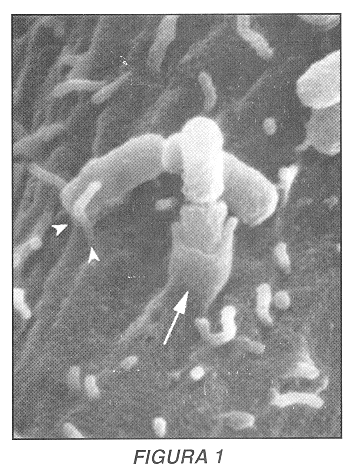
<body><![CDATA[<BR><FONT SIZE=-1>&nbsp;</FONT>     <BR><B><FONT FACE="Arial,Helvetica"><FONT SIZE=-1>Invasi&oacute;n de las c&eacute;lulas hospedero</FONT></FONT></B><FONT SIZE=-1></FONT>      <P><FONT SIZE=-1><FONT FACE="Arial,Helvetica">Las etapas iniciales de adhesi&oacute;n e invasi&oacute;n de las c&eacute;lulas eucariotas por parte de <I>Brucella </I>han sido poco caracterizadas hasta el momento. Estructuras tales como pilis o fimbrias, necesarias para la adhesi&oacute;n de otros pat&oacute;genos gram negativos (como <I>Escherichia coli </I>uropatog&eacute;nica o <I>Neisseria</I> <I>gonorrhoeae) </I>a sus sustratos respectivos (<A HREF="#12">12</A>), no han sido descritas en el g&eacute;nero <I>Brucella. </I>Tampoco se han puesto en evidencia prote&iacute;nas bacterianas que puedan mediar la internalizaci&oacute;n de este par&aacute;sito en sus c&eacute;lulas hospedero, como s&iacute; se ha hecho en el caso de pat&oacute;genos</FONT> <FONT FACE="Arial,Helvetica">como <I>Listeria monocytogenes </I>o<I> Yersinia</I> <I>pestis, </I>donde las prote&iacute;nas de las familias internalinas e invasinas, respectivamente, favorecen la adhesi&oacute;n y la invasi&oacute;n de estas bacterias en c&eacute;lulas epiteliales (<A HREF="#13">13</A>, <A HREF="#14">14</A>). Algunas de estas prote&iacute;nas de invasi&oacute;n poseen la capacidad de asociarse con mol&eacute;culas eucariotas que normalmente son necesarias en interacciones de adhesi&oacute;n intercelular: as&iacute;, se ha demostrado que la internalina A de <I>Listeria monocytogenes </I>reconoce espec&iacute;ficamente a la mol&eacute;cula caderina E, que participa en la formaci&oacute;n de uniones fuertes entre las membranas basolaterales de c&eacute;lulas de la pared intestinal (<A HREF="#15">15</A>, <A HREF="#16">16</A>); igualmente, la invasina de <I>Yersinia pestis </I>interact&uacute;a con la mol&eacute;cula integrina alfa-5-beta-1, necesaria en el proceso de fijaci&oacute;n de la matriz extracelular a ciertas c&eacute;lulas epiteliales (<A HREF="#17">17</A>, <A HREF="#18">18</A>). En el caso de <I>Brucella, </I>se ha sugerido recientemente que la cepa vacunal de <I>Brucella abortus</I> RB51 es capaz de invadir trofoblastos bovinos precisamente a trav&eacute;s de su adhesi&oacute;n a la mol&eacute;cula integrina alfa-5-beta-1 (<A HREF="#19">19</A>); sin embargo, esta observaci&oacute;n no ha podido repetirse en otros laboratorios (<A HREF="#20">20</A>).</FONT></FONT><FONT SIZE=-1></FONT>      <P><FONT SIZE=-1><FONT FACE="Arial,Helvetica">La c&eacute;lula eucariota juega un papel activo importante en el proceso de invasi&oacute;n de pat&oacute;genos intracelulares, gracias a una fina manipulaci&oacute;n de la arquitectura celular por parte de los par&aacute;sitos (<A HREF="#21">21</A>). As&iacute;, gracias a la inyeci&oacute;n de prote&iacute;nas bacterianas en el citoplasma de la c&eacute;lula hu&eacute;sped a trav&eacute;s de un sistema especializado de secreci&oacute;n denominado sistema de secreci&oacute;n de tipo III (<A HREF="#22">22</A>)- bacterias como <I>Shigella flexneri</I></FONT> <FONT FACE="Arial,Helvetica">o<I> Salmonella typhimurium </I>inducen repliegues importantes en la membrana de la c&eacute;lula blanco que permitir&aacute;n la formaci&oacute;n de una gran vacuola en la cual estos par&aacute;sitos son internalizados (<A HREF="#23">23</A>, <A HREF="#24">24</A>)<I>. Brucella abortus, </I>por el contrario, reorganiza s&oacute;lo localmente la membrana celular en el punto de contacto entre la bacteria y su c&eacute;lula blanco (<A HREF="#Fig.1">Figura 1</A>) (<A HREF="#25">25</A>), utilizando un mecanismo de invasi&oacute;n llamado 'fagocitosis por cremallera', observado igualmente durante los procesos de internalizaci&oacute;n de <I>Listeria monocytogenes y Yersinia pestis </I>(<A HREF="#26">26</A>). De los tres elementos que conforman el esqueleto celular -los filamentos intermedios, los microt&uacute;bulos y el citoesqueleto de actina-, se ha podido demostrar que los dos &uacute;ltimos juegan un rol importante durante el -proceso de invasi&oacute;n de <I>Brucella: </I>en efecto, cuando se tratan c&eacute;lulas blanco con la citocalacina D -un inhibidor de la polimerizaci&oacute;n de la actina- o con el nocodazol -un inhibidor de la polimerizaci&oacute;n de la tubulina- se inhibe significativamente la entrada de las brucelas (<A HREF="#20">20</A>, <A HREF="#25">25</A>).</FONT></FONT>     <BR><FONT SIZE=-1>&nbsp;</FONT>     <BR><FONT SIZE=-1>&nbsp;</FONT>     <BR><B><FONT FACE="Arial,Helvetica"><FONT SIZE=-1>Tr&aacute;fico intracelular</FONT></FONT></B><FONT SIZE=-1></FONT>      <P><FONT SIZE=-1><FONT FACE="Arial,Helvetica">La internalizaci&oacute;n de material extracelular se lleva a cabo en la c&eacute;lula gracias a una serie de mecanismos que se han denominado conjuntamente bajo el nombre de endocitosis o fagocitosis, dependiendo de la naturaleza y las dimensiones del material internalizado (<A HREF="#27">27</A>, <A HREF="#28">28</A>). Estos procesos implican una compleja interacci&oacute;n del material internalizado con diferentes poblaciones</FONT> <FONT FACE="Arial,Helvetica">de compartimientos intracelulares definidos por criterios morfol&oacute;gicos, topol&oacute;gicos y/o estructurales (<A HREF="#29">29</A>, <A HREF="#30">30</A>). As&iacute;, luego de interactuar con la superficie celular, el material endocitado (o fagocitado) entra en contacto con una red din&aacute;mica de t&uacute;bulos y ves&iacute;culas conocida con el nombre de endosomas tempranos: en estos compartimientos se clasifica y se ordena el material extracelular, permitiendo el reciclaje de ciertos elementos (como receptores) a la membrana celular (<A HREF="#31">31</A>). En seguida, el material extracelular contin&uacute;a su internalizaci&oacute;n interactuando con una serie de compartimientos reticulares localizados principalmente en la regi&oacute;n perinuclear de la c&eacute;lula y que se denominan endosomas tard&iacute;os: en estas estructuras se inicia la degradaci&oacute;n de una gran parte del material endocitado (<A HREF="#32">32</A>). Sin embargo, no es sino en los lisosomas -estructuras densas con un bajo pH intraluminal- donde se acumula y degrada totalmente el material que proviene de la cascada de endocitosis/ fagocitosis, gracias a la presencia de proteasas, nucleasas y hexosaminidasas con alto poder hidrol&iacute;tico (<A HREF="#33">33</A>).</FONT></FONT><FONT SIZE=-1></FONT>      <P><FONT SIZE=-1><FONT FACE="Arial,Helvetica">Algunos pat&oacute;genos intracelulares destruyen r&aacute;pidamente la membrana,de sus vacuolas de internalizaci&oacute;n y proliferan libremente en el citoplasma de la c&eacute;lula hospedero, evitando el contacto con el sistema de degradaci&oacute;n celular (es el caso de <I>Listeria monocytogenes, Shigella flexneri y Rickettsia </I>[<A HREF="#34">34</A>]). Sin embargo, un gran n&uacute;mero de par&aacute;sitos permanecen asociados a estructuras intracelulares delimitadas por membranas, lo que ha obligado a estos</FONT> <FONT FACE="Arial,Helvetica">microorganismos a desarrollar estrategias diversas para evitar su destrucci&oacute;n en los compartimientos profundos de la cascada de endocitosis/ fagocitosis (<A HREF="#35">35</A>). As&iacute;, <I>Mycobacterium tuberculosis </I>es internalizado en un compartimiento con caracter&iacute;sticas iniciales de endosoma temprano; sin embargo, la bacteria modifica posteriormente las propiedades fusog&eacute;nicas de esta estructura impidiendo que el fagosoma se transforme en endosoma tard&iacute;o o lisosoma, y el microorganismo prolifera de esta forma en un nicho desligado completamente de los sistemas de transporte intracelular (<A HREF="#36">36</A>, <A HREF="#37">37</A>). <I>Salmonella typhimurium, </I>por el contrario, no inhibe la maduraci&oacute;n de su compartimiento de internalizaci&oacute;n, el cual eventualmente es transformado en un lisosoma; sin embargo, <I>Salmonella </I>ha desarrollado mecanismos de supervivencia que le permiten proliferar a&uacute;n en presencia de enzimas de degradaci&oacute;n (<A HREF="#38">38</A>): uno de sus m&aacute;s importantes mecanismos de adaptaci&oacute;n es un sistema regulador que permite a la bacteria ser sensible a cambios en el medio ambiente -como variaciones de pH o fluctuaci&oacute;n en la concentraci&oacute;n de iones divalentes- y modificar, en respuesta a estos cambios, la estructura de su membrana externa para as&iacute; resistir la acci&oacute;n l&iacute;tica de las enzimas celulares (<A HREF="#39">39</A>).</FONT></FONT><FONT SIZE=-1></FONT>      <P><FONT SIZE=-1><FONT FACE="Arial,Helvetica">Recientemente, el tr&aacute;fico intracelular de la cepa virulenta <I>Brucella abortus</I> 2308 y de la cepa atenuada B. abortus 19 ha sido estudiado exhaustivamente a trav&eacute;s del empleo de la microscop&iacute;a electr&oacute;nica de transmisi&oacute;n y la</FONT> <FONT FACE="Arial,Helvetica">microscop&iacute;a confocal utilizando como modelo de infecci&oacute;n la l&iacute;nea celular humana HeLa (<A HREF="#40">40</A>, <A HREF="#41">41</A>). Durante los primeros minutos de su internalizaci&oacute;n las brucelas residen en estructuras caracterizadas por la presencia de marcadores t&iacute;picos de endosomas tempranos tales como la prote&iacute;na rab5, una mol&eacute;cula perteneciente a la subfamilia de GTPasas Rab conocida por regular la vectorialidad en el transporte de compartimientos intracelulares (rab5 es espec&iacute;fica de endosomas tempranos y regula la fusi&oacute;n homot&iacute;pica de estas estructuras, mientras que rab7 se localiza en endosomas tard&iacute;os y regula la fusi&oacute;n heterot&iacute;pica de estos compartimientos con los lisosomas [<A HREF="#42">42</A>]). Posteriormente, luego de 30 minutos de internalizaci&oacute;n, las brucelas (tanto la cepa vacunal como la cepa virulenta) se desligan progresivamente de la cascada de endocitosis: los marcadores de endosomas tempranos (como rab5 y el receptor de la transferrina) desaparecen del compartimiento bacteriano, y no se observa en estas estructuras la aparici&oacute;n de marcadores de endosomas tard&iacute;os (como rab7 o el receptor de la manosa6-fosfato). Por el contrario, las bacterias se localizan en una estructura at&iacute;pica caracterizada por la presencia de la prote&iacute;na lisosomal LAMP ('Iisosomal-associated membrane protein': prote&iacute;na de membrana asociada a los lisosomas'), estructura que a su vez carece de enzimas de degradaci&oacute;n como la catepsina D, lo que sugiere que las brucelas interat&uacute;an con un compartimiento de naturaleza no lisosomal (<A HREF="#41">41</A>).</FONT></FONT><FONT SIZE=-1></FONT>      ]]></body>
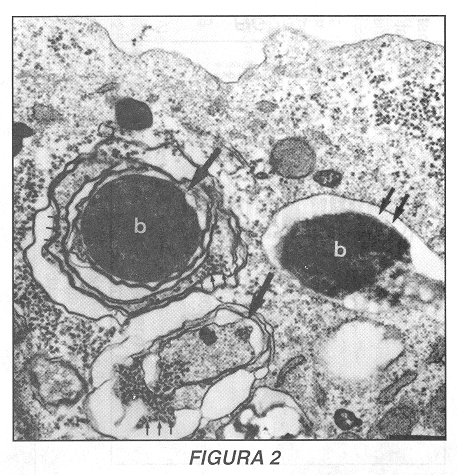
<body><![CDATA[<P><FONT SIZE=-1><FONT FACE="Arial,Helvetica">Morfol&oacute;gicamente, el compartimiento que contiene las brucelas durante esta etapa del proceso de infecci&oacute;n es una estructura multilamelar con muchas similitudes a las vacuolas autofagoc&iacute;ticas tempranas (<A HREF="#Fig. 2">Figura 2</A>) (<A HREF="#40">40</A>). Los autofagosomas son organelas generadas cuando el suministro extracelular de materia prima para la s&iacute;ntesis de prote&iacute;nas disminuye significativamente: en estas circunstancias la autofagocitosis permite a la c&eacute;lula generar nuevos amino&aacute;cidos y p&eacute;ptidos a partir del reciclaje de mol&eacute;culas citoplasm&aacute;ticas (<A HREF="#43">43</A>). Los compartimientos autofagoc&iacute;ticos aparecen gracias a la invaginaci&oacute;n de membranas del ret&iacute;culo endoplasm&aacute;tico alrededor de organelas y solutos; las vacuolas multilamelares as&iacute; formadas maduran gradualmente hasta fusionar con los lisosomas, donde se degradar&aacute; el material aislado para su reciciaje intracelular (<A HREF="#44">44</A>, <A HREF="#45">45</A>). La interacci&oacute;n entre <I>Brucella </I>y la cascada de autofagocitosis esta sustentada por varias evidencias (<A HREF="#41">41</A>): primero, y como se acaba de mencionar anteriormente, el compartimiento que contiene al par&aacute;sito posee morfol&oacute;gicamente las caracter&iacute;sticas de un autofagosoma (multiples membranas en una sola estructura vacuoiar); segundo, una mol&eacute;cula con capacidad de acumularse espec&iacute;ficamente en los autofagosomas -la monodansilcadaverina (<A HREF="#46">46</A>)- se acumula igualmente en las vacuolas bacterianas; tercero, una mol&eacute;cula caracter&iacute;stica del ret&iacute;culo endoplasm&aacute;tico -el translocador sec61<IMG SRC="/img/fbpe/rccm/v20n1-2/beta.GIF" HEIGHT=21 WIDTH=10 ALIGN=TEXTTOP> (<A HREF="#47">47</A>)- se localiza tambi&eacute;n en el fagosoma bacteriano, lo que sugiere que en efecto esta estructura se origina en el</FONT> <FONT FACE="Arial,Helvetica">ret&iacute;culo endoplasm&aacute;tico; finalmente, la modulaci&oacute;n de la autofagocitosis gracias al tratamiento con drogas como la 3-metiladenina (que inhibe la formaci&oacute;n de autofagosomas [<A HREF="#48">48</A>]) o a la depleci&oacute;n de amino&aacute;cidos (que aumenta la formaci&oacute;n de autofagosomas [<A HREF="#49">49</A>]) conduce de la misma manera a una modulaci&oacute;n en el crecimiento intracelular de las brucelas (<A HREF="#40">40</A>). La presencia de la mol&eacute;cula lisosomal LAMP en los autofagosomas (y en la vacuola bacteriana) sugiere que esta prote&iacute;na puede interactuar directamente con otros sistemas de transporte intracelular probablemente gracias a una comunicaci&oacute;n directa entre la cascada de autofagocitosis y el aparato de Golgi (a partir de donde LAMP es distribuida a las organelas intracelulares [<A HREF="#50">50</A>]). Estas observaciones sugieren entonces que, luego de un pasaje transitorio por los compartimientos precoces de la cascada de endocitosis/fagocitosis, las brucelas interact&uacute;an con la cascada de autofagocitosis y residen en autofagosomas multilamelares. Sin embargo, esta estructura no constituye el nicho final de proliferaci&oacute;n (o de degradaci&oacute;n) de <I>B. abortus.</I></FONT></FONT><FONT SIZE=-1></FONT>      
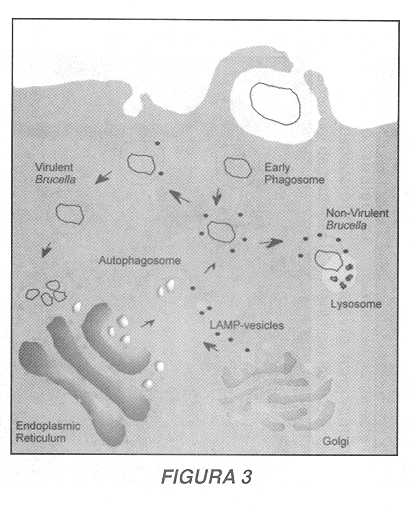
<P><FONT SIZE=-1><FONT FACE="Arial,Helvetica">En efecto, durante los per&iacute;odos tard&iacute;os de la infecci&oacute;n (24 horas luego de la inoculaci&oacute;n de las bacterias en las c&eacute;lulas hu&eacute;sped), se observa una diferencia importante en el tr&aacute;fico de la cepa virulenta y de la cepa atenuada de <I>Brucella </I>(<A HREF="#41">41</A>). La cepa atenuada 19, luego de transitar por los autofagosomas, colocaliza con los lisosomas ricos en catepsina D y las bacterias presentan a partir de este momento una morfolog&iacute;a</FONT> <FONT FACE="Arial,Helvetica">irregular, lo que sugiere que esta cepa no es capaz de detener la maduraci&oacute;n de las vacuolas autofagoc&iacute;ticas, que finalmente fusionan con los lisosomas, lo que conduce a una degradaci&oacute;n de las brucelas atenuadas. Por otra parte, la cepa virulenta 2308 presenta una trayectoria distinta: el compartimiento bacteriano pierde el marcaje LAMP, lo que sugiere que esta brucela transita a partir de los autofagosomas hacia un nueva estructura intracelular. La presencia de la prote&iacute;na sec61<IMG SRC="/img/fbpe/rccm/v20n1-2/beta.GIF" HEIGHT=21 WIDTH=10 ALIGN=TEXTTOP> en este nuevo compartimiento indica que este est&aacute; relacionado con el ret&iacute;culo endoplasm&aacute;tico. Un an&aacute;lisis detallado demuestra que otros marcadores del ret&iacute;culo endoplasm&aacute;tico como lo son la prote&iacute;na disulfuro isomerasa o el chaper&oacute;n molecular calnexina tambi&eacute;n est&aacute;n presentes en el compartimiento bacteriano, donde se observa en este momento la proliferaci&oacute;n de <I>Brucella</I> (<A HREF="#41">41</A>). Estos datos sugieren entonces que la cepa virulenta 2308 logra inhibir la maduraci&oacute;n de los autofagosomas y gracias a un mecanismo de transporte retr&oacute;grado logra alcanzar el ret&iacute;culo endoplasm&aacute;tico (a partir del cual los autofagosomas se originan) y prolifera finalmente en este nicho intracelular (<A HREF="#Fig.3">Figura 3</A>) (<A HREF="#41">41</A>). Otras evidencias confirman esta hip&oacute;tesis: el tratamiento de c&eacute;lulas infectadas con la droga proaerolisina de <I>Aeromonas hydrophila,</I></FONT> <FONT FACE="Arial,Helvetica">que normalmente induce una vacuolizaci&oacute;n espec&iacute;fica del ret&iacute;culo endoplasm&aacute;tico (<A HREF="#51">51</A>), conduce a la vacuolizaci&oacute;n del compartimiento de proliferaci&oacute;n de <I>Brucella. </I>Igualmente, el tratamiento de c&eacute;lulas infectadas con la</FONT> <FONT FACE="Arial,Helvetica">droga brefeldina A, que induce la reorganizaci&oacute;n del aparato de Golgi sobre el ret&iacute;culo endoplasm&aacute;tico (<A HREF="#52">52</A>), conduce a una reorganizaci&oacute;n de las cisternas golgianas sobre el compartimiento de replicaci&oacute;n de la cepa 2308 (<A HREF="#41">41</A>).</FONT></FONT><FONT SIZE=-1></FONT>      
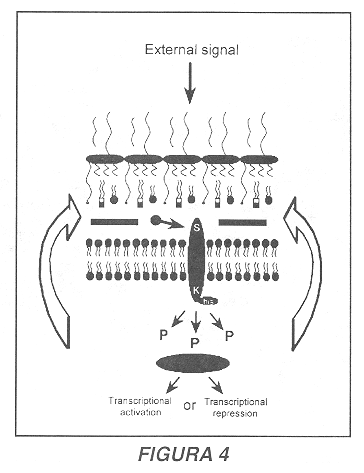
<P><FONT SIZE=-1><FONT FACE="Arial,Helvetica">El mecanismo molecular que permite a las brucelas el inducir el transporte retr&oacute;grado de su compartimento autofagoc&iacute;tico hacia el ret&iacute;culo endoplasm&aacute;tico no se conoce actualmente. Evolutivamente esta estrategia de supervivencia parece exitosa ya que otro par&aacute;sito intracelular, <I>Legionella pneumophila, </I>ha desarrollado un mecanismo similar de proliferaci&oacute;n en c&eacute;lulas fagoc&iacute;ticas del sistema inmune (<A HREF="#53">53</A>). Toxoplasma gondii igualmente prolifera en &uacute;ltima instancia en el ret&iacute;culo</FONT> <FONT FACE="Arial,Helvetica">endoplasm&aacute;tico de las c&eacute;lulas hu&eacute;spedes (<A HREF="#54">54</A>). Estos par&aacute;sitos intracelulares probablemente aprovechan la, maquinaria biosint&eacute;tica presente en el ret&iacute;culo endopiasm&aacute;tico para obtener amino&aacute;cidos y/o p&eacute;ptidos que pueden ser utilizados como nutrientes (<A HREF="#55">55</A>). Igualmente, este nicho esta totalmente aislado de los mecanismos de degradaci&oacute;n celular asociados a la cascada de endocitosis/ fagocitosis, lo que permite una proliferaci&oacute;n no restringida de estos microorganismos, que eventualmente lisan m&eacute;canicamente a las c&eacute;lulas hu&eacute;spedes a partir de per&iacute;odos superiores a las 72 horas de inoculaci&oacute;n (<A HREF="#40">40</A>).</FONT></FONT>     <BR><FONT SIZE=-1>&nbsp;</FONT>     <BR><FONT SIZE=-1>&nbsp;</FONT>     <BR><B><FONT FACE="Arial,Helvetica"><FONT SIZE=-1>Adaptaci&oacute;n a los par&aacute;metros f&iacute;sico-qu&iacute;mico-biol&oacute;gicos del medio intracelular</FONT></FONT></B><FONT SIZE=-1></FONT>      <P><FONT SIZE=-1><FONT FACE="Arial,Helvetica"><I>Brucella </I>posee un estrategia de supervivencia intracelular que le permite evadir el contacto con los compartimientos de degradaci&oacute;n celulares gracias a una interacci&oacute;n breve con los endosomas tempranos y a un tr&aacute;nsito retr&oacute;grado por la cascada de autofagocitosis para finalmente proliferar en el ret&iacute;culo endoplasm&aacute;tico de la c&eacute;lula hu&eacute;sped (<A HREF="#40">40</A>, <A HREF="#41">41</A>). En todas estas etapas las bacterias tienen que ser capaces de reaccionar a cambios en los par&aacute;metros f&iacute;sico/qu&iacute;mico/biol&oacute;gicos del medio intracelular (tales como acidez, presi&oacute;n osm&oacute;tica, concentraci&oacute;n de iones divalentes y/o actividad enzim&aacute;tica, por ejemplo) que permitan a estos microorganimos determinar su precisa ubicaci&oacute;n intracelular y as&iacute; poder expresar los genes adecuados para la supervivencia en cada uno de los diferentes contextos por los cuales transitan las brucelas.</FONT></FONT><FONT SIZE=-1></FONT>      <P><FONT SIZE=-1><FONT FACE="Arial,Helvetica">Una adaptaci&oacute;n que permite a <I>Brucella</I> hacer frente a estos cambios es la presencia de un sistema regulador de dos componentes que confiere a la bacteria la capacidad de percibir variaciones en el microambiente externo y adaptarse a los nuevos par&aacute;metros ambientales (<A HREF="#56">56</A>). Este sistema, denominado BvrS/R ('Brucella virulence-related sensor and regulator': sensor y regulador asociados a la virulencia de <I>Brucella</I>)<I> </I>consta de dos prote&iacute;nas: una mol&eacute;cula sensora de membrana que tiene acceso al espacio periplasm&aacute;tico de la membrana externa,</FONT> <FONT FACE="Arial,Helvetica">y una mol&eacute;cula reguladora citoplasm&aacute;tica. Frente a cambios en los par&aacute;metros externos, el dominio externo del sensor expuesto en la regi&oacute;n periplasm&aacute;tica sufre un cambio conformacional que induce una autofosforilaci&oacute;n de la prote&iacute;na, gracias a la presencia de un dominio interno que posee una actividad enzim&aacute;tica histidina quinasa. El grupo fosfato ubicado sobre el residuo histidina es enseguida transferido a un residuo aspartato presente en el regulador citoplasm&aacute;tico, que adquiere entonces la capacidad de actuar como activador o como represor transcripcional (<A HREF="#Fig.4">Figura 4</A>) (<A HREF="#56">56</A>, <A HREF="#57">57</A>). Sistemas similares han sido descritos en otros pat&oacute;genos intracelulares, y uno de los mejor documentados es el regulador PhoP/PhoQ de <I>Salmonella typhimurium,</I> que es activado por una disminuci&oacute;n en la acidez del compartimiento bacteriano, as&iacute; como por una disminuci&oacute;n en la concentraci&oacute;n de iones divalentes como el calcio y el magnesio (<A HREF="#58">58</A>, <A HREF="#59">59</A>). Estos est&iacute;mulos conducen, entre otros efectos, a una modificaci&oacute;n en la estructura del l&iacute;pido A de la mol&eacute;cula de lipopolisac&aacute;rido, lo que confiere a Salmonella la resistencia a mol&eacute;culas microbicidas como los p&eacute;ptidos can&oacute;nicos (<A HREF="#60">60</A>).</FONT></FONT><FONT SIZE=-1></FONT>      <P><FONT SIZE=-1><FONT FACE="Arial,Helvetica">En el caso del sistema BvrS/R de <I>Brucella abortus, </I>todav&iacute;a no se conocen los est&iacute;mulos que llevan a su activaci&oacute;n; sin embargo, se ha observado que la mutaci&oacute;n de tanto la prote&iacute;na sensora como de la prote&iacute;na reguladora conducen a un cambio en las propiedades biol&oacute;gicas de la membrana externa de <I>Brucella </I>y afectan profundamente la virulencia estos microorganismos (<A HREF="#56">56</A>).</FONT> <FONT FACE="Arial,Helvetica">La membrana externa de <I>Brucella </I>juega, en efecto, un papel preponderante en la virulencia y en la supervivencia intracelular de estos par&aacute;sitos: esta membrana es permeable a hormonas hidrof&oacute;bicas (<A HREF="#61">61</A>) pero es resistente a antibi&oacute;ticos can&oacute;nicos presentes en los gr&aacute;nulos azur&aacute;filos de c&eacute;lulas fagoc&iacute;ticas del sistema inmune (<A HREF="#62">62</A>). El lipopolisac&aacute;rido (LPS) de la membrana es el principal responsable de esta resistencia, como ha podido demostrarse en experimentos en los cuales se ha transferido el LPS de brucelas resistentes a bacterias sensibles a la acci&oacute;n microbicida de los p&eacute;ptidos can&oacute;nicos: las bacterias receptoras adquieren el fenotipo resistente (<A HREF="#63">63</A>). El LPS de <I>Bru</I>cella presenta igualmente otras propiedades biol&oacute;gicas particulares: es una mol&eacute;cula muy poco t&oacute;xica en relaci&oacute;n a las endotoxinas de enterobacterias (<A HREF="#64">64</A>) y su internalizaci&oacute;n en c&eacute;lulas fagoc&iacute;ticas del sistema inmune es lenta (<A HREF="#65">65</A>), lo que representa claras adaptaciones a la vida intracelular.</FONT></FONT><FONT SIZE=-1></FONT>      <P><FONT SIZE=-1><FONT FACE="Arial,Helvetica">Las bacterias mutantes del sistema BvrS/R se adhieren en forma aparentemente inspec&iacute;fica a la superficie de las c&eacute;lulas blanco y poseen una limitada capacidad para invadirlas; igualmente, estos mutantes son altamente sensibles a la acci&oacute;n microbicida de p&eacute;ptidos can&oacute;nicos, lo que sugiere que la estructura de la membrana externa de estas bacterias est&aacute; particularmente alterada (<A HREF="#56">56</A>). Como el LPS es el principal responsable de la resistencia a los p&eacute;ptidos can&oacute;nicos, el sistema BvrS/R probablemente controla los elementos estructurales del</FONT> <FONT FACE="Arial,Helvetica">lipopolisac&aacute;rido necesarios a esta resistencia, lo que permite aproximar funcionalmente este sistema al regulador PhoP/PhoQ de Salmonella (<A HREF="#60">60</A>).</FONT></FONT><FONT SIZE=-1></FONT>      ]]></body>
<body><![CDATA[<P><FONT SIZE=-1><FONT FACE="Arial,Helvetica">El sistema BvrS/R es tambi&eacute;n necesario para un adecuado tr&aacute;fico intracelular de las brucelas: los mutantes de este sistema son incapaces de acceder a los autofagosomas y son r&aacute;pidamente degradados en lisosomas ricos en catepsina D (<A HREF="#41">41</A>). Esta observaci&oacute;n sugiere que, tal y como se ha demostrado en el caso de otros sistemas reguladores de dos componentes, el sistema BvrS/R probablemente regula un vasto grupo de genes cuyas funciones todav&iacute;a deben caracterizarse. En efecto, se ha observado que cuando <I>Brucella </I>prolifera en el medio intracelular, el patr&oacute;n de expresi&oacute;n de al menos 147 prote&iacute;nas cambia con respecto al patr&oacute;n de prote&iacute;nas expresadas en el medio de cultivo (<A HREF="#66">66</A>, <A HREF="#67">67</A>). Una compleja regulaci&oacute;n g&eacute;nica debe acompa&ntilde;ar claramente el paso del medio extracelular al medio intracelular, y varios laboratorios se dedican actualmente a caracterizar los est&iacute;mulos que activan esta regulaci&oacute;n, as&iacute; como los genes que son activados en cada una de las distintas etapas del proceso de infecci&oacute;n.</FONT></FONT>     <BR><FONT SIZE=-1>&nbsp;</FONT>     <BR><FONT SIZE=-1>&nbsp;</FONT>     <BR><B><FONT FACE="Arial,Helvetica"><FONT SIZE=-1>Vacunas recombinantes: una nueva perspectiva en el estudio del parasitismo intracelular</FONT></FONT></B><FONT SIZE=-1></FONT>      <P><FONT SIZE=-1><FONT FACE="Arial,Helvetica">El estudio de los mecanismos patog&eacute;nicos de par&aacute;sitos intracelulares est&aacute; suministrando herramientas moleculares que permiten caracterizar las funciones fundamentales de las c&eacute;lulas procariotas y eucariotas (<A HREF="#68">68</A>-<A HREF="#70">70</A>). Recientemente, estas herramientas comienzan a ser empleadas en el campo de la investigaci&oacute;n aplicada, particularmente en la producci&oacute;n de vacunas (<A HREF="#71">71</A>). Por ejemplo, la propiedad de <I>Listeria monocytogenes </I>de romper su vacuola de internalizaci&oacute;n y de proliferar en el espacio citoplasm&aacute;tico de las c&eacute;lulas hospedero ha favorecido el uso de bacterias recombinantes atenuadas que fungen como vectores para dirigir ant&iacute;genos tumorales o virales al citoplasma de las c&eacute;lulas hospedero (<A HREF="#72">72</A>). Estas mol&eacute;culas pueden ser degradadas y transportadas al ret&iacute;culo endoplasm&aacute;tico, donde se asocian a las prote&iacute;nas del complejo mayor de histocompatibilidad de clase I; los ant&iacute;genos as&iacute; procesados pueden posteriormente ser presentados en la superficie de la c&eacute;lula hospedero a linfocitos T citot&oacute;xicos, cuya activaci&oacute;n es capaz de inducir la regresi&oacute;n de tumores (<A HREF="#73">73</A>). Un principio similar ha sido utilizado para controlar infecciones virales mediante la manipulaci&oacute;n del sistema de secreci&oacute;n de tipo III de <I>Salmonela</I> <I>typhimurium:</I> cepas recombinantes atenuadas de este pat&oacute;geno son capaces de inyectar ant&iacute;genos del virus de la coriomeningitis</FONT> <FONT FACE="Arial,Helvetica">en el citoplasma de c&eacute;lulas hospederas de rat&oacute;n y as&iacute; proteger a este animal de una infecci&oacute;n que de otro modo ser&iacute;a mortal (<A HREF="#74">74</A>). La propiedad de <I>Brucella de</I> proliferar en el ret&iacute;culo endoplasm&aacute;tico de las c&eacute;lulas hospedero podr&iacute;a ser igualmente empleada para dirigir ant&iacute;genos virales o tumorales hacia las prote&iacute;nas del complejo de mayor de histocompatibilidad de clase I, gracias al uso de cepas atenuadas de este par&aacute;sito (<A HREF="#75">75</A>).</FONT></FONT>     <BR><FONT SIZE=-1>&nbsp;</FONT>     <BR><FONT SIZE=-1>&nbsp;</FONT>     <BR><B><FONT FACE="Arial,Helvetica"><FONT SIZE=-1>Conclusi&oacute;n</FONT></FONT></B><B><FONT FACE="Arial,Helvetica"><FONT SIZE=-1></FONT></FONT></B>      <P><FONT SIZE=-1><FONT FACE="Arial,Helvetica">Si bien algunas de las adaptaciones m&aacute;s importantes de <I>Brucella </I>a la vida intracelular han sido puestas en evidencia recientemente (su mecanismo de entrada, su tr&aacute;fico intracelular y su nicho de proliferaci&oacute;n en las c&eacute;lulas eucariotas), la caracterizaci&oacute;n de la patobiolog&iacute;a de este microorganismo es todav&iacute;a fragmentaria. Es necesario identificar las mol&eacute;culas bacterianas que inducen la internalizaci&oacute;n de este pat&oacute;geno en sus c&eacute;lulas blanco, as&iacute; como los receptores celulares asociados a este proceso de invasi&oacute;n; igualmente, debe determinarse la naturaleza de los mecanismos que permiten a este microorganismo el disociarse de la cascada de endocitosis/fagocitosis para asociarse al proceso de autofagocitosis y proliferar finalmente en el ret&iacute;culo endoplasm&aacute;tico de las c&eacute;lulas hospedero. Sin embargo, las bases gen&eacute;ticas de estas adaptaciones comienzan a conocerse, lo que facilitar&aacute; la identificaci&oacute;n de nuevos factores de virulencia en este modelo de parasitismo intracelular.</FONT></FONT>     <BR><FONT SIZE=-1>&nbsp;</FONT><FONT SIZE=-1></FONT>      ]]></body>
<body><![CDATA[<P><FONT SIZE=-1>&nbsp;</FONT>     <CENTER><A NAME="Fig.1"></A><IMG SRC="/img/fbpe/rccm/v20n1-2/0647i1.GIF" HEIGHT=470 WIDTH=358></CENTER> <FONT SIZE=-1>&nbsp;</FONT><FONT SIZE=-1></FONT>      
<P><FONT SIZE=-1><FONT FACE="Arial,Helvetica">&nbsp;</FONT></FONT>     <BR><FONT SIZE=-1>&nbsp;</FONT>     <CENTER><A NAME="Fig. 2"></A><IMG SRC="/img/fbpe/rccm/v20n1-2/0647i2.GIF" HEIGHT=475 WIDTH=457></CENTER> <FONT SIZE=-1>&nbsp;</FONT>     
<BR><FONT SIZE=-1>&nbsp;</FONT>     <BR><FONT SIZE=-1>&nbsp;</FONT>     <BR><FONT SIZE=-1>&nbsp;</FONT>     <CENTER><A NAME="Fig.3"></A><IMG SRC="/img/fbpe/rccm/v20n1-2/0647i3.GIF" HEIGHT=509 WIDTH=411></CENTER> <FONT SIZE=-1>&nbsp;</FONT><FONT SIZE=-1></FONT>      
<P><FONT SIZE=-1>&nbsp;</FONT>     ]]></body>
<body><![CDATA[<CENTER><A NAME="Fig.4"></A><IMG SRC="/img/fbpe/rccm/v20n1-2/0647i4.GIF" HEIGHT=473 WIDTH=364></CENTER> <FONT SIZE=-1>&nbsp;</FONT>     
<BR><FONT SIZE=-1>&nbsp;</FONT><FONT SIZE=-1></FONT>      <P><B><FONT FACE="Arial,Helvetica"><FONT SIZE=-1>Agradecimientos</FONT></FONT></B><FONT SIZE=-1></FONT>      <P><FONT SIZE=-1><FONT FACE="Arial,Helvetica">Agradezco profundamente al Ministerio Costarricense de Ciencia y Tecnolog&iacute;a y a la Comisi&oacute;n del Premio Nacional de Ciencia y Tecnolog&iacute;a por el reconocimiento al trabajo expuesto en este manuscrito mediante la atribuci&oacute;n del Premio Clodomiro Picado Twight 1998. Agradezco igualmente Dr. Enrique Freer Bustamante la invitaci&oacute;n a publicar la presente revisi&oacute;n bibliogr&aacute;fica.</FONT></FONT>     <BR><FONT SIZE=-1>&nbsp;</FONT><FONT SIZE=-1></FONT>      <P><B><FONT FACE="Arial,Helvetica"><FONT SIZE=-1>Referencias</FONT></FONT></B><FONT SIZE=-1></FONT>      <!-- ref --><P><A NAME="1"></A><FONT SIZE=-1><FONT FACE="Arial,Helvetica">1.Corsaro D, Venditti D, Padula M, Valassina M. lntracellular life. <I>Crit Rev</I> <I>Microbiol </I>1999;25:39-79.</FONT></FONT><FONT SIZE=-1></FONT>    &nbsp;&nbsp;&nbsp;&nbsp;&nbsp;&nbsp;&nbsp;&nbsp;[&#160;<a href="javascript:void(0);" onclick="javascript: window.open('/scielo.php?script=sci_nlinks&ref=778047&pid=S0253-2948199900010000900001&lng=','','width=640,height=500,resizable=yes,scrollbars=1,menubar=yes,');">Links</a>&#160;]<!-- end-ref --><!-- ref --><P><A NAME="2"></A><FONT SIZE=-1><FONT FACE="Arial,Helvetica">2.Pizarro-Cerd&aacute; J, Desjardins M, Moreno E, Gorvel JP. When intracellular pathogens invade the frontiers of cell biology and immunology. <I>Histol Histopathol</I> 1997;12:1027-1038.</FONT></FONT><FONT SIZE=-1></FONT>    &nbsp;&nbsp;&nbsp;&nbsp;&nbsp;&nbsp;&nbsp;&nbsp;[&#160;<a href="javascript:void(0);" onclick="javascript: window.open('/scielo.php?script=sci_nlinks&ref=778048&pid=S0253-2948199900010000900002&lng=','','width=640,height=500,resizable=yes,scrollbars=1,menubar=yes,');">Links</a>&#160;]<!-- end-ref --><!-- ref --><P><A NAME="3"></A><FONT SIZE=-1><FONT FACE="Arial,Helvetica">3.Finlay BB, Falkow S. Common themes in microbial pathogenicity revisite. <I>Mol</I> <I>Biol Microbiol Rev </I>1997;61:136-169.</FONT></FONT><FONT SIZE=-1></FONT>    &nbsp;&nbsp;&nbsp;&nbsp;&nbsp;&nbsp;&nbsp;&nbsp;[&#160;<a href="javascript:void(0);" onclick="javascript: window.open('/scielo.php?script=sci_nlinks&ref=778049&pid=S0253-2948199900010000900003&lng=','','width=640,height=500,resizable=yes,scrollbars=1,menubar=yes,');">Links</a>&#160;]<!-- end-ref --><!-- ref --><P><A NAME="4"></A><FONT SIZE=-1><FONT FACE="Arial,Helvetica">4.Binder S, Levitt M, Sacks JJ, Hughes, JM. Emerging infectious diseases: public health issues for the 21 st century. <I>Science</I> 1999;284:1311-1313.</FONT></FONT><FONT SIZE=-1></FONT>    &nbsp;&nbsp;&nbsp;&nbsp;&nbsp;&nbsp;&nbsp;&nbsp;[&#160;<a href="javascript:void(0);" onclick="javascript: window.open('/scielo.php?script=sci_nlinks&ref=778050&pid=S0253-2948199900010000900004&lng=','','width=640,height=500,resizable=yes,scrollbars=1,menubar=yes,');">Links</a>&#160;]<!-- end-ref --><!-- ref --><P><A NAME="5"></A><FONT SIZE=-1><FONT FACE="Arial,Helvetica">5.Zavala I, Nava A, Guerra J, Quir&oacute;s C. Brucellosis. <I>Infect Dis Clin N</I> <I>Am</I> 1994;8:225-241.</FONT></FONT><FONT SIZE=-1></FONT>    &nbsp;&nbsp;&nbsp;&nbsp;&nbsp;&nbsp;&nbsp;&nbsp;[&#160;<a href="javascript:void(0);" onclick="javascript: window.open('/scielo.php?script=sci_nlinks&ref=778051&pid=S0253-2948199900010000900005&lng=','','width=640,height=500,resizable=yes,scrollbars=1,menubar=yes,');">Links</a>&#160;]<!-- end-ref --><!-- ref --><P><A NAME="6"></A><FONT SIZE=-1><FONT FACE="Arial,Helvetica">6.Enright FM. The pathogenesis and pathobiology of Brucella infection in domestic animals. En: Nielsen K, Duncan B editores. Animal brucellosis. Boca Rat&oacute;n Florida: CRC Press lnc., 1990:301-320.</FONT></FONT><FONT SIZE=-1></FONT>    &nbsp;&nbsp;&nbsp;&nbsp;&nbsp;&nbsp;&nbsp;&nbsp;[&#160;<a href="javascript:void(0);" onclick="javascript: window.open('/scielo.php?script=sci_nlinks&ref=778052&pid=S0253-2948199900010000900006&lng=','','width=640,height=500,resizable=yes,scrollbars=1,menubar=yes,');">Links</a>&#160;]<!-- end-ref --><!-- ref --><P><A NAME="7"></A><FONT SIZE=-1><FONT FACE="Arial,Helvetica">7.Baldwin CL, Winter AJ. Macrophages and Brucella. <I>Immunol Sem </I>1994; 60: 363-380.</FONT></FONT><FONT SIZE=-1></FONT>    &nbsp;&nbsp;&nbsp;&nbsp;&nbsp;&nbsp;&nbsp;&nbsp;[&#160;<a href="javascript:void(0);" onclick="javascript: window.open('/scielo.php?script=sci_nlinks&ref=778053&pid=S0253-2948199900010000900007&lng=','','width=640,height=500,resizable=yes,scrollbars=1,menubar=yes,');">Links</a>&#160;]<!-- end-ref --><!-- ref --><P><A NAME="8"></A><FONT SIZE=-1><FONT FACE="Arial,Helvetica">8.Liautard JP. lnteraction between professional phagocytes and&nbsp; Brucella. <I>Microbiologia </I>1996;12:197-206.</FONT></FONT><FONT SIZE=-1></FONT>    &nbsp;&nbsp;&nbsp;&nbsp;&nbsp;&nbsp;&nbsp;&nbsp;[&#160;<a href="javascript:void(0);" onclick="javascript: window.open('/scielo.php?script=sci_nlinks&ref=778054&pid=S0253-2948199900010000900008&lng=','','width=640,height=500,resizable=yes,scrollbars=1,menubar=yes,');">Links</a>&#160;]<!-- end-ref --><!-- ref --><P><A NAME="9"></A><FONT SIZE=-1><FONT FACE="Arial,Helvetica">9.Smith LD, Ficht TA. Pathogenesis of Brucella. <I>Crit Rev Microbiol </I>1990;17:209-230.</FONT></FONT><FONT SIZE=-1></FONT>    &nbsp;&nbsp;&nbsp;&nbsp;&nbsp;&nbsp;&nbsp;&nbsp;[&#160;<a href="javascript:void(0);" onclick="javascript: window.open('/scielo.php?script=sci_nlinks&ref=778055&pid=S0253-2948199900010000900009&lng=','','width=640,height=500,resizable=yes,scrollbars=1,menubar=yes,');">Links</a>&#160;]<!-- end-ref --><!-- ref --><P><A NAME="10"></A><FONT SIZE=-1><FONT FACE="Arial,Helvetica">10.Moreno E. Brucella evolution. En: Plommet M editor. Prevention of brucellosis in mediterranean countries. Wageningen: Internacional Centre for Advanced Mediterranean Agronomic Studies, Pudoc Scientific Publishers 1992:198-218.</FONT></FONT><FONT SIZE=-1></FONT>    &nbsp;&nbsp;&nbsp;&nbsp;&nbsp;&nbsp;&nbsp;&nbsp;[&#160;<a href="javascript:void(0);" onclick="javascript: window.open('/scielo.php?script=sci_nlinks&ref=778056&pid=S0253-2948199900010000900010&lng=','','width=640,height=500,resizable=yes,scrollbars=1,menubar=yes,');">Links</a>&#160;]<!-- end-ref --><!-- ref --><P><A NAME="11"></A><FONT SIZE=-1><FONT FACE="Arial,Helvetica">11. Moreno E, Stackebrandt E, Dorsch M, Wolters J, Brusch M, Mayer M. Brucella abortus 16S rRNA and lipid A reveal a phylogenetic relationship with members of the alpha-2 subdivision of the class Proteobacteria. <I>J Bacteriol </I>1990; 172:3569-3576.</FONT></FONT><FONT SIZE=-1></FONT>    &nbsp;&nbsp;&nbsp;&nbsp;&nbsp;&nbsp;&nbsp;&nbsp;[&#160;<a href="javascript:void(0);" onclick="javascript: window.open('/scielo.php?script=sci_nlinks&ref=778057&pid=S0253-2948199900010000900011&lng=','','width=640,height=500,resizable=yes,scrollbars=1,menubar=yes,');">Links</a>&#160;]<!-- end-ref --><!-- ref --><P><A NAME="12"></A><FONT SIZE=-1><FONT FACE="Arial,Helvetica">12.Abraham SN, Jonsson AB, Normark S. Fimbriae-mediated host-pathogen cross-talk. <I>Curr Opin Microbiol</I> 1998;1:75-81.</FONT></FONT><FONT SIZE=-1></FONT>    &nbsp;&nbsp;&nbsp;&nbsp;&nbsp;&nbsp;&nbsp;&nbsp;[&#160;<a href="javascript:void(0);" onclick="javascript: window.open('/scielo.php?script=sci_nlinks&ref=778058&pid=S0253-2948199900010000900012&lng=','','width=640,height=500,resizable=yes,scrollbars=1,menubar=yes,');">Links</a>&#160;]<!-- end-ref --><!-- ref --><P><A NAME="13"></A><FONT SIZE=-1><FONT FACE="Arial,Helvetica">13.Isberg R, Tran van Nhieu G. The mechanism of phagocytic uptake promoted by invasin-integrin interaction. <I>Trends Cell</I> <I>Biol </I>1995;5:120-124.</FONT></FONT><FONT SIZE=-1></FONT>    &nbsp;&nbsp;&nbsp;&nbsp;&nbsp;&nbsp;&nbsp;&nbsp;[&#160;<a href="javascript:void(0);" onclick="javascript: window.open('/scielo.php?script=sci_nlinks&ref=778059&pid=S0253-2948199900010000900013&lng=','','width=640,height=500,resizable=yes,scrollbars=1,menubar=yes,');">Links</a>&#160;]<!-- end-ref --><!-- ref --><P><A NAME="14"></A><FONT SIZE=-1><FONT FACE="Arial,Helvetica">14.Cossart P, Lecuit M. lnteractions of Listeria monocytogenes with mammalian cells during entry and actin-based movement: bacterial factors, cellular ligands and signalin. <I>EMBO </I>J 1998;17:3797-3806.</FONT></FONT><FONT SIZE=-1></FONT>    &nbsp;&nbsp;&nbsp;&nbsp;&nbsp;&nbsp;&nbsp;&nbsp;[&#160;<a href="javascript:void(0);" onclick="javascript: window.open('/scielo.php?script=sci_nlinks&ref=778060&pid=S0253-2948199900010000900014&lng=','','width=640,height=500,resizable=yes,scrollbars=1,menubar=yes,');">Links</a>&#160;]<!-- end-ref --><!-- ref --><P><A NAME="15"></A><FONT SIZE=-1><FONT FACE="Arial,Helvetica">15.Gaillard JL, Berche P, Frehel C, Gouin E, Cossart P. Entry of Listeria monocytogenes is mediated by internalin, a repeat protein reminiscent of surface antigens from gram-positive cocci. <I>Cell</I> 1991;65:1127-1141.</FONT></FONT><FONT SIZE=-1></FONT>    &nbsp;&nbsp;&nbsp;&nbsp;&nbsp;&nbsp;&nbsp;&nbsp;[&#160;<a href="javascript:void(0);" onclick="javascript: window.open('/scielo.php?script=sci_nlinks&ref=778061&pid=S0253-2948199900010000900015&lng=','','width=640,height=500,resizable=yes,scrollbars=1,menubar=yes,');">Links</a>&#160;]<!-- end-ref --><!-- ref --><P><A NAME="16"></A><FONT SIZE=-1><FONT FACE="Arial,Helvetica">16.Mengaud J, Ohayon H, Gounon P, Mege MR, Cossart P. E-cadherin is the receptor for internalin, a surface protein required for entry of Listeria monocytogenes into epithelial celis. <I>Cell</I> 1996;84:923-932.</FONT></FONT><FONT SIZE=-1></FONT>    &nbsp;&nbsp;&nbsp;&nbsp;&nbsp;&nbsp;&nbsp;&nbsp;[&#160;<a href="javascript:void(0);" onclick="javascript: window.open('/scielo.php?script=sci_nlinks&ref=778062&pid=S0253-2948199900010000900016&lng=','','width=640,height=500,resizable=yes,scrollbars=1,menubar=yes,');">Links</a>&#160;]<!-- end-ref --><!-- ref --><P><A NAME="17"></A><FONT SIZE=-1><FONT FACE="Arial,Helvetica">17.Isberg RR, Leong JM. Multiple&nbsp;<IMG SRC="http:/img/fbpe/rccm/v20n1-2/beta.GIF" HEIGHT=21 WIDTH=10 ALIGN=TEXTTOP>1 chain integrins are receptors for invasin, a protein that promoted bacterial penetration into mammalian cells. <I>Cell</I> 1990;60:861-871.</FONT></FONT><FONT SIZE=-1></FONT>    &nbsp;&nbsp;&nbsp;&nbsp;&nbsp;&nbsp;&nbsp;&nbsp;[&#160;<a href="javascript:void(0);" onclick="javascript: window.open('/scielo.php?script=sci_nlinks&ref=778063&pid=S0253-2948199900010000900017&lng=','','width=640,height=500,resizable=yes,scrollbars=1,menubar=yes,');">Links</a>&#160;]<!-- end-ref --><!-- ref --><P><A NAME="18"></A><FONT SIZE=-1><FONT FACE="Arial,Helvetica">18.Isberg RR, Voorhis DL, Falkow S. Identification o invasin, a protein that allows enteric bacteria to penetrate cultured mammalian cells. Cell 1987;50:769-778.</FONT></FONT><FONT SIZE=-1></FONT>    &nbsp;&nbsp;&nbsp;&nbsp;&nbsp;&nbsp;&nbsp;&nbsp;[&#160;<a href="javascript:void(0);" onclick="javascript: window.open('/scielo.php?script=sci_nlinks&ref=778064&pid=S0253-2948199900010000900018&lng=','','width=640,height=500,resizable=yes,scrollbars=1,menubar=yes,');">Links</a>&#160;]<!-- end-ref --><!-- ref --><P><A NAME="19"></A><FONT SIZE=-1><FONT FACE="Arial,Helvetica">19.Brees D, Steadham E, Stevens M, Cheville N. Alfa-5-beta-1 integrin mediates Brucella abortus strain RB51 adhesion on bovine trophoblastic celis. <I>Vet</I> <I>Pathol </I>1996;33:615.</FONT></FONT><FONT SIZE=-1></FONT>    &nbsp;&nbsp;&nbsp;&nbsp;&nbsp;&nbsp;&nbsp;&nbsp;[&#160;<a href="javascript:void(0);" onclick="javascript: window.open('/scielo.php?script=sci_nlinks&ref=778065&pid=S0253-2948199900010000900019&lng=','','width=640,height=500,resizable=yes,scrollbars=1,menubar=yes,');">Links</a>&#160;]<!-- end-ref --><!-- ref --><P><A NAME="20"></A><FONT SIZE=-1><FONT FACE="Arial,Helvetica">20.Pizarro-Cerd&aacute; J, Moreno E, Gorvel JP. Resultados no publicados.</FONT></FONT><FONT SIZE=-1></FONT>    &nbsp;&nbsp;&nbsp;&nbsp;&nbsp;&nbsp;&nbsp;&nbsp;[&#160;<a href="javascript:void(0);" onclick="javascript: window.open('/scielo.php?script=sci_nlinks&ref=778066&pid=S0253-2948199900010000900020&lng=','','width=640,height=500,resizable=yes,scrollbars=1,menubar=yes,');">Links</a>&#160;]<!-- end-ref --><!-- ref --><P><A NAME="21"></A><FONT SIZE=-1><FONT FACE="Arial,Helvetica">21.Goosney DL, Knoechel DG, Finlay BB. Enteropathogenic E. coli, Salmonella, and Shigella: masters of host cell cytoskeletal exploitations. <I>Emerg Infect</I> <I>Dis </I>1999;5:216-223.</FONT></FONT><FONT SIZE=-1></FONT>    &nbsp;&nbsp;&nbsp;&nbsp;&nbsp;&nbsp;&nbsp;&nbsp;[&#160;<a href="javascript:void(0);" onclick="javascript: window.open('/scielo.php?script=sci_nlinks&ref=778067&pid=S0253-2948199900010000900021&lng=','','width=640,height=500,resizable=yes,scrollbars=1,menubar=yes,');">Links</a>&#160;]<!-- end-ref --><!-- ref --><P><A NAME="22"></A><FONT SIZE=-1><FONT FACE="Arial,Helvetica">22.Galan JE, Colimer A. Type III secretion machines: bacterial devices for protein delivery into host cells. <I>Science</I> 1999;284:1322-1328.</FONT></FONT><FONT SIZE=-1></FONT>    &nbsp;&nbsp;&nbsp;&nbsp;&nbsp;&nbsp;&nbsp;&nbsp;[&#160;<a href="javascript:void(0);" onclick="javascript: window.open('/scielo.php?script=sci_nlinks&ref=778068&pid=S0253-2948199900010000900022&lng=','','width=640,height=500,resizable=yes,scrollbars=1,menubar=yes,');">Links</a>&#160;]<!-- end-ref --><!-- ref --><P><A NAME="23"></A><FONT SIZE=-1><FONT FACE="Arial,Helvetica">23.Goosney DL, de Grado M, Finlay BB. Putting E. coli on a pedestal: a unique system to study signal transduction and the actin cytoskeleton. <I>Trends Cell Biol</I> 1999;9:11-14.</FONT></FONT><FONT SIZE=-1></FONT>    &nbsp;&nbsp;&nbsp;&nbsp;&nbsp;&nbsp;&nbsp;&nbsp;[&#160;<a href="javascript:void(0);" onclick="javascript: window.open('/scielo.php?script=sci_nlinks&ref=778069&pid=S0253-2948199900010000900023&lng=','','width=640,height=500,resizable=yes,scrollbars=1,menubar=yes,');">Links</a>&#160;]<!-- end-ref --><!-- ref --><P><A NAME="24"></A><FONT SIZE=-1><FONT FACE="Arial,Helvetica">24.Tran van Nhieu G, Sansonetti PJ. Mechanism of Shigella entry into epithelial cells. <I>Curr Opin Microbiol </I>1999;2:51-55.</FONT></FONT><FONT SIZE=-1></FONT>    &nbsp;&nbsp;&nbsp;&nbsp;&nbsp;&nbsp;&nbsp;&nbsp;[&#160;<a href="javascript:void(0);" onclick="javascript: window.open('/scielo.php?script=sci_nlinks&ref=778070&pid=S0253-2948199900010000900024&lng=','','width=640,height=500,resizable=yes,scrollbars=1,menubar=yes,');">Links</a>&#160;]<!-- end-ref --><!-- ref --><P><A NAME="25"></A><FONT SIZE=-1><FONT FACE="Arial,Helvetica">25.Pizarro-Cerd&aacute; J, Moreno E, Gorvel JP. Brucella abortus: invasion and survival within professional and non-professional phagocytes. En: Tartakoff A, Gordon S editores. Advances in Cell and Molecular Biology of Membranes and Organelles Vol.6: Phagocytosis and Pathogens. Greenwich: JAI Press, 1999:201-232.</FONT></FONT><FONT SIZE=-1></FONT>    &nbsp;&nbsp;&nbsp;&nbsp;&nbsp;&nbsp;&nbsp;&nbsp;[&#160;<a href="javascript:void(0);" onclick="javascript: window.open('/scielo.php?script=sci_nlinks&ref=778071&pid=S0253-2948199900010000900025&lng=','','width=640,height=500,resizable=yes,scrollbars=1,menubar=yes,');">Links</a>&#160;]<!-- end-ref --><!-- ref --><P><A NAME="26"></A><FONT SIZE=-1><FONT FACE="Arial,Helvetica">26.Dramsi S, Cossart P. lntracellular pathogens and the actin cytoskeleton. <I>Annu Rev Cell Dev Biol </I>1998; 14:137-166.</FONT></FONT><FONT SIZE=-1></FONT>    &nbsp;&nbsp;&nbsp;&nbsp;&nbsp;&nbsp;&nbsp;&nbsp;[&#160;<a href="javascript:void(0);" onclick="javascript: window.open('/scielo.php?script=sci_nlinks&ref=778072&pid=S0253-2948199900010000900026&lng=','','width=640,height=500,resizable=yes,scrollbars=1,menubar=yes,');">Links</a>&#160;]<!-- end-ref --><!-- ref --><P><A NAME="27"></A><FONT SIZE=-1><FONT FACE="Arial,Helvetica">27.Mellman I. Endocytosis and molecular sorting. <I>Annu Rev Cell Dev Biol</I> 1996;12:575-625.</FONT></FONT><FONT SIZE=-1></FONT>    &nbsp;&nbsp;&nbsp;&nbsp;&nbsp;&nbsp;&nbsp;&nbsp;[&#160;<a href="javascript:void(0);" onclick="javascript: window.open('/scielo.php?script=sci_nlinks&ref=778073&pid=S0253-2948199900010000900027&lng=','','width=640,height=500,resizable=yes,scrollbars=1,menubar=yes,');">Links</a>&#160;]<!-- end-ref --><!-- ref --><P><A NAME="28"></A><FONT SIZE=-1><FONT FACE="Arial,Helvetica">28.Riezman H, Woodman PG, van Meer G, Marsh M. Molecular mechanisms of endocytosis. <I>Cell</I> 1997;91:731-738.</FONT></FONT><FONT SIZE=-1></FONT>    &nbsp;&nbsp;&nbsp;&nbsp;&nbsp;&nbsp;&nbsp;&nbsp;[&#160;<a href="javascript:void(0);" onclick="javascript: window.open('/scielo.php?script=sci_nlinks&ref=778074&pid=S0253-2948199900010000900028&lng=','','width=640,height=500,resizable=yes,scrollbars=1,menubar=yes,');">Links</a>&#160;]<!-- end-ref --><!-- ref --><P><A NAME="29"></A><FONT SIZE=-1><FONT FACE="Arial,Helvetica">29.Desjardins M, Huber LA, Parton RG, Griffiths G. Biogenesis of phagolysosomes proceeds through a sequential series of interactions with the endocytic apparatus. <I>J Cell Biol</I> 1994; 124:677-688.</FONT></FONT><FONT SIZE=-1></FONT>    &nbsp;&nbsp;&nbsp;&nbsp;&nbsp;&nbsp;&nbsp;&nbsp;[&#160;<a href="javascript:void(0);" onclick="javascript: window.open('/scielo.php?script=sci_nlinks&ref=778075&pid=S0253-2948199900010000900029&lng=','','width=640,height=500,resizable=yes,scrollbars=1,menubar=yes,');">Links</a>&#160;]<!-- end-ref --><!-- ref --><P><A NAME="30"></A><FONT SIZE=-1><FONT FACE="Arial,Helvetica">30.Desjardins M. Biogenesis of phagolysosomes: the 'kiss and run' hypothesis. <I>Trends Cell Biol </I>1995;5:183-186.</FONT></FONT><FONT SIZE=-1></FONT>    &nbsp;&nbsp;&nbsp;&nbsp;&nbsp;&nbsp;&nbsp;&nbsp;[&#160;<a href="javascript:void(0);" onclick="javascript: window.open('/scielo.php?script=sci_nlinks&ref=778076&pid=S0253-2948199900010000900030&lng=','','width=640,height=500,resizable=yes,scrollbars=1,menubar=yes,');">Links</a>&#160;]<!-- end-ref --><!-- ref --><P><A NAME="31"></A><FONT SIZE=-1><FONT FACE="Arial,Helvetica">31.Robinson MS, Watts C, Zerial M. Membrane dynamics in endocytosis. <I>Cell</I> 1996;84:13-21.</FONT></FONT><FONT SIZE=-1></FONT>    &nbsp;&nbsp;&nbsp;&nbsp;&nbsp;&nbsp;&nbsp;&nbsp;[&#160;<a href="javascript:void(0);" onclick="javascript: window.open('/scielo.php?script=sci_nlinks&ref=778077&pid=S0253-2948199900010000900031&lng=','','width=640,height=500,resizable=yes,scrollbars=1,menubar=yes,');">Links</a>&#160;]<!-- end-ref --><!-- ref --><P><A NAME="32"></A><FONT SIZE=-1><FONT FACE="Arial,Helvetica">32.Stoorvogel W, Strous GJ, Geuze HJ, Oorschot V, Schwartz AL. Late endosomes derive from eariy endosomes by maturation. <I>Cell</I> 1991;65:417-427.</FONT></FONT><FONT SIZE=-1></FONT>    &nbsp;&nbsp;&nbsp;&nbsp;&nbsp;&nbsp;&nbsp;&nbsp;[&#160;<a href="javascript:void(0);" onclick="javascript: window.open('/scielo.php?script=sci_nlinks&ref=778078&pid=S0253-2948199900010000900032&lng=','','width=640,height=500,resizable=yes,scrollbars=1,menubar=yes,');">Links</a>&#160;]<!-- end-ref --><!-- ref --><P><A NAME="33"></A><FONT SIZE=-1><FONT FACE="Arial,Helvetica">33.Cuervo AM, Dice JF. Lysosomes, a meeting point of proteins, chaperons, and proteases. <I>J Mol Med </I>1998;76:6-12.</FONT></FONT><FONT SIZE=-1></FONT>    &nbsp;&nbsp;&nbsp;&nbsp;&nbsp;&nbsp;&nbsp;&nbsp;[&#160;<a href="javascript:void(0);" onclick="javascript: window.open('/scielo.php?script=sci_nlinks&ref=778079&pid=S0253-2948199900010000900033&lng=','','width=640,height=500,resizable=yes,scrollbars=1,menubar=yes,');">Links</a>&#160;]<!-- end-ref --><!-- ref --><P><A NAME="34"></A><FONT SIZE=-1><FONT FACE="Arial,Helvetica">34.Theriot JA. The cell biology of infection by intracellular bacteriai pathogens. <I>Annu Rev Cell Dev Biol </I>1995; 11:213-239.</FONT></FONT><FONT SIZE=-1></FONT>    &nbsp;&nbsp;&nbsp;&nbsp;&nbsp;&nbsp;&nbsp;&nbsp;[&#160;<a href="javascript:void(0);" onclick="javascript: window.open('/scielo.php?script=sci_nlinks&ref=778080&pid=S0253-2948199900010000900034&lng=','','width=640,height=500,resizable=yes,scrollbars=1,menubar=yes,');">Links</a>&#160;]<!-- end-ref --><!-- ref --><P><A NAME="35"></A><FONT SIZE=-1><FONT FACE="Arial,Helvetica">35.Hackstadt T. The diverse habitats of obligate intracellular parasites. <I>Curr Opin</I> <I>Microbiol </I>1998;1:82-87.</FONT></FONT><FONT SIZE=-1></FONT>    &nbsp;&nbsp;&nbsp;&nbsp;&nbsp;&nbsp;&nbsp;&nbsp;[&#160;<a href="javascript:void(0);" onclick="javascript: window.open('/scielo.php?script=sci_nlinks&ref=778081&pid=S0253-2948199900010000900035&lng=','','width=640,height=500,resizable=yes,scrollbars=1,menubar=yes,');">Links</a>&#160;]<!-- end-ref --><!-- ref --><P><A NAME="36"></A><FONT SIZE=-1><FONT FACE="Arial,Helvetica">36.Clemens DL. Characterization of the Mycobacterium tuberculosis phagosome. <I>Trends Microbiol </I>1996;4:113-118.</FONT></FONT><FONT SIZE=-1></FONT>    &nbsp;&nbsp;&nbsp;&nbsp;&nbsp;&nbsp;&nbsp;&nbsp;[&#160;<a href="javascript:void(0);" onclick="javascript: window.open('/scielo.php?script=sci_nlinks&ref=778082&pid=S0253-2948199900010000900036&lng=','','width=640,height=500,resizable=yes,scrollbars=1,menubar=yes,');">Links</a>&#160;]<!-- end-ref --><!-- ref --><P><A NAME="37"></A><FONT SIZE=-1><FONT FACE="Arial,Helvetica">37.Deretic V, Fratti RA. Mycobacterium tuberculosis phagosme. <I>Mol Microbiol</I> 1999;31:1603-1609.</FONT></FONT><FONT SIZE=-1></FONT>    &nbsp;&nbsp;&nbsp;&nbsp;&nbsp;&nbsp;&nbsp;&nbsp;[&#160;<a href="javascript:void(0);" onclick="javascript: window.open('/scielo.php?script=sci_nlinks&ref=778083&pid=S0253-2948199900010000900037&lng=','','width=640,height=500,resizable=yes,scrollbars=1,menubar=yes,');">Links</a>&#160;]<!-- end-ref --><!-- ref --><P><A NAME="38"></A><FONT SIZE=-1><FONT FACE="Arial,Helvetica">38.Garc&iacute;a del Portillo F. Interaction of Salmonella with lysosomes of eukaryotic cells.<I> Microbiolog&iacute;a </I>1996;12:259-266.</FONT></FONT><FONT SIZE=-1></FONT>    &nbsp;&nbsp;&nbsp;&nbsp;&nbsp;&nbsp;&nbsp;&nbsp;[&#160;<a href="javascript:void(0);" onclick="javascript: window.open('/scielo.php?script=sci_nlinks&ref=778084&pid=S0253-2948199900010000900038&lng=','','width=640,height=500,resizable=yes,scrollbars=1,menubar=yes,');">Links</a>&#160;]<!-- end-ref --><!-- ref --><P><A NAME="39"></A><FONT SIZE=-1><FONT FACE="Arial,Helvetica">39.Ernst RK, Guina T, Miller SI. How intracellular bacteria survive: surface modifications that promote resistance to host innate immune responses. <I>J Infect Dis</I> 1999; 179:S326-330.</FONT></FONT><FONT SIZE=-1></FONT>    &nbsp;&nbsp;&nbsp;&nbsp;&nbsp;&nbsp;&nbsp;&nbsp;[&#160;<a href="javascript:void(0);" onclick="javascript: window.open('/scielo.php?script=sci_nlinks&ref=778085&pid=S0253-2948199900010000900039&lng=','','width=640,height=500,resizable=yes,scrollbars=1,menubar=yes,');">Links</a>&#160;]<!-- end-ref --><!-- ref --><P><A NAME="40"></A><FONT SIZE=-1><FONT FACE="Arial,Helvetica">40.Pizarro-Cerd&aacute; J, Moreno E, Sanguedolce V, M&egrave;ge JL, Gorvel JP. Virulent Brucella abortus avoids lysosome fusion and distributes within autophagosome-iike compartments. Infect <I>lmmun </I>1998;66:2387-2392.</FONT></FONT><FONT SIZE=-1></FONT>    &nbsp;&nbsp;&nbsp;&nbsp;&nbsp;&nbsp;&nbsp;&nbsp;[&#160;<a href="javascript:void(0);" onclick="javascript: window.open('/scielo.php?script=sci_nlinks&ref=778086&pid=S0253-2948199900010000900040&lng=','','width=640,height=500,resizable=yes,scrollbars=1,menubar=yes,');">Links</a>&#160;]<!-- end-ref --><!-- ref --><P><A NAME="41"></A><FONT SIZE=-1><FONT FACE="Arial,Helvetica">41.Pizarro-Cerd&aacute; J, M&eacute;resse S, Parton RG, van der Goot G, Sola-Landa A, L&oacute;pez-Go&ntilde;i I, et al. Pathogenic Brucella abortus transits through the autophagic pathway and replicates in the endopiasmic reticulum of non-professional phagocytes. <I>Infect Immun </I>1998;66:5711-5724.</FONT></FONT><FONT SIZE=-1></FONT>    &nbsp;&nbsp;&nbsp;&nbsp;&nbsp;&nbsp;&nbsp;&nbsp;[&#160;<a href="javascript:void(0);" onclick="javascript: window.open('/scielo.php?script=sci_nlinks&ref=778087&pid=S0253-2948199900010000900041&lng=','','width=640,height=500,resizable=yes,scrollbars=1,menubar=yes,');">Links</a>&#160;]<!-- end-ref --><!-- ref --><P><A NAME="42"></A><FONT SIZE=-1><FONT FACE="Arial,Helvetica">42.Mohrmann K, van der Sluijs P. Regulation of membrane transport through the endocytic pathway by rabGTPases. <I>Mol</I> <I>Membr Biol </I>1999;16:81-87.</FONT></FONT><FONT SIZE=-1></FONT>    &nbsp;&nbsp;&nbsp;&nbsp;&nbsp;&nbsp;&nbsp;&nbsp;[&#160;<a href="javascript:void(0);" onclick="javascript: window.open('/scielo.php?script=sci_nlinks&ref=778088&pid=S0253-2948199900010000900042&lng=','','width=640,height=500,resizable=yes,scrollbars=1,menubar=yes,');">Links</a>&#160;]<!-- end-ref --><!-- ref --><P><A NAME="43"></A><FONT SIZE=-1><FONT FACE="Arial,Helvetica">43.Mortimore GE, Miotto G, Venerando R, Kadowaki M. Autophagy. <I>Subcell</I> <I>Biochem </I>1996;27:93-135.</FONT></FONT><FONT SIZE=-1></FONT>    &nbsp;&nbsp;&nbsp;&nbsp;&nbsp;&nbsp;&nbsp;&nbsp;[&#160;<a href="javascript:void(0);" onclick="javascript: window.open('/scielo.php?script=sci_nlinks&ref=778089&pid=S0253-2948199900010000900043&lng=','','width=640,height=500,resizable=yes,scrollbars=1,menubar=yes,');">Links</a>&#160;]<!-- end-ref --><!-- ref --><P><A NAME="44"></A><FONT SIZE=-1><FONT FACE="Arial,Helvetica">44.Dunn WA. Autophagy and related mechanisms of lysosome-mediated protein degradation. <I>Trends Cell Biol</I> 1994;4:139-143.</FONT></FONT><FONT SIZE=-1></FONT>    &nbsp;&nbsp;&nbsp;&nbsp;&nbsp;&nbsp;&nbsp;&nbsp;[&#160;<a href="javascript:void(0);" onclick="javascript: window.open('/scielo.php?script=sci_nlinks&ref=778090&pid=S0253-2948199900010000900044&lng=','','width=640,height=500,resizable=yes,scrollbars=1,menubar=yes,');">Links</a>&#160;]<!-- end-ref --><!-- ref --><P><A NAME="45"></A><FONT SIZE=-1><FONT FACE="Arial,Helvetica">45.Lawrence BP, Brown WJ. Autophagic vacuoles rapidly fuse with pre-existing lysosomes in cultured hepatocytes. <I>J Cell</I> <I>Sci </I>1992;102:515-526.</FONT></FONT><FONT SIZE=-1></FONT>    &nbsp;&nbsp;&nbsp;&nbsp;&nbsp;&nbsp;&nbsp;&nbsp;[&#160;<a href="javascript:void(0);" onclick="javascript: window.open('/scielo.php?script=sci_nlinks&ref=778091&pid=S0253-2948199900010000900045&lng=','','width=640,height=500,resizable=yes,scrollbars=1,menubar=yes,');">Links</a>&#160;]<!-- end-ref --><!-- ref --><P><A NAME="46"></A><FONT SIZE=-1><FONT FACE="Arial,Helvetica">46.Biederbick A, Kern HF, Els&auml;sser HP. Monodansylcadaverine (MDC) is a specific in vivo marker for autophagic vacuoles. <I>Eur J Cell Biol </I>1995;66:3-14.</FONT></FONT><FONT SIZE=-1></FONT>    &nbsp;&nbsp;&nbsp;&nbsp;&nbsp;&nbsp;&nbsp;&nbsp;[&#160;<a href="javascript:void(0);" onclick="javascript: window.open('/scielo.php?script=sci_nlinks&ref=778092&pid=S0253-2948199900010000900046&lng=','','width=640,height=500,resizable=yes,scrollbars=1,menubar=yes,');">Links</a>&#160;]<!-- end-ref --><!-- ref --><P><A NAME="47"></A><FONT SIZE=-1><FONT FACE="Arial,Helvetica">47.High S, Anderson SS, Gorlich D, Hartmann E, Prehn S, Rapoport TA, et al. Sec61<IMG SRC="http:/img/fbpe/rccm/v20n1-2/beta.GIF" HEIGHT=21 WIDTH=10 ALIGN=TEXTTOP> is adjacent to nascent type I and type II signal-anchored proteins during their membrane insertion. <I>J Cell Biol</I> 1993;121:743-750.</FONT></FONT><FONT SIZE=-1></FONT>    &nbsp;&nbsp;&nbsp;&nbsp;&nbsp;&nbsp;&nbsp;&nbsp;[&#160;<a href="javascript:void(0);" onclick="javascript: window.open('/scielo.php?script=sci_nlinks&ref=778093&pid=S0253-2948199900010000900047&lng=','','width=640,height=500,resizable=yes,scrollbars=1,menubar=yes,');">Links</a>&#160;]<!-- end-ref --><!-- ref --><P><A NAME="48"></A><FONT SIZE=-1><FONT FACE="Arial,Helvetica">48.Seglen PO, Gordon PB. 1982. 3-methyladenine: specific inhibitor of autophagic/lysosomal protein degradation in isolated rat hepatocytes. <I>Proc Natl</I> <I>Acad Sci USA </I>1982;79:1889-1892.</FONT></FONT><FONT SIZE=-1></FONT>    &nbsp;&nbsp;&nbsp;&nbsp;&nbsp;&nbsp;&nbsp;&nbsp;[&#160;<a href="javascript:void(0);" onclick="javascript: window.open('/scielo.php?script=sci_nlinks&ref=778094&pid=S0253-2948199900010000900048&lng=','','width=640,height=500,resizable=yes,scrollbars=1,menubar=yes,');">Links</a>&#160;]<!-- end-ref --><!-- ref --><P><A NAME="49"></A><FONT SIZE=-1><FONT FACE="Arial,Helvetica">49.Schworer CM, Shiffer KA, Mortimore GE. Quantitative relationship between autophagy and proteolysis during graded amino acid deprivation of perfused rat liver. <I>J Biol Chem </I>1981;256:7652-7658.</FONT></FONT><FONT SIZE=-1></FONT>    &nbsp;&nbsp;&nbsp;&nbsp;&nbsp;&nbsp;&nbsp;&nbsp;[&#160;<a href="javascript:void(0);" onclick="javascript: window.open('/scielo.php?script=sci_nlinks&ref=778095&pid=S0253-2948199900010000900049&lng=','','width=640,height=500,resizable=yes,scrollbars=1,menubar=yes,');">Links</a>&#160;]<!-- end-ref --><!-- ref --><P><A NAME="50"></A><FONT SIZE=-1><FONT FACE="Arial,Helvetica">50.Hunziker W, Geuze HJ. lntracellular traficking of lysosomal membrane proteins. <I>Bio Essays </I>1995;18:379-388.</FONT></FONT><FONT SIZE=-1></FONT>    &nbsp;&nbsp;&nbsp;&nbsp;&nbsp;&nbsp;&nbsp;&nbsp;[&#160;<a href="javascript:void(0);" onclick="javascript: window.open('/scielo.php?script=sci_nlinks&ref=778096&pid=S0253-2948199900010000900050&lng=','','width=640,height=500,resizable=yes,scrollbars=1,menubar=yes,');">Links</a>&#160;]<!-- end-ref --><!-- ref --><P><A NAME="51"></A><FONT SIZE=-1><FONT FACE="Arial,Helvetica">51.Abrami L, Fivaz M, Glauser PE, Parton RG, van der Goot FG. A poreforming toxin interacts with a GPI-anchored protein and causes vacuolation of the endopiasmic reticulum. <I>J Cell Biol</I> 1998;140:525-540.</FONT></FONT><FONT SIZE=-1></FONT>    &nbsp;&nbsp;&nbsp;&nbsp;&nbsp;&nbsp;&nbsp;&nbsp;[&#160;<a href="javascript:void(0);" onclick="javascript: window.open('/scielo.php?script=sci_nlinks&ref=778097&pid=S0253-2948199900010000900051&lng=','','width=640,height=500,resizable=yes,scrollbars=1,menubar=yes,');">Links</a>&#160;]<!-- end-ref --><!-- ref --><P><A NAME="52"></A><FONT SIZE=-1><FONT FACE="Arial,Helvetica">52.Lippencott-Schwartz J, Yuan LC, Bonifacino JS, Klausner RD. Rapid redistribution of Golgi proteins into the endoplasmic reticulum in celis treated with brefeldin A: evidence for membrane recycling from Golgi to ER. <I>Cell</I> 1989;56:801-813.</FONT></FONT><FONT SIZE=-1></FONT>    &nbsp;&nbsp;&nbsp;&nbsp;&nbsp;&nbsp;&nbsp;&nbsp;[&#160;<a href="javascript:void(0);" onclick="javascript: window.open('/scielo.php?script=sci_nlinks&ref=778098&pid=S0253-2948199900010000900052&lng=','','width=640,height=500,resizable=yes,scrollbars=1,menubar=yes,');">Links</a>&#160;]<!-- end-ref --><!-- ref --><P><A NAME="53"></A><FONT SIZE=-1><FONT FACE="Arial,Helvetica">53.Swanson MS, lsberg RR. Association of Legionella pneumophila with the macrophage endoplasmic reticulum. <I>lnfect</I> <I>Immun </I>1995;63:3609-3620.</FONT></FONT><FONT SIZE=-1></FONT>    &nbsp;&nbsp;&nbsp;&nbsp;&nbsp;&nbsp;&nbsp;&nbsp;[&#160;<a href="javascript:void(0);" onclick="javascript: window.open('/scielo.php?script=sci_nlinks&ref=778099&pid=S0253-2948199900010000900053&lng=','','width=640,height=500,resizable=yes,scrollbars=1,menubar=yes,');">Links</a>&#160;]<!-- end-ref --><!-- ref --><P><A NAME="54"></A><FONT SIZE=-1><FONT FACE="Arial,Helvetica">54.Sinai AP, Webster P, Joiner KA. Association of host cel endoplasmic reticulum and mitochondria with the Toxoplasma gondii parasitophorous vacuole membrane: a high affinity interaction.<I> J Cell Sci </I>1997; 110:2117-2128.</FONT></FONT><FONT SIZE=-1></FONT>    &nbsp;&nbsp;&nbsp;&nbsp;&nbsp;&nbsp;&nbsp;&nbsp;[&#160;<a href="javascript:void(0);" onclick="javascript: window.open('/scielo.php?script=sci_nlinks&ref=778100&pid=S0253-2948199900010000900054&lng=','','width=640,height=500,resizable=yes,scrollbars=1,menubar=yes,');">Links</a>&#160;]<!-- end-ref --><!-- ref --><P><A NAME="55"></A><FONT SIZE=-1><FONT FACE="Arial,Helvetica">55.Sinai AP, Joiner KA. Safe haven: the cell biology of nonfusogenic pathogen vacuoles. <I>Annu Rev Microbiol </I>1997;51:415-462.</FONT></FONT><FONT SIZE=-1></FONT>    &nbsp;&nbsp;&nbsp;&nbsp;&nbsp;&nbsp;&nbsp;&nbsp;[&#160;<a href="javascript:void(0);" onclick="javascript: window.open('/scielo.php?script=sci_nlinks&ref=778101&pid=S0253-2948199900010000900055&lng=','','width=640,height=500,resizable=yes,scrollbars=1,menubar=yes,');">Links</a>&#160;]<!-- end-ref --><!-- ref --><P><A NAME="56"></A><FONT SIZE=-1><FONT FACE="Arial,Helvetica">56.Sola-Landa A, Pizarro-Cerd&aacute; J, Grillo JM, Moreno E, Moriy&oacute;n I, Blasco JM, et al. A two component regulatory system playing a criticai role in plant pathogens and endosymbionts is present in Brucella abortus and controls cell invasion and virulence. <I>Mol Microbiol </I>1998;29:5265-5273.</FONT></FONT><FONT SIZE=-1></FONT>    &nbsp;&nbsp;&nbsp;&nbsp;&nbsp;&nbsp;&nbsp;&nbsp;[&#160;<a href="javascript:void(0);" onclick="javascript: window.open('/scielo.php?script=sci_nlinks&ref=778102&pid=S0253-2948199900010000900056&lng=','','width=640,height=500,resizable=yes,scrollbars=1,menubar=yes,');">Links</a>&#160;]<!-- end-ref --><!-- ref --><P><A NAME="57"></A><FONT SIZE=-1><FONT FACE="Arial,Helvetica">57.Gross R. Signal transduction and virulence regulation in human and animal pathogens. <I>FEMS Microbiol Rev</I> 1993;104:301-326.</FONT></FONT><FONT SIZE=-1></FONT>    &nbsp;&nbsp;&nbsp;&nbsp;&nbsp;&nbsp;&nbsp;&nbsp;[&#160;<a href="javascript:void(0);" onclick="javascript: window.open('/scielo.php?script=sci_nlinks&ref=778103&pid=S0253-2948199900010000900057&lng=','','width=640,height=500,resizable=yes,scrollbars=1,menubar=yes,');">Links</a>&#160;]<!-- end-ref --><!-- ref --><P><A NAME="58"></A><FONT SIZE=-1><FONT FACE="Arial,Helvetica">58.Alpuche-Aranda CM, Swanson JA, Loomis WP, Miller SI. Salmonella typhimurium activases virulence gene transcription within acidified macrophage phagosomes. <I>Proc Natl Acad Sci USA </I>1992;89:10079-10083.</FONT></FONT><FONT SIZE=-1></FONT>    &nbsp;&nbsp;&nbsp;&nbsp;&nbsp;&nbsp;&nbsp;&nbsp;[&#160;<a href="javascript:void(0);" onclick="javascript: window.open('/scielo.php?script=sci_nlinks&ref=778104&pid=S0253-2948199900010000900058&lng=','','width=640,height=500,resizable=yes,scrollbars=1,menubar=yes,');">Links</a>&#160;]<!-- end-ref --><!-- ref --><P><A NAME="59"></A><FONT SIZE=-1><FONT FACE="Arial,Helvetica">59.Garc&iacute;a-V&eacute;scovi E, Soncini FC, Groisman EA. Mg2+ as an extracellular signal: environmental regulation of Salmonella virulence. <I>Cell</I> 1996;84:165-174.</FONT></FONT><FONT SIZE=-1></FONT>    &nbsp;&nbsp;&nbsp;&nbsp;&nbsp;&nbsp;&nbsp;&nbsp;[&#160;<a href="javascript:void(0);" onclick="javascript: window.open('/scielo.php?script=sci_nlinks&ref=778105&pid=S0253-2948199900010000900059&lng=','','width=640,height=500,resizable=yes,scrollbars=1,menubar=yes,');">Links</a>&#160;]<!-- end-ref --><!-- ref --><P><A NAME="60"></A><FONT SIZE=-1><FONT FACE="Arial,Helvetica">60.Guo L, Lim KB, Gunn JS, Bainbridge B, Darveau RP, Hackett M, et al. Regulation of lipid A modifications by Salmonella typhimurium virulence genes phoP-phoQ. <I>Science </I>1997;276:250-253.</FONT></FONT><FONT SIZE=-1></FONT>    &nbsp;&nbsp;&nbsp;&nbsp;&nbsp;&nbsp;&nbsp;&nbsp;[&#160;<a href="javascript:void(0);" onclick="javascript: window.open('/scielo.php?script=sci_nlinks&ref=778106&pid=S0253-2948199900010000900060&lng=','','width=640,height=500,resizable=yes,scrollbars=1,menubar=yes,');">Links</a>&#160;]<!-- end-ref --><!-- ref --><P><A NAME="61"></A><FONT SIZE=-1><FONT FACE="Arial,Helvetica">61.Mart&iacute;nez de Tejada G, Moriy&oacute;n I. The outer membrane of Brucella spp. are not barriers to hydrophobic permeants. <I>J Bacteriol</I> 1993<I>; </I>175:5273-5275.</FONT></FONT><FONT SIZE=-1></FONT>    &nbsp;&nbsp;&nbsp;&nbsp;&nbsp;&nbsp;&nbsp;&nbsp;[&#160;<a href="javascript:void(0);" onclick="javascript: window.open('/scielo.php?script=sci_nlinks&ref=778107&pid=S0253-2948199900010000900061&lng=','','width=640,height=500,resizable=yes,scrollbars=1,menubar=yes,');">Links</a>&#160;]<!-- end-ref --><!-- ref --><P><A NAME="62"></A><FONT SIZE=-1><FONT FACE="Arial,Helvetica">62.Mart&iacute;nez de Tejada G, Pizarro-Cerd&aacute; J, Moreno E, Moriy&oacute;n I. The outer membrane of Brucella spp. are resistant to bactericidal cationic peptides. <I>Infect</I> <I>Immun </I>1995;63:3054-3061.</FONT></FONT><FONT SIZE=-1></FONT>    &nbsp;&nbsp;&nbsp;&nbsp;&nbsp;&nbsp;&nbsp;&nbsp;[&#160;<a href="javascript:void(0);" onclick="javascript: window.open('/scielo.php?script=sci_nlinks&ref=778108&pid=S0253-2948199900010000900062&lng=','','width=640,height=500,resizable=yes,scrollbars=1,menubar=yes,');">Links</a>&#160;]<!-- end-ref --><!-- ref --><P><A NAME="63"></A><FONT SIZE=-1><FONT FACE="Arial,Helvetica">63.Freer E, Moreno E, Moriy&oacute;n I, Pizarro-Cerd&aacute; J, Weintraub A, Gorvel JP. Brucella/Salmonella -LPS chimeras are less permeable to hydrophobic probes and more sensitiva to cationic peptides and EDTA than their native Brucella spp. counterparts. <I>J Bacteriol </I>1996; 178:5867-5876.</FONT></FONT><FONT SIZE=-1></FONT>    &nbsp;&nbsp;&nbsp;&nbsp;&nbsp;&nbsp;&nbsp;&nbsp;[&#160;<a href="javascript:void(0);" onclick="javascript: window.open('/scielo.php?script=sci_nlinks&ref=778109&pid=S0253-2948199900010000900063&lng=','','width=640,height=500,resizable=yes,scrollbars=1,menubar=yes,');">Links</a>&#160;]<!-- end-ref --><!-- ref --><P><A NAME="64"></A><FONT SIZE=-1><FONT FACE="Arial,Helvetica">64.Rasool O, Freer E, Moreno E, Jarstrand C. Effect of Brucella abortus lipopolysaccharide on oxidative metabolism and lysozyme release by human neutrophils. <I>Infect Immun </I>1992;60:1699-1702.</FONT></FONT><FONT SIZE=-1></FONT>    &nbsp;&nbsp;&nbsp;&nbsp;&nbsp;&nbsp;&nbsp;&nbsp;[&#160;<a href="javascript:void(0);" onclick="javascript: window.open('/scielo.php?script=sci_nlinks&ref=778110&pid=S0253-2948199900010000900064&lng=','','width=640,height=500,resizable=yes,scrollbars=1,menubar=yes,');">Links</a>&#160;]<!-- end-ref --><!-- ref --><P><A NAME="65"></A><FONT SIZE=-1><FONT FACE="Arial,Helvetica">65. Forestier C, Moreno E, Pizarro-Cerd&aacute; J, Gorvel JP. lnternalization, accumulation in lysosomes and recycling of LPS at the cell surtace of murine macrophages. <I>J</I> <I>Immunol</I> 1999;162:6784-6791.</FONT></FONT><FONT SIZE=-1></FONT>    &nbsp;&nbsp;&nbsp;&nbsp;&nbsp;&nbsp;&nbsp;&nbsp;[&#160;<a href="javascript:void(0);" onclick="javascript: window.open('/scielo.php?script=sci_nlinks&ref=778111&pid=S0253-2948199900010000900065&lng=','','width=640,height=500,resizable=yes,scrollbars=1,menubar=yes,');">Links</a>&#160;]<!-- end-ref --><!-- ref --><P><A NAME="66"></A><FONT SIZE=-1><FONT FACE="Arial,Helvetica">66.Lin J, Fitch TA. Protein synthesis in Brucella abortus induced during macrophage infection. <I>lnfect Immun</I> 1995;63:1409-1414.</FONT></FONT><FONT SIZE=-1></FONT>    &nbsp;&nbsp;&nbsp;&nbsp;&nbsp;&nbsp;&nbsp;&nbsp;[&#160;<a href="javascript:void(0);" onclick="javascript: window.open('/scielo.php?script=sci_nlinks&ref=778112&pid=S0253-2948199900010000900066&lng=','','width=640,height=500,resizable=yes,scrollbars=1,menubar=yes,');">Links</a>&#160;]<!-- end-ref --><!-- ref --><P><A NAME="67"></A><FONT SIZE=-1><FONT FACE="Arial,Helvetica">67.Rafie-Kolpin M, Essenberg RC, Wyckoff III JH. Identification and comparison of macrophage-induced proteins and proteins induced under various stress conditions in Brucella abortus. <I>Infect</I> <I>Immun </I>1996;64:5274-5283.</FONT></FONT><FONT SIZE=-1></FONT>    &nbsp;&nbsp;&nbsp;&nbsp;&nbsp;&nbsp;&nbsp;&nbsp;[&#160;<a href="javascript:void(0);" onclick="javascript: window.open('/scielo.php?script=sci_nlinks&ref=778113&pid=S0253-2948199900010000900067&lng=','','width=640,height=500,resizable=yes,scrollbars=1,menubar=yes,');">Links</a>&#160;]<!-- end-ref --><!-- ref --><P><A NAME="68"></A><FONT SIZE=-1><FONT FACE="Arial,Helvetica">68.Cossart P, Boquet P, Normark S, Rappuoli R. Cellular microbiology emerging<I>. Science </I>1996;271:315-316.</FONT></FONT><FONT SIZE=-1></FONT>    &nbsp;&nbsp;&nbsp;&nbsp;&nbsp;&nbsp;&nbsp;&nbsp;[&#160;<a href="javascript:void(0);" onclick="javascript: window.open('/scielo.php?script=sci_nlinks&ref=778114&pid=S0253-2948199900010000900068&lng=','','width=640,height=500,resizable=yes,scrollbars=1,menubar=yes,');">Links</a>&#160;]<!-- end-ref --><!-- ref --><P><A NAME="69"></A><FONT SIZE=-1><FONT FACE="Arial,Helvetica">69.Finlay BB, Cossart P. Exploitation of mammalian host cell functions by bacterial pathogens. <I>Science</I> 1997;276:718-725.</FONT></FONT><FONT SIZE=-1></FONT>    &nbsp;&nbsp;&nbsp;&nbsp;&nbsp;&nbsp;&nbsp;&nbsp;[&#160;<a href="javascript:void(0);" onclick="javascript: window.open('/scielo.php?script=sci_nlinks&ref=778115&pid=S0253-2948199900010000900069&lng=','','width=640,height=500,resizable=yes,scrollbars=1,menubar=yes,');">Links</a>&#160;]<!-- end-ref --><!-- ref --><P><A NAME="70"></A><FONT SIZE=-1><FONT FACE="Arial,Helvetica">70.Pizarro-Cerd&aacute; J, Akira S, Desjardins M, Moreno M, Gorvel JP. Endocytosis modulation in activated NF-IL6 (-/-) Macrophages is responsable for a high susceptibility to B. abortus infection. <I>J Inmunol</I> 1999; 162:3519-3526.</FONT></FONT><FONT SIZE=-1></FONT>    &nbsp;&nbsp;&nbsp;&nbsp;&nbsp;&nbsp;&nbsp;&nbsp;[&#160;<a href="javascript:void(0);" onclick="javascript: window.open('/scielo.php?script=sci_nlinks&ref=778116&pid=S0253-2948199900010000900070&lng=','','width=640,height=500,resizable=yes,scrollbars=1,menubar=yes,');">Links</a>&#160;]<!-- end-ref --><!-- ref --><P><A NAME="71"></A><FONT SIZE=-1><FONT FACE="Arial,Helvetica">71.Milon G, Cossart P. Live recombinant Listeria monocytogenes as an immunotherapeutic agent for experimental tumors. <I>Trends Cell Biol </I>1995;3:451-452.</FONT></FONT><FONT SIZE=-1></FONT>    &nbsp;&nbsp;&nbsp;&nbsp;&nbsp;&nbsp;&nbsp;&nbsp;[&#160;<a href="javascript:void(0);" onclick="javascript: window.open('/scielo.php?script=sci_nlinks&ref=778117&pid=S0253-2948199900010000900071&lng=','','width=640,height=500,resizable=yes,scrollbars=1,menubar=yes,');">Links</a>&#160;]<!-- end-ref --><!-- ref --><P><A NAME="72"></A><FONT SIZE=-1><FONT FACE="Arial,Helvetica">72.Jensen, ER, Shen H, Wettstein FO, Ahmed R, Miller JF. Recombinant Listeria monocytogenes as a live vaccine vehicle and a probe for studying cell-mediated immunity. <I>Immunol Rev</I> 1997; 158:147-157.</FONT></FONT><FONT SIZE=-1></FONT>    &nbsp;&nbsp;&nbsp;&nbsp;&nbsp;&nbsp;&nbsp;&nbsp;[&#160;<a href="javascript:void(0);" onclick="javascript: window.open('/scielo.php?script=sci_nlinks&ref=778118&pid=S0253-2948199900010000900072&lng=','','width=640,height=500,resizable=yes,scrollbars=1,menubar=yes,');">Links</a>&#160;]<!-- end-ref --><!-- ref --><P><A NAME="73"></A><FONT SIZE=-1><FONT FACE="Arial,Helvetica">73.Weiskirch LM, Paterson Y. Listeria monocytogenes: a potent vaccine vector for neoplastic and infectious disease. <I>Immunol Rev </I>1997; 158:159-169.</FONT></FONT><FONT SIZE=-1></FONT>    &nbsp;&nbsp;&nbsp;&nbsp;&nbsp;&nbsp;&nbsp;&nbsp;[&#160;<a href="javascript:void(0);" onclick="javascript: window.open('/scielo.php?script=sci_nlinks&ref=778119&pid=S0253-2948199900010000900073&lng=','','width=640,height=500,resizable=yes,scrollbars=1,menubar=yes,');">Links</a>&#160;]<!-- end-ref --><!-- ref --><P><A NAME="74"></A><FONT SIZE=-1><FONT FACE="Arial,Helvetica">74.R&uuml;ssmann H, Shams H, Poblete F, Fu Y, Gal&aacute;n JE, Donis RO. Delivery of epitopes by the Salmonella type III secretion system for vaccine development. <I>Science </I>1998;281:565-568.</FONT></FONT><FONT SIZE=-1></FONT>    &nbsp;&nbsp;&nbsp;&nbsp;&nbsp;&nbsp;&nbsp;&nbsp;[&#160;<a href="javascript:void(0);" onclick="javascript: window.open('/scielo.php?script=sci_nlinks&ref=778120&pid=S0253-2948199900010000900074&lng=','','width=640,height=500,resizable=yes,scrollbars=1,menubar=yes,');">Links</a>&#160;]<!-- end-ref --><!-- ref --><P><A NAME="75"></A><FONT FACE="Arial,Helvetica"><FONT SIZE=-1>75.Comerci DJ, Pollevick GD, Vigliocco AM, Frasch ACC, Ugalde RA. Vector development fot the expression of foreign proteins in the vaccines strain Brucella abortus S19. <I>Infect</I> <I>Immun</I> 1998;66:3862-3866.</FONT></FONT>    &nbsp;&nbsp;&nbsp;&nbsp;&nbsp;&nbsp;&nbsp;&nbsp;[&#160;<a href="javascript:void(0);" onclick="javascript: window.open('/scielo.php?script=sci_nlinks&ref=778121&pid=S0253-2948199900010000900075&lng=','','width=640,height=500,resizable=yes,scrollbars=1,menubar=yes,');">Links</a>&#160;]<!-- end-ref --><BR>&nbsp;      <P><A NAME="a1"></A><FONT SIZE=-1><FONT FACE="Arial,Helvetica"><A HREF="#1a">1</A> Unit&eacute; des Interactions Bact&eacute;ries-Cellules Departament de Bact&eacute;riologie, Institut Pasteur 28 rue du Docteur Roux, 75724 Paris Cedex 15, France.</FONT></FONT>      ]]></body><back>
<ref-list>
<ref id="B1">
<nlm-citation citation-type="journal">
<person-group person-group-type="author">
<name>
<surname><![CDATA[Corsaro]]></surname>
<given-names><![CDATA[D]]></given-names>
</name>
<name>
<surname><![CDATA[Venditti]]></surname>
<given-names><![CDATA[D]]></given-names>
</name>
<name>
<surname><![CDATA[Padula]]></surname>
<given-names><![CDATA[M]]></given-names>
</name>
<name>
<surname><![CDATA[Valassina]]></surname>
<given-names><![CDATA[M]]></given-names>
</name>
</person-group>
<article-title xml:lang="en"><![CDATA[lntracellular life]]></article-title>
<source><![CDATA[Crit Rev Microbiol]]></source>
<year>1999</year>
<volume>25</volume>
<page-range>39-79</page-range></nlm-citation>
</ref>
<ref id="B2">
<nlm-citation citation-type="journal">
<person-group person-group-type="author">
<name>
<surname><![CDATA[Pizarro-Cerdá]]></surname>
<given-names><![CDATA[J]]></given-names>
</name>
<name>
<surname><![CDATA[Desjardins]]></surname>
<given-names><![CDATA[M]]></given-names>
</name>
<name>
<surname><![CDATA[Moreno]]></surname>
<given-names><![CDATA[E]]></given-names>
</name>
<name>
<surname><![CDATA[Gorvel]]></surname>
<given-names><![CDATA[JP]]></given-names>
</name>
</person-group>
<article-title xml:lang="en"><![CDATA[When intracellular pathogens invade the frontiers of cell biology and immunology]]></article-title>
<source><![CDATA[Histol Histopathol]]></source>
<year>1997</year>
<volume>12</volume>
<page-range>1027-1038</page-range></nlm-citation>
</ref>
<ref id="B3">
<nlm-citation citation-type="journal">
<person-group person-group-type="author">
<name>
<surname><![CDATA[Finlay]]></surname>
<given-names><![CDATA[BB]]></given-names>
</name>
<name>
<surname><![CDATA[Falkow]]></surname>
<given-names><![CDATA[S]]></given-names>
</name>
</person-group>
<article-title xml:lang="en"><![CDATA[Common themes in microbial pathogenicity revisite]]></article-title>
<source><![CDATA[Mol Biol Microbiol Rev]]></source>
<year>1997</year>
<volume>61</volume>
<page-range>136-169</page-range></nlm-citation>
</ref>
<ref id="B4">
<nlm-citation citation-type="journal">
<person-group person-group-type="author">
<name>
<surname><![CDATA[Binder]]></surname>
<given-names><![CDATA[S]]></given-names>
</name>
<name>
<surname><![CDATA[Levitt]]></surname>
<given-names><![CDATA[M]]></given-names>
</name>
<name>
<surname><![CDATA[Sacks]]></surname>
<given-names><![CDATA[JJ]]></given-names>
</name>
<name>
<surname><![CDATA[Hughes]]></surname>
<given-names><![CDATA[JM]]></given-names>
</name>
</person-group>
<article-title xml:lang="en"><![CDATA[Emerging infectious diseases: public health issues for the 21 st century]]></article-title>
<source><![CDATA[Science]]></source>
<year>1999</year>
<volume>284</volume>
<page-range>1311-1313</page-range></nlm-citation>
</ref>
<ref id="B5">
<nlm-citation citation-type="journal">
<person-group person-group-type="author">
<name>
<surname><![CDATA[Zavala]]></surname>
<given-names><![CDATA[I]]></given-names>
</name>
<name>
<surname><![CDATA[Nava]]></surname>
<given-names><![CDATA[A]]></given-names>
</name>
<name>
<surname><![CDATA[Guerra]]></surname>
<given-names><![CDATA[J]]></given-names>
</name>
<name>
<surname><![CDATA[Quirós]]></surname>
<given-names><![CDATA[C]]></given-names>
</name>
</person-group>
<article-title xml:lang="en"><![CDATA[Brucellosis]]></article-title>
<source><![CDATA[Infect Dis Clin N Am]]></source>
<year>1994</year>
<volume>8</volume>
<page-range>225-241</page-range></nlm-citation>
</ref>
<ref id="B6">
<nlm-citation citation-type="book">
<person-group person-group-type="author">
<name>
<surname><![CDATA[Enright]]></surname>
<given-names><![CDATA[FM]]></given-names>
</name>
</person-group>
<article-title xml:lang="en"><![CDATA[The pathogenesis and pathobiology of Brucella infection in domestic animals]]></article-title>
<person-group person-group-type="editor">
<name>
<surname><![CDATA[Nielsen]]></surname>
<given-names><![CDATA[K]]></given-names>
</name>
<name>
<surname><![CDATA[Duncan]]></surname>
<given-names><![CDATA[B]]></given-names>
</name>
</person-group>
<source><![CDATA[Animal brucellosis]]></source>
<year>1990</year>
<page-range>301-320</page-range><publisher-loc><![CDATA[Boca Ratón^eFlorida Florida]]></publisher-loc>
<publisher-name><![CDATA[CRC Press lnc.]]></publisher-name>
</nlm-citation>
</ref>
<ref id="B7">
<nlm-citation citation-type="journal">
<person-group person-group-type="author">
<name>
<surname><![CDATA[Baldwin]]></surname>
<given-names><![CDATA[CL]]></given-names>
</name>
<name>
<surname><![CDATA[Winter]]></surname>
<given-names><![CDATA[AJ]]></given-names>
</name>
</person-group>
<article-title xml:lang="en"><![CDATA[Macrophages and Brucella]]></article-title>
<source><![CDATA[Immunol Sem]]></source>
<year>1994</year>
<volume>60</volume>
<page-range>363-380</page-range></nlm-citation>
</ref>
<ref id="B8">
<nlm-citation citation-type="journal">
<person-group person-group-type="author">
<name>
<surname><![CDATA[Liautard]]></surname>
<given-names><![CDATA[JP]]></given-names>
</name>
</person-group>
<article-title xml:lang="en"><![CDATA[lnteraction between professional phagocytes and Brucella]]></article-title>
<source><![CDATA[Microbiologia]]></source>
<year>1996</year>
<volume>12</volume>
<page-range>197-206</page-range></nlm-citation>
</ref>
<ref id="B9">
<nlm-citation citation-type="journal">
<person-group person-group-type="author">
<name>
<surname><![CDATA[Smith]]></surname>
<given-names><![CDATA[LD]]></given-names>
</name>
<name>
<surname><![CDATA[Ficht]]></surname>
<given-names><![CDATA[TA]]></given-names>
</name>
</person-group>
<article-title xml:lang="en"><![CDATA[Pathogenesis of Brucella]]></article-title>
<source><![CDATA[Crit Rev Microbiol]]></source>
<year>1990</year>
<volume>17</volume>
<page-range>209-230</page-range></nlm-citation>
</ref>
<ref id="B10">
<nlm-citation citation-type="book">
<person-group person-group-type="author">
<name>
<surname><![CDATA[Moreno]]></surname>
<given-names><![CDATA[E]]></given-names>
</name>
</person-group>
<article-title xml:lang="en"><![CDATA[Brucella evolution]]></article-title>
<person-group person-group-type="editor">
<name>
<surname><![CDATA[Plommet]]></surname>
<given-names><![CDATA[M]]></given-names>
</name>
</person-group>
<source><![CDATA[Prevention of brucellosis in mediterranean countries]]></source>
<year>1992</year>
<page-range>198-218</page-range><publisher-name><![CDATA[Wageningen: Internacional Centre for Advanced Mediterranean Agronomic Studies, Pudoc Scientific Publishers]]></publisher-name>
</nlm-citation>
</ref>
<ref id="B11">
<nlm-citation citation-type="journal">
<person-group person-group-type="author">
<name>
<surname><![CDATA[Moreno]]></surname>
<given-names><![CDATA[E]]></given-names>
</name>
<name>
<surname><![CDATA[Stackebrandt]]></surname>
<given-names><![CDATA[E]]></given-names>
</name>
<name>
<surname><![CDATA[Dorsch]]></surname>
<given-names><![CDATA[M]]></given-names>
</name>
<name>
<surname><![CDATA[Wolters]]></surname>
<given-names><![CDATA[J]]></given-names>
</name>
<name>
<surname><![CDATA[Brusch]]></surname>
<given-names><![CDATA[M]]></given-names>
</name>
<name>
<surname><![CDATA[Mayer]]></surname>
<given-names><![CDATA[M]]></given-names>
</name>
</person-group>
<article-title xml:lang="en"><![CDATA[Brucella abortus 16S rRNA and lipid A reveal a phylogenetic relationship with members of the alpha-2 subdivision of the class Proteobacteria]]></article-title>
<source><![CDATA[J Bacteriol]]></source>
<year>1990</year>
<volume>172</volume>
<page-range>3569-3576</page-range></nlm-citation>
</ref>
<ref id="B12">
<nlm-citation citation-type="journal">
<person-group person-group-type="author">
<name>
<surname><![CDATA[Abraham]]></surname>
<given-names><![CDATA[SN]]></given-names>
</name>
<name>
<surname><![CDATA[Jonsson]]></surname>
<given-names><![CDATA[AB]]></given-names>
</name>
<name>
<surname><![CDATA[Normark]]></surname>
<given-names><![CDATA[S]]></given-names>
</name>
</person-group>
<article-title xml:lang="en"><![CDATA[Fimbriae-mediated host-pathogen cross-talk]]></article-title>
<source><![CDATA[Curr Opin Microbiol]]></source>
<year>1998</year>
<volume>1</volume>
<page-range>75-81</page-range></nlm-citation>
</ref>
<ref id="B13">
<nlm-citation citation-type="journal">
<person-group person-group-type="author">
<name>
<surname><![CDATA[Isberg]]></surname>
<given-names><![CDATA[R]]></given-names>
</name>
<name>
<surname><![CDATA[Tran van Nhieu]]></surname>
<given-names><![CDATA[G]]></given-names>
</name>
</person-group>
<article-title xml:lang="en"><![CDATA[The mechanism of phagocytic uptake promoted by invasin-integrin interaction]]></article-title>
<source><![CDATA[Trends Cell Biol]]></source>
<year>1995</year>
<volume>5</volume>
<page-range>120-124</page-range></nlm-citation>
</ref>
<ref id="B14">
<nlm-citation citation-type="journal">
<person-group person-group-type="author">
<name>
<surname><![CDATA[Cossart]]></surname>
<given-names><![CDATA[P]]></given-names>
</name>
<name>
<surname><![CDATA[Lecuit]]></surname>
<given-names><![CDATA[M]]></given-names>
</name>
</person-group>
<article-title xml:lang="en"><![CDATA[lnteractions of Listeria monocytogenes with mammalian cells during entry and actin-based movement: bacterial factors, cellular ligands and signalin]]></article-title>
<source><![CDATA[EMBO J]]></source>
<year>1998</year>
<volume>17</volume>
<page-range>3797-3806</page-range></nlm-citation>
</ref>
<ref id="B15">
<nlm-citation citation-type="journal">
<person-group person-group-type="author">
<name>
<surname><![CDATA[Gaillard]]></surname>
<given-names><![CDATA[JL]]></given-names>
</name>
<name>
<surname><![CDATA[Berche]]></surname>
<given-names><![CDATA[P]]></given-names>
</name>
<name>
<surname><![CDATA[Frehel]]></surname>
<given-names><![CDATA[C]]></given-names>
</name>
<name>
<surname><![CDATA[Gouin]]></surname>
<given-names><![CDATA[E]]></given-names>
</name>
<name>
<surname><![CDATA[Cossart]]></surname>
<given-names><![CDATA[P]]></given-names>
</name>
</person-group>
<article-title xml:lang="en"><![CDATA[Entry of Listeria monocytogenes is mediated by internalin, a repeat protein reminiscent of surface antigens from gram-positive cocci]]></article-title>
<source><![CDATA[Cell]]></source>
<year>1991</year>
<volume>65</volume>
<page-range>1127-1141</page-range></nlm-citation>
</ref>
<ref id="B16">
<nlm-citation citation-type="journal">
<person-group person-group-type="author">
<name>
<surname><![CDATA[Mengaud]]></surname>
<given-names><![CDATA[J]]></given-names>
</name>
<name>
<surname><![CDATA[Ohayon]]></surname>
<given-names><![CDATA[H]]></given-names>
</name>
<name>
<surname><![CDATA[Gounon]]></surname>
<given-names><![CDATA[P]]></given-names>
</name>
<name>
<surname><![CDATA[Mege]]></surname>
<given-names><![CDATA[MR]]></given-names>
</name>
<name>
<surname><![CDATA[Cossart]]></surname>
<given-names><![CDATA[P]]></given-names>
</name>
</person-group>
<article-title xml:lang="en"><![CDATA[E-cadherin is the receptor for internalin, a surface protein required for entry of Listeria monocytogenes into epithelial celis]]></article-title>
<source><![CDATA[Cell]]></source>
<year>1996</year>
<volume>84</volume>
<page-range>923-932</page-range></nlm-citation>
</ref>
<ref id="B17">
<nlm-citation citation-type="journal">
<person-group person-group-type="author">
<name>
<surname><![CDATA[Isberg]]></surname>
<given-names><![CDATA[RR]]></given-names>
</name>
<name>
<surname><![CDATA[Leong]]></surname>
<given-names><![CDATA[JM]]></given-names>
</name>
</person-group>
<article-title xml:lang="en"><![CDATA[Multiple <IMG SRC="beta.GIF" WIDTH=10 HEIGHT=21>1 chain integrins are receptors for invasin, a protein that promoted bacterial penetration into mammalian cells]]></article-title>
<source><![CDATA[Cell]]></source>
<year>1990</year>
<volume>60</volume>
<page-range>861-871</page-range></nlm-citation>
</ref>
<ref id="B18">
<nlm-citation citation-type="journal">
<person-group person-group-type="author">
<name>
<surname><![CDATA[Isberg]]></surname>
<given-names><![CDATA[RR]]></given-names>
</name>
<name>
<surname><![CDATA[Voorhis]]></surname>
<given-names><![CDATA[DL]]></given-names>
</name>
<name>
<surname><![CDATA[Falkow]]></surname>
<given-names><![CDATA[S]]></given-names>
</name>
</person-group>
<article-title xml:lang="en"><![CDATA[Identification o invasin, a protein that allows enteric bacteria to penetrate cultured mammalian cells]]></article-title>
<source><![CDATA[Cell]]></source>
<year>1987</year>
<volume>50</volume>
<page-range>769-778</page-range></nlm-citation>
</ref>
<ref id="B19">
<nlm-citation citation-type="journal">
<person-group person-group-type="author">
<name>
<surname><![CDATA[Brees]]></surname>
<given-names><![CDATA[D]]></given-names>
</name>
<name>
<surname><![CDATA[Steadham]]></surname>
<given-names><![CDATA[E]]></given-names>
</name>
<name>
<surname><![CDATA[Stevens]]></surname>
<given-names><![CDATA[M]]></given-names>
</name>
<name>
<surname><![CDATA[Cheville]]></surname>
<given-names><![CDATA[N]]></given-names>
</name>
</person-group>
<article-title xml:lang="en"><![CDATA[Alfa-5-beta-1 integrin mediates Brucella abortus strain RB51 adhesion on bovine trophoblastic celis]]></article-title>
<source><![CDATA[Vet Pathol]]></source>
<year>1996</year>
<volume>33</volume>
<page-range>615</page-range></nlm-citation>
</ref>
<ref id="B20">
<nlm-citation citation-type="">
<person-group person-group-type="author">
<name>
<surname><![CDATA[Pizarro-Cerdá]]></surname>
<given-names><![CDATA[J]]></given-names>
</name>
<name>
<surname><![CDATA[Moreno]]></surname>
<given-names><![CDATA[E]]></given-names>
</name>
<name>
<surname><![CDATA[Gorvel]]></surname>
<given-names><![CDATA[JP]]></given-names>
</name>
</person-group>
<source><![CDATA[]]></source>
<year></year>
</nlm-citation>
</ref>
<ref id="B21">
<nlm-citation citation-type="journal">
<person-group person-group-type="author">
<name>
<surname><![CDATA[Goosney]]></surname>
<given-names><![CDATA[DL]]></given-names>
</name>
<name>
<surname><![CDATA[Knoechel]]></surname>
<given-names><![CDATA[DG]]></given-names>
</name>
<name>
<surname><![CDATA[Finlay]]></surname>
<given-names><![CDATA[BB]]></given-names>
</name>
</person-group>
<article-title xml:lang="en"><![CDATA[Enteropathogenic E. coli, Salmonella, and Shigella: masters of host cell cytoskeletal exploitations]]></article-title>
<source><![CDATA[Emerg Infect Dis]]></source>
<year>1999</year>
<volume>5</volume>
<page-range>216-223</page-range></nlm-citation>
</ref>
<ref id="B22">
<nlm-citation citation-type="journal">
<person-group person-group-type="author">
<name>
<surname><![CDATA[Galan]]></surname>
<given-names><![CDATA[JE]]></given-names>
</name>
<name>
<surname><![CDATA[Colimer]]></surname>
<given-names><![CDATA[A]]></given-names>
</name>
</person-group>
<article-title xml:lang="en"><![CDATA[Type III secretion machines: bacterial devices for protein delivery into host cells]]></article-title>
<source><![CDATA[Science]]></source>
<year>1999</year>
<volume>284</volume>
<page-range>1322-1328</page-range></nlm-citation>
</ref>
<ref id="B23">
<nlm-citation citation-type="journal">
<person-group person-group-type="author">
<name>
<surname><![CDATA[Goosney]]></surname>
<given-names><![CDATA[DL]]></given-names>
</name>
<name>
<surname><![CDATA[de Grado]]></surname>
<given-names><![CDATA[M]]></given-names>
</name>
<name>
<surname><![CDATA[Finlay]]></surname>
<given-names><![CDATA[BB]]></given-names>
</name>
</person-group>
<article-title xml:lang="en"><![CDATA[Putting E. coli on a pedestal: a unique system to study signal transduction and the actin cytoskeleton]]></article-title>
<source><![CDATA[Trends Cell Biol]]></source>
<year>1999</year>
<volume>9</volume>
<page-range>11-14</page-range></nlm-citation>
</ref>
<ref id="B24">
<nlm-citation citation-type="journal">
<person-group person-group-type="author">
<name>
<surname><![CDATA[Tran van Nhieu]]></surname>
<given-names><![CDATA[G]]></given-names>
</name>
<name>
<surname><![CDATA[Sansonetti]]></surname>
<given-names><![CDATA[PJ]]></given-names>
</name>
</person-group>
<article-title xml:lang="en"><![CDATA[Mechanism of Shigella entry into epithelial cells]]></article-title>
<source><![CDATA[Curr Opin Microbiol]]></source>
<year>1999</year>
<volume>2</volume>
<page-range>51-55</page-range></nlm-citation>
</ref>
<ref id="B25">
<nlm-citation citation-type="book">
<person-group person-group-type="author">
<name>
<surname><![CDATA[Pizarro-Cerdá]]></surname>
<given-names><![CDATA[J]]></given-names>
</name>
<name>
<surname><![CDATA[Moreno]]></surname>
<given-names><![CDATA[E]]></given-names>
</name>
<name>
<surname><![CDATA[Gorvel]]></surname>
<given-names><![CDATA[JP]]></given-names>
</name>
</person-group>
<article-title xml:lang="en"><![CDATA[Brucella abortus: invasion and survival within professional and non-professional phagocytes]]></article-title>
<person-group person-group-type="editor">
<name>
<surname><![CDATA[Tartakoff]]></surname>
<given-names><![CDATA[A]]></given-names>
</name>
<name>
<surname><![CDATA[Gordon]]></surname>
<given-names><![CDATA[S]]></given-names>
</name>
</person-group>
<source><![CDATA[Phagocytosis and Pathogens]]></source>
<year>1999</year>
<volume>Vol.6</volume>
<page-range>201-232</page-range><publisher-name><![CDATA[Greenwich: JAI Press]]></publisher-name>
</nlm-citation>
</ref>
<ref id="B26">
<nlm-citation citation-type="journal">
<person-group person-group-type="author">
<name>
<surname><![CDATA[Dramsi]]></surname>
<given-names><![CDATA[S]]></given-names>
</name>
<name>
<surname><![CDATA[Cossart]]></surname>
<given-names><![CDATA[P]]></given-names>
</name>
</person-group>
<article-title xml:lang="en"><![CDATA[lntracellular pathogens and the actin cytoskeleton]]></article-title>
<source><![CDATA[Annu Rev Cell Dev Biol]]></source>
<year>1998</year>
<volume>14</volume>
<page-range>137-166</page-range></nlm-citation>
</ref>
<ref id="B27">
<nlm-citation citation-type="journal">
<person-group person-group-type="author">
<name>
<surname><![CDATA[Mellman]]></surname>
<given-names><![CDATA[I]]></given-names>
</name>
</person-group>
<article-title xml:lang="en"><![CDATA[Endocytosis and molecular sorting]]></article-title>
<source><![CDATA[Annu Rev Cell Dev Biol]]></source>
<year>1996</year>
<volume>12</volume>
<page-range>575-625</page-range></nlm-citation>
</ref>
<ref id="B28">
<nlm-citation citation-type="journal">
<person-group person-group-type="author">
<name>
<surname><![CDATA[Riezman]]></surname>
<given-names><![CDATA[H]]></given-names>
</name>
<name>
<surname><![CDATA[Woodman]]></surname>
<given-names><![CDATA[PG]]></given-names>
</name>
<name>
<surname><![CDATA[van Meer]]></surname>
<given-names><![CDATA[G]]></given-names>
</name>
<name>
<surname><![CDATA[Marsh]]></surname>
<given-names><![CDATA[M]]></given-names>
</name>
</person-group>
<article-title xml:lang="en"><![CDATA[Molecular mechanisms of endocytosis]]></article-title>
<source><![CDATA[Cell]]></source>
<year>1997</year>
<volume>91</volume>
<page-range>731-738</page-range></nlm-citation>
</ref>
<ref id="B29">
<nlm-citation citation-type="journal">
<person-group person-group-type="author">
<name>
<surname><![CDATA[Desjardins]]></surname>
<given-names><![CDATA[M]]></given-names>
</name>
<name>
<surname><![CDATA[Huber]]></surname>
<given-names><![CDATA[LA]]></given-names>
</name>
<name>
<surname><![CDATA[Parton]]></surname>
<given-names><![CDATA[RG]]></given-names>
</name>
<name>
<surname><![CDATA[Griffiths]]></surname>
<given-names><![CDATA[G]]></given-names>
</name>
</person-group>
<article-title xml:lang="en"><![CDATA[Biogenesis of phagolysosomes proceeds through a sequential series of interactions with the endocytic apparatus]]></article-title>
<source><![CDATA[J Cell Biol]]></source>
<year>1994</year>
<volume>124</volume>
<page-range>677-688</page-range></nlm-citation>
</ref>
<ref id="B30">
<nlm-citation citation-type="journal">
<person-group person-group-type="author">
<name>
<surname><![CDATA[Desjardins]]></surname>
<given-names><![CDATA[M.]]></given-names>
</name>
</person-group>
<article-title xml:lang="en"><![CDATA[Biogenesis of phagolysosomes: the 'kiss and run' hypothesis]]></article-title>
<source><![CDATA[Trends Cell Biol]]></source>
<year>1995</year>
<volume>5</volume>
<page-range>183-186</page-range></nlm-citation>
</ref>
<ref id="B31">
<nlm-citation citation-type="journal">
<person-group person-group-type="author">
<name>
<surname><![CDATA[Robinson]]></surname>
<given-names><![CDATA[MS]]></given-names>
</name>
<name>
<surname><![CDATA[Watts]]></surname>
<given-names><![CDATA[C]]></given-names>
</name>
<name>
<surname><![CDATA[Zerial]]></surname>
<given-names><![CDATA[M]]></given-names>
</name>
</person-group>
<article-title xml:lang="en"><![CDATA[Membrane dynamics in endocytosis]]></article-title>
<source><![CDATA[Cell]]></source>
<year>1996</year>
<volume>84</volume>
<page-range>13-21</page-range></nlm-citation>
</ref>
<ref id="B32">
<nlm-citation citation-type="journal">
<person-group person-group-type="author">
<name>
<surname><![CDATA[Stoorvogel]]></surname>
<given-names><![CDATA[W]]></given-names>
</name>
<name>
<surname><![CDATA[Strous]]></surname>
<given-names><![CDATA[GJ]]></given-names>
</name>
<name>
<surname><![CDATA[Geuze]]></surname>
<given-names><![CDATA[HJ]]></given-names>
</name>
<name>
<surname><![CDATA[Oorschot]]></surname>
<given-names><![CDATA[V]]></given-names>
</name>
<name>
<surname><![CDATA[Schwartz]]></surname>
<given-names><![CDATA[AL]]></given-names>
</name>
</person-group>
<article-title xml:lang="en"><![CDATA[Late endosomes derive from eariy endosomes by maturation]]></article-title>
<source><![CDATA[Cell]]></source>
<year>1991</year>
<volume>65</volume>
<page-range>417-427</page-range></nlm-citation>
</ref>
<ref id="B33">
<nlm-citation citation-type="journal">
<person-group person-group-type="author">
<name>
<surname><![CDATA[Cuervo]]></surname>
<given-names><![CDATA[AM]]></given-names>
</name>
<name>
<surname><![CDATA[Dice]]></surname>
<given-names><![CDATA[JF]]></given-names>
</name>
</person-group>
<article-title xml:lang="en"><![CDATA[Lysosomes, a meeting point of proteins, chaperons, and proteases]]></article-title>
<source><![CDATA[J Mol Med]]></source>
<year>1998</year>
<volume>76</volume>
<page-range>6-12</page-range></nlm-citation>
</ref>
<ref id="B34">
<nlm-citation citation-type="journal">
<person-group person-group-type="author">
<name>
<surname><![CDATA[Theriot]]></surname>
<given-names><![CDATA[JA]]></given-names>
</name>
</person-group>
<article-title xml:lang="en"><![CDATA[The cell biology of infection by intracellular bacteriai pathogens]]></article-title>
<source><![CDATA[Annu Rev Cell Dev Biol]]></source>
<year>1995</year>
<volume>11</volume>
<page-range>213-239</page-range></nlm-citation>
</ref>
<ref id="B35">
<nlm-citation citation-type="journal">
<person-group person-group-type="author">
<name>
<surname><![CDATA[Hackstadt]]></surname>
<given-names><![CDATA[T.]]></given-names>
</name>
</person-group>
<article-title xml:lang="en"><![CDATA[The diverse habitats of obligate intracellular parasites]]></article-title>
<source><![CDATA[Curr Opin Microbiol]]></source>
<year>1998</year>
<volume>1</volume>
<page-range>82-87</page-range></nlm-citation>
</ref>
<ref id="B36">
<nlm-citation citation-type="journal">
<person-group person-group-type="author">
<name>
<surname><![CDATA[Clemens]]></surname>
<given-names><![CDATA[DL]]></given-names>
</name>
</person-group>
<article-title xml:lang="en"><![CDATA[Characterization of the Mycobacterium tuberculosis phagosome]]></article-title>
<source><![CDATA[Trends Microbiol]]></source>
<year>1996</year>
<volume>4</volume>
<page-range>113-118</page-range></nlm-citation>
</ref>
<ref id="B37">
<nlm-citation citation-type="journal">
<person-group person-group-type="author">
<name>
<surname><![CDATA[Deretic]]></surname>
<given-names><![CDATA[V]]></given-names>
</name>
<name>
<surname><![CDATA[Fratti]]></surname>
<given-names><![CDATA[RA]]></given-names>
</name>
</person-group>
<article-title xml:lang="en"><![CDATA[Mycobacterium tuberculosis phagosme]]></article-title>
<source><![CDATA[Mol Microbiol]]></source>
<year>1999</year>
<volume>31</volume>
<page-range>1603-1609</page-range></nlm-citation>
</ref>
<ref id="B38">
<nlm-citation citation-type="journal">
<person-group person-group-type="author">
<name>
<surname><![CDATA[García del Portillo]]></surname>
<given-names><![CDATA[F]]></given-names>
</name>
</person-group>
<article-title xml:lang="en"><![CDATA[Interaction of Salmonella with lysosomes of eukaryotic cells]]></article-title>
<source><![CDATA[Microbiología]]></source>
<year>1996</year>
<volume>12</volume>
<page-range>259-266</page-range></nlm-citation>
</ref>
<ref id="B39">
<nlm-citation citation-type="journal">
<person-group person-group-type="author">
<name>
<surname><![CDATA[Ernst]]></surname>
<given-names><![CDATA[RK]]></given-names>
</name>
<name>
<surname><![CDATA[Guina]]></surname>
<given-names><![CDATA[T]]></given-names>
</name>
<name>
<surname><![CDATA[Miller]]></surname>
<given-names><![CDATA[SI]]></given-names>
</name>
</person-group>
<article-title xml:lang="en"><![CDATA[How intracellular bacteria survive: surface modifications that promote resistance to host innate immune responses]]></article-title>
<source><![CDATA[J Infect Dis]]></source>
<year>1999</year>
<volume>179</volume>
<page-range>S326-330</page-range></nlm-citation>
</ref>
<ref id="B40">
<nlm-citation citation-type="journal">
<person-group person-group-type="author">
<name>
<surname><![CDATA[Pizarro-Cerdá]]></surname>
<given-names><![CDATA[J]]></given-names>
</name>
<name>
<surname><![CDATA[Moreno]]></surname>
<given-names><![CDATA[E]]></given-names>
</name>
<name>
<surname><![CDATA[Sanguedolce]]></surname>
<given-names><![CDATA[V]]></given-names>
</name>
<name>
<surname><![CDATA[Mège]]></surname>
<given-names><![CDATA[JL]]></given-names>
</name>
<name>
<surname><![CDATA[Gorvel]]></surname>
<given-names><![CDATA[JP]]></given-names>
</name>
</person-group>
<article-title xml:lang="en"><![CDATA[Virulent Brucella abortus avoids lysosome fusion and distributes within autophagosome-iike compartments]]></article-title>
<source><![CDATA[Infect lmmun]]></source>
<year>1998</year>
<volume>66</volume>
<page-range>2387-2392</page-range></nlm-citation>
</ref>
<ref id="B41">
<nlm-citation citation-type="journal">
<person-group person-group-type="author">
<name>
<surname><![CDATA[Pizarro-Cerdá]]></surname>
<given-names><![CDATA[J]]></given-names>
</name>
<name>
<surname><![CDATA[Méresse]]></surname>
<given-names><![CDATA[S]]></given-names>
</name>
<name>
<surname><![CDATA[Parton]]></surname>
<given-names><![CDATA[RG]]></given-names>
</name>
<name>
<surname><![CDATA[van der Goot]]></surname>
<given-names><![CDATA[G]]></given-names>
</name>
<name>
<surname><![CDATA[Sola-Landa]]></surname>
<given-names><![CDATA[A]]></given-names>
</name>
<name>
<surname><![CDATA[López-Goñi]]></surname>
<given-names><![CDATA[I]]></given-names>
</name>
</person-group>
<article-title xml:lang="en"><![CDATA[Pathogenic Brucella abortus transits through the autophagic pathway and replicates in the endopiasmic reticulum of non-professional phagocytes]]></article-title>
<source><![CDATA[Infect Immun]]></source>
<year>1998</year>
<volume>66</volume>
<page-range>5711-5724</page-range></nlm-citation>
</ref>
<ref id="B42">
<nlm-citation citation-type="journal">
<person-group person-group-type="author">
<name>
<surname><![CDATA[Mohrmann]]></surname>
<given-names><![CDATA[K]]></given-names>
</name>
<name>
<surname><![CDATA[van der Sluijs]]></surname>
<given-names><![CDATA[P]]></given-names>
</name>
</person-group>
<article-title xml:lang="en"><![CDATA[Regulation of membrane transport through the endocytic pathway by rabGTPases]]></article-title>
<source><![CDATA[Mol Membr Biol]]></source>
<year>1999</year>
<volume>16</volume>
<page-range>81-87</page-range></nlm-citation>
</ref>
<ref id="B43">
<nlm-citation citation-type="journal">
<person-group person-group-type="author">
<name>
<surname><![CDATA[Mortimore]]></surname>
<given-names><![CDATA[GE]]></given-names>
</name>
<name>
<surname><![CDATA[Miotto]]></surname>
<given-names><![CDATA[G]]></given-names>
</name>
<name>
<surname><![CDATA[Venerando]]></surname>
<given-names><![CDATA[R]]></given-names>
</name>
<name>
<surname><![CDATA[Kadowaki]]></surname>
<given-names><![CDATA[M]]></given-names>
</name>
</person-group>
<article-title xml:lang="en"><![CDATA[Autophagy]]></article-title>
<source><![CDATA[Subcell Biochem]]></source>
<year>1996</year>
<volume>27</volume>
<page-range>93-135</page-range></nlm-citation>
</ref>
<ref id="B44">
<nlm-citation citation-type="journal">
<person-group person-group-type="author">
<name>
<surname><![CDATA[Dunn]]></surname>
<given-names><![CDATA[WA]]></given-names>
</name>
</person-group>
<article-title xml:lang="en"><![CDATA[Autophagy and related mechanisms of lysosome-mediated protein degradation]]></article-title>
<source><![CDATA[Trends Cell Biol]]></source>
<year>1994</year>
<volume>4</volume>
<page-range>139-143</page-range></nlm-citation>
</ref>
<ref id="B45">
<nlm-citation citation-type="journal">
<person-group person-group-type="author">
<name>
<surname><![CDATA[Lawrence]]></surname>
<given-names><![CDATA[BP]]></given-names>
</name>
<name>
<surname><![CDATA[Brown]]></surname>
<given-names><![CDATA[WJ]]></given-names>
</name>
</person-group>
<article-title xml:lang="en"><![CDATA[Autophagic vacuoles rapidly fuse with pre-existing lysosomes in cultured hepatocytes]]></article-title>
<source><![CDATA[J Cell Sci]]></source>
<year>1992</year>
<volume>102</volume>
<page-range>515-526</page-range></nlm-citation>
</ref>
<ref id="B46">
<nlm-citation citation-type="journal">
<person-group person-group-type="author">
<name>
<surname><![CDATA[Biederbick]]></surname>
<given-names><![CDATA[A]]></given-names>
</name>
<name>
<surname><![CDATA[Kern]]></surname>
<given-names><![CDATA[HF]]></given-names>
</name>
<name>
<surname><![CDATA[Elsässer]]></surname>
<given-names><![CDATA[HP]]></given-names>
</name>
</person-group>
<article-title xml:lang="en"><![CDATA[Monodansylcadaverine (MDC) is a specific in vivo marker for autophagic vacuoles]]></article-title>
<source><![CDATA[Eur J Cell Biol]]></source>
<year>1995</year>
<volume>66</volume>
<page-range>3-14</page-range></nlm-citation>
</ref>
<ref id="B47">
<nlm-citation citation-type="journal">
<person-group person-group-type="author">
<name>
<surname><![CDATA[High]]></surname>
<given-names><![CDATA[S]]></given-names>
</name>
<name>
<surname><![CDATA[Anderson]]></surname>
<given-names><![CDATA[SS]]></given-names>
</name>
<name>
<surname><![CDATA[Gorlich]]></surname>
<given-names><![CDATA[D]]></given-names>
</name>
<name>
<surname><![CDATA[Hartmann]]></surname>
<given-names><![CDATA[E]]></given-names>
</name>
<name>
<surname><![CDATA[Prehn]]></surname>
<given-names><![CDATA[S]]></given-names>
</name>
<name>
<surname><![CDATA[Rapoport]]></surname>
<given-names><![CDATA[TA]]></given-names>
</name>
</person-group>
<article-title xml:lang="en"><![CDATA[Sec61<IMG SRC="beta.GIF" WIDTH=10 HEIGHT=21> is adjacent to nascent type I and type II signal-anchored proteins during their membrane insertion]]></article-title>
<source><![CDATA[J Cell Biol]]></source>
<year>1993</year>
<volume>121</volume>
<page-range>743-750</page-range></nlm-citation>
</ref>
<ref id="B48">
<nlm-citation citation-type="journal">
<person-group person-group-type="author">
<name>
<surname><![CDATA[Seglen]]></surname>
<given-names><![CDATA[PO]]></given-names>
</name>
<name>
<surname><![CDATA[Gordon]]></surname>
<given-names><![CDATA[PB]]></given-names>
</name>
</person-group>
<article-title xml:lang="en"><![CDATA[3-methyladenine: specific inhibitor of autophagic/lysosomal protein degradation in isolated rat hepatocytes]]></article-title>
<source><![CDATA[Proc Natl Acad Sci USA]]></source>
<year>1982</year>
<month>19</month>
<day>82</day>
<volume>79</volume>
<page-range>1889-1892</page-range></nlm-citation>
</ref>
<ref id="B49">
<nlm-citation citation-type="journal">
<person-group person-group-type="author">
<name>
<surname><![CDATA[Schworer]]></surname>
<given-names><![CDATA[CM]]></given-names>
</name>
<name>
<surname><![CDATA[Shiffer]]></surname>
<given-names><![CDATA[KA]]></given-names>
</name>
<name>
<surname><![CDATA[Mortimore]]></surname>
<given-names><![CDATA[GE]]></given-names>
</name>
</person-group>
<article-title xml:lang="en"><![CDATA[Quantitative relationship between autophagy and proteolysis during graded amino acid deprivation of perfused rat liver]]></article-title>
<source><![CDATA[J Biol Chem]]></source>
<year>1981</year>
<volume>256</volume>
<page-range>7652-7658</page-range></nlm-citation>
</ref>
<ref id="B50">
<nlm-citation citation-type="journal">
<person-group person-group-type="author">
<name>
<surname><![CDATA[Hunziker]]></surname>
<given-names><![CDATA[W]]></given-names>
</name>
<name>
<surname><![CDATA[Geuze]]></surname>
<given-names><![CDATA[HJ]]></given-names>
</name>
</person-group>
<article-title xml:lang="en"><![CDATA[lntracellular traficking of lysosomal membrane proteins]]></article-title>
<source><![CDATA[Bio Essays]]></source>
<year>1995</year>
<volume>18</volume>
<page-range>379-388</page-range></nlm-citation>
</ref>
<ref id="B51">
<nlm-citation citation-type="journal">
<person-group person-group-type="author">
<name>
<surname><![CDATA[Abrami]]></surname>
<given-names><![CDATA[L]]></given-names>
</name>
<name>
<surname><![CDATA[Fivaz]]></surname>
<given-names><![CDATA[M]]></given-names>
</name>
<name>
<surname><![CDATA[Glauser]]></surname>
<given-names><![CDATA[PE]]></given-names>
</name>
<name>
<surname><![CDATA[Parton]]></surname>
<given-names><![CDATA[RG]]></given-names>
</name>
<name>
<surname><![CDATA[van der Goot]]></surname>
<given-names><![CDATA[FG]]></given-names>
</name>
</person-group>
<article-title xml:lang="en"><![CDATA[A poreforming toxin interacts with a GPI-anchored protein and causes vacuolation of the endopiasmic reticulum]]></article-title>
<source><![CDATA[J Cell Biol]]></source>
<year>1998</year>
<volume>140</volume>
<page-range>525-540</page-range></nlm-citation>
</ref>
<ref id="B52">
<nlm-citation citation-type="journal">
<person-group person-group-type="author">
<name>
<surname><![CDATA[Lippencott-Schwartz]]></surname>
<given-names><![CDATA[J]]></given-names>
</name>
<name>
<surname><![CDATA[Yuan]]></surname>
<given-names><![CDATA[LC]]></given-names>
</name>
<name>
<surname><![CDATA[Bonifacino]]></surname>
<given-names><![CDATA[JS]]></given-names>
</name>
<name>
<surname><![CDATA[Klausner]]></surname>
<given-names><![CDATA[RD]]></given-names>
</name>
</person-group>
<article-title xml:lang="en"><![CDATA[Rapid redistribution of Golgi proteins into the endoplasmic reticulum in celis treated with brefeldin A: evidence for membrane recycling from Golgi to ER]]></article-title>
<source><![CDATA[Cell]]></source>
<year>1989</year>
<volume>56</volume>
<page-range>801-813</page-range></nlm-citation>
</ref>
<ref id="B53">
<nlm-citation citation-type="journal">
<person-group person-group-type="author">
<name>
<surname><![CDATA[Swanson]]></surname>
<given-names><![CDATA[MS]]></given-names>
</name>
<name>
<surname><![CDATA[lsberg]]></surname>
<given-names><![CDATA[RR]]></given-names>
</name>
</person-group>
<article-title xml:lang="en"><![CDATA[Association of Legionella pneumophila with the macrophage endoplasmic reticulum]]></article-title>
<source><![CDATA[lnfect Immun]]></source>
<year>1995</year>
<volume>63</volume>
<page-range>3609-3620</page-range></nlm-citation>
</ref>
<ref id="B54">
<nlm-citation citation-type="journal">
<person-group person-group-type="author">
<name>
<surname><![CDATA[Sinai]]></surname>
<given-names><![CDATA[AP]]></given-names>
</name>
<name>
<surname><![CDATA[Webster]]></surname>
<given-names><![CDATA[P]]></given-names>
</name>
<name>
<surname><![CDATA[Joiner]]></surname>
<given-names><![CDATA[KA]]></given-names>
</name>
</person-group>
<article-title xml:lang="en"><![CDATA[Association of host cel endoplasmic reticulum and mitochondria with the Toxoplasma gondii parasitophorous vacuole membrane: a high affinity interaction]]></article-title>
<source><![CDATA[J Cell Sci]]></source>
<year>1997</year>
<volume>110</volume>
<page-range>2117-2128</page-range></nlm-citation>
</ref>
<ref id="B55">
<nlm-citation citation-type="journal">
<person-group person-group-type="author">
<name>
<surname><![CDATA[Sinai]]></surname>
<given-names><![CDATA[AP]]></given-names>
</name>
<name>
<surname><![CDATA[Joiner]]></surname>
<given-names><![CDATA[KA]]></given-names>
</name>
</person-group>
<article-title xml:lang="en"><![CDATA[Safe haven: the cell biology of nonfusogenic pathogen vacuoles]]></article-title>
<source><![CDATA[Annu Rev Microbiol]]></source>
<year>1997</year>
<volume>51</volume>
<page-range>415-462</page-range></nlm-citation>
</ref>
<ref id="B56">
<nlm-citation citation-type="journal">
<person-group person-group-type="author">
<name>
<surname><![CDATA[Sola-Landa]]></surname>
<given-names><![CDATA[A]]></given-names>
</name>
<name>
<surname><![CDATA[Pizarro-Cerdá]]></surname>
<given-names><![CDATA[J]]></given-names>
</name>
<name>
<surname><![CDATA[Grillo]]></surname>
<given-names><![CDATA[JM]]></given-names>
</name>
<name>
<surname><![CDATA[Moreno]]></surname>
<given-names><![CDATA[E]]></given-names>
</name>
<name>
<surname><![CDATA[Moriyón]]></surname>
<given-names><![CDATA[I]]></given-names>
</name>
<name>
<surname><![CDATA[Blasco]]></surname>
<given-names><![CDATA[JM]]></given-names>
</name>
</person-group>
<article-title xml:lang="en"><![CDATA[A two component regulatory system playing a criticai role in plant pathogens and endosymbionts is present in Brucella abortus and controls cell invasion and virulence]]></article-title>
<source><![CDATA[Mol Microbiol]]></source>
<year>1998</year>
<volume>29</volume>
<page-range>5265-5273</page-range></nlm-citation>
</ref>
<ref id="B57">
<nlm-citation citation-type="journal">
<person-group person-group-type="author">
<name>
<surname><![CDATA[Gross]]></surname>
<given-names><![CDATA[R]]></given-names>
</name>
</person-group>
<article-title xml:lang="en"><![CDATA[Signal transduction and virulence regulation in human and animal pathogens]]></article-title>
<source><![CDATA[FEMS Microbiol Rev]]></source>
<year>1993</year>
<volume>104</volume>
<page-range>301-326</page-range></nlm-citation>
</ref>
<ref id="B58">
<nlm-citation citation-type="journal">
<person-group person-group-type="author">
<name>
<surname><![CDATA[Alpuche-Aranda]]></surname>
<given-names><![CDATA[CM]]></given-names>
</name>
<name>
<surname><![CDATA[Swanson]]></surname>
<given-names><![CDATA[JA]]></given-names>
</name>
<name>
<surname><![CDATA[Loomis]]></surname>
<given-names><![CDATA[WP]]></given-names>
</name>
<name>
<surname><![CDATA[Miller]]></surname>
<given-names><![CDATA[SI]]></given-names>
</name>
</person-group>
<article-title xml:lang="en"><![CDATA[Salmonella typhimurium activases virulence gene transcription within acidified macrophage phagosomes]]></article-title>
<source><![CDATA[Proc Natl Acad Sci USA]]></source>
<year>1992</year>
<volume>89</volume>
<page-range>10079-10083</page-range></nlm-citation>
</ref>
<ref id="B59">
<nlm-citation citation-type="journal">
<person-group person-group-type="author">
<name>
<surname><![CDATA[García-Véscovi]]></surname>
<given-names><![CDATA[E]]></given-names>
</name>
<name>
<surname><![CDATA[Soncini]]></surname>
<given-names><![CDATA[FC]]></given-names>
</name>
<name>
<surname><![CDATA[Groisman]]></surname>
<given-names><![CDATA[EA]]></given-names>
</name>
</person-group>
<article-title xml:lang="en"><![CDATA[Mg2+ as an extracellular signal: environmental regulation of Salmonella virulence]]></article-title>
<source><![CDATA[Cell]]></source>
<year>1996</year>
<volume>84</volume>
<page-range>165-174</page-range></nlm-citation>
</ref>
<ref id="B60">
<nlm-citation citation-type="journal">
<person-group person-group-type="author">
<name>
<surname><![CDATA[Guo]]></surname>
<given-names><![CDATA[L]]></given-names>
</name>
<name>
<surname><![CDATA[Lim]]></surname>
<given-names><![CDATA[KB]]></given-names>
</name>
<name>
<surname><![CDATA[Gunn]]></surname>
<given-names><![CDATA[JS]]></given-names>
</name>
<name>
<surname><![CDATA[Bainbridge]]></surname>
<given-names><![CDATA[B]]></given-names>
</name>
<name>
<surname><![CDATA[Darveau]]></surname>
<given-names><![CDATA[RP]]></given-names>
</name>
<name>
<surname><![CDATA[Hackett]]></surname>
<given-names><![CDATA[M]]></given-names>
</name>
</person-group>
<article-title xml:lang="en"><![CDATA[Regulation of lipid A modifications by Salmonella typhimurium virulence genes phoP-phoQ]]></article-title>
<source><![CDATA[Science]]></source>
<year>1997</year>
<volume>276</volume>
<page-range>250-253</page-range></nlm-citation>
</ref>
<ref id="B61">
<nlm-citation citation-type="journal">
<person-group person-group-type="author">
<name>
<surname><![CDATA[Martínez de Tejada]]></surname>
<given-names><![CDATA[G]]></given-names>
</name>
<name>
<surname><![CDATA[Moriyón]]></surname>
<given-names><![CDATA[I]]></given-names>
</name>
</person-group>
<article-title xml:lang="en"><![CDATA[The outer membrane of Brucella spp. are not barriers to hydrophobic permeants]]></article-title>
<source><![CDATA[J Bacteriol]]></source>
<year>1993</year>
<volume>175</volume>
<page-range>5273-5275</page-range></nlm-citation>
</ref>
<ref id="B62">
<nlm-citation citation-type="journal">
<person-group person-group-type="author">
<name>
<surname><![CDATA[Martínez de Tejada]]></surname>
<given-names><![CDATA[G]]></given-names>
</name>
<name>
<surname><![CDATA[Pizarro-Cerdá]]></surname>
<given-names><![CDATA[J]]></given-names>
</name>
<name>
<surname><![CDATA[Moreno]]></surname>
<given-names><![CDATA[E]]></given-names>
</name>
<name>
<surname><![CDATA[Moriyón]]></surname>
<given-names><![CDATA[I]]></given-names>
</name>
</person-group>
<article-title xml:lang="en"><![CDATA[The outer membrane of Brucella spp. are resistant to bactericidal cationic peptides]]></article-title>
<source><![CDATA[Infect Immun]]></source>
<year>1995</year>
<volume>63</volume>
<page-range>3054-3061</page-range></nlm-citation>
</ref>
<ref id="B63">
<nlm-citation citation-type="journal">
<person-group person-group-type="author">
<name>
<surname><![CDATA[Freer]]></surname>
<given-names><![CDATA[E]]></given-names>
</name>
<name>
<surname><![CDATA[Moreno]]></surname>
<given-names><![CDATA[E]]></given-names>
</name>
<name>
<surname><![CDATA[Moriyón]]></surname>
<given-names><![CDATA[I]]></given-names>
</name>
<name>
<surname><![CDATA[Pizarro-Cerdá]]></surname>
<given-names><![CDATA[J]]></given-names>
</name>
<name>
<surname><![CDATA[Weintraub]]></surname>
<given-names><![CDATA[A]]></given-names>
</name>
<name>
<surname><![CDATA[Gorvel]]></surname>
<given-names><![CDATA[JP]]></given-names>
</name>
</person-group>
<article-title xml:lang="en"><![CDATA[Brucella/Salmonella -LPS chimeras are less permeable to hydrophobic probes and more sensitiva to cationic peptides and EDTA than their native Brucella spp. counterparts]]></article-title>
<source><![CDATA[J Bacteriol]]></source>
<year>1996</year>
<volume>178</volume>
<page-range>5867-5876</page-range></nlm-citation>
</ref>
<ref id="B64">
<nlm-citation citation-type="journal">
<person-group person-group-type="author">
<name>
<surname><![CDATA[Rasool]]></surname>
<given-names><![CDATA[O]]></given-names>
</name>
<name>
<surname><![CDATA[Freer]]></surname>
<given-names><![CDATA[E]]></given-names>
</name>
<name>
<surname><![CDATA[Moreno]]></surname>
<given-names><![CDATA[E]]></given-names>
</name>
<name>
<surname><![CDATA[Jarstrand]]></surname>
<given-names><![CDATA[C]]></given-names>
</name>
</person-group>
<article-title xml:lang="en"><![CDATA[Effect of Brucella abortus lipopolysaccharide on oxidative metabolism and lysozyme release by human neutrophils]]></article-title>
<source><![CDATA[Infect Immun]]></source>
<year>1992</year>
<volume>60</volume>
<page-range>1699-1702</page-range></nlm-citation>
</ref>
<ref id="B65">
<nlm-citation citation-type="journal">
<person-group person-group-type="author">
<name>
<surname><![CDATA[Forestier]]></surname>
<given-names><![CDATA[C]]></given-names>
</name>
<name>
<surname><![CDATA[Moreno]]></surname>
<given-names><![CDATA[E]]></given-names>
</name>
<name>
<surname><![CDATA[Pizarro-Cerdá]]></surname>
<given-names><![CDATA[J]]></given-names>
</name>
<name>
<surname><![CDATA[Gorvel]]></surname>
<given-names><![CDATA[JP]]></given-names>
</name>
</person-group>
<article-title xml:lang="en"><![CDATA[lnternalization, accumulation in lysosomes and recycling of LPS at the cell surtace of murine macrophages]]></article-title>
<source><![CDATA[J Immunol]]></source>
<year>1999</year>
<volume>162</volume>
<page-range>6784-6791</page-range></nlm-citation>
</ref>
<ref id="B66">
<nlm-citation citation-type="journal">
<person-group person-group-type="author">
<name>
<surname><![CDATA[Lin]]></surname>
<given-names><![CDATA[J]]></given-names>
</name>
<name>
<surname><![CDATA[Fitch]]></surname>
<given-names><![CDATA[TA]]></given-names>
</name>
</person-group>
<article-title xml:lang="en"><![CDATA[Protein synthesis in Brucella abortus induced during macrophage infection]]></article-title>
<source><![CDATA[lnfect Immun]]></source>
<year>1995</year>
<volume>63</volume>
<page-range>1409-1414</page-range></nlm-citation>
</ref>
<ref id="B67">
<nlm-citation citation-type="journal">
<person-group person-group-type="author">
<name>
<surname><![CDATA[Rafie-Kolpin]]></surname>
<given-names><![CDATA[M]]></given-names>
</name>
<name>
<surname><![CDATA[Essenberg]]></surname>
<given-names><![CDATA[RC]]></given-names>
</name>
<name>
<surname><![CDATA[Wyckoff III]]></surname>
<given-names><![CDATA[JH]]></given-names>
</name>
</person-group>
<article-title xml:lang="en"><![CDATA[Identification and comparison of macrophage-induced proteins and proteins induced under various stress conditions in Brucella abortus]]></article-title>
<source><![CDATA[Infect Immun]]></source>
<year>1996</year>
<volume>64</volume>
<page-range>5274-5283</page-range></nlm-citation>
</ref>
<ref id="B68">
<nlm-citation citation-type="journal">
<person-group person-group-type="author">
<name>
<surname><![CDATA[Cossart]]></surname>
<given-names><![CDATA[P]]></given-names>
</name>
<name>
<surname><![CDATA[Boquet]]></surname>
<given-names><![CDATA[P]]></given-names>
</name>
<name>
<surname><![CDATA[Normark]]></surname>
<given-names><![CDATA[S]]></given-names>
</name>
<name>
<surname><![CDATA[Rappuoli]]></surname>
<given-names><![CDATA[R]]></given-names>
</name>
</person-group>
<article-title xml:lang="en"><![CDATA[Cellular microbiology emerging]]></article-title>
<source><![CDATA[Science]]></source>
<year>1996</year>
<volume>271</volume>
<page-range>315-316</page-range></nlm-citation>
</ref>
<ref id="B69">
<nlm-citation citation-type="journal">
<person-group person-group-type="author">
<name>
<surname><![CDATA[Finlay]]></surname>
<given-names><![CDATA[BB]]></given-names>
</name>
<name>
<surname><![CDATA[Cossart]]></surname>
<given-names><![CDATA[P]]></given-names>
</name>
</person-group>
<article-title xml:lang="en"><![CDATA[Exploitation of mammalian host cell functions by bacterial pathogens]]></article-title>
<source><![CDATA[Science]]></source>
<year>1997</year>
<volume>276</volume>
<page-range>718-725</page-range></nlm-citation>
</ref>
<ref id="B70">
<nlm-citation citation-type="journal">
<person-group person-group-type="author">
<name>
<surname><![CDATA[Pizarro-Cerdá]]></surname>
<given-names><![CDATA[J]]></given-names>
</name>
<name>
<surname><![CDATA[Akira]]></surname>
<given-names><![CDATA[S]]></given-names>
</name>
<name>
<surname><![CDATA[Desjardins]]></surname>
<given-names><![CDATA[M]]></given-names>
</name>
<name>
<surname><![CDATA[Moreno]]></surname>
<given-names><![CDATA[M]]></given-names>
</name>
<name>
<surname><![CDATA[Gorvel]]></surname>
<given-names><![CDATA[JP]]></given-names>
</name>
</person-group>
<article-title xml:lang="en"><![CDATA[Endocytosis modulation in activated NF-IL6 (-/-) Macrophages is responsable for a high susceptibility to B. abortus infection]]></article-title>
<source><![CDATA[J Inmunol]]></source>
<year>1999</year>
<volume>162</volume>
<page-range>3519-3526</page-range></nlm-citation>
</ref>
<ref id="B71">
<nlm-citation citation-type="journal">
<person-group person-group-type="author">
<name>
<surname><![CDATA[Milon]]></surname>
<given-names><![CDATA[G]]></given-names>
</name>
<name>
<surname><![CDATA[Cossart]]></surname>
<given-names><![CDATA[P]]></given-names>
</name>
</person-group>
<article-title xml:lang="en"><![CDATA[Live recombinant Listeria monocytogenes as an immunotherapeutic agent for experimental tumors]]></article-title>
<source><![CDATA[Trends Cell Biol]]></source>
<year>1995</year>
<volume>3</volume>
<page-range>451-452</page-range></nlm-citation>
</ref>
<ref id="B72">
<nlm-citation citation-type="journal">
<person-group person-group-type="author">
<name>
<surname><![CDATA[Jensen]]></surname>
<given-names><![CDATA[ER]]></given-names>
</name>
<name>
<surname><![CDATA[Shen]]></surname>
<given-names><![CDATA[H]]></given-names>
</name>
<name>
<surname><![CDATA[Wettstein]]></surname>
<given-names><![CDATA[FO]]></given-names>
</name>
<name>
<surname><![CDATA[Ahmed]]></surname>
<given-names><![CDATA[R]]></given-names>
</name>
<name>
<surname><![CDATA[Miller]]></surname>
<given-names><![CDATA[JF]]></given-names>
</name>
</person-group>
<article-title xml:lang="en"><![CDATA[Recombinant Listeria monocytogenes as a live vaccine vehicle and a probe for studying cell-mediated immunity]]></article-title>
<source><![CDATA[Immunol Rev]]></source>
<year>1997</year>
<volume>158</volume>
<page-range>147-157</page-range></nlm-citation>
</ref>
<ref id="B73">
<nlm-citation citation-type="journal">
<person-group person-group-type="author">
<name>
<surname><![CDATA[Weiskirch]]></surname>
<given-names><![CDATA[LM]]></given-names>
</name>
<name>
<surname><![CDATA[Paterson]]></surname>
<given-names><![CDATA[Y]]></given-names>
</name>
</person-group>
<article-title xml:lang="en"><![CDATA[Listeria monocytogenes: a potent vaccine vector for neoplastic and infectious disease]]></article-title>
<source><![CDATA[Immunol Rev]]></source>
<year>1997</year>
<volume>158</volume>
<page-range>159-169</page-range></nlm-citation>
</ref>
<ref id="B74">
<nlm-citation citation-type="journal">
<person-group person-group-type="author">
<name>
<surname><![CDATA[Rüssmann]]></surname>
<given-names><![CDATA[H]]></given-names>
</name>
<name>
<surname><![CDATA[Shams]]></surname>
<given-names><![CDATA[H]]></given-names>
</name>
<name>
<surname><![CDATA[Poblete]]></surname>
<given-names><![CDATA[F]]></given-names>
</name>
<name>
<surname><![CDATA[Fu]]></surname>
<given-names><![CDATA[Y]]></given-names>
</name>
<name>
<surname><![CDATA[Galán]]></surname>
<given-names><![CDATA[JE]]></given-names>
</name>
<name>
<surname><![CDATA[Donis]]></surname>
<given-names><![CDATA[RO]]></given-names>
</name>
</person-group>
<article-title xml:lang="en"><![CDATA[Delivery of epitopes by the Salmonella type III secretion system for vaccine development]]></article-title>
<source><![CDATA[Science]]></source>
<year>1998</year>
<volume>281</volume>
<page-range>565-568</page-range></nlm-citation>
</ref>
<ref id="B75">
<nlm-citation citation-type="journal">
<person-group person-group-type="author">
<name>
<surname><![CDATA[Comerci]]></surname>
<given-names><![CDATA[DJ]]></given-names>
</name>
<name>
<surname><![CDATA[Pollevick]]></surname>
<given-names><![CDATA[GD]]></given-names>
</name>
<name>
<surname><![CDATA[Vigliocco]]></surname>
<given-names><![CDATA[AM]]></given-names>
</name>
<name>
<surname><![CDATA[Frasch]]></surname>
<given-names><![CDATA[ACC]]></given-names>
</name>
<name>
<surname><![CDATA[Ugalde]]></surname>
<given-names><![CDATA[RA]]></given-names>
</name>
</person-group>
<article-title xml:lang="en"><![CDATA[Vector development fot the expression of foreign proteins in the vaccines strain Brucella abortus S19]]></article-title>
<source><![CDATA[Infect Immun]]></source>
<year>1998</year>
<volume>66</volume>
<page-range>3862-3866</page-range></nlm-citation>
</ref>
</ref-list>
</back>
</article>