<?xml version="1.0" encoding="ISO-8859-1"?><article xmlns:mml="http://www.w3.org/1998/Math/MathML" xmlns:xlink="http://www.w3.org/1999/xlink" xmlns:xsi="http://www.w3.org/2001/XMLSchema-instance">
<front>
<journal-meta>
<journal-id>0253-2948</journal-id>
<journal-title><![CDATA[Revista Costarricense de Ciencias Médicas]]></journal-title>
<abbrev-journal-title><![CDATA[Rev. costarric. cienc. méd]]></abbrev-journal-title>
<issn>0253-2948</issn>
<publisher>
<publisher-name><![CDATA[Editorial Nacional de Salud y Seguridad Social]]></publisher-name>
</publisher>
</journal-meta>
<article-meta>
<article-id>S0253-29481998000300010</article-id>
<title-group>
<article-title xml:lang="es"><![CDATA[Microsporidiosis: una parasitosis de reciente adaptación al hombre]]></article-title>
</title-group>
<contrib-group>
<contrib contrib-type="author">
<name>
<surname><![CDATA[Chinchilla C.]]></surname>
<given-names><![CDATA[Misael]]></given-names>
</name>
</contrib>
<contrib contrib-type="author">
<name>
<surname><![CDATA[Reyes L]]></surname>
<given-names><![CDATA[Lilliana]]></given-names>
</name>
</contrib>
<contrib contrib-type="author">
<name>
<surname><![CDATA[Guerrero B.]]></surname>
<given-names><![CDATA[Olga Marta]]></given-names>
</name>
</contrib>
<contrib contrib-type="author">
<name>
<surname><![CDATA[Castro C]]></surname>
<given-names><![CDATA[Alfredo]]></given-names>
</name>
</contrib>
</contrib-group>
<aff id="A">
<institution><![CDATA[,  ]]></institution>
<addr-line><![CDATA[ ]]></addr-line>
</aff>
<pub-date pub-type="pub">
<day>00</day>
<month>12</month>
<year>1998</year>
</pub-date>
<pub-date pub-type="epub">
<day>00</day>
<month>12</month>
<year>1998</year>
</pub-date>
<volume>19</volume>
<numero>3-4</numero>
<fpage>209</fpage>
<lpage>221</lpage>
<copyright-statement/>
<copyright-year/>
<self-uri xlink:href="http://www.scielo.sa.cr/scielo.php?script=sci_arttext&amp;pid=S0253-29481998000300010&amp;lng=en&amp;nrm=iso"></self-uri><self-uri xlink:href="http://www.scielo.sa.cr/scielo.php?script=sci_abstract&amp;pid=S0253-29481998000300010&amp;lng=en&amp;nrm=iso"></self-uri><self-uri xlink:href="http://www.scielo.sa.cr/scielo.php?script=sci_pdf&amp;pid=S0253-29481998000300010&amp;lng=en&amp;nrm=iso"></self-uri><abstract abstract-type="short" xml:lang="es"><p><![CDATA[Se hace un análisis general de la literatura y del trabajo de los autores sobre microsporidiosis, una parasitosis que se ha puesto en boga a raíz de los problemas de inmunosupresión, especialmente en personas infectadas con el virus del SIDA. Se hace una revisión histórica, se describe básicamente la morfología de los géneros más importantes de los microsporidios y se comentan algunos aspectos de la epidemiología. Se revisan los cambios patológicos debidos a la infección con estos parásitos, los métodos de diagnóstico más usados, el tratamiento y la prevención contra esta parasitosis. Se enfatiza sobre el hallazgo por primera vez en Costa Rica y probablemente en Centro América, de casos humanos de infección con Enterocytozoon bieneusi y con el género Nosema.]]></p></abstract>
<abstract abstract-type="short" xml:lang="en"><p><![CDATA[Microsporidiosis is a recent and important disease related particularly specially with problems of immunosuppression as is the case in AIDS. The authors mention several studies related with this parasitosis, especially the presentation, for the first time in Costa Rica and probably in Central America, of Enterocytozoon bieneusi or Nosema infestation in human. Some data dealing with the history of this parasitosis are mentioned, and the morphology of the known genera and species is briefly described. Notes on the epidemiology and transmissión of these organisms, as well as the pathology produced by microsporidial infection are also presented. The more relevant and useful diagnostic methods, and the known treatment and prevention measures are indicated.]]></p></abstract>
<kwd-group>
<kwd lng="es"><![CDATA[Microsporidia]]></kwd>
<kwd lng="es"><![CDATA[microsporidiosis]]></kwd>
<kwd lng="la"><![CDATA[Enterocytozoon]]></kwd>
<kwd lng="la"><![CDATA[Encephalitozoon]]></kwd>
<kwd lng="la"><![CDATA[Pleistophora]]></kwd>
<kwd lng="la"><![CDATA[Nosema]]></kwd>
<kwd lng="en"><![CDATA[Microsporidia]]></kwd>
<kwd lng="en"><![CDATA[microsporidiosis]]></kwd>
<kwd lng="la"><![CDATA[Enterocytozoon]]></kwd>
<kwd lng="la"><![CDATA[Encephalitozoon]]></kwd>
<kwd lng="la"><![CDATA[Pleistophora]]></kwd>
<kwd lng="la"><![CDATA[Nosema]]></kwd>
</kwd-group>
</article-meta>
</front><body><![CDATA[ <CENTER><B><FONT FACE="Arial,Helvetica">Microsporidiosis: una parasitosis de reciente adaptaci&oacute;n al hombre</FONT></B></CENTER>      <CENTER>&nbsp;</CENTER>      <CENTER>&nbsp;</CENTER>      <CENTER><B><FONT FACE="Arial,Helvetica"><FONT SIZE=-1>Misael Chinchilla C.; Lilliana Reyes L.;&nbsp; Olga Marta Guerrero B. y&nbsp; Alfredo Castro C.&nbsp;<A NAME="*a"></A><A HREF="#*">*</A></FONT></FONT></B></CENTER>      <CENTER><I><FONT FACE="Arial,Helvetica">&nbsp;</FONT></I></CENTER> &nbsp;      <P><B><FONT FACE="Arial,Helvetica"><FONT SIZE=-1>Resumen</FONT></FONT></B>      <P><FONT FACE="Arial,Helvetica"><FONT SIZE=-1>Se hace un an&aacute;lisis general de la literatura y del trabajo de los autores sobre microsporidiosis, una parasitosis que se ha puesto en boga a ra&iacute;z de los problemas de inmunosupresi&oacute;n, especialmente en personas infectadas con el virus del SIDA. Se hace una revisi&oacute;n hist&oacute;rica, se describe b&aacute;sicamente la morfolog&iacute;a de los g&eacute;neros m&aacute;s importantes de los microsporidios y se comentan algunos aspectos de la epidemiolog&iacute;a.</FONT></FONT>      <P><FONT FACE="Arial,Helvetica"><FONT SIZE=-1>Se revisan los cambios patol&oacute;gicos debidos a la infecci&oacute;n con estos par&aacute;sitos, los m&eacute;todos de diagn&oacute;stico m&aacute;s usados, el tratamiento y la prevenci&oacute;n contra esta parasitosis.</FONT></FONT>      <P><FONT FACE="Arial,Helvetica"><FONT SIZE=-1>Se enfatiza sobre el hallazgo por primera vez en Costa Rica y probablemente en Centro Am&eacute;rica, de casos humanos de infecci&oacute;n con <I>Enterocytozoon bieneusi</I> y con el g&eacute;nero <I>Nosema.</I></FONT></FONT>      <P><B><FONT FACE="Arial,Helvetica"><FONT SIZE=-1>Palabras claves</FONT></FONT></B>      ]]></body>
<body><![CDATA[<P><FONT FACE="Arial,Helvetica"><FONT SIZE=-1>Microsporidia, microsporidiosis, <I>Enterocytozoon, Encephalitozoon, Pleistophora, Nosema.</I></FONT></FONT>     <BR><FONT FACE="Arial,Helvetica"><FONT SIZE=-1>&nbsp;</FONT></FONT>     <BR><B><FONT FACE="Arial,Helvetica"><FONT SIZE=-1>Abstract</FONT></FONT></B>      <P><FONT FACE="Arial,Helvetica"><FONT SIZE=-1>Microsporidiosis is a recent and important disease related particularly specially with problems of immunosuppression as is the case in AIDS. The authors mention several studies related with this parasitosis, especially the presentation, for the first time in Costa Rica and probably in Central America, of <I>Enterocytozoon bieneusi </I>or <I>Nosema </I>infestation in human.</FONT></FONT>      <P><FONT FACE="Arial,Helvetica"><FONT SIZE=-1>Some data dealing with the history of this parasitosis are mentioned, and the morphology of the known genera and species is briefly described. Notes on the epidemiology and transmissi&oacute;n of these organisms, as well as the pathology produced by microsporidial infection are also presented.</FONT></FONT>      <P><FONT FACE="Arial,Helvetica"><FONT SIZE=-1>The more relevant and useful diagnostic methods, and the known treatment and prevention measures are indicated.</FONT></FONT>      <P><B><FONT FACE="Arial,Helvetica"><FONT SIZE=-1>Key words</FONT></FONT></B>      <P><FONT FACE="Arial,Helvetica"><FONT SIZE=-1>Microsporidia, microsporidiosis, <I>Enterocytozoon, Encephalitozoon, Pleistophora, Nosema.</I></FONT></FONT>      <P><FONT FACE="Arial,Helvetica"><FONT SIZE=-1>&nbsp;</FONT></FONT>      <P><B><FONT FACE="Arial,Helvetica"><FONT SIZE=-1>Introducci&oacute;n</FONT></FONT></B>      ]]></body>
<body><![CDATA[<P><FONT FACE="Arial,Helvetica"><FONT SIZE=-1>La aparici&oacute;n de entidades nosol&oacute;gicas fuertemente inmunosupresoras, han influido para que una serie de organismos de vida libre o par&aacute;sitos de animales vertebrados e invertebrados, tales como los microsporidios sean capaces de invadir al hombre, habituarse a &eacute;l y finalmente producirle alguna patolog&iacute;a importante. Pero no s&oacute;lo debemos pensar que estas situaciones se producen en individuos inmunodeficientes. Por el contrario, las lesiones oculares causadas por estos par&aacute;sitos son comunes en individuos sin problema inmunol&oacute;gico. Adem&aacute;s ya se han encontrado problemas intestinales debidos a microsporidios en individuos totalmente saludables y sin inmunodeficiencias conocidas (<A HREF="#1">1</A>).</FONT></FONT>      <P><FONT FACE="Arial,Helvetica"><FONT SIZE=-1>Hist&oacute;ricamente los microsporidios comienzan a tener relevancia por un fen&oacute;meno de tipo econ&oacute;mico. En 1857, N&auml;geli describe e informa sobre el par&aacute;sito llamado <I>Nosema bombycis</I>, importante por destruir la larva de la mariposa <I>Bombyx bombyx</I>, o gusano de seda(<A HREF="#2">2</A>). Por la misma &eacute;poca se informa de <I>Nosema apis</I> que tambi&eacute;n tiene importancia econ&oacute;mica por parasitar las abejas productoras de miel. Posteriormente se encuentran microsporidios en muchos otros insectos, vertebrados inferiores, roedores, conejos, etc (<A HREF="#3">3</A>).</FONT></FONT>      <P><FONT FACE="Arial,Helvetica"><FONT SIZE=-1>El primer caso humano debido a estos organismos fue informado por Matsubayashi <I>et al.</I> (<A HREF="#4">4</A>) y luego varios m&aacute;s fueron encontrados en pacientes con SIDA. Desportes <I>et al.</I> (<A HREF="#5">5</A>) inform&oacute; por primera vez la presencia del <I>Enterocytozoon bieneusi el cual</I> produce lesiones importantes en el hombre. Posteriormente en los noventas, se informa de otros g&eacute;neros que se describen m&aacute;s adelante y se reporta el hallazgo de <I>Trachipleistophora hominis</I> (<A HREF="#6">6</A>) en un paciente con SIDA quien padece de una severa miositis. Un resumen hist&oacute;rico se presenta en el <A HREF="#CUADRO1">Cuadro 1</A>.</FONT></FONT>      <P><FONT SIZE=-1>&nbsp;</FONT>     <CENTER><A NAME="CUADRO1"></A><B><FONT FACE="Arial,Helvetica"><FONT SIZE=-1>CUADRO 1</FONT></FONT></B></CENTER>      <CENTER><B><FONT FACE="Arial,Helvetica"><FONT SIZE=-1>MICROSPORIDIOSIS-RESUMEN HIST&Oacute;RICO</FONT></FONT></B></CENTER> <FONT FACE="Arial,Helvetica"><FONT SIZE=-1>&nbsp;&nbsp;</FONT></FONT>     <CENTER><TABLE BORDER=0 CELLSPACING=0 CELLPADDING=0 COLS=3 WIDTH="90%" > <TR> <TD>     <CENTER><B><FONT FACE="Arial,Helvetica"><FONT SIZE=-1>A&ntilde;o</FONT></FONT></B></CENTER> </TD>  <TD>     <CENTER><B><FONT FACE="Arial,Helvetica"><FONT SIZE=-1>Autores</FONT></FONT></B></CENTER> </TD>  <TD>     <CENTER><B><FONT FACE="Arial,Helvetica"><FONT SIZE=-1>Informaci&oacute;n</FONT></FONT></B></CENTER> </TD> </TR>  <TR> <TD></TD>  <TD></TD>  <TD></TD> </TR>  <TR> <TD><FONT FACE="Arial,Helvetica"><FONT SIZE=-1>1857</FONT></FONT></TD>  <TD><FONT FACE="Arial,Helvetica"><FONT SIZE=-1>N&auml;geli</FONT></FONT></TD>  <TD><FONT FACE="Arial,Helvetica"><FONT SIZE=-1><I>Nosema bombycis</I> en el gusano de seda</FONT></FONT></TD> </TR>  <TR> <TD><FONT FACE="Arial,Helvetica"><FONT SIZE=-1>1882</FONT></FONT></TD>  <TD><FONT FACE="Arial,Helvetica"><FONT SIZE=-1>Balbiani</FONT></FONT></TD>  <TD><FONT FACE="Arial,Helvetica"><FONT SIZE=-1>Crea el orden Microsporidia</FONT></FONT></TD> </TR>  <TR> <TD><FONT FACE="Arial,Helvetica"><FONT SIZE=-1>1887</FONT></FONT></TD>  <TD><FONT FACE="Arial,Helvetica"><FONT SIZE=-1>Moniez</FONT></FONT></TD>  <TD><FONT FACE="Arial,Helvetica"><FONT SIZE=-1>Primer caso en vertebrados (<I>Glugea anomala</I>) en quistes subcut. en peces</FONT></FONT></TD> </TR>  <TR> <TD><FONT FACE="Arial,Helvetica"><FONT SIZE=-1>1903</FONT></FONT></TD>  <TD><FONT FACE="Arial,Helvetica"><FONT SIZE=-1>Zander</FONT></FONT></TD>  <TD><FONT FACE="Arial,Helvetica"><FONT SIZE=-1>Hallazgo y descripci&oacute;n de <I>Nosema apis</I></FONT></FONT></TD> </TR>  <TR> <TD><FONT FACE="Arial,Helvetica"><FONT SIZE=-1>1922</FONT></FONT></TD>  <TD><FONT FACE="Arial,Helvetica"><FONT SIZE=-1>Wright y Craighead</FONT></FONT></TD>  <TD><FONT FACE="Arial,Helvetica"><FONT SIZE=-1>Microsporidios en conejos</FONT></FONT></TD> </TR>  <TR> <TD><FONT FACE="Arial,Helvetica"><FONT SIZE=-1>1923</FONT></FONT></TD>  <TD><FONT FACE="Arial,Helvetica"><FONT SIZE=-1>Levaditi <I>et al</I></FONT></FONT></TD>  <TD><FONT FACE="Arial,Helvetica"><FONT SIZE=-1>Da el nombre al <I>E. cuniculi</I> de conejos</FONT></FONT></TD> </TR>  <TR> <TD><FONT FACE="Arial,Helvetica"><FONT SIZE=-1>1962</FONT></FONT></TD>  <TD><FONT FACE="Arial,Helvetica"><FONT SIZE=-1>Nelson</FONT></FONT></TD>  <TD><FONT FACE="Arial,Helvetica"><FONT SIZE=-1>Confirman a <I>E. cuniculi </I>como microsporidio</FONT></FONT></TD> </TR>  <TR> <TD><FONT FACE="Arial,Helvetica"><FONT SIZE=-1>1964</FONT></FONT></TD>  <TD><FONT FACE="Arial,Helvetica"><FONT SIZE=-1>Lainson <I>et al</I></FONT></FONT></TD>  <TD><FONT FACE="Arial,Helvetica"><FONT SIZE=-1>Idem</FONT></FONT></TD> </TR>  <TR> <TD><FONT SIZE=-1>&nbsp;</FONT></TD>  <TD><FONT SIZE=-1>&nbsp;</FONT></TD>  <TD><FONT SIZE=-1>&nbsp;</FONT></TD> </TR>  <TR> <TD COLSPAN="3">     ]]></body>
<body><![CDATA[<CENTER><FONT FACE="Arial,Helvetica"><FONT SIZE=-1>&nbsp;MICROSPORIDIOSIS EN EL HOMBRE</FONT></FONT></CENTER> </TD> </TR>  <TR> <TD><FONT SIZE=-1>&nbsp;</FONT></TD>  <TD><FONT SIZE=-1>&nbsp;</FONT></TD>  <TD><FONT SIZE=-1>&nbsp;</FONT></TD> </TR>  <TR> <TD><FONT FACE="Arial,Helvetica"><FONT SIZE=-1>1959</FONT></FONT></TD>  <TD><FONT FACE="Arial,Helvetica"><FONT SIZE=-1>Marsubayashi <I>et al.</I></FONT></FONT></TD>  <TD><FONT FACE="Arial,Helvetica"><FONT SIZE=-1>Primeros hallazgos (<I>Encephalitozoon</I>)</FONT></FONT></TD> </TR>  <TR> <TD><FONT FACE="Arial,Helvetica"><FONT SIZE=-1>1982</FONT></FONT></TD>  <TD><FONT FACE="Arial,Helvetica"><FONT SIZE=-1>Gourley</FONT></FONT></TD>  <TD><FONT FACE="Arial,Helvetica"><FONT SIZE=-1>Primeros estudios</FONT></FONT></TD> </TR>  <TR> <TD><FONT FACE="Arial,Helvetica"><FONT SIZE=-1>1984</FONT></FONT></TD>  <TD><FONT FACE="Arial,Helvetica"><FONT SIZE=-1>Connor y Neafie</FONT></FONT></TD>  <TD><FONT FACE="Arial,Helvetica"><FONT SIZE=-1>Primeras descripciones</FONT></FONT></TD> </TR>  <TR> <TD><FONT FACE="Arial,Helvetica"><FONT SIZE=-1>1985</FONT></FONT></TD>  <TD><FONT FACE="Arial,Helvetica"><FONT SIZE=-1>Desportes <I>et al</I></FONT></FONT></TD>  <TD><FONT FACE="Arial,Helvetica"><FONT SIZE=-1><I>Enterocytozoon bieneusi </I>(1a. vez)</FONT></FONT></TD> </TR>  <TR> <TD><FONT FACE="Arial,Helvetica"><FONT SIZE=-1>1988- y sigs</FONT></FONT></TD>  <TD><FONT FACE="Arial,Helvetica"><FONT SIZE=-1>Cali, Canning, Weber, Bryan, etc.</FONT></FONT></TD>  <TD><FONT FACE="Arial,Helvetica"><FONT SIZE=-1>Hallazgo y descripci&oacute;n de nuevos g&eacute;neros y especies en el hombre</FONT></FONT></TD> </TR> </TABLE></CENTER> <FONT FACE="Arial,Helvetica"><FONT SIZE=-1>&nbsp;</FONT></FONT>     <BR><FONT SIZE=-1>&nbsp;</FONT>     <BR><FONT SIZE=-1>&nbsp;</FONT>      <P><B><FONT FACE="Arial,Helvetica"><FONT SIZE=-1>Morfolog&iacute;a general y ciclo de vida</FONT></FONT></B>      <P><FONT FACE="Arial,Helvetica"><FONT SIZE=-1>El ciclo de vida de estos organismos incluye:</FONT></FONT>      <P><FONT FACE="Arial,Helvetica"><FONT SIZE=-1><I>La espora</I>: es la forma infectante para los diferentes hu&eacute;spedes, dentro de los cuales va a liberar el filamento polar que le permite fijarse en los tejidos correspondientes. Sus membranas particulares, la exospora prote&iacute;nica electrodensa y la endospora quitinosa y electrol&uacute;cida la hacen resistente a los factores ambientales. Tiene adem&aacute;s un esporoplasto uni o binuclear, dependiendo del g&eacute;nero, el cual es inyectado a la c&eacute;lula hu&eacute;sped por el filamento polar que act&uacute;a en el proceso por un sistema complejo de membranas llamado polaroplasto lamelar. Este sistema est&aacute; rodeado de ret&iacute;culo endopl&aacute;smico rugoso y ribosomas libres. El filamento polar es un t&uacute;bulo unido al aparato de anclaje, presenta una constituci&oacute;n espiralada y su n&uacute;mero de espiras es importante desde el punto de vista taxon&oacute;mico.</FONT></FONT>      <P><FONT FACE="Arial,Helvetica"><FONT SIZE=-1><I>Merontes</I>: representan la fase vegetativa del par&aacute;sito, son c&eacute;lulas muy simples, rodeadas por una sola membrana y que se multiplican por divisi&oacute;n binaria y por divisi&oacute;n m&uacute;ltiple. Pueden producirse formas plasmodiales debido a una reproducci&oacute;n nuclear asincr&oacute;nica con respecto a la divisi&oacute;n citoplasm&aacute;tica.</FONT></FONT>      <P><FONT FACE="Arial,Helvetica"><FONT SIZE=-1><I>Esporontes</I>: los procesos de esporogon&iacute;a se inician tan pronto como los merontes se rodean de una capa superficial amorfa y se contituyen entonces en los esporontes. Estos crecen y se multiplican por divisi&oacute;n binaria o m&uacute;ltiple hasta transformarse en los esporoblastos que son los precursores de las esporas. Estas estructuras al ser ingeridas, se fijan al tejido por medio del filamento polar que introduce los &aacute;cidos nucleicos y el material citoplasm&aacute;tico al nuevo hospedero (<A HREF="#3">3</A>).</FONT></FONT>      <P><FONT FACE="Arial,Helvetica"><FONT SIZE=-1>&nbsp;</FONT></FONT>     <BR><B><FONT FACE="Arial,Helvetica"><FONT SIZE=-1>G&eacute;neros y especies parasitas del hombre</FONT></FONT></B>      ]]></body>
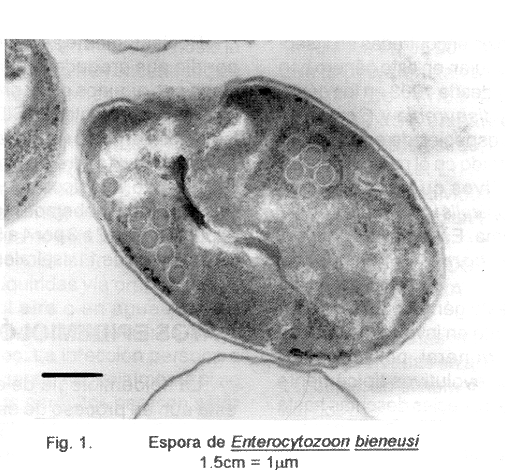
<body><![CDATA[<P><I><FONT FACE="Arial,Helvetica"><FONT SIZE=-1>Enterocytozoon bieneusi</FONT></FONT></I>      <P><FONT FACE="Arial,Helvetica"><FONT SIZE=-1>Fue descubierto por Desportes<I> et al.</I> en pacientes VIH positivos que presentaban una diarrea cr&oacute;nica importante (<A HREF="#5">5</A>). Puesto que &eacute;sta es la especie m&aacute;s frecuente en los casos de microsporidiosis humana, se describen en detalle las caracter&iacute;sticas biol&oacute;gicas y morfol&oacute;gicas particulares, que de acuerdo con Cali &amp; Owen (<A HREF="#7">7</A>) y Weber <I>et al.</I> (<A HREF="#3">3</A>) son:</FONT></FONT>      <P><FONT FACE="Arial,Helvetica"><FONT SIZE=-1>&nbsp;&nbsp; a) El organismo es monocariota en todos sus estad&iacute;os evolutivos.</FONT></FONT>      <P><FONT FACE="Arial,Helvetica"><FONT SIZE=-1>&nbsp;&nbsp; b) En sus estados tempranos de desarrollo, tiene un n&uacute;cleo claramente alargado.</FONT></FONT>      <P><FONT FACE="Arial,Helvetica"><FONT SIZE=-1>&nbsp;&nbsp; c) Las formas proliferativas y esporog&oacute;nicas son redondeadas, plasmodiales (muchos n&uacute;cleos), circundadas por una sola membrana y miden alrededor de 6 &micro;m de di&aacute;metro.</FONT></FONT>      <P><FONT FACE="Arial,Helvetica"><FONT SIZE=-1>&nbsp;&nbsp; d) Presenta inclusiones citoplasm&aacute;ticas electrol&uacute;cidas, en varios de sus estados evolutivos y unos discos electrodensos que se forman durante la esporogon&iacute;a, discos que son precursores del aparato de anclaje y del filamento polar.</FONT></FONT>      <P><FONT FACE="Arial,Helvetica"><FONT SIZE=-1>&nbsp;&nbsp; e) Uno de sus estados evolutivos, el esporoblasto, se origina de las formas esporog&oacute;nicas plasmodiales al invaginarse el plasmalema.</FONT></FONT>      <P><FONT FACE="Arial,Helvetica"><FONT SIZE=-1>&nbsp;&nbsp; f) Las esporas miden 0.7 a 0.98 por 1.08 a 1.64 &micro;m y su filamento o t&uacute;bulo polar presenta de 5 a 7 espiras que al microscopio electr&oacute;nico, se observan en dos grupos o filas opuestas localizadas en un extremo de la espora (<A HREF="#figura1">Fig. 1</A>).</FONT></FONT>      <P><FONT FACE="Arial,Helvetica"><FONT SIZE=-1>&nbsp; g) Todos los estados evolutivos del par&aacute;sito se encuentran, cuando est&aacute;n dentro de la c&eacute;lula (las esporas pueden hallarse libres), en contacto directo con el citoplasma de la c&eacute;lula hu&eacute;sped y no inclu&iacute;dos en vacuolas parasit&oacute;foras.</FONT></FONT>      <P><FONT FACE="Arial,Helvetica"><FONT SIZE=-1>Esta especie se ha encontrado tambi&eacute;n en epitelios nasal, bronquial y traqueal, adem&aacute;s de los ductos biliar y pancre&aacute;tico, ves&iacute;cula biliar y c&eacute;lulas no parenquimatosas hep&aacute;ticas (<A HREF="#3">3</A>).</FONT></FONT>      ]]></body>
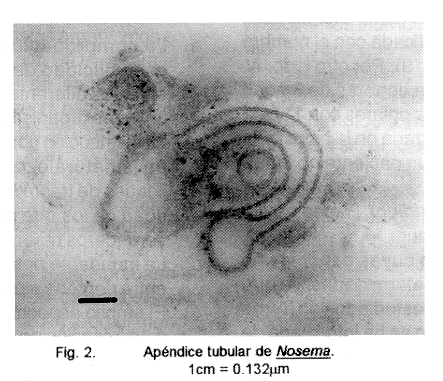
<body><![CDATA[<P><FONT FACE="Arial,Helvetica"><FONT SIZE=-1>G&eacute;nero <I>Encephalitozoon.</I> Incluye las especies: <I>E. cuniculi, E. hellem, E. intestinalis</I> (antes <I>Septata intestinalis</I>).</FONT></FONT>      <P><FONT FACE="Arial,Helvetica"><FONT SIZE=-1><I>E. cuniculi</I> fue encontrado por Wright y Craighead (<A HREF="#8">8</A>) pero el nombre se lo dieron Levaditi, Nicolau y Schoen (<A HREF="#9">9</A>), confirmado y redescrito por Weiser en 1964 (<A HREF="#10">10</A>).</FONT></FONT>      <P><FONT FACE="Arial,Helvetica"><FONT SIZE=-1>Esta especie parasita al hombre, roedores, carn&iacute;voros, otros primates e inclusive algunas aves. Los tejidos m&aacute;s com&uacute;nmente infectados son el cerebral y el muscular; pero tambi&eacute;n se puede encontrar en macr&oacute;fagos, c&eacute;lulas epiteliales, endotelios vasculares y c&eacute;lulas de los t&uacute;bulos renales.</FONT></FONT>      <P><FONT FACE="Arial,Helvetica"><FONT SIZE=-1>Morfol&oacute;gicamente sus esporas se caracterizan por ser monocari&oacute;ticas, con tama&ntilde;o de 1.0-1.5 por 2.0-2.5 &micro;m, endosporas gruesas y exosporas delgadas, adem&aacute;s de presentar de 6 a 8 vueltas o espirales en su filamento polar. Los merontes son redondos u ovalados y miden de 2 a 6 por 1 a 3 &micro;m. Los esporontes aparecen libres en el centro de una vacuola parasit&oacute;fora, como sucede con todos los estados evolutivos del g&eacute;nero <I>Encephalitozoon</I> y se dividen en dos esporoblastos que finalmente van a madurar dando las esporas.</FONT></FONT>      <P><FONT FACE="Arial,Helvetica"><FONT SIZE=-1><I>E. hellem</I> fue descrito por Didier <I>et al</I> (<A HREF="#11">11</A>). Adem&aacute;s de los detalles descritos anteriormente para el g&eacute;nero, esta especie se caracteriza por presentar esporas que miden 2.0 a 2.5 por 1.0 a 1.5 &micro;m y el filamento polar presenta de 5 a 7 espiras generalmente en filas sencillas localizadas en la periferia de la espora. Ha sido encontrado en macr&oacute;fagos, c&eacute;lulas de los epitelios nasal, bronquial, corneal, conjuntival, del tracto urinario y t&uacute;bulos renales.</FONT></FONT>      <P><FONT FACE="Arial,Helvetica"><FONT SIZE=-1><I>E. intestinalis</I> fue descrito con el nombre de <I>Septata intestinalis</I> por Cali <I>et al. </I>(<A HREF="#12">12</A>) y reclasificado, con base en caracter&iacute;sticas gen&eacute;ticas e inmunol&oacute;gicas por Hartskeerl <I>et al</I> (<A HREF="#13">13</A>). Sus c&eacute;lulas proliferativas se caracterizan por ser uni, bi o tetranucleadas y la esporogon&iacute;a da origen a 4 esporas. Dentro de la vacuola parasit&oacute;fora se observan los organismos incluidos en una red fibrilar, dando la idea de que dicha vacuola es septada, lo cual dio origen al primer nombre cient&iacute;fico. En los esporontes se observaron originalmente los llamados ap&eacute;ndices tubulares que se originan de la superficie y terminan en una estructura semejante a un bulbo; este ap&eacute;ndice tubular lo hemos observado en el g&eacute;nero <I>Nosema </I>por Chinchilla <I>et al</I>. (datos sin publicar. <A HREF="#figura2">Fig. 2</A>). Las esporas maduras miden 2.0 por 1.2 &micro;m, son uninucleadas y presentan de 4 a 7 (usualmente 5) espirales en el filamento polar. Hasta ahora s&oacute;lo ha sido diagnosticado en pacientes VIH positivos con diarrea, se han encontrado los par&aacute;sitos en enterocitos y en macr&oacute;fagos de la l&aacute;mina propia (<A HREF="#12">12</A>). Tambi&eacute;n han sido encontrados en fibroblastos y c&eacute;lulas endoteliales de la l&aacute;mina propia, c&eacute;lulas epiteliales de canal&iacute;culos biliares, &aacute;rbol bronquial y cavidad nasal, as&iacute; como en las c&eacute;lulas de los t&uacute;bulos renales (<A HREF="#12">12</A>, <A HREF="#14">14</A>).</FONT></FONT>      <P><FONT FACE="Arial,Helvetica"><FONT SIZE=-1>G&eacute;nero <I>Pleistophora. </I>Las<I> </I>especies: <I>P. tropicalis, P. simulii</I>, presentan esporas monocari&oacute;ticas en gran cantidad dentro de la ves&iacute;cula espor&oacute;fora cubierta por una membrana gruesa, amorfa, constituidas por las formas plasmodiales merog&oacute;nicas. La esporogon&iacute;a produce m&uacute;ltiple n&uacute;mero de esporas las cuales se caracterizan por medir 2.8 a 3.2 o 3.4 &micro;m y presentar filamentos polares con 9 a 12 espiras. Las especies de este g&eacute;nero son par&aacute;sitos normales de peces, anfibios y reptiles (<A HREF="#6">6</A>).</FONT></FONT>     <BR><FONT SIZE=-1>&nbsp;</FONT>     <BR><FONT SIZE=-1>&nbsp;</FONT>     <CENTER><A NAME="figura1"></A><IMG SRC="/img/fbpe/rccm/v19n3-4/Figura1.GIF" HEIGHT=472 WIDTH=505></CENTER> <FONT FACE="Arial,Helvetica"><FONT SIZE=-1>&nbsp;</FONT></FONT>     
]]></body>
<body><![CDATA[<BR><FONT FACE="Arial,Helvetica"><FONT SIZE=-1>&nbsp;</FONT></FONT>     <CENTER><A NAME="figura2"></A><IMG SRC="/img/fbpe/rccm/v19n3-4/Figura2.GIF" HEIGHT=381 WIDTH=443></CENTER> <FONT SIZE=-1>&nbsp;</FONT>      
<P><FONT FACE="Arial,Helvetica"><FONT SIZE=-1>Algunas especies encontradas en insectos que antes se inclu&iacute;an en este g&eacute;nero han sido reclasificadas desde 1982 en los g&eacute;neros <I>Vavraia, Polydispyrenia </I>y <I>Cystosporogenes</I> (<A HREF="#15">15</A>). Las especies de este g&eacute;nero que se han encontrado en el m&uacute;sculo de pacientes VIH positivos que presentaban miositis, son <I>P. tropicalis</I> y<I> P. simulii </I>(<A HREF="#16">16</A>).</FONT></FONT>      <P><FONT FACE="Arial,Helvetica"><FONT SIZE=-1>G&eacute;nero Nosema. Especies <I>N. connori, N. ocularum, N. corneum (Vittaforma cornea).</I></FONT></FONT>      <P><FONT FACE="Arial,Helvetica"><FONT SIZE=-1>Especies de este g&eacute;nero han sido descritas especialmente en invertebrados y se caracterizan, en general, por presentar todos los estadios evolutivos t&iacute;picamente dicari&oacute;ticos. De las especies descritas hasta hoy que parasitan al hombre (<A HREF="#17">17</A>), <I>N. connori</I>, encontrada en un ni&ntilde;o at&iacute;mico, presenta esporas que miden 2 a 2.5 por 4 a 4.5 &micro;m de tama&ntilde;o con filamentos polares con 11 espirales (<A HREF="#18">18</A>). En<I> N. corneum</I>, diagnosticada en el estroma de la c&oacute;rnea de personas aparentemente no inmunosupresas (<A HREF="#1">1</A>), las esporas miden 1 por 3.7 &micro;m y tienen un filamento polar con 6 espiras. Esta especie ha sido reclasificada con el nombre de <I>Vitta-forma cornea</I> (<A HREF="#19">19</A>). Por otro lado, <I>N. ocularum</I> que presentan esporas de 3 por 5 &micro;m de tama&ntilde;o y t&uacute;bulos polares con 11 a 12 espiras, ha sido encontrada en la biopsia de una &uacute;lcera c&oacute;rnea de un paciente no inmunosupreso (<A HREF="#20">20</A>).</FONT></FONT>      <P><FONT FACE="Arial,Helvetica"><FONT SIZE=-1>G&eacute;nero <I>Microsporidium. </I>Especies:<I> M. ceylonensis, M. africanum.</I></FONT></FONT>      <P><FONT FACE="Arial,Helvetica"><FONT SIZE=-1>Este es un g&eacute;nero cuyas especies no han sido claramente determinadas, ya que sus ciclos no han sido estudiados en forma completa. Sin embargo se ha informado de las especies <I>M. ceylonensis</I> y <I>M. africanum</I> que parasitan el.estroma de la c&oacute;rnea de individuos en los cuales no se encontr&oacute; ning&uacute;n problema de inmunidad (<A HREF="#21">21</A>, <A HREF="#22">22</A>). En cuanto a los estados evolutivos de este g&eacute;nero, s&oacute;lo se conoce la morfolog&iacute;a de las esporas cuyo tama&ntilde;o es de 2.5 por 4.5 &micro;m y cuyo filamento presenta de 11 a 13 espirales.</FONT></FONT>      <P><FONT FACE="Arial,Helvetica"><FONT SIZE=-1>Recientemente se encontr&oacute; un microsporidio que produce miositis severa, asociada con algunos otros problemas patol&oacute;gicos en un paciente con SIDA, que fue clasificado con el nombre de <I>Trachipleistophora hominis</I> (<A HREF="#6">6</A>). Aparte de gran cantidad de detalles morfol&oacute;gicos que se indican en el trabajo citado, debemos mencionar que las esporas miden 2 a 3 por 4 a 5 &micro;m y presentan un promedio de 11 espirales en su filamento polar.</FONT></FONT>     <BR><FONT FACE="Arial,Helvetica"><FONT SIZE=-1>&nbsp;</FONT></FONT>      <P><B><FONT FACE="Arial,Helvetica"><FONT SIZE=-1>Datos epidemiol&oacute;gicos</FONT></FONT></B>      ]]></body>
<body><![CDATA[<P><FONT FACE="Arial,Helvetica"><FONT SIZE=-1>La epidemiolog&iacute;a de esta parasitosis est&aacute; a&uacute;n en proceso de estudio, especialmente porque su diagn&oacute;stico todav&iacute;a depende fundamentalmente de estudios morfol&oacute;gicos, por lo que las estad&iacute;sticas que se realizan con base en encuestas, no son del todo confiables. Sin embargo los siguientes aspectos bien conocidos determinan la distribuci&oacute;n cosmopolita de esta parasitosis.</FONT></FONT> <OL TYPE="a"><FONT FACE="Arial,Helvetica"><FONT SIZE=-1>a) La comprobaci&oacute;n de la ausencia de especificidad de hu&eacute;sped que existe entre los diferentes g&eacute;neros y especies de estos organismos.</FONT></FONT>      <P><FONT FACE="Arial,Helvetica"><FONT SIZE=-1>b) La distribuci&oacute;n ubicua de estos par&aacute;sitos en la naturaleza aumenta las posibilidades de trasmisi&oacute;n, dada la gran cantidad de los que pueden considerarse verdaderos reservorios.</FONT></FONT>      <P><FONT FACE="Arial,Helvetica"><FONT SIZE=-1>c) La indudable posibilidad de trasmisi&oacute;n entre persona y persona.</FONT></FONT>      <P><FONT FACE="Arial,Helvetica"><FONT SIZE=-1>d) El amplio espectro cl&iacute;nico que presenta esta infecci&oacute;n en el hombre.</FONT></FONT>    </OL> <FONT FACE="Arial,Helvetica"><FONT SIZE=-1>Tambi&eacute;n, en t&eacute;rminos generales, la epidemiolog&iacute;a de esta parasitosis puede depender de la condici&oacute;n de resistencia natural e inmunidad del hombre y por supuesto, de las especies que le infecten. Esto hace que la microsporidiosis sea asociada com&uacute;nmente con individuos infectados con VIH (<A HREF="#23">23</A>). Sin embargo en la nosematosis la mayor&iacute;a de los casos se han encontrado en individuos inmunocompetentes y al mismo tiempo, se tienen noticias de infecciones por <I>E. bieneusi</I>, tambi&eacute;n en personas sin deficiencias inmunol&oacute;gicas (<A HREF="#24">24</A>,<A HREF="#25">25</A>).</FONT></FONT>      <P><FONT FACE="Arial,Helvetica"><FONT SIZE=-1>En cuanto a la infecci&oacute;n en humanos, las esporas resultan ser el estado evolutivo infectante; aunque no est&aacute; totalmente clara la v&iacute;a de infecci&oacute;n. Existen evidencias de que ellas son adquiridas v&iacute;a oral del medio ambiente, en el aire o en aguas contaminadas o inclusive por ingesti&oacute;n de insectos contaminados. La infecci&oacute;n persona a persona cobra fuerza, especialmente si se analiza que estos par&aacute;sitos parecen estar presentes en el intestino de los humanos, de los cuales los individuos inmunocompetentes se podr&iacute;an considerar como importantes reservorios (<A HREF="#3">3</A>, <A HREF="#26">26</A>). En la trasmisi&oacute;n se ha comprobado el efecto de los aerosoles por medio de algunos estudios experimentales, especialmente en infecciones pulmonares (<A HREF="#27">27</A>). Los problemas oculares podr&iacute;an deberse a contaminaciones aer&oacute;genas y la presencia de estos organismos en la pr&oacute;stata de enfermos con SIDA, adem&aacute;s de algunos experimentos de laboratorio realizado con <I>Encephalitozoon</I>, hacen pensar en la trasmisi&oacute;n sexual y trasplacentaria (<A HREF="#3">3</A>).</FONT></FONT>      <P><FONT FACE="Arial,Helvetica"><FONT SIZE=-1>En cuanto a la prevalencia y distribuci&oacute;n geogr&aacute;fica de esta parasitosis, al no ser confiables los datos de seroprevalencia por las razones antes indicadas, la informaci&oacute;n que se da se basa en el diagn&oacute;stico por la observaci&oacute;n de las esporas. Con base en ello se concluye que esta parasitosis est&aacute; presente pr&aacute;cticamente en todo el mundo, exceptuando quiz&aacute; la Ant&aacute;rtida. Las diferencias de prevalencia entre los pa&iacute;ses podr&iacute;an estar dadas por las variaciones en los factores de riesgo, pero m&aacute;s probablemente, por la capacidad diagn&oacute;stica. Lo que s&iacute; es evidente es que un importante n&uacute;mero de casos han sido encontrados en pacientes VIH positivos y en personas inmunosuprimidas por otras causas.</FONT></FONT>      <P><FONT FACE="Arial,Helvetica"><FONT SIZE=-1>De los datos conocidos se desprende que la prevalencia va del 7% en algunos lugares de Africa hasta el 50% en Francia (<A HREF="#3">3</A>). Sin embargo, dadas las diferencias en el muestreo, esta informaci&oacute;n no es concluyente. En un estudio hecho en Costa Rica en individuos VIH positivos (<A HREF="#28">28</A>) hemos encontrado un 7% de positividad.</FONT></FONT>     <BR><FONT FACE="Arial,Helvetica"><FONT SIZE=-1>&nbsp;</FONT></FONT>      <P><B><FONT FACE="Arial,Helvetica"><FONT SIZE=-1>Patolog&iacute;a, patog&eacute;nesis y sintomatolog&iacute;a</FONT></FONT></B>      ]]></body>
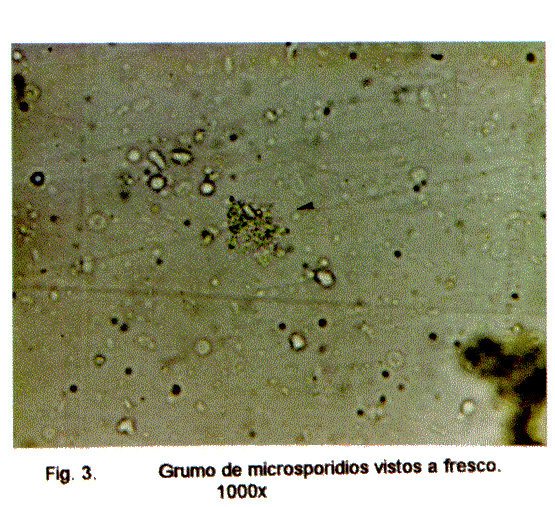
<body><![CDATA[<P><FONT FACE="Arial,Helvetica"><FONT SIZE=-1>Adem&aacute;s de las manifestaciones patol&oacute;gicas observadas en animales de diferentes especies, en el humano se pueden encontrar dos posibilidades: una notable reproducci&oacute;n de los par&aacute;sitos en los individuos inmunosuprimidos con la correspondiente intensa patolog&iacute;a (<A HREF="#14">14</A>, <A HREF="#29">29</A>) y por otro lado, individuos inmunocompetentes que presentan importantes lesiones debidas a los microsporidios (<A HREF="#30">30</A>, <A HREF="#31">31</A>). Es necesario anotar que las infecciones intestinales, s&oacute;lo son severas en individuos con problemas de inmunidad; en los individuos inmunocompetentes las diarreas que se producen pueden ser agudas pero siempre autolimitadas. Por lo tanto, no existen claras evidencias de que microsporidiosis diseminadas ocurran en individuos sin problemas inmunol&oacute;gicos.</FONT></FONT>      <P><FONT FACE="Arial,Helvetica"><FONT SIZE=-1>Las manifestaciones cl&iacute;nicas en esta parasitosis pueden resumirse en las sintomatolog&iacute;as relacionadas con problemas intestinales, oculares, musculares y sist&eacute;micos (<A HREF="#30">30</A>). Las lesiones intestinales especialmente causadas por <I>E. bieneusi</I> (<A HREF="#19">19</A>), pero tambi&eacute;n presentes en infecciones por especies de los g&eacute;neros <I>Pleistophora</I>,<I> Microsporidium </I>y <I>Encephalitozoon,</I> se manifiestan como una diarrea cr&oacute;nica acompa&ntilde;ada de p&eacute;rdida de peso, fiebre, anorexia y adelgazamiento probablemente debido a problemas de mala absorci&oacute;n intestinal (<A HREF="#1">1</A>, <A HREF="#5">5</A>, <A HREF="#19">19</A>).</FONT></FONT>      <P><FONT FACE="Arial,Helvetica"><FONT SIZE=-1>Esto &uacute;ltimo ocurre porque el epitelio intestinal presenta muchas alteraciones, incluyendo, en los casos severos, una degeneraci&oacute;n epitelial generalizada. En estos casos, generalmente observados en inmunosuprimidos y muy especialmente en individuos VIH positivos, se produce un desprendimiento de la mucosa la cual va a estar presente en las heces del individuo (<A HREF="#32">32</A>). A la par de estas manifestaciones intestinales, puede observarse tambi&eacute;n, en el caso de infecciones con <I>E. bieneusi</I>, invasi&oacute;n del par&aacute;sito en los epitelios de los ductos biliares (<A HREF="#3">3</A>), del &aacute;rbol respiratorio (<A HREF="#33">33</A>) y del ducto pancre&aacute;tico en donde generalmente no causan lesiones importantes (<A HREF="#3">3</A>).</FONT></FONT>      <P><FONT FACE="Arial,Helvetica"><FONT SIZE=-1>Las lesiones oculares son producidas especialmente por especies de los g&eacute;neros <I>Encephalitozoon, Nosema</I> y <I>Microsporidium</I> en individuos con buena salud general, sin inmunodeficiencias, siempre y cuando no se trate de alguna infecci&oacute;n diseminada debida a alguna especie del primer g&eacute;nero mencionado (<A HREF="#34">34</A>).</FONT></FONT>      <P><FONT FACE="Arial,Helvetica"><FONT SIZE=-1>Las lesiones observadas son queratoconjuntivitis, &uacute;lceras de la c&oacute;rnea, degeneraci&oacute;n y necrosis (<A HREF="#35">35</A>, <A HREF="#36">36</A>). En individuos VIH positivos estas lesiones pueden ser m&aacute;s pronunciadas y se acompa&ntilde;an con infiltrados inflamatorios mixtos de neutr&oacute;filos y c&eacute;lulas mononucleares. Los pacientes pueden presentar eritema conjuntival, disminuci&oacute;n de la capacidad visual y fotofobia (<A HREF="#35">35</A>).</FONT></FONT>      <P><FONT FACE="Arial,Helvetica"><FONT SIZE=-1>Las miositis en la microsporidiosis han sido informadas especialmente en las infecciones con<I> Pleistophora</I> spp y <I>Trachipleistophora hominis</I>. Los signos y s&iacute;ntomas m&aacute;s corrientemente observados son mialgias importantes debidas a la miopat&iacute;a difusa, asociadas con fiebre, adenopat&iacute;a generalizada y p&eacute;rdida de peso (<A HREF="#6">6</A>, <A HREF="#16">16</A>, <A HREF="#37">37</A>). Lesiones causadas por <I>Encephalitozoon cuniculi</I> se han encontrado en h&iacute;gado lo que produce ictericia, fiebre, necrosis hepatocelular, todo lo cual, acompa&ntilde;ado de una diarrea severa, produciendo la muerte en al menos un paciente (<A HREF="#3">3</A>).</FONT></FONT>      <P><FONT FACE="Arial,Helvetica"><FONT SIZE=-1>Infecciones generalizadas en pacientes con SIDA debidas a estos par&aacute;sitos, tambi&eacute;n han sido observadas. En efecto, patolog&iacute;as conjuntas muy variadas tales como queratoconjuntivitis, bronquiolitis, sinusitis, nefritis, uretritis, cistitis, prostatitis, hepatitis y peritonitis han sido relacionadas con infecciones por <I>E. hellem</I> (<A HREF="#27">27</A>) <I>E. cuniculi </I>(<A HREF="#37">37</A>) y <I>E. intestinalis</I> (<A HREF="#14">14</A>). Tambi&eacute;n se han observado manifestaciones sist&eacute;micas incluyendo el tracto urinario y el sistema respiratorio. En este &uacute;ltimo se ha observado sinusitis, poliposis nasal con la consecuente obstrucci&oacute;n y descarga nasal mucopurulenta persistente. La muerte puede ocurrir por complicaciones de cualquiera de los sistemas afectados.</FONT></FONT>     <BR><FONT FACE="Arial,Helvetica"><FONT SIZE=-1>&nbsp;</FONT></FONT>      <P><B><FONT FACE="Arial,Helvetica"><FONT SIZE=-1>Diagn&oacute;stico</FONT></FONT></B>      <P><FONT FACE="Arial,Helvetica"><FONT SIZE=-1>La identificaci&oacute;n de estos organismos presenta algunas dificultades porque los elementos de diagn&oacute;stico son las esporas cuyo tama&ntilde;o es muy peque&ntilde;o. Vistas al fresco es posible sospechar su presencia cuando se encuentran en grumos, pero aisladamente son muy dif&iacute;ciles de ubicar (<A HREF="#figura3">Fig. 3</A>) En todo caso es necesario realizar tinciones especiales tal como la de Weber <I>et al.</I> (<A HREF="#38">38</A>), la de Ryan <I>et al.</I> (<A HREF="#39">39</A>) y la de Luna<I> et al.</I> (<A HREF="#40">40</A>) que usa el blanco calcofluor fluorocromo.</FONT></FONT>     ]]></body>
<body><![CDATA[<BR><FONT SIZE=-1>&nbsp;</FONT>     <BR><FONT SIZE=-1>&nbsp;</FONT>     <CENTER><A NAME="figura3"></A><IMG SRC="/img/fbpe/rccm/v19n3-4/Figura3.GIF" HEIGHT=507 WIDTH=555></CENTER> <FONT SIZE=-1>&nbsp;</FONT>     
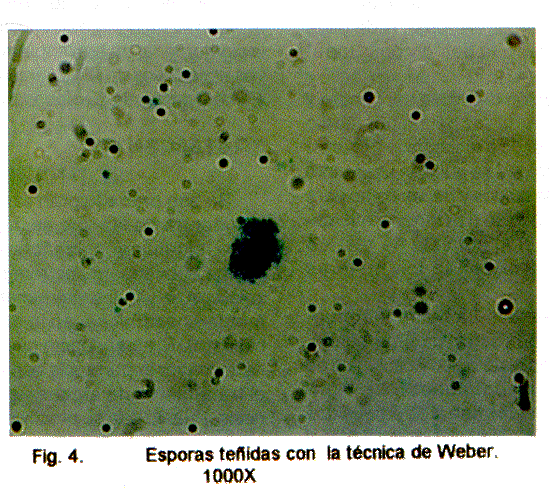
<BR><FONT SIZE=-1>&nbsp;</FONT>      <P><FONT FACE="Arial,Helvetica"><FONT SIZE=-1>La t&eacute;cnica de Weber es la usada en el Laboratorio de Protozoolog&iacute;a para el diagn&oacute;stico de estos par&aacute;sitos en las heces humanas. Esta t&eacute;cnica ti&ntilde;e las esporas de un color rojo intenso que sobresale del color verde de contraste (<A HREF="#figura4">Fig. 4</A>).</FONT></FONT>     <BR><FONT SIZE=-1>&nbsp;</FONT>     <BR><FONT SIZE=-1>&nbsp;</FONT>     <CENTER><A NAME="figura4"></A><IMG SRC="/img/fbpe/rccm/v19n3-4/Figura4.GIF" HEIGHT=490 WIDTH=550></CENTER> <FONT FACE="Arial,Helvetica"><FONT SIZE=-1>&nbsp;</FONT></FONT>      
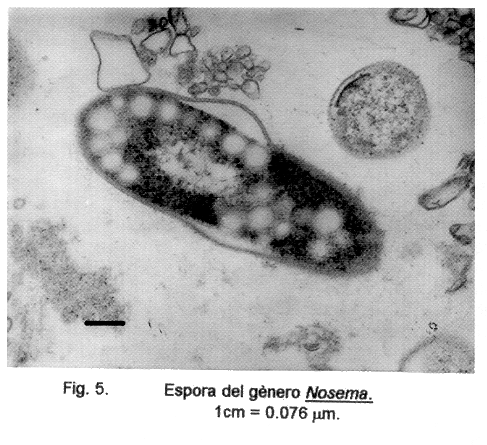
<P><FONT FACE="Arial,Helvetica"><FONT SIZE=-1>Ninguna de las t&eacute;cnicas de concentraci&oacute;n parecen ser necesarias para el diagn&oacute;stico de los microsporidios ya que los pacientes sintom&aacute;ticos, generalmente presentan gran cantidad de esporas f&aacute;ciles de encontrar. Estudios histol&oacute;gicos han sido practicados en biopsias y en material de autopsia pero para un diagn&oacute;stico confiable deben realizarse tinciones especiales de los tejidos, tales como la de Gram modificada (Brown-Brenn o Brown-Hopps), la de plata de Warthin-Starry o la del "chromotrope" aplicada a tejidos (<A HREF="#41">41</A>).</FONT></FONT>      <P><FONT FACE="Arial,Helvetica"><FONT SIZE=-1>La identificaci&oacute;n definitiva del g&eacute;nero y especies s&oacute;lo puede ser hecha por medio del uso del microscopio electr&oacute;nico (<A HREF="#figura1">Figs. 1</A> y <A HREF="#figura5">5</A>). Estas t&eacute;cnicas se pueden usar tanto para muestras de fluidos y heces como para tejidos de todo tipo. Se usa tanto la microscop&iacute;a de trasmisi&oacute;n como la de rastreo (scanning) y se obtienen los mejores resultados.</FONT></FONT>     ]]></body>
<body><![CDATA[<BR><FONT SIZE=-1>&nbsp;</FONT>     <BR><FONT SIZE=-1>&nbsp;</FONT>     <CENTER><A NAME="figura5"></A><IMG SRC="/img/fbpe/rccm/v19n3-4/Figura5.GIF" HEIGHT=445 WIDTH=487></CENTER> <FONT SIZE=-1>&nbsp;</FONT>     
<BR><FONT SIZE=-1>&nbsp;</FONT>      <P><FONT FACE="Arial,Helvetica"><FONT SIZE=-1>Ulitizando la t&eacute;cnica de inmunofluorescencia, han sido usadas pruebas serol&oacute;gicas en el estudio histol&oacute;gico y citol&oacute;gico de muy diversos espec&iacute;menes (<A HREF="#42">42</A>). Anticuerpos monoclonales han sido producidos para la detecci&oacute;n de las esporas en heces y en diferentes fluidos especialmente en el caso de las infecciones por <I>E. bieneusi</I> y <I>Encephalitozoon</I> (<A HREF="#43">43</A>, <A HREF="#44">44</A>).</FONT></FONT>      <P><FONT FACE="Arial,Helvetica"><FONT SIZE=-1>Se han hecho estudios serol&oacute;gicos empleando las t&eacute;cnicas del carbono inmunoensayo, ELISA, Western Blot (<A HREF="#45">45</A>) y muy recientemente se han implementado ensayos espec&iacute;ficos de PCR para la detecci&oacute;n de <I>E.intestinalis</I> y de <I>E. bieneusi</I> en heces (<A HREF="#46">46</A>).</FONT></FONT>      <P><FONT FACE="Arial,Helvetica"><FONT SIZE=-1>&nbsp;</FONT></FONT>     <BR><B><FONT FACE="Arial,Helvetica"><FONT SIZE=-1>Tratamiento</FONT></FONT></B>      <P><FONT FACE="Arial,Helvetica"><FONT SIZE=-1>Se han probado gran cantidad de drogas dentro de las que se incluyen fumagilina, sinefungina, itraconazole, azithromicina, atovaquone, octreotide y albendazole, con resultados muy variables, pr&aacute;cticamente anecd&oacute;ticos, en la mayor&iacute;a de los casos (<A HREF="#3">3</A>). El albendazole es al que se le ha dado mayor importancia especialmente en el tratamiento de algunas encefalitozoonosis. Puesto que su efectividad en la enterocitozoonosis no parece ser muy efectiva (<A HREF="#47">47</A>), siendo &eacute;sta la infecci&oacute;n microsporidial m&aacute;s corriente en el hombre, es necesario la b&uacute;squeda de nuevas drogas.</FONT></FONT>      <P><FONT FACE="Arial,Helvetica"><FONT SIZE=-1>Al respecto, Sharspstone <I>et al</I> (<A HREF="#48">48</A>) han demostrado que la thalidomida es efectiva en aproximadamente el 60% de los casos tratados. Sin embargo, sus efectos teratog&eacute;nicos limitan su uso.</FONT></FONT>      ]]></body>
<body><![CDATA[<P><FONT FACE="Arial,Helvetica"><FONT SIZE=-1>&nbsp;</FONT></FONT>     <BR><B><FONT FACE="Arial,Helvetica"><FONT SIZE=-1>Medidas preventivas</FONT></FONT></B>      <P><FONT FACE="Arial,Helvetica"><FONT SIZE=-1>Debido a que los mecanismos de trasmisi&oacute;n de estos par&aacute;sitos, as&iacute; como las fuentes de infecci&oacute;n todav&iacute;a no son muy conocidas, la prevenci&oacute;n en las microsporidiosis no se puede establecer claramente. Sin embargo, tomando en cuenta algunos datos que se conocen acerca de la sensibilidad de las esporas al calor y a la congelaci&oacute;n (<A HREF="#3">3</A>), se puede sugerir la aplicaci&oacute;n de estos medios f&iacute;sicos para evitar infecciones. Tambi&eacute;n por analog&iacute;a con todas las parasitosis que se adquieren v&iacute;a oral y por un hecho probado de que los aerosoles son importantes en la diseminaci&oacute;n de estos organismos, se puede sugerir el lavado de manos y de hortalizas y frutas que se ingieren sin cocinar. Relacionado con estos mismos hechos, es recomendable para el personal de hospitales que menejen pacientes inmunol&oacute;gicamente deficientes, un estricto control higi&eacute;nico.</FONT></FONT>     <BR><FONT FACE="Arial,Helvetica"><FONT SIZE=-1>&nbsp;</FONT></FONT>      <P><B><FONT FACE="Arial,Helvetica"><FONT SIZE=-1>Agradecimientos</FONT></FONT></B>      <P><FONT FACE="Arial,Helvetica"><FONT SIZE=-1>Este trabajo fue subvencionado por la Vicerrector&iacute;a de Investigaci&oacute;n (proyecto # 803-97-262). Los autores agradecen a Ethel S&aacute;nchez Chac&oacute;n y Laura Hern&aacute;ndez Chavarria de la Unidad de Microscop&iacute;a Electr&oacute;nica, Universidad de Costa Rica.</FONT></FONT>     <CENTER><FONT FACE="Arial,Helvetica"><FONT SIZE=-1>&nbsp;</FONT></FONT></CENTER>       <P><B><FONT FACE="Arial,Helvetica"><FONT SIZE=-1>Referencias</FONT></FONT></B>      <!-- ref --><P><A NAME="1"></A><FONT FACE="Arial,Helvetica"><FONT SIZE=-1>1. Shadduck J A, Meccoli R A, Davis R, Font R L. First isolation of a microsporidian from a human patient. <I>J Infect Dis</I> 1990; 162:773-776.</FONT></FONT>    &nbsp;&nbsp;&nbsp;&nbsp;&nbsp;&nbsp;&nbsp;&nbsp;[&#160;<a href="javascript:void(0);" onclick="javascript: window.open('/scielo.php?script=sci_nlinks&ref=772516&pid=S0253-2948199800030001000001&lng=','','width=640,height=500,resizable=yes,scrollbars=1,menubar=yes,');">Links</a>&#160;]<!-- end-ref --><!-- ref --><P><A NAME="2"></A><FONT FACE="Arial,Helvetica"><FONT SIZE=-1>2. N&auml;geli K W. Ueber die neue krankheit der Seidenraupe und verwandte organismen. <I>Bot Z</I> 1857; 15:760-761.</FONT></FONT>    &nbsp;&nbsp;&nbsp;&nbsp;&nbsp;&nbsp;&nbsp;&nbsp;[&#160;<a href="javascript:void(0);" onclick="javascript: window.open('/scielo.php?script=sci_nlinks&ref=772517&pid=S0253-2948199800030001000002&lng=','','width=640,height=500,resizable=yes,scrollbars=1,menubar=yes,');">Links</a>&#160;]<!-- end-ref --><!-- ref --><P><A NAME="3"></A><FONT FACE="Arial,Helvetica"><FONT SIZE=-1>3. Weber R, Bryan R T, Schwartz D A, Owen R L. Human microsporidial infections. <I>Clin Microbiol Rev</I> 1994; 7:426-461.</FONT></FONT>    &nbsp;&nbsp;&nbsp;&nbsp;&nbsp;&nbsp;&nbsp;&nbsp;[&#160;<a href="javascript:void(0);" onclick="javascript: window.open('/scielo.php?script=sci_nlinks&ref=772518&pid=S0253-2948199800030001000003&lng=','','width=640,height=500,resizable=yes,scrollbars=1,menubar=yes,');">Links</a>&#160;]<!-- end-ref --><!-- ref --><P><A NAME="4"></A><FONT FACE="Arial,Helvetica"><FONT SIZE=-1>4. Matsubayashi H, Koike T, Mikata T, Hagiwara S. A case of <I>Encephalitozoon</I>-like body infection in man. <I>Arch Pathol</I> 1959; 67:181-187.</FONT></FONT>    &nbsp;&nbsp;&nbsp;&nbsp;&nbsp;&nbsp;&nbsp;&nbsp;[&#160;<a href="javascript:void(0);" onclick="javascript: window.open('/scielo.php?script=sci_nlinks&ref=772519&pid=S0253-2948199800030001000004&lng=','','width=640,height=500,resizable=yes,scrollbars=1,menubar=yes,');">Links</a>&#160;]<!-- end-ref --><!-- ref --><P><A NAME="5"></A><FONT FACE="Arial,Helvetica"><FONT SIZE=-1>5. Desportes I, Le Charpantier Y, Galian A, <I>et al.</I> Ocurrence of a new microsporidian, <I>Enterocytozoon bieneusi</I> n.g., n.sp., in the enterocytes of a human patients with AIDS. <I>J Protozool </I>1985; 32:250-254.</FONT></FONT>    &nbsp;&nbsp;&nbsp;&nbsp;&nbsp;&nbsp;&nbsp;&nbsp;[&#160;<a href="javascript:void(0);" onclick="javascript: window.open('/scielo.php?script=sci_nlinks&ref=772520&pid=S0253-2948199800030001000005&lng=','','width=640,height=500,resizable=yes,scrollbars=1,menubar=yes,');">Links</a>&#160;]<!-- end-ref --><!-- ref --><P><A NAME="6"></A><FONT FACE="Arial,Helvetica"><FONT SIZE=-1>6. Field A S, Marriott D J, Milleken S T, <I>et al.</I> Myositis associated with a newly described microsporidian, <I>Trachipleistophora hominis</I>, in a patient with AIDS. <I>J Clin</I> <I>Microbiol </I>1996; 34: 2803-2811.</FONT></FONT>    &nbsp;&nbsp;&nbsp;&nbsp;&nbsp;&nbsp;&nbsp;&nbsp;[&#160;<a href="javascript:void(0);" onclick="javascript: window.open('/scielo.php?script=sci_nlinks&ref=772521&pid=S0253-2948199800030001000006&lng=','','width=640,height=500,resizable=yes,scrollbars=1,menubar=yes,');">Links</a>&#160;]<!-- end-ref --><!-- ref --><P><A NAME="7"></A><FONT FACE="Arial,Helvetica"><FONT SIZE=-1>7. Cali A, Owen R L. Intracellular development of <I>Enterocytozoon</I>, a unique microsporidian found in the intestine of AIDS patients. <I>J Protozool</I>; 1990; 145-155.</FONT></FONT>    &nbsp;&nbsp;&nbsp;&nbsp;&nbsp;&nbsp;&nbsp;&nbsp;[&#160;<a href="javascript:void(0);" onclick="javascript: window.open('/scielo.php?script=sci_nlinks&ref=772522&pid=S0253-2948199800030001000007&lng=','','width=640,height=500,resizable=yes,scrollbars=1,menubar=yes,');">Links</a>&#160;]<!-- end-ref --><!-- ref --><P><A NAME="8"></A><FONT FACE="Arial,Helvetica"><FONT SIZE=-1>8. Wrigth J H, Craighead E M. Infectious motor paralysis in young rabbit. <I>J Exp Med</I> 1992; 36:135-140.</FONT></FONT>    &nbsp;&nbsp;&nbsp;&nbsp;&nbsp;&nbsp;&nbsp;&nbsp;[&#160;<a href="javascript:void(0);" onclick="javascript: window.open('/scielo.php?script=sci_nlinks&ref=772523&pid=S0253-2948199800030001000008&lng=','','width=640,height=500,resizable=yes,scrollbars=1,menubar=yes,');">Links</a>&#160;]<!-- end-ref --><!-- ref --><P><A NAME="9"></A><FONT FACE="Arial,Helvetica"><FONT SIZE=-1>9. Levaditi C, Nicolau S, Schoen R. L’agent etiologique de l’enc&eacute;phalite epizootique du lapin (<I>Encephalitozoon cuniculi)</I>. C.R. <I>Soc Biol Paris</I> 1923; 89:984-986.</FONT></FONT>    &nbsp;&nbsp;&nbsp;&nbsp;&nbsp;&nbsp;&nbsp;&nbsp;[&#160;<a href="javascript:void(0);" onclick="javascript: window.open('/scielo.php?script=sci_nlinks&ref=772524&pid=S0253-2948199800030001000009&lng=','','width=640,height=500,resizable=yes,scrollbars=1,menubar=yes,');">Links</a>&#160;]<!-- end-ref --><!-- ref --><P><A NAME="10"></A><FONT FACE="Arial,Helvetica"><FONT SIZE=-1>10. Weiser J. On the taxonomic position of the genus <I>Encephalitozoon</I> Levaditi, Nicolau &amp; Schoen, 1923 (Protozoa, Microsporidia). <I>Parasitology</I> 1964; 54:749-751.</FONT></FONT>    &nbsp;&nbsp;&nbsp;&nbsp;&nbsp;&nbsp;&nbsp;&nbsp;[&#160;<a href="javascript:void(0);" onclick="javascript: window.open('/scielo.php?script=sci_nlinks&ref=772525&pid=S0253-2948199800030001000010&lng=','','width=640,height=500,resizable=yes,scrollbars=1,menubar=yes,');">Links</a>&#160;]<!-- end-ref --><!-- ref --><P><A NAME="11"></A><FONT FACE="Arial,Helvetica"><FONT SIZE=-1>11. Didier E S, Shadduck J A, Didier P J, <I>et al</I>. Studies on ocular microsporidia. <I>J Protozool</I> 1991; 38:635-638.</FONT></FONT>    &nbsp;&nbsp;&nbsp;&nbsp;&nbsp;&nbsp;&nbsp;&nbsp;[&#160;<a href="javascript:void(0);" onclick="javascript: window.open('/scielo.php?script=sci_nlinks&ref=772526&pid=S0253-2948199800030001000011&lng=','','width=640,height=500,resizable=yes,scrollbars=1,menubar=yes,');">Links</a>&#160;]<!-- end-ref --><!-- ref --><P><A NAME="12"></A><FONT FACE="Arial,Helvetica"><FONT SIZE=-1>12. Cali A, Kotler D P, Orenstein J M. <I>Septata intestinalis</I> n.g.; n.sp., an intestinal microsporidian associated with chronic diarrhoea and dissemination in AIDS patient. <I>J Euk Microbiol</I> 1993; 40:101-112.</FONT></FONT>    &nbsp;&nbsp;&nbsp;&nbsp;&nbsp;&nbsp;&nbsp;&nbsp;[&#160;<a href="javascript:void(0);" onclick="javascript: window.open('/scielo.php?script=sci_nlinks&ref=772527&pid=S0253-2948199800030001000012&lng=','','width=640,height=500,resizable=yes,scrollbars=1,menubar=yes,');">Links</a>&#160;]<!-- end-ref --><!-- ref --><P><A NAME="13"></A><FONT FACE="Arial,Helvetica"><FONT SIZE=-1>13. Hartskeerl R A, Schuitema R J, de Wachter R. Secundary structure of the small subunit ribosomal RNA sequence of the microsporidium <I>Encephalitozoon cuniculi: Nucleic acids Res</I>. 1993; 21:1489.</FONT></FONT>    &nbsp;&nbsp;&nbsp;&nbsp;&nbsp;&nbsp;&nbsp;&nbsp;[&#160;<a href="javascript:void(0);" onclick="javascript: window.open('/scielo.php?script=sci_nlinks&ref=772528&pid=S0253-2948199800030001000013&lng=','','width=640,height=500,resizable=yes,scrollbars=1,menubar=yes,');">Links</a>&#160;]<!-- end-ref --><!-- ref --><P><A NAME="14"></A><FONT FACE="Arial,Helvetica"><FONT SIZE=-1>14. Dore G J, Marriott D J, Hing MC, <I>et al</I>. Disseminated microsporidiosis due to <I>Septata intestinalis</I> in nine patients infected with the human immunodeficiency virus: Response to therapy with albendazole. <I>Clin Infect</I> <I>Dis</I> 1995; 21:70-76.</FONT></FONT>    &nbsp;&nbsp;&nbsp;&nbsp;&nbsp;&nbsp;&nbsp;&nbsp;[&#160;<a href="javascript:void(0);" onclick="javascript: window.open('/scielo.php?script=sci_nlinks&ref=772529&pid=S0253-2948199800030001000014&lng=','','width=640,height=500,resizable=yes,scrollbars=1,menubar=yes,');">Links</a>&#160;]<!-- end-ref --><!-- ref --><P><A NAME="15"></A><FONT FACE="Arial,Helvetica"><FONT SIZE=-1>15. Larson R J I. Identification of microsporidian genera (Protozoa, Microspora) a guide with comments on the taxonomy. <I>Arch Protistenkd</I> 1988;136:1-37.</FONT></FONT>    &nbsp;&nbsp;&nbsp;&nbsp;&nbsp;&nbsp;&nbsp;&nbsp;[&#160;<a href="javascript:void(0);" onclick="javascript: window.open('/scielo.php?script=sci_nlinks&ref=772530&pid=S0253-2948199800030001000015&lng=','','width=640,height=500,resizable=yes,scrollbars=1,menubar=yes,');">Links</a>&#160;]<!-- end-ref --><!-- ref --><P><A NAME="16"></A><FONT FACE="Arial,Helvetica"><FONT SIZE=-1>16. Ledford D K, Overman M D, Gonzalo A, <I>et al.</I> Microsporidiosis myositis in a patient with acquired immunodeficiency syndrome. <I>Ann Intern Med</I> 1985; 102:628-630.</FONT></FONT>    &nbsp;&nbsp;&nbsp;&nbsp;&nbsp;&nbsp;&nbsp;&nbsp;[&#160;<a href="javascript:void(0);" onclick="javascript: window.open('/scielo.php?script=sci_nlinks&ref=772531&pid=S0253-2948199800030001000016&lng=','','width=640,height=500,resizable=yes,scrollbars=1,menubar=yes,');">Links</a>&#160;]<!-- end-ref --><!-- ref --><P><A NAME="17"></A><FONT FACE="Arial,Helvetica"><FONT SIZE=-1>17. Cali A. General microsporidian features and recent findings on AIDS isolates. <I>J Protozool</I> 1991; 38: 625-630.</FONT></FONT>    &nbsp;&nbsp;&nbsp;&nbsp;&nbsp;&nbsp;&nbsp;&nbsp;[&#160;<a href="javascript:void(0);" onclick="javascript: window.open('/scielo.php?script=sci_nlinks&ref=772532&pid=S0253-2948199800030001000017&lng=','','width=640,height=500,resizable=yes,scrollbars=1,menubar=yes,');">Links</a>&#160;]<!-- end-ref --><!-- ref --><P><A NAME="18"></A><FONT FACE="Arial,Helvetica"><FONT SIZE=-1>18. Margileth A M, Strano A J, Chandra R, <I>et al.</I> Disseminated nosematosis in an immunologically compromised infant. <I>Arch Pathol</I> 1973; 95:145-150.</FONT></FONT>    &nbsp;&nbsp;&nbsp;&nbsp;&nbsp;&nbsp;&nbsp;&nbsp;[&#160;<a href="javascript:void(0);" onclick="javascript: window.open('/scielo.php?script=sci_nlinks&ref=772533&pid=S0253-2948199800030001000018&lng=','','width=640,height=500,resizable=yes,scrollbars=1,menubar=yes,');">Links</a>&#160;]<!-- end-ref --><!-- ref --><P><A NAME="19"></A><FONT FACE="Arial,Helvetica"><FONT SIZE=-1>19. Croft S L, Williams J, McGowan I. Intestinal microsporidiosis. S<I>emin Gastroint</I> <I>Dis </I>1977; 8:45-55.</FONT></FONT>    &nbsp;&nbsp;&nbsp;&nbsp;&nbsp;&nbsp;&nbsp;&nbsp;[&#160;<a href="javascript:void(0);" onclick="javascript: window.open('/scielo.php?script=sci_nlinks&ref=772534&pid=S0253-2948199800030001000019&lng=','','width=640,height=500,resizable=yes,scrollbars=1,menubar=yes,');">Links</a>&#160;]<!-- end-ref --><!-- ref --><P><A NAME="20"></A><FONT FACE="Arial,Helvetica"><FONT SIZE=-1>20. Cali A, Meisler D, Lowder C Y, <I>et al.</I> Corneal microsporidosis: Characterization and identification. <I>J Protozool</I> 1991; 38:2155-2175.</FONT></FONT>    &nbsp;&nbsp;&nbsp;&nbsp;&nbsp;&nbsp;&nbsp;&nbsp;[&#160;<a href="javascript:void(0);" onclick="javascript: window.open('/scielo.php?script=sci_nlinks&ref=772535&pid=S0253-2948199800030001000020&lng=','','width=640,height=500,resizable=yes,scrollbars=1,menubar=yes,');">Links</a>&#160;]<!-- end-ref --><!-- ref --><P><A NAME="21"></A><FONT FACE="Arial,Helvetica"><FONT SIZE=-1>21. Ashton N, Wirasinha PA. Encephalitozoonosis (Nosematosis) of the cornea. <I>Br J Ophthalmol</I> 1973; 57: 669-674.</FONT></FONT>    &nbsp;&nbsp;&nbsp;&nbsp;&nbsp;&nbsp;&nbsp;&nbsp;[&#160;<a href="javascript:void(0);" onclick="javascript: window.open('/scielo.php?script=sci_nlinks&ref=772536&pid=S0253-2948199800030001000021&lng=','','width=640,height=500,resizable=yes,scrollbars=1,menubar=yes,');">Links</a>&#160;]<!-- end-ref --><!-- ref --><P><A NAME="22"></A><FONT FACE="Arial,Helvetica"><FONT SIZE=-1>22. Pinnolis M, Egbert P R, Font R L, Winter FC. Nosematosis of the cornea. <I>Arch Ophthalmol</I> 1981; 99:1044-1047.</FONT></FONT>    &nbsp;&nbsp;&nbsp;&nbsp;&nbsp;&nbsp;&nbsp;&nbsp;[&#160;<a href="javascript:void(0);" onclick="javascript: window.open('/scielo.php?script=sci_nlinks&ref=772537&pid=S0253-2948199800030001000022&lng=','','width=640,height=500,resizable=yes,scrollbars=1,menubar=yes,');">Links</a>&#160;]<!-- end-ref --><!-- ref --><P><A NAME="23"></A><FONT FACE="Arial,Helvetica"><FONT SIZE=-1>23. Orenstein J M. Microsporidiosis in the acquired immunodeficiency Syndrome. <I>J Parasitol</I> 1991; 77:843-864.</FONT></FONT>    &nbsp;&nbsp;&nbsp;&nbsp;&nbsp;&nbsp;&nbsp;&nbsp;[&#160;<a href="javascript:void(0);" onclick="javascript: window.open('/scielo.php?script=sci_nlinks&ref=772538&pid=S0253-2948199800030001000023&lng=','','width=640,height=500,resizable=yes,scrollbars=1,menubar=yes,');">Links</a>&#160;]<!-- end-ref --><!-- ref --><P><A NAME="24"></A><FONT FACE="Arial,Helvetica"><FONT SIZE=-1>24. Shadduck J A, Orenstein J M. Comparative Pathology in microsporidiosis. <I>Arch Pathol Lab Med</I> 1993; 117: 1215-1219.</FONT></FONT>    &nbsp;&nbsp;&nbsp;&nbsp;&nbsp;&nbsp;&nbsp;&nbsp;[&#160;<a href="javascript:void(0);" onclick="javascript: window.open('/scielo.php?script=sci_nlinks&ref=772539&pid=S0253-2948199800030001000024&lng=','','width=640,height=500,resizable=yes,scrollbars=1,menubar=yes,');">Links</a>&#160;]<!-- end-ref --><!-- ref --><P><A NAME="25"></A><FONT FACE="Arial,Helvetica"><FONT SIZE=-1>25. Sandford J, Hannermann A, Gelderblom H, <I>et al. Enterocytozoon bieneusi </I>infection in an immunocompetent patient who had acute diarrhea and who was not infected with the human immunodeficiency virus<I>. Clin Infect Dis</I> 1994; 19:514-516.</FONT></FONT>    &nbsp;&nbsp;&nbsp;&nbsp;&nbsp;&nbsp;&nbsp;&nbsp;[&#160;<a href="javascript:void(0);" onclick="javascript: window.open('/scielo.php?script=sci_nlinks&ref=772540&pid=S0253-2948199800030001000025&lng=','','width=640,height=500,resizable=yes,scrollbars=1,menubar=yes,');">Links</a>&#160;]<!-- end-ref --><!-- ref --><P><A NAME="26"></A><FONT FACE="Arial,Helvetica"><FONT SIZE=-1>26. Bryan R T, Weber R. Microsporidia emerging pathogens in immunodeficient persons. <I>Arch Pathol Lab Med</I> 1993;117:1243-1245.</FONT></FONT>    &nbsp;&nbsp;&nbsp;&nbsp;&nbsp;&nbsp;&nbsp;&nbsp;[&#160;<a href="javascript:void(0);" onclick="javascript: window.open('/scielo.php?script=sci_nlinks&ref=772541&pid=S0253-2948199800030001000026&lng=','','width=640,height=500,resizable=yes,scrollbars=1,menubar=yes,');">Links</a>&#160;]<!-- end-ref --><!-- ref --><P><A NAME="27"></A><FONT FACE="Arial,Helvetica"><FONT SIZE=-1>27. Weber R, Kuster H, Visvesvara G, <I>et al. </I>Disseminated microsporidiosis due to <I>Encephalitozoon hellem</I>: Pulmonary colonization, microhematuria and mild conjuntivitis in patient with AIDS. <I>Clin Infect Dis </I>1993; 17:415-419.</FONT></FONT>    &nbsp;&nbsp;&nbsp;&nbsp;&nbsp;&nbsp;&nbsp;&nbsp;[&#160;<a href="javascript:void(0);" onclick="javascript: window.open('/scielo.php?script=sci_nlinks&ref=772542&pid=S0253-2948199800030001000027&lng=','','width=640,height=500,resizable=yes,scrollbars=1,menubar=yes,');">Links</a>&#160;]<!-- end-ref --><!-- ref --><P><A NAME="28"></A><FONT FACE="Arial,Helvetica"><FONT SIZE=-1>28. Reyes L , Chinchilla M, Frajman M, <I>et al. </I>Presencia de par&aacute;sitos intestinales en pacientes HIV seropositivos con el primer informe de microsporidiosis humana en Costa Rica. <I>Parasitolog&iacute;a al D&iacute;a</I> 1997; 21:1-2.</FONT></FONT>    &nbsp;&nbsp;&nbsp;&nbsp;&nbsp;&nbsp;&nbsp;&nbsp;[&#160;<a href="javascript:void(0);" onclick="javascript: window.open('/scielo.php?script=sci_nlinks&ref=772543&pid=S0253-2948199800030001000028&lng=','','width=640,height=500,resizable=yes,scrollbars=1,menubar=yes,');">Links</a>&#160;]<!-- end-ref --><!-- ref --><P><A NAME="29"></A><FONT FACE="Arial,Helvetica"><FONT SIZE=-1>29. Orenstein J M, Dieterich D T, Kotler D M. Systematic dissemination by a newly recognized microsporidia species in AIDS. AIDS 1992; 6:1143-1150.</FONT></FONT>    &nbsp;&nbsp;&nbsp;&nbsp;&nbsp;&nbsp;&nbsp;&nbsp;[&#160;<a href="javascript:void(0);" onclick="javascript: window.open('/scielo.php?script=sci_nlinks&ref=772544&pid=S0253-2948199800030001000029&lng=','','width=640,height=500,resizable=yes,scrollbars=1,menubar=yes,');">Links</a>&#160;]<!-- end-ref --><!-- ref --><P><A NAME="30"></A><FONT FACE="Arial,Helvetica"><FONT SIZE=-1>30. Weber R, Bryan R T. Microsporidial infection in immunodeficient and immunocompetent patients. <I>Clin Infect Dis</I> 1994; 19:517-521.</FONT></FONT>    &nbsp;&nbsp;&nbsp;&nbsp;&nbsp;&nbsp;&nbsp;&nbsp;[&#160;<a href="javascript:void(0);" onclick="javascript: window.open('/scielo.php?script=sci_nlinks&ref=772545&pid=S0253-2948199800030001000030&lng=','','width=640,height=500,resizable=yes,scrollbars=1,menubar=yes,');">Links</a>&#160;]<!-- end-ref --><!-- ref --><P><A NAME="31"></A><FONT FACE="Arial,Helvetica"><FONT SIZE=-1>31. Molina J M, Sarfati C, Beauvais B, <I>et al.</I> Intestinal microsporidiosis in human immunodeficiency virus-infected patients with chronic unexplained diarrhea: Prevalence and Clinical and biological features. <I>J infect Dis</I> 1993; 167:217-221.</FONT></FONT>    &nbsp;&nbsp;&nbsp;&nbsp;&nbsp;&nbsp;&nbsp;&nbsp;[&#160;<a href="javascript:void(0);" onclick="javascript: window.open('/scielo.php?script=sci_nlinks&ref=772546&pid=S0253-2948199800030001000031&lng=','','width=640,height=500,resizable=yes,scrollbars=1,menubar=yes,');">Links</a>&#160;]<!-- end-ref --><!-- ref --><P><A NAME="32"></A><FONT FACE="Arial,Helvetica"><FONT SIZE=-1>32. Chinchilla M, Reyes L, Guerrero O M, <I>et al. Enterocytozoon bieneusi</I> (Orden Microsporidia, Familia Enterocytozoonidae) in Costa Rica: Report of the first human case in Central America. <I>Parasitolog&iacute;a al D&iacute;a</I> 1997; 21: 119-122.</FONT></FONT>    &nbsp;&nbsp;&nbsp;&nbsp;&nbsp;&nbsp;&nbsp;&nbsp;[&#160;<a href="javascript:void(0);" onclick="javascript: window.open('/scielo.php?script=sci_nlinks&ref=772547&pid=S0253-2948199800030001000032&lng=','','width=640,height=500,resizable=yes,scrollbars=1,menubar=yes,');">Links</a>&#160;]<!-- end-ref --><!-- ref --><P><A NAME="33"></A><FONT FACE="Arial,Helvetica"><FONT SIZE=-1>33. Weber R, Kuster H, Keller R, <I>et al. </I>Pulmonary and intestinal microsporidiosis in a patient with the acquired immunodeficiency syndrome. <I>Am Rev Respir Dis</I> 1992;146: 1603-1605.</FONT></FONT>    &nbsp;&nbsp;&nbsp;&nbsp;&nbsp;&nbsp;&nbsp;&nbsp;[&#160;<a href="javascript:void(0);" onclick="javascript: window.open('/scielo.php?script=sci_nlinks&ref=772548&pid=S0253-2948199800030001000033&lng=','','width=640,height=500,resizable=yes,scrollbars=1,menubar=yes,');">Links</a>&#160;]<!-- end-ref --><!-- ref --><P><A NAME="34"></A><FONT FACE="Arial,Helvetica"><FONT SIZE=-1>34. Bryan R T, Cali A, Owen R L, Spencer H L. Microsporidia oportunistic pathogens in patients with AIDS. 1991, p. 1-26. In T.Sun (ed.) <I>Progress in Clinical Parasitology</I>. Vol 2. Field and Wood. Philadelphia.</FONT></FONT>    &nbsp;&nbsp;&nbsp;&nbsp;&nbsp;&nbsp;&nbsp;&nbsp;[&#160;<a href="javascript:void(0);" onclick="javascript: window.open('/scielo.php?script=sci_nlinks&ref=772549&pid=S0253-2948199800030001000034&lng=','','width=640,height=500,resizable=yes,scrollbars=1,menubar=yes,');">Links</a>&#160;]<!-- end-ref --><!-- ref --><P><A NAME="35"></A><FONT FACE="Arial,Helvetica"><FONT SIZE=-1>35. Cali A, Meisler D M, Rutherford I, <I>et al. </I>Corneal microsporidiosis in a patient with AIDS<I>. Am J Trop Med Hyg</I> 1991; 44(5):463-468.</FONT></FONT>    &nbsp;&nbsp;&nbsp;&nbsp;&nbsp;&nbsp;&nbsp;&nbsp;[&#160;<a href="javascript:void(0);" onclick="javascript: window.open('/scielo.php?script=sci_nlinks&ref=772550&pid=S0253-2948199800030001000035&lng=','','width=640,height=500,resizable=yes,scrollbars=1,menubar=yes,');">Links</a>&#160;]<!-- end-ref --><!-- ref --><P><A NAME="36"></A><FONT FACE="Arial,Helvetica"><FONT SIZE=-1>36. Chup G L, Alroy J, Adelman LS, <I>et al.</I> Myositis due to <I>Pleistophora</I> (Microsporidia) in a patient with AIDS. <I>Clin Infect Dis</I> 1993; 16:15-21.</FONT></FONT>    &nbsp;&nbsp;&nbsp;&nbsp;&nbsp;&nbsp;&nbsp;&nbsp;[&#160;<a href="javascript:void(0);" onclick="javascript: window.open('/scielo.php?script=sci_nlinks&ref=772551&pid=S0253-2948199800030001000036&lng=','','width=640,height=500,resizable=yes,scrollbars=1,menubar=yes,');">Links</a>&#160;]<!-- end-ref --><!-- ref --><P><A NAME="37"></A><FONT FACE="Arial,Helvetica"><FONT SIZE=-1>37. Mertens R B, Didier E S, Fishbein M C, <I>et al.</I> <I>Encephalitozoon cuniculi</I> microsporidiosis: infection of the brain, heart, kidney, trachea, adrenal glands and urinary bladder in a patient withs AIDS. <I>Mod Pathol</I> 1997; 10: 68-77.</FONT></FONT>    &nbsp;&nbsp;&nbsp;&nbsp;&nbsp;&nbsp;&nbsp;&nbsp;[&#160;<a href="javascript:void(0);" onclick="javascript: window.open('/scielo.php?script=sci_nlinks&ref=772552&pid=S0253-2948199800030001000037&lng=','','width=640,height=500,resizable=yes,scrollbars=1,menubar=yes,');">Links</a>&#160;]<!-- end-ref --><!-- ref --><P><A NAME="38"></A><FONT FACE="Arial,Helvetica"><FONT SIZE=-1>38. Weber R, Bryan R T, Owen R L, <I>et al. </I>Improved light-microscopical detection of microsporidia spores in stool and duodenal aspirates. <I>N Engl J Med</I> 1992; 326:161-166.</FONT></FONT>    &nbsp;&nbsp;&nbsp;&nbsp;&nbsp;&nbsp;&nbsp;&nbsp;[&#160;<a href="javascript:void(0);" onclick="javascript: window.open('/scielo.php?script=sci_nlinks&ref=772553&pid=S0253-2948199800030001000038&lng=','','width=640,height=500,resizable=yes,scrollbars=1,menubar=yes,');">Links</a>&#160;]<!-- end-ref --><!-- ref --><P><A NAME="39"></A><FONT FACE="Arial,Helvetica"><FONT SIZE=-1>39. Ryan N, Sutherland G, Coughlan K, <I>et al. </I>A new trichrome-blue stain for detection of microsporidial species in urine, stool, and nasopharingeal specimens. <I>J Clin</I> <I>Microbiol</I> 1993; 31: 3264-3269.</FONT></FONT>    &nbsp;&nbsp;&nbsp;&nbsp;&nbsp;&nbsp;&nbsp;&nbsp;[&#160;<a href="javascript:void(0);" onclick="javascript: window.open('/scielo.php?script=sci_nlinks&ref=772554&pid=S0253-2948199800030001000039&lng=','','width=640,height=500,resizable=yes,scrollbars=1,menubar=yes,');">Links</a>&#160;]<!-- end-ref --><!-- ref --><P><A NAME="40"></A><FONT FACE="Arial,Helvetica"><FONT SIZE=-1>40. Luna V A, Stewart B K, Bergeron DL, <I>et al. </I>Use of the fluorochrome calcofluor white in the screening of stool specimens for spores of microsporidia. <I>Am J Clin</I> <I>Pathol</I> 1995; 103: 656-659.</FONT></FONT>    &nbsp;&nbsp;&nbsp;&nbsp;&nbsp;&nbsp;&nbsp;&nbsp;[&#160;<a href="javascript:void(0);" onclick="javascript: window.open('/scielo.php?script=sci_nlinks&ref=772555&pid=S0253-2948199800030001000040&lng=','','width=640,height=500,resizable=yes,scrollbars=1,menubar=yes,');">Links</a>&#160;]<!-- end-ref --><!-- ref --><P><A NAME="41"></A><FONT FACE="Arial,Helvetica"><FONT SIZE=-1>41. Connolly G M M, Ellis D S, Williams J E, <I>et al. </I>Use of electron microscopy in examination of faeces and rectal and jejunal biopsy specimens. <I>J Clin Pathol</I> 1991; 44: 313-316.</FONT></FONT>    &nbsp;&nbsp;&nbsp;&nbsp;&nbsp;&nbsp;&nbsp;&nbsp;[&#160;<a href="javascript:void(0);" onclick="javascript: window.open('/scielo.php?script=sci_nlinks&ref=772556&pid=S0253-2948199800030001000041&lng=','','width=640,height=500,resizable=yes,scrollbars=1,menubar=yes,');">Links</a>&#160;]<!-- end-ref --><!-- ref --><P><A NAME="42"></A><FONT FACE="Arial,Helvetica"><FONT SIZE=-1>42. Aldras A M, Orenstein J M, Kotler D P, <I>et al. </I>Detection of microsporidia by indirect immunofluorescence antibody test using polyclonal and monoclonal antibodies. <I>J Clin Microb</I> 1994; 32: 608-612.</FONT></FONT>    &nbsp;&nbsp;&nbsp;&nbsp;&nbsp;&nbsp;&nbsp;&nbsp;[&#160;<a href="javascript:void(0);" onclick="javascript: window.open('/scielo.php?script=sci_nlinks&ref=772557&pid=S0253-2948199800030001000042&lng=','','width=640,height=500,resizable=yes,scrollbars=1,menubar=yes,');">Links</a>&#160;]<!-- end-ref --><!-- ref --><P><A NAME="43"></A><FONT FACE="Arial,Helvetica"><FONT SIZE=-1>43. Zhu X, Wittner M, Tanowitz HB, <I>et al.</I> Small subunit rRNA sequence of <I>Enterocytozoon bieneusi</I> and its potential diagnostic role with use of the polymerase chain reaction. <I>J Infect Dis</I> 1993; 168:1570-1575.</FONT></FONT>    &nbsp;&nbsp;&nbsp;&nbsp;&nbsp;&nbsp;&nbsp;&nbsp;[&#160;<a href="javascript:void(0);" onclick="javascript: window.open('/scielo.php?script=sci_nlinks&ref=772558&pid=S0253-2948199800030001000043&lng=','','width=640,height=500,resizable=yes,scrollbars=1,menubar=yes,');">Links</a>&#160;]<!-- end-ref --><!-- ref --><P><A NAME="44"></A><FONT FACE="Arial,Helvetica"><FONT SIZE=-1>44. Weiss L M, Cali A, Levee E, <I>et al. </I>Diagnosis of <I>Encephalitozoon cuniculi</I> infection by western blot and the use of cross-reactive antigens for the possible detection of microsporidiosis in humans. <I>Am J Trop Med Hyg</I> 1992; 47: 456-462.</FONT></FONT>    &nbsp;&nbsp;&nbsp;&nbsp;&nbsp;&nbsp;&nbsp;&nbsp;[&#160;<a href="javascript:void(0);" onclick="javascript: window.open('/scielo.php?script=sci_nlinks&ref=772559&pid=S0253-2948199800030001000044&lng=','','width=640,height=500,resizable=yes,scrollbars=1,menubar=yes,');">Links</a>&#160;]<!-- end-ref --><!-- ref --><P><A NAME="45"></A><FONT FACE="Arial,Helvetica"><FONT SIZE=-1>45. Hollister W S, Canning E U, Wilcox A. Evidence for widespread ocurrence of antibodies to <I>Encephalitozoon cuniculi</I> (Microspora) in man provided by ELISA and another serological test. <I>Parasitology </I>1991; 102: 33-43.</FONT></FONT>    &nbsp;&nbsp;&nbsp;&nbsp;&nbsp;&nbsp;&nbsp;&nbsp;[&#160;<a href="javascript:void(0);" onclick="javascript: window.open('/scielo.php?script=sci_nlinks&ref=772560&pid=S0253-2948199800030001000045&lng=','','width=640,height=500,resizable=yes,scrollbars=1,menubar=yes,');">Links</a>&#160;]<!-- end-ref --><!-- ref --><P><A NAME="46"></A><FONT FACE="Arial,Helvetica"><FONT SIZE=-1>46. Ombrouck C, Ciceron L, Biligui S, <I>et al. </I>Specific PCR assay for direct detection of intestinal microsporidia <I>Enterocytozoon bieneusi</I> and <I>Encephalitozoon intestinalis</I> in fecal specimens from human immunodeficiency virus-infected patient. <I>J Clin Microbiol </I>1977; 35:652-655.</FONT></FONT>    &nbsp;&nbsp;&nbsp;&nbsp;&nbsp;&nbsp;&nbsp;&nbsp;[&#160;<a href="javascript:void(0);" onclick="javascript: window.open('/scielo.php?script=sci_nlinks&ref=772561&pid=S0253-2948199800030001000046&lng=','','width=640,height=500,resizable=yes,scrollbars=1,menubar=yes,');">Links</a>&#160;]<!-- end-ref --><!-- ref --><P><A NAME="47"></A><FONT FACE="Arial,Helvetica"><FONT SIZE=-1>47. Dieterich D T, Lew E A, Kotler D P, <I>et al. </I>Treatment with albendazole for intestinal disease due to <I>Enterocytozoon bieneusi </I>in patients with AIDS. <I>J Infect Dis</I> 1994; 169:178-183.</FONT></FONT>    &nbsp;&nbsp;&nbsp;&nbsp;&nbsp;&nbsp;&nbsp;&nbsp;[&#160;<a href="javascript:void(0);" onclick="javascript: window.open('/scielo.php?script=sci_nlinks&ref=772562&pid=S0253-2948199800030001000047&lng=','','width=640,height=500,resizable=yes,scrollbars=1,menubar=yes,');">Links</a>&#160;]<!-- end-ref --><!-- ref --><P><A NAME="48"></A><FONT FACE="Arial,Helvetica"><FONT SIZE=-1>48. Sharpstone D, Rowbotton A, Francis N, <I>et al.</I> Thalidomide: a novel therapy for microsporidiosis. <I>Gastroenterology</I> 1997; 112:1823-1829.</FONT></FONT>    &nbsp;&nbsp;&nbsp;&nbsp;&nbsp;&nbsp;&nbsp;&nbsp;[&#160;<a href="javascript:void(0);" onclick="javascript: window.open('/scielo.php?script=sci_nlinks&ref=772563&pid=S0253-2948199800030001000048&lng=','','width=640,height=500,resizable=yes,scrollbars=1,menubar=yes,');">Links</a>&#160;]<!-- end-ref --><BR><FONT FACE="Arial,Helvetica"><FONT SIZE=-1>&nbsp;</FONT></FONT>     <BR><FONT SIZE=-1>&nbsp;</FONT>     <BR><A NAME="*"></A><FONT FACE="Arial,Helvetica"><FONT SIZE=-1><A HREF="#*a">*</A> Centro de Investigaci&oacute;n en Enfermedades Tropicales (CIET), Departamento de Parasitolog&iacute;a; Facultad</FONT></FONT>     <BR><FONT FACE="Arial,Helvetica"><FONT SIZE=-1>de Microbiolog&iacute;a. Universidad de Costa Rica.</FONT></FONT>     ]]></body>
<body><![CDATA[<BR><FONT SIZE=-1>&nbsp;</FONT>     <BR><FONT FACE="Arial,Helvetica"><FONT SIZE=-1>Facultad de Microbiolog&iacute;a, Universidad de Costa Rica. San Jos&eacute;. Costa Rica. Am&eacute;rica Central.</FONT></FONT>      ]]></body><back>
<ref-list>
<ref id="B1">
<nlm-citation citation-type="journal">
<person-group person-group-type="author">
<name>
<surname><![CDATA[Shadduck]]></surname>
<given-names><![CDATA[J A]]></given-names>
</name>
<name>
<surname><![CDATA[Meccoli]]></surname>
<given-names><![CDATA[R A]]></given-names>
</name>
<name>
<surname><![CDATA[Davis]]></surname>
<given-names><![CDATA[R]]></given-names>
</name>
<name>
<surname><![CDATA[Font]]></surname>
<given-names><![CDATA[R L]]></given-names>
</name>
</person-group>
<article-title xml:lang="en"><![CDATA[First isolation of a microsporidian from a human patient]]></article-title>
<source><![CDATA[J Infect Dis]]></source>
<year>1990</year>
<volume>162</volume>
<page-range>773-776</page-range></nlm-citation>
</ref>
<ref id="B2">
<nlm-citation citation-type="journal">
<person-group person-group-type="author">
<name>
<surname><![CDATA[Nägeli]]></surname>
<given-names><![CDATA[K W]]></given-names>
</name>
</person-group>
<article-title xml:lang="de"><![CDATA[Ueber die neue krankheit der Seidenraupe und verwandte organismen]]></article-title>
<source><![CDATA[Bot Z]]></source>
<year>1857</year>
<volume>15</volume>
<page-range>760-761</page-range></nlm-citation>
</ref>
<ref id="B3">
<nlm-citation citation-type="journal">
<person-group person-group-type="author">
<name>
<surname><![CDATA[Weber]]></surname>
<given-names><![CDATA[R]]></given-names>
</name>
<name>
<surname><![CDATA[Bryan]]></surname>
<given-names><![CDATA[R T]]></given-names>
</name>
<name>
<surname><![CDATA[Schwartz]]></surname>
<given-names><![CDATA[D A]]></given-names>
</name>
<name>
<surname><![CDATA[Owen]]></surname>
<given-names><![CDATA[R L]]></given-names>
</name>
</person-group>
<article-title xml:lang="en"><![CDATA[Human microsporidial infections]]></article-title>
<source><![CDATA[Clin Microbiol Rev]]></source>
<year>1994</year>
<volume>7</volume>
<page-range>426-461</page-range></nlm-citation>
</ref>
<ref id="B4">
<nlm-citation citation-type="journal">
<person-group person-group-type="author">
<name>
<surname><![CDATA[Matsubayashi]]></surname>
<given-names><![CDATA[H]]></given-names>
</name>
<name>
<surname><![CDATA[Koike]]></surname>
<given-names><![CDATA[T]]></given-names>
</name>
<name>
<surname><![CDATA[Mikata]]></surname>
<given-names><![CDATA[T]]></given-names>
</name>
<name>
<surname><![CDATA[Hagiwara]]></surname>
<given-names><![CDATA[S]]></given-names>
</name>
</person-group>
<article-title xml:lang="en"><![CDATA[A case of Encephalitozoon-like body infection in man]]></article-title>
<source><![CDATA[Arch Pathol]]></source>
<year>1959</year>
<volume>67</volume>
<page-range>181-187</page-range></nlm-citation>
</ref>
<ref id="B5">
<nlm-citation citation-type="journal">
<person-group person-group-type="author">
<name>
<surname><![CDATA[Desportes]]></surname>
<given-names><![CDATA[I]]></given-names>
</name>
<name>
<surname><![CDATA[Le Charpantier]]></surname>
<given-names><![CDATA[Y]]></given-names>
</name>
<name>
<surname><![CDATA[Galian]]></surname>
<given-names><![CDATA[A]]></given-names>
</name>
</person-group>
<article-title xml:lang="en"><![CDATA[Ocurrence of a new microsporidian, Enterocytozoon bieneusi n.g., n.sp., in the enterocytes of a human patients with AIDS]]></article-title>
<source><![CDATA[J Protozool]]></source>
<year>1985</year>
<volume>32</volume>
<page-range>250-254</page-range></nlm-citation>
</ref>
<ref id="B6">
<nlm-citation citation-type="journal">
<person-group person-group-type="author">
<name>
<surname><![CDATA[Field]]></surname>
<given-names><![CDATA[A S]]></given-names>
</name>
<name>
<surname><![CDATA[Marriott]]></surname>
<given-names><![CDATA[D J]]></given-names>
</name>
<name>
<surname><![CDATA[Milleken]]></surname>
<given-names><![CDATA[S T]]></given-names>
</name>
</person-group>
<article-title xml:lang="en"><![CDATA[Myositis associated with a newly described microsporidian, Trachipleistophora hominis, in a patient with AIDS]]></article-title>
<source><![CDATA[J Clin Microbiol]]></source>
<year>1996</year>
<volume>34</volume>
<page-range>2803-2811</page-range></nlm-citation>
</ref>
<ref id="B7">
<nlm-citation citation-type="journal">
<person-group person-group-type="author">
<name>
<surname><![CDATA[Cali]]></surname>
<given-names><![CDATA[A]]></given-names>
</name>
<name>
<surname><![CDATA[Owen]]></surname>
<given-names><![CDATA[R L]]></given-names>
</name>
</person-group>
<article-title xml:lang="en"><![CDATA[Intracellular development of Enterocytozoon, a unique microsporidian found in the intestine of AIDS patients]]></article-title>
<source><![CDATA[J Protozool]]></source>
<year>1990</year>
<page-range>145-155</page-range></nlm-citation>
</ref>
<ref id="B8">
<nlm-citation citation-type="journal">
<person-group person-group-type="author">
<name>
<surname><![CDATA[Wrigth]]></surname>
<given-names><![CDATA[J H]]></given-names>
</name>
<name>
<surname><![CDATA[Craighead]]></surname>
<given-names><![CDATA[E M]]></given-names>
</name>
</person-group>
<article-title xml:lang="en"><![CDATA[Infectious motor paralysis in young rabbit]]></article-title>
<source><![CDATA[J Exp Med]]></source>
<year>1992</year>
<volume>36</volume>
<page-range>135-140</page-range></nlm-citation>
</ref>
<ref id="B9">
<nlm-citation citation-type="journal">
<person-group person-group-type="author">
<name>
<surname><![CDATA[Levaditi]]></surname>
<given-names><![CDATA[C]]></given-names>
</name>
<name>
<surname><![CDATA[Nicolau]]></surname>
<given-names><![CDATA[S]]></given-names>
</name>
<name>
<surname><![CDATA[Schoen]]></surname>
<given-names><![CDATA[R]]></given-names>
</name>
</person-group>
<article-title xml:lang="fr"><![CDATA[L’agent etiologique de l’encéphalite epizootique du lapin (Encephalitozoon cuniculi). C.R]]></article-title>
<source><![CDATA[Soc Biol Paris]]></source>
<year>1923</year>
<volume>89</volume>
<page-range>984-986</page-range></nlm-citation>
</ref>
<ref id="B10">
<nlm-citation citation-type="journal">
<person-group person-group-type="author">
<name>
<surname><![CDATA[Weiser]]></surname>
<given-names><![CDATA[J]]></given-names>
</name>
</person-group>
<article-title xml:lang="en"><![CDATA[On the taxonomic position of the genus Encephalitozoon Levaditi, Nicolau & Schoen, 1923 (Protozoa, Microsporidia).]]></article-title>
<source><![CDATA[Parasitology]]></source>
<year>1964</year>
<volume>54</volume>
<page-range>749-751</page-range></nlm-citation>
</ref>
<ref id="B11">
<nlm-citation citation-type="journal">
<person-group person-group-type="author">
<name>
<surname><![CDATA[Didier]]></surname>
<given-names><![CDATA[E S]]></given-names>
</name>
<name>
<surname><![CDATA[Shadduck]]></surname>
<given-names><![CDATA[J A]]></given-names>
</name>
<name>
<surname><![CDATA[Didier]]></surname>
<given-names><![CDATA[P J]]></given-names>
</name>
</person-group>
<article-title xml:lang="en"><![CDATA[Studies on ocular microsporidia]]></article-title>
<source><![CDATA[J Protozool]]></source>
<year>1991</year>
<volume>38</volume>
<page-range>635-638</page-range></nlm-citation>
</ref>
<ref id="B12">
<nlm-citation citation-type="journal">
<person-group person-group-type="author">
<name>
<surname><![CDATA[Cali]]></surname>
<given-names><![CDATA[A]]></given-names>
</name>
<name>
<surname><![CDATA[Kotler]]></surname>
<given-names><![CDATA[D P]]></given-names>
</name>
<name>
<surname><![CDATA[Orenstein]]></surname>
<given-names><![CDATA[J M]]></given-names>
</name>
</person-group>
<article-title xml:lang="en"><![CDATA[Septata intestinalis n.g.; n.sp., an intestinal microsporidian associated with chronic diarrhoea and dissemination in AIDS patient]]></article-title>
<source><![CDATA[J Euk Microbiol]]></source>
<year>1993</year>
<volume>40</volume>
<page-range>101-112</page-range></nlm-citation>
</ref>
<ref id="B13">
<nlm-citation citation-type="journal">
<person-group person-group-type="author">
<name>
<surname><![CDATA[Hartskeerl]]></surname>
<given-names><![CDATA[R A]]></given-names>
</name>
<name>
<surname><![CDATA[Schuitema]]></surname>
<given-names><![CDATA[R J]]></given-names>
</name>
<name>
<surname><![CDATA[de Wachter]]></surname>
<given-names><![CDATA[R]]></given-names>
</name>
</person-group>
<article-title xml:lang="en"><![CDATA[Secundary structure of the small subunit ribosomal RNA sequence of the microsporidium Encephalitozoon cuniculi]]></article-title>
<source><![CDATA[Nucleic acids Res.]]></source>
<year>1993</year>
<volume>21</volume>
<page-range>1489</page-range></nlm-citation>
</ref>
<ref id="B14">
<nlm-citation citation-type="journal">
<person-group person-group-type="author">
<name>
<surname><![CDATA[Dore]]></surname>
<given-names><![CDATA[G J]]></given-names>
</name>
<name>
<surname><![CDATA[Marriott]]></surname>
<given-names><![CDATA[D J]]></given-names>
</name>
<name>
<surname><![CDATA[Hing]]></surname>
<given-names><![CDATA[MC]]></given-names>
</name>
</person-group>
<article-title xml:lang="en"><![CDATA[Disseminated microsporidiosis due to Septata intestinalis in nine patients infected with the human immunodeficiency virus: Response to therapy with albendazole]]></article-title>
<source><![CDATA[Clin Infect Dis]]></source>
<year>1995</year>
<volume>21</volume>
<page-range>70-76</page-range></nlm-citation>
</ref>
<ref id="B15">
<nlm-citation citation-type="journal">
<person-group person-group-type="author">
<name>
<surname><![CDATA[Larson]]></surname>
<given-names><![CDATA[R J I]]></given-names>
</name>
</person-group>
<article-title xml:lang="en"><![CDATA[Identification of microsporidian genera (Protozoa, Microspora) a guide with comments on the taxonomy]]></article-title>
<source><![CDATA[Arch Protistenkd]]></source>
<year>1988</year>
<volume>136</volume>
<page-range>1-37</page-range></nlm-citation>
</ref>
<ref id="B16">
<nlm-citation citation-type="journal">
<person-group person-group-type="author">
<name>
<surname><![CDATA[Ledford]]></surname>
<given-names><![CDATA[D K]]></given-names>
</name>
<name>
<surname><![CDATA[Overman]]></surname>
<given-names><![CDATA[M D]]></given-names>
</name>
<name>
<surname><![CDATA[Gonzalo]]></surname>
<given-names><![CDATA[A]]></given-names>
</name>
</person-group>
<article-title xml:lang="en"><![CDATA[Microsporidiosis myositis in a patient with acquired immunodeficiency syndrome]]></article-title>
<source><![CDATA[Ann Intern Med]]></source>
<year>1985</year>
<volume>102</volume>
<page-range>628-630</page-range></nlm-citation>
</ref>
<ref id="B17">
<nlm-citation citation-type="journal">
<person-group person-group-type="author">
<name>
<surname><![CDATA[Cali]]></surname>
<given-names><![CDATA[A]]></given-names>
</name>
</person-group>
<article-title xml:lang="en"><![CDATA[General microsporidian features and recent findings on AIDS isolates]]></article-title>
<source><![CDATA[J Protozool]]></source>
<year>1991</year>
<volume>38</volume>
<page-range>625-630</page-range></nlm-citation>
</ref>
<ref id="B18">
<nlm-citation citation-type="journal">
<person-group person-group-type="author">
<name>
<surname><![CDATA[Margileth]]></surname>
<given-names><![CDATA[A M]]></given-names>
</name>
<name>
<surname><![CDATA[Strano]]></surname>
<given-names><![CDATA[A J]]></given-names>
</name>
<name>
<surname><![CDATA[Chandra]]></surname>
<given-names><![CDATA[R]]></given-names>
</name>
</person-group>
<article-title xml:lang="en"><![CDATA[Disseminated nosematosis in an immunologically compromised infant]]></article-title>
<source><![CDATA[Arch Pathol]]></source>
<year>1973</year>
<volume>95</volume>
<page-range>145-150</page-range></nlm-citation>
</ref>
<ref id="B19">
<nlm-citation citation-type="journal">
<person-group person-group-type="author">
<name>
<surname><![CDATA[Croft]]></surname>
<given-names><![CDATA[S L]]></given-names>
</name>
<name>
<surname><![CDATA[Williams]]></surname>
<given-names><![CDATA[J]]></given-names>
</name>
<name>
<surname><![CDATA[McGowan]]></surname>
<given-names><![CDATA[I]]></given-names>
</name>
</person-group>
<article-title xml:lang="en"><![CDATA[Intestinal microsporidiosis]]></article-title>
<source><![CDATA[Semin Gastroint Dis]]></source>
<year>1977</year>
<volume>8</volume>
<page-range>45-55</page-range></nlm-citation>
</ref>
<ref id="B20">
<nlm-citation citation-type="journal">
<person-group person-group-type="author">
<name>
<surname><![CDATA[Cali]]></surname>
<given-names><![CDATA[A]]></given-names>
</name>
<name>
<surname><![CDATA[Meisler]]></surname>
<given-names><![CDATA[D]]></given-names>
</name>
<name>
<surname><![CDATA[Lowder]]></surname>
<given-names><![CDATA[C Y]]></given-names>
</name>
</person-group>
<article-title xml:lang="en"><![CDATA[Corneal microsporidosis: Characterization and identification]]></article-title>
<source><![CDATA[J Protozool]]></source>
<year>1991</year>
<volume>38</volume>
<page-range>2155-2175</page-range></nlm-citation>
</ref>
<ref id="B21">
<nlm-citation citation-type="journal">
<person-group person-group-type="author">
<name>
<surname><![CDATA[Ashton]]></surname>
<given-names><![CDATA[N]]></given-names>
</name>
<name>
<surname><![CDATA[Wirasinha]]></surname>
<given-names><![CDATA[PA]]></given-names>
</name>
</person-group>
<article-title xml:lang="en"><![CDATA[Encephalitozoonosis (Nosematosis) of the cornea]]></article-title>
<source><![CDATA[Br J Ophthalmol]]></source>
<year>1973</year>
<volume>57</volume>
<page-range>669-674</page-range></nlm-citation>
</ref>
<ref id="B22">
<nlm-citation citation-type="journal">
<person-group person-group-type="author">
<name>
<surname><![CDATA[Pinnolis]]></surname>
<given-names><![CDATA[M]]></given-names>
</name>
<name>
<surname><![CDATA[Egbert]]></surname>
<given-names><![CDATA[P R]]></given-names>
</name>
<name>
<surname><![CDATA[Font]]></surname>
<given-names><![CDATA[R L]]></given-names>
</name>
<name>
<surname><![CDATA[Winter]]></surname>
<given-names><![CDATA[FC]]></given-names>
</name>
</person-group>
<article-title xml:lang="en"><![CDATA[Nosematosis of the cornea]]></article-title>
<source><![CDATA[Arch Ophthalmol]]></source>
<year>1981</year>
<volume>99</volume>
<page-range>1044-1047</page-range></nlm-citation>
</ref>
<ref id="B23">
<nlm-citation citation-type="journal">
<person-group person-group-type="author">
<name>
<surname><![CDATA[Orenstein]]></surname>
<given-names><![CDATA[J M]]></given-names>
</name>
</person-group>
<article-title xml:lang="en"><![CDATA[Microsporidiosis in the acquired immunodeficiency Syndrome]]></article-title>
<source><![CDATA[J Parasitol]]></source>
<year>1991</year>
<volume>77</volume>
<page-range>843-864</page-range></nlm-citation>
</ref>
<ref id="B24">
<nlm-citation citation-type="journal">
<person-group person-group-type="author">
<name>
<surname><![CDATA[Shadduck]]></surname>
<given-names><![CDATA[J A]]></given-names>
</name>
<name>
<surname><![CDATA[Orenstein]]></surname>
<given-names><![CDATA[J M]]></given-names>
</name>
</person-group>
<article-title xml:lang="en"><![CDATA[Comparative Pathology in microsporidiosis]]></article-title>
<source><![CDATA[Arch Pathol Lab Med]]></source>
<year>1993</year>
<volume>117</volume>
<page-range>1215-1219</page-range></nlm-citation>
</ref>
<ref id="B25">
<nlm-citation citation-type="journal">
<person-group person-group-type="author">
<name>
<surname><![CDATA[Sandford]]></surname>
<given-names><![CDATA[J]]></given-names>
</name>
<name>
<surname><![CDATA[Hannermann]]></surname>
<given-names><![CDATA[A]]></given-names>
</name>
<name>
<surname><![CDATA[Gelderblom]]></surname>
<given-names><![CDATA[H]]></given-names>
</name>
</person-group>
<article-title xml:lang="en"><![CDATA[Enterocytozoon bieneusi infection in an immunocompetent patient who had acute diarrhea and who was not infected with the human immunodeficiency virus]]></article-title>
<source><![CDATA[Clin Infect Dis]]></source>
<year>1994</year>
<volume>19</volume>
<page-range>514-516</page-range></nlm-citation>
</ref>
<ref id="B26">
<nlm-citation citation-type="journal">
<person-group person-group-type="author">
<name>
<surname><![CDATA[Bryan]]></surname>
<given-names><![CDATA[R T]]></given-names>
</name>
<name>
<surname><![CDATA[Weber]]></surname>
<given-names><![CDATA[R]]></given-names>
</name>
</person-group>
<article-title xml:lang="en"><![CDATA[Microsporidia emerging pathogens in immunodeficient persons]]></article-title>
<source><![CDATA[Arch Pathol Lab Med]]></source>
<year>1993</year>
<volume>117</volume>
<page-range>1243-1245</page-range></nlm-citation>
</ref>
<ref id="B27">
<nlm-citation citation-type="journal">
<person-group person-group-type="author">
<name>
<surname><![CDATA[Weber]]></surname>
<given-names><![CDATA[R]]></given-names>
</name>
<name>
<surname><![CDATA[Kuster]]></surname>
<given-names><![CDATA[H]]></given-names>
</name>
<name>
<surname><![CDATA[Visvesvara]]></surname>
<given-names><![CDATA[G]]></given-names>
</name>
</person-group>
<article-title xml:lang="en"><![CDATA[Disseminated microsporidiosis due to Encephalitozoon hellem: Pulmonary colonization, microhematuria and mild conjuntivitis in patient with AIDS]]></article-title>
<source><![CDATA[Clin Infect Dis]]></source>
<year>1993</year>
<volume>17</volume>
<page-range>415-419</page-range></nlm-citation>
</ref>
<ref id="B28">
<nlm-citation citation-type="journal">
<person-group person-group-type="author">
<name>
<surname><![CDATA[Reyes]]></surname>
<given-names><![CDATA[L]]></given-names>
</name>
<name>
<surname><![CDATA[Chinchilla]]></surname>
<given-names><![CDATA[M]]></given-names>
</name>
<name>
<surname><![CDATA[Frajman]]></surname>
<given-names><![CDATA[M]]></given-names>
</name>
</person-group>
<article-title xml:lang="es"><![CDATA[Presencia de parásitos intestinales en pacientes HIV seropositivos con el primer informe de microsporidiosis humana en Costa Rica]]></article-title>
<source><![CDATA[Parasitología al Día]]></source>
<year>1997</year>
<volume>21</volume>
<page-range>1-2</page-range></nlm-citation>
</ref>
<ref id="B29">
<nlm-citation citation-type="journal">
<person-group person-group-type="author">
<name>
<surname><![CDATA[Orenstein]]></surname>
<given-names><![CDATA[J M]]></given-names>
</name>
<name>
<surname><![CDATA[Dieterich]]></surname>
<given-names><![CDATA[D T]]></given-names>
</name>
<name>
<surname><![CDATA[Kotler]]></surname>
<given-names><![CDATA[D M]]></given-names>
</name>
</person-group>
<article-title xml:lang="en"><![CDATA[Systematic dissemination by a newly recognized microsporidia species in AIDS]]></article-title>
<source><![CDATA[AIDS]]></source>
<year>1992</year>
<volume>6</volume>
<page-range>1143-1150</page-range></nlm-citation>
</ref>
<ref id="B30">
<nlm-citation citation-type="journal">
<person-group person-group-type="author">
<name>
<surname><![CDATA[Weber]]></surname>
<given-names><![CDATA[R]]></given-names>
</name>
<name>
<surname><![CDATA[Bryan]]></surname>
<given-names><![CDATA[R T]]></given-names>
</name>
</person-group>
<article-title xml:lang="en"><![CDATA[Microsporidial infection in immunodeficient and immunocompetent patients]]></article-title>
<source><![CDATA[Clin Infect Dis]]></source>
<year>1994</year>
<volume>19</volume>
<page-range>517-521</page-range></nlm-citation>
</ref>
<ref id="B31">
<nlm-citation citation-type="journal">
<person-group person-group-type="author">
<name>
<surname><![CDATA[Molina]]></surname>
<given-names><![CDATA[J M]]></given-names>
</name>
<name>
<surname><![CDATA[Sarfati]]></surname>
<given-names><![CDATA[C]]></given-names>
</name>
<name>
<surname><![CDATA[Beauvais]]></surname>
<given-names><![CDATA[B]]></given-names>
</name>
</person-group>
<article-title xml:lang="en"><![CDATA[Intestinal microsporidiosis in human immunodeficiency virus-infected patients with chronic unexplained diarrhea: Prevalence and Clinical and biological features]]></article-title>
<source><![CDATA[J infect Dis]]></source>
<year>1993</year>
<volume>167</volume>
<page-range>217-221</page-range></nlm-citation>
</ref>
<ref id="B32">
<nlm-citation citation-type="journal">
<person-group person-group-type="author">
<name>
<surname><![CDATA[Chinchilla]]></surname>
<given-names><![CDATA[M]]></given-names>
</name>
<name>
<surname><![CDATA[Reyes]]></surname>
<given-names><![CDATA[L]]></given-names>
</name>
<name>
<surname><![CDATA[Guerrero]]></surname>
<given-names><![CDATA[O M]]></given-names>
</name>
</person-group>
<article-title xml:lang="en"><![CDATA[Enterocytozoon bieneusi (Orden Microsporidia, Familia Enterocytozoonidae) in Costa Rica: Report of the first human case in Central America]]></article-title>
<source><![CDATA[Parasitología al Día]]></source>
<year>1997</year>
<volume>21</volume>
<page-range>119-122</page-range></nlm-citation>
</ref>
<ref id="B33">
<nlm-citation citation-type="journal">
<person-group person-group-type="author">
<name>
<surname><![CDATA[Weber]]></surname>
<given-names><![CDATA[R]]></given-names>
</name>
<name>
<surname><![CDATA[Kuster]]></surname>
<given-names><![CDATA[H]]></given-names>
</name>
<name>
<surname><![CDATA[Keller]]></surname>
<given-names><![CDATA[R]]></given-names>
</name>
</person-group>
<article-title xml:lang="en"><![CDATA[Pulmonary and intestinal microsporidiosis in a patient with the acquired immunodeficiency syndrome]]></article-title>
<source><![CDATA[Am Rev Respir Dis]]></source>
<year>1992</year>
<volume>146</volume>
<page-range>1603-1605</page-range></nlm-citation>
</ref>
<ref id="B34">
<nlm-citation citation-type="">
<person-group person-group-type="author">
<name>
<surname><![CDATA[Bryan]]></surname>
<given-names><![CDATA[R T]]></given-names>
</name>
<name>
<surname><![CDATA[Cali]]></surname>
<given-names><![CDATA[A]]></given-names>
</name>
<name>
<surname><![CDATA[Owen]]></surname>
<given-names><![CDATA[R L]]></given-names>
</name>
<name>
<surname><![CDATA[Spencer]]></surname>
<given-names><![CDATA[H L]]></given-names>
</name>
</person-group>
<article-title xml:lang="en"><![CDATA[Microsporidia oportunistic pathogens in patients with AIDS.]]></article-title>
<person-group person-group-type="editor">
<name>
<surname><![CDATA[Sun]]></surname>
<given-names><![CDATA[T.]]></given-names>
</name>
</person-group>
<source><![CDATA[Progress in Clinical Parasitology]]></source>
<year>1991</year>
<volume>Vol 2</volume>
<page-range>1-26</page-range><publisher-loc><![CDATA[Philadelphia ]]></publisher-loc>
</nlm-citation>
</ref>
<ref id="B35">
<nlm-citation citation-type="journal">
<person-group person-group-type="author">
<name>
<surname><![CDATA[Cali]]></surname>
<given-names><![CDATA[A]]></given-names>
</name>
<name>
<surname><![CDATA[Meisler]]></surname>
<given-names><![CDATA[D M]]></given-names>
</name>
<name>
<surname><![CDATA[Rutherford]]></surname>
<given-names><![CDATA[I]]></given-names>
</name>
</person-group>
<article-title xml:lang="en"><![CDATA[Corneal microsporidiosis in a patient with AIDS]]></article-title>
<source><![CDATA[Am J Trop Med Hyg]]></source>
<year>1991</year>
<volume>44</volume>
<numero>^s5</numero>
<issue>^s5</issue>
<supplement>5</supplement>
<page-range>463-468</page-range></nlm-citation>
</ref>
<ref id="B36">
<nlm-citation citation-type="journal">
<person-group person-group-type="author">
<name>
<surname><![CDATA[Chup]]></surname>
<given-names><![CDATA[G L]]></given-names>
</name>
<name>
<surname><![CDATA[Alroy]]></surname>
<given-names><![CDATA[J]]></given-names>
</name>
<name>
<surname><![CDATA[Adelman]]></surname>
<given-names><![CDATA[LS]]></given-names>
</name>
</person-group>
<article-title xml:lang="en"><![CDATA[Myositis due to Pleistophora (Microsporidia) in a patient with AIDS]]></article-title>
<source><![CDATA[Clin Infect Dis]]></source>
<year>1993</year>
<volume>16</volume>
<page-range>15-21</page-range></nlm-citation>
</ref>
<ref id="B37">
<nlm-citation citation-type="journal">
<person-group person-group-type="author">
<name>
<surname><![CDATA[Mertens]]></surname>
<given-names><![CDATA[R B]]></given-names>
</name>
<name>
<surname><![CDATA[Didier]]></surname>
<given-names><![CDATA[E S]]></given-names>
</name>
<name>
<surname><![CDATA[Fishbein]]></surname>
<given-names><![CDATA[M C]]></given-names>
</name>
</person-group>
<article-title xml:lang="en"><![CDATA[Encephalitozoon cuniculi microsporidiosis: infection of the brain, heart, kidney, trachea, adrenal glands and urinary bladder in a patient withs AIDS]]></article-title>
<source><![CDATA[Mod Pathol]]></source>
<year>1997</year>
<volume>10</volume>
<page-range>68-77</page-range></nlm-citation>
</ref>
<ref id="B38">
<nlm-citation citation-type="journal">
<person-group person-group-type="author">
<name>
<surname><![CDATA[Weber]]></surname>
<given-names><![CDATA[R]]></given-names>
</name>
<name>
<surname><![CDATA[Bryan]]></surname>
<given-names><![CDATA[R T]]></given-names>
</name>
<name>
<surname><![CDATA[Owen]]></surname>
<given-names><![CDATA[R L]]></given-names>
</name>
</person-group>
<article-title xml:lang="en"><![CDATA[Improved light-microscopical detection of microsporidia spores in stool and duodenal aspirates]]></article-title>
<source><![CDATA[N Engl J Med]]></source>
<year>1992</year>
<volume>326</volume>
<page-range>161-166</page-range></nlm-citation>
</ref>
<ref id="B39">
<nlm-citation citation-type="journal">
<person-group person-group-type="author">
<name>
<surname><![CDATA[Ryan]]></surname>
<given-names><![CDATA[N]]></given-names>
</name>
<name>
<surname><![CDATA[Sutherland]]></surname>
<given-names><![CDATA[G]]></given-names>
</name>
<name>
<surname><![CDATA[Coughlan]]></surname>
<given-names><![CDATA[K]]></given-names>
</name>
</person-group>
<article-title xml:lang="en"><![CDATA[A new trichrome-blue stain for detection of microsporidial species in urine, stool, and nasopharingeal specimens]]></article-title>
<source><![CDATA[J Clin Microbiol]]></source>
<year>1993</year>
<volume>31</volume>
<page-range>3264-3269</page-range></nlm-citation>
</ref>
<ref id="B40">
<nlm-citation citation-type="journal">
<person-group person-group-type="author">
<name>
<surname><![CDATA[Luna]]></surname>
<given-names><![CDATA[V A]]></given-names>
</name>
<name>
<surname><![CDATA[Stewart]]></surname>
<given-names><![CDATA[B K]]></given-names>
</name>
<name>
<surname><![CDATA[Bergeron]]></surname>
<given-names><![CDATA[DL]]></given-names>
</name>
</person-group>
<article-title xml:lang="en"><![CDATA[Use of the fluorochrome calcofluor white in the screening of stool specimens for spores of microsporidia]]></article-title>
<source><![CDATA[Am J Clin Pathol]]></source>
<year>1995</year>
<volume>103</volume>
<page-range>656-659</page-range></nlm-citation>
</ref>
<ref id="B41">
<nlm-citation citation-type="journal">
<person-group person-group-type="author">
<name>
<surname><![CDATA[Connolly]]></surname>
<given-names><![CDATA[G M M]]></given-names>
</name>
<name>
<surname><![CDATA[Ellis]]></surname>
<given-names><![CDATA[D S]]></given-names>
</name>
<name>
<surname><![CDATA[Williams]]></surname>
<given-names><![CDATA[J E]]></given-names>
</name>
</person-group>
<article-title xml:lang="en"><![CDATA[Use of electron microscopy in examination of faeces and rectal and jejunal biopsy specimens]]></article-title>
<source><![CDATA[J Clin Pathol]]></source>
<year>1991</year>
<volume>44</volume>
<page-range>313-316</page-range></nlm-citation>
</ref>
<ref id="B42">
<nlm-citation citation-type="journal">
<person-group person-group-type="author">
<name>
<surname><![CDATA[Aldras]]></surname>
<given-names><![CDATA[A M]]></given-names>
</name>
<name>
<surname><![CDATA[Orenstein]]></surname>
<given-names><![CDATA[J M]]></given-names>
</name>
<name>
<surname><![CDATA[Kotler]]></surname>
<given-names><![CDATA[D P]]></given-names>
</name>
</person-group>
<article-title xml:lang="en"><![CDATA[Detection of microsporidia by indirect immunofluorescence antibody test using polyclonal and monoclonal antibodies]]></article-title>
<source><![CDATA[J Clin Microb]]></source>
<year>1994</year>
<volume>32</volume>
<page-range>608-612</page-range></nlm-citation>
</ref>
<ref id="B43">
<nlm-citation citation-type="journal">
<person-group person-group-type="author">
<name>
<surname><![CDATA[Zhu]]></surname>
<given-names><![CDATA[X]]></given-names>
</name>
<name>
<surname><![CDATA[Wittner]]></surname>
<given-names><![CDATA[M]]></given-names>
</name>
<name>
<surname><![CDATA[Tanowitz]]></surname>
<given-names><![CDATA[HB]]></given-names>
</name>
</person-group>
<article-title xml:lang="en"><![CDATA[Small subunit rRNA sequence of Enterocytozoon bieneusi and its potential diagnostic role with use of the polymerase chain reaction]]></article-title>
<source><![CDATA[J Infect Dis]]></source>
<year>1993</year>
<volume>168</volume>
<page-range>1570-1575</page-range></nlm-citation>
</ref>
<ref id="B44">
<nlm-citation citation-type="journal">
<person-group person-group-type="author">
<name>
<surname><![CDATA[Weiss]]></surname>
<given-names><![CDATA[L M]]></given-names>
</name>
<name>
<surname><![CDATA[Cali]]></surname>
<given-names><![CDATA[A]]></given-names>
</name>
<name>
<surname><![CDATA[Levee]]></surname>
<given-names><![CDATA[E]]></given-names>
</name>
</person-group>
<article-title xml:lang="en"><![CDATA[Diagnosis of Encephalitozoon cuniculi infection by western blot and the use of cross-reactive antigens for the possible detection of microsporidiosis in humans]]></article-title>
<source><![CDATA[Am J Trop Med Hyg]]></source>
<year>1992</year>
<volume>47</volume>
<page-range>456-462</page-range></nlm-citation>
</ref>
<ref id="B45">
<nlm-citation citation-type="journal">
<person-group person-group-type="author">
<name>
<surname><![CDATA[Hollister]]></surname>
<given-names><![CDATA[W S]]></given-names>
</name>
<name>
<surname><![CDATA[Canning]]></surname>
<given-names><![CDATA[E U]]></given-names>
</name>
<name>
<surname><![CDATA[Wilcox]]></surname>
<given-names><![CDATA[A]]></given-names>
</name>
</person-group>
<article-title xml:lang="en"><![CDATA[Evidence for widespread ocurrence of antibodies to Encephalitozoon cuniculi (Microspora) in man provided by ELISA and another serological test]]></article-title>
<source><![CDATA[Parasitology]]></source>
<year>1991</year>
<volume>102</volume>
<page-range>33-43</page-range></nlm-citation>
</ref>
<ref id="B46">
<nlm-citation citation-type="journal">
<person-group person-group-type="author">
<name>
<surname><![CDATA[Ombrouck]]></surname>
<given-names><![CDATA[C]]></given-names>
</name>
<name>
<surname><![CDATA[Ciceron]]></surname>
<given-names><![CDATA[L]]></given-names>
</name>
<name>
<surname><![CDATA[Biligui]]></surname>
<given-names><![CDATA[S]]></given-names>
</name>
</person-group>
<article-title xml:lang="en"><![CDATA[Specific PCR assay for direct detection of intestinal microsporidia Enterocytozoon bieneusi and Encephalitozoon intestinalis in fecal specimens from human immunodeficiency virus-infected patient]]></article-title>
<source><![CDATA[J Clin Microbiol]]></source>
<year>1977</year>
<volume>35</volume>
<page-range>652-655</page-range></nlm-citation>
</ref>
<ref id="B47">
<nlm-citation citation-type="journal">
<person-group person-group-type="author">
<name>
<surname><![CDATA[Dieterich]]></surname>
<given-names><![CDATA[D T]]></given-names>
</name>
<name>
<surname><![CDATA[Lew]]></surname>
<given-names><![CDATA[E A]]></given-names>
</name>
<name>
<surname><![CDATA[Kotler]]></surname>
<given-names><![CDATA[D P]]></given-names>
</name>
</person-group>
<article-title xml:lang="en"><![CDATA[Treatment with albendazole for intestinal disease due to Enterocytozoon bieneusi in patients with AIDS]]></article-title>
<source><![CDATA[J Infect Dis]]></source>
<year>1994</year>
<volume>169</volume>
<page-range>178-183</page-range></nlm-citation>
</ref>
<ref id="B48">
<nlm-citation citation-type="journal">
<person-group person-group-type="author">
<name>
<surname><![CDATA[Sharpstone]]></surname>
<given-names><![CDATA[D]]></given-names>
</name>
<name>
<surname><![CDATA[Rowbotton]]></surname>
<given-names><![CDATA[A]]></given-names>
</name>
<name>
<surname><![CDATA[Francis]]></surname>
<given-names><![CDATA[N]]></given-names>
</name>
</person-group>
<article-title xml:lang="en"><![CDATA[Thalidomide: a novel therapy for microsporidiosis]]></article-title>
<source><![CDATA[Gastroenterology]]></source>
<year>1997</year>
<volume>112</volume>
<page-range>1823-1829</page-range></nlm-citation>
</ref>
</ref-list>
</back>
</article>