<?xml version="1.0" encoding="ISO-8859-1"?><article xmlns:mml="http://www.w3.org/1998/Math/MathML" xmlns:xlink="http://www.w3.org/1999/xlink" xmlns:xsi="http://www.w3.org/2001/XMLSchema-instance">
<front>
<journal-meta>
<journal-id>0253-2948</journal-id>
<journal-title><![CDATA[Revista Costarricense de Ciencias Médicas]]></journal-title>
<abbrev-journal-title><![CDATA[Rev. costarric. cienc. méd]]></abbrev-journal-title>
<issn>0253-2948</issn>
<publisher>
<publisher-name><![CDATA[Editorial Nacional de Salud y Seguridad Social]]></publisher-name>
</publisher>
</journal-meta>
<article-meta>
<article-id>S0253-29481998000300009</article-id>
<title-group>
<article-title xml:lang="es"><![CDATA[Varios genes descartados como causantes de retinosis pigmentaria autosómica recesiva en dos familias costarricenses]]></article-title>
</title-group>
<contrib-group>
<contrib contrib-type="author">
<name>
<surname><![CDATA[Leal]]></surname>
<given-names><![CDATA[Alejandro]]></given-names>
</name>
<xref ref-type="aff" rid="A01"/>
</contrib>
<contrib contrib-type="author">
<name>
<surname><![CDATA[Gutiérrez-Espeleta]]></surname>
<given-names><![CDATA[Gustavo]]></given-names>
</name>
</contrib>
<contrib contrib-type="author">
<name>
<surname><![CDATA[Barrantes]]></surname>
<given-names><![CDATA[Ramiro]]></given-names>
</name>
</contrib>
</contrib-group>
<aff id="A01">
<institution><![CDATA[,Universidad de Costa Rica Instituto de Investigaciones en Salud y Escuela de Biología ]]></institution>
<addr-line><![CDATA[ San José]]></addr-line>
<country>Costa Rica</country>
</aff>
<pub-date pub-type="pub">
<day>00</day>
<month>12</month>
<year>1998</year>
</pub-date>
<pub-date pub-type="epub">
<day>00</day>
<month>12</month>
<year>1998</year>
</pub-date>
<volume>19</volume>
<numero>3-4</numero>
<fpage>194</fpage>
<lpage>205</lpage>
<copyright-statement/>
<copyright-year/>
<self-uri xlink:href="http://www.scielo.sa.cr/scielo.php?script=sci_arttext&amp;pid=S0253-29481998000300009&amp;lng=en&amp;nrm=iso"></self-uri><self-uri xlink:href="http://www.scielo.sa.cr/scielo.php?script=sci_abstract&amp;pid=S0253-29481998000300009&amp;lng=en&amp;nrm=iso"></self-uri><self-uri xlink:href="http://www.scielo.sa.cr/scielo.php?script=sci_pdf&amp;pid=S0253-29481998000300009&amp;lng=en&amp;nrm=iso"></self-uri><abstract abstract-type="short" xml:lang="es"><p><![CDATA[Se estudiaron dos familias costarricenses con Retinosis Pigmentaria (RP) de herencia autosómica recesiva, con el fin de descartar genes relacionados con la enfermedad. Para esto se efectuó un análisis de ligamiento con marcadores polimórficos por repeticiones en tandem (STRPs). En una familia (C1) los afectados presentan una degeneración de aparición temprana y severa. En la otra familia (P1) la aparición es temprana pero con una degeneración más lenta que en C1. Las diferencias fenotípicas sugieren que se trata de mutaciones diferentes en ambas familias. En C1 los siguientes genes quedan descartados (Z (0,0) =<IMG SRC="http:/img/fbpe/rccm/v19n3-4/infinito.JPG" WIDTH=12 HEIGHT=9><IMG SRC="http:/img/fbpe/rccm/v19n3-4/infinito.JPG" WIDTH=12 HEIGHT=9>): el de herencia autosómica recesiva (RPAR) de la región 1q31-32.1, RPAR por mutación en la fosfodiesterasa B en 4p16.3, RPAR de 6p a 20 cM del gen de la periferina, el de la distrofia macular del cromosoma 6, y del proto-oncogen myc. Por su parte, el puntaje Lod con el marcador RDS no permite descartar con certeza al gen RDS (Z (0,0) =<IMG SRC="http:/img/fbpe/rccm/v19n3-4/infinito.JPG" WIDTH=12 HEIGHT=9> 0,0083) y se observan puntajes Lod positivos en el caso de los marcadores myc en 8q24.12-q24.13 (Z (0,2) = 0,3050) y periferina/RDS en 6p12 (Z (0,1) = 0.2063), pero no son significativos. En P1 se descarta el gen que codifica la rodopsina, el de la fosfodesterasa B, el de RPAR cercano a la periferina, el de la periferina, RPAD del cromosoma 7 y el proto-oncogen myc. Por otra parte, se encontraron valores positivos en marcadores cercanos al gen de la rodopsina (RHO, Z (0.1) = 0.3991), periferina (RDS, Z (0.2) = 0.3390) y Usher 1A del cromosoma 14q (P1, Z (0.09) = 0.7647). En lo sucesivo deberán descartarse por completo las regiones correspondientes a genes que participan en la transmisión de la señal visual o que forman parte de alguna estructura en la retina. La metodología aquí seguida es útil y factible en Costa Rica para descartar genes implicados en enfermedades hereditarias humanas, y se puede utilizar para conocer los orígenes de otras patologías, realizar un diagnóstico preciso, ofrecer asesoría genética y apoyar el diseño de terapias.]]></p></abstract>
<abstract abstract-type="short" xml:lang="en"><p><![CDATA[In order to discard some candidate genes for autosomal recessive Retinitis Pigmentosa (RP), two families with this disease were studied. Linkage analysis was done, using polymorphic markers (STRPs). In one family (C1) affected members present an early onset and severe degeneration of the retina. In the other family (P1) the onset is earlier but the degeneration is slower than in C1. Phenotypic differences indicate that there are different mutations in both families. The following genes are not responsible for the disease in family C1 (Z (0.0)=<IMG SRC="http:/img/fbpe/rccm/v19n3-4/infinito.JPG" WIDTH=12 HEIGHT=9>: autosomal recessive RP (arRP) on 1q31-32.1, arRP by mutation in the PDEB gene on 4p16.3, arRP on 6p at 20 cM of peripherin gene, macular dystrophy on chromosome 6 and proto-oncogene myc. On the other hand, the marker RDS´ lod score certainly does not allow discard in a the peripherin gene as responsible (Z(0.1)= <IMG SRC="http:/img/fbpe/rccm/v19n3-4/infinito.JPG" WIDTH=12 HEIGHT=9>0.0083), and there are positive lod scores for myc on 8q (Z (0.2)= 0.3050) and peripherin/RDS on 6p12 (Z(0.1)= 0.2063), but they are not significant. In the case of P1, results suggest that the following genes could be discarded: rodopsin, PDEB, arRP close to peripherhin, peripherin/RDS, adRP on chromosome 7 and myc. Nevertheless positive values were found near regions of rodopsin (RHO, Z(0.1)= 0.3991), peripherin (RDS, Z(0.2)= 0.3390) and Usher 1A on 14q (P1, Z(0.09)= 0.7647). The next step is to discard the regions with genes implicated in the visual transmission system or in the structure of the retina. This methodology can be used in Costa Rica for discarding genes implicated in other human hereditary diseases, for ascertaining information on the origen of certain pathologies, in order to get a precise diagnosis, to offer genetic counseling, and to support the design of therapies.]]></p></abstract>
<kwd-group>
<kwd lng="es"><![CDATA[Genética humana]]></kwd>
<kwd lng="es"><![CDATA[Enfermedades hereditarias]]></kwd>
<kwd lng="es"><![CDATA[Diagnóstico molecular]]></kwd>
<kwd lng="es"><![CDATA[Análisis de ligamiento genético]]></kwd>
<kwd lng="es"><![CDATA[Retinosis Pigmentaria]]></kwd>
<kwd lng="es"><![CDATA[Marcadores polimórficos]]></kwd>
</kwd-group>
</article-meta>
</front><body><![CDATA[ <CENTER><B><FONT FACE="Arial,Helvetica">Varios genes descartados como causantes de retinosis pigmentaria</FONT></B></CENTER>      <CENTER><B><FONT FACE="Arial,Helvetica">autos&oacute;mica recesiva en dos familias costarricenses</FONT></B></CENTER>      <CENTER>&nbsp;</CENTER>      <CENTER><B><FONT FACE="Arial,Helvetica"><FONT SIZE=-1>Alejandro Leal, Gustavo Guti&eacute;rrez-Espeleta,&nbsp; Ramiro Barrantes&nbsp;<A NAME="*a"></A><A HREF="#*">*</A></FONT></FONT></B></CENTER> <B><FONT FACE="Arial,Helvetica"><FONT SIZE=-1>&nbsp;</FONT></FONT></B>     <BR>&nbsp;      <P><B><FONT FACE="Arial,Helvetica"><FONT SIZE=-1>Resumen</FONT></FONT></B>      <P><FONT FACE="Arial,Helvetica"><FONT SIZE=-1>Se estudiaron dos familias costarricenses con Retinosis Pigmentaria (RP) de herencia autos&oacute;mica recesiva, con el fin de descartar genes relacionados con la enfermedad. Para esto se efectu&oacute; un an&aacute;lisis de ligamiento con marcadores polim&oacute;rficos por repeticiones en tandem (STRPs). En una familia (C1) los afectados presentan una degeneraci&oacute;n de aparici&oacute;n temprana y severa. En la otra familia (P1) la aparici&oacute;n es temprana pero con una degeneraci&oacute;n m&aacute;s lenta que en C1. Las diferencias fenot&iacute;picas sugieren que se trata de mutaciones diferentes en ambas familias.</FONT></FONT>      <P><FONT FACE="Arial,Helvetica"><FONT SIZE=-1>En C1 los siguientes genes quedan descartados (Z (0,0) =&nbsp;<IMG SRC="/img/fbpe/rccm/v19n3-4/infinito.JPG" HEIGHT=9 WIDTH=13>) : el de herencia autos&oacute;mica recesiva (RPAR) de la regi&oacute;n 1q31-32.1, RPAR por mutaci&oacute;n en la fosfodiesterasa B en 4p16.3, RPAR de 6p a 20 cM del gen de la periferina, el de la distrofia macular del cromosoma 6, y del proto-oncogen <I>myc</I>. Por su parte, el puntaje Lod con el marcador RDS no permite descartar con certeza al gen RDS (Z (0,0) =&nbsp;<IMG SRC="/img/fbpe/rccm/v19n3-4/infinito.JPG" HEIGHT=9 WIDTH=13>0,0083) y se observan puntajes Lod positivos en el caso de los marcadores <I>myc</I> en 8q24.12-q24.13 (Z (0,2) = 0,3050) y periferina/RDS en 6p12 (Z (0,1) = 0.2063), pero no son significativos.</FONT></FONT>      
<P><FONT FACE="Arial,Helvetica"><FONT SIZE=-1>En P1 se descarta el gen que codifica la rodopsina, el de la fosfodesterasa B, el de RPAR cercano a la periferina, el de la periferina, RPAD del cromosoma 7 y el proto-oncogen <I>myc</I>. Por otra parte, se encontraron valores positivos en marcadores cercanos al gen de la rodopsina (RHO, Z (0.1) = 0.3991), periferina (RDS, Z (0.2) = 0.3390) y Usher 1A del cromosoma 14q (P1, Z (0.09) = 0.7647).</FONT></FONT>      <P><FONT FACE="Arial,Helvetica"><FONT SIZE=-1>En lo sucesivo deber&aacute;n descartarse por completo las regiones correspondientes a genes que participan en la transmisi&oacute;n de la se&ntilde;al visual o que forman parte de alguna estructura en la retina. La metodolog&iacute;a aqu&iacute; seguida es &uacute;til y factible en Costa Rica para descartar genes implicados en enfermedades hereditarias humanas, y se puede utilizar para conocer los or&iacute;genes de otras patolog&iacute;as, realizar un diagn&oacute;stico preciso, ofrecer asesor&iacute;a gen&eacute;tica y apoyar el dise&ntilde;o de terapias.</FONT></FONT>      ]]></body>
<body><![CDATA[<P><B><FONT FACE="Arial,Helvetica"><FONT SIZE=-1>Palabras claves</FONT></FONT></B>      <P><FONT FACE="Arial,Helvetica"><FONT SIZE=-1>Gen&eacute;tica humana, Enfermedades hereditarias, Diagn&oacute;stico molecular, An&aacute;lisis de ligamiento gen&eacute;tico, Retinosis Pigmentaria, Marcadores polim&oacute;rficos.</FONT></FONT>     <BR><B><FONT FACE="Arial,Helvetica"><FONT SIZE=-1>&nbsp;</FONT></FONT></B>     <BR><B><FONT FACE="Arial,Helvetica"><FONT SIZE=-1>Abstract</FONT></FONT></B>     <BR><FONT FACE="Arial,Helvetica"><FONT SIZE=-1>&nbsp;</FONT></FONT>     <BR><FONT FACE="Arial,Helvetica"><FONT SIZE=-1>In order to discard some candidate genes for autosomal recessive Retinitis Pigmentosa (RP), two families with this disease were studied. Linkage analysis was done, using polymorphic markers (STRPs). In one family (C1) affected members present an early onset and severe degeneration of the retina. In the other family (P1) the onset is earlier but the degeneration is slower than in C1. Phenotypic differences indicate that there are different mutations in both families.</FONT></FONT>      <P><FONT FACE="Arial,Helvetica"><FONT SIZE=-1>The following genes are not responsible for the disease in family C1 (Z (0.0)=&nbsp;<IMG SRC="/img/fbpe/rccm/v19n3-4/infinito.JPG" HEIGHT=9 WIDTH=13>: autosomal recessive RP (arRP) on 1q31-32.1, arRP by mutation in the PDEB gene on 4p16.3, arRP on 6p at 20 cM of peripherin gene, macular dystrophy on chromosome 6 and proto-oncogene <I>myc</I>. On the other hand, the marker RDS&acute; lod score certainly does not allow discard in a the peripherin gene as responsible (Z(0.1)= - 0.0083), and there are positive lod scores for <I>myc</I> on 8q (Z (0.2)= 0.3050) and peripherin/RDS on 6p12 (Z(0.1)= 0.2063), but they are not significant.</FONT></FONT>      
<P><FONT FACE="Arial,Helvetica"><FONT SIZE=-1>In the case of P1, results suggest that the following genes could be discarded: rodopsin, PDEB, arRP close to peripherhin, peripherin/RDS, adRP on chromosome 7 and <I>myc</I>. Nevertheless positive values were found near regions of rodopsin (RHO, Z(0.1)= 0.3991), peripherin (RDS, Z(0.2)= 0.3390) and Usher 1A on 14q (P1, Z(0.09)= 0.7647).</FONT></FONT>      <P><FONT FACE="Arial,Helvetica"><FONT SIZE=-1>The next step is to discard the regions with genes implicated in the visual transmission system or in the structure of the retina.</FONT></FONT>      <P><FONT FACE="Arial,Helvetica"><FONT SIZE=-1>This methodology can be used in Costa Rica for discarding genes implicated in other human hereditary diseases, for ascertaining information on the origen of certain pathologies, in order to get a precise diagnosis, to offer genetic counseling, and to support the design of therapies.</FONT></FONT>     ]]></body>
<body><![CDATA[<BR>&nbsp;      <P><B><FONT FACE="Arial,Helvetica"><FONT SIZE=-1>Introducci&oacute;n</FONT></FONT></B>     <BR><FONT FACE="Arial,Helvetica"><FONT SIZE=-1>&nbsp;</FONT></FONT>     <BR><FONT FACE="Arial,Helvetica"><FONT SIZE=-1>La clasificaci&oacute;n precisa de enfermedades hereditarias requiere del diagn&oacute;stico molecular, esto es, identificar el gen que causa la patolog&iacute;a, y preferiblemente, determinar la mutaci&oacute;n espec&iacute;fica involucrada. De este modo se obtiene informaci&oacute;n que podr&iacute;a favorecer un mejor pron&oacute;stico, un mejor conocimiento del desarrollo de la enfermedad o s&iacute;ndrome y eventualmente, dar luces para la formulaci&oacute;n o mejor&iacute;a del tratamiento. El presente estudio constituye el primer paso en la busqueda de un diagn&oacute;stico molecular de la Retinosis Pigmentaria (RP) en familias costarricenses.</FONT></FONT>      <P><FONT FACE="Arial,Helvetica"><FONT SIZE=-1>La RP es un grupo de enfermedades que se caracterizan por la degeneraci&oacute;n progresiva de la retina, ceguera nocturna, p&eacute;rdida de campo visual y una pigmentaci&oacute;n oftalmol&oacute;gica particular (<A HREF="#1">1</A>). La prevalencia de la RP oscila entre 1:3700 y 1:7000 seg&uacute;n las poblaciones estudiadas (<A HREF="#2">2-4</A>): en los Estados Unidos los casos se distribuyen en 31% de RP de herencia autos&oacute;mica recesiva (RPAR), 17% autos&oacute;mica dominante (RPAD), 10% recesiva ligada al X (RPLX) y 42% a casos aislados (<A HREF="#5">5</A>). El diagn&oacute;stico cl&iacute;nico de la RP es sumamente heterog&eacute;neo (<A HREF="#6">6</A>), al igual que la gen&eacute;tica (<A HREF="#CUADRO1">Cuadro I</A>). Por ejemplo, en el caso de la RPAR se han encontrado como responsables de la patolog&iacute;a mutaciones en el gen de la rodopsina, tambi&eacute;n implicada en la RPAD, en 3q21-q24 (<A HREF="#7">7</A>), y en el gen de la subunidad B de la fosfodiesterasa en 4p16.3 (<A HREF="#8">8</A>). Adem&aacute;s hay loci que se han relacionado por ligamiento con alg&uacute;n tipo de RPAR, como son el del gen del canal cati&oacute;nico dependiente de GMPc en 4p14-cen, as&iacute; como el localizado en 14q11, posiblemente debido a una mutaci&oacute;n en el gen NRL (<A HREF="#9">9</A>). Tambi&eacute;n se ha encontrado ligamiento entre un tipo de RPAR y el marcador D6S291 en 6p, distinto al gen de la periferina, implicada en la RPAD (<A HREF="#10">10</A>), as&iacute; como con el marcador F13B en 1q31-q32.1 (<A HREF="#11">11</A>). No obstante, en la mayor&iacute;a de las familias con RP todav&iacute;a se desconoce relaci&oacute;n con alguna regi&oacute;n del genoma (75-80%) (<A HREF="#12">12</A>).</FONT></FONT>     <BR><FONT SIZE=-1>&nbsp;</FONT>     <BR><FONT SIZE=-1>&nbsp;</FONT>     <CENTER><A NAME="CUADRO1"></A><B><FONT FACE="Arial,Helvetica"><FONT SIZE=-1>CUADRO I</FONT></FONT></B></CENTER>      <CENTER><B><FONT FACE="Arial,Helvetica"><FONT SIZE=-1>REGIONES CROMOSOMICAS LIGADAS A RP Y GENES IDENTIFICADOS</FONT></FONT></B></CENTER> <FONT FACE="Arial,Helvetica"><FONT SIZE=-1>&nbsp;</FONT></FONT>     <BR><FONT FACE="Arial,Helvetica"><FONT SIZE=-1>&nbsp;</FONT></FONT>     ]]></body>
<body><![CDATA[<CENTER><TABLE BORDER=0 CELLSPACING=0 CELLPADDING=0 COLS=3 WIDTH="63%" > <TR> <TD><B><FONT FACE="Arial,Helvetica"><FONT SIZE=-1>Cromosoma y gen</FONT></FONT></B></TD>  <TD><B><FONT FACE="Arial,Helvetica"><FONT SIZE=-1>Clasificaci&oacute;n Cl&iacute;nica</FONT></FONT></B></TD>  <TD>     <CENTER><B><FONT FACE="Arial,Helvetica"><FONT SIZE=-1>Patr&oacute;n de herencia</FONT></FONT></B></CENTER> </TD> </TR>  <TR> <TD></TD>  <TD></TD>  <TD>     <CENTER><FONT FACE="Arial,Helvetica"><FONT SIZE=-1>&nbsp;</FONT></FONT></CENTER> </TD> </TR>  <TR> <TD><FONT FACE="Arial,Helvetica"><FONT SIZE=-1>1q31-q32.1</FONT></FONT></TD>  <TD><FONT FACE="Arial,Helvetica"><FONT SIZE=-1>RP</FONT></FONT></TD>  <TD>     <CENTER><FONT FACE="Arial,Helvetica"><FONT SIZE=-1>AR</FONT></FONT></CENTER> </TD> </TR>  <TR> <TD><FONT FACE="Arial,Helvetica"><FONT SIZE=-1>1q</FONT></FONT></TD>  <TD><FONT FACE="Arial,Helvetica"><FONT SIZE=-1>S&iacute;ndrome de Usher II</FONT></FONT></TD>  <TD>     <CENTER><FONT FACE="Arial,Helvetica"><FONT SIZE=-1>AR</FONT></FONT></CENTER> </TD> </TR>  <TR> <TD><FONT FACE="Arial,Helvetica"><FONT SIZE=-1>3q21-q24 (RHO)</FONT></FONT></TD>  <TD><FONT FACE="Arial,Helvetica"><FONT SIZE=-1>RP</FONT></FONT></TD>  <TD><FONT FACE="Arial,Helvetica"><FONT SIZE=-1>&nbsp;&nbsp;&nbsp;&nbsp;&nbsp;&nbsp;&nbsp;&nbsp;&nbsp;&nbsp;&nbsp;&nbsp;&nbsp;&nbsp;&nbsp;&nbsp;&nbsp;&nbsp; AD, AR</FONT></FONT></TD> </TR>  <TR> <TD><FONT FACE="Arial,Helvetica"><FONT SIZE=-1>3q21-q25</FONT></FONT></TD>  <TD><FONT FACE="Arial,Helvetica"><FONT SIZE=-1>S&iacute;ndrome de Usher III</FONT></FONT></TD>  <TD>     <CENTER><FONT FACE="Arial,Helvetica"><FONT SIZE=-1>AD</FONT></FONT></CENTER> </TD> </TR>  <TR> <TD><FONT FACE="Arial,Helvetica"><FONT SIZE=-1>3q</FONT></FONT></TD>  <TD><FONT FACE="Arial,Helvetica"><FONT SIZE=-1>RP</FONT></FONT></TD>  <TD>     <CENTER><FONT FACE="Arial,Helvetica"><FONT SIZE=-1>AD</FONT></FONT></CENTER> </TD> </TR>  <TR> <TD><FONT FACE="Arial,Helvetica"><FONT SIZE=-1>6p</FONT></FONT></TD>  <TD><FONT FACE="Arial,Helvetica"><FONT SIZE=-1>RP</FONT></FONT></TD>  <TD>     <CENTER><FONT FACE="Arial,Helvetica"><FONT SIZE=-1>AR</FONT></FONT></CENTER> </TD> </TR>  <TR> <TD><FONT FACE="Arial,Helvetica"><FONT SIZE=-1>3</FONT></FONT></TD>  <TD><FONT FACE="Arial,Helvetica"><FONT SIZE=-1>Sindrome Bardet-Biedl</FONT></FONT></TD>  <TD>     <CENTER><FONT FACE="Arial,Helvetica"><FONT SIZE=-1>AR</FONT></FONT></CENTER> </TD> </TR>  <TR> <TD><FONT FACE="Arial,Helvetica"><FONT SIZE=-1>4p14-q13 (CNGC)</FONT></FONT></TD>  <TD><FONT FACE="Arial,Helvetica"><FONT SIZE=-1>RP</FONT></FONT></TD>  <TD>     <CENTER><FONT FACE="Arial,Helvetica"><FONT SIZE=-1>AR</FONT></FONT></CENTER> </TD> </TR>  <TR> <TD><FONT FACE="Arial,Helvetica"><FONT SIZE=-1>4p16.3 (PDEB)</FONT></FONT></TD>  <TD><FONT FACE="Arial,Helvetica"><FONT SIZE=-1>RP</FONT></FONT></TD>  <TD>     ]]></body>
<body><![CDATA[<CENTER><FONT FACE="Arial,Helvetica"><FONT SIZE=-1>AR</FONT></FONT></CENTER> </TD> </TR>  <TR> <TD><FONT FACE="Arial,Helvetica"><FONT SIZE=-1>5q31.2-q24 (PDEA)</FONT></FONT></TD>  <TD><FONT FACE="Arial,Helvetica"><FONT SIZE=-1>RP</FONT></FONT></TD>  <TD>     <CENTER><FONT FACE="Arial,Helvetica"><FONT SIZE=-1>AR</FONT></FONT></CENTER> </TD> </TR>  <TR> <TD><FONT FACE="Arial,Helvetica"><FONT SIZE=-1>6p (RDS)</FONT></FONT></TD>  <TD><FONT FACE="Arial,Helvetica"><FONT SIZE=-1>Variable</FONT></FONT></TD>  <TD><FONT FACE="Arial,Helvetica"><FONT SIZE=-1>&nbsp;&nbsp;&nbsp;&nbsp;&nbsp;&nbsp;&nbsp;&nbsp;&nbsp;&nbsp;&nbsp;&nbsp;&nbsp;&nbsp;&nbsp;&nbsp;&nbsp;&nbsp; AD, AR</FONT></FONT></TD> </TR>  <TR> <TD><FONT FACE="Arial,Helvetica"><FONT SIZE=-1>6q14-q16.2 (MCDR1)</FONT></FONT></TD>  <TD><FONT FACE="Arial,Helvetica"><FONT SIZE=-1>Distrofia macular</FONT></FONT></TD>  <TD>     <CENTER><FONT FACE="Arial,Helvetica"><FONT SIZE=-1>AD</FONT></FONT></CENTER> </TD> </TR>  <TR> <TD><FONT FACE="Arial,Helvetica"><FONT SIZE=-1>7q31-35</FONT></FONT></TD>  <TD><FONT FACE="Arial,Helvetica"><FONT SIZE=-1>RP</FONT></FONT></TD>  <TD>     <CENTER><FONT FACE="Arial,Helvetica"><FONT SIZE=-1>AD</FONT></FONT></CENTER> </TD> </TR>  <TR> <TD><FONT FACE="Arial,Helvetica"><FONT SIZE=-1>7p15</FONT></FONT></TD>  <TD><FONT FACE="Arial,Helvetica"><FONT SIZE=-1>RP</FONT></FONT></TD>  <TD>     <CENTER><FONT FACE="Arial,Helvetica"><FONT SIZE=-1>AD</FONT></FONT></CENTER> </TD> </TR>  <TR> <TD><FONT FACE="Arial,Helvetica"><FONT SIZE=-1>8p</FONT></FONT></TD>  <TD><FONT FACE="Arial,Helvetica"><FONT SIZE=-1>RP</FONT></FONT></TD>  <TD>     <CENTER><FONT FACE="Arial,Helvetica"><FONT SIZE=-1>AD</FONT></FONT></CENTER> </TD> </TR>  <TR> <TD><FONT FACE="Arial,Helvetica"><FONT SIZE=-1>11q13 (ROM1)</FONT></FONT></TD>  <TD><FONT FACE="Arial,Helvetica"><FONT SIZE=-1>RP</FONT></FONT></TD>  <TD>     <CENTER><FONT FACE="Arial,Helvetica"><FONT SIZE=-1>AD&nbsp;</FONT></FONT></CENTER> </TD> </TR>  <TR> <TD><FONT FACE="Arial,Helvetica"><FONT SIZE=-1>11q (miosina VIIA)</FONT></FONT></TD>  <TD><FONT FACE="Arial,Helvetica"><FONT SIZE=-1>Sindrome de Usher I</FONT></FONT></TD>  <TD>     <CENTER><FONT FACE="Arial,Helvetica"><FONT SIZE=-1>AR</FONT></FONT></CENTER> </TD> </TR>  <TR> <TD><FONT FACE="Arial,Helvetica"><FONT SIZE=-1>11q</FONT></FONT></TD>  <TD><FONT FACE="Arial,Helvetica"><FONT SIZE=-1>Sindrome Bardet-Biedl</FONT></FONT></TD>  <TD>     <CENTER><FONT FACE="Arial,Helvetica"><FONT SIZE=-1>AR</FONT></FONT></CENTER> </TD> </TR>  <TR> <TD><FONT FACE="Arial,Helvetica"><FONT SIZE=-1>11p15.1-p14</FONT></FONT></TD>  <TD><FONT FACE="Arial,Helvetica"><FONT SIZE=-1>Sindrome de Usher I</FONT></FONT></TD>  <TD>     <CENTER><FONT FACE="Arial,Helvetica"><FONT SIZE=-1>AR</FONT></FONT></CENTER> </TD> </TR>  <TR> <TD><FONT FACE="Arial,Helvetica"><FONT SIZE=-1>14q32</FONT></FONT></TD>  <TD><FONT FACE="Arial,Helvetica"><FONT SIZE=-1>Sindrome de Usher I</FONT></FONT></TD>  <TD>     ]]></body>
<body><![CDATA[<CENTER><FONT FACE="Arial,Helvetica"><FONT SIZE=-1>AR</FONT></FONT></CENTER> </TD> </TR>  <TR> <TD><FONT FACE="Arial,Helvetica"><FONT SIZE=-1>15q22-23</FONT></FONT></TD>  <TD><FONT FACE="Arial,Helvetica"><FONT SIZE=-1>Sindrome Bardet-Biedl</FONT></FONT></TD>  <TD>     <CENTER><FONT FACE="Arial,Helvetica"><FONT SIZE=-1>AR</FONT></FONT></CENTER> </TD> </TR>  <TR> <TD><FONT FACE="Arial,Helvetica"><FONT SIZE=-1>16q21</FONT></FONT></TD>  <TD><FONT FACE="Arial,Helvetica"><FONT SIZE=-1>Sindrome Bardet-Biedl</FONT></FONT></TD>  <TD>     <CENTER><FONT FACE="Arial,Helvetica"><FONT SIZE=-1>AR</FONT></FONT></CENTER> </TD> </TR>  <TR> <TD><FONT FACE="Arial,Helvetica"><FONT SIZE=-1>17p13</FONT></FONT></TD>  <TD><FONT FACE="Arial,Helvetica"><FONT SIZE=-1>RP</FONT></FONT></TD>  <TD>     <CENTER><FONT FACE="Arial,Helvetica"><FONT SIZE=-1>AD</FONT></FONT></CENTER> </TD> </TR>  <TR> <TD><FONT FACE="Arial,Helvetica"><FONT SIZE=-1>19q13.4</FONT></FONT></TD>  <TD><FONT FACE="Arial,Helvetica"><FONT SIZE=-1>RP</FONT></FONT></TD>  <TD>     <CENTER><FONT FACE="Arial,Helvetica"><FONT SIZE=-1>AD</FONT></FONT></CENTER> </TD> </TR>  <TR> <TD><FONT FACE="Arial,Helvetica"><FONT SIZE=-1>Xp11.23</FONT></FONT></TD>  <TD><FONT FACE="Arial,Helvetica"><FONT SIZE=-1>RP</FONT></FONT></TD>  <TD>     <CENTER><FONT FACE="Arial,Helvetica"><FONT SIZE=-1>XL</FONT></FONT></CENTER> </TD> </TR>  <TR> <TD><FONT FACE="Arial,Helvetica"><FONT SIZE=-1>Xp21.1</FONT></FONT></TD>  <TD WIDTH="80%"><FONT FACE="Arial,Helvetica"><FONT SIZE=-1>RP</FONT></FONT></TD>  <TD>     <CENTER><FONT FACE="Arial,Helvetica"><FONT SIZE=-1>XL</FONT></FONT></CENTER> </TD> </TR>  <TR> <TD><FONT FACE="Arial,Helvetica"><FONT SIZE=-1>Mitocondria</FONT></FONT></TD>  <TD><FONT FACE="Arial,Helvetica"><FONT SIZE=-1>Sindrome Kearns-Sayre</FONT></FONT></TD>  <TD><FONT FACE="Arial,Helvetica"><FONT SIZE=-1>&nbsp;&nbsp;&nbsp;&nbsp;&nbsp;&nbsp;&nbsp;&nbsp;&nbsp;&nbsp;&nbsp;&nbsp;&nbsp;&nbsp;&nbsp;&nbsp;&nbsp;&nbsp; Materna</FONT></FONT></TD> </TR> </TABLE></CENTER> <FONT FACE="Arial,Helvetica"><FONT SIZE=-1>&nbsp;</FONT></FONT>     <CENTER><FONT FACE="Arial,Helvetica"><FONT SIZE=-1>Basado en Dryja y Li, 1995 (<A HREF="#13">13</A>).</FONT></FONT></CENTER> <FONT SIZE=-1>&nbsp;</FONT>      <P><FONT FACE="Arial,Helvetica"><FONT SIZE=-1>Es evidente la gran heterogeneidad de la RP, pero se aprecia mejor la complejidad del estudio de este grupo de patolog&iacute;as teniendo en cuenta el hallazgo de una RP provocada por heterogeneidad compuesta. Kajiwara y colaboradores (<A HREF="#13">13</A>) encontraron una familia con un patr&oacute;n de herencia aparentemente autos&oacute;mico recesivo, en la que los afectados presentan una mutaci&oacute;n en uno de los genes de la periferina/RDS y otra en uno de los genes de la ROM-1 (prote&iacute;nas que forman un complejo), mientras que los genes correspondientes en los cromosomas hom&oacute;logos eran normales. Por otra parte, van Soest y colaboradores (<A HREF="#11">11</A>) encontraron una familia con RPAR que, aunque sus miembros tienen ancestros comunes, el origen de la enfermedad se debe aparentemente a dos genes distintos en la misma familia. Los afectados de una parte de la familia tienen el gen ligado a 1q31-32.1, mientras que los afectados de otra parte de la familia no.</FONT></FONT>      <P><FONT FACE="Arial,Helvetica"><FONT SIZE=-1>El objetivo de este estudio es descartar algunos loci implicados con alg&uacute;n tipo de RPAR, y otros genes relacionados con otros tipos de RP, como responsables de la enfermedad en estas familias. Para esto, se aplica una metodolog&iacute;a sencilla con el fin de descartar el gen o los genes que ya han sido localizados en regiones cromos&oacute;micas y que podr&iacute;an ser responsables de enfermedades hereditarias, antes de proceder a un tamizaje gen&oacute;mico completo.</FONT></FONT>      ]]></body>
<body><![CDATA[<P><B><FONT FACE="Arial,Helvetica"><FONT SIZE=-1>&nbsp;</FONT></FONT></B>     <BR><B><FONT FACE="Arial,Helvetica"><FONT SIZE=-1>Material y m&eacute;todos</FONT></FONT></B>     <BR><FONT SIZE=-1>&nbsp;</FONT>     <BR><B><FONT FACE="Arial,Helvetica"><FONT SIZE=-1>Clasificaci&oacute;n de las familias</FONT></FONT></B>     <BR><FONT FACE="Arial,Helvetica"><FONT SIZE=-1>&nbsp;</FONT></FONT>     <BR><FONT FACE="Arial,Helvetica"><FONT SIZE=-1>De las 70 familias identificadas por nosotros con RP en Costa Rica (datos no publicados), dos con RPAR fueron estudiadas. La familia "C1" cuenta con 9 afectados vivos y 13 portadores obligatorios vivos (<A HREF="#FIG.1">Figura 1</A>), y se analizaron 22 individuos. La familia "P1" tiene 9 afectados y 19 portadores obligatorios vivos (<A HREF="#FIG.2">Figura 2</A>), y de ella se analizaron 30 miembros. En esta familia, todos los afectados proceden de uniones consangu&iacute;neas, mientras que en la familia C1, no todos los portadores han sido relacionados geneal&oacute;gicamente.</FONT></FONT>     <CENTER><FONT SIZE=-1>&nbsp;&nbsp;&nbsp;&nbsp;<FONT FACE="Arial,Helvetica"></FONT></FONT></CENTER>      <CENTER><A NAME="FIG.1"></A><B><FONT FACE="Arial,Helvetica"><FONT SIZE=-1><A HREF="../../../../../img/fbpe/rccm/v19n3-4/0384i1.GIF">Figura 1</A></FONT></FONT></B></CENTER>      <CENTER><B><FONT FACE="Arial,Helvetica"><FONT SIZE=-1><A HREF="../../../../../img/fbpe/rccm/v19n3-4/0384i1.GIF">Genealog&iacute;a de la familia C1, con Retinosis Pigmentaria autos&oacute;mica recesiva</A></FONT></FONT></B></CENTER>      <CENTER><FONT FACE="Arial,Helvetica"><FONT SIZE=-1>(pulse el enlace para ver la imagen)</FONT></FONT></CENTER> <FONT SIZE=-1>&nbsp;</FONT>      ]]></body>
<body><![CDATA[<P><FONT FACE="Arial,Helvetica"><FONT SIZE=-1>Las familias C1 y P1 se clasificaron en cuanto a su patr&oacute;n de herencia con la clave de Haim (<A HREF="#14">14</A>). Las genealog&iacute;as se iniciaron por entrevista y se corroboraron y ampliaron por medio de registros eclesi&aacute;sticos. Antes de efectuar las entrevistas y an&aacute;lisis se obtuvo el consentimiento informado de los participantes en la investigaci&oacute;n.</FONT></FONT>     <BR><FONT SIZE=-1>&nbsp;</FONT>     <CENTER><FONT SIZE=-1>&nbsp;</FONT>&nbsp;<A NAME="FIG.2"></A><B><FONT FACE="Arial,Helvetica"><FONT SIZE=-1><A HREF="../../../../../img/fbpe/rccm/v19n3-4/0384i2.GIF">Figura 2</A></FONT></FONT></B></CENTER>      <CENTER><B><FONT FACE="Arial,Helvetica"><FONT SIZE=-1><A HREF="../../../../../img/fbpe/rccm/v19n3-4/0384i2.GIF">Genealog&iacute;a de la familia P1, con Retinosis Pigmentaria autos&oacute;mica recesiva</A></FONT></FONT></B></CENTER>      <CENTER><FONT FACE="Arial,Helvetica"><FONT SIZE=-1>(pulse el enlace para ver la imagen)</FONT></FONT></CENTER>      <CENTER></CENTER> <FONT SIZE=-1>&nbsp;</FONT>     <BR><FONT SIZE=-1>&nbsp;</FONT>     <CENTER><A NAME="CUADRO2"></A><B><FONT FACE="Arial,Helvetica"><FONT SIZE=-1>CUADRO II</FONT></FONT></B></CENTER>      <CENTER><B><FONT FACE="Arial,Helvetica"><FONT SIZE=-1>INICIADORES PROBADOS EN LA B&Uacute;SQUEDA DE LIGAMIENTO</FONT></FONT></B></CENTER>      <CENTER><B><FONT FACE="Arial,Helvetica"><FONT SIZE=-1>CON RPAR, REGI&Oacute;N CROMOS&Oacute;MICA, C&Oacute;DIGO EN LA BASE DE DATOS</FONT></FONT></B></CENTER>      ]]></body>
<body><![CDATA[<CENTER><B><FONT FACE="Arial,Helvetica"><FONT SIZE=-1>GEN&Eacute;TICA OMIM Y REFERENCIA BIBLIOGR&Aacute;FICA</FONT></FONT></B></CENTER> <FONT FACE="Arial,Helvetica"><FONT SIZE=-1>&nbsp;</FONT></FONT>     <CENTER><FONT FACE="Arial,Helvetica"><FONT SIZE=-1>&nbsp;</FONT></FONT></CENTER>      <CENTER><TABLE BORDER=0 CELLSPACING=0 CELLPADDING=0 WIDTH="526" > <TR> <TD VALIGN=TOP WIDTH="13%">     <CENTER><B><FONT FACE="Arial,Helvetica"><FONT SIZE=-1>Tipo de RP</FONT></FONT></B></CENTER> </TD>  <TD VALIGN=TOP WIDTH="13%">     <CENTER><B><FONT FACE="Arial,Helvetica"><FONT SIZE=-1>C&oacute;digoOMIM&nbsp;</FONT></FONT></B></CENTER> </TD>  <TD VALIGN=TOP WIDTH="21%">     <CENTER><B><FONT FACE="Arial,Helvetica"><FONT SIZE=-1>Herencia</FONT></FONT></B></CENTER> </TD>  <TD VALIGN=TOP WIDTH="16%">     <CENTER><B><FONT FACE="Arial,Helvetica"><FONT SIZE=-1>Locus</FONT></FONT></B></CENTER> </TD>  <TD VALIGN=TOP WIDTH="18%">     <CENTER><B><FONT FACE="Arial,Helvetica"><FONT SIZE=-1>Marcadores&nbsp;</FONT></FONT></B></CENTER> </TD>  <TD VALIGN=TOP WIDTH="19%">     <CENTER><FONT FACE="Arial,Helvetica"><FONT SIZE=-1><B>Distancia&nbsp;</B>&nbsp;</FONT></FONT></CENTER> </TD> </TR>  <TR> <TD>     <CENTER><FONT SIZE=-1>&nbsp;</FONT></CENTER> </TD>  <TD>     ]]></body>
<body><![CDATA[<CENTER><FONT SIZE=-1>&nbsp;</FONT></CENTER> </TD>  <TD>     <CENTER><FONT SIZE=-1>&nbsp;</FONT></CENTER> </TD>  <TD>     <CENTER><FONT SIZE=-1>&nbsp;</FONT></CENTER> </TD>  <TD>     <CENTER><B><FONT FACE="Arial,Helvetica"><FONT SIZE=-1>(STRPs)</FONT></FONT></B></CENTER> </TD>  <TD>     <CENTER><B><FONT FACE="Arial,Helvetica"><FONT SIZE=-1>STRP-gen (cM)</FONT></FONT></B></CENTER> </TD> </TR>  <TR> <TD>     <CENTER><FONT SIZE=-1>&nbsp;</FONT></CENTER> </TD>  <TD>     <CENTER><FONT SIZE=-1>&nbsp;</FONT></CENTER> </TD>  <TD>     <CENTER><FONT SIZE=-1>&nbsp;</FONT></CENTER> </TD>  <TD>     <CENTER><FONT SIZE=-1>&nbsp;</FONT></CENTER> </TD>  <TD>     <CENTER><FONT SIZE=-1>&nbsp;</FONT></CENTER> </TD>  <TD>     ]]></body>
<body><![CDATA[<CENTER><FONT SIZE=-1>&nbsp;</FONT></CENTER> </TD> </TR>  <TR> <TD VALIGN=TOP WIDTH="13%">     <CENTER><FONT FACE="Arial,Helvetica"><FONT SIZE=-1>RP12</FONT></FONT></CENTER> </TD>  <TD VALIGN=TOP WIDTH="13%">     <CENTER><FONT FACE="Arial,Helvetica"><FONT SIZE=-1>600105</FONT></FONT></CENTER> </TD>  <TD VALIGN=TOP WIDTH="21%">     <CENTER><FONT FACE="Arial,Helvetica"><FONT SIZE=-1>A Recesiva</FONT></FONT></CENTER> </TD>  <TD VALIGN=TOP WIDTH="16%">     <CENTER><FONT FACE="Arial,Helvetica"><FONT SIZE=-1>1q31-q32.1</FONT></FONT></CENTER> </TD>  <TD VALIGN=TOP WIDTH="18%">     <CENTER><FONT FACE="Arial,Helvetica"><FONT SIZE=-1>F13B</FONT></FONT></CENTER> </TD>  <TD VALIGN=TOP WIDTH="19%">     <CENTER><FONT FACE="Arial,Helvetica"><FONT SIZE=-1><A HREF="#**cuadro2">**</A></FONT></FONT></CENTER> </TD> </TR>  <TR> <TD VALIGN=TOP WIDTH="13%">     <CENTER><FONT FACE="Arial,Helvetica"><FONT SIZE=-1>USH2</FONT></FONT></CENTER> </TD>  <TD VALIGN=TOP WIDTH="13%">     <CENTER><FONT FACE="Arial,Helvetica"><FONT SIZE=-1>276901</FONT></FONT></CENTER> </TD>  <TD VALIGN=TOP WIDTH="21%">     <CENTER><FONT FACE="Arial,Helvetica"><FONT SIZE=-1>A.Recesiva</FONT></FONT></CENTER> </TD>  <TD VALIGN=TOP WIDTH="16%">     ]]></body>
<body><![CDATA[<CENTER><FONT FACE="Arial,Helvetica"><FONT SIZE=-1>1q32</FONT></FONT></CENTER> </TD>  <TD VALIGN=TOP WIDTH="18%">     <CENTER><FONT FACE="Arial,Helvetica"><FONT SIZE=-1>C4BPA/B&nbsp;</FONT></FONT></CENTER> </TD>  <TD VALIGN=TOP WIDTH="19%">     <CENTER><FONT FACE="Arial,Helvetica"><FONT SIZE=-1><A HREF="#**cuadro2">**</A></FONT></FONT></CENTER> </TD> </TR>  <TR> <TD VALIGN=TOP WIDTH="13%">     <CENTER><FONT FACE="Arial,Helvetica"><FONT SIZE=-1>RHO</FONT></FONT></CENTER> </TD>  <TD VALIGN=TOP WIDTH="13%">     <CENTER><FONT FACE="Arial,Helvetica"><FONT SIZE=-1>180380 268000&nbsp;</FONT></FONT></CENTER> </TD>  <TD VALIGN=TOP WIDTH="21%">     <CENTER><FONT FACE="Arial,Helvetica"><FONT SIZE=-1>A.Dominante A.Recesiva</FONT></FONT></CENTER> </TD>  <TD VALIGN=TOP WIDTH="16%">     <CENTER><FONT FACE="Arial,Helvetica"><FONT SIZE=-1>3q21-q24</FONT></FONT></CENTER> </TD>  <TD VALIGN=TOP WIDTH="18%">     <CENTER><FONT SIZE=-1><FONT FACE="Arial,Helvetica">RHO&nbsp;</FONT>&nbsp;</FONT></CENTER>      <CENTER><FONT SIZE=-1><FONT FACE="Arial,Helvetica">D3S1292&nbsp;&nbsp;</FONT>&nbsp;</FONT></CENTER>      <CENTER><FONT SIZE=-1><FONT FACE="Arial,Helvetica">D3S1309&nbsp;</FONT>&nbsp;</FONT></CENTER>      ]]></body>
<body><![CDATA[<CENTER><FONT FACE="Arial,Helvetica"><FONT SIZE=-1>D3S1589</FONT></FONT></CENTER> </TD>  <TD VALIGN=TOP WIDTH="19%">     <CENTER><FONT SIZE=-1><FONT FACE="Arial,Helvetica">&nbsp; 0&nbsp;</FONT>&nbsp;</FONT></CENTER>      <CENTER><FONT SIZE=-1><FONT FACE="Arial,Helvetica">&nbsp; 2&nbsp;</FONT>&nbsp;</FONT></CENTER>      <CENTER><FONT SIZE=-1><FONT FACE="Arial,Helvetica">&nbsp; 7&nbsp;</FONT>&nbsp;</FONT></CENTER>      <CENTER><FONT FACE="Arial,Helvetica"><FONT SIZE=-1>7</FONT></FONT></CENTER> </TD> </TR>  <TR> <TD VALIGN=TOP WIDTH="13%">     <CENTER><FONT FACE="Arial,Helvetica"><FONT SIZE=-1>RP4</FONT></FONT></CENTER> </TD>  <TD VALIGN=TOP WIDTH="13%">     <CENTER><FONT FACE="Arial,Helvetica"><FONT SIZE=-1>S.N.<A HREF="#***cuadro2">***</A></FONT></FONT></CENTER> </TD>  <TD VALIGN=TOP WIDTH="21%">     <CENTER><FONT FACE="Arial,Helvetica"><FONT SIZE=-1>A.Dominante</FONT></FONT></CENTER> </TD>  <TD VALIGN=TOP WIDTH="16%">     <CENTER><FONT FACE="Arial,Helvetica"><FONT SIZE=-1>3q</FONT></FONT></CENTER> </TD>  <TD VALIGN=TOP WIDTH="18%">     <CENTER><FONT FACE="Arial,Helvetica"><FONT SIZE=-1>D3S621</FONT></FONT></CENTER> </TD>  <TD VALIGN=TOP WIDTH="19%">     ]]></body>
<body><![CDATA[<CENTER><FONT FACE="Arial,Helvetica"><FONT SIZE=-1>12</FONT></FONT></CENTER> </TD> </TR>  <TR> <TD VALIGN=TOP WIDTH="13%">     <CENTER><FONT FACE="Arial,Helvetica"><FONT SIZE=-1>PDEB</FONT></FONT></CENTER> </TD>  <TD VALIGN=TOP WIDTH="13%">     <CENTER><FONT FACE="Arial,Helvetica"><FONT SIZE=-1>180072</FONT></FONT></CENTER> </TD>  <TD VALIGN=TOP WIDTH="21%">     <CENTER><FONT FACE="Arial,Helvetica"><FONT SIZE=-1>A.Recesiva</FONT></FONT></CENTER> </TD>  <TD VALIGN=TOP WIDTH="16%">     <CENTER><FONT FACE="Arial,Helvetica"><FONT SIZE=-1>4p16.3</FONT></FONT></CENTER> </TD>  <TD VALIGN=TOP WIDTH="18%">     <CENTER><FONT SIZE=-1><FONT FACE="Arial,Helvetica">PDEB&nbsp;</FONT>&nbsp;</FONT></CENTER>      <CENTER><FONT SIZE=-1><FONT FACE="Arial,Helvetica">D4S412&nbsp;</FONT>&nbsp;</FONT></CENTER>      <CENTER><FONT FACE="Arial,Helvetica"><FONT SIZE=-1>D4S431</FONT></FONT></CENTER> </TD>  <TD VALIGN=TOP WIDTH="19%">     <CENTER><FONT SIZE=-1><FONT FACE="Arial,Helvetica">&nbsp; 0&nbsp;</FONT>&nbsp;</FONT></CENTER>      <CENTER><FONT SIZE=-1><FONT FACE="Arial,Helvetica"><A HREF="#**cuadro2">**</A>&nbsp;</FONT>&nbsp;</FONT></CENTER>      ]]></body>
<body><![CDATA[<CENTER><FONT FACE="Arial,Helvetica"><FONT SIZE=-1><A HREF="#**cuadro2">**</A></FONT></FONT></CENTER> </TD> </TR>  <TR> <TD VALIGN=TOP WIDTH="13%">     <CENTER><FONT FACE="Arial,Helvetica"><FONT SIZE=-1>PDEA</FONT></FONT></CENTER> </TD>  <TD VALIGN=TOP WIDTH="13%">     <CENTER><FONT FACE="Arial,Helvetica"><FONT SIZE=-1>180071</FONT></FONT></CENTER> </TD>  <TD VALIGN=TOP WIDTH="21%">     <CENTER><FONT FACE="Arial,Helvetica"><FONT SIZE=-1>A.Recesiva</FONT></FONT></CENTER> </TD>  <TD VALIGN=TOP WIDTH="16%">     <CENTER><FONT FACE="Arial,Helvetica"><FONT SIZE=-1>5q31.2-34</FONT></FONT></CENTER> </TD>  <TD VALIGN=TOP WIDTH="18%">     <CENTER><FONT FACE="Arial,Helvetica"><FONT SIZE=-1>D5S373&nbsp;</FONT></FONT></CENTER> </TD>  <TD VALIGN=TOP WIDTH="19%">     <CENTER><FONT FACE="Arial,Helvetica"><FONT SIZE=-1><A HREF="#**cuadro2">**</A></FONT></FONT></CENTER> </TD> </TR>  <TR> <TD VALIGN=TOP WIDTH="13%">     <CENTER><FONT FACE="Arial,Helvetica"><FONT SIZE=-1>RP</FONT></FONT></CENTER> </TD>  <TD VALIGN=TOP WIDTH="13%">     <CENTER><FONT FACE="Arial,Helvetica"><FONT SIZE=-1>S.N.<A HREF="#***cuadro2">***</A></FONT></FONT></CENTER> </TD>  <TD VALIGN=TOP WIDTH="21%">     <CENTER><FONT FACE="Arial,Helvetica"><FONT SIZE=-1>A.Recesiva</FONT></FONT></CENTER> </TD>  <TD VALIGN=TOP WIDTH="16%">     ]]></body>
<body><![CDATA[<CENTER><FONT FACE="Arial,Helvetica"><FONT SIZE=-1>6p</FONT></FONT></CENTER> </TD>  <TD VALIGN=TOP WIDTH="18%">     <CENTER><FONT FACE="Arial,Helvetica"><FONT SIZE=-1>D6S105&nbsp;</FONT></FONT></CENTER> </TD>  <TD VALIGN=TOP WIDTH="19%">     <CENTER><FONT FACE="Arial,Helvetica"><FONT SIZE=-1>5</FONT></FONT></CENTER> </TD> </TR>  <TR> <TD VALIGN=TOP WIDTH="13%">     <CENTER><FONT FACE="Arial,Helvetica"><FONT SIZE=-1>RDS</FONT></FONT></CENTER> </TD>  <TD VALIGN=TOP WIDTH="13%">     <CENTER><FONT FACE="Arial,Helvetica"><FONT SIZE=-1>179605</FONT></FONT></CENTER> </TD>  <TD VALIGN=TOP WIDTH="21%">     <CENTER><FONT FACE="Arial,Helvetica"><FONT SIZE=-1>A.Dominante</FONT></FONT></CENTER> </TD>  <TD VALIGN=TOP WIDTH="16%">     <CENTER><FONT FACE="Arial,Helvetica"><FONT SIZE=-1>6p12</FONT></FONT></CENTER> </TD>  <TD VALIGN=TOP WIDTH="18%">     <CENTER><FONT FACE="Arial,Helvetica"><FONT SIZE=-1>RDS</FONT></FONT></CENTER> </TD>  <TD VALIGN=TOP WIDTH="19%">     <CENTER><FONT FACE="Arial,Helvetica"><FONT SIZE=-1>0</FONT></FONT></CENTER> </TD> </TR>  <TR> <TD VALIGN=TOP WIDTH="13%">     <CENTER><FONT FACE="Arial,Helvetica"><FONT SIZE=-1>MCDR1</FONT></FONT></CENTER> </TD>  <TD VALIGN=TOP WIDTH="13%">     ]]></body>
<body><![CDATA[<CENTER><FONT FACE="Arial,Helvetica"><FONT SIZE=-1>136550</FONT></FONT></CENTER> </TD>  <TD VALIGN=TOP WIDTH="21%">     <CENTER><FONT FACE="Arial,Helvetica"><FONT SIZE=-1>A.Dominante</FONT></FONT></CENTER> </TD>  <TD VALIGN=TOP WIDTH="16%">     <CENTER><FONT FACE="Arial,Helvetica"><FONT SIZE=-1>6q14-q16.2</FONT></FONT></CENTER> </TD>  <TD VALIGN=TOP WIDTH="18%">     <CENTER><FONT FACE="Arial,Helvetica"><FONT SIZE=-1>D6S251&nbsp;</FONT></FONT></CENTER> </TD>  <TD VALIGN=TOP WIDTH="19%">     <CENTER><FONT FACE="Arial,Helvetica"><FONT SIZE=-1><A HREF="#**cuadro2">**</A></FONT></FONT></CENTER> </TD> </TR>  <TR> <TD VALIGN=TOP WIDTH="13%">     <CENTER><FONT FACE="Arial,Helvetica"><FONT SIZE=-1>RP9</FONT></FONT></CENTER> </TD>  <TD VALIGN=TOP WIDTH="13%">     <CENTER><FONT FACE="Arial,Helvetica"><FONT SIZE=-1>180104</FONT></FONT></CENTER> </TD>  <TD VALIGN=TOP WIDTH="21%">     <CENTER><FONT FACE="Arial,Helvetica"><FONT SIZE=-1>A.Dominante</FONT></FONT></CENTER> </TD>  <TD VALIGN=TOP WIDTH="16%">     <CENTER><FONT FACE="Arial,Helvetica"><FONT SIZE=-1>7p15.1</FONT></FONT></CENTER> </TD>  <TD VALIGN=TOP WIDTH="18%">     <CENTER><FONT FACE="Arial,Helvetica"><FONT SIZE=-1>D7S435</FONT></FONT></CENTER> </TD>  <TD VALIGN=TOP WIDTH="19%">     ]]></body>
<body><![CDATA[<CENTER><FONT FACE="Arial,Helvetica"><FONT SIZE=-1>4.6</FONT></FONT></CENTER> </TD> </TR>  <TR> <TD VALIGN=TOP WIDTH="13%">     <CENTER><FONT FACE="Arial,Helvetica"><FONT SIZE=-1>RP1</FONT></FONT></CENTER> </TD>  <TD VALIGN=TOP WIDTH="13%">     <CENTER><FONT FACE="Arial,Helvetica"><FONT SIZE=-1>180100</FONT></FONT></CENTER> </TD>  <TD VALIGN=TOP WIDTH="21%">     <CENTER><FONT FACE="Arial,Helvetica"><FONT SIZE=-1>A.Dominante</FONT></FONT></CENTER> </TD>  <TD VALIGN=TOP WIDTH="16%">     <CENTER><FONT FACE="Arial,Helvetica"><FONT SIZE=-1>8p12</FONT></FONT></CENTER> </TD>  <TD VALIGN=TOP WIDTH="18%">     <CENTER><FONT FACE="Arial,Helvetica"><FONT SIZE=-1>D8S87</FONT></FONT></CENTER> </TD>  <TD VALIGN=TOP WIDTH="19%">     <CENTER><FONT FACE="Arial,Helvetica"><FONT SIZE=-1>14</FONT></FONT></CENTER> </TD> </TR>  <TR> <TD VALIGN=TOP WIDTH="13%">     <CENTER><I><FONT FACE="Arial,Helvetica"><FONT SIZE=-1>myc<A HREF="#*cuadro2">*</A></FONT></FONT></I></CENTER> </TD>  <TD VALIGN=TOP WIDTH="13%">     <CENTER><FONT FACE="Arial,Helvetica"><FONT SIZE=-1>190080</FONT></FONT></CENTER> </TD>  <TD VALIGN=TOP WIDTH="21%">     <CENTER><FONT FACE="Arial,Helvetica"><FONT SIZE=-1>Proto-oncogen</FONT></FONT></CENTER> </TD>  <TD VALIGN=TOP WIDTH="16%">     ]]></body>
<body><![CDATA[<CENTER><FONT FACE="Arial,Helvetica"><FONT SIZE=-1>8q24</FONT></FONT></CENTER> </TD>  <TD VALIGN=TOP WIDTH="18%">     <CENTER><FONT FACE="Arial,Helvetica"><FONT SIZE=-1>MYC</FONT></FONT></CENTER> </TD>  <TD VALIGN=TOP WIDTH="19%">     <CENTER><FONT FACE="Arial,Helvetica"><FONT SIZE=-1>0</FONT></FONT></CENTER> </TD> </TR>  <TR> <TD VALIGN=TOP WIDTH="13%">     <CENTER><FONT FACE="Arial,Helvetica"><FONT SIZE=-1>USH1C</FONT></FONT></CENTER> </TD>  <TD VALIGN=TOP WIDTH="13%">     <CENTER><FONT FACE="Arial,Helvetica"><FONT SIZE=-1>276904</FONT></FONT></CENTER> </TD>  <TD VALIGN=TOP WIDTH="21%">     <CENTER><FONT FACE="Arial,Helvetica"><FONT SIZE=-1>A.Recesiva</FONT></FONT></CENTER> </TD>  <TD VALIGN=TOP WIDTH="16%">     <CENTER><FONT FACE="Arial,Helvetica"><FONT SIZE=-1>11p15</FONT></FONT></CENTER> </TD>  <TD VALIGN=TOP WIDTH="18%">     <CENTER><FONT FACE="Arial,Helvetica"><FONT SIZE=-1>D11S875&nbsp;</FONT></FONT></CENTER> </TD>  <TD VALIGN=TOP WIDTH="19%">     <CENTER><FONT FACE="Arial,Helvetica"><FONT SIZE=-1>10</FONT></FONT></CENTER> </TD> </TR>  <TR> <TD VALIGN=TOP WIDTH="13%">     <CENTER><FONT FACE="Arial,Helvetica"><FONT SIZE=-1>USH1B</FONT></FONT></CENTER> </TD>  <TD VALIGN=TOP WIDTH="13%">     ]]></body>
<body><![CDATA[<CENTER><FONT FACE="Arial,Helvetica"><FONT SIZE=-1>276903</FONT></FONT></CENTER> </TD>  <TD VALIGN=TOP WIDTH="21%">     <CENTER><FONT FACE="Arial,Helvetica"><FONT SIZE=-1>A.Recesiva</FONT></FONT></CENTER> </TD>  <TD VALIGN=TOP WIDTH="16%">     <CENTER><FONT FACE="Arial,Helvetica"><FONT SIZE=-1>11q14-q21</FONT></FONT></CENTER> </TD>  <TD VALIGN=TOP WIDTH="18%">     <CENTER><FONT FACE="Arial,Helvetica"><FONT SIZE=-1>D11S876&nbsp;</FONT></FONT></CENTER> </TD>  <TD VALIGN=TOP WIDTH="19%">     <CENTER><FONT FACE="Arial,Helvetica"><FONT SIZE=-1><A HREF="#**cuadro2">**</A></FONT></FONT></CENTER> </TD> </TR>  <TR> <TD VALIGN=TOP WIDTH="13%">     <CENTER><FONT FACE="Arial,Helvetica"><FONT SIZE=-1>USH1A</FONT></FONT></CENTER> </TD>  <TD VALIGN=TOP WIDTH="13%">     <CENTER><FONT FACE="Arial,Helvetica"><FONT SIZE=-1>276900</FONT></FONT></CENTER> </TD>  <TD VALIGN=TOP WIDTH="21%">     <CENTER><FONT FACE="Arial,Helvetica"><FONT SIZE=-1>A.Recesiva</FONT></FONT></CENTER> </TD>  <TD VALIGN=TOP WIDTH="16%">     <CENTER><FONT FACE="Arial,Helvetica"><FONT SIZE=-1>14q32.1</FONT></FONT></CENTER> </TD>  <TD VALIGN=TOP WIDTH="18%">     <CENTER><FONT FACE="Arial,Helvetica"><FONT SIZE=-1>P1</FONT></FONT></CENTER> </TD>  <TD VALIGN=TOP WIDTH="19%">     ]]></body>
<body><![CDATA[<CENTER><FONT FACE="Arial,Helvetica"><FONT SIZE=-1><A HREF="#**cuadro2">**</A></FONT></FONT></CENTER> </TD> </TR> </TABLE></CENTER> <FONT SIZE=-1>&nbsp;</FONT>     <BR><A NAME="*cuadro2"></A><FONT FACE="Arial,Helvetica"><FONT SIZE=-1>* No se ha relacionado con RP</FONT></FONT>     <BR><FONT SIZE=-1>&nbsp;<A NAME="**cuadro2"></A><FONT FACE="Arial,Helvetica">** Marcador en la misma regi&oacute;n pero no se cuenta con la distancia exacta entre el marcador y el gen.</FONT></FONT>     <BR><FONT SIZE=-1>&nbsp;<A NAME="***cuadro2"></A><FONT FACE="Arial,Helvetica">*** Sin n&uacute;mero en OMIM por ser loci sujetos a confirmaci&oacute;n.</FONT></FONT>     <BR><FONT SIZE=-1>&nbsp;</FONT>     <BR><B><FONT FACE="Arial,Helvetica"><FONT SIZE=-1>Diagn&oacute;stico cl&iacute;nico</FONT></FONT></B>     <BR><FONT FACE="Arial,Helvetica"><FONT SIZE=-1>&nbsp;</FONT></FONT>     <BR><FONT FACE="Arial,Helvetica"><FONT SIZE=-1>A los pacientes y controles se les realizaron estudios de agudeza visual, electrorretinograf&iacute;a (ERG), angiograf&iacute;a y de campo visual en el Instituto de Cirug&iacute;a Ocular. El ERG se hizo en ambos ojos bajo sedaci&oacute;n con hidrato de cloral, con un equipo TOMEY PE-400; se hizo un ERG flash con midriasis y adaptado a la oscuridad por 45 minutos, y se midi&oacute; la amplitud y tiempo impl&iacute;cito para las ondas A y B (visi&oacute;n escot&oacute;pica). Tambi&eacute;n se efectu&oacute; un ERG flash adaptado a la luz por 5 minutos, y luego se hizo con flash intermitente con frecuencia de 2 Hz/s y se midieron la amplitud (P100) y la latencia (P100 y P70). La angiograf&iacute;a en ambos ojos se realiz&oacute; con un equipo Top-Con (FD-32 y TRC-50 FT) a&ntilde;adiendo fluoresce&iacute;na intravenosa, y el estudio de campo visual se realiz&oacute; con la presentaci&oacute;n autom&aacute;tica de se&ntilde;ales en todo el per&iacute;metro y con indicaci&oacute;n subjetiva en el momento en que se observaba la se&ntilde;al (Equipo Tomey autom&aacute;tico, prueba central 30-2).</FONT></FONT>      <P><B><FONT FACE="Arial,Helvetica"><FONT SIZE=-1>Aislamiento, condiciones de pCR, iniciadores utilizados</FONT></FONT></B>      <P><FONT FACE="Arial,Helvetica"><FONT SIZE=-1>Se aisl&oacute; ADN de sangre perif&eacute;rica por el m&eacute;todo de fenol-cloroformo (<A HREF="#15">15</A>), se prepararon soluciones de ADN en agua a 0.008 ug/uL y se realiz&oacute; la Reacci&oacute;n en Cadena de la Polimerasa (PCR). Para esto se utilizaron iniciadores para marcadores polim&oacute;rficos microsatel&iacute;ticos (<A HREF="#16">16</A>), reportados en la literatura como ligados a los genes de inter&eacute;s o en regiones cercanas a genes candidatos. Uno de los iniciadores se marc&oacute; con 32P (gamma-GTP). Luego se realiz&oacute; la PCR con las siguientes concentraciones finales: 1X de buffer de reacci&oacute;n (10 mM Tris-HCl, 50 mM KCl), MgCl2 1 mM, cada dNTP a 200 &micro;M, ambos iniciadores a 0.3 &micro;M, 0.33 U de Taq Polimerasa y 28 ng de ADN. El perfil de amplificaci&oacute;n fue el siguiente: 94<SUP>o</SUP>C (3:00), nueve ciclos de 94<SUP>o</SUP>C (0:45), 55<SUP>o</SUP>C (1:20) y 72<SUP>o</SUP>C (0:45), dieciseis ciclos de 90<SUP>o</SUP>C (0.45), 55<SUP>o</SUP>C (1:20) y 72<SUP>o</SUP>C (0:45), y a 72<SUP>o</SUP>C (3:00) para finalizar. El producto de las PCR se corri&oacute; en geles de poliacrilamida al 6%, a 55 watts (poder constante), durante 3 a 5 horas. La detecci&oacute;n del producto de amplificaci&oacute;n se realiz&oacute; por exposici&oacute;n del gel a una pel&iacute;cula de Rayos X (Agfa Curix, 100 NIF) por 24 horas.</FONT></FONT>     ]]></body>
<body><![CDATA[<BR><FONT FACE="Arial,Helvetica"><FONT SIZE=-1>&nbsp;</FONT></FONT>     <BR><B><FONT FACE="Arial,Helvetica"><FONT SIZE=-1>An&aacute;lisis de ligamiento</FONT></FONT></B>      <P><FONT FACE="Arial,Helvetica"><FONT SIZE=-1>Los marcadores utilizados, su localizaci&oacute;n y el gen al que est&aacute;n ligados se muestran en el <A HREF="#CUADRO2">Cuadro II</A>.</FONT></FONT>      <P><FONT FACE="Arial,Helvetica"><FONT SIZE=-1>Se leyeron las radiograf&iacute;as y se verific&oacute; la herencia mendeliana con el programa LINKAGE INTERFASE (<A HREF="#17">17</A>). Luego se utiliz&oacute; el programa LINKAGE (<A HREF="#18">18</A>) y se observ&oacute; si hab&iacute;a ligamiento entre dos puntos ("Two point analysis") con MLINK y se obtuvo el puntaje Lod como medida de ligamiento (<A HREF="#19">19</A>). El puntaje Lod es una medida de la probabilidad de que dos sitios del genoma (el correspondiente a un marcador y el del gen buscado) est&eacute;n cerca, contra la probabilidad de que no lo est&eacute;n. Si dos loci est&aacute;n cerca, la frecuencia de recombinaci&oacute;n en meiosis va a ser baja (menor a 0.5), mientras que si dos loci est&aacute;n lejos, la frecuencia de recombinantes ser&aacute; muy cercana a 0.5 (50% de probabilidades de que segreguen juntos, por azar). El puntaje Lod es igual al logaritmo base 10 de la probabilidad de la ocurrencia de los resultados observados en una familia a una fracci&oacute;n de recombinaci&oacute;n dada, entre la probabilidad de la ocurrencia de estos resultados por simple azar. Se utiliza el logaritmo porque esto facilita la adici&oacute;n de puntajes Lod encontrados en distintas familias. A saber,</FONT></FONT>     <BR><FONT SIZE=-1>&nbsp;</FONT>     <CENTER><B><FONT FACE="Arial,Helvetica"><FONT SIZE=-1>Puntaje Lod (Z) = log10 P(<IMG SRC="/img/fbpe/rccm/v19n3-4/cita.GIF" HEIGHT=15 WIDTH=9>)/P(0.5) ,</FONT></FONT></B></CENTER>      
<CENTER><FONT SIZE=-1>&nbsp;</FONT></CENTER> <FONT FACE="Arial,Helvetica"><FONT SIZE=-1>donde P(<IMG SRC="/img/fbpe/rccm/v19n3-4/cita.GIF" HEIGHT=15 WIDTH=9>) es la probabilidad de ocurrencia de los resultados observados considerando una fracci&oacute;n de recombinaci&oacute;n, y P(0.5), la probabilidad de que ocurran por segregaci&oacute;n azarosa (todo esto en una familia).</FONT></FONT>      
<P><FONT FACE="Arial,Helvetica"><FONT SIZE=-1>Por convenci&oacute;n se acepta que dos loci est&aacute;n ligados si el puntaje Lod es igual o superior a +3 (probabilidad de 1000:1 de que esten ligados) y se descarta ligamiento si el puntaje es igual o menor a –2.</FONT></FONT>      <P><FONT FACE="Arial,Helvetica"><FONT SIZE=-1>Adem&aacute;s, se determin&oacute; la capacidad que tienen las familias estudiadas de permitir que se encuentre ligamiento en ellas, para lo cual se crearon segregaciones de cuatro alelos en las familias, uno de los cuales ligado con recombinaci&oacute;n de 0.0.</FONT></FONT>      <P><FONT FACE="Arial,Helvetica"><FONT SIZE=-1>Por desconocerse las frecuencias al&eacute;licas en Costa Rica de los marcadores utilizados, se asumi&oacute; que todas eran iguales para los diferentes alelos, como se suele realizar en estos casos (<A HREF="#20">20</A>). La frecuencia del alelo mutado del gen causante de la RP en cada familia se calcul&oacute; asumiendo una incidencia de 1:3500 debido a ese gen (<A HREF="#21">21</A>), en cuyo caso la frecuencia g&eacute;nica ser&iacute;a de q = 0.016903.</FONT></FONT>     ]]></body>
<body><![CDATA[<BR><FONT FACE="Arial,Helvetica"><FONT SIZE=-1>&nbsp;</FONT></FONT>     <BR><FONT FACE="Arial,Helvetica"><FONT SIZE=-1><B>Resultados</B>&nbsp;</FONT></FONT>      <P><B><FONT FACE="Arial,Helvetica"><FONT SIZE=-1>Patr&oacute;n de herencia y&nbsp; diagn&oacute;stico cl&iacute;nico</FONT></FONT></B>     <BR><B><FONT FACE="Arial,Helvetica"><FONT SIZE=-1>&nbsp;</FONT></FONT></B>     <BR><FONT FACE="Arial,Helvetica"><FONT SIZE=-1>En ambas familias la herencia es claramente autos&oacute;mica recesiva de expresi&oacute;n temprana, aunque la degeneraci&oacute;n tiene distintas caracter&iacute;sticas en C1 y P1.</FONT></FONT>     <BR><FONT SIZE=-1>&nbsp;</FONT>     <CENTER><A NAME="Cuadro3"></A><B><FONT FACE="Arial,Helvetica"><FONT SIZE=-1>CUADRO III</FONT></FONT></B></CENTER>      <CENTER><B><FONT FACE="Arial,Helvetica"><FONT SIZE=-1>PUNTAJES LOD DE UN MARCADOR IDEAL DE 4 ALELOS QUE SEGREGA</FONT></FONT></B></CENTER>      <CENTER><B><FONT FACE="Arial,Helvetica"><FONT SIZE=-1>CON LA RP, E INDICA EL PODER DE LAS FAMILIAS C1 Y P1 PARA</FONT></FONT></B></CENTER>      <CENTER><B><FONT FACE="Arial,Helvetica"><FONT SIZE=-1>QUE EN ELLAS SE ENCUENTRE LIGAMIENTO CON EL</FONT></FONT></B></CENTER>      ]]></body>
<body><![CDATA[<CENTER><B><FONT FACE="Arial,Helvetica"><FONT SIZE=-1>GEN QUE PROVOCA SU TIPO DE RPAR</FONT></FONT></B></CENTER> <FONT SIZE=-1><FONT FACE="Arial,Helvetica">&nbsp;</FONT>&nbsp;</FONT>     <CENTER><TABLE BORDER=0 CELLSPACING=0 CELLPADDING=0 WIDTH="475" BORDERCOLOR="#000000" > <TR> <TD VALIGN=TOP WIDTH="19%">     <CENTER><B><FONT FACE="Arial,Helvetica"><FONT SIZE=-1>Familia&nbsp;</FONT></FONT></B></CENTER> </TD>  <TD VALIGN=TOP WIDTH="17%">     <CENTER><B><FONT FACE="Arial,Helvetica"><FONT SIZE=-1>0.0</FONT></FONT></B></CENTER> </TD>  <TD VALIGN=TOP WIDTH="16%">     <CENTER><B><FONT FACE="Arial,Helvetica"><FONT SIZE=-1>0.1</FONT></FONT></B></CENTER> </TD>  <TD VALIGN=TOP WIDTH="16%">     <CENTER><B><FONT FACE="Arial,Helvetica"><FONT SIZE=-1>0.2</FONT></FONT></B></CENTER> </TD>  <TD VALIGN=TOP WIDTH="16%">     <CENTER><B><FONT FACE="Arial,Helvetica"><FONT SIZE=-1>0.3</FONT></FONT></B></CENTER> </TD>  <TD VALIGN=TOP WIDTH="16%">     <CENTER><B><FONT FACE="Arial,Helvetica"><FONT SIZE=-1>0.4</FONT></FONT></B></CENTER> </TD> </TR>  <TR> <TD></TD>  <TD></TD>  <TD></TD>  <TD></TD>  <TD></TD>  <TD></TD> </TR>  <TR> <TD VALIGN=TOP WIDTH="19%">     <CENTER><FONT FACE="Arial,Helvetica"><FONT SIZE=-1>C1</FONT></FONT></CENTER> </TD>  <TD VALIGN=TOP WIDTH="17%">     <CENTER><FONT FACE="Arial,Helvetica"><FONT SIZE=-1>4.5850</FONT></FONT></CENTER> </TD>  <TD VALIGN=TOP WIDTH="16%">     ]]></body>
<body><![CDATA[<CENTER><FONT FACE="Arial,Helvetica"><FONT SIZE=-1>3.5936</FONT></FONT></CENTER> </TD>  <TD VALIGN=TOP WIDTH="16%">     <CENTER><FONT FACE="Arial,Helvetica"><FONT SIZE=-1>2.5616</FONT></FONT></CENTER> </TD>  <TD VALIGN=TOP WIDTH="16%">     <CENTER><FONT FACE="Arial,Helvetica"><FONT SIZE=-1>1.5154</FONT></FONT></CENTER> </TD>  <TD VALIGN=TOP WIDTH="16%">     <CENTER><FONT FACE="Arial,Helvetica"><FONT SIZE=-1>0.5428</FONT></FONT></CENTER> </TD> </TR>  <TR> <TD VALIGN=TOP WIDTH="19%">     <CENTER><FONT FACE="Arial,Helvetica"><FONT SIZE=-1>P1</FONT></FONT></CENTER> </TD>  <TD VALIGN=TOP WIDTH="17%">     <CENTER><FONT FACE="Arial,Helvetica"><FONT SIZE=-1>5.2460</FONT></FONT></CENTER> </TD>  <TD VALIGN=TOP WIDTH="16%">     <CENTER><FONT FACE="Arial,Helvetica"><FONT SIZE=-1>3.9549</FONT></FONT></CENTER> </TD>  <TD VALIGN=TOP WIDTH="16%">     <CENTER><FONT FACE="Arial,Helvetica"><FONT SIZE=-1>2.6848</FONT></FONT></CENTER> </TD>  <TD VALIGN=TOP WIDTH="16%">     <CENTER><FONT FACE="Arial,Helvetica"><FONT SIZE=-1>1.5234</FONT></FONT></CENTER> </TD>  <TD VALIGN=TOP WIDTH="16%">     <CENTER><FONT FACE="Arial,Helvetica"><FONT SIZE=-1>0.5615</FONT></FONT></CENTER> </TD> </TR> </TABLE></CENTER> <FONT SIZE=-1>&nbsp;</FONT>      ]]></body>
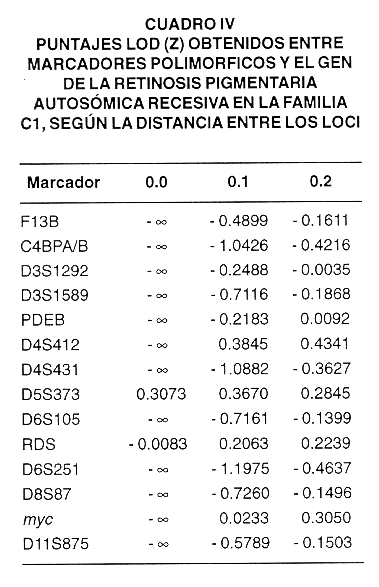
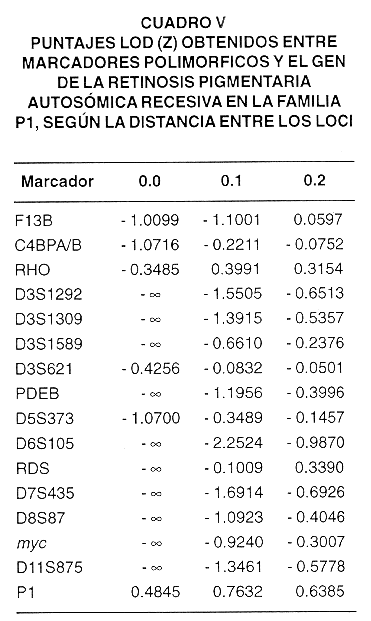
<body><![CDATA[<P><FONT FACE="Arial,Helvetica"><FONT SIZE=-1>El fenotipo de la RP en la familia C1 se caracteriza por una respuesta electro-fisiol&oacute;gica nula de bastones, con degeneraci&oacute;n variable a nivel de conos (temprana o tard&iacute;a). Los individuos afectados presentan un moteado difuso temprano en la m&aacute;cula, que en algunos se presenta muy alterada, con atrofia geogr&aacute;fica. Presentan atenuaci&oacute;n vascular, proliferaci&oacute;n de pigmento tard&iacute;a, nistagmus temprano, epitelio pigmentario atrofiado y p&eacute;rdida de la visi&oacute;n perif&eacute;rica t&iacute;pica de RP.</FONT></FONT>      <P><FONT FACE="Arial,Helvetica"><FONT SIZE=-1>Por su parte, la familia P1 presenta una respuesta electrofisiol&oacute;gica escot&oacute;pica nula, pero la respuesta fot&oacute;pica se agrava tard&iacute;amente. Se presenta atrofia en la m&aacute;cula, atenuaci&oacute;n vascular, proliferaci&oacute;n de pigmento, pero no nistagmus. El epitelio pigmentario se encuentra atrofiado y se da p&eacute;rdida de la visi&oacute;n perif&eacute;rica.</FONT></FONT>     <BR><FONT FACE="Arial,Helvetica"><FONT SIZE=-1>&nbsp;</FONT></FONT>      <P><B><FONT FACE="Arial,Helvetica"><FONT SIZE=-1>An&aacute;lisis de ligamento</FONT></FONT></B>     <BR><FONT FACE="Arial,Helvetica"><FONT SIZE=-1>&nbsp;</FONT></FONT>     <BR><FONT FACE="Arial,Helvetica"><FONT SIZE=-1>En el <A HREF="#Cuadro3">Cuadro III</A> se muestra el puntaje Lod de un marcador te&oacute;rico ligado con el alelo afectado, mientras que en los <A HREF="#Cuadro4">Cuadros IV</A> y <A HREF="#CUADRO5">V</A> se presentan los puntajes Lod obtenidos en cada una de las familias. Como puede observarse, ambas familias tienen poder suficiente para que un marcador ligado a la RPAR que las afecta demuestre la existencia de ligamiento (C1, Z (0.0) = 4.59; P1, Z (0.0) = 5.25). Un puntaje Lod de Z (0.0) =&nbsp;<IMG SRC="/img/fbpe/rccm/v19n3-4/infinito.JPG" HEIGHT=9 WIDTH=13>, al tratarse de marcadores polim&oacute;rificos ligados, permite considerar muy improbable que sea el causante de la patolog&iacute;a, al es el caso en la familia C1, con los genes de la RPAR de la regi&oacute;n 1q31-32.1 (F13B), RPAR por mutaci&oacute;n en la fosfodiesterasa B en 4p16.3 (PDEB), RPAR de 6p a 20 cM del gen de la periferina (D6S105), distrofia macular MCDR1 (D6S251) y del proto-oncogen <I>myc</I>. Por su parte, el puntaje Lod con el marcador RDS no permite descartar con certeza al gen RDS (Z (0.0) = - 0.0083), y se observan puntajes Lod positivos en el caso de los marcadores <I>myc</I> en 8q24.12-q24.13 (Z (0,2) = 0.3050) y periferina/RDS en 6p12 (Z (0.1) = 0.2063), pero &eacute;stos no son significativos.</FONT></FONT>&nbsp;<FONT SIZE=-1>&nbsp;</FONT>     
<BR><FONT SIZE=-1>&nbsp;</FONT>     <CENTER><A NAME="Cuadro4"></A><IMG SRC="/img/fbpe/rccm/v19n3-4/0384i3.GIF" HEIGHT=587 WIDTH=379></CENTER>       
<P><FONT FACE="Arial,Helvetica"><FONT SIZE=-1>&nbsp;</FONT></FONT>     <CENTER><A NAME="CUADRO5"></A><IMG SRC="/img/fbpe/rccm/v19n3-4/0384i4.GIF" HEIGHT=621 WIDTH=371></CENTER> <FONT SIZE=-1>&nbsp;</FONT>     
]]></body>
<body><![CDATA[<BR><FONT SIZE=-1>&nbsp;</FONT>     <BR><FONT FACE="Arial,Helvetica"><FONT SIZE=-1>En cuanto a la familia P1, se descartan los siguientes genes como causantes de la RPAR, al obtenerse valores de Z (0.0) =&nbsp;<IMG SRC="/img/fbpe/rccm/v19n3-4/infinito.JPG" HEIGHT=9 WIDTH=13> : el que codifica por la rodopsina (RHO, D3S1292, D3S1309 y D3S1589), el de la fosfodesterasa B (PDEB), el de RPAR cercano a la periferina (D6S105), el de la periferina (RDS), RPAD del cromosoma 7 (D7S435) y el proto-oncogen <I>myc</I>. Por otra parte, se encontraron valores positivos en loci cercanos al gen de la rodopsina (RHO, Z (0.1) = 0.3991), periferina (RDS, Z (0.2) = 0.3390) y Usher 1A del cromosoma 14q (P1, Z (0.09) = 0.7647).</FONT></FONT>      
<P><FONT FACE="Arial,Helvetica"><FONT SIZE=-1>Ahora bien, hay que tener en cuenta que todos los resultados anteriores corresponden a puntajes Lod obtenidos asumiendo igualdad en la frecuencia de los alelos del marcador, lo cual introduce la probabilidad de error. Sin dejar esto de lado, se puede afirmar que el an&aacute;lisis de los marcadores polim&oacute;rficos no ha encontrado ninguno ligado a la RPAR en las familias C1 y P1, sino que al contrario, en la mayor&iacute;a de los casos se han descartado los genes probados.</FONT></FONT>     <BR><FONT SIZE=-1>&nbsp;</FONT>&nbsp;<FONT FACE="Arial,Helvetica"><FONT SIZE=-1>&nbsp;&nbsp;</FONT></FONT>     <BR><B><FONT FACE="Arial,Helvetica"><FONT SIZE=-1>Discusi&oacute;n</FONT></FONT></B>     <BR><FONT FACE="Arial,Helvetica"><FONT SIZE=-1>&nbsp;</FONT></FONT>     <BR><FONT FACE="Arial,Helvetica"><FONT SIZE=-1>La reconstrucci&oacute;n geneal&oacute;gica de la familia P1 que permiti&oacute; el establecimiento de nexos consangu&iacute;neos como responsables de la enfermedad en todos los afectados, hace pensar que en esta familia una sola mutaci&oacute;n es la causante de la patolog&iacute;a en todos los afectados. Esto podr&iacute;a facilitar el an&aacute;lisis de ligamiento gen&eacute;tico. A&uacute;n as&iacute; no se debe descartar <I>a priori </I>que el problema se deba a la interacci&oacute;n de dos genes en las familias (heterogeneidad compuesta) como ha pasado en otros casos en RP (<A HREF="#12">12</A>). Por su parte, la familia C1 presenta el inconveniente de que no se estableci&oacute; relaci&oacute;n geneal&oacute;gica entre el tronco familiar y algunos portadores obligatorios, por lo que queda una mayor probabilidad de que la heterogeneidad compuesta sea responsable del padecimiento.</FONT></FONT>      <P><FONT FACE="Arial,Helvetica"><FONT SIZE=-1>Los marcadores utilizados (STRPs) tienen la ventaja de ser muy polim&oacute;rficos y de permitir un an&aacute;lisis m&aacute;s r&aacute;pido que si se analizara cada uno de los exones de cada gen, en el caso de contarse con familias que permitan este tipo de an&aacute;lisis. Los puntajes Lod obtenidos para los diversos marcadores ligados a los genes en estudio dan evidencia de que en la familia C1 no hay ligamiento con los genes RP12 (1q31-32.1), PDEB (4p16.3), RP en 6p (a 20 cM de RDS), MCDR1 (6q14-q16.2) y <I>myc</I> (8q24), y quedan por descartarse el gen RDS y regiones cercanas a <I>myc</I>. Por su parte, en la familia P1 se encontr&oacute; evidencia de que los siguientes genes no causan la RP: RHO, PDEB, RP a 20 cM de RDS, RDS, RP9 y <I>myc. </I>En los casos restantes, en ambas familias se deben probar m&aacute;s marcadores ligados para obtener resultados concluyentes. En ninguna de las dos familias fue posible descartar los genes RP1 y USH1C porque los marcadores ligados (D8S87 y D11S875 respectivamente) no presentaron los puntajes Lod requeridos, si se toma en cuenta la distancia de estos marcadores con respecto al gen (<A HREF="#CUADRO2">Cuadro II</A>).</FONT></FONT>      <P><FONT FACE="Arial,Helvetica"><FONT SIZE=-1>Se prob&oacute; el proto-oncogen <I>myc</I> como posible gen candidato debido a que la prote&iacute;na codificada por el gen <I>myc</I> participa tanto en el desarrollo del c&aacute;ncer, como en la apoptosis, mecanismo por el que mueren las c&eacute;lulas de la retina cuando hay RP. Es predecible que de haberse heredado ese gen con una mutaci&oacute;n que predisponga a la apoptosis la muerte celular se dar&iacute;a en estadios tempranos y en diversos tejidos, no s&oacute;lo en la retina. Sin embargo, se prob&oacute; porque podr&iacute;a darse el caso de que por los niveles de s&iacute;ntesis proteica en la retina fueran diferentes, y que por tanto, las consecuencias negativas de la mutaci&oacute;n se pudieran dar particularmente en ese tejido.</FONT></FONT>      <P><FONT FACE="Arial,Helvetica"><FONT SIZE=-1>Para continuar con la b&uacute;squeda del gen o genes responsables de la RPAR en estas familias y antes de continuar con el mapeo del genoma, deben descartarse los restantes loci que se han relacionado con RPAR y RPAD, as&iacute; como a otros s&iacute;ndromes con RP. Luego se deben investigar otros genes que codifican prote&iacute;nas que participan en la transducci&oacute;n de la se&ntilde;al visual o que juegan un papel estructural en c&eacute;lulas de la retina. Al analizarse los datos se deber&aacute; tener en cuenta la posibilidad de que existan dos loci que est&eacute;n involucrados en la RP en la misma familia. Si estos estudios culminan con el hallazgo de los genes responsables, se estar&aacute; avanzando en la comprensi&oacute;n de la fisiopatolog&iacute;a y se establecer&aacute; la posibilidad de un diagn&oacute;stico molecular.</FONT></FONT>      ]]></body>
<body><![CDATA[<P><FONT FACE="Arial,Helvetica"><FONT SIZE=-1>En el caso de la RP de estas familias, se ha seguido la metodolog&iacute;a habitual de descartar los loci anteriormente relacionados con la patolog&iacute;a, para luego continuar con el tamizaje gen&oacute;mico. Cuando se conocen los genes candidatos, se pueden utilizar t&eacute;cnicas directas de b&uacute;squeda de mutaciones (p.e. polimorfismos en la conformacion de ADN banda simple, SSCP). No obstante, si se cuenta con familias grandes, con un buen n&uacute;mero de afectados, la utilizaci&oacute;n de marcadores polim&oacute;rficos y el an&aacute;lisis de ligamiento permite un estudio relativamente barato y r&aacute;pido. Los pasos seguidos en &eacute;ste y en m&uacute;ltiples estudios de enfermedades hereditarias, se sintetizan a continuaci&oacute;n:</FONT></FONT>      <P><FONT FACE="Arial,Helvetica"><FONT SIZE=-1>1. Construir la genealog&iacute;a de la familia afectada.</FONT></FONT>      <P><FONT FACE="Arial,Helvetica"><FONT SIZE=-1>2. Realizar el diagn&oacute;stico cl&iacute;nico m&aacute;s preciso posible de los afectados, portadores obligatorios y controles sanos; de esta manera se escoger&aacute;n en primer lugar los marcadores m&aacute;s probables.</FONT></FONT>      <P><FONT FACE="Arial,Helvetica"><FONT SIZE=-1>3. Extraer ADN de los individuos.</FONT></FONT>      <P><FONT FACE="Arial,Helvetica"><FONT SIZE=-1>4. Realizar pruebas con PCR y los marcadores candidatos, y observar los resultados por medio de electroforesis.</FONT></FONT>      <P><FONT FACE="Arial,Helvetica"><FONT SIZE=-1>5. Se realiza un an&aacute;lisis de ligamiento, y se descarta o se muestra evidencia del gen como responsable de la patolog&iacute;a de la familia.</FONT></FONT>      <P><FONT FACE="Arial,Helvetica"><FONT SIZE=-1>Despu&eacute;s de estos pasos, en caso de no encontrarse ligamiento, se deber&aacute; continuar con mapeo gen&eacute;tico en sitios del genoma a&uacute;n no descritos como responsables de la enfermedad.</FONT></FONT>     <BR><B><FONT FACE="Arial,Helvetica"><FONT SIZE=-1>&nbsp;</FONT></FONT></B>     <BR><B><FONT FACE="Arial,Helvetica"><FONT SIZE=-1>Agradecimientos</FONT></FONT></B>     <BR><FONT SIZE=-1>&nbsp;</FONT>     ]]></body>
<body><![CDATA[<BR><FONT FACE="Arial,Helvetica"><FONT SIZE=-1>Este estudio es resultado del proyecto # 742-93-324 financiado por la Vicerrector&iacute;a de Investigaci&oacute;n de la Universidad de Costa Rica.</FONT></FONT>      <P><FONT FACE="Arial,Helvetica"><FONT SIZE=-1>Agradecemos a Pedro Le&oacute;n y a Sandra Silva del Centro de Investigaci&oacute;n en Biolog&iacute;a Celular y Molecular de la Universidad de Costa Rica, por sus valiosos aportes. A Jorge Azofeifa por sus comentarios. Al se&ntilde;or Alvaro Mendieta y a la Fundaci&oacute;n Costarricense de Retinosis Pigmentaria, y al se&ntilde;or Carlos Gamboa y familia, por el importante apoyo econ&oacute;mico, necesario por el costo de los estudios cl&iacute;nicos. Tambi&eacute;n agradecemos a Gerardo Jim&eacute;nez por la ayuda en el trabajo de campo.</FONT></FONT><B><FONT FACE="Arial,Helvetica"><FONT SIZE=-1></FONT></FONT></B>      <P><B><FONT FACE="Arial,Helvetica"><FONT SIZE=-1>Referencias</FONT></FONT></B>      <!-- ref --><P><A NAME="1"></A><FONT FACE="Arial,Helvetica"><FONT SIZE=-1>1. Bunker C, Berson E, Bromley W, Haves R, Roderick T. Prevalence of retinitis pigmentosa in Maine. <I>Am J Ophtalmol </I>1984; 97: 357- 365.</FONT></FONT>    &nbsp;&nbsp;&nbsp;&nbsp;&nbsp;&nbsp;&nbsp;&nbsp;[&#160;<a href="javascript:void(0);" onclick="javascript: window.open('/scielo.php?script=sci_nlinks&ref=780217&pid=S0253-2948199800030000900001&lng=','','width=640,height=500,resizable=yes,scrollbars=1,menubar=yes,');">Links</a>&#160;]<!-- end-ref --><!-- ref --><P><A NAME="2"></A><FONT FACE="Arial,Helvetica"><FONT SIZE=-1>2. Boughman J, Conneally M, Nance W. Population genetic studies of retintitis pigmentosa. <I>Am J Hum Genet </I>1980; 32: 223-235.</FONT></FONT>    &nbsp;&nbsp;&nbsp;&nbsp;&nbsp;&nbsp;&nbsp;&nbsp;[&#160;<a href="javascript:void(0);" onclick="javascript: window.open('/scielo.php?script=sci_nlinks&ref=780218&pid=S0253-2948199800030000900002&lng=','','width=640,height=500,resizable=yes,scrollbars=1,menubar=yes,');">Links</a>&#160;]<!-- end-ref --><!-- ref --><P><A NAME="3"></A><FONT FACE="Arial,Helvetica"><FONT SIZE=-1>3. Bundey S, Crews J. A study of retinitis pigmentosa in the city of Birmingham: clinical and genetic heterogeneity. <I>J Med Genet</I> 1984; 21: 421-428.</FONT></FONT>    &nbsp;&nbsp;&nbsp;&nbsp;&nbsp;&nbsp;&nbsp;&nbsp;[&#160;<a href="javascript:void(0);" onclick="javascript: window.open('/scielo.php?script=sci_nlinks&ref=780219&pid=S0253-2948199800030000900003&lng=','','width=640,height=500,resizable=yes,scrollbars=1,menubar=yes,');">Links</a>&#160;]<!-- end-ref --><!-- ref --><P><A NAME="4"></A><FONT FACE="Arial,Helvetica"><FONT SIZE=-1>4. Amman F, Klein D, Franceschetti A. Genetic and epidemiological investigations on pigmentary degeneration of retina and allied disorders in Switzerland. <I>J Neurol Sci </I>1965; 2: 183-196.</FONT></FONT>    &nbsp;&nbsp;&nbsp;&nbsp;&nbsp;&nbsp;&nbsp;&nbsp;[&#160;<a href="javascript:void(0);" onclick="javascript: window.open('/scielo.php?script=sci_nlinks&ref=780220&pid=S0253-2948199800030000900004&lng=','','width=640,height=500,resizable=yes,scrollbars=1,menubar=yes,');">Links</a>&#160;]<!-- end-ref --><!-- ref --><P><A NAME="5"></A><FONT FACE="Arial,Helvetica"><FONT SIZE=-1>5. Heckenlively J. The diagnosis and classification of retinitis pigmentosa. En: Retinitis Pigmentosa. Philadelphia: JB Lippincott; 1988: 15-24.</FONT></FONT>    &nbsp;&nbsp;&nbsp;&nbsp;&nbsp;&nbsp;&nbsp;&nbsp;[&#160;<a href="javascript:void(0);" onclick="javascript: window.open('/scielo.php?script=sci_nlinks&ref=780221&pid=S0253-2948199800030000900005&lng=','','width=640,height=500,resizable=yes,scrollbars=1,menubar=yes,');">Links</a>&#160;]<!-- end-ref --><!-- ref --><P><A NAME="6"></A><FONT FACE="Arial,Helvetica"><FONT SIZE=-1>6. Farber D, Heckenlively J, Sparkes R, Bateman B. Molecular genetics of retinitis pigmenosa. <I>West J Med</I> 1991; 155: 388-399.</FONT></FONT>    &nbsp;&nbsp;&nbsp;&nbsp;&nbsp;&nbsp;&nbsp;&nbsp;[&#160;<a href="javascript:void(0);" onclick="javascript: window.open('/scielo.php?script=sci_nlinks&ref=780222&pid=S0253-2948199800030000900006&lng=','','width=640,height=500,resizable=yes,scrollbars=1,menubar=yes,');">Links</a>&#160;]<!-- end-ref --><!-- ref --><P><A NAME="7"></A><FONT FACE="Arial,Helvetica"><FONT SIZE=-1>7. Kumaramanickavel G, Maw M, Denton M, John S, Srisailapathy C, Orth U, Oehlmann R, Gal A. Missense rhodopsin mutation in a family with recessive retinitis pigmentosa. <I>Nat Genet </I>1994; 8: 10-11.</FONT></FONT>    &nbsp;&nbsp;&nbsp;&nbsp;&nbsp;&nbsp;&nbsp;&nbsp;[&#160;<a href="javascript:void(0);" onclick="javascript: window.open('/scielo.php?script=sci_nlinks&ref=780223&pid=S0253-2948199800030000900007&lng=','','width=640,height=500,resizable=yes,scrollbars=1,menubar=yes,');">Links</a>&#160;]<!-- end-ref --><!-- ref --><P><A NAME="8"></A><FONT FACE="Arial,Helvetica"><FONT SIZE=-1>8. McLaughlin M, Berson E, Dryja T. Recessive mutations in the gene encoding the B-subunit of rod phosphodiesterase in patients with retinitis pigmentosa. <I>Nat Genet</I> 1993; 4: 130-134.</FONT></FONT>    &nbsp;&nbsp;&nbsp;&nbsp;&nbsp;&nbsp;&nbsp;&nbsp;[&#160;<a href="javascript:void(0);" onclick="javascript: window.open('/scielo.php?script=sci_nlinks&ref=780224&pid=S0253-2948199800030000900008&lng=','','width=640,height=500,resizable=yes,scrollbars=1,menubar=yes,');">Links</a>&#160;]<!-- end-ref --><!-- ref --><P><A NAME="9"></A><FONT FACE="Arial,Helvetica"><FONT SIZE=-1>9. Bruford E, Mansfield D, Teague P, Barber A, Fossarello M, Wright A. Genetic linkage in autosomal recessive retinitis pigmentosa. <I>Am J Hum Genet </I>1994; 55 : A181.</FONT></FONT>    &nbsp;&nbsp;&nbsp;&nbsp;&nbsp;&nbsp;&nbsp;&nbsp;[&#160;<a href="javascript:void(0);" onclick="javascript: window.open('/scielo.php?script=sci_nlinks&ref=780225&pid=S0253-2948199800030000900009&lng=','','width=640,height=500,resizable=yes,scrollbars=1,menubar=yes,');">Links</a>&#160;]<!-- end-ref --><!-- ref --><P><A NAME="10"></A><FONT FACE="Arial,Helvetica"><FONT SIZE=-1>10. Knowles J, Shugart Y, Banerjee P, Gilliam C, Lewis C, Jacobson S, Ott J. Identification of a locus, distinct from RDS-peripherin, for autosomal recessive retinitis pigmentosa on chromosome 6p. <I>Hum Molec Genet </I>1994; 3: 1401-1403.</FONT></FONT>    &nbsp;&nbsp;&nbsp;&nbsp;&nbsp;&nbsp;&nbsp;&nbsp;[&#160;<a href="javascript:void(0);" onclick="javascript: window.open('/scielo.php?script=sci_nlinks&ref=780226&pid=S0253-2948199800030000900010&lng=','','width=640,height=500,resizable=yes,scrollbars=1,menubar=yes,');">Links</a>&#160;]<!-- end-ref --><!-- ref --><P><A NAME="11"></A><FONT FACE="Arial,Helvetica"><FONT SIZE=-1>11. van Soest S, van der Born L, Gal A, Farrar J, Bleeker L, Westerveld A, Humphries P, Sandkuijl L, Bergen A. Assignmento of a gene for autosomal recessive retinitis pigmentosa (RP12) to chromosome 1q31-q32.1 in an inbred and genetically heterogeneous disease population. <I>Genomics</I> 1994; 22: 499-504.</FONT></FONT>    &nbsp;&nbsp;&nbsp;&nbsp;&nbsp;&nbsp;&nbsp;&nbsp;[&#160;<a href="javascript:void(0);" onclick="javascript: window.open('/scielo.php?script=sci_nlinks&ref=780227&pid=S0253-2948199800030000900011&lng=','','width=640,height=500,resizable=yes,scrollbars=1,menubar=yes,');">Links</a>&#160;]<!-- end-ref --><!-- ref --><P><A NAME="12"></A><FONT FACE="Arial,Helvetica"><FONT SIZE=-1>12. Kajiwara K, Berson E, Dryja T. Digenic retinitis pigmentosa due to mutations at the unlinked peripherin/RDS and ROM1 loci. <I>Science</I> 1994; 264: 1604-1608.</FONT></FONT>    &nbsp;&nbsp;&nbsp;&nbsp;&nbsp;&nbsp;&nbsp;&nbsp;[&#160;<a href="javascript:void(0);" onclick="javascript: window.open('/scielo.php?script=sci_nlinks&ref=780228&pid=S0253-2948199800030000900012&lng=','','width=640,height=500,resizable=yes,scrollbars=1,menubar=yes,');">Links</a>&#160;]<!-- end-ref --><!-- ref --><P><A NAME="13"></A><FONT FACE="Arial,Helvetica"><FONT SIZE=-1>13. Dryja TP, Li T. Molecular genetics of retinitis pigmentosa. <I>Hum Molec Genet</I> 1995; 4: 1739-1743.</FONT></FONT>    &nbsp;&nbsp;&nbsp;&nbsp;&nbsp;&nbsp;&nbsp;&nbsp;[&#160;<a href="javascript:void(0);" onclick="javascript: window.open('/scielo.php?script=sci_nlinks&ref=780229&pid=S0253-2948199800030000900013&lng=','','width=640,height=500,resizable=yes,scrollbars=1,menubar=yes,');">Links</a>&#160;]<!-- end-ref --><!-- ref --><P><A NAME="14"></A><FONT FACE="Arial,Helvetica"><FONT SIZE=-1>14. Haim M. Retinitis pigmentosa: problems associated with genetic classification. <I>Clin Genet </I>1993; 44: 62-70.</FONT></FONT>    &nbsp;&nbsp;&nbsp;&nbsp;&nbsp;&nbsp;&nbsp;&nbsp;[&#160;<a href="javascript:void(0);" onclick="javascript: window.open('/scielo.php?script=sci_nlinks&ref=780230&pid=S0253-2948199800030000900014&lng=','','width=640,height=500,resizable=yes,scrollbars=1,menubar=yes,');">Links</a>&#160;]<!-- end-ref --><!-- ref --><P><A NAME="15"></A><FONT FACE="Arial,Helvetica"><FONT SIZE=-1>15. Madisen L, Hoar D, Holroyd CD, Crsip M, Hodes ME. DNA Banking: the effects of storage of blood and isolated DNA on the integrity of DNA. <I>Am J Med Genet</I> 1987; 27: 379-390.</FONT></FONT>    &nbsp;&nbsp;&nbsp;&nbsp;&nbsp;&nbsp;&nbsp;&nbsp;[&#160;<a href="javascript:void(0);" onclick="javascript: window.open('/scielo.php?script=sci_nlinks&ref=780231&pid=S0253-2948199800030000900015&lng=','','width=640,height=500,resizable=yes,scrollbars=1,menubar=yes,');">Links</a>&#160;]<!-- end-ref --><!-- ref --><P><A NAME="16"></A><FONT FACE="Arial,Helvetica"><FONT SIZE=-1>16. Weissenbach J, Gyapay G, Dib C, Vignal A, Morissette J, Millasseau P, Vaysseix G, Lanthrop M. A second generation linkage map of the human genome. <I>Nature</I> 1992; 359: 794-801.</FONT></FONT>    &nbsp;&nbsp;&nbsp;&nbsp;&nbsp;&nbsp;&nbsp;&nbsp;[&#160;<a href="javascript:void(0);" onclick="javascript: window.open('/scielo.php?script=sci_nlinks&ref=780232&pid=S0253-2948199800030000900016&lng=','','width=640,height=500,resizable=yes,scrollbars=1,menubar=yes,');">Links</a>&#160;]<!-- end-ref --><!-- ref --><P><A NAME="17"></A><FONT FACE="Arial,Helvetica"><FONT SIZE=-1>17. Nichols B. Linkage interphase for Macintosh 3.1, Iowa: Molecular Ophthalmology Lab. University of Iowa, 1994.</FONT></FONT>    &nbsp;&nbsp;&nbsp;&nbsp;&nbsp;&nbsp;&nbsp;&nbsp;[&#160;<a href="javascript:void(0);" onclick="javascript: window.open('/scielo.php?script=sci_nlinks&ref=780233&pid=S0253-2948199800030000900017&lng=','','width=640,height=500,resizable=yes,scrollbars=1,menubar=yes,');">Links</a>&#160;]<!-- end-ref --><!-- ref --><P><A NAME="18"></A><FONT FACE="Arial,Helvetica"><FONT SIZE=-1>18. Lathrop G, Lalouel J, Julier C. Strategies for multilocus linkage analysis in humans. <I>Proc Natl Acad Sci USA</I> 1984; 81: 3443-3446.</FONT></FONT>    &nbsp;&nbsp;&nbsp;&nbsp;&nbsp;&nbsp;&nbsp;&nbsp;[&#160;<a href="javascript:void(0);" onclick="javascript: window.open('/scielo.php?script=sci_nlinks&ref=780234&pid=S0253-2948199800030000900018&lng=','','width=640,height=500,resizable=yes,scrollbars=1,menubar=yes,');">Links</a>&#160;]<!-- end-ref --><!-- ref --><P><A NAME="19"></A><FONT FACE="Arial,Helvetica"><FONT SIZE=-1>19. Morton N. Sequential tests for the detection of linkage. <I>Am J Hum Genet</I> 1955; 7: 277-318.</FONT></FONT>    &nbsp;&nbsp;&nbsp;&nbsp;&nbsp;&nbsp;&nbsp;&nbsp;[&#160;<a href="javascript:void(0);" onclick="javascript: window.open('/scielo.php?script=sci_nlinks&ref=780235&pid=S0253-2948199800030000900019&lng=','','width=640,height=500,resizable=yes,scrollbars=1,menubar=yes,');">Links</a>&#160;]<!-- end-ref --><!-- ref --><P><A NAME="20"></A><FONT FACE="Arial,Helvetica"><FONT SIZE=-1>20. Terwilliger JD, Ott J. Handbook of human genetic linkage, 1 ed., Baltimore, Maryland: The Johns Hopkins University Press, 1994; 307 p.</FONT></FONT>    &nbsp;&nbsp;&nbsp;&nbsp;&nbsp;&nbsp;&nbsp;&nbsp;[&#160;<a href="javascript:void(0);" onclick="javascript: window.open('/scielo.php?script=sci_nlinks&ref=780236&pid=S0253-2948199800030000900020&lng=','','width=640,height=500,resizable=yes,scrollbars=1,menubar=yes,');">Links</a>&#160;]<!-- end-ref --><!-- ref --><P><A NAME="21"></A><FONT FACE="Arial,Helvetica"><FONT SIZE=-1>21. Boughman J, Caldwell R. Genetic an clinical characterization of a survey population with retinitis pigmentosa. En: Cotlier E, Maumenee I, Berman E (eds.) Clinical, stuctural and biochemical advances in hereditary eye disorders: New York: Alan R. Liss; 1982: 147-166.</FONT></FONT>    &nbsp;&nbsp;&nbsp;&nbsp;&nbsp;&nbsp;&nbsp;&nbsp;[&#160;<a href="javascript:void(0);" onclick="javascript: window.open('/scielo.php?script=sci_nlinks&ref=780237&pid=S0253-2948199800030000900021&lng=','','width=640,height=500,resizable=yes,scrollbars=1,menubar=yes,');">Links</a>&#160;]<!-- end-ref --><P><A NAME="*"></A><FONT FACE="Arial,Helvetica"><FONT SIZE=-1><A HREF="#*a">*</A> Instituto de Investigaciones en Salud y Escuela de Biolog&iacute;a. Universidad de Costa Rica. San Jos&eacute;, Costa Rica.</FONT></FONT>     <BR><FONT FACE="Arial,Helvetica"><FONT SIZE=-1>E-mail: <A HREF="mailto:aleal@humgenet.uni-erlangen.de">aleal@humgenet.uni-erlangen.de</A></FONT></FONT>      ]]></body><back>
<ref-list>
<ref id="B1">
<nlm-citation citation-type="journal">
<person-group person-group-type="author">
<name>
<surname><![CDATA[Bunker]]></surname>
<given-names><![CDATA[C]]></given-names>
</name>
<name>
<surname><![CDATA[Berson]]></surname>
<given-names><![CDATA[E]]></given-names>
</name>
<name>
<surname><![CDATA[Bromley]]></surname>
<given-names><![CDATA[W]]></given-names>
</name>
<name>
<surname><![CDATA[Haves]]></surname>
<given-names><![CDATA[R]]></given-names>
</name>
<name>
<surname><![CDATA[Roderick]]></surname>
<given-names><![CDATA[T]]></given-names>
</name>
</person-group>
<article-title xml:lang="en"><![CDATA[Prevalence of retinitis pigmentosa in Maine]]></article-title>
<source><![CDATA[Am J Ophtalmol]]></source>
<year>1984</year>
<volume>97</volume>
<page-range>357- 365</page-range></nlm-citation>
</ref>
<ref id="B2">
<nlm-citation citation-type="journal">
<person-group person-group-type="author">
<name>
<surname><![CDATA[Boughman]]></surname>
<given-names><![CDATA[J]]></given-names>
</name>
<name>
<surname><![CDATA[Conneally]]></surname>
<given-names><![CDATA[M]]></given-names>
</name>
<name>
<surname><![CDATA[Nance]]></surname>
<given-names><![CDATA[W]]></given-names>
</name>
</person-group>
<article-title xml:lang="en"><![CDATA[Population genetic studies of retintitis pigmentosa]]></article-title>
<source><![CDATA[Am J Hum Genet]]></source>
<year>1980</year>
<volume>32</volume>
<page-range>223-235</page-range></nlm-citation>
</ref>
<ref id="B3">
<nlm-citation citation-type="journal">
<person-group person-group-type="author">
<name>
<surname><![CDATA[Bundey]]></surname>
<given-names><![CDATA[S]]></given-names>
</name>
<name>
<surname><![CDATA[Crews]]></surname>
<given-names><![CDATA[J]]></given-names>
</name>
</person-group>
<article-title xml:lang="en"><![CDATA[A study of retinitis pigmentosa in the city of Birmingham: clinical and genetic heterogeneity]]></article-title>
<source><![CDATA[J Med Genet]]></source>
<year>1984</year>
<volume>21</volume>
<page-range>421-428</page-range></nlm-citation>
</ref>
<ref id="B4">
<nlm-citation citation-type="journal">
<person-group person-group-type="author">
<name>
<surname><![CDATA[Amman]]></surname>
<given-names><![CDATA[F]]></given-names>
</name>
<name>
<surname><![CDATA[Klein]]></surname>
<given-names><![CDATA[D]]></given-names>
</name>
<name>
<surname><![CDATA[Franceschetti]]></surname>
<given-names><![CDATA[A]]></given-names>
</name>
</person-group>
<article-title xml:lang="en"><![CDATA[Genetic and epidemiological investigations on pigmentary degeneration of retina and allied disorders in Switzerland]]></article-title>
<source><![CDATA[J Neurol Sci]]></source>
<year>1965</year>
<volume>2</volume>
<page-range>183-196</page-range></nlm-citation>
</ref>
<ref id="B5">
<nlm-citation citation-type="book">
<person-group person-group-type="author">
<name>
<surname><![CDATA[Heckenlively]]></surname>
<given-names><![CDATA[J]]></given-names>
</name>
</person-group>
<article-title xml:lang="en"><![CDATA[The diagnosis and classification of retinitis pigmentosa]]></article-title>
<source><![CDATA[Retinitis Pigmentosa]]></source>
<year>1988</year>
<page-range>15-24</page-range><publisher-loc><![CDATA[Philadelphia ]]></publisher-loc>
<publisher-name><![CDATA[JB Lippincott]]></publisher-name>
</nlm-citation>
</ref>
<ref id="B6">
<nlm-citation citation-type="journal">
<person-group person-group-type="author">
<name>
<surname><![CDATA[Farber]]></surname>
<given-names><![CDATA[D]]></given-names>
</name>
<name>
<surname><![CDATA[Heckenlively]]></surname>
<given-names><![CDATA[J]]></given-names>
</name>
<name>
<surname><![CDATA[Sparkes]]></surname>
<given-names><![CDATA[R]]></given-names>
</name>
<name>
<surname><![CDATA[Bateman]]></surname>
<given-names><![CDATA[B]]></given-names>
</name>
</person-group>
<article-title xml:lang="en"><![CDATA[Molecular genetics of retinitis pigmenosa]]></article-title>
<source><![CDATA[West J Med]]></source>
<year>1991</year>
<volume>155</volume>
<page-range>388-399</page-range></nlm-citation>
</ref>
<ref id="B7">
<nlm-citation citation-type="journal">
<person-group person-group-type="author">
<name>
<surname><![CDATA[Kumaramanickavel]]></surname>
<given-names><![CDATA[G]]></given-names>
</name>
<name>
<surname><![CDATA[Maw]]></surname>
<given-names><![CDATA[M]]></given-names>
</name>
<name>
<surname><![CDATA[Denton]]></surname>
<given-names><![CDATA[M]]></given-names>
</name>
<name>
<surname><![CDATA[John]]></surname>
<given-names><![CDATA[S]]></given-names>
</name>
<name>
<surname><![CDATA[Srisailapathy]]></surname>
<given-names><![CDATA[C]]></given-names>
</name>
<name>
<surname><![CDATA[Orth]]></surname>
<given-names><![CDATA[U]]></given-names>
</name>
<name>
<surname><![CDATA[Oehlmann]]></surname>
<given-names><![CDATA[R]]></given-names>
</name>
<name>
<surname><![CDATA[Gal]]></surname>
<given-names><![CDATA[A]]></given-names>
</name>
</person-group>
<article-title xml:lang="en"><![CDATA[Missense rhodopsin mutation in a family with recessive retinitis pigmentosa]]></article-title>
<source><![CDATA[Nat Genet]]></source>
<year>1994</year>
<volume>8</volume>
<page-range>10-11</page-range></nlm-citation>
</ref>
<ref id="B8">
<nlm-citation citation-type="journal">
<person-group person-group-type="author">
<name>
<surname><![CDATA[McLaughlin]]></surname>
<given-names><![CDATA[M]]></given-names>
</name>
<name>
<surname><![CDATA[Berson]]></surname>
<given-names><![CDATA[E]]></given-names>
</name>
<name>
<surname><![CDATA[Dryja]]></surname>
<given-names><![CDATA[T]]></given-names>
</name>
</person-group>
<article-title xml:lang="en"><![CDATA[Recessive mutations in the gene encoding the B-subunit of rod phosphodiesterase in patients with retinitis pigmentosa]]></article-title>
<source><![CDATA[Nat Genet]]></source>
<year>1993</year>
<volume>4</volume>
<page-range>130-134</page-range></nlm-citation>
</ref>
<ref id="B9">
<nlm-citation citation-type="journal">
<person-group person-group-type="author">
<name>
<surname><![CDATA[Bruford]]></surname>
<given-names><![CDATA[E]]></given-names>
</name>
<name>
<surname><![CDATA[Mansfield]]></surname>
<given-names><![CDATA[D]]></given-names>
</name>
<name>
<surname><![CDATA[Teague]]></surname>
<given-names><![CDATA[P]]></given-names>
</name>
<name>
<surname><![CDATA[Barber]]></surname>
<given-names><![CDATA[A]]></given-names>
</name>
<name>
<surname><![CDATA[Fossarello]]></surname>
<given-names><![CDATA[M]]></given-names>
</name>
<name>
<surname><![CDATA[Wright]]></surname>
<given-names><![CDATA[A]]></given-names>
</name>
</person-group>
<article-title xml:lang="en"><![CDATA[Genetic linkage in autosomal recessive retinitis pigmentosa]]></article-title>
<source><![CDATA[Am J Hum Genet]]></source>
<year>1994</year>
<volume>55</volume>
<page-range>A181</page-range></nlm-citation>
</ref>
<ref id="B10">
<nlm-citation citation-type="journal">
<person-group person-group-type="author">
<name>
<surname><![CDATA[Knowles]]></surname>
<given-names><![CDATA[J]]></given-names>
</name>
<name>
<surname><![CDATA[Shugart]]></surname>
<given-names><![CDATA[Y]]></given-names>
</name>
<name>
<surname><![CDATA[Banerjee]]></surname>
<given-names><![CDATA[P]]></given-names>
</name>
<name>
<surname><![CDATA[Gilliam]]></surname>
<given-names><![CDATA[C]]></given-names>
</name>
<name>
<surname><![CDATA[Lewis]]></surname>
<given-names><![CDATA[C]]></given-names>
</name>
<name>
<surname><![CDATA[Jacobson]]></surname>
<given-names><![CDATA[S]]></given-names>
</name>
<name>
<surname><![CDATA[Ott]]></surname>
<given-names><![CDATA[J]]></given-names>
</name>
</person-group>
<article-title xml:lang="en"><![CDATA[Identification of a locus, distinct from RDS-peripherin, for autosomal recessive retinitis pigmentosa on chromosome 6p]]></article-title>
<source><![CDATA[Hum Molec Genet]]></source>
<year>1994</year>
<volume>3</volume>
<page-range>1401-1403</page-range></nlm-citation>
</ref>
<ref id="B11">
<nlm-citation citation-type="journal">
<person-group person-group-type="author">
<name>
<surname><![CDATA[van Soest]]></surname>
<given-names><![CDATA[S]]></given-names>
</name>
<name>
<surname><![CDATA[van der Born]]></surname>
<given-names><![CDATA[L]]></given-names>
</name>
<name>
<surname><![CDATA[Gal]]></surname>
<given-names><![CDATA[A]]></given-names>
</name>
<name>
<surname><![CDATA[Farrar]]></surname>
<given-names><![CDATA[J]]></given-names>
</name>
<name>
<surname><![CDATA[Bleeker]]></surname>
<given-names><![CDATA[L]]></given-names>
</name>
<name>
<surname><![CDATA[Westerveld]]></surname>
<given-names><![CDATA[A]]></given-names>
</name>
<name>
<surname><![CDATA[Humphries]]></surname>
<given-names><![CDATA[P]]></given-names>
</name>
<name>
<surname><![CDATA[Sandkuijl]]></surname>
<given-names><![CDATA[L]]></given-names>
</name>
<name>
<surname><![CDATA[Bergen]]></surname>
<given-names><![CDATA[A]]></given-names>
</name>
</person-group>
<article-title xml:lang="en"><![CDATA[Assignmento of a gene for autosomal recessive retinitis pigmentosa (RP12) to chromosome 1q31-q32.1 in an inbred and genetically heterogeneous disease population]]></article-title>
<source><![CDATA[Genomics]]></source>
<year>1994</year>
<volume>22</volume>
<page-range>499-504</page-range></nlm-citation>
</ref>
<ref id="B12">
<nlm-citation citation-type="journal">
<person-group person-group-type="author">
<name>
<surname><![CDATA[Kajiwara]]></surname>
<given-names><![CDATA[K]]></given-names>
</name>
<name>
<surname><![CDATA[Berson]]></surname>
<given-names><![CDATA[E]]></given-names>
</name>
<name>
<surname><![CDATA[Dryja]]></surname>
<given-names><![CDATA[T]]></given-names>
</name>
</person-group>
<article-title xml:lang="en"><![CDATA[Digenic retinitis pigmentosa due to mutations at the unlinked peripherin/RDS and ROM1 loci]]></article-title>
<source><![CDATA[Science]]></source>
<year>1994</year>
<volume>264</volume>
<page-range>1604-1608</page-range></nlm-citation>
</ref>
<ref id="B13">
<nlm-citation citation-type="journal">
<person-group person-group-type="author">
<name>
<surname><![CDATA[Dryja]]></surname>
<given-names><![CDATA[TP]]></given-names>
</name>
<name>
<surname><![CDATA[Li]]></surname>
<given-names><![CDATA[T]]></given-names>
</name>
</person-group>
<article-title xml:lang="en"><![CDATA[Molecular genetics of retinitis pigmentosa]]></article-title>
<source><![CDATA[Hum Molec Genet]]></source>
<year>1995</year>
<volume>4</volume>
<page-range>1739-1743</page-range></nlm-citation>
</ref>
<ref id="B14">
<nlm-citation citation-type="journal">
<person-group person-group-type="author">
<name>
<surname><![CDATA[Haim]]></surname>
<given-names><![CDATA[M]]></given-names>
</name>
</person-group>
<article-title xml:lang="en"><![CDATA[Retinitis pigmentosa: problems associated with genetic classification]]></article-title>
<source><![CDATA[Clin Genet]]></source>
<year>1993</year>
<volume>44</volume>
<page-range>62-70</page-range></nlm-citation>
</ref>
<ref id="B15">
<nlm-citation citation-type="journal">
<person-group person-group-type="author">
<name>
<surname><![CDATA[Madisen]]></surname>
<given-names><![CDATA[L]]></given-names>
</name>
<name>
<surname><![CDATA[Hoar]]></surname>
<given-names><![CDATA[D]]></given-names>
</name>
<name>
<surname><![CDATA[Holroyd]]></surname>
<given-names><![CDATA[CD]]></given-names>
</name>
<name>
<surname><![CDATA[Crsip]]></surname>
<given-names><![CDATA[M]]></given-names>
</name>
<name>
<surname><![CDATA[Hodes]]></surname>
<given-names><![CDATA[ME]]></given-names>
</name>
</person-group>
<article-title xml:lang="en"><![CDATA[DNA Banking: the effects of storage of blood and isolated DNA on the integrity of DNA]]></article-title>
<source><![CDATA[Am J Med Genet]]></source>
<year>1987</year>
<volume>27</volume>
<page-range>379-390</page-range></nlm-citation>
</ref>
<ref id="B16">
<nlm-citation citation-type="journal">
<person-group person-group-type="author">
<name>
<surname><![CDATA[Weissenbach]]></surname>
<given-names><![CDATA[J]]></given-names>
</name>
<name>
<surname><![CDATA[Gyapay]]></surname>
<given-names><![CDATA[G]]></given-names>
</name>
<name>
<surname><![CDATA[Dib]]></surname>
<given-names><![CDATA[C]]></given-names>
</name>
<name>
<surname><![CDATA[Vignal]]></surname>
<given-names><![CDATA[A]]></given-names>
</name>
<name>
<surname><![CDATA[Morissette]]></surname>
<given-names><![CDATA[J]]></given-names>
</name>
<name>
<surname><![CDATA[Millasseau]]></surname>
<given-names><![CDATA[P]]></given-names>
</name>
<name>
<surname><![CDATA[Vaysseix]]></surname>
<given-names><![CDATA[G]]></given-names>
</name>
<name>
<surname><![CDATA[Lanthrop]]></surname>
<given-names><![CDATA[M]]></given-names>
</name>
</person-group>
<article-title xml:lang="en"><![CDATA[A second generation linkage map of the human genome]]></article-title>
<source><![CDATA[Nature]]></source>
<year>1992</year>
<volume>359</volume>
<page-range>794-801</page-range></nlm-citation>
</ref>
<ref id="B17">
<nlm-citation citation-type="book">
<person-group person-group-type="author">
<name>
<surname><![CDATA[Nichols]]></surname>
<given-names><![CDATA[B]]></given-names>
</name>
</person-group>
<source><![CDATA[Linkage interphase for Macintosh 3.1]]></source>
<year>1994</year>
<publisher-loc><![CDATA[Iowa ]]></publisher-loc>
<publisher-name><![CDATA[Molecular Ophthalmology Lab. University of Iowa]]></publisher-name>
</nlm-citation>
</ref>
<ref id="B18">
<nlm-citation citation-type="journal">
<person-group person-group-type="author">
<name>
<surname><![CDATA[Lathrop]]></surname>
<given-names><![CDATA[G]]></given-names>
</name>
<name>
<surname><![CDATA[Lalouel]]></surname>
<given-names><![CDATA[J]]></given-names>
</name>
<name>
<surname><![CDATA[Julier]]></surname>
<given-names><![CDATA[C]]></given-names>
</name>
</person-group>
<article-title xml:lang="en"><![CDATA[Strategies for multilocus linkage analysis in humans]]></article-title>
<source><![CDATA[Proc Natl Acad Sci USA]]></source>
<year>1984</year>
<volume>81</volume>
<page-range>3443-3446</page-range></nlm-citation>
</ref>
<ref id="B19">
<nlm-citation citation-type="journal">
<person-group person-group-type="author">
<name>
<surname><![CDATA[Morton]]></surname>
<given-names><![CDATA[N]]></given-names>
</name>
</person-group>
<article-title xml:lang="en"><![CDATA[Sequential tests for the detection of linkage]]></article-title>
<source><![CDATA[Am J Hum Genet]]></source>
<year>1955</year>
<volume>7</volume>
<page-range>277-318</page-range></nlm-citation>
</ref>
<ref id="B20">
<nlm-citation citation-type="book">
<person-group person-group-type="author">
<name>
<surname><![CDATA[Terwilliger]]></surname>
<given-names><![CDATA[JD]]></given-names>
</name>
<name>
<surname><![CDATA[Ott]]></surname>
<given-names><![CDATA[J]]></given-names>
</name>
</person-group>
<source><![CDATA[Handbook of human genetic linkage]]></source>
<year>1994</year>
<edition>1 ed.</edition>
<page-range>307</page-range><publisher-loc><![CDATA[Baltimore^eMaryland Maryland]]></publisher-loc>
<publisher-name><![CDATA[The Johns Hopkins University Press]]></publisher-name>
</nlm-citation>
</ref>
<ref id="B21">
<nlm-citation citation-type="book">
<person-group person-group-type="author">
<name>
<surname><![CDATA[Boughman]]></surname>
<given-names><![CDATA[J]]></given-names>
</name>
<name>
<surname><![CDATA[Caldwell]]></surname>
<given-names><![CDATA[R]]></given-names>
</name>
</person-group>
<article-title xml:lang="en"><![CDATA[Genetic an clinical characterization of a survey population with retinitis pigmentosa]]></article-title>
<person-group person-group-type="editor">
<name>
<surname><![CDATA[Cotlier]]></surname>
<given-names><![CDATA[E]]></given-names>
</name>
<name>
<surname><![CDATA[Maumenee]]></surname>
<given-names><![CDATA[I]]></given-names>
</name>
<name>
<surname><![CDATA[Berman]]></surname>
<given-names><![CDATA[E]]></given-names>
</name>
</person-group>
<source><![CDATA[Clinical, stuctural and biochemical advances in hereditary eye disorders]]></source>
<year>1982</year>
<page-range>147-166</page-range><publisher-loc><![CDATA[New York ]]></publisher-loc>
<publisher-name><![CDATA[Alan R. Liss]]></publisher-name>
</nlm-citation>
</ref>
</ref-list>
</back>
</article>