<?xml version="1.0" encoding="ISO-8859-1"?><article xmlns:mml="http://www.w3.org/1998/Math/MathML" xmlns:xlink="http://www.w3.org/1999/xlink" xmlns:xsi="http://www.w3.org/2001/XMLSchema-instance">
<front>
<journal-meta>
<journal-id>0253-2948</journal-id>
<journal-title><![CDATA[Revista Costarricense de Ciencias Médicas]]></journal-title>
<abbrev-journal-title><![CDATA[Rev. costarric. cienc. méd]]></abbrev-journal-title>
<issn>0253-2948</issn>
<publisher>
<publisher-name><![CDATA[Editorial Nacional de Salud y Seguridad Social]]></publisher-name>
</publisher>
</journal-meta>
<article-meta>
<article-id>S0253-29481998000100010</article-id>
<title-group>
<article-title xml:lang="es"><![CDATA[Gardnerella vaginalis Mobiluncus en la etiología de la vaginosis bacteriana]]></article-title>
</title-group>
<contrib-group>
<contrib contrib-type="author">
<name>
<surname><![CDATA[Hernández]]></surname>
<given-names><![CDATA[Francisco]]></given-names>
</name>
</contrib>
</contrib-group>
<aff id="A">
<institution><![CDATA[,  ]]></institution>
<addr-line><![CDATA[ ]]></addr-line>
</aff>
<pub-date pub-type="pub">
<day>00</day>
<month>06</month>
<year>1998</year>
</pub-date>
<pub-date pub-type="epub">
<day>00</day>
<month>06</month>
<year>1998</year>
</pub-date>
<volume>19</volume>
<numero>1-2</numero>
<fpage>107</fpage>
<lpage>116</lpage>
<copyright-statement/>
<copyright-year/>
<self-uri xlink:href="http://www.scielo.sa.cr/scielo.php?script=sci_arttext&amp;pid=S0253-29481998000100010&amp;lng=en&amp;nrm=iso"></self-uri><self-uri xlink:href="http://www.scielo.sa.cr/scielo.php?script=sci_abstract&amp;pid=S0253-29481998000100010&amp;lng=en&amp;nrm=iso"></self-uri><self-uri xlink:href="http://www.scielo.sa.cr/scielo.php?script=sci_pdf&amp;pid=S0253-29481998000100010&amp;lng=en&amp;nrm=iso"></self-uri><abstract abstract-type="short" xml:lang="es"><p><![CDATA[Las vaginitis y las vaginosis bacterianas (VB) son infecciones muy frecuentes en la mujer. La primera se asocia con agentes específicos como Candida, Trichomonas y Chamydea. Sin embargo, hay una alta frecuencia de casos etiológicamente no definidos, que en el pasado fueron considerados como "vaginitis inespecíficas". Actualmente la mayoría de esos casos se definen como VB, un síndrome común y mal diagnosticado, cuya etiología es polimicrobiana asociada con un desequilibrio de la flora vaginal. Dos de los agentes más importantes, relacionados con VB son Gardnerella vaginalis y Mobiluncus spp. El primero fue descrito en 1953 como el agente responsable de las vaginitis inespecíficas; no obstante, su prevalencia similar en casos y controles y las inoculaciones en voluntarias no confirmaron su papel en las vaginitis. Hoy, los análisis cuantitativos de la población vaginal y el hallazgo de una citotoxina en este agente confirman su acción causal en las VB. Mobiluncus es una bacteria anaerobia, toxigénica relacionada con las VB y con otras patologías, como coriomnionitis, nacimientos a pretérmino, enfermedad inflamatoria pélvica post aborto y endometritis post cesarea. Este agente es de cultivo fastidioso; sin embargo, la tinción de Gram es el método diagnóstico más común para las VB.]]></p></abstract>
<abstract abstract-type="short" xml:lang="en"><p><![CDATA[Vaginitis and bacterial vaginosis (BV) are the most frequent infections in women. The former is associated with specific agents, such as Candida, Trichomonas, and Chamydea.; nevertheless, there are a high frequency of cases without defined agent, that were considered in the past as "inespecific vaginitis". Actually the majority of those cases as defined BV, common and underdiagnosed syndrome, in which etiology are associated a poly-micorobial population from the altered vaginal flora. Two of the most important agents related with BV are Gardnerella vaginalis and Mobiluncus spp. The former was described in 1953 as the agent responsible of inespecific vaginitis; however, its prevalence in cases and controls was similar and inoculations in volunteers do not confirm its role in the vaginitis. Today, the quantitative analysis of bacterial populations, cytotoxin found in this agent confirms its role in the ethiology of BV. Mobiluncus is a toxigenic anaerobic agent related with VB and with other pathologist as choriomnionitis, preterm birth, post-abortal pelvic inflammatory disease and post-caesarean endometritis. This agent is anaerobic and fastidious; nevertheless, the Gram stein is the most common diagnosis tool for BV.]]></p></abstract>
<kwd-group>
<kwd lng="es"><![CDATA[Gardnerella vaginalis]]></kwd>
<kwd lng="es"><![CDATA[Mobiluncus. Spp.]]></kwd>
<kwd lng="es"><![CDATA[Vaginosis Bacteriana]]></kwd>
<kwd lng="es"><![CDATA[Vaginitis]]></kwd>
<kwd lng="en"><![CDATA[Gardnerella vaginalis]]></kwd>
<kwd lng="en"><![CDATA[Mobiluncus. Spp.]]></kwd>
<kwd lng="en"><![CDATA[Bacterial vaginosis]]></kwd>
<kwd lng="en"><![CDATA[vaginitis]]></kwd>
</kwd-group>
</article-meta>
</front><body><![CDATA[ <CENTER><B><FONT FACE="Arial,Helvetica"><I>Gardenerella vaginalis y mobiluncus </I>en la etiolog&iacute;a de la vaginosis bacteriana</FONT></B></CENTER>      <CENTER><B><FONT FACE="Arial,Helvetica">&nbsp;</FONT></B></CENTER>      <CENTER><B><FONT FACE="Arial,Helvetica"><FONT SIZE=-1>&nbsp;</FONT></FONT></B></CENTER>      <CENTER><B><FONT FACE="Arial,Helvetica"><FONT SIZE=-1>Francisco Hern&aacute;ndez</FONT></FONT></B></CENTER>      <CENTER><B><FONT FACE="Arial,Helvetica"><FONT SIZE=-1>&nbsp;</FONT></FONT></B></CENTER>      <CENTER><B><FONT FACE="Arial,Helvetica"><FONT SIZE=-1>&nbsp;</FONT></FONT></B></CENTER> <B><FONT FACE="Arial,Helvetica"><FONT SIZE=-1>Resumen</FONT></FONT></B><FONT SIZE=-1></FONT>      <P><FONT FACE="Arial,Helvetica"><FONT SIZE=-1><I>La</I>s vaginitis y las vaginosis bacterianas (VB) son infecciones muy frecuentes en la mujer. La primera se asocia con agentes espec&iacute;ficos como Candida, Trichomonas y Chamydea. Sin embargo, hay una alta frecuencia de casos etiol&oacute;gicamente no definidos, que en el pasado fueron considerados como "vaginitis inespec&iacute;ficas". Actualmente la mayor&iacute;a de esos casos se definen como VB, un s&iacute;ndrome com&uacute;n y mal diagnosticado, cuya etiolog&iacute;a es polimicrobiana asociada con un desequilibrio de la flora vaginal. Dos de los agentes m&aacute;s importantes, relacionados con VB son Gardnerella vaginalis y Mobiluncus spp. El primero fue descrito en 1953 como el agente responsable de las vaginitis inespec&iacute;ficas; no obstante, su prevalencia similar en casos y controles y las inoculaciones en voluntarias no confirmaron su papel en las vaginitis. Hoy, los an&aacute;lisis cuantitativos de la poblaci&oacute;n vaginal y el hallazgo de una citotoxina en este agente confirman su acci&oacute;n causal en las VB. Mobiluncus es una bacteria anaerobia, toxig&eacute;nica relacionada con las VB y con otras patolog&iacute;as, como coriomnionitis, nacimientos a pret&eacute;rmino, enfermedad inflamatoria p&eacute;lvica post aborto y endometritis post cesarea. Este agente es de cultivo fastidioso; sin embargo, la tinci&oacute;n de Gram es el m&eacute;todo diagn&oacute;stico m&aacute;s com&uacute;n para las VB.</FONT></FONT><FONT SIZE=-1></FONT>      <P><B><FONT FACE="Arial,Helvetica"><FONT SIZE=-1>Palabras clave</FONT></FONT></B><I><FONT FACE="Arial,Helvetica"><FONT SIZE=-1></FONT></FONT></I>      <P><FONT SIZE=-1><FONT FACE="Arial,Helvetica"><I>Gardnerella vaginalis</I>, <I>Mobiluncus.</I> Spp. Vaginosis Bacteriana, Vaginitis.</FONT></FONT>     <BR><FONT SIZE=-1></FONT>&nbsp;<FONT SIZE=-1></FONT>      ]]></body>
<body><![CDATA[<P><B><FONT FACE="Arial,Helvetica"><FONT SIZE=-1>Abstract</FONT></FONT></B><FONT SIZE=-1></FONT>      <P><FONT SIZE=-1><FONT FACE="Arial,Helvetica">Vaginitis and bacterial vaginosis (BV) are the most frequent infections in women. The former is associated with specific agents, such as <I>Candida, Trichomonas,</I> and <I>Chamydea</I>.; nevertheless, there are a high frequency of cases without defined agent, that were considered in the past as "inespecific vaginitis". Actually the majority of those cases as defined BV, common and underdiagnosed syndrome, in which etiology are associated a poly-micorobial population from the altered vaginal flora. Two of the most important agents related with BV are <I>Gardnerella vaginalis</I> and <I>Mobiluncus</I> spp. The former was described in 1953 as the agent responsible of inespecific vaginitis; however, its prevalence in cases and controls was similar and inoculations in volunteers do not confirm its role in the vaginitis. Today, the quantitative analysis of bacterial populations, cytotoxin found in this agent confirms its role in the ethiology of BV. <I>Mobiluncus</I> is a toxigenic anaerobic agent related with VB and with other pathologist as choriomnionitis, preterm birth, post-abortal pelvic inflammatory disease and post-caesarean endometritis. This agent is anaerobic and fastidious; nevertheless, the Gram stein is the most common diagnosis tool for BV.</FONT></FONT><FONT SIZE=-1></FONT>      <P><B><FONT FACE="Arial,Helvetica"><FONT SIZE=-1>Key words</FONT></FONT></B><I><FONT FACE="Arial,Helvetica"><FONT SIZE=-1></FONT></FONT></I>      <P><FONT SIZE=-1><FONT FACE="Arial,Helvetica"><I>Gardnerella vaginalis</I>, <I>Mobiluncus.</I> Spp. Bacterial vaginosis, vaginitis.</FONT></FONT>     <BR><FONT SIZE=-1>&nbsp;</FONT>     <BR><FONT SIZE=-1><FONT FACE="Arial,Helvetica">&nbsp;</FONT></FONT>     <BR><B><FONT FACE="Arial,Helvetica"><FONT SIZE=-1>Introducci&oacute;n</FONT></FONT></B><FONT SIZE=-1></FONT>      <P><FONT SIZE=-1><FONT FACE="Arial,Helvetica">De acuerdo con las observaciones del tercer simposio internacional sobre vaginitis/ vaginosis bacteriana (VB), se considera que esta &uacute;ltima entidad constituye la infecci&oacute;n m&aacute;s frecuente en mujeres f&eacute;rtiles. Se calcula que afecta a un 10% de la poblaci&oacute;n general y un 30 % o m&aacute;s seg&uacute;n grupos espec&iacute;ficos de poblaci&oacute;n (Citado en <A HREF="#1. Parent">1</A>). Esta condici&oacute;n presenta un espectro cl&iacute;nico que usualmente suele pasar inadvertido para la paciente, o que ella misma, por considerarla trivial, no consulta con el m&eacute;dico ya que en la mayor&iacute;a de los casos las &uacute;nicas molestias suelen ser prurito y una secreci&oacute;n blanquecina mal oliente (<A HREF="#2. O´Dowd">2</A>). Ese espectro cl&iacute;nico leve, unido al hecho de que la VB es una condici&oacute;n cuya notificaci&oacute;n no es obligatoria, hace que se desconozca su frecuencia real en la comunidad y que exista una nebulosa de dudas en relaci&oacute;n con esta condici&oacute;n, tal como ha sido se&ntilde;alado por el "CDC" (<A HREF="#3. Center for Disease">3</A>). Estos hechos obligan a prestar m&aacute;s atenci&oacute;n a esta patolog&iacute;a, ignorada o tildada de falta de importancia para algunos. Y esta revisi&oacute;n en un af&aacute;n por divulgar el conocimiento existente en relaci&oacute;n con las VB y en especial su importancia en Costa Rica.</FONT></FONT>     <BR><FONT SIZE=-1></FONT>&nbsp;<B><FONT FACE="Arial,Helvetica"><FONT SIZE=-1></FONT></FONT></B>      <P><FONT SIZE=-1><B><FONT FACE="Arial,Helvetica">&iquest;Vaginitis o vaginosis?</FONT></B></FONT><FONT SIZE=-1></FONT>      ]]></body>
<body><![CDATA[<P><FONT SIZE=-1><FONT FACE="Arial,Helvetica">Las infecciones vaginales inicialmente se definieron como cuadros de vaginitis, clasificados seg&uacute;n el agente etiol&oacute;gico involucrado. Los primeros agentes se&ntilde;alados fueron <I>Candida</I> y<I> Trichomonas </I>(<A HREF="#4. Spiegel,">4)</A>. La primera es la causa m&aacute;s frecuente de vaginitis y se extrapola que el 20% de las mujeres sufren al menos una infecci&oacute;n por <I>Candida</I> durante su vida; adem&aacute;s, usualmente es la causa en la que m&aacute;s piensan m&eacute;dicos y pacientes cuando se enfrentan con un cuadro cuya manifestaci&oacute;n m&aacute;s relevante es la secreci&oacute;n vaginal (<A HREF="#2. O´Dowd">2</A>). En tanto la frecuencia de tricomoniasis era menor del 5% (<A HREF="#5. Spiegel">5</A>). Sin embargo, estudiando ambas causas, quedaba una proporci&oacute;n importante de casos de etiolog&iacute;a desconocida que fueron denominados "vaginitis inespec&iacute;ficas" y cuya dilucidaci&oacute;n ha sido motivo de numerosas investigaciones.</FONT></FONT><FONT SIZE=-1></FONT>      <P><FONT SIZE=-1><FONT FACE="Arial,Helvetica">En la d&eacute;cada de 1950 se identific&oacute; una bacteria que m&aacute;s tarde ser&iacute;a denominada <I>Gardnerella</I>. En aquella &eacute;poca se pens&oacute; que este nuevo agente ser&iacute;a responsable de esos cuadros de etiolog&iacute;a inespec&iacute;fica (<A HREF="#6. Leopold S.">6)</A>. No obstante, la evidencia epidemiol&oacute;gica posterior no apoy&oacute; esas suposiciones.</FONT></FONT><FONT SIZE=-1></FONT>      <P><FONT SIZE=-1><FONT FACE="Arial,Helvetica">Posteriormente se describi&oacute; el g&eacute;nero <I>Chlamydia</I>, involucrado con este tipo de patolog&iacute;a y que actualmente se considera el agente infeccioso m&aacute;s frecuente en humanos. Las clamidias se involucran en una amplia gama de cuadros relacionados con transmisi&oacute;n sexual, que incluyen el linfogranuloma ven&eacute;reo, uretritis no gonoc&oacute;ccicas que pueden evolucionar hasta epididimitis e infecciones del tracto genitourinario, en las cuales se incluyen cervicitis, s&iacute;ndrome uretral agudo, piuria no bacteriana, endometritis y salpingitis; a parte de las infecciones oculares y pneumon&iacute;as especialmente del reci&eacute;n nacido, en las cuales la contaminaci&oacute;n de origen materno es obvia (<A HREF="#7. Barnes">7</A>).</FONT></FONT><FONT SIZE=-1></FONT>      <P><FONT SIZE=-1><FONT FACE="Arial,Helvetica">Los tres agentes mencionados (<I>Candida, Trichomonas </I>y<I> Chlamydia</I>) se relacionan con cuadros vaginales preponderantemente inflamatorios en los cuales hay secreci&oacute;n purulenta. No obstante, a&uacute;n quedaba una proporci&oacute;n importante de casos etiol&oacute;gicamente no definidos y en los cuales la inflamaci&oacute;n no siempre se presenta, por lo que en 1984 se defini&oacute; la VB (</FONT><A HREF="#4. Spiegel,">4-</A><A HREF="#5. Spiegel">5</A>)<FONT FACE="Arial,Helvetica">, como una nueva entidad en la cual el componente inflamatorio no era importante y en cuya etiolog&iacute;a no se involucra a un determinado germen, sino m&aacute;s bien se define como una trama multicausal. Esta trama obedece a un desequilibrio ecol&oacute;gico de la flora vaginal, en la cual desaparecen los lactobacilus, encargados de mantener un pH &aacute;cido, y restrictivo a otras bacterias, y se establece una flora variada, integrada por agentes anaerobios, anaerobios facultativos y aerobios (<A HREF="#8. Rosenstein">8</A>).</FONT>&nbsp;<B><I><FONT FACE="Arial,Helvetica">&nbsp;</FONT></I></B></FONT>     <BR><FONT SIZE=-1>&nbsp;</FONT><FONT SIZE=-1></FONT>      <P><FONT SIZE=-1><B><FONT FACE="Arial,Helvetica"><I>Gardnerella</I> <I>vaginalis</I>:</FONT></B></FONT><FONT SIZE=-1></FONT>      <P><FONT SIZE=-1><FONT FACE="Arial,Helvetica">Como se mencion&oacute; previamente, el descubrimiento en 1953 de la bacteria que m&aacute;s tarde ser&iacute;a clasificada como <I>Gardnerella</I>, fue anunciado como la respuesta etiol&oacute;gica a las vaginitis inespec&iacute;ficas (<A HREF="#6. Leopold S.">6)</A>. Sin embargo, la evoluci&oacute;n del conocimiento llevar&iacute;a a menospreciar su papel en esta condici&oacute;n cl&iacute;nica, para reestablecerlos en la d&eacute;cada de 1990, nuevamente como una bacteria con un potencial de virulencia, que la hace capaz de inducir cuadros cl&iacute;nicos importantes.</FONT></FONT><FONT SIZE=-1></FONT>      <P><FONT SIZE=-1><FONT FACE="Arial,Helvetica">Las primeras descripciones de esta bacteria datan de 1953, cuando Leopold lo aisl&oacute; de 58 (27%) mujeres con cervicitis y de dos hombres con uretritis inespec&iacute;fica (<A HREF="#6. Leopold S.">6</A>). Luego en 1955 Gardner y Dukes lo aislaron de 127 (92%) mujeres con vaginitis inespec&iacute;ficas y la denominan <I>Haemophilus vaginalis</I>, por aislarse inicialmente s&oacute;lo en agar sangre. La asociaron con los requerimientos nutricionales de <I>Haemophilus </I>(<A HREF="#9. Gardner">9</A>)<I>,</I> pero m&aacute;s tarde se descart&oacute; y la relacionaron con otros g&eacute;neros de bacilos Gram positivos como: <I>Corynebacterium</I>, <I>Butyribacterium</I> e incluso <I>Lactobacillus</I>, para finalmente clasificarla en el nuevo g&eacute;nero <I>Gardnerella</I>, con una sola especia <I>G. vaginalis</I> (<A HREF="#10. Greenwod">10</A>). Este g&eacute;nero solo tiene relaci&oacute;n filog&eacute;netica con <I>Bifidobacterium</I>, y constituye un grupo taxon&oacute;micamente bien definido (<A HREF="#11. Van">11</A>).</FONT></FONT><FONT SIZE=-1></FONT>      <P><FONT SIZE=-1><FONT FACE="Arial,Helvetica"><I>Gardnerella vaginalis</I> es un bacilo inm&oacute;vil, no encapsulado, puede presentar fimbrias y es corto con una longitud de 0,5 a 1,5 &micro;m, lo que hace que aparezca como un coco-bacilo pleom&oacute;rfico, que usualmente se ti&ntilde;e como Gram negativo o Gram variable (<A HREF="#12. Pivot P.">12</A>). Ultraestructuralmente su pared corresponde a la de un Gram positivo y la discrepancia en su car&aacute;cter tintorial radica en el poco espesor de su capa de peptidoglican, que hace que se decolore f&aacute;cilmente durante el proceso de la tinci&oacute;n de Gram y que por lo tanto aparece como Gram negativo (<A HREF="#13. Harper">13</A>). Es un organismo anaerobio facultativo y se aisla en agar sangre incubado en anaerobiosis o en una atm&oacute;sfera de 5% de CO<SUB>2</SUB>, a 35&deg;C por 48 horas, y se originan colonias transl&uacute;cidas de 0,3 a 0,5 mm de di&aacute;metro, con hem&oacute;lisis tipo beta. La hem&oacute;lisis se presenta en agar sangre con eritrocitos de origen humano o de conejo, pero no de otros animales. Adem&aacute;s, es catalasa y oxidasa negativo. Estas caracter&iacute;sticas aunadas al car&aacute;cter tintorial de formas cocobacilares Gram negativas, permiten identificarla, y tambi&eacute;n puede confirmarse mediante el sistema API-20 (<A HREF="#12. Pivot P.">12</A>).</FONT></FONT><FONT SIZE=-1></FONT>      <P><FONT SIZE=-1><FONT FACE="Arial,Helvetica">Tambi&eacute;n se han aislado, de secreciones vaginales, otras bacterias que por su similitud con &eacute;sta se han denominado agentes similares a <I>Gardnerella</I> o a <I>Corynebacterium.</I> Recientemente estos agentes fueron clasificados gen&eacute;ticamente como <I>Actinomyces</I> y difieren de <I>Actinomyces pyogenes</I> (<A HREF="#14. Würst">14</A>) por lo cual se propuso la nueva especie <I>A. turicensis</I> (<A HREF="#11. Van">11</A>).</FONT></FONT>     ]]></body>
<body><![CDATA[<BR><FONT SIZE=-1></FONT>&nbsp;<FONT SIZE=-1></FONT>      <P><FONT SIZE=-1><B><FONT FACE="Arial,Helvetica"><I>Gardnerella y&nbsp;</I> su relaci&oacute;n con vaginitis/vaginosis:</FONT></B></FONT><FONT SIZE=-1></FONT>      <P><FONT SIZE=-1><FONT FACE="Arial,Helvetica">Tratando de probar la virulencia de <I>G. vaginalis,</I> Gardner y Dukes en 1955 (<A HREF="#15. Eschenbach">15</A>-<A HREF="#16. Ledger">16</A>) intentaron satisfacer los postulados de Kock inoculando la bacteria en vagina de 13 mujeres sanas, de las cuales s&oacute;lo una desarroll&oacute; la infecci&oacute;n, aunque el agente se aisl&oacute; de 10 de las mujeres inoculadas. Sin embargo, dado que en los frotis vaginales de los casos de "vaginitis inespec&iacute;fica" aparec&iacute;a una flora bacteriana muy variada, Criswell y colaboradores en 1969 (<A HREF="#15. Eschenbach">15</A>-<A HREF="#16. Ledger">16</A>) recurrieron a inocular secreciones de mujeres con ese cuadro cl&iacute;nico en la vagina de 15 voluntarias sanas, de las cuales 10 desarrollaron el cuadro, por lo que se asumi&oacute; que ese agente requer&iacute;a la presencia de otras bacterias para manifestarse cl&iacute;nicamente (<A HREF="#15. Eschenbach">15</A>-<A HREF="#16. Ledger">16</A>).</FONT></FONT><FONT SIZE=-1></FONT>      <P><FONT SIZE=-1><FONT FACE="Arial,Helvetica">Aunque con esos estudios experimentales en humanos se ignor&oacute; la multicausalidad de las VB, se estableci&oacute; la importancia de <I>G. vaginalis</I>. No obstante, esos datos y otros que mostraban una prevalencia de <I>G. vaginalis</I> similar en casos y testigos llev&oacute; a restarle importancia a ese agente; y considerarlo un habitante normal de flora vaginal (<A HREF="#17. McCormack">17</A>). Sin embargo, empleando medios de aislamiento m&aacute;s sensibles que los utilizados por Gardner y Dukes se ha aislado<I> G. vaginalis</I> de un 98 a 100% de las mujeres con VB y de un 40 a 50% de las mujeres sanas, lo que s&iacute; muestra una diferencia estad&iacute;sticamente significativa entre casos y testigos (<A HREF="#18. Totten">18</A>). Pero el hallazgo m&aacute;s importante en este sentido es la cuantificaci&oacute;n de la bacteria, pues en la VB la poblaci&oacute;n de <I>G. vaginalis</I> es de 1000 a un mill&oacute;n de veces mayor que la recuperada de pacientes normales (<A HREF="#4. Spiegel,">4</A>,<A HREF="#19. Blackwell">19</A>).</FONT></FONT><FONT SIZE=-1></FONT>      <P><FONT SIZE=-1><FONT FACE="Arial,Helvetica">Tambi&eacute;n se ha descrito en esta bacteria la presencia de una toxina citol&iacute;tica, capaz de lisar espec&iacute;ficamente los eritrocitos de humanos, pero no los de otras especies (<A HREF="#20. Rottini">20)</A>. Esta toxina ha sido considerada una "prote&iacute;na similar a una perforina" y que adem&aacute;s de los eritrocitos, rompe las c&eacute;lulas epiteliales, lo cual podr&iacute;a explicar las alteraciones ultraestructurales observadas en las c&eacute;lulas gu&iacute;a, ya que aparecen pr&aacute;cticamente sin citoplasma, y se hace evidente su citoesqueleto. Se han detectado anticuerpos espec&iacute;ficos tipo IgA contra esta toxina en el 60% de los lavados vaginales de pacientes con VB, lo que demuestra que induce una respuesta inmune espec&iacute;fica local.</FONT></FONT><FONT SIZE=-1></FONT>      <P><FONT SIZE=-1><FONT FACE="Arial,Helvetica">Por otra parte <I>G. vaginalis</I> ha sido relacionada con patolog&iacute;a como endometritis, cistitis, amnionitis, septicemia neonatal y meningitis (<A HREF="#20. Rottini">20</A>), hallazgos que aunados al descubrimiento de la toxina en esta bacteria y su alta capacidad para adherirse <I>in vivo </I>o <I>in vitro</I> a c&eacute;lulas epiteliales (<A HREF="#21. Lefevre">21</A>) respaldan la necesidad de considerar a <I>G. vaginalis </I>como una bacteria potencialmente pat&oacute;gena, que al formar parte del complejo bacteriano involucrado con la etiolog&iacute;a de las VB, no debe menospreciarse.</FONT></FONT>     <BR><FONT SIZE=-1></FONT>&nbsp;<B><I><FONT FACE="Arial,Helvetica"><FONT SIZE=-1></FONT></FONT></I></B>      <P><FONT SIZE=-1><B><I><FONT FACE="Arial,Helvetica">Mobiluncus spp.</FONT></I></B></FONT><FONT SIZE=-1></FONT>      <P><FONT SIZE=-1><FONT FACE="Arial,Helvetica">En 1913 Curtis aisl&oacute; una bacteria anaerobia, curva y m&oacute;vil a partir de las secreciones vaginales de una mujer con una endometritis post partum y tambi&eacute;n la detect&oacute; en secreciones de pacientes con leucorrea. Posiblemente esos fueron los primeros aislamientos de un agente que en 1984 ser&iacute;a identificado como <I>Mobiluncus </I>y que ser&iacute;a se&ntilde;alado como uno de los agentes involucrados con la etiolog&iacute;a de las VB (<A HREF="#22. Spiegel">22</A>).</FONT></FONT><FONT SIZE=-1></FONT>      <P><FONT SIZE=-1><FONT FACE="Arial,Helvetica"><I>Mobiluncus</I>, cuyo nombre deriva de los t&eacute;rminos griegos: m&oacute;vil y gancho -uncus-, es un g&eacute;nero de bacterias curvas, anaerobias, de cultivo lento y altamente fastidioso. Tintorialmente se comporta como Gram variable, aunque usualmente se ti&ntilde;e como Gram negativo; sin embargo, ultraestructuralmente su pared corresponde a Gram positivo (<A HREF="#23. Spiegel">23</A>). El g&eacute;nero comprende dos especies bien definidas y morfol&oacute;gicamente diferentes: <I>M. mulieris</I> y <I>M. curtisii.</I> La primera mide de 1,9 a 6 &micro;m (x 2,9 a 3&micro;m) de largo, aparece curvada en media luna e incluso forma semic&iacute;rculos e invariablemente se ti&ntilde;e como Gram negativa y tiene de 1 a 8 flagelos con origen m&uacute;ltiple. <I>M. curtisii </I>debe su nombre al doctor Curtis, quien posiblemente fue el primero en aislarla en 1913. Esta bacteria mide de 0,8 a 3&micro;m (x 1,5 a 1,7&micro;m) de largo, puede te&ntilde;irse como Gram positiva o Gram negativa, tiene de 1 a 6 flagelos que salen de una inserci&oacute;n com&uacute;n. En esta especie se describieron dos subespecies <I>M. curtisii curtisii</I> y <I>M. curtisii holmesii</I>, basadas en la movilidad diferente que exhib&iacute;an en agar suave y en la capacidad de la &uacute;ltima para utilizar los nitratos (<A HREF="#4. Spiegel,">4</A>-<A HREF="#5. Spiegel">5</A>, <A HREF="#22. Spiegel">22</A>-<A HREF="#23. Spiegel">23</A>). Sin embargo, su caracterizaci&oacute;n bioqu&iacute;mica y la secuencia de su ARN 16S no apoyan tal subdivisi&oacute;n (<A HREF="#24. Tiveljung">24</A>) y por el contrario el g&eacute;nero se se&ntilde;ala como muy complejo fenotip&iacute;camente, lo que con frecuencia lleva a la descripci&oacute;n de especies at&iacute;picas (<A HREF="#24. Tiveljung">24</A>-<A HREF="#25. Schewebke">25</A>), o bien a una heterogeneidad antig&eacute;nica tal que amerita una nueva clasificaci&oacute;n de las especies de este g&eacute;nero (<A HREF="#26. Schewebke">26</A>).</FONT></FONT><FONT SIZE=-1></FONT>      ]]></body>
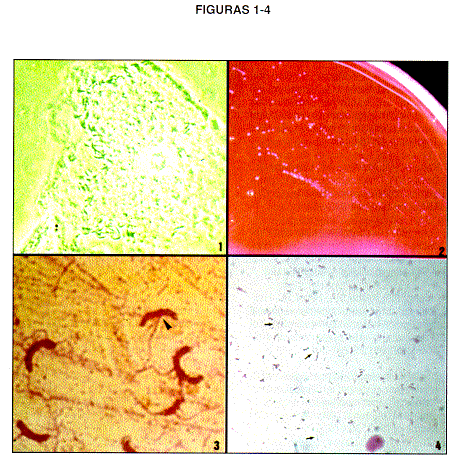
<body><![CDATA[<P><FONT SIZE=-1><I><FONT FACE="Arial,Helvetica">&nbsp;</FONT></I></FONT>     <BR><FONT SIZE=-1><B><FONT FACE="Arial,Helvetica"><I>Mobiluncus </I>como agente infeccioso:</FONT></B></FONT><FONT SIZE=-1></FONT>      <P><FONT SIZE=-1><FONT FACE="Arial,Helvetica">En la d&eacute;cada de 1980<I> Mobiluncus</I> pas&oacute; a ser el candidato etiol&oacute;gico m&aacute;s importante relacionado con las VB. Se le incrimin&oacute; con un 50 a 70% de los casos, en cuyo diagn&oacute;stico se incluy&oacute; la presencia de c&eacute;lulas gu&iacute;a, en este caso recubiertas por bacterias curvas (<A HREF="#27. DeBoer">27</A>), como se muestra en la <A HREF="#Fig. 1-4">figura 1</A>. Su potencial patog&eacute;nico se refleja en la causalidad de abscesos umbilicales, en mamas (<A HREF="#28. Sturm">28</A>-<A HREF="#29. Bennett">29)</A>, en cuero cabelludo de neonatos, en heridas quir&uacute;rgicas, en membranas corioalantoideas y en septicemias <A HREF="#30. Eschenback">(30</A>-<A HREF="#31. Mayer">31</A>), adem&aacute;s, se asocia con ruptura de membranas, parto prematuro y prematuridad (<A HREF="#4. Spiegel,">4</A>).</FONT></FONT><FONT SIZE=-1></FONT>      <P><FONT SIZE=-1><FONT FACE="Arial,Helvetica">El hallazgo de una toxina citot&oacute;xica, capaz de desprender monocapas celulares o inducir la p&eacute;rdida de cilios en c&eacute;lulas cultivadas de oviducto (<A HREF="#32. Taylor-Robinson">32 Taylor-Robinson</A>) representa un mecanismo de virulencia importante para esta bacteria. Aunque la excreci&oacute;n de esta toxina parece ser leve, su efecto parece potenciarse por el hecho de que la bacteria coloniza el epitelio adhiri&eacute;ndose a &eacute;l posiblemente mediante su flagelo.</FONT></FONT>     <BR><FONT SIZE=-1><FONT FACE="Arial,Helvetica">&nbsp;</FONT></FONT><FONT SIZE=-1></FONT>      <P><FONT SIZE=-1><B><FONT FACE="Arial,Helvetica">Aislamiento e identificaci&oacute;n de <I>mobilunicus:</I></FONT></B></FONT><FONT SIZE=-1></FONT>      <P><FONT SIZE=-1><FONT FACE="Arial,Helvetica">El cultivo de esta bacteria se hace en agar sangre o en medios selectivos con antibi&oacute;ticos (<A HREF="#22. Spiegel">22</A>-<A HREF="#23. Spiegel">23</A>), tambi&eacute;n se ha descrito que el enriquecimiento en fr&iacute;o por 2 a 4 horas favorece su aislamiento (<A HREF="#33. Smith">33</A>). La muestra recomendada es el l&iacute;quido obtenido del lavado vaginal realizado con soluci&oacute;n salina est&eacute;ril. En nuestra experiencia no hay diferencia significativa entre su aislamiento a partir del lavado o de un frotis vaginal; en ambos casos la muestra se inocula en platos de agar sangre tratando de realizar un rayado adecuado para aislar colonias, las placas se incuban en jarras tipo GasPak con sobre generador de anaerobiosis y con catalizador, por lo menos durante 10 d&iacute;as a 35&deg;C. Al cabo de ese tiempo se examinan las placas en busca de colonias de menos de 1 mm de di&aacute;metro, transl&uacute;cidas e incoloras, compuestas por bacilos curvos Gram negativos; para esta tinci&oacute;n de Gram se sustituye la contratinci&oacute;n de safranina por fucsina b&aacute;sica (<A HREF="#34. Moraga">34</A>). Sin embargo, hay una infinidad de otros agentes, tanto cocoides como bacilares rectos, con morfolog&iacute;a colonial similar a la descrita ; adem&aacute;s, el tama&ntilde;o de esas colonias es igual o menor que el di&aacute;metro de la aguja bacteriol&oacute;gica, por lo cual pr&aacute;cticamente toda la colonia se pierde en la tinci&oacute;n, eso significa que una vez identificada es dif&iacute;cil recuperarla nuevamente del plato para un subcultivo. Ante esa situaci&oacute;n en nuestro laboratorio recurrimos a rayar cada colonia por estr&iacute;a en un nuevo plato de agar sangre e incubarla nuevamente por 10 d&iacute;as en anaerobiosis, de manera que la tinci&oacute;n de Gram la hacemos de esa segunda incubaci&oacute;n, de la cual f&aacute;cilmente se recupera la bacteria para un subcultivo (<A HREF="#35. Hernández">35)</A>. En la<A HREF="#Fig. 1-4"> figura 2</A> se muestra un cultivo puro de <I>M. mulieris</I>. A partir de esas colonias es factible hacer una tinci&oacute;n de flagelos siguiendo el m&eacute;todo descrito por Kodaka (<A HREF="#36. Kodaka">36</A>), para corroborar la morfolog&iacute;a y el tipo de flagelos (<A HREF="#Fig. 1-4">Fig. 3</A>).</FONT></FONT><FONT SIZE=-1></FONT>      <P><FONT SIZE=-1><FONT FACE="Arial,Helvetica">Obviamente el cultivo no es la forma m&aacute;s pr&aacute;ctica para diagnosticar <I>Mobiluncus</I>, pues la obtenci&oacute;n de la bacteria en cultivo puro puede llevar hasta m&aacute;s de un mes (<A HREF="#35. Hernández">35)</A>. Se ha empleado tambi&eacute;n inmunofluorescencia con anticuerpos monoclonales o cromatograf&iacute;a de las secreciones tratando de identificar los productos metab&oacute;licos de la bacteria (<A HREF="#37. Fohn">37</A>). Sin embargo, la identificaci&oacute;n de bacterias curvas Gram negativas en la tinci&oacute;n de Gram realizada a un frotis vaginal es prueba suficiente para su identificaci&oacute;n, pues en la flora vaginal no se ha descrito ning&uacute;n otro agente bacteriano con esta morfolog&iacute;a (<A HREF="#37. Fohn">37</A>-<A HREF="#42. Schwebke">42</A>). En la<A HREF="#Fig. 1-4"> figura 4 </A>se muestra un frotis vaginal en el que predomina el morfotipo de <I>Mobiluncus</I>.</FONT></FONT>     <BR><FONT SIZE=-1><B><FONT FACE="Arial,Helvetica">&nbsp;</FONT></B></FONT><B><FONT FACE="Arial,Helvetica"><FONT SIZE=-1></FONT></FONT></B>      <P><B><FONT FACE="Arial,Helvetica"><FONT SIZE=-1>Conclusi&oacute;n</FONT></FONT></B><FONT SIZE=-1></FONT>      ]]></body>
<body><![CDATA[<P><FONT SIZE=-1><FONT FACE="Arial,Helvetica">La etiolog&iacute;a de las VB o bien de las otrora denominadas vaginitis inespec&iacute;ficas ha variado conforme se han identificado nuevos agentes infecciosos involucrados con este tipo de patolog&iacute;a. Sin embargo, el concepto m&aacute;s nuevo en este sentido es que la VB no es un cuadro debido a un determinado agente infeccioso, sino que por el contrario obedece a una multicausalidad simult&aacute;nea, debido a un desequilibrio en la flora normal de la vagina <A HREF="#3. Center for Disease">(3</A><A HREF="#4. Spiegel,">-4</A>).</FONT></FONT><FONT SIZE=-1></FONT>      <P><FONT SIZE=-1><FONT FACE="Arial,Helvetica">El enfoque de la causalidad de las VB debe ser de tipo ecol&oacute;gico; una alteraci&oacute;n del ecosistema vaginal puede llevar a la desaparici&oacute;n de los lactobacilos acid&oacute;filos y con ello a un cambio en el pH vaginal. En consecuencia, otras bacterias, que bien pueden ser parte de una flora propia de este nicho, pero que usualmente est&aacute;n en baja proporci&oacute;n, como es el caso de <I>G. vaginalis</I>, pueden multiplicarse y tornarse en flora preponderante (<A HREF="#43. Priestley">43)</A>. Tambi&eacute;n otros agentes pueden llegar de otros sitios, por ejemplo por contaminaci&oacute;n fecal, como podr&iacute;a ser el caso de muchos anaerobios e incluso de enterobacterias (<A HREF="#44. Krohn">44</A>).</FONT></FONT><FONT SIZE=-1></FONT>      <P><FONT SIZE=-1><FONT FACE="Arial,Helvetica">En todo caso, las VB se caracterizan por la presencia de una flora variada e independientemente del agente o agentes involucrados, debe prest&aacute;rsele atenci&oacute;n a esta condici&oacute;n, pues si bien la sintomatolog&iacute;a suele ser leve, los efectos secundarios en el parto y su producto son importantes (<A HREF="#45. Hillier">45</A>-<A HREF="#47. Larsson">47</A>).</FONT></FONT>     <BR><B><FONT FACE="Arial,Helvetica"><FONT SIZE=-1></FONT></FONT></B>&nbsp;<B><FONT FACE="Arial,Helvetica"><FONT SIZE=-1></FONT></FONT></B>      <P><B><FONT FACE="Arial,Helvetica"><FONT SIZE=-1>Referencias</FONT></FONT></B><B><FONT FACE="Arial,Helvetica"><FONT SIZE=-1></FONT></FONT></B>      <!-- ref --><P><A NAME="1. Parent"></A><FONT SIZE=-1><FONT FACE="Arial,Helvetica">1. Parent D, Bossens M, Bayot D, Kirpatrick C, Graf F, Wilkinson FE, Kaise RR. Therapy of bacterial vaginitis using exogenously-applied lactobacilli acidophili and a low dose of estriol. Arzneim Forsch <I>Drug Res</I> 1996;46:68-73.</FONT></FONT><FONT SIZE=-1></FONT>    &nbsp;&nbsp;&nbsp;&nbsp;&nbsp;&nbsp;&nbsp;&nbsp;[&#160;<a href="javascript:void(0);" onclick="javascript: window.open('/scielo.php?script=sci_nlinks&ref=772034&pid=S0253-2948199800010001000001&lng=','','width=640,height=500,resizable=yes,scrollbars=1,menubar=yes,');">Links</a>&#160;]<!-- end-ref --><!-- ref --><P><A NAME="2. O´Dowd"></A><FONT SIZE=-1><FONT FACE="Arial,Helvetica">2. O&acute;Dowd TC, Parker S, Kelly A. Women&acute;s experiences of general practitioner management of their vaginal symptoms. <I>Brit J Gen Pract</I> 1996;46:415-418.</FONT></FONT><FONT SIZE=-1></FONT>    &nbsp;&nbsp;&nbsp;&nbsp;&nbsp;&nbsp;&nbsp;&nbsp;[&#160;<a href="javascript:void(0);" onclick="javascript: window.open('/scielo.php?script=sci_nlinks&ref=772035&pid=S0253-2948199800010001000002&lng=','','width=640,height=500,resizable=yes,scrollbars=1,menubar=yes,');">Links</a>&#160;]<!-- end-ref --><!-- ref --><P><A NAME="3. Center for Disease"></A><FONT SIZE=-1><FONT FACE="Arial,Helvetica">3. Center for Disease Control. Non-reported sexualy transmited diseases. <I>Morbiod Mortal Weekly Rep</I> 1989;8:61.</FONT></FONT><FONT SIZE=-1></FONT>    &nbsp;&nbsp;&nbsp;&nbsp;&nbsp;&nbsp;&nbsp;&nbsp;[&#160;<a href="javascript:void(0);" onclick="javascript: window.open('/scielo.php?script=sci_nlinks&ref=772036&pid=S0253-2948199800010001000003&lng=','','width=640,height=500,resizable=yes,scrollbars=1,menubar=yes,');">Links</a>&#160;]<!-- end-ref --><!-- ref --><P><A NAME="4. Spiegel,"></A><FONT SIZE=-1><FONT FACE="Arial,Helvetica">4. Spiegel, CA. Bacterial vaginosis. <I>Clin Microbiol Rev</I> 1991;4:485-502.</FONT></FONT><FONT SIZE=-1></FONT>    &nbsp;&nbsp;&nbsp;&nbsp;&nbsp;&nbsp;&nbsp;&nbsp;[&#160;<a href="javascript:void(0);" onclick="javascript: window.open('/scielo.php?script=sci_nlinks&ref=772037&pid=S0253-2948199800010001000004&lng=','','width=640,height=500,resizable=yes,scrollbars=1,menubar=yes,');">Links</a>&#160;]<!-- end-ref --><!-- ref --><P><A NAME="5. Spiegel"></A><FONT SIZE=-1><FONT FACE="Arial,Helvetica">5. Spiegel CA. Vaginitis/vaginosis. <I>Sexual Transm Dis</I> 1989;9:525-533.</FONT></FONT><FONT SIZE=-1></FONT>    &nbsp;&nbsp;&nbsp;&nbsp;&nbsp;&nbsp;&nbsp;&nbsp;[&#160;<a href="javascript:void(0);" onclick="javascript: window.open('/scielo.php?script=sci_nlinks&ref=772038&pid=S0253-2948199800010001000005&lng=','','width=640,height=500,resizable=yes,scrollbars=1,menubar=yes,');">Links</a>&#160;]<!-- end-ref --><!-- ref --><P><A NAME="6. Leopold S."></A><FONT SIZE=-1><FONT FACE="Arial,Helvetica">6. Leopold S. Heretofore undescriberd organism isolated from the genitourinary system. US. <I>Armed Forces Med J</I> 1953 ; 4 : 263-266</FONT></FONT><FONT SIZE=-1></FONT>    &nbsp;&nbsp;&nbsp;&nbsp;&nbsp;&nbsp;&nbsp;&nbsp;[&#160;<a href="javascript:void(0);" onclick="javascript: window.open('/scielo.php?script=sci_nlinks&ref=772039&pid=S0253-2948199800010001000006&lng=','','width=640,height=500,resizable=yes,scrollbars=1,menubar=yes,');">Links</a>&#160;]<!-- end-ref --><!-- ref --><P><A NAME="7. Barnes"></A><FONT SIZE=-1><FONT FACE="Arial,Helvetica">7. Barnes RC. Laboratory diagnosis of human chlamidial infections.<I> Clin Microbiol Rev</I> 1989;2:119-136.</FONT></FONT><FONT SIZE=-1></FONT>    &nbsp;&nbsp;&nbsp;&nbsp;&nbsp;&nbsp;&nbsp;&nbsp;[&#160;<a href="javascript:void(0);" onclick="javascript: window.open('/scielo.php?script=sci_nlinks&ref=772040&pid=S0253-2948199800010001000007&lng=','','width=640,height=500,resizable=yes,scrollbars=1,menubar=yes,');">Links</a>&#160;]<!-- end-ref --><!-- ref --><P><A NAME="8. Rosenstein"></A><FONT SIZE=-1><FONT FACE="Arial,Helvetica">8. Rosenstein IJ, Morgan DJ, Sheehan M, Lamont RF, Taylor-Robinson D. Bacterial vaginosis in pregnancy: Distribution of bacterial species in different Gram-stein categories of the vaginal flora. <I>J Med Microbiol</I> 1996;45:120-126.</FONT></FONT><FONT SIZE=-1></FONT>    &nbsp;&nbsp;&nbsp;&nbsp;&nbsp;&nbsp;&nbsp;&nbsp;[&#160;<a href="javascript:void(0);" onclick="javascript: window.open('/scielo.php?script=sci_nlinks&ref=772041&pid=S0253-2948199800010001000008&lng=','','width=640,height=500,resizable=yes,scrollbars=1,menubar=yes,');">Links</a>&#160;]<!-- end-ref --><P><A NAME="9. Gardner"></A><FONT SIZE=-1><FONT FACE="Arial,Helvetica">9. Gardner HL, Dukes CH. <I>Haemophilus vaginalis</I> vaginitis : a newly defined specific infection previously classified as &uml;nonspecific&uml;vaginitis. <I>Am J Obstet Gynecol </I>1955;69:962-976.</FONT></FONT><FONT SIZE=-1></FONT>      <!-- ref --><P><A NAME="10. Greenwod"></A><FONT SIZE=-1><FONT FACE="Arial,Helvetica">10. Greenwod JR, Pickett MJ. Transfer of <I>Haemophilus vaginalis </I>Gardner and Dukes to a new genus <I>Gardnerella :G. vaginalis</I> (Gardner and Dukes) comb. nov. <I>Int J Syst Bacteriol</I> 1980; 30:170-178.</FONT></FONT><FONT SIZE=-1></FONT>    &nbsp;&nbsp;&nbsp;&nbsp;&nbsp;&nbsp;&nbsp;&nbsp;[&#160;<a href="javascript:void(0);" onclick="javascript: window.open('/scielo.php?script=sci_nlinks&ref=772043&pid=S0253-2948199800010001000010&lng=','','width=640,height=500,resizable=yes,scrollbars=1,menubar=yes,');">Links</a>&#160;]<!-- end-ref --><!-- ref --><P><A NAME="11. Van"></A><FONT SIZE=-1><FONT FACE="Arial,Helvetica">11. Van Esbroeck M, Vandamme P, Falsen E, Vancanney T, Moore E, Pot B, Gavini F, Kersters K, Goossens H. Polyphasis approach to the classification and identificaion of <I>Gardnerella vaginalis</I> and unidentified <I>Gardnerella&nbsp; vaginalis</I>-like corinefroms present in bacterial vaginosis. <I>Int J Syst Bacteriol</I> 46;675-682.</FONT></FONT><FONT SIZE=-1></FONT>    &nbsp;&nbsp;&nbsp;&nbsp;&nbsp;&nbsp;&nbsp;&nbsp;[&#160;<a href="javascript:void(0);" onclick="javascript: window.open('/scielo.php?script=sci_nlinks&ref=772044&pid=S0253-2948199800010001000011&lng=','','width=640,height=500,resizable=yes,scrollbars=1,menubar=yes,');">Links</a>&#160;]<!-- end-ref --><!-- ref --><P><A NAME="12. Pivot P."></A><FONT SIZE=-1><FONT FACE="Arial,Helvetica">12. Pivot P. <I>Gardnerella, Streptobacillus, Spirillum </I>and <I>Calymmatobacterium</I>. p. 483-487. <I>IN </I>:A Balows, Hausler WJ, Herrmann KL, Isenberg HD, Shadomy HJ. (ed.). <I>Manual of Clinical Microbiology</I>, 5<SUP>th</SUP> ed. American Society for Microbiology, Washington D. C. 1991.</FONT></FONT><FONT SIZE=-1></FONT>    &nbsp;&nbsp;&nbsp;&nbsp;&nbsp;&nbsp;&nbsp;&nbsp;[&#160;<a href="javascript:void(0);" onclick="javascript: window.open('/scielo.php?script=sci_nlinks&ref=772045&pid=S0253-2948199800010001000012&lng=','','width=640,height=500,resizable=yes,scrollbars=1,menubar=yes,');">Links</a>&#160;]<!-- end-ref --><!-- ref --><P><A NAME="13. Harper"></A><FONT SIZE=-1><FONT FACE="Arial,Helvetica">13. Harper JJ, Davis GHG. Cell wall analysis of <I>Gardnerella vaginalis (Haemophylus vaginalis)</I>. <I>Int Syst Bacteriol</I> 1982;32:48-50.</FONT></FONT><FONT SIZE=-1></FONT>    &nbsp;&nbsp;&nbsp;&nbsp;&nbsp;&nbsp;&nbsp;&nbsp;[&#160;<a href="javascript:void(0);" onclick="javascript: window.open('/scielo.php?script=sci_nlinks&ref=772046&pid=S0253-2948199800010001000013&lng=','','width=640,height=500,resizable=yes,scrollbars=1,menubar=yes,');">Links</a>&#160;]<!-- end-ref --><!-- ref --><P><A NAME="14. Würst"></A><FONT SIZE=-1><FONT FACE="Arial,Helvetica">14. W&uuml;rst J, Lucchini GM, L&uuml;thy-Hottenstin J, Brum F, Altwegg M. Isolation of Gram-positive rods that resemble but are clearly disticnt from <I>Actinomyces pyogenes</I> from mixed wound infections.<I> J Clin Microbiol</I> 1993;31:1127-1135.</FONT></FONT><FONT SIZE=-1></FONT>    &nbsp;&nbsp;&nbsp;&nbsp;&nbsp;&nbsp;&nbsp;&nbsp;[&#160;<a href="javascript:void(0);" onclick="javascript: window.open('/scielo.php?script=sci_nlinks&ref=772047&pid=S0253-2948199800010001000014&lng=','','width=640,height=500,resizable=yes,scrollbars=1,menubar=yes,');">Links</a>&#160;]<!-- end-ref --><!-- ref --><P><A NAME="15. Eschenbach"></A><FONT SIZE=-1><FONT FACE="Arial,Helvetica">15. Eschenbach DA. History and review of bacterial vaginosis.<I> Amer J Obstet Gynecol</I> 1993;169:441-445.</FONT></FONT><FONT SIZE=-1></FONT>    &nbsp;&nbsp;&nbsp;&nbsp;&nbsp;&nbsp;&nbsp;&nbsp;[&#160;<a href="javascript:void(0);" onclick="javascript: window.open('/scielo.php?script=sci_nlinks&ref=772048&pid=S0253-2948199800010001000015&lng=','','width=640,height=500,resizable=yes,scrollbars=1,menubar=yes,');">Links</a>&#160;]<!-- end-ref --><!-- ref --><P><A NAME="16. Ledger"></A><FONT SIZE=-1><FONT FACE="Arial,Helvetica">16. Ledger WJ. Historical review of the treatment of bacterial vaginosis. <I>AM J Obstet Gynecol</I> 1993;169:474-478.</FONT></FONT><FONT SIZE=-1></FONT>    &nbsp;&nbsp;&nbsp;&nbsp;&nbsp;&nbsp;&nbsp;&nbsp;[&#160;<a href="javascript:void(0);" onclick="javascript: window.open('/scielo.php?script=sci_nlinks&ref=772049&pid=S0253-2948199800010001000016&lng=','','width=640,height=500,resizable=yes,scrollbars=1,menubar=yes,');">Links</a>&#160;]<!-- end-ref --><!-- ref --><P><A NAME="17. McCormack"></A><FONT SIZE=-1><FONT FACE="Arial,Helvetica">17. McCormack WM, Hayes CM, Rosner B. et al. Vaginal coloniztion with <I>Corynebacterium vaginalis</I> (<I>Haemophilus vaginalis</I>). <I>J Infect Dis</I> 1977;136:740-745.</FONT></FONT><FONT SIZE=-1></FONT>    &nbsp;&nbsp;&nbsp;&nbsp;&nbsp;&nbsp;&nbsp;&nbsp;[&#160;<a href="javascript:void(0);" onclick="javascript: window.open('/scielo.php?script=sci_nlinks&ref=772050&pid=S0253-2948199800010001000017&lng=','','width=640,height=500,resizable=yes,scrollbars=1,menubar=yes,');">Links</a>&#160;]<!-- end-ref --><!-- ref --><P><A NAME="18. Totten"></A><FONT SIZE=-1><FONT FACE="Arial,Helvetica">18. Totten PA, Amsel R, Hale J, et al. Selective differential human bilayer media for isolation of <I>Gardnerella</I> (<I>Haemophilus</I>)<I> vaginalis</I>. <I>J Clin Microbiol</I> 1982;15:141-147.</FONT></FONT><FONT SIZE=-1></FONT>    &nbsp;&nbsp;&nbsp;&nbsp;&nbsp;&nbsp;&nbsp;&nbsp;[&#160;<a href="javascript:void(0);" onclick="javascript: window.open('/scielo.php?script=sci_nlinks&ref=772051&pid=S0253-2948199800010001000018&lng=','','width=640,height=500,resizable=yes,scrollbars=1,menubar=yes,');">Links</a>&#160;]<!-- end-ref --><!-- ref --><P><A NAME="19. Blackwell"></A><FONT SIZE=-1><FONT FACE="Arial,Helvetica">19. Blackwell AL, Fox AR, Phillips I, et al. Anaerobic vaginosis (non specific): clinical, microbiological and therapaeutic findings. <I>Lancet</I> 1983;2:1379-1382.</FONT></FONT><FONT SIZE=-1></FONT>    &nbsp;&nbsp;&nbsp;&nbsp;&nbsp;&nbsp;&nbsp;&nbsp;[&#160;<a href="javascript:void(0);" onclick="javascript: window.open('/scielo.php?script=sci_nlinks&ref=772052&pid=S0253-2948199800010001000019&lng=','','width=640,height=500,resizable=yes,scrollbars=1,menubar=yes,');">Links</a>&#160;]<!-- end-ref --><!-- ref --><P><A NAME="20. Rottini"></A><FONT SIZE=-1><FONT FACE="Arial,Helvetica">20. Rottini G, Dobrina A, Fargiarini O, Nardon E, Amirante GA, Patriarca P. Identification and partial characterization of a cytolitic toxin produced by <I>Gardnerella vaginalis</I>. <I>Infect Immun</I> 1990;58:3751-3758.</FONT></FONT><FONT SIZE=-1></FONT>    &nbsp;&nbsp;&nbsp;&nbsp;&nbsp;&nbsp;&nbsp;&nbsp;[&#160;<a href="javascript:void(0);" onclick="javascript: window.open('/scielo.php?script=sci_nlinks&ref=772053&pid=S0253-2948199800010001000020&lng=','','width=640,height=500,resizable=yes,scrollbars=1,menubar=yes,');">Links</a>&#160;]<!-- end-ref --><!-- ref --><P><A NAME="21. Lefevre"></A><FONT SIZE=-1><FONT FACE="Arial,Helvetica">21. Lefevre JC. Donne&eacute;s bacteriolgiques r&eacute;centes: de la physiopathologie au traitement. <I>Rev Fr Gyn&eacute;col Obst&eacute;t</I> 1993;88:207-10.</FONT></FONT><FONT SIZE=-1></FONT>    &nbsp;&nbsp;&nbsp;&nbsp;&nbsp;&nbsp;&nbsp;&nbsp;[&#160;<a href="javascript:void(0);" onclick="javascript: window.open('/scielo.php?script=sci_nlinks&ref=772054&pid=S0253-2948199800010001000021&lng=','','width=640,height=500,resizable=yes,scrollbars=1,menubar=yes,');">Links</a>&#160;]<!-- end-ref --><!-- ref --><P><A NAME="22. Spiegel"></A><FONT SIZE=-1><FONT FACE="Arial,Helvetica">22. Spiegel C A. The genus <I>Mobiluncus</I>. In: Prolaryotes, 2<SUP>nd</SUP>. Ed. Balow A, Tr&uuml;er HG, Dworkin M, Harder W, Scheeifer KH. (eds). Springer Verlag, NY. 1992. p 906-917.</FONT></FONT><FONT SIZE=-1></FONT>    &nbsp;&nbsp;&nbsp;&nbsp;&nbsp;&nbsp;&nbsp;&nbsp;[&#160;<a href="javascript:void(0);" onclick="javascript: window.open('/scielo.php?script=sci_nlinks&ref=772055&pid=S0253-2948199800010001000022&lng=','','width=640,height=500,resizable=yes,scrollbars=1,menubar=yes,');">Links</a>&#160;]<!-- end-ref --><!-- ref --><P><A NAME="23. Spiegel"></A><FONT SIZE=-1><FONT FACE="Arial,Helvetica">23. Spiegel, C. A. &amp; Roberts, M. <I>Mobiluncus</I> gen. nov., <I>Mobiluncus</I> <I>curtisii</I> subsp. <I>curtisii</I> sp. nov., <I>Mobiluncus</I> <I>curtisii</I> subsp. <I>holmesii</I> subsp. nov., and <I>Mobiluncus</I> <I>mulieris</I> sp. nov., curved rods from the human vagina. <I>Int Syst Bacteriol</I> 1984; 34: 177-184.</FONT></FONT><FONT SIZE=-1></FONT>    &nbsp;&nbsp;&nbsp;&nbsp;&nbsp;&nbsp;&nbsp;&nbsp;[&#160;<a href="javascript:void(0);" onclick="javascript: window.open('/scielo.php?script=sci_nlinks&ref=772056&pid=S0253-2948199800010001000023&lng=','','width=640,height=500,resizable=yes,scrollbars=1,menubar=yes,');">Links</a>&#160;]<!-- end-ref --><!-- ref --><P><A NAME="24. Tiveljung"></A><FONT SIZE=-1><FONT FACE="Arial,Helvetica">24. Tiveljung A, -forsum U, Montein HJ. Classification of the genus <I>Mobiluncus</I> based on comparative partial 16S rRNA gene analysis. <I>Int J Syst Bacteriol</I> 1996;46:332-336.</FONT></FONT><FONT SIZE=-1></FONT>    &nbsp;&nbsp;&nbsp;&nbsp;&nbsp;&nbsp;&nbsp;&nbsp;[&#160;<a href="javascript:void(0);" onclick="javascript: window.open('/scielo.php?script=sci_nlinks&ref=772057&pid=S0253-2948199800010001000024&lng=','','width=640,height=500,resizable=yes,scrollbars=1,menubar=yes,');">Links</a>&#160;]<!-- end-ref --><!-- ref --><P><A NAME="25. Schewebke"></A><FONT SIZE=-1><FONT FACE="Arial,Helvetica">25. Schewebke JR, Lukehart SA, Roberts C, Hiller SL. Identification of two new antigenic subgroups within the genus <I>Mobiluncus.</I> <I>J Clin Microbiol</I> 1991;29:2204-8.</FONT></FONT><FONT SIZE=-1></FONT>    &nbsp;&nbsp;&nbsp;&nbsp;&nbsp;&nbsp;&nbsp;&nbsp;[&#160;<a href="javascript:void(0);" onclick="javascript: window.open('/scielo.php?script=sci_nlinks&ref=772058&pid=S0253-2948199800010001000025&lng=','','width=640,height=500,resizable=yes,scrollbars=1,menubar=yes,');">Links</a>&#160;]<!-- end-ref --><!-- ref --><P><A NAME="26. Schewebke"></A><FONT SIZE=-1><FONT FACE="Arial,Helvetica">26. Schewebke JR, Hiller SL, Fohn MJ, Lukehart SA. Demostration of herergeneity among the antigenic proteins of <I>Mobiluncus</I> species. <I>J Clin Microbiol</I> 1990;28:463-8.</FONT></FONT><FONT SIZE=-1></FONT>    &nbsp;&nbsp;&nbsp;&nbsp;&nbsp;&nbsp;&nbsp;&nbsp;[&#160;<a href="javascript:void(0);" onclick="javascript: window.open('/scielo.php?script=sci_nlinks&ref=772059&pid=S0253-2948199800010001000026&lng=','','width=640,height=500,resizable=yes,scrollbars=1,menubar=yes,');">Links</a>&#160;]<!-- end-ref --><!-- ref --><P><A NAME="27. DeBoer"></A><FONT SIZE=-1><FONT FACE="Arial,Helvetica">27. DeBoer, JM, Plantema FHF. Ultrastructure of the <I>in situ</I> adherence of<I> Mobiluncus</I> to vaginal epithelial cells. <I>Can J Microbiol</I> 1988;34:757-766.</FONT></FONT><FONT SIZE=-1></FONT>    &nbsp;&nbsp;&nbsp;&nbsp;&nbsp;&nbsp;&nbsp;&nbsp;[&#160;<a href="javascript:void(0);" onclick="javascript: window.open('/scielo.php?script=sci_nlinks&ref=772060&pid=S0253-2948199800010001000027&lng=','','width=640,height=500,resizable=yes,scrollbars=1,menubar=yes,');">Links</a>&#160;]<!-- end-ref --><!-- ref --><P><A NAME="28. Sturm"></A><FONT SIZE=-1><FONT FACE="Arial,Helvetica">28. Sturm AW, Sikkenk PJH. Anaerobic curved rods in breast abscess. <I>Lancet</I> 1984;2:1216.</FONT></FONT><FONT SIZE=-1></FONT>    &nbsp;&nbsp;&nbsp;&nbsp;&nbsp;&nbsp;&nbsp;&nbsp;[&#160;<a href="javascript:void(0);" onclick="javascript: window.open('/scielo.php?script=sci_nlinks&ref=772061&pid=S0253-2948199800010001000028&lng=','','width=640,height=500,resizable=yes,scrollbars=1,menubar=yes,');">Links</a>&#160;]<!-- end-ref --><!-- ref --><P><A NAME="29. Bennett"></A><FONT SIZE=-1><FONT FACE="Arial,Helvetica">29. Bennett KW, Winstanley TG, Taylor AKM, Shorhouse AJ. Anaerobid curve rods in breast abscess and vagina. <I>Lancet</I> 1989;1:564.</FONT></FONT><FONT SIZE=-1></FONT>    &nbsp;&nbsp;&nbsp;&nbsp;&nbsp;&nbsp;&nbsp;&nbsp;[&#160;<a href="javascript:void(0);" onclick="javascript: window.open('/scielo.php?script=sci_nlinks&ref=772062&pid=S0253-2948199800010001000029&lng=','','width=640,height=500,resizable=yes,scrollbars=1,menubar=yes,');">Links</a>&#160;]<!-- end-ref --><!-- ref --><P><A NAME="30. Eschenback"></A><FONT SIZE=-1><FONT FACE="Arial,Helvetica">30. Eschenback DA. Bacterial vaginosis and anaerobes in obstetric-gynecologic infection. <I>Clin Infect Dis</I> 1993;16 (Suppl 4):S282-7.</FONT></FONT><FONT SIZE=-1></FONT>    &nbsp;&nbsp;&nbsp;&nbsp;&nbsp;&nbsp;&nbsp;&nbsp;[&#160;<a href="javascript:void(0);" onclick="javascript: window.open('/scielo.php?script=sci_nlinks&ref=772063&pid=S0253-2948199800010001000030&lng=','','width=640,height=500,resizable=yes,scrollbars=1,menubar=yes,');">Links</a>&#160;]<!-- end-ref --><!-- ref --><P><A NAME="31. Mayer"></A><FONT SIZE=-1><FONT FACE="Arial,Helvetica">31. Mayer J, Hegewald S, Sartor VE, Carroll K. Extragenital infection due to a <I>Mobiluncus mulieris</I>. Case report and review. <I>Diag Microbiol Infect Dis</I> 1994;20:164-165.</FONT></FONT><FONT SIZE=-1></FONT>    &nbsp;&nbsp;&nbsp;&nbsp;&nbsp;&nbsp;&nbsp;&nbsp;[&#160;<a href="javascript:void(0);" onclick="javascript: window.open('/scielo.php?script=sci_nlinks&ref=772064&pid=S0253-2948199800010001000031&lng=','','width=640,height=500,resizable=yes,scrollbars=1,menubar=yes,');">Links</a>&#160;]<!-- end-ref --><!-- ref --><P><A NAME="32. Taylor-Robinson"></A><FONT SIZE=-1><FONT FACE="Arial,Helvetica">32. Taylor-Robinson AW, Borriello SP, Taylor-Robinson D. Identification and preliminary characterization of a cytotoxin isolated from <I>Mobiluncus </I>spp. <I>Int J Exp Path</I> 1993;74:357-66.</FONT></FONT><FONT SIZE=-1></FONT>    &nbsp;&nbsp;&nbsp;&nbsp;&nbsp;&nbsp;&nbsp;&nbsp;[&#160;<a href="javascript:void(0);" onclick="javascript: window.open('/scielo.php?script=sci_nlinks&ref=772065&pid=S0253-2948199800010001000032&lng=','','width=640,height=500,resizable=yes,scrollbars=1,menubar=yes,');">Links</a>&#160;]<!-- end-ref --><!-- ref --><P><A NAME="33. Smith"></A><FONT SIZE=-1><FONT FACE="Arial,Helvetica">33. Smith HJ, Moore HB. Isolation of <I>Mobiluncus</I> species from clinical specimens by using cold enrichment and selective media. J. Clin. Microbiol 1988; 26: 1134-37</FONT></FONT><FONT SIZE=-1></FONT>    &nbsp;&nbsp;&nbsp;&nbsp;&nbsp;&nbsp;&nbsp;&nbsp;[&#160;<a href="javascript:void(0);" onclick="javascript: window.open('/scielo.php?script=sci_nlinks&ref=772066&pid=S0253-2948199800010001000033&lng=','','width=640,height=500,resizable=yes,scrollbars=1,menubar=yes,');">Links</a>&#160;]<!-- end-ref --><!-- ref --><P><A NAME="34. Moraga"></A><FONT SIZE=-1><FONT FACE="Arial,Helvetica">34. Moraga, M. &amp; Hern&aacute;ndez, F. Prevalencia de vaginosis bacteriana en prostitutas, San Jos&eacute;, Costa Rica. <I>Rev Cost Cienc M&eacute;d.</I> 1997. En prensa.</FONT></FONT><FONT SIZE=-1></FONT>    &nbsp;&nbsp;&nbsp;&nbsp;&nbsp;&nbsp;&nbsp;&nbsp;[&#160;<a href="javascript:void(0);" onclick="javascript: window.open('/scielo.php?script=sci_nlinks&ref=772067&pid=S0253-2948199800010001000034&lng=','','width=640,height=500,resizable=yes,scrollbars=1,menubar=yes,');">Links</a>&#160;]<!-- end-ref --><!-- ref --><P><A NAME="35. Hernández"></A><FONT SIZE=-1><FONT FACE="Arial,Helvetica">35. Hern&aacute;ndez F, Rodr&iacute;guez E, Gamboa MM, Coto E, Acu&ntilde;a MA. Ultrastructural view of the bacterium <I>Mobiluncus</I> <I>mulieris</I>: An approach to understand some problems for its isolation. <I>Rev Biol Trop</I> 1994;42:101-104.</FONT></FONT><FONT SIZE=-1></FONT>    &nbsp;&nbsp;&nbsp;&nbsp;&nbsp;&nbsp;&nbsp;&nbsp;[&#160;<a href="javascript:void(0);" onclick="javascript: window.open('/scielo.php?script=sci_nlinks&ref=772068&pid=S0253-2948199800010001000035&lng=','','width=640,height=500,resizable=yes,scrollbars=1,menubar=yes,');">Links</a>&#160;]<!-- end-ref --><!-- ref --><P><A NAME="36. Kodaka"></A><FONT SIZE=-1><FONT FACE="Arial,Helvetica">36. Kodaka HA, Armfield AY, Lombard GL, Dowell VR. Practical procedure for demonstrating bacterial flagella. <I>J Clin Microbiol</I> 1982;16:948-952.</FONT></FONT><FONT SIZE=-1></FONT>    &nbsp;&nbsp;&nbsp;&nbsp;&nbsp;&nbsp;&nbsp;&nbsp;[&#160;<a href="javascript:void(0);" onclick="javascript: window.open('/scielo.php?script=sci_nlinks&ref=772069&pid=S0253-2948199800010001000036&lng=','','width=640,height=500,resizable=yes,scrollbars=1,menubar=yes,');">Links</a>&#160;]<!-- end-ref --><!-- ref --><P><A NAME="37. Fohn"></A><FONT SIZE=-1><FONT FACE="Arial,Helvetica">37. Fohn MJ, Lukehart SA, Hillier SL. Production and characterization of monoclonal antibodies to <I>Mobiluncus</I> species. <I>J Clin Microbiol</I> 1988;26:2598-2603.</FONT></FONT><FONT SIZE=-1></FONT>    &nbsp;&nbsp;&nbsp;&nbsp;&nbsp;&nbsp;&nbsp;&nbsp;[&#160;<a href="javascript:void(0);" onclick="javascript: window.open('/scielo.php?script=sci_nlinks&ref=772070&pid=S0253-2948199800010001000037&lng=','','width=640,height=500,resizable=yes,scrollbars=1,menubar=yes,');">Links</a>&#160;]<!-- end-ref --><!-- ref --><P><A NAME="38. Nugent"></A><FONT SIZE=-1><FONT FACE="Arial,Helvetica">38. Nugent RP, Krohn MA, Hillier SL. Reliability of diagnosing bacterial vaginosis in improved by a standardized method of Gram stain interpretation. <I>J Clin Microbiol</I> 1991;29:297-301.</FONT></FONT><FONT SIZE=-1></FONT>    &nbsp;&nbsp;&nbsp;&nbsp;&nbsp;&nbsp;&nbsp;&nbsp;[&#160;<a href="javascript:void(0);" onclick="javascript: window.open('/scielo.php?script=sci_nlinks&ref=772071&pid=S0253-2948199800010001000038&lng=','','width=640,height=500,resizable=yes,scrollbars=1,menubar=yes,');">Links</a>&#160;]<!-- end-ref --><!-- ref --><P><A NAME="39. Cook"></A><FONT SIZE=-1><FONT FACE="Arial,Helvetica">39. Cook RL, Redondo-L&oacute;pez V, Schmitt C, Meriwether C, Sobel J. Clinical, microbiological, and biochemical factors in recurrent bacterial vaginosis.<I> J Clin Microbiol</I> 1992;30:870-7.</FONT></FONT><FONT SIZE=-1></FONT>    &nbsp;&nbsp;&nbsp;&nbsp;&nbsp;&nbsp;&nbsp;&nbsp;[&#160;<a href="javascript:void(0);" onclick="javascript: window.open('/scielo.php?script=sci_nlinks&ref=772072&pid=S0253-2948199800010001000039&lng=','','width=640,height=500,resizable=yes,scrollbars=1,menubar=yes,');">Links</a>&#160;]<!-- end-ref --><!-- ref --><P><A NAME="40. Joesoef"></A><FONT SIZE=-1><FONT FACE="Arial,Helvetica">40. Joesoef MR, Hillier SL, Josodiwondo S, Linnan M. Reproducibility of a scoring system for Gram stain diagnosis of bacterial vaginosis. <I>J Clin Microbiol</I> 1991;29:1730-31.</FONT></FONT><FONT SIZE=-1></FONT>    &nbsp;&nbsp;&nbsp;&nbsp;&nbsp;&nbsp;&nbsp;&nbsp;[&#160;<a href="javascript:void(0);" onclick="javascript: window.open('/scielo.php?script=sci_nlinks&ref=772073&pid=S0253-2948199800010001000040&lng=','','width=640,height=500,resizable=yes,scrollbars=1,menubar=yes,');">Links</a>&#160;]<!-- end-ref --><!-- ref --><P><A NAME="41. Morgan"></A><FONT SIZE=-1><FONT FACE="Arial,Helvetica">41. Morgan DJ, About CJ, McCaffrey IM, Bhide SA, Lamont RF, Taylor-Robinson D. Comaparison of Gram-stained smears prepared form blind vaginal swabs with those obtained at speculum examination for the assesment of vaginal flora. <I>Brit J Obstet Gynaecol</I> 1996;103:1105-08</FONT></FONT><FONT SIZE=-1></FONT>    &nbsp;&nbsp;&nbsp;&nbsp;&nbsp;&nbsp;&nbsp;&nbsp;[&#160;<a href="javascript:void(0);" onclick="javascript: window.open('/scielo.php?script=sci_nlinks&ref=772074&pid=S0253-2948199800010001000041&lng=','','width=640,height=500,resizable=yes,scrollbars=1,menubar=yes,');">Links</a>&#160;]<!-- end-ref --><!-- ref --><P><A NAME="42. Schwebke"></A><FONT SIZE=-1><FONT FACE="Arial,Helvetica">42. Schwebke JR, Hiller SL, Sobel JD, McGregor JA, Sweet RL. Validity of the vaginal Gram stain for the diagnosis of bacterial vaginosis. <I>Obstet Gynecol</I> 1996;88: 573-6.</FONT></FONT><FONT SIZE=-1></FONT>    &nbsp;&nbsp;&nbsp;&nbsp;&nbsp;&nbsp;&nbsp;&nbsp;[&#160;<a href="javascript:void(0);" onclick="javascript: window.open('/scielo.php?script=sci_nlinks&ref=772075&pid=S0253-2948199800010001000042&lng=','','width=640,height=500,resizable=yes,scrollbars=1,menubar=yes,');">Links</a>&#160;]<!-- end-ref --><!-- ref --><P><A NAME="43. Priestley"></A><FONT SIZE=-1><FONT FACE="Arial,Helvetica">43. Priestley CJF, Jones BM, Dhar J, Goodwin L. What is normal vaginal flora ? <I>Genitourin Med</I> 1997;73:23-8.</FONT></FONT><FONT SIZE=-1></FONT>    &nbsp;&nbsp;&nbsp;&nbsp;&nbsp;&nbsp;&nbsp;&nbsp;[&#160;<a href="javascript:void(0);" onclick="javascript: window.open('/scielo.php?script=sci_nlinks&ref=772076&pid=S0253-2948199800010001000043&lng=','','width=640,height=500,resizable=yes,scrollbars=1,menubar=yes,');">Links</a>&#160;]<!-- end-ref --><!-- ref --><P><A NAME="44. Krohn"></A><FONT SIZE=-1><FONT FACE="Arial,Helvetica">44. Krohn MA, Thwin SS, Rbe LK, Brown Z, Hillier SL. Vaginal colonization by <I>Escherichia coli</I> arisk factor for very low birth weght delivery and other perinatal complications. <I>J Infect Dis</I> 1997; 175:606-10.</FONT></FONT><FONT SIZE=-1></FONT>    &nbsp;&nbsp;&nbsp;&nbsp;&nbsp;&nbsp;&nbsp;&nbsp;[&#160;<a href="javascript:void(0);" onclick="javascript: window.open('/scielo.php?script=sci_nlinks&ref=772077&pid=S0253-2948199800010001000044&lng=','','width=640,height=500,resizable=yes,scrollbars=1,menubar=yes,');">Links</a>&#160;]<!-- end-ref --><!-- ref --><P><A NAME="45. Hillier"></A><FONT SIZE=-1><FONT FACE="Arial,Helvetica">45. Hillier SL, Martius J, Krohn M, Kiviat N, Holmes K K, Eschenbach DA. A case control study of choroammioninic infection and histologic chorioamnionitis in pregnancy. <I>N Engl J Med</I> 1988;319:972-8.</FONT></FONT><FONT SIZE=-1></FONT>    &nbsp;&nbsp;&nbsp;&nbsp;&nbsp;&nbsp;&nbsp;&nbsp;[&#160;<a href="javascript:void(0);" onclick="javascript: window.open('/scielo.php?script=sci_nlinks&ref=772078&pid=S0253-2948199800010001000045&lng=','','width=640,height=500,resizable=yes,scrollbars=1,menubar=yes,');">Links</a>&#160;]<!-- end-ref --><!-- ref --><P><A NAME="46. Hillier"></A><FONT SIZE=-1><FONT FACE="Arial,Helvetica">46. Hillier SL, Kivia NB, Hawes S, Hasselquist MB, Hanssen PW, Eschenbach DA, Holmes KK. Role of bacterial vaginosis associated microorganisms in endometritis.<I> Am J Obstet Gynecol</I> 1996;175:435-41</FONT></FONT><FONT SIZE=-1></FONT>    &nbsp;&nbsp;&nbsp;&nbsp;&nbsp;&nbsp;&nbsp;&nbsp;[&#160;<a href="javascript:void(0);" onclick="javascript: window.open('/scielo.php?script=sci_nlinks&ref=772079&pid=S0253-2948199800010001000046&lng=','','width=640,height=500,resizable=yes,scrollbars=1,menubar=yes,');">Links</a>&#160;]<!-- end-ref --><!-- ref --><P><A NAME="47. Larsson"></A><FONT SIZE=-1><FONT FACE="Arial,Helvetica">47. Larsson PG, Bergman B, Forsum U, Pahlson C. Treatment of bacterial vaginosis in women with vaginal bleeding complications or discharge and harboring <I>Mobiluncus</I>. <I>Gynecol Obstet Invest</I> 1990;29:296-300.</FONT></FONT>    &nbsp;&nbsp;&nbsp;&nbsp;&nbsp;&nbsp;&nbsp;&nbsp;[&#160;<a href="javascript:void(0);" onclick="javascript: window.open('/scielo.php?script=sci_nlinks&ref=772080&pid=S0253-2948199800010001000047&lng=','','width=640,height=500,resizable=yes,scrollbars=1,menubar=yes,');">Links</a>&#160;]<!-- end-ref --><BR><FONT SIZE=-1><FONT FACE="Arial,Helvetica">&nbsp;</FONT></FONT>     <CENTER><FONT SIZE=-1>&nbsp;</FONT></CENTER>      <CENTER><FONT SIZE=-1>&nbsp;</FONT></CENTER>      <CENTER><FONT SIZE=-1>&nbsp;</FONT></CENTER>      <CENTER><A NAME="Fig. 1-4"></A><IMG SRC="/img/fbpe/rccm/v19n1-2/0279i01.GIF" HEIGHT=475 WIDTH=458></CENTER> <FONT FACE="Arial,Helvetica"><FONT SIZE=-1></FONT></FONT>      
<P><FONT FACE="Arial,Helvetica"><FONT SIZE=-1>Figura 1. Micrograf&iacute;a de contraste de fases de una c&eacute;lula gu&iacute;a&nbsp; una paciente con vaginosis bacteriana. Se observa los bacilos curvos, especialmente en el borde izquierdo de la c&eacute;lula.</FONT></FONT><FONT FACE="Arial,Helvetica"><FONT SIZE=-1></FONT></FONT>      <P><FONT FACE="Arial,Helvetica"><FONT SIZE=-1>Figura 2. Micrograf&iacute;a de&nbsp; una placa de agar sangre con un cultivo de Mobiluncus mulieris de 10 d&iacute;as de incubaci&oacute;n en anaerobiosis.</FONT></FONT><FONT FACE="Arial,Helvetica"><FONT SIZE=-1></FONT></FONT>      <P><FONT FACE="Arial,Helvetica"><FONT SIZE=-1>Figura 3. Micrograf&iacute;a de&nbsp; luz, de una tinci&oacute;n de flagelos(tinci&oacute;n de Kodaka, referencia <A HREF="#36. Kodaka">36</A>) de Mobiluncus muliers, se observan bacilos curvos, algunos pr&aacute;cticamente en forma de " media luna". La punta de flecha muestra la inserci&oacute;n de los flagelos.</FONT></FONT><FONT FACE="Arial,Helvetica"><FONT SIZE=-1></FONT></FONT>      ]]></body>
<body><![CDATA[<P><FONT FACE="Arial,Helvetica"><FONT SIZE=-1>Figura 4. Micrograf&iacute;a de&nbsp; luz de un frotis vaginal de una paciente con vaginosis bacteriana, tinci&oacute;n de Gram. Las flechas se&ntilde;alan grupos de bacterias, Gram negativas.</FONT></FONT>      ]]></body><back>
<ref-list>
<ref id="B1">
<label>1</label><nlm-citation citation-type="journal">
<person-group person-group-type="author">
<name>
<surname><![CDATA[Parent]]></surname>
<given-names><![CDATA[D]]></given-names>
</name>
<name>
<surname><![CDATA[Bossens]]></surname>
<given-names><![CDATA[M]]></given-names>
</name>
<name>
<surname><![CDATA[Bayot]]></surname>
<given-names><![CDATA[D]]></given-names>
</name>
<name>
<surname><![CDATA[Kirpatrick]]></surname>
<given-names><![CDATA[C]]></given-names>
</name>
<name>
<surname><![CDATA[Graf]]></surname>
<given-names><![CDATA[F]]></given-names>
</name>
<name>
<surname><![CDATA[Wilkinson]]></surname>
<given-names><![CDATA[FE]]></given-names>
</name>
<name>
<surname><![CDATA[Kaise]]></surname>
<given-names><![CDATA[RR]]></given-names>
</name>
</person-group>
<article-title xml:lang="en"><![CDATA[Therapy of bacterial vaginitis using exogenously-applied lactobacilli acidophili and a low dose of estriol]]></article-title>
<source><![CDATA[Arzneim Forsch Drug Res]]></source>
<year>1996</year>
<volume>46</volume>
<page-range>68-73</page-range></nlm-citation>
</ref>
<ref id="B2">
<label>2</label><nlm-citation citation-type="journal">
<person-group person-group-type="author">
<name>
<surname><![CDATA[O' Dowd]]></surname>
<given-names><![CDATA[TC]]></given-names>
</name>
<name>
<surname><![CDATA[Parker]]></surname>
<given-names><![CDATA[S]]></given-names>
</name>
<name>
<surname><![CDATA[Kelly]]></surname>
<given-names><![CDATA[A.]]></given-names>
</name>
</person-group>
<article-title xml:lang="en"><![CDATA[Women's experiences of general practitioner management of their vaginal symptoms]]></article-title>
<source><![CDATA[Brit J Gen Pract]]></source>
<year>1996</year>
<volume>46</volume>
<page-range>415-418</page-range></nlm-citation>
</ref>
<ref id="B3">
<label>3.</label><nlm-citation citation-type="journal">
<collab>Center for Disease Control.</collab>
<article-title xml:lang="en"><![CDATA[Non-reported sexualy transmited diseases]]></article-title>
<source><![CDATA[Morbiod Mortal Weekly Rep]]></source>
<year>1989</year>
<volume>8</volume>
</nlm-citation>
</ref>
<ref id="B4">
<label>4</label><nlm-citation citation-type="journal">
<person-group person-group-type="author">
<name>
<surname><![CDATA[Spiegel]]></surname>
<given-names><![CDATA[CA.]]></given-names>
</name>
</person-group>
<article-title xml:lang="en"><![CDATA[Bacterial vaginosis]]></article-title>
<source><![CDATA[Clin Microbiol Rev]]></source>
<year>1991</year>
<volume>4</volume>
<page-range>485-502</page-range></nlm-citation>
</ref>
<ref id="B5">
<label>5</label><nlm-citation citation-type="journal">
<person-group person-group-type="author">
<name>
<surname><![CDATA[Spiegel]]></surname>
<given-names><![CDATA[CA.]]></given-names>
</name>
</person-group>
<article-title xml:lang="en"><![CDATA[Vaginitis/vaginosis.]]></article-title>
<source><![CDATA[Sexual Transm Dis]]></source>
<year>1989</year>
<month>;</month>
<volume>9</volume>
<page-range>525-533</page-range></nlm-citation>
</ref>
<ref id="B6">
<label>6</label><nlm-citation citation-type="journal">
<person-group person-group-type="author">
<name>
<surname><![CDATA[Leopold]]></surname>
<given-names><![CDATA[S.]]></given-names>
</name>
</person-group>
<article-title xml:lang="en"><![CDATA[Heretofore undescriberd organism isolated from the genitourinary system]]></article-title>
<source><![CDATA[US. Armed Forces Med J]]></source>
<year>1953</year>
<volume>4</volume>
<page-range>263-266</page-range></nlm-citation>
</ref>
<ref id="B7">
<label>7</label><nlm-citation citation-type="journal">
<person-group person-group-type="author">
<name>
<surname><![CDATA[Barnes]]></surname>
<given-names><![CDATA[RC.]]></given-names>
</name>
</person-group>
<article-title xml:lang="en"><![CDATA[Laboratory diagnosis of human chlamidial infections]]></article-title>
<source><![CDATA[Clin Microbiol Rev]]></source>
<year>1989</year>
<volume>2</volume>
<page-range>119-136</page-range></nlm-citation>
</ref>
<ref id="B8">
<label>8</label><nlm-citation citation-type="journal">
<person-group person-group-type="author">
<name>
<surname><![CDATA[Rosenstein]]></surname>
<given-names><![CDATA[IJ]]></given-names>
</name>
<name>
<surname><![CDATA[Morgan]]></surname>
<given-names><![CDATA[DJ]]></given-names>
</name>
<name>
<surname><![CDATA[Sheehan]]></surname>
<given-names><![CDATA[M]]></given-names>
</name>
<name>
<surname><![CDATA[Lamont]]></surname>
<given-names><![CDATA[RF]]></given-names>
</name>
<name>
<surname><![CDATA[Taylor-Robinson]]></surname>
<given-names><![CDATA[D]]></given-names>
</name>
</person-group>
<article-title xml:lang="en"><![CDATA[Bacterial vaginosis in pregnancy: Distribution of bacterial species in different Gram-stein categories of the vaginal flora]]></article-title>
<source><![CDATA[J Med Microbiol]]></source>
<year>1996</year>
<volume>45</volume>
<page-range>120-126</page-range></nlm-citation>
</ref>
<ref id="B9">
<label>9</label><nlm-citation citation-type="journal">
<person-group person-group-type="author">
<name>
<surname><![CDATA[Gardner]]></surname>
<given-names><![CDATA[HL]]></given-names>
</name>
<name>
<surname><![CDATA[Dukes]]></surname>
<given-names><![CDATA[CH]]></given-names>
</name>
</person-group>
<article-title xml:lang="en"><![CDATA[Haemophilus vaginalis vaginitis :: a newly defined specific infection previously classified as nonspecifi" vaginitis.]]></article-title>
<source><![CDATA[Am J Obstet Gynecol]]></source>
<year>1955</year>
<volume>69:</volume>
<page-range>962-976</page-range></nlm-citation>
</ref>
<ref id="B10">
<label>10</label><nlm-citation citation-type="journal">
<person-group person-group-type="author">
<name>
<surname><![CDATA[Greenwod]]></surname>
<given-names><![CDATA[JR]]></given-names>
</name>
<name>
<surname><![CDATA[Pickett]]></surname>
<given-names><![CDATA[MJ]]></given-names>
</name>
</person-group>
<article-title xml:lang="en"><![CDATA[Transfer of Haemophilus vaginalis Gardner and Dukes to a new genus Gardnerella: G. vaginalis (Gardner and Dukes) comb. nov.]]></article-title>
<source><![CDATA[Int J Syst Bacteriol]]></source>
<year>1980</year>
<page-range>170-178</page-range></nlm-citation>
</ref>
<ref id="B11">
<label>11</label><nlm-citation citation-type="journal">
<person-group person-group-type="author">
<name>
<surname><![CDATA[Van Esbroeck]]></surname>
<given-names><![CDATA[M]]></given-names>
</name>
<name>
<surname><![CDATA[Vandamme]]></surname>
<given-names><![CDATA[P]]></given-names>
</name>
<name>
<surname><![CDATA[Falsen]]></surname>
<given-names><![CDATA[E]]></given-names>
</name>
<name>
<surname><![CDATA[Vancanney]]></surname>
<given-names><![CDATA[T]]></given-names>
</name>
<name>
<surname><![CDATA[Moore]]></surname>
<given-names><![CDATA[E]]></given-names>
</name>
<name>
<surname><![CDATA[Pot]]></surname>
<given-names><![CDATA[B]]></given-names>
</name>
<name>
<surname><![CDATA[Gavini]]></surname>
<given-names><![CDATA[F]]></given-names>
</name>
<name>
<surname><![CDATA[Kersters]]></surname>
<given-names><![CDATA[K]]></given-names>
</name>
<name>
<surname><![CDATA[Goossens]]></surname>
<given-names><![CDATA[H.]]></given-names>
</name>
</person-group>
<article-title xml:lang="en"><![CDATA[Polyphasis approach to the classification and identificaion of Gardnerella vaginalis and unidentified Gardnerella vaginalis-like corinefroms present in bacterial vaginosis.]]></article-title>
<source><![CDATA[Int J Syst Bacteriol]]></source>
<year></year>
<volume>46</volume>
<page-range>675-682</page-range></nlm-citation>
</ref>
<ref id="B12">
<label>12</label><nlm-citation citation-type="book">
<person-group person-group-type="author">
<name>
<surname><![CDATA[Pivot]]></surname>
<given-names><![CDATA[P.]]></given-names>
</name>
</person-group>
<article-title xml:lang="en"><![CDATA[Gardnerella, Streptobacillus, Spirillum and Calymmatobacterium]]></article-title>
<person-group person-group-type="editor">
<name>
<surname><![CDATA[Balows]]></surname>
</name>
<name>
<surname><![CDATA[Hausler]]></surname>
<given-names><![CDATA[WJ]]></given-names>
</name>
<name>
<surname><![CDATA[Herrmann]]></surname>
<given-names><![CDATA[KL]]></given-names>
</name>
<name>
<surname><![CDATA[Isenberg]]></surname>
<given-names><![CDATA[HD]]></given-names>
</name>
<name>
<surname><![CDATA[Shadomy]]></surname>
<given-names><![CDATA[HJ]]></given-names>
</name>
</person-group>
<source><![CDATA[Manual of Clinical Microbiolog]]></source>
<year>1991</year>
<edition>5</edition>
<page-range>483-487</page-range><publisher-loc><![CDATA[Washington D. C ]]></publisher-loc>
<publisher-name><![CDATA[American Society for Microbiology]]></publisher-name>
</nlm-citation>
</ref>
<ref id="B13">
<label>13</label><nlm-citation citation-type="journal">
<person-group person-group-type="author">
<name>
<surname><![CDATA[Harper]]></surname>
<given-names><![CDATA[JJ]]></given-names>
</name>
<name>
<surname><![CDATA[Davis]]></surname>
<given-names><![CDATA[GHG]]></given-names>
</name>
</person-group>
<article-title xml:lang="en"><![CDATA[Cell wall analysis of Gardnerella vaginalis (Haemophylus vaginalis]]></article-title>
<source><![CDATA[Int Syst Bacteriol]]></source>
<year>1982</year>
<volume>32:</volume>
<page-range>48-50</page-range></nlm-citation>
</ref>
<ref id="B14">
<label>14</label><nlm-citation citation-type="journal">
<person-group person-group-type="author">
<name>
<surname><![CDATA[Würst]]></surname>
<given-names><![CDATA[J]]></given-names>
</name>
<name>
<surname><![CDATA[Lucchini]]></surname>
<given-names><![CDATA[GM]]></given-names>
</name>
<name>
<surname><![CDATA[Lüthy-Hottenstin]]></surname>
<given-names><![CDATA[J]]></given-names>
</name>
<name>
<surname><![CDATA[Brum]]></surname>
<given-names><![CDATA[F]]></given-names>
</name>
<name>
<surname><![CDATA[Altwegg]]></surname>
<given-names><![CDATA[M.]]></given-names>
</name>
</person-group>
<article-title xml:lang="en"><![CDATA[Isolation of Gram-positive rods that resemble but are clearly disticnt from Actinomyces pyogenes from mixed wound infections]]></article-title>
<source><![CDATA[J Clin Microbiol]]></source>
<year>1993</year>
<volume>31</volume>
<page-range>1127-1135</page-range></nlm-citation>
</ref>
<ref id="B15">
<label>15</label><nlm-citation citation-type="journal">
<person-group person-group-type="author">
<name>
<surname><![CDATA[Eschenbach]]></surname>
<given-names><![CDATA[DA.]]></given-names>
</name>
</person-group>
<article-title xml:lang="en"><![CDATA[History and review of bacterial vaginosis]]></article-title>
<source><![CDATA[Amer J Obstet Gynecol]]></source>
<year>1993</year>
<volume>169</volume>
<page-range>441-445</page-range></nlm-citation>
</ref>
<ref id="B16">
<label>16</label><nlm-citation citation-type="journal">
<person-group person-group-type="author">
<name>
<surname><![CDATA[Ledger]]></surname>
<given-names><![CDATA[WJ.]]></given-names>
</name>
</person-group>
<article-title xml:lang="en"><![CDATA[Historical review of the treatment of bacterial vaginosis.]]></article-title>
<source><![CDATA[AM J Obstet Gynecol]]></source>
<year>1993</year>
<volume>169</volume>
<page-range>474-478</page-range></nlm-citation>
</ref>
<ref id="B17">
<label>17</label><nlm-citation citation-type="journal">
<person-group person-group-type="author">
<name>
<surname><![CDATA[McCormack]]></surname>
<given-names><![CDATA[WM]]></given-names>
</name>
<name>
<surname><![CDATA[Hayes]]></surname>
<given-names><![CDATA[CM]]></given-names>
</name>
<name>
<surname><![CDATA[Rosner]]></surname>
<given-names><![CDATA[B]]></given-names>
</name>
</person-group>
<article-title xml:lang="en"><![CDATA[Vaginal coloniztion with Corynebacterium vaginalis (Haemophilus vaginalis).]]></article-title>
<source><![CDATA[J Infect Dis]]></source>
<year>1977</year>
<volume>136</volume>
<page-range>740-745</page-range></nlm-citation>
</ref>
<ref id="B18">
<label>18</label><nlm-citation citation-type="journal">
<person-group person-group-type="author">
<name>
<surname><![CDATA[Totten]]></surname>
<given-names><![CDATA[P]]></given-names>
</name>
<name>
<surname><![CDATA[Amsel]]></surname>
<given-names><![CDATA[R]]></given-names>
</name>
<name>
<surname><![CDATA[Hale]]></surname>
<given-names><![CDATA[J]]></given-names>
</name>
</person-group>
<article-title xml:lang="en"><![CDATA[Selective differential human bilayer media for isolation of Gardnerella (Haemophilus) vaginalis.]]></article-title>
<source><![CDATA[J Clin Microbiol]]></source>
<year>1982</year>
<volume>15</volume>
<page-range>141-147</page-range></nlm-citation>
</ref>
<ref id="B19">
<label>19</label><nlm-citation citation-type="journal">
<person-group person-group-type="author">
<name>
<surname><![CDATA[Blackwell]]></surname>
<given-names><![CDATA[AL]]></given-names>
</name>
<name>
<surname><![CDATA[Fox]]></surname>
<given-names><![CDATA[AR]]></given-names>
</name>
<name>
<surname><![CDATA[Phillips]]></surname>
<given-names><![CDATA[I]]></given-names>
</name>
</person-group>
<article-title xml:lang="en"><![CDATA[Anaerobic vaginosis (non specific): clinical, microbiological and therapaeutic findings.]]></article-title>
<source><![CDATA[Lancet]]></source>
<year>1983</year>
<volume>2</volume>
<page-range>1379-1382</page-range></nlm-citation>
</ref>
<ref id="B20">
<label>20.</label><nlm-citation citation-type="journal">
<person-group person-group-type="author">
<name>
<surname><![CDATA[Rottini]]></surname>
<given-names><![CDATA[G]]></given-names>
</name>
<name>
<surname><![CDATA[Dobrina]]></surname>
<given-names><![CDATA[A]]></given-names>
</name>
<name>
<surname><![CDATA[Fargiarini]]></surname>
<given-names><![CDATA[O]]></given-names>
</name>
<name>
<surname><![CDATA[Nardon]]></surname>
<given-names><![CDATA[E]]></given-names>
</name>
<name>
<surname><![CDATA[Amirante]]></surname>
<given-names><![CDATA[GA]]></given-names>
</name>
<name>
<surname><![CDATA[Patriarca]]></surname>
<given-names><![CDATA[P.]]></given-names>
</name>
</person-group>
<article-title xml:lang="en"><![CDATA[Identification and partial characterization of a cytolitic toxin produced by Gardnerella vaginalis]]></article-title>
<source><![CDATA[Infect Immun]]></source>
<year>1990</year>
<volume>58</volume>
<page-range>3751-3758</page-range></nlm-citation>
</ref>
<ref id="B21">
<label>21</label><nlm-citation citation-type="journal">
<person-group person-group-type="author">
<name>
<surname><![CDATA[Lefevre]]></surname>
<given-names><![CDATA[JC.]]></given-names>
</name>
</person-group>
<article-title xml:lang="en"><![CDATA[Donneés bacteriolgiques récentes:: de la physiopathologie au traitement]]></article-title>
<source><![CDATA[Rev Fr Gynécol Obstét]]></source>
<year>1993</year>
<volume>88</volume>
<page-range>207-10</page-range></nlm-citation>
</ref>
<ref id="B22">
<label>22</label><nlm-citation citation-type="book">
<person-group person-group-type="author">
<name>
<surname><![CDATA[Spiegel]]></surname>
<given-names><![CDATA[C A]]></given-names>
</name>
</person-group>
<article-title xml:lang="en"><![CDATA[The genus Mobiluncus]]></article-title>
<person-group person-group-type="editor">
<name>
<surname><![CDATA[Balow]]></surname>
<given-names><![CDATA[A]]></given-names>
</name>
<name>
<surname><![CDATA[Trüer]]></surname>
<given-names><![CDATA[HG]]></given-names>
</name>
<name>
<surname><![CDATA[Dworkin]]></surname>
<given-names><![CDATA[M]]></given-names>
</name>
<name>
<surname><![CDATA[Harder]]></surname>
<given-names><![CDATA[W]]></given-names>
</name>
<name>
<surname><![CDATA[Scheeifer]]></surname>
<given-names><![CDATA[KH.]]></given-names>
</name>
</person-group>
<source><![CDATA[Prolaryotes]]></source>
<year>1992</year>
<edition>2</edition>
<page-range>p 906-917</page-range><publisher-loc><![CDATA[^eNY. NY.]]></publisher-loc>
<publisher-name><![CDATA[Springer Verlag]]></publisher-name>
</nlm-citation>
</ref>
<ref id="B23">
<label>23</label><nlm-citation citation-type="journal">
<person-group person-group-type="author">
<name>
<surname><![CDATA[Spiegel]]></surname>
<given-names><![CDATA[C. A.]]></given-names>
</name>
<name>
<surname><![CDATA[Roberts]]></surname>
<given-names><![CDATA[M]]></given-names>
</name>
</person-group>
<article-title xml:lang="en"><![CDATA[Mobiluncus gen. nov., Mobiluncus curtisii subsp. curtisii sp. nov., Mobiluncus curtisii subsp. holmesii subsp. nov., and Mobiluncus mulieris sp. nov., curved rods from the human vagina]]></article-title>
<source><![CDATA[Int Syst Bacteriol]]></source>
<year>1984</year>
<volume>34</volume>
<page-range>177-184</page-range></nlm-citation>
</ref>
<ref id="B24">
<label>24</label><nlm-citation citation-type="journal">
<person-group person-group-type="author">
<name>
<surname><![CDATA[Tiveljung]]></surname>
<given-names><![CDATA[A]]></given-names>
</name>
<name>
<surname><![CDATA[forsum]]></surname>
<given-names><![CDATA[U]]></given-names>
</name>
<name>
<surname><![CDATA[Montein]]></surname>
<given-names><![CDATA[HJ]]></given-names>
</name>
</person-group>
<article-title xml:lang="en"><![CDATA[Classification of the genus Mobiluncus based on comparative partial 16S rRNA gene analysis]]></article-title>
<source><![CDATA[Int J Syst Bacteriol]]></source>
<year>1996</year>
<volume>46</volume>
<page-range>332-336</page-range></nlm-citation>
</ref>
<ref id="B25">
<label>25</label><nlm-citation citation-type="journal">
<person-group person-group-type="author">
<name>
<surname><![CDATA[Schewebke]]></surname>
<given-names><![CDATA[JR]]></given-names>
</name>
<name>
<surname><![CDATA[Lukehart]]></surname>
<given-names><![CDATA[SA]]></given-names>
</name>
<name>
<surname><![CDATA[Roberts]]></surname>
<given-names><![CDATA[C]]></given-names>
</name>
<name>
<surname><![CDATA[Hiller]]></surname>
<given-names><![CDATA[SL]]></given-names>
</name>
</person-group>
<article-title xml:lang="en"><![CDATA[Identification of two new antigenic subgroups within the genus Mobiluncus]]></article-title>
<source><![CDATA[J Clin Microbiol]]></source>
<year>1991</year>
<volume>29</volume>
<page-range>2204-8</page-range></nlm-citation>
</ref>
<ref id="B26">
<label>26</label><nlm-citation citation-type="journal">
<person-group person-group-type="author">
<name>
<surname><![CDATA[Schewebke]]></surname>
<given-names><![CDATA[JR]]></given-names>
</name>
<name>
<surname><![CDATA[Hiller]]></surname>
<given-names><![CDATA[SL]]></given-names>
</name>
<name>
<surname><![CDATA[Fohn]]></surname>
<given-names><![CDATA[MJ]]></given-names>
</name>
<name>
<surname><![CDATA[Lukehart]]></surname>
<given-names><![CDATA[SA]]></given-names>
</name>
</person-group>
<article-title xml:lang="en"><![CDATA[Demostration of herergeneity among the antigenic proteins of Mobiluncus species.]]></article-title>
<source><![CDATA[J Clin Microbiol]]></source>
<year>1990</year>
<volume>28</volume>
<page-range>463-8</page-range></nlm-citation>
</ref>
<ref id="B27">
<label>27</label><nlm-citation citation-type="journal">
<person-group person-group-type="author">
<name>
<surname><![CDATA[DeBoer]]></surname>
<given-names><![CDATA[JM]]></given-names>
</name>
<name>
<surname><![CDATA[Plantema]]></surname>
<given-names><![CDATA[FHF]]></given-names>
</name>
</person-group>
<article-title xml:lang="en"><![CDATA[Ultrastructure of the in situ adherence of Mobiluncus to vaginal epithelial cells.]]></article-title>
<source><![CDATA[Can J Microbiol]]></source>
<year>1988</year>
<volume>34</volume>
<page-range>757-766</page-range></nlm-citation>
</ref>
<ref id="B28">
<label>28</label><nlm-citation citation-type="journal">
<person-group person-group-type="author">
<name>
<surname><![CDATA[Sturm]]></surname>
<given-names><![CDATA[AW]]></given-names>
</name>
<name>
<surname><![CDATA[Sikkenk]]></surname>
<given-names><![CDATA[PJH]]></given-names>
</name>
</person-group>
<article-title xml:lang="en"><![CDATA[Anaerobic curved rods in breast abscess]]></article-title>
<source><![CDATA[Lancet]]></source>
<year>1984</year>
<volume>2</volume>
</nlm-citation>
</ref>
<ref id="B29">
<label>29</label><nlm-citation citation-type="journal">
<person-group person-group-type="author">
<name>
<surname><![CDATA[Bennett]]></surname>
<given-names><![CDATA[KW]]></given-names>
</name>
<name>
<surname><![CDATA[Winstanley]]></surname>
<given-names><![CDATA[TG]]></given-names>
</name>
<name>
<surname><![CDATA[Taylor]]></surname>
<given-names><![CDATA[AKM]]></given-names>
</name>
<name>
<surname><![CDATA[Shorhouse]]></surname>
<given-names><![CDATA[AJ.]]></given-names>
</name>
</person-group>
<article-title xml:lang="en"><![CDATA[Anaerobid curve rods in breast abscess and vagina]]></article-title>
<source><![CDATA[Lancet]]></source>
<year>1989</year>
<month>;</month>
<volume>1</volume>
</nlm-citation>
</ref>
<ref id="B30">
<label>30</label><nlm-citation citation-type="journal">
<person-group person-group-type="author">
<name>
<surname><![CDATA[Eschenback]]></surname>
<given-names><![CDATA[DA]]></given-names>
</name>
</person-group>
<article-title xml:lang="en"><![CDATA[Bacterial vaginosis and anaerobes in obstetric-gynecologic]]></article-title>
<source><![CDATA[infection. Clin Infect Dis]]></source>
<year>1993</year>
<volume>16</volume>
<numero>4^sSupp</numero>
<issue>4^sSupp</issue>
<supplement>Supp</supplement>
<page-range>S282-7</page-range></nlm-citation>
</ref>
<ref id="B31">
<label>31</label><nlm-citation citation-type="journal">
<person-group person-group-type="author">
<name>
<surname><![CDATA[Mayer]]></surname>
<given-names><![CDATA[J]]></given-names>
</name>
<name>
<surname><![CDATA[Hegewald]]></surname>
<given-names><![CDATA[S]]></given-names>
</name>
<name>
<surname><![CDATA[Sartor]]></surname>
<given-names><![CDATA[VE]]></given-names>
</name>
<name>
<surname><![CDATA[Carroll]]></surname>
<given-names><![CDATA[K.]]></given-names>
</name>
</person-group>
<article-title xml:lang="en"><![CDATA[Extragenital infection due to a Mobiluncus mulieris.: Case report and review]]></article-title>
<source><![CDATA[Diag Microbiol Infect Dis]]></source>
<year>1994</year>
<volume>20</volume>
<page-range>164-165</page-range></nlm-citation>
</ref>
<ref id="B32">
<label>32</label><nlm-citation citation-type="journal">
<person-group person-group-type="author">
<name>
<surname><![CDATA[Taylor-Robinson]]></surname>
<given-names><![CDATA[AW]]></given-names>
</name>
<name>
<surname><![CDATA[Borriello]]></surname>
<given-names><![CDATA[SP]]></given-names>
</name>
<name>
<surname><![CDATA[Taylor-Robinson]]></surname>
<given-names><![CDATA[D.]]></given-names>
</name>
</person-group>
<article-title xml:lang="en"><![CDATA[Identification and preliminary characterization of a cytotoxin isolated from Mobiluncus spp.]]></article-title>
<source><![CDATA[Int J Exp Path]]></source>
<year>1993</year>
<volume>74</volume>
<page-range>357-66</page-range></nlm-citation>
</ref>
<ref id="B33">
<label>33</label><nlm-citation citation-type="journal">
<person-group person-group-type="author">
<name>
<surname><![CDATA[Smith]]></surname>
<given-names><![CDATA[HJ]]></given-names>
</name>
<name>
<surname><![CDATA[Moore]]></surname>
<given-names><![CDATA[HB]]></given-names>
</name>
</person-group>
<article-title xml:lang="en"><![CDATA[Isolation of Mobiluncus species from clinical specimens by using cold enrichment and selective media.]]></article-title>
<source><![CDATA[J. Clin. Microbiol]]></source>
<year>1988</year>
<volume>26</volume>
<page-range>1134-37</page-range></nlm-citation>
</ref>
<ref id="B34">
<label>34</label><nlm-citation citation-type="journal">
<person-group person-group-type="author">
<name>
<surname><![CDATA[Moraga]]></surname>
<given-names><![CDATA[M.]]></given-names>
</name>
<name>
<surname><![CDATA[Hernández]]></surname>
<given-names><![CDATA[F.]]></given-names>
</name>
</person-group>
<article-title xml:lang="en"><![CDATA[Prevalencia de vaginosis bacteriana en prostitutas, San José, Costa Rica.]]></article-title>
<source><![CDATA[Rev Cost Cienc Méd.]]></source>
<year>1997</year>
</nlm-citation>
</ref>
<ref id="B35">
<label>35</label><nlm-citation citation-type="journal">
<person-group person-group-type="author">
<name>
<surname><![CDATA[Hernández]]></surname>
<given-names><![CDATA[F]]></given-names>
</name>
<name>
<surname><![CDATA[Rodríguez]]></surname>
<given-names><![CDATA[E]]></given-names>
</name>
<name>
<surname><![CDATA[Gamboa]]></surname>
<given-names><![CDATA[MM]]></given-names>
</name>
<name>
<surname><![CDATA[Coto]]></surname>
<given-names><![CDATA[E]]></given-names>
</name>
<name>
<surname><![CDATA[Acuña]]></surname>
<given-names><![CDATA[MA]]></given-names>
</name>
</person-group>
<article-title xml:lang="en"><![CDATA[Ultrastructural view of the bacterium Mobiluncus mulieris:: An approach to understand some problems for its isolation]]></article-title>
<source><![CDATA[Rev Biol Trop]]></source>
<year>1994</year>
<volume>42</volume>
<page-range>101-104</page-range></nlm-citation>
</ref>
<ref id="B36">
<label>36</label><nlm-citation citation-type="journal">
<person-group person-group-type="author">
<name>
<surname><![CDATA[Kodaka]]></surname>
<given-names><![CDATA[HA]]></given-names>
</name>
<name>
<surname><![CDATA[Armfield]]></surname>
<given-names><![CDATA[AY]]></given-names>
</name>
<name>
<surname><![CDATA[Lombard]]></surname>
<given-names><![CDATA[GL]]></given-names>
</name>
<name>
<surname><![CDATA[Dowell]]></surname>
<given-names><![CDATA[VR.]]></given-names>
</name>
</person-group>
<article-title xml:lang="en"><![CDATA[Practical procedure for demonstrating bacterial flagella.]]></article-title>
<source><![CDATA[J Clin Microbiol]]></source>
<year>1982</year>
<volume>16</volume>
<page-range>948-952</page-range></nlm-citation>
</ref>
<ref id="B37">
<label>37</label><nlm-citation citation-type="journal">
<person-group person-group-type="author">
<name>
<surname><![CDATA[Fohn]]></surname>
<given-names><![CDATA[MJ]]></given-names>
</name>
<name>
<surname><![CDATA[Lukehart]]></surname>
<given-names><![CDATA[SA]]></given-names>
</name>
<name>
<surname><![CDATA[Hillier]]></surname>
<given-names><![CDATA[SL]]></given-names>
</name>
</person-group>
<article-title xml:lang="en"><![CDATA[Production and characterization of monoclonal antibodies to Mobiluncus species]]></article-title>
<source><![CDATA[J Clin Microbiol]]></source>
<year>1988</year>
<volume>26</volume>
<page-range>2598-2603</page-range></nlm-citation>
</ref>
<ref id="B38">
<label>38</label><nlm-citation citation-type="journal">
<person-group person-group-type="author">
<name>
<surname><![CDATA[Nugent]]></surname>
<given-names><![CDATA[RP]]></given-names>
</name>
<name>
<surname><![CDATA[Krohn]]></surname>
<given-names><![CDATA[MA]]></given-names>
</name>
<name>
<surname><![CDATA[Hillier]]></surname>
<given-names><![CDATA[SL.]]></given-names>
</name>
</person-group>
<article-title xml:lang="en"><![CDATA[Reliability of diagnosing bacterial vaginosis in improved by a standardized method of Gram stain interpretation.]]></article-title>
<source><![CDATA[J Clin Microbiol]]></source>
<year>1991</year>
<volume>29</volume>
<page-range>297-301</page-range></nlm-citation>
</ref>
<ref id="B39">
<label>39</label><nlm-citation citation-type="journal">
<person-group person-group-type="author">
<name>
<surname><![CDATA[Cook]]></surname>
<given-names><![CDATA[RL]]></given-names>
</name>
<name>
<surname><![CDATA[Redondo-López]]></surname>
<given-names><![CDATA[V]]></given-names>
</name>
<name>
<surname><![CDATA[Schmitt]]></surname>
<given-names><![CDATA[C]]></given-names>
</name>
<name>
<surname><![CDATA[Meriwether]]></surname>
<given-names><![CDATA[C]]></given-names>
</name>
<name>
<surname><![CDATA[Sobel]]></surname>
<given-names><![CDATA[J.]]></given-names>
</name>
</person-group>
<article-title xml:lang="en"><![CDATA[Clinical, microbiological, and biochemical factors in recurrent bacterial vaginosis.]]></article-title>
<source><![CDATA[J Clin Microbiol]]></source>
<year>1992</year>
<volume>30:</volume>
<page-range>870-7</page-range></nlm-citation>
</ref>
<ref id="B40">
<label>40</label><nlm-citation citation-type="journal">
<person-group person-group-type="author">
<name>
<surname><![CDATA[Joesoef]]></surname>
<given-names><![CDATA[MR]]></given-names>
</name>
<name>
<surname><![CDATA[Hillier]]></surname>
<given-names><![CDATA[SL]]></given-names>
</name>
<name>
<surname><![CDATA[Josodiwondo]]></surname>
<given-names><![CDATA[S]]></given-names>
</name>
<name>
<surname><![CDATA[Linnan]]></surname>
<given-names><![CDATA[M.]]></given-names>
</name>
</person-group>
<article-title xml:lang="en"><![CDATA[Reproducibility of a scoring system for Gram stain diagnosis of bacterial vaginosis.]]></article-title>
<source><![CDATA[J Clin Microbiol]]></source>
<year>1991</year>
<volume>29</volume>
<page-range>1730-31</page-range></nlm-citation>
</ref>
<ref id="B41">
<label>41</label><nlm-citation citation-type="journal">
<person-group person-group-type="author">
<name>
<surname><![CDATA[Morgan]]></surname>
<given-names><![CDATA[DJ]]></given-names>
</name>
<name>
<surname><![CDATA[About]]></surname>
<given-names><![CDATA[CJ]]></given-names>
</name>
<name>
<surname><![CDATA[McCaffrey]]></surname>
<given-names><![CDATA[IM]]></given-names>
</name>
<name>
<surname><![CDATA[Bhide]]></surname>
<given-names><![CDATA[SA]]></given-names>
</name>
<name>
<surname><![CDATA[Lamont]]></surname>
<given-names><![CDATA[RF]]></given-names>
</name>
<name>
<surname><![CDATA[Taylor-Robinson]]></surname>
<given-names><![CDATA[D.]]></given-names>
</name>
</person-group>
<article-title xml:lang="en"><![CDATA[Comaparison of Gram-stained smears prepared form blind vaginal swabs with those obtained at speculum examination for the assesment of vaginal flora]]></article-title>
<source><![CDATA[Brit J Obstet Gynaecol]]></source>
<year>1996</year>
<volume>103</volume>
<page-range>1105-08</page-range></nlm-citation>
</ref>
<ref id="B42">
<label>42</label><nlm-citation citation-type="journal">
<person-group person-group-type="author">
<name>
<surname><![CDATA[Schwebke]]></surname>
<given-names><![CDATA[JR]]></given-names>
</name>
<name>
<surname><![CDATA[Hiller]]></surname>
<given-names><![CDATA[SL]]></given-names>
</name>
<name>
<surname><![CDATA[Sobel]]></surname>
<given-names><![CDATA[JD]]></given-names>
</name>
<name>
<surname><![CDATA[McGregor]]></surname>
<given-names><![CDATA[JA]]></given-names>
</name>
<name>
<surname><![CDATA[Sweet]]></surname>
<given-names><![CDATA[RL.]]></given-names>
</name>
</person-group>
<article-title xml:lang="en"><![CDATA[Validity of the vaginal Gram stain for the diagnosis of bacterial vaginosis.]]></article-title>
<source><![CDATA[Obstet Gynecol]]></source>
<year>1996</year>
<volume>88</volume>
<page-range>573-6</page-range></nlm-citation>
</ref>
<ref id="B43">
<label>43</label><nlm-citation citation-type="journal">
<person-group person-group-type="author">
<name>
<surname><![CDATA[Priestley]]></surname>
<given-names><![CDATA[CJF]]></given-names>
</name>
<name>
<surname><![CDATA[Jones]]></surname>
<given-names><![CDATA[BM]]></given-names>
</name>
<name>
<surname><![CDATA[Dhar]]></surname>
<given-names><![CDATA[J]]></given-names>
</name>
<name>
<surname><![CDATA[Goodwin]]></surname>
<given-names><![CDATA[L]]></given-names>
</name>
</person-group>
<article-title xml:lang="en"><![CDATA[What is normal vaginal flora ?]]></article-title>
<source><![CDATA[Genitourin Med]]></source>
<year>1997</year>
<volume>73</volume>
<page-range>23-8</page-range></nlm-citation>
</ref>
<ref id="B44">
<label>44</label><nlm-citation citation-type="journal">
<person-group person-group-type="author">
<name>
<surname><![CDATA[Krohn]]></surname>
<given-names><![CDATA[MA]]></given-names>
</name>
<name>
<surname><![CDATA[Thwin]]></surname>
<given-names><![CDATA[SS]]></given-names>
</name>
<name>
<surname><![CDATA[Rbe]]></surname>
<given-names><![CDATA[LK]]></given-names>
</name>
<name>
<surname><![CDATA[Brown]]></surname>
<given-names><![CDATA[Z]]></given-names>
</name>
<name>
<surname><![CDATA[Hillier]]></surname>
<given-names><![CDATA[SL]]></given-names>
</name>
</person-group>
<article-title xml:lang="en"><![CDATA[Vaginal colonization by Escherichia coli arisk factor for very low birth weght delivery and other perinatal complications]]></article-title>
<source><![CDATA[J Infect Dis]]></source>
<year>1997</year>
<volume>175</volume>
<page-range>606-10</page-range></nlm-citation>
</ref>
<ref id="B45">
<label>45</label><nlm-citation citation-type="journal">
<person-group person-group-type="author">
<name>
<surname><![CDATA[Hillier]]></surname>
<given-names><![CDATA[SL]]></given-names>
</name>
<name>
<surname><![CDATA[Martius]]></surname>
<given-names><![CDATA[J]]></given-names>
</name>
<name>
<surname><![CDATA[Krohn]]></surname>
<given-names><![CDATA[M]]></given-names>
</name>
<name>
<surname><![CDATA[Kiviat]]></surname>
<given-names><![CDATA[N]]></given-names>
</name>
<name>
<surname><![CDATA[Holmes]]></surname>
<given-names><![CDATA[K K]]></given-names>
</name>
<name>
<surname><![CDATA[Eschenbach]]></surname>
<given-names><![CDATA[DA]]></given-names>
</name>
</person-group>
<article-title xml:lang="en"><![CDATA[A case control study of choroammioninic infection and histologic chorioamnionitis in pregnancy]]></article-title>
<source><![CDATA[N Engl J Med]]></source>
<year>1988</year>
<volume>319</volume>
<page-range>972-8</page-range></nlm-citation>
</ref>
<ref id="B46">
<label>46</label><nlm-citation citation-type="journal">
<person-group person-group-type="author">
<name>
<surname><![CDATA[Hillier]]></surname>
<given-names><![CDATA[SL]]></given-names>
</name>
<name>
<surname><![CDATA[Kivia]]></surname>
<given-names><![CDATA[NB]]></given-names>
</name>
<name>
<surname><![CDATA[Hawes]]></surname>
<given-names><![CDATA[S]]></given-names>
</name>
<name>
<surname><![CDATA[Hasselquist]]></surname>
<given-names><![CDATA[MB]]></given-names>
</name>
<name>
<surname><![CDATA[Hanssen]]></surname>
<given-names><![CDATA[PW]]></given-names>
</name>
<name>
<surname><![CDATA[Eschenbach]]></surname>
<given-names><![CDATA[DA]]></given-names>
</name>
<name>
<surname><![CDATA[Holmes]]></surname>
<given-names><![CDATA[KK]]></given-names>
</name>
</person-group>
<article-title xml:lang="en"><![CDATA[Role of bacterial vaginosis associated microorganisms in endometritis]]></article-title>
<source><![CDATA[Am J Obstet Gynecol]]></source>
<year>1996</year>
<volume>175</volume>
<page-range>435-41</page-range></nlm-citation>
</ref>
<ref id="B47">
<label>47</label><nlm-citation citation-type="journal">
<person-group person-group-type="author">
<name>
<surname><![CDATA[Larsson]]></surname>
<given-names><![CDATA[PG]]></given-names>
</name>
<name>
<surname><![CDATA[Bergman]]></surname>
<given-names><![CDATA[B]]></given-names>
</name>
<name>
<surname><![CDATA[Forsum]]></surname>
<given-names><![CDATA[U]]></given-names>
</name>
<name>
<surname><![CDATA[Pahlson]]></surname>
<given-names><![CDATA[C.]]></given-names>
</name>
</person-group>
<article-title xml:lang="en"><![CDATA[Treatment of bacterial vaginosis in women with vaginal bleeding complications or discharge and harboring Mobiluncus]]></article-title>
<source><![CDATA[Gynecol Obstet Invest]]></source>
<year>1990</year>
<volume>29</volume>
<page-range>296-300</page-range></nlm-citation>
</ref>
</ref-list>
</back>
</article>
