<?xml version="1.0" encoding="ISO-8859-1"?><article xmlns:mml="http://www.w3.org/1998/Math/MathML" xmlns:xlink="http://www.w3.org/1999/xlink" xmlns:xsi="http://www.w3.org/2001/XMLSchema-instance">
<front>
<journal-meta>
<journal-id>0253-2948</journal-id>
<journal-title><![CDATA[Revista Costarricense de Ciencias Médicas]]></journal-title>
<abbrev-journal-title><![CDATA[Rev. costarric. cienc. méd]]></abbrev-journal-title>
<issn>0253-2948</issn>
<publisher>
<publisher-name><![CDATA[Editorial Nacional de Salud y Seguridad Social]]></publisher-name>
</publisher>
</journal-meta>
<article-meta>
<article-id>S0253-29481997000400005</article-id>
<title-group>
<article-title xml:lang="es"><![CDATA[Alteraciones ultraestructurales en la pared celular de pseudomonas aeruginosa inducidas por amikacina]]></article-title>
</title-group>
<contrib-group>
<contrib contrib-type="author">
<name>
<surname><![CDATA[Echand]]></surname>
<given-names><![CDATA[Karina]]></given-names>
</name>
<xref ref-type="aff" rid="A01"/>
</contrib>
<contrib contrib-type="author">
<name>
<surname><![CDATA[Hernández]]></surname>
<given-names><![CDATA[Francisco]]></given-names>
</name>
<xref ref-type="aff" rid="A02"/>
</contrib>
</contrib-group>
<aff id="A01">
<institution><![CDATA[,Universidad de Costa Rica  ]]></institution>
<addr-line><![CDATA[ ]]></addr-line>
</aff>
<aff id="A02">
<institution><![CDATA[,Universidad de Costa Rica  ]]></institution>
<addr-line><![CDATA[ ]]></addr-line>
</aff>
<pub-date pub-type="pub">
<day>00</day>
<month>12</month>
<year>1997</year>
</pub-date>
<pub-date pub-type="epub">
<day>00</day>
<month>12</month>
<year>1997</year>
</pub-date>
<volume>18</volume>
<numero>4</numero>
<fpage>51</fpage>
<lpage>55</lpage>
<copyright-statement/>
<copyright-year/>
<self-uri xlink:href="http://www.scielo.sa.cr/scielo.php?script=sci_arttext&amp;pid=S0253-29481997000400005&amp;lng=en&amp;nrm=iso"></self-uri><self-uri xlink:href="http://www.scielo.sa.cr/scielo.php?script=sci_abstract&amp;pid=S0253-29481997000400005&amp;lng=en&amp;nrm=iso"></self-uri><self-uri xlink:href="http://www.scielo.sa.cr/scielo.php?script=sci_pdf&amp;pid=S0253-29481997000400005&amp;lng=en&amp;nrm=iso"></self-uri><abstract abstract-type="short" xml:lang="es"><p><![CDATA[Los antibióticos del grupo de los aminoglicósidos se introdujeron en 1994 con la estreptomycina. Actualmente ese grupo incluye antibióticos naturales y semisintéticos como la amikacina, droga indicada para el tratamiento de infecciones por Pseudomonas aeruginosa. La acción fundamental de esta droga es sobre la síntesis proteica, no obstante, para ingresar al citoplasma debe interaccionar con componentes de la membran externa, lo que se asocia con una acción bactericida. Se sometió la cepa ATCC 27853 de Pseudomonas aeruginosa a la acción de sulfato de amikacina y como control se cultivó la bacteria en el medio libre de antibióticos. Se cosecharon las bacterias; se fijaron con una mezcla de glutaraldehido al 2,5%, rojo de rutenio al 0,075% y lisina 50 mM y se procesaron para microscopía electrónica. Se observaron alteraciones en la pared bacteriana, como separación de sus componentes y la membrana externa apareció más ondulada que en los controles no tratados con el antibiótico; además en el citoplasma de las bacterias tratadas aparecieron zonas claras aparentemente debidas, a retracción del citoplasma.]]></p></abstract>
<abstract abstract-type="short" xml:lang="en"><p><![CDATA[The aminoglycosides were introduced with streptomycin en 1944, today this group of antibiotics includes natural and semisynthetic drugs, such as amikacin sulfate, used for treating Pseudomonas aeruginosa infections. The best known action of this antibiotic is the inhibition of bacterial protein synthesis; nevertheless, its bactericidal activity is associated with its interactions and destabilization of the outer membrane. Pseudomonas aeruginosa (strain ATCC 27853) was treated in vitro with amikacin and as control, the strain was inoculated in culture media without antibiotic. The bacteria were harvested and suspended in cacodilate buffer and fixed with a mixture of 2.5% glutaraldehide, 0.075% ruthenium red, and 50mM lysine, and processed for electron microscopy. The bacteria treated with the antibiotic showed a wavier outer membrane than the controls and the cell wall of the bacteria exposed to the antibiotic was altered; also, their cytoplasm showed clear zones, like vacuoles, but without membranes and the remaining cytoplasm was more electrondense than the cytoplasm of the untreated control cells.]]></p></abstract>
<kwd-group>
<kwd lng="es"><![CDATA[Ultraestructura]]></kwd>
<kwd lng="es"><![CDATA[Pseudomonas aeruginosa]]></kwd>
<kwd lng="es"><![CDATA[amikacina]]></kwd>
<kwd lng="es"><![CDATA[pared celular]]></kwd>
<kwd lng="en"><![CDATA[Ultrastructure]]></kwd>
<kwd lng="en"><![CDATA[Pseudomonas aeruginosa]]></kwd>
<kwd lng="en"><![CDATA[amikacin]]></kwd>
<kwd lng="en"><![CDATA[cell wall]]></kwd>
</kwd-group>
</article-meta>
</front><body><![CDATA[ <CENTER><B><FONT FACE="Arial,Helvetica">Alteraciones ultraestructurales en la pared celular de pseud&oacute;monas</FONT></B></CENTER>      <CENTER><B><FONT FACE="Arial,Helvetica">aeruginosa inducidas por amikacina&nbsp;<A NAME="*a"></A><SUP><A HREF="#*">*</A></SUP></FONT></B></CENTER>      <CENTER>&nbsp;</CENTER>      <CENTER>&nbsp;</CENTER>      <CENTER><B><FONT FACE="Arial,Helvetica"><FONT SIZE=-1>Karina Echandi<A NAME="1a"></A></FONT><SUP><FONT SIZE=-2><A HREF="#1A.">1</A></FONT></SUP><FONT SIZE=-1>&nbsp;&nbsp; y&nbsp;&nbsp; Francisco Hern&aacute;ndez</FONT><SUP><FONT SIZE=-2><A HREF="#2A.">2</A> <A HREF="#**">**</A></FONT></SUP></FONT></B></CENTER>      <CENTER><B><FONT FACE="Arial,Helvetica"><FONT SIZE=-1>&nbsp;</FONT></FONT></B></CENTER>      <CENTER><B><FONT FACE="Arial,Helvetica"><FONT SIZE=-1>&nbsp;</FONT></FONT></B></CENTER> <B><FONT FACE="Arial,Helvetica"><FONT SIZE=-1>&nbsp;</FONT></FONT></B>     <BR><B><FONT FACE="Arial,Helvetica"><FONT SIZE=-1>Resumen</FONT></FONT></B>     <CENTER><FONT SIZE=-1>&nbsp;</FONT></CENTER> <FONT FACE="Arial,Helvetica"><FONT SIZE=-1>Los antibi&oacute;ticos del grupo de los aminoglic&oacute;sidos se introdujeron en 1994 con la estreptomycina. Actualmente ese grupo incluye antibi&oacute;ticos naturales y semisint&eacute;ticos como la amikacina, droga indicada para el tratamiento de infecciones por <I>Pseudomonas aeruginosa. </I>La acci&oacute;n fundamental de esta droga es sobre la s&iacute;ntesis proteica, no obstante, para ingresar al citoplasma debe interaccionar con componentes de la membran externa, lo que se asocia con una acci&oacute;n bactericida.</FONT></FONT>      <P><FONT FACE="Arial,Helvetica"><FONT SIZE=-1>Se someti&oacute; la cepa ATCC 27853 de <I>Pseudomonas aeruginosa </I>a la acci&oacute;n de sulfato de amikacina y como control se cultiv&oacute; la bacteria en el medio libre de antibi&oacute;ticos. Se cosecharon las bacterias; se fijaron con una mezcla de glutaraldehido al 2,5%, rojo de rutenio al 0,075% y lisina 50 mM y se procesaron para microscop&iacute;a electr&oacute;nica.</FONT></FONT>      ]]></body>
<body><![CDATA[<P><FONT FACE="Arial,Helvetica"><FONT SIZE=-1>Se observaron alteraciones en la pared bacteriana, como separaci&oacute;n de sus componentes y la membrana externa apareci&oacute; m&aacute;s ondulada que en los controles no tratados con el antibi&oacute;tico; adem&aacute;s en el citoplasma de las bacterias tratadas aparecieron zonas claras aparentemente debidas, a retracci&oacute;n del citoplasma. (Rev. Costarricense de Ciencias M&eacute;dicas, 1997. 18-04:51-58)</FONT></FONT>      <P><B><FONT FACE="Arial,Helvetica"><FONT SIZE=-1>Palabras clave</FONT></FONT></B>      <P><FONT FACE="Arial,Helvetica"><FONT SIZE=-1>Ultraestructura, <I>Pseudomonas aeruginosa</I>, amikacina, pared celular.</FONT></FONT>     <BR>&nbsp;      <P><FONT FACE="Arial,Helvetica"><FONT SIZE=-1>La estreptomycina, introducida en 1994, fue el primer aminoglic&oacute;sido de una familia de antibi&oacute;ticos que actualmente incluye drogas naturales y semisint&eacute;ticas. Las primeras son derivadas de <I>Micromonospora</I> spp y llevan el sufijo&nbsp; "micina" (gentamicina, isomicina y netilmicina) o de <I>Streptomyces</I> spp, con el sufijo "mycina" (estreptomycina, neomycina, kanamycina y tobramycina)<SUP>(<A HREF="#1.">1</A>)</SUP>. La amikacina es un derivado semi-sint&eacute;tico de la kanamycina<SUP>(<A HREF="#2.">2</A>, <A HREF="#4.">3</A>)</SUP> y es la droga m&aacute;s resistente del grupo, sin embargo, es inactiva principalmente por una acetiltransferasa de bacterias Gram-negativas<SUP>(<A HREF="#4.">4</A>)</SUP>.</FONT></FONT>     <BR>&nbsp;      <P><FONT SIZE=-1><FONT FACE="Arial,Helvetica">En general los aminoglic&oacute;sidos se caracterizan por una acci&oacute;n r&aacute;pida, un amplio espectro y efectos sin&eacute;rgicos con antibi&oacute;ticos beta lact&aacute;micos, por lo que en los &uacute;ltimos a&ntilde;os han constituido el tratamiento de elecci&oacute;n contra bacilos Gram negativos y en especial contra las infecciones por <I>Pseudomonas</I> spp<SUP>(<A HREF="#5.">5</A>)</SUP>. Adem&aacute;s, inducen una baja de liberaci&oacute;n de endotoxinas<SUP>(<A HREF="#6.">6</A>)</SUP>. Estos antibi&oacute;ticos bloquean la s&iacute;ntesis proteica al interactuar con los ribosomas en las etapas de iniciaci&oacute;n y elongaci&oacute;n de las prote&iacute;nas; pero para que lleguen al citoplasma de bacterias Gram negativas, deben unirse a l&iacute;pido A del lipopolisac&aacute;rido<SUP>(<A HREF="#7.">7</A>)</SUP>, y destruir uniones en la bicapa lip&iacute;dica,</FONT> <FONT FACE="Arial,Helvetica">lo que lleva a desestabilizar la membrana externa<SUP>(<A HREF="#8.">8</A>)</SUP>, desorganiz&aacute;ndola<SUP>(<A HREF="#7.">7</A>,<A HREF="#8.">8</A>)</SUP>, con un consiguiente aumento en la permeabilidad a lisozima y compuestos hidr&oacute;fobos<SUP>(<A HREF="#7.">7</A>,<A HREF="#8.">8</A>) </SUP>acci&oacute;n que se relaciona con la actividad bactericida y citot&oacute;xica de este grupo de antibi&oacute;ticos<SUP>(<A HREF="#9.">9</A>,<A HREF="#10.">10</A>)</SUP>.</FONT></FONT>      <P><FONT FACE="Arial,Helvetica"><FONT SIZE=-1>Como se indic&oacute; previamente la amikacina es el antibi&oacute;tico de elecci&oacute;n en el tratamiento de las infecciones por <I>Pseudomonas aeruginosa.</I> Esta caracter&iacute;stica motiv&oacute; la b&uacute;squeda de alteraciones ultraestructurales en la pared celular de esta bacteria tratada <I>in vitro </I>con sulfato de amikacina.</FONT></FONT>     <BR>&nbsp;      <P><B><FONT FACE="Arial,Helvetica"><FONT SIZE=-1>Material y m&eacute;todos</FONT></FONT></B>      ]]></body>
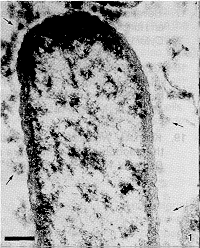
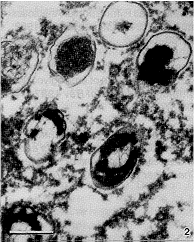
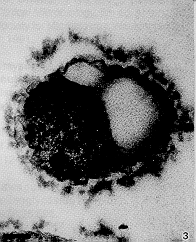
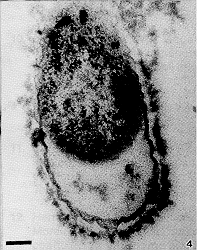
<body><![CDATA[<P><FONT FACE="Arial,Helvetica"><FONT SIZE=-1>Se inocularon 100 &micro;l de una suspensi&oacute;n (<I>ca. </I>3 x 108 UFC/mL) de <I>Pseudomonas</I> <I>aeruginosa </I>(cepa ATCC 27853) en placas de M&uuml;eller Hinton con 32, 16, 8, 4, 2 y 1 &micro;g/mL de sulfato de amikacina (Amikin<SUP>&reg;</SUP> , Bristol) y en placas sin el antibi&oacute;tico. Las colonias obtenidas en los platos se colectaron y fijaron durante 20 minutos a temperatura ambiente con una mezcla de glutaraldehido al 2,5%, rojo de rutenio al 0,075% y lisina 50 mM en amortiguador de cacodilato al 0.1 M (pH =7.0). Luego se fijaron nuevamente durante 100 minutos con una soluci&oacute;n de glutaraldehido, rojo de rutenio y cacodilato<SUP>(<A HREF="#11.">11</A>)</SUP>. La suspensi&oacute;n de bacterias fijadas se incluy&oacute; en un co&aacute;gulo de plasma<SUP>(<A HREF="#12.">12</A>)</SUP>, se seccion&oacute; en cubos de <I>ca</I>. 1 mm<SUP>3</SUP> y se fijaron nuevamente con glutaraldehido al 2,5% durante 30 minutos, se lavaron con el amortiguador de cacodilato, se fijaron en tetra&oacute;xido de osmio, se deshidrataron en una gradiente de etanol (30 a 100%) y se incluyeron en resina Spurr de baja viscosidad para obtener secciones finas (<I>ca</I>. 90 nm de grosor), que se ti&ntilde;eron con acetato de uranilo y citrato de plomo y se analizaron en microscopio electr&oacute;nico de transmisi&oacute;n.</FONT></FONT>     <BR>&nbsp;      <P><B><FONT FACE="Arial,Helvetica"><FONT SIZE=-1>Resultados</FONT></FONT></B>      <P><FONT FACE="Arial,Helvetica"><FONT SIZE=-1>En las muestras control no tratadas con amikacina se aprecia el aspecto normal del citoplasma, la pared bacteriana, incluyendo una buena definici&oacute;n de la membrana externa y de los componentes del glicocalix, que aparece como un material amorfo y electr&oacute;n denso dispuesto alrededor de las c&eacute;lulas (<A HREF="#Figura1">Figura 1</A>).</FONT></FONT>      <P><FONT FACE="Arial,Helvetica"><FONT SIZE=-1>Solo se obtuvieron colonias en las placas con la menor concentraci&oacute;n del antibi&oacute;tico y mostraron alteraciones citoplasm&aacute;ticas, como la presencia de zonas electrol&uacute;cidas, centrales o perif&eacute;ricas; en todo caso no se vislumbra una membrana alrededor de esas zonas claras, por lo que se trata de espacios de plam&oacute;lisis (Figuras <A HREF="#Figura2">2</A> y <A HREF="#Figura4">4</A>).&nbsp; Algunas c&eacute;lulas pierden pr&aacute;cticamente todo el citoplasma y en aquellas que a&uacute;n conservan parte de &eacute;ste, aparece m&aacute;s denso a los electrones que el citoplasma de los controles sin antibi&oacute;tico (Figuras <A HREF="#Figura2">2</A> y <A HREF="#Figura3">3</A>).&nbsp; Adem&aacute;s, la pared celular aparece con ondulaciones m&aacute;s pronunciadas que las observadas en las muestras control (Figuras <A HREF="#Figura3">3</A> y <A HREF="#Figura4">4</A>) y la membrana externa se hace m&aacute;s evidente, lo cual podr&iacute;a ser debido a separaci&oacute;n de los elementos que forman la pared bacteriana.</FONT></FONT>     <BR>&nbsp;      <P><B><FONT FACE="Arial,Helvetica"><FONT SIZE=-1>Discusi&oacute;n</FONT></FONT></B>      <P><FONT FACE="Arial,Helvetica"><FONT SIZE=-1>Tradicionalmente se ha considerado a la amikacina como un antibi&oacute;tico que inhibe la s&iacute;ntesis de prote&iacute;nas al unirse a la subunidad 30 S del ribosoma bacteriano y producir una lectura err&oacute;nea en el RNAm<SUP>(<A HREF="#14.">14</A>)</SUP>. Sin embargo, este antibi&oacute;tico interacciona con los sitios de uni&oacute;n de cationes divalentes en los lipopolisac&aacute;ridos de <I>Pseudomonas aeruginosa </I>y permeabiliza la membrana externa de este&nbsp; microorganismo, lo que facilita la entrada del antibi&oacute;tico<SUP>(<A HREF="#7.">7</A>, <A HREF="#8.">8</A>, <A HREF="#14.">14</A>)</SUP>.&nbsp; Es muy posible que al igual que la gentamicina, la amikacina, desplace cationes esenciales dentro de la membrana externa, lo que producir&iacute;a desestabilidad que podr&iacute;a llevar tambi&eacute;n a la extracci&oacute;n de constituyentes org&aacute;nicos<SUP>(<A HREF="#16.">16</A>, <A HREF="#17.">17</A>)</SUP>. Los mecanismos de interacci&oacute;n entre el antibi&oacute;tico y los componentes de la membrana externa que promueven su internalizaci&oacute;n, inducen la desestabilizaci&oacute;n de esa membrana, haciendo a la c&eacute;lula m&aacute;s susceptible a los cambios hipert&oacute;nicos del medio extracelular. Esto explica la acci&oacute;n bactericida de este antibi&oacute;tico y se refleja en alteraciones ultraestructurales como las zonas transparentes a los electrones en el citoplasma, lo que puede deberse a espacios de plasm&oacute;lisis y a condensaci&oacute;n del citoplasma. Esto parece ocurrir en algunos casos, dado el aumento en la electrodensidad observado (Figuras <A HREF="#Figura2">2</A> y <A HREF="#Figura4">4</A>). En otros casos, las bacterias no parecen mostrar alteraciones citoplasm&aacute;ticas, pero la pared presenta ondulaciones m&aacute;s acentuadas que las observadas en las muestras control; tambi&eacute;n se observa una aparente separaci&oacute;n de las capas de la cubierta bacteriana (Figuras <A HREF="#Figura3">3</A> y <A HREF="#Figura4">4</A>). Este fen&oacute;meno podr&iacute;a deberse a la retracci&oacute;n del citoplasma con la consiguiente formaci&oacute;n de pliegues de su pared, en la cual tanto la membrana externa como el s&aacute;culo de mureina y la membrana citoplasm&aacute;tica se estar&iacute;an arrugando como respuesta a la retracci&oacute;n del citoplasma, lo cual se ha demostrado en <I>Escherichia coli</I> que sometida a choque osm&oacute;tico<SUP>(<A HREF="#18.">18</A>)</SUP>, que por la elasticidad de su mureina, es capaz de expanderse o contraerse hasta cuatro veces su &aacute;rea<A HREF="#19.">(19)</A>. Por lo tanto, la contracci&oacute;n del citoplasma tambi&eacute;n inducir&iacute;a la contracci&oacute;n de la mureina, lo que har&iacute;a que el perplasma se expandiera y la membrana externa se corrugara, como se observa en las Figuras <A HREF="#Figura3">3</A> y <A HREF="#Figura4">4</A>, en las que se hacen evidentes los distintos componentes de la envoltura bacteriana. Otra posibilidad que explicar&iacute;a tales alteraciones y que tambi&eacute;n ha sido descrita, es la acci&oacute;n de la droga sobre la s&iacute;ntesis de lipoprote&iacute;nas<A HREF="#17.">(17)</A>.</FONT></FONT>      <P><FONT FACE="Arial,Helvetica"><FONT SIZE=-1>En conclusi&oacute;n el tratamiento <I>in vitro</I> de <I>Pseudomonas aeruginosa</I>&nbsp; con dosis subletales de sulfato de amikacina induce alteraciones ultraestructurales tanto en la pared bacteriana como en el citoplasma, cambios que llevar&iacute;an a la muerte de la bacteria.</FONT></FONT>     <BR>&nbsp;      ]]></body>
<body><![CDATA[<P><B><FONT FACE="Arial,Helvetica"><FONT SIZE=-1>Agradecimientos</FONT></FONT></B>      <P><FONT FACE="Arial,Helvetica"><FONT SIZE=-1>Al&nbsp; personal de&nbsp; la Unidad de Microscop&iacute;a Electr&oacute;nica de la Universidad de Costa Rica y a Patricia Rivera del Laboratorio de Microbiolog&iacute;a, Servicio de Patolog&iacute;a del Hospital Nacional de Ni&ntilde;os y al Dr. Gerardo Mora, del Centro de Investigaci&oacute;n en Productos Naturales, de la Universidad de Costa Rica por su colaboraci&oacute;n. A la Agencia de Cooperaci&oacute;n Internacional del Jap&oacute;n (JICA) y la Vicerrector&iacute;a de Investigaci&oacute;n de la Universidad de Costa Rica, por su apoyo y financiamiento.</FONT></FONT>     <BR><FONT SIZE=-1>&nbsp;</FONT>     <BR><B><FONT FACE="Arial,Helvetica"><FONT SIZE=-1>&nbsp;</FONT></FONT></B>     <BR><B><FONT FACE="Arial,Helvetica"><FONT SIZE=-1>Abstract</FONT></FONT></B>      <P><FONT FACE="Arial,Helvetica"><FONT SIZE=-1>The aminoglycosides were introduced with streptomycin en 1944, today this group of antibiotics includes natural and semisynthetic drugs, such as amikacin sulfate, used for treating <I>Pseudomonas aeruginosa</I> infections. The best known action of this antibiotic is the inhibition of bacterial protein synthesis; nevertheless, its bactericidal activity is associated with its interactions and destabilization of the outer membrane.</FONT></FONT>      <P><FONT FACE="Arial,Helvetica"><FONT SIZE=-1><I>Pseudomonas aeruginosa</I> (strain ATCC 27853) was treated <I>in vitro</I> with amikacin and as control, the strain was inoculated in culture media without antibiotic. The bacteria were harvested and suspended in cacodilate buffer and fixed with a mixture of 2.5% glutaraldehide, 0.075% ruthenium red, and 50mM lysine, and processed for electron microscopy.</FONT></FONT>      <P><FONT FACE="Arial,Helvetica"><FONT SIZE=-1>The bacteria treated with the antibiotic showed a wavier outer membrane than the controls and the cell wall of the bacteria exposed to the antibiotic was altered; also, their cytoplasm showed clear zones, like vacuoles, but without membranes and the remaining cytoplasm was more electrondense than the cytoplasm of the untreated control cells.</FONT></FONT>      <P><B><FONT FACE="Arial,Helvetica"><FONT SIZE=-1>Key words</FONT></FONT></B>      <P><FONT FACE="Arial,Helvetica"><FONT SIZE=-1>Ultrastructure, <I>Pseudomonas aeruginosa</I>, amikacin, cell wall.</FONT></FONT>     ]]></body>
<body><![CDATA[<BR>&nbsp;      <P><B><FONT FACE="Arial,Helvetica"><FONT SIZE=-1>Referencias</FONT></FONT></B>      <!-- ref --><P><A NAME="1."></A><FONT SIZE=-1><FONT FACE="Arial,Helvetica">1.&nbsp; Yao JDC, Moellering RC. Antibacterial Agents, p. 1065-1098. <I>IN</I>: A Balows, Hausler WJ, Herrmann KL,</FONT> <FONT FACE="Arial,Helvetica">Isenberg HD, Shadomy HJ. (ed). <I>Manual of Clinical Microbiology</I>, 5th ed. American Society for</FONT> <FONT FACE="Arial,Helvetica">Microbiology, Washington D.C. 1991.</FONT></FONT>    &nbsp;&nbsp;&nbsp;&nbsp;&nbsp;&nbsp;&nbsp;&nbsp;[&#160;<a href="javascript:void(0);" onclick="javascript: window.open('/scielo.php?script=sci_nlinks&ref=770963&pid=S0253-2948199700040000500001&lng=','','width=640,height=500,resizable=yes,scrollbars=1,menubar=yes,');">Links</a>&#160;]<!-- end-ref --><!-- ref --><P><A NAME="2."></A><FONT SIZE=-1><FONT FACE="Arial,Helvetica">2.&nbsp; Grayson, M. Antibiotics, chemotherapeutics and antibacteria agents for disease control. John Wiley &amp;</FONT> <FONT FACE="Arial,Helvetica">Sons. Nueva York. 1982, 32-71 p.</FONT></FONT>    &nbsp;&nbsp;&nbsp;&nbsp;&nbsp;&nbsp;&nbsp;&nbsp;[&#160;<a href="javascript:void(0);" onclick="javascript: window.open('/scielo.php?script=sci_nlinks&ref=770964&pid=S0253-2948199700040000500002&lng=','','width=640,height=500,resizable=yes,scrollbars=1,menubar=yes,');">Links</a>&#160;]<!-- end-ref --><!-- ref --><P><A NAME="3."></A><FONT FACE="Arial,Helvetica"><FONT SIZE=-1>3.&nbsp; Ristuccia, AM, Cunha BA. An overview of amikacin. Ther Drug Monit 1995; 7:12-25.</FONT></FONT>    &nbsp;&nbsp;&nbsp;&nbsp;&nbsp;&nbsp;&nbsp;&nbsp;[&#160;<a href="javascript:void(0);" onclick="javascript: window.open('/scielo.php?script=sci_nlinks&ref=770965&pid=S0253-2948199700040000500003&lng=','','width=640,height=500,resizable=yes,scrollbars=1,menubar=yes,');">Links</a>&#160;]<!-- end-ref --><!-- ref --><P><A NAME="4."></A><FONT FACE="Arial,Helvetica"><FONT SIZE=-1>4.&nbsp; kawaguchi H. A new semisinthetic aminoglycoside antibiotic. <I>J Antibiot</I> 1972;25:695.</FONT></FONT>    &nbsp;&nbsp;&nbsp;&nbsp;&nbsp;&nbsp;&nbsp;&nbsp;[&#160;<a href="javascript:void(0);" onclick="javascript: window.open('/scielo.php?script=sci_nlinks&ref=770966&pid=S0253-2948199700040000500004&lng=','','width=640,height=500,resizable=yes,scrollbars=1,menubar=yes,');">Links</a>&#160;]<!-- end-ref --><!-- ref --><P><A NAME="5."></A><FONT FACE="Arial,Helvetica"><FONT SIZE=-1>5.&nbsp; Barriere SL. Aminoglycosides: A reassessment of their therapeutic role. <I>Clin Pharm</I> 1988;7:385-90.</FONT></FONT>    &nbsp;&nbsp;&nbsp;&nbsp;&nbsp;&nbsp;&nbsp;&nbsp;[&#160;<a href="javascript:void(0);" onclick="javascript: window.open('/scielo.php?script=sci_nlinks&ref=770967&pid=S0253-2948199700040000500005&lng=','','width=640,height=500,resizable=yes,scrollbars=1,menubar=yes,');">Links</a>&#160;]<!-- end-ref --><BR><FONT SIZE=-1>&nbsp;</FONT>     <!-- ref --><BR><A NAME="6."></A><FONT SIZE=-1><FONT FACE="Arial,Helvetica">6.&nbsp; Lamp KC, Rybak MJ, McGrath BJ, Summers KK.&nbsp; Influence of antibiotic and E5 monoclonal</FONT> <FONT FACE="Arial,Helvetica">immunoglobulin M interactiosn on endotoxin release from <I>Escherichia coli</I> and <I>Pseudomona aeruginosa</I>.</FONT> <FONT FACE="Arial,Helvetica"><I>Antimicrob Agents Chemother</I> 1996;402:247-52.&nbsp;&nbsp;</FONT></FONT>    &nbsp;&nbsp;&nbsp;&nbsp;&nbsp;&nbsp;&nbsp;&nbsp;[&#160;<a href="javascript:void(0);" onclick="javascript: window.open('/scielo.php?script=sci_nlinks&ref=770969&pid=S0253-2948199700040000500006&lng=','','width=640,height=500,resizable=yes,scrollbars=1,menubar=yes,');">Links</a>&#160;]<!-- end-ref --><!-- ref --><P><A NAME="7."></A><FONT SIZE=-1><FONT FACE="Arial,Helvetica">7.&nbsp; Hancock REW, Won PGW. Compounds which increase the permeability of the <I>Pseudomonas</I></FONT> <FONT FACE="Arial,Helvetica"><I>aeruginosa</I> outer membrane. <I>Antimicrob Agents Chemother</I> 1984;26:48-52.&nbsp;&nbsp;</FONT></FONT>    &nbsp;&nbsp;&nbsp;&nbsp;&nbsp;&nbsp;&nbsp;&nbsp;[&#160;<a href="javascript:void(0);" onclick="javascript: window.open('/scielo.php?script=sci_nlinks&ref=770970&pid=S0253-2948199700040000500007&lng=','','width=640,height=500,resizable=yes,scrollbars=1,menubar=yes,');">Links</a>&#160;]<!-- end-ref --><!-- ref --><P><A NAME="8."></A><FONT SIZE=-1><FONT FACE="Arial,Helvetica">8.&nbsp;&nbsp;&nbsp; Hancock REW, Raffle VJ, Nicas TI. Involvement of the outer membrane in gentamicin and streptomycin</FONT> <FONT FACE="Arial,Helvetica">uptake and killing in <I>Pseudomonas aeruginosa</I>. <I>Antimicrob Agents Chemother</I> 1981;19:777-85.</FONT></FONT>    &nbsp;&nbsp;&nbsp;&nbsp;&nbsp;&nbsp;&nbsp;&nbsp;[&#160;<a href="javascript:void(0);" onclick="javascript: window.open('/scielo.php?script=sci_nlinks&ref=770971&pid=S0253-2948199700040000500008&lng=','','width=640,height=500,resizable=yes,scrollbars=1,menubar=yes,');">Links</a>&#160;]<!-- end-ref --><!-- ref --><P><A NAME="9."></A><FONT SIZE=-1><FONT FACE="Arial,Helvetica">9.&nbsp; Xiong Y, Caillon Q, Drugeon J, Potel KM, Baron D. Influence of pH on adaptative resistence of</FONT> <FONT FACE="Arial,Helvetica"><I>Pseudomona aeruginosa</I> to aminoglycosides and their postantibiotic effects. <I>Antimicrob Agents</I></FONT> <FONT FACE="Arial,Helvetica"><I>Chemother</I> 1996; 40:35-39.</FONT></FONT>    &nbsp;&nbsp;&nbsp;&nbsp;&nbsp;&nbsp;&nbsp;&nbsp;[&#160;<a href="javascript:void(0);" onclick="javascript: window.open('/scielo.php?script=sci_nlinks&ref=770972&pid=S0253-2948199700040000500009&lng=','','width=640,height=500,resizable=yes,scrollbars=1,menubar=yes,');">Links</a>&#160;]<!-- end-ref --><!-- ref --><P><A NAME="10."></A><FONT SIZE=-1><FONT FACE="Arial,Helvetica">10. Rahtmati-bahram A, Magee JT, Jackson SK. Growth temeperature-dependent variation of cell envelope</FONT> <FONT FACE="Arial,Helvetica">lipids and antibiotic susceptibility in <I>Stenotrophomonas</I> (<I>Xanthomonas</I>) <I>maltophila. J Antimicrobial</I></FONT> <FONT FACE="Arial,Helvetica"><I>Chemother</I> 1995; 36:317-26.</FONT></FONT>    &nbsp;&nbsp;&nbsp;&nbsp;&nbsp;&nbsp;&nbsp;&nbsp;[&#160;<a href="javascript:void(0);" onclick="javascript: window.open('/scielo.php?script=sci_nlinks&ref=770973&pid=S0253-2948199700040000500010&lng=','','width=640,height=500,resizable=yes,scrollbars=1,menubar=yes,');">Links</a>&#160;]<!-- end-ref --><!-- ref --><P><A NAME="11."></A><FONT SIZE=-1><FONT FACE="Arial,Helvetica">11. Jacqes M, Graham L. Improved preservation of bacterial capsule for electron microscopy . <I>J Electron</I></FONT> <FONT FACE="Arial,Helvetica"><I>Microsc Tech</I> 1989; 11:167-9.</FONT></FONT>    &nbsp;&nbsp;&nbsp;&nbsp;&nbsp;&nbsp;&nbsp;&nbsp;[&#160;<a href="javascript:void(0);" onclick="javascript: window.open('/scielo.php?script=sci_nlinks&ref=770974&pid=S0253-2948199700040000500011&lng=','','width=640,height=500,resizable=yes,scrollbars=1,menubar=yes,');">Links</a>&#160;]<!-- end-ref --><!-- ref --><P><A NAME="12."></A><FONT SIZE=-1><FONT FACE="Arial,Helvetica">12. Hern&aacute;ndez F.,Coto E, Colmenares A, Moreira L. Aplicaci&oacute;n del m&eacute;todo de coagulaci&oacute;n de plasma al</FONT> <FONT FACE="Arial,Helvetica">estudio ultraestructural de espec&iacute;menes biol&oacute;gicos. <I>Rev Biol Trop</I> 1991;39:177-80.</FONT></FONT>    &nbsp;&nbsp;&nbsp;&nbsp;&nbsp;&nbsp;&nbsp;&nbsp;[&#160;<a href="javascript:void(0);" onclick="javascript: window.open('/scielo.php?script=sci_nlinks&ref=770975&pid=S0253-2948199700040000500012&lng=','','width=640,height=500,resizable=yes,scrollbars=1,menubar=yes,');">Links</a>&#160;]<!-- end-ref --><P><A NAME="13."></A><FONT SIZE=-1><FONT FACE="Arial,Helvetica">13. Hoffmann HP, Geftic SG, Gelzer J, Heymann H, Adair FW. Ultrastructural alterations associated with the</FONT> <FONT FACE="Arial,Helvetica">growth of resistant <I>Pseudomonas aeruginosa</I> in the presence of benzalkonium chloride. <I>J Bacteriol</I> 1973;</FONT></FONT>     <BR><FONT FACE="Arial,Helvetica"><FONT SIZE=-1>&nbsp;&nbsp;&nbsp;&nbsp;&nbsp; 113:409-16.</FONT></FONT>      <!-- ref --><P><A NAME="14."></A><FONT FACE="Arial,Helvetica"><FONT SIZE=-1>14. Chopra I, Ball P. Transport of Antibiotics into bacteria. <I>Adv Microb Physiol</I> 1982; 23:183-99.</FONT></FONT>    &nbsp;&nbsp;&nbsp;&nbsp;&nbsp;&nbsp;&nbsp;&nbsp;[&#160;<a href="javascript:void(0);" onclick="javascript: window.open('/scielo.php?script=sci_nlinks&ref=770978&pid=S0253-2948199700040000500014&lng=','','width=640,height=500,resizable=yes,scrollbars=1,menubar=yes,');">Links</a>&#160;]<!-- end-ref --><!-- ref --><P><A NAME="15."></A><FONT SIZE=-1><FONT FACE="Arial,Helvetica">15. Taber HW, Mueller PJ, Miller PF, Arrow AS. Bacterial uptake of aminoglycoside antibiotics. <I>Microbiol</I></FONT> <FONT FACE="Arial,Helvetica"><I>Rev</I> 1987; 51:439-57.</FONT></FONT>    &nbsp;&nbsp;&nbsp;&nbsp;&nbsp;&nbsp;&nbsp;&nbsp;[&#160;<a href="javascript:void(0);" onclick="javascript: window.open('/scielo.php?script=sci_nlinks&ref=770979&pid=S0253-2948199700040000500015&lng=','','width=640,height=500,resizable=yes,scrollbars=1,menubar=yes,');">Links</a>&#160;]<!-- end-ref --><!-- ref --><P><A NAME="16."></A><FONT SIZE=-1><FONT FACE="Arial,Helvetica">16. Martin NL, Beveridge TJ. Gentamicin interaction with <I>Pseudomonas aeruginosa</I> cell envelope.</FONT> <FONT FACE="Arial,Helvetica"><I>Antimicrob Agents Chemother</I> 1986; 29:1079-87.</FONT></FONT>    &nbsp;&nbsp;&nbsp;&nbsp;&nbsp;&nbsp;&nbsp;&nbsp;[&#160;<a href="javascript:void(0);" onclick="javascript: window.open('/scielo.php?script=sci_nlinks&ref=770980&pid=S0253-2948199700040000500016&lng=','','width=640,height=500,resizable=yes,scrollbars=1,menubar=yes,');">Links</a>&#160;]<!-- end-ref --><!-- ref --><P><A NAME="17."></A><FONT SIZE=-1><FONT FACE="Arial,Helvetica">17. Beveridge TJ. Ultrastructure, chemistry and function of the bacterial wall. <I>Int Rev Cytol</I></FONT> <FONT FACE="Arial,Helvetica">1981;72:229-17.</FONT></FONT>    &nbsp;&nbsp;&nbsp;&nbsp;&nbsp;&nbsp;&nbsp;&nbsp;[&#160;<a href="javascript:void(0);" onclick="javascript: window.open('/scielo.php?script=sci_nlinks&ref=770981&pid=S0253-2948199700040000500017&lng=','','width=640,height=500,resizable=yes,scrollbars=1,menubar=yes,');">Links</a>&#160;]<!-- end-ref --><!-- ref --><P><A NAME="18."></A><FONT SIZE=-1><FONT FACE="Arial,Helvetica">18. Koch A, Schwarz H. Phase and electron microscopic observations of plasmolysis of the Gram-negative</FONT> <FONT FACE="Arial,Helvetica">cell wall. <I>Microbiology</I> 1995; 141:3161-70.</FONT></FONT>    &nbsp;&nbsp;&nbsp;&nbsp;&nbsp;&nbsp;&nbsp;&nbsp;[&#160;<a href="javascript:void(0);" onclick="javascript: window.open('/scielo.php?script=sci_nlinks&ref=770982&pid=S0253-2948199700040000500018&lng=','','width=640,height=500,resizable=yes,scrollbars=1,menubar=yes,');">Links</a>&#160;]<!-- end-ref --><!-- ref --><P><A NAME="19."></A><FONT SIZE=-1><FONT FACE="Arial,Helvetica">19. Koch A L, Woeste SW. The elasticity of the sacculus of <I>Escherichia coli. J Bacteriol</I>. 1992;</FONT> <FONT FACE="Arial,Helvetica">174:4811-19.</FONT></FONT>    &nbsp;&nbsp;&nbsp;&nbsp;&nbsp;&nbsp;&nbsp;&nbsp;[&#160;<a href="javascript:void(0);" onclick="javascript: window.open('/scielo.php?script=sci_nlinks&ref=770983&pid=S0253-2948199700040000500019&lng=','','width=640,height=500,resizable=yes,scrollbars=1,menubar=yes,');">Links</a>&#160;]<!-- end-ref --><BR><FONT SIZE=-1>&nbsp;</FONT>      <P><A NAME="1A."></A><FONT SIZE=-1><FONT FACE="Arial,Helvetica"><A HREF="#1a">1</A>.&nbsp; Centro de Informaci&oacute;n de Medicamentos (CIMED) Facultad de Farmacia, Universidad de Costa Rica,</FONT> <FONT FACE="Arial,Helvetica">San Jos&eacute;, Costa Rica.</FONT></FONT>     <BR>&nbsp;     <BR><A NAME="2A."></A><FONT SIZE=-1><FONT FACE="Arial,Helvetica"><A HREF="#1a">2</A>.&nbsp; Facultad de Microbiolog&iacute;a, Unidad de Microscopia Electr&oacute;nica y Centro de Investigaci&oacute;n en</FONT> <FONT FACE="Arial,Helvetica">Enfermedades Tropicales, Universidad de Costa Rica, San Jos&eacute;, Costa Rica.</FONT></FONT>     <BR><FONT SIZE=-1>&nbsp;</FONT>     <BR><A NAME="*"></A><FONT FACE="Arial,Helvetica"><FONT SIZE=-1><A HREF="#*a">*</A>&nbsp;&nbsp; Trabajo presentado en el XVI Congreso Panamericano de Farmacia.</FONT></FONT>     <BR><FONT SIZE=-1>&nbsp;</FONT>     ]]></body>
<body><![CDATA[<BR><A NAME="**"></A><FONT FACE="Arial,Helvetica"><FONT SIZE=-1><A HREF="#1a">**</A>&nbsp; Correspondencia.</FONT></FONT>     <BR><FONT SIZE=-1>&nbsp;</FONT>     <BR><FONT SIZE=-1>&nbsp;</FONT>     <CENTER><FONT SIZE=-1>&nbsp;</FONT></CENTER>      <CENTER><FONT SIZE=-1>&nbsp;</FONT></CENTER>      <CENTER><TABLE BORDER=0 CELLSPACING=0 CELLPADDING=0 COLS=2 WIDTH="51%" > <TR> <TD><A NAME="Figura1"></A><IMG SRC="/img/fbpe/rccm/v18n4/0032i01.GIF" HEIGHT=298 WIDTH=230></TD>  <TD><A NAME="Figura2"></A><IMG SRC="/img/fbpe/rccm/v18n4/0032i02.GIF" HEIGHT=298 WIDTH=218></TD> </TR>  <TR> <TD><IMG SRC="/img/fbpe/rccm/v18n4/0032i03.GIF" HEIGHT=278 WIDTH=230><FONT SIZE=-1>&nbsp;</FONT>&nbsp;     
<BR><A NAME="Figura3"></A></TD>  <TD><IMG SRC="/img/fbpe/rccm/v18n4/0032i04.GIF" HEIGHT=278 WIDTH=221><FONT SIZE=-1>&nbsp;</FONT>&nbsp;     
<BR><A NAME="Figura4"></A></TD> </TR> </TABLE></CENTER>      <CENTER><FONT SIZE=-1>&nbsp;</FONT></CENTER> <FONT SIZE=-1>&nbsp;<I><FONT FACE="Arial,Helvetica">&nbsp;&nbsp;&nbsp; <A HREF="#Figura1">Figura 1</A>. Electromicrograf&iacute;as de transmisi&oacute;n. Corresponde al control no tratado con antibi&oacute;tico, se observa el glicocalix (flecha),</FONT></I></FONT>     <BR><I><FONT FACE="Arial,Helvetica"><FONT SIZE=-1>&nbsp;&nbsp;&nbsp; la membrana citoplasm&aacute;tica (MC), peptidoglicano (P) y membrana externa (ME). La barra equivale a 0.1&micro;m.</FONT></FONT></I>      ]]></body>
<body><![CDATA[<P><I><FONT FACE="Arial,Helvetica"><FONT SIZE=-1>&nbsp;&nbsp;&nbsp; <A HREF="#Figura2">Figura 2</A>. C&eacute;lulas tratadas con sulfato de amikacina. Esta muestra cortes transversales de las bacterias, que presentan zonas</FONT></FONT></I>     <BR><I><FONT FACE="Arial,Helvetica"><FONT SIZE=-1>&nbsp;&nbsp;&nbsp; electrol&uacute;cidas y restos de citoplasma electrodensos.</FONT></FONT></I>     <BR><I><FONT FACE="Arial,Helvetica"><FONT SIZE=-1>&nbsp;&nbsp;&nbsp; Barra = 0,25&micro;m.</FONT></FONT></I>      <P><I><FONT FACE="Arial,Helvetica"><FONT SIZE=-1>&nbsp;&nbsp; <A HREF="#Figura3">Figura 3</A>. Muestra detalles de la retracci&oacute;n citopl&aacute;smica y alteraciones en la pared celular, que muestra los componentes m&aacute;s</FONT></FONT></I>     <BR><I><FONT FACE="Arial,Helvetica"><FONT SIZE=-1>&nbsp;&nbsp;&nbsp; separados y aparece con ondulaciones fuertes.</FONT></FONT></I>     <BR><I><FONT FACE="Arial,Helvetica"><FONT SIZE=-1>&nbsp;&nbsp;&nbsp; Barra = 0,1 &micro;m.</FONT></FONT></I>      <P><I><FONT FACE="Arial,Helvetica"><FONT SIZE=-1>&nbsp;&nbsp;&nbsp; <A HREF="#Figura4">Figura 4</A>. Muestra detalles de la retracci&oacute;n citopl&aacute;smica y&nbsp; alteraciones en la pared celular, que muestra los componentes m&aacute;s</FONT></FONT></I>     <BR><I><FONT FACE="Arial,Helvetica"><FONT SIZE=-1>&nbsp;&nbsp;&nbsp; separados y aparece con ondulaciones fuertes.</FONT></FONT></I>     <BR><I><FONT FACE="Arial,Helvetica"><FONT SIZE=-1>&nbsp;&nbsp;&nbsp; Barra = 0,1 &micro;m.</FONT></FONT></I>      ]]></body><back>
<ref-list>
<ref id="B1">
<label>1</label><nlm-citation citation-type="book">
<person-group person-group-type="author">
<name>
<surname><![CDATA[Yao]]></surname>
<given-names><![CDATA[JDC]]></given-names>
</name>
<name>
<surname><![CDATA[Moellering]]></surname>
<given-names><![CDATA[RC.]]></given-names>
</name>
</person-group>
<article-title xml:lang="en"><![CDATA[Antibacterial Agents]]></article-title>
<person-group person-group-type="editor">
<name>
<surname><![CDATA[Balows]]></surname>
<given-names><![CDATA[A]]></given-names>
</name>
<name>
<surname><![CDATA[Hausler]]></surname>
<given-names><![CDATA[WJ]]></given-names>
</name>
<name>
<surname><![CDATA[Herrmann]]></surname>
<given-names><![CDATA[KL]]></given-names>
</name>
<name>
<surname><![CDATA[senberg]]></surname>
<given-names><![CDATA[HD]]></given-names>
</name>
<name>
<surname><![CDATA[Shadomy]]></surname>
<given-names><![CDATA[HJ.]]></given-names>
</name>
</person-group>
<source><![CDATA[Manual of Clinical Microbiology]]></source>
<year>1991</year>
<edition>5</edition>
<page-range>1065-1098</page-range><publisher-loc><![CDATA[^eWashington D.C. Washington D.C.]]></publisher-loc>
<publisher-name><![CDATA[American Society for Microbiology]]></publisher-name>
</nlm-citation>
</ref>
<ref id="B2">
<label>2</label><nlm-citation citation-type="book">
<person-group person-group-type="author">
<name>
<surname><![CDATA[Grayson]]></surname>
<given-names><![CDATA[M.]]></given-names>
</name>
</person-group>
<source><![CDATA[Antibiotics, chemotherapeutics and antibacteria agents for disease control]]></source>
<year>1982</year>
<page-range>32-71 p</page-range><publisher-loc><![CDATA[^eNueva York Nueva York]]></publisher-loc>
<publisher-name><![CDATA[John Wiley & Sons]]></publisher-name>
</nlm-citation>
</ref>
<ref id="B3">
<label>3</label><nlm-citation citation-type="journal">
<person-group person-group-type="author">
<name>
<surname><![CDATA[Ristuccia]]></surname>
<given-names><![CDATA[AM]]></given-names>
</name>
</person-group>
<article-title xml:lang="en"><![CDATA[Cunha BA: An overview of amikacin]]></article-title>
<source><![CDATA[Ther Drug Monit]]></source>
<year>1995</year>
<volume>7</volume>
<page-range>12-25</page-range></nlm-citation>
</ref>
<ref id="B4">
<label>4</label><nlm-citation citation-type="journal">
<person-group person-group-type="author">
<name>
<surname><![CDATA[kawaguchi]]></surname>
<given-names><![CDATA[H]]></given-names>
</name>
</person-group>
<article-title xml:lang="en"><![CDATA[A new semisinthetic aminoglycoside antibiotic]]></article-title>
<source><![CDATA[J Antibiot]]></source>
<year>1972</year>
<volume>25</volume>
</nlm-citation>
</ref>
<ref id="B5">
<label>5</label><nlm-citation citation-type="journal">
<person-group person-group-type="author">
<name>
<surname><![CDATA[Barriere]]></surname>
<given-names><![CDATA[SL.]]></given-names>
</name>
</person-group>
<article-title xml:lang="en"><![CDATA[Aminoglycosides: A reassessment of their therapeutic role]]></article-title>
<source><![CDATA[Clin Pharm]]></source>
<year>1988</year>
<volume>7</volume>
<page-range>385-90</page-range></nlm-citation>
</ref>
<ref id="B6">
<label>6</label><nlm-citation citation-type="journal">
<person-group person-group-type="author">
<name>
<surname><![CDATA[Lamp]]></surname>
<given-names><![CDATA[KC]]></given-names>
</name>
<name>
<surname><![CDATA[Rybak]]></surname>
<given-names><![CDATA[MJ]]></given-names>
</name>
<name>
<surname><![CDATA[McGrath]]></surname>
<given-names><![CDATA[BJ]]></given-names>
</name>
<name>
<surname><![CDATA[Summers]]></surname>
<given-names><![CDATA[KK.]]></given-names>
</name>
</person-group>
<article-title xml:lang="en"><![CDATA[Influence of antibiotic and E5 monoclonal immunoglobulin M interactiosn on endotoxin release from Escherichia coli and Pseudomona aeruginosa]]></article-title>
<source><![CDATA[Antimicrob Agents Chemother]]></source>
<year>1996</year>
<volume>402</volume>
<page-range>247-52</page-range></nlm-citation>
</ref>
<ref id="B7">
<label>7</label><nlm-citation citation-type="journal">
<person-group person-group-type="author">
<name>
<surname><![CDATA[Hancock]]></surname>
<given-names><![CDATA[REW]]></given-names>
</name>
<name>
<surname><![CDATA[Won]]></surname>
<given-names><![CDATA[PGW]]></given-names>
</name>
</person-group>
<article-title xml:lang="en"><![CDATA[Compounds which increase the permeability of the Pseudomonas aeruginosa outer membrane]]></article-title>
<source><![CDATA[Antimicrob Agents Chemother]]></source>
<year>1984</year>
<volume>26</volume>
<page-range>48-52</page-range></nlm-citation>
</ref>
<ref id="B8">
<label>8</label><nlm-citation citation-type="journal">
<person-group person-group-type="author">
<name>
<surname><![CDATA[Hancock]]></surname>
<given-names><![CDATA[REW]]></given-names>
</name>
<name>
<surname><![CDATA[Raffle]]></surname>
<given-names><![CDATA[VJ]]></given-names>
</name>
<name>
<surname><![CDATA[Nicas]]></surname>
<given-names><![CDATA[TI.]]></given-names>
</name>
</person-group>
<article-title xml:lang="en"><![CDATA[Involvement of the outer membrane in gentamicin and streptomycin uptake and killing in Pseudomonas aeruginosa]]></article-title>
<source><![CDATA[Antimicrob Agents Chemother]]></source>
<year>1981</year>
<volume>19</volume>
<page-range>777-85</page-range></nlm-citation>
</ref>
<ref id="B9">
<label>9</label><nlm-citation citation-type="journal">
<person-group person-group-type="author">
<name>
<surname><![CDATA[Xiong]]></surname>
<given-names><![CDATA[Y]]></given-names>
</name>
<name>
<surname><![CDATA[Caillon]]></surname>
<given-names><![CDATA[Q]]></given-names>
</name>
<name>
<surname><![CDATA[Drugeon]]></surname>
<given-names><![CDATA[J]]></given-names>
</name>
<name>
<surname><![CDATA[Potel]]></surname>
<given-names><![CDATA[KM]]></given-names>
</name>
<name>
<surname><![CDATA[Baron]]></surname>
<given-names><![CDATA[D]]></given-names>
</name>
</person-group>
<article-title xml:lang="en"><![CDATA[Influence of pH on adaptative resistence of Pseudomona aeruginosa to aminoglycosides and their postantibiotic effects]]></article-title>
<source><![CDATA[Antimicrob Agents Chemother]]></source>
<year>1996</year>
<volume>40</volume>
<page-range>35-39</page-range></nlm-citation>
</ref>
<ref id="B10">
<label>10</label><nlm-citation citation-type="journal">
<person-group person-group-type="author">
<name>
<surname><![CDATA[Rahtmati-bahram]]></surname>
<given-names><![CDATA[A]]></given-names>
</name>
<name>
<surname><![CDATA[Magee]]></surname>
<given-names><![CDATA[JT]]></given-names>
</name>
<name>
<surname><![CDATA[Jackson]]></surname>
<given-names><![CDATA[SK]]></given-names>
</name>
</person-group>
<article-title xml:lang="en"><![CDATA[Growth temeperature-dependent variation of cell envelope lipids and antibiotic susceptibility in Stenotrophomonas (Xanthomonas) maltophila]]></article-title>
<source><![CDATA[J Antimicrobial Chemother]]></source>
<year>1995</year>
<volume>36</volume>
<page-range>317-26</page-range></nlm-citation>
</ref>
<ref id="B11">
<label>11</label><nlm-citation citation-type="journal">
<person-group person-group-type="author">
<name>
<surname><![CDATA[Jacqes]]></surname>
<given-names><![CDATA[M]]></given-names>
</name>
<name>
<surname><![CDATA[Graham]]></surname>
<given-names><![CDATA[L.]]></given-names>
</name>
</person-group>
<article-title xml:lang="en"><![CDATA[Improved preservation of bacterial capsule for electron microscopy]]></article-title>
<source><![CDATA[J Electron Microsc Tech]]></source>
<year>1989</year>
<volume>11</volume>
<page-range>167-9</page-range></nlm-citation>
</ref>
<ref id="B12">
<label>12</label><nlm-citation citation-type="journal">
<person-group person-group-type="author">
<name>
<surname><![CDATA[Hernández]]></surname>
<given-names><![CDATA[F.]]></given-names>
</name>
<name>
<surname><![CDATA[Coto]]></surname>
<given-names><![CDATA[E]]></given-names>
</name>
<name>
<surname><![CDATA[Colmenares]]></surname>
<given-names><![CDATA[A]]></given-names>
</name>
<name>
<surname><![CDATA[Moreira]]></surname>
<given-names><![CDATA[L.]]></given-names>
</name>
</person-group>
<article-title xml:lang="es"><![CDATA[Aplicación del método de coagulación de plasma al estudio ultraestructural de especímenes biológicos]]></article-title>
<source><![CDATA[Rev Biol Trop]]></source>
<year>1991</year>
<volume>39</volume>
<page-range>177-80</page-range></nlm-citation>
</ref>
<ref id="B13">
<label>13</label><nlm-citation citation-type="journal">
<person-group person-group-type="author">
<name>
<surname><![CDATA[Hoffmann]]></surname>
<given-names><![CDATA[HP]]></given-names>
</name>
<name>
<surname><![CDATA[Geftic]]></surname>
<given-names><![CDATA[SG]]></given-names>
</name>
<name>
<surname><![CDATA[Gelzer]]></surname>
<given-names><![CDATA[J]]></given-names>
</name>
<name>
<surname><![CDATA[Heymann]]></surname>
<given-names><![CDATA[H]]></given-names>
</name>
<name>
<surname><![CDATA[Adair]]></surname>
<given-names><![CDATA[FW]]></given-names>
</name>
</person-group>
<article-title xml:lang="en"><![CDATA[Ultrastructural alterations associated with the growth of resistant Pseudomonas aeruginosa in the presence of benzalkonium chloride]]></article-title>
<source><![CDATA[J Bacteriol]]></source>
<year>1973</year>
<volume>113</volume>
<page-range>409-16</page-range></nlm-citation>
</ref>
<ref id="B14">
<label>14</label><nlm-citation citation-type="journal">
<person-group person-group-type="author">
<name>
<surname><![CDATA[Chopra]]></surname>
<given-names><![CDATA[I]]></given-names>
</name>
<name>
<surname><![CDATA[Ball]]></surname>
<given-names><![CDATA[P.]]></given-names>
</name>
</person-group>
<article-title xml:lang="en"><![CDATA[Transport of Antibiotics into bacteria]]></article-title>
<source><![CDATA[Adv Microb Physiol]]></source>
<year>1982</year>
<volume>23</volume>
<page-range>183-99</page-range></nlm-citation>
</ref>
<ref id="B15">
<label>15</label><nlm-citation citation-type="journal">
<person-group person-group-type="author">
<name>
<surname><![CDATA[Taber]]></surname>
<given-names><![CDATA[HW]]></given-names>
</name>
<name>
<surname><![CDATA[Mueller]]></surname>
<given-names><![CDATA[PJ]]></given-names>
</name>
<name>
<surname><![CDATA[Miller]]></surname>
<given-names><![CDATA[PF]]></given-names>
</name>
<name>
<surname><![CDATA[Arrow]]></surname>
<given-names><![CDATA[AS]]></given-names>
</name>
</person-group>
<article-title xml:lang="en"><![CDATA[Bacterial uptake of aminoglycoside antibiotics]]></article-title>
<source><![CDATA[Microbiol Rev]]></source>
<year>1987</year>
<volume>51</volume>
<page-range>439-57</page-range></nlm-citation>
</ref>
<ref id="B16">
<label>16</label><nlm-citation citation-type="journal">
<person-group person-group-type="author">
<name>
<surname><![CDATA[Martin]]></surname>
<given-names><![CDATA[NL]]></given-names>
</name>
<name>
<surname><![CDATA[Beveridge]]></surname>
<given-names><![CDATA[TJ.]]></given-names>
</name>
</person-group>
<article-title xml:lang="en"><![CDATA[Gentamicin interaction with Pseudomonas aeruginosa cell envelope]]></article-title>
<source><![CDATA[Antimicrob Agents Chemother]]></source>
<year>1986</year>
<volume>29</volume>
<page-range>1079-87</page-range></nlm-citation>
</ref>
<ref id="B17">
<label>17</label><nlm-citation citation-type="journal">
<person-group person-group-type="author">
<name>
<surname><![CDATA[Beveridge]]></surname>
<given-names><![CDATA[TJ]]></given-names>
</name>
</person-group>
<article-title xml:lang="en"><![CDATA[Ultrastructure, chemistry and function of the bacterial wall]]></article-title>
<source><![CDATA[Int Rev Cytol]]></source>
<year>1981</year>
<volume>72</volume>
<page-range>229-17</page-range></nlm-citation>
</ref>
<ref id="B18">
<label>18</label><nlm-citation citation-type="journal">
<person-group person-group-type="author">
<name>
<surname><![CDATA[Koch]]></surname>
<given-names><![CDATA[A]]></given-names>
</name>
<name>
<surname><![CDATA[Schwarz]]></surname>
<given-names><![CDATA[H]]></given-names>
</name>
</person-group>
<article-title xml:lang="en"><![CDATA[Phase and electron microscopic observations of plasmolysis of the Gram-negative cell wall]]></article-title>
<source><![CDATA[Microbiology]]></source>
<year>1995</year>
<volume>141</volume>
<page-range>3161-70</page-range></nlm-citation>
</ref>
<ref id="B19">
<label>19</label><nlm-citation citation-type="journal">
<person-group person-group-type="author">
<name>
<surname><![CDATA[Koch]]></surname>
<given-names><![CDATA[A L]]></given-names>
</name>
<name>
<surname><![CDATA[Woeste]]></surname>
<given-names><![CDATA[SW]]></given-names>
</name>
</person-group>
<article-title xml:lang="en"><![CDATA[The elasticity of the sacculus of Escherichia coli]]></article-title>
<source><![CDATA[J Bacteriol.]]></source>
<year>1992</year>
<volume>174</volume>
<page-range>4811-19</page-range></nlm-citation>
</ref>
</ref-list>
</back>
</article>
