<?xml version="1.0" encoding="ISO-8859-1"?><article xmlns:mml="http://www.w3.org/1998/Math/MathML" xmlns:xlink="http://www.w3.org/1999/xlink" xmlns:xsi="http://www.w3.org/2001/XMLSchema-instance">
<front>
<journal-meta>
<journal-id>0253-2948</journal-id>
<journal-title><![CDATA[Revista Costarricense de Ciencias Médicas]]></journal-title>
<abbrev-journal-title><![CDATA[Rev. costarric. cienc. méd]]></abbrev-journal-title>
<issn>0253-2948</issn>
<publisher>
<publisher-name><![CDATA[Editorial Nacional de Salud y Seguridad Social]]></publisher-name>
</publisher>
</journal-meta>
<article-meta>
<article-id>S0253-29481997000200007</article-id>
<title-group>
<article-title xml:lang="es"><![CDATA[Hendiduria esternal completa: informe de un caso]]></article-title>
</title-group>
<contrib-group>
<contrib contrib-type="author">
<name>
<surname><![CDATA[Salas S]]></surname>
<given-names><![CDATA[Donato A]]></given-names>
</name>
<xref ref-type="aff" rid="A01"/>
</contrib>
<contrib contrib-type="author">
<name>
<surname><![CDATA[Caro C]]></surname>
<given-names><![CDATA[Marco A]]></given-names>
</name>
<xref ref-type="aff" rid="A02"/>
</contrib>
</contrib-group>
<aff id="A01">
<institution><![CDATA[,Ambulancia de Aviones Sección Médica ]]></institution>
<addr-line><![CDATA[ ]]></addr-line>
</aff>
<aff id="A02">
<institution><![CDATA[,Hospital Nacional de Niños  ]]></institution>
<addr-line><![CDATA[ ]]></addr-line>
</aff>
<pub-date pub-type="pub">
<day>00</day>
<month>06</month>
<year>1997</year>
</pub-date>
<pub-date pub-type="epub">
<day>00</day>
<month>06</month>
<year>1997</year>
</pub-date>
<volume>18</volume>
<numero>2</numero>
<fpage>57</fpage>
<lpage>61</lpage>
<copyright-statement/>
<copyright-year/>
<self-uri xlink:href="http://www.scielo.sa.cr/scielo.php?script=sci_arttext&amp;pid=S0253-29481997000200007&amp;lng=en&amp;nrm=iso"></self-uri><self-uri xlink:href="http://www.scielo.sa.cr/scielo.php?script=sci_abstract&amp;pid=S0253-29481997000200007&amp;lng=en&amp;nrm=iso"></self-uri><self-uri xlink:href="http://www.scielo.sa.cr/scielo.php?script=sci_pdf&amp;pid=S0253-29481997000200007&amp;lng=en&amp;nrm=iso"></self-uri><abstract abstract-type="short" xml:lang="es"><p><![CDATA[Se presenta y comenta el caso de un paciente recién nacido con hendidura esternal completa que fue trasladado al Hospital Nacional de Niños "Carlos Saénz Herrera" para tratamiento quirúrgico del defecto. El paciente fue sometido a tres intervenciones quirúrgicas para la reparación definitiva de la hendidura. La hendidura esternal es un padecimiento de etiología desconocida, baja incidencia y que comúnmente se asocia a otros defectos de la línea media.]]></p></abstract>
<abstract abstract-type="short" xml:lang="en"><p><![CDATA[A case of complete sternal cleft in a newborn is presented. The child was transfered to the National Children's Hospital "Carlos Salazar Herrera" for the surgical correction of the defect. The patient was operated three times for the definitive repair therapy of the cleft sternum. The sternal cleft is of unkown aetiology, with low incidence and is commonly asociated with other middle line defects.]]></p></abstract>
<kwd-group>
<kwd lng="es"><![CDATA[Hendidura esternal]]></kwd>
<kwd lng="es"><![CDATA[reparación]]></kwd>
<kwd lng="es"><![CDATA[neonato]]></kwd>
<kwd lng="en"><![CDATA[Sternal cleft]]></kwd>
<kwd lng="en"><![CDATA[repair]]></kwd>
<kwd lng="en"><![CDATA[newborn]]></kwd>
</kwd-group>
</article-meta>
</front><body><![CDATA[ <CENTER><B><FONT FACE="Arial,Helvetica">Hendidura esternal completa</FONT></B></CENTER>      <CENTER><B><FONT FACE="Arial,Helvetica">informe de un caso</FONT></B></CENTER>      <CENTER><B><FONT FACE="Arial,Helvetica"><FONT SIZE=-1>&nbsp;</FONT></FONT></B></CENTER>      <CENTER><B><FONT FACE="Arial,Helvetica"><FONT SIZE=-1>&nbsp;</FONT></FONT></B></CENTER>      <CENTER><B><FONT FACE="Arial,Helvetica"><FONT SIZE=-1>Donato A. Salas S.&nbsp;<A NAME="1a"></A><SUP><A HREF="#autor1">1</A></SUP>, Marco A. Caro C.<SUP><A HREF="#autor2">2</A></SUP></FONT></FONT></B></CENTER> <FONT FACE="Arial,Helvetica"><FONT SIZE=-1><SUP>&nbsp;</SUP></FONT></FONT>     <BR><B><FONT FACE="Arial,Helvetica"><FONT SIZE=-1></FONT></FONT></B>&nbsp;<B><FONT FACE="Arial,Helvetica"><FONT SIZE=-1></FONT></FONT></B>      <P><B><FONT FACE="Arial,Helvetica"><FONT SIZE=-1>Resumen</FONT></FONT></B><FONT FACE="Arial,Helvetica"><FONT SIZE=-1></FONT></FONT>      <P><FONT FACE="Arial,Helvetica"><FONT SIZE=-1>Se presenta y comenta el caso de un paciente reci&eacute;n nacido con hendidura esternal completa que fue trasladado al Hospital Nacional de Ni&ntilde;os "Carlos Sa&eacute;nz Herrera" para tratamiento quir&uacute;rgico del defecto.</FONT></FONT><FONT FACE="Arial,Helvetica"><FONT SIZE=-1></FONT></FONT>      <P><FONT FACE="Arial,Helvetica"><FONT SIZE=-1>El paciente fue sometido a tres intervenciones quir&uacute;rgicas para la reparaci&oacute;n definitiva de la hendidura.</FONT></FONT><FONT FACE="Arial,Helvetica"><FONT SIZE=-1></FONT></FONT>      <P><FONT FACE="Arial,Helvetica"><FONT SIZE=-1>La hendidura esternal es un padecimiento de etiolog&iacute;a desconocida, baja incidencia y que com&uacute;nmente se asocia a otros defectos de la l&iacute;nea media.</FONT></FONT><FONT FACE="Arial,Helvetica"><FONT SIZE=-1></FONT></FONT>      ]]></body>
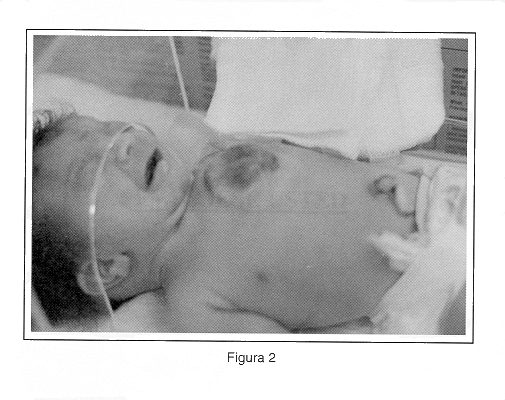
<body><![CDATA[<P><B><FONT FACE="Arial,Helvetica"><FONT SIZE=-1>Palabras Clave</FONT></FONT></B><FONT FACE="Arial,Helvetica"><FONT SIZE=-1></FONT></FONT>      <P><FONT FACE="Arial,Helvetica"><FONT SIZE=-1>Hendidura esternal, reparaci&oacute;n, neonato</FONT></FONT><FONT FACE="Arial,Helvetica"><FONT SIZE=-1></FONT></FONT>      <P><FONT FACE="Arial,Helvetica"><FONT SIZE=-1>&nbsp;</FONT></FONT>     <BR><B><FONT FACE="Arial,Helvetica"><FONT SIZE=-1>Introducci&oacute;n</FONT></FONT></B>     <CENTER><B><FONT FACE="Arial,Helvetica"><FONT SIZE=-1>&nbsp;</FONT></FONT></B></CENTER> <FONT FACE="Arial,Helvetica"><FONT SIZE=-1>La hendidura esternal constituye un trastorno poco frecuente, pertenece al grupo de defectos de fusi&oacute;n de la l&iacute;nea media corporal y que usualmente involucran diafragma, coraz&oacute;n, pericardio y las paredes abdominal y tor&aacute;cica. sin embargo la hendidura esternal como anomal&iacute;a aislada es extremadamente rara y de un excelente pron&oacute;stico.</FONT></FONT><FONT FACE="Arial,Helvetica"><FONT SIZE=-1></FONT></FONT>      <P><FONT FACE="Arial,Helvetica"><FONT SIZE=-1>La primera descripci&oacute;n cl&iacute;nica que se tiene de este padecimiento fue comunicada en Londres en 1740 en una memoria intitulada "Torres a la Soci&eacute;te Royale". La primera correcci&oacute;n quir&uacute;rgica fue realizada en 1888 por M. Lannelongue.</FONT></FONT><FONT FACE="Arial,Helvetica"><FONT SIZE=-1></FONT></FONT>      <P><FONT FACE="Arial,Helvetica"><FONT SIZE=-1>El presente art&iacute;culo tiene como base el caso de un paciente en edad neonatal que fue trasladado inmediatamente despu&eacute;s de su nacimiento, de un hospital rural, al Hospital Nacional de Ni&ntilde;os, presentaba una hendidura esternal completa, de la cual se han informado pocos casos en la literatura mundial (<A HREF="#1">1</A>).</FONT></FONT><FONT FACE="Arial,Helvetica"><FONT SIZE=-1></FONT></FONT>      <P><FONT FACE="Arial,Helvetica"><FONT SIZE=-1>&nbsp;</FONT></FONT>     <BR><B><FONT FACE="Arial,Helvetica"><FONT SIZE=-1>Informe del caso</FONT></FONT></B><FONT FACE="Arial,Helvetica"><FONT SIZE=-1></FONT></FONT>      <P><FONT FACE="Arial,Helvetica"><FONT SIZE=-1>Se trata de un reci&eacute;n nacido masculino de t&eacute;rmino (40 semanas) adecuado para edad gestacional, con peso al nacer de 3200 gramos, talla 52 cent&iacute;metros, Apgar de 8-9, nacido por parto vaginal inducto-conducido en el Hospital de Ciudad Neily, de madre conocida sana de 28 a&ntilde;os de edad, gesta dos, sin antecedentes personales o familiares de importancia ni historia de ingesta de medicamentos teratog&eacute;nos durante el embarazo. No hab&iacute;a sospecha cl&iacute;nica de la lesi&oacute;n antes del nacimiento. Al hacer el examen f&iacute;sico se encontr&oacute; un reci&eacute;n nacido de t&eacute;rmino; eupneico, sin cianosis, con un conspicuo defecto en la regi&oacute;n esternal que media aproximadamente 6 cm de di&aacute;metro y no estaba cubierto por piel, lo que permit&iacute;a una visi&oacute;n directa del pericardio y el latido card&iacute;aco, adem&aacute;s exist&iacute;a desplazamiento parad&oacute;jico del coraz&oacute;n con los movimientos respiratorios y se protru&iacute;a fuera de la cavidad tor&aacute;cica con el llanto. La parrilla costal y la pared anterior abdominal, al igual que la cabeza, el cuello y las cuatro extremidades no presentaban malformaciones (<A HREF="#figura1">Figura 1</A>).</FONT></FONT><FONT FACE="Arial,Helvetica"><FONT SIZE=-1></FONT></FONT>      ]]></body>
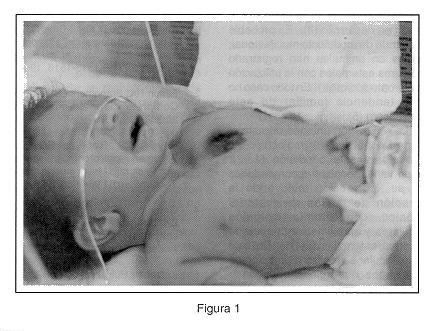
<body><![CDATA[<P><FONT FACE="Arial,Helvetica"><FONT SIZE=-1>El paciente fue colocado en halo de ox&iacute;geno, se le tom&oacute; v&iacute;a perif&eacute;rica y se traslad&oacute; inmediatamente por avi&oacute;n al Hospital Nacional de Ni&ntilde;os "Carlos Sa&eacute;nz Herrera".</FONT></FONT><FONT FACE="Arial,Helvetica"><FONT SIZE=-1></FONT></FONT>      <P><FONT FACE="Arial,Helvetica"><FONT SIZE=-1>A su ingreso en este centro fue sometido a un ecocardiograma el cual no mostr&oacute; patolog&iacute;a card&iacute;aca. Se llev&oacute; a sala de operaciones el mismo d&iacute;a. La exploraci&oacute;n operatoria revel&oacute; un coraz&oacute;n herniado y probables rebordes esternales. Se le realiz&oacute; plast&iacute;a de pericardio, reducci&oacute;n cardiaca con colocaci&oacute;n de un parche de PTFE (Gore-Tex) y la aproximaci&oacute;n y cierre parcial esternal (<A HREF="#figura2">Figura 2</A>).</FONT></FONT><FONT FACE="Arial,Helvetica"><FONT SIZE=-1></FONT></FONT>      <P><FONT FACE="Arial,Helvetica"><FONT SIZE=-1>Durante el per&iacute;odo transcurrido desde su nacimiento a esta primera cirug&iacute;a, su condici&oacute;n hemodin&aacute;mica fue estable y normal, tampoco se presentaron trastornos metab&oacute;licos o hidroelectrol&iacute;ticos de importancia cl&iacute;nica. Doce d&iacute;as despu&eacute;s el paciente es reintervenido para una nueva aproximaci&oacute;n de los bordes esternales y dos d&iacute;as m&aacute;s tarde se somete a una &uacute;ltima cirug&iacute;a para el cierre definitivo del defecto.</FONT></FONT><FONT FACE="Arial,Helvetica"><FONT SIZE=-1></FONT></FONT>      <P><FONT FACE="Arial,Helvetica"><FONT SIZE=-1>Al quinto d&iacute;a de estancia hospitalaria se le realizaron ultrasonogramas de ri&ntilde;on y cerebro catalogados como normales.</FONT></FONT><FONT FACE="Arial,Helvetica"><FONT SIZE=-1></FONT></FONT>      <P><FONT FACE="Arial,Helvetica"><FONT SIZE=-1>El paciente permaneci&oacute; internado un total de 23 d&iacute;as.</FONT></FONT><FONT FACE="Arial,Helvetica"><FONT SIZE=-1></FONT></FONT>      <P><FONT FACE="Arial,Helvetica"><FONT SIZE=-1>Dos semanas despu&eacute;s de reingresado al hospital por presentar infecci&oacute;n del sitio de la herida quir&uacute;rgica. Su peso y su talla al momento del ingreso eran de 4400 grs. y 57 cms. respectivamente. El cultivo de la secreci&oacute;n report&oacute; estafilococo dorado sensible a oxacilina; un gamma &oacute;seo con Ga 67 no mostr&oacute; evidencia de osteomielitis a nivel tor&aacute;cico.</FONT></FONT><FONT FACE="Arial,Helvetica"><FONT SIZE=-1></FONT></FONT>      <P><FONT FACE="Arial,Helvetica"><FONT SIZE=-1>Desde ese momento hasta la fecha ha mostrado una evoluci&oacute;n satisfactoria. La tomograf&iacute;a axial computarizada de abdomen, pelvis, y columna lumbar, fueron normales, al igual que el resto de pruebas de laboratorio- hemograma, pruebas de coagulaci&oacute;n, examen de orina. Se le inici&oacute; fisioterapia. Fue egresada al decimotercer d&iacute;a, con instrucciones para continuar rehabilitaci&oacute;n ambulatoria. Al d&iacute;a 20 del postoperatorio, la paciente cursaba con franca mejor&iacute;a, y al mes fue dada de alta, sin secuelas neurol&oacute;gicas.</FONT></FONT><FONT FACE="Arial,Helvetica"><FONT SIZE=-1></FONT></FONT>      <P><FONT FACE="Arial,Helvetica"><FONT SIZE=-1>&nbsp;</FONT></FONT>     <BR><B><FONT FACE="Arial,Helvetica"><FONT SIZE=-1>Comentario</FONT></FONT></B><FONT FACE="Arial,Helvetica"><FONT SIZE=-1></FONT></FONT>      <P><FONT FACE="Arial,Helvetica"><FONT SIZE=-1>La hendidura esternal de cualquier tipo con coraz&oacute;n en posici&oacute;n normal, conocida tambi&eacute;n como estern&oacute;n b&iacute;fido o fisura esternal, es una malformaci&oacute;n cong&eacute;nita poco frecuente (<A HREF="#1">1</A>).</FONT></FONT><FONT FACE="Arial,Helvetica"><FONT SIZE=-1></FONT></FONT>      ]]></body>
<body><![CDATA[<P><FONT FACE="Arial,Helvetica"><FONT SIZE=-1>La hendidura esternal puede clasificarse como completa e incompleta y esta &uacute;ltima su vez se subdivide en superior e inferior. La hendidura inferior con frecuencia se asocia a cardiopat&iacute;a cong&eacute;nita y a defectos en la pared abdominal como en la pentalog&iacute;a de Cantrell. La hendidura completa, como la de este caso, es -de todas las variantes- la m&aacute;s rara pese a lo cual, si no se acompa&ntilde;a de mal formaci&oacute;n card&iacute;aca, es de un pron&oacute;stico excelente. (<A HREF="#2">2</A>,<A HREF="#3">3</A>)</FONT></FONT><FONT FACE="Arial,Helvetica"><FONT SIZE=-1></FONT></FONT>      <P><FONT FACE="Arial,Helvetica"><FONT SIZE=-1>El estern&oacute;n empieza a formarse alrededor de la sexta semana de desarrollo intrauterino a partir de c&eacute;lulas provenientes de la placa lateral del mesodermo. Esta c&eacute;lula forman dos bandas paralelas de tejido mesenquimatoso que posteriormente se fusiona en sentido cefalocaudal hacia la d&eacute;cima semana. De esta fusi&oacute;n se originan el cuerpo y parte del manubrio esternal. Tres primordios mesenquimatosos provenientes de las clav&iacute;culas completan el extremo cranial del manubrio; la osificaci&oacute;n del cuerpo esternal se lleva a cabo atravez de m&uacute;ltiples n&uacute;cleos oste&oacute;genos que van apareciendo tambi&eacute;n es sentido cef&aacute;locaudal. Este proceso se inicia al sexto mes y se completa despu&eacute;s del nacimiento.</FONT></FONT><FONT FACE="Arial,Helvetica"><FONT SIZE=-1></FONT></FONT>      <P><FONT FACE="Arial,Helvetica"><FONT SIZE=-1>No se conoce la etiopatogenia de la hendidura esternal, algunos autores sospechan que se deba a una ruptura del corion entre las semanas seis y nueve de gestaci&oacute;n que luego se agrava por la compresi&oacute;n mec&aacute;nica que realizar&iacute;a el coraz&oacute;n en desarrollo (<A HREF="#3">3</A>). Es probable que se trate de un defecto multifactorial; estudios en animales con la utilizaci&oacute;n de valproato s&oacute;dico (<A HREF="#6">6</A>). En todo caso no existe tendencia familiar de este padecimiento (<A HREF="#5">5</A>).</FONT></FONT><FONT FACE="Arial,Helvetica"><FONT SIZE=-1></FONT></FONT>      <P><FONT FACE="Arial,Helvetica"><FONT SIZE=-1>La reparaci&oacute;n primaria durante el per&iacute;odo neonatal es el mejor tipo de manejo para esta condici&oacute;n (<A HREF="#1">1</A>,<A HREF="#2">2</A>). Existen varias t&eacute;cnicas recomendadas para su correcci&oacute;n incluyendo la utilizaci&oacute;n de mallas de material prot&eacute;sico, condrotom&iacute;a, colgajos musculares, y aproximaci&oacute;n primaria de las barras esternales (<A HREF="#2">2-4</A>). En este caso particular se realiz&oacute; reparaci&oacute;n en tres tiempos quir&uacute;rgicos obteniendo buenos resultados tanto est&eacute;tica como funcionalmente al lograr reponer la protecci&oacute;n &oacute;sea del mediastino y restaurar el juego normal de las presiones intrator&aacute;cicas y eliminar el movimiento parad&oacute;jico del coraz&oacute;n.</FONT></FONT><FONT FACE="Arial,Helvetica"><FONT SIZE=-1></FONT></FONT>      <P><FONT FACE="Arial,Helvetica"><FONT SIZE=-1>&nbsp;</FONT></FONT>     <BR><B><FONT FACE="Arial,Helvetica"><FONT SIZE=-1>Abstract</FONT></FONT></B>     <CENTER><B><FONT FACE="Arial,Helvetica"><FONT SIZE=-1>&nbsp;</FONT></FONT></B></CENTER> <FONT FACE="Arial,Helvetica"><FONT SIZE=-1>A case of complete sternal cleft in a newborn is presented. The child was transfered to the National Children&acute;s Hospital "Carlos Salazar Herrera" for the surgical correction of the defect.</FONT></FONT><FONT FACE="Arial,Helvetica"><FONT SIZE=-1></FONT></FONT>      <P><FONT FACE="Arial,Helvetica"><FONT SIZE=-1>The patient was operated three times for the definitive repair therapy of the cleft sternum.</FONT></FONT><FONT FACE="Arial,Helvetica"><FONT SIZE=-1></FONT></FONT>      <P><FONT FACE="Arial,Helvetica"><FONT SIZE=-1>The sternal cleft is of unkown aetiology, with low incidence and is commonly asociated with other middle line defects.</FONT></FONT>     <BR><FONT FACE="Arial,Helvetica"><FONT SIZE=-1>&nbsp;</FONT></FONT>     ]]></body>
<body><![CDATA[<BR><B><FONT FACE="Arial,Helvetica"><FONT SIZE=-1>Key words</FONT></FONT></B><FONT FACE="Arial,Helvetica"><FONT SIZE=-1></FONT></FONT>      <P><FONT FACE="Arial,Helvetica"><FONT SIZE=-1>Sternal cleft, repair, newborn.</FONT></FONT><FONT FACE="Arial,Helvetica"><FONT SIZE=-1></FONT></FONT>      <P><FONT FACE="Arial,Helvetica"><FONT SIZE=-1>&nbsp;</FONT></FONT>     <BR><B><FONT FACE="Arial,Helvetica"><FONT SIZE=-1>Referencias</FONT></FONT></B>     <!-- ref --><CENTER><FONT FACE="Arial,Helvetica"><FONT SIZE=-1>&nbsp;</FONT></FONT></CENTER> <A NAME="1"></A><FONT FACE="Arial,Helvetica"><FONT SIZE=-1>1.<B>&nbsp; </B>Knoxl, Tuggle D, Knott-Craig CJ. Repair of congenital sternal clefts in adolecente and infancy<I>. Journal of Pediatrics Surgery</I> 29 (12): 1513-1516, 1994.</FONT></FONT><FONT FACE="Arial,Helvetica"><FONT SIZE=-1></FONT></FONT>    &nbsp;&nbsp;&nbsp;&nbsp;&nbsp;&nbsp;&nbsp;&nbsp;[&#160;<a href="javascript:void(0);" onclick="javascript: window.open('/scielo.php?script=sci_nlinks&ref=791469&pid=S0253-2948199700020000700001&lng=','','width=640,height=500,resizable=yes,scrollbars=1,menubar=yes,');">Links</a>&#160;]<!-- end-ref --><!-- ref --><P><A NAME="2"></A><FONT FACE="Arial,Helvetica"><FONT SIZE=-1>2. Firmin RK, Fragomeni LS, Lennox SC. Complete cleft sternum. Thorax 35:303-306, 1980.</FONT></FONT><FONT FACE="Arial,Helvetica"><FONT SIZE=-1></FONT></FONT>    &nbsp;&nbsp;&nbsp;&nbsp;&nbsp;&nbsp;&nbsp;&nbsp;[&#160;<a href="javascript:void(0);" onclick="javascript: window.open('/scielo.php?script=sci_nlinks&ref=791470&pid=S0253-2948199700020000700002&lng=','','width=640,height=500,resizable=yes,scrollbars=1,menubar=yes,');">Links</a>&#160;]<!-- end-ref --><!-- ref --><P><A NAME="3"></A><FONT FACE="Arial,Helvetica"><FONT SIZE=-1>3. Snyder BJ, Robbins RC, Ramos D. Primary repair of complete sternal cleft with Pectoralis Mayor muscle flaps. <I>Ann Thorac Surg</I> 61:984-986, 1996.</FONT></FONT><FONT FACE="Arial,Helvetica"><FONT SIZE=-1></FONT></FONT>    &nbsp;&nbsp;&nbsp;&nbsp;&nbsp;&nbsp;&nbsp;&nbsp;[&#160;<a href="javascript:void(0);" onclick="javascript: window.open('/scielo.php?script=sci_nlinks&ref=791471&pid=S0253-2948199700020000700003&lng=','','width=640,height=500,resizable=yes,scrollbars=1,menubar=yes,');">Links</a>&#160;]<!-- end-ref --><!-- ref --><P><A NAME="4"></A><FONT FACE="Arial,Helvetica"><FONT SIZE=-1>4. Greemberg BM, Becker JM, Pletcher BA. Congenital bifid sternun: Repair in early infancy and literature review. <I>Plast Reconstr Surg</I> 88:886-889, 1991.</FONT></FONT><FONT FACE="Arial,Helvetica"><FONT SIZE=-1></FONT></FONT>    &nbsp;&nbsp;&nbsp;&nbsp;&nbsp;&nbsp;&nbsp;&nbsp;[&#160;<a href="javascript:void(0);" onclick="javascript: window.open('/scielo.php?script=sci_nlinks&ref=791472&pid=S0253-2948199700020000700004&lng=','','width=640,height=500,resizable=yes,scrollbars=1,menubar=yes,');">Links</a>&#160;]<!-- end-ref --><!-- ref --><P><A NAME="5"></A><FONT FACE="Arial,Helvetica"><FONT SIZE=-1>5. Kotzot D, Huk W, Pfeiffer RA. Genetic counseling of cleft sternum. <I>Genet Couns</I> 5(2):147-150, 1994.</FONT></FONT><FONT FACE="Arial,Helvetica"><FONT SIZE=-1></FONT></FONT>    &nbsp;&nbsp;&nbsp;&nbsp;&nbsp;&nbsp;&nbsp;&nbsp;[&#160;<a href="javascript:void(0);" onclick="javascript: window.open('/scielo.php?script=sci_nlinks&ref=791473&pid=S0253-2948199700020000700005&lng=','','width=640,height=500,resizable=yes,scrollbars=1,menubar=yes,');">Links</a>&#160;]<!-- end-ref --><!-- ref --><P><A NAME="6"></A><FONT FACE="Arial,Helvetica"><FONT SIZE=-1>6. Padmanabhan R, Hameed MS. Exencephaly and axial skeletal malformation induced by maternal administration of sodium valproate in the MF1 mouse. <I>J Craniofac Genet</I><B> </B><I>Dev</I> <I>Biol</I> 14(3): 192-205, 1994.</FONT></FONT><FONT FACE="Arial,Helvetica"><FONT SIZE=-1></FONT></FONT>    &nbsp;&nbsp;&nbsp;&nbsp;&nbsp;&nbsp;&nbsp;&nbsp;[&#160;<a href="javascript:void(0);" onclick="javascript: window.open('/scielo.php?script=sci_nlinks&ref=791474&pid=S0253-2948199700020000700006&lng=','','width=640,height=500,resizable=yes,scrollbars=1,menubar=yes,');">Links</a>&#160;]<!-- end-ref --><!-- ref --><P><A NAME="7"></A><FONT FACE="Arial,Helvetica"><FONT SIZE=-1>7. Cantrell JR, Haller JA, Ravitch MM. A syndrome of congenitl defects involving the abdominal wall, sternum, diaphragm, preicardium and heart. <I>Surg Gynecol Obstet</I> 107:602-614, 1958.</FONT></FONT>    &nbsp;&nbsp;&nbsp;&nbsp;&nbsp;&nbsp;&nbsp;&nbsp;[&#160;<a href="javascript:void(0);" onclick="javascript: window.open('/scielo.php?script=sci_nlinks&ref=791475&pid=S0253-2948199700020000700007&lng=','','width=640,height=500,resizable=yes,scrollbars=1,menubar=yes,');">Links</a>&#160;]<!-- end-ref --><BR><FONT FACE="Arial,Helvetica"><FONT SIZE=-1>&nbsp;</FONT></FONT>     <CENTER><A NAME="figura1"></A><IMG SRC="/img/fbpe/rccm/v18n2/0806i1.GIF" HEIGHT=331 WIDTH=433></CENTER> <FONT FACE="Arial,Helvetica"><FONT SIZE=-1>&nbsp;</FONT></FONT>     
<BR><FONT FACE="Arial,Helvetica"><FONT SIZE=-1>&nbsp;</FONT></FONT>     <BR><FONT FACE="Arial,Helvetica"><FONT SIZE=-1>&nbsp;</FONT></FONT>     <CENTER><A NAME="figura2"></A><IMG SRC="/img/fbpe/rccm/v18n2/0806i2.GIF" HEIGHT=400 WIDTH=505></CENTER> <FONT FACE="Arial,Helvetica"><FONT SIZE=-1>&nbsp;</FONT></FONT>     
<BR><FONT FACE="Arial,Helvetica"><FONT SIZE=-1>&nbsp;</FONT></FONT>     <BR><FONT FACE="Arial,Helvetica"><FONT SIZE=-1>&nbsp;</FONT></FONT><FONT FACE="Arial,Helvetica"><FONT SIZE=-1></FONT></FONT>      <P><A NAME="autor1"></A><FONT FACE="Arial,Helvetica"><FONT SIZE=-1><A HREF="#1a">1</A>. Secci&oacute;n M&eacute;dica y Vuelos Ambulancia de Aviones Taxi A&eacute;reo S.A.</FONT></FONT><FONT FACE="Arial,Helvetica"><FONT SIZE=-1></FONT></FONT>      <P><A NAME="autor2"></A><FONT FACE="Arial,Helvetica"><FONT SIZE=-1><A HREF="#1a">2</A>. Hospital Nacional de Ni&ntilde;os, Dr. Carlos Sa&eacute;nz Herrera.</FONT></FONT>     ]]></body>
<body><![CDATA[<BR><FONT FACE="Arial,Helvetica"><FONT SIZE=-1>&nbsp;</FONT></FONT>      ]]></body><back>
<ref-list>
<ref id="B1">
<label>1</label><nlm-citation citation-type="journal">
<person-group person-group-type="author">
<name>
<surname><![CDATA[Knoxl]]></surname>
</name>
<name>
<surname><![CDATA[Tuggle]]></surname>
<given-names><![CDATA[D]]></given-names>
</name>
<name>
<surname><![CDATA[Knott-Craig]]></surname>
<given-names><![CDATA[CJ]]></given-names>
</name>
</person-group>
<article-title xml:lang="en"><![CDATA[Repair of congenital sternal clefts in adolecente and infancy]]></article-title>
<source><![CDATA[Journal of Pediatrics Surgery]]></source>
<year>1994</year>
<volume>29</volume>
<numero>12</numero>
<issue>12</issue>
<page-range>1513-1516</page-range></nlm-citation>
</ref>
<ref id="B2">
<label>2</label><nlm-citation citation-type="journal">
<person-group person-group-type="author">
<name>
<surname><![CDATA[Firmin]]></surname>
<given-names><![CDATA[RK]]></given-names>
</name>
<name>
<surname><![CDATA[Fragomeni]]></surname>
<given-names><![CDATA[LS]]></given-names>
</name>
<name>
<surname><![CDATA[Lennox]]></surname>
<given-names><![CDATA[SC]]></given-names>
</name>
</person-group>
<article-title xml:lang="en"><![CDATA[Complete cleft sternum]]></article-title>
<source><![CDATA[Thorax]]></source>
<year>1980</year>
<volume>35</volume>
<page-range>303-306</page-range></nlm-citation>
</ref>
<ref id="B3">
<label>3</label><nlm-citation citation-type="journal">
<person-group person-group-type="author">
<name>
<surname><![CDATA[Snyder]]></surname>
<given-names><![CDATA[BJ]]></given-names>
</name>
<name>
<surname><![CDATA[Robbins]]></surname>
<given-names><![CDATA[RC]]></given-names>
</name>
<name>
<surname><![CDATA[Ramos]]></surname>
<given-names><![CDATA[D]]></given-names>
</name>
</person-group>
<article-title xml:lang="en"><![CDATA[Primary repair of complete sternal cleft with Pectoralis Mayor muscle flaps]]></article-title>
<source><![CDATA[Ann Thorac Surg]]></source>
<year>1996</year>
<volume>61</volume>
<page-range>984-986</page-range></nlm-citation>
</ref>
<ref id="B4">
<label>4</label><nlm-citation citation-type="journal">
<person-group person-group-type="author">
<name>
<surname><![CDATA[Greemberg]]></surname>
<given-names><![CDATA[BM]]></given-names>
</name>
<name>
<surname><![CDATA[Becker]]></surname>
<given-names><![CDATA[JM]]></given-names>
</name>
<name>
<surname><![CDATA[Pletcher]]></surname>
<given-names><![CDATA[BA]]></given-names>
</name>
</person-group>
<article-title xml:lang="en"><![CDATA[Congenital bifid sternun: Repair in early infancy and literature review]]></article-title>
<source><![CDATA[Plast Reconstr Surg]]></source>
<year>1991</year>
<volume>88</volume>
<page-range>886-889</page-range></nlm-citation>
</ref>
<ref id="B5">
<label>5</label><nlm-citation citation-type="journal">
<person-group person-group-type="author">
<name>
<surname><![CDATA[Kotzot]]></surname>
<given-names><![CDATA[D]]></given-names>
</name>
<name>
<surname><![CDATA[Huk]]></surname>
<given-names><![CDATA[W]]></given-names>
</name>
<name>
<surname><![CDATA[Pfeiffer]]></surname>
<given-names><![CDATA[RA]]></given-names>
</name>
</person-group>
<article-title xml:lang="en"><![CDATA[Genetic counseling of cleft sternum]]></article-title>
<source><![CDATA[Genet Couns]]></source>
<year>1994</year>
<volume>5</volume>
<numero>2</numero>
<issue>2</issue>
<page-range>147-150</page-range></nlm-citation>
</ref>
<ref id="B6">
<label>6</label><nlm-citation citation-type="journal">
<person-group person-group-type="author">
<name>
<surname><![CDATA[Padmanabhan]]></surname>
<given-names><![CDATA[R]]></given-names>
</name>
<name>
<surname><![CDATA[Hameed]]></surname>
<given-names><![CDATA[MS]]></given-names>
</name>
</person-group>
<article-title xml:lang="en"><![CDATA[Exencephaly and axial skeletal malformation induced by maternal administration of sodium valproate in the MF1 mouse]]></article-title>
<source><![CDATA[J Craniofac Genet Dev Biol]]></source>
<year>1994</year>
<volume>14</volume>
<numero>3</numero>
<issue>3</issue>
<page-range>192-205</page-range></nlm-citation>
</ref>
<ref id="B7">
<label>7</label><nlm-citation citation-type="journal">
<person-group person-group-type="author">
<name>
<surname><![CDATA[Cantrell]]></surname>
<given-names><![CDATA[JR]]></given-names>
</name>
<name>
<surname><![CDATA[Haller]]></surname>
<given-names><![CDATA[JA]]></given-names>
</name>
<name>
<surname><![CDATA[Ravitch]]></surname>
<given-names><![CDATA[MM]]></given-names>
</name>
</person-group>
<article-title xml:lang="en"><![CDATA[A syndrome of congenitl defects involving the abdominal wall, sternum, diaphragm, preicardium and heart]]></article-title>
<source><![CDATA[Surg Gynecol Obstet]]></source>
<year>1958</year>
<volume>107</volume>
<page-range>602-614</page-range></nlm-citation>
</ref>
</ref-list>
</back>
</article>