<?xml version="1.0" encoding="ISO-8859-1"?><article xmlns:mml="http://www.w3.org/1998/Math/MathML" xmlns:xlink="http://www.w3.org/1999/xlink" xmlns:xsi="http://www.w3.org/2001/XMLSchema-instance">
<front>
<journal-meta>
<journal-id>0034-7744</journal-id>
<journal-title><![CDATA[Revista de Biología Tropical]]></journal-title>
<abbrev-journal-title><![CDATA[Rev. biol. trop]]></abbrev-journal-title>
<issn>0034-7744</issn>
<publisher>
<publisher-name><![CDATA[Universidad de Costa Rica]]></publisher-name>
</publisher>
</journal-meta>
<article-meta>
<article-id>S0034-77442015000200014</article-id>
<title-group>
<article-title xml:lang="es"><![CDATA[Nueva especie del género Urobatis (Myliobatiformes: Urotrygonidae) del Pacífico oriental tropical]]></article-title>
<article-title xml:lang="en"><![CDATA[A new species of Urobatis (Myliobatiformes: Urotrygonidae) from the tropical Eastern Pacific]]></article-title>
</title-group>
<contrib-group>
<contrib contrib-type="author">
<name>
<surname><![CDATA[Del Moral-Flores]]></surname>
<given-names><![CDATA[Luis Fernando]]></given-names>
</name>
</contrib>
<contrib contrib-type="author">
<name>
<surname><![CDATA[Angulo]]></surname>
<given-names><![CDATA[Arturo]]></given-names>
</name>
</contrib>
<contrib contrib-type="author">
<name>
<surname><![CDATA[López]]></surname>
<given-names><![CDATA[Myrna I.]]></given-names>
</name>
</contrib>
<contrib contrib-type="author">
<name>
<surname><![CDATA[Bussing]]></surname>
<given-names><![CDATA[William A.]]></given-names>
</name>
</contrib>
</contrib-group>
<aff id="A01">
<institution><![CDATA[,Universidad Nacional Autónoma de México  ]]></institution>
<addr-line><![CDATA[Coyoacán Distrito Federal]]></addr-line>
<country>México</country>
</aff>
<aff id="A02">
<institution><![CDATA[,Universidad Nacional Autónoma de México  ]]></institution>
<addr-line><![CDATA[Tlalnepantla Estado de México]]></addr-line>
<country>México</country>
</aff>
<aff id="A03">
<institution><![CDATA[,Universidad de Costa Rica  ]]></institution>
<addr-line><![CDATA[San Pedro de Montes de Oca San José]]></addr-line>
<country>Costa Rica</country>
</aff>
<aff id="A04">
<institution><![CDATA[,Universidad de Costa Rica  ]]></institution>
<addr-line><![CDATA[San Pedro de Montes de Oca San José]]></addr-line>
<country>Costa Rica</country>
</aff>
<pub-date pub-type="pub">
<day>00</day>
<month>06</month>
<year>2015</year>
</pub-date>
<pub-date pub-type="epub">
<day>00</day>
<month>06</month>
<year>2015</year>
</pub-date>
<volume>63</volume>
<numero>2</numero>
<fpage>501</fpage>
<lpage>514</lpage>
<copyright-statement/>
<copyright-year/>
<self-uri xlink:href="http://www.scielo.sa.cr/scielo.php?script=sci_arttext&amp;pid=S0034-77442015000200014&amp;lng=en&amp;nrm=iso"></self-uri><self-uri xlink:href="http://www.scielo.sa.cr/scielo.php?script=sci_abstract&amp;pid=S0034-77442015000200014&amp;lng=en&amp;nrm=iso"></self-uri><self-uri xlink:href="http://www.scielo.sa.cr/scielo.php?script=sci_pdf&amp;pid=S0034-77442015000200014&amp;lng=en&amp;nrm=iso"></self-uri><abstract abstract-type="short" xml:lang="en"><p><![CDATA[A new species of round stingray, Urobatis pardalis sp. nov., is described from material collected in the Pacific coast of Costa Rica. This new species differs from its congeners by the color pattern of the dorsal surface and by several proportional measurements. A key to all species of the genus is provided.]]></p></abstract>
<abstract abstract-type="short" xml:lang="es"><p><![CDATA[Nueva especie del género Urobatis (Myliobatiformes: Urotrygonidae) del Pacífico oriental tropical. Una nueva especie de raya redonda con espina, Urobatis pardalis sp. nov., es descrita a partir de material recolectado en las costas del Pacífico de Costa Rica. Esta nueva especie difiere de sus congéneres por el patrón de la coloración dorsal del disco y por varias relaciones de medidas. Se presenta una clave para la determinación taxonómica de las especies del género.]]></p></abstract>
<kwd-group>
<kwd lng="en"><![CDATA[new species]]></kwd>
<kwd lng="en"><![CDATA[Urobatis pardalis sp. nov]]></kwd>
<kwd lng="en"><![CDATA[round stingray]]></kwd>
<kwd lng="en"><![CDATA[Costa Rica]]></kwd>
<kwd lng="en"><![CDATA[Central America]]></kwd>
<kwd lng="es"><![CDATA[nueva especie]]></kwd>
<kwd lng="es"><![CDATA[Urobatis pardalis sp. nov.]]></kwd>
<kwd lng="es"><![CDATA[raya redonda]]></kwd>
<kwd lng="es"><![CDATA[Costa Rica]]></kwd>
<kwd lng="es"><![CDATA[Centroamérica]]></kwd>
</kwd-group>
</article-meta>
</front><body><![CDATA[ <div style="text-align: justify;">     <div style="text-align: center;"><font style="font-weight: bold;"  size="4"><span style="font-family: verdana;">Nueva especie del g&eacute;nero </span></font><font size="4"><span style="font-family: verdana;"><span  style="font-style: italic;">Urobatis </span></span></font><font  style="font-weight: bold;" size="4"><span style="font-family: verdana;">(Myliobatiformes: Urotrygonidae) del Pac&iacute;fico oriental tropical    <br>     <br> </span></font><font style="font-weight: bold;" size="4"><span  style="font-family: verdana;">A new species of </span></font><font  size="4"><span style="font-family: verdana;"><span  style="font-style: italic;">Urobatis </span></span></font><font  style="font-weight: bold;" size="4"><span style="font-family: verdana;">(Myliobatiformes: Urotrygonidae) from the tropical Eastern Pacific</span></font><font  size="2"><span style="font-family: verdana;"><span  style="font-weight: bold;"></span></span></font><br  style="font-family: verdana;"> </div> <br style="font-family: verdana;">     <div style="text-align: center;"><font size="2"><span  style="font-family: verdana;">Luis Fernando Del Moral-Flores<sup><a href="#1">1</a><a name="5"></a>*, <a href="#2">2</a><a  name="6"></a>*</sup>, Arturo Angulo<sup><a href="#3">3</a><a name="7"></a>*</sup>, Myrna I. L&oacute;pez<sup><a href="#3">3</a>, <a href="#4">4</a><a name="8"></a>*</sup> &amp; William A. Bussing&#8224;<sup><a href="#3">3</a>, <a href="#4">4</a></sup></span></font><br  style="font-family: verdana;"> </div> <font size="2"><span style="font-family: verdana;"></span></font><br  style="font-family: verdana;"> <hr style="width: 100%; height: 2px;"><font style="font-weight: bold;"  size="3"><span style="font-family: verdana;">Abstract</span></font><br  style="font-family: verdana;"> <font size="2"></font><br style="font-family: verdana;"> <font size="2"><span style="font-family: verdana;"><span  style="font-weight: bold;"></span>A new species of round stingray, <span style="font-style: italic;">Urobatis pardalis</span> sp. nov., is described from material collected in the Pacific coast of Costa Rica. This new species differs from its congeners by the color pattern of the dorsal surface and by several proportional measurements. A key to all species of the genus is provided. </span></font><br  style="font-family: verdana;"> <font size="2"></font><br style="font-family: verdana;"> <font size="2"><span style="font-family: verdana;"><span  style="font-weight: bold;">Key words:</span> new species, </span></font><font  size="2"><span style="font-family: verdana;"><span  style="font-style: italic;">Urobatis pardalis</span></span></font><font  size="2"><span style="font-family: verdana;"> sp. nov., round stingray, Costa Rica, Central America.    <br>     <br>     </span></font><font style="font-weight: bold;" size="3"><span      style="font-family: verdana;">Resumen</span></font><br      style="font-family: verdana;">     ]]></body>
<body><![CDATA[<font size="2">     </font><br style="font-family: verdana;">     <font size="2">     <span style="font-family: verdana;">Nueva especie del g&eacute;nero </span></font><font      size="2"><span style="font-family: verdana;"><span      style="font-style: italic;">Urobatis</span></span></font><font size="2"><span      style="font-family: verdana;"> (Myliobatiformes: Urotrygonidae) del     Pac&iacute;fico oriental     tropical. Una nueva especie de raya redonda con espina,&nbsp;</span></font><font      size="2"><span style="font-family: verdana;"><span     ]]></body>
<body><![CDATA[ style="font-style: italic;">Urobatis</span></span></font><font size="2"><span      style="font-family: verdana;"><span style="font-style: italic;">     pardalis</span></span></font><font size="2"><span      style="font-family: verdana;"> sp. nov., es descrita a partir de     material recolectado en las     costas del Pac&iacute;fico de Costa Rica. Esta nueva especie difiere de     sus cong&eacute;neres por el patr&oacute;n de la coloraci&oacute;n     dorsal del disco y por varias relaciones de medidas. Se presenta una     clave para la determinaci&oacute;n taxon&oacute;mica de las especies     del g&eacute;nero.</span></font><br style="font-family: verdana;">     ]]></body>
<body><![CDATA[<font size="2">     </font><br style="font-family: verdana;">     <font size="2">     <span style="font-family: verdana;"><span style="font-weight: bold;">Palabras     clave:</span> nueva especie,&nbsp;</span></font><font size="2"><span      style="font-family: verdana;"><span style="font-style: italic;">Urobatis</span></span></font><font      size="2"><span style="font-family: verdana;"><span      style="font-style: italic;"> pardalis</span></span></font><font      size="2"><span style="font-family: verdana;"> sp. nov., raya redonda,     Costa Rica,     ]]></body>
<body><![CDATA[Centroam&eacute;rica.</span></font><br style="font-family: verdana;">     <br style="font-family: verdana;">     <hr style="width: 100%; height: 2px;"><font size="2"><span      style="font-family: verdana;">La familia     Urotrygonidae     est&aacute; representada actualmente por dos g&eacute;neros (</span></font><font      size="2"><span style="font-family: verdana;"><span      style="font-style: italic;">Urobatis</span></span></font><font size="2"><span      style="font-family: verdana;">     Garman, 1913; <span style="font-style: italic;">Urotrygon</span> Gill,     ]]></body>
<body><![CDATA[1863) y 19 especies v&aacute;lidas (in     parte, Compagno, 2005; Eschmeyer, 2014; Froese, &amp; Pauly, 2014;     Nelson, 2006); distribuidas en el Pac&iacute;fico oriental y en el     Atl&aacute;ntico occidental (Compagno, 2005; Nelson, 2006). En 1996     McEachran, Dunn y Miyake establecen esta familia y la distinguen de     Urolophidae, la cual inclu&iacute;a formalmente a ambos g&eacute;neros     (e.g., Bigelow, &amp; Shroeder, 1953; Castro-Aguirre, &amp;     Espinosa-P&eacute;rez, 1996; Compagno, 1999; Nelson, 1994). Dentro de     esta &uacute;ltima se reconocen actualmente los g&eacute;neros     <span style="font-style: italic;">Trygonoptera</span> M&uuml;ller y     ]]></body>
<body><![CDATA[Henle (1841) y <span style="font-style: italic;">Urolophus</span>     M&uuml;ller y     Henle, 1937, con seis y 22 especies v&aacute;lidas respectivamente     (Pollersp&ouml;ck, 2014), mismas que restringen su distribuci&oacute;n     al Indopac&iacute;fico occidental (Last, &amp; Compagno, 1999; Last,     &amp; Stevens, 1994; Yearsley, Last, &amp; Gomon, 2008).</span></font><br      style="font-family: verdana;">     <font size="2"></font><br style="font-family: verdana;">     <font size="2"><span style="font-family: verdana;">El g&eacute;nero </span></font><font      size="2"><span style="font-family: verdana;"><span     ]]></body>
<body><![CDATA[ style="font-style: italic;">Urobatis</span></span></font><font size="2"><span      style="font-family: verdana;"> (</span></font><font size="2"><span      style="font-family: verdana;"><span style="font-style: italic;">sensu</span></span></font><font      size="2"><span style="font-family: verdana;">     McEachran et al., 1996) fue considerado un sin&oacute;nimo de </span></font><font      size="2"><span style="font-family: verdana;"><span      style="font-style: italic;">Urolophus</span></span></font><font      size="2"><span style="font-family: verdana;">     (Cappetta, 1987; Nelson et al., 2004); no obstante puede distinguirse     de &eacute;ste por la forma del disco, espec&iacute;ficamente su     ]]></body>
<body><![CDATA[relaci&oacute;n ancho/largo, por la longitud de la cola y por la     longitud, altura y forma de la aleta caudal, entre otros caracteres     (McEachran et al., 1996; Nelson, 2006; Robertson, &amp; Allen, 2008).     En el Atl&aacute;ntico occidental el g&eacute;nero </span></font><font      size="2"><span style="font-family: verdana;"><span      style="font-style: italic;">Urobatis</span></span></font><font size="2"><span      style="font-family: verdana;"> est&aacute;     representado por una &uacute;nica especie, <span      style="font-style: italic;">U. jamaicensis</span> (Cuvier,     1816), la cual se distribuye desde el Cabo Lookout en Carolina del     ]]></body>
<body><![CDATA[Norte, EEUU, hasta las costas de Venezuela, incluyendo las Antillas y     Bahamas (Aguilera, 1998; B&ouml;hlke, &amp; Chaplin, 1968;     Cervig&oacute;n-Marcos, &amp; Ram&iacute;rez-Nahim, 2012; McEachran,     &amp; Fechhelm, 1998). En el Pac&iacute;fico oriental este     g&eacute;nero est&aacute; representado por cinco especies: <span      style="font-style: italic;">U.     concentricus</span> Osburn y Nichols (1916), distribuida desde el Golfo     de     California hasta el sur de M&eacute;xico (Beebe, &amp; Tee-Van, 1941;     M&aacute;rquez-Espinosa, 2012); <span style="font-style: italic;">U.     ]]></body>
<body><![CDATA[halleri</span> (Cooper, 1863), distribuida     desde la costa de California, EEUU, hasta la costa sur de M&eacute;xico     (M&aacute;rquez-Espinosa, 2012; Miller, &amp; Lea, 1972); <span      style="font-style: italic;">U. maculatus</span>     Garman (1913), end&eacute;mica del Golfo de California (Castro-Aguirre,     &amp; Espinosa-P&eacute;rez, 1996); <span style="font-style: italic;">U.     marmoratus</span> (Philippi, 1892)     restringida a la costa central de Chile (De Buen, 1959); y <span      style="font-style: italic;">U.     tumbesensis</span> (Chirichigno, &amp; McEachran, 1979), distribuida     ]]></body>
<body><![CDATA[desde     Colombia hasta Per&uacute; (Chirichigno, 1974; Chirichigno, &amp;     McEachran, 1979; Mej&iacute;a-Falla, &amp; Bola&ntilde;os-Cubillo,     2011; Mej&iacute;a-Falla, &amp; Navia, 2009).</span></font><br      style="font-family: verdana;">     <font size="2"></font><br style="font-family: verdana;">     <font size="2"><span style="font-family: verdana;">La especie </span></font><font      size="2"><span style="font-family: verdana;"><span      style="font-style: italic;">Urolophus</span></span></font><font      size="2"><span style="font-family: verdana;"> <span     ]]></body>
<body><![CDATA[ style="font-style: italic;">nebulosus</span>,     descrita por Garman (1885) a partir de un ejemplar recolectado en     Colima, M&eacute;xico, ha sido puesto bajo sinonimia de </span></font><font      size="2"><span style="font-family: verdana;"><span      style="font-style: italic;">Urobatis</span></span></font><font size="2"><span      style="font-family: verdana;">     <span style="font-style: italic;">halleri</span> por Castro-Aguirre     &amp; Espinosa-P&eacute;rez (1996), no     obstante, de acuerdo con los caracteres diagn&oacute;sticos de la     descripci&oacute;n original, esta especie deber&iacute;a ser asignada     ]]></body>
<body><![CDATA[al g&eacute;nero </span></font><font size="2"><span      style="font-family: verdana;"><span style="font-style: italic;">Urotrygon</span></span></font><font      size="2"><span style="font-family: verdana;"> (<span      style="font-style: italic;">sensu</span> McEachran et al., 1996), por     lo cual     es necesaria una revisi&oacute;n de su estatus. Por otra parte, la     especie </span></font><font size="2"><span      style="font-family: verdana;"><span style="font-style: italic;">Urolophus</span></span></font><font      size="2"><span style="font-family: verdana;"> <span      style="font-style: italic;">umbrifer</span> Jordan &amp; Starks, 1895     ]]></body>
<body><![CDATA[(Jordan, 1895)     descrita a partir de ejemplares provenientes de Mazatl&aacute;n,     Sinaloa, M&eacute;xico, corresponde a un sin&oacute;nimo v&aacute;lido     de </span></font><font size="2"><span style="font-family: verdana;"><span      style="font-style: italic;">U. halleri</span></span></font><font      size="2"><span style="font-family: verdana;"> (Castro-Aguirre, &amp;     Espinosa P&eacute;rez, 1996). Al     revisar parte de esta problem&aacute;tica y al examinar ejemplares de </span></font><font      size="2"><span style="font-family: verdana;"><span      style="font-style: italic;">Urobatis</span></span></font><font size="2"><span     ]]></body>
<body><![CDATA[ style="font-family: verdana;"> a lo largo de su distribuci&oacute;n en     ambas costas del     continente Americano, se ha corroborado la existencia de una     s&eacute;ptima especie hasta el momento no descrita. Esta nueva especie     se ha confundido y asignado bajo el nombre de </span></font><font      size="2"><span style="font-family: verdana;"><span      style="font-style: italic;">U. halleri</span></span></font><font      size="2"><span style="font-family: verdana;"> por presentar     un patr&oacute;n de coloraci&oacute;n reticular; su distribuci&oacute;n     se limita al Pac&iacute;fico de Costa Rica, Panam&aacute; y Colombia     ]]></body>
<body><![CDATA[(v.gr., Allen, &amp; Robertson, 1998; Bussing, &amp; L&oacute;pez,     2005, 2011; Mej&iacute;a-Falla, &amp; Bola&ntilde;os-Cubillos, 2011).     En la presente contribuci&oacute;n esta nueva entidad se describe     formalmente. Se incluye adem&aacute;s una clave para la     determinaci&oacute;n taxon&oacute;mica de las especies del     g&eacute;nero.</span></font><br style="font-family: verdana;">     <font size="2"></font><br style="font-family: verdana;">     <font style="font-weight: bold;" size="3"><span      style="font-family: verdana;">Materiales y M&eacute;todos</span></font><br      style="font-family: verdana;">     ]]></body>
<body><![CDATA[<font size="2"></font><br style="font-family: verdana;">     <font size="2"><span style="font-family: verdana;">Se examin&oacute;     material de las     siguientes colecciones de referencia: Colecci&oacute;n Nacional de     Peces, Instituto de Biolog&iacute;a de la Universidad Nacional     Aut&oacute;noma de M&eacute;xico (CNPE-IBUNAM) y Museo de     Zoolog&iacute;a, Escuela de Biolog&iacute;a, Universidad de Costa Rica     (UCR). La evaluaci&oacute;n taxon&oacute;mica del mismo se     realiz&oacute; contrastando las descripciones originales de las     especies v&aacute;lidas, sin&oacute;nimos y enmiendas     ]]></body>
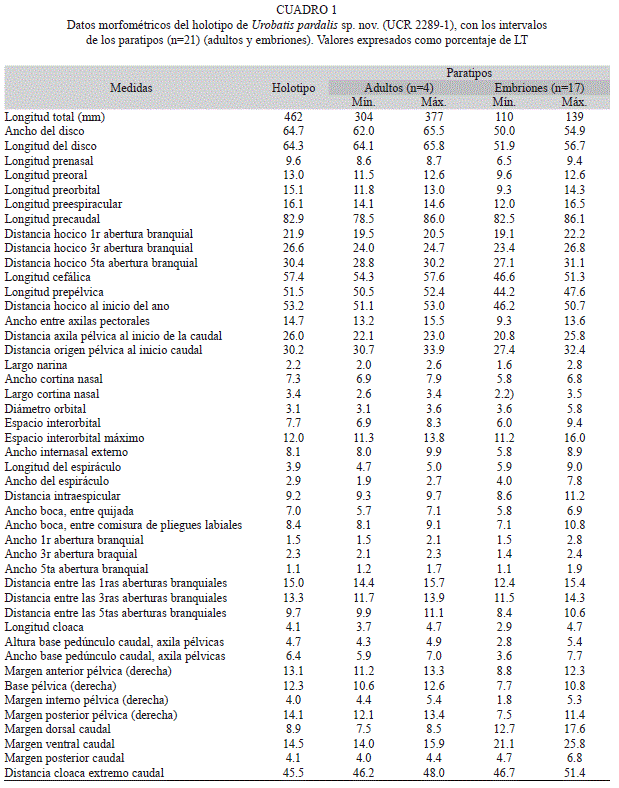
<body><![CDATA[taxon&oacute;micas propias del g&eacute;nero </span></font><font      size="2"><span style="font-family: verdana;"><span      style="font-style: italic;">Urobatis</span></span></font><font size="2"><span      style="font-family: verdana;"> (Chirichigno,     &amp; McEachran, 1979; Cooper, 1863; Cuvier, 1816; Garman, 1913;     Jordan, &amp; Starks, 1895; Osburn, &amp; Nichols, 1916; Philippi,     1892). A cada esp&eacute;cimen se le tomaron un de total de 46 medidas     (<a href="/img/revistas/rbt/v63n2/a14t1.gif">Cuadro 1</a>), de acuerdo     con el protocolo establecido por Bigelow &amp;     Schoereder (1953), con algunas modificaciones de Chirichigno &amp;     ]]></body>
<body><![CDATA[McEachran (1979), L&oacute;pez &amp; Bussing (1998) y Miyake &amp;     McEachran (1988). Las medidas se expresan como porcentaje de la     Longitud Total (LT). Informaci&oacute;n comparativa     (morfol&oacute;gica, morfom&eacute;trica y mer&iacute;stica) fue     obtenida de las siguientes fuentes: Chirichigno &amp; McEachran (1979),     McEachran (1995), Lamilla &amp; S&aacute;ez (2003), McEachran &amp; de     Carvalho (2003), Lamilla &amp; Bustamante (2005), Robertson &amp; Allen     (2008), Mej&iacute;a-Falla &amp; Navia (2009), y Mej&iacute;a-Falla     &amp; Bola&ntilde;os-Cubillo (2011).</span></font><br      style="font-family: verdana;">     ]]></body>
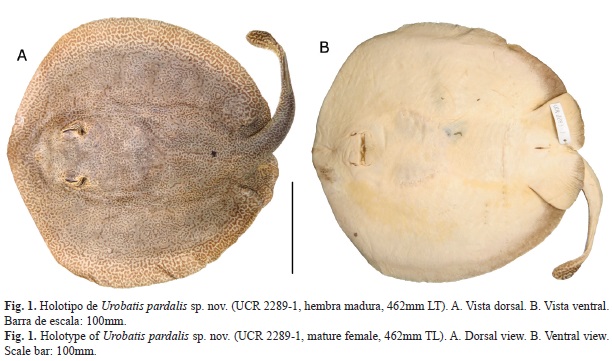
<body><![CDATA[<font size="2"></font><br style="font-family: verdana;">     <font style="font-weight: bold;" size="3"><span      style="font-family: verdana;">Resultados</span></font><br      style="font-family: verdana;">     <font size="2"></font><br style="font-family: verdana;">     <div style="text-align: center;"><font style="font-weight: bold;"  size="2"><span style="font-family: verdana;"><span  style="font-style: italic;">Urobatis</span></span></font><font  style="font-weight: bold;" size="2"><span style="font-family: verdana;"><span  style="font-style: italic;"> pardalis</span></span></font><font  size="2"><span style="font-family: verdana;"><span  style="font-weight: bold;"> </span>sp. nov.</span></font><br  style="font-family: verdana;"> <font size="2"></font><br style="font-family: verdana;"> <font size="2"><span style="font-family: verdana;">(<a  href="/img/revistas/rbt/v63n2/a14i1.jpg">Figs. 1</a>-7, <a  href="/img/revistas/rbt/v63n2/a14t1.gif">Cuadro 1</a>)</span></font><br  style="font-family: verdana;"> </div> <font size="2"></font><br style="font-family: verdana;"> <font size="2"><span style="font-family: verdana;"><span  style="font-style: italic;">Urobatis</span></span></font><font size="2"><span  style="font-family: verdana;"> </span></font><font size="2"><span  style="font-family: verdana;"><span style="font-style: italic;">halleri</span></span></font><font  size="2"><span style="font-family: verdana;"> (no Cooper, 1863): Allen, &amp; Robertson, 1994, en parte: 35 descripci&oacute;n; McEachran, 1995, en parte: 787 clave, 789 descripci&oacute;n; Allen, &amp; Robertson, 1998, en parte: 34 descripci&oacute;n; Bussing &amp; L&oacute;pez, 2009: 441 lista; Bussing &amp; L&oacute;pez, 2011: 34 lista, descripci&oacute;n; Mej&iacute;a-Falla &amp; Bola&ntilde;os-Cubillo, 2011: 244-245 descripci&oacute;n.</span></font><br  style="font-family: verdana;"> <font size="2"></font><br style="font-family: verdana;"> <font size="2"><span style="font-family: verdana;"><span  style="font-weight: bold;">Holotipo:</span> UCR 2289-01, hembra adulta (462mm LT), recolectada en Playa Escondida, lado norte de la Bah&iacute;a, Provincia de Puntarenas, Costa Rica (9&ordm; 40&#8217; 0.0012&#8221; N - 84&ordm; 40&#8217; 24.6&#8221; O), el 12 de Junio de 1992, por William A. Bussing, mediante arp&oacute;n, a una profundidad de 11-14m.</span></font><br  style="font-family: verdana;"> <font size="2"></font><br style="font-family: verdana;"> <font size="2"><span style="font-family: verdana;"><span  style="font-weight: bold;">Paratipos:</span> 21 espec&iacute;menes. UCR 0357-16, 1 esp&eacute;cimen, hembra (377mm LT), recolectada en Isla San Jos&eacute;, Golfo de Papagayo, Provincia de Guanacaste, Costa Rica (10&ordm; 51&#8217; 50.0004&#8221; N - 85&ordm; 54&#8217; 59.9898&#8221; O), el 14 de septiembre de 1969, por R.T. Nishimoto y C. Stone, a una profundidad de 0.6-2.1m; UCR 0618-05, 1 esp&eacute;cimen, hembra (313mm LT), recolectada frente a Bah&iacute;a Jobo, La Cruz, Provincia de Guanacaste, Costa Rica (11&ordm; 2&#8217; 39.9984&#8221; N - 85&ordm; 45&#8217; 31.4742&#8221; O), el 15 de febrero de 1972, por William A. Bussing, a una profundidad de 5-11m; UCR 2336-14, 2 espec&iacute;menes, machos (304-315mm LT), recolectados frente a Bah&iacute;a Pavones, Golfito, Provincia de Puntarenas, Costa Rica (8&ordm; 25&#8217; 5.9988&#8221; N - 83&ordm; 13&#8217; 5.9046&#8221; O), el 11 de diciembre de 1993, por Myrna I. L&oacute;pez y William A. Bussing, a una profundidad de 53m; UCR 2503-01, 17 espec&iacute;menes nonatos (110-139mm LT), recolectados en Playas del Coco, Carrillo, Provincia de Guanacaste, Costa Rica (10&ordm; 33&#8217; 19.998&#8221; N - 85&ordm; 42&#8217; 9.8496&#8221; O), el 23 de febrero de 1996, por Helena Molina.</span></font><br  style="font-family: verdana;"> <font size="2"></font><br style="font-family: verdana;"> <font size="2"><span style="font-family: verdana;"><span  style="font-weight: bold;">Diagnosis: </span>El holotipo (<a  href="/img/revistas/rbt/v63n2/a14i1.jpg">Fig. 1</a>) y dos paratipos son hembras maduras; dos paratipos son machos que acaban de alcanzar la madurez, con el mixopterigio desarrollado y ligeramente calcificado; 17 paratipos est&aacute;n en estado nonatos (<a  href="/img/revistas/rbt/v63n2/a14i2.jpg">Fig. 2</a>) y por esta condici&oacute;n no se utilizaron en la diagnosis ni en la descripci&oacute;n de la especie (ver apartado). Disco circular, la longitud del ancho y largo son similares; ancho del disco 62.0-65.5% de LT; longitud del disco 64.1-65.8% de LT; longitud cef&aacute;lica 54.3-57.6% de LT; distancia prep&eacute;lvica 50.5-52.4% de LT; distancia del hocico al ano 51.1-53.2% de LT; longitud precaudal 78.5-86.0% de LT; longitud preespiracular 14.1-16.1% de LT; distancia entre la axila de las aletas p&eacute;lvicas y el inicio de la caudal 22.1-26.0% de LT; ancho entre las axilas de las pectorales 13.2-15.5% de LT; longitud del margen ventral y dorsal de la aleta caudal 14.0-15.9% y 7.5-8.9% de LT, respectivamente; 27 a 33 hileras de dientes en la mand&iacute;bula superior; dent&iacute;culos o tub&eacute;rculos dorsales ausentes; dorso del disco con un fondo de color pardo con tonos anaranjados y vermiculaciones blancas o m&aacute;s claras que el fondo; vermiculaciones dorsales de grosor variable, fusion&aacute;ndose en algunos casos hasta formar manchas u ocelos.    <br> </span></font><br style="font-family: verdana;"> <font size="2"><span style="font-family: verdana;"><span  style="font-weight: bold;">English diagnosis: </span>The holotype (<a href="/img/revistas/rbt/v63n2/a14i1.jpg">Fig. 1</a>) and two paratypes are mature females; two paratypes are males who just reached sexual maturity, with the claspers developed and slightly calcified; 17 paratypes were unborn (<a  href="/img/revistas/rbt/v63n2/a14i2.jpg">Fig. 2</a>) and because of this condition, they were not considered in the diagnosis and in the description. Disc circular, their wide and their length are about equal; disc width 64.1-65.8% of the total length (TL); disc length 64.1-65.8% of TL; head length 54.3-57.6% of TL; prepelvic length 50.5-52.4% of TL; distance from snout to anus 51.1-53.2% of TL; precaudal length 78.5-86.0% of TL; prespiracular length 14.1-16.1% of TL; distance between the axils of the pelvics fins and the origin of the caudal fin 22.1-26.0% of TL; width between the axils of the pectorals fins 13.2-15.5% of TL; caudal ventral margin length 14.0-15.9% of TL; caudal dorsal margin length 7.5-8.9% of TL; 27 to 33 rows of teeth in the upper jaw; dorsal denticles or tubercles absent; back of the disc with a brown background with orange shades and white or pale vermiculations of variable thickness, sometimes merging to form spots or ocelli.</span></font><br style="font-family: verdana;"> <font size="2"></font><br style="font-family: verdana;"> <font size="2"><span style="font-family: verdana;"><span  style="font-weight: bold;">Descripci&oacute;n: </span>La morfometr&iacute;a de los espec&iacute;menes tipo se muestra en el <a href="/img/revistas/rbt/v63n2/a14t1.gif">cuadro 1</a>, las medidas se expresan como porcentaje de la LT. Disco redondeado, su longitud es similar a su ancho, ambas medidas caben 1.5 a 1.6 veces en LT; margen anterolateral ligeramente convexo en hembras, mientras que en los machos el &aacute;ngulo es mayor con ligera tendencia a la concavidad; la regi&oacute;n del hocico es m&aacute;s roma en las hembras en tanto en los machos es m&aacute;s puntiaguda; la distancia preorbital cabe 6.6 a 8.5 veces en LT. La longitud de la punta del hocico a la inserci&oacute;n de las aletas p&eacute;lvicas es 1.9 a 2.0 veces la LT. Las aletas p&eacute;lvicas presentan una forma trapezoide y su base es de longitud similar a su borde anterior (0.9 a 1.1 veces); el borde anterior se origina a la altura del inicio de la cloaca y se extiende hasta alcanzar el extremo posterior del disco; el borde posterior sobresale de manera convexa del disco y alcanza el borde interno, el cual se fusiona en la parte ventral con la cola; ambos bordes son redondeados, principalmente en su &aacute;ngulo distal; la longitud del borde posterior es mayor a la distancia que existe entre las axilas de las aletas p&eacute;lvicas y guarda una relaci&oacute;n de 7.1 a 8.2 veces la LT. Cola corta y robusta, su longitud es menor a la del disco (1.3 a 1.4 veces la primera en la segunda) y cabe 2.1 a 2.2 veces en LT; es de forma cil&iacute;ndrica pero en su parte ventral est&aacute; ligeramente aplanada (<a  href="/img/revistas/rbt/v63n2/a14i3.jpg">Fig. 3</a>); su grosor y altura son m&aacute;ximos en la base del ped&uacute;nculo caudal, cercanos al eje de las axilas de las aletas p&eacute;lvicas; la altura y ancho en este eje es de 9.3-10.4% y 12.5-14.7% la longitud de la cloaca al extremo de la caudal, respectivamente; el origen de la espina caudal es equidistante a la base del ped&uacute;nculo y al origen dorsal de la caudal, su extremo alcanza y en ocasiones sobrepasa el origen de la aleta caudal. La aleta caudal ligeramente robusta, ovalada; el l&oacute;bulo dorsal es m&aacute;s alto que el ventral pero su longitud es menor, su borde posterior es ovalado y cabe 10.1 a 11.8 veces en la longitud de la cola; la distancia de la punta del hocico al origen dorsal caudal es 78.5-86.1% de LT; la distancia que hay entre la axila de las p&eacute;lvicas y el inicio de la caudal con respecto a la LT es de 22.1-26.0%. El di&aacute;metro orbital cabe 3.2 a 4.2 veces en la longitud del hocico y representa el 3.1-3.7% de LT; longitud preoral mayor que la m&aacute;xima longitud internasal (1.2-1.6 veces la segunda en la primera); interorbital ancho (6.9-8.3 % de LT), 2.0 a 2.4 veces el di&aacute;metro ocular. La longitud del espir&aacute;culo es 1.3 a 1.6 veces m&aacute;s grande que el ojo (representando un 3.9-5.0% de LT), y 0.5 a 0.7 veces el espacio interorbital (<a  href="/img/revistas/rbt/v63n2/a14i4.jpg">Fig. 4</a>); su inserci&oacute;n inferior sobrepasa anteriormente la mitad de la longitud ocular; la distancia interespiracular representa el 9.2-9.7% de LT y en ella cabe el di&aacute;metro ocular 2.5-3.1 veces. La distancia prenasal cabe 6.7 a 7.6 veces en la longitud del disco; la cortina nasal se origina en el borde dorsal interno de la narina, lateralmente sus bordes alcanzan los pliegues labiales comisurales y en profundidad se extiende hasta alcanzar la de los pliegues labiales; los bordes laterales son rectos interrumpidos en su parte media por un plegamiento sinuoso; el borde horizontal presenta un pliegue continuo a manera de flecos cortos con bases anchas; la longitud del pliegue lateral representa el 35.0-48.4% del horizontal (<a  href="/img/revistas/rbt/v63n2/a14i5.jpg">Fig. 5</a>). Distancia entre las primeras aberturas branquiales 1.6 a 1.8 veces la distancia internasal externa; distancia entre las quintas aberturas branquiales 1.0 a 1.2 veces la distancia internasal externa. Tanto la regi&oacute;n dorsal y ventral del disco as&iacute; como la regi&oacute;n caudal est&aacute;n desnudas, no presentan dent&iacute;culos ni aguijones.    <br>     </span></font><br style="font-family: verdana;">     <font size="2"><span style="font-family: verdana;"><span     ]]></body>
<body><![CDATA[ style="font-weight: bold;">English description</span>: Morphometric     data of type specimens, expressed as percentages of TL, are given in     <a href="/img/revistas/rbt/v63n2/a14t1.gif">Table 1</a>. Disc rounded,     its length similar to its width, both measures     fit 1.5 to 1.6 times in TL; in females the anterolateral disc margin is     slightly convex, in males the angle is greater with a slight tendency     to concavity; in females the snout is blunt, in males is more pointed;     preorbital distance 6.6 to 8.5 times in TL. The length from the tip of     the snout to the insertion of the pelvic fins is 1.9 to 2.0 times in     TL. The pelvic fins have a trapezoid shape and the length of its base     ]]></body>
<body><![CDATA[is similar to the length of its anterior margin (0.9 to 1.1 times); the     anterior margin originates at the origin of the cloaca and extends     until reach the posterior end of the disc; the posterior margin     protrude convexly from the disc and reaches its inner margin, which     merges with the tail into the ventral part; both edges are rounded,     mainly on its distal angle; the length of the posterior margin is     greater than the distance between the axils of the pelvic fins, the     posterior margin is 7.1 to 8.2 times in TL. Tail short and stout, its     length is less than the disk length (1.3 to 1.4 times the first in the     second) and it is 2.1 to 2.2 times in TL; cylindrical in shape, with     ]]></body>
<body><![CDATA[the ventral part slightly flattened (<a      href="/img/revistas/rbt/v63n2/a14i3.jpg">Fig. 3</a>.); its thickness     and its     height are maximum at the base of the caudal peduncle, close to the     axis of the axils of the pelvics fins; the height and width at this     axis is 9.3-10.4% and 12.5-14.7% the length of the origin of the anus     to the end of the caudal fin, respectively; the origin of the caudal     spine is equidistant to the base of the caudal peduncle and to the     caudal dorsal origin, its end reaches and sometimes exceeds the origin     of the caudal fin. The caudal fin is slightly robust, oval in shape;     ]]></body>
<body><![CDATA[the dorsal lobe is higher than the ventral but its length is shorter,     its posterior margin is oval in shape and it is 10.1 to 11.8 times in     the length of the tail; the distance from the tip of snout to the     caudal dorsal origin is 78.5-86.1% of TL; the distance between the     axils of the pelvic fins and the origin of the caudal fin is 22.1-26.0%     of TL. The orbital diameter is 3.2 to 4.2 times in snout length, and     represents 3.1-3.7% of TL; preoral length greater than the maximum     internasal length (1.2-1.6 times the second on the first); the     interorbital wide (6.9-8.3% TL) is 2.0 to 2.4 times the eye diameter.     The spiracle length is 1.3 to 1.6 times larger than the eye     ]]></body>
<body><![CDATA[(representing 3.9-5.0% of TL), and 0.5 to 0.7 times in the interorbital     space (<a href="/img/revistas/rbt/v63n2/a14i4.jpg">Fig 4</a>.); its     inferior insertion exceeds the half of the eye     length; the interespiracular distance represents 9.2-9.7% of TL and it     fits 2.5-3.1 times in the eye diameter. Prenasal distance 6.7 to 7.6     times in the length of the disc; nasal curtain originates at the inner     dorsal edge of the nostril, laterally its borders reach the commissural     folds and horizontally extends up to reach the labial folds; the     lateral margins are straight, interrupted in their middle by a sinuous     fold; the horizontal margin has a continuous fold with short and broad     ]]></body>
<body><![CDATA[based fringes; lateral fold length 35.0-48.4% of the horizontal fold     (<a href="/img/revistas/rbt/v63n2/a14i5.jpg">Fig. 5</a>). Distance     between first gill openings 1.6     to 1.8 times the     external internarial length; distance between fifth gill openings 1.0     to 1.2 times the external internarial length. Disc and tail naked,     without denticles or thorns.</span></font><br      style="font-family: verdana;">     <font size="2"></font><br style="font-family: verdana;">     <font size="2"><span style="font-family: verdana;"><span     ]]></body>
<body><![CDATA[ style="font-weight: bold;">Coloraci&oacute;n:</span> Los ejemplares     fijados y preservados presentan el siguiente patr&oacute;n de     coloraci&oacute;n: la regi&oacute;n ventral es de color blanco o crema,     con tintes rosados; la regi&oacute;n dorsal es de color pardo con tonos     anaranjados, presentando vermiculaciones m&aacute;s claras que el     fondo, sobre todo en el borde del disco; estas vermiculaciones     var&iacute;an en grosor y disposici&oacute;n, algunas son cortas y     anchas a manera de manchas, otras forman c&iacute;rculos envolviendo al     color del fondo dando la apariencia de ocelos; en ocasiones los ocelos     y manchas presentan una disposici&oacute;n paralela al borde del disco.     ]]></body>
<body><![CDATA[Ejemplares reci&eacute;n capturados o en estado libre (<a      href="/img/revistas/rbt/v63n2/a14i6.jpg">Fig. 6</a>)     presentan una coloraci&oacute;n m&aacute;s marcada, incluso tienen la     capacidad de intensificar o disminuir la coloraci&oacute;n; es posible     observar ejemplares que presentan en el dorso del disco c&iacute;rculos     bien delimitados que se originan al intensificar la coloraci&oacute;n     del fondo.</span></font><br style="font-family: verdana;">     <font size="2"><span style="font-family: verdana;">&nbsp;</span></font><br      style="font-family: verdana;">     <font size="2"><span style="font-family: verdana;"><span     ]]></body>
<body><![CDATA[ style="font-weight: bold;">Embriones: </span>Los embriones al igual     que los adultos presentan una piel desnuda, sin tub&eacute;rculos ni     aguijones recurvados; desde ese estadio, la espina caudal est&aacute;     presente, sin aserraciones marcadas, y sin estar completamente     calcificada, presentando una consistencia blanda; la forma del disco es     ovalada; es notable el proceso de encefalizaci&oacute;n por lo que el     di&aacute;metro orbital es ligeramente mayor con respecto al     espir&aacute;culo; en la parte dorsal ocular corre hacia la parte     posterior una proyecci&oacute;n que se extiende lateralmente de forma     perpendicular a la &oacute;rbita ocular, esta proyecci&oacute;n es una     ]]></body>
<body><![CDATA[reminiscencia del l&oacute;bulo espiracular embrionario que se     transformar&aacute; hasta desaparecer conforme el organismo crece; el     di&aacute;metro vertical de la abertura espiracular es mayor que el     ocular. La coloraci&oacute;n es muy similar entre sexos: color de fondo     pardo claro sobre el cual se presenta un distintivo patr&oacute;n de     c&iacute;rculos y semic&iacute;rculos oscuros que se extienden del     dorso hac&iacute;a los bordes del disco; en cada c&iacute;rculo, hay     uno o dos puntos distintivos en el centro; conforme se acercan a los     bordes el di&aacute;metro de los c&iacute;rculos disminuye hasta que se     pierde en una serie de reticulaciones o puntos que bordean de manera     ]]></body>
<body><![CDATA[paralela el disco; la aleta caudal es oscura; las &oacute;rbitas     est&aacute;n bordeadas en la parte superior y anterior por una franja     oscura.</span></font><br style="font-family: verdana;">     <font size="2"></font><br style="font-family: verdana;">     <font size="2"><span style="font-family: verdana;"><span      style="font-weight: bold;">Distribuci&oacute;n:</span> Esta especie     se distribuye en el Pac&iacute;fico oriental tropical, su l&iacute;mite     sur son las costas de Colombia y al norte las costas de Costa Rica     (v.gr., Allen, &amp; Robertson, 1998; Bussing, &amp; L&oacute;pez,     2005, 2011; Mej&iacute;a-Falla, &amp; Bola&ntilde;os-Cubillos, 2011).</span></font><br     ]]></body>
<body><![CDATA[ style="font-family: verdana;">     <font size="2"></font><br style="font-family: verdana;">     <font size="2"><span style="font-family: verdana;"><span      style="font-weight: bold;">Etimolog&iacute;a: </span>El     ep&iacute;teto <span style="font-style: italic;">&#8220;pardalis&#8221;</span>,     derivando de la antigua palabra griega que     refiere al leopardo o pantera (<span style="font-style: italic;">&#8220;pardus&#8221;     </span>leopardo o pantera y <span style="font-style: italic;">&#8220;&#8211;alis&#8221; </span>un     sufijo adjetival que significa &#8220;igual&#8221; o &#8220;como&#8221;), fue asignado a esta     nueva especie debido a que su patr&oacute;n de coloraci&oacute;n dorsal     ]]></body>
<body><![CDATA[es muy similar a la del f&eacute;lido.</span></font><br      style="font-family: verdana;">     <font size="2"></font><br style="font-family: verdana;">     <font size="2"><span style="font-family: verdana;"><span      style="font-weight: bold;">Material comparativo:</span> 15     ejemplares. </span></font><font size="2"><span      style="font-family: verdana;"><span style="font-style: italic;">Urobatis</span></span></font><font      size="2"><span style="font-family: verdana;"> <span      style="font-style: italic;">concentricus</span>: 1 ejemplar.     CNPE-IBUNAM 2167, 1     ]]></body>
<body><![CDATA[ejemplar, hembra, Playa Negritos, Bah&iacute;a de Chamela, Jalisco,     M&eacute;xico. </span></font><font size="2"><span      style="font-family: verdana;"><span style="font-style: italic;">Urobatis</span></span></font><font      size="2"><span style="font-family: verdana;"> </span></font><font      size="2"><span style="font-family: verdana;"><span      style="font-style: italic;">halleri</span></span></font><font size="2"><span      style="font-family: verdana;">: 5 ejemplares. CNPE-IBUNAM 17506 (ex     ITESM 90-23), 5 ejemplares, 3 hembras y 2 machos, frente a la Playa (y     campo Pesquero) Santo Tom&aacute;s, Guaymas, Sonora, M&eacute;xico. </span></font><font      size="2"><span style="font-family: verdana;"><span     ]]></body>
<body><![CDATA[ style="font-style: italic;">Urobatis</span></span></font><font size="2"><span      style="font-family: verdana;"> <span style="font-style: italic;">jamaicensis</span>:     5 ejemplares. CNPE-IBUNAM 3137, 1 ejemplar,     hembra, Celest&uacute;n, Yucat&aacute;n, M&eacute;xico. CNPE-IBUNAM     10689, 1 ejemplar, macho, Playa Bonita, Campeche, Campeche,     M&eacute;xico. CNPE-IBUANM 4639, 2 ejemplares, machos, Punta Estrella,     La Escollera, Puerto Morelos, Quintana Roo, M&eacute;xico. CNPE-IBUNAM     763, 1 ejemplar, hembra, Puerto Progreso, Yucat&aacute;n,     M&eacute;xico. </span></font><font size="2"><span      style="font-family: verdana;"><span style="font-style: italic;">Urobatis</span></span></font><font     ]]></body>
<body><![CDATA[ size="2"><span style="font-family: verdana;"> <span      style="font-style: italic;">maculatus</span>: 4 ejemplares.     CNPE-IBUNAM 17117 (ex     ITESM 82-27A), 3 ejemplares, 1 hembra y 2 machos, frente a Playa     Cochorit, ca. 1-4 millas a ESE de Cabo Haro, Empalme, Guaymas, Sonora,     M&eacute;xico. CNPE-IBUNAM 16442 (ex ITESM 79-19), 1 ejemplar, macho,     Los Bajos de La Reina, Bah&iacute;a de Bacochibampo, Guaymas, Sonora,     M&eacute;xico.</span></font><br style="font-family: verdana;">     <font size="2"></font><br style="font-family: verdana;">     <div style="text-align: center;"><font size="2"><span  style="font-family: verdana;"><span style="font-weight: bold;">Clave dicot&oacute;mica para la determinaci&oacute;n taxon&oacute;mica de las especies del g&eacute;nero</span> </span></font><font size="2"><span  style="font-family: verdana;"><span style="font-style: italic;">Urobatis</span></span></font><br  style="font-family: verdana;"> </div> <br style="font-family: verdana;">     ]]></body>
<body><![CDATA[<div style="text-align: justify;"><font size="2"><span      style="font-family: verdana;">1a.&nbsp;&nbsp;     &nbsp;Dorso del     disco y/o cola con una o m&aacute;s series de dent&iacute;culos     d&eacute;rmicos, tub&eacute;rculos y/o espinas evidentes (en ejemplares     neonatos no est&aacute;n desarrollados y en juveniles no son muy     evidentes)&nbsp;&nbsp; &nbsp;2</span></font><br      style="font-family: verdana;">     <br style="font-family: verdana;">     <font size="2"><span style="font-family: verdana;">1b.&nbsp;&nbsp;     ]]></body>
<body><![CDATA[&nbsp;Dorso del     disco desnudo, sin dent&iacute;culos d&eacute;rmicos, tub&eacute;rculos     o espinas evidentes&nbsp;&nbsp; &nbsp;3</span></font><br      style="font-family: verdana;">     <br style="font-family: verdana;">     <font size="2"><span style="font-family: verdana;">2a.&nbsp;&nbsp;     &nbsp;Superficie     dorsal del disco de color pardo amarillento, pardo claro, canela, verde     oscuro o pardo oscuro con numerosas manchas o puntos de color pardo     oscuro, verde, dorado o blanco, de tama&ntilde;o variable, formando un     ]]></body>
<body><![CDATA[patr&oacute;n reticulado o vermiculado; superficie ventral de color     pardo claro, crema o verduzco, con los bordes usualmente m&aacute;s     oscuros; con distribuci&oacute;n en el Atl&aacute;ntico     occidental&nbsp;&nbsp;&nbsp; </span></font><font size="2"><span      style="font-family: verdana;"><span style="font-style: italic;">U. </span></span></font><font      size="2"><span style="font-family: verdana;"><span      style="font-style: italic;">jamaicensis</span></span></font><br      style="font-family: verdana;">     <br style="font-family: verdana;">     <font size="2"><span style="font-family: verdana;">2b.&nbsp;&nbsp;     ]]></body>
<body><![CDATA[&nbsp;Superficie     dorsal del disco de color marr&oacute;n con l&iacute;neas onduladas     oscuras y claras y manchas blancas del tama&ntilde;o del ojo;     superficie ventral de color pardo, pardo claro, blanco, rosa o crema,     con los bordes usualmente m&aacute;s oscuros y un patr&oacute;n     reticulado de manchas p&aacute;lidas sobre un fondo m&aacute;s oscuro     en la parte posterior del disco y de las aletas p&eacute;lvicas; con     distribuci&oacute;n restringida al Pac&iacute;fico de Colombia y     Per&uacute;&nbsp;&nbsp;&nbsp; </span></font><font size="2"><span      style="font-family: verdana;"><span style="font-style: italic;">U.     ]]></body>
<body><![CDATA[tumbesensis</span></span></font><br style="font-family: verdana;">     <br style="font-family: verdana;">     <font size="2"><span style="font-family: verdana;">3a.&nbsp;&nbsp;     &nbsp;Superficie     dorsal del disco de color plomo jaspeado, con numerosas manchitas y/o     vermiculaciones blancas; superficie ventral de color blanquecino     uniforme, con los bordes usualmente m&aacute;s oscuros; con     distribuci&oacute;n restringida al Pac&iacute;fico de     Chile&nbsp;&nbsp;&nbsp;     </span></font><font size="2"><span style="font-family: verdana;"><span     ]]></body>
<body><![CDATA[ style="font-style: italic;">U. marmoratus</span></span></font><br      style="font-family: verdana;">     <br style="font-family: verdana;">     <font size="2"><span style="font-family: verdana;">3b.&nbsp;&nbsp;     &nbsp;Patr&oacute;n     de coloraci&oacute;n no como el descrito anteriormente, con     distribuci&oacute;n restringida entre el Pac&iacute;fico sur de Estados     Unidos y Colombia&nbsp;&nbsp; &nbsp;4</span></font><br      style="font-family: verdana;">     <br style="font-family: verdana;">     ]]></body>
<body><![CDATA[<font size="2"><span style="font-family: verdana;">4a.&nbsp;&nbsp;     &nbsp;Superficie     dorsal del disco de color pardo o gris pardo, con manchas o puntos     irregulares (asim&eacute;tricos) pardo oscuros o negros, y de     tama&ntilde;o variable, relativamente espaciados; 35 a 37 hileras de     dientes en la mand&iacute;bula superior; end&eacute;mica del Golfo de     California&nbsp;&nbsp;&nbsp; </span></font><font size="2"><span      style="font-family: verdana;"><span style="font-style: italic;">U.     maculatus</span></span></font><br style="font-family: verdana;">     <br style="font-family: verdana;">     ]]></body>
<body><![CDATA[<font size="2"><span style="font-family: verdana;">4b.&nbsp;&nbsp;     &nbsp;Patr&oacute;n     de coloraci&oacute;n dorsal del disco con un fondo de color gris claro,     verde olivo a pardo claro y uniforme, cubierto con l&iacute;neas,     parches, puntos peque&ntilde;os o vermiculaciones, nunca con manchas o     puntos negros u oscuros irregulares; 26 a 35 hileras de dientes en la     mand&iacute;bula superior&nbsp;&nbsp; &nbsp;5</span></font><br      style="font-family: verdana;">     </div>     <br style="font-family: verdana;">     ]]></body>
<body><![CDATA[<font size="2"><span style="font-family: verdana;">5a.&nbsp;&nbsp;     &nbsp;Superficie     dorsal del disco de color gris claro con l&iacute;neas, parches y     peque&ntilde;os puntos oscuros, estos &uacute;ltimos, m&aacute;s o     menos ordenados en filas conc&eacute;ntricas; 2 franjas p&aacute;lidas,     estrechas, cerca de los bordes del disco; con distribuci&oacute;n     restringida desde el Golfo de California hasta el sur de     M&eacute;xico&nbsp;&nbsp;&nbsp; </span></font><font size="2"><span      style="font-family: verdana;"><span style="font-style: italic;">U. </span></span></font><font      size="2"><span style="font-family: verdana;"><span     ]]></body>
<body><![CDATA[ style="font-style: italic;">concentricus</span></span></font><br      style="font-family: verdana;">     <font size="2"></font><br style="font-family: verdana;">     <font size="2"><span style="font-family: verdana;">5b.&nbsp;&nbsp;     &nbsp;Superficie     dorsal del disco de color uniforme o con vermiculaciones, puntos o     manchas m&aacute;s claras que el fondo, mismas que var&iacute;an en su     grosor y disposici&oacute;n; sin franjas claras cerca de los bordes del     disco; con distribuci&oacute;n restringida entre el Pac&iacute;fico sur     de Estados Unidos y Colombia&nbsp;&nbsp; &nbsp;6</span></font><br     ]]></body>
<body><![CDATA[ style="font-family: verdana;">     <font size="2"></font><br style="font-family: verdana;">     <font size="2"><span style="font-family: verdana;">6a.&nbsp;&nbsp;     &nbsp;Superficie     dorsal del disco de color pardo claro, verde olivo, o canela uniforme,     o pardo con vermiculaciones m&aacute;s claras que el fondo, mismas que     var&iacute;an en su grosor y disposici&oacute;n; longitud del disco     54-58% de LT; ancho del disco 56-60% de LT; con distribuci&oacute;n     restringida entre el Pac&iacute;fico sur de Estados Unidos y el sur de     M&eacute;xico&nbsp;&nbsp;&nbsp; </span></font><font size="2"><span     ]]></body>
<body><![CDATA[ style="font-family: verdana;"><span style="font-style: italic;">U. </span></span></font><font      size="2"><span style="font-family: verdana;"><span      style="font-style: italic;">halleri</span></span></font><br      style="font-family: verdana;">     <font size="2"></font><br style="font-family: verdana;">     <font size="2"><span style="font-family: verdana;">6b.&nbsp;&nbsp;     &nbsp;Superficie     dorsal del disco de color pardo o gris pardo, con manchas o puntos     irregulares pardo oscuros o negros, de tama&ntilde;o variable,     relativamente espaciados; longitud del disco 64-66% de LT; ancho del     ]]></body>
<body><![CDATA[disco 62-65% de LT; con distribuci&oacute;n restringida entre el     Pac&iacute;fico norte de Costa Rica y Colombia&nbsp;&nbsp; &nbsp;<span      style="font-style: italic;">U.     pardalis</span> sp. nov.</span></font><br style="font-family: verdana;">     <font size="2"></font><br style="font-family: verdana;">     <font style="font-weight: bold;" size="3"><span      style="font-family: verdana;">Discusi&oacute;n</span></font><br      style="font-family: verdana;">     <font size="2"></font><br style="font-family: verdana;">     <font size="2"><span style="font-family: verdana;"><span     ]]></body>
<body><![CDATA[ style="font-style: italic;">Urobatis</span></span></font><font size="2"><span      style="font-family: verdana;"><span style="font-style: italic;">     pardalis</span></span></font><font size="2"><span      style="font-family: verdana;"> sp. nov. difiere     de sus cong&eacute;neres por el patr&oacute;n de coloraci&oacute;n     dorsal del disco. La especie </span></font><font size="2"><span      style="font-family: verdana;"><span style="font-style: italic;">U.     maculatus</span></span></font><font size="2"><span      style="font-family: verdana;"> presenta un color pardo o     gris oscuro como fondo con manchas negras circulares o elipsoidales     ]]></body>
<body><![CDATA[bordeadas por una banda m&aacute;s tenue, y se diferencia de </span></font><font      size="2"><span style="font-family: verdana;"><span      style="font-style: italic;">U. pardalis</span></span></font><font      size="2"><span style="font-family: verdana;"> sp. nov., que nunca     presenta vermiculaciones o reticulaciones     (Allen, &amp; Robertson, 1994; McEachran, 1995). La especie </span></font><font      size="2"><span style="font-family: verdana;"><span      style="font-style: italic;">U.     concentricus</span></span></font><font size="2"><span      style="font-family: verdana;"> presenta el mismo color en el dorso del     ]]></body>
<body><![CDATA[disco que </span></font><font size="2"><span      style="font-family: verdana;"><span style="font-style: italic;">U.     maculatus</span></span></font><font size="2"><span      style="font-family: verdana;"> pero sin manchas negras, en su lugar,     presenta un     patr&oacute;n de manchas a manera de c&iacute;rculos u &oacute;valos,     de color blanquecino, dispuestas en la regi&oacute;n central del disco     y de manera sim&eacute;trica a los costados (Allen, &amp; Robertson,     1994; McEachran, 1995), difiere tambi&eacute;n de </span></font><font      size="2"><span style="font-family: verdana;"><span     ]]></body>
<body><![CDATA[ style="font-style: italic;">U. pardalis</span></span></font><font      size="2"><span style="font-family: verdana;"> sp. nov.     al no presentar vermiculaciones ni manchas como se disponen en esta     &uacute;ltima. </span></font><font size="2"><span      style="font-family: verdana;"><span style="font-style: italic;">Urobatis</span></span></font><font      size="2"><span style="font-family: verdana;"> </span></font><font      size="2"><span style="font-family: verdana;"><span      style="font-style: italic;">concentricus</span></span></font><font      size="2"><span style="font-family: verdana;"> presenta adem&aacute;s     dos bandas     ]]></body>
<body><![CDATA[claras equidistantes en los bordes del disco, ausentes en <span      style="font-style: italic;"></span></span></font><font size="2"><span      style="font-family: verdana;"><span style="font-style: italic;">U.     pardalis</span></span></font><font size="2"><span      style="font-family: verdana;"><span style="font-style: italic;"></span>     sp. nov. (Allen, &amp; Robertson, 1994; McEachran, 1995). La especie <span      style="font-style: italic;">U.     tumbesencis</span> presenta un fondo de color verdoso a pardo y     est&aacute;     cubierto con manchas blancas que tienen una disposici&oacute;n a manera     ]]></body>
<body><![CDATA[de rosetas (Mej&iacute;a-Falla, &amp; Bola&ntilde;os-Cubillo, 2011),     difiere tambi&eacute;n de </span></font><font size="2"><span      style="font-family: verdana;"><span style="font-style: italic;">U.     pardalis</span></span></font><font size="2"><span      style="font-family: verdana;"> sp. nov. al no presentar     vermiculaciones ni manchas como se disponen en esta &uacute;ltima. De     acuerdo a la descripci&oacute;n que hace Philippi (1892) de </span></font><font      size="2"><span style="font-family: verdana;"><span      style="font-style: italic;">U. maculatus</span></span></font><font      size="2"><span style="font-family: verdana;">, la coloraci&oacute;n de     ]]></body>
<body><![CDATA[esta especie consiste en un fondo de     color plomo jaspeado con numerosas manchas peque&ntilde;as (Lamilla,     &amp; Bustamante, 2005); es muy poco lo que se conoce de esta especie,     incluso se desconoce el paradero del holotipo (Eschmeyer, 2014). Por     &uacute;ltimo, las especies </span></font><font size="2"><span      style="font-family: verdana;"><span style="font-style: italic;">U.     jamaicensis</span></span></font><font size="2"><span      style="font-family: verdana;"> y </span></font><font size="2"><span      style="font-family: verdana;"><span style="font-style: italic;">U.     halleri</span></span></font><font size="2"><span     ]]></body>
<body><![CDATA[ style="font-family: verdana;"> presentan una     amplia variaci&oacute;n en la coloraci&oacute;n dorsal del disco     (Babel, 1967), sin embargo en ambas es predominante el patr&oacute;n de     manchas peque&ntilde;as con di&aacute;metro menor al de la     &oacute;rbita ocular (McEachran, &amp; de Carvalho, 2003;     Mej&iacute;a-Falla, &amp; Bola&ntilde;os-Cubillo, 2011); cuando son     predominantes las reticulaciones estas no son tan marcadas en todo el     disco como en el caso de </span></font><font size="2"><span      style="font-family: verdana;"><span style="font-style: italic;">U.     pardalis</span></span></font><font size="2"><span     ]]></body>
<body><![CDATA[ style="font-family: verdana;"> sp. nov.</span></font><br      style="font-family: verdana;">     <font size="2"></font><br style="font-family: verdana;">     <font size="2"><span style="font-family: verdana;">Los caracteres     morfom&eacute;tricos     tambi&eacute;n permiten distinguir a </span></font><font size="2"><span      style="font-family: verdana;"><span style="font-style: italic;">U.     pardalis</span></span></font><font size="2"><span      style="font-family: verdana;"> sp. nov. del resto de     las especies dentro del g&eacute;nero. En esta &uacute;ltima, el ancho     ]]></body>
<body><![CDATA[del disco (62-65% de LT) y su longitud (64-66% de LT) son mayores con     respecto a la longitud total, sus cong&eacute;neres tienen una     relaci&oacute;n menor: en </span></font><font size="2"><span      style="font-family: verdana;"><span style="font-style: italic;">U.     jamaicensis</span></span></font><font size="2"><span      style="font-family: verdana;"> el ancho del disco es 50-54% y     la longitud es 55-60%; en </span></font><font size="2"><span      style="font-family: verdana;"><span style="font-style: italic;">U.     concentricus</span></span></font><font size="2"><span      style="font-family: verdana;"> el ancho es 59-60% y la     ]]></body>
<body><![CDATA[longitud del disco es 59-60%; en </span></font><font size="2"><span      style="font-family: verdana;"><span style="font-style: italic;">U.     halleri</span></span></font><font size="2"><span      style="font-family: verdana;"> el ancho es 56-60% y la     longitud es 54-58%; y en </span></font><font size="2"><span      style="font-family: verdana;"><span style="font-style: italic;">U.     maculatus</span></span></font><font size="2"><span      style="font-family: verdana;"> el ancho es 57-61% y la longitud     es 57-61%. Adem&aacute;s la longitud cef&aacute;lica (54-58% de LT), la     prep&eacute;lvica (50-52% de LT) y la preanal (51-53% de LT) son     ]]></body>
<body><![CDATA[mayores en </span></font><font size="2"><span      style="font-family: verdana;"><span style="font-style: italic;">U.     pardalis</span></span></font><font size="2"><span      style="font-family: verdana;"> sp. nov. en comparaci&oacute;n con el     resto de     las especies del g&eacute;nero: en </span></font><font size="2"><span      style="font-family: verdana;"><span style="font-style: italic;">U.     jamaicensis</span></span></font><font size="2"><span      style="font-family: verdana;"> la longitud     cef&aacute;lica representa el 47-52% de LT, la prep&eacute;lvica 45-50%     ]]></body>
<body><![CDATA[de LT y la preanal 46-51% de LT; en </span></font><font size="2"><span      style="font-family: verdana;"><span style="font-style: italic;">U.     concentricus</span></span></font><font size="2"><span      style="font-family: verdana;"> la longitud     cef&aacute;lica es 52-53% de LT, la prep&eacute;lvica 48-49% de LT y la     preanal 49-50% de LT; en </span></font><font size="2"><span      style="font-family: verdana;"><span style="font-style: italic;">U.     halleri</span></span></font><font size="2"><span      style="font-family: verdana;"> la longitud cef&aacute;lica es     47-52% de LT, la prep&eacute;lvica 44-48% de LT y la preanal 47-51% de     ]]></body>
<body><![CDATA[LT; en </span></font><font size="2"><span style="font-family: verdana;"><span      style="font-style: italic;">U. maculatus</span></span></font><font      size="2"><span style="font-family: verdana;"> la longitud     cef&aacute;lica es 50-54% de LT, la     prep&eacute;lvica 46-49% de LT y la preanal 48-52% de LT. Por su parte,     la longitud precaudal (78-86% LT) y la del margen ventral caudal     (14-16% LT) son proporcionalmente m&aacute;s cortas en </span></font><font      size="2"><span style="font-family: verdana;"><span      style="font-style: italic;">U. pardalis</span></span></font><font      size="2"><span style="font-family: verdana;"> sp.     ]]></body>
<body><![CDATA[nov. que entre sus cong&eacute;neres: en </span></font><font size="2"><span      style="font-family: verdana;"><span style="font-style: italic;">U.     jamaicensis</span></span></font><font size="2"><span      style="font-family: verdana;"> la longitud     precaudal es 86-92% de LT y el margen ventral caudal es 19-22% LT; en </span></font><font      size="2"><span style="font-family: verdana;"><span      style="font-style: italic;">U.     concentricus</span></span></font><font size="2"><span      style="font-family: verdana;">, la longitud precaudal es 88-89% LT y     el margen ventral     ]]></body>
<body><![CDATA[caudal es 17-18% LT; en </span></font><font size="2"><span      style="font-family: verdana;"><span style="font-style: italic;">U.     halleri</span></span></font><font size="2"><span      style="font-family: verdana;"> la longitud precaudal es 85-88% LT y     el margen ventral caudal es 20-24% LT; y en </span></font><font      size="2"><span style="font-family: verdana;"><span      style="font-style: italic;">U. maculatus</span></span></font><font      size="2"><span style="font-family: verdana;"> la longitud     precaudal es 78-86% LT y el margen ventral caudal es 19-24% LT.&nbsp;</span></font><font      size="2"><span style="font-family: verdana;"><span     ]]></body>
<body><![CDATA[ style="font-style: italic;">Urobatis</span></span></font><font size="2"><span      style="font-family: verdana;"><span style="font-style: italic;">     pardalis</span></span></font><font size="2"><span      style="font-family: verdana;"> sp. nov. presenta tambi&eacute;n     mayores longitudes     prespiraculares (14-16% LT vs 13-15% LT) y aquella de la axila de la     aletas p&eacute;lvicas al inicio de la aleta caudal (22-26% LT vs     19-24% LT) y menores en cuanto al ancho entre las axilas de las aletas     pectorales (13-16% LT vs 14-18% LT) y la longitud dorsal de la aleta     caudal (7-9% LT vs 12-15% LT) en comparaci&oacute;n con </span></font><font     ]]></body>
<body><![CDATA[ size="2"><span style="font-family: verdana;"><span      style="font-style: italic;">U. halleri</span></span></font><font      size="2"><span style="font-family: verdana;">.</span></font><br      style="font-family: verdana;">     <font size="2"></font><br style="font-family: verdana;">     <font size="2"><span style="font-family: verdana;">Con base en ciertas     caracter&iacute;sticas anat&oacute;micas es posible adem&aacute;s     distinguir a la nueva especie del resto de sus cong&eacute;neres.     As&iacute; se distingue a </span></font><font size="2"><span      style="font-family: verdana;"><span style="font-style: italic;">U.     ]]></body>
<body><![CDATA[pardalis</span></span></font><font size="2"><span      style="font-family: verdana;"> sp. nov. de </span></font><font      size="2"><span style="font-family: verdana;"><span      style="font-style: italic;">U. jamaicensis</span></span></font><font      size="2"><span style="font-family: verdana;"> y </span></font><font      size="2"><span style="font-family: verdana;"><span      style="font-style: italic;">U.     tumbesencis</span></span></font><font size="2"><span      style="font-family: verdana;"> por la ausencia de dent&iacute;culos o     tub&eacute;rculos     ]]></body>
<body><![CDATA[d&eacute;rmicos en la superficie dorsal del disco; y de </span></font><font      size="2"><span style="font-family: verdana;"><span      style="font-style: italic;">U. maculatus</span></span></font><font      size="2"><span style="font-family: verdana;">     por el n&uacute;mero de hileras de dientes en la mand&iacute;bula     superior (35 a 37 vs 27 a 33 en </span></font><font size="2"><span      style="font-family: verdana;"><span style="font-style: italic;">U.     pardalis</span></span></font><font size="2"><span      style="font-family: verdana;"> sp. nov.). Tambi&eacute;n     puede distinguirse esta nueva especie de las otras especies de la     ]]></body>
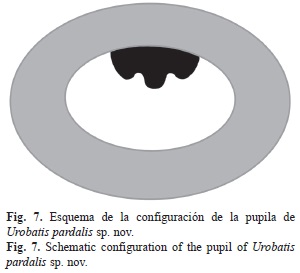
<body><![CDATA[familia&nbsp;</span></font><font size="2"><span      style="font-family: verdana;">Urotrygon</span></font><font size="2"><span      style="font-family: verdana;">idae</span></font><font size="2"><span      style="font-family: verdana;"> por la forma de la pupila (<a      href="#Fig7">Fig. 7</a>)     (L&oacute;pez     &amp; Bussing, 1998; Rubio-Rodr&iacute;guez, Navarro-Gonz&aacute;lez,     &amp; Vergara-Solana, 2010).    <br>     <br> </span></font>     ]]></body>
<body><![CDATA[<div style="text-align: center;"><font size="2"><span  style="font-family: verdana;"><a name="Fig7"></a><img alt=""  src="/img/revistas/rbt/v63n2/a14i7.jpg"  style="width: 300px; height: 273px;"></span></font><br  style="font-family: verdana;"> <font size="2"><span style="font-family: verdana;"></span></font></div> <br style="font-family: verdana;"> <font size="2"><span style="font-family: verdana;">Por &uacute;ltimo, la distribuci&oacute;n geogr&aacute;fica de las especies del g&eacute;nero </span></font><font size="2"><span style="font-family: verdana;"><span  style="font-style: italic;">Urobatis</span></span></font><font size="2"><span  style="font-family: verdana;"> presenta patrones definidos y pueden ayudar tambi&eacute;n a discriminar entre especies. La especie </span></font><font size="2"><span  style="font-family: verdana;"><span style="font-style: italic;">U. jamaicensis</span></span></font><font size="2"><span  style="font-family: verdana;">, es end&eacute;mica del Atl&aacute;ntico occidental (McEachran, &amp; Fechhelm, 1998; Cervig&oacute;n-Marcos, &amp; Ram&iacute;rez-Nahim, 2012), mientras que el resto lo son para el Pac&iacute;fico oriental (Allen, &amp; Robertson, 1994). As&iacute; </span></font><font size="2"><span  style="font-family: verdana;"><span style="font-style: italic;">U. halleri</span></span></font><font size="2"><span  style="font-family: verdana;"> se ha registrado desde las costas de Oreg&oacute;n, Estados Unidos (Miller, &amp; Lea, 1972), hasta el sur de M&eacute;xico, siendo la especie m&aacute;s septentrional. En contraparte, </span></font><font size="2"><span  style="font-family: verdana;"><span style="font-style: italic;">U. marmoratus</span></span></font><font size="2"><span  style="font-family: verdana;"> es la m&aacute;s meridional, y aparentemente se encuentra restringida a las costas de Chile, donde las aguas son fr&iacute;as (De Buen, 1959; Eschmeyer, 2014). </span></font><font size="2"><span style="font-family: verdana;"><span  style="font-style: italic;">U. maculatus</span></span></font><font  size="2"><span style="font-family: verdana;"> est&aacute; ampliamente distribuida en las costas del Golfo de California donde es end&eacute;mica (Castro-Aguirre, &amp; Espinosa-P&eacute;rez, 1996); de manera similar </span></font><font  size="2"><span style="font-family: verdana;"><span  style="font-style: italic;">U. concentricus</span></span></font><font size="2"><span  style="font-family: verdana;"> era considerada como end&eacute;mica del mismo mar, sin embargo recientemente ha sido registrado en la costa central del Pac&iacute;fico mexicano (M&aacute;rquez-Espinosa, 2012). Las costas de Per&uacute;, al sur, y Colombia al norte, constituyen los l&iacute;mites de distribuci&oacute;n de </span></font><font size="2"><span  style="font-family: verdana;"><span style="font-style: italic;">U. tumbesensis</span></span></font><font size="2"><span  style="font-family: verdana;"> (Chirichigno, &amp; McEachran, 1979), mientras que&nbsp;</span></font><font size="2"><span  style="font-family: verdana;"><span style="font-style: italic;">Urobatis</span></span></font><font  size="2"><span style="font-family: verdana;"><span  style="font-style: italic;"> pardalis</span></span></font><font  size="2"><span style="font-family: verdana;"> sp. nov., es representante de la regi&oacute;n biogeogr&aacute;fica Pan&aacute;mica (</span></font><font size="2"><span style="font-family: verdana;"><span  style="font-style: italic;">sensu</span></span></font><font size="2"><span  style="font-family: verdana;"> Briggs, 1974), encontr&aacute;ndose desde la costa pac&iacute;fica de Costa Rica hasta Colombia.</span></font><br  style="font-family: verdana;"> <font size="2"></font><br style="font-family: verdana;"> <font style="font-weight: bold;" size="3"><span  style="font-family: verdana;">Agradecimientos</span></font><br  style="font-family: verdana;"> <font size="2"></font><br style="font-family: verdana;"> <font size="2"><span style="font-family: verdana;">Los autores dedican este estudio a la memoria del Dr. William Bussing (q.e.p.d.), fallecido en noviembre de 2014, quien contribuyo sustancialmente al desarrollo de la Ictiolog&iacute;a en Costa Rica. Adem&aacute;s agradecen a Ana Rosa Ram&iacute;rez y Carolina M&eacute;ndez por las facilidades brindadas durante la estancia en el Museo de Zoolog&iacute;a de la UCR, as&iacute; tambi&eacute;n a H&eacute;ctor Espinosa P&eacute;rez por el acceso al material comparativo alojado en la CNPE-IBUNAM. El primer autor agradece al CONACyT por la beca otorgada para poder realizar sus estudios de posgrado, as&iacute; mismo al Posgrado en Ciencias Biol&oacute;gicas de la UNAM.</span></font><br  style="font-family: verdana;"> <br style="font-family: verdana;"> <hr style="width: 100%; height: 2px;"><font style="font-weight: bold;"  size="3"><span style="font-family: verdana;"></span></font><font  size="2"><span style="font-family: verdana;"></span></font><font  style="font-weight: bold;" size="3"><span style="font-family: verdana;">Referencias</span></font><br  style="font-family: verdana;"> <br style="font-family: verdana;">     <!-- ref --><div style="text-align: left;"><font size="2"><span  style="font-family: verdana;">Aguilera, O. (1998). Los peces marinos del occidente de Venezuela. <span style="font-style: italic;">Acta Biol&oacute;gica Venezuelica, 18</span>, 43-57.    &nbsp;&nbsp;&nbsp;&nbsp;&nbsp;&nbsp;&nbsp;&nbsp;[&#160;<a href="javascript:void(0);" onclick="javascript: window.open('/scielo.php?script=sci_nlinks&ref=1616047&pid=S0034-7744201500020001400001&lng=','','width=640,height=500,resizable=yes,scrollbars=1,menubar=yes,');">Links</a>&#160;]<!-- end-ref --><!-- ref --></span></font><br style="font-family: verdana;"> <br style="font-family: verdana;"> <font size="2"><span style="font-family: verdana;">Allen, G. R., &amp; Robertson, D. R. (1994). <span style="font-style: italic;">Fishes of the Tropical Eastern Pacific.</span> Hawaii, Honolul&uacute;: University of Hawaii.    &nbsp;&nbsp;&nbsp;&nbsp;&nbsp;&nbsp;&nbsp;&nbsp;[&#160;<a href="javascript:void(0);" onclick="javascript: window.open('/scielo.php?script=sci_nlinks&ref=1616048&pid=S0034-7744201500020001400002&lng=','','width=640,height=500,resizable=yes,scrollbars=1,menubar=yes,');">Links</a>&#160;]<!-- end-ref --><!-- ref --></span></font><br  style="font-family: verdana;"> <br style="font-family: verdana;"> <font size="2"><span style="font-family: verdana;">Allen, G. R., &amp; Robertson, D. R. (1998). <span style="font-style: italic;">Peces del Pac&iacute;fico Oriental tropical.</span> M&eacute;xico D.F: Comisi&oacute;n Nacional para el Conocimiento y Uso de la Biodiversidad, CEMEX, S.A. y Agrupaci&oacute;n Sierra Madre, S.C.    &nbsp;&nbsp;&nbsp;&nbsp;&nbsp;&nbsp;&nbsp;&nbsp;[&#160;<a href="javascript:void(0);" onclick="javascript: window.open('/scielo.php?script=sci_nlinks&ref=1616049&pid=S0034-7744201500020001400003&lng=','','width=640,height=500,resizable=yes,scrollbars=1,menubar=yes,');">Links</a>&#160;]<!-- end-ref --><!-- ref --></span></font><br  style="font-family: verdana;"> <br style="font-family: verdana;"> <font size="2"><span style="font-family: verdana;">Babel, J. S. (1967). Reproduction, life history, and ecology of the round stingray, </span></font><font  size="2"><span style="font-family: verdana;"><span  style="font-style: italic;">Urolophus</span></span></font><font  size="2"><span style="font-family: verdana;"> </span></font><font  size="2"><span style="font-family: verdana;"><span  style="font-style: italic;">halleri</span></span></font><font size="2"><span  style="font-family: verdana;"> Cooper. <span style="font-style: italic;">California Department of Fish and Game, Fish Bulletin, 137</span>, 1-104.    &nbsp;&nbsp;&nbsp;&nbsp;&nbsp;&nbsp;&nbsp;&nbsp;[&#160;<a href="javascript:void(0);" onclick="javascript: window.open('/scielo.php?script=sci_nlinks&ref=1616050&pid=S0034-7744201500020001400004&lng=','','width=640,height=500,resizable=yes,scrollbars=1,menubar=yes,');">Links</a>&#160;]<!-- end-ref --><!-- ref --></span></font><br style="font-family: verdana;"> <br style="font-family: verdana;"> <font size="2"><span style="font-family: verdana;">Beebe, W., &amp; Tee-Van, J. (1941). Fishes from the tropical eastern Pacific (from Cedros Island, Baja California, south to the Galapagos Islands and northern Peru). Rays, mantas and chimaeras. <span style="font-style: italic;">Zoologica, 26</span>, 245-280.    &nbsp;&nbsp;&nbsp;&nbsp;&nbsp;&nbsp;&nbsp;&nbsp;[&#160;<a href="javascript:void(0);" onclick="javascript: window.open('/scielo.php?script=sci_nlinks&ref=1616051&pid=S0034-7744201500020001400005&lng=','','width=640,height=500,resizable=yes,scrollbars=1,menubar=yes,');">Links</a>&#160;]<!-- end-ref --><!-- ref --></span></font><br style="font-family: verdana;"> <br style="font-family: verdana;"> <font size="2"><span style="font-family: verdana;">Bigelow, H. B., &amp; Schroeder, W. C. (1953). Saw fishes, guitar fishes, skates, rays, and chimaeroids. In J. Tee-Van, C. M. Breder, A. E. Parr, W. C. Schroeder, &amp; L. P. Schultz (Eds.), <span style="font-style: italic;">Fishes of the Western North Atlantic</span> (pp. 1-514). Part 2. Memoir Sears Foundation for Marine Research.    &nbsp;&nbsp;&nbsp;&nbsp;&nbsp;&nbsp;&nbsp;&nbsp;[&#160;<a href="javascript:void(0);" onclick="javascript: window.open('/scielo.php?script=sci_nlinks&ref=1616052&pid=S0034-7744201500020001400006&lng=','','width=640,height=500,resizable=yes,scrollbars=1,menubar=yes,');">Links</a>&#160;]<!-- end-ref --><!-- ref --></span></font><br  style="font-family: verdana;"> <br style="font-family: verdana;"> <font size="2"><span style="font-family: verdana;">B&ouml;hlke, J. E., &amp; Chaplin, C. C. G. (1968). <span style="font-style: italic;">Fishes of the Bahamas and adjacent tropical waters.</span> United States of America: University of Texas Press.    &nbsp;&nbsp;&nbsp;&nbsp;&nbsp;&nbsp;&nbsp;&nbsp;[&#160;<a href="javascript:void(0);" onclick="javascript: window.open('/scielo.php?script=sci_nlinks&ref=1616053&pid=S0034-7744201500020001400007&lng=','','width=640,height=500,resizable=yes,scrollbars=1,menubar=yes,');">Links</a>&#160;]<!-- end-ref --><!-- ref --></span></font><br  style="font-family: verdana;"> <br style="font-family: verdana;"> <font size="2"><span style="font-family: verdana;">Briggs, J. C. (1974). <span style="font-style: italic;">Marine zoogeography.</span> New York: McGraw-Hill Book Company.    &nbsp;&nbsp;&nbsp;&nbsp;&nbsp;&nbsp;&nbsp;&nbsp;[&#160;<a href="javascript:void(0);" onclick="javascript: window.open('/scielo.php?script=sci_nlinks&ref=1616054&pid=S0034-7744201500020001400008&lng=','','width=640,height=500,resizable=yes,scrollbars=1,menubar=yes,');">Links</a>&#160;]<!-- end-ref --><!-- ref --></span></font><br  style="font-family: verdana;"> <br style="font-family: verdana;"> <font size="2"><span style="font-family: verdana;">Bussing, W. A., &amp; L&oacute;pez, M. I. (2005). Peces de la Isla del Coco y peces arrecifales de la costa pac&iacute;fica de Am&eacute;rica Central meridional. <span  style="font-style: italic;">Revista de Biolog&iacute;a Tropical, 53</span>(2), 1-192.    &nbsp;&nbsp;&nbsp;&nbsp;&nbsp;&nbsp;&nbsp;&nbsp;[&#160;<a href="javascript:void(0);" onclick="javascript: window.open('/scielo.php?script=sci_nlinks&ref=1616055&pid=S0034-7744201500020001400009&lng=','','width=640,height=500,resizable=yes,scrollbars=1,menubar=yes,');">Links</a>&#160;]<!-- end-ref --><!-- ref --></span></font><br  style="font-family: verdana;"> <br style="font-family: verdana;"> <font size="2"><span style="font-family: verdana;">Bussing, W. A., &amp; L&oacute;pez, M. I. (2009). Marine Fish. In I. S. Wehrtmann, &amp; J. Cort&eacute;s (Eds.). <span style="font-style: italic;">Marine biodiversity of Costa Rica, Central America</span> (pp. 453-458). Berlin: Springer Science &amp; Business Media.    &nbsp;&nbsp;&nbsp;&nbsp;&nbsp;&nbsp;&nbsp;&nbsp;[&#160;<a href="javascript:void(0);" onclick="javascript: window.open('/scielo.php?script=sci_nlinks&ref=1616056&pid=S0034-7744201500020001400010&lng=','','width=640,height=500,resizable=yes,scrollbars=1,menubar=yes,');">Links</a>&#160;]<!-- end-ref --><!-- ref --></span></font><br  style="font-family: verdana;"> <br style="font-family: verdana;"> <font size="2"><span style="font-family: verdana;">Bussing, W. A., &amp; L&oacute;pez, M. I. (2011). P<span style="font-style: italic;">eces demersales y pel&aacute;gicos costeros del Pac&iacute;fico de Centroam&eacute;rica meridional.</span> San Jos&eacute;: Editorial de la Universidad de Costa Rica.    &nbsp;&nbsp;&nbsp;&nbsp;&nbsp;&nbsp;&nbsp;&nbsp;[&#160;<a href="javascript:void(0);" onclick="javascript: window.open('/scielo.php?script=sci_nlinks&ref=1616057&pid=S0034-7744201500020001400011&lng=','','width=640,height=500,resizable=yes,scrollbars=1,menubar=yes,');">Links</a>&#160;]<!-- end-ref --><!-- ref --></span></font><br  style="font-family: verdana;"> <br style="font-family: verdana;"> <font size="2"><span style="font-family: verdana;">Cappetta, H. (1987). Chondrichthyes II. Mesozoic and cenozoic Elasmobranchii. In H. P. Schultze (Ed.), <span style="font-style: italic;">Handbook of Paleoichthyology</span> (pp. 1-193). Stuttgart: Gustav Fischer.    &nbsp;&nbsp;&nbsp;&nbsp;&nbsp;&nbsp;&nbsp;&nbsp;[&#160;<a href="javascript:void(0);" onclick="javascript: window.open('/scielo.php?script=sci_nlinks&ref=1616058&pid=S0034-7744201500020001400012&lng=','','width=640,height=500,resizable=yes,scrollbars=1,menubar=yes,');">Links</a>&#160;]<!-- end-ref --><!-- ref --></span></font><br  style="font-family: verdana;"> <br style="font-family: verdana;"> <font size="2"><span style="font-family: verdana;">Castro-Aguirre, J. L., &amp; Espinosa-P&eacute;rez, H. (1996). L<span style="font-style: italic;">istados Faun&iacute;sticos de M&eacute;xico VII. Cat&aacute;logo sistem&aacute;tico de las rayas y especies afines de M&eacute;xico (Chondrichthyes: Elasmobranchii: Rajiformes: Batoideioorpha).</span> M&eacute;xico, D.F: Instituto de Biolog&iacute;a, UNAM.    &nbsp;&nbsp;&nbsp;&nbsp;&nbsp;&nbsp;&nbsp;&nbsp;[&#160;<a href="javascript:void(0);" onclick="javascript: window.open('/scielo.php?script=sci_nlinks&ref=1616059&pid=S0034-7744201500020001400013&lng=','','width=640,height=500,resizable=yes,scrollbars=1,menubar=yes,');">Links</a>&#160;]<!-- end-ref --><!-- ref --></span></font><br style="font-family: verdana;"> <br style="font-family: verdana;"> <font size="2"><span style="font-family: verdana;">Cervig&oacute;n-Marcos, F., &amp; Ram&iacute;ez-Nahim, H. (2012). Peces marinos de las costas de Venezuela. Venezuela, Caracas: Fundaci&oacute;n Museo Del Mar.    &nbsp;&nbsp;&nbsp;&nbsp;&nbsp;&nbsp;&nbsp;&nbsp;[&#160;<a href="javascript:void(0);" onclick="javascript: window.open('/scielo.php?script=sci_nlinks&ref=1616060&pid=S0034-7744201500020001400014&lng=','','width=640,height=500,resizable=yes,scrollbars=1,menubar=yes,');">Links</a>&#160;]<!-- end-ref --><!-- ref --></span></font><br  style="font-family: verdana;"> <br style="font-family: verdana;"> <font size="2"><span style="font-family: verdana;">Chirichigno, F. (1974). Clave para identificar los peces marinos del Per&uacute;. <span  style="font-style: italic;">Instituto del Mar del Per&uacute;, 44</span>, 1-390.    &nbsp;&nbsp;&nbsp;&nbsp;&nbsp;&nbsp;&nbsp;&nbsp;[&#160;<a href="javascript:void(0);" onclick="javascript: window.open('/scielo.php?script=sci_nlinks&ref=1616061&pid=S0034-7744201500020001400015&lng=','','width=640,height=500,resizable=yes,scrollbars=1,menubar=yes,');">Links</a>&#160;]<!-- end-ref --><!-- ref --></span></font><br  style="font-family: verdana;"> <br style="font-family: verdana;"> <font size="2"><span style="font-family: verdana;">Chirichigno F., N., &amp; McEachran, J. D. (1979). </span></font><font size="2"><span  style="font-family: verdana;"><span style="font-style: italic;">Urolophus</span></span></font><font  size="2"><span style="font-family: verdana;"> tumbesensis, a new stingray from the coast of Peru (Batoidea: Urolophidae).<span style="font-style: italic;"> Copeia, 1979,</span> 709-713.    &nbsp;&nbsp;&nbsp;&nbsp;&nbsp;&nbsp;&nbsp;&nbsp;[&#160;<a href="javascript:void(0);" onclick="javascript: window.open('/scielo.php?script=sci_nlinks&ref=1616062&pid=S0034-7744201500020001400016&lng=','','width=640,height=500,resizable=yes,scrollbars=1,menubar=yes,');">Links</a>&#160;]<!-- end-ref --><!-- ref --></span></font><br  style="font-family: verdana;"> <br style="font-family: verdana;"> <font size="2"><span style="font-family: verdana;">Compagno, L. J. V. (1999). Checklist of living elasmobranches. In W. C. Hamlett (Ed.), <span  style="font-style: italic;">Sharks, skates, and rays. The biology of elasmobranch fishes</span> (pp. 471-498). Baltimore: The John Hopkins Univ. Press.    &nbsp;&nbsp;&nbsp;&nbsp;&nbsp;&nbsp;&nbsp;&nbsp;[&#160;<a href="javascript:void(0);" onclick="javascript: window.open('/scielo.php?script=sci_nlinks&ref=1616063&pid=S0034-7744201500020001400017&lng=','','width=640,height=500,resizable=yes,scrollbars=1,menubar=yes,');">Links</a>&#160;]<!-- end-ref --><!-- ref --></span></font><br  style="font-family: verdana;"> <br style="font-family: verdana;"> <font size="2"><span style="font-family: verdana;">Compagno, L. J. V. (2005). Checklist of living Chondrichthyes. In W. C. Hamlett (Ed.), <span style="font-style: italic;">Reproductive Biology and Phylogeny of Chondrichthyes: sharks, batoids, and chimaeras</span> (pp. 501-548). New Hampshire, United States of America: CRC Press.    &nbsp;&nbsp;&nbsp;&nbsp;&nbsp;&nbsp;&nbsp;&nbsp;[&#160;<a href="javascript:void(0);" onclick="javascript: window.open('/scielo.php?script=sci_nlinks&ref=1616064&pid=S0034-7744201500020001400018&lng=','','width=640,height=500,resizable=yes,scrollbars=1,menubar=yes,');">Links</a>&#160;]<!-- end-ref --><!-- ref --></span></font><br style="font-family: verdana;"> <br style="font-family: verdana;"> <font size="2"><span style="font-family: verdana;">Cooper, J. G. (1863). On new genera and species of Californian fishes-No. II. <span  style="font-style: italic;">Proceedings of the California Academy of Sciences (Series 1), 3</span>, 93-97.    &nbsp;&nbsp;&nbsp;&nbsp;&nbsp;&nbsp;&nbsp;&nbsp;[&#160;<a href="javascript:void(0);" onclick="javascript: window.open('/scielo.php?script=sci_nlinks&ref=1616065&pid=S0034-7744201500020001400019&lng=','','width=640,height=500,resizable=yes,scrollbars=1,menubar=yes,');">Links</a>&#160;]<!-- end-ref --><!-- ref --></span></font><br  style="font-family: verdana;"> <br style="font-family: verdana;"> <font size="2"><span style="font-family: verdana;">Cuvier, G. (1816). Le R&egrave;gne Animal distribu&eacute; d&#8217;apr&egrave;s son organisation pour servir de base &agrave; l&#8217;histoire naturelle des animaux et d&#8217;introduction &agrave; l&#8217;anatomie compar&eacute;e. Les reptiles, les poissons, les mollusques et les ann&eacute;lides (Edition 1, Vol. 2, pp. 1-532). Paris.    &nbsp;&nbsp;&nbsp;&nbsp;&nbsp;&nbsp;&nbsp;&nbsp;[&#160;<a href="javascript:void(0);" onclick="javascript: window.open('/scielo.php?script=sci_nlinks&ref=1616066&pid=S0034-7744201500020001400020&lng=','','width=640,height=500,resizable=yes,scrollbars=1,menubar=yes,');">Links</a>&#160;]<!-- end-ref --><!-- ref --></span></font><br style="font-family: verdana;"> <br style="font-family: verdana;"> <font size="2"><span style="font-family: verdana;">De Buen, F. (1959). Lampreas, tiburones, rayas y peces en la estaci&oacute;n de Biolog&iacute;a Marina de Montemar, Chile (Primera contribuci&oacute;n). <span  style="font-style: italic;">Revista de Biolog&iacute;a Marina, Valpara&iacute;so, 9</span>, 1-200.    &nbsp;&nbsp;&nbsp;&nbsp;&nbsp;&nbsp;&nbsp;&nbsp;[&#160;<a href="javascript:void(0);" onclick="javascript: window.open('/scielo.php?script=sci_nlinks&ref=1616067&pid=S0034-7744201500020001400021&lng=','','width=640,height=500,resizable=yes,scrollbars=1,menubar=yes,');">Links</a>&#160;]<!-- end-ref --><!-- ref --></span></font><br  style="font-family: verdana;"> <br style="font-family: verdana;"> <font size="2"><span style="font-family: verdana;">Eschmeyer, W. N. (2014). Catalog of fishes: genera, species, references [On tine forum comment]. Retrieve from http://research.calacademy.org/research/ichthyology/catalog/fishcatmain.asp.    &nbsp;&nbsp;&nbsp;&nbsp;&nbsp;&nbsp;&nbsp;&nbsp;[&#160;<a href="javascript:void(0);" onclick="javascript: window.open('/scielo.php?script=sci_nlinks&ref=1616068&pid=S0034-7744201500020001400022&lng=','','width=640,height=500,resizable=yes,scrollbars=1,menubar=yes,');">Links</a>&#160;]<!-- end-ref --><!-- ref --></span></font><br  style="font-family: verdana;"> <br style="font-family: verdana;"> <font size="2"><span style="font-family: verdana;">Froese, R., &amp; Pauly, D. (2014). FishBase World Wide Web electronic publication (Version 06/2014) [FishBase Data]. Stockholm, Sweden: FishBase consortium. Retrieve from http://www.fishbase.org/search.php.    &nbsp;&nbsp;&nbsp;&nbsp;&nbsp;&nbsp;&nbsp;&nbsp;[&#160;<a href="javascript:void(0);" onclick="javascript: window.open('/scielo.php?script=sci_nlinks&ref=1616069&pid=S0034-7744201500020001400023&lng=','','width=640,height=500,resizable=yes,scrollbars=1,menubar=yes,');">Links</a>&#160;]<!-- end-ref --><!-- ref --></span></font><br  style="font-family: verdana;"> <br style="font-family: verdana;"> <font size="2"><span style="font-family: verdana;">Garman, S. (1885). Notes and descriptions taken from selachians in the U. S. National Museum. <span style="font-style: italic;">Proceedings of the United States National Museum, 8</span>, 39-44.    &nbsp;&nbsp;&nbsp;&nbsp;&nbsp;&nbsp;&nbsp;&nbsp;[&#160;<a href="javascript:void(0);" onclick="javascript: window.open('/scielo.php?script=sci_nlinks&ref=1616070&pid=S0034-7744201500020001400024&lng=','','width=640,height=500,resizable=yes,scrollbars=1,menubar=yes,');">Links</a>&#160;]<!-- end-ref --><!-- ref --></span></font><br  style="font-family: verdana;"> <br style="font-family: verdana;"> <font size="2"><span style="font-family: verdana;">Garman, S. (1913). The Plagiostomia (sharks, skates, and rays). <span style="font-style: italic;">Memoirs of the Museum of Comparative Zoology, 36</span>, 1-515.    &nbsp;&nbsp;&nbsp;&nbsp;&nbsp;&nbsp;&nbsp;&nbsp;[&#160;<a href="javascript:void(0);" onclick="javascript: window.open('/scielo.php?script=sci_nlinks&ref=1616071&pid=S0034-7744201500020001400025&lng=','','width=640,height=500,resizable=yes,scrollbars=1,menubar=yes,');">Links</a>&#160;]<!-- end-ref --><!-- ref --></span></font><br  style="font-family: verdana;"> <br style="font-family: verdana;"> <font size="2"><span style="font-family: verdana;">Jordan, D. S. (1895). The fishes of Sinaloa. <span style="font-style: italic;">Proceedings of the California Academy of Sciences (Series 2), 5</span>, 377-514.    &nbsp;&nbsp;&nbsp;&nbsp;&nbsp;&nbsp;&nbsp;&nbsp;[&#160;<a href="javascript:void(0);" onclick="javascript: window.open('/scielo.php?script=sci_nlinks&ref=1616072&pid=S0034-7744201500020001400026&lng=','','width=640,height=500,resizable=yes,scrollbars=1,menubar=yes,');">Links</a>&#160;]<!-- end-ref --><!-- ref --></span></font><br style="font-family: verdana;"> <br style="font-family: verdana;"> <font size="2"><span style="font-family: verdana;">Lamilla, J., &amp; Bustamante, C. (2005). Gu&iacute;a para el reconocimiento de: tiburones, rayas y quimeras de Chile. <span style="font-style: italic;">Oceana, 17</span>, 1-80.    &nbsp;&nbsp;&nbsp;&nbsp;&nbsp;&nbsp;&nbsp;&nbsp;[&#160;<a href="javascript:void(0);" onclick="javascript: window.open('/scielo.php?script=sci_nlinks&ref=1616073&pid=S0034-7744201500020001400027&lng=','','width=640,height=500,resizable=yes,scrollbars=1,menubar=yes,');">Links</a>&#160;]<!-- end-ref --><!-- ref --></span></font><br style="font-family: verdana;"> <br style="font-family: verdana;"> <font size="2"><span style="font-family: verdana;">Lamilla, J., &amp; S&aacute;ez, S. (2003). Clave taxon&oacute;mica para el reconocimiento de especies de rayas chilenas. <span style="font-style: italic;">Investigaciones Marinas, Valpara&iacute;so, 31</span>, 3-16.    &nbsp;&nbsp;&nbsp;&nbsp;&nbsp;&nbsp;&nbsp;&nbsp;[&#160;<a href="javascript:void(0);" onclick="javascript: window.open('/scielo.php?script=sci_nlinks&ref=1616074&pid=S0034-7744201500020001400028&lng=','','width=640,height=500,resizable=yes,scrollbars=1,menubar=yes,');">Links</a>&#160;]<!-- end-ref --><!-- ref --></span></font><br  style="font-family: verdana;"> <br style="font-family: verdana;"> <font size="2"><span style="font-family: verdana;">Last, P. R., &amp; Compagno, L. J. V. (1999). Urolophidae. In K. E. Carpenter, &amp; V. H. Niem (Eds.), <span style="font-style: italic;">Species identification guide for fisheries purposes. The living marine resources of the western central Pacific. Batoid fishes, chimaeras and bony fishes part 1 (Elopidae to Linophrynidae) </span>(pp. 1397-2068). Rome: FAO.    &nbsp;&nbsp;&nbsp;&nbsp;&nbsp;&nbsp;&nbsp;&nbsp;[&#160;<a href="javascript:void(0);" onclick="javascript: window.open('/scielo.php?script=sci_nlinks&ref=1616075&pid=S0034-7744201500020001400029&lng=','','width=640,height=500,resizable=yes,scrollbars=1,menubar=yes,');">Links</a>&#160;]<!-- end-ref --><!-- ref --></span></font><br style="font-family: verdana;"> <br style="font-family: verdana;"> <font size="2"><span style="font-family: verdana;">Last, P. R., &amp; Stevens, J. D. (1994). <span style="font-style: italic;">Sharks and Rays of Australia. </span>Australia: CSIRO.    &nbsp;&nbsp;&nbsp;&nbsp;&nbsp;&nbsp;&nbsp;&nbsp;[&#160;<a href="javascript:void(0);" onclick="javascript: window.open('/scielo.php?script=sci_nlinks&ref=1616076&pid=S0034-7744201500020001400030&lng=','','width=640,height=500,resizable=yes,scrollbars=1,menubar=yes,');">Links</a>&#160;]<!-- end-ref --><!-- ref --></span></font><br  style="font-family: verdana;"> <br style="font-family: verdana;"> <font size="2"><span style="font-family: verdana;">L&oacute;pez, M. I., &amp; Bussing, W. A. (1998). </span></font><font size="2"><span  style="font-family: verdana;"><span style="font-style: italic;">Urotrygon</span></span></font><font  size="2"><span style="font-family: verdana;"> cimar, a new eastern Pacific stringray (Pisces: Urolophidae). <span style="font-style: italic;">Revista de Biolog&iacute;a Tropical, 46,</span> 271-277.    &nbsp;&nbsp;&nbsp;&nbsp;&nbsp;&nbsp;&nbsp;&nbsp;[&#160;<a href="javascript:void(0);" onclick="javascript: window.open('/scielo.php?script=sci_nlinks&ref=1616077&pid=S0034-7744201500020001400031&lng=','','width=640,height=500,resizable=yes,scrollbars=1,menubar=yes,');">Links</a>&#160;]<!-- end-ref --><!-- ref --></span></font><br  style="font-family: verdana;"> <br style="font-family: verdana;"> <font size="2"><span style="font-family: verdana;">M&aacute;rquez-Espinosa, A. F. (2012). Gu&iacute;a de los peces marinos de la costa norte de Guerrero, M&eacute;xico. M&eacute;xico: Facultad de Estudios Superiores Iztacala, UNAM.    &nbsp;&nbsp;&nbsp;&nbsp;&nbsp;&nbsp;&nbsp;&nbsp;[&#160;<a href="javascript:void(0);" onclick="javascript: window.open('/scielo.php?script=sci_nlinks&ref=1616078&pid=S0034-7744201500020001400032&lng=','','width=640,height=500,resizable=yes,scrollbars=1,menubar=yes,');">Links</a>&#160;]<!-- end-ref --><!-- ref --></span></font><br style="font-family: verdana;"> <br style="font-family: verdana;"> <font size="2"><span style="font-family: verdana;">McEachran, J. D. (1995). Urolophidae. Rayas redondas. In W. Fischer, F. Krupp, W. Schneider, C. Sommer, K. E. Carpenter &amp; V. Niem (Eds.), <span  style="font-style: italic;">Gu&iacute;a FAO para Identificaci&oacute;n de Especies para los Fines de la Pesca. Pacifico Centro-Oriental (</span>pp. 786-792). Rome: FAO.    &nbsp;&nbsp;&nbsp;&nbsp;&nbsp;&nbsp;&nbsp;&nbsp;[&#160;<a href="javascript:void(0);" onclick="javascript: window.open('/scielo.php?script=sci_nlinks&ref=1616079&pid=S0034-7744201500020001400033&lng=','','width=640,height=500,resizable=yes,scrollbars=1,menubar=yes,');">Links</a>&#160;]<!-- end-ref --><!-- ref --></span></font><br  style="font-family: verdana;"> <br style="font-family: verdana;"> <font size="2"><span style="font-family: verdana;">McEachran, J. D., &amp; de Carvalho, M. R. (2003). Urolophidae. In K. E. Carpenter (Ed.), <span  style="font-style: italic;">The living marine resources of the Western Central Atlantic. Volume 1. Introduction, molluscs, crustaceans, hagfishes, sharks, baroid fishes, and chimaeras. FAO species identification guide for fishery purposes and American Society of Ichthyologist and Herpetologists Special Publication No. 5</span> (pp. 572-574). Rome: FAO.    &nbsp;&nbsp;&nbsp;&nbsp;&nbsp;&nbsp;&nbsp;&nbsp;[&#160;<a href="javascript:void(0);" onclick="javascript: window.open('/scielo.php?script=sci_nlinks&ref=1616080&pid=S0034-7744201500020001400034&lng=','','width=640,height=500,resizable=yes,scrollbars=1,menubar=yes,');">Links</a>&#160;]<!-- end-ref --><!-- ref --></span></font><br  style="font-family: verdana;"> <br style="font-family: verdana;"> <font size="2"><span style="font-family: verdana;">McEachran, J. D., &amp; Fechhelm, J. D. (1998). Fishes of the Gulf of Mexico, Vol. 1: Myxiniformes to Gasterosteiformes. Austin, Texas: University of Texas Press.    &nbsp;&nbsp;&nbsp;&nbsp;&nbsp;&nbsp;&nbsp;&nbsp;[&#160;<a href="javascript:void(0);" onclick="javascript: window.open('/scielo.php?script=sci_nlinks&ref=1616081&pid=S0034-7744201500020001400035&lng=','','width=640,height=500,resizable=yes,scrollbars=1,menubar=yes,');">Links</a>&#160;]<!-- end-ref --><!-- ref --></span></font><br  style="font-family: verdana;"> <br style="font-family: verdana;"> <font size="2"><span style="font-family: verdana;">McEachran, J. D., Dunn, K. A., &amp; Miyake, T. (1996). Interrelationships of the batoid fishes (Chondrichthyes: Batoidea). In M. L. J. Stiassny, L. R. Parenti, &amp; G. D. Johnson (Eds.), <span style="font-style: italic;">Interrelationships of Fishes</span> (pp. 63-84). New York: Academic Press.    &nbsp;&nbsp;&nbsp;&nbsp;&nbsp;&nbsp;&nbsp;&nbsp;[&#160;<a href="javascript:void(0);" onclick="javascript: window.open('/scielo.php?script=sci_nlinks&ref=1616082&pid=S0034-7744201500020001400036&lng=','','width=640,height=500,resizable=yes,scrollbars=1,menubar=yes,');">Links</a>&#160;]<!-- end-ref --><!-- ref --></span></font><br style="font-family: verdana;"> <br style="font-family: verdana;"> <font size="2"><span style="font-family: verdana;">Mej&iacute;a-Falla, P. A., &amp; Navia, A. F. (2009). New records of </span></font><font size="2"><span  style="font-family: verdana;"><span style="font-style: italic;">Urobatis</span></span></font><font  size="2"><span style="font-family: verdana;"> tumbesensis (Chirichigno &amp; McEachran, 1979) in the Tropical Eastern Pacific. <span  style="font-style: italic;">Pan-American Journal of Aquatic Sciences, 4</span>(3), 255-258.    &nbsp;&nbsp;&nbsp;&nbsp;&nbsp;&nbsp;&nbsp;&nbsp;[&#160;<a href="javascript:void(0);" onclick="javascript: window.open('/scielo.php?script=sci_nlinks&ref=1616083&pid=S0034-7744201500020001400037&lng=','','width=640,height=500,resizable=yes,scrollbars=1,menubar=yes,');">Links</a>&#160;]<!-- end-ref --><!-- ref --></span></font><br  style="font-family: verdana;"> <br style="font-family: verdana;"> <font size="2"><span style="font-family: verdana;">Mej&iacute;a-Falla, P. A., &amp; Bola&ntilde;os-Cubillos, N. (2011). Familia&nbsp;</span></font><font  size="2"><span style="font-family: verdana;">Urotrygon</span></font><font  size="2"><span style="font-family: verdana;">idae</span></font><font  size="2"><span style="font-family: verdana;">. In P. A. Mej&iacute;a-Falla, A. F. Navia, V. Puentes (Eds.), <span  style="font-style: italic;">Gu&iacute;a para la identificaci&oacute;n de especies de tiburones, rayas y quimeras de Colombia </span>(pp. 243-259), Bogot&aacute;, Colombia: Ministerio de Ambiente y Desarrollo Sostenible; Corporaci&oacute;n para el Desarrollo Sostenible del Archipi&eacute;lago de San Andr&eacute;s, Providencia y Santa Catalina &#8211; CORALINA; Gobernaci&oacute;n de San Andr&eacute;s, Providencia y Santa Catalina, Fundaci&oacute;n SQUALUS.    &nbsp;&nbsp;&nbsp;&nbsp;&nbsp;&nbsp;&nbsp;&nbsp;[&#160;<a href="javascript:void(0);" onclick="javascript: window.open('/scielo.php?script=sci_nlinks&ref=1616084&pid=S0034-7744201500020001400038&lng=','','width=640,height=500,resizable=yes,scrollbars=1,menubar=yes,');">Links</a>&#160;]<!-- end-ref --><!-- ref --></span></font><br  style="font-family: verdana;"> <br style="font-family: verdana;"> <font size="2"><span style="font-family: verdana;">Miller, D. J., &amp; Lea, R. N. (1972). Guide to the coastal marine fishes of California.<span  style="font-style: italic;"> Fish Bulletin, 157</span>, 1-249.    &nbsp;&nbsp;&nbsp;&nbsp;&nbsp;&nbsp;&nbsp;&nbsp;[&#160;<a href="javascript:void(0);" onclick="javascript: window.open('/scielo.php?script=sci_nlinks&ref=1616085&pid=S0034-7744201500020001400039&lng=','','width=640,height=500,resizable=yes,scrollbars=1,menubar=yes,');">Links</a>&#160;]<!-- end-ref --><!-- ref --></span></font><br  style="font-family: verdana;"> <br style="font-family: verdana;"> <font size="2"><span style="font-family: verdana;">Miyake, T., &amp; McEachran, J. D. (1988). Three new species of the stingray genus </span></font><font  style="font-style: italic;" size="2"><span  style="font-family: verdana;">Urotrygon</span></font><font size="2"><span  style="font-family: verdana;"> (Myliobatiformes: Urolophidae) from the eastern Pacific. <span  style="font-style: italic;">Bulletin of Marine Science, 42</span>(3), 366-375.    &nbsp;&nbsp;&nbsp;&nbsp;&nbsp;&nbsp;&nbsp;&nbsp;[&#160;<a href="javascript:void(0);" onclick="javascript: window.open('/scielo.php?script=sci_nlinks&ref=1616086&pid=S0034-7744201500020001400040&lng=','','width=640,height=500,resizable=yes,scrollbars=1,menubar=yes,');">Links</a>&#160;]<!-- end-ref --><!-- ref --></span></font><br  style="font-family: verdana;"> <br style="font-family: verdana;"> <font size="2"><span style="font-family: verdana;">Nelson, J. S. (1994). <span style="font-style: italic;">Fishes of the world.</span> New York: John Wiley and Sons, Inc.    &nbsp;&nbsp;&nbsp;&nbsp;&nbsp;&nbsp;&nbsp;&nbsp;[&#160;<a href="javascript:void(0);" onclick="javascript: window.open('/scielo.php?script=sci_nlinks&ref=1616087&pid=S0034-7744201500020001400041&lng=','','width=640,height=500,resizable=yes,scrollbars=1,menubar=yes,');">Links</a>&#160;]<!-- end-ref --><!-- ref --></span></font><br  style="font-family: verdana;"> <br style="font-family: verdana;"> <font size="2"><span style="font-family: verdana;">Nelson, J. S. (2006). <span style="font-style: italic;">Fishes of the world.</span> Hoboken, New Jersey: John Wiley &amp; Sons.    &nbsp;&nbsp;&nbsp;&nbsp;&nbsp;&nbsp;&nbsp;&nbsp;[&#160;<a href="javascript:void(0);" onclick="javascript: window.open('/scielo.php?script=sci_nlinks&ref=1616088&pid=S0034-7744201500020001400042&lng=','','width=640,height=500,resizable=yes,scrollbars=1,menubar=yes,');">Links</a>&#160;]<!-- end-ref --><!-- ref --></span></font><br  style="font-family: verdana;"> <br style="font-family: verdana;"> <font size="2"><span style="font-family: verdana;">Nelson, J. S., Crossman E. J., Espinosa-P&eacute;rez, H., Findley, L. T., Gilbert, C. R., Lea, R. N., &amp; Williams, J. D. (2004). <span style="font-style: italic;">Common and scientific names of fishes from the United States, Canada, and Mexico.</span> Bethesda, Maryland: American Fisheries Society.    &nbsp;&nbsp;&nbsp;&nbsp;&nbsp;&nbsp;&nbsp;&nbsp;[&#160;<a href="javascript:void(0);" onclick="javascript: window.open('/scielo.php?script=sci_nlinks&ref=1616089&pid=S0034-7744201500020001400043&lng=','','width=640,height=500,resizable=yes,scrollbars=1,menubar=yes,');">Links</a>&#160;]<!-- end-ref --><!-- ref --></span></font><br  style="font-family: verdana;"> <br style="font-family: verdana;"> <font size="2"><span style="font-family: verdana;">Osburn, R. C., &amp; Nichols, J. T. (1916). Shore fishes collected by the &#8220;Albatross&#8221; expedition in Lower California, with descriptions of new species. <span  style="font-style: italic;">Bulletin of the American Museum of Natural History, 35,</span> 139-181.    &nbsp;&nbsp;&nbsp;&nbsp;&nbsp;&nbsp;&nbsp;&nbsp;[&#160;<a href="javascript:void(0);" onclick="javascript: window.open('/scielo.php?script=sci_nlinks&ref=1616090&pid=S0034-7744201500020001400044&lng=','','width=640,height=500,resizable=yes,scrollbars=1,menubar=yes,');">Links</a>&#160;]<!-- end-ref --><!-- ref --></span></font><br  style="font-family: verdana;"> <br style="font-family: verdana;"> <font size="2"><span style="font-family: verdana;">Philippi, R. A. (1892). Algunos peces de Chile. Las rayas, <span style="font-style: italic;">Callorrhynchus </span>i <span style="font-style: italic;">Orthagoriscus </span>Chilenos. <span style="font-style: italic;">Anales del Museo Nacional de Chile. Primera seccion, Zoolog&iacute;a, 3</span>, 1-16.    &nbsp;&nbsp;&nbsp;&nbsp;&nbsp;&nbsp;&nbsp;&nbsp;[&#160;<a href="javascript:void(0);" onclick="javascript: window.open('/scielo.php?script=sci_nlinks&ref=1616091&pid=S0034-7744201500020001400045&lng=','','width=640,height=500,resizable=yes,scrollbars=1,menubar=yes,');">Links</a>&#160;]<!-- end-ref --><!-- ref --></span></font><br style="font-family: verdana;"> <br style="font-family: verdana;"> <font size="2"><span style="font-family: verdana;">Pollersp&ouml;ck, J. (2014). Shark-References. Retrieve from www.shark-references.com.    &nbsp;&nbsp;&nbsp;&nbsp;&nbsp;&nbsp;&nbsp;&nbsp;[&#160;<a href="javascript:void(0);" onclick="javascript: window.open('/scielo.php?script=sci_nlinks&ref=1616092&pid=S0034-7744201500020001400046&lng=','','width=640,height=500,resizable=yes,scrollbars=1,menubar=yes,');">Links</a>&#160;]<!-- end-ref --><!-- ref --></span></font><br  style="font-family: verdana;"> <br style="font-family: verdana;"> <font size="2"><span style="font-family: verdana;">Robertson, D. R., &amp; Allen, G. R. (2008). Peces Costeros del Pac&iacute;fico Oriental Tropical: Sistema de Informaci&oacute;n en l&iacute;nea (Versi&oacute;n 1.0.4.53). Retrieve from ww.http://biogeodb.stri.si.edu.    &nbsp;&nbsp;&nbsp;&nbsp;&nbsp;&nbsp;&nbsp;&nbsp;[&#160;<a href="javascript:void(0);" onclick="javascript: window.open('/scielo.php?script=sci_nlinks&ref=1616093&pid=S0034-7744201500020001400047&lng=','','width=640,height=500,resizable=yes,scrollbars=1,menubar=yes,');">Links</a>&#160;]<!-- end-ref --><!-- ref --></span></font><br  style="font-family: verdana;"> <br style="font-family: verdana;"> <font size="2"><span style="font-family: verdana;">Rubio-Rodr&iacute;guez, U., Navarro-Gonz&aacute;lez, J. A., &amp; Vergara-Solana, F. J. (2010). First record of black mucus and ocular malformations in the round stingray </span></font><font size="2"><span  style="font-family: verdana;"><span style="font-style: italic;">Urobatis</span></span></font><font  size="2"><span style="font-family: verdana;"> </span></font><font  size="2"><span style="font-family: verdana;"><span  style="font-style: italic;">halleri</span></span></font><font size="2"><span  style="font-family: verdana;"> (Rajiformes:&nbsp;</span></font><font  size="2"><span style="font-family: verdana;">Urotrygon</span></font><font  size="2"><span style="font-family: verdana;">idae</span></font><font  size="2"><span style="font-family: verdana;">) at the southern Gulf of California, Mexico. <span style="font-style: italic;">Marine Biodiversity Records, 3</span>:e17. doi:10.1017/S1755267209990960.    &nbsp;&nbsp;&nbsp;&nbsp;&nbsp;&nbsp;&nbsp;&nbsp;[&#160;<a href="javascript:void(0);" onclick="javascript: window.open('/scielo.php?script=sci_nlinks&ref=1616094&pid=S0034-7744201500020001400048&lng=','','width=640,height=500,resizable=yes,scrollbars=1,menubar=yes,');">Links</a>&#160;]<!-- end-ref --><!-- ref --></span></font><br  style="font-family: verdana;"> <br style="font-family: verdana;"> <font size="2"><span style="font-family: verdana;">Yearsley, G. K., Last, P. R., &amp; Gomon, M. F. (2008). </span></font><font size="2"><span  style="font-family: verdana;"><span style="font-style: italic;">Trygonoptera</span></span></font><font  size="2"><span style="font-family: verdana;"> imitata sp. nov., a new stingaree (Myliobatoidei: Urolophidae) from southeastern Australia. In P. R. Last, W. T. White, &amp; J. J. Pogonoski. <span  style="font-style: italic;">Descriptions of new Australian Chondrichthyans</span> (pp. 261-267). Retrieve from http://bionames.org/bionames-archive/issn/1833-2331/22/261.pdf.    &nbsp;&nbsp;&nbsp;&nbsp;&nbsp;&nbsp;&nbsp;&nbsp;[&#160;<a href="javascript:void(0);" onclick="javascript: window.open('/scielo.php?script=sci_nlinks&ref=1616095&pid=S0034-7744201500020001400049&lng=','','width=640,height=500,resizable=yes,scrollbars=1,menubar=yes,');">Links</a>&#160;]<!-- end-ref --></span></font>    <br> <font size="2"><span style="font-family: verdana;"></span></font></div> <font size="2"><span style="font-family: verdana;">    <br> </span></font><font size="2"><span style="font-family: verdana;"><a  name="1"></a><a href="#5">1</a>. Posgrado en Ciencias Biol&oacute;gicas, Universidad Nacional Aut&oacute;noma de M&eacute;xico; Av. Ciudad Universitaria 3000, C. P. 04360, Coyoac&aacute;n, Distrito Federal, M&eacute;xico; delmoralfer@gmail.com</span></font><br  style="font-family: verdana;"> <br style="font-family: verdana;"> <font size="2"><span style="font-family: verdana;"><a name="2"></a><a  href="#6">2</a>. Laboratorio de Zoolog&iacute;a, Facultad de Estudios Superiores Iztacala, Universidad Nacional Aut&oacute;noma de M&eacute;xico. Av. de los Barrios No. 1, Los Reyes Iztacala, 54090 Tlalnepantla, Estado de M&eacute;xico, M&eacute;xico.</span></font><br  style="font-family: verdana;"> <br style="font-family: verdana;"> <font size="2"><span style="font-family: verdana;"><a name="3"></a><a  href="#7">3</a>. Museo de Zoolog&iacute;a, Escuela de Biolog&iacute;a, Universidad de Costa Rica, 11501-2060, San Pedro de Montes de Oca, San Jos&eacute;, Costa Rica; arturo.angulosibaja@ucr.ac.cr, myrna.lopez@ucr.ac.cr, william.bussing@ucr.ac.cr</span></font><br style="font-family: verdana;"> <br style="font-family: verdana;"> <font size="2"><span style="font-family: verdana;"><a name="4"></a><a  href="#8">4</a>. Centro de Investigaci&oacute;n en Ciencias del Mar y Limnolog&iacute;a, Universidad de Costa Rica, 11501-2060, San Pedro de Montes de Oca, San Jos&eacute;, Costa Rica.</span></font><font  size="2"><span style="font-family: verdana;"><br  style="font-family: verdana;"> </span></font><font size="2"> </font> <hr style="width: 100%; height: 2px;">     <div style="text-align: center;"><font size="2"><span  style="font-family: verdana;"></span></font><font  style="font-weight: bold;" size="2"><span style="font-family: verdana;">Recibido 08-IX-2014. Corregido 12-I-2015. Aceptado 03-II-2015.</span></font></div> <font style="font-weight: bold;" size="2"></font></div>      ]]></body><back>
<ref-list>
<ref id="B1">
<nlm-citation citation-type="journal">
<person-group person-group-type="author">
<name>
<surname><![CDATA[Aguilera]]></surname>
<given-names><![CDATA[O.]]></given-names>
</name>
</person-group>
<article-title xml:lang="en"><![CDATA[Los peces marinos del occidente de Venezuela]]></article-title>
<source><![CDATA[Acta Biológica Venezuelica]]></source>
<year>1998</year>
<volume>18</volume>
<page-range>43-57</page-range></nlm-citation>
</ref>
<ref id="B2">
<nlm-citation citation-type="book">
<person-group person-group-type="author">
<name>
<surname><![CDATA[Allen]]></surname>
<given-names><![CDATA[G. R.]]></given-names>
</name>
<name>
<surname><![CDATA[Robertson]]></surname>
<given-names><![CDATA[D. R.]]></given-names>
</name>
</person-group>
<source><![CDATA[Fishes of the Tropical Eastern Pacific]]></source>
<year>1994</year>
<publisher-loc><![CDATA[^eHawaii, Honolulú Hawaii, Honolulú]]></publisher-loc>
<publisher-name><![CDATA[University of Hawaii]]></publisher-name>
</nlm-citation>
</ref>
<ref id="B3">
<nlm-citation citation-type="book">
<person-group person-group-type="author">
<name>
<surname><![CDATA[Allen]]></surname>
<given-names><![CDATA[G. R.]]></given-names>
</name>
<name>
<surname><![CDATA[Robertson]]></surname>
<given-names><![CDATA[D. R.]]></given-names>
</name>
</person-group>
<source><![CDATA[Peces del Pacífico Oriental tropical]]></source>
<year>1998</year>
<publisher-loc><![CDATA[^eMéxico D.F México D.F]]></publisher-loc>
<publisher-name><![CDATA[Comisión Nacional para el Conocimiento y Uso de la Biodiversidad, CEMEX, S.A. y Agrupación Sierra Madre, S.C]]></publisher-name>
</nlm-citation>
</ref>
<ref id="B4">
<nlm-citation citation-type="journal">
<person-group person-group-type="author">
<name>
<surname><![CDATA[Babel]]></surname>
<given-names><![CDATA[J. S.]]></given-names>
</name>
</person-group>
<article-title xml:lang="en"><![CDATA[Reproduction, life history, and ecology of the round stingray, Urolophus halleri Cooper]]></article-title>
<source><![CDATA[California Department of Fish and Game, Fish Bulletin]]></source>
<year>1967</year>
<volume>137</volume>
<page-range>1-104</page-range></nlm-citation>
</ref>
<ref id="B5">
<nlm-citation citation-type="journal">
<person-group person-group-type="author">
<name>
<surname><![CDATA[Beebe]]></surname>
<given-names><![CDATA[W.]]></given-names>
</name>
<name>
<surname><![CDATA[Tee-Van]]></surname>
<given-names><![CDATA[J.]]></given-names>
</name>
</person-group>
<article-title xml:lang="en"><![CDATA[Fishes from the tropical eastern Pacific (from Cedros Island, Baja California, south to the Galapagos Islands and northern Peru)]]></article-title>
<source><![CDATA[Rays, mantas and chimaeras. Zoologica]]></source>
<year>1941</year>
<volume>26</volume>
<page-range>245-280</page-range></nlm-citation>
</ref>
<ref id="B6">
<nlm-citation citation-type="">
<person-group person-group-type="author">
<name>
<surname><![CDATA[Bigelow]]></surname>
<given-names><![CDATA[H. B.]]></given-names>
</name>
<name>
<surname><![CDATA[Schroeder]]></surname>
<given-names><![CDATA[W. C.]]></given-names>
</name>
</person-group>
<article-title xml:lang="en"><![CDATA[Saw fishes, guitar fishes, skates, rays, and chimaeroids]]></article-title>
<person-group person-group-type="editor">
<name>
<surname><![CDATA[Tee-Van]]></surname>
<given-names><![CDATA[J.]]></given-names>
</name>
<name>
<surname><![CDATA[Breder]]></surname>
<given-names><![CDATA[C. M.]]></given-names>
</name>
<name>
<surname><![CDATA[Parr]]></surname>
<given-names><![CDATA[A. E.]]></given-names>
</name>
<name>
<surname><![CDATA[Schroeder]]></surname>
<given-names><![CDATA[W. C.]]></given-names>
</name>
<name>
<surname><![CDATA[Schultz]]></surname>
<given-names><![CDATA[L. P.]]></given-names>
</name>
</person-group>
<source><![CDATA[Fishes of the Western North Atlantic]]></source>
<year>1953</year>
<page-range>1-514</page-range></nlm-citation>
</ref>
<ref id="B7">
<nlm-citation citation-type="book">
<person-group person-group-type="author">
<name>
<surname><![CDATA[Böhlke]]></surname>
<given-names><![CDATA[J. E.]]></given-names>
</name>
<name>
<surname><![CDATA[Chaplin]]></surname>
<given-names><![CDATA[C. C. G.]]></given-names>
</name>
</person-group>
<source><![CDATA[Fishes of the Bahamas and adjacent tropical waters]]></source>
<year>1968</year>
<publisher-loc><![CDATA[^eUnited States of America United States of America]]></publisher-loc>
<publisher-name><![CDATA[University of Texas Press]]></publisher-name>
</nlm-citation>
</ref>
<ref id="B8">
<nlm-citation citation-type="book">
<person-group person-group-type="author">
<name>
<surname><![CDATA[Briggs]]></surname>
<given-names><![CDATA[J. C.]]></given-names>
</name>
</person-group>
<source><![CDATA[Marine zoogeography]]></source>
<year>1974</year>
<publisher-loc><![CDATA[^eNew York New York]]></publisher-loc>
<publisher-name><![CDATA[McGraw-Hill Book Company]]></publisher-name>
</nlm-citation>
</ref>
<ref id="B9">
<nlm-citation citation-type="journal">
<person-group person-group-type="author">
<name>
<surname><![CDATA[Bussing]]></surname>
<given-names><![CDATA[W. A.]]></given-names>
</name>
<name>
<surname><![CDATA[López]]></surname>
<given-names><![CDATA[M. I.]]></given-names>
</name>
</person-group>
<article-title xml:lang="en"><![CDATA[Peces de la Isla del Coco y peces arrecifales de la costa pacífica de América Central meridional]]></article-title>
<source><![CDATA[Revista de Biología Tropical]]></source>
<year>2005</year>
<volume>53</volume>
<numero>2</numero>
<issue>2</issue>
<page-range>1-192</page-range></nlm-citation>
</ref>
<ref id="B10">
<nlm-citation citation-type="book">
<person-group person-group-type="author">
<name>
<surname><![CDATA[Bussing]]></surname>
<given-names><![CDATA[W. A]]></given-names>
</name>
<name>
<surname><![CDATA[López]]></surname>
<given-names><![CDATA[M. I]]></given-names>
</name>
</person-group>
<article-title xml:lang="en"><![CDATA[Marine Fish]]></article-title>
<person-group person-group-type="editor">
<name>
<surname><![CDATA[Wehrtmann]]></surname>
<given-names><![CDATA[I. S]]></given-names>
</name>
<name>
<surname><![CDATA[Cortés]]></surname>
<given-names><![CDATA[J]]></given-names>
</name>
</person-group>
<source><![CDATA[Marine biodiversity of Costa Rica, Central America]]></source>
<year>2009</year>
<page-range>453-458</page-range><publisher-loc><![CDATA[Berlin ]]></publisher-loc>
<publisher-name><![CDATA[Springer Science & Business Media]]></publisher-name>
</nlm-citation>
</ref>
<ref id="B11">
<nlm-citation citation-type="book">
<person-group person-group-type="author">
<name>
<surname><![CDATA[Bussing]]></surname>
<given-names><![CDATA[W. A.]]></given-names>
</name>
<name>
<surname><![CDATA[López]]></surname>
<given-names><![CDATA[M. I.]]></given-names>
</name>
</person-group>
<source><![CDATA[Peces demersales y pelágicos costeros del Pacífico de Centroamérica meridional]]></source>
<year>2011</year>
<publisher-loc><![CDATA[^eSan José San José]]></publisher-loc>
<publisher-name><![CDATA[Editorial de la Universidad de Costa Rica]]></publisher-name>
</nlm-citation>
</ref>
<ref id="B12">
<nlm-citation citation-type="book">
<person-group person-group-type="author">
<name>
<surname><![CDATA[Cappetta]]></surname>
<given-names><![CDATA[H.]]></given-names>
</name>
</person-group>
<article-title xml:lang="en"><![CDATA[Chondrichthyes II: Mesozoic and cenozoic Elasmobranchii.]]></article-title>
<person-group person-group-type="editor">
<name>
<surname><![CDATA[Schultze]]></surname>
<given-names><![CDATA[H. P.]]></given-names>
</name>
</person-group>
<source><![CDATA[Handbook of Paleoichthyology]]></source>
<year>1987</year>
<page-range>1-193</page-range><publisher-loc><![CDATA[^eStuttgart Stuttgart]]></publisher-loc>
<publisher-name><![CDATA[Gustav Fischer]]></publisher-name>
</nlm-citation>
</ref>
<ref id="B13">
<nlm-citation citation-type="book">
<person-group person-group-type="author">
<name>
<surname><![CDATA[Castro-Aguirre]]></surname>
<given-names><![CDATA[J. L.]]></given-names>
</name>
<name>
<surname><![CDATA[Espinosa-Pérez]]></surname>
<given-names><![CDATA[H.]]></given-names>
</name>
</person-group>
<source><![CDATA[Listados Faunísticos de México VII. Catálogo sistemático de las rayas y especies afines de México (Chondrichthyes: Elasmobranchii: Rajiformes: Batoideioorpha).]]></source>
<year>1996</year>
<publisher-loc><![CDATA[^eMéxico, D.F México, D.F]]></publisher-loc>
<publisher-name><![CDATA[Instituto de Biología, UNAM]]></publisher-name>
</nlm-citation>
</ref>
<ref id="B14">
<nlm-citation citation-type="book">
<person-group person-group-type="author">
<name>
<surname><![CDATA[Cervigón-Marcos]]></surname>
<given-names><![CDATA[F.]]></given-names>
</name>
<name>
<surname><![CDATA[Ramíez-Nahim]]></surname>
<given-names><![CDATA[H.]]></given-names>
</name>
</person-group>
<source><![CDATA[Peces marinos de las costas de Venezuela]]></source>
<year>2012</year>
<publisher-loc><![CDATA[^eVenezuela, Caracas Venezuela, Caracas]]></publisher-loc>
<publisher-name><![CDATA[Fundación Museo Del Mar]]></publisher-name>
</nlm-citation>
</ref>
<ref id="B15">
<nlm-citation citation-type="journal">
<person-group person-group-type="author">
<name>
<surname><![CDATA[Chirichigno]]></surname>
<given-names><![CDATA[F.]]></given-names>
</name>
</person-group>
<article-title xml:lang="en"><![CDATA[Clave para identificar los peces marinos del Perú]]></article-title>
<source><![CDATA[Instituto del Mar del Perú]]></source>
<year>1974</year>
<volume>44</volume>
<page-range>1-390</page-range></nlm-citation>
</ref>
<ref id="B16">
<nlm-citation citation-type="journal">
<person-group person-group-type="author">
<name>
<surname><![CDATA[Chirichigno]]></surname>
<given-names><![CDATA[F., N.]]></given-names>
</name>
<name>
<surname><![CDATA[McEachran]]></surname>
<given-names><![CDATA[J. D.]]></given-names>
</name>
</person-group>
<article-title xml:lang="en"><![CDATA[Urolophus tumbesensis, a new stingray from the coast of Peru (Batoidea: Urolophidae)]]></article-title>
<source><![CDATA[Copeia]]></source>
<year>1979</year>
<volume>1979</volume>
<page-range>709-713</page-range></nlm-citation>
</ref>
<ref id="B17">
<nlm-citation citation-type="book">
<person-group person-group-type="author">
<name>
<surname><![CDATA[Compagno]]></surname>
<given-names><![CDATA[L. J. V.]]></given-names>
</name>
</person-group>
<article-title xml:lang="en"><![CDATA[Checklist of living elasmobranches]]></article-title>
<person-group person-group-type="editor">
<name>
<surname><![CDATA[Hamlett]]></surname>
<given-names><![CDATA[W. C.]]></given-names>
</name>
</person-group>
<source><![CDATA[Sharks, skates, and rays. The biology of elasmobranch fishes]]></source>
<year>1999</year>
<page-range>471-498</page-range><publisher-loc><![CDATA[^eBaltimore Baltimore]]></publisher-loc>
<publisher-name><![CDATA[The John Hopkins Univ. Press]]></publisher-name>
</nlm-citation>
</ref>
<ref id="B18">
<nlm-citation citation-type="book">
<person-group person-group-type="author">
<name>
<surname><![CDATA[Compagno]]></surname>
<given-names><![CDATA[L. J. V.]]></given-names>
</name>
</person-group>
<article-title xml:lang="en"><![CDATA[Checklist of living Chondrichthyes.]]></article-title>
<person-group person-group-type="editor">
<name>
<surname><![CDATA[Hamlett]]></surname>
<given-names><![CDATA[W. C.]]></given-names>
</name>
</person-group>
<source><![CDATA[Reproductive Biology and Phylogeny of Chondrichthyes: sharks, batoids, and chimaeras]]></source>
<year>2005</year>
<page-range>501-548</page-range><publisher-loc><![CDATA[New Hampshire^eUnited States of America United States of America]]></publisher-loc>
<publisher-name><![CDATA[CRC Press]]></publisher-name>
</nlm-citation>
</ref>
<ref id="B19">
<nlm-citation citation-type="journal">
<person-group person-group-type="author">
<name>
<surname><![CDATA[Cooper]]></surname>
<given-names><![CDATA[J. G.]]></given-names>
</name>
</person-group>
<article-title xml:lang="en"><![CDATA[On new genera and species of Californian fishes-No]]></article-title>
<source><![CDATA[II. Proceedings of the California Academy of Sciences (Series 1)]]></source>
<year>1863</year>
<volume>3</volume>
<page-range>93-97</page-range></nlm-citation>
</ref>
<ref id="B20">
<nlm-citation citation-type="">
<person-group person-group-type="author">
<name>
<surname><![CDATA[Cuvier]]></surname>
<given-names><![CDATA[G.]]></given-names>
</name>
</person-group>
<source><![CDATA[Le Règne Animal distribué d&#8217;après son organisation pour servir de base à l&#8217;histoire naturelle des animaux et d&#8217;introduction à l&#8217;anatomie comparée]]></source>
<year>1816</year>
<volume>2</volume>
<edition>1</edition>
<page-range>1-532</page-range><publisher-loc><![CDATA[^eParis Paris]]></publisher-loc>
</nlm-citation>
</ref>
<ref id="B21">
<nlm-citation citation-type="journal">
<person-group person-group-type="author">
<name>
<surname><![CDATA[De]]></surname>
<given-names><![CDATA[Buen, F.]]></given-names>
</name>
</person-group>
<article-title xml:lang="en"><![CDATA[Lampreas, tiburones, rayas y peces en la estación de Biología Marina de Montemar, Chile (Primera contribución)]]></article-title>
<source><![CDATA[Revista de Biología Marina, Valparaíso]]></source>
<year>1959</year>
<volume>9</volume>
<page-range>1-200</page-range></nlm-citation>
</ref>
<ref id="B22">
<nlm-citation citation-type="">
<person-group person-group-type="author">
<name>
<surname><![CDATA[Eschmeyer]]></surname>
<given-names><![CDATA[W. N.]]></given-names>
</name>
</person-group>
<source><![CDATA[Catalog of fishes: genera, species, references [On tine forum comment]]]></source>
<year>2014</year>
</nlm-citation>
</ref>
<ref id="B23">
<nlm-citation citation-type="">
<person-group person-group-type="author">
<name>
<surname><![CDATA[Froese]]></surname>
<given-names><![CDATA[R.]]></given-names>
</name>
<name>
<surname><![CDATA[Pauly]]></surname>
<given-names><![CDATA[D.]]></given-names>
</name>
</person-group>
<source><![CDATA[FishBase World Wide Web electronic publication (Version 06/2014) [FishBase Data]]]></source>
<year>2014</year>
<publisher-loc><![CDATA[^eStockholm, Sweden Stockholm, Sweden]]></publisher-loc>
</nlm-citation>
</ref>
<ref id="B24">
<nlm-citation citation-type="journal">
<person-group person-group-type="author">
<name>
<surname><![CDATA[Garman]]></surname>
<given-names><![CDATA[S.]]></given-names>
</name>
</person-group>
<article-title xml:lang="en"><![CDATA[Notes and descriptions taken from selachians in the U]]></article-title>
<source><![CDATA[S. National Museum. Proceedings of the United States National Museum]]></source>
<year>1885</year>
<volume>8</volume>
<page-range>39-44</page-range></nlm-citation>
</ref>
<ref id="B25">
<nlm-citation citation-type="journal">
<person-group person-group-type="author">
<name>
<surname><![CDATA[Garman]]></surname>
<given-names><![CDATA[S.]]></given-names>
</name>
</person-group>
<article-title xml:lang="en"><![CDATA[The Plagiostomia (sharks, skates, and rays)]]></article-title>
<source><![CDATA[Memoirs of the Museum of Comparative Zoology]]></source>
<year>1913</year>
<volume>36</volume>
<page-range>1-515</page-range></nlm-citation>
</ref>
<ref id="B26">
<nlm-citation citation-type="journal">
<person-group person-group-type="author">
<name>
<surname><![CDATA[Jordan]]></surname>
<given-names><![CDATA[D. S.]]></given-names>
</name>
</person-group>
<article-title xml:lang="en"><![CDATA[The fishes of Sinaloa]]></article-title>
<source><![CDATA[Proceedings of the California Academy of Sciences (Series 2)]]></source>
<year>1895</year>
<volume>5</volume>
<page-range>377-514</page-range></nlm-citation>
</ref>
<ref id="B27">
<nlm-citation citation-type="journal">
<person-group person-group-type="author">
<name>
<surname><![CDATA[Lamilla]]></surname>
<given-names><![CDATA[J.]]></given-names>
</name>
<name>
<surname><![CDATA[Bustamante]]></surname>
<given-names><![CDATA[C.]]></given-names>
</name>
</person-group>
<article-title xml:lang="en"><![CDATA[Guía para el reconocimiento de: tiburones, rayas y quimeras de Chile]]></article-title>
<source><![CDATA[Oceana]]></source>
<year>2005</year>
<volume>17</volume>
<page-range>1-80</page-range></nlm-citation>
</ref>
<ref id="B28">
<nlm-citation citation-type="journal">
<person-group person-group-type="author">
<name>
<surname><![CDATA[Lamilla]]></surname>
<given-names><![CDATA[J.]]></given-names>
</name>
<name>
<surname><![CDATA[Sáez]]></surname>
<given-names><![CDATA[S.]]></given-names>
</name>
</person-group>
<article-title xml:lang="en"><![CDATA[Clave taxonómica para el reconocimiento de especies de rayas chilenas]]></article-title>
<source><![CDATA[Investigaciones Marinas, Valparaíso]]></source>
<year>2003</year>
<volume>31</volume>
<page-range>3-16</page-range></nlm-citation>
</ref>
<ref id="B29">
<nlm-citation citation-type="book">
<person-group person-group-type="author">
<name>
<surname><![CDATA[Last]]></surname>
<given-names><![CDATA[P. R.]]></given-names>
</name>
<name>
<surname><![CDATA[Compagno]]></surname>
<given-names><![CDATA[L. J. V.]]></given-names>
</name>
</person-group>
<article-title xml:lang="en"><![CDATA[Urolophidae]]></article-title>
<person-group person-group-type="editor">
<name>
<surname><![CDATA[Carpenter]]></surname>
<given-names><![CDATA[K. E.]]></given-names>
</name>
<name>
<surname><![CDATA[Niem]]></surname>
<given-names><![CDATA[V. H.]]></given-names>
</name>
</person-group>
<source><![CDATA[Species identification guide for fisheries purposes.: The living marine resources of the western central Pacific. Batoid fishes, chimaeras and bony fishes part 1 (Elopidae to Linophrynidae)]]></source>
<year>1999</year>
<page-range>1397-2068</page-range><publisher-loc><![CDATA[^eRome Rome]]></publisher-loc>
<publisher-name><![CDATA[FAO]]></publisher-name>
</nlm-citation>
</ref>
<ref id="B30">
<nlm-citation citation-type="book">
<person-group person-group-type="author">
<name>
<surname><![CDATA[Last]]></surname>
<given-names><![CDATA[P. R.]]></given-names>
</name>
<name>
<surname><![CDATA[Stevens]]></surname>
<given-names><![CDATA[J. D.]]></given-names>
</name>
</person-group>
<source><![CDATA[Sharks and Rays of Australia]]></source>
<year>1994</year>
<publisher-loc><![CDATA[^eAustralia Australia]]></publisher-loc>
<publisher-name><![CDATA[CSIRO]]></publisher-name>
</nlm-citation>
</ref>
<ref id="B31">
<nlm-citation citation-type="journal">
<person-group person-group-type="author">
<name>
<surname><![CDATA[López]]></surname>
<given-names><![CDATA[M. I.]]></given-names>
</name>
<name>
<surname><![CDATA[Bussing]]></surname>
<given-names><![CDATA[W. A.]]></given-names>
</name>
</person-group>
<article-title xml:lang="en"><![CDATA[Urotrygon cimar, a new eastern Pacific stringray (Pisces: Urolophidae)]]></article-title>
<source><![CDATA[Revista de Biología Tropical]]></source>
<year>1998</year>
<volume>46</volume>
<page-range>271-277</page-range></nlm-citation>
</ref>
<ref id="B32">
<nlm-citation citation-type="book">
<person-group person-group-type="author">
<name>
<surname><![CDATA[Márquez-Espinosa]]></surname>
<given-names><![CDATA[A. F.]]></given-names>
</name>
</person-group>
<source><![CDATA[Guía de los peces marinos de la costa norte de Guerrero, México]]></source>
<year>2012</year>
<publisher-name><![CDATA[Facultad de Estudios Superiores Iztacala, UNAM]]></publisher-name>
</nlm-citation>
</ref>
<ref id="B33">
<nlm-citation citation-type="book">
<person-group person-group-type="author">
<name>
<surname><![CDATA[McEachran]]></surname>
<given-names><![CDATA[J. D.]]></given-names>
</name>
</person-group>
<article-title xml:lang="en"><![CDATA[Urolophidae: Rayas redondas.]]></article-title>
<person-group person-group-type="editor">
<name>
<surname><![CDATA[Fischer]]></surname>
<given-names><![CDATA[W.]]></given-names>
</name>
<name>
<surname><![CDATA[Krupp]]></surname>
<given-names><![CDATA[F.]]></given-names>
</name>
<name>
<surname><![CDATA[Schneider]]></surname>
<given-names><![CDATA[W.]]></given-names>
</name>
<name>
<surname><![CDATA[Sommer]]></surname>
<given-names><![CDATA[C.]]></given-names>
</name>
<name>
<surname><![CDATA[Carpenter]]></surname>
<given-names><![CDATA[K. E.]]></given-names>
</name>
<name>
<surname><![CDATA[Niem]]></surname>
<given-names><![CDATA[V.]]></given-names>
</name>
</person-group>
<source><![CDATA[Guía FAO para Identificación de Especies para los Fines de la Pesca. Pacifico Centro-Oriental]]></source>
<year>1995</year>
<page-range>786-792</page-range><publisher-loc><![CDATA[^eRome Rome]]></publisher-loc>
<publisher-name><![CDATA[FAO]]></publisher-name>
</nlm-citation>
</ref>
<ref id="B34">
<nlm-citation citation-type="book">
<person-group person-group-type="author">
<name>
<surname><![CDATA[McEachran]]></surname>
<given-names><![CDATA[J. D.]]></given-names>
</name>
<name>
<surname><![CDATA[de]]></surname>
<given-names><![CDATA[Carvalho, M. R.]]></given-names>
</name>
</person-group>
<article-title xml:lang="en"><![CDATA[Urolophidae]]></article-title>
<person-group person-group-type="editor">
<name>
<surname><![CDATA[Carpenter]]></surname>
<given-names><![CDATA[K. E.]]></given-names>
</name>
</person-group>
<source><![CDATA[The living marine resources of the Western Central Atlantic.]]></source>
<year>2003</year>
<volume>1.</volume><volume>5</volume>
<page-range>572-574</page-range><publisher-loc><![CDATA[^eRome Rome]]></publisher-loc>
<publisher-name><![CDATA[FAO]]></publisher-name>
</nlm-citation>
</ref>
<ref id="B35">
<nlm-citation citation-type="book">
<person-group person-group-type="author">
<name>
<surname><![CDATA[McEachran]]></surname>
<given-names><![CDATA[J. D.]]></given-names>
</name>
<name>
<surname><![CDATA[Fechhelm]]></surname>
<given-names><![CDATA[J. D.]]></given-names>
</name>
</person-group>
<source><![CDATA[Fishes of the Gulf of Mexico]]></source>
<year>1998</year>
<volume>. 1</volume>
<publisher-loc><![CDATA[Austin^eTexas Texas]]></publisher-loc>
<publisher-name><![CDATA[University of Texas Press]]></publisher-name>
</nlm-citation>
</ref>
<ref id="B36">
<nlm-citation citation-type="book">
<person-group person-group-type="author">
<name>
<surname><![CDATA[McEachran]]></surname>
<given-names><![CDATA[J. D.]]></given-names>
</name>
<name>
<surname><![CDATA[Dunn]]></surname>
<given-names><![CDATA[K. A.]]></given-names>
</name>
<name>
<surname><![CDATA[Miyake]]></surname>
<given-names><![CDATA[T.]]></given-names>
</name>
</person-group>
<article-title xml:lang="en"><![CDATA[Interrelationships of the batoid fishes (Chondrichthyes: Batoidea).]]></article-title>
<person-group person-group-type="editor">
<name>
<surname><![CDATA[Stiassny]]></surname>
<given-names><![CDATA[M. L. J.]]></given-names>
</name>
<name>
<surname><![CDATA[Parenti]]></surname>
<given-names><![CDATA[L. R.]]></given-names>
</name>
<name>
<surname><![CDATA[Johnson]]></surname>
<given-names><![CDATA[G. D.]]></given-names>
</name>
</person-group>
<source><![CDATA[Interrelationships of Fishes]]></source>
<year>1996</year>
<page-range>63-84</page-range><publisher-loc><![CDATA[^eNew York New York]]></publisher-loc>
<publisher-name><![CDATA[Academic Press]]></publisher-name>
</nlm-citation>
</ref>
<ref id="B37">
<nlm-citation citation-type="journal">
<person-group person-group-type="author">
<name>
<surname><![CDATA[Mejía-Falla]]></surname>
<given-names><![CDATA[P. A.]]></given-names>
</name>
<name>
<surname><![CDATA[Navia]]></surname>
<given-names><![CDATA[A. F.]]></given-names>
</name>
</person-group>
<article-title xml:lang="en"><![CDATA[New records of Urobatis tumbesensis (Chirichigno & McEachran, 1979) in the Tropical Eastern Pacific]]></article-title>
<source><![CDATA[Pan-American Journal of Aquatic Sciences]]></source>
<year>2009</year>
<volume>4</volume>
<numero>3</numero>
<issue>3</issue>
<page-range>255-258</page-range></nlm-citation>
</ref>
<ref id="B38">
<nlm-citation citation-type="book">
<person-group person-group-type="author">
<name>
<surname><![CDATA[Mejía-Falla]]></surname>
<given-names><![CDATA[P. A.]]></given-names>
</name>
<name>
<surname><![CDATA[Bolaños-Cubillos]]></surname>
<given-names><![CDATA[N.]]></given-names>
</name>
</person-group>
<article-title xml:lang="en"><![CDATA[Familia Urotrygonidae]]></article-title>
<person-group person-group-type="editor">
<name>
<surname><![CDATA[Mejía-Falla]]></surname>
<given-names><![CDATA[P. A.]]></given-names>
</name>
<name>
<surname><![CDATA[Navia]]></surname>
<given-names><![CDATA[A. F.]]></given-names>
</name>
<name>
<surname><![CDATA[Puentes]]></surname>
<given-names><![CDATA[V.]]></given-names>
</name>
</person-group>
<source><![CDATA[Guía para la identificación de especies de tiburones, rayas y quimeras de Colombia]]></source>
<year>2011</year>
<page-range>243-259</page-range><publisher-loc><![CDATA[^eBogotá Bogotá]]></publisher-loc>
<publisher-name><![CDATA[Ministerio de Ambiente y Desarrollo Sostenible; Corporación para el Desarrollo Sostenible del Archipiélago de San Andrés, Providencia y Santa Catalina - CORALINA; Gobernación de San Andrés, Providencia y Santa Catalina, Fundación SQUALUS]]></publisher-name>
</nlm-citation>
</ref>
<ref id="B39">
<nlm-citation citation-type="journal">
<person-group person-group-type="author">
<name>
<surname><![CDATA[Miller]]></surname>
<given-names><![CDATA[D. J.]]></given-names>
</name>
<name>
<surname><![CDATA[Lea]]></surname>
<given-names><![CDATA[R. N.]]></given-names>
</name>
</person-group>
<article-title xml:lang="en"><![CDATA[Guide to the coastal marine fishes of California]]></article-title>
<source><![CDATA[Fish Bulletin]]></source>
<year>1972</year>
<volume>157</volume>
<page-range>1-249</page-range></nlm-citation>
</ref>
<ref id="B40">
<nlm-citation citation-type="journal">
<person-group person-group-type="author">
<name>
<surname><![CDATA[Miyake]]></surname>
<given-names><![CDATA[T.]]></given-names>
</name>
<name>
<surname><![CDATA[McEachran]]></surname>
<given-names><![CDATA[J. D.]]></given-names>
</name>
</person-group>
<article-title xml:lang="en"><![CDATA[Three new species of the stingray genus Urotrygon (Myliobatiformes: Urolophidae) from the eastern Pacific]]></article-title>
<source><![CDATA[Bulletin of Marine Science]]></source>
<year>1988</year>
<volume>42</volume>
<numero>3</numero>
<issue>3</issue>
<page-range>366-375</page-range></nlm-citation>
</ref>
<ref id="B41">
<nlm-citation citation-type="book">
<person-group person-group-type="author">
<name>
<surname><![CDATA[Nelson]]></surname>
<given-names><![CDATA[J. S.]]></given-names>
</name>
</person-group>
<source><![CDATA[Fishes of the world]]></source>
<year>1994</year>
<publisher-loc><![CDATA[^eNew York New York]]></publisher-loc>
<publisher-name><![CDATA[John Wiley and Sons, Inc]]></publisher-name>
</nlm-citation>
</ref>
<ref id="B42">
<nlm-citation citation-type="book">
<person-group person-group-type="author">
<name>
<surname><![CDATA[Nelson]]></surname>
<given-names><![CDATA[J. S.]]></given-names>
</name>
</person-group>
<source><![CDATA[Fishes of the world]]></source>
<year>2006</year>
<publisher-loc><![CDATA[^eHoboken, New Jersey Hoboken, New Jersey]]></publisher-loc>
<publisher-name><![CDATA[John Wiley & Sons]]></publisher-name>
</nlm-citation>
</ref>
<ref id="B43">
<nlm-citation citation-type="book">
<person-group person-group-type="author">
<name>
<surname><![CDATA[Nelson]]></surname>
<given-names><![CDATA[J. S.]]></given-names>
</name>
<name>
<surname><![CDATA[Crossman]]></surname>
<given-names><![CDATA[E. J., Espinosa-Pérez]]></given-names>
</name>
<name>
<surname><![CDATA[H.]]></surname>
<given-names><![CDATA[Findley]]></given-names>
</name>
<name>
<surname><![CDATA[L.]]></surname>
<given-names><![CDATA[T., Gilbert]]></given-names>
</name>
<name>
<surname><![CDATA[C.]]></surname>
<given-names><![CDATA[R., Lea]]></given-names>
</name>
<name>
<surname><![CDATA[R.]]></surname>
<given-names><![CDATA[N., & Williams]]></given-names>
</name>
<name>
<surname><![CDATA[J.]]></surname>
<given-names><![CDATA[D.]]></given-names>
</name>
</person-group>
<source><![CDATA[Common and scientific names of fishes from the United States, Canada, and Mexico]]></source>
<year>2004</year>
<publisher-loc><![CDATA[^eBethesda, Maryland Bethesda, Maryland]]></publisher-loc>
<publisher-name><![CDATA[American Fisheries Society]]></publisher-name>
</nlm-citation>
</ref>
<ref id="B44">
<nlm-citation citation-type="journal">
<person-group person-group-type="author">
<name>
<surname><![CDATA[Osburn]]></surname>
<given-names><![CDATA[R. C.]]></given-names>
</name>
<name>
<surname><![CDATA[Nichols]]></surname>
<given-names><![CDATA[J. T.]]></given-names>
</name>
</person-group>
<article-title xml:lang="en"><![CDATA[Shore fishes collected by the &#8220;Albatross&#8221; expedition in Lower California, with descriptions of new species]]></article-title>
<source><![CDATA[Bulletin of the American Museum of Natural History]]></source>
<year>1916</year>
<volume>35</volume>
<page-range>139-181</page-range></nlm-citation>
</ref>
<ref id="B45">
<nlm-citation citation-type="journal">
<person-group person-group-type="author">
<name>
<surname><![CDATA[Philippi]]></surname>
<given-names><![CDATA[R. A.]]></given-names>
</name>
</person-group>
<article-title xml:lang="en"><![CDATA[Algunos peces de Chile]]></article-title>
<source><![CDATA[Las rayas, Callorrhynchus i Orthagoriscus Chilenos. Anales del Museo Nacional de Chile. Primera seccion, Zoología]]></source>
<year>1892</year>
<volume>3</volume>
<page-range>1-16</page-range></nlm-citation>
</ref>
<ref id="B46">
<nlm-citation citation-type="">
<person-group person-group-type="author">
<name>
<surname><![CDATA[Pollerspöck]]></surname>
<given-names><![CDATA[J.]]></given-names>
</name>
</person-group>
<source><![CDATA[Shark-References.]]></source>
<year>2014</year>
</nlm-citation>
</ref>
<ref id="B47">
<nlm-citation citation-type="">
<person-group person-group-type="author">
<name>
<surname><![CDATA[Robertson]]></surname>
<given-names><![CDATA[D. R.]]></given-names>
</name>
<name>
<surname><![CDATA[Allen]]></surname>
<given-names><![CDATA[G. R.]]></given-names>
</name>
</person-group>
<source><![CDATA[Peces Costeros del Pacífico Oriental Tropical: Sistema de Información en línea (Versión 1.0.4.53).]]></source>
<year>2008</year>
</nlm-citation>
</ref>
<ref id="B48">
<nlm-citation citation-type="journal">
<person-group person-group-type="author">
<name>
<surname><![CDATA[Rubio-Rodríguez]]></surname>
<given-names><![CDATA[U.]]></given-names>
</name>
<name>
<surname><![CDATA[Navarro-González]]></surname>
<given-names><![CDATA[J. A.]]></given-names>
</name>
<name>
<surname><![CDATA[Vergara-Solana]]></surname>
<given-names><![CDATA[F. J.]]></given-names>
</name>
</person-group>
<article-title xml:lang="en"><![CDATA[First record of black mucus and ocular malformations in the round stingray Urobatis halleri (Rajiformes: Urotrygonidae) at the southern Gulf of California, Mexico]]></article-title>
<source><![CDATA[Marine Biodiversity Records]]></source>
<year>2010</year>
<volume>3</volume>
<page-range>e17</page-range></nlm-citation>
</ref>
<ref id="B49">
<nlm-citation citation-type="">
<person-group person-group-type="author">
<name>
<surname><![CDATA[Yearsley]]></surname>
<given-names><![CDATA[G. K.]]></given-names>
</name>
<name>
<surname><![CDATA[Last]]></surname>
<given-names><![CDATA[P. R.]]></given-names>
</name>
<name>
<surname><![CDATA[Gomon]]></surname>
<given-names><![CDATA[M. F.]]></given-names>
</name>
</person-group>
<article-title xml:lang="en"><![CDATA[Trygonoptera imitata sp. nov., a new stingaree (Myliobatoidei: Urolophidae) from southeastern Australia.]]></article-title>
<person-group person-group-type="editor">
<name>
<surname><![CDATA[Last]]></surname>
<given-names><![CDATA[P. R.]]></given-names>
</name>
<name>
<surname><![CDATA[White]]></surname>
<given-names><![CDATA[W. T.]]></given-names>
</name>
<name>
<surname><![CDATA[Pogonoski]]></surname>
<given-names><![CDATA[J. J.]]></given-names>
</name>
</person-group>
<source><![CDATA[Descriptions of new Australian Chondrichthyans]]></source>
<year>2008</year>
<page-range>261-267</page-range></nlm-citation>
</ref>
</ref-list>
</back>
</article>