<?xml version="1.0" encoding="ISO-8859-1"?><article xmlns:mml="http://www.w3.org/1998/Math/MathML" xmlns:xlink="http://www.w3.org/1999/xlink" xmlns:xsi="http://www.w3.org/2001/XMLSchema-instance">
<front>
<journal-meta>
<journal-id>0034-7744</journal-id>
<journal-title><![CDATA[Revista de Biología Tropical]]></journal-title>
<abbrev-journal-title><![CDATA[Rev. biol. trop]]></abbrev-journal-title>
<issn>0034-7744</issn>
<publisher>
<publisher-name><![CDATA[Universidad de Costa Rica]]></publisher-name>
</publisher>
</journal-meta>
<article-meta>
<article-id>S0034-77442015000200009</article-id>
<title-group>
<article-title xml:lang="en"><![CDATA[Population structure of the red mangrove crab, Goniopsis cruentata (Decapoda: Grapsidae) under different fishery impacts: Implications for resource management]]></article-title>
<article-title xml:lang="es"><![CDATA[Estructura de la población del cangrejo rojo de manglar, Goniopsis cruentata (Decapoda: Grapsidae) bajo diferentes impactos de pesca: Implicaciones para la gestión de los recursos]]></article-title>
</title-group>
<contrib-group>
<contrib contrib-type="author">
<name>
<surname><![CDATA[Hirose]]></surname>
<given-names><![CDATA[Gustavo L.]]></given-names>
</name>
</contrib>
<contrib contrib-type="author">
<name>
<surname><![CDATA[Souza]]></surname>
<given-names><![CDATA[Laize S.]]></given-names>
</name>
</contrib>
<contrib contrib-type="author">
<name>
<surname><![CDATA[Silva]]></surname>
<given-names><![CDATA[Sonja L.R.]]></given-names>
</name>
</contrib>
<contrib contrib-type="author">
<name>
<surname><![CDATA[Alves]]></surname>
<given-names><![CDATA[Douglas F.R.]]></given-names>
</name>
</contrib>
<contrib contrib-type="author">
<name>
<surname><![CDATA[Negreiros-Fransozo]]></surname>
<given-names><![CDATA[Maria Lucia]]></given-names>
</name>
</contrib>
</contrib-group>
<aff id="A01">
<institution><![CDATA[,Universidade Federal Sergipe  ]]></institution>
<addr-line><![CDATA[ São Cristóvão-SE]]></addr-line>
<country>Brasil</country>
</aff>
<aff id="A02">
<institution><![CDATA[,Universidade Estadual Paulista  ]]></institution>
<addr-line><![CDATA[Botucatu SP]]></addr-line>
<country>Brasil</country>
</aff>
<aff id="A03">
<institution><![CDATA[,Universidade Estadual Paulista  ]]></institution>
<addr-line><![CDATA[Botucatu SP]]></addr-line>
<country>Brasil</country>
</aff>
<pub-date pub-type="pub">
<day>00</day>
<month>06</month>
<year>2015</year>
</pub-date>
<pub-date pub-type="epub">
<day>00</day>
<month>06</month>
<year>2015</year>
</pub-date>
<volume>63</volume>
<numero>2</numero>
<fpage>443</fpage>
<lpage>457</lpage>
<copyright-statement/>
<copyright-year/>
<self-uri xlink:href="http://www.scielo.sa.cr/scielo.php?script=sci_arttext&amp;pid=S0034-77442015000200009&amp;lng=en&amp;nrm=iso"></self-uri><self-uri xlink:href="http://www.scielo.sa.cr/scielo.php?script=sci_abstract&amp;pid=S0034-77442015000200009&amp;lng=en&amp;nrm=iso"></self-uri><self-uri xlink:href="http://www.scielo.sa.cr/scielo.php?script=sci_pdf&amp;pid=S0034-77442015000200009&amp;lng=en&amp;nrm=iso"></self-uri><abstract abstract-type="short" xml:lang="en"><p><![CDATA[The red mangrove crab, Goniopsis cruentata, influences the recruitment and composition of plant species in the mangrove ecosystem and it is an important fishery resource. Nevertheless, no current management and conservation plans are available for this species for the Brazilian coast. This investigation evaluated the population structure and reproductive biology in populations of G. cruentata under contrasting fishery pressures. The sampling program was carried out in two mangroves, Vaza-Barris and Sergipe River, from January through December 2011. Crabs from both mangroves were randomly collected by a professional fisherman during daytime low tide periods, using a fishing rod baited with pieces of a locally abundant gastropod, Pugilina morio, during 20min/area (catch per unit effort). Monthly measurements of air, sediment surface layer and water temperatures were obtained with a digital thermometer and salinity with an optical refractometer. Both crab populations were compared concerning their abundance, body size, sex ratio, size at onset of sexual maturity and fecundity (FI). Abiotic factors (air, water and mud temperature; and salinity) showed no significant differences between sampling localities. A total of 4 370 crabs were sampled, 2 829 from the Sergipe River and 1 541 from the Vaza-Barris River. The abundance and body size of crabs were compared between mangroves, and statistically significant differences were found. The sex ratio for both populations differed from the expected 1:1 ratio, and a significant deviation in favor of juvenile males was obtained, while adults showed a bias toward females. The estimated size at onset of sexual maturity for both sexes was similar in both populations. However, the populations differed significantly in the number and volume of eggs: a higher FI was obtained in females from the Sergipe River, while a higher egg volume was observed in females from the Vaza-Barris River mangrove. These results indicated a tendency to decrease the body size, the abundance of crabs and the reproductive potential of the species, with higher fishing intensities, reinforcing the need to develop a management plan as well as to establish conservation units for G. cruentata in the Northeastern Brazilian coast. Habitat loss in conjunction with long-term overfishing can have irreversible consequences, which can impact not only the populations of commercially exploited crabs, but the dynamics of virtually the entire mangrove ecosystem.]]></p></abstract>
<abstract abstract-type="short" xml:lang="es"><p><![CDATA[El cangrejo rojo Goniopsis cruentata influye en el reclutamiento y la composición de especies vegetales del ecosistema manglar y es un importante recurso pesquero. Sin embargo hasta la fecha, no se han desarrollado planes de manejo y conservación para esta especie en Brasil. La presente investigación evaluó la estructura poblacional y la biología reproductiva de las poblaciones de G. cruentata expuestas a diferentes presiones de pesca. El muestreo se realizó en dos manglares, Río Sergipe y Río Vaza-Barris entre enero y diciembre 2011. En ambos manglares, los animales fueron recolectados de día durante la marea baja por un pescador profesional, utilizando una caña de pescar con carnada del gasterópodo Pugilina morio, durante 20min/área (captura por unidad de esfuerzo, CPUE). Mensualmente con un termómetro digital se registró la temperatura del aire, agua y capa superficial del sedimento, mientras que la salinidad fue cuantificada utilizando un refractómetro óptico. Las poblaciones fueron comparadas en su abundancia, tamaño corporal, proporción de sexos, talla de primera madurez sexual y fecundidad. Los factores abióticos(temperatura del aire, agua y sedimento y la salinidad) no mostraron diferencias significativas entre ambos sitios de muestreo. Se recolectaron un total de 4 370 cangrejos; 2 829 en el río Sergipe y 1 541 en Vaza-Barris. Se registraron diferencias significativas entre los manglares con respecto a la abundancia y el tamaño corporal de los animales. La proporción de sexos de ambas poblaciones difirió de la relación 1:1 esperada y se obtuvo una desviación significativa en favor de machos jóvenes, mientras que los adultos mostraron una tendencia hacia las hembras. A su vez, las poblaciones difirieron significativamente en el número de huevos, con un mayor IF para las hembras del manglar del río Sergipe. El volumen de los huevos también mostró diferencias significativas entre ambas poblaciones. Estos resultados indican que la alta intensidad de pesca podría estar afectando dichos parámetros, lo que refuerza la necesidad de desarrollar un plan de manejo y la creación de unidades de conservación para G. cruentata en la costa noreste de Brasil. La pérdida del hábitat junto con la sobrepesca a largo plazo, pueden tener consecuencias irreversibles, que afectan no sólo a las poblaciones de cangrejos de importancia comercial, sino también la dinámica del ecosistema de manglar.]]></p></abstract>
<kwd-group>
<kwd lng="en"><![CDATA[body size]]></kwd>
<kwd lng="en"><![CDATA[fecundity]]></kwd>
<kwd lng="en"><![CDATA[Grapsidae]]></kwd>
<kwd lng="en"><![CDATA[management plan]]></kwd>
<kwd lng="en"><![CDATA[overfishing]]></kwd>
<kwd lng="es"><![CDATA[fecundidad]]></kwd>
<kwd lng="es"><![CDATA[Grapsidae]]></kwd>
<kwd lng="es"><![CDATA[plan de manejo]]></kwd>
<kwd lng="es"><![CDATA[sobrepesca]]></kwd>
<kwd lng="es"><![CDATA[tamaño corporal]]></kwd>
</kwd-group>
</article-meta>
</front><body><![CDATA[ <div style="text-align: justify;">     <div style="text-align: center;"><font style="font-weight: bold;"  size="4"><span style="font-family: verdana;">Population structure of the red mangrove crab, </span></font><font size="4"><span  style="font-family: verdana;"><span style="font-style: italic;">Goniopsis cruentata</span></span></font><font style="font-weight: bold;" size="4"><span  style="font-family: verdana;"> (Decapoda: Grapsidae) under different fishery impacts: Implications for resource management    <br>     <br> </span></font><font style="font-weight: bold;" size="4"><span  style="font-family: verdana;">Estructura de la poblaci&oacute;n del cangrejo rojo de manglar, </span></font><font size="4"><span  style="font-family: verdana;"><span style="font-style: italic;">Goniopsis cruentata</span></span></font><font style="font-weight: bold;" size="4"><span  style="font-family: verdana;"> (Decapoda: Grapsidae) bajo diferentes impactos de pesca: Implicaciones para la gesti&oacute;n de los recursos</span></font><font  size="2"><span style="font-family: verdana;"><span  style="font-weight: bold;"></span></span></font><br  style="font-family: verdana;"> </div> <br style="font-family: verdana;">     <div style="text-align: center;"><font size="2"><span      style="font-family: verdana;">Gustavo L. Hirose<sup><a href="#1">1</a><a      name="4"></a>*,<a href="#2">2</a><a name="5"></a>*</sup>,     Laize S.     Souza<a href="#1"><sup>1</sup></a>, Sonja L.R. Silva<a href="#1"><sup>1</sup></a>,     Douglas F.R. Alves<sup><a href="#1">1</a>,<a href="#2">2</a></sup>     ]]></body>
<body><![CDATA[&amp; Maria Lucia     Negreiros-Fransozo<sup><a href="#2">2</a>,<a href="#3">3</a><a name="6"></a>*</sup></span></font><br      style="font-family: verdana;">     </div>     <font size="2"><span style="font-family: verdana;"></span></font><br      style="font-family: verdana;">     <hr      style="width: 100%; height: 2px; margin-left: 0px; margin-right: 0px;"><font      style="font-weight: bold;" size="3"><span style="font-family: verdana;">Abstract</span></font><br      style="font-family: verdana;">     ]]></body>
<body><![CDATA[<font size="2"></font><br style="font-family: verdana;">     <font size="2"><span style="font-family: verdana;">The red mangrove     crab, <span style="font-style: italic;">Goniopsis     cruentata</span>, influences the recruitment and composition of plant     species     in the mangrove ecosystem and it is an important fishery resource.     Nevertheless, no current management and conservation plans are     available for this species for the Brazilian coast. This investigation     evaluated the population structure and reproductive biology in     populations of <span style="font-style: italic;">G. cruentata</span>     ]]></body>
<body><![CDATA[under contrasting fishery pressures. The     sampling program was carried out in two mangroves, Vaza-Barris and     Sergipe River, from January through December 2011. Crabs from both     mangroves were randomly collected by a professional fisherman during     daytime low tide periods, using a fishing rod baited with pieces of a     locally abundant gastropod, <span style="font-style: italic;">Pugilina     morio</span>, during 20min/area (catch     per unit effort). Monthly measurements of air, sediment surface layer     and water temperatures were obtained with a digital thermometer and     salinity with an optical refractometer. Both crab populations were     ]]></body>
<body><![CDATA[compared concerning their abundance, body size, sex ratio, size at     onset of sexual maturity and fecundity (FI). Abiotic factors (air,     water and mud temperature; and salinity) showed no significant     differences between sampling localities. A total of 4 370 crabs were     sampled, 2 829 from the Sergipe River and 1 541 from the Vaza-Barris     River. The abundance and body size of crabs were compared between     mangroves, and statistically significant differences were found. The     sex ratio for both populations differed from the expected 1:1 ratio,     and a significant deviation in favor of juvenile males was obtained,     while adults showed a bias toward females. The estimated size at onset     ]]></body>
<body><![CDATA[of sexual maturity for both sexes was similar in both populations.     However, the populations differed significantly in the number and     volume of eggs: a higher FI was obtained in females from the Sergipe     River, while a higher egg volume was observed in females from the     Vaza-Barris River mangrove. These results indicated a tendency to     decrease the body size, the abundance of crabs and the reproductive     potential of the species, with higher fishing intensities, reinforcing     the need to develop a management plan as well as to establish     conservation units for </span></font><font size="2"><span      style="font-family: verdana;"><span style="font-style: italic;">G.     ]]></body>
<body><![CDATA[cruentata</span></span></font><font size="2"><span      style="font-family: verdana;"> in the Northeastern Brazilian     coast. Habitat loss in conjunction with long-term overfishing can have     irreversible consequences, which can impact not only the populations of     commercially exploited crabs, but the dynamics of virtually the entire     mangrove ecosystem.</span></font><br style="font-family: verdana;">     <font size="2"></font><br style="font-family: verdana;">     <font size="2"><span style="font-family: verdana;"><span      style="font-weight: bold;">Key words:</span> body size, fecundity,     Grapsidae, management plan, overfishing.</span></font><br     ]]></body>
<body><![CDATA[ style="font-family: verdana;">     <font size="2"></font><br style="font-family: verdana;">     <font style="font-weight: bold;" size="3"><span      style="font-family: verdana;">Resumen</span></font><br      style="font-family: verdana;">     <font size="2"></font><br style="font-family: verdana;">     <font style="font-weight: bold;" size="2"><span      style="font-family: verdana;"></span></font><font size="2"><span      style="font-family: verdana;">El cangrejo rojo </span></font><font      size="2"><span style="font-family: verdana;"><span     ]]></body>
<body><![CDATA[ style="font-style: italic;">Goniopsis     cruentata</span></span></font><font size="2"><span      style="font-family: verdana;"> influye en el     reclutamiento y la composici&oacute;n de especies vegetales del     ecosistema manglar y es un importante recurso pesquero. Sin embargo     hasta la fecha, no se han desarrollado planes de manejo y     conservaci&oacute;n para esta especie en Brasil. La presente     investigaci&oacute;n evalu&oacute; la estructura poblacional y la     biolog&iacute;a reproductiva de las poblaciones de </span></font><font      size="2"><span style="font-family: verdana;"><span     ]]></body>
<body><![CDATA[ style="font-style: italic;">G. cruentata</span></span></font><font      size="2"><span style="font-family: verdana;">     expuestas a diferentes presiones de pesca. El muestreo se     realiz&oacute; en dos manglares, R&iacute;o Sergipe y R&iacute;o     Vaza-Barris entre enero y diciembre 2011. En ambos manglares, los     animales fueron recolectados de d&iacute;a durante la marea baja por un     pescador profesional, utilizando una ca&ntilde;a de pescar con carnada     del gaster&oacute;podo </span></font><font size="2"><span      style="font-family: verdana;"><span style="font-style: italic;">Pugilina     morio</span></span></font><font size="2"><span     ]]></body>
<body><![CDATA[ style="font-family: verdana;">, durante 20min/&aacute;rea     (captura por unidad de esfuerzo, CPUE). Mensualmente con un     term&oacute;metro digital se registr&oacute; la temperatura del aire,     agua y capa superficial del sedimento, mientras que la salinidad fue     cuantificada utilizando un refract&oacute;metro &oacute;ptico. Las     poblaciones fueron comparadas en su abundancia, tama&ntilde;o corporal,     proporci&oacute;n de sexos, talla de primera madurez sexual y     fecundidad. Los factores abi&oacute;ticos(temperatura del aire, agua y     sedimento y la salinidad) no mostraron diferencias significativas entre     ambos sitios de muestreo. Se recolectaron un total de 4 370 cangrejos;     ]]></body>
<body><![CDATA[2 829 en el r&iacute;o Sergipe y 1 541 en Vaza-Barris. Se registraron     diferencias significativas entre los manglares con respecto a la     abundancia y el tama&ntilde;o corporal de los animales. La     proporci&oacute;n de sexos de ambas poblaciones difiri&oacute; de la     relaci&oacute;n 1:1 esperada y se obtuvo una desviaci&oacute;n     significativa en favor de machos j&oacute;venes, mientras que los     adultos mostraron una tendencia hacia las hembras. A su vez, las     poblaciones difirieron significativamente en el n&uacute;mero de     huevos, con un mayor IF para las hembras del manglar del r&iacute;o     Sergipe. El volumen de los huevos tambi&eacute;n mostr&oacute;     ]]></body>
<body><![CDATA[diferencias significativas entre ambas poblaciones. Estos resultados     indican que la alta intensidad de pesca podr&iacute;a estar afectando     dichos par&aacute;metros, lo que refuerza la necesidad de desarrollar     un plan de manejo y la creaci&oacute;n de unidades de     conservaci&oacute;n para </span></font><font size="2"><span      style="font-family: verdana;"><span style="font-style: italic;">G.     cruentata</span></span></font><font size="2"><span      style="font-family: verdana;"> en la costa noreste de Brasil. La     p&eacute;rdida del h&aacute;bitat junto con la sobrepesca a largo     plazo, pueden tener consecuencias irreversibles, que afectan no     ]]></body>
<body><![CDATA[s&oacute;lo a las poblaciones de cangrejos de importancia comercial,     sino tambi&eacute;n la din&aacute;mica del ecosistema de manglar.</span></font><br      style="font-family: verdana;">     <font size="2"></font><br style="font-family: verdana;">     <font size="2"><span style="font-family: verdana;"><span      style="font-weight: bold;">Palabras clave:</span> fecundidad,     Grapsidae, plan de manejo, sobrepesca, tama&ntilde;o corporal.</span></font><br      style="font-family: verdana;">     <br style="font-family: verdana;">     <hr     ]]></body>
<body><![CDATA[ style="width: 100%; height: 2px; margin-left: 0px; margin-right: 0px;"><font      size="2"><span style="font-family: verdana;">Brazil is the largest     South American     country, with 7 408km of coastline of which 6 786km contains mangrove     forests with an estimated area of 25 000km<sup>2</sup> (Saenger,     Hegerl, &amp;     Davie, 1983; Schaeffer-Novelli, Cintr&oacute;n-Molero, Soares, &amp;     De-Rosa, 2000). The mangrove vegetation contributes to habitat     complexity and the diversity of the mangrove ecosystem (Macintosh,     Ashton, &amp; Havanon, 2002; Colpo, Chacur, Guimar&atilde;es, &amp;     ]]></body>
<body><![CDATA[Negreiros-Fransozo, 2011), and is considered the habitat with the     richest diversity of land-dwelling crabs (Hartnoll, &amp; Gould, 1988).</span></font><br      style="font-family: verdana;">     <font size="2"></font><br style="font-family: verdana;">     <font size="2"><span style="font-family: verdana;">Crabs of the     families Ocypodidae,     Ucididae, Sesarmidae and Grapsidae are among the most abundant and     ecologically significant animals found in mangrove ecosystems, where     they play a key role in food webs and energy flow (Macintosh, 1988;     Schubart, Cuesta, &amp; Felder, 2002; Kristensen, 2008). Ocypodid and     ]]></body>
<body><![CDATA[Ucidid crabs cause bioturbation of the sediment and have the potential     to influence and regulate mangrove production (Nordhaus, Wolff, &amp;     Diele, 2006; Kristensen, 2008; Smith, Wilcox, &amp; Lessmann, 2009).</span></font><br      style="font-family: verdana;">     <font size="2"></font><br style="font-family: verdana;">     <font size="2"><span style="font-family: verdana;">Grapsid crabs     consume and process     large quantities of mangrove leaf litter (Lee, 1998), often acting as     the first consumers processing the mangrove carbon, even before     microbial colonization (Nerot, Meziane, Provost-Govrich, &amp;     ]]></body>
<body><![CDATA[Rybarczyk, 2009). By facilitating microbial colonization and     degradation of organic matter, grapsid crabs can also provide food for     other organisms in mangrove areas (Lee, 1997; Nerot et al., 2009). </span></font><font      size="2"><span style="font-family: verdana;"><span      style="font-style: italic;">Goniopsis     cruentata</span></span></font><font size="2"><span      style="font-family: verdana;"> is one of the most abundant grapsid     crabs of     mangrove ecosystems in the Brazilian South Atlantic, and the trophic     role of this crab in the ecosystem is wider than that observed for     ]]></body>
<body><![CDATA[sesarmid and ocypodid mangrove crabs (Lima-Gomes, Cobo, &amp; Fransozo,     2011). Recently, a study by Ferreira, Ganade, Freire and Attayde (2013)     showed that </span></font><font size="2"><span      style="font-family: verdana;"><span style="font-style: italic;">G.     cruentata</span></span></font><font size="2"><span      style="font-family: verdana;"> plays an important role in propagule     predation, and may affect the mangrove recruitment and community     composition.</span></font><br style="font-family: verdana;">     <font size="2"></font><br style="font-family: verdana;">     <font size="2"><span style="font-family: verdana;"><span     ]]></body>
<body><![CDATA[ style="font-style: italic;">Goniopsis     cruentata</span></span></font><font size="2"><span      style="font-family: verdana;"> (Latreille,     1803) is restricted to the Western Atlantic, and in Brazil occurs from     Par&aacute; to Santa Catarina (Melo, 1996). During low tide this     species can be found walking on the substrate, hiding in burrows made     by other species and crevices, or climbing the trunks and roots of     trees, occupying virtually all mangrove microhabitats (Cobo, &amp;     Fransozo, 2003). The species is consumed and exploited by artisanal     fisherman, mainly in Northeastern Brazil (Moura, &amp; Coelho, 2004;     ]]></body>
<body><![CDATA[Maciel, &amp; Alves, 2009).</span></font><br      style="font-family: verdana;">     <font size="2"></font><br style="font-family: verdana;">     <font size="2"><span style="font-family: verdana;">In recent years,     fishing pressure     on </span></font><font size="2"><span style="font-family: verdana;"><span      style="font-style: italic;">G. cruentata</span></span></font><font      size="2"><span style="font-family: verdana;"> has been increasing,     since the stocks of <span style="font-style: italic;">Ucides     cordatus</span> (Linnaeus, 1763) have been significantly reduced,     ]]></body>
<body><![CDATA[mainly due     to habitat destruction, Lethargic Crab Disease (LCD) and overfishing     (Botelho, Andrade, &amp; Santos, 2004; Diele, Koch, &amp; Saint-Paul,     2005; Guerra et al., 2013). Some researchers have also reported an     apparent decline in stocks of </span></font><font size="2"><span      style="font-family: verdana;"><span style="font-style: italic;">G.     cruentata</span></span></font><font size="2"><span      style="font-family: verdana;"> under different impacts,     such as, cutting trees and discharge of solid waste (Menezes,     Ara&uacute;jo, &amp; Calado, 2012), as well as decreased body size of     ]]></body>
<body><![CDATA[these crabs (Maciel, &amp; Alves, 2009). This is a matter for concern,     as no management plan has yet been developed to ensure the conservation     of natural stocks of this species in Brazil. The majority of studies     have focused on the exploitation of resources in aquatic ecosystems     (Pauly et al., 2002; Costa, Fransozo, Freire, &amp; Castilho, 2007;     Fisher, Frank, &amp; Leggett, 2010; Almeida, Baeza, Fransozo, Castilho,     &amp; Fransozo, 2012; Baeza et al., 2013), compared with the     exploitation of semi-terrestrial crabs living in the inter- and     supratidal zones (Diele, Koch, &amp; Saint-Paul, 2005).</span></font><br      style="font-family: verdana;">     ]]></body>
<body><![CDATA[<font size="2"></font><br style="font-family: verdana;">     <font size="2"><span style="font-family: verdana;">In the last decade,     fishery     monitoring data for </span></font><font size="2"><span      style="font-family: verdana;"><span style="font-style: italic;">G.     cruentata</span></span></font><font size="2"><span      style="font-family: verdana;">, provided by the Brazilian Institute     of Environment and Renewable Natural Resources (IBAMA), point to an     estimated catch for the State of Sergipe (Brazil) of about     0.5tons/year. However, recent fishery statistics for the Sergipe coast     ]]></body>
<body><![CDATA[showed different results, estimating the harvest for the year 2010     alone at 115 tons (Souza, Dantas-Junior, Silva, F&eacute;lix, &amp;     Santos, 2012). This estimate exceeds the average annual production for     all of Northeastern Brazil, estimated by IBAMA at about     71.87&plusmn;38.25tons/year. This is alarming because underestimation     of fishing of </span></font><font size="2"><span      style="font-family: verdana;"><span style="font-style: italic;">G.     cruentata</span></span></font><font size="2"><span      style="font-family: verdana;"> on the Northeast coast of Brazil may be     hiding the actual situation of overfishing of stocks of this species.</span></font><br     ]]></body>
<body><![CDATA[ style="font-family: verdana;">     <font size="2"></font><br style="font-family: verdana;">     <font size="2"><span style="font-family: verdana;">Taking into account     the ecological     and socioeconomic importance of </span></font><font size="2"><span      style="font-family: verdana;"><span style="font-style: italic;">G.     cruentata</span></span></font><font size="2"><span      style="font-family: verdana;"> on the Brazilian coast and     the lack of a plan for management and conservation by government     agencies, the present investigation evaluated the population structure     ]]></body>
<body><![CDATA[and reproductive biology in two populations of </span></font><font      size="2"><span style="font-family: verdana;"><span      style="font-style: italic;">G. cruentata</span></span></font><font      size="2"><span style="font-family: verdana;"> under     different fishery pressures. The data were compared with results     obtained by different researchers in recent years, in order to assess     possible spatial and temporal changes in population features.</span></font><br      style="font-family: verdana;">     <font size="2"></font><br style="font-family: verdana;">     <font style="font-weight: bold;" size="3"><span     ]]></body>
<body><![CDATA[ style="font-family: verdana;">Materials and Methods</span></font><br      style="font-family: verdana;">     <font size="2"></font><br style="font-family: verdana;">     <font size="2"><span style="font-family: verdana;"><span      style="font-weight: bold;">Study site:</span> The samples of </span></font><font      size="2"><span style="font-family: verdana;"><span      style="font-style: italic;">G. cruentata</span></span></font><font      size="2"><span style="font-family: verdana;"> were obtained monthly     from January through December 2011. The     sampling program was conducted in two mangroves, Sergipe     ]]></body>
<body><![CDATA[(10&ordm;48&#8217;52&#8221; S - 37&ordm;06&#8217;10.4&#8221; W) and Vaza-Barris     (11&ordm;06&#8217;26.6&#8221; S - 37&ordm;13&#8217;53.7&#8221; W), the two major mangrove     ecosystems in the state of Sergipe, with estimated areas of 54.96k</span></font><font      size="2"><span style="font-family: verdana;">m<sup>2</sup></span></font><font      size="2"><span style="font-family: verdana;">     and 59.96k</span></font><font size="2"><span      style="font-family: verdana;">m<sup>2</sup></span></font><font size="2"><span      style="font-family: verdana;">, respectively, on the Vaza-Barris and     Sergipe rivers     (Carvalho, &amp; Fontes, 2007). The mangroves in this part of the     ]]></body>
<body><![CDATA[Brazilian coast develop in protected estuaries because of the high wave     energy on the open coast. The mangroves are composed mainly of members     of the genera <span style="font-style: italic;">Rhizophora</span>, <span      style="font-style: italic;">Laguncularia</span> and <span      style="font-style: italic;">Avicennia</span>, with stands     reaching more than 10m in height (Schaeffer-Novelli,     Cintr&oacute;n-Molero, &amp; Adaime, 1990). In this study, </span></font><font      size="2"><span style="font-family: verdana;"><span      style="font-style: italic;">Rhizophora</span></span></font><font      size="2"><span style="font-family: verdana;"> </span></font><font     ]]></body>
<body><![CDATA[ size="2"><span style="font-family: verdana;"><span      style="font-style: italic;">mangle</span></span></font><font size="2"><span      style="font-family: verdana;"><span style="font-style: italic;"></span>     L. dominated the two study areas, and the substrate was     typically muddy (personal observation).</span></font><br      style="font-family: verdana;">     <font size="2"></font><br style="font-family: verdana;">     <font size="2"><span style="font-family: verdana;">The catch of </span></font><font      size="2"><span style="font-family: verdana;"><span      style="font-style: italic;">G. cruentata</span></span></font><font     ]]></body>
<body><![CDATA[ size="2"><span style="font-family: verdana;"> in the     Sergipe River mangrove during 2010 was estimated at 187.12kg/year, and     for the Vaza-Barris River mangrove at 17 140.27kg/year (Souza et al.,     2012). Unfortunately, long-term monitoring data for the species in     these areas are nonexistent. The distance between the sampling     localities is approximately 25km; the great difference in the crab     catch between these mangroves is mainly related to the fishing     intensity from riverside communities, which have distinctive cultural     traits. The main target of artisanal fishing on the Sergipe River is <span      style="font-style: italic;">U.     ]]></body>
<body><![CDATA[cordatus</span>, while along the Vaza-Barris River the fishery is     focused on     both</span></font><font size="2"><span style="font-family: verdana;"><span      style="font-style: italic;">G. cruentata</span></span></font><font      size="2"><span style="font-family: verdana;"> and </span></font><font      size="2"><span style="font-family: verdana;"><span      style="font-style: italic;">U.     cordatus</span></span></font><font size="2"><span      style="font-family: verdana;">.</span></font><br      style="font-family: verdana;">     ]]></body>
<body><![CDATA[<font size="2"></font><br style="font-family: verdana;">     <font size="2"><span style="font-family: verdana;"><span      style="font-weight: bold;">Abiotic factors:</span> The similarity of     the localities was analyzed in relation to environmental variables.     Monthly measurements of air, sediment surface layer and water     temperatures were obtained with a digital thermometer and salinity with     an optical refractometer. Unfortunately, data concerning the sediment     grain size and organic matter content were not taken. Data on air     temperature and salinity were not transformed. Data on water and     sediment temperature were log-transformed, but the homogeneity of     ]]></body>
<body><![CDATA[variances remained heterogeneous. The similarity in air temperature and     salinity between the localities was assessed by Student&#8217;s <span      style="font-style: italic;">t-</span>test     (&#945;=0.05). The water and mud temperatures were compared using a     non-parametric Mann-Whitney <span style="font-style: italic;">U</span>     test (&#945;=0.05).</span></font><br style="font-family: verdana;">     <font size="2"></font><br style="font-family: verdana;">     <font size="2"><span style="font-family: verdana;"><span      style="font-weight: bold;">Sampling methodology: </span>The crabs     were collected in the intertidal zone, during daytime low-tide periods     ]]></body>
<body><![CDATA[(spring tides: new or full moon) in Sergipe and Vaza-Barris mangroves,     which are areas typically exploited by the riverine communities. In     each mangrove, six equidistant areas of 38.5</span></font><font size="2"><span      style="font-family: verdana;">m<sup>2</sup></span></font><font size="2"><span      style="font-family: verdana;"> each were delimited, 20m     apart and approximately 10m from the ebb-tide limit. The crabs were     randomly captured by a professional fisherman using a fishing rod     baited with pieces of a locally abundant gastropod, </span></font><font      size="2"><span style="font-family: verdana;"><span      style="font-style: italic;">Pugilina morio</span></span></font><font     ]]></body>
<body><![CDATA[ size="2"><span style="font-family: verdana;">,     during 20min/area (catch per unit effort). To estimate the size of each     area, the maximum range of the line attached to the fishing rod (3.5m)     was used as the radius of the area. The total number of crabs caught     each month in the six areas was considered a sample unit. This sampling     procedure was employed because the use of quadrats or transects for     measuring crab abundance is not appropriate in this species. The     agility of crabs in moving in this heterogeneous habitat prevents     sampling by other methods. This procedure is commonly used by artisanal     fishermen to catch </span></font><font size="2"><span     ]]></body>
<body><![CDATA[ style="font-family: verdana;"><span style="font-style: italic;">G.     cruentata</span></span></font><font size="2"><span      style="font-family: verdana;"> in Northeastern Brazil; for details,     see Maciel and Alves (2009).</span></font><br      style="font-family: verdana;">     <font size="2"></font><br style="font-family: verdana;">     <font size="2"><span style="font-family: verdana;">After each     collection, the crabs     were stored in plastic bags and transported to the laboratory, where     they were sexed by observation of the abdomen (narrow for males and     ]]></body>
<body><![CDATA[wide for females) and number of pleopods (2 pairs for males and 4 pairs     for females). Ovigerous females were placed in individual plastic bags     in the field, to prevent egg loss. Subsequently, crabs were measured     for the following dimensions, with a digital caliper (0.05mm): Carapace     Width (CW) and Abdomen Width (AW) for males and females; and Gonopod     Length (GL) only for males.</span></font><br      style="font-family: verdana;">     <font size="2"></font><br style="font-family: verdana;">     <font size="2"><span style="font-family: verdana;"><span      style="font-weight: bold;">Abundance and body size:</span> The data     ]]></body>
<body><![CDATA[on crab abundance were normal and homoscedastic. The abundance of </span></font><font      size="2"><span style="font-family: verdana;"><span      style="font-style: italic;">G. cruentata</span></span></font><font      size="2"><span style="font-family: verdana;"> was compared among     months and localities, as was the     interaction between these two factors, using a factorial analysis of     variance (two-way ANOVA, months/localities as fixed factors) (Zar,     2010). After differences among months and between localities were     found, a post hoc Tukey test (&#945;=0.05) was carried out.</span></font><br      style="font-family: verdana;">     ]]></body>
<body><![CDATA[<font size="2"></font><br style="font-family: verdana;">     <font size="2"><span style="font-family: verdana;">Data for body size     were     log-transformed, but the homogeneity of variances remained     heterogeneous. Even though this violates the assumptions of a     parametric test, a two-way ANOVA (&#945;=0.05) was performed to compare the     mean size of individuals and sexes. This procedure was adopted because     the analysis of variance is robust, operating well even with     considerable heterogeneity of variances (Zar, 2010).</span></font><br      style="font-family: verdana;">     ]]></body>
<body><![CDATA[<font size="2"></font><br style="font-family: verdana;">     <font size="2"><span style="font-family: verdana;"><span      style="font-weight: bold;">Sex ratio:</span> Crabs were separated     into juvenile or adult demographic categories by adopting the highest     value obtained by the analyses of morphological and gonadal maturity,     for each sampling location. The sex ratio was estimated as the quotient     between the number of males and the total number of individuals in the     sample; sex ratios higher or lower than 0.5 indicated a population     skewed toward males or females, respectively. For each locality,     deviations from a balanced sex ratio were evaluated for juveniles and     ]]></body>
<body><![CDATA[adults separately, using a binomial test (Wilson &amp; Hardy, 2002).</span></font><br      style="font-family: verdana;">     <font size="2"></font><br style="font-family: verdana;">     <font size="2"><span style="font-family: verdana;"><span      style="font-weight: bold;">Size at Onset Maturity (SOM): </span>In     order to estimate the SOM, males were first grouped into age categories     according to the relationship between CW and GL. Similarly, females     were first grouped into age categories according to the relationship     between CW and AW. Morphometric variables used to determine SOM were     based on previous reports, to allow comparisons. Next, a K-means     ]]></body>
<body><![CDATA[non-hierarchical clustering analysis was performed; this clustering     analysis distributes the data in groups of numbers previously     established by an iterative process that minimizes the variance within     groups and maximizes it among them. The result of the classification     (K-means) was refined using discriminant analysis. This statistical     procedure was based on Sampedro, Gonz&aacute;lez-Gurriar&aacute;n,     Freire &amp; Mui&ntilde;o (1999) and Corgos and Freire (2006).</span></font><br      style="font-family: verdana;">     <font size="2"></font><br style="font-family: verdana;">     <font size="2"><span style="font-family: verdana;">If the CW overlapped     ]]></body>
<body><![CDATA[between the     juvenile and adult age categories, the SOM was determined as the CW at     which 50% of the specimens showed morphometric relationships     characteristic of the adult condition (W 50%). This value was obtained     by logistic function interpolation AP=a/(1+b*exp(-cx)) adjusted to the     data for adult proportions (AP) vs. size classes (1.0mm) (CW), where     the value of a is first estimated to be the maximal value of y. The     values of b and c are then estimated using a straight-line fit to a     linearized model.</span></font><br style="font-family: verdana;">     <font size="2"></font><br style="font-family: verdana;">     ]]></body>
<body><![CDATA[<font size="2"><span style="font-family: verdana;"><span      style="font-weight: bold;">Gonadal sexual maturity (SOG):</span> Data     for the carapace width (CW) were related to the stages of gonadal     development in order to determine the SOG of </span></font><font      size="2"><span style="font-family: verdana;"><span      style="font-style: italic;">G. cruentata</span></span></font><font      size="2"><span style="font-family: verdana;">. These data     were analyzed separately for males and females by the macroscopic     characterization, based on color, shape and volume of the gonads and     hepatopancreas in relation to the thoracic cavity. Gonads were     ]]></body>
<body><![CDATA[classified into four stages of development for both sexes, according to     the model proposed by Cobo and Fransozo (2005) and Souza and Silva     (2009) for </span></font><font size="2"><span      style="font-family: verdana;"><span style="font-style: italic;">G.     cruentata</span></span></font><font size="2"><span      style="font-family: verdana;">.</span></font><br      style="font-family: verdana;">     <font size="2"></font><br style="font-family: verdana;">     <font size="2"><span style="font-family: verdana;"><span      style="font-weight: bold;">Fecundity and egg size:</span> The     ]]></body>
<body><![CDATA[determination of fecundity was based on the number of eggs spawned per     female. Thirty females from each mangrove, in the same breeding season,     were selected for fecundity analysis. The females analyzed had eggs in     the early stages of embryonic development (Costa, &amp;     Negreiros-Fransozo, 1996), to avoid any bias in the analysis caused by     the loss of eggs during the incubation period. The egg mass of each     ovigerous female was separated from the pleopods under a     stereomicroscope. A subsample of 1 000 eggs (from different pleopods)     was removed from each female. After the subsample was separated and     counted, the eggs (total+subsample) were dried in an oven at a constant     ]]></body>
<body><![CDATA[temperature of 60&deg;C, and weighed on an analytical balance (0.0001g)     every 3h until the weight stabilized.</span></font><br      style="font-family: verdana;">     <font size="2"></font><br style="font-family: verdana;">     <font size="2"><span style="font-family: verdana;">After drying, the     number of eggs of     each female was extrapolated from the dry weight of the subsample in     relation to the total dry weight of the sample (Pinheiro, &amp;     Terceiro, 2000). For comparative purposes, the fecundity index was     calculated for each ovigerous female by the formula: FI=n/CW, where     ]]></body>
<body><![CDATA[FI=Fecundity index, n=number of eggs.</span></font><br      style="font-family: verdana;">     <font size="2"></font><br style="font-family: verdana;">     <font size="2"><span style="font-family: verdana;">The size of eggs     (n=30) was     obtained by measuring their diameter, using a stereomicroscope equipped     with an imaging and measuring system, and the volume calculated by the     ellipsoid formula according to Jones and Simons (1983): v=1/6&#960;I<sup>3</sup>     where,     v=volume of egg and I=diameter of egg. The number and volume of eggs     ]]></body>
<body><![CDATA[from the two populations were compared using Student&#8217;s t test (Zar,     2010).</span></font><br style="font-family: verdana;">     <font size="2"></font><br style="font-family: verdana;">     <font style="font-weight: bold;" size="3"><span      style="font-family: verdana;">Results</span></font><br      style="font-family: verdana;">     <font size="2"></font><br style="font-family: verdana;">     <font size="2"><span style="font-family: verdana;"><span      style="font-weight: bold;">Abiotic factors: </span>No significant     annual differences in abiotic factors between sampling localities were     ]]></body>
<body><![CDATA[observed. The mean values for each abiotic factor are shown in <a      href="/img/revistas/rbt/v63n2/a09t1.gif">Table 1</a>.</span></font><br      style="font-family: verdana;">     <font size="2"></font><br style="font-family: verdana;">     <font size="2"><span style="font-family: verdana;"><span      style="font-weight: bold;">Abundance and body size:</span> During the     collection period, a total of 4 370 crabs were sampled, 2 829 from the     Sergipe River and 1 541 from the Vaza-Barris River. The mean size of     individuals from the Sergipe River was 33.72&plusmn;5.13mm CL, and from     the Vaza-Barris River 32.57&plusmn;5.41mm CW. The descriptive     ]]></body>
<body><![CDATA[statistics for each demographic category of the crabs in the two     mangroves are shown in <a href="/img/revistas/rbt/v63n2/a09t2.gif">Table     2</a>.</span></font><br style="font-family: verdana;">     <font size="2"></font><br style="font-family: verdana;">     <font size="2"><span style="font-family: verdana;">The abundance of     crabs was compared     between mangroves, and statistically significant differences were found     in relation to the mangrove and months (<a      href="/img/revistas/rbt/v63n2/a09t3.gif">Table 3</a>). Although the     number     ]]></body>
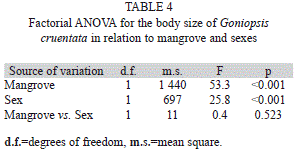
<body><![CDATA[of crabs sampled from the Sergipe River mangrove was higher than from     the Vaza-Barris River mangrove, statistically significant differences     in the abundance of crabs between the mangroves were found only for     February, March, September and November (<a      href="/img/revistas/rbt/v63n2/a09i1.jpg">Fig. 1A</a>).</span></font><br      style="font-family: verdana;">     <font size="2"></font><br style="font-family: verdana;">     <font size="2"><span style="font-family: verdana;">Regarding the size     of the crabs,     significant differences were also found between the mangroves and sexes     ]]></body>
<body><![CDATA[(<a href="#Table4">Table 4</a>). The mean sizes of both sexes were     larger in the Sergipe     River than in the Vaza-Barris River mangrove. Males were larger than     females in both mangroves (<a href="/img/revistas/rbt/v63n2/a09i1.jpg">Fig.     1B</a>).    <br>     <br> </span></font>     <div style="text-align: center;"><font size="2"><span      style="font-family: verdana;"><a name="Table4"></a><img alt=""      src="/img/revistas/rbt/v63n2/a09t4.gif"     ]]></body>
<body><![CDATA[ style="width: 298px; height: 156px;"></span></font><br      style="font-family: verdana;">     <font size="2"><span style="font-family: verdana;"></span></font></div>     <br style="font-family: verdana;">     <font size="2"><span style="font-family: verdana;"><span      style="font-weight: bold;">Sex ratio:</span> The sex ratio for both     populations differed from the expected 1:1 ratio (male:female)     (p&lt;0.01), for both juveniles and adults. A significant deviation in     favor of juvenile males was obtained, while adults showed a bias toward     females (<a href="/img/revistas/rbt/v63n2/a09i1.jpg">Fig. 1C</a>).</span></font><br     ]]></body>
<body><![CDATA[ style="font-family: verdana;">     <font size="2"></font><br style="font-family: verdana;">     <font size="2"><span style="font-family: verdana;"><span      style="font-weight: bold;">Morphological sexual maturity:</span> The     estimated value for morphological sexual maturity was higher for males     than for females, for the population of the Sergipe River mangrove. The     estimated size where 50% of individuals were already in adult form (W     50%) for males was 32.24mm CW (<a      href="/img/revistas/rbt/v63n2/a09i2.jpg">Fig. 2A, Fig. 2B</a>); the     largest juvenile     ]]></body>
<body><![CDATA[male measured was 33.57mm CW, and the smallest adult male 32.11mm CW.     For females, the estimated value was 27.01mm CW (<a      href="/img/revistas/rbt/v63n2/a09i2.jpg">Fig. 2C, Fig. 2D</a>); the     largest juvenile female measured was 27.8mm CW and the smallest adult     female 24.98mm CW.</span></font><br style="font-family: verdana;">     <font size="2"></font><br style="font-family: verdana;">     <font size="2"><span style="font-family: verdana;">The estimated size     at onset of     sexual maturity for both sexes was similar in the two populations. The     estimated size where 50% of individuals were already in adult form (W     ]]></body>
<body><![CDATA[50%) in males was 31.49mm CW (<a      href="/img/revistas/rbt/v63n2/a09i2.jpg">Fig. 2E, Fig. 2F</a>); the     largest juvenile     male measured 32.39mm CW and the smallest adult 30.80mm CW. For females     the estimated value was 27.23mm CW (<a      href="/img/revistas/rbt/v63n2/a09i2.jpg">Fig. 2G, Fig. 2H</a>); the     largest     juvenile female measured 28.35mm CW and the smallest adult 25.16mm CW.</span></font><br      style="font-family: verdana;">     <font size="2"></font><br style="font-family: verdana;">     ]]></body>
<body><![CDATA[<font size="2"><span style="font-family: verdana;"><span      style="font-weight: bold;">Gonadal sexual maturity:</span> The     estimated sizes for gonadal sexual maturity were very close to those     estimated from the morphological sexual maturity, 32.38 and 26.53mm CW     for males and females, respectively, from the Sergipe River mangrove     (<a href="/img/revistas/rbt/v63n2/a09i3.jpg">Fig. 3A, Fig. 3B</a>) and     30.90 and 27.88mm CW for males and females,     respectively, from the Vaza-Barris River mangrove (<a      href="/img/revistas/rbt/v63n2/a09i3.jpg">Fig. 3C, Fig. 3D</a>).</span></font><br      style="font-family: verdana;">     ]]></body>
<body><![CDATA[<font size="2"></font><br style="font-family: verdana;">     <font size="2"><span style="font-family: verdana;"><span      style="font-weight: bold;">Fecundity and egg size:</span> The     populations differed significantly in the number of eggs, with a higher     IF for females from the Sergipe River mangrove (t=2.28, p=0.026) (<a      href="/img/revistas/rbt/v63n2/a09i4.jpg">Fig.     4A</a>). The mean number of eggs carried by females from the Sergipe     River     mangrove was estimated at 50 460&plusmn;19 828 eggs, while females from     the Vaza-Barris River carried 40 005&plusmn;18 508 eggs. The mean CW     ]]></body>
<body><![CDATA[for ovigerous females was 35.23&plusmn;4.6mm for the Sergipe River     mangrove; and the largest and smallest ovigerous females measured 42.04     and 25.71mm CW, respectively. The mean CW for ovigerous females in the     Vaza-Barris River mangrove was 34.51mm; and the largest and smallest     ovigerous females measured 42.08 and 25.62mm CW, respectively.</span></font><br      style="font-family: verdana;">     <font size="2"></font><br style="font-family: verdana;">     <font size="2"><span style="font-family: verdana;">The egg volume also     showed     statistically significant differences between populations (t=8.98,     ]]></body>
<body><![CDATA[p&lt;0.001). In contrast to the trend for fecundity, the population     from the Sergipe River carried smaller eggs than the population of the     Vaza-Barris River mangrove (<a href="/img/revistas/rbt/v63n2/a09i4.jpg">Fig.     4B</a>).</span></font><br style="font-family: verdana;">     <font size="2"></font><br style="font-family: verdana;">     <font size="2"><span style="font-family: verdana;"><a      href="/img/revistas/rbt/v63n2/a09t5.gif">Table 5</a> compares the     data obtained     in the Sergipe State with other previously published data.</span></font><br      style="font-family: verdana;">     ]]></body>
<body><![CDATA[<font size="2"></font><br style="font-family: verdana;">     <font style="font-weight: bold;" size="3"><span      style="font-family: verdana;">Discussion</span></font><br      style="font-family: verdana;">     <font size="2"></font><br style="font-family: verdana;">     <font size="2"><span style="font-family: verdana;">The lack of studies     and     standardized procedures used in sampling </span></font><font size="2"><span      style="font-family: verdana;"><span style="font-style: italic;">G.     cruentata</span></span></font><font size="2"><span     ]]></body>
<body><![CDATA[ style="font-family: verdana;"> prevents     comparisons of its abundance with populations from other mangroves.     Nevertheless, considering that this study used the same field procedure     for both mangroves, we can infer that the mean crab abundance found in     the Vaza-Barris River mangrove is lower than in the Sergipe River     mangrove. These differences can be attributed to environmental factors     that are intrinsic to a particular mangrove forest or crab population,     such as primary productivity, pneumatophore density, or patterns of     larval recruitment (Piou, Berger, &amp; Feller, 2009; Sandrini-Neto,     &amp; Lana, 2012), but might also be a consequence of the stronger     ]]></body>
<body><![CDATA[fishing intensity (Tripple, 1995; Carver, Wolcott, Wolcott, &amp;     Hines, 2005) in the Vaza-Barris River mangrove.</span></font><br      style="font-family: verdana;">     <font size="2"></font><br style="font-family: verdana;">     <font size="2"><span style="font-family: verdana;">In Northeastern     Brazil, </span></font><font size="2"><span      style="font-family: verdana;"><span style="font-style: italic;">G.     cruentata</span></span></font><font size="2"><span      style="font-family: verdana;"> is usually not sold as whole     individuals but as processed     ]]></body>
<body><![CDATA[meat, popularly known as &#8220;catado&#8221;. </span></font><font size="2"><span      style="font-family: verdana;"><span style="font-style: italic;">Goniopsis     cruentata</span></span></font><font size="2"><span      style="font-family: verdana;"> (mean size     33.72&plusmn;5.13mm CW in individuals from Sergipe State) is not large     compared to other mangrove crab species, such as </span></font><font      size="2"><span style="font-family: verdana;"><span      style="font-style: italic;">U.     cordatus</span></span></font><font size="2"><span      style="font-family: verdana;"> (mean size     ]]></body>
<body><![CDATA[about 45.00mm CW, on the Northeastern Brazilian coast) (Castiglioni,     &amp; Coelho, 2011). Therefore a large number of individuals of </span></font><font      size="2"><span style="font-family: verdana;"><span      style="font-style: italic;">G. cruentata</span></span></font><font      size="2"><span style="font-family: verdana;"> are usually required to     produce a small amount of meat;     according to Carri&ccedil;o et al. (unpublished data), 120-150 adult     crabs are needed to produce one kg of &#8220;catado&#8221;. This makes fishing for </span></font><font      size="2"><span style="font-family: verdana;"><span      style="font-style: italic;">G. cruentata</span></span></font><font     ]]></body>
<body><![CDATA[ size="2"><span style="font-family: verdana;"> a highly impactful     activity for the natural populations.</span></font><br      style="font-family: verdana;">     <font size="2"></font><br style="font-family: verdana;">     <font size="2"><span style="font-family: verdana;">The two populations     differed     significantly in body size. Body size variations are common, and may     reflect the phenotypic plasticity of the organisms or the influence of     environmental factors such as photoperiod, temperature, and food     availability (Campbell, &amp; Eagles, 1983; Negreiros-Fransozo,     ]]></body>
<body><![CDATA[Fransozo, Gonz&aacute;lez-Gordillo, &amp; Bertini, 2002). One of the     most obvious of these changes is related to the latitudinal cline.     Intraspecific studies on decapod crustaceans tend to show that     larger-bodied crabs occur at higher latitudes (Jones, &amp; Simons,     1983; Hines, 1989; Lardies, &amp; Castilla, 2001; Castilho et al.,     2007; Hirose, Fransozo, Tropea, Lopez-Greco, &amp; Negreiros-Fransozo,     2012); this phenomenon is known as Bergmann&acute;s rule (Blackburn,     Gaston, &amp; Loder, 1999).</span></font><br      style="font-family: verdana;">     <font size="2"></font><br style="font-family: verdana;">     ]]></body>
<body><![CDATA[<font size="2"><span style="font-family: verdana;">Comparison of the     body size of     crabs in this and previous studies on the Northeastern Brazilian coast,     in relation to space and time, does not show evidence of a latitudinal     cline or a spatial dependency in the maximum body size, probably due to     intrinsic differences in environmental factors of each mangrove forest.     In contrast, the relationship of the body size vs. year shows an     apparently temporal pattern, with a tendency to diminution of the     maximum body size in relation to time. Body size is probably the most     important quantitative trait of an individual. It deeply affects     ]]></body>
<body><![CDATA[virtually all physiological (e.g., metabolic rate) and fitness traits     (e.g., fecundity or mating success), producing strong but not     necessarily well-understood allometric relationships within and among     organisms (McNab, 1971; Blanckenhorn, &amp; Demont, 2004).</span></font><br      style="font-family: verdana;">     <font size="2"></font><br style="font-family: verdana;">     <font size="2"><span style="font-family: verdana;">The artisanal     fishery for the red     mangrove crab targets the larger individuals (personal observation),     probably due to the small amounts of meat in juvenile crabs. The result     ]]></body>
<body><![CDATA[is, in part, that juvenile individuals (less than the estimated W50%)     are maintained in the population. Moreover, selection of the largest     individuals by fishermen would tend to capture larger numbers of males     due to their larger body size. This could explain the deviation in sex     ratio recorded for the adults in this study. Furthermore, the     collection of larger individuals could favor genotypes with slower     growth and a younger age at onset of maturation, among other changes,     that reduce the reproductive success of a population (Conover, &amp;     Munch, 2002; Carver et al., 2005).</span></font><br      style="font-family: verdana;">     ]]></body>
<body><![CDATA[<font size="2"></font><br style="font-family: verdana;">     <font size="2"><span style="font-family: verdana;">The size at onset of     sexual     maturity (W 50%) of </span></font><font size="2"><span      style="font-family: verdana;"><span style="font-style: italic;">G.     cruentata</span></span></font><font size="2"><span      style="font-family: verdana;"> from Sergipe State was estimated     utilizing different procedures (morphological and gonadal maturation).     The results were similar, in agreement with Souza and Silva (2009).     However, when compared among localities or on a time scale, no apparent     ]]></body>
<body><![CDATA[pattern was found. This is probably because the SOM is very plastic     under different environmental conditions, i.e., different levels of     productivity and stress, or the presence, mainly in mangrove areas, of     large amounts of growth-inhibiting substances (e.g., polyphenols     derived from tannins of halophyte plants) (Power, &amp; Bliss, 1983;     Rodr&iacute;guez, 1987; D&iacute;az, &amp; Conde, 1988 and 1989; Conde,     &amp; D&iacute;az, 1989; Negreiros-Fransozo et al., 2002; Hirose et     al., 2012).</span></font><br style="font-family: verdana;">     <font size="2"></font><br style="font-family: verdana;">     <font size="2"><span style="font-family: verdana;">The existing     ]]></body>
<body><![CDATA[management plans for     commercially exploited crustacean species in Brazil are based on a set     of measures designed to maintain a breeding stock large enough for     adequate recruitment, and to prevent the capture of individuals in     critical phases of their life cycles (MMA/IBAMA, 2011). The size at     onset of sexual maturity (W50%) is regularly used to define a minimum     size of capture (estimated for Sergipe State in 32.4 and 27.9mm CW for     males and females, respectively). In view of the high variability found     here (W50%) compared to other locations, an ecosystem-based management     plan should be adopted to increase the efficiency of these measures as     ]]></body>
<body><![CDATA[alternatives for protection of natural populations (Ma, Townsend,     Zhang, Sigrist, &amp; Christensen, 2010).</span></font><br      style="font-family: verdana;">     <font size="2"></font><br style="font-family: verdana;">     <font size="2"><span style="font-family: verdana;">The effect of     fishing on the     reproductive potential of </span></font><font size="2"><span      style="font-family: verdana;"><span style="font-style: italic;">G.     cruentata</span></span></font><font size="2"><span      style="font-family: verdana;"> should be taken into account.     ]]></body>
<body><![CDATA[Our results show that both sexes are taken by fishermen, and     approximately 33% of the females sampled were bearing eggs. According     to our observation, ovigerous females are typically used in the     production of &#8220;catado&#8221; in Sergipe, which could heavily impact the     reproductive potential of the stock. The estimated mean fecundity of </span></font><font      size="2"><span style="font-family: verdana;"><span      style="font-style: italic;">G. cruentata</span></span></font><font      size="2"><span style="font-family: verdana;"> from Sergipe (42     923&plusmn;19 171 eggs) is lower than that     described by Moura and Coelho (2003) from Cear&aacute; in 1999 (87 000     ]]></body>
<body><![CDATA[eggs). This may be a reflection of the smaller body size in     Northeastern populations, which would also tend to reduce the     reproductive potential of the species.</span></font><br      style="font-family: verdana;">     <font size="2"></font><br style="font-family: verdana;">     <font size="2"><span style="font-family: verdana;">Fecundity and egg     size differed     significantly between the two mangrove areas under different fishing     pressure in Sergipe state. These results suggest an apparent trade-off     between egg size and egg number. Trade-offs between egg number and size     ]]></body>
<body><![CDATA[are characteristic of most animals (Timi, Lanfranchi, &amp; Poulin,     2005). According to Fox and Czesak (2000), when environmental     conditions vary, the relationship between progeny size and progeny     fitness is likely to vary too, resulting in a different optimal progeny     size in different environments. Factors that may affect the trade-off     between egg size and egg number include climate conditions, predation     and population density (Fox, &amp; Czesak, 2000). In the present study,     the significant differences in population density between the mangrove     localities may affect competition for food and consequently select for     egg size (Parker, &amp; Begon, 1986).</span></font><br     ]]></body>
<body><![CDATA[ style="font-family: verdana;">     <font size="2"></font><br style="font-family: verdana;">     <font size="2"><span style="font-family: verdana;">Habitat loss in     conjunction with     long-term overfishing can have irreversible consequences, which can     impact not only the populations of commercially exploited crabs, but     the dynamics of virtually the entire mangrove ecosystem. Our results     indicated a tendency towards a decrease in the body size, abundance and     reproductive potential of </span></font><font size="2"><span      style="font-family: verdana;"><span style="font-style: italic;">G.     ]]></body>
<body><![CDATA[cruentata</span></span></font><font size="2"><span      style="font-family: verdana;">, probably in response to     pressure from artisanal fishing. Our overall evaluation indicates that     Northeastern populations of </span></font><font size="2"><span      style="font-family: verdana;"><span style="font-style: italic;">G.     cruentata</span></span></font><font size="2"><span      style="font-family: verdana;"> can be currently overfished,     reinforcing the need to develop a management plan for the species, as     well as for the implementation of conservation units in the mangroves     on the Northeastern Brazilian coast.</span></font><br     ]]></body>
<body><![CDATA[ style="font-family: verdana;">     <font size="2"></font><br style="font-family: verdana;">     <font style="font-weight: bold;" size="3"><span      style="font-family: verdana;">Acknowledgments</span></font><br      style="font-family: verdana;">     <font size="2"></font><br style="font-family: verdana;">     <font size="2"><span style="font-family: verdana;">To the CNPq     (Conselho Nacional de     Desenvolvimento Cient&iacute;fico e Tecnol&oacute;gico) for financial     support (CNPq-Universal #472386/2010-7 to the first author; and CNPq &#8211;     ]]></body>
<body><![CDATA[Research Fellowship to MLNF). All sampling in Brazil was carried out     according to state and federal laws regulating wildlife collection     (SISBIO #24097-1).</span></font><br style="font-family: verdana;">     <br style="font-family: verdana;">     <hr      style="width: 100%; height: 2px; margin-left: 0px; margin-right: 0px;"><font      style="font-weight: bold;" size="3"><span style="font-family: verdana;">References</span></font><br      style="font-family: verdana;">     <br style="font-family: verdana;">     <!-- ref --><div style="text-align: left;"><font size="2"><span  style="font-family: verdana;">Almeida, A. C., Baeza, J. A., Fransozo, V., Castilho, A. L., &amp; Fransozo, A. (2012). Reproductive biology and recruitment of <span style="font-style: italic;">Xiphopenaeus kroyeri</span> in a marine protected area in the Western Atlantic: implications for resource management. <span style="font-style: italic;">Aquatic Biology, 17</span>(1), 57-69.    &nbsp;&nbsp;&nbsp;&nbsp;&nbsp;&nbsp;&nbsp;&nbsp;[&#160;<a href="javascript:void(0);" onclick="javascript: window.open('/scielo.php?script=sci_nlinks&ref=1602509&pid=S0034-7744201500020000900001&lng=','','width=640,height=500,resizable=yes,scrollbars=1,menubar=yes,');">Links</a>&#160;]<!-- end-ref --><!-- ref --></span></font><br  style="font-family: verdana;"> <br style="font-family: verdana;"> <font size="2"><span style="font-family: verdana;">Baeza, J. A., Furlan, M., Almeida, A. C., Barros-Alves, S. P., Alves, D. F. R., &amp; Fransozo, V. (2013). Population dynamics and reproductive traits of the ornamental crab <span style="font-style: italic;">Porcellana sayana:</span> implications for fishery management and aquaculture. <span style="font-style: italic;">Sexuality and Early Development in Aquatic Organisms, 1</span>, 1-12.    &nbsp;&nbsp;&nbsp;&nbsp;&nbsp;&nbsp;&nbsp;&nbsp;[&#160;<a href="javascript:void(0);" onclick="javascript: window.open('/scielo.php?script=sci_nlinks&ref=1602510&pid=S0034-7744201500020000900002&lng=','','width=640,height=500,resizable=yes,scrollbars=1,menubar=yes,');">Links</a>&#160;]<!-- end-ref --><!-- ref --></span></font><br  style="font-family: verdana;"> <br style="font-family: verdana;"> <font size="2"><span style="font-family: verdana;">Blackburn, T. M., Gaston, K. J., &amp; Loder, N. (1999). Geographic gradients in body size: a clarification of Bergmann&#8217;s rule. <span style="font-style: italic;">Diversity and Distributions, 5</span>(4), 165-174.    &nbsp;&nbsp;&nbsp;&nbsp;&nbsp;&nbsp;&nbsp;&nbsp;[&#160;<a href="javascript:void(0);" onclick="javascript: window.open('/scielo.php?script=sci_nlinks&ref=1602511&pid=S0034-7744201500020000900003&lng=','','width=640,height=500,resizable=yes,scrollbars=1,menubar=yes,');">Links</a>&#160;]<!-- end-ref --><!-- ref --></span></font><br style="font-family: verdana;"> <br style="font-family: verdana;"> <font size="2"><span style="font-family: verdana;">Blanckenhorn, W. U., &amp; Demont, M. (2004). Bergmann and converse Bergmann latitudinal clines in arthropods: Two ends of a continuum? <span style="font-style: italic;">Integrative and Comparative Biology, 44</span>(6), 413-424.    &nbsp;&nbsp;&nbsp;&nbsp;&nbsp;&nbsp;&nbsp;&nbsp;[&#160;<a href="javascript:void(0);" onclick="javascript: window.open('/scielo.php?script=sci_nlinks&ref=1602512&pid=S0034-7744201500020000900004&lng=','','width=640,height=500,resizable=yes,scrollbars=1,menubar=yes,');">Links</a>&#160;]<!-- end-ref --><!-- ref --></span></font><br  style="font-family: verdana;"> <br style="font-family: verdana;"> <font size="2"><span style="font-family: verdana;">Botelho, E. R. O., Andrade, C. E. R., &amp; Santos, M. C. F. (2004). Estudo da popula&ccedil;&atilde;o de aratu-do-mangue, </span></font><font size="2"><span  style="font-family: verdana;"><span style="font-style: italic;">Goniopsis cruentata</span></span></font><font size="2"><span  style="font-family: verdana;"> (Latreille, 1803) (Crustacea, Decapoda, Grapsidae) no estu&aacute;rio do rio Camaragibe (Alagoas &#8211; Brasil). <span style="font-style: italic;">Boletim T&eacute;cnico Cient&iacute;fico do CEPENE, 12</span>, 91-98.    &nbsp;&nbsp;&nbsp;&nbsp;&nbsp;&nbsp;&nbsp;&nbsp;[&#160;<a href="javascript:void(0);" onclick="javascript: window.open('/scielo.php?script=sci_nlinks&ref=1602513&pid=S0034-7744201500020000900005&lng=','','width=640,height=500,resizable=yes,scrollbars=1,menubar=yes,');">Links</a>&#160;]<!-- end-ref --><!-- ref --></span></font><br  style="font-family: verdana;"> <br style="font-family: verdana;"> <font size="2"><span style="font-family: verdana;">Campbell, A., &amp; Eagles, M. D. (1983). Size at maturity and fecundity of rock crabs, <span  style="font-style: italic;">Cancer irroratus</span>, from the Bay of Fundy and southwestern Nova Scotia. <span  style="font-style: italic;">Fishery Bulletin, 81</span>(2), 357-362.    &nbsp;&nbsp;&nbsp;&nbsp;&nbsp;&nbsp;&nbsp;&nbsp;[&#160;<a href="javascript:void(0);" onclick="javascript: window.open('/scielo.php?script=sci_nlinks&ref=1602514&pid=S0034-7744201500020000900006&lng=','','width=640,height=500,resizable=yes,scrollbars=1,menubar=yes,');">Links</a>&#160;]<!-- end-ref --><!-- ref --></span></font><br style="font-family: verdana;"> <br style="font-family: verdana;"> <font size="2"><span style="font-family: verdana;">Carvalho, M. E., &amp; Fontes, A. L. (2007). A carcinicultura no espa&ccedil;o litor&acirc;neo Sergipano. <span style="font-style: italic;">Revista da Fapese, 3</span>(1), 87-112.    &nbsp;&nbsp;&nbsp;&nbsp;&nbsp;&nbsp;&nbsp;&nbsp;[&#160;<a href="javascript:void(0);" onclick="javascript: window.open('/scielo.php?script=sci_nlinks&ref=1602515&pid=S0034-7744201500020000900007&lng=','','width=640,height=500,resizable=yes,scrollbars=1,menubar=yes,');">Links</a>&#160;]<!-- end-ref --><!-- ref --></span></font><br style="font-family: verdana;"> <br style="font-family: verdana;"> <font size="2"><span style="font-family: verdana;">Carver, A. M., Wolcott, T. G., Wolcott, D. L., &amp; Hines, A. H. (2005). Unnatural selection: effects of a male-focused size-selective fishery on reproductive potential of a blue crab population. <span style="font-style: italic;">Journal of Experimental Marine Biology and Ecology, 319</span>(1), 29-41.    &nbsp;&nbsp;&nbsp;&nbsp;&nbsp;&nbsp;&nbsp;&nbsp;[&#160;<a href="javascript:void(0);" onclick="javascript: window.open('/scielo.php?script=sci_nlinks&ref=1602516&pid=S0034-7744201500020000900008&lng=','','width=640,height=500,resizable=yes,scrollbars=1,menubar=yes,');">Links</a>&#160;]<!-- end-ref --><!-- ref --></span></font><br  style="font-family: verdana;"> <br style="font-family: verdana;"> <font size="2"><span style="font-family: verdana;">Castiglioni, D. S., &amp; Coelho, P. A. (2011). Determina&ccedil;&atilde;o da maturidade sexual de </span></font><font  size="2"><span style="font-family: verdana;"><span  style="font-style: italic;">Ucides cordatus</span></span></font><font size="2"><span  style="font-family: verdana;"> (Crustacea, Brachyura, Ucididae) em duas &aacute;reas de manguezal do litoral sul de Pernambuco, Brasil. <span  style="font-style: italic;">Iheringia S&eacute;rie Zoologia, 101</span>(1-2), 138-144.    &nbsp;&nbsp;&nbsp;&nbsp;&nbsp;&nbsp;&nbsp;&nbsp;[&#160;<a href="javascript:void(0);" onclick="javascript: window.open('/scielo.php?script=sci_nlinks&ref=1602517&pid=S0034-7744201500020000900009&lng=','','width=640,height=500,resizable=yes,scrollbars=1,menubar=yes,');">Links</a>&#160;]<!-- end-ref --><!-- ref --></span></font><br  style="font-family: verdana;"> <br style="font-family: verdana;"> <font size="2"><span style="font-family: verdana;">Castilho, A. L., Gavio, M. A., Costa, R. C., Boschi, E. E., Bauer, R. T., &amp; Fransozo, A. (2007). Latitudinal variation in population structure and reproductive pattern of the endemic South American shrimp <span style="font-style: italic;">Artemesia longinaris </span>(Decapoda: Penaeoidea). <span style="font-style: italic;">Journal of Crustacean Biology, 27</span>(4), 548-552.    &nbsp;&nbsp;&nbsp;&nbsp;&nbsp;&nbsp;&nbsp;&nbsp;[&#160;<a href="javascript:void(0);" onclick="javascript: window.open('/scielo.php?script=sci_nlinks&ref=1602518&pid=S0034-7744201500020000900010&lng=','','width=640,height=500,resizable=yes,scrollbars=1,menubar=yes,');">Links</a>&#160;]<!-- end-ref --><!-- ref --></span></font><br  style="font-family: verdana;"> <br style="font-family: verdana;"> <font size="2"><span style="font-family: verdana;">Cobo, V. J., &amp; Fransozo, A. (2003). External factors determining breeding season in the red mangrove crab </span></font><font size="2"><span  style="font-family: verdana;"><span style="font-style: italic;">Goniopsis cruentata</span></span></font><font size="2"><span  style="font-family: verdana;"> (Latreille) (Crustacea, Brachyura, Grapsidae) on the S&atilde;o Paulo State northern coast, Brazil. <span style="font-style: italic;">Revista Brasileira de Zoologia, 20</span>(2), 213-217.    &nbsp;&nbsp;&nbsp;&nbsp;&nbsp;&nbsp;&nbsp;&nbsp;[&#160;<a href="javascript:void(0);" onclick="javascript: window.open('/scielo.php?script=sci_nlinks&ref=1602519&pid=S0034-7744201500020000900011&lng=','','width=640,height=500,resizable=yes,scrollbars=1,menubar=yes,');">Links</a>&#160;]<!-- end-ref --><!-- ref --></span></font><br style="font-family: verdana;"> <br style="font-family: verdana;"> <font size="2"><span style="font-family: verdana;">Cobo, V. J., &amp; Fransozo, A. (2005). Physiological maturity and relationship of growth and reproduction in the red mangrove crab </span></font><font size="2"><span  style="font-family: verdana;"><span style="font-style: italic;">Goniopsis cruentata</span></span></font><font size="2"><span  style="font-family: verdana;"> (Latreille) (Brachyura, Grapsidae) on the coast of S&atilde;o Paulo, Brazil. <span style="font-style: italic;">Revista Brasileira de Zoologia, 22</span>(1), 219-223.    &nbsp;&nbsp;&nbsp;&nbsp;&nbsp;&nbsp;&nbsp;&nbsp;[&#160;<a href="javascript:void(0);" onclick="javascript: window.open('/scielo.php?script=sci_nlinks&ref=1602520&pid=S0034-7744201500020000900012&lng=','','width=640,height=500,resizable=yes,scrollbars=1,menubar=yes,');">Links</a>&#160;]<!-- end-ref --><!-- ref --></span></font><br style="font-family: verdana;"> <br style="font-family: verdana;"> <font size="2"><span style="font-family: verdana;">Colpo, K. D., Chacur, M. M., Guimar&atilde;es, F. J., &amp; Negreiros-Fransozo, M. L. (2011). Subtropical Brazilian mangroves as a refuge of crab (Decapoda: Brachyura) diversity. <span style="font-style: italic;">Biodiversity and Conservation, 20</span>(13), 3239-3250.    &nbsp;&nbsp;&nbsp;&nbsp;&nbsp;&nbsp;&nbsp;&nbsp;[&#160;<a href="javascript:void(0);" onclick="javascript: window.open('/scielo.php?script=sci_nlinks&ref=1602521&pid=S0034-7744201500020000900013&lng=','','width=640,height=500,resizable=yes,scrollbars=1,menubar=yes,');">Links</a>&#160;]<!-- end-ref --><!-- ref --></span></font><br  style="font-family: verdana;"> <br style="font-family: verdana;"> <font size="2"><span style="font-family: verdana;">Conde, J. E., &amp; D&iacute;az, H. (1989). The mangrove tree crab <span style="font-style: italic;">Aratus pisonii</span> in a tropical estuarine coastal lagoon. <span style="font-style: italic;">Estuarine, Coastal and Shelf Science, 28</span>(6), 639-650.    &nbsp;&nbsp;&nbsp;&nbsp;&nbsp;&nbsp;&nbsp;&nbsp;[&#160;<a href="javascript:void(0);" onclick="javascript: window.open('/scielo.php?script=sci_nlinks&ref=1602522&pid=S0034-7744201500020000900014&lng=','','width=640,height=500,resizable=yes,scrollbars=1,menubar=yes,');">Links</a>&#160;]<!-- end-ref --><!-- ref --></span></font><br  style="font-family: verdana;"> <br style="font-family: verdana;"> <font size="2"><span style="font-family: verdana;">Conover, D. O., &amp; Munch, S. B. (2002). Sustaining fisheries yields over evolutionary time scales. <span style="font-style: italic;">Science, 297</span>(5578), 94-96.    &nbsp;&nbsp;&nbsp;&nbsp;&nbsp;&nbsp;&nbsp;&nbsp;[&#160;<a href="javascript:void(0);" onclick="javascript: window.open('/scielo.php?script=sci_nlinks&ref=1602523&pid=S0034-7744201500020000900015&lng=','','width=640,height=500,resizable=yes,scrollbars=1,menubar=yes,');">Links</a>&#160;]<!-- end-ref --><!-- ref --></span></font><br  style="font-family: verdana;"> <br style="font-family: verdana;"> <font size="2"><span style="font-family: verdana;">Corgos, A., &amp; Freire, J. (2006). Morphometric and gonad maturity in the spider crab <span  style="font-style: italic;">Maja brachydactyla</span>: a comparison of methods for estimating size at maturity in species with determinate growth. <span style="font-style: italic;">Journal of Marine Science, 63</span>(5), 851-859.    &nbsp;&nbsp;&nbsp;&nbsp;&nbsp;&nbsp;&nbsp;&nbsp;[&#160;<a href="javascript:void(0);" onclick="javascript: window.open('/scielo.php?script=sci_nlinks&ref=1602524&pid=S0034-7744201500020000900016&lng=','','width=640,height=500,resizable=yes,scrollbars=1,menubar=yes,');">Links</a>&#160;]<!-- end-ref --><!-- ref --></span></font><br style="font-family: verdana;"> <br style="font-family: verdana;"> <font size="2"><span style="font-family: verdana;">Costa, R. C., Fransozo, A., Freire, F. A. M., &amp; Castilho, A. L. (2007). Abundance and ecological distribution of the &#8220;sete-barbas&#8221; shrimp <span  style="font-style: italic;">Xiphopenaeus kroyeri</span> (Heller, 1862) (Decapoda: Penaeoidea) in three bays of the Ubatuba region, southeastern Brazil. <span style="font-style: italic;">Gulf and Caribbean Research, 19</span>, 33-41.    &nbsp;&nbsp;&nbsp;&nbsp;&nbsp;&nbsp;&nbsp;&nbsp;[&#160;<a href="javascript:void(0);" onclick="javascript: window.open('/scielo.php?script=sci_nlinks&ref=1602525&pid=S0034-7744201500020000900017&lng=','','width=640,height=500,resizable=yes,scrollbars=1,menubar=yes,');">Links</a>&#160;]<!-- end-ref --><!-- ref --></span></font><br  style="font-family: verdana;"> <br style="font-family: verdana;"> <font size="2"><span style="font-family: verdana;">Costa, T. M., &amp; Negreiros-Fransozo, M. L. (1996). Fecundidade de Callinectes danae Smith, 1869 (Crustacea, Decapoda, Portunidae) na regi&atilde;o de Ubatuba (SP), Brasil. <span style="font-style: italic;">Arquivos de Biologia e Tecnologia, 39</span>, 393-400.    &nbsp;&nbsp;&nbsp;&nbsp;&nbsp;&nbsp;&nbsp;&nbsp;[&#160;<a href="javascript:void(0);" onclick="javascript: window.open('/scielo.php?script=sci_nlinks&ref=1602526&pid=S0034-7744201500020000900018&lng=','','width=640,height=500,resizable=yes,scrollbars=1,menubar=yes,');">Links</a>&#160;]<!-- end-ref --><!-- ref --></span></font><br  style="font-family: verdana;"> <br style="font-family: verdana;"> <font size="2"><span style="font-family: verdana;">D&iacute;az, H., &amp; Conde, J. E. (1988). On the food sources for the mangrove tree crab <span  style="font-style: italic;">Aratus pisonii</span> (Brachyura: Grapsidae). <span style="font-style: italic;">Biotropica, 20,</span> 348-350.    &nbsp;&nbsp;&nbsp;&nbsp;&nbsp;&nbsp;&nbsp;&nbsp;[&#160;<a href="javascript:void(0);" onclick="javascript: window.open('/scielo.php?script=sci_nlinks&ref=1602527&pid=S0034-7744201500020000900019&lng=','','width=640,height=500,resizable=yes,scrollbars=1,menubar=yes,');">Links</a>&#160;]<!-- end-ref --><!-- ref --></span></font><br style="font-family: verdana;"> <br style="font-family: verdana;"> <font size="2"><span style="font-family: verdana;">D&iacute;az, H., &amp; Conde, J. E. (1989). Population dynamics and life history of the mangrove crab <span style="font-style: italic;">Aratus pisonii </span>(Brachyura, Grapsidae) in a marine environment.<span style="font-style: italic;"> Bulletin of Marine Science, 45</span>(1), 148-163.    &nbsp;&nbsp;&nbsp;&nbsp;&nbsp;&nbsp;&nbsp;&nbsp;[&#160;<a href="javascript:void(0);" onclick="javascript: window.open('/scielo.php?script=sci_nlinks&ref=1602528&pid=S0034-7744201500020000900020&lng=','','width=640,height=500,resizable=yes,scrollbars=1,menubar=yes,');">Links</a>&#160;]<!-- end-ref --><!-- ref --></span></font><br  style="font-family: verdana;"> <br style="font-family: verdana;"> <font size="2"><span style="font-family: verdana;">Diele, K., Koch, V., &amp; Saint-Paul, U. 2005. Population structure, catch composition and CPUE of the artisanally harvested mangrove crab </span></font><font size="2"><span  style="font-family: verdana;"><span style="font-style: italic;">Ucides cordatus</span></span></font><font size="2"><span  style="font-family: verdana;"> (Ocypodidae) in the Caet&eacute; estuary, North Brazil: indications for overfishing? <span style="font-style: italic;">Aquatic Living Resources, 18</span>(2), 169-178.    &nbsp;&nbsp;&nbsp;&nbsp;&nbsp;&nbsp;&nbsp;&nbsp;[&#160;<a href="javascript:void(0);" onclick="javascript: window.open('/scielo.php?script=sci_nlinks&ref=1602529&pid=S0034-7744201500020000900021&lng=','','width=640,height=500,resizable=yes,scrollbars=1,menubar=yes,');">Links</a>&#160;]<!-- end-ref --><!-- ref --></span></font><br style="font-family: verdana;"> <br style="font-family: verdana;"> <font size="2"><span style="font-family: verdana;">Ferreira, A. C., Ganade, G., Freire, F. A. M., &amp; Attayde, J. L. (2013). Propagule predation in a Neotropical mangrove: the role of the Grapsid crab </span></font><font  size="2"><span style="font-family: verdana;"><span  style="font-style: italic;">Goniopsis cruentata</span></span></font><font size="2"><span  style="font-family: verdana;">. <span style="font-style: italic;">Hydrobiologia, 707</span>(1), 135-146.    &nbsp;&nbsp;&nbsp;&nbsp;&nbsp;&nbsp;&nbsp;&nbsp;[&#160;<a href="javascript:void(0);" onclick="javascript: window.open('/scielo.php?script=sci_nlinks&ref=1602530&pid=S0034-7744201500020000900022&lng=','','width=640,height=500,resizable=yes,scrollbars=1,menubar=yes,');">Links</a>&#160;]<!-- end-ref --><!-- ref --></span></font><br  style="font-family: verdana;"> <br style="font-family: verdana;"> <font size="2"><span style="font-family: verdana;">Fisher, J. A. D, Frank, K. T., &amp; Leggett, W. C. (2010). Global variation in marine fish body size and its role in biodiversity&#8211;ecosystem functioning. <span  style="font-style: italic;">Marine Ecology Progress Series, 405</span>, 1-13.    &nbsp;&nbsp;&nbsp;&nbsp;&nbsp;&nbsp;&nbsp;&nbsp;[&#160;<a href="javascript:void(0);" onclick="javascript: window.open('/scielo.php?script=sci_nlinks&ref=1602531&pid=S0034-7744201500020000900023&lng=','','width=640,height=500,resizable=yes,scrollbars=1,menubar=yes,');">Links</a>&#160;]<!-- end-ref --><!-- ref --></span></font><br  style="font-family: verdana;"> <br style="font-family: verdana;"> <font size="2"><span style="font-family: verdana;">Fox, C. W., &amp; Czesak, M. L. 2000. Evolutionary ecology of progeny size in Arthropods. <span  style="font-style: italic;">Annual Review of Entomology, 45</span>(1), 341-369.    &nbsp;&nbsp;&nbsp;&nbsp;&nbsp;&nbsp;&nbsp;&nbsp;[&#160;<a href="javascript:void(0);" onclick="javascript: window.open('/scielo.php?script=sci_nlinks&ref=1602532&pid=S0034-7744201500020000900024&lng=','','width=640,height=500,resizable=yes,scrollbars=1,menubar=yes,');">Links</a>&#160;]<!-- end-ref --><!-- ref --></span></font><br  style="font-family: verdana;"> <br style="font-family: verdana;"> <font size="2"><span style="font-family: verdana;">Guerra, R. S., Nascimento, M. M. F., Miesch, S., Najafzadeh, M. J., Ribeiro, R. O., Ostrensky, A., Hoog, G. S., Vicente, V. A., &amp; Boeger, W. A. (2013). Black yeast biota in the mangrove, in search of the origin of the lethargic crab disease (LCD).<span style="font-style: italic;"> Mycopathologia, 175</span>(5-6), 421-430.    &nbsp;&nbsp;&nbsp;&nbsp;&nbsp;&nbsp;&nbsp;&nbsp;[&#160;<a href="javascript:void(0);" onclick="javascript: window.open('/scielo.php?script=sci_nlinks&ref=1602533&pid=S0034-7744201500020000900025&lng=','','width=640,height=500,resizable=yes,scrollbars=1,menubar=yes,');">Links</a>&#160;]<!-- end-ref --><!-- ref --></span></font><br style="font-family: verdana;"> <br style="font-family: verdana;"> <font size="2"><span style="font-family: verdana;">Hartnoll, R. G., &amp; Gould, P. (1988). Brachyuran life history strategies and the optimization of egg production. <span style="font-style: italic;">Symposia of the Zoological Society of London, 59</span>, 1-9.    &nbsp;&nbsp;&nbsp;&nbsp;&nbsp;&nbsp;&nbsp;&nbsp;[&#160;<a href="javascript:void(0);" onclick="javascript: window.open('/scielo.php?script=sci_nlinks&ref=1602534&pid=S0034-7744201500020000900026&lng=','','width=640,height=500,resizable=yes,scrollbars=1,menubar=yes,');">Links</a>&#160;]<!-- end-ref --><!-- ref --></span></font><br  style="font-family: verdana;"> <br style="font-family: verdana;"> <font size="2"><span style="font-family: verdana;">Hines, A. H. (1989). Geographic variation in size at maturity in Brachyuran crabs. <span  style="font-style: italic;">Bulletin of Marine Science, 45</span>(2), 356-368.    &nbsp;&nbsp;&nbsp;&nbsp;&nbsp;&nbsp;&nbsp;&nbsp;[&#160;<a href="javascript:void(0);" onclick="javascript: window.open('/scielo.php?script=sci_nlinks&ref=1602535&pid=S0034-7744201500020000900027&lng=','','width=640,height=500,resizable=yes,scrollbars=1,menubar=yes,');">Links</a>&#160;]<!-- end-ref --><!-- ref --></span></font><br  style="font-family: verdana;"> <br style="font-family: verdana;"> <font size="2"><span style="font-family: verdana;">Hirose, G. L., Fransozo, V., Tropea, C., Lopez-Greco, L. S., &amp; Negreiros-Fransozo, M. L. (2012). Comparison of body size, relative growth and size at onset sexual maturity of <span style="font-style: italic;">Uca uruguayensis</span> (Crustacea: Decapoda: Ocypodidae) from different latitudes in the southwestern Atlantic. <span  style="font-style: italic;">Journal of the Marine Biological Association of the United Kingdom, 93</span>(3), 781-788.    &nbsp;&nbsp;&nbsp;&nbsp;&nbsp;&nbsp;&nbsp;&nbsp;[&#160;<a href="javascript:void(0);" onclick="javascript: window.open('/scielo.php?script=sci_nlinks&ref=1602536&pid=S0034-7744201500020000900028&lng=','','width=640,height=500,resizable=yes,scrollbars=1,menubar=yes,');">Links</a>&#160;]<!-- end-ref --><!-- ref --></span></font><br  style="font-family: verdana;"> <br style="font-family: verdana;"> <font size="2"><span style="font-family: verdana;">Jones, M. B., &amp; Simons, M. J. (1983). Latitudinal variation in reproductive characteristics of a mud crab, Helice crassa (Grapsidae). <span style="font-style: italic;">Bulletin of Marine Science, 33</span>(3), 656-670.    &nbsp;&nbsp;&nbsp;&nbsp;&nbsp;&nbsp;&nbsp;&nbsp;[&#160;<a href="javascript:void(0);" onclick="javascript: window.open('/scielo.php?script=sci_nlinks&ref=1602537&pid=S0034-7744201500020000900029&lng=','','width=640,height=500,resizable=yes,scrollbars=1,menubar=yes,');">Links</a>&#160;]<!-- end-ref --><!-- ref --></span></font><br style="font-family: verdana;"> <br style="font-family: verdana;"> <font size="2"><span style="font-family: verdana;">Kristensen, E. (2008). Mangrove crabs as ecosystem engineers; with emphasis on sediment processes. <span style="font-style: italic;">Journal of Sea Research, 59</span>(1), 30-43.    &nbsp;&nbsp;&nbsp;&nbsp;&nbsp;&nbsp;&nbsp;&nbsp;[&#160;<a href="javascript:void(0);" onclick="javascript: window.open('/scielo.php?script=sci_nlinks&ref=1602538&pid=S0034-7744201500020000900030&lng=','','width=640,height=500,resizable=yes,scrollbars=1,menubar=yes,');">Links</a>&#160;]<!-- end-ref --><!-- ref --></span></font><br style="font-family: verdana;"> <br style="font-family: verdana;"> <font size="2"><span style="font-family: verdana;">Lardies, M. A., &amp; Castilla, J. C. 2001. Latitudinal variation in the reproductive biology of the commensal crab <span style="font-style: italic;">Pinnaxodes chilenis </span>(Decapoda: Pinnotheridae) along the Chilean coast. <span style="font-style: italic;">Marine Biology, 139</span>(6), 1125-1133.    &nbsp;&nbsp;&nbsp;&nbsp;&nbsp;&nbsp;&nbsp;&nbsp;[&#160;<a href="javascript:void(0);" onclick="javascript: window.open('/scielo.php?script=sci_nlinks&ref=1602539&pid=S0034-7744201500020000900031&lng=','','width=640,height=500,resizable=yes,scrollbars=1,menubar=yes,');">Links</a>&#160;]<!-- end-ref --><!-- ref --></span></font><br style="font-family: verdana;"> <br style="font-family: verdana;"> <font size="2"><span style="font-family: verdana;">Lee, S. Y. (1997). Potential trophic importance of the faecal material of the mangrove sesarmine crab Sesarma messa. <span style="font-style: italic;">Marine Ecology Progress Series, 159</span>, 275-284.    &nbsp;&nbsp;&nbsp;&nbsp;&nbsp;&nbsp;&nbsp;&nbsp;[&#160;<a href="javascript:void(0);" onclick="javascript: window.open('/scielo.php?script=sci_nlinks&ref=1602540&pid=S0034-7744201500020000900032&lng=','','width=640,height=500,resizable=yes,scrollbars=1,menubar=yes,');">Links</a>&#160;]<!-- end-ref --><!-- ref --></span></font><br  style="font-family: verdana;"> <br style="font-family: verdana;"> <font size="2"><span style="font-family: verdana;">Lee, S. Y. (1998). Ecological role of grapsid crabs in mangrove ecosystems: a review. <span  style="font-style: italic;">Marine and Freshwater Research, 49</span>, 335-343.    &nbsp;&nbsp;&nbsp;&nbsp;&nbsp;&nbsp;&nbsp;&nbsp;[&#160;<a href="javascript:void(0);" onclick="javascript: window.open('/scielo.php?script=sci_nlinks&ref=1602541&pid=S0034-7744201500020000900033&lng=','','width=640,height=500,resizable=yes,scrollbars=1,menubar=yes,');">Links</a>&#160;]<!-- end-ref --><!-- ref --></span></font><br  style="font-family: verdana;"> <br style="font-family: verdana;"> <font size="2"><span style="font-family: verdana;">Lima-Gomes, R. C., Cobo, V. J., &amp; Fransozo, A. (2011). Feeding behaviour and ecosystem role of the red mangrove crab </span></font><font size="2"><span  style="font-family: verdana;"><span style="font-style: italic;">Goniopsis cruentata</span></span></font><font size="2"><span  style="font-family: verdana;"> (Latreille, 1803) (Decapoda, Grapsoidea) in a subtropical estuary on the Brazilian coast. <span style="font-style: italic;">Crustaceana, 84,</span> 735-747.    &nbsp;&nbsp;&nbsp;&nbsp;&nbsp;&nbsp;&nbsp;&nbsp;[&#160;<a href="javascript:void(0);" onclick="javascript: window.open('/scielo.php?script=sci_nlinks&ref=1602542&pid=S0034-7744201500020000900034&lng=','','width=640,height=500,resizable=yes,scrollbars=1,menubar=yes,');">Links</a>&#160;]<!-- end-ref --><!-- ref --></span></font><br  style="font-family: verdana;"> <br style="font-family: verdana;"> <font size="2"><span style="font-family: verdana;">Lira, J. J. P. R., Calado, T. C. S., &amp; Ara&uacute;jo, M. S. L. C. (2013). Breeding period in the mangrove crab </span></font><font size="2"><span  style="font-family: verdana;"><span style="font-style: italic;">Goniopsis cruentata</span></span></font><font size="2"><span  style="font-family: verdana;"> (Decapoda: Grapsidae) in Northeast Brazil.<span style="font-style: italic;"> Revista Biolog&iacute;a Tropical, 61</span>, 29-38.    &nbsp;&nbsp;&nbsp;&nbsp;&nbsp;&nbsp;&nbsp;&nbsp;[&#160;<a href="javascript:void(0);" onclick="javascript: window.open('/scielo.php?script=sci_nlinks&ref=1602543&pid=S0034-7744201500020000900035&lng=','','width=640,height=500,resizable=yes,scrollbars=1,menubar=yes,');">Links</a>&#160;]<!-- end-ref --><!-- ref --></span></font><br  style="font-family: verdana;"> <br style="font-family: verdana;"> <font size="2"><span style="font-family: verdana;">Ma, H., Townsend, H., Zhang, X., Sigrist, M., &amp; Christensen, V. (2010). Using a fisheries ecosystem model with a water quality model to explore trophic and habitat impacts on a fisheries stock: A case study of the blue crab population in the Chesapeake Bay. <span style="font-style: italic;">Ecological Modelling, 221</span>, 997-1004.    &nbsp;&nbsp;&nbsp;&nbsp;&nbsp;&nbsp;&nbsp;&nbsp;[&#160;<a href="javascript:void(0);" onclick="javascript: window.open('/scielo.php?script=sci_nlinks&ref=1602544&pid=S0034-7744201500020000900036&lng=','','width=640,height=500,resizable=yes,scrollbars=1,menubar=yes,');">Links</a>&#160;]<!-- end-ref --><!-- ref --></span></font><br  style="font-family: verdana;"> <br style="font-family: verdana;"> <font size="2"><span style="font-family: verdana;">Maciel, D. C., &amp; Alves, A. G. C. (2009). Conhecimentos e pr&aacute;ticas locais relacionadas ao aratu </span></font><font size="2"><span style="font-family: verdana;"><span  style="font-style: italic;">Goniopsis cruentata</span></span></font><font size="2"><span  style="font-family: verdana;"> (Latreille, 1803) em Barra de Sirinha&eacute;m, litoral sul de Pernambuco, Brasil. <span style="font-style: italic;">Biota Neotropica, 9,</span> 29-36.    &nbsp;&nbsp;&nbsp;&nbsp;&nbsp;&nbsp;&nbsp;&nbsp;[&#160;<a href="javascript:void(0);" onclick="javascript: window.open('/scielo.php?script=sci_nlinks&ref=1602545&pid=S0034-7744201500020000900037&lng=','','width=640,height=500,resizable=yes,scrollbars=1,menubar=yes,');">Links</a>&#160;]<!-- end-ref --><!-- ref --></span></font><br  style="font-family: verdana;"> <br style="font-family: verdana;"> <font size="2"><span style="font-family: verdana;">Macintosh, D. J. (1988). The ecology and physiology of decapods of mangrove swamps. <span  style="font-style: italic;">Symposia of the Zoological Society of London, 59</span>, 315-341.    &nbsp;&nbsp;&nbsp;&nbsp;&nbsp;&nbsp;&nbsp;&nbsp;[&#160;<a href="javascript:void(0);" onclick="javascript: window.open('/scielo.php?script=sci_nlinks&ref=1602546&pid=S0034-7744201500020000900038&lng=','','width=640,height=500,resizable=yes,scrollbars=1,menubar=yes,');">Links</a>&#160;]<!-- end-ref --><!-- ref --></span></font><br  style="font-family: verdana;"> <br style="font-family: verdana;"> <font size="2"><span style="font-family: verdana;">Macintosh, D. J., Ashton, E. C., &amp; Havanon, S. (2002). Mangrove rehabilitation and intertidal biodiversity: a study in the Ranong Mangrove Ecosystem, Thailand. <span style="font-style: italic;">Estuarine, Coastal and Shelf Science, 55</span>, 331-345.    &nbsp;&nbsp;&nbsp;&nbsp;&nbsp;&nbsp;&nbsp;&nbsp;[&#160;<a href="javascript:void(0);" onclick="javascript: window.open('/scielo.php?script=sci_nlinks&ref=1602547&pid=S0034-7744201500020000900039&lng=','','width=640,height=500,resizable=yes,scrollbars=1,menubar=yes,');">Links</a>&#160;]<!-- end-ref --><!-- ref --></span></font><br style="font-family: verdana;"> <br style="font-family: verdana;"> <font size="2"><span style="font-family: verdana;">McNab, B. K. (1971). On the ecological significance of Bergmann&#8217;s rule. <span  style="font-style: italic;">Ecology, 52</span>, 845-854.    &nbsp;&nbsp;&nbsp;&nbsp;&nbsp;&nbsp;&nbsp;&nbsp;[&#160;<a href="javascript:void(0);" onclick="javascript: window.open('/scielo.php?script=sci_nlinks&ref=1602548&pid=S0034-7744201500020000900040&lng=','','width=640,height=500,resizable=yes,scrollbars=1,menubar=yes,');">Links</a>&#160;]<!-- end-ref --><!-- ref --></span></font><br  style="font-family: verdana;"> <br style="font-family: verdana;"> <font size="2"><span style="font-family: verdana;">Melo, G. A. S. (1996). <span style="font-style: italic;">Manual de identifica&ccedil;&atilde;o dos Brachyura (caranguejos e siris) do litoral brasileiro.</span> S&atilde;o Paulo: Pl&ecirc;iade.    &nbsp;&nbsp;&nbsp;&nbsp;&nbsp;&nbsp;&nbsp;&nbsp;[&#160;<a href="javascript:void(0);" onclick="javascript: window.open('/scielo.php?script=sci_nlinks&ref=1602549&pid=S0034-7744201500020000900041&lng=','','width=640,height=500,resizable=yes,scrollbars=1,menubar=yes,');">Links</a>&#160;]<!-- end-ref --><!-- ref --></span></font><br  style="font-family: verdana;"> <br style="font-family: verdana;"> <font size="2"><span style="font-family: verdana;">Menezes, A. P. D., Ara&uacute;jo, M. S. L. C., &amp; Calado, T. C. S. (2012). Bioecologia de </span></font><font  size="2"><span style="font-family: verdana;"><span  style="font-style: italic;">Goniopsis cruentata</span></span></font><font size="2"><span  style="font-family: verdana;"> (Latreille, 1803) (Decapoda, Grapsidae) do complexo estuarino-lagunar Munda&uacute;/Manguaba, Alagoas, Brasil. <span  style="font-style: italic;">Natural Resources, 2</span>(2), 37-49.    &nbsp;&nbsp;&nbsp;&nbsp;&nbsp;&nbsp;&nbsp;&nbsp;[&#160;<a href="javascript:void(0);" onclick="javascript: window.open('/scielo.php?script=sci_nlinks&ref=1602550&pid=S0034-7744201500020000900042&lng=','','width=640,height=500,resizable=yes,scrollbars=1,menubar=yes,');">Links</a>&#160;]<!-- end-ref --><!-- ref --></span></font><br  style="font-family: verdana;"> <br style="font-family: verdana;"> <font size="2"><span style="font-family: verdana;">Moura, N. F. O., &amp; Coelho, P. A. (2003). Fecundidade de </span></font><font size="2"><span  style="font-family: verdana;"><span style="font-style: italic;">Goniopsis cruentata</span></span></font><font size="2"><span  style="font-family: verdana;"> (Latreille, 1803) (Crustacea: Brachyura: Grapsidae) no manguezal do rio Paripe &#8211; Pernambuco &#8211; Brasil. <span style="font-style: italic;">Tropical Oceanography, 31</span>(2), 127-133.    &nbsp;&nbsp;&nbsp;&nbsp;&nbsp;&nbsp;&nbsp;&nbsp;[&#160;<a href="javascript:void(0);" onclick="javascript: window.open('/scielo.php?script=sci_nlinks&ref=1602551&pid=S0034-7744201500020000900043&lng=','','width=640,height=500,resizable=yes,scrollbars=1,menubar=yes,');">Links</a>&#160;]<!-- end-ref --><!-- ref --></span></font><br  style="font-family: verdana;"> <br style="font-family: verdana;"> <font size="2"><span style="font-family: verdana;">Moura, N. O. F., &amp; Coelho, P. A. (2004). Maturidade sexual fisiol&oacute;gica em </span></font><font  size="2"><span style="font-family: verdana;"><span  style="font-style: italic;">Goniopsis cruentata</span></span></font><font size="2"><span  style="font-family: verdana;"> (Latreille) (Crust&aacute;cea, Brachyura, Grapsidae) no Estu&aacute;rio de Paripe, Pernambuco, Brasil. <span style="font-style: italic;">Revista Brasileira de Zoologia, 21</span>(4), 1011-1015.    &nbsp;&nbsp;&nbsp;&nbsp;&nbsp;&nbsp;&nbsp;&nbsp;[&#160;<a href="javascript:void(0);" onclick="javascript: window.open('/scielo.php?script=sci_nlinks&ref=1602552&pid=S0034-7744201500020000900044&lng=','','width=640,height=500,resizable=yes,scrollbars=1,menubar=yes,');">Links</a>&#160;]<!-- end-ref --><!-- ref --></span></font><br style="font-family: verdana;"> <br style="font-family: verdana;"> <font size="2"><span style="font-family: verdana;">Negreiros-Fransozo, M. L., Fransozo, A., Gonz&aacute;lez-Gordillo, J. I., &amp; Bertini, G. (2002). First appraisal on releasing and reinvasion of decapod larvae in a subtropical estuary from Brazil. <span style="font-style: italic;">Acta Limnologica Brasiliensis, 14</span>(2), 87-94.    &nbsp;&nbsp;&nbsp;&nbsp;&nbsp;&nbsp;&nbsp;&nbsp;[&#160;<a href="javascript:void(0);" onclick="javascript: window.open('/scielo.php?script=sci_nlinks&ref=1602553&pid=S0034-7744201500020000900045&lng=','','width=640,height=500,resizable=yes,scrollbars=1,menubar=yes,');">Links</a>&#160;]<!-- end-ref --><!-- ref --></span></font><br style="font-family: verdana;"> <br style="font-family: verdana;"> <font size="2"><span style="font-family: verdana;">Nerot, C., Meziane, T., Provost-Govrich, A., Rybarczyk, H., &amp; Lee, S. Y. (2009). Role of grapsid crabs, Parasesarma erythrodactyla, in entry of mangrove leaves into an estuarine food web: a mesocosm study. M<span  style="font-style: italic;">arine Biology, 156</span>(11), 2343-2352.    &nbsp;&nbsp;&nbsp;&nbsp;&nbsp;&nbsp;&nbsp;&nbsp;[&#160;<a href="javascript:void(0);" onclick="javascript: window.open('/scielo.php?script=sci_nlinks&ref=1602554&pid=S0034-7744201500020000900046&lng=','','width=640,height=500,resizable=yes,scrollbars=1,menubar=yes,');">Links</a>&#160;]<!-- end-ref --><!-- ref --></span></font><br style="font-family: verdana;"> <br style="font-family: verdana;"> <font size="2"><span style="font-family: verdana;">Nordhaus, I., Wolff, M., &amp; Diele, K. (2006). Litter processing and population food intake of the mangrove crab </span></font><font size="2"><span  style="font-family: verdana;"><span style="font-style: italic;">Ucides cordatus</span></span></font><font size="2"><span  style="font-family: verdana;"> in a high intertidal forest in northern Brazil. <span style="font-style: italic;">Estuarine, Coastal and Shelf Science, 67</span>(1), 239-250.    &nbsp;&nbsp;&nbsp;&nbsp;&nbsp;&nbsp;&nbsp;&nbsp;[&#160;<a href="javascript:void(0);" onclick="javascript: window.open('/scielo.php?script=sci_nlinks&ref=1602555&pid=S0034-7744201500020000900047&lng=','','width=640,height=500,resizable=yes,scrollbars=1,menubar=yes,');">Links</a>&#160;]<!-- end-ref --><!-- ref --></span></font><br  style="font-family: verdana;"> <br style="font-family: verdana;"> <font size="2"><span style="font-family: verdana;">Parker, G. A., &amp; Begon, M. B. (1986). Optimal egg size and clutch size: effects of environment and maternal phenotype. <span style="font-style: italic;">The American Naturalist, 128</span>, 573-592.    &nbsp;&nbsp;&nbsp;&nbsp;&nbsp;&nbsp;&nbsp;&nbsp;[&#160;<a href="javascript:void(0);" onclick="javascript: window.open('/scielo.php?script=sci_nlinks&ref=1602556&pid=S0034-7744201500020000900048&lng=','','width=640,height=500,resizable=yes,scrollbars=1,menubar=yes,');">Links</a>&#160;]<!-- end-ref --><!-- ref --></span></font><br  style="font-family: verdana;"> <br style="font-family: verdana;"> <font size="2"><span style="font-family: verdana;">Pauly, D., Christensen, V., Gu&eacute;nette, S., Pitcher, T. J., Sumaila, U. R., Walters, C. J., Watson, R., &amp; Zeller, D. (2002). Towards sustainability in world fisheries. <span style="font-style: italic;">Nature, 418</span>(6898), 689-695.    &nbsp;&nbsp;&nbsp;&nbsp;&nbsp;&nbsp;&nbsp;&nbsp;[&#160;<a href="javascript:void(0);" onclick="javascript: window.open('/scielo.php?script=sci_nlinks&ref=1602557&pid=S0034-7744201500020000900049&lng=','','width=640,height=500,resizable=yes,scrollbars=1,menubar=yes,');">Links</a>&#160;]<!-- end-ref --><!-- ref --></span></font><br style="font-family: verdana;"> <br style="font-family: verdana;"> <font size="2"><span style="font-family: verdana;">Pinheiro, M. A. A., &amp; Terceiro, O. S. L. (2000). Fecundity and reproductive output of the speckled swimming crab <span style="font-style: italic;">Arenaeus cribrarius</span> (Lamarck, 1818) (Brachyura, Portunidae). <span style="font-style: italic;">Crustaceana, 73</span>(9), 1121-1137.    &nbsp;&nbsp;&nbsp;&nbsp;&nbsp;&nbsp;&nbsp;&nbsp;[&#160;<a href="javascript:void(0);" onclick="javascript: window.open('/scielo.php?script=sci_nlinks&ref=1602558&pid=S0034-7744201500020000900050&lng=','','width=640,height=500,resizable=yes,scrollbars=1,menubar=yes,');">Links</a>&#160;]<!-- end-ref --><!-- ref --></span></font><br style="font-family: verdana;"> <br style="font-family: verdana;"> <font size="2"><span style="font-family: verdana;">Piou, C., Berger, U., &amp; Feller, I. C. (2009). Spatial structure of a leaf-removing crab population in a mangrove of North-Brazil. <span style="font-style: italic;">Wetlands Ecology and Management, 17</span>(2), 93-106.    &nbsp;&nbsp;&nbsp;&nbsp;&nbsp;&nbsp;&nbsp;&nbsp;[&#160;<a href="javascript:void(0);" onclick="javascript: window.open('/scielo.php?script=sci_nlinks&ref=1602559&pid=S0034-7744201500020000900051&lng=','','width=640,height=500,resizable=yes,scrollbars=1,menubar=yes,');">Links</a>&#160;]<!-- end-ref --><!-- ref --></span></font><br style="font-family: verdana;"> <br style="font-family: verdana;"> <font size="2"><span style="font-family: verdana;">Powers, L. W., &amp; Bliss, D. E. 1983. Terrestrial adaptations. In D. E. Bliss (Ed.), <span  style="font-style: italic;">The Biology of Crustacea</span> (pp. 271-333). New York: Academic Press.    &nbsp;&nbsp;&nbsp;&nbsp;&nbsp;&nbsp;&nbsp;&nbsp;[&#160;<a href="javascript:void(0);" onclick="javascript: window.open('/scielo.php?script=sci_nlinks&ref=1602560&pid=S0034-7744201500020000900052&lng=','','width=640,height=500,resizable=yes,scrollbars=1,menubar=yes,');">Links</a>&#160;]<!-- end-ref --><!-- ref --></span></font><br  style="font-family: verdana;"> <br style="font-family: verdana;"> <font size="2"><span style="font-family: verdana;">Rodr&iacute;guez, G. (1987). Structure and production in Neotropical mangroves. <span  style="font-style: italic;">Tree, 2</span>(9), 264-267.    &nbsp;&nbsp;&nbsp;&nbsp;&nbsp;&nbsp;&nbsp;&nbsp;[&#160;<a href="javascript:void(0);" onclick="javascript: window.open('/scielo.php?script=sci_nlinks&ref=1602561&pid=S0034-7744201500020000900053&lng=','','width=640,height=500,resizable=yes,scrollbars=1,menubar=yes,');">Links</a>&#160;]<!-- end-ref --><!-- ref --></span></font><br  style="font-family: verdana;"> <br style="font-family: verdana;"> <font size="2"><span style="font-family: verdana;">Saenger, P., Hegerl, E. J., &amp; Davie, J. D. (1983). Global status of mangrove ecosystems. <span style="font-style: italic;">Environmentalist, 3</span>(3), 1-88.    &nbsp;&nbsp;&nbsp;&nbsp;&nbsp;&nbsp;&nbsp;&nbsp;[&#160;<a href="javascript:void(0);" onclick="javascript: window.open('/scielo.php?script=sci_nlinks&ref=1602562&pid=S0034-7744201500020000900054&lng=','','width=640,height=500,resizable=yes,scrollbars=1,menubar=yes,');">Links</a>&#160;]<!-- end-ref --><!-- ref --></span></font><br  style="font-family: verdana;"> <br style="font-family: verdana;"> <font size="2"><span style="font-family: verdana;">Sampedro, M., Gonz&aacute;lez-Gurriar&aacute;n, E., Freire, J., &amp; Mui&ntilde;o, R. (1999). Morphometry and sexual maturity in the spider crab Maja squinado (Decapoda: Majidae) in Galicia, Spain. <span  style="font-style: italic;">Journal of Crustacean Biology, 19</span>, 578-592.    &nbsp;&nbsp;&nbsp;&nbsp;&nbsp;&nbsp;&nbsp;&nbsp;[&#160;<a href="javascript:void(0);" onclick="javascript: window.open('/scielo.php?script=sci_nlinks&ref=1602563&pid=S0034-7744201500020000900055&lng=','','width=640,height=500,resizable=yes,scrollbars=1,menubar=yes,');">Links</a>&#160;]<!-- end-ref --><!-- ref --></span></font><br  style="font-family: verdana;"> <br style="font-family: verdana;"> <font size="2"><span style="font-family: verdana;">Sandrini-Neto, L., &amp; Lana, P. C. (2012). Distribution patterns of the crab </span></font><font  size="2"><span style="font-family: verdana;"><span  style="font-style: italic;">Ucides cordatus</span></span></font><font size="2"><span  style="font-family: verdana;"> (Brachyura, Ucididae) at different spatial scales in subtropical mangroves of Paranagu&aacute; Bay (southern Brazil). <span  style="font-style: italic;">Helgoland Marine Research, 66</span>(2), 167-174.    &nbsp;&nbsp;&nbsp;&nbsp;&nbsp;&nbsp;&nbsp;&nbsp;[&#160;<a href="javascript:void(0);" onclick="javascript: window.open('/scielo.php?script=sci_nlinks&ref=1602564&pid=S0034-7744201500020000900056&lng=','','width=640,height=500,resizable=yes,scrollbars=1,menubar=yes,');">Links</a>&#160;]<!-- end-ref --><!-- ref --></span></font><br  style="font-family: verdana;"> <br style="font-family: verdana;"> <font size="2"><span style="font-family: verdana;">Santos, M. C. F., Botelho, E. R. R. O., &amp; Ivo, C. T. C. (2001). Biologia populacional e manejo da pesca de aratu, </span></font><font size="2"><span  style="font-family: verdana;"><span style="font-style: italic;">Goniopsis cruentata</span></span></font><font size="2"><span  style="font-family: verdana;"> (Latreille, 1803) (Crustacea: Decapoda: Grapsidae) no litoral sul de Pernambuco&#8211;Brasil. <span  style="font-style: italic;">Boletim T&eacute;cnico-Cient&iacute;fico do CEPENE, 9</span>, 87-123.    &nbsp;&nbsp;&nbsp;&nbsp;&nbsp;&nbsp;&nbsp;&nbsp;[&#160;<a href="javascript:void(0);" onclick="javascript: window.open('/scielo.php?script=sci_nlinks&ref=1602565&pid=S0034-7744201500020000900057&lng=','','width=640,height=500,resizable=yes,scrollbars=1,menubar=yes,');">Links</a>&#160;]<!-- end-ref --><!-- ref --></span></font><br  style="font-family: verdana;"> <br style="font-family: verdana;"> <font size="2"><span style="font-family: verdana;">Schaeffer-Novelli,Y., Cintr&oacute;n-Molero, G., &amp; Adaime, R. R. (1990). Variability of mangrove ecosystems along the Brazilian Coast. <span  style="font-style: italic;">Estuaries, 13</span>(2), 204-218.    &nbsp;&nbsp;&nbsp;&nbsp;&nbsp;&nbsp;&nbsp;&nbsp;[&#160;<a href="javascript:void(0);" onclick="javascript: window.open('/scielo.php?script=sci_nlinks&ref=1602566&pid=S0034-7744201500020000900058&lng=','','width=640,height=500,resizable=yes,scrollbars=1,menubar=yes,');">Links</a>&#160;]<!-- end-ref --><!-- ref --></span></font><br style="font-family: verdana;"> <br style="font-family: verdana;"> <font size="2"><span style="font-family: verdana;">Schaeffer-Novelli, Y., Cintr&oacute;n-Molero, G., Soares, M. L. G., &amp; De-Rosa, T. (2000). Brazilian mangroves. <span style="font-style: italic;">Aquatic Ecosystem Health and Management, 3</span>(4), 561-570.    &nbsp;&nbsp;&nbsp;&nbsp;&nbsp;&nbsp;&nbsp;&nbsp;[&#160;<a href="javascript:void(0);" onclick="javascript: window.open('/scielo.php?script=sci_nlinks&ref=1602567&pid=S0034-7744201500020000900059&lng=','','width=640,height=500,resizable=yes,scrollbars=1,menubar=yes,');">Links</a>&#160;]<!-- end-ref --><!-- ref --></span></font><br style="font-family: verdana;"> <br style="font-family: verdana;"> <font size="2"><span style="font-family: verdana;">Schubart, C. D., Cuesta, J. A., &amp; Felder, D. L. (2002). Glyptograpsidae, a new brachyuran family from Central America: larval and adult morphology, and a molecular phylogeny of the Grapsoidea. <span style="font-style: italic;">Journal of Crustacean Biology, 22</span>(1), 28-44.    &nbsp;&nbsp;&nbsp;&nbsp;&nbsp;&nbsp;&nbsp;&nbsp;[&#160;<a href="javascript:void(0);" onclick="javascript: window.open('/scielo.php?script=sci_nlinks&ref=1602568&pid=S0034-7744201500020000900060&lng=','','width=640,height=500,resizable=yes,scrollbars=1,menubar=yes,');">Links</a>&#160;]<!-- end-ref --><!-- ref --></span></font><br style="font-family: verdana;"> <br style="font-family: verdana;"> <font size="2"><span style="font-family: verdana;">Silva, Z. S., &amp; Oshiro, L. M. Y. (2002). Aspectos reprodutivos de </span></font><font size="2"><span  style="font-family: verdana;"><span style="font-style: italic;">Goniopsis cruentata</span></span></font><font size="2"><span  style="font-family: verdana;"> (Latreille) (Crustacea, Brachyura, Grapsidae) na Ba&iacute;a de Sepetiba, Rio de Janeiro, Brasil.<span style="font-style: italic;"> Revista Brasileira de Zoologia, 19</span>(3), 907-914.    &nbsp;&nbsp;&nbsp;&nbsp;&nbsp;&nbsp;&nbsp;&nbsp;[&#160;<a href="javascript:void(0);" onclick="javascript: window.open('/scielo.php?script=sci_nlinks&ref=1602569&pid=S0034-7744201500020000900061&lng=','','width=640,height=500,resizable=yes,scrollbars=1,menubar=yes,');">Links</a>&#160;]<!-- end-ref --><!-- ref --></span></font><br  style="font-family: verdana;"> <br style="font-family: verdana;"> <font size="2"><span style="font-family: verdana;">Smith, N. F., Wilcox, C., &amp; Lessmann, J. M. (2009). Fiddler crab burrowing affects growth and production on the white mangrove (</span></font><font size="2"><span  style="font-family: verdana;"><span style="font-style: italic;">Laguncularia</span></span></font><font  size="2"><span style="font-family: verdana;"> racemosa) in a restored Florida coastal marsh.<span style="font-style: italic;"> Marine Biology, 156</span>(11), 2255-2266.    &nbsp;&nbsp;&nbsp;&nbsp;&nbsp;&nbsp;&nbsp;&nbsp;[&#160;<a href="javascript:void(0);" onclick="javascript: window.open('/scielo.php?script=sci_nlinks&ref=1602570&pid=S0034-7744201500020000900062&lng=','','width=640,height=500,resizable=yes,scrollbars=1,menubar=yes,');">Links</a>&#160;]<!-- end-ref --><!-- ref --></span></font><br  style="font-family: verdana;"> <br style="font-family: verdana;"> <font size="2"><span style="font-family: verdana;">Souza, L. P., &amp; Silva, J. R. F. (2009). Morphology of the female reproductive system of the red-clawed mangrove tree crab (</span></font><font size="2"><span  style="font-family: verdana;"><span style="font-style: italic;">Goniopsis cruentata</span></span></font><font size="2"><span  style="font-family: verdana;"> Latreille, 1803). <span  style="font-style: italic;">Scientia Marina, 73</span>(3), 527-539.    &nbsp;&nbsp;&nbsp;&nbsp;&nbsp;&nbsp;&nbsp;&nbsp;[&#160;<a href="javascript:void(0);" onclick="javascript: window.open('/scielo.php?script=sci_nlinks&ref=1602571&pid=S0034-7744201500020000900063&lng=','','width=640,height=500,resizable=yes,scrollbars=1,menubar=yes,');">Links</a>&#160;]<!-- end-ref --><!-- ref --></span></font><br  style="font-family: verdana;"> <br style="font-family: verdana;"> <font size="2"><span style="font-family: verdana;">Souza, M. J. F. T., Dantas-Junior, J. F., Silva, F. C. B., F&eacute;lix, D. C. F., &amp; Santos, J. C. (2012). <span style="font-style: italic;">Estat&iacute;stica pesqueira da costa do Estado de Sergipe e Extremo norte da Bahia 2010.</span> S&atilde;o Crist&oacute;v&atilde;o: Editora UFS.    &nbsp;&nbsp;&nbsp;&nbsp;&nbsp;&nbsp;&nbsp;&nbsp;[&#160;<a href="javascript:void(0);" onclick="javascript: window.open('/scielo.php?script=sci_nlinks&ref=1602572&pid=S0034-7744201500020000900064&lng=','','width=640,height=500,resizable=yes,scrollbars=1,menubar=yes,');">Links</a>&#160;]<!-- end-ref --><!-- ref --></span></font><br style="font-family: verdana;"> <br style="font-family: verdana;"> <font size="2"><span style="font-family: verdana;">Timi, J. T., Lanfranchi, A. L., &amp; Poulin, R. (2005). Is there a trade-off between fecundity and egg volume in the parasitic copepod <span style="font-style: italic;">Lernanthropus cynoscicola? Parasitology Research, 95</span>(1), 1-4.    &nbsp;&nbsp;&nbsp;&nbsp;&nbsp;&nbsp;&nbsp;&nbsp;[&#160;<a href="javascript:void(0);" onclick="javascript: window.open('/scielo.php?script=sci_nlinks&ref=1602573&pid=S0034-7744201500020000900065&lng=','','width=640,height=500,resizable=yes,scrollbars=1,menubar=yes,');">Links</a>&#160;]<!-- end-ref --><!-- ref --></span></font><br  style="font-family: verdana;"> <br style="font-family: verdana;"> <font size="2"><span style="font-family: verdana;">Wilson, K., &amp; Hardy, I. C. W. (2002). Statistical analysis of sex ratios: an introduction. In I. C. W. Hardy (Ed.), <span style="font-style: italic;">Sex ratios: concepts and research methods</span> (pp. 48-92). Cambridge: Cambridge University Press.    &nbsp;&nbsp;&nbsp;&nbsp;&nbsp;&nbsp;&nbsp;&nbsp;[&#160;<a href="javascript:void(0);" onclick="javascript: window.open('/scielo.php?script=sci_nlinks&ref=1602574&pid=S0034-7744201500020000900066&lng=','','width=640,height=500,resizable=yes,scrollbars=1,menubar=yes,');">Links</a>&#160;]<!-- end-ref --><!-- ref --></span></font><br  style="font-family: verdana;"> <br style="font-family: verdana;"> <font size="2"><span style="font-family: verdana;">Zar, J. H. (2010). <span  style="font-style: italic;">Biostatistical analysis.</span> Upper Saddle River: Prentice-Hall/Pearson.    &nbsp;&nbsp;&nbsp;&nbsp;&nbsp;&nbsp;&nbsp;&nbsp;[&#160;<a href="javascript:void(0);" onclick="javascript: window.open('/scielo.php?script=sci_nlinks&ref=1602575&pid=S0034-7744201500020000900067&lng=','','width=640,height=500,resizable=yes,scrollbars=1,menubar=yes,');">Links</a>&#160;]<!-- end-ref --></span></font>    <br> <font size="2"><span style="font-family: verdana;"></span></font></div> <font size="2"><span style="font-family: verdana;">    <br> </span></font><font size="2"><span style="font-family: verdana;"><a  name="1"></a><a href="#4">1</a>. Programa de P&oacute;s-gradua&ccedil;&atilde;o em Ecologia e Conserva&ccedil;&atilde;o, Universidade Federal Sergipe. Av. Marechal Rondon, s/n, CEP: 49100-000, S&atilde;o Crist&oacute;v&atilde;o-SE, Brasil; gustavo_lh@hotmail.com, laizes.s@hotmail.com, luana_resende2008@hotmail.com, douglas_biologo@yahoo.com.br</span></font><br  style="font-family: verdana;"> <br style="font-family: verdana;"> <font size="2"><span style="font-family: verdana;"><a name="2"></a><a  href="#5">2</a>. NEBECC, Group of Studies on Crustacean Biology, Ecology and Culture, Universidade Estadual Paulista. Distrito de Rubi&atilde;o J&uacute;nior, s/n, CEP: 18618-970, Botucatu, SP, Brasil.</span></font><br style="font-family: verdana;"> <br style="font-family: verdana;"> <font size="2"><span style="font-family: verdana;"><a name="3"></a><a  href="#6">3</a>. Departamento de Zoologia, Instituto de Bioci&ecirc;ncias, Universidade Estadual Paulista. Distrito de Rubi&atilde;o J&uacute;nior, s/n, CEP: 18618-970, Botucatu, SP, Brasil; mlnf@ibb.unesp.br</span></font>    <br> <hr  style="width: 100%; height: 2px; margin-left: 0px; margin-right: 0px;">     ]]></body>
<body><![CDATA[<div style="text-align: center;"><font style="font-weight: bold;"  size="2"><span style="font-family: verdana;">Received 31-VII-2014. Corrected 10-XII-2014. Accepted 19-I-2015.</span></font>    <br> <font style="font-weight: bold;" size="2"></font></div> </div>      ]]></body><back>
<ref-list>
<ref id="B1">
<nlm-citation citation-type="journal">
<person-group person-group-type="author">
<name>
<surname><![CDATA[Almeida]]></surname>
<given-names><![CDATA[A. C.]]></given-names>
</name>
<name>
<surname><![CDATA[Baeza]]></surname>
<given-names><![CDATA[J. A.]]></given-names>
</name>
<name>
<surname><![CDATA[Fransozo]]></surname>
<given-names><![CDATA[V.]]></given-names>
</name>
<name>
<surname><![CDATA[Castilho]]></surname>
<given-names><![CDATA[A. L.]]></given-names>
</name>
<name>
<surname><![CDATA[Fransozo]]></surname>
<given-names><![CDATA[A.]]></given-names>
</name>
</person-group>
<article-title xml:lang="en"><![CDATA[Reproductive biology and recruitment of Xiphopenaeus kroyeri in a marine protected area in the Western Atlantic: implications for resource management]]></article-title>
<source><![CDATA[Aquatic Biology]]></source>
<year>2012</year>
<volume>17</volume>
<numero>1</numero>
<issue>1</issue>
<page-range>57-69</page-range></nlm-citation>
</ref>
<ref id="B2">
<nlm-citation citation-type="journal">
<person-group person-group-type="author">
<name>
<surname><![CDATA[Baeza]]></surname>
<given-names><![CDATA[J. A.]]></given-names>
</name>
<name>
<surname><![CDATA[Furlan]]></surname>
<given-names><![CDATA[M.]]></given-names>
</name>
<name>
<surname><![CDATA[Almeida]]></surname>
<given-names><![CDATA[A. C.]]></given-names>
</name>
<name>
<surname><![CDATA[Barros-Alves]]></surname>
<given-names><![CDATA[S. P.]]></given-names>
</name>
<name>
<surname><![CDATA[Alves]]></surname>
<given-names><![CDATA[D. F. R.]]></given-names>
</name>
<name>
<surname><![CDATA[Fransozo]]></surname>
<given-names><![CDATA[V.]]></given-names>
</name>
</person-group>
<article-title xml:lang="en"><![CDATA[Population dynamics and reproductive traits of the ornamental crab Porcellana sayana: implications for fishery management and aquaculture]]></article-title>
<source><![CDATA[Sexuality and Early Development in Aquatic Organisms]]></source>
<year>2013</year>
<volume>1</volume>
<page-range>1-12</page-range></nlm-citation>
</ref>
<ref id="B3">
<nlm-citation citation-type="journal">
<person-group person-group-type="author">
<name>
<surname><![CDATA[Blackburn]]></surname>
<given-names><![CDATA[T. M.]]></given-names>
</name>
<name>
<surname><![CDATA[Gaston]]></surname>
<given-names><![CDATA[K. J.]]></given-names>
</name>
<name>
<surname><![CDATA[Loder]]></surname>
<given-names><![CDATA[N.]]></given-names>
</name>
</person-group>
<article-title xml:lang="en"><![CDATA[Geographic gradients in body size: a clarification of Bergmann&#8217;s rule]]></article-title>
<source><![CDATA[Diversity and Distributions]]></source>
<year>1999</year>
<volume>5</volume>
<numero>4</numero>
<issue>4</issue>
<page-range>165-174</page-range></nlm-citation>
</ref>
<ref id="B4">
<nlm-citation citation-type="journal">
<person-group person-group-type="author">
<name>
<surname><![CDATA[Blanckenhorn]]></surname>
<given-names><![CDATA[W. U.]]></given-names>
</name>
<name>
<surname><![CDATA[Demont]]></surname>
<given-names><![CDATA[M.]]></given-names>
</name>
</person-group>
<article-title xml:lang="en"><![CDATA[Bergmann and converse Bergmann latitudinal clines in arthropods: Two ends of a continuum?]]></article-title>
<source><![CDATA[Integrative and Comparative Biology]]></source>
<year>2004</year>
<volume>44</volume>
<numero>6</numero>
<issue>6</issue>
<page-range>413-424</page-range></nlm-citation>
</ref>
<ref id="B5">
<nlm-citation citation-type="journal">
<person-group person-group-type="author">
<name>
<surname><![CDATA[Botelho]]></surname>
<given-names><![CDATA[E. R. O.]]></given-names>
</name>
<name>
<surname><![CDATA[Andrade]]></surname>
<given-names><![CDATA[C. E. R.]]></given-names>
</name>
<name>
<surname><![CDATA[Santos]]></surname>
<given-names><![CDATA[M. C. F.]]></given-names>
</name>
</person-group>
<article-title xml:lang="en"><![CDATA[Estudo da população de aratu-do-mangue, Goniopsis cruentata (Latreille, 1803) (Crustacea, Decapoda, Grapsidae) no estuário do rio Camaragibe (Alagoas - Brasil)]]></article-title>
<source><![CDATA[Boletim Técnico Científico do CEPENE]]></source>
<year>2004</year>
<volume>12</volume>
<page-range>91-98</page-range></nlm-citation>
</ref>
<ref id="B6">
<nlm-citation citation-type="journal">
<person-group person-group-type="author">
<name>
<surname><![CDATA[Campbell]]></surname>
<given-names><![CDATA[A.]]></given-names>
</name>
<name>
<surname><![CDATA[Eagles]]></surname>
<given-names><![CDATA[M. D.]]></given-names>
</name>
</person-group>
<article-title xml:lang="en"><![CDATA[Size at maturity and fecundity of rock crabs, Cancer irroratus, from the Bay of Fundy and southwestern Nova Scotia]]></article-title>
<source><![CDATA[Fishery Bulletin]]></source>
<year>1983</year>
<volume>81</volume>
<numero>2</numero>
<issue>2</issue>
<page-range>357-362</page-range></nlm-citation>
</ref>
<ref id="B7">
<nlm-citation citation-type="journal">
<person-group person-group-type="author">
<name>
<surname><![CDATA[Carvalho]]></surname>
<given-names><![CDATA[M. E.]]></given-names>
</name>
<name>
<surname><![CDATA[Fontes]]></surname>
<given-names><![CDATA[A. L.]]></given-names>
</name>
</person-group>
<article-title xml:lang="en"><![CDATA[A carcinicultura no espaço litorâneo Sergipano]]></article-title>
<source><![CDATA[Revista da Fapese]]></source>
<year>2007</year>
<volume>3</volume>
<numero>1</numero>
<issue>1</issue>
<page-range>87-112</page-range></nlm-citation>
</ref>
<ref id="B8">
<nlm-citation citation-type="journal">
<person-group person-group-type="author">
<name>
<surname><![CDATA[Carver]]></surname>
<given-names><![CDATA[A. M.]]></given-names>
</name>
<name>
<surname><![CDATA[Wolcott]]></surname>
<given-names><![CDATA[T. G.]]></given-names>
</name>
<name>
<surname><![CDATA[Wolcott]]></surname>
<given-names><![CDATA[D. L.]]></given-names>
</name>
<name>
<surname><![CDATA[Hines]]></surname>
<given-names><![CDATA[A. H.]]></given-names>
</name>
</person-group>
<article-title xml:lang="en"><![CDATA[Unnatural selection: effects of a male-focused size-selective fishery on reproductive potential of a blue crab population]]></article-title>
<source><![CDATA[Journal of Experimental Marine Biology and Ecology]]></source>
<year>2005</year>
<volume>319</volume>
<numero>1</numero>
<issue>1</issue>
<page-range>29-41</page-range></nlm-citation>
</ref>
<ref id="B9">
<nlm-citation citation-type="journal">
<person-group person-group-type="author">
<name>
<surname><![CDATA[Castiglioni]]></surname>
<given-names><![CDATA[D. S.]]></given-names>
</name>
<name>
<surname><![CDATA[Coelho]]></surname>
<given-names><![CDATA[P. A.]]></given-names>
</name>
</person-group>
<article-title xml:lang="en"><![CDATA[Determinação da maturidade sexual de Ucides cordatus (Crustacea, Brachyura, Ucididae) em duas áreas de manguezal do litoral sul de Pernambuco, Brasil]]></article-title>
<source><![CDATA[Iheringia Série Zoologia]]></source>
<year>2011</year>
<volume>101</volume>
<numero>1-2</numero>
<issue>1-2</issue>
<page-range>138-144</page-range></nlm-citation>
</ref>
<ref id="B10">
<nlm-citation citation-type="journal">
<person-group person-group-type="author">
<name>
<surname><![CDATA[Castilho]]></surname>
<given-names><![CDATA[A. L.]]></given-names>
</name>
<name>
<surname><![CDATA[Gavio]]></surname>
<given-names><![CDATA[M. A.]]></given-names>
</name>
<name>
<surname><![CDATA[Costa]]></surname>
<given-names><![CDATA[R. C.]]></given-names>
</name>
<name>
<surname><![CDATA[Boschi]]></surname>
<given-names><![CDATA[E. E.]]></given-names>
</name>
<name>
<surname><![CDATA[Bauer]]></surname>
<given-names><![CDATA[R. T.]]></given-names>
</name>
<name>
<surname><![CDATA[Fransozo]]></surname>
<given-names><![CDATA[A.]]></given-names>
</name>
</person-group>
<article-title xml:lang="en"><![CDATA[Latitudinal variation in population structure and reproductive pattern of the endemic South American shrimp Artemesia longinaris (Decapoda: Penaeoidea)]]></article-title>
<source><![CDATA[Journal of Crustacean Biology]]></source>
<year>2007</year>
<volume>27</volume>
<numero>4</numero>
<issue>4</issue>
<page-range>548-552</page-range></nlm-citation>
</ref>
<ref id="B11">
<nlm-citation citation-type="journal">
<person-group person-group-type="author">
<name>
<surname><![CDATA[Cobo]]></surname>
<given-names><![CDATA[V. J.]]></given-names>
</name>
<name>
<surname><![CDATA[Fransozo]]></surname>
<given-names><![CDATA[A.]]></given-names>
</name>
</person-group>
<article-title xml:lang="en"><![CDATA[External factors determining breeding season in the red mangrove crab Goniopsis cruentata (Latreille) (Crustacea, Brachyura, Grapsidae) on the São Paulo State northern coast, Brazil]]></article-title>
<source><![CDATA[Revista Brasileira de Zoologia]]></source>
<year>2003</year>
<volume>20</volume>
<numero>2</numero>
<issue>2</issue>
<page-range>213-217</page-range></nlm-citation>
</ref>
<ref id="B12">
<nlm-citation citation-type="journal">
<person-group person-group-type="author">
<name>
<surname><![CDATA[Cobo]]></surname>
<given-names><![CDATA[V. J.]]></given-names>
</name>
<name>
<surname><![CDATA[Fransozo]]></surname>
<given-names><![CDATA[A.]]></given-names>
</name>
</person-group>
<article-title xml:lang="en"><![CDATA[Physiological maturity and relationship of growth and reproduction in the red mangrove crab Goniopsis cruentata (Latreille) (Brachyura, Grapsidae) on the coast of São Paulo, Brazil]]></article-title>
<source><![CDATA[Revista Brasileira de Zoologia]]></source>
<year>2005</year>
<volume>22</volume>
<numero>1</numero>
<issue>1</issue>
<page-range>219-223</page-range></nlm-citation>
</ref>
<ref id="B13">
<nlm-citation citation-type="journal">
<person-group person-group-type="author">
<name>
<surname><![CDATA[Colpo]]></surname>
<given-names><![CDATA[K. D.]]></given-names>
</name>
<name>
<surname><![CDATA[Chacur]]></surname>
<given-names><![CDATA[M. M.]]></given-names>
</name>
<name>
<surname><![CDATA[Guimarães]]></surname>
<given-names><![CDATA[F. J.]]></given-names>
</name>
<name>
<surname><![CDATA[Negreiros-Fransozo]]></surname>
<given-names><![CDATA[M. L.]]></given-names>
</name>
</person-group>
<article-title xml:lang="en"><![CDATA[Subtropical Brazilian mangroves as a refuge of crab (Decapoda: Brachyura) diversity]]></article-title>
<source><![CDATA[Biodiversity and Conservation]]></source>
<year>2011</year>
<volume>20</volume>
<numero>13</numero>
<issue>13</issue>
<page-range>3239-3250</page-range></nlm-citation>
</ref>
<ref id="B14">
<nlm-citation citation-type="journal">
<person-group person-group-type="author">
<name>
<surname><![CDATA[Conde]]></surname>
<given-names><![CDATA[J. E.]]></given-names>
</name>
<name>
<surname><![CDATA[Díaz]]></surname>
<given-names><![CDATA[H.]]></given-names>
</name>
</person-group>
<article-title xml:lang="en"><![CDATA[The mangrove tree crab Aratus pisonii in a tropical estuarine coastal lagoon]]></article-title>
<source><![CDATA[Estuarine, Coastal and Shelf Science]]></source>
<year>1989</year>
<volume>28</volume>
<numero>6</numero>
<issue>6</issue>
<page-range>639-650</page-range></nlm-citation>
</ref>
<ref id="B15">
<nlm-citation citation-type="journal">
<person-group person-group-type="author">
<name>
<surname><![CDATA[Conover]]></surname>
<given-names><![CDATA[D. O.]]></given-names>
</name>
<name>
<surname><![CDATA[Munch]]></surname>
<given-names><![CDATA[S. B.]]></given-names>
</name>
</person-group>
<article-title xml:lang="en"><![CDATA[Sustaining fisheries yields over evolutionary time scales]]></article-title>
<source><![CDATA[Science]]></source>
<year>2002</year>
<volume>297</volume>
<numero>5578</numero>
<issue>5578</issue>
<page-range>94-96</page-range></nlm-citation>
</ref>
<ref id="B16">
<nlm-citation citation-type="journal">
<person-group person-group-type="author">
<name>
<surname><![CDATA[Corgos]]></surname>
<given-names><![CDATA[A.]]></given-names>
</name>
<name>
<surname><![CDATA[Freire]]></surname>
<given-names><![CDATA[J.]]></given-names>
</name>
</person-group>
<article-title xml:lang="en"><![CDATA[Morphometric and gonad maturity in the spider crab Maja brachydactyla: a comparison of methods for estimating size at maturity in species with determinate growth]]></article-title>
<source><![CDATA[Journal of Marine Science]]></source>
<year>2006</year>
<volume>63</volume>
<numero>5</numero>
<issue>5</issue>
<page-range>851-859</page-range></nlm-citation>
</ref>
<ref id="B17">
<nlm-citation citation-type="journal">
<person-group person-group-type="author">
<name>
<surname><![CDATA[Costa]]></surname>
<given-names><![CDATA[R. C.]]></given-names>
</name>
<name>
<surname><![CDATA[Fransozo]]></surname>
<given-names><![CDATA[A.]]></given-names>
</name>
<name>
<surname><![CDATA[Freire]]></surname>
<given-names><![CDATA[F. A. M.]]></given-names>
</name>
<name>
<surname><![CDATA[Castilho]]></surname>
<given-names><![CDATA[A. L.]]></given-names>
</name>
</person-group>
<article-title xml:lang="en"><![CDATA[Abundance and ecological distribution of the &#8220;sete-barbas&#8221; shrimp Xiphopenaeus kroyeri (Heller, 1862) (Decapoda: Penaeoidea) in three bays of the Ubatuba region, southeastern Brazil]]></article-title>
<source><![CDATA[Gulf and Caribbean Research]]></source>
<year>2007</year>
<volume>19</volume>
<page-range>33-41</page-range></nlm-citation>
</ref>
<ref id="B18">
<nlm-citation citation-type="journal">
<person-group person-group-type="author">
<name>
<surname><![CDATA[Costa]]></surname>
<given-names><![CDATA[T. M.]]></given-names>
</name>
<name>
<surname><![CDATA[Negreiros-Fransozo]]></surname>
<given-names><![CDATA[M. L.]]></given-names>
</name>
</person-group>
<article-title xml:lang="en"><![CDATA[Fecundidade de Callinectes danae Smith, 1869 (Crustacea, Decapoda, Portunidae) na região de Ubatuba (SP), Brasil]]></article-title>
<source><![CDATA[Arquivos de Biologia e Tecnologia]]></source>
<year>1996</year>
<volume>39</volume>
<page-range>393-400</page-range></nlm-citation>
</ref>
<ref id="B19">
<nlm-citation citation-type="journal">
<person-group person-group-type="author">
<name>
<surname><![CDATA[Díaz]]></surname>
<given-names><![CDATA[H.]]></given-names>
</name>
<name>
<surname><![CDATA[Conde]]></surname>
<given-names><![CDATA[J. E.]]></given-names>
</name>
</person-group>
<article-title xml:lang="en"><![CDATA[On the food sources for the mangrove tree crab Aratus pisonii (Brachyura: Grapsidae)]]></article-title>
<source><![CDATA[Biotropica]]></source>
<year>1988</year>
<volume>20</volume>
<page-range>348-350</page-range></nlm-citation>
</ref>
<ref id="B20">
<nlm-citation citation-type="journal">
<person-group person-group-type="author">
<name>
<surname><![CDATA[Díaz]]></surname>
<given-names><![CDATA[H.]]></given-names>
</name>
<name>
<surname><![CDATA[Conde]]></surname>
<given-names><![CDATA[J. E.]]></given-names>
</name>
</person-group>
<article-title xml:lang="en"><![CDATA[Population dynamics and life history of the mangrove crab Aratus pisonii (Brachyura, Grapsidae) in a marine environment]]></article-title>
<source><![CDATA[Bulletin of Marine Science]]></source>
<year>1989</year>
<volume>45</volume>
<numero>1</numero>
<issue>1</issue>
<page-range>148-163</page-range></nlm-citation>
</ref>
<ref id="B21">
<nlm-citation citation-type="journal">
<person-group person-group-type="author">
<name>
<surname><![CDATA[Diele]]></surname>
<given-names><![CDATA[K.]]></given-names>
</name>
<name>
<surname><![CDATA[Koch]]></surname>
<given-names><![CDATA[V.]]></given-names>
</name>
<name>
<surname><![CDATA[Saint-Paul]]></surname>
<given-names><![CDATA[U.]]></given-names>
</name>
</person-group>
<article-title xml:lang="en"><![CDATA[Population structure, catch composition and CPUE of the artisanally harvested mangrove crab Ucides cordatus (Ocypodidae) in the Caeté estuary, North Brazil: indications for overfishing?]]></article-title>
<source><![CDATA[Aquatic Living Resources]]></source>
<year>2005</year>
<volume>18</volume>
<numero>2</numero>
<issue>2</issue>
<page-range>169-178</page-range></nlm-citation>
</ref>
<ref id="B22">
<nlm-citation citation-type="journal">
<person-group person-group-type="author">
<name>
<surname><![CDATA[Ferreira]]></surname>
<given-names><![CDATA[A. C.]]></given-names>
</name>
<name>
<surname><![CDATA[Ganade]]></surname>
<given-names><![CDATA[G.]]></given-names>
</name>
<name>
<surname><![CDATA[Freire]]></surname>
<given-names><![CDATA[F. A. M.]]></given-names>
</name>
<name>
<surname><![CDATA[Attayde]]></surname>
<given-names><![CDATA[J. L.]]></given-names>
</name>
</person-group>
<article-title xml:lang="en"><![CDATA[Propagule predation in a Neotropical mangrove: the role of the Grapsid crab Goniopsis cruentata]]></article-title>
<source><![CDATA[Hydrobiologia]]></source>
<year>2013</year>
<volume>707</volume>
<numero>1</numero>
<issue>1</issue>
<page-range>135-146</page-range></nlm-citation>
</ref>
<ref id="B23">
<nlm-citation citation-type="journal">
<person-group person-group-type="author">
<name>
<surname><![CDATA[Fisher]]></surname>
<given-names><![CDATA[J. A. D]]></given-names>
</name>
<name>
<surname><![CDATA[Frank]]></surname>
<given-names><![CDATA[K. T.]]></given-names>
</name>
<name>
<surname><![CDATA[Leggett]]></surname>
<given-names><![CDATA[W. C.]]></given-names>
</name>
</person-group>
<article-title xml:lang="en"><![CDATA[Global variation in marine fish body size and its role in biodiversity-ecosystem functioning]]></article-title>
<source><![CDATA[Marine Ecology Progress Series]]></source>
<year>2010</year>
<volume>405</volume>
<page-range>1-13</page-range></nlm-citation>
</ref>
<ref id="B24">
<nlm-citation citation-type="journal">
<person-group person-group-type="author">
<name>
<surname><![CDATA[Fox]]></surname>
<given-names><![CDATA[C. W.]]></given-names>
</name>
<name>
<surname><![CDATA[Czesak]]></surname>
<given-names><![CDATA[M. L.]]></given-names>
</name>
</person-group>
<article-title xml:lang="en"><![CDATA[Evolutionary ecology of progeny size in Arthropods.]]></article-title>
<source><![CDATA[Annual Review of Entomology]]></source>
<year>2000</year>
<volume>45</volume>
<numero>1</numero>
<issue>1</issue>
<page-range>341-369</page-range></nlm-citation>
</ref>
<ref id="B25">
<nlm-citation citation-type="journal">
<person-group person-group-type="author">
<name>
<surname><![CDATA[Guerra]]></surname>
<given-names><![CDATA[R. S.]]></given-names>
</name>
<name>
<surname><![CDATA[Nascimento]]></surname>
<given-names><![CDATA[M. M. F.]]></given-names>
</name>
<name>
<surname><![CDATA[Miesch]]></surname>
<given-names><![CDATA[S.]]></given-names>
</name>
<name>
<surname><![CDATA[Najafzadeh]]></surname>
<given-names><![CDATA[M. J.]]></given-names>
</name>
<name>
<surname><![CDATA[Ribeiro]]></surname>
<given-names><![CDATA[R. O.]]></given-names>
</name>
<name>
<surname><![CDATA[Ostrensky]]></surname>
<given-names><![CDATA[A.]]></given-names>
</name>
<name>
<surname><![CDATA[Hoog]]></surname>
<given-names><![CDATA[G. S.]]></given-names>
</name>
<name>
<surname><![CDATA[Vicente]]></surname>
<given-names><![CDATA[V. A.]]></given-names>
</name>
<name>
<surname><![CDATA[Boeger]]></surname>
<given-names><![CDATA[W. A.]]></given-names>
</name>
</person-group>
<article-title xml:lang="en"><![CDATA[Black yeast biota in the mangrove, in search of the origin of the lethargic crab disease (LCD)]]></article-title>
<source><![CDATA[Mycopathologia]]></source>
<year>2013</year>
<volume>175</volume>
<numero>5-6</numero>
<issue>5-6</issue>
<page-range>421-430</page-range></nlm-citation>
</ref>
<ref id="B26">
<nlm-citation citation-type="journal">
<person-group person-group-type="author">
<name>
<surname><![CDATA[Hartnoll]]></surname>
<given-names><![CDATA[R. G.]]></given-names>
</name>
<name>
<surname><![CDATA[Gould]]></surname>
<given-names><![CDATA[P.]]></given-names>
</name>
</person-group>
<article-title xml:lang="en"><![CDATA[Brachyuran life history strategies and the optimization of egg production]]></article-title>
<source><![CDATA[Symposia of the Zoological Society of London]]></source>
<year>1988</year>
<volume>59</volume>
<page-range>1-9</page-range></nlm-citation>
</ref>
<ref id="B27">
<nlm-citation citation-type="journal">
<person-group person-group-type="author">
<name>
<surname><![CDATA[Hines]]></surname>
<given-names><![CDATA[A. H.]]></given-names>
</name>
</person-group>
<article-title xml:lang="en"><![CDATA[Geographic variation in size at maturity in Brachyuran crabs]]></article-title>
<source><![CDATA[Bulletin of Marine Science]]></source>
<year>1989</year>
<volume>45</volume>
<numero>2</numero>
<issue>2</issue>
<page-range>356-368</page-range></nlm-citation>
</ref>
<ref id="B28">
<nlm-citation citation-type="journal">
<person-group person-group-type="author">
<name>
<surname><![CDATA[Hirose]]></surname>
<given-names><![CDATA[G. L.]]></given-names>
</name>
<name>
<surname><![CDATA[Fransozo]]></surname>
<given-names><![CDATA[V.]]></given-names>
</name>
<name>
<surname><![CDATA[Tropea]]></surname>
<given-names><![CDATA[C.]]></given-names>
</name>
<name>
<surname><![CDATA[Lopez-Greco]]></surname>
<given-names><![CDATA[L. S.]]></given-names>
</name>
<name>
<surname><![CDATA[Negreiros-Fransozo]]></surname>
<given-names><![CDATA[M. L.]]></given-names>
</name>
</person-group>
<article-title xml:lang="en"><![CDATA[Comparison of body size, relative growth and size at onset sexual maturity of Uca uruguayensis (Crustacea: Decapoda: Ocypodidae) from different latitudes in the southwestern Atlantic]]></article-title>
<source><![CDATA[Journal of the Marine Biological Association of the United Kingdom]]></source>
<year>2012</year>
<volume>93</volume>
<numero>3</numero>
<issue>3</issue>
<page-range>781-788</page-range></nlm-citation>
</ref>
<ref id="B29">
<nlm-citation citation-type="journal">
<person-group person-group-type="author">
<name>
<surname><![CDATA[Jones]]></surname>
<given-names><![CDATA[M. B.]]></given-names>
</name>
<name>
<surname><![CDATA[Simons]]></surname>
<given-names><![CDATA[M. J.]]></given-names>
</name>
</person-group>
<article-title xml:lang="en"><![CDATA[Latitudinal variation in reproductive characteristics of a mud crab, Helice crassa (Grapsidae)]]></article-title>
<source><![CDATA[Bulletin of Marine Science]]></source>
<year>1983</year>
<volume>33</volume>
<numero>3</numero>
<issue>3</issue>
<page-range>656-670</page-range></nlm-citation>
</ref>
<ref id="B30">
<nlm-citation citation-type="journal">
<person-group person-group-type="author">
<name>
<surname><![CDATA[Kristensen]]></surname>
<given-names><![CDATA[E.]]></given-names>
</name>
</person-group>
<article-title xml:lang="en"><![CDATA[Mangrove crabs as ecosystem engineers; with emphasis on sediment processes]]></article-title>
<source><![CDATA[Journal of Sea Research]]></source>
<year>2008</year>
<volume>59</volume>
<numero>1</numero>
<issue>1</issue>
<page-range>30-43</page-range></nlm-citation>
</ref>
<ref id="B31">
<nlm-citation citation-type="journal">
<person-group person-group-type="author">
<name>
<surname><![CDATA[Lardies]]></surname>
<given-names><![CDATA[M. A.]]></given-names>
</name>
<name>
<surname><![CDATA[Castilla]]></surname>
<given-names><![CDATA[J. C.]]></given-names>
</name>
</person-group>
<article-title xml:lang="en"><![CDATA[Latitudinal variation in the reproductive biology of the commensal crab Pinnaxodes chilenis (Decapoda: Pinnotheridae) along the Chilean coast.]]></article-title>
<source><![CDATA[Marine Biology]]></source>
<year>2001</year>
<volume>139</volume>
<numero>6</numero>
<issue>6</issue>
<page-range>1125-1133</page-range></nlm-citation>
</ref>
<ref id="B32">
<nlm-citation citation-type="journal">
<person-group person-group-type="author">
<name>
<surname><![CDATA[Lee]]></surname>
<given-names><![CDATA[S. Y.]]></given-names>
</name>
</person-group>
<article-title xml:lang="en"><![CDATA[Potential trophic importance of the faecal material of the mangrove sesarmine crab Sesarma messa]]></article-title>
<source><![CDATA[Marine Ecology Progress Series]]></source>
<year>1997</year>
<volume>159</volume>
<page-range>275-284</page-range></nlm-citation>
</ref>
<ref id="B33">
<nlm-citation citation-type="journal">
<person-group person-group-type="author">
<name>
<surname><![CDATA[Lee]]></surname>
<given-names><![CDATA[S. Y.]]></given-names>
</name>
</person-group>
<article-title xml:lang="en"><![CDATA[Ecological role of grapsid crabs in mangrove ecosystems: a review]]></article-title>
<source><![CDATA[Marine and Freshwater Research]]></source>
<year>1998</year>
<volume>49</volume>
<page-range>335-343</page-range></nlm-citation>
</ref>
<ref id="B34">
<nlm-citation citation-type="journal">
<person-group person-group-type="author">
<name>
<surname><![CDATA[Lima-Gomes]]></surname>
<given-names><![CDATA[R. C.]]></given-names>
</name>
<name>
<surname><![CDATA[Cobo]]></surname>
<given-names><![CDATA[V. J.]]></given-names>
</name>
<name>
<surname><![CDATA[Fransozo]]></surname>
<given-names><![CDATA[A.]]></given-names>
</name>
</person-group>
<article-title xml:lang="en"><![CDATA[Feeding behaviour and ecosystem role of the red mangrove crab Goniopsis cruentata (Latreille, 1803) (Decapoda, Grapsoidea) in a subtropical estuary on the Brazilian coast]]></article-title>
<source><![CDATA[Crustaceana]]></source>
<year>2011</year>
<volume>84</volume>
<page-range>735-747</page-range></nlm-citation>
</ref>
<ref id="B35">
<nlm-citation citation-type="journal">
<person-group person-group-type="author">
<name>
<surname><![CDATA[Lira]]></surname>
<given-names><![CDATA[J. J. P. R.]]></given-names>
</name>
<name>
<surname><![CDATA[Calado]]></surname>
<given-names><![CDATA[T. C. S.]]></given-names>
</name>
<name>
<surname><![CDATA[Araújo]]></surname>
<given-names><![CDATA[M. S. L. C.]]></given-names>
</name>
</person-group>
<article-title xml:lang="en"><![CDATA[Breeding period in the mangrove crab Goniopsis cruentata (Decapoda: Grapsidae) in Northeast Brazil]]></article-title>
<source><![CDATA[Revista Biología Tropical]]></source>
<year>2013</year>
<volume>61</volume>
<page-range>29-38</page-range></nlm-citation>
</ref>
<ref id="B36">
<nlm-citation citation-type="journal">
<person-group person-group-type="author">
<name>
<surname><![CDATA[Ma]]></surname>
<given-names><![CDATA[H.]]></given-names>
</name>
<name>
<surname><![CDATA[Townsend]]></surname>
<given-names><![CDATA[H.]]></given-names>
</name>
<name>
<surname><![CDATA[Zhang]]></surname>
<given-names><![CDATA[X.]]></given-names>
</name>
<name>
<surname><![CDATA[Sigrist]]></surname>
<given-names><![CDATA[M.]]></given-names>
</name>
<name>
<surname><![CDATA[Christensen]]></surname>
<given-names><![CDATA[V.]]></given-names>
</name>
</person-group>
<article-title xml:lang="en"><![CDATA[Using a fisheries ecosystem model with a water quality model to explore trophic and habitat impacts on a fisheries stock: A case study of the blue crab population in the Chesapeake Bay]]></article-title>
<source><![CDATA[Ecological Modelling]]></source>
<year>2010</year>
<volume>221</volume>
<page-range>997-1004</page-range></nlm-citation>
</ref>
<ref id="B37">
<nlm-citation citation-type="journal">
<person-group person-group-type="author">
<name>
<surname><![CDATA[Maciel]]></surname>
<given-names><![CDATA[D. C.]]></given-names>
</name>
<name>
<surname><![CDATA[Alves]]></surname>
<given-names><![CDATA[A. G. C.]]></given-names>
</name>
</person-group>
<article-title xml:lang="en"><![CDATA[Conhecimentos e práticas locais relacionadas ao aratu Goniopsis cruentata (Latreille, 1803) em Barra de Sirinhaém, litoral sul de Pernambuco, Brasil]]></article-title>
<source><![CDATA[Biota Neotropica]]></source>
<year>2009</year>
<volume>9</volume>
<page-range>29-36</page-range></nlm-citation>
</ref>
<ref id="B38">
<nlm-citation citation-type="journal">
<person-group person-group-type="author">
<name>
<surname><![CDATA[Macintosh]]></surname>
<given-names><![CDATA[D. J.]]></given-names>
</name>
</person-group>
<article-title xml:lang="en"><![CDATA[The ecology and physiology of decapods of mangrove swamps]]></article-title>
<source><![CDATA[Symposia of the Zoological Society of London]]></source>
<year>1988</year>
<volume>59</volume>
<page-range>315-341</page-range></nlm-citation>
</ref>
<ref id="B39">
<nlm-citation citation-type="journal">
<person-group person-group-type="author">
<name>
<surname><![CDATA[Macintosh]]></surname>
<given-names><![CDATA[D. J.]]></given-names>
</name>
<name>
<surname><![CDATA[Ashton]]></surname>
<given-names><![CDATA[E. C.]]></given-names>
</name>
<name>
<surname><![CDATA[Havanon]]></surname>
<given-names><![CDATA[S.]]></given-names>
</name>
</person-group>
<article-title xml:lang="en"><![CDATA[Mangrove rehabilitation and intertidal biodiversity: a study in the Ranong Mangrove Ecosystem, Thailand]]></article-title>
<source><![CDATA[Estuarine, Coastal and Shelf Science]]></source>
<year>2002</year>
<volume>55</volume>
<page-range>331-345</page-range></nlm-citation>
</ref>
<ref id="B40">
<nlm-citation citation-type="journal">
<person-group person-group-type="author">
<name>
<surname><![CDATA[McNab]]></surname>
<given-names><![CDATA[B. K.]]></given-names>
</name>
</person-group>
<article-title xml:lang="en"><![CDATA[On the ecological significance of Bergmann&#8217;s rule]]></article-title>
<source><![CDATA[Ecology]]></source>
<year>1971</year>
<volume>52</volume>
<page-range>845-854</page-range></nlm-citation>
</ref>
<ref id="B41">
<nlm-citation citation-type="book">
<person-group person-group-type="author">
<name>
<surname><![CDATA[Melo]]></surname>
<given-names><![CDATA[G. A. S.]]></given-names>
</name>
</person-group>
<source><![CDATA[Manual de identificação dos Brachyura (caranguejos e siris) do litoral brasileiro]]></source>
<year>1996</year>
<publisher-loc><![CDATA[^eSão Paulo São Paulo]]></publisher-loc>
<publisher-name><![CDATA[Plêiade]]></publisher-name>
</nlm-citation>
</ref>
<ref id="B42">
<nlm-citation citation-type="journal">
<person-group person-group-type="author">
<name>
<surname><![CDATA[Menezes]]></surname>
<given-names><![CDATA[A. P. D.]]></given-names>
</name>
<name>
<surname><![CDATA[Araújo]]></surname>
<given-names><![CDATA[M. S. L. C.]]></given-names>
</name>
<name>
<surname><![CDATA[Calado]]></surname>
<given-names><![CDATA[T. C. S.]]></given-names>
</name>
</person-group>
<article-title xml:lang="en"><![CDATA[Bioecologia de Goniopsis cruentata (Latreille, 1803) (Decapoda, Grapsidae) do complexo estuarino-lagunar Mundaú/Manguaba, Alagoas, Brasil]]></article-title>
<source><![CDATA[Natural Resources]]></source>
<year>2012</year>
<volume>2</volume>
<numero>2</numero>
<issue>2</issue>
<page-range>37-49</page-range></nlm-citation>
</ref>
<ref id="B43">
<nlm-citation citation-type="journal">
<person-group person-group-type="author">
<name>
<surname><![CDATA[Moura]]></surname>
<given-names><![CDATA[N. F. O.]]></given-names>
</name>
<name>
<surname><![CDATA[Coelho]]></surname>
<given-names><![CDATA[P. A.]]></given-names>
</name>
</person-group>
<article-title xml:lang="en"><![CDATA[Fecundidade de Goniopsis cruentata (Latreille, 1803) (Crustacea: Brachyura: Grapsidae) no manguezal do rio Paripe - Pernambuco - Brasil]]></article-title>
<source><![CDATA[Tropical Oceanography]]></source>
<year>2003</year>
<volume>31</volume>
<numero>2</numero>
<issue>2</issue>
<page-range>127-133</page-range></nlm-citation>
</ref>
<ref id="B44">
<nlm-citation citation-type="journal">
<person-group person-group-type="author">
<name>
<surname><![CDATA[Moura]]></surname>
<given-names><![CDATA[N. O. F.]]></given-names>
</name>
<name>
<surname><![CDATA[Coelho]]></surname>
<given-names><![CDATA[P. A.]]></given-names>
</name>
</person-group>
<article-title xml:lang="en"><![CDATA[Maturidade sexual fisiológica em Goniopsis cruentata (Latreille) (Crustácea, Brachyura, Grapsidae) no Estuário de Paripe, Pernambuco, Brasil]]></article-title>
<source><![CDATA[Revista Brasileira de Zoologia]]></source>
<year>2004</year>
<volume>21</volume>
<numero>4</numero>
<issue>4</issue>
<page-range>1011-1015</page-range></nlm-citation>
</ref>
<ref id="B45">
<nlm-citation citation-type="journal">
<person-group person-group-type="author">
<name>
<surname><![CDATA[Negreiros-Fransozo]]></surname>
<given-names><![CDATA[M. L.]]></given-names>
</name>
<name>
<surname><![CDATA[Fransozo]]></surname>
<given-names><![CDATA[A.]]></given-names>
</name>
<name>
<surname><![CDATA[González-Gordillo]]></surname>
<given-names><![CDATA[J. I.]]></given-names>
</name>
<name>
<surname><![CDATA[Bertini]]></surname>
<given-names><![CDATA[G.]]></given-names>
</name>
</person-group>
<article-title xml:lang="en"><![CDATA[First appraisal on releasing and reinvasion of decapod larvae in a subtropical estuary from Brazil]]></article-title>
<source><![CDATA[Acta Limnologica Brasiliensis]]></source>
<year>2002</year>
<volume>14</volume>
<numero>2</numero>
<issue>2</issue>
<page-range>87-94</page-range></nlm-citation>
</ref>
<ref id="B46">
<nlm-citation citation-type="journal">
<person-group person-group-type="author">
<name>
<surname><![CDATA[Nerot]]></surname>
<given-names><![CDATA[C.]]></given-names>
</name>
<name>
<surname><![CDATA[Meziane]]></surname>
<given-names><![CDATA[T.]]></given-names>
</name>
<name>
<surname><![CDATA[Provost-Govrich]]></surname>
<given-names><![CDATA[A.]]></given-names>
</name>
<name>
<surname><![CDATA[Rybarczyk]]></surname>
<given-names><![CDATA[H.]]></given-names>
</name>
<name>
<surname><![CDATA[Lee]]></surname>
<given-names><![CDATA[S. Y.]]></given-names>
</name>
</person-group>
<article-title xml:lang="en"><![CDATA[Role of grapsid crabs, Parasesarma erythrodactyla, in entry of mangrove leaves into an estuarine food web: a mesocosm study]]></article-title>
<source><![CDATA[Marine Biology]]></source>
<year>2009</year>
<volume>156</volume>
<numero>11</numero>
<issue>11</issue>
<page-range>2343-2352</page-range></nlm-citation>
</ref>
<ref id="B47">
<nlm-citation citation-type="journal">
<person-group person-group-type="author">
<name>
<surname><![CDATA[Nordhaus]]></surname>
<given-names><![CDATA[I.]]></given-names>
</name>
<name>
<surname><![CDATA[Wolff]]></surname>
<given-names><![CDATA[M.]]></given-names>
</name>
<name>
<surname><![CDATA[Diele]]></surname>
<given-names><![CDATA[K.]]></given-names>
</name>
</person-group>
<article-title xml:lang="en"><![CDATA[Litter processing and population food intake of the mangrove crab Ucides cordatus in a high intertidal forest in northern Brazil]]></article-title>
<source><![CDATA[Estuarine, Coastal and Shelf Science]]></source>
<year>2006</year>
<volume>67</volume>
<numero>1</numero>
<issue>1</issue>
<page-range>239-250</page-range></nlm-citation>
</ref>
<ref id="B48">
<nlm-citation citation-type="journal">
<person-group person-group-type="author">
<name>
<surname><![CDATA[Parker]]></surname>
<given-names><![CDATA[G. A.]]></given-names>
</name>
<name>
<surname><![CDATA[Begon]]></surname>
<given-names><![CDATA[M. B.]]></given-names>
</name>
</person-group>
<article-title xml:lang="en"><![CDATA[Optimal egg size and clutch size: effects of environment and maternal phenotype]]></article-title>
<source><![CDATA[The American Naturalist]]></source>
<year>1986</year>
<volume>128</volume>
<page-range>573-592</page-range></nlm-citation>
</ref>
<ref id="B49">
<nlm-citation citation-type="journal">
<person-group person-group-type="author">
<name>
<surname><![CDATA[Pauly]]></surname>
<given-names><![CDATA[D.]]></given-names>
</name>
<name>
<surname><![CDATA[Christensen]]></surname>
<given-names><![CDATA[V.]]></given-names>
</name>
<name>
<surname><![CDATA[Guénette]]></surname>
<given-names><![CDATA[S.]]></given-names>
</name>
<name>
<surname><![CDATA[Pitcher]]></surname>
<given-names><![CDATA[T. J.]]></given-names>
</name>
<name>
<surname><![CDATA[Sumaila]]></surname>
<given-names><![CDATA[U. R.]]></given-names>
</name>
<name>
<surname><![CDATA[Walters]]></surname>
<given-names><![CDATA[C. J.]]></given-names>
</name>
<name>
<surname><![CDATA[Watson]]></surname>
<given-names><![CDATA[R.]]></given-names>
</name>
<name>
<surname><![CDATA[Zeller]]></surname>
<given-names><![CDATA[D.]]></given-names>
</name>
</person-group>
<article-title xml:lang="en"><![CDATA[Towards sustainability in world fisheries]]></article-title>
<source><![CDATA[Nature]]></source>
<year>2002</year>
<volume>418</volume>
<numero>6898</numero>
<issue>6898</issue>
<page-range>689-695</page-range></nlm-citation>
</ref>
<ref id="B50">
<nlm-citation citation-type="journal">
<person-group person-group-type="author">
<name>
<surname><![CDATA[Pinheiro]]></surname>
<given-names><![CDATA[M. A. A.]]></given-names>
</name>
<name>
<surname><![CDATA[Terceiro]]></surname>
<given-names><![CDATA[O. S. L.]]></given-names>
</name>
</person-group>
<article-title xml:lang="en"><![CDATA[Fecundity and reproductive output of the speckled swimming crab Arenaeus cribrarius (Lamarck, 1818) (Brachyura, Portunidae)]]></article-title>
<source><![CDATA[Crustaceana]]></source>
<year>2000</year>
<volume>73</volume>
<numero>9</numero>
<issue>9</issue>
<page-range>1121-1137</page-range></nlm-citation>
</ref>
<ref id="B51">
<nlm-citation citation-type="journal">
<person-group person-group-type="author">
<name>
<surname><![CDATA[Piou]]></surname>
<given-names><![CDATA[C.]]></given-names>
</name>
<name>
<surname><![CDATA[Berger]]></surname>
<given-names><![CDATA[U.]]></given-names>
</name>
<name>
<surname><![CDATA[Feller]]></surname>
<given-names><![CDATA[I. C.]]></given-names>
</name>
</person-group>
<article-title xml:lang="en"><![CDATA[Spatial structure of a leaf-removing crab population in a mangrove of North-Brazil]]></article-title>
<source><![CDATA[Wetlands Ecology and Management]]></source>
<year>2009</year>
<volume>17</volume>
<numero>2</numero>
<issue>2</issue>
<page-range>93-106</page-range></nlm-citation>
</ref>
<ref id="B52">
<nlm-citation citation-type="book">
<person-group person-group-type="author">
<name>
<surname><![CDATA[Powers]]></surname>
<given-names><![CDATA[L. W.]]></given-names>
</name>
<name>
<surname><![CDATA[Bliss]]></surname>
<given-names><![CDATA[D. E.]]></given-names>
</name>
</person-group>
<article-title xml:lang="en"><![CDATA[Terrestrial adaptations]]></article-title>
<person-group person-group-type="editor">
<name>
<surname><![CDATA[Bliss]]></surname>
<given-names><![CDATA[D. E.]]></given-names>
</name>
</person-group>
<source><![CDATA[Biology of Crustacea]]></source>
<year>1983</year>
<page-range>271-333</page-range><publisher-loc><![CDATA[^eNew York New York]]></publisher-loc>
<publisher-name><![CDATA[Academic Press]]></publisher-name>
</nlm-citation>
</ref>
<ref id="B53">
<nlm-citation citation-type="journal">
<person-group person-group-type="author">
<name>
<surname><![CDATA[Rodríguez]]></surname>
<given-names><![CDATA[G.]]></given-names>
</name>
</person-group>
<article-title xml:lang="en"><![CDATA[Structure and production in Neotropical mangroves]]></article-title>
<source><![CDATA[Tree]]></source>
<year>1987</year>
<volume>2</volume>
<numero>9</numero>
<issue>9</issue>
<page-range>264-267</page-range></nlm-citation>
</ref>
<ref id="B54">
<nlm-citation citation-type="journal">
<person-group person-group-type="author">
<name>
<surname><![CDATA[Saenger]]></surname>
<given-names><![CDATA[P.]]></given-names>
</name>
<name>
<surname><![CDATA[Hegerl]]></surname>
<given-names><![CDATA[E. J.]]></given-names>
</name>
<name>
<surname><![CDATA[Davie]]></surname>
<given-names><![CDATA[J. D.]]></given-names>
</name>
</person-group>
<article-title xml:lang="en"><![CDATA[Global status of mangrove ecosystems]]></article-title>
<source><![CDATA[Environmentalist]]></source>
<year>1983</year>
<volume>3</volume>
<numero>3</numero>
<issue>3</issue>
<page-range>1-88</page-range></nlm-citation>
</ref>
<ref id="B55">
<nlm-citation citation-type="journal">
<person-group person-group-type="author">
<name>
<surname><![CDATA[Sampedro]]></surname>
<given-names><![CDATA[M.]]></given-names>
</name>
<name>
<surname><![CDATA[González-Gurriarán]]></surname>
<given-names><![CDATA[E.]]></given-names>
</name>
<name>
<surname><![CDATA[Freire]]></surname>
<given-names><![CDATA[J.]]></given-names>
</name>
<name>
<surname><![CDATA[Muiño]]></surname>
<given-names><![CDATA[R.]]></given-names>
</name>
</person-group>
<article-title xml:lang="en"><![CDATA[Morphometry and sexual maturity in the spider crab Maja squinado (Decapoda: Majidae) in Galicia, Spain]]></article-title>
<source><![CDATA[Journal of Crustacean Biology]]></source>
<year>1999</year>
<volume>19</volume>
<page-range>578-592</page-range></nlm-citation>
</ref>
<ref id="B56">
<nlm-citation citation-type="journal">
<person-group person-group-type="author">
<name>
<surname><![CDATA[Sandrini-Neto]]></surname>
<given-names><![CDATA[L.]]></given-names>
</name>
<name>
<surname><![CDATA[Lana]]></surname>
<given-names><![CDATA[P. C.]]></given-names>
</name>
</person-group>
<article-title xml:lang="en"><![CDATA[Distribution patterns of the crab Ucides cordatus (Brachyura, Ucididae) at different spatial scales in subtropical mangroves of Paranaguá Bay (southern Brazil)]]></article-title>
<source><![CDATA[Helgoland Marine Research]]></source>
<year>2012</year>
<volume>66</volume>
<numero>2</numero>
<issue>2</issue>
<page-range>167-174</page-range></nlm-citation>
</ref>
<ref id="B57">
<nlm-citation citation-type="journal">
<person-group person-group-type="author">
<name>
<surname><![CDATA[Santos]]></surname>
<given-names><![CDATA[M. C. F.]]></given-names>
</name>
<name>
<surname><![CDATA[Botelho]]></surname>
<given-names><![CDATA[E. R. R. O.]]></given-names>
</name>
<name>
<surname><![CDATA[Ivo]]></surname>
<given-names><![CDATA[C. T. C.]]></given-names>
</name>
</person-group>
<article-title xml:lang="en"><![CDATA[Biologia populacional e manejo da pesca de aratu, Goniopsis cruentata (Latreille, 1803) (Crustacea: Decapoda: Grapsidae) no litoral sul de Pernambuco-Brasil]]></article-title>
<source><![CDATA[Boletim Técnico-Científico do CEPENE]]></source>
<year>2001</year>
<volume>9</volume>
<page-range>87-123</page-range></nlm-citation>
</ref>
<ref id="B58">
<nlm-citation citation-type="journal">
<person-group person-group-type="author">
<name>
<surname><![CDATA[Schaeffer-Novelli]]></surname>
<given-names><![CDATA[Y., Cintrón-Molero]]></given-names>
</name>
<name>
<surname><![CDATA[G.]]></surname>
<given-names><![CDATA[& Adaime]]></given-names>
</name>
<name>
<surname><![CDATA[R.]]></surname>
<given-names><![CDATA[R.]]></given-names>
</name>
</person-group>
<article-title xml:lang="en"><![CDATA[Variability of mangrove ecosystems along the Brazilian Coast]]></article-title>
<source><![CDATA[Estuaries]]></source>
<year>1990</year>
<volume>13</volume>
<numero>2</numero>
<issue>2</issue>
<page-range>204-218</page-range></nlm-citation>
</ref>
<ref id="B59">
<nlm-citation citation-type="journal">
<person-group person-group-type="author">
<name>
<surname><![CDATA[Schaeffer-Novelli]]></surname>
<given-names><![CDATA[Y.]]></given-names>
</name>
<name>
<surname><![CDATA[Cintrón-Molero]]></surname>
<given-names><![CDATA[G.]]></given-names>
</name>
<name>
<surname><![CDATA[Soares]]></surname>
<given-names><![CDATA[M. L. G.]]></given-names>
</name>
<name>
<surname><![CDATA[De-Rosa]]></surname>
<given-names><![CDATA[T.]]></given-names>
</name>
</person-group>
<article-title xml:lang="en"><![CDATA[Brazilian mangroves]]></article-title>
<source><![CDATA[Aquatic Ecosystem Health and Management]]></source>
<year>2000</year>
<volume>3</volume>
<numero>4</numero>
<issue>4</issue>
<page-range>561-570</page-range></nlm-citation>
</ref>
<ref id="B60">
<nlm-citation citation-type="journal">
<person-group person-group-type="author">
<name>
<surname><![CDATA[Schubart]]></surname>
<given-names><![CDATA[C. D.]]></given-names>
</name>
<name>
<surname><![CDATA[Cuesta]]></surname>
<given-names><![CDATA[J. A.]]></given-names>
</name>
<name>
<surname><![CDATA[Felder]]></surname>
<given-names><![CDATA[D. L.]]></given-names>
</name>
</person-group>
<article-title xml:lang="en"><![CDATA[Glyptograpsidae, a new brachyuran family from Central America: larval and adult morphology, and a molecular phylogeny of the Grapsoidea]]></article-title>
<source><![CDATA[Journal of Crustacean Biology]]></source>
<year>2002</year>
<volume>22</volume>
<numero>1</numero>
<issue>1</issue>
<page-range>28-44</page-range></nlm-citation>
</ref>
<ref id="B61">
<nlm-citation citation-type="journal">
<person-group person-group-type="author">
<name>
<surname><![CDATA[Silva]]></surname>
<given-names><![CDATA[Z. S.]]></given-names>
</name>
<name>
<surname><![CDATA[Oshiro]]></surname>
<given-names><![CDATA[L. M. Y.]]></given-names>
</name>
</person-group>
<article-title xml:lang="en"><![CDATA[Aspectos reprodutivos de Goniopsis cruentata (Latreille) (Crustacea, Brachyura, Grapsidae) na Baía de Sepetiba, Rio de Janeiro, Brasil]]></article-title>
<source><![CDATA[Revista Brasileira de Zoologia]]></source>
<year>2002</year>
<volume>19</volume>
<numero>3</numero>
<issue>3</issue>
<page-range>907-914</page-range></nlm-citation>
</ref>
<ref id="B62">
<nlm-citation citation-type="journal">
<person-group person-group-type="author">
<name>
<surname><![CDATA[Smith]]></surname>
<given-names><![CDATA[N. F.]]></given-names>
</name>
<name>
<surname><![CDATA[Wilcox]]></surname>
<given-names><![CDATA[C.]]></given-names>
</name>
<name>
<surname><![CDATA[Lessmann]]></surname>
<given-names><![CDATA[J. M.]]></given-names>
</name>
</person-group>
<article-title xml:lang="en"><![CDATA[Fiddler crab burrowing affects growth and production on the white mangrove (Laguncularia racemosa) in a restored Florida coastal marsh]]></article-title>
<source><![CDATA[Marine Biology]]></source>
<year>2009</year>
<volume>156</volume>
<numero>11</numero>
<issue>11</issue>
<page-range>2255-2266</page-range></nlm-citation>
</ref>
<ref id="B63">
<nlm-citation citation-type="journal">
<person-group person-group-type="author">
<name>
<surname><![CDATA[Souza]]></surname>
<given-names><![CDATA[L. P.]]></given-names>
</name>
<name>
<surname><![CDATA[Silva]]></surname>
<given-names><![CDATA[J. R. F.]]></given-names>
</name>
</person-group>
<article-title xml:lang="en"><![CDATA[Morphology of the female reproductive system of the red-clawed mangrove tree crab (Goniopsis cruentata Latreille, 1803)]]></article-title>
<source><![CDATA[Scientia Marina]]></source>
<year>2009</year>
<volume>73</volume>
<numero>3</numero>
<issue>3</issue>
<page-range>527-539</page-range></nlm-citation>
</ref>
<ref id="B64">
<nlm-citation citation-type="book">
<person-group person-group-type="author">
<name>
<surname><![CDATA[Souza]]></surname>
<given-names><![CDATA[M. J. F. T.]]></given-names>
</name>
<name>
<surname><![CDATA[Dantas-Junior]]></surname>
<given-names><![CDATA[J. F.]]></given-names>
</name>
<name>
<surname><![CDATA[Silva]]></surname>
<given-names><![CDATA[F. C. B.]]></given-names>
</name>
<name>
<surname><![CDATA[Félix]]></surname>
<given-names><![CDATA[D. C. F.]]></given-names>
</name>
<name>
<surname><![CDATA[Santos]]></surname>
<given-names><![CDATA[J. C.]]></given-names>
</name>
</person-group>
<source><![CDATA[Estatística pesqueira da costa do Estado de Sergipe e Extremo norte da Bahia 2010]]></source>
<year>2012</year>
<publisher-loc><![CDATA[^eSão Cristóvão São Cristóvão]]></publisher-loc>
<publisher-name><![CDATA[Editora UFS]]></publisher-name>
</nlm-citation>
</ref>
<ref id="B65">
<nlm-citation citation-type="journal">
<person-group person-group-type="author">
<name>
<surname><![CDATA[Timi]]></surname>
<given-names><![CDATA[J. T.]]></given-names>
</name>
<name>
<surname><![CDATA[Lanfranchi]]></surname>
<given-names><![CDATA[A. L.]]></given-names>
</name>
<name>
<surname><![CDATA[Poulin]]></surname>
<given-names><![CDATA[R.]]></given-names>
</name>
</person-group>
<article-title xml:lang="en"><![CDATA[Is there a trade-off between fecundity and egg volume in the parasitic copepod Lernanthropus cynoscicola?]]></article-title>
<source><![CDATA[Parasitology Research]]></source>
<year>2005</year>
<volume>95</volume>
<numero>1</numero>
<issue>1</issue>
<page-range>1-4</page-range></nlm-citation>
</ref>
<ref id="B66">
<nlm-citation citation-type="book">
<person-group person-group-type="author">
<name>
<surname><![CDATA[Wilson]]></surname>
<given-names><![CDATA[K.]]></given-names>
</name>
<name>
<surname><![CDATA[Hardy]]></surname>
<given-names><![CDATA[I. C. W.]]></given-names>
</name>
</person-group>
<source><![CDATA[Statistical analysis of sex ratios: an introduction. In I. C. W. Hardy (Ed.), Sex ratios: concepts and research methods]]></source>
<year>2002</year>
<page-range>48-92</page-range><publisher-loc><![CDATA[^eCambridge Cambridge]]></publisher-loc>
<publisher-name><![CDATA[Cambridge University Press]]></publisher-name>
</nlm-citation>
</ref>
<ref id="B67">
<nlm-citation citation-type="book">
<person-group person-group-type="author">
<name>
<surname><![CDATA[Zar]]></surname>
<given-names><![CDATA[J. H.]]></given-names>
</name>
</person-group>
<source><![CDATA[Biostatistical analysis]]></source>
<year>2010</year>
<publisher-loc><![CDATA[^eUpper Saddle River Upper Saddle River]]></publisher-loc>
<publisher-name><![CDATA[Prentice-Hall/Pearson]]></publisher-name>
</nlm-citation>
</ref>
</ref-list>
</back>
</article>