<?xml version="1.0" encoding="ISO-8859-1"?><article xmlns:mml="http://www.w3.org/1998/Math/MathML" xmlns:xlink="http://www.w3.org/1999/xlink" xmlns:xsi="http://www.w3.org/2001/XMLSchema-instance">
<front>
<journal-meta>
<journal-id>0034-7744</journal-id>
<journal-title><![CDATA[Revista de Biología Tropical]]></journal-title>
<abbrev-journal-title><![CDATA[Rev. biol. trop]]></abbrev-journal-title>
<issn>0034-7744</issn>
<publisher>
<publisher-name><![CDATA[Universidad de Costa Rica]]></publisher-name>
</publisher>
</journal-meta>
<article-meta>
<article-id>S0034-77442014000700019</article-id>
<title-group>
<article-title xml:lang="en"><![CDATA[Bomb-cratered coral reefs in Puerto Rico, the untold story about a novel habitat: from reef destruction to community-based ecological rehabilitation]]></article-title>
<article-title xml:lang="es"><![CDATA[Los arrecifes de coral con craters-bomba en Puerto Rico, la historia no contada sobre un hábitat inusual: desde la destrucción de arrecifes hasta la rehabilitación ecológica basada en la comunidad]]></article-title>
</title-group>
<contrib-group>
<contrib contrib-type="author">
<name>
<surname><![CDATA[Hernández-Delgado]]></surname>
<given-names><![CDATA[Edwin A.]]></given-names>
</name>
<xref ref-type="aff" rid="A01"/>
</contrib>
<contrib contrib-type="author">
<name>
<surname><![CDATA[Montañez-Acuña]]></surname>
<given-names><![CDATA[Alfredo]]></given-names>
</name>
<xref ref-type="aff" rid="A02"/>
</contrib>
<contrib contrib-type="author">
<name>
<surname><![CDATA[Otaño-Cruz]]></surname>
<given-names><![CDATA[Abimarie]]></given-names>
</name>
</contrib>
<contrib contrib-type="author">
<name>
<surname><![CDATA[Suleimán-Ramos]]></surname>
<given-names><![CDATA[Samuel E.]]></given-names>
</name>
</contrib>
</contrib-group>
<aff id="A01">
<institution><![CDATA[,University of Puerto Rico  ]]></institution>
<addr-line><![CDATA[ San Juan]]></addr-line>
<country>PR</country>
</aff>
<aff id="A02">
<institution><![CDATA[,Sociedad Ambiente Marino  ]]></institution>
<addr-line><![CDATA[ San Juan]]></addr-line>
<country>PR</country>
</aff>
<pub-date pub-type="pub">
<day>00</day>
<month>09</month>
<year>2014</year>
</pub-date>
<pub-date pub-type="epub">
<day>00</day>
<month>09</month>
<year>2014</year>
</pub-date>
<volume>62</volume>
<fpage>350</fpage>
<lpage>367</lpage>
<copyright-statement/>
<copyright-year/>
<self-uri xlink:href="http://www.scielo.sa.cr/scielo.php?script=sci_arttext&amp;pid=S0034-77442014000700019&amp;lng=en&amp;nrm=iso"></self-uri><self-uri xlink:href="http://www.scielo.sa.cr/scielo.php?script=sci_abstract&amp;pid=S0034-77442014000700019&amp;lng=en&amp;nrm=iso"></self-uri><self-uri xlink:href="http://www.scielo.sa.cr/scielo.php?script=sci_pdf&amp;pid=S0034-77442014000700019&amp;lng=en&amp;nrm=iso"></self-uri><abstract abstract-type="short" xml:lang="en"><p><![CDATA[Ecological impacts of military bombing activities in Puerto Rico have often been described as minimal, with recurrent allegations of confounding effects by hurricanes, coral diseases and local anthropogenic stressors. Reef craters, though isolated, are associated with major colony fragmentation and framework pulverization, with a net permanent loss of reef bio-construction. In contrast, adjacent non-bombarded reef sections have significantly higher benthic spatial relief and biodiversity. We compared benthic communities on 35-50 year-old bomb-cratered coral reefs at Culebra and Vieques Islands, with adjacent non-impacted sites; 2) coral recruit density and fish community structure within and outside craters; and 3) early effects of a rehabilitation effort using low-tech Staghorn coral Acropora cervicornis farming. Reef craters ranged in size from approximately 50 to 400m² and were largely dominated by heavily fragmented, flattened benthos, with coral cover usually below 2% and dominance by non-reef building taxa (i.e., filamentous algal turfs, macroalgae). Benthic spatial heterogeneity was lower within craters which also resulted in a lowered functional value as fish nursery ground. Fish species richness, abundance and biomass, and coral recruit density were lower within craters. Low-tech, community-based approaches to culture, harvest and transplant A. cervicornis into formerly bombarded grounds have proved successful in increasing percent coral cover, benthic spatial heterogeneity, and helping rehabilitate nursery ground functions.]]></p></abstract>
<abstract abstract-type="short" xml:lang="es"><p><![CDATA[Los impactos ecológicos de las actividades militares de bombardeos en Puerto Rico se han descrito a menudo como mínimos, con recurrentes denuncias al confundir efectos por huracanes, enfermedades de corales y estresores antropogénicos locales. Los cráteres de arrecife, aunque aislados, están relacionados con una alta fragmentación de la colonia y pulverización del contorno, con una pérdida neta permanente de arrecife en bio-construcción. En contraste, secciones adyacentes de arrecife no bombardeado tienen mayor biodiversidad y mayor relieve espacial bentónico. Comparamos las comunidades bentónicas en cráteres-bomba de arrecifes de coral con 35-50 años de antigüedad en las islas de Vieques, Puerto Rico, en comparación con los sitios adyacentes no impactados; 2) la densidad de reclutamiento de coral y estructura de la comunidad de peces dentro y fuera de los cráteres; y 3) impactos preliminares de un esfuerzo de rehabilitación basado en la comunidad arrecifal usando tecnología simple con el cultivo del coral Staghorn Acropora cervicornis. Los cráteres de arrecife se distancian en tamaño de aproximadamente 50 a 400m² y fueron dominados ampliamente por fragmentos de bentos aplanado, con una cubierta de coral generalmente por debajo de 2% y el predominio de taxones no constructores de arrecifes (es decir, tapetes de algas filamentosas, macroalgas). La heterogeneidad espacial bentónica fue significativamente menor dentro de cráteres que también resultaron en un reducido valor funcional como tierra de vivero de peces. La riqueza de especies de peces, abundancia y biomasa y densidad coral recluta fueron significativamente menores dentro de cráteres. Tecnología simple, basada en los enfoques de cultivo de comunidad, la cosecha y transplante de A. cervicornis en terrenos anteriormente bombardeados han demostrado un éxito al aumentar el porcentaje de cobertura de coral, la heterogeneidad espacial bentónica y ayudando a rehabilitar funcionalmente la tierra para vivero.]]></p></abstract>
<kwd-group>
<kwd lng="en"><![CDATA[Benthic community structure]]></kwd>
<kwd lng="en"><![CDATA[bombing impacts]]></kwd>
<kwd lng="en"><![CDATA[community-based ecological rehabilitation]]></kwd>
<kwd lng="en"><![CDATA[coral reefs]]></kwd>
<kwd lng="en"><![CDATA[fish community structure]]></kwd>
<kwd lng="en"><![CDATA[military activities]]></kwd>
<kwd lng="en"><![CDATA[novel habitats]]></kwd>
<kwd lng="es"><![CDATA[estructura de la comunidad bentónica]]></kwd>
<kwd lng="es"><![CDATA[impactos de bombardeo]]></kwd>
<kwd lng="es"><![CDATA[rehabilitación ecológica basada en la comunidad]]></kwd>
<kwd lng="es"><![CDATA[arrecifes de coral]]></kwd>
<kwd lng="es"><![CDATA[estructura de la comunidad de peces]]></kwd>
<kwd lng="es"><![CDATA[actividades militares]]></kwd>
<kwd lng="es"><![CDATA[hábitat inusual]]></kwd>
</kwd-group>
</article-meta>
</front><body><![CDATA[ <div style="text-align: justify;">     <div style="text-align: center;"><font style="font-weight: bold;"  size="4"><span style="font-family: verdana;">Bomb-cratered coral reefs in Puerto Rico, the untold story about a novel habitat: from reef destruction to community-based ecological rehabilitation    <br>     <br> </span></font><font style="font-weight: bold;" size="4"><span  style="font-family: verdana;">Los arrecifes de coral con craters-bomba en Puerto Rico, la historia no contada sobre un h&aacute;bitat inusual: desde la destrucci&oacute;n de arrecifes hasta la rehabilitaci&oacute;n ecol&oacute;gica basada en la comunidad</span></font><font size="2"><span  style="font-family: verdana;"><span style="font-weight: bold;"></span></span></font></div> <br style="font-family: verdana;">     <div style="text-align: center;"><font size="2"><span  style="font-family: verdana;">Edwin A. Hern&aacute;ndez-Delgado<sup><a href="#1">1</a><a name="3"></a>*,<a  href="#2">2</a><a name="4"></a>*</sup>, Alfredo Monta&ntilde;ez-Acu&ntilde;a<sup><a href="#1">1</a>,<a href="#2">2</a></sup>, Abimarie Ota&ntilde;o-Cruz<sup><a href="#1">1</a>,<a href="#2">2</a></sup> &amp; Samuel E. Suleim&aacute;n-Ramos<a href="#2"><sup>2</sup></a></span></font>    <br>     <br style="font-family: verdana;">     </div>     <font size="2"><span style="font-family: verdana;"></span></font>     <hr style="width: 100%; height: 2px;"><font style="font-weight: bold;"     ]]></body>
<body><![CDATA[ size="3"><span style="font-family: verdana;">Abstract</span></font><br      style="font-family: verdana;">     <font size="2"></font><br style="font-family: verdana;">     <font size="2"><span style="font-family: verdana;">Ecological impacts     of military     bombing activities in Puerto Rico have often been described as minimal,     with recurrent allegations of confounding effects by hurricanes, coral     diseases and local anthropogenic stressors. Reef craters, though     isolated, are associated with major colony fragmentation and framework     pulverization, with a net permanent loss of reef bio-construction. In     ]]></body>
<body><![CDATA[contrast, adjacent non-bombarded reef sections have significantly     higher benthic spatial relief and biodiversity. We compared benthic     communities on 35-50 year-old bomb-cratered coral reefs at Culebra and     Vieques Islands, with adjacent non-impacted sites; 2) coral recruit     density and fish community structure within and outside craters; and 3)     early effects of a rehabilitation effort using low-tech Staghorn coral     <span style="font-style: italic;">Acropora cervicornis</span> farming.     Reef craters ranged in size from     approximately 50 to 400m<sup>2</sup> and were largely dominated by     heavily     ]]></body>
<body><![CDATA[fragmented, flattened benthos, with coral cover usually below 2% and     dominance by non-reef building taxa (i.e., filamentous algal turfs,     macroalgae). Benthic spatial heterogeneity was lower within craters     which also resulted in a lowered functional value as fish nursery     ground. Fish species richness, abundance and biomass, and coral recruit     density were lower within craters. Low-tech, community-based approaches     to culture, harvest and transplant <span style="font-style: italic;">A.     cervicornis</span> into formerly     bombarded grounds have proved successful in increasing percent coral     cover, benthic spatial heterogeneity, and helping rehabilitate nursery     ]]></body>
<body><![CDATA[ground functions.</span></font><br style="font-family: verdana;">     <font size="2"></font><br style="font-family: verdana;">     <font size="2"><span style="font-family: verdana;"><span      style="font-weight: bold;">Key words: </span>Benthic community     structure, bombing impacts, community-based ecological rehabilitation,     coral reefs, fish community structure, military activities, novel     habitats.</span></font><br style="font-family: verdana;">     <font size="2"></font><br style="font-family: verdana;">     <font style="font-weight: bold;" size="3"><span      style="font-family: verdana;">Resumen</span></font><br     ]]></body>
<body><![CDATA[ style="font-family: verdana;">     <font size="2"></font><br style="font-family: verdana;">     <font size="2"><span style="font-family: verdana;"><span      style="font-weight: bold;"></span>Los     impactos ecol&oacute;gicos de las actividades militares de bombardeos     en Puerto Rico se han descrito a menudo como m&iacute;nimos, con     recurrentes denuncias al confundir efectos por huracanes, enfermedades     de corales y estresores antropog&eacute;nicos locales. Los     cr&aacute;teres de arrecife, aunque aislados, est&aacute;n relacionados     con una alta fragmentaci&oacute;n de la colonia y pulverizaci&oacute;n     ]]></body>
<body><![CDATA[del contorno, con una p&eacute;rdida neta permanente de arrecife en     bio-construcci&oacute;n. En contraste, secciones adyacentes de arrecife     no bombardeado tienen mayor biodiversidad y mayor relieve espacial     bent&oacute;nico. Comparamos las comunidades bent&oacute;nicas en     cr&aacute;teres-bomba de arrecifes de coral con 35-50 a&ntilde;os de     antig&uuml;edad en las islas de Vieques, Puerto Rico, en     comparaci&oacute;n con los sitios adyacentes no impactados; 2) la     densidad de reclutamiento de coral y estructura de la comunidad de     peces dentro y fuera de los cr&aacute;teres; y 3) impactos preliminares     de un esfuerzo de rehabilitaci&oacute;n basado en la comunidad     ]]></body>
<body><![CDATA[arrecifal usando tecnolog&iacute;a simple con el cultivo del coral     Staghorn </span></font><font size="2"><span      style="font-family: verdana;"><span style="font-style: italic;">Acropora     cervicornis</span></span></font><font size="2"><span      style="font-family: verdana;">. Los cr&aacute;teres de arrecife se     distancian en tama&ntilde;o de aproximadamente 50 a 400</span></font><font      size="2"><span style="font-family: verdana;">m<sup>2</sup></span></font><font      size="2"><span style="font-family: verdana;"> y fueron     dominados ampliamente por fragmentos de bentos aplanado, con una     cubierta de coral generalmente por debajo de 2% y el predominio de     ]]></body>
<body><![CDATA[taxones no constructores de arrecifes (es decir, tapetes de algas     filamentosas, macroalgas). La heterogeneidad espacial bent&oacute;nica     fue significativamente menor dentro de cr&aacute;teres que     tambi&eacute;n resultaron en un reducido valor funcional como tierra de     vivero de peces. La riqueza de especies de peces, abundancia y biomasa     y densidad coral recluta fueron significativamente menores dentro de     cr&aacute;teres. Tecnolog&iacute;a simple, basada en los enfoques de     cultivo de comunidad, la cosecha y transplante de </span></font><font      size="2"><span style="font-family: verdana;"><span      style="font-style: italic;">A. cervicornis</span></span></font><font     ]]></body>
<body><![CDATA[ size="2"><span style="font-family: verdana;"> en     terrenos anteriormente bombardeados han demostrado un &eacute;xito al     aumentar el porcentaje de cobertura de coral, la heterogeneidad     espacial bent&oacute;nica y ayudando a rehabilitar funcionalmente la     tierra para vivero.</span></font><br style="font-family: verdana;">     <font size="2"></font><br style="font-family: verdana;">     <font size="2"><span style="font-family: verdana;"><span      style="font-weight: bold;">Palabras clave:</span> estructura de la     comunidad bent&oacute;nica, impactos de bombardeo,     rehabilitaci&oacute;n ecol&oacute;gica basada en la comunidad,     ]]></body>
<body><![CDATA[arrecifes de coral, estructura de la comunidad de peces, actividades     militares, h&aacute;bitat inusual</span></font><br      style="font-family: verdana;">     <br style="font-family: verdana;">     <hr style="width: 100%; height: 2px;"><font size="2"><span      style="font-family: verdana;">Long-term adverse ecological     impacts of military maneuvers on coral reef ecosystems have remained as     a concern as there is still limited information in the literature about     impacts across multiple spatial and temporal scales. Most     studies have     ]]></body>
<body><![CDATA[often focused on very large spatial scale assessments, which have by     default often overlooked some of the acute impacts on bomb-cratered     coral reefs at smaller (i.e., fringing reef) spatial scales. Most     published accounts were from studies conducted at Vieques Island,     Puerto Rico (Raymond, 1978; DON 1979; DON 1980; DON 1986, Raymond &amp;     Dodge, 1980; Antonius &amp; Weiner, 1982; GMI, 2003; GMI, 2005,     Deslarzes, Nawojchik, Evans, McGarrity &amp; Gehring, 2006; Evans,     Nawojchik &amp; Deslarzes, 2006; Hern&aacute;ndez-Cruz, Purkis &amp;     Riegl, 2006; Kendall &amp; Eschelbach, 2006; McGarrity &amp; Deslarzes,     2006; Riegl, Moyer, Walker, kohler, Gilliam &amp; Dodge, 2008; Bauer,     ]]></body>
<body><![CDATA[Menza, Foley &amp; Kendall, 2008; Bauer &amp; Kendall, 2010) which were     conducted over island wide spatial scales and found minimal destructive     ecological impacts of bombing activities at such large scales,     concluding that hurricanes and multiple localized human stressors     (i.e., sedimentation, fishing) caused significant confounding effects.     Even studies which have documented critical acute impacts of bombing     and sedimentation across military-impacted coral reefs (IDEA, 1970;     Carrera-Rodr&iacute;guez, 1978; Rogers, Cintr&oacute;n &amp; Goenaga,     1978; Goenaga, 1986; Goenaga, 1991) did not provide a full quantitative     characterization of the localized impacts on bomb-cratered reefs at     ]]></body>
<body><![CDATA[reef-level spatial scales. None of these studies had either the     temporal resolution to address long-term recovery of impacted sites.     Therefore, the impacts of habitat fragmentation at across reef spatial     scales associated to military activities and its long-term consequences     on the recovery ability of local community structure and ecosystem     resilience have still been poorly addressed.</span></font><br      style="font-family: verdana;">     <font size="2"></font><br style="font-family: verdana;">     <font size="2"><span style="font-family: verdana;">Localized bombing     impacts on coral     ]]></body>
<body><![CDATA[reefs still remain controversial, and most of the literature has     focused on blast fishing. This is known to cause extensive reef     framework destruction across Indo-Pacific (McManus, Reyes &amp;     Na&ntilde;ola, 1997; Pet-Soede &amp; Erdmann, 1998) and Red Sea coral     reefs (Riegl, 2001), besides its concomitant overexploitation of     fishery resources. Blast fishing impacts have caused significant loss     of coral cover, an increase in the amount of bare substrate and rubble,     and a decline in fish species richness and abundance (Riegl &amp; Luke,     1999). These authors suggested that natural regeneration of impacted     reef communities is likely to be very slow, possibly taking several     ]]></body>
<body><![CDATA[hundred years, and that rehabilitation would be difficult since coral     transplants would have to mimic the previously existing community. The     frequency and magnitude of military bombing activities in Vieques     Island showed a steady significant increase during the cold war years.     Rosa-Serrano (1996) documented increasing crater abundance within     bombarded areas between 1964 and 1988 using GIS-based analysis,     suggesting a long-term increase of physical impacts of bombing. Porter     (2000) found unexploded ordnance, leaking toxic 2-4-6-Trinitrotoluene     (TNT) on and around reefs, and over 1,000 deteriorating barrels of     unknown chemicals on the sunken military vessel USS Killen off     ]]></body>
<body><![CDATA[southeast Vieques. Porter, Barton and Torres (2011) also found a     statistically significant inverse correlation between the coral species     richness, colony abundance and species diversity, and the density of     military ordnance across reef scales in Vieques. There were also     multiple animals across the reef food web polluted with toxic compounds     similar to those present in unexploded ordnance. Chromium in sediments,     and TNT in both, water and sediments, exponentially increased within     areas still littered with unexploded ordnance.</span></font><br      style="font-family: verdana;">     <font size="2"></font><br style="font-family: verdana;">     ]]></body>
<body><![CDATA[<font size="2"><span style="font-family: verdana;">Reef craters present     in both,     Culebra and Vieques Islands coral reefs are often very small in     comparison to the scale of each island, each ranging in size from     approximately 50 to 400</span></font><font size="2"><span      style="font-family: verdana;">m<sup>2</sup></span></font><font size="2"><span      style="font-family: verdana;">. But these are largely dominated by     heavily     fragmented flattened benthos, with % coral cover usually below 2% and     dominance by non-reef building taxa (i.e., filamentous algal turfs,     ]]></body>
<body><![CDATA[macroalgae) (<a href="/img/revistas/rbt/v62s3/a19i1.jpg">Fig. 1a-c</a>).     In contrast, adjacent non-bombarded reef zones     are still dominated by consolidated benthos, with higher percent living     coral cover and larger abundance of reef building species (<a      href="/img/revistas/rbt/v62s3/a19i1.jpg">Fig. 1d-f</a>).     Benthic spatial heterogeneity is also significantly lower within crater     scales which also results in a lowered functional value as fish nursery     ground. The fact that physical disturbance within bombarded grounds was     so locally extensive resulted in a mosaic of habitat patches with     permanent loss of reef framework and in potentially declining multiple     ]]></body>
<body><![CDATA[ecosystem functions and services. Therefore, reef craters have become a     <span style="font-style: italic;">de facto</span> novel habitat, and as     such, there is a need to address the     ecological status of benthic and fish communities, as well as their     recovery state three to five decades after bombing.</span></font><br      style="font-family: verdana;">     <font size="2"></font><br style="font-family: verdana;">     <font size="2"><span style="font-family: verdana;">This study was aimed     at: 1)     documenting the condition of benthic communities within 35-50 year-old     ]]></body>
<body><![CDATA[reef craters at Culebra and Vieques Islands, Puerto Rico, in comparison     to adjacent non-bombarded sites within former military maneuver sites;     2) comparing coral recruit density and fish community structure within     and outside reef craters; and 3) addressing the preliminary impacts of     a community-based bombarded coral reef rehabilitation effort using     low-tech approaches to cultivate threatened staghorn coral, </span></font><font      size="2"><span style="font-family: verdana;"><span      style="font-style: italic;">Acropora cervicornis</span></span></font><font      size="2"><span style="font-family: verdana;"> (Lamarck, 1816), and     rehabilitate bombarded coral reefs.</span></font><br     ]]></body>
<body><![CDATA[ style="font-family: verdana;">     <font size="2"></font><br style="font-family: verdana;">     <font style="font-weight: bold;" size="3"><span      style="font-family: verdana;">Materials and Methods</span></font><br      style="font-family: verdana;">     <font size="2"></font><br style="font-family: verdana;">     <font size="2"><span style="font-family: verdana;"><span      style="font-weight: bold;">Study sites:</span> Studies were conducted     across 15 fringing reef sites, 11 at Culebra Island (located between     18&deg;19.791&#8217;N, 65&deg;19.943&#8217;W and 18&deg;20.776&#8217;N, 65&deg;20.498&#8217;W)     ]]></body>
<body><![CDATA[and 4 at Vieques Island (located between 18&deg;08.784&#8217;N,     65&deg;18.482&#8217;W and 18&deg;09.698&#8217;N, 65&deg;25.073&#8217;W), off eastern     Puerto Rico (State Plane, NAD83, FIPS PR5200, <a      href="/img/revistas/rbt/v62s3/a19i2.jpg">Fig. 2</a>).     Reef craters     examined in this study ranged between 50 and 400</span></font><font      size="2"><span style="font-family: verdana;">m<sup>2</sup></span></font><font      size="2"><span style="font-family: verdana;">. Sites were selected     based on their representativeness of typical reef segments impacted by     framework destruction as our aim was documenting what is the status of     ]]></body>
<body><![CDATA[severely impacted reef sites 35-50 years after bombing impacts. Crater     age was estimated from aerial photography and from anecdotal accounts     from older fisher folks from both islands, and was a key factor for     selecting impacted study sites to have a more accurate estimate of reef     recovery trends through time. Control sites were selected on adjacent     (usually &lt;250m) sites not directly impacted by bombs. Reefs were     subdivided by treatment (impacted-craters [n=7], non-impacted controls     [n=8]), and depth (shallow, 1-3m [n=9]; deep, 6-10m [n=6]). In Culebra,     sampling was conducted in 6 shallow (3 impacted, 3 controls) and 5 deep     (2 impacted, 3 controls) reefs. In Vieques sampling was conducted in 2     ]]></body>
<body><![CDATA[shallow (1 impacted, 1 control) and 2 deep (1 impacted, 1 control)     reefs. All benthic surveys in Culebra were conducted within the Canal     Luis Pe&ntilde;a no-take Natural Reserve (CLPNR) where all fishing is     prohibited. Fish studies were conducted only in Culebra within the     CLPNR to reduce confounding factors with fishing impacts elsewhere.     Coral recruitment and reef rehabilitation studies were conducted in     Culebra at the bombarded area described above (CR-I1, CR-I2), at     Bah&iacute;a Tamarindo (CR-C1, 18&deg;18.877&#8217;N, 65&deg;19.093&#8217;W), and     at Punta Soldado (CR-C2, 18&deg;16.846&#8217;N, 65&deg;17.192&#8217;W).     Bah&iacute;a Tamarindo is also located within CLPNR and was used for     ]]></body>
<body><![CDATA[artillery training activities and amphibious vehicle landing practices     between 1920s and 1950s, but was never bombarded. Punta Soldado is     located outside CLPNR and was used as a target site during the 1920s     but never thereafter. These were used as control sites which underwent     different levels of military activities, across different temporal     scales, in comparison to direct recent bombing within reef cratered     areas at impacted sites until 1970s. Also, these sites are part of a     network of coral recruitment monitoring sites.    <br>     </span></font><br style="font-family: verdana;">     ]]></body>
<body><![CDATA[<font size="2"><span style="font-family: verdana;"><span      style="font-weight: bold;">Benthic community:</span> Benthic habitats     were characterized across all sites through 3-6 replicate ten m-long     digital video-transects. Number of replicates varied as a function of     crater size and covered at least 50-75% of the impacted area within     each crater. Transect deployment within each crater was haphazard,     often separated by at least 5m. A total of six random, non-overlapping     still images/transect were obtained and analyzed with Coral Point Count     with excel extensions (v3.6) (Kohler &amp; Gill, 2006) to address     percent cover of all benthic components, including coral, algal     ]]></body>
<body><![CDATA[functional groups (macroalgae, turf, crustose coralline algae [CCA],     erect calcareous algae [ECA], <span style="font-style: italic;">Halimeda</span>     spp.), cyanobacteria, other     components, sand, rubble, and bare substrate. A total of 20 random dots     per image were used. Coral species richness, species diversity index     (H&#8217;n) (Shannon &amp; Weaver, 1948), and evenness (J&#8217;n) (Pielou, 1966)     were also calculated.</span></font><br style="font-family: verdana;">     <font size="2"></font><br style="font-family: verdana;">     <font size="2"><span style="font-family: verdana;"><span      style="font-weight: bold;">Coral recruits:</span> Coral recruit     ]]></body>
<body><![CDATA[densities were addressed only in Culebra using triplicate 2.25 x 2m     quadrat grids subdivided in 12 replicate 0.75 x 0.50m quadrats/grid     from one shallow (CR-IS) and one deep crater (CR-ID), and from two     control non-impacted sites at Bah&iacute;a Tamarindo (CR-C1), and Punta     Soldado (CR-C2). High-resolution digital images were collected and all     hydrocoral/scleractinian recruits with a diameter below 5cm were     counted and identified to the lowest taxon possible.</span></font><br      style="font-family: verdana;">     <font size="2"></font><br style="font-family: verdana;">     <font size="2"><span style="font-family: verdana;"><span     ]]></body>
<body><![CDATA[ style="font-weight: bold;">Fish community structure: </span>Fish     communities were characterized only in Culebra using stationary visual     censuses within craters (impacted) and adjacent (control) locations     following a slight modification from Bohnsack and Bannerot, (1986).     Data was collected within a 5 m-radius imaginary cylinder during a     period of 15min. All individuals were counted, identified to the lowest     taxon possible, and standard fork length was estimated. Size data were     used to estimate biomass. Weight-length relationships were calculated     following Bohnsack and Harper (1988). Basic information of the fish     community structure reported in this study included species richness,     ]]></body>
<body><![CDATA[abundance, H&#8217;n, J&#8217;n, total biomass, and piscivore biomass. Reef     structural complexity is known to have an important influence on fish     community structure (Roberts &amp; Ormond, 1987). A 6-point scale was     used to characterize a reef structural heterogeneity index (RSHI) as     follows: 0= no vertical relief; 1= low and sparse relief; 2= low but     widespread relief; 3= moderately complex; 4= very complex with numerous     caves and fissures; 5= exceptionally complex with high coral cover and     numerous caves and overhangs (Hawkins et al., 1999).</span></font><br      style="font-family: verdana;">     <font size="2"></font><br style="font-family: verdana;">     ]]></body>
<body><![CDATA[<font size="2"><span style="font-family: verdana;"><span      style="font-weight: bold;">Statistical analyses: </span>A three-way     permutational analysis of variance (PERMANOVA) was used to test the     null hypothesis of no significant difference in benthic biodiversity     parameters and community structure between sites (Culebra, Vieques),     treatment level (bombarded areas, non-impacted controls), and depth     (1-3m, 6-9m) using PRIMER-e v.6.1.14 (Anderson, Gorley &amp; Clarke,     2008). Principal component ordination (PCO) was used to determine which     benthic taxa explained spatial clustering patterns of benthic     communities. Proportional data on percent benthic components cover were     ]]></body>
<body><![CDATA[&#8730;-transformed prior to analysis. A one-way PERMANOVA was used to test     spatial patterns of coral recruits between bombarded and non-impacted     sites in Culebra, followed by PCO. A one-way analysis of similarity     (ANOSIM) was used to test spatial patterns of fish communities between     bombarded and non-impacted sites in Culebra, followed by a     multi-dimensional scaling (MDS) analysis (Clarke &amp; Warwick, 2001).     Data were also &#8730;-transformed prior to analysis. All tests were based in     10 000 permutations. Fish community data also were correlated     (Spearman) with RSHI.</span></font><br style="font-family: verdana;">     <font size="2"></font><br style="font-family: verdana;">     ]]></body>
<body><![CDATA[<font size="2"><span style="font-family: verdana;"><span      style="font-weight: bold;">Coral reef rehabilitation:</span> A total     of 2 000 corals were harvested from existing low-tech coral farms     through the <span style="font-style: italic;">Community-Based Coral     Aquaculture and Reef Rehabilitation     Project </span>and outplanted to adjacent coral reefs within former     military     maneuver ranges at two sites in Culebra Island, Bah&iacute;a Tamarindo     and Punta Soldado. Sites selected for outplanting were located within a     flat shallow reef (&lt;2.5m) used as artillery maneuver areas at     ]]></body>
<body><![CDATA[Bah&iacute;a Tamarindo (impacted site) and at a reef segment at Punta     Soldado non-impacted by bombing or artillery maneuvers since 1920s     (control site). Corals were attached to masonry nails driven to reef     bottom, outplanted in patches of densities ranging from 80 to 120 per     25</span></font><font size="2"><span style="font-family: verdana;">m<sup>2</sup></span></font><font      size="2"><span style="font-family: verdana;">. Survival rates and     growth were addressed following two     representative patches located at elevated rocky outcrops and two     patches adjacent to reef sand pockets at increasing time intervals     during a year. A two-way ANOSIM was used to test the null hypotheses of     ]]></body>
<body><![CDATA[no significant change in coral survival rates, skeletal extension, and     branch production through time and between sites.</span></font><br      style="font-family: verdana;">     <font size="2"></font><br style="font-family: verdana;">     <font style="font-weight: bold;" size="3"><span      style="font-family: verdana;">Results</span></font><br      style="font-family: verdana;">     <font size="2"></font><br style="font-family: verdana;">     <font size="2"><span style="font-family: verdana;"><span      style="font-weight: bold;">Benthic community:</span> Coral reef     ]]></body>
<body><![CDATA[benthic communities across bombarded areas showed significantly more     physical destruction and an altered coral assemblage in comparison to     control non-impacted sites (<a href="/img/revistas/rbt/v62s3/a19t1.gif">Table     1</a>). There was a significantly     different benthic community structure between sites (<span      style="font-style: italic;"></span></span></font><font size="2"><span      style="font-family: verdana;"><span style="font-style: italic;">p=</span></span></font><font      size="2"><span style="font-family: verdana;"><span      style="font-style: italic;"></span>0.0473) and     treatments (</span></font><font size="2"><span     ]]></body>
<body><![CDATA[ style="font-family: verdana;"><span style="font-style: italic;">p=</span></span></font><font      size="2"><span style="font-family: verdana;">0.0348). Also,     interactions between site and treatment,     treatment and depth, and among site, treatment and depth were highly     significant. Bombarded sites were characterized by having significantly     lower coral species richness (</span></font><font size="2"><span      style="font-family: verdana;"><span style="font-style: italic;">p=</span></span></font><font      size="2"><span style="font-family: verdana;">0.0452), percent coral     cover     (</span></font><font size="2"><span style="font-family: verdana;"><span     ]]></body>
<body><![CDATA[ style="font-style: italic;">p=</span></span></font><font size="2"><span      style="font-family: verdana;">0.0025), H&#8217;n (</span></font><font      size="2"><span style="font-family: verdana;"><span      style="font-style: italic;">p=</span></span></font><font size="2"><span      style="font-family: verdana;">0.0107), and J&#8217;n (</span></font><font      size="2"><span style="font-family: verdana;"><span      style="font-style: italic;">p=</span></span></font><font size="2"><span      style="font-family: verdana;">0.0174) (<a      href="/img/revistas/rbt/v62s3/a19i3.jpg">Fig. 3a-d</a>). Mean coral     species richness within bombarded bottoms was 2.2/transect, while mean     ]]></body>
<body><![CDATA[value at adjacent non-impacted control sites was 8.8/transect. Mean     living coral cover within bombarded bottoms was 1.9% and 15.7% at     control sites. Coral cover was also higher at deeper (13%) than at     shallower sites (6.5%). Mean H&#8217;n within bombarded bottoms was 0.4912     and 1.6101 at control sites, while mean J&#8217;n within bombarded bottoms     was 0.4169 and 0.7834 at control sites. Species richness and H&#8217;n also     had significant treatment x depth, and site x treatment x depth     interactions. Macroalgal cover was higher on control sites (47%), in     comparison to bombarded areas (29%), while algal turf was higher within     bombarded grounds (26%), in comparison to control sites (16%) (<a     ]]></body>
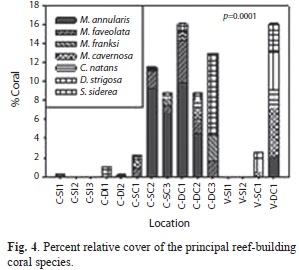
<body><![CDATA[ href="/img/revistas/rbt/v62s3/a19i1.jpg">Fig.     1e-f</a>). But none of these differences were significant.</span></font><br      style="font-family: verdana;">     <font size="2"></font><br style="font-family: verdana;">     <font size="2"><span style="font-family: verdana;">The percent relative     cover of the     most important reef building coral species was significantly lower     within bombarded areas (<a href="#Fig4">Fig. 4</a>). <span      style="font-style: italic;">Montastraea</span>     <span style="font-style: italic;">(=Orbicella) annularis</span>     ]]></body>
<body><![CDATA[(Ellis &amp; Solander, 1786) averaged 0.05% within bombarded areas and     4.1% at control sites, while <span style="font-style: italic;">O.     faveolata</span> (Ellis &amp; Solander, 1786),     <span style="font-style: italic;">O. franksi</span> (Gregory, 1895),     and <span style="font-style: italic;">M. cavernosa</span> Linnaeus,     1767 averaged     1.3, 0.5, and 1.0%, respectively, at control sites. None of these     species were present within bombarded areas. <span      style="font-style: italic;">Colpophyllia natans     (</span>Houttuyn, 1772) averaged 0.01% within bombarded grounds and     ]]></body>
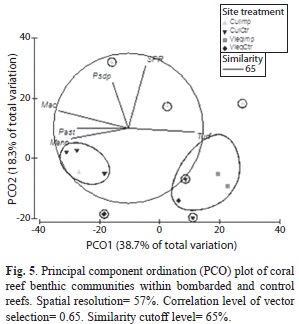
<body><![CDATA[0.38% in     control sites. <span style="font-style: italic;">Diploria strigosa</span>     (Dana, 1846) averaged 0.7% at control     sites and was absent within bombarded areas, and <span      style="font-style: italic;">Siderastrea siderea</span>     (Ellis &amp; Solander, 1786) had a mean 0.14% cover within bombarded     areas and 1.8% in control sites.    <br>     <br> </span></font>     <div style="text-align: center;"><font size="2"><span  style="font-family: verdana;"><a name="Fig4"></a><img alt=""  src="/img/revistas/rbt/v62s3/a19i4.jpg"  style="width: 299px; height: 270px;"></span></font><br  style="font-family: verdana;"> <font size="2"><span style="font-family: verdana;"></span></font></div> <br style="font-family: verdana;"> <font size="2"><span style="font-family: verdana;">Principal component ordination (PCO) analysis showed two larger clusters of reef communities, and 5 individual sites (<a href="#Fig5">Fig. 5</a>). Impacted sites at Culebra were dominated by open substrates composed by a mixture of bare bedrock, rubble and sand pockets (SPR), algal turf, brown macroalgal patches (e.g., Dictyota spp.), and sporadic colonies of octocoral <span  style="font-style: italic;">Pseudopterogorgia </span>spp. (<a  href="/img/revistas/rbt/v62s3/a19i1.jpg">Fig. 1a-b</a>). Vieques impacted sites were dominated by algal turfs (<a  href="/img/revistas/rbt/v62s3/a19i1.jpg">Fig. 1c</a>). Culebra control site showed a higher spatial heterogeneity mostly dominated by macroalgae, <span style="font-style: italic;">M. annularis</span>, and <span style="font-style: italic;">P. astreoides</span> (<a  href="/img/revistas/rbt/v62s3/a19i1.jpg">Fig. 1c-d</a>). Control sites at Vieques were also dominated by turf, and in a lesser degree a mixed octocoral community. The proposed PCO solution explained 57% of the observed spatial variation.    ]]></body>
<body><![CDATA[<br>     <br> </span></font>     <div style="text-align: center;"><font size="2"><span      style="font-family: verdana;"><a name="Fig5"></a><img alt=""      src="/img/revistas/rbt/v62s3/a19i5.jpg"      style="width: 299px; height: 324px;"></span></font><br      style="font-family: verdana;">     <font size="2"><span style="font-family: verdana;"></span></font></div>     <br style="font-family: verdana;">     <font size="2"><span style="font-family: verdana;"><span     ]]></body>
<body><![CDATA[ style="font-weight: bold;">Coral recruits:</span> Coral recruit     density was significantly higher (PERMANOVA, Pseudo-F=6.55, </span></font><font      size="2"><span style="font-family: verdana;"><span      style="font-style: italic;">p=</span></span></font><font size="2"><span      style="font-family: verdana;">0.0001)     within non-impacted control sites in comparison to bombarded areas.     Control site CR-C1 located within CLPNR averaged 51 colonies/30</span></font><font      size="2"><span style="font-family: verdana;">m<sup>2</sup></span></font><font      size="2"><span style="font-family: verdana;">,     while CR-C2 outside CLPNR averaged 21 colonies/30</span></font><font     ]]></body>
<body><![CDATA[ size="2"><span style="font-family: verdana;">m<sup>2</sup></span></font><font      size="2"><span style="font-family: verdana;"> (<a      href="/img/revistas/rbt/v62s3/a19i6.jpg">Fig. 6</a>). Impacted     site CR-I1 averaged 8 colonies/30</span></font><font size="2"><span      style="font-family: verdana;">m<sup>2</sup></span></font><font size="2"><span      style="font-family: verdana;">, while CR-I2 averaged less than 3     colonies/30</span></font><font size="2"><span      style="font-family: verdana;">m<sup>2</sup></span></font><font size="2"><span      style="font-family: verdana;">. Both impacted sites were also located     within CLPNR.     ]]></body>
<body><![CDATA[ANOSIM analysis showed that coral recruit community structure was     significantly different between treatments (R=0.830, </span></font><font      size="2"><span style="font-family: verdana;"><span      style="font-style: italic;">p=</span></span></font><font size="2"><span      style="font-family: verdana;">0.0001). Also,     species richness (R=0.736, </span></font><font size="2"><span      style="font-family: verdana;"><span style="font-style: italic;">p=</span></span></font><font      size="2"><span style="font-family: verdana;">0.0006), and H&#8217;n     (R=0.747, </span></font><font size="2"><span      style="font-family: verdana;"><span style="font-style: italic;">p=</span></span></font><font     ]]></body>
<body><![CDATA[ size="2"><span style="font-family: verdana;">0.0006) were     significantly higher at control sites than at bombarded areas. No     significant difference in J&#8217;n was documented. Brooder species such as     <span style="font-style: italic;">Favia fragum</span> (Esper, 1795), <span      style="font-style: italic;">Siderastrea radians</span> (Pallas, 1766),     and     <span style="font-style: italic;">Porites astreoides</span> (Lamarck,     1816) were dominant at control sites,     while lower abundances of <span style="font-style: italic;">S. radians</span>     and <span style="font-style: italic;">P. astreoides</span>     ]]></body>
<body><![CDATA[characterized     bombarded sites, particularly, at deeper impacted areas. PCO analysis     showed five different clusters of reef communities, and five individual     sites (<a href="/img/revistas/rbt/v62s3/a19i7.jpg">Fig. 7</a>). The     three clusters composed of control non-impacted     sites were explained by <span style="font-style: italic;">P.     astreoides, P. porites, F. fragum</span>, and     <span style="font-style: italic;">Millepora striata </span>(Lamarck,     1816). Bombarded sites clusters were     determined by <span style="font-style: italic;">S. radians</span>. The     ]]></body>
<body><![CDATA[proposed solution by PCO explained 71.1%     of the observed spatial variation.</span></font><br      style="font-family: verdana;">     <font size="2"></font><br style="font-family: verdana;">     <font size="2"><span style="font-family: verdana;"><span      style="font-weight: bold;">Fish community: </span>Fish community     structure also showed significant difference (p&lt;0.0001) between     treatment levels that were mostly related to a highly significant     decline (</span></font><font size="2"><span      style="font-family: verdana;"><span style="font-style: italic;">p=</span></span></font><font     ]]></body>
<body><![CDATA[ size="2"><span style="font-family: verdana;">0.0030) observed in the     reef structural heterogeneity index     (RSHI) within bombarded sites (<a      href="/img/revistas/rbt/v62s3/a19i8.jpg">Fig. 8a</a>). RSHI had a mean     value of 0.69     within bombarded areas and 2.72 within control sites. Fish species     richness was significantly higher (23.4 per count) at control sites     (</span></font><font size="2"><span style="font-family: verdana;"><span      style="font-style: italic;">p=</span></span></font><font size="2"><span      style="font-family: verdana;">0.0020) than at bombarded areas (12.6)     ]]></body>
<body><![CDATA[(<a href="/img/revistas/rbt/v62s3/a19i8.jpg">Fig. 8b</a>). Fish     abundance was     also significantly higher (</span></font><font size="2"><span      style="font-family: verdana;"><span style="font-style: italic;">p=</span></span></font><font      size="2"><span style="font-family: verdana;">0.0002) at control sites     (491) versus     bombarded sites (108) (<a href="/img/revistas/rbt/v62s3/a19i8.jpg">Fig.     8c</a>). Also, H&#8217;n was significantly higher     (</span></font><font size="2"><span style="font-family: verdana;"><span      style="font-style: italic;">p=</span></span></font><font size="2"><span     ]]></body>
<body><![CDATA[ style="font-family: verdana;">0.0020) within control areas (1.6744) in     comparison to bombarded     grounds (1.1716) (<a href="/img/revistas/rbt/v62s3/a19i8.jpg">Fig. 8d</a>).     Total fish biomass was significantly higher     (</span></font><font size="2"><span style="font-family: verdana;"><span      style="font-style: italic;">p=</span></span></font><font size="2"><span      style="font-family: verdana;">0.0001) at control sites (7 697g) than     at bombarded areas (999g)     (<a href="/img/revistas/rbt/v62s3/a19i8.jpg">Fig. 8e</a>). Similarly,     piscivore biomass was significantly higher     ]]></body>
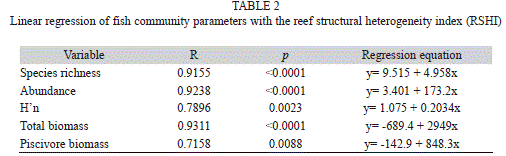
<body><![CDATA[(</span></font><font size="2"><span style="font-family: verdana;"><span      style="font-style: italic;">p=</span></span></font><font size="2"><span      style="font-family: verdana;">0.0002) at control sites (2,406 g) than     at bombarded areas (206g)     (<a href="/img/revistas/rbt/v62s3/a19i8.jpg">Fig. 8f</a>). All fish     community parameters showed a highly significant     linear regression (p&lt;0.0088) with RSHI (<a href="#Tab2">Table 2</a>),     suggesting the     strong permanent negative impacts of bombing activities on the     demolition of reef framework and the net decline in fish communities     ]]></body>
<body><![CDATA[associated to losing spatial benthic heterogeneity. Significant reef     functional herbivore guilds such as scrapers, including <span      style="font-style: italic;">Scarus iserti</span>     Bloch, 1790, <span style="font-style: italic;">S. vetula</span>     Schneider, 1801, <span style="font-style: italic;">Sparisomq viride</span>     (Bonnaterre,     1788), <span style="font-style: italic;">S. rubiprinne</span>     (Valenciennes, 1839), and <span style="font-style: italic;">S. radians</span>     (Valenciennes, 1839), and browsers such as <span      style="font-style: italic;">Acanthurus coeruleus</span>     ]]></body>
<body><![CDATA[Schneider, 1801 were largely absent from reef craters, in comparison to     adjacent non-bombarded sites. Also, important piscivore guilds such as     groupers, including <span style="font-style: italic;">Epinephelus     guttatus</span> (Linnaeus, 1758), E.     adscensionis (Osbeck, 1765), <span style="font-style: italic;">Cephalopholis     fulva</span> (Linnaeus, 1758), and     <span style="font-style: italic;">C. cruentata</span> (Lacep&egrave;de,     1802), and snappers <span style="font-style: italic;">Lutjanus jocu</span>     (Schneider, 1801), <span style="font-style: italic;">L. analis</span>     (Cuvier, 1828), and <span style="font-style: italic;">L. apodus</span>     ]]></body>
<body><![CDATA[(Walbaum,     1892) were also absent from reef craters. Fishing impacts was not a     factor influencing observed differences in fish community structure     within and outside craters as fish data were collected from sites     located within the no-take CLPNR.    <br>     <br> </span></font>     <div style="text-align: center;"><font size="2"><span      style="font-family: verdana;"><a name="Tab2"></a><img alt=""      src="/img/revistas/rbt/v62s3/a19t2.gif"     ]]></body>
<body><![CDATA[ style="width: 506px; height: 156px;"></span></font><br      style="font-family: verdana;">     <font size="2"><span style="font-family: verdana;"></span></font></div>     <br style="font-family: verdana;">     <font size="2"><span style="font-family: verdana;"><span      style="font-weight: bold;">Coral reef rehabilitation:</span> Mean     percent colony survival rates of </span></font><font size="2"><span      style="font-family: verdana;"><span style="font-style: italic;">Acropora     cervicornis</span></span></font><font size="2"><span      style="font-family: verdana;"> outplants was 81%     ]]></body>
<body><![CDATA[at impacted sites and 86% at control sites after one year, with a mean     survival of 88% at impacted sites and 70% at impacted sites on     low-relief reef patches adjacent to sand (<a      href="/img/revistas/rbt/v62s3/a19i9.jpg">Fig. 9</a>). Percent survival     at     elevated rocky outcrops reached 92% at impacted sites and 84% at     control sites. Percent live coral tissue cover on outplanted colonies     averaged 85% at both, impacted and control sites after one year (<a      href="/img/revistas/rbt/v62s3/a19i10.jpg">Figure     10a</a>), ranging from 82 to 88% within impacted sites in low-relief     ]]></body>
<body><![CDATA[patches adjacent to sand and in elevated outcrops, respectively. Mean %     live tissue cover ranged from 82 to 89% within impacted sites in     low-relief patches adjacent to sand and in elevated outcrops,     respectively. Total outplanted colony linear length showed a mean     overall increase from 41 to 129cm across impacted sites, and from 32 to     81cm across control sites after one year (<a      href="/img/revistas/rbt/v62s3/a19i10.jpg">Figure 10b</a>). Total     outplanted     colony branch abundance/colony showed a mean overall increase from 4.5     to 14.4 cm across impacted sites, and from 3.4 to 8.3cm across control     ]]></body>
<body><![CDATA[sites after one year (<a href="/img/revistas/rbt/v62s3/a19i10.jpg">Figure     10c</a>). Temporal effects were significant     for all variables, but treatment and position effects were not (<a      href="/img/revistas/rbt/v62s3/a19t3.gif">Table     3</a>).</span></font><br style="font-family: verdana;">     <font size="2"></font><br style="font-family: verdana;">     <font style="font-weight: bold;" size="3"><span      style="font-family: verdana;">Discussion</span></font><br      style="font-family: verdana;">     <font size="2"></font><br style="font-family: verdana;">     ]]></body>
<body><![CDATA[<font size="2"><span style="font-family: verdana;">Profound, acute and     persistent     negative impacts of historical bombing activities were documented in     Culebra and Vieques Islands, Puerto Rico, across coral reef craters     spatial scales. Severely impacted reef segments were characterized by     having significantly lower spatial relief, bedrock exposure and an     abundant mixture of unstable turf-covered rubble and bedrock boulders     demolished by explosions. These substrates were also characterized by     low coral colony abundance, low percent living coral cover, low coral     species richness and H&#8217;n, when compared to adjacent control sites.     ]]></body>
<body><![CDATA[Similarly, coral recruit communities were significantly more     depauperate within impacted grounds than in control sites, either     within or outside the no-take CLPNR, which suggest the persistent     inability of coral recruits to survive the natural oceanographic     dynamics of unstable substrates within bombarded sites. This is     consistent with severe impacts by blast fishing documented elsewhere     (Riegl &amp; Luke, 1999; Riegl, 2001). The permanent lack of natural     recovery ability of 35-50 years old bomb-cratered coral reef segments,     when compared to adjacent non-bombarded control sites dominated by     massive reef-building species such as <span style="font-style: italic;">M.     ]]></body>
<body><![CDATA[annularis</span> species complex,     implies that at the local ecosystem scale, bombarded coral reefs have     shown a permanent shift in composition and functions, that full     recovery of previously existing benthic community structure and spatial     heterogeneity may take centuries. Coral recruitment rates of critical     reef-building species across the northeast Caribbean region are     increasingly low (Rogers, Fitz, III, Gilnack, Beets &amp; Hardin, 1984;     Edmunds &amp; Elahi, 2007; Edmunds, Ross &amp; Didden, 2011),     suggesting that habitat fragmentation by bombing has resulted in a     permanent localized loss of coral reproductive stock and that in     ]]></body>
<body><![CDATA[combination with natural low recruitment rates of most reef-building     species, natural recovery of composition and functions is very unlikely.</span></font><br      style="font-family: verdana;">     <font size="2"></font><br style="font-family: verdana;">     <font size="2"><span style="font-family: verdana;">Bombarded areas were     also     characterized by sustaining lower fish species richness, H&#8217;n,     abundance, and biomass, as a result of the permanent loss and lack of     recovery of reef benthic spatial relief. They also had a very low     abundance or absence of significant fish functional groups of     ]]></body>
<body><![CDATA[herbivores and carnivores, including multiple commercially-important     species. These findings are consistent with IDEA (1970) which estimated     at least 10 times higher fish densities outside cratered reefs in     Culebra Island, though no quantitative parameters were provided. Riegl     (2001) found that coral cover decreased, bare substratum and rubble     increased, and fish communities changed within areas impacted by blast     fishing in Egypt. Depauperate fish assemblages within bombarded reef     segments were also consistent with declining fish communities     documented on reefs that have already shown rapid benthic community     decline as a result of climate change impacts (Jones, McCormick,     ]]></body>
<body><![CDATA[Srinivasan &amp; Eagle, 2004, Graham et al., 2006; Pratchett et al.,     2008). Such changes may become more pronounced as coral cover continues     to decline and as fishing pressure continues to increase (Pratchett,     Hoey &amp; Wilson, 2014). Fishing impacts were not a factor in this     study as all fish data collection was conducted within the no-take     CLPNR. Status of more diverse and rich fish communities across control     sites is consistent with previous accounts across similar spatial     scales for the site (Hern&aacute;ndez-Delgado, Rosado-Mat&iacute;as     &amp; Sabat, 2006). Therefore, differences in fish community structure     were presumed to occur at the studied spatial scales as the result of     ]]></body>
<body><![CDATA[altered benthic community structure and spatial heterogeneity due to     bombing activities.</span></font><br style="font-family: verdana;">     <font size="2"></font><br style="font-family: verdana;">     <font size="2"><span style="font-family: verdana;">Individual reef     craters are often     small in size (50-400</span></font><font size="2"><span      style="font-family: verdana;">m<sup>2</sup></span></font><font size="2"><span      style="font-family: verdana;">) and isolated in space, which render     them as     very small spatial units generally disregarded as having low ecological     ]]></body>
<body><![CDATA[significance as they may represent a small geographical proportion of     reef surface area in comparison to island wide spatial scales. Studies     of bombing impacts at small spatial scales are still very limited.     Dodge (1981) found no significant impacts of military bombing on </span></font><font      size="2"><span style="font-family: verdana;"><span      style="font-style: italic;">M. annularis</span></span></font><font      size="2"><span style="font-family: verdana;"> growth rates on     individual coral core samples from Vieques,     but Macintyre, Raymond &amp; Stuckenrath (1983) found significant     destruction by bombing of shallow <span style="font-style: italic;">Acropora     ]]></body>
<body><![CDATA[palmata</span> (Lamarck, 1816) and     <span style="font-style: italic;">Porites porites</span> (Pallas, 1766)     frameworks. Porter et al. (2011) also     found a statistically significant inverse correlation between the coral     species richness, colony abundance and species diversity, and the     density of military ordnance across reef scales in Vieques.     Nonetheless, at smaller ecological scales (e.g., fringing reef unit),     reef craters represent localized mosaics of reef segments that were     severely reduced to a flattened, unstable, demolished reef bottom, with     depauperate biodiversity, that have shown little or no recovery even     ]]></body>
<body><![CDATA[after three to five decade temporal scales. Placed within the context     of current sea surface warming trends, recurrent massive bleaching     events, and documented decline of northeastern Caribbean coral reefs     (Miller et al., 2009; Hern&aacute;ndez-Pacheco,     Hern&aacute;ndez-Delgado &amp; Sabat, 2011; Edmunds, 2013), net     recovery of ecosystem structure and functions within bombarded grounds     is unlikely to occur, rendering them as novel habitats (sensu Graham,     Cinner, Norstr&ouml;m &amp; Nystr&ouml;m, 2014). This suggests that     future trajectories of dramatically changed reef communities     constituting novel habitats will be quite different from the past, and     ]]></body>
<body><![CDATA[embracing novel futures may enable more pragmatic approaches (e.g.,     rehabilitating ecological functions instead of restoring original     diversity) to maintaining or re-building the dominance of massive     reef-building corals from the past.</span></font><br      style="font-family: verdana;">     <font size="2"></font><br style="font-family: verdana;">     <font size="2"><span style="font-family: verdana;">The lack of     meaningful natural     coral reef recovery within 35-50 year-old reef craters from Culebra is     alarming, but surprisingly, still poorly addressed. Our study suggests     ]]></body>
<body><![CDATA[that coral community recovery is minimal within reef craters and     limited to sporadic ephemeral species such as <span      style="font-style: italic;">S. radians</span> and <span      style="font-style: italic;">P.     astreoides.</span> There is increasing evidence that natural coral reef     recovery ability from blasting even across small spatial scales can     become severely limited with increasing spatial and temporal scale of     destruction. Extensively blasted areas for fishing in Indonesia showed     no significant recovery within a period of six years despite adequate     coral larval supply from adjacent reefs (Fox &amp; Caldwell, 2006).     ]]></body>
<body><![CDATA[Extensive bombing can result in the formation of unstable coral rubble     fields that can move with ocean currents and storm swells, causing     extended mortality on adjacent remnant patches of living corals and     that can also prevent successful coral larval recruitment over unstable     bottoms (Fox, Pet, Dahuri &amp; Caldwell, 2002; 2003; Lindhal, 2003;     Raymundo, Maypa, Gomez &amp; Cadiz, 2007). Therefore, reef natural     recovery ability within directly bombarded grounds seems poorly     probable and will require assisted coral reef rehabilitation methods     (Bowden-Kerby, 1997; Raymundo et al., 2007; Hern&aacute;ndez-Delgado,     Suleim&aacute;n, Olivo, Fonseca &amp; Lucking, 2011). This can be     ]]></body>
<body><![CDATA[feasible across small spatial scales similar to those of reef craters.     Nonetheless, human intervention is unlikely to be effective on large     spatial scales due to prohibitive costs, highlighting the need for a     combination of effective management approaches to foster the     rehabilitation of reef ecological functions and ecosystem resilience.</span></font><br      style="font-family: verdana;">     <font size="2"></font><br style="font-family: verdana;">     <font size="2"><span style="font-family: verdana;">A particular concern     is that a     habitat once dominated by a </span></font><font size="2"><span     ]]></body>
<body><![CDATA[ style="font-family: verdana;"><span style="font-style: italic;">M.     annularis</span></span></font><font size="2"><span      style="font-family: verdana;"> species complex framework has     not shown any sign of recovery over the course of several decades     through sexual coral larval recruitment. Though coral larval settlement     do occur within the crater, coral spat mortality appears to be high     largely due to the unstable fragmented nature of the bottom.     Considering the significant decline of </span></font><font size="2"><span      style="font-family: verdana;"><span style="font-style: italic;">M.     annularis</span></span></font><font size="2"><span     ]]></body>
<body><![CDATA[ style="font-family: verdana;"> species complex     percent living cover across the region (Miller et al., 2009;     Hern&aacute;ndez-Pacheco et al., 2011, Edmunds, 2013), recovering     benthic spatial heterogeneity ecological functions is largely     improbable. Therefore, an alternative strategy that can potentially     achieve rapid results in rehabilitating shallow reef ecological     functions as juvenile fish nursery grounds is the use of     community-based, low-tech farming and outplanting of rapid-growing </span></font><font      size="2"><span style="font-family: verdana;"><span      style="font-style: italic;">Acropora cervicornis</span></span></font><font     ]]></body>
<body><![CDATA[ size="2"><span style="font-family: verdana;">. Low-tech,     community-based approaches to culture,     harvest and transplant </span></font><font size="2"><span      style="font-family: verdana;"><span style="font-style: italic;">A.     cervicornis</span></span></font><font size="2"><span      style="font-family: verdana;"> into formerly bombarded grounds     proved highly successful in fomenting increasing benthic spatial     heterogeneity, while fostering meaningful community-based     participation. Outplanted colonies showed outstanding survival and     growth rates. Observed decline occurred as a result of partial coral     ]]></body>
<body><![CDATA[mortality associated to massive runoff events from deforested steep     slopes adjacent to the coastline following heavy rainfall. Higher     percent survival rate observed on rocky outcrops at impacted sites     (within no-take CLPNR) was the result of lower predation impacts by     corallivore gastropod <span style="font-style: italic;">Coralliophila     abbreviata</span> Lamarck, 1816 and <span style="font-style: italic;">C.     caribaea</span> Abbott, 1958, and by fireworm <span      style="font-style: italic;">Hermodice carunculata</span> Pallas,     1766; in comparison to adjacent controls outside the reserve. This     could be the result of lack of invertebrate predators across control     ]]></body>
<body><![CDATA[non-reserve sites, which is consistent with previous accounts of fish     community structure from the site (Hern&aacute;ndez-Delgado et al.,     2006). This suggests that </span></font><font size="2"><span      style="font-family: verdana;"><span style="font-style: italic;">A.     cervicornis</span></span></font><font size="2"><span      style="font-family: verdana;"> farming and outplanting is a     key successful tool to help rehabilitate shallow reef nursery grounds.     But further, it also showed that reef trophic condition is a key     element in determining reef rehabilitation success. Therefore, the     combination of a no-take marine protected area designation and low-tech     ]]></body>
<body><![CDATA[coral farming and outplanting are key management tools to foster the     rehabilitation of reef ecological functions and ecosystem resilience of     impacted sites across reef spatial scales. History has shown that     introducing and fostering compliance with coral reef conservation     measures in a small island community still traumatized by historical     military practices and by past actions by the government perceived by     local communities as serious violation of trust has become a paramount     challenge. Nonetheless, community-based participatory management     approaches have proved to be a highly successful and empowering     strategy to rehabilitate impacted coral reefs ecosystems and to educate     ]]></body>
<body><![CDATA[base communities through hands-on experience on the significance of     reef conservation and rehabilitation.</span></font><br      style="font-family: verdana;">     <font size="2"></font><br style="font-family: verdana;">     <font size="2"><span style="font-family: verdana;">There is also a     concern that     military impacts on coral reef are ecologically persistent and that     they may still represent a risk of toxic pollution further threatening     reef recovery. Goenaga (1986, 1991) suggested that the large abundance     of unexploded ordnance and the potential leaching of pollutants from     ]]></body>
<body><![CDATA[bombs in coral reefs may significantly impair their future recreational     and fishing value. Porter (2000) found evidence of abundant &#8220;unexploded     bombs, artillery shells, and shell casings on the coral reef and in     adjacent seagrass beds; burial and shading of coral reef organisms by     unexploded ordnance and ordnance debris; fracturing of the coral reef     framework and the underlying coral bed rock, and the existence of bombs     and bomb fragments impregnated into the reef; the existence of     parachutes from flares and cluster bomb fragments draped over corals     and other coral reef flora and fauna; and the existence of unexploded     bombs leaking materials into coral reef environment and creating a     ]]></body>
<body><![CDATA[limited &#8220;dead zone&#8221; around the bombs&#8221;. Porter et al. (2011) also found     a statistically significant inverse correlation between the density of     unexploded ordnance and coral species richness, coral colony abundance,     and coral species diversity, with reefs with the highest concentrations     of bombs and bomb fragments having the lowest health indices and the     lowest species diversity. Further, evidence of leaking toxics from     unexploded ordnance has also been documented in reef demersal fauna     from Vieques (Porter et al., 2011). These factors, in combination with     the long-term impacts of uncontrolled, poorly planned land uses in the     post-military land development boom in Culebra and Vieques has also     ]]></body>
<body><![CDATA[resulted in the implementation of a non-sustainable development model     with paramount adverse ecological and socio-economic implications to     environmental and socio-economic sustainability of the islands     (Hern&aacute;ndez-Delgado et al., 2012; Ramos-Scharr&oacute;n, Amador     &amp; Hern&aacute;ndez-Delgado, 2012). This is an aspect that deserves     further research.</span></font><br style="font-family: verdana;">     <font size="2"></font><br style="font-family: verdana;">     <font size="2"><span style="font-family: verdana;">Our findings showed     that there was     still an untold story about bombing impacts across small reef spatial     ]]></body>
<body><![CDATA[scales, that benthic habitat destruction is ecologically long-lasting     (over decadal scales) and that lack of net recovery has resulted in     converting impacted reefs in a <span style="font-style: italic;">de     facto</span> novel habitat. Natural reef     recovery abilities within bombarded reefs need to be continuously     monitored. Targeted monitoring efforts will become critical in the     context of increasing sea surface temperature and its long-term impacts     on coral reefs. Declining reefs across the region due to climate change     impacts may aggravate the ability of bombarded reefs to show at least a     modest degree of recovery. The lack of natural recovery ability coupled     ]]></body>
<body><![CDATA[with a declining social-ecological system significantly reduces the     probability of ecosystem and socio-economic recovery. A major     community-based effort should be launched to foster improved coral reef     ecosystem and socio-economic resilience rehabilitation. Integration of     local stakeholders should help improve efforts by local natural     resource managers and decision-makers to accelerate recovery of     ecological functions of degraded reef ecosystems and socio-economic     systems, but also to repair communication and trust.</span></font><br      style="font-family: verdana;">     <font size="2"></font><br style="font-family: verdana;">     ]]></body>
<body><![CDATA[<font style="font-weight: bold;" size="3"><span      style="font-family: verdana;">Acknowledgments</span></font><br      style="font-family: verdana;">     <font size="2"></font><br style="font-family: verdana;">     <font size="2"><span style="font-family: verdana;">This study was     possible thanks to     the support provided to E.A. Hern&aacute;ndez-Delgado by the National     Science Foundation HRD #0734826 through the Center for Applied Tropical     Ecology and Conservation. We also thank the partial support from the     Caribbean Coral Reef Institute of the University of Puerto Rico     ]]></body>
<body><![CDATA[(NA04NOS4260206, NA05NOS4261159, and NA07NOS4000192) to E.A.     Hern&aacute;ndez-Delgado, and the partial support provided by NOAA and     The Nature Conservancy (MAR-SAM-110110) through Sociedad Ambiente     Marino to S. Suleim&aacute;n-Ramos and E.A. Hern&aacute;ndez-Delgado.</span></font><br      style="font-family: verdana;">     <br style="font-family: verdana;">     <hr style="width: 100%; height: 2px;"><font style="font-weight: bold;"      size="3"><span style="font-family: verdana;">References</span></font><br      style="font-family: verdana;">     <br style="font-family: verdana;">     ]]></body>
<body><![CDATA[<!-- ref --><div style="text-align: left;"><font size="2"><span  style="font-family: verdana;">Anderson, M. J., Gorley R. N., &amp; Clarke K. R. (2008). <span style="font-style: italic;">PERMANOVA + for PRIMER: Guide to Software and Statistical Methods.</span> Plymouth, U.K.: PRIMER-E.    &nbsp;&nbsp;&nbsp;&nbsp;&nbsp;&nbsp;&nbsp;&nbsp;[&#160;<a href="javascript:void(0);" onclick="javascript: window.open('/scielo.php?script=sci_nlinks&ref=1786904&pid=S0034-7744201400070001900001&lng=','','width=640,height=500,resizable=yes,scrollbars=1,menubar=yes,');">Links</a>&#160;]<!-- end-ref --><!-- ref --></span></font><br  style="font-family: verdana;"> <br style="font-family: verdana;"> <font size="2"><span style="font-family: verdana;">Antonius, A., &amp; Weiner, A. (1982). Coral reefs under fire. <span style="font-style: italic;">Marine Ecology Progress Series, 3,</span> 255-277.    &nbsp;&nbsp;&nbsp;&nbsp;&nbsp;&nbsp;&nbsp;&nbsp;[&#160;<a href="javascript:void(0);" onclick="javascript: window.open('/scielo.php?script=sci_nlinks&ref=1786905&pid=S0034-7744201400070001900002&lng=','','width=640,height=500,resizable=yes,scrollbars=1,menubar=yes,');">Links</a>&#160;]<!-- end-ref --><!-- ref --></span></font><br style="font-family: verdana;"> <br style="font-family: verdana;"> <font size="2"><span style="font-family: verdana;">Bauer, L. J., Menza, C., Foley, K. A., &amp; Kendall, M. S. (2008). <span style="font-style: italic;">An ecological characterization of the marine resources of Vieques, Puerto Rico. Part I: Historical data synthesis.</span> Prepared by National Centers for Coastal Ocean Science (NCCOS) Biogeography Branch in cooperation with the Office of Response and Restoration. Silver, Spring, MD.: NOAA Technical Memorandum NOS NCCOS 86.    &nbsp;&nbsp;&nbsp;&nbsp;&nbsp;&nbsp;&nbsp;&nbsp;[&#160;<a href="javascript:void(0);" onclick="javascript: window.open('/scielo.php?script=sci_nlinks&ref=1786906&pid=S0034-7744201400070001900003&lng=','','width=640,height=500,resizable=yes,scrollbars=1,menubar=yes,');">Links</a>&#160;]<!-- end-ref --><!-- ref --></span></font><br style="font-family: verdana;"> <br style="font-family: verdana;"> <font size="2"><span style="font-family: verdana;">Bauer, L. J., &amp; Kendall, M. S. (eds.). (2010). <span style="font-style: italic;">An Ecological Characterization of the Marine Resources of Vieques, Puerto Rico Part II: Field Studies of Habitats, Nutrients, Contaminants, Fish, and Benthic Communities.</span> Silver, Spring, MD.: NOAA Tech. Memorandum NOS NCCOS 110.    &nbsp;&nbsp;&nbsp;&nbsp;&nbsp;&nbsp;&nbsp;&nbsp;[&#160;<a href="javascript:void(0);" onclick="javascript: window.open('/scielo.php?script=sci_nlinks&ref=1786907&pid=S0034-7744201400070001900004&lng=','','width=640,height=500,resizable=yes,scrollbars=1,menubar=yes,');">Links</a>&#160;]<!-- end-ref --><!-- ref --></span></font><br  style="font-family: verdana;"> <br style="font-family: verdana;"> <font size="2"><span style="font-family: verdana;">Bohnsack, J. A., &amp; Bannerot, S. P. (1986). <span style="font-style: italic;">A stationary census technique for quantitatively assessing community structure of coral reef fishes.</span> Silver, Spring, MD.: NOAA Technical Report NMFS 41.    &nbsp;&nbsp;&nbsp;&nbsp;&nbsp;&nbsp;&nbsp;&nbsp;[&#160;<a href="javascript:void(0);" onclick="javascript: window.open('/scielo.php?script=sci_nlinks&ref=1786908&pid=S0034-7744201400070001900005&lng=','','width=640,height=500,resizable=yes,scrollbars=1,menubar=yes,');">Links</a>&#160;]<!-- end-ref --><!-- ref --></span></font><br style="font-family: verdana;"> <br style="font-family: verdana;"> <font size="2"><span style="font-family: verdana;">Bohnsack, J. A., &amp; Harper, D. E. (1988). <span style="font-style: italic;">Length-weight relationships of selected marine reef fishes from the Southeastern United States and the Caribbean.</span> Silver, Spring, MD.: NOAA Technical Memorandum NMFS-SEFC-215.    &nbsp;&nbsp;&nbsp;&nbsp;&nbsp;&nbsp;&nbsp;&nbsp;[&#160;<a href="javascript:void(0);" onclick="javascript: window.open('/scielo.php?script=sci_nlinks&ref=1786909&pid=S0034-7744201400070001900006&lng=','','width=640,height=500,resizable=yes,scrollbars=1,menubar=yes,');">Links</a>&#160;]<!-- end-ref --><!-- ref --></span></font><br  style="font-family: verdana;"> <br style="font-family: verdana;"> <font size="2"><span style="font-family: verdana;">Bowden-Kerby, A. (1997). Coral transplantation in sheltered habitats using unattached fragments and cultured colonies. <span style="font-style: italic;">Proceedings from the 8th International Coral Reef Symposium, 2,</span> 2063-2068.    &nbsp;&nbsp;&nbsp;&nbsp;&nbsp;&nbsp;&nbsp;&nbsp;[&#160;<a href="javascript:void(0);" onclick="javascript: window.open('/scielo.php?script=sci_nlinks&ref=1786910&pid=S0034-7744201400070001900007&lng=','','width=640,height=500,resizable=yes,scrollbars=1,menubar=yes,');">Links</a>&#160;]<!-- end-ref --><!-- ref --></span></font><br  style="font-family: verdana;"> <br style="font-family: verdana;"> <font size="2"><span style="font-family: verdana;">Carrera-Rodr&iacute;guez, C. J. (1978). <span style="font-style: italic;">Evaluaci&oacute;n sobre las consecuencias de las actividades militares llevadas a cabo en Vieques, P.R. por las Fuerzas Armadas de los EE.UU. de Am&eacute;rica en los sistemas marinos del este de Vieques, con atenci&oacute;n principal a los arrecifes de coral. </span>Report to the Department of Natural Resources, San Juan, Puerto Rico.    &nbsp;&nbsp;&nbsp;&nbsp;&nbsp;&nbsp;&nbsp;&nbsp;[&#160;<a href="javascript:void(0);" onclick="javascript: window.open('/scielo.php?script=sci_nlinks&ref=1786911&pid=S0034-7744201400070001900008&lng=','','width=640,height=500,resizable=yes,scrollbars=1,menubar=yes,');">Links</a>&#160;]<!-- end-ref --><!-- ref --></span></font><br  style="font-family: verdana;"> <br style="font-family: verdana;"> <font size="2"><span style="font-family: verdana;">Clarke, K. R., &amp; Warwick, R. M. (2001). <span style="font-style: italic;">Change in Marine Communities: An Approach to Statistical Analysis and Interpretation. </span>2nd Ed. Plymouth Marine Laboratory, UK: PRIMER-E, Ltd.    &nbsp;&nbsp;&nbsp;&nbsp;&nbsp;&nbsp;&nbsp;&nbsp;[&#160;<a href="javascript:void(0);" onclick="javascript: window.open('/scielo.php?script=sci_nlinks&ref=1786912&pid=S0034-7744201400070001900009&lng=','','width=640,height=500,resizable=yes,scrollbars=1,menubar=yes,');">Links</a>&#160;]<!-- end-ref --><!-- ref -->,</span></font><br style="font-family: verdana;"> <br style="font-family: verdana;"> <font size="2"><span style="font-family: verdana;">Deslarzes, K. J. P., Nawojchik, R., Evans, D. J., McGarrity, C. J., &amp; Gehring, P. (2006). The condition of fringing reefs off former military training areas at Isla de Culebra and Isla de Vieques, Puerto Rico: preliminary results. <span  style="font-style: italic;">Proceedings from the 10th International Coral Reef Symposium, Japan</span>, 1152-1159.    &nbsp;&nbsp;&nbsp;&nbsp;&nbsp;&nbsp;&nbsp;&nbsp;[&#160;<a href="javascript:void(0);" onclick="javascript: window.open('/scielo.php?script=sci_nlinks&ref=1786913&pid=S0034-7744201400070001900010&lng=','','width=640,height=500,resizable=yes,scrollbars=1,menubar=yes,');">Links</a>&#160;]<!-- end-ref --><!-- ref --></span></font><br  style="font-family: verdana;"> <br style="font-family: verdana;"> <font size="2"><span style="font-family: verdana;">Dodge, R. E. 1981. Growth characteristics of reef-building corals within and external to a naval ordnance range: Vieques, Puerto Rico. <span style="font-style: italic;">Proceedings from the 4th International Coral Reef Symposium, 2</span>, 241-248.    &nbsp;&nbsp;&nbsp;&nbsp;&nbsp;&nbsp;&nbsp;&nbsp;[&#160;<a href="javascript:void(0);" onclick="javascript: window.open('/scielo.php?script=sci_nlinks&ref=1786914&pid=S0034-7744201400070001900011&lng=','','width=640,height=500,resizable=yes,scrollbars=1,menubar=yes,');">Links</a>&#160;]<!-- end-ref --><!-- ref --></span></font><br  style="font-family: verdana;"> <br style="font-family: verdana;"> <font size="2"><span style="font-family: verdana;">DON (U.S. Department of the Navy). (1979). <span style="font-style: italic;">Draft Environmental Impact Statement for the Continued Use of the Atlantic Fleet Weapons Training Facility Inner Range (Vieques). </span>Prepared by TAMS (Tippetts, Abbett, McCarthy, Stratton) and Ecology and Environment, Inc.    &nbsp;&nbsp;&nbsp;&nbsp;&nbsp;&nbsp;&nbsp;&nbsp;[&#160;<a href="javascript:void(0);" onclick="javascript: window.open('/scielo.php?script=sci_nlinks&ref=1786915&pid=S0034-7744201400070001900012&lng=','','width=640,height=500,resizable=yes,scrollbars=1,menubar=yes,');">Links</a>&#160;]<!-- end-ref --><!-- ref --></span></font><br style="font-family: verdana;"> <br style="font-family: verdana;"> <font size="2"><span style="font-family: verdana;">DON (U.S. Department of the Navy). (1980). <span style="font-style: italic;">Final Environmental Impact Statement for the Continued Use of the Atlantic Fleet Weapons Training Facility Inner Range (Vieques). </span>Prepared by TAMS (Tippetts, Abbett, McCarthy, Stratton) and Ecology and Environment, Inc.    &nbsp;&nbsp;&nbsp;&nbsp;&nbsp;&nbsp;&nbsp;&nbsp;[&#160;<a href="javascript:void(0);" onclick="javascript: window.open('/scielo.php?script=sci_nlinks&ref=1786916&pid=S0034-7744201400070001900013&lng=','','width=640,height=500,resizable=yes,scrollbars=1,menubar=yes,');">Links</a>&#160;]<!-- end-ref --><!-- ref --></span></font><br style="font-family: verdana;"> <br style="font-family: verdana;"> <font size="2"><span style="font-family: verdana;">DON (U.S. Department of the Navy). (1986). <span style="font-style: italic;">Environmental Assessment of Continued Use of the Atlantic Fleet Weapons Training Facility Inner Range, Vieques, Puerto Rico.</span> Prepared by Ecology and Environment, Inc.    &nbsp;&nbsp;&nbsp;&nbsp;&nbsp;&nbsp;&nbsp;&nbsp;[&#160;<a href="javascript:void(0);" onclick="javascript: window.open('/scielo.php?script=sci_nlinks&ref=1786917&pid=S0034-7744201400070001900014&lng=','','width=640,height=500,resizable=yes,scrollbars=1,menubar=yes,');">Links</a>&#160;]<!-- end-ref --><!-- ref --></span></font><br  style="font-family: verdana;"> <br style="font-family: verdana;"> <font size="2"><span style="font-family: verdana;">Edmunds, P. J. (2013). Decadal-scale changes in the community structure of coral reefs of St. John, US Virgin Islands.<span style="font-style: italic;"> Marine Ecology Progress Series, 489,</span> 107-123.    &nbsp;&nbsp;&nbsp;&nbsp;&nbsp;&nbsp;&nbsp;&nbsp;[&#160;<a href="javascript:void(0);" onclick="javascript: window.open('/scielo.php?script=sci_nlinks&ref=1786918&pid=S0034-7744201400070001900015&lng=','','width=640,height=500,resizable=yes,scrollbars=1,menubar=yes,');">Links</a>&#160;]<!-- end-ref --><!-- ref --></span></font><br  style="font-family: verdana;"> <br style="font-family: verdana;"> <font size="2"><span style="font-family: verdana;">Edmunds, P. J., &amp; Elahi, R. (2007). The demographics of a 15-year decline in cover of the Caribbean reef coral </span></font><font style="font-style: italic;" size="2"><span  style="font-family: verdana;">Montastraea</span></font><font size="2"><span  style="font-family: verdana;"><span style="font-style: italic;"> annularis</span>. <span style="font-style: italic;">Ecological Monographs, 77</span>, 3-18.    &nbsp;&nbsp;&nbsp;&nbsp;&nbsp;&nbsp;&nbsp;&nbsp;[&#160;<a href="javascript:void(0);" onclick="javascript: window.open('/scielo.php?script=sci_nlinks&ref=1786919&pid=S0034-7744201400070001900016&lng=','','width=640,height=500,resizable=yes,scrollbars=1,menubar=yes,');">Links</a>&#160;]<!-- end-ref --><!-- ref --></span></font><br  style="font-family: verdana;"> <br style="font-family: verdana;"> <font size="2"><span style="font-family: verdana;">Edmunds, P. J., Ross, C. L. M., &amp; Didden, C. (2011). High, but localized recruitment of </span></font><font  size="2"><span style="font-family: verdana;"><span  style="font-style: italic;">Montastraea</span></span></font><font  size="2"><span style="font-family: verdana;"> annulalris complex in St. John, United States Virgin Islands. <span  style="font-style: italic;">Coral Reefs, 30,</span> 123-130</span></font><br style="font-family: verdana;"> <br style="font-family: verdana;"> <font size="2"><span style="font-family: verdana;">Evans, D. J., Nawojchik, R., &amp; Deslarzes, K. J. P. (2006). The status of coral reef fish populations off former military ranges at the islands of Culebra and Vieques, Puerto Rico: preliminary data. <span style="font-style: italic;">Proceedings from the 10th International Coral Reef Symposium</span>, 1105-1109.    &nbsp;&nbsp;&nbsp;&nbsp;&nbsp;&nbsp;&nbsp;&nbsp;[&#160;<a href="javascript:void(0);" onclick="javascript: window.open('/scielo.php?script=sci_nlinks&ref=1786920&pid=S0034-7744201400070001900018&lng=','','width=640,height=500,resizable=yes,scrollbars=1,menubar=yes,');">Links</a>&#160;]<!-- end-ref --><!-- ref --></span></font><br  style="font-family: verdana;"> <br style="font-family: verdana;"> <font size="2"><span style="font-family: verdana;">Fox, H. E., Pet, J. S., Dahuri, R., &amp; Caldwell, R. L. (2002). Coral reef restoration after blast fishing in Indonesia. <span style="font-style: italic;">Proceedings from the 9th International Coral Reef Symposium, 2</span>, 969&#8211;976.    &nbsp;&nbsp;&nbsp;&nbsp;&nbsp;&nbsp;&nbsp;&nbsp;[&#160;<a href="javascript:void(0);" onclick="javascript: window.open('/scielo.php?script=sci_nlinks&ref=1786921&pid=S0034-7744201400070001900019&lng=','','width=640,height=500,resizable=yes,scrollbars=1,menubar=yes,');">Links</a>&#160;]<!-- end-ref --><!-- ref --></span></font><br  style="font-family: verdana;"> <br style="font-family: verdana;"> <font size="2"><span style="font-family: verdana;">Fox, H. E., Pet, J. S., Dahuri, R., &amp; Caldwell, R. L. (2003). Recovery in rubble fields: long-term impacts of blast fishing. <span style="font-style: italic;">Marine Pollution Bulletin, 46</span>, 1024-1031.    &nbsp;&nbsp;&nbsp;&nbsp;&nbsp;&nbsp;&nbsp;&nbsp;[&#160;<a href="javascript:void(0);" onclick="javascript: window.open('/scielo.php?script=sci_nlinks&ref=1786922&pid=S0034-7744201400070001900020&lng=','','width=640,height=500,resizable=yes,scrollbars=1,menubar=yes,');">Links</a>&#160;]<!-- end-ref --><!-- ref --></span></font><br  style="font-family: verdana;"> <br style="font-family: verdana;"> <font size="2"><span style="font-family: verdana;">Fox, H. E., &amp; Caldwell, R. L. (2006). Recovery from blast fishing on coral reefs: A tale of two scales. <span style="font-style: italic;">Ecol. Appl., 16</span>, 1631-1635.    &nbsp;&nbsp;&nbsp;&nbsp;&nbsp;&nbsp;&nbsp;&nbsp;[&#160;<a href="javascript:void(0);" onclick="javascript: window.open('/scielo.php?script=sci_nlinks&ref=1786923&pid=S0034-7744201400070001900021&lng=','','width=640,height=500,resizable=yes,scrollbars=1,menubar=yes,');">Links</a>&#160;]<!-- end-ref --><!-- ref --></span></font><br style="font-family: verdana;"> <br style="font-family: verdana;"> <font size="2"><span style="font-family: verdana;">GMI (Geo-Marine, Inc.). (2003). <span style="font-style: italic;">Reef ecosystem baseline assessment survey and monitoring, Vieques Island, Naval Station Roosevelt Roads, Puerto Rico.</span> Prepared for Atlantic Division, Naval Facilities Engineering Command, Norfolk, Virginia.    &nbsp;&nbsp;&nbsp;&nbsp;&nbsp;&nbsp;&nbsp;&nbsp;[&#160;<a href="javascript:void(0);" onclick="javascript: window.open('/scielo.php?script=sci_nlinks&ref=1786924&pid=S0034-7744201400070001900022&lng=','','width=640,height=500,resizable=yes,scrollbars=1,menubar=yes,');">Links</a>&#160;]<!-- end-ref --><!-- ref --></span></font><br style="font-family: verdana;"> <br style="font-family: verdana;"> <font size="2"><span style="font-family: verdana;">GMI (Geo-Marine Inc.). (2005). <span style="font-style: italic;">An assessment of the condition of coral reefs off the former Navy bombing ranges at Isla de Culebra and Isla de Vieques, Puerto Rico.</span> Prepared for the Department of Defense, Legacy Resource Management Program, Arlington, Virginia, and US Army Corps of Engineers, Huntsville, Alabama.    &nbsp;&nbsp;&nbsp;&nbsp;&nbsp;&nbsp;&nbsp;&nbsp;[&#160;<a href="javascript:void(0);" onclick="javascript: window.open('/scielo.php?script=sci_nlinks&ref=1786925&pid=S0034-7744201400070001900023&lng=','','width=640,height=500,resizable=yes,scrollbars=1,menubar=yes,');">Links</a>&#160;]<!-- end-ref --><!-- ref --></span></font><br style="font-family: verdana;"> <br style="font-family: verdana;"> <font size="2"><span style="font-family: verdana;">Goenaga, C. (1986). Los arrecifes costaneros en Puerto Rico: Estado actual e implicaciones sociales. <span style="font-style: italic;">Science-Ciencia, 13</span>, 78-91.    &nbsp;&nbsp;&nbsp;&nbsp;&nbsp;&nbsp;&nbsp;&nbsp;[&#160;<a href="javascript:void(0);" onclick="javascript: window.open('/scielo.php?script=sci_nlinks&ref=1786926&pid=S0034-7744201400070001900024&lng=','','width=640,height=500,resizable=yes,scrollbars=1,menubar=yes,');">Links</a>&#160;]<!-- end-ref --><!-- ref --></span></font><br  style="font-family: verdana;"> <br style="font-family: verdana;"> <font size="2"><span style="font-family: verdana;">Goenaga, C. (1991). The state of coral reefs in the wider Caribbean. <span style="font-style: italic;">Interciencia, 15</span>, 12-20.    &nbsp;&nbsp;&nbsp;&nbsp;&nbsp;&nbsp;&nbsp;&nbsp;[&#160;<a href="javascript:void(0);" onclick="javascript: window.open('/scielo.php?script=sci_nlinks&ref=1786927&pid=S0034-7744201400070001900025&lng=','','width=640,height=500,resizable=yes,scrollbars=1,menubar=yes,');">Links</a>&#160;]<!-- end-ref --><!-- ref --></span></font><br style="font-family: verdana;"> <br style="font-family: verdana;"> <font size="2"><span style="font-family: verdana;">Graham, N. A. J., Wilson, S. K., Jennings, S., Polunin, N. V. C., Bijoux, J. P., &amp; Robinson, J. (2006). Dynamic fragility of oceanic coral reef ecosystems. <span  style="font-style: italic;">Proceedings of the National Academic Sciences. USA, 103</span>, 8425-8429.    &nbsp;&nbsp;&nbsp;&nbsp;&nbsp;&nbsp;&nbsp;&nbsp;[&#160;<a href="javascript:void(0);" onclick="javascript: window.open('/scielo.php?script=sci_nlinks&ref=1786928&pid=S0034-7744201400070001900026&lng=','','width=640,height=500,resizable=yes,scrollbars=1,menubar=yes,');">Links</a>&#160;]<!-- end-ref --><!-- ref --></span></font><br  style="font-family: verdana;"> <br style="font-family: verdana;"> <font size="2"><span style="font-family: verdana;">Graham, N. A. J., Cinner, J. E., Norstr&ouml;m, A.V., &amp; Nystr&ouml;m, M. (2014). Coral reefs as novel ecosystems: embracing new futures. <span  style="font-style: italic;">Current Opinion in Environment Sustainability, 7</span>, 9-14.    &nbsp;&nbsp;&nbsp;&nbsp;&nbsp;&nbsp;&nbsp;&nbsp;[&#160;<a href="javascript:void(0);" onclick="javascript: window.open('/scielo.php?script=sci_nlinks&ref=1786929&pid=S0034-7744201400070001900027&lng=','','width=640,height=500,resizable=yes,scrollbars=1,menubar=yes,');">Links</a>&#160;]<!-- end-ref --><!-- ref --></span></font><br  style="font-family: verdana;"> <br style="font-family: verdana;"> <font size="2"><span style="font-family: verdana;">Hawkins, J. P., Roberts, C. M., Van&#8217;t Hof, T., De Meyer, K., Tratalos, J., &amp; Aldam, C. (1999). Effects of recreational scuba diving on Caribbean coral and fish communities. <span style="font-style: italic;">Conservation Biology, 13,</span> 888-897.    &nbsp;&nbsp;&nbsp;&nbsp;&nbsp;&nbsp;&nbsp;&nbsp;[&#160;<a href="javascript:void(0);" onclick="javascript: window.open('/scielo.php?script=sci_nlinks&ref=1786930&pid=S0034-7744201400070001900028&lng=','','width=640,height=500,resizable=yes,scrollbars=1,menubar=yes,');">Links</a>&#160;]<!-- end-ref --><!-- ref --></span></font><br style="font-family: verdana;"> <br style="font-family: verdana;"> <font size="2"><span style="font-family: verdana;">Hern&aacute;ndez-Cruz, L. R., Purkis, S. J., &amp; Riegl, B. M. (2006). Documenting decadal spatial changes in seagrass and </span></font><font size="2"><span  style="font-family: verdana;"><span style="font-style: italic;">Acropora palmata</span></span></font><font size="2"><span  style="font-family: verdana;"> cover by aerial photography analysis in Vieques, Puerto Rico: 1937-2000. <span  style="font-style: italic;">Bulletin of Marine Sciences, 79,</span> 401-414.    &nbsp;&nbsp;&nbsp;&nbsp;&nbsp;&nbsp;&nbsp;&nbsp;[&#160;<a href="javascript:void(0);" onclick="javascript: window.open('/scielo.php?script=sci_nlinks&ref=1786931&pid=S0034-7744201400070001900029&lng=','','width=640,height=500,resizable=yes,scrollbars=1,menubar=yes,');">Links</a>&#160;]<!-- end-ref --><!-- ref --></span></font><br  style="font-family: verdana;"> <br style="font-family: verdana;"> <font size="2"><span style="font-family: verdana;">Hern&aacute;ndez-Delgado, E. A., Rosado-Mat&iacute;as, B.J., &amp; Sabat, A. M. (2006). Management failures and coral decline threatens fish functional groups recovery patterns in the Luis Pe&ntilde;a Channel No-Take Natural Reserve, Culebra Island, PR. <span style="font-style: italic;">Proceedings from the Gulf &amp; Caribbean Fisheries Institute, 57</span>, 577-605.    &nbsp;&nbsp;&nbsp;&nbsp;&nbsp;&nbsp;&nbsp;&nbsp;[&#160;<a href="javascript:void(0);" onclick="javascript: window.open('/scielo.php?script=sci_nlinks&ref=1786932&pid=S0034-7744201400070001900030&lng=','','width=640,height=500,resizable=yes,scrollbars=1,menubar=yes,');">Links</a>&#160;]<!-- end-ref --><!-- ref --></span></font><br  style="font-family: verdana;"> <br style="font-family: verdana;"> <font size="2"><span style="font-family: verdana;">Hern&aacute;ndez-Delgado, E. A., Suleim&aacute;n, S., Olivo, I., Fonseca, J., &amp; Lucking, M. A. (2011). Alternativas de baja tecnolog&iacute;a para la rehabilitaci&oacute;n de los arrecifes de coral. 178-186. In Seguinot-Barbosa, J (ed.). <span style="font-style: italic;">Islas en Extinci&oacute;n: Impactos Ambientales en las Islas de Puerto Rico.</span> Cata&ntilde;o, PR: Ediciones SM.    &nbsp;&nbsp;&nbsp;&nbsp;&nbsp;&nbsp;&nbsp;&nbsp;[&#160;<a href="javascript:void(0);" onclick="javascript: window.open('/scielo.php?script=sci_nlinks&ref=1786933&pid=S0034-7744201400070001900031&lng=','','width=640,height=500,resizable=yes,scrollbars=1,menubar=yes,');">Links</a>&#160;]<!-- end-ref --><!-- ref --></span></font><br style="font-family: verdana;"> <br style="font-family: verdana;"> <font size="2"><span style="font-family: verdana;">Hern&aacute;ndez-Delgado, E. A., Ramos-Scharr&oacute;n, C. E., Guerrero, C., Lucking, M. A., Laureano, R., M&eacute;ndez-L&aacute;zaro, P. A., &amp; Mel&eacute;ndez-D&iacute;az, J. O. (2012).Long-term impacts of tourism and urban development in tropical coastal habitats in a changing climate: Lessons learned from Puerto Rico. 357-398. In Kasimoglu, M. (ed.), <span style="font-style: italic;">Visions from Global Tourism Industry-Creating and Sustaining Competitive Strategies. </span>Puerto Rico: Intech Publications.    &nbsp;&nbsp;&nbsp;&nbsp;&nbsp;&nbsp;&nbsp;&nbsp;[&#160;<a href="javascript:void(0);" onclick="javascript: window.open('/scielo.php?script=sci_nlinks&ref=1786934&pid=S0034-7744201400070001900032&lng=','','width=640,height=500,resizable=yes,scrollbars=1,menubar=yes,');">Links</a>&#160;]<!-- end-ref --><!-- ref --></span></font><br  style="font-family: verdana;"> <br style="font-family: verdana;"> <font size="2"><span style="font-family: verdana;">Hern&aacute;ndez-Pacheco, R., Hern&aacute;ndez-Delgado, E. A., &amp; Sabat, A. M. (2011). Demographics of bleaching in the Caribbean reef-building coral </span></font><font  style="font-style: italic;" size="2"><span  style="font-family: verdana;">Montastraea</span></font><font size="2"><span  style="font-family: verdana;"><span style="font-style: italic;"> annularis</span></span></font><font size="2"><span  style="font-family: verdana;">. <span style="font-style: italic;">Ecosphere 2</span>(1), 1-13. doi:10.1890/ES10-00065.1</span></font><br  style="font-family: verdana;    &nbsp;&nbsp;&nbsp;&nbsp;&nbsp;&nbsp;&nbsp;&nbsp;[&#160;<a href="javascript:void(0);" onclick="javascript: window.open('/scielo.php?script=sci_nlinks&ref=1786935&pid=S0034-7744201400070001900033&lng=','','width=640,height=500,resizable=yes,scrollbars=1,menubar=yes,');">Links</a>&#160;]<!-- end-ref --><!-- ref -->"> <br style="font-family: verdana;"> <font size="2"><span style="font-family: verdana;">IDEA (Instituto de Estudio Ambiental). (1970). <span style="font-style: italic;">Informe sobre Culebra del Instituto de Estudio Ambiental.</span> San Juan, Puerto Rico: Coelgio de Abogados.    &nbsp;&nbsp;&nbsp;&nbsp;&nbsp;&nbsp;&nbsp;&nbsp;[&#160;<a href="javascript:void(0);" onclick="javascript: window.open('/scielo.php?script=sci_nlinks&ref=1786936&pid=S0034-7744201400070001900034&lng=','','width=640,height=500,resizable=yes,scrollbars=1,menubar=yes,');">Links</a>&#160;]<!-- end-ref --><!-- ref --></span></font><br  style="font-family: verdana;"> <br style="font-family: verdana;"> <font size="2"><span style="font-family: verdana;">Jones, G. P., McCormick, M. I., Srinivasan, M., &amp; Eagle, J. V. (2004). Coral decline threatens fish biodiversity in marine reserves. <span style="font-style: italic;">Proceedings of the National Academic Sciences USA, 101, </span>8251-8253.    &nbsp;&nbsp;&nbsp;&nbsp;&nbsp;&nbsp;&nbsp;&nbsp;[&#160;<a href="javascript:void(0);" onclick="javascript: window.open('/scielo.php?script=sci_nlinks&ref=1786937&pid=S0034-7744201400070001900035&lng=','','width=640,height=500,resizable=yes,scrollbars=1,menubar=yes,');">Links</a>&#160;]<!-- end-ref --><!-- ref --></span></font><br  style="font-family: verdana;"> <br style="font-family: verdana;"> <font size="2"><span style="font-family: verdana;">Kendall, M. S., &amp; Eschelbach, K. A. (2006). Spatial analysis of the benthic habitats within the limited-use zones around Vieques. Puerto Rico. <span  style="font-style: italic;">Bulletin Marine Science, 79,</span> 389-400.    &nbsp;&nbsp;&nbsp;&nbsp;&nbsp;&nbsp;&nbsp;&nbsp;[&#160;<a href="javascript:void(0);" onclick="javascript: window.open('/scielo.php?script=sci_nlinks&ref=1786938&pid=S0034-7744201400070001900036&lng=','','width=640,height=500,resizable=yes,scrollbars=1,menubar=yes,');">Links</a>&#160;]<!-- end-ref --><!-- ref --></span></font><br style="font-family: verdana;"> <br style="font-family: verdana;"> <font size="2"><span style="font-family: verdana;">Kohler, K. E., &amp; Gill, S. M. (2006). Coral Point Count with Excel extensions (CPCe): A Visual Basic program for the determination of coral and substrate coverage using random point count methodology.<span style="font-style: italic;"> Computing and Geoscience, 32</span>, 1259-1269.    &nbsp;&nbsp;&nbsp;&nbsp;&nbsp;&nbsp;&nbsp;&nbsp;[&#160;<a href="javascript:void(0);" onclick="javascript: window.open('/scielo.php?script=sci_nlinks&ref=1786939&pid=S0034-7744201400070001900037&lng=','','width=640,height=500,resizable=yes,scrollbars=1,menubar=yes,');">Links</a>&#160;]<!-- end-ref --><!-- ref --></span></font><br  style="font-family: verdana;"> <br style="font-family: verdana;"> <font size="2"><span style="font-family: verdana;">Lindahl, U. (2003). Coral reef rehabilitation through transplantation of staghorn corals: effects of artificial stabilization and mechanical damages. <span  style="font-style: italic;">Coral Reefs, 22</span>, 217-223.    &nbsp;&nbsp;&nbsp;&nbsp;&nbsp;&nbsp;&nbsp;&nbsp;[&#160;<a href="javascript:void(0);" onclick="javascript: window.open('/scielo.php?script=sci_nlinks&ref=1786940&pid=S0034-7744201400070001900038&lng=','','width=640,height=500,resizable=yes,scrollbars=1,menubar=yes,');">Links</a>&#160;]<!-- end-ref --><!-- ref --></span></font><br style="font-family: verdana;"> <br style="font-family: verdana;"> <font size="2"><span style="font-family: verdana;">Macintyre, I. G., Raymond, B., &amp; Stuckenrath, R. (1983). Recent history of a fringing reef, Bahia Salina del Sur, Vieques Island, Puerto Rico. Atoll Research Bulletin, 268, 1-9.    &nbsp;&nbsp;&nbsp;&nbsp;&nbsp;&nbsp;&nbsp;&nbsp;[&#160;<a href="javascript:void(0);" onclick="javascript: window.open('/scielo.php?script=sci_nlinks&ref=1786941&pid=S0034-7744201400070001900039&lng=','','width=640,height=500,resizable=yes,scrollbars=1,menubar=yes,');">Links</a>&#160;]<!-- end-ref --><!-- ref --></span></font><br style="font-family: verdana;"> <br style="font-family: verdana;"> <font size="2"><span style="font-family: verdana;">McGarrity, C. J., &amp; Deslarzes, K. J. P. (2006). Preliminary data on juvenile corals and coral maladies on reefs off civilian and former military locations at the islands of Culebra and Vieques, Puerto Rico. <span style="font-style: italic;">Proceedings from the 10th International Coral Reef Symposium</span>, 1160-1164.    &nbsp;&nbsp;&nbsp;&nbsp;&nbsp;&nbsp;&nbsp;&nbsp;[&#160;<a href="javascript:void(0);" onclick="javascript: window.open('/scielo.php?script=sci_nlinks&ref=1786942&pid=S0034-7744201400070001900040&lng=','','width=640,height=500,resizable=yes,scrollbars=1,menubar=yes,');">Links</a>&#160;]<!-- end-ref --><!-- ref --></span></font><br  style="font-family: verdana;"> <br style="font-family: verdana;"> <font size="2"><span style="font-family: verdana;">McManus, J. W., Reyes, Jr R. B., &amp; Na&ntilde;ola, Jr C. L. (1997). Effects of some destructive fishing methods on coral cover and potential rates of recovery. <span style="font-style: italic;">Environmental Management, 21,</span> 69-78.    &nbsp;&nbsp;&nbsp;&nbsp;&nbsp;&nbsp;&nbsp;&nbsp;[&#160;<a href="javascript:void(0);" onclick="javascript: window.open('/scielo.php?script=sci_nlinks&ref=1786943&pid=S0034-7744201400070001900041&lng=','','width=640,height=500,resizable=yes,scrollbars=1,menubar=yes,');">Links</a>&#160;]<!-- end-ref --><!-- ref --></span></font><br style="font-family: verdana;"> <br style="font-family: verdana;"> <font size="2"><span style="font-family: verdana;">Miller, J., Muller, E., Rogers, C., Waara, R., Atkinson, A., Whelan, K. R. T., Patterson, M., &amp; Witcher, B. (2009). Coral disease following massive bleaching in 2005 causes 60% decline in coral cover on reefs in the US Virgin Islands. <span style="font-style: italic;">Coral Reefs, 28,</span> 925-937.    &nbsp;&nbsp;&nbsp;&nbsp;&nbsp;&nbsp;&nbsp;&nbsp;[&#160;<a href="javascript:void(0);" onclick="javascript: window.open('/scielo.php?script=sci_nlinks&ref=1786944&pid=S0034-7744201400070001900042&lng=','','width=640,height=500,resizable=yes,scrollbars=1,menubar=yes,');">Links</a>&#160;]<!-- end-ref --><!-- ref --></span></font><br  style="font-family: verdana;"> <br style="font-family: verdana;"> <font size="2"><span style="font-family: verdana;">Pet-Soede, L., &amp; Erdmann, M. V. (1998). <span style="font-style: italic;">Blast fishing in Southwest Sulawesi, Indonesia.</span> April-June: 4-9.Naga: Center for Living Aquatic Resources Management Quarterly.    &nbsp;&nbsp;&nbsp;&nbsp;&nbsp;&nbsp;&nbsp;&nbsp;[&#160;<a href="javascript:void(0);" onclick="javascript: window.open('/scielo.php?script=sci_nlinks&ref=1786945&pid=S0034-7744201400070001900043&lng=','','width=640,height=500,resizable=yes,scrollbars=1,menubar=yes,');">Links</a>&#160;]<!-- end-ref --><!-- ref --></span></font><br  style="font-family: verdana;"> <br style="font-family: verdana;"> <font size="2"><span style="font-family: verdana;">Pielou, E. C. (1966). The measurement of diversity in different types of biological collections.<span  style="font-style: italic;"> Journal of Theoretical Biology, 13</span>, 131-144.    &nbsp;&nbsp;&nbsp;&nbsp;&nbsp;&nbsp;&nbsp;&nbsp;[&#160;<a href="javascript:void(0);" onclick="javascript: window.open('/scielo.php?script=sci_nlinks&ref=1786946&pid=S0034-7744201400070001900044&lng=','','width=640,height=500,resizable=yes,scrollbars=1,menubar=yes,');">Links</a>&#160;]<!-- end-ref --><!-- ref --></span></font><br  style="font-family: verdana;"> <br style="font-family: verdana;"> <font size="2"><span style="font-family: verdana;">Porter, J. W. (2000). <span style="font-style: italic;">The effects of naval bombardment on the coral reefs of Isla Vieques, Puerto Rico.</span> Atlanta, Georgia: King and Spaulding.    &nbsp;&nbsp;&nbsp;&nbsp;&nbsp;&nbsp;&nbsp;&nbsp;[&#160;<a href="javascript:void(0);" onclick="javascript: window.open('/scielo.php?script=sci_nlinks&ref=1786947&pid=S0034-7744201400070001900045&lng=','','width=640,height=500,resizable=yes,scrollbars=1,menubar=yes,');">Links</a>&#160;]<!-- end-ref --><!-- ref --></span></font><br  style="font-family: verdana;"> <br style="font-family: verdana;"> <font size="2"><span style="font-family: verdana;">Porter, J. W., Barton, J. V., &amp; Torres, C. (2011). Ecological, radiological, and toxicological effects of naval bombardment on the coral reefs of Isla de Vieques, Puerto Rico. pp 65-122. In <span style="font-style: italic;">Warfare Ecology.</span> Netherlands: Springer.    &nbsp;&nbsp;&nbsp;&nbsp;&nbsp;&nbsp;&nbsp;&nbsp;[&#160;<a href="javascript:void(0);" onclick="javascript: window.open('/scielo.php?script=sci_nlinks&ref=1786948&pid=S0034-7744201400070001900046&lng=','','width=640,height=500,resizable=yes,scrollbars=1,menubar=yes,');">Links</a>&#160;]<!-- end-ref --><!-- ref --></span></font><br style="font-family: verdana;"> <br style="font-family: verdana;"> <font size="2"><span style="font-family: verdana;">Pratchett, M. S., Munday, P. L., Wilson, S. K., Graham, N. A. J., Cinner, J. E., Bellwood, D. R., Jones, G. P., Polunin, N. V. C., &amp; McClanahan, T. R. (2008). Effects of climate-induced coral bleaching on coral-reef fishes &#8211; Ecological and economic consequences. <span style="font-style: italic;">Oceanography Marine Biology Annual Review, 46</span>, 251-296.    &nbsp;&nbsp;&nbsp;&nbsp;&nbsp;&nbsp;&nbsp;&nbsp;[&#160;<a href="javascript:void(0);" onclick="javascript: window.open('/scielo.php?script=sci_nlinks&ref=1786949&pid=S0034-7744201400070001900047&lng=','','width=640,height=500,resizable=yes,scrollbars=1,menubar=yes,');">Links</a>&#160;]<!-- end-ref --><!-- ref --></span></font><br style="font-family: verdana;"> <br style="font-family: verdana;"> <font size="2"><span style="font-family: verdana;">Pratchett, M. S., Hoey, A. S., &amp; Wilson, S. K. (2014). Reef degradation and the loss of critical ecosystem goods and services provided by coral reef fishes. <span  style="font-style: italic;">Current Opinion on Environmental Sustainability, 7,</span> 37-43.    &nbsp;&nbsp;&nbsp;&nbsp;&nbsp;&nbsp;&nbsp;&nbsp;[&#160;<a href="javascript:void(0);" onclick="javascript: window.open('/scielo.php?script=sci_nlinks&ref=1786950&pid=S0034-7744201400070001900048&lng=','','width=640,height=500,resizable=yes,scrollbars=1,menubar=yes,');">Links</a>&#160;]<!-- end-ref --><!-- ref --></span></font><br  style="font-family: verdana;"> <br style="font-family: verdana;"> <font size="2"><span style="font-family: verdana;">Ramos-Scharr&oacute;n, C. E., Amador, J. M., &amp; Hern&aacute;ndez-Delgado, E. A. (2012). An interdisciplinary erosion mitigation approach for coral reef protection &#8211; A case study from the eastern Caribbean. 127-160. In Cruzado, A. (Ed.). <span style="font-style: italic;">Marine Ecosystems</span>. InTech Publications.    &nbsp;&nbsp;&nbsp;&nbsp;&nbsp;&nbsp;&nbsp;&nbsp;[&#160;<a href="javascript:void(0);" onclick="javascript: window.open('/scielo.php?script=sci_nlinks&ref=1786951&pid=S0034-7744201400070001900049&lng=','','width=640,height=500,resizable=yes,scrollbars=1,menubar=yes,');">Links</a>&#160;]<!-- end-ref --><!-- ref --></span></font><br style="font-family: verdana;"> <br style="font-family: verdana;"> <font size="2"><span style="font-family: verdana;">Raymond, W. (1978). <span  style="font-style: italic;">Marine sediment of a Naval bombing range.</span> Fort Lauderdale, FL: Ocean Research and Survey, Inc.    &nbsp;&nbsp;&nbsp;&nbsp;&nbsp;&nbsp;&nbsp;&nbsp;[&#160;<a href="javascript:void(0);" onclick="javascript: window.open('/scielo.php?script=sci_nlinks&ref=1786952&pid=S0034-7744201400070001900050&lng=','','width=640,height=500,resizable=yes,scrollbars=1,menubar=yes,');">Links</a>&#160;]<!-- end-ref --><!-- ref --></span></font><br style="font-family: verdana;"> <br style="font-family: verdana;"> <font size="2"><span style="font-family: verdana;">Raymond, W. F., &amp; Dodge, R. E. (1980). <span style="font-style: italic;">1979 hurricane damage to coral reefs of Vieques. </span>Report to the Commander, Atlantic Division, Naval Facilities Engineering Command, Norfolk, Virginia.    &nbsp;&nbsp;&nbsp;&nbsp;&nbsp;&nbsp;&nbsp;&nbsp;[&#160;<a href="javascript:void(0);" onclick="javascript: window.open('/scielo.php?script=sci_nlinks&ref=1786953&pid=S0034-7744201400070001900051&lng=','','width=640,height=500,resizable=yes,scrollbars=1,menubar=yes,');">Links</a>&#160;]<!-- end-ref --><!-- ref --></span></font><br style="font-family: verdana;"> <br style="font-family: verdana;"> <font size="2"><span style="font-family: verdana;">Raymundo, L. J., Maypa, A. P., Gomez, E. D., &amp; Cadiz, P. (2007). Can dynamite-blasted reefs recover? A novel, low-tech approach to stimulating natural recovery in fish and coral populations. <span style="font-style: italic;">Marine Pollution Bulletin, 54</span>, 1009-1019.    &nbsp;&nbsp;&nbsp;&nbsp;&nbsp;&nbsp;&nbsp;&nbsp;[&#160;<a href="javascript:void(0);" onclick="javascript: window.open('/scielo.php?script=sci_nlinks&ref=1786954&pid=S0034-7744201400070001900052&lng=','','width=640,height=500,resizable=yes,scrollbars=1,menubar=yes,');">Links</a>&#160;]<!-- end-ref --></span></font><br  style="font-family: verdana;"> </div> <br style="font-family: verdana;">     <!-- ref --><div style="text-align: left;"> <font size="2"><span style="font-family: verdana;">Riegl, B. (2001). Degradation of reef structure, coral and fish communities in the Red Sea by ship groundings and dynamite fisheries. <span style="font-style: italic;">Bulletin of Marine Science, 69</span>, 595-611.    &nbsp;&nbsp;&nbsp;&nbsp;&nbsp;&nbsp;&nbsp;&nbsp;[&#160;<a href="javascript:void(0);" onclick="javascript: window.open('/scielo.php?script=sci_nlinks&ref=1786956&pid=S0034-7744201400070001900053&lng=','','width=640,height=500,resizable=yes,scrollbars=1,menubar=yes,');">Links</a>&#160;]<!-- end-ref --><!-- ref --></span></font><br style="font-family: verdana;"> <br style="font-family: verdana;"> <font size="2"><span style="font-family: verdana;">Riegl, B., &amp; Luke, K. E. (1999). Ecological parameters of dynamited reefs in the northern Red Sea and their relevance to reef rehabilitation. <span  style="font-style: italic;">Marine Pollution Bulletin, 37</span>, 488-498.    &nbsp;&nbsp;&nbsp;&nbsp;&nbsp;&nbsp;&nbsp;&nbsp;[&#160;<a href="javascript:void(0);" onclick="javascript: window.open('/scielo.php?script=sci_nlinks&ref=1786957&pid=S0034-7744201400070001900054&lng=','','width=640,height=500,resizable=yes,scrollbars=1,menubar=yes,');">Links</a>&#160;]<!-- end-ref --><!-- ref --></span></font><br  style="font-family: verdana;"> <br style="font-family: verdana;"> <font size="2"><span style="font-family: verdana;">Riegl, B., Moyer, R. P., Walker, B. K., Kohler, K., Gilliam, D., &amp; Dodge, R. E. (2008). A tale of germs, storms, and bombs: Geomorphology and coral assemblage structure at Vieques (Puerto Rico) compared to St. Croix (U.S. Virgin Islands). <span style="font-style: italic;">Journal of Coastal Research, 24,</span> 1008-1021.    &nbsp;&nbsp;&nbsp;&nbsp;&nbsp;&nbsp;&nbsp;&nbsp;[&#160;<a href="javascript:void(0);" onclick="javascript: window.open('/scielo.php?script=sci_nlinks&ref=1786958&pid=S0034-7744201400070001900055&lng=','','width=640,height=500,resizable=yes,scrollbars=1,menubar=yes,');">Links</a>&#160;]<!-- end-ref --><!-- ref --></span></font><br style="font-family: verdana;"> <br style="font-family: verdana;"> <font size="2"><span style="font-family: verdana;">Roberts, C. M., &amp; Ortnond, R. F. G. (1987). Habitat complexity and coral reef fish diversity and abundance on Red Sea fringing reefs. <span style="font-style: italic;">Marine Ecology Progress Series, 41</span>, 1-8.    &nbsp;&nbsp;&nbsp;&nbsp;&nbsp;&nbsp;&nbsp;&nbsp;[&#160;<a href="javascript:void(0);" onclick="javascript: window.open('/scielo.php?script=sci_nlinks&ref=1786959&pid=S0034-7744201400070001900056&lng=','','width=640,height=500,resizable=yes,scrollbars=1,menubar=yes,');">Links</a>&#160;]<!-- end-ref --><!-- ref --></span></font><br style="font-family: verdana;"> <br style="font-family: verdana;"> <font size="2"><span style="font-family: verdana;">Rogers, C. S., Cintr&oacute;n, G., &amp; Goenaga, C. (1978). <span style="font-style: italic;">The impact of military operations on the coral reefs of Vieques and Culebra.</span> Report to the Department of Natural Resources, San Juan, Puerto Rico.    &nbsp;&nbsp;&nbsp;&nbsp;&nbsp;&nbsp;&nbsp;&nbsp;[&#160;<a href="javascript:void(0);" onclick="javascript: window.open('/scielo.php?script=sci_nlinks&ref=1786960&pid=S0034-7744201400070001900057&lng=','','width=640,height=500,resizable=yes,scrollbars=1,menubar=yes,');">Links</a>&#160;]<!-- end-ref --><!-- ref --></span></font><br  style="font-family: verdana;"> <br style="font-family: verdana;"> <font size="2"><span style="font-family: verdana;">Rogers, C. S., Fitz, III H. C., Gilnack, M., Beets, J., &amp; Hardin, J. (1984). Scleractinian coral recruitment patterns at Salt River Submarine Canyon, St. Croix, U.S. Virgin Islands. <span style="font-style: italic;">Coral Reefs, 3</span>, 69-76.    &nbsp;&nbsp;&nbsp;&nbsp;&nbsp;&nbsp;&nbsp;&nbsp;[&#160;<a href="javascript:void(0);" onclick="javascript: window.open('/scielo.php?script=sci_nlinks&ref=1786961&pid=S0034-7744201400070001900058&lng=','','width=640,height=500,resizable=yes,scrollbars=1,menubar=yes,');">Links</a>&#160;]<!-- end-ref --><!-- ref --></span></font><br style="font-family: verdana;"> <br style="font-family: verdana;"> <font size="2"><span style="font-family: verdana;">Rosa-Serrano, N. (1996). <span style="font-style: italic;">Impacto ambiental del bombardeo de la Marina en el area este de la Isla de Vieques.</span> B.Sc. Thesis, Environmental Sciences Program, University of Puerto Rico, San Juan, PR.    &nbsp;&nbsp;&nbsp;&nbsp;&nbsp;&nbsp;&nbsp;&nbsp;[&#160;<a href="javascript:void(0);" onclick="javascript: window.open('/scielo.php?script=sci_nlinks&ref=1786962&pid=S0034-7744201400070001900059&lng=','','width=640,height=500,resizable=yes,scrollbars=1,menubar=yes,');">Links</a>&#160;]<!-- end-ref --><!-- ref --></span></font><br  style="font-family: verdana;"> <br style="font-family: verdana;"> <font size="2"><span style="font-family: verdana;">Shannon, C. E., &amp; Weaver, W. (1948). <span style="font-style: italic;">The Mathematical Theory of Communication. </span>Urbana, IL.: University of Illinois Press.    &nbsp;&nbsp;&nbsp;&nbsp;&nbsp;&nbsp;&nbsp;&nbsp;[&#160;<a href="javascript:void(0);" onclick="javascript: window.open('/scielo.php?script=sci_nlinks&ref=1786963&pid=S0034-7744201400070001900060&lng=','','width=640,height=500,resizable=yes,scrollbars=1,menubar=yes,');">Links</a>&#160;]<!-- end-ref --></span></font>    <br> <font size="2"><span style="font-family: verdana;"></span></font></div> <font size="2"><span style="font-family: verdana;">    <br> </span></font><font size="2"><span style="font-family: verdana;"><a  name="1"></a><a href="#3">1</a>. University of Puerto Rico, Center for Applied Tropical Ecology and Conservation, Coral Reef Research Group, PO Box 23360, San Juan, PR 00931-3360; fax: 1-787-764-2610; edwin.hernandezdelgado@gmail.com, omsjulio@hotmail.com, alfredo.a.montanez@gmail.com, abimarie07@gmail.com</span></font><br style="font-family: verdana;"> <br style="font-family: verdana;"> <font size="2"><span style="font-family: verdana;"><a name="2"></a><a  href="#4">2</a>. Sociedad Ambiente Marino, PO Box 22158, San Juan, PR 00931-2158; samuelsuleiman@gmail.com</span></font><font  size="2"><span style="font-family: verdana;"><br  style="font-family: verdana;"> </span></font><a href="mailto:samuelsuleiman@gmail.com"><font size="2"></font></a> <hr style="width: 100%; height: 2px;">     <div style="text-align: center;"><a  href="mailto:samuelsuleiman@gmail.com"><font size="2"><span  style="font-family: verdana;"></span></font><font size="2"><span  style="font-family: verdana;"></span></font></a><font  style="font-weight: bold;" size="2"><span style="font-family: verdana;">Received 23-VIII-2013 Corrected 21-II-2014 Accepted 24-III-2014</span></font></div> <font style="font-weight: bold;" size="2"></font></div>      ]]></body><back>
<ref-list>
<ref id="B1">
<nlm-citation citation-type="book">
<person-group person-group-type="author">
<name>
<surname><![CDATA[Anderson]]></surname>
<given-names><![CDATA[M. J.]]></given-names>
</name>
<name>
<surname><![CDATA[Gorley]]></surname>
<given-names><![CDATA[R. N.]]></given-names>
</name>
<name>
<surname><![CDATA[Clarke]]></surname>
<given-names><![CDATA[K. R.]]></given-names>
</name>
</person-group>
<source><![CDATA[PERMANOVA + for PRIMER: Guide to Software and Statistical Methods.]]></source>
<year>2008</year>
<publisher-loc><![CDATA[^ePlymouth Plymouth]]></publisher-loc>
<publisher-name><![CDATA[PRIMER-E.]]></publisher-name>
</nlm-citation>
</ref>
<ref id="B2">
<nlm-citation citation-type="journal">
<person-group person-group-type="author">
<name>
<surname><![CDATA[Antonius]]></surname>
<given-names><![CDATA[A.]]></given-names>
</name>
<name>
<surname><![CDATA[Weiner]]></surname>
<given-names><![CDATA[A.]]></given-names>
</name>
</person-group>
<article-title xml:lang="en"><![CDATA[Coral reefs under fire]]></article-title>
<source><![CDATA[Marine Ecology Progress Series]]></source>
<year>1982</year>
<volume>3</volume>
<page-range>255-277</page-range></nlm-citation>
</ref>
<ref id="B3">
<nlm-citation citation-type="book">
<person-group person-group-type="author">
<name>
<surname><![CDATA[Bauer]]></surname>
<given-names><![CDATA[L. J.]]></given-names>
</name>
<name>
<surname><![CDATA[Menza]]></surname>
<given-names><![CDATA[C.]]></given-names>
</name>
<name>
<surname><![CDATA[Foley]]></surname>
<given-names><![CDATA[K. A.]]></given-names>
</name>
<name>
<surname><![CDATA[Kendall]]></surname>
<given-names><![CDATA[M. S.]]></given-names>
</name>
</person-group>
<source><![CDATA[An ecological characterization of the marine resources of Vieques, Puerto Rico: Part I: Historical data synthesis. Prepared by National Centers for Coastal Ocean Science (NCCOS) Biogeography Branch in cooperation with the Office of Response and Restoration.]]></source>
<year>2008</year>
<publisher-loc><![CDATA[Silver, Spring^eMD MD]]></publisher-loc>
<publisher-name><![CDATA[NOAA]]></publisher-name>
</nlm-citation>
</ref>
<ref id="B4">
<nlm-citation citation-type="book">
<person-group person-group-type="author">
<name>
<surname><![CDATA[Bauer]]></surname>
<given-names><![CDATA[L. J.]]></given-names>
</name>
<name>
<surname><![CDATA[Kendall]]></surname>
<given-names><![CDATA[M. S.]]></given-names>
</name>
</person-group>
<source><![CDATA[An Ecological Characterization of the Marine Resources of Vieques, Puerto Rico Part II: Field Studies of Habitats, Nutrients, Contaminants, Fish, and Benthic Communities]]></source>
<year>2010</year>
<publisher-loc><![CDATA[Silver, Spring^eMD MD]]></publisher-loc>
<publisher-name><![CDATA[NOAA]]></publisher-name>
</nlm-citation>
</ref>
<ref id="B5">
<nlm-citation citation-type="book">
<person-group person-group-type="author">
<name>
<surname><![CDATA[Bohnsack]]></surname>
<given-names><![CDATA[J. A.]]></given-names>
</name>
<name>
<surname><![CDATA[Bannerot]]></surname>
<given-names><![CDATA[S. P.]]></given-names>
</name>
</person-group>
<source><![CDATA[A stationary census technique for quantitatively assessing community structure of coral reef fishes]]></source>
<year>1986</year>
<publisher-loc><![CDATA[^eMD. MD.]]></publisher-loc>
<publisher-name><![CDATA[NOAATechnical Report NMFS]]></publisher-name>
</nlm-citation>
</ref>
<ref id="B6">
<nlm-citation citation-type="book">
<person-group person-group-type="author">
<name>
<surname><![CDATA[Bohnsack]]></surname>
<given-names><![CDATA[J. A.]]></given-names>
</name>
<name>
<surname><![CDATA[Harper]]></surname>
<given-names><![CDATA[D. E.]]></given-names>
</name>
</person-group>
<source><![CDATA[Length-weight relationships of selected marine reef fishes from the Southeastern United States and the Caribbean]]></source>
<year>1988</year>
<publisher-loc><![CDATA[Silver, Spring^eMD. MD.]]></publisher-loc>
<publisher-name><![CDATA[NOAA]]></publisher-name>
</nlm-citation>
</ref>
<ref id="B7">
<nlm-citation citation-type="journal">
<person-group person-group-type="author">
<name>
<surname><![CDATA[Bowden-Kerby]]></surname>
<given-names><![CDATA[A.]]></given-names>
</name>
</person-group>
<article-title xml:lang="en"><![CDATA[Coral transplantation in sheltered habitats using unattached fragments and cultured colonies]]></article-title>
<source><![CDATA[Proceedings from the 8th International Coral Reef Symposium]]></source>
<year>1997</year>
<volume>2</volume>
<page-range>2063-2068</page-range></nlm-citation>
</ref>
<ref id="B8">
<nlm-citation citation-type="book">
<person-group person-group-type="author">
<name>
<surname><![CDATA[Carrera-Rodríguez]]></surname>
<given-names><![CDATA[C. J.]]></given-names>
</name>
</person-group>
<source><![CDATA[Evaluación sobre las consecuencias de las actividades militares llevadas a cabo en Vieques, P. R. por las Fuerzas Armadas de los EE.UU. de América en los sistemas marinos del este de Vieques, con atención principal a los arrecifes de coral.]]></source>
<year>1978</year>
<publisher-loc><![CDATA[^eSan Juan San Juan]]></publisher-loc>
<publisher-name><![CDATA[Department of Natural Resources]]></publisher-name>
</nlm-citation>
</ref>
<ref id="B9">
<nlm-citation citation-type="book">
<person-group person-group-type="author">
<name>
<surname><![CDATA[Clarke]]></surname>
<given-names><![CDATA[K. R.]]></given-names>
</name>
<name>
<surname><![CDATA[Warwick]]></surname>
<given-names><![CDATA[R. M.]]></given-names>
</name>
</person-group>
<source><![CDATA[Change in Marine Communities: An Approach to Statistical Analysis and Interpretation.]]></source>
<year>2001</year>
<edition>2</edition>
<publisher-name><![CDATA[Plymouth Marine LaboratoryPRIMER-E, Ltd.]]></publisher-name>
</nlm-citation>
</ref>
<ref id="B10">
<nlm-citation citation-type="journal">
<person-group person-group-type="author">
<name>
<surname><![CDATA[Deslarzes]]></surname>
<given-names><![CDATA[K. J. P.]]></given-names>
</name>
<name>
<surname><![CDATA[Nawojchik]]></surname>
<given-names><![CDATA[R.]]></given-names>
</name>
<name>
<surname><![CDATA[Evans]]></surname>
<given-names><![CDATA[D. J.]]></given-names>
</name>
<name>
<surname><![CDATA[McGarrity]]></surname>
<given-names><![CDATA[C. J.]]></given-names>
</name>
<name>
<surname><![CDATA[Gehring]]></surname>
<given-names><![CDATA[P.]]></given-names>
</name>
</person-group>
<article-title xml:lang="en"><![CDATA[The condition of fringing reefs off former military training areas at Isla de Culebra and Isla de Vieques, Puerto Rico: preliminary results]]></article-title>
<source><![CDATA[Proceedings from the 10th International Coral Reef Symposium, Japan]]></source>
<year>2006</year>
</nlm-citation>
</ref>
<ref id="B11">
<nlm-citation citation-type="journal">
<person-group person-group-type="author">
<name>
<surname><![CDATA[Dodge]]></surname>
<given-names><![CDATA[R. E.]]></given-names>
</name>
</person-group>
<article-title xml:lang="en"><![CDATA[Growth characteristics of reef-building corals within and external to a naval ordnance range: Vieques, Puerto Rico]]></article-title>
<source><![CDATA[Proceedings from the 4th International Coral Reef Symposium]]></source>
<year>1981</year>
<volume>2</volume>
<page-range>241-248</page-range></nlm-citation>
</ref>
<ref id="B12">
<nlm-citation citation-type="book">
<collab>DON (U.S. Department of the Navy)</collab>
<source><![CDATA[Draft Environmental Impact Statement for the Continued Use of the Atlantic Fleet Weapons Training Facility Inner Range (Vieques).]]></source>
<year>1979</year>
<publisher-name><![CDATA[TAMS (Tippetts, Abbett, McCarthy, Stratton) and Ecology and Environment, Inc.]]></publisher-name>
</nlm-citation>
</ref>
<ref id="B13">
<nlm-citation citation-type="book">
<collab>DON (U.S. Department of the Navy)</collab>
<source><![CDATA[Final Environmental Impact Statement for the Continued Use of the Atlantic Fleet Weapons Training Facility Inner Range (Vieques).]]></source>
<year>1980</year>
<publisher-name><![CDATA[TAMS (Tippetts, Abbett, McCarthy, Stratton) and Ecology and Environment, Inc.]]></publisher-name>
</nlm-citation>
</ref>
<ref id="B14">
<nlm-citation citation-type="book">
<collab>DON (U.S. Department of the Navy)</collab>
<source><![CDATA[Environmental Assessment of Continued Use of the Atlantic Fleet Weapons Training Facility Inner Range, Vieques, Puerto Rico.]]></source>
<year>1986</year>
<publisher-name><![CDATA[by Ecology and Environment, Inc]]></publisher-name>
</nlm-citation>
</ref>
<ref id="B15">
<nlm-citation citation-type="journal">
<person-group person-group-type="author">
<name>
<surname><![CDATA[Edmunds]]></surname>
<given-names><![CDATA[P. J.]]></given-names>
</name>
</person-group>
<article-title xml:lang="en"><![CDATA[Decadal-scale changes in the community structure of coral reefs of St. John, US Virgin Islands.]]></article-title>
<source><![CDATA[Marine Ecology Progress Series]]></source>
<year>2013</year>
<volume>489</volume>
<page-range>107-123</page-range></nlm-citation>
</ref>
<ref id="B16">
<nlm-citation citation-type="journal">
<person-group person-group-type="author">
<name>
<surname><![CDATA[Edmunds]]></surname>
<given-names><![CDATA[P. J.]]></given-names>
</name>
<name>
<surname><![CDATA[Elahi]]></surname>
<given-names><![CDATA[R.]]></given-names>
</name>
</person-group>
<article-title xml:lang="en"><![CDATA[The demographics of a 15-year decline in cover of the Caribbean reef coral Montastraea annularis]]></article-title>
<source><![CDATA[Ecological Monographs]]></source>
<year>2007</year>
<volume>77</volume>
<page-range>3-18</page-range></nlm-citation>
</ref>
<ref id="B17">
<nlm-citation citation-type="journal">
<person-group person-group-type="author">
<name>
<surname><![CDATA[Edmunds]]></surname>
<given-names><![CDATA[P. J.]]></given-names>
</name>
<name>
<surname><![CDATA[Ross]]></surname>
<given-names><![CDATA[C. L. M.]]></given-names>
</name>
<name>
<surname><![CDATA[Didden]]></surname>
<given-names><![CDATA[C.]]></given-names>
</name>
</person-group>
<article-title xml:lang="en"><![CDATA[High, but localized recruitment of Montastraea annulalris complex in St. [stitle]John, United States Virgin Islands.]]></article-title>
<source><![CDATA[Coral Reefs]]></source>
<year>2011</year>
<volume>30</volume>
<page-range>123-130</page-range></nlm-citation>
</ref>
<ref id="B18">
<nlm-citation citation-type="journal">
<person-group person-group-type="author">
<name>
<surname><![CDATA[Evans]]></surname>
<given-names><![CDATA[D. J.]]></given-names>
</name>
<name>
<surname><![CDATA[Nawojchik]]></surname>
<given-names><![CDATA[R.]]></given-names>
</name>
<name>
<surname><![CDATA[Deslarzes]]></surname>
<given-names><![CDATA[K. J. P.]]></given-names>
</name>
</person-group>
<article-title xml:lang="en"><![CDATA[The status of coral reef fish populations off former military ranges at the islands of Culebra and Vieques, Puerto Rico: preliminary data]]></article-title>
<source><![CDATA[Proceedings from the 10th International Coral Reef Symposium]]></source>
<year>2006</year>
</nlm-citation>
</ref>
<ref id="B19">
<nlm-citation citation-type="journal">
<person-group person-group-type="author">
<name>
<surname><![CDATA[Fox]]></surname>
<given-names><![CDATA[H. E.]]></given-names>
</name>
<name>
<surname><![CDATA[Pet]]></surname>
<given-names><![CDATA[J. S.]]></given-names>
</name>
<name>
<surname><![CDATA[Dahuri]]></surname>
<given-names><![CDATA[R.]]></given-names>
</name>
<name>
<surname><![CDATA[Caldwell]]></surname>
<given-names><![CDATA[R. L.]]></given-names>
</name>
</person-group>
<article-title xml:lang="en"><![CDATA[Coral reef restoration after blast fishing in Indonesia]]></article-title>
<source><![CDATA[Proceedings from the 9th International Coral Reef Symposium]]></source>
<year>2002</year>
<volume>2</volume>
<page-range>969-976</page-range></nlm-citation>
</ref>
<ref id="B20">
<nlm-citation citation-type="journal">
<person-group person-group-type="author">
<name>
<surname><![CDATA[Fox]]></surname>
<given-names><![CDATA[H. E.]]></given-names>
</name>
<name>
<surname><![CDATA[Pet]]></surname>
<given-names><![CDATA[J. S.]]></given-names>
</name>
<name>
<surname><![CDATA[Dahuri]]></surname>
<given-names><![CDATA[R.]]></given-names>
</name>
<name>
<surname><![CDATA[Caldwell]]></surname>
<given-names><![CDATA[R. L.]]></given-names>
</name>
</person-group>
<article-title xml:lang="en"><![CDATA[Recovery in rubble fields: long-term impacts of blast fishing]]></article-title>
<source><![CDATA[Marine Pollution Bulletin]]></source>
<year>2003</year>
<volume>46</volume>
<page-range>1024-1031</page-range></nlm-citation>
</ref>
<ref id="B21">
<nlm-citation citation-type="journal">
<person-group person-group-type="author">
<name>
<surname><![CDATA[Fox]]></surname>
<given-names><![CDATA[H. E.]]></given-names>
</name>
<name>
<surname><![CDATA[Caldwell]]></surname>
<given-names><![CDATA[R. L.]]></given-names>
</name>
</person-group>
<article-title xml:lang="en"><![CDATA[Recovery from blast fishing on coral reefs: A tale of two scales]]></article-title>
<source><![CDATA[Ecol. Appl.]]></source>
<year>2006</year>
<volume>16</volume>
<page-range>1631-1635</page-range></nlm-citation>
</ref>
<ref id="B22">
<nlm-citation citation-type="book">
<collab>GMI (Geo-Marine, Inc.)</collab>
<source><![CDATA[Reef ecosystem baseline assessment survey and monitoring, Vieques Island, Naval Station Roosevelt Roads, Puerto Rico.]]></source>
<year>2003</year>
<publisher-loc><![CDATA[Norfolk^eVirginia Virginia]]></publisher-loc>
<publisher-name><![CDATA[Prepared for Atlantic Division, Naval Facilities Engineering Command]]></publisher-name>
</nlm-citation>
</ref>
<ref id="B23">
<nlm-citation citation-type="book">
<collab>GMI (Geo-Marine Inc.)</collab>
<source><![CDATA[An assessment of the condition of coral reefs off the former Navy bombing ranges at Isla de Culebra and Isla de Vieques, Puerto Rico.]]></source>
<year>2005</year>
<publisher-loc><![CDATA[Huntsville^eAlabama Alabama]]></publisher-loc>
<publisher-name><![CDATA[Prepared for the Department of Defense, Legacy Resource Management Program, Arlington, Virginia, and US Army Corps of Engineers]]></publisher-name>
</nlm-citation>
</ref>
<ref id="B24">
<nlm-citation citation-type="journal">
<person-group person-group-type="author">
<name>
<surname><![CDATA[Goenaga]]></surname>
<given-names><![CDATA[C.]]></given-names>
</name>
</person-group>
<article-title xml:lang="en"><![CDATA[Los arrecifes costaneros en Puerto Rico: Estado actual e implicaciones sociales]]></article-title>
<source><![CDATA[Science-Ciencia]]></source>
<year>1986</year>
<volume>13</volume>
<page-range>78-91</page-range></nlm-citation>
</ref>
<ref id="B25">
<nlm-citation citation-type="journal">
<person-group person-group-type="author">
<name>
<surname><![CDATA[Goenaga]]></surname>
<given-names><![CDATA[C.]]></given-names>
</name>
</person-group>
<article-title xml:lang="en"><![CDATA[The state of coral reefs in the wider Caribbean]]></article-title>
<source><![CDATA[Interciencia]]></source>
<year>1991</year>
<volume>15</volume>
<page-range>12-20</page-range></nlm-citation>
</ref>
<ref id="B26">
<nlm-citation citation-type="journal">
<person-group person-group-type="author">
<name>
<surname><![CDATA[Graham]]></surname>
<given-names><![CDATA[N. A. J.]]></given-names>
</name>
<name>
<surname><![CDATA[Wilson]]></surname>
<given-names><![CDATA[S. K.]]></given-names>
</name>
<name>
<surname><![CDATA[Jennings]]></surname>
<given-names><![CDATA[S.]]></given-names>
</name>
<name>
<surname><![CDATA[Polunin]]></surname>
<given-names><![CDATA[N. V. C.]]></given-names>
</name>
<name>
<surname><![CDATA[Bijoux]]></surname>
<given-names><![CDATA[J. P.]]></given-names>
</name>
<name>
<surname><![CDATA[Robinson]]></surname>
<given-names><![CDATA[J.]]></given-names>
</name>
</person-group>
<article-title xml:lang="en"><![CDATA[Dynamic fragility of oceanic coral reef ecosystems]]></article-title>
<source><![CDATA[Proceedings of the National Academic Sciences. USA]]></source>
<year>2006</year>
<volume>103</volume>
<page-range>8425-8429</page-range></nlm-citation>
</ref>
<ref id="B27">
<nlm-citation citation-type="journal">
<person-group person-group-type="author">
<name>
<surname><![CDATA[Graham]]></surname>
<given-names><![CDATA[N. A. J.]]></given-names>
</name>
<name>
<surname><![CDATA[Cinner]]></surname>
<given-names><![CDATA[J. E.]]></given-names>
</name>
<name>
<surname><![CDATA[Norström]]></surname>
<given-names><![CDATA[A.V.]]></given-names>
</name>
<name>
<surname><![CDATA[Nyström]]></surname>
<given-names><![CDATA[M.]]></given-names>
</name>
</person-group>
<article-title xml:lang="en"><![CDATA[Coral reefs as novel ecosystems: embracing new futures]]></article-title>
<source><![CDATA[Current Opinion in Environment Sustainability]]></source>
<year>2014</year>
<volume>7</volume>
<page-range>9-14</page-range></nlm-citation>
</ref>
<ref id="B28">
<nlm-citation citation-type="journal">
<person-group person-group-type="author">
<name>
<surname><![CDATA[Hawkins]]></surname>
<given-names><![CDATA[J. P.]]></given-names>
</name>
<name>
<surname><![CDATA[Roberts]]></surname>
<given-names><![CDATA[C. M.]]></given-names>
</name>
<name>
<surname><![CDATA[Van&#8217;t Hof]]></surname>
<given-names><![CDATA[T.]]></given-names>
</name>
<name>
<surname><![CDATA[De Meyer]]></surname>
<given-names><![CDATA[K.]]></given-names>
</name>
<name>
<surname><![CDATA[Tratalos]]></surname>
<given-names><![CDATA[J.]]></given-names>
</name>
<name>
<surname><![CDATA[Aldam]]></surname>
<given-names><![CDATA[C.]]></given-names>
</name>
</person-group>
<article-title xml:lang="en"><![CDATA[Effects of recreational scuba diving on Caribbean coral and fish communities]]></article-title>
<source><![CDATA[Conservation Biology]]></source>
<year>1999</year>
<volume>13</volume>
<page-range>888-897</page-range></nlm-citation>
</ref>
<ref id="B29">
<nlm-citation citation-type="journal">
<person-group person-group-type="author">
<name>
<surname><![CDATA[Hernández-Cruz]]></surname>
<given-names><![CDATA[L. R.]]></given-names>
</name>
<name>
<surname><![CDATA[Purkis]]></surname>
<given-names><![CDATA[S. J.]]></given-names>
</name>
<name>
<surname><![CDATA[Riegl]]></surname>
<given-names><![CDATA[B. M.]]></given-names>
</name>
</person-group>
<article-title xml:lang="en"><![CDATA[Documenting decadal spatial changes in seagrass and Acropora palmata cover by aerial photography analysis in Vieques, Puerto Rico: 1937-2000]]></article-title>
<source><![CDATA[Bulletin of Marine Sciences]]></source>
<year>2006</year>
<volume>79</volume>
<page-range>401-414</page-range></nlm-citation>
</ref>
<ref id="B30">
<nlm-citation citation-type="journal">
<person-group person-group-type="author">
<name>
<surname><![CDATA[Hernández-Delgado]]></surname>
<given-names><![CDATA[E. A.]]></given-names>
</name>
<name>
<surname><![CDATA[Rosado-Matías]]></surname>
<given-names><![CDATA[B.J.]]></given-names>
</name>
<name>
<surname><![CDATA[Sabat]]></surname>
<given-names><![CDATA[A. M.]]></given-names>
</name>
</person-group>
<article-title xml:lang="en"><![CDATA[Management failures and coral decline threatens fish functional groups recovery patterns in the Luis Peña Channel No-Take Natural Reserve, Culebra Island, PR]]></article-title>
<source><![CDATA[Proceedings from the Gulf & Caribbean Fisheries Institute]]></source>
<year>2006</year>
<volume>57</volume>
<page-range>577-605</page-range></nlm-citation>
</ref>
<ref id="B31">
<nlm-citation citation-type="book">
<person-group person-group-type="author">
<name>
<surname><![CDATA[Hernández-Delgado]]></surname>
<given-names><![CDATA[E. A.]]></given-names>
</name>
<name>
<surname><![CDATA[Suleimán]]></surname>
<given-names><![CDATA[S.]]></given-names>
</name>
<name>
<surname><![CDATA[Olivo]]></surname>
<given-names><![CDATA[I.]]></given-names>
</name>
<name>
<surname><![CDATA[Fonseca]]></surname>
<given-names><![CDATA[J.]]></given-names>
</name>
<name>
<surname><![CDATA[Lucking]]></surname>
<given-names><![CDATA[M. A.]]></given-names>
</name>
</person-group>
<article-title xml:lang="en"><![CDATA[Alternativas de baja tecnología para la rehabilitación de los arrecifes de coral]]></article-title>
<person-group person-group-type="editor">
<name>
<surname><![CDATA[Seguinot-Barbosa]]></surname>
<given-names><![CDATA[J]]></given-names>
</name>
</person-group>
<source><![CDATA[Islas en Extinción:: Impactos Ambientales en las Islas de Puerto Rico.]]></source>
<year>2011</year>
<page-range>178-186</page-range><publisher-loc><![CDATA[^eCataño Cataño]]></publisher-loc>
<publisher-name><![CDATA[Ediciones SM]]></publisher-name>
</nlm-citation>
</ref>
<ref id="B32">
<nlm-citation citation-type="book">
<person-group person-group-type="author">
<name>
<surname><![CDATA[Hernández-Delgado]]></surname>
<given-names><![CDATA[E. A.]]></given-names>
</name>
<name>
<surname><![CDATA[Ramos-Scharrón]]></surname>
<given-names><![CDATA[C. E.]]></given-names>
</name>
<name>
<surname><![CDATA[Guerrero]]></surname>
<given-names><![CDATA[C.]]></given-names>
</name>
<name>
<surname><![CDATA[Lucking]]></surname>
<given-names><![CDATA[M. A.]]></given-names>
</name>
<name>
<surname><![CDATA[Laureano]]></surname>
<given-names><![CDATA[R.]]></given-names>
</name>
<name>
<surname><![CDATA[Méndez-Lázaro]]></surname>
<given-names><![CDATA[P. A.]]></given-names>
</name>
<name>
<surname><![CDATA[Meléndez-Díaz]]></surname>
<given-names><![CDATA[J. O.]]></given-names>
</name>
</person-group>
<article-title xml:lang="en"><![CDATA[Long-term impacts of tourism and urban development in tropical coastal habitats in a changing climate: Lessons learned from Puerto Rico]]></article-title>
<person-group person-group-type="editor">
<name>
<surname><![CDATA[Kasimoglu]]></surname>
<given-names><![CDATA[M.]]></given-names>
</name>
</person-group>
<source><![CDATA[Visions from Global Tourism Industry-Creating and Sustaining Competitive Strategies.]]></source>
<year>2012</year>
<page-range>357-398</page-range><publisher-name><![CDATA[Intech Publications]]></publisher-name>
</nlm-citation>
</ref>
<ref id="B33">
<nlm-citation citation-type="journal">
<person-group person-group-type="author">
<name>
<surname><![CDATA[Hernández-Pacheco]]></surname>
<given-names><![CDATA[R]]></given-names>
</name>
<name>
<surname><![CDATA[Hernández-Delgado]]></surname>
<given-names><![CDATA[E. A]]></given-names>
</name>
<name>
<surname><![CDATA[Sabat]]></surname>
<given-names><![CDATA[A. M]]></given-names>
</name>
</person-group>
<article-title xml:lang="en"><![CDATA[Demographics of bleaching in the Caribbean reef-building coral Montastraea annularis]]></article-title>
<source><![CDATA[Ecosphere]]></source>
<year>2011</year>
<volume>2</volume>
<numero>1</numero>
<issue>1</issue>
<page-range>1-13</page-range></nlm-citation>
</ref>
<ref id="B34">
<nlm-citation citation-type="book">
<collab>IDEA (Instituto de Estudio Ambiental)</collab>
<source><![CDATA[Informe sobre Culebra del Instituto de Estudio Ambiental]]></source>
<year>1970</year>
<publisher-loc><![CDATA[^eSan Juan San Juan]]></publisher-loc>
<publisher-name><![CDATA[Coelgio de Abogados]]></publisher-name>
</nlm-citation>
</ref>
<ref id="B35">
<nlm-citation citation-type="journal">
<person-group person-group-type="author">
<name>
<surname><![CDATA[Jones]]></surname>
<given-names><![CDATA[G. P.]]></given-names>
</name>
<name>
<surname><![CDATA[McCormick]]></surname>
<given-names><![CDATA[M. I.]]></given-names>
</name>
<name>
<surname><![CDATA[Srinivasan]]></surname>
<given-names><![CDATA[M.]]></given-names>
</name>
<name>
<surname><![CDATA[Eagle]]></surname>
<given-names><![CDATA[J. V.]]></given-names>
</name>
</person-group>
<article-title xml:lang="en"><![CDATA[Coral decline threatens fish biodiversity in marine reserves]]></article-title>
<source><![CDATA[Proceedings of the National Academic Sciences USA]]></source>
<year>2004</year>
<volume>101</volume>
<page-range>8251-8253</page-range></nlm-citation>
</ref>
<ref id="B36">
<nlm-citation citation-type="journal">
<person-group person-group-type="author">
<name>
<surname><![CDATA[Kendall]]></surname>
<given-names><![CDATA[M. S.]]></given-names>
</name>
<name>
<surname><![CDATA[Eschelbach]]></surname>
<given-names><![CDATA[K. A.]]></given-names>
</name>
</person-group>
<article-title xml:lang="en"><![CDATA[Spatial analysis of the benthic habitats within the limited-use zones around Vieques. Puerto Rico.]]></article-title>
<source><![CDATA[Bulletin Marine Science]]></source>
<year>2006</year>
<volume>79</volume>
<page-range>389-400</page-range></nlm-citation>
</ref>
<ref id="B37">
<nlm-citation citation-type="journal">
<person-group person-group-type="author">
<name>
<surname><![CDATA[Kohler]]></surname>
<given-names><![CDATA[K. E.]]></given-names>
</name>
<name>
<surname><![CDATA[Gill]]></surname>
<given-names><![CDATA[S. M.]]></given-names>
</name>
</person-group>
<article-title xml:lang="en"><![CDATA[Coral Point Count with Excel extensions (CPCe): A Visual Basic program for the determination of coral and substrate coverage using random point count methodology]]></article-title>
<source><![CDATA[Computing and Geoscience]]></source>
<year>2006</year>
<volume>32</volume>
<page-range>1259-1269</page-range></nlm-citation>
</ref>
<ref id="B38">
<nlm-citation citation-type="journal">
<person-group person-group-type="author">
<name>
<surname><![CDATA[Lindahl]]></surname>
<given-names><![CDATA[U.]]></given-names>
</name>
</person-group>
<article-title xml:lang="en"><![CDATA[Coral reef rehabilitation through transplantation of staghorn corals: effects of artificial stabilization and mechanical damages]]></article-title>
<source><![CDATA[Coral Reefs]]></source>
<year>2003</year>
<volume>22</volume>
<page-range>217-223</page-range></nlm-citation>
</ref>
<ref id="B39">
<nlm-citation citation-type="journal">
<person-group person-group-type="author">
<name>
<surname><![CDATA[Macintyre]]></surname>
<given-names><![CDATA[I. G.]]></given-names>
</name>
<name>
<surname><![CDATA[Raymond]]></surname>
<given-names><![CDATA[B.]]></given-names>
</name>
<name>
<surname><![CDATA[Stuckenrath]]></surname>
<given-names><![CDATA[R.]]></given-names>
</name>
</person-group>
<article-title xml:lang="en"><![CDATA[Recent history of a fringing reef, Bahia Salina del Sur, Vieques Island, Puerto Rico]]></article-title>
<source><![CDATA[Atoll Research Bulletin]]></source>
<year>1983</year>
<volume>268</volume>
<page-range>1-9</page-range></nlm-citation>
</ref>
<ref id="B40">
<nlm-citation citation-type="journal">
<person-group person-group-type="author">
<name>
<surname><![CDATA[McGarrity]]></surname>
<given-names><![CDATA[C. J.]]></given-names>
</name>
<name>
<surname><![CDATA[Deslarzes]]></surname>
<given-names><![CDATA[K. J. P.]]></given-names>
</name>
</person-group>
<article-title xml:lang="en"><![CDATA[Preliminary data on juvenile corals and coral maladies on reefs off civilian and former military locations at the islands of Culebra and Vieques, Puerto Rico]]></article-title>
<source><![CDATA[Proceedings from the 10th International Coral Reef Symposium]]></source>
<year>2006</year>
<page-range>1160-1164</page-range></nlm-citation>
</ref>
<ref id="B41">
<nlm-citation citation-type="journal">
<person-group person-group-type="author">
<name>
<surname><![CDATA[McManus]]></surname>
<given-names><![CDATA[J. W.]]></given-names>
</name>
<name>
<surname><![CDATA[Reyes, Jr]]></surname>
<given-names><![CDATA[R. B.]]></given-names>
</name>
<name>
<surname><![CDATA[Nañola, Jr]]></surname>
<given-names><![CDATA[C. L.]]></given-names>
</name>
</person-group>
<article-title xml:lang="en"><![CDATA[Effects of some destructive fishing methods on coral cover and potential rates of recovery]]></article-title>
<source><![CDATA[Environmental Management]]></source>
<year>1997</year>
<volume>21</volume>
<page-range>69-78</page-range></nlm-citation>
</ref>
<ref id="B42">
<nlm-citation citation-type="journal">
<person-group person-group-type="author">
<name>
<surname><![CDATA[Miller]]></surname>
<given-names><![CDATA[J.]]></given-names>
</name>
<name>
<surname><![CDATA[Muller]]></surname>
<given-names><![CDATA[E.]]></given-names>
</name>
<name>
<surname><![CDATA[Rogers]]></surname>
<given-names><![CDATA[C.]]></given-names>
</name>
<name>
<surname><![CDATA[Waara]]></surname>
<given-names><![CDATA[R.]]></given-names>
</name>
<name>
<surname><![CDATA[Atkinson]]></surname>
<given-names><![CDATA[A.]]></given-names>
</name>
<name>
<surname><![CDATA[Whelan]]></surname>
<given-names><![CDATA[K. R. T.]]></given-names>
</name>
<name>
<surname><![CDATA[Patterson]]></surname>
<given-names><![CDATA[M.]]></given-names>
</name>
<name>
<surname><![CDATA[Witcher]]></surname>
<given-names><![CDATA[B.]]></given-names>
</name>
</person-group>
<article-title xml:lang="en"><![CDATA[Coral disease following massive bleaching in 2005 causes 60% decline in coral cover on reefs in the US Virgin Islands]]></article-title>
<source><![CDATA[Coral Reefs]]></source>
<year>2009</year>
<volume>28</volume>
<page-range>925-937</page-range></nlm-citation>
</ref>
<ref id="B43">
<nlm-citation citation-type="book">
<person-group person-group-type="author">
<name>
<surname><![CDATA[Pet-Soede]]></surname>
<given-names><![CDATA[L.]]></given-names>
</name>
<name>
<surname><![CDATA[Erdmann]]></surname>
<given-names><![CDATA[M. V.]]></given-names>
</name>
</person-group>
<source><![CDATA[Blast fishing in Southwest Sulawesi, Indonesia]]></source>
<year>1998</year>
<publisher-name><![CDATA[Naga: Center for Living Aquatic Resources Management Quarterly]]></publisher-name>
</nlm-citation>
</ref>
<ref id="B44">
<nlm-citation citation-type="journal">
<person-group person-group-type="author">
<name>
<surname><![CDATA[Pielou]]></surname>
<given-names><![CDATA[E. C.]]></given-names>
</name>
</person-group>
<article-title xml:lang="en"><![CDATA[The measurement of diversity in different types of biological collections]]></article-title>
<source><![CDATA[Journal of Theoretical Biology]]></source>
<year>1966</year>
<volume>13</volume>
<page-range>131-144</page-range></nlm-citation>
</ref>
<ref id="B45">
<nlm-citation citation-type="book">
<person-group person-group-type="author">
<name>
<surname><![CDATA[Porter]]></surname>
<given-names><![CDATA[J. W.]]></given-names>
</name>
</person-group>
<source><![CDATA[The effects of naval bombardment on the coral reefs of Isla Vieques, Puerto Rico]]></source>
<year>2000</year>
<publisher-loc><![CDATA[Atlanta^eGeorgia Georgia]]></publisher-loc>
<publisher-name><![CDATA[King and Spaulding]]></publisher-name>
</nlm-citation>
</ref>
<ref id="B46">
<nlm-citation citation-type="book">
<person-group person-group-type="author">
<name>
<surname><![CDATA[Porter]]></surname>
<given-names><![CDATA[J. W.]]></given-names>
</name>
<name>
<surname><![CDATA[Barton]]></surname>
<given-names><![CDATA[J. V.]]></given-names>
</name>
<name>
<surname><![CDATA[Torres]]></surname>
<given-names><![CDATA[C.]]></given-names>
</name>
</person-group>
<source><![CDATA[Ecological, radiological, and toxicological effects of naval bombardment on the coral reefs of Isla de Vieques, Puerto Rico]]></source>
<year>2011</year>
<page-range>65-122</page-range><publisher-name><![CDATA[Springer]]></publisher-name>
</nlm-citation>
</ref>
<ref id="B47">
<nlm-citation citation-type="journal">
<person-group person-group-type="author">
<name>
<surname><![CDATA[Pratchett]]></surname>
<given-names><![CDATA[M. S.]]></given-names>
</name>
<name>
<surname><![CDATA[Munday]]></surname>
<given-names><![CDATA[P. L.]]></given-names>
</name>
<name>
<surname><![CDATA[Wilson]]></surname>
<given-names><![CDATA[S. K.]]></given-names>
</name>
<name>
<surname><![CDATA[Graham]]></surname>
<given-names><![CDATA[N. A. J.]]></given-names>
</name>
<name>
<surname><![CDATA[Cinner]]></surname>
<given-names><![CDATA[J. E.]]></given-names>
</name>
<name>
<surname><![CDATA[Bellwood]]></surname>
<given-names><![CDATA[D. R.]]></given-names>
</name>
<name>
<surname><![CDATA[Jones]]></surname>
<given-names><![CDATA[G. P.]]></given-names>
</name>
<name>
<surname><![CDATA[Polunin]]></surname>
<given-names><![CDATA[N. V. C.]]></given-names>
</name>
<name>
<surname><![CDATA[McClanahan]]></surname>
<given-names><![CDATA[T. R.]]></given-names>
</name>
</person-group>
<article-title xml:lang="en"><![CDATA[Effects of climate-induced coral bleaching on coral-reef fishes - Ecological and economic consequences]]></article-title>
<source><![CDATA[Oceanography Marine Biology Annual Review]]></source>
<year>2008</year>
<volume>46</volume>
<page-range>251-296</page-range></nlm-citation>
</ref>
<ref id="B48">
<nlm-citation citation-type="journal">
<person-group person-group-type="author">
<name>
<surname><![CDATA[Pratchett]]></surname>
<given-names><![CDATA[M. S.]]></given-names>
</name>
<name>
<surname><![CDATA[Hoey]]></surname>
<given-names><![CDATA[A. S.]]></given-names>
</name>
<name>
<surname><![CDATA[Wilson]]></surname>
<given-names><![CDATA[S. K.]]></given-names>
</name>
</person-group>
<article-title xml:lang="en"><![CDATA[Reef degradation and the loss of critical ecosystem goods and services provided by coral reef fishes]]></article-title>
<source><![CDATA[Current Opinion on Environmental Sustainability]]></source>
<year>2014</year>
<volume>7</volume>
<page-range>37-43</page-range></nlm-citation>
</ref>
<ref id="B49">
<nlm-citation citation-type="book">
<person-group person-group-type="author">
<name>
<surname><![CDATA[Ramos-Scharrón]]></surname>
<given-names><![CDATA[C. E.]]></given-names>
</name>
<name>
<surname><![CDATA[Amador]]></surname>
<given-names><![CDATA[J. M.]]></given-names>
</name>
<name>
<surname><![CDATA[Hernández-Delgado]]></surname>
<given-names><![CDATA[E. A.]]></given-names>
</name>
</person-group>
<article-title xml:lang="en"><![CDATA[An interdisciplinary erosion mitigation approach for coral reef protection - A case study from the eastern Caribbean. 127-160.]]></article-title>
<person-group person-group-type="editor">
<name>
<surname><![CDATA[Cruzado]]></surname>
<given-names><![CDATA[A.]]></given-names>
</name>
</person-group>
<source><![CDATA[Marine Ecosystems]]></source>
<year>2012</year>
<publisher-name><![CDATA[InTech Publications]]></publisher-name>
</nlm-citation>
</ref>
<ref id="B50">
<nlm-citation citation-type="book">
<person-group person-group-type="author">
<name>
<surname><![CDATA[Raymond]]></surname>
<given-names><![CDATA[W.]]></given-names>
</name>
</person-group>
<source><![CDATA[Marine sediment of a Naval bombing range]]></source>
<year>1978</year>
<publisher-loc><![CDATA[Fort Lauderdale^eFL FL]]></publisher-loc>
<publisher-name><![CDATA[Ocean Research and Survey, Inc]]></publisher-name>
</nlm-citation>
</ref>
<ref id="B51">
<nlm-citation citation-type="book">
<person-group person-group-type="author">
<name>
<surname><![CDATA[Raymond]]></surname>
<given-names><![CDATA[W. F.]]></given-names>
</name>
<name>
<surname><![CDATA[Dodge]]></surname>
<given-names><![CDATA[R. E.]]></given-names>
</name>
</person-group>
<source><![CDATA[1979 hurricane damage to coral reefs of Vieques.]]></source>
<year>1980</year>
<publisher-loc><![CDATA[Norfolk^eVirginia Virginia]]></publisher-loc>
<publisher-name><![CDATA[the Commander, Atlantic Division, Naval Facilities Engineering Command]]></publisher-name>
</nlm-citation>
</ref>
<ref id="B52">
<nlm-citation citation-type="journal">
<person-group person-group-type="author">
<name>
<surname><![CDATA[Raymundo]]></surname>
<given-names><![CDATA[L. J.]]></given-names>
</name>
<name>
<surname><![CDATA[Maypa]]></surname>
<given-names><![CDATA[A. P.]]></given-names>
</name>
<name>
<surname><![CDATA[Gomez]]></surname>
<given-names><![CDATA[E. D.]]></given-names>
</name>
<name>
<surname><![CDATA[Cadiz]]></surname>
<given-names><![CDATA[P.]]></given-names>
</name>
</person-group>
<article-title xml:lang="en"><![CDATA[Can dynamite-blasted reefs recover? A novel, low-tech approach to stimulating natural recovery in fish and coral populations]]></article-title>
<source><![CDATA[Marine Pollution Bulletin]]></source>
<year>2007</year>
<volume>54</volume>
<page-range>1009-1019</page-range></nlm-citation>
</ref>
<ref id="B53">
<nlm-citation citation-type="journal">
<person-group person-group-type="author">
<name>
<surname><![CDATA[Riegl]]></surname>
<given-names><![CDATA[B.]]></given-names>
</name>
</person-group>
<article-title xml:lang="en"><![CDATA[Degradation of reef structure, coral and fish communities in the Red Sea by ship groundings and dynamite fisheries]]></article-title>
<source><![CDATA[Bulletin of Marine Science]]></source>
<year>2001</year>
<volume>69</volume>
<page-range>595-611</page-range></nlm-citation>
</ref>
<ref id="B54">
<nlm-citation citation-type="journal">
<person-group person-group-type="author">
<name>
<surname><![CDATA[Riegl]]></surname>
<given-names><![CDATA[B.]]></given-names>
</name>
<name>
<surname><![CDATA[Luke]]></surname>
<given-names><![CDATA[K. E.]]></given-names>
</name>
</person-group>
<article-title xml:lang="en"><![CDATA[Ecological parameters of dynamited reefs in the northern Red Sea and their relevance to reef rehabilitation]]></article-title>
<source><![CDATA[Marine Pollution Bulletin]]></source>
<year>1999</year>
<volume>37</volume>
<page-range>488-498</page-range></nlm-citation>
</ref>
<ref id="B55">
<nlm-citation citation-type="journal">
<person-group person-group-type="author">
<name>
<surname><![CDATA[Riegl]]></surname>
<given-names><![CDATA[B.]]></given-names>
</name>
<name>
<surname><![CDATA[Moyer]]></surname>
<given-names><![CDATA[R. P.]]></given-names>
</name>
<name>
<surname><![CDATA[Walker]]></surname>
<given-names><![CDATA[B. K.]]></given-names>
</name>
<name>
<surname><![CDATA[Kohler]]></surname>
<given-names><![CDATA[K.]]></given-names>
</name>
<name>
<surname><![CDATA[Gilliam]]></surname>
<given-names><![CDATA[D.]]></given-names>
</name>
<name>
<surname><![CDATA[Dodge]]></surname>
<given-names><![CDATA[R. E.]]></given-names>
</name>
</person-group>
<article-title xml:lang="en"><![CDATA[A tale of germs, storms, and bombs: Geomorphology and coral assemblage structure at Vieques (Puerto Rico) compared to St. Croix (U.S. Virgin Islands).]]></article-title>
<source><![CDATA[Journal of Coastal Research]]></source>
<year>2008</year>
<volume>24</volume>
<page-range>1008-1021</page-range></nlm-citation>
</ref>
<ref id="B56">
<nlm-citation citation-type="journal">
<person-group person-group-type="author">
<name>
<surname><![CDATA[Roberts]]></surname>
<given-names><![CDATA[C. M.]]></given-names>
</name>
<name>
<surname><![CDATA[Ortnond]]></surname>
<given-names><![CDATA[R. F. G.]]></given-names>
</name>
</person-group>
<article-title xml:lang="en"><![CDATA[Habitat complexity and coral reef fish diversity and abundance on Red Sea fringing reefs]]></article-title>
<source><![CDATA[Marine Ecology Progress Series]]></source>
<year>1987</year>
<volume>41</volume>
<page-range>1-8</page-range></nlm-citation>
</ref>
<ref id="B57">
<nlm-citation citation-type="book">
<person-group person-group-type="author">
<name>
<surname><![CDATA[Rogers]]></surname>
<given-names><![CDATA[C. S.]]></given-names>
</name>
<name>
<surname><![CDATA[Cintrón]]></surname>
<given-names><![CDATA[G.]]></given-names>
</name>
<name>
<surname><![CDATA[Goenaga]]></surname>
<given-names><![CDATA[C.]]></given-names>
</name>
</person-group>
<source><![CDATA[The impact of military operations on the coral reefs of Vieques and Culebra.]]></source>
<year>1978</year>
<publisher-loc><![CDATA[^eSan Juan San Juan]]></publisher-loc>
<publisher-name><![CDATA[Report to the Department of Natural Resources]]></publisher-name>
</nlm-citation>
</ref>
<ref id="B58">
<nlm-citation citation-type="journal">
<person-group person-group-type="author">
<name>
<surname><![CDATA[Rogers]]></surname>
<given-names><![CDATA[C. S.]]></given-names>
</name>
<name>
<surname><![CDATA[Fitz]]></surname>
<given-names><![CDATA[III H. C.]]></given-names>
</name>
<name>
<surname><![CDATA[Gilnack]]></surname>
<given-names><![CDATA[M.]]></given-names>
</name>
<name>
<surname><![CDATA[Beets]]></surname>
<given-names><![CDATA[J.]]></given-names>
</name>
<name>
<surname><![CDATA[Hardin]]></surname>
<given-names><![CDATA[J.]]></given-names>
</name>
</person-group>
<article-title xml:lang="en"><![CDATA[Scleractinian coral recruitment patterns at Salt River Submarine Canyon, St. Croix, U.S. Virgin Islands.]]></article-title>
<source><![CDATA[Coral Reefs]]></source>
<year>1984</year>
<volume>3</volume>
<page-range>69-76</page-range></nlm-citation>
</ref>
<ref id="B59">
<nlm-citation citation-type="">
<person-group person-group-type="author">
<name>
<surname><![CDATA[Rosa-Serrano]]></surname>
<given-names><![CDATA[N.]]></given-names>
</name>
</person-group>
<source><![CDATA[Impacto ambiental del bombardeo de la Marina en el area este de la Isla de Vieques.]]></source>
<year>1996</year>
</nlm-citation>
</ref>
<ref id="B60">
<nlm-citation citation-type="book">
<person-group person-group-type="author">
<name>
<surname><![CDATA[Shannon]]></surname>
<given-names><![CDATA[C. E.]]></given-names>
</name>
<name>
<surname><![CDATA[Weaver]]></surname>
<given-names><![CDATA[W.]]></given-names>
</name>
</person-group>
<source><![CDATA[The Mathematical Theory of Communication]]></source>
<year>1948</year>
<publisher-loc><![CDATA[^eUrbana, IL. Urbana, IL.]]></publisher-loc>
<publisher-name><![CDATA[University of Illinois Press]]></publisher-name>
</nlm-citation>
</ref>
</ref-list>
</back>
</article>