<?xml version="1.0" encoding="ISO-8859-1"?><article xmlns:mml="http://www.w3.org/1998/Math/MathML" xmlns:xlink="http://www.w3.org/1999/xlink" xmlns:xsi="http://www.w3.org/2001/XMLSchema-instance">
<front>
<journal-meta>
<journal-id>0034-7744</journal-id>
<journal-title><![CDATA[Revista de Biología Tropical]]></journal-title>
<abbrev-journal-title><![CDATA[Rev. biol. trop]]></abbrev-journal-title>
<issn>0034-7744</issn>
<publisher>
<publisher-name><![CDATA[Universidad de Costa Rica]]></publisher-name>
</publisher>
</journal-meta>
<article-meta>
<article-id>S0034-77442014000700013</article-id>
<title-group>
<article-title xml:lang="en"><![CDATA[Possible recovery of Acropora palmata (Scleractinia:Acroporidae) within the Veracruz Reef System, Gulf of Mexico: a survey of 24 reefs to assess the benthic communities]]></article-title>
<article-title xml:lang="es"><![CDATA[Posible recuperación de Acropora palmata (Scleractinia:Acroporidae) en el sistema arrecifal de Vera Cruz, Golfo de México: evaluación de comunidades bentónicas en 24 arrecifes]]></article-title>
</title-group>
<contrib-group>
<contrib contrib-type="author">
<name>
<surname><![CDATA[Larson]]></surname>
<given-names><![CDATA[Elizabeth A.]]></given-names>
</name>
<xref ref-type="aff" rid="A01"/>
</contrib>
<contrib contrib-type="author">
<name>
<surname><![CDATA[Gilliam]]></surname>
<given-names><![CDATA[David S.]]></given-names>
</name>
</contrib>
<contrib contrib-type="author">
<name>
<surname><![CDATA[L&#8057;pez Padierna]]></surname>
<given-names><![CDATA[Mauricio]]></given-names>
</name>
</contrib>
<contrib contrib-type="author">
<name>
<surname><![CDATA[Walker]]></surname>
<given-names><![CDATA[Brian K.]]></given-names>
</name>
</contrib>
</contrib-group>
<aff id="A01">
<institution><![CDATA[,Nova Southeastern University Oceanographic Center  ]]></institution>
<addr-line><![CDATA[ FL]]></addr-line>
<country>USA</country>
</aff>
<pub-date pub-type="pub">
<day>00</day>
<month>09</month>
<year>2014</year>
</pub-date>
<pub-date pub-type="epub">
<day>00</day>
<month>09</month>
<year>2014</year>
</pub-date>
<volume>62</volume>
<fpage>299</fpage>
<lpage>308</lpage>
<copyright-statement/>
<copyright-year/>
<self-uri xlink:href="http://www.scielo.sa.cr/scielo.php?script=sci_arttext&amp;pid=S0034-77442014000700013&amp;lng=en&amp;nrm=iso"></self-uri><self-uri xlink:href="http://www.scielo.sa.cr/scielo.php?script=sci_abstract&amp;pid=S0034-77442014000700013&amp;lng=en&amp;nrm=iso"></self-uri><self-uri xlink:href="http://www.scielo.sa.cr/scielo.php?script=sci_pdf&amp;pid=S0034-77442014000700013&amp;lng=en&amp;nrm=iso"></self-uri><abstract abstract-type="short" xml:lang="en"><p><![CDATA[Recent evidence shows that Acropora palmata within the Veracruz Reef System, located in the southwestern Gulf of Mexico, may be recovering after the die off from the flooding of the Jamapa River and a dramatic cold water event in the 1970s. Since this decline, few surveys have documented the status of A. palmata. The 28 named reefs in the system are divided into 13 northern and 15 southern groups by the River. Between 2007 and 2013, we surveyed 24 reefs to assess the benthic communities. Seven of the 11 reefs surveyed in the northern group and all in the southern group had A. palmata. Colonies were typically found on the windward side of the reefs in shallow waters along the reef edges or crest. We also recorded colony diameter and condition along belt transects at two reefs in the north (Anegada de Adentro and Verde) and two in the south (Periferico and Sargazo), between 2011 and 2013. In addition, eight permanent transects were surveyed at Rizo (south). A total of 1 804 colonies were assessed; densities ranged from 0.02 to 0.28 colonies/m² (mean (±SD), colony diameter of 58 ± 73cm, and 89 ± 18% live tissue per colony). Total prevalence of predation by damselfish was 5%, by snails 2%, and <1% by fireworms, disease prevalence was <3%. Size frequency distributions indicated that all of the sites had a moderate to high spawning potential, 15-68% of the colonies at each site were mature, measuring over 1 600cm². The presence of these healthy and potentially reproductive colonies is important for species recovery, particularly because much of the greater Caribbean still shows little to no signs of recovery. Conservation and management efforts of these reefs are vital.]]></p></abstract>
<abstract abstract-type="short" xml:lang="es"><p><![CDATA[Evidencia reciente indica que las poblaciones de Acropora palmata del sistema arrecifal de Vera Cruz, ubicado al suroeste del Golfo de México, podría estarse recuperando después de las inundaciones del río Jamapa e intrusiones de agua fría que afectaron la región en los años setenta. Desde la disminución, pocos estudios han documentado el estado A. palmata. Consiste de 28 arrecifes divididos 13 al norte y 15 al sur del río. Entre el 2007 y 2013 se muestrearon 24 arrecifes para caracterizar las comunidades bentónicas. Siete de los 11 arrecifes del norte y en todos los arrecifes del sur tenían A. palmata. Las colonias se encontraron por lo general en el barlovento de los corales en agua sómeras a lo largo del borde del arrecife. También registramos los diámetros de las colonias y condición a lo largo de transectos tipo conturón en dos arrecifes al norte (Anegada de Adentro y Verde) y dos en el sur (Periférico y Sargazo), entre el 2011 y 2013. Además, ocho transectos se evaluaron en Rizo (al sur). Evaluamos un total de 1 804 colonias; las densidades variaron entre 0.02 a 0.28 colonias/m² (promedio (±DE) del diámetro de colonia 58± 3cm y 89±18% de tejido vivo por colonia). La depredación fue 5% por peces damisela, 2% por caracoles y <1% por gusanos, prevalencia de enfermedades <3%. La distribución de tamaños indicó que las poblaciones tienen un potencial moderado a alto de desove, 15-68 de las colonias eran maduras, y medían más de 1 600cm².La presencia de estas colonias saludables y potencialmente reproductivas son importantes para la recuperación de especies, particularmente porque el Caribe muestra muy pocas o ninguna señale de recuperación. Esfuerzos en conservación y manejo en estos arrecifes es vital.]]></p></abstract>
<kwd-group>
<kwd lng="en"><![CDATA[Acropora palmata]]></kwd>
<kwd lng="en"><![CDATA[population recovery]]></kwd>
<kwd lng="en"><![CDATA[Veracruz]]></kwd>
<kwd lng="en"><![CDATA[Mexico]]></kwd>
<kwd lng="en"><![CDATA[colony size class frequency]]></kwd>
<kwd lng="es"><![CDATA[Acropora palmata]]></kwd>
<kwd lng="es"><![CDATA[recuperación poblacional]]></kwd>
<kwd lng="es"><![CDATA[Veracruz]]></kwd>
<kwd lng="es"><![CDATA[Mexico]]></kwd>
<kwd lng="es"><![CDATA[distribución de frecuencia de tamaño]]></kwd>
</kwd-group>
</article-meta>
</front><body><![CDATA[ <div style="text-align: justify;">     <div style="text-align: center;"><font style="font-weight: bold;"  size="4"><span style="font-family: verdana;">Possible recovery of </span></font><font size="4"><span style="font-family: verdana;"><span  style="font-style: italic;">Acropora palmata</span></span></font><font style="font-weight: bold;" size="4"><span  style="font-family: verdana;"> (Scleractinia:Acroporidae) within the Veracruz Reef System, Gulf of Mexico: a survey of 24 reefs to assess the benthic communities    <br>     <br> </span></font><font style="font-weight: bold;" size="4"><span  style="font-family: verdana;">Posible recuperaci&oacute;n de </span></font><font  size="4"><span style="font-family: verdana;"><span  style="font-style: italic;">Acropora palmata</span></span></font><font style="font-weight: bold;" size="4"><span  style="font-family: verdana;"> (Scleractinia:Acroporidae) en el sistema arrecifal de Vera Cruz, Golfo de M&eacute;xico: evaluaci&oacute;n de comunidades bent&oacute;nicas en 24 arrecifes&nbsp;</span></font><font  style="font-weight: bold;" size="2"><span style="font-family: verdana;"></span></font></div> <br style="font-family: verdana;">     <div style="text-align: center;"><font size="2"><span  style="font-family: verdana;">Elizabeth A. Larson<sup><a href="#1">1</a><a  name="2"></a>*</sup>, David S. Gilliam<a href="#1"><sup>1</sup></a>, Mauricio L&#8057;pez Padierna<a  href="#1"><sup>1</sup></a> &amp; Brian K. Walker<a href="#1"><sup>1</sup></a></span></font>    <br>     <br style="font-family: verdana;">     </div>     <font size="2"><span style="font-family: verdana;"></span></font>     <hr style="width: 100%; height: 2px;"><font style="font-weight: bold;"     ]]></body>
<body><![CDATA[ size="3"><span style="font-family: verdana;">Abstract</span></font><br      style="font-family: verdana;">     <font size="2"></font><br style="font-family: verdana;">     <font size="2"><span style="font-family: verdana;">Recent evidence     shows that </span></font><font size="2"><span      style="font-family: verdana;"><span style="font-style: italic;">Acropora     palmata</span></span></font><font size="2"><span      style="font-family: verdana;"><span style="font-style: italic;"></span>     within the Veracruz Reef System, located in the southwestern     Gulf of Mexico, may be recovering after the die off from the flooding     ]]></body>
<body><![CDATA[of the Jamapa River and a dramatic cold water event in the 1970s. Since     this decline, few surveys have documented the status of </span></font><font      size="2"><span style="font-family: verdana;"><span      style="font-style: italic;">A. palmata</span></span></font><font      size="2"><span style="font-family: verdana;">. The     28 named reefs in the system are divided into 13 northern and 15     southern groups by the River. Between 2007 and 2013, we surveyed 24     reefs to assess the benthic communities. Seven of the 11 reefs surveyed     in the northern group and all in the southern group had <span      style="font-style: italic;">A. palmata</span>.     ]]></body>
<body><![CDATA[Colonies were typically found on the windward side of the reefs in     shallow waters along the reef edges or crest. We also recorded colony     diameter and condition along belt transects at two reefs in the north     (Anegada de Adentro and Verde) and two in the south (Periferico and     Sargazo), between 2011 and 2013. In addition, eight permanent transects     were surveyed at Rizo (south). A total of 1 804 colonies were assessed;     densities ranged from 0.02 to 0.28 colonies/m&sup2; (mean (&plusmn;SD),     colony diameter of 58 &plusmn; 73cm, and 89 &plusmn; 18% live tissue     per colony). Total prevalence of predation by damselfish was 5%, by     snails 2%, and &lt;1% by fireworms, disease prevalence was &lt;3%. Size     ]]></body>
<body><![CDATA[frequency distributions indicated that all of the sites had a moderate     to high spawning potential, 15-68% of the colonies at each site were     mature, measuring over 1 600cm&sup2;. The presence of these healthy and     potentially reproductive colonies is important for species recovery,     particularly because much of the greater Caribbean still shows little     to no signs of recovery. Conservation and management efforts of these     reefs are vital.</span></font><br style="font-family: verdana;">     <font size="2"></font><br style="font-family: verdana;">     <font size="2"><span style="font-family: verdana;"><span      style="font-weight: bold;">Key words:</span> </span></font><font     ]]></body>
<body><![CDATA[ size="2"><span style="font-family: verdana;"></span></font><font      size="2"><span style="font-family: verdana;"><span      style="font-style: italic;">Acropora     palmata</span></span></font><font size="2"><span      style="font-family: verdana;">,     population recovery, Veracruz, Mexico, colony size class frequency.</span></font><br      style="font-family: verdana;">     <font size="2"></font><br style="font-family: verdana;">     <font style="font-weight: bold;" size="3"><span      style="font-family: verdana;">Resumen</span></font><br     ]]></body>
<body><![CDATA[ style="font-family: verdana;">     <font size="2"></font><br style="font-family: verdana;">     <font style="font-weight: bold;" size="2"><span      style="font-family: verdana;"></span></font><font size="2"><span      style="font-family: verdana;">Evidencia reciente indica que     las     poblaciones de </span></font><font size="2"><span      style="font-family: verdana;"></span></font><font size="2"><span      style="font-family: verdana;"><span style="font-style: italic;">Acropora     palmata</span></span></font><font size="2"><span     ]]></body>
<body><![CDATA[ style="font-family: verdana;"> del sistema arrecifal de Vera Cruz,     ubicado al suroeste del Golfo de M&eacute;xico, podr&iacute;a estarse     recuperando despu&eacute;s de las inundaciones del r&iacute;o Jamapa e     intrusiones de agua fr&iacute;a que afectaron la regi&oacute;n en los     a&ntilde;os setenta. Desde la disminuci&oacute;n, pocos estudios han     documentado el estado </span></font><font size="2"><span      style="font-family: verdana;"><span style="font-style: italic;">A.     palmata</span></span></font><font size="2"><span      style="font-family: verdana;">. Consiste de 28 arrecifes divididos 13     al norte y 15 al sur del r&iacute;o. Entre el 2007 y 2013 se     ]]></body>
<body><![CDATA[muestrearon 24 arrecifes para caracterizar las comunidades     bent&oacute;nicas. Siete de los 11 arrecifes del norte y en todos los     arrecifes del sur ten&iacute;an </span></font><font size="2"><span      style="font-family: verdana;"><span style="font-style: italic;">A.     palmata</span></span></font><font size="2"><span      style="font-family: verdana;">. Las colonias se encontraron     por lo general en el barlovento de los corales en agua s&oacute;meras a     lo largo del borde del arrecife. Tambi&eacute;n registramos los     di&aacute;metros de las colonias y condici&oacute;n a lo largo de     transectos tipo contur&oacute;n en dos arrecifes al norte (Anegada de     ]]></body>
<body><![CDATA[Adentro y Verde) y dos en el sur (Perif&eacute;rico y Sargazo), entre     el 2011 y 2013. Adem&aacute;s, ocho transectos se evaluaron en Rizo (al     sur). Evaluamos un total de 1 804 colonias; las densidades variaron     entre 0.02 a 0.28 colonias/m&sup2; (promedio (&plusmn;DE) del     di&aacute;metro de colonia 58&plusmn; 3cm y 89&plusmn;18% de tejido     vivo por colonia). La depredaci&oacute;n fue 5% por peces damisela, 2%     por caracoles y &lt;1% por gusanos, prevalencia de enfermedades &lt;3%.     La distribuci&oacute;n de tama&ntilde;os indic&oacute; que las     poblaciones tienen un potencial moderado a alto de desove, 15-68 de las     colonias eran maduras, y med&iacute;an m&aacute;s de 1 600cm&sup2;.La     ]]></body>
<body><![CDATA[presencia de estas colonias saludables y potencialmente reproductivas     son importantes para la recuperaci&oacute;n de especies,     particularmente porque el Caribe muestra muy pocas o ninguna     se&ntilde;ale de recuperaci&oacute;n. Esfuerzos en conservaci&oacute;n     y manejo en estos arrecifes es vital.</span></font><br      style="font-family: verdana;">     <font size="2"></font><br style="font-family: verdana;">     <font size="2"><span style="font-family: verdana;"><span      style="font-weight: bold;">Palabras clave:</span> </span></font><font      size="2"><span style="font-family: verdana;"></span></font><font     ]]></body>
<body><![CDATA[ size="2"><span style="font-family: verdana;"><span      style="font-style: italic;">Acropora     palmata</span></span></font><font size="2"><span      style="font-family: verdana;">,     recuperaci&oacute;n poblacional, Veracruz, Mexico, distribuci&oacute;n     de frecuencia de tama&ntilde;o.</span></font><br      style="font-family: verdana;">     <br style="font-family: verdana;">     <hr style="width: 100%; height: 2px;"><font size="2"><span      style="font-family: verdana;"></span></font><font size="2"><span     ]]></body>
<body><![CDATA[ style="font-family: verdana;"><span style="font-style: italic;">Acropora     palmata</span></span></font><font size="2"><span      style="font-family: verdana;"> and     <span style="font-style: italic;">A. cervicornis</span>     (Lamarck, 1816) historically have been major reef framework builders in     the greater Caribbean, Gulf of Mexico and Florida (Adey, 1978; Neigell     &amp; Avise, 1983). Their complex three-dimensional structure provides     habitat to numerous invertebrate and vertebrate species and coastal     protection during storms and hurricanes. Between the 1970&#8217;s and 1980&#8217;s     populations across the species range were plagued by disease and in     ]]></body>
<body><![CDATA[some locations researchers documented up to 100% loss by white band     disease (Dustan &amp; Halas, 1987; Knowlton, Lang &amp; Keller, 1990;     Aronson &amp; Precht, 2001; Bruckner, 2002). There has been very little     documentation of species recovery since these declines     (Grober-Dunsmore, Bonito &amp; Frazer, 2006; Mayor, Rogers &amp;     Hillis-Starr, 2006; Jones et al., 2008) thus, in 2006 they were listed     as threatened by the US Endangered Species Act (NOAA, 2006) and     critically endangered by the IUCN Red list (Aronson et al., 2008a;     2008b).</span></font><br style="font-family: verdana;">     <font size="2"></font><br style="font-family: verdana;">     ]]></body>
<body><![CDATA[<font size="2"><span style="font-family: verdana;">Since the listing,     many populations     have not returned to self-sustainable levels despite increased     restoration activities and protection (Knowlton et al., 1990; Aronson     &amp; Precht, 2001; Bruckner, 2002; Miller, Bourque &amp; Bohnsack,     2002; </span></font><font size="2"><span style="font-family: verdana;"><span      style="font-style: italic;">Acropora</span></span></font><font size="2"><span      style="font-family: verdana;"> Biological Review Team, 2005); however,     there are     remnant populations throughout the </span></font><font size="2"><span     ]]></body>
<body><![CDATA[ style="font-family: verdana;"><span style="font-style: italic;">Acropora</span></span></font><font      size="2"><span style="font-family: verdana;"> spp. range. Large </span></font><font      size="2"><span style="font-family: verdana;"><span      style="font-style: italic;">Acropora</span></span></font><font size="2"><span      style="font-family: verdana;">     spp. populations have been reported in Florida (Vargas-Angel, Thomas     &amp; Hoke, 2003; Williams, Miller &amp; Kramer, 2008; Walker, Larson,     Moulding &amp; Gilliam, 2012); Punta Rusia, Dominican Republic (Lirman     et al., 2010); Roatan, Honduras (Keck, Houston, Purkis &amp; Riegl,     2005); Venezuela (Zubillaga, M&aacute;rquez, Cr&aacute;quer &amp;     ]]></body>
<body><![CDATA[Bastidas, 2008); and St. John, US Virgin Islands (Grober-Dunsmore et     al., 2006). Here we add to this list by reporting on the abundant </span></font><font      size="2"><span style="font-family: verdana;"><span      style="font-style: italic;">A. palmata</span></span></font><font      size="2"><span style="font-family: verdana;"> in Veracruz, Mexico.</span></font><br      style="font-family: verdana;">     <font size="2"></font><br style="font-family: verdana;">     <font size="2"><span style="font-family: verdana;">The Veracruz Reef     System (VRS) is     located within the Parque Nacional Sistema Arrecifal Veracruzano     ]]></body>
<body><![CDATA[(PNSAV) which encompasses 52 000ha of marine ecosystems off the coast     of the major port city of Veracruz, Mexico and a small fishing village     to the south, Ant&#8057;n Lizardo. The VRS includes 28 shallow-water coral     reefs, which are separated into two groups by the Jamapa River outflow.     The northern group consists of 13 reefs near the city of Veracruz and     the southern group has 15 reefs near Ant&#8057;n Lizardo. Most of the reefs     in this system are heavily impacted by urbanization, run-off,     sedimentation, close proximity to coastline and fishing activities     (Emery, 1963; Horta-Puga, 2007). In 1992, the VRS was declared a     natural protected area and was converted into a National Park by the     ]]></body>
<body><![CDATA[Mexican Government (Diario Oficial, 1992).</span></font><br      style="font-family: verdana;">     <font size="2"></font><br style="font-family: verdana;">     <font size="2"><span style="font-family: verdana;">Since the late     1800&#8217;s, </span></font><font size="2"><span      style="font-family: verdana;"><span style="font-style: italic;">A.     palmata</span></span></font><font size="2"><span      style="font-family: verdana;">     and </span></font><font size="2"><span style="font-family: verdana;"><span      style="font-style: italic;">A. cervicornis</span></span></font><font     ]]></body>
<body><![CDATA[ size="2"><span style="font-family: verdana;"> have dominated the     shallow-water coral reefs of the     VRS (Heilprin, 1890). However, similar to other Caribbean populations,     researchers observed local declines through the 1970&#8217;s and 1980&#8217;s.     Mortality in this region was attributed to disease and the flooding of     the nearby Jamapa and Papaloapan rivers (Rannefeld, 1972; Tunnell,     1988; 1992). In 1971, Rannefeld (1972) documented up to a 100% loss at     Enmedio for both species and by 1973, abundance had decreased     dramatically on many reef slopes (Tunnell, 1988; 1992). However,     Jordan-Dahlgren (1992) documented re-colonization of </span></font><font     ]]></body>
<body><![CDATA[ size="2"><span style="font-family: verdana;"><span      style="font-style: italic;">A. palmata</span></span></font><font      size="2"><span style="font-family: verdana;"> to old     standing dead colonies in the late 1980&#8217;s. Another study by Lara,     Padilla, Garc&iacute;a and Espejel (1992) observed </span></font><font      size="2"><span style="font-family: verdana;"><span      style="font-style: italic;">Acropora</span></span></font><font size="2"><span      style="font-family: verdana;"> spp. at 82%     of the reefs surveyed (n=17) and recorded them as dominant (&gt;20%     live cover) on the fore reef edge and inner fore reef zones. Despite     ]]></body>
<body><![CDATA[this, in 2002 population levels of </span></font><font size="2"><span      style="font-family: verdana;"><span style="font-style: italic;">A.     palmata</span></span></font><font size="2"><span      style="font-family: verdana;"> were reported as low     (0&#8211;0.3% cover) at six reefs in the VRS (Jones et al., 2008), some of     which had previously been documented as having colonies (Lara et al.,     1992).</span></font><br style="font-family: verdana;">     <font size="2"></font><br style="font-family: verdana;">     <font size="2"><span style="font-family: verdana;">This study was part     of a larger,     ]]></body>
<body><![CDATA[long-term project in which we partnered with PNSAV staff to     characterize the benthic communities in the VRS (Rangel Avalos et al.,     2007). To date, 24 of the 28 reefs have been visited and it was during     these visits that it was noted that a majority of the reefs had the     presence of one or both species of </span></font><font size="2"><span      style="font-family: verdana;"><span style="font-style: italic;">Acropora</span></span></font><font      size="2"><span style="font-family: verdana;">. Using the knowledge     gained     of these populations during the benthic surveys, additional </span></font><font      size="2"><span style="font-family: verdana;"><span     ]]></body>
<body><![CDATA[ style="font-style: italic;">A. palmata</span></span></font><font      size="2"><span style="font-family: verdana;">     assessments were completed to document the current status, health and     possible recovery of </span></font><font size="2"><span      style="font-family: verdana;"><span style="font-style: italic;">A.     palmata</span></span></font><font size="2"><span      style="font-family: verdana;"> within the VRS. Population recovery     herein is defined by an increase in colony abundance, size and     distribution and the potential to sexually reproduce with low     prevalence of recent mortality in comparison to previous studies in the     ]]></body>
<body><![CDATA[VRS.</span></font><br style="font-family: verdana;">     <font size="2"></font><br style="font-family: verdana;">     <font style="font-weight: bold;" size="3"><span      style="font-family: verdana;">Materials and Methods</span></font><br      style="font-family: verdana;">     <font size="2"></font><br style="font-family: verdana;">     <font size="2"><span style="font-family: verdana;"><span      style="font-weight: bold;">Benthic     characterization     assessment:</span> Reefs within the VRS were visited between 2007 and     ]]></body>
<body><![CDATA[2013 as     part of a larger benthic characterization project (Rangel Avalos et     al., 2007). Fifty-five sites, targeting the windward side and northern     and southern ends of the reefs, were surveyed across 24 of the 28     reefs. Of these sites, 28 were in the northern group and 27 were in the     southern group. At each site, four or five 30m point intercept     transects were completed for benthic characterization. In addition,     notes and images were taken of the area surrounding the transects.     Special attention was taken to note the presence of </span></font><font      size="2"><span style="font-family: verdana;"><span     ]]></body>
<body><![CDATA[ style="font-style: italic;">A. palmata</span></span></font><font      size="2"><span style="font-family: verdana;">. These     data were utilized to document the distribution of </span></font><font      size="2"><span style="font-family: verdana;"><span      style="font-style: italic;">A. palmata</span></span></font><font      size="2"><span style="font-family: verdana;"> within     the VRS and target sites for the </span></font><font size="2"><span      style="font-family: verdana;"><span style="font-style: italic;">A.     palmata</span></span></font><font size="2"><span      style="font-family: verdana;"> assessment.</span></font><br     ]]></body>
<body><![CDATA[ style="font-family: verdana;">     <font size="2"></font><br style="font-family: verdana;">     <font size="2"><span style="font-family: verdana;"></span></font><font      style="font-weight: bold;" size="2"><span style="font-family: verdana;"><span      style="font-style: italic;">Acropora</span></span></font><font      style="font-weight: bold;" size="2"><span style="font-family: verdana;"><span      style="font-style: italic;">     palmata</span></span></font><font size="2"><span      style="font-family: verdana;"><span style="font-weight: bold;">     assessment: </span>Five     ]]></body>
<body><![CDATA[sites where </span></font><font size="2"><span      style="font-family: verdana;"><span style="font-style: italic;">A.     palmata</span></span></font><font size="2"><span      style="font-family: verdana;"> was found in greatest abundance were     used to     further investigate the status of </span></font><font size="2"><span      style="font-family: verdana;"><span style="font-style: italic;">A.     palmata</span></span></font><font size="2"><span      style="font-family: verdana;"> within the VRS. These     sites were on two reefs in the northern group (Verde and Anegada de     ]]></body>
<body><![CDATA[Adentro) and three reefs in the southern group (Rizo,     Perif&eacute;rico, and Sargazo). Colony maximum length, height, percent     mortality and presence or absence of disease and predation were     collected along five or six parallel 10m belt transects at all reefs     but Rizo. Divers spread across the reef approximately 10m apart,     swimming parallel to each other, collecting data on colonies within 5m     to each side of them. A hand-held GPS was used to mark the start and     end of each transect to obtain transect length. Belt transects length     varied between 15-170m and depended on the population size and time     available. At Rizo, eight previously installed permanent transects, 7m     ]]></body>
<body><![CDATA[x 30m, were utilized for the assessment. For all transects, a colony     was only included if it had live tissue and measurements were made of     the entire colony skeleton (live tissue + dead skeleton).</span></font><br      style="font-family: verdana;">     <font size="2"></font><br style="font-family: verdana;">     <font size="2"><span style="font-family: verdana;">A live area index     (LAI) was used to     compare the amount of live tissue between sites and across years to     better understand the population structure within the VRS. LAI indices     typically use colony length, width and percent live tissue     ]]></body>
<body><![CDATA[measurements. However, in order to maximize the number of colonies     measured within the limited time available during each sampling, colony     width was only measured for a subset of colonies (348) at four of the     five sites; width measurements were not collected at Perif&eacute;rico.     The mean ratio of length divided by the width of 348 colonies was 0.75,     and this value was used as a conversion to estimate width for the LAI.     Therefore, for this study LAI = (Length &times; (0.75) Length &times; %     live tissue)/100, where length was the maximum dimension of the colony     and percent live tissue was the percentage of the whole colony covered     by live tissue.</span></font><br style="font-family: verdana;">     ]]></body>
<body><![CDATA[<font size="2"></font><br style="font-family: verdana;">     <font size="2"><span style="font-family: verdana;">The resulting size     frequency     distribution was used to describe the population structure. Soong and     Lang (1992) reported that </span></font><font size="2"><span      style="font-family: verdana;"><span style="font-style: italic;">A.     palmata</span></span></font><font size="2"><span      style="font-family: verdana;"> was not fertile until colonies     were &gt;60c</span></font><font size="2"><span      style="font-family: verdana;">m<sup>2</sup></span></font><font size="2"><span     ]]></body>
<body><![CDATA[ style="font-family: verdana;">, and as size of the colony increased as     did the     frequency of fertility, 31% of the colonies between 250 and 1 000c</span></font><font      size="2"><span style="font-family: verdana;">m<sup>2</sup></span></font><font      size="2"><span style="font-family: verdana;">,     43% of the colonies between 1 000 and 4 000cm<sup>2</sup> and 88% of     the colonies     &gt;4 000c</span></font><font size="2"><span      style="font-family: verdana;">m<sup>2</sup></span></font><font size="2"><span      style="font-family: verdana;"> were fertile. In addition to     ]]></body>
<body><![CDATA[determining the proportion of     fertile colonies within each size class, they concluded that colonies     greater than 1 600c</span></font><font size="2"><span      style="font-family: verdana;">m<sup>2</sup></span></font><font size="2"><span      style="font-family: verdana;"> were reproductively mature. Therefore,     our chosen     size classes, similar to those of Sch&auml;rer et al. (2008), are as     follows: small colonies with no reproductive potential (&lt;60c</span></font><font      size="2"><span style="font-family: verdana;">m<sup>2</sup></span></font><font      size="2"><span style="font-family: verdana;">),     ]]></body>
<body><![CDATA[medium colonies with low frequency of fertility (60-1 600c</span></font><font      size="2"><span style="font-family: verdana;">m<sup>2</sup></span></font><font      size="2"><span style="font-family: verdana;">) and large     mature colonies with moderate to high potential to spawn (&gt;1 600c</span></font><font      size="2"><span style="font-family: verdana;">m<sup>2</sup></span></font><font      size="2"><span style="font-family: verdana;">).</span></font><br      style="font-family: verdana;">     <font size="2"></font><br style="font-family: verdana;">     <font style="font-weight: bold;" size="3"><span      style="font-family: verdana;">Results</span></font><br     ]]></body>
<body><![CDATA[ style="font-family: verdana;">     <font size="2"></font><br style="font-family: verdana;">     <font size="2"><span style="font-family: verdana;"><span      style="font-weight: bold;">Benthic     characterization     assessment:</span> Based on the point intercept surveys and site     descriptions, </span></font><font size="2"><span      style="font-family: verdana;"><span style="font-style: italic;">A.     palmata</span></span></font><font size="2"><span      style="font-family: verdana;"> was present at 20 of the 24 reefs     ]]></body>
<body><![CDATA[surveyed and 34 of the 50     sites. In the northern group, </span></font><font size="2"><span      style="font-family: verdana;"><span style="font-style: italic;">A.     palmata</span></span></font><font size="2"><span      style="font-family: verdana;"> was present at seven of the 11     reefs and 13 of the 28 sites (<a      href="/img/revistas/rbt/v62s3/a13i1.jpg">Fig. 1</a>). In the     southern group, </span></font><font size="2"><span      style="font-family: verdana;"><span style="font-style: italic;">A.     palmata</span></span></font><font size="2"><span     ]]></body>
<body><![CDATA[ style="font-family: verdana;"> was present at all reefs     (n=13) and 21 of the 27 sites (<a      href="/img/revistas/rbt/v62s3/a13i2.jpg">Fig.     2</a>). Where </span></font><font size="2"><span      style="font-family: verdana;"><span style="font-style: italic;">A.     palmata</span></span></font><font size="2"><span      style="font-family: verdana;"> was present, colony abundance varied by     site     ranging from one colony to multiple large overlapping colonies.</span></font><br      style="font-family: verdana;">     ]]></body>
<body><![CDATA[<br>     <font size="2"><span style="font-family: verdana;">Five reefs were of     particular     interest because </span></font><font size="2"><span      style="font-family: verdana;"><span style="font-style: italic;">A.     palmata</span></span></font><font size="2"><span      style="font-family: verdana;"> was present in greater abundance. In     the     northern group, large overlapping </span></font><font size="2"><span      style="font-family: verdana;"><span style="font-style: italic;">A.     ]]></body>
<body><![CDATA[palmata</span></span></font><font size="2"><span      style="font-family: verdana;"> colonies were found at     Verde and Anegada de Adentro reefs. Colonies were observed on the reef     flat at Anegada de Adentro and on the leeward slope of Verde. Three     reefs in the southern group, Rizo, Sargazo and Perif&eacute;rico also     had greater abundance. Colonies at Rizo were observed on the reef flat     and on the upper fore reef of Sargazo and Perif&eacute;rico.</span></font><br      style="font-family: verdana;">     <font size="2"></font><br style="font-family: verdana;">     <font size="2"><span style="font-family: verdana;"></span></font><font     ]]></body>
<body><![CDATA[ style="font-weight: bold;" size="2"><span style="font-family: verdana;"><span      style="font-style: italic;">Acropora</span></span></font><font      style="font-weight: bold;" size="2"><span style="font-family: verdana;"><span      style="font-style: italic;">     palmata</span></span></font><font size="2"><span      style="font-family: verdana;"><span style="font-weight: bold;">     assessment:</span> Belt     transects targeting </span></font><font size="2"><span      style="font-family: verdana;"><span style="font-style: italic;">A.     palmata</span></span></font><font size="2"><span     ]]></body>
<body><![CDATA[ style="font-family: verdana;"> were completed between 2011 and 2013 at     Verde, Anegada de Adentro, Rizo, Perif&eacute;rico and Sargazo reefs,     surveying a total area of 21 420m&sup2; (<a      href="/img/revistas/rbt/v62s3/a13t1.gif">Table 1</a>). A total of 1     804     colonies were measured across all sites and all years. The number of     colonies ranged from 40 in 2011 at Rizo to 764 at Verde in 2012 (<a      href="/img/revistas/rbt/v62s3/a13t1.gif">Table     1</a>).</span></font><br style="font-family: verdana;">     <font size="2"></font><br style="font-family: verdana;">     ]]></body>
<body><![CDATA[<font size="2"><span style="font-family: verdana;">Colony density     (&plusmn;SD) ranged     from 0.02&plusmn;0.03colonies/m&sup2; to     0.28&plusmn;0.08colonies/m&sup2; (<a      href="/img/revistas/rbt/v62s3/a13t1.gif">Table 1</a>). The greatest     abundance of </span></font><font size="2"><span      style="font-family: verdana;"><span style="font-style: italic;">A.     palmata</span></span></font><font size="2"><span      style="font-family: verdana;"> was found at Anegada de     Adentro where the density was     ]]></body>
<body><![CDATA[significantly greater than that of the other four sites     (Kruskal-Wallis, p&lt;0.05). When reefs were grouped by location, the     northern sites&#8217; mean density (0.15&plusmn;0.12colonies/m&sup2;) was     significantly greater than the southern     (0.06&plusmn;0.06colonies/m&sup2;&#8212;Kruskal- Wallis, p&lt;0.05). Verde     and Rizo were visited during consecutive years and both had an increase     in colony density from 2011 to 2012 (<a      href="/img/revistas/rbt/v62s3/a13t1.gif">Table 1</a>). The increased     number of     colonies at Rizo was likely due to the VRS being directly impacted by     ]]></body>
<body><![CDATA[two storms between the 2011 and 2012 surveys. Rizo was surveyed once     more in 2013 and density remained similar to that observed in 2012.</span></font><br      style="font-family: verdana;">     <font size="2"></font><br style="font-family: verdana;">     <font size="2"><span style="font-family: verdana;">Mean colony length     (&plusmn;SD) for     all reefs was 58&plusmn;73cm. Anegada de Adentro had significantly     larger colonies than the rest of the reefs (122&plusmn;163cm     &#8212;Kruskal-Wallis, p&lt;0.05) and the largest colony recorded (length= 1     320cm). At Verde colony length increased from 2011 to 2012. At Rizo     ]]></body>
<body><![CDATA[colony length decreased from 2011 to 2012, but increased slightly in     2013 (<a href="/img/revistas/rbt/v62s3/a13t1.gif">Table 1</a>).</span></font><br      style="font-family: verdana;">     <font size="2"></font><br style="font-family: verdana;">     <font size="2"><span style="font-family: verdana;">Mean percent live     tissue     (&plusmn;SD) per colony for all reefs across all years was     89&plusmn;18%. Mean percent live tissue per colony varied by reef and     was greatest at Rizo in 2011, 96% (<a      href="/img/revistas/rbt/v62s3/a13t1.gif">Table 1</a>). However, from     ]]></body>
<body><![CDATA[2011 to 2013     colonies at Rizo decreased in mean percent live tissue per colony from     96% to 73%. Colonies at Verde also decreased in live tissue from 92% to     87% between the 2011 and 2012 survey.</span></font><br      style="font-family: verdana;">     <font size="2"></font><br style="font-family: verdana;">     <font size="2"><span style="font-family: verdana;">Predation by the     threespot     damselfish, Stegastes <span style="font-style: italic;">planifrons</span>     (Cuvier 1830), snail, <span style="font-style: italic;">Coralliophilia     ]]></body>
<body><![CDATA[abbreviata</span> (Lamarck 1816) and bearded fireworm, <span      style="font-style: italic;">Hermodice carunculata</span>     (Pallas 1766) were present in both groups. Damselfish predation,     through the creation of algal gardens was the most common type,     observed on 95 colonies. Its impact was difficult to quantify and was     only recorded as present or absent on a colony since it was not     considered a cause of recent mortality. The most common cause of recent     mortality was predation by snails, affecting 35 colonies throughout the     three years of data collection. Half of the colonies with snail     predation were observed at Sargazo. Fireworm predation was recorded on     ]]></body>
<body><![CDATA[ten colonies; eight of which were observed at Verde. The mean percent     recent mortality of all colonies was 1.1%, and ranged from 3.3% at     Sargazo to 0.1% at Rizo.</span></font><br style="font-family: verdana;">     <font size="2"></font><br style="font-family: verdana;">     <font size="2"><span style="font-family: verdana;">Disease prevalence     was low.     Although it was recorded at four of the five reefs, it was only     observed on 2.7% of the colonies across the entire study. Disease was     not observed at Rizo. Rapid tissue loss (RTL) was the most commonly     recorded condition (Williams &amp; Miller, 2005), observed affecting     ]]></body>
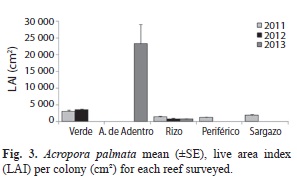
<body><![CDATA[1.4% of the colonies. White band disease (WB) and white pox (WP) were     also observed in low levels 0.9% and 0.3% of the colonies respectively.     WB was mainly observed at Verde affecting only one other colony at     Perif&eacute;rico. RTL was observed at Verde, Anegada de Adentro and     Sargazo and WP was only observed at Verde and Sargazo.</span></font><br      style="font-family: verdana;">     <font size="2"></font><br style="font-family: verdana;">     <font size="2"><span style="font-family: verdana;">Mean LAI ranged from     828cm&sup2; to     23 448cm&sup2; per reef (<a href="#Fig3">Fig. 3</a>). The reefs in the     ]]></body>
<body><![CDATA[northern group had     significantly larger mean LAI&#8217;s, Anegada de Adentro (23 448cm&sup2;)     and Verde (3 097cm&sup2; in 2011 and 3 580cm&sup2; in 2012) than the     southern group, where all reefs had a LAI under 2 000cm&sup2;     (Kruskal-Wallis, p&lt;0.05- <a href="#Fig3">Fig. 3</a>).    <br>     <br> </span></font>     <div style="text-align: center;"><font size="2"><span      style="font-family: verdana;"><a name="Fig3"></a><img alt=""      src="/img/revistas/rbt/v62s3/a13i3.jpg"     ]]></body>
<body><![CDATA[ style="width: 297px; height: 178px;"></span></font><br      style="font-family: verdana;">     <font size="2"><span style="font-family: verdana;"></span></font></div>     <br style="font-family: verdana;">     <font size="2"><span style="font-family: verdana;">In 2011, for all     reefs combined, 6%     of the measured colonies were small (&lt;60cm&sup2;), 66% were medium     (60-1 600cm&sup2;) and 28% were large (&gt;1 600cm&sup2;). From 2011 to     2012, there was a small shift from small colonies to medium and large     at Verde. At Rizo, there was a decrease in the number of large colonies     ]]></body>
<body><![CDATA[and an increase in the number of small and medium colonies and by 2013,     there was a small increase in medium colonies and decrease in small     colonies. Anegada de Adentro was the only site dominated by large     colonies with 69% having a mean LAI greater than 1 600cm&sup2; (<a      href="/img/revistas/rbt/v62s3/a13i3.jpg">Fig. 3</a>,     <a href="/img/revistas/rbt/v62s3/a13i4.jpg">4</a>).</span></font><br      style="font-family: verdana;">     <font size="2"></font><br style="font-family: verdana;">     <font style="font-weight: bold;" size="3"><span      style="font-family: verdana;">Discussion</span></font><br     ]]></body>
<body><![CDATA[ style="font-family: verdana;">     <font size="2"></font><br style="font-family: verdana;">     <font size="2"><span style="font-family: verdana;">This study is the     most     comprehensive study of </span></font><font size="2"><span      style="font-family: verdana;"><span style="font-style: italic;">A.     palmata</span></span></font><font size="2"><span      style="font-family: verdana;"> within the Veracruz Reef System to     date. Its distribution through the VRS indicates that </span></font><font      size="2"><span style="font-family: verdana;"><span     ]]></body>
<body><![CDATA[ style="font-style: italic;">A. palmata</span></span></font><font      size="2"><span style="font-family: verdana;"> may be     recovering from the 1970&#8217;s and 1980&#8217;s die off. </span></font><font      size="2"><span style="font-family: verdana;"></span></font><font      size="2"><span style="font-family: verdana;"><span      style="font-style: italic;">Acropora</span></span></font><font size="2"><span      style="font-family: verdana;"><span style="font-style: italic;">     palmata</span></span></font><font size="2"><span      style="font-family: verdana;"> was     present at a majority of the sites surveyed in both reef groups. For     ]]></body>
<body><![CDATA[those sites where it was not found it appears that either the habitat     was not suitable (too deep) or the sites were within close proximity to     shore and/or the major shipping port (northern group). The overall mean     density of this study (0.08colonies/ m&sup2;) was greater than the     previously described for the area (0.03), Puerto Rico (0.03), St. Croix     (0.02) and St. John (0.06) and similar to Venezuela (0.08)     (Jordan-Dahlgren, 1992; Mayor et al., 2006; Sch&auml;rer et al., 2008;     Zubillaga et al., 2008). Colony density and mean colony length were     greatest in the northern group (Verde and Anegada de Adentro). This was     contrary to what was found by Jordan-Dahlgren (1992), however the three     ]]></body>
<body><![CDATA[reefs that they surveyed in the southern group were not included in our     </span></font><font size="2"><span style="font-family: verdana;"><span      style="font-style: italic;">A. palmata</span></span></font><font      size="2"><span style="font-family: verdana;"> assessment.</span></font><br      style="font-family: verdana;">     <font size="2"></font><br style="font-family: verdana;">     <font size="2"><span style="font-family: verdana;">In order for a     population to be     recovering it needs to be dominated by &#8216;healthy&#8217; colonies, which are     characterized by a broad distribution of colony size frequencies     ]]></body>
<body><![CDATA[(Knowlton, 2001) low prevalence of disease, predation and recent     mortality and have reproductive potential (Richmond, 1997; Zubillaga et     al., 2008). The mean colony length during this study was 58cm, whereas     Jordan-Dahlgren (1992) reported a mean colony size of 22cm. The largest     colony measured (1 320cm) was over ten times that of Jordan-Dahlgren     (1992). Across the three years of data collection, the mean percent     live tissue of all colonies was 89% and mean recent mortality was only     1.1%. Prevalence of disease (2.7%) and predation (2.5%) were observed     at very low levels. Other studies have recorded similar or higher     levels of disease and predation in other regions (Grober-Dunsmore, et     ]]></body>
<body><![CDATA[al., 2006; Sch&auml;rer et al., 2008; Zubillaga et al., 2008; Williams     &amp; Miller, 2011).</span></font><br style="font-family: verdana;">     <font size="2"></font><br style="font-family: verdana;">     <font size="2"><span style="font-family: verdana;">The </span></font><font      size="2"><span style="font-family: verdana;"><span      style="font-style: italic;">A. palmata</span></span></font><font      size="2"><span style="font-family: verdana;">     populations in the     VRS have a high spawning potential, 38% of the colonies are considered     mature (&gt;1 600cm&sup2;), of those colonies 53% were &gt;4 000c</span></font><font     ]]></body>
<body><![CDATA[ size="2"><span style="font-family: verdana;">m<sup>2</sup></span></font><font      size="2"><span style="font-family: verdana;">.     According to Soong and Lang (1992) there is a high potential (88%) that     colonies &gt;4 000c</span></font><font size="2"><span      style="font-family: verdana;">m<sup>2</sup></span></font><font size="2"><span      style="font-family: verdana;"> are fertile. All sites were dominated     by medium     sized colonies; only 4% of the colonies were classified as small across     all years. This size frequency distribution indicates that these     populations have a high potential for colonies to spawn, whereas two     ]]></body>
<body><![CDATA[decades prior the majority of the colonies were in the small to medium     size classes (Jordan-Dahlgren 1992). Large colonies were found across     the VRS, increasing the potential for sexual reproduction, albeit the     genetic diversity for this species is currently unknown for this region.</span></font><br      style="font-family: verdana;">     <font size="2"></font><br style="font-family: verdana;">     <font size="2"><span style="font-family: verdana;">Although the </span></font><font      size="2"><span style="font-family: verdana;"><span      style="font-style: italic;">A. palmata</span></span></font><font      size="2"><span style="font-family: verdana;"> populations     ]]></body>
<body><![CDATA[were &#8216;healthy&#8217; as defined herein, there was a decrease in the percent     live tissue cover (96% to73%) at Rizo from 2011 to 2013. We found no     signs of disease and very little recent mortality, however, the VRS was     directly hit by two storms between the 2011 and 2012 surveys, Tropical     Storm Harvey (August) and Hurricane Nate (September). These storms     caused an increase in wave height and flooding of the Jamapa river     (Blake, 2011; Kimberlain, 2011). At Rizo in 2011, 40 </span></font><font      size="2"><span style="font-family: verdana;"><span      style="font-style: italic;">A. palmata</span></span></font><font      size="2"><span style="font-family: verdana;">     ]]></body>
<body><![CDATA[colonies were measured within the permanent monitoring transects and in     2012, the count increased to 89. Initially, there were no small     colonies within this population, but in 2012, 7% of the colonies were     less than 60cm&sup2;. There was also a 20% drop in the number of large     colonies, which may indicate that the energy from the storms caused     some large colonies to fragment into smaller colonies. Williams (2011)     found similar increases in fragmentation, decreases in colony size, and     increases in colony tissue mortality following a hurricane. This shift     was also apparent in the mean colony length, decreasing from 40cm to     33cm between 2011 and 2012. However, this trend seemed to be reverting     ]]></body>
<body><![CDATA[in 2013, as we observed a decrease in small colonies and an increase in     medium colonies. This could indicate that the small fragments formed in     2012 had survived and grown in the intervening period, showing some     resilience, characteristic of a healthy population. We were not able to     detect similar patterns at Verde because, unlike Rizo, the transects     started in the same location both years, but the 2012 transect     continued an additional 1 200m past the end of the 2011 transects,     therefore including more colonies in the assessment. In addition, the     colonies at Verde may be more protected as they are found on the     leeward slope of the reef, whereas colonies at Rizo are more exposed on     ]]></body>
<body><![CDATA[the windward edge of the reef.</span></font><br      style="font-family: verdana;">     <font size="2"></font><br style="font-family: verdana;">     <font size="2"><span style="font-family: verdana;">These data suggest     that </span></font><font size="2"><span style="font-family: verdana;"><span      style="font-style: italic;">A. palmata</span></span></font><font      size="2"><span style="font-family: verdana;">     in the VRS is healthy, abundant, broadly distributed, and has a high     spawning potential, whereas most of the Caribbean populations are not.     Hence, the next question may be, why has this species been able to     ]]></body>
<body><![CDATA[proliferate in this area where there are continuous terrestrial and     environmental impacts? Especially if it is thought to have endured the     same population decrease as the rest of the Greater Caribbean. During a     time where this species is under review to be uplisted to Endangered     under the US Endangered Species Act, proper management and conservation     efforts should be made to protect these recovering populations.</span></font><br      style="font-family: verdana;">     <font size="2"></font><br style="font-family: verdana;">     <font style="font-weight: bold;" size="3"><span      style="font-family: verdana;">Acknowledgments</span></font><br     ]]></body>
<body><![CDATA[ style="font-family: verdana;">     <font size="2"></font><br style="font-family: verdana;">     <font size="2"><span style="font-family: verdana;">We thank the staff     of the Parque     Nacional Sistema Arrecifal Veracruzano, M. Rangel Avalos and J.     Santander Monsalvo for critical logistical support. Nova Southeastern     University Oceanographic Center graduate students, V. Brinkhuis, S.     Bush, A. Costaregni, N. D&#8217;Antonio, P. Espitia, D. Fahy, A. Halperin, M.     Sathe, J. Walczak, and C. Walton, provided essential help with data     collection. Partial funding for this research was provided by multiple     ]]></body>
<body><![CDATA[Nova Southeastern University President Faculty Research and Development     Grants, the Guy Harvey Research Institute, and a grant from the     National Oceanic and Atmospheric Administration to the National Coral     Reef Institute. We thank Margaret Miller and an anonymous reviewer for     constructive comments on this work. This is NCRI Contribution 157.</span></font><br      style="font-family: verdana;">     <br style="font-family: verdana;">     <hr style="width: 100%; height: 2px;"><font style="font-weight: bold;"      size="3"><span style="font-family: verdana;">References</span></font><br      style="font-family: verdana;">     ]]></body>
<body><![CDATA[<br style="font-family: verdana;">     <!-- ref --><div style="text-align: left;"><font size="2"><span  style="font-family: verdana;"><span style="font-style: italic;">Acropora</span></span></font><font  size="2"><span style="font-family: verdana;"> Biological Review Team. (2005). <span style="font-style: italic;">Atlantic </span></span></font><font  style="font-style: italic;" size="2"><span  style="font-family: verdana;">Acropora</span></font><font size="2"><span  style="font-family: verdana;"><span style="font-style: italic;"> status review document.</span> Report to National Marine Fisheries Service, Southeast Regional Office.    &nbsp;&nbsp;&nbsp;&nbsp;&nbsp;&nbsp;&nbsp;&nbsp;[&#160;<a href="javascript:void(0);" onclick="javascript: window.open('/scielo.php?script=sci_nlinks&ref=1771045&pid=S0034-7744201400070001300001&lng=','','width=640,height=500,resizable=yes,scrollbars=1,menubar=yes,');">Links</a>&#160;]<!-- end-ref --><!-- ref --></span></font><br  style="font-family: verdana;"> <br style="font-family: verdana;"> <font size="2"><span style="font-family: verdana;">Adey, W. H. (1978). Coral reef morphogenesis: a multidimensional model. <span  style="font-style: italic;">Science, 202</span>, 831-837.    &nbsp;&nbsp;&nbsp;&nbsp;&nbsp;&nbsp;&nbsp;&nbsp;[&#160;<a href="javascript:void(0);" onclick="javascript: window.open('/scielo.php?script=sci_nlinks&ref=1771046&pid=S0034-7744201400070001300002&lng=','','width=640,height=500,resizable=yes,scrollbars=1,menubar=yes,');">Links</a>&#160;]<!-- end-ref --><!-- ref --></span></font><br  style="font-family: verdana;"> <br style="font-family: verdana;"> <font size="2"><span style="font-family: verdana;">Aronson, R. B., Bruckner, A. W., Moore, J.,. Precht W. F., &amp; Weil, E. (2008a). <span  style="font-style: italic;">IUCN Red List of Threatened Species: </span></span></font><font  style="font-style: italic;" size="2"><span  style="font-family: verdana;">Acropora</span></font><font size="2"><span  style="font-family: verdana;"><span style="font-style: italic;"> cervicornis.</span> Retrieved from www.iucnredlist.org.    &nbsp;&nbsp;&nbsp;&nbsp;&nbsp;&nbsp;&nbsp;&nbsp;[&#160;<a href="javascript:void(0);" onclick="javascript: window.open('/scielo.php?script=sci_nlinks&ref=1771047&pid=S0034-7744201400070001300003&lng=','','width=640,height=500,resizable=yes,scrollbars=1,menubar=yes,');">Links</a>&#160;]<!-- end-ref --><!-- ref --></span></font><br style="font-family: verdana;"> <a href="www.iucnredlist.org"></a><br style="font-family: verdana;"> <font size="2"><span style="font-family: verdana;">Aronson, R. B., Bruckner, A. W., Moore, J., Precht W. F., &amp; Weil, E. (2008b). <span  style="font-style: italic;">IUCN Red List of Threatened Species: </span></span></font><font  style="font-style: italic;" size="2"><span  style="font-family: verdana;"></span></font><font  style="font-style: italic;" size="2"><span  style="font-family: verdana;">Acropora</span></font><font  style="font-style: italic;" size="2"><span  style="font-family: verdana;"> palmata</span></font><font size="2"><span style="font-family: verdana;"><span  style="font-style: italic;">.</span> Version 2012.2. Retrieved from www.iucnredlist.org.    &nbsp;&nbsp;&nbsp;&nbsp;&nbsp;&nbsp;&nbsp;&nbsp;[&#160;<a href="javascript:void(0);" onclick="javascript: window.open('/scielo.php?script=sci_nlinks&ref=1771048&pid=S0034-7744201400070001300004&lng=','','width=640,height=500,resizable=yes,scrollbars=1,menubar=yes,');">Links</a>&#160;]<!-- end-ref --><!-- ref --></span></font><br style="font-family: verdana;"> <br style="font-family: verdana;"> <font size="2"><span style="font-family: verdana;">Aronson, R. B., &amp; Precht, W. F. (2001). White-band disease and the changing face of Caribbean coral reefs. <span style="font-style: italic;">Hydrobiologia, 460</span>, 25-38.    &nbsp;&nbsp;&nbsp;&nbsp;&nbsp;&nbsp;&nbsp;&nbsp;[&#160;<a href="javascript:void(0);" onclick="javascript: window.open('/scielo.php?script=sci_nlinks&ref=1771049&pid=S0034-7744201400070001300005&lng=','','width=640,height=500,resizable=yes,scrollbars=1,menubar=yes,');">Links</a>&#160;]<!-- end-ref --><!-- ref --></span></font><br style="font-family: verdana;"> <br style="font-family: verdana;"> <font size="2"><span style="font-family: verdana;">Blake, E. S. (2011). <span style="font-style: italic;">Tropical Cyclone Report.</span> Tropical Cyclone Harvey. National Oceanic and Atmospheric Administration, USA.    &nbsp;&nbsp;&nbsp;&nbsp;&nbsp;&nbsp;&nbsp;&nbsp;[&#160;<a href="javascript:void(0);" onclick="javascript: window.open('/scielo.php?script=sci_nlinks&ref=1771050&pid=S0034-7744201400070001300006&lng=','','width=640,height=500,resizable=yes,scrollbars=1,menubar=yes,');">Links</a>&#160;]<!-- end-ref --><!-- ref --></span></font><br  style="font-family: verdana;"> <br style="font-family: verdana;"> <font size="2"><span style="font-family: verdana;">Bruckner, A. W. (2002). P<span style="font-style: italic;">roceedings of the Caribbean </span></span></font><font style="font-style: italic;"  size="2"><span style="font-family: verdana;">Acropora</span></font><font  size="2"><span style="font-family: verdana;"><span  style="font-style: italic;"> Workshop: Potential Application of the U.S. Endangered Species Act as a Conservation Strategy. </span>NOAA Technical Memorandum NMFS-OPR-24.    &nbsp;&nbsp;&nbsp;&nbsp;&nbsp;&nbsp;&nbsp;&nbsp;[&#160;<a href="javascript:void(0);" onclick="javascript: window.open('/scielo.php?script=sci_nlinks&ref=1771051&pid=S0034-7744201400070001300007&lng=','','width=640,height=500,resizable=yes,scrollbars=1,menubar=yes,');">Links</a>&#160;]<!-- end-ref --><!-- ref --></span></font><br style="font-family: verdana;"> <br style="font-family: verdana;"> <font size="2"><span style="font-family: verdana;">Diario Oficial, D. (1992). Decreto por el que se declara &aacute;rea natural protegida con el car&aacute;cter de Parque Marino Nacional, la zona conocida como Sistema Arrecifal Veracruzano, ubicada frente a las Costas de los municipios de Veracruz, Boca del R&iacute;o y Alvarado del estado de Veracruz Llave, con superficie de 52,238-91-50 hect&aacute;reas. Diario Oficial de la Federacion, Mexico.    &nbsp;&nbsp;&nbsp;&nbsp;&nbsp;&nbsp;&nbsp;&nbsp;[&#160;<a href="javascript:void(0);" onclick="javascript: window.open('/scielo.php?script=sci_nlinks&ref=1771052&pid=S0034-7744201400070001300008&lng=','','width=640,height=500,resizable=yes,scrollbars=1,menubar=yes,');">Links</a>&#160;]<!-- end-ref --><!-- ref --></span></font><br  style="font-family: verdana;"> <br style="font-family: verdana;"> <font size="2"><span style="font-family: verdana;">Dustan, P. &amp; Halas, J. C. (1987). Changes in the reef-coral community of Carysfort reef, Key Largo, Florida: 1974 to 1982. <span style="font-style: italic;">Coral Reefs, 6,</span> 91-106.    &nbsp;&nbsp;&nbsp;&nbsp;&nbsp;&nbsp;&nbsp;&nbsp;[&#160;<a href="javascript:void(0);" onclick="javascript: window.open('/scielo.php?script=sci_nlinks&ref=1771053&pid=S0034-7744201400070001300009&lng=','','width=640,height=500,resizable=yes,scrollbars=1,menubar=yes,');">Links</a>&#160;]<!-- end-ref --><!-- ref --></span></font><br style="font-family: verdana;"> <br style="font-family: verdana;"> <font size="2"><span style="font-family: verdana;">Emery, K. O. (1963). Coral reefs off Veracruz, Mexico. <span style="font-style: italic;">Geofisica internacional, 3</span>, 11-17.    &nbsp;&nbsp;&nbsp;&nbsp;&nbsp;&nbsp;&nbsp;&nbsp;[&#160;<a href="javascript:void(0);" onclick="javascript: window.open('/scielo.php?script=sci_nlinks&ref=1771054&pid=S0034-7744201400070001300010&lng=','','width=640,height=500,resizable=yes,scrollbars=1,menubar=yes,');">Links</a>&#160;]<!-- end-ref --><!-- ref --></span></font><br  style="font-family: verdana;"> <br style="font-family: verdana;"> <font size="2"><span style="font-family: verdana;">Grober-Dunsmore, R., Bonito, V., &amp; Frazer, T. K. (2006). Potential inhibitors to recovery of </span></font><font  size="2"><span style="font-family: verdana;"></span></font><font  size="2"><span style="font-family: verdana;"><span  style="font-style: italic;">Acropora</span></span></font><font size="2"><span  style="font-family: verdana;"><span style="font-style: italic;"> palmata</span></span></font><font size="2"><span  style="font-family: verdana;"> populations in St. John, US Virgin Islands. <span style="font-style: italic;">Marine Ecology Progress Series, 321</span>, 123-132.    &nbsp;&nbsp;&nbsp;&nbsp;&nbsp;&nbsp;&nbsp;&nbsp;[&#160;<a href="javascript:void(0);" onclick="javascript: window.open('/scielo.php?script=sci_nlinks&ref=1771055&pid=S0034-7744201400070001300011&lng=','','width=640,height=500,resizable=yes,scrollbars=1,menubar=yes,');">Links</a>&#160;]<!-- end-ref --><!-- ref --></span></font><br  style="font-family: verdana;"> <br style="font-family: verdana;"> <font size="2"><span style="font-family: verdana;">Heilprin, A. (1890). The Corals and Coral Reefs of the Western Waters of the Gulf of Mexico. <span  style="font-style: italic;">Proceedings of the Academy of Natural Sciences of Philadelphia, 42</span>, 303-316.    &nbsp;&nbsp;&nbsp;&nbsp;&nbsp;&nbsp;&nbsp;&nbsp;[&#160;<a href="javascript:void(0);" onclick="javascript: window.open('/scielo.php?script=sci_nlinks&ref=1771056&pid=S0034-7744201400070001300012&lng=','','width=640,height=500,resizable=yes,scrollbars=1,menubar=yes,');">Links</a>&#160;]<!-- end-ref --><!-- ref --></span></font><br  style="font-family: verdana;"> <br style="font-family: verdana;"> <font size="2"><span style="font-family: verdana;">Horta-Puga, G. (2007). Environmental Impacts, p. 126-141. In Tunnell J. W. Jr., Chavez E. A., &amp; Withers K. (eds.). <span style="font-style: italic;">Coral Reefs of the Southern Gulf of Mexico.</span> Texas: A&amp;M University Press, College Station.    &nbsp;&nbsp;&nbsp;&nbsp;&nbsp;&nbsp;&nbsp;&nbsp;[&#160;<a href="javascript:void(0);" onclick="javascript: window.open('/scielo.php?script=sci_nlinks&ref=1771057&pid=S0034-7744201400070001300013&lng=','','width=640,height=500,resizable=yes,scrollbars=1,menubar=yes,');">Links</a>&#160;]<!-- end-ref --><!-- ref --></span></font><br  style="font-family: verdana;"> <br style="font-family: verdana;"> <font size="2"><span style="font-family: verdana;">Jones, J., Withers, K., &amp; Tunnell, J. W. Jr. (2008). Comparison of Benthic Communities on Six Coral Reefs inthe Veracruz Reef System (Mexico). <span  style="font-style: italic;">Proceedings of the 11th International Coral Reef Symposium, Fort Lauderdale, FL USA</span>, 757-760.    &nbsp;&nbsp;&nbsp;&nbsp;&nbsp;&nbsp;&nbsp;&nbsp;[&#160;<a href="javascript:void(0);" onclick="javascript: window.open('/scielo.php?script=sci_nlinks&ref=1771058&pid=S0034-7744201400070001300014&lng=','','width=640,height=500,resizable=yes,scrollbars=1,menubar=yes,');">Links</a>&#160;]<!-- end-ref --><!-- ref --></span></font><br style="font-family: verdana;"> <br style="font-family: verdana;"> <font size="2"><span style="font-family: verdana;">Jordan-Dahlgren, E. (1992). Recolonization Patterns of </span></font><font size="2"><span  style="font-family: verdana;"></span></font><font size="2"><span  style="font-family: verdana;"><span style="font-style: italic;">Acropora</span></span></font><font  size="2"><span style="font-family: verdana;"><span  style="font-style: italic;"> palmata</span></span></font><font size="2"><span  style="font-family: verdana;"> in a Marginal Environment. <span style="font-style: italic;">Bulletin of Marine Science, 51</span>, 104-117.    &nbsp;&nbsp;&nbsp;&nbsp;&nbsp;&nbsp;&nbsp;&nbsp;[&#160;<a href="javascript:void(0);" onclick="javascript: window.open('/scielo.php?script=sci_nlinks&ref=1771059&pid=S0034-7744201400070001300015&lng=','','width=640,height=500,resizable=yes,scrollbars=1,menubar=yes,');">Links</a>&#160;]<!-- end-ref --><!-- ref --></span></font><br style="font-family: verdana;"> <br style="font-family: verdana;"> <font size="2"><span style="font-family: verdana;">Keck, J., Houston, R. S., Purkis, S., &amp; Riegl, B. M. (2005). Unexpectedly high cover of </span></font><font  size="2"><span style="font-family: verdana;"><span  style="font-style: italic;">Acropora</span></span></font><font size="2"><span  style="font-family: verdana;"> cervicornis on offshore reef in Roatan (Honduras). <span  style="font-style: italic;">Coral Reefs, 24</span>, 509.    &nbsp;&nbsp;&nbsp;&nbsp;&nbsp;&nbsp;&nbsp;&nbsp;[&#160;<a href="javascript:void(0);" onclick="javascript: window.open('/scielo.php?script=sci_nlinks&ref=1771060&pid=S0034-7744201400070001300016&lng=','','width=640,height=500,resizable=yes,scrollbars=1,menubar=yes,');">Links</a>&#160;]<!-- end-ref --><!-- ref --></span></font><br  style="font-family: verdana;"> <br style="font-family: verdana;"> <font size="2"><span style="font-family: verdana;">Kimberlain, T. B. (2011). Tropical Cyclone Report. Hurricane Nate. National Oceanic and Atmospheric Administration, USA.    &nbsp;&nbsp;&nbsp;&nbsp;&nbsp;&nbsp;&nbsp;&nbsp;[&#160;<a href="javascript:void(0);" onclick="javascript: window.open('/scielo.php?script=sci_nlinks&ref=1771061&pid=S0034-7744201400070001300017&lng=','','width=640,height=500,resizable=yes,scrollbars=1,menubar=yes,');">Links</a>&#160;]<!-- end-ref --><!-- ref --></span></font><br style="font-family: verdana;"> <br style="font-family: verdana;"> <font size="2"><span style="font-family: verdana;">Knowlton, N. (2001). The future of coral reefs. <span style="font-style: italic;">Proceedings of the National Academy of Science of the United States of America</span>, 5419-5425.    &nbsp;&nbsp;&nbsp;&nbsp;&nbsp;&nbsp;&nbsp;&nbsp;[&#160;<a href="javascript:void(0);" onclick="javascript: window.open('/scielo.php?script=sci_nlinks&ref=1771062&pid=S0034-7744201400070001300018&lng=','','width=640,height=500,resizable=yes,scrollbars=1,menubar=yes,');">Links</a>&#160;]<!-- end-ref --><!-- ref --></span></font><br  style="font-family: verdana;"> <br style="font-family: verdana;"> <font size="2"><span style="font-family: verdana;">Knowlton, N., Lang, J. C. &amp; Keller, B. D. (1990). Case study of natural population collapse: post-hurricane predation on Jamaican Staghorn coral. <span  style="font-style: italic;">Smithsonian Contributions to the Marine Sciences, 36.    &nbsp;&nbsp;&nbsp;&nbsp;&nbsp;&nbsp;&nbsp;&nbsp;[&#160;<a href="javascript:void(0);" onclick="javascript: window.open('/scielo.php?script=sci_nlinks&ref=1771063&pid=S0034-7744201400070001300019&lng=','','width=640,height=500,resizable=yes,scrollbars=1,menubar=yes,');">Links</a>&#160;]<!-- end-ref --><!-- ref --></span></span></font><br  style="font-family: verdana;"> <br style="font-family: verdana;"> <font size="2"><span style="font-family: verdana;">Lara, M., Padilla, C., Garcia, C., &amp; Espejel, J. J. (1992). Coral Reef of Veracruz Mexico I. Zonation and community. <span style="font-style: italic;">Proceedings of the 7th International Coral Reef Symposium, Guam., 1,</span> 535-544.    &nbsp;&nbsp;&nbsp;&nbsp;&nbsp;&nbsp;&nbsp;&nbsp;[&#160;<a href="javascript:void(0);" onclick="javascript: window.open('/scielo.php?script=sci_nlinks&ref=1771064&pid=S0034-7744201400070001300020&lng=','','width=640,height=500,resizable=yes,scrollbars=1,menubar=yes,');">Links</a>&#160;]<!-- end-ref --><!-- ref --></span></font><br  style="font-family: verdana;"> <br style="font-family: verdana;"> <font size="2"><span style="font-family: verdana;">Lirman, D., Bowden-Kerby, A., Schopmeyer, S., Huntington, B., Thyberg, T., Gough, M., Gough, T., Gough, R., &amp; Gough, Y. (2010). A window to the past: documenting the status of one of the last remaining &#8216;megapopulations&#8217; of the threatened staghorn coral </span></font><font size="2"><span  style="font-family: verdana;"><span style="font-style: italic;">Acropora</span></span></font><font  size="2"><span style="font-family: verdana;"> <span  style="font-style: italic;">cervicornis </span>in the Dominican Republic. <span style="font-style: italic;">Aquatic Conservation: Marine and Freshwater Ecosystems, 20,</span> 773-781.    &nbsp;&nbsp;&nbsp;&nbsp;&nbsp;&nbsp;&nbsp;&nbsp;[&#160;<a href="javascript:void(0);" onclick="javascript: window.open('/scielo.php?script=sci_nlinks&ref=1771065&pid=S0034-7744201400070001300021&lng=','','width=640,height=500,resizable=yes,scrollbars=1,menubar=yes,');">Links</a>&#160;]<!-- end-ref --><!-- ref --></span></font><br style="font-family: verdana;"> <br style="font-family: verdana;"> <font size="2"><span style="font-family: verdana;">Mayor, P.A., Rogers, C.S. &amp; Hillis-Starr, Z.M. (2006). Distribution and abundance of elkhorn coral, </span></font><font size="2"><span style="font-family: verdana;"></span></font><font  size="2"><span style="font-family: verdana;"><span  style="font-style: italic;">Acropora</span></span></font><font size="2"><span  style="font-family: verdana;"><span style="font-style: italic;"> palmata</span></span></font><font size="2"><span  style="font-family: verdana;">, and prevalence of white-band disease at Buck island reef national monument, St. Croix, US Virgin Islands. <span  style="font-style: italic;">Coral Reefs, 25</span>, 239-242.    &nbsp;&nbsp;&nbsp;&nbsp;&nbsp;&nbsp;&nbsp;&nbsp;[&#160;<a href="javascript:void(0);" onclick="javascript: window.open('/scielo.php?script=sci_nlinks&ref=1771066&pid=S0034-7744201400070001300022&lng=','','width=640,height=500,resizable=yes,scrollbars=1,menubar=yes,');">Links</a>&#160;]<!-- end-ref --><!-- ref --></span></font><br style="font-family: verdana;"> <br style="font-family: verdana;"> <font size="2"><span style="font-family: verdana;">Miller, M. W., Bourque, J., &amp; Bohnsack, J. (2002). An analysis of the loss of Acroporid corals at Looe Key, Florida, USA 1983-2000. <span style="font-style: italic;">Coral Reefs, 21,</span> 179-182.    &nbsp;&nbsp;&nbsp;&nbsp;&nbsp;&nbsp;&nbsp;&nbsp;[&#160;<a href="javascript:void(0);" onclick="javascript: window.open('/scielo.php?script=sci_nlinks&ref=1771067&pid=S0034-7744201400070001300023&lng=','','width=640,height=500,resizable=yes,scrollbars=1,menubar=yes,');">Links</a>&#160;]<!-- end-ref --><!-- ref --></span></font><br  style="font-family: verdana;"> <br style="font-family: verdana;"> <font size="2"><span style="font-family: verdana;">Neigell, J. E., &amp; Avise, J. C. (1983). Clonal diversity and population structure in a reef-building coral, </span></font><font size="2"><span style="font-family: verdana;"><span  style="font-style: italic;">Acropora</span></span></font><font size="2"><span  style="font-family: verdana;"> cervicornis: self recognition analysis and demographic interpretation. <span style="font-style: italic;">Evolution, 37</span>, 437-453.    &nbsp;&nbsp;&nbsp;&nbsp;&nbsp;&nbsp;&nbsp;&nbsp;[&#160;<a href="javascript:void(0);" onclick="javascript: window.open('/scielo.php?script=sci_nlinks&ref=1771068&pid=S0034-7744201400070001300024&lng=','','width=640,height=500,resizable=yes,scrollbars=1,menubar=yes,');">Links</a>&#160;]<!-- end-ref --><!-- ref --></span></font><br style="font-family: verdana;"> <br style="font-family: verdana;"> <font size="2"><span style="font-family: verdana;">NOAA. (2006). Endangered and threatened species: final listing determinations for Elkhorn coral and Staghorn coral Federal Register 71: 26852-26861.    &nbsp;&nbsp;&nbsp;&nbsp;&nbsp;&nbsp;&nbsp;&nbsp;[&#160;<a href="javascript:void(0);" onclick="javascript: window.open('/scielo.php?script=sci_nlinks&ref=1771069&pid=S0034-7744201400070001300025&lng=','','width=640,height=500,resizable=yes,scrollbars=1,menubar=yes,');">Links</a>&#160;]<!-- end-ref --><!-- ref --></span></font><br  style="font-family: verdana;"> <br style="font-family: verdana;"> <font size="2"><span style="font-family: verdana;">Rangel Avalos, M. A., Jordan, L. K. B., Walker, B. K., Gilliam, D. S., Carvajal Hinojosa, E., &amp; Spieler, R. E. (2007). Fish and Coral Reef Communities of the Parque Nacional Sistema Arrecifal Veracruzano (Veracruz Coral Reef System National Park) Veracruz, Mexico: Preliminary Results. <span  style="font-style: italic;">Proceedings of the 60th Annual Gulf and Caribbean Fisheries Institute Meeting, Punta Cana, Dominican Republic, 60</span>, 427-435.    &nbsp;&nbsp;&nbsp;&nbsp;&nbsp;&nbsp;&nbsp;&nbsp;[&#160;<a href="javascript:void(0);" onclick="javascript: window.open('/scielo.php?script=sci_nlinks&ref=1771070&pid=S0034-7744201400070001300026&lng=','','width=640,height=500,resizable=yes,scrollbars=1,menubar=yes,');">Links</a>&#160;]<!-- end-ref --><!-- ref --></span></font><br  style="font-family: verdana;"> <br style="font-family: verdana;"> <font size="2"><span style="font-family: verdana;">Rannefeld, J. W. (1972). T<span style="font-style: italic;">he stony corals of Enmedio Reef off Veracruz, Mexico. </span>M.S Thesis. Texas A &amp; M University, College Station.    &nbsp;&nbsp;&nbsp;&nbsp;&nbsp;&nbsp;&nbsp;&nbsp;[&#160;<a href="javascript:void(0);" onclick="javascript: window.open('/scielo.php?script=sci_nlinks&ref=1771071&pid=S0034-7744201400070001300027&lng=','','width=640,height=500,resizable=yes,scrollbars=1,menubar=yes,');">Links</a>&#160;]<!-- end-ref --><!-- ref --></span></font><br  style="font-family: verdana;"> <br style="font-family: verdana;"> <font size="2"><span style="font-family: verdana;">Richmond, R. H. (1997). Reproduction and recruitment in corals: critical links in the persistence of reefs, p. 175-197. In Brikeland, C. (eds.). <span  style="font-style: italic;">Life and Death of Coral Reefs.</span> New York: Chapman &amp; Hall.    &nbsp;&nbsp;&nbsp;&nbsp;&nbsp;&nbsp;&nbsp;&nbsp;[&#160;<a href="javascript:void(0);" onclick="javascript: window.open('/scielo.php?script=sci_nlinks&ref=1771072&pid=S0034-7744201400070001300028&lng=','','width=640,height=500,resizable=yes,scrollbars=1,menubar=yes,');">Links</a>&#160;]<!-- end-ref --><!-- ref --></span></font><br  style="font-family: verdana;"> <br style="font-family: verdana;"> <font size="2"><span style="font-family: verdana;">Sch&auml;rer, M., Nemeth, M., Valdivia, A., Miller, M., Williams, D., &amp; Diez, C. (2008). Elkhorn coral distribution and condition throughout the Puerto Rican Archipelago. <span style="font-style: italic;">Proc. of the 11th Int. Coral Reef Symp., Fort Lauderdale, FL USA</span>., 815-819.    &nbsp;&nbsp;&nbsp;&nbsp;&nbsp;&nbsp;&nbsp;&nbsp;[&#160;<a href="javascript:void(0);" onclick="javascript: window.open('/scielo.php?script=sci_nlinks&ref=1771073&pid=S0034-7744201400070001300029&lng=','','width=640,height=500,resizable=yes,scrollbars=1,menubar=yes,');">Links</a>&#160;]<!-- end-ref --><!-- ref --></span></font><br style="font-family: verdana;"> <br style="font-family: verdana;"> <font size="2"><span style="font-family: verdana;">Soong, K., &amp; Lang, J. C. (1992). Reproductive integration in reef corals. <span  style="font-style: italic;">Biological Bulletin, 183</span>, 418-431.    &nbsp;&nbsp;&nbsp;&nbsp;&nbsp;&nbsp;&nbsp;&nbsp;[&#160;<a href="javascript:void(0);" onclick="javascript: window.open('/scielo.php?script=sci_nlinks&ref=1771074&pid=S0034-7744201400070001300030&lng=','','width=640,height=500,resizable=yes,scrollbars=1,menubar=yes,');">Links</a>&#160;]<!-- end-ref --><!-- ref --></span></font><br style="font-family: verdana;"> <br style="font-family: verdana;"> <font size="2"><span style="font-family: verdana;">Tunnell, J. W. J. (1988). Regional comparison of southwestern Gulf of Mexico to Caribbean sea coral reefs. <span style="font-style: italic;">Proceedings of the 6th International Coral Reef Symposium, Townsville, Australia, 3</span>, 303-308.    &nbsp;&nbsp;&nbsp;&nbsp;&nbsp;&nbsp;&nbsp;&nbsp;[&#160;<a href="javascript:void(0);" onclick="javascript: window.open('/scielo.php?script=sci_nlinks&ref=1771075&pid=S0034-7744201400070001300031&lng=','','width=640,height=500,resizable=yes,scrollbars=1,menubar=yes,');">Links</a>&#160;]<!-- end-ref --><!-- ref --></span></font><br  style="font-family: verdana;"> <br style="font-family: verdana;"> <font size="2"><span style="font-family: verdana;">Tunnell, J. W. J. (1992). Natural Versus Human Impacts to Southern Gulf of Mexico Coral Reef Resources. Proceedings of the 7th International Coral Reef Symposium, Guam., 1, 300-306.    &nbsp;&nbsp;&nbsp;&nbsp;&nbsp;&nbsp;&nbsp;&nbsp;[&#160;<a href="javascript:void(0);" onclick="javascript: window.open('/scielo.php?script=sci_nlinks&ref=1771076&pid=S0034-7744201400070001300032&lng=','','width=640,height=500,resizable=yes,scrollbars=1,menubar=yes,');">Links</a>&#160;]<!-- end-ref --><!-- ref --></span></font><br style="font-family: verdana;"> <br style="font-family: verdana;"> <font size="2"><span style="font-family: verdana;">Vargas-Angel, B., Thomas, J. D., &amp; Hoke, S. M. (2003). High-latitude </span></font><font size="2"><span  style="font-family: verdana;"><span style="font-style: italic;">Acropora</span></span></font><font  size="2"><span style="font-family: verdana;"> cervicornis thickets off Fort Lauderdale, Florida, USA. <span style="font-style: italic;">Coral Reefs, 22</span>, 465-473.    &nbsp;&nbsp;&nbsp;&nbsp;&nbsp;&nbsp;&nbsp;&nbsp;[&#160;<a href="javascript:void(0);" onclick="javascript: window.open('/scielo.php?script=sci_nlinks&ref=1771077&pid=S0034-7744201400070001300033&lng=','','width=640,height=500,resizable=yes,scrollbars=1,menubar=yes,');">Links</a>&#160;]<!-- end-ref --><!-- ref --></span></font><br  style="font-family: verdana;"> <br style="font-family: verdana;"> <font size="2"><span style="font-family: verdana;">Walker, B. K., Larson, E. A., Moulding, A. L., &amp; Gilliam, D. S. (2012). Small-scale mapping of indeterminate arborescent acroporid coral (</span></font><font size="2"><span  style="font-family: verdana;"><span style="font-style: italic;">Acropora</span></span></font><font  size="2"><span style="font-family: verdana;"> cervicornis) patches. <span style="font-style: italic;">Coral Reefs, 31</span>, 885-894.    &nbsp;&nbsp;&nbsp;&nbsp;&nbsp;&nbsp;&nbsp;&nbsp;[&#160;<a href="javascript:void(0);" onclick="javascript: window.open('/scielo.php?script=sci_nlinks&ref=1771078&pid=S0034-7744201400070001300034&lng=','','width=640,height=500,resizable=yes,scrollbars=1,menubar=yes,');">Links</a>&#160;]<!-- end-ref --><!-- ref --></span></font><br style="font-family: verdana;"> <br style="font-family: verdana;"> <font size="2"><span style="font-family: verdana;">Williams, D. E., &amp; Miller, M. W. (2005). Coral disease outbreak: pattern. prevalence and transmission in </span></font><font size="2"><span style="font-family: verdana;"><span  style="font-style: italic;">Acropora</span></span></font><font size="2"><span  style="font-family: verdana;"> cervicornis. <span  style="font-style: italic;">Marine Ecology Progress Series, 301</span>, 119-128.    &nbsp;&nbsp;&nbsp;&nbsp;&nbsp;&nbsp;&nbsp;&nbsp;[&#160;<a href="javascript:void(0);" onclick="javascript: window.open('/scielo.php?script=sci_nlinks&ref=1771079&pid=S0034-7744201400070001300035&lng=','','width=640,height=500,resizable=yes,scrollbars=1,menubar=yes,');">Links</a>&#160;]<!-- end-ref --><!-- ref --></span></font><br style="font-family: verdana;"> <br style="font-family: verdana;"> <font size="2"><span style="font-family: verdana;">Williams, D. E., Miller, M. W., &amp; Kramer, K. L. (2008). Recruitment failure in Florida Keys </span></font><font  size="2"><span style="font-family: verdana;"></span></font><font  size="2"><span style="font-family: verdana;"><span  style="font-style: italic;">Acropora</span></span></font><font size="2"><span  style="font-family: verdana;"><span style="font-style: italic;"> palmata</span></span></font><font size="2"><span  style="font-family: verdana;">, a threatened Caribbean coral. <span  style="font-style: italic;">Coral Reefs, 27</span>, 697-705.    &nbsp;&nbsp;&nbsp;&nbsp;&nbsp;&nbsp;&nbsp;&nbsp;[&#160;<a href="javascript:void(0);" onclick="javascript: window.open('/scielo.php?script=sci_nlinks&ref=1771080&pid=S0034-7744201400070001300036&lng=','','width=640,height=500,resizable=yes,scrollbars=1,menubar=yes,');">Links</a>&#160;]<!-- end-ref --><!-- ref --></span></font><br style="font-family: verdana;"> <br style="font-family: verdana;"> <font size="2"><span style="font-family: verdana;">Williams, D. E., &amp; Miller, M. W. (2011). Attributing mortality among drivers of population decline in </span></font><font size="2"><span style="font-family: verdana;"></span></font><font  size="2"><span style="font-family: verdana;"><span  style="font-style: italic;">Acropora</span></span></font><font size="2"><span  style="font-family: verdana;"><span style="font-style: italic;"> palmata</span></span></font><font size="2"><span  style="font-family: verdana;"> in the Flordia Keys (USA). <span  style="font-style: italic;">Coral Reefs, 31</span>, 369-382.    &nbsp;&nbsp;&nbsp;&nbsp;&nbsp;&nbsp;&nbsp;&nbsp;[&#160;<a href="javascript:void(0);" onclick="javascript: window.open('/scielo.php?script=sci_nlinks&ref=1771081&pid=S0034-7744201400070001300037&lng=','','width=640,height=500,resizable=yes,scrollbars=1,menubar=yes,');">Links</a>&#160;]<!-- end-ref --><!-- ref --></span></font><br  style="font-family: verdana;"> <br style="font-family: verdana;"> <font size="2"><span style="font-family: verdana;">Zubillaga, A. L., M&aacute;rquez, L. M., Cr&aacute;quer, A., &amp; Bastidas, C. (2008). Ecological and genetic data indicate recovery of the endangered coral </span></font><font  size="2"><span style="font-family: verdana;"></span></font><font  size="2"><span style="font-family: verdana;"><span  style="font-style: italic;">Acropora</span></span></font><font size="2"><span  style="font-family: verdana;"><span style="font-style: italic;"> palmata</span></span></font><font size="2"><span  style="font-family: verdana;"> in Los Roques, Southern Caribbean. <span style="font-style: italic;">Coral Reefs, 27</span>, 63-72.    &nbsp;&nbsp;&nbsp;&nbsp;&nbsp;&nbsp;&nbsp;&nbsp;[&#160;<a href="javascript:void(0);" onclick="javascript: window.open('/scielo.php?script=sci_nlinks&ref=1771082&pid=S0034-7744201400070001300038&lng=','','width=640,height=500,resizable=yes,scrollbars=1,menubar=yes,');">Links</a>&#160;]<!-- end-ref --></span></font>    ]]></body>
<body><![CDATA[<br> <font size="2"><span style="font-family: verdana;"></span></font></div> <font size="2"><span style="font-family: verdana;"></span></font><br  style="font-family: verdana;"> <font size="2"><span style="font-family: verdana;"><a name="1"></a><a  href="#2">1</a>. Nova Southeastern University Oceanographic Center, 8000 N. Ocean Dr. Dania Beach, FL, 33004 USA; goergen@nova.edu</span></font><br style="font-family: verdana;"> <hr style="width: 100%; height: 2px;">     <div style="text-align: center;"><font style="font-weight: bold;"  size="2"><span style="font-family: verdana;">Received 03-XI-2013 Corrected 12-III-2014 Accepted 24-III-2014</span></font></div> <font style="font-weight: bold;" size="2"></font></div>      ]]></body><back>
<ref-list>
<ref id="B1">
<nlm-citation citation-type="">
<collab>Acropora Biological Review Team</collab>
<source><![CDATA[Atlantic Acropora status review document.]]></source>
<year>2005</year>
<publisher-loc><![CDATA[Southeast Regional Office ]]></publisher-loc>
</nlm-citation>
</ref>
<ref id="B2">
<nlm-citation citation-type="journal">
<person-group person-group-type="author">
<name>
<surname><![CDATA[Adey]]></surname>
<given-names><![CDATA[W. H.]]></given-names>
</name>
</person-group>
<article-title xml:lang="en"><![CDATA[Coral reef morphogenesis: a multidimensional model]]></article-title>
<source><![CDATA[Science]]></source>
<year>1978</year>
<volume>202</volume>
<page-range>831-837</page-range></nlm-citation>
</ref>
<ref id="B3">
<nlm-citation citation-type="">
<person-group person-group-type="author">
<name>
<surname><![CDATA[Aronson]]></surname>
<given-names><![CDATA[R. B.]]></given-names>
</name>
<name>
<surname><![CDATA[Bruckner]]></surname>
<given-names><![CDATA[A. W.]]></given-names>
</name>
<name>
<surname><![CDATA[Moore]]></surname>
<given-names><![CDATA[J.]]></given-names>
</name>
<name>
<surname><![CDATA[Precht]]></surname>
<given-names><![CDATA[W. F.]]></given-names>
</name>
<name>
<surname><![CDATA[Weil]]></surname>
<given-names><![CDATA[E.]]></given-names>
</name>
</person-group>
<source><![CDATA[IUCN Red List of Threatened Species:: Acropora cervicornis.]]></source>
<year>2008</year>
</nlm-citation>
</ref>
<ref id="B4">
<nlm-citation citation-type="">
<person-group person-group-type="author">
<name>
<surname><![CDATA[Aronson]]></surname>
<given-names><![CDATA[R. B.]]></given-names>
</name>
<name>
<surname><![CDATA[Bruckner]]></surname>
<given-names><![CDATA[A. W.]]></given-names>
</name>
<name>
<surname><![CDATA[Moore]]></surname>
<given-names><![CDATA[J.]]></given-names>
</name>
<name>
<surname><![CDATA[Precht]]></surname>
<given-names><![CDATA[W. F.]]></given-names>
</name>
<name>
<surname><![CDATA[Weil]]></surname>
<given-names><![CDATA[E.]]></given-names>
</name>
</person-group>
<source><![CDATA[IUCN Red List of Threatened Species:: Acropora palmata.]]></source>
<year>2008</year>
</nlm-citation>
</ref>
<ref id="B5">
<nlm-citation citation-type="journal">
<person-group person-group-type="author">
<name>
<surname><![CDATA[Aronson]]></surname>
<given-names><![CDATA[R. B.]]></given-names>
</name>
<name>
<surname><![CDATA[Precht]]></surname>
<given-names><![CDATA[W. F.]]></given-names>
</name>
</person-group>
<article-title xml:lang="en"><![CDATA[White-band disease and the changing face of Caribbean coral reefs]]></article-title>
<source><![CDATA[Hydrobiologia]]></source>
<year>2001</year>
<volume>460</volume>
<page-range>25-38</page-range></nlm-citation>
</ref>
<ref id="B6">
<nlm-citation citation-type="book">
<person-group person-group-type="author">
<name>
<surname><![CDATA[Blake]]></surname>
<given-names><![CDATA[E. S.]]></given-names>
</name>
</person-group>
<source><![CDATA[Tropical Cyclone Report.: Tropical Cyclone Harvey]]></source>
<year>2011</year>
<publisher-name><![CDATA[National Oceanic and Atmospheric Administration]]></publisher-name>
</nlm-citation>
</ref>
<ref id="B7">
<nlm-citation citation-type="">
<person-group person-group-type="author">
<name>
<surname><![CDATA[Bruckner]]></surname>
<given-names><![CDATA[A. W.]]></given-names>
</name>
</person-group>
<source><![CDATA[Proceedings of the Caribbean Acropora Workshop: Potential Application of the U. S. Endangered Species Act as a Conservation Strategy.]]></source>
<year>2002</year>
</nlm-citation>
</ref>
<ref id="B8">
<nlm-citation citation-type="book">
<collab>Diario Oficial, D.</collab>
<source><![CDATA[Decreto por el que se declara área natural protegida con el carácter de Parque Marino Nacional, la zona conocida como Sistema Arrecifal Veracruzano, ubicada frente a las Costas de los municipios de Veracruz, Boca del Río y Alvarado del estado de Veracruz Llave, con superficie de 52,238-91-50 hectáreas.]]></source>
<year>1992</year>
<publisher-name><![CDATA[Diario Oficial de la Federacion]]></publisher-name>
</nlm-citation>
</ref>
<ref id="B9">
<nlm-citation citation-type="journal">
<person-group person-group-type="author">
<name>
<surname><![CDATA[Dustan]]></surname>
<given-names><![CDATA[P.]]></given-names>
</name>
<name>
<surname><![CDATA[Halas]]></surname>
<given-names><![CDATA[J. C.]]></given-names>
</name>
</person-group>
<article-title xml:lang="en"><![CDATA[Changes in the reef-coral community of Carysfort reef, Key Largo, Florida: 1974 to 1982]]></article-title>
<source><![CDATA[Coral Reefs]]></source>
<year>1987</year>
<volume>6</volume>
<page-range>91-106</page-range></nlm-citation>
</ref>
<ref id="B10">
<nlm-citation citation-type="journal">
<person-group person-group-type="author">
<name>
<surname><![CDATA[Emery]]></surname>
<given-names><![CDATA[K. O.]]></given-names>
</name>
</person-group>
<article-title xml:lang="en"><![CDATA[Coral reefs off Veracruz, Mexico]]></article-title>
<source><![CDATA[Geofisica internacional]]></source>
<year>1963</year>
<volume>3</volume>
<page-range>11-17</page-range></nlm-citation>
</ref>
<ref id="B11">
<nlm-citation citation-type="journal">
<person-group person-group-type="author">
<name>
<surname><![CDATA[Grober-Dunsmore]]></surname>
<given-names><![CDATA[R.]]></given-names>
</name>
<name>
<surname><![CDATA[Bonito]]></surname>
<given-names><![CDATA[V.]]></given-names>
</name>
<name>
<surname><![CDATA[Frazer]]></surname>
<given-names><![CDATA[T. K.]]></given-names>
</name>
</person-group>
<article-title xml:lang="en"><![CDATA[Potential inhibitors to recovery of Acropora palmata populations in St. John, US Virgin Islands.]]></article-title>
<source><![CDATA[Marine Ecology Progress Series]]></source>
<year>2006</year>
<volume>321</volume>
<page-range>123-132</page-range></nlm-citation>
</ref>
<ref id="B12">
<nlm-citation citation-type="journal">
<person-group person-group-type="author">
<name>
<surname><![CDATA[Heilprin]]></surname>
<given-names><![CDATA[A.]]></given-names>
</name>
</person-group>
<article-title xml:lang="en"><![CDATA[The Corals and Coral Reefs of the Western Waters of the Gulf of Mexico]]></article-title>
<source><![CDATA[Proceedings of the Academy of Natural Sciences of Philadelphia]]></source>
<year>1890</year>
<volume>42</volume>
<page-range>303-316</page-range></nlm-citation>
</ref>
<ref id="B13">
<nlm-citation citation-type="book">
<person-group person-group-type="author">
<name>
<surname><![CDATA[Horta-Puga]]></surname>
<given-names><![CDATA[G.]]></given-names>
</name>
</person-group>
<article-title xml:lang="en"><![CDATA[Environmental Impacts, p]]></article-title>
<person-group person-group-type="editor">
<name>
<surname><![CDATA[Tunnell]]></surname>
<given-names><![CDATA[J. W. Jr.]]></given-names>
</name>
<name>
<surname><![CDATA[Chavez]]></surname>
<given-names><![CDATA[E. A.]]></given-names>
</name>
<name>
<surname><![CDATA[Withers]]></surname>
<given-names><![CDATA[K.]]></given-names>
</name>
</person-group>
<source><![CDATA[]]></source>
<year>2007</year>
<page-range>126-141</page-range><publisher-loc><![CDATA[^eTexas Texas]]></publisher-loc>
<publisher-name><![CDATA[A & M University Press, College Station]]></publisher-name>
</nlm-citation>
</ref>
<ref id="B14">
<nlm-citation citation-type="">
<person-group person-group-type="author">
<name>
<surname><![CDATA[Jones]]></surname>
<given-names><![CDATA[J.]]></given-names>
</name>
<name>
<surname><![CDATA[Withers]]></surname>
<given-names><![CDATA[K.]]></given-names>
</name>
<name>
<surname><![CDATA[Tunnell]]></surname>
<given-names><![CDATA[J. W. Jr.]]></given-names>
</name>
</person-group>
<source><![CDATA[Comparison of Benthic Communities on Six Coral Reefs inthe Veracruz Reef System (Mexico)]]></source>
<year>2008</year>
<page-range>757-760</page-range><publisher-loc><![CDATA[Fort Lauderdale^eFL FL]]></publisher-loc>
</nlm-citation>
</ref>
<ref id="B15">
<nlm-citation citation-type="journal">
<person-group person-group-type="author">
<name>
<surname><![CDATA[Jordan-Dahlgren]]></surname>
<given-names><![CDATA[E.]]></given-names>
</name>
</person-group>
<article-title xml:lang="en"><![CDATA[Recolonization Patterns of Acropora palmata in a Marginal Environment]]></article-title>
<source><![CDATA[Bulletin of Marine Science]]></source>
<year>1992</year>
<volume>51</volume>
<page-range>104-117</page-range></nlm-citation>
</ref>
<ref id="B16">
<nlm-citation citation-type="journal">
<person-group person-group-type="author">
<name>
<surname><![CDATA[Keck]]></surname>
<given-names><![CDATA[J.]]></given-names>
</name>
<name>
<surname><![CDATA[Houston]]></surname>
<given-names><![CDATA[R. S.]]></given-names>
</name>
<name>
<surname><![CDATA[Purkis]]></surname>
<given-names><![CDATA[S.]]></given-names>
</name>
<name>
<surname><![CDATA[Riegl]]></surname>
<given-names><![CDATA[B. M.]]></given-names>
</name>
</person-group>
<article-title xml:lang="en"><![CDATA[Unexpectedly high cover of Acropora cervicornis on offshore reef in Roatan (Honduras)]]></article-title>
<source><![CDATA[Coral Reefs]]></source>
<year>2005</year>
<volume>24</volume>
<page-range>509</page-range></nlm-citation>
</ref>
<ref id="B17">
<nlm-citation citation-type="book">
<person-group person-group-type="author">
<name>
<surname><![CDATA[Kimberlain]]></surname>
<given-names><![CDATA[T. B.]]></given-names>
</name>
</person-group>
<source><![CDATA[Tropical Cyclone Report.: Hurricane Nate]]></source>
<year>2011</year>
<publisher-name><![CDATA[National Oceanic and Atmospheric Administration]]></publisher-name>
</nlm-citation>
</ref>
<ref id="B18">
<nlm-citation citation-type="journal">
<person-group person-group-type="author">
<name>
<surname><![CDATA[Knowlton]]></surname>
<given-names><![CDATA[N.]]></given-names>
</name>
</person-group>
<article-title xml:lang="en"><![CDATA[The future of coral reefs]]></article-title>
<source><![CDATA[Proceedings of the National Academy of Science of the United States of America]]></source>
<year>2001</year>
<page-range>5419-5425</page-range></nlm-citation>
</ref>
<ref id="B19">
<nlm-citation citation-type="journal">
<person-group person-group-type="author">
<name>
<surname><![CDATA[Knowlton]]></surname>
<given-names><![CDATA[N.]]></given-names>
</name>
<name>
<surname><![CDATA[Lang]]></surname>
<given-names><![CDATA[J. C.]]></given-names>
</name>
<name>
<surname><![CDATA[Keller]]></surname>
<given-names><![CDATA[B. D.]]></given-names>
</name>
</person-group>
<article-title xml:lang="en"><![CDATA[Case study of natural population collapse: post-hurricane predation on Jamaican Staghorn coral]]></article-title>
<source><![CDATA[Smithsonian Contributions to the Marine Sciences]]></source>
<year>1990</year>
<volume>36</volume>
</nlm-citation>
</ref>
<ref id="B20">
<nlm-citation citation-type="journal">
<person-group person-group-type="author">
<name>
<surname><![CDATA[Lara]]></surname>
<given-names><![CDATA[M.]]></given-names>
</name>
<name>
<surname><![CDATA[Padilla]]></surname>
<given-names><![CDATA[C.]]></given-names>
</name>
<name>
<surname><![CDATA[Garcia]]></surname>
<given-names><![CDATA[C.]]></given-names>
</name>
<name>
<surname><![CDATA[Espejel]]></surname>
<given-names><![CDATA[J. J.]]></given-names>
</name>
</person-group>
<article-title xml:lang="en"><![CDATA[Coral Reef of Veracruz Mexico I. Zonation and community.]]></article-title>
<source><![CDATA[Proceedings of the 7th International Coral Reef Symposium, Guam.]]></source>
<year>1992</year>
<volume>1</volume>
<page-range>535-544</page-range></nlm-citation>
</ref>
<ref id="B21">
<nlm-citation citation-type="journal">
<person-group person-group-type="author">
<name>
<surname><![CDATA[Lirman]]></surname>
<given-names><![CDATA[D.]]></given-names>
</name>
<name>
<surname><![CDATA[Bowden-Kerby]]></surname>
<given-names><![CDATA[A.]]></given-names>
</name>
<name>
<surname><![CDATA[Schopmeyer]]></surname>
<given-names><![CDATA[S.]]></given-names>
</name>
<name>
<surname><![CDATA[Huntington]]></surname>
<given-names><![CDATA[B.]]></given-names>
</name>
<name>
<surname><![CDATA[Thyberg]]></surname>
<given-names><![CDATA[T.]]></given-names>
</name>
<name>
<surname><![CDATA[Gough]]></surname>
<given-names><![CDATA[M.]]></given-names>
</name>
<name>
<surname><![CDATA[Gough]]></surname>
<given-names><![CDATA[T.]]></given-names>
</name>
<name>
<surname><![CDATA[Gough]]></surname>
<given-names><![CDATA[R.]]></given-names>
</name>
<name>
<surname><![CDATA[Gough]]></surname>
<given-names><![CDATA[Y.]]></given-names>
</name>
</person-group>
<article-title xml:lang="en"><![CDATA[A window to the past: documenting the status of one of the last remaining &#8216;megapopulations&#8217; of the threatened staghorn coral Acropora cervicornis in the Dominican Republic]]></article-title>
<source><![CDATA[Aquatic Conservation: Marine and Freshwater Ecosystems]]></source>
<year>2010</year>
<volume>20</volume>
<page-range>773-781</page-range></nlm-citation>
</ref>
<ref id="B22">
<nlm-citation citation-type="journal">
<person-group person-group-type="author">
<name>
<surname><![CDATA[Mayor]]></surname>
<given-names><![CDATA[P.A.]]></given-names>
</name>
<name>
<surname><![CDATA[Rogers]]></surname>
<given-names><![CDATA[C.S.]]></given-names>
</name>
<name>
<surname><![CDATA[Hillis-Starr]]></surname>
<given-names><![CDATA[Z.M.]]></given-names>
</name>
</person-group>
<article-title xml:lang="en"><![CDATA[Distribution and abundance of elkhorn coral, Acropora palmata, and prevalence of white-band disease at Buck island reef national monument, St. Croix, US Virgin Islands.]]></article-title>
<source><![CDATA[Coral Reefs]]></source>
<year>2006</year>
<volume>25</volume>
<page-range>239-242</page-range></nlm-citation>
</ref>
<ref id="B23">
<nlm-citation citation-type="journal">
<person-group person-group-type="author">
<name>
<surname><![CDATA[Miller]]></surname>
<given-names><![CDATA[M. W.]]></given-names>
</name>
<name>
<surname><![CDATA[Bourque]]></surname>
<given-names><![CDATA[J.]]></given-names>
</name>
<name>
<surname><![CDATA[Bohnsack]]></surname>
<given-names><![CDATA[J.]]></given-names>
</name>
</person-group>
<article-title xml:lang="en"><![CDATA[An analysis of the loss of Acroporid corals at Looe Key, Florida, USA 1983-2000]]></article-title>
<source><![CDATA[Coral Reefs]]></source>
<year>2002</year>
<volume>21</volume>
<page-range>179-182</page-range></nlm-citation>
</ref>
<ref id="B24">
<nlm-citation citation-type="journal">
<person-group person-group-type="author">
<name>
<surname><![CDATA[Neigell]]></surname>
<given-names><![CDATA[J. E.]]></given-names>
</name>
<name>
<surname><![CDATA[Avise]]></surname>
<given-names><![CDATA[J. C.]]></given-names>
</name>
</person-group>
<article-title xml:lang="en"><![CDATA[Clonal diversity and population structure in a reef-building coral, Acropora cervicornis: self recognition analysis and demographic interpretation]]></article-title>
<source><![CDATA[Evolution]]></source>
<year>1983</year>
<volume>37</volume>
<page-range>437-453</page-range></nlm-citation>
</ref>
<ref id="B25">
<nlm-citation citation-type="journal">
<collab>NOAA</collab>
<article-title xml:lang="en"><![CDATA[Endangered and threatened species: final listing determinations for Elkhorn coral and Staghorn coral]]></article-title>
<source><![CDATA[Federal Register]]></source>
<year>2006</year>
<volume>71</volume>
<page-range>26852-26861</page-range></nlm-citation>
</ref>
<ref id="B26">
<nlm-citation citation-type="journal">
<person-group person-group-type="author">
<name>
<surname><![CDATA[Rangel Avalos]]></surname>
<given-names><![CDATA[M. A.]]></given-names>
</name>
<name>
<surname><![CDATA[Jordan]]></surname>
<given-names><![CDATA[L. K. B.]]></given-names>
</name>
<name>
<surname><![CDATA[Walker]]></surname>
<given-names><![CDATA[B. K.]]></given-names>
</name>
<name>
<surname><![CDATA[Gilliam]]></surname>
<given-names><![CDATA[D. S.]]></given-names>
</name>
<name>
<surname><![CDATA[Carvajal Hinojosa]]></surname>
<given-names><![CDATA[E.]]></given-names>
</name>
<name>
<surname><![CDATA[Spieler]]></surname>
<given-names><![CDATA[R. E.]]></given-names>
</name>
</person-group>
<article-title xml:lang="en"><![CDATA[Fish and Coral Reef Communities of the Parque Nacional Sistema Arrecifal Veracruzano (Veracruz Coral Reef System National Park) Veracruz, Mexico: Preliminary Results]]></article-title>
<source><![CDATA[Proceedings of the 60th Annual Gulf and Caribbean Fisheries Institute Meeting, Punta Cana, Dominican Republic]]></source>
<year>2007</year>
<volume>60</volume>
<page-range>427-435</page-range></nlm-citation>
</ref>
<ref id="B27">
<nlm-citation citation-type="">
<person-group person-group-type="author">
<name>
<surname><![CDATA[Rannefeld]]></surname>
<given-names><![CDATA[J. W.]]></given-names>
</name>
</person-group>
<source><![CDATA[The stony corals of Enmedio Reef off Veracruz, Mexico.]]></source>
<year>1972</year>
</nlm-citation>
</ref>
<ref id="B28">
<nlm-citation citation-type="book">
<person-group person-group-type="author">
<name>
<surname><![CDATA[Richmond]]></surname>
<given-names><![CDATA[R. H.]]></given-names>
</name>
</person-group>
<article-title xml:lang="en"><![CDATA[Reproduction and recruitment in corals: critical links in the persistence of reefs]]></article-title>
<person-group person-group-type="editor">
<name>
<surname><![CDATA[Brikeland]]></surname>
<given-names><![CDATA[C.]]></given-names>
</name>
</person-group>
<source><![CDATA[Life and Death of Coral Reefs]]></source>
<year>1997</year>
<page-range>175-197</page-range><publisher-loc><![CDATA[^eNew York New York]]></publisher-loc>
<publisher-name><![CDATA[Chapman & Hall]]></publisher-name>
</nlm-citation>
</ref>
<ref id="B29">
<nlm-citation citation-type="journal">
<person-group person-group-type="author">
<name>
<surname><![CDATA[Schärer]]></surname>
<given-names><![CDATA[M.]]></given-names>
</name>
<name>
<surname><![CDATA[Nemeth]]></surname>
<given-names><![CDATA[M.]]></given-names>
</name>
<name>
<surname><![CDATA[Valdivia]]></surname>
<given-names><![CDATA[A.]]></given-names>
</name>
<name>
<surname><![CDATA[Miller]]></surname>
<given-names><![CDATA[M.]]></given-names>
</name>
<name>
<surname><![CDATA[Williams]]></surname>
<given-names><![CDATA[D.]]></given-names>
</name>
<name>
<surname><![CDATA[Diez]]></surname>
<given-names><![CDATA[C.]]></given-names>
</name>
</person-group>
<article-title xml:lang="en"><![CDATA[Elkhorn coral distribution and condition throughout the Puerto Rican Archipelago]]></article-title>
<source><![CDATA[Proc. of the 11th Int. Coral Reef Symp., Fort Lauderdale, FL USA.]]></source>
<year>2008</year>
<page-range>815-819</page-range></nlm-citation>
</ref>
<ref id="B30">
<nlm-citation citation-type="journal">
<person-group person-group-type="author">
<name>
<surname><![CDATA[Soong]]></surname>
<given-names><![CDATA[K.]]></given-names>
</name>
<name>
<surname><![CDATA[Lang]]></surname>
<given-names><![CDATA[J. C.]]></given-names>
</name>
</person-group>
<article-title xml:lang="en"><![CDATA[Reproductive integration in reef corals]]></article-title>
<source><![CDATA[Biological Bulletin]]></source>
<year>1992</year>
<volume>183</volume>
<page-range>418-431</page-range></nlm-citation>
</ref>
<ref id="B31">
<nlm-citation citation-type="journal">
<person-group person-group-type="author">
<name>
<surname><![CDATA[Tunnell]]></surname>
<given-names><![CDATA[J. W. J.]]></given-names>
</name>
</person-group>
<article-title xml:lang="en"><![CDATA[Regional comparison of southwestern Gulf of Mexico to Caribbean sea coral reefs]]></article-title>
<source><![CDATA[Proceedings of the 6th International Coral Reef Symposium, Townsville, Australia]]></source>
<year>1988</year>
<volume>3</volume>
<page-range>303-308</page-range></nlm-citation>
</ref>
<ref id="B32">
<nlm-citation citation-type="journal">
<person-group person-group-type="author">
<name>
<surname><![CDATA[Tunnell]]></surname>
<given-names><![CDATA[J. W. J.]]></given-names>
</name>
</person-group>
<article-title xml:lang="en"><![CDATA[Natural Versus Human Impacts to Southern Gulf of Mexico Coral Reef Resources]]></article-title>
<source><![CDATA[Proceedings of the 7th International Coral Reef Symposium, Guam.]]></source>
<year>1992</year>
<volume>1</volume>
<page-range>300-306</page-range></nlm-citation>
</ref>
<ref id="B33">
<nlm-citation citation-type="journal">
<person-group person-group-type="author">
<name>
<surname><![CDATA[Vargas-Angel]]></surname>
<given-names><![CDATA[B.]]></given-names>
</name>
<name>
<surname><![CDATA[Thomas]]></surname>
<given-names><![CDATA[J. D.]]></given-names>
</name>
<name>
<surname><![CDATA[Hoke]]></surname>
<given-names><![CDATA[S. M.]]></given-names>
</name>
</person-group>
<article-title xml:lang="en"><![CDATA[High-latitude Acropora cervicornis thickets off Fort Lauderdale, Florida, USA]]></article-title>
<source><![CDATA[Coral Reefs]]></source>
<year>2003</year>
<volume>22</volume>
<page-range>465-473.</page-range></nlm-citation>
</ref>
<ref id="B34">
<nlm-citation citation-type="journal">
<person-group person-group-type="author">
<name>
<surname><![CDATA[Walker]]></surname>
<given-names><![CDATA[B. K.]]></given-names>
</name>
<name>
<surname><![CDATA[Larson]]></surname>
<given-names><![CDATA[E. A.]]></given-names>
</name>
<name>
<surname><![CDATA[Moulding]]></surname>
<given-names><![CDATA[A. L.]]></given-names>
</name>
<name>
<surname><![CDATA[Gilliam]]></surname>
<given-names><![CDATA[D. S.]]></given-names>
</name>
</person-group>
<article-title xml:lang="en"><![CDATA[Small-scale mapping of indeterminate arborescent acroporid coral (Acropora cervicornis) patches]]></article-title>
<source><![CDATA[Coral Reefs]]></source>
<year>2012</year>
<volume>31</volume>
<page-range>885-894</page-range></nlm-citation>
</ref>
<ref id="B35">
<nlm-citation citation-type="journal">
<person-group person-group-type="author">
<name>
<surname><![CDATA[Williams]]></surname>
<given-names><![CDATA[D. E.]]></given-names>
</name>
<name>
<surname><![CDATA[Miller]]></surname>
<given-names><![CDATA[M. W.]]></given-names>
</name>
</person-group>
<article-title xml:lang="en"><![CDATA[Coral disease outbreak: pattern]]></article-title>
<source><![CDATA[prevalence and transmission in Acropora cervicornis. Marine Ecology Progress Series]]></source>
<year>2005</year>
<volume>301</volume>
<page-range>119-128</page-range></nlm-citation>
</ref>
<ref id="B36">
<nlm-citation citation-type="journal">
<person-group person-group-type="author">
<name>
<surname><![CDATA[Williams]]></surname>
<given-names><![CDATA[D. E.]]></given-names>
</name>
<name>
<surname><![CDATA[Miller]]></surname>
<given-names><![CDATA[M. W.]]></given-names>
</name>
<name>
<surname><![CDATA[Kramer]]></surname>
<given-names><![CDATA[K. L.]]></given-names>
</name>
</person-group>
<article-title xml:lang="en"><![CDATA[Recruitment failure in Florida Keys Acropora palmata, a threatened Caribbean coral]]></article-title>
<source><![CDATA[Coral Reefs]]></source>
<year>2008</year>
<volume>27</volume>
<page-range>697-705</page-range></nlm-citation>
</ref>
<ref id="B37">
<nlm-citation citation-type="journal">
<person-group person-group-type="author">
<name>
<surname><![CDATA[Williams]]></surname>
<given-names><![CDATA[D. E.]]></given-names>
</name>
<name>
<surname><![CDATA[Miller]]></surname>
<given-names><![CDATA[M. W.]]></given-names>
</name>
</person-group>
<article-title xml:lang="en"><![CDATA[Attributing mortality among drivers of population decline in Acropora palmata in the Flordia Keys (USA)]]></article-title>
<source><![CDATA[Coral Reefs]]></source>
<year>2011</year>
<volume>31</volume>
<page-range>369-382</page-range></nlm-citation>
</ref>
<ref id="B38">
<nlm-citation citation-type="journal">
<person-group person-group-type="author">
<name>
<surname><![CDATA[Zubillaga]]></surname>
<given-names><![CDATA[A. L.]]></given-names>
</name>
<name>
<surname><![CDATA[Márquez]]></surname>
<given-names><![CDATA[L. M.]]></given-names>
</name>
<name>
<surname><![CDATA[Cráquer]]></surname>
<given-names><![CDATA[A.]]></given-names>
</name>
<name>
<surname><![CDATA[Bastidas]]></surname>
<given-names><![CDATA[C.]]></given-names>
</name>
</person-group>
<article-title xml:lang="en"><![CDATA[Ecological and genetic data indicate recovery of the endangered coral Acropora palmata in Los Roques, Southern Caribbean]]></article-title>
<source><![CDATA[Coral Reefs]]></source>
<year>2008</year>
<volume>27</volume>
<page-range>63-72</page-range></nlm-citation>
</ref>
</ref-list>
</back>
</article>