<?xml version="1.0" encoding="ISO-8859-1"?><article xmlns:mml="http://www.w3.org/1998/Math/MathML" xmlns:xlink="http://www.w3.org/1999/xlink" xmlns:xsi="http://www.w3.org/2001/XMLSchema-instance">
<front>
<journal-meta>
<journal-id>0034-7744</journal-id>
<journal-title><![CDATA[Revista de Biología Tropical]]></journal-title>
<abbrev-journal-title><![CDATA[Rev. biol. trop]]></abbrev-journal-title>
<issn>0034-7744</issn>
<publisher>
<publisher-name><![CDATA[Universidad de Costa Rica]]></publisher-name>
</publisher>
</journal-meta>
<article-meta>
<article-id>S0034-77442014000700005</article-id>
<title-group>
<article-title xml:lang="en"><![CDATA[Status of the coral reefs in Foul and Folly Bays, Morant Wetlands, south-eastern Jamaica, with emphasis on corals and macroalgae]]></article-title>
</title-group>
<contrib-group>
<contrib contrib-type="author">
<name>
<surname><![CDATA[Chin]]></surname>
<given-names><![CDATA[Denise A.]]></given-names>
</name>
<xref ref-type="aff" rid="A01"/>
</contrib>
<contrib contrib-type="author">
<name>
<surname><![CDATA[Webber]]></surname>
<given-names><![CDATA[Dale F.S.]]></given-names>
</name>
</contrib>
<contrib contrib-type="author">
<name>
<surname><![CDATA[Webber]]></surname>
<given-names><![CDATA[Mona K.]]></given-names>
</name>
</contrib>
</contrib-group>
<aff id="A01">
<institution><![CDATA[,University of the West Indies  ]]></institution>
<addr-line><![CDATA[Mona Campus Kingston 7]]></addr-line>
<country>Jamaica</country>
</aff>
<pub-date pub-type="pub">
<day>00</day>
<month>09</month>
<year>2014</year>
</pub-date>
<pub-date pub-type="epub">
<day>00</day>
<month>09</month>
<year>2014</year>
</pub-date>
<volume>62</volume>
<fpage>39</fpage>
<lpage>47</lpage>
<copyright-statement/>
<copyright-year/>
<self-uri xlink:href="http://www.scielo.sa.cr/scielo.php?script=sci_arttext&amp;pid=S0034-77442014000700005&amp;lng=en&amp;nrm=iso"></self-uri><self-uri xlink:href="http://www.scielo.sa.cr/scielo.php?script=sci_abstract&amp;pid=S0034-77442014000700005&amp;lng=en&amp;nrm=iso"></self-uri><self-uri xlink:href="http://www.scielo.sa.cr/scielo.php?script=sci_pdf&amp;pid=S0034-77442014000700005&amp;lng=en&amp;nrm=iso"></self-uri><abstract abstract-type="short" xml:lang="en"><p><![CDATA[Foul and Folly Bays are located within the Morant Wetlands near the eastern tip of Jamaica. They have never been investigated but were believed to be important for larval productivity because of the extent of benthic habitats, absence of major coastal developments and remote location. The study was aimed at providing baseline data on the spatial distribution and status of corals and associated benthos. We investigated coral reefs and associated areas with phototransects at eight stations analysed with the Coral Point Count software. Most areas were dominated by algae, evidence of a phase shift from coral to algal reefs. Coral cover varied significantly across the bays (ANOVA, p= 0.0342) with a maximum of 27.03% at the deepest station and a mean of 5.6% at all other stations combined. Mean cover of macroalgae was 39% and varied significantly across stations (&#945;= 0.05, F= 7.472, p= 0.005). The deepest station also had the highest percentage of calcareous algae and live coral while dead coral with algae (DCA) was a significant variable across all other stations (ANOVA, p<0.001). Gorgonians (ANOVA, p<0.001), sponges and urchins were also assessed. Diadema antillarum was not observed at any station. Overall the status of the reefs was poor, probably due to overfishing, absence of urchins and the resultant algal proliferation.]]></p></abstract>
<abstract abstract-type="short" xml:lang="es"><p><![CDATA[Las bahías Foul y Folly se encuentran dentro de los Humedales Morant cerca de la punta oriental de la isla de Jamaica. Estos dos bahías nunca han sido investigadas pero se cree que son áreas importantes para la productividad larvaria debido a la extensión de los hábitats bentónicos, ausencia de desarrollos importantes a lo largo de la costa y la ubicación remota de la zona. El estudio tuvo como objetivo proporcionar datos de referencia sobre la distribución espacial y el estado de los corales y del bentos asociado. Investigamos los arrecifes coralinos y áreas asociadas utilizando fototransectos en ocho estaciones analizadas con el programa Coral Point Count. La mayoría de las áreas tuvieron predominio algal, mostrando evidencia del desplazamiento de fase de coral a algas. La cobertura de coral varió significativamente a través de las bahías (ANOVA , p= 0.0342), con un máximo de 27.03% en la estación estación más profunda y una media de 5.6% en todas las demás estaciones combinadas. La media de porcentaje de cobertura de macroalgas fue de 39% y varió significativamente entre las estaciones (&#945;= 0.05, F= 7.472, p= 0.005). La estación mas profunda presentaba el mayor porcentaje de algas calcáreas y coral vivo, mientras que el coral muerto con algas (DCA) fue una variable significativa en todas las demás estaciones (ANOVA , p<0.001). También se evaluaron las gorgonias (ANOVA , p<0.001), esponjas y erizos de mar. No se observó Diadema antillarum en todas las estaciones dentro de los transectos. En general, el estado de los arrecifes era pobre, probablemente debido a la pesca excesiva, la ausencia de erizos y la proliferación de algas resultante.]]></p></abstract>
<kwd-group>
<kwd lng="en"><![CDATA[Coral Reefs]]></kwd>
<kwd lng="en"><![CDATA[Spatial Variation]]></kwd>
<kwd lng="en"><![CDATA[Foul Bay]]></kwd>
<kwd lng="en"><![CDATA[Folly Bay]]></kwd>
<kwd lng="en"><![CDATA[Jamaica]]></kwd>
<kwd lng="es"><![CDATA[arrecifes coralinos]]></kwd>
<kwd lng="es"><![CDATA[variación espacial]]></kwd>
<kwd lng="es"><![CDATA[Bahía Foul]]></kwd>
<kwd lng="es"><![CDATA[Bahía Folly]]></kwd>
<kwd lng="es"><![CDATA[Jamaica]]></kwd>
</kwd-group>
</article-meta>
</front><body><![CDATA[ <div style="text-align: justify;">     <div style="text-align: center;"><font style="font-weight: bold;"  size="4"><span style="font-family: verdana;">Status of the coral reefs in Foul and Folly Bays, Morant Wetlands, south-eastern Jamaica, with emphasis on corals and macroalgae</span></font><br style="font-family: verdana;"> </div> <br style="font-family: verdana;">     <div style="text-align: center;"><font size="2"><span      style="font-family: verdana;">Denise A. Chin<sup><a href="#1">1</a><a      name="2"></a>*</sup>,     Dale F.S. Webber<a href="#1"><sup>1</sup></a></span></font><a href="#1"><font      size="2"><span style="font-family: verdana;"></span></font></a><font      size="2"><span style="font-family: verdana;">     &amp; Mona K. Webber<a href="#1"><sup>1</sup></a></span></font><br      style="font-family: verdana;">     ]]></body>
<body><![CDATA[</div>     <font size="2"><span style="font-family: verdana;"></span></font><br      style="font-family: verdana;">     <hr style="width: 100%; height: 2px;"><font style="font-weight: bold;"      size="3"><span style="font-family: verdana;">Abstract</span></font><br      style="font-family: verdana;">     <font size="2"></font><br style="font-family: verdana;">     <font size="2"><span style="font-family: verdana;">Foul and Folly Bays     are located     within the Morant Wetlands near the eastern tip of Jamaica. They have     ]]></body>
<body><![CDATA[never been investigated but were believed to be important for larval     productivity because of the extent of benthic habitats, absence of     major coastal developments and remote location. The study was aimed at     providing baseline data on the spatial distribution and status of     corals and associated benthos. We investigated coral reefs and     associated areas with phototransects at eight stations analysed with     the Coral Point Count software. Most areas were dominated by algae,     evidence of a phase shift from coral to algal reefs. Coral cover varied     significantly across the bays (ANOVA, p= 0.0342) with a maximum of     27.03% at the deepest station and a mean of 5.6% at all other stations     ]]></body>
<body><![CDATA[combined. Mean cover of macroalgae was 39% and varied significantly     across stations (&#945;= 0.05, F= 7.472, p= 0.005). The deepest station also     had the highest percentage of calcareous algae and live coral while     dead coral with algae (DCA) was a significant variable across all other     stations (ANOVA, p&lt;0.001). Gorgonians (ANOVA, p&lt;0.001), sponges     and urchins were also assessed. <span style="font-style: italic;">Diadema     antillarum</span> was not observed at     any station. Overall the status of the reefs was poor, probably due to     overfishing, absence of urchins and the resultant algal proliferation.</span></font><br      style="font-family: verdana;">     ]]></body>
<body><![CDATA[<font size="2"></font><br style="font-family: verdana;">     <font size="2"><span style="font-family: verdana;"><span      style="font-weight: bold;">Key words: </span>Coral Reefs, Spatial     Variation, Foul Bay, Folly Bay, Jamaica.</span></font><br      style="font-family: verdana;">     <font size="2"></font><br style="font-family: verdana;">     <font style="font-weight: bold;" size="3"><span      style="font-family: verdana;">Resumen</span></font><br      style="font-family: verdana;">     <font size="2"></font><br style="font-family: verdana;">     ]]></body>
<body><![CDATA[<font size="2"><span style="font-family: verdana;">Las bah&iacute;as     Foul y Folly se     encuentran dentro de los Humedales Morant cerca de la punta oriental de     la isla de Jamaica. Estos dos bah&iacute;as nunca han sido investigadas     pero se cree que son &aacute;reas importantes para la productividad     larvaria debido a la extensi&oacute;n de los h&aacute;bitats     bent&oacute;nicos, ausencia de desarrollos importantes a lo largo de la     costa y la ubicaci&oacute;n remota de la zona. El estudio tuvo como     objetivo proporcionar datos de referencia sobre la distribuci&oacute;n     espacial y el estado de los corales y del bentos asociado. Investigamos     ]]></body>
<body><![CDATA[los arrecifes coralinos y &aacute;reas asociadas utilizando     fototransectos en ocho estaciones analizadas con el programa Coral     Point Count. La mayor&iacute;a de las &aacute;reas tuvieron predominio     algal, mostrando evidencia del desplazamiento de fase de coral a algas.     La cobertura de coral vari&oacute; significativamente a trav&eacute;s     de las bah&iacute;as (ANOVA , p= 0.0342), con un m&aacute;ximo de     27.03% en la estaci&oacute;n estaci&oacute;n m&aacute;s profunda y una     media de 5.6% en todas las dem&aacute;s estaciones combinadas. La media     de porcentaje de cobertura de macroalgas fue de 39% y vari&oacute;     significativamente entre las estaciones (&#945;= 0.05, F= 7.472, p= 0.005).     ]]></body>
<body><![CDATA[La estaci&oacute;n mas profunda presentaba el mayor porcentaje de algas     calc&aacute;reas y coral vivo, mientras que el coral muerto con algas     (DCA) fue una variable significativa en todas las dem&aacute;s     estaciones (ANOVA , p&lt;0.001). Tambi&eacute;n se evaluaron las     gorgonias (ANOVA , p&lt;0.001), esponjas y erizos de mar. No se     observ&oacute; </span></font><font size="2"><span      style="font-family: verdana;"><span style="font-style: italic;">Diadema     antillarum</span></span></font><font size="2"><span      style="font-family: verdana;"> en todas las estaciones dentro de los     transectos. En general, el estado de los arrecifes era pobre,     ]]></body>
<body><![CDATA[probablemente debido a la pesca excesiva, la ausencia de erizos y la     proliferaci&oacute;n de algas resultante.</span></font><br      style="font-family: verdana;">     <font size="2"></font><br style="font-family: verdana;">     <font size="2"><span style="font-family: verdana;"><span      style="font-weight: bold;">Palabras claves: </span>arrecifes     coralinos, variaci&oacute;n espacial, Bah&iacute;a Foul, Bah&iacute;a     Folly, Jamaica.</span></font><br style="font-family: verdana;">     <br style="font-family: verdana;">     <hr style="width: 100%; height: 2px;"><font size="2"><span     ]]></body>
<body><![CDATA[ style="font-family: verdana;">Coral reefs are     complex and diverse     marine ecosystems (Woodley et al., 1981; Moberg &amp; Folke, 1999).     They offer many economic and environmental services including their     natural beauty, recreation, food, jobs, chemicals, pharmaceuticals and     shoreline protection (Moberg &amp; Folke, 1999). Jamaica is the third     largest island of the Caribbean and is said to be in the center of the     coral diversity in the Atlantic Ocean (Hughes, 1994). In Jamaica, the     effects of overfishing, hurricane damage, bleaching and disease have     combined to destroy many reefs, evidenced by reduction in coral cover     ]]></body>
<body><![CDATA[from 50% on reefs in the late 1970&#8217;s to less than 5% today (Hughes,     1994; Goreau, 1992). Burgeoning populations, destructive fishing     practices, coastal development, unsound agricultural practices,     sedimentation from forests clearing, expanding tourism, and increasing     pollution (Grimsditch &amp; Salm, 2006) all exacerbate the rapid     decline of coral reef systems.</span></font><br      style="font-family: verdana;">     <font size="2"></font><br style="font-family: verdana;">     <font size="2"><span style="font-family: verdana;">There has been     extensive research     ]]></body>
<body><![CDATA[on coral reefs in Jamaica beginning in the 1950&#8217;s with Thomas Goreau     studying areas on the north and south coasts of Jamaica (Goreau, 1959;     Goreau &amp; Wells, 1967; Barnes, 1970; Liddell &amp; Olhorst, 1981;     Woodley et al., 1981; Hudson, 1985; Gates, 1990; Goreau, 1992; Aronson     &amp; Percht, 1995; Hughes, 1994; LaPointe, 1997; Mendes &amp; Woodley,     2001; Crabbe, Mendes &amp; Warner, 2002). However, the coral reef     community of the Foul and Folly Bays, Morant Wetlands, St. Thomas,     Jamaica has never been described or quantitatively assessed.</span></font><br      style="font-family: verdana;">     <font size="2"></font><br style="font-family: verdana;">     ]]></body>
<body><![CDATA[<font size="2"><span style="font-family: verdana;">The study site was     positioned on     the south-eastern coast of Jamaica encompassing two bays (Foul Bay and     Folly Bay). They are lined by an extensive mangrove forest which has     been designated as a bird reserve since 1984. Beyond the mangrove     forest the land use is primarily for sugar cane and a sugar cane     factory is associated with the fields. Artisanal fishing is done within     the bays and off-shore banks associated with the easternmost end of     Jamaica, supports the fishing community (144 registered fishers and 21     registered vessels in 2010) of Rocky Point. Due to the prevailing east     ]]></body>
<body><![CDATA[to west currents and the lack major developments, the two bays were     thought to be pristine with healthy coral reef communities.</span></font><br      style="font-family: verdana;">     <font size="2"></font><br style="font-family: verdana;">     <font size="2"><span style="font-family: verdana;">Since this coral     community has     never been studied, this research sought to achieve the objectives of     determining the composition and relative abundance of all living and     non-living substrate types associated with the reef and to describe the     spatial variation of corals and associated benthic organisms across     ]]></body>
<body><![CDATA[Foul and Folly Bays.</span></font><br style="font-family: verdana;">     <font size="2"></font><br style="font-family: verdana;">     <font style="font-weight: bold;" size="3"><span      style="font-family: verdana;">Materials and Methods</span></font><br      style="font-family: verdana;">     <font size="2"></font><br style="font-family: verdana;">     <font size="2"><span style="font-family: verdana;">Coral surveys were     conducted     between 8:00a.m. and 12:00p.m. Sampling was done on four occasions:     December 5, 2007; January 31, 2008; April 11, 2008 and November 21,     ]]></body>
<body><![CDATA[2008. Eight stations were chosen using a stratified random process     based on areas with live corals across the Morant Wetlands bays     (17&deg;52&#8217;8.77&#8221;N-76&deg;15&#8217;2.18&#8221;W) using a bathymetry map and     reconnaissance surveys (<a href="/img/revistas/rbt/v62s3/a05i1.jpg">Fig.     1</a>). Stations 1-7 were referred to as the     shallow stations (&lt;1-3m) and station 8 the deep station (~12m). A     Garmin<sub>&reg;</sub> GPSMAP<sup>&reg;</sup> 76CSx was used (accuracy     &lt;10m 95% typically)     to locate the station previously chosen and accessed by a fishing     vessel. Once in the general area of the station, a reef was randomly     ]]></body>
<body><![CDATA[chosen and &#8216;marked&#8217; on the Global Positioning System (GPS) to indicate     its exact location.</span></font><br style="font-family: verdana;">     <font size="2"></font><br style="font-family: verdana;">     <font size="2"><span style="font-family: verdana;">A camera framer with     base     dimensions of 0.75m x 0.5m was used to maintain the dimensions of each     photo. The camera framer was constructed from 2cm cold water PVC (White     &amp; Porter, 1985). A Canon Power Shot G5 Digital camera housed in a     waterproof casing was used to capture the contents of the frame.     Pictures were taken along the entire length of the reef in the     ]]></body>
<body><![CDATA[direction parallel to the shoreline. Transects were done in replicate     per station.</span></font><br style="font-family: verdana;">     <font size="2"></font><br style="font-family: verdana;">     <font size="2"><span style="font-family: verdana;">Coral Point Count     with Excel     extensions (CPCe) version 3.5 software (Kohler &amp; Gill, 2006) was     used to analyze the photographs. Twenty randomly positioned dots were     generated on each photograph. The substrate type overlain by each dot     was identified using the categories listed in the software. Excel data     sheets were produced using CPCe version 3.5 for statistical analysis.     ]]></body>
<body><![CDATA[Percentage coral cover was assessed.</span></font><br      style="font-family: verdana;">     <font size="2"></font><br style="font-family: verdana;">     <font size="2"><span style="font-family: verdana;">Cumulative species     richness curves     were done for each transect at each station to ensure adequate sampling     intensity. The percentage cover of all species and substrates     associated with the reef were log transformed (Sokal &amp; Rohlf, 1981)     and normality confirmed using Shapiro-Wilks W- test. One-way analysis     of variance (ANOVA, p= 0.05), tests were done to indicate whether     ]]></body>
<body><![CDATA[significant spatial variability existed using Statistica V.7. Coral     species diversity was calculated using the Shannon- Weaver Index     (H&acute;).</span></font><br style="font-family: verdana;">     <font size="2"></font><br style="font-family: verdana;">     <font style="font-weight: bold;" size="3"><span      style="font-family: verdana;">Results</span></font><br      style="font-family: verdana;">     <font size="2"></font><br style="font-family: verdana;">     <font size="2"><span style="font-family: verdana;">The spatially     dominant substrates     ]]></body>
<body><![CDATA[found in the reefal areas of the Morant Wetlands bays (Foul and Folly     Bays) were coral, macroalgae, dead coral with algae (DCA), gorgonian,     <span style="font-style: italic;">Porites asteroides, Porites porites,     Dictyota</span> sp., <span style="font-style: italic;">Sargassum </span>sp.,     <span style="font-style: italic;">Turbinaria </span>sp., and <span      style="font-style: italic;">Halimeda </span>spp. These were all found     to vary     significantly (ANOVA, p&#8804;0.01) across stations.</span></font><br      style="font-family: verdana;">     <font size="2"></font><br style="font-family: verdana;">     ]]></body>
<body><![CDATA[<font size="2"><span style="font-family: verdana;"><span      style="font-weight: bold;">Coral distribution:</span> 17 species of     corals were identified including <span style="font-style: italic;">Millepora     complanata</span> and <span style="font-style: italic;">Millepora     alcicornis, M. complanat</span>a and <span style="font-style: italic;">M.     alcicornis</span>, though not true corals,     were grouped with the true corals as they are important cnidarians on     the reef. Corals were identified from all stations except for station     five (17&deg;52&#8217;27.07&#8221;N-76&deg;14&#8217;9.78&#8221;W). The 17 coral species     identified were not equally distributed across all stations as stations     ]]></body>
<body><![CDATA[1-7 had means not exceeding seven species while station eight had 16     coral species. The mean coral cover was 5.6% across stations (<a      href="/img/revistas/rbt/v62s3/a05i2.jpg">Fig. 2</a>).     The highest mean percentage cover was noted at station eight     (17&deg;52&#8217;25.43&#8221;N-76&deg;16&#8217;23.45&#8221;W) with 27.03%. Station five had the     lowest mean percentage cover (0%) of coral. Stations one to four     located within Folly Bay had a coral percentage cover values of &lt;7%.     In Foul Bay (stations five to eight) there was a dramatic increase in     coral cover with progression from station five to station eight. The     total coral percentage cover was significantly different across     ]]></body>
<body><![CDATA[stations (ANOVA, p= 0.0342). It should be noted that for good visual     effect, graphical presentation of the data has stations numbered in the     reverse order (i.e. stations eight &agrave; one) which is indicative of     the actual position of the stations in the area; station eight being     westernmost.</span></font><br style="font-family: verdana;">     <font size="2"></font><br style="font-family: verdana;">     <font size="2"><span style="font-family: verdana;">Foul Bay had the     higher coverage of     <span style="font-style: italic;">P. asteroides</span> with station     eight having the highest percentage cover.     ]]></body>
<body><![CDATA[The overall coverage of <span style="font-style: italic;">P. porites</span>     was very low with the highest mean     percentage cover being 3.17% at station two and the lowest at stations     five (0%) and six (0%). <span style="font-style: italic;">A.     agaricites </span>was found only at stations one,     three, four, seven and eight. Station eight had the highest mean     percentage cover of 23.2%.</span></font><br      style="font-family: verdana;">     <font size="2"></font><br style="font-family: verdana;">     <font size="2"><span style="font-family: verdana;"><span     ]]></body>
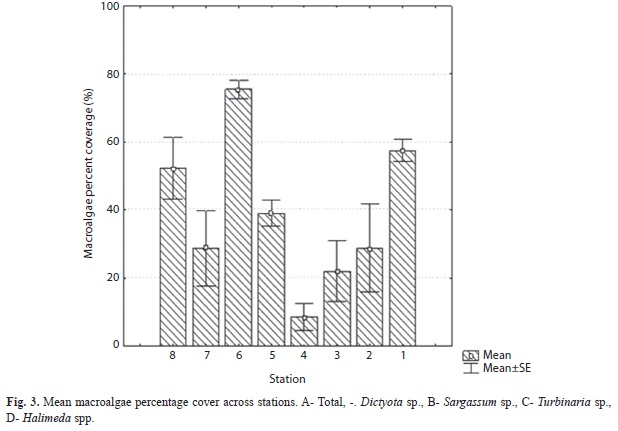
<body><![CDATA[ style="font-weight: bold;">Algal cover:</span> Macro-algae was the     dominant benthic substrate across all stations and showed significant     spatial variation (ANOVA, p= 0.005). The highest mean percentage cover     was seen at station six (75.4%) and lowest (8.52%) at station four     (<a href="/img/revistas/rbt/v62s3/a05i3.jpg">Fig. 3</a>). However, in     Folly Bay (stations one to four), macroalgae     gradually decreased with progression from station one to four. Between     the two bays, Foul Bay had the higher percentage cover of macroalgae.     There was no gradual decrease in Foul Bay (stations five to eight), as     was seen in Folly Bay.</span></font><br style="font-family: verdana;">     ]]></body>
<body><![CDATA[<font size="2"></font><br style="font-family: verdana;">     <font size="2"><span style="font-family: verdana;">The algal groups     examined (<span style="font-style: italic;">Dictyota     </span>sp., <span style="font-style: italic;">Sargassum </span>sp., <span      style="font-style: italic;">Turbinaria </span>sp. and <span      style="font-style: italic;">Halimeda </span>spp.) varied     significantly (ANOVA, p&#8804;0.01) across the stations. The more fleshy     algae dominated in the shallow areas of Foul and Folly Bays while the     calcareous algae (<span style="font-style: italic;">Halimeda </span>spp.)     tended to be high at station 8. It     ]]></body>
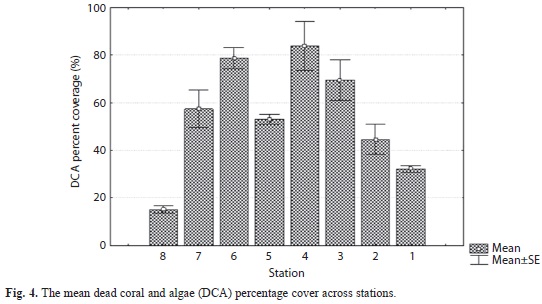
<body><![CDATA[should be noted that no </span></font><font size="2"><span      style="font-family: verdana;"><span style="font-style: italic;">Diadema     antillarum</span></span></font><font size="2"><span      style="font-family: verdana;"> were observed along the     transects.</span></font><br style="font-family: verdana;">     <font size="2"></font><br style="font-family: verdana;">     <font size="2"><span style="font-family: verdana;"><span      style="font-weight: bold;">Dead coral with algae (DCA): </span>The     category DCA was found at all stations with a percent coverage ranging     from 15.19-83.86% (<a href="/img/revistas/rbt/v62s3/a05i4.jpg">Fig. 4</a>).     ]]></body>
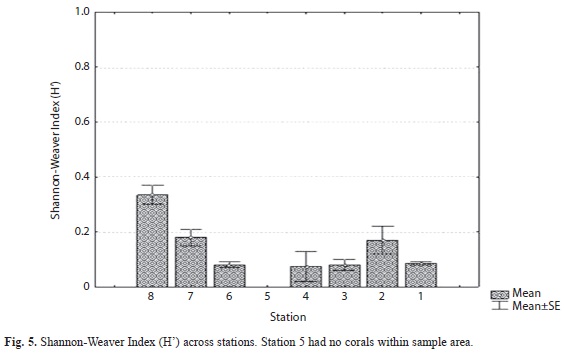
<body><![CDATA[DCA showed a gradual     increase in percent     coverage in Folly Bay from station one to four. There was no pattern     observed for Foul Bay. The highest coverage of DCA was seen at station     four (83.86%) and the lowest at station eight (15.19%).DCA was     significantly different across stations (ANOVA, p &lt; 0.001).    <br> </span></font><br style="font-family: verdana;"> <font size="2"><span style="font-family: verdana;"><span  style="font-weight: bold;">Gorgonians (soft corals):</span> All stations except for stations five and six had gorgonians present. Station two (11.46%) had the highest percentage of gorgonians while stations five and six had the lowest (0%). Folly Bay had a higher percentage of gorgonians than Foul Bay. Gorgonians were significantly different across stations (ANOVA, p&lt;0.01).</span></font><br  style="font-family: verdana;"> <font size="2"></font><br style="font-family: verdana;"> <font size="2"><span style="font-family: verdana;"><span  style="font-weight: bold;">Diversity:</span> Shannon-Weaver Index (H&#8217;) diversity across the stations (<a  href="/img/revistas/rbt/v62s3/a05i5.jpg">Fig. 5</a>) ranged from zero at station five (no coral species were found) to 0.34 at station eight. There was no clear trend for stations one to four (Folly Bay). Foul Bay (stations five to eight) however, demonstrated a trend of increasing coral species diversity from station six to eight.    <br>     </span></font><br style="font-family: verdana;">     <font style="font-weight: bold;" size="3"><span     ]]></body>
<body><![CDATA[ style="font-family: verdana;">Discussion</span></font><br      style="font-family: verdana;">     <font size="2"></font><br style="font-family: verdana;">     <font size="2"><span style="font-family: verdana;"><span      style="font-weight: bold;">Location and extent of the coral     reef system: </span>The coral reef system studied across the Morant     Wetlands     bays was situated at the southeastern tip of Jamaica and as such, the     area is exposed to the open waters of the Caribbean Sea. The coral reef     area, which runs parallel to the shoreline, spanned approximately 7km     ]]></body>
<body><![CDATA[that was 80% of the length of the shoreline. Previous representations     of the reef in older bathymetric charts show a continuous barrier reef     system but this has been severely degraded without the charts being     updated. The reasons for the degradation would appear to be a     combination of natural and anthropogenic causes.</span></font><br      style="font-family: verdana;">     <font size="2"></font><br style="font-family: verdana;">     <font size="2"><span style="font-family: verdana;">This study suggests     that the reef     system was of a patchy barrier reef type with channels along the     ]]></body>
<body><![CDATA[shallower stations, found mostly in Folly Bay and a section of Foul     Bay. The edge of the system has a reef oriented perpendicular to the     shoreline (station eight) which is located on the edge of a channel     between Foul Bay and Rock Point Bay. This was observed to be a part of     a buttress system (I. Wilmot pers. comm.). Buttresses were generally     reported to be found only on the north coast of Jamaica (Goreau, 1959),     but this area has never received a detailed survey and so the feature     may have never been described. Further assessment would be needed in     areas outside of the immediate sample location to confirm whether     station eight was an anomaly. Surveys of deeper areas south and west of     ]]></body>
<body><![CDATA[Foul and Folly bays may reveal a similar reef as was observed at     station eight. This would be expected as there is a positive     correlation of depth and diversity (Bonem &amp; Stanley, 1977; Huston,     1985) in corals.</span></font><br style="font-family: verdana;">     <font size="2"></font><br style="font-family: verdana;">     <font size="2"><span style="font-family: verdana;"><span      style="font-weight: bold;">Composition and relative abundance     of coral species:</span> The seventeen hermatypic coral species found     in the     Morant Wetlands bays included species previously reported from the     ]]></body>
<body><![CDATA[north coast (Goreau, 1959; Wells &amp; Lang, 1973) as well as the south     coast (Goreau, 1959; Mendes, 1992). This represents approximately 1/3     of the species previously reported to be occurring in Jamaica (Goreau     &amp; Wells, 1967).</span></font><br style="font-family: verdana;">     <font size="2"></font><br style="font-family: verdana;">     <font size="2"><span style="font-family: verdana;">Circulation patterns     with very high     current speeds (Wilmot, 2010) found within Foul and Folly Bays appear     to be unfavorable for coral recruitment (Lugo-Fernandez, 2001;     Blanco-Martin, 2006) especially in the shallow algal dominated areas.     ]]></body>
<body><![CDATA[Station eight situated on the edge of Foul Bay seemed to be most     suitable for coral growth as it had the highest diversity and     percentage cover of corals. This is further supported by the fact that     this station had the highest abundance of massive reef-building corals     (Loya, 1976; Goreau, 1959) corals such as <span      style="font-style: italic;">M. annularis</span>, <span      style="font-style: italic;">M. cavernosa</span>     and <span style="font-style: italic;">Diploria strigosa.</span></span></font><br      style="font-family: verdana;">     <font size="2"></font><br style="font-family: verdana;">     ]]></body>
<body><![CDATA[<font size="2"><span style="font-family: verdana;">As expected,     diversity and coral     cover showed a positive correlation with progression from shallow     stations to the deeper station eight (Porter, 1974). While the coral     cover at station eight was much higher than average, by comparison the     average coral cover of the Morant Wetlands was found to be 20% of the     average coral cover found at Lime Cay, another south coast area     (McNaught, 2007) .</span></font><br style="font-family: verdana;">     <font size="2"></font><br style="font-family: verdana;">     <font size="2"><span style="font-family: verdana;"><span     ]]></body>
<body><![CDATA[ style="font-weight: bold;">Composition of other living and     non-living substrate types:</span> The rock-like pavement which would     represent the fore-reef area seen across stations one to seven was     thought to have been a part of what was a healthy, continuous barrier     reef system as seen in older maps. The presence of this rock-like     pavement was one of the reasons for sampling parallel to the shoreline.</span></font><br      style="font-family: verdana;">     <font size="2"></font><br style="font-family: verdana;">     <font size="2"><span style="font-family: verdana;">The Morant Wetlands,     now dominated     ]]></body>
<body><![CDATA[by algae, seemed to have undergone a coral-algae phase-shift when     compared to many reefs across Jamaica and the Caribbean (LaPointe,     1997; Hughes, 1994; Wilkinson, 2008; Bruno, Sweatman, Precht, Selig     &amp; Schutte, 2009). Macroalgae showed a general trend increasing from     station one to eight with the more fleshy algae (e.g. <span      style="font-style: italic;">Sargassum</span>,     <span style="font-style: italic;">Dictyota </span>and <span      style="font-style: italic;">Turbinaria</span>) in the shallow areas     (Hudson, 1985) and the     calcareous algae Halimeda being most abundant at station eight (deep     ]]></body>
<body><![CDATA[station) was similar to observations by McNaught (2007), working near     Lime Cay.</span></font><br style="font-family: verdana;">     <font size="2"></font><br style="font-family: verdana;">     <font size="2"><span style="font-family: verdana;">The absence of </span></font><font      size="2"><span style="font-family: verdana;"><span      style="font-style: italic;">Diadema antillarum</span></span></font><font      size="2"><span style="font-family: verdana;">     and <span style="font-style: italic;">Echinometra lucunter</span>     would further support the high abundance of     algae (Sammarco, 1982). This observation was somewhat similar to Byrd&#8217;s     ]]></body>
<body><![CDATA[(2008) study also done within the Morant Wetlands. Although sampling     was done only in the day, the strong wave action throughout this area     is thought to be unfavorable for <span style="font-style: italic;">D.     antillarum</span> (Clemente &amp;     Hernandez, 2008; Alves, et al., 2001). Sponges had a positive     correlation with coral cover; this trend was observed on other reefs     such as Curacao, Santa Maria and N.E. Colombia with mean sponge cover     below 25% (Aerts, 1998).</span></font><br style="font-family: verdana;">     <font size="2"></font><br style="font-family: verdana;">     <font size="2"><span style="font-family: verdana;">This study provides     ]]></body>
<body><![CDATA[a baseline of     the coral community within the Morant wetlands bays. The coral reef     studied in the Morant Wetlands should be described as a patchy barrier     reef. Seventeen coral species were identified within this area, the     mean coral cover was low (5.4%) and macroalgae high (39%). While the     coral reef system studied in the Morant Wetlands is situated at the     eastern tip of Jamaica, and so is exposed to the pristine waters of the     Caribbean Sea. The coral reef is very degraded and is not a continuous     barrier reef system as was represented on older bathymetric charts. The     degraded state of reefs in the Morant wetlands area is probably     ]]></body>
<body><![CDATA[attributed to a combination of overfishing, absence of urchins and the     resultant algal proliferation, as well as strong waves and currents     (Wilmot, 2010) reducing coral recruitment. The anomalous high % coral     cover at station eight was attributed to the depth in that area.</span></font><br      style="font-family: verdana;">     <font size="2"></font><br style="font-family: verdana;">     <font style="font-weight: bold;" size="3"><span      style="font-family: verdana;">Acknowledgments</span></font><br      style="font-family: verdana;">     <font size="2"></font><br style="font-family: verdana;">     ]]></body>
<body><![CDATA[<font size="2"><span style="font-family: verdana;">This project was     funded by The     Environmental Foundation of Jamaica. Thanks to the team in Rocky Point,     St. Thomas, Judith Mendes, Alison Foster, Nicole Harris, Inilek Wilmot,     Marsha Robinson who assisted with sampling and also contributed their     expertise and knowledge.</span></font><br style="font-family: verdana;">     <br style="font-family: verdana;">     <hr style="width: 100%; height: 2px;"><font style="font-weight: bold;"      size="3"><span style="font-family: verdana;">References</span></font><br      style="font-family: verdana;">     ]]></body>
<body><![CDATA[<br style="font-family: verdana;">     <!-- ref --><div style="text-align: left;"><font size="2"><span  style="font-family: verdana;">Aerts, L. A. M. (1998). Sponge/ coral interactions in Caribbean reefs: analysis of overgrowth patterns in relation to species identity and cover. <span  style="font-style: italic;">Marine Ecology Progress Series, 175</span>, 241- 249.    &nbsp;&nbsp;&nbsp;&nbsp;&nbsp;&nbsp;&nbsp;&nbsp;[&#160;<a href="javascript:void(0);" onclick="javascript: window.open('/scielo.php?script=sci_nlinks&ref=1774414&pid=S0034-7744201400070000500001&lng=','','width=640,height=500,resizable=yes,scrollbars=1,menubar=yes,');">Links</a>&#160;]<!-- end-ref --><!-- ref --></span></font><br  style="font-family: verdana;"> <br style="font-family: verdana;"> <font size="2"><span style="font-family: verdana;">Alves, F. M. A., Ch&iacute;charo, L. M., Serr&atilde;o, E., &amp; Abreu, D. (2001). Algal cover and sea urchin spatial distribution at Madeira Island (NE Atlantic). <span  style="font-style: italic;">Scientia Marina, 65</span>, 383-392.    &nbsp;&nbsp;&nbsp;&nbsp;&nbsp;&nbsp;&nbsp;&nbsp;[&#160;<a href="javascript:void(0);" onclick="javascript: window.open('/scielo.php?script=sci_nlinks&ref=1774415&pid=S0034-7744201400070000500002&lng=','','width=640,height=500,resizable=yes,scrollbars=1,menubar=yes,');">Links</a>&#160;]<!-- end-ref --><!-- ref --></span></font><br  style="font-family: verdana;"> <br style="font-family: verdana;"> <font size="2"><span style="font-family: verdana;">Aronson, R. B., &amp; Percht, W. F. (1995). Landscape patterns of reef coral diversity: a test of the intermediate disturbance hypothesis. <span style="font-style: italic;">Journal of Experimental Marine Biology and Ecology, 192</span>(1), 1-14.    &nbsp;&nbsp;&nbsp;&nbsp;&nbsp;&nbsp;&nbsp;&nbsp;[&#160;<a href="javascript:void(0);" onclick="javascript: window.open('/scielo.php?script=sci_nlinks&ref=1774416&pid=S0034-7744201400070000500003&lng=','','width=640,height=500,resizable=yes,scrollbars=1,menubar=yes,');">Links</a>&#160;]<!-- end-ref --><!-- ref --></span></font><br  style="font-family: verdana;"> <br style="font-family: verdana;"> <font size="2"><span style="font-family: verdana;">Barnes, D. J. (1970). Coral skeletons: an explanation of their growth and structure. <span  style="font-style: italic;">Science, 170</span>, 1305-1308.    &nbsp;&nbsp;&nbsp;&nbsp;&nbsp;&nbsp;&nbsp;&nbsp;[&#160;<a href="javascript:void(0);" onclick="javascript: window.open('/scielo.php?script=sci_nlinks&ref=1774417&pid=S0034-7744201400070000500004&lng=','','width=640,height=500,resizable=yes,scrollbars=1,menubar=yes,');">Links</a>&#160;]<!-- end-ref --><!-- ref --></span></font><br style="font-family: verdana;"> <br style="font-family: verdana;"> <font size="2"><span style="font-family: verdana;">Blanco-Martin, B. 2006. Dispersal of coral larvae: a modelling perspective on its determinants and implications. PhD. Thesis School of Marine Biology and Aquaculture, James Cook University.    &nbsp;&nbsp;&nbsp;&nbsp;&nbsp;&nbsp;&nbsp;&nbsp;[&#160;<a href="javascript:void(0);" onclick="javascript: window.open('/scielo.php?script=sci_nlinks&ref=1774418&pid=S0034-7744201400070000500005&lng=','','width=640,height=500,resizable=yes,scrollbars=1,menubar=yes,');">Links</a>&#160;]<!-- end-ref --><!-- ref --></span></font><br style="font-family: verdana;"> <br style="font-family: verdana;"> <font size="2"><span style="font-family: verdana;">Bonem, R. M., &amp; Stanley, Jr G. D. (1977). Zonation of a lagoonal patch reef: analysis, comparison, and implications for fossil biohermal assemblages. <span  style="font-style: italic;">Proceedings of the Third International Coral Reef Symposium, University of Miami, Florida, 2</span>, 175-181.    &nbsp;&nbsp;&nbsp;&nbsp;&nbsp;&nbsp;&nbsp;&nbsp;[&#160;<a href="javascript:void(0);" onclick="javascript: window.open('/scielo.php?script=sci_nlinks&ref=1774419&pid=S0034-7744201400070000500006&lng=','','width=640,height=500,resizable=yes,scrollbars=1,menubar=yes,');">Links</a>&#160;]<!-- end-ref --><!-- ref --></span></font><br style="font-family: verdana;"> <br style="font-family: verdana;"> <font size="2"><span style="font-family: verdana;">Bruno, J. F., Sweatman, H., Precht, W., Selig, E. R., &amp; Schutte, G. W. (2009) Assessing evidence of phase shifts from coral to macroalgal dominance on coral reefs. <span style="font-style: italic;">Ecology, 90</span>, 1478-1484.    &nbsp;&nbsp;&nbsp;&nbsp;&nbsp;&nbsp;&nbsp;&nbsp;[&#160;<a href="javascript:void(0);" onclick="javascript: window.open('/scielo.php?script=sci_nlinks&ref=1774420&pid=S0034-7744201400070000500007&lng=','','width=640,height=500,resizable=yes,scrollbars=1,menubar=yes,');">Links</a>&#160;]<!-- end-ref --><!-- ref --></span></font><br  style="font-family: verdana;"> <br style="font-family: verdana;"> <font size="2"><span style="font-family: verdana;">Byrd, N. A. (2008). <span  style="font-style: italic;">Distribution and species composition of benthic macroalgae associated with the Morant Wetlands coastal area, east coast, Jamaica</span>. M.Sc. Thesis, University ,f the West Indies, Mona.    &nbsp;&nbsp;&nbsp;&nbsp;&nbsp;&nbsp;&nbsp;&nbsp;[&#160;<a href="javascript:void(0);" onclick="javascript: window.open('/scielo.php?script=sci_nlinks&ref=1774421&pid=S0034-7744201400070000500008&lng=','','width=640,height=500,resizable=yes,scrollbars=1,menubar=yes,');">Links</a>&#160;]<!-- end-ref --><!-- ref --></span></font><br  style="font-family: verdana;"> <br style="font-family: verdana;"> <font size="2"><span style="font-family: verdana;">Clemente, S. and J.C. Hernandez. 2008. Influence of wave exposure and habitat complexity in determining spatial variation of the sea urchin Diadema aff. antillarum (Echinoidea: Diadematidae) populations and macroalgal cover (Canary Islands - Eastern Atlantic Ocean). Rev. Biol. Trop. (Int. J. Trop. Biol.) 56 (3): 229-254.    &nbsp;&nbsp;&nbsp;&nbsp;&nbsp;&nbsp;&nbsp;&nbsp;[&#160;<a href="javascript:void(0);" onclick="javascript: window.open('/scielo.php?script=sci_nlinks&ref=1774422&pid=S0034-7744201400070000500009&lng=','','width=640,height=500,resizable=yes,scrollbars=1,menubar=yes,');">Links</a>&#160;]<!-- end-ref --><!-- ref --></span></font><br style="font-family: verdana;"> <br style="font-family: verdana;"> <font size="2"><span style="font-family: verdana;">Crabbe, M.J.C., Mendes J.M. &amp; Warner G. F. (2002). Lack of recruitment of non-branching corals in Discovery Bay is linked to severe storms. <span  style="font-style: italic;">Bulletin of Marine Science, 70</span>, 939&#8211;945.    &nbsp;&nbsp;&nbsp;&nbsp;&nbsp;&nbsp;&nbsp;&nbsp;[&#160;<a href="javascript:void(0);" onclick="javascript: window.open('/scielo.php?script=sci_nlinks&ref=1774423&pid=S0034-7744201400070000500010&lng=','','width=640,height=500,resizable=yes,scrollbars=1,menubar=yes,');">Links</a>&#160;]<!-- end-ref --><!-- ref --></span></font><br style="font-family: verdana;"> <br style="font-family: verdana;"> <font size="2"><span style="font-family: verdana;">Gates, R. D. (1990). Seawater temperature and sublethal coral bleaching in Jamaica. <span  style="font-style: italic;">Coral Reefs, 8</span>, 193-197.    &nbsp;&nbsp;&nbsp;&nbsp;&nbsp;&nbsp;&nbsp;&nbsp;[&#160;<a href="javascript:void(0);" onclick="javascript: window.open('/scielo.php?script=sci_nlinks&ref=1774424&pid=S0034-7744201400070000500011&lng=','','width=640,height=500,resizable=yes,scrollbars=1,menubar=yes,');">Links</a>&#160;]<!-- end-ref --><!-- ref --></span></font><br style="font-family: verdana;"> <br style="font-family: verdana;"> <font size="2"><span style="font-family: verdana;">Goreau, T. F., &amp; Wells, J. W. (1967). The shallow water scleractinian of Jamaica: revised list of species and their vertical distribution range. <span  style="font-style: italic;">Bulletin of Marine Science, 17,</span> 442-453.    &nbsp;&nbsp;&nbsp;&nbsp;&nbsp;&nbsp;&nbsp;&nbsp;[&#160;<a href="javascript:void(0);" onclick="javascript: window.open('/scielo.php?script=sci_nlinks&ref=1774425&pid=S0034-7744201400070000500012&lng=','','width=640,height=500,resizable=yes,scrollbars=1,menubar=yes,');">Links</a>&#160;]<!-- end-ref --><!-- ref --></span></font><br  style="font-family: verdana;"> <br style="font-family: verdana;"> <font size="2"><span style="font-family: verdana;">Goreau, T. F. (1959). The ecology of Jamaican reefs. I. Species composition and zonation. <span  style="font-style: italic;">Ecology, 40</span>, 67-90.    &nbsp;&nbsp;&nbsp;&nbsp;&nbsp;&nbsp;&nbsp;&nbsp;[&#160;<a href="javascript:void(0);" onclick="javascript: window.open('/scielo.php?script=sci_nlinks&ref=1774426&pid=S0034-7744201400070000500013&lng=','','width=640,height=500,resizable=yes,scrollbars=1,menubar=yes,');">Links</a>&#160;]<!-- end-ref --><!-- ref --></span></font><br style="font-family: verdana;"> <br style="font-family: verdana;"> <font size="2"><span style="font-family: verdana;">Goreau, T. J. (1992). Bleaching and reef community change in Jamaica: 1951&#8211;1991. <span  style="font-style: italic;">American Zoologist, 32</span>, 683&#8211;695.    &nbsp;&nbsp;&nbsp;&nbsp;&nbsp;&nbsp;&nbsp;&nbsp;[&#160;<a href="javascript:void(0);" onclick="javascript: window.open('/scielo.php?script=sci_nlinks&ref=1774427&pid=S0034-7744201400070000500014&lng=','','width=640,height=500,resizable=yes,scrollbars=1,menubar=yes,');">Links</a>&#160;]<!-- end-ref --><!-- ref --></span></font><br style="font-family: verdana;"> <br style="font-family: verdana;"> <font size="2"><span style="font-family: verdana;">Grimsditch, G. D., &amp; Salm, R. V. (2006). <span style="font-style: italic;">Coral reef resilience and resistance to bleaching.</span> International Union for Conservation of Nature Resilience Science Group Working Paper. No.1. Gland Switzerland.    &nbsp;&nbsp;&nbsp;&nbsp;&nbsp;&nbsp;&nbsp;&nbsp;[&#160;<a href="javascript:void(0);" onclick="javascript: window.open('/scielo.php?script=sci_nlinks&ref=1774428&pid=S0034-7744201400070000500015&lng=','','width=640,height=500,resizable=yes,scrollbars=1,menubar=yes,');">Links</a>&#160;]<!-- end-ref --><!-- ref --></span></font><br  style="font-family: verdana;"> <br style="font-family: verdana;"> <font size="2"><span style="font-family: verdana;">Hughes, T. P. (1994). Catastrophes, phase shifts, and large-scale degradation of a Caribbean coral reef. <span style="font-style: italic;">Science, 265</span>, 1547-1551.    &nbsp;&nbsp;&nbsp;&nbsp;&nbsp;&nbsp;&nbsp;&nbsp;[&#160;<a href="javascript:void(0);" onclick="javascript: window.open('/scielo.php?script=sci_nlinks&ref=1774429&pid=S0034-7744201400070000500016&lng=','','width=640,height=500,resizable=yes,scrollbars=1,menubar=yes,');">Links</a>&#160;]<!-- end-ref --><!-- ref --></span></font><br  style="font-family: verdana;"> <br style="font-family: verdana;"> <font size="2"><span style="font-family: verdana;">Hudson, J.H. 1985 . Growth rate and carbonate production in Halimedia opuntia: Marquesas Keys, Florida. Paleoalgology , Springer pp 257-263.    &nbsp;&nbsp;&nbsp;&nbsp;&nbsp;&nbsp;&nbsp;&nbsp;[&#160;<a href="javascript:void(0);" onclick="javascript: window.open('/scielo.php?script=sci_nlinks&ref=1774430&pid=S0034-7744201400070000500017&lng=','','width=640,height=500,resizable=yes,scrollbars=1,menubar=yes,');">Links</a>&#160;]<!-- end-ref --><!-- ref --></span></font><br  style="font-family: verdana;"> <br style="font-family: verdana;"> <font size="2"><span style="font-family: verdana;">Huston, M. (1985). Variation in coral growth rates with depth at Discovery Bay, Jamaica. <span  style="font-style: italic;">Coral Reefs, 4</span>, 19-25.    &nbsp;&nbsp;&nbsp;&nbsp;&nbsp;&nbsp;&nbsp;&nbsp;[&#160;<a href="javascript:void(0);" onclick="javascript: window.open('/scielo.php?script=sci_nlinks&ref=1774431&pid=S0034-7744201400070000500018&lng=','','width=640,height=500,resizable=yes,scrollbars=1,menubar=yes,');">Links</a>&#160;]<!-- end-ref --><!-- ref --></span></font><br style="font-family: verdana;"> <br style="font-family: verdana;"> <font size="2"><span style="font-family: verdana;">Kohler, K. E., &amp; Gill, S. M. (2006). Coral Point Count with Excel extensions (CPCe): A Visual Basic program for the determination of coral and substrate coverage using random point count methodology. <span style="font-style: italic;">Computers &amp; Geosciences, 32</span>(9), 1259-1269.    &nbsp;&nbsp;&nbsp;&nbsp;&nbsp;&nbsp;&nbsp;&nbsp;[&#160;<a href="javascript:void(0);" onclick="javascript: window.open('/scielo.php?script=sci_nlinks&ref=1774432&pid=S0034-7744201400070000500019&lng=','','width=640,height=500,resizable=yes,scrollbars=1,menubar=yes,');">Links</a>&#160;]<!-- end-ref --><!-- ref --></span></font><br style="font-family: verdana;"> <br style="font-family: verdana;"> <font size="2"><span style="font-family: verdana;">LaPointe, B. E. (1997). Nutrients thresholds for bottom-up control of macroalgae blooms on coral reefs in Jamaica and southeast Florida. <span style="font-style: italic;">Limnology &amp; Oceanography, 42</span>, 1119-1131.    &nbsp;&nbsp;&nbsp;&nbsp;&nbsp;&nbsp;&nbsp;&nbsp;[&#160;<a href="javascript:void(0);" onclick="javascript: window.open('/scielo.php?script=sci_nlinks&ref=1774433&pid=S0034-7744201400070000500020&lng=','','width=640,height=500,resizable=yes,scrollbars=1,menubar=yes,');">Links</a>&#160;]<!-- end-ref --><!-- ref --></span></font><br style="font-family: verdana;"> <br style="font-family: verdana;"> <font size="2"><span style="font-family: verdana;">Loya, Y. (1976). Effects of water turbidity and sedimentation on the community structure of Puerto Rican corals. <span style="font-style: italic;">Bulletin of Marine Science, 26</span>(4), 450-466.    &nbsp;&nbsp;&nbsp;&nbsp;&nbsp;&nbsp;&nbsp;&nbsp;[&#160;<a href="javascript:void(0);" onclick="javascript: window.open('/scielo.php?script=sci_nlinks&ref=1774434&pid=S0034-7744201400070000500021&lng=','','width=640,height=500,resizable=yes,scrollbars=1,menubar=yes,');">Links</a>&#160;]<!-- end-ref --><!-- ref --></span></font><br style="font-family: verdana;"> <br style="font-family: verdana;"> <font size="2"><span style="font-family: verdana;">Liddell, W. D., &amp; Ohlhorst, S. L. (1981). Geomorphology and community composition of two adjacent reef areas, Discovery Bay, Jamaica. Journal of Marine Research, 39, 791-804.    &nbsp;&nbsp;&nbsp;&nbsp;&nbsp;&nbsp;&nbsp;&nbsp;[&#160;<a href="javascript:void(0);" onclick="javascript: window.open('/scielo.php?script=sci_nlinks&ref=1774435&pid=S0034-7744201400070000500022&lng=','','width=640,height=500,resizable=yes,scrollbars=1,menubar=yes,');">Links</a>&#160;]<!-- end-ref --><!-- ref --></span></font><br  style="font-family: verdana;"> <br style="font-family: verdana;"> <font size="2"><span style="font-family: verdana;">Lugo-Fernandez, A., Deslarzes, K. J. P, Price, J. M., Boland, G. S., &amp; Morin, M. V. (2001). Inferring probable dispersal of Flower Banks Coral Larvae (Gulf of Mexico) using observed and simulated drifter trajectories. <span  style="font-style: italic;">Continental Shelf Research, 21</span>(1), 47-67.    &nbsp;&nbsp;&nbsp;&nbsp;&nbsp;&nbsp;&nbsp;&nbsp;[&#160;<a href="javascript:void(0);" onclick="javascript: window.open('/scielo.php?script=sci_nlinks&ref=1774436&pid=S0034-7744201400070000500023&lng=','','width=640,height=500,resizable=yes,scrollbars=1,menubar=yes,');">Links</a>&#160;]<!-- end-ref --><!-- ref --></span></font><br  style="font-family: verdana;"> <br style="font-family: verdana;"> <font size="2"><span style="font-family: verdana;">McNaught, M. A. P. (2007). <span style="font-style: italic;">The status of the coral reefs within the Palisadoes- Port Royal Protected Area: Detecting hurricane impacts between 2001 and 2005 using a regional monitoring protocol.</span> M.Sc. Thesis, University of the West Indies, Mona.    &nbsp;&nbsp;&nbsp;&nbsp;&nbsp;&nbsp;&nbsp;&nbsp;[&#160;<a href="javascript:void(0);" onclick="javascript: window.open('/scielo.php?script=sci_nlinks&ref=1774437&pid=S0034-7744201400070000500024&lng=','','width=640,height=500,resizable=yes,scrollbars=1,menubar=yes,');">Links</a>&#160;]<!-- end-ref --><!-- ref --></span></font><br style="font-family: verdana;"> <br style="font-family: verdana;"> <font size="2"><span style="font-family: verdana;">Mendes, J. M. (1992). <span style="font-style: italic;">A description of the fringing reef of Lime Cay, (Port Royal Cays, Jamaica), with long term monitoring. </span>M.Phil. Thesis, University of the West Indies, Mona.    &nbsp;&nbsp;&nbsp;&nbsp;&nbsp;&nbsp;&nbsp;&nbsp;[&#160;<a href="javascript:void(0);" onclick="javascript: window.open('/scielo.php?script=sci_nlinks&ref=1774438&pid=S0034-7744201400070000500025&lng=','','width=640,height=500,resizable=yes,scrollbars=1,menubar=yes,');">Links</a>&#160;]<!-- end-ref --><!-- ref --></span></font><br style="font-family: verdana;"> <br style="font-family: verdana;"> <font size="2"><span style="font-family: verdana;">Mendes, J. M., &amp; Woodley, J. D. (2002). Effects of the 1995-1996 bleaching event on polyp tissue depth, growth, reproduction and skeletal band formation in <span  style="font-style: italic;">Montastraea annularis. Marine Ecology Progress Series, 235</span>, 93-102.    &nbsp;&nbsp;&nbsp;&nbsp;&nbsp;&nbsp;&nbsp;&nbsp;[&#160;<a href="javascript:void(0);" onclick="javascript: window.open('/scielo.php?script=sci_nlinks&ref=1774439&pid=S0034-7744201400070000500026&lng=','','width=640,height=500,resizable=yes,scrollbars=1,menubar=yes,');">Links</a>&#160;]<!-- end-ref --><!-- ref --></span></font><br  style="font-family: verdana;"> <br style="font-family: verdana;"> <font size="2"><span style="font-family: verdana;">Moberg, F., and C. Folke. 1999. Ecological Goods and Services of Coral Reef Ecosystems. <span  style="font-style: italic;">Ecological Economics 29</span>, no. 2: 215-33.    &nbsp;&nbsp;&nbsp;&nbsp;&nbsp;&nbsp;&nbsp;&nbsp;[&#160;<a href="javascript:void(0);" onclick="javascript: window.open('/scielo.php?script=sci_nlinks&ref=1774440&pid=S0034-7744201400070000500027&lng=','','width=640,height=500,resizable=yes,scrollbars=1,menubar=yes,');">Links</a>&#160;]<!-- end-ref --><!-- ref --></span></font><br  style="font-family: verdana;"> <br style="font-family: verdana;"> <font size="2"><span style="font-family: verdana;">Porter, J. W. (1974). Community structure of coral reefs on opposite sides of the Isthmus of Panama.<span  style="font-style: italic;"> Science, 186</span>, 543-545.    &nbsp;&nbsp;&nbsp;&nbsp;&nbsp;&nbsp;&nbsp;&nbsp;[&#160;<a href="javascript:void(0);" onclick="javascript: window.open('/scielo.php?script=sci_nlinks&ref=1774441&pid=S0034-7744201400070000500028&lng=','','width=640,height=500,resizable=yes,scrollbars=1,menubar=yes,');">Links</a>&#160;]<!-- end-ref --><!-- ref --></span></font><br  style="font-family: verdana;"> <br style="font-family: verdana;"> <font size="2"><span style="font-family: verdana;">Sammarco, P. W. (1982). Effects of grazing by </span></font><font size="2"><span  style="font-family: verdana;"><span style="font-style: italic;">Diadema antillarum</span></span></font><font size="2"><span  style="font-family: verdana;"> Philippi (Echinodermata: Echinoidea) on algal diversity and community structure. <span  style="font-style: italic;">Journal of Experimental Marine. Biology and Ecology, 65</span>, 83-105.    &nbsp;&nbsp;&nbsp;&nbsp;&nbsp;&nbsp;&nbsp;&nbsp;[&#160;<a href="javascript:void(0);" onclick="javascript: window.open('/scielo.php?script=sci_nlinks&ref=1774442&pid=S0034-7744201400070000500029&lng=','','width=640,height=500,resizable=yes,scrollbars=1,menubar=yes,');">Links</a>&#160;]<!-- end-ref --><!-- ref --></span></font><br  style="font-family: verdana;"> <br style="font-family: verdana;"> <font size="2"><span style="font-family: verdana;">Sokal, R. R., &amp; Rohlf, F. J. (1981). <span style="font-style: italic;">Biometry</span>. 2nd edition. San Francisco, CA.: Freeman.    &nbsp;&nbsp;&nbsp;&nbsp;&nbsp;&nbsp;&nbsp;&nbsp;[&#160;<a href="javascript:void(0);" onclick="javascript: window.open('/scielo.php?script=sci_nlinks&ref=1774443&pid=S0034-7744201400070000500030&lng=','','width=640,height=500,resizable=yes,scrollbars=1,menubar=yes,');">Links</a>&#160;]<!-- end-ref --><!-- ref --></span></font><br  style="font-family: verdana;"> <br style="font-family: verdana;"> <font size="2"><span style="font-family: verdana;">Wells, J. W., &amp; Lang, J.C. (1973). Systematic list of Jamaican shallow-water Scleractinia. <span style="font-style: italic;">Bulletin of Marine Sciences, 23</span>(1), 55-58.    &nbsp;&nbsp;&nbsp;&nbsp;&nbsp;&nbsp;&nbsp;&nbsp;[&#160;<a href="javascript:void(0);" onclick="javascript: window.open('/scielo.php?script=sci_nlinks&ref=1774444&pid=S0034-7744201400070000500031&lng=','','width=640,height=500,resizable=yes,scrollbars=1,menubar=yes,');">Links</a>&#160;]<!-- end-ref --><!-- ref --></span></font><br style="font-family: verdana;"> <br style="font-family: verdana;"> <font size="2"><span style="font-family: verdana;">White, M. W., &amp; Porter, J. W. (1985). The Establishment and monitoring of two permanent photograph transects in Looe Key and Key Largo National Marine Sanctuaries (Florida Cays). <span style="font-style: italic;">Proceeding of the Fifth International Coral Reef Congress, Tahiti, 5</span>, 531-537.    &nbsp;&nbsp;&nbsp;&nbsp;&nbsp;&nbsp;&nbsp;&nbsp;[&#160;<a href="javascript:void(0);" onclick="javascript: window.open('/scielo.php?script=sci_nlinks&ref=1774445&pid=S0034-7744201400070000500032&lng=','','width=640,height=500,resizable=yes,scrollbars=1,menubar=yes,');">Links</a>&#160;]<!-- end-ref --><!-- ref --></span></font><br  style="font-family: verdana;"> <br style="font-family: verdana;"> <font size="2"><span style="font-family: verdana;">Wilkinson, C. (2008). <span style="font-style: italic;">Status of coral reefs of the world: 2008. </span>Townsville, Australia: Global Coral Reef Monitoring Network and Reef and Rainforest Research Centre.    &nbsp;&nbsp;&nbsp;&nbsp;&nbsp;&nbsp;&nbsp;&nbsp;[&#160;<a href="javascript:void(0);" onclick="javascript: window.open('/scielo.php?script=sci_nlinks&ref=1774446&pid=S0034-7744201400070000500033&lng=','','width=640,height=500,resizable=yes,scrollbars=1,menubar=yes,');">Links</a>&#160;]<!-- end-ref --><!-- ref --></span></font><br  style="font-family: verdana;"> <br style="font-family: verdana;"> <font size="2"><span style="font-family: verdana;">Wilmot, I. (2010). <span  style="font-style: italic;">The water quality and circulation patterns of Foul and Folly Bays in the Morant Wetlands area, east coast, Jamaica.</span> MPhil Thesis, University of the West Indies, Mona.    &nbsp;&nbsp;&nbsp;&nbsp;&nbsp;&nbsp;&nbsp;&nbsp;[&#160;<a href="javascript:void(0);" onclick="javascript: window.open('/scielo.php?script=sci_nlinks&ref=1774447&pid=S0034-7744201400070000500034&lng=','','width=640,height=500,resizable=yes,scrollbars=1,menubar=yes,');">Links</a>&#160;]<!-- end-ref --><!-- ref --></span></font><br style="font-family: verdana;"> <br style="font-family: verdana;"> <font size="2"><span style="font-family: verdana;">Woodley, J. D., E. A. Chornesky, P. A. Clifford, J. C. B. Jackson, L. S. Kaufman, N. Knowlton, J. C. Land, M. P. Pearson, J. L. Wulff, A. S. G. Curtis, M. D. Dallmeyer, B. P. Jupp, M. A. R. Koehl, J. Neigel, E. M. Sides. (1981). Hurricane Allen&#8217;s impact on Jamaican coral reefs. <span style="font-style: italic;">Science, 214:</span>749-755.    &nbsp;&nbsp;&nbsp;&nbsp;&nbsp;&nbsp;&nbsp;&nbsp;[&#160;<a href="javascript:void(0);" onclick="javascript: window.open('/scielo.php?script=sci_nlinks&ref=1774448&pid=S0034-7744201400070000500035&lng=','','width=640,height=500,resizable=yes,scrollbars=1,menubar=yes,');">Links</a>&#160;]<!-- end-ref --></span></font>    <br> <font size="2"><span style="font-family: verdana;"></span></font></div> <font size="2"><span style="font-family: verdana;">    <br> </span></font><font size="2"><span style="font-family: verdana;"><a  name="1"></a><a href="#2">1</a>. Department of Life Sciences, University of the West Indies, Mona Campus, Kingston 7, Jamaica, W.I.; mona.webber@uwimona.edu.jm</span></font><br  style="font-family: verdana;"> <hr style="width: 100%; height: 2px;">     <div style="text-align: center;"><font style="font-weight: bold;"  size="2"><span style="font-family: verdana;">Received 16-X-2013 Corrected 05-II-2014 Accepted 24-III-2014</span></font></div> <font style="font-weight: bold;" size="2"></font></div>     ]]></body>
<body><![CDATA[ ]]></body><back>
<ref-list>
<ref id="B1">
<nlm-citation citation-type="journal">
<person-group person-group-type="author">
<name>
<surname><![CDATA[Aerts]]></surname>
<given-names><![CDATA[L. A. M.]]></given-names>
</name>
</person-group>
<article-title xml:lang="en"><![CDATA[Sponge/ coral interactions in Caribbean reefs: analysis of overgrowth patterns in relation to species identity and cover]]></article-title>
<source><![CDATA[Marine Ecology Progress Series]]></source>
<year>1998</year>
<volume>175</volume>
<page-range>241- 249</page-range></nlm-citation>
</ref>
<ref id="B2">
<nlm-citation citation-type="journal">
<person-group person-group-type="author">
<name>
<surname><![CDATA[Alves]]></surname>
<given-names><![CDATA[F. M. A.]]></given-names>
</name>
<name>
<surname><![CDATA[Chícharo]]></surname>
<given-names><![CDATA[L. M.]]></given-names>
</name>
<name>
<surname><![CDATA[Serrão]]></surname>
<given-names><![CDATA[E.]]></given-names>
</name>
<name>
<surname><![CDATA[Abreu]]></surname>
<given-names><![CDATA[D.]]></given-names>
</name>
</person-group>
<article-title xml:lang="en"><![CDATA[Algal cover and sea urchin spatial distribution at Madeira Island (NE Atlantic)]]></article-title>
<source><![CDATA[Scientia Marina]]></source>
<year>2001</year>
<volume>65</volume>
<page-range>383-392</page-range></nlm-citation>
</ref>
<ref id="B3">
<nlm-citation citation-type="journal">
<person-group person-group-type="author">
<name>
<surname><![CDATA[Aronson]]></surname>
<given-names><![CDATA[R. B.]]></given-names>
</name>
<name>
<surname><![CDATA[Percht]]></surname>
<given-names><![CDATA[W. F.]]></given-names>
</name>
</person-group>
<article-title xml:lang="en"><![CDATA[Landscape patterns of reef coral diversity: a test of the intermediate disturbance hypothesis]]></article-title>
<source><![CDATA[Journal of Experimental Marine Biology and Ecology]]></source>
<year>1995</year>
<volume>192</volume>
<numero>1</numero>
<issue>1</issue>
<page-range>1-14</page-range></nlm-citation>
</ref>
<ref id="B4">
<nlm-citation citation-type="journal">
<person-group person-group-type="author">
<name>
<surname><![CDATA[Barnes]]></surname>
<given-names><![CDATA[D. J.]]></given-names>
</name>
</person-group>
<article-title xml:lang="en"><![CDATA[Coral skeletons: an explanation of their growth and structure]]></article-title>
<source><![CDATA[Science]]></source>
<year>1970</year>
<volume>170</volume>
<page-range>1305-1308</page-range></nlm-citation>
</ref>
<ref id="B5">
<nlm-citation citation-type="">
<person-group person-group-type="author">
<name>
<surname><![CDATA[Blanco-Martin]]></surname>
<given-names><![CDATA[B.]]></given-names>
</name>
</person-group>
<source><![CDATA[Dispersal of coral larvae: a modelling perspective on its determinants and implications]]></source>
<year>2006</year>
</nlm-citation>
</ref>
<ref id="B6">
<nlm-citation citation-type="journal">
<person-group person-group-type="author">
<name>
<surname><![CDATA[Bonem]]></surname>
<given-names><![CDATA[R. M.]]></given-names>
</name>
<name>
<surname><![CDATA[Stanley,]]></surname>
<given-names><![CDATA[Jr G. D.]]></given-names>
</name>
</person-group>
<article-title xml:lang="en"><![CDATA[Zonation of a lagoonal patch reef: analysis, comparison, and implications for fossil biohermal assemblages]]></article-title>
<source><![CDATA[Proceedings of the Third International Coral Reef Symposium, University of Miami, Florida]]></source>
<year>1977</year>
<volume>2</volume>
<page-range>175-181</page-range></nlm-citation>
</ref>
<ref id="B7">
<nlm-citation citation-type="journal">
<person-group person-group-type="author">
<name>
<surname><![CDATA[Bruno]]></surname>
<given-names><![CDATA[J. F.]]></given-names>
</name>
<name>
<surname><![CDATA[Sweatman]]></surname>
<given-names><![CDATA[H.]]></given-names>
</name>
<name>
<surname><![CDATA[Precht]]></surname>
<given-names><![CDATA[W.]]></given-names>
</name>
<name>
<surname><![CDATA[Selig]]></surname>
<given-names><![CDATA[E. R.]]></given-names>
</name>
<name>
<surname><![CDATA[Schutte]]></surname>
<given-names><![CDATA[G. W.]]></given-names>
</name>
</person-group>
<article-title xml:lang="en"><![CDATA[Assessing evidence of phase shifts from coral to macroalgal dominance on coral reefs.]]></article-title>
<source><![CDATA[Ecology]]></source>
<year>2009</year>
<volume>90</volume>
<page-range>1478-1484</page-range></nlm-citation>
</ref>
<ref id="B8">
<nlm-citation citation-type="">
<person-group person-group-type="author">
<name>
<surname><![CDATA[Byrd]]></surname>
<given-names><![CDATA[N. A.]]></given-names>
</name>
</person-group>
<source><![CDATA[Distribution and species composition of benthic macroalgae associated with the Morant Wetlands coastal area, east coast, Jamaica.]]></source>
<year>2008</year>
</nlm-citation>
</ref>
<ref id="B9">
<nlm-citation citation-type="journal">
<person-group person-group-type="author">
<name>
<surname><![CDATA[Clemente]]></surname>
<given-names><![CDATA[S.]]></given-names>
</name>
<name>
<surname><![CDATA[Hernandez]]></surname>
<given-names><![CDATA[J.C.]]></given-names>
</name>
</person-group>
<article-title xml:lang="en"><![CDATA[Influence of wave exposure and habitat complexity in determining spatial variation of the sea urchin Diadema aff. antillarum (Echinoidea: Diadematidae) populations and macroalgal cover (Canary Islands - Eastern Atlantic Ocean).]]></article-title>
<source><![CDATA[Rev. Biol. Trop. (Int. J. Trop. Biol.)]]></source>
<year>2008</year>
<volume>56</volume>
<numero>3</numero>
<issue>3</issue>
<page-range>229-254</page-range></nlm-citation>
</ref>
<ref id="B10">
<nlm-citation citation-type="journal">
<person-group person-group-type="author">
<name>
<surname><![CDATA[Crabbe]]></surname>
<given-names><![CDATA[M.J.C.]]></given-names>
</name>
<name>
<surname><![CDATA[Mendes]]></surname>
<given-names><![CDATA[J.M.]]></given-names>
</name>
<name>
<surname><![CDATA[Warner]]></surname>
<given-names><![CDATA[G. F.]]></given-names>
</name>
</person-group>
<article-title xml:lang="en"><![CDATA[Lack of recruitment of non-branching corals in Discovery Bay is linked to severe storms]]></article-title>
<source><![CDATA[Bulletin of Marine Science]]></source>
<year>2002</year>
<volume>70</volume>
<page-range>939-945</page-range></nlm-citation>
</ref>
<ref id="B11">
<nlm-citation citation-type="journal">
<person-group person-group-type="author">
<name>
<surname><![CDATA[Gates]]></surname>
<given-names><![CDATA[R. D.]]></given-names>
</name>
</person-group>
<article-title xml:lang="en"><![CDATA[Seawater temperature and sublethal coral bleaching in Jamaica]]></article-title>
<source><![CDATA[Coral Reefs]]></source>
<year>1990</year>
<volume>8</volume>
<page-range>193-197</page-range></nlm-citation>
</ref>
<ref id="B12">
<nlm-citation citation-type="journal">
<person-group person-group-type="author">
<name>
<surname><![CDATA[Goreau]]></surname>
<given-names><![CDATA[T. F.]]></given-names>
</name>
<name>
<surname><![CDATA[Wells]]></surname>
<given-names><![CDATA[J. W.]]></given-names>
</name>
</person-group>
<article-title xml:lang="en"><![CDATA[The shallow water scleractinian of Jamaica: revised list of species and their vertical distribution range]]></article-title>
<source><![CDATA[Bulletin of Marine Science]]></source>
<year>1967</year>
<volume>17</volume>
<page-range>442-453</page-range></nlm-citation>
</ref>
<ref id="B13">
<nlm-citation citation-type="journal">
<person-group person-group-type="author">
<name>
<surname><![CDATA[Goreau]]></surname>
<given-names><![CDATA[T. F]]></given-names>
</name>
</person-group>
<source><![CDATA[The ecology of Jamaican reefs]]></source>
<year>1959</year>
<volume>40</volume>
<page-range>67-90</page-range></nlm-citation>
</ref>
<ref id="B14">
<nlm-citation citation-type="journal">
<person-group person-group-type="author">
<name>
<surname><![CDATA[Goreau]]></surname>
<given-names><![CDATA[T. J.]]></given-names>
</name>
</person-group>
<article-title xml:lang="en"><![CDATA[Bleaching and reef community change in Jamaica: 1951-1991]]></article-title>
<source><![CDATA[American Zoologist]]></source>
<year>1992</year>
<volume>32</volume>
<page-range>683-695</page-range></nlm-citation>
</ref>
<ref id="B15">
<nlm-citation citation-type="book">
<person-group person-group-type="author">
<name>
<surname><![CDATA[Grimsditch]]></surname>
<given-names><![CDATA[G. D.]]></given-names>
</name>
<name>
<surname><![CDATA[Salm]]></surname>
<given-names><![CDATA[R. V.]]></given-names>
</name>
</person-group>
<source><![CDATA[Coral reef resilience and resistance to bleaching]]></source>
<year>2006</year>
<volume>1</volume>
<publisher-loc><![CDATA[Gland ]]></publisher-loc>
<publisher-name><![CDATA[International Union for Conservation of Nature Resilience Science Group]]></publisher-name>
</nlm-citation>
</ref>
<ref id="B16">
<nlm-citation citation-type="journal">
<person-group person-group-type="author">
<name>
<surname><![CDATA[Hughes]]></surname>
<given-names><![CDATA[T. P.]]></given-names>
</name>
</person-group>
<article-title xml:lang="en"><![CDATA[Catastrophes, phase shifts, and large-scale degradation of a Caribbean coral reef]]></article-title>
<source><![CDATA[Science]]></source>
<year>1994</year>
<volume>265</volume>
<page-range>1547-1551</page-range></nlm-citation>
</ref>
<ref id="B17">
<nlm-citation citation-type="book">
<person-group person-group-type="author">
<name>
<surname><![CDATA[Hudson]]></surname>
<given-names><![CDATA[J.H.]]></given-names>
</name>
</person-group>
<source><![CDATA[Growth rate and carbonate production in Halimedia opuntia: Marquesas Keys, Florida.]]></source>
<year>1985</year>
<page-range>257-263.</page-range><publisher-name><![CDATA[Springer]]></publisher-name>
</nlm-citation>
</ref>
<ref id="B18">
<nlm-citation citation-type="journal">
<person-group person-group-type="author">
<name>
<surname><![CDATA[Huston]]></surname>
<given-names><![CDATA[M.]]></given-names>
</name>
</person-group>
<article-title xml:lang="en"><![CDATA[Variation in coral growth rates with depth at Discovery Bay, Jamaica]]></article-title>
<source><![CDATA[Coral Reefs]]></source>
<year>1985</year>
<volume>4</volume>
<page-range>19-25</page-range></nlm-citation>
</ref>
<ref id="B19">
<nlm-citation citation-type="journal">
<person-group person-group-type="author">
<name>
<surname><![CDATA[Kohler]]></surname>
<given-names><![CDATA[K. E.]]></given-names>
</name>
<name>
<surname><![CDATA[Gill]]></surname>
<given-names><![CDATA[S. M.]]></given-names>
</name>
</person-group>
<article-title xml:lang="en"><![CDATA[Coral Point Count with Excel extensions (CPCe): A Visual Basic program for the determination of coral and substrate coverage using random point count methodology]]></article-title>
<source><![CDATA[Computers & Geosciences]]></source>
<year>2006</year>
<volume>32</volume>
<numero>9</numero>
<issue>9</issue>
<page-range>1259-1269</page-range></nlm-citation>
</ref>
<ref id="B20">
<nlm-citation citation-type="journal">
<person-group person-group-type="author">
<name>
<surname><![CDATA[LaPointe]]></surname>
<given-names><![CDATA[B. E.]]></given-names>
</name>
</person-group>
<article-title xml:lang="en"><![CDATA[Nutrients thresholds for bottom-up control of macroalgae blooms on coral reefs in Jamaica and southeast Florida]]></article-title>
<source><![CDATA[Limnology & Oceanography]]></source>
<year>1997</year>
<volume>42</volume>
<page-range>1119-1131</page-range></nlm-citation>
</ref>
<ref id="B21">
<nlm-citation citation-type="journal">
<person-group person-group-type="author">
<name>
<surname><![CDATA[Loya]]></surname>
<given-names><![CDATA[Y.]]></given-names>
</name>
</person-group>
<article-title xml:lang="en"><![CDATA[Effects of water turbidity and sedimentation on the community structure of Puerto Rican corals]]></article-title>
<source><![CDATA[Bulletin of Marine Science]]></source>
<year>1976</year>
<volume>26</volume>
<numero>4</numero>
<issue>4</issue>
<page-range>450-466</page-range></nlm-citation>
</ref>
<ref id="B22">
<nlm-citation citation-type="journal">
<person-group person-group-type="author">
<name>
<surname><![CDATA[Liddell]]></surname>
<given-names><![CDATA[W. D.]]></given-names>
</name>
<name>
<surname><![CDATA[Ohlhorst]]></surname>
<given-names><![CDATA[S. L.]]></given-names>
</name>
</person-group>
<article-title xml:lang="en"><![CDATA[Geomorphology and community composition of two adjacent reef areas, Discovery Bay, Jamaica]]></article-title>
<source><![CDATA[Journal of Marine Research]]></source>
<year>1981</year>
<volume>39</volume>
<page-range>791-804</page-range></nlm-citation>
</ref>
<ref id="B23">
<nlm-citation citation-type="journal">
<person-group person-group-type="author">
<name>
<surname><![CDATA[Lugo-Fernandez]]></surname>
<given-names><![CDATA[A.]]></given-names>
</name>
<name>
<surname><![CDATA[Deslarzes]]></surname>
<given-names><![CDATA[K. J. P]]></given-names>
</name>
<name>
<surname><![CDATA[Price]]></surname>
<given-names><![CDATA[J. M.]]></given-names>
</name>
<name>
<surname><![CDATA[Boland]]></surname>
<given-names><![CDATA[G. S.]]></given-names>
</name>
<name>
<surname><![CDATA[Morin]]></surname>
<given-names><![CDATA[M. V.]]></given-names>
</name>
</person-group>
<article-title xml:lang="en"><![CDATA[Inferring probable dispersal of Flower Banks Coral Larvae (Gulf of Mexico) using observed and simulated drifter trajectories]]></article-title>
<source><![CDATA[Continental Shelf Research]]></source>
<year>2001</year>
<volume>21</volume>
<numero>1</numero>
<issue>1</issue>
<page-range>47-67</page-range></nlm-citation>
</ref>
<ref id="B24">
<nlm-citation citation-type="">
<person-group person-group-type="author">
<name>
<surname><![CDATA[McNaught]]></surname>
<given-names><![CDATA[M. A. P.]]></given-names>
</name>
</person-group>
<source><![CDATA[The status of the coral reefs within the Palisadoes- Port Royal Protected Area: Detecting hurricane impacts between 2001 and 2005 using a regional monitoring protocol.]]></source>
<year>2007</year>
</nlm-citation>
</ref>
<ref id="B25">
<nlm-citation citation-type="">
<person-group person-group-type="author">
<name>
<surname><![CDATA[Mendes]]></surname>
<given-names><![CDATA[J. M.]]></given-names>
</name>
</person-group>
<source><![CDATA[A description of the fringing reef of Lime Cay, (Port Royal Cays, Jamaica), with long term monitoring.]]></source>
<year>1992</year>
</nlm-citation>
</ref>
<ref id="B26">
<nlm-citation citation-type="journal">
<person-group person-group-type="author">
<name>
<surname><![CDATA[Mendes]]></surname>
<given-names><![CDATA[J. M.]]></given-names>
</name>
<name>
<surname><![CDATA[Woodley]]></surname>
<given-names><![CDATA[J. D.]]></given-names>
</name>
</person-group>
<article-title xml:lang="en"><![CDATA[Effects of the 1995-1996 bleaching event on polyp tissue depth, growth, reproduction and skeletal band formation in Montastraea annularis]]></article-title>
<source><![CDATA[Marine Ecology Progress Series]]></source>
<year>2002</year>
<volume>235</volume>
<page-range>93-102</page-range></nlm-citation>
</ref>
<ref id="B27">
<nlm-citation citation-type="journal">
<person-group person-group-type="author">
<name>
<surname><![CDATA[Moberg]]></surname>
<given-names><![CDATA[F.]]></given-names>
</name>
<name>
<surname><![CDATA[Folke]]></surname>
<given-names><![CDATA[C.]]></given-names>
</name>
</person-group>
<article-title xml:lang="en"><![CDATA[Ecological Goods and Services of Coral Reef Ecosystems]]></article-title>
<source><![CDATA[Ecological Economics]]></source>
<year>1999</year>
<volume>29</volume>
<numero>2</numero>
<issue>2</issue>
<page-range>215-33</page-range></nlm-citation>
</ref>
<ref id="B28">
<nlm-citation citation-type="journal">
<person-group person-group-type="author">
<name>
<surname><![CDATA[Porter]]></surname>
<given-names><![CDATA[J. W.]]></given-names>
</name>
</person-group>
<article-title xml:lang="en"><![CDATA[Community structure of coral reefs on opposite sides of the Isthmus of Panama]]></article-title>
<source><![CDATA[Science]]></source>
<year>1974</year>
<volume>186</volume>
<page-range>543-545</page-range></nlm-citation>
</ref>
<ref id="B29">
<nlm-citation citation-type="journal">
<person-group person-group-type="author">
<name>
<surname><![CDATA[Sammarco]]></surname>
<given-names><![CDATA[P. W.]]></given-names>
</name>
</person-group>
<article-title xml:lang="en"><![CDATA[Effects of grazing by Diadema antillarum Philippi (Echinodermata: Echinoidea) on algal diversity and community structure]]></article-title>
<source><![CDATA[Journal of Experimental Marine. Biology and Ecology]]></source>
<year>1982</year>
<volume>65</volume>
<page-range>83-105</page-range></nlm-citation>
</ref>
<ref id="B30">
<nlm-citation citation-type="book">
<person-group person-group-type="author">
<name>
<surname><![CDATA[Sokal]]></surname>
<given-names><![CDATA[R. R.]]></given-names>
</name>
<name>
<surname><![CDATA[Rohlf]]></surname>
<given-names><![CDATA[F. J.]]></given-names>
</name>
</person-group>
<source><![CDATA[Biometry]]></source>
<year>1981</year>
<edition>2</edition>
<publisher-loc><![CDATA[San Francisco^eCA. CA.]]></publisher-loc>
<publisher-name><![CDATA[Freeman]]></publisher-name>
</nlm-citation>
</ref>
<ref id="B31">
<nlm-citation citation-type="journal">
<person-group person-group-type="author">
<name>
<surname><![CDATA[Wells]]></surname>
<given-names><![CDATA[J. W.]]></given-names>
</name>
<name>
<surname><![CDATA[Lang]]></surname>
<given-names><![CDATA[J.C.]]></given-names>
</name>
</person-group>
<article-title xml:lang="en"><![CDATA[Systematic list of Jamaican shallow-water Scleractinia]]></article-title>
<source><![CDATA[Bulletin of Marine Sciences]]></source>
<year>1973</year>
<volume>23</volume>
<numero>1</numero>
<issue>1</issue>
<page-range>55-58</page-range></nlm-citation>
</ref>
<ref id="B32">
<nlm-citation citation-type="journal">
<person-group person-group-type="author">
<name>
<surname><![CDATA[White]]></surname>
<given-names><![CDATA[M. W.]]></given-names>
</name>
<name>
<surname><![CDATA[Porter]]></surname>
<given-names><![CDATA[J. W.]]></given-names>
</name>
</person-group>
<article-title xml:lang="en"><![CDATA[The Establishment and monitoring of two permanent photograph transects in Looe Key and Key Largo National Marine Sanctuaries (Florida Cays)]]></article-title>
<source><![CDATA[Proceeding of the Fifth International Coral Reef Congress, Tahiti]]></source>
<year>1985</year>
<volume>5</volume>
<page-range>531-537</page-range></nlm-citation>
</ref>
<ref id="B33">
<nlm-citation citation-type="book">
<person-group person-group-type="author">
<name>
<surname><![CDATA[Wilkinson]]></surname>
<given-names><![CDATA[C.]]></given-names>
</name>
</person-group>
<source><![CDATA[Status of coral reefs of the world: 2008]]></source>
<year>2008</year>
<publisher-loc><![CDATA[^eTownsville, Townsville,]]></publisher-loc>
<publisher-name><![CDATA[Global Coral Reef Monitoring Network and Reef and Rainforest Research Centre]]></publisher-name>
</nlm-citation>
</ref>
<ref id="B34">
<nlm-citation citation-type="">
<person-group person-group-type="author">
<name>
<surname><![CDATA[Wilmot]]></surname>
<given-names><![CDATA[I.]]></given-names>
</name>
</person-group>
<source><![CDATA[The water quality and circulation patterns of Foul and Folly Bays in the Morant Wetlands area, east coast, Jamaica.]]></source>
<year>2010</year>
</nlm-citation>
</ref>
<ref id="B35">
<nlm-citation citation-type="journal">
<person-group person-group-type="author">
<name>
<surname><![CDATA[Woodley]]></surname>
<given-names><![CDATA[J. D.]]></given-names>
</name>
<name>
<surname><![CDATA[Chornesky]]></surname>
<given-names><![CDATA[E. A.]]></given-names>
</name>
<name>
<surname><![CDATA[Clifford]]></surname>
<given-names><![CDATA[P. A.]]></given-names>
</name>
<name>
<surname><![CDATA[Jackson]]></surname>
<given-names><![CDATA[J. C. B.]]></given-names>
</name>
<name>
<surname><![CDATA[Kaufman]]></surname>
<given-names><![CDATA[L. S.]]></given-names>
</name>
<name>
<surname><![CDATA[Knowlton]]></surname>
<given-names><![CDATA[N.]]></given-names>
</name>
<name>
<surname><![CDATA[Land]]></surname>
<given-names><![CDATA[J. C.]]></given-names>
</name>
<name>
<surname><![CDATA[Pearson]]></surname>
<given-names><![CDATA[M. P.]]></given-names>
</name>
<name>
<surname><![CDATA[Wulff]]></surname>
<given-names><![CDATA[J. L.]]></given-names>
</name>
<name>
<surname><![CDATA[Curtis]]></surname>
<given-names><![CDATA[A. S. G.]]></given-names>
</name>
<name>
<surname><![CDATA[Dallmeyer]]></surname>
<given-names><![CDATA[M. D.]]></given-names>
</name>
<name>
<surname><![CDATA[Jupp]]></surname>
<given-names><![CDATA[B. P.]]></given-names>
</name>
<name>
<surname><![CDATA[Koehl]]></surname>
<given-names><![CDATA[M. A. R.]]></given-names>
</name>
<name>
<surname><![CDATA[Neigel]]></surname>
<given-names><![CDATA[J.]]></given-names>
</name>
<name>
<surname><![CDATA[Sides.]]></surname>
<given-names><![CDATA[E. M.]]></given-names>
</name>
</person-group>
<article-title xml:lang="en"><![CDATA[Hurricane Allen&#8217;s impact on Jamaican coral reefs]]></article-title>
<source><![CDATA[Science]]></source>
<year>1981</year>
<volume>214</volume>
<page-range>749-755</page-range></nlm-citation>
</ref>
</ref-list>
</back>
</article>