<?xml version="1.0" encoding="ISO-8859-1"?><article xmlns:mml="http://www.w3.org/1998/Math/MathML" xmlns:xlink="http://www.w3.org/1999/xlink" xmlns:xsi="http://www.w3.org/2001/XMLSchema-instance">
<front>
<journal-meta>
<journal-id>0034-7744</journal-id>
<journal-title><![CDATA[Revista de Biología Tropical]]></journal-title>
<abbrev-journal-title><![CDATA[Rev. biol. trop]]></abbrev-journal-title>
<issn>0034-7744</issn>
<publisher>
<publisher-name><![CDATA[Universidad de Costa Rica]]></publisher-name>
</publisher>
</journal-meta>
<article-meta>
<article-id>S0034-77442014000700002</article-id>
<title-group>
<article-title xml:lang="en"><![CDATA[The planktonic communities of the Jamaican south-east coast; a comparison of harbor, shelf and oceanic areas]]></article-title>
<article-title xml:lang="es"><![CDATA[Comunidades planctónicas de la costa sudoriental jamaiquina; una comparación de puerto, estante y áreas oceánicas]]></article-title>
</title-group>
<contrib-group>
<contrib contrib-type="author">
<name>
<surname><![CDATA[Small]]></surname>
<given-names><![CDATA[Hugh]]></given-names>
</name>
</contrib>
<contrib contrib-type="author">
<name>
<surname><![CDATA[Lue]]></surname>
<given-names><![CDATA[Kristoffer]]></given-names>
</name>
</contrib>
<contrib contrib-type="author">
<name>
<surname><![CDATA[Webber]]></surname>
<given-names><![CDATA[Dale]]></given-names>
</name>
</contrib>
<contrib contrib-type="author">
<name>
<surname><![CDATA[Webber]]></surname>
<given-names><![CDATA[Mona]]></given-names>
</name>
</contrib>
</contrib-group>
<aff id="A01">
<institution><![CDATA[,University of the West Indies  ]]></institution>
<addr-line><![CDATA[Mona Kingston 7]]></addr-line>
<country>Jamaica</country>
</aff>
<pub-date pub-type="pub">
<day>00</day>
<month>09</month>
<year>2014</year>
</pub-date>
<pub-date pub-type="epub">
<day>00</day>
<month>09</month>
<year>2014</year>
</pub-date>
<volume>62</volume>
<fpage>259</fpage>
<lpage>272</lpage>
<copyright-statement/>
<copyright-year/>
<self-uri xlink:href="http://www.scielo.sa.cr/scielo.php?script=sci_arttext&amp;pid=S0034-77442014000700002&amp;lng=en&amp;nrm=iso"></self-uri><self-uri xlink:href="http://www.scielo.sa.cr/scielo.php?script=sci_abstract&amp;pid=S0034-77442014000700002&amp;lng=en&amp;nrm=iso"></self-uri><self-uri xlink:href="http://www.scielo.sa.cr/scielo.php?script=sci_pdf&amp;pid=S0034-77442014000700002&amp;lng=en&amp;nrm=iso"></self-uri><abstract abstract-type="short" xml:lang="en"><p><![CDATA[Few studies have compared water quality and plankton along the eutrophication gradient from Kingston Harbour to oceanic waters around Jamaica. To compare the planktonic community along the expected nutrient gradient, we sampled every two weeks at four stations, from eutrophic Kingston Harbour to oceanic California Bank. Phytoplankton was assessed from whole water Niskin bottle casts and zooplankton by vertical hauls with plankton nets of three different mesh sizes: 64µm, 200µm, and 600µm. Total phytoplankton biomass declined sharply away from the harbour (1.0 &#956;g L-1 at the Harbour Shoal Beacon to 0.2 &#956;g L-1 at California Bank). Characteristic estuarine phytoplankton genera -such as Ceratium, Gonyaulax, Gyrodinium and Rhizosolenia- dominated harbour samples while genera characteristic of offshore locations -such as Asterionelliopsis, Navicula, Nitzschia, Rhizosolenia and Thalassionema- dominated California Bank. Highest phytoplankton densities (mean values of 34 174 cells L-1) were found at the harbor mouth. Mean zooplankton abundances ranged from maximum (5 858.5m-3) at Beacon to minimum (2 124.2 m-3) at California; 171 species of zooplankton were identified and copepods dominated with 76 species. Overall, 75 species of zooplankton were identified from Beacon, 107 from Port Royal Cays- South East Cay, 110 from the exposed shelf edge- Windward Edge, and 95 from the oceanic California Bank. Larval forms dominated; copepod nauplii, fish eggs and echinoderm larvae occurred at all sites. Lucifer faxoni and Penilia avirostris were indicative of harbor waters and Microsetella sp. and Farranula carinata of offshore waters. Some zooplankton taxa, like L. faxoni, Paracalanus parvus and copepod nauplii, despite showing gradual decline with distance from Beacon to the Edge, increased in abundance at the furthest station, California. California Bank clearly experiences enrichment which at times can be as high as near-shore areas, but the planktonic community is unique and similar only to those at other offshore station. To be reliable, characterization of water masses must involve a range of physicochemical and biological parameters.]]></p></abstract>
<abstract abstract-type="short" xml:lang="es"><p><![CDATA[Pocos estudios han comparado la calidad de agua y plancton a lo largo de un gradiente de eutrofización en el Puerto Kingston con aguas oceánicas en Jamaica. Para comparar la comunidad de plancton a lo largo del gradiente de nutrientes esperado, muestreamos cada dos semanas en cuatro estaciones, desde el eutrófico Puerto Kingston hasta el Banco oceánico California. Evaluamos el fitoplancton de agua entera en botellas de molde tipo Niskin usando la biomasa total y y zooplancton por arrastres verticales con redes de plancton de tres tamaños de malla diferente: 64µm, 200µm y 600µm. La biomasa total de fitoplancton mostró una fuerte caída al aumentar la distancia desde el puerto Kingston (1.0µg L-1 en el Puerto Shoal Beacon a 0.2µg L-1 en el Banco California). Géneros característicos estuarinos como Ceratium, Gonyaulax, Gyrodinium y Rhizosolenia dominaron en las muestras del Puerto Kingston mientras que géneros característicos de costa afuera como Asterionelliopsis, Navicula, Nitzschia, Rhizosolenia y Thalassionema dominaron en el Banco California. Las densidades más altas de fitoplancton (valores promedio de 34 174 células L-1) se encontraron en la boca del puerto. Valores promedio de zooplancton oscilaban entre un máximo (5 858.5m-3) en el Puerto Shoal Beacon (HSB) a un mínimo (2 124.19m-3) en el Banco California (CB), 171 especies del zooplancton fueron identificadas, de los cuales los copépodos dominaban con 76 especies. En general, se identificaron 75 especies del zooplancton en HSB, 107 de los Cayos Port Royal (SEC), 110 del borde de la plataforma expuesta (WE) y 95 del Banco oceánico (CB). Las formas larvarias eran numéricamente dominantes con nauplios de copépodos, huevos de peces y larvas de equinodermos que ocurren en todos los sitios. La dominancia de especies individuales fue utilizada para caracterizar las masas de agua. Lucifer faxoni y Penilia avirostris fueron indicativos de las aguas del puerto y Microsetella sp. y Farranula carinata fueron identificados como indicadores de aguas costa afuera. Taxones seleccionados de de zooplancton, como L. faxoni, Paracalanus parvus y nauplios de copépodos, a pesar de mostrar un decline gradual con la distancia desde el puerto de Kingston a la otra estación costa afuera, aumentan su abundancia en la estación más lejana, Banco California. Banco California es claramente una zona que experimenta un enriquecimiento que a veces puede ser tan alto como las áreas cerca de la costa, pero la comunidad planctónica es única y similar únicamente a las estaciones costa afuera. Para ser confiable, la caracterización de masas de agua debe implicar una serie de parámetros físico-químicos y biológicos.]]></p></abstract>
<kwd-group>
<kwd lng="en"><![CDATA[Plankton]]></kwd>
<kwd lng="en"><![CDATA[Water quality]]></kwd>
<kwd lng="en"><![CDATA[Kingston Harbour]]></kwd>
<kwd lng="en"><![CDATA[South-east coast]]></kwd>
<kwd lng="en"><![CDATA[Jamaica]]></kwd>
<kwd lng="es"><![CDATA[Plancton]]></kwd>
<kwd lng="es"><![CDATA[costa sur-este]]></kwd>
<kwd lng="es"><![CDATA[calidad de agua]]></kwd>
<kwd lng="es"><![CDATA[Puerto Kingston]]></kwd>
<kwd lng="es"><![CDATA[Jamaica]]></kwd>
</kwd-group>
</article-meta>
</front><body><![CDATA[ <div style="text-align: justify;">     <div style="text-align: center;"><font style="font-weight: bold;"  size="4"><span style="font-family: verdana;">The planktonic communities of the Jamaican south-east coast; a comparison of harbor, shelf and oceanic areas</span></font>    <br> <font style="font-weight: bold;" size="4"><span  style="font-family: verdana;"></span></font></div> <font style="font-weight: bold;" size="4"><span  style="font-family: verdana;">    <br> </span></font>     <div style="text-align: center;"><font style="font-weight: bold;"  size="4"><span style="font-family: verdana;">Comunidades plact&oacute;nicas de la costa sudoriental Jamaiquina; una comparaci&oacute;n de puerto, estante y &aacute;reas oce&aacute;nicas</span></font><font  size="2"><span style="font-family: verdana;"></span></font><br  style="font-family: verdana;"> </div> <br style="font-family: verdana;">     <div style="text-align: center;"><font size="2"><span      style="font-family: verdana;">Hugh Small<sup><a href="#1">1</a><a      name="2"></a>*</sup>,     Kristoffer Lue</span></font><a href="#1"><font size="2"><span      style="font-family: verdana;"><sup>1</sup></span></font></a><font     ]]></body>
<body><![CDATA[ size="2"><span style="font-family: verdana;">, Dale     Webber</span></font><font size="2"><span style="font-family: verdana;"><sup>1</sup></span></font><font      size="2"><span style="font-family: verdana;"></span></font><font      size="2"><span style="font-family: verdana;"> &amp; Mona Webber</span></font><a      href="#1"><font size="2"><span style="font-family: verdana;"><sup>1</sup></span></font></a><br      style="font-family: verdana;">     </div>     <font size="2"><span style="font-family: verdana;"></span></font><br      style="font-family: verdana;">     <hr style="width: 100%; height: 2px;"><font style="font-weight: bold;"     ]]></body>
<body><![CDATA[ size="3"><span style="font-family: verdana;">Abstract</span></font><br      style="font-family: verdana;">     <font size="2"></font><br style="font-family: verdana;">     <font size="2"><span style="font-family: verdana;">Few studies have     compared water     quality and plankton along the eutrophication gradient from Kingston     Harbour to oceanic waters around Jamaica. To compare the planktonic     community along the expected nutrient gradient, we sampled every two     weeks at four stations, from eutrophic Kingston Harbour to oceanic     California Bank. Phytoplankton was assessed from whole water Niskin     ]]></body>
<body><![CDATA[bottle casts and zooplankton by vertical hauls with plankton nets of     three different mesh sizes: 64&micro;m, 200&micro;m, and 600&micro;m.     Total phytoplankton biomass declined sharply away from the harbour (1.0     &#956;g L<sup>-1</sup> at the Harbour Shoal Beacon to 0.2 &#956;g </span></font><font      size="2"><span style="font-family: verdana;">L<sup>-1</sup></span></font><font      size="2"><span style="font-family: verdana;"> at California Bank).     Characteristic estuarine phytoplankton genera -such as <span      style="font-style: italic;">Ceratium,     Gonyaulax, Gyrodinium</span> and <span style="font-style: italic;">Rhizosolenia</span>-     dominated harbour samples while     ]]></body>
<body><![CDATA[genera characteristic of offshore locations -such as <span      style="font-style: italic;">Asterionelliopsis,     Navicula, Nitzschia,</span> </span></font><font size="2"><span      style="font-family: verdana;"><span style="font-style: italic;">Rhizosolenia</span></span></font><font      size="2"><span style="font-family: verdana;"> and <span      style="font-style: italic;">Thalassionema</span>- dominated     California Bank. Highest phytoplankton densities (mean values of 34 174     cells </span></font><font size="2"><span style="font-family: verdana;">L<sup>-1</sup></span></font><font      size="2"><span style="font-family: verdana;">) were found at the     harbor mouth. Mean zooplankton abundances     ]]></body>
<body><![CDATA[ranged from maximum (5 858.5m-3) at Beacon to minimum (2 124.2 m-3) at     California; 171 species of zooplankton were identified and copepods     dominated with 76 species. Overall, 75 species of zooplankton were     identified from Beacon, 107 from Port Royal Cays- South East Cay, 110     from the exposed shelf edge- Windward Edge, and 95 from the oceanic     California Bank. Larval forms dominated; copepod nauplii, fish eggs and     echinoderm larvae occurred at all sites. <span      style="font-style: italic;">Lucifer faxoni</span> and <span      style="font-style: italic;">Penilia     avirostris</span> were indicative of harbor waters and <span     ]]></body>
<body><![CDATA[ style="font-style: italic;">Microsetella</span> sp. and     <span style="font-style: italic;">Farranula carinata</span> of offshore     waters. Some zooplankton taxa, like <span style="font-style: italic;">L.     faxoni</span>, Paracalanus parvus and copepod nauplii, despite showing     gradual     decline with distance from Beacon to the Edge, increased in abundance     at the furthest station, California. California Bank clearly     experiences enrichment which at times can be as high as near-shore     areas, but the planktonic community is unique and similar only to those     at other offshore station. To be reliable, characterization of water     ]]></body>
<body><![CDATA[masses must involve a range of physicochemical and biological     parameters. </span></font><br style="font-family: verdana;">     <font size="2"></font><br style="font-family: verdana;">     <font size="2"><span style="font-family: verdana;"><span      style="font-weight: bold;">Key words:</span> Plankton, Water quality,     Kingston Harbour, South-east coast, Jamaica.</span></font><br      style="font-family: verdana;">     <font size="2"></font><br style="font-family: verdana;">     <font style="font-weight: bold;" size="3"><span      style="font-family: verdana;">Resumen</span></font><br     ]]></body>
<body><![CDATA[ style="font-family: verdana;">     <font size="2"></font><br style="font-family: verdana;">     <font size="2"><span style="font-family: verdana;">Pocos estudios han     comparado     la calidad de agua y plancton a lo largo de un gradiente de     eutrofizaci&oacute;n en el Puerto Kingston con aguas oce&aacute;nicas     en Jamaica. Para comparar la comunidad de plancton a lo largo del     gradiente de nutrientes esperado, muestreamos cada dos semanas en     cuatro estaciones, desde el eutr&oacute;fico Puerto Kingston hasta el     Banco oce&aacute;nico California. Evaluamos el fitoplancton de agua     ]]></body>
<body><![CDATA[entera en botellas de molde tipo Niskin usando la biomasa total y y     zooplancton por arrastres verticales con redes de plancton de tres     tama&ntilde;os de malla diferente: 64&micro;m, 200&micro;m y     600&micro;m. La biomasa total de fitoplancton mostr&oacute; una fuerte     ca&iacute;da al aumentar la distancia desde el puerto Kingston     (1.0&micro;g </span></font><font size="2"><span      style="font-family: verdana;">L<sup>-1</sup></span></font><font      size="2"><span style="font-family: verdana;"> en el Puerto Shoal     Beacon a 0.2&micro;g </span></font><font size="2"><span      style="font-family: verdana;">L<sup>-1</sup></span></font><font     ]]></body>
<body><![CDATA[ size="2"><span style="font-family: verdana;"> en el     Banco California). G&eacute;neros caracter&iacute;sticos estuarinos     como </span></font><font size="2"><span style="font-family: verdana;"><span      style="font-style: italic;">Ceratium,     Gonyaulax, Gyrodinium</span></span></font><font size="2"><span      style="font-family: verdana;"> y&nbsp;<span style="font-style: italic;"></span></span></font><font      size="2"><span style="font-family: verdana;"></span></font><font      size="2"><span style="font-family: verdana;"><span      style="font-style: italic;">Rhizosolenia</span></span></font><font      size="2"><span style="font-family: verdana;"> </span></font><font     ]]></body>
<body><![CDATA[ size="2"><span style="font-family: verdana;"><span      style="font-style: italic;"></span>dominaron en las     muestras del Puerto Kingston mientras que g&eacute;neros     caracter&iacute;sticos de costa afuera como </span></font><font      size="2"><span style="font-family: verdana;"><span      style="font-style: italic;">Asterionelliopsis,     Navicula, </span></span></font><font size="2"><span      style="font-family: verdana;"><span style="font-style: italic;">Nitzschia</span></span></font><font      size="2"><span style="font-family: verdana;"><span      style="font-style: italic;">,</span></span></font><font size="2"><span     ]]></body>
<body><![CDATA[ style="font-family: verdana;"> </span></font><font size="2"><span      style="font-family: verdana;"><span style="font-style: italic;">Rhizosolenia</span></span></font><font      size="2"><span style="font-family: verdana;"> y <span      style="font-style: italic;">Thalassionema </span>dominaron en el     Banco     California. Las densidades m&aacute;s altas de fitoplancton (valores     promedio de 34 174 c&eacute;lulas </span></font><font size="2"><span      style="font-family: verdana;">L<sup>-1</sup></span></font><font      size="2"><span style="font-family: verdana;">) se encontraron en la     boca del     ]]></body>
<body><![CDATA[puerto. Valores promedio de zooplancton oscilaban entre un     m&aacute;ximo (5 858.5m-3) en el Puerto Shoal Beacon (HSB) a un     m&iacute;nimo (2 124.19m-3) en el Banco California (CB), 171 especies     del zooplancton fueron identificadas, de los cuales los     cop&eacute;podos dominaban con 76 especies. En general, se     identificaron 75 especies del zooplancton en HSB, 107 de los Cayos Port     Royal (SEC), 110 del borde de la plataforma expuesta (WE) y 95 del     Banco oce&aacute;nico (CB). Las formas larvarias eran     num&eacute;ricamente dominantes con nauplios de cop&eacute;podos,     huevos de peces y larvas de equinodermos que ocurren en todos los     ]]></body>
<body><![CDATA[sitios. La dominancia de especies individuales fue utilizada para     caracterizar las masas de agua. </span></font><font size="2"><span      style="font-family: verdana;"><span style="font-style: italic;">Lucifer     faxoni</span></span></font><font size="2"><span      style="font-family: verdana;"> y </span></font><font size="2"><span      style="font-family: verdana;"><span style="font-style: italic;">Penilia     avirostris</span></span></font><font size="2"><span      style="font-family: verdana;">     fueron indicativos de las aguas del puerto y </span></font><font      size="2"><span style="font-family: verdana;"><span     ]]></body>
<body><![CDATA[ style="font-style: italic;">Microsetella</span></span></font><font      size="2"><span style="font-family: verdana;"> sp. y </span></font><font      size="2"><span style="font-family: verdana;"><span      style="font-style: italic;">Farranula carinata</span></span></font><font      size="2"><span style="font-family: verdana;"> fueron identificados     como indicadores de aguas costa     afuera. Taxones seleccionados de de zooplancton, como </span></font><font      size="2"><span style="font-family: verdana;"><span      style="font-style: italic;">L.     faxoni</span></span></font><font size="2"><span     ]]></body>
<body><![CDATA[ style="font-family: verdana;">,     Paracalanus parvus y nauplios de cop&eacute;podos, a pesar de mostrar     un decline gradual con la distancia desde el puerto de Kingston a la     otra estaci&oacute;n costa afuera, aumentan su abundancia en la     estaci&oacute;n m&aacute;s lejana, Banco California. Banco California     es claramente una zona que experimenta un enriquecimiento que a veces     puede ser tan alto como las &aacute;reas cerca de la costa, pero la     comunidad planct&oacute;nica es &uacute;nica y similar     &uacute;nicamente a las estaciones costa afuera. Para ser confiable, la     caracterizaci&oacute;n de masas de agua debe implicar una serie de     ]]></body>
<body><![CDATA[par&aacute;metros f&iacute;sico-qu&iacute;micos y biol&oacute;gicos.</span></font><br      style="font-family: verdana;">     <font size="2"><span style="font-family: verdana;">&nbsp;</span></font><br      style="font-family: verdana;">     <font size="2"><span style="font-family: verdana;"><span      style="font-weight: bold;">Palabras clave:</span> Plancton, costa     sur-este, calidad de agua, Puerto Kingston, Jamaica.</span></font><br      style="font-family: verdana;">     <br style="font-family: verdana;">     <hr style="width: 100%; height: 2px;"><font size="2"><span     ]]></body>
<body><![CDATA[ style="font-family: verdana;">There is now a great     deal of     information concerning the planktonic communities of the Kingston     Harbour and the nearby coastal shelf areas (Moore &amp; Sander, 1979;     Webber &amp; Roff, 1996; Webber &amp; Webber, 1998; Dunbar &amp;     Webber, 2003; Campbell, Manning, Webber &amp; Webber, 2008). Some of     these studies have been quite extensive covering distances from     Kingston Harbour to as far as 5km to the shelf edge (Moore &amp;     Sander, 1979) or parallel to the coast for 15km (Lindo, 1991). Other     studies have covered extensive areas of the Port Royal cays (Webber et     ]]></body>
<body><![CDATA[al., 1996; Webber &amp; Roff, 1996, Persad, Hopcroft, Webber &amp;     Roff, 2003) in an effort to indicate the extent of Kingston Harbour     influence and to identify indicator species of the water masses in the     area. In most cases, the Kingston Harbour has been cited as a source of     eutrophication with polluted waters leaving the mouth and being diluted     by oceanic waters as the distance increased. However, it is believed     that the outflow from Kingston Harbour, mainly affects the Hellshire     coastline and proximal areas of the Port Royal cays and so     progressively improved water quality and pristine conditions should be     experienced with increasing distance form Kingston Harbour and the     ]]></body>
<body><![CDATA[south coast shelf.</span></font><br style="font-family: verdana;">     <font size="2"></font><br style="font-family: verdana;">     <font size="2"><span style="font-family: verdana;">Few studies have     adequately     compared water quality and plankton along this eutrophication gradient     from Kingston Harbour to oceanic waters around Jamaica. Indeed, the     only previous study was conducted in 1964 and compared the zooplankton     community and water quality between Kingston Harbour, the Port Royal     Cays and an offshore station located 5 km away from the coastline of     Jamaica (Moore &amp; Sander, 1979). Moore and Sander (1979) indicated a     ]]></body>
<body><![CDATA[gradient of conditions including, increased zooplankton abundances,     phytoplankton biomass and nutrients across the stations towards the     harbor. The increase in zooplankton abundances and phytoplankton     biomass observed was found to be due to various factors: upwelling,     run-off of nutrient rich waters, freshwater and local current dynamics.     These factors had the effect of enhancing the nutrient levels thereby     increasing productivity.</span></font><br style="font-family: verdana;">     <font size="2"></font><br style="font-family: verdana;">     <font size="2"><span style="font-family: verdana;">The area beyond the     southern     ]]></body>
<body><![CDATA[Jamaican shelf although influenced by predominantly oceanic sources,     Grant and Wyatt (1980), is very productive in some locations. These     locations include the offshore banks, e.g. California Bank and the     edges of the Jamaican shelf and are considered as a moderate fisheries     resource (Munro, 1983).</span></font><br style="font-family: verdana;">     <font size="2"></font><br style="font-family: verdana;">     <font size="2"><span style="font-family: verdana;">The paucity of     studies comparing     oceanic, shelf and harbor waters on the south coast is due primarily to     the extent of the south coast shelf (28km at its widest point) and the     ]]></body>
<body><![CDATA[local unavailability of vessels capable of safely embarking on voyages     to areas far offshore. Compounding this problem is the difficulty in     the actual data collection and processing while offshore. In general,     work on water quality and plankton in Jamaica&#8217;s offshore locations has     been limited to occasional cruises on large scientific vessels or to     the opportunistic trips on Jamaican Coast Guard vessels. Thus these     voyages provide inadequate descriptions of the offshore planktonic     communities and little opportunity for contemporaneous collections in     near-shore waters that would allow for adequate examination of an     inshore to offshore gradient.</span></font><br     ]]></body>
<body><![CDATA[ style="font-family: verdana;">     <font size="2"></font><br style="font-family: verdana;">     <font size="2"><span style="font-family: verdana;">The primary aim of     this     investigation was therefore to compare water quality and plankton along     a gradient from expectedly pristine areas well beyond the shelf with     areas close to shore and ultimately high nutrient areas like Kingston     Harbour. The study was intended to:</span></font><br      style="font-family: verdana;">     <font size="2"></font><br style="font-family: verdana;">     ]]></body>
<body><![CDATA[<font size="2"><span style="font-family: verdana;">1. Identify and     confirm a     eutrophication gradient between Kingston Harbour, the Port Royal Cays     and offshore areas,</span></font><font size="2"><span      style="font-family: verdana;">    <br>     <br> 2. Compare the planktonic communities along the gradient and</span></font><font size="2"><span  style="font-family: verdana;">    <br>     <br> 3. Identify planktonic indicator species or communities characteristic of the areas along the gradient.</span></font><br  style="font-family: verdana;"> <br style="font-family: verdana;"> <font style="font-weight: bold;" size="3"><span  style="font-family: verdana;">Materials and Methods</span></font><br  style="font-family: verdana;"> <font size="2"></font><br style="font-family: verdana;"> <font size="2"><span style="font-family: verdana;"><span  style="font-weight: bold;">Study sites:</span> Four sites were selected (<a href="/img/revistas/rbt/v62s3/a02i1.jpg">Fig. 1</a>) to represent four contrasting marine environments with increasing linear distance from Kingston Harbour (<a  href="/img/revistas/rbt/v62s3/a02t1.jgif">Table 1</a>). The linear distance represented a nutrient gradient from the eutrophic Kingston Harbour to oligotrophic California Bank (furthest away). The first site (Harbour Shoal Beacon - HSB) was located at the mouth of Kingston Harbour which has been characterized as eutrophic since the 1970&#8217;s (Goodbody, 2003; Wade, Antonio &amp; Mahon, 1972). Kingston Harbour receives agricultural runoff and partially treated sewage effluent which serve as a source of nutrient enrichment. The second site (South East Cay - SEC) was located 5 km from HSB. This location represents a coral cay and is one of a number of cays on the south coast shelf of Jamaica referred to as the Port Royal Cays. The Port Royal Cays are important for near-shore fishery and recreational sites for locals and visitors (Steele, 1998). The third location (Windward Edge - WE) was located 7km from the SEC, on the south-coast shelf edge and as such is exposed to oceanic influences. The coral reefs of this location are deep, patchy and often senescent (Munro, 1983). The fourth sampling location (California Bank - CB) was the furthest being ten 10km from the third site (WE) or 22km from Kingston Harbour. California Bank represents a small offshore bank, 8.6km2 in area with immediate surrounding waters of approximately 700km depth. The water depth on the bank ranges between 35-45m. Munro (1983) also describes the reefs of this location to be sparse in coral cover and with sills that are not well developed.    <br>     ]]></body>
<body><![CDATA[<br>     <br style="font-family: verdana;">     </span></font><br style="font-family: verdana;">     <font size="2"><span style="font-family: verdana;"><span      style="font-weight: bold;">Sampling programme:</span> Sampling was     carried out every two weeks from April to December 2004. <a      href="/img/revistas/rbt/v62s3/a02t1.jgif">Table 1</a> has     the G.P.S coordinates of the stations that were occupied for sampling.     On each occasion, sampling commenced from the station furthest offshore     (California Bank) and progressed towards the more eutrophic station     ]]></body>
<body><![CDATA[(Harbour Shoal Beacon). All four stations were sampled between 0830 and     1300 hours on the same day.</span></font><br      style="font-family: verdana;">     <font size="2"></font><br style="font-family: verdana;">     <font size="2"><span style="font-family: verdana;"><span      style="font-weight: bold;">Water quality and phytoplankton     assessment: </span>Physical and chemical parameters including:     temperature,     salinity, oxidative redox potential, turbidity and light were collected     in situ on each sampling occasion using a hydro-lab multi-parameter     ]]></body>
<body><![CDATA[probe. Light values at specific depths (starting from 1.0m) were used     to calculate the extinction coefficient (Poole &amp; Atkins, 1929).     Sampling from California Bank, Windward Edge and South East Cay was     done at 5m intervals starting at the surface (0.1m) to a maximum depth     of 20m. However, collections from Harbour Shoal Beacon were done at 1 m     intervals starting at the surface to a maximum of 5m due to the shallow     nature of that site.</span></font><br style="font-family: verdana;">     <font size="2"></font><br style="font-family: verdana;">     <font size="2"><span style="font-family: verdana;">Whole water samples,     collected     ]]></body>
<body><![CDATA[using a 6L Niskin water bottle, were used to determine total and size     fractionated phytoplankton biomass, phytoplankton species composition     and abundance as well as nitrate and phosphate concentrations. Whole     water samples from California Bank, Windward Edge and South East Cay     were collected with the Niskin bottle at depths of 20m, 10m and at the     surface 0.5m; while at Harbour Shoal Beacon samples were collected from     5m and 0.5m depths. Phytoplankton samples were kept in the dark to     protect them from light shock and processed within a maximum holding     time of 5h (Parsons, Maita &amp; Lalli, 1984).</span></font><br      style="font-family: verdana;">     ]]></body>
<body><![CDATA[<font size="2"></font><br style="font-family: verdana;">     <font size="2"><span style="font-family: verdana;">A 250mL portion of     each sample was     immediately preserved (poured directly from the Niskin bottle into     250mL plastic bottle) containing 2.5mL of acidized Lugol&#8217;s solution for     counting and identification while the remainder of the sample was     filtered through Nalgene size fractionating tower into three size     classes. Separation was done using the appropriate size filters as     follows: Nitex screening - 20&micro;m; Whatman glassfibre filters, GDF     - 2.7&micro;m and Whatman glassfibre filters, GDF - 0.7&micro;m.</span></font><br     ]]></body>
<body><![CDATA[ style="font-family: verdana;">     <font size="2"></font><br style="font-family: verdana;">     <font size="2"><span style="font-family: verdana;">Chlorophyll <span      style="font-style: italic;">a</span> content was     determined using 6mL of 90% acetone to extract the chlorophyll (Arar     &amp; Collins, 1997). The quantity of Chlorophyll a in the extract was     determined using a Turner Design Fluorometer TD700. Lugol&#8217;s preserved     phytoplankton samples were gently homogenized and 100mL portions used     to fill settling chambers which were allowed to stand for 24 hours     before examination using a Carl Zeiss inverted microscope with phase     ]]></body>
<body><![CDATA[contrast (Model # 401672). Where cell numbers were low, the entire     sample was enumerated (e.g. from California Bank, Windward Edge and     South East Cay). However, cells from 30 random fields of view (Paerl,     1978) were counted from the Harbour Shoal Beacon. The number of     phytoplankton genera and the total number of cells per liter were     determined from the analysis.</span></font><br      style="font-family: verdana;">     <font size="2"></font><br style="font-family: verdana;">     <font size="2"><span style="font-family: verdana;">Nitrates and     phosphate were     ]]></body>
<body><![CDATA[determined from the filtrate produced after the phytoplankton     filtering. The filtrate was frozen as soon as possible after     collection. Nitrate values were determined using a modified cadmium     reduction column method. Phosphate analysis was done using the     Molybdate Colorimetric method (Parsons et al., 1984). Ammonium was not     determined as the detection limit of the methods (APHA-AWWA-WPCF, 1980)     was exceeded by background values, thus making sample values negligible     and very unreliable.</span></font><br style="font-family: verdana;">     <font size="2"></font><br style="font-family: verdana;">     <font size="2"><span style="font-family: verdana;"><span     ]]></body>
<body><![CDATA[ style="font-weight: bold;">Zooplankton assessment: </span>SCOR, WP2     pattern plankton nets (UNESCO, 1968) of three different mesh sizes:     600&micro;m, 200&micro;m and 64&micro;m were used to collect     zooplankton samples in replicate (n=2) vertical hauls. The hoop     diameter of the 600&micro;m net was 1 m while the diameter of the     200&micro;m and 64&micro;m net was 0.5. Samples were collected from a     depth of 20m from California Bank, Windward Edge and South East Cay but     from a 5m depth at Harbour Shoal Beacon. The net was hauled at a speed     of approximately 0.5ms-1 using a manual winch. Plankton nets were     washed between stations to prevent artificial transfer of species.</span></font><br     ]]></body>
<body><![CDATA[ style="font-family: verdana;">     <font size="2"></font><br style="font-family: verdana;">     <font size="2"><span style="font-family: verdana;">Zooplankton samples     were fixed upon     collection by pouring the contents of the cod end into 1 l containers     containing 10mL of full strength formalin. All samples were later     preserved in 10% formalin. Zooplankton species identification and     enumeration were conducted on a sub-sample obtained using a     modification of the beaker split method (Van Guelphen, Markle &amp;     Duggan, 1982). The sub-sample was transferred into a Bogorov tray and     ]]></body>
<body><![CDATA[analyzed using a Wild (M7) binocular microscope. Zooplankton organisms     were enumerated and identified to genus and species where possible     using guides including: Owre and Foyo (1967), Newell and Newell (1977),     Michel (1984) and Todd, Laverack &amp; Boxshall (1996).</span></font><br      style="font-family: verdana;">     <font size="2"></font><br style="font-family: verdana;">     <font style="font-weight: bold;" size="3"><span      style="font-family: verdana;">Results</span></font><br      style="font-family: verdana;">     <font size="2"></font><br style="font-family: verdana;">     ]]></body>
<body><![CDATA[<font size="2"><span style="font-family: verdana;">A total of 10     physicochemical, five     phytoplankton and 13 zooplankton parameters were collected and analyzed     each as 105-108 discrete samples during this investigation. All data     were assessed for normal distribution using STATISTICA 7 and Log <sub>(x     +1)</sub>     transformations applied where necessary. Temporal differences were not     significant (MANOVA, p&gt;0.05) but spatial variability was significant     for eight of the physicochemical, all of the phytoplankton (size     fractionated biomass (pico, nano and netplankton), abundance and     ]]></body>
<body><![CDATA[richness, and eight of the zooplankton parameters (total abundance,     species richness, abundance of copepods, calanoids, larvae, decapods,     cladocerans and cnidarians). All significant variables were used in     stepwise variable selection multiple regression models.</span></font><br      style="font-family: verdana;">     <font size="2"></font><br style="font-family: verdana;">     <font size="2"><span style="font-family: verdana;"><span      style="font-weight: bold;">Physicochemical parameters:</span> Mean     temperature values showed a slight decrease with increasing distance     from Harbour Shoal beacon (HSB). Values ranged from 29.53oC at HSB to     ]]></body>
<body><![CDATA[28.50oC at California Bank (Fig. 2). Nevertheless, temperatures were     significantly different between the stations (MANOVA, P=0.003). Mean     <span style="font-weight: bold;">salinity </span>values (MANOVA, P     &lt; 0.001) increased sharply from Harbour     Shoal Beacon (35.76o/oo) to South East Cay (36.19o/oo) and remained     almost constant as distance increased from South East Cay (SEC) to     offshore stations (<a href="/img/revistas/rbt/v62s3/a02i2.jpg">Fig. 2</a>).     Significant differences     in <span style="font-weight: bold;">turbidity </span>values     were not observed (MANOVA, P=0.165) and there was no trend in the     ]]></body>
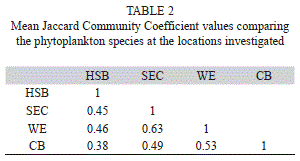
<body><![CDATA[distribution of turbidity as distance increased. However, extinction     coefficient (MANOVA, P&lt; 0.001) initially declined from 0.53 at     Harbour Shoal Beacon to 0.068 at South East Cay, before gradually     decreasing as distance offshore increased, reaching 0.044 at California     Bank (<a href="/img/revistas/rbt/v62s3/a02i3.jpg">Fig. 3</a>).    <br> </span></font><br style="font-family: verdana;"> <font size="2"><span style="font-family: verdana;"><span  style="font-weight: bold;">Oxidative redox potential</span> (ORP) values (MANOVA, p = 0.011) increased as distance offshore increased (<a href="/img/revistas/rbt/v62s3/a02i3.jpg">Fig. 3</a>) but Phosphate (MANOVA, P = 0.027) showed similar values at the Harbour Shoal Beacon as at California Bank. <span  style="font-weight: bold;">Phosphate values</span> ranged from a low of 0.055 &micro;g at </span></font><font size="2"><span  style="font-family: verdana;">L<sup>-1</sup></span></font><font  size="2"><span style="font-family: verdana;"> at Windward Edge to a high of 0.099&micro;g at </span></font><font size="2"><span  style="font-family: verdana;">L<sup>-1</sup></span></font><font  size="2"><span style="font-family: verdana;"> at Harbour Shoal Beacon with California Bank being a close second with high values of 0.098&micro;g at </span></font><font  size="2"><span style="font-family: verdana;">L<sup>-1</sup></span></font><font  size="2"><span style="font-family: verdana;"> (<a  href="/img/revistas/rbt/v62s3/a02i4.jpg">Fig. 4</a>). However, <span style="font-weight: bold;">nitrate values </span>showed no significant differences between stations (MANOVA, P = 0.079).    <br> </span></font><br style="font-family: verdana;"> <font size="2"><span style="font-family: verdana;"><span  style="font-weight: bold;">Phytoplankton: </span>A severe decline in mean chlorophyll a total biomass (MANOVA p = &lt; 0.001) was seen from Harbour Shoal Beacon (1.25&micro;g </span></font><font size="2"><span  style="font-family: verdana;">L<sup>-1</sup></span></font><font  size="2"><span style="font-family: verdana;">) to South East Cay (0.25&micro;g </span></font><font size="2"><span  style="font-family: verdana;">L<sup>-1</sup></span></font><font  size="2"><span style="font-family: verdana;">). A more gradual decline was observed towards Windward Edge (0.2&micro;g </span></font><font size="2"><span  style="font-family: verdana;">L<sup>-1</sup></span></font><font  size="2"><span style="font-family: verdana;">) then to California Bank (0.125&micro;g </span></font><font size="2"><span  style="font-family: verdana;">L<sup>-1</sup></span></font><font  size="2"><span style="font-family: verdana;">). Also as depth increased, chlorophyll <span style="font-style: italic;">a</span> values showed small increases at all stations and were found to not be significant (<a  href="/img/revistas/rbt/v62s3/a02i5.jpg">Fig. 5</a>).</span></font><br  style="font-family: verdana;"> <font size="2"></font><br style="font-family: verdana;"> <font size="2"><span style="font-family: verdana;">Examination of the proportion contributed by each phytoplankton size fraction (<a  href="/img/revistas/rbt/v62s3/a02i6.jpg">Fig. 6</a>) showed that the picoplankton (0.7&micro;m) contributed the dominant portion of the biomass at California Bank, Windward Edge and South East Cay while the netplankton (20&micro;m) dominated only at Harbour Shoal Beacon. Generally the picoplankton fraction increased and netplankton decreased with distance from Kingston Harbour. The nanoplankton fraction (2.7&micro;m) showed the least pattern across all stations (<a  href="/img/revistas/rbt/v62s3/a02i6.jpg">Fig. 6</a>). Chlorophyll a values for all size classes of phytoplankton showed significant spatial variation (MANOVA P &lt;0.001) after log transformation.</span></font><br style="font-family: verdana;"> <font size="2"></font><br style="font-family: verdana;"> <font size="2"><span style="font-family: verdana;">Stepwise, variable selection multiple regression tests showed that 56% of the variation in netplankton was related to variation in distance, temperature, pH and dissolved oxygen (R2=55.75%, P&lt;0.005), while 72% of the variation in nanoplankton was related to variation in distance, temperature, specific conductivity and phosphates (R2=71.38%, P&lt;0.005). Variation in distance, dissolved oxygen and salinity were attributable for 54% of the variation in picoplankton (R2=53.29, P&lt;0.005).</span></font><br  style="font-family: verdana;"> <font size="2"></font><br style="font-family: verdana;"> <font size="2"><span style="font-family: verdana;">The <span  style="font-weight: bold;">number of phytoplankton taxa</span> (richness) increased from Harbour Shoal Beacon (mean of 12) to South East cay with a mean of 19 (MANOVA, P &lt; 0.001). However, as distance increased further offshore a general decline was then observed with Windward Edge having a richness of 15 genera, the same as California Bank (<a href="/img/revistas/rbt/v62s3/a02i7.jpg">Fig. 7</a>). Stepwise variable selection multiple regression showed that variations of 13% in the number of phytoplankton genera could be directly attributable to variation in nitrates and dissolved oxygen (R2=12.58%, P&lt;0.05), with both having a negative relationship to richness.</span></font><br style="font-family: verdana;"> <font size="2"></font><br style="font-family: verdana;"> <font size="2"><span style="font-family: verdana;">Phytoplankton abundance (# of cells </span></font><font size="2"><span  style="font-family: verdana;">l<sup>-1</sup></span></font><font  size="2"><span style="font-family: verdana;">) followed a similar spatial distribution pattern (MANOVA, P&lt;0.001) where a severe decrease was seen from Harbour Shoal Beacon (34 173.51 cells </span></font><font size="2"><span  style="font-family: verdana;"></span></font><font size="2"><span  style="font-family: verdana;">l<sup>-1</sup></span></font><font  size="2"><span style="font-family: verdana;">) to South East Cay (507.67 cells </span></font><font size="2"><span  style="font-family: verdana;"></span></font><font size="2"><span  style="font-family: verdana;">l<sup>-1</sup></span></font><font  size="2"><span style="font-family: verdana;">). A gradual decrease was then obtained from South East Cay as distance offshore increased. Windward Edge had mean abundance values of 320.30 cells </span></font><font  size="2"><span style="font-family: verdana;"></span></font><font  size="2"><span style="font-family: verdana;">l<sup>-1</sup></span></font><font  size="2"><span style="font-family: verdana;"> while California Bank had 137.71 cells </span></font><font size="2"><span  style="font-family: verdana;"></span></font><font size="2"><span  style="font-family: verdana;">l<sup>-1</sup></span></font><font  size="2"><span style="font-family: verdana;"> (<a  href="/img/revistas/rbt/v62s3/a02i6.jpg">Fig. 6</a>). Stepwise variable selection multiple regression showed that 61% of the variation in number of cells was attributable to distance and total dissolved solids (R<sup>2</sup>=60.79%, P&lt;0.05), both having negative relationships to the number of cells </span></font><font size="2"><span  style="font-family: verdana;"></span></font><font size="2"><span  style="font-family: verdana;">l<sup>-1</sup></span></font><font  size="2"><span style="font-family: verdana;">.</span></font><br  style="font-family: verdana;"> <font size="2"></font><br style="font-family: verdana;"> <font size="2"><span style="font-family: verdana;"><span  style="font-weight: bold;">Jaccard community coefficient</span> (JCC) analysis indicated that the communities at Harbour Shoal Beacon and South East cay were 45% similar, Harbour Shoal Beacon and Windward Edge were 46% similar while Harbour Shoal Beacon and California Bank were 38% similar. South East Cay and Windward Edge were 63% similar and South East Cay and California Bank 49% similar. Finally, phytoplankton communities at Windward Edge and California Bank were 53% similar (Table 2).    <br>     <br> </span></font>     <div style="text-align: center;"><font size="2"><span  style="font-family: verdana;"><a name="tab2"></a><img alt=""  src="/img/revistas/rbt/v62s3/a02t2.gif"  style="width: 300px; height: 161px;"></span></font><br  style="font-family: verdana;"> <font size="2"><span style="font-family: verdana;"></span></font></div> <br style="font-family: verdana;"> <font size="2"><span style="font-family: verdana;"><span  style="font-weight: bold;">Zooplankton species richness and total abundances:</span> The overall number of zooplankton species encountered during the sampling period (total richness) ranged from 81 species at Harbour Shoal Beacon (HSB) to 115 species at Windward Edge (MANOVA, P&lt;0.001). HSB also consistently had the lowest mean richness (<a  href="/img/revistas/rbt/v62s3/a02i8.jpg">Fig. 8</a>). Contrastingly, HSB had the greatest mean zooplankton abundance (Nos. m-3) when compared to the other three stations (MANOVA, P&lt;0.001). Mean zooplankton abundance at HSB was 5 963 individuals m<sup>-3</sup> while South East Cay (SEC), Windward Edge (WE) and California Bank (CB) had abundance values of approximately 2 000 individuals m3 (<a  href="/img/revistas/rbt/v62s3/a02i9.jpg">Fig. 9</a>).    ]]></body>
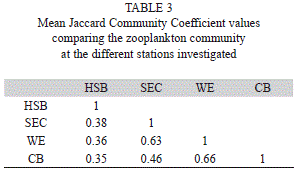
<body><![CDATA[<br> </span></font><br style="font-family: verdana;"> <font size="2"><span style="font-family: verdana;">When all net collections were combined, larvae (invertebrate and vertebrate) were the most abundant group being the greatest proportion of the collections from all four stations. Larvae accounted for more than half of the total abundance at CB (<a href="/img/revistas/rbt/v62s3/a02i9.jpg">Fig. 9</a>). Of the larval group, copepod nauplii were numerically the most dominant taxon. These occurred universally across all stations and sampling occasions with highest numbers observed at HSB followed by CB. The other two stations (SEC and WE) showed similar low numbers. Adult copepods were the second most abundant taxonomic group (after larvae). Cnidarians made the smallest contribution at each station, but were still most abundant at Harbour Shoal Beacon.</span></font><br  style="font-family: verdana;"> <font size="2"></font><br style="font-family: verdana;"> <font size="2"><span style="font-family: verdana;">Potential <span  style="font-weight: bold;">zooplankton indicator species</span> were examined in terms of their relative abundance across the four stations. Species like </span></font><font  style="font-weight: bold;" size="2"><span style="font-family: verdana;"><span  style="font-style: italic;">Penilia avirostris</span></span></font><font size="2"><span  style="font-family: verdana;"> and </span></font><font  style="font-weight: bold;" size="2"><span style="font-family: verdana;"><span  style="font-style: italic;">Lucifer faxoni</span></span></font><font  size="2"><span style="font-family: verdana;"><span  style="font-weight: bold;"> </span>had been identified as Kingston harbor indicators (Lindo, 1991; Webber, Roff, Chisholm &amp; Clarke, 1996). <span style="font-style: italic;">P. avirostris</span> showed greatest abundance at Harbour Shoal Beacon (<a  href="/img/revistas/rbt/v62s3/a02t3.jgif">Table 4</a>) and then declined exponentially to the stations further offshore (MANOVA P &gt; 0.001). </span></font><font  size="2"><span style="font-family: verdana;"><span  style="font-style: italic;">L. faxoni</span></span></font><font size="2"><span  style="font-family: verdana;"> was similar with maximum abundances at HSB, followed by a severe decline at SEC and WE. However, abundances showed a slight increase at CB, above values recorded at SEC and WE.</span></font><br  style="font-family: verdana;"> <font size="2"></font><br style="font-family: verdana;"> <font size="2"><span style="font-family: verdana;"><span  style="font-style: italic;">Microsetella</span></span></font><font  size="2"><span style="font-family: verdana;"> sp. occurred at all four stations investigated and abundances gradually increased with distance (MANOVA, P&lt;0.001) from the Harbour Shoal Beacon, where mean abundances were less than 5 individuals m<sup>-3</sup>. However it was present as 30 and 37 individuals m-3 at Windward Edge and California Bank, respectively. <span style="font-style: italic;">F. carinata</span> (MANOVA, P= 0.001) seemed to have similar distribution (increase in the numbers of this species as distance offshore increased) but it was only observed at South East Cay, Windward Edge and California Bank. It was not observed at Harbour Shoal Beacon over all the sampling occasions.</span></font><br  style="font-family: verdana;"> <font size="2"></font><br style="font-family: verdana;"> <font size="2"><span style="font-family: verdana;">Using the Jaccard Community Coefficient (JCC), the zooplankton community at the stations increased in similarity from Harbour Shoal Beacon (HSB) towards California Bank (CB). HSB was the least similar compared to the other stations with similarities of 38% and less (<a href="#tab3">Table 3</a>). The highest community similarities were observed between CB and WE (66% similarity). Communities at South East Cay (SEC) and Windward Edge (WE) showed 63% similarity while SEC and CB were 46% similar (<a  href="/img/revistas/rbt/v62s3/a02t4.jgif">Table 4</a>). This pattern was almost identical to the phytoplankton community.    <br>     <br> </span></font>     <div style="text-align: center;"><font size="2"><span      style="font-family: verdana;"><a name="tab3"></a><img alt=""      src="/img/revistas/rbt/v62s3/a02t3.gif"      style="width: 300px; height: 172px;"></span></font><br      style="font-family: verdana;">     <font size="2"><span style="font-family: verdana;"></span></font></div>     <br style="font-family: verdana;">     ]]></body>
<body><![CDATA[<font style="font-weight: bold;" size="3"><span      style="font-family: verdana;">Discussion</span></font><br      style="font-family: verdana;">     <font size="2"></font><br style="font-family: verdana;">     <font size="2"><span style="font-family: verdana;">Comparison of water     quality and     plankton across areas spanning coastal bays or harbors and offshore,     oceanic banks are rare as intensive plankton and water quality sampling     requires relatively short intervals between collecting and processing     events. Alternatives include availability of large enough vessels for     ]]></body>
<body><![CDATA[shipboard analysis or restricting attention to few parameters (Moore     &amp; Sander, 1979). This study achieved comparative analysis of 11     physicochemical parameters, 13 zooplankton parameters and five     phytoplankton parameters sampled from different depths at stations up     to 22km apart across an expected eutrophication gradient.</span></font><br      style="font-family: verdana;">     <font size="2"></font><br style="font-family: verdana;">     <font size="2"><span style="font-family: verdana;">Thus it was expected     that the     physicochemical parameters would show severe changes from the eutrophic     ]]></body>
<body><![CDATA[waters at Harbour Shoal Beacon (HSB) at the mouth of Kingston harbor to     South East Cay (SEC), Windward Edge (WE) and California Bank (CB) 22km     away, along the predicted eutrophication gradient. However, with the     exception of Extinction coefficient and Salinity, the change in water     quality parameters with increasing distance off shore was not as severe     as expected. In fact the gradually declining nutrient gradient was     disrupted by values at the furthest station (CB) being higher than     those from its next nearest neighbor. This pattern was also     demonstrated for the zooplankton parameters: species richness, numbers     of </span></font><font size="2"><span style="font-family: verdana;"><span     ]]></body>
<body><![CDATA[ style="font-style: italic;">L.     faxoni</span></span></font><font size="2"><span      style="font-family: verdana;">, <span style="font-style: italic;">Paracalanus     parvus</span> and copepod nauplii. Values at     California bank for these parameters indicated unexpected enrichment of     the area. Offshore banks and shelf areas may receive enrichment from     upwelling which is aided by horizontal circulation patterns like gyres     that concentrate nutrients and retain planktonic communities (Genin,     2004; Rakhesh, Raman &amp; Sudarsan, 2006). Such circulation is said to     lead to increased numbers in especially larval forms, phytoplankton and     ]]></body>
<body><![CDATA[other plankton with limited means of movement (Carleton, Brinkman &amp;     Doherty, 2001).</span></font><br style="font-family: verdana;">     <font size="2"></font><br style="font-family: verdana;">     <font size="2"><span style="font-family: verdana;">While it was     unexpected for the     offshore bank to have nitrate values as high as at the mouth of     Kingston Harbour, upwelling has been shown to promote significant     enrichment of surface waters (Caldeira et al., 2002). Nevertheless, it     is important to note that nutrient values between the eutrophic     Kingston harbor and relatively pristine offshore sites were not as     ]]></body>
<body><![CDATA[different as expected; clearly indicating the deficiency in relying on     nutrients as indicators in such conditions.</span></font><br      style="font-family: verdana;">     <font size="2"></font><br style="font-family: verdana;">     <font size="2"><span style="font-family: verdana;">The identification     of indicator     species and groups from the plankton was more reliable at     characterizing different water masses (McGehee, Derner &amp; Warren,     2004; Fehling et al., 2012; Tseng, Dahms, Chen &amp; Hwang, 2013).     Netplankton (&gt;20&micro;m) is known to be dominant in high nutrient     ]]></body>
<body><![CDATA[waters because of the low surface area to volume ratio causing them to     be best suited and therefore allowing them to persist in high nutrient     concentrations (Hopcroft, 1988; Webber, 1990), such as is available at     HSB. Contrastingly, the picoplankton size class, having a high surface     area to volume ratio would dominate oligotrophic areas such as South     East Cay, Windward Edge and California Bank (Hopcroft, 1988; Webber,     1990). The last size fraction, the nanoplankton, are known to remain     fairly consistent whether near or far from the coast (Vant &amp; Safi,     1996). This is corroborated by the findings of Webber and Roff (1996)     where small picoplankton dominated nutrient poor oceanic waters and     ]]></body>
<body><![CDATA[netplankton in coastal waters nutrient rich waters.</span></font><br      style="font-family: verdana;">     <font size="2"></font><br style="font-family: verdana;">     <font size="2"><span style="font-family: verdana;">The taxonomic     richness (number of     zooplankton species and phytoplankton genera) did not follow the     expected gradient as lowest number of species occurred at both Harbour     Shoal Beacon and California Bank. Furthermore, while total abundances     (zooplankton Nos. m-3 and Chlorophyll a </span></font><font size="2"><span      style="font-family: verdana;">L<sup>-1</sup></span></font><font     ]]></body>
<body><![CDATA[ size="2"><span style="font-family: verdana;">) followed the expected     gradient, individual species and groups such as copepod nauplii showed     secondary increases at the station located furthest offshore due to     enrichment associated with the changes in circulation associated with     the submerged bank.</span></font><br style="font-family: verdana;">     <font size="2"></font><br style="font-family: verdana;">     <font size="2"><span style="font-family: verdana;">While abundances may     be     unpredictable, community composition has been shown to be better when     identifying distinct water masses (Campbell et al., 2008). Thus greater     ]]></body>
<body><![CDATA[percentage similarity was expected and obtained from stations closer to     each other along the gradient. Even in cases where the nutrient     concentrations were similar, (e.g. Harbor Shoal Beacon and California     Bank), the planktonic communities were most different and reflected the     differing conditions of the associated water mass. This is also     supported by the dominant species (indicators) in each water body. In     terms of the phytoplankton, coastal and oceanic water bodies were     separated into two general groups with, the coastal stations having     dinoflagellattes (also shown by Matsuoka, Joyce, Katoni &amp; Matsuyma,     2003) such as: </span></font><font size="2"><span     ]]></body>
<body><![CDATA[ style="font-family: verdana;"><span style="font-style: italic;">Gonyaulax</span></span></font><font      size="2"><span style="font-family: verdana;">, </span></font><font      size="2"><span style="font-family: verdana;"><span      style="font-style: italic;">Gyrodinium</span> </span></font><font      size="2"><span style="font-family: verdana;">and Perdinium being     dominant while     oceanic stations having diatoms such as: </span></font><font size="2"><span      style="font-family: verdana;"><span style="font-style: italic;">Navicula</span></span></font><font      size="2"><span style="font-family: verdana;">, </span></font><font      size="2"><span style="font-family: verdana;"><span     ]]></body>
<body><![CDATA[ style="font-style: italic;">Nitzschia</span></span></font><font      size="2"><span style="font-family: verdana;">,     <span style="font-style: italic;">Rhixosloenia </span>and <span      style="font-style: italic;">Thallassionema </span>being dominant;     irrespective of     nutrient levels.</span></font><br style="font-family: verdana;">     <font size="2"></font><br style="font-family: verdana;">     <font size="2"><span style="font-family: verdana;">Throughout the     study, zooplankton     groups were dominated by copepods and larvae which accounted for more     ]]></body>
<body><![CDATA[than 70% of the abundances at each station. However, copepods were     expected to be the dominant group as was previously reported by other     authors (Youngbluth, 1980; Moore &amp; Sander, 1979; Webber &amp; Roff,     1995; Dunbar &amp; Webber, 2003). The larval group contained     representatives from different groups notably copepod nauplii, fish     eggs and echinoderms. The high larval presence at the offshore stations     (California Bank and Windward Edge), was further evidence that they are     productive areas with reduced flushing and water retention processes     that lead to increased numbers of especially larval forms with limited     means of movement (Cowen &amp; Castro, 1994; Carleton et al., 2001).</span></font><br     ]]></body>
<body><![CDATA[ style="font-family: verdana;">     <font size="2"></font><br style="font-family: verdana;">     <font size="2"><span style="font-family: verdana;">Within each     group/taxa a few     species displayed high abundances and occurrence at the stations and     therefore have the potential for use as indicators of different water     masses/conditions. </span></font><font size="2"><span      style="font-family: verdana;"><span style="font-style: italic;">L.     faxoni</span></span></font><font size="2"><span      style="font-family: verdana;"> has been identified as an indicator of     ]]></body>
<body><![CDATA[Kingston Harbour waters in previous studies (Lindo, 1991; Webber et     al., 1996; Dunbar &amp; Webber, 2003). </span></font><font size="2"><span      style="font-family: verdana;"><span style="font-style: italic;">L.     faxoni</span></span></font><font size="2"><span      style="font-family: verdana;">, clearly displayed     highest numbers at the Harbour station but did not have lowest mean     values at the furthest offshore station. The distribution of the     species appears to be less affected by salinity levels and more by     nutrients.</span></font><br style="font-family: verdana;">     <font size="2"></font><br style="font-family: verdana;">     ]]></body>
<body><![CDATA[<font size="2"><span style="font-family: verdana;">The Cladoceran, <span      style="font-style: italic;">P. avirostris</span> has     often been paired with </span></font><font size="2"><span      style="font-family: verdana;"><span style="font-style: italic;">L.     faxoni</span></span></font><font size="2"><span      style="font-family: verdana;">. As shown in the present     investigation, it also tends to have highest numbers at the harbor     station and low numbers at offshore areas. <span      style="font-style: italic;">P. avirostris</span> has been     previously reported in high abundances in the Kingston Harbour and at     ]]></body>
<body><![CDATA[its mouth (Moore &amp; Sander, 1979; Dunbar &amp; Webber, 2003; Webber     et al., 2005). The distribution of the species appears to be affected     by salinity concentrations and food availability.     Moraitou-Apostolopoulou and Kiortsis (1973) found that higher     salinities and pelagic nature of the waters had an effect on <span      style="font-style: italic;">P.     avirostris</span>&#8217; distribution, thereby limiting its presence to areas     with     shallow low-salinity waters.</span></font><br      style="font-family: verdana;">     ]]></body>
<body><![CDATA[<font size="2"></font><br style="font-family: verdana;">     <font size="2"><span style="font-family: verdana;">The copepod </span></font><font      size="2"><span style="font-family: verdana;"><span      style="font-style: italic;">Microsetella</span></span></font><font      size="2"><span style="font-family: verdana;"> sp. was     the dominant harpacticoid at the offshore stations and Moore and Sander     (1979) reported this species as only occurring at stations outside of     the Harbour and while Webber et al. (1996) did not report it from their     study of the Port Royal Cays, it was found offshore Discovery Bay,     north coast of Jamaica (Webber &amp; Roff 1995). The cyclopoid, <span     ]]></body>
<body><![CDATA[ style="font-style: italic;">F.     carinata</span> was important at the offshore stations, while being     absent     from the Harbour Shoal Beacon. This species has also been found to be     important in oceanic waters off the north coast at Discovery Bay,     Jamaica by Webber &amp; Roff (1995). </span></font><font size="2"><span      style="font-family: verdana;"><span style="font-style: italic;">Microsetella</span></span></font><font      size="2"><span style="font-family: verdana;"> sp. and <span      style="font-style: italic;">F. carinata</span>     therefore could be indicators of offshore waters.</span></font><br     ]]></body>
<body><![CDATA[ style="font-family: verdana;">     <font size="2"></font><br style="font-family: verdana;">     <font size="2"><span style="font-family: verdana;">Larvae followed the     general trend     of highest numbers at the Harbour mouth; however the numbers at station     California Bank were second highest. Moore and Sander (1979) had     reported relatively low mean numbers (135m-3) at their offshore     station, a magnitude lower than reported by the present study. In using     a single mesh (~200&micro;m) for their study they would have     underestimated copepodites by a factor of three to six, and also     ]]></body>
<body><![CDATA[underestimated copepods by a factor of five (Webber &amp; Roff, 1995).     The relatively high larval abundance at California Bank would suggest a     mechanism or processes that retain larvae associated with this area.     Similar effects have been seen by Heywood, Barton &amp; Simpson (1990)     and Hern&aacute;ndez-Le&oacute;n (1990), where they found an increase     in the biological production and attributed it to the presence of an     offshore bank.</span></font><br style="font-family: verdana;">     <font size="2"></font><br style="font-family: verdana;">     <font size="2"><span style="font-family: verdana;">In general there was     a change in     ]]></body>
<body><![CDATA[biological parameters with increasing distance from the harbor towards     the open sea. Based on the indices investigated, the identification of     a gradient of conditions with different levels of eutrophication was     partially achieved with confirmation that Harbour Shoal Beacon was the     most eutrophic site and Windward Edge most oligotrophic. South East     Cay, due to its position on the south coast shelf, should be classified     as mesotrophic (Vollenweider et al., 1998) along with California Bank.     California Bank while having oceanic planktonic communities, is not     oligotrophic, but is influenced by processes that reflect mesotrophic     conditions hence its pairing with South East Cay. The findings of this     ]]></body>
<body><![CDATA[study indicate that accurate characterization of water masses and their     trophic status must involve a range of physicochemical and biological     parameters.</span></font><br style="font-family: verdana;">     <br style="font-family: verdana;">     <hr style="width: 100%; height: 2px;"><font style="font-weight: bold;"      size="3"><span style="font-family: verdana;">References</span></font><br      style="font-family: verdana;">     <br style="font-family: verdana;">     <!-- ref --><div style="text-align: left;"><font size="2"><span  style="font-family: verdana;">APHA-AWWA-WPFC. (1980). <span style="font-style: italic;">Standard methods for examination of water and wastewater.</span> 15<sup>th</sup> ed. New York: Public Health Association Inc.    &nbsp;&nbsp;&nbsp;&nbsp;&nbsp;&nbsp;&nbsp;&nbsp;[&#160;<a href="javascript:void(0);" onclick="javascript: window.open('/scielo.php?script=sci_nlinks&ref=1789956&pid=S0034-7744201400070000200001&lng=','','width=640,height=500,resizable=yes,scrollbars=1,menubar=yes,');">Links</a>&#160;]<!-- end-ref --><!-- ref --></span></font><br  style="font-family: verdana;"> <br style="font-family: verdana;"> <font size="2"><span style="font-family: verdana;">Arar, J. E., &amp; Collins, G. B. (1997). <span style="font-style: italic;">In vitro determination of chlorophyll a and pheophytin a in marine and freshwater algae by fluorescence.</span> National Exposure Research Laboratories Office of Research Development. USEPA Method 445.0.    &nbsp;&nbsp;&nbsp;&nbsp;&nbsp;&nbsp;&nbsp;&nbsp;[&#160;<a href="javascript:void(0);" onclick="javascript: window.open('/scielo.php?script=sci_nlinks&ref=1789957&pid=S0034-7744201400070000200002&lng=','','width=640,height=500,resizable=yes,scrollbars=1,menubar=yes,');">Links</a>&#160;]<!-- end-ref --><!-- ref --></span></font><br  style="font-family: verdana;"> <br style="font-family: verdana;"> <font size="2"><span style="font-family: verdana;">Caldeira, R. M. A., Gordon, S., Miller, P., Pilgrim, D., &amp; Nezlin, N. P. (2002). Sea-surface signatures of the island mass effect phenomenon around Madeira island, northeastern Atlantic. <span style="font-style: italic;">Remote Sensing of Environments, 80</span>, 336 - 360.    &nbsp;&nbsp;&nbsp;&nbsp;&nbsp;&nbsp;&nbsp;&nbsp;[&#160;<a href="javascript:void(0);" onclick="javascript: window.open('/scielo.php?script=sci_nlinks&ref=1789958&pid=S0034-7744201400070000200003&lng=','','width=640,height=500,resizable=yes,scrollbars=1,menubar=yes,');">Links</a>&#160;]<!-- end-ref --><!-- ref --></span></font><br  style="font-family: verdana;"> <br style="font-family: verdana;"> <font size="2"><span style="font-family: verdana;">Campbell, P., Manning J., Webber, M., &amp; Webber, D. (2008). Planktonic communities as indicators of water quality in mangrove lagoons: a Jamaican case study. <span  style="font-style: italic;">Transitional Waters Bulletin, 3,</span> 39 - 63.    &nbsp;&nbsp;&nbsp;&nbsp;&nbsp;&nbsp;&nbsp;&nbsp;[&#160;<a href="javascript:void(0);" onclick="javascript: window.open('/scielo.php?script=sci_nlinks&ref=1789959&pid=S0034-7744201400070000200004&lng=','','width=640,height=500,resizable=yes,scrollbars=1,menubar=yes,');">Links</a>&#160;]<!-- end-ref --><!-- ref --></span></font><br  style="font-family: verdana;"> <br style="font-family: verdana;"> <font size="2"><span style="font-family: verdana;">Carleton, J. H., Brinkman, R., &amp; Doherty, P. J. (2001). Zooplankton community structure and water flow in the lee of Helix reef (Great Barrier Reef, Australia). <span  style="font-style: italic;">Marine Biology, 139</span>, 705-763.    &nbsp;&nbsp;&nbsp;&nbsp;&nbsp;&nbsp;&nbsp;&nbsp;[&#160;<a href="javascript:void(0);" onclick="javascript: window.open('/scielo.php?script=sci_nlinks&ref=1789960&pid=S0034-7744201400070000200005&lng=','','width=640,height=500,resizable=yes,scrollbars=1,menubar=yes,');">Links</a>&#160;]<!-- end-ref --><!-- ref --></span></font><br  style="font-family: verdana;"> <br style="font-family: verdana;"> <font size="2"><span style="font-family: verdana;">Cowen, R. K., &amp; Castro, L. R. (1994). Relation of coral reef fish larval distributions to island scale circulation around Barbados, West Indies. <span  style="font-style: italic;">Bulletin of Marine Science, 54</span>, 228-244.    &nbsp;&nbsp;&nbsp;&nbsp;&nbsp;&nbsp;&nbsp;&nbsp;[&#160;<a href="javascript:void(0);" onclick="javascript: window.open('/scielo.php?script=sci_nlinks&ref=1789961&pid=S0034-7744201400070000200006&lng=','','width=640,height=500,resizable=yes,scrollbars=1,menubar=yes,');">Links</a>&#160;]<!-- end-ref --><!-- ref --></span></font><br  style="font-family: verdana;"> <br style="font-family: verdana;"> <font size="2"><span style="font-family: verdana;">Dunbar, F. N., &amp; Webber, M. K. (2003). zooplankton distribution in the eutrophic Kingston Harbour, Jamaica. <span style="font-style: italic;">Bulletin of Marine Science, 73,</span> 343-359.    &nbsp;&nbsp;&nbsp;&nbsp;&nbsp;&nbsp;&nbsp;&nbsp;[&#160;<a href="javascript:void(0);" onclick="javascript: window.open('/scielo.php?script=sci_nlinks&ref=1789962&pid=S0034-7744201400070000200007&lng=','','width=640,height=500,resizable=yes,scrollbars=1,menubar=yes,');">Links</a>&#160;]<!-- end-ref --><!-- ref --></span></font><br style="font-family: verdana;"> <br style="font-family: verdana;"> <font size="2"><span style="font-family: verdana;">Fehling, J., Davisdon, K., Bolch, C., Brand, T., &amp; Narayanaswamy, B. (2012). The relationship between phytoplankton distribution and water column characteristics in north western European shelf sea waters. <span style="font-style: italic;">PLoS ONE, 7</span>(3), e34098. doi:10.1371/journal.pone.0034098.    &nbsp;&nbsp;&nbsp;&nbsp;&nbsp;&nbsp;&nbsp;&nbsp;[&#160;<a href="javascript:void(0);" onclick="javascript: window.open('/scielo.php?script=sci_nlinks&ref=1789963&pid=S0034-7744201400070000200008&lng=','','width=640,height=500,resizable=yes,scrollbars=1,menubar=yes,');">Links</a>&#160;]<!-- end-ref --><!-- ref --></span></font><br  style="font-family: verdana;"> <br style="font-family: verdana;"> <font size="2"><span style="font-family: verdana;">Genin, A. (2004). Bio-physical coupling in the formation of zooplankton and fish aggregations over abrupt topographies. <span style="font-style: italic;">Journal of Marine Systems, 50</span>, 3-20.    &nbsp;&nbsp;&nbsp;&nbsp;&nbsp;&nbsp;&nbsp;&nbsp;[&#160;<a href="javascript:void(0);" onclick="javascript: window.open('/scielo.php?script=sci_nlinks&ref=1789964&pid=S0034-7744201400070000200009&lng=','','width=640,height=500,resizable=yes,scrollbars=1,menubar=yes,');">Links</a>&#160;]<!-- end-ref --><!-- ref --></span></font><br  style="font-family: verdana;"> <br style="font-family: verdana;"> <font size="2"><span style="font-family: verdana;">Goodbody, I. (2003). Kingston harbor Jamaica: an overview. <span style="font-style: italic;">Bulletin of Marine Science, 73</span>, 249 - 255.    &nbsp;&nbsp;&nbsp;&nbsp;&nbsp;&nbsp;&nbsp;&nbsp;[&#160;<a href="javascript:void(0);" onclick="javascript: window.open('/scielo.php?script=sci_nlinks&ref=1789965&pid=S0034-7744201400070000200010&lng=','','width=640,height=500,resizable=yes,scrollbars=1,menubar=yes,');">Links</a>&#160;]<!-- end-ref --><!-- ref --></span></font><br  style="font-family: verdana;"> <br style="font-family: verdana;"> <font size="2"><span style="font-family: verdana;">Grant, C. J., &amp; Wyatt, J. R. (1980). Surface currents in the eastern Cayman and western Caribbean seas. <span style="font-style: italic;">Bulletin of Marine Sciences, 30</span>, 613 - 622.    &nbsp;&nbsp;&nbsp;&nbsp;&nbsp;&nbsp;&nbsp;&nbsp;[&#160;<a href="javascript:void(0);" onclick="javascript: window.open('/scielo.php?script=sci_nlinks&ref=1789966&pid=S0034-7744201400070000200011&lng=','','width=640,height=500,resizable=yes,scrollbars=1,menubar=yes,');">Links</a>&#160;]<!-- end-ref --><!-- ref --></span></font><br style="font-family: verdana;"> <br style="font-family: verdana;"> <font size="2"><span style="font-family: verdana;">Hern&aacute;ndez-Le&oacute;n, S. (1990). Accumulation of mesozooplankton in a wake area as a causative mechanism of the &#8220;island-mass effect&#8221;. <span  style="font-style: italic;">Marine Biology, 109</span>, 141-147.    &nbsp;&nbsp;&nbsp;&nbsp;&nbsp;&nbsp;&nbsp;&nbsp;[&#160;<a href="javascript:void(0);" onclick="javascript: window.open('/scielo.php?script=sci_nlinks&ref=1789967&pid=S0034-7744201400070000200012&lng=','','width=640,height=500,resizable=yes,scrollbars=1,menubar=yes,');">Links</a>&#160;]<!-- end-ref --><!-- ref --></span></font><br  style="font-family: verdana;"> <br style="font-family: verdana;"> <font size="2"><span style="font-family: verdana;">Heywood, K. J., Barton, E. D., &amp; Simpson, J. H. (1990). The effects of flow disturbance by an oceanic island. <span style="font-style: italic;">Journal of Marine Research, 48</span>, 55 -73.    &nbsp;&nbsp;&nbsp;&nbsp;&nbsp;&nbsp;&nbsp;&nbsp;[&#160;<a href="javascript:void(0);" onclick="javascript: window.open('/scielo.php?script=sci_nlinks&ref=1789968&pid=S0034-7744201400070000200013&lng=','','width=640,height=500,resizable=yes,scrollbars=1,menubar=yes,');">Links</a>&#160;]<!-- end-ref --><!-- ref --></span></font><br  style="font-family: verdana;"> <br style="font-family: verdana;"> <font size="2"><span style="font-family: verdana;">Hopcroft, R. R. (1988). <span style="font-style: italic;">Size fractionated biomass and primary production of tropical neretic phytoplankton near Kingston Jamaica.</span> M.Sc. Thesis, University of Guelph, Jamaica.    &nbsp;&nbsp;&nbsp;&nbsp;&nbsp;&nbsp;&nbsp;&nbsp;[&#160;<a href="javascript:void(0);" onclick="javascript: window.open('/scielo.php?script=sci_nlinks&ref=1789969&pid=S0034-7744201400070000200014&lng=','','width=640,height=500,resizable=yes,scrollbars=1,menubar=yes,');">Links</a>&#160;]<!-- end-ref --><!-- ref --></span></font><br style="font-family: verdana;"> <br style="font-family: verdana;"> <font size="2"><span style="font-family: verdana;">Lindo, M. (1991). The effect of Kingston Harbour outflow on the zooplankton populations of Hellshire, south-east coast, Jamaica. <span style="font-style: italic;">Estuarine, Coastal and Shelf Science, 32</span>, 597 - 608.    &nbsp;&nbsp;&nbsp;&nbsp;&nbsp;&nbsp;&nbsp;&nbsp;[&#160;<a href="javascript:void(0);" onclick="javascript: window.open('/scielo.php?script=sci_nlinks&ref=1789970&pid=S0034-7744201400070000200015&lng=','','width=640,height=500,resizable=yes,scrollbars=1,menubar=yes,');">Links</a>&#160;]<!-- end-ref --><!-- ref --></span></font><br style="font-family: verdana;"> <br style="font-family: verdana;"> <font size="2"><span style="font-family: verdana;">Matsouka, K., Joyce, L. B., Katoni, Y., &amp; Matsuyma, Y. (2003). Modern dinoflagellate cysts in hypertrophic coastal waters off Tokyo Bay, Japan. <span  style="font-style: italic;">Journal of Plankton Research, 25</span>, 1461-1470.    &nbsp;&nbsp;&nbsp;&nbsp;&nbsp;&nbsp;&nbsp;&nbsp;[&#160;<a href="javascript:void(0);" onclick="javascript: window.open('/scielo.php?script=sci_nlinks&ref=1789971&pid=S0034-7744201400070000200016&lng=','','width=640,height=500,resizable=yes,scrollbars=1,menubar=yes,');">Links</a>&#160;]<!-- end-ref --><!-- ref --></span></font><br  style="font-family: verdana;"> <br style="font-family: verdana;"> <font size="2"><span style="font-family: verdana;">McGehee, D. E., Derner, D. A., &amp; Warren, J. D. (2004). Zooplankton in the Ligurian Sea: Part 1. Characterization of their dispersion, relative abundance and environment during summer 1999. <span style="font-style: italic;">Journal of Plankton Research, 26</span>, 1409 - 1418.    &nbsp;&nbsp;&nbsp;&nbsp;&nbsp;&nbsp;&nbsp;&nbsp;[&#160;<a href="javascript:void(0);" onclick="javascript: window.open('/scielo.php?script=sci_nlinks&ref=1789972&pid=S0034-7744201400070000200017&lng=','','width=640,height=500,resizable=yes,scrollbars=1,menubar=yes,');">Links</a>&#160;]<!-- end-ref --><!-- ref --></span></font><br style="font-family: verdana;"> <br style="font-family: verdana;"> <font size="2"><span style="font-family: verdana;">Michel, H. B. (1984). Chaetognaths of the Caribbean sea and adjacent waters. <span  style="font-style: italic;">NOAA Technical Report of the North-East Marine Fisheries Service, 15</span>, 25.    &nbsp;&nbsp;&nbsp;&nbsp;&nbsp;&nbsp;&nbsp;&nbsp;[&#160;<a href="javascript:void(0);" onclick="javascript: window.open('/scielo.php?script=sci_nlinks&ref=1789973&pid=S0034-7744201400070000200018&lng=','','width=640,height=500,resizable=yes,scrollbars=1,menubar=yes,');">Links</a>&#160;]<!-- end-ref --><!-- ref --></span></font><br  style="font-family: verdana;"> <br style="font-family: verdana;"> <font size="2"><span style="font-family: verdana;">Moore, E., &amp; Sander, F. (1979). A comparative study of zooplankton from oceanic, shelf, and harbour waters of Jamaica. <span style="font-style: italic;">Biotropica, 11</span>, 196-206.    &nbsp;&nbsp;&nbsp;&nbsp;&nbsp;&nbsp;&nbsp;&nbsp;[&#160;<a href="javascript:void(0);" onclick="javascript: window.open('/scielo.php?script=sci_nlinks&ref=1789974&pid=S0034-7744201400070000200019&lng=','','width=640,height=500,resizable=yes,scrollbars=1,menubar=yes,');">Links</a>&#160;]<!-- end-ref --><!-- ref --></span></font><br style="font-family: verdana;"> <br style="font-family: verdana;"> <font size="2"><span style="font-family: verdana;">Moraitou-Apostolopoulou, M., &amp; Kiortsis, V. (1973). The Cladocerans of the Aegan Sea: Occurrence and seasonal variation. <span style="font-style: italic;">Marine Biology, 20</span>, 137-143.    &nbsp;&nbsp;&nbsp;&nbsp;&nbsp;&nbsp;&nbsp;&nbsp;[&#160;<a href="javascript:void(0);" onclick="javascript: window.open('/scielo.php?script=sci_nlinks&ref=1789975&pid=S0034-7744201400070000200020&lng=','','width=640,height=500,resizable=yes,scrollbars=1,menubar=yes,');">Links</a>&#160;]<!-- end-ref --><!-- ref --></span></font><br style="font-family: verdana;"> <br style="font-family: verdana;"> <font size="2"><span style="font-family: verdana;">Munro, J. C. (1983). <span style="font-style: italic;">Caribbean coral reef fishery report.</span> ODA/ UWI Fisheries Ecology Research Project 1969-1973.    &nbsp;&nbsp;&nbsp;&nbsp;&nbsp;&nbsp;&nbsp;&nbsp;[&#160;<a href="javascript:void(0);" onclick="javascript: window.open('/scielo.php?script=sci_nlinks&ref=1789976&pid=S0034-7744201400070000200021&lng=','','width=640,height=500,resizable=yes,scrollbars=1,menubar=yes,');">Links</a>&#160;]<!-- end-ref --><!-- ref --></span></font><br style="font-family: verdana;"> <br style="font-family: verdana;"> <font size="2"><span style="font-family: verdana;">Newell, G. E., &amp; Newell, R. C. (1977). <span style="font-style: italic;">Marine plankton: a practical guide. </span>London: Huthinson and Co. Ltd.    &nbsp;&nbsp;&nbsp;&nbsp;&nbsp;&nbsp;&nbsp;&nbsp;[&#160;<a href="javascript:void(0);" onclick="javascript: window.open('/scielo.php?script=sci_nlinks&ref=1789977&pid=S0034-7744201400070000200022&lng=','','width=640,height=500,resizable=yes,scrollbars=1,menubar=yes,');">Links</a>&#160;]<!-- end-ref --><!-- ref --></span></font><br style="font-family: verdana;"> <br style="font-family: verdana;"> <font size="2"><span style="font-family: verdana;">Owre, H. B., &amp; Foyo, M. (1967). <span style="font-style: italic;">Copepods of the Florida current.</span> <span style="font-style: italic;">Fauna Caribaea No. 1.Crustacea, Part1: Copepoda. </span>Miami: Institute of marine science University of Miami.    &nbsp;&nbsp;&nbsp;&nbsp;&nbsp;&nbsp;&nbsp;&nbsp;[&#160;<a href="javascript:void(0);" onclick="javascript: window.open('/scielo.php?script=sci_nlinks&ref=1789978&pid=S0034-7744201400070000200023&lng=','','width=640,height=500,resizable=yes,scrollbars=1,menubar=yes,');">Links</a>&#160;]<!-- end-ref --><!-- ref --></span></font><br style="font-family: verdana;"> <br style="font-family: verdana;"> <font size="2"><span style="font-family: verdana;">Paerl, H. W. (1978). Effectiveness of various counting methods in detecting viable plankton. <span  style="font-style: italic;">Journal of Marine and Freshwater Research, 12</span>, 67-72.    &nbsp;&nbsp;&nbsp;&nbsp;&nbsp;&nbsp;&nbsp;&nbsp;[&#160;<a href="javascript:void(0);" onclick="javascript: window.open('/scielo.php?script=sci_nlinks&ref=1789979&pid=S0034-7744201400070000200024&lng=','','width=640,height=500,resizable=yes,scrollbars=1,menubar=yes,');">Links</a>&#160;]<!-- end-ref --><!-- ref --></span></font><br  style="font-family: verdana;"> <br style="font-family: verdana;"> <font size="2"><span style="font-family: verdana;">Parsons, T. R., Maita, Y., &amp; Lalli, C. M. (1984). <span style="font-style: italic;">A manual of chemical and biological methods for seawater analysis.</span> UK: Pergamon Press.    &nbsp;&nbsp;&nbsp;&nbsp;&nbsp;&nbsp;&nbsp;&nbsp;[&#160;<a href="javascript:void(0);" onclick="javascript: window.open('/scielo.php?script=sci_nlinks&ref=1789980&pid=S0034-7744201400070000200025&lng=','','width=640,height=500,resizable=yes,scrollbars=1,menubar=yes,');">Links</a>&#160;]<!-- end-ref --><!-- ref --></span></font><br  style="font-family: verdana;"> <br style="font-family: verdana;"> <font size="2"><span style="font-family: verdana;">Persad, G., Hopcroft, R. R., Webber, M. K., &amp; Roff, J. C. (2003). Abundance, biomass and production of ctenophores and medusae off Kingston, Jamaica. <span  style="font-style: italic;">Bulletin of Marine Sciences, 73</span>, 379-396.    &nbsp;&nbsp;&nbsp;&nbsp;&nbsp;&nbsp;&nbsp;&nbsp;[&#160;<a href="javascript:void(0);" onclick="javascript: window.open('/scielo.php?script=sci_nlinks&ref=1789981&pid=S0034-7744201400070000200026&lng=','','width=640,height=500,resizable=yes,scrollbars=1,menubar=yes,');">Links</a>&#160;]<!-- end-ref --><!-- ref --></span></font><br  style="font-family: verdana;"> <br style="font-family: verdana;"> <font size="2"><span style="font-family: verdana;">Poole, H. H., &amp; Atkins, W. R. C. (1929). Photoelectric measurements of submarine illumination throughout the year. <span style="font-style: italic;">Journal of the Marine Biological Association of the U.K., 16</span>, 297 - 324.    &nbsp;&nbsp;&nbsp;&nbsp;&nbsp;&nbsp;&nbsp;&nbsp;[&#160;<a href="javascript:void(0);" onclick="javascript: window.open('/scielo.php?script=sci_nlinks&ref=1789982&pid=S0034-7744201400070000200027&lng=','','width=640,height=500,resizable=yes,scrollbars=1,menubar=yes,');">Links</a>&#160;]<!-- end-ref --><!-- ref --></span></font><br  style="font-family: verdana;"> <br style="font-family: verdana;"> <font size="2"><span style="font-family: verdana;">Rakhesh, M., Raman, A. V., &amp; Sudarsan, D. (2006). Discriminating zooplankton assemblages in neritic and oceanic waters: A case for the northeast coast of India, Bay of Bengal. <span style="font-style: italic;">Marine Environmental Research, 61</span>, 93-109.    &nbsp;&nbsp;&nbsp;&nbsp;&nbsp;&nbsp;&nbsp;&nbsp;[&#160;<a href="javascript:void(0);" onclick="javascript: window.open('/scielo.php?script=sci_nlinks&ref=1789983&pid=S0034-7744201400070000200028&lng=','','width=640,height=500,resizable=yes,scrollbars=1,menubar=yes,');">Links</a>&#160;]<!-- end-ref --><!-- ref --></span></font><br  style="font-family: verdana;"> <br style="font-family: verdana;"> <font size="2"><span style="font-family: verdana;">Steele, R. D. (1998). <span style="font-style: italic;">NRCA - Demo Palisadoes and Port Royal Protected area project. Report on the Palisadoes Tombolo and the Port Royal Cays.</span> The Department of Life Sciences, University of the West Indies Mona.    &nbsp;&nbsp;&nbsp;&nbsp;&nbsp;&nbsp;&nbsp;&nbsp;[&#160;<a href="javascript:void(0);" onclick="javascript: window.open('/scielo.php?script=sci_nlinks&ref=1789984&pid=S0034-7744201400070000200029&lng=','','width=640,height=500,resizable=yes,scrollbars=1,menubar=yes,');">Links</a>&#160;]<!-- end-ref --><!-- ref --></span></font><br  style="font-family: verdana;"> <br style="font-family: verdana;"> <font size="2"><span style="font-family: verdana;">Todd, C. D., Laverack, M. S., &amp; Boxshall, G. A. (1996). <span style="font-style: italic;">Coastal marine zooplankton. A practical manual for students.</span> Oxford: Cambridge Univ. Press.    &nbsp;&nbsp;&nbsp;&nbsp;&nbsp;&nbsp;&nbsp;&nbsp;[&#160;<a href="javascript:void(0);" onclick="javascript: window.open('/scielo.php?script=sci_nlinks&ref=1789985&pid=S0034-7744201400070000200030&lng=','','width=640,height=500,resizable=yes,scrollbars=1,menubar=yes,');">Links</a>&#160;]<!-- end-ref --><!-- ref --></span></font><br  style="font-family: verdana;"> <br style="font-family: verdana;"> <font size="2"><span style="font-family: verdana;">Tseng, L., Dahms, H., Chen, Q., &amp; Hwang, J. (2013). Geospatial variability in the autumn community structure of epipelagic zooplankton in the upper layer of the northern South China Sea. <span style="font-style: italic;">Zoological Studies, 52</span>, 1-12.    &nbsp;&nbsp;&nbsp;&nbsp;&nbsp;&nbsp;&nbsp;&nbsp;[&#160;<a href="javascript:void(0);" onclick="javascript: window.open('/scielo.php?script=sci_nlinks&ref=1789986&pid=S0034-7744201400070000200031&lng=','','width=640,height=500,resizable=yes,scrollbars=1,menubar=yes,');">Links</a>&#160;]<!-- end-ref --><!-- ref --></span></font><br style="font-family: verdana;"> <br style="font-family: verdana;"> <font size="2"><span style="font-family: verdana;">UNESCO. (1968). <span  style="font-style: italic;">Monographs on oceanic methodology: zooplankton sampling. </span>Paris: UNESCO.    &nbsp;&nbsp;&nbsp;&nbsp;&nbsp;&nbsp;&nbsp;&nbsp;[&#160;<a href="javascript:void(0);" onclick="javascript: window.open('/scielo.php?script=sci_nlinks&ref=1789987&pid=S0034-7744201400070000200032&lng=','','width=640,height=500,resizable=yes,scrollbars=1,menubar=yes,');">Links</a>&#160;]<!-- end-ref --><!-- ref --></span></font><br  style="font-family: verdana;"> <br style="font-family: verdana;"> <font size="2"><span style="font-family: verdana;">Van Guelph, L., Markle, D. F., &amp; Duggan, D. J. (1983). An evaluation of the accuracy, precision, and speed of several zooplankton sub sampling techniques. <span  style="font-style: italic;">J. Cons. Perm. Int. Explor. Mer., 40</span>, 226-236.    &nbsp;&nbsp;&nbsp;&nbsp;&nbsp;&nbsp;&nbsp;&nbsp;[&#160;<a href="javascript:void(0);" onclick="javascript: window.open('/scielo.php?script=sci_nlinks&ref=1789988&pid=S0034-7744201400070000200033&lng=','','width=640,height=500,resizable=yes,scrollbars=1,menubar=yes,');">Links</a>&#160;]<!-- end-ref --><!-- ref --></span></font><br  style="font-family: verdana;"> <br style="font-family: verdana;"> <font size="2"><span style="font-family: verdana;">Vant, W. N., &amp; Safi, K. A. (1996). Size - fractionated phytoplankton biomass and photosynthesis in Manukau Harbour, New Zealand. <span style="font-style: italic;">New Zealand Journal of Marine and Freshwater Research, 30</span>, 115 -125.    &nbsp;&nbsp;&nbsp;&nbsp;&nbsp;&nbsp;&nbsp;&nbsp;[&#160;<a href="javascript:void(0);" onclick="javascript: window.open('/scielo.php?script=sci_nlinks&ref=1789989&pid=S0034-7744201400070000200034&lng=','','width=640,height=500,resizable=yes,scrollbars=1,menubar=yes,');">Links</a>&#160;]<!-- end-ref --><!-- ref --></span></font><br  style="font-family: verdana;"> <br style="font-family: verdana;"> <font size="2"><span style="font-family: verdana;">Vollenweider, R. Giovanardi, A. F. Montanari, G., &amp; Rinaldi, A. (1998). Characterization of the trophic conditions of the marine coastal waters with special reference to the NW Adriatia sea: proposal for a trophic scale, turbidity and generalized water quality index. <span style="font-style: italic;">Environmetrics, 9</span>, 329-357.    &nbsp;&nbsp;&nbsp;&nbsp;&nbsp;&nbsp;&nbsp;&nbsp;[&#160;<a href="javascript:void(0);" onclick="javascript: window.open('/scielo.php?script=sci_nlinks&ref=1789990&pid=S0034-7744201400070000200035&lng=','','width=640,height=500,resizable=yes,scrollbars=1,menubar=yes,');">Links</a>&#160;]<!-- end-ref --><!-- ref --></span></font><br style="font-family: verdana;"> <br style="font-family: verdana;"> <font size="2"><span style="font-family: verdana;">Wade, B., Antonio, L., &amp; Mahon, R. (1972). Increasing organic pollution in Kingston Harbour, Jamaica. <span style="font-style: italic;">Marine Pollution Bulletin, 3,</span> 106 - 110.    &nbsp;&nbsp;&nbsp;&nbsp;&nbsp;&nbsp;&nbsp;&nbsp;[&#160;<a href="javascript:void(0);" onclick="javascript: window.open('/scielo.php?script=sci_nlinks&ref=1789991&pid=S0034-7744201400070000200036&lng=','','width=640,height=500,resizable=yes,scrollbars=1,menubar=yes,');">Links</a>&#160;]<!-- end-ref --><!-- ref --></span></font><br style="font-family: verdana;"> <br style="font-family: verdana;"> <font size="2"><span style="font-family: verdana;">Webber, D. F. (1990). <span style="font-style: italic;">Phytoplankton populations of the coastal zone and nearshore waters of Hellshire: St. Catherine, Jamaica. </span>Ph.D. Thesis, University of the West Indies, Mona.    &nbsp;&nbsp;&nbsp;&nbsp;&nbsp;&nbsp;&nbsp;&nbsp;[&#160;<a href="javascript:void(0);" onclick="javascript: window.open('/scielo.php?script=sci_nlinks&ref=1789992&pid=S0034-7744201400070000200037&lng=','','width=640,height=500,resizable=yes,scrollbars=1,menubar=yes,');">Links</a>&#160;]<!-- end-ref --><!-- ref --></span></font><br style="font-family: verdana;"> <br style="font-family: verdana;"> <font size="2"><span style="font-family: verdana;">Webber, M. K., &amp; Roff, J. C. (1995). Annual structure of the copepod community and associated pelagic environment off Discovery Bay, Jamaica. <span  style="font-style: italic;">Marine Biology, 123</span>, 467-479.    &nbsp;&nbsp;&nbsp;&nbsp;&nbsp;&nbsp;&nbsp;&nbsp;[&#160;<a href="javascript:void(0);" onclick="javascript: window.open('/scielo.php?script=sci_nlinks&ref=1789993&pid=S0034-7744201400070000200038&lng=','','width=640,height=500,resizable=yes,scrollbars=1,menubar=yes,');">Links</a>&#160;]<!-- end-ref --><!-- ref --></span></font><br style="font-family: verdana;"> <br style="font-family: verdana;"> <font size="2"><span style="font-family: verdana;">Webber, M. K., Roff, J. C., Chisholm, L. A., &amp; Clarke, C. (1996). Zooplankton distributions and community structure in an area of the south coast shelf of Jamaica. <span style="font-style: italic;">Bulletin of Marine Sciences, 59</span>, 259-270.    &nbsp;&nbsp;&nbsp;&nbsp;&nbsp;&nbsp;&nbsp;&nbsp;[&#160;<a href="javascript:void(0);" onclick="javascript: window.open('/scielo.php?script=sci_nlinks&ref=1789994&pid=S0034-7744201400070000200039&lng=','','width=640,height=500,resizable=yes,scrollbars=1,menubar=yes,');">Links</a>&#160;]<!-- end-ref --><!-- ref --></span></font><br style="font-family: verdana;"> <br style="font-family: verdana;"> <font size="2"><span style="font-family: verdana;">Webber, D. F., &amp; Roff, J. C. (1996). Influence of Kingston Harbour on the phytoplankton community of the nearshore Hellshire coast, southeast Jamaica. <span  style="font-style: italic;">Bulletin of Marine Sciences, 59</span>, 245 - 258.    &nbsp;&nbsp;&nbsp;&nbsp;&nbsp;&nbsp;&nbsp;&nbsp;[&#160;<a href="javascript:void(0);" onclick="javascript: window.open('/scielo.php?script=sci_nlinks&ref=1789995&pid=S0034-7744201400070000200040&lng=','','width=640,height=500,resizable=yes,scrollbars=1,menubar=yes,');">Links</a>&#160;]<!-- end-ref --><!-- ref --></span></font><br  style="font-family: verdana;"> <br style="font-family: verdana;"> <font size="2"><span style="font-family: verdana;">Webber, D. F., &amp; Webber, M. K. (1998). The water quality of Kingston Harbour: Evaluating the use of the planktonic community and traditional water quality indices. <span style="font-style: italic;">Chemistry and Ecology, 14</span>, 357-374.    &nbsp;&nbsp;&nbsp;&nbsp;&nbsp;&nbsp;&nbsp;&nbsp;[&#160;<a href="javascript:void(0);" onclick="javascript: window.open('/scielo.php?script=sci_nlinks&ref=1789996&pid=S0034-7744201400070000200041&lng=','','width=640,height=500,resizable=yes,scrollbars=1,menubar=yes,');">Links</a>&#160;]<!-- end-ref --><!-- ref --></span></font><br style="font-family: verdana;"> <br style="font-family: verdana;"> <font size="2"><span style="font-family: verdana;">Webber, M. K., Edward-Myers, E., Campbell, C., &amp; Webber, D. (2005). Phytoplankton and zooplankton as indicators of water quality in Discovery Bay, Jamaica. <span  style="font-style: italic;">Hydrobiologia, 545</span>, 177-193.    &nbsp;&nbsp;&nbsp;&nbsp;&nbsp;&nbsp;&nbsp;&nbsp;[&#160;<a href="javascript:void(0);" onclick="javascript: window.open('/scielo.php?script=sci_nlinks&ref=1789997&pid=S0034-7744201400070000200042&lng=','','width=640,height=500,resizable=yes,scrollbars=1,menubar=yes,');">Links</a>&#160;]<!-- end-ref --><!-- ref --></span></font><br style="font-family: verdana;"> <br style="font-family: verdana;"> <font size="2"><span style="font-family: verdana;">Youngbluth, M. J. (1980). Daily, seasonal, and annual fluctuations among zooplankton populations in an unpolluted tropical embayment. <span style="font-style: italic;">Estuarine, Coastal and Marine Science, 10,</span> 265-287.    &nbsp;&nbsp;&nbsp;&nbsp;&nbsp;&nbsp;&nbsp;&nbsp;[&#160;<a href="javascript:void(0);" onclick="javascript: window.open('/scielo.php?script=sci_nlinks&ref=1789998&pid=S0034-7744201400070000200043&lng=','','width=640,height=500,resizable=yes,scrollbars=1,menubar=yes,');">Links</a>&#160;]<!-- end-ref --></span></font>    <br> <font size="2"><span style="font-family: verdana;"></span></font></div> <font size="2"><span style="font-family: verdana;">    <br> </span></font><font size="2"><span style="font-family: verdana;"><a  name="1"></a><a href="#2">1</a>. Department of Life Sciences, University of the West Indies, Mona, Kingston 7, Jamaica; hugh.small@uwimona.edu.jm, mona.webber@uwimona.edu.jm. dale.webber@uwimona.edu.jm, krislue@gmail.com.</span></font><br style="font-family: verdana;"> <hr style="width: 100%; height: 2px;">     <div style="text-align: center;"><font style="font-weight: bold;"  size="2"><span style="font-family: verdana;">Received 19-IX-2013 Corrected 31-III-2014 Accepted 01-IV-2014</span></font></div> <font style="font-weight: bold;" size="2"></font></div>      ]]></body><back>
<ref-list>
<ref id="B1">
<nlm-citation citation-type="book">
<collab>APHA</collab>
<collab>AWWA</collab>
<collab>WPFC</collab>
<source><![CDATA[Standard methods for examination of water and wastewater.]]></source>
<year>1980</year>
<edition>15</edition>
<publisher-loc><![CDATA[^eNew York New York]]></publisher-loc>
<publisher-name><![CDATA[Public Health Association Inc.]]></publisher-name>
</nlm-citation>
</ref>
<ref id="B2">
<nlm-citation citation-type="book">
<person-group person-group-type="author">
<name>
<surname><![CDATA[Arar]]></surname>
<given-names><![CDATA[J. E.]]></given-names>
</name>
<name>
<surname><![CDATA[Collins]]></surname>
<given-names><![CDATA[G. B.]]></given-names>
</name>
</person-group>
<source><![CDATA[In vitro determination of chlorophyll a and pheophytin a in marine and freshwater algae by fluorescence]]></source>
<year>1997</year>
<publisher-name><![CDATA[National Exposure Research Laboratories Office of Research Development.USEPA]]></publisher-name>
</nlm-citation>
</ref>
<ref id="B3">
<nlm-citation citation-type="journal">
<person-group person-group-type="author">
<name>
<surname><![CDATA[Caldeira]]></surname>
<given-names><![CDATA[R. M. A.]]></given-names>
</name>
<name>
<surname><![CDATA[Gordon]]></surname>
<given-names><![CDATA[S.]]></given-names>
</name>
<name>
<surname><![CDATA[Miller]]></surname>
<given-names><![CDATA[P.]]></given-names>
</name>
<name>
<surname><![CDATA[Pilgrim]]></surname>
<given-names><![CDATA[D.]]></given-names>
</name>
<name>
<surname><![CDATA[Nezlin]]></surname>
<given-names><![CDATA[N. P.]]></given-names>
</name>
</person-group>
<article-title xml:lang="en"><![CDATA[Sea-surface signatures of the island mass effect phenomenon around Madeira island, northeastern Atlantic]]></article-title>
<source><![CDATA[Remote Sensing of Environments]]></source>
<year>2002</year>
<volume>80</volume>
<page-range>336 - 360</page-range></nlm-citation>
</ref>
<ref id="B4">
<nlm-citation citation-type="journal">
<person-group person-group-type="author">
<name>
<surname><![CDATA[Campbell]]></surname>
<given-names><![CDATA[P.]]></given-names>
</name>
<name>
<surname><![CDATA[Manning J., Webber]]></surname>
<given-names><![CDATA[M.]]></given-names>
</name>
<name>
<surname><![CDATA[Webber]]></surname>
<given-names><![CDATA[D.]]></given-names>
</name>
</person-group>
<article-title xml:lang="en"><![CDATA[Planktonic communities as indicators of water quality in mangrove lagoons: a Jamaican case study]]></article-title>
<source><![CDATA[Transitional Waters Bulletin]]></source>
<year>2008</year>
<volume>3</volume>
<page-range>39 - 63</page-range></nlm-citation>
</ref>
<ref id="B5">
<nlm-citation citation-type="journal">
<person-group person-group-type="author">
<name>
<surname><![CDATA[Carleton]]></surname>
<given-names><![CDATA[J. H.]]></given-names>
</name>
<name>
<surname><![CDATA[Brinkman]]></surname>
<given-names><![CDATA[R.]]></given-names>
</name>
<name>
<surname><![CDATA[Doherty]]></surname>
<given-names><![CDATA[P. J.]]></given-names>
</name>
</person-group>
<article-title xml:lang="en"><![CDATA[Zooplankton community structure and water flow in the lee of Helix reef (Great Barrier Reef, Australia)]]></article-title>
<source><![CDATA[Marine Biology]]></source>
<year>2001</year>
<volume>139</volume>
<page-range>705-763</page-range></nlm-citation>
</ref>
<ref id="B6">
<nlm-citation citation-type="journal">
<person-group person-group-type="author">
<name>
<surname><![CDATA[Cowen]]></surname>
<given-names><![CDATA[R. K.]]></given-names>
</name>
<name>
<surname><![CDATA[Castro]]></surname>
<given-names><![CDATA[L. R.]]></given-names>
</name>
</person-group>
<article-title xml:lang="en"><![CDATA[Relation of coral reef fish larval distributions to island scale circulation around Barbados, West Indies]]></article-title>
<source><![CDATA[Bulletin of Marine Science]]></source>
<year>1994</year>
<volume>54</volume>
<page-range>228-244</page-range></nlm-citation>
</ref>
<ref id="B7">
<nlm-citation citation-type="journal">
<person-group person-group-type="author">
<name>
<surname><![CDATA[Dunbar]]></surname>
<given-names><![CDATA[F. N.]]></given-names>
</name>
<name>
<surname><![CDATA[Webber]]></surname>
<given-names><![CDATA[M. K.]]></given-names>
</name>
</person-group>
<article-title xml:lang="en"><![CDATA[zooplankton distribution in the eutrophic Kingston Harbour, Jamaica]]></article-title>
<source><![CDATA[Bulletin of Marine Science]]></source>
<year>2003</year>
<volume>73</volume>
<page-range>343-359</page-range></nlm-citation>
</ref>
<ref id="B8">
<nlm-citation citation-type="journal">
<person-group person-group-type="author">
<name>
<surname><![CDATA[Fehling]]></surname>
<given-names><![CDATA[J.]]></given-names>
</name>
<name>
<surname><![CDATA[Davisdon]]></surname>
<given-names><![CDATA[K.]]></given-names>
</name>
<name>
<surname><![CDATA[Bolch]]></surname>
<given-names><![CDATA[C.]]></given-names>
</name>
<name>
<surname><![CDATA[Brand]]></surname>
<given-names><![CDATA[T.]]></given-names>
</name>
<name>
<surname><![CDATA[Narayanaswamy]]></surname>
<given-names><![CDATA[B.]]></given-names>
</name>
</person-group>
<article-title xml:lang="en"><![CDATA[The relationship between phytoplankton distribution and water column characteristics in north western European shelf sea waters]]></article-title>
<source><![CDATA[PLoS ONE]]></source>
<year>2012</year>
<volume>7</volume>
<numero>3</numero>
<issue>3</issue>
<page-range>e34098</page-range></nlm-citation>
</ref>
<ref id="B9">
<nlm-citation citation-type="journal">
<person-group person-group-type="author">
<name>
<surname><![CDATA[Genin]]></surname>
<given-names><![CDATA[A.]]></given-names>
</name>
</person-group>
<article-title xml:lang="en"><![CDATA[Bio-physical coupling in the formation of zooplankton and fish aggregations over abrupt topographies]]></article-title>
<source><![CDATA[Journal of Marine Systems]]></source>
<year>2004</year>
<volume>50</volume>
<page-range>3-20</page-range></nlm-citation>
</ref>
<ref id="B10">
<nlm-citation citation-type="journal">
<person-group person-group-type="author">
<name>
<surname><![CDATA[Goodbody]]></surname>
<given-names><![CDATA[I.]]></given-names>
</name>
</person-group>
<article-title xml:lang="en"><![CDATA[Kingston harbor Jamaica: an overview]]></article-title>
<source><![CDATA[Bulletin of Marine Science]]></source>
<year>2003</year>
<volume>73</volume>
<page-range>249 - 255</page-range></nlm-citation>
</ref>
<ref id="B11">
<nlm-citation citation-type="journal">
<person-group person-group-type="author">
<name>
<surname><![CDATA[Grant]]></surname>
<given-names><![CDATA[C. J.]]></given-names>
</name>
<name>
<surname><![CDATA[Wyatt]]></surname>
<given-names><![CDATA[J. R.]]></given-names>
</name>
</person-group>
<article-title xml:lang="en"><![CDATA[Surface currents in the eastern Cayman and western Caribbean seas]]></article-title>
<source><![CDATA[Bulletin of Marine Sciences]]></source>
<year>1980</year>
<volume>30</volume>
<page-range>613 - 622</page-range></nlm-citation>
</ref>
<ref id="B12">
<nlm-citation citation-type="journal">
<person-group person-group-type="author">
<name>
<surname><![CDATA[Hernández-León]]></surname>
<given-names><![CDATA[S.]]></given-names>
</name>
</person-group>
<article-title xml:lang="en"><![CDATA[Accumulation of mesozooplankton in a wake area as a causative mechanism of the &#8220;island-mass effect&#8221;]]></article-title>
<source><![CDATA[Marine Biology]]></source>
<year>1990</year>
<volume>109</volume>
<page-range>141-147</page-range></nlm-citation>
</ref>
<ref id="B13">
<nlm-citation citation-type="journal">
<person-group person-group-type="author">
<name>
<surname><![CDATA[Heywood]]></surname>
<given-names><![CDATA[K. J.]]></given-names>
</name>
<name>
<surname><![CDATA[Barton]]></surname>
<given-names><![CDATA[E. D.]]></given-names>
</name>
<name>
<surname><![CDATA[Simpson]]></surname>
<given-names><![CDATA[J. H.]]></given-names>
</name>
</person-group>
<article-title xml:lang="en"><![CDATA[The effects of flow disturbance by an oceanic island]]></article-title>
<source><![CDATA[Journal of Marine Research]]></source>
<year>1990</year>
<volume>48</volume>
<page-range>55 -73</page-range></nlm-citation>
</ref>
<ref id="B14">
<nlm-citation citation-type="">
<person-group person-group-type="author">
<name>
<surname><![CDATA[Hopcroft]]></surname>
<given-names><![CDATA[R. R.]]></given-names>
</name>
</person-group>
<source><![CDATA[Size fractionated biomass and primary production of tropical neretic phytoplankton near Kingston Jamaica.]]></source>
<year>1988</year>
</nlm-citation>
</ref>
<ref id="B15">
<nlm-citation citation-type="journal">
<person-group person-group-type="author">
<name>
<surname><![CDATA[Lindo]]></surname>
<given-names><![CDATA[M.]]></given-names>
</name>
</person-group>
<article-title xml:lang="en"><![CDATA[The effect of Kingston Harbour outflow on the zooplankton populations of Hellshire, south-east coast, Jamaica]]></article-title>
<source><![CDATA[Estuarine, Coastal and Shelf Science]]></source>
<year>1991</year>
<volume>32</volume>
<page-range>597 - 608</page-range></nlm-citation>
</ref>
<ref id="B16">
<nlm-citation citation-type="journal">
<person-group person-group-type="author">
<name>
<surname><![CDATA[Matsouka]]></surname>
<given-names><![CDATA[K.]]></given-names>
</name>
<name>
<surname><![CDATA[Joyce]]></surname>
<given-names><![CDATA[L. B.]]></given-names>
</name>
<name>
<surname><![CDATA[Katoni]]></surname>
<given-names><![CDATA[Y.]]></given-names>
</name>
<name>
<surname><![CDATA[Matsuyma]]></surname>
<given-names><![CDATA[Y.]]></given-names>
</name>
</person-group>
<article-title xml:lang="en"><![CDATA[Modern dinoflagellate cysts in hypertrophic coastal waters off Tokyo Bay, Japan]]></article-title>
<source><![CDATA[Journal of Plankton Research]]></source>
<year>2003</year>
<volume>25</volume>
<page-range>1461-1470</page-range></nlm-citation>
</ref>
<ref id="B17">
<nlm-citation citation-type="journal">
<person-group person-group-type="author">
<name>
<surname><![CDATA[McGehee]]></surname>
<given-names><![CDATA[D. E.]]></given-names>
</name>
<name>
<surname><![CDATA[Derner]]></surname>
<given-names><![CDATA[D. A.]]></given-names>
</name>
<name>
<surname><![CDATA[Warren]]></surname>
<given-names><![CDATA[J. D.]]></given-names>
</name>
</person-group>
<article-title xml:lang="en"><![CDATA[Zooplankton in the Ligurian Sea: Part 1]]></article-title>
<source><![CDATA[Characterization of their dispersion, relative abundance and environment during summer 1999. Journal of Plankton Research]]></source>
<year>2004</year>
<volume>26</volume>
<page-range>1409 - 1418</page-range></nlm-citation>
</ref>
<ref id="B18">
<nlm-citation citation-type="journal">
<person-group person-group-type="author">
<name>
<surname><![CDATA[Michel]]></surname>
<given-names><![CDATA[H. B.]]></given-names>
</name>
</person-group>
<article-title xml:lang="en"><![CDATA[Chaetognaths of the Caribbean sea and adjacent waters]]></article-title>
<source><![CDATA[NOAA Technical Report of the North-East Marine Fisheries Service]]></source>
<year>1984</year>
<volume>15</volume>
<page-range>25</page-range></nlm-citation>
</ref>
<ref id="B19">
<nlm-citation citation-type="journal">
<person-group person-group-type="author">
<name>
<surname><![CDATA[Moore]]></surname>
<given-names><![CDATA[E.]]></given-names>
</name>
<name>
<surname><![CDATA[Sander]]></surname>
<given-names><![CDATA[F.]]></given-names>
</name>
</person-group>
<article-title xml:lang="en"><![CDATA[A comparative study of zooplankton from oceanic, shelf, and harbour waters of Jamaica]]></article-title>
<source><![CDATA[Biotropica]]></source>
<year>1979</year>
<volume>11</volume>
<page-range>196-206</page-range></nlm-citation>
</ref>
<ref id="B20">
<nlm-citation citation-type="journal">
<person-group person-group-type="author">
<name>
<surname><![CDATA[Moraitou-Apostolopoulou]]></surname>
<given-names><![CDATA[M.]]></given-names>
</name>
<name>
<surname><![CDATA[Kiortsis]]></surname>
<given-names><![CDATA[V.]]></given-names>
</name>
</person-group>
<article-title xml:lang="en"><![CDATA[The Cladocerans of the Aegan Sea: Occurrence and seasonal variation]]></article-title>
<source><![CDATA[Marine Biology]]></source>
<year>1973</year>
<volume>20</volume>
<page-range>137-143</page-range></nlm-citation>
</ref>
<ref id="B21">
<nlm-citation citation-type="book">
<person-group person-group-type="author">
<name>
<surname><![CDATA[Munro]]></surname>
<given-names><![CDATA[J. C.]]></given-names>
</name>
</person-group>
<source><![CDATA[Caribbean coral reef fishery report.]]></source>
<year>1983</year>
<publisher-name><![CDATA[ODAUWI]]></publisher-name>
</nlm-citation>
</ref>
<ref id="B22">
<nlm-citation citation-type="book">
<person-group person-group-type="author">
<name>
<surname><![CDATA[Newell]]></surname>
<given-names><![CDATA[G. E.]]></given-names>
</name>
<name>
<surname><![CDATA[Newell]]></surname>
<given-names><![CDATA[R. C.]]></given-names>
</name>
</person-group>
<source><![CDATA[Marine plankton: a practical guide]]></source>
<year>1977</year>
<publisher-loc><![CDATA[^eLondon London]]></publisher-loc>
<publisher-name><![CDATA[Huthinson and Co. Ltd]]></publisher-name>
</nlm-citation>
</ref>
<ref id="B23">
<nlm-citation citation-type="book">
<person-group person-group-type="author">
<name>
<surname><![CDATA[Owre]]></surname>
<given-names><![CDATA[H. B.]]></given-names>
</name>
<name>
<surname><![CDATA[Foyo]]></surname>
<given-names><![CDATA[M.]]></given-names>
</name>
</person-group>
<source><![CDATA[Copepods of the Florida current]]></source>
<year>1967</year>
<volume>Part1</volume>
<publisher-loc><![CDATA[^eMiami Miami]]></publisher-loc>
<publisher-name><![CDATA[Institute of marine science University of Miami]]></publisher-name>
</nlm-citation>
</ref>
<ref id="B24">
<nlm-citation citation-type="journal">
<person-group person-group-type="author">
<name>
<surname><![CDATA[Paerl]]></surname>
<given-names><![CDATA[H. W.]]></given-names>
</name>
</person-group>
<article-title xml:lang="en"><![CDATA[Effectiveness of various counting methods in detecting viable plankton]]></article-title>
<source><![CDATA[Journal of Marine and Freshwater Research]]></source>
<year>1978</year>
<volume>12</volume>
<page-range>67-72</page-range></nlm-citation>
</ref>
<ref id="B25">
<nlm-citation citation-type="book">
<person-group person-group-type="author">
<name>
<surname><![CDATA[Parsons]]></surname>
<given-names><![CDATA[T. R.]]></given-names>
</name>
<name>
<surname><![CDATA[Maita]]></surname>
<given-names><![CDATA[Y.]]></given-names>
</name>
<name>
<surname><![CDATA[Lalli]]></surname>
<given-names><![CDATA[C. M.]]></given-names>
</name>
</person-group>
<source><![CDATA[A manual of chemical and biological methods for seawater analysis]]></source>
<year>1984</year>
<publisher-name><![CDATA[Pergamon Press]]></publisher-name>
</nlm-citation>
</ref>
<ref id="B26">
<nlm-citation citation-type="journal">
<person-group person-group-type="author">
<name>
<surname><![CDATA[Persad]]></surname>
<given-names><![CDATA[G.]]></given-names>
</name>
<name>
<surname><![CDATA[Hopcroft]]></surname>
<given-names><![CDATA[R. R.]]></given-names>
</name>
<name>
<surname><![CDATA[Webber]]></surname>
<given-names><![CDATA[M. K.]]></given-names>
</name>
<name>
<surname><![CDATA[Roff]]></surname>
<given-names><![CDATA[J. C.]]></given-names>
</name>
</person-group>
<article-title xml:lang="en"><![CDATA[Abundance, biomass and production of ctenophores and medusae off Kingston, Jamaica]]></article-title>
<source><![CDATA[Bulletin of Marine Sciences]]></source>
<year>2003</year>
<volume>73</volume>
<page-range>379-396</page-range></nlm-citation>
</ref>
<ref id="B27">
<nlm-citation citation-type="journal">
<person-group person-group-type="author">
<name>
<surname><![CDATA[Poole]]></surname>
<given-names><![CDATA[H. H.]]></given-names>
</name>
<name>
<surname><![CDATA[Atkins]]></surname>
<given-names><![CDATA[W. R. C.]]></given-names>
</name>
</person-group>
<article-title xml:lang="en"><![CDATA[Photoelectric measurements of submarine illumination throughout the year]]></article-title>
<source><![CDATA[Journal of the Marine Biological Association of the U.K.]]></source>
<year>1929</year>
<volume>16</volume>
<page-range>297 - 324</page-range></nlm-citation>
</ref>
<ref id="B28">
<nlm-citation citation-type="journal">
<person-group person-group-type="author">
<name>
<surname><![CDATA[Rakhesh]]></surname>
<given-names><![CDATA[M.]]></given-names>
</name>
<name>
<surname><![CDATA[Raman]]></surname>
<given-names><![CDATA[A. V.]]></given-names>
</name>
<name>
<surname><![CDATA[Sudarsan]]></surname>
<given-names><![CDATA[D.]]></given-names>
</name>
</person-group>
<article-title xml:lang="en"><![CDATA[Discriminating zooplankton assemblages in neritic and oceanic waters: A case for the northeast coast of India, Bay of Bengal]]></article-title>
<source><![CDATA[Marine Environmental Research]]></source>
<year>2006</year>
<volume>61</volume>
<page-range>93-109</page-range></nlm-citation>
</ref>
<ref id="B29">
<nlm-citation citation-type="book">
<person-group person-group-type="author">
<name>
<surname><![CDATA[Steele]]></surname>
<given-names><![CDATA[R. D.]]></given-names>
</name>
</person-group>
<source><![CDATA[NRCA - Demo Palisadoes and Port Royal Protected area project.]]></source>
<year>1998</year>
<publisher-loc><![CDATA[Mona ]]></publisher-loc>
<publisher-name><![CDATA[The Department of Life Sciences, University of the West Indies]]></publisher-name>
</nlm-citation>
</ref>
<ref id="B30">
<nlm-citation citation-type="book">
<person-group person-group-type="author">
<name>
<surname><![CDATA[Todd]]></surname>
<given-names><![CDATA[C. D.]]></given-names>
</name>
<name>
<surname><![CDATA[Laverack]]></surname>
<given-names><![CDATA[M. S.]]></given-names>
</name>
<name>
<surname><![CDATA[Boxshall]]></surname>
<given-names><![CDATA[G. A.]]></given-names>
</name>
</person-group>
<source><![CDATA[Coastal marine zooplankton]]></source>
<year>1996</year>
<publisher-loc><![CDATA[^eA practical manual for students. Oxford A practical manual for students. Oxford]]></publisher-loc>
<publisher-name><![CDATA[Cambridge Univ. Press]]></publisher-name>
</nlm-citation>
</ref>
<ref id="B31">
<nlm-citation citation-type="journal">
<person-group person-group-type="author">
<name>
<surname><![CDATA[Tseng]]></surname>
<given-names><![CDATA[L.]]></given-names>
</name>
<name>
<surname><![CDATA[Dahms]]></surname>
<given-names><![CDATA[H.]]></given-names>
</name>
<name>
<surname><![CDATA[Chen]]></surname>
<given-names><![CDATA[Q.]]></given-names>
</name>
<name>
<surname><![CDATA[Hwang]]></surname>
<given-names><![CDATA[J.]]></given-names>
</name>
</person-group>
<article-title xml:lang="en"><![CDATA[Geospatial variability in the autumn community structure of epipelagic zooplankton in the upper layer of the northern South China Sea]]></article-title>
<source><![CDATA[Zoological Studies]]></source>
<year>2013</year>
<volume>52</volume>
<page-range>1-12</page-range></nlm-citation>
</ref>
<ref id="B32">
<nlm-citation citation-type="book">
<collab>UNESCO</collab>
<source><![CDATA[Monographs on oceanic methodology: zooplankton sampling.]]></source>
<year>1968</year>
<publisher-loc><![CDATA[^eParis Paris]]></publisher-loc>
<publisher-name><![CDATA[UNESCO]]></publisher-name>
</nlm-citation>
</ref>
<ref id="B33">
<nlm-citation citation-type="journal">
<person-group person-group-type="author">
<name>
<surname><![CDATA[Van Guelph]]></surname>
<given-names><![CDATA[L.]]></given-names>
</name>
<name>
<surname><![CDATA[Markle]]></surname>
<given-names><![CDATA[D. F.]]></given-names>
</name>
<name>
<surname><![CDATA[Duggan]]></surname>
<given-names><![CDATA[D. J.]]></given-names>
</name>
</person-group>
<article-title xml:lang="en"><![CDATA[An evaluation of the accuracy, precision, and speed of several zooplankton sub sampling techniques]]></article-title>
<source><![CDATA[J. Cons. Perm. Int. Explor. Mer.]]></source>
<year>1983</year>
<volume>40</volume>
<page-range>226-236</page-range></nlm-citation>
</ref>
<ref id="B34">
<nlm-citation citation-type="journal">
<person-group person-group-type="author">
<name>
<surname><![CDATA[Vant]]></surname>
<given-names><![CDATA[W. N.]]></given-names>
</name>
<name>
<surname><![CDATA[Safi]]></surname>
<given-names><![CDATA[K. A.]]></given-names>
</name>
</person-group>
<article-title xml:lang="en"><![CDATA[Size - fractionated phytoplankton biomass and photosynthesis in Manukau Harbour, New Zealand]]></article-title>
<source><![CDATA[New Zealand Journal of Marine and Freshwater Research]]></source>
<year>1996</year>
<volume>30</volume>
<page-range>115 -125</page-range></nlm-citation>
</ref>
<ref id="B35">
<nlm-citation citation-type="journal">
<person-group person-group-type="author">
<name>
<surname><![CDATA[Vollenweider]]></surname>
<given-names><![CDATA[R]]></given-names>
</name>
<name>
<surname><![CDATA[Giovanardi]]></surname>
<given-names><![CDATA[A. F]]></given-names>
</name>
<name>
<surname><![CDATA[Montanari]]></surname>
<given-names><![CDATA[G]]></given-names>
</name>
<name>
<surname><![CDATA[Rinaldi]]></surname>
<given-names><![CDATA[A.]]></given-names>
</name>
</person-group>
<article-title xml:lang="en"><![CDATA[Characterization of the trophic conditions of the marine coastal waters with special reference to the NW Adriatia sea: proposal for a trophic scale, turbidity and generalized water quality index]]></article-title>
<source><![CDATA[Environmetrics]]></source>
<year>1998</year>
<volume>9</volume>
<page-range>329-357</page-range></nlm-citation>
</ref>
<ref id="B36">
<nlm-citation citation-type="journal">
<person-group person-group-type="author">
<name>
<surname><![CDATA[Wade]]></surname>
<given-names><![CDATA[B.]]></given-names>
</name>
<name>
<surname><![CDATA[Antonio]]></surname>
<given-names><![CDATA[L.]]></given-names>
</name>
<name>
<surname><![CDATA[Mahon]]></surname>
<given-names><![CDATA[R.]]></given-names>
</name>
</person-group>
<article-title xml:lang="en"><![CDATA[Increasing organic pollution in Kingston Harbour, Jamaica]]></article-title>
<source><![CDATA[Marine Pollution Bulletin]]></source>
<year>1972</year>
<volume>3</volume>
<page-range>106 - 110</page-range></nlm-citation>
</ref>
<ref id="B37">
<nlm-citation citation-type="">
<person-group person-group-type="author">
<name>
<surname><![CDATA[Webber]]></surname>
<given-names><![CDATA[D. F.]]></given-names>
</name>
</person-group>
<source><![CDATA[Phytoplankton populations of the coastal zone and nearshore waters of Hellshire: St. Catherine, Jamaica.]]></source>
<year>1990</year>
</nlm-citation>
</ref>
<ref id="B38">
<nlm-citation citation-type="journal">
<person-group person-group-type="author">
<name>
<surname><![CDATA[Webber]]></surname>
<given-names><![CDATA[M. K.]]></given-names>
</name>
<name>
<surname><![CDATA[Roff]]></surname>
<given-names><![CDATA[J. C.]]></given-names>
</name>
</person-group>
<article-title xml:lang="en"><![CDATA[Annual structure of the copepod community and associated pelagic environment off Discovery Bay, Jamaica]]></article-title>
<source><![CDATA[Marine Biology]]></source>
<year>1995</year>
<volume>123</volume>
<page-range>467-479</page-range></nlm-citation>
</ref>
<ref id="B39">
<nlm-citation citation-type="journal">
<person-group person-group-type="author">
<name>
<surname><![CDATA[Webber]]></surname>
<given-names><![CDATA[M. K.]]></given-names>
</name>
<name>
<surname><![CDATA[Roff]]></surname>
<given-names><![CDATA[J. C.]]></given-names>
</name>
<name>
<surname><![CDATA[Chisholm]]></surname>
<given-names><![CDATA[L. A.]]></given-names>
</name>
<name>
<surname><![CDATA[Clarke]]></surname>
<given-names><![CDATA[C.]]></given-names>
</name>
</person-group>
<article-title xml:lang="en"><![CDATA[Zooplankton distributions and community structure in an area of the south coast shelf of Jamaica]]></article-title>
<source><![CDATA[Bulletin of Marine Sciences]]></source>
<year>1996</year>
<volume>59</volume>
<page-range>259-270</page-range></nlm-citation>
</ref>
<ref id="B40">
<nlm-citation citation-type="journal">
<person-group person-group-type="author">
<name>
<surname><![CDATA[Webber]]></surname>
<given-names><![CDATA[D. F.]]></given-names>
</name>
<name>
<surname><![CDATA[Roff]]></surname>
<given-names><![CDATA[J. C.]]></given-names>
</name>
</person-group>
<article-title xml:lang="en"><![CDATA[Influence of Kingston Harbour on the phytoplankton community of the nearshore Hellshire coast, southeast Jamaica]]></article-title>
<source><![CDATA[Bulletin of Marine Sciences]]></source>
<year>1996</year>
<volume>59</volume>
<page-range>245 - 258</page-range></nlm-citation>
</ref>
<ref id="B41">
<nlm-citation citation-type="journal">
<person-group person-group-type="author">
<name>
<surname><![CDATA[Webber]]></surname>
<given-names><![CDATA[D. F.]]></given-names>
</name>
<name>
<surname><![CDATA[Webber]]></surname>
<given-names><![CDATA[M. K.]]></given-names>
</name>
</person-group>
<article-title xml:lang="en"><![CDATA[The water quality of Kingston Harbour: Evaluating the use of the planktonic community and traditional water quality indices]]></article-title>
<source><![CDATA[Chemistry and Ecology]]></source>
<year>1998</year>
<volume>14</volume>
<page-range>357-374</page-range></nlm-citation>
</ref>
<ref id="B42">
<nlm-citation citation-type="journal">
<person-group person-group-type="author">
<name>
<surname><![CDATA[Webber]]></surname>
<given-names><![CDATA[M. K.]]></given-names>
</name>
<name>
<surname><![CDATA[Edward-Myers]]></surname>
<given-names><![CDATA[E.]]></given-names>
</name>
<name>
<surname><![CDATA[Campbell]]></surname>
<given-names><![CDATA[C.]]></given-names>
</name>
<name>
<surname><![CDATA[Webber]]></surname>
<given-names><![CDATA[D.]]></given-names>
</name>
</person-group>
<article-title xml:lang="en"><![CDATA[Phytoplankton and zooplankton as indicators of water quality in Discovery Bay, Jamaica]]></article-title>
<source><![CDATA[Hydrobiologia]]></source>
<year>2005</year>
<volume>545</volume>
<page-range>177-193</page-range></nlm-citation>
</ref>
<ref id="B43">
<nlm-citation citation-type="journal">
<person-group person-group-type="author">
<name>
<surname><![CDATA[Youngbluth]]></surname>
<given-names><![CDATA[M. J.]]></given-names>
</name>
</person-group>
<article-title xml:lang="en"><![CDATA[Daily, seasonal, and annual fluctuations among zooplankton populations in an unpolluted tropical embayment]]></article-title>
<source><![CDATA[Estuarine, Coastal and Marine Science]]></source>
<year>1980</year>
<volume>10</volume>
<page-range>265-287</page-range></nlm-citation>
</ref>
</ref-list>
</back>
</article>