<?xml version="1.0" encoding="ISO-8859-1"?><article xmlns:mml="http://www.w3.org/1998/Math/MathML" xmlns:xlink="http://www.w3.org/1999/xlink" xmlns:xsi="http://www.w3.org/2001/XMLSchema-instance">
<front>
<journal-meta>
<journal-id>0034-7744</journal-id>
<journal-title><![CDATA[Revista de Biología Tropical]]></journal-title>
<abbrev-journal-title><![CDATA[Rev. biol. trop]]></abbrev-journal-title>
<issn>0034-7744</issn>
<publisher>
<publisher-name><![CDATA[Universidad de Costa Rica]]></publisher-name>
</publisher>
</journal-meta>
<article-meta>
<article-id>S0034-77442014000400030</article-id>
<title-group>
<article-title xml:lang="en"><![CDATA[Development of RAPD-SCAR markers for Lonicera japonica (Caprifolicaceae) variety authentication by improved RAPD and DNA cloning]]></article-title>
<article-title xml:lang="es"><![CDATA[Desarrollo de marcadores RAPD-SCAR para Lonicera japonica Thunb. (Caprifolicaceae) para la autenticación de variedades mediante RAPD mejorados y clonación de ADN]]></article-title>
</title-group>
<contrib-group>
<contrib contrib-type="author">
<name>
<surname><![CDATA[Yang]]></surname>
<given-names><![CDATA[Luquan]]></given-names>
</name>
</contrib>
<contrib contrib-type="author">
<name>
<surname><![CDATA[Khan]]></surname>
<given-names><![CDATA[Md. Asaduzzaman]]></given-names>
</name>
</contrib>
<contrib contrib-type="author">
<name>
<surname><![CDATA[Mei]]></surname>
<given-names><![CDATA[Zhiqiang]]></given-names>
</name>
</contrib>
<contrib contrib-type="author">
<name>
<surname><![CDATA[Yang]]></surname>
<given-names><![CDATA[Manman]]></given-names>
</name>
</contrib>
<contrib contrib-type="author">
<name>
<surname><![CDATA[Zhang]]></surname>
<given-names><![CDATA[Tiandan]]></given-names>
</name>
</contrib>
<contrib contrib-type="author">
<name>
<surname><![CDATA[Wei]]></surname>
<given-names><![CDATA[Chunli]]></given-names>
</name>
</contrib>
<contrib contrib-type="author">
<name>
<surname><![CDATA[Yang]]></surname>
<given-names><![CDATA[Weichan]]></given-names>
</name>
</contrib>
<contrib contrib-type="author">
<name>
<surname><![CDATA[Zhu]]></surname>
<given-names><![CDATA[Li]]></given-names>
</name>
</contrib>
<contrib contrib-type="author">
<name>
<surname><![CDATA[Long]]></surname>
<given-names><![CDATA[Yan]]></given-names>
</name>
</contrib>
<contrib contrib-type="author">
<name>
<surname><![CDATA[Fu]]></surname>
<given-names><![CDATA[Junjiang]]></given-names>
</name>
</contrib>
</contrib-group>
<aff id="A01">
<institution><![CDATA[,Research Center for Preclinical Medicine, Luzhou Medical College  ]]></institution>
<addr-line><![CDATA[Luzhou Sichuan Province]]></addr-line>
<country>China</country>
</aff>
<aff id="A02">
<institution><![CDATA[,Research Center for Preclinical Medicine, Luzhou Medical College  ]]></institution>
<addr-line><![CDATA[Luzhou Sichuan Province]]></addr-line>
<country>China</country>
</aff>
<pub-date pub-type="pub">
<day>00</day>
<month>12</month>
<year>2014</year>
</pub-date>
<pub-date pub-type="epub">
<day>00</day>
<month>12</month>
<year>2014</year>
</pub-date>
<volume>62</volume>
<numero>4</numero>
<fpage>1649</fpage>
<lpage>1657</lpage>
<copyright-statement/>
<copyright-year/>
<self-uri xlink:href="http://www.scielo.sa.cr/scielo.php?script=sci_arttext&amp;pid=S0034-77442014000400030&amp;lng=en&amp;nrm=iso"></self-uri><self-uri xlink:href="http://www.scielo.sa.cr/scielo.php?script=sci_abstract&amp;pid=S0034-77442014000400030&amp;lng=en&amp;nrm=iso"></self-uri><self-uri xlink:href="http://www.scielo.sa.cr/scielo.php?script=sci_pdf&amp;pid=S0034-77442014000400030&amp;lng=en&amp;nrm=iso"></self-uri><abstract abstract-type="short" xml:lang="en"><p><![CDATA[Genetic diversity within a species is a common feature, which plays a vital role in its survival and adaptability, and is important for the identification and authentication of a species. Lonicera japonica is a traditionally used medicinal plant, which have been recently genetically characterized by an improved ran- dom ampli&#64257;ed polymorphic DNA (RAPD) analysis. In this study, the molecular markers on the basis of these RAPD fragments have been developed to identify specific L. japonica variety. The DNAs were extracted from fresh young leaves of different samples of L. japonica collected from Shenzhen, Yichang, Leshan, Emei and Loudi, China. The DNA materials were amplified using improved RAPD PCR. Different RAPD bands were excised, cloned and developed for stable sequence-characterized amplified region (SCAR) markers with differ- ent species. Two SCAR markers, JYH3-3 and JYH4-3, have been successfully cloned from improved RAPD fragments. The SCAR marker JYH3-3 was found specific for all of the L. japonica samples collected from the different regions, and another marker JYH 4-3 was strictly specific to the Shenzhen sample from Guangdong province, which is geographically distant from Hubei, Sichuan and Hunan Provinces (source of other L. japonica samples). The marker JYH3-3 was found as specific molecular marker for the identification of L. japonica, while JYH4-3 was found as molecular marker strictly specific for the Shenzhen sample. The developed SCAR mark- ers might serve as more specific molecular markers for L. japonica variety authentication. The combination of improved RAPD analysis and SCAR marker development have resulted useful tools to study the genetic variety of any organism, which we have successfully applied here in L. japonica.]]></p></abstract>
<abstract abstract-type="short" xml:lang="es"><p><![CDATA[La diversidad genética dentro de una especie es una característica común, que juega un papel vital en su supervivencia y adaptabilidad, y es importante para la identificación y la autenticación de una especie. Lonicera japonica es una planta medicinal utilizada tradicionalmente, que han sido recientemente caracterizada genéticamente por amplificación aleatoria mejorada de ADN polimórfico (RAPD). En este estudio, los marcadores moleculares basados en estos fragmentos de RAPD se han desarrollado para identificar una variedad específica de L. japonica. Los ADN se extrajeron de las hojas jóvenes frescas de diferentes muestras de L. japonica recogidas de Shenzhen, Yichang, Leshan, Emei y Loudi, China. Los materiales de ADN fueron amplificados utilizando el RAPD PCR mejorado. Diferentes bandas RAPD fueron extraídas, clonadas y desarrolladas para las regiones amplificadas de secuencia conocida (SCAR) con marcado- res de diferentes especies. Dos marcadores SCAR, JYH3-3 y JYH4-3, se clonaron con éxito de los RAPD mejorados. El marcador SCAR JYH3-3 se encontró específico para todas las muestras de L. japonica recolectadas en las diferentes regiones, mientras que el otro marcador JYH4-3 era estrictamente específico para la muestra de Shenzhen de la provincia de Guangdong, que está geográficamente distante de Hubei, Sichuan y Provincias Hunan (fuente de otras muestras de L. japonica). Se encontró que JYH3-3 es un marcador molecular específico para la identificación de L. japonica, mientras que JYH4-3 se encontró como marcador molecular estrictamente específico para la muestra de Shenzhen. Los marcadores SCAR desarrollados podrían servir como marcadores moleculares más específicos para la autenticación de la variedad L. japonica. La combi- nación de RAPD mejorado y el desarrollo del marcador SCAR han dado como resultado herramientas útiles para el estudio de la variedad genética de cualquier organismo, que hemos aplicado con éxito en L. japonica.]]></p></abstract>
<kwd-group>
<kwd lng="en"><![CDATA[molecular markers]]></kwd>
<kwd lng="en"><![CDATA[Lonicera japonica]]></kwd>
<kwd lng="en"><![CDATA[random ampli&#64257;ed polymorphic DNA]]></kwd>
<kwd lng="en"><![CDATA[sequence-characterized amplified region]]></kwd>
<kwd lng="en"><![CDATA[identification of genetic species]]></kwd>
<kwd lng="es"><![CDATA[marcadores moleculares]]></kwd>
<kwd lng="es"><![CDATA[Lonicera japonica]]></kwd>
<kwd lng="es"><![CDATA[ADN polimórfico amplificado al azar]]></kwd>
<kwd lng="es"><![CDATA[regiones amplificadas de secuencia conocida]]></kwd>
<kwd lng="es"><![CDATA[identificación de especies genéticas]]></kwd>
</kwd-group>
</article-meta>
</front><body><![CDATA[ <div style="text-align: justify;">     <div style="text-align: center;"><font style="font-weight: bold;"  size="4"><span style="font-family: verdana;">Development of RAPD-SCAR markers for </span></font><font size="4"><span style="font-family: verdana;"><span  style="font-style: italic;">Lonicera</span></span></font><font  style="font-weight: bold;" size="4"><span style="font-family: verdana;"><span  style="font-style: italic;"> </span></span></font><font size="4"><span  style="font-family: verdana;"><span style="font-style: italic;">japonica</span> </span></font><font style="font-weight: bold;" size="4"><span  style="font-family: verdana;">(Caprifolicaceae) variety authentication by improved RAPD and DNA cloning    <br>     <br> </span></font><font style="font-weight: bold;" size="4"><span  style="font-family: verdana;">Desarrollo de marcadores </span></font><font  style="font-weight: bold;" size="4"><span style="font-family: verdana;">RAPD-SCAR para </span></font><font size="4"><span style="font-family: verdana;"><span  style="font-style: italic;">Lonicera</span></span></font><font  style="font-weight: bold;" size="4"><span style="font-family: verdana;"><span  style="font-style: italic;"> </span></span></font><font size="4"><span  style="font-family: verdana;"><span style="font-style: italic;">japonica</span> </span></font><font style="font-weight: bold;" size="4"><span  style="font-family: verdana;">(Caprifolicaceae) para la autenticaci&oacute;n de variedades mediante </span></font><font  style="font-weight: bold;" size="4"><span style="font-family: verdana;">RAPD mejorados y clonaci&oacute;n de ADN </span></font><font size="2"><span  style="font-family: verdana;"></span></font><font size="2"><span  style="font-family: verdana;"></span></font><br  style="font-family: verdana;"> </div> <br style="font-family: verdana;">     <div style="text-align: center;"><font size="2"><span      style="font-family: verdana;">Luquan Yang<sup><a href="#1">1</a><a      name="3"></a>*</sup>,     Md. Asaduzzaman     Khan</span></font><a href="#1"><font size="2"><span      style="font-family: verdana;"><sup>1</sup></span></font></a><font     ]]></body>
<body><![CDATA[ size="2"><span style="font-family: verdana;">, Zhiqiang Mei</span></font><a      href="#1"><font size="2"><span style="font-family: verdana;"><sup>1</sup></span></font></a><font      size="2"><span style="font-family: verdana;">, Manman Yang</span></font><a      href="#1"><font size="2"><span style="font-family: verdana;"><sup>1</sup></span></font></a><font      size="2"><span style="font-family: verdana;">, Tiandan Zhang</span></font><a      href="#1"><font size="2"><span style="font-family: verdana;"><sup>1</sup></span></font></a><font      size="2"><span style="font-family: verdana;">, Chunli Wei</span></font><a      href="#1"><font size="2"><span style="font-family: verdana;"><sup>1</sup></span></font></a><font      size="2"><span style="font-family: verdana;">,     Weichan Yang</span></font><a href="#1"><font size="2"><span     ]]></body>
<body><![CDATA[ style="font-family: verdana;"><sup>1</sup></span></font></a><font      size="2"><span style="font-family: verdana;">, Li Zhu</span></font><a      href="#1"><font size="2"><span style="font-family: verdana;"><sup>1</sup></span></font></a><font      size="2"><span style="font-family: verdana;">, Yan Long</span></font><a      href="#1"><font size="2"><span style="font-family: verdana;"><sup>1</sup></span></font></a><font      size="2"><span style="font-family: verdana;"> &amp; Junjiang Fu<sup><a      href="#1">1</a>,<a href="#2">2</a><a name="4"></a>*</sup></span></font><br      style="font-family: verdana;">     </div>     <font size="2"><span style="font-family: verdana;"></span></font><br     ]]></body>
<body><![CDATA[ style="font-family: verdana;">     <hr style="width: 100%; height: 2px;"><font style="font-weight: bold;"      size="3"><span style="font-family: verdana;">Abstract</span></font><br      style="font-family: verdana;">     <font size="2"></font><br style="font-family: verdana;">     <font size="2"><span style="font-family: verdana;">Genetic diversity     within a species     is a common feature, which plays a vital role in its survival and     adaptability, and is important for the identification and     authentication of a species. <span style="font-style: italic;">Lonicera     ]]></body>
<body><![CDATA[japonica</span> is a traditionally used     medicinal plant, which have been recently genetically characterized by     an improved ran- dom ampli&#64257;ed polymorphic DNA (RAPD) analysis. In this     study, the molecular markers on the basis of these RAPD fragments have     been developed to identify specific <span style="font-style: italic;">L.     japonica</span> variety. The DNAs were     extracted from fresh young leaves of different samples of </span></font><font      size="2"><span style="font-family: verdana;"><span      style="font-style: italic;">L. japonica</span></span></font><font      size="2"><span style="font-family: verdana;">     ]]></body>
<body><![CDATA[collected from Shenzhen, Yichang, Leshan, Emei and Loudi, China. The     DNA materials were amplified using improved RAPD PCR. Different RAPD     bands were excised, cloned and developed for stable     sequence-characterized amplified region (SCAR) markers with different     species. Two SCAR markers, JYH3-3 and JYH4-3, have been successfully     cloned from improved RAPD fragments. The SCAR marker JYH3-3 was found     specific for all of the </span></font><font size="2"><span      style="font-family: verdana;"><span style="font-style: italic;">L.     japonica</span></span></font><font size="2"><span      style="font-family: verdana;"> samples collected from the     ]]></body>
<body><![CDATA[different regions, and another marker JYH 4-3 was strictly specific to     the Shenzhen sample from Guangdong province, which is geographically     distant from Hubei, Sichuan and Hunan Provinces (source of other </span></font><font      size="2"><span style="font-family: verdana;"><span      style="font-style: italic;">L. japonica</span></span></font><font      size="2"><span style="font-family: verdana;"> samples). The marker     JYH3-3 was found as specific molecular     marker for the identification of </span></font><font size="2"><span      style="font-family: verdana;"><span style="font-style: italic;">L.     japonica</span></span></font><font size="2"><span     ]]></body>
<body><![CDATA[ style="font-family: verdana;">, while JYH4-3 was found as     molecular marker strictly specific for the Shenzhen sample. The     developed SCAR mark- ers might serve as more specific molecular markers     for </span></font><font size="2"><span style="font-family: verdana;"><span      style="font-style: italic;">L. japonica</span></span></font><font      size="2"><span style="font-family: verdana;"> variety authentication.     The combination of improved     RAPD analysis and SCAR marker development have resulted useful tools to     study the genetic variety of any organism, which we have successfully     applied here in </span></font><font size="2"><span     ]]></body>
<body><![CDATA[ style="font-family: verdana;"><span style="font-style: italic;">L.     japonica</span></span></font><font size="2"><span      style="font-family: verdana;">. </span></font><br      style="font-family: verdana;">     <font size="2"></font><br style="font-family: verdana;">     <font size="2"><span style="font-family: verdana;"><span      style="font-weight: bold;">Key words:</span> molecular markers, </span></font><font      size="2"><span style="font-family: verdana;"><span      style="font-style: italic;">Lonicera japonica</span></span></font><font      size="2"><span style="font-family: verdana;">, random ampli&#64257;ed     ]]></body>
<body><![CDATA[polymorphic DNA,     sequence-characterized amplified region, identification of genetic     species.</span></font><br style="font-family: verdana;">     <font size="2"></font><br style="font-family: verdana;">     <font style="font-weight: bold;" size="3"><span      style="font-family: verdana;">Resumen</span></font><br      style="font-family: verdana;">     <font size="2"></font><br style="font-family: verdana;">     <font size="2"><span style="font-family: verdana;"></span></font><font      size="2"><span style="font-family: verdana;">La diversidad     ]]></body>
<body><![CDATA[gen&eacute;tica dentro de&nbsp;     una&nbsp; especie&nbsp; es&nbsp; una&nbsp; caracter&iacute;stica&nbsp;     com&uacute;n,&nbsp; que&nbsp; juega un papel vital en su supervivencia     y adaptabilidad, y es importante&nbsp; para&nbsp; la&nbsp;     identificaci&oacute;n&nbsp; y&nbsp; la&nbsp; autenticaci&oacute;n&nbsp;     de una especie. </span></font><font size="2"><span      style="font-family: verdana;"><span style="font-style: italic;">Lonicera     japonica</span></span></font><font size="2"><span      style="font-family: verdana;"> es una planta medicinal utilizada     tradicionalmente, que han sido recientemente caracterizada     ]]></body>
<body><![CDATA[gen&eacute;ticamente por amplificaci&oacute;n aleatoria mejorada de ADN     polim&oacute;rfico (RAPD). En este estudio, los marcadores moleculares     basados en estos fragmentos de RAPD se han desarrollado para     identificar una variedad espec&iacute;fica de </span></font><font      size="2"><span style="font-family: verdana;"><span      style="font-style: italic;">L. japonica</span></span></font><font      size="2"><span style="font-family: verdana;">. Los ADN se     extrajeron de las hojas j&oacute;venes frescas de diferentes muestras     de </span></font><font size="2"><span style="font-family: verdana;"><span      style="font-style: italic;">L. japonica</span></span></font><font     ]]></body>
<body><![CDATA[ size="2"><span style="font-family: verdana;"> recogidas de Shenzhen,     Yichang, Leshan, Emei y Loudi,     China. Los materiales de ADN fueron amplificados utilizando el RAPD PCR     mejorado. Diferentes bandas RAPD fueron extra&iacute;das, clonadas y     desarrolladas para las regiones amplificadas de secuencia conocida     (SCAR) con marcado- res de diferentes especies. Dos marcadores SCAR,     JYH3-3 y JYH4-3, se clonaron con &eacute;xito de los RAPD mejorados. El     marcador SCAR JYH3-3 se encontr&oacute; espec&iacute;fico para todas     las muestras de </span></font><font size="2"><span      style="font-family: verdana;"><span style="font-style: italic;">L.     ]]></body>
<body><![CDATA[japonica</span></span></font><font size="2"><span      style="font-family: verdana;"> recolectadas en las diferentes     regiones,     mientras que el otro marcador JYH4-3 era estrictamente     espec&iacute;fico para la muestra de Shenzhen de la provincia de     Guangdong, que est&aacute; geogr&aacute;ficamente distante de Hubei,     Sichuan y Provincias Hunan (fuente de otras muestras de </span></font><font      size="2"><span style="font-family: verdana;"><span      style="font-style: italic;">L. japonica</span></span></font><font      size="2"><span style="font-family: verdana;">).     ]]></body>
<body><![CDATA[Se encontr&oacute; que JYH3-3 es un marcador molecular     espec&iacute;fico para la identificaci&oacute;n de </span></font><font      size="2"><span style="font-family: verdana;"><span      style="font-style: italic;">L. japonica</span></span></font><font      size="2"><span style="font-family: verdana;">,     mientras que JYH4-3 se encontr&oacute; como marcador molecular     estrictamente espec&iacute;fico para la muestra de Shenzhen. Los     marcadores SCAR desarrollados podr&iacute;an servir como marcadores     moleculares m&aacute;s espec&iacute;ficos para la autenticaci&oacute;n     de la variedad </span></font><font size="2"><span     ]]></body>
<body><![CDATA[ style="font-family: verdana;"><span style="font-style: italic;">L.     japonica</span></span></font><font size="2"><span      style="font-family: verdana;">. La combi- naci&oacute;n de RAPD     mejorado y     el desarrollo del marcador SCAR han dado como resultado herramientas     &uacute;tiles para el estudio de la variedad gen&eacute;tica de     cualquier organismo, que hemos aplicado con &eacute;xito en </span></font><font      size="2"><span style="font-family: verdana;"><span      style="font-style: italic;">L. japonica</span></span></font><font      size="2"><span style="font-family: verdana;">.</span></font><br     ]]></body>
<body><![CDATA[ style="font-family: verdana;">     <font size="2"></font><br style="font-family: verdana;">     <font size="2"><span style="font-family: verdana;"><span      style="font-weight: bold;">Palabras clave:</span> marcadores     moleculares, </span></font><font size="2"><span      style="font-family: verdana;"><span style="font-style: italic;">Lonicera     japonica</span></span></font><font size="2"><span      style="font-family: verdana;">, ADN polim&oacute;rfico amplificado al     azar, regiones amplificadas de secuencia conocida,     identificaci&oacute;n de especies gen&eacute;ticas.</span></font><br     ]]></body>
<body><![CDATA[ style="font-family: verdana;">     <br style="font-family: verdana;">     <hr style="width: 100%; height: 2px;"><font size="2"><span      style="font-family: verdana;">Genetic differences     within a     species are a common feature in the living world, and a result of the     adaptation to changing environments. It has been postulated that     genetic diversity plays a&nbsp; vital&nbsp; role&nbsp; in&nbsp;     the&nbsp; survival&nbsp; and&nbsp; adaptability of a species, and its     escape from the extinction with changing environmental conditions     ]]></body>
<body><![CDATA[(Frankham, 2008). Besides, the analysis of the genetic diversity is     important for the identification and authentication of a species; it is     also important for organisms genetic profiling and conservation.     Considering the analysis of the genetic diversity, a number of     molecular marker techniques have been developed over the last 30 years:     random ampli&#64257;ed polymor- phic&nbsp; DNA (RAPD),&nbsp; simple&nbsp;     sequence&nbsp; repeat (SSR),&nbsp; inter-simple&nbsp; sequence&nbsp;     repeat&nbsp; (ISSR) and ampli&#64257;ed fragment length polymorphism (AFLP)     analysis (Agarwal, Shrivastava, &amp; Padh, 2008; Liu, Li, Khan, &amp;     Zhu, 2012; Fu, Yang, Khan, &amp; Mei, 2013). These techniques are     ]]></body>
<body><![CDATA[currently being used for the genetic characterization and     identification of different unicel- lular and multicellular organisms.</span></font><br      style="font-family: verdana;">     <font size="2"></font><br style="font-family: verdana;">     <font size="2"><span style="font-family: verdana;"><span      style="font-style: italic;">Lonicera japonica</span></span></font><font      size="2"><span style="font-family: verdana;"> Thunb., known as     the Japanese honeysuckle, or Jin-Yin-Hua (JYH) in Chinese, is a     traditional medicine used mainly in some parts of East-Asian countries,     including China, Japan and Korea. </span></font><font size="2"><span     ]]></body>
<body><![CDATA[ style="font-family: verdana;"><span style="font-style: italic;">L.     japonica</span></span></font><font size="2"><span      style="font-family: verdana;"> is well known for its     anti-cancer, anti-in&#64258;ammatory, anti-virus, anti-angiogenic,     anti-oxidant, hepato-protective and wound healing activities (Xiang et     al., 2001; Zhang, Song, &amp; Shi, 2011; Chen, Liou, Tzeng, Lee, &amp;     Liu, 2012; Park et al., 2012, Cho et al., 2012). Although not under the     extinction threat, this medicinal plant is not widely recognized all     over the world. One main reason behind the narrow spectrum regional use     of this plant, is the lack of genetic information and invalidated     ]]></body>
<body><![CDATA[identification process. Recently, by employing improved RAPD analysis,     we have genetically characterized and authenticated </span></font><font      size="2"><span style="font-family: verdana;"><span      style="font-style: italic;">L. japonica</span></span></font><font      size="2"><span style="font-family: verdana;"> species     from differ- ent regions of China, which are geographically isolated     (Fu et al., 2013). Sequence-character- ized amplified region (SCAR)     marker is one of the stable molecular markers that is generally derived     from RAPD, of which the basic principle is to convert the dominant     markers into co-dominant markers to reduce the tedious- ness of RAPD     ]]></body>
<body><![CDATA[(Dnyaneshwar, Preeti, Kalpana, &amp; Bhushan, 2006; Li, Tang, &amp;     Cai, , 2010; Rajesh et al., 2013). SCAR markers usually reveal higher     levels of polymorphism owing to higher annealing temperatures and     longer primer sequence specificity (Kumla, Doolgin- dachbaporn,     Sudmoon, &amp; Sattayasai, 2012). When RAPD is combined with SCAR     markers, the analytical procedure becomes a simple PCR analysis, using     PCR primers designed from the sequence of RAPD amplicons (Kumla et al.,     2012; Rajesh et al. 2013), as we have indicated earlier (Fu et al.,     2013). In this study, we have developed&nbsp; SCAR&nbsp; markers&nbsp;     from&nbsp; previously established RAPD fragments for the genetic     ]]></body>
<body><![CDATA[characterization, authentication and validation of </span></font><font      size="2"><span style="font-family: verdana;"><span      style="font-style: italic;">L. japonica</span></span></font><font      size="2"><span style="font-family: verdana;">.</span></font><br      style="font-family: verdana;">     <font size="2"></font><br style="font-family: verdana;">     <font style="font-weight: bold;" size="3"><span      style="font-family: verdana;">Materials and methods</span></font><br      style="font-family: verdana;">     <font size="2"></font><br style="font-family: verdana;">     ]]></body>
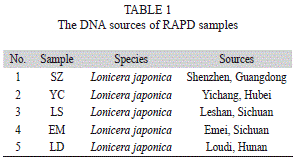
<body><![CDATA[<font style="font-weight: bold;" size="2"><span      style="font-family: verdana;">Extraction of </span></font><font      style="font-weight: bold;" size="2"><span style="font-family: verdana;"><span      style="font-style: italic;">L. japonica</span></span></font><font      size="2"><span style="font-family: verdana;"><span      style="font-weight: bold;"> DNA: </span>The     DNAs were extracted from fresh young leaves of different samples of </span></font><font      size="2"><span style="font-family: verdana;"><span      style="font-style: italic;">L. japonica</span></span></font><font      size="2"><span style="font-family: verdana;"> (<a href="#Table1">Table     ]]></body>
<body><![CDATA[1</a>) by using previously described method, diluted with a     final concentration of 10ng/&#956;L and stored at -20&deg;C until use (Fu et     al., 2013).</span></font><br style="font-family: verdana;">     <br>     <div style="text-align: center;"><a name="Table1"></a><img alt=""  src="/img/revistas/rbt/v62n4/a30t1.gif"  style="width: 297px; height: 160px;">    <br>     </div>     <br style="font-family: verdana;">     <font size="2"><span style="font-family: verdana;"><span      style="font-weight: bold;">Amplification of DNA     ]]></body>
<body><![CDATA[by improved     RAPD:</span> The improved RAPD PCR were ini- tially&nbsp;     amplified&nbsp;     with&nbsp; random&nbsp; primers&nbsp; SBC- Q2 and SBC-I10 using above     mentioned </span></font><font size="2"><span      style="font-family: verdana;"><span style="font-style: italic;">L.     japonica</span></span></font><font size="2"><span      style="font-family: verdana;"> DNAs with Tiangen reagents (Beijing,     China). A     total 15&#956;L PCR reaction system was consisted of 7.5&#956;L 2&times;Taq PCR     ]]></body>
<body><![CDATA[MasterMix, 1.5&#956;L 2.5&#956;M primer, 1.5&#956;L genomic DNA, and with ddH<sub>2</sub>O.     Amplification reactions were per- formed by using &#8220;Applied Biosystems     Veriti&reg; 96-Well Thermal Cycler&#8221; (Life Technology, USA), with the     following steps: initial denaturation at 95&deg;C for 90s, 40 cycles of     denaturation at 94&deg;C for 40s, annealing at 36&deg;C with the RAMP     rate from annealing to extension was adjusted to 0.125&ordm;C/s (5%     ramp rate) for 60s, extension at 72&deg;C for 90s, and a final     extension step at 72&deg;C for 5min. PCR products were detected with     1.5% agarose gel electrophoresis.</span></font><br      style="font-family: verdana;">     ]]></body>
<body><![CDATA[<font size="2"></font><br style="font-family: verdana;">     <font size="2"><span style="font-family: verdana;"><span      style="font-weight: bold;">Cloning and     sequencing of DNA     fragments:</span> Two different bright bands were excised from agarose     gel,     purified by using TIANgel Mini&nbsp; Purification&nbsp; Kit&nbsp;     (DP209,&nbsp; China).&nbsp; Puri- fied DNA fragments were ligated into     pGM-T vector (No. VT202, Tiangen reagents, Beijing, China), and     transformed into DH5&#945; E. coli competent cells. The recombinant clones     ]]></body>
<body><![CDATA[were selected on LB agar plates containing 100&#956;g/ &#956;L of ampicillin,     40mg of X-gal and 160&#956;g of IPTG. The white colonies were screened out     by blue white screening. The presence of right insert was verified by     PCR by using T7/SP6 primer pairs (T7 primer: 5&#8217;-TAATACGACT-     CACTATAGGG-3&#8217;, SP6 primer: 5&#8217;-ATTTAG- GTGACACTATAGAA-3&#8217;),&nbsp;     which&nbsp; is&nbsp; located at pGM-T vector near to the ligation ends,     and <span style="font-style: italic;">EcoRI</span> digestion (Fu,     2012). The cloned DNA fragments were then     sequenced by Sanger method.&nbsp; The&nbsp; homology&nbsp; of&nbsp;     sequenced&nbsp; DNA was searched and analyzed by the online pro- gram     ]]></body>
<body><![CDATA[BLAST (http://www.ncbi.nlm.nih.gov/     BLAST/) in different species.</span></font><br      style="font-family: verdana;">     <font size="2"></font><br style="font-family: verdana;">     <font size="2"><span style="font-family: verdana;"><span      style="font-weight: bold;">SCAR primer design:</span>     The nucleotide     sequence of each of the cloned RAPD fragment was used to design pairs     of SCAR primers using Primer 3 (http://bioinfo.ut.ee/     primer3-0.4.0/primer3/) and sequences of each primer&nbsp;     ]]></body>
<body><![CDATA[and&nbsp;     amplification&nbsp; length&nbsp; were&nbsp; listed in <a      href="/img/revistas/rbt/v62n4/a30t2.gif">table 2</a>.</span></font><br      style="font-family: verdana;">     <font size="2"></font><br style="font-family: verdana;">     <font size="2"><span style="font-family: verdana;"><span      style="font-weight: bold;">Development SCAR     markers and SCAR     analysis:</span> To develop SCAR markers, the PCR amplification was     performed,     ]]></body>
<body><![CDATA[where the content of 10&#956;L PCR reaction system was as follows: 5&#956;L     2&times;Taq PCR MasterMix, 1&#956;L of 2.5&#956;M each pair of SCAR primers and     1&#956;L genomic DNA (10ng), the remaining volumes were filled by ddH2O. PCR     was performed by using&nbsp; &#8220;Applied&nbsp; Biosystems&nbsp;     Veriti&reg;&nbsp; 96-Well Thermal Cycler&#8221; (Life Technology, USA) with     an initial pre-denaturation for 90s at 95&deg;C, followed by 35 cycles     of denaturation at 94&deg;C for&nbsp; 40s,&nbsp; annealing&nbsp;     at&nbsp; different&nbsp; temperatures 54&deg;C, 57&deg;C, 60&deg;C,     63&deg;C or 66&deg;C for 30s, and extension&nbsp; at&nbsp;     72&deg;C&nbsp; for&nbsp; 40s. The&nbsp; final&nbsp; exten- sion step     ]]></body>
<body><![CDATA[was performed at 72&deg;C for 5 min. The amplified PCR products were     separated by&nbsp; electrophoresis&nbsp; on&nbsp; 1.0%&nbsp;     agarose&nbsp; gel&nbsp; in 1&times;TAE buffer. Gels were visualized by     0.5&#956;g/ mL ethidium bromide staining, and the images were documented     using the ChemiDoc XRS (Bio-Rad, USA). Sequences of the SCAR primers,     amplified length and PCR condition were included in <a      href="/img/revistas/rbt/v62n4/a30t2.gif">table 2</a>.</span></font><br      style="font-family: verdana;">     <font size="2"></font><br style="font-family: verdana;">     <font size="2"><span style="font-family: verdana;">To distinguish the     ]]></body>
<body><![CDATA[difference     between the varieties of </span></font><font size="2"><span      style="font-family: verdana;"><span style="font-style: italic;">L.     japonica</span></span></font><font size="2"><span      style="font-family: verdana;"> and other species, the SCAR&nbsp;     analysis&nbsp; was&nbsp; performed&nbsp; by&nbsp; using&nbsp; 20 DNA     samples as templates, including five samples of </span></font><font      size="2"><span style="font-family: verdana;"><span      style="font-style: italic;">L. japonica</span></span></font><font      size="2"><span style="font-family: verdana;"> which were     ]]></body>
<body><![CDATA[described previously (Fu et al., 2013), five samples of <span      style="font-style: italic;">D. longan</span>     collected from Sichuan, Guang- dong, Guangxi, Fujian and Hainan (Yang,     Fu, Khan, Zeng, &amp; Fu 2013; Mei et al., 2014), five samples of <span      style="font-style: italic;">C.     album</span> collected from Luzhou City, Gastrodia elata collected from     Liangshan City in Sichuan Province (Mei et al., 2014), <span      style="font-style: italic;">P. chinese</span>     collected from Gulin County in Sich- uan province, <span      style="font-style: italic;">P. sedoides, D.     ]]></body>
<body><![CDATA[confinis</span> collected from Guangxi source of wild, and <span      style="font-style: italic;">V. philippica </span>(Yang     et al., 2013). PCR amplifications were performed by using above     mentioned 2 pairs of SCAR primers and amplification conditions in <a      href="/img/revistas/rbt/v62n4/a30t2.gif">table     2</a>.</span></font><br style="font-family: verdana;">     <font size="2"></font><br style="font-family: verdana;">     <font style="font-weight: bold;" size="3"><span      style="font-family: verdana;">Results</span></font><br      style="font-family: verdana;">     ]]></body>
<body><![CDATA[<font size="2"></font><br style="font-family: verdana;">     <font size="2"><span style="font-family: verdana;"><span      style="font-weight: bold;">Cloning of RAPD     fragments:</span> Two RAPD     primers, SBC-Q2 (Q2) and SBC-I10 (I10), were used to improve RAPD     amplification from five DNA samples of </span></font><font size="2"><span      style="font-family: verdana;"><span style="font-style: italic;">L.     japonica</span></span></font><font size="2"><span      style="font-family: verdana;">, which were     collected from Shenzhen City of Guangdong Province, Yichang City of     ]]></body>
<body><![CDATA[Hubei Province, Leshan and Emei City of Sichuan Province and Loudi City     of Hunan Province, respectively (Fu et al., 2013). The results are     shown in the <a href="/img/revistas/rbt/v62n4/a30i1.jpg">figure 1</a>,     the black arrows indi- cated bands labeled with     JYH3 in primer Q2 (<a href="/img/revistas/rbt/v62n4/a30i1.jpg">Fig. 1A</a>)     and labeled with JYH4 in primer I10 (<a      href="/img/revistas/rbt/v62n4/a30i1.jpg">Fig.     1B</a>). The DNA bands with black arrows were cut from the agarose gel,     purified, ligated to T-vector by AT cloning, and under black and white     screening method. The positive clones were then identified by plasmid     ]]></body>
<body><![CDATA[DNA digestion using <span style="font-style: italic;">EcoRI</span>     enzyme in clones JYH 3-3 (<a href="/img/revistas/rbt/v62n4/a30i1.jpg">Fig.     1C</a>) and JYH     4-3 (<a href="/img/revistas/rbt/v62n4/a30i1.jpg">Fig. 1C</a>), or by     PCR     amplification using SP6 primer and T7 primer     in clone JYH 4-3 (<a href="/img/revistas/rbt/v62n4/a30i1.jpg">Fig. 1E</a>).     In the <a href="/img/revistas/rbt/v62n4/a30i1.jpg">figure 1C</a>,     clone     JYH 3-3, which     ]]></body>
<body><![CDATA[showed with a similar ~600-700bp inserted&nbsp; DNA-fragment,&nbsp;     was&nbsp; sequenced.&nbsp; In the <a      href="/img/revistas/rbt/v62n4/a30i1.jpg">figure 1E</a>, clones JYH4-1,     JYH4-2,     JYH4-3 showed PCR band with a similar ~300bp inserted&nbsp;     DNA-fragment,&nbsp; and&nbsp; clone&nbsp; JYH4-3 was verified by EcoR I     digestion (<a href="/img/revistas/rbt/v62n4/a30i1.jpg">Fig. 1D</a>),     and     was selected for further sequencing.</span></font><br      style="font-family: verdana;">     ]]></body>
<body><![CDATA[<font size="2"></font><br style="font-family: verdana;">     <font style="font-weight: bold;" size="2"><span      style="font-family: verdana;">Sequences and     characterization of </span></font><font style="font-weight: bold;"      size="2"><span style="font-family: verdana;"><span      style="font-style: italic;">L. japonica</span></span></font><font      size="2"><span style="font-family: verdana;"><span      style="font-weight: bold;">-specific RAPD fragments:</span> Sequencing     of the above two cloned     RAPD fragments of </span></font><font size="2"><span     ]]></body>
<body><![CDATA[ style="font-family: verdana;"><span style="font-style: italic;">L.     japonica</span></span></font><font size="2"><span      style="font-family: verdana;"> revealed that the clone JYH4-3     consisted     of 589 nucleotides and was deposited into GenBank with accession number     KF698799 (<a href="/img/revistas/rbt/v62n4/a30i2.jpg">Fig. 2A</a>), and     the clone JYH4-3 consisted of 308 nucleotides     and was deposited into GenBank with accession number KF698800 (<a      href="/img/revistas/rbt/v62n4/a30i2.jpg">Fig.     2B</a>). BLAST searches of the nucleotide sequences in GenBank showed     ]]></body>
<body><![CDATA[that     458 nucleotides of clone JYH3-3 fragment (nucleotides 8 to 588) shared     78% identity to the mRNA of&nbsp; Vitis&nbsp; vinifera&nbsp;     probable&nbsp; receptor-like&nbsp; protein kinase At1g67000-like     (LOC100253816) (Sequence&nbsp; ID:&nbsp; ref|XM_002268656.2|)&nbsp;     with an&nbsp; E&nbsp; value&nbsp; 4e-97&nbsp; (<a      href="/img/revistas/rbt/v62n4/a30i2.jpg">Fig.&nbsp; 2C</a>).     The&nbsp; nucleotide sequences of clone JYH 4-3 fragment did not show     any identity to that of any species (data not shown).</span></font><br      style="font-family: verdana;">     ]]></body>
<body><![CDATA[<font size="2"></font><br style="font-family: verdana;">     <font style="font-weight: bold;" size="2"><span      style="font-family: verdana;">Development of </span></font><font      style="font-weight: bold;" size="2"><span style="font-family: verdana;"><span      style="font-style: italic;">L. japonica</span></span></font><font      size="2"><span style="font-family: verdana;"><span      style="font-weight: bold;">-specific     SCAR markers JYH3-3 and JYH4-3:</span> To generate a stable </span></font><font      size="2"><span style="font-family: verdana;"><span      style="font-style: italic;">L. japonica</span></span></font><font     ]]></body>
<body><![CDATA[ size="2"><span style="font-family: verdana;">-specific diagnostic SCAR     markers from RAPD markers, two pairs     of primers (JYH 3-3L and JYH 3-3R; JYH 4-3L and JYH 4-3R) (<a      href="/img/revistas/rbt/v62n4/a30t2.gif">Table 2</a>)     were designed and synthesized based on cloned sequences in <a      href="/img/revistas/rbt/v62n4/a30i2.jpg">figure 2</a>.     The PCR amplification results&nbsp; with&nbsp; different&nbsp;     annealing&nbsp; temperature are shown in <a      href="/img/revistas/rbt/v62n4/a30i3.jpg">figure 3 A</a>, <a      href="/img/revistas/rbt/v62n4/a30i3.jpg">figure 3 B</a>, which     ]]></body>
<body><![CDATA[indicates that annealing with 63&deg;C have better specific     amplification in SCAR maker JYH3-3&nbsp; with&nbsp; expected&nbsp;     size&nbsp; (<a href="/img/revistas/rbt/v62n4/a30i3.jpg">Fig.&nbsp; 3 A</a>),&nbsp;     and with 60&deg;C have better     amplification in SCAR maker JYH4-3 with expected size in the </span></font><font      size="2"><span style="font-family: verdana;"><span      style="font-style: italic;">L. japonica</span></span></font><font      size="2"><span style="font-family: verdana;"> samples (<a      href="/img/revistas/rbt/v62n4/a30i3.jpg">Fig. 3 B</a>). Negative     control (NC) without DNA template     ]]></body>
<body><![CDATA[did not show any PCR products. Therefore, </span></font><font size="2"><span      style="font-family: verdana;"><span style="font-style: italic;">L.     japonica</span></span></font><font size="2"><span      style="font-family: verdana;">-specific SCAR     markers were developed. The sequences of SCAR primers, amplified length     and PCR condition are shown in <a      href="/img/revistas/rbt/v62n4/a30t2.gif">table 2</a>.</span></font><br      style="font-family: verdana;">     <font size="2"></font><br      style="font-family: verdana; font-weight: bold;">     ]]></body>
<body><![CDATA[<font style="font-weight: bold;" size="2"><span      style="font-family: verdana;">Authentication </span></font><font      style="font-weight: bold;" size="2"><span style="font-family: verdana;"><span      style="font-style: italic;">L. japonica</span></span></font><font      size="2"><span style="font-family: verdana;"><span      style="font-weight: bold;">: </span>The     designed SCAR primer pairs were then used to amplify the genomic DNA     from 20 of collected DNA samples to test amplification     species-specificity. The PCR amplification was performed again. The     results indicated that the PCR products with expected size were     ]]></body>
<body><![CDATA[observed in all five of </span></font><font size="2"><span      style="font-family: verdana;"><span style="font-style: italic;">L.     japonica</span></span></font><font size="2"><span      style="font-family: verdana;"> samples by SCAR marker JYH3-3,     without any amplification in other species we tested (<a      href="/img/revistas/rbt/v62n4/a30i3.jpg">Fig. 3C</a>). This     indicates that SCAR marker JYH3-3 is </span></font><font size="2"><span      style="font-family: verdana;"><span style="font-style: italic;">L.     japonica</span></span></font><font size="2"><span      style="font-family: verdana;">-specific. The lack of     ]]></body>
<body><![CDATA[this specific amplicon in the other species indicates the efficacy of     this marker in distinguishing the </span></font><font size="2"><span      style="font-family: verdana;"><span style="font-style: italic;">L.     japonica</span></span></font><font size="2"><span      style="font-family: verdana;"> group from the others.     The PCR results by SCAR marker JYH4-3 indicated that the PCR products     with expected size were observed only in Shenzhen sample of </span></font><font      size="2"><span style="font-family: verdana;"><span      style="font-style: italic;">L. japonica</span></span></font><font      size="2"><span style="font-family: verdana;">, without any     ]]></body>
<body><![CDATA[amplification in other four </span></font><font size="2"><span      style="font-family: verdana;"><span style="font-style: italic;">L.     japonica</span></span></font><font size="2"><span      style="font-family: verdana;"> samples     and in other species we tested (<a      href="/img/revistas/rbt/v62n4/a30i3.jpg">Fig. 3D</a>). This indicated     that the SCAR     marker JYH4-3 is Shenzhen sample-specific. The lack of this specific     amplicon in the samples from Yichang, Leshan, Emei and Loudi city and     other species indicates the efficacy of this marker in distinguishing     ]]></body>
<body><![CDATA[the Shenzhen sample of </span></font><font size="2"><span      style="font-family: verdana;"><span style="font-style: italic;">L.     japonica</span></span></font><font size="2"><span      style="font-family: verdana;"> from other cultivars, as well as     other species.</span></font><br style="font-family: verdana;">     <font size="2"></font><br style="font-family: verdana;">     <font style="font-weight: bold;" size="3"><span      style="font-family: verdana;">Discussion</span></font><br      style="font-family: verdana;">     <font size="2"></font><br style="font-family: verdana;">     ]]></body>
<body><![CDATA[<font size="2"><span style="font-family: verdana;">In modern     bio-molecular science,     molecular marker technologies have become significant tools. These     technologies are helpful for systematic biologists, and very useful to     solve species&nbsp; and&nbsp; population&nbsp; identification&nbsp;     level problems. RAPD is one of the frontline tech- niques, which is     widely used in genetic characterization and identification of any     organism. It is easy to handle; it can reveal high degrees of&nbsp;     polymorphisms;&nbsp; and&nbsp; it&nbsp; does&nbsp; not&nbsp; require     prior DNA sequence information of the species (Williams, Kubelik,     ]]></body>
<body><![CDATA[Livak, Rafalski, &amp; Tingey, 1990; Shakeel, Ilyas &amp; Kazi, 2013;     Noormo-hammadi, Hasheminejad-Ahangarani, Sheidai, Ghasemzadeh-Baraki,     &amp; Alishah, 2013; Fu et al., 2013; Kumar et al., 2013). In recent     years, a number of plants and other organisms have been characterized     genetically by RAPD and improved RAPD analysis (Kumla et al., 2012;     Bhat et al., 2012, Fu et al., 2013). Moreover the potential of RAPD has     also been proven in the study of genetic diversity in newly found or     synthetic species of organisms, which are important both in agriculture     and industry (Shakeel et al., 2013). It has been established that     conversion of RAPD markers into SCAR markers can improve the     ]]></body>
<body><![CDATA[specificity and stability, which makes this technique more convenient     and efficient in the testing of different alleles (Rajesh et al.,     2013). As SCAR markers can identify a single or a few bands instead of     a complex pattern, they are more straightforward than RAPD, SSR, ISSR     and AFLP. So identification of any organism becomes more authentic and     well-verified if RAPD analysis is combined to SCAR marker technology.</span></font><br      style="font-family: verdana;">     <font size="2"></font><br style="font-family: verdana;">     <font size="2"><span style="font-family: verdana;">The recent     resurgence of     ]]></body>
<body><![CDATA[traditional medicine research has significant importance in modern     biomedical research. For this, identification and characterization of     medicinal plants is of emerging importance among the group of     biologists. </span></font><font size="2"><span      style="font-family: verdana;"><span style="font-style: italic;">L.     japonica</span></span></font><font size="2"><span      style="font-family: verdana;"> is a well-known Chinese and&nbsp;     Japanese&nbsp; traditional&nbsp; medicinal&nbsp; plant.&nbsp; In a     recent study, an improved RAPD analysis have&nbsp; reported&nbsp;     the&nbsp; genetic&nbsp; distance&nbsp; between the samples of this     ]]></body>
<body><![CDATA[plant collected from different geographic locations of China (Fu et     al., 2013). Here in this study, we have generated SCAR markers from the     cloning of previously developed RAPD&nbsp; markers (Fu&nbsp; et al.,     2013). For this we have also optimized the anneal- ing temperature, and     we found that at 60oC, or 63oC, amplification was better than other     that in other temperatures (<a href="/img/revistas/rbt/v62n4/a30t2.gif">Table     2</a>). This study reports that the     marker JYH3-3 is specific to the DNAs from all </span></font><font      size="2"><span style="font-family: verdana;"><span      style="font-style: italic;">L. japonica</span></span></font><font     ]]></body>
<body><![CDATA[ size="2"><span style="font-family: verdana;"> samples, as     they showed no PCR amplification in DNA of other plants used in this     study (D. longan, C. album, Gastrodia elata, P. chinese, P. sedoides,     D. confinis, V. philippica). Interestingly, another marker JYH4-3 was     found to be Shenzhen sample-specific. This finding reflects our     previous study (Fu et al., 2013), where we reported that Shenzhen is     geographically far-isolated from other regions, and possess high level     of genetic distance. This study actually validates the improved RAPD     analysis result of our previous study, as well as establishes specific     molecular markers (SCAR) to distinguish </span></font><font size="2"><span     ]]></body>
<body><![CDATA[ style="font-family: verdana;"><span style="font-style: italic;">L.     japonica</span></span></font><font size="2"><span      style="font-family: verdana;"> from other plants,     and even to differ- entiate within species. According to the best of     our knowledge, this is the first RAPD-SCAR study on </span></font><font      size="2"><span style="font-family: verdana;"><span      style="font-style: italic;">L. japonica</span></span></font><font      size="2"><span style="font-family: verdana;">     identification. However, some studies have reported the RAPD-SCAR     technique for the identification and authentication of other organisms     ]]></body>
<body><![CDATA[like pepper (Jiang, Jianhua, &amp; Li, 2009), longan fruits (Yang et     al., 2013), shrimp (Dutta et al., 2014), silkworm (Dutta et al., 2012),     microbes (Lee, Lee, Lee &amp; Lee, 2013) among others. </span></font><br      style="font-family: verdana;">     <font size="2"></font><br style="font-family: verdana;">     <font size="2"><span style="font-family: verdana;">This study     sucessfully developed     specific SCAR markers for the identification of the medicinal&nbsp;     plants&nbsp; of&nbsp; </span></font><font size="2"><span      style="font-family: verdana;"><span style="font-style: italic;">L.     ]]></body>
<body><![CDATA[japonica</span></span></font><font size="2"><span      style="font-family: verdana;">.&nbsp; This&nbsp; study also     indicated that improved RAPD analysis is a potential molecular     technique for the genetic characterization and identification of any     species, and when the RAPD fragments are cloned and generated to SCAR     markers, they can serve as&nbsp; more&nbsp; specific&nbsp;     molecular&nbsp; markers.&nbsp; Thus, combining these two molecular     marker techniques can provide a simple and reliable tool for the     genetic characterization, identification, authentication of other     medicinal plants as well as any other plant species.</span></font><br     ]]></body>
<body><![CDATA[ style="font-family: verdana;">     <font size="2"></font><br style="font-family: verdana;">     <font style="font-weight: bold;" size="3"><span      style="font-family: verdana;">Acknowledgments</span></font><br      style="font-family: verdana;">     <font size="2"></font><br style="font-family: verdana;">     <font size="2"><span style="font-family: verdana;">This research was     supported in part     by the National Natural Science Foundation of China (30371493 and     81172049), the Science and Technology Innovation Team of Colleges and     ]]></body>
<body><![CDATA[Universities in Sichuan Province (13TD0032), and the Health Department     Foundation of Sichuan Province (130261). The authors particularly thank     all individuals who provided DNAs or leaves for </span></font><font      size="2"><span style="font-family: verdana;"><span      style="font-style: italic;">L. japonica</span></span></font><font      size="2"><span style="font-family: verdana;"> and other     species.</span></font><br style="font-family: verdana;">     <br style="font-family: verdana;">     <hr style="width: 100%; height: 2px;"><font style="font-weight: bold;"      size="3"><span style="font-family: verdana;">References</span></font><br     ]]></body>
<body><![CDATA[ style="font-family: verdana;">     <br style="font-family: verdana;">     <!-- ref --><div style="text-align: left;"><font size="2"><span  style="font-family: verdana;">Agarwal, M., Shrivastava, N., &amp; Padh, H. (2008). Advances in molecular marker techniques and their appli- cations in plant sciences. <span style="font-style: italic;">Plant Cell Reports, 27</span>(4), 617-631.    &nbsp;&nbsp;&nbsp;&nbsp;&nbsp;&nbsp;&nbsp;&nbsp;[&#160;<a href="javascript:void(0);" onclick="javascript: window.open('/scielo.php?script=sci_nlinks&ref=1575694&pid=S0034-7744201400040003000001&lng=','','width=640,height=500,resizable=yes,scrollbars=1,menubar=yes,');">Links</a>&#160;]<!-- end-ref --><!-- ref --></span></font><br  style="font-family: verdana;"> <br style="font-family: verdana;"> <font size="2"><span style="font-family: verdana;">Bhat, A. A., Haniffa, M. A., Divya, P. R., Gopalakrishnan, A., Milton, M. J., Kumar, R., &amp; Paray, B. A. (2012). Molecular characterization of eight Indian Snake-head species (Pisces: Perciformes Channidae) using RAPD markers. <span  style="font-style: italic;">Molecular Biology Reports, 39</span>(4), 4267-4273.    &nbsp;&nbsp;&nbsp;&nbsp;&nbsp;&nbsp;&nbsp;&nbsp;[&#160;<a href="javascript:void(0);" onclick="javascript: window.open('/scielo.php?script=sci_nlinks&ref=1575695&pid=S0034-7744201400040003000002&lng=','','width=640,height=500,resizable=yes,scrollbars=1,menubar=yes,');">Links</a>&#160;]<!-- end-ref --><!-- ref --></span></font><br  style="font-family: verdana;"> <br style="font-family: verdana;"> <font size="2"><span style="font-family: verdana;">Chen, W. C., Liou, S. S., Tzeng, T. F., Lee, S. L., &amp; Liu, I. M. (2012). Wound repair and anti-in&#64258;ammatory potential of <span style="font-style: italic;"></span></span></font><font  size="2"><span style="font-family: verdana;"><span  style="font-style: italic;">Lonicera japonica</span></span></font><font  size="2"><span style="font-family: verdana;"><span  style="font-style: italic;"></span> in excision wound-induced rats. <span  style="font-style: italic;">BMC Complementary and Alternative Medicine, 12</span>, 226.    &nbsp;&nbsp;&nbsp;&nbsp;&nbsp;&nbsp;&nbsp;&nbsp;[&#160;<a href="javascript:void(0);" onclick="javascript: window.open('/scielo.php?script=sci_nlinks&ref=1575696&pid=S0034-7744201400040003000003&lng=','','width=640,height=500,resizable=yes,scrollbars=1,menubar=yes,');">Links</a>&#160;]<!-- end-ref --><!-- ref --></span></font><br style="font-family: verdana;"> <br style="font-family: verdana;"> <font size="2"><span style="font-family: verdana;">Cho, W. K., Kim, H., Choi, Y. J., Yim, N. H., Yang, H. J., &amp; Ma, J. Y. (2012). Epimedium koreanum Nakai water extract exhibits antiviral activity against porcine epidermic diarrhea virus in vitro and <span style="font-style: italic;">in vivo</span>. <span style="font-style: italic;">Evidence Based&nbsp; Complementary&nbsp; and&nbsp; Alternative&nbsp; Medicine, 2012,</span> 985151.    &nbsp;&nbsp;&nbsp;&nbsp;&nbsp;&nbsp;&nbsp;&nbsp;[&#160;<a href="javascript:void(0);" onclick="javascript: window.open('/scielo.php?script=sci_nlinks&ref=1575697&pid=S0034-7744201400040003000004&lng=','','width=640,height=500,resizable=yes,scrollbars=1,menubar=yes,');">Links</a>&#160;]<!-- end-ref --><!-- ref --></span></font><br style="font-family: verdana;"> <br style="font-family: verdana;"> <font size="2"><span style="font-family: verdana;">Dnyaneshwar,&nbsp; W.,&nbsp; Preeti,&nbsp; C.,&nbsp; Kalpana,&nbsp; J.,&nbsp; &amp;&nbsp; Bhushan, P. (2006). Development and application of RAPD- SCAR marker for identification of <span style="font-style: italic;">Phyllanthus emblica</span> LINN. <span style="font-style: italic;">Biological &amp; Pharmaceutical Bulletin, 29</span>(11), 2313-2316.    &nbsp;&nbsp;&nbsp;&nbsp;&nbsp;&nbsp;&nbsp;&nbsp;[&#160;<a href="javascript:void(0);" onclick="javascript: window.open('/scielo.php?script=sci_nlinks&ref=1575698&pid=S0034-7744201400040003000005&lng=','','width=640,height=500,resizable=yes,scrollbars=1,menubar=yes,');">Links</a>&#160;]<!-- end-ref --><!-- ref --></span></font><br  style="font-family: verdana;"> <br style="font-family: verdana;"> <font size="2"><span style="font-family: verdana;">Dutta, S. R., Kar, P. K., Srivastava, A. K., Sinha, M. K., Shankar, J., &amp; Ghosh, A. K. (2012). Identification of RAPD and SCAR markers associated with yield traits in the Indian tropical tasar silkworm <span  style="font-style: italic;">Antheraea mylitta drury.</span> <span style="font-style: italic;">Genetics and Molecular Biology, 35</span>(4), 743-751.    &nbsp;&nbsp;&nbsp;&nbsp;&nbsp;&nbsp;&nbsp;&nbsp;[&#160;<a href="javascript:void(0);" onclick="javascript: window.open('/scielo.php?script=sci_nlinks&ref=1575699&pid=S0034-7744201400040003000006&lng=','','width=640,height=500,resizable=yes,scrollbars=1,menubar=yes,');">Links</a>&#160;]<!-- end-ref --><!-- ref --></span></font><br style="font-family: verdana;"> <br style="font-family: verdana;"> <font size="2"><span style="font-family: verdana;">Dutta, S., Biswas, S., Mukherjee, K., Chakrabarty, U., Mallik, A., &amp; Mandal, N. (2014). Identification of RAPD-SCAR marker linked to white spot syndrome virus resistance in populations of giant black tiger shrimp, <span  style="font-style: italic;">Penaeus monodon </span>Fabricius<span style="font-style: italic;">. Journal of Fish Diseases, 37</span>(5), 471-480. doi: 10.1111/jfd.12128.    &nbsp;&nbsp;&nbsp;&nbsp;&nbsp;&nbsp;&nbsp;&nbsp;[&#160;<a href="javascript:void(0);" onclick="javascript: window.open('/scielo.php?script=sci_nlinks&ref=1575700&pid=S0034-7744201400040003000007&lng=','','width=640,height=500,resizable=yes,scrollbars=1,menubar=yes,');">Links</a>&#160;]<!-- end-ref --><!-- ref --></span></font><br style="font-family: verdana;"> <br style="font-family: verdana;"> <font size="2"><span style="font-family: verdana;">Frankham, R. (2008). Genetic adaptation to captivity in species conservation programs. <span  style="font-style: italic;">Molecular Ecology, 17</span>(1), 325-333.    &nbsp;&nbsp;&nbsp;&nbsp;&nbsp;&nbsp;&nbsp;&nbsp;[&#160;<a href="javascript:void(0);" onclick="javascript: window.open('/scielo.php?script=sci_nlinks&ref=1575701&pid=S0034-7744201400040003000008&lng=','','width=640,height=500,resizable=yes,scrollbars=1,menubar=yes,');">Links</a>&#160;]<!-- end-ref --><!-- ref --></span></font><br  style="font-family: verdana;"> <br style="font-family: verdana;"> <font size="2"><span style="font-family: verdana;">Fu, J. J. (2012). <span  style="font-style: italic;">Short protocols in medical molecular biology.</span> Beijing: China Medical Science Press.    &nbsp;&nbsp;&nbsp;&nbsp;&nbsp;&nbsp;&nbsp;&nbsp;[&#160;<a href="javascript:void(0);" onclick="javascript: window.open('/scielo.php?script=sci_nlinks&ref=1575702&pid=S0034-7744201400040003000009&lng=','','width=640,height=500,resizable=yes,scrollbars=1,menubar=yes,');">Links</a>&#160;]<!-- end-ref --><!-- ref --></span></font><br style="font-family: verdana;"> <br style="font-family: verdana;"> <font size="2"><span style="font-family: verdana;">Fu, J., Yang, L., Khan, M. A., &amp; Mei, Z. (2013). Genetic characterization and authentication of </span></font><font  size="2"><span style="font-family: verdana;"><span  style="font-style: italic;">Lonicera japonica</span></span></font><font  size="2"><span style="font-family: verdana;"> Thunb. by using improved RAPD analysis. <span style="font-style: italic;">Molecular Biology Reports, 40</span>(10), 5993-5999.    &nbsp;&nbsp;&nbsp;&nbsp;&nbsp;&nbsp;&nbsp;&nbsp;[&#160;<a href="javascript:void(0);" onclick="javascript: window.open('/scielo.php?script=sci_nlinks&ref=1575703&pid=S0034-7744201400040003000010&lng=','','width=640,height=500,resizable=yes,scrollbars=1,menubar=yes,');">Links</a>&#160;]<!-- end-ref --><!-- ref --></span></font><br  style="font-family: verdana;"> <br style="font-family: verdana;"> <font size="2"><span style="font-family: verdana;">Jiang, S., Jianhua, X., &amp; Li, X. (2009). A Study on the RAPD and SCAR Molecular Markers of <span  style="font-style: italic;">Piper </span>Species. <span style="font-style: italic;">Journal of Agriculture and Rural Development in the Tropics and Subtropics, 110</span>(2), 127-135.    &nbsp;&nbsp;&nbsp;&nbsp;&nbsp;&nbsp;&nbsp;&nbsp;[&#160;<a href="javascript:void(0);" onclick="javascript: window.open('/scielo.php?script=sci_nlinks&ref=1575704&pid=S0034-7744201400040003000011&lng=','','width=640,height=500,resizable=yes,scrollbars=1,menubar=yes,');">Links</a>&#160;]<!-- end-ref --><!-- ref --></span></font><br  style="font-family: verdana;"> <br style="font-family: verdana;"> <font size="2"><span style="font-family: verdana;">Kumar, S., Sharma, R., Kumar, V., Govind, K., Vyas, G., &amp; Rathore, A. (2013).Combining molecular-marker and chemical analysis of <span  style="font-style: italic;">Capparis decidua</span> (Capparaceae) in the Thar Desert of Western Rajasthan (India). <span  style="font-style: italic;">Revista de Biolog&iacute;a Tropical, 61</span>(1), 311-320.    &nbsp;&nbsp;&nbsp;&nbsp;&nbsp;&nbsp;&nbsp;&nbsp;[&#160;<a href="javascript:void(0);" onclick="javascript: window.open('/scielo.php?script=sci_nlinks&ref=1575705&pid=S0034-7744201400040003000012&lng=','','width=640,height=500,resizable=yes,scrollbars=1,menubar=yes,');">Links</a>&#160;]<!-- end-ref --><!-- ref --></span></font><br  style="font-family: verdana;"> <br style="font-family: verdana;"> <font size="2"><span style="font-family: verdana;">Kumla, S., Doolgindachbaporn, S., Sudmoon, R., &amp; Sattayasai, N. (2012). Genetic variation, population structure and identification of yellow catfish, Mystus nemurus (C&amp;V) in Thailand using RAPD, ISSR and SCAR&nbsp; marker.&nbsp; <span style="font-style: italic;">Molecular&nbsp; Biology&nbsp; Reports,&nbsp; 39</span>(5), 5201-5210.    &nbsp;&nbsp;&nbsp;&nbsp;&nbsp;&nbsp;&nbsp;&nbsp;[&#160;<a href="javascript:void(0);" onclick="javascript: window.open('/scielo.php?script=sci_nlinks&ref=1575706&pid=S0034-7744201400040003000013&lng=','','width=640,height=500,resizable=yes,scrollbars=1,menubar=yes,');">Links</a>&#160;]<!-- end-ref --><!-- ref --></span></font><br  style="font-family: verdana;"> <br style="font-family: verdana;"> <font size="2"><span style="font-family: verdana;">Lee, D. H., Lee, S. K., Lee, S. Y., &amp; Lee, J. K. (2013). Development of SCAR Markers for the Identification of Phytophthora katsurae Causing Chestnut Ink Disease in Korea. <span style="font-style: italic;">Mycobiology, 41</span>(2), 86-93.    &nbsp;&nbsp;&nbsp;&nbsp;&nbsp;&nbsp;&nbsp;&nbsp;[&#160;<a href="javascript:void(0);" onclick="javascript: window.open('/scielo.php?script=sci_nlinks&ref=1575707&pid=S0034-7744201400040003000014&lng=','','width=640,height=500,resizable=yes,scrollbars=1,menubar=yes,');">Links</a>&#160;]<!-- end-ref --><!-- ref --></span></font><br style="font-family: verdana;"> <br style="font-family: verdana;"> <font size="2"><span style="font-family: verdana;">Li,&nbsp; S.&nbsp; F.,&nbsp; Tang,&nbsp; S.&nbsp; J.,&nbsp; &amp;&nbsp; Cai,&nbsp; W.&nbsp; Q.&nbsp; (2010).&nbsp; RAPD- SCAR markers for genetically improved NEW GIFT Nile Tilapia (Oreochrmis niloticus niloticus L.) and their application in strain identification. <span style="font-style: italic;">Zoological Research, 31</span>(2), 147-153.    &nbsp;&nbsp;&nbsp;&nbsp;&nbsp;&nbsp;&nbsp;&nbsp;[&#160;<a href="javascript:void(0);" onclick="javascript: window.open('/scielo.php?script=sci_nlinks&ref=1575708&pid=S0034-7744201400040003000015&lng=','','width=640,height=500,resizable=yes,scrollbars=1,menubar=yes,');">Links</a>&#160;]<!-- end-ref --><!-- ref --></span></font><br  style="font-family: verdana;"> <br style="font-family: verdana;"> <font size="2"><span style="font-family: verdana;">Liu, W., Li, L., Khan, M. A., &amp; Zhu, F. (2012). Popular molecular markers in bacteria. <span  style="font-style: italic;">Molecular Genetics, Microbiology &amp; Virology, 27</span>(3), 103-107.    &nbsp;&nbsp;&nbsp;&nbsp;&nbsp;&nbsp;&nbsp;&nbsp;[&#160;<a href="javascript:void(0);" onclick="javascript: window.open('/scielo.php?script=sci_nlinks&ref=1575709&pid=S0034-7744201400040003000016&lng=','','width=640,height=500,resizable=yes,scrollbars=1,menubar=yes,');">Links</a>&#160;]<!-- end-ref --><!-- ref --></span></font><br  style="font-family: verdana;"> <br style="font-family: verdana;"> <font size="2"><span style="font-family: verdana;">Mei, Z., Fu, S., Yu, H., Yang L., Duan, C., Liu, Y., Gong, S., &amp; Fu, J. (2014). Genetic characterization and authentication of <span  style="font-style: italic;">Dimocarpus longan</span> Lour. using an improved RAPD technique. <span style="font-style: italic;">Genetics and Molecular Research, 13</span>(1), 1447-1455.    &nbsp;&nbsp;&nbsp;&nbsp;&nbsp;&nbsp;&nbsp;&nbsp;[&#160;<a href="javascript:void(0);" onclick="javascript: window.open('/scielo.php?script=sci_nlinks&ref=1575710&pid=S0034-7744201400040003000017&lng=','','width=640,height=500,resizable=yes,scrollbars=1,menubar=yes,');">Links</a>&#160;]<!-- end-ref --><!-- ref --></span></font><br style="font-family: verdana;"> <br style="font-family: verdana;"> <font size="2"><span style="font-family: verdana;">Mei, Z., Yang, L., Zhang, T., Yu, H., Gan, L., Zhang, L., Yang, M., &amp; Fu, J. (2014). Improved RAPD Analysis of <span style="font-style: italic;">Canarium album</span> (Lour.) Raeusch from Sichuan Province along Yangtze River in China. <span style="font-style: italic;">Annual Research &amp; Review in Biology, 4</span>(1), 51-60.    &nbsp;&nbsp;&nbsp;&nbsp;&nbsp;&nbsp;&nbsp;&nbsp;[&#160;<a href="javascript:void(0);" onclick="javascript: window.open('/scielo.php?script=sci_nlinks&ref=1575711&pid=S0034-7744201400040003000018&lng=','','width=640,height=500,resizable=yes,scrollbars=1,menubar=yes,');">Links</a>&#160;]<!-- end-ref --><!-- ref --></span></font><br style="font-family: verdana;"> <br style="font-family: verdana;"> <font size="2"><span style="font-family: verdana;">Noormohammadi, Z., Hasheminejad-Ahangarani, F. Y., Sheidai, M., Ghasemzadeh-Baraki, A. S., &amp; Alishah, O. (2013). Genetic diversity analysis in Opal cotton hybrids based on SSR, ISSR, and RAPD markers. <span  style="font-style: italic;">Genetics and Molecular Research, 12</span>(1), 256-269.    &nbsp;&nbsp;&nbsp;&nbsp;&nbsp;&nbsp;&nbsp;&nbsp;[&#160;<a href="javascript:void(0);" onclick="javascript: window.open('/scielo.php?script=sci_nlinks&ref=1575712&pid=S0034-7744201400040003000019&lng=','','width=640,height=500,resizable=yes,scrollbars=1,menubar=yes,');">Links</a>&#160;]<!-- end-ref --><!-- ref --></span></font><br  style="font-family: verdana;"> <br style="font-family: verdana;"> <font size="2"><span style="font-family: verdana;">Park, H. S., Park, K. I., Lee, D. H., Kang, S. R., Nagappan, A., Kim, J. A., Kim, E. H., Lee, W. S., Shin, S. C., Hah, Y. S., &amp; Kim, G. S. (2012). Polyphenolic extract isolated from Korean </span></font><font size="2"><span  style="font-family: verdana;"><span style="font-style: italic;">Lonicera japonica</span></span></font><font size="2"><span  style="font-family: verdana;"> Thunb. Induce G2/M cell cycle arrest and apoptosis in HepG2 cells: involvements of PI3 K/Akt and MAPKs. <span style="font-style: italic;">Food and Chemical Toxicology, 50</span>(7), 2407-2416.    &nbsp;&nbsp;&nbsp;&nbsp;&nbsp;&nbsp;&nbsp;&nbsp;[&#160;<a href="javascript:void(0);" onclick="javascript: window.open('/scielo.php?script=sci_nlinks&ref=1575713&pid=S0034-7744201400040003000020&lng=','','width=640,height=500,resizable=yes,scrollbars=1,menubar=yes,');">Links</a>&#160;]<!-- end-ref --><!-- ref --></span></font><br style="font-family: verdana;"> <br style="font-family: verdana;"> <font size="2"><span style="font-family: verdana;">Rajesh, M. K., Jerard, B. A., Preethi, P., Thomas, R. J., Fayas, T. P., Rachana, K. E., &amp; Karun, A. (2013). Development of a RAPD-derived SCAR marker associated with tall-type palm trait in coconut. <span style="font-style: italic;">Scientia Horticulturae, 150</span>, 312-316.    &nbsp;&nbsp;&nbsp;&nbsp;&nbsp;&nbsp;&nbsp;&nbsp;[&#160;<a href="javascript:void(0);" onclick="javascript: window.open('/scielo.php?script=sci_nlinks&ref=1575714&pid=S0034-7744201400040003000021&lng=','','width=640,height=500,resizable=yes,scrollbars=1,menubar=yes,');">Links</a>&#160;]<!-- end-ref --><!-- ref --></span></font><br  style="font-family: verdana;"> <br style="font-family: verdana;"> <font size="2"><span style="font-family: verdana;">Shakeel, M., Ilyas, M., &amp; Kazi, M. (2013). Evaluation of synthetic hexaploid wheats (derivative of durum wheats and Aegilops tauschii accessions) for studying genetic diversity using randomly amplified polymorphic DNA (RAPD) markers. <span style="font-style: italic;">Molecular Biology Reports, 40</span>(1), 21-26.    &nbsp;&nbsp;&nbsp;&nbsp;&nbsp;&nbsp;&nbsp;&nbsp;[&#160;<a href="javascript:void(0);" onclick="javascript: window.open('/scielo.php?script=sci_nlinks&ref=1575715&pid=S0034-7744201400040003000022&lng=','','width=640,height=500,resizable=yes,scrollbars=1,menubar=yes,');">Links</a>&#160;]<!-- end-ref --><!-- ref --></span></font><br style="font-family: verdana;"> <br style="font-family: verdana;"> <font size="2"><span style="font-family: verdana;">Williams, J. G., Kubelik, A. R., Livak, K. J., Rafalski, J. A.,&nbsp; &amp; Tingey,&nbsp; S. V.&nbsp; (1990).&nbsp; DNA polymorphisms amplified by arbitrary primers are useful as genetic markers. <span style="font-style: italic;">Nucleic Acids Research, 18</span>(22), 6531-6535.    &nbsp;&nbsp;&nbsp;&nbsp;&nbsp;&nbsp;&nbsp;&nbsp;[&#160;<a href="javascript:void(0);" onclick="javascript: window.open('/scielo.php?script=sci_nlinks&ref=1575716&pid=S0034-7744201400040003000023&lng=','','width=640,height=500,resizable=yes,scrollbars=1,menubar=yes,');">Links</a>&#160;]<!-- end-ref --><!-- ref --></span></font><br  style="font-family: verdana;"> <br style="font-family: verdana;"> <font size="2"><span style="font-family: verdana;">Xiang, T., Xiong, Q. B., Ketut, A. I., Tezuka, Y., Nagaoka, T., Wu, L. J., &amp; Kadota, S. (2001). Studies on the hepatocyte protective activity and the structure- activity relationships of quinic acid and caffeic acid derivatives from the &#64258;ower buds of Lonicera bournei. <span style="font-style: italic;">Planta Medica, 67</span>(4), 322-355.    &nbsp;&nbsp;&nbsp;&nbsp;&nbsp;&nbsp;&nbsp;&nbsp;[&#160;<a href="javascript:void(0);" onclick="javascript: window.open('/scielo.php?script=sci_nlinks&ref=1575717&pid=S0034-7744201400040003000024&lng=','','width=640,height=500,resizable=yes,scrollbars=1,menubar=yes,');">Links</a>&#160;]<!-- end-ref --><!-- ref --></span></font><br  style="font-family: verdana;"> <br style="font-family: verdana;"> <font size="2"><span style="font-family: verdana;">Yang, L., Fu, S., Khan, M. A., Zeng, W., &amp; Fu, J. (2013). Molecular cloning and development of RAPD-SCAR markers for Dimocarpus longan variety authentication. <span style="font-style: italic;">SpringerPlus, 2</span>, 501.    &nbsp;&nbsp;&nbsp;&nbsp;&nbsp;&nbsp;&nbsp;&nbsp;[&#160;<a href="javascript:void(0);" onclick="javascript: window.open('/scielo.php?script=sci_nlinks&ref=1575718&pid=S0034-7744201400040003000025&lng=','','width=640,height=500,resizable=yes,scrollbars=1,menubar=yes,');">Links</a>&#160;]<!-- end-ref --><!-- ref --> </span></font><br  style="font-family: verdana;"> <br style="font-family: verdana;"> <font size="2"><span style="font-family: verdana;">Zhang, H., Song, J., &amp; Shi, J. (2011). Screen anti-in&#64258;uenza virus serum marker of </span></font><font  size="2"><span style="font-family: verdana;"><span  style="font-style: italic;">Lonicera japonica</span></span></font><font  size="2"><span style="font-family: verdana;"> by proteomics technology. <span style="font-style: italic;">Zhongguo Zhong Yao Za Zhi, 36</span>(8), 1071-1074.    &nbsp;&nbsp;&nbsp;&nbsp;&nbsp;&nbsp;&nbsp;&nbsp;[&#160;<a href="javascript:void(0);" onclick="javascript: window.open('/scielo.php?script=sci_nlinks&ref=1575719&pid=S0034-7744201400040003000026&lng=','','width=640,height=500,resizable=yes,scrollbars=1,menubar=yes,');">Links</a>&#160;]<!-- end-ref --></span></font>    <br> <font size="2"><span style="font-family: verdana;"></span></font></div> <font size="2"><span style="font-family: verdana;">    ]]></body>
<body><![CDATA[<br> </span></font><br style="font-family: verdana;">     <div style="text-align: left;"><font size="2"><span  style="font-family: verdana;"><a name="1"></a><a href="#3">1</a>. Research Center for Preclinical Medicine, Luzhou Medical College, Luzhou, Sichuan Province 646000, China; 690199186@qq.com, asadkhanbmj@yahoo.com, xuguangyin1@163.com, yangman0205@126.com, 1517440878@qq.com, weichunli2013@163.com, 47191096@qq.com, 871345204@qq.com, longyan0124@foxmail.com</span></font><br  style="font-family: verdana;"> <br style="font-family: verdana;"> <font size="2"><span style="font-family: verdana;"><a name="2"></a><a  href="#4">2</a>. Research Center for Preclinical Medicine, Luzhou Medical College, Luzhou, Sichuan Province 646000 China, and Forensic Center, Luzhou Medical College, Luzhou, Sichuan 646000, China; fujunjiang@hotmail.com</span></font><br  style="font-family: verdana;"> </div> <hr style="width: 100%; height: 2px;">     <div style="text-align: center;"><font style="font-weight: bold;"  size="2"><span style="font-family: verdana;">Received 17-II-2014.&nbsp;&nbsp;&nbsp;&nbsp;&nbsp;&nbsp;&nbsp; Corrected 22-V-2014.&nbsp;&nbsp;&nbsp;&nbsp;&nbsp;&nbsp; Accepted 25-VI-2014. </span></font>    <br> </div> </div>      ]]></body><back>
<ref-list>
<ref id="B1">
<nlm-citation citation-type="journal">
<person-group person-group-type="author">
<name>
<surname><![CDATA[Agarwal]]></surname>
<given-names><![CDATA[M.]]></given-names>
</name>
<name>
<surname><![CDATA[Shrivastava]]></surname>
<given-names><![CDATA[N.]]></given-names>
</name>
<name>
<surname><![CDATA[Padh]]></surname>
<given-names><![CDATA[H.]]></given-names>
</name>
</person-group>
<source><![CDATA[Plant Cell Reports]]></source>
<year>2008</year>
<volume>27</volume>
<numero>4</numero>
<issue>4</issue>
<page-range>617-631</page-range></nlm-citation>
</ref>
<ref id="B2">
<nlm-citation citation-type="journal">
<person-group person-group-type="author">
<name>
<surname><![CDATA[Bhat]]></surname>
<given-names><![CDATA[A. A.]]></given-names>
</name>
<name>
<surname><![CDATA[Haniffa]]></surname>
<given-names><![CDATA[M. A.]]></given-names>
</name>
<name>
<surname><![CDATA[Divya]]></surname>
<given-names><![CDATA[P. R.]]></given-names>
</name>
<name>
<surname><![CDATA[Gopalakrishnan]]></surname>
<given-names><![CDATA[A.]]></given-names>
</name>
<name>
<surname><![CDATA[Milton]]></surname>
<given-names><![CDATA[M. J.]]></given-names>
</name>
<name>
<surname><![CDATA[Kumar]]></surname>
<given-names><![CDATA[R.]]></given-names>
</name>
<name>
<surname><![CDATA[Paray]]></surname>
<given-names><![CDATA[B. A.]]></given-names>
</name>
</person-group>
<article-title xml:lang="en"><![CDATA[Molecular characterization of eight Indian Snake-head species (Pisces: Perciformes Channidae) using RAPD markers.]]></article-title>
<source><![CDATA[Molecular Biology Reports]]></source>
<year>2012</year>
<volume>39</volume>
<numero>4</numero>
<issue>4</issue>
<page-range>4267-4273</page-range></nlm-citation>
</ref>
<ref id="B3">
<nlm-citation citation-type="journal">
<person-group person-group-type="author">
<name>
<surname><![CDATA[Chen]]></surname>
<given-names><![CDATA[W. C.]]></given-names>
</name>
<name>
<surname><![CDATA[Liou]]></surname>
<given-names><![CDATA[S. S.]]></given-names>
</name>
<name>
<surname><![CDATA[Tzeng]]></surname>
<given-names><![CDATA[T. F.]]></given-names>
</name>
<name>
<surname><![CDATA[Lee]]></surname>
<given-names><![CDATA[S. L.]]></given-names>
</name>
<name>
<surname><![CDATA[Liu]]></surname>
<given-names><![CDATA[I. M.]]></given-names>
</name>
</person-group>
<article-title xml:lang="en"><![CDATA[Wound repair and anti-in&#64258;ammatory potential of Lonicera japonica in excision wound-induced rats.]]></article-title>
<source><![CDATA[BMC Complementary and Alternative Medicine]]></source>
<year>2012</year>
<volume>12</volume>
<page-range>226</page-range></nlm-citation>
</ref>
<ref id="B4">
<nlm-citation citation-type="journal">
<person-group person-group-type="author">
<name>
<surname><![CDATA[Cho]]></surname>
<given-names><![CDATA[W. K.]]></given-names>
</name>
<name>
<surname><![CDATA[Kim]]></surname>
<given-names><![CDATA[H.]]></given-names>
</name>
<name>
<surname><![CDATA[Choi]]></surname>
<given-names><![CDATA[Y. J.]]></given-names>
</name>
<name>
<surname><![CDATA[Yim]]></surname>
<given-names><![CDATA[N. H.]]></given-names>
</name>
<name>
<surname><![CDATA[Yang]]></surname>
<given-names><![CDATA[H. J.]]></given-names>
</name>
<name>
<surname><![CDATA[Ma]]></surname>
<given-names><![CDATA[J. Y.]]></given-names>
</name>
</person-group>
<article-title xml:lang="en"><![CDATA[Epimedium koreanum Nakai water extract exhibits antiviral activity against porcine epidermic diarrhea virus in vitro and in vivo.]]></article-title>
<source><![CDATA[Evidence Based Complementary and Alternative Medicine]]></source>
<year>2012</year>
<volume>2012</volume>
<page-range>985151</page-range></nlm-citation>
</ref>
<ref id="B5">
<nlm-citation citation-type="journal">
<person-group person-group-type="author">
<name>
<surname><![CDATA[Dnyaneshwar]]></surname>
<given-names><![CDATA[W.]]></given-names>
</name>
<name>
<surname><![CDATA[Preeti]]></surname>
<given-names><![CDATA[C.]]></given-names>
</name>
<name>
<surname><![CDATA[Kalpana]]></surname>
<given-names><![CDATA[J.]]></given-names>
</name>
<name>
<surname><![CDATA[Bhushan]]></surname>
<given-names><![CDATA[P.]]></given-names>
</name>
</person-group>
<article-title xml:lang="en"><![CDATA[Development and application of RAPD- SCAR marker for identification of Phyllanthus emblica LINN.]]></article-title>
<source><![CDATA[Biological & Pharmaceutical Bulletin]]></source>
<year>2006</year>
<volume>29</volume>
<numero>11</numero>
<issue>11</issue>
<page-range>2313-2316</page-range></nlm-citation>
</ref>
<ref id="B6">
<nlm-citation citation-type="journal">
<person-group person-group-type="author">
<name>
<surname><![CDATA[Dutta]]></surname>
<given-names><![CDATA[S. R.]]></given-names>
</name>
<name>
<surname><![CDATA[Kar]]></surname>
<given-names><![CDATA[P. K.]]></given-names>
</name>
<name>
<surname><![CDATA[Srivastava]]></surname>
<given-names><![CDATA[A. K.]]></given-names>
</name>
<name>
<surname><![CDATA[Sinha]]></surname>
<given-names><![CDATA[M. K.]]></given-names>
</name>
<name>
<surname><![CDATA[Shankar]]></surname>
<given-names><![CDATA[J.]]></given-names>
</name>
<name>
<surname><![CDATA[Ghosh]]></surname>
<given-names><![CDATA[A. K.]]></given-names>
</name>
</person-group>
<article-title xml:lang="en"><![CDATA[Identification of RAPD and SCAR markers associated with yield traits in the Indian tropical tasar silkworm Antheraea mylitta drury.]]></article-title>
<source><![CDATA[Genetics and Molecular Biology]]></source>
<year>2012</year>
<volume>35</volume>
<numero>4</numero>
<issue>4</issue>
<page-range>743-751</page-range></nlm-citation>
</ref>
<ref id="B7">
<nlm-citation citation-type="journal">
<person-group person-group-type="author">
<name>
<surname><![CDATA[Dutta]]></surname>
<given-names><![CDATA[S.]]></given-names>
</name>
<name>
<surname><![CDATA[Biswas]]></surname>
<given-names><![CDATA[S.]]></given-names>
</name>
<name>
<surname><![CDATA[Mukherjee]]></surname>
<given-names><![CDATA[K.]]></given-names>
</name>
<name>
<surname><![CDATA[Chakrabarty]]></surname>
<given-names><![CDATA[U.]]></given-names>
</name>
<name>
<surname><![CDATA[Mallik]]></surname>
<given-names><![CDATA[A.]]></given-names>
</name>
<name>
<surname><![CDATA[Mandal]]></surname>
<given-names><![CDATA[N.]]></given-names>
</name>
</person-group>
<article-title xml:lang="en"><![CDATA[Identification of RAPD-SCAR marker linked to white spot syndrome virus resistance in populations of giant black tiger shrimp, Penaeus monodon Fabricius.]]></article-title>
<source><![CDATA[Journal of Fish Diseases]]></source>
<year>2014</year>
<volume>37</volume>
<numero>5</numero>
<issue>5</issue>
<page-range>471-480</page-range></nlm-citation>
</ref>
<ref id="B8">
<nlm-citation citation-type="journal">
<person-group person-group-type="author">
<name>
<surname><![CDATA[Frankham]]></surname>
<given-names><![CDATA[R.]]></given-names>
</name>
</person-group>
<article-title xml:lang="en"><![CDATA[Genetic adaptation to captivity in species conservation programs.]]></article-title>
<source><![CDATA[Molecular Ecology]]></source>
<year>2008</year>
<volume>17</volume>
<numero>1</numero>
<issue>1</issue>
<page-range>325-333</page-range></nlm-citation>
</ref>
<ref id="B9">
<nlm-citation citation-type="book">
<person-group person-group-type="author">
<name>
<surname><![CDATA[Fu]]></surname>
<given-names><![CDATA[J. J.]]></given-names>
</name>
</person-group>
<source><![CDATA[Short protocols in medical molecular biology.]]></source>
<year>2012</year>
<publisher-loc><![CDATA[^eBeijing Beijing]]></publisher-loc>
<publisher-name><![CDATA[China Medical Science Press]]></publisher-name>
</nlm-citation>
</ref>
<ref id="B10">
<nlm-citation citation-type="journal">
<person-group person-group-type="author">
<name>
<surname><![CDATA[Fu]]></surname>
<given-names><![CDATA[J.]]></given-names>
</name>
<name>
<surname><![CDATA[Yang]]></surname>
<given-names><![CDATA[L.]]></given-names>
</name>
<name>
<surname><![CDATA[Khan]]></surname>
<given-names><![CDATA[M. A.]]></given-names>
</name>
<name>
<surname><![CDATA[Mei]]></surname>
<given-names><![CDATA[Z.]]></given-names>
</name>
</person-group>
<article-title xml:lang="en"><![CDATA[Genetic characterization and authentication of Lonicera japonica Thunb. by using improved RAPD analysis.]]></article-title>
<source><![CDATA[Molecular Biology Reports]]></source>
<year>2013</year>
<volume>40</volume>
<numero>10</numero>
<issue>10</issue>
<page-range>5993-5999</page-range></nlm-citation>
</ref>
<ref id="B11">
<nlm-citation citation-type="journal">
<person-group person-group-type="author">
<name>
<surname><![CDATA[Jiang]]></surname>
<given-names><![CDATA[S.]]></given-names>
</name>
<name>
<surname><![CDATA[Jianhua]]></surname>
<given-names><![CDATA[X.]]></given-names>
</name>
<name>
<surname><![CDATA[Li]]></surname>
<given-names><![CDATA[X.]]></given-names>
</name>
</person-group>
<article-title xml:lang="en"><![CDATA[A Study on the RAPD and SCAR Molecular Markers of Piper Species.]]></article-title>
<source><![CDATA[Journal of Agriculture and Rural Development in the Tropics and Subtropics]]></source>
<year>2009</year>
<volume>110</volume>
<numero>2</numero>
<issue>2</issue>
<page-range>127-135</page-range></nlm-citation>
</ref>
<ref id="B12">
<nlm-citation citation-type="journal">
<person-group person-group-type="author">
<name>
<surname><![CDATA[Kumar]]></surname>
<given-names><![CDATA[S.]]></given-names>
</name>
<name>
<surname><![CDATA[Sharma]]></surname>
<given-names><![CDATA[R.]]></given-names>
</name>
<name>
<surname><![CDATA[Kumar]]></surname>
<given-names><![CDATA[V.]]></given-names>
</name>
<name>
<surname><![CDATA[Govind]]></surname>
<given-names><![CDATA[K.]]></given-names>
</name>
<name>
<surname><![CDATA[Vyas]]></surname>
<given-names><![CDATA[G.]]></given-names>
</name>
<name>
<surname><![CDATA[Rathore]]></surname>
<given-names><![CDATA[A.]]></given-names>
</name>
</person-group>
<article-title xml:lang="en"><![CDATA[Combining molecular-marker and chemical analysis of Capparis decidua (Capparaceae) in the Thar Desert of Western Rajasthan (India).]]></article-title>
<source><![CDATA[Revista de Biología Tropical]]></source>
<year>2013</year>
<volume>61</volume>
<numero>1</numero>
<issue>1</issue>
<page-range>311-320</page-range></nlm-citation>
</ref>
<ref id="B13">
<nlm-citation citation-type="journal">
<person-group person-group-type="author">
<name>
<surname><![CDATA[Kumla]]></surname>
<given-names><![CDATA[S.]]></given-names>
</name>
<name>
<surname><![CDATA[Doolgindachbaporn]]></surname>
<given-names><![CDATA[S.]]></given-names>
</name>
<name>
<surname><![CDATA[Sudmoon]]></surname>
<given-names><![CDATA[R.]]></given-names>
</name>
<name>
<surname><![CDATA[Sattayasai]]></surname>
<given-names><![CDATA[N.]]></given-names>
</name>
</person-group>
<article-title xml:lang="en"><![CDATA[Genetic variation, population structure and identification of yellow catfish, Mystus nemurus (C&V) in Thailand using RAPD, ISSR and SCAR marker.]]></article-title>
<source><![CDATA[Molecular Biology Reports]]></source>
<year>2012</year>
<volume>39</volume>
<numero>5</numero>
<issue>5</issue>
<page-range>5201-5210</page-range></nlm-citation>
</ref>
<ref id="B14">
<nlm-citation citation-type="journal">
<person-group person-group-type="author">
<name>
<surname><![CDATA[Lee]]></surname>
<given-names><![CDATA[D. H.]]></given-names>
</name>
<name>
<surname><![CDATA[Lee]]></surname>
<given-names><![CDATA[S. K.]]></given-names>
</name>
<name>
<surname><![CDATA[Lee]]></surname>
<given-names><![CDATA[S. Y.]]></given-names>
</name>
<name>
<surname><![CDATA[Lee]]></surname>
<given-names><![CDATA[J. K.]]></given-names>
</name>
</person-group>
<article-title xml:lang="en"><![CDATA[Development of SCAR Markers for the Identification of Phytophthora katsurae Causing Chestnut Ink Disease in Korea.]]></article-title>
<source><![CDATA[Mycobiology]]></source>
<year>2013</year>
<volume>41</volume>
<numero>2</numero>
<issue>2</issue>
<page-range>86-93</page-range></nlm-citation>
</ref>
<ref id="B15">
<nlm-citation citation-type="journal">
<person-group person-group-type="author">
<name>
<surname><![CDATA[Li]]></surname>
<given-names><![CDATA[S. F.]]></given-names>
</name>
<name>
<surname><![CDATA[Tang]]></surname>
<given-names><![CDATA[S. J.]]></given-names>
</name>
<name>
<surname><![CDATA[Cai]]></surname>
<given-names><![CDATA[W. Q.]]></given-names>
</name>
</person-group>
<article-title xml:lang="en"><![CDATA[RAPD- SCAR markers for genetically improved NEW GIFT Nile Tilapia (Oreochrmis niloticus niloticus L.) and their application in strain identification.]]></article-title>
<source><![CDATA[Zoological Research]]></source>
<year>2010</year>
<volume>31</volume>
<numero>2</numero>
<issue>2</issue>
<page-range>147-153</page-range></nlm-citation>
</ref>
<ref id="B16">
<nlm-citation citation-type="journal">
<person-group person-group-type="author">
<name>
<surname><![CDATA[Liu]]></surname>
<given-names><![CDATA[W.]]></given-names>
</name>
<name>
<surname><![CDATA[Li]]></surname>
<given-names><![CDATA[L.]]></given-names>
</name>
<name>
<surname><![CDATA[Khan]]></surname>
<given-names><![CDATA[M. A.]]></given-names>
</name>
<name>
<surname><![CDATA[Zhu]]></surname>
<given-names><![CDATA[F.]]></given-names>
</name>
</person-group>
<article-title xml:lang="en"><![CDATA[Popular molecular markers in bacteria.]]></article-title>
<source><![CDATA[Molecular Genetics, Microbiology & Virology]]></source>
<year>2012</year>
<volume>27</volume>
<numero>3</numero>
<issue>3</issue>
<page-range>103-107</page-range></nlm-citation>
</ref>
<ref id="B17">
<nlm-citation citation-type="journal">
<person-group person-group-type="author">
<name>
<surname><![CDATA[Mei]]></surname>
<given-names><![CDATA[Z.]]></given-names>
</name>
<name>
<surname><![CDATA[Fu]]></surname>
<given-names><![CDATA[S.]]></given-names>
</name>
<name>
<surname><![CDATA[Yu]]></surname>
<given-names><![CDATA[H.]]></given-names>
</name>
<name>
<surname><![CDATA[Yang]]></surname>
<given-names><![CDATA[L.]]></given-names>
</name>
<name>
<surname><![CDATA[Duan]]></surname>
<given-names><![CDATA[C.]]></given-names>
</name>
<name>
<surname><![CDATA[Liu]]></surname>
<given-names><![CDATA[Y.]]></given-names>
</name>
<name>
<surname><![CDATA[Gong]]></surname>
<given-names><![CDATA[S.]]></given-names>
</name>
<name>
<surname><![CDATA[Fu]]></surname>
<given-names><![CDATA[J.]]></given-names>
</name>
</person-group>
<article-title xml:lang="en"><![CDATA[Genetic characterization and authentication of Dimocarpus longan Lour. using an improved RAPD technique.]]></article-title>
<source><![CDATA[Genetics and Molecular Research]]></source>
<year>2014</year>
<volume>13</volume>
<numero>1</numero>
<issue>1</issue>
<page-range>1447-1455</page-range></nlm-citation>
</ref>
<ref id="B18">
<nlm-citation citation-type="journal">
<person-group person-group-type="author">
<name>
<surname><![CDATA[Mei]]></surname>
<given-names><![CDATA[Z.]]></given-names>
</name>
<name>
<surname><![CDATA[Yang]]></surname>
<given-names><![CDATA[L.]]></given-names>
</name>
<name>
<surname><![CDATA[Zhang]]></surname>
<given-names><![CDATA[T.]]></given-names>
</name>
<name>
<surname><![CDATA[Yu]]></surname>
<given-names><![CDATA[H.]]></given-names>
</name>
<name>
<surname><![CDATA[Gan]]></surname>
<given-names><![CDATA[L.]]></given-names>
</name>
<name>
<surname><![CDATA[Zhang]]></surname>
<given-names><![CDATA[L.]]></given-names>
</name>
<name>
<surname><![CDATA[Yang]]></surname>
<given-names><![CDATA[M.]]></given-names>
</name>
<name>
<surname><![CDATA[Fu]]></surname>
<given-names><![CDATA[J.]]></given-names>
</name>
</person-group>
<article-title xml:lang="en"><![CDATA[Improved RAPD Analysis of Canarium album (Lour.) Raeusch from Sichuan Province along Yangtze River in China.]]></article-title>
<source><![CDATA[Annual Research & Review in Biology]]></source>
<year>2014</year>
<volume>4</volume>
<numero>1</numero>
<issue>1</issue>
<page-range>51-60</page-range></nlm-citation>
</ref>
<ref id="B19">
<nlm-citation citation-type="journal">
<person-group person-group-type="author">
<name>
<surname><![CDATA[Noormohammadi]]></surname>
<given-names><![CDATA[Z.]]></given-names>
</name>
<name>
<surname><![CDATA[Hasheminejad-Ahangarani]]></surname>
<given-names><![CDATA[F. Y.]]></given-names>
</name>
<name>
<surname><![CDATA[Sheidai]]></surname>
<given-names><![CDATA[M.]]></given-names>
</name>
<name>
<surname><![CDATA[Ghasemzadeh-Baraki]]></surname>
<given-names><![CDATA[A. S.]]></given-names>
</name>
<name>
<surname><![CDATA[Alishah]]></surname>
<given-names><![CDATA[O.]]></given-names>
</name>
</person-group>
<article-title xml:lang="en"><![CDATA[Genetic diversity analysis in Opal cotton hybrids based on SSR, ISSR, and RAPD markers.]]></article-title>
<source><![CDATA[Genetics and Molecular Research]]></source>
<year>2013</year>
<volume>12</volume>
<numero>1</numero>
<issue>1</issue>
<page-range>256-269</page-range></nlm-citation>
</ref>
<ref id="B20">
<nlm-citation citation-type="journal">
<person-group person-group-type="author">
<name>
<surname><![CDATA[Park]]></surname>
<given-names><![CDATA[H. S.]]></given-names>
</name>
<name>
<surname><![CDATA[Park]]></surname>
<given-names><![CDATA[K. I.]]></given-names>
</name>
<name>
<surname><![CDATA[Lee]]></surname>
<given-names><![CDATA[D. H.]]></given-names>
</name>
<name>
<surname><![CDATA[Kang]]></surname>
<given-names><![CDATA[S. R.]]></given-names>
</name>
<name>
<surname><![CDATA[Nagappan]]></surname>
<given-names><![CDATA[A.]]></given-names>
</name>
<name>
<surname><![CDATA[Kim]]></surname>
<given-names><![CDATA[J. A.]]></given-names>
</name>
<name>
<surname><![CDATA[Kim]]></surname>
<given-names><![CDATA[E. H.]]></given-names>
</name>
<name>
<surname><![CDATA[Lee]]></surname>
<given-names><![CDATA[W. S.]]></given-names>
</name>
<name>
<surname><![CDATA[Shin]]></surname>
<given-names><![CDATA[S. C.]]></given-names>
</name>
<name>
<surname><![CDATA[Hah]]></surname>
<given-names><![CDATA[Y. S.]]></given-names>
</name>
<name>
<surname><![CDATA[Kim]]></surname>
<given-names><![CDATA[G. S.]]></given-names>
</name>
</person-group>
<article-title xml:lang="en"><![CDATA[Polyphenolic extract isolated from Korean Lonicera japonica Thunb. Induce G2/M cell cycle arrest and apoptosis in HepG2 cells: involvements of PI3 K/Akt and MAPKs.]]></article-title>
<source><![CDATA[Food and Chemical Toxicology]]></source>
<year>2012</year>
<volume>50</volume>
<numero>7</numero>
<issue>7</issue>
<page-range>2407-2416</page-range></nlm-citation>
</ref>
<ref id="B21">
<nlm-citation citation-type="journal">
<person-group person-group-type="author">
<name>
<surname><![CDATA[Rajesh]]></surname>
<given-names><![CDATA[M. K.]]></given-names>
</name>
<name>
<surname><![CDATA[Jerard]]></surname>
<given-names><![CDATA[B. A.]]></given-names>
</name>
<name>
<surname><![CDATA[Preethi]]></surname>
<given-names><![CDATA[P.]]></given-names>
</name>
<name>
<surname><![CDATA[Thomas]]></surname>
<given-names><![CDATA[R. J.]]></given-names>
</name>
<name>
<surname><![CDATA[Fayas]]></surname>
<given-names><![CDATA[T. P.]]></given-names>
</name>
<name>
<surname><![CDATA[Rachana]]></surname>
<given-names><![CDATA[K. E.]]></given-names>
</name>
<name>
<surname><![CDATA[Karun]]></surname>
<given-names><![CDATA[A.]]></given-names>
</name>
</person-group>
<article-title xml:lang="en"><![CDATA[Development of a RAPD-derived SCAR marker associated with tall-type palm trait in coconut.]]></article-title>
<source><![CDATA[Scientia Horticulturae]]></source>
<year>2013</year>
<volume>150</volume>
<page-range>312-316</page-range></nlm-citation>
</ref>
<ref id="B22">
<nlm-citation citation-type="journal">
<person-group person-group-type="author">
<name>
<surname><![CDATA[Shakeel]]></surname>
<given-names><![CDATA[M.]]></given-names>
</name>
<name>
<surname><![CDATA[Ilyas]]></surname>
<given-names><![CDATA[M.]]></given-names>
</name>
<name>
<surname><![CDATA[Kazi]]></surname>
<given-names><![CDATA[M.]]></given-names>
</name>
</person-group>
<article-title xml:lang="en"><![CDATA[Evaluation of synthetic hexaploid wheats (derivative of durum wheats and Aegilops tauschii accessions) for studying genetic diversity using randomly amplified polymorphic DNA (RAPD) markers.]]></article-title>
<source><![CDATA[Molecular Biology Reports]]></source>
<year>2013</year>
<volume>40</volume>
<numero>1</numero>
<issue>1</issue>
<page-range>21-26</page-range></nlm-citation>
</ref>
<ref id="B23">
<nlm-citation citation-type="journal">
<person-group person-group-type="author">
<name>
<surname><![CDATA[Williams]]></surname>
<given-names><![CDATA[J. G.]]></given-names>
</name>
<name>
<surname><![CDATA[Kubelik]]></surname>
<given-names><![CDATA[A. R.]]></given-names>
</name>
<name>
<surname><![CDATA[Livak]]></surname>
<given-names><![CDATA[K. J.]]></given-names>
</name>
<name>
<surname><![CDATA[Rafalski]]></surname>
<given-names><![CDATA[J. A.]]></given-names>
</name>
<name>
<surname><![CDATA[Tingey]]></surname>
<given-names><![CDATA[S. V.]]></given-names>
</name>
</person-group>
<article-title xml:lang="en"><![CDATA[DNA polymorphisms amplified by arbitrary primers are useful as genetic markers.]]></article-title>
<source><![CDATA[Nucleic Acids Research]]></source>
<year>1990</year>
<volume>18</volume>
<numero>22</numero>
<issue>22</issue>
<page-range>6531-6535</page-range></nlm-citation>
</ref>
<ref id="B24">
<nlm-citation citation-type="journal">
<person-group person-group-type="author">
<name>
<surname><![CDATA[Xiang]]></surname>
<given-names><![CDATA[T.]]></given-names>
</name>
<name>
<surname><![CDATA[Xiong]]></surname>
<given-names><![CDATA[Q. B.]]></given-names>
</name>
<name>
<surname><![CDATA[Ketut]]></surname>
<given-names><![CDATA[A. I.]]></given-names>
</name>
<name>
<surname><![CDATA[Tezuka]]></surname>
<given-names><![CDATA[Y.]]></given-names>
</name>
<name>
<surname><![CDATA[Nagaoka]]></surname>
<given-names><![CDATA[T.]]></given-names>
</name>
<name>
<surname><![CDATA[Wu]]></surname>
<given-names><![CDATA[L. J.]]></given-names>
</name>
<name>
<surname><![CDATA[Kadota]]></surname>
<given-names><![CDATA[S.]]></given-names>
</name>
</person-group>
<article-title xml:lang="en"><![CDATA[Studies on the hepatocyte protective activity and the structure- activity relationships of quinic acid and caffeic acid derivatives from the &#64258;ower buds of Lonicera bournei.]]></article-title>
<source><![CDATA[Planta Medica]]></source>
<year>2001</year>
<volume>67</volume>
<numero>4</numero>
<issue>4</issue>
<page-range>322-355</page-range></nlm-citation>
</ref>
<ref id="B25">
<nlm-citation citation-type="journal">
<person-group person-group-type="author">
<name>
<surname><![CDATA[Yang]]></surname>
<given-names><![CDATA[L.]]></given-names>
</name>
<name>
<surname><![CDATA[Fu]]></surname>
<given-names><![CDATA[S.]]></given-names>
</name>
<name>
<surname><![CDATA[Khan]]></surname>
<given-names><![CDATA[M. A.]]></given-names>
</name>
<name>
<surname><![CDATA[Zeng]]></surname>
<given-names><![CDATA[W.]]></given-names>
</name>
<name>
<surname><![CDATA[Fu]]></surname>
<given-names><![CDATA[J.]]></given-names>
</name>
</person-group>
<article-title xml:lang="en"><![CDATA[Molecular cloning and development of RAPD-SCAR markers for Dimocarpus longan variety authentication.]]></article-title>
<source><![CDATA[SpringerPlus]]></source>
<year>2013</year>
<volume>2</volume>
<page-range>501</page-range></nlm-citation>
</ref>
<ref id="B26">
<nlm-citation citation-type="journal">
<person-group person-group-type="author">
<name>
<surname><![CDATA[Zhang]]></surname>
<given-names><![CDATA[H.]]></given-names>
</name>
<name>
<surname><![CDATA[Song]]></surname>
<given-names><![CDATA[J.]]></given-names>
</name>
<name>
<surname><![CDATA[Shi]]></surname>
<given-names><![CDATA[J.]]></given-names>
</name>
</person-group>
<article-title xml:lang="en"><![CDATA[Screen anti-in&#64258;uenza virus serum marker of Lonicera japonica by proteomics technology.]]></article-title>
<source><![CDATA[Zhongguo Zhong Yao Za Zhi]]></source>
<year>2011</year>
<volume>36</volume>
<numero>8</numero>
<issue>8</issue>
<page-range>1071-1074</page-range></nlm-citation>
</ref>
</ref-list>
</back>
</article>