<?xml version="1.0" encoding="ISO-8859-1"?><article xmlns:mml="http://www.w3.org/1998/Math/MathML" xmlns:xlink="http://www.w3.org/1999/xlink" xmlns:xsi="http://www.w3.org/2001/XMLSchema-instance">
<front>
<journal-meta>
<journal-id>0034-7744</journal-id>
<journal-title><![CDATA[Revista de Biología Tropical]]></journal-title>
<abbrev-journal-title><![CDATA[Rev. biol. trop]]></abbrev-journal-title>
<issn>0034-7744</issn>
<publisher>
<publisher-name><![CDATA[Universidad de Costa Rica]]></publisher-name>
</publisher>
</journal-meta>
<article-meta>
<article-id>S0034-77442014000400022</article-id>
<title-group>
<article-title xml:lang="en"><![CDATA[Morphological and physiological responses of seagrasses (Alismatales) to grazers (Testudines: Cheloniidae) and the role of these responses as grazing patch abandonment cues]]></article-title>
<article-title xml:lang="es"><![CDATA[Respuestas morfológicas y fisiológicas de los pastos marinos (Alismatales) a los herbívoros (Testudines: Cheloniidae) y el papel de estas respuestas como señales de abandono de parches de pastoreo]]></article-title>
</title-group>
<contrib-group>
<contrib contrib-type="author">
<name>
<surname><![CDATA[Lacey]]></surname>
<given-names><![CDATA[Elizabeth A.]]></given-names>
</name>
</contrib>
<contrib contrib-type="author">
<name>
<surname><![CDATA[Collado-Vides]]></surname>
<given-names><![CDATA[Ligia]]></given-names>
</name>
</contrib>
<contrib contrib-type="author">
<name>
<surname><![CDATA[Fourqurean]]></surname>
<given-names><![CDATA[James W.]]></given-names>
</name>
</contrib>
</contrib-group>
<aff id="A01">
<institution><![CDATA[,The Richard Stockton College of New Jersey  ]]></institution>
<addr-line><![CDATA[Galloway New Jersey]]></addr-line>
<country>USA</country>
</aff>
<aff id="A02">
<institution><![CDATA[,Florida International University  ]]></institution>
<addr-line><![CDATA[Miami Florida]]></addr-line>
<country>USA</country>
</aff>
<pub-date pub-type="pub">
<day>00</day>
<month>12</month>
<year>2014</year>
</pub-date>
<pub-date pub-type="epub">
<day>00</day>
<month>12</month>
<year>2014</year>
</pub-date>
<volume>62</volume>
<numero>4</numero>
<fpage>1535</fpage>
<lpage>1548</lpage>
<copyright-statement/>
<copyright-year/>
<self-uri xlink:href="http://www.scielo.sa.cr/scielo.php?script=sci_arttext&amp;pid=S0034-77442014000400022&amp;lng=en&amp;nrm=iso"></self-uri><self-uri xlink:href="http://www.scielo.sa.cr/scielo.php?script=sci_abstract&amp;pid=S0034-77442014000400022&amp;lng=en&amp;nrm=iso"></self-uri><self-uri xlink:href="http://www.scielo.sa.cr/scielo.php?script=sci_pdf&amp;pid=S0034-77442014000400022&amp;lng=en&amp;nrm=iso"></self-uri><abstract abstract-type="short" xml:lang="en"><p><![CDATA[Green sea turtles, Chelonia mydas, are grazers influencing the distribution of seagrass within shallow coastal ecosystems, yet the drivers behind C. mydas patch use within seagrass beds are largely unknown. Current theories center on food quality (nutrient content) as the plant responds to grazing disturbances; however, no study has monitored these parameters in a natural setting without grazer manipulation. To determine the morphological and physiological responses potentially influencing seagrass recovery from grazing disturbances, seagrasses were monitored for one year under three different grazing scenarios (turtle grazed, fish grazed and ungrazed) in a tropical ecosystem in Akumal Bay, Quintana Roo, Mexico. Significantly less soluble carbohydrates and increased nitrogen and phosphorus content in Thalassia testudinum were indicative of the stresses placed on seagrasses during herbivory. To determine if these physiological responses were the drivers of the heterogeneous grazing behavior by C. mydas recorded in Akumal Bay, patches were mapped and monitored over a six-month interval. The abandoned patches had the lowest standing crop rather than leaf nutrient or rhizome soluble carbohydrate content. This suggests a modified Giving Up Density (GUD) behavior: the critical threshold where cost of continued grazing does not provide minimum nutrients, therefore, new patches must be utilized, explains resource abandonment and mechanism behind C. mydas grazing. This study is the first to apply GUD theory, often applied in terrestrial literature, to explain marine herbivore grazing behavior.]]></p></abstract>
<abstract abstract-type="short" xml:lang="es"><p><![CDATA[Las tortugas verdes, Chelonia mydas, son herbívoros que influencian la distribución de pastos marinos en sistemas costeros someros, sin embargo los factores que hay detrás del uso de un parche de pastos marinos por C. mydas son desconocidos. Teorías actuales se centran en calidad de alimento (contenido de nutrientes en tejido) conforme la planta responde a la alteración causada por el pastoreo; sin embargo no hay estudios que hayan monitoreado estos parámetros en un diseño natural sin manipulación del herbívoro. Para deter minar las respuestas morfológicas y fisiológicas (productividad, morfología y almacenamiento de nutrientes) que potencialmente influencian la recuperación de los pastos de la alteración por pastoreo, los pastos fueron monitoreados por un año en tres escenarios diferentes de pastoreo (pastoreo por tortuga, pastoreo por peces, sin pastoreo) en el sistema tropical Bahía de Akumal, Quintana Roo, México. Significativamente menos carbohidratos solubles y mayor contenido de nitrógeno y fósforo fueron indicativos del estrés causado por el pastoreo en los pastos. Para determinar si estas respuestas fisiológicas de los pastos son las causantes del heterogéneo comportamiento de pastoreo de C. midas, reportado en Akumal, se mapearon y monitorearon parches de pastos en intervalos de seis meses. Los parches abandonados tuvieron menor biomasa, en vez de bajo contenido de nutrientes en hoja, o de carbohidratos en raíces. Estos resultados sugieren un comportamiento modificado de renunciamiento por densidad: el umbral crítico donde el costo de pastoreo continuo no provee los nutrimentos mínimos, por lo tanto nuevos parches deberán ser utilizados, explicando así el abandono del recurso y mecanismo detrás del comportamiento de pastoreo por C. mydas. Este es el primer estudio en aplicar la teoría de renuncia por densidad, frecuentemente utilizada en la literatura terrestre, para explicar el comportamiento de pastoreo de herbívoros.]]></p></abstract>
<kwd-group>
<kwd lng="en"><![CDATA[seagrass]]></kwd>
<kwd lng="en"><![CDATA[Thalassia testudinum]]></kwd>
<kwd lng="en"><![CDATA[patch abandonment]]></kwd>
<kwd lng="en"><![CDATA[Chelonia mydas]]></kwd>
<kwd lng="en"><![CDATA[herbivory]]></kwd>
<kwd lng="en"><![CDATA[grazing behavior]]></kwd>
<kwd lng="en"><![CDATA[giving up density(GUD).]]></kwd>
<kwd lng="es"><![CDATA[pastos marinos]]></kwd>
<kwd lng="es"><![CDATA[Thalassia testudinum]]></kwd>
<kwd lng="es"><![CDATA[abandono de parche]]></kwd>
<kwd lng="es"><![CDATA[Chelonia mydas]]></kwd>
<kwd lng="es"><![CDATA[herbívoro]]></kwd>
<kwd lng="es"><![CDATA[pastoreo]]></kwd>
<kwd lng="es"><![CDATA[renunciamiento por densidad (GUD)]]></kwd>
</kwd-group>
</article-meta>
</front><body><![CDATA[ <div style="text-align: justify;">     <div style="text-align: center;"><font style="font-weight: bold;"  size="4"><span style="font-family: verdana;">Morphological and physiological responses of seagrasses (Alismatales) to grazers (Testudines: Cheloniidae) and the role of these responses as grazing patch abandonment cues</span></font><br style="font-family: verdana;"> </div> <br style="font-family: verdana;">     <div style="text-align: center;"><font size="2"><span      style="font-family: verdana;">Elizabeth A. Lacey<sup><a href="#1">1</a><a      name="3"></a>*</sup>,     Ligia     Collado-Vides<sup><a href="#2">2</a><a name="4"></a>*</sup> &amp; James     W.     Fourqurean<a href="#2"><sup>2</sup></a></span></font><br      style="font-family: verdana;">     ]]></body>
<body><![CDATA[</div>     <br style="font-family: verdana;">     <hr style="width: 100%; height: 2px;"><font style="font-weight: bold;"      size="3"><span style="font-family: verdana;">Abstract</span></font><br      style="font-family: verdana;">     <br style="font-family: verdana;">     <font size="2"><span style="font-family: verdana;">Green sea turtles, <span      style="font-style: italic;">Chelonia mydas</span>,     are grazers influencing the distribution of seagrass within shallow     coastal ecosystems, yet the drivers behind <span     ]]></body>
<body><![CDATA[ style="font-style: italic;">C. mydas</span> patch use within     seagrass beds are largely unknown. Current theories center on food     quality (nutrient content) as the plant responds to grazing     disturbances; however, no study has monitored these parameters in a     natural setting without grazer manipulation. To determine the     morphological and physiological responses potentially influencing     seagrass recovery from grazing disturbances, seagrasses were monitored     for one year under three different grazing scenarios (turtle grazed,     fish grazed and ungrazed) in a tropical ecosystem in Akumal Bay,     Quintana Roo, Mexico. Significantly less soluble carbohydrates and     ]]></body>
<body><![CDATA[increased nitrogen and phosphorus content in <span      style="font-style: italic;">Thalassia testudinum</span> were     indicative of the stresses placed on seagrasses during herbivory. To     determine if these physiological responses were the drivers of the     heterogeneous grazing behavior by </span></font><font size="2"><span      style="font-family: verdana;"><span style="font-style: italic;">C.     mydas</span></span></font><font size="2"><span      style="font-family: verdana;"> recorded in Akumal Bay,     patches were mapped and monitored over a six-month interval. The     abandoned patches had the lowest standing crop rather than leaf     ]]></body>
<body><![CDATA[nutrient or rhizome soluble carbohydrate content. This suggests a     modified Giving Up Density (GUD) behavior: the critical threshold where     cost of continued grazing does not provide minimum nutrients,     therefore, new patches must be utilized, explains resource abandonment     and mechanism behind </span></font><font size="2"><span      style="font-family: verdana;"><span style="font-style: italic;">C.     mydas</span></span></font><font size="2"><span      style="font-family: verdana;"> grazing. This study is the first to     apply     GUD theory, often applied in terrestrial literature, to explain marine     ]]></body>
<body><![CDATA[herbivore grazing behavior.</span></font><br      style="font-family: verdana;">     <br style="font-family: verdana;">     <font size="2"><span style="font-family: verdana;"><span      style="font-weight: bold;">Key words:</span> seagrass, </span></font><font      size="2"><span style="font-family: verdana;"><span      style="font-style: italic;">Thalassia testudinum</span></span></font><font      size="2"><span style="font-family: verdana;">, patch abandonment, </span></font><font      size="2"><span style="font-family: verdana;"><span      style="font-style: italic;">Chelonia mydas</span></span></font><font     ]]></body>
<body><![CDATA[ size="2"><span style="font-family: verdana;">, herbivory, grazing     behavior, giving up density (GUD).</span></font><br      style="font-family: verdana;">     <br style="font-family: verdana;">     <font style="font-weight: bold;" size="3"><span      style="font-family: verdana;">Resumen</span></font><br      style="font-family: verdana;">     <br style="font-family: verdana;">     <font size="2"><span style="font-family: verdana;">Respuestas     morfol&oacute;gicas y     ]]></body>
<body><![CDATA[fisiol&oacute;gicas de los pastos marinos (Alismatales) a los     herb&iacute;voros (Testudines: Cheloniidae) y el papel de estas     respuestas como se&ntilde;a- les de abandono de parches de pastoreo.     Las tortugas verdes, </span></font><font size="2"><span      style="font-family: verdana;"><span style="font-style: italic;">Chelonia     mydas</span></span></font><font size="2"><span      style="font-family: verdana;">, son herb&iacute;voros que     influencian la distribuci&oacute;n de pastos marinos en sistemas     costeros someros, sin embargo los factores que hay detr&aacute;s del     uso de un parche de pastos marinos por </span></font><font size="2"><span     ]]></body>
<body><![CDATA[ style="font-family: verdana;"><span style="font-style: italic;">C.     mydas</span></span></font><font size="2"><span      style="font-family: verdana;"> son desconocidos.     Teor&iacute;as actuales se centran en calidad de alimento (contenido     de nutrientes en tejido) conforme la planta responde a la     alteraci&oacute;n causada por el pastoreo; sin embargo no hay estudios     que hayan monitoreado estos par&aacute;metros en un dise&ntilde;o     natural sin manipulaci&oacute;n del herb&iacute;voro. Para deter minar     las respuestas morfol&oacute;gicas y fisiol&oacute;gicas     (productividad, morfolog&iacute;a y almacenamiento de nutrientes) que     ]]></body>
<body><![CDATA[potencialmente influencian la recuperaci&oacute;n de los pastos de la     alteraci&oacute;n por pastoreo, los pastos fueron monitoreados por un     a&ntilde;o en tres escenarios diferentes de pastoreo (pastoreo por     tortuga, pastoreo por peces, sin pastoreo) en el sistema tropical     Bah&iacute;a de Akumal, Quintana Roo, M&eacute;xico. Significativamente     menos carbohidratos solubles y mayor contenido de nitr&oacute;geno y     f&oacute;sforo fueron indicativos del estr&eacute;s causado por el     pastoreo en los pastos. Para determinar si estas respuestas     fisiol&oacute;gicas de los pastos son las causantes del     heterog&eacute;neo comportamiento de pastoreo de <span     ]]></body>
<body><![CDATA[ style="font-style: italic;">C. midas</span>, reportado en     Akumal, se mapearon y monitorearon parches de pastos en intervalos de     seis meses. Los parches abandonados tuvieron menor biomasa, en vez de     bajo contenido de nutrientes en hoja, o de carbohidratos en     ra&iacute;ces. Estos resultados sugieren un comportamiento modificado     de renunciamiento por densidad: el umbral cr&iacute;tico donde el costo     de pastoreo continuo no provee los nutrimentos m&iacute;nimos, por lo     tanto nuevos parches deber&aacute;n ser utilizados, explicando     as&iacute; el abandono del recurso y mecanismo detr&aacute;s del     comportamiento de pastoreo por </span></font><font size="2"><span     ]]></body>
<body><![CDATA[ style="font-family: verdana;"><span style="font-style: italic;">C.     mydas</span></span></font><font size="2"><span      style="font-family: verdana;">. Este es el primer estudio en     aplicar la teor&iacute;a de renuncia por densidad, frecuentemente     utilizada en la literatura terrestre, para explicar el comportamiento     de pastoreo de herb&iacute;voros.</span></font><br      style="font-family: verdana;">     <br style="font-family: verdana;">     <font size="2"><span style="font-family: verdana;"><span      style="font-weight: bold;">Palabras clave:</span> pastos marinos, </span></font><font     ]]></body>
<body><![CDATA[ size="2"><span style="font-family: verdana;"><span      style="font-style: italic;">Thalassia testudinum</span></span></font><font      size="2"><span style="font-family: verdana;">, abandono de parche, </span></font><font      size="2"><span style="font-family: verdana;"><span      style="font-style: italic;">Chelonia mydas</span></span></font><font      size="2"><span style="font-family: verdana;">,     herb&iacute;voro, pastoreo, renunciamiento por densidad (GUD).</span></font><br      style="font-family: verdana;">     <br style="font-family: verdana;">     <hr style="width: 100%; height: 2px;"><font size="2"><span     ]]></body>
<body><![CDATA[ style="font-family: verdana;">Herbivores are     important drivers of     ecosystem dynamics (Heck &amp; Valentine, 2007; Valentine &amp;     Duffy, 2006) and seagrass productivity (Valentine, Heck, Busby, &amp;     Webb, 1997; Zieman, Iverson, &amp; Ogden, 1984), reducing canopy cover     and freeing space for competitive interactions between macrophytes     (Heck &amp; Valentine, 2006). Grazing by herbivores is not uniform as     they selectively feed in certain areas depending on abiotic and biotic     factors. This patchy grazing behavior opens space for successional     dynamics heterogeneously throughout the seagrass ecosystem, changing     ]]></body>
<body><![CDATA[overall ecosystem&nbsp; dynamics.&nbsp; Despite&nbsp; the&nbsp;     prevalence of herbivory and its importance in driving sea-grass     distribution, there is a paucity of literature which explores the     physiological mechanisms of seagrasses in driving patch use and     abandonment among marine herbivores.</span></font><br      style="font-family: verdana;">     <br style="font-family: verdana;">     <font size="2"><span style="font-family: verdana;">Grazing disturbances     by marine     herbivores varies&nbsp; in&nbsp; intensity&nbsp; and&nbsp;     ]]></body>
<body><![CDATA[distribution&nbsp; throughout seagrass beds. Grazing by fishes in patch     reefs within seagrass beds typically occurs in areas directly adjacent     to the patch reef, creating a halo effect. In order to reduce predation     risk, fishes exist within a &#8216;home range&#8217; and repeatedly graze these     areas rather than moving throughout the seagrass bed (Randall, 1965).     Distribution of grazing patches by fishes is largely determined by this     predator avoidance behavior rather than any seagrass physiological     driver. In some regions, seagrass halos can be relatively easy to     identify as leaves grazed by fishes can be distinguished by unique     biting patterns (oval shapes removed laterally), while turtle grazers     ]]></body>
<body><![CDATA[remove the entire leaf apex (<span style="font-style: italic;">pers     observation</span>). Green sea turtles     (</span></font><font size="2"><span style="font-family: verdana;"><span      style="font-style: italic;">Chelonia mydas</span></span></font><font      size="2"><span style="font-family: verdana;"> Linnaeus 1758) grazing     behavior differs from fishes in     that they repeatedly graze distinct patches of seagrass, which     optimizes food quality, as new leaves have higher nutrient content than     old leaves (Aragones, Lawler, Foley, &amp; Marsh, 2006; Bjorndal,     1980). The drivers behind the creation of these grazing patches, as     ]]></body>
<body><![CDATA[well as the cues for herbivores to abandon a grazing patch in favor of     a new patch, are not well known. Thayer, Bjorndal, Ogden, Williams, and     Zieman (1984) hypothesized that decreases in aboveground nutrient     content, and therefore food quality, of repeatedly grazed seagrasses     would lead to abandonment of grazed patches. More recent studies     indicate that repeated grazing does not lead to a decrease in the food     quality of grazed seagrass- es (Fourqurean, Manuel, Coates, Kenworthy,     &amp; Smith, 2010; Moran &amp; Bjorndal, 2005, 2007). An alternative     theory proposed by Fourqurean et al. (2010) as an extension of research     by Dawes et al. (1979), suggests that reduced carbon fixation by     ]]></body>
<body><![CDATA[repeatedly grazed plants, which results in progressive thinning of     leaves and decreased storage of soluble carbohydrates in&nbsp;     plant&nbsp; rhizomes,&nbsp; may&nbsp; occur&nbsp; prior&nbsp; to&nbsp;     sea-grass bed abandonment. Based on this theory, decreased soluble     carbohydrates may therefore serve as a predictor of herbivore     abandonment of particular grazed areas over others. In addition,     indices of shoot density, blade width and leaf growth are also used as     early indications of chronic stress (Lal, Arthur, Marba, Lill, &amp;     Alcoverro, 2010; Lee &amp; Dunton, 1997; Zie- man, Iverson, &amp;     Ogden, 1984). Decreased food availability for herbivores in a patch may     ]]></body>
<body><![CDATA[be the cue for grazing patch abandonment.</span></font><br      style="font-family: verdana;">     <br style="font-family: verdana;">     <font size="2"><span style="font-family: verdana;">When the potential     harvest rate of     thin, sparse, slow-growing seagrasses by sea turtles can no longer     balance the associated metabolic costs of foraging, sea turtles should     abandon grazing in those patches for areas with higher potential     harvest rates, the concept of Giving Up Density (GUD) (Brown, 1988).     Giving Up Density theory extends the optimal foraging theory and     ]]></body>
<body><![CDATA[includes balancing the harvest rate to metabolic costs, predation risk     and missed opportunity costs of not engaging in alternative activities.     It is likely that GUD, and a modification that considers biomass     instead of density, rather than any direct cue that sea turtles could     detect from decreased storage of carbohydrates in rhizomes of the     grazed plant, serves as the cue for patch abandonment. In order to     determine if this theory is applicable, it is necessary to monitor     morphology, growth rate, leaf nutrient content and soluble carbohydrate     levels in rhizomes, which are all important to seagrass recovery and     growth, as they are abandoned by green sea turtles. There is a lack of     ]]></body>
<body><![CDATA[studies which consider these parameters in natural rather than     simulated grazed seagrass beds (Kuiper-Linley, Johnson, &amp; Lanyon,     2007; Moran &amp; Bjorndal, 2005, 2007).</span></font><br      style="font-family: verdana;">     <br style="font-family: verdana;">     <font size="2"><span style="font-family: verdana;">Our study was     designed to evaluate     the effect of different types of herbivory (fish and turtle) on     morphological and physiological characteristics of seagrasses. We also     wanted to determine which of the monitored seagrass characteristics may     ]]></body>
<body><![CDATA[cue grazing patch abandonment by green sea turtles. We expect that     grazed patches would have higher nutrient con- tent (nitrogen and     phosphorus) in aboveground leaf tissue than ungrazed patches,     regardless of grazer identity, as nutrient reserves are mobilized&nbsp;     to&nbsp; replace&nbsp; lost&nbsp; tissue.&nbsp; We&nbsp; expect that     summer nutrient content of aboveground biomass would be lower than     winter, and that summer rhizome soluble carbohydrates would be higher,     because high light availability in summer drivers increased carbon     fixation (Lee &amp;&nbsp; Dunton,&nbsp; 1997;&nbsp; Perez,&nbsp;     Guevara,&nbsp; &amp;&nbsp; Bone, 2006). Owing to the previous finding     ]]></body>
<body><![CDATA[that nutrient content of seagrass leaves does not decline as&nbsp;     a&nbsp; result&nbsp; of&nbsp; repeated&nbsp; grazing&nbsp; (Fourqurean     et al., 2010; Moran &amp; Bjorndal, 2005, 2007), we expect that     nutrient content of seagrass leaves would not be an explanation for     grazing patch abandonment. If reduced seagrass carbon fixation leads to     abandonment by </span></font><font size="2"><span      style="font-family: verdana;"><span style="font-style: italic;">C.     mydas</span></span></font><font size="2"><span      style="font-family: verdana;">, we predict that patches abandoned     would have     ]]></body>
<body><![CDATA[significantly lower soluble carbohydrates than patches remaining     grazed. However, as the potential harvest rate is determined by the     product of seagrass biomass and the specific growth rate, rhizome     carbohydrate concentrations may not be a reliable indicator of     potential harvest rate. While a paucity of storage in belowground     carbohydrate reserves would cause leaf thinning and decreased     productivity, herbivores would be unable to determine the amount of     sugars within the rhizomes while grazing aboveground tissue. We predict     that patches with the lowest biomass, as measured through standing crop     biomass, will be aban- doned prior to other patches.</span></font><br     ]]></body>
<body><![CDATA[ style="font-family: verdana;">     <br style="font-family: verdana;">     <font size="2"><span style="font-family: verdana;">Materials and Methods</span></font><br      style="font-family: verdana;">     <font style="font-family: verdana;" size="2">    <br>     Study site: Akumal (&#8220;Place     of the     Turtles&#8221; in Mayan) is located in Quintana Roo, Mexico, in&nbsp;     the&nbsp; Yucatan&nbsp; Peninsula&nbsp; along&nbsp; the&nbsp; Caribbean     ]]></body>
<body><![CDATA[Sea (20&deg;23&#8217;45&#8221; N, and 87&deg;18&#8217;52&#8221; W). The&nbsp; region&nbsp; of     Akumal&nbsp; experiences&nbsp; seasonal temperatures and precipitation,     with a relatively cooler wet season occurring from May to November, and     a dry season from December to April. Average air temperatures of the     Yucatan range from 21-33&deg;C, water temperatures average&nbsp;     29&deg;C&nbsp; and&nbsp; water&nbsp; salinity&nbsp; 36%.&nbsp; Akumal     Bay is the Northern 400 meter portion of a 2km half moon-shaped lagoon     connected to Jade&nbsp; Bay&nbsp; and&nbsp; South Akumal&nbsp; Bay. A     barrier reef exists 300m offshore and variable-sized patch&nbsp;     reefs&nbsp; are&nbsp; sparsely&nbsp; distributed&nbsp; throughout the     ]]></body>
<body><![CDATA[entire lagoon. Seagrass herbivores include the green sea turtle </font><font      size="2"><span style="font-family: verdana;"><span      style="font-style: italic;">Chelonia mydas</span></span></font><font      size="2"><span style="font-family: verdana;"> and near the     interspersed patch reefs, members of the     family <span style="font-style: italic;">Scaridae </span>(parrotfish)     and <span style="font-style: italic;">Acanthuridae </span>(surgeonfish).     Seagrass     beds consist of </span></font><font size="2"><span      style="font-family: verdana;"><span style="font-style: italic;">Thalassia     ]]></body>
<body><![CDATA[testudinum</span></span></font><font size="2"><span      style="font-family: verdana;"> (Banks ex K&ouml;nig), <span      style="font-style: italic;">Halodule     wrightii </span>(Ascherson) and <span style="font-style: italic;">Syringodium&nbsp;     filiforme&nbsp;     </span>(Kuetz),&nbsp; with&nbsp; few&nbsp; intermixed macroalgae     typified by     calcareous Chlorophytes (e.g., <span style="font-style: italic;">Halimeda</span>,     <span style="font-style: italic;">Udotea</span>) and calcareous     Rhodophytes (e.g,. <span style="font-style: italic;">Neogoniolithon</span>).</span></font><br     ]]></body>
<body><![CDATA[ style="font-family: verdana;">     <br style="font-family: verdana;">     <font size="2"><span style="font-family: verdana;"><span      style="font-weight: bold;">Seagrass response:</span> To determine the     species specific response of seagrasses to herbivory, indicators of     physiological responses were monitored in turtle and fish grazed and     ungrazed patches in the seagrass beds. Distinct patches exist where     seagrass beds have been grazed (by either turtle or fish) or not     grazed, and within these patches small cages (20cm diameter) were     haphazardly placed for six days at a time during two growing seasons     ]]></body>
<body><![CDATA[(winter and summer) to sample productivity (<span      style="font-style: italic;">T. testudinum</span> only), leaf     morphology, tissue nutrients and soluble carbohydrates of all species     present (n=12, 6, 12 in winter for ungrazed, fish grazed and turtle     grazed, respectively; n=11, 10, 8 in summer for ungrazed, fish grazed     and turtle grazed, respectively). Cages were created with vinyl-coated     hardware mesh (ca. 1cm mesh) and four 3mm diameter vinyl-coated metal     stakes&nbsp; secured&nbsp; the&nbsp; cage&nbsp; into&nbsp; the&nbsp;     substrate. These cages were not intended to be experimental exclosures;     rather, they allowed us to measure the production of material for     ]]></body>
<body><![CDATA[productivity estimates in the short-term without losing biomass to fish     or turtle grazers. Cages were deployed&nbsp; on&nbsp; two&nbsp;     separate&nbsp; occasions&nbsp; during each season. Areas targeted as     fish grazed surrounded a 50m<sup>2</sup> patch reef adjacent to the     same seagrass     beds where turtle grazing occurred. Fish herbivory was confirmed by the     patterns of bite marks on leaves, which were indicative of parrotfish     grazing. Turtle herbivory was confirmed during visual census of the     study area.</span></font><br style="font-family: verdana;">     <br style="font-family: verdana;">     ]]></body>
<body><![CDATA[<font size="2"><span style="font-family: verdana;">To&nbsp;&nbsp;     measure&nbsp;&nbsp;     productivity,&nbsp;&nbsp; morphology and physiological status of     seagrass within these cages, all </span></font><font size="2"><span      style="font-family: verdana;"><span style="font-style: italic;">T.     testudinum</span></span></font><font size="2"><span      style="font-family: verdana;"> blades were punched     using a modified leaf marking technique (Fourqurean, Willsie, Rose,     &amp; Rutten, 2001; Zieman, 1974). At the end of six days, aboveground     and belowground biomass was collected for all seagrass species present     ]]></body>
<body><![CDATA[from which to measure nitrogen, phosphorus and soluble carbohydrates.     Six randomly selected shoots&nbsp; of&nbsp; </span></font><font      size="2"><span style="font-family: verdana;"><span      style="font-style: italic;">T. testudinum</span></span></font><font      size="2"><span style="font-family: verdana;">&nbsp;     were&nbsp; measured&nbsp; for length, width and elongation rate     (mm/shoot/ day), from which elongation area (width x length of new     growth at base of leaf) was calculated. All seagrass samples were     cleaned of epiphytes, dried to a constant weight at 60&ordm;C and     ground to a fine powder using a mortar and pestle. Samples were     ]]></body>
<body><![CDATA[analyzed in duplicate for&nbsp; nitrogen&nbsp; content&nbsp;     using&nbsp; a&nbsp; CHN&nbsp; analyzer and for phosphorus using     dry-oxidation acidhydrolysis extraction followed by colorimetric     analysis. Dry weight elemental content was calculated as (mass of     element/dry weight of sample) x 100%. Rhizome tissue for all species     was cleaned of adhering sediments, dried to a constant weight at     60&ordm;C and ground to a fine powder using a mortar and pestle.     Because of the smaller size and paucity of <span      style="font-style: italic;">H. wrightii</span> and <span      style="font-style: italic;">S. filiforme</span>     ]]></body>
<body><![CDATA[rhizomes, samples were pooled from three cages to provide an adequate     amount of sample material. Samples were analyzed for soluble     carbohydrates using the adaptation for seagrass tissue (Lee &amp;     Dunton, 1997) to the MBTH (3-methyl-2-benzothiazolinone hydrazone     hydrochloride) method (Pakulski &amp; Ben- ner, 1992).</span></font><br      style="font-family: verdana;">     <br style="font-family: verdana;">     <font size="2"><span style="font-family: verdana;">In order to test for     the     hypothesized differences between herbivory patches and seasons on     ]]></body>
<body><![CDATA[nutrient content, carbohydrate content and growth rates, a randomized     complete block ANOVA was used for morphological and productivity data,     where shoots within cage were&nbsp; nested&nbsp; within&nbsp;     combinations&nbsp; of&nbsp; patch (fish&nbsp; grazed,&nbsp;     turtle&nbsp; grazed,&nbsp; ungrazed)&nbsp; x&nbsp; season (winter,     summer). Data were analyzed to establish if they conformed to all     normality assumptions.&nbsp; Differences&nbsp; among&nbsp;     patches&nbsp; for all seagrass species were determined through Least     Squares Difference pairwise comparisons with Bonferroni corrected     significance levels (0.008).&nbsp; Because&nbsp; of&nbsp; the&nbsp;     ]]></body>
<body><![CDATA[variability&nbsp; in&nbsp; presence of </span></font><font size="2"><span      style="font-family: verdana;"><span style="font-style: italic;">H.     wrightii</span></span></font><font size="2"><span      style="font-family: verdana;"> and </span></font><font size="2"><span      style="font-family: verdana;"><span style="font-style: italic;">S.     filiforme</span></span></font><font size="2"><span      style="font-family: verdana;"> in     grazed cages,&nbsp; sample&nbsp; sizes&nbsp; varied&nbsp; between&nbsp;     patches and seasons. Therefore, to test for differences between     herbivory patches and between seasons, nutrient content and soluble     ]]></body>
<body><![CDATA[carbohydrate data were analyzed via three-way ANOVA (</span></font><font      size="2"><span style="font-family: verdana;"><span      style="font-style: italic;">T. testudinum</span></span></font><font      size="2"><span style="font-family: verdana;">),&nbsp; two-way ANOVA (</span></font><font      size="2"><span style="font-family: verdana;"><span      style="font-style: italic;">S. filiforme</span></span></font><font      size="2"><span style="font-family: verdana;">) or&nbsp;     via&nbsp; a&nbsp; student&#8217;s&nbsp; t-test&nbsp; or&nbsp; Mann-Whitney     nonparametric test (</span></font><font size="2"><span      style="font-family: verdana;"><span style="font-style: italic;">H.     ]]></body>
<body><![CDATA[wrightii</span></span></font><font size="2"><span      style="font-family: verdana;">), depending on how the data met     normality assumptions. No </span></font><font size="2"><span      style="font-family: verdana;"><span style="font-style: italic;">S.     filiforme</span></span></font><font size="2"><span      style="font-family: verdana;"> was present during the winter in     the fish grazed patch and no </span></font><font size="2"><span      style="font-family: verdana;"><span style="font-style: italic;">H.     wrightii</span></span></font><font size="2"><span      style="font-family: verdana;"> was present in the fish     ]]></body>
<body><![CDATA[(either season) or turtle grazed (winter season) patches.</span></font><br      style="font-family: verdana;">     <br style="font-family: verdana;">     <font size="2"><span style="font-family: verdana;"><span      style="font-weight: bold;">Patch&nbsp; dynamics:&nbsp;</span>     To&nbsp; monitor&nbsp; changes in&nbsp; turtle&nbsp; grazed&nbsp;     or&nbsp; ungrazed&nbsp; patch&nbsp; location and seagrass morphological     and physiological changes in relation to changes in patch designation     over time, patch locations in the seagrass ecosystem were identified     and monitored using belt transects. Ten transects were established     ]]></body>
<body><![CDATA[between pre-existing navigational buoys in Akumal Bay initially     (January 2011) and resampled&nbsp; along&nbsp; the&nbsp; same&nbsp;     locations&nbsp; six&nbsp; months later (June 2011). The meter wide belt     transects differed in length and cardinal ordination, and covered&nbsp;     a&nbsp; combined&nbsp; length&nbsp; of&nbsp; 860m&nbsp; within     the&nbsp; Northern&nbsp; portion&nbsp; of Akumal&nbsp; Bay&nbsp; where     sea turtles are present in higher densities than other portions of the     Bay (authors&#8217; pers. obs.). Patches&nbsp; were&nbsp; labeled&nbsp;     as&nbsp; turtle&nbsp; grazed&nbsp; when leaf apices were incomplete and     seagrass blade length was 5cm or less from the blade sheath junction.     ]]></body>
<body><![CDATA[Ungrazed patches were those with seagrass blade length greater than 5cm     and complete apexes. A modified Braun-Blanquet (BB) index was used to     calculate abundance for each macrophyte present (Fourqurean et al.,     2001) within a 0.25m<sup>2 </sup>plot placed haphazardly within each     patch. For     each macrophyte BB score, 1 indicated coverage less than 5% of the     plot, 2 indicated 5-25% cover, 3 indicated 25-50% cover, 4 indicated     50-75% cover; and 5 indicated 75-100% cover. The presence of a     different patch along a transect was recorded when grazing status     (turtle grazed or ungrazed) or when BB score differed from adjacent     ]]></body>
<body><![CDATA[seagrass patches along the transect.</span></font><br      style="font-family: verdana;">     <br style="font-family: verdana;">     <font size="2"><span style="font-family: verdana;">Braun-Blanquet     scores were     converted to abundances using the mean abundance within each score     (e.g., 2.5% cover for score 1, 87.5% cover for score 5) and then     averaged across similarly designated patches (e.g., all turtle grazed     patches). Mean abundances are presented for turtle grazed and ungrazed     patches during both surveys for comparisons between surveys. A     ]]></body>
<body><![CDATA[Student&#8217;s t-test was used to test for differences between turtle grazed     and ungrazed seagrass abundances as no data were available to determine     newly grazed or abandoned status during the initial time period. An     ANOVA was used to test for differences in species abundance among patch     status (ungrazed, turtle grazed, abandoned, newly grazed) within the     second sampling after examination of standardized residuals showed the     data conformed to all normality assumptions. Within each patch,&nbsp;     grazing&nbsp; status&nbsp; (blade&nbsp; apex&nbsp; complete or     incomplete) of </span></font><font size="2"><span      style="font-family: verdana;"><span style="font-style: italic;">T.     ]]></body>
<body><![CDATA[testudinum</span></span></font><font size="2"><span      style="font-family: verdana;"> and seagrass blade length for all     species     was recorded. In the second survey, patches labeled ungrazed had been     ungrazed for six months or more while abandoned patches were recently     ungrazed (less than six months since being grazed). An abandoned patch     was a patch that was grazed by turtles during the first survey and     whose blade lengths had increased and blade apexes were intact for the     second survey. Following the second survey, a Student&#8217;s t-test was used     to test for differences in proportions of each transect in each status     ]]></body>
<body><![CDATA[between sampling events. Standing crop was calculated utilizing biomass     constants for </span></font><font size="2"><span      style="font-family: verdana;"><span style="font-style: italic;">T.     testudinum</span></span></font><font size="2"><span      style="font-family: verdana;"> and </span></font><font size="2"><span      style="font-family: verdana;"><span style="font-style: italic;">S.     filiforme</span></span></font><font size="2"><span      style="font-family: verdana;"> (Fourqurean et al., 2001)     and tested for signifi- cance using an ANOVA.</span></font><br      style="font-family: verdana;">     ]]></body>
<body><![CDATA[<br style="font-family: verdana;">     <font size="2"><span style="font-family: verdana;">At 15 randomly     chosen turtle grazed     and ungrazed patches along the transects, six randomly selected shoots     of </span></font><font size="2"><span style="font-family: verdana;"><span      style="font-style: italic;">T. testudinum</span></span></font><font      size="2"><span style="font-family: verdana;"> were collected to     determine the change in response     variables between sampling intervals as a function of patch status     following the methods outlined above. An ANOVA was used to test for     ]]></body>
<body><![CDATA[hypothesized differences in all </span></font><font size="2"><span      style="font-family: verdana;"><span style="font-style: italic;">T.     testudinum</span></span></font><font size="2"><span      style="font-family: verdana;"> parameters (width,     nitrogen, phosphorus, soluble carbohydrates) among patch status in the     second survey (remain ungrazed, remain turtle&nbsp; grazed,&nbsp;     abandoned)&nbsp; after&nbsp; examination of standardized residuals     showed the data conformed to all normality assumptions. A Student&#8217;s     t-test was used to test for differences in initial survey data between     patches designated during the second survey as grazed and abandoned.     ]]></body>
<body><![CDATA[Means are presented for each of the three statuses in the initial     survey for comparisons between surveys.</span></font><br      style="font-family: verdana;">     <br style="font-family: verdana;">     <font style="font-weight: bold;" size="3"><span      style="font-family: verdana;">Results</span></font><br      style="font-family: verdana;">     <font style="font-family: verdana;" size="2">Seagrass response: While     cages were     deployed on two separate occasions during each season,&nbsp;     ]]></body>
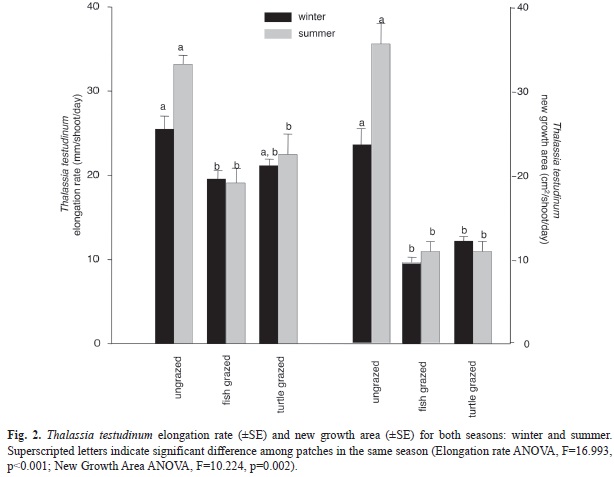
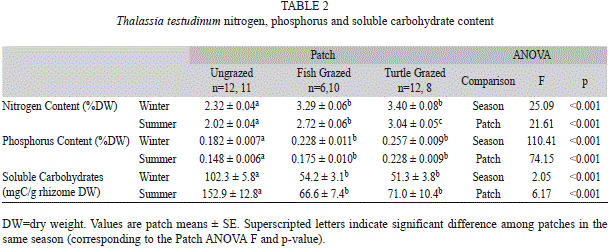
<body><![CDATA[samples&nbsp; were&nbsp; pooled&nbsp; within&nbsp; season after     statistical analysis determined there was no significant difference     between deployments within each patch (Student&#8217;s t-test, p=0.897).     Ungrazed patches had the widest </font><font size="2"><span      style="font-family: verdana;"><span style="font-style: italic;">Thalassia     testudinum</span></span></font><font size="2"><span      style="font-family: verdana;"> blades (ANOVA     F=12.06, p&lt;0.001) with fastest elongation rate (ANOVA F=16.99,     p&lt;0.001) and largest new growth area (ANOVA F=10.22, p=0.002), when     compared to fish and turtle grazed patches (<a     ]]></body>
<body><![CDATA[ href="/img/revistas/rbt/v62n4/a22i1.jpg">Fig. 1</a> and <a      href="/img/revistas/rbt/v62n4/a22i2.jpg">2</a>). The     difference between ungrazed and grazed was greater in the summer months     and significantly higher in ungrazed patches compared to grazed     patches, regardless of grazer identity in both seasons&nbsp;     (p&lt;0.001&nbsp; for&nbsp; all&nbsp; three&nbsp; parameters). Fish     grazed and turtle grazed patches were significantly different from each     other in width during the winter (p&lt;0.001), but were not     significantly different for other parameters or within the same patch     between seasons. Grazed shoots had a maximum of three leaves, while     ]]></body>
<body><![CDATA[ungrazed shoots had a maximum of six leaves. Fish&nbsp; grazed&nbsp;     leaves&nbsp; appeared&nbsp; less&nbsp; pigmented and curled when     compared with turtle grazed leaves. All three species of seagrass were     pres- ent in the majority of ungrazed patches while </span></font><font      size="2"><span style="font-family: verdana;"><span      style="font-style: italic;">T. testudinum</span></span></font><font      size="2"><span style="font-family: verdana;"> and     occasionally </span></font><font size="2"><span      style="font-family: verdana;"><span style="font-style: italic;">S.     filiforme</span></span></font><font size="2"><span     ]]></body>
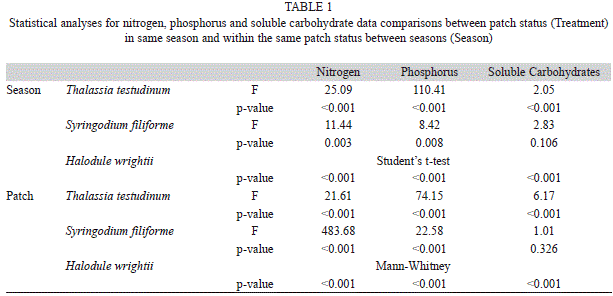
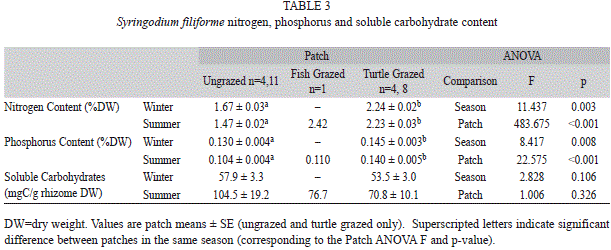
<body><![CDATA[ style="font-family: verdana;"> were present in grazed patches.     Ungrazed     patches of </span></font><font size="2"><span      style="font-family: verdana;"><span style="font-style: italic;">T.     testudinum</span></span></font><font size="2"><span      style="font-family: verdana;"> had lower nitrogen and phosphorus     content than     turtle and fish grazed patches in both seasons (<a      href="/img/revistas/rbt/v62n4/a22t2.gif">Table 2</a>). Soluble     carbohydrates in </span></font><font size="2"><span     ]]></body>
<body><![CDATA[ style="font-family: verdana;"><span style="font-style: italic;">T.     testudinum</span></span></font><font size="2"><span      style="font-family: verdana;"> rhizomes were significantly higher in     the ungrazed patches for both seasons and were significantly higher in     summer compared to winter in all three patches (<a      href="/img/revistas/rbt/v62n4/a22t1.gif">Table 1</a>, <a      href="/img/revistas/rbt/v62n4/a22t2.gif">2</a>).</span></font><br      style="font-family: verdana;">     <br style="font-family: verdana;">     <font size="2"><span style="font-family: verdana;">Similar significant     ]]></body>
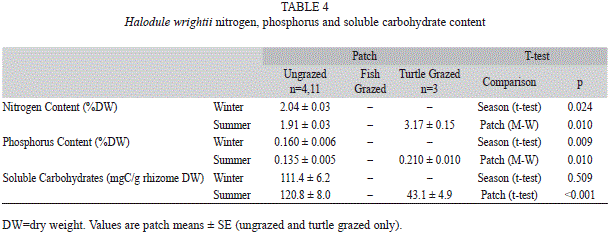
<body><![CDATA[differences to     those of <span style="font-style: italic;">T. testudium</span> were     found in <span style="font-style: italic;">Syringodium filiforme</span>,     for which     ungrazed patches had significantly lower nitrogen and phosphorus     content than turtle grazed patches (<a      href="/img/revistas/rbt/v62n4/a22t1.gif">Table 1</a>, <a      href="/img/revistas/rbt/v62n4/a22t3.gif">3</a>, sample size was too     small to test for differences from fish grazed patches). For Halodule     wrightii, significant differences were found in nitrogen and phosphorus     ]]></body>
<body><![CDATA[content between ungrazed and turtle grazed patches in the winter only     (<a href="/img/revistas/rbt/v62n4/a22t1.gif">Table 1</a>, <a      href="/img/revistas/rbt/v62n4/a22t4.gif">4</a>). There was     significantly higher nitrogen and&nbsp;     phosphorus&nbsp; content&nbsp; in&nbsp; winter&nbsp; compared to&nbsp;     summer&nbsp; in&nbsp; the&nbsp; ungrazed&nbsp; patches,&nbsp; similar     to the trend found in </span></font><font size="2"><span      style="font-family: verdana;"><span style="font-style: italic;">T.     testudinum</span></span></font><font size="2"><span      style="font-family: verdana;"> and </span></font><font size="2"><span     ]]></body>
<body><![CDATA[ style="font-family: verdana;"><span style="font-style: italic;">S.     filiforme</span></span></font><font size="2"><span      style="font-family: verdana;">.&nbsp;     Soluble&nbsp; carbohydrates&nbsp; of&nbsp; rhizomes were significantly     higher in ungrazed patches than turtle grazed patches (<a      href="/img/revistas/rbt/v62n4/a22t1.gif">Table 1</a>),     similar to </span></font><font size="2"><span      style="font-family: verdana;"><span style="font-style: italic;">T.     testudinum</span></span></font><font size="2"><span      style="font-family: verdana;">.&nbsp; Grazed shoots had a maximum of     ]]></body>
<body><![CDATA[three     leaves while ungrazed shoots had a maximum of seven leaves.</span></font><br      style="font-family: verdana;">     <br style="font-family: verdana;">     <font size="2"><span style="font-family: verdana;"><span      style="font-weight: bold;">Patch dynamics:</span> The majority of     seagrass patches recorded during the initial survey were ungrazed by     turtles (63%), while the remaining patches were turtle grazed. The     percent of ungrazed patches did not significantly change&nbsp;     during&nbsp; the&nbsp; second&nbsp; survey&nbsp; (Student&#8217;s t-test,     ]]></body>
<body><![CDATA[p=0.911), while significant reductions in turtle grazed patches     occurred (Student&#8217;s t-test, p&lt;0.003). From the initial 318m of     grazed patches,&nbsp; 27%&nbsp; continued&nbsp; to&nbsp; be&nbsp;     grazed,&nbsp; while 73% were abandoned by turtles in the second survey.     From the initial 542m of ungrazed patches, 97% remained ungrazed while     3% changed to grazed in the second survey. During initial surveys,     ungrazed patches had significantly higher abundances of all three     seagrass species than turtle grazed patches (t-test, p&lt;0.001, <a      href="/img/revistas/rbt/v62n4/a22t5.gif">Table     5</a>).</span></font><br style="font-family: verdana;">     ]]></body>
<body><![CDATA[<br style="font-family: verdana;">     <font size="2"><span style="font-family: verdana;">In the second     survey, comparisons     could only be made between ungrazed, turtle grazed and&nbsp;     abandoned&nbsp; patches,&nbsp; as&nbsp; sample&nbsp; size&nbsp; of     newly grazed patches was too small (n=1) for statistical comparison.     Ungrazed patches had the highest abundance of </span></font><font      size="2"><span style="font-family: verdana;"><span      style="font-style: italic;">T. testudinum</span></span></font><font      size="2"><span style="font-family: verdana;"> and </span></font><font     ]]></body>
<body><![CDATA[ size="2"><span style="font-family: verdana;"><span      style="font-style: italic;">S. filiforme</span></span></font><font      size="2"><span style="font-family: verdana;"> than grazed and     abandoned patches (ANOVA, p=0.015 and     p=0.037, respectively), while </span></font><font size="2"><span      style="font-family: verdana;"><span style="font-style: italic;">H.     wrightii</span></span></font><font size="2"><span      style="font-family: verdana;"> abundance was highest in     abandoned patches (ANOVA, p=0.008) and increased significantly from     initial to second survey (t-test, p&lt;0.001). </span></font><font     ]]></body>
<body><![CDATA[ size="2"><span style="font-family: verdana;"><span      style="font-style: italic;">Syringodium filiforme</span></span></font><font      size="2"><span style="font-family: verdana;">     and </span></font><font size="2"><span style="font-family: verdana;"><span      style="font-style: italic;">T. testudinum</span></span></font><font      size="2"><span style="font-family: verdana;"> abundance did not     significantly change for abandoned     patches from initial to second survey (t-test, p=0.912). Two     species&nbsp; of&nbsp; macroalgae&nbsp; not&nbsp; observed&nbsp;     in&nbsp; the initial survey occurred within the one aban- doned plot     ]]></body>
<body><![CDATA[(<span style="font-style: italic;">Halimeda </span>sp., <span      style="font-style: italic;">Penicillus </span>sp.). In the one newly     grazed patch, there     was one less seagrass species present, but the small sample size did     not allow statistical comparisons.</span></font><br      style="font-family: verdana;">     <br style="font-family: verdana;">     <font size="2"><span style="font-family: verdana;">Within the fifteen     transect patches     of </span></font><font size="2"><span style="font-family: verdana;"><span     ]]></body>
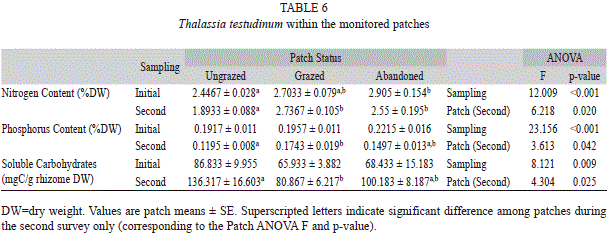
<body><![CDATA[ style="font-style: italic;">T. testudinum</span></span></font><font      size="2"><span style="font-family: verdana;"> sampled for nutrients,     soluble carbohydrates&nbsp;     and&nbsp; morphology&nbsp; during&nbsp; the&nbsp; initial survey,     ungrazed patches had significantly lower nitrogen and phosphorus     content (<a href="/img/revistas/rbt/v62n4/a22t6.gif">Table 6</a>;     t-test, p&lt;0.001 for both parameters) and     significantly higher soluble sugar content (t-test, p=0.044) than     grazed patches, similar to those results&nbsp; found&nbsp; in&nbsp;     the&nbsp; cages.&nbsp; Phosphorus&nbsp; content and soluble     ]]></body>
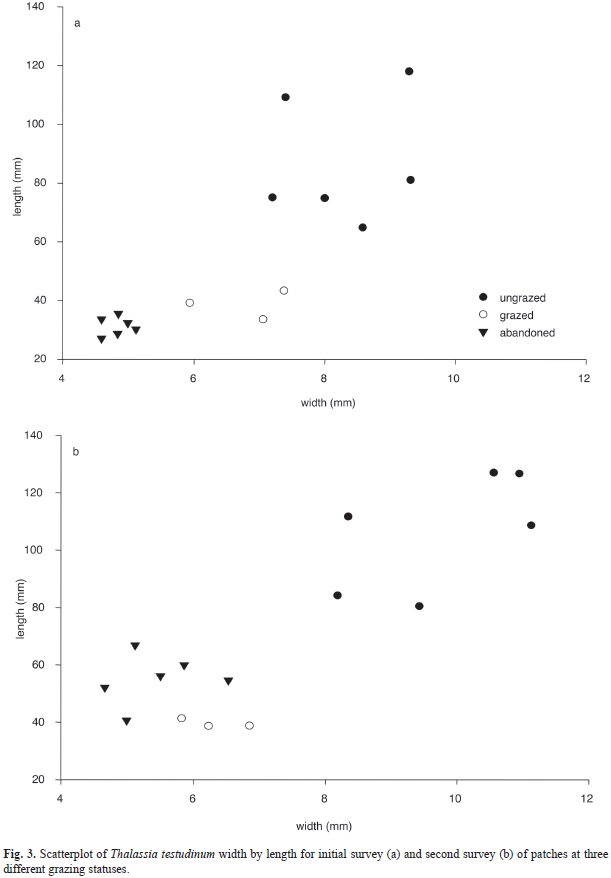
<body><![CDATA[carbohydrates were not significantly different between abandoned and     ungrazed patches while nitrogen content was not significantly different     between abandoned and grazed patches. Therefore, we detected no     differences in nitrogen, phosphorus or soluble carbohydrates in </span></font><font      size="2"><span style="font-family: verdana;"><span      style="font-style: italic;">Thalassia testudinum</span></span></font><font      size="2"><span style="font-family: verdana;">. Prior to abandonment,     leaves were short and     narrow, and a distinct shift in these parameters followed abandonment     (<a href="/img/revistas/rbt/v62n4/a22i3.jpg">Fig. 3</a>). Standing crop     ]]></body>
<body><![CDATA[biomass indicated abandoned patches exist under     a threshold of 42.1g/m<sup>2</sup>, while grazed patches averaged     significantly     greater at 62.9g/m<sup>2</sup>, and ungrazed patches averaged     significantly     greater than abandoned and grazed patches at 99.7g/m<sup>2</sup>     (ANOVA,     p&lt;0.001).</span></font><br style="font-family: verdana;">     <br style="font-family: verdana;">     <font style="font-weight: bold;" size="3"><span     ]]></body>
<body><![CDATA[ style="font-family: verdana;">Discussion</span></font><br      style="font-family: verdana;">     <font size="2"><span style="font-family: verdana;">Monitoring of patch     status provided     an opportunity to look at the changes in response variables (nutrient     content, morphology, physiology) as a function of patch type. The     driver(s) behind changes in patch use are elusive, as monitoring of </span></font><font      size="2"><span style="font-family: verdana;"><span      style="font-style: italic;">Chelonia mydas</span></span></font><font      size="2"><span style="font-family: verdana;"> patch use through time     ]]></body>
<body><![CDATA[can be challenging in the field.     Contrary to our hypothesis, we did not find that patches with the     lowest soluble carbohydrate content in the seagrass rhizomes were more     likely to be abandoned (as suggested by Fourqurean et al., 2010), nor     did we find that patches with the lowest nutrient content of seagrass     leaves were likely to be abandoned (as suggested by Thayer et al.,     1984). However, those patches abandoned had the smallest biomass and     therefore density of leaves, indicating that a modified GUD or a     &#8216;giving up biomass&#8217; may be the mechanism by which patches are     abandoned. Further, the sparser grazed patches also had narrower,     ]]></body>
<body><![CDATA[shorter leaves. When a patch is com- posed of these much smaller     leaves, the effort required by </span></font><font size="2"><span      style="font-family: verdana;"><span style="font-style: italic;">C.     mydas</span></span></font><font size="2"><span      style="font-family: verdana;"> to consume enough plant biomass     to fulfill their nutritional needs could outweigh the nutritional     reward, and therefore induce abandonment of the patch by feeding     turtles, similar to the mechanism regulating patch use by herbivores     reported in terrestrial ecosystems (Brown, 1988).</span></font><br      style="font-family: verdana;">     ]]></body>
<body><![CDATA[<br style="font-family: verdana;">     <font size="2"><span style="font-family: verdana;">In&nbsp; our&nbsp;     system,&nbsp;     patch&nbsp; abandonment&nbsp; was not driven by the quality of seagrass     as would be reflected in nutrient content, nor by stored soluble&nbsp;     carbohydrates,&nbsp; but&nbsp; cued&nbsp; directly&nbsp; by the low     quantity provided by the sparse, thin seagrass blades of the heavily     grazed patches. Based on the biomass found in grazed patches during the     initial survey that were later abandoned, we propose a threshold of     approximately 17g/m<sup>2</sup>, below which patches can be predicted     ]]></body>
<body><![CDATA[to become     abandoned by sea turtle grazers in search of higher quantity yields for     their grazing effort. While it may be suggested that the turtles are     avoiding highly grazed plots because of the abundance of sandy     substrate, should that be the case we would have expected grazed areas     to be abandoned uniformly, rather than at a certain leaf biomass as we     found. Further work is necessary to spatially and temporally increase     the application of this proposed threshold.</span></font><br      style="font-family: verdana;">     <br style="font-family: verdana;">     ]]></body>
<body><![CDATA[<font size="2"><span style="font-family: verdana;">The relative     physiological     (productivity, tissue nutrients and soluble carbohydrates) and     morphological effects of grazing on seagrasses were&nbsp; similar&nbsp;     to&nbsp; those&nbsp; previously&nbsp; measured from simulated grazing     or exclosure experiments (Fourqurean et al., 2010; Moran &amp;     Bjorndal,&nbsp; 2005,&nbsp; 2007).&nbsp; Leaf&nbsp; widths&nbsp;     of&nbsp; fish grazed&nbsp; (4.9-5.4mm)&nbsp; and&nbsp; turtle&nbsp;     grazed&nbsp; (5.0-5.9mm) patches in this study were within range of     other studies on grazing (5.3-6.3mm, Zieman et al., 1984; 5.6-6.3mm,     ]]></body>
<body><![CDATA[Moran &amp; Bjorndal, 2005; 3.3-4.7mm, Williams, 1988; 1.4-3.0mm,     Fourqurean et al., 2010). These differences in leaf widths further     emphasize the detrimental effects of intense grazing to seagrasses,     which have less photosynthetic leaf tissue, storage of carbohydrates in     their rhizomes, and narrower and shorter leaves when subjected to     intense grazing. These responses likely decrease the ability of heavily     grazed plants to recover from disturbance or survive.</span></font><br      style="font-family: verdana;">     <br style="font-family: verdana;">     <font size="2"><span style="font-family: verdana;">Smaller sample sizes     ]]></body>
<body><![CDATA[for </span></font><font size="2"><span style="font-family: verdana;"><span      style="font-style: italic;">Syringodium filiforme</span></span></font><font      size="2"><span style="font-family: verdana;"> and <span      style="font-style: italic;">Halodule wrightii</span> limited our     determination     of significant differences in nutrient and soluble carbohydrate content     between patches&nbsp; but&nbsp; their&nbsp; absence&nbsp; in&nbsp;     grazed&nbsp; patches may indicate herbivore preference (Armitage &amp;     Fourqurean, 2006). The absence of certain species&nbsp; may&nbsp;     also&nbsp; indicate&nbsp; a&nbsp; lower&nbsp; tolerance to repeated or     ]]></body>
<body><![CDATA[prolonged grazing as they are unable to recover sufficiently to remain     in the ecosystem (Kuiper-Linley et al., 2007). The lower soluble     carbohydrate in the ungrazed </span></font><font size="2"><span      style="font-family: verdana;"><span style="font-style: italic;">S.     filiforme</span></span></font><font size="2"><span      style="font-family: verdana;"> during the winter may     decrease the ability of this species to recover from grazing. Larger     species with thicker rhizomes, such as </span></font><font size="2"><span      style="font-family: verdana;"><span style="font-style: italic;">T.     testudinum</span></span></font><font size="2"><span     ]]></body>
<body><![CDATA[ style="font-family: verdana;">, may also be     better at translocating their stored carbohydrates longer distances and     are therefore better able to compensate for loss than those species     with thinner rhizomes, e.g., </span></font><font size="2"><span      style="font-family: verdana;"><span style="font-style: italic;">H.     wrightii</span></span></font><font size="2"><span      style="font-family: verdana;"> and </span></font><font size="2"><span      style="font-family: verdana;"><span style="font-style: italic;">S.     filiforme</span></span></font><font size="2"><span      style="font-family: verdana;"> (Marba,     ]]></body>
<body><![CDATA[Santiago, Diaz-Almela, Alvarez, &amp; Duarte, 2006). Within the     timeframe of our study, the reduced productivity and leaf biomass for     all three species in grazed patches when compared to ungrazed plants     suggest an increased reliance on aboveground biomass and increases the     plant&#8217;s&nbsp; reliance&nbsp; on&nbsp; belowground&nbsp; biomass&nbsp;     as a energy reserve (Williams, 1988). As these reserves are depleted to     replace leaves lost to grazers, the lower soluble carbohydrate content     of the rhizomes reduces the ability of the plant to counter prolonged     or future disturbances until the reserves can be replaced (Kuiper-     Linley et al., 2007). </span></font><br style="font-family: verdana;">     ]]></body>
<body><![CDATA[<br style="font-family: verdana;">     <font size="2"><span style="font-family: verdana;">Over a six month     interval, the     location of turtle grazed patches was largely stable, with only a small     fraction of area changing status. Our data indicate grazing patches     were long- lived enough to affect soluble carbohydrate storage,     morphology and nutrient content of seagrass leaves. As expected during     the initial survey, turtle herbivory reduced seagrass abundance and     canopy complexity (macrophyte species composition and blade length and     width). During the second survey, after patches were abandoned,     ]]></body>
<body><![CDATA[increased leaf lengths, widths and the occurrence of pioneering species     (</span></font><font size="2"><span style="font-family: verdana;"><span      style="font-style: italic;">Halodule wrightii</span></span></font><font      size="2"><span style="font-family: verdana;">) increased canopy     complexity. The abundance of this     species in recently abandoned patches is consistent with successional     dynamics reported for other types of seagrass ecosystems, especially in     nutrient-replete systems (Duarte, 1995; Fourqurean, Powell, Ken-worthy,     &amp; Zieman, 1995). Although we cannot statistically test     changes in macroalgae as a result of the small sample size, the one     ]]></body>
<body><![CDATA[patch that&nbsp; had&nbsp; Udotea&nbsp; and&nbsp; </span></font><font      size="2"><span style="font-family: verdana;"><span      style="font-style: italic;">Halimeda </span></span></font><font      size="2"><span style="font-family: verdana;">     during&nbsp; the initial study did have a new genus, Penicillus, during     the second survey. It was surprising that macroalgae were scarce     throughout grazed patches, where canopy cover was decreased and     potential competitive interactions increased, or in ungrazed patches,     where macroalgae may potentially find refuge within the complex canopy.     The absence of macroalgae could be due to limited algal reproductive     ]]></body>
<body><![CDATA[potential or the result of selective grazing both within grazed and     ungrazed seagrass patches, although preferential grazing of the     calcareous macroalgae present has not been reported. This is an     interesting area for further study on macrophyte dynamics in this     unique system.</span></font><br style="font-family: verdana;">     <br style="font-family: verdana;">     <font size="2"><span style="font-family: verdana;">Impacts of grazers     on different     seagrass species may also be an important determinant of primary     producer distribution, as found in other studies (Armitage &amp;     ]]></body>
<body><![CDATA[Fourqurean, 2006). Fishes such as members of the family Scaridae     preferentially feed on faster-growing, early successional seagrass     species such as </span></font><font size="2"><span      style="font-family: verdana;"><span style="font-style: italic;">Halodule     wrightii</span></span></font><font size="2"><span      style="font-family: verdana;"> over slower-growing, climax species     such as </span></font><font size="2"><span      style="font-family: verdana;"><span style="font-style: italic;">T.     testudinum</span></span></font><font size="2"><span      style="font-family: verdana;"> (Armitage &amp; Fourqurean, 2006;&nbsp;     ]]></body>
<body><![CDATA[Burkholder,&nbsp; Heithaus,&nbsp; &amp;&nbsp; Fourqurean, 2012), thus     impacting the diversity of seagrass- es found within these grazed     patches. Seagrass preference is less evident for green sea turtles in     the Caribbean as their diet largely consists of </span></font><font      size="2"><span style="font-family: verdana;"><span      style="font-style: italic;">T. testudinum</span></span></font><font      size="2"><span style="font-family: verdana;">     (Mortimer, 1981), which may be an artifact of the lower availability     and abundance of </span></font><font size="2"><span      style="font-family: verdana;"><span style="font-style: italic;">H.     ]]></body>
<body><![CDATA[wrightii</span></span></font><font size="2"><span      style="font-family: verdana;"> relative to other species as well as     spatial variability between grazing&nbsp; populations&nbsp; and&nbsp;     habitat&nbsp; types&nbsp; (Bjorndal, 1997). This is the first study to     simultaneously consider the impact of turtle and fish grazing behaviors     on morphological and physiological parameters important to seagrass     growth and recovery (e.g., productivity, blade width).</span></font><br      style="font-family: verdana;">     <br style="font-family: verdana;">     <font size="2"><span style="font-family: verdana;">Considering the     ]]></body>
<body><![CDATA[preference of many     herbivores for </span></font><font size="2"><span      style="font-family: verdana;"><span style="font-style: italic;">Halodule     wrightii</span></span></font><font size="2"><span      style="font-family: verdana;"> and Syringo- dium filiforme     (Armitage &amp; Fourqurean, 2006; Burkholder,&nbsp; Heithaus,&nbsp;     &amp;&nbsp; Fourqurean,&nbsp; 2012), the presence of these species in     the ungrazed beds&nbsp; may&nbsp; provide&nbsp; a&nbsp; source&nbsp;     for&nbsp; recolonization by these species once patches are abandoned.     Similar responses have been reported after other&nbsp; disturbances     ]]></body>
<body><![CDATA[(Armitage, Frankovich, &amp; Fourqurean, 2011). While </span></font><font      size="2"><span style="font-family: verdana;"><span      style="font-style: italic;">H. wrightii</span></span></font><font      size="2"><span style="font-family: verdana;">     can&nbsp; replace&nbsp; </span></font><font size="2"><span      style="font-family: verdana;"><span style="font-style: italic;">T.     testudinum</span></span></font><font size="2"><span      style="font-family: verdana;">&nbsp; under&nbsp;     conditions of&nbsp; high&nbsp; nutrient&nbsp; availability&nbsp;     (Fourqurean&nbsp; et al., 1995), if no source for </span></font><font     ]]></body>
<body><![CDATA[ size="2"><span style="font-family: verdana;"><span      style="font-style: italic;">H. wrightii</span></span></font><font      size="2"><span style="font-family: verdana;"> propagules exists, the     ecosystem may transition to bare sand rather than     supporting a macrophyte assemblage. Alternatively, this study suggests     that&nbsp; heterogeneous&nbsp; grazing&nbsp; may&nbsp; promote&nbsp; a     more species-rich seagrass community in a eutrophic ecosystem.</span></font><br      style="font-family: verdana;">     <br style="font-family: verdana;">     <font size="2"><span style="font-family: verdana;">Our study determined     ]]></body>
<body><![CDATA[that in Akumal     seagrass beds, leaf nutrient content was not a cue to seagrass patch     abandonment, as hypothesized by Moran and Bjorndal (2005, 2007) and     Fourqurean et al. (2010), but it was surprising that there was no clear     signal of lowest soluble carbohydrates in patches being abandoned.     Instead, our data suggest that a modified Giving Up Density (GUD) as     Giving Up Biomass, similar to the relationship found in terrestrial     ecosystems, is the mechanism by which patches are abandoned. Our     research is the first to apply a modified GUD theory to the grazing     behavior of marine herbivores as we develop this threshold parameter of     ]]></body>
<body><![CDATA[standing crop biomass.</span></font><br style="font-family: verdana;">     <br style="font-family: verdana;">     <font size="2"><span style="font-family: verdana;">The application of     this theory     provides novel insight on the behavior of mesograzers and the crossover     between terrestrial and aquatic theories on grazing yield/grazing     effort or risk. The application of GUD theory should be examined in     other sites experiencing patch abandonment by green sea turtles in     order to test this proposed threshold.</span></font><br      style="font-family: verdana;">     ]]></body>
<body><![CDATA[<br style="font-family: verdana;">     <font style="font-weight: bold;" size="3"><span      style="font-family: verdana;">Acknowledgments</span></font><br      style="font-family: verdana;">     <font size="2"><span style="font-family: verdana;">We are grateful to     Centro     Ecol&oacute;gico Akumal staff and volunteers for field support and     logistics, in particular Y. Kleinschmidt and B. van Tussenbroek from     Universidad Nacional Aut&oacute;noma de M&eacute;xico&nbsp;     provided&nbsp; research support, and suggestions from J. Rehage     ]]></body>
<body><![CDATA[contributed to improve the manuscript. This work was supported by a     Florida International University Doctoral Evidence Acquisition     Fellowship with publication funding provided by The Richard Stockton     College of New Jersey (E. A. L.). This is contribution 666 from the     Southeast Environmental Research Center.</span></font><br      style="font-family: verdana;">     <br style="font-family: verdana;">     <hr style="width: 100%; height: 2px;"><font style="font-weight: bold;"      size="3"><span style="font-family: verdana;">References</span></font><br      style="font-family: verdana;">     ]]></body>
<body><![CDATA[<font size="2"><span style="font-family: verdana;">     <!-- ref --><div style="text-align: left;"><font size="2"><span  style="font-family: verdana;">Aragones, L. V., Lawler, I. R., Foley, W. J., &amp; Marsh, H. (2006). Dugong grazing and turtle cropping: grazing optimization in tropical seagrass systems? <span  style="font-style: italic;">Oecologia, 149</span>, 635-647.    &nbsp;&nbsp;&nbsp;&nbsp;&nbsp;&nbsp;&nbsp;&nbsp;[&#160;<a href="javascript:void(0);" onclick="javascript: window.open('/scielo.php?script=sci_nlinks&ref=1568566&pid=S0034-7744201400040002200001&lng=','','width=640,height=500,resizable=yes,scrollbars=1,menubar=yes,');">Links</a>&#160;]<!-- end-ref --><!-- ref --></span></font><br style="font-family: verdana;"> <br style="font-family: verdana;"> <font size="2"><span style="font-family: verdana;">Armitage, A. R. &amp; Fourqurean, J. W. (2006). The shortterm influence of herbivory near patch reefs varies between seagrass species. <span style="font-style: italic;">Journal of Experimental Marine Biology and Ecology, 339</span>(1), 65-74.    &nbsp;&nbsp;&nbsp;&nbsp;&nbsp;&nbsp;&nbsp;&nbsp;[&#160;<a href="javascript:void(0);" onclick="javascript: window.open('/scielo.php?script=sci_nlinks&ref=1568567&pid=S0034-7744201400040002200002&lng=','','width=640,height=500,resizable=yes,scrollbars=1,menubar=yes,');">Links</a>&#160;]<!-- end-ref --><!-- ref --></span></font><br  style="font-family: verdana;"> <br style="font-family: verdana;"> <font size="2"><span style="font-family: verdana;">Armitage, A. R., Frankovich, T. A., &amp; Fourqurean, J. W. (2011). Long-term effects of adding nutrients to an oligotrophic coastal environment. <span  style="font-style: italic;">Ecosystems, 14</span>(3), 430-444.    &nbsp;&nbsp;&nbsp;&nbsp;&nbsp;&nbsp;&nbsp;&nbsp;[&#160;<a href="javascript:void(0);" onclick="javascript: window.open('/scielo.php?script=sci_nlinks&ref=1568568&pid=S0034-7744201400040002200003&lng=','','width=640,height=500,resizable=yes,scrollbars=1,menubar=yes,');">Links</a>&#160;]<!-- end-ref --><!-- ref --></span></font><br  style="font-family: verdana;"> <br style="font-family: verdana;"> <font size="2"><span style="font-family: verdana;">Bjorndal, K. A. (1980). Nutrition and grazing behavior of the green turtle </span></font><font size="2"><span  style="font-family: verdana;"><span style="font-style: italic;">Chelonia mydas</span></span></font><font size="2"><span  style="font-family: verdana;">. <span style="font-style: italic;">Marine Biology, 56</span>, 147-154.    &nbsp;&nbsp;&nbsp;&nbsp;&nbsp;&nbsp;&nbsp;&nbsp;[&#160;<a href="javascript:void(0);" onclick="javascript: window.open('/scielo.php?script=sci_nlinks&ref=1568569&pid=S0034-7744201400040002200004&lng=','','width=640,height=500,resizable=yes,scrollbars=1,menubar=yes,');">Links</a>&#160;]<!-- end-ref --><!-- ref --></span></font><br  style="font-family: verdana;"> <br style="font-family: verdana;"> <font size="2"><span style="font-family: verdana;">Bjorndal, K. A. (1997). Foraging ecology and nutrition of sea turtles. In P. L. Lutz &amp; J. A. Musick (Eds.), <span style="font-style: italic;">The biology of sea turtles</span> (pp. 432). Boca Raton, FL: CRC Press.    &nbsp;&nbsp;&nbsp;&nbsp;&nbsp;&nbsp;&nbsp;&nbsp;[&#160;<a href="javascript:void(0);" onclick="javascript: window.open('/scielo.php?script=sci_nlinks&ref=1568570&pid=S0034-7744201400040002200005&lng=','','width=640,height=500,resizable=yes,scrollbars=1,menubar=yes,');">Links</a>&#160;]<!-- end-ref --><!-- ref --></span></font><br  style="font-family: verdana;"> <br style="font-family: verdana;"> <font size="2"><span style="font-family: verdana;">Brown, J. S. (1988). Patch use as an indicator of habitat preference, predation risk, and competition. <span style="font-style: italic;">Behavioral Ecology and Sociobiology, 22</span>, 37-47.    &nbsp;&nbsp;&nbsp;&nbsp;&nbsp;&nbsp;&nbsp;&nbsp;[&#160;<a href="javascript:void(0);" onclick="javascript: window.open('/scielo.php?script=sci_nlinks&ref=1568571&pid=S0034-7744201400040002200006&lng=','','width=640,height=500,resizable=yes,scrollbars=1,menubar=yes,');">Links</a>&#160;]<!-- end-ref --><!-- ref --></span></font><br style="font-family: verdana;"> <br style="font-family: verdana;"> <font size="2"><span style="font-family: verdana;">Burkholder, D. A., Heithaus, M. R., &amp; Fourqurean, J. W. (2012). Feeding preferences of herbivores in a relatively pristine subtropical seagrass ecosystem. <span  style="font-style: italic;">Marine and Freshwater Research, 63</span>, 1051-1058.    &nbsp;&nbsp;&nbsp;&nbsp;&nbsp;&nbsp;&nbsp;&nbsp;[&#160;<a href="javascript:void(0);" onclick="javascript: window.open('/scielo.php?script=sci_nlinks&ref=1568572&pid=S0034-7744201400040002200007&lng=','','width=640,height=500,resizable=yes,scrollbars=1,menubar=yes,');">Links</a>&#160;]<!-- end-ref --><!-- ref --></span></font><br  style="font-family: verdana;"> <br style="font-family: verdana;"> <font size="2"><span style="font-family: verdana;">Dawes, C. J., Bird, K., Durako, M., Goddard, R., Hoffman, W., &amp; McIntosh, R. (1979). Chemical fluctuations due to seasonal cropping effects on an alga-seagrass community. <span style="font-style: italic;">Aquatic Botany, 6</span>, 79-86.    &nbsp;&nbsp;&nbsp;&nbsp;&nbsp;&nbsp;&nbsp;&nbsp;[&#160;<a href="javascript:void(0);" onclick="javascript: window.open('/scielo.php?script=sci_nlinks&ref=1568573&pid=S0034-7744201400040002200008&lng=','','width=640,height=500,resizable=yes,scrollbars=1,menubar=yes,');">Links</a>&#160;]<!-- end-ref --><!-- ref --></span></font><br style="font-family: verdana;"> <br style="font-family: verdana;"> <font size="2"><span style="font-family: verdana;">Duarte, C. M. (1995). Submerged aquatic vegetation in relation to different nutrient regimes. <span  style="font-style: italic;">Ophelia, 41</span>, 87-112.    &nbsp;&nbsp;&nbsp;&nbsp;&nbsp;&nbsp;&nbsp;&nbsp;[&#160;<a href="javascript:void(0);" onclick="javascript: window.open('/scielo.php?script=sci_nlinks&ref=1568574&pid=S0034-7744201400040002200009&lng=','','width=640,height=500,resizable=yes,scrollbars=1,menubar=yes,');">Links</a>&#160;]<!-- end-ref --><!-- ref --></span></font><br style="font-family: verdana;"> <br style="font-family: verdana;"> <font size="2"><span style="font-family: verdana;">Fourqurean, J. W., Manuel, S., Coates, K. A., Kenworthy, W. J., &amp; Smith, S. R. (2010). Effects of excluding sea turtle herbivores from a seagrass bed: overgrazing may have led to loss of seagrass meadows in Bermuda. <span  style="font-style: italic;">Marine Ecology Progress Series, 419</span>, 223-232.    &nbsp;&nbsp;&nbsp;&nbsp;&nbsp;&nbsp;&nbsp;&nbsp;[&#160;<a href="javascript:void(0);" onclick="javascript: window.open('/scielo.php?script=sci_nlinks&ref=1568575&pid=S0034-7744201400040002200010&lng=','','width=640,height=500,resizable=yes,scrollbars=1,menubar=yes,');">Links</a>&#160;]<!-- end-ref --><!-- ref --></span></font><br  style="font-family: verdana;"> <br style="font-family: verdana;"> <font size="2"><span style="font-family: verdana;">Fourqurean, J. W., Powell, G. V. N., Kenworthy, W. J., &amp; Zieman, J. C. (1995). The effects of long-term mani- pulation of nutrient supply on competition between the seagrasses </span></font><font size="2"><span  style="font-family: verdana;"><span style="font-style: italic;">Thalassia testudinum</span></span></font><font size="2"><span  style="font-family: verdana;"> and </span></font><font size="2"><span  style="font-family: verdana;"><span style="font-style: italic;">Halodule wrightii</span></span></font><font size="2"><span  style="font-family: verdana;"> in Florida Bay. <span style="font-style: italic;">Oikos, 72</span>, 349-358.    &nbsp;&nbsp;&nbsp;&nbsp;&nbsp;&nbsp;&nbsp;&nbsp;[&#160;<a href="javascript:void(0);" onclick="javascript: window.open('/scielo.php?script=sci_nlinks&ref=1568576&pid=S0034-7744201400040002200011&lng=','','width=640,height=500,resizable=yes,scrollbars=1,menubar=yes,');">Links</a>&#160;]<!-- end-ref --><!-- ref --></span></font><br  style="font-family: verdana;"> <br style="font-family: verdana;"> <font size="2"><span style="font-family: verdana;">Fourqurean, J. W., Willsie, A. W., Rose, C. D., &amp; Rutten, L. M. (2001). Spatial and temporal pattern in seagrass community composition and productivity in south Florida. <span style="font-style: italic;">Marine Biology, 138</span>, 341-354.    &nbsp;&nbsp;&nbsp;&nbsp;&nbsp;&nbsp;&nbsp;&nbsp;[&#160;<a href="javascript:void(0);" onclick="javascript: window.open('/scielo.php?script=sci_nlinks&ref=1568577&pid=S0034-7744201400040002200012&lng=','','width=640,height=500,resizable=yes,scrollbars=1,menubar=yes,');">Links</a>&#160;]<!-- end-ref --><!-- ref --></span></font><br  style="font-family: verdana;"> <br style="font-family: verdana;"> <font size="2"><span style="font-family: verdana;">Heck, J. K. L. &amp; Valentine, J. F. (2006). Plant-herbivore interactions in seagrass meadows. <span  style="font-style: italic;">Journal of Experimental Marine Biology and Ecology, 330</span>, 420-436.    &nbsp;&nbsp;&nbsp;&nbsp;&nbsp;&nbsp;&nbsp;&nbsp;[&#160;<a href="javascript:void(0);" onclick="javascript: window.open('/scielo.php?script=sci_nlinks&ref=1568578&pid=S0034-7744201400040002200013&lng=','','width=640,height=500,resizable=yes,scrollbars=1,menubar=yes,');">Links</a>&#160;]<!-- end-ref --><!-- ref --></span></font><br  style="font-family: verdana;"> <br style="font-family: verdana;"> <font size="2"><span style="font-family: verdana;">Heck, J. &amp; Valentine, J. F. (2007). The H.T. Odum synthe sis essay: The primacy of top-down effects in shallow benthic&nbsp; ecosystems.&nbsp; <span  style="font-style: italic;">Esutaries&nbsp; and&nbsp; Coasts,&nbsp; 30</span>(3), 371-381.    &nbsp;&nbsp;&nbsp;&nbsp;&nbsp;&nbsp;&nbsp;&nbsp;[&#160;<a href="javascript:void(0);" onclick="javascript: window.open('/scielo.php?script=sci_nlinks&ref=1568579&pid=S0034-7744201400040002200014&lng=','','width=640,height=500,resizable=yes,scrollbars=1,menubar=yes,');">Links</a>&#160;]<!-- end-ref --><!-- ref --></span></font><br  style="font-family: verdana;"> <br style="font-family: verdana;"> <font size="2"><span style="font-family: verdana;">Kuiper-Linley,&nbsp; M.,&nbsp; Johnson,&nbsp; C.&nbsp; R.,&nbsp; &amp;&nbsp; Lanyon,&nbsp; J.&nbsp; M. (2007). Effects of simulated green turtle regrazing on seagrass abundance, growth and nutritional status of Moreton Bay, south-east Queensland, Australia. <span style="font-style: italic;">Marine and Freshwater Research, 58</span>, 492-503.    &nbsp;&nbsp;&nbsp;&nbsp;&nbsp;&nbsp;&nbsp;&nbsp;[&#160;<a href="javascript:void(0);" onclick="javascript: window.open('/scielo.php?script=sci_nlinks&ref=1568580&pid=S0034-7744201400040002200015&lng=','','width=640,height=500,resizable=yes,scrollbars=1,menubar=yes,');">Links</a>&#160;]<!-- end-ref --><!-- ref --></span></font><br  style="font-family: verdana;"> <br style="font-family: verdana;"> <font size="2"><span style="font-family: verdana;">Lal, A., Arthur, R., Marba, N., Lill, A. W. T., &amp; Alcoverro, T. (2010). Implications of conserving an ecosystem modifier: increasing green turtle (</span></font><font  size="2"><span style="font-family: verdana;"><span  style="font-style: italic;">Chelonia mydas</span></span></font><font  size="2"><span style="font-family: verdana;">) densities substantially alters seagrass meados. <span  style="font-style: italic;">Biological Conservation, 143</span>, 2730-2738.    &nbsp;&nbsp;&nbsp;&nbsp;&nbsp;&nbsp;&nbsp;&nbsp;[&#160;<a href="javascript:void(0);" onclick="javascript: window.open('/scielo.php?script=sci_nlinks&ref=1568581&pid=S0034-7744201400040002200016&lng=','','width=640,height=500,resizable=yes,scrollbars=1,menubar=yes,');">Links</a>&#160;]<!-- end-ref --><!-- ref --></span></font><br  style="font-family: verdana;"> <br style="font-family: verdana;"> <font size="2"><span style="font-family: verdana;">Lee, K. S. &amp; Dunton, K. H. (1997). Effects of in situ light reduction on the maintenance, growth and partitioning of carbon resources in </span></font><font size="2"><span  style="font-family: verdana;"><span style="font-style: italic;">Thalassia testudinum</span></span></font><font size="2"><span  style="font-family: verdana;"> Banks ex Konig. <span style="font-style: italic;">Journal of Experimental Marine Biology and Ecology, 210</span>, 53-73.    &nbsp;&nbsp;&nbsp;&nbsp;&nbsp;&nbsp;&nbsp;&nbsp;[&#160;<a href="javascript:void(0);" onclick="javascript: window.open('/scielo.php?script=sci_nlinks&ref=1568582&pid=S0034-7744201400040002200017&lng=','','width=640,height=500,resizable=yes,scrollbars=1,menubar=yes,');">Links</a>&#160;]<!-- end-ref --><!-- ref --></span></font><br  style="font-family: verdana;"> <br style="font-family: verdana;"> <font size="2"><span style="font-family: verdana;">Marba, N., Santiago, R., Diaz-Almela, E., Alvarez, E., &amp; Duarte, C. M. (2006). Seagrass (Posidonia oceanica) vertical growth as an early indicator of fish farm- derived stress. <span style="font-style: italic;">Estuarine, Coastal and Shelf Science, 67</span>, 475-483.    &nbsp;&nbsp;&nbsp;&nbsp;&nbsp;&nbsp;&nbsp;&nbsp;[&#160;<a href="javascript:void(0);" onclick="javascript: window.open('/scielo.php?script=sci_nlinks&ref=1568583&pid=S0034-7744201400040002200018&lng=','','width=640,height=500,resizable=yes,scrollbars=1,menubar=yes,');">Links</a>&#160;]<!-- end-ref --><!-- ref --></span></font><br  style="font-family: verdana;"> <br style="font-family: verdana;"> <font size="2"><span style="font-family: verdana;">Moran, K. L. &amp; Bjorndal, K. A. (2005). Simulated green turtle grazing affects structure and productivity of&nbsp; seagrass pastures. <span  style="font-style: italic;">Marine Ecology Progress Series, 305</span>, 235-247.    &nbsp;&nbsp;&nbsp;&nbsp;&nbsp;&nbsp;&nbsp;&nbsp;[&#160;<a href="javascript:void(0);" onclick="javascript: window.open('/scielo.php?script=sci_nlinks&ref=1568584&pid=S0034-7744201400040002200019&lng=','','width=640,height=500,resizable=yes,scrollbars=1,menubar=yes,');">Links</a>&#160;]<!-- end-ref --><!-- ref --></span></font><br  style="font-family: verdana;"> <br style="font-family: verdana;"> <font size="2"><span style="font-family: verdana;">Moran, K. L. &amp; Bjorndal, K. A. (2007). Simulated green turtle grazing affects nutrient composition of the seagrass </span></font><font size="2"><span  style="font-family: verdana;"><span style="font-style: italic;">Thalassia testudinum</span></span></font><font size="2"><span  style="font-family: verdana;">. <span style="font-style: italic;">Marine Biology, 150</span>, 1083-1092.    &nbsp;&nbsp;&nbsp;&nbsp;&nbsp;&nbsp;&nbsp;&nbsp;[&#160;<a href="javascript:void(0);" onclick="javascript: window.open('/scielo.php?script=sci_nlinks&ref=1568585&pid=S0034-7744201400040002200020&lng=','','width=640,height=500,resizable=yes,scrollbars=1,menubar=yes,');">Links</a>&#160;]<!-- end-ref --><!-- ref --></span></font><br  style="font-family: verdana;"> <br style="font-family: verdana;"> <font size="2"><span style="font-family: verdana;">Mortimer, J. A. (1981). The feeding ecology of the West Caribbean green turtle (</span></font><font size="2"><span  style="font-family: verdana;"><span style="font-style: italic;">Chelonia mydas</span></span></font><font size="2"><span  style="font-family: verdana;">) in Nicara- gua. <span style="font-style: italic;">Biotropica, 13</span>, 49-58.    &nbsp;&nbsp;&nbsp;&nbsp;&nbsp;&nbsp;&nbsp;&nbsp;[&#160;<a href="javascript:void(0);" onclick="javascript: window.open('/scielo.php?script=sci_nlinks&ref=1568586&pid=S0034-7744201400040002200021&lng=','','width=640,height=500,resizable=yes,scrollbars=1,menubar=yes,');">Links</a>&#160;]<!-- end-ref --><!-- ref --></span></font><br  style="font-family: verdana;"> <br style="font-family: verdana;"> <font size="2"><span style="font-family: verdana;">Pakulski, J. D. &amp; Benner, R. (1992). An improved method for the hydrolysis and MBTH analysis of dissolved and particulate carbohydrates in seawater. <span  style="font-style: italic;">Marine Chemistry, 40</span>, 143-160.    &nbsp;&nbsp;&nbsp;&nbsp;&nbsp;&nbsp;&nbsp;&nbsp;[&#160;<a href="javascript:void(0);" onclick="javascript: window.open('/scielo.php?script=sci_nlinks&ref=1568587&pid=S0034-7744201400040002200022&lng=','','width=640,height=500,resizable=yes,scrollbars=1,menubar=yes,');">Links</a>&#160;]<!-- end-ref --><!-- ref --></span></font><br style="font-family: verdana;"> <br style="font-family: verdana;"> <font size="2"><span style="font-family: verdana;">Perez, D., Guevara, M., &amp; Bone, D. (2006) Temporal variation of biomass and productivity of </span></font><font  size="2"><span style="font-family: verdana;"><span  style="font-style: italic;">Thalassia testudinum</span></span></font><font  size="2"><span style="font-family: verdana;"> (Hydrocharitacea) in Venezuela, Southern Caribbean.&nbsp; <span style="font-style: italic;">Revista&nbsp; de&nbsp; Biolog&iacute;a&nbsp; Tropical,&nbsp; 54</span>(2), 329-339.    &nbsp;&nbsp;&nbsp;&nbsp;&nbsp;&nbsp;&nbsp;&nbsp;[&#160;<a href="javascript:void(0);" onclick="javascript: window.open('/scielo.php?script=sci_nlinks&ref=1568588&pid=S0034-7744201400040002200023&lng=','','width=640,height=500,resizable=yes,scrollbars=1,menubar=yes,');">Links</a>&#160;]<!-- end-ref --><!-- ref --></span></font><br style="font-family: verdana;"> <br style="font-family: verdana;"> <font size="2"><span style="font-family: verdana;">Randall, J. E. (1965). Grazing effect on seagrasses by herbivorous reef fishes in the West Indies. <span style="font-style: italic;">Ecology, 46</span>, 255-260.    &nbsp;&nbsp;&nbsp;&nbsp;&nbsp;&nbsp;&nbsp;&nbsp;[&#160;<a href="javascript:void(0);" onclick="javascript: window.open('/scielo.php?script=sci_nlinks&ref=1568589&pid=S0034-7744201400040002200024&lng=','','width=640,height=500,resizable=yes,scrollbars=1,menubar=yes,');">Links</a>&#160;]<!-- end-ref --><!-- ref --></span></font><br  style="font-family: verdana;"> <br style="font-family: verdana;"> <font size="2"><span style="font-family: verdana;">Thayer, G. W., Bjorndal, K. A., Ogden, J., Williams, S., &amp; Zieman, J. (1984) Role of larger herbivores in sea- grass communities. <span style="font-style: italic;">Estuaries, 7,</span> 351-376.    &nbsp;&nbsp;&nbsp;&nbsp;&nbsp;&nbsp;&nbsp;&nbsp;[&#160;<a href="javascript:void(0);" onclick="javascript: window.open('/scielo.php?script=sci_nlinks&ref=1568590&pid=S0034-7744201400040002200025&lng=','','width=640,height=500,resizable=yes,scrollbars=1,menubar=yes,');">Links</a>&#160;]<!-- end-ref --><!-- ref --></span></font><br style="font-family: verdana;"> <br style="font-family: verdana;"> <font size="2"><span style="font-family: verdana;">Valentine, J. F. &amp; Duffy, J. E. (2006). The central role of grazing in seagrass ecology. In T. Larkum, R. J. Orth, &amp; C. M. Duarte (Eds.), Seagrass: Biology, ecology and their conservation (pp. 463-501). Dordrecht: Springer.    &nbsp;&nbsp;&nbsp;&nbsp;&nbsp;&nbsp;&nbsp;&nbsp;[&#160;<a href="javascript:void(0);" onclick="javascript: window.open('/scielo.php?script=sci_nlinks&ref=1568591&pid=S0034-7744201400040002200026&lng=','','width=640,height=500,resizable=yes,scrollbars=1,menubar=yes,');">Links</a>&#160;]<!-- end-ref --><!-- ref --></span></font><br  style="font-family: verdana;"> <br style="font-family: verdana;"> <font size="2"><span style="font-family: verdana;">Valentine, J. F., Heck, K. L., Busby, J., &amp; Webb, D. (1997).&nbsp; Experimental evidence that herbivory can increase shoot density in a subtropical turtlegrass (</span></font><font size="2"><span style="font-family: verdana;"><span  style="font-style: italic;">Thalassia testudinum</span></span></font><font  size="2"><span style="font-family: verdana;">) meadow. <span  style="font-style: italic;">Oecologia, 112</span>, 193-200.    &nbsp;&nbsp;&nbsp;&nbsp;&nbsp;&nbsp;&nbsp;&nbsp;[&#160;<a href="javascript:void(0);" onclick="javascript: window.open('/scielo.php?script=sci_nlinks&ref=1568592&pid=S0034-7744201400040002200027&lng=','','width=640,height=500,resizable=yes,scrollbars=1,menubar=yes,');">Links</a>&#160;]<!-- end-ref --><!-- ref --></span></font><br  style="font-family: verdana;"> <br style="font-family: verdana;"> <font size="2"><span style="font-family: verdana;">Williams, S. L. (1988). </span></font><font size="2"><span  style="font-family: verdana;"><span style="font-style: italic;">Thalassia testudinum</span></span></font><font size="2"><span  style="font-family: verdana;"> productivity and grazing by green turtles in a highly disturbed seagrass bed. <span style="font-style: italic;">Marine Biology, 98</span>, 447-455.    &nbsp;&nbsp;&nbsp;&nbsp;&nbsp;&nbsp;&nbsp;&nbsp;[&#160;<a href="javascript:void(0);" onclick="javascript: window.open('/scielo.php?script=sci_nlinks&ref=1568593&pid=S0034-7744201400040002200028&lng=','','width=640,height=500,resizable=yes,scrollbars=1,menubar=yes,');">Links</a>&#160;]<!-- end-ref --><!-- ref --></span></font><br  style="font-family: verdana;"> <br style="font-family: verdana;"> <font size="2"><span style="font-family: verdana;">Zieman, J. C. (1974). Methods for the study of the growth and production of turtle grass, </span></font><font  size="2"><span style="font-family: verdana;"><span  style="font-style: italic;">Thalassia testudinum</span></span></font><font  size="2"><span style="font-family: verdana;"> Konig. <span  style="font-style: italic;">Aquaculture, 4</span>, 139-143.    &nbsp;&nbsp;&nbsp;&nbsp;&nbsp;&nbsp;&nbsp;&nbsp;[&#160;<a href="javascript:void(0);" onclick="javascript: window.open('/scielo.php?script=sci_nlinks&ref=1568594&pid=S0034-7744201400040002200029&lng=','','width=640,height=500,resizable=yes,scrollbars=1,menubar=yes,');">Links</a>&#160;]<!-- end-ref --><!-- ref --></span></font><br  style="font-family: verdana;"> <br style="font-family: verdana;"> <font size="2"><span style="font-family: verdana;">Zieman, J. C., Iverson, R. L., &amp; Ogden, J. C. (1984). Herbivory effects on </span></font><font  size="2"><span style="font-family: verdana;"><span  style="font-style: italic;">Thalassia testudinum</span></span></font><font  size="2"><span style="font-family: verdana;"> leaf growth and nitrogen content. <span style="font-style: italic;">Marine Ecology Progress Series, 15</span>, 151-158.    &nbsp;&nbsp;&nbsp;&nbsp;&nbsp;&nbsp;&nbsp;&nbsp;[&#160;<a href="javascript:void(0);" onclick="javascript: window.open('/scielo.php?script=sci_nlinks&ref=1568595&pid=S0034-7744201400040002200030&lng=','','width=640,height=500,resizable=yes,scrollbars=1,menubar=yes,');">Links</a>&#160;]<!-- end-ref --></span></font>    <br> <font size="2"><span style="font-family: verdana;"></span></font></div> <font size="2"><span style="font-family: verdana;"></span></font><a  href="mailto:jim.fourqurean@fiu.edu"><font size="2"><span  style="font-family: verdana;"></span></font></a>    <br> <font size="2"><span style="font-family: verdana;"><a name="1"></a><a  href="#3">1</a>. School of Natural Sciences and Mathematics, The Richard Stockton College of New Jersey, Galloway, New Jersey </span></font><font size="2"><span style="font-family: verdana;">08205 USA; elizabeth.lacey@stockton.edu<br style="font-family: verdana;"> </span></font><font size="2"><span style="font-family: verdana;"><a  name="2"></a><a href="#4">2</a>. Department of Biological Sciences, Florida International University, Miami, Florida 33199 USA; colladol@fiu.edu, jim.fourqurean@fiu.edu</span></font><br  style="font-family: verdana;"> <hr style="width: 100%; height: 2px;">     <div style="text-align: center;"><font style="font-weight: bold;"  size="2"><span style="font-family: verdana;">Received 17-XII-2013.&nbsp;&nbsp;&nbsp;&nbsp;&nbsp;&nbsp;&nbsp; Corrected 26-VI-2014.&nbsp;&nbsp;&nbsp;&nbsp;&nbsp;&nbsp; Accepted 21-VII-2014.</span></font><font  style="font-weight: bold;" size="2"> </font></div> </span></font></div>      ]]></body><back>
<ref-list>
<ref id="B1">
<nlm-citation citation-type="journal">
<person-group person-group-type="author">
<name>
<surname><![CDATA[Aragones]]></surname>
<given-names><![CDATA[L. V.]]></given-names>
</name>
<name>
<surname><![CDATA[Lawler]]></surname>
<given-names><![CDATA[I. R.]]></given-names>
</name>
<name>
<surname><![CDATA[Foley]]></surname>
<given-names><![CDATA[W. J.]]></given-names>
</name>
<name>
<surname><![CDATA[Marsh]]></surname>
<given-names><![CDATA[H.]]></given-names>
</name>
</person-group>
<article-title xml:lang="en"><![CDATA[Dugong grazing and turtle cropping:: grazing optimization in tropical seagrass systems?]]></article-title>
<source><![CDATA[Oecologia]]></source>
<year>2006</year>
<volume>149</volume>
<page-range>635-647</page-range></nlm-citation>
</ref>
<ref id="B2">
<nlm-citation citation-type="journal">
<person-group person-group-type="author">
<name>
<surname><![CDATA[Armitage]]></surname>
<given-names><![CDATA[A. R.]]></given-names>
</name>
<name>
<surname><![CDATA[Fourqurean]]></surname>
<given-names><![CDATA[J. W.]]></given-names>
</name>
</person-group>
<article-title xml:lang="en"><![CDATA[The shortterm influence of herbivory near patch reefs varies between seagrass species.]]></article-title>
<source><![CDATA[Journal of Experimental Marine Biology and Ecology]]></source>
<year>2006</year>
<volume>339</volume>
<numero>1</numero>
<issue>1</issue>
<page-range>65-74</page-range></nlm-citation>
</ref>
<ref id="B3">
<nlm-citation citation-type="journal">
<person-group person-group-type="author">
<name>
<surname><![CDATA[Armitage]]></surname>
<given-names><![CDATA[A. R.]]></given-names>
</name>
<name>
<surname><![CDATA[Frankovich]]></surname>
<given-names><![CDATA[T. A.]]></given-names>
</name>
<name>
<surname><![CDATA[Fourqurean]]></surname>
<given-names><![CDATA[J. W.]]></given-names>
</name>
</person-group>
<article-title xml:lang="en"><![CDATA[Long-term effects of adding nutrients to an oligotrophic coastal environment.]]></article-title>
<source><![CDATA[Ecosystems]]></source>
<year>2011</year>
<volume>14</volume>
<numero>3</numero>
<issue>3</issue>
<page-range>430-444</page-range></nlm-citation>
</ref>
<ref id="B4">
<nlm-citation citation-type="journal">
<person-group person-group-type="author">
<name>
<surname><![CDATA[Bjorndal]]></surname>
<given-names><![CDATA[K. A.]]></given-names>
</name>
</person-group>
<article-title xml:lang="en"><![CDATA[Nutrition and grazing behavior of the green turtle Chelonia mydas.]]></article-title>
<source><![CDATA[Marine Biology]]></source>
<year>1980</year>
<volume>56</volume>
<page-range>147-154</page-range></nlm-citation>
</ref>
<ref id="B5">
<nlm-citation citation-type="book">
<person-group person-group-type="author">
<name>
<surname><![CDATA[Bjorndal]]></surname>
<given-names><![CDATA[K. A.]]></given-names>
</name>
</person-group>
<article-title xml:lang="en"><![CDATA[Foraging ecology and nutrition of sea turtles.]]></article-title>
<person-group person-group-type="editor">
<name>
<surname><![CDATA[Lutz]]></surname>
<given-names><![CDATA[P. L.]]></given-names>
</name>
<name>
<surname><![CDATA[Musick]]></surname>
<given-names><![CDATA[J. A.]]></given-names>
</name>
</person-group>
<source><![CDATA[The biology of sea turtles]]></source>
<year>1997</year>
<page-range>432</page-range><publisher-loc><![CDATA[Boca Raton^eFL FL]]></publisher-loc>
<publisher-name><![CDATA[CRC Press]]></publisher-name>
</nlm-citation>
</ref>
<ref id="B6">
<nlm-citation citation-type="journal">
<person-group person-group-type="author">
<name>
<surname><![CDATA[Brown]]></surname>
<given-names><![CDATA[J. S.]]></given-names>
</name>
</person-group>
<article-title xml:lang="en"><![CDATA[Patch use as an indicator of habitat preference, predation risk, and competition.]]></article-title>
<source><![CDATA[Behavioral Ecology and Sociobiology]]></source>
<year>1988</year>
<volume>22</volume>
<page-range>37-47</page-range></nlm-citation>
</ref>
<ref id="B7">
<nlm-citation citation-type="journal">
<person-group person-group-type="author">
<name>
<surname><![CDATA[Burkholder]]></surname>
<given-names><![CDATA[D. A.]]></given-names>
</name>
<name>
<surname><![CDATA[Heithaus]]></surname>
<given-names><![CDATA[M. R.]]></given-names>
</name>
<name>
<surname><![CDATA[Fourqurean]]></surname>
<given-names><![CDATA[J. W.]]></given-names>
</name>
</person-group>
<article-title xml:lang="en"><![CDATA[Feeding preferences of herbivores in a relatively pristine subtropical seagrass ecosystem.]]></article-title>
<source><![CDATA[Marine and Freshwater Research]]></source>
<year>2012</year>
<volume>63</volume>
<page-range>1051-1058</page-range></nlm-citation>
</ref>
<ref id="B8">
<nlm-citation citation-type="journal">
<person-group person-group-type="author">
<name>
<surname><![CDATA[Dawes]]></surname>
<given-names><![CDATA[C. J.]]></given-names>
</name>
<name>
<surname><![CDATA[Bird]]></surname>
<given-names><![CDATA[K.]]></given-names>
</name>
<name>
<surname><![CDATA[Durako]]></surname>
<given-names><![CDATA[M.]]></given-names>
</name>
<name>
<surname><![CDATA[Goddard]]></surname>
<given-names><![CDATA[R.]]></given-names>
</name>
<name>
<surname><![CDATA[Hoffman]]></surname>
<given-names><![CDATA[W.]]></given-names>
</name>
<name>
<surname><![CDATA[McIntosh]]></surname>
<given-names><![CDATA[R.]]></given-names>
</name>
</person-group>
<article-title xml:lang="en"><![CDATA[Chemical fluctuations due to seasonal cropping effects on an alga-seagrass community.]]></article-title>
<source><![CDATA[Aquatic Botany]]></source>
<year>1979</year>
<volume>6</volume>
<page-range>79-86</page-range></nlm-citation>
</ref>
<ref id="B9">
<nlm-citation citation-type="journal">
<person-group person-group-type="author">
<name>
<surname><![CDATA[Duarte]]></surname>
<given-names><![CDATA[C. M.]]></given-names>
</name>
</person-group>
<article-title xml:lang="en"><![CDATA[Submerged aquatic vegetation in relation to different nutrient regimes.]]></article-title>
<source><![CDATA[Ophelia]]></source>
<year>1995</year>
<volume>41</volume>
<page-range>87-112</page-range></nlm-citation>
</ref>
<ref id="B10">
<nlm-citation citation-type="journal">
<person-group person-group-type="author">
<name>
<surname><![CDATA[Fourqurean]]></surname>
<given-names><![CDATA[J. W.]]></given-names>
</name>
<name>
<surname><![CDATA[Manuel]]></surname>
<given-names><![CDATA[S.]]></given-names>
</name>
<name>
<surname><![CDATA[Coates]]></surname>
<given-names><![CDATA[K. A.]]></given-names>
</name>
<name>
<surname><![CDATA[Kenworthy]]></surname>
<given-names><![CDATA[W. J.]]></given-names>
</name>
<name>
<surname><![CDATA[Smith]]></surname>
<given-names><![CDATA[S. R.]]></given-names>
</name>
</person-group>
<article-title xml:lang="en"><![CDATA[Effects of excluding sea turtle herbivores from a seagrass bed:: overgrazing may have led to loss of seagrass meadows in Bermuda.]]></article-title>
<source><![CDATA[Marine Ecology Progress Series]]></source>
<year>2010</year>
<volume>419</volume>
<page-range>223-232</page-range></nlm-citation>
</ref>
<ref id="B11">
<nlm-citation citation-type="journal">
<person-group person-group-type="author">
<name>
<surname><![CDATA[Fourqurean]]></surname>
<given-names><![CDATA[J. W.]]></given-names>
</name>
<name>
<surname><![CDATA[Powell]]></surname>
<given-names><![CDATA[G. V. N.]]></given-names>
</name>
<name>
<surname><![CDATA[Kenworthy]]></surname>
<given-names><![CDATA[W. J.]]></given-names>
</name>
<name>
<surname><![CDATA[Zieman]]></surname>
<given-names><![CDATA[J. C.]]></given-names>
</name>
</person-group>
<article-title xml:lang="en"><![CDATA[The effects of long-term mani- pulation of nutrient supply on competition between the seagrasses Thalassia testudinum and Halodule wrightii in Florida Bay.]]></article-title>
<source><![CDATA[Oikos]]></source>
<year>1995</year>
<volume>72</volume>
<page-range>349-358</page-range></nlm-citation>
</ref>
<ref id="B12">
<nlm-citation citation-type="journal">
<person-group person-group-type="author">
<name>
<surname><![CDATA[Fourqurean]]></surname>
<given-names><![CDATA[J. W.]]></given-names>
</name>
<name>
<surname><![CDATA[Willsie]]></surname>
<given-names><![CDATA[A. W.]]></given-names>
</name>
<name>
<surname><![CDATA[Rose]]></surname>
<given-names><![CDATA[C. D.]]></given-names>
</name>
<name>
<surname><![CDATA[Rutten]]></surname>
<given-names><![CDATA[L. M.]]></given-names>
</name>
</person-group>
<article-title xml:lang="en"><![CDATA[Spatial and temporal pattern in seagrass community composition and productivity in south Florida.]]></article-title>
<source><![CDATA[Marine Biology]]></source>
<year>2001</year>
<volume>138</volume>
<page-range>341-354</page-range></nlm-citation>
</ref>
<ref id="B13">
<nlm-citation citation-type="journal">
<person-group person-group-type="author">
<name>
<surname><![CDATA[Heck]]></surname>
<given-names><![CDATA[J. K. L.]]></given-names>
</name>
<name>
<surname><![CDATA[Valentine]]></surname>
<given-names><![CDATA[J. F.]]></given-names>
</name>
</person-group>
<source><![CDATA[Journal of Experimental Marine Biology and Ecology]]></source>
<year>2006</year>
<volume>330</volume>
<page-range>420-436</page-range></nlm-citation>
</ref>
<ref id="B14">
<nlm-citation citation-type="journal">
<person-group person-group-type="author">
<name>
<surname><![CDATA[Heck]]></surname>
<given-names><![CDATA[J.]]></given-names>
</name>
<name>
<surname><![CDATA[Valentine]]></surname>
<given-names><![CDATA[J. F.]]></given-names>
</name>
</person-group>
<article-title xml:lang="en"><![CDATA[The H.T. Odum synthe sis essay:: The primacy of top-down effects in shallow benthic ecosystems.]]></article-title>
<source><![CDATA[Esutaries and Coasts]]></source>
<year>2007</year>
<volume>30</volume>
<numero>3</numero>
<issue>3</issue>
<page-range>371-381</page-range></nlm-citation>
</ref>
<ref id="B15">
<nlm-citation citation-type="journal">
<person-group person-group-type="author">
<name>
<surname><![CDATA[Kuiper-Linley]]></surname>
<given-names><![CDATA[M.]]></given-names>
</name>
<name>
<surname><![CDATA[Johnson]]></surname>
<given-names><![CDATA[C. R.]]></given-names>
</name>
<name>
<surname><![CDATA[Lanyon]]></surname>
<given-names><![CDATA[J. M.]]></given-names>
</name>
</person-group>
<article-title xml:lang="en"><![CDATA[Effects of simulated green turtle regrazing on seagrass abundance, growth and nutritional status of Moreton Bay, south-east Queensland, Australia.]]></article-title>
<source><![CDATA[Marine and Freshwater Research]]></source>
<year>2007</year>
<volume>58</volume>
<page-range>492-503</page-range></nlm-citation>
</ref>
<ref id="B16">
<nlm-citation citation-type="journal">
<person-group person-group-type="author">
<name>
<surname><![CDATA[Lal]]></surname>
<given-names><![CDATA[A.]]></given-names>
</name>
<name>
<surname><![CDATA[Arthur]]></surname>
<given-names><![CDATA[R.]]></given-names>
</name>
<name>
<surname><![CDATA[Marba]]></surname>
<given-names><![CDATA[N.]]></given-names>
</name>
<name>
<surname><![CDATA[Lill]]></surname>
<given-names><![CDATA[A. W. T.]]></given-names>
</name>
<name>
<surname><![CDATA[Alcoverro]]></surname>
<given-names><![CDATA[T.]]></given-names>
</name>
</person-group>
<article-title xml:lang="en"><![CDATA[Implications of conserving an ecosystem modifier:: increasing green turtle (Chelonia mydas) densities substantially alters seagrass meados.]]></article-title>
<source><![CDATA[Biological Conservation]]></source>
<year>2010</year>
<volume>143</volume>
<page-range>2730-2738</page-range></nlm-citation>
</ref>
<ref id="B17">
<nlm-citation citation-type="journal">
<person-group person-group-type="author">
<name>
<surname><![CDATA[Lee]]></surname>
<given-names><![CDATA[K. S.]]></given-names>
</name>
<name>
<surname><![CDATA[Dunton]]></surname>
<given-names><![CDATA[K. H.]]></given-names>
</name>
</person-group>
<article-title xml:lang="en"><![CDATA[Effects of in situ light reduction on the maintenance, growth and partitioning of carbon resources in Thalassia testudinum Banks ex Konig.]]></article-title>
<source><![CDATA[Journal of Experimental Marine Biology and Ecology]]></source>
<year>1997</year>
<volume>210</volume>
<page-range>53-73</page-range></nlm-citation>
</ref>
<ref id="B18">
<nlm-citation citation-type="journal">
<person-group person-group-type="author">
<name>
<surname><![CDATA[Marba]]></surname>
<given-names><![CDATA[N.]]></given-names>
</name>
<name>
<surname><![CDATA[Santiago]]></surname>
<given-names><![CDATA[R.]]></given-names>
</name>
<name>
<surname><![CDATA[Diaz-Almela]]></surname>
<given-names><![CDATA[E.]]></given-names>
</name>
<name>
<surname><![CDATA[Alvarez]]></surname>
<given-names><![CDATA[E.]]></given-names>
</name>
<name>
<surname><![CDATA[Duarte]]></surname>
<given-names><![CDATA[C. M.]]></given-names>
</name>
</person-group>
<article-title xml:lang="en"><![CDATA[Seagrass (Posidonia oceanica) vertical growth as an early indicator of fish farm- derived stress.]]></article-title>
<source><![CDATA[Estuarine, Coastal and Shelf Science]]></source>
<year>2006</year>
<volume>67</volume>
<page-range>475-483</page-range></nlm-citation>
</ref>
<ref id="B19">
<nlm-citation citation-type="journal">
<person-group person-group-type="author">
<name>
<surname><![CDATA[Moran]]></surname>
<given-names><![CDATA[K. L.]]></given-names>
</name>
<name>
<surname><![CDATA[Bjorndal]]></surname>
<given-names><![CDATA[K. A.]]></given-names>
</name>
</person-group>
<article-title xml:lang="en"><![CDATA[Simulated green turtle grazing affects structure and productivity of seagrass pastures.]]></article-title>
<source><![CDATA[Marine Ecology Progress Series]]></source>
<year>2005</year>
<volume>305</volume>
<page-range>235-247</page-range></nlm-citation>
</ref>
<ref id="B20">
<nlm-citation citation-type="journal">
<person-group person-group-type="author">
<name>
<surname><![CDATA[Moran]]></surname>
<given-names><![CDATA[K. L.]]></given-names>
</name>
<name>
<surname><![CDATA[Bjorndal]]></surname>
<given-names><![CDATA[K. A.]]></given-names>
</name>
</person-group>
<article-title xml:lang="en"><![CDATA[Simulated green turtle grazing affects nutrient composition of the seagrass Thalassia testudinum.]]></article-title>
<source><![CDATA[Marine Biology]]></source>
<year>2007</year>
<volume>150</volume>
<page-range>1083-1092</page-range></nlm-citation>
</ref>
<ref id="B21">
<nlm-citation citation-type="journal">
<person-group person-group-type="author">
<name>
<surname><![CDATA[Mortimer]]></surname>
<given-names><![CDATA[J. A.]]></given-names>
</name>
</person-group>
<article-title xml:lang="en"><![CDATA[The feeding ecology of the West Caribbean green turtle (Chelonia mydas) in Nicara- gua.]]></article-title>
<source><![CDATA[Biotropica]]></source>
<year>1981</year>
<volume>13</volume>
<page-range>49-58</page-range></nlm-citation>
</ref>
<ref id="B22">
<nlm-citation citation-type="journal">
<person-group person-group-type="author">
<name>
<surname><![CDATA[Pakulski]]></surname>
<given-names><![CDATA[J. D.]]></given-names>
</name>
<name>
<surname><![CDATA[Benner]]></surname>
<given-names><![CDATA[R.]]></given-names>
</name>
</person-group>
<article-title xml:lang="en"><![CDATA[An improved method for the hydrolysis and MBTH analysis of dissolved and particulate carbohydrates in seawater.]]></article-title>
<source><![CDATA[Marine Chemistry]]></source>
<year>1992</year>
<volume>40</volume>
<page-range>143-160</page-range></nlm-citation>
</ref>
<ref id="B23">
<nlm-citation citation-type="journal">
<person-group person-group-type="author">
<name>
<surname><![CDATA[Perez]]></surname>
<given-names><![CDATA[D.]]></given-names>
</name>
<name>
<surname><![CDATA[Guevara]]></surname>
<given-names><![CDATA[M.]]></given-names>
</name>
<name>
<surname><![CDATA[Bone]]></surname>
<given-names><![CDATA[D.]]></given-names>
</name>
</person-group>
<article-title xml:lang="en"><![CDATA[Temporal variation of biomass and productivity of Thalassia testudinum (Hydrocharitacea) in Venezuela, Southern Caribbean.]]></article-title>
<source><![CDATA[Revista de Biología Tropical]]></source>
<year>2006</year>
<volume>54</volume>
<numero>2</numero>
<issue>2</issue>
<page-range>329-339</page-range></nlm-citation>
</ref>
<ref id="B24">
<nlm-citation citation-type="journal">
<person-group person-group-type="author">
<name>
<surname><![CDATA[Randall]]></surname>
<given-names><![CDATA[J. E.]]></given-names>
</name>
</person-group>
<article-title xml:lang="en"><![CDATA[Grazing effect on seagrasses by herbivorous reef fishes in the West Indies.]]></article-title>
<source><![CDATA[Ecology]]></source>
<year>1965</year>
<volume>46</volume>
<page-range>255-260</page-range></nlm-citation>
</ref>
<ref id="B25">
<nlm-citation citation-type="journal">
<person-group person-group-type="author">
<name>
<surname><![CDATA[Thayer]]></surname>
<given-names><![CDATA[G. W.]]></given-names>
</name>
<name>
<surname><![CDATA[Bjorndal]]></surname>
<given-names><![CDATA[K. A.]]></given-names>
</name>
<name>
<surname><![CDATA[Ogden]]></surname>
<given-names><![CDATA[J.]]></given-names>
</name>
<name>
<surname><![CDATA[Williams]]></surname>
<given-names><![CDATA[S.]]></given-names>
</name>
<name>
<surname><![CDATA[Zieman]]></surname>
<given-names><![CDATA[J.]]></given-names>
</name>
</person-group>
<article-title xml:lang="en"><![CDATA[Role of larger herbivores in sea- grass communities.]]></article-title>
<source><![CDATA[Estuaries]]></source>
<year>1984</year>
<volume>7</volume>
<page-range>351-376</page-range></nlm-citation>
</ref>
<ref id="B26">
<nlm-citation citation-type="book">
<person-group person-group-type="author">
<name>
<surname><![CDATA[Valentine]]></surname>
<given-names><![CDATA[J. F.]]></given-names>
</name>
<name>
<surname><![CDATA[Duffy]]></surname>
<given-names><![CDATA[J. E.]]></given-names>
</name>
</person-group>
<article-title xml:lang="en"><![CDATA[The central role of grazing in seagrass ecology.]]></article-title>
<person-group person-group-type="editor">
<name>
<surname><![CDATA[Larkum]]></surname>
<given-names><![CDATA[T.]]></given-names>
</name>
<name>
<surname><![CDATA[Orth]]></surname>
<given-names><![CDATA[R. J.]]></given-names>
</name>
<name>
<surname><![CDATA[Duarte]]></surname>
<given-names><![CDATA[C. M.]]></given-names>
</name>
</person-group>
<source><![CDATA[Seagrass:: Biology, ecology and their conservation]]></source>
<year>2006</year>
<page-range>463-501</page-range><publisher-loc><![CDATA[Dordrecht ]]></publisher-loc>
<publisher-name><![CDATA[Springer]]></publisher-name>
</nlm-citation>
</ref>
<ref id="B27">
<nlm-citation citation-type="journal">
<person-group person-group-type="author">
<name>
<surname><![CDATA[Valentine]]></surname>
<given-names><![CDATA[J. F.]]></given-names>
</name>
<name>
<surname><![CDATA[Heck]]></surname>
<given-names><![CDATA[K. L.]]></given-names>
</name>
<name>
<surname><![CDATA[Busby]]></surname>
<given-names><![CDATA[J.]]></given-names>
</name>
<name>
<surname><![CDATA[Webb]]></surname>
<given-names><![CDATA[D.]]></given-names>
</name>
</person-group>
<article-title xml:lang="en"><![CDATA[Experimental evidence that herbivory can increase shoot density in a subtropical turtlegrass (Thalassia testudinum) meadow.]]></article-title>
<source><![CDATA[Oecologia]]></source>
<year>1997</year>
<volume>112</volume>
<page-range>193-200</page-range></nlm-citation>
</ref>
<ref id="B28">
<nlm-citation citation-type="journal">
<person-group person-group-type="author">
<name>
<surname><![CDATA[Williams]]></surname>
<given-names><![CDATA[S. L.]]></given-names>
</name>
</person-group>
<article-title xml:lang="en"><![CDATA[Thalassia testudinum productivity and grazing by green turtles in a highly disturbed seagrass bed.]]></article-title>
<source><![CDATA[Marine Biology]]></source>
<year>1988</year>
<volume>98</volume>
<page-range>447-455</page-range></nlm-citation>
</ref>
<ref id="B29">
<nlm-citation citation-type="journal">
<person-group person-group-type="author">
<name>
<surname><![CDATA[Zieman]]></surname>
<given-names><![CDATA[J. C.]]></given-names>
</name>
</person-group>
<article-title xml:lang="en"><![CDATA[Methods for the study of the growth and production of turtle grass, Thalassia testudinum Konig.]]></article-title>
<source><![CDATA[Aquaculture]]></source>
<year>1974</year>
<volume>4</volume>
<page-range>139-143</page-range></nlm-citation>
</ref>
<ref id="B30">
<nlm-citation citation-type="journal">
<person-group person-group-type="author">
<name>
<surname><![CDATA[Zieman]]></surname>
<given-names><![CDATA[J. C.]]></given-names>
</name>
<name>
<surname><![CDATA[Iverson]]></surname>
<given-names><![CDATA[R. L.]]></given-names>
</name>
<name>
<surname><![CDATA[Ogden]]></surname>
<given-names><![CDATA[J. C.]]></given-names>
</name>
</person-group>
<article-title xml:lang="en"><![CDATA[Herbivory effects on Thalassia testudinum leaf growth and nitrogen content.]]></article-title>
<source><![CDATA[Marine Ecology Progress Series]]></source>
<year>1984</year>
<volume>15</volume>
<page-range>151-158</page-range></nlm-citation>
</ref>
</ref-list>
</back>
</article>