<?xml version="1.0" encoding="ISO-8859-1"?><article xmlns:mml="http://www.w3.org/1998/Math/MathML" xmlns:xlink="http://www.w3.org/1999/xlink" xmlns:xsi="http://www.w3.org/2001/XMLSchema-instance">
<front>
<journal-meta>
<journal-id>0034-7744</journal-id>
<journal-title><![CDATA[Revista de Biología Tropical]]></journal-title>
<abbrev-journal-title><![CDATA[Rev. biol. trop]]></abbrev-journal-title>
<issn>0034-7744</issn>
<publisher>
<publisher-name><![CDATA[Universidad de Costa Rica]]></publisher-name>
</publisher>
</journal-meta>
<article-meta>
<article-id>S0034-77442014000400013</article-id>
<title-group>
<article-title xml:lang="en"><![CDATA[Density, distribution, and activity of the ocelot Leopardus pardalis (Carnivora: Felidae) in Southeast Mexican rainforests]]></article-title>
<article-title xml:lang="es"><![CDATA[Densidad, distribución y actividad del ocelote Leopardus pardalis (Carnivora: Felidae) en los bosques húmedos del sureste mexicano]]></article-title>
</title-group>
<contrib-group>
<contrib contrib-type="author">
<name>
<surname><![CDATA[Pérez-Irineo]]></surname>
<given-names><![CDATA[Gabriela]]></given-names>
</name>
<xref ref-type="aff" rid="A01"/>
</contrib>
<contrib contrib-type="author">
<name>
<surname><![CDATA[Santos-Moreno]]></surname>
<given-names><![CDATA[Antonio]]></given-names>
</name>
<xref ref-type="aff" rid="A02"/>
</contrib>
</contrib-group>
<aff id="A01">
<institution><![CDATA[,Instituto Politécnico Nacional (IPN)  ]]></institution>
<addr-line><![CDATA[Santa Cruz Xoxocotlán Oaxaca]]></addr-line>
<country>México</country>
</aff>
<aff id="A02">
<institution><![CDATA[,Instituto Politécnico Nacional (IPN)  ]]></institution>
<addr-line><![CDATA[Santa Cruz Xoxocotlán Oaxaca]]></addr-line>
<country>México</country>
</aff>
<pub-date pub-type="pub">
<day>00</day>
<month>12</month>
<year>2014</year>
</pub-date>
<pub-date pub-type="epub">
<day>00</day>
<month>12</month>
<year>2014</year>
</pub-date>
<volume>62</volume>
<numero>4</numero>
<fpage>1421</fpage>
<lpage>1432</lpage>
<copyright-statement/>
<copyright-year/>
<self-uri xlink:href="http://www.scielo.sa.cr/scielo.php?script=sci_arttext&amp;pid=S0034-77442014000400013&amp;lng=en&amp;nrm=iso"></self-uri><self-uri xlink:href="http://www.scielo.sa.cr/scielo.php?script=sci_abstract&amp;pid=S0034-77442014000400013&amp;lng=en&amp;nrm=iso"></self-uri><self-uri xlink:href="http://www.scielo.sa.cr/scielo.php?script=sci_pdf&amp;pid=S0034-77442014000400013&amp;lng=en&amp;nrm=iso"></self-uri><abstract abstract-type="short" xml:lang="en"><p><![CDATA[The ocelot Leopardus pardalis is of particular significance in terrestrial communities due to its ecological role within the group of small-sized felids and as a mesopredator. However, despite the reduction of ocelot habitat in Southeast Mexico, there are still very few ecological studies. This research aimed to contribute with some ecological aspects of the species in this region. For this, 29 camera trap stations were established in a rain forest in Los Chimalapas (an area of 22km2) during a two years period (March 2011-June, 2013), in Oaxaca state, Southeast Mexico. Data allowed the estimation of the population density, activity pattern, sex ratio, residence time, and spatial distribution. Population density was calculated using Capture-Recapture Models for demographically open populations; besides, circular techniques were used to determine if nocturnal and diurnal activity varied significantly over the seasons, and Multiple Discriminant Analysis was used to determine which of the selected environmental variables best explained ocelot abundance in the region. A total of 103 ocelot records were obtained, with a total sampling effort of 8 529 trap-days. Density of 22-38individuals/100km2 was estimated. Ocelot population had a high proportion of transient individuals in the zone (55%), and the sex ratio was statistically equal to 1:1. Ocelot activity was more frequent at night (1:00-6:00h), but it also exhibited diurnal activity throughout the study period. Ocelot spatial distribution was positively affected by the proximity to the village as well as by the amount of prey. The ocelot population here appears to be stable, with a density similar to other regions in Central and South America, which could be attributed to the diversity of prey species and a low degree of disturbance in Los Chimalapas. Rev. Biol. Trop. 62 (4): 1421-1432. Epub 2014 December 01.]]></p></abstract>
<abstract abstract-type="short" xml:lang="es"><p><![CDATA[El ocelote Leopardus pardalis es importante en comunidades terrestres debido a su papel ecológico dentro del grupo de felinos de tallas pequeñas y como mesodepredador. A pesar de la disminución del hábitat del ocelote en el sureste de México, son pocos los estudios ecológicos. El siguiente trabajo presenta una contribución de algunos aspectos ecológicos de la especie en esta región. Se estimó la densidad poblacional, patrón de actividad, proporción de sexos, tiempo de residencia y distribución espacial del ocelote. El estudio se llevó a cabo mediante fototrampeo dentro de Los Chimalapas, en el estado de Oaxaca, sureste de México. Se establecieron 29 estaciones dentro de la selva alta y se cubrió un área de 22km2, durante dos años (marzo 2011-junio 2013). La densidad fue estimada usando Modelos de Captura-Recaptura para poblaciones demográficamente abiertas, las técnicas circulares fueron usadas para determinar si la actividad nocturna y diurna varió significativamente entre épocas y, un análisis discriminante múltiple fue usado para conocer cuáles variables explican mejor la abundancia del ocelote en la región. Se obtuvieron 103 registros de ocelote con un esfuerzo de 8 529 días-trampa. Se estimó una densidad de 22-38 individuos/100km2. La población del ocelote tuvo un porcentaje alto de transeúntes (55%) y la proporción de sexos fue estadísticamente similar de 1:1. El ocelote estuvo más activo en la noche (1:00-6:00am), pero exhibió actividad diurna durante todo el periodo de estudio. La distribución espacial estuvo afectada positivamente por la proximidad a poblados y por la cantidad de presas. La población del ocelote parece estable, con una densidad similar a otras regiones de Centro y Sudamérica, quizá debido a la diversidad de especies presa y al grado bajo de alteración en Los Chimalapas.]]></p></abstract>
<kwd-group>
<kwd lng="en"><![CDATA[camera-trapping]]></kwd>
<kwd lng="en"><![CDATA[capture-recapture]]></kwd>
<kwd lng="en"><![CDATA[Los Chimalapas]]></kwd>
<kwd lng="en"><![CDATA[CJS Model]]></kwd>
<kwd lng="es"><![CDATA[captura-recaptura]]></kwd>
<kwd lng="es"><![CDATA[fototrampeo]]></kwd>
<kwd lng="es"><![CDATA[Los Chimalapas]]></kwd>
<kwd lng="es"><![CDATA[Modelo CJS]]></kwd>
</kwd-group>
</article-meta>
</front><body><![CDATA[ <div style="text-align: justify;">     <div style="text-align: center;"><font  style="font-family: Verdana; font-weight: bold;" size="4"> Density, distribution, and activity of the ocelot Leopardus pardalis (Carnivora: Felidae) in Southeast Mexican rainforests    <br>     <br> </font><font style="font-family: Verdana; font-weight: bold;" size="4">Densidad, distribuci&oacute;n y actividad del ocelote&nbsp;</font><font  style="font-family: Verdana;" size="2"><span style="font-weight: bold;"> </span></font><font style="font-family: Verdana; font-weight: bold;"  size="4">Leopardus pardalis (Carnivora: Felidae) en los bosques h&uacute;medos del sureste mexicano</font><font  style="font-family: Verdana;" size="2"><span style="font-weight: bold;"></span></font>    <br> </div> <font style="font-family: Verdana;" size="2"></font>    <br>     <div style="text-align: center;"><font style="font-family: Verdana;"  size="2">Gabriela P&eacute;rez-Irineo<sup><a href="#1">1</a><a name="3"></a>*</sup> &amp; Antonio Santos-Moreno<sup><a href="#2">2</a><a name="4"></a>*</sup></font>    <br> </div> <font style="font-family: Verdana;" size="2"></font>    <br> <hr style="width: 100%; height: 2px;"><font  style="font-family: Verdana;" size="2"></font><font  style="font-family: Verdana; font-weight: bold;" size="3">Abstract</font>    <br> <font style="font-family: Verdana;" size="2"></font>    ]]></body>
<body><![CDATA[<br> <font style="font-family: Verdana;" size="2">The ocelot <span  style="font-style: italic;">Leopardus pardalis</span> is of particular significance in terrestrial communities due to its ecological role within the group of small-sized felids and as a mesopredator. However, despite the reduction of ocelot habitat in Southeast Mexico, there are still very few ecological studies. This research aimed to contribute with some ecological aspects of the species in this region. For this, 29 camera trap stations were established in a rain forest in Los Chimalapas (an area of 22km2) during a two years period (March 2011-June, 2013), in Oaxaca state, Southeast Mexico. Data allowed the estimation of the population density, activity pattern, sex ratio, residence time, and spatial distribution. Population density was calculated using Capture-Recapture Models for demographically open populations; besides, circular techniques were used to determine if nocturnal and diurnal activity varied significantly over the seasons, and Multiple Discriminant Analysis was used to determine which of the selected environmental variables best explained ocelot abundance in the region. A total of 103 ocelot records were obtained, with a total sampling effort of 8 529 trap-days. Density of 22-38individuals/100km2 was estimated. Ocelot population had a high proportion of transient individuals in the zone (55%), and the sex ratio was statistically equal to 1:1. Ocelot activity was more frequent at night (1:00-6:00h), but it also exhibited diurnal activity throughout the study period. Ocelot spatial distribution was positively affected by the proximity to the village as well as by the amount of prey. The ocelot population here appears to be stable, with a density similar to other regions in Central and South America, which could be attributed to the diversity of prey species and a low degree of disturbance in Los Chimalapas. Rev. Biol. Trop. 62 (4): 1421-1432. Epub 2014 December 01.</font>    <br> <font style="font-family: Verdana;" size="2"></font>    <br> <font style="font-family: Verdana;" size="2"><span  style="font-weight: bold;">Key words</span>: camera-trapping, capture-recapture, Los Chimalapas, CJS Model.</font>    <br> <font style="font-family: Verdana;" size="2"></font>    <br> <font style="font-family: Verdana; font-weight: bold;" size="3">Resumen</font>    <br> <font style="font-family: Verdana;" size="2"></font>    <br> <font style="font-family: Verdana;" size="2"><span  style="font-weight: bold;"></span>El ocelote <span style="font-style: italic;">Leopardus pardalis</span> es importante en comunidades terrestres debido a su papel ecol&oacute;gico dentro del grupo de felinos de tallas peque&ntilde;as y como mesodepredador. A pesar de la disminuci&oacute;n del h&aacute;bitat del ocelote en el sureste de M&eacute;xico, son pocos los estudios ecol&oacute;gicos. El siguiente trabajo presenta una contribuci&oacute;n de algunos aspectos ecol&oacute;gicos de la especie en esta regi&oacute;n. Se estim&oacute; la densidad poblacional, patr&oacute;n de actividad, proporci&oacute;n de sexos, tiempo de residencia y distribuci&oacute;n espacial del ocelote. El estudio se llev&oacute; a cabo mediante fototrampeo dentro de Los Chimalapas, en el estado de Oaxaca, sureste de M&eacute;xico. Se establecieron 29 estaciones dentro de la selva alta y se cubri&oacute; un &aacute;rea de 22km2, durante dos a&ntilde;os (marzo 2011-junio 2013). La densidad fue estimada usando Modelos de Captura-Recaptura para poblaciones demogr&aacute;ficamente abiertas, las t&eacute;cnicas circulares fueron usadas para determinar si la actividad nocturna y diurna vari&oacute; significativamente entre &eacute;pocas y, un an&aacute;lisis discriminante m&uacute;ltiple fue usado para conocer cu&aacute;les variables explican mejor la abundancia del ocelote en la regi&oacute;n. Se obtuvieron 103 registros de ocelote con un esfuerzo de 8 529 d&iacute;as-trampa. Se estim&oacute; una densidad de 22-38 individuos/100km2. La poblaci&oacute;n del ocelote tuvo un porcentaje alto de transe&uacute;ntes (55%) y la proporci&oacute;n de sexos fue estad&iacute;sticamente similar de 1:1. El ocelote estuvo m&aacute;s activo en la noche (1:00-6:00am), pero exhibi&oacute; actividad diurna durante todo el periodo de estudio. La distribuci&oacute;n espacial estuvo afectada positivamente por la proximidad a poblados y por la cantidad de presas. La poblaci&oacute;n del ocelote parece estable, con una densidad similar a otras regiones de Centro y Sudam&eacute;rica, quiz&aacute; debido a la diversidad de especies presa y al grado bajo de alteraci&oacute;n en Los Chimalapas.</font>    <br> <font style="font-family: Verdana;" size="2"></font>    <br> <font style="font-family: Verdana;" size="2"><span  style="font-weight: bold;">Palabras clave</span>: captura-recaptura, fototrampeo, Los Chimalapas, Modelo CJS.</font>    <br> <hr style="width: 100%; height: 2px;"><font  style="font-family: Verdana;" size="2"></font><font  style="font-family: Verdana;" size="2">Ocelot <span  style="font-style: italic;">Leopardus pardalis</span> (Linnaeus, 1758) distribution ranges from the Southern United States to Northern Argentina (Murray &amp; Gardner, 1997; Sunquist &amp; Sunquist, 2002). It is found in a wide variety of habitats where it coexists with other cats such as the jaguar <span style="font-style: italic;">Panthera onca</span> (Linnaeus, 1758), the puma <span style="font-style: italic;">Puma concolor</span> (Linnaeus, 1771), the margay <span style="font-style: italic;">Leopardus wiedii</span> (Schinz, 1821), and the jaguarundi <span style="font-style: italic;">Puma yagouaroundi</span> (Lac&eacute;p&egrave;de, 1809) (Murray &amp; Gardner, 1997; Sunquist &amp; Sunquist, 2002; de Oliveira et al., 2010). Within these habitats, the ocelot can impact other species due to its role as a mesopredator or through intraguild predation (Sunquist &amp; Sunquist, 2002; de Oliveira et al., 2010). In areas where other large-size predators are absent, such as the jaguar and the puma, this species may become the primary predator.</font>    ]]></body>
<body><![CDATA[<br> <font style="font-family: Verdana;" size="2"></font>    <br> <font style="font-family: Verdana;" size="2">Some studies indicate that ocelots prefer areas with closed canopy and avoid large open areas (L&oacute;pez-Gonz&aacute;lez, Brown, &amp; Gallo-Reynoso, 2003; Harveson, Tewes, Anderson, &amp; Laak, 2004; Mart&iacute;nez-Calderas et al., 2011). The ocelot is mainly nocturnal, but in some areas exhibits day time activities (Ludlow &amp; Sunquist, 1987; Caso, 1994). The birth rate is 1:1, the subadults occupy the natal area until sexual maturity is reached, and take several months to occupy the permanent area as adults (Laak, 1991; Caso, 1994; Haines, Tewes, Laack, Grant, &amp; Young, 2005). Diet varies throughout its distribution: prey &lt;100g are more frequent, however medium-sized prey provide greater biomass (de Oliveira et al., 2010).</font>    <br> <font style="font-family: Verdana;" size="2"></font>    <br> <font style="font-family: Verdana;" size="2">Ocelot population density varies considerably across its distribution (de Oliveira et al., 2010) and presents a significant relationship with latitude and precipitation. This relationship has enabled the generation of a density model (Di Bitetti, Paviolo, De Angelo, &amp; Di Blanco, 2008a). Ocelot density has been calculated using radio telemetry data (Dillon &amp; Kelly, 2008) and camera trapping (Maffei, Noss, Cu&eacute;llar, &amp; Rumiz, 2005; Di Bitetti et al., 2008a). In camera trapping studies, estimates were made using capture-recapture data and demographically closed population models (Trolle &amp; K&eacute;ry, 2003; 2005; Kolowski &amp; Alonso, 2010; D&iacute;az-Pulido &amp; Payan, 2011; Gonz&aacute;lez-Maya &amp; Cardenal-Porras, 2011). Nonetheless, demographically open population models are the most appropriate for long term research (&gt;3 months) as these models allow for individual entry and exit to the population of interest over time by birth, death, immigration and emigration (Lebreton, Burnham, Clobert, &amp; Anderson, 1992). Although this approximation has been employed in studies of felid populations (Guti&eacute;rrez-Gonz&aacute;lez, G&oacute;mez-Ram&iacute;rez, &amp; L&oacute;pez-Gonz&aacute;lez, 2012), it has not yet been applied to ocelots.</font>    <br> <font style="font-family: Verdana;" size="2"></font>    <br> <font style="font-family: Verdana;" size="2">Ocelot studies have been conducted in the Southern United States and in Central and South America. In Mexico, studies have been carried out in the Northern, Western, and central parts of the country in several habitat types, including dry tropical forest, submontane thornscrub, xeric shrublands and deciduous forest. Studies of Carnivora species in Southeast Mexico are few (Ceballos, Ch&aacute;vez, List, &amp; Zarza, 2007; Torres, 2009), even though this region has a high concentration of biodiversity in Carnivora (Valenzuela &amp; V&aacute;zquez, 2007). Moreover, this region is also covered by rainforest, which is one of the most vulnerable habitats (Reyes, Mas, &amp; Vel&aacute;zquez, 2010).</font>    <br> <font style="font-family: Verdana;" size="2"></font>    <br> <font style="font-family: Verdana;" size="2">The region of Los Chimalapas is located in the Selva Zoque, Southeast Mexico, and it is one of the largest rainforest tracts in Mesoamerica (Salas, Schibli, &amp; Torres, 2001). It stands out for having more than 300 000ha of semi-deciduous tropical forest and tropical rain forest and more than 40% of Mexico&acute;s vertebrates, nine (22%) of which are endemic to Mexico (Salas et al., 2001; Lira-Torres, Galindo-Leal, &amp; Briones-Salas, 2012). Although the deforestation rate is low in Los Chimalapas, constant change in the forest cover is increasing, mainly in areas near water bodies and villages, but it is unknown if these areas are used by the species. Additionally, constant alterations can generate changes at the community or population levels. Given these modifications, it is convenient to conduct studies on the abundance of species in these environments and their trends over time. Ocelots are particularly important due to their ecological role within the felid assemblage as a mesopredator, however their population status and spatial distribution in this region are unknown. This ocelot ecology study aims to contribute with information on population density, activity patterns, sex ratio, residence, and spatial distribution in Los Chimalapas.</font>    <br> <font style="font-family: Verdana;" size="2"></font>    <br> <font style="font-family: Verdana; font-weight: bold;" size="3">Materials and methods</font>    ]]></body>
<body><![CDATA[<br> <font style="font-family: Verdana;" size="2"></font>    <br> <font style="font-family: Verdana;" size="2"><span  style="font-weight: bold;">Study Site:</span> San Antonio Nuevo Para&iacute;so is located in the Northern part of Los Chimalapas (17o09&#8217;42&#8221; N - 94o21&#8217;20&#8221; W), in the municipality of Santa Mar&iacute;a Chimalapa. Its vegetation includes tropical rain forest and chaparral. The regional climate is hot and humid, with annual temperatures ranging from 22 to 26&ordm;C, and an annual precipitation of 2 000 to 2 500mm (Trejo, 2004). The wet season lasts from June to December and the dry season from January to May. San Antonio Nuevo Para&iacute;so has 140 inhabitants with cornfield and livestock areas.</font>    <br> <font style="font-family: Verdana;" size="2"></font>    <br> <font style="font-family: Verdana;" size="2"><span  style="font-weight: bold;">Data collection:</span> From March 2011 to June 2013, 29 sampling stations were installed, 22 of them equipped with one camera trap, and seven with two cameras operating independently. Traps were located on both sides of the trail in order to obtain images of both flanks of the animals so as to recognize them in subsequent shots (Trolle &amp; K&eacute;ry, 2003; Di Bitetti, Paviolo, &amp; De Angelo, 2006). Un-baited traps were placed at a height of 30cm above ground, in the rainforest adjacent to rivers (three traps), inside the forest (14), on trails (four), and in areas adjacent to livestock (five). Because of the particular topographic conditions of Los Chimalapas, and as the minimum home range of a male (3.5km2) includes two or three females (Sunquist &amp; Sunquist, 2002), traps were spaced from 0.5 to 1.5km apart. The initial model was Wildgame IR4 4MP Digital Game Scouting Camera, and traps that failed were replaced by a ScoutGuard SG550/SG550V 5MP and a Bushnell Trophy Cam 5MP; 100% of the initial traps were replaced during the study. All traps were programmed to stay active 24h. The delay period between photographs was set to 1min.</font>    <br> <font style="font-family: Verdana;" size="2"></font>    <br> <font style="font-family: Verdana;" size="2">A preliminary filter was applied to avoid data duplication (Di Bitetti et al., 2006; Monroy-Vilchis, Zarco-Gonz&aacute;lez, Rodr&iacute;guez-Soto, Soria-D&iacute;az, &amp; Urios, 2011). For abundance calculations, all photographs taken by a trapping station during a 24h period constituted a single independent record. Individual identifications were made according to spot patterns (Trolle &amp; K&eacute;ry, 2003). Due to a lack of photos of both flanks for each individual, analysis was based on the flank with the greater number of records. A capture-recapture history was built for each identified ocelot: their presence was established monthly and each month was considered a sampling occasion. Ocelot abundance was obtained using the Cormack-Jolly-Seber (CJS) open population model. Closed-population assumptions were evaluated with CloseTest (Stanley &amp; Richards, 1999) and the CJS model assumptions with U-CARE (Choquet, Lebreton, Gimenez, Reboulet, &amp; Pradel, 2009).</font>    <br> <font style="font-family: Verdana;" size="2"></font>    <br> <font style="font-family: Verdana;" size="2">The CJS model assumes that each capture is an independent event, that capture and survival probabilities at a single capture occasion are the same for all animals, that capture and survival probabilities are equal across time intervals, and that any emigration is permanent (Lebreton et al., 1992; Lindenmayer, Lacy, &amp; Viggers, 1998). This model only includes two parameters: survival probability (&#934;) and capture probability (p), whereas the original Jolly-Seber model allowed for the estimation of apparent survival rates, capture rates, population sizes, and the number of new animals (Pollock, 1982), consequently the CJS model provides greater accuracy in the estimations (Lindenmayer et al., 1998). The survival probability and the capture probability can vary or remain constant over time. The candidate models were: (1) constant &#934; and p, [&#934;p]; (2) constant &#934; and p varying through time (expressed in year: 2011, 2012, and 2013), [&#934;p<sub>t</sub>]; (3) F varying over time and constant p, [&#934;<sub>t</sub>p]; and (4) both F and p vary over time, [&#934;<sub>t</sub>p<sub>t</sub>] (Lebreton et al., 1992). The best model was selected using the Quasi-Akaike Information Criterion (QAIC; Burnham &amp; Anderson, 2002). Model parameters were adjusted to minimize overdispersion due to extrabinomial variation, by dividing the observed value of c-hat from the original data by the mean of the simulated values of c-hat from 1 000 pseudo-samples generated through the bootstrap parametric method (Santos-Moreno, Briones-Salas, &amp; L&oacute;pez-Wilchis, 2007). The program Mark 6.0 was used to run model construction and analysis (Cooch &amp; White, 2012). Once the final model was selected, population size (N) was calculated as the number of observed individuals divided by the capture probability (Lindenmayer et al., 1998).</font>    <br> <font style="font-family: Verdana;" size="2"></font>    <br> <font style="font-family: Verdana;" size="2">In order to estimate the effective sampling area, we calculated the minimum convex polygon area defined by all trapping stations plus a buffer size. As there is still debate about the calculation of buffer size for an effective sampling area (Maffei et al., 2005; Trolle &amp; K&eacute;ry, 2005; Dillon &amp; Kelly, 2008; Maffei &amp; Noss, 2008), we used both the mean maximum distance moved by ocelots caught on two or more occasions (MMDM), and half the MMDM (&frac12;MMDM). The variance of area was estimated follow Karanth and Nichols (1998). Density was calculated as the estimated number of individuals by the CJS capture-recapture model divided by the effective sampling area, and extrapolated to a 100km2 area.</font>    ]]></body>
<body><![CDATA[<br> <font style="font-family: Verdana;" size="2"></font>    <br> <font style="font-family: Verdana;" size="2">Due to the close distance between the traps, it was important to evaluate whether the observed camera trap captures at one site was independent on the neighboring sites. So, we used Moran Index (I) to evaluate spatial autocorrelation (Sokal &amp; Oden, 1978) in the camera trap captures. Under the null hypothesis of no spatial autocorrelation, Moran&acute;s I has the expected value approaching zero in absence of autocorrelation, with positive and negative values indicating positive and negative autocorrelation, respectively. The tests were using ArcGis 9.3 (Esri, 2008); the inverse distance was used for the computations.</font>    <br> <font style="font-family: Verdana;" size="2"></font>    <br> <font style="font-family: Verdana;" size="2">In order to describe activity patterns, all photographs taken by each sampling station within a 1h span were considered as a single record (Di Bitetti et al., 2006). The 24h were grouped into one-hour periods, and each photographic record was classified within those intervals. The diurnal activity lasted from 6:00am-20:00, and the nocturnal from 20:00-06:00. Circular techniques (Zar, 1999) were used to analyze whether nocturnal and diurnal activity varied significantly through the seasons. We first tested if activity differed from day and night for each season per year. The activity between dry and wet seasons was then compared. The Mardia-Watson-Wheeler test was used to test if activity varied between seasons, and the Watson U2 test was applied if the observations were less than 10. Statistical tests were performed with the software Oriana version 4 (Kovach Computing Services, 2011), and the significance of the test was p=0.05.</font>    <br> <font style="font-family: Verdana;" size="2"></font>    <br> <font style="font-family: Verdana;" size="2">To estimate the sex ratio, each identifiable individual was classified into male (testicle presence) and female (without testicle presence). The ratio was expressed as the number of males per female (male:female). A binomial test was performed to determine if the ratios differed significantly from a 1:1 ratio, and the test was significant at p&lt;0.05. We counted the period of residence of each individual as the number of months from the first capture to last re-capture.</font>    <br> <font style="font-family: Verdana;" size="2"></font>    <br> <font style="font-family: Verdana;" size="2">A Multiple Discriminant Analysis was used to determine which of the selected environmental variables best explains ocelot abundance in the region. The response variable was the number of ocelot records, which were grouped into three record classes: 1=zero record; 2=from one to four records; and 3=more than five. The predictor variables were the following: distance from water bodies (DWB); distance from nearest village (DNV); distance to cornfields and livestock (DCP); altitude (ALT); number of prey records (PR) for each camera trap location; and, habitat (HAB). The habitat was classified as 1=livestock; 2=trail; 3=rivers; and 4=inside the forest. Distances were measured in kilometers, and altitude in meters. Prey species considered had a weight of =10kg. All values were standardized by dividing each value by the respective variable&#8217;s maximum. Spatial data from variables was calculated using ArcGis 9.3 (Esri, 2008; Inegi, 2000), and statistical analyses with Statistica 7 (Statsoft, 2005), and NCSS 2007 (Hintze, 2010).</font>    <br> <font style="font-family: Verdana;" size="2"></font>    <br> <font style="font-family: Verdana; font-weight: bold;" size="3">Results</font>    ]]></body>
<body><![CDATA[<br> <font style="font-family: Verdana;" size="2"></font>    <br> <font style="font-family: Verdana;" size="2">The total sampling effort was 8 529 trap-days; 543 pictures were of the order Carnivora, of which 128 were ocelots, representing 103 individual records. From the 103 ocelot photographs, 33 could not be identified to an individual level because of poor photograph quality, lighting or position of the animal. From the remaining 70, 34 were right-side pictures, enabling the identification of nine individuals (<a  href="/img/revistas/rbt/v62n4/a13t1.gif">Table 1</a>); 36 left-side pictures were obtained, with five identified individuals. Two individuals were identified from both sides. Thus, the capture-recapture history matrix was built with right-side picture data, but adding the data of identified individual for both sides, so that the number of records was 57.</font>    <br> <font style="font-family: Verdana;" size="2"></font>    <br> <font style="font-family: Verdana;" size="2">The ocelot population was not closed (<span style="font-style: italic;">&#967;</span><sup>2</sup>=223.47, d.f.=20, p=0.000). There were no additions (p=0.99), however there were population losses (p=0.00). As for the CJS model assumptions, neither the presence of transiting individuals (p=0.24) nor the camera trap effects in mark and capture history (p=0.30) were significant. Camera-trap captures were spatially independent in total captures (Moran&acute;I=-0.024, p=0.97), captures in 2011 (I=-0.015, p=0.95), 2012 (I=0.062, p=0.75), and 2013 (I=-0.475, p=0.23).</font>    <br> <font style="font-family: Verdana;" size="2"></font>    <br> <font style="font-family: Verdana;" size="2">After adjusting parameters with the overdispersion correction factor (c-hat=0.88), the best model was [&#934;<sub>t</sub>,p], supported by 75% of the data. The second best model was [&#934;<sub>t</sub>,p<sub>t</sub>], supported by 16% of the data (<a href="/img/revistas/rbt/v62n4/a13t2.gif">Table 2</a>). According to the best model, estimate abundance was 20.13(SE=0.08). There were five individuals in two or more trap locations, with an average maximum distance traveled of 2.6km, so density was 38 individuals/100km<sup>2</sup> (95% Confidence Interval=29-56) with &frac12;MMDM, and 22 individuals/100km2 (95% Confidence Interval=17-32) with MMDM (<a  href="/img/revistas/rbt/v62n4/a13t3.gif">Table 3</a>).</font>    <br> <font style="font-family: Verdana;" size="2"></font>    <br> <font style="font-family: Verdana;" size="2">We obtained 104 independent records from which to describe activity patterns. The ocelot was more active at night, but it also showed diurnal activity throughout the study period. Maximum activity occurred between 1:00-6:00 (<a href="#fig_1">Fig. 1</a>). The differences between nocturnal and diurnal activity in each period were significant (p&lt;0.05) and so a separate analysis was carried out. Because within each season (dry or wet) the differences between years (2011, 2012 and 2013) for nocturnal (U<sup>2</sup> of the Watson test<sub>wet season</sub>=0.051, p&gt;0.5; U<sup>2</sup><sub>dry season</sub>=0.138, p&gt;0.1) or diurnal activity (U<sup>2</sup><sub>wet season</sub>=0.057, p&gt;0.5; U<sup>2</sup><sub>dry season</sub>=0.029, p&gt;0.5) were not significant, the data between years was pooled as a single sample in final analysis. The differences in nocturnal activity between the wet and dry seasons were not significant (W of the Mardia-Watson-Wheeler test=1.047, p=0.59) and the differences in diurnal activity between the two periods were not significant (W=0.37, p=0.83).</font>    <br>     <br> <a name="fig_1"></a>     ]]></body>
<body><![CDATA[<div style="text-align: center;"><img alt=""  src="/img/revistas/rbt/v62n4/a13i1.jpg"  style="width: 452px; height: 226px;">    <br> </div> <font style="font-family: Verdana;" size="2"></font>    <br> <font style="font-family: Verdana;" size="2">Three females and five males were recorded, and one individual was not classified. The sex ratio was 1:0.6, but it was not significantly different from 1:1 (z=0.35, p=0.72). Regarding presence, five of nine ocelots (55%) were observed during a single month, one for 10 months, one for 12, one for 16, and one for 23 (mean=7.33, 95% confidence interval from four to 10 months) (<a  href="/img/revistas/rbt/v62n4/a13t1.gif">Table 1</a>).</font>    <br> <font style="font-family: Verdana;" size="2"></font>    <br> <font style="font-family: Verdana;" size="2">Discriminant Function 1 explained 71% of total variance. The most important variable was the proximity to the village and, for the Discriminant Function 2, the number of prey records. Both functions show a tendency for trap grouping in function of ocelot abundance classes, particularly in discriminating the sites without ocelot records (<a href="/img/revistas/rbt/v62n4/a13i1.jpg">Fig. 2</a>). Stations with the highest number of ocelot records showed a high number of prey records (mean=58.3) and were 3-6km from the village. In contrast, stations without ocelot records showed a low value of prey records (mean=3.4) and were 5-8km from the village (<a  href="/img/revistas/rbt/v62n4/a13t4.gif">Table 4</a>).</font>    <br> <font style="font-family: Verdana;" size="2"></font>    <br> <font style="font-family: Verdana; font-weight: bold;" size="3">Discussion</font>    <br> <font style="font-family: Verdana;" size="2"></font>    <br> <font style="font-family: Verdana;" size="2">The estimated ocelot population density in Los Chimalapas was 38individuals/100km<sup>2</sup>. This density was within the range of 6 to 106 individuals/100km<sup>2</sup>, observed in the tropical deciduous forest, tropical oaks forest or subtropical thornscrub in the North and Center of Mexico (L&oacute;pez-Gonz&aacute;lez et al., 2003; Mart&iacute;nez, 1997). In other rainforests in Southeast Mexico, the density was 14 individuals/100km<sup>2</sup> (Torres, 2009), so, the density in Los Chimalapas was higher. In other eco-regions such as Los Llanos in Venezuela, the Pantanal in Brazil or the dry forest in Bolivia, the calculated density was from 11 to 59individuals/100km2 (Ludlow &amp; Sunquist, 1987; Maffei et al., 2005; Trolle &amp; K&eacute;ry, 2003; 2005; D&iacute;az-Pulido &amp; Payan, 2011), and in other similar rainforests in the Americas, densities were from 8 to 75individuals/100km2 (Di Bitetti et al., 2006; 2008a; Kolowski &amp; Alonso, 2010; Gonz&aacute;lez-Maya &amp; Cardenal-Porras, 2011). Therefore, the population density observed in Los Chimalapas is neither high nor low in comparison with these regions.</font>    <br> <font style="font-family: Verdana;" size="2"></font>    ]]></body>
<body><![CDATA[<br> <font style="font-family: Verdana;" size="2">The capture-recapture models for closed populations are widely used in the estimation of ocelot population size, but until now, the open population models had not been used for this species. Open population models are the most appropriate choice when studies are carried out over a longer time period, when populations show additions and/or losses, such as the ocelot population in Los Chimalapas, something which is not considered in closed population models (Lebreton et al., 1992). Despite the distance of the traps, captures were spatially independent and model assumption was not violated. The CJS model can produce biases in the parameter estimation due to the violation of the other assumptions (equal probabilities of capture and survival, and the permanence and migration) because there were variations between individuals in terms of age, sex, or migration of the ocelot (Laak, 1991; Caso, 1994). Open population models allow us to observe variations in certain parameters over time (Guti&eacute;rrez-Gonz&aacute;lez et al., 2012). Thus, this model is a suitable tool for the study of populations that require long-term monitoring, and it is useful for the implementation of effective strategies for carnivore conservation in the region.</font>    <br> <font style="font-family: Verdana;" size="2"></font>    <br> <font style="font-family: Verdana;" size="2">It has been observed in previous studies that the ocelot density is high in ecoregions near the Equator and with high rainfall. The generated model indicates that ocelot densities decrease with latitude and increase with rainfall (Di Bitetti et al., 2008a). The CJS model estimation was consistent with patterns of abundance according to this model: 37 to 56 individuals/100km<sup>2</sup> using the model of latitude and precipitation, respectively. So, the geographic location of Los Chimalapas may be a determining factor in ocelot density. Los Chimalapas is considered a well-preserved region: about 90% of the forest is conserved and the presence of human activity and the proportion of livestock areas are low (Ortega del Valle, Carranza, &amp; Mart&iacute;nez, 2012). The ocelot density tends to be higher in better preserved areas than in those exposed to human activity: 20-56 compared with 11 individuals/100km<sup>2</sup>, respectively (Trolle &amp; K&eacute;ry, 2003; Di Bitetti et al., 2006).</font>    <br> <font style="font-family: Verdana;" size="2"></font>    <br> <font style="font-family: Verdana;" size="2">The region has a significant variety of potential prey species, but there is no data on ocelot diet in the area. However, studies in rainforests in Central and South America indicate that small mammals are most common in the ocelot diet, but that the Central American agouti <span style="font-style: italic;">Dasyprocta punctata</span> (Saussure, 1860) and the paca <span style="font-style: italic;">Cuniculus paca</span> (Linnaeus, 1776) are also important in terms of biomass and frequency (Moreno, Kays, &amp; Samudio, 2006; de Oliveira et al., 2010). These species are present in Los Chimalapas with high relative abundances: about 19% of total records were for these two species (G. P&eacute;rez, in prep.). In surrounding areas, the <span  style="font-style: italic;">C. paca</span> population was high, in comparison to other area: 67-70individuals/100km<sup>2</sup> (Parroquin, Gallina, Aguirre, &amp; P&eacute;rez, 2010; Santos-Moreno &amp; P&eacute;rez-Irineo, 2013). This prey species constitute a food base able to sustain predator populations, such as the ocelot. In other habitats, the density of predators like the tiger <span  style="font-style: italic;">Panthera tigris</span> (Linnaeus, 1758; Karanth, Nichols, Kumar, Link, &amp; Hines, 2004), the jaguar (Polisar et al., 2003), and others (Carbone, Pettorelli, &amp; Stephens, 2011) was positively correlated with prey density.</font>    <br> <font style="font-family: Verdana;" size="2"></font>    <br> <font style="font-family: Verdana;" size="2">Sex ratio in the ocelot population of Los Chimalapas was 1:1. In contrast, in South American populations, the number of females was greater than that of males (Ludlow &amp; Sunquist, 1987; Di Bitetti et al., 2006). The males move more widely, for the search of an available home range, the defense of territory, or for the reproduction, so that they were recorded more frequently (Laak, 1991; Caso, 1994). While no offspring or young were found during the study period, one of the identified females was pregnant during the dry season of 2011, suggesting that the ocelot population was reproductive.</font>    <br> <font style="font-family: Verdana;" size="2"></font>    <br> <font style="font-family: Verdana;" size="2">The population seems to include an important percentage of transient individuals; 50% of identified individuals were observed in the area only during a single month, and only two individuals remained in the area for more than 16 months. Based on other wide studies (&gt;2.5 years), young ocelots disperse and establish a home range after the 14-35 months of age (Laak, 1991; Haines et al., 2005; Mares, Moreno, Kays, &amp; Wikelski, 2008). Due to the duration of this study (27 month), there is some uncertainty as to the classification of these two individuals as residents, however it also provides insight into this parameter in the ocelot population in the area. The transient individuals could have migrated to other areas, such as Sierra Tres Picos, in Central Los Chimalapas or as the Uxpanapa region in Veracruz. Both regions are important flora and fauna preservation areas (Salas et al., 2001).</font>    <br> <font style="font-family: Verdana;" size="2"></font>    ]]></body>
<body><![CDATA[<br> <font style="font-family: Verdana;" size="2">In Los Chimalapas, the ocelot showed primarily nocturnal activity. However, the diurnal activity was present throughout the study period. In several studies, the ocelot activity was primarily nocturnal (18:00-6:00), with little diurnal activity (Ludlow &amp; Sunquist, 1987; Emmons, 1988; Maffei et al., 2005; Di Bitetti et al., 2006). In other studies, 38% of the activity was diurnal (Caso, 1994). The amplitude of the activity pattern recorded in Los Chimalapas may result from two factors: the availability of prey both day and night, and low human activity and poaching in the area.</font>    <br> <font style="font-family: Verdana;" size="2"></font>    <br> <font style="font-family: Verdana;" size="2">Although the paca&acute;s activity pattern is variable throughout its distribution, in San Antonio Nuevo Para&iacute;so the species was nocturnal (Gregorio, 2012); whereas the agouties were diurnals (G. P&eacute;rez, in prep.). The relationship between mesopredator activity and prey has been observed in other studies (Ludlow &amp; Sunquist, 1987), as well as for other predator species such as the puma, the jaguar and the tiger (Paviolo, Di Blanco, De Angelo, &amp; Di Bitetti, 2009; Harmsen, Foster, Silver, Ostro, &amp; Doncaster, 2011).</font>    <br> <font style="font-family: Verdana;" size="2"></font>    <br> <font style="font-family: Verdana;" size="2">On the other hand, human presence was scarce in the area and poaching was only for local consumption, therefore, the ocelot was active without the risk of being hunted and their activity was wider than in other regions. In the Yucatan Peninsula, Mexico, the ocelot activity was nocturnal (Torres, 2009). In this region, the climatic conditions are similar to Los Chimalapas, but with a long history of disturbance. In regions where the ocelot is hunted, its activity is completely nocturnal (Sunquist &amp; Sunquist, 2002). It can thus be established that the quality of the region and the presence of prey determine activity rather than the physical conditions. In other species, the activity amplitude was also less in areas with human activity. Pumas show activity during both periods of the day in areas or seasons with low poaching; on the other hand, they were mainly nocturnal in areas with high poaching (Paviolo et al., 2009). In canids, the activity shifts as a strategy to avoid human contact (Kitchen, Gese, &amp; Schauster, 2000). This same pattern was observed in cat&acute;s larger prey in other regions (Di Bitetti, Paviolo, Ferrari, De Angelo, &amp; Di Blanco, 2008b).</font>    <br> <font style="font-family: Verdana;" size="2"></font>    <br> <font style="font-family: Verdana;" size="2">In this study, the proximity to the water supply and livestock areas does not seem to affect the ocelot presence, probably due to the abundance of water in the region. Perhaps on a larger scale this effect would be different, as with other felids (Hatten, Averril-Murray, &amp; Van Pelt, 2003; Monroy-Vilchis, Rodr&iacute;guez-Soto, Zarco-Gonz&aacute;lez, &amp; Urios, 2009). In contrast, ocelot spatial distribution was positively affected by the proximity to the village and the greater amount of prey. No vehicular traffic exists in the region, and pressure of human activities is considered low. So, the ocelot occupies different areas without the risk of vehicular collision or poaching.</font>    <br> <font style="font-family: Verdana;" size="2"></font>    <br> <font style="font-family: Verdana;" size="2">In Los Chimalapas, potentially useable areas for livestock were used by the ocelot, such as areas near the village. These areas have dense vegetation cover, but if vegetation cover is reduced, the ocelot would avoid them. The ocelot supports some degree of disturbance, but they are dependent on dense cover (Sunquist &amp; Sunquist, 2002; Harveson et al., 2004; de Oliveira et al., 2010). An increase in open areas would negatively affect the ocelot movement and dispersion routes (Haines et al., 2005; Harveson et al., 2004; Grigione et al., 2009) and consequently the ocelot distribution pattern. This species occupies a wide range of microhabitats and uses trails and roads, indicating a wide ecological plasticity (Murray &amp; Gardner, 1997; Sunquist &amp; Sunquist, 2002).</font>    <br> <font style="font-family: Verdana;" size="2"></font>    ]]></body>
<body><![CDATA[<br> <font style="font-family: Verdana;" size="2">The ocelot is listed as an endangered species by Mexican law (Semarnat, 2010); it is among the ten species with the highest conservation priority in the country (Valenzuela &amp; V&aacute;zquez, 2007). In Los Chimalapas, the ocelot population enjoys ecological and environmental conditions that favor its presence in the mid and long term. However, changes in vegetation cover will affect the ocelot population, activity and, distribution in the long-term. Thus, it is important to continue long-term ecological studies on different species and their possible population shifts with appropriate analytical tools.</font>    <br> <font style="font-family: Verdana;" size="2"></font>    <br> <font style="font-family: Verdana; font-weight: bold;" size="3">Acknowledgments</font>    <br> <font style="font-family: Verdana;" size="2"></font>    <br> <font style="font-family: Verdana;" size="2">The authors thank the San Antonio Nuevo Para&iacute;so community in Mexico for the facilities granted; IDEAWILD for the donated materials; the Laboratorio de An&aacute;lisis Geoespacial, CIIDIR-IPN Unidad Oaxaca for support on geographical information; CONACyT for a scholarship provided to the first author; and IPN for funding (Projects SIP-20110395, SIP-20120962, and SIP-20131154 to A. Santos-Moreno). We thank R. del Castillo, M. Garcia, G. Ramos, R. Solano, and the three anonymous reviewers for their suggestions on the realization of the manuscript.</font>    <br> <hr style="width: 100%; height: 2px;"><font  style="font-family: Verdana;" size="2"></font><font  style="font-family: Verdana; font-weight: bold;" size="3">References</font>    <br> <font style="font-family: Verdana;" size="2"></font>    <br>     <!-- ref --><div style="text-align: left;"><font style="font-family: Verdana;"  size="2">Burnham, K. P. &amp; Anderson, D. R. (2002). <span  style="font-style: italic;">Model Selection and Inference &#8211;A Practical Information&#8211; Theoretic Approach</span>. Nueva York: Springer-Verlag.    &nbsp;&nbsp;&nbsp;&nbsp;&nbsp;&nbsp;&nbsp;&nbsp;[&#160;<a href="javascript:void(0);" onclick="javascript: window.open('/scielo.php?script=sci_nlinks&ref=1568221&pid=S0034-7744201400040001300001&lng=','','width=640,height=500,resizable=yes,scrollbars=1,menubar=yes,');">Links</a>&#160;]<!-- end-ref --></font>    ]]></body>
<body><![CDATA[<br> <font style="font-family: Verdana;" size="2"></font>    <!-- ref --><br> <font style="font-family: Verdana;" size="2">Carbone, C., Pettorelli, N., &amp; Stephens, P. A. (2011). The bigger they come, the harder they fall: body size and prey abundance influence predator-prey ratios. <span style="font-style: italic;">Biology Letters, 7</span>, 312-315.    &nbsp;&nbsp;&nbsp;&nbsp;&nbsp;&nbsp;&nbsp;&nbsp;[&#160;<a href="javascript:void(0);" onclick="javascript: window.open('/scielo.php?script=sci_nlinks&ref=1568224&pid=S0034-7744201400040001300002&lng=','','width=640,height=500,resizable=yes,scrollbars=1,menubar=yes,');">Links</a>&#160;]<!-- end-ref --></font>    <br> <font style="font-family: Verdana;" size="2"></font>    <!-- ref --><br> <font style="font-family: Verdana;" size="2">Caso, A. (1994). <span  style="font-style: italic;">Home range and habitat use of three neotropical carnivores in Northeast Mexico</span>. (Master&acute;s thesis). Texas University, Kingville.    &nbsp;&nbsp;&nbsp;&nbsp;&nbsp;&nbsp;&nbsp;&nbsp;[&#160;<a href="javascript:void(0);" onclick="javascript: window.open('/scielo.php?script=sci_nlinks&ref=1568227&pid=S0034-7744201400040001300003&lng=','','width=640,height=500,resizable=yes,scrollbars=1,menubar=yes,');">Links</a>&#160;]<!-- end-ref --></font>    <br> <font style="font-family: Verdana;" size="2"></font>    <!-- ref --><br> <font style="font-family: Verdana;" size="2">Ceballos, G., Ch&aacute;vez, C., List, R., &amp; Zarza, H. (2007). <span style="font-style: italic;">Conservaci&oacute;n y manejo del jaguar en M&eacute;xico. Estudios de caso y perspectivas</span>. Ciudad de M&eacute;xico: Alianza WWF/Telcel, Comisi&oacute;n Nacional para el Conocimiento y Uso de la Biodiversidad, UNAM, Comisi&oacute;n Nacional de &Aacute;reas Naturales Protegidas &amp; EcoCiencia S.C.    &nbsp;&nbsp;&nbsp;&nbsp;&nbsp;&nbsp;&nbsp;&nbsp;[&#160;<a href="javascript:void(0);" onclick="javascript: window.open('/scielo.php?script=sci_nlinks&ref=1568230&pid=S0034-7744201400040001300004&lng=','','width=640,height=500,resizable=yes,scrollbars=1,menubar=yes,');">Links</a>&#160;]<!-- end-ref --></font>    <br> <font style="font-family: Verdana;" size="2"></font>    ]]></body>
<body><![CDATA[<!-- ref --><br> <font style="font-family: Verdana;" size="2">Choquet, R., Lebreton, J. D., Gimenez, O., Reboulet, A. M., &amp; Pradel, R. (2009). U-CARE: Utilities for performing goodness of fit tests and manipulating Capture-Recapture data. <span  style="font-style: italic;">Ecography, 32,</span> 1071-1074.    &nbsp;&nbsp;&nbsp;&nbsp;&nbsp;&nbsp;&nbsp;&nbsp;[&#160;<a href="javascript:void(0);" onclick="javascript: window.open('/scielo.php?script=sci_nlinks&ref=1568233&pid=S0034-7744201400040001300005&lng=','','width=640,height=500,resizable=yes,scrollbars=1,menubar=yes,');">Links</a>&#160;]<!-- end-ref --></font>    <br> <font style="font-family: Verdana;" size="2"></font>    <!-- ref --><br> <font style="font-family: Verdana;" size="2">Cooch, E. &amp; White, G. (2012). <span style="font-style: italic;">Program Mark. Analysis of data from marked individuals. A gentle introduction.</span> Nueva York: Connell University.    &nbsp;&nbsp;&nbsp;&nbsp;&nbsp;&nbsp;&nbsp;&nbsp;[&#160;<a href="javascript:void(0);" onclick="javascript: window.open('/scielo.php?script=sci_nlinks&ref=1568236&pid=S0034-7744201400040001300006&lng=','','width=640,height=500,resizable=yes,scrollbars=1,menubar=yes,');">Links</a>&#160;]<!-- end-ref --></font>    <br> <font style="font-family: Verdana;" size="2"></font>    <!-- ref --><br> <font style="font-family: Verdana;" size="2">de Oliveira, T. G., Tortato, M. A., Silveira, L., Kasper, C. B., Mazim, F. D., Lucherini, M., ... &amp; Sunquist, M. (2010). Ocelot ecology and its effect on the small-felid guild in the lowland neotropics. In D. W. Macdonald &amp; A. J. Loveridge (Eds.), <span  style="font-style: italic;">Biology and conservation of wild felids</span> (pp. 559-596). Nueva York: Oxford University Press.    &nbsp;&nbsp;&nbsp;&nbsp;&nbsp;&nbsp;&nbsp;&nbsp;[&#160;<a href="javascript:void(0);" onclick="javascript: window.open('/scielo.php?script=sci_nlinks&ref=1568239&pid=S0034-7744201400040001300007&lng=','','width=640,height=500,resizable=yes,scrollbars=1,menubar=yes,');">Links</a>&#160;]<!-- end-ref --></font>    <br> <font style="font-family: Verdana;" size="2"></font>    <!-- ref --><br> <font style="font-family: Verdana;" size="2">Di Bitetti, M. S., Paviolo, A., &amp; De Angelo, C. (2006). Density, habitat use and activity patterns of ocelots (<span  style="font-style: italic;">Leopardus pardalis</span>) in the Atlantic Forest of Misiones, Argentina. <span  style="font-style: italic;">Journal of Zoology, 270</span>, 153-163.    &nbsp;&nbsp;&nbsp;&nbsp;&nbsp;&nbsp;&nbsp;&nbsp;[&#160;<a href="javascript:void(0);" onclick="javascript: window.open('/scielo.php?script=sci_nlinks&ref=1568242&pid=S0034-7744201400040001300008&lng=','','width=640,height=500,resizable=yes,scrollbars=1,menubar=yes,');">Links</a>&#160;]<!-- end-ref --></font>    <br> <font style="font-family: Verdana;" size="2"></font>    <!-- ref --><br> <font style="font-family: Verdana;" size="2">Di Bitetti, M. S., Paviolo, A., De Angelo, C. D., &amp; Di Blanco, Y. E. (2008a). Local and continental correlates of the abundance of a Neotropical cat, the ocelot (<span style="font-style: italic;">Leopardus pardalis</span>). <span style="font-style: italic;">Journal of Tropical Ecology, 24</span>, 189-200.    &nbsp;&nbsp;&nbsp;&nbsp;&nbsp;&nbsp;&nbsp;&nbsp;[&#160;<a href="javascript:void(0);" onclick="javascript: window.open('/scielo.php?script=sci_nlinks&ref=1568245&pid=S0034-7744201400040001300009&lng=','','width=640,height=500,resizable=yes,scrollbars=1,menubar=yes,');">Links</a>&#160;]<!-- end-ref --></font>    <br> <font style="font-family: Verdana;" size="2"></font>    <!-- ref --><br> <font style="font-family: Verdana;" size="2">Di Bitetti, M. S., Paviolo, A., Ferrari, C. A., De Angelo, C. D., &amp; Di Blanco, Y. E. (2008b). Differential responses to hunting in two sympatric species of brocket deer (<span  style="font-style: italic;">Mazama americana</span> and <span  style="font-style: italic;">M. nana</span>). <span style="font-style: italic;">Biotropica, 40</span>, 636-645.    &nbsp;&nbsp;&nbsp;&nbsp;&nbsp;&nbsp;&nbsp;&nbsp;[&#160;<a href="javascript:void(0);" onclick="javascript: window.open('/scielo.php?script=sci_nlinks&ref=1568248&pid=S0034-7744201400040001300010&lng=','','width=640,height=500,resizable=yes,scrollbars=1,menubar=yes,');">Links</a>&#160;]<!-- end-ref --></font>    <br> <font style="font-family: Verdana;" size="2"></font>    <!-- ref --><br> <font style="font-family: Verdana;" size="2">D&iacute;az-Pulido, A. &amp; Payan, E. (2011). Densidad de ocelotes (<span style="font-style: italic;">Leopardus pardalis</span>) en Los Llanos Colombianos. <span style="font-style: italic;">Mastozoolog&iacute;a Neotropical, 18</span>, 63-71.    &nbsp;&nbsp;&nbsp;&nbsp;&nbsp;&nbsp;&nbsp;&nbsp;[&#160;<a href="javascript:void(0);" onclick="javascript: window.open('/scielo.php?script=sci_nlinks&ref=1568251&pid=S0034-7744201400040001300011&lng=','','width=640,height=500,resizable=yes,scrollbars=1,menubar=yes,');">Links</a>&#160;]<!-- end-ref --></font>    ]]></body>
<body><![CDATA[<br> <font style="font-family: Verdana;" size="2"></font>    <!-- ref --><br> <font style="font-family: Verdana;" size="2">Dillon, A. &amp; Kelly, M. J. (2008). Ocelot home range, overlap and density: comparing radio telemetry with camera trapping. <span  style="font-style: italic;">Journal of Zoology, 275</span>, 391-398.    &nbsp;&nbsp;&nbsp;&nbsp;&nbsp;&nbsp;&nbsp;&nbsp;[&#160;<a href="javascript:void(0);" onclick="javascript: window.open('/scielo.php?script=sci_nlinks&ref=1568254&pid=S0034-7744201400040001300012&lng=','','width=640,height=500,resizable=yes,scrollbars=1,menubar=yes,');">Links</a>&#160;]<!-- end-ref --></font>    <br> <font style="font-family: Verdana;" size="2"></font>    <!-- ref --><br> <font style="font-family: Verdana;" size="2">Emmons, L. H. (1988). A field study of ocelot (Felis pardalis) in Peru. <span style="font-style: italic;">Review d&acute;Ecologie, 43</span>, 133-157.    &nbsp;&nbsp;&nbsp;&nbsp;&nbsp;&nbsp;&nbsp;&nbsp;[&#160;<a href="javascript:void(0);" onclick="javascript: window.open('/scielo.php?script=sci_nlinks&ref=1568257&pid=S0034-7744201400040001300013&lng=','','width=640,height=500,resizable=yes,scrollbars=1,menubar=yes,');">Links</a>&#160;]<!-- end-ref --></font>    <br> <font style="font-family: Verdana;" size="2"></font>    <!-- ref --><br> <font style="font-family: Verdana;" size="2">Esri. (2008). ArcGis version 9.3. http://www.esri.com/software/arcgis</font>    &nbsp;&nbsp;&nbsp;&nbsp;&nbsp;&nbsp;&nbsp;&nbsp;[&#160;<a href="javascript:void(0);" onclick="javascript: window.open('/scielo.php?script=sci_nlinks&ref=1568260&pid=S0034-7744201400040001300014&lng=','','width=640,height=500,resizable=yes,scrollbars=1,menubar=yes,');">Links</a>&#160;]<!-- end-ref --><br> <font style="font-family: Verdana;" size="2"></font>    <!-- ref --><br> <font style="font-family: Verdana;" size="2">Gonz&aacute;lez-Maya, J. F. &amp; Cardenal-Porras, J. (2011). Ocelot density in the Caribbean slope of the Talamanca region, Costa Rica. <span style="font-style: italic;">Hystrix, the Italian Journal of Mammalogy, 22</span>, 355-360.    &nbsp;&nbsp;&nbsp;&nbsp;&nbsp;&nbsp;&nbsp;&nbsp;[&#160;<a href="javascript:void(0);" onclick="javascript: window.open('/scielo.php?script=sci_nlinks&ref=1568262&pid=S0034-7744201400040001300015&lng=','','width=640,height=500,resizable=yes,scrollbars=1,menubar=yes,');">Links</a>&#160;]<!-- end-ref --></font>    <br> <font style="font-family: Verdana;" size="2"></font>    <!-- ref --><br> <font style="font-family: Verdana;" size="2">Gregorio, L. C. (2012). <span  style="font-style: italic;">Estimaci&oacute;n de algunos par&aacute;metros demogr&aacute;ficos poblacionales de tepezcuintle (Cuniculus paca) en San Antonio Nuevo Para&iacute;so, Santa Mar&iacute;a Chimalapa, Oaxaca</span>. Informe t&eacute;cnico de Residencia Profesional. Oaxaca: Instituto tecnol&oacute;gico del Valle de Oaxaca.    &nbsp;&nbsp;&nbsp;&nbsp;&nbsp;&nbsp;&nbsp;&nbsp;[&#160;<a href="javascript:void(0);" onclick="javascript: window.open('/scielo.php?script=sci_nlinks&ref=1568265&pid=S0034-7744201400040001300016&lng=','','width=640,height=500,resizable=yes,scrollbars=1,menubar=yes,');">Links</a>&#160;]<!-- end-ref --></font>    <br> <font style="font-family: Verdana;" size="2"></font>    <!-- ref --><br> <font style="font-family: Verdana;" size="2">Grigione, M. M., Menke, K., L&oacute;pez-Gonz&aacute;lez, C., List, R., Banda, A., Carrerea, J., &#8230; &amp; Van Pelt, B. (2009). Identifying potential conservation areas for felids in the USA and Mexico: integrating reliable knowledge across an international border. <span  style="font-style: italic;">Oryx, 43</span>, 78-86.    &nbsp;&nbsp;&nbsp;&nbsp;&nbsp;&nbsp;&nbsp;&nbsp;[&#160;<a href="javascript:void(0);" onclick="javascript: window.open('/scielo.php?script=sci_nlinks&ref=1568268&pid=S0034-7744201400040001300017&lng=','','width=640,height=500,resizable=yes,scrollbars=1,menubar=yes,');">Links</a>&#160;]<!-- end-ref --></font>    <br> <font style="font-family: Verdana;" size="2"></font>    <!-- ref --><br> <font style="font-family: Verdana;" size="2">Guti&eacute;rrez-Gonz&aacute;lez, C. E., G&oacute;mez-Ram&iacute;rez, M. A., &amp; L&oacute;pez-Gonz&aacute;lez, C. A. (2012). Estimation of the density of the near threatened jaguar <span style="font-style: italic;">Panther onca</span> in Sonora, Mexico, using camera trapping and an open population model. <span style="font-style: italic;">Oryx, 46</span>, 431-437.    &nbsp;&nbsp;&nbsp;&nbsp;&nbsp;&nbsp;&nbsp;&nbsp;[&#160;<a href="javascript:void(0);" onclick="javascript: window.open('/scielo.php?script=sci_nlinks&ref=1568271&pid=S0034-7744201400040001300018&lng=','','width=640,height=500,resizable=yes,scrollbars=1,menubar=yes,');">Links</a>&#160;]<!-- end-ref --></font>    ]]></body>
<body><![CDATA[<br> <font style="font-family: Verdana;" size="2"></font>    <!-- ref --><br> <font style="font-family: Verdana;" size="2">Haines, A. M., Tewes, M. E., Laack, L. L., Grant, W. E., &amp; Young, J. (2005). Evaluating recovery strategies for an ocelot (<span style="font-style: italic;">Leopardus pardalis</span>) population in the United States. <span style="font-style: italic;">Biological Conservation, 126</span>, 512-522.    &nbsp;&nbsp;&nbsp;&nbsp;&nbsp;&nbsp;&nbsp;&nbsp;[&#160;<a href="javascript:void(0);" onclick="javascript: window.open('/scielo.php?script=sci_nlinks&ref=1568274&pid=S0034-7744201400040001300019&lng=','','width=640,height=500,resizable=yes,scrollbars=1,menubar=yes,');">Links</a>&#160;]<!-- end-ref --></font>    <br> <font style="font-family: Verdana;" size="2"></font>    <!-- ref --><br> <font style="font-family: Verdana;" size="2">Harmsen, B. J., Foster, R. J., Silver, S. C., Ostro, L. E. T., &amp; Doncaster, C. P. (2011). Jaguar and puma activity patterns in relation to their main prey. <span style="font-style: italic;">Mammalian Biology, 76</span>, 320-324.    &nbsp;&nbsp;&nbsp;&nbsp;&nbsp;&nbsp;&nbsp;&nbsp;[&#160;<a href="javascript:void(0);" onclick="javascript: window.open('/scielo.php?script=sci_nlinks&ref=1568277&pid=S0034-7744201400040001300020&lng=','','width=640,height=500,resizable=yes,scrollbars=1,menubar=yes,');">Links</a>&#160;]<!-- end-ref --></font>    <br> <font style="font-family: Verdana;" size="2"></font>    <!-- ref --><br> <font style="font-family: Verdana;" size="2">Harveson, P. M., Tewes, M. E., Anderson, G. L., &amp; Laak, L. L. (2004). Habitat use by ocelots in south Texas: implications for restoration. <span style="font-style: italic;">Wildlife Society Bulletin, 32</span>, 948-954.    &nbsp;&nbsp;&nbsp;&nbsp;&nbsp;&nbsp;&nbsp;&nbsp;[&#160;<a href="javascript:void(0);" onclick="javascript: window.open('/scielo.php?script=sci_nlinks&ref=1568280&pid=S0034-7744201400040001300021&lng=','','width=640,height=500,resizable=yes,scrollbars=1,menubar=yes,');">Links</a>&#160;]<!-- end-ref --></font>    <br> <font style="font-family: Verdana;" size="2"></font>    ]]></body>
<body><![CDATA[<!-- ref --><br> <font style="font-family: Verdana;" size="2">Hatten, J. R., Averril-Murray, A., &amp; Van Pelt, W. E. (2003). <span style="font-style: italic;">Characterizing and mapping potential jaguar habitat in Arizona</span>. Nongame and Endangered Wildlife Program, Technical Report 203. Arizona: Game and fish Department.    &nbsp;&nbsp;&nbsp;&nbsp;&nbsp;&nbsp;&nbsp;&nbsp;[&#160;<a href="javascript:void(0);" onclick="javascript: window.open('/scielo.php?script=sci_nlinks&ref=1568283&pid=S0034-7744201400040001300022&lng=','','width=640,height=500,resizable=yes,scrollbars=1,menubar=yes,');">Links</a>&#160;]<!-- end-ref --></font>    <br> <font style="font-family: Verdana;" size="2"></font>    <!-- ref --><br> <font style="font-family: Verdana;" size="2">Hintze, J. (2010). <span  style="font-style: italic;">NCSS Statistical data analysis software</span>. http://www.ncss.com</font>    &nbsp;&nbsp;&nbsp;&nbsp;&nbsp;&nbsp;&nbsp;&nbsp;[&#160;<a href="javascript:void(0);" onclick="javascript: window.open('/scielo.php?script=sci_nlinks&ref=1568286&pid=S0034-7744201400040001300023&lng=','','width=640,height=500,resizable=yes,scrollbars=1,menubar=yes,');">Links</a>&#160;]<!-- end-ref --><br> <font style="font-family: Verdana;" size="2"></font>    <!-- ref --><br> <font style="font-family: Verdana;" size="2">Inegi. (2000). <span  style="font-style: italic;">Red hidrol&oacute;gica escala 1:50 000 y modelo digital de elevaci&oacute;n 1:50 000</span>. http://www.inegi.org.mx</font>    &nbsp;&nbsp;&nbsp;&nbsp;&nbsp;&nbsp;&nbsp;&nbsp;[&#160;<a href="javascript:void(0);" onclick="javascript: window.open('/scielo.php?script=sci_nlinks&ref=1568288&pid=S0034-7744201400040001300024&lng=','','width=640,height=500,resizable=yes,scrollbars=1,menubar=yes,');">Links</a>&#160;]<!-- end-ref --><br> <font style="font-family: Verdana;" size="2"></font>    <!-- ref --><br> <font style="font-family: Verdana;" size="2">Karanth, K. U. &amp; Nichols, J. D. (1998). Estimation of tiger densities in India using photographic captures and recaptures. <span  style="font-style: italic;">Ecology, 79</span>, 2852-2862.    &nbsp;&nbsp;&nbsp;&nbsp;&nbsp;&nbsp;&nbsp;&nbsp;[&#160;<a href="javascript:void(0);" onclick="javascript: window.open('/scielo.php?script=sci_nlinks&ref=1568290&pid=S0034-7744201400040001300025&lng=','','width=640,height=500,resizable=yes,scrollbars=1,menubar=yes,');">Links</a>&#160;]<!-- end-ref --></font>    <br> <font style="font-family: Verdana;" size="2"></font>    ]]></body>
<body><![CDATA[<!-- ref --><br> <font style="font-family: Verdana;" size="2">Karanth, K. U., Nichols, J. D., Kumar, N. S., Link, W. A., &amp; Hines, J. E. (2004). Tigers and their prey: predicting carnivore densities from prey abundance. <span style="font-style: italic;">Proceedings of the National Academy of Sciences of the United States of America, 101</span>, 4854-4858.    &nbsp;&nbsp;&nbsp;&nbsp;&nbsp;&nbsp;&nbsp;&nbsp;[&#160;<a href="javascript:void(0);" onclick="javascript: window.open('/scielo.php?script=sci_nlinks&ref=1568293&pid=S0034-7744201400040001300026&lng=','','width=640,height=500,resizable=yes,scrollbars=1,menubar=yes,');">Links</a>&#160;]<!-- end-ref --></font>    <br> <font style="font-family: Verdana;" size="2"></font>    <!-- ref --><br> <font style="font-family: Verdana;" size="2">Kitchen, A. M., Gese, E. M., &amp; Schauster, E. R. (2000). Changes in coyote activity patterns due to reduced exposure to human persecution. <span style="font-style: italic;">Canadian Journal of Zoology, 78</span>, 853-857.    &nbsp;&nbsp;&nbsp;&nbsp;&nbsp;&nbsp;&nbsp;&nbsp;[&#160;<a href="javascript:void(0);" onclick="javascript: window.open('/scielo.php?script=sci_nlinks&ref=1568296&pid=S0034-7744201400040001300027&lng=','','width=640,height=500,resizable=yes,scrollbars=1,menubar=yes,');">Links</a>&#160;]<!-- end-ref --></font>    <br> <font style="font-family: Verdana;" size="2"></font>    <!-- ref --><br> <font style="font-family: Verdana;" size="2">Kolowski, J. M. &amp; Alonso. A. (2010). Density and activity patterns of ocelots (<span style="font-style: italic;">Leopardus pardalis</span>) in northern Peru and the impact of oil exploration activities. <span style="font-style: italic;">Biological Conservation, 143</span>, 917-925.    &nbsp;&nbsp;&nbsp;&nbsp;&nbsp;&nbsp;&nbsp;&nbsp;[&#160;<a href="javascript:void(0);" onclick="javascript: window.open('/scielo.php?script=sci_nlinks&ref=1568299&pid=S0034-7744201400040001300028&lng=','','width=640,height=500,resizable=yes,scrollbars=1,menubar=yes,');">Links</a>&#160;]<!-- end-ref --></font>    <br> <font style="font-family: Verdana;" size="2"></font>    <!-- ref --><br> <font style="font-family: Verdana;" size="2">Kovach Computing Services. (2011). <span style="font-style: italic;">Software Oriana version 4</span>. http://www.kovcomp.co.uk/oriana/oribroc.html</font>    &nbsp;&nbsp;&nbsp;&nbsp;&nbsp;&nbsp;&nbsp;&nbsp;[&#160;<a href="javascript:void(0);" onclick="javascript: window.open('/scielo.php?script=sci_nlinks&ref=1568302&pid=S0034-7744201400040001300029&lng=','','width=640,height=500,resizable=yes,scrollbars=1,menubar=yes,');">Links</a>&#160;]<!-- end-ref --><br> <font style="font-family: Verdana;" size="2"></font>    <!-- ref --><br> <font style="font-family: Verdana;" size="2">Laak, L. L. (1991). <span  style="font-style: italic;">Ecology of the ocelot</span> (Felis pardalis) <span style="font-style: italic;">in south Texas</span>. (Master&acute;s thesis). Texas University, Kingsville.    &nbsp;&nbsp;&nbsp;&nbsp;&nbsp;&nbsp;&nbsp;&nbsp;[&#160;<a href="javascript:void(0);" onclick="javascript: window.open('/scielo.php?script=sci_nlinks&ref=1568304&pid=S0034-7744201400040001300030&lng=','','width=640,height=500,resizable=yes,scrollbars=1,menubar=yes,');">Links</a>&#160;]<!-- end-ref --></font>    <br> <font style="font-family: Verdana;" size="2"></font>    <!-- ref --><br> <font style="font-family: Verdana;" size="2">Lebreton, J. D., Burnham, K. P., Clobert, J., &amp; Anderson, D. R. (1992). Modeling survival and testing biological hypotheses using marked animal: A unified approach with case studies. <span  style="font-style: italic;">Ecological Monographs, 62</span>, 67-118.    &nbsp;&nbsp;&nbsp;&nbsp;&nbsp;&nbsp;&nbsp;&nbsp;[&#160;<a href="javascript:void(0);" onclick="javascript: window.open('/scielo.php?script=sci_nlinks&ref=1568307&pid=S0034-7744201400040001300031&lng=','','width=640,height=500,resizable=yes,scrollbars=1,menubar=yes,');">Links</a>&#160;]<!-- end-ref --></font>    <br> <font style="font-family: Verdana;" size="2"></font>    <!-- ref --><br> <font style="font-family: Verdana;" size="2">Lindenmayer, D. B., Lacy, R. C., &amp; Viggers, K. L. (1998). Modeling survival and capture probabilities of the mountain brushtail possum (<span style="font-style: italic;">Trichosurus caninus</span>) in the forests of southeastern Australia using trap-recapture data. J<span style="font-style: italic;">ournal of Zoology, 245</span>, 1-13.    &nbsp;&nbsp;&nbsp;&nbsp;&nbsp;&nbsp;&nbsp;&nbsp;[&#160;<a href="javascript:void(0);" onclick="javascript: window.open('/scielo.php?script=sci_nlinks&ref=1568310&pid=S0034-7744201400040001300032&lng=','','width=640,height=500,resizable=yes,scrollbars=1,menubar=yes,');">Links</a>&#160;]<!-- end-ref --></font>    <br> <font style="font-family: Verdana;" size="2"></font>    ]]></body>
<body><![CDATA[<!-- ref --><br> <font style="font-family: Verdana;" size="2">Lira-Torres, I., Galindo-Leal, C., &amp; Briones-Salas, M. (2012). Mam&iacute;feros de la Selva Zoque, M&eacute;xico: riqueza, uso y conservaci&oacute;n. <span style="font-style: italic;">Revista de Biolog&iacute;a Tropical, 60</span>, 781-797.    &nbsp;&nbsp;&nbsp;&nbsp;&nbsp;&nbsp;&nbsp;&nbsp;[&#160;<a href="javascript:void(0);" onclick="javascript: window.open('/scielo.php?script=sci_nlinks&ref=1568313&pid=S0034-7744201400040001300033&lng=','','width=640,height=500,resizable=yes,scrollbars=1,menubar=yes,');">Links</a>&#160;]<!-- end-ref --></font>    <br> <font style="font-family: Verdana;" size="2"></font>    <!-- ref --><br> <font style="font-family: Verdana;" size="2">L&oacute;pez-Gonz&aacute;lez, C. A., Brown, D. E., &amp; Gallo-Reynoso, J. P. (2003). The ocelot Leopardus pardalis in north-western Mexico: ecology, distribution and conservation status. <span style="font-style: italic;">Oryx, 37</span>, 358-364.    &nbsp;&nbsp;&nbsp;&nbsp;&nbsp;&nbsp;&nbsp;&nbsp;[&#160;<a href="javascript:void(0);" onclick="javascript: window.open('/scielo.php?script=sci_nlinks&ref=1568316&pid=S0034-7744201400040001300034&lng=','','width=640,height=500,resizable=yes,scrollbars=1,menubar=yes,');">Links</a>&#160;]<!-- end-ref --></font>    <br> <font style="font-family: Verdana;" size="2"></font>    <!-- ref --><br> <font style="font-family: Verdana;" size="2">Ludlow, M. E. &amp; Sunquist, M. E. (1987). Ecology and behavior of ocelots in Venezuela. <span style="font-style: italic;">National Geographic Research, 3</span>, 447-461.    &nbsp;&nbsp;&nbsp;&nbsp;&nbsp;&nbsp;&nbsp;&nbsp;[&#160;<a href="javascript:void(0);" onclick="javascript: window.open('/scielo.php?script=sci_nlinks&ref=1568319&pid=S0034-7744201400040001300035&lng=','','width=640,height=500,resizable=yes,scrollbars=1,menubar=yes,');">Links</a>&#160;]<!-- end-ref --></font>    <br> <font style="font-family: Verdana;" size="2"></font>    <!-- ref --><br> <font style="font-family: Verdana;" size="2">Maffei, L., Noss, A. J., Cu&eacute;llar, E., &amp; Rumiz, D. I. (2005). Ocelot (Felis pardalis) population densities, activity, and ranging behaviour in dry forest of Eastern Bolivia: data from camera trapping. <span style="font-style: italic;">Journal of Tropical Ecology, 21</span>, 1-6.    &nbsp;&nbsp;&nbsp;&nbsp;&nbsp;&nbsp;&nbsp;&nbsp;[&#160;<a href="javascript:void(0);" onclick="javascript: window.open('/scielo.php?script=sci_nlinks&ref=1568322&pid=S0034-7744201400040001300036&lng=','','width=640,height=500,resizable=yes,scrollbars=1,menubar=yes,');">Links</a>&#160;]<!-- end-ref --></font>    <br> <font style="font-family: Verdana;" size="2"></font>    <!-- ref --><br> <font style="font-family: Verdana;" size="2">Maffei, L. &amp; Noss, A. J. (2008). How small is too small? Camera trap survey areas and density estimates for ocelots in the Bolivian Chaco. <span style="font-style: italic;">Biotropica, 40</span>, 71-75.    &nbsp;&nbsp;&nbsp;&nbsp;&nbsp;&nbsp;&nbsp;&nbsp;[&#160;<a href="javascript:void(0);" onclick="javascript: window.open('/scielo.php?script=sci_nlinks&ref=1568325&pid=S0034-7744201400040001300037&lng=','','width=640,height=500,resizable=yes,scrollbars=1,menubar=yes,');">Links</a>&#160;]<!-- end-ref --></font>    <br> <font style="font-family: Verdana;" size="2"></font>    <!-- ref --><br> <font style="font-family: Verdana;" size="2">Mares, R., Moreno, R. S., Kays, R. W., &amp; Wikelski, M. (2008). Predispersal home range shift of an ocelot <span  style="font-style: italic;">Leopardus pardalis</span> (Carnivora: Felidae) on Barro Colorado Island, Panama. <span  style="font-style: italic;">Revista de Biolog&iacute;a Tropical, 56</span>, 779-787.    &nbsp;&nbsp;&nbsp;&nbsp;&nbsp;&nbsp;&nbsp;&nbsp;[&#160;<a href="javascript:void(0);" onclick="javascript: window.open('/scielo.php?script=sci_nlinks&ref=1568328&pid=S0034-7744201400040001300038&lng=','','width=640,height=500,resizable=yes,scrollbars=1,menubar=yes,');">Links</a>&#160;]<!-- end-ref --></font>    <br> <font style="font-family: Verdana;" size="2"></font>    <!-- ref --><br> <font style="font-family: Verdana;" size="2">Mart&iacute;nez, E. (1997). <span style="font-style: italic;">Estudio ecol&oacute;gico del ocelote (Leopardus pardalis) en la zona de Chamela, Jalisco, M&eacute;xico</span>. (Tesis de Maestr&iacute;a). UNAM, M&eacute;xico D. F.    &nbsp;&nbsp;&nbsp;&nbsp;&nbsp;&nbsp;&nbsp;&nbsp;[&#160;<a href="javascript:void(0);" onclick="javascript: window.open('/scielo.php?script=sci_nlinks&ref=1568331&pid=S0034-7744201400040001300039&lng=','','width=640,height=500,resizable=yes,scrollbars=1,menubar=yes,');">Links</a>&#160;]<!-- end-ref --></font>    ]]></body>
<body><![CDATA[<br> <font style="font-family: Verdana;" size="2"></font>    <!-- ref --><br> <font style="font-family: Verdana;" size="2">Mart&iacute;nez-Calderas, J. M., Rosas-Rosas, O. C., Mart&iacute;nez-Montoya. J. F., Tarango-Ar&aacute;mbula, L. A., Clemente-S&aacute;nchez, F., Crosby-Galv&aacute;n, M. M., &amp; S&aacute;nchez Hermosillo, M. D. (2011). Distribuci&oacute;n del ocelote (<span style="font-style: italic;">Leopardus pardalis</span>) en San Luis Potos&iacute;, M&eacute;xico. <span style="font-style: italic;">Revista Mexicana de Biodiversidad, 82</span>, 997-1004.    &nbsp;&nbsp;&nbsp;&nbsp;&nbsp;&nbsp;&nbsp;&nbsp;[&#160;<a href="javascript:void(0);" onclick="javascript: window.open('/scielo.php?script=sci_nlinks&ref=1568334&pid=S0034-7744201400040001300040&lng=','','width=640,height=500,resizable=yes,scrollbars=1,menubar=yes,');">Links</a>&#160;]<!-- end-ref --></font>    <br> <font style="font-family: Verdana;" size="2"></font>    <!-- ref --><br> <font style="font-family: Verdana;" size="2">Monroy-Vilchis, O., Rodr&iacute;guez-Soto, C., Zarco-Gonz&aacute;lez, M., &amp; Urios, V. (2009). Cougar and jaguar habitat use and activity patterns in central Mexico. <span style="font-style: italic;">Animal Biology, 59</span>, 145-157.    &nbsp;&nbsp;&nbsp;&nbsp;&nbsp;&nbsp;&nbsp;&nbsp;[&#160;<a href="javascript:void(0);" onclick="javascript: window.open('/scielo.php?script=sci_nlinks&ref=1568337&pid=S0034-7744201400040001300041&lng=','','width=640,height=500,resizable=yes,scrollbars=1,menubar=yes,');">Links</a>&#160;]<!-- end-ref --></font>    <br> <font style="font-family: Verdana;" size="2"></font>    <!-- ref --><br> <font style="font-family: Verdana;" size="2">Monroy-Vilchis, O., Zarco-Gonz&aacute;lez, M. M., Rodr&iacute;guez-Soto, C., Soria-D&iacute;az, L., &amp; Urios V. (2011). Fototrampeo de mam&iacute;feros en la Sierra Nanchititla, M&eacute;xico: abundancia relativa y patr&oacute;n de actividad. <span style="font-style: italic;">Revista de Biolog&iacute;a Tropical, 59</span>, 373-383.    &nbsp;&nbsp;&nbsp;&nbsp;&nbsp;&nbsp;&nbsp;&nbsp;[&#160;<a href="javascript:void(0);" onclick="javascript: window.open('/scielo.php?script=sci_nlinks&ref=1568340&pid=S0034-7744201400040001300042&lng=','','width=640,height=500,resizable=yes,scrollbars=1,menubar=yes,');">Links</a>&#160;]<!-- end-ref --></font>    <br> <font style="font-family: Verdana;" size="2"></font>    ]]></body>
<body><![CDATA[<!-- ref --><br> <font style="font-family: Verdana;" size="2">Moreno, R. S., Kays, R. W., &amp; Samudio, R. (2006). Competitive release in diets of ocelot (<span style="font-style: italic;">Leopardus pardalis</span>) and puma (<span style="font-style: italic;">Puma concolor</span>) after jaguar (<span style="font-style: italic;">Panthera onca</span>) decline. <span style="font-style: italic;">Journal of Mammalogy, 87</span>, 808-816.    &nbsp;&nbsp;&nbsp;&nbsp;&nbsp;&nbsp;&nbsp;&nbsp;[&#160;<a href="javascript:void(0);" onclick="javascript: window.open('/scielo.php?script=sci_nlinks&ref=1568343&pid=S0034-7744201400040001300043&lng=','','width=640,height=500,resizable=yes,scrollbars=1,menubar=yes,');">Links</a>&#160;]<!-- end-ref --></font>    <br> <font style="font-family: Verdana;" size="2"></font>    <!-- ref --><br> <font style="font-family: Verdana;" size="2">Murray, J. L. &amp; Gardner, G. L. (1997). <span style="font-style: italic;">Leopardus pardalis. Mammalian Species, 548</span>, 1-10.    &nbsp;&nbsp;&nbsp;&nbsp;&nbsp;&nbsp;&nbsp;&nbsp;[&#160;<a href="javascript:void(0);" onclick="javascript: window.open('/scielo.php?script=sci_nlinks&ref=1568346&pid=S0034-7744201400040001300044&lng=','','width=640,height=500,resizable=yes,scrollbars=1,menubar=yes,');">Links</a>&#160;]<!-- end-ref --></font>    <br> <font style="font-family: Verdana;" size="2"></font>    <!-- ref --><br> <font style="font-family: Verdana;" size="2">Ortega del Valle, D., Carranza, T., &amp; Mart&iacute;nez, J. (2012). Una mirada desde el coraz&oacute;n de la j&iacute;cara de oro. Experiencias de conservaci&oacute;n en la Selva Zoque de Los Chimalapas. Oaxaca: WWF-M&eacute;xico.    &nbsp;&nbsp;&nbsp;&nbsp;&nbsp;&nbsp;&nbsp;&nbsp;[&#160;<a href="javascript:void(0);" onclick="javascript: window.open('/scielo.php?script=sci_nlinks&ref=1568349&pid=S0034-7744201400040001300045&lng=','','width=640,height=500,resizable=yes,scrollbars=1,menubar=yes,');">Links</a>&#160;]<!-- end-ref --></font>    <br> <font style="font-family: Verdana;" size="2"></font>    <!-- ref --><br> <font style="font-family: Verdana;" size="2">Parroquin, J., Gallina, S., Aguirre, G., &amp; P&eacute;rez, J. (2010). El tepezcuintle: estrategias para su aprovechamiento con base en la evaluaci&oacute;n de su poblaci&oacute;n y h&aacute;bitat en el ejido Loma de Oro, Uxpanapa, Veracruz, M&eacute;xico. In M. M. Guerra Roa, S. Calm&eacute;, S. Gallina, &amp; E. J. Naranjo (Eds.), <span style="font-style: italic;">Uso y manejo de fauna Silvestre en el norte de Mesoam&eacute;rica</span> (pp. 137-160). Xalapa: Secretaria de Educaci&oacute;n de Veracruz.    &nbsp;&nbsp;&nbsp;&nbsp;&nbsp;&nbsp;&nbsp;&nbsp;[&#160;<a href="javascript:void(0);" onclick="javascript: window.open('/scielo.php?script=sci_nlinks&ref=1568352&pid=S0034-7744201400040001300046&lng=','','width=640,height=500,resizable=yes,scrollbars=1,menubar=yes,');">Links</a>&#160;]<!-- end-ref --></font>    <br> <font style="font-family: Verdana;" size="2"></font>    <!-- ref --><br> <font style="font-family: Verdana;" size="2">Paviolo, A., Di Blanco, Y. E., De Angelo, C. D., &amp; Di Bitetti, M. (2009). Protection affects the abundance and activity patterns of pumas in the Atlantic Forest. <span style="font-style: italic;">Journal of Mammalogy, 90</span>, 926-934.    &nbsp;&nbsp;&nbsp;&nbsp;&nbsp;&nbsp;&nbsp;&nbsp;[&#160;<a href="javascript:void(0);" onclick="javascript: window.open('/scielo.php?script=sci_nlinks&ref=1568355&pid=S0034-7744201400040001300047&lng=','','width=640,height=500,resizable=yes,scrollbars=1,menubar=yes,');">Links</a>&#160;]<!-- end-ref --></font>    <br> <font style="font-family: Verdana;" size="2"></font>    <!-- ref --><br> <font style="font-family: Verdana;" size="2">Polisar, J., Maxit, I., Scognamillo, D., Farrell, L., Sunquist, M. E., &amp; Eisenberg, J. (2003). Jaguar, pumas, their prey base, and cattle ranching: ecological interpretation of a management problem. <span style="font-style: italic;">Biological Conservation, 109</span>, 297-310.    &nbsp;&nbsp;&nbsp;&nbsp;&nbsp;&nbsp;&nbsp;&nbsp;[&#160;<a href="javascript:void(0);" onclick="javascript: window.open('/scielo.php?script=sci_nlinks&ref=1568358&pid=S0034-7744201400040001300048&lng=','','width=640,height=500,resizable=yes,scrollbars=1,menubar=yes,');">Links</a>&#160;]<!-- end-ref --></font>    <br> <font style="font-family: Verdana;" size="2"></font>    <!-- ref --><br> <font style="font-family: Verdana;" size="2">Pollock, K. H. (1982). A capture-recapture design robust to unequal probability capture. <span style="font-style: italic;">Journal of Wildlife Management, 46</span>, 752-757.    &nbsp;&nbsp;&nbsp;&nbsp;&nbsp;&nbsp;&nbsp;&nbsp;[&#160;<a href="javascript:void(0);" onclick="javascript: window.open('/scielo.php?script=sci_nlinks&ref=1568361&pid=S0034-7744201400040001300049&lng=','','width=640,height=500,resizable=yes,scrollbars=1,menubar=yes,');">Links</a>&#160;]<!-- end-ref --></font>    ]]></body>
<body><![CDATA[<br> <font style="font-family: Verdana;" size="2"></font>    <!-- ref --><br> <font style="font-family: Verdana;" size="2">Reyes, J., Mas, J., &amp; Vel&aacute;zquez, A. (2010). Trends of tropical deforestation in Southeast Mexico. <span style="font-style: italic;">Singapore Journal of Tropical Geography, 31</span>, 180-196.    &nbsp;&nbsp;&nbsp;&nbsp;&nbsp;&nbsp;&nbsp;&nbsp;[&#160;<a href="javascript:void(0);" onclick="javascript: window.open('/scielo.php?script=sci_nlinks&ref=1568364&pid=S0034-7744201400040001300050&lng=','','width=640,height=500,resizable=yes,scrollbars=1,menubar=yes,');">Links</a>&#160;]<!-- end-ref --></font>    <br> <font style="font-family: Verdana;" size="2"></font>    <!-- ref --><br> <font style="font-family: Verdana;" size="2">Salas, S. H., Schibli, L., &amp; Torres, E. (2001). La importancia ecol&oacute;gica y biol&oacute;gica. In A. Aparicio Cid (Ed.), <span  style="font-style: italic;">Chimalapas, la &uacute;ltima oportunidad</span> (pp. 29-47). Ciudad de M&eacute;xico: Word Wildlife Found y Secretaria del medio Ambiente, Recursos Naturales y Pesca.    &nbsp;&nbsp;&nbsp;&nbsp;&nbsp;&nbsp;&nbsp;&nbsp;[&#160;<a href="javascript:void(0);" onclick="javascript: window.open('/scielo.php?script=sci_nlinks&ref=1568367&pid=S0034-7744201400040001300051&lng=','','width=640,height=500,resizable=yes,scrollbars=1,menubar=yes,');">Links</a>&#160;]<!-- end-ref --></font>    <br> <font style="font-family: Verdana;" size="2"></font>    <!-- ref --><br> <font style="font-family: Verdana;" size="2">Santos-Moreno, A., Briones-Salas, M. A., &amp; L&oacute;pez-Wilchis, R. (2007). Diferencias en algunos par&aacute;metros demogr&aacute;ficos de <span style="font-style: italic;">Oryzomys chapmani</span> (Rodentia: Muridae) asociadas a tres estados sucesionales de bosque mes&oacute;filo de monta&ntilde;a en Oaxaca, M&eacute;xico. <span  style="font-style: italic;">Acta Zool&oacute;gica Mexicana (n.s.), 23</span>, 123-137.    &nbsp;&nbsp;&nbsp;&nbsp;&nbsp;&nbsp;&nbsp;&nbsp;[&#160;<a href="javascript:void(0);" onclick="javascript: window.open('/scielo.php?script=sci_nlinks&ref=1568370&pid=S0034-7744201400040001300052&lng=','','width=640,height=500,resizable=yes,scrollbars=1,menubar=yes,');">Links</a>&#160;]<!-- end-ref --></font>    <br> <font style="font-family: Verdana;" size="2"></font>    ]]></body>
<body><![CDATA[<!-- ref --><br> <font style="font-family: Verdana;" size="2">Santos-Moreno, A. &amp; P&eacute;rez-Irineo, G. (2013). Estimaci&oacute;n de abundancia de tepezcuinte (Cuniculus paca) y de su relaci&oacute;n con la presencia de competidores y depredadores. <span  style="font-style: italic;">Therya, 4</span>, 89-98. Retrieved from http://www1.inecol.edu.mx/azm/_231_2007.htm</font>    &nbsp;&nbsp;&nbsp;&nbsp;&nbsp;&nbsp;&nbsp;&nbsp;[&#160;<a href="javascript:void(0);" onclick="javascript: window.open('/scielo.php?script=sci_nlinks&ref=1568373&pid=S0034-7744201400040001300053&lng=','','width=640,height=500,resizable=yes,scrollbars=1,menubar=yes,');">Links</a>&#160;]<!-- end-ref --><br> <font style="font-family: Verdana;" size="2"></font>    <!-- ref --><br> <font style="font-family: Verdana;" size="2">Semarnat. (2010). <span  style="font-style: italic;">Norma Oficial Mexicana NOM-059-SEMARNAT-2010, Protecci&oacute;n ambiental-Especies nativas de M&eacute;xico de flora y fauna silvestres. Categor&iacute;a de riesgo y especificaciones para su inclusi&oacute;n, exclusi&oacute;n o cambio. Lista de especies en riesgo</span>. M&eacute;xico: Diario Oficial de la Federaci&oacute;n.    &nbsp;&nbsp;&nbsp;&nbsp;&nbsp;&nbsp;&nbsp;&nbsp;[&#160;<a href="javascript:void(0);" onclick="javascript: window.open('/scielo.php?script=sci_nlinks&ref=1568375&pid=S0034-7744201400040001300054&lng=','','width=640,height=500,resizable=yes,scrollbars=1,menubar=yes,');">Links</a>&#160;]<!-- end-ref --></font>    <br> <font style="font-family: Verdana;" size="2"></font>    <!-- ref --><br> <font style="font-family: Verdana;" size="2">Sokal, R. R. &amp; Oden, N. L. (1978). Spatial autocorrelation in Biology. 1. Methodology. <span style="font-style: italic;">Biological Journal of the Linnean Society, 10</span>, 199-228.    &nbsp;&nbsp;&nbsp;&nbsp;&nbsp;&nbsp;&nbsp;&nbsp;[&#160;<a href="javascript:void(0);" onclick="javascript: window.open('/scielo.php?script=sci_nlinks&ref=1568378&pid=S0034-7744201400040001300055&lng=','','width=640,height=500,resizable=yes,scrollbars=1,menubar=yes,');">Links</a>&#160;]<!-- end-ref --></font>    <br> <font style="font-family: Verdana;" size="2"></font>    <!-- ref --><br> <font style="font-family: Verdana;" size="2">Stanley, T. R., &amp; Richards, J. D. (1999). <span style="font-style: italic;">CloseTest. A program for testing capture-recapture data for closure</span>, v. 3. Colorado: US Geological Survey.    &nbsp;&nbsp;&nbsp;&nbsp;&nbsp;&nbsp;&nbsp;&nbsp;[&#160;<a href="javascript:void(0);" onclick="javascript: window.open('/scielo.php?script=sci_nlinks&ref=1568381&pid=S0034-7744201400040001300056&lng=','','width=640,height=500,resizable=yes,scrollbars=1,menubar=yes,');">Links</a>&#160;]<!-- end-ref --></font>    ]]></body>
<body><![CDATA[<br> <font style="font-family: Verdana;" size="2"></font>    <!-- ref --><br> <font style="font-family: Verdana;" size="2">Statsoft. (2005). <span  style="font-style: italic;">Statistical data analysis software, version 7.1</span>. http://www.statsoft.com</font>    &nbsp;&nbsp;&nbsp;&nbsp;&nbsp;&nbsp;&nbsp;&nbsp;[&#160;<a href="javascript:void(0);" onclick="javascript: window.open('/scielo.php?script=sci_nlinks&ref=1568384&pid=S0034-7744201400040001300057&lng=','','width=640,height=500,resizable=yes,scrollbars=1,menubar=yes,');">Links</a>&#160;]<!-- end-ref --><br> <font style="font-family: Verdana;" size="2"></font>    <!-- ref --><br> <font style="font-family: Verdana;" size="2">Sunquist, M. &amp; Sunquist, F. (2002). <span style="font-style: italic;">Wild cats of the world</span>. Chicago: The University of Chicago Press.    &nbsp;&nbsp;&nbsp;&nbsp;&nbsp;&nbsp;&nbsp;&nbsp;[&#160;<a href="javascript:void(0);" onclick="javascript: window.open('/scielo.php?script=sci_nlinks&ref=1568386&pid=S0034-7744201400040001300058&lng=','','width=640,height=500,resizable=yes,scrollbars=1,menubar=yes,');">Links</a>&#160;]<!-- end-ref --></font>    <br> <font style="font-family: Verdana;" size="2"></font>    <!-- ref --><br> <font style="font-family: Verdana;" size="2">Torres, E. J. (2009). <span  style="font-style: italic;">Densidad, abundancia, uso de h&aacute;bitat y patrones de actividad del ocelote (Leopardus pardalis) en la zona noreste del Estado de Quintana Roo: Estudio usando c&aacute;maras trampa</span>. (Tesis de Maestr&iacute;a). Colegio de la Frontera Sur, M&eacute;xico.    &nbsp;&nbsp;&nbsp;&nbsp;&nbsp;&nbsp;&nbsp;&nbsp;[&#160;<a href="javascript:void(0);" onclick="javascript: window.open('/scielo.php?script=sci_nlinks&ref=1568389&pid=S0034-7744201400040001300059&lng=','','width=640,height=500,resizable=yes,scrollbars=1,menubar=yes,');">Links</a>&#160;]<!-- end-ref --></font>    <br> <font style="font-family: Verdana;" size="2"></font>    <!-- ref --><br> <font style="font-family: Verdana;" size="2">Trejo, I. (2004). Clima. In A. J. Garc&iacute;a-Mendoza, M. J. Ordo&ntilde;ez &amp; M. Briones-Salas (Eds.), Biodiversidad de Oaxaca (pp. 67-85). Ciudad de M&eacute;xico: Instituto de Biolog&iacute;a, UNAM-Fondo Oaxaque&ntilde;o para la Conservaci&oacute;n de la Naturaleza-Word Wildlife Fund.    &nbsp;&nbsp;&nbsp;&nbsp;&nbsp;&nbsp;&nbsp;&nbsp;[&#160;<a href="javascript:void(0);" onclick="javascript: window.open('/scielo.php?script=sci_nlinks&ref=1568392&pid=S0034-7744201400040001300060&lng=','','width=640,height=500,resizable=yes,scrollbars=1,menubar=yes,');">Links</a>&#160;]<!-- end-ref --></font>    <br> <font style="font-family: Verdana;" size="2"></font>    <!-- ref --><br> <font style="font-family: Verdana;" size="2">Trolle, M. &amp; K&eacute;ry, M. (2003). Estimation of ocelot density in the Pantanal using capture-recapture analysis of camera-trapping data. <span style="font-style: italic;">Journal of Mammalogy, 84</span>, 607-614.    &nbsp;&nbsp;&nbsp;&nbsp;&nbsp;&nbsp;&nbsp;&nbsp;[&#160;<a href="javascript:void(0);" onclick="javascript: window.open('/scielo.php?script=sci_nlinks&ref=1568395&pid=S0034-7744201400040001300061&lng=','','width=640,height=500,resizable=yes,scrollbars=1,menubar=yes,');">Links</a>&#160;]<!-- end-ref --></font>    <br> <font style="font-family: Verdana;" size="2"></font>    <!-- ref --><br> <font style="font-family: Verdana;" size="2">Trolle, M. &amp; K&eacute;ry, M. (2005). Camera-trap study of ocelot and other secretive mammals in the northem Pantanal. <span  style="font-style: italic;">Mammalia, 69</span>, 405-412.    &nbsp;&nbsp;&nbsp;&nbsp;&nbsp;&nbsp;&nbsp;&nbsp;[&#160;<a href="javascript:void(0);" onclick="javascript: window.open('/scielo.php?script=sci_nlinks&ref=1568398&pid=S0034-7744201400040001300062&lng=','','width=640,height=500,resizable=yes,scrollbars=1,menubar=yes,');">Links</a>&#160;]<!-- end-ref --></font>    <br> <font style="font-family: Verdana;" size="2"></font>    <!-- ref --><br> <font style="font-family: Verdana;" size="2">Valenzuela, D., &amp; V&aacute;zquez, L. B. (2007). Consideraciones para priorizar la conservaci&oacute;n de carn&iacute;voros mexicanos. In G. S&aacute;nchez-Rojas &amp; A. Rojas-Mart&iacute;nez (Eds.), <span  style="font-style: italic;">T&oacute;picos en sistem&aacute;tica, biogeograf&iacute;a, ecolog&iacute;a y conservaci&oacute;n de mam&iacute;feros</span> (pp. 197-214). Hidalgo: Universidad Aut&oacute;noma del Estado de Hidalgo.    &nbsp;&nbsp;&nbsp;&nbsp;&nbsp;&nbsp;&nbsp;&nbsp;[&#160;<a href="javascript:void(0);" onclick="javascript: window.open('/scielo.php?script=sci_nlinks&ref=1568401&pid=S0034-7744201400040001300063&lng=','','width=640,height=500,resizable=yes,scrollbars=1,menubar=yes,');">Links</a>&#160;]<!-- end-ref --></font>    ]]></body>
<body><![CDATA[<br> <font style="font-family: Verdana;" size="2"></font>    <!-- ref --><br> <font style="font-family: Verdana;" size="2">Zar, J. H. (1999). <span  style="font-style: italic;">Biostatistical Analysis</span>. Nueva Jersey: Prentice Hall.    &nbsp;&nbsp;&nbsp;&nbsp;&nbsp;&nbsp;&nbsp;&nbsp;[&#160;<a href="javascript:void(0);" onclick="javascript: window.open('/scielo.php?script=sci_nlinks&ref=1568404&pid=S0034-7744201400040001300064&lng=','','width=640,height=500,resizable=yes,scrollbars=1,menubar=yes,');">Links</a>&#160;]<!-- end-ref --></font>    <br> </div> <font style="font-family: Verdana;" size="2"></font><font  style="font-family: Verdana;" size="2">    <br> </font><font style="font-family: Verdana;" size="2"><a name="1"></a><a  href="#3">1</a>.Laboratorio de Ecolog&iacute;a Animal, Centro Interdisciplinario de Investigaci&oacute;n para el Desarrollo Integral Regional, Unidad Oaxaca, Instituto Polit&eacute;cnico Nacional (IPN), Hornos 1003, Santa Cruz Xoxocotl&aacute;n, Oaxaca 71230, M&eacute;xico; gabyirineo@yahoo.com.mx</font>    <br> <font style="font-family: Verdana;" size="2"><a name="2"></a><a  href="#4">2</a>.Laboratorio de Ecolog&iacute;a Animal, Centro Interdisciplinario de Investigaci&oacute;n para el Desarrollo Integral Regional, Unidad Oaxaca, Instituto Polit&eacute;cnico Nacional (IPN), Hornos 1003, Santa Cruz Xoxocotl&aacute;n, Oaxaca 71230, M&eacute;xico; asantosm90@hotmail.com</font>    <br> <hr style="width: 100%; height: 2px;">     <div style="text-align: center;"><font  style="font-family: Verdana; font-weight: bold;" size="2">Received 30-IX-2013. Corrected 17-VI-2014. Accepted 21-VII-2014. </font></div> </div>      ]]></body><back>
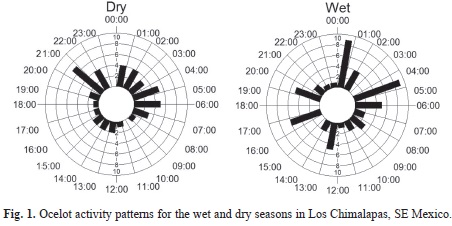
<ref-list>
<ref id="B1">
<nlm-citation citation-type="book">
<person-group person-group-type="author">
<name>
<surname><![CDATA[Burnham]]></surname>
<given-names><![CDATA[K. P.]]></given-names>
</name>
<name>
<surname><![CDATA[Anderson]]></surname>
<given-names><![CDATA[D. R.]]></given-names>
</name>
</person-group>
<source><![CDATA[Model Selection and Inference -A Practical Information- Theoretic Approach]]></source>
<year>2002</year>
<publisher-loc><![CDATA[^eNueva York Nueva York]]></publisher-loc>
<publisher-name><![CDATA[Springer-Verlag]]></publisher-name>
</nlm-citation>
</ref>
<ref id="B2">
<nlm-citation citation-type="journal">
<person-group person-group-type="author">
<name>
<surname><![CDATA[Carbone]]></surname>
<given-names><![CDATA[C.]]></given-names>
</name>
<name>
<surname><![CDATA[Pettorelli]]></surname>
<given-names><![CDATA[N.]]></given-names>
</name>
<name>
<surname><![CDATA[Stephens]]></surname>
<given-names><![CDATA[P. A.]]></given-names>
</name>
</person-group>
<article-title xml:lang="en"><![CDATA[The bigger they come, the harder they fall: body size and prey abundance influence predator-prey ratios]]></article-title>
<source><![CDATA[Biology Letters]]></source>
<year>2011</year>
<volume>7</volume>
<page-range>312-315</page-range></nlm-citation>
</ref>
<ref id="B3">
<nlm-citation citation-type="">
<person-group person-group-type="author">
<name>
<surname><![CDATA[Caso]]></surname>
<given-names><![CDATA[A.]]></given-names>
</name>
</person-group>
<source><![CDATA[Home range and habitat use of three neotropical carnivores in Northeast Mexico]]></source>
<year>1994</year>
</nlm-citation>
</ref>
<ref id="B4">
<nlm-citation citation-type="book">
<person-group person-group-type="author">
<name>
<surname><![CDATA[Ceballos]]></surname>
<given-names><![CDATA[G.]]></given-names>
</name>
<name>
<surname><![CDATA[Chávez]]></surname>
<given-names><![CDATA[C.]]></given-names>
</name>
<name>
<surname><![CDATA[List]]></surname>
<given-names><![CDATA[R.]]></given-names>
</name>
<name>
<surname><![CDATA[Zarza]]></surname>
<given-names><![CDATA[H.]]></given-names>
</name>
</person-group>
<source><![CDATA[Conservación y manejo del jaguar en México. Estudios de caso y perspectivas]]></source>
<year>2007</year>
<publisher-loc><![CDATA[Ciudad de México ]]></publisher-loc>
<publisher-name><![CDATA[Alianza WWF/TelcelComisión Nacional para el Conocimiento y Uso de la BiodiversidadUNAMComisión Nacional de Áreas Naturales Protegidas & EcoCiencia S.C.]]></publisher-name>
</nlm-citation>
</ref>
<ref id="B5">
<nlm-citation citation-type="journal">
<person-group person-group-type="author">
<name>
<surname><![CDATA[Choquet]]></surname>
<given-names><![CDATA[R.]]></given-names>
</name>
<name>
<surname><![CDATA[Lebreton]]></surname>
<given-names><![CDATA[J. D.]]></given-names>
</name>
<name>
<surname><![CDATA[Gimenez]]></surname>
<given-names><![CDATA[O.]]></given-names>
</name>
<name>
<surname><![CDATA[Reboulet]]></surname>
<given-names><![CDATA[A. M.]]></given-names>
</name>
<name>
<surname><![CDATA[Pradel]]></surname>
<given-names><![CDATA[R.]]></given-names>
</name>
</person-group>
<article-title xml:lang="en"><![CDATA[U-CARE: Utilities for performing goodness of fit tests and manipulating Capture-Recapture data]]></article-title>
<source><![CDATA[Ecography]]></source>
<year>2009</year>
<volume>32</volume>
<page-range>1071-1074</page-range></nlm-citation>
</ref>
<ref id="B6">
<nlm-citation citation-type="book">
<person-group person-group-type="author">
<name>
<surname><![CDATA[Cooch]]></surname>
<given-names><![CDATA[E.]]></given-names>
</name>
<name>
<surname><![CDATA[White]]></surname>
<given-names><![CDATA[G]]></given-names>
</name>
</person-group>
<source><![CDATA[Program Mark: Analysis of data from marked individuals. A gentle introduction]]></source>
<year>2012</year>
<publisher-loc><![CDATA[^eNueva York Nueva York]]></publisher-loc>
<publisher-name><![CDATA[Connell University]]></publisher-name>
</nlm-citation>
</ref>
<ref id="B7">
<nlm-citation citation-type="book">
<person-group person-group-type="author">
<name>
<surname><![CDATA[de Oliveira]]></surname>
<given-names><![CDATA[T. G.]]></given-names>
</name>
<name>
<surname><![CDATA[Tortato]]></surname>
<given-names><![CDATA[M. A.]]></given-names>
</name>
<name>
<surname><![CDATA[Silveira]]></surname>
<given-names><![CDATA[L.]]></given-names>
</name>
<name>
<surname><![CDATA[Kasper]]></surname>
<given-names><![CDATA[C. B.]]></given-names>
</name>
<name>
<surname><![CDATA[Mazim]]></surname>
<given-names><![CDATA[F. D.]]></given-names>
</name>
<name>
<surname><![CDATA[Lucherini]]></surname>
<given-names><![CDATA[M.]]></given-names>
</name>
<name>
<surname><![CDATA[Sunquist]]></surname>
<given-names><![CDATA[M.]]></given-names>
</name>
</person-group>
<article-title xml:lang="en"><![CDATA[Ocelot ecology and its effect on the small-felid guild in the lowland neotropics]]></article-title>
<person-group person-group-type="editor">
<name>
<surname><![CDATA[Macdonald]]></surname>
<given-names><![CDATA[D. W]]></given-names>
</name>
<name>
<surname><![CDATA[Loveridge]]></surname>
<given-names><![CDATA[A. J.]]></given-names>
</name>
</person-group>
<source><![CDATA[Biology and conservation of wild felids]]></source>
<year>2010</year>
<page-range>559-596</page-range><publisher-loc><![CDATA[^eNueva York Nueva York]]></publisher-loc>
<publisher-name><![CDATA[Oxford University Press]]></publisher-name>
</nlm-citation>
</ref>
<ref id="B8">
<nlm-citation citation-type="journal">
<person-group person-group-type="author">
<name>
<surname><![CDATA[Di Bitetti]]></surname>
<given-names><![CDATA[M. S.]]></given-names>
</name>
<name>
<surname><![CDATA[Paviolo]]></surname>
<given-names><![CDATA[A.]]></given-names>
</name>
<name>
<surname><![CDATA[De Angelo]]></surname>
<given-names><![CDATA[C.]]></given-names>
</name>
</person-group>
<article-title xml:lang="en"><![CDATA[Density, habitat use and activity patterns of ocelots (Leopardus pardalis) in the Atlantic Forest of Misiones, Argentina]]></article-title>
<source><![CDATA[Journal of Zoology]]></source>
<year>2006</year>
<volume>270</volume>
<page-range>153-163</page-range></nlm-citation>
</ref>
<ref id="B9">
<nlm-citation citation-type="journal">
<person-group person-group-type="author">
<name>
<surname><![CDATA[Di Bitetti]]></surname>
<given-names><![CDATA[M. S.]]></given-names>
</name>
<name>
<surname><![CDATA[Paviolo]]></surname>
<given-names><![CDATA[A.]]></given-names>
</name>
<name>
<surname><![CDATA[De Angelo]]></surname>
<given-names><![CDATA[C. D.]]></given-names>
</name>
<name>
<surname><![CDATA[Di Blanco]]></surname>
<given-names><![CDATA[Y. E.]]></given-names>
</name>
</person-group>
<article-title xml:lang="en"><![CDATA[Local and continental correlates of the abundance of a Neotropical cat, the ocelot (Leopardus pardalis)]]></article-title>
<source><![CDATA[Journal of Tropical Ecology]]></source>
<year>2008</year>
<volume>24</volume>
<page-range>189-200</page-range></nlm-citation>
</ref>
<ref id="B10">
<nlm-citation citation-type="journal">
<person-group person-group-type="author">
<name>
<surname><![CDATA[Di Bitetti]]></surname>
<given-names><![CDATA[M. S.]]></given-names>
</name>
<name>
<surname><![CDATA[Paviolo]]></surname>
<given-names><![CDATA[A.]]></given-names>
</name>
<name>
<surname><![CDATA[Ferrari]]></surname>
<given-names><![CDATA[C. A.]]></given-names>
</name>
<name>
<surname><![CDATA[De Angelo]]></surname>
<given-names><![CDATA[C. D.]]></given-names>
</name>
<name>
<surname><![CDATA[Di Blanco]]></surname>
<given-names><![CDATA[Y. E.]]></given-names>
</name>
</person-group>
<article-title xml:lang="en"><![CDATA[Differential responses to hunting in two sympatric species of brocket deer (Mazama americana and M. nana)]]></article-title>
<source><![CDATA[Biotropica]]></source>
<year>2008</year>
<volume>40</volume>
<page-range>636-645</page-range></nlm-citation>
</ref>
<ref id="B11">
<nlm-citation citation-type="journal">
<person-group person-group-type="author">
<name>
<surname><![CDATA[Díaz-Pulido]]></surname>
<given-names><![CDATA[A.]]></given-names>
</name>
<name>
<surname><![CDATA[Payan]]></surname>
<given-names><![CDATA[E.]]></given-names>
</name>
</person-group>
<article-title xml:lang="es"><![CDATA[Densidad de ocelotes (Leopardus pardalis) en Los Llanos Colombianos]]></article-title>
<source><![CDATA[Mastozoología Neotropical]]></source>
<year>2011</year>
<volume>18</volume>
<page-range>63-71</page-range></nlm-citation>
</ref>
<ref id="B12">
<nlm-citation citation-type="journal">
<person-group person-group-type="author">
<name>
<surname><![CDATA[Dillon]]></surname>
<given-names><![CDATA[A.]]></given-names>
</name>
<name>
<surname><![CDATA[Kelly]]></surname>
<given-names><![CDATA[M. J.]]></given-names>
</name>
</person-group>
<article-title xml:lang="en"><![CDATA[Ocelot home range, overlap and density: comparing radio telemetry with camera trapping]]></article-title>
<source><![CDATA[Journal of Zoology]]></source>
<year>2008</year>
<volume>275</volume>
<page-range>391-398</page-range></nlm-citation>
</ref>
<ref id="B13">
<nlm-citation citation-type="journal">
<person-group person-group-type="author">
<name>
<surname><![CDATA[Emmons]]></surname>
<given-names><![CDATA[L. H.]]></given-names>
</name>
</person-group>
<source><![CDATA[Review d´Ecologie]]></source>
<year>1988</year>
<volume>43</volume>
<page-range>133-157</page-range></nlm-citation>
</ref>
<ref id="B14">
<nlm-citation citation-type="book">
<collab>Esri</collab>
<source><![CDATA[ArcGis version 9.3]]></source>
<year>2008</year>
<publisher-name><![CDATA[http://www.esri.com/software/arcgis]]></publisher-name>
</nlm-citation>
</ref>
<ref id="B15">
<nlm-citation citation-type="journal">
<person-group person-group-type="author">
<name>
<surname><![CDATA[González-Maya]]></surname>
<given-names><![CDATA[J. F.]]></given-names>
</name>
<name>
<surname><![CDATA[Cardenal-Porras]]></surname>
<given-names><![CDATA[J.]]></given-names>
</name>
</person-group>
<article-title xml:lang="en"><![CDATA[Ocelot density in the Caribbean slope of the Talamanca region, Costa Rica]]></article-title>
<source><![CDATA[Hystrix, the Italian Journal of Mammalogy]]></source>
<year>2011</year>
<volume>22</volume>
<page-range>355-360</page-range></nlm-citation>
</ref>
<ref id="B16">
<nlm-citation citation-type="book">
<person-group person-group-type="author">
<name>
<surname><![CDATA[Gregorio]]></surname>
<given-names><![CDATA[L. C.]]></given-names>
</name>
</person-group>
<source><![CDATA[Estimación de algunos parámetros demográficos poblacionales de tepezcuintle (Cuniculus paca) en San Antonio Nuevo Paraíso, Santa María Chimalapa, Oaxaca]]></source>
<year>2012</year>
<publisher-loc><![CDATA[^eOaxaca Oaxaca]]></publisher-loc>
<publisher-name><![CDATA[Instituto tecnológico del Valle de Oaxaca.]]></publisher-name>
</nlm-citation>
</ref>
<ref id="B17">
<nlm-citation citation-type="journal">
<person-group person-group-type="author">
<name>
<surname><![CDATA[Grigione]]></surname>
<given-names><![CDATA[M. M.]]></given-names>
</name>
<name>
<surname><![CDATA[Menke]]></surname>
<given-names><![CDATA[K.]]></given-names>
</name>
<name>
<surname><![CDATA[López-González]]></surname>
<given-names><![CDATA[C.]]></given-names>
</name>
<name>
<surname><![CDATA[List]]></surname>
<given-names><![CDATA[R.]]></given-names>
</name>
<name>
<surname><![CDATA[Banda]]></surname>
<given-names><![CDATA[A.]]></given-names>
</name>
<name>
<surname><![CDATA[Carrerea]]></surname>
<given-names><![CDATA[J.]]></given-names>
</name>
<name>
<surname><![CDATA[Van Pelt]]></surname>
<given-names><![CDATA[B.]]></given-names>
</name>
</person-group>
<article-title xml:lang="en"><![CDATA[Identifying potential conservation areas for felids in the USA and Mexico: integrating reliable knowledge across an international border]]></article-title>
<source><![CDATA[Oryx]]></source>
<year>2009</year>
<volume>43</volume>
<page-range>78-86</page-range></nlm-citation>
</ref>
<ref id="B18">
<nlm-citation citation-type="journal">
<person-group person-group-type="author">
<name>
<surname><![CDATA[Gutiérrez-González]]></surname>
<given-names><![CDATA[C. E.]]></given-names>
</name>
<name>
<surname><![CDATA[Gómez-Ramírez]]></surname>
<given-names><![CDATA[M. A.]]></given-names>
</name>
</person-group>
<source><![CDATA[Oryx]]></source>
<year></year>
<volume>46</volume>
<page-range>431-437</page-range></nlm-citation>
</ref>
<ref id="B19">
<nlm-citation citation-type="journal">
<person-group person-group-type="author">
<name>
<surname><![CDATA[Haines]]></surname>
<given-names><![CDATA[A. M.]]></given-names>
</name>
<name>
<surname><![CDATA[Tewes]]></surname>
<given-names><![CDATA[M. E.]]></given-names>
</name>
<name>
<surname><![CDATA[Laack]]></surname>
<given-names><![CDATA[L. L.]]></given-names>
</name>
<name>
<surname><![CDATA[Grant]]></surname>
<given-names><![CDATA[W. E.]]></given-names>
</name>
<name>
<surname><![CDATA[Young]]></surname>
<given-names><![CDATA[J.]]></given-names>
</name>
</person-group>
<article-title xml:lang="en"><![CDATA[Evaluating recovery strategies for an ocelot (Leopardus pardalis) population in the United States]]></article-title>
<source><![CDATA[Biological Conservation]]></source>
<year>2005</year>
<volume>126</volume>
<page-range>512-522</page-range></nlm-citation>
</ref>
<ref id="B20">
<nlm-citation citation-type="journal">
<person-group person-group-type="author">
<name>
<surname><![CDATA[Harmsen]]></surname>
<given-names><![CDATA[B. J.]]></given-names>
</name>
<name>
<surname><![CDATA[Foster]]></surname>
<given-names><![CDATA[R. J.]]></given-names>
</name>
<name>
<surname><![CDATA[Silver]]></surname>
<given-names><![CDATA[S. C.]]></given-names>
</name>
<name>
<surname><![CDATA[Ostro]]></surname>
<given-names><![CDATA[L. E. T.]]></given-names>
</name>
<name>
<surname><![CDATA[Doncaster]]></surname>
<given-names><![CDATA[C. P.]]></given-names>
</name>
</person-group>
<article-title xml:lang="en"><![CDATA[Jaguar and puma activity patterns in relation to their main prey]]></article-title>
<source><![CDATA[Mammalian Biology]]></source>
<year>2011</year>
<volume>76</volume>
<page-range>320-324</page-range></nlm-citation>
</ref>
<ref id="B21">
<nlm-citation citation-type="journal">
<person-group person-group-type="author">
<name>
<surname><![CDATA[Harveson]]></surname>
<given-names><![CDATA[P. M.]]></given-names>
</name>
<name>
<surname><![CDATA[Tewes]]></surname>
<given-names><![CDATA[M. E.]]></given-names>
</name>
<name>
<surname><![CDATA[Anderson]]></surname>
<given-names><![CDATA[G. L.]]></given-names>
</name>
<name>
<surname><![CDATA[Laak]]></surname>
<given-names><![CDATA[L. L.]]></given-names>
</name>
</person-group>
<article-title xml:lang="en"><![CDATA[Habitat use by ocelots in south Texas: implications for restoration]]></article-title>
<source><![CDATA[Wildlife Society Bulletin]]></source>
<year>2004</year>
<volume>32</volume>
<page-range>948-954</page-range></nlm-citation>
</ref>
<ref id="B22">
<nlm-citation citation-type="book">
<person-group person-group-type="author">
<name>
<surname><![CDATA[Hatten]]></surname>
<given-names><![CDATA[J. R.]]></given-names>
</name>
<name>
<surname><![CDATA[Averril-Murray]]></surname>
<given-names><![CDATA[A.]]></given-names>
</name>
<name>
<surname><![CDATA[Van Pelt]]></surname>
<given-names><![CDATA[W. E.]]></given-names>
</name>
</person-group>
<source><![CDATA[Characterizing and mapping potential jaguar habitat in Arizona]]></source>
<year>2003</year>
<publisher-loc><![CDATA[^eArizona Arizona]]></publisher-loc>
<publisher-name><![CDATA[Game and fish Department]]></publisher-name>
</nlm-citation>
</ref>
<ref id="B23">
<nlm-citation citation-type="">
<person-group person-group-type="author">
<name>
<surname><![CDATA[Hintze]]></surname>
<given-names><![CDATA[J.]]></given-names>
</name>
</person-group>
<source><![CDATA[NCSS Statistical data analysis software]]></source>
<year>2010</year>
</nlm-citation>
</ref>
<ref id="B24">
<nlm-citation citation-type="">
<collab>Inegi</collab>
<source><![CDATA[Red hidrológica escala 1:50 000 y modelo digital de elevación 1:50 000]]></source>
<year>2000</year>
</nlm-citation>
</ref>
<ref id="B25">
<nlm-citation citation-type="journal">
<person-group person-group-type="author">
<name>
<surname><![CDATA[Karanth]]></surname>
<given-names><![CDATA[K. U.]]></given-names>
</name>
<name>
<surname><![CDATA[Nichols]]></surname>
<given-names><![CDATA[J. D.]]></given-names>
</name>
</person-group>
<article-title xml:lang="en"><![CDATA[Estimation of tiger densities in India using photographic captures and recaptures]]></article-title>
<source><![CDATA[Ecology]]></source>
<year>1998</year>
<volume>79</volume>
<page-range>2852-2862</page-range></nlm-citation>
</ref>
<ref id="B26">
<nlm-citation citation-type="journal">
<person-group person-group-type="author">
<name>
<surname><![CDATA[Karanth]]></surname>
<given-names><![CDATA[K. U.]]></given-names>
</name>
<name>
<surname><![CDATA[Nichols]]></surname>
<given-names><![CDATA[J. D.]]></given-names>
</name>
<name>
<surname><![CDATA[Kumar]]></surname>
<given-names><![CDATA[N. S.]]></given-names>
</name>
<name>
<surname><![CDATA[Link]]></surname>
<given-names><![CDATA[W. A.]]></given-names>
</name>
<name>
<surname><![CDATA[Hines]]></surname>
<given-names><![CDATA[J. E.]]></given-names>
</name>
</person-group>
<article-title xml:lang="en"><![CDATA[Tigers and their prey: predicting carnivore densities from prey abundance]]></article-title>
<source><![CDATA[Proceedings of the National Academy of Sciences of the United States of America]]></source>
<year>2004</year>
<volume>101</volume>
<page-range>4854-4858</page-range></nlm-citation>
</ref>
<ref id="B27">
<nlm-citation citation-type="journal">
<person-group person-group-type="author">
<name>
<surname><![CDATA[Kitchen]]></surname>
<given-names><![CDATA[A. M.]]></given-names>
</name>
<name>
<surname><![CDATA[Gese]]></surname>
<given-names><![CDATA[E. M.]]></given-names>
</name>
<name>
<surname><![CDATA[Schauster]]></surname>
<given-names><![CDATA[E. R.]]></given-names>
</name>
</person-group>
<article-title xml:lang="en"><![CDATA[Changes in coyote activity patterns due to reduced exposure to human persecution]]></article-title>
<source><![CDATA[Canadian Journal of Zoology]]></source>
<year>2000</year>
<volume>78</volume>
<page-range>853-857</page-range></nlm-citation>
</ref>
<ref id="B28">
<nlm-citation citation-type="journal">
<person-group person-group-type="author">
<name>
<surname><![CDATA[Kolowski]]></surname>
<given-names><![CDATA[J. M.]]></given-names>
</name>
<name>
<surname><![CDATA[Alonso]]></surname>
<given-names><![CDATA[A.]]></given-names>
</name>
</person-group>
<article-title xml:lang="en"><![CDATA[Density and activity patterns of ocelots (Leopardus pardalis) in northern Peru and the impact of oil exploration activities]]></article-title>
<source><![CDATA[Biological Conservation]]></source>
<year>2010</year>
<volume>143</volume>
<page-range>917-925</page-range></nlm-citation>
</ref>
<ref id="B29">
<nlm-citation citation-type="">
<collab>Kovach Computing Services</collab>
<source><![CDATA[Software Oriana version 4]]></source>
<year>2011</year>
</nlm-citation>
</ref>
<ref id="B30">
<nlm-citation citation-type="">
<person-group person-group-type="author">
<name>
<surname><![CDATA[Laak]]></surname>
<given-names><![CDATA[L. L.]]></given-names>
</name>
</person-group>
<source><![CDATA[Ecology of the ocelot (Felis pardalis) in south Texas]]></source>
<year>1991</year>
</nlm-citation>
</ref>
<ref id="B31">
<nlm-citation citation-type="journal">
<person-group person-group-type="author">
<name>
<surname><![CDATA[Lebreton]]></surname>
<given-names><![CDATA[J. D.]]></given-names>
</name>
<name>
<surname><![CDATA[Burnham]]></surname>
<given-names><![CDATA[K. P.]]></given-names>
</name>
<name>
<surname><![CDATA[Clobert]]></surname>
<given-names><![CDATA[J.]]></given-names>
</name>
<name>
<surname><![CDATA[Anderson]]></surname>
<given-names><![CDATA[D. R.]]></given-names>
</name>
</person-group>
<article-title xml:lang="en"><![CDATA[Modeling survival and testing biological hypotheses using marked animal: A unified approach with case studies]]></article-title>
<source><![CDATA[Ecological Monographs]]></source>
<year>1992</year>
<volume>62</volume>
<page-range>67-118</page-range></nlm-citation>
</ref>
<ref id="B32">
<nlm-citation citation-type="journal">
<person-group person-group-type="author">
<name>
<surname><![CDATA[Lindenmayer]]></surname>
<given-names><![CDATA[D. B.]]></given-names>
</name>
<name>
<surname><![CDATA[Lacy]]></surname>
<given-names><![CDATA[R. C.]]></given-names>
</name>
<name>
<surname><![CDATA[Viggers]]></surname>
<given-names><![CDATA[K. L.]]></given-names>
</name>
</person-group>
<article-title xml:lang="en"><![CDATA[Modeling survival and capture probabilities of the mountain brushtail possum (Trichosurus caninus) in the forests of southeastern Australia using trap-recapture data]]></article-title>
<source><![CDATA[Journal of Zoology]]></source>
<year>1998</year>
<volume>245</volume>
<page-range>1-13</page-range></nlm-citation>
</ref>
<ref id="B33">
<nlm-citation citation-type="journal">
<person-group person-group-type="author">
<name>
<surname><![CDATA[Lira-Torres]]></surname>
<given-names><![CDATA[I.]]></given-names>
</name>
<name>
<surname><![CDATA[Galindo-Leal]]></surname>
<given-names><![CDATA[C.]]></given-names>
</name>
<name>
<surname><![CDATA[Briones-Salas]]></surname>
<given-names><![CDATA[M.]]></given-names>
</name>
</person-group>
<article-title xml:lang="es"><![CDATA[Mamíferos de la Selva Zoque, México: riqueza, uso y conservación]]></article-title>
<source><![CDATA[Revista de Biología Tropical]]></source>
<year>2012</year>
<volume>60</volume>
<page-range>781-797</page-range></nlm-citation>
</ref>
<ref id="B34">
<nlm-citation citation-type="journal">
<person-group person-group-type="author">
<name>
<surname><![CDATA[López-González]]></surname>
<given-names><![CDATA[C. A.]]></given-names>
</name>
<name>
<surname><![CDATA[Brown]]></surname>
<given-names><![CDATA[D. E.]]></given-names>
</name>
<name>
<surname><![CDATA[Gallo-Reynoso]]></surname>
<given-names><![CDATA[J. P.]]></given-names>
</name>
</person-group>
<article-title xml:lang="en"><![CDATA[The ocelot Leopardus pardalis in north-western Mexico: ecology, distribution and conservation status]]></article-title>
<source><![CDATA[Oryx]]></source>
<year>2003</year>
<volume>37</volume>
<page-range>358-364</page-range></nlm-citation>
</ref>
<ref id="B35">
<nlm-citation citation-type="journal">
<person-group person-group-type="author">
<name>
<surname><![CDATA[Ludlow]]></surname>
<given-names><![CDATA[M. E.]]></given-names>
</name>
<name>
<surname><![CDATA[Sunquist]]></surname>
<given-names><![CDATA[M. E.]]></given-names>
</name>
</person-group>
<article-title xml:lang="en"><![CDATA[Ecology and behavior of ocelots in Venezuela]]></article-title>
<source><![CDATA[National Geographic Research]]></source>
<year>1987</year>
<volume>3</volume>
<page-range>447-461</page-range></nlm-citation>
</ref>
<ref id="B36">
<nlm-citation citation-type="journal">
<person-group person-group-type="author">
<name>
<surname><![CDATA[Maffei]]></surname>
<given-names><![CDATA[L.]]></given-names>
</name>
<name>
<surname><![CDATA[Noss]]></surname>
<given-names><![CDATA[A. J.]]></given-names>
</name>
<name>
<surname><![CDATA[Cuéllar]]></surname>
<given-names><![CDATA[E.]]></given-names>
</name>
<name>
<surname><![CDATA[Rumiz]]></surname>
<given-names><![CDATA[D. I.]]></given-names>
</name>
</person-group>
<article-title xml:lang="en"><![CDATA[Ocelot (Felis pardalis) population densities, activity, and ranging behaviour in dry forest of Eastern Bolivia: data from camera trapping]]></article-title>
<source><![CDATA[Journal of Tropical Ecology]]></source>
<year>2005</year>
<volume>21</volume>
<page-range>1-6</page-range></nlm-citation>
</ref>
<ref id="B37">
<nlm-citation citation-type="journal">
<person-group person-group-type="author">
<name>
<surname><![CDATA[Maffei]]></surname>
<given-names><![CDATA[L.]]></given-names>
</name>
<name>
<surname><![CDATA[Noss]]></surname>
<given-names><![CDATA[A. J.]]></given-names>
</name>
</person-group>
<article-title xml:lang="en"><![CDATA[How small is too small?: Camera trap survey areas and density estimates for ocelots in the Bolivian Chaco]]></article-title>
<source><![CDATA[Biotropica]]></source>
<year>2008</year>
<volume>40</volume>
<page-range>71-75</page-range></nlm-citation>
</ref>
<ref id="B38">
<nlm-citation citation-type="journal">
<person-group person-group-type="author">
<name>
<surname><![CDATA[Mares]]></surname>
<given-names><![CDATA[R.]]></given-names>
</name>
<name>
<surname><![CDATA[Moreno]]></surname>
<given-names><![CDATA[R. S.]]></given-names>
</name>
<name>
<surname><![CDATA[Kays]]></surname>
<given-names><![CDATA[R. W.]]></given-names>
</name>
<name>
<surname><![CDATA[Wikelski]]></surname>
<given-names><![CDATA[M.]]></given-names>
</name>
</person-group>
<article-title xml:lang="en"><![CDATA[Predispersal home range shift of an ocelot Leopardus pardalis (Carnivora: Felidae) on Barro Colorado Island, Panama]]></article-title>
<source><![CDATA[Revista de Biología Tropical]]></source>
<year>2008</year>
<volume>56</volume>
<page-range>779-787</page-range></nlm-citation>
</ref>
<ref id="B39">
<nlm-citation citation-type="">
<person-group person-group-type="author">
<name>
<surname><![CDATA[Martínez]]></surname>
<given-names><![CDATA[E.]]></given-names>
</name>
</person-group>
<source><![CDATA[Estudio ecológico del ocelote (Leopardus pardalis) en la zona de Chamela, Jalisco, México]]></source>
<year>1997</year>
</nlm-citation>
</ref>
<ref id="B40">
<nlm-citation citation-type="journal">
<person-group person-group-type="author">
<name>
<surname><![CDATA[Martínez-Calderas]]></surname>
<given-names><![CDATA[J. M.]]></given-names>
</name>
<name>
<surname><![CDATA[Rosas-Rosas]]></surname>
<given-names><![CDATA[O. C.]]></given-names>
</name>
<name>
<surname><![CDATA[Martínez-Montoya]]></surname>
<given-names><![CDATA[J. F.]]></given-names>
</name>
</person-group>
<source><![CDATA[Revista Mexicana de Biodiversidad]]></source>
<year></year>
<volume>82</volume>
<page-range>997-1004</page-range></nlm-citation>
</ref>
<ref id="B41">
<nlm-citation citation-type="journal">
<person-group person-group-type="author">
<name>
<surname><![CDATA[Monroy-Vilchis]]></surname>
<given-names><![CDATA[O.]]></given-names>
</name>
<name>
<surname><![CDATA[Rodríguez-Soto]]></surname>
<given-names><![CDATA[C.]]></given-names>
</name>
<name>
<surname><![CDATA[Zarco-González]]></surname>
<given-names><![CDATA[M.]]></given-names>
</name>
<name>
<surname><![CDATA[Urios]]></surname>
<given-names><![CDATA[V.]]></given-names>
</name>
</person-group>
<article-title xml:lang="en"><![CDATA[Cougar and jaguar habitat use and activity patterns in central Mexico]]></article-title>
<source><![CDATA[Animal Biology]]></source>
<year>2009</year>
<volume>59</volume>
<page-range>145-157</page-range></nlm-citation>
</ref>
<ref id="B42">
<nlm-citation citation-type="journal">
<person-group person-group-type="author">
<name>
<surname><![CDATA[Monroy-Vilchis]]></surname>
<given-names><![CDATA[O.]]></given-names>
</name>
<name>
<surname><![CDATA[Zarco-González]]></surname>
<given-names><![CDATA[M. M.]]></given-names>
</name>
<name>
<surname><![CDATA[Rodríguez-Soto]]></surname>
<given-names><![CDATA[C.]]></given-names>
</name>
<name>
<surname><![CDATA[Soria-Díaz]]></surname>
<given-names><![CDATA[L.]]></given-names>
</name>
<name>
<surname><![CDATA[Urios]]></surname>
<given-names><![CDATA[V.]]></given-names>
</name>
</person-group>
<article-title xml:lang="es"><![CDATA[Fototrampeo de mamíferos en la Sierra Nanchititla, México: abundancia relativa y patrón de actividad]]></article-title>
<source><![CDATA[Revista de Biología Tropical]]></source>
<year>2011</year>
<volume>59</volume>
<page-range>373-383</page-range></nlm-citation>
</ref>
<ref id="B43">
<nlm-citation citation-type="journal">
<person-group person-group-type="author">
<name>
<surname><![CDATA[Moreno]]></surname>
<given-names><![CDATA[R. S.]]></given-names>
</name>
<name>
<surname><![CDATA[Kays]]></surname>
<given-names><![CDATA[R. W.]]></given-names>
</name>
<name>
<surname><![CDATA[Samudio]]></surname>
<given-names><![CDATA[R.]]></given-names>
</name>
</person-group>
<article-title xml:lang="en"><![CDATA[Competitive release in diets of ocelot (Leopardus pardalis) and puma (Puma concolor) after jaguar (Panthera onca) decline]]></article-title>
<source><![CDATA[Journal of Mammalogy]]></source>
<year>2006</year>
<volume>87</volume>
<page-range>808-816</page-range></nlm-citation>
</ref>
<ref id="B44">
<nlm-citation citation-type="journal">
<person-group person-group-type="author">
<name>
<surname><![CDATA[Murray]]></surname>
<given-names><![CDATA[J. L.]]></given-names>
</name>
<name>
<surname><![CDATA[Gardner]]></surname>
<given-names><![CDATA[G. L.]]></given-names>
</name>
</person-group>
<article-title xml:lang="es"><![CDATA[Leopardus pardalis]]></article-title>
<source><![CDATA[Mammalian Species]]></source>
<year>1997</year>
<volume>548</volume>
<page-range>1-10</page-range></nlm-citation>
</ref>
<ref id="B45">
<nlm-citation citation-type="book">
<person-group person-group-type="author">
<name>
<surname><![CDATA[Ortega del Valle]]></surname>
<given-names><![CDATA[D.]]></given-names>
</name>
<name>
<surname><![CDATA[Carranza]]></surname>
<given-names><![CDATA[T.]]></given-names>
</name>
<name>
<surname><![CDATA[Martínez]]></surname>
<given-names><![CDATA[J.]]></given-names>
</name>
</person-group>
<source><![CDATA[Una mirada desde el corazón de la jícara de oro: Experiencias de conservación en la Selva Zoque de Los Chimalapas]]></source>
<year>2012</year>
<publisher-loc><![CDATA[^eOaxaca Oaxaca]]></publisher-loc>
<publisher-name><![CDATA[WWF-México]]></publisher-name>
</nlm-citation>
</ref>
<ref id="B46">
<nlm-citation citation-type="book">
<person-group person-group-type="author">
<name>
<surname><![CDATA[Parroquin]]></surname>
<given-names><![CDATA[J.]]></given-names>
</name>
<name>
<surname><![CDATA[Gallina]]></surname>
<given-names><![CDATA[S.]]></given-names>
</name>
<name>
<surname><![CDATA[Aguirre]]></surname>
<given-names><![CDATA[G.]]></given-names>
</name>
<name>
<surname><![CDATA[Pérez]]></surname>
<given-names><![CDATA[J.]]></given-names>
</name>
</person-group>
<article-title xml:lang="es"><![CDATA[El tepezcuintle: estrategias para su aprovechamiento con base en la evaluación de su población y hábitat en el ejido Loma de Oro, Uxpanapa, Veracruz, México]]></article-title>
<person-group person-group-type="editor">
<name>
<surname><![CDATA[Guerra Roa]]></surname>
<given-names><![CDATA[M. M]]></given-names>
</name>
<name>
<surname><![CDATA[Calmé]]></surname>
<given-names><![CDATA[S]]></given-names>
</name>
<name>
<surname><![CDATA[Gallina]]></surname>
<given-names><![CDATA[S]]></given-names>
</name>
<name>
<surname><![CDATA[Naranjo]]></surname>
<given-names><![CDATA[E. J]]></given-names>
</name>
</person-group>
<source><![CDATA[Uso y manejo de fauna Silvestre en el norte de Mesoamérica]]></source>
<year>2010</year>
<page-range>137-160</page-range><publisher-loc><![CDATA[Xalapa ]]></publisher-loc>
<publisher-name><![CDATA[Secretaria de Educación de Veracruz]]></publisher-name>
</nlm-citation>
</ref>
<ref id="B47">
<nlm-citation citation-type="journal">
<person-group person-group-type="author">
<name>
<surname><![CDATA[Paviolo]]></surname>
<given-names><![CDATA[A]]></given-names>
</name>
<name>
<surname><![CDATA[Di Blanco,]]></surname>
<given-names><![CDATA[Y. E.]]></given-names>
</name>
<name>
<surname><![CDATA[De Angelo]]></surname>
<given-names><![CDATA[C. D.]]></given-names>
</name>
<name>
<surname><![CDATA[Di Bitetti]]></surname>
<given-names><![CDATA[M.]]></given-names>
</name>
</person-group>
<article-title xml:lang="en"><![CDATA[Protection affects the abundance and activity patterns of pumas in the Atlantic Forest]]></article-title>
<source><![CDATA[Journal of Mammalogy]]></source>
<year>2009</year>
<volume>90</volume>
<page-range>926-934</page-range></nlm-citation>
</ref>
<ref id="B48">
<nlm-citation citation-type="journal">
<person-group person-group-type="author">
<name>
<surname><![CDATA[Polisar]]></surname>
<given-names><![CDATA[J.]]></given-names>
</name>
<name>
<surname><![CDATA[Maxit]]></surname>
<given-names><![CDATA[I.]]></given-names>
</name>
<name>
<surname><![CDATA[Scognamillo]]></surname>
<given-names><![CDATA[D.]]></given-names>
</name>
<name>
<surname><![CDATA[Farrell]]></surname>
<given-names><![CDATA[L.]]></given-names>
</name>
<name>
<surname><![CDATA[Sunquist]]></surname>
<given-names><![CDATA[M. E.]]></given-names>
</name>
<name>
<surname><![CDATA[Eisenberg]]></surname>
<given-names><![CDATA[J.]]></given-names>
</name>
</person-group>
<article-title xml:lang="en"><![CDATA[Jaguar, pumas, their prey base, and cattle ranching: ecological interpretation of a management problem]]></article-title>
<source><![CDATA[Biological Conservation]]></source>
<year>2003</year>
<volume>109</volume>
<page-range>297-310</page-range></nlm-citation>
</ref>
<ref id="B49">
<nlm-citation citation-type="journal">
<person-group person-group-type="author">
<name>
<surname><![CDATA[Pollock]]></surname>
<given-names><![CDATA[K. H.]]></given-names>
</name>
</person-group>
<article-title xml:lang="en"><![CDATA[A capture-recapture design robust to unequal probability capture]]></article-title>
<source><![CDATA[Journal of Wildlife Management]]></source>
<year>1982</year>
<volume>46</volume>
<page-range>752-757</page-range></nlm-citation>
</ref>
<ref id="B50">
<nlm-citation citation-type="journal">
<person-group person-group-type="author">
<name>
<surname><![CDATA[Reyes]]></surname>
<given-names><![CDATA[J.]]></given-names>
</name>
<name>
<surname><![CDATA[Mas]]></surname>
<given-names><![CDATA[J.]]></given-names>
</name>
<name>
<surname><![CDATA[Velázquez]]></surname>
<given-names><![CDATA[A.]]></given-names>
</name>
</person-group>
<article-title xml:lang="en"><![CDATA[Trends of tropical deforestation in Southeast Mexico]]></article-title>
<source><![CDATA[Singapore Journal of Tropical Geography]]></source>
<year>2010</year>
<volume>31</volume>
<page-range>180-196</page-range></nlm-citation>
</ref>
<ref id="B51">
<nlm-citation citation-type="book">
<person-group person-group-type="author">
<name>
<surname><![CDATA[Salas]]></surname>
<given-names><![CDATA[S. H.]]></given-names>
</name>
<name>
<surname><![CDATA[Schibli]]></surname>
<given-names><![CDATA[L.]]></given-names>
</name>
<name>
<surname><![CDATA[Torres]]></surname>
<given-names><![CDATA[E.]]></given-names>
</name>
</person-group>
<article-title xml:lang="es"><![CDATA[La importancia ecológica y biológica]]></article-title>
<person-group person-group-type="editor">
<name>
<surname><![CDATA[Aparicio Cid]]></surname>
<given-names><![CDATA[A]]></given-names>
</name>
</person-group>
<source><![CDATA[Chimalapas, la última oportunidad]]></source>
<year>2001</year>
<page-range>29-47</page-range><publisher-loc><![CDATA[Ciudad de México ]]></publisher-loc>
<publisher-name><![CDATA[Word Wildlife FoundSecretaria del medio Ambiente, Recursos Naturales y Pesca]]></publisher-name>
</nlm-citation>
</ref>
<ref id="B52">
<nlm-citation citation-type="journal">
<person-group person-group-type="author">
<name>
<surname><![CDATA[Santos-Moreno]]></surname>
<given-names><![CDATA[A.]]></given-names>
</name>
<name>
<surname><![CDATA[Briones-Salas]]></surname>
<given-names><![CDATA[M. A.]]></given-names>
</name>
<name>
<surname><![CDATA[López-Wilchis]]></surname>
<given-names><![CDATA[R.]]></given-names>
</name>
</person-group>
<article-title xml:lang="es"><![CDATA[Diferencias en algunos parámetros demográficos de Oryzomys chapmani (Rodentia: Muridae) asociadas a tres estados sucesionales de bosque mesófilo de montaña en Oaxaca, México]]></article-title>
<source><![CDATA[Acta Zoológica Mexicana (n.s.)]]></source>
<year>2007</year>
<volume>23</volume>
<page-range>123-137</page-range></nlm-citation>
</ref>
<ref id="B53">
<nlm-citation citation-type="journal">
<person-group person-group-type="author">
<name>
<surname><![CDATA[Santos-Moreno]]></surname>
<given-names><![CDATA[A.]]></given-names>
</name>
<name>
<surname><![CDATA[Pérez-Irineo]]></surname>
<given-names><![CDATA[G.]]></given-names>
</name>
</person-group>
<article-title xml:lang="es"><![CDATA[Estimación de abundancia de tepezcuinte (Cuniculus paca) y de su relación con la presencia de competidores y depredadores]]></article-title>
<source><![CDATA[Therya]]></source>
<year>2013</year>
<volume>4</volume>
<page-range>89-98</page-range></nlm-citation>
</ref>
<ref id="B54">
<nlm-citation citation-type="book">
<collab>Semarnat</collab>
<source><![CDATA[Norma Oficial Mexicana NOM-059-SEMARNAT-2010, Protección ambiental-Especies nativas de México de flora y fauna silvestres: Categoría de riesgo y especificaciones para su inclusión, exclusión o cambio. Lista de especies en riesgo]]></source>
<year>2010</year>
<publisher-name><![CDATA[Diario Oficial de la Federación]]></publisher-name>
</nlm-citation>
</ref>
<ref id="B55">
<nlm-citation citation-type="journal">
<person-group person-group-type="author">
<name>
<surname><![CDATA[Sokal]]></surname>
<given-names><![CDATA[R. R.]]></given-names>
</name>
<name>
<surname><![CDATA[Oden]]></surname>
<given-names><![CDATA[N. L.]]></given-names>
</name>
</person-group>
<article-title xml:lang="en"><![CDATA[Spatial autocorrelation in Biology: 1. Methodology]]></article-title>
<source><![CDATA[Biological Journal of the Linnean Society]]></source>
<year>1978</year>
<volume>10</volume>
<page-range>199-228</page-range></nlm-citation>
</ref>
<ref id="B56">
<nlm-citation citation-type="book">
<person-group person-group-type="author">
<name>
<surname><![CDATA[Stanley]]></surname>
<given-names><![CDATA[T. R.]]></given-names>
</name>
<name>
<surname><![CDATA[Richards]]></surname>
<given-names><![CDATA[J. D.]]></given-names>
</name>
</person-group>
<source><![CDATA[CloseTest: A program for testing capture-recapture data for closure, v. 3]]></source>
<year>1999</year>
<publisher-loc><![CDATA[^eColorado Colorado]]></publisher-loc>
<publisher-name><![CDATA[US Geological Survey]]></publisher-name>
</nlm-citation>
</ref>
<ref id="B57">
<nlm-citation citation-type="">
<collab>Statsoft</collab>
<source><![CDATA[Statistical data analysis software, version 7.1]]></source>
<year>2005</year>
</nlm-citation>
</ref>
<ref id="B58">
<nlm-citation citation-type="book">
<person-group person-group-type="author">
<name>
<surname><![CDATA[Sunquist]]></surname>
<given-names><![CDATA[M.]]></given-names>
</name>
<name>
<surname><![CDATA[Sunquist]]></surname>
<given-names><![CDATA[F]]></given-names>
</name>
</person-group>
<source><![CDATA[Wild cats of the world]]></source>
<year>2002</year>
<publisher-loc><![CDATA[^eChicago Chicago]]></publisher-loc>
<publisher-name><![CDATA[The University of Chicago Press]]></publisher-name>
</nlm-citation>
</ref>
<ref id="B59">
<nlm-citation citation-type="">
<person-group person-group-type="author">
<name>
<surname><![CDATA[Torres]]></surname>
<given-names><![CDATA[E. J.]]></given-names>
</name>
</person-group>
<source><![CDATA[Densidad, abundancia, uso de hábitat y patrones de actividad del ocelote (Leopardus pardalis) en la zona noreste del Estado de Quintana Roo: Estudio usando cámaras trampa]]></source>
<year>2009</year>
</nlm-citation>
</ref>
<ref id="B60">
<nlm-citation citation-type="book">
<person-group person-group-type="author">
<name>
<surname><![CDATA[Trejo]]></surname>
<given-names><![CDATA[I.]]></given-names>
</name>
</person-group>
<article-title xml:lang="es"><![CDATA[Clima]]></article-title>
<person-group person-group-type="editor">
<name>
<surname><![CDATA[García-Mendoza]]></surname>
<given-names><![CDATA[A. J]]></given-names>
</name>
<name>
<surname><![CDATA[Ordoñez]]></surname>
<given-names><![CDATA[M. J]]></given-names>
</name>
<name>
<surname><![CDATA[Briones-Salas]]></surname>
<given-names><![CDATA[M]]></given-names>
</name>
</person-group>
<source><![CDATA[Biodiversidad de Oaxaca]]></source>
<year>2004</year>
<page-range>67-85</page-range><publisher-loc><![CDATA[Ciudad de México ]]></publisher-loc>
<publisher-name><![CDATA[Instituto de BiologíaUNAM-Fondo Oaxaqueño para la Conservación de la Naturaleza-Word Wildlife Fund.]]></publisher-name>
</nlm-citation>
</ref>
<ref id="B61">
<nlm-citation citation-type="journal">
<person-group person-group-type="author">
<name>
<surname><![CDATA[Trolle]]></surname>
<given-names><![CDATA[M.]]></given-names>
</name>
<name>
<surname><![CDATA[Kéry]]></surname>
<given-names><![CDATA[M.]]></given-names>
</name>
</person-group>
<article-title xml:lang="en"><![CDATA[Estimation of ocelot density in the Pantanal using capture-recapture analysis of camera-trapping data]]></article-title>
<source><![CDATA[Journal of Mammalogy]]></source>
<year>2003</year>
<volume>84</volume>
<page-range>607-614</page-range></nlm-citation>
</ref>
<ref id="B62">
<nlm-citation citation-type="journal">
<person-group person-group-type="author">
<name>
<surname><![CDATA[Trolle]]></surname>
<given-names><![CDATA[M.]]></given-names>
</name>
<name>
<surname><![CDATA[Kéry]]></surname>
<given-names><![CDATA[M.]]></given-names>
</name>
</person-group>
<article-title xml:lang="en"><![CDATA[Camera-trap study of ocelot and other secretive mammals in the northem Pantanal]]></article-title>
<source><![CDATA[Mammalia]]></source>
<year>2005</year>
<volume>69</volume>
<page-range>405-412</page-range></nlm-citation>
</ref>
<ref id="B63">
<nlm-citation citation-type="book">
<person-group person-group-type="author">
<name>
<surname><![CDATA[Valenzuela]]></surname>
<given-names><![CDATA[D.]]></given-names>
</name>
<name>
<surname><![CDATA[Vázquez]]></surname>
<given-names><![CDATA[L. B.]]></given-names>
</name>
</person-group>
<article-title xml:lang="es"><![CDATA[Consideraciones para priorizar la conservación de carnívoros mexicanos]]></article-title>
<person-group person-group-type="editor">
<name>
<surname><![CDATA[Sánchez-Rojas]]></surname>
<given-names><![CDATA[G]]></given-names>
</name>
<name>
<surname><![CDATA[Rojas-Martínez]]></surname>
<given-names><![CDATA[A]]></given-names>
</name>
</person-group>
<source><![CDATA[Tópicos en sistemática, biogeografía, ecología y conservación de mamíferos]]></source>
<year>2007</year>
<page-range>197-214</page-range><publisher-loc><![CDATA[^eHidalgo Hidalgo]]></publisher-loc>
<publisher-name><![CDATA[Universidad Autónoma del Estado de Hidalgo]]></publisher-name>
</nlm-citation>
</ref>
<ref id="B64">
<nlm-citation citation-type="book">
<person-group person-group-type="author">
<name>
<surname><![CDATA[Zar]]></surname>
<given-names><![CDATA[J. H.]]></given-names>
</name>
</person-group>
<source><![CDATA[Biostatistical Analysis]]></source>
<year>1999</year>
<publisher-loc><![CDATA[^eNueva Jersey Nueva Jersey]]></publisher-loc>
<publisher-name><![CDATA[Prentice Hall]]></publisher-name>
</nlm-citation>
</ref>
</ref-list>
</back>
</article>
