<?xml version="1.0" encoding="ISO-8859-1"?><article xmlns:mml="http://www.w3.org/1998/Math/MathML" xmlns:xlink="http://www.w3.org/1999/xlink" xmlns:xsi="http://www.w3.org/2001/XMLSchema-instance">
<front>
<journal-meta>
<journal-id>0034-7744</journal-id>
<journal-title><![CDATA[Revista de Biología Tropical]]></journal-title>
<abbrev-journal-title><![CDATA[Rev. biol. trop]]></abbrev-journal-title>
<issn>0034-7744</issn>
<publisher>
<publisher-name><![CDATA[Universidad de Costa Rica]]></publisher-name>
</publisher>
</journal-meta>
<article-meta>
<article-id>S0034-77442014000400010</article-id>
<title-group>
<article-title xml:lang="en"><![CDATA[New leafhopper species of Jikradia from Mesoamerica with new records, revised key to species, distribution, origin, and checklist (Hemiptera: Cicadellidae: Coelidiinae: Teruliini)]]></article-title>
</title-group>
<contrib-group>
<contrib contrib-type="author">
<name>
<surname><![CDATA[Mervin W.]]></surname>
<given-names><![CDATA[Nielson]]></given-names>
</name>
</contrib>
<contrib contrib-type="author">
<name>
<surname><![CDATA[Zack]]></surname>
<given-names><![CDATA[Richard S.]]></given-names>
</name>
</contrib>
<contrib contrib-type="author">
<name>
<surname><![CDATA[Poggi]]></surname>
<given-names><![CDATA[Francesco]]></given-names>
</name>
</contrib>
<contrib contrib-type="author">
<name>
<surname><![CDATA[Nickel]]></surname>
<given-names><![CDATA[Herbert]]></given-names>
</name>
</contrib>
</contrib-group>
<aff id="A01">
<institution><![CDATA[,Brigham Young University  ]]></institution>
<addr-line><![CDATA[Provo UT]]></addr-line>
<country>USA</country>
</aff>
<aff id="A02">
<institution><![CDATA[,Washington State University  ]]></institution>
<addr-line><![CDATA[Pullman WA]]></addr-line>
<country>USA</country>
</aff>
<aff id="A03">
<institution><![CDATA[,Private Entomologist  ]]></institution>
<addr-line><![CDATA[ ]]></addr-line>
</aff>
<aff id="A04">
<institution><![CDATA[,Ehrengard-Schramm-Weg 2  ]]></institution>
<addr-line><![CDATA[Göttingen ]]></addr-line>
<country>Germany</country>
</aff>
<pub-date pub-type="pub">
<day>00</day>
<month>12</month>
<year>2014</year>
</pub-date>
<pub-date pub-type="epub">
<day>00</day>
<month>12</month>
<year>2014</year>
</pub-date>
<volume>62</volume>
<numero>4</numero>
<fpage>1375</fpage>
<lpage>1383</lpage>
<copyright-statement/>
<copyright-year/>
<self-uri xlink:href="http://www.scielo.sa.cr/scielo.php?script=sci_arttext&amp;pid=S0034-77442014000400010&amp;lng=en&amp;nrm=iso"></self-uri><self-uri xlink:href="http://www.scielo.sa.cr/scielo.php?script=sci_abstract&amp;pid=S0034-77442014000400010&amp;lng=en&amp;nrm=iso"></self-uri><self-uri xlink:href="http://www.scielo.sa.cr/scielo.php?script=sci_pdf&amp;pid=S0034-77442014000400010&amp;lng=en&amp;nrm=iso"></self-uri><abstract abstract-type="short" xml:lang="en"><p><![CDATA[The following four new species of leafhoppers are described and illustrated: Jikradia dentata n. sp. and J. trispinata n. sp. from Guatemala, J. variabilis n. sp. from Belize, and J. exilis n. sp. from Costa Rica. Jikradia basipendula Nielson and J. krameri Nielson are new records for Guatemala. Belize is a new record for the genus. A record of the first introduction of the genus in the Old World is reviewed. A revised key to the known species is provided with a review of its possible origin. A checklist of all known species is also given. Rev. Biol. Trop. 62 (4): 1375-1383. Epub 2014 December 01.]]></p></abstract>
<abstract abstract-type="short" xml:lang="es"><p><![CDATA[Las siguientes cuatro nuevas especies de chicharritas son descritas e ilustradas: Jikradia dentata n. sp. y J. trispinata n. sp. de Guatemala, J. variabilis n. sp. de Belice, y J. exilis n. sp. de Costa Rica. Jikradia basipendula Nielson y J. krameri Nielson son nuevas especies reportadas para Guatemala. El género Jikradia es un nuevo registro para Belice. Un registro de la primera introducción del género en el Viejo Continente es revisado. Se presenta una clave revisada de las nuevas especies con una revisión de su posible origen. También se presenta una lista revisada de todas las especies conocidas.]]></p></abstract>
<kwd-group>
<kwd lng="en"><![CDATA[leafhoppers]]></kwd>
<kwd lng="en"><![CDATA[taxonomy]]></kwd>
<kwd lng="en"><![CDATA[new species]]></kwd>
<kwd lng="en"><![CDATA[new records]]></kwd>
<kwd lng="en"><![CDATA[checklist]]></kwd>
<kwd lng="en"><![CDATA[Guatemala]]></kwd>
<kwd lng="en"><![CDATA[Belize]]></kwd>
<kwd lng="en"><![CDATA[Costa Rica]]></kwd>
<kwd lng="en"><![CDATA[Italy]]></kwd>
<kwd lng="es"><![CDATA[chicharritas]]></kwd>
<kwd lng="es"><![CDATA[nuevas especies]]></kwd>
<kwd lng="es"><![CDATA[nuevos registros]]></kwd>
<kwd lng="es"><![CDATA[lista de verificación]]></kwd>
<kwd lng="es"><![CDATA[taxonomía]]></kwd>
<kwd lng="es"><![CDATA[Costa Rica]]></kwd>
<kwd lng="es"><![CDATA[Belice]]></kwd>
<kwd lng="es"><![CDATA[Guatemala]]></kwd>
<kwd lng="es"><![CDATA[Italia]]></kwd>
</kwd-group>
</article-meta>
</front><body><![CDATA[ <div style="text-align: justify;">     <div style="text-align: justify;">     <div style="text-align: center;"><font  style="font-family: Verdana; font-weight: bold;" size="4">New leafhopper species of </font><font style="font-family: Verdana;"  size="4"><span style="font-style: italic;">Jikradia</span></font><font  style="font-family: Verdana; font-weight: bold;" size="4"> from Mesoamerica with new records, revised key to species, distribution, origin, and checklist (Hemiptera: Cicadellidae: Coelidiinae: Teruliini)</font>    <br> </div>     <br>     <div style="text-align: center;"><font style="font-family: Verdana;"  size="2">Mervin W. Nielson<sup><a href="#1">1</a><a name="5"></a>*</sup>, Richard S. Zack<sup><a href="#2">2</a><a name="6"></a>*</sup>, Francesco Poggi<sup><a href="#3">3</a><a name="7"></a>*</sup> &amp; Herbert Nickel<sup><a href="#4">4</a><a name="8"></a>*</sup></font>    <br> </div>     <br> <hr style="width: 100%; height: 2px;">    <br> <font style="font-family: Verdana; font-weight: bold;" size="3">Abstract</font>    <br>     ]]></body>
<body><![CDATA[<br> <font style="font-family: Verdana;" size="2">The following four new species of leafhoppers are described and illustrated: <span style="font-style: italic;">Jikradia dentata</span> n. sp. and <span style="font-style: italic;">J. trispinata</span> n. sp. from Guatemala, <span style="font-style: italic;">J. variabilis</span> n. sp. from Belize, and <span style="font-style: italic;">J. exilis</span> n. sp. from Costa Rica. <span style="font-style: italic;">Jikradia basipendula</span> Nielson and <span style="font-style: italic;">J. krameri</span> Nielson are new records for Guatemala. Belize is a new record for the genus. A record of the first introduction of the genus in the Old World is reviewed. A revised key to the known species is provided with a review of its possible origin. A checklist of all known species is also given. Rev. Biol. Trop. 62 (4): 1375-1383. Epub 2014 December 01.</font>    <br> <font style="font-family: Verdana;" size="2">&nbsp;</font>    <br> <font style="font-family: Verdana;" size="2"><span  style="font-weight: bold;">Key words:</span> leafhoppers, taxonomy, new species, new records, checklist, Guatemala, Belize, Costa Rica, Italy.</font>    <br>     <br> <font style="font-family: Verdana; font-weight: bold;" size="3">Resumen</font>    <br>     <br> <font style="font-family: Verdana;" size="2">Las siguientes cuatro nuevas especies de chicharritas son descritas e ilustradas: <span style="font-style: italic;">Jikradia dentata</span> n. sp. y <span style="font-style: italic;">J. trispinata</span> n. sp. de Guatemala, <span style="font-style: italic;">J. variabilis</span> n. sp. de Belice, y <span style="font-style: italic;">J. exilis</span> n. sp. de Costa Rica. <span style="font-style: italic;">Jikradia basipendula</span> Nielson y <span style="font-style: italic;">J. krameri</span> Nielson son nuevas especies reportadas para Guatemala. El g&eacute;nero <span  style="font-style: italic;">Jikradia</span> es un nuevo registro para Belice. Un registro de la primera introducci&oacute;n del g&eacute;nero en el Viejo Continente es revisado. Se presenta una clave revisada de las nuevas especies con una revisi&oacute;n de su posible origen. Tambi&eacute;n se presenta una lista revisada de todas las especies conocidas.</font>    <br> <font style="font-family: Verdana;" size="2">&nbsp;</font>    <br> <font style="font-family: Verdana;" size="2"><span  style="font-weight: bold;">Palabras clave:</span> chicharritas, nuevas especies, nuevos registros, lista de verificaci&oacute;n, taxonom&iacute;a, Costa Rica, Belice, Guatemala, Italia.</font>    <br>     ]]></body>
<body><![CDATA[<br> <hr style="width: 100%; height: 2px;">    <br> <font style="font-family: Verdana;" size="2">The genus <span  style="font-style: italic;">Jikradia</span> was described by Nielson (1979) in a revision of the tribe Teruliini, followed by the description of one new species by Nielson (1989) and a subsequent review with descriptions of four new species by Godoy and Nielson (1998). Twenty-two species are presently known, including four new species described herein. A new introduction of <span style="font-style: italic;">Jikradia olitoria</span> (Say) in the Old World (Italy) was first discovered and identified by Dr. Francesco Poggi and confirmed by Dr. Herbert Nickel, University of G&ouml;ttingen, G&ouml;ttingen, Germany (personal communications, 12 August 2013- 22 October 2013). Specimens from Italy were donated by Dr. Poggi to the senior author who subsequently confirmed the identifications.</font>    <br>     <br> <font style="font-family: Verdana;" size="2"><span  style="font-style: italic;">Jikradia</span> is one of only two genera in the tribe Teruliini, subfamily Coelidiinae that occupies both the New and Old World. The other genus is <span style="font-style: italic;">Biadorus</span> recorded from Brazil and Ivory Coast in West Africa. <span style="font-style: italic;">Jikradia</span> is broadly distributed in the Neotropical and Nearctic regions from the Galapagos Islands Northward into Canada. Guatemala has the richest fauna in Mesoamerica and may represent the center of its origin. A discussion of the taxonomic limitations of the genus is covered in Nielson (1979) and in Godoy and Nielson (1998).</font>    <br>     <br> <font style="font-family: Verdana;" size="2">In this paper we describe four new species, two from Guatemala, one from Costa Rica and one from Belize, which is also a new distribution record for the genus. Four taxa formerly designated as subspecies in Nielson (1979) are elevated to species rank. <span  style="font-style: italic;">Jikradia infula</span> Nielson, not included in the Godoy and Nielson (1998) paper is added herein. A revised key to species is provided. A checklist of all known species and their distribution is given. The possible origin of the group is also reviewed.</font>    <br>     <br> <font style="font-family: Verdana; font-weight: bold;" size="3">Materials and methods</font>    <br>     <br> <font style="font-family: Verdana;" size="2">Specimens from Guatemala were collected by Richard Zack and borrowed from the Florida State Collection of Arthropods, Gainesville, FL. Paul Freytag provided specimens from Costa Rica and Belize. Specimens from Italy were provided by Dr. Francesco Poggi and are in M. W. Nielson&#8217;s personal collection (MWN). The Guatemalan types are deposited in the Universidad del Valle de Guatemala, Guatemala City (UVG). The types from Costa Rica and Belize are deposited in the Museo de Zoolog&iacute;a, San Jos&eacute;, Costa Rica (MZUCR) and the United States Natural History Museum, Washington, D.C. (NMNH), respectively. Additional specimens are deposited in the M. T. James Entomological Collection at Washington State University (WSUC).</font>    ]]></body>
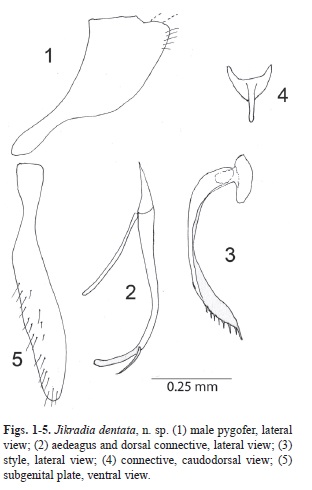
<body><![CDATA[<br>     <br> <font style="font-family: Verdana; font-weight: bold;" size="3">Results</font>    <br>     <br> <font style="font-family: Verdana; font-style: italic;" size="2">Jikradia dentata</font>    <br> <font style="font-family: Verdana;" size="2">Nielson and Zack, n. sp.</font>    <br> <font style="font-family: Verdana;" size="2"><a  href="/img/revistas/rbt/v62n4/a10i1.jpg">Fig. 1</a>, <a  href="/img/revistas/rbt/v62n4/a10i1.jpg">Fig. 2</a>, <a  href="/img/revistas/rbt/v62n4/a10i1.jpg">Fig. 3</a>, <a  href="/img/revistas/rbt/v62n4/a10i1.jpg">Fig. 4</a> and <a  href="/img/revistas/rbt/v62n4/a10i1.jpg">Fig. 5</a>.</font>    <br> <font style="font-family: Verdana;" size="2">&nbsp;</font>    <br> <font style="font-family: Verdana;" size="2"><span  style="font-weight: bold;">Length:</span> Male 7.05mm; female 8.15-8.30mm.</font>    <br>     <br> <font style="font-family: Verdana;" size="2"><span  style="font-weight: bold;">External morphology:</span> moderately large, slightly robust species. General color deep brown to black with light brown head and translucent costa on forewing. Face light brown, eyes dark brown.</font>    ]]></body>
<body><![CDATA[<br>     <br> <font style="font-family: Verdana;" size="2"><span  style="font-weight: bold;">Male genitalia:</span> Pygofer in lateral view narrow in basal 1/3, rectangulate in distal 2/3, tuft of macrosetae on upper caudoventral margin, small digitate lobe apically (<a  href="/img/revistas/rbt/v62n4/a10i1.jpg">Fig. 1</a>); aedeagus in lateral view with single, subapical process, arising from ventral margin, gonopore not evident (<a href="/img/revistas/rbt/v62n4/a10i2.jpg">Fig. 2</a>); style in lateral view with apophysis distinctively dentate on inner lateral margin from middle to apex (<a  href="/img/revistas/rbt/v62n4/a10i1.jpg">Fig. 3</a>); connective Y-shaped, arms about equal in length of stem, membrane present in basal half (<a href="/img/revistas/rbt/v62n4/a10i1.jpg">Fig. 4</a>); dorsal connective very long, narrow (<a href="/img/revistas/rbt/v62n4/a10i1.jpg">Fig. 2</a>) subgenital plate constricted subbasally, setaceous in distal 1/5 (<a href="/img/revistas/rbt/v62n4/a10i1.jpg">Fig. 5</a>).</font>    <br>     <br> <font style="font-family: Verdana;" size="2"><span  style="font-weight: bold;">Female:</span> Seventh sternite about twice as long as penultimate sternite, its posterior margin sinuate.</font>    <br>     <br> <font style="font-family: Verdana;" size="2"><span  style="font-weight: bold;">Material examined:</span> Holotype male. GUATEMALA: Zacapa Dept., Marble Quarry rd. at San Lorenzo, NE of Teculutan, 19 July 2007, N15&deg;04.856&#8217; W89&deg;40.086&#8217;, 1880m, R. S. Zack collector (UVG). Four female specimens, same data as holotype (UVG, WSUC).</font>    <br>     <br> <font style="font-family: Verdana;" size="2"><span  style="font-weight: bold;">Etymology:</span> The name of the species is descriptive of the dentate, inner lateral margin of the stylar apophysis. The name is based on the Latin root &#8220;denta&#8221; meaning toothed with consonant &#8220;t&#8221; and feminine suffix &#8220;a.&#8221;</font>    <br>     <br> <font style="font-family: Verdana;" size="2"><span  style="font-weight: bold;">Remarks:</span> This species is nearest to <span  style="font-style: italic;">J. serrata</span> Nielson but can be distinguished easily from it and all other known species by the distinctive dentate style (<a href="/img/revistas/rbt/v62n4/a10i1.jpg">Fig. 3</a>).</font>    ]]></body>
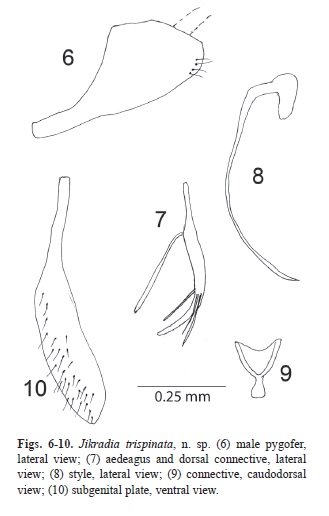
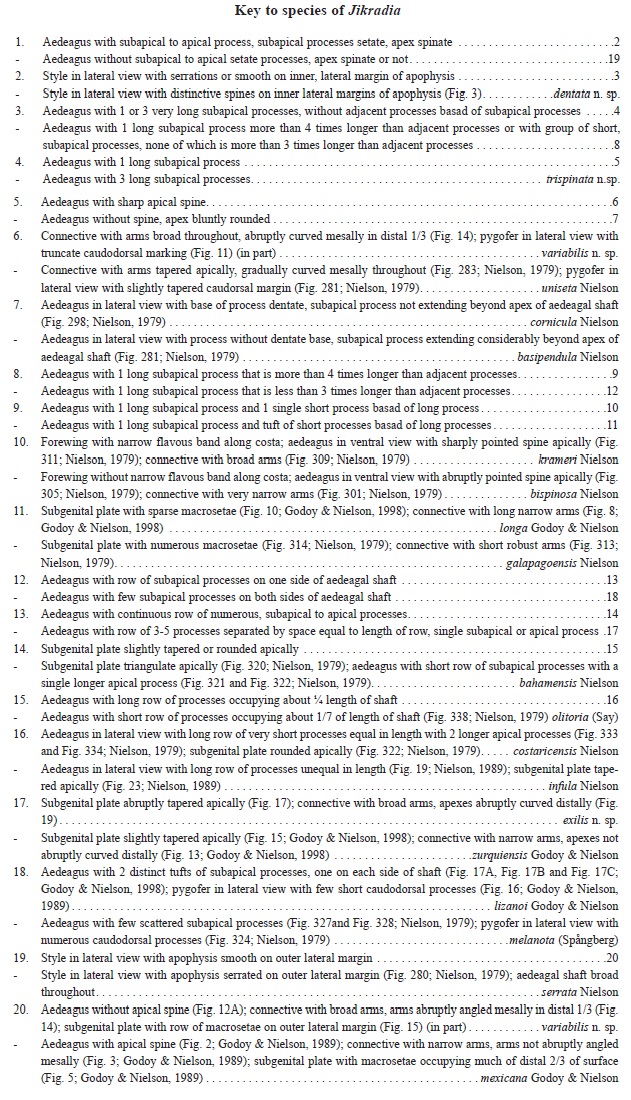
<body><![CDATA[<br>     <br> <font style="font-family: Verdana; font-style: italic;" size="2">Jikradia trispinata</font>    <br> <font style="font-family: Verdana;" size="2">Nielson and Zack, n. sp.</font>    <br> <font style="font-family: Verdana;" size="2"><a  href="/img/revistas/rbt/v62n4/a10i2.jpg">Fig. 6</a>, <a  href="/img/revistas/rbt/v62n4/a10i2.jpg">Fig. 7</a>, <a  href="/img/revistas/rbt/v62n4/a10i2.jpg">Fig. 8</a>, <a  href="/img/revistas/rbt/v62n4/a10i2.jpg">Fig. 9</a> and <a  href="/img/revistas/rbt/v62n4/a10i2.jpg">Fig. 10</a>.</font>    <br> <font style="font-family: Verdana;" size="2">&nbsp;</font>    <br> <font style="font-family: Verdana;" size="2"><span  style="font-weight: bold;">Length:</span> Male 6.59mm; female unknown.</font>    <br>     <br> <font style="font-family: Verdana;" size="2"><span  style="font-weight: bold;">External morphology:</span> Moderately large, slightly robust species. General color black, head including face tannish, forewing with costa translucent.</font>    <br>     <br> <font style="font-family: Verdana;" size="2"><span  style="font-weight: bold;">Male genitalia:</span> Pygofer in lateral view very narrow in basal 1/3, subquadrate in distal 2/3, caudal margin rounded, few macrosetae apically (<a href="/img/revistas/rbt/v62n4/a10i2.jpg">Fig. 6</a>); aedeagus in lateral view very short, shorter than style, with 3 very long setae arising near middle of shaft on lateral side, gonopore not evident (<a href="/img/revistas/rbt/v62n4/a10i2.jpg">Fig. 7</a>); style in lateral view very long, apophysis very narrow throughout (<a  href="/img/revistas/rbt/v62n4/a10i2.jpg">Fig. 8</a>); connective Y-shaped, membrane large, nearly triangulate, stem short, expanded distally (Fig. 9); dorsal connective very long, narrow (<a  href="/img/revistas/rbt/v62n4/a10i2.jpg">Fig. 7</a>); subgenital plate long, very narrow in basal 2/5, broad throughout in distal 3/5, setaceous in distal 3/5 (<a href="/img/revistas/rbt/v62n4/a10i2.jpg">Fig. 10</a>).</font>    ]]></body>
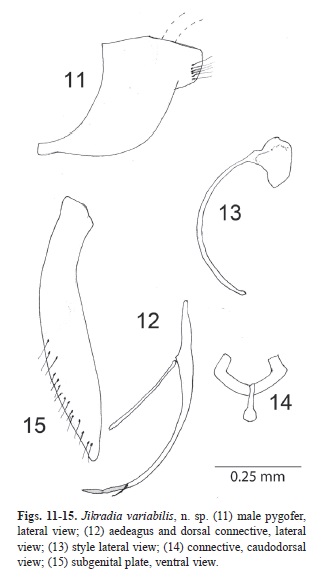
<body><![CDATA[<br>     <br> <font style="font-family: Verdana;" size="2"><span  style="font-weight: bold;">Material examined:</span> Holotype male, GUATEMALA: Dept. El Progreso, Sierra de las Minas, nr Pinlano, road between old &#8220;fca la Trinidad/fea la Tomenta &#8211; la Caba&ntilde;as&#8221;, 15&deg;0722N 89&deg;9469W, 2199 m. 15-17-V-2010, moist oak forest, light trap, Paul Skelly, G. Steck, and B. Sutton (UVG).</font>    <br>     <br> <font style="font-family: Verdana;" size="2"><span  style="font-weight: bold;">Etymology:</span> The name of the species is descriptive of the 3 microsetae on the shaft of the aedeagus. The name is based on a combination of the Latin prefix &#8220;tri&#8221; meaning three and the root &#8220;spina&#8221; meaning spine with consonant &#8220;t&#8221; and feminine suffix &#8220;a.&#8221;</font>    <br>     <br> <font style="font-family: Verdana;" size="2"><span  style="font-weight: bold;">Remarks:</span> This species, with three microsetae on the aedeagal shaft is nearest to <span style="font-style: italic;">J. bispinosa</span> Nielson, which has two microsetae on the aedeagal shaft.</font>    <br> <font style="font-family: Verdana;" size="2">&nbsp;</font>    <br> <font style="font-family: Verdana; font-style: italic;" size="2">Jikradia variabilis</font>    <br> <font style="font-family: Verdana;" size="2">Nielson and Nickel, n. sp.</font>    <br> <font style="font-family: Verdana;" size="2"><a  href="/img/revistas/rbt/v62n4/a10i3.jpg">Fig. 11</a>,<a  href="/img/revistas/rbt/v62n4/a10i3.jpg"> Fig. 12</a>, <a  href="/img/revistas/rbt/v62n4/a10i3.jpg">Fig. 13</a>, <a  href="/img/revistas/rbt/v62n4/a10i3.jpg">Fig. 14</a> and <a  href="/img/revistas/rbt/v62n4/a10i3.jpg">Fig. 15</a></font>    ]]></body>
<body><![CDATA[<br> <font style="font-family: Verdana;" size="2">&nbsp;</font>    <br> <font style="font-family: Verdana;" size="2"><span  style="font-weight: bold;">Length:</span> Male 6.20-6.50mm; female 7.75mm.</font>    <br>     <br> <font style="font-family: Verdana;" size="2"><span  style="font-weight: bold;">External morphology:</span> Moderately large, robust species. General color black in males, dark brown in females; head tannish in males, light brown in females; face light yellow in males, light brown in females; forewing with small irregular, light brown spot near middle of costa, color pattern variable in female.</font>    <br>     <br> <font style="font-family: Verdana;" size="2"><span  style="font-weight: bold;">Male genitalia:</span> Pygofer in lateral view subrectangulate, caudal margin subtruncate, few microsetae apically (<a  href="/img/revistas/rbt/v62n4/a10i3.jpg">Fig. 11</a>); aedeagus in lateral view very long, longer than style, shaft tapered apically, sharply pointed apically, with single short subapical microseta, gonopore not evident (<a href="/img/revistas/rbt/v62n4/a10i3.jpg">Fig. 12</a>), microsetae sometimes absent or broken off; style in lateral view broadly curved, base large, apophysis long, very narrow throughout (<a href="/img/revistas/rbt/v62n4/a10i3.jpg">Fig. 13</a>); connective Y shaped, arms of uniform width, angled subdistally, stem moderately long, apex bulbous (<a  href="/img/revistas/rbt/v62n4/a10i3.jpg">Fig. 14</a>) dorsal connective very long, narrow (<a  href="/img/revistas/rbt/v62n4/a10i3.jpg">Fig. 12</a>); subgenital plate long, slightly curved, slightly tapered apically, setose on outer lateral margin in distal 2/5 (<a href="/img/revistas/rbt/v62n4/a10i3.jpg">Fig. 15</a>).    <br> </font>    <br> <font style="font-family: Verdana;" size="2"><span  style="font-weight: bold;">Female:</span> Seventh sternite large, about twice as long as penultimate sternite, caudal margin sinuate.</font>    <br>     <br> <font style="font-family: Verdana;" size="2"><span  style="font-weight: bold;">Material examined:</span> Holotype male, BELIZE, Cayo district, near Teakettle Bank, Pooks Hill, N1709.257N 8851.094W, 279ft., 7-VII- 2003, Charles R. Bartlett (NMNH). Additional specimens, four males, same data as holotype except two specimens collected 6-VII-2003 (NMNH, MWN), two females same data as holotype except collected 3-VII-2003 and 5-VII-2003 (NMNH).</font>    ]]></body>
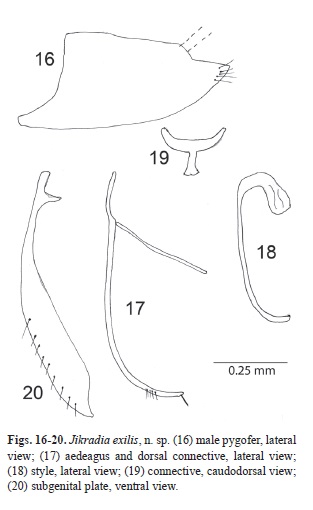
<body><![CDATA[<br>     <br> <font style="font-family: Verdana;" size="2"><span  style="font-weight: bold;">Etymology:</span> The name of the species denotes variation in the number of setae on the aedeagal shaft, which varies from zero to one. The name is based in the Latin root &#8220;varius&#8221; meaning change and &#8220;bilis&#8221; for combined adjective and feminine ending.</font>    <br> <font style="font-family: Verdana;" size="2">&nbsp;</font>    <br> <font style="font-family: Verdana; font-style: italic;" size="2">Jikradia exilis</font>    <br> <font style="font-family: Verdana;" size="2">Nielson and Poggi, n. sp.</font>    <br> <font style="font-family: Verdana;" size="2"><a  href="/img/revistas/rbt/v62n4/a10i4.jpg">Fig. 16</a>, <a  href="/img/revistas/rbt/v62n4/a10i4.jpg">Fig. 17</a>, <a  href="/img/revistas/rbt/v62n4/a10i4.jpg">Fig. 18</a>, <a  href="/img/revistas/rbt/v62n4/a10i4.jpg">Fig. 19</a> and <a  href="/img/revistas/rbt/v62n4/a10i4.jpg">Fig. 20</a></font>    <br> <font style="font-family: Verdana;" size="2">&nbsp;</font>    <br> <font style="font-family: Verdana;" size="2"><span  style="font-weight: bold;">Length:</span> Male 4.34 mm, female unknown.</font>    <br>     <br> <font style="font-family: Verdana;" size="2"><span  style="font-weight: bold;">External morphology:</span> Small, slender species. General color black with markings on forewings; head black, crown black bordered with yellow on lateral margins; eyes black; forewings black, costa with narrow, yellow stripe on outer margin, joined to yellow spot subapically, appendix with yellow border, small yellow spot at apex of clavus; face yellow with two longitudinal black stripes from apex of clypeus to apex of clypellus.</font>    ]]></body>
<body><![CDATA[<br>     <br> <font style="font-family: Verdana;" size="2"><span  style="font-weight: bold;">Male genitalia:</span> Pygofer in lateral view more or less rectangular, its caudal margin slightly tapered, apex with few microsetae (<a  href="/img/revistas/rbt/v62n4/a10i4.jpg">Fig. 16</a>); aedeagus very long, nearly twice as long as style, very narrow throughout from base to apex, small narrow spine subapically, tuft of 4-5 microsetae subapically, gonopore subapical (<a  href="/img/revistas/rbt/v62n4/a10i4.jpg">Fig. 17</a>); style with long narrow apophysis, nearly recurved apically (<a  href="/img/revistas/rbt/v62n4/a10i4.jpg">Fig. 18</a>); connective Y-shaped, arms broad, broadly curved, membrane absent, stem moderately long and robust (<a href="/img/revistas/rbt/v62n4/a10i4.jpg">Fig. 19</a>); dorsal connective very long and narrow (<a  href="/img/revistas/rbt/v62n4/a10i4.jpg">Fig. 17</a>); subgenital plate long, constricted along basal 1/5, with subbasal lobe on inner lateral margin, row of microsetae on apical half of inner lateral margin (<a href="/img/revistas/rbt/v62n4/a10i4.jpg">Fig. 20</a>).</font>    <br>     <br> <font style="font-family: Verdana;" size="2"><span  style="font-weight: bold;">Material examined:</span> Holotype male, COSTA RICA, Rinc&oacute;n, Osa Pen., 100ft. VIII-II-1966, S. L. Wood (MZUCR).</font>    <br>     <br> <font style="font-family: Verdana;" size="2"><span  style="font-weight: bold;">Etymology:</span> The name of this species is descriptive of the very narrow aedeagal shaft. The name is based in the Latin root &#8220;exili&#8221; meaning thin and the suffix &#8220;s&#8221; for feminine gender.</font>    <br>     <br> <font style="font-family: Verdana;" size="2"><span  style="font-weight: bold;">Remarks:</span> From <span  style="font-style: italic;">J. galapagoensis</span> to which it is nearest, <span style="font-style: italic;">J. exilis</span> can be easily distinguished by the very long narrow aedeagus and the single row of setae on the outer lateral margin of the subgenital plate. The subapical aedeagal process is a spine in <span  style="font-style: italic;">J. exilis</span> whereas in <span  style="font-style: italic;">J. galapagoensis</span>, it is a seta. Also, <span  style="font-style: italic;">J. exilis</span> has two black stripes in the face, characters lacking in <span style="font-style: italic;">J. galapagoensis</span>.</font>    <br> <font style="font-family: Verdana;" size="2">&nbsp;</font>    <br> <font style="font-family: Verdana;" size="2"><span  style="font-style: italic;">Jikradia olitoria</span> (Say) (reinstated)</font><font  style="font-family: Verdana;" size="2"><span  style="font-style: italic;">    ]]></body>
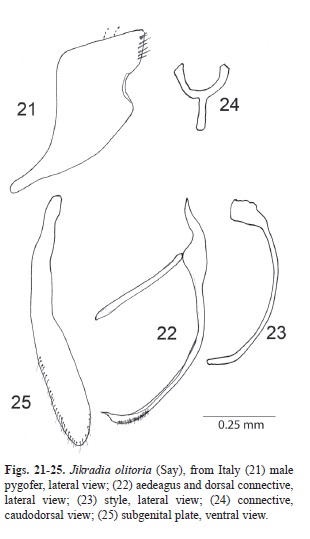
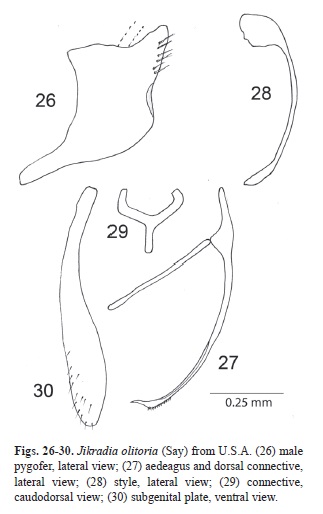
<body><![CDATA[<br> Jassus olitorius</span> Say, 1830:310</font>    <br> <font style="font-family: Verdana;" size="2"><span  style="font-style: italic;">Coelidia olitoria</span> (Say); Metcalf, 1964:64</font>    <br> <font style="font-family: Verdana;" size="2"><span  style="font-style: italic;">Jikradia olitoria olitoria</span> (Say); Nielson, 1979: 92</font>    <br> <font style="font-family: Verdana;" size="2">&nbsp;</font>    <br> <font style="font-family: Verdana;" size="2"><span  style="font-style: italic;">Jikradia olitoria</span> (Say) is the most widespread species. The latest taxonomic treatment and previous distribution of this species are covered in Nielson (1979). Comparison of the adult general habitus and male genitalia features between the Italian and American populations are shown in Plate 2 and <a href="/img/revistas/rbt/v62n4/a10i5.jpg">Fig. 21</a>,<a href="/img/revistas/rbt/v62n4/a10i5.jpg"> Fig. 22</a>, <a  href="/img/revistas/rbt/v62n4/a10i5.jpg">Fig. 23</a>, <a  href="/img/revistas/rbt/v62n4/a10i5.jpg">Fig. 24</a>, <a  href="/img/revistas/rbt/v62n4/a10i5.jpg">Fig. 25</a>, <a href="/img/revistas/rbt/v62n4/a10i6.jpg">Fig. 26</a>, <a  href="/img/revistas/rbt/v62n4/a10i6.jpg">Fig. 27</a>, <a  href="/img/revistas/rbt/v62n4/a10i6.jpg">Fig. 28</a>, <a  href="/img/revistas/rbt/v62n4/a10i6.jpg">Fig. 29</a> and <a  href="/img/revistas/rbt/v62n4/a10i6.jpg">Fig. 30</a>, respectively. These differences are not considered significant to justify separate species. Specimens from Italy were collected in Lombardia, Maresso (LC), 350m., 1.viii. 2013, at light, 350m.; 5.ix.2 013 on <span  style="font-style: italic;">Populus tremula</span> L., 350 m.; 14.ix.2013 on Salix alba L. by Francesco Poggi. The earliest record appears to be 2010. Specimens from United States were collected in St. Joseph, Buchanan Co, Missouri, on 18. vii. 1987 on unidentified shrubs and trees by M. W. Nielson.</font>    <br>     <br> <font style="font-family: Verdana; font-weight: bold;" size="2">Reinstated and new status species</font>    <br>     <br> <font style="font-family: Verdana;" size="2"><span  style="font-style: italic;">Jikradia melanota</span> (Sp&aring;ngberg) <span style="font-weight: bold;">[reinstated]</span></font>    <br> <font style="font-family: Verdana;" size="2"><span  style="font-style: italic;">Jassus melanotus</span> Sp&aring;ngberg, 1878:19</font>    ]]></body>
<body><![CDATA[<br> <font style="font-family: Verdana;" size="2"><span  style="font-style: italic;">Coelidia melanota</span> (Sp&aring;ngberg); Oman, 1949:55</font>    <br> <font style="font-family: Verdana;" size="2"><span  style="font-style: italic;">Coelidia melanota</span> (Sp&aring;ngberg); Metcalf, 1964:60</font>    <br> <font style="font-family: Verdana;" size="2"><span  style="font-style: italic;">Coelidia melanota melanota</span> (Sp&aring;ngberg); Nielson, 1979:86</font>    <br> <font style="font-family: Verdana;" size="2">&nbsp;</font>    <br> <font style="font-family: Verdana;" size="2"><span  style="font-style: italic;">Jikradia galapagoensis</span> (Osborn) <span  style="font-weight: bold;">[reinstated]</span></font>    <br> <font style="font-family: Verdana;" size="2"><span  style="font-style: italic;">Coelidia galapagoensis</span> (Osborn); Metcalf, 1964:52</font>    <br> <font style="font-family: Verdana;" size="2"><span  style="font-style: italic;">Jikradia melanota galapagoensis</span> (Osborn); Nielson, 1979:88</font>    <br> <font style="font-family: Verdana;" size="2">&nbsp;</font>    <br> <font style="font-family: Verdana;" size="2"><span  style="font-style: italic;">Jikradia bahamensis</span> Nielson <span  style="font-weight: bold;">[new status]</span></font>    <br> <font style="font-family: Verdana;" size="2"><span  style="font-style: italic;">Jikradia melanota bahamensis</span> Nielson, 1979:90</font>    ]]></body>
<body><![CDATA[<br> <font style="font-family: Verdana;" size="2">&nbsp;</font>    <br> <font style="font-family: Verdana;" size="2"><span  style="font-style: italic;">Jikradia costaricensis</span> Nielson <span  style="font-weight: bold;">[new status]</span></font>    <br> <font style="font-family: Verdana;" size="2"><span  style="font-style: italic;">Jikradia melanota costaricensis</span> Nielson, 1979:91</font>    <br> <font style="font-family: Verdana;" size="2">&nbsp;</font>    <br> <font style="font-family: Verdana;" size="2"><span  style="font-style: italic;">Jikradia olitoria</span> (Say) <span  style="font-weight: bold;">[reinstated]</span></font>    <br> <font style="font-family: Verdana;" size="2"><span  style="font-style: italic;">Jassus olitorius</span> Say, 1830:310</font>    <br> <font style="font-family: Verdana;" size="2"><span  style="font-style: italic;">Coelidia olitoria</span> (Say); Metcalf, 1964:64</font>    <br> <font style="font-family: Verdana;" size="2"><span  style="font-style: italic;">Jikradia olitoria olitoria</span> (Say); Nielson, 1979:92</font>    <br> <font style="font-family: Verdana;" size="2">&nbsp;</font>    <br> <font style="font-family: Verdana;" size="2"><span  style="font-style: italic;">Jikradia floridana</span> (Lawson) <span  style="font-weight: bold;">[reinstated]</span></font>    ]]></body>
<body><![CDATA[<br> <font style="font-family: Verdana;" size="2"><span  style="font-style: italic;">Jassus floridanus</span> Lawson, 1927:171</font>    <br> <font style="font-family: Verdana;" size="2"><span  style="font-style: italic;">Coelidia floridana</span> (Lawson); Oman, 1949:55</font><font style="font-family: Verdana;" size="2">    <br> <span style="font-style: italic;">Jikradia olitoria floridana</span> (Lawson); Nielson, 1979:95</font>    <br>     <br> <font style="font-family: Verdana; font-weight: bold;" size="2">Checklist of species of Jikradia</font>    <br>     <br> <font style="font-family: Verdana;" size="2"><span  style="font-style: italic;">Jikradia bahamensis</span> Nielson (Bahama Islands)</font>    <br> <font style="font-family: Verdana;" size="2"><span  style="font-style: italic;">Jikradia basipendula</span> Nielson (Costa Rica, Guatemala (<span style="font-weight: bold;">new record</span>), Mexico)</font>    <br> <font style="font-family: Verdana;" size="2"><span  style="font-style: italic;">Jikradia bispinosa</span> Nielson (Guatemala, Mexico)</font>    <br> <font style="font-family: Verdana;" size="2"><span  style="font-style: italic;">Jikradia cornicula</span> Nielson (Guatemala, Mexico)</font>    ]]></body>
<body><![CDATA[<br> <font style="font-family: Verdana;" size="2"><span  style="font-style: italic;">Jikradia costaricensis</span> Godoy &amp; Nielson (Costa Rica, El Salvador, Honduras, Panama)</font>    <br> <font style="font-family: Verdana;" size="2"><span  style="font-style: italic;">Jikradia dentata</span> n. sp. (Guatemala)</font>    <br> <font style="font-family: Verdana;" size="2"><span  style="font-style: italic;">Jikradia exilisn</span>. sp. (Costa Rica)</font>    <br> <font style="font-family: Verdana;" size="2"><span  style="font-style: italic;">Jikradia galapagoensis</span> Nielson (Galapagos Islands)</font>    <br> <font style="font-family: Verdana;" size="2"><span  style="font-style: italic;">Jikradia infula</span> Nielson (Mexico)</font>    <br> <font style="font-family: Verdana;" size="2"><span  style="font-style: italic;">Jikradia krameri</span> Nielson (Guatemala (new record), Honduras)</font>    <br> <font style="font-family: Verdana;" size="2"><span  style="font-style: italic;">Jikradia lizanoi</span> Godoy &amp; Nielson (Costa Rica)</font>    <br> <font style="font-family: Verdana;" size="2"><span  style="font-style: italic;">Jikradia longa</span> Godoy &amp; Nielson (Costa Rica)</font>    <br> <font style="font-family: Verdana;" size="2"><span  style="font-style: italic;">Jikradia floridana</span> (Lawson) (United States)</font>    <br> <font style="font-family: Verdana;" size="2"><span  style="font-style: italic;">Jikradia galapagoensis</span> (Osborn) (El Salvador, Galapagos Islands, Guatemala, Mexico, Nicaragua, Panama)</font>    ]]></body>
<body><![CDATA[<br> <font style="font-family: Verdana;" size="2"><span  style="font-style: italic;">Jikradia melanota</span> (Sp&aring;ngberg) (Bahama Islands, Bermuda, Cuba, United States)</font>    <br> <font style="font-family: Verdana;" size="2"><span  style="font-style: italic;">Jikradia mexicana</span> Godoy &amp; Nielson (Mexico)</font>    <br> <font style="font-family: Verdana;" size="2"><span  style="font-style: italic;">Jikradia olitoria</span> (Say) (Canada, Italy (new record) United States)</font>    <br> <font style="font-family: Verdana;" size="2"><span  style="font-style: italic;">Jikradia serrata</span> Nielson (El Salvador, Guatemala, Honduras, Panama)</font>    <br> <font style="font-family: Verdana;" size="2"><span  style="font-style: italic;">Jikradia trispinata</span> n. sp. (Costa Rica)</font>    <br> <font style="font-family: Verdana;" size="2"><span  style="font-style: italic;">Jikradia uniseta</span> Nielson (Guatemala, Honduras, Mexico)</font>    <br> <font style="font-family: Verdana;" size="2"><span  style="font-style: italic;">Jikradia variabilis</span> n. sp. (Belize (<span  style="font-weight: bold;">new record</span>))</font>    <br> <font style="font-family: Verdana;" size="2"><span  style="font-style: italic;">Jikradia zurquiensis</span> Godoy &amp; Nielson (Costa Rica)    <br>     <br> <a href="/img/revistas/rbt/v62n4/a10a1.jpg">imagen</a></font>    ]]></body>
<body><![CDATA[<br>     <br> <font style="font-family: Verdana; font-weight: bold;" size="3">Discussion</font>    <br>     <br> <font style="font-family: Verdana;" size="2">Previous to this paper, the genus <span style="font-style: italic;">Jikradia</span> was known only in the New World from the Galapagos Islands (Ecuador) northward to Canada. Recent discovery of <span style="font-style: italic;">Jikradia olitoria</span> (Say) from Italy reported by Francesco Poggi and Herbert Nickel extends the distribution to the Old World. Comparisons of the adult general habitus and male genitalia features among specimens from Italy and Missouri, U.S.A are shown in Plate 2 and <a href="/img/revistas/rbt/v62n4/a10i5.jpg">Fig. 21</a>, <a  href="/img/revistas/rbt/v62n4/a10i5.jpg">Fig. 22</a>, <a  href="/img/revistas/rbt/v62n4/a10i5.jpg">Fig. 23</a>, <a  href="/img/revistas/rbt/v62n4/a10i5.jpg">Fig. 24</a>, <a  href="/img/revistas/rbt/v62n4/a10i5.jpg">Fig. 25</a>, <a  href="/img/revistas/rbt/v62n4/a10i6.jpg">Fig. 26</a>, <a  href="/img/revistas/rbt/v62n4/a10i6.jpg">Fig. 27</a>, <a  href="/img/revistas/rbt/v62n4/a10i6.jpg">Fig. 28</a>, <a href="/img/revistas/rbt/v62n4/a10i6.jpg">Fig. 29</a> and <a  href="/img/revistas/rbt/v62n4/a10i6.jpg">Fig. 30</a>, respectively. The Italian adults, on average, were about 2mm shorter than specimens from USA.</font>    <br>     <br> <font style="font-family: Verdana;" size="2">The origin of the genus appears to be Guatemala in Central America. Speciation and dispersal are believed to be multidirectional, South to the Galapagos Islands, Northeast to United States and Canada, and from Southern United States to the Caribbean Islands. The Italian population of <span style="font-style: italic;">Jikradia olitoria</span> (Say) was an introduction from the United States.    <br> </font>    <br> <font style="font-family: Verdana; font-weight: bold;" size="3">Acknowledgments</font>    <br>     <br> <font style="font-family: Verdana;" size="2">We thank Jos&eacute; Monz&oacute;n Sierra for his companionship and expertise during RSZ&#8217;s studies in Guatemala. We thank Consejo Nacional de Areas Protegidas (CONAP) for Guatemala collecting and export permits, Defensores de la Naturaleza for research permits for the Reserva de las Bi&oacute;sfera de las Minas, and Jack Schuster and Enio B. Cano for assistance and allowing us access to the insect collect at the Universidad del Valle De Guatemala, Guatemala City.</font>    ]]></body>
<body><![CDATA[<br>     <br> <hr style="width: 100%; height: 2px;">    <br> <font style="font-family: Verdana; font-weight: bold;" size="3">References</font>    <br>     <br>     <!-- ref --><div style="text-align: left;"><font style="font-family: Verdana;"  size="2">Godoy, C. &amp; Nielson, M. W. (1998). A review of the leafhopper genus <span style="font-style: italic;">Jikradia</span> with descriptions of four new species (Homoptera: Cicadellidae). <span style="font-style: italic;">Revista de Biolog&iacute;a Tropical, 46</span>(3), 739-748.    &nbsp;&nbsp;&nbsp;&nbsp;&nbsp;&nbsp;&nbsp;&nbsp;[&#160;<a href="javascript:void(0);" onclick="javascript: window.open('/scielo.php?script=sci_nlinks&ref=1563303&pid=S0034-7744201400040001000001&lng=','','width=640,height=500,resizable=yes,scrollbars=1,menubar=yes,');">Links</a>&#160;]<!-- end-ref --></font>    <br>     <!-- ref --><br> <font style="font-family: Verdana;" size="2">Lawson, P. W. (1927). The genus <span style="font-style: italic;">Jassus</span> in America North of Mexico (Cicadellidae, Hemip.). <span style="font-style: italic;">Canadian Entomologist, 59</span>, 167-174.    &nbsp;&nbsp;&nbsp;&nbsp;&nbsp;&nbsp;&nbsp;&nbsp;[&#160;<a href="javascript:void(0);" onclick="javascript: window.open('/scielo.php?script=sci_nlinks&ref=1563306&pid=S0034-7744201400040001000002&lng=','','width=640,height=500,resizable=yes,scrollbars=1,menubar=yes,');">Links</a>&#160;]<!-- end-ref --></font>    ]]></body>
<body><![CDATA[<br>     <!-- ref --><br> <font style="font-family: Verdana;" size="2">Metcalf, Z. P. (1964). <span  style="font-style: italic;">General Catalog of the Homoptera. Fascicle VI. Cicadelloidea. Part 11. Coelidiidae.</span> United States: United States Department of Agriculture, Agricultural Research Service.    &nbsp;&nbsp;&nbsp;&nbsp;&nbsp;&nbsp;&nbsp;&nbsp;[&#160;<a href="javascript:void(0);" onclick="javascript: window.open('/scielo.php?script=sci_nlinks&ref=1563309&pid=S0034-7744201400040001000003&lng=','','width=640,height=500,resizable=yes,scrollbars=1,menubar=yes,');">Links</a>&#160;]<!-- end-ref --></font>    <br>     <!-- ref --><br> <font style="font-family: Verdana;" size="2">Nielson, M. W. (1979). A revision of the Subfamily Coelidiinae (Homoptera: Cicadellidae) III. Teruliini, new Tribe. <span  style="font-style: italic;">Pacific Insect Monographs, 35</span>, 1-329.    &nbsp;&nbsp;&nbsp;&nbsp;&nbsp;&nbsp;&nbsp;&nbsp;[&#160;<a href="javascript:void(0);" onclick="javascript: window.open('/scielo.php?script=sci_nlinks&ref=1563312&pid=S0034-7744201400040001000004&lng=','','width=640,height=500,resizable=yes,scrollbars=1,menubar=yes,');">Links</a>&#160;]<!-- end-ref --></font>    <br>     <!-- ref --><br> <font style="font-family: Verdana;" size="2">Nielson, M. W. (1989). Additional new species of teruliine leafhoppers with key to species (Cicadellidae: Coelidiinae: Teruliini). <span  style="font-style: italic;">Great Basin Naturalist, 49</span>(3), 398-403.    &nbsp;&nbsp;&nbsp;&nbsp;&nbsp;&nbsp;&nbsp;&nbsp;[&#160;<a href="javascript:void(0);" onclick="javascript: window.open('/scielo.php?script=sci_nlinks&ref=1563315&pid=S0034-7744201400040001000005&lng=','','width=640,height=500,resizable=yes,scrollbars=1,menubar=yes,');">Links</a>&#160;]<!-- end-ref --></font>    <br>     ]]></body>
<body><![CDATA[<!-- ref --><br> <font style="font-family: Verdana;" size="2">Oman, P. (1949). The Nearctic leafhoppers (Homoptera: Cicadellidae). A generic classification and check list. <span  style="font-style: italic;">Memoirs of the Entomological Society of Washington, 3</span>, 1-253.    &nbsp;&nbsp;&nbsp;&nbsp;&nbsp;&nbsp;&nbsp;&nbsp;[&#160;<a href="javascript:void(0);" onclick="javascript: window.open('/scielo.php?script=sci_nlinks&ref=1563318&pid=S0034-7744201400040001000006&lng=','','width=640,height=500,resizable=yes,scrollbars=1,menubar=yes,');">Links</a>&#160;]<!-- end-ref --></font>    <br>     <!-- ref --><br> <font style="font-family: Verdana;" size="2">Say, T. (1830). Descriptions of new North American Hemipterous insects belonging to the first family of the section Homoptera of Latreille (continued). <span style="font-style: italic;">Journal of the Academy of Natural Sciences of Philadelphia, 6</span>, 299-314.    &nbsp;&nbsp;&nbsp;&nbsp;&nbsp;&nbsp;&nbsp;&nbsp;[&#160;<a href="javascript:void(0);" onclick="javascript: window.open('/scielo.php?script=sci_nlinks&ref=1563321&pid=S0034-7744201400040001000007&lng=','','width=640,height=500,resizable=yes,scrollbars=1,menubar=yes,');">Links</a>&#160;]<!-- end-ref --></font>    <br>     <!-- ref --><br> <font style="font-family: Verdana;" size="2">Sp&aring;ngberg, J. (1878). Species Jassi generis Homopterorum descripsit. Svenska Vetenskaps-Akademiens.&Ouml;fversigt af Forhandlingar, 35(8), 3-40.    &nbsp;&nbsp;&nbsp;&nbsp;&nbsp;&nbsp;&nbsp;&nbsp;[&#160;<a href="javascript:void(0);" onclick="javascript: window.open('/scielo.php?script=sci_nlinks&ref=1563324&pid=S0034-7744201400040001000008&lng=','','width=640,height=500,resizable=yes,scrollbars=1,menubar=yes,');">Links</a>&#160;]<!-- end-ref --></font>    <br> </div>     <br> <font style="font-family: Verdana;" size="2"><a name="1"></a><a  href="#5">1</a>. Retired, former Affiliate Faculty, Monte L. Bean Life Science Museum, Brigham Young University, Provo, UT 84606 USA; mwnielz@gmail.com</font>    ]]></body>
<body><![CDATA[<br> <font style="font-family: Verdana;" size="2"><a name="2"></a><a  href="#6">2</a>. M. T. James Entomological Collection, Department of Entomology, Washington State University, Pullman, WA 99164-6382 USA; zack@wsu.edu</font>    <br> <font style="font-family: Verdana;" size="2"><a name="3"></a><a  href="#7">3</a>. Private Entomologist; erythria@gmail.com</font>    <br> <font style="font-family: Verdana;" size="2"><a name="4"></a><a  href="#8">4</a>. Ehrengard-Schramm-Weg 2, 37085 G&ouml;ttingen, Germany; herbertnickel@gmx.de</font>    <br> <hr style="width: 100%; height: 2px;">     <div style="text-align: center;"><font  style="font-family: Verdana; font-weight: bold;" size="2">Received 13-I-2014. Corrected 20-VI-2014. Accepted 23-VII-2014.</font>    <br> </div> </div> </div>      ]]></body><back>
<ref-list>
<ref id="B1">
<nlm-citation citation-type="journal">
<person-group person-group-type="author">
<name>
<surname><![CDATA[Godoy]]></surname>
<given-names><![CDATA[C.]]></given-names>
</name>
<name>
<surname><![CDATA[Nielson]]></surname>
<given-names><![CDATA[M. W.]]></given-names>
</name>
</person-group>
<article-title xml:lang="en"><![CDATA[A review of the leafhopper genus Jikradia with descriptions of four new species (Homoptera: Cicadellidae)]]></article-title>
<source><![CDATA[Revista de Biología Tropical]]></source>
<year>1998</year>
<volume>46</volume>
<numero>3</numero>
<issue>3</issue>
<page-range>739-748</page-range></nlm-citation>
</ref>
<ref id="B2">
<nlm-citation citation-type="journal">
<person-group person-group-type="author">
<name>
<surname><![CDATA[Lawson]]></surname>
<given-names><![CDATA[P. W.]]></given-names>
</name>
</person-group>
<article-title xml:lang="en"><![CDATA[The genus Jassus in America North of Mexico (Cicadellidae, Hemip.)]]></article-title>
<source><![CDATA[Canadian Entomologist]]></source>
<year>1927</year>
<volume>59</volume>
<page-range>167-174</page-range></nlm-citation>
</ref>
<ref id="B3">
<nlm-citation citation-type="book">
<person-group person-group-type="author">
<name>
<surname><![CDATA[Metcalf]]></surname>
<given-names><![CDATA[Z. P.]]></given-names>
</name>
</person-group>
<source><![CDATA[General Catalog of the Homoptera.]]></source>
<year>1964</year>
<publisher-name><![CDATA[United States Department of Agriculture, Agricultural Research Service.]]></publisher-name>
</nlm-citation>
</ref>
<ref id="B4">
<nlm-citation citation-type="journal">
<person-group person-group-type="author">
<name>
<surname><![CDATA[Nielson]]></surname>
<given-names><![CDATA[M. W.]]></given-names>
</name>
</person-group>
<article-title xml:lang="en"><![CDATA[A revision of the Subfamily Coelidiinae (Homoptera: Cicadellidae) III.: Teruliini, new Tribe]]></article-title>
<source><![CDATA[Pacific Insect Monographs]]></source>
<year>1979</year>
<volume>35</volume>
<page-range>1-329</page-range></nlm-citation>
</ref>
<ref id="B5">
<nlm-citation citation-type="journal">
<person-group person-group-type="author">
<name>
<surname><![CDATA[Nielson]]></surname>
<given-names><![CDATA[M. W.]]></given-names>
</name>
</person-group>
<article-title xml:lang="en"><![CDATA[Additional new species of teruliine leafhoppers with key to species (Cicadellidae: Coelidiinae: Teruliini)]]></article-title>
<source><![CDATA[Great Basin Naturalist]]></source>
<year>1989</year>
<volume>49</volume>
<numero>3</numero>
<issue>3</issue>
<page-range>398-403</page-range></nlm-citation>
</ref>
<ref id="B6">
<nlm-citation citation-type="journal">
<person-group person-group-type="author">
<name>
<surname><![CDATA[Oman]]></surname>
<given-names><![CDATA[P.]]></given-names>
</name>
</person-group>
<article-title xml:lang="en"><![CDATA[The Nearctic leafhoppers (Homoptera: Cicadellidae).: A generic classification and check list.]]></article-title>
<source><![CDATA[Memoirs of the Entomological Society of Washington]]></source>
<year>1949</year>
<volume>3</volume>
<page-range>1-253</page-range></nlm-citation>
</ref>
<ref id="B7">
<nlm-citation citation-type="journal">
<person-group person-group-type="author">
<name>
<surname><![CDATA[Say]]></surname>
<given-names><![CDATA[T.]]></given-names>
</name>
</person-group>
<article-title xml:lang="en"><![CDATA[Descriptions of new North American Hemipterous insects belonging to the first family of the section Homoptera of Latreille (continued).]]></article-title>
<source><![CDATA[Journal of the Academy of Natural Sciences of Philadelphia]]></source>
<year>1830</year>
<volume>6</volume>
<page-range>299-314</page-range></nlm-citation>
</ref>
<ref id="B8">
<nlm-citation citation-type="journal">
<person-group person-group-type="author">
<name>
<surname><![CDATA[Spångberg]]></surname>
<given-names><![CDATA[J.]]></given-names>
</name>
</person-group>
<article-title xml:lang="en"><![CDATA[Species Jassi generis Homopterorum descripsit]]></article-title>
<source><![CDATA[Svenska Vetenskaps-Akademiens. Öfversigt af Forhandlingar]]></source>
<year>1878</year>
<volume>35</volume><volume>8</volume>
<page-range>3-40</page-range></nlm-citation>
</ref>
</ref-list>
</back>
</article>