<?xml version="1.0" encoding="ISO-8859-1"?><article xmlns:mml="http://www.w3.org/1998/Math/MathML" xmlns:xlink="http://www.w3.org/1999/xlink" xmlns:xsi="http://www.w3.org/2001/XMLSchema-instance">
<front>
<journal-meta>
<journal-id>0034-7744</journal-id>
<journal-title><![CDATA[Revista de Biología Tropical]]></journal-title>
<abbrev-journal-title><![CDATA[Rev. biol. trop]]></abbrev-journal-title>
<issn>0034-7744</issn>
<publisher>
<publisher-name><![CDATA[Universidad de Costa Rica]]></publisher-name>
</publisher>
</journal-meta>
<article-meta>
<article-id>S0034-77442014000200006</article-id>
<title-group>
<article-title xml:lang="en"><![CDATA[Seasonal variation in body size and diet of the sea star Astropecten marginatus (Paxillosida, Astropectinidae) off coast of Paraná, Southern Brazil]]></article-title>
<article-title xml:lang="es"><![CDATA[Variaciones estacionales en el tamaño corporal y dieta de la estrella de mar Astropecten marginatus (Paxillosida, Astropectinidae) frente a la costa de Paraná, sur de Brasil]]></article-title>
</title-group>
<contrib-group>
<contrib contrib-type="author">
<name>
<surname><![CDATA[Guilherme]]></surname>
<given-names><![CDATA[Pablo D. B.]]></given-names>
</name>
<xref ref-type="aff" rid="A01"/>
</contrib>
<contrib contrib-type="author">
<name>
<surname><![CDATA[Rosa]]></surname>
<given-names><![CDATA[Leonardo C.]]></given-names>
</name>
<xref ref-type="aff" rid="A02"/>
</contrib>
</contrib-group>
<aff id="A01">
<institution><![CDATA[,Universidade Federal do Paraná  ]]></institution>
<addr-line><![CDATA[ ]]></addr-line>
<country>Brasil</country>
</aff>
<aff id="A02">
<institution><![CDATA[,Universidade Federal do Sergipe  ]]></institution>
<addr-line><![CDATA[ ]]></addr-line>
<country>Brasil</country>
</aff>
<pub-date pub-type="pub">
<day>00</day>
<month>03</month>
<year>2014</year>
</pub-date>
<pub-date pub-type="epub">
<day>00</day>
<month>03</month>
<year>2014</year>
</pub-date>
<volume>62</volume>
<numero>1</numero>
<fpage>73</fpage>
<lpage>83</lpage>
<copyright-statement/>
<copyright-year/>
<self-uri xlink:href="http://www.scielo.sa.cr/scielo.php?script=sci_arttext&amp;pid=S0034-77442014000200006&amp;lng=en&amp;nrm=iso"></self-uri><self-uri xlink:href="http://www.scielo.sa.cr/scielo.php?script=sci_abstract&amp;pid=S0034-77442014000200006&amp;lng=en&amp;nrm=iso"></self-uri><self-uri xlink:href="http://www.scielo.sa.cr/scielo.php?script=sci_pdf&amp;pid=S0034-77442014000200006&amp;lng=en&amp;nrm=iso"></self-uri><abstract abstract-type="short" xml:lang="en"><p><![CDATA[The sea star Astropecten marginatus has a neotropical distribution and is a highly abundant and frequent species in shrimp trawling by-catchin many places along the Brazilian coast. This has caused its threat to extinction and in addition, its bio-ecological aspects are poorly known. Thus, the main objective of this study was to analyze the seasonal variations of population length structure and feeding habits of the sea stars A. marginatus inhabiting off state of Paraná, Southern Brazil. The analyzed specimens were collected in February (summer), April (fall), June (winter) and October (spring) of 2008 from shrimp by-catch trawling. In the laboratory, each individual had its length measured and then weighed on an analytical scale. Afterwards, the stomach contents of 10 individuals of each of two most frequent length classes were seasonally analyzed. The relative frequency and abundance for each prey category was determined and, then combined into an index of alimentary importance. A total of 994 individuals of A. marginatus were collected with length ranging from 7.0 to 56.2mm, but most individuals were in the 20.1-25mm length classes. Individuals larger than 40mm were only collected in the spring while a few recruits (<10mm) were found in fall and winter. The total weight of individuals ranged from 0.1 to 15.3g and the weight-length relationships showed a negative allometric growth (b<2.54). Regarding its food consumption, this sea star explored eleven food items, with cumaceans and mollusks as the most frequent items. High frequency of empty stomach was recorded at fall. Seasonal differences in the amount explored preys and ingested items as well as in the prey composition were also observed. Higher amount of explored prey categories and ingested items were recorded at winter-spring than summer-fall periods. Predominance in prey category changed from gastropods (summer and fall) to cumaceans (winter and spring). The importance of gastropods as main prey category at summer and fall should be carefully considered since it was coincidently observed with high frequency of empty stomach and low amount of ingested items. The observed seasonal differences in feeding behavior pattern were mainly associated to low prey availability and to changes in the sea star feeding rates, and probably reflected in some biological traits such as small body size of the population inhabiting waters off the Paraná coast, Southern Brazil.]]></p></abstract>
<abstract abstract-type="short" xml:lang="es"><p><![CDATA[La estrella de mar Astropecten marginatus presenta una distribución neotropical y debido a su abundancia es frecuente encontrarla como captura incidental durante actividades de pesca de arrastre; actividad por la cual se encuentra amenazada en muchos lugares a lo largo de la costa brasileña. En este estudio se analizaron las variaciones estacionales de la estructura de la población y se determinaron los principales componentes de la dieta de A. marginatus frente a la costa de Paraná, sur de Brasil. Las muestras analizadas provinieron de las capturas de la pesca de arrastre recogidas en febrero (verano), abril (otoño), junio (invierno) y octubre (primavera) 2008. De cada individuo se midió la longitud y se pesó, posteriormente se analizó el contenido estomacal de 10 organismos de cada una de las dos clases de talla más frecuentes por cada temporada. Se analizaron 994 ejemplares de A. marginatus, los cuales presentaron una longitud que varió entre 7.0-56.2mm, con mayor frecuencia de individuos entre 20.1-25mm. Los organismos mayores (&gt;40mm) se encontraron solamente en la primavera, mientras aquellos con talla inferior a los 10mm se obtuvieron durante el otoño y el invierno. El peso de los individuos se mantuvo entre los 0.1-15.3g. La relación entre el peso y talla mostró un crecimiento alométrico negativo (b<2.54). En cuanto a la dieta, esta especie consumió un total de once presas, de las cuales los cumáceos y moluscos fueron los grupos más consumidos. Una mayor cantidad de presas exploradas se registró en el invierno-primavera de los períodos de verano-otoño. El predominio de la presa cambió de gasterópodos (verano y otoño) a cumáceos (invierno y primavera). Las diferencias estacionales en el patrón de alimentación podrían estar asociadas a una baja disponibilidad de presas y a los cambios en las tasas de alimentación, lo cual se ve reflejado en algunos rasgos biológicos, como el pequeño tamaño del cuerpo esta población.]]></p></abstract>
<kwd-group>
<kwd lng="en"><![CDATA[Asteroidea]]></kwd>
<kwd lng="en"><![CDATA[Echinodermata]]></kwd>
<kwd lng="en"><![CDATA[population length structure]]></kwd>
<kwd lng="en"><![CDATA[food items]]></kwd>
<kwd lng="en"><![CDATA[seasonal variation]]></kwd>
<kwd lng="en"><![CDATA[prey availability]]></kwd>
<kwd lng="es"><![CDATA[Asteroidea]]></kwd>
<kwd lng="es"><![CDATA[Echinodermata]]></kwd>
<kwd lng="es"><![CDATA[estructura etaria de la población]]></kwd>
<kwd lng="es"><![CDATA[componentes alimenticios]]></kwd>
<kwd lng="es"><![CDATA[variación estacional]]></kwd>
<kwd lng="es"><![CDATA[disponibilidad de presas]]></kwd>
</kwd-group>
</article-meta>
</front><body><![CDATA[ <div style="text-align: justify;">     <div style="text-align: justify;">     <div style="text-align: center;"><font  style="font-family: verdana; font-weight: bold;" size="4">Seasonal variation in body size and diet of the sea star </font><font  style="font-family: verdana;" size="4"><span  style="font-style: italic;">Astropecten marginatus</span></font><font  style="font-family: verdana; font-weight: bold;" size="4"> (Paxillosida, Astropectinidae) off coast of Paran&aacute;, Southern Brazil    <br>     <br> </font><font style="font-family: verdana; font-weight: bold;" size="4">Variaciones estacionales en el tama&ntilde;o corporal y dieta de la estrella de mar </font><font style="font-family: verdana;" size="4"><span  style="font-style: italic;">Astropecten marginatus</span></font><font  style="font-family: verdana; font-weight: bold;" size="4"> (Paxillosida, Astropectinidae) frente a la costa de Paran&aacute;, sur de Brasil</font><font style="font-family: verdana;" size="2"><span  style="font-weight: bold;"></span></font></div>     <br>     <div style="text-align: center;"><font style="font-family: verdana;"  size="2">Pablo D. B. Guilherme<sup><a href="#1">1</a><a name="3"></a>*</sup> &amp; Leonardo C. Rosa<sup><a href="#2">2</a><a name="4"></a>*</sup></font>    <br> </div> <font style="font-family: verdana;" size="2"></font> <font style="font-family: verdana;" size="2">    <br> <a name="Correspondencia2"></a>*<a href="#Correspondencia1">Direcci&oacute;n para correspondencia:</a>    <br> </font><font style="font-family: verdana;" size="2"></font> <hr style="width: 100%; height: 2px;"><font  style="font-family: verdana;" size="2"><span style="font-weight: bold;">Abstract</span> </font>    ]]></body>
<body><![CDATA[<br> <font style="font-family: verdana;" size="2"></font>    <br> <font style="font-family: verdana;" size="2">The sea star <span  style="font-style: italic;">Astropecten marginatus</span> has a neotropical distribution and is a highly abundant and frequent species in shrimp trawling by-catchin many places along the Brazilian coast. This has caused its threat to extinction and in addition, its bio-ecological aspects are poorly known. Thus, the main objective of this study was to analyze the seasonal variations of population length structure and feeding habits of the sea stars <span style="font-style: italic;">A. marginatus</span> inhabiting off state of Paran&aacute;, Southern Brazil. The analyzed specimens were collected in February (summer), April (fall), June (winter) and October (spring) of 2008 from shrimp by-catch trawling. In the laboratory, each individual had its length measured and then weighed on an analytical scale. Afterwards, the stomach contents of 10 individuals of each of two most frequent length classes were seasonally analyzed. The relative frequency and abundance for each prey category was determined and, then combined into an index of alimentary importance. A total of 994 individuals of <span  style="font-style: italic;">A. marginatus</span> were collected with length ranging from 7.0 to 56.2mm, but most individuals were in the 20.1-25mm length classes. Individuals larger than 40mm were only collected in the spring while a few recruits (&lt;10mm) were found in fall and winter. The total weight of individuals ranged from 0.1 to 15.3g and the weight-length relationships showed a negative allometric growth (b&lt;2.54). Regarding its food consumption, this sea star explored eleven food items, with cumaceans and mollusks as the most frequent items. High frequency of empty stomach was recorded at fall. Seasonal differences in the amount explored preys and ingested items as well as in the prey composition were also observed. Higher amount of explored prey categories and ingested items were recorded at winter-spring than summer-fall periods. Predominance in prey category changed from gastropods (summer and fall) to cumaceans (winter and spring). The importance of gastropods as main prey category at summer and fall should be carefully considered since it was coincidently observed with high frequency of empty stomach and low amount of ingested items. The observed seasonal differences in feeding behavior pattern were mainly associated to low prey availability and to changes in the sea star feeding rates, and probably reflected in some biological traits such as small body size of the population inhabiting waters off the Paran&aacute; coast, Southern Brazil. </font>    <br> <font style="font-family: verdana;" size="2"></font>    <br> <font style="font-family: verdana;" size="2"><span  style="font-weight: bold;">Key words:</span> Asteroidea, Echinodermata, population length structure, food items, seasonal variation, prey availability. </font>    <br> <font style="font-family: verdana;" size="2"></font>    <br> <font style="font-family: verdana; font-weight: bold;" size="2">Resumen</font>    <br> <font style="font-family: verdana;" size="2"></font>    <br> <font style="font-family: verdana;" size="2"><span  style="font-weight: bold;"></span><span style="font-weight: bold;"></span> La estrella de mar <span style="font-style: italic;">Astropecten marginatus</span> presenta una distribuci&oacute;n neotropical y debido a su abundancia es frecuente encontrarla como captura incidental durante actividades de pesca de arrastre; actividad por la cual se encuentra amenazada en muchos lugares a lo largo de la costa brasile&ntilde;a. En este estudio se analizaron las variaciones estacionales de la estructura de la poblaci&oacute;n y se determinaron los principales componentes de la dieta de <span  style="font-style: italic;">A. marginatus</span> frente a la costa de Paran&aacute;, sur de Brasil. Las muestras analizadas provinieron de las capturas de la pesca de arrastre recogidas en febrero (verano), abril (oto&ntilde;o), junio (invierno) y octubre (primavera) 2008. De cada individuo se midi&oacute; la longitud y se pes&oacute;, posteriormente se analiz&oacute; el contenido estomacal de 10 organismos de cada una de las dos clases de talla m&aacute;s frecuentes por cada temporada. Se analizaron 994 ejemplares de <span  style="font-style: italic;">A. marginatus</span>, los cuales presentaron una longitud que vari&oacute; entre 7.0-56.2mm, con mayor frecuencia de individuos entre 20.1-25mm. Los organismos mayores (&gt;40mm) se encontraron solamente en la primavera, mientras aquellos con talla inferior a los 10mm se obtuvieron durante el oto&ntilde;o y el invierno. El peso de los individuos se mantuvo entre los 0.1-15.3g. La relaci&oacute;n entre el peso y talla mostr&oacute; un crecimiento alom&eacute;trico negativo (b&lt;2.54). En cuanto a la dieta, esta especie consumi&oacute; un total de once presas, de las cuales los cum&aacute;ceos y moluscos fueron los grupos m&aacute;s consumidos. Una mayor cantidad de presas exploradas se registr&oacute; en el invierno-primavera de los per&iacute;odos de verano-oto&ntilde;o. El predominio de la presa cambi&oacute; de gaster&oacute;podos (verano y oto&ntilde;o) a cum&aacute;ceos (invierno y primavera). Las diferencias estacionales en el patr&oacute;n de alimentaci&oacute;n podr&iacute;an estar asociadas a una baja disponibilidad de presas y a los cambios en las tasas de alimentaci&oacute;n, lo cual se ve reflejado en algunos rasgos biol&oacute;gicos, como el peque&ntilde;o tama&ntilde;o del cuerpo esta poblaci&oacute;n.</font>    <br> <font style="font-family: verdana;" size="2"></font>    <br> <font style="font-family: verdana;" size="2"><span  style="font-weight: bold;">Palabras clave:</span> Asteroidea, Echinodermata, estructura etaria de la poblaci&oacute;n, componentes alimenticios, variaci&oacute;n estacional, disponibilidad de presas. </font><font  style="font-family: verdana;" size="2">&nbsp;</font>    ]]></body>
<body><![CDATA[<br> <hr style="width: 100%; height: 2px;"><font  style="font-family: verdana;" size="2">The seastars (Echinodermata, Asteroidea) are predominantly carnivorous generalists (Sloan, 1980). They inhabit different types of substrates and have an important role as high-level predator in intertidal and subtidal communities (Jangoux, 1982; Ganmanee, Narita, Iidas, &amp; Sekiguchi, 2003).</font>    <br> <font style="font-family: verdana;" size="2"></font>    <br> <font style="font-family: verdana;" size="2">The order Paxillosida has ambulacral feet without suckers and an incomplete digestive tract, morphological features considered primitive (Jangoux, 1982; Blake, 1987, 1989), although some molecular studies show the opposite (Matsubara et al., 2005, Janies, Voight, &amp; Daly, 2011; Mah &amp; Foltz, 2011). Regarding their feeding habits, the paxillosids swallow their prey whole digesting it inside the stomach cavity and, this intraoral digestion reflects an adaptation to life in soft-bottom substrates (Blake, 1987; Ventura, 2013). </font>    <br> <font style="font-family: verdana;" size="2"></font>    <br> <font style="font-family: verdana;" size="2">Members of the family Astropectinidae, including the genus <span style="font-style: italic;">Astropecten</span> (Gray, 1840), inhabit tropical, subtropical and temperate waters (Bitter &amp; Penchaszadeh, 1983; Soto, 2000; Loh &amp; Todd, 2011). This genus is exclusively carnivorous and an active predator with a generalist diet, and has negative effects on the density of its prey (Jangoux, 1982). These organisms are able to find and capture their preferred prey buried into the sediment (Wells, Wells, &amp; Gray, 1961; Bitter &amp; Penchaszadeh, 1983). The selectivity of its prey is influenced by several factors such as the prey size, which depends on its body size and constraints imposed by the mechanism of intraoral digestion (Ventura, Grillo, &amp; Fernandes, 2001). The availability of prey also exerts influence on the diet, as their distribution and abundance are determined by environmental conditions (McClintock &amp; Lawrence, 1985; Beddingfield &amp; McClintock, 1993; Monteiro &amp; Pardo, 1994; Gaymer, Himmelman, &amp; Johnson, 2001; Gil &amp; Zaixso, 2008). The genus <span style="font-style: italic;">Astropecten</span> is able to distinguish the &#8220;quality&#8221; of their prey using its chemo-receptive abilities (Sloan, 1980) and thus to select prey with higher nutritional quality and energy (Beddingfield &amp; McClintock, 1993). As a consequence, it is the most specialized trophic group of asteroids (Jangoux, 1982). </font>    <br> <font style="font-family: verdana;" size="2"></font>    <br> <font style="font-family: verdana;" size="2"><span  style="font-style: italic;">Astropecten marginatus</span> (Gray, 1840) has a neotropical distribution (Caribbean Sea to the extreme South of Brazil, the State of Rio Grande do Sul) inhabiting sandy substrates between depths of one to 130m (Tommasi, 1970; Jangoux, 1982; Clark &amp; Downey, 1992). Due to its high frequency and abundance, the species is considered an important item in shrimp by-catch fisheries (Kotas, 1998; Branco &amp; Verani, 2006) and, it is threatened with extinction in many Brazilian coastal states (MMA, 2004). Despite its abundance and importance, knowledge on the biology and ecology of <span style="font-style: italic;">A. marginatus</span> is scarce. Some bio-metric and ecological information about this species may be found in studies off the coast of Venezuela (Roa, 1967), Brazil (Tommasi, 1970; Monteiro &amp; Pardo, 1994), and Suriname (Walenkamp, 1976, 1979). Furthermore, species feeding habits had only been studied for populations off Venezuelan (Soto, 1984; Ortega, Mart&iacute;n, &amp; D&iacute;az, 2011) and Southeastern Brazilian coasts (Monteiro &amp; Pardo, 1994).</font>    <br> <font style="font-family: verdana;" size="2"></font>    <br> <font style="font-family: verdana;" size="2">The main objective of this study was to analyze the seasonal variations in the population length structure and in prey composition of sea stars <span style="font-style: italic;">Astropecten marginatus</span> inhabiting off state of Paran&aacute;, Southern Brazil. </font>    <br> <font style="font-family: verdana;" size="2"></font>    ]]></body>
<body><![CDATA[<br> <font style="font-family: verdana; font-weight: bold;" size="3">Materials and Methods</font>    <br> <font style="font-family: verdana;" size="2"></font>    <br> <font style="font-family: verdana;" size="2">The coast of Paran&aacute; is characterized by a shallow continental shelf with a smooth topographic gradient (Veiga, 2005). The substrate is mostly sand, mud and clay from continental and fluvial origin (Angulo, 1992; Lorenzi, 2004). The climate is classified as <span  style="font-style: italic;">Cfa</span>, according to K&ouml;ppen-Geiger (i.e., rainy temperate [C], raining all year around [f] and average temperature of the warmest month above 22&deg;C[a]) (Maack, 1968; Vanhoni &amp; Mendon&ccedil;a, 2008).</font>    <br> <font style="font-family: verdana;" size="2"></font>    <br> <font style="font-family: verdana;" size="2">The analyzed specimens of <span  style="font-style: italic;">A. marginatus</span> were taken from the by-catch of artisanal sea-bob shrimp <span style="font-style: italic;">Xiphopenaeus kroyeri</span> (Heller, 1862) fishery carried out off the coast of Paran&aacute;. In this region, shrimp trawling are normally carried out at depths ranging from five to 25m (Andriguetto-Filho, 1999). Samples were collected in February (summer), April (fall), June (winter), and October (spring) of 2008, by local fishers always at Shangril&aacute; beach (25&deg;37&#8217;20&#8221; S - 48&deg;24&#8217;36&#8221; W). Specimens of <span style="font-style: italic;">A. marginatus</span> were separated from the rest of the by-catch and immediately fixed in formalin (10%).</font>    <br> <font style="font-family: verdana;" size="2"></font>    <br> <font style="font-family: verdana;" size="2">In laboratory, the length of each individual was measured from the center of the disc to the end of its longest arm with a caliper (0.05mm precision). Each specimen was dried on paper towel and then weighed with an analytical scale (0.1mg precision). The specimens of <span  style="font-style: italic;">A. marginatus</span> were grouped into different length classes at intervals of 5mm, which was determinate by Sturges&#8217; Rule (Sturges, 1926).</font>    <br> <font style="font-family: verdana;" size="2"></font>    <br> <font style="font-family: verdana;" size="2">The weight-length relationship was estimated by least square regressions with preceding ln-transformation of dependent (weight in g) and independent (length in mm) for each season. Regressions coefficients were tested for significant deviations from zero (ANOVA). Slopes of different regression equations were compared with each other employing multiple ANCOVA and, intercepts with the Y-axis with an ANOVA (i.e., after removal of the interaction term).</font>    <br> <font style="font-family: verdana;" size="2"></font>    ]]></body>
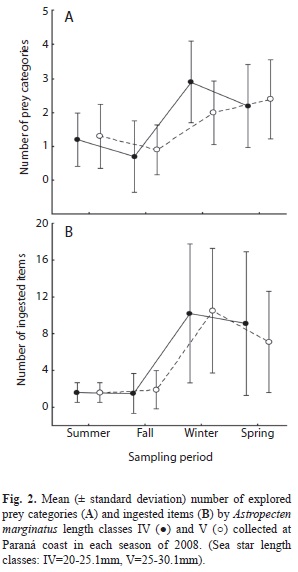
<body><![CDATA[<br> <font style="font-family: verdana;" size="2">Furthermore, ten individuals of each one of two most frequent length classes (i.e., Class IV=20.1-25mm and Class V=25.1-30mm) were separated to analyze stomach contents. We adopted this procedure because some length classes were either not observed or did not have enough individuals at all sampling periods. The stomach of each individual was removed through an incision in the aboral region and transferred to Petri dishes where the items were identified and quantified under a stereo micro-scope. The relative frequency (F%=number of stomachs contained item <span style="font-style: italic;">&#8220;i&#8221;</span>/total number of stomachs) and abundance (N%=total number of individuals of item <span style="font-style: italic;">&#8220;i&#8221;</span>/total individuals of all items) for each prey category was determined (Hyslop, 1980). These two frequencies were combined into an index of alimentary importance: AI=(F%*N%)/&#931;(F%*N%), modified from the equation of Kawakami &amp; Vazzoler (1980). Differences in both number of prey categories types and number of ingested items among individuals of different length classes and sampling periods were determined using a two-way ANOVA. All data were tested for normality (Kolmogorov-Smirnov test) and homogeneity of variances (Cochran test) prior to their use in statistical tests (Underwood, 1997). The number of ingested items were transformed to log(x+1) to assure variance homogeneity and normal distribution. In cases in which the ANOVA result was significant (p&lt;0.05), Tukey&#8217;s multiple comparison test was applied to determine specific differences (Underwood, 1997). The similarity in the <span  style="font-style: italic;">A. marginatus</span> food items between two most frequent length classes and among sampling periods were assessed by applying the Simplified Morisita index (Horn, 1966). A suitable coefficient for proportion analyses with little influence of the sample size (Krebs, 1999), on the AI values of each item, where the results were displayed in the form of UPGMA clustering method dendrogram. In a complementary way, a two-way PERMANOVA was used to test the null hypothesis of no difference in prey composition among length classes and sampling periods (Anderson, 2001). </font>    <br> <font style="font-family: verdana;" size="2"></font>    <br> <font style="font-family: verdana; font-weight: bold;" size="3">Results</font>    <br> <font style="font-family: verdana;" size="2"></font>    <br> <font style="font-family: verdana;" size="2">A total of 994 <span  style="font-style: italic;">Astropecten marginatus</span> were collected with length ranging from 7.0 to 56.2mm. Most of them were in the 20.1-25mm length classes (i.e., 31.2% of total individuals). Individuals larger than 40mm were only collected in the spring while a few recruits (&lt;10mm) were found in fall and winter (<a  href="img/revistas/rbt/v62n1/a06i1.jpg">Fig. 1</a>). Total weight of individuals ranged from 0.1 to 15.3g. All weight-length relationships were highly significant (p&lt;0.01), with coefficient of determination ranging around 0.95 (<a href="img/revistas/rbt/v62n1/a06t1.gif">Table 1</a>). Seasonal differences in regression slopes were not significant (ANCOVA: df=3, f=0.41, p=0.75) and, the observed values (b&lt;2.54) indicate a negative allometry.</font>    <br> <font style="font-family: verdana;" size="2"></font>    <br> <font style="font-family: verdana;" size="2">From the 80 stomachs analyzed, 19% were empty. The highest frequency of empty stomachs was observed at fall (<a  href="img/revistas/rbt/v62n1/a06t2.gif">Table 2</a>). In general, <span  style="font-style: italic;">A. marginatus</span> explored eleven prey categories and, cumaceans and mollusks were the most frequents (<a href="img/revistas/rbt/v62n1/a06t2.gif">Table 2</a>). Higher mean values of explored prey categories (ANOVA, df=3, F=12.28, p&lt;0.001) and ingested items (df=3, F=15.54, p&lt;0.001) were observed in the individuals collected at winter-spring than summer-fall ones (<a  href="/img/revistas/rbt/v62n1/a06i2.jpg">Fig. 2</a>).</font>    <br> <font style="font-family: verdana;" size="2"></font>    <br> <font style="font-family: verdana;" size="2">The seasonal analysis of the diet of the two most common length classes showed the existence of two groups (<a  href="img/revistas/rbt/v62n1/a06i3.jpg">Fig. 3</a>). The first group comprises individuals collected during the summer and fall, and had gastropods as main food item (AI&gt;0.78; <a href="img/revistas/rbt/v62n1/a06t2.gif">Table 2</a>). Those collected in spring and winter, which had cumaceans as main food item (AI&gt;0.62; <a  href="img/revistas/rbt/v62n1/a06t2.gif">Table 2</a>), were placed together in another group (<a  href="img/revistas/rbt/v62n1/a06i3.jpg">Fig. 3</a>). In addition, this analysis reveals no differences between two length classes. Also, prey composition was significantly different among individuals collected at spring-winter and summer-fall (PERMANOVA, pseudo-F=10.181, p=0.001), but no difference was observed between the analyzed length classes (pseudo-F=0.245, p=0.848).&nbsp;     <br> </font>    ]]></body>
<body><![CDATA[<br> <font style="font-family: verdana; font-weight: bold;" size="3">Discussion</font>    <br> <font style="font-family: verdana;" size="2"></font>    <br> <font style="font-family: verdana;" size="2">The individuals of <span  style="font-style: italic;">Astropecten marginatus</span> inhabiting off the state of Paran&aacute; showed lower length than from other places. The most frequent length classes in this study (20.1-25mm) were lower than observed by Monteiro &amp; Pardo (1994) for the population from state of S&atilde;o Paulo, Southeastern Brazil (40-50mm) or by Soto (1984) and Ortega et al., (2011) from the coast of Venezuela (30-34mm and 31-46mm, respectively). The maximum recorded length (56.2mm) are also lower than those observed for others Caribbean populations, where were recorded maximum sizes around 78mm (Roa, 1967; Walenkamp, 1976, 1979; Ortega et al., 2011).</font>    <br> <font style="font-family: verdana;" size="2"></font>    <br> <font style="font-family: verdana;" size="2">The observed seasonal differences in length could be related either to recruitment or to migration. Although the recruitment of <span  style="font-style: italic;">Astropecten</span> is unpredictable (Christensen, 1970), for the species <span  style="font-style: italic;">A. irregularis</span> an increase in the abundance of juveniles has been reported in fall (Freeman, Richardson &amp; Seed, 2001). Otherwise, the absence of large individuals of <span style="font-style: italic;">A. latespinosus</span> during winter could be related to offshore migration (Nojima, 1983), which was also observed in other coastal echinoderms (Borzone, 1999).</font>    <br> <font style="font-family: verdana;" size="2"></font>    <br> <font style="font-family: verdana;" size="2">The weight-length relationships showed a negative allometry, confirming that organisms invest more in length than in weight, as has been observed for other species of <span style="font-style: italic;">Astropecten</span> off the Brazilian coast (Ventura, Junqueira &amp; Fernandes, 1994).</font>    <br> <font style="font-family: verdana;" size="2"></font>    <br> <font style="font-family: verdana;" size="2">Regarding feeding behavior on the genus <span style="font-style: italic;">Astropecten</span>, several studies conducted world-wide have found primarily mollusks, especially bivalves (Christensen, 1970; Penchaszadeh, 1973; Nojima, 1988, 1989; Freeman, Richardson &amp; Seed, 1998; Brogger &amp; Penchaszadeh, 2008; Loh &amp; Todd, 2011) and gastropods (Soto, 2000, Ganmanee et al., 2003; Juan, Cartes &amp; Demestre, 2007) as main prey. The same feeding pattern has also been observed for <span style="font-style: italic;">A. marginatus</span> inhabiting the Caribbean Sea (Soto, 1984; Ortega et al., 2011) and Brazil (Monteiro &amp; Pardo, 1994). Furthermore, temporal differences in the amount of ingested items and in the food preferences have also been observed.</font>    <br> <font style="font-family: verdana;" size="2"></font>    ]]></body>
<body><![CDATA[<br> <font style="font-family: verdana;" size="2">In contrast to our results, higher number of consumed prey is usually observed during warm seasons and it is primarily associated to an increase of prey availability promoted by recruitment process of benthic community or an increase of feeding rates of sea stars (Christensen, 1970; Doi 1976; Ganmanee et al., 2003; Caregnato, Wiggers, Tarasconi &amp; Veitenheimer-Mendes, 2009). Considering the temperature influence on animal metabolism, a faster feeding rate could result in a lower residence time of food items at sea star stomachs and thus, higher frequencies of empty stomachs or low amount of ingested items can be expected as observed in our results, especially if prey availability is low. Changes in food preference also result from prey availability in the environment. Nojima (1988) observed that adults of <span style="font-style: italic;">Astropecten latespinosus</span> modified its feeding behavior from shellfish predators to non-selective deposit feeder when preferred preys are scarce or absent. Penchaszadeh (1973) also observed seasonal changes in food preferences of <span style="font-style: italic;">A. brasiliensis</span>, changing from shellfish (mainly <span style="font-style: italic;">Mytilus</span> sp.) as preferred prey in the summer to cumaceans in the fall. These changes were related to changes in availability and vulnerability of prey.</font>    <br> <font style="font-family: verdana;" size="2"></font>    <br> <font style="font-family: verdana;" size="2">The genus <span  style="font-style: italic;">Astropecten</span> is a good benthic sampler as it has a generalist diet, considering as a tool for comparative studies of sand-bottom communities (Wells et al., 1961). Although there is no data about the structure of the benthic community of the inner shelf in the state of Paran&aacute;, high frequency and abundance of cumaceans as food item possibly reflects the unavailability of mollusks in the region. Even so, gastropods were the main prey category explored at summer and fall. However, this pattern must be carefully analyzed since it can have been biased due high frequency of empty stomach and low amount of ingested items observed in these periods.</font>    <br> <font style="font-family: verdana;" size="2"></font>    <br> <font style="font-family: verdana;" size="2">Considering that the quantity and quality of ingested food are the main factors responsible for seastar growth (Scheibling, 1980), the lower length observed for <span style="font-style: italic;">Astropecten marginatus</span> inhabiting off the state of Paran&aacute; probably reflects its feeding behavior imposed by available of local preys. </font>    <br> <font style="font-family: verdana;" size="2"></font>    <br> <font style="font-family: verdana; font-weight: bold;" size="3">Acknowledgments</font>    <br> <font style="font-family: verdana;" size="2"></font>    <br> <font style="font-family: verdana;" size="2">The authors would like to thank to John Lawrence, K&aacute;tia Freire, Mauricio Vald&eacute;s de Anda and four anonymous reviewers for suggestions and comments. The first author was sponsored by an MSc scholarship from CAPES/REUNI (Brazilian Government). </font>    <br> <font style="font-family: verdana;" size="2"></font> <hr style="width: 100%; height: 2px;"><font  style="font-family: verdana; font-weight: bold;" size="3">References</font>    ]]></body>
<body><![CDATA[<br>     <br>     <!-- ref --><div style="text-align: left;"><font style="font-family: verdana;"  size="2">Anderson, M. J. (2001). A new method for a non-para-metric multivariate analysis of variance. <span style="font-style: italic;">Austral Ecology, 26</span>, 32-46.    &nbsp;&nbsp;&nbsp;&nbsp;&nbsp;&nbsp;&nbsp;&nbsp;[&#160;<a href="javascript:void(0);" onclick="javascript: window.open('/scielo.php?script=sci_nlinks&ref=1626898&pid=S0034-7744201400020000600001&lng=','','width=640,height=500,resizable=yes,scrollbars=1,menubar=yes,');">Links</a>&#160;]<!-- end-ref --></font>    <br>     <!-- ref --><br> <font style="font-family: verdana;" size="2">Andriguetto-Filho, J. M. (1999). <span style="font-style: italic;">Sistemas t&eacute;cnicos de pesca e suas din&acirc;micas de transforma&ccedil;&atilde;o no Litoral do Paran&aacute;, Brasil</span> (Unpublished doctoral dissertation). Universidade Federal do Paran&aacute;, Curitiba, Brazil.    &nbsp;&nbsp;&nbsp;&nbsp;&nbsp;&nbsp;&nbsp;&nbsp;[&#160;<a href="javascript:void(0);" onclick="javascript: window.open('/scielo.php?script=sci_nlinks&ref=1626901&pid=S0034-7744201400020000600002&lng=','','width=640,height=500,resizable=yes,scrollbars=1,menubar=yes,');">Links</a>&#160;]<!-- end-ref --></font>    <br>     <!-- ref --><br> <font style="font-family: verdana;" size="2">Angulo, R. J. (1992). <span  style="font-style: italic;">Geologia da plan&iacute;cie costeira do Estado do Paran&aacute;.</span> (Unpublished doctoral dissertation). Universidade de S&atilde;o Paulo, S&atilde;o Paulo, Brazil.    &nbsp;&nbsp;&nbsp;&nbsp;&nbsp;&nbsp;&nbsp;&nbsp;[&#160;<a href="javascript:void(0);" onclick="javascript: window.open('/scielo.php?script=sci_nlinks&ref=1626904&pid=S0034-7744201400020000600003&lng=','','width=640,height=500,resizable=yes,scrollbars=1,menubar=yes,');">Links</a>&#160;]<!-- end-ref --></font>    ]]></body>
<body><![CDATA[<br>     <!-- ref --><br> <font style="font-family: verdana;" size="2">Beddingfield, S. D., &amp; McClintock, J. B. (1993). Feeding behavior of the sea star <span style="font-style: italic;">Astropecten</span> <span  style="font-style: italic;">articulatus</span> (Echino-dermata: Asteroidea): an evaluation of energy-efficient foraging in a soft-bottom predator. <span style="font-style: italic;">Marine Biology, 115</span>, 669-676.    &nbsp;&nbsp;&nbsp;&nbsp;&nbsp;&nbsp;&nbsp;&nbsp;[&#160;<a href="javascript:void(0);" onclick="javascript: window.open('/scielo.php?script=sci_nlinks&ref=1626907&pid=S0034-7744201400020000600004&lng=','','width=640,height=500,resizable=yes,scrollbars=1,menubar=yes,');">Links</a>&#160;]<!-- end-ref --></font>    <br>     <!-- ref --><br> <font style="font-family: verdana;" size="2">Bitter, R., &amp; Penchaszadeh, P. E. (1983). Ecologia tr&oacute;fica de dos estrellas de mar del genero <span style="font-style: italic;">Astropecten</span> coexistentes em Golfo Triste, Venezuela. <span style="font-style: italic;">Studies on Neotropical Fauna and Environment, 18</span>, 163-180.    &nbsp;&nbsp;&nbsp;&nbsp;&nbsp;&nbsp;&nbsp;&nbsp;[&#160;<a href="javascript:void(0);" onclick="javascript: window.open('/scielo.php?script=sci_nlinks&ref=1626910&pid=S0034-7744201400020000600005&lng=','','width=640,height=500,resizable=yes,scrollbars=1,menubar=yes,');">Links</a>&#160;]<!-- end-ref --> </font>    <br>     <!-- ref --><br> <font style="font-family: verdana;" size="2">Blake, D. B. (1987). A classification and phylogeny of post-Paleozoic sea stars (Asteroidea: Echino-dermata). <span  style="font-style: italic;">Journal of Natural History, 21</span>, 481-528.    &nbsp;&nbsp;&nbsp;&nbsp;&nbsp;&nbsp;&nbsp;&nbsp;[&#160;<a href="javascript:void(0);" onclick="javascript: window.open('/scielo.php?script=sci_nlinks&ref=1626913&pid=S0034-7744201400020000600006&lng=','','width=640,height=500,resizable=yes,scrollbars=1,menubar=yes,');">Links</a>&#160;]<!-- end-ref --></font>    <br>     ]]></body>
<body><![CDATA[<!-- ref --><br> <font style="font-family: verdana;" size="2">Blake, D. B. (1989). Asteroidea: Functional morphology, classification and phylogeny. In M. Jangoux &amp; J. M. Lawrence (Eds.), <span  style="font-style: italic;">Echinoderm Studies, Vol. 3</span> (pp. 179-223). Rotterdam: A. A. Balkema.    &nbsp;&nbsp;&nbsp;&nbsp;&nbsp;&nbsp;&nbsp;&nbsp;[&#160;<a href="javascript:void(0);" onclick="javascript: window.open('/scielo.php?script=sci_nlinks&ref=1626916&pid=S0034-7744201400020000600007&lng=','','width=640,height=500,resizable=yes,scrollbars=1,menubar=yes,');">Links</a>&#160;]<!-- end-ref --></font>    <br>     <!-- ref --><br> <font style="font-family: verdana;" size="2">Borzone, C. A. (1999). Influence of <span style="font-style: italic;">Mellita quinquiesper-forata</span> beds on the structure of subtidal benthic communities of sandy beaches. In M. D. C. Carnevalli &amp; F. Bonasoro (Eds.), <span  style="font-style: italic;">Echinoderm Research 1998</span> (pp. 433-437). Rotterdam: A. A. Balkema.    &nbsp;&nbsp;&nbsp;&nbsp;&nbsp;&nbsp;&nbsp;&nbsp;[&#160;<a href="javascript:void(0);" onclick="javascript: window.open('/scielo.php?script=sci_nlinks&ref=1626919&pid=S0034-7744201400020000600008&lng=','','width=640,height=500,resizable=yes,scrollbars=1,menubar=yes,');">Links</a>&#160;]<!-- end-ref --></font>    <br>     <!-- ref --><br> <font style="font-family: verdana;" size="2">Branco, J. O., &amp; Verani, J. R. (2006). Pesca do camar&atilde;o sete-barbas e sua fauna acompanhante, na Arma&ccedil;&atilde;o do Itapocoroy, Penha, SC. In J. O. Branco &amp; A. W. C. Marenzi (Eds.), <span style="font-style: italic;">Bases ecol&oacute;gicas para um desenvolvimento sustent&aacute;vel: estudos de caso em Penha, SC.</span> (pp. 153-170). Itajai, SC: Editora da Univali.    &nbsp;&nbsp;&nbsp;&nbsp;&nbsp;&nbsp;&nbsp;&nbsp;[&#160;<a href="javascript:void(0);" onclick="javascript: window.open('/scielo.php?script=sci_nlinks&ref=1626922&pid=S0034-7744201400020000600009&lng=','','width=640,height=500,resizable=yes,scrollbars=1,menubar=yes,');">Links</a>&#160;]<!-- end-ref --></font>    <br>     <!-- ref --><br> <font style="font-family: verdana;" size="2">Brogger, M. I., &amp; Penchaszadeh, P. E. (2008). Infaunal mollusks as main prey for two sand bottoms sea stars off Puerto Quequ&eacute;n (Argentina). <span style="font-style: italic;">Revista de Biolog&iacute;a Tropical, 56</span>(3), 329-334.    &nbsp;&nbsp;&nbsp;&nbsp;&nbsp;&nbsp;&nbsp;&nbsp;[&#160;<a href="javascript:void(0);" onclick="javascript: window.open('/scielo.php?script=sci_nlinks&ref=1626925&pid=S0034-7744201400020000600010&lng=','','width=640,height=500,resizable=yes,scrollbars=1,menubar=yes,');">Links</a>&#160;]<!-- end-ref --></font>    <br>     <!-- ref --><br> <font style="font-family: verdana;" size="2">Caregnato, F. F., Wiggers, F., Tarasconi, J. C., &amp; Veitenheimer-Mendes, I. L. (2009). Taxonomic composition of mollusks collected from the stomach content of <span style="font-style: italic;">Astropecten brasiliensis</span> (Echino-dermata: Asteroidea) in Santa Catarina, Brazil. <span  style="font-style: italic;">Revista Brasileira de Bioci&ecirc;ncias, 7</span>(3), 252-259.    &nbsp;&nbsp;&nbsp;&nbsp;&nbsp;&nbsp;&nbsp;&nbsp;[&#160;<a href="javascript:void(0);" onclick="javascript: window.open('/scielo.php?script=sci_nlinks&ref=1626928&pid=S0034-7744201400020000600011&lng=','','width=640,height=500,resizable=yes,scrollbars=1,menubar=yes,');">Links</a>&#160;]<!-- end-ref --></font>    <br>     <!-- ref --><br> <font style="font-family: verdana;" size="2">Christensen, A. M. (1970). Feeding biology of the sea star <span style="font-style: italic;">Astropecten</span> irregularis Pennant. <span style="font-style: italic;">Ophelia, 8</span>, 1-134.    &nbsp;&nbsp;&nbsp;&nbsp;&nbsp;&nbsp;&nbsp;&nbsp;[&#160;<a href="javascript:void(0);" onclick="javascript: window.open('/scielo.php?script=sci_nlinks&ref=1626931&pid=S0034-7744201400020000600012&lng=','','width=640,height=500,resizable=yes,scrollbars=1,menubar=yes,');">Links</a>&#160;]<!-- end-ref --></font>    <br>     <!-- ref --><br> <font style="font-family: verdana;" size="2">Clark, A. M., &amp; Downey, M. E. (1992). <span style="font-style: italic;">Starfishes of the Atlantic.</span> London: Chapman &amp; Hall.    &nbsp;&nbsp;&nbsp;&nbsp;&nbsp;&nbsp;&nbsp;&nbsp;[&#160;<a href="javascript:void(0);" onclick="javascript: window.open('/scielo.php?script=sci_nlinks&ref=1626934&pid=S0034-7744201400020000600013&lng=','','width=640,height=500,resizable=yes,scrollbars=1,menubar=yes,');">Links</a>&#160;]<!-- end-ref --></font>    ]]></body>
<body><![CDATA[<br>     <!-- ref --><br> <font style="font-family: verdana;" size="2">Doi, T. (1976). Some aspects of feeding ecology of the sea-star, genus <span style="font-style: italic;">Astropecten</span>. <span  style="font-style: italic;">Publications from the Amakusa Marine Biological Laboratory, 4</span>, 1-19.    &nbsp;&nbsp;&nbsp;&nbsp;&nbsp;&nbsp;&nbsp;&nbsp;[&#160;<a href="javascript:void(0);" onclick="javascript: window.open('/scielo.php?script=sci_nlinks&ref=1626937&pid=S0034-7744201400020000600014&lng=','','width=640,height=500,resizable=yes,scrollbars=1,menubar=yes,');">Links</a>&#160;]<!-- end-ref --></font>    <br>     <!-- ref --><br> <font style="font-family: verdana;" size="2">Freeman, S. M., Richardson, C. A., &amp; Seed, R. (1998). The distribution and occurrence of <span style="font-style: italic;">Acholoe</span> <span style="font-style: italic;">squamosa</span> (Polychaeta: Polynoidae) a commensal with the burrowing starfish <span  style="font-style: italic;">Astropecten</span> <span style="font-style: italic;">irregularis</span> (Echino-dermata: Asteroidea). <span style="font-style: italic;">Estuarine, Coastal and Shelf Science, 47</span>, 107-118.    &nbsp;&nbsp;&nbsp;&nbsp;&nbsp;&nbsp;&nbsp;&nbsp;[&#160;<a href="javascript:void(0);" onclick="javascript: window.open('/scielo.php?script=sci_nlinks&ref=1626940&pid=S0034-7744201400020000600015&lng=','','width=640,height=500,resizable=yes,scrollbars=1,menubar=yes,');">Links</a>&#160;]<!-- end-ref --></font>    <br>     <!-- ref --><br> <font style="font-family: verdana;" size="2">Freeman, S. M., Richardson, C. A., &amp; Seed, R. (2001). Seasonal abundance, spatial distribution, spawning and growth of <span  style="font-style: italic;">Astropecten</span> <span style="font-style: italic;">irregularis</span> (Echinodermata: Asteroidea). <span style="font-style: italic;">Estuarine, Coastal and Shelf Science, 53</span>, 39-49.    &nbsp;&nbsp;&nbsp;&nbsp;&nbsp;&nbsp;&nbsp;&nbsp;[&#160;<a href="javascript:void(0);" onclick="javascript: window.open('/scielo.php?script=sci_nlinks&ref=1626943&pid=S0034-7744201400020000600016&lng=','','width=640,height=500,resizable=yes,scrollbars=1,menubar=yes,');">Links</a>&#160;]<!-- end-ref --></font>    <br>     ]]></body>
<body><![CDATA[<!-- ref --><br> <font style="font-family: verdana;" size="2">Ganmanee, M., Narita, T., Iidas, S., &amp; Sekiguchi, H. (2003). Feeding habits of asteroids, <span style="font-style: italic;">Luidia quinaria</span> and <span style="font-style: italic;">Astropecten</span> scoparius, in Ise Bay, Central Japan. <span style="font-style: italic;">Fisheries Science, 69</span>, 1121-1134.    &nbsp;&nbsp;&nbsp;&nbsp;&nbsp;&nbsp;&nbsp;&nbsp;[&#160;<a href="javascript:void(0);" onclick="javascript: window.open('/scielo.php?script=sci_nlinks&ref=1626946&pid=S0034-7744201400020000600017&lng=','','width=640,height=500,resizable=yes,scrollbars=1,menubar=yes,');">Links</a>&#160;]<!-- end-ref --></font>    <br>     <!-- ref --><br> <font style="font-family: verdana;" size="2">Gaymer, C. F., Himmelman, J. H., &amp; Johnson, L. E. (2001). Distribution and feeding ecology of the seastars <span  style="font-style: italic;">Leptasterias polaris</span> and <span style="font-style: italic;">Asterias vulgaris</span> in the northern Gulf of St. Lawrence, Canada. <span style="font-style: italic;">Journal of the Marine Biological Association of the United Kingdom, 81</span>, 827-843.    &nbsp;&nbsp;&nbsp;&nbsp;&nbsp;&nbsp;&nbsp;&nbsp;[&#160;<a href="javascript:void(0);" onclick="javascript: window.open('/scielo.php?script=sci_nlinks&ref=1626949&pid=S0034-7744201400020000600018&lng=','','width=640,height=500,resizable=yes,scrollbars=1,menubar=yes,');">Links</a>&#160;]<!-- end-ref --></font>    <br>     <!-- ref --><br> <font style="font-family: verdana;" size="2">Gil, D. G. &amp; Zaixso, H. E. (2008). Feeding ecology of the sub-Antarctic sea star <span style="font-style: italic;">Anasterias minuta</span> within tide pools in Patagonia, Argentina. <span style="font-style: italic;">Revista de Biolog&iacute;a Tropical, 56</span>, 311-328.    &nbsp;&nbsp;&nbsp;&nbsp;&nbsp;&nbsp;&nbsp;&nbsp;[&#160;<a href="javascript:void(0);" onclick="javascript: window.open('/scielo.php?script=sci_nlinks&ref=1626952&pid=S0034-7744201400020000600019&lng=','','width=640,height=500,resizable=yes,scrollbars=1,menubar=yes,');">Links</a>&#160;]<!-- end-ref --></font>    <br>     <!-- ref --><br> <font style="font-family: verdana;" size="2">Horn, H. S. (1966). Measurement of &#8220;Overlap&#8221; in comparative ecological studies. <span style="font-style: italic;">The American Naturalist, 100</span>, 419-424.    &nbsp;&nbsp;&nbsp;&nbsp;&nbsp;&nbsp;&nbsp;&nbsp;[&#160;<a href="javascript:void(0);" onclick="javascript: window.open('/scielo.php?script=sci_nlinks&ref=1626955&pid=S0034-7744201400020000600020&lng=','','width=640,height=500,resizable=yes,scrollbars=1,menubar=yes,');">Links</a>&#160;]<!-- end-ref --></font>    <br>     <!-- ref --><br> <font style="font-family: verdana;" size="2">Hyslop, E. J. (1980). Stomach contents analysis- a review of methods and their application. <span style="font-style: italic;">Journal of Fish Biology, 17</span>, 411-429.    &nbsp;&nbsp;&nbsp;&nbsp;&nbsp;&nbsp;&nbsp;&nbsp;[&#160;<a href="javascript:void(0);" onclick="javascript: window.open('/scielo.php?script=sci_nlinks&ref=1626958&pid=S0034-7744201400020000600021&lng=','','width=640,height=500,resizable=yes,scrollbars=1,menubar=yes,');">Links</a>&#160;]<!-- end-ref --></font>    <br>     <!-- ref --><br> <font style="font-family: verdana;" size="2">Jangoux, M. (1982). Food and feeding mechanism: Asteroidea. In M. Jangoux &amp; J. M. Lawrence (Eds.), <span style="font-style: italic;">Echinoderm Nutrition</span> (pp. 117-159). Rotterdam: A. A. Balkema.    &nbsp;&nbsp;&nbsp;&nbsp;&nbsp;&nbsp;&nbsp;&nbsp;[&#160;<a href="javascript:void(0);" onclick="javascript: window.open('/scielo.php?script=sci_nlinks&ref=1626961&pid=S0034-7744201400020000600022&lng=','','width=640,height=500,resizable=yes,scrollbars=1,menubar=yes,');">Links</a>&#160;]<!-- end-ref --></font>    <br>     <!-- ref --><br> <font style="font-family: verdana;" size="2">Janies, D., Voight, J., &amp; Daly, M. (2011). Echinoderm Phylogeny Including Xyloplax, a Progenetic Asteroid. <span  style="font-style: italic;">Systematic Biology, 60</span>(4), 420-438.    &nbsp;&nbsp;&nbsp;&nbsp;&nbsp;&nbsp;&nbsp;&nbsp;[&#160;<a href="javascript:void(0);" onclick="javascript: window.open('/scielo.php?script=sci_nlinks&ref=1626964&pid=S0034-7744201400020000600023&lng=','','width=640,height=500,resizable=yes,scrollbars=1,menubar=yes,');">Links</a>&#160;]<!-- end-ref --></font>    ]]></body>
<body><![CDATA[<br>     <!-- ref --><br> <font style="font-family: verdana;" size="2">Juan, S., Cartes, J. E., &amp; Demestre, M. (2007). Effects of commercial trawling activities in the diet of the flat fish <span  style="font-style: italic;">Citharus linguatula</span> (Osteichthyes: Pleuronectiformes) and the starfish <span style="font-style: italic;">Astropecten</span> <span  style="font-style: italic;">irregulares</span> (Echinodermata: Asteroidea). <span style="font-style: italic;">Journal of Experimental Marine Biology and Ecology, 349</span>, 152-169.    &nbsp;&nbsp;&nbsp;&nbsp;&nbsp;&nbsp;&nbsp;&nbsp;[&#160;<a href="javascript:void(0);" onclick="javascript: window.open('/scielo.php?script=sci_nlinks&ref=1626967&pid=S0034-7744201400020000600024&lng=','','width=640,height=500,resizable=yes,scrollbars=1,menubar=yes,');">Links</a>&#160;]<!-- end-ref --></font>    <br>     <!-- ref --><br> <font style="font-family: verdana;" size="2">Kawakami, E. &amp; Vazzoler, G. (1980). M&eacute;todo gr&aacute;fico e estimativa de &iacute;ndice alimentar aplicado no estudo de alimenta&ccedil;&atilde;o de peixes. <span style="font-style: italic;">Boletim Instituto Oceanogr&aacute;fico, 29</span>(2), 205-207.    &nbsp;&nbsp;&nbsp;&nbsp;&nbsp;&nbsp;&nbsp;&nbsp;[&#160;<a href="javascript:void(0);" onclick="javascript: window.open('/scielo.php?script=sci_nlinks&ref=1626970&pid=S0034-7744201400020000600025&lng=','','width=640,height=500,resizable=yes,scrollbars=1,menubar=yes,');">Links</a>&#160;]<!-- end-ref --></font>    <br>     <!-- ref --><br> <font style="font-family: verdana;" size="2">Kotas, J. E. (1998). <span  style="font-style: italic;">Fauna acompanhante nas pescarias de camar&atilde;o em Santa Catarina</span>. Bras&iacute;lia, DF: CEPSUL/ IBAMA.    &nbsp;&nbsp;&nbsp;&nbsp;&nbsp;&nbsp;&nbsp;&nbsp;[&#160;<a href="javascript:void(0);" onclick="javascript: window.open('/scielo.php?script=sci_nlinks&ref=1626973&pid=S0034-7744201400020000600026&lng=','','width=640,height=500,resizable=yes,scrollbars=1,menubar=yes,');">Links</a>&#160;]<!-- end-ref --></font>    <br>     ]]></body>
<body><![CDATA[<!-- ref --><br> <font style="font-family: verdana;" size="2">Krebs, C. J. (1999). <span  style="font-style: italic;">Ecology: the experimental analysis of distribution and abundance.</span> San Francisco: Benjamin Cummings.    &nbsp;&nbsp;&nbsp;&nbsp;&nbsp;&nbsp;&nbsp;&nbsp;[&#160;<a href="javascript:void(0);" onclick="javascript: window.open('/scielo.php?script=sci_nlinks&ref=1626976&pid=S0034-7744201400020000600027&lng=','','width=640,height=500,resizable=yes,scrollbars=1,menubar=yes,');">Links</a>&#160;]<!-- end-ref --></font>    <br>     <!-- ref --><br> <font style="font-family: verdana;" size="2">Loh, K. S. &amp; Todd, P. A. (2011). Diet and feeding in the sea star <span style="font-style: italic;">Astropecten indicus</span> (D&ouml;derlein, 1888). <span style="font-style: italic;">The Raffles Bulletin of Zoology, 59</span>(2), 251-258.    &nbsp;&nbsp;&nbsp;&nbsp;&nbsp;&nbsp;&nbsp;&nbsp;[&#160;<a href="javascript:void(0);" onclick="javascript: window.open('/scielo.php?script=sci_nlinks&ref=1626979&pid=S0034-7744201400020000600028&lng=','','width=640,height=500,resizable=yes,scrollbars=1,menubar=yes,');">Links</a>&#160;]<!-- end-ref --></font>    <br>     <!-- ref --><br> <font style="font-family: verdana;" size="2">Lorenzi, L. (2004). <span  style="font-style: italic;">Estrutura das Associa&ccedil;&otilde;es infaunais sublitorais de substrato inconsolidados adjacente a recifes artificiais e naturais (Paran&aacute;, Brasil).</span> (Unpublished doctoral dissertation).Universidade Federal do Paran&aacute;, Curitiba, Brazil.    &nbsp;&nbsp;&nbsp;&nbsp;&nbsp;&nbsp;&nbsp;&nbsp;[&#160;<a href="javascript:void(0);" onclick="javascript: window.open('/scielo.php?script=sci_nlinks&ref=1626982&pid=S0034-7744201400020000600029&lng=','','width=640,height=500,resizable=yes,scrollbars=1,menubar=yes,');">Links</a>&#160;]<!-- end-ref --></font>    <br>     <!-- ref --><br> <font style="font-family: verdana;" size="2">Maack, R. (1968). <span  style="font-style: italic;">Geografia f&iacute;sica do estado do Paran&aacute;.</span> Curitiba: Imprensa Oficial (UFPR).    &nbsp;&nbsp;&nbsp;&nbsp;&nbsp;&nbsp;&nbsp;&nbsp;[&#160;<a href="javascript:void(0);" onclick="javascript: window.open('/scielo.php?script=sci_nlinks&ref=1626985&pid=S0034-7744201400020000600030&lng=','','width=640,height=500,resizable=yes,scrollbars=1,menubar=yes,');">Links</a>&#160;]<!-- end-ref --></font>    <br>     <!-- ref --><br> <font style="font-family: verdana;" size="2">Mah, C. L., &amp; Foltz, D. W. (2011). Molecular Phylogeny of the Forcipulatacea (Asteroidea: Echinodermata). <span  style="font-style: italic;">Systematics and Biogeography, 162</span>, 646-660.    &nbsp;&nbsp;&nbsp;&nbsp;&nbsp;&nbsp;&nbsp;&nbsp;[&#160;<a href="javascript:void(0);" onclick="javascript: window.open('/scielo.php?script=sci_nlinks&ref=1626988&pid=S0034-7744201400020000600031&lng=','','width=640,height=500,resizable=yes,scrollbars=1,menubar=yes,');">Links</a>&#160;]<!-- end-ref --></font>    <br>     <!-- ref --><br> <font style="font-family: verdana;" size="2">Matsubara, M., Komatsu, M., Araki, T., Asakawa, S., Yokobori, S., Watanabe, K., &amp; Wada, H. (2005). The phylogenetic status of Paxillosida (Asteroidea) based on complete mitochondrial DNA sequences. <span style="font-style: italic;">Molecular Phylogenetics and Evolution, 36</span>, 598-605.    &nbsp;&nbsp;&nbsp;&nbsp;&nbsp;&nbsp;&nbsp;&nbsp;[&#160;<a href="javascript:void(0);" onclick="javascript: window.open('/scielo.php?script=sci_nlinks&ref=1626991&pid=S0034-7744201400020000600032&lng=','','width=640,height=500,resizable=yes,scrollbars=1,menubar=yes,');">Links</a>&#160;]<!-- end-ref --></font>    <br>     <!-- ref --><br> <font style="font-family: verdana;" size="2">McClintock, J. B., &amp; Lawrence, J. M. (1985). Characteristics of foraging in the soft-bottom benthic starfish <span  style="font-style: italic;">Luidia clathrata</span> (Echinodermata: Asteroidea): prey selectivity, switching behavior, functional responses and movement patterns. <span  style="font-style: italic;">Oecologia, 66</span>, 291-298.    &nbsp;&nbsp;&nbsp;&nbsp;&nbsp;&nbsp;&nbsp;&nbsp;[&#160;<a href="javascript:void(0);" onclick="javascript: window.open('/scielo.php?script=sci_nlinks&ref=1626994&pid=S0034-7744201400020000600033&lng=','','width=640,height=500,resizable=yes,scrollbars=1,menubar=yes,');">Links</a>&#160;]<!-- end-ref --></font>    ]]></body>
<body><![CDATA[<br>     <!-- ref --><br> <font style="font-family: verdana;" size="2">MMA - Brazilian Ministry of the Environment. (2004). <span style="font-style: italic;">Lista Nacional das Esp&eacute;cies de Invertebrados Aqu&aacute;ticos e Peixes Amea&ccedil;ados de Extin&ccedil;&atilde;o</span> (Instru&ccedil;&atilde;o Normativa no. 05 de 21 de maio de 2004). Brasilia, DF: Imprensa Nacional.    &nbsp;&nbsp;&nbsp;&nbsp;&nbsp;&nbsp;&nbsp;&nbsp;[&#160;<a href="javascript:void(0);" onclick="javascript: window.open('/scielo.php?script=sci_nlinks&ref=1626997&pid=S0034-7744201400020000600034&lng=','','width=640,height=500,resizable=yes,scrollbars=1,menubar=yes,');">Links</a>&#160;]<!-- end-ref --></font>    <br>     <!-- ref --><br> <font style="font-family: verdana;" size="2">Monteiro, A. M. G., &amp; Pardo, E. V. (1994). Dieta alimentar de <span style="font-style: italic;">Astropecten marginatus</span> e <span  style="font-style: italic;">Luidia senegalensis</span> (Echinodermata: Asteroidea). <span style="font-style: italic;">Revista Brasileira de Biologia, 54</span>, 49-54.    &nbsp;&nbsp;&nbsp;&nbsp;&nbsp;&nbsp;&nbsp;&nbsp;[&#160;<a href="javascript:void(0);" onclick="javascript: window.open('/scielo.php?script=sci_nlinks&ref=1627000&pid=S0034-7744201400020000600035&lng=','','width=640,height=500,resizable=yes,scrollbars=1,menubar=yes,');">Links</a>&#160;]<!-- end-ref --></font>    <br>     <!-- ref --><br> <font style="font-family: verdana;" size="2">Nojima, S. (1983). Ecological studies on the sea star, <span style="font-style: italic;">Astropecten latespinosus</span>: V. Pattern of spatial distribution and seasonal migration, with special reference to spawning aggregation. <span  style="font-style: italic;">Publications from the Amakusa Marine Biological Laboratory, 7</span>(1), 1-16.    &nbsp;&nbsp;&nbsp;&nbsp;&nbsp;&nbsp;&nbsp;&nbsp;[&#160;<a href="javascript:void(0);" onclick="javascript: window.open('/scielo.php?script=sci_nlinks&ref=1627003&pid=S0034-7744201400020000600036&lng=','','width=640,height=500,resizable=yes,scrollbars=1,menubar=yes,');">Links</a>&#160;]<!-- end-ref --></font>    <br>     ]]></body>
<body><![CDATA[<!-- ref --><br> <font style="font-family: verdana;" size="2">Nojima, S. (1988). Stomach contents and feeding habits of four sympatrics sea stars, genus <span style="font-style: italic;">Astropecten</span> (Echino-dermata: Asteroidea) from northern Kyushu, Japan. <span style="font-style: italic;">Publications from the Amakusa Marine Biological Laboratory, 9</span>(2), 67-76.    &nbsp;&nbsp;&nbsp;&nbsp;&nbsp;&nbsp;&nbsp;&nbsp;[&#160;<a href="javascript:void(0);" onclick="javascript: window.open('/scielo.php?script=sci_nlinks&ref=1627006&pid=S0034-7744201400020000600037&lng=','','width=640,height=500,resizable=yes,scrollbars=1,menubar=yes,');">Links</a>&#160;]<!-- end-ref --></font>    <br>     <!-- ref --><br> <font style="font-family: verdana;" size="2">Nojima, S. (1989). Ecological studies on the sea star, <span style="font-style: italic;">Astropecten latespinosus</span> Meissner. VI. Seasonal changes in stomach contents, preference of food items, size preference and two kinds of switching in feeding habitats. <span style="font-style: italic;">Publications from the Amakusa Marine Biological Laboratory, 10</span>, 17-40.    &nbsp;&nbsp;&nbsp;&nbsp;&nbsp;&nbsp;&nbsp;&nbsp;[&#160;<a href="javascript:void(0);" onclick="javascript: window.open('/scielo.php?script=sci_nlinks&ref=1627009&pid=S0034-7744201400020000600038&lng=','','width=640,height=500,resizable=yes,scrollbars=1,menubar=yes,');">Links</a>&#160;]<!-- end-ref --></font>    <br>     <!-- ref --><br> <font style="font-family: verdana;" size="2">Ortega, I., Mart&iacute;n, A. &amp; D&iacute;az, Y. (2011). Distribuci&oacute;n, par&aacute;metros poblacionales y dieta de <span style="font-style: italic;">Astropecten marginatus</span> (Asteroidea: Astropectinidae) en el Atl&aacute;ntico venezolano. <span style="font-style: italic;">Revista de Biolog&iacute;a Tropical, 59</span>(1), 53-69.    &nbsp;&nbsp;&nbsp;&nbsp;&nbsp;&nbsp;&nbsp;&nbsp;[&#160;<a href="javascript:void(0);" onclick="javascript: window.open('/scielo.php?script=sci_nlinks&ref=1627012&pid=S0034-7744201400020000600039&lng=','','width=640,height=500,resizable=yes,scrollbars=1,menubar=yes,');">Links</a>&#160;]<!-- end-ref --></font>    <br>     <!-- ref --><br> <font style="font-family: verdana;" size="2">Penchaszadeh, P. E. (1973). Comportamiento tr&oacute;fico de la estrella de mar <span style="font-style: italic;">Astropecten brasiliensis</span>. <span style="font-style: italic;">Ecolog&iacute;a (Buenos Aires), 1</span>, 45-54.    &nbsp;&nbsp;&nbsp;&nbsp;&nbsp;&nbsp;&nbsp;&nbsp;[&#160;<a href="javascript:void(0);" onclick="javascript: window.open('/scielo.php?script=sci_nlinks&ref=1627015&pid=S0034-7744201400020000600040&lng=','','width=640,height=500,resizable=yes,scrollbars=1,menubar=yes,');">Links</a>&#160;]<!-- end-ref --></font>    <br>     <!-- ref --><br> <font style="font-family: verdana;" size="2">Roa, E. Z. (1967). Contribuci&oacute;n al estudio de los equino-dermos de Venezuela. <span style="font-style: italic;">Acta Biologica Venezuelica, 5</span>, 267-333.    &nbsp;&nbsp;&nbsp;&nbsp;&nbsp;&nbsp;&nbsp;&nbsp;[&#160;<a href="javascript:void(0);" onclick="javascript: window.open('/scielo.php?script=sci_nlinks&ref=1627018&pid=S0034-7744201400020000600041&lng=','','width=640,height=500,resizable=yes,scrollbars=1,menubar=yes,');">Links</a>&#160;]<!-- end-ref --></font>    <br>     <!-- ref --><br> <font style="font-family: verdana;" size="2">Scheibling, R. E. (1980). Dynamics and feeding activity of high-density aggregations of Oreaster reticulatus (Echinodermata: Asteroidea) in a sand patch habitat. <span style="font-style: italic;">Marine Ecology Progress Series, 2</span>, 321-327.    &nbsp;&nbsp;&nbsp;&nbsp;&nbsp;&nbsp;&nbsp;&nbsp;[&#160;<a href="javascript:void(0);" onclick="javascript: window.open('/scielo.php?script=sci_nlinks&ref=1627021&pid=S0034-7744201400020000600042&lng=','','width=640,height=500,resizable=yes,scrollbars=1,menubar=yes,');">Links</a>&#160;]<!-- end-ref --></font>    <br>     <!-- ref --><br> <font style="font-family: verdana;" size="2">Sloan, N. A. (1980). Aspects of the feeding biology of asteroids. <span style="font-style: italic;">Oceanography and Marine Biology: An Annual Review, 18</span>, 57-124.    &nbsp;&nbsp;&nbsp;&nbsp;&nbsp;&nbsp;&nbsp;&nbsp;[&#160;<a href="javascript:void(0);" onclick="javascript: window.open('/scielo.php?script=sci_nlinks&ref=1627024&pid=S0034-7744201400020000600043&lng=','','width=640,height=500,resizable=yes,scrollbars=1,menubar=yes,');">Links</a>&#160;]<!-- end-ref --></font>    ]]></body>
<body><![CDATA[<br>     <!-- ref --><br> <font style="font-family: verdana;" size="2">Soto, R. B. (1984). Composicion de la dieta de <span style="font-style: italic;">Astropecten marginatus</span> (Echinodermata: Asteroidea). <span style="font-style: italic;">Boletim del Instituto Oceanografico de Venezuela, 23</span>(1-2), 169-176.    &nbsp;&nbsp;&nbsp;&nbsp;&nbsp;&nbsp;&nbsp;&nbsp;[&#160;<a href="javascript:void(0);" onclick="javascript: window.open('/scielo.php?script=sci_nlinks&ref=1627027&pid=S0034-7744201400020000600044&lng=','','width=640,height=500,resizable=yes,scrollbars=1,menubar=yes,');">Links</a>&#160;]<!-- end-ref --></font>    <br>     <!-- ref --><br> <font style="font-family: verdana;" size="2">Soto, R. B. (2000). Nicho complementario en tres especies de asteroideos del g&eacute;nero <span style="font-style: italic;">Astropecten</span>. <span style="font-style: italic;">Croizatia, 1</span>(1), 31-37.    &nbsp;&nbsp;&nbsp;&nbsp;&nbsp;&nbsp;&nbsp;&nbsp;[&#160;<a href="javascript:void(0);" onclick="javascript: window.open('/scielo.php?script=sci_nlinks&ref=1627030&pid=S0034-7744201400020000600045&lng=','','width=640,height=500,resizable=yes,scrollbars=1,menubar=yes,');">Links</a>&#160;]<!-- end-ref --></font>    <br>     <!-- ref --><br> <font style="font-family: verdana;" size="2">Sturges, H. (1926). The choice of a class-interval. <span style="font-style: italic;">Journal of the American Statistical Association, 21</span>, 65-66.    &nbsp;&nbsp;&nbsp;&nbsp;&nbsp;&nbsp;&nbsp;&nbsp;[&#160;<a href="javascript:void(0);" onclick="javascript: window.open('/scielo.php?script=sci_nlinks&ref=1627033&pid=S0034-7744201400020000600046&lng=','','width=640,height=500,resizable=yes,scrollbars=1,menubar=yes,');">Links</a>&#160;]<!-- end-ref --></font>    <br>     ]]></body>
<body><![CDATA[<!-- ref --><br> <font style="font-family: verdana;" size="2">Tommasi, L. R. (1970). Lista dos aster&oacute;ides recentes do Brasil. <span style="font-style: italic;">Contribui&ccedil;&otilde;es do Instituto Oceanogr&aacute;fico da Universidade de S&atilde;o Paulo, 18</span>, 1-61.    &nbsp;&nbsp;&nbsp;&nbsp;&nbsp;&nbsp;&nbsp;&nbsp;[&#160;<a href="javascript:void(0);" onclick="javascript: window.open('/scielo.php?script=sci_nlinks&ref=1627036&pid=S0034-7744201400020000600047&lng=','','width=640,height=500,resizable=yes,scrollbars=1,menubar=yes,');">Links</a>&#160;]<!-- end-ref --></font>    <br>     <!-- ref --><br> <font style="font-family: verdana;" size="2">Underwood, A. J. (1997). <span  style="font-style: italic;">Experiments in Ecology: Their Logical Design and Interpretation Using Analysis of Variance.</span> Cambridge: Cambridge University Press.    &nbsp;&nbsp;&nbsp;&nbsp;&nbsp;&nbsp;&nbsp;&nbsp;[&#160;<a href="javascript:void(0);" onclick="javascript: window.open('/scielo.php?script=sci_nlinks&ref=1627039&pid=S0034-7744201400020000600048&lng=','','width=640,height=500,resizable=yes,scrollbars=1,menubar=yes,');">Links</a>&#160;]<!-- end-ref --></font>    <br>     <!-- ref --><br> <font style="font-family: verdana;" size="2">Vanhoni, F., &amp; Mendon&ccedil;a, F. (2008). O clima do litoral do estado do Paran&aacute;. <span style="font-style: italic;">Revista Brasileira de Climatologia, 3-4</span>, 49-63.    &nbsp;&nbsp;&nbsp;&nbsp;&nbsp;&nbsp;&nbsp;&nbsp;[&#160;<a href="javascript:void(0);" onclick="javascript: window.open('/scielo.php?script=sci_nlinks&ref=1627042&pid=S0034-7744201400020000600049&lng=','','width=640,height=500,resizable=yes,scrollbars=1,menubar=yes,');">Links</a>&#160;]<!-- end-ref --></font>    <br>     <!-- ref --><br> <font style="font-family: verdana;" size="2">Veiga, F. A. (2005). <span  style="font-style: italic;">Processos morfodin&acirc;micos e sedimentol&oacute;gicos na plataforma continental rasa paranaense</span> (Unpublished doctoral dissertation). Universidade Federal do Paran&aacute;, Curitiba, Brazil.    &nbsp;&nbsp;&nbsp;&nbsp;&nbsp;&nbsp;&nbsp;&nbsp;[&#160;<a href="javascript:void(0);" onclick="javascript: window.open('/scielo.php?script=sci_nlinks&ref=1627045&pid=S0034-7744201400020000600050&lng=','','width=640,height=500,resizable=yes,scrollbars=1,menubar=yes,');">Links</a>&#160;]<!-- end-ref --></font>    <br>     <!-- ref --><br> <font style="font-family: verdana;" size="2">Ventura, C. R. R. (2013). Astropecten. In J. M. Lawrence (Ed.), <span style="font-style: italic;">Starfish: Biology and Ecology of the Asteroidea</span> (pp. 101-108). Baltimore, Maryland, USA: The Johns Hopkins University Press.    &nbsp;&nbsp;&nbsp;&nbsp;&nbsp;&nbsp;&nbsp;&nbsp;[&#160;<a href="javascript:void(0);" onclick="javascript: window.open('/scielo.php?script=sci_nlinks&ref=1627048&pid=S0034-7744201400020000600051&lng=','','width=640,height=500,resizable=yes,scrollbars=1,menubar=yes,');">Links</a>&#160;]<!-- end-ref --> </font>    <br>     <!-- ref --><br> <font style="font-family: verdana;" size="2">Ventura, C. R. R., Grillo, M. C. G., &amp; Fernandes, F. C. (2001). Feeding niche breadth and feeding niche overlap of paxillosid starfishes (Echinodermata: Asteroidea) from a midshelf upwelling region, Cabo Frio, Brazil. In M. Barker (Ed.), <span  style="font-style: italic;">Echinoderms 2000</span> (pp. 227-233). Rotterdam: A. A. Balkema.    &nbsp;&nbsp;&nbsp;&nbsp;&nbsp;&nbsp;&nbsp;&nbsp;[&#160;<a href="javascript:void(0);" onclick="javascript: window.open('/scielo.php?script=sci_nlinks&ref=1627051&pid=S0034-7744201400020000600052&lng=','','width=640,height=500,resizable=yes,scrollbars=1,menubar=yes,');">Links</a>&#160;]<!-- end-ref --></font>    <br>     <!-- ref --><br> <font style="font-family: verdana;" size="2">Ventura, C. R. R., Junqueira, A. O. R., &amp; Fernandes, F. C. (1994). The relation between body size and number of prey in starfish (Echinodermata: Asteroidea). In B. David, A. Gille, J. P. F&eacute;ral, &amp; M. Roux (Eds.), <span style="font-style: italic;">Echinoderms through time</span> (pp. 375-380). Rotterdam: A. A. Balkema.    &nbsp;&nbsp;&nbsp;&nbsp;&nbsp;&nbsp;&nbsp;&nbsp;[&#160;<a href="javascript:void(0);" onclick="javascript: window.open('/scielo.php?script=sci_nlinks&ref=1627054&pid=S0034-7744201400020000600053&lng=','','width=640,height=500,resizable=yes,scrollbars=1,menubar=yes,');">Links</a>&#160;]<!-- end-ref --></font>    ]]></body>
<body><![CDATA[<br>     <!-- ref --><br> <font style="font-family: verdana;" size="2">Walenkamp, J. H. C. (1976). The asteroids of the coastal waters of Surinam. <span style="font-style: italic;">Zoologische Verhandelingen, 147</span>, 1-91.    &nbsp;&nbsp;&nbsp;&nbsp;&nbsp;&nbsp;&nbsp;&nbsp;[&#160;<a href="javascript:void(0);" onclick="javascript: window.open('/scielo.php?script=sci_nlinks&ref=1627057&pid=S0034-7744201400020000600054&lng=','','width=640,height=500,resizable=yes,scrollbars=1,menubar=yes,');">Links</a>&#160;]<!-- end-ref --></font>    <br>     <!-- ref --><br> <font style="font-family: verdana;" size="2">Walenkamp, J. H. C. (1979). Asteroidea (Echinodermata) from the Guyana shelf. <span style="font-style: italic;">Zoologische Verhandelingen, 170</span>, 1-97.    &nbsp;&nbsp;&nbsp;&nbsp;&nbsp;&nbsp;&nbsp;&nbsp;[&#160;<a href="javascript:void(0);" onclick="javascript: window.open('/scielo.php?script=sci_nlinks&ref=1627060&pid=S0034-7744201400020000600055&lng=','','width=640,height=500,resizable=yes,scrollbars=1,menubar=yes,');">Links</a>&#160;]<!-- end-ref --></font>    <br>     <!-- ref --><br> <font style="font-family: verdana;" size="2">Wells, H. W., Wells, M. J., &amp; Gray, L. E. (1961). Food of the sea-star <span style="font-style: italic;">Astropecten articulatus. The Biological Bulletin, 120</span>, 265-271.    &nbsp;&nbsp;&nbsp;&nbsp;&nbsp;&nbsp;&nbsp;&nbsp;[&#160;<a href="javascript:void(0);" onclick="javascript: window.open('/scielo.php?script=sci_nlinks&ref=1627063&pid=S0034-7744201400020000600056&lng=','','width=640,height=500,resizable=yes,scrollbars=1,menubar=yes,');">Links</a>&#160;]<!-- end-ref --></font>    <br> </div> <font style="font-family: verdana;" size="2">    ]]></body>
<body><![CDATA[<br> <a name="Correspondencia1"></a><a href="#Correspondencia2">*</a>Correspondencia a:</font>    <br> <font style="font-family: verdana;" size="2"> </font><font style="font-family: verdana;" size="2">Pablo D. B. Guilherme. </font><font style="font-family: verdana;" size="2">Programa de P&oacute;s-Gradua&ccedil;&atilde;o em Ecologia e Conserva&ccedil;&atilde;o, Universidade Federal do Paran&aacute;. Centro Polit&eacute;cnico, Curitiba-PR, CEP 81531-990, Caixa Postal 19031, Brasil. Correo electr&oacute;nico pdbguilherme@gmail.com </font>    <br> <font style="font-family: verdana;" size="2"> </font><small><span style="font-family: verdana;">Leonardo C. Rosa.</span></small><font  style="font-family: verdana;" size="2">N&uacute;cleo de Engenharia de Pesca, Universidade Federal de Sergipe. Av. Marechal Rondon, s/n. Bairro Jardim Rosa Elze, S&atilde;o Crist&oacute;v&atilde;o-SE, CEP 49100-000, Brasil. Correo electr&oacute;nico leonardo.rosa@rocketmail.com     <br> </font><font style="font-family: verdana;" size="2"><a name="1"></a><a  href="#3">1</a>. Programa de P&oacute;s-Gradua&ccedil;&atilde;o em Ecologia e Conserva&ccedil;&atilde;o, Universidade Federal do Paran&aacute;. Centro Polit&eacute;cnico, Curitiba-PR, CEP 81531-990, Caixa Postal 19031, Brasil. Correo electr&oacute;nico pdbguilherme@gmail.com </font>    <br> <font style="font-family: verdana;" size="2"><a name="2"></a><a  href="#4">2</a>. N&uacute;cleo de Engenharia de Pesca, Universidade Federal de Sergipe. Av. Marechal Rondon, s/n. Bairro Jardim Rosa Elze, S&atilde;o Crist&oacute;v&atilde;o-SE, CEP 49100-000, Brasil. Correo electr&oacute;nico leonardo.rosa@rocketmail.com </font>    <br> <font style="font-family: verdana;" size="2"><span  style="font-weight: bold;"></span></font> <hr style="width: 100%; height: 2px;">     <div style="text-align: center;"><font style="font-family: verdana;"  size="2"><span style="font-weight: bold;">Received 25-ii-2013.&nbsp;&nbsp; &nbsp;Corrected 07-IX-2013.&nbsp;&nbsp; &nbsp;Accepted 01-X-2013.</span> </font>    <br> </div> </div>     <div style="text-align: center;"><font style="font-family: verdana;"  size="2"></font></div> </div> <font style="font-family: verdana;" size="2"></font>      ]]></body><back>
<ref-list>
<ref id="B1">
<nlm-citation citation-type="journal">
<person-group person-group-type="author">
<name>
<surname><![CDATA[Anderson]]></surname>
<given-names><![CDATA[M. J.]]></given-names>
</name>
</person-group>
<article-title xml:lang="en"><![CDATA[A new method for a non-para-metric multivariate analysis of variance]]></article-title>
<source><![CDATA[Austral Ecology]]></source>
<year>2001</year>
<volume>26</volume>
<page-range>32-46</page-range></nlm-citation>
</ref>
<ref id="B2">
<nlm-citation citation-type="">
<person-group person-group-type="author">
<name>
<surname><![CDATA[Andriguetto-Filho]]></surname>
<given-names><![CDATA[J. M.]]></given-names>
</name>
</person-group>
<source><![CDATA[Sistemas técnicos de pesca e suas dinâmicas de transformação no Litoral do Paraná, Brasil]]></source>
<year>1999</year>
</nlm-citation>
</ref>
<ref id="B3">
<nlm-citation citation-type="">
<person-group person-group-type="author">
<name>
<surname><![CDATA[Angulo]]></surname>
<given-names><![CDATA[R. J.]]></given-names>
</name>
</person-group>
<source><![CDATA[Geologia da planície costeira do Estado do Paraná]]></source>
<year>1992</year>
</nlm-citation>
</ref>
<ref id="B4">
<nlm-citation citation-type="journal">
<person-group person-group-type="author">
<name>
<surname><![CDATA[Beddingfield]]></surname>
<given-names><![CDATA[S. D.]]></given-names>
</name>
<name>
<surname><![CDATA[McClintock]]></surname>
<given-names><![CDATA[J. B.]]></given-names>
</name>
</person-group>
<article-title xml:lang="en"><![CDATA[Feeding behavior of the sea star Astropecten articulatus (Echino-dermata: Asteroidea): an evaluation of energy-efficient foraging in a soft-bottom predator]]></article-title>
<source><![CDATA[Marine Biology]]></source>
<year>1993</year>
<volume>115</volume>
<page-range>669-676</page-range></nlm-citation>
</ref>
<ref id="B5">
<nlm-citation citation-type="journal">
<person-group person-group-type="author">
<name>
<surname><![CDATA[Bitter]]></surname>
<given-names><![CDATA[R.]]></given-names>
</name>
<name>
<surname><![CDATA[Penchaszadeh]]></surname>
<given-names><![CDATA[P. E.]]></given-names>
</name>
</person-group>
<article-title xml:lang="es"><![CDATA[Ecologia trófica de dos estrellas de mar del genero Astropecten coexistentes em Golfo Triste, Venezuela]]></article-title>
<source><![CDATA[Studies on Neotropical Fauna and Environment]]></source>
<year>1983</year>
<volume>18</volume>
<page-range>163-180</page-range></nlm-citation>
</ref>
<ref id="B6">
<nlm-citation citation-type="journal">
<person-group person-group-type="author">
<name>
<surname><![CDATA[Blake]]></surname>
<given-names><![CDATA[D. B.]]></given-names>
</name>
</person-group>
<article-title xml:lang="en"><![CDATA[A classification and phylogeny of post-Paleozoic sea stars (Asteroidea: Echino-dermata)]]></article-title>
<source><![CDATA[Journal of Natural History]]></source>
<year>1987</year>
<volume>21</volume>
<page-range>481-528</page-range></nlm-citation>
</ref>
<ref id="B7">
<nlm-citation citation-type="book">
<person-group person-group-type="author">
<name>
<surname><![CDATA[Blake]]></surname>
<given-names><![CDATA[D. B.]]></given-names>
</name>
</person-group>
<article-title xml:lang="en"><![CDATA[Asteroidea: Functional morphology, classification and phylogeny]]></article-title>
<person-group person-group-type="editor">
<name>
<surname><![CDATA[Jangoux]]></surname>
<given-names><![CDATA[M.]]></given-names>
</name>
<name>
<surname><![CDATA[Lawrence]]></surname>
<given-names><![CDATA[J. M.]]></given-names>
</name>
</person-group>
<source><![CDATA[Echinoderm Studies]]></source>
<year>1989</year>
<volume>3</volume>
<page-range>179-223</page-range><publisher-loc><![CDATA[^eRotterdam Rotterdam]]></publisher-loc>
<publisher-name><![CDATA[A. A. Balkema]]></publisher-name>
</nlm-citation>
</ref>
<ref id="B8">
<nlm-citation citation-type="book">
<person-group person-group-type="author">
<name>
<surname><![CDATA[Borzone]]></surname>
<given-names><![CDATA[C. A.]]></given-names>
</name>
</person-group>
<article-title xml:lang="en"><![CDATA[Influence of Mellita quinquiesper-forata beds on the structure of subtidal benthic communities of sandy beaches]]></article-title>
<person-group person-group-type="editor">
<name>
<surname><![CDATA[Carnevalli]]></surname>
<given-names><![CDATA[M. D. C.]]></given-names>
</name>
<name>
<surname><![CDATA[Bonasoro]]></surname>
<given-names><![CDATA[F.]]></given-names>
</name>
</person-group>
<source><![CDATA[Echinoderm Research 1998]]></source>
<year>1999</year>
<page-range>433-437</page-range><publisher-loc><![CDATA[^eRotterdam Rotterdam]]></publisher-loc>
<publisher-name><![CDATA[A. A. Balkema]]></publisher-name>
</nlm-citation>
</ref>
<ref id="B9">
<nlm-citation citation-type="book">
<person-group person-group-type="author">
<name>
<surname><![CDATA[Branco]]></surname>
<given-names><![CDATA[J. O.]]></given-names>
</name>
<name>
<surname><![CDATA[Verani]]></surname>
<given-names><![CDATA[J. R.]]></given-names>
</name>
</person-group>
<article-title xml:lang="pt"><![CDATA[Pesca do camarão sete-barbas e sua fauna acompanhante, na Armação do Itapocoroy, Penha, SC]]></article-title>
<person-group person-group-type="editor">
<name>
<surname><![CDATA[Branco]]></surname>
<given-names><![CDATA[J. O.]]></given-names>
</name>
<name>
<surname><![CDATA[Marenzi]]></surname>
<given-names><![CDATA[A. W. C.]]></given-names>
</name>
</person-group>
<source><![CDATA[Bases ecológicas para um desenvolvimento sustentável: estudos de caso em Penha, SC]]></source>
<year>2006</year>
<page-range>153-170</page-range><publisher-loc><![CDATA[^eItajai, SC Itajai, SC]]></publisher-loc>
<publisher-name><![CDATA[Editora da Univali]]></publisher-name>
</nlm-citation>
</ref>
<ref id="B10">
<nlm-citation citation-type="journal">
<person-group person-group-type="author">
<name>
<surname><![CDATA[Brogger]]></surname>
<given-names><![CDATA[M. I.]]></given-names>
</name>
<name>
<surname><![CDATA[Penchaszadeh]]></surname>
<given-names><![CDATA[P. E.]]></given-names>
</name>
</person-group>
<article-title xml:lang="en"><![CDATA[Infaunal mollusks as main prey for two sand bottoms sea stars off Puerto Quequén (Argentina)]]></article-title>
<source><![CDATA[Revista de Biología Tropical]]></source>
<year>2008</year>
<volume>56</volume>
<numero>3</numero>
<issue>3</issue>
<page-range>329-334</page-range></nlm-citation>
</ref>
<ref id="B11">
<nlm-citation citation-type="journal">
<person-group person-group-type="author">
<name>
<surname><![CDATA[Caregnato]]></surname>
<given-names><![CDATA[F. F.]]></given-names>
</name>
<name>
<surname><![CDATA[Wiggers]]></surname>
<given-names><![CDATA[F.]]></given-names>
</name>
<name>
<surname><![CDATA[Tarasconi]]></surname>
<given-names><![CDATA[J. C.]]></given-names>
</name>
<name>
<surname><![CDATA[Veitenheimer-Mendes]]></surname>
<given-names><![CDATA[I. L.]]></given-names>
</name>
</person-group>
<article-title xml:lang="en"><![CDATA[Taxonomic composition of mollusks collected from the stomach content of Astropecten brasiliensis (Echino-dermata: Asteroidea) in Santa Catarina, Brazil]]></article-title>
<source><![CDATA[Revista Brasileira de Biociências]]></source>
<year>2009</year>
<volume>7</volume>
<numero>3</numero>
<issue>3</issue>
<page-range>252-259</page-range></nlm-citation>
</ref>
<ref id="B12">
<nlm-citation citation-type="journal">
<person-group person-group-type="author">
<name>
<surname><![CDATA[Christensen]]></surname>
<given-names><![CDATA[A. M.]]></given-names>
</name>
</person-group>
<article-title xml:lang="en"><![CDATA[Feeding biology of the sea star Astropecten irregularis Pennant]]></article-title>
<source><![CDATA[Ophelia]]></source>
<year>1970</year>
<volume>8</volume>
<page-range>1-134</page-range></nlm-citation>
</ref>
<ref id="B13">
<nlm-citation citation-type="book">
<person-group person-group-type="author">
<name>
<surname><![CDATA[Clark]]></surname>
<given-names><![CDATA[A. M.]]></given-names>
</name>
<name>
<surname><![CDATA[Downey]]></surname>
<given-names><![CDATA[M. E.]]></given-names>
</name>
</person-group>
<source><![CDATA[Starfishes of the Atlantic]]></source>
<year>1992</year>
<publisher-loc><![CDATA[^eLondon London]]></publisher-loc>
<publisher-name><![CDATA[Chapman & Hall]]></publisher-name>
</nlm-citation>
</ref>
<ref id="B14">
<nlm-citation citation-type="journal">
<person-group person-group-type="author">
<name>
<surname><![CDATA[Doi]]></surname>
<given-names><![CDATA[T.]]></given-names>
</name>
</person-group>
<article-title xml:lang="en"><![CDATA[Some aspects of feeding ecology of the sea-star, genus Astropecten]]></article-title>
<source><![CDATA[Publications from the Amakusa Marine Biological Laboratory]]></source>
<year>1976</year>
<volume>4</volume>
<page-range>1-19</page-range></nlm-citation>
</ref>
<ref id="B15">
<nlm-citation citation-type="journal">
<person-group person-group-type="author">
<name>
<surname><![CDATA[Freeman]]></surname>
<given-names><![CDATA[S. M.]]></given-names>
</name>
<name>
<surname><![CDATA[Richardson]]></surname>
<given-names><![CDATA[C. A.]]></given-names>
</name>
<name>
<surname><![CDATA[Seed]]></surname>
<given-names><![CDATA[R.]]></given-names>
</name>
</person-group>
<article-title xml:lang="en"><![CDATA[The distribution and occurrence of Acholoe squamosa (Polychaeta: Polynoidae) a commensal with the burrowing starfish Astropecten irregularis (Echino-dermata: Asteroidea)]]></article-title>
<source><![CDATA[Estuarine, Coastal and Shelf Science]]></source>
<year>1998</year>
<volume>47</volume>
<page-range>107-118</page-range></nlm-citation>
</ref>
<ref id="B16">
<nlm-citation citation-type="journal">
<person-group person-group-type="author">
<name>
<surname><![CDATA[Freeman]]></surname>
<given-names><![CDATA[S. M.]]></given-names>
</name>
<name>
<surname><![CDATA[Richardson]]></surname>
<given-names><![CDATA[C. A.]]></given-names>
</name>
<name>
<surname><![CDATA[Seed]]></surname>
<given-names><![CDATA[R.]]></given-names>
</name>
</person-group>
<article-title xml:lang="en"><![CDATA[Seasonal abundance, spatial distribution, spawning and growth of Astropecten irregularis (Echinodermata: Asteroidea)]]></article-title>
<source><![CDATA[Estuarine, Coastal and Shelf Science]]></source>
<year>2001</year>
<volume>53</volume>
<page-range>39-49</page-range></nlm-citation>
</ref>
<ref id="B17">
<nlm-citation citation-type="journal">
<person-group person-group-type="author">
<name>
<surname><![CDATA[Ganmanee]]></surname>
<given-names><![CDATA[M.]]></given-names>
</name>
<name>
<surname><![CDATA[Narita]]></surname>
<given-names><![CDATA[T.]]></given-names>
</name>
<name>
<surname><![CDATA[Iidas]]></surname>
<given-names><![CDATA[S.]]></given-names>
</name>
<name>
<surname><![CDATA[Sekiguchi]]></surname>
<given-names><![CDATA[H.]]></given-names>
</name>
</person-group>
<article-title xml:lang="en"><![CDATA[Feeding habits of asteroids, Luidia quinaria and Astropecten scoparius, in Ise Bay, Central Japan]]></article-title>
<source><![CDATA[Fisheries Science]]></source>
<year>2003</year>
<volume>69</volume>
<page-range>1121-1134</page-range></nlm-citation>
</ref>
<ref id="B18">
<nlm-citation citation-type="journal">
<person-group person-group-type="author">
<name>
<surname><![CDATA[Gaymer]]></surname>
<given-names><![CDATA[C. F.]]></given-names>
</name>
<name>
<surname><![CDATA[Himmelman]]></surname>
<given-names><![CDATA[J. H.]]></given-names>
</name>
<name>
<surname><![CDATA[Johnson]]></surname>
<given-names><![CDATA[L. E.]]></given-names>
</name>
</person-group>
<article-title xml:lang="en"><![CDATA[Distribution and feeding ecology of the seastars Leptasterias polaris and Asterias vulgaris in the northern Gulf of St. Lawrence, Canada]]></article-title>
<source><![CDATA[Journal of the Marine Biological Association of the United Kingdom]]></source>
<year>2001</year>
<volume>81</volume>
<page-range>827-843</page-range></nlm-citation>
</ref>
<ref id="B19">
<nlm-citation citation-type="journal">
<person-group person-group-type="author">
<name>
<surname><![CDATA[Gil]]></surname>
<given-names><![CDATA[D. G.]]></given-names>
</name>
<name>
<surname><![CDATA[Zaixso]]></surname>
<given-names><![CDATA[H. E.]]></given-names>
</name>
</person-group>
<article-title xml:lang="en"><![CDATA[Feeding ecology of the sub-Antarctic sea star Anasterias minuta within tide pools in Patagonia, Argentina]]></article-title>
<source><![CDATA[Revista de Biología Tropical]]></source>
<year>2008</year>
<volume>56</volume>
<page-range>311-328</page-range></nlm-citation>
</ref>
<ref id="B20">
<nlm-citation citation-type="journal">
<person-group person-group-type="author">
<name>
<surname><![CDATA[Horn]]></surname>
<given-names><![CDATA[H. S.]]></given-names>
</name>
</person-group>
<article-title xml:lang="en"><![CDATA[Measurement of &#8220;Overlap&#8221; in comparative ecological studies]]></article-title>
<source><![CDATA[The American Naturalist]]></source>
<year>1966</year>
<volume>100</volume>
<page-range>419-424</page-range></nlm-citation>
</ref>
<ref id="B21">
<nlm-citation citation-type="journal">
<person-group person-group-type="author">
<name>
<surname><![CDATA[Hyslop]]></surname>
<given-names><![CDATA[E. J.]]></given-names>
</name>
</person-group>
<article-title xml:lang="en"><![CDATA[Stomach contents analysis- a review of methods and their application]]></article-title>
<source><![CDATA[Journal of Fish Biology]]></source>
<year>1980</year>
<volume>17</volume>
<page-range>411-429</page-range></nlm-citation>
</ref>
<ref id="B22">
<nlm-citation citation-type="book">
<person-group person-group-type="author">
<name>
<surname><![CDATA[Jangoux]]></surname>
<given-names><![CDATA[M.]]></given-names>
</name>
</person-group>
<article-title xml:lang="en"><![CDATA[Food and feeding mechanism: Asteroidea]]></article-title>
<person-group person-group-type="editor">
<name>
<surname><![CDATA[Jangoux]]></surname>
<given-names><![CDATA[M.]]></given-names>
</name>
<name>
<surname><![CDATA[Lawrence]]></surname>
<given-names><![CDATA[J. M.]]></given-names>
</name>
</person-group>
<source><![CDATA[Echinoderm Nutrition]]></source>
<year>1982</year>
<page-range>117-159</page-range><publisher-loc><![CDATA[^eRotterdam Rotterdam]]></publisher-loc>
<publisher-name><![CDATA[A. A. Balkema]]></publisher-name>
</nlm-citation>
</ref>
<ref id="B23">
<nlm-citation citation-type="journal">
<person-group person-group-type="author">
<name>
<surname><![CDATA[Janies]]></surname>
<given-names><![CDATA[D.]]></given-names>
</name>
<name>
<surname><![CDATA[Voight]]></surname>
<given-names><![CDATA[J.]]></given-names>
</name>
<name>
<surname><![CDATA[Daly]]></surname>
<given-names><![CDATA[M.]]></given-names>
</name>
</person-group>
<article-title xml:lang="en"><![CDATA[Echinoderm Phylogeny Including Xyloplax, a Progenetic Asteroid]]></article-title>
<source><![CDATA[Systematic Biology]]></source>
<year>2011</year>
<volume>60</volume>
<numero>4</numero>
<issue>4</issue>
<page-range>420-438</page-range></nlm-citation>
</ref>
<ref id="B24">
<nlm-citation citation-type="journal">
<person-group person-group-type="author">
<name>
<surname><![CDATA[Juan]]></surname>
<given-names><![CDATA[S.]]></given-names>
</name>
<name>
<surname><![CDATA[Cartes]]></surname>
<given-names><![CDATA[J. E.]]></given-names>
</name>
<name>
<surname><![CDATA[Demestre]]></surname>
<given-names><![CDATA[M.]]></given-names>
</name>
</person-group>
<article-title xml:lang="en"><![CDATA[Effects of commercial trawling activities in the diet of the flat fish Citharus linguatula (Osteichthyes: Pleuronectiformes) and the starfish Astropecten irregulares (Echinodermata: Asteroidea)]]></article-title>
<source><![CDATA[Journal of Experimental Marine Biology and Ecology]]></source>
<year>2007</year>
<volume>349</volume>
<page-range>152-169</page-range></nlm-citation>
</ref>
<ref id="B25">
<nlm-citation citation-type="journal">
<person-group person-group-type="author">
<name>
<surname><![CDATA[Kawakami]]></surname>
<given-names><![CDATA[E.]]></given-names>
</name>
<name>
<surname><![CDATA[Vazzoler]]></surname>
<given-names><![CDATA[G.]]></given-names>
</name>
</person-group>
<article-title xml:lang="pt"><![CDATA[Método gráfico e estimativa de índice alimentar aplicado no estudo de alimentação de peixes]]></article-title>
<source><![CDATA[Boletim Instituto Oceanográfico]]></source>
<year>1980</year>
<volume>29</volume>
<numero>2</numero>
<issue>2</issue>
<page-range>205-207</page-range></nlm-citation>
</ref>
<ref id="B26">
<nlm-citation citation-type="book">
<person-group person-group-type="author">
<name>
<surname><![CDATA[Kotas]]></surname>
<given-names><![CDATA[J. E.]]></given-names>
</name>
</person-group>
<source><![CDATA[Fauna acompanhante nas pescarias de camarão em Santa Catarina]]></source>
<year>1998</year>
<publisher-loc><![CDATA[^eBrasília, DF Brasília, DF]]></publisher-loc>
<publisher-name><![CDATA[CEPSUL/ IBAMA]]></publisher-name>
</nlm-citation>
</ref>
<ref id="B27">
<nlm-citation citation-type="book">
<person-group person-group-type="author">
<name>
<surname><![CDATA[Krebs]]></surname>
<given-names><![CDATA[C. J.]]></given-names>
</name>
</person-group>
<source><![CDATA[Ecology: the experimental analysis of distribution and abundance]]></source>
<year>1999</year>
<publisher-loc><![CDATA[^eSan Francisco San Francisco]]></publisher-loc>
<publisher-name><![CDATA[Benjamin Cummings]]></publisher-name>
</nlm-citation>
</ref>
<ref id="B28">
<nlm-citation citation-type="journal">
<person-group person-group-type="author">
<name>
<surname><![CDATA[Loh]]></surname>
<given-names><![CDATA[K. S.]]></given-names>
</name>
<name>
<surname><![CDATA[Todd]]></surname>
<given-names><![CDATA[P. A.]]></given-names>
</name>
</person-group>
<article-title xml:lang="en"><![CDATA[Diet and feeding in the sea star Astropecten indicus (Döderlein, 1888)]]></article-title>
<source><![CDATA[The Raffles Bulletin of Zoology]]></source>
<year>2011</year>
<volume>59</volume>
<numero>2</numero>
<issue>2</issue>
<page-range>251-258</page-range></nlm-citation>
</ref>
<ref id="B29">
<nlm-citation citation-type="">
<person-group person-group-type="author">
<name>
<surname><![CDATA[Lorenzi]]></surname>
<given-names><![CDATA[L.]]></given-names>
</name>
</person-group>
<source><![CDATA[Estrutura das Associações infaunais sublitorais de substrato inconsolidados adjacente a recifes artificiais e naturais (Paraná, Brasil)]]></source>
<year>2004</year>
</nlm-citation>
</ref>
<ref id="B30">
<nlm-citation citation-type="book">
<person-group person-group-type="author">
<name>
<surname><![CDATA[Maack]]></surname>
<given-names><![CDATA[R.]]></given-names>
</name>
</person-group>
<source><![CDATA[Geografia física do estado do Paraná]]></source>
<year>1968</year>
<publisher-loc><![CDATA[^eCuritiba Curitiba]]></publisher-loc>
<publisher-name><![CDATA[Imprensa Oficial (UFPR)]]></publisher-name>
</nlm-citation>
</ref>
<ref id="B31">
<nlm-citation citation-type="journal">
<person-group person-group-type="author">
<name>
<surname><![CDATA[Mah]]></surname>
<given-names><![CDATA[C. L.]]></given-names>
</name>
<name>
<surname><![CDATA[Foltz]]></surname>
<given-names><![CDATA[D. W.]]></given-names>
</name>
</person-group>
<article-title xml:lang="en"><![CDATA[Molecular Phylogeny of the Forcipulatacea (Asteroidea: Echinodermata)]]></article-title>
<source><![CDATA[Systematics and Biogeography]]></source>
<year>2011</year>
<volume>162</volume>
<page-range>646-660</page-range></nlm-citation>
</ref>
<ref id="B32">
<nlm-citation citation-type="journal">
<person-group person-group-type="author">
<name>
<surname><![CDATA[Matsubara]]></surname>
<given-names><![CDATA[M.]]></given-names>
</name>
<name>
<surname><![CDATA[Komatsu]]></surname>
<given-names><![CDATA[M.]]></given-names>
</name>
<name>
<surname><![CDATA[Araki]]></surname>
<given-names><![CDATA[T.]]></given-names>
</name>
<name>
<surname><![CDATA[Asakawa]]></surname>
<given-names><![CDATA[S.]]></given-names>
</name>
<name>
<surname><![CDATA[Yokobori]]></surname>
<given-names><![CDATA[S.]]></given-names>
</name>
<name>
<surname><![CDATA[Watanabe]]></surname>
<given-names><![CDATA[K.]]></given-names>
</name>
<name>
<surname><![CDATA[Wada]]></surname>
<given-names><![CDATA[H.]]></given-names>
</name>
</person-group>
<article-title xml:lang="en"><![CDATA[The phylogenetic status of Paxillosida (Asteroidea) based on complete mitochondrial DNA sequences]]></article-title>
<source><![CDATA[Molecular Phylogenetics and Evolution]]></source>
<year>2005</year>
<volume>36</volume>
<page-range>598-605</page-range></nlm-citation>
</ref>
<ref id="B33">
<nlm-citation citation-type="journal">
<person-group person-group-type="author">
<name>
<surname><![CDATA[McClintock]]></surname>
<given-names><![CDATA[J. B.]]></given-names>
</name>
<name>
<surname><![CDATA[Lawrence]]></surname>
<given-names><![CDATA[J. M.]]></given-names>
</name>
</person-group>
<article-title xml:lang="en"><![CDATA[Characteristics of foraging in the soft-bottom benthic starfish Luidia clathrata (Echinodermata: Asteroidea): prey selectivity, switching behavior, functional responses and movement patterns]]></article-title>
<source><![CDATA[Oecologia]]></source>
<year>1985</year>
<volume>66</volume>
<page-range>291-298</page-range></nlm-citation>
</ref>
<ref id="B34">
<nlm-citation citation-type="book">
<collab>MMA - Brazilian Ministry of the Environment</collab>
<source><![CDATA[Lista Nacional das Espécies de Invertebrados Aquáticos e Peixes Ameaçados de Extinção (Instrução Normativa no. 05 de 21 de maio de 2004)]]></source>
<year>2004</year>
<publisher-loc><![CDATA[^eBrasilia, DF Brasilia, DF]]></publisher-loc>
<publisher-name><![CDATA[Imprensa Nacional]]></publisher-name>
</nlm-citation>
</ref>
<ref id="B35">
<nlm-citation citation-type="journal">
<person-group person-group-type="author">
<name>
<surname><![CDATA[Monteiro]]></surname>
<given-names><![CDATA[A. M. G.]]></given-names>
</name>
<name>
<surname><![CDATA[Pardo]]></surname>
<given-names><![CDATA[E. V.]]></given-names>
</name>
</person-group>
<article-title xml:lang="pt"><![CDATA[Dieta alimentar de Astropecten marginatus e Luidia senegalensis (Echinodermata: Asteroidea)]]></article-title>
<source><![CDATA[Revista Brasileira de Biologia]]></source>
<year>1994</year>
<volume>54</volume>
<page-range>49-54</page-range></nlm-citation>
</ref>
<ref id="B36">
<nlm-citation citation-type="journal">
<person-group person-group-type="author">
<name>
<surname><![CDATA[Nojima]]></surname>
<given-names><![CDATA[S.]]></given-names>
</name>
</person-group>
<article-title xml:lang="en"><![CDATA[Ecological studies on the sea star, Astropecten latespinosus: V. Pattern of spatial distribution and seasonal migration, with special reference to spawning aggregation]]></article-title>
<source><![CDATA[Publications from the Amakusa Marine Biological Laboratory]]></source>
<year>1983</year>
<volume>7</volume>
<numero>1</numero>
<issue>1</issue>
<page-range>1-16</page-range></nlm-citation>
</ref>
<ref id="B37">
<nlm-citation citation-type="journal">
<person-group person-group-type="author">
<name>
<surname><![CDATA[Nojima]]></surname>
<given-names><![CDATA[S.]]></given-names>
</name>
</person-group>
<article-title xml:lang="en"><![CDATA[Stomach contents and feeding habits of four sympatrics sea stars, genus Astropecten (Echino-dermata: Asteroidea) from northern Kyushu, Japan]]></article-title>
<source><![CDATA[Publications from the Amakusa Marine Biological Laboratory]]></source>
<year>1988</year>
<volume>9</volume>
<numero>2</numero>
<issue>2</issue>
<page-range>67-76</page-range></nlm-citation>
</ref>
<ref id="B38">
<nlm-citation citation-type="journal">
<person-group person-group-type="author">
<name>
<surname><![CDATA[Nojima]]></surname>
<given-names><![CDATA[S.]]></given-names>
</name>
</person-group>
<article-title xml:lang="en"><![CDATA[Ecological studies on the sea star, Astropecten latespinosus Meissner. VI. Seasonal changes in stomach contents, preference of food items, size preference and two kinds of switching in feeding habitats]]></article-title>
<source><![CDATA[Publications from the Amakusa Marine Biological Laboratory]]></source>
<year>1989</year>
<volume>10</volume>
<page-range>17-40</page-range></nlm-citation>
</ref>
<ref id="B39">
<nlm-citation citation-type="journal">
<person-group person-group-type="author">
<name>
<surname><![CDATA[Ortega]]></surname>
<given-names><![CDATA[I.]]></given-names>
</name>
<name>
<surname><![CDATA[Martín]]></surname>
<given-names><![CDATA[A.]]></given-names>
</name>
<name>
<surname><![CDATA[Díaz]]></surname>
<given-names><![CDATA[Y.]]></given-names>
</name>
</person-group>
<article-title xml:lang="es"><![CDATA[Distribución, parámetros poblacionales y dieta de Astropecten marginatus (Asteroidea: Astropectinidae) en el Atlántico venezolano]]></article-title>
<source><![CDATA[Revista de Biología Tropical]]></source>
<year>2011</year>
<volume>59</volume>
<numero>1</numero>
<issue>1</issue>
<page-range>53-69</page-range></nlm-citation>
</ref>
<ref id="B40">
<nlm-citation citation-type="journal">
<person-group person-group-type="author">
<name>
<surname><![CDATA[Penchaszadeh]]></surname>
<given-names><![CDATA[P. E.]]></given-names>
</name>
</person-group>
<article-title xml:lang="es"><![CDATA[Comportamiento trófico de la estrella de mar Astropecten brasiliensis]]></article-title>
<source><![CDATA[Ecología (Buenos Aires)]]></source>
<year>1973</year>
<volume>1</volume>
<page-range>45-54</page-range></nlm-citation>
</ref>
<ref id="B41">
<nlm-citation citation-type="journal">
<person-group person-group-type="author">
<name>
<surname><![CDATA[Roa]]></surname>
<given-names><![CDATA[E. Z.]]></given-names>
</name>
</person-group>
<article-title xml:lang="es"><![CDATA[Contribución al estudio de los equino-dermos de Venezuela]]></article-title>
<source><![CDATA[Acta Biologica Venezuelica]]></source>
<year>1967</year>
<volume>5</volume>
<page-range>267-333</page-range></nlm-citation>
</ref>
<ref id="B42">
<nlm-citation citation-type="journal">
<person-group person-group-type="author">
<name>
<surname><![CDATA[Scheibling]]></surname>
<given-names><![CDATA[R. E.]]></given-names>
</name>
</person-group>
<article-title xml:lang="en"><![CDATA[Dynamics and feeding activity of high-density aggregations of Oreaster reticulatus (Echinodermata: Asteroidea) in a sand patch habitat]]></article-title>
<source><![CDATA[Marine Ecology Progress Series]]></source>
<year>1980</year>
<volume>2</volume>
<page-range>321-327</page-range></nlm-citation>
</ref>
<ref id="B43">
<nlm-citation citation-type="journal">
<person-group person-group-type="author">
<name>
<surname><![CDATA[Sloan]]></surname>
<given-names><![CDATA[N. A]]></given-names>
</name>
</person-group>
<article-title xml:lang="en"><![CDATA[Aspects of the feeding biology of asteroids]]></article-title>
<source><![CDATA[Oceanography and Marine Biology: An Annual Review]]></source>
<year>1980</year>
<volume>18</volume>
<page-range>57-124</page-range></nlm-citation>
</ref>
<ref id="B44">
<nlm-citation citation-type="journal">
<person-group person-group-type="author">
<name>
<surname><![CDATA[Soto]]></surname>
<given-names><![CDATA[R. B.]]></given-names>
</name>
</person-group>
<article-title xml:lang="es"><![CDATA[Composicion de la dieta de Astropecten marginatus (Echinodermata: Asteroidea)]]></article-title>
<source><![CDATA[Boletim del Instituto Oceanografico de Venezuela]]></source>
<year>1984</year>
<volume>23</volume>
<numero>1-2</numero>
<issue>1-2</issue>
<page-range>169-176</page-range></nlm-citation>
</ref>
<ref id="B45">
<nlm-citation citation-type="journal">
<person-group person-group-type="author">
<name>
<surname><![CDATA[Soto]]></surname>
<given-names><![CDATA[R. B.]]></given-names>
</name>
</person-group>
<article-title xml:lang="es"><![CDATA[Nicho complementario en tres especies de asteroideos del género Astropecten]]></article-title>
<source><![CDATA[Croizatia]]></source>
<year>2000</year>
<volume>1</volume>
<numero>1</numero>
<issue>1</issue>
<page-range>31-37</page-range></nlm-citation>
</ref>
<ref id="B46">
<nlm-citation citation-type="journal">
<person-group person-group-type="author">
<name>
<surname><![CDATA[Sturges]]></surname>
<given-names><![CDATA[H.]]></given-names>
</name>
</person-group>
<article-title xml:lang="en"><![CDATA[The choice of a class-interval]]></article-title>
<source><![CDATA[Journal of the American Statistical Association]]></source>
<year>1926</year>
<volume>21</volume>
<page-range>65-66</page-range></nlm-citation>
</ref>
<ref id="B47">
<nlm-citation citation-type="journal">
<person-group person-group-type="author">
<name>
<surname><![CDATA[Tommasi]]></surname>
<given-names><![CDATA[L. R.]]></given-names>
</name>
</person-group>
<article-title xml:lang="pt"><![CDATA[Lista dos asteróides recentes do Brasil]]></article-title>
<source><![CDATA[Contribuições do Instituto Oceanográfico da Universidade de São Paulo]]></source>
<year>1970</year>
<volume>18</volume>
<page-range>1-61</page-range></nlm-citation>
</ref>
<ref id="B48">
<nlm-citation citation-type="book">
<person-group person-group-type="author">
<name>
<surname><![CDATA[Underwood]]></surname>
<given-names><![CDATA[A. J.]]></given-names>
</name>
</person-group>
<source><![CDATA[Experiments in Ecology: Their Logical Design and Interpretation Using Analysis of Variance]]></source>
<year>1997</year>
<publisher-loc><![CDATA[^eCambridge Cambridge]]></publisher-loc>
<publisher-name><![CDATA[Cambridge University Press]]></publisher-name>
</nlm-citation>
</ref>
<ref id="B49">
<nlm-citation citation-type="journal">
<person-group person-group-type="author">
<name>
<surname><![CDATA[Vanhoni]]></surname>
<given-names><![CDATA[F.]]></given-names>
</name>
<name>
<surname><![CDATA[Mendonça]]></surname>
<given-names><![CDATA[F.]]></given-names>
</name>
</person-group>
<article-title xml:lang="pt"><![CDATA[O clima do litoral do estado do Paraná]]></article-title>
<source><![CDATA[Revista Brasileira de Climatologia]]></source>
<year>2008</year>
<volume>3-4</volume>
<page-range>49-63</page-range></nlm-citation>
</ref>
<ref id="B50">
<nlm-citation citation-type="">
<person-group person-group-type="author">
<name>
<surname><![CDATA[Veiga]]></surname>
<given-names><![CDATA[F. A.]]></given-names>
</name>
</person-group>
<source><![CDATA[Processos morfodinâmicos e sedimentológicos na plataforma continental rasa paranaense]]></source>
<year>2005</year>
</nlm-citation>
</ref>
<ref id="B51">
<nlm-citation citation-type="book">
<person-group person-group-type="author">
<name>
<surname><![CDATA[Ventura]]></surname>
<given-names><![CDATA[C. R. R.]]></given-names>
</name>
</person-group>
<article-title xml:lang="en"><![CDATA[Astropecten]]></article-title>
<person-group person-group-type="editor">
<name>
<surname><![CDATA[Lawrence]]></surname>
<given-names><![CDATA[J. M.]]></given-names>
</name>
</person-group>
<source><![CDATA[Starfish: Biology and Ecology of the Asteroidea]]></source>
<year>2013</year>
<page-range>101-108</page-range><publisher-loc><![CDATA[Baltimore^eMaryland Maryland]]></publisher-loc>
<publisher-name><![CDATA[The Johns Hopkins University Press]]></publisher-name>
</nlm-citation>
</ref>
<ref id="B52">
<nlm-citation citation-type="book">
<person-group person-group-type="author">
<name>
<surname><![CDATA[Ventura]]></surname>
<given-names><![CDATA[C. R. R.]]></given-names>
</name>
<name>
<surname><![CDATA[Grillo]]></surname>
<given-names><![CDATA[M. C. G.]]></given-names>
</name>
<name>
<surname><![CDATA[Fernandes]]></surname>
<given-names><![CDATA[F. C.]]></given-names>
</name>
</person-group>
<article-title xml:lang="en"><![CDATA[Feeding niche breadth and feeding niche overlap of paxillosid starfishes (Echinodermata: Asteroidea) from a midshelf upwelling region, Cabo Frio, Brazil]]></article-title>
<person-group person-group-type="editor">
<name>
<surname><![CDATA[Barker]]></surname>
<given-names><![CDATA[M.]]></given-names>
</name>
</person-group>
<source><![CDATA[Echinoderms 2000]]></source>
<year>2001</year>
<page-range>227-233</page-range><publisher-loc><![CDATA[^eRotterdam Rotterdam]]></publisher-loc>
<publisher-name><![CDATA[A. A. Balkema]]></publisher-name>
</nlm-citation>
</ref>
<ref id="B53">
<nlm-citation citation-type="book">
<person-group person-group-type="author">
<name>
<surname><![CDATA[Ventura]]></surname>
<given-names><![CDATA[C. R. R.]]></given-names>
</name>
<name>
<surname><![CDATA[Junqueira]]></surname>
<given-names><![CDATA[A. O. R.]]></given-names>
</name>
<name>
<surname><![CDATA[Fernandes]]></surname>
<given-names><![CDATA[F. C.]]></given-names>
</name>
</person-group>
<article-title xml:lang="en"><![CDATA[The relation between body size and number of prey in starfish (Echinodermata: Asteroidea)]]></article-title>
<person-group person-group-type="editor">
<name>
<surname><![CDATA[David]]></surname>
<given-names><![CDATA[B.]]></given-names>
</name>
<name>
<surname><![CDATA[Gille]]></surname>
<given-names><![CDATA[A.]]></given-names>
</name>
<name>
<surname><![CDATA[Féral]]></surname>
<given-names><![CDATA[J. P.]]></given-names>
</name>
<name>
<surname><![CDATA[Roux]]></surname>
<given-names><![CDATA[M.]]></given-names>
</name>
</person-group>
<source><![CDATA[Echinoderms through time]]></source>
<year>1994</year>
<page-range>375-380</page-range><publisher-loc><![CDATA[^eRotterdam Rotterdam]]></publisher-loc>
<publisher-name><![CDATA[A. A. Balkema]]></publisher-name>
</nlm-citation>
</ref>
<ref id="B54">
<nlm-citation citation-type="journal">
<person-group person-group-type="author">
<name>
<surname><![CDATA[Walenkamp]]></surname>
<given-names><![CDATA[J. H. C.]]></given-names>
</name>
</person-group>
<article-title xml:lang="en"><![CDATA[The asteroids of the coastal waters of Surinam]]></article-title>
<source><![CDATA[Zoologische Verhandelingen]]></source>
<year>1976</year>
<volume>147</volume>
<page-range>1-91</page-range></nlm-citation>
</ref>
<ref id="B55">
<nlm-citation citation-type="journal">
<person-group person-group-type="author">
<name>
<surname><![CDATA[Walenkamp]]></surname>
<given-names><![CDATA[J. H. C.]]></given-names>
</name>
</person-group>
<article-title xml:lang="en"><![CDATA[Asteroidea (Echinodermata) from the Guyana shelf]]></article-title>
<source><![CDATA[Zoologische Verhandelingen]]></source>
<year>1979</year>
<volume>170</volume>
<page-range>1-97</page-range></nlm-citation>
</ref>
<ref id="B56">
<nlm-citation citation-type="journal">
<person-group person-group-type="author">
<name>
<surname><![CDATA[Wells]]></surname>
<given-names><![CDATA[H. W.]]></given-names>
</name>
<name>
<surname><![CDATA[Wells]]></surname>
<given-names><![CDATA[M. J.]]></given-names>
</name>
<name>
<surname><![CDATA[Gray]]></surname>
<given-names><![CDATA[L. E.]]></given-names>
</name>
</person-group>
<article-title xml:lang="en"><![CDATA[Food of the sea-star Astropecten articulatus]]></article-title>
<source><![CDATA[The Biological Bulletin]]></source>
<year>1961</year>
<volume>120</volume>
<page-range>265-271</page-range></nlm-citation>
</ref>
</ref-list>
</back>
</article>