<?xml version="1.0" encoding="ISO-8859-1"?><article xmlns:mml="http://www.w3.org/1998/Math/MathML" xmlns:xlink="http://www.w3.org/1999/xlink" xmlns:xsi="http://www.w3.org/2001/XMLSchema-instance">
<front>
<journal-meta>
<journal-id>0034-7744</journal-id>
<journal-title><![CDATA[Revista de Biología Tropical]]></journal-title>
<abbrev-journal-title><![CDATA[Rev. biol. trop]]></abbrev-journal-title>
<issn>0034-7744</issn>
<publisher>
<publisher-name><![CDATA[Universidad de Costa Rica]]></publisher-name>
</publisher>
</journal-meta>
<article-meta>
<article-id>S0034-77442014000100030</article-id>
<title-group>
<article-title xml:lang="es"><![CDATA[Morfología polínica de especies del género Senna (Fabaceae) del Sureste del Iberá, Corrientes, Argentina]]></article-title>
<article-title xml:lang="en"><![CDATA[Pollen morphology of species of genus Senna (Fabales: Fabaceae) in Southeast Ibera, Corrientes, Argentina]]></article-title>
</title-group>
<contrib-group>
<contrib contrib-type="author">
<name>
<surname><![CDATA[Fernandez-Pacella]]></surname>
<given-names><![CDATA[Lionel]]></given-names>
</name>
</contrib>
</contrib-group>
<aff id="A01">
<institution><![CDATA[,Universidad Nacional del Nordeste  ]]></institution>
<addr-line><![CDATA[ ]]></addr-line>
<country>Argentina</country>
</aff>
<pub-date pub-type="pub">
<day>00</day>
<month>08</month>
<year>2014</year>
</pub-date>
<pub-date pub-type="epub">
<day>00</day>
<month>08</month>
<year>2014</year>
</pub-date>
<volume>62</volume>
<numero>2</numero>
<fpage>769</fpage>
<lpage>782</lpage>
<copyright-statement/>
<copyright-year/>
<self-uri xlink:href="http://www.scielo.sa.cr/scielo.php?script=sci_arttext&amp;pid=S0034-77442014000100030&amp;lng=en&amp;nrm=iso"></self-uri><self-uri xlink:href="http://www.scielo.sa.cr/scielo.php?script=sci_abstract&amp;pid=S0034-77442014000100030&amp;lng=en&amp;nrm=iso"></self-uri><self-uri xlink:href="http://www.scielo.sa.cr/scielo.php?script=sci_pdf&amp;pid=S0034-77442014000100030&amp;lng=en&amp;nrm=iso"></self-uri><abstract abstract-type="short" xml:lang="en"><p><![CDATA[The system of Ibera lake and marshes in the Province of Corrientes, covers an area of approximately12 000km², and is considered one of the most important wetlands in Latin America. Given the wide diversity oftropical communities in this area, it is important to generate new information about the different species of this ecosystem, through pollen morphology, as lake sediments favor the pollen grains conservation. With the aim to promote future research on systematics, vegetation history and melissopalynology of this region, this study attempted to describe the pollen morphology of the well represented genus Senna. For this, we conducted 5-8 days collection trips in Southeast Ibera, on a monthly basis between 2009 and 2011. Based on the plants collected, the literature review and databases from the herbarium of the Botanical Institute of Northeast Argentina, we developed a list of species for the Province of Corrientes. For the pollen morphology, we manually took at least three flower buds per flower in the sampled sites, and for those species not sampled in the field, samples were obtained from the IBONE herbarium. Palynological material preparation was carried out by a modified tech nique of Erdtman acetolysis. The palynological descriptions considered the polar and equatorial diameter, exine thickness, openings and sculptural elements. Our results showed that Senna genus is euripalynic, composed of 3-colporate pollen grains, small to medium size, radiosymmetric, isopolar, oblates-spheroidals to prolates, subcircular field, subtriangular to triangular and long colpis. We described for the first time, the pollen morphology of 17 species of the genus Senna for this area, and recognized two groups considering endoapertures: lalongates and circular. The list of species belonging to the genus Senna presented here could be considered in restoration and recovery plans. A major constraint for the correct interpretation of the environmental changes impacts in vegetation, whether of climatic and/or anthropogenic origin, is the knowledge of pollen morphology of tropical species. A palynological database is of high value for the interpretation and determination of plant species.]]></p></abstract>
<abstract abstract-type="short" xml:lang="es"><p><![CDATA[El sistema de esteros y lagunas del Iberá, en la provincia de Corrientes abarcan aproximadamente 12 000km² de superficie y es considerado uno de los humedales más importantes de Latinoamérica. Dada la gran diversidad de las comunidades tropicales en esta área, es importante generar nueva información sobre las diferentes especies de este ecosistema, a través de la morfología del polen, ya que los sedimentos lacustres constituyen un medio ácido, pobre en oxígeno y favorable a la conservación de granos de polen que se depositan en su superficie. Con el objetivo de promover futuras investigaciones sobre la sistemática, historia de la vegetación y melisopalinología de esta región, el estudio trató de describir la morfología polínica del género Senna, que se halla bien representado en la zona. Se elaboró un listado de especies pertenecientes a la Provincia de Corrientes. Este listado se realizó mediante recolectas botánicas realizadas en el Sureste del Iberá, durante 5 a 8 días de cada mes entre 2009 y 2011, adicionalmente, se consultó literatura especializada y bases de datos de herbario del Instituto de Botánica del Nordeste Argentino. En cuanto al estudio morfológico del polen, se tomaron manualmente los botones florales de ejemplares en la zona de estudio. Para aquellas especies que no pudieron ser muestreadas en campo, se precisó de la toma de botones florales del herbario del IBONE. La preparación del material palinológico se llevó a cabo por la técnica modificada de acetólisis de Erdtman. Las descripciones palinológicas consideran el diámetro polar y ecuatorial, grosor de la exina, aberturas y elementos esculturales. Los resultados muestran que el género Senna es euripolínico, compuesto de granos 3-colporados pequeños a medianos, radiosimétricos, isopolares, oblatos-esferoidales a prolatos, ámbito subcircular, subtriangular a triangular; colpos largos. Aquí, se describen por primera vez para la zona, la morfología polínica de 17 especies del género Senna, del sureste del sistema Iberá, reconociéndose dos grupos teniendo en cuenta endoaperturas: lalongadas y circulares. El listado de especies pertenecientes al género Senna presentado en este trabajo debe ser considerado en las actividades de restauración y recuperación de los diferentes tipos de vegetación. Una limitación importante para la correcta interpretación del impacto de las variaciones ambientales en la vegetación, ya sean climáticas y/o antropogénicas, es el conocimiento de la morfología polínica de las especies tropicales, por lo tanto, se debe contar con una base de datos palinológica a nivel morfológico que ayude a la interpretación y determinación de especies vegetales.]]></p></abstract>
<kwd-group>
<kwd lng="en"><![CDATA[Senna pollen morphology]]></kwd>
<kwd lng="en"><![CDATA[Southeast Ibera]]></kwd>
<kwd lng="en"><![CDATA[diversity]]></kwd>
<kwd lng="en"><![CDATA[tropical communities]]></kwd>
<kwd lng="en"><![CDATA[paleoecological]]></kwd>
<kwd lng="en"><![CDATA[Caesalpinioideae]]></kwd>
<kwd lng="es"><![CDATA[morfología polínica de Senna]]></kwd>
<kwd lng="es"><![CDATA[Sureste Iberá]]></kwd>
<kwd lng="es"><![CDATA[diversidad]]></kwd>
<kwd lng="es"><![CDATA[comunidades tropicales]]></kwd>
<kwd lng="es"><![CDATA[paleoecológicas]]></kwd>
<kwd lng="es"><![CDATA[Caesalpinioideae]]></kwd>
</kwd-group>
</article-meta>
</front><body><![CDATA[ <div style="text-align: justify;">     <div style="text-align: center;"><font style="font-weight: bold;"  size="4"><span style="font-family: verdana;">Morfolog&iacute;a pol&iacute;nica de especies del g&eacute;nero </span></font><font size="4"><span  style="font-family: verdana;"><span style="font-style: italic;">Senna </span></span></font><font  style="font-weight: bold;" size="4"><span style="font-family: verdana;">(Fabaceae) del Sureste del Iber&aacute;, Corrientes, Argentina    <br>     <br> </span></font><font style="font-weight: bold;" size="4"><span  style="font-family: verdana;">Pollen morphology of species of genus </span></font><font  size="4"><span style="font-family: verdana;"><span  style="font-style: italic;">Senna </span></span></font><font  style="font-weight: bold;" size="4"><span style="font-family: verdana;">(Fabales: Fabaceae) in southeast Ibera, Corrientes, Argentina </span></font><font  size="2"><span style="font-family: verdana;"><span  style="font-weight: bold;"></span></span></font><br  style="font-family: verdana;"> </div> <br style="font-family: verdana;">     <div style="text-align: center;"><font size="2"><span  style="font-family: verdana;">Lionel Fernandez-Pacella<sup><a href="#1">1</a><a name="2"></a>*</sup></span></font><br  style="font-family: verdana;"> </div> <br style="font-family: verdana;"> <font size="2"><span style="font-family: verdana;">    <br>     <a name="Correspondencia2"></a>*<a href="#Correspondencia1">Direcci&oacute;n     para correspondencia:</a><br style="font-family: verdana;">     </span></font><font size="2"></font>     <hr style="width: 100%; height: 2px;"><font style="font-weight: bold;"     ]]></body>
<body><![CDATA[ size="3"><span style="font-family: verdana;">Abstract</span></font><br      style="font-family: verdana;">     <font size="2"></font><br style="font-family: verdana;">     <font size="2"><span style="font-family: verdana;"><span      style="font-weight: bold;"></span>The system of Ibera lake and marshes     in the Province     of     Corrientes, covers an area of approximately12 000km<sup>2</sup>, and is     considered     one of the most important wetlands in Latin America. Given the wide     ]]></body>
<body><![CDATA[diversity oftropical communities in this area, it is important to     generate new information about the different species of this ecosystem,     through pollen morphology, as lake sediments favor the pollen grains     conservation. With the aim to promote future research on systematics,     vegetation history and melissopalynology of this region, this study     attempted to describe the pollen morphology of the well represented     genus <span style="font-style: italic;">Senna</span>. For this, we     conducted 5-8 days collection trips in     Southeast Ibera, on a monthly basis between 2009 and 2011. Based on the     plants collected, the literature review and databases from the     ]]></body>
<body><![CDATA[herbarium of the Botanical Institute of Northeast Argentina, we     developed a list of species for the Province of Corrientes. For the     pollen morphology, we manually took at least three flower buds per     flower in the sampled sites, and for those species not sampled in the     field, samples were obtained from the IBONE herbarium. Palynological     material preparation was carried out by a modified tech nique of     Erdtman acetolysis. The palynological descriptions considered the polar     and equatorial diameter, exine thickness, openings and sculptural     elements. Our results showed that Senna genus is euripalynic, composed     of 3-colporate pollen grains, small to medium size, radiosymmetric,     ]]></body>
<body><![CDATA[isopolar, oblates-spheroidals to prolates, subcircular field,     subtriangular to triangular and long colpis. We described for the first     time, the pollen morphology of 17 species of the genus <span      style="font-style: italic;">Senna </span>for this     area, and recognized two groups considering endoapertures: lalongates     and circular. The list of species belonging to the genus <span      style="font-style: italic;">Senna     </span>presented here could be considered in restoration and recovery     plans. A     major constraint for the correct interpretation of the environmental     ]]></body>
<body><![CDATA[changes impacts in vegetation, whether of climatic and/or anthropogenic     origin, is the knowledge of pollen morphology of tropical species. A     palynological database is of high value for the interpretation and     determination of plant species. </span></font><br      style="font-family: verdana;">     <font size="2"></font><br style="font-family: verdana;">     <font size="2"><span style="font-family: verdana;"><span      style="font-weight: bold;">Key words:</span> <span      style="font-style: italic;">Senna </span>pollen morphology,     Southeast Ibera, diversity, tropical communities, paleoecological,     ]]></body>
<body><![CDATA[Caesalpinioideae.</span></font><br style="font-family: verdana;">     <font size="2"></font><br style="font-family: verdana;">     <font style="font-weight: bold;" size="3"><span      style="font-family: verdana;">Resumen</span></font><br      style="font-family: verdana;">     <font size="2"></font><br style="font-family: verdana;">     <font size="2"><span style="font-family: verdana;">El sistema de     esteros y lagunas del     Iber&aacute;, en la provincia de Corrientes abarcan aproximadamente 12     000km<sup>2</sup> de superficie y es considerado uno de los humedales     ]]></body>
<body><![CDATA[m&aacute;s     importantes de Latinoam&eacute;rica. Dada la gran diversidad de las     comunidades tropicales en esta &aacute;rea, es importante generar nueva     informaci&oacute;n sobre las diferentes especies de este ecosistema, a     trav&eacute;s de la morfolog&iacute;a del polen, ya que los sedimentos     lacustres constituyen un medio &aacute;cido, pobre en ox&iacute;geno y     favorable a la conservaci&oacute;n de granos de polen que se depositan     en su superficie. Con el objetivo de promover futuras investigaciones     sobre la sistem&aacute;tica, historia de la vegetaci&oacute;n y     melisopalinolog&iacute;a de esta regi&oacute;n, el estudio trat&oacute;     ]]></body>
<body><![CDATA[de describir la morfolog&iacute;a pol&iacute;nica del g&eacute;nero     <span style="font-style: italic;">Senna</span>, que se halla bien     representado en la zona. Se elabor&oacute; un     listado de especies pertenecientes a la Provincia de Corrientes. Este     listado se realiz&oacute; mediante recolectas bot&aacute;nicas     realizadas en el Sureste del Iber&aacute;, durante 5 a 8 d&iacute;as de     cada mes entre 2009 y 2011, adicionalmente, se consult&oacute;     literatura especializada y bases de datos de herbario del Instituto de     Bot&aacute;nica del Nordeste Argentino. En cuanto al estudio     morfol&oacute;gico del polen, se tomaron manualmente los botones     ]]></body>
<body><![CDATA[florales de ejemplares en la zona de estudio. Para aquellas especies     que no pudieron ser muestreadas en campo, se precis&oacute; de la toma     de botones florales del herbario del IBONE. La preparaci&oacute;n del     material palinol&oacute;gico se llev&oacute; a cabo por la     t&eacute;cnica modificada de acet&oacute;lisis de Erdtman. Las     descripciones palinol&oacute;gicas consideran el di&aacute;metro polar     y ecuatorial, grosor de la exina, aberturas y elementos esculturales.     Los resultados muestran que el g&eacute;nero <span      style="font-style: italic;">Senna </span>es     euripol&iacute;nico, compuesto de granos 3-colporados peque&ntilde;os a     ]]></body>
<body><![CDATA[medianos, radiosim&eacute;tricos, isopolares, oblatos-esferoidales a     prolatos, &aacute;mbito subcircular, subtriangular a triangular; colpos     largos. Aqu&iacute;, se describen por primera vez para la zona, la     morfolog&iacute;a pol&iacute;nica de 17 especies del g&eacute;nero     <span style="font-style: italic;">Senna</span>, del sureste del sistema     Iber&aacute;, reconoci&eacute;ndose dos     grupos teniendo en cuenta endoaperturas: lalongadas y circulares. El     listado de especies pertenecientes al g&eacute;nero <span      style="font-style: italic;">Senna </span>presentado en     este trabajo debe ser considerado en las actividades de     ]]></body>
<body><![CDATA[restauraci&oacute;n y recuperaci&oacute;n de los diferentes tipos de     vegetaci&oacute;n. Una limitaci&oacute;n importante para la correcta     interpretaci&oacute;n del impacto de las variaciones ambientales en la     vegetaci&oacute;n, ya sean clim&aacute;ticas y/o antropog&eacute;nicas,     es el conocimiento de la morfolog&iacute;a pol&iacute;nica de las     especies tropicales, por lo tanto, se debe contar con una base de datos     palinol&oacute;gica a nivel morfol&oacute;gico que ayude a la     interpretaci&oacute;n y determinaci&oacute;n de especies vegetales.</span></font><br      style="font-family: verdana;">     <font size="2"></font><br style="font-family: verdana;">     ]]></body>
<body><![CDATA[<font size="2"><span style="font-family: verdana;"><span      style="font-weight: bold;">Palabras clave:</span> morfolog&iacute;a     pol&iacute;nica de <span style="font-style: italic;">Senna</span>,     Sureste Iber&aacute;, diversidad, comunidades     tropicales, paleoecol&oacute;gicas, </span></font><font size="2"><span      style="font-family: verdana;">Caesalpinioideae.    <br>     <br style="font-family: verdana;">     </span></font><font size="2"></font>     <hr style="width: 100%; height: 2px;"><font size="2"><span     ]]></body>
<body><![CDATA[ style="font-family: verdana;">Dada la amplia diversidad de las     comunidades tropicales en la Provincia de Corrientes, es importante     documentar a trav&eacute;s de floras pol&iacute;nicas, la     morfolog&iacute;a de las distintas especies que las conforman y que     sirvan de base para futuras investigaciones sobre sistem&aacute;tica,     historia de la vegetaci&oacute;n y melisopalinolog&iacute;a de esta     regi&oacute;n. </span></font><br style="font-family: verdana;">     <font size="2"></font><br style="font-family: verdana;">     <font size="2"><span style="font-family: verdana;">En la Provincia de     Corrientes, el     ]]></body>
<body><![CDATA[sistema de esteros y lagunas del Iber&aacute;, abarca aproximadamente     12 000km<sup>2</sup> de superficie y es considerado uno de los     humedales     m&aacute;s impor- tantes de Latinoam&eacute;rica. Por su     extensi&oacute;n se halla en el decimoquinto lugar entre las planicies     anegables e inundables de Sudam&eacute;rica (Neiff, 1997). En general,     puede expresarse que corresponde a una dilatada planicie muy escasa que     se orienta hacia el S, y cuya somera cubeta es alimentada     fundamentalmente por las lluvias (1 200 a 1 500mm/a&ntilde;o), para     desaguar en el r&iacute;o Paran&aacute; Medio a trav&eacute;s del     ]]></body>
<body><![CDATA[r&iacute;o Corrientes.</span></font><br style="font-family: verdana;">     <font size="2"></font><br style="font-family: verdana;">     <font size="2"><span style="font-family: verdana;">La cuenca del     Iber&aacute; se ha     desarrollado sobre una base de arenas que corresponden al Plioceno     Superior-Pleistoceno Inferior (Castellanos, 1965) en el margen     occidental, mientras que en el margen oriental la superficie de la     cubeta corresponde a una base de limo y arcilla en los primeros 50cm     (Iriondo, 1994). El fondo de la mayor&iacute;a de los lagos del     Iber&aacute; est&aacute; cubierto por sedimentos arenosos, que     ]]></body>
<body><![CDATA[ser&iacute;an relictos del modelado fluvial (Popolizio, 1981), como     tambi&eacute;n ondulaciones hoy sumergidas bajo la vegetaci&oacute;n,     sin embargo, en la parte este de la laguna Iber&aacute;, los sedimentos     son limo-arenosos, hasta limosos en algunos sectores.</span></font><br      style="font-family: verdana;">     <font size="2"></font><br style="font-family: verdana;">     <font size="2"><span style="font-family: verdana;">Cuadrado y Neiff     (1993) y     posteriormente Fernandez-Pacella, Garralla, y Anz&oacute;tegui (2011)     efectuaron los primeros estudios pol&iacute;nicos en el Iber&aacute;;     ]]></body>
<body><![CDATA[Fernandez-Pacella et al. Sobre muestras de lagunas ubicadas en el     noroeste del sistema, mientras que Cuadrado y Neiff sobre varias     muestras de embalsados provenientes de la parte este del sistema, estos     &uacute;ltimos s&oacute;lo hallaron polen en los primeros metros del     embalsado, y muy poco o ninguno en las muestras m&aacute;s profundas,     tambi&eacute;n indicaron la ausencia de esporas f&uacute;ngicas. Dada     la amplia diversidad de las comunidades tropicales en la Provincia de     Corrientes, es importante documentar, a trav&eacute;s de floras     pol&iacute;nicas, la morfolog&iacute;a de las distintas especies que     las conforman.</span></font><br style="font-family: verdana;">     ]]></body>
<body><![CDATA[<font size="2"></font><br style="font-family: verdana;">     <font size="2"><span style="font-family: verdana;">El g&eacute;nero     <span style="font-style: italic;">Senna </span>forma parte     de la subfamilia Caesalpinioideae, compuesta por 160 g&eacute;neros y     aproximadamente 1 900 especies. En Argentina dicha subfamilia cuenta     con 16 g&eacute;neros y 83 especies, de los cuales se encuentran en el     nordeste 11 g&eacute;neros y 45 especies (Fernandez-Pacella,     Anz&oacute;tegui, &amp; Horn, 2010). La subfamilia est&aacute;     compuesta mayoritariamente por &aacute;rboles y sub-arbustos y en menor     medida por hierbas trepadoras. Se halla muy bien representada en     ]]></body>
<body><![CDATA[regiones tropicales de Am&eacute;rica y &Aacute;frica. Los     g&eacute;neros m&aacute;s numerosos son <span      style="font-style: italic;">Senna </span>(con 332 especies),     <span style="font-style: italic;">Chamaecrista </span>L. Moench (con     265) y <span style="font-style: italic;">Caesalpinia </span>L. (con     100). Se     encuentran en esta subfamilia, las casias, cina-cina, pata de vaca o     pata de buey (<span style="font-style: italic;">Bauhinia </span>L.),     acacia negra (<span style="font-style: italic;">Gleditsia </span>L.),     guayac&aacute;n (<span style="font-style: italic;">Caesalpinia gillesii     ]]></body>
<body><![CDATA[</span>(Wall. ex Hook.) Wall. ex     D.Dietr.). Varias especies de cesalpin&oacute;ideas son     mel&iacute;feras y otras se cultivan con fines decorativos, forestales,     industriales o medici</span></font><font size="2"><span      style="font-family: verdana;">nales (Palacios-Ch&aacute;vez,     Arregu&iacute;n-S&aacute;nchez, de la Luz, &amp; Quiroz-Garc&iacute;a,     1996).</span></font><br style="font-family: verdana;">     <font size="2"></font><br style="font-family: verdana;">     <font size="2"><span style="font-family: verdana;">Una     limitaci&oacute;n importante     ]]></body>
<body><![CDATA[para la correcta interpretaci&oacute;n del impacto de las variaciones     ambientales en la vegetaci&oacute;n, ya sean clim&aacute;ticas y/o     antropog&eacute;nicas, es el conocimiento de la morfolog&iacute;a     pol&iacute;nica de las especies tropicales. Por lo tanto, se debe     contar con una base de datos palinol&oacute;gico a nivel     morfol&oacute;gico, que ayude a la interpretaci&oacute;n y     determinaci&oacute;n de especies vegetales. Por lo anterior, el     objetivo de este estudio fue describir la morfolog&iacute;a     pol&iacute;nica de las especies del g&eacute;nero <span      style="font-style: italic;">Senna </span>Mill. de la     ]]></body>
<body><![CDATA[zona Sureste del sistema Iber&aacute;, el g&eacute;nero m&aacute;s     representado de esta subfamilia en el Nordeste argentino.</span></font><br      style="font-family: verdana;">     <font size="2"></font><br style="font-family: verdana;">     <font style="font-weight: bold;" size="3"><span      style="font-family: verdana;">Materiales y M&eacute;todos</span></font><br      style="font-family: verdana;">     <font size="2"></font><br style="font-family: verdana;">     <font size="2"><span style="font-family: verdana;">Se elabor&oacute; un     listado de     ]]></body>
<body><![CDATA[especies pertenecientes a la selva del Nordeste argentino, m&aacute;s     precisamente de la Provincia de Corrientes. Este listado se     realiz&oacute; mediante recolectas bot&aacute;nicas realizadas en los     caminos y senderos de la zona n&uacute;cleo (Sureste del Iber&aacute;),     durante 5 a 8 d&iacute;as de cada mes, y abarc&oacute; el     per&iacute;odo entre 2009 y 2011. La recolecta bot&aacute;nica se     realiz&oacute; en bosques conservados y bosques que presentaron     diferentes etapas de recuperaci&oacute;n. Adicionalmente, se     realiz&oacute; una revisi&oacute;n de los ejemplares con base en     literatura especializada (Abbiatti, 1946; Arbo &amp; Tressens, 1997,     ]]></body>
<body><![CDATA[2002; Carnevalli, 1994; Dimitri, 1974; Graham &amp; Barker, 1981;     Fernandez-Pacella, et al., 2010, 2011) y bases de datos de herbario del     Instituto de Bot&aacute;nica del Nordeste (IBONE). La recolecta y     procesamiento de los ejemplares bot&aacute;nicos se realiz&oacute; de     acuerdo con la propuesta de Loty Chiang (1986). Los nombres     taxon&oacute;micos fueron corroborados en la base de datos del Missouri     Botanical Graden W3TROPICOS (www.tropicos.org) consultado en el periodo     2009-2011).</span></font><br style="font-family: verdana;">     <font size="2"></font><br style="font-family: verdana;">     <font size="2"><span style="font-family: verdana;">En cuanto al estudio     ]]></body>
<body><![CDATA[morfol&oacute;gico del polen se tomaron manualmente los botones     florales, como m&iacute;nimo tres de cada flor, obtenidos de ejemplares     en la zona de estudio, para aquellas especies que no pudieron ser     muestreadas en campo, se precis&oacute; de la toma de botones florales     del herbario del IBONE. La preparaci&oacute;n del material     palinol&oacute;gico, se llev&oacute; a cabo por la t&eacute;cnica de     acet&oacute;lisis de Erdtman (1969) modificada. A fin de obtener     resultados confiables, de cada muestra se cont&oacute; como     m&iacute;nimo 300 granos de polen. La observaci&oacute;n y     microfotografias del material pol&iacute;nico se realiz&oacute; con un     ]]></body>
<body><![CDATA[fotomicroscopio Nikon Eclipse (E100) y Microscopio Electr&oacute;nico     de Barrido (MEB). Para realizar las descripciones de las diferentes     especies se bas&oacute; en la terminolog&iacute;a de Erdtman (1969),     complement&aacute;ndose con Kremp (1965), Punt, Hoen, Blackmore,     Nilsson, y Le Thomas (2007), Roubik y Moreno (1991), considerando los     siguientes caracteres morfol&oacute;gicos del polen: a) tipo,     n&uacute;mero y posici&oacute;n de las aberturas; b) descripci&oacute;n     detallada de las aberturas, considerando la forma, estructura,     tama&ntilde;o y posici&oacute;n; c) exina: estructura y     ornamentaci&oacute;n se&ntilde;alando el tipo, la forma, la     ]]></body>
<body><![CDATA[distribuci&oacute;n de los elementos con el grosor de las capas     (sexina; nexina); d) la asociaci&oacute;n, simetr&iacute;a y polaridad     (ASP); e) la forma del grano, indicando el contorno polar y ecuatorial;     f) el tama&ntilde;o en micras; g) &iacute;ndice del &aacute;rea polar o     apocolpium (IAP); h) la forma de vida (FV) de la especie y finalmente     informaci&oacute;n del ejemplar. En este trabajo se presentan 17     especies pertenecientes al g&eacute;nero <span      style="font-style: italic;">Senna</span>, las cuales no se     hab&iacute;an descrito anteriormente para el Iber&aacute;. Las     preparaciones palinol&oacute;gicas fueron depositadas en la palinoteca     ]]></body>
<body><![CDATA[del Centro de Ecolog&iacute;a del Litoral (CECOAL) y en el herbario del     Instituto de Bot&aacute;nica del Nordeste Argentino (IBONE).</span></font><br      style="font-family: verdana;">     <font size="2"></font><br style="font-family: verdana;">     <font style="font-weight: bold;" size="3"><span      style="font-family: verdana;">Resultados </span></font><br      style="font-family: verdana;">     <font size="2"></font><br style="font-family: verdana;">     <font size="2"><span style="font-family: verdana;">El trabajo ha     derivado en una lista     ]]></body>
<body><![CDATA[de especies de plantas vasculares cercana a la realidad de la     diversidad de especies que pudieran encontrarse en el Iber&aacute; y     &aacute;reas aleda&ntilde;as. Las caracter&iacute;sticas     topogr&aacute;ficas y los accesos complicados restringieron la     recolecta bot&aacute;nica en muchas zonas flor&iacute;sticamente     importantes.</span></font><br style="font-family: verdana;">     <font size="2"></font><br style="font-family: verdana;">     <font size="2"><span style="font-family: verdana;">En este estudio se     describen por     primera vez para la zona, la morfolog&iacute;a pol&iacute;nica de 17     ]]></body>
<body><![CDATA[especies,&nbsp; pertenecientes al g&eacute;nero <span      style="font-style: italic;">Senna</span>, del sureste del     sistema Iber&aacute; correspondientes a la familia Fabaceae, Subfamilia     Caesalpinoideae. Desde el punto de vista palinol&oacute;gico el     g&eacute;nero est&aacute; compuesto de granos 3-colporados     peque&ntilde;os a medianos, radiosim&eacute;tricos, isopolares,     oblatos-esferoidales a prolatos, &aacute;mbito subcircular,     subtriangular a triangular; colpos largos y de ancho variable     5.8-15.8&micro;m, con costillas (en algunas especies); endoaperturas     lalongadas de 6.3-16.4&micro;m de ancho x 2.9-11.5&micro;m de largo o     ]]></body>
<body><![CDATA[circulares, en algunas especies levemente sobreelevadas sobre la     superficie del grano. Exina de 1.4-6.4&micro;m de espesor. El MEB     revela que la sexina es tectada psilada, escabrada a rugulada;     imperforada, punctada a perforada, en algunas especies se observa un     peque&ntilde;o anillo o fastigium externo en las endoaperturas y otras     presentan nanoesp&iacute;nulas fuera del &aacute;rea polar.</span></font><br      style="font-family: verdana;">     <font size="2"></font><br style="font-family: verdana;">     <font size="2"><span style="font-family: verdana;">A     continuaci&oacute;n se presentan     ]]></body>
<body><![CDATA[las descripciones palinol&oacute;gicas ordenadas alfab&eacute;ticamente     por especies, de cada una de ellas se midieron los par&aacute;metros     com&uacute;nmente utilizados en las descripciones palinol&oacute;gicas:     di&aacute;metro polar, di&aacute;metro ecuatorial, espesor de la exina     (sexina y nexina s&oacute;lo en aquellas especies claramente     distinguibles al MO), aperturas, elementos esculturales e &iacute;ndice     del apocolpio (<a href="/img/revistas/rbt/v62n2/a30t1.gif">Cuadro 1</a>).</span></font><br      style="font-family: verdana;">     <br style="font-family: verdana;">     <div style="text-align: center;"><font size="2"><span  style="font-family: verdana;">FABACEAE</span></font><br  style="font-family: verdana;"> </div> <br style="font-family: verdana;">     ]]></body>
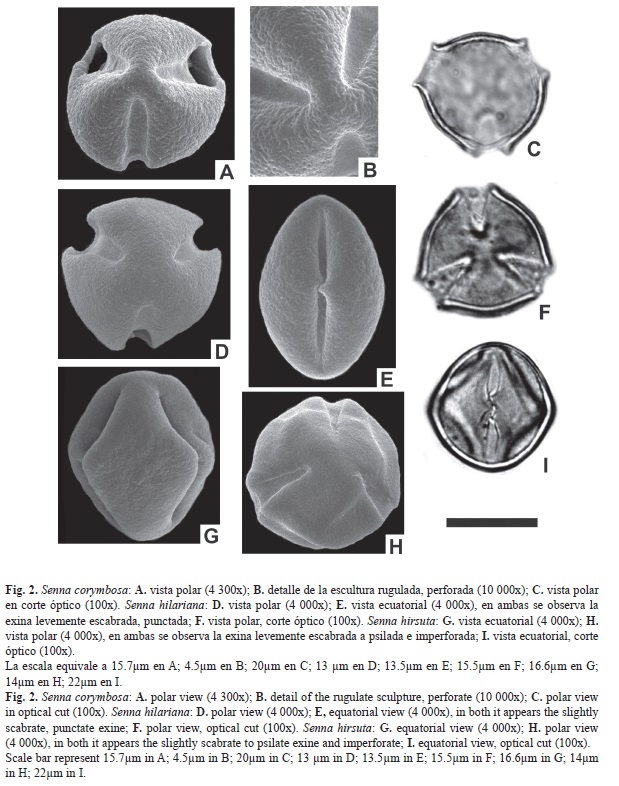
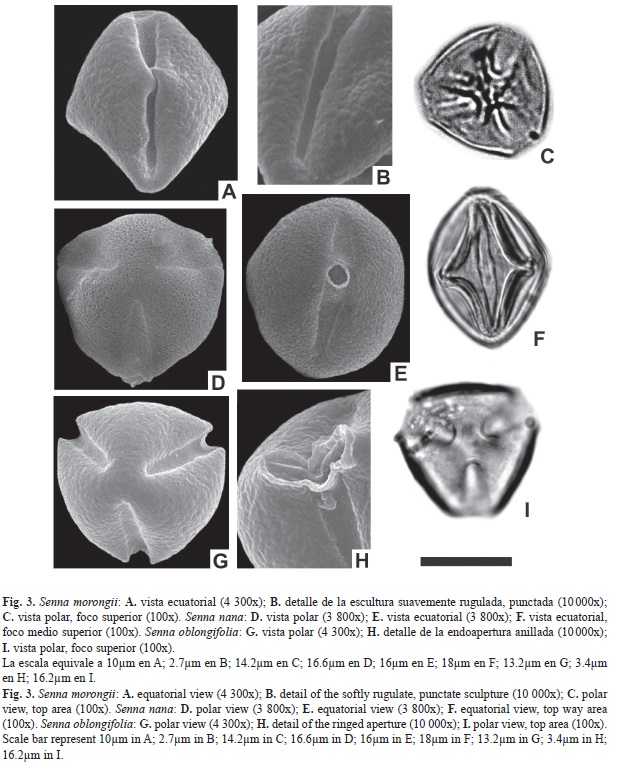
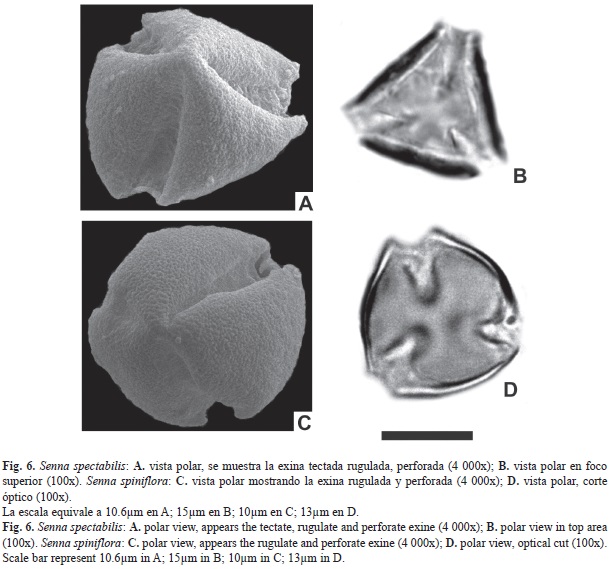
<body><![CDATA[<div style="text-align: center;"><font  style="font-weight: bold; font-style: italic;" size="2"><span  style="font-family: verdana;">Senna alata</span></font><br  style="font-family: verdana;"> </div> <br style="font-family: verdana;">     <div style="text-align: center;"><font size="2"><span  style="font-family: verdana;">(L.) Roxb.</span></font><br  style="font-family: verdana;"> <br style="font-family: verdana;"> <font size="2"><span style="font-family: verdana;">(<a  href="/img/revistas/rbt/v62n2/a30i1.jpg">Fig. 1A-C, F</a>)</span></font><br  style="font-family: verdana;"> </div> <br style="font-family: verdana;"> <font size="2"><span style="font-family: verdana;"><span  style="font-weight: bold;">Abertura</span>: Tricolporado. Colpos largos de 16.3-18&#956;m, y 13.4-15.8&#956;m de ancho, endoaperturas lalongadas de 10-11.4 x 4.9-6.5&#956;m (ancho x largo), rodeada por un fastigium. Exina: tectada, rugulada, fosulada. <span style="font-weight: bold;">Exina </span>de 3.1-4&#956;m de espesor. Sex. 2-3&#956;m; Nex. 1-1.1&#956;m. <span style="font-weight: bold;">ASP</span>: M&oacute;nada; isopolar; radiosim&eacute;trica. <span style="font-weight: bold;">Forma</span>: oblato; CP: subtriangular; CE: el&iacute;ptico. <span style="font-weight: bold;">Tama&ntilde;o</span>: P=18.9-20.3&#956;m; E=30.8-32.2&#956;m. <span style="font-weight: bold;">IAP</span>: 6&#956;m <span style="font-weight: bold;">FV</span>: arbusto o subarbusto. <span  style="font-weight: bold;">Ejemplar</span>: Krapovikas y Cristobal 29073 (Ctes.).</span></font><br style="font-family: verdana;"> <br style="font-family: verdana;">     <div style="text-align: center;"><font  style="font-weight: bold; font-style: italic;" size="2"><span  style="font-family: verdana;">Senna chaco&euml;nsis</span></font><br  style="font-family: verdana;"> <br style="font-family: verdana;"> <font size="2"><span style="font-family: verdana;">(L. Bravo) H.S. Irwin &amp; Barneby</span></font><br style="font-family: verdana;"> <br style="font-family: verdana;"> <font size="2"><span style="font-family: verdana;">(<a  href="/img/revistas/rbt/v62n2/a30i1.jpg">Fig. 1D-E, I</a>)</span></font><br  style="font-family: verdana;"> </div> <br style="font-family: verdana;"> <font size="2"><span style="font-family: verdana;"><span  style="font-weight: bold;">Abertura</span>: Tricolporado. Colpos largos de 17.5-19.8&#956;m, y 6-9&#956;m de ancho, endoaperturas circulares de 7-9.6&#956;m de di&aacute;metro. Exina: tectada, escabrada, imperforada. <span style="font-weight: bold;">Exina </span>de 1.4- 2.8&#956;m de espesor. Diferenciaci&oacute;n entre sexina y nexina de dif&iacute;cil observaci&oacute;n. <span  style="font-weight: bold;">ASP</span>: M&oacute;nada; isopolar; radiosim&eacute;trica. <span style="font-weight: bold;">Forma</span>: oblato; CP: subtriangular; CE: el&iacute;ptico. <span style="font-weight: bold;">Tama&ntilde;o</span>: P=19.6- 21.7&#956;m; E=22.4-23.8&#956;m. IAP: 4&#956;m <span style="font-weight: bold;">FV</span>: arbusto o subarbusto. <span  style="font-weight: bold;">Ejemplar</span>: Legname y Cuezzo 10452 (Ctes.).</span></font><br style="font-family: verdana;"> <br style="font-family: verdana;">     <div style="text-align: center;"><font  style="font-weight: bold; font-style: italic;" size="2"><span  style="font-family: verdana;">Senna chloroclada</span></font><br  style="font-family: verdana;"> <br style="font-family: verdana;"> <font size="2"><span style="font-family: verdana;">(Harms) H.S. Irwin &amp; Barneby.</span></font><br style="font-family: verdana;"> <br style="font-family: verdana;"> <font size="2"><span style="font-family: verdana;">(<a  href="/img/revistas/rbt/v62n2/a30i1.jpg">Fig. 1G-H, J</a>)     <br> <br style="font-family: verdana;"> </span></font></div> <font size="2"><span style="font-family: verdana;"><span  style="font-weight: bold;">Abertura</span>: Tricolporado. Colpos largos de 25-29.6&#956;m, y 6.7-8&#956;m de ancho, endoaperturas lalongadas de 6.3-7.7 x 3-4.5&#956;m (ancho x largo). <span style="font-weight: bold;">Exina</span>: tectada, rugulada, perforada. Exina de 2.1-3.5&#956;m de espesor. Sex. 1.3- 2.5&#956;m; Nex. 0.8-1&#956;m. <span  style="font-weight: bold;">ASP</span>: M&oacute;nada; isopolar; radiosim&eacute;trica. <span  style="font-weight: bold;">Forma</span>: prolato; CP: triangular; </span></font><font size="2"><span  style="font-family: verdana;">CE: el&iacute;ptico. <span style="font-weight: bold; font-style: italic;">Tama&ntilde;o: </span>P=32.9-34.3&#956;m; E=21-24.5&#956;m. <span style="font-weight: bold;">IAP</span>: 2.4&#956;m <span style="font-weight: bold;">FV</span>: arbusto. <span  style="font-weight: bold; font-style: italic;">Ejemplar: </span></span></font><font  size="2"><span style="font-family: verdana;">Krapovikas et al. 26714 (Ctes.).</span></font><br style="font-family: verdana;"> <br style="font-family: verdana;">     <div style="text-align: center;"><font  style="font-weight: bold; font-style: italic;" size="2"><span  style="font-family: verdana;">Senna corymbosa</span></font><br  style="font-family: verdana;"> <br style="font-family: verdana;"> <font size="2"><span style="font-family: verdana;">(Lam.) H.S. Irwin &amp; Barneby</span></font><br style="font-family: verdana;"> <br style="font-family: verdana;"> <font size="2"><span style="font-family: verdana;">(<a  href="/img/revistas/rbt/v62n2/a30i2.jpg">Fig. 2A-C</a>)</span></font><br  style="font-family: verdana;"> <br style="font-family: verdana;"> </div> <font size="2"><span style="font-family: verdana;"><span  style="font-weight: bold;">Abertura</span>: Tricolporado. Colpos largos de 17.1-19.4&#956;m, y 6.5-8.7&#956;m de ancho, endoa pertura lalongadas de 7-9.1 x 4-6&#956;m (ancho x largo) rodeada por un anillo de sexina. <span style="font-weight: bold;">Exina</span>: tectada, rugulada, perforada. Exina de 2.8-3.5&#956;m de espesor. Sex. 1.9-2.5 &#956;m; Nex. 0.9-1&#956;m. <span style="font-weight: bold;">ASP</span>: M&oacute;nada; isopolar; radiosim&eacute;trica. <span style="font-weight: bold;">Forma</span>: oblato; CP: subtriangular; CE: el&iacute;ptico. <span style="font-weight: bold;">Tama&ntilde;o</span>: P=23.1-25.9&#956;m; E=27.3-29.4&#956;m. <span style="font-weight: bold;">IAP</span>: 4.6&#956;m FV: arbusto o &aacute;rbol. <span style="font-weight: bold;">Ejemplar</span>: Huidobro 3667 (Ctes.).</span></font><br style="font-family: verdana;"> <br style="font-family: verdana;">     <div style="text-align: center;"><font  style="font-weight: bold; font-style: italic;" size="2"><span  style="font-family: verdana;">Senna hilariana </span></font><br  style="font-family: verdana; font-weight: bold; font-style: italic;"> <br style="font-family: verdana;"> <font size="2"><span style="font-family: verdana;">(Benth.) H.S. Irwin &amp; Barneby</span></font><br style="font-family: verdana;"> <br style="font-family: verdana;"> <a href="/img/revistas/rbt/v62n2/a30i2.jpg"><font size="2"><span  style="font-family: verdana;">(</span></font></a><font size="2"><span  style="font-family: verdana;"><a  href="/img/revistas/rbt/v62n2/a30i2.jpg">Fig. 2D-F</a><a href="/img/revistas/rbt/v62n2/a30i2.jpg">)</a></span></font><br  style="font-family: verdana;"> </div> <br style="font-family: verdana;"> <font size="2"><span style="font-family: verdana;"><span  style="font-weight: bold;">Abertura</span>: Tricolporado. Colpos largos de 21.8-23&#956;m, y 6.7-8&#956;m de ancho, endoaperturas lalongadas de 7-8.9 x 3.9-4.6&#956;m (ancho x largo), rodeada por un anillo de sexina. <span style="font-weight: bold;">Exina</span>: tectada, escabrada, punctada. Exina de 1.4-2.8&#956;m de espesor. Sex. 0.8-2 &#956;m; Nex. 0.6-0.8&#956;m. <span style="font-weight: bold;">ASP</span>: M&oacute;nada; isopolar; radiosim&eacute;trica<span style="font-weight: bold;">. Forma</span>: prolato; CP: subtriangular; CE: el&iacute;ptico. <span style="font-weight: bold;">Tama&ntilde;o</span>: P=27.3-29.4&#956;m; E=23.1-24.5&#956;m. IAP: 6.7&#956;m <span style="font-weight: bold;">FV</span>: arbusto o subarbusto. <span style="font-weight: bold; font-style: italic;">Ejemplar</span>: Schinini 8104 (Ctes.).</span></font><br style="font-family: verdana;"> <br style="font-family: verdana;">     <div style="text-align: center;"><font  style="font-weight: bold; font-style: italic;" size="2"><span  style="font-family: verdana;">Senna hirsuta</span></font><br  style="font-family: verdana;"> <br style="font-family: verdana;"> <font size="2"><span style="font-family: verdana;">(L.) H.S. Irwin &amp; Barneby</span></font><br style="font-family: verdana;"> <br style="font-family: verdana;"> <font size="2"><span style="font-family: verdana;">(<a  href="/img/revistas/rbt/v62n2/a30i2.jpg">Fig. 2G-I</a>)</span></font><br  style="font-family: verdana;"> <br style="font-family: verdana;"> </div> <font size="2"><span style="font-family: verdana;"><span  style="font-weight: bold;">Abertura</span>: Tricolporado. Colpos largos de 26.4-28.1&#956;m, y 6.9-8.4&#956;m de ancho, endoaperturas circulares de 7.7-9.1&#956;m de di&aacute;metro. <span style="font-weight: bold;">Exina</span>: tectada, escabrada e imperforada. Exina de 2.1-3.5&#956;m de espesor. Sex. 1.1-2.5&#956;m; Nex. 1-1&#956;m. <span style="font-weight: bold;">ASP</span>: M&oacute;nada; isopolar; radiosim&eacute;trica. Forma: prolato; CP: subcircular; CE: el&iacute;ptico. <span style="font-weight: bold;">Tama&ntilde;o</span>: P=30.8-32.9&#956;m; E=23.1-25.9&#956;m. <span style="font-weight: bold;">IAP</span>: 4.1&#956;m FV: hierba o subarbusto. <span style="font-weight: bold;">Ejemplar</span>: Schinini 7996 (Ctes.).</span></font><br style="font-family: verdana;"> <br style="font-family: verdana;">     <div style="text-align: center;"><font  style="font-weight: bold; font-style: italic;" size="2"><span  style="font-family: verdana;">Senna morongii</span></font><br  style="font-family: verdana;"> <br style="font-family: verdana;"> <font size="2"><span style="font-family: verdana;">(Britton) H.S. Irwin &amp; Barneby</span></font><br style="font-family: verdana;"> <br style="font-family: verdana;"> <font size="2"><span style="font-family: verdana;">(<a  href="/img/revistas/rbt/v62n2/a30i3.jpg">Fig. 3A-C</a>)</span></font><br  style="font-family: verdana;"> </div> <br style="font-family: verdana;"> <font size="2"><span style="font-family: verdana;"><span  style="font-weight: bold;">Abertura: </span>Tricolporado. Colpos largos de 17-18.6&#956;m, y 6.7-8.8&#956;m de ancho, endoaperturas lalongadas de 7-9.4 x 3.9-4.8&#956;m (ancho x largo). <span style="font-weight: bold;">Exina</span>: tectada, rugulada, punctada. Exina de 1.4-2.8&#956;m de espesor. Diferenciaci&oacute;n entre sexina y nexina de dif&iacute;cil observaci&oacute;n. <span  style="font-weight: bold;">ASP</span>: M&oacute;nada; isopolar; radiosim&eacute;trica. Forma: prolato; CP: subtriangular; CE: el&iacute;ptico. <span style="font-weight: bold;">Tama&ntilde;o</span>: P=21.7-23.1&#956;m; E=19.6-21&#956;m. <span style="font-weight: bold;">IAP</span>: 4.2&#956;m <span style="font-weight: bold;">FV</span>: subarbusto. <span  style="font-weight: bold;">Ejemplar</span>: Quar&iacute;n y Tressens 1356 (Ctes.).</span></font><br style="font-family: verdana;"> <br style="font-family: verdana;">     <div style="text-align: center;"><font  style="font-weight: bold; font-style: italic;" size="2"><span  style="font-family: verdana;">Senna nana</span></font><br  style="font-family: verdana;"> <br style="font-family: verdana;"> <font size="2"><span style="font-family: verdana;">(Benth.) H.S. Irwin &amp; Barneby</span></font><br style="font-family: verdana;"> <br style="font-family: verdana;"> <font size="2"><span style="font-family: verdana;">(<a  href="/img/revistas/rbt/v62n2/a30i3.jpg"><span  style="font-weight: bold;">Fig. 3D-F</span></a>)</span></font><br  style="font-family: verdana;"> </div> <br style="font-family: verdana;"> <font size="2"><span style="font-family: verdana;"><span  style="font-weight: bold;">Abertura</span>: Tricolporado. Colpos largos de 27.3-29&#956;m, y 7-7.6&#956;m de ancho, endoaperturas circulares de 7.4-8.3&#956;m de di&aacute;metro, rodeada por un anillo de sexina. <span  style="font-weight: bold;">Exina</span>: tectada, rugulada, perforada a foveolada. Exina de 2.4-3.8&#956;m de espesor. Sex. 1.4-2.8&#956;m; Nex. 1-1&#956;m. <span style="font-weight: bold;">ASP</span>: M&oacute;nada; isopolar; radiosim&eacute;trica. <span style="font-weight: bold;">Forma</span>: subprolato-esferoidal; CP: subtriangular; CE: el&iacute;ptico. <span style="font-weight: bold;">Tama&ntilde;o</span>: P=31.5-32.9&#956;m; E=29.4- 31.5&#956;m. <span style="font-weight: bold;">IAP</span>: 6.7&#956;m <span style="font-weight: bold;">FV</span>: hierba o subarbusto. <span style="font-weight: bold;">Ejemplar</span>: Krapovikas et al. 21196 (Ctes.).</span></font><br style="font-family: verdana;"> <br style="font-family: verdana;">     ]]></body>
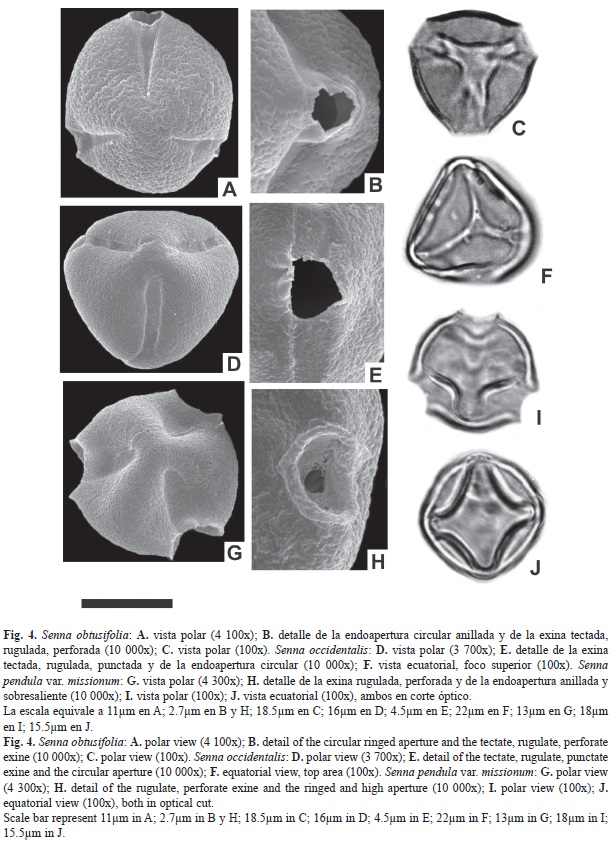
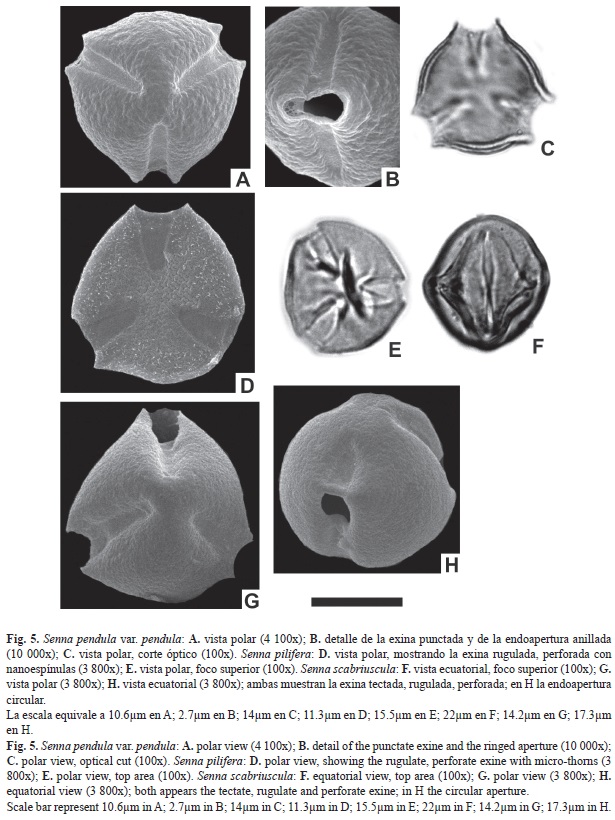
<body><![CDATA[<div style="text-align: center;"><font  style="font-weight: bold; font-style: italic;" size="2"><span  style="font-family: verdana;">Senna oblongifolia</span></font><br  style="font-family: verdana;"> <br style="font-family: verdana;"> <font size="2"><span style="font-family: verdana;">(Vog.-Zuber) H.S. Irwin &amp; Barneby</span></font><br style="font-family: verdana;"> <br style="font-family: verdana;"> <font size="2"><span style="font-family: verdana;">(<a  href="/img/revistas/rbt/v62n2/a30i3.jpg"><span  style="font-weight: bold;">Fig. 3G-I</span></a>)</span></font><br  style="font-family: verdana;"> </div> <br style="font-family: verdana;"> <font size="2"><span style="font-family: verdana;"><span  style="font-weight: bold;">Abertura</span>: Tricolporado. Colpos largos de 15-17.2&#956;m, y 6.9-8.5&#956;m de ancho, endoaperturas lalongadas de 7.7-9.1 x 3.9-4.2&#956;m (ancho x largo), rodeada por un anillo de sexina. <span style="font-weight: bold;">Exina</span>: tectada, ligeramente rugulada, puctada a perforada. Exina de 2-3.4&#956;m de espesor. Diferenciaci&oacute;n entre sexina y nexina de dif&iacute;cil observaci&oacute;n. <span style="font-weight: bold;">ASP</span>: M&oacute;nada; isopolar; radiosim&eacute;trica. <span style="font-weight: bold;">Forma</span>: oblato; CP: subtriangular a triangular; CE: el&iacute;ptico. <span style="font-weight: bold;">Tama&ntilde;o</span>: P=19.6-21&#956;m; E=23.1-25.9&#956;m. <span style="font-weight: bold;">IAP</span>: 4.2&#956;m <span style="font-weight: bold;">FV</span>: arbusto. <span  style="font-weight: bold;">Ejemplar</span>: Morrone et al.860 (Ctes.).</span></font><br  style="font-family: verdana;"> <br style="font-family: verdana;">     <div style="text-align: center;"><font  style="font-weight: bold; font-style: italic;" size="2"><span  style="font-family: verdana;">Senna obtusifolia</span></font><br  style="font-family: verdana;"> <br style="font-family: verdana;"> <font size="2"><span style="font-family: verdana;">(L.) H.S. Irwin &amp; Barneby</span></font><br style="font-family: verdana;"> <br style="font-family: verdana;"> <font size="2"><span style="font-family: verdana;">(<a  href="/img/revistas/rbt/v62n2/a30i4.jpg"><span  style="font-weight: bold;">Fig. 4A-C</span></a>)</span></font><br  style="font-family: verdana;"> </div> <br style="font-family: verdana;"> <font size="2"><span style="font-family: verdana;"><span  style="font-weight: bold;">Abertura</span>: Tricolporado. Colpos largos de 14.1-16.1&#956;m, y 6.5-8.5&#956;m de ancho, endoaperturas circulares de 7.1-9.1&#956;m de di&aacute;metro, rodeada por un anillo de sexina. <span style="font-weight: bold;">Exina</span>: tectada, rugulada, perforada. Exina de 2.1-3.5&#956;m de espesor. Sex. 1.4-2.5&#956;m; Nex. 0.7-1&#956;m. <span style="font-weight: bold;">ASP</span>: M&oacute;nada; isopolar; radiosim&eacute;trica. Forma: subprolato-esferoidal; CP: subtriangular-subcircular; CE: el&iacute;ptico. <span  style="font-weight: bold;">Tama&ntilde;o</span>: P=22.4-23.8&#956;m; E=21.7-23.1 &#956;m. <span style="font-weight: bold;">IAP</span>: 4.8&#956;m <span style="font-weight: bold;">FV</span>: hierba o subarbusto. Ejemplar: Fortunato </span></font><font size="2"><span  style="font-family: verdana;">8063 (Ctes.).</span></font><br  style="font-family: verdana;"> <br style="font-family: verdana;">     <div style="text-align: center;"><font  style="font-weight: bold; font-style: italic;" size="2"><span  style="font-family: verdana;">Senna occidentalis</span></font><br  style="font-family: verdana;"> <br style="font-family: verdana;"> <font size="2"><span style="font-family: verdana;">(L.) Link</span></font><br  style="font-family: verdana;"> <br style="font-family: verdana;"> <font size="2"><span style="font-family: verdana;">(<a  href="/img/revistas/rbt/v62n2/a30i4.jpg"><span  style="font-weight: bold;">Fig. 4D-F</span></a>)</span></font><br  style="font-family: verdana;"> </div> <br style="font-family: verdana;"> <font size="2"><span style="font-family: verdana;"><span  style="font-weight: bold;">Abertura</span>: Tricolporado. Colpos largos de 29.1-30.9&#956;m, y 6.3-8.4&#956;m de ancho, endoaperturas circulares de 7-9&#956;m de di&aacute;metro. <span style="font-weight: bold;">Exina</span>: tectada, rugulada, punctada. Exina de 3-5.4&#956;m de espesor. Diferenciaci&oacute;n entre sexina y nexina de dif&iacute;cil observaci&oacute;n. <span style="font-weight: bold;">ASP</span>: M&oacute;nada; isopolar; radiosim&eacute;trica. <span style="font-weight: bold;">Forma</span>: prolato; CP: triangular; CE: el&iacute;ptico. <span style="font-weight: bold;">Tama&ntilde;o</span>: P=34.3-36.4&#956;m; E=30.8-32.2&#956;m. <span style="font-weight: bold;">IAP</span>: 4.7&#956;m FV: hierba. <span style="font-weight: bold;">Ejemplar</span>: Arbo 622 (Ctes.).</span></font><br style="font-family: verdana;"> <br style="font-family: verdana;">     <div style="text-align: center;"><font  style="font-weight: bold; font-style: italic;" size="2"><span  style="font-family: verdana;">Senna pendula</span></font><br  style="font-family: verdana;"> <br style="font-family: verdana;"> <font size="2"><span style="font-family: verdana;">(Willd.) H.S. Irwin &amp; Barneby var. <span style="font-style: italic;">missionum</span></span></font><br  style="font-family: verdana;"> <br style="font-family: verdana;"> <font size="2"><span style="font-family: verdana;">(<a  href="/img/revistas/rbt/v62n2/a30i4.jpg"><span  style="font-weight: bold;">Fig. 4G-J</span></a>)</span></font><br  style="font-family: verdana;"> </div> <br style="font-family: verdana;"> <font size="2"><span style="font-family: verdana;"><span  style="font-weight: bold;">Abertura</span>: Tricolporado. Colpos largos de 17.1-19&#956;m, y 7-9&#956;m de ancho, endoaperturas circulares de 7-9&#956;m de di&aacute;metro, rodeada por un anillo de sexina. <span  style="font-weight: bold;">Exina</span>: tectada, rugulada, perforada. Exina de 1.4-2.8&#956;m de espesor. Sex. 0.9-2&#956;m; Nex. 0.5-0.8 &#956;m. <span style="font-weight: bold;">ASP</span>: M&oacute;nada; isopolar; radiosim&eacute;trica. <span style="font-weight: bold;">Forma</span>: suboblato; CP: subtriangular; CE: el&iacute;ptico. <span style="font-weight: bold;">Tama&ntilde;o</span>: P=22.4-23.8&#956;m; E=23.8-25.2&#956;m. <span style="font-weight: bold;">IAP</span>: 3.3&#956;m <span style="font-weight: bold;">FV</span>: subarbusto. <span  style="font-weight: bold;">Ejemplar</span>: Tressens et al. 6637(Ctes.).</span></font><br style="font-family: verdana;"> <br style="font-family: verdana;">     <div style="text-align: center;"><font  style="font-weight: bold; font-style: italic;" size="2"><span  style="font-family: verdana;">Senna pendula</span></font><br  style="font-family: verdana;"> <br style="font-family: verdana;"> <font size="2"><span style="font-family: verdana;">(Willd.) H.S. Irwin &amp; Barneby var. <span style="font-style: italic;">pendula</span></span></font><br  style="font-family: verdana;"> <br style="font-family: verdana;"> <font size="2"><span style="font-family: verdana;">(<a  href="/img/revistas/rbt/v62n2/a30i5.jpg"><span  style="font-weight: bold;">Fig. 5A-C</span></a>)</span></font><br  style="font-family: verdana;"> </div> <br style="font-family: verdana;"> <font size="2"><span style="font-family: verdana;"><span  style="font-weight: bold;">Abertura</span>: Tricolporado. Colpos largos de 22.1-25.6&#956;m, y 6.6-7.9&#956;m de ancho, endoaperturas lalongadas de 7.1-8.6 x 3-4.5&#956;m (ancho x largo), rodeada por un anillo de sexina. <span style="font-weight: bold;">Exina</span>: tectada, rugulada, punctada. Exina de 1.4-2.8&#956;m de espesor. Sex. 1-1.8 &#956;m; Nex. 0.4- 1&#956;m. <span style="font-weight: bold;">ASP</span>: M&oacute;nada; isopolar; radiosim&eacute;trica. <span style="font-weight: bold;">Forma</span>: prolato; CP: subtriangular; CE: el&iacute;ptico. <span style="font-weight: bold;">Tama&ntilde;o</span>: P=26.6-29.4&#956;m; E=20.3-21.7&#956;m. <span style="font-weight: bold;">IAP</span>: 4&#956;m <span style="font-weight: bold;">FV</span>: arbusto. <span  style="font-weight: bold;">Ejemplar</span>: Dematteis et al. 930 (Ctes.).</span></font><br style="font-family: verdana;"> <br style="font-family: verdana;">     <div style="text-align: center;"><font  style="font-weight: bold; font-style: italic;" size="2"><span  style="font-family: verdana;">Senna pilifera</span></font><br  style="font-family: verdana;"> <br style="font-family: verdana;"> <font size="2"><span style="font-family: verdana;">(Vog.-Zuber) H.S. Irwin &amp; Barneby</span></font><br style="font-family: verdana;"> <br style="font-family: verdana;"> <font size="2"><span style="font-family: verdana;">(<a  href="/img/revistas/rbt/v62n2/a30i5.jpg"><span  style="font-weight: bold;">Fig. 5D-E</span></a>)</span></font><br  style="font-family: verdana;"> </div> <br style="font-family: verdana;"> <font size="2"><span style="font-family: verdana;"><span  style="font-weight: bold;">Abertura</span>: Tricolporado. Colpos largos de 25.1-29.3&#956;m, y 6.4-8.7&#956;m de ancho, endoaperturas lalongadas de 7.4-9.2 x 3.1-4.6&#956;m (ancho x largo), rodeada por un anillo de sexina. <span style="font-weight: bold;">Exina</span>: tectada, rugulada, perforada, presentando nanoesp&iacute;nulas fuera del &aacute;rea polar. Exina de 2.1-3.5&#956;m de espesor. Diferenciaci&oacute;n entre sexina y nexina de dif&iacute;cil observaci&oacute;n. <span style="font-weight: bold;">ASP</span>: M&oacute;nada; isopolar; radiosim&eacute;trica. <span style="font-weight: bold;">Forma</span>: prolato; CP: subtriangular; CE: el&iacute;ptico. <span style="font-weight: bold;">Tama&ntilde;o</span>: P=28.3-32.7&#956;m; E=23.1-24.5&#956;m. <span style="font-weight: bold;">IAP</span>: 5&#956;m <span style="font-weight: bold;">FV</span>: hierba o subarbusto. <span  style="font-weight: bold;">Ejemplar</span>: Schinini et al. 18969 (Ctes.).</span></font><br style="font-family: verdana;"> <br style="font-family: verdana;">     <div style="text-align: center;"><font  style="font-weight: bold; font-style: italic;" size="2"><span  style="font-family: verdana;">Senna scabriuscula</span></font><br  style="font-family: verdana;"> <br style="font-family: verdana;"> <font size="2"><span style="font-family: verdana;">(Vog.-Zuber) H.S. Irwin &amp; Barneby</span></font><br style="font-family: verdana;"> <br style="font-family: verdana;"> <font size="2"><span style="font-family: verdana;">(<a  href="/img/revistas/rbt/v62n2/a30i5.jpg"><span  style="font-weight: bold;">Fig. 5F-H</span></a>)</span></font><br  style="font-family: verdana;"> </div> <br style="font-family: verdana;"> <font size="2"><span style="font-family: verdana;"><span  style="font-weight: bold;">Abertura</span>: Tricolporado. Colpos largos de 28.2-31&#956;m, y 6.8-8.4&#956;m de ancho, endoaperturas circulares de 7-8.7&#956;m de di&aacute;metro. <span style="font-weight: bold;">Exina</span>: tectada, rugulada, perforada. Exina de 3.5-6.1&#956;m de espesor. Diferenciaci&oacute;n entre sexina y nexina de dif&iacute;cil observaci&oacute;n. <span style="font-weight: bold;">ASP</span>: M&oacute;nada; isopolar; radiosim&eacute;trica. <span style="font-weight: bold;">Forma</span>: prolato; CP: subtriangular; CE: el&iacute;ptico. <span style="font-weight: bold;">Tama&ntilde;o</span>: P=33.6-35&#956;m; E=30.8-32.2&#956;m. <span style="font-weight: bold;">IAP</span>: 5.2&#956;m <span style="font-weight: bold;">FV</span>: hierba o subarbusto. <span  style="font-weight: bold;">Ejemplar</span>: Carnevalli 3260 (Ctes.).</span></font><br  style="font-family: verdana;"> <br style="font-family: verdana;">     <div style="text-align: center;"><font  style="font-weight: bold; font-style: italic;" size="2"><span  style="font-family: verdana;">Senna spectabilis</span></font><br  style="font-family: verdana; font-weight: bold;"> <br style="font-family: verdana;"> <font size="2"><span style="font-family: verdana;">(D.C.) H.S. Irwin &amp; Barneby</span></font><br style="font-family: verdana;"> <br style="font-family: verdana;"> <font size="2"><span style="font-family: verdana;">(<a  href="/img/revistas/rbt/v62n2/a30i6.jpg"><span  style="font-weight: bold;">Fig. 6A-B</span></a>)</span></font><br  style="font-family: verdana;"> </div> <br style="font-family: verdana;"> <font size="2"><span style="font-family: verdana;"><span  style="font-weight: bold;">Abertura</span>: Tricolporado. Colpos largos de 22.4-24.7&#956;m, y 7-8.6&#956;m de ancho, endoaper-turas lalongadas de 7.4-8.9 x 4.9-6&#956;m (ancho x largo). <span style="font-weight: bold;">Exina</span>: tectada, levemente rugulada, perforada. Exina de 2.1-3.5&#956;m de espesor. Diferenciaci&oacute;n entre sexina y nexina de dif&iacute;cil observaci&oacute;n. <span  style="font-weight: bold;">ASP</span>: M&oacute;nada; isopolar; radiosim&eacute;trica. <span  style="font-weight: bold;">Forma</span>: prolato; CP: triangular; CE: el&iacute;ptico. <span style="font-weight: bold;">Tama&ntilde;o</span>: P=26.6-28.7&#956;m; E=23.8-25.2&#956;m. <span style="font-weight: bold;">IAP</span>: 7.7&#956;m FV: arbusto o &aacute;rbol. <span style="font-weight: bold;">Ejemplar</span>: Solomon 7350 (Ctes.).</span></font><br style="font-family: verdana;"> <br style="font-family: verdana;">     <div style="text-align: center;"><font  style="font-weight: bold; font-style: italic;" size="2"><span  style="font-family: verdana;">Senna spiniflora</span></font><br  style="font-family: verdana;"> <font size="2"><span style="font-family: verdana;">&nbsp;</span></font><br  style="font-family: verdana;"> <font size="2"><span style="font-family: verdana;">(Burkart) H.S. Irwin &amp; Barneby</span></font><br style="font-family: verdana;"> <br style="font-family: verdana;"> <font size="2"><span style="font-family: verdana;">(<a  href="/img/revistas/rbt/v62n2/a30i6.jpg"><span  style="font-weight: bold;">Fig. 6C-D</span></a>)</span></font><br  style="font-family: verdana;"> </div> <br style="font-family: verdana;"> <font size="2"><span style="font-family: verdana;"><span  style="font-weight: bold;">Abertura</span>: Tricolporado. Colpos largos de 23.9-25.6&#956;m, y 6.5-9&#956;m de ancho, endoaperturas lalongadas de 7-9.4 x 2.9-4,8&#956;m (ancho x largo), rodeada por un anillo de sexina. <span style="font-weight: bold;">Exina</span>: tectada, rugulada, perforada. Exina de 2.1-4&#956;m de espesor. Diferenciaci&oacute;n entre sexina y nexina de dif&iacute;cil observaci&oacute;n. <span style="font-weight: bold;">ASP</span>: M&oacute;nada; isopolar; radiosim&eacute;trica. <span style="font-weight: bold;">Forma</span>: prolato; CP: subtriangular; CE: el&iacute;ptico. <span style="font-weight: bold;">Tama&ntilde;o</span>: P=26.6-28 &#956;m; E=23.8-25.2&#956;m. <span style="font-weight: bold;">IAP</span>: 4.3&#956;m <span style="font-weight: bold;">FV: </span>arbusto. <span  style="font-weight: bold;">Ejemplar</span>: Schinini y Pire 24928 (Ctes.).</span></font><br style="font-family: verdana;"> <font size="2"></font><br style="font-family: verdana;"> <font style="font-weight: bold;" size="3"><span  style="font-family: verdana;">Discusi&oacute;n</span></font><br  style="font-family: verdana;"> <font size="2"></font><br style="font-family: verdana;"> <font size="2"><span style="font-family: verdana;">Como se observa en los resultados comen- tados anteriormente, las caracter&iacute;sticas morfol&oacute;gicas del g&eacute;nero coinciden con lo expuesto por Buril, Alves, y Ribeiro dos Santos (2011), y Ventura y Huam&aacute;n (2008) considerando al g&eacute;nero <span style="font-style: italic;">Senna</span>, como estenopol&iacute;nico. La forma de las endoaperturas es el rasgo m&aacute;s importante que permite establecer dos tipos pol&iacute;nicos en los taxones estudiados. &nbsp;</span></font><br style="font-family: verdana;"> <font size="2"></font><br style="font-family: verdana;"> <font size="2"><span style="font-family: verdana;">- el <span  style="font-weight: bold;">Tipo I</span> incluye las especies con endoaperturas lalongadas como <span style="font-style: italic;">Senna </span>alata, <span style="font-style: italic;">S. chloroclada, S. corymbosa, S. hilariana, S. morongii, S. oblongifolia, S. pendula </span>var<span  style="font-style: italic;">. pendula, S. pilifera, S. spiniflora</span> y <span  style="font-style: italic;">S. Spectabilis.</span></span></font><br  style="font-family: verdana;"> <font size="2"><span style="font-family: verdana;">- el <span  style="font-weight: bold;">Tipo II</span> incluye taxones con endoaperturas circulares como<span style="font-style: italic;"> Senna chaco&euml;nsis, S. hirsuta, S. nana, S. obtusifolia, S. occidentalis, S. pendula </span>var<span  style="font-style: italic;">. missionum </span>y<span  style="font-style: italic;"> S. scabriuscula</span>.</span></font><br style="font-family: verdana;"> <font size="2"></font><br style="font-family: verdana;"> <font size="2"><span style="font-family: verdana;">En general, el tama&ntilde;o de los granos de polen en Angiospermas parece ser un car&aacute;cter con importante grado de variabilidad, dependiente de diversos factores del medio f&iacute;sico, como la nutrici&oacute;n mineral y/o la disponibilidad de agua (Muller, 1979; Ojeda &amp; D&iacute;ez, 1992; Schoch-Bodmer, 1940; Walker &amp; Doyle, 1975; Walker, 1976) y las caracter&iacute;sticas clim&aacute;ticas (Lobreau-Callen, 1975). Las investigaciones paleoecol&oacute;gicas basadas en el an&aacute;lisis del contenido de polen en sedimentos de diferentes cuerpos de agua del Este del Iber&aacute;, han aportado datos sobre el impacto de los cambios clim&aacute;ticos y ambientales en la vegetaci&oacute;n durante los &uacute;ltimos cientos de a&ntilde;os (Fernandez-Pacella et al., 2011). El Iber&aacute; tiene &aacute;reas cuya vegetaci&oacute;n original ha sido notablemente alterada y afectada, sin embargo, tambi&eacute;n tiene &aacute;reas como el Sureste y Suroeste, en varias etapas de sucesi&oacute;n (Fernandez-Pacella, 1013), por lo que se observa, desde el punto de vista fison&oacute;mico, el dominio de las especies herb&aacute;ceas-arbustivas, mientras que las le&ntilde;osas son muy escasas en cuanto a superficies parciales y totales. Por ello, el listado de especies pertenecientes al g&eacute;nero <span  style="font-style: italic;">Senna </span>presentado en este trabajo, podr&iacute;a ser considerado en las actividades de restauraci&oacute;n y recuperaci&oacute;n de los diferentes tipos de vegetaci&oacute;n.</span></font><br style="font-family: verdana;"> <font size="2"></font><br style="font-family: verdana;"> <font size="2"><span style="font-family: verdana;">Siendo el an&aacute;lisis de polen la herramienta para la reconstrucci&oacute;n de la historia de la vegetaci&oacute;n, los conjuntos pol&iacute;nicos f&oacute;siles de zonas tropicales muestran que generalmente los granos de polen no son identificados a nivel espec&iacute;fico, lo que lleva a la p&eacute;rdida de informaci&oacute;n en las reconstrucciones paleo-ambientales. Adicionalmente, al ser una zona con una alta biodiversidad, se espera que este estudio sirva de base para futuras investigaciones sobre sistem&aacute;tica, historia de la vegetaci&oacute;n y melisopalinolog&iacute;a de esta regi&oacute;n, ya que los sedimentos lacustres constituyen un medio &aacute;cido, pobre en ox&iacute;geno y favorable a la conservaci&oacute;n de las esporas y de los granos de polen que se depositan en su superficie (Fernandez-Pacella et al., 2011).</span></font><br  style="font-family: verdana;"> <font size="2"></font><br style="font-family: verdana;"> <font style="font-weight: bold;" size="3"><span  style="font-family: verdana;">Agradecimientos</span></font><br  style="font-family: verdana;"> <font size="2"></font><br style="font-family: verdana;"> <font size="2"><span style="font-family: verdana;">El autor desea expresar su agradecimiento al Instituto de Bot&aacute;nica del Nordeste (IBONE) por permitir observar la colecci&oacute;n del herbario, al Prof. Oscar Canteros por realizar el procesamiento qu&iacute;mico de las muestras y al Camping Municipal de Colonia Carlos Pellegrini aprobando el acceso para recolectar material.    <br> <br style="font-family: verdana;"> </span></font><font size="2"></font> <hr style="width: 100%; height: 2px;"><font style="font-weight: bold;"  size="3"><span style="font-family: verdana;">Referencias</span></font><br  style="font-family: verdana;"> <br style="font-family: verdana;">     ]]></body>
<body><![CDATA[<!-- ref --><div style="text-align: left;"><font size="2"><span  style="font-family: verdana;">Abbiatti, D. (1946). Las Lornat&aacute;ceas argentinas. Revista Museo La Plata, <span  style="font-style: italic;">Secci&oacute;n Bot&aacute;nica, 7</span>, 1-110.    &nbsp;&nbsp;&nbsp;&nbsp;&nbsp;&nbsp;&nbsp;&nbsp;[&#160;<a href="javascript:void(0);" onclick="javascript: window.open('/scielo.php?script=sci_nlinks&ref=1564253&pid=S0034-7744201400010003000001&lng=','','width=640,height=500,resizable=yes,scrollbars=1,menubar=yes,');">Links</a>&#160;]<!-- end-ref --><!-- ref --></span></font><br  style="font-family: verdana;"> <br style="font-family: verdana;"> <font size="2"><span style="font-family: verdana;">Arbo, M. M. &amp; Tressens, S. G. (1997). Flora de la Reserva Natural Provincial del Iber&aacute; (Corrientes).<span style="font-style: italic;"> Actas Ciencias Agrarias &#8211; Ciencias Biol&oacute;gicas, 3,</span> 6-9.    &nbsp;&nbsp;&nbsp;&nbsp;&nbsp;&nbsp;&nbsp;&nbsp;[&#160;<a href="javascript:void(0);" onclick="javascript: window.open('/scielo.php?script=sci_nlinks&ref=1564254&pid=S0034-7744201400010003000002&lng=','','width=640,height=500,resizable=yes,scrollbars=1,menubar=yes,');">Links</a>&#160;]<!-- end-ref --> </span></font>    <br> <font size="2"><span style="font-family: verdana;"></span></font>    <!-- ref --><br> <font size="2"><span style="font-family: verdana;"></span></font><font  size="2"><span style="font-family: verdana;">Arbo, M. M. &amp; Tressens, S. G. (2002). <span style="font-style: italic;">Flora de Iber&aacute;</span>. Corrientes, Argentina: EUDENE.    &nbsp;&nbsp;&nbsp;&nbsp;&nbsp;&nbsp;&nbsp;&nbsp;[&#160;<a href="javascript:void(0);" onclick="javascript: window.open('/scielo.php?script=sci_nlinks&ref=1564257&pid=S0034-7744201400010003000003&lng=','','width=640,height=500,resizable=yes,scrollbars=1,menubar=yes,');">Links</a>&#160;]<!-- end-ref --><!-- ref --> </span></font><br  style="font-family: verdana;"> <br style="font-family: verdana;"> <font size="2"><span style="font-family: verdana;">Buril, M. T.; Alves, M., &amp; Ribeiro dos Santos, Francisco de Assis (2011). Tipifica&ccedil;&atilde;o pol&iacute;nica em Leguminosae de uma &aacute;rea priorit&aacute;ria para conserva&ccedil;&atilde;o da Caatinga: Caesalpinioideae e Papilionoideae. <span  style="font-style: italic;">Acta Botanica Brasilica, 25</span>(3), 117-132.    &nbsp;&nbsp;&nbsp;&nbsp;&nbsp;&nbsp;&nbsp;&nbsp;[&#160;<a href="javascript:void(0);" onclick="javascript: window.open('/scielo.php?script=sci_nlinks&ref=1564258&pid=S0034-7744201400010003000004&lng=','','width=640,height=500,resizable=yes,scrollbars=1,menubar=yes,');">Links</a>&#160;]<!-- end-ref --><!-- ref --></span></font><br style="font-family: verdana;"> <br style="font-family: verdana;"> <font size="2"><span style="font-family: verdana;">Carnevalli, R. (1994).<span style="font-style: italic;"> Fitogeograf&iacute;a de la Provincia de Corrientes.</span> Asunci&oacute;n, Paraguay: LITOCOLOR.    &nbsp;&nbsp;&nbsp;&nbsp;&nbsp;&nbsp;&nbsp;&nbsp;[&#160;<a href="javascript:void(0);" onclick="javascript: window.open('/scielo.php?script=sci_nlinks&ref=1564259&pid=S0034-7744201400010003000005&lng=','','width=640,height=500,resizable=yes,scrollbars=1,menubar=yes,');">Links</a>&#160;]<!-- end-ref --> </span></font>    <br> <font size="2"><span style="font-family: verdana;"></span></font>    <!-- ref --><br> <font size="2"><span style="font-family: verdana;">Castellanos, A. (1965). Estudio fisiogr&aacute;fico de la provincia de Corrientes. <span  style="font-style: italic;">Instituto de Fisiograf&iacute;a y Geolog&iacute;a (Universidad Nacional del Litoral), 49</span>, 100-222.    &nbsp;&nbsp;&nbsp;&nbsp;&nbsp;&nbsp;&nbsp;&nbsp;[&#160;<a href="javascript:void(0);" onclick="javascript: window.open('/scielo.php?script=sci_nlinks&ref=1564262&pid=S0034-7744201400010003000006&lng=','','width=640,height=500,resizable=yes,scrollbars=1,menubar=yes,');">Links</a>&#160;]<!-- end-ref --><!-- ref --></span></font><br  style="font-family: verdana;"> <br style="font-family: verdana;"> <font size="2"><span style="font-family: verdana;">Cuadrado, G. A. &amp; Neiff, J. J. (1993). Palynology of Embalsados in Distrophic Lakes in Northeastern of Argentina. <span style="font-style: italic;">Revista Brasilera de Biolog&iacute;a, 53</span>, 443-451.    &nbsp;&nbsp;&nbsp;&nbsp;&nbsp;&nbsp;&nbsp;&nbsp;[&#160;<a href="javascript:void(0);" onclick="javascript: window.open('/scielo.php?script=sci_nlinks&ref=1564263&pid=S0034-7744201400010003000007&lng=','','width=640,height=500,resizable=yes,scrollbars=1,menubar=yes,');">Links</a>&#160;]<!-- end-ref --><!-- ref --></span></font><br  style="font-family: verdana;"> <br style="font-family: verdana;"> <font size="2"><span style="font-family: verdana;">Dimitri, M. J. (1974). La Flora Arb&oacute;rea del Parque Nacional Iguaz&uacute;. <span  style="font-style: italic;">Anales Parques Nacionales, 12</span>, 27-180.    &nbsp;&nbsp;&nbsp;&nbsp;&nbsp;&nbsp;&nbsp;&nbsp;[&#160;<a href="javascript:void(0);" onclick="javascript: window.open('/scielo.php?script=sci_nlinks&ref=1564264&pid=S0034-7744201400010003000008&lng=','','width=640,height=500,resizable=yes,scrollbars=1,menubar=yes,');">Links</a>&#160;]<!-- end-ref --><!-- ref --> </span></font><br  style="font-family: verdana;"> <br style="font-family: verdana;"> <font size="2"><span style="font-family: verdana;">Erdtman, G. (1969). <span style="font-style: italic;">Handbook of Palynology: Morphology, taxonomy, ecology an introduction to the study of pollen grains and spores.</span> New York: Hafner Publishing.    &nbsp;&nbsp;&nbsp;&nbsp;&nbsp;&nbsp;&nbsp;&nbsp;[&#160;<a href="javascript:void(0);" onclick="javascript: window.open('/scielo.php?script=sci_nlinks&ref=1564265&pid=S0034-7744201400010003000009&lng=','','width=640,height=500,resizable=yes,scrollbars=1,menubar=yes,');">Links</a>&#160;]<!-- end-ref --><!-- ref --></span></font><br  style="font-family: verdana;"> <br style="font-family: verdana;"> <font size="2"><span style="font-family: verdana;">Fernandez-Pacella, L., Anz&oacute;tegui, L. M., &amp; Horn, Y. M. (2010). Caesalpinoideae Fabaceae. In S. M. Pire, L. M. Anz&oacute;tegui, &amp; G. A. Cuadrado (Eds.), <span style="font-style: italic;">Flora Pol&iacute;nica del Nordeste Argentino.</span>(pp. 71-87). Corrientes, Argentina: EUDENE &#8211;UNNE.    &nbsp;&nbsp;&nbsp;&nbsp;&nbsp;&nbsp;&nbsp;&nbsp;[&#160;<a href="javascript:void(0);" onclick="javascript: window.open('/scielo.php?script=sci_nlinks&ref=1564266&pid=S0034-7744201400010003000010&lng=','','width=640,height=500,resizable=yes,scrollbars=1,menubar=yes,');">Links</a>&#160;]<!-- end-ref --><!-- ref --></span></font><br  style="font-family: verdana;"> <br style="font-family: verdana;"> <font size="2"><span style="font-family: verdana;">Fern&aacute;ndez-Pacella, L., Garralla, S., &amp; Anz&oacute;tegui, L. M. (2011). Cambios en la vegetaci&oacute;n durante el Holoceno en la regi&oacute;n Norte del Iber&aacute;, Corrientes, Argentina. <span style="font-style: italic;">Revista de Biolog&iacute;a Tropical, 59</span>(1), 103-112.    &nbsp;&nbsp;&nbsp;&nbsp;&nbsp;&nbsp;&nbsp;&nbsp;[&#160;<a href="javascript:void(0);" onclick="javascript: window.open('/scielo.php?script=sci_nlinks&ref=1564267&pid=S0034-7744201400010003000011&lng=','','width=640,height=500,resizable=yes,scrollbars=1,menubar=yes,');">Links</a>&#160;]<!-- end-ref --><!-- ref --> </span></font><br  style="font-family: verdana;"> <br style="font-family: verdana;"> <font size="2"><span style="font-family: verdana;">Fernandez-Pacella, L. (2013). <span style="font-style: italic;">Palinolog&iacute;a del Cuaternario en sedimentos lacustres del Noroeste del Iber&aacute;, Corrientes, Argentina.</span> (Tesis Doctoral). Universidad Nacional del Nordeste, Corrientes. Argentina.    &nbsp;&nbsp;&nbsp;&nbsp;&nbsp;&nbsp;&nbsp;&nbsp;[&#160;<a href="javascript:void(0);" onclick="javascript: window.open('/scielo.php?script=sci_nlinks&ref=1564268&pid=S0034-7744201400010003000012&lng=','','width=640,height=500,resizable=yes,scrollbars=1,menubar=yes,');">Links</a>&#160;]<!-- end-ref --><!-- ref --></span></font><br  style="font-family: verdana;"> <br style="font-family: verdana;"> <font size="2"><span style="font-family: verdana;">Graham, A. &amp; Barker, G. (1981). Palinology and Tribal Classification in the Caesalpinioidea. In R. M. Polhill, &amp; P. H Raven (Eds.), <span style="font-style: italic;">Advances in Legume Systematics</span> (pp.802-833). Reino Unido: Royal Botanical Gardens Kew.    &nbsp;&nbsp;&nbsp;&nbsp;&nbsp;&nbsp;&nbsp;&nbsp;[&#160;<a href="javascript:void(0);" onclick="javascript: window.open('/scielo.php?script=sci_nlinks&ref=1564269&pid=S0034-7744201400010003000013&lng=','','width=640,height=500,resizable=yes,scrollbars=1,menubar=yes,');">Links</a>&#160;]<!-- end-ref --><!-- ref --></span></font><br  style="font-family: verdana;"> <br style="font-family: verdana;"> <font size="2"><span style="font-family: verdana;">Iriondo, M. (1994). Los climas cuaternarios de la regi&oacute;n Pampeana. <span  style="font-style: italic;">Museo Provincial de Ciencias Naturales &#8220;Florentino Ameghino&#8221;, 4</span>, 481.    &nbsp;&nbsp;&nbsp;&nbsp;&nbsp;&nbsp;&nbsp;&nbsp;[&#160;<a href="javascript:void(0);" onclick="javascript: window.open('/scielo.php?script=sci_nlinks&ref=1564270&pid=S0034-7744201400010003000014&lng=','','width=640,height=500,resizable=yes,scrollbars=1,menubar=yes,');">Links</a>&#160;]<!-- end-ref --><!-- ref --></span></font><br  style="font-family: verdana;"> <br style="font-family: verdana;"> <font size="2"><span style="font-family: verdana;">Kremp, G. O. W. (1965). <span style="font-style: italic;">Morphologic encyclopedia of palynology. </span>Tucson: University of Arizona Press.    &nbsp;&nbsp;&nbsp;&nbsp;&nbsp;&nbsp;&nbsp;&nbsp;[&#160;<a href="javascript:void(0);" onclick="javascript: window.open('/scielo.php?script=sci_nlinks&ref=1564271&pid=S0034-7744201400010003000015&lng=','','width=640,height=500,resizable=yes,scrollbars=1,menubar=yes,');">Links</a>&#160;]<!-- end-ref --><!-- ref --></span></font><br  style="font-family: verdana;"> <br style="font-family: verdana;"> <font size="2"><span style="font-family: verdana;">Lobreau-Callen, D. (1975) Les variations dimensionnelles du pollen du genre Ilex (Aquifoliaceae) et leurs rapports avec le climat. <span style="font-style: italic;">Bulletin de la Soci&eacute;t&eacute; Botanique de France, Collection Palynologie, 122</span>, 179-199.    &nbsp;&nbsp;&nbsp;&nbsp;&nbsp;&nbsp;&nbsp;&nbsp;[&#160;<a href="javascript:void(0);" onclick="javascript: window.open('/scielo.php?script=sci_nlinks&ref=1564272&pid=S0034-7744201400010003000016&lng=','','width=640,height=500,resizable=yes,scrollbars=1,menubar=yes,');">Links</a>&#160;]<!-- end-ref --><!-- ref --></span></font><br  style="font-family: verdana;"> <br style="font-family: verdana;"> <font size="2"><span style="font-family: verdana;">Muller, J. (1979) Form and function in Angiosperm pollen. <span style="font-style: italic;">Annals of the Missouri Botanical Garden, 66</span>, 593-632.    &nbsp;&nbsp;&nbsp;&nbsp;&nbsp;&nbsp;&nbsp;&nbsp;[&#160;<a href="javascript:void(0);" onclick="javascript: window.open('/scielo.php?script=sci_nlinks&ref=1564273&pid=S0034-7744201400010003000017&lng=','','width=640,height=500,resizable=yes,scrollbars=1,menubar=yes,');">Links</a>&#160;]<!-- end-ref --><!-- ref --></span></font><br style="font-family: verdana;"> <br style="font-family: verdana;"> <font size="2"><span style="font-family: verdana;">Neiff, J. J. (1997). <span style="font-style: italic;">Ecolog&iacute;a evolutiva del macrosistema Iber&aacute; (Corrientes, Argentina). </span>(Tesis de Maestr&iacute;a). Universidad Nacional del Litoral, Santa Fe, Argentina.    &nbsp;&nbsp;&nbsp;&nbsp;&nbsp;&nbsp;&nbsp;&nbsp;[&#160;<a href="javascript:void(0);" onclick="javascript: window.open('/scielo.php?script=sci_nlinks&ref=1564274&pid=S0034-7744201400010003000018&lng=','','width=640,height=500,resizable=yes,scrollbars=1,menubar=yes,');">Links</a>&#160;]<!-- end-ref --></span></font>    <!-- ref --><br> <font size="2"><span style="font-family: verdana;"></span></font><br  style="font-family: verdana;"> <font size="2"><span style="font-family: verdana;"></span></font><font  size="2"><span style="font-family: verdana;">Ojeda, F. &amp; D&iacute;ez, M. J. (1992). Pollen dimorphism in three Teucrium species (Lamiaceae). <span  style="font-style: italic;">Plant Systematics and Evolution, 183</span>, 43-49.    &nbsp;&nbsp;&nbsp;&nbsp;&nbsp;&nbsp;&nbsp;&nbsp;[&#160;<a href="javascript:void(0);" onclick="javascript: window.open('/scielo.php?script=sci_nlinks&ref=1564276&pid=S0034-7744201400010003000019&lng=','','width=640,height=500,resizable=yes,scrollbars=1,menubar=yes,');">Links</a>&#160;]<!-- end-ref --><!-- ref --> </span></font><br  style="font-family: verdana;"> <br style="font-family: verdana;"> <font size="2"><span style="font-family: verdana;">Palacios-Ch&aacute;vez, R., Arregu&iacute;n-S&aacute;nchez, M. de la Luz, &amp; Quiroz-Garc&iacute;a, D. L. (1996). Morfolog&iacute;a de los granos de polen de la Subfamilia Caesalpinioideae (Leguminosae) del Valle de Mexico. <span style="font-style: italic;">Revista Polibot&aacute;nica, 1</span>, 16-21.    &nbsp;&nbsp;&nbsp;&nbsp;&nbsp;&nbsp;&nbsp;&nbsp;[&#160;<a href="javascript:void(0);" onclick="javascript: window.open('/scielo.php?script=sci_nlinks&ref=1564277&pid=S0034-7744201400010003000020&lng=','','width=640,height=500,resizable=yes,scrollbars=1,menubar=yes,');">Links</a>&#160;]<!-- end-ref --><!-- ref --> </span></font><br style="font-family: verdana;"> <br style="font-family: verdana;"> <font size="2"><span style="font-family: verdana;">Popolizio, E. (1981). Diagn&oacute;stico del macrosistema del Iber&aacute;, Corrientes. Informe final del Convenio. Provincia de Corrientes (ICA)/INCYTH, 13 vol. Corrientes, Argentina.    &nbsp;&nbsp;&nbsp;&nbsp;&nbsp;&nbsp;&nbsp;&nbsp;[&#160;<a href="javascript:void(0);" onclick="javascript: window.open('/scielo.php?script=sci_nlinks&ref=1564278&pid=S0034-7744201400010003000021&lng=','','width=640,height=500,resizable=yes,scrollbars=1,menubar=yes,');">Links</a>&#160;]<!-- end-ref --><!-- ref --></span></font><br  style="font-family: verdana;"> <br style="font-family: verdana;"> <font size="2"><span style="font-family: verdana;">Punt, W., Hoen, P. P., Blackmore, S., Nilsson, S., &amp; Le Thomas, A. (2007). Glossary of pollen and spore terminology. <span style="font-style: italic;">Review of Palaeobotany and Palynology, 143</span>, 1-81.    &nbsp;&nbsp;&nbsp;&nbsp;&nbsp;&nbsp;&nbsp;&nbsp;[&#160;<a href="javascript:void(0);" onclick="javascript: window.open('/scielo.php?script=sci_nlinks&ref=1564279&pid=S0034-7744201400010003000022&lng=','','width=640,height=500,resizable=yes,scrollbars=1,menubar=yes,');">Links</a>&#160;]<!-- end-ref --><!-- ref --></span></font><br  style="font-family: verdana;"> <br style="font-family: verdana;"> <font size="2"><span style="font-family: verdana;">Roubik, D. W. &amp; Moreno, J. E. (1991). Pollen and spores of Barro Colorado Island. <span  style="font-style: italic;">Monographs in Systematic Botany, 36</span>, 1-270.    &nbsp;&nbsp;&nbsp;&nbsp;&nbsp;&nbsp;&nbsp;&nbsp;[&#160;<a href="javascript:void(0);" onclick="javascript: window.open('/scielo.php?script=sci_nlinks&ref=1564280&pid=S0034-7744201400010003000023&lng=','','width=640,height=500,resizable=yes,scrollbars=1,menubar=yes,');">Links</a>&#160;]<!-- end-ref --><!-- ref --></span></font><br  style="font-family: verdana;"> <br style="font-family: verdana;"> <font size="2"><span style="font-family: verdana;">Schoch-Bodmer, H. (1940). The influence of nutrition upon pollen-grain size in Lythrum salicaria. <span style="font-style: italic;">Journal of Genetics, 40</span>, 393-402.    &nbsp;&nbsp;&nbsp;&nbsp;&nbsp;&nbsp;&nbsp;&nbsp;[&#160;<a href="javascript:void(0);" onclick="javascript: window.open('/scielo.php?script=sci_nlinks&ref=1564281&pid=S0034-7744201400010003000024&lng=','','width=640,height=500,resizable=yes,scrollbars=1,menubar=yes,');">Links</a>&#160;]<!-- end-ref --><!-- ref --> </span></font><br style="font-family: verdana;"> <br style="font-family: verdana;"> <font size="2"><span style="font-family: verdana;">Ventura, K. &amp; Huam&aacute;n, L. (2008). Morfolog&iacute;a pol&iacute;nica de la familia Fabaceae de la parte baja de los Valles de Pativilca y Fortaleza (Lima-Per&uacute;). <span style="font-style: italic;">Biologist, 6</span>(2), 112-134.    &nbsp;&nbsp;&nbsp;&nbsp;&nbsp;&nbsp;&nbsp;&nbsp;[&#160;<a href="javascript:void(0);" onclick="javascript: window.open('/scielo.php?script=sci_nlinks&ref=1564282&pid=S0034-7744201400010003000025&lng=','','width=640,height=500,resizable=yes,scrollbars=1,menubar=yes,');">Links</a>&#160;]<!-- end-ref --><!-- ref --></span></font><br  style="font-family: verdana;"> <br style="font-family: verdana;"> <font size="2"><span style="font-family: verdana;">Walker, J. W. &amp; Doyle, J. A. (1975). The bases of Angiosperm phylogeny: Palynology. <span  style="font-style: italic;">Annals of the Missouri Botanical Garden, 62</span>, 664-723.    &nbsp;&nbsp;&nbsp;&nbsp;&nbsp;&nbsp;&nbsp;&nbsp;[&#160;<a href="javascript:void(0);" onclick="javascript: window.open('/scielo.php?script=sci_nlinks&ref=1564283&pid=S0034-7744201400010003000026&lng=','','width=640,height=500,resizable=yes,scrollbars=1,menubar=yes,');">Links</a>&#160;]<!-- end-ref --><!-- ref --></span></font><br  style="font-family: verdana;"> <br style="font-family: verdana;"> <font size="2"><span style="font-family: verdana;">Walker, J. W. (1976). Evolutionary significance of the exine in the pollen of primitive Angiosperms. In I. K. Ferguson &amp; J. Moller (Eds.), The evolutionary significance of the exine. <span style="font-style: italic;">Linnean Society Symposium, 1</span>, 251-308.    &nbsp;&nbsp;&nbsp;&nbsp;&nbsp;&nbsp;&nbsp;&nbsp;[&#160;<a href="javascript:void(0);" onclick="javascript: window.open('/scielo.php?script=sci_nlinks&ref=1564284&pid=S0034-7744201400010003000027&lng=','','width=640,height=500,resizable=yes,scrollbars=1,menubar=yes,');">Links</a>&#160;]<!-- end-ref --><!-- ref --> </span></font><br  style="font-family: verdana;"> <br style="font-family: verdana;"> <font size="2"><span style="font-family: verdana;">Tropicos.org. Missouri Botanical Garden. (2009-2011). Retrieved form http://www.tropicos.org</span></font>    &nbsp;&nbsp;&nbsp;&nbsp;&nbsp;&nbsp;&nbsp;&nbsp;[&#160;<a href="javascript:void(0);" onclick="javascript: window.open('/scielo.php?script=sci_nlinks&ref=1564285&pid=S0034-7744201400010003000028&lng=','','width=640,height=500,resizable=yes,scrollbars=1,menubar=yes,');">Links</a>&#160;]<!-- end-ref --><br> <font size="2"><span style="font-family: verdana;"></span></font></div> <font size="2"><span style="font-family: verdana;">    <br> </span></font><font size="2"><span style="font-family: verdana;"><a  name="Correspondencia1"></a><a href="#Correspondencia2">*</a>Correspondencia:</span></font> <font size="2"><span style="font-family: verdana;"></span></font><font  size="2"><span style="font-family: verdana;">Lionel Fernandez-Pacella</span></font><font size="2"><span  style="font-family: verdana;">: Universidad Nacional del Nordeste, Centro de Ecolog&iacute;a Aplicada del Litoral, CONICET, CP 3400- Corrientes, Argentina; lionelpacella@yahoo.com.ar    <br> </span></font><font size="2"><span style="font-family: verdana;"><a  name="1"></a><a href="#2">1</a>. Universidad Nacional del Nordeste, Centro de Ecolog&iacute;a Aplicada del Litoral, CONICET, CP 3400- Corrientes, Argentina; lionelpacella@yahoo.com.ar</span></font>    <br> <span style="font-family: verdana;"></span> <hr style="width: 100%; height: 2px;"><span  style="font-family: verdana;"></span>     <div style="text-align: center;"><font style="font-weight: bold;"  size="2"><span style="font-family: verdana;">Recibido 06-V-2013.&nbsp; Corregido 10-XI-2013.&nbsp; Aceptado 09-XII-2013.</span></font></div> <font style="font-weight: bold;" size="2"></font></div>      ]]></body><back>
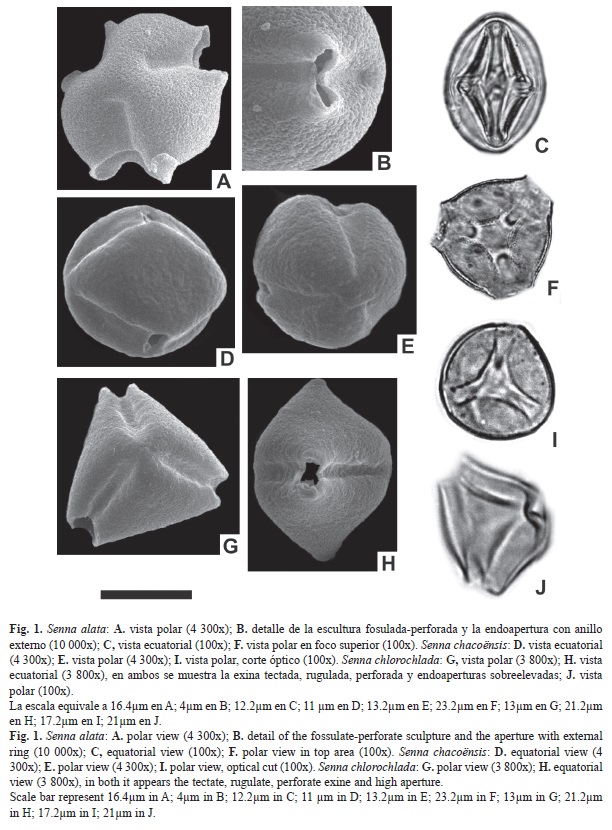
<ref-list>
<ref id="B1">
<nlm-citation citation-type="journal">
<person-group person-group-type="author">
<name>
<surname><![CDATA[Abbiatti]]></surname>
<given-names><![CDATA[D.]]></given-names>
</name>
</person-group>
<article-title xml:lang="es"><![CDATA[Las Lornatáceas argentinas.]]></article-title>
<source><![CDATA[Revista Museo La Plata, Sección Botánica]]></source>
<year>1946</year>
<volume>7</volume>
<page-range>1-110</page-range></nlm-citation>
</ref>
<ref id="B2">
<nlm-citation citation-type="journal">
<person-group person-group-type="author">
<name>
<surname><![CDATA[Arbo]]></surname>
<given-names><![CDATA[M. M.]]></given-names>
</name>
<name>
<surname><![CDATA[Tressens]]></surname>
<given-names><![CDATA[S. G.]]></given-names>
</name>
</person-group>
<article-title xml:lang="es"><![CDATA[Flora de la Reserva Natural Provincial del Iberá (Corrientes).]]></article-title>
<source><![CDATA[Actas Ciencias Agrarias - Ciencias Biológicas]]></source>
<year>1997</year>
<volume>3</volume>
<page-range>6-9</page-range></nlm-citation>
</ref>
<ref id="B3">
<nlm-citation citation-type="book">
<person-group person-group-type="author">
<name>
<surname><![CDATA[Arbo]]></surname>
<given-names><![CDATA[M. M.]]></given-names>
</name>
<name>
<surname><![CDATA[Tressens]]></surname>
<given-names><![CDATA[S. G.]]></given-names>
</name>
</person-group>
<source><![CDATA[Flora de Iberá.]]></source>
<year>2002</year>
<publisher-loc><![CDATA[^eCorrientes Corrientes]]></publisher-loc>
<publisher-name><![CDATA[EUDENE]]></publisher-name>
</nlm-citation>
</ref>
<ref id="B4">
<nlm-citation citation-type="journal">
<person-group person-group-type="author">
<name>
<surname><![CDATA[Buril]]></surname>
<given-names><![CDATA[M. T.]]></given-names>
</name>
<name>
<surname><![CDATA[Alves]]></surname>
<given-names><![CDATA[M.]]></given-names>
</name>
<name>
<surname><![CDATA[Ribeiro dos Santos]]></surname>
<given-names><![CDATA[Francisco de Assis]]></given-names>
</name>
</person-group>
<article-title xml:lang="pt"><![CDATA[Tipificação polínica em Leguminosae de uma área prioritária para conservação da Caatinga: Caesalpinioideae e Papilionoideae.]]></article-title>
<source><![CDATA[Acta Botanica Brasilica]]></source>
<year>2011</year>
<volume>25</volume>
<numero>3</numero>
<issue>3</issue>
<page-range>117-132</page-range></nlm-citation>
</ref>
<ref id="B5">
<nlm-citation citation-type="book">
<person-group person-group-type="author">
<name>
<surname><![CDATA[Carnevalli]]></surname>
<given-names><![CDATA[R.]]></given-names>
</name>
</person-group>
<source><![CDATA[Fitogeografía de la Provincia de Corrientes.]]></source>
<year>1994</year>
<publisher-loc><![CDATA[^eAsunción Asunción]]></publisher-loc>
<publisher-name><![CDATA[LITOCOLOR]]></publisher-name>
</nlm-citation>
</ref>
<ref id="B6">
<nlm-citation citation-type="journal">
<person-group person-group-type="author">
<name>
<surname><![CDATA[Castellanos]]></surname>
<given-names><![CDATA[A.]]></given-names>
</name>
</person-group>
<article-title xml:lang="es"><![CDATA[Estudio fisiográfico de la provincia de Corrientes.]]></article-title>
<source><![CDATA[Instituto de Fisiografía y Geología (Universidad Nacional del Litoral)]]></source>
<year>1965</year>
<volume>49</volume>
<page-range>100-222</page-range></nlm-citation>
</ref>
<ref id="B7">
<nlm-citation citation-type="journal">
<person-group person-group-type="author">
<name>
<surname><![CDATA[Cuadrado]]></surname>
<given-names><![CDATA[G. A.]]></given-names>
</name>
<name>
<surname><![CDATA[Neiff]]></surname>
<given-names><![CDATA[J. J.]]></given-names>
</name>
</person-group>
<article-title xml:lang="en"><![CDATA[Palynology of Embalsados in Distrophic Lakes in Northeastern of Argentina.]]></article-title>
<source><![CDATA[Revista Brasilera de Biología]]></source>
<year>1993</year>
<volume>53</volume>
<page-range>443-451</page-range></nlm-citation>
</ref>
<ref id="B8">
<nlm-citation citation-type="journal">
<person-group person-group-type="author">
<name>
<surname><![CDATA[Dimitri]]></surname>
<given-names><![CDATA[M. J.]]></given-names>
</name>
</person-group>
<article-title xml:lang="es"><![CDATA[La Flora Arbórea del Parque Nacional Iguazú.]]></article-title>
<source><![CDATA[Anales Parques Nacionales]]></source>
<year>1974</year>
<volume>12</volume>
<page-range>27-180</page-range></nlm-citation>
</ref>
<ref id="B9">
<nlm-citation citation-type="book">
<person-group person-group-type="author">
<name>
<surname><![CDATA[Erdtman]]></surname>
<given-names><![CDATA[G.]]></given-names>
</name>
</person-group>
<source><![CDATA[Handbook of Palynology: Morphology, taxonomy, ecology an introduction to the study of pollen grains and spores]]></source>
<year>1969</year>
<publisher-loc><![CDATA[^eNew York New York]]></publisher-loc>
<publisher-name><![CDATA[Hafner Publishing]]></publisher-name>
</nlm-citation>
</ref>
<ref id="B10">
<nlm-citation citation-type="book">
<person-group person-group-type="author">
<name>
<surname><![CDATA[Fernandez-Pacella]]></surname>
<given-names><![CDATA[L.]]></given-names>
</name>
<name>
<surname><![CDATA[Anzótegui]]></surname>
<given-names><![CDATA[L. M.]]></given-names>
</name>
<name>
<surname><![CDATA[Horn]]></surname>
<given-names><![CDATA[Y. M.]]></given-names>
</name>
</person-group>
<article-title xml:lang="es"><![CDATA[Caesalpinoideae Fabaceae]]></article-title>
<person-group person-group-type="editor">
<name>
<surname><![CDATA[Pire]]></surname>
<given-names><![CDATA[S. M.]]></given-names>
</name>
<name>
<surname><![CDATA[Anzótegui]]></surname>
<given-names><![CDATA[L. M.]]></given-names>
</name>
<name>
<surname><![CDATA[Cuadrado]]></surname>
<given-names><![CDATA[G. A.]]></given-names>
</name>
</person-group>
<source><![CDATA[Flora Polínica del Nordeste Argentino]]></source>
<year>2010</year>
<page-range>71-87</page-range><publisher-loc><![CDATA[^eCorrientes Corrientes]]></publisher-loc>
<publisher-name><![CDATA[EUDENE -UNNE]]></publisher-name>
</nlm-citation>
</ref>
<ref id="B11">
<nlm-citation citation-type="journal">
<person-group person-group-type="author">
<name>
<surname><![CDATA[Fernández-Pacella]]></surname>
<given-names><![CDATA[L]]></given-names>
</name>
<name>
<surname><![CDATA[Garralla]]></surname>
<given-names><![CDATA[S]]></given-names>
</name>
<name>
<surname><![CDATA[Anzótegui]]></surname>
<given-names><![CDATA[L. M]]></given-names>
</name>
</person-group>
<article-title xml:lang="es"><![CDATA[Cambios en la vegetación durante el Holoceno en la región Norte del Iberá, Corrientes, Argentina]]></article-title>
<source><![CDATA[Revista de Biología Tropical]]></source>
<year>2011</year>
<volume>59</volume>
<numero>1</numero>
<issue>1</issue>
<page-range>103-112.</page-range></nlm-citation>
</ref>
<ref id="B12">
<nlm-citation citation-type="">
<person-group person-group-type="author">
<name>
<surname><![CDATA[Fernandez-Pacella]]></surname>
<given-names><![CDATA[L.]]></given-names>
</name>
</person-group>
<source><![CDATA[Palinología del Cuaternario en sedimentos lacustres del Noroeste del Iberá, Corrientes, Argentina.]]></source>
<year>2013</year>
</nlm-citation>
</ref>
<ref id="B13">
<nlm-citation citation-type="book">
<person-group person-group-type="author">
<name>
<surname><![CDATA[Graham]]></surname>
<given-names><![CDATA[A.]]></given-names>
</name>
<name>
<surname><![CDATA[Barker]]></surname>
<given-names><![CDATA[G.]]></given-names>
</name>
</person-group>
<article-title xml:lang="en"><![CDATA[Palinology and Tribal Classification in the Caesalpinioidea.]]></article-title>
<person-group person-group-type="editor">
<name>
<surname><![CDATA[Polhill]]></surname>
<given-names><![CDATA[R. M.]]></given-names>
</name>
<name>
<surname><![CDATA[Raven]]></surname>
<given-names><![CDATA[P. H]]></given-names>
</name>
</person-group>
<source><![CDATA[Advances in Legume Systematics]]></source>
<year>1981</year>
<page-range>802-833</page-range><publisher-name><![CDATA[Royal Botanical Gardens Kew]]></publisher-name>
</nlm-citation>
</ref>
<ref id="B14">
<nlm-citation citation-type="journal">
<person-group person-group-type="author">
<name>
<surname><![CDATA[Iriondo]]></surname>
<given-names><![CDATA[M.]]></given-names>
</name>
</person-group>
<article-title xml:lang="es"><![CDATA[Los climas cuaternarios de la región Pampeana.]]></article-title>
<source><![CDATA[Museo Provincial de Ciencias Naturales &#8220;Florentino Ameghino]]></source>
<year>1994</year>
<volume>4</volume>
<page-range>481</page-range></nlm-citation>
</ref>
<ref id="B15">
<nlm-citation citation-type="book">
<person-group person-group-type="author">
<name>
<surname><![CDATA[Kremp]]></surname>
<given-names><![CDATA[G. O. W.]]></given-names>
</name>
</person-group>
<source><![CDATA[Morphologic encyclopedia of palynology]]></source>
<year>1965</year>
<publisher-loc><![CDATA[^eTucson Tucson]]></publisher-loc>
<publisher-name><![CDATA[University of Arizona Press]]></publisher-name>
</nlm-citation>
</ref>
<ref id="B16">
<nlm-citation citation-type="journal">
<person-group person-group-type="author">
<name>
<surname><![CDATA[Lobreau-Callen]]></surname>
<given-names><![CDATA[D.]]></given-names>
</name>
</person-group>
<article-title xml:lang="fr"><![CDATA[Les variations dimensionnelles du pollen du genre Ilex (Aquifoliaceae) et leurs rapports avec le climat.]]></article-title>
<source><![CDATA[Bulletin de la Société Botanique de France, Collection Palynologie]]></source>
<year>1975</year>
<volume>122</volume>
<page-range>179-199</page-range></nlm-citation>
</ref>
<ref id="B17">
<nlm-citation citation-type="journal">
<person-group person-group-type="author">
<name>
<surname><![CDATA[Muller]]></surname>
<given-names><![CDATA[J.]]></given-names>
</name>
</person-group>
<article-title xml:lang="en"><![CDATA[Form and function in Angiosperm pollen.]]></article-title>
<source><![CDATA[Annals of the Missouri Botanical Garden]]></source>
<year>1979</year>
<volume>66</volume>
<page-range>593-632</page-range></nlm-citation>
</ref>
<ref id="B18">
<nlm-citation citation-type="">
<person-group person-group-type="author">
<name>
<surname><![CDATA[Neiff]]></surname>
<given-names><![CDATA[J. J.]]></given-names>
</name>
</person-group>
<source><![CDATA[Ecología evolutiva del macrosistema Iberá (Corrientes, Argentina).]]></source>
<year>1997</year>
</nlm-citation>
</ref>
<ref id="B19">
<nlm-citation citation-type="journal">
<person-group person-group-type="author">
<name>
<surname><![CDATA[Ojeda]]></surname>
<given-names><![CDATA[F.]]></given-names>
</name>
<name>
<surname><![CDATA[Díez]]></surname>
<given-names><![CDATA[M. J.]]></given-names>
</name>
</person-group>
<article-title xml:lang="en"><![CDATA[Pollen dimorphism in three Teucrium species (Lamiaceae).]]></article-title>
<source><![CDATA[Plant Systematics and Evolution]]></source>
<year>1992</year>
<volume>183</volume>
<page-range>43-49</page-range></nlm-citation>
</ref>
<ref id="B20">
<nlm-citation citation-type="journal">
<person-group person-group-type="author">
<name>
<surname><![CDATA[Palacios-Chávez]]></surname>
<given-names><![CDATA[R.]]></given-names>
</name>
<name>
<surname><![CDATA[Arreguín-Sánchez]]></surname>
<given-names><![CDATA[M. de la Luz]]></given-names>
</name>
<name>
<surname><![CDATA[Quiroz-García]]></surname>
<given-names><![CDATA[D. L.]]></given-names>
</name>
</person-group>
<article-title xml:lang="es"><![CDATA[Morfología de los granos de polen de la Subfamilia Caesalpinioideae (Leguminosae) del Valle de Mexico.]]></article-title>
<source><![CDATA[Revista Polibotánica]]></source>
<year>1996</year>
<volume>1</volume>
<page-range>16-21</page-range></nlm-citation>
</ref>
<ref id="B21">
<nlm-citation citation-type="book">
<person-group person-group-type="author">
<name>
<surname><![CDATA[Popolizio]]></surname>
<given-names><![CDATA[E.]]></given-names>
</name>
</person-group>
<source><![CDATA[Diagnóstico del macrosistema del Iberá, Corrientes]]></source>
<year>1981</year>
<volume>13</volume>
<publisher-loc><![CDATA[Corrientes^eCorrientes Corrientes]]></publisher-loc>
<publisher-name><![CDATA[ICAINCYTH]]></publisher-name>
</nlm-citation>
</ref>
<ref id="B22">
<nlm-citation citation-type="journal">
<person-group person-group-type="author">
<name>
<surname><![CDATA[Punt]]></surname>
<given-names><![CDATA[W.]]></given-names>
</name>
<name>
<surname><![CDATA[Hoen]]></surname>
<given-names><![CDATA[P. P.]]></given-names>
</name>
<name>
<surname><![CDATA[Blackmore]]></surname>
<given-names><![CDATA[S.]]></given-names>
</name>
<name>
<surname><![CDATA[Nilsson]]></surname>
<given-names><![CDATA[S.]]></given-names>
</name>
<name>
<surname><![CDATA[Le Thomas]]></surname>
<given-names><![CDATA[A.]]></given-names>
</name>
</person-group>
<article-title xml:lang="en"><![CDATA[Glossary of pollen and spore terminology]]></article-title>
<source><![CDATA[Review of Palaeobotany and Palynology]]></source>
<year>2007</year>
<volume>143</volume>
<page-range>1-81</page-range></nlm-citation>
</ref>
<ref id="B23">
<nlm-citation citation-type="journal">
<person-group person-group-type="author">
<name>
<surname><![CDATA[Roubik]]></surname>
<given-names><![CDATA[D. W.]]></given-names>
</name>
<name>
<surname><![CDATA[Moreno]]></surname>
<given-names><![CDATA[J. E.]]></given-names>
</name>
</person-group>
<article-title xml:lang="en"><![CDATA[Pollen and spores of Barro Colorado Island.]]></article-title>
<source><![CDATA[Monographs in Systematic Botany]]></source>
<year>1991</year>
<volume>36</volume>
<page-range>1-270</page-range></nlm-citation>
</ref>
<ref id="B24">
<nlm-citation citation-type="journal">
<person-group person-group-type="author">
<name>
<surname><![CDATA[Schoch-Bodmer]]></surname>
<given-names><![CDATA[H.]]></given-names>
</name>
</person-group>
<article-title xml:lang="en"><![CDATA[The influence of nutrition upon pollen-grain size in Lythrum salicaria.]]></article-title>
<source><![CDATA[Journal of Genetics]]></source>
<year>1940</year>
<volume>40</volume>
<page-range>393-402</page-range></nlm-citation>
</ref>
<ref id="B25">
<nlm-citation citation-type="journal">
<person-group person-group-type="author">
<name>
<surname><![CDATA[Ventura]]></surname>
<given-names><![CDATA[K.]]></given-names>
</name>
<name>
<surname><![CDATA[Huamán]]></surname>
<given-names><![CDATA[L.]]></given-names>
</name>
</person-group>
<article-title xml:lang="es"><![CDATA[Morfología polínica de la familia Fabaceae de la parte baja de los Valles de Pativilca y Fortaleza (Lima-Perú).]]></article-title>
<source><![CDATA[Biologist]]></source>
<year>2008</year>
<volume>6</volume>
<numero>2</numero>
<issue>2</issue>
<page-range>112-134</page-range></nlm-citation>
</ref>
<ref id="B26">
<nlm-citation citation-type="journal">
<person-group person-group-type="author">
<name>
<surname><![CDATA[Walker]]></surname>
<given-names><![CDATA[J. W.]]></given-names>
</name>
<name>
<surname><![CDATA[Doyle]]></surname>
<given-names><![CDATA[J. A.]]></given-names>
</name>
</person-group>
<article-title xml:lang="es"><![CDATA[The bases of Angiosperm phylogeny: Palynology]]></article-title>
<source><![CDATA[Annals of the Missouri Botanical Garden]]></source>
<year>1975</year>
<volume>62</volume>
<page-range>664-723</page-range></nlm-citation>
</ref>
<ref id="B27">
<nlm-citation citation-type="">
<person-group person-group-type="author">
<name>
<surname><![CDATA[Walker]]></surname>
<given-names><![CDATA[J. W.]]></given-names>
</name>
</person-group>
<article-title xml:lang="en"><![CDATA[Evolutionary significance of the exine in the pollen of primitive Angiosperms.]]></article-title>
<person-group person-group-type="editor">
<name>
<surname><![CDATA[Ferguson]]></surname>
<given-names><![CDATA[I. K.]]></given-names>
</name>
<name>
<surname><![CDATA[Moller]]></surname>
<given-names><![CDATA[J.]]></given-names>
</name>
</person-group>
<source><![CDATA[The evolutionary significance of the exine.]]></source>
<year>1976</year>
<volume>1</volume>
<page-range>251-308</page-range></nlm-citation>
</ref>
<ref id="B28">
<nlm-citation citation-type="">
<collab>Tropicos.org</collab>
<source><![CDATA[Missouri Botanical Garden]]></source>
<year>2009</year>
</nlm-citation>
</ref>
</ref-list>
</back>
</article>