<?xml version="1.0" encoding="ISO-8859-1"?><article xmlns:mml="http://www.w3.org/1998/Math/MathML" xmlns:xlink="http://www.w3.org/1999/xlink" xmlns:xsi="http://www.w3.org/2001/XMLSchema-instance">
<front>
<journal-meta>
<journal-id>0034-7744</journal-id>
<journal-title><![CDATA[Revista de Biología Tropical]]></journal-title>
<abbrev-journal-title><![CDATA[Rev. biol. trop]]></abbrev-journal-title>
<issn>0034-7744</issn>
<publisher>
<publisher-name><![CDATA[Universidad de Costa Rica]]></publisher-name>
</publisher>
</journal-meta>
<article-meta>
<article-id>S0034-77442014000100008</article-id>
<title-group>
<article-title xml:lang="es"><![CDATA[Reproducción del camarón rosado Farfantepenaeus notialis (Decapoda: Penaeidae) en el Caribe colombiano]]></article-title>
<article-title xml:lang="en"><![CDATA[Reproduction of the pink shrimp Farfantepenaeus notialis (Decapoda: Penaeidae) in the Colombian Caribbean]]></article-title>
</title-group>
<contrib-group>
<contrib contrib-type="author">
<name>
<surname><![CDATA[Paramo]]></surname>
<given-names><![CDATA[Jorge]]></given-names>
</name>
<xref ref-type="aff" rid="A01"/>
</contrib>
<contrib contrib-type="author">
<name>
<surname><![CDATA[Pérez]]></surname>
<given-names><![CDATA[Daniel]]></given-names>
</name>
<xref ref-type="aff" rid="A01"/>
</contrib>
<contrib contrib-type="author">
<name>
<surname><![CDATA[Wolff]]></surname>
<given-names><![CDATA[Matthias]]></given-names>
</name>
<xref ref-type="aff" rid="A02"/>
</contrib>
</contrib-group>
<aff id="A01">
<institution><![CDATA[,Universidad del Magdalena Grupo de Investigación Ciencia y Tecnología Pesquera Tropical ]]></institution>
<addr-line><![CDATA[ Santa Marta]]></addr-line>
</aff>
<aff id="A02">
<institution><![CDATA[,Universität Bremen Leibniz Zentrum für Marine Tropenökologia ]]></institution>
<addr-line><![CDATA[ Bremen]]></addr-line>
<country>Alemania</country>
</aff>
<pub-date pub-type="pub">
<day>00</day>
<month>08</month>
<year>2014</year>
</pub-date>
<pub-date pub-type="epub">
<day>00</day>
<month>08</month>
<year>2014</year>
</pub-date>
<volume>62</volume>
<numero>2</numero>
<fpage>513</fpage>
<lpage>521</lpage>
<copyright-statement/>
<copyright-year/>
<self-uri xlink:href="http://www.scielo.sa.cr/scielo.php?script=sci_arttext&amp;pid=S0034-77442014000100008&amp;lng=en&amp;nrm=iso"></self-uri><self-uri xlink:href="http://www.scielo.sa.cr/scielo.php?script=sci_abstract&amp;pid=S0034-77442014000100008&amp;lng=en&amp;nrm=iso"></self-uri><self-uri xlink:href="http://www.scielo.sa.cr/scielo.php?script=sci_pdf&amp;pid=S0034-77442014000100008&amp;lng=en&amp;nrm=iso"></self-uri><abstract abstract-type="short" xml:lang="en"><p><![CDATA[The shallow water pink shrimp (Farfantepenaeus notialis) is among the socioeconomically most important resources of the Caribbean. The lack of biological and fishery information is of great concern for the fisheries management authorities. The presented study therefore aimed at the investigation of the reproductive cycle, the size composition and the size at first maturity of this species as a basis for the ordination and management of this resource. The study was conducted from June 2012 to May 2013 off the coast of the Caribbean Sea of Colombia. A total of 5 356 individuals were collected, identified, classified and preserved for their subsequent analysis in the laboratory. Size, weight, sex and gonad stage were recorded for each specimen. Significant differences were found in sex ratio in all months sampled with a clear predominance of females. Mature females were found year-around, but two reproductive peaks were identified during the periods October-December and April-June. The mean catch total length size (MCS) for females and males was 148.00mm and 122.54mm, respectively. The mean size at maturity (LT50%) was 129.34mm for females and 97.77mm for males. MCS was always above LT50% for both sexes. Considering the large reduction in fishing effort in the Colombian Caribbean Sea over the last years, we could expect that the shrimp population is in a rebuilding process or perhaps it may be already restored.]]></p></abstract>
<abstract abstract-type="short" xml:lang="es"><p><![CDATA[El camarón de aguas someras, es uno de los recursos de mayor importancia socioeconómica en la región Caribe. La falta de información biológica pesquera, es una preocupación de los administradores pesqueros. Por tanto, el presente estudio tiene como objetivo conocer la época reproductiva, la estructura de tallas y la talla media de madurez del camarón de aguas someras (Farfantepenaeus notialis) como insumo para la ordenación y manejo pesquero en el Caribe colombiano. El estudio se llevó a cabo desde junio del 2012 hasta mayo del 2013 en el Caribe colombiano. Se recolectaron 5 356 individuos, los cuales fueron identificados, clasificados y conservados para su análisis en el laboratorio, donde se analizaron las muestras tomando datos de talla, peso, sexo y estadio gonadal. Se encontraron diferencias significativas en la razón de sexo durante todos los meses muestreados, con una mayor proporción de hembras. Se presentaron hembras maduras durante todo el año, pero con dos picos reproductivos de máximo desove, uno entre octubre y diciembre y el otro entre abril y junio. La talla media de captura (TMC) durante todo el muestreo para las hembras fue de 148.0mm de longitud total (LT) y para los machos fue de 122.5mm LT. La talla media de madurez (LT50%) para las hembras y machos fue de 129.34mm LT y 97.77mm LT, respectivamente. La TMC siempre fue mayor que la LT50% para ambos sexos. Debido a la gran disminución del esfuerzo pesquero en el Caribe colombiano durante los últimos 10 años, se espera que este recurso se encuentre en una fase de recuperación o ya esté recuperado.]]></p></abstract>
<kwd-group>
<kwd lng="en"><![CDATA[shrimps]]></kwd>
<kwd lng="en"><![CDATA[Farfantepenaeus notialis]]></kwd>
<kwd lng="en"><![CDATA[reproduction]]></kwd>
<kwd lng="en"><![CDATA[maturity]]></kwd>
<kwd lng="en"><![CDATA[Colombian Caribbean]]></kwd>
<kwd lng="es"><![CDATA[camarón]]></kwd>
<kwd lng="es"><![CDATA[Farfantepenaeus notialis]]></kwd>
<kwd lng="es"><![CDATA[reproducción]]></kwd>
<kwd lng="es"><![CDATA[talla media de madurez]]></kwd>
<kwd lng="es"><![CDATA[Caribe colombiano]]></kwd>
</kwd-group>
</article-meta>
</front><body><![CDATA[ <div style="text-align: justify;">     <div style="text-align: justify;">     <div style="text-align: center;"><font  style="font-family: verdana; font-weight: bold;" size="4">Reproducci&oacute;n del camar&oacute;n rosado </font><font style="font-family: verdana;"  size="4"><span style="font-style: italic;">Farfantepenaeus notialis</span> <span style="font-weight: bold;">(Decapoda: Penaeidae) en el Caribe colombiano    <br>     <br> </span></font><font style="font-family: verdana; font-weight: bold;"  size="4">Reproduction of the pink shrimp </font><font  style="font-family: verdana;" size="4"><span  style="font-style: italic;">Farfantepenaeus notialis</span> <span style="font-weight: bold;">(Decapoda: Penaeidae) in the Colombian Caribbean</span></font><font style="font-family: verdana;" size="2"><span  style="font-weight: bold;"></span><span style="font-weight: bold;"></span></font>    <br> </div>     <br>     <div style="text-align: center;"><font style="font-family: verdana;"  size="2">Jorge Paramo<sup><a href="#1">1</a><a name="3"></a>*</sup>, Daniel P&eacute;rez<a href="#1"><sup>1</sup></a> &amp; Matthias Wolff<sup><a href="#2">2</a><a name="4"></a>*</sup></font>    <br> </div> <font style="font-family: verdana;" size="2">    <br> <a name="Correspondencia2"></a>*<a href="#Correspondencia1">Direcci&oacute;n para correspondencia:</a>    ]]></body>
<body><![CDATA[<br> </font><font style="font-family: verdana;" size="2"></font> <hr style="width: 100%; height: 2px;"><font  style="font-family: verdana; font-weight: bold;" size="2">Abstract</font>    <br> <font style="font-family: verdana;" size="2"></font>    <br> <font style="font-family: verdana;" size="2"><span  style="font-weight: bold;"></span>The shallow water pink shrimp (<span style="font-style: italic;">Farfantepenaeus notialis</span>) is among the socioeconomically most important resources of the Caribbean. The lack of biological and fishery information is of great concern for the fisheries management authorities. The presented study therefore aimed at the investigation of the reproductive cycle, the size composition and the size at first maturity of this species as a basis for the ordination and management of this resource. The study was conducted from June 2012 to May 2013 off the coast of the Caribbean Sea of Colombia. A total of 5 356 individuals were collected, identified, classified and preserved for their subsequent analysis in the laboratory. Size, weight, sex and gonad stage were recorded for each specimen. Significant differences were found in sex ratio in all months sampled with a clear predominance of females. Mature females were found year-around, but two reproductive peaks were identified during the periods October-December and April-June. The mean catch total length size (MCS) for females and males was 148.00mm and 122.54mm, respectively. The mean size at maturity (LT<sub>50%</sub>) was 129.34mm for females and 97.77mm for males. MCS was always above LT<sub>50%</sub> for both sexes. Considering the large reduction in fishing effort in the Colombian Caribbean Sea over the last years, we could expect that the shrimp population is in a rebuilding process or perhaps it may be already restored. </font>    <br> <font style="font-family: verdana;" size="2"></font>    <br> <font style="font-family: verdana;" size="2"><span  style="font-weight: bold;">Key words:</span> shrimps, <span  style="font-style: italic;">Farfantepenaeus notialis</span>, reproduction, maturity, Colombian Caribbean.</font>    <br> <font style="font-family: verdana;" size="2"></font>    <br> <font style="font-family: verdana; font-weight: bold;" size="2">Resumen</font>    <br> <font style="font-family: verdana;" size="2"></font>    <br> <font style="font-family: verdana;" size="2">El camar&oacute;n de aguas someras, es uno de los recursos de mayor importancia socioecon&oacute;mica en la regi&oacute;n Caribe. La falta de informaci&oacute;n biol&oacute;gica pesquera, es una preocupaci&oacute;n de los administradores pesqueros. Por tanto, el presente estudio tiene como objetivo conocer la &eacute;poca reproductiva, la estructura de tallas y la talla media de madurez del camar&oacute;n de aguas someras (<span style="font-style: italic;">Farfantepenaeus notialis</span>) como insumo para la ordenaci&oacute;n y manejo pesquero en el Caribe colombiano. El estudio se llev&oacute; a cabo desde junio del 2012 hasta mayo del 2013 en el Caribe colombiano. Se recolectaron 5 356 individuos, los cuales fueron identificados, clasificados y conservados para su an&aacute;lisis en el laboratorio, donde se analizaron las muestras tomando datos de talla, peso, sexo y estadio gonadal. Se encontraron diferencias significativas en la raz&oacute;n de sexo durante todos los meses muestreados, con una mayor proporci&oacute;n de hembras. Se presentaron hembras maduras durante todo el a&ntilde;o, pero con dos picos reproductivos de m&aacute;ximo desove, uno entre octubre y diciembre y el otro entre abril y junio. La talla media de captura (TMC) durante todo el muestreo para las hembras fue de 148.0mm de longitud total (LT) y para los machos fue de 122.5mm LT. La talla media de madurez (LT<sub>50%</sub>) para las hembras y machos fue de 129.34mm LT y 97.77mm LT, respectivamente. La TMC siempre fue mayor que la LT<sub>50%</sub> para ambos sexos. Debido a la gran disminuci&oacute;n del esfuerzo pesquero en el Caribe colombiano durante los &uacute;ltimos 10 a&ntilde;os, se espera que este recurso se encuentre en una fase de recuperaci&oacute;n o ya est&eacute; recuperado.</font>    <br> <font style="font-family: verdana;" size="2"></font>    ]]></body>
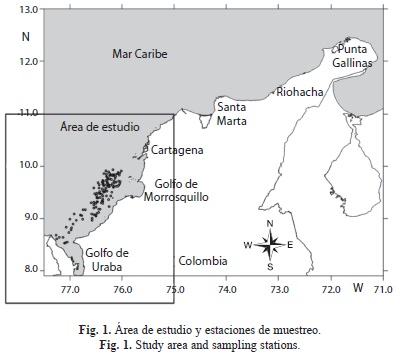
<body><![CDATA[<br> <font style="font-family: verdana;" size="2"><span  style="font-weight: bold;">Palabras clave:</span> camar&oacute;n, <span  style="font-style: italic;">Farfantepenaeus notialis</span>, reproducci&oacute;n, talla media de madurez, Caribe colombiano </font>    <br> <hr style="width: 100%; height: 2px;"><font  style="font-family: verdana;" size="2">En el Caribe colombiano la pesquer&iacute;a de camar&oacute;n de aguas someras (CAS) tiene como objetivo principal la captura del camar&oacute;n rosado (<span style="font-style: italic;">Farfantepenaeus notialis</span>, P&eacute;rez-Farfante, 1967), aunque tambi&eacute;n est&aacute;n presentes otras especies de camarones con menores capturas tales como <span  style="font-style: italic;">Farfantepenaeus brasiliensis</span> (Latreille, 1817), <span style="font-style: italic;">Farfantepenaeus subtilis</span> (P&eacute;rez-Farfante, 1967) y <span style="font-style: italic;">Litopenaeus schmitii</span> (Burkenroad, 1936) (Paramo &amp; Saint-Paul, 2010). La pesquer&iacute;a de camar&oacute;n de aguas someras es de gran importancia socio-econ&oacute;mica en la regi&oacute;n Caribe. As&iacute; como en la mayor&iacute;a de las pesquer&iacute;as tropicales de camar&oacute;n alrededor de mundo que est&aacute;n completamente explotadas (Guillet, 2008), este es un t&iacute;pico caso de una pesquer&iacute;a colapsada por falta de control (Paramo &amp; Saint-Paul, 2010). No obstante, debido a la sobreexplotaci&oacute;n, falta de informaci&oacute;n biol&oacute;gica, pesquera, seguimiento y control, es necesario generar conocimiento biol&oacute;gico-pesquero sobre el recurso. De tal manera, que los tomadores de decisiones y/o entidades competentes puedan elaborar y tomar medidas de manejo para su aprovechamiento racional y sostenible, considerando el enfoque precautorio de acuerdo con el c&oacute;digo de conducta para la pesca responsable (FAO, 1995). Este enfoque considera informaci&oacute;n b&aacute;sica sobre la biolog&iacute;a reproductiva de la poblaci&oacute;n de camar&oacute;n tales como estadios reproductivos, talla media de madurez, &eacute;poca reproductiva y zonas donde se reproducen. La sobreexplotaci&oacute;n del recurso debido a la alta presi&oacute;n ejercida sobre un amplio &aacute;mbito de tallas, como consecuencia de la falta de medidas de manejo (Paramo &amp; Saint-Paul, 2010), ha tenido como consecuencia la disminuci&oacute;n de la flota pesquera industrial en las &uacute;ltimas d&eacute;cadas, que se viene presentando en muchos mares tropicales a nivel mundial (Garc&iacute;a, 1989). Situaci&oacute;n que ha sido documentada por el Instituto Colombiano de Desarrollo Rural (INCODER) y la Autoridad Nacional de Acuicultura y Pesca (AUNAP) en sus estad&iacute;sticas pesqueras en el Caribe colombiano (Barreto &amp; Borda, 2008; Paramo &amp; Saint-Paul, 2010). Por ello, es de gran relevancia tener informaci&oacute;n precisa sobre del estado actual del stock y de su biolog&iacute;a reproductiva (Desantis et al., 2001; Belcari, Viva, Mori &amp; De Ranieri. 2003; Carlucci D&#8217;Onghia, Sion, Maiorano &amp; Tursi, 2006; Kapiris &amp; Thessalou-Legaki, 2006, 2009; Echeverr&iacute;a-S&aacute;enz &amp; Wehrtmann, 2011). El camar&oacute;n rosado (<span style="font-style: italic;">F. notialis</span>) pertenece a la familia Penaeidae, es de gran importancia comercial para la pesca industrial en el Caribe colombiano (Paramo &amp; Saint-Paul, 2010). <span  style="font-style: italic;">F. notialis</span> habita en fondos blandos desde los 3 a los 100m y raramente llega hasta los 700m, pero presenta sus mayores abundancias en aguas someras entre los 10 a 75m de profundidad (Fischer, Bianchi &amp; Scott, 1981). <span  style="font-style: italic;">F. notialis</span> se distribuye a lo largo de la costa del mar Caribe, la costa de Am&eacute;rica del Sur hasta Brasil, y tambi&eacute;n se encuentra en la costa de &Aacute;frica Occidental desde Mauritania hasta Angola (Tavares, 2002). El ciclo de vida de los camarones penaeidos es complejo (Dall, Hill, Rothlisberg &amp; Staples, 1990), involucrando el desove de los adultos fuera de la costa, y la migraci&oacute;n de las larvas hacia las regiones de crianza, que incluyen lagunas costeras, manglares y estuarios (Garc&iacute;a &amp; Le Reste, 1986). Las zonas de crianza proporcionan alimento (Lee, 1999; Loneragan &amp; Bunn, 1999) y refugio contra los predadores (Minello &amp; Zimmerman, 1991). La migraci&oacute;n comprende una fase estuarina, cuando la post-larva entra a las desembocaduras de los r&iacute;os, donde se mantienen hasta la etapa juvenil y luego migran hacia el mar como sub-adultos, el cual es un per&iacute;odo caracterizado por el r&aacute;pido crecimiento y migraci&oacute;n continua (Dall et al., 1990). El camar&oacute;n de aguas someras <span style="font-style: italic;">F. notialis</span> pertenece a las especies que desovan frente a la costa, a profundidades que var&iacute;an aproximadamente de 10 a 80m. Generalmente las especies de la familia Penaeidae alcanzan su madurez sexual antes de haber cumplido un a&ntilde;o de edad (Fischer et al., 1995). Por lo tanto, se requiere investigaci&oacute;n biol&oacute;gica para conocer el ciclo reproductivo y los factores que afectan el &eacute;xito en el desove ya que el conocimiento respectivo es de alta prioridad para el manejo pesquero. Las regulaciones tales como vedas durante &eacute;pocas de reproducci&oacute;n y el reclutamiento de los crust&aacute;ceos, dependen del conocimiento de la biolog&iacute;a reproductiva (Liz&aacute;rraga-Cubedo, Pierce &amp; Santos, 2008). Por esta raz&oacute;n, el presente estudio tiene como objetivo conocer la &eacute;poca reproductiva, la estructura de tallas y la talla media de madurez del camar&oacute;n de aguas someras (<span style="font-style: italic;">Farfantepenaeus notialis</span>) como insumo para la ordenaci&oacute;n y manejo pesquero en el Caribe colombiano. </font>    <br> <font style="font-family: verdana;" size="2"></font>    <br> <font style="font-family: verdana; font-weight: bold;" size="3">Materiales y M&eacute;todos</font>    <br> <font style="font-family: verdana;" size="2"></font>    <br> <font style="font-family: verdana;" size="2">Muestreo a bordo del barco camaronero: Las muestras fueron recolectadas en el barco camaronero Adriatic, entre junio 2012 y junio 2013 en los sitios donde opera normalmente la flota camaronera en el Caribe colombiano (<a href="/img/revistas/rbt/v62n2/a08i1.jpg">Fig. 1</a>). Se realizaron en total 141 estaciones de muestreo, usando una red de arrastre camaronera de ancho 12.8m y largo 10.7m, con tama&ntilde;o de malla al final del copo de 44.5mm de nudo a nudo. El muestreo se hizo de acuerdo a la reglamentaci&oacute;n vigente sobre dispositivo excluidor de tortugas (DET). Para la evaluaci&oacute;n de los fondos arrastrables se utiliz&oacute; una ecosonda FURUNO FCV 1150. La duraci&oacute;n aproximada de cada arrastre comercial fue de cuatro horas, en los cuales se tomaron datos de hora inicial y final, posici&oacute;n inicial y final por medio de un GPS marca Garmin GPS-map76CSx. De cada lance se tom&oacute; una muestra de aproximadamente dos kilos y medio, unos 50 individuos. Los individuos recolectados, fueron separados, identificados, conservados con bisulfito de sodio y guardados en bolsas debidamente rotuladas para su an&aacute;lisis en laboratorio del Centro de Desarrollo Pesquero y Acuicola en Taganga de la Universidad del Magdalena. En cada individuo se registr&oacute; la longitud total (LT) desde la punta del rostro hasta la punta del telson con un calibrador digital de 12&#8221; UPM (m&oacute;dulo de presi&oacute;n universal) con precisi&oacute;n de 0.01mm, y el peso total con una balanza anal&iacute;tica marca Ohaus Pioneer con una precisi&oacute;n de 0.1mg.    <br> </font>    <br> <font style="font-family: verdana;" size="2">Determinaci&oacute;n macrosc&oacute;pica de los estadios de madurez gonadal: Se determinaron visualmente cinco estadios de madurez macrosc&oacute;picos para las hembras y machos: I) inmaduros, ovarios transl&uacute;cidos; II) en desarrollo, ovarios opacos; III) casi maduros, ovarios de color amarillo naranja; IV) maduros, ovarios grandes color oliva, algunas veces caf&eacute;; y V) desovados, ovarios vac&iacute;os. Para la estimaci&oacute;n de la talla media de madurez se consideraron los estadios I y II como inmaduros y los estadios III, IV y V como maduros (Paramo &amp; Saint-Paul, 2010). </font>    <br> <font style="font-family: verdana;" size="2"></font>    <br> <font style="font-family: verdana;" size="2">Se determin&oacute; la proporci&oacute;n sexual, el estadio de madurez gonadal por sexos. Se realiz&oacute; una prueba de Chi-cuadrado para establecer significancia estad&iacute;stica de diferencias entre el n&uacute;mero de hembras y machos en las muestras mensuales. Se evalu&oacute; las diferencias en la distribuci&oacute;n de frecuencias de las tallas entre hembras y machos usando la prueba no param&eacute;trica Kolmogorov-Smirnov (Gotelli &amp; Ellison, 2004). Se realiz&oacute; una prueba de comparaciones m&uacute;ltiples de Kruskal-Wallis para determinar el nivel de significancia estad&iacute;stica entre las diferencias de la talla media de captura (TMC) mensual en hembras y machos de <span style="font-style: italic;">F. notialis</span>. Se calcul&oacute; para ambos sexos por muestra mensual la proporci&oacute;n de individuos maduros e inmaduros de <span style="font-style: italic;">F. notialis</span>. La talla media de madurez sexual (LT<sub>50%</sub>) fue modelada ajustando la funci&oacute;n log&iacute;stica de la proporci&oacute;n de individuos maduros con 5mm de intervalo de clase de talla de LT (Paramo &amp; Saint-Paul, 2010), mediante una regresi&oacute;n no lineal. Se realiz&oacute; una prueba de Chi-cuadrado para evaluar el nivel de significancia estad&iacute;stica en las diferencias entre la talla media de captura mensual con la talla media de madurez en hembras y machos, respectivamente.</font>    ]]></body>
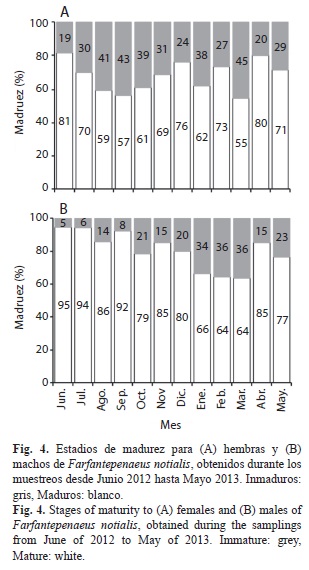
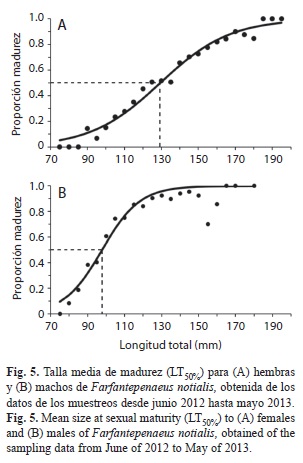
<body><![CDATA[<br> <font style="font-family: verdana;" size="2">&nbsp;</font>    <br> <font style="font-family: verdana; font-weight: bold;" size="3">RESULTADOS</font>    <br> <font style="font-family: verdana;" size="2"></font>    <br> <font style="font-family: verdana;" size="2"><span  style="font-weight: bold;">Proporci&oacute;n de sexos:</span> Se analiz&oacute; un total de 5 199 individuos, 56.4% hembras y 43.6% machos (<a  href="img/revistas/rbt/v62n2/a08i2.jpg">Fig. 2</a>). En todos los meses predominaron las hembras, con mayor porcentaje en septiembre y octubre, y el m&aacute;s bajo en noviembre (<a  href="img/revistas/rbt/v62n2/a08i2.jpg">Fig. 2</a>). Existen diferencias significativas entre la abundancia de hembras y machos en todos los meses muestreados (Chi<sup>2</sup>=591.63; p=0.000).</font>    <br> <font style="font-family: verdana;" size="2"></font>    <br> <font style="font-family: verdana;" size="2"><span  style="font-weight: bold;">Estructura de tallas:</span> La estructura de tallas en todo el periodo muestra un intervalo para las hembras desde 69.7 hasta 198.6mm de LT, con una media de 148.0mm de LT (CV=12.1%) (<a  href="img/revistas/rbt/v62n2/a08i3.jpg">Fig. 3</a>A). Para los machos se obtuvo un intervalo desde 74.0 hasta 181.8mm de LT, con una media de 122.5mm de LT (CV=10.4%) (<a href="img/revistas/rbt/v62n2/a08i3.jpg">Fig. 3</a>B). En todos los meses las hembras fueron significativamente de mayor talla que los machos (p=0.000). La TMC mensual de las hembras fue mayor entre junio y diciembre 2012 (~150mm de LT) y disminuy&oacute; en enero, marzo y mayo (~135mm de LT), mostrando diferencias significativas entre estos dos periodos (<a href="img/revistas/rbt/v62n2/a08i3.jpg">Fig. 3</a>A) (p=0.000). La TMC de los machos aument&oacute; desde junio hasta septiembre 2012 (~127mm de LT) y disminuy&oacute; desde enero hasta marzo 2013 (~115mm de LT), mostrando diferencias significativas entre los meses de muestreo (p=0.000) (<a  href="img/revistas/rbt/v62n2/a08i3.jpg">Fig. 3</a>B). Los individuos fueron capturados entre 15.48 y 66.60m de profundidad (profundidad media de 46.19m&plusmn;11.87).</font>    <br> <font style="font-family: verdana;" size="2"></font>    <br> <font style="font-family: verdana;" size="2">Porcentaje mensual de estadios de madurez: En junio 81.5% de las hembras estuvieron maduras, mientras que en septiembre el porcentaje disminuy&oacute; a 56.6% y en diciembre aument&oacute; hasta 76.1%. Posteriormente entre enero y marzo 2013 el porcentaje de hembras maduras disminuy&oacute;, para luego aumentar entre abril (80.1%) y mayo (71.3%) de 2013 (<a href="/img/revistas/rbt/v62n2/a08i4.jpg">Fig. 4A</a>). Los machos presentaron un 94.7% de individuos maduros en el mes de junio y el alto porcentaje se mantuvo hasta diciembre de 2012. Sin embargo, entre enero y marzo 2013 el porcentaje de individuos maduros disminuy&oacute; con valores entre 66.3% y 63.6%, para luego aumentar en abril (85.3%) y mayo (76.6%) de 2013 (<a href="/img/revistas/rbt/v62n2/a08i4.jpg">Fig. 4B</a>).     <br> </font>    <br> <font style="font-family: verdana;" size="2">Talla media de madurez: La talla media de madurez en las hembras fue de 129.34m de LT con valores de los par&aacute;metros de la funci&oacute;n log&iacute;stica a=6.86 y b=-0.05, con un r2 de 0.98 (<a  href="/img/revistas/rbt/v62n2/a08i5.jpg">Fig. 5A</a>). En los machos la talla media de madurez se estim&oacute; en 97.77mm de LT (a=9.66 y b=-0.10), con un r2 de 0.92 (<a  href="/img/revistas/rbt/v62n2/a08i5.jpg">Fig. 5B</a>). Al comparar la talla media de madurez en hembras y machos con su respectiva talla media de captura (<a href="img/revistas/rbt/v62n2/a08i3.jpg">Fig. 3</a>), se encontraron diferencias estad&iacute;sticamente significativas (Hembras: Chi2=15 223.23; p=0.000; machos: Chi2=17 988.74; p=0.000).     ]]></body>
<body><![CDATA[<br> </font>    <br> <font style="font-family: verdana; font-weight: bold;" size="3">Discusi&oacute;n</font>    <br> <font style="font-family: verdana;" size="2"></font>    <br> <font style="font-family: verdana;" size="2">La poblaci&oacute;n de camar&oacute;n rosado (<span style="font-style: italic;">F. notialis</span>) en el Caribe colombiano se caracteriz&oacute; por tener un gran porcentaje de hembras maduras en todo el a&ntilde;o (&gt;50%), indicando que la reproducci&oacute;n es continua durante todo el a&ntilde;o pero con dos picos de m&aacute;ximo desove, uno entre octubre y diciembre y el otro entre abril y junio. Esto coincide con lo encontrado para los camarones peneidos que com&uacute;nmente muestran dos picos de desove por a&ntilde;o (Garc&iacute;a &amp; Le Reste, 1986; Pauly et al., 1984; Garc&iacute;a, 1985). La LT<sub>50%</sub> en este estudio fue de 129.34mm de LT para las hembras y 97.77mm de LT para los machos, la cual es similar para las hembras en estudios previos (LT<sub>50%</sub>=136.7mm) (Paramo &amp; Saint-Paul, 2010). Adem&aacute;s, la talla media de captura (TMC) siempre fue mayor que la LT<sub>50%</sub> para ambos sexos. Debido a que el desove es la base de la renovaci&oacute;n y conservaci&oacute;n del stock de un recurso pesquero, estudios sobre la reproducci&oacute;n de los peneidos explotados son cr&iacute;ticos para el desarrollo de estrategias de manejo (Arag&oacute;n-Noriega &amp; Alc&aacute;ntara-Razo, 2005). Una medida central para el manejo es proteger el periodo y las &aacute;reas reproductivas (Garc&iacute;a, 1985). Adicionalmente, se ha sugerido que las estrategias de manejo deben permitir a las hembras reproducirse al menos una vez antes de ser capturadas (Arag&oacute;n-Noriega &amp; Alc&aacute;ntara-Razo, 2005). Por lo tanto, las medidas de manejo que se deben adoptar en pesquer&iacute;as de crust&aacute;ceos para asegurar una explotaci&oacute;n eficiente y sostenible, incluyen restricciones de captura y esfuerzo, talla m&iacute;nima legal de desembarque (superior a la LT<sub>50%</sub>), estaciones cerradas (vedas) para proteger la reproducci&oacute;n y el reclutamiento y &aacute;reas protegidas. En este sentido, uno de los principales elementos de presi&oacute;n para el stock es la alta tasa de explotaci&oacute;n en el periodo reproductivo, entonces es probable que esto pueda conllevar a riesgo de sobreexplotaci&oacute;n o fracaso en el reclutamiento en el medio y largo plazo (Liz&aacute;rraga-Cubedo et al., 2008). No obstante, tambi&eacute;n se ha demostrado en camarones peneidos que un esfuerzo pesquero alto en las etapas de juveniles en &aacute;reas de crianza y durante el reclutamiento puede conllevar a una sobreexplotaci&oacute;n (Gracia, 1995, 1997, 2004). Por lo tanto, se deben dise&ntilde;ar estrategias de manejo para proteger los juveniles (P&eacute;rez-Casta&ntilde;eda &amp; Defeo, 2000; May-K&uacute; &amp; Ord&oacute;&ntilde;ez-L&oacute;pez, 2006) Adem&aacute;s, debido a su ciclo de vida corto (~2 a&ntilde;os) (Garc&iacute;a, 1996; Leal-Gaxiola, L&oacute;pez-Mart&iacute;nez, Ch&aacute;vez, Hern&aacute;ndez-V&aacute;squez &amp; M&eacute;ndez-Tenorio, 2001; Charnov &amp; Hannah, 2002; L&oacute;pez-Mart&iacute;nez, Arregu&iacute;n-S&aacute;nchez, Hern&aacute;ndez-V&aacute;squez, Garc&iacute;a-Juarez &amp; Valenzuela-Qui&ntilde;onez, 2003; L&oacute;pez-Mart&iacute;nez et al., 2005), caracter&iacute;sticas de alto potencial reproductivo tales como fecundidad alta, generaciones anuales, maduraci&oacute;n temprana y estrategia oportunista para aprovechar condiciones ambientales favorables, los camarones peneidos pueden recuperarse en un relativo corto plazo despu&eacute;s de una sobreexplotaci&oacute;n (Gracia, 1991, 1996). En este sentido, debido a que la pesquer&iacute;a de camar&oacute;n de aguas someras en el Caribe colombiano lleg&oacute; a tener unas 120 embarcaciones en la d&eacute;cada de los 90&#8217;s (Barreto &amp; Borda, 2008; Paramo &amp; Saint-Paul, 2010), pero actualmente y desde hace unos 10 a&ntilde;os el esfuerzo pesquero disminuy&oacute; a unas ocho embarcaciones, se podr&iacute;a suponer que la pesquer&iacute;a de camar&oacute;n de aguas someras este en una fase de recuperaci&oacute;n o que probablemente pueda estar recuperada. No obstante, debido a que no existe temporada de veda en la pesquer&iacute;a de CAS en el Caribe colombiano, se recomienda una veda ya sea en la &eacute;poca reproductiva (noviembre-diciembre) o en la &eacute;poca de reclutamiento (marzo) o una combinaci&oacute;n de las dos con periodo de veda en diciembre (reproducci&oacute;n) y otro periodo en marzo (reclutamiento). Por &uacute;ltimo, algo muy importante es no aumentar el esfuerzo pesquero hasta que se realice un monitoreo pesquero y conocer la real recuperaci&oacute;n de la poblaci&oacute;n de CAS en el Caribe colombiano.</font>    <br> <font style="font-family: verdana;" size="2"></font>    <br> <font style="font-family: verdana; font-weight: bold;" size="3">Agradecimientos</font>    <br> <font style="font-family: verdana;" size="2"></font>    <br> <font style="font-family: verdana;" size="2">Este trabajo es una contribuci&oacute;n del grupo de investigaci&oacute;n Ciencia y Tecnolog&iacute;a Tropical (CITEPT) Universidad del Magdalena (Colombia), con el apoyo cient&iacute;fico del Leibniz-Zentrum f&uuml;r Marine Tropen&ouml;kologie (ZMT), Alemania. Agradecemos a los Capitanes del Barco &#8220;Adriatic&#8221; David Guillem y Alfonso Guillem y a su tripulaci&oacute;n por su inter&eacute;s y apoyo para que se realizara la investigaci&oacute;n. Agradecemos a los estudiantes del Programa de Ingenier&iacute;a Pesquera de la Universidad del Magdalena del grupo de investigaci&oacute;n CITEPT quienes participaron en los muestreos a bordo de la embarcaci&oacute;n y an&aacute;lisis en laboratorio. El trabajo fue financiado por el Instituto colombiano de Desarrollo Rural (INCODER), la Autoridad Nacional de Pesca y Acuicultura AUNAP y la Universidad del Magdalena, convenio 790-2011 (INCODER/Unimagdalena), proyecto &#8220;Din&aacute;mica y estructura poblacional de las especies de camar&oacute;n de aguas someras y profundas del Caribe colombiano, con fines de ordenaci&oacute;n y resoluci&oacute;n de conflictos&#8221;, y convenio 018-2012 (AUNAP/Unimagdalena) proyecto &#8220;Evaluaci&oacute;n directa de la Biomasa y distribuci&oacute;n espacial de las especies de las especies de Camar&oacute;n de Aguas someras (CAS) en el Caribe colombiano&#8221;.</font>    <br> <font style="font-family: verdana;" size="2"></font> <hr style="width: 100%; height: 2px;"><font  style="font-family: verdana; font-weight: bold;" size="3">&nbsp;Referencias</font>    <br>     ]]></body>
<body><![CDATA[<br>     <!-- ref --><div style="text-align: left;"><font style="font-family: verdana;"  size="2">Arag&oacute;n-Noriega, E. A. &amp; Alc&aacute;ntara-Razo, E. (2005). Influence of sea surface temperature on reproductive period and size at maturity of brown shrimp (<span style="font-style: italic;">Farfantepenaeus californiensis</span>) in the Gulf of California. <span style="font-style: italic;">Marine Biology, 146</span>, 373-379.    &nbsp;&nbsp;&nbsp;&nbsp;&nbsp;&nbsp;&nbsp;&nbsp;[&#160;<a href="javascript:void(0);" onclick="javascript: window.open('/scielo.php?script=sci_nlinks&ref=1560180&pid=S0034-7744201400010000800001&lng=','','width=640,height=500,resizable=yes,scrollbars=1,menubar=yes,');">Links</a>&#160;]<!-- end-ref --></font>    <br>     <!-- ref --><br> <font style="font-family: verdana;" size="2">Barreto, C. &amp; Borda, C. (2008). <span style="font-style: italic;">Evaluaci&oacute;n de recursos pesqueros colombianos</span>. Bogot&aacute;: ICA Produmedios.    &nbsp;&nbsp;&nbsp;&nbsp;&nbsp;&nbsp;&nbsp;&nbsp;[&#160;<a href="javascript:void(0);" onclick="javascript: window.open('/scielo.php?script=sci_nlinks&ref=1560183&pid=S0034-7744201400010000800002&lng=','','width=640,height=500,resizable=yes,scrollbars=1,menubar=yes,');">Links</a>&#160;]<!-- end-ref --></font>    <br>     <!-- ref --><br> <font style="font-family: verdana;" size="2">Belcari, P., Viva, C., Mori, M., &amp; De Ranieri, S. (2003). Fishery and biology of Aristaeomorpha foliacea (Risso, 1827) (Crustacea: <span style="font-style: italic;">Decapoda</span>) in the Northern Tyrrenien Sea (Western Mediterranean). <span style="font-style: italic;">Journal of Northwest Atlantic Fishery Science, 31</span>, 195-204.    &nbsp;&nbsp;&nbsp;&nbsp;&nbsp;&nbsp;&nbsp;&nbsp;[&#160;<a href="javascript:void(0);" onclick="javascript: window.open('/scielo.php?script=sci_nlinks&ref=1560186&pid=S0034-7744201400010000800003&lng=','','width=640,height=500,resizable=yes,scrollbars=1,menubar=yes,');">Links</a>&#160;]<!-- end-ref --> </font>    <br>     ]]></body>
<body><![CDATA[<!-- ref --><br> <font style="font-family: verdana;" size="2">Carlucci, R., D&#8217;Onghia, G., Sion, L., Maiorano, P., &amp; Tursi, A. (2006). Selectivity parameters and size at first maturity in deep-water shrimps, <span style="font-style: italic;">Aristaeomorpha foliacea</span> (Risso, 1827) and <span style="font-style: italic;">Aristeus antennatus</span> (Risso, 1816), from the north-western Ionian Sea (Mediterranean Sea). <span style="font-style: italic;">Hydrobiologia, 557</span>, 145-154.    &nbsp;&nbsp;&nbsp;&nbsp;&nbsp;&nbsp;&nbsp;&nbsp;[&#160;<a href="javascript:void(0);" onclick="javascript: window.open('/scielo.php?script=sci_nlinks&ref=1560189&pid=S0034-7744201400010000800004&lng=','','width=640,height=500,resizable=yes,scrollbars=1,menubar=yes,');">Links</a>&#160;]<!-- end-ref --></font>    <br>     <!-- ref --><br> <font style="font-family: verdana;" size="2">Charnov, E. L. &amp; Hannah, R. W. (2002). Shrimp adjust their sex ratio to fluctuating age distributions. <span  style="font-style: italic;">Evolutionary Ecology Research, 4</span>, 239-246.    &nbsp;&nbsp;&nbsp;&nbsp;&nbsp;&nbsp;&nbsp;&nbsp;[&#160;<a href="javascript:void(0);" onclick="javascript: window.open('/scielo.php?script=sci_nlinks&ref=1560192&pid=S0034-7744201400010000800005&lng=','','width=640,height=500,resizable=yes,scrollbars=1,menubar=yes,');">Links</a>&#160;]<!-- end-ref --></font>    <br>     <!-- ref --><br> <font style="font-family: verdana;" size="2">Dall, W., Hill, B. J., Rothlisberg, P. C., &amp; Staples, D. J. (1990). The biology of the Penaeidae. <span style="font-style: italic;">Advances in Marine Biology, 27</span>, 1-489.    &nbsp;&nbsp;&nbsp;&nbsp;&nbsp;&nbsp;&nbsp;&nbsp;[&#160;<a href="javascript:void(0);" onclick="javascript: window.open('/scielo.php?script=sci_nlinks&ref=1560195&pid=S0034-7744201400010000800006&lng=','','width=640,height=500,resizable=yes,scrollbars=1,menubar=yes,');">Links</a>&#160;]<!-- end-ref --></font>    <br>     <!-- ref --><br> <font style="font-family: verdana;" size="2">Desantis, S., Labate, M., Maioramo, P., Tursi, A., Labate, G. M., &amp; Ciccarelli, M. (2001). A histochemical and ultrastructural study of oogenesis in <span style="font-style: italic;">Aristaeomorpha foliacea</span> (Risso, 1827). <span style="font-style: italic;">Hydrobiologia, 449</span>, 253-259.    &nbsp;&nbsp;&nbsp;&nbsp;&nbsp;&nbsp;&nbsp;&nbsp;[&#160;<a href="javascript:void(0);" onclick="javascript: window.open('/scielo.php?script=sci_nlinks&ref=1560198&pid=S0034-7744201400010000800007&lng=','','width=640,height=500,resizable=yes,scrollbars=1,menubar=yes,');">Links</a>&#160;]<!-- end-ref --></font>    <br>     <!-- ref --><br> <font style="font-family: verdana;" size="2">Echeverr&iacute;a-S&aacute;enz, S. &amp; Wehrtmann, I. S. (2011). Egg production of the commercially exploited deepwater shrimp, <span  style="font-style: italic;">Heterocarpus vicarius</span> (Decapoda: Pandalidae), Pacific Costa Rica, Central America. <span style="font-style: italic;">Journal of Crustacean Biology, 31</span>(3), 434-440.    &nbsp;&nbsp;&nbsp;&nbsp;&nbsp;&nbsp;&nbsp;&nbsp;[&#160;<a href="javascript:void(0);" onclick="javascript: window.open('/scielo.php?script=sci_nlinks&ref=1560201&pid=S0034-7744201400010000800008&lng=','','width=640,height=500,resizable=yes,scrollbars=1,menubar=yes,');">Links</a>&#160;]<!-- end-ref --></font>    <br>     <!-- ref --><br> <font style="font-family: verdana;" size="2">FAO. (1995). <span  style="font-style: italic;">C&oacute;digo de conducta para la pesca responsable</span>. Roma, FAO.    &nbsp;&nbsp;&nbsp;&nbsp;&nbsp;&nbsp;&nbsp;&nbsp;[&#160;<a href="javascript:void(0);" onclick="javascript: window.open('/scielo.php?script=sci_nlinks&ref=1560204&pid=S0034-7744201400010000800009&lng=','','width=640,height=500,resizable=yes,scrollbars=1,menubar=yes,');">Links</a>&#160;]<!-- end-ref --></font>    <br>     <!-- ref --><br> <font style="font-family: verdana;" size="2">Fischer, W., Bianchi, G., &amp; Scott, W. B. (Eds.). (1981). <span style="font-style: italic;">FAO Species identification Sheets for Fishery Purposes. Volumen VII. Eastern Central Atlantic; fishing area 34 and part of 47</span>. Roma: Canada Funds-in-Trust &amp; FAO.    &nbsp;&nbsp;&nbsp;&nbsp;&nbsp;&nbsp;&nbsp;&nbsp;[&#160;<a href="javascript:void(0);" onclick="javascript: window.open('/scielo.php?script=sci_nlinks&ref=1560207&pid=S0034-7744201400010000800010&lng=','','width=640,height=500,resizable=yes,scrollbars=1,menubar=yes,');">Links</a>&#160;]<!-- end-ref --></font>    ]]></body>
<body><![CDATA[<br>     <!-- ref --><br> <font style="font-family: verdana;" size="2">Fischer, W., Krupp, F., Schneider, W., Sommer, C., Carpenter, K. E., &amp; Niem, V. H. (1995). <span style="font-style: italic;">Gu&iacute;a FAO para la identificaci&oacute;n de especies para los fines de la pesca. Pac&iacute;fico centro-oriental. Volumen II. Vertebrados - Parte 1</span>. Roma: FAO.    &nbsp;&nbsp;&nbsp;&nbsp;&nbsp;&nbsp;&nbsp;&nbsp;[&#160;<a href="javascript:void(0);" onclick="javascript: window.open('/scielo.php?script=sci_nlinks&ref=1560210&pid=S0034-7744201400010000800011&lng=','','width=640,height=500,resizable=yes,scrollbars=1,menubar=yes,');">Links</a>&#160;]<!-- end-ref --></font>    <br>     <!-- ref --><br> <font style="font-family: verdana;" size="2">Garc&iacute;a, S. &amp; Reste, L. L. (1986). <span style="font-style: italic;">Ciclos vitales, din&aacute;mica, explotaci&oacute;n y ordenaci&oacute;n de las poblaciones de camarones peneidos costeros.</span> Roma: FAO Doc. T&eacute;c. Pesca.    &nbsp;&nbsp;&nbsp;&nbsp;&nbsp;&nbsp;&nbsp;&nbsp;[&#160;<a href="javascript:void(0);" onclick="javascript: window.open('/scielo.php?script=sci_nlinks&ref=1560213&pid=S0034-7744201400010000800012&lng=','','width=640,height=500,resizable=yes,scrollbars=1,menubar=yes,');">Links</a>&#160;]<!-- end-ref --></font>    <br>     <!-- ref --><br> <font style="font-family: verdana;" size="2">Garc&iacute;a, S. (1985). Reproduction, stock assessment models and population parameters in exploited penaeid shrimp populations. In P. C. Rothlisberg, B. J. Hill, &amp; D. J. Staples (Eds.), <span  style="font-style: italic;">Second Australian National Prawn Seminar, NPS2</span> (pp. 139-158). Cleveland.    &nbsp;&nbsp;&nbsp;&nbsp;&nbsp;&nbsp;&nbsp;&nbsp;[&#160;<a href="javascript:void(0);" onclick="javascript: window.open('/scielo.php?script=sci_nlinks&ref=1560216&pid=S0034-7744201400010000800013&lng=','','width=640,height=500,resizable=yes,scrollbars=1,menubar=yes,');">Links</a>&#160;]<!-- end-ref --></font>    <br>     ]]></body>
<body><![CDATA[<!-- ref --><br> <font style="font-family: verdana;" size="2">Garc&iacute;a, S. (1989). The management of coastal penaeid shrimp fisheries. In J. F. Caddy (Ed.), <span style="font-style: italic;">Marine Invertebrate Fisheries: Their Assessment and Management</span> (pp. 281-306). New York: Wiley.    &nbsp;&nbsp;&nbsp;&nbsp;&nbsp;&nbsp;&nbsp;&nbsp;[&#160;<a href="javascript:void(0);" onclick="javascript: window.open('/scielo.php?script=sci_nlinks&ref=1560219&pid=S0034-7744201400010000800014&lng=','','width=640,height=500,resizable=yes,scrollbars=1,menubar=yes,');">Links</a>&#160;]<!-- end-ref --></font>    <br>     <!-- ref --><br> <font style="font-family: verdana;" size="2">Garc&iacute;a, S. (1996). The precautionary approach to fisheries and its implications for fishery research, technology and management: an updated review. In <span style="font-style: italic;">Precautionary Approach to Fisheries. Part 2: Scientific papers</span> (pp. 1-75). Roma: FAO.    &nbsp;&nbsp;&nbsp;&nbsp;&nbsp;&nbsp;&nbsp;&nbsp;[&#160;<a href="javascript:void(0);" onclick="javascript: window.open('/scielo.php?script=sci_nlinks&ref=1560222&pid=S0034-7744201400010000800015&lng=','','width=640,height=500,resizable=yes,scrollbars=1,menubar=yes,');">Links</a>&#160;]<!-- end-ref --></font>    <br>     <!-- ref --><br> <font style="font-family: verdana;" size="2">Gotelli, N. J. &amp; Ellison, A. M. (2004). <span style="font-style: italic;">A primer of Ecological Statistics</span>. Sunderland: Sinauer Associates, Inc.    &nbsp;&nbsp;&nbsp;&nbsp;&nbsp;&nbsp;&nbsp;&nbsp;[&#160;<a href="javascript:void(0);" onclick="javascript: window.open('/scielo.php?script=sci_nlinks&ref=1560225&pid=S0034-7744201400010000800016&lng=','','width=640,height=500,resizable=yes,scrollbars=1,menubar=yes,');">Links</a>&#160;]<!-- end-ref --> </font>    <br>     <!-- ref --><br> <font style="font-family: verdana;" size="2">Gracia, A. (1991). Spawning stock-recruitment relationships of white shrimp in the Southwestern Gulf of Mexico. <span  style="font-style: italic;">Transactions of the American Fisheries Society, 120</span>, 519-527.    &nbsp;&nbsp;&nbsp;&nbsp;&nbsp;&nbsp;&nbsp;&nbsp;[&#160;<a href="javascript:void(0);" onclick="javascript: window.open('/scielo.php?script=sci_nlinks&ref=1560228&pid=S0034-7744201400010000800017&lng=','','width=640,height=500,resizable=yes,scrollbars=1,menubar=yes,');">Links</a>&#160;]<!-- end-ref --></font>    <br>     <!-- ref --><br> <font style="font-family: verdana;" size="2">Gracia, A. (1995). Impacto de la pesca artesanal sobre la producci&oacute;n de camar&oacute;n rosado Penaeus Farfan-tepenaeus duorarum Burkenroad, 1939. <span style="font-style: italic;">Ciencias Marinas, 21</span>, 343-359.    &nbsp;&nbsp;&nbsp;&nbsp;&nbsp;&nbsp;&nbsp;&nbsp;[&#160;<a href="javascript:void(0);" onclick="javascript: window.open('/scielo.php?script=sci_nlinks&ref=1560231&pid=S0034-7744201400010000800018&lng=','','width=640,height=500,resizable=yes,scrollbars=1,menubar=yes,');">Links</a>&#160;]<!-- end-ref --></font>    <br>     <!-- ref --><br> <font style="font-family: verdana;" size="2">Gracia, A. (1996). White shrimp Penaeus setiferus recruitment overfishing. <span style="font-style: italic;">Marine and Freshwater Research, 47</span>, 59-63.    &nbsp;&nbsp;&nbsp;&nbsp;&nbsp;&nbsp;&nbsp;&nbsp;[&#160;<a href="javascript:void(0);" onclick="javascript: window.open('/scielo.php?script=sci_nlinks&ref=1560234&pid=S0034-7744201400010000800019&lng=','','width=640,height=500,resizable=yes,scrollbars=1,menubar=yes,');">Links</a>&#160;]<!-- end-ref --></font>    <br>     <!-- ref --><br> <font style="font-family: verdana;" size="2">Gracia, A. (1997). Simulated and actual effects of the brown shrimp, <span style="font-style: italic;">Penaeus aztecus</span>, closure in Mexico.</font><font style="font-family: verdana;" size="2"> <span  style="font-style: italic;">Marine Fisheries Review, 59</span>, 18-24.    &nbsp;&nbsp;&nbsp;&nbsp;&nbsp;&nbsp;&nbsp;&nbsp;[&#160;<a href="javascript:void(0);" onclick="javascript: window.open('/scielo.php?script=sci_nlinks&ref=1560237&pid=S0034-7744201400010000800020&lng=','','width=640,height=500,resizable=yes,scrollbars=1,menubar=yes,');">Links</a>&#160;]<!-- end-ref --></font>    ]]></body>
<body><![CDATA[<br>     <!-- ref --><br> <font style="font-family: verdana;" size="2">Gracia, A. (2004). Aprovechamiento y conservaci&oacute;n del recurso camar&oacute;n. In M. Caso, I. Pisanty, &amp; E. Ezcurra (Eds.), <span style="font-style: italic;">Diagn&oacute;stico ambiental del Golfo de M&eacute;xico</span> (Vol. 2, pp. 713-725). Secretar&iacute;a de Medio Ambiente y Recursos Naturales, Instituto Nacional de Ecolog&iacute;a, A. C., Harte Research Institute for the Gulf of M&eacute;xico Studies.    &nbsp;&nbsp;&nbsp;&nbsp;&nbsp;&nbsp;&nbsp;&nbsp;[&#160;<a href="javascript:void(0);" onclick="javascript: window.open('/scielo.php?script=sci_nlinks&ref=1560240&pid=S0034-7744201400010000800021&lng=','','width=640,height=500,resizable=yes,scrollbars=1,menubar=yes,');">Links</a>&#160;]<!-- end-ref --></font>    <br>     <!-- ref --><br> <font style="font-family: verdana;" size="2">Guillet, R. (2008). <span  style="font-style: italic;">Global study of shrimp fisheries</span>. Roma: FAO Fisheries Technical Papers. No. 475.    &nbsp;&nbsp;&nbsp;&nbsp;&nbsp;&nbsp;&nbsp;&nbsp;[&#160;<a href="javascript:void(0);" onclick="javascript: window.open('/scielo.php?script=sci_nlinks&ref=1560243&pid=S0034-7744201400010000800022&lng=','','width=640,height=500,resizable=yes,scrollbars=1,menubar=yes,');">Links</a>&#160;]<!-- end-ref --></font>    <br>     <!-- ref --><br> <font style="font-family: verdana;" size="2">Kapiris, K. &amp; Thessalou-Legaki, M. (2006). Comparative fecundity and oocyte size of <span style="font-style: italic;">Aristaeomorpha foliacea</span> and <span style="font-style: italic;">Aristeus antennatus</span> in the Hellenic Ionian Sea (E. Mediterranean) (Decapoda: Aristeidae). <span  style="font-style: italic;">Acta Zoologica, 87</span>, 239-245.    &nbsp;&nbsp;&nbsp;&nbsp;&nbsp;&nbsp;&nbsp;&nbsp;[&#160;<a href="javascript:void(0);" onclick="javascript: window.open('/scielo.php?script=sci_nlinks&ref=1560246&pid=S0034-7744201400010000800023&lng=','','width=640,height=500,resizable=yes,scrollbars=1,menubar=yes,');">Links</a>&#160;]<!-- end-ref --></font>    <br>     ]]></body>
<body><![CDATA[<!-- ref --><br> <font style="font-family: verdana;" size="2">Kapiris, K. &amp; Thessalou-Legaki, M. (2009). Comparative Reproduction Aspects of the Deep-water Shrimps</font><font  style="font-family: verdana;" size="2"> A<span  style="font-style: italic;">ristaeomorpha&nbsp; foliacea</span>&nbsp; and <span style="font-style: italic;">Aristeus&nbsp; antennatus</span> (Decapoda, Aristeidae) in the Greek Ionian Sea (Eastern Mediterranean). <span style="font-style: italic;">International Journal of Zoology</span>, doi:10.1155/2009/979512 Article ID 979512, 9 p.    &nbsp;&nbsp;&nbsp;&nbsp;&nbsp;&nbsp;&nbsp;&nbsp;[&#160;<a href="javascript:void(0);" onclick="javascript: window.open('/scielo.php?script=sci_nlinks&ref=1560249&pid=S0034-7744201400010000800024&lng=','','width=640,height=500,resizable=yes,scrollbars=1,menubar=yes,');">Links</a>&#160;]<!-- end-ref --></font>    <br>     <!-- ref --><br> <font style="font-family: verdana;" size="2">Leal-Gaxiola, A., L&oacute;pez- Mart&iacute;nez, J., Ch&aacute;vez, E. A., Hern&aacute;ndez-V&aacute;squez, S., &amp; M&eacute;ndez-Tenorio, F. (2001). Interannual variability of the reproductive period of the brown shrimp, <span style="font-style: italic;">Farfantepenaeus californiensis</span> (Holmes, 1900) (Decapoda, Natantia). <span style="font-style: italic;">Crustaceana, 74</span>, 839-851.    &nbsp;&nbsp;&nbsp;&nbsp;&nbsp;&nbsp;&nbsp;&nbsp;[&#160;<a href="javascript:void(0);" onclick="javascript: window.open('/scielo.php?script=sci_nlinks&ref=1560252&pid=S0034-7744201400010000800025&lng=','','width=640,height=500,resizable=yes,scrollbars=1,menubar=yes,');">Links</a>&#160;]<!-- end-ref --></font>    <br>     <!-- ref --><br> <font style="font-family: verdana;" size="2">Lee, S. Y. (1999). Tropical mangrove ecology: physical and biotic factors influencing ecosystem structure and function. <span  style="font-style: italic;">Australian Journal of Ecology, 24</span>, 355-366.    &nbsp;&nbsp;&nbsp;&nbsp;&nbsp;&nbsp;&nbsp;&nbsp;[&#160;<a href="javascript:void(0);" onclick="javascript: window.open('/scielo.php?script=sci_nlinks&ref=1560255&pid=S0034-7744201400010000800026&lng=','','width=640,height=500,resizable=yes,scrollbars=1,menubar=yes,');">Links</a>&#160;]<!-- end-ref --></font>    <br>     <!-- ref --><br> <font style="font-family: verdana;" size="2">Liz&aacute;rraga-Cubedo, H. A., Pierce, G. J., &amp; Santos, M. B. (2008). Reproduction of crustaceans in relation to fisheries. In E. Mente (Ed.), <span style="font-style: italic;">Reproductive biology of crustaceans, case studies of decapod crustaceans</span> (pp. 169-222). Enfield: Science Publishers.    &nbsp;&nbsp;&nbsp;&nbsp;&nbsp;&nbsp;&nbsp;&nbsp;[&#160;<a href="javascript:void(0);" onclick="javascript: window.open('/scielo.php?script=sci_nlinks&ref=1560258&pid=S0034-7744201400010000800027&lng=','','width=640,height=500,resizable=yes,scrollbars=1,menubar=yes,');">Links</a>&#160;]<!-- end-ref --></font>    <br>     <!-- ref --><br> <font style="font-family: verdana;" size="2">Loneragan, N. R. &amp; Bunn, S. E. (1999). River flows and estuarine ecosystems: implications for coastal fisheries from a review and a case study of the Logan River, South-East Queensland. <span  style="font-style: italic;">Australian Journal of Ecology, 24</span>, 431-440.    &nbsp;&nbsp;&nbsp;&nbsp;&nbsp;&nbsp;&nbsp;&nbsp;[&#160;<a href="javascript:void(0);" onclick="javascript: window.open('/scielo.php?script=sci_nlinks&ref=1560261&pid=S0034-7744201400010000800028&lng=','','width=640,height=500,resizable=yes,scrollbars=1,menubar=yes,');">Links</a>&#160;]<!-- end-ref --></font>    <br>     <!-- ref --><br> <font style="font-family: verdana;" size="2">L&oacute;pez-Mart&iacute;nez, J., Arregu&iacute;n-S&aacute;nchez, F., Hern&aacute;ndez-V&aacute;squez, S., Garc&iacute;a-Juarez, A. R., &amp; Valenzuela-Qui&ntilde;onez, W. (2003). Interanual variation of growth of the brown shrimp <span style="font-style: italic;">Farfantepenaeus californiensis</span> and its relationship to temperature. <span style="font-style: italic;">Fisheries Research, 61</span>, 95-105.    &nbsp;&nbsp;&nbsp;&nbsp;&nbsp;&nbsp;&nbsp;&nbsp;[&#160;<a href="javascript:void(0);" onclick="javascript: window.open('/scielo.php?script=sci_nlinks&ref=1560264&pid=S0034-7744201400010000800029&lng=','','width=640,height=500,resizable=yes,scrollbars=1,menubar=yes,');">Links</a>&#160;]<!-- end-ref --></font>    <br>     <!-- ref --><br> <font style="font-family: verdana;" size="2">L&oacute;pez-Mart&iacute;nez, J., R&aacute;bago-Quiroz, C., Nev&aacute;rez-Mart&iacute;nez, M. O., Garc&iacute;a-Ju&aacute;rez, A. R., Rivera-Parra, G., &amp; Ch&aacute;vez-Villalba, J. (2005). Growth, reproduction, and size at first maturity of blue shrimp, <span  style="font-style: italic;">Litopenaeus stylirostris</span> (Stimpson, 1874) along the east coast of the Gulf of California, Mexico. <span style="font-style: italic;">Fisheries Research, 71</span>(1), 93-102.    &nbsp;&nbsp;&nbsp;&nbsp;&nbsp;&nbsp;&nbsp;&nbsp;[&#160;<a href="javascript:void(0);" onclick="javascript: window.open('/scielo.php?script=sci_nlinks&ref=1560267&pid=S0034-7744201400010000800030&lng=','','width=640,height=500,resizable=yes,scrollbars=1,menubar=yes,');">Links</a>&#160;]<!-- end-ref --></font>    ]]></body>
<body><![CDATA[<br>     <!-- ref --><br> <font style="font-family: verdana;" size="2">May-K&uacute;, M. A. &amp; Ord&oacute;&ntilde;ez-L&oacute;pez, U. (2006). Spatial patterns of density and size structure of penaeid shrimps <span style="font-style: italic;">Farfantepenaeus brasiliensis</span> and <span style="font-style: italic;">Farfantepenaeus notialis</span> in a hypersaline lagoon in the Yucat&aacute;n Peninsula, Mexico. <span  style="font-style: italic;">Bulletin of Marine Science, 79</span>(2), 259-271.    &nbsp;&nbsp;&nbsp;&nbsp;&nbsp;&nbsp;&nbsp;&nbsp;[&#160;<a href="javascript:void(0);" onclick="javascript: window.open('/scielo.php?script=sci_nlinks&ref=1560270&pid=S0034-7744201400010000800031&lng=','','width=640,height=500,resizable=yes,scrollbars=1,menubar=yes,');">Links</a>&#160;]<!-- end-ref --></font>    <br>     <!-- ref --><br> <font style="font-family: verdana;" size="2">Minello, T. J. &amp; Zimmerman, R. J. (1991). The role of estuarine habitats in regulating growth and survival of juvenile penaeid shrimp. In P. F. Deloach, W. J. Dougherty, &amp; M. A. Davidson (Eds.), <span style="font-style: italic;">Frontiers of shrimp research. Developments in Aquaculture and Fisheries Science</span> (Vol. 22, pp. 1-16). Amsterdam: Elsevier Science.    &nbsp;&nbsp;&nbsp;&nbsp;&nbsp;&nbsp;&nbsp;&nbsp;[&#160;<a href="javascript:void(0);" onclick="javascript: window.open('/scielo.php?script=sci_nlinks&ref=1560273&pid=S0034-7744201400010000800032&lng=','','width=640,height=500,resizable=yes,scrollbars=1,menubar=yes,');">Links</a>&#160;]<!-- end-ref --></font>    <br>     <!-- ref --><br> <font style="font-family: verdana;" size="2">Paramo, J. &amp; Saint-Paul, U. (2010). Morphological differentiation of southern pink shrimp <span style="font-style: italic;">Farfantepenaeus notialis</span> in Colombian Caribbean Sea. <span style="font-style: italic;">Aquatic Living Resources, 23</span>(1), 95-101.    &nbsp;&nbsp;&nbsp;&nbsp;&nbsp;&nbsp;&nbsp;&nbsp;[&#160;<a href="javascript:void(0);" onclick="javascript: window.open('/scielo.php?script=sci_nlinks&ref=1560276&pid=S0034-7744201400010000800033&lng=','','width=640,height=500,resizable=yes,scrollbars=1,menubar=yes,');">Links</a>&#160;]<!-- end-ref --></font>    <br>     ]]></body>
<body><![CDATA[<!-- ref --><br> <font style="font-family: verdana;" size="2">Pauly, D., Ingles, J., &amp; Neal, R. (1984). Application to shrimp stocks of objective methods for the estimation of growth, mortality and recruitment-related parameters from length-frequency data (ELEFAN I and II). In J. A. Gulland &amp; B. J. Rothschild (Eds.), Penaeid shrimps. <span style="font-style: italic;">Their biology and management</span> (pp. 220-234). Fishing New Books.    &nbsp;&nbsp;&nbsp;&nbsp;&nbsp;&nbsp;&nbsp;&nbsp;[&#160;<a href="javascript:void(0);" onclick="javascript: window.open('/scielo.php?script=sci_nlinks&ref=1560279&pid=S0034-7744201400010000800034&lng=','','width=640,height=500,resizable=yes,scrollbars=1,menubar=yes,');">Links</a>&#160;]<!-- end-ref --></font>    <br>     <!-- ref --><br> <font style="font-family: verdana;" size="2">P&eacute;rez-Casta&ntilde;eda, R. &amp; Defeo, O. (2000). Population structure of penaeid shrimp <span style="font-style: italic;">Farfantepenaeus notialis</span> in its new range extension for the Gulf of Mexico. <span style="font-style: italic;">Bulletin of Marine Science, 67</span>(3), 1069-1074.    &nbsp;&nbsp;&nbsp;&nbsp;&nbsp;&nbsp;&nbsp;&nbsp;[&#160;<a href="javascript:void(0);" onclick="javascript: window.open('/scielo.php?script=sci_nlinks&ref=1560282&pid=S0034-7744201400010000800035&lng=','','width=640,height=500,resizable=yes,scrollbars=1,menubar=yes,');">Links</a>&#160;]<!-- end-ref --></font>    <br>     <!-- ref --><br> <font style="font-family: verdana;" size="2">Tavares, M. (2002). Shrimps. In K. E. Carpenter (Ed.), <span style="font-style: italic;">The living marine resources of the Western Central Atlantic. Introduction, molluscs, crustaceans, hagfishes, sharks, batoid fishes, and chimaeras. FAO Species Identification Guide for Fishery Purposes and American Society of Ichthyologists and Herpetologists Special Publication No. 5</span> (Vol. 1, pp. 251-291). Roma: FAO.    &nbsp;&nbsp;&nbsp;&nbsp;&nbsp;&nbsp;&nbsp;&nbsp;[&#160;<a href="javascript:void(0);" onclick="javascript: window.open('/scielo.php?script=sci_nlinks&ref=1560285&pid=S0034-7744201400010000800036&lng=','','width=640,height=500,resizable=yes,scrollbars=1,menubar=yes,');">Links</a>&#160;]<!-- end-ref -->&nbsp; </font>    <br> </div> <font style="font-family: verdana;" size="2">    <br> <a name="Correspondencia1"></a><a href="#Correspondencia2">*</a>Correspondencia a:</font><font style="font-family: verdana;" size="2">    ]]></body>
<body><![CDATA[<br> </font><font style="font-family: verdana;" size="2">Jorge Paramo. </font><font  style="font-family: verdana;" size="2">Universidad del Magdalena, Grupo de Investigaci&oacute;n Ciencia y Tecnolog&iacute;a Pesquera Tropical (CITEPT). Cra. 32 No. 22-08 Avenida del Ferrocarril, Santa Marta. Correo electr&oacute;nico jparamo@unimagdalena.edu.co     <br> </font><font style="font-family: verdana;" size="2">Daniel P&eacute;rez. </font><font style="font-family: verdana;" size="2">Universidad del Magdalena, Grupo de Investigaci&oacute;n Ciencia y Tecnolog&iacute;a Pesquera Tropical (CITEPT). Cra. 32 No. 22-08 Avenida del Ferrocarril, Santa Marta. Correo electr&oacute;nico </font><font  style="font-family: verdana;" size="2">danieldm90@gmail.com</font><font  style="font-family: verdana;" size="2">    <br> </font><small><span style="font-family: verdana;">Matthias Wolff</span></small>. <font style="font-family: verdana;" size="2">Universit&auml;t Bremen, Leibniz Zentrum f&uuml;r Marine Tropen&ouml;kologie (ZMT). Fahrenheit Strasse 6, Bremen, Alemania. Correo electr&oacute;nico matthias.wolff@zmt-bremen.de     <br> </font><font style="font-family: verdana;" size="2"><a name="1"></a><a  href="#3">1</a>. Universidad del Magdalena, Grupo de Investigaci&oacute;n Ciencia y Tecnolog&iacute;a Pesquera Tropical (CITEPT). Cra. 32 No. 22-08 Avenida del Ferrocarril, Santa Marta. Correo electr&oacute;nico jparamo@unimagdalena.edu.co, danieldm90@gmail.com&nbsp; </font>    <br> <font style="font-family: verdana;" size="2"><a name="2"></a><a  href="#4">2</a>. Universit&auml;t Bremen, Leibniz Zentrum f&uuml;r Marine Tropen&ouml;kologie (ZMT). Fahrenheit Strasse 6, Bremen, Alemania. Correo electr&oacute;nico matthias.wolff@zmt-bremen.de</font>    <br> <hr style="width: 100%; height: 2px;">     <div style="text-align: center;"><font  style="font-family: verdana; font-weight: bold;" size="2">Recibido 21-viii-2013. Corregido 15-Xii-2013. Aceptado 22-i-2014.</font>    <br> </div> <font style="font-family: verdana;" size="2"></font><font  style="font-family: verdana;" size="2"></font><font  style="font-family: verdana;" size="2"></font><font  style="font-family: verdana;" size="2"></font></div> </div> <font style="font-family: verdana;" size="2"></font>      ]]></body><back>
<ref-list>
<ref id="B1">
<nlm-citation citation-type="journal">
<person-group person-group-type="author">
<name>
<surname><![CDATA[Aragón-Noriega]]></surname>
<given-names><![CDATA[E. A.]]></given-names>
</name>
<name>
<surname><![CDATA[Alcántara-Razo]]></surname>
<given-names><![CDATA[E.]]></given-names>
</name>
</person-group>
<article-title xml:lang="en"><![CDATA[Influence of sea surface temperature on reproductive period and size at maturity of brown shrimp (Farfantepenaeus californiensis) in the Gulf of California]]></article-title>
<source><![CDATA[Marine Biology]]></source>
<year>2005</year>
<volume>146</volume>
<page-range>373-379</page-range></nlm-citation>
</ref>
<ref id="B2">
<nlm-citation citation-type="book">
<person-group person-group-type="author">
<name>
<surname><![CDATA[Barreto]]></surname>
<given-names><![CDATA[C.]]></given-names>
</name>
<name>
<surname><![CDATA[Borda]]></surname>
<given-names><![CDATA[C.]]></given-names>
</name>
</person-group>
<source><![CDATA[Evaluación de recursos pesqueros colombianos]]></source>
<year>2008</year>
<publisher-loc><![CDATA[^eBogotá Bogotá]]></publisher-loc>
<publisher-name><![CDATA[ICA Produmedios]]></publisher-name>
</nlm-citation>
</ref>
<ref id="B3">
<nlm-citation citation-type="journal">
<person-group person-group-type="author">
<name>
<surname><![CDATA[Belcari]]></surname>
<given-names><![CDATA[P.]]></given-names>
</name>
<name>
<surname><![CDATA[Viva]]></surname>
<given-names><![CDATA[C.]]></given-names>
</name>
<name>
<surname><![CDATA[Mori]]></surname>
<given-names><![CDATA[M.]]></given-names>
</name>
<name>
<surname><![CDATA[De Ranieri]]></surname>
<given-names><![CDATA[S.]]></given-names>
</name>
</person-group>
<article-title xml:lang="en"><![CDATA[Fishery and biology of Aristaeomorpha foliacea (Risso, 1827) (Crustacea: Decapoda) in the Northern Tyrrenien Sea (Western Mediterranean)]]></article-title>
<source><![CDATA[Journal of Northwest Atlantic Fishery Science]]></source>
<year>2003</year>
<volume>31</volume>
<page-range>195-204.</page-range></nlm-citation>
</ref>
<ref id="B4">
<nlm-citation citation-type="journal">
<person-group person-group-type="author">
<name>
<surname><![CDATA[Carlucci]]></surname>
<given-names><![CDATA[R.]]></given-names>
</name>
<name>
<surname><![CDATA[D&#8217;Onghia]]></surname>
<given-names><![CDATA[G.]]></given-names>
</name>
<name>
<surname><![CDATA[Sion]]></surname>
<given-names><![CDATA[L.]]></given-names>
</name>
<name>
<surname><![CDATA[Maiorano]]></surname>
<given-names><![CDATA[P.]]></given-names>
</name>
<name>
<surname><![CDATA[Tursi]]></surname>
<given-names><![CDATA[A.]]></given-names>
</name>
</person-group>
<article-title xml:lang="en"><![CDATA[Selectivity parameters and size at first maturity in deep-water shrimps, Aristaeomorpha foliacea (Risso, 1827) and Aristeus antennatus (Risso, 1816), from the north-western Ionian Sea (Mediterranean Sea)]]></article-title>
<source><![CDATA[Hydrobiologia]]></source>
<year>2006</year>
<volume>557</volume>
<page-range>145-154</page-range></nlm-citation>
</ref>
<ref id="B5">
<nlm-citation citation-type="journal">
<person-group person-group-type="author">
<name>
<surname><![CDATA[Charnov]]></surname>
<given-names><![CDATA[E. L.]]></given-names>
</name>
<name>
<surname><![CDATA[Hannah]]></surname>
<given-names><![CDATA[R. W.]]></given-names>
</name>
</person-group>
<article-title xml:lang="en"><![CDATA[Shrimp adjust their sex ratio to fluctuating age distributions]]></article-title>
<source><![CDATA[Evolutionary Ecology Research]]></source>
<year>2002</year>
<volume>4</volume>
<page-range>239-246</page-range></nlm-citation>
</ref>
<ref id="B6">
<nlm-citation citation-type="journal">
<person-group person-group-type="author">
<name>
<surname><![CDATA[Dall]]></surname>
<given-names><![CDATA[W.]]></given-names>
</name>
<name>
<surname><![CDATA[Hill]]></surname>
<given-names><![CDATA[B. J.]]></given-names>
</name>
<name>
<surname><![CDATA[Rothlisberg]]></surname>
<given-names><![CDATA[P. C.]]></given-names>
</name>
<name>
<surname><![CDATA[Staples]]></surname>
<given-names><![CDATA[D. J.]]></given-names>
</name>
</person-group>
<article-title xml:lang="en"><![CDATA[The biology of the Penaeidae]]></article-title>
<source><![CDATA[Advances in Marine Biology]]></source>
<year>1990</year>
<volume>27</volume>
<page-range>1-489</page-range></nlm-citation>
</ref>
<ref id="B7">
<nlm-citation citation-type="journal">
<person-group person-group-type="author">
<name>
<surname><![CDATA[Desantis]]></surname>
<given-names><![CDATA[S.]]></given-names>
</name>
<name>
<surname><![CDATA[Labate]]></surname>
<given-names><![CDATA[M.]]></given-names>
</name>
<name>
<surname><![CDATA[Maioramo]]></surname>
<given-names><![CDATA[P.]]></given-names>
</name>
<name>
<surname><![CDATA[Tursi]]></surname>
<given-names><![CDATA[A.]]></given-names>
</name>
<name>
<surname><![CDATA[Labate]]></surname>
<given-names><![CDATA[G. M.]]></given-names>
</name>
<name>
<surname><![CDATA[Ciccarelli]]></surname>
<given-names><![CDATA[M.]]></given-names>
</name>
</person-group>
<article-title xml:lang="en"><![CDATA[A histochemical and ultrastructural study of oogenesis in Aristaeomorpha foliacea (Risso, 1827)]]></article-title>
<source><![CDATA[Hydrobiologia]]></source>
<year>2001</year>
<volume>449</volume>
<page-range>253-259</page-range></nlm-citation>
</ref>
<ref id="B8">
<nlm-citation citation-type="journal">
<person-group person-group-type="author">
<name>
<surname><![CDATA[Echeverría-Sáenz]]></surname>
<given-names><![CDATA[S.]]></given-names>
</name>
<name>
<surname><![CDATA[Wehrtmann]]></surname>
<given-names><![CDATA[I. S.]]></given-names>
</name>
</person-group>
<article-title xml:lang="en"><![CDATA[Egg production of the commercially exploited deepwater shrimp, Heterocarpus vicarius (Decapoda: Pandalidae), Pacific Costa Rica, Central America]]></article-title>
<source><![CDATA[Journal of Crustacean Biology]]></source>
<year>2011</year>
<volume>31</volume>
<numero>3</numero>
<issue>3</issue>
<page-range>434-440</page-range></nlm-citation>
</ref>
<ref id="B9">
<nlm-citation citation-type="book">
<collab>FAO</collab>
<source><![CDATA[Código de conducta para la pesca responsable]]></source>
<year>1995</year>
<publisher-loc><![CDATA[^eRoma Roma]]></publisher-loc>
<publisher-name><![CDATA[FAO]]></publisher-name>
</nlm-citation>
</ref>
<ref id="B10">
<nlm-citation citation-type="book">
<person-group person-group-type="author">
<name>
<surname><![CDATA[Fischer]]></surname>
<given-names><![CDATA[W.]]></given-names>
</name>
<name>
<surname><![CDATA[Bianchi]]></surname>
<given-names><![CDATA[G.]]></given-names>
</name>
<name>
<surname><![CDATA[Scott]]></surname>
<given-names><![CDATA[W. B.]]></given-names>
</name>
</person-group>
<source><![CDATA[FAO Species identification Sheets for Fishery Purposes. Volumen VII. Eastern Central Atlantic; fishing area 34 and part of 47]]></source>
<year>1981</year>
<publisher-loc><![CDATA[^eRoma Roma]]></publisher-loc>
<publisher-name><![CDATA[Canada Funds-in-Trust & FAO]]></publisher-name>
</nlm-citation>
</ref>
<ref id="B11">
<nlm-citation citation-type="book">
<person-group person-group-type="author">
<name>
<surname><![CDATA[Fischer]]></surname>
<given-names><![CDATA[W.]]></given-names>
</name>
<name>
<surname><![CDATA[Krupp]]></surname>
<given-names><![CDATA[F.]]></given-names>
</name>
<name>
<surname><![CDATA[Schneider]]></surname>
<given-names><![CDATA[W.]]></given-names>
</name>
<name>
<surname><![CDATA[Sommer]]></surname>
<given-names><![CDATA[C.]]></given-names>
</name>
<name>
<surname><![CDATA[Carpenter]]></surname>
<given-names><![CDATA[K. E.]]></given-names>
</name>
<name>
<surname><![CDATA[Niem]]></surname>
<given-names><![CDATA[V. H.]]></given-names>
</name>
</person-group>
<source><![CDATA[Guía FAO para la identificación de especies para los fines de la pesca. Pacífico centro-oriental. Volumen II. Vertebrados - Parte 1]]></source>
<year>1995</year>
<publisher-loc><![CDATA[^eRoma Roma]]></publisher-loc>
<publisher-name><![CDATA[FAO]]></publisher-name>
</nlm-citation>
</ref>
<ref id="B12">
<nlm-citation citation-type="book">
<person-group person-group-type="author">
<name>
<surname><![CDATA[García]]></surname>
<given-names><![CDATA[S.]]></given-names>
</name>
<name>
<surname><![CDATA[Reste]]></surname>
<given-names><![CDATA[L. L.]]></given-names>
</name>
</person-group>
<source><![CDATA[Ciclos vitales, dinámica, explotación y ordenación de las poblaciones de camarones peneidos costeros]]></source>
<year>1986</year>
<publisher-loc><![CDATA[^eRoma Roma]]></publisher-loc>
<publisher-name><![CDATA[FAO Doc. Téc. Pesca]]></publisher-name>
</nlm-citation>
</ref>
<ref id="B13">
<nlm-citation citation-type="">
<person-group person-group-type="author">
<name>
<surname><![CDATA[García]]></surname>
<given-names><![CDATA[S.]]></given-names>
</name>
</person-group>
<person-group person-group-type="editor">
<name>
<surname><![CDATA[Rothlisberg]]></surname>
<given-names><![CDATA[P. C.]]></given-names>
</name>
<name>
<surname><![CDATA[Hill]]></surname>
<given-names><![CDATA[B. J.]]></given-names>
</name>
<name>
<surname><![CDATA[Staples]]></surname>
<given-names><![CDATA[D. J.]]></given-names>
</name>
</person-group>
<source><![CDATA[Second Australian National Prawn Seminar, NPS2]]></source>
<year>1985</year>
<page-range>139-158</page-range><publisher-loc><![CDATA[^eCleveland Cleveland]]></publisher-loc>
</nlm-citation>
</ref>
<ref id="B14">
<nlm-citation citation-type="book">
<person-group person-group-type="author">
<name>
<surname><![CDATA[García]]></surname>
<given-names><![CDATA[S.]]></given-names>
</name>
</person-group>
<article-title xml:lang="en"><![CDATA[The management of coastal penaeid shrimp fisheries]]></article-title>
<person-group person-group-type="editor">
<name>
<surname><![CDATA[Caddy]]></surname>
<given-names><![CDATA[J. F.]]></given-names>
</name>
</person-group>
<source><![CDATA[Marine Invertebrate Fisheries: Their Assessment and Management]]></source>
<year>1989</year>
<page-range>281-306</page-range><publisher-loc><![CDATA[^eNew York New York]]></publisher-loc>
<publisher-name><![CDATA[Wiley]]></publisher-name>
</nlm-citation>
</ref>
<ref id="B15">
<nlm-citation citation-type="book">
<person-group person-group-type="author">
<name>
<surname><![CDATA[García]]></surname>
<given-names><![CDATA[S.]]></given-names>
</name>
</person-group>
<article-title xml:lang="en"><![CDATA[The precautionary approach to fisheries and its implications for fishery research, technology and management: an updated review]]></article-title>
<source><![CDATA[Precautionary Approach to Fisheries: Part 2: Scientific papers]]></source>
<year>1996</year>
<page-range>1-75</page-range><publisher-loc><![CDATA[^eRoma Roma]]></publisher-loc>
<publisher-name><![CDATA[FAO]]></publisher-name>
</nlm-citation>
</ref>
<ref id="B16">
<nlm-citation citation-type="book">
<person-group person-group-type="author">
<name>
<surname><![CDATA[Gotelli]]></surname>
<given-names><![CDATA[N. J.]]></given-names>
</name>
<name>
<surname><![CDATA[Ellison]]></surname>
<given-names><![CDATA[A. M.]]></given-names>
</name>
</person-group>
<source><![CDATA[A primer of Ecological Statistics]]></source>
<year>2004</year>
<publisher-loc><![CDATA[^eSunderland Sunderland]]></publisher-loc>
<publisher-name><![CDATA[Sinauer Associates, Inc]]></publisher-name>
</nlm-citation>
</ref>
<ref id="B17">
<nlm-citation citation-type="journal">
<person-group person-group-type="author">
<name>
<surname><![CDATA[Gracia]]></surname>
<given-names><![CDATA[A.]]></given-names>
</name>
</person-group>
<article-title xml:lang="en"><![CDATA[Spawning stock-recruitment relationships of white shrimp in the Southwestern Gulf of Mexico]]></article-title>
<source><![CDATA[Transactions of the American Fisheries Society]]></source>
<year>1991</year>
<volume>120</volume>
<page-range>519-527</page-range></nlm-citation>
</ref>
<ref id="B18">
<nlm-citation citation-type="journal">
<person-group person-group-type="author">
<name>
<surname><![CDATA[Gracia]]></surname>
<given-names><![CDATA[A.]]></given-names>
</name>
</person-group>
<article-title xml:lang="es"><![CDATA[Impacto de la pesca artesanal sobre la producción de camarón rosado Penaeus Farfan-tepenaeus duorarum Burkenroad, 1939]]></article-title>
<source><![CDATA[Ciencias Marinas]]></source>
<year>1995</year>
<volume>21</volume>
<page-range>343-359</page-range></nlm-citation>
</ref>
<ref id="B19">
<nlm-citation citation-type="journal">
<person-group person-group-type="author">
<name>
<surname><![CDATA[Gracia]]></surname>
<given-names><![CDATA[A.]]></given-names>
</name>
</person-group>
<article-title xml:lang="en"><![CDATA[White shrimp Penaeus setiferus recruitment overfishing]]></article-title>
<source><![CDATA[Marine and Freshwater Research]]></source>
<year>1996</year>
<volume>47</volume>
<page-range>59-63</page-range></nlm-citation>
</ref>
<ref id="B20">
<nlm-citation citation-type="journal">
<person-group person-group-type="author">
<name>
<surname><![CDATA[Gracia]]></surname>
<given-names><![CDATA[A.]]></given-names>
</name>
</person-group>
<article-title xml:lang="en"><![CDATA[Simulated and actual effects of the brown shrimp, Penaeus aztecus, closure in Mexico]]></article-title>
<source><![CDATA[Marine Fisheries Review]]></source>
<year>1997</year>
<volume>59</volume>
<page-range>18-24</page-range></nlm-citation>
</ref>
<ref id="B21">
<nlm-citation citation-type="book">
<person-group person-group-type="author">
<name>
<surname><![CDATA[Gracia]]></surname>
<given-names><![CDATA[A.]]></given-names>
</name>
</person-group>
<article-title xml:lang="es"><![CDATA[Aprovechamiento y conservación del recurso camarón]]></article-title>
<person-group person-group-type="editor">
<name>
<surname><![CDATA[Caso]]></surname>
<given-names><![CDATA[M.]]></given-names>
</name>
<name>
<surname><![CDATA[Pisanty]]></surname>
<given-names><![CDATA[I.]]></given-names>
</name>
<name>
<surname><![CDATA[Ezcurra]]></surname>
<given-names><![CDATA[E.]]></given-names>
</name>
</person-group>
<source><![CDATA[Diagnóstico ambiental del Golfo de México]]></source>
<year>2004</year>
<volume>2</volume>
<page-range>713-725</page-range><publisher-name><![CDATA[Secretaría de Medio Ambiente y Recursos Naturales, Instituto Nacional de Ecología, A. C., Harte Research Institute for the Gulf of México Studies]]></publisher-name>
</nlm-citation>
</ref>
<ref id="B22">
<nlm-citation citation-type="book">
<person-group person-group-type="author">
<name>
<surname><![CDATA[Guillet]]></surname>
<given-names><![CDATA[R.]]></given-names>
</name>
</person-group>
<source><![CDATA[Global study of shrimp fisheries]]></source>
<year>2008</year>
<publisher-loc><![CDATA[^eRoma Roma]]></publisher-loc>
<publisher-name><![CDATA[FAO Fisheries Technical Papers]]></publisher-name>
</nlm-citation>
</ref>
<ref id="B23">
<nlm-citation citation-type="journal">
<person-group person-group-type="author">
<name>
<surname><![CDATA[Kapiris]]></surname>
<given-names><![CDATA[K.]]></given-names>
</name>
<name>
<surname><![CDATA[Thessalou-Legaki]]></surname>
<given-names><![CDATA[M.]]></given-names>
</name>
</person-group>
<article-title xml:lang="en"><![CDATA[Comparative fecundity and oocyte size of Aristaeomorpha foliacea and Aristeus antennatus in the Hellenic Ionian Sea (E. Mediterranean) (Decapoda: Aristeidae)]]></article-title>
<source><![CDATA[Acta Zoologica]]></source>
<year>2006</year>
<volume>87</volume>
<page-range>239-245</page-range></nlm-citation>
</ref>
<ref id="B24">
<nlm-citation citation-type="journal">
<person-group person-group-type="author">
<name>
<surname><![CDATA[Kapiris]]></surname>
<given-names><![CDATA[K.]]></given-names>
</name>
<name>
<surname><![CDATA[Thessalou-Legaki]]></surname>
<given-names><![CDATA[M.]]></given-names>
</name>
</person-group>
<article-title xml:lang="en"><![CDATA[Comparative Reproduction Aspects of the Deep-water Shrimps Aristaeomorpha foliacea and Aristeus antennatus (Decapoda, Aristeidae) in the Greek Ionian Sea (Eastern Mediterranean)]]></article-title>
<source><![CDATA[International Journal of Zoology]]></source>
<year>2009</year>
<page-range>9</page-range></nlm-citation>
</ref>
<ref id="B25">
<nlm-citation citation-type="journal">
<person-group person-group-type="author">
<name>
<surname><![CDATA[Leal-Gaxiola]]></surname>
<given-names><![CDATA[A.]]></given-names>
</name>
<name>
<surname><![CDATA[López- Martínez]]></surname>
<given-names><![CDATA[J.]]></given-names>
</name>
<name>
<surname><![CDATA[Chávez]]></surname>
<given-names><![CDATA[E. A.]]></given-names>
</name>
<name>
<surname><![CDATA[Hernández-Vásquez]]></surname>
<given-names><![CDATA[S.]]></given-names>
</name>
<name>
<surname><![CDATA[Méndez-Tenorio]]></surname>
<given-names><![CDATA[F.]]></given-names>
</name>
</person-group>
<article-title xml:lang="en"><![CDATA[Interannual variability of the reproductive period of the brown shrimp, Farfantepenaeus californiensis (Holmes, 1900) (Decapoda, Natantia)]]></article-title>
<source><![CDATA[Crustaceana]]></source>
<year>2001</year>
<volume>74</volume>
<page-range>839-851</page-range></nlm-citation>
</ref>
<ref id="B26">
<nlm-citation citation-type="journal">
<person-group person-group-type="author">
<name>
<surname><![CDATA[Lee]]></surname>
<given-names><![CDATA[S. Y.]]></given-names>
</name>
</person-group>
<article-title xml:lang="en"><![CDATA[Tropical mangrove ecology: physical and biotic factors influencing ecosystem structure and function]]></article-title>
<source><![CDATA[Australian Journal of Ecology]]></source>
<year>1999</year>
<volume>24</volume>
<page-range>355-366</page-range></nlm-citation>
</ref>
<ref id="B27">
<nlm-citation citation-type="book">
<person-group person-group-type="author">
<name>
<surname><![CDATA[Lizárraga-Cubedo]]></surname>
<given-names><![CDATA[H. A.]]></given-names>
</name>
<name>
<surname><![CDATA[Pierce]]></surname>
<given-names><![CDATA[G. J.]]></given-names>
</name>
<name>
<surname><![CDATA[Santos]]></surname>
<given-names><![CDATA[M. B.]]></given-names>
</name>
</person-group>
<article-title xml:lang="en"><![CDATA[Reproduction of crustaceans in relation to fisheries]]></article-title>
<person-group person-group-type="editor">
<name>
<surname><![CDATA[Mente]]></surname>
<given-names><![CDATA[E.]]></given-names>
</name>
</person-group>
<source><![CDATA[Reproductive biology of crustaceans, case studies of decapod crustaceans]]></source>
<year>2008</year>
<page-range>169-222</page-range><publisher-loc><![CDATA[^eEnfield Enfield]]></publisher-loc>
<publisher-name><![CDATA[Science Publishers]]></publisher-name>
</nlm-citation>
</ref>
<ref id="B28">
<nlm-citation citation-type="journal">
<person-group person-group-type="author">
<name>
<surname><![CDATA[Loneragan]]></surname>
<given-names><![CDATA[N. R.]]></given-names>
</name>
<name>
<surname><![CDATA[Bunn]]></surname>
<given-names><![CDATA[S. E.]]></given-names>
</name>
</person-group>
<article-title xml:lang="en"><![CDATA[River flows and estuarine ecosystems: implications for coastal fisheries from a review and a case study of the Logan River, South-East Queensland]]></article-title>
<source><![CDATA[Australian Journal of Ecology]]></source>
<year>1999</year>
<volume>24</volume>
<page-range>431-440</page-range></nlm-citation>
</ref>
<ref id="B29">
<nlm-citation citation-type="journal">
<person-group person-group-type="author">
<name>
<surname><![CDATA[López-Martínez]]></surname>
<given-names><![CDATA[J.]]></given-names>
</name>
<name>
<surname><![CDATA[Arreguín-Sánchez]]></surname>
<given-names><![CDATA[F.]]></given-names>
</name>
<name>
<surname><![CDATA[Hernández-Vásquez]]></surname>
<given-names><![CDATA[S.]]></given-names>
</name>
<name>
<surname><![CDATA[García-Juarez]]></surname>
<given-names><![CDATA[A. R.]]></given-names>
</name>
<name>
<surname><![CDATA[Valenzuela-Quiñonez]]></surname>
<given-names><![CDATA[W.]]></given-names>
</name>
</person-group>
<article-title xml:lang="en"><![CDATA[Interanual variation of growth of the brown shrimp Farfantepenaeus californiensis and its relationship to temperature]]></article-title>
<source><![CDATA[Fisheries Research]]></source>
<year>2003</year>
<volume>61</volume>
<page-range>95-105</page-range></nlm-citation>
</ref>
<ref id="B30">
<nlm-citation citation-type="journal">
<person-group person-group-type="author">
<name>
<surname><![CDATA[López-Martínez]]></surname>
<given-names><![CDATA[J.]]></given-names>
</name>
<name>
<surname><![CDATA[Rábago-Quiroz]]></surname>
<given-names><![CDATA[C.]]></given-names>
</name>
<name>
<surname><![CDATA[Nevárez-Martínez]]></surname>
<given-names><![CDATA[M. O.]]></given-names>
</name>
<name>
<surname><![CDATA[García-Juárez]]></surname>
<given-names><![CDATA[A. R.]]></given-names>
</name>
<name>
<surname><![CDATA[Rivera-Parra]]></surname>
<given-names><![CDATA[G.]]></given-names>
</name>
<name>
<surname><![CDATA[Chávez-Villalba]]></surname>
<given-names><![CDATA[J.]]></given-names>
</name>
</person-group>
<article-title xml:lang="en"><![CDATA[Growth, reproduction, and size at first maturity of blue shrimp, Litopenaeus stylirostris (Stimpson, 1874) along the east coast of the Gulf of California, Mexico]]></article-title>
<source><![CDATA[Fisheries Research]]></source>
<year>2005</year>
<volume>71</volume>
<numero>1</numero>
<issue>1</issue>
<page-range>93-102</page-range></nlm-citation>
</ref>
<ref id="B31">
<nlm-citation citation-type="journal">
<person-group person-group-type="author">
<name>
<surname><![CDATA[May-Kú]]></surname>
<given-names><![CDATA[M. A.]]></given-names>
</name>
<name>
<surname><![CDATA[Ordóñez-López]]></surname>
<given-names><![CDATA[U.]]></given-names>
</name>
</person-group>
<article-title xml:lang="en"><![CDATA[Spatial patterns of density and size structure of penaeid shrimps Farfantepenaeus brasiliensis and Farfantepenaeus notialis in a hypersaline lagoon in the Yucatán Peninsula, Mexico]]></article-title>
<source><![CDATA[Bulletin of Marine Science]]></source>
<year>2006</year>
<volume>79</volume>
<numero>2</numero>
<issue>2</issue>
<page-range>259-271</page-range></nlm-citation>
</ref>
<ref id="B32">
<nlm-citation citation-type="book">
<person-group person-group-type="author">
<name>
<surname><![CDATA[Minello]]></surname>
<given-names><![CDATA[T. J.]]></given-names>
</name>
<name>
<surname><![CDATA[Zimmerman]]></surname>
<given-names><![CDATA[R. J.]]></given-names>
</name>
</person-group>
<article-title xml:lang="en"><![CDATA[The role of estuarine habitats in regulating growth and survival of juvenile penaeid shrimp]]></article-title>
<person-group person-group-type="editor">
<name>
<surname><![CDATA[Deloach]]></surname>
<given-names><![CDATA[P. F.]]></given-names>
</name>
<name>
<surname><![CDATA[Dougherty]]></surname>
<given-names><![CDATA[W. J.]]></given-names>
</name>
<name>
<surname><![CDATA[Davidson]]></surname>
<given-names><![CDATA[M. A.]]></given-names>
</name>
</person-group>
<source><![CDATA[Frontiers of shrimp research. Developments in Aquaculture and Fisheries Science]]></source>
<year>1991</year>
<volume>22</volume>
<page-range>1-16</page-range><publisher-loc><![CDATA[^eAmsterdam Amsterdam]]></publisher-loc>
<publisher-name><![CDATA[Elsevier Science]]></publisher-name>
</nlm-citation>
</ref>
<ref id="B33">
<nlm-citation citation-type="journal">
<person-group person-group-type="author">
<name>
<surname><![CDATA[Paramo]]></surname>
<given-names><![CDATA[J.]]></given-names>
</name>
<name>
<surname><![CDATA[Saint-Paul]]></surname>
<given-names><![CDATA[U.]]></given-names>
</name>
</person-group>
<article-title xml:lang="en"><![CDATA[Morphological differentiation of southern pink shrimp Farfantepenaeus notialis in Colombian Caribbean Sea]]></article-title>
<source><![CDATA[Aquatic Living Resources]]></source>
<year>2010</year>
<volume>23</volume>
<numero>1</numero>
<issue>1</issue>
<page-range>95-101</page-range></nlm-citation>
</ref>
<ref id="B34">
<nlm-citation citation-type="book">
<person-group person-group-type="author">
<name>
<surname><![CDATA[Pauly]]></surname>
<given-names><![CDATA[D.]]></given-names>
</name>
<name>
<surname><![CDATA[Ingles]]></surname>
<given-names><![CDATA[J.]]></given-names>
</name>
<name>
<surname><![CDATA[Neal]]></surname>
<given-names><![CDATA[R.]]></given-names>
</name>
</person-group>
<article-title xml:lang="en"><![CDATA[Application to shrimp stocks of objective methods for the estimation of growth, mortality and recruitment-related parameters from length-frequency data (ELEFAN I and II)]]></article-title>
<person-group person-group-type="editor">
<name>
<surname><![CDATA[Gulland]]></surname>
<given-names><![CDATA[J. A.]]></given-names>
</name>
<name>
<surname><![CDATA[Rothschild]]></surname>
<given-names><![CDATA[B. J.]]></given-names>
</name>
</person-group>
<source><![CDATA[Penaeid shrimps. Their biology and management]]></source>
<year>1984</year>
<page-range>220-234</page-range><publisher-name><![CDATA[Fishing New Books]]></publisher-name>
</nlm-citation>
</ref>
<ref id="B35">
<nlm-citation citation-type="journal">
<person-group person-group-type="author">
<name>
<surname><![CDATA[Pérez-Castañeda]]></surname>
<given-names><![CDATA[R.]]></given-names>
</name>
<name>
<surname><![CDATA[Defeo]]></surname>
<given-names><![CDATA[O.]]></given-names>
</name>
</person-group>
<article-title xml:lang="en"><![CDATA[Population structure of penaeid shrimp Farfantepenaeus notialis in its new range extension for the Gulf of Mexico]]></article-title>
<source><![CDATA[Bulletin of Marine Science]]></source>
<year>2000</year>
<volume>67</volume>
<numero>3</numero>
<issue>3</issue>
<page-range>1069-1074</page-range></nlm-citation>
</ref>
<ref id="B36">
<nlm-citation citation-type="book">
<person-group person-group-type="author">
<name>
<surname><![CDATA[Tavares]]></surname>
<given-names><![CDATA[M.]]></given-names>
</name>
</person-group>
<article-title xml:lang="en"><![CDATA[Shrimps]]></article-title>
<person-group person-group-type="editor">
<name>
<surname><![CDATA[Carpenter]]></surname>
<given-names><![CDATA[K. E.]]></given-names>
</name>
</person-group>
<source><![CDATA[The living marine resources of the Western Central Atlantic. Introduction, molluscs, crustaceans, hagfishes, sharks, batoid fishes, and chimaeras. FAO Species Identification Guide for Fishery Purposes and American Society of Ichthyologists and Herpetologists Special Publication No. 5]]></source>
<year>2002</year>
<volume>1</volume>
<page-range>251-291</page-range><publisher-loc><![CDATA[^eRoma Roma]]></publisher-loc>
<publisher-name><![CDATA[FAO]]></publisher-name>
</nlm-citation>
</ref>
</ref-list>
</back>
</article>