<?xml version="1.0" encoding="ISO-8859-1"?><article xmlns:mml="http://www.w3.org/1998/Math/MathML" xmlns:xlink="http://www.w3.org/1999/xlink" xmlns:xsi="http://www.w3.org/2001/XMLSchema-instance">
<front>
<journal-meta>
<journal-id>0034-7744</journal-id>
<journal-title><![CDATA[Revista de Biología Tropical]]></journal-title>
<abbrev-journal-title><![CDATA[Rev. biol. trop]]></abbrev-journal-title>
<issn>0034-7744</issn>
<publisher>
<publisher-name><![CDATA[Universidad de Costa Rica]]></publisher-name>
</publisher>
</journal-meta>
<article-meta>
<article-id>S0034-77442013000500014</article-id>
<title-group>
<article-title xml:lang="en"><![CDATA[Morphology and ultrastructure of the freshwater rotifer Brachionus bidentatus (Monogononta: Brachionidae) using scanning and transmission electron microscopy]]></article-title>
<article-title xml:lang="es"><![CDATA[Morfología y ultraestructura del rotífero de agua dulce Brachionus bidentatus (Monogononta: Brachionidae), utilizando microscopía electrónica de barrido y transmisión]]></article-title>
</title-group>
<contrib-group>
<contrib contrib-type="author">
<name>
<surname><![CDATA[Guerrero-Jiménez]]></surname>
<given-names><![CDATA[Gerardo]]></given-names>
</name>
<xref ref-type="aff" rid="A01"/>
</contrib>
<contrib contrib-type="author">
<name>
<surname><![CDATA[Zavala-Padilla]]></surname>
<given-names><![CDATA[Guadalupe]]></given-names>
</name>
<xref ref-type="aff" rid="A02"/>
</contrib>
<contrib contrib-type="author">
<name>
<surname><![CDATA[Silva-Briano]]></surname>
<given-names><![CDATA[Marcelo]]></given-names>
</name>
<xref ref-type="aff" rid="A03"/>
</contrib>
<contrib contrib-type="author">
<name>
<surname><![CDATA[Rico-Martínez]]></surname>
<given-names><![CDATA[Roberto]]></given-names>
</name>
<xref ref-type="aff" rid="A01"/>
</contrib>
</contrib-group>
<aff id="A01">
<institution><![CDATA[,Universidad Autónoma de Aguascalientes  ]]></institution>
<addr-line><![CDATA[ ]]></addr-line>
</aff>
<aff id="A02">
<institution><![CDATA[,Universidad Nacional Autónoma de México  ]]></institution>
<addr-line><![CDATA[ ]]></addr-line>
</aff>
<aff id="A03">
<institution><![CDATA[,Universidad Autónoma de Aguascalientes  ]]></institution>
<addr-line><![CDATA[ ]]></addr-line>
</aff>
<pub-date pub-type="pub">
<day>00</day>
<month>12</month>
<year>2013</year>
</pub-date>
<pub-date pub-type="epub">
<day>00</day>
<month>12</month>
<year>2013</year>
</pub-date>
<volume>61</volume>
<numero>4</numero>
<fpage>1737</fpage>
<lpage>1745</lpage>
<copyright-statement/>
<copyright-year/>
<self-uri xlink:href="http://www.scielo.sa.cr/scielo.php?script=sci_arttext&amp;pid=S0034-77442013000500014&amp;lng=en&amp;nrm=iso"></self-uri><self-uri xlink:href="http://www.scielo.sa.cr/scielo.php?script=sci_abstract&amp;pid=S0034-77442013000500014&amp;lng=en&amp;nrm=iso"></self-uri><self-uri xlink:href="http://www.scielo.sa.cr/scielo.php?script=sci_pdf&amp;pid=S0034-77442013000500014&amp;lng=en&amp;nrm=iso"></self-uri><abstract abstract-type="short" xml:lang="en"><p><![CDATA[The study of sexual reproductive behavior supported by ultrastructural evidence is important in rotifers to describe differences among potential cryptic species. In this research, the morphology of the rotifer Brachionus bidentatus is described at the ultrastructural level, using electronic microscopy, together with a brief description and discussion of its sexual reproductive behavior. The characteristics of the (a) male,(b) the female, (c) the sexual egg or cyst, (d) the partenogenic egg, (e) the no-fecundated sexual egg (male egg), and (f) the trophi, were described. Another part of this research is dedicated to the ultrastructure of the sex cells of the male rotifer B. bidentatus. Samples were obtained from La Punta pond in Cosio, Aguascalientes, Mexico (22°08&#8217; N - 102°24&#8217; W), and a culture was maintained in the laboratory. Fifty organisms, from different stages of the rotifer Brachionus bidentatus, were fixed in Formol at 4% and then prepared; besides, for the trophi, 25 female rotifer Brachionus bidentatus were prepared for observation in a JEOL 5900 LV scanning electronic microscope. In addition, for the observation of male sex cells, 500 males of Brachionus bidentatus were isolated, fixed and observed in a JEOL 1010 transmission microscope. Females of B. bidentatus in laboratory cultures had a lifespan of five days (mean±one SD=4.69±0.48; N=13), and produced 4.5+3.67 (N=6) parthenogenetic eggs during such lifespan. In the case of non-fertilized sexual eggs, they produced up to 18 eggs (mean±one SD=13±4.93; N=7). Sexual females produced a single cyst on average (mean±one SD=1±0; N=20). For the sexual cycle, the time of copulation between male and female ranged from 10 to 40 seconds (mean±one SD=17.33±10.55, N=7). The spermatozoa are composed of a celular body and a flagellum, the size of the body is of 300nm while the flagellum measures 1&#8201;700nm. The rods have a double membrane. Their mean length is almost 2.45µm±0.74, N=6; and their mean wide is 0.773µm±0.241, N=11. The evidence on the specific ultrastructural characteristics of the rotifer B. bidentatus is notorious, even more in the male and in the cyst cell. Regarding the ultrastructure of the spermatozoa and the rods, compared to other species they only differ in size, despite their structural resemblance. Our study of the ultraestructure of this species adds useful information that along with molecular data will help clarify the taxonomy of brachionid rotifers. Rev. Biol. Trop. 61 (4): 1737-1745. Epub 2013 December 01.]]></p></abstract>
<abstract abstract-type="short" xml:lang="es"><p><![CDATA[El estudio del comportamiento reproductivo sexual apoyado en evidencias ultraestructurales en rotíferos, es importante para describir diferencias entre especies potencialmente crípticas. En este trabajo se describe a nivel ultraestructural la morfología del rotífero Brachionus bidentatus, usando microscopía electrónica, junto con una breve descripción y discusión de su comportamiento sexual reproductivo. Se presentan las características del: (a) macho, (b) hembra, (c) huevo partenogenético, (d) huevo sexual no fecundado, (e) trofos. También se muestra un apartado sobre la ultra estructura de las células sexuales de rotíferos macho B. bidentatus. Para el estudio se utilizó una cepa proveniente del bordo La Punta (22°08&#8217; N - 102°24&#8217; W), ubicado en Cosió, estado de Aguascalientes, México y se cultivaron en el laboratorio. Para el procesamiento de las muestras se tomaron 50 organismos fijados en Formol al 4%, de los diferentes estadios del rotífero Brachionus bidentatus, mientras que para el trofos se tomaron 25 organismos hembra del rotífero Brachionis bidentatus y se prepararon para observarse en un microscopio electrónico de barrido JEOL 5900 LV, mientras que para las observaciones de las células sexuales del macho se aislaron 500 organismos machos del rotífero Brachionus bidentatus, se fijaron e incluyeron en resina epóxica (EPON) para su observación en un microscopio electrónico de transmisión JEOL 1010 operado a 80kv. Los análisis obtenidos de hembras de B. bidentatus en cultivos de laboratorio demuestran un ciclo de vida de cinco días (4.69±0.48; N=13), y una producción de 4.5±3.67 (N=6) huevos partenogenéticos. En el caso de los huevos no fertilizados, la hembra produce más de 18 huevos (13±4.93; N=7). Para los huevos sexuales solo se produce uno solo por hembra (1±0; N=20). En el ciclo sexual, los tiempos de copula entre el macho y la hembra están en el rango de 10 a 40 segundos (17.33±10.55, N=7). Los espermatozoides se componen de un cuerpo celular y un flagelo, el tamaño del cuerpo celular es de 300nm mientras que el flagelo mide 1 700nm. Los bastones presentan una doble membrana y su tamaño a lo largo va de 2.45µm±0.74; N=6 mientras que el ancho es de 0.773µm±0.241; N=11. La evidencia sobre las características específicas ultraestructurales del rotífero B. bidentatus son notorias, más aun en el macho y en el quiste. En cuanto a la ultraestructura de los espermatozoides y los bastones respecto a otras especies sólo difieren en su tamaño, a pesar de las similitudes estructurales las estructuras de los bastones se evidencian con mayor claridad y dan más evidencias sobre su funcionalidad. Nuestro estudio de la ultraesturctura de esta especie añade información útil que junto con un análisis molecular ayudarán a clarificar la taxonomía de rotíferos brachionidos.]]></p></abstract>
<kwd-group>
<kwd lng="en"><![CDATA[Rotifer]]></kwd>
<kwd lng="en"><![CDATA[Brachionus bidentatus]]></kwd>
<kwd lng="en"><![CDATA[ultrastructure]]></kwd>
<kwd lng="en"><![CDATA[rods]]></kwd>
<kwd lng="en"><![CDATA[spermatozoon]]></kwd>
<kwd lng="es"><![CDATA[Rotifero]]></kwd>
<kwd lng="es"><![CDATA[Brachionus bidentatus]]></kwd>
<kwd lng="es"><![CDATA[ultraestructura]]></kwd>
<kwd lng="es"><![CDATA[varillas]]></kwd>
<kwd lng="es"><![CDATA[espermatozoide]]></kwd>
</kwd-group>
</article-meta>
</front><body><![CDATA[ <div style="text-align: justify;">     <div style="text-align: justify;">     <div style="text-align: center;"><font  style="font-family: verdana; font-weight: bold;" size="4">Morphology and ultrastructure of the freshwater rotifer </font><font  style="font-family: verdana;" size="4"><span  style="font-style: italic;">Brachionus bidentatus</span></font><font  style="font-family: verdana; font-weight: bold;" size="4"> (Monogononta: Brachionidae) using scanning and transmission electron microscopy    <br>     <br> </font><font style="font-family: verdana; font-weight: bold;" size="4">Morfolog&iacute;a y ultraestructura del rot&iacute;fero de agua dulce </font><font  style="font-family: verdana;" size="4"><span  style="font-style: italic;">Brachionus bidentatus</span></font><font  style="font-family: verdana; font-weight: bold;" size="4"> (Monogononta: Brachionidae), utilizando&nbsp; microscop&iacute;a electr&oacute;nica de barrido y transmisi&oacute;n</font><font  style="font-family: verdana;" size="2"><span style="font-weight: bold;"></span></font></div>     <br>     <div style="text-align: center;"><font style="font-family: verdana;"  size="2">Gerardo Guerrero-Jim&eacute;nez<sup><a href="#1">1</a><a name="4"></a>*</sup>, Guadalupe Zavala-Padilla<sup><a href="#2">2</a><a name="5"></a>*</sup>, Marcelo Silva-Briano<sup><a href="#3">3</a><a name="6"></a>*</sup> &amp; Roberto Rico-Mart&iacute;nez<a href="#1"><sup>1</sup></a></font>    <br> </div> &nbsp;    <br> <font style="font-family: verdana;" size="2"><a name="Correspondencia2"></a>*<a  href="#Correspondencia1">Direcci&oacute;n para correspondencia:</a>    <br> </font><font style="font-family: verdana;" size="2"></font> <hr style="width: 100%; height: 2px;"><font  style="font-family: verdana; font-weight: bold;" size="3">Abstract</font>    ]]></body>
<body><![CDATA[<br> <font style="font-family: verdana;" size="2"></font>    <br> <font style="font-family: verdana;" size="2"><span  style="font-weight: bold;"></span>The study of sexual reproductive behavior supported by ultrastructural evidence is important in rotifers to describe differences among potential cryptic species. In this research, the morphology of the rotifer <span style="font-style: italic;">Brachionus bidentatus</span> is described at the ultrastructural level, using electronic microscopy, together with a brief description and discussion of its sexual reproductive behavior. The characteristics of the (a) male,(b) the female, (c) the sexual egg or cyst, (d) the partenogenic egg, (e) the no-fecundated sexual egg (male egg), and (f) the trophi, were described. Another part of this research is dedicated to the ultrastructure of the sex cells of the male rotifer B. bidentatus. Samples were obtained from La Punta pond in Cosio, Aguascalientes, Mexico (22&deg;08&#8217; N - 102&deg;24&#8217; W), and a culture was maintained in the laboratory. Fifty organisms, from different stages of the rotifer <span style="font-style: italic;">Brachionus bidentatus</span>, were fixed in Formol at 4% and then prepared; besides, for the trophi, 25 female rotifer <span style="font-style: italic;">Brachionus bidentatus</span> were prepared for observation in a JEOL 5900 LV scanning electronic microscope. In addition, for the observation of male sex cells, 500 males of <span style="font-style: italic;">Brachionus bidentatus</span> were isolated, fixed and observed in a JEOL 1010 transmission microscope. Females of B. <span style="font-style: italic;">bidentatus</span> in laboratory cultures had a lifespan of five days (mean&plusmn;one SD=4.69&plusmn;0.48; N=13), and produced 4.5+3.67 (N=6) parthenogenetic eggs during such lifespan. In the case of non-fertilized sexual eggs, they produced up to 18 eggs (mean&plusmn;one SD=13&plusmn;4.93; N=7). Sexual females produced a single cyst on average (mean&plusmn;one SD=1&plusmn;0; N=20). For the sexual cycle, the time of copulation between male and female ranged from 10 to 40 seconds (mean&plusmn;one SD=17.33&plusmn;10.55, N=7). The spermatozoa are composed of a celular body and a flagellum, the size of the body is of 300nm while the flagellum measures 1&#8201;700nm. The rods have a double membrane. Their mean length is almost 2.45&micro;m&plusmn;0.74, N=6; and their mean wide is 0.773&micro;m&plusmn;0.241, N=11. The evidence on the specific ultrastructural characteristics of the rotifer B. bidentatus is notorious, even more in the male and in the cyst cell. Regarding the ultrastructure of the spermatozoa and the rods, compared to other species they only differ in size, despite their structural resemblance. Our study of the ultraestructure of this species adds useful information that along with molecular data will help clarify the taxonomy of brachionid rotifers. Rev. Biol. Trop. 61 (4): 1737-1745. Epub 2013 December 01.</font>    <br> <font style="font-family: verdana;" size="2"></font>    <br> <font style="font-family: verdana;" size="2"><span  style="font-weight: bold;">Key words</span>: Rotifer, <span  style="font-style: italic;">Brachionus bidentatus</span>, ultrastructure, rods, spermatozoon.</font>    <br> <font style="font-family: verdana;" size="2"></font>    <br> <font style="font-family: verdana; font-weight: bold;" size="3">Resumen    <br>     <br> </font><font style="font-family: verdana;" size="2">El estudio del comportamiento reproductivo sexual apoyado en evidencias ultraestructurales en rot&iacute;feros, es importante para describir diferencias entre especies potencialmente cr&iacute;pticas. En este trabajo se describe a nivel ultraestructural la morfolog&iacute;a del rot&iacute;fero <span style="font-style: italic;">Brachionus bidentatus</span>, usando microscop&iacute;a electr&oacute;nica, junto con una breve descripci&oacute;n y discusi&oacute;n de su comportamiento sexual reproductivo. Se presentan las caracter&iacute;sticas del: (a) macho, (b) hembra, (c) huevo partenogen&eacute;tico, (d) huevo sexual no fecundado, (e) trofos. Tambi&eacute;n se muestra un apartado sobre la ultra estructura de las c&eacute;lulas sexuales de rot&iacute;feros macho <span  style="font-style: italic;">B. bidentatus</span>. Para el estudio se utiliz&oacute; una cepa proveniente del bordo La Punta (22&deg;08&#8217; N - 102&deg;24&#8217; W), ubicado en Cosi&oacute;, estado de Aguascalientes, M&eacute;xico y se cultivaron en el laboratorio. Para el procesamiento de las muestras se tomaron 50 organismos fijados en Formol al 4%, de los diferentes estadios del rot&iacute;fero <span  style="font-style: italic;">Brachionus bidentatus,</span> mientras que para el trofos se tomaron 25 organismos hembra del rot&iacute;fero <span style="font-style: italic;">Brachionis bidentatus</span> y se prepararon para observarse en un microscopio electr&oacute;nico de barrido JEOL 5900 LV, mientras que para las observaciones de las c&eacute;lulas sexuales del macho se aislaron 500 organismos machos del rot&iacute;fero <span style="font-style: italic;">Brachionus bidentatus</span>, se fijaron e incluyeron en resina ep&oacute;xica (EPON) para su observaci&oacute;n en un microscopio electr&oacute;nico de transmisi&oacute;n JEOL 1010 operado a 80kv. Los an&aacute;lisis obtenidos de hembras de <span style="font-style: italic;">B. bidentatus</span> en cultivos de laboratorio demuestran un ciclo de vida de cinco d&iacute;as (4.69&plusmn;0.48; N=13), y una producci&oacute;n de 4.5&plusmn;3.67 (N=6) huevos partenogen&eacute;ticos. En el caso de los huevos no fertilizados, la hembra produce m&aacute;s de 18 huevos (13&plusmn;4.93; N=7). Para los huevos sexuales solo se produce uno solo por hembra (1&plusmn;0; N=20). En el ciclo sexual, los tiempos de copula entre el macho y la hembra est&aacute;n en el rango de 10 a 40 segundos (17.33&plusmn;10.55, N=7). Los espermatozoides se componen de un cuerpo celular y un flagelo, el tama&ntilde;o del cuerpo celular es de 300nm mientras que el flagelo mide 1 700nm. Los bastones presentan una doble membrana y su tama&ntilde;o a lo largo va de 2.45&micro;m&plusmn;0.74; N=6 mientras que el ancho es de 0.773&micro;m&plusmn;0.241; N=11. La evidencia sobre las caracter&iacute;sticas espec&iacute;ficas ultraestructurales del rot&iacute;fero <span style="font-style: italic;">B. bidentatus </span>son notorias, m&aacute;s aun en el macho y en el quiste. En cuanto a la ultraestructura de los espermatozoides y los bastones respecto a otras especies s&oacute;lo difieren en su tama&ntilde;o, a pesar de las similitudes estructurales las estructuras de los bastones se evidencian con mayor claridad y dan m&aacute;s evidencias sobre su funcionalidad. Nuestro estudio de la ultraesturctura de esta especie a&ntilde;ade informaci&oacute;n &uacute;til que junto con un an&aacute;lisis molecular ayudar&aacute;n a clarificar la taxonom&iacute;a de rot&iacute;feros brachionidos.</font>    <br> <font style="font-family: verdana;" size="2"></font>    <br> <font style="font-family: verdana;" size="2"><span  style="font-weight: bold;">Palabras clave</span>: Rotifero, <span  style="font-style: italic;">Brachionus bidentatus</span>, ultraestructura, varillas, espermatozoide</font>    ]]></body>
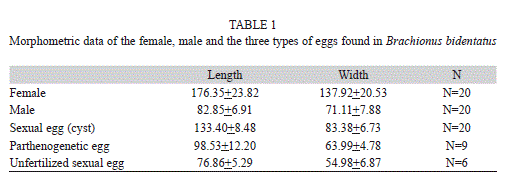
<body><![CDATA[<br> <font style="font-family: verdana;" size="2"></font> <hr style="width: 100%; height: 2px;">    <br> <font style="font-family: verdana;" size="2">The study of rotifer ultrastructure is still important for two reasons: (1) there is still a paucity of information regarding basic rotifer morphology, (2) detailed study of rotifer trophi using SEM is an useful tool to help differentiate cryptic species (Segers, Murugan &amp; Dumont, 1993). In the past, the description of new species was based on light microscopy; nowadays, we have known from the work of molecular genetics that many species are really species complexes (Gilbert &amp; Walsh, 2005; Wallace, Snell, Ricci &amp; Nogrady, 2006). <span  style="font-style: italic;">Brachionus bidentatus</span> is a freshwater rotifer that has several polymorphic characteristics (Koste, 1978; Silva-Briano 2000). Recently, one of these variants, having two anterior wing-like projections, was described as a new species after experiments demonstrated that these projections were not the result of phenotypic plasticity (Silva-Briano, Galv&aacute;n-de la Rosa, P&eacute;rez-Legaspi &amp; R. Rico-Mart&iacute;nez 2007). Rotifer ultrastructure has been studied since 1980 (Wallace et al., 2006), but unfortunately has been restricted to very few species. Perhaps the work by Cl&eacute;ment &amp; Wurdak (1991), is the most complete, and summarized findings in ultrastructure and anatomy. Their work includes transmission electron microscopy (TEM) and scanning electron microscope (SEM) photographs of the different structures found in eight species: <span  style="font-style: italic;">Asplanchna brightwellii, Brachionus calyciflorus, B. plicatilis, B. sericus, Notommata copeus, Philodina roseola, Rhinoglena frontalis, and Trichocerca rattus</span>. Recently, many studies have focused on the ultrastructure of the trophi, giving the importance of this organ in the phylum (Wallace et al., 2006).</font>    <br> <font style="font-family: verdana;" size="2"></font>    <br> <font style="font-family: verdana;" size="2">In rotifers, two types of cells have been identified in the sperm vesicle: spermatozoa and rods (Cl&eacute;ment &amp; Wurdak, 1991). The study of the ultrastructure of the spermatozoa in rotifers has been limited to the genera <span style="font-style: italic;">Asplachna</span> and <span style="font-style: italic;">Brachionus</span> (Koehler, 1965; Cl&eacute;ment, 1977; Cl&eacute;ment &amp; Wurdak, 1991). Melone &amp; Ferraguti (1993) described with details the ultrastructure of the sperm in <span style="font-style: italic;">Brachionus plicatilis</span>. The cellular body of the spermatozoon has several vesicles; the nucleus is partially condensed, and has several mitochondria and some cytoplasm. On the other hand, the rods are cells that lack flagellum and nucleus and have great secretory activity. They are composed of a dense homogeneous substance originated in the Golgi apparatus (Cl&eacute;ment &amp; Wurdak, 1991). The studies regarding rotifer ultrastructure in general and sperm cells in particular are quite limited. The goal of this work was to study the ultrastructure of female and male <span style="font-style: italic;">B. bidentatus</span>, and the three types of eggs (parthenogenetic, sexual unfertilized and sexual fertilized) using SEM and TEM. We also analyzed the trophi and the spermatic cells, and compared our findings with those previously published.     <br>     <br> </font><font style="font-family: verdana; font-weight: bold;" size="3">Materials and methods    <br>     <br> </font><font style="font-family: verdana;" size="2"><span  style="font-weight: bold;">Maintenance of the </span><span  style="font-style: italic;">Brachionus bidentatus</span><span  style="font-weight: bold;"> culture</span>: Specimens of <span  style="font-style: italic;">B. bidentatus</span> were collected from La Punta reservoir (22&deg;08&#8217;N - 102&deg;24&#8217;W) located in the municipality of Cos&iacute;o in Aguascalientes State, Mexico. Rotifer cultures were maintained in petri dishes with EPA medium at pH=7.5 (U.S. Environmental Protection Agency, 1985), that were kept in a bioclimatic chamber with a photoperiod of 16:8L: D, at 25&ordm;C. The cultures were fed 1x10<sup>6</sup>cells/mL of the chlorophyte <span style="font-style: italic;">Nannochloris oculata</span> grown in Bold&acute;s Basal Medium (Nichols, 1973).</font>    <br> <font style="font-family: verdana;" size="2"></font>    <br> <font style="font-family: verdana;" size="2"><span  style="font-weight: bold;">Egg production of </span><span  style="font-style: italic;">Brachionus bidentatus</span><span  style="font-weight: bold;"> females</span>: Neonate females were isolated at birth and placed in separate wells of a 24-well polystyrene plate (Costar Co.). Females (N=13), were monitored every two hours from birth to death. The number and type of eggs produced by each female were recorded. </font>    ]]></body>
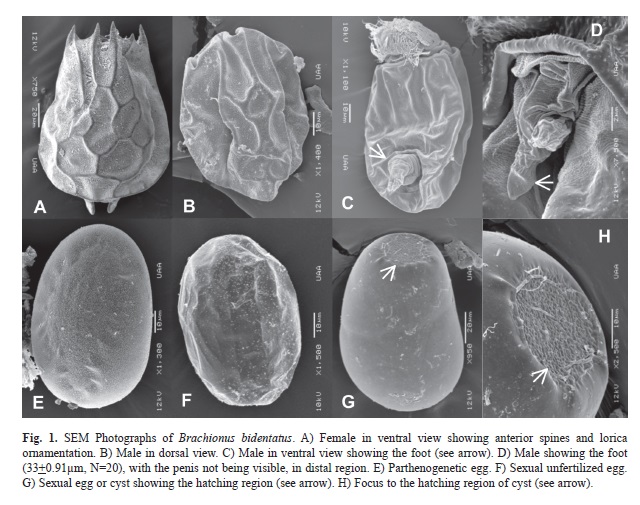
<body><![CDATA[<br> <font style="font-family: verdana;" size="2"></font>    <br> <font style="font-family: verdana;" size="2"><span  style="font-weight: bold;">Preparation of samples for SEM</span>: Fifty female specimens, 50 male specimens, and 50 cysts of the freshwater rotifer <span  style="font-style: italic;">B. bidentatus</span> previously fixed in 4% formaldehyde, were dehydrated in graded series of ethanol, then took them to critical point and mounted in an aluminum stub (1cm high and 1.2cm in diameter), and covered with gold. To study the trophi, 25 B. <span style="font-style: italic;">bidentatus</span> females were prepared according to the protocol of Segers et al (1993) with slight modifications. Briefly, this protocol consisted in isolating 25 females in a Petri dish. Then adding a drop of sodium hipochloride, and wait until the lorica was dissolved. Then the females were washed three times with distilled water and mounted in a SEM cylinder. The specimens were observed in a JEOL 5900 LV scanning electronic microscope. </font>    <br> <font style="font-family: verdana;" size="2"></font>    <br> <font style="font-family: verdana;" size="2"><span  style="font-weight: bold;">Preparation of male specimens for TEM</span>: Males of <span style="font-style: italic;">B. bidentatus</span> (N=500) were fixed in 2% Glutaraldehyde (GTA) and 4% Paraformaldehyde (PFA) with 0.16M phosphate buffer (PBS). Then, they were post-fixated with 1% osmium tetraoxide (OSO<sub>4</sub>). Later, the males were embedded in epoxic resin (EPON) and observed in a JEOL 1010 transmission microscope operated in 80kv. </font>    <br> <font style="font-family: verdana; font-weight: bold;" size="3">    <br> Results    <br>     <br> </font><font style="font-family: verdana;" size="2"><span  style="font-weight: bold;">Life cycle of </span><span  style="font-style: italic;">Brachionus bidentatus</span>: In laboratory cultures females of B. bidentatus have a lifespan of five days (mean&plusmn;one SD=4.69&plusmn;0.48; N=13), and produce 4.5&plusmn;3.67 (N=6) parthenogenetic eggs during such lifespan. Unfertilized sexual females produce up to 18 male eggs (mean&plusmn;one SD=13&plusmn;4.93; N=7). Once fertilized, sexual females produce a single diapausing embryo or cysts (mean&plusmn;one SD=1&plusmn;0; N=20). The length of time of copulation ranges from 10 to 40s (mean&plusmn;one SD=17.33&plusmn;10.55, N=7). The morphometric measurements of the adult females, males, and the three types of eggs present in B. bidentatus are shown in <a href="/img/revistas/rbt/v61n4/a14t1.gif">Table 1</a>. </font>    <br>     <div style="text-align: center;"><br style="font-weight: bold;"> </div> <font style="font-family: verdana;" size="2"><span  style="font-weight: bold;">SEM analysis of females, males and the three types of eggs</span>: The anterior ventral plate of the lorica contains two oval borders jointed to the lateral spines that in turn join the ventral and dorsal plates. Two rounded spines are present in the ventral posterior: in the female these form a semi-circular boarder from which emerges the foot. In the anterior part of the dorsal plate there are six spines, and the anterointermediate spines (Stemberger, 1979). These are 4X smaller than the anterolateral and anteromedian spines (<a  href="/img/revistas/rbt/v61n4/a14i1.jpg">Fig. 1A</a>; see arrow). There is no ornamentation in the ventral plate, only a couple of symmetric folds: these originate from the oval border (<a  href="/img/revistas/rbt/v61n4/a14i1.jpg">Fig. 1B</a>). The dorsal plate shows polygonal plates (hexagonal plates in the middle) (<a  href="/img/revistas/rbt/v61n4/a14i1.jpg">Fig. 1</a>). We observed that freshly collected specimens possessed posterior spines, but these spines were lacking in females cultured in the laboratory (<a href="/img/revistas/rbt/v61n4/a14i1.jpg">Fig. 1</a>). We infer from this observation that this particular population experienced cyclomorphosis. </font>    ]]></body>
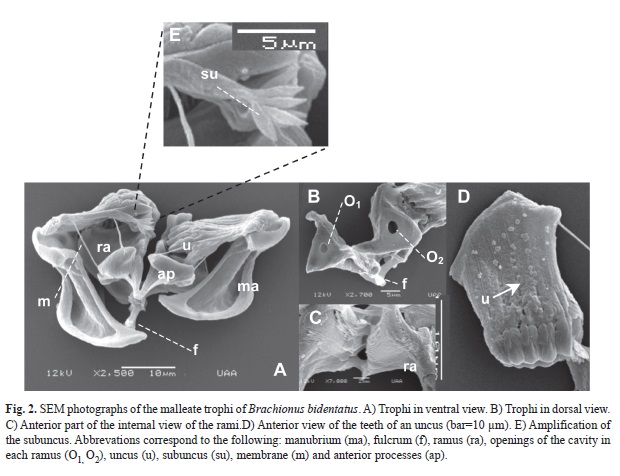
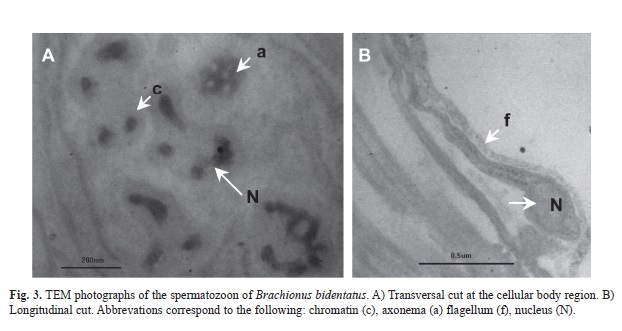
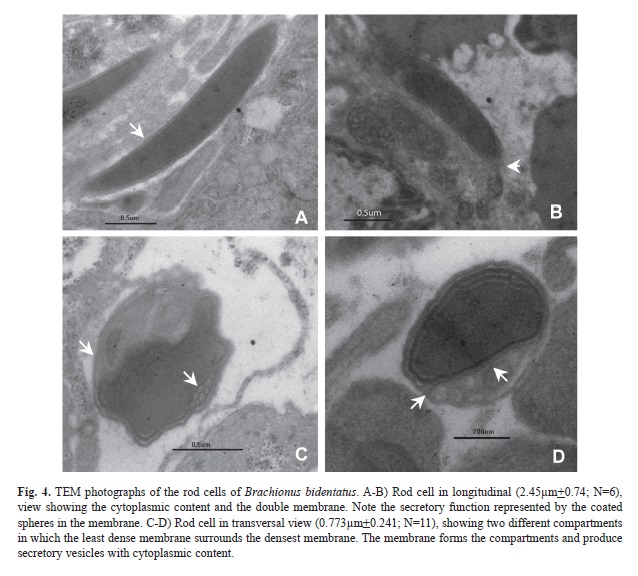
<body><![CDATA[<br> <font style="font-family: verdana;" size="2"></font>    <br> <font style="font-family: verdana;" size="2">Males can reach up to 90&micro;m in length (<a href="/img/revistas/rbt/v61n4/a14t1.gif">Table 1</a>). However their loricas lack ornamentation and spines as is present in females (<a  href="/img/revistas/rbt/v61n4/a14i1.jpg">Fig. 1C</a>). The male lorica, as in the female, is composed of the dorsal and ventral plates. The dorsal plate has a peculiar ridge. No trophi was observed in the male. Regarding the reproductive apparatus, and in contrast with other males described previously (even within the genus), where a foot and penis are clearly seen, in <span  style="font-style: italic;">B. bidentatus</span> we observed only the foot (<a href="/img/revistas/rbt/v61n4/a14i1.jpg">Fig. 1D</a>) whose mean length is 33&micro;m (<a  href="/img/revistas/rbt/v61n4/a14t1.gif">Table 1</a>). Therefore, the penis must have been retracted or hidden by the techniques used in preparing the male specimens.</font>    <br> <font style="font-family: verdana;" size="2"></font>    <br> <font style="font-family: verdana;" size="2">The parthenogenetic eggs are oval with approximately 100&micro;m length (<a href="/img/revistas/rbt/v61n4/a14t1.gif">Table 1</a>). They have a smooth surface and round contour (<a  href="/img/revistas/rbt/v61n4/a14i1.jpg">Fig. 1E</a>). A female is able to produce seven to 10 eggs during her lifespan. Usually they are unable to carry more than three eggs at a time (N=5).The length of non-fertilized, sexual eggs (male eggs) is 80&micro;m (<a  href="/img/revistas/rbt/v61n4/a14t1.gif">Table 1</a>); they possess a smooth surface, but show some borders and ridges (<a href="/img/revistas/rbt/v61n4/a14i1.jpg">Fig. 1F</a>). The fertilized sexual eggs (diapausing embryos) are oval with a very peculiar structure in their anterior part (<a  href="/img/revistas/rbt/v61n4/a14i1.jpg">Fig. 1G</a>, see arrow); the surface of the egg is smooth with a small rugose surface from which neonates hatch. Inside of this hatching area, the rugose surfaces appear to be composed of small entangled membranes (<a  href="/img/revistas/rbt/v61n4/a14i1.jpg">Fig. 1H</a>). </font>    <br> <font style="font-family: verdana;" size="2"></font>    <br> <font style="font-family: verdana;" size="2"><span  style="font-weight: bold;">Ultrastructure of the trophi:</span> The trophi of <span style="font-style: italic;">B. bidentatus</span> is malleate with bilateral symmetry, and it is composed of manubria, fulcrum, rami and unci (<a href="/img/revistas/rbt/v61n4/a14i2.jpg">Fig. 2</a>). Each manubrium is joined to its respective unci (<a href="/img/revistas/rbt/v61n4/a14i2.jpg">Fig. 2A and B</a>), which provides support while processing food. The unci have five teeth disposed from the smallest to the largest teeth in dorsal view (<a href="/img/revistas/rbt/v61n4/a14i2.jpg">Fig. 2D</a>). On the other hand, a sixth segmentation is observed appearing to be a sixth tooth, but it is in fact, the projections of the subuncus, which shows a series of small teeth similar to the bristles of a toothbrush (<a  href="/img/revistas/rbt/v61n4/a14i2.jpg">Fig. 2E</a>). The largest tooth is linked to the anterior process through a fine membrane. A third more robust membrane joins the anterior processes to the posterior part of each rami. The ramus is the structure where the teeth of each uncus collide. In the internal part of the uncus there are multiple rows of thin ridges that work in the grinding process (<a  href="/img/revistas/rbt/v61n4/a14i2.jpg">Fig. 2C</a>). Finally, the fulcrum is a cylindrical prolongation that is joined to the rami (<a  href="/img/revistas/rbt/v61n4/a14i2.jpg">Fig. 2F</a>).</font>    <br> <font style="font-family: verdana;" size="2"></font>    <br> <font style="font-family: verdana;" size="2"><span  style="font-weight: bold;">Ultrastructure of the sperm cells</span>: The spermatozoon of <span style="font-style: italic;">B. bidentatus</span> are composed of a body cell and a flagellum. The length of the cellular body is 300nm, while the flagellum is 1&#8201;700nm long (<a  href="/img/revistas/rbt/v61n4/a14i3.jpg">Fig. 3B</a>). The nucleus of the body cell shows dense areas of chromatin and an axonema in the process of disintegration (<a  href="/img/revistas/rbt/v61n4/a14i3.jpg">Fig. 3A</a>). Spermatozoan are located in specific regions of the rotifer forming a conglomerate without mixing with other cells and always surrounded by a large amount of rough endoplasmic reticulum and free ribosomes. </font>    <br> <font style="font-family: verdana;" size="2"></font>    <br> <font style="font-family: verdana;" size="2">The rods have double membrane. Their length is almost 2.45&#956;m and they are less than 1&#956;m wide (<a href="/img/revistas/rbt/v61n4/a14i4.jpg">Fig. 4</a>). In a transversal view, they have two sections: one very electrodense, in which a membrane is divided in small vesicles separated by its own membrane that in turn is covered by a less dense membrane. The second section, which is the densest area of the rod, has small vesicles in which the cytoplasmic content can be seen. The least dense region of the rod also presents a vesicular arrangement, however these vesicles may occupy the whole area of the rod. Double membranes can be observed in <a  href="/img/revistas/rbt/v61n4/a14i4.jpg">Fig. 4</a>. The least electrodense membrane covers the whole content of the rod including the densest membrane, which only surrounds the cytoplasmic content. In <a  href="/img/revistas/rbt/v61n4/a14i4.jpg">Fig. 4B and C</a>, it is possible to observe that the space surrounded by the least dense membrane is totally occupied. In this case, the small vesicles with cytoplasmic content start to separate. These vesicles are shaped spherically and can be confused with the ultrastructure of the mitochondria. Once the vesicles are separated from this region, they become elongated and are transported to a cavity in which some flagella are found.    ]]></body>
<body><![CDATA[<br>     <br> </font><font style="font-family: verdana; font-weight: bold;" size="3">Discussion    <br>     <br> </font><font style="font-family: verdana;" size="2">The study of <span  style="font-style: italic;">B. bidentatus</span> ultrastructure and sexual features have shown its importance as it allows to determine subtle, yet important, differences in sexual reproductive behavior and structure that contribute to the general knowledge of this genus, the best studied in rotifers. </font>    <br> <font style="font-family: verdana;" size="2"></font>    <br> <font style="font-family: verdana;" size="2">The cysts are not only part of the sexual cycle, but they are also capable of withstanding unfavorable conditions, thus being reservoirs of genetic diversity (G&oacute;mez &amp; Carvalho, 2000). They are characterized by differences in morphology and a darker color with respect to the parthenogenetic eggs based on observations of light microscopy; however, many other differences are clear when they are observed with electronic microscopy (Pourriot &amp; Snell, 1983). The morphology and ornamentation of the cyst observed at the electronic microscope differs in each species, and therefore can be used to clarify the relationship among cryptic species (Gilbert &amp; Wurdak, 1978). The ornamentation of the <span style="font-style: italic;">B. bidentatus</span> cyst showed several specific characteristics: there is a granular area in the anterior part of the cyst surrounded by a membrane envolving the content of the cyst. </font>    <br> <font style="font-family: verdana;" size="2"></font>    <br> <font style="font-family: verdana;" size="2">Females of <span  style="font-style: italic;">B. bidentatus</span> are widely distributed throughout the State of Aguascalientes (Silva-Briano &amp; Adabache Ortiz, 2000). The characteristics of the female are clearly described by Koste (1978). The length of the female lorica ranges between 153-578&micro;m, which agrees with Stemberger&acute;s range of 175-578&micro;m (Stemberger, 1979), and reports of mean lorica length of 315&micro;m (Rico-Mart&iacute;nez, 1999). The mating behavior of <span  style="font-style: italic;">B. bidentatus</span> was briefly described by De Ridder (1991), and Rico-Mart&iacute;nez (1999). The latest author reports a mean lorica width of 65&micro;m, and a mean number of 4.58 granular cells for the male. However, in our work the male mean lorica length was 82.85&micro;m, 71.11&micro;m of mean lorica width, and a mean number of five granular cells. We found many similarities in the mating behavior of <span  style="font-style: italic;">B. bidentatus</span> with that of other <span style="font-style: italic;">Brachionus</span> species. One difference is that the male is quite small (less than 100&micro;m long). Many rotifers males lack mastax, or if present it is degenerated. The same is true for pharynx, stomach and gastric cells (Gilbert, 1993; Snell &amp; Wallace, 2010). In the case of the male <span style="font-style: italic;">B. bidentatus</span>, the mastax is absent, but we were not able to identify the stomach using TEM and SEM. When comparing the <span  style="font-style: italic;">B. bidentatus</span> male with that of B. araceliae included in the work of Silva-Briano et al. (2007), the differences in size and general morphology were clear. </font>    <br> <font style="font-family: verdana;" size="2"></font>    <br> <font style="font-family: verdana;" size="2">Males of <span  style="font-style: italic;">B. bidentatus</span> show a region where the sexual cells are found (photographs not included), these cells are the spermatozoa and the rods. The number of sexual cells own by a male ranges from 30 to 200 (Wallace et al., 2006). In <span style="font-style: italic;">B. plicatilis</span> the spermatozoa are 40 to 45&micro;m long, and possess a cellular body and a flagellum (Melone &amp; Ferraguti, 1993). These spermatozoa are larger than that of the spermatozoa of <span style="font-style: italic;">B. bidentatus</span> which reaches only 2&micro;m long. The sexual cigar-like appearance cells are known as rods. However, in <span  style="font-style: italic;">B. bidentatus</span> the rods are only 2&micro;m long, much shorter than those of <span style="font-style: italic;">B. plicatilis</span>, which are each 15&micro;m long (Melone &amp; Ferraguti, 1993). The secretory function of the rods has been described earlier (Cl&eacute;ment &amp; Wurdak 1991), and in the present study we confirmed this finding, where transversal cuts allowed the visualization of a dense region with cytoplasmic content originated in the Golgi Apparatus (Cl&eacute;ment &amp; Wurdak 1991). Cl&eacute;ment &amp; Wurdak (1991) have described a double membrane involving the rods of <span style="font-style: italic;">Brachionus sericus</span> such membranes were also observed in <span style="font-style: italic;">B. bidentatus</span>.</font>    ]]></body>
<body><![CDATA[<br> <font style="font-family: verdana;" size="2"></font>    <br> <font style="font-family: verdana;" size="2">The observations of <span  style="font-style: italic;">B. bidentatus</span> ultrastructure presented here suggested that there are differences in general morphology, trophi, and sexual cells among members of the same genus. Even in the case of <span  style="font-style: italic;">B. araceliae</span>, which was previously described as a morphotype of <span  style="font-style: italic;">B. bidentatus</span>, the differences are striking. Therefore, if we are to achieve a deeper comprehension understanding of rotifer biology, additional studies of their ultrastructure is required.    <br>     <br> </font><font style="font-family: verdana; font-weight: bold;" size="3">Acknowledgments    <br>     <br> </font><font style="font-family: verdana;" size="2">The authors acknowledge the help of Maria de Lourdes SeguraValdez and Luis Felipe Jim&eacute;nez Garcia, and also to Araceli Adabache-Ortiz for her help with the SEM images.    <br> </font> <hr style="width: 100%; height: 2px;"><font  style="font-family: verdana; font-weight: bold;" size="3">References    <br>     <!-- ref --><br> </font><font style="font-family: verdana;" size="2">Cl&eacute;ment, P. (1977). Ultrastructural research on rotifers.<span  style="font-style: italic;"> </span>Hydrobiologia, 8, 270-297.    &nbsp;&nbsp;&nbsp;&nbsp;&nbsp;&nbsp;&nbsp;&nbsp;[&#160;<a href="javascript:void(0);" onclick="javascript: window.open('/scielo.php?script=sci_nlinks&ref=1525303&pid=S0034-7744201300050001400001&lng=','','width=640,height=500,resizable=yes,scrollbars=1,menubar=yes,');">Links</a>&#160;]<!-- end-ref --><br>     ]]></body>
<body><![CDATA[<!-- ref --><br> </font><font style="font-family: verdana;" size="2">Cl&eacute;ment, P. &amp; Wurdak, E. S . (1991). Rotifera. In F. W. Harrison &amp; E. E. Ruppert (Eds.). Microscopic Anatomy of Invertebrates, Vol. 4: Aschelmintes (219-297). New York: Wiley-Liss.    &nbsp;&nbsp;&nbsp;&nbsp;&nbsp;&nbsp;&nbsp;&nbsp;[&#160;<a href="javascript:void(0);" onclick="javascript: window.open('/scielo.php?script=sci_nlinks&ref=1525305&pid=S0034-7744201300050001400002&lng=','','width=640,height=500,resizable=yes,scrollbars=1,menubar=yes,');">Links</a>&#160;]<!-- end-ref --><br>     <!-- ref --><br> </font><font style="font-family: verdana;" size="2">De Ridder, M. (1991). Rotifers from Algeria. Journal of African Zoology, 105, 734-783.    &nbsp;&nbsp;&nbsp;&nbsp;&nbsp;&nbsp;&nbsp;&nbsp;[&#160;<a href="javascript:void(0);" onclick="javascript: window.open('/scielo.php?script=sci_nlinks&ref=1525307&pid=S0034-7744201300050001400003&lng=','','width=640,height=500,resizable=yes,scrollbars=1,menubar=yes,');">Links</a>&#160;]<!-- end-ref --><br>     <!-- ref --><br> </font><font style="font-family: verdana;" size="2">Environmental Protection Agency. (1985). Methods for measuring the acute toxicity of effluents to freshwater and marine organisms. In W. H. Peltier &amp; C. I. Weber (Eds.). EPA-600/485-013. Washington, D.C., USA. Environmental Protection Agency.    &nbsp;&nbsp;&nbsp;&nbsp;&nbsp;&nbsp;&nbsp;&nbsp;[&#160;<a href="javascript:void(0);" onclick="javascript: window.open('/scielo.php?script=sci_nlinks&ref=1525309&pid=S0034-7744201300050001400004&lng=','','width=640,height=500,resizable=yes,scrollbars=1,menubar=yes,');">Links</a>&#160;]<!-- end-ref --><br>     <!-- ref --><br> </font><font style="font-family: verdana;" size="2">Gilbert, J. J. (1993). Rotifera, Asexual Propagation and Reproductive Strategies. In K. G. Adiyodi &amp; R. G. Adiyodi (Eds.). Reproductive Biology of Invertebrates, Volumen VI, part A (p. 231-263). New Delhi: Oxford and IBH Publishing Co.    &nbsp;&nbsp;&nbsp;&nbsp;&nbsp;&nbsp;&nbsp;&nbsp;[&#160;<a href="javascript:void(0);" onclick="javascript: window.open('/scielo.php?script=sci_nlinks&ref=1525311&pid=S0034-7744201300050001400005&lng=','','width=640,height=500,resizable=yes,scrollbars=1,menubar=yes,');">Links</a>&#160;]<!-- end-ref --><br>     <!-- ref --><br> </font><font style="font-family: verdana;" size="2">Gilbert, J. J. &amp; Wurdak, E. S. (1978). Species-specific morphology of resting eggs in the Rotifer Asplancha. Transactions of the American microscopical Society, 97, 330-339.    &nbsp;&nbsp;&nbsp;&nbsp;&nbsp;&nbsp;&nbsp;&nbsp;[&#160;<a href="javascript:void(0);" onclick="javascript: window.open('/scielo.php?script=sci_nlinks&ref=1525313&pid=S0034-7744201300050001400006&lng=','','width=640,height=500,resizable=yes,scrollbars=1,menubar=yes,');">Links</a>&#160;]<!-- end-ref --><br>     ]]></body>
<body><![CDATA[<!-- ref --><br> </font><font style="font-family: verdana;" size="2">Gilbert, J. J., &amp; Walsh, E. J. (2005).Brachionus calyciflorus is a species complex: Mating behavior and genetic differentiation among four geographically isolated strains. Hydrobiologia<span  style="font-style: italic;">, </span>546, 257-265.    &nbsp;&nbsp;&nbsp;&nbsp;&nbsp;&nbsp;&nbsp;&nbsp;[&#160;<a href="javascript:void(0);" onclick="javascript: window.open('/scielo.php?script=sci_nlinks&ref=1525315&pid=S0034-7744201300050001400007&lng=','','width=640,height=500,resizable=yes,scrollbars=1,menubar=yes,');">Links</a>&#160;]<!-- end-ref --><br>     <!-- ref --><br> </font><font style="font-family: verdana;" size="2">G&oacute;mez, A. &amp; Carvalho, G. (2000). Sex, parthenogenesis and genetic structure of rotifers: microsatellite analysis of contemporary and resting egg bank populations. Molecular Ecology, 9, 203-214.    &nbsp;&nbsp;&nbsp;&nbsp;&nbsp;&nbsp;&nbsp;&nbsp;[&#160;<a href="javascript:void(0);" onclick="javascript: window.open('/scielo.php?script=sci_nlinks&ref=1525317&pid=S0034-7744201300050001400008&lng=','','width=640,height=500,resizable=yes,scrollbars=1,menubar=yes,');">Links</a>&#160;]<!-- end-ref --><br>     <!-- ref --><br> </font><font style="font-family: verdana;" size="2">Koehler, J. (1965). An electron microscopic study of the dimorphic spermatozoa of <span style="font-style: italic;">Asplanchna</span> (Rotifera). I. The adult testis. Zeitchrift f&uuml;r Zellforschung, 67, 57-76.    &nbsp;&nbsp;&nbsp;&nbsp;&nbsp;&nbsp;&nbsp;&nbsp;[&#160;<a href="javascript:void(0);" onclick="javascript: window.open('/scielo.php?script=sci_nlinks&ref=1525319&pid=S0034-7744201300050001400009&lng=','','width=640,height=500,resizable=yes,scrollbars=1,menubar=yes,');">Links</a>&#160;]<!-- end-ref --><br>     <!-- ref --><br> </font><font style="font-family: verdana;" size="2">Koste, W. (1978). Rotatoria. Ein Bestimmungswerk, begr&uuml;ndet von Max Voigt &Uuml;berordning Monogononta. (Ed.). Gebr&uuml;der Borntraeger. Berlin. Stuttgart. 10.    &nbsp;&nbsp;&nbsp;&nbsp;&nbsp;&nbsp;&nbsp;&nbsp;[&#160;<a href="javascript:void(0);" onclick="javascript: window.open('/scielo.php?script=sci_nlinks&ref=1525321&pid=S0034-7744201300050001400010&lng=','','width=640,height=500,resizable=yes,scrollbars=1,menubar=yes,');">Links</a>&#160;]<!-- end-ref --><br>     <!-- ref --><br> </font><font style="font-family: verdana;" size="2">Melone, G. &amp; Ferraguti, M. (1993). The Spermatozoon of <span  style="font-style: italic;">Brachionus plicatilis</span> (Rotifera, Monogononta), with Some Notes on Sperm Ultraestructure in Rotifera. Acta Zoologica 75(2), 81-88.    &nbsp;&nbsp;&nbsp;&nbsp;&nbsp;&nbsp;&nbsp;&nbsp;[&#160;<a href="javascript:void(0);" onclick="javascript: window.open('/scielo.php?script=sci_nlinks&ref=1525323&pid=S0034-7744201300050001400011&lng=','','width=640,height=500,resizable=yes,scrollbars=1,menubar=yes,');">Links</a>&#160;]<!-- end-ref --><br>     ]]></body>
<body><![CDATA[<!-- ref --><br> </font><font style="font-family: verdana;" size="2">Nichols, H.W. (1973). Growth media-freshwater. In J. R. Stein (Ed.). Handbook of physiological methods (p. 7-24). Cambridge MA: Cambridge University Press.    &nbsp;&nbsp;&nbsp;&nbsp;&nbsp;&nbsp;&nbsp;&nbsp;[&#160;<a href="javascript:void(0);" onclick="javascript: window.open('/scielo.php?script=sci_nlinks&ref=1525325&pid=S0034-7744201300050001400012&lng=','','width=640,height=500,resizable=yes,scrollbars=1,menubar=yes,');">Links</a>&#160;]<!-- end-ref --><br>     <!-- ref --><br> </font><font style="font-family: verdana;" size="2">Pourriot, R. &amp; Snell, T. W. (1983). Resting eggs in rotifers. Hydrobiologia, 114, 213-224.    &nbsp;&nbsp;&nbsp;&nbsp;&nbsp;&nbsp;&nbsp;&nbsp;[&#160;<a href="javascript:void(0);" onclick="javascript: window.open('/scielo.php?script=sci_nlinks&ref=1525327&pid=S0034-7744201300050001400013&lng=','','width=640,height=500,resizable=yes,scrollbars=1,menubar=yes,');">Links</a>&#160;]<!-- end-ref --><br>     <!-- ref --><br> </font><font style="font-family: verdana;" size="2">Rico-Mart&iacute;nez, R. 1999. Final Report of the project Characterization of mating behavior in several freshwater species of rotifers. International Foundation for Science (IFS). Stokholm, Sweden. 39 p.    &nbsp;&nbsp;&nbsp;&nbsp;&nbsp;&nbsp;&nbsp;&nbsp;[&#160;<a href="javascript:void(0);" onclick="javascript: window.open('/scielo.php?script=sci_nlinks&ref=1525329&pid=S0034-7744201300050001400014&lng=','','width=640,height=500,resizable=yes,scrollbars=1,menubar=yes,');">Links</a>&#160;]<!-- end-ref --><br>     <!-- ref --><br> </font><font style="font-family: verdana;" size="2">Segers, H. Murugan, G. &amp; Dumont, H. (1993). On the taxonomy of the Brachionidae: description of Plationus n. gen. (Rotifera, Monogononta). Hydrobiologia, 268, 1- 8.    &nbsp;&nbsp;&nbsp;&nbsp;&nbsp;&nbsp;&nbsp;&nbsp;[&#160;<a href="javascript:void(0);" onclick="javascript: window.open('/scielo.php?script=sci_nlinks&ref=1525331&pid=S0034-7744201300050001400015&lng=','','width=640,height=500,resizable=yes,scrollbars=1,menubar=yes,');">Links</a>&#160;]<!-- end-ref --><br>     <!-- ref --><br> </font><font style="font-family: verdana;" size="2">Silva-Briano, M. &amp; Adabache-Ortiz, A. (2000). Brachionus species in Aguascalientes State, M&eacute;xico. In M. Munawar (Ed.). Aquatic Ecosystems of M&eacute;xico. (p. 203- 211). Burlington, Ontario, Canada. Ecovision World Monograph series.    &nbsp;&nbsp;&nbsp;&nbsp;&nbsp;&nbsp;&nbsp;&nbsp;[&#160;<a href="javascript:void(0);" onclick="javascript: window.open('/scielo.php?script=sci_nlinks&ref=1525333&pid=S0034-7744201300050001400016&lng=','','width=640,height=500,resizable=yes,scrollbars=1,menubar=yes,');">Links</a>&#160;]<!-- end-ref --><br>     ]]></body>
<body><![CDATA[<!-- ref --><br> </font><font style="font-family: verdana;" size="2">Silva-Briano, M., R. Galv&aacute;n-de la Rosa, A. P&eacute;rez-Legaspi &amp; R. Rico-Mart&iacute;nez. (2007). On the description of <span  style="font-style: italic;">Brachionus araceliae</span> sp.nov. A new species of freshwater rotifer from Mexico. Hidrobiol&oacute;gica, 17(2), 179-183.    &nbsp;&nbsp;&nbsp;&nbsp;&nbsp;&nbsp;&nbsp;&nbsp;[&#160;<a href="javascript:void(0);" onclick="javascript: window.open('/scielo.php?script=sci_nlinks&ref=1525335&pid=S0034-7744201300050001400017&lng=','','width=640,height=500,resizable=yes,scrollbars=1,menubar=yes,');">Links</a>&#160;]<!-- end-ref --><br>     <!-- ref --><br> </font><font style="font-family: verdana;" size="2">Stemberger, R.S. (1979). A guide to rotifers of the Laurentian Great Lakes. EPA-600/4-79-021. Washington, D.C.: U.S. Environmental Protection Agency.    &nbsp;&nbsp;&nbsp;&nbsp;&nbsp;&nbsp;&nbsp;&nbsp;[&#160;<a href="javascript:void(0);" onclick="javascript: window.open('/scielo.php?script=sci_nlinks&ref=1525337&pid=S0034-7744201300050001400018&lng=','','width=640,height=500,resizable=yes,scrollbars=1,menubar=yes,');">Links</a>&#160;]<!-- end-ref --><br>     <!-- ref --><br> </font><font style="font-family: verdana;" size="2">Snell, T.W. &amp; Wallace, R.L. (2010). Chapter 8: Rotifera. In J.H. Thorp &amp; A. Covich. (Eds.). Ecology and Classification of North American Freshwater Invertebrates (p. 173-206). New York: Academic Press.    &nbsp;&nbsp;&nbsp;&nbsp;&nbsp;&nbsp;&nbsp;&nbsp;[&#160;<a href="javascript:void(0);" onclick="javascript: window.open('/scielo.php?script=sci_nlinks&ref=1525339&pid=S0034-7744201300050001400019&lng=','','width=640,height=500,resizable=yes,scrollbars=1,menubar=yes,');">Links</a>&#160;]<!-- end-ref --><br>     <!-- ref --><br> </font><font style="font-family: verdana;" size="2">Wallace, R.L., Snell T.W., Ricci. C. &amp; Nogrady T. (2006). Rotifera Part 1: Biology, Ecology and Systematics. Ghent, Belgium: Kenobi Productions.    &nbsp;&nbsp;&nbsp;&nbsp;&nbsp;&nbsp;&nbsp;&nbsp;[&#160;<a href="javascript:void(0);" onclick="javascript: window.open('/scielo.php?script=sci_nlinks&ref=1525341&pid=S0034-7744201300050001400020&lng=','','width=640,height=500,resizable=yes,scrollbars=1,menubar=yes,');">Links</a>&#160;]<!-- end-ref --><br>     <br> <a name="Correspondencia1"></a><a href="#Correspondencia2">*</a>Correspondencia a:</font><font style="font-family: verdana;" size="2">     <br> </font><sup><font style="font-family: verdana;" size="2"><a name="1"></a><a  href="#4">1</a></font></sup><font style="font-family: verdana;"  size="2">Gerardo Guerrero-Jim&eacute;nez. </font><font  style="font-family: verdana;" size="2">Universidad Aut&oacute;noma de Aguascalientes, Laboratorio de Toxicolog&iacute;a Acu&aacute;tica, Edificio 60. Depto. Qu&iacute;mica. Avenida Universidad 940, C.P. 20131, Aguascalientes, Ags., M&eacute;xico    ]]></body>
<body><![CDATA[<br> </font><sup><font style="font-family: verdana;" size="2"><a name="2"></a><a  href="#5">2</a></font></sup><font style="font-family: verdana;"  size="2">Guadalupe Zavala-Padilla. </font><font style="font-family: verdana;" size="2">Universidad Nacional Aut&oacute;noma de M&eacute;xico. Instituto de Biotecnolog&iacute;a. Laboratorio de Microscop&iacute;a.Av. Universidad #2001, Col. Chamilpa C.P. 62210 Cuernavaca Morelos. M&eacute;xico; gzavala@ibt.unam.mx    <br> </font><font style="font-family: verdana;" size="2"><sup><a name="3"></a><a  href="#6">3</a></sup></font><font style="font-family: verdana;"  size="2">Marcelo Silva-Briano. </font><font style="font-family: verdana;" size="2">Universidad Aut&oacute;noma de Aguascalientes Laboratorio de Ecolog&iacute;a. Edificio 202. Depto. Biolog&iacute;a. Avenida Universidad 940, C.P. 20131, Aguascalientes, Ags., M&eacute;xico; msilva@correo.uaa.mx</font>    <br> <a href="#1"><sup><font style="font-family: verdana;" size="2">1</font></sup></a><font  style="font-family: verdana;" size="2">Roberto Rico-Mart&iacute;nez. </font><font style="font-family: verdana;"  size="2"> Universidad Aut&oacute;noma de Aguascalientes, Laboratorio de Toxicolog&iacute;a Acu&aacute;tica, Edificio 60. Depto. Qu&iacute;mica. Avenida Universidad 940, C.P. 20131, Aguascalientes, Ags., M&eacute;xico; rrico@correo.uaa.mx</font> <hr style="width: 100%; height: 2px;">     <div style="text-align: center;"><font  style="font-family: verdana; font-weight: bold;" size="2">Received 22-I-2013.&nbsp;&nbsp;&nbsp;&nbsp;&nbsp;&nbsp;&nbsp; Corrected 20-IV-2013.&nbsp;&nbsp;&nbsp;&nbsp;&nbsp;&nbsp; Accepted 27-V-2013.</font>    <br> </div> </div>     <div style="text-align: center;"><font style="font-family: verdana;"  size="2"></font></div> </div> <font style="font-family: verdana;" size="2"></font>      ]]></body><back>
<ref-list>
<ref id="B1">
<nlm-citation citation-type="journal">
<person-group person-group-type="author">
<name>
<surname><![CDATA[Clément]]></surname>
<given-names><![CDATA[P.]]></given-names>
</name>
</person-group>
<article-title xml:lang="en"><![CDATA[Ultrastructural research on rotifers.]]></article-title>
<source><![CDATA[Hydrobiologia]]></source>
<year>1977</year>
<volume>8</volume>
<page-range>270-297</page-range></nlm-citation>
</ref>
<ref id="B2">
<nlm-citation citation-type="book">
<person-group person-group-type="author">
<name>
<surname><![CDATA[Clément]]></surname>
<given-names><![CDATA[P.]]></given-names>
</name>
<name>
<surname><![CDATA[Wurdak]]></surname>
<given-names><![CDATA[E. S .]]></given-names>
</name>
</person-group>
<article-title xml:lang="en"><![CDATA[Rotifera]]></article-title>
<person-group person-group-type="editor">
<name>
<surname><![CDATA[Harrison]]></surname>
<given-names><![CDATA[F. W.]]></given-names>
</name>
<name>
<surname><![CDATA[Ruppert]]></surname>
<given-names><![CDATA[E. E.]]></given-names>
</name>
</person-group>
<source><![CDATA[Microscopic Anatomy of Invertebrates]]></source>
<year>1991</year>
<volume>4</volume>
<page-range>219-297</page-range><publisher-loc><![CDATA[^eNew York New York]]></publisher-loc>
<publisher-name><![CDATA[Wiley-Liss]]></publisher-name>
</nlm-citation>
</ref>
<ref id="B3">
<nlm-citation citation-type="journal">
<person-group person-group-type="author">
<name>
<surname><![CDATA[De Ridder]]></surname>
<given-names><![CDATA[M]]></given-names>
</name>
</person-group>
<article-title xml:lang="en"><![CDATA[Rotifers from Algeria.]]></article-title>
<source><![CDATA[Journal of African Zoology]]></source>
<year>1991</year>
<volume>105</volume>
<page-range>734-783</page-range></nlm-citation>
</ref>
<ref id="B4">
<nlm-citation citation-type="book">
<collab>Environmental Protection Agency</collab>
<article-title xml:lang="en"><![CDATA[Methods for measuring the acute toxicity of effluents to freshwater and marine organisms.]]></article-title>
<person-group person-group-type="author">
<name>
<surname><![CDATA[Peltier]]></surname>
<given-names><![CDATA[W. H.]]></given-names>
</name>
<name>
<surname><![CDATA[Weber]]></surname>
<given-names><![CDATA[C. I.]]></given-names>
</name>
</person-group>
<source><![CDATA[]]></source>
<year>1985</year>
<publisher-loc><![CDATA[^eWashington, D.C. Washington, D.C.]]></publisher-loc>
<publisher-name><![CDATA[Environmental Protection Agency]]></publisher-name>
</nlm-citation>
</ref>
<ref id="B5">
<nlm-citation citation-type="book">
<person-group person-group-type="author">
<name>
<surname><![CDATA[Gilbert]]></surname>
<given-names><![CDATA[J. J]]></given-names>
</name>
</person-group>
<person-group person-group-type="editor">
<name>
<surname><![CDATA[Adiyodi]]></surname>
<given-names><![CDATA[K. G.]]></given-names>
</name>
<name>
<surname><![CDATA[Adiyodi]]></surname>
<given-names><![CDATA[R. G.]]></given-names>
</name>
</person-group>
<source><![CDATA[Reproductive Biology of Invertebrates]]></source>
<year>1993</year>
<volume>VI</volume>
<page-range>231-263</page-range><publisher-loc><![CDATA[^eNew Delhi New Delhi]]></publisher-loc>
<publisher-name><![CDATA[Oxford and IBH Publishing Co]]></publisher-name>
</nlm-citation>
</ref>
<ref id="B6">
<nlm-citation citation-type="journal">
<person-group person-group-type="author">
<name>
<surname><![CDATA[Gilbert]]></surname>
<given-names><![CDATA[J. J.]]></given-names>
</name>
<name>
<surname><![CDATA[Wurdak]]></surname>
<given-names><![CDATA[E. S.]]></given-names>
</name>
</person-group>
<article-title xml:lang="en"><![CDATA[Species-specific morphology of resting eggs in the Rotifer Asplancha.]]></article-title>
<source><![CDATA[Transactions of the American microscopical Society]]></source>
<year>1978</year>
<volume>97</volume>
<page-range>330-339</page-range></nlm-citation>
</ref>
<ref id="B7">
<nlm-citation citation-type="journal">
<person-group person-group-type="author">
<name>
<surname><![CDATA[Gilbert]]></surname>
<given-names><![CDATA[J. J.]]></given-names>
</name>
<name>
<surname><![CDATA[Walsh]]></surname>
<given-names><![CDATA[E. J.]]></given-names>
</name>
</person-group>
<article-title xml:lang="en"><![CDATA[Brachionus calyciflorus is a species complex:: Mating behavior and genetic differentiation among four geographically isolated strains]]></article-title>
<source><![CDATA[Hydrobiologia]]></source>
<year>2005</year>
<volume>546</volume>
<page-range>257-265</page-range></nlm-citation>
</ref>
<ref id="B8">
<nlm-citation citation-type="journal">
<person-group person-group-type="author">
<name>
<surname><![CDATA[Gómez]]></surname>
<given-names><![CDATA[A.]]></given-names>
</name>
<name>
<surname><![CDATA[Carvalho]]></surname>
<given-names><![CDATA[G.]]></given-names>
</name>
</person-group>
<article-title xml:lang="en"><![CDATA[Sex, parthenogenesis and genetic structure of rotifers:: microsatellite analysis of contemporary and resting egg bank populations.]]></article-title>
<source><![CDATA[Molecular Ecology]]></source>
<year>2000</year>
<volume>9</volume>
<page-range>203-214</page-range></nlm-citation>
</ref>
<ref id="B9">
<nlm-citation citation-type="journal">
<person-group person-group-type="author">
<name>
<surname><![CDATA[Koehler]]></surname>
<given-names><![CDATA[J.]]></given-names>
</name>
</person-group>
<article-title xml:lang="en"><![CDATA[An electron microscopic study of the dimorphic spermatozoa of Asplanchna (Rotifera).: I. The adult testis.]]></article-title>
<source><![CDATA[Zeitchrift für Zellforschung]]></source>
<year>1965</year>
<volume>67</volume>
<page-range>57-76</page-range></nlm-citation>
</ref>
<ref id="B10">
<nlm-citation citation-type="book">
<person-group person-group-type="author">
<name>
<surname><![CDATA[Koste]]></surname>
<given-names><![CDATA[W.]]></given-names>
</name>
</person-group>
<source><![CDATA[Rotatoria. Ein Bestimmungswerk, begründet von Max Voigt Überordning Monogononta.]]></source>
<year>1978</year>
<page-range>10</page-range><publisher-loc><![CDATA[Gebrüder Borntraeger^eBerlin Berlin]]></publisher-loc>
<publisher-name><![CDATA[Stuttgart]]></publisher-name>
</nlm-citation>
</ref>
<ref id="B11">
<nlm-citation citation-type="journal">
<person-group person-group-type="author">
<name>
<surname><![CDATA[Melone]]></surname>
<given-names><![CDATA[G.]]></given-names>
</name>
<name>
<surname><![CDATA[Ferraguti]]></surname>
<given-names><![CDATA[M.]]></given-names>
</name>
</person-group>
<article-title xml:lang="en"><![CDATA[The Spermatozoon of Brachionus plicatilis (Rotifera, Monogononta), with Some Notes on Sperm Ultraestructure in Rotifera.]]></article-title>
<source><![CDATA[Acta Zoologica]]></source>
<year>1993</year>
<volume>75</volume>
<numero>2</numero>
<issue>2</issue>
<page-range>81-88</page-range></nlm-citation>
</ref>
<ref id="B12">
<nlm-citation citation-type="book">
<person-group person-group-type="author">
<name>
<surname><![CDATA[Nichols]]></surname>
<given-names><![CDATA[H.W.]]></given-names>
</name>
</person-group>
<article-title xml:lang="en"><![CDATA[Growth media-freshwater.]]></article-title>
<person-group person-group-type="editor">
<name>
<surname><![CDATA[Stein]]></surname>
<given-names><![CDATA[J. R.]]></given-names>
</name>
</person-group>
<source><![CDATA[Handbook of physiological methods]]></source>
<year>1973</year>
<page-range>7-24</page-range><publisher-loc><![CDATA[^eCambridge MA Cambridge MA]]></publisher-loc>
<publisher-name><![CDATA[Cambridge University Press]]></publisher-name>
</nlm-citation>
</ref>
<ref id="B13">
<nlm-citation citation-type="journal">
<person-group person-group-type="author">
<name>
<surname><![CDATA[Pourriot]]></surname>
<given-names><![CDATA[R.]]></given-names>
</name>
<name>
<surname><![CDATA[Snell]]></surname>
<given-names><![CDATA[T. W.]]></given-names>
</name>
</person-group>
<article-title xml:lang="en"><![CDATA[Resting eggs in rotifers.]]></article-title>
<source><![CDATA[Hydrobiologia]]></source>
<year>1983</year>
<volume>114</volume>
<page-range>213-224</page-range></nlm-citation>
</ref>
<ref id="B14">
<nlm-citation citation-type="book">
<person-group person-group-type="author">
<name>
<surname><![CDATA[Rico-Martínez]]></surname>
<given-names><![CDATA[R.]]></given-names>
</name>
</person-group>
<source><![CDATA[Final Report of the project Characterization of mating behavior in several freshwater species of rotifers.]]></source>
<year>1999</year>
<page-range>39</page-range><publisher-loc><![CDATA[^eStokholm Stokholm]]></publisher-loc>
<publisher-name><![CDATA[International Foundation for Science (IFS).]]></publisher-name>
</nlm-citation>
</ref>
<ref id="B15">
<nlm-citation citation-type="journal">
<person-group person-group-type="author">
<name>
<surname><![CDATA[Segers]]></surname>
<given-names><![CDATA[H.]]></given-names>
</name>
<name>
<surname><![CDATA[Murugan]]></surname>
<given-names><![CDATA[G.]]></given-names>
</name>
<name>
<surname><![CDATA[Dumont]]></surname>
<given-names><![CDATA[H.]]></given-names>
</name>
</person-group>
<article-title xml:lang="en"><![CDATA[On the taxonomy of the Brachionidae: description of Plationus n. gen. (Rotifera, Monogononta)]]></article-title>
<source><![CDATA[Hydrobiologia]]></source>
<year>1993</year>
<volume>268</volume>
<page-range>1- 8</page-range></nlm-citation>
</ref>
<ref id="B16">
<nlm-citation citation-type="book">
<person-group person-group-type="author">
<name>
<surname><![CDATA[Silva-Briano]]></surname>
<given-names><![CDATA[M.]]></given-names>
</name>
<name>
<surname><![CDATA[Adabache-Ortiz]]></surname>
<given-names><![CDATA[A.]]></given-names>
</name>
</person-group>
<article-title xml:lang="en"><![CDATA[Brachionus species in Aguascalientes State, México.]]></article-title>
<person-group person-group-type="editor">
<name>
<surname><![CDATA[Munawar]]></surname>
<given-names><![CDATA[M.]]></given-names>
</name>
</person-group>
<source><![CDATA[Aquatic Ecosystems of México.]]></source>
<year>2000</year>
<page-range>203- 211</page-range><publisher-loc><![CDATA[Burlington^eOntario Ontario]]></publisher-loc>
<publisher-name><![CDATA[Ecovision World Monograph series]]></publisher-name>
</nlm-citation>
</ref>
<ref id="B17">
<nlm-citation citation-type="journal">
<person-group person-group-type="author">
<name>
<surname><![CDATA[Silva-Briano]]></surname>
<given-names><![CDATA[M.]]></given-names>
</name>
<name>
<surname><![CDATA[Galván-de la Rosa]]></surname>
<given-names><![CDATA[R.]]></given-names>
</name>
<name>
<surname><![CDATA[Pérez-Legaspi]]></surname>
<given-names><![CDATA[A.]]></given-names>
</name>
<name>
<surname><![CDATA[Rico-Martínez]]></surname>
<given-names><![CDATA[R]]></given-names>
</name>
</person-group>
<article-title xml:lang="en"><![CDATA[On the description of Brachionus araceliae sp.nov. A new species of freshwater rotifer from Mexico.]]></article-title>
<source><![CDATA[Hidrobiológica]]></source>
<year>2007</year>
<volume>17</volume>
<numero>2</numero>
<issue>2</issue>
<page-range>179-183</page-range></nlm-citation>
</ref>
<ref id="B18">
<nlm-citation citation-type="book">
<person-group person-group-type="author">
<name>
<surname><![CDATA[Stemberger]]></surname>
<given-names><![CDATA[R.S.]]></given-names>
</name>
</person-group>
<source><![CDATA[A guide to rotifers of the Laurentian Great Lakes.]]></source>
<year>1979</year>
<publisher-loc><![CDATA[^eWashington, D.C. Washington, D.C.]]></publisher-loc>
<publisher-name><![CDATA[U.S. Environmental Protection Agency]]></publisher-name>
</nlm-citation>
</ref>
<ref id="B19">
<nlm-citation citation-type="book">
<person-group person-group-type="author">
<name>
<surname><![CDATA[Snell]]></surname>
<given-names><![CDATA[T.W.]]></given-names>
</name>
<name>
<surname><![CDATA[Wallace]]></surname>
<given-names><![CDATA[R.L.]]></given-names>
</name>
</person-group>
<article-title xml:lang="en"><![CDATA[Chapter 8:: Rotifera]]></article-title>
<person-group person-group-type="editor">
<name>
<surname><![CDATA[Thorp]]></surname>
<given-names><![CDATA[J.H.]]></given-names>
</name>
<name>
<surname><![CDATA[Covich]]></surname>
<given-names><![CDATA[A.]]></given-names>
</name>
</person-group>
<source><![CDATA[Ecology and Classification of North American Freshwater Invertebrates]]></source>
<year>2010</year>
<page-range>173-206</page-range><publisher-loc><![CDATA[^eNew York New York]]></publisher-loc>
<publisher-name><![CDATA[Academic Press]]></publisher-name>
</nlm-citation>
</ref>
<ref id="B20">
<nlm-citation citation-type="book">
<person-group person-group-type="author">
<name>
<surname><![CDATA[Wallace]]></surname>
<given-names><![CDATA[R.L.]]></given-names>
</name>
<name>
<surname><![CDATA[Snell]]></surname>
<given-names><![CDATA[T.W.]]></given-names>
</name>
<name>
<surname><![CDATA[Ricci]]></surname>
<given-names><![CDATA[C.]]></given-names>
</name>
<name>
<surname><![CDATA[Nogrady]]></surname>
<given-names><![CDATA[T.]]></given-names>
</name>
</person-group>
<source><![CDATA[Rotifera]]></source>
<year>2006</year>
<publisher-loc><![CDATA[Ghent^eBelgium Belgium]]></publisher-loc>
<publisher-name><![CDATA[Kenobi Productions]]></publisher-name>
</nlm-citation>
</ref>
</ref-list>
</back>
</article>