<?xml version="1.0" encoding="ISO-8859-1"?><article xmlns:mml="http://www.w3.org/1998/Math/MathML" xmlns:xlink="http://www.w3.org/1999/xlink" xmlns:xsi="http://www.w3.org/2001/XMLSchema-instance">
<front>
<journal-meta>
<journal-id>0034-7744</journal-id>
<journal-title><![CDATA[Revista de Biología Tropical]]></journal-title>
<abbrev-journal-title><![CDATA[Rev. biol. trop]]></abbrev-journal-title>
<issn>0034-7744</issn>
<publisher>
<publisher-name><![CDATA[Universidad de Costa Rica]]></publisher-name>
</publisher>
</journal-meta>
<article-meta>
<article-id>S0034-77442013000400030</article-id>
<title-group>
<article-title xml:lang="es"><![CDATA[Demografía poblacional de Rhinella arenarum (Anura: Bufonidae) y Physalaemus biligonigerus (Anura: Leiuperidae) en agroecosistemas de la provincia de Córdoba, Argentina]]></article-title>
<article-title xml:lang="en"><![CDATA[Population demography in Rhinella arenarum (Anura: Bufonidae) and Physalaemus biligonigerus (Anura: Leiuperidae) in agroecosystems in the province of Córdoba, Argentina]]></article-title>
</title-group>
<contrib-group>
<contrib contrib-type="author">
<name>
<surname><![CDATA[Bionda]]></surname>
<given-names><![CDATA[Clarisa]]></given-names>
</name>
<xref ref-type="aff" rid="A01"/>
</contrib>
<contrib contrib-type="author">
<name>
<surname><![CDATA[Lajmanovich]]></surname>
<given-names><![CDATA[Rafael]]></given-names>
</name>
<xref ref-type="aff" rid="A02"/>
</contrib>
<contrib contrib-type="author">
<name>
<surname><![CDATA[Salas]]></surname>
<given-names><![CDATA[Nancy]]></given-names>
</name>
<xref ref-type="aff" rid="A01"/>
</contrib>
<contrib contrib-type="author">
<name>
<surname><![CDATA[Martino]]></surname>
<given-names><![CDATA[Adolfo]]></given-names>
</name>
<xref ref-type="aff" rid="A01"/>
</contrib>
<contrib contrib-type="author">
<name>
<surname><![CDATA[di Tada]]></surname>
<given-names><![CDATA[Ismael]]></given-names>
</name>
<xref ref-type="aff" rid="A01"/>
</contrib>
</contrib-group>
<aff id="A01">
<institution><![CDATA[,Universidad Nacional de Río Cuarto  ]]></institution>
<addr-line><![CDATA[Río Cuarto Córdoba]]></addr-line>
<country>Argentina</country>
</aff>
<aff id="A02">
<institution><![CDATA[,Facultad de Bioquímica y Ciencias Biológicas  ]]></institution>
<addr-line><![CDATA[ Santa Fe]]></addr-line>
<country>Argentina</country>
</aff>
<aff id="A03">
<institution><![CDATA[,Consejo Nacional de Investigaciones Científicas y Técnicas (CONICET)  ]]></institution>
<addr-line><![CDATA[ ]]></addr-line>
<country>Argentina</country>
</aff>
<pub-date pub-type="pub">
<day>00</day>
<month>09</month>
<year>2013</year>
</pub-date>
<pub-date pub-type="epub">
<day>00</day>
<month>09</month>
<year>2013</year>
</pub-date>
<volume>61</volume>
<numero>3</numero>
<fpage>1389</fpage>
<lpage>1400</lpage>
<copyright-statement/>
<copyright-year/>
<self-uri xlink:href="http://www.scielo.sa.cr/scielo.php?script=sci_arttext&amp;pid=S0034-77442013000400030&amp;lng=en&amp;nrm=iso"></self-uri><self-uri xlink:href="http://www.scielo.sa.cr/scielo.php?script=sci_abstract&amp;pid=S0034-77442013000400030&amp;lng=en&amp;nrm=iso"></self-uri><self-uri xlink:href="http://www.scielo.sa.cr/scielo.php?script=sci_pdf&amp;pid=S0034-77442013000400030&amp;lng=en&amp;nrm=iso"></self-uri><abstract abstract-type="short" xml:lang="en"><p><![CDATA[The advancing agricultural frontier has led to an important loss of natural habitats, with significant consequences for biodiversity. The demography for two species of anurans, Physalaemus biligonigerus and Rhinella arenarum, both associated with agricultural systems in the central region of the Córdoba Province, were analyzed and compared in this study. Four sites were sampled: three agroecosystems with different alteration degrees (C1, C2 and SM1) and a fourth site not cultivated (SM2). The sampling was conducted during two reproductive periods, from September 2008 to April 2009 and September 2009 to April 2010. Individuals were captured using live pitfall traps for the metamorphic, juveniles and adults; and visual encounter survey, for the capture of eggs and larvae. With the abundance data, the survival for each age class was estimated using the KNM method (Kiritani Nakasuki Manly). With survival rates and fertility population, Leslie matrices were elaborated to obtain a quantitative projection of the population size. Altered environments showed lower eggs and larvae survival. Population pro-jections were favorable in the site SM2 and were less favorable and a tendency to extinction, in sites dominated by crops. This study showed that the agroecosystems of this region are possibly inhospitable environments for reproduction and survival of the species studied. The aquatic stages in the life cycle of both species would be the more affected, since water bodies deterioration is present or may occur in those areas. We can recognize species-specific effects of agricultural ecosystems; P. biligonigerus was the most affected species, possibly because of their life histories and habitat requirements. We suggested that environmental degradation caused by the cropland in the central region of Argentina would impact on the demographics of the anuran populations in the area.]]></p></abstract>
<abstract abstract-type="short" xml:lang="es"><p><![CDATA[El crecimiento de la agricultura produce pérdida del hábitat natural, con consecuencias para la biodiversidad de los anfibios. Se analizó la demografía poblacional de dos especies de anfibios en agroecosistemas de la provincia de Córdoba, Rhinella arenarum y Physalaemus biligonigerus. Los muestreos se realizaron en tres agroecosistemas y en un cuarto sitio, no afectado por cultivos. Los individuos se capturaron utilizando trampas de caída viva y relevamientos visuales. Con los datos de abundancia se estimó la supervivencia para cada clase de edad y con las tasas de supervivencia y fertilidad poblacional, se construyeron matrices de Leslie para obtener una proyección cuantitativa del tamaño poblacional. Las proyecciones poblacionales fueron favorables para el sitio SM2 y desfavorables para los sitios cultivados. Los agroecosistemas son ambientes posiblemente inhóspitos para la reproducción y supervivencia de las especies estudiadas. Particularmente se ven afectados aquellos estadios acuáticos del ciclo de vida de estas especies, debido al deterioro de los cuerpos de agua en estas áreas. Se reconocieron efectos especie-específicos de los ecosistemas agrícolas, ya que P. biligonigerus resultó la especie más afectada. Se sugiere un deterioro ambiental producido por cultivos extensivos de soja, lo que impactaría la demografía de las poblaciones de anuros.]]></p></abstract>
<kwd-group>
<kwd lng="en"><![CDATA[population demography]]></kwd>
<kwd lng="en"><![CDATA[Rhinella arenarum]]></kwd>
<kwd lng="en"><![CDATA[Physalaemus biligonigerus]]></kwd>
<kwd lng="en"><![CDATA[survival]]></kwd>
<kwd lng="en"><![CDATA[fertility]]></kwd>
<kwd lng="en"><![CDATA[agroecosystems]]></kwd>
<kwd lng="es"><![CDATA[demografía poblacional]]></kwd>
<kwd lng="es"><![CDATA[Rhinella arenarum]]></kwd>
<kwd lng="es"><![CDATA[Physalaemus biligonigeru]]></kwd>
<kwd lng="es"><![CDATA[supervivencia]]></kwd>
<kwd lng="es"><![CDATA[fertilidad]]></kwd>
<kwd lng="es"><![CDATA[agroecosistemas]]></kwd>
</kwd-group>
</article-meta>
</front><body><![CDATA[ <div style="text-align: center;"><font size="4"><span  style="font-family: verdana; font-weight: bold;">Demograf&iacute;a poblacional de </span><span style="font-family: verdana; font-style: italic;">Rhinella arenarum</span><span style="font-family: verdana; font-weight: bold;"> (Anura: Bufonidae) y </span><span  style="font-family: verdana; font-style: italic;">Physalaemus biligonigerus</span><span  style="font-family: verdana; font-weight: bold;"> (Anura: Leiuperidae) en agroecosistemas de la provincia de C&oacute;rdoba, Argentina    <br> </span></font><font size="4"><span  style="font-family: verdana; font-weight: bold;">    <br> Population demography in </span></font><font size="4"><span  style="font-family: verdana; font-style: italic;">Rhinella arenarum</span><span style="font-family: verdana; font-weight: bold;"> (Anura: Bufonidae) and </span></font><font size="4"><span  style="font-family: verdana; font-style: italic;">hysalaemus biligonigerus</span><span  style="font-family: verdana; font-weight: bold;"> (Anura: Leiuperidae) in agroecosystems in the province of C&oacute;rdoba, Argentina</span></font><font size="2"><span  style="font-family: verdana;"><span style="font-weight: bold;"></span></span></font><br  style="font-family: verdana;"> </div> <font size="2"><br style="font-family: verdana;"> </font>     <div style="text-align: justify;">     <div style="text-align: center;"><font size="2"><span  style="font-family: verdana;">Clarisa Bionda<sup><a href="#1">1</a><a  name="4"></a>*,<a href="#3">3</a><a name="6"></a>*</sup>, Rafael Lajmanovich<sup><a href="#2">2</a><a name="5"></a>*,<a href="#3">3</a></sup>, Nancy Salas<a href="#1"><sup>1</sup></a>, Adolfo Martino<a href="#1"><sup>1</sup></a> &amp; Ismael di Tada<a href="#1"><sup>1</sup></a></span></font>    <br> <br style="font-family: verdana;"> </div> <font size="2"><span style="font-family: verdana;"><a  name="Correspondencia2"></a>*<a href="#Correspomdencia1">Direcci&oacute;n para correspondencia:</a></span></font><br style="font-family: verdana;"> <font size="2"><span style="font-family: verdana;"></span></font></div> <hr  style="width: 100%; height: 2px; margin-left: 0px; margin-right: 0px;">     <div style="text-align: justify;"><font size="3"><span  style="font-family: verdana; font-weight: bold;">Abstract</span></font><br  style="font-family: verdana;"> <font size="2"></font><br style="font-family: verdana;"> <font size="2"><span style="font-family: verdana;"><span  style="font-weight: bold;"></span><span style="font-weight: bold;"></span> The advancing agricultural frontier has led to an important loss of natural habitats, with significant consequences for biodiversity. The demography for two species of anurans, <span  style="font-style: italic;">Physalaemus biligonigerus</span> and <span style="font-style: italic;">Rhinella arenarum</span>, both associated with agricultural systems in the central region of the C&oacute;rdoba Province, were analyzed and compared in this study. Four sites were sampled: three agroecosystems with different alteration degrees (C1, C2 and SM1) and a fourth site not cultivated (SM2). The sampling was conducted during two reproductive periods, from September 2008 to April 2009 and September 2009 to April 2010. Individuals were captured using live pitfall traps for the metamorphic, juveniles and adults; and visual encounter survey, for the capture of eggs and larvae. With the abundance data, the survival for each age class was estimated using the KNM method (Kiritani Nakasuki Manly). With survival rates and fertility population, Leslie matrices were elaborated to obtain a quantitative projection of the population size. Altered environments showed lower eggs and larvae survival. Population pro-jections were favorable in the site SM2 and were less favorable and a tendency to extinction, in sites dominated by crops. This study showed that the agroecosystems of this region are possibly inhospitable environments for reproduction and survival of the species studied. The aquatic stages in the life cycle of both species would be the more affected, since water bodies deterioration is present or may occur in those areas. We can recognize species-specific effects of agricultural ecosystems; <span  style="font-style: italic;">P. biligonigerus</span> was the most affected species, possibly because of their life histories and habitat requirements. We suggested that environmental degradation caused by the cropland in the central region of Argentina would impact on the demographics of the anuran populations in the area. </span></font><br  style="font-family: verdana;"> <font size="2"></font><br style="font-family: verdana;"> <font size="2"><span style="font-family: verdana;"><span  style="font-weight: bold;">Key words:</span> population demography, <span style="font-style: italic;">Rhinella arenarum</span>, <span  style="font-style: italic;">Physalaemus biligonigerus</span>, survival, fertility, agroecosystems.</span></font><br style="font-family: verdana;"> <font size="2">&nbsp; <span style="font-family: verdana;"></span><span  style="font-family: verdana;">&nbsp;</span></font><br  style="font-family: verdana;"> <font size="3"><span style="font-family: verdana; font-weight: bold;">Resumen</span></font><br  style="font-family: verdana;"> <font size="2"></font><br style="font-family: verdana;"> <font size="2"><span style="font-family: verdana;">El crecimiento de la agricultura produce p&eacute;rdida del h&aacute;bitat natural, con consecuencias para la biodiversidad de los anfibios. Se analiz&oacute; la demograf&iacute;a poblacional de dos especies de anfibios en agroecosistemas de la provincia de C&oacute;rdoba, <span  style="font-style: italic;">Rhinella arenarum</span> y <span style="font-style: italic;">Physalaemus biligonigerus</span>. Los muestreos se realizaron en tres agroecosistemas y en un cuarto sitio, no afectado por cultivos. Los individuos se capturaron utilizando trampas de ca&iacute;da viva y relevamientos visuales. Con los datos de abundancia se estim&oacute; la supervivencia para cada clase de edad y con las tasas de supervivencia y fertilidad poblacional, se construyeron matrices de Leslie para obtener una proyecci&oacute;n cuantitativa del tama&ntilde;o poblacional. Las proyecciones poblacionales fueron favorables para el sitio SM2 y desfavorables para los sitios cultivados. Los agroecosistemas son ambientes posiblemente inh&oacute;spitos para la reproducci&oacute;n y supervivencia de las especies estudiadas. Particularmente se ven afectados aquellos estadios acu&aacute;ticos del ciclo de vida de estas especies, debido al deterioro de los cuerpos de agua en estas &aacute;reas. Se reconocieron efectos especie-espec&iacute;ficos de los ecosistemas agr&iacute;colas, ya que <span style="font-style: italic;">P. biligonigerus</span> result&oacute; la especie m&aacute;s afectada. Se sugiere un deterioro ambiental producido por cultivos extensivos de soja, lo que impactar&iacute;a la demograf&iacute;a de las poblaciones de anuros.</span></font><br style="font-family: verdana;"> <font size="2"></font><br style="font-family: verdana;"> <font size="2"><span style="font-family: verdana;"><span  style="font-weight: bold;">Palabras clave:</span> demograf&iacute;a poblacional, <span style="font-style: italic;">Rhinella arenarum</span>, Physalaemus biligonigeru, supervivencia, fertilidad, agroecosistemas.</span><span  style="font-family: verdana;">&nbsp;</span></font><br  style="font-family: verdana;"> </div> <hr  style="width: 100%; height: 2px; margin-left: 0px; margin-right: 0px;">     <div style="text-align: justify;"><font size="2"><span      style="font-family: verdana;">La proporci&oacute;n de bosques     transformados en tierras agr&iacute;colas est&aacute; creciendo     ]]></body>
<body><![CDATA[r&aacute;pidamente en algunas &aacute;reas Neotropicales.     Particularmente, la regi&oacute;n central de Argentina ha sido afectada     por el desarrollo agr&iacute;cola (Pengue 2005, Rossi 2006), con una     clara tendencia de reemplazo de la agricultura tradicional por una     producci&oacute;n m&aacute;s especializada, principalmente en la     obtenci&oacute;n de soja (<span style="font-style: italic;">Glycine max</span>     L.). Este progreso de la     agricultura ha convertido a la regi&oacute;n en un importante     productor, procesador y exportador de granos, aceite y harina de soja     (Pengue 2005, Altieri &amp; Pengue 2006). Sin embargo, esta actividad     ]]></body>
<body><![CDATA[se ha convertido en la principal causa de reducci&oacute;n,     fragmentaci&oacute;n y deterioro del h&aacute;bitat natural y, en     consecuencia, es considerada un factor relevante en la     declinaci&oacute;n registrada en las poblaciones de anfibios en las     &uacute;ltimas d&eacute;cadas (di Tada <span      style="font-style: italic;">et al.</span> 1996, Wake 1998, Davidson     <span style="font-style: italic;">et al.</span> 2002, Stuart <span      style="font-style: italic;">et al.</span> 2004, Beebee &amp; Griffiths     2005, Collins     &amp; Crump 2009, Peltzer <span style="font-style: italic;">et al.</span>     ]]></body>
<body><![CDATA[2011).</span></font><br style="font-family: verdana;">     <font size="2"></font><br style="font-family: verdana;">     <font size="2"><span style="font-family: verdana;">En este contexto,     resulta valioso     el conocimiento sobre la demograf&iacute;a de las poblaciones de     anfibios que habitan los ecosistemas agr&iacute;colas (Heyer 1974,     Wilbur 1980, Guerry &amp; Hunter 2002), ya que al estimar     par&aacute;metros poblacionales, se puede establecer el estado de     conservaci&oacute;n de las especies. De esta manera, es posible     determinar si las poblaciones de anfibios que habitan agroecosistemas     ]]></body>
<body><![CDATA[son afectadas por dicha actividad, o si simplemente manifiestan     fluctuaciones naturales en sus tama&ntilde;os poblacionales (Beebee     1996). Las &aacute;reas cultivadas, entre otras consecuencias, producen     la alteraci&oacute;n de los ambientes acu&aacute;ticos o un deterioro     en la calidad de los mismos, en particular en la duraci&oacute;n del     hidroperiodo, que puede afectar la supervivencia de huevos y larvas de     anfibios (Carey &amp; Bryant 1995, Taylor <span      style="font-style: italic;">et al.</span> 2005, Altig <span      style="font-style: italic;">et al.</span>     2007, Peltzer <span style="font-style: italic;">et al.</span> 2008).     ]]></body>
<body><![CDATA[Estos efectos tienden a modificar los     rasgos de historias de vida como tama&ntilde;o y condici&oacute;n     corporal, supervivencia, fertilidad, entre otros (M&aacute;rquez     Garc&iacute;a <span style="font-style: italic;">et al.</span> 2009,     Bionda <span style="font-style: italic;">et al.</span> 2012), que en     &uacute;ltima     instancia podr&iacute;an comprometer la permanencia de las poblaciones     en el tiempo. La determinaci&oacute;n de la fecundidad y la     supervivencia constituyen par&aacute;metros b&aacute;sicos de una     poblaci&oacute;n, ya que proveen informaci&oacute;n acerca de las     ]]></body>
<body><![CDATA[variaciones demogr&aacute;ficas, como las fluctuaciones     num&eacute;ricas o la magnitud del crecimiento poblacional (Carey 1993,     Shaffer 1994, Sinsch <span style="font-style: italic;">et al.</span>     2001), que permitir&iacute;a esclarecer de     qu&eacute; manera ambientes como los agroecosistemas pueden afectar a     las poblaciones de anfibios. En este trabajo nos proponemos analizar la     demograf&iacute;a poblacional de dos especies de anfibios asociadas a     sistemas agr&iacute;colas de la regi&oacute;n central de la provincia     de C&oacute;rdoba, <span style="font-style: italic;">Rhinella arenarum</span>     Hensel 1867, y </span><span style="font-family: verdana;"><span     ]]></body>
<body><![CDATA[ style="font-style: italic;">Physalaemus biligonigerus</span> Cope     1861. </span></font><br style="font-family: verdana;">     <font size="2"></font><br style="font-family: verdana;">     <font size="3"><span style="font-family: verdana; font-weight: bold;">Materiales     y m&eacute;todos</span></font><br style="font-family: verdana;">     <font size="2"></font><br style="font-family: verdana;">     <font size="2"><span style="font-family: verdana;">Los sitios de     muestreo se     encuentran en los alrededores de la localidad de R&iacute;o Cuarto     (33&ordm;07&#8217;55&#8217;&#8217;18&#8217;&#8217; S - 64&ordm;21&#8217;08&#8217;&#8217;96&#8217;&#8217; W), provincia de     ]]></body>
<body><![CDATA[C&oacute;rdoba, Argentina. La regi&oacute;n se caracteriza por tener     clima semiseco, con tendencia a semih&uacute;medo. Las lluvias     m&aacute;ximas ocurren durante el periodo octubre-marzo, con una media     anual de 800-1 000mm (Bionda 2011, Gatica <span      style="font-style: italic;">et al.</span> 2012). La     fisiograf&iacute;a del &aacute;rea de estudio corresponde a llanuras     suavemente onduladas. La escasa pendiente favorece el estancamiento de     las aguas, sumado al aporte subterr&aacute;neo que junto con las     precipitaciones, ayuda a mantener cursos de agua permanentes     (Bridarolli &amp; di Tada 1996).</span></font><br     ]]></body>
<body><![CDATA[ style="font-family: verdana;">     <font size="2"></font><br style="font-family: verdana;">     <font size="2"><span style="font-family: verdana;">La selecci&oacute;n     de las     especies, <span style="font-style: italic;">R. arenarum</span> y <span      style="font-style: italic;">P. biligonigerus</span>, se bas&oacute; en     su     representatividad en las comunidades de anfibios de la regi&oacute;n de     estudio (Bionda <span style="font-style: italic;">et al.</span>     2011a). Ambas especies de anuros presentan una     ]]></body>
<body><![CDATA[amplia distribuci&oacute;n en el Neotr&oacute;pico, siendo encontradas     en Argentina, Bolivia, Brasil, Uruguay y Paraguay (IUCN 2011), y     est&aacute;n consideradas como especies No Amenazadas (Lavilla <span      style="font-style: italic;">et al.</span>     2000) o de Preocupaci&oacute;n Menor (IUCN 2011). La recolecci&oacute;n     de los espec&iacute;menes fue realizada en cuatro sitios, tres de ellos     se encuentran en zonas de cultivos de soja: Sitio Cultivo 1 (C1,     33&ordm;05&#8217;54&#8217;&#8217;38&#8217;&#8217; S - 64&ordm;26&#8217;04&#8217;&#8217;76&#8217;&#8217; W), Sitio Cultivo 2 (C2,     33&ordm;05&#8217;54&#8217;&#8217;79&#8217;&#8217; S - 64&ordm;25&#8217;46&#8217;&#8217;77&#8217;&#8217; W) y Sitio Semimodificado 1     (SM1, 33&ordm;05&#8217;39&#8217;&#8217;29&#8217;&#8217; S - 64&ordm;25&#8217;57&#8217;&#8217;72&#8217;&#8217; W). Los tres sitios     ]]></body>
<body><![CDATA[presentan distintos grados de alteraci&oacute;n en relaci&oacute;n a la     distancia de los cultivos a los cuerpos de agua. En C1 y C2, los     cultivos est&aacute;n a escasos metros de los cuerpos de agua (15m     aproximadamente), mientras que en SM1 se encuentran m&aacute;s alejados     (200m aproximadamente). En los tres sitios existe la pr&aacute;ctica     ganadera, aunque el sitio C1 presenta esta actividad con una mayor     intensidad (presencia de ganado a diario y en cercan&iacute;a o dentro     de lagunas). El cuarto sitio de muestreo, llamado Sitio Semimodificado     2 (SM2, 33&ordm;06&#8217;41&#8217;&#8217;95&#8217;&#8217; S - 64&ordm;18&#8217;14&#8217;&#8217;71&#8217;&#8217; W), corresponde a     una zona periurbana no afectada por cultivos, cubierta por pastizales y     ]]></body>
<body><![CDATA[formaciones boscosas de &aacute;rboles aut&oacute;ctonos e introducidos     (Doffo 1989).</span></font><br style="font-family: verdana;">     <font size="2"></font><br style="font-family: verdana;">     <font size="2"><span style="font-family: verdana;">El muestreo en cada     sitio fue     realizado durante dos periodos reproductivos, entre septiembre 2008 y     abril 2009 y septiembre 2009 hasta abril 2010. Los muestreos fueron     sistem&aacute;ticos, con dos o tres visitas semanales dependiendo de     las precipitaciones. Los individuos fueron capturados utilizando     trampas de ca&iacute;da viva (Corn 1994). Estas trampas fueron     ]]></body>
<body><![CDATA[dispuestas en dos l&iacute;neas, estas &uacute;ltimas a una distancia     de 6 a 8m de los cuerpos de agua. Cada l&iacute;nea de trampas     consisti&oacute; de ocho recipientes de pl&aacute;stico de 22cm de     di&aacute;metro y 40cm de profundidad, espaciadas a 2.5m. El fondo de     cada trampa fue humedecido para prevenir la desecaci&oacute;n. Cada     individuo capturado fue removido para ser marcado mediante la     amputaci&oacute;n de falanges (Waichman 1992) y as&iacute; evitar la     sobreestimaci&oacute;n del tama&ntilde;o de la poblaci&oacute;n;     adem&aacute;s se le registr&oacute; la clase de edad     (metam&oacute;rfico, juvenil o adulto). La clasificaci&oacute;n de los     ]]></body>
<body><![CDATA[individuos capturados en los diferentes estadios fue realizada mediante     la observaci&oacute;n de caracter&iacute;sticas morfol&oacute;gicas     siguiendo a Duellman &amp; Trueb (1994). Todos los individuos fueron     liberados luego en cada sitio de captura. Asimismo, se realizaron     muestreos usando la t&eacute;cnica de relevamiento por encuentros     visuales (Crump &amp; Scott 1994), mediante recorridos por los bordes     de los cuerpos de agua, no solo para la captura y recaptura de     individuos, sino tambi&eacute;n para la observaci&oacute;n de     oviposiciones y larvas. Los recorridos se realizaron durante 30min     aproximadamente, registrando la mayor parte del borde correspondiente a     ]]></body>
<body><![CDATA[cada laguna. Para estimar el n&uacute;mero de huevos por puesta se     utiliz&oacute; la t&eacute;cnica descrita en Bionda <span      style="font-style: italic;">et al.</span> (2011b).     Para el muestreo de larvas, se realiz&oacute; una captura en cada sitio     transcurridas dos semanas aproximadamente del inicio de la     reproducci&oacute;n y la observaci&oacute;n de oviposiciones para cada     especie. Esta captura consisti&oacute; de seis barridas con un copo a     lo largo de una transecta desde el margen del cuerpo de agua hasta 2m     dentro del mismo, con un &aacute;rea de muestreo de 10m<sup>2</sup>. La     abundancia     ]]></body>
<body><![CDATA[total de larvas para cada especie se obtuvo a partir de la suma del     n&uacute;mero de larvas capturadas entre todas las barridas. Se     realizaron an&aacute;lisis de contingencia (Zar 1996), para corroborar     si la abundancia total de cada especie (a partir&nbsp; de los datos de     las trampas de ca&iacute;da y los relevamientos por encuentros     visuales), es similar entre sitios.</span></font><br      style="font-family: verdana;">     <font size="2"></font><br style="font-family: verdana;">     <font size="2"><span style="font-family: verdana;">Durante cada     muestreo realizado     ]]></body>
<body><![CDATA[para la captura de individuos, se registr&oacute; adem&aacute;s las     siguientes variables ambientales: temperatura del aire (TA; a 100cm del     suelo con un term&oacute;metro de mercurio) y del agua (TAg; a la mitad     de la columna de agua y con un term&oacute;metro de mercurio), pH del     agua (a 5cm de profundidad aproximadamente y con cintas indicadoras de     pH) y profundidad de las lagunas (PL; con cinta m&eacute;trica).     Adem&aacute;s, el registro de precipitaci&oacute;n ca&iacute;da, fue     provista por la estaci&oacute;n meteorol&oacute;gica perteneciente a la     C&aacute;tedra de Meteorolog&iacute;a Agr&iacute;cola (Universidad     Nacional de R&iacute;o Cuarto), distante a unos 15km aproximadamente de     ]]></body>
<body><![CDATA[los sitios de muestreo. Se realiz&oacute; la toma de muestras de agua     en todos los sitios para la medici&oacute;n de niveles de nitrato (N) y     f&oacute;sforo (F), utilizando los m&eacute;todos Colorim&eacute;trico     y de Espectrofotometr&iacute;a visible, respectivamente (USEPA 1994).</span></font><br      style="font-family: verdana;">     <font size="2"></font><br style="font-family: verdana;">     <font size="2"><span style="font-family: verdana;">Con los datos de     abundancia fue     estimada la supervivencia para cada clase de edad (huevos, larvas,     metam&oacute;rficos y juveniles) para la construcci&oacute;n de     ]]></body>
<body><![CDATA[matrices de proyecci&oacute;n poblacional o matrices de Leslie. Estas     estimaciones fueron realizadas con el m&eacute;todo KNM (Kiritani     Nakasuki Manly) siguiendo a B&eacute;cart <span      style="font-style: italic;">et al.</span> (2007). Este     m&eacute;todo es el m&aacute;s apropiado si se trabaja con especies que     exhiben un comportamiento multicohorte (Manly 1989, Rhodes 2004,     B&eacute;cart <span style="font-style: italic;">et al.</span> 2007).     Por otra parte, las tasas de supervivencia     por clase de edad fueron calculadas para cada evento reproductivo, y     siendo que los adultos capturados para cada a&ntilde;o no han nacido en     ]]></body>
<body><![CDATA[dicho evento reproductivo sino que los mismos nacieron en a&ntilde;os     anteriores, el dato para el n&uacute;mero de adultos fue estimado en     funci&oacute;n al n&uacute;mero de juveniles registrados, teniendo en     cuenta una mortalidad promedio de 0.45 (Perry &amp; Goodall 1979, Wells     2007). Se realiz&oacute; una validaci&oacute;n del m&eacute;todo KNM,     comparando para ello las tasas de supervivencia obtenidas por este     m&eacute;todo y las calculadas mediante la proporci&oacute;n entre los     valores absolutos de abundancia para las distintas clases de edad. Para     corroborar si exist&iacute;an diferencias significativas entre ambas     estimaciones, se aplico el t-test para muestras pareadas (datos     ]]></body>
<body><![CDATA[previamente modificados con la transformaci&oacute;n arcsen por     tratarse de proporciones seg&uacute;n Zar 1996) bajo la     hip&oacute;tesis nula de que ambas estimaciones, KNM y proporciones,     son iguales. Para realizar estas comparaciones se utiliz&oacute; el     programa Statistica (Statsoft 2001). Adem&aacute;s, se calcul&oacute;     la fuerza de la mortalidad o <span style="font-style: italic;">killing     power</span> para cada estadio siguiendo     a Begon <span style="font-style: italic;">et al.</span> (2006).     Finalmente, con la tasa de supervivencia para     cada clase de edad y la fertilidad poblacional (n&uacute;mero de huevos     ]]></body>
<body><![CDATA[promedio por puesta), fueron construidas las matrices de     proyecci&oacute;n poblacional o matrices de Leslie (1945) que permiten     obtener una predicci&oacute;n cuantitativa del tama&ntilde;o     poblacional, realizado para 30 generaciones.</span></font><br      style="font-family: verdana;">     <font size="2"></font><br style="font-family: verdana;">     <font size="3"><span style="font-family: verdana; font-weight: bold;">Resultados</span></font><br      style="font-family: verdana;">     <font size="2"></font><br style="font-family: verdana;">     <font size="2"><span style="font-family: verdana;">En ambos periodos de     ]]></body>
<body><![CDATA[muestreo, se     registr&oacute; una precipitaci&oacute;n semejante (2008-2009=575mm y     2009-2010=444mm totales entre los meses de septiembre a abril). En el     <a href="/img/revistas/rbt/v61n3/a30t1.gif">cuadro 1</a> se muestran     los valores medios y desv&iacute;os     est&aacute;ndar de las variables ambientales registradas en cada sitio     de muestreo. En general, las temperaturas fueron m&aacute;s elevadas     para el periodo 2009-2010, particularmente una mayor temperatura del     agua fue registrada para las lagunas del C2 lo cual podr&iacute;a estar     asociado a una menor profundidad de las mismas. Los valores de pH del     ]]></body>
<body><![CDATA[agua, indican que el sitio SM1 registr&oacute; los valores m&aacute;s     elevados, al igual que el C1 para 2008-2009, en ambos casos con     promedios mayores a ocho; mientras que en los sitios C2 y SM2, los     valores oscilaron entre seis y siete, para ambos periodos de muestreo.     De acuerdo con los valores observados en la profundidad de las lagunas,     el sitio SM2 presenta las lagunas de mayor profundidad. Por su parte,     el C2 indic&oacute; una disminuci&oacute;n considerable en la     profundidad de las lagunas para el &uacute;ltimo periodo de muestreo.     Los niveles de nitrato presentan valores aceptables (por debajo de los     valores l&iacute;mites de acuerdo USEPA (1994) y OMS (2006) con     ]]></body>
<body><![CDATA[excepci&oacute;n de lo ocurrido en las lagunas del C2, con valores     considerablemente mayores para las muestras tomadas en 2008-2009. En     cuanto a los valores de f&oacute;sforo, en todos los sitios se     registraron niveles por encima de los l&iacute;mites establecidos de     acuerdo a USEPA (1994) y OMS (2006); los valores m&aacute;s altos se     registraron para el C2 en 2008-2009.</span></font><br      style="font-family: verdana;">     <font size="2"></font><br style="font-family: verdana;">     <font size="2"><span style="font-family: verdana;">De acuerdo con los     datos     ]]></body>
<body><![CDATA[registrados para <span style="font-style: italic;">R. arenarum</span>,     la abundancia de esta especie difiere     entre los sitios (X<sub>2 C1-C2</sub>=173.22, X<sub>2 SM1-C1</sub>=114.03,     X<sub>2 SM1-C2</sub>=169.92,     X<sub>2 SM1-SM2</sub>=108.40, X<sub>2 C1-SM2</sub>=297, X<sub>2 C2-SM2</sub>=450.45,     p&lt;0.01 y gl=14     para todos los casos). Sin embargo, para <span      style="font-style: italic;">P. biligonigerus</span>, la     abundancia es similar entre los sitios alterados (X<sub>2 C1-C2</sub>=18.09,     X<sub>2     ]]></body>
<body><![CDATA[SM1-C2</sub>=22.77, X<sub>2 SM1-C1</sub>=9.90, p&gt;0.05 y gl=14 para     todos los casos) y     difieren de la encontrada para SM2 (X<sub>2 C1-SM2</sub>=26.25, X<sub>2     C2-SM2</sub>=28.93,     X<sub>2 SM1-SM2</sub>=27.58, p&lt;0.05 y gl=14 para todos los casos).</span></font><br      style="font-family: verdana;">     <font size="2"></font><br style="font-family: verdana;">     <font size="2"><span style="font-family: verdana;">En el <a      href="/img/revistas/rbt/v61n3/a30t2.gif">cuadro 2</a> se     muestran las     ]]></body>
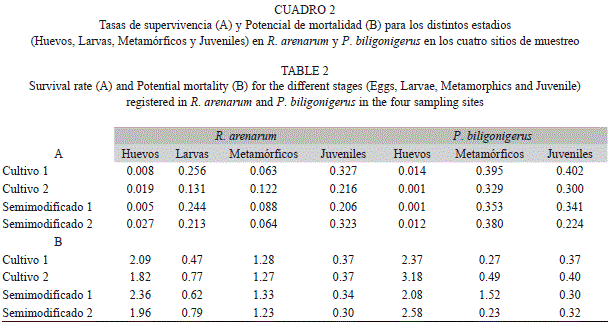
<body><![CDATA[medias de supervivencia seg&uacute;n KNM y los valores para la fuerza     de la mortalidad o killing power para cada clase de edad, obtenidos a     partir de los valores de supervivencia y mortalidad registrados para     cada a&ntilde;o de muestreo. En <span style="font-style: italic;">R.     arenarum</span>, puede notarse que los     ambientes alterados presentan una baja supervivencia para los huevos,     principalmente los sitios C1 y SM1, y que el sitio C2 adem&aacute;s     muestra la menor supervivencia para el estadio larval (<a      href="/img/revistas/rbt/v61n3/a30t2.gif">Cuadro 2</a>, A).     Los estadios que m&aacute;s podr&iacute;an comprometer a las     ]]></body>
<body><![CDATA[poblaciones son los de huevos y metam&oacute;rficos, teniendo en cuenta     que registran los valores m&aacute;s altos de mortalidad (<a      href="/img/revistas/rbt/v61n3/a30t2.gif">Cuadro 2</a>, B).     En <span style="font-style: italic;">P. biligonigerus</span>, se puede     destacar la baja supervivencia que     presentan los huevos en los sitios C2 y SM1 (<a      href="/img/revistas/rbt/v61n3/a30t2.gif">Cuadro 2</a>, A). La     mortalidad actu&oacute; con mayor fuerza en el estadio de huevos, lo     que indica que este estadio es el que m&aacute;s podr&iacute;a     comprometer a las poblaciones; donde C2 registr&oacute; la mortalidad     ]]></body>
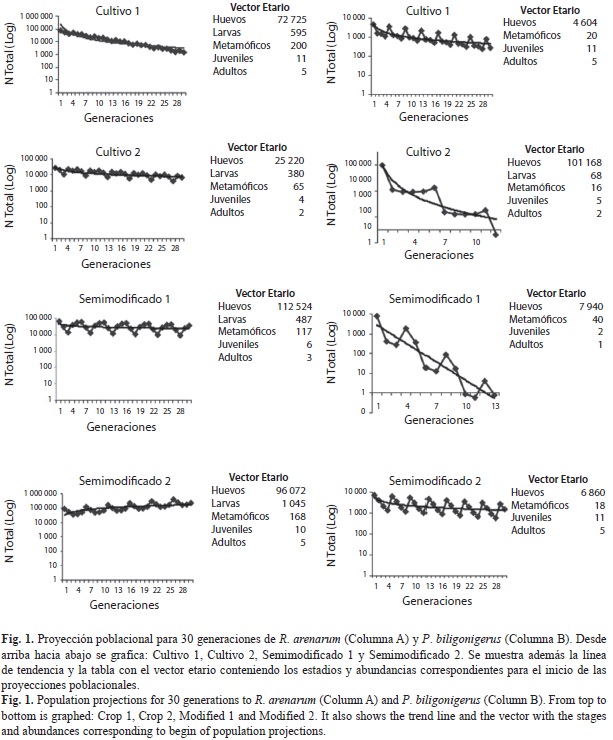
<body><![CDATA[m&aacute;s alta (<a href="/img/revistas/rbt/v61n3/a30t2.gif">Cuadro 2</a>,     B). Por otra parte, el sitio SM1     registr&oacute; una mortalidad alta para el estadio de los     metam&oacute;rficos. Cabe aclarar que para esta especie ha resultado     muy dif&iacute;cil la captura de larvas, s&oacute;lo en el sitio C2 fue     capturado un n&uacute;mero significativo de las mismas, valores que     pueden ser observados en los vectores etarios de la <a      href="/img/revistas/rbt/v61n3/a30i1.jpg">figura 1</a>, sin     embargo, por contar con este &uacute;nico registro entre los cuatro     sitios de muestreo, no se calcul&oacute; para este estadio la tasa de     ]]></body>
<body><![CDATA[supervivencia y la fuerza de la mortalidad.</span></font><br      style="font-family: verdana;">     <font size="2"></font><br style="font-family: verdana;">     <font size="2"><span style="font-family: verdana;">En la <a      href="/img/revistas/rbt/v61n3/a30i1.jpg">figura 1</a> se     muestran las     proyecciones poblacionales obtenidas para 30 generaciones y los     vectores etarios utilizados para el inicio de dichas simulaciones. El     vector etario fue construido con el promedio de las abundancias     obtenidas para cada clase de edad durante los dos a&ntilde;os de     ]]></body>
<body><![CDATA[muestreo. Las proyecciones parecen ser favorables para ambas especies     en el sitio SM2. <span style="font-style: italic;">R. arenarum</span>     muestra proyecciones descendentes en sus     tama&ntilde;os poblacionales en los sitios de cultivos m&aacute;s     alterados (C1 y C2) y parece mantener su tama&ntilde;o poblacional a lo     largo de las generaciones en el sitio SM1. Por su parte, <span      style="font-style: italic;">P.     biligonigerus</span>, indic&oacute; proyecciones desfavorables para     todos los     sitios alterados. Particularmente, para los sitios C2 y SM1, el modelo     ]]></body>
<body><![CDATA[predice la extinci&oacute;n de las poblaciones entre las generaciones     12 y 13, respectivamente. Esta especie muestra para el sitio de menor     alteraci&oacute;n, una proyecci&oacute;n poblacional estable que     mantiene el tama&ntilde;o poblacional a lo largo de las generaciones.     Al analizar los vectores etarios en cada proyecci&oacute;n, se puede     advertir que a pesar de la alta fertilidad que registran las especies     en sitios como SM1 y C2, presentan proyecciones no favorables en el     tiempo. Los resultados de validaci&oacute;n para el m&eacute;todo KNM     no indic&oacute; diferencias significativas entre las tasas de     supervivencia calculadas usando el m&eacute;todo y las estimadas     ]]></body>
<body><![CDATA[mediante la proporci&oacute;n entre los valores absolutos de abundancia     por clase de edad; es decir, el m&eacute;todo KNM provee una     estimaci&oacute;n precisa de las tasas de supervivencia para todos los     estadios (t-test para muestras pareadas, p&gt;0.05).</span></font><br      style="font-family: verdana;">     <font size="2"></font><br style="font-family: verdana;">     <font size="3"><span style="font-family: verdana; font-weight: bold;">Discusi&oacute;n</span></font><br      style="font-family: verdana;">     <font size="2"></font><br style="font-family: verdana;">     <font size="2"><span style="font-family: verdana;">La din&aacute;mica     ]]></body>
<body><![CDATA[poblacional es     una especialidad de la ecolog&iacute;a que estudia los mecanismos y las     consecuencias de las variaciones demogr&aacute;ficas, usualmente     fluctuaciones num&eacute;ricas (Carey 1993). Las fuerzas que regulan     esta din&aacute;mica ha sido un tema central y controversial en los     estudios sobre la estructuraci&oacute;n de las comunidades en general     (Begon <span style="font-style: italic;">et al.</span> 2006, Wang <span      style="font-style: italic;">et al.</span> 2009). Varias     caracter&iacute;sticas de     los agroecosistemas pueden constituir factores de mortalidad que     ]]></body>
<body><![CDATA[podr&iacute;an en &uacute;ltima instancia comprometer la persistencia     de las poblaciones. A escala del paisaje, la especializaci&oacute;n de     los agroecosistemas hacia ciertos cultivos como ocurre con la soja para     la regi&oacute;n de este estudio, disminuye dr&aacute;sticamente la     biodiversidad de un ecosistema la cual proporciona la &#8220;resiliencia&#8221; o     la capacidad de los mismos para recuperarse o adaptarse a un entorno     cambiante (Moone &amp; Barberi 2008). Esto plantea serios     cuestionamientos sobre qu&eacute; tipos de agroecosistemas     permitir&iacute;an conservar la biodiversidad (Perfecto &amp;     Vandermeer 2008). Espec&iacute;ficamente a lo que se refiere a la zona     ]]></body>
<body><![CDATA[neotropical, los estudios con especies de anfibios en ecosistemas     agr&iacute;colas han indicado una riqueza y diversidad reducida en     dichos ambientes (Peltzer <span style="font-style: italic;">et al.</span>     2006, Bionda <span style="font-style: italic;">et al.</span> 2011a),     en este     sentido, la presencia de ganado puede afectar de manera negativa a las     distintas poblaciones (Knutson <span style="font-style: italic;">et al.</span>     2004, Schmutzer <span style="font-style: italic;">et al.</span> 2008,     Burton <span style="font-style: italic;">et al.</span> 2009, Bionda <span      style="font-style: italic;">et al.</span> 2011a), aunque estos efectos     ]]></body>
<body><![CDATA[pueden     ser m&aacute;s marcados en algunas especies que en otras.     Adem&aacute;s, se ha comprobado que la presencia de agroqu&iacute;micos     causan alteraciones bioqu&iacute;micas y fisiol&oacute;gicas,     incrementando de este modo la mortalidad (e.g. Lajmanovich <span      style="font-style: italic;">et al.</span> 2004,     Peltzer <span style="font-style: italic;">et al.</span> 2007, Attademo     <span style="font-style: italic;">et al.</span> 2011, Whitfield 2011).     Asimismo,     una mala calidad de los cuerpos de agua, un hidroperiodo reducido     ]]></body>
<body><![CDATA[(Peltzer <span style="font-style: italic;">et al.</span> 2008, Bionda <span      style="font-style: italic;">et al.</span> 2011b) o una menor     disponibilidad y     tipo de alimento (Bionda <span style="font-style: italic;">et al.</span>     2012), tambi&eacute;n constituyen     factores en los agroecosistemas que contribuyen a disminuir la     sobrevivencia poblacional. A pesar de todas estas evidencias,     cabr&iacute;a plantearse si estos factores podr&iacute;an comprometer a     las poblaciones en el tiempo.</span></font><br      style="font-family: verdana;">     ]]></body>
<body><![CDATA[<font size="2"></font><br style="font-family: verdana;">     <font size="2"><span style="font-family: verdana;">En este estudio, la     predicci&oacute;n en la evoluci&oacute;n de las distintas poblaciones     teniendo en cuenta los valores de fertilidad y tasas de supervivencia,     ha indicado una proyecci&oacute;n favorable en el tiempo para el sitio     menos alterado y desfavorables para las poblaciones de los ambientes     dominados por cultivos. Particularmente para el C2, fue observada una     baja supervivencia en huevos y larvas, y proyecciones poblacionales     descendentes o pr&oacute;ximas a la extinci&oacute;n seg&uacute;n la     especie. La baja supervivencia en el C2 de huevos y larvas,     ]]></body>
<body><![CDATA[podr&iacute;a deberse a una mala calidad de agua en sus lagunas, con     niveles de nitrato y f&oacute;sforo excesivamente altos y condiciones     tales como temperaturas y profundidad de las lagunas poco propicias.     Varios autores han demostrado como el nitrato en cantidades excesivas,     as&iacute; como una alta temperatura, alteran el desarrollo y     crecimiento larval, afectando de este modo su supervivencia (Boone     &amp; Bridges 1999, Edwards <span style="font-style: italic;">et al.</span>     2006). Esta inestabilidad en las     condiciones podr&iacute;an ser razones suficientes para la baja     supervivencia y proyecciones poblacionales desfavorables registradas     ]]></body>
<body><![CDATA[para este sitio. Los valores excesivamente altos de nitrato en el agua     de las lagunas del C2 en los a&ntilde;os 2008-2009, comparado a lo     ocurrido para 2009-2010, podr&iacute;an ser consecuencias de diferentes     pr&aacute;cticas en el manejo de los cultivos, como ser, una mayor     superficie sembrada o una mayor aplicaci&oacute;n de biocidas y     fertilizantes durante la temporada 2008-2009, haciendo que los niveles     de nitrato en el agua de las lagunas presentaran valores por encima de     los aceptados en la normativa internacional (USEPA 1994, OMS 2006). Por     su parte, los sitios C1 y SM1, tambi&eacute;n registraron bajas     supervivencias y proyecciones poblacionales desfavorables. Para estos     ]]></body>
<body><![CDATA[sitios se podr&iacute;a destacar los valores alcalinos de pH, con     promedios por encima de ocho. Esta &uacute;ltima observaci&oacute;n,     sumado a lo indicado para el C2, demuestra que en general los     agroecosistemas en esta regi&oacute;n, son ambientes posiblemente     inh&oacute;spitos para la reproducci&oacute;n y la supervivencia de las     especies estudiadas, particularmente para los estadios acu&aacute;ticos</span></font><br      style="font-family: verdana;">     <font size="2"></font><br style="font-family: verdana;">     <font size="2"><span style="font-family: verdana;">Por otra parte, de     acuerdo a los     ]]></body>
<body><![CDATA[resultados obtenidos para <span style="font-style: italic;">R. arenarum</span>     y <span style="font-style: italic;">P. biligonigerus</span>, es     posible     reconocer que los efectos de este tipo de ambientes alterados, son     especie-espec&iacute;ficos. Coincidiendo de este modo con lo mencionado     por Burton <span style="font-style: italic;">et al.</span> (2009) y     Lajmanovich <span style="font-style: italic;">et al.</span> (2010) que     demostraron     las respuestas diferenciales de las especies y el riesgo     ecol&oacute;gico interespec&iacute;fico en los agroecosistemas. Al     ]]></body>
<body><![CDATA[respecto, es posible apreciar que las proyecciones fueron m&aacute;s     desfavorables para <span style="font-style: italic;">P. biligonigerus</span>.     Si bien <span style="font-style: italic;">R. arenarum</span>     present&oacute; bajas supervivencias, particularmente en los sitios     m&aacute;s alterados, esta especie mostr&oacute; un mayor reclutamiento     y proyecciones m&aacute;s favorables que <span      style="font-style: italic;">P. biligonigerus</span>. Es probable     que algunas caracter&iacute;sticas de la biolog&iacute;a y los     requerimientos de h&aacute;bitat de <span style="font-style: italic;">P.     biligonigerus</span> la conviertan en     ]]></body>
<body><![CDATA[una especie m&aacute;s sensible a los cambios y modificaciones del     h&aacute;bitat. Seg&uacute;n Cei (1980), <span      style="font-style: italic;">P. biligonigerus</span> puede ser     considerada una especie de importantes requerimientos hacia     h&aacute;bitats con disponibilidad de agua. En contrapartida, las     especies de anfibios de h&aacute;bitos m&aacute;s terrestres como <span      style="font-style: italic;">R.     arenarum</span>, son m&aacute;s generalistas en sus requerimientos de     h&aacute;bitats, y por ello, m&aacute;s independientes de las variables     ambientales (Keller <span style="font-style: italic;">et al.</span>     ]]></body>
<body><![CDATA[2009). A pesar de que el modo reproductivo     de <span style="font-style: italic;">R. arenarum</span> (huevos en     cordones gelatinosos depositados dentro del     agua) es m&aacute;s dependiente del agua que el de <span      style="font-style: italic;">P. biligonigerus</span>     (huevos en nidos de espuma depositados sobre la superficie del agua),     sus requerimientos de h&aacute;bitats m&aacute;s generalistas puede     llevar a una mayor supervivencia de los estadios     postmetam&oacute;rficos resultando en un mayor reclutamiento, comparado     a <span style="font-style: italic;">P. biligonigerus</span>. En este     ]]></body>
<body><![CDATA[sentido, la posible modificaci&oacute;n de     los ambientes acu&aacute;ticos en los agroecosistemas, en     relaci&oacute;n a la calidad del agua y su hidroperiodo, permite     presuponer que aquellas especies de h&aacute;bitos m&aacute;s     acu&aacute;ticos, pueden ser m&aacute;s sensibles a la     alteraci&oacute;n de estos tipos de ambientes. El trabajo realizado por     Peltzer (2006) para la regi&oacute;n centro-este de Argentina es     concluyente al respecto, ya que en los ambientes alterados encontraron     una mayor representatividad de anuros correspondientes al gremio     terrestre, seguido del gremio semiacu&aacute;tico, y una     ]]></body>
<body><![CDATA[declinaci&oacute;n notable del gremio acu&aacute;tico. Sin embargo,     otros trabajos, principalmente en arrozales, no encuentran diferencias     significativas entre ambientes alterados y la composici&oacute;n de las     especies seg&uacute;n sus h&aacute;bitos (Vasconcelos &amp; Rossa Feres     2005, Schaefer 2006). A pesar de que <span style="font-style: italic;">P.     biligonigerus</span> registra una     elevada reproducci&oacute;n en todos los ambientes analizados,     particularmente un importante n&uacute;mero de puestas de huevos fueron     observadas en el C2, lo cual podr&iacute;a indicar una mayor capacidad     reproductiva para explotar ambientes perturbados, luego se observa un     ]]></body>
<body><![CDATA[bajo o nulo reclutamiento debido a las bajas supervivencias por clase     de edad. En los agroecosistemas, <span style="font-style: italic;">P.     biligonigerus</span> mostr&oacute;     proyecciones desfavorables, y una tendencia a la extinci&oacute;n de     las poblaciones en la mayor parte de los sitios analizados. <span      style="font-style: italic;">P.     biligonigerus</span> presenta un comportamiento explosivo, con una     elevada     actividad reproductiva en un corto tiempo, luego de registrarse     precipitaciones importantes (Martino 1999, Bionda 2011, Bionda <span     ]]></body>
<body><![CDATA[ style="font-style: italic;">et al.</span>     2011a). Para Heyer (1974) las especies que se reproducen en     ambientesvariables maximizan su esfuerzo reproductivo. Otros trabajos     realizados con <span style="font-style: italic;">P. albonotatus</span>,     especie ecol&oacute;gicamente similar a     <span style="font-style: italic;">P. biligonigerus</span>, indica a <span      style="font-style: italic;">P. albonotatus</span> como una especie     invasora de     habitats agr&iacute;colas debido a la abundancia registrada (Peltzer <span      style="font-style: italic;">et     ]]></body>
<body><![CDATA[al.</span> 2006, Lajmanovich <span style="font-style: italic;">et al.</span>     2010). En el mismo sentido, un estudio     realizado durante cuatro a&ntilde;os sobre las comunidades de anfibios     del departamento de R&iacute;o Cuarto (C&oacute;rdoba), demostr&oacute;     que <span style="font-style: italic;">P. biligonigerus</span> fue la     especie m&aacute;s abundante en los     agroecosistemas, pero su abundancia vari&oacute; de manera considerable     entre a&ntilde;os de muestreo, indicando una din&aacute;mica poco     estable en dichos sitios (Bionda 2011).</span></font><br      style="font-family: verdana;">     ]]></body>
<body><![CDATA[<font size="2"></font><br style="font-family: verdana;">     <font size="2"><span style="font-family: verdana;">Mediante este     estudio se ha     advertido que los agroecosistemas por sus caracter&iacute;sticas     representan h&aacute;bitats inh&oacute;spitos para las poblaciones de     <span style="font-style: italic;">R. arenarum</span> y <span      style="font-style: italic;">P. biligonigerus</span>, las cuales     constituyen especies     representativas de la herpetofauna regional por su abundancia y     distribuci&oacute;n. El hecho de que los estadios acu&aacute;ticos     ]]></body>
<body><![CDATA[registren en general una baja supervivencia en los agroecosistemas,     permite pensar en una mala calidad de agua en las lagunas de dichos     ambientes. Asimismo, podemos reconocer efectos     especie-espec&iacute;ficos de los ecosistemas agr&iacute;colas, ya que     <span style="font-style: italic;">P. biligonigerus</span>     result&oacute; la especie m&aacute;s vulnerable,     posiblemente por sus caracter&iacute;sticas de historias de vida y     requerimientos de h&aacute;bitats. Finalmente, el deterioro ambiental     producido por los cultivos extensivos de soja en la regi&oacute;n     central de la Argentina, impactar&iacute;a en la demograf&iacute;a de     ]]></body>
<body><![CDATA[las poblaciones de anuros, generando una reducci&oacute;n en el     tama&ntilde;o de sus poblaciones.</span></font><br      style="font-family: verdana;">     <font size="2"></font><br style="font-family: verdana;">     <font size="3"><span style="font-family: verdana; font-weight: bold;">Agradecimientos</span></font><br      style="font-family: verdana;">     <font size="2"></font><br style="font-family: verdana;">     <font size="2"><span style="font-family: verdana;">Este trabajo fue     financiado por el     Consejo Nacional de Investigaciones Cient&iacute;ficas y     ]]></body>
<body><![CDATA[T&eacute;cnicas (CONICET), la Agencia Nacional de Promoci&oacute;n     Cient&iacute;fica y Tecnol&oacute;gica (ANCyT) y SCyT UNRC, PPI     18/C350. Nuestro estudio fue autorizado por la Agencia C&oacute;rdoba     Ambiente (A.C.A.S.E.).</span></font><br style="font-family: verdana;">     <font size="2"></font></div>     <hr      style="width: 100%; height: 2px; margin-left: 0px; margin-right: 0px;">     <div style="text-align: justify;"><font size="3"><span  style="font-family: verdana; font-weight: bold;">Referencias</span></font><br  style="font-family: verdana;"> <br style="font-family: verdana;">     <!-- ref --><div style="text-align: left;"><font size="2"><span  style="font-family: verdana;">Altieri, M. &amp; W. Pengue. 2006. GM Soybean: Latin America&#8217;s new colonizer. GRAIN, Barcelona, Espa&ntilde;a. (Consultado: Junio 6, 2011, http://www.grain.org/seedling/index. cfm?id=421).    &nbsp;&nbsp;&nbsp;&nbsp;&nbsp;&nbsp;&nbsp;&nbsp;[&#160;<a href="javascript:void(0);" onclick="javascript: window.open('/scielo.php?script=sci_nlinks&ref=1651663&pid=S0034-7744201300040003000001&lng=','','width=640,height=500,resizable=yes,scrollbars=1,menubar=yes,');">Links</a>&#160;]<!-- end-ref --><!-- ref --></span></font><br  style="font-family: verdana;"> <br style="font-family: verdana;"> <font size="2"><span style="font-family: verdana;">Altig, R., M.R. Whiles &amp; C.L. Taylor. 2007. What do tadpoles really eat? Assessing the trophic status of an understudied and imperiled group of consumers in freshwater habitats. Freshwat. Biol. 52: 386-395.    &nbsp;&nbsp;&nbsp;&nbsp;&nbsp;&nbsp;&nbsp;&nbsp;[&#160;<a href="javascript:void(0);" onclick="javascript: window.open('/scielo.php?script=sci_nlinks&ref=1651664&pid=S0034-7744201300040003000002&lng=','','width=640,height=500,resizable=yes,scrollbars=1,menubar=yes,');">Links</a>&#160;]<!-- end-ref --><!-- ref --></span></font><br  style="font-family: verdana;"> <br style="font-family: verdana;"> <font size="2"><span style="font-family: verdana;">Attademo, A.M., M. Cabagna Zenklusen, R.C. Lajmanovich, P.M. Peltzer, C. Junges &amp; A. Bass&oacute;. 2011. Besterase activities and blood cell morphology in the Frog <span style="font-style: italic;">Leptodactylus chaquensis</span> (Amphibia: Leptodactylidae) on rice agroecosystems from Santa Fe Province (Argentina). Ecotoxicology 20: 274-282.    &nbsp;&nbsp;&nbsp;&nbsp;&nbsp;&nbsp;&nbsp;&nbsp;[&#160;<a href="javascript:void(0);" onclick="javascript: window.open('/scielo.php?script=sci_nlinks&ref=1651665&pid=S0034-7744201300040003000003&lng=','','width=640,height=500,resizable=yes,scrollbars=1,menubar=yes,');">Links</a>&#160;]<!-- end-ref --><!-- ref --></span></font><br style="font-family: verdana;"> <br style="font-family: verdana;"> <font size="2"><span style="font-family: verdana;">B&eacute;cart, E., A. Aubry &amp; M. Emmerson. 2007. Monitoring the conservation status of natterjack toad (<span style="font-style: italic;">Bufo calamita</span>) in Ireland, 2004 - 2006. Irish Wildlife Manuals, No. 31. National Parks and Wildlife Service, Department of the Environment, Heritage and Local. Government, Dubl&iacute;n, Irlanda.    &nbsp;&nbsp;&nbsp;&nbsp;&nbsp;&nbsp;&nbsp;&nbsp;[&#160;<a href="javascript:void(0);" onclick="javascript: window.open('/scielo.php?script=sci_nlinks&ref=1651666&pid=S0034-7744201300040003000004&lng=','','width=640,height=500,resizable=yes,scrollbars=1,menubar=yes,');">Links</a>&#160;]<!-- end-ref --></span></font><br  style="font-family: verdana;"> <font size="2"><span style="font-family: verdana;"></span></font>    <!-- ref --><br> <font size="2"><span style="font-family: verdana;">Beebee, T.J.C. 1996. Ecology and conservation of amphibians. Conservation biology series. Chapman &amp; Hall, Londres, Inglaterra.    &nbsp;&nbsp;&nbsp;&nbsp;&nbsp;&nbsp;&nbsp;&nbsp;[&#160;<a href="javascript:void(0);" onclick="javascript: window.open('/scielo.php?script=sci_nlinks&ref=1651668&pid=S0034-7744201300040003000005&lng=','','width=640,height=500,resizable=yes,scrollbars=1,menubar=yes,');">Links</a>&#160;]<!-- end-ref --><!-- ref --></span></font><br  style="font-family: verdana;"> <br style="font-family: verdana;"> <font size="2"><span style="font-family: verdana;">Beebee, T.J.C. &amp; R.A. Griffiths. 2005. The amphibian decline crisis: A watershed for conservation biology? Biol. Conservat. 125: 271-285.    &nbsp;&nbsp;&nbsp;&nbsp;&nbsp;&nbsp;&nbsp;&nbsp;[&#160;<a href="javascript:void(0);" onclick="javascript: window.open('/scielo.php?script=sci_nlinks&ref=1651669&pid=S0034-7744201300040003000006&lng=','','width=640,height=500,resizable=yes,scrollbars=1,menubar=yes,');">Links</a>&#160;]<!-- end-ref --><!-- ref --></span></font><br  style="font-family: verdana;"> <br style="font-family: verdana;"> <font size="2"><span style="font-family: verdana;">Begon, M., C.R. Townsend &amp; J.L. Harper. 2006. Ecology: from individuals to ecosystems. Blackwell, Oxford, Oxforshire, Inglaterra.    &nbsp;&nbsp;&nbsp;&nbsp;&nbsp;&nbsp;&nbsp;&nbsp;[&#160;<a href="javascript:void(0);" onclick="javascript: window.open('/scielo.php?script=sci_nlinks&ref=1651670&pid=S0034-7744201300040003000007&lng=','','width=640,height=500,resizable=yes,scrollbars=1,menubar=yes,');">Links</a>&#160;]<!-- end-ref --><!-- ref --></span></font><br  style="font-family: verdana;"> <br style="font-family: verdana;"> <font size="2"><span style="font-family: verdana;">Bionda, C.L. 2011. Din&aacute;mica poblacional de anfibios asociados a cultivos extensivos de la provincia de C&oacute;rdoba, Argentina. Tesis de Doctorado, Universidad Nacional de R&iacute;o Cuarto, R&iacute;o Cuarto, C&oacute;rdoba, Argentina.    &nbsp;&nbsp;&nbsp;&nbsp;&nbsp;&nbsp;&nbsp;&nbsp;[&#160;<a href="javascript:void(0);" onclick="javascript: window.open('/scielo.php?script=sci_nlinks&ref=1651671&pid=S0034-7744201300040003000008&lng=','','width=640,height=500,resizable=yes,scrollbars=1,menubar=yes,');">Links</a>&#160;]<!-- end-ref --><!-- ref --></span></font><br  style="font-family: verdana;"> <br style="font-family: verdana;"> <font size="2"><span style="font-family: verdana;">Bionda, C.L., I.E. di Tada &amp; R.C. Lajmanovich. 2011a. Composition of amphibian assemblages in agroecosystems from the central region of Argentina. Russ. J. Herpetol. 18: 93-98.    &nbsp;&nbsp;&nbsp;&nbsp;&nbsp;&nbsp;&nbsp;&nbsp;[&#160;<a href="javascript:void(0);" onclick="javascript: window.open('/scielo.php?script=sci_nlinks&ref=1651672&pid=S0034-7744201300040003000009&lng=','','width=640,height=500,resizable=yes,scrollbars=1,menubar=yes,');">Links</a>&#160;]<!-- end-ref --><!-- ref --></span></font><br style="font-family: verdana;"> <br style="font-family: verdana;"> <font size="2"><span style="font-family: verdana;">Bionda, C.L., R.C. Lajmanovich, N.E. Salas, A.L. Martino &amp; I.E. di Tada. 2011b. Reproductive Ecology of the Common South American Toad <span  style="font-style: italic;">Rhinella arenarum</span> (Anura: Bufonidae): Reproductive Effort, Clutch Size, Fecundity, and Mate Selection. J. Herpetol. 45: 261-264.    &nbsp;&nbsp;&nbsp;&nbsp;&nbsp;&nbsp;&nbsp;&nbsp;[&#160;<a href="javascript:void(0);" onclick="javascript: window.open('/scielo.php?script=sci_nlinks&ref=1651673&pid=S0034-7744201300040003000010&lng=','','width=640,height=500,resizable=yes,scrollbars=1,menubar=yes,');">Links</a>&#160;]<!-- end-ref --><!-- ref --></span></font><br  style="font-family: verdana;"> <br style="font-family: verdana;"> <font size="2"><span style="font-family: verdana;">Bionda, C.L., N. Gari, E. Luque, N.E. Salas, R.C. Lajmanovich &amp; A.L. Martino. 2012. Ecolog&iacute;a tr&oacute;fica en larvas de <span style="font-style: italic;">Rhinella arenarum</span> (Anura: Bufonidae) en agroecosistemas y sus posibles implicaciones para la conservaci&oacute;n. Rev. Biol. Trop. 60: 771-779.    &nbsp;&nbsp;&nbsp;&nbsp;&nbsp;&nbsp;&nbsp;&nbsp;[&#160;<a href="javascript:void(0);" onclick="javascript: window.open('/scielo.php?script=sci_nlinks&ref=1651674&pid=S0034-7744201300040003000011&lng=','','width=640,height=500,resizable=yes,scrollbars=1,menubar=yes,');">Links</a>&#160;]<!-- end-ref --><!-- ref --></span></font><br  style="font-family: verdana;"> <br style="font-family: verdana;"> <font size="2"><span style="font-family: verdana;">Boone, M.D. &amp; C.M. Bridges. 1999. The effect of temperature on the potency of Carbaryl for survival of tadpoles of the green frog (<span style="font-style: italic;">Rana clamitans</span>). Environ. Toxicol. Chem. 18: 1482-1484.    &nbsp;&nbsp;&nbsp;&nbsp;&nbsp;&nbsp;&nbsp;&nbsp;[&#160;<a href="javascript:void(0);" onclick="javascript: window.open('/scielo.php?script=sci_nlinks&ref=1651675&pid=S0034-7744201300040003000012&lng=','','width=640,height=500,resizable=yes,scrollbars=1,menubar=yes,');">Links</a>&#160;]<!-- end-ref --><!-- ref --></span></font><br style="font-family: verdana;"> <br style="font-family: verdana;"> <font size="2"><span style="font-family: verdana;">Bridarolli, M.E. &amp; I.E. di Tada. 1996. Algunos aspectos de la geograf&iacute;a f&iacute;sica de la provincia de C&oacute;rdoba, p. 15-38. <span  style="font-style: italic;">In</span> I.E. di Tada &amp; E.H. Bucher (eds.). Biodiversidad de la provincia de C&oacute;rdoba. Fauna. Universidad Nacional de R&iacute;o Cuarto, R&iacute;o Cuarto, C&oacute;rdoba, Argentina.    &nbsp;&nbsp;&nbsp;&nbsp;&nbsp;&nbsp;&nbsp;&nbsp;[&#160;<a href="javascript:void(0);" onclick="javascript: window.open('/scielo.php?script=sci_nlinks&ref=1651676&pid=S0034-7744201300040003000013&lng=','','width=640,height=500,resizable=yes,scrollbars=1,menubar=yes,');">Links</a>&#160;]<!-- end-ref --><!-- ref --></span></font><br  style="font-family: verdana;"> <br style="font-family: verdana;"> <font size="2"><span style="font-family: verdana;">Burton, E.C., M.J. Gray, A.C. Schmutzer &amp; D.L. Miller. 2009. Differential responses of postmetamorphic amphibians to cattle grazing in wetlands. J. Wildl. Manag. 73: 269-277.    &nbsp;&nbsp;&nbsp;&nbsp;&nbsp;&nbsp;&nbsp;&nbsp;[&#160;<a href="javascript:void(0);" onclick="javascript: window.open('/scielo.php?script=sci_nlinks&ref=1651677&pid=S0034-7744201300040003000014&lng=','','width=640,height=500,resizable=yes,scrollbars=1,menubar=yes,');">Links</a>&#160;]<!-- end-ref --><!-- ref --></span></font><br style="font-family: verdana;"> <br style="font-family: verdana;"> <font size="2"><span style="font-family: verdana;">Carey, J.R. 1993. Applied demography for biologists: with special emphasis on insects. Oxford University, Nueva York, EE.UU.    &nbsp;&nbsp;&nbsp;&nbsp;&nbsp;&nbsp;&nbsp;&nbsp;[&#160;<a href="javascript:void(0);" onclick="javascript: window.open('/scielo.php?script=sci_nlinks&ref=1651678&pid=S0034-7744201300040003000015&lng=','','width=640,height=500,resizable=yes,scrollbars=1,menubar=yes,');">Links</a>&#160;]<!-- end-ref --><!-- ref --></span></font><br  style="font-family: verdana;"> <br style="font-family: verdana;"> <font size="2"><span style="font-family: verdana;">Carey, C. &amp; C.J. Bryant. 1995. Possible interrelations among environmental toxicants, Amphibian development, and decline of Amphibian populations. Environ. Health Perspect. 103: 13-17.    &nbsp;&nbsp;&nbsp;&nbsp;&nbsp;&nbsp;&nbsp;&nbsp;[&#160;<a href="javascript:void(0);" onclick="javascript: window.open('/scielo.php?script=sci_nlinks&ref=1651679&pid=S0034-7744201300040003000016&lng=','','width=640,height=500,resizable=yes,scrollbars=1,menubar=yes,');">Links</a>&#160;]<!-- end-ref --><!-- ref --></span></font><br style="font-family: verdana;"> <br style="font-family: verdana;"> <font size="2"><span style="font-family: verdana;">Cei, J.M. 1980. Amphibians of Argentina. Monit. Zool. Ital. Nueva Serie, Florencia, Italia.    &nbsp;&nbsp;&nbsp;&nbsp;&nbsp;&nbsp;&nbsp;&nbsp;[&#160;<a href="javascript:void(0);" onclick="javascript: window.open('/scielo.php?script=sci_nlinks&ref=1651680&pid=S0034-7744201300040003000017&lng=','','width=640,height=500,resizable=yes,scrollbars=1,menubar=yes,');">Links</a>&#160;]<!-- end-ref --><!-- ref --></span></font><br  style="font-family: verdana;"> <br style="font-family: verdana;"> <font size="2"><span style="font-family: verdana;">Collins, J.P. &amp; M. Crump. 2009. Extinction in Our Time. Oxford University, Nueva York, EE.UU.    &nbsp;&nbsp;&nbsp;&nbsp;&nbsp;&nbsp;&nbsp;&nbsp;[&#160;<a href="javascript:void(0);" onclick="javascript: window.open('/scielo.php?script=sci_nlinks&ref=1651681&pid=S0034-7744201300040003000018&lng=','','width=640,height=500,resizable=yes,scrollbars=1,menubar=yes,');">Links</a>&#160;]<!-- end-ref --><!-- ref --></span></font><br  style="font-family: verdana;"> <br style="font-family: verdana;"> <font size="2"><span style="font-family: verdana;">Corn, P.S. 1994. Cercas en l&iacute;nea recta y trampas de ca&iacute;da, p. 104-113. <span  style="font-style: italic;">In</span> W.R. Heyer, M.A. Donnelly, R.W. McDiarmid, L.C. Hayek &amp; M.S. Foster (eds.). Medici&oacute;n y Monitoreo de la diversidad biol&oacute;gica. M&eacute;todos estandarizados para Anfibios. Universitaria de La Patagonia, Comodoro Rivadavia, Chubut, Argentina.    &nbsp;&nbsp;&nbsp;&nbsp;&nbsp;&nbsp;&nbsp;&nbsp;[&#160;<a href="javascript:void(0);" onclick="javascript: window.open('/scielo.php?script=sci_nlinks&ref=1651682&pid=S0034-7744201300040003000019&lng=','','width=640,height=500,resizable=yes,scrollbars=1,menubar=yes,');">Links</a>&#160;]<!-- end-ref --><!-- ref --></span></font><br  style="font-family: verdana;"> <br style="font-family: verdana;"> <font size="2"><span style="font-family: verdana;">Crump, M.L. &amp; N.J. Scott. 1994. T&eacute;cnicas est&aacute;ndar para inventarios y monitoreo, p. 71-136. <span style="font-style: italic;">In</span> W.R. Heyer, M.A. Donnelly, R.W. McDiarmid, L.C. Hayek &amp; M.S. Foster (eds.). Medici&oacute;n y Monitoreo de la diversidad biol&oacute;gica. M&eacute;todos estandarizados para Anfibios. Universitaria de La Patagonia, Comodoro Rivadavia, Chubut, Argentina.    &nbsp;&nbsp;&nbsp;&nbsp;&nbsp;&nbsp;&nbsp;&nbsp;[&#160;<a href="javascript:void(0);" onclick="javascript: window.open('/scielo.php?script=sci_nlinks&ref=1651683&pid=S0034-7744201300040003000020&lng=','','width=640,height=500,resizable=yes,scrollbars=1,menubar=yes,');">Links</a>&#160;]<!-- end-ref --><!-- ref --></span></font><br  style="font-family: verdana;"> <br style="font-family: verdana;"> <font size="2"><span style="font-family: verdana;">Davidson, C., H.B. Shaffer &amp; M.R. Jennings. 2002. Spatial tests of the pesticide drift, habitat destruction, UV-B, and climate-change hypotheses for California amphibian declines. Conservat. Biol. 16: 1588-1601.    &nbsp;&nbsp;&nbsp;&nbsp;&nbsp;&nbsp;&nbsp;&nbsp;[&#160;<a href="javascript:void(0);" onclick="javascript: window.open('/scielo.php?script=sci_nlinks&ref=1651684&pid=S0034-7744201300040003000021&lng=','','width=640,height=500,resizable=yes,scrollbars=1,menubar=yes,');">Links</a>&#160;]<!-- end-ref --><!-- ref --></span></font><br  style="font-family: verdana;"> <br style="font-family: verdana;"> <font size="2"><span style="font-family: verdana;">di Tada, I.E., M.V. Zavattieri, M.E. Bridarolli, N.E. Salas &amp; A.L. Martino. 1996. Anfibios Anuros de la provincia de C&oacute;rdoba, p. 191-215. <span  style="font-style: italic;">In</span> I.E. di Tada &amp; E.H. Bucher (eds.). Biodiversidad de la provincia de C&oacute;rdoba. Fauna. Universidad Nacional de R&iacute;o Cuarto, R&iacute;o Cuarto, C&oacute;rdoba, Argentina.    &nbsp;&nbsp;&nbsp;&nbsp;&nbsp;&nbsp;&nbsp;&nbsp;[&#160;<a href="javascript:void(0);" onclick="javascript: window.open('/scielo.php?script=sci_nlinks&ref=1651685&pid=S0034-7744201300040003000022&lng=','','width=640,height=500,resizable=yes,scrollbars=1,menubar=yes,');">Links</a>&#160;]<!-- end-ref --><!-- ref --></span></font><br  style="font-family: verdana;"> <br style="font-family: verdana;"> <font size="2"><span style="font-family: verdana;">Doffo, N. 1989. Geomorfolog&iacute;a del &aacute;rea urbana de la ciudad de R&iacute;o Cuarto y de la cuenca del arroyo El Ba&ntilde;ado, algunas consideraciones aplicadas al manejo del medio natural. Tesis de grado, Universidad Nacional de R&iacute;o Cuarto, R&iacute;o Cuarto, C&oacute;rdoba, Argentina.    &nbsp;&nbsp;&nbsp;&nbsp;&nbsp;&nbsp;&nbsp;&nbsp;[&#160;<a href="javascript:void(0);" onclick="javascript: window.open('/scielo.php?script=sci_nlinks&ref=1651686&pid=S0034-7744201300040003000023&lng=','','width=640,height=500,resizable=yes,scrollbars=1,menubar=yes,');">Links</a>&#160;]<!-- end-ref --><!-- ref --></span></font><br  style="font-family: verdana;"> <br style="font-family: verdana;"> <font size="2"><span style="font-family: verdana;">Duellman, W.E. &amp; L. Trueb. 1994. Biology of amphibians. Johns Hopkins, Londres, Inglaterra.    &nbsp;&nbsp;&nbsp;&nbsp;&nbsp;&nbsp;&nbsp;&nbsp;[&#160;<a href="javascript:void(0);" onclick="javascript: window.open('/scielo.php?script=sci_nlinks&ref=1651687&pid=S0034-7744201300040003000024&lng=','','width=640,height=500,resizable=yes,scrollbars=1,menubar=yes,');">Links</a>&#160;]<!-- end-ref --><!-- ref --></span></font><br  style="font-family: verdana;"> <br style="font-family: verdana;"> <font size="2"><span style="font-family: verdana;">Edwards, T.M., K.A. McCoy, T. Barbeau, M.W. McCoy, J. Matthew Thro &amp; L.J. Guillette Jr. 2006. Environmental context determines nitrate toxicity in Southern toad (<span style="font-style: italic;">Bufo terrestris</span>) tadpoles. Aquat. Toxicol. 78: 50-58.    &nbsp;&nbsp;&nbsp;&nbsp;&nbsp;&nbsp;&nbsp;&nbsp;[&#160;<a href="javascript:void(0);" onclick="javascript: window.open('/scielo.php?script=sci_nlinks&ref=1651688&pid=S0034-7744201300040003000025&lng=','','width=640,height=500,resizable=yes,scrollbars=1,menubar=yes,');">Links</a>&#160;]<!-- end-ref --><!-- ref --></span></font><br  style="font-family: verdana;"> <br style="font-family: verdana;"> <font size="2"><span style="font-family: verdana;">Gatica, E.A., C.A. Almeida, M.A. Mallea, M.C. Del Corigliano &amp; P. Gonz&aacute;lez. 2012. Water quality assessment, by statistical analysis, on rural and urban areas of Chocancharava River (R&iacute;o Cuarto), C&oacute;rdoba, Argentina. Environ. Monit. Assess. DOI 10.1007/ s10661-011-2495-7.    &nbsp;&nbsp;&nbsp;&nbsp;&nbsp;&nbsp;&nbsp;&nbsp;[&#160;<a href="javascript:void(0);" onclick="javascript: window.open('/scielo.php?script=sci_nlinks&ref=1651689&pid=S0034-7744201300040003000026&lng=','','width=640,height=500,resizable=yes,scrollbars=1,menubar=yes,');">Links</a>&#160;]<!-- end-ref --><!-- ref --></span></font><br  style="font-family: verdana;"> <br style="font-family: verdana;"> <font size="2"><span style="font-family: verdana;">Guerry, A.D. &amp; M.L. Hunter Jr. 2002. Amphibian distribution in a landscape of forest and agriculture: an examination of landscape composition and configuration. Conservat. Biol. 16: 745-754.    &nbsp;&nbsp;&nbsp;&nbsp;&nbsp;&nbsp;&nbsp;&nbsp;[&#160;<a href="javascript:void(0);" onclick="javascript: window.open('/scielo.php?script=sci_nlinks&ref=1651690&pid=S0034-7744201300040003000027&lng=','','width=640,height=500,resizable=yes,scrollbars=1,menubar=yes,');">Links</a>&#160;]<!-- end-ref --><!-- ref --></span></font><br style="font-family: verdana;"> <br style="font-family: verdana;"> <font size="2"><span style="font-family: verdana;">Heyer, W.R. 1974. Niche measurements of frog larvae from a seasonal tropical location in Thailand. Ecology Tempe 55: 651-656.    &nbsp;&nbsp;&nbsp;&nbsp;&nbsp;&nbsp;&nbsp;&nbsp;[&#160;<a href="javascript:void(0);" onclick="javascript: window.open('/scielo.php?script=sci_nlinks&ref=1651691&pid=S0034-7744201300040003000028&lng=','','width=640,height=500,resizable=yes,scrollbars=1,menubar=yes,');">Links</a>&#160;]<!-- end-ref --><!-- ref --></span></font><br  style="font-family: verdana;"> <br style="font-family: verdana;"> <font size="2"><span style="font-family: verdana;">IUCN, 2011. The IUCN Red List of Threatened Species. Version 2011.2. (Consultado: Mayo 30, 2012, http://www.iucnredlist.org).    &nbsp;&nbsp;&nbsp;&nbsp;&nbsp;&nbsp;&nbsp;&nbsp;[&#160;<a href="javascript:void(0);" onclick="javascript: window.open('/scielo.php?script=sci_nlinks&ref=1651692&pid=S0034-7744201300040003000029&lng=','','width=640,height=500,resizable=yes,scrollbars=1,menubar=yes,');">Links</a>&#160;]<!-- end-ref --><!-- ref --></span></font><br  style="font-family: verdana;"> <br style="font-family: verdana;"> <font size="2"><span style="font-family: verdana;">Keller, A., M.O. R&ouml;del, K.E. Linsenmair &amp; T.U. Grafe. 2009. The importance of environmental heterogeneity for species diversity and assemblage structure in Bornean stream frogs. J. Anim. Ecol. 78: 305-314.    &nbsp;&nbsp;&nbsp;&nbsp;&nbsp;&nbsp;&nbsp;&nbsp;[&#160;<a href="javascript:void(0);" onclick="javascript: window.open('/scielo.php?script=sci_nlinks&ref=1651693&pid=S0034-7744201300040003000030&lng=','','width=640,height=500,resizable=yes,scrollbars=1,menubar=yes,');">Links</a>&#160;]<!-- end-ref --><!-- ref --></span></font><br  style="font-family: verdana;"> <br style="font-family: verdana;"> <font size="2"><span style="font-family: verdana;">Knutson, M.G., W.B. Richardson, D.M. Reineke, B.R. Gray, J.R. Parmelee &amp; S.E. Weick. 2004. Agricultural ponds support amphibian populations. Ecol. Appl. 14: 669-684.    &nbsp;&nbsp;&nbsp;&nbsp;&nbsp;&nbsp;&nbsp;&nbsp;[&#160;<a href="javascript:void(0);" onclick="javascript: window.open('/scielo.php?script=sci_nlinks&ref=1651694&pid=S0034-7744201300040003000031&lng=','','width=640,height=500,resizable=yes,scrollbars=1,menubar=yes,');">Links</a>&#160;]<!-- end-ref --><!-- ref --></span></font><br style="font-family: verdana;"> <br style="font-family: verdana;"> <font size="2"><span style="font-family: verdana;">Lajmanovich, R.C., J.C. S&aacute;nchez-Hern&aacute;ndez, G. Stringhini &amp; P.M. Peltzer. 2004. Levels of serum Cholinesterase activity in the Rococo toad (<span  style="font-style: italic;">Bufo paracnemis</span>) in Agrosystems of Argentina. Bull. Environ. Contam. Toxicol. 72: 586-591.    &nbsp;&nbsp;&nbsp;&nbsp;&nbsp;&nbsp;&nbsp;&nbsp;[&#160;<a href="javascript:void(0);" onclick="javascript: window.open('/scielo.php?script=sci_nlinks&ref=1651695&pid=S0034-7744201300040003000032&lng=','','width=640,height=500,resizable=yes,scrollbars=1,menubar=yes,');">Links</a>&#160;]<!-- end-ref --><!-- ref --></span></font><br style="font-family: verdana;"> <br style="font-family: verdana;"> <font size="2"><span style="font-family: verdana;">Lajmanovich, R.C., P.M. Peltzer, C.M. Junges, A.M. Attademo, L.C. Sanchez &amp; A. Bass&oacute;. 2010. Activity levels of Besterases in the tadpoles of 11 species of frogs in the middle Paran&aacute; River flood plain: Implication for ecological risk assessment of soybean crops. Ecotoxicol. Environ. Saf. 73: 1517-1524.    &nbsp;&nbsp;&nbsp;&nbsp;&nbsp;&nbsp;&nbsp;&nbsp;[&#160;<a href="javascript:void(0);" onclick="javascript: window.open('/scielo.php?script=sci_nlinks&ref=1651696&pid=S0034-7744201300040003000033&lng=','','width=640,height=500,resizable=yes,scrollbars=1,menubar=yes,');">Links</a>&#160;]<!-- end-ref --><!-- ref --></span></font><br style="font-family: verdana;"> <br style="font-family: verdana;"> <font size="2"><span style="font-family: verdana;">Lavilla, E.O., E. Richard &amp; G.J. Scrocchi. 2000. Categorizaci&oacute;n de los anfibios y reptiles de la Rep&uacute;blica Argentina. Asociaci&oacute;n Herpetol&oacute;gica Argentina, Buenos Aires, Argentina.    &nbsp;&nbsp;&nbsp;&nbsp;&nbsp;&nbsp;&nbsp;&nbsp;[&#160;<a href="javascript:void(0);" onclick="javascript: window.open('/scielo.php?script=sci_nlinks&ref=1651697&pid=S0034-7744201300040003000034&lng=','','width=640,height=500,resizable=yes,scrollbars=1,menubar=yes,');">Links</a>&#160;]<!-- end-ref --><!-- ref --></span></font><br  style="font-family: verdana;"> <br style="font-family: verdana;"> <font size="2"><span style="font-family: verdana;">Leslie, P.H. 1945. On the use of matrices in certain population mathematics. Biometrika 35: 183-212.    &nbsp;&nbsp;&nbsp;&nbsp;&nbsp;&nbsp;&nbsp;&nbsp;[&#160;<a href="javascript:void(0);" onclick="javascript: window.open('/scielo.php?script=sci_nlinks&ref=1651698&pid=S0034-7744201300040003000035&lng=','','width=640,height=500,resizable=yes,scrollbars=1,menubar=yes,');">Links</a>&#160;]<!-- end-ref --><!-- ref --></span></font><br  style="font-family: verdana;"> <br style="font-family: verdana;"> <font size="2"><span style="font-family: verdana;">Manly, B.F.J. 1989. A review of methods for the analysis of stage-frequency data, p. 3-69. <span  style="font-style: italic;">In</span> L.L. Mcdonald, B.F.J. Manly, J.A. Lockwood &amp; J.A. Logan (eds.). Estimation and analysis of insect populations. Springer-Verlag, Nueva York, EE.UU.    &nbsp;&nbsp;&nbsp;&nbsp;&nbsp;&nbsp;&nbsp;&nbsp;[&#160;<a href="javascript:void(0);" onclick="javascript: window.open('/scielo.php?script=sci_nlinks&ref=1651699&pid=S0034-7744201300040003000036&lng=','','width=640,height=500,resizable=yes,scrollbars=1,menubar=yes,');">Links</a>&#160;]<!-- end-ref --><!-- ref --></span></font><br style="font-family: verdana;"> <br style="font-family: verdana;"> <font size="2"><span style="font-family: verdana;">M&aacute;rquez Garc&iacute;a, M., M. Correa-Solis, M. Sallaberry &amp; M.A. M&eacute;ndez. 2009. Effects of pond drying on morphological and life-history traits in the anuran <span style="font-style: italic;">Rhinella spinulosa</span> (Anura: Bufonidae). Evol. Ecol. Res. 11: 803-815.    &nbsp;&nbsp;&nbsp;&nbsp;&nbsp;&nbsp;&nbsp;&nbsp;[&#160;<a href="javascript:void(0);" onclick="javascript: window.open('/scielo.php?script=sci_nlinks&ref=1651700&pid=S0034-7744201300040003000037&lng=','','width=640,height=500,resizable=yes,scrollbars=1,menubar=yes,');">Links</a>&#160;]<!-- end-ref --><!-- ref --></span></font><br  style="font-family: verdana;"> <br style="font-family: verdana;"> <font size="2"><span style="font-family: verdana;">Martino, A.L. 1999. An&aacute;lisis estructural de una comunidad de anfibios (Barreto, C&oacute;rdoba, Argentina). Tesis de Doctorado, Universidad Nacional de R&iacute;o Cuarto, R&iacute;o Cuarto, C&oacute;rdoba, Argentina.    &nbsp;&nbsp;&nbsp;&nbsp;&nbsp;&nbsp;&nbsp;&nbsp;[&#160;<a href="javascript:void(0);" onclick="javascript: window.open('/scielo.php?script=sci_nlinks&ref=1651701&pid=S0034-7744201300040003000038&lng=','','width=640,height=500,resizable=yes,scrollbars=1,menubar=yes,');">Links</a>&#160;]<!-- end-ref --><!-- ref --></span></font><br  style="font-family: verdana;"> <br style="font-family: verdana;"> <font size="2"><span style="font-family: verdana;">Moone, A.C. &amp; P. B&aacute;rberi. 2008. Functional biodiversity: An agroecosystem approach. Agr. Ecosyst. Environ. 127: 7-21.    &nbsp;&nbsp;&nbsp;&nbsp;&nbsp;&nbsp;&nbsp;&nbsp;[&#160;<a href="javascript:void(0);" onclick="javascript: window.open('/scielo.php?script=sci_nlinks&ref=1651702&pid=S0034-7744201300040003000039&lng=','','width=640,height=500,resizable=yes,scrollbars=1,menubar=yes,');">Links</a>&#160;]<!-- end-ref --><!-- ref --></span></font><br  style="font-family: verdana;"> <br style="font-family: verdana;"> <font size="2"><span style="font-family: verdana;">OMS. Organizaci&oacute;n Mundial de la Salud. 2006. Gu&iacute;as para la calidad del agua potable de la OMS. Vol. 1: Recomendaciones. OMS, Ginebra, Suiza. (Consultado: 15 Diciembre 2011, http://www.who.int/water_sanitation_health/dwq/es/).    &nbsp;&nbsp;&nbsp;&nbsp;&nbsp;&nbsp;&nbsp;&nbsp;[&#160;<a href="javascript:void(0);" onclick="javascript: window.open('/scielo.php?script=sci_nlinks&ref=1651703&pid=S0034-7744201300040003000040&lng=','','width=640,height=500,resizable=yes,scrollbars=1,menubar=yes,');">Links</a>&#160;]<!-- end-ref --><!-- ref --></span></font><br  style="font-family: verdana;"> <br style="font-family: verdana;"> <font size="2"><span style="font-family: verdana;">Peltzer, P.M. 2006. La fragmentaci&oacute;n de h&aacute;bitat y su influencia en la diversidad y distribuci&oacute;n de anfibios anuros de &aacute;reas ecotonales de los dominios fitogeogr&aacute;ficos amaz&oacute;nico y chaque&ntilde;o. Tesis de Doctorado, Universidad Nacional de La Plata, La Plata, Buenos Aires, Argentina.    &nbsp;&nbsp;&nbsp;&nbsp;&nbsp;&nbsp;&nbsp;&nbsp;[&#160;<a href="javascript:void(0);" onclick="javascript: window.open('/scielo.php?script=sci_nlinks&ref=1651704&pid=S0034-7744201300040003000041&lng=','','width=640,height=500,resizable=yes,scrollbars=1,menubar=yes,');">Links</a>&#160;]<!-- end-ref --><!-- ref --></span></font><br style="font-family: verdana;"> <br style="font-family: verdana;"> <font size="2"><span style="font-family: verdana;">Peltzer, P.M., R.C. Lajmanovich, A.M. Attademo &amp; A.H. Beltzer. 2006. Anuran diversity across agricultural pond in Argentina. Biodivers. Conservat. 15: 3499-3513.    &nbsp;&nbsp;&nbsp;&nbsp;&nbsp;&nbsp;&nbsp;&nbsp;[&#160;<a href="javascript:void(0);" onclick="javascript: window.open('/scielo.php?script=sci_nlinks&ref=1651705&pid=S0034-7744201300040003000042&lng=','','width=640,height=500,resizable=yes,scrollbars=1,menubar=yes,');">Links</a>&#160;]<!-- end-ref --><!-- ref --></span></font><br  style="font-family: verdana;"> <br style="font-family: verdana;"> <font size="2"><span style="font-family: verdana;">Peltzer, P.M., R.C. Lajmanovich, A.M. Attademo, M. Cabagna, G. Fiorenza, C. Junges, A. Bass&oacute;. 2007. Population and Health of Common Toads Across Agricultural Lands: Implications in Worldwide Declines. Froglog 84: 4-6.    &nbsp;&nbsp;&nbsp;&nbsp;&nbsp;&nbsp;&nbsp;&nbsp;[&#160;<a href="javascript:void(0);" onclick="javascript: window.open('/scielo.php?script=sci_nlinks&ref=1651706&pid=S0034-7744201300040003000043&lng=','','width=640,height=500,resizable=yes,scrollbars=1,menubar=yes,');">Links</a>&#160;]<!-- end-ref --><!-- ref --></span></font><br  style="font-family: verdana;"> <br style="font-family: verdana;"> <font size="2"><span style="font-family: verdana;">Peltzer, P.M., R.C. Lajmanovich, J.C. S&aacute;nchez Hern&aacute;ndez, M. Cabagna, A.M. Attademo &amp; A. Bass&oacute;. 2008. Effects of agricultural pond eutrophication on survival and health status of Scinax nasicus tadpoles. Ecotoxicol. Environ. Saf. 70: 185-197.    &nbsp;&nbsp;&nbsp;&nbsp;&nbsp;&nbsp;&nbsp;&nbsp;[&#160;<a href="javascript:void(0);" onclick="javascript: window.open('/scielo.php?script=sci_nlinks&ref=1651707&pid=S0034-7744201300040003000044&lng=','','width=640,height=500,resizable=yes,scrollbars=1,menubar=yes,');">Links</a>&#160;]<!-- end-ref --><!-- ref --></span></font><br  style="font-family: verdana;"> <br style="font-family: verdana;"> <font size="2"><span style="font-family: verdana;">Peltzer, P.M., R.C. Lajmanovich, L.C. Sanchez, A.M. Attademo, C.M. Junges, C.L. Bionda, A.L. Martino &amp; A. Bass&oacute;. 2011. Morphological abnormalities in amphibian populations from the mid-eastern region of Argentina. Herpetol. Conserv. Biol. 6: 432-442.    &nbsp;&nbsp;&nbsp;&nbsp;&nbsp;&nbsp;&nbsp;&nbsp;[&#160;<a href="javascript:void(0);" onclick="javascript: window.open('/scielo.php?script=sci_nlinks&ref=1651708&pid=S0034-7744201300040003000045&lng=','','width=640,height=500,resizable=yes,scrollbars=1,menubar=yes,');">Links</a>&#160;]<!-- end-ref --><!-- ref --></span></font><br  style="font-family: verdana;"> <br style="font-family: verdana;"> <font size="2"><span style="font-family: verdana;">Pengue, W.A. 2005. Transgenic crops in Argentina: the ecological and social debt. Bull. Sci. Technol. Soc. 25: 314-322.    &nbsp;&nbsp;&nbsp;&nbsp;&nbsp;&nbsp;&nbsp;&nbsp;[&#160;<a href="javascript:void(0);" onclick="javascript: window.open('/scielo.php?script=sci_nlinks&ref=1651709&pid=S0034-7744201300040003000046&lng=','','width=640,height=500,resizable=yes,scrollbars=1,menubar=yes,');">Links</a>&#160;]<!-- end-ref --><!-- ref --></span></font><br style="font-family: verdana;"> <br style="font-family: verdana;"> <font size="2"><span style="font-family: verdana;">Perfecto, I. &amp; J. Vandermeer. 2008. Biodiversity Conservation in Tropical Agroecosystems: A New Conservation Paradigm. Ann. New York Acad. Sci. 1134: 173-200.    &nbsp;&nbsp;&nbsp;&nbsp;&nbsp;&nbsp;&nbsp;&nbsp;[&#160;<a href="javascript:void(0);" onclick="javascript: window.open('/scielo.php?script=sci_nlinks&ref=1651710&pid=S0034-7744201300040003000047&lng=','','width=640,height=500,resizable=yes,scrollbars=1,menubar=yes,');">Links</a>&#160;]<!-- end-ref --><!-- ref --></span></font><br  style="font-family: verdana;"> <br style="font-family: verdana;"> <font size="2"><span style="font-family: verdana;">Perry, R.A. &amp; D.W. Goodall. 1979. Arid land ecosystems: structure, functioning, and management. Cambridge University, Cambridge, Massacchusetts, EE.UU.    &nbsp;&nbsp;&nbsp;&nbsp;&nbsp;&nbsp;&nbsp;&nbsp;[&#160;<a href="javascript:void(0);" onclick="javascript: window.open('/scielo.php?script=sci_nlinks&ref=1651711&pid=S0034-7744201300040003000048&lng=','','width=640,height=500,resizable=yes,scrollbars=1,menubar=yes,');">Links</a>&#160;]<!-- end-ref --><!-- ref --></span></font><br  style="font-family: verdana;"> <br style="font-family: verdana;"> <font size="2"><span style="font-family: verdana;">Rhodes, A.C.E. 2004. Marine harpacticoid copepod culture for the production of long chain highly unsaturated fatty acids and carotenoid pigments. Ph.D. Thesis, University of North Carolina, Carolina del Norte, EE.UU.    &nbsp;&nbsp;&nbsp;&nbsp;&nbsp;&nbsp;&nbsp;&nbsp;[&#160;<a href="javascript:void(0);" onclick="javascript: window.open('/scielo.php?script=sci_nlinks&ref=1651712&pid=S0034-7744201300040003000049&lng=','','width=640,height=500,resizable=yes,scrollbars=1,menubar=yes,');">Links</a>&#160;]<!-- end-ref --><!-- ref --></span></font><br  style="font-family: verdana;"> <br style="font-family: verdana;"> <font size="2"><span style="font-family: verdana;">Rossi, R.L. 2006. Impactos recientes de la soja en la Argentina. Panorama productivo del cultivo. Agromercado 129: 4-7.    &nbsp;&nbsp;&nbsp;&nbsp;&nbsp;&nbsp;&nbsp;&nbsp;[&#160;<a href="javascript:void(0);" onclick="javascript: window.open('/scielo.php?script=sci_nlinks&ref=1651713&pid=S0034-7744201300040003000050&lng=','','width=640,height=500,resizable=yes,scrollbars=1,menubar=yes,');">Links</a>&#160;]<!-- end-ref --><!-- ref --></span></font><br style="font-family: verdana;"> <br style="font-family: verdana;"> <font size="2"><span style="font-family: verdana;">Schaefer, E.F. 2006. Restricciones cuantitativas asociadas con los modos reproductivos de los anfibios en &aacute;reas de impacto por la actividad arrocera en la provincia de Corrientes. Tesis de Doctorado, Universidad Nacional de La Plata, La Plata, Buenos Aires, Argentina.    &nbsp;&nbsp;&nbsp;&nbsp;&nbsp;&nbsp;&nbsp;&nbsp;[&#160;<a href="javascript:void(0);" onclick="javascript: window.open('/scielo.php?script=sci_nlinks&ref=1651714&pid=S0034-7744201300040003000051&lng=','','width=640,height=500,resizable=yes,scrollbars=1,menubar=yes,');">Links</a>&#160;]<!-- end-ref --><!-- ref --></span></font><br  style="font-family: verdana;"> <br style="font-family: verdana;"> <font size="2"><span style="font-family: verdana;">Schmutzer, A.C., M.J. Gray, E.C. Burton &amp; D.L. Miller. 2008. Impacts of cattle on amphibian larvae and the aquatic environment. Freshwat. Biol. 53: 2613-2625.    &nbsp;&nbsp;&nbsp;&nbsp;&nbsp;&nbsp;&nbsp;&nbsp;[&#160;<a href="javascript:void(0);" onclick="javascript: window.open('/scielo.php?script=sci_nlinks&ref=1651715&pid=S0034-7744201300040003000052&lng=','','width=640,height=500,resizable=yes,scrollbars=1,menubar=yes,');">Links</a>&#160;]<!-- end-ref --><!-- ref --></span></font><br  style="font-family: verdana;"> <br style="font-family: verdana;"> <font size="2"><span style="font-family: verdana;">Shaffer, M.L. 1994. Demographic processes, population dynamics on heterogeneous landscapes, p. 179-205. <span style="font-style: italic;">In</span> G.K. Meffe &amp; C.R. Carroll (eds.). Principles of conservation biology. Sinauer, Sunderland, Massachusetts, EE.UU.    &nbsp;&nbsp;&nbsp;&nbsp;&nbsp;&nbsp;&nbsp;&nbsp;[&#160;<a href="javascript:void(0);" onclick="javascript: window.open('/scielo.php?script=sci_nlinks&ref=1651716&pid=S0034-7744201300040003000053&lng=','','width=640,height=500,resizable=yes,scrollbars=1,menubar=yes,');">Links</a>&#160;]<!-- end-ref --><!-- ref --></span></font><br  style="font-family: verdana;"> <br style="font-family: verdana;"> <font size="2"><span style="font-family: verdana;">Sinsch, U., I.E. Di Tada &amp; A.L. Martino. 2001. Longevity, demography and sex-specific growth of the Pampa de Achala toad, <span style="font-style: italic;">Bufo achalensis</span> CEI, 1972. Stud. Neotrop. Fauna Environ. 36: 95-104.    &nbsp;&nbsp;&nbsp;&nbsp;&nbsp;&nbsp;&nbsp;&nbsp;[&#160;<a href="javascript:void(0);" onclick="javascript: window.open('/scielo.php?script=sci_nlinks&ref=1651717&pid=S0034-7744201300040003000054&lng=','','width=640,height=500,resizable=yes,scrollbars=1,menubar=yes,');">Links</a>&#160;]<!-- end-ref --><!-- ref --></span></font><br style="font-family: verdana;"> <br style="font-family: verdana;"> <font size="2"><span style="font-family: verdana;">Statsoft. 2001. Statistica for Windows, Release 6.0. Computer program manual. Statsoft, Inc. Tulsa, Oklahoma, EE.UU.    &nbsp;&nbsp;&nbsp;&nbsp;&nbsp;&nbsp;&nbsp;&nbsp;[&#160;<a href="javascript:void(0);" onclick="javascript: window.open('/scielo.php?script=sci_nlinks&ref=1651718&pid=S0034-7744201300040003000055&lng=','','width=640,height=500,resizable=yes,scrollbars=1,menubar=yes,');">Links</a>&#160;]<!-- end-ref --><!-- ref --></span></font><br style="font-family: verdana;"> <br style="font-family: verdana;"> <font size="2"><span style="font-family: verdana;">Stuart, S.N., J.S. Chanson, N.A. Cox, B.E. Young, A.S.L. Rodrigues, D.L. Fischman &amp; R.W. Waller. 2004. Status and trends of amphibian declines and extinctions worldwide. Science 306: 1783-1786.    &nbsp;&nbsp;&nbsp;&nbsp;&nbsp;&nbsp;&nbsp;&nbsp;[&#160;<a href="javascript:void(0);" onclick="javascript: window.open('/scielo.php?script=sci_nlinks&ref=1651719&pid=S0034-7744201300040003000056&lng=','','width=640,height=500,resizable=yes,scrollbars=1,menubar=yes,');">Links</a>&#160;]<!-- end-ref --><!-- ref --></span></font><br  style="font-family: verdana;"> <br style="font-family: verdana;"> <font size="2"><span style="font-family: verdana;">Taylor, B., D. Skelly, L.K. Demarchis, M.D. Slade, D. Galusha &amp; P.M. Rabinowitz. 2005. Proximity to pollution sources and risk of amphibian limb malformation. Environ. Health Perspect. 113: 1497-1501.    &nbsp;&nbsp;&nbsp;&nbsp;&nbsp;&nbsp;&nbsp;&nbsp;[&#160;<a href="javascript:void(0);" onclick="javascript: window.open('/scielo.php?script=sci_nlinks&ref=1651720&pid=S0034-7744201300040003000057&lng=','','width=640,height=500,resizable=yes,scrollbars=1,menubar=yes,');">Links</a>&#160;]<!-- end-ref --><!-- ref --></span></font><br  style="font-family: verdana;"> <br style="font-family: verdana;"> <font size="2"><span style="font-family: verdana;">USEPA, United States Environmental Protection Agency. 1994. National Water Quality Inventory. 1992 Report to Congress. EPA-841-R-94-001. Office of Water, Washington D.C., EE.UU.    &nbsp;&nbsp;&nbsp;&nbsp;&nbsp;&nbsp;&nbsp;&nbsp;[&#160;<a href="javascript:void(0);" onclick="javascript: window.open('/scielo.php?script=sci_nlinks&ref=1651721&pid=S0034-7744201300040003000058&lng=','','width=640,height=500,resizable=yes,scrollbars=1,menubar=yes,');">Links</a>&#160;]<!-- end-ref --><!-- ref --></span></font><br  style="font-family: verdana;"> <br style="font-family: verdana;"> <font size="2"><span style="font-family: verdana;">Vasconcelos, T.S. &amp; D.C. Rossa Feres. 2005. Diversidade, distribui&ccedil;&atilde;o espacial e temporal de anf&iacute;bios anuros (Amphibia, Anura) na regi&atilde;o noroeste do estado de S&atilde;o Paulo, Brasil. Biota Neotr. 5: 1-14.    &nbsp;&nbsp;&nbsp;&nbsp;&nbsp;&nbsp;&nbsp;&nbsp;[&#160;<a href="javascript:void(0);" onclick="javascript: window.open('/scielo.php?script=sci_nlinks&ref=1651722&pid=S0034-7744201300040003000059&lng=','','width=640,height=500,resizable=yes,scrollbars=1,menubar=yes,');">Links</a>&#160;]<!-- end-ref --><!-- ref --></span></font><br  style="font-family: verdana;"> <br style="font-family: verdana;"> <font size="2"><span style="font-family: verdana;">Waichman, A.V. 1992. An alphanumeric code for toe clipping amphibians and reptiles. Herpetol. Rev. 23: 19-21.    &nbsp;&nbsp;&nbsp;&nbsp;&nbsp;&nbsp;&nbsp;&nbsp;[&#160;<a href="javascript:void(0);" onclick="javascript: window.open('/scielo.php?script=sci_nlinks&ref=1651723&pid=S0034-7744201300040003000060&lng=','','width=640,height=500,resizable=yes,scrollbars=1,menubar=yes,');">Links</a>&#160;]<!-- end-ref --><!-- ref --></span></font><br style="font-family: verdana;"> <br style="font-family: verdana;"> <font size="2"><span style="font-family: verdana;">Wake, D.B. 1998. Action on amphibians. Trends Ecol. Evol. 13: 379-380.    &nbsp;&nbsp;&nbsp;&nbsp;&nbsp;&nbsp;&nbsp;&nbsp;[&#160;<a href="javascript:void(0);" onclick="javascript: window.open('/scielo.php?script=sci_nlinks&ref=1651724&pid=S0034-7744201300040003000061&lng=','','width=640,height=500,resizable=yes,scrollbars=1,menubar=yes,');">Links</a>&#160;]<!-- end-ref --><!-- ref --></span></font><br  style="font-family: verdana;"> <br style="font-family: verdana;"> <font size="2"><span style="font-family: verdana;">Wang, G., J.O. Wolff, S.H. Vessey, N.A. Slade, J.W. Witham, J.F. Merritt, M.L. Hunter Jr &amp; S.P. Elias. 2009. Comparative population dynamics of <span  style="font-style: italic;">Peromyscus leucopus</span> in North America: influences of climate, food, and density dependence. Popul. Ecol. 51: 133-142.    &nbsp;&nbsp;&nbsp;&nbsp;&nbsp;&nbsp;&nbsp;&nbsp;[&#160;<a href="javascript:void(0);" onclick="javascript: window.open('/scielo.php?script=sci_nlinks&ref=1651725&pid=S0034-7744201300040003000062&lng=','','width=640,height=500,resizable=yes,scrollbars=1,menubar=yes,');">Links</a>&#160;]<!-- end-ref --><!-- ref --></span></font><br style="font-family: verdana;"> <br style="font-family: verdana;"> <font size="2"><span style="font-family: verdana;">Wells, K.D. 2007. The ecology and behavior of amphibians. Universidad de Chicago, Chicago, Illinois, EE.UU.    &nbsp;&nbsp;&nbsp;&nbsp;&nbsp;&nbsp;&nbsp;&nbsp;[&#160;<a href="javascript:void(0);" onclick="javascript: window.open('/scielo.php?script=sci_nlinks&ref=1651726&pid=S0034-7744201300040003000063&lng=','','width=640,height=500,resizable=yes,scrollbars=1,menubar=yes,');">Links</a>&#160;]<!-- end-ref --><!-- ref --></span></font><br style="font-family: verdana;"> <br style="font-family: verdana;"> <font size="2"><span style="font-family: verdana;">Whitfield, S.M. 2011. Enigmatic Faunal Declines at La Selva, Costa Rica: Patterns and Processes in a Collapsing Neotropical Herpetofauna. Florida International University, Miami, Florida, EE.UU. (Consultado: 14 Mayo 2012, http://digitalcommons. fiu.edu/etd/435).    &nbsp;&nbsp;&nbsp;&nbsp;&nbsp;&nbsp;&nbsp;&nbsp;[&#160;<a href="javascript:void(0);" onclick="javascript: window.open('/scielo.php?script=sci_nlinks&ref=1651727&pid=S0034-7744201300040003000064&lng=','','width=640,height=500,resizable=yes,scrollbars=1,menubar=yes,');">Links</a>&#160;]<!-- end-ref --><!-- ref --></span></font><br  style="font-family: verdana;"> <br style="font-family: verdana;"> <font size="2"><span style="font-family: verdana;">Wilbur, H.M. 1980. Complex life cycle. Annu. Rev. Ecol. Systemat. 11: 67-93.    &nbsp;&nbsp;&nbsp;&nbsp;&nbsp;&nbsp;&nbsp;&nbsp;[&#160;<a href="javascript:void(0);" onclick="javascript: window.open('/scielo.php?script=sci_nlinks&ref=1651728&pid=S0034-7744201300040003000065&lng=','','width=640,height=500,resizable=yes,scrollbars=1,menubar=yes,');">Links</a>&#160;]<!-- end-ref --><!-- ref --></span></font><br  style="font-family: verdana;"> <br style="font-family: verdana;"> <font size="2"><span style="font-family: verdana;">Zar, J.H. 1996. Biostatistical Analysis. Prentice Hall, Nueva Jersey, EE.UU.    &nbsp;&nbsp;&nbsp;&nbsp;&nbsp;&nbsp;&nbsp;&nbsp;[&#160;<a href="javascript:void(0);" onclick="javascript: window.open('/scielo.php?script=sci_nlinks&ref=1651729&pid=S0034-7744201300040003000066&lng=','','width=640,height=500,resizable=yes,scrollbars=1,menubar=yes,');">Links</a>&#160;]<!-- end-ref --></span></font>    <br> <font size="2"><span style="font-family: verdana;"></span></font></div> <font size="2"><span style="font-family: verdana;">    <br> <a name="Correspomdencia1"></a><a href="#Correspondencia2">*</a>Correspondencia para:</span></font><font size="2"><span style="font-family: verdana;"></span></font><br  style="font-family: verdana;"> <font size="2"><span style="font-family: verdana;">Clarisa Bionda</span></font><font  size="2"><span style="font-family: verdana;">. Ecolog&iacute;a, Departamento de Ciencias Naturales, Facultad de Ciencias Exactas, F&iacute;sico-Qu&iacute;micas y Naturales, UNRC, ruta 36km 601, R&iacute;o Cuarto, C&oacute;rdoba, Argentina; </span></font><font  size="2"><span style="font-family: verdana;">Consejo Nacional de Investigaciones Cient&iacute;ficas y T&eacute;cnicas (CONICET), Argentina;</span></font><font size="2"><span  style="font-family: verdana;"> cbionda@exa.unrc.edu.ar</span></font><br style="font-family: verdana;"> <font size="2"><span style="font-family: verdana;">Rafael Lajmanovich</span></font><font size="2"><span  style="font-family: verdana;">. Ecotoxicolog&iacute;a, Escuela Superior de Sanidad &#8220;Dr. Ram&oacute;n Carrillo&#8221;, Facultad de Bioqu&iacute;mica y Ciencias Biol&oacute;gicas, Paraje &#8220;El Pozo&#8221; s/n, Santa Fe, Argentina; </span></font><font  size="2"><span style="font-family: verdana;">Consejo Nacional de Investigaciones Cient&iacute;ficas y T&eacute;cnicas (CONICET), Argentina;</span></font><font size="2"><span  style="font-family: verdana;"> lajmanovich@hotmail.com </span></font><br style="font-family: verdana;"> <font size="2"><span style="font-family: verdana;">Nancy Salas</span></font><font  size="2"><span style="font-family: verdana;">. Ecolog&iacute;a, Departamento de Ciencias Naturales, Facultad de Ciencias Exactas, F&iacute;sico-Qu&iacute;micas y Naturales, UNRC, ruta 36km 601, R&iacute;o Cuarto, C&oacute;rdoba, Argentina; nsalas@exa.unrc.edu.ar    <br> </span></font><font size="2"><span style="font-family: verdana;">Adolfo Martino</span></font><font size="2"><span style="font-family: verdana;">. Ecolog&iacute;a, Departamento de Ciencias Naturales, Facultad de Ciencias Exactas, F&iacute;sico-Qu&iacute;micas y Naturales, UNRC, ruta 36km 601, R&iacute;o Cuarto, C&oacute;rdoba, Argentina; amartino@exa.unrc.edu.ar    <br> </span></font><font size="2"><span style="font-family: verdana;">Ismael di Tada</span></font><font size="2"><span style="font-family: verdana;">. Ecolog&iacute;a, Departamento de Ciencias Naturales, Facultad de Ciencias Exactas, F&iacute;sico-Qu&iacute;micas y Naturales, UNRC, ruta 36km 601, R&iacute;o Cuarto, C&oacute;rdoba, Argentina; iditada@gmail.com     ]]></body>
<body><![CDATA[<br> </span></font><font size="2"><span style="font-family: verdana;"><a  name="1"></a><a href="#4">1</a>. Ecolog&iacute;a, Departamento de Ciencias Naturales, Facultad de Ciencias Exactas, F&iacute;sico-Qu&iacute;micas y Naturales, UNRC, ruta 36km 601, R&iacute;o Cuarto, C&oacute;rdoba, Argentina; cbionda@exa.unrc.edu.ar, nsalas@exa.unrc.edu.ar, amartino@exa.unrc.edu.ar, iditada@gmail.com </span></font><br style="font-family: verdana;"> <font size="2"><span style="font-family: verdana;"><a name="2"></a><a  href="#5">2</a>. Ecotoxicolog&iacute;a, Escuela Superior de Sanidad &#8220;Dr. Ram&oacute;n Carrillo&#8221;, Facultad de Bioqu&iacute;mica y Ciencias Biol&oacute;gicas, Paraje &#8220;El Pozo&#8221; s/n, Santa Fe, Argentina; lajmanovich@hotmail.com </span></font><br style="font-family: verdana;"> <font size="2"><span style="font-family: verdana;"><a name="3"></a><a  href="#6">3</a>. Consejo Nacional de Investigaciones Cient&iacute;ficas y T&eacute;cnicas (CONICET), Argentina </span></font>    <br> <font size="2"><span style="font-family: verdana;"></span></font><font  size="2"><span style="font-family: verdana;"></span></font><font  size="2"> </font></div> <hr  style="width: 100%; height: 2px; font-family: verdana; margin-left: 0px; margin-right: 0px;">     <div style="text-align: center; font-weight: bold;"><span  style="font-family: verdana;"><font size="2">Recibido 22-III-2012. Corregido 10-X-2012.</font></span><small><small><b><span  style="font-size: 10pt; font-family: &quot;Verdana&quot;,&quot;sans-serif&quot;;"> </span></b></small></small><span  style="font-family: verdana;"><font size="2">Aceptado 12-XI-2012.</font></span>    <br> </div>      ]]></body><back>
<ref-list>
<ref id="B1">
<nlm-citation citation-type="book">
<person-group person-group-type="author">
<name>
<surname><![CDATA[Altieri]]></surname>
<given-names><![CDATA[M]]></given-names>
</name>
<name>
<surname><![CDATA[Pengue]]></surname>
<given-names><![CDATA[W]]></given-names>
</name>
</person-group>
<article-title xml:lang="en"><![CDATA[GM Soybean: Latin America&#8217;s new colonizer]]></article-title>
<source><![CDATA[]]></source>
<year>2006</year>
<month>Ju</month>
<day>ni</day>
<publisher-loc><![CDATA[^eBarcelona Barcelona]]></publisher-loc>
<publisher-name><![CDATA[GRAIN]]></publisher-name>
</nlm-citation>
</ref>
<ref id="B2">
<nlm-citation citation-type="journal">
<person-group person-group-type="author">
<name>
<surname><![CDATA[Altig]]></surname>
<given-names><![CDATA[R]]></given-names>
</name>
<name>
<surname><![CDATA[Whiles]]></surname>
<given-names><![CDATA[M.R]]></given-names>
</name>
<name>
<surname><![CDATA[Taylor]]></surname>
<given-names><![CDATA[C.L]]></given-names>
</name>
</person-group>
<article-title xml:lang="en"><![CDATA[What do tadpoles really eat?: Assessing the trophic status of an understudied and imperiled group of consumers in freshwater habitats]]></article-title>
<source><![CDATA[Freshwat. Biol]]></source>
<year>2007</year>
<volume>52</volume>
<page-range>386-395</page-range></nlm-citation>
</ref>
<ref id="B3">
<nlm-citation citation-type="journal">
<person-group person-group-type="author">
<name>
<surname><![CDATA[Attademo]]></surname>
<given-names><![CDATA[A.M]]></given-names>
</name>
<name>
<surname><![CDATA[Cabagna Zenklusen]]></surname>
<given-names><![CDATA[M]]></given-names>
</name>
<name>
<surname><![CDATA[Lajmanovich]]></surname>
<given-names><![CDATA[R.C]]></given-names>
</name>
<name>
<surname><![CDATA[Peltzer]]></surname>
<given-names><![CDATA[P.M]]></given-names>
</name>
<name>
<surname><![CDATA[Junges]]></surname>
<given-names><![CDATA[C]]></given-names>
</name>
<name>
<surname><![CDATA[Bassó]]></surname>
<given-names><![CDATA[A]]></given-names>
</name>
</person-group>
<article-title xml:lang="en"><![CDATA[Besterase activities and blood cell morphology in the Frog Leptodactylus chaquensis (Amphibia: Leptodactylidae) on rice agroecosystems from Santa Fe Province (Argentina)]]></article-title>
<source><![CDATA[Ecotoxicology]]></source>
<year>2011</year>
<volume>20</volume>
<page-range>274-282</page-range></nlm-citation>
</ref>
<ref id="B4">
<nlm-citation citation-type="journal">
<person-group person-group-type="author">
<name>
<surname><![CDATA[Bécart]]></surname>
<given-names><![CDATA[E]]></given-names>
</name>
<name>
<surname><![CDATA[Aubry]]></surname>
<given-names><![CDATA[A]]></given-names>
</name>
<name>
<surname><![CDATA[Emmerson]]></surname>
<given-names><![CDATA[M]]></given-names>
</name>
</person-group>
<article-title xml:lang="en"><![CDATA[Monitoring the conservation status of natterjack toad (Bufo calamita) in Ireland, 2004 - 2006]]></article-title>
<source><![CDATA[Irish Wildlife Manuals]]></source>
<year>2007</year>
<volume>No. 31</volume>
<publisher-loc><![CDATA[Dublín ]]></publisher-loc>
<publisher-name><![CDATA[National Parks and Wildlife Service, Department of the Environment, Heritage and Local. Government]]></publisher-name>
</nlm-citation>
</ref>
<ref id="B5">
<nlm-citation citation-type="book">
<person-group person-group-type="author">
<name>
<surname><![CDATA[Beebee]]></surname>
<given-names><![CDATA[T.J.C]]></given-names>
</name>
</person-group>
<source><![CDATA[Ecology and conservation of amphibians: Conservation biology series]]></source>
<year>1996</year>
<publisher-loc><![CDATA[Londres ]]></publisher-loc>
<publisher-name><![CDATA[Chapman & Hall]]></publisher-name>
</nlm-citation>
</ref>
<ref id="B6">
<nlm-citation citation-type="journal">
<person-group person-group-type="author">
<name>
<surname><![CDATA[Beebee]]></surname>
<given-names><![CDATA[T.J.C]]></given-names>
</name>
<name>
<surname><![CDATA[Griffiths]]></surname>
<given-names><![CDATA[R.A]]></given-names>
</name>
</person-group>
<article-title xml:lang="en"><![CDATA[The amphibian decline crisis: A watershed for conservation biology?]]></article-title>
<source><![CDATA[Biol. Conservat]]></source>
<year>2005</year>
<volume>125</volume>
<page-range>271-285</page-range></nlm-citation>
</ref>
<ref id="B7">
<nlm-citation citation-type="">
<person-group person-group-type="author">
<name>
<surname><![CDATA[Begon]]></surname>
<given-names><![CDATA[M]]></given-names>
</name>
<name>
<surname><![CDATA[Townsend]]></surname>
<given-names><![CDATA[C.R]]></given-names>
</name>
<name>
<surname><![CDATA[Harper]]></surname>
<given-names><![CDATA[J.L]]></given-names>
</name>
</person-group>
<source><![CDATA[]]></source>
<year>2006</year>
</nlm-citation>
</ref>
<ref id="B8">
<nlm-citation citation-type="">
<person-group person-group-type="author">
<name>
<surname><![CDATA[Bionda]]></surname>
<given-names><![CDATA[C.L]]></given-names>
</name>
</person-group>
<source><![CDATA[Dinámica poblacional de anfibios asociados a cultivos extensivos de la provincia de Córdoba, Argentina.]]></source>
<year>2011</year>
</nlm-citation>
</ref>
<ref id="B9">
<nlm-citation citation-type="journal">
<person-group person-group-type="author">
<name>
<surname><![CDATA[Bionda]]></surname>
<given-names><![CDATA[C.L]]></given-names>
</name>
<name>
<surname><![CDATA[di Tada]]></surname>
<given-names><![CDATA[I.E]]></given-names>
</name>
<name>
<surname><![CDATA[Lajmanovich]]></surname>
<given-names><![CDATA[R.C]]></given-names>
</name>
</person-group>
<article-title xml:lang="en"><![CDATA[Composition of amphibian assemblages in agroecosystems from the central region of Argentina]]></article-title>
<source><![CDATA[Russ. J. Herpetol]]></source>
<year>2011</year>
<month>a</month>
<volume>18</volume>
<page-range>93-98</page-range></nlm-citation>
</ref>
<ref id="B10">
<nlm-citation citation-type="journal">
<person-group person-group-type="author">
<name>
<surname><![CDATA[Bionda]]></surname>
<given-names><![CDATA[C.L]]></given-names>
</name>
<name>
<surname><![CDATA[Lajmanovich]]></surname>
<given-names><![CDATA[R.C]]></given-names>
</name>
<name>
<surname><![CDATA[Salas]]></surname>
<given-names><![CDATA[N.E]]></given-names>
</name>
<name>
<surname><![CDATA[Martino]]></surname>
<given-names><![CDATA[A.L]]></given-names>
</name>
<name>
<surname><![CDATA[di Tada]]></surname>
<given-names><![CDATA[I.E]]></given-names>
</name>
</person-group>
<article-title xml:lang="en"><![CDATA[Reproductive Ecology of the Common South American Toad Rhinella arenarum (Anura: Bufonidae): Reproductive Effort, Clutch Size, Fecundity, and Mate Selection]]></article-title>
<source><![CDATA[J. Herpetol]]></source>
<year>2011</year>
<month>b</month>
<volume>45</volume>
<page-range>261-264</page-range></nlm-citation>
</ref>
<ref id="B11">
<nlm-citation citation-type="journal">
<person-group person-group-type="author">
<name>
<surname><![CDATA[Bionda]]></surname>
<given-names><![CDATA[C.L]]></given-names>
</name>
<name>
<surname><![CDATA[Gari]]></surname>
<given-names><![CDATA[N]]></given-names>
</name>
<name>
<surname><![CDATA[Luque]]></surname>
<given-names><![CDATA[E]]></given-names>
</name>
<name>
<surname><![CDATA[Salas]]></surname>
<given-names><![CDATA[N.E]]></given-names>
</name>
<name>
<surname><![CDATA[Lajmanovich]]></surname>
<given-names><![CDATA[R.C]]></given-names>
</name>
<name>
<surname><![CDATA[Martino]]></surname>
<given-names><![CDATA[A.L]]></given-names>
</name>
</person-group>
<article-title xml:lang="es"><![CDATA[Ecología trófica en larvas de Rhinella arenarum (Anura: Bufonidae) en agroecosistemas y sus posibles implicaciones para la conservación]]></article-title>
<source><![CDATA[Rev. Biol. Trop]]></source>
<year>2012</year>
<volume>60</volume>
<page-range>771-779</page-range></nlm-citation>
</ref>
<ref id="B12">
<nlm-citation citation-type="journal">
<person-group person-group-type="author">
<name>
<surname><![CDATA[Boone]]></surname>
<given-names><![CDATA[M.D]]></given-names>
</name>
<name>
<surname><![CDATA[Bridges]]></surname>
<given-names><![CDATA[C.M]]></given-names>
</name>
</person-group>
<article-title xml:lang="en"><![CDATA[The effect of temperature on the potency of Carbaryl for survival of tadpoles of the green frog (Rana clamitans)]]></article-title>
<source><![CDATA[Environ. Toxicol. Chem]]></source>
<year>1999</year>
<volume>18</volume>
<page-range>1482-1484.</page-range></nlm-citation>
</ref>
<ref id="B13">
<nlm-citation citation-type="book">
<person-group person-group-type="author">
<name>
<surname><![CDATA[Bridarolli]]></surname>
<given-names><![CDATA[M.E]]></given-names>
</name>
<name>
<surname><![CDATA[di Tada]]></surname>
<given-names><![CDATA[I.E]]></given-names>
</name>
</person-group>
<article-title xml:lang="es"><![CDATA[Algunos aspectos de la geografía física de la provincia de Córdoba]]></article-title>
<person-group person-group-type="editor">
<name>
<surname><![CDATA[di Tada]]></surname>
<given-names><![CDATA[I.E.]]></given-names>
</name>
<name>
<surname><![CDATA[Bucher]]></surname>
<given-names><![CDATA[E.H]]></given-names>
</name>
</person-group>
<source><![CDATA[Biodiversidad de la provincia de Córdoba: Fauna]]></source>
<year>1996</year>
<page-range>p. 15-38</page-range><publisher-loc><![CDATA[Río Cuarto^eCórdoba Córdoba]]></publisher-loc>
<publisher-name><![CDATA[Universidad Nacional de Río Cuarto]]></publisher-name>
</nlm-citation>
</ref>
<ref id="B14">
<nlm-citation citation-type="journal">
<person-group person-group-type="author">
<name>
<surname><![CDATA[Burton]]></surname>
<given-names><![CDATA[E.C]]></given-names>
</name>
<name>
<surname><![CDATA[Gray]]></surname>
<given-names><![CDATA[M.J]]></given-names>
</name>
<name>
<surname><![CDATA[Schmutzer]]></surname>
<given-names><![CDATA[A.C]]></given-names>
</name>
<name>
<surname><![CDATA[Miller]]></surname>
<given-names><![CDATA[D.L]]></given-names>
</name>
</person-group>
<article-title xml:lang="en"><![CDATA[Differential responses of postmetamorphic amphibians to cattle grazing in wetlands]]></article-title>
<source><![CDATA[J. Wildl. Manag]]></source>
<year>2009</year>
<volume>73</volume>
<page-range>269-277</page-range></nlm-citation>
</ref>
<ref id="B15">
<nlm-citation citation-type="book">
<person-group person-group-type="author">
<name>
<surname><![CDATA[Carey]]></surname>
<given-names><![CDATA[J.R]]></given-names>
</name>
</person-group>
<source><![CDATA[Applied demography for biologists: with special emphasis on insects]]></source>
<year>1993</year>
<publisher-loc><![CDATA[^eNueva York Nueva York]]></publisher-loc>
<publisher-name><![CDATA[Oxford University]]></publisher-name>
</nlm-citation>
</ref>
<ref id="B16">
<nlm-citation citation-type="journal">
<person-group person-group-type="author">
<name>
<surname><![CDATA[Carey]]></surname>
<given-names><![CDATA[C]]></given-names>
</name>
<name>
<surname><![CDATA[Bryant]]></surname>
<given-names><![CDATA[C.J]]></given-names>
</name>
</person-group>
<article-title xml:lang="en"><![CDATA[Possible interrelations among environmental toxicants, Amphibian development, and decline of Amphibian populations]]></article-title>
<source><![CDATA[Environ. Health Perspect]]></source>
<year>1995</year>
<volume>103</volume>
<page-range>13-17</page-range></nlm-citation>
</ref>
<ref id="B17">
<nlm-citation citation-type="book">
<person-group person-group-type="author">
<name>
<surname><![CDATA[Cei]]></surname>
<given-names><![CDATA[J.M]]></given-names>
</name>
</person-group>
<source><![CDATA[Amphibians of Argentina]]></source>
<year>1980</year>
<publisher-loc><![CDATA[^eFlorencia Florencia]]></publisher-loc>
<publisher-name><![CDATA[Nueva Serie]]></publisher-name>
</nlm-citation>
</ref>
<ref id="B18">
<nlm-citation citation-type="book">
<person-group person-group-type="author">
<name>
<surname><![CDATA[Collins]]></surname>
<given-names><![CDATA[J.P]]></given-names>
</name>
<name>
<surname><![CDATA[Crump]]></surname>
<given-names><![CDATA[M]]></given-names>
</name>
</person-group>
<source><![CDATA[Extinction in Our Time]]></source>
<year>2009</year>
<publisher-loc><![CDATA[^eNueva York Nueva York]]></publisher-loc>
<publisher-name><![CDATA[Oxford University]]></publisher-name>
</nlm-citation>
</ref>
<ref id="B19">
<nlm-citation citation-type="book">
<person-group person-group-type="author">
<name>
<surname><![CDATA[Corn]]></surname>
<given-names><![CDATA[P.S]]></given-names>
</name>
</person-group>
<article-title xml:lang="es"><![CDATA[Cercas en línea recta y trampas de caída]]></article-title>
<person-group person-group-type="editor">
<name>
<surname><![CDATA[Heyer]]></surname>
<given-names><![CDATA[W.R]]></given-names>
</name>
<name>
<surname><![CDATA[Donnelly]]></surname>
<given-names><![CDATA[M.A]]></given-names>
</name>
<name>
<surname><![CDATA[McDiarmid]]></surname>
<given-names><![CDATA[R.W]]></given-names>
</name>
<name>
<surname><![CDATA[Hayek]]></surname>
<given-names><![CDATA[L.C]]></given-names>
</name>
<name>
<surname><![CDATA[Foster]]></surname>
<given-names><![CDATA[M.S]]></given-names>
</name>
</person-group>
<source><![CDATA[Medición y Monitoreo de la diversidad biológica: Métodos estandarizados para Anfibios]]></source>
<year>1994</year>
<page-range>104-113</page-range><publisher-loc><![CDATA[Comodoro Rivadavia^eChubut Chubut]]></publisher-loc>
<publisher-name><![CDATA[Universitaria de La Patagonia]]></publisher-name>
</nlm-citation>
</ref>
<ref id="B20">
<nlm-citation citation-type="book">
<person-group person-group-type="author">
<name>
<surname><![CDATA[Crump]]></surname>
<given-names><![CDATA[M.L]]></given-names>
</name>
<name>
<surname><![CDATA[Scott]]></surname>
<given-names><![CDATA[N.J]]></given-names>
</name>
</person-group>
<article-title xml:lang="es"><![CDATA[Técnicas estándar para inventarios y monitoreo]]></article-title>
<person-group person-group-type="editor">
<name>
<surname><![CDATA[Heyer]]></surname>
<given-names><![CDATA[W.R]]></given-names>
</name>
<name>
<surname><![CDATA[Donnelly]]></surname>
<given-names><![CDATA[M.A]]></given-names>
</name>
<name>
<surname><![CDATA[McDiarmid]]></surname>
<given-names><![CDATA[R.W]]></given-names>
</name>
<name>
<surname><![CDATA[Hayek]]></surname>
<given-names><![CDATA[L.C]]></given-names>
</name>
<name>
<surname><![CDATA[Foster]]></surname>
<given-names><![CDATA[M.S]]></given-names>
</name>
</person-group>
<source><![CDATA[Medición y Monitoreo de la diversidad biológica: Métodos estandarizados para Anfibios]]></source>
<year>1994</year>
<page-range>71-136</page-range><publisher-loc><![CDATA[Comodoro Rivadavia^eChubut Chubut]]></publisher-loc>
<publisher-name><![CDATA[Universitaria de La Patagonia]]></publisher-name>
</nlm-citation>
</ref>
<ref id="B21">
<nlm-citation citation-type="journal">
<person-group person-group-type="author">
<name>
<surname><![CDATA[Davidson]]></surname>
<given-names><![CDATA[C]]></given-names>
</name>
<name>
<surname><![CDATA[Shaffer]]></surname>
<given-names><![CDATA[H.B]]></given-names>
</name>
<name>
<surname><![CDATA[Jennings]]></surname>
<given-names><![CDATA[M.R]]></given-names>
</name>
</person-group>
<article-title xml:lang="en"><![CDATA[Spatial tests of the pesticide drift, habitat destruction, UV-B, and climate-change hypotheses for California amphibian declines]]></article-title>
<source><![CDATA[Conservat. Biol]]></source>
<year>2002</year>
<volume>16</volume>
<page-range>1588-1601</page-range></nlm-citation>
</ref>
<ref id="B22">
<nlm-citation citation-type="book">
<person-group person-group-type="author">
<name>
<surname><![CDATA[di Tada]]></surname>
<given-names><![CDATA[I.E]]></given-names>
</name>
<name>
<surname><![CDATA[Zavattieri]]></surname>
<given-names><![CDATA[M.V]]></given-names>
</name>
<name>
<surname><![CDATA[Bridarolli]]></surname>
<given-names><![CDATA[M.E]]></given-names>
</name>
<name>
<surname><![CDATA[Salas]]></surname>
<given-names><![CDATA[N.E]]></given-names>
</name>
<name>
<surname><![CDATA[Martino]]></surname>
<given-names><![CDATA[A.L]]></given-names>
</name>
</person-group>
<article-title xml:lang="es"><![CDATA[Anfibios Anuros de la provincia de Córdoba]]></article-title>
<person-group person-group-type="editor">
<name>
<surname><![CDATA[di Tada]]></surname>
<given-names><![CDATA[I.E]]></given-names>
</name>
<name>
<surname><![CDATA[Bucher]]></surname>
<given-names><![CDATA[E.H]]></given-names>
</name>
</person-group>
<source><![CDATA[Biodiversidad de la provincia de Córdoba.: Fauna]]></source>
<year>1996</year>
<page-range>191-215</page-range><publisher-loc><![CDATA[Río Cuarto^eCórdoba Córdoba]]></publisher-loc>
<publisher-name><![CDATA[Universidad Nacional de Río Cuarto]]></publisher-name>
</nlm-citation>
</ref>
<ref id="B23">
<nlm-citation citation-type="">
<person-group person-group-type="author">
<name>
<surname><![CDATA[Doffo]]></surname>
<given-names><![CDATA[N]]></given-names>
</name>
</person-group>
<source><![CDATA[Geomorfología del área urbana de la ciudad de Río Cuarto y de la cuenca del arroyo El Bañado: algunas consideraciones aplicadas al manejo del medio natural]]></source>
<year>1989</year>
</nlm-citation>
</ref>
<ref id="B24">
<nlm-citation citation-type="book">
<person-group person-group-type="author">
<name>
<surname><![CDATA[Duellman]]></surname>
<given-names><![CDATA[W.E]]></given-names>
</name>
<name>
<surname><![CDATA[Trueb]]></surname>
<given-names><![CDATA[L]]></given-names>
</name>
</person-group>
<source><![CDATA[Biology of amphibians]]></source>
<year>1994</year>
<publisher-loc><![CDATA[^eLondres Londres]]></publisher-loc>
<publisher-name><![CDATA[Johns Hopkins]]></publisher-name>
</nlm-citation>
</ref>
<ref id="B25">
<nlm-citation citation-type="journal">
<person-group person-group-type="author">
<name>
<surname><![CDATA[Edwards]]></surname>
<given-names><![CDATA[T.M]]></given-names>
</name>
<name>
<surname><![CDATA[McCoy]]></surname>
<given-names><![CDATA[K.A]]></given-names>
</name>
<name>
<surname><![CDATA[Barbeau]]></surname>
<given-names><![CDATA[T]]></given-names>
</name>
<name>
<surname><![CDATA[McCoy]]></surname>
<given-names><![CDATA[M.W]]></given-names>
</name>
<name>
<surname><![CDATA[Matthew Thro]]></surname>
<given-names><![CDATA[J]]></given-names>
</name>
<name>
<surname><![CDATA[Guillette Jr]]></surname>
<given-names><![CDATA[L.J]]></given-names>
</name>
</person-group>
<article-title xml:lang="en"><![CDATA[Environmental context determines nitrate toxicity in Southern toad (Bufo terrestris) tadpoles]]></article-title>
<source><![CDATA[Aquat. Toxicol]]></source>
<year>2006</year>
<volume>78</volume>
<page-range>50-58</page-range></nlm-citation>
</ref>
<ref id="B26">
<nlm-citation citation-type="journal">
<person-group person-group-type="author">
<name>
<surname><![CDATA[Gatica]]></surname>
<given-names><![CDATA[E.A]]></given-names>
</name>
<name>
<surname><![CDATA[Almeida]]></surname>
<given-names><![CDATA[C.A]]></given-names>
</name>
<name>
<surname><![CDATA[Mallea]]></surname>
<given-names><![CDATA[M.A]]></given-names>
</name>
<name>
<surname><![CDATA[Del Corigliano]]></surname>
<given-names><![CDATA[M.C]]></given-names>
</name>
<name>
<surname><![CDATA[González]]></surname>
<given-names><![CDATA[P]]></given-names>
</name>
</person-group>
<article-title xml:lang="en"><![CDATA[Water quality assessment, by statistical analysis, on rural and urban areas of Chocancharava River (Río Cuarto), Córdoba, Argentina]]></article-title>
<source><![CDATA[Environ. Monit. Assess]]></source>
<year>2012</year>
</nlm-citation>
</ref>
<ref id="B27">
<nlm-citation citation-type="journal">
<person-group person-group-type="author">
<name>
<surname><![CDATA[Guerry]]></surname>
<given-names><![CDATA[A.D]]></given-names>
</name>
<name>
<surname><![CDATA[Hunter Jr]]></surname>
<given-names><![CDATA[M.L]]></given-names>
</name>
</person-group>
<article-title xml:lang="en"><![CDATA[Amphibian distribution in a landscape of forest and agriculture: an examination of landscape composition and configuration]]></article-title>
<source><![CDATA[Conservat. Biol]]></source>
<year>2002</year>
<volume>16</volume>
<page-range>745-754</page-range></nlm-citation>
</ref>
<ref id="B28">
<nlm-citation citation-type="journal">
<person-group person-group-type="author">
<name>
<surname><![CDATA[Heyer]]></surname>
<given-names><![CDATA[W.R]]></given-names>
</name>
</person-group>
<article-title xml:lang="en"><![CDATA[Niche measurements of frog larvae from a seasonal tropical location in Thailand]]></article-title>
<source><![CDATA[Ecology Tempe]]></source>
<year>1974</year>
<volume>55</volume>
<page-range>651-656</page-range></nlm-citation>
</ref>
<ref id="B29">
<nlm-citation citation-type="">
<collab>IUCN</collab>
<article-title xml:lang="en"><![CDATA[The IUCN Red List of Threatened Species.: Version 2011.2]]></article-title>
<source><![CDATA[]]></source>
<year>2011</year>
<month>Ma</month>
<day>yo</day>
</nlm-citation>
</ref>
<ref id="B30">
<nlm-citation citation-type="journal">
<person-group person-group-type="author">
<name>
<surname><![CDATA[Keller]]></surname>
<given-names><![CDATA[A]]></given-names>
</name>
<name>
<surname><![CDATA[Rödel]]></surname>
<given-names><![CDATA[M.O]]></given-names>
</name>
<name>
<surname><![CDATA[Linsenmair]]></surname>
<given-names><![CDATA[K.E]]></given-names>
</name>
<name>
<surname><![CDATA[Grafe]]></surname>
<given-names><![CDATA[T.U]]></given-names>
</name>
</person-group>
<article-title xml:lang="en"><![CDATA[The importance of environmental heterogeneity for species diversity and assemblage structure in Bornean stream frogs]]></article-title>
<source><![CDATA[J. Anim. Ecol]]></source>
<year>2009</year>
<volume>78</volume>
<page-range>305-314</page-range></nlm-citation>
</ref>
<ref id="B31">
<nlm-citation citation-type="journal">
<person-group person-group-type="author">
<name>
<surname><![CDATA[Knutson]]></surname>
<given-names><![CDATA[M.G]]></given-names>
</name>
<name>
<surname><![CDATA[Richardson]]></surname>
<given-names><![CDATA[W.B]]></given-names>
</name>
<name>
<surname><![CDATA[Reineke]]></surname>
<given-names><![CDATA[D.M]]></given-names>
</name>
<name>
<surname><![CDATA[Gray]]></surname>
<given-names><![CDATA[B.R]]></given-names>
</name>
<name>
<surname><![CDATA[Parmelee]]></surname>
<given-names><![CDATA[J.R]]></given-names>
</name>
<name>
<surname><![CDATA[Weick]]></surname>
<given-names><![CDATA[S.E]]></given-names>
</name>
</person-group>
<article-title xml:lang="en"><![CDATA[Agricultural ponds support amphibian populations]]></article-title>
<source><![CDATA[Ecol. Appl]]></source>
<year>2004</year>
<volume>14</volume>
<page-range>669-684</page-range></nlm-citation>
</ref>
<ref id="B32">
<nlm-citation citation-type="journal">
<person-group person-group-type="author">
<name>
<surname><![CDATA[Lajmanovich]]></surname>
<given-names><![CDATA[R.C]]></given-names>
</name>
<name>
<surname><![CDATA[Sánchez-Hernández]]></surname>
<given-names><![CDATA[J.C]]></given-names>
</name>
<name>
<surname><![CDATA[Stringhini]]></surname>
<given-names><![CDATA[G]]></given-names>
</name>
<name>
<surname><![CDATA[Peltzer]]></surname>
<given-names><![CDATA[P.M]]></given-names>
</name>
</person-group>
<article-title xml:lang="en"><![CDATA[Levels of serum Cholinesterase activity in the Rococo toad (Bufo paracnemis) in Agrosystems of Argentina]]></article-title>
<source><![CDATA[Bull. Environ. Contam. Toxicol]]></source>
<year>2004</year>
<volume>72</volume>
<page-range>586-591</page-range></nlm-citation>
</ref>
<ref id="B33">
<nlm-citation citation-type="journal">
<person-group person-group-type="author">
<name>
<surname><![CDATA[Lajmanovich]]></surname>
<given-names><![CDATA[R.C]]></given-names>
</name>
<name>
<surname><![CDATA[Peltzer]]></surname>
<given-names><![CDATA[P.M]]></given-names>
</name>
<name>
<surname><![CDATA[Junges]]></surname>
<given-names><![CDATA[C.M]]></given-names>
</name>
<name>
<surname><![CDATA[Attademo]]></surname>
<given-names><![CDATA[A.M]]></given-names>
</name>
<name>
<surname><![CDATA[Sanchez]]></surname>
<given-names><![CDATA[L.C]]></given-names>
</name>
<name>
<surname><![CDATA[Bassó]]></surname>
<given-names><![CDATA[A]]></given-names>
</name>
</person-group>
<article-title xml:lang="en"><![CDATA[Activity levels of Besterases in the tadpoles of 11 species of frogs in the middle Paraná River flood plain: Implication for ecological risk assessment of soybean crops]]></article-title>
<source><![CDATA[Ecotoxicol. Environ. Saf]]></source>
<year>2010</year>
<volume>73</volume>
<page-range>1517-1524</page-range></nlm-citation>
</ref>
<ref id="B34">
<nlm-citation citation-type="book">
<person-group person-group-type="author">
<name>
<surname><![CDATA[Lavilla]]></surname>
<given-names><![CDATA[E.O]]></given-names>
</name>
<name>
<surname><![CDATA[Richard]]></surname>
<given-names><![CDATA[E]]></given-names>
</name>
<name>
<surname><![CDATA[Scrocchi]]></surname>
<given-names><![CDATA[G.J]]></given-names>
</name>
</person-group>
<source><![CDATA[Categorización de los anfibios y reptiles de la República Argentina]]></source>
<year>2000</year>
<publisher-loc><![CDATA[^eBuenos Aires Buenos Aires]]></publisher-loc>
<publisher-name><![CDATA[Asociación Herpetológica Argentina]]></publisher-name>
</nlm-citation>
</ref>
<ref id="B35">
<nlm-citation citation-type="journal">
<person-group person-group-type="author">
<name>
<surname><![CDATA[Leslie]]></surname>
<given-names><![CDATA[P.H]]></given-names>
</name>
</person-group>
<article-title xml:lang="en"><![CDATA[On the use of matrices in certain population mathematics]]></article-title>
<source><![CDATA[Biometrika]]></source>
<year>1945</year>
<volume>35</volume>
<page-range>183-212</page-range></nlm-citation>
</ref>
<ref id="B36">
<nlm-citation citation-type="book">
<person-group person-group-type="author">
<name>
<surname><![CDATA[Manly]]></surname>
<given-names><![CDATA[B.F.J]]></given-names>
</name>
</person-group>
<article-title xml:lang="en"><![CDATA[A review of methods for the analysis of stage-frequency data]]></article-title>
<person-group person-group-type="editor">
<name>
<surname><![CDATA[Mcdonald]]></surname>
<given-names><![CDATA[L.L]]></given-names>
</name>
<name>
<surname><![CDATA[Manly]]></surname>
<given-names><![CDATA[B.F.J]]></given-names>
</name>
<name>
<surname><![CDATA[Lockwood]]></surname>
<given-names><![CDATA[J.A]]></given-names>
</name>
<name>
<surname><![CDATA[Logan]]></surname>
<given-names><![CDATA[J.A]]></given-names>
</name>
</person-group>
<source><![CDATA[Estimation and analysis of insect populations]]></source>
<year>1989</year>
<page-range>3-69</page-range><publisher-loc><![CDATA[^eNueva York Nueva York]]></publisher-loc>
<publisher-name><![CDATA[Springer-Verlag]]></publisher-name>
</nlm-citation>
</ref>
<ref id="B37">
<nlm-citation citation-type="journal">
<person-group person-group-type="author">
<name>
<surname><![CDATA[Márquez García]]></surname>
<given-names><![CDATA[M]]></given-names>
</name>
<name>
<surname><![CDATA[Correa-Solis]]></surname>
<given-names><![CDATA[M]]></given-names>
</name>
<name>
<surname><![CDATA[Sallaberry]]></surname>
<given-names><![CDATA[M]]></given-names>
</name>
<name>
<surname><![CDATA[Méndez]]></surname>
<given-names><![CDATA[M.A]]></given-names>
</name>
</person-group>
<article-title xml:lang="en"><![CDATA[Effects of pond drying on morphological and life-history traits in the anuran Rhinella spinulosa (Anura: Bufonidae)]]></article-title>
<source><![CDATA[Evol. Ecol. Res]]></source>
<year>2009</year>
<volume>11</volume>
<page-range>803-815</page-range></nlm-citation>
</ref>
<ref id="B38">
<nlm-citation citation-type="">
<person-group person-group-type="author">
<name>
<surname><![CDATA[Martino]]></surname>
<given-names><![CDATA[A.L]]></given-names>
</name>
</person-group>
<source><![CDATA[Análisis estructural de una comunidad de anfibios (Barreto, Córdoba, Argentina)]]></source>
<year>1999</year>
</nlm-citation>
</ref>
<ref id="B39">
<nlm-citation citation-type="journal">
<person-group person-group-type="author">
<name>
<surname><![CDATA[Moone]]></surname>
<given-names><![CDATA[A.C]]></given-names>
</name>
<name>
<surname><![CDATA[Bárberi]]></surname>
<given-names><![CDATA[P]]></given-names>
</name>
</person-group>
<article-title xml:lang="en"><![CDATA[Functional biodiversity: An agroecosystem approach]]></article-title>
<source><![CDATA[Agr. Ecosyst. Environ]]></source>
<year>2008</year>
<volume>127</volume>
<page-range>7-21</page-range></nlm-citation>
</ref>
<ref id="B40">
<nlm-citation citation-type="book">
<collab>OMS. Organización Mundial de la Salud</collab>
<article-title xml:lang="es"><![CDATA[Guías para la calidad del agua potable de la OMS: Vol. 1: Recomendaciones]]></article-title>
<source><![CDATA[]]></source>
<year>2006</year>
<month>15</month>
<day> D</day>
<publisher-loc><![CDATA[^eGinebra Ginebra]]></publisher-loc>
<publisher-name><![CDATA[OMS]]></publisher-name>
</nlm-citation>
</ref>
<ref id="B41">
<nlm-citation citation-type="">
<person-group person-group-type="author">
<name>
<surname><![CDATA[Peltzer]]></surname>
<given-names><![CDATA[P.M]]></given-names>
</name>
</person-group>
<source><![CDATA[La fragmentación de hábitat y su influencia en la diversidad y distribución de anfibios anuros de áreas ecotonales de los dominios fitogeográficos amazónico y chaqueño.]]></source>
<year>2006</year>
</nlm-citation>
</ref>
<ref id="B42">
<nlm-citation citation-type="journal">
<person-group person-group-type="author">
<name>
<surname><![CDATA[Peltzer]]></surname>
<given-names><![CDATA[P.M]]></given-names>
</name>
<name>
<surname><![CDATA[Lajmanovich]]></surname>
<given-names><![CDATA[R.C]]></given-names>
</name>
<name>
<surname><![CDATA[Attademo]]></surname>
<given-names><![CDATA[A.M]]></given-names>
</name>
<name>
<surname><![CDATA[Beltzer]]></surname>
<given-names><![CDATA[A.H]]></given-names>
</name>
</person-group>
<article-title xml:lang="en"><![CDATA[Anuran diversity across agricultural pond in Argentina]]></article-title>
<source><![CDATA[Biodivers. Conservat]]></source>
<year>2006</year>
<volume>15</volume>
<page-range>3499-3513</page-range></nlm-citation>
</ref>
<ref id="B43">
<nlm-citation citation-type="journal">
<person-group person-group-type="author">
<name>
<surname><![CDATA[Peltzer]]></surname>
<given-names><![CDATA[P.M]]></given-names>
</name>
<name>
<surname><![CDATA[Lajmanovich]]></surname>
<given-names><![CDATA[R.C]]></given-names>
</name>
<name>
<surname><![CDATA[Attademo]]></surname>
<given-names><![CDATA[A.M]]></given-names>
</name>
<name>
<surname><![CDATA[Cabagna]]></surname>
<given-names><![CDATA[M]]></given-names>
</name>
<name>
<surname><![CDATA[Fiorenza]]></surname>
<given-names><![CDATA[G]]></given-names>
</name>
<name>
<surname><![CDATA[Junges]]></surname>
<given-names><![CDATA[C]]></given-names>
</name>
<name>
<surname><![CDATA[Bassó]]></surname>
<given-names><![CDATA[A]]></given-names>
</name>
</person-group>
<article-title xml:lang="en"><![CDATA[Population and Health of Common Toads Across Agricultural Lands: Implications in Worldwide Declines]]></article-title>
<source><![CDATA[Froglog]]></source>
<year>2007</year>
<volume>84</volume>
<page-range>4-6</page-range></nlm-citation>
</ref>
<ref id="B44">
<nlm-citation citation-type="journal">
<person-group person-group-type="author">
<name>
<surname><![CDATA[Peltzer]]></surname>
<given-names><![CDATA[P.M]]></given-names>
</name>
<name>
<surname><![CDATA[Lajmanovich]]></surname>
<given-names><![CDATA[R.C]]></given-names>
</name>
<name>
<surname><![CDATA[Sánchez Hernández]]></surname>
<given-names><![CDATA[J.C]]></given-names>
</name>
<name>
<surname><![CDATA[Cabagna]]></surname>
<given-names><![CDATA[M]]></given-names>
</name>
<name>
<surname><![CDATA[Attademo]]></surname>
<given-names><![CDATA[A.M]]></given-names>
</name>
<name>
<surname><![CDATA[Bassó]]></surname>
<given-names><![CDATA[A]]></given-names>
</name>
</person-group>
<article-title xml:lang="en"><![CDATA[Effects of agricultural pond eutrophication on survival and health status of Scinax nasicus tadpoles]]></article-title>
<source><![CDATA[Ecotoxicol. Environ. Saf]]></source>
<year>2008</year>
<volume>70</volume>
<page-range>185-197</page-range></nlm-citation>
</ref>
<ref id="B45">
<nlm-citation citation-type="journal">
<person-group person-group-type="author">
<name>
<surname><![CDATA[Peltzer]]></surname>
<given-names><![CDATA[P.M]]></given-names>
</name>
<name>
<surname><![CDATA[Lajmanovich]]></surname>
<given-names><![CDATA[R.C]]></given-names>
</name>
<name>
<surname><![CDATA[Sanchez]]></surname>
<given-names><![CDATA[L.C]]></given-names>
</name>
<name>
<surname><![CDATA[Attademo]]></surname>
<given-names><![CDATA[A.M]]></given-names>
</name>
<name>
<surname><![CDATA[Junges]]></surname>
<given-names><![CDATA[C.M]]></given-names>
</name>
<name>
<surname><![CDATA[Bionda]]></surname>
<given-names><![CDATA[C.L.]]></given-names>
</name>
<name>
<surname><![CDATA[Martino]]></surname>
<given-names><![CDATA[A.L]]></given-names>
</name>
<name>
<surname><![CDATA[Bassó]]></surname>
<given-names><![CDATA[A]]></given-names>
</name>
</person-group>
<article-title xml:lang="en"><![CDATA[Morphological abnormalities in amphibian populations from the mid-eastern region of Argentina]]></article-title>
<source><![CDATA[Herpetol. Conserv. Biol]]></source>
<year>2011</year>
<volume>6</volume>
<page-range>432-442</page-range></nlm-citation>
</ref>
<ref id="B46">
<nlm-citation citation-type="journal">
<person-group person-group-type="author">
<name>
<surname><![CDATA[Pengue]]></surname>
<given-names><![CDATA[W.A]]></given-names>
</name>
</person-group>
<article-title xml:lang="en"><![CDATA[Transgenic crops in Argentina: the ecological and social debt]]></article-title>
<source><![CDATA[Bull. Sci. Technol. Soc.]]></source>
<year>2005</year>
<volume>25</volume>
<page-range>314-322</page-range></nlm-citation>
</ref>
<ref id="B47">
<nlm-citation citation-type="journal">
<person-group person-group-type="author">
<name>
<surname><![CDATA[Perfecto]]></surname>
<given-names><![CDATA[I]]></given-names>
</name>
<name>
<surname><![CDATA[Vandermeer]]></surname>
<given-names><![CDATA[J]]></given-names>
</name>
</person-group>
<article-title xml:lang="en"><![CDATA[Biodiversity Conservation in Tropical Agroecosystems: A New Conservation Paradigm]]></article-title>
<source><![CDATA[Ann. New York Acad. Sci]]></source>
<year>2008</year>
<volume>1134</volume>
<page-range>173-200</page-range></nlm-citation>
</ref>
<ref id="B48">
<nlm-citation citation-type="book">
<person-group person-group-type="author">
<name>
<surname><![CDATA[Perry]]></surname>
<given-names><![CDATA[R.A]]></given-names>
</name>
<name>
<surname><![CDATA[Goodall]]></surname>
<given-names><![CDATA[D.W]]></given-names>
</name>
</person-group>
<source><![CDATA[Arid land ecosystems: structure, functioning, and management]]></source>
<year>1979</year>
<publisher-loc><![CDATA[Cambridge^eMassacchusetts Massacchusetts]]></publisher-loc>
<publisher-name><![CDATA[Cambridge University]]></publisher-name>
</nlm-citation>
</ref>
<ref id="B49">
<nlm-citation citation-type="">
<person-group person-group-type="author">
<name>
<surname><![CDATA[Rhodes]]></surname>
<given-names><![CDATA[A.C.E]]></given-names>
</name>
</person-group>
<source><![CDATA[Marine harpacticoid copepod culture for the production of long chain highly unsaturated fatty acids and carotenoid pigments.]]></source>
<year>2004</year>
</nlm-citation>
</ref>
<ref id="B50">
<nlm-citation citation-type="journal">
<person-group person-group-type="author">
<name>
<surname><![CDATA[Rossi]]></surname>
<given-names><![CDATA[R.L]]></given-names>
</name>
</person-group>
<article-title xml:lang="es"><![CDATA[Impactos recientes de la soja en la Argentina: Panorama productivo del cultivo]]></article-title>
<source><![CDATA[Agromercado]]></source>
<year>2006</year>
<volume>129</volume>
<page-range>4-7</page-range></nlm-citation>
</ref>
<ref id="B51">
<nlm-citation citation-type="">
<person-group person-group-type="author">
<name>
<surname><![CDATA[Schaefer]]></surname>
<given-names><![CDATA[E.F]]></given-names>
</name>
</person-group>
<source><![CDATA[Restricciones cuantitativas asociadas con los modos reproductivos de los anfibios en áreas de impacto por la actividad arrocera en la provincia de Corrientes]]></source>
<year>2006</year>
</nlm-citation>
</ref>
<ref id="B52">
<nlm-citation citation-type="journal">
<person-group person-group-type="author">
<name>
<surname><![CDATA[Schmutzer]]></surname>
<given-names><![CDATA[A.C]]></given-names>
</name>
<name>
<surname><![CDATA[Gray]]></surname>
<given-names><![CDATA[M.J]]></given-names>
</name>
<name>
<surname><![CDATA[Burton]]></surname>
<given-names><![CDATA[E.C]]></given-names>
</name>
<name>
<surname><![CDATA[Miller]]></surname>
<given-names><![CDATA[D.L]]></given-names>
</name>
</person-group>
<article-title xml:lang="en"><![CDATA[Impacts of cattle on amphibian larvae and the aquatic environment]]></article-title>
<source><![CDATA[Freshwat. Biol]]></source>
<year>2008</year>
<volume>53</volume>
<page-range>2613-2625</page-range></nlm-citation>
</ref>
<ref id="B53">
<nlm-citation citation-type="book">
<person-group person-group-type="author">
<name>
<surname><![CDATA[Shaffer]]></surname>
<given-names><![CDATA[M.L]]></given-names>
</name>
</person-group>
<article-title xml:lang="en"><![CDATA[Demographic processes, population dynamics on heterogeneous landscapes]]></article-title>
<person-group person-group-type="editor">
<name>
<surname><![CDATA[Meffe]]></surname>
<given-names><![CDATA[G.K]]></given-names>
</name>
<name>
<surname><![CDATA[Carroll]]></surname>
<given-names><![CDATA[C.R]]></given-names>
</name>
</person-group>
<source><![CDATA[Principles of conservation biology]]></source>
<year>1994</year>
<page-range>179-205</page-range><publisher-loc><![CDATA[Sunderland^eMassachusetts Massachusetts]]></publisher-loc>
<publisher-name><![CDATA[Sinauer]]></publisher-name>
</nlm-citation>
</ref>
<ref id="B54">
<nlm-citation citation-type="journal">
<person-group person-group-type="author">
<name>
<surname><![CDATA[Sinsch]]></surname>
<given-names><![CDATA[U]]></given-names>
</name>
<name>
<surname><![CDATA[Di Tada]]></surname>
<given-names><![CDATA[I.E]]></given-names>
</name>
<name>
<surname><![CDATA[Martino]]></surname>
<given-names><![CDATA[A.L]]></given-names>
</name>
</person-group>
<article-title xml:lang="en"><![CDATA[Longevity, demography and sex-specific growth of the Pampa de Achala toad, Bufo achalensis CEI, 1972]]></article-title>
<source><![CDATA[Stud. Neotrop. Fauna Environ]]></source>
<year>2001</year>
<volume>36</volume>
<page-range>95-104</page-range></nlm-citation>
</ref>
<ref id="B55">
<nlm-citation citation-type="book">
<collab>Statsoft</collab>
<source><![CDATA[Statistica for Windows, Release 6.0: Computer program manual]]></source>
<year>2001</year>
<publisher-loc><![CDATA[Tulsa^eOklahoma Oklahoma]]></publisher-loc>
<publisher-name><![CDATA[Statsoft, Inc]]></publisher-name>
</nlm-citation>
</ref>
<ref id="B56">
<nlm-citation citation-type="journal">
<person-group person-group-type="author">
<name>
<surname><![CDATA[Stuart]]></surname>
<given-names><![CDATA[S.N]]></given-names>
</name>
<name>
<surname><![CDATA[Chanson]]></surname>
<given-names><![CDATA[J.S]]></given-names>
</name>
<name>
<surname><![CDATA[Cox]]></surname>
<given-names><![CDATA[N.A]]></given-names>
</name>
<name>
<surname><![CDATA[Young]]></surname>
<given-names><![CDATA[B.E]]></given-names>
</name>
<name>
<surname><![CDATA[Rodrigues]]></surname>
<given-names><![CDATA[A.S.L]]></given-names>
</name>
<name>
<surname><![CDATA[Fischman]]></surname>
<given-names><![CDATA[D.L]]></given-names>
</name>
<name>
<surname><![CDATA[Waller]]></surname>
<given-names><![CDATA[R.W]]></given-names>
</name>
</person-group>
<article-title xml:lang="en"><![CDATA[Status and trends of amphibian declines and extinctions worldwide]]></article-title>
<source><![CDATA[Science]]></source>
<year>2004</year>
<volume>306</volume>
<page-range>1783-1786</page-range></nlm-citation>
</ref>
<ref id="B57">
<nlm-citation citation-type="journal">
<person-group person-group-type="author">
<name>
<surname><![CDATA[Taylor]]></surname>
<given-names><![CDATA[B]]></given-names>
</name>
<name>
<surname><![CDATA[Skelly]]></surname>
<given-names><![CDATA[D]]></given-names>
</name>
<name>
<surname><![CDATA[Demarchis]]></surname>
<given-names><![CDATA[L.K]]></given-names>
</name>
<name>
<surname><![CDATA[Slade]]></surname>
<given-names><![CDATA[M.D]]></given-names>
</name>
<name>
<surname><![CDATA[Galusha]]></surname>
<given-names><![CDATA[D]]></given-names>
</name>
<name>
<surname><![CDATA[Rabinowitz]]></surname>
<given-names><![CDATA[P.M]]></given-names>
</name>
</person-group>
<article-title xml:lang="en"><![CDATA[Proximity to pollution sources and risk of amphibian limb malformation]]></article-title>
<source><![CDATA[Environ. Health Perspect]]></source>
<year>2005</year>
<volume>113</volume>
<page-range>1497-1501</page-range></nlm-citation>
</ref>
<ref id="B58">
<nlm-citation citation-type="book">
<collab>USEPA, United States Environmental Protection Agency</collab>
<source><![CDATA[National Water Quality Inventory. 1992 Report to Congress: EPA-841-R-94-001]]></source>
<year>1994</year>
<publisher-loc><![CDATA[^eWashington D.C Washington D.C]]></publisher-loc>
<publisher-name><![CDATA[Office of Water]]></publisher-name>
</nlm-citation>
</ref>
<ref id="B59">
<nlm-citation citation-type="journal">
<person-group person-group-type="author">
<name>
<surname><![CDATA[Vasconcelos]]></surname>
<given-names><![CDATA[T.S]]></given-names>
</name>
<name>
<surname><![CDATA[Rossa Feres]]></surname>
<given-names><![CDATA[D.C.]]></given-names>
</name>
</person-group>
<article-title xml:lang="en"><![CDATA[Diversidade, distribuição espacial e temporal de anfíbios anuros (Amphibia, Anura) na região noroeste do estado de São Paulo, Brasil]]></article-title>
<source><![CDATA[Biota Neotr]]></source>
<year>2005</year>
<volume>5</volume>
<page-range>1-14</page-range></nlm-citation>
</ref>
<ref id="B60">
<nlm-citation citation-type="journal">
<person-group person-group-type="author">
<name>
<surname><![CDATA[Waichman]]></surname>
<given-names><![CDATA[A.V]]></given-names>
</name>
</person-group>
<article-title xml:lang="en"><![CDATA[An alphanumeric code for toe clipping amphibians and reptiles]]></article-title>
<source><![CDATA[Herpetol. Rev]]></source>
<year>1992</year>
<volume>23</volume>
<page-range>19-21</page-range></nlm-citation>
</ref>
<ref id="B61">
<nlm-citation citation-type="journal">
<person-group person-group-type="author">
<name>
<surname><![CDATA[Wake]]></surname>
<given-names><![CDATA[D.B]]></given-names>
</name>
</person-group>
<article-title xml:lang="en"><![CDATA[Action on amphibians]]></article-title>
<source><![CDATA[Trends Ecol. Evol]]></source>
<year>1998</year>
<volume>13</volume>
<page-range>379-380</page-range></nlm-citation>
</ref>
<ref id="B62">
<nlm-citation citation-type="journal">
<person-group person-group-type="author">
<name>
<surname><![CDATA[Wang]]></surname>
<given-names><![CDATA[G]]></given-names>
</name>
<name>
<surname><![CDATA[Wolff]]></surname>
<given-names><![CDATA[J.O]]></given-names>
</name>
<name>
<surname><![CDATA[Vessey]]></surname>
<given-names><![CDATA[S.H]]></given-names>
</name>
<name>
<surname><![CDATA[Slade]]></surname>
<given-names><![CDATA[N.A]]></given-names>
</name>
<name>
<surname><![CDATA[Witham]]></surname>
<given-names><![CDATA[J.W]]></given-names>
</name>
<name>
<surname><![CDATA[Merritt]]></surname>
<given-names><![CDATA[J.F]]></given-names>
</name>
<name>
<surname><![CDATA[Hunter Jr]]></surname>
<given-names><![CDATA[M.L]]></given-names>
</name>
<name>
<surname><![CDATA[Elias]]></surname>
<given-names><![CDATA[S.P]]></given-names>
</name>
</person-group>
<article-title xml:lang="en"><![CDATA[Comparative population dynamics of Peromyscus leucopus in North America: influences of climate, food, and density dependence]]></article-title>
<source><![CDATA[Popul. Ecol]]></source>
<year>2009</year>
<volume>51</volume>
<page-range>133-142</page-range></nlm-citation>
</ref>
<ref id="B63">
<nlm-citation citation-type="book">
<person-group person-group-type="author">
<name>
<surname><![CDATA[Wells]]></surname>
<given-names><![CDATA[K.D]]></given-names>
</name>
</person-group>
<source><![CDATA[The ecology and behavior of amphibians]]></source>
<year>2007</year>
<publisher-loc><![CDATA[Chicago^eIllinois Illinois]]></publisher-loc>
<publisher-name><![CDATA[Universidad de Chicago]]></publisher-name>
</nlm-citation>
</ref>
<ref id="B64">
<nlm-citation citation-type="book">
<person-group person-group-type="author">
<name>
<surname><![CDATA[Whitfield]]></surname>
<given-names><![CDATA[S.M]]></given-names>
</name>
</person-group>
<article-title xml:lang="en"><![CDATA[Enigmatic Faunal Declines at La Selva, Costa Rica: Patterns and Processes in a Collapsing Neotropical Herpetofauna]]></article-title>
<source><![CDATA[]]></source>
<year>2011</year>
<month>14</month>
<day> M</day>
<publisher-loc><![CDATA[Miami^eFlorida Florida]]></publisher-loc>
<publisher-name><![CDATA[Florida International University]]></publisher-name>
</nlm-citation>
</ref>
<ref id="B65">
<nlm-citation citation-type="journal">
<person-group person-group-type="author">
<name>
<surname><![CDATA[Wilbur]]></surname>
<given-names><![CDATA[H.M]]></given-names>
</name>
</person-group>
<article-title xml:lang="en"><![CDATA[Complex life cycle]]></article-title>
<source><![CDATA[Annu.Rev. Ecol. Systemat]]></source>
<year>1980</year>
<volume>11</volume>
<page-range>67-93</page-range></nlm-citation>
</ref>
<ref id="B66">
<nlm-citation citation-type="book">
<person-group person-group-type="author">
<name>
<surname><![CDATA[Zar]]></surname>
<given-names><![CDATA[J.H]]></given-names>
</name>
</person-group>
<source><![CDATA[Biostatistical Analysis]]></source>
<year>1996</year>
<publisher-loc><![CDATA[^eNueva Jersey Nueva Jersey]]></publisher-loc>
<publisher-name><![CDATA[Prentice Hall]]></publisher-name>
</nlm-citation>
</ref>
</ref-list>
</back>
</article>