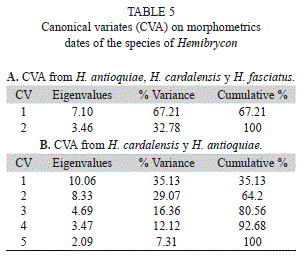
<?xml version="1.0" encoding="ISO-8859-1"?><article xmlns:mml="http://www.w3.org/1998/Math/MathML" xmlns:xlink="http://www.w3.org/1999/xlink" xmlns:xsi="http://www.w3.org/2001/XMLSchema-instance">
<front>
<journal-meta>
<journal-id>0034-7744</journal-id>
<journal-title><![CDATA[Revista de Biología Tropical]]></journal-title>
<abbrev-journal-title><![CDATA[Rev. biol. trop]]></abbrev-journal-title>
<issn>0034-7744</issn>
<publisher>
<publisher-name><![CDATA[Universidad de Costa Rica]]></publisher-name>
</publisher>
</journal-meta>
<article-meta>
<article-id>S0034-77442013000400029</article-id>
<title-group>
<article-title xml:lang="en"><![CDATA[Three new species of Hemibrycon (Characiformes: Characidae) from the Magdalena River Basin, Colombia]]></article-title>
<article-title xml:lang="es"><![CDATA[Tres nuevas especies de Hemibrycon (Characiformes: Characidae) de la cuenca del río Magdalena, Colombia]]></article-title>
</title-group>
<contrib-group>
<contrib contrib-type="author">
<name>
<surname><![CDATA[Román-Valencia]]></surname>
<given-names><![CDATA[César]]></given-names>
</name>
<xref ref-type="aff" rid="A01"/>
</contrib>
<contrib contrib-type="author">
<name>
<surname><![CDATA[Ruiz-C.]]></surname>
<given-names><![CDATA[Raquel I.]]></given-names>
</name>
<xref ref-type="aff" rid="A01"/>
</contrib>
<contrib contrib-type="author">
<name>
<surname><![CDATA[Taphorn]]></surname>
<given-names><![CDATA[Donald C.]]></given-names>
</name>
</contrib>
<contrib contrib-type="author">
<name>
<surname><![CDATA[Mancera-Rodriguez]]></surname>
<given-names><![CDATA[Néstor J.]]></given-names>
</name>
<xref ref-type="aff" rid="A02"/>
</contrib>
<contrib contrib-type="author">
<name>
<surname><![CDATA[García-Alzate]]></surname>
<given-names><![CDATA[Carlos A.]]></given-names>
</name>
<xref ref-type="aff" rid="A01"/>
</contrib>
</contrib-group>
<aff id="A01">
<institution><![CDATA[,Universidad del Quindío  ]]></institution>
<addr-line><![CDATA[Armenia Quindío]]></addr-line>
<country>Colombia</country>
</aff>
<aff id="A02">
<institution><![CDATA[,Universidad Nacional de Colombia  ]]></institution>
<addr-line><![CDATA[ ]]></addr-line>
<country>Colombia</country>
</aff>
<aff id="A04">
<institution><![CDATA[,Universidad del Atlántico  ]]></institution>
<addr-line><![CDATA[Barranquilla Atlántico]]></addr-line>
<country>Colombia</country>
</aff>
<pub-date pub-type="pub">
<day>00</day>
<month>09</month>
<year>2013</year>
</pub-date>
<pub-date pub-type="epub">
<day>00</day>
<month>09</month>
<year>2013</year>
</pub-date>
<volume>61</volume>
<numero>3</numero>
<fpage>1365</fpage>
<lpage>1387</lpage>
<copyright-statement/>
<copyright-year/>
<self-uri xlink:href="http://www.scielo.sa.cr/scielo.php?script=sci_arttext&amp;pid=S0034-77442013000400029&amp;lng=en&amp;nrm=iso"></self-uri><self-uri xlink:href="http://www.scielo.sa.cr/scielo.php?script=sci_abstract&amp;pid=S0034-77442013000400029&amp;lng=en&amp;nrm=iso"></self-uri><self-uri xlink:href="http://www.scielo.sa.cr/scielo.php?script=sci_pdf&amp;pid=S0034-77442013000400029&amp;lng=en&amp;nrm=iso"></self-uri><abstract abstract-type="short" xml:lang="en"><p><![CDATA[Fish biodiversity of aquatic ecosystems is highly threatened by different economic activities driven by human populations, and its description is increasingly a priority. For the Cauca-Magdalena River system we have described 14 species, and the purpose of this paper was to describe three new species belonging to the same genus Hemibrycon from the Nare and Guatapé River drainages of the middle Magdalena River, Colombia. The description was based on a series of 200 specimens, and the use of morphometric, meristic and osteological characters, as well as fish distribution and morphogeometric analytical methods. We have found that Hemibrycon fasciatus n. sp. (n=54) differs from other species of Hemibrycon (that also have a vertical humeral spot) in having: melanophores outlining the posterior margins of the scales along sides of body; humeral spot extending onto posterior margin of opercle; a dark lateral stripe, formed by deep pigment that is continuous with the peduncular spot; the toothed portion of the maxilla not reaching the dorsal margin of the dentary (vs. toothed portion of maxilla extending beyond dorsal margin of dentary); all maxillary teeth tricuspid (vs. some unicuspid teeth present on maxilla). H. cardalensis n. sp. (n=64) differs in having: a vertically elongate humeral spot that extends one or two scales below the lateral line canal. H. cardalensis n. sp. differs from all congeners in having the pigment of the caudal spot restricted to the ventral half of the caudal peduncle, and in having melanophores around the anterior scales of the lateral line. Hemibrycon antioquiae n. sp. (n=82) differs in having a circular humeral spot. It differs from the other species with a circular humeral spot, like H. mikrostiktos, in having a projection of disperse melanophores extending from the dorsal margin of the humeral spot to below the lateral stripe. Habitat data and environmental impacts caused by the construction of reservoirs for hydroelectric projects and other threats in the area are included, as well as a key to all species Hemibrycon present in the Magdalena River Basin. The synonymy of H. pautensis with H. polyodon is discussed and H. pautensis is evalidated.]]></p></abstract>
<abstract abstract-type="short" xml:lang="es"><p><![CDATA[Un total de 14 especies del género Hemibrycon Günther se han encontrado en la cuenca del río Magdalena- Cauca de Colombia. En este estudio, se describen tres nuevas especies de peces del género Hemibrycon Günther 1864 (Characiformes: Characidae) de la cuenca del río Magdalena con una serie de 200 ejemplares, con caracteres morfométricos, merísticos, osteológicos y distribución, y bajo un método de análisis morfogeométrico: Hemibrycon fasciatus n. sp. (n=54), se distingue de otras especies de Hemibrycon por una mancha humeral vertical y por presentar: melanóforos sobre el borde posterior de las escamas a lo largo de la parte lateral del cuerpo; la mancha humeral extendida sobre el borde posterior del opérculo; una banda lateral oscura, formada por pigmentos profundos que se prolongan con la mancha peduncular; la longitud del maxilar con dientes que no alcanzan el borde dorsal del dentarío (vs. longitud con dientes del maxilar sobrepasan el borde dorsal del dentarío); todos los dientes del maxilar tricúspides (vs. dientes unicúspides en el maxilar). H. cardalensis n. sp. (n=64) se distingue de todos sus congéneres por presentar los pigmentos del pedúnculo caudal restringidos a su mitad ventral, y por exhibir melanóforos alrededor de las escamas anteriores del canal latero sensorial. Hemibrycon antioquiae n. sp. (n=82) se distingue en el área predorsal que es sobresaliente respecto a la superficie dorsal del cráneo, por una banda lateral oscura, y por la forma de la mancha peduncular que es ancha y se extiende sobre la banda lateral (vs. banda lateral plateada sin melanóforos y mancha peduncular no conspicua). Se distingue de todos sus congéneres por la forma rectangular del borde posterior del cleitro. Se incluyen datos del hábitat, los efectos antrópicos generados por la construcción de embalses o represas para proyectos hidroeléctricos en el hábitat propio de las especies y una clave taxonómica de las especies de Hemibrycon presentes del río Magdalena. También se discute la sinonimia de H. pautensis con H. polyodon y por lo tanto se revalida H. pautensis.]]></p></abstract>
<kwd-group>
<kwd lng="en"><![CDATA[tropical fish]]></kwd>
<kwd lng="en"><![CDATA[new taxon]]></kwd>
<kwd lng="en"><![CDATA[scales]]></kwd>
<kwd lng="en"><![CDATA[morphology]]></kwd>
<kwd lng="en"><![CDATA[pigmentation pattern]]></kwd>
<kwd lng="es"><![CDATA[pez tropical]]></kwd>
<kwd lng="es"><![CDATA[nuevo taxon]]></kwd>
<kwd lng="es"><![CDATA[escamas]]></kwd>
<kwd lng="es"><![CDATA[morfología]]></kwd>
<kwd lng="es"><![CDATA[patrón de pigmentación]]></kwd>
</kwd-group>
</article-meta>
</front><body><![CDATA[ <div style="text-align: justify;">     <div style="text-align: center;"><font style="font-weight: bold;"  size="4"><span style="font-family: verdana;">Three new species of </span></font><font  style="font-style: italic;" size="4"><span  style="font-family: verdana;">Hemibrycon </span></font><font style="font-weight: bold;" size="4"><span  style="font-family: verdana;">(Characiformes: Characidae) from the Magdalena River Basin, Colombia    <br> </span></font><font style="font-weight: bold;" size="4"><span  style="font-family: verdana;">    <br> Tres nuevas especies de </span></font><font style="font-style: italic;"  size="4"><span style="font-family: verdana;">Hemibrycon </span></font><font style="font-weight: bold;" size="4"><span  style="font-family: verdana;">(Characiformes: Characidae) de la cuenca del r&iacute;o Magdalena, Colombia</span></font><font size="2"><span  style="font-family: verdana;"><span style="font-weight: bold;"> </span></span></font></div> <br style="font-family: verdana;">     <div style="text-align: center;"><font size="2"><span  style="font-family: verdana;">C&eacute;sar Rom&aacute;n-Valencia<sup><a href="#1">1</a><a name="5"></a>*</sup>, Raquel I. Ruiz-C.<a href="#1"><sup>1</sup></a>, Donald C. Taphorn<sup><a href="#3">3</a><a name="7"></a>*</sup>, N&eacute;stor J. Mancera-Rodriguez<sup><a href="#1">2</a><a name="6"></a>*</sup> &amp; Carlos A. Garc&iacute;a-Alzate<sup><a href="#1">1</a>,<a href="#4">4</a><a  name="8"></a>*</sup></span></font><br style="font-family: verdana;"> </div> <font size="2"><span style="font-family: verdana;">    <br> <a name="Correspondencia2"></a>*<a href="#Correspondencia1">Direcci&oacute;n para correspondencia:</a><br style="font-family: verdana;"> </span></font><font size="2"></font> <hr style="width: 100%; height: 2px;"><font style="font-weight: bold;"  size="3"><span style="font-family: verdana;">Abstract</span></font><br  style="font-family: verdana;"> <font size="2"></font><br style="font-family: verdana;"> <font size="2"><span style="font-family: verdana;"><span  style="font-weight: bold;"></span>Fish biodiversity of aquatic ecosystems is highly threatened by different economic activities driven by human populations, and its description is increasingly a priority. For the Cauca-Magdalena River system we have described 14 species, and the purpose of this paper was to describe three new species belonging to the same genus <span  style="font-style: italic;">Hemibrycon </span>from the Nare and Guatap&eacute; River drainages of the middle Magdalena River, Colombia. The description was based on a series of 200 specimens, and the use of morphometric, meristic and osteological characters, as well as fish distribution and morphogeometric analytical methods. We have found that <span style="font-style: italic;">Hemibrycon fasciatus</span> n. sp. (n=54) differs from other species of <span style="font-style: italic;">Hemibrycon </span>(that also have a vertical humeral spot) in having: melanophores outlining the posterior margins of the scales along sides of body; humeral spot extending onto posterior margin of opercle; a dark lateral stripe, formed by deep pigment that is continuous with the peduncular spot; the toothed portion of the maxilla not reaching the dorsal margin of the dentary (vs. toothed portion of maxilla extending beyond dorsal margin of dentary); all maxillary teeth tricuspid (vs. some unicuspid teeth present on maxilla). <span style="font-style: italic;">H. cardalensis</span> n. sp. (n=64) differs in having: a vertically elongate humeral spot that extends one or two scales below the lateral line canal. <span style="font-style: italic;">H. cardalensis</span> n. sp. differs from all congeners in having the pigment of the caudal spot restricted to the ventral half of the caudal peduncle, and in having melanophores around the anterior scales of the lateral line. <span style="font-style: italic;">Hemibrycon antioquiae</span> n. sp. (n=82) differs in having a circular humeral spot. It differs from the other species with a circular humeral spot, like <span style="font-style: italic;">H. mikrostiktos</span>, in having a projection of disperse melanophores extending from the dorsal margin of the humeral spot to below the lateral stripe. Habitat data and environmental impacts caused by the construction of reservoirs for hydroelectric projects and other threats in the area are included, as well as a key to all species <span style="font-style: italic;">Hemibrycon </span>present in the Magdalena River Basin. The synonymy of <span style="font-style: italic;">H. pautensis</span> with <span style="font-style: italic;">H. polyodon</span> is discussed and <span style="font-style: italic;">H. pautensis</span> is evalidated. </span></font><br  style="font-family: verdana;"> <font size="2"></font><br style="font-family: verdana;"> <font size="2"><span style="font-family: verdana;"><span  style="font-weight: bold;">Key words: </span>tropical fish, new taxon, scales, morphology, pigmentation pattern.    <br>     <br style="font-family: verdana; font-weight: bold;">     </span></font><font style="font-weight: bold;" size="3"><span      style="font-family: verdana;">Resumen</span></font><br     ]]></body>
<body><![CDATA[ style="font-family: verdana;">     <font size="2"></font><br style="font-family: verdana;">     <font size="2"><span style="font-family: verdana;">Un total de 14     especies del     g&eacute;nero <span style="font-style: italic;">Hemibrycon </span>G&uuml;nther     se han encontrado en la cuenca     del r&iacute;o Magdalena- Cauca de Colombia. En este estudio, se     describen tres nuevas especies de peces del g&eacute;nero <span      style="font-style: italic;">Hemibrycon     </span>G&uuml;nther 1864 (Characiformes: Characidae) de la cuenca del     ]]></body>
<body><![CDATA[r&iacute;o Magdalena con una serie de 200 ejemplares, con caracteres     morfom&eacute;tricos, mer&iacute;sticos, osteol&oacute;gicos y     distribuci&oacute;n, y bajo un m&eacute;todo de an&aacute;lisis     morfogeom&eacute;trico: <span style="font-style: italic;">Hemibrycon     fasciatus</span> n. sp. (n=54), se     distingue de otras especies de <span style="font-style: italic;">Hemibrycon     </span>por una mancha humeral     vertical y por presentar: melan&oacute;foros sobre el borde posterior     de las escamas a lo largo de la parte lateral del cuerpo; la mancha     humeral extendida sobre el borde posterior del op&eacute;rculo; una     ]]></body>
<body><![CDATA[banda lateral oscura, formada por pigmentos profundos que se prolongan     con la mancha peduncular; la longitud del maxilar con dientes que no     alcanzan el borde dorsal del dentar&iacute;o (vs. longitud con dientes     del maxilar sobrepasan el borde dorsal del dentar&iacute;o); todos los     dientes del maxilar tric&uacute;spides (vs. dientes unic&uacute;spides     en el maxilar). <span style="font-style: italic;">H. cardalensis</span>     n. sp. (n=64) se distingue de todos sus     cong&eacute;neres por presentar los pigmentos del ped&uacute;nculo     caudal restringidos a su mitad ventral, y por exhibir     melan&oacute;foros alrededor de las escamas anteriores del canal latero     ]]></body>
<body><![CDATA[sensorial. <span style="font-style: italic;">Hemibrycon antioquiae</span>     n. sp. (n=82) se distingue en el     &aacute;rea predorsal que es sobresaliente respecto a la superficie     dorsal del cr&aacute;neo, por una banda lateral oscura, y por la forma     de la mancha peduncular que es ancha y se extiende sobre la banda     lateral (vs. banda lateral plateada sin melan&oacute;foros y mancha     peduncular no conspicua). Se distingue de todos sus cong&eacute;neres     por la forma rectangular del borde posterior del cleitro. Se incluyen     datos del h&aacute;bitat, los efectos antr&oacute;picos generados por     la construcci&oacute;n de embalses o represas para proyectos     ]]></body>
<body><![CDATA[hidroel&eacute;ctricos en el h&aacute;bitat propio de las especies y     una clave taxon&oacute;mica de las especies de <span      style="font-style: italic;">Hemibrycon </span>presentes del     r&iacute;o Magdalena. Tambi&eacute;n se discute la sinonimia de <span      style="font-style: italic;">H.     pautensis</span> con <span style="font-style: italic;">H. polyodon</span>     y por lo tanto se revalida <span style="font-style: italic;">H.     pautensis</span>.</span></font><br style="font-family: verdana;">     <font size="2"></font><br style="font-family: verdana;">     <font size="2"><span style="font-family: verdana;"><span     ]]></body>
<body><![CDATA[ style="font-weight: bold;">Palabras clave:</span> pez tropical, nuevo     taxon, escamas, morfolog&iacute;a, patr&oacute;n de pigmentaci&oacute;n.</span></font><br      style="font-family: verdana;">     <font size="2"></font>     <hr style="width: 100%; height: 2px;"><font size="2"><span      style="font-family: verdana;">The taxonomy of the genus     Hemibrycon G&uuml;nther has been fairly addressed     (Rom&aacute;n-Valencia <span style="font-style: italic;">et al.</span>     2006, 2007, 2009a, 2009b,     Rom&aacute;n-Valencia &amp; Ruiz 2007, Bertaco <span     ]]></body>
<body><![CDATA[ style="font-style: italic;">et al.</span> 2007,     Rom&aacute;n-Valencia &amp; Arcila-Mesa 2008, 2009, 2010, Bertaco &amp;     Malabarba 2010). A total of 14 species have been found in the     Cauca-Magdalena River Basin of Colombia, including the three described     here in: <span style="font-style: italic;">H. boquiae</span>, <span      style="font-style: italic;">H. brevispini</span>, <span      style="font-style: italic;">H. cairoense</span>, <span      style="font-style: italic;">H. colombianus</span>, <span      style="font-style: italic;">H.     palomae</span>, <span style="font-style: italic;">H. paez</span>, <span     ]]></body>
<body><![CDATA[ style="font-style: italic;">H. quindos</span>, <span      style="font-style: italic;">H. rafaelense</span>, <span      style="font-style: italic;">H. raqueliae</span>, <span      style="font-style: italic;">H.     virolinica</span>, and <span style="font-style: italic;">H. yacopiae</span>     (Rom&aacute;n-Valencia <span style="font-style: italic;">et al.</span>     2006, 2007,     2009a, 2009b, 2010, Rom&aacute;n-Valencia &amp; Ruiz-C. 2007,     Rom&aacute;n-Valencia &amp; Arcila-Mesa 2008, 2009, 2010). The increase     in the number of described <span style="font-style: italic;">Hemibrycon     ]]></body>
<body><![CDATA[</span>species from the Cauca-Magdalena     River system, most of which exist in allopatry, suggests an interesting     model for diversification of this genus in the Andes     (Rom&aacute;n-Valencia &amp; Arcila-Mesa 2009).</span></font><br      style="font-family: verdana;">     <font size="2"></font><br style="font-family: verdana;">     <font size="2"><span style="font-family: verdana;">Many Andean fishes     are threatened     by human developments and this is the case for these new species,     because their habitat is imperiled by the construction and operation of     ]]></body>
<body><![CDATA[hydroelectric dams, and other factors. The purpose of this paper is to     describe three new species of <span style="font-style: italic;">Hemibrycon     </span>from the Nare and     Guatap&eacute; River drainages of the middle Magdalena River, as a     further contribution of the first author&#8217;s ongoing revision of     <span style="font-style: italic;">Hemibrycon </span>species in South     America; yet more proof of the undocumented     biodiversity of the genus.</span></font><br      style="font-family: verdana;">     <font size="2"></font><br style="font-family: verdana;">     ]]></body>
<body><![CDATA[<font style="font-weight: bold;" size="3"><span      style="font-family: verdana;">Materials and Methods </span></font><br      style="font-family: verdana;">     <font size="2"></font><br style="font-family: verdana;">     <font size="2"><span style="font-family: verdana;">Cast nets and     electro fishing gear     were used to capture these fishes from nine creeks in fiv&nbsp; areas     of the middle reaches of the Nare River, above the     Pe&ntilde;ol-Guatap&eacute; dam, and between that site and the San     Lorenzo reservoir, and the Guatap&eacute; River drainage, and both     ]]></body>
<body><![CDATA[above and below the Playas reservoir. This region includes parts of the     following counties (Municipios): Alejandr&iacute;a, Concepci&oacute;n,     Guatap&eacute;, San Vicente and San Rafael, in the state (Departamento)     of Antioquia, Colombia (<a href="/img/revistas/rbt/v61n3/a29i1.jpg">Fig.     1</a>), that will be described in the next     paragraphs.</span></font><br style="font-family: verdana;">     <font size="2"></font><br style="font-family: verdana;">     <font size="2"><span style="font-family: verdana;"><span      style="font-weight: bold;">Zone 1: </span>Sampling stations were     located in the Nare River drainage above the     ]]></body>
<body><![CDATA[Pe&ntilde;ol-Guatap&eacute; reservoir. Collections were made in La     Compa&ntilde;&iacute;a and La Magdalena Creeks, at altitudes between 1     875 and 2 094m.a.s.l, and in different dates (November 2007, March and     May 2008, January and March 2010, June, September and November 2011,     and February 2012). These sites had major human impacts, with obvious     contamination, bad odors, garbage, sewage and agricultural runoff from     adjacent fields.</span></font><br style="font-family: verdana;">     <font size="2"></font><br style="font-family: verdana;">     <font size="2"><span style="font-family: verdana;">&#8226; <span      style="font-weight: bold;">La Compa&ntilde;&iacute;a Creek:</span>     ]]></body>
<body><![CDATA[Located in San Vicente County, this stream receives sewage from much of     the region and empties into the Nare River above the     Pe&ntilde;ol-Guatap&eacute; reservoir. The sampling site was at 2     094m.a.s.l. The substrate was sandy, with medium sized rocks; water was     dark because of suspended organic material. Depth was 1.0-1.80m.</span></font><br      style="font-family: verdana;">     <font size="2"></font><br style="font-family: verdana;">     <font size="2"><span style="font-family: verdana;">&#8226; <span      style="font-weight: bold;">La Magdalena Creek:</span> Located in     San Vicente County, this site had better water quality than La     ]]></body>
<body><![CDATA[Compa&ntilde;&iacute;a Creek. Sampling sites were located between 1 875     and 2 140m.a.s.l. Water was clear over a sandy to rocky substrate; the     sampling sites were near a path through cattle pastures and     agricultural fields where beans, strawberries, and sisal crops were     grown. Local inhabitants informed us that the creek was affected when     the fibers from the sisal plants are washed after harvest, and also, by     fertilizers and pesticides. Sewage pipes flowing into streams from     several houses were also observed in the area.    <br>     <br style="font-family: verdana;">     ]]></body>
<body><![CDATA[</span></font><font size="2"><span style="font-family: verdana;"><span      style="font-weight: bold;">Zone 2: </span>These sites were located in     the Nare River drainage below the Pe&ntilde;ol-Guatap&eacute; reservoir:</span></font><br      style="font-family: verdana;">     <font size="2"></font><br style="font-family: verdana;">     <font size="2"><span style="font-family: verdana;">&#8226; <span      style="font-weight: bold;">Santa Gertrudis Creek:</span> Located     below the outflow chute of the Pe&ntilde;ol-Guatap&eacute; Reservoir at     an altitude of 1 820m.a.s.l. substrate was rocky, water clear to     crystalline and the stream was affected by the discharge from the     ]]></body>
<body><![CDATA[reservoir. Water quality was better than that in creeks of Zone 1, with     rapid flow and good oxygenation.</span></font><br      style="font-family: verdana;">     <font size="2"></font><br style="font-family: verdana;">     <font size="2"><span style="font-family: verdana;"><span      style="font-weight: bold;">Zone 3: </span>Stations located in the     Nare River drainage above the San Lorenzo reservoir:</span></font><br      style="font-family: verdana;">     <font size="2"></font><br style="font-family: verdana;">     <font size="2"><span style="font-family: verdana;">&#8226; <span     ]]></body>
<body><![CDATA[ style="font-weight: bold;">San Lorenzo and San Jos&eacute;     Creeks:</span> Located between 1 250 and 1 261m.a.s.l. respectively,     these     creeks empty directly in to the San Lorenzo Reservoir. In this sector     there are very large rocks, but upstream the substrate is sandy. Fish     capture was easier in areas where loose rocks served as refuges. Depth     of San Lorenzo Creek was between 0.4-1.50m and at sites in San     Jos&eacute; Creek, from 0.20-0.70m.</span></font><br      style="font-family: verdana;">     <font size="2"></font><br style="font-family: verdana;">     ]]></body>
<body><![CDATA[<font size="2"><span style="font-family: verdana;"><span      style="font-weight: bold;">Zone 4:</span> Sites located in the     Guatap&eacute; River drainage, above the Playas Reservoir.</span></font><br      style="font-family: verdana;">     <font size="2"></font><br style="font-family: verdana;">     <font size="2"><span style="font-family: verdana;">&#8226; <span      style="font-weight: bold;">Guatap&eacute; River drainage,     Pe&ntilde;oles and Mazorcos Creeks: </span>these are located in San     Rafael     County, substrates were rocky and slopes were steep. Sites were located     ]]></body>
<body><![CDATA[between 1 201 and 1 265m.a.s.l. The region was partially forested with     native vegetation, but cattle pastures were also present. Very large     rocks were present in and around the stream.</span></font><br      style="font-family: verdana;">     <font size="2"></font><br style="font-family: verdana;">     <font size="2"><span style="font-family: verdana;"><span      style="font-weight: bold;">Zone 5:</span> These sites were located in     the Guatap&eacute; River drainage below Playas Reservoir.</span></font><br      style="font-family: verdana;">     <font size="2"></font><br style="font-family: verdana;">     ]]></body>
<body><![CDATA[<font size="2"><span style="font-family: verdana;">&#8226; <span      style="font-weight: bold;">El Cardal Creek:</span> This stream is     located in the Guatap&eacute; River drainage, below Playas Reservoir.     Substrate was sandy to rocky, with very large rocks upstream from the     sampling station. Water was moderately contaminated. At some spots in     this creek, decomposing organic material caused bad odors. Mining     activity was also present, but both sides of the channel had native     vegetation. In the upper section of this creek, sediment deposits were     noted, along with very large rocks, with lichens growing on the exposed     portions. El Cardal Creek near the two-lane bridge on the highway     ]]></body>
<body><![CDATA[between San Rafael and San Carlos counties receives the discharge of     sewage pipes coming from a housing development of the &#8220;Empresas     P&uacute;blicas de Medell&iacute;n&#8221; (EPM) company.</span></font><br      style="font-family: verdana;">     <font size="2"></font><br style="font-family: verdana;">     <font size="2"><span style="font-family: verdana;">Measurements were     taken with     digital calipers, recorded to hundredths of millimeters and usually     expressed as percentages of standard or head length (<a      href="/img/revistas/rbt/v61n3/a29t1.gif">Table 1</a>). Counts     ]]></body>
<body><![CDATA[were made using a stereoscope with a dissection needle to extend the     fins. Counts and measurements were taken from the left side of     specimens when possible and in general were taken according to     guidelines in Vari &amp; Siebert (1990).</span></font><br      style="font-family: verdana;">     <font size="2"></font><br style="font-family: verdana;">     <font size="2"><span style="font-family: verdana;">Observations of     bones and cartilage     were made using cleared and stained specimens (C &amp; S), prepared     according to techniques outlined in Taylor &amp; Van Dyke (1985) and     ]]></body>
<body><![CDATA[Song &amp; Parenti (1995). Bone nomenclature follows Weitzman (1962),     Vari (1995) and Ruiz-C. &amp; Rom&aacute;n-Valencia (2006). Museum     acronyms follow Sabaj-Perez (2012).In the list of paratypes, the number     of individuals is given immediately after the catalog number, which is     followed by the range of Standard Length (SL) in mm for that lot. All     collections were made in Colombia, Antioquia state (department), from     the Nare and Guatap&eacute; Rivers Basins. Some locality information is     not translated because key information from original labels is often     lost by inaccurate translation. The holotypes were kept in the     laboratory of Ichthyology, Universidad del Quind&iacute;o, Armenia,     ]]></body>
<body><![CDATA[Colombia (IUQ). </span></font><br style="font-family: verdana;">     <font size="2"></font><br style="font-family: verdana;">     <font size="2"><span style="font-family: verdana;">The 21 morphometric     characters     analyzed in this study (<a href="/img/revistas/rbt/v61n3/a29t1.gif">Table     1</a>) were evaluated by Principal Component     Analysis (PCA) using the Burnaby method to eliminate the influence of     size with the PAST program, session 2.13 for Windows (Hammer et. al.     2008). Also, a morphogeometric analysis was done to discriminate     populations from the Nare and Guatap&eacute; River drainages (<a     ]]></body>
<body><![CDATA[ href="/img/revistas/rbt/v61n3/a29i1.jpg">Fig. 1</a>)     that coincide with the three new species described here. For that     analysis a digital image was taken of the left side of each individual     using a CyberShot w360 Sony digital camera installed on a photography     stand. The macro lens option was used to reduce deformation of the     edges of the images. Millimeter graph paper was used as a background     for these images to determine if deformation was occurring, and the     scale of each image (Ruiz-C. &amp; Cipriani 2006, Garc&iacute;a-Alzate     <span style="font-style: italic;">et al.</span> 2011, Ruiz-C. <span      style="font-style: italic;">et al.</span> 2011). TPS files were     ]]></body>
<body><![CDATA[created using the     software program TPSUtil (Rohlf 2004a). The program TPSDig2 (Rohlf     2004b) was used to digitize morphological landmarks, which were     homologous features that permit the general description of body form.     30 type I and II landmarks were recorded (<a      href="/img/revistas/rbt/v61n3/a29t2.gif">Table 2</a>).</span></font><br      style="font-family: verdana;">     <font size="2"></font><br style="font-family: verdana;">     <font size="2"><span style="font-family: verdana;">The size of each     configuration was     ]]></body>
<body><![CDATA[estimated by using the &#8220;size centroid&#8221; (TC) that is calculated by     taking the square root of the sum of the squares of the distance of     each landmark from the centroid (Bookstein 1991, Bookstein <span      style="font-style: italic;">et al.</span>     1999). Once all images were digitized, the effects of translation,     scale and rotation were eliminated from the set of configurations using     an orthogonal analysis of generalized procrustes least squares (AGP)     (Rohlf &amp; Slice 1990), using the software program TPSSmall (Rohlf     2003); all configurations were scaled at TC=1 for this procedure.</span></font><br      style="font-family: verdana;">     ]]></body>
<body><![CDATA[<font size="2"></font><br style="font-family: verdana;">     <font size="2"><span style="font-family: verdana;">The coordinate     matrix generated by     the TPS Dig2 program was analyzed with the MorphoJ program, which     generated: an analysis of variance of canonical variables (AVC) using     standardized data; this multivariate analysis maximizes the traditional     morphological variation between groups; the changes in shape associated     with each canonical variable (VC) that are drawn as deformation grids     that describe the differences found between groups, and consists of the     observations of the multivariate analysis compared with data obtained     ]]></body>
<body><![CDATA[with traditional techniques (AVC), discriminating the variation between     species; and evaluating the similarity among populations based on the     Mahalanobis distance nearness.</span></font><br      style="font-family: verdana;">     <font size="2"></font><br style="font-family: verdana;">     <font size="2"><span style="font-family: verdana;"><span      style="font-weight: bold;">Comparative material examined:</span> See     (Rom&aacute;n-Valencia 2001, Rom&aacute;n-Valencia <span      style="font-style: italic;">et al.</span> 2006, 2007,     2009a, 2009b, Rom&aacute;n-Valencia &amp; Ruiz-C. 2007,     ]]></body>
<body><![CDATA[Rom&aacute;n-Valencia &amp; Arcila-Mesa 2008, 2009, 2010) for     additional lists of comparative material examined of <span      style="font-style: italic;">Hemibrycon </span>species     that we compared with this new species. Data were also used from     Bertaco <span style="font-style: italic;">et al.</span> (2007).</span></font><br      style="font-family: verdana;">     <font size="2"></font><br style="font-family: verdana;">     <font style="font-weight: bold;" size="3"><span      style="font-family: verdana;">Results</span></font><br      style="font-family: verdana;">     ]]></body>
<body><![CDATA[<font size="2"></font><br style="font-family: verdana;">     <font size="2"><span style="font-family: verdana;"><span      style="font-style: italic; font-weight: bold;">Hemibrycon fasciatus</span>     n. sp.</span></font><br style="font-family: verdana;">     <font size="2"><span style="font-family: verdana;">(<a      href="/img/revistas/rbt/v61n3/a29t1.gif">Table1</a>-<a href="#t_5">5</a>,     <a href="/img/revistas/rbt/v61n3/a29i2.jpg">Figs.     2</a>-<a href="/img/revistas/rbt/v61n3/a29i3.jpg">3</a>, <a      href="/img/revistas/rbt/v61n3/a29i6.jpg">6</a>-<a      href="/img/revistas/rbt/v61n3/a29i13.jpg">13</a>)    ]]></body>
<body><![CDATA[<br>     </span></font><br style="font-family: verdana;">     <font size="2"><span style="font-family: verdana;"><span      style="font-weight: bold;">Holotype:</span> IUQ 3191, 81.0mm SL,     Colombia, Antioquia, Municipio de San Vicente, Vereda Corrientes,     middle sector of the Magdalena River Basin, La Magdalena Creek,     tributary of the Nare River, 6&deg;18&#8217;42.4&#8221; N-75&deg;15&#8217;28.7&#8217;&#8217; W, 1     882m.a.s.l., 27 Mar 2010, N. Mancera (<a      href="/img/revistas/rbt/v61n3/a29i2.jpg">Fig. 2</a>).</span></font><br      style="font-family: verdana;">     ]]></body>
<body><![CDATA[<font size="2"></font><br style="font-family: verdana;">     <font size="2"><span style="font-family: verdana;"><span      style="font-weight: bold;">Paratypes:</span> All from the state     (Departamento) of Antioquia, middle Magdalena River Basin and collected     by N. Mancera: IUQ 3065 (4), 32.4-71.5mm SL, Quebrada Santa Gertrudis     afluente r&iacute;o Nare, municipio de Concepci&oacute;n     6&ordm;19&#8217;21.0&#8221; N-75&ordm;09&#8217;38.6&#8221; W, 1 820m.a.s.l., 31 Jan 2010. IUQ     3156 (1), 52.7mm SL, Quebrada Santa Gertrudis, afluente r&iacute;o     Nare, l&iacute;mites municipios Concepci&oacute;n y Alejandr&iacute;a,     despu&eacute;s del embalse Pe&ntilde;ol-Guatap&eacute; 6&ordm;19&#8217;32.3&#8221;     ]]></body>
<body><![CDATA[N-75&ordm;09&#8217;50.4&#8221; W, 1 820m.a.s.l., 22 Jun 2011. IUQ 3192 (2,     C&amp;S), 52.0-58.8mm SL, Quebrada Santa Gertrudis afluente r&iacute;o     Nare, municipio de Concepci&oacute;n 6&ordm;19&#8217;21.0&#8221; N-75&ordm;09&#8217;38.6&#8221;     W, 1 820m.a.s.l., 31 Jan 2010. IUQ 3160 (1), 44.3mm SL, Quebrada Santa     Gertrudis, afluente r&iacute;o Nare, municipio de Concepci&oacute;n,     6&ordm;19&#8217;21.0&#8221; N-75&ordm;09&#8217;38.6&#8221; W, 1 820m.a.s.l., 22 Jun 2011. IUQ     3168 (1), 72.2mm SL, Quebrada La Magdalena, vereda Corrientes,     municipio San Vicente, afluente r&iacute;o Nare 6&deg;19&#8217;52.5&#8221;     N-75&deg;17&#8217;04.8&#8221; W, 2 140m.a.s.l., 24 Jun 2011. IUQ 3167 (1), 59.4mm     SL, Quebrada La Magdalena afluente r&iacute;o Nare, municipio San     ]]></body>
<body><![CDATA[Vicente, antes del embalse Pe&ntilde;ol-Guatap&eacute; 6&deg;19&#8217;52.5&#8217;&#8217;     N-75&deg;17&#8217;4.8&#8221; W, 2 140m.a.s.l., 17Nov 2011. IUQ 3173 (1), 73.1mm SL,     Quebrada La Magdalena, afluente r&iacute;o Nare, municipio San Vicente,     6&deg;18&#8217;42.4&#8221; N-75&deg;15&#8217;28.7&#8217;&#8217; W, 1882 25 Sep 2011. IUQ 3171 (1),     55.2mm SL, Quebrada La Magdalena, vereda Corrientes, municipio San     Vicente, afluente r&iacute;o Nare 6&deg;19&#8217;52.5&#8217;&#8217; N-75&deg;17&#8217;4.8&#8221; W-2     140m.a.s.l., 24 Jun 2011. IUQ 3164 (2), 75.1-91.1mm SL, Quebrada La     Magdalena, afluente r&iacute;o Nare, vereda Corrientes, municipio San     Vicente, afluente r&iacute;o Nare 6&deg;18&#8217;42.4&#8217;&#8217; N-75&deg;15&#8217;28.7&#8221; W,     1 882m.a.s.l., 24 Jun 2011. IUQ 3166 (2), 74.9-76.7mm SL, Quebrada La     ]]></body>
<body><![CDATA[Magdalena, vereda Corrientes, municipio San Vicente, afluente     r&iacute;o Nare 6&deg;19&#8217;52.5&#8217; &#8217;N-75&deg;17&#8217;04.8&#8221; W, 2 140m.a.s.l., 17     Nov 2011. IUQ 3070 (24), 45.0-82.8mm SL, Quebrada La Magdalena, vereda     Corrientes, 6&deg;18&#8217;42.4&#8217;&#8217; N-75&deg;15&#8217;28.7&#8221; W, 1 882m.a.s.l. 27 Mar     2010. CSJ 14 (2), 50.2-54.6mm SL, Quebrada La Magdalena, vereda     Corrientes, 6&deg;18&#8217;42.4&#8217;&#8217; N-75&deg;15&#8217;28.7&#8221; W, 1 882m.a.s.l. 27 Mar     2010. AUM 56756 (1), 62.4mm SL, Quebrada La Magdalena, vereda     Corrientes, 6&deg;18&#8217;42.4&#8217;&#8217; N-75&deg;15&#8217;28.7&#8221; W, 1 882m.a.s.l. 27 Mar     2010. IUQ 3078 (8), 23.6-65.8mm SL, Quebrada Santa Gertrudis, afluente     r&iacute;o Nare, municipio de Concepci&oacute;n 6&ordm;19&#8217;21.0&#8221;     ]]></body>
<body><![CDATA[N-75&ordm;09&#8217;38.6&#8221; W, 1 820m.a.s.l., 26 May 2008. IUQ 3158 (1), 58.1mm     SL, Quebrada Santa Gertrudis, afluente r&iacute;o Nare, municipio de     Concepci&oacute;n 6&ordm;19&#8217;21.0&#8221; N-75&ordm;09&#8217;38.6&#8221; W, 1 820m.a.s.l.,     22 Jun 2011. IUQ 3193 (1, C&amp;S), 61.3mm SL, Quebrada La Magdalena,     vereda Corrientes, 6&deg;18&#8217;42.4&#8217;&#8217; N-75&deg;15&#8217;28.7&#8221; W, 1 882m.a.s.l.,     27 Mar 2010.</span></font><br style="font-family: verdana;">     <font size="2"></font><br style="font-family: verdana;">     <font size="2"><span style="font-family: verdana;"><span      style="font-weight: bold;">Diagnosis:</span> <span      style="font-style: italic;">Hemibrycon fasciatus</span> n.     ]]></body>
<body><![CDATA[sp. differs from <span style="font-style: italic;">H. mikrostiktos</span>,     <span style="font-style: italic;">H. boquiae</span>, <span      style="font-style: italic;">H. brevispini</span>, <span      style="font-style: italic;">H.     microformaa</span>, <span style="font-style: italic;">H. metae</span>,     <span style="font-style: italic;">H. colombianus</span>, <span      style="font-style: italic;">H. rafaelense</span> and <span      style="font-style: italic;">H. palomae</span> by     the presence of a circular humeral spot that does not pass ventrally     below the lateral-line canal, and has a only a diffuse, inconspicuous     ]]></body>
<body><![CDATA[vertical extension (vs. presence of a vertically elongate humeral spot     that reaches 1 or 2 scales below the lateral line canal); and by having     short scales with a rounded posterior margin at the base of the     caudal-fin (vs. scales at base of caudal fin elongate and with     posterior margin lobed, <a href="/img/revistas/rbt/v61n3/a29i3.jpg">Fig.     3</a>). It differs from the other species of     <span style="font-style: italic;">Hemibrycon </span>(<span      style="font-style: italic;">H. beni, H. helleri, H. huambonicus, H.     inambari, H.     jelskii, H. polyodon, H. surinamensis, H. taeniurus, H. divisorensis,     ]]></body>
<body><![CDATA[H. quindos, H. santamartae, H. raqueliae, H. virolinica, H. yacopiae     </span>and <span style="font-style: italic;">H. jabonero</span>), in     having melanophores present on the posterior     margins of the scales all along the sides of body (vs. melanophores     absent from margins of scales along entire length of sides of body;     except for <span style="font-style: italic;">H. virolinica</span>); by     having a dark lateral stripe, formed by     deep pigment that is continuous with the caudal peduncle spot (vs.     lateral stripe silvery); by a wide, concave pelvic bone (vs. narrow and     straight); by having the middle part of the dorsal margin of the     ]]></body>
<body><![CDATA[orbito-sphenoid bone concave, and not in contact with the frontal (vs.     in contact with frontal); ventral tip of extrascapular bifurcate (vs.     not bifurcate); first postcleithrum not contacting cleithrum (vs.     touching). The portion of maxilla with teeth does not reach the dorsal     border of the dentary (vs. portion of maxilla with teeth reaching     beyond dorsal border of dentary); all maxillary teeth tricuspid (vs.     some unicuspid teeth present on maxilla); it differs from <span      style="font-style: italic;">H. virolinica</span>     by having the caudal peduncle spot continuous with the dark lateral     stripe (vs. melanophores of caudal peduncle spot not conspicuous and     ]]></body>
<body><![CDATA[restricted to just caudal peduncle) and by having the humeral spot     extending on to the posterior part of the opercle (vs. area anterior to     humeral spot depigmented).</span></font><br      style="font-family: verdana;">     <font size="2"></font><br style="font-family: verdana;">     <font size="2"><span style="font-family: verdana;"><span      style="font-weight: bold;">Description:</span> Body slender and     elongate (mean maximum body depth about 29.6% SL). Area above orbits     convex, concave between posterior margin of orbit and supraoccipital     spine. Dorsal profile of head and body oblique from supraoccipital to     ]]></body>
<body><![CDATA[dorsal-fin origin and from last dorsal-fin ray to base of caudal fin.     Ventral profile of body convex from snout to base of pelvic fin;     straight from pelvic-fin origin to anal fin. Caudal peduncle laterally     compressed. Head and snout short (21.7% SL and 26.3% HL respectively),     jaws equal, mouth terminal, lips soft and flexible, and not covering     outer row of premaxilla teeth; ventral border of upper jaw straight;     posterior edge of maxilla reaching anterior edge of orbit.</span></font><br      style="font-family: verdana;">     <font size="2"></font><br style="font-family: verdana;">     <font size="2"><span style="font-family: verdana;">Premaxilla with two     ]]></body>
<body><![CDATA[rows of teeth.     Two-four teeth of outer row tricuspid with central cusp larger. Inner     premaxillary row with four pentacuspid teeth that diminish gradually in     size. Maxilla long, posterior margin straight, with 6-11 uni- or     tricuspid teeth, central cusp slightly longer. Dentary with four large     tricuspid teeth with central cusp largest, followed by four to nine     smaller, uni- to tricuspid teeth. Total number of vertebra 38-40. Six     infraorbitals present, the first thin and narrow, extending between the     dorsal edge of maxilla and lateral ethmoid, with sensorial canal.     Second infraorbital short and wide, not covering dorsal part of     ]]></body>
<body><![CDATA[angulo-articular. Anterior part of second infraorbital overlaying     anterior part of first infraorbital; its posterior margin extends below     third infraorbital. Third infraorbital widest and longest, its ventral     border in contact with sensorial canal of preopercle. Fourth, fifth and     sixth infraorbitals short and wide, covering posterior margin of     hyomandibular. Supraorbital absent. Eight to nine supraneurals present     between head and anterior part of dorsal fin, without cartilage on     upper and lower edges, and with medial sensorial canal.</span></font><br      style="font-family: verdana;">     <font size="2"></font><br style="font-family: verdana;">     ]]></body>
<body><![CDATA[<font size="2"><span style="font-family: verdana;"><span      style="font-weight: bold;">Secondary sexual dimorphism:</span>     Between 13-18 spines present on seventh branched pelvic-fin ray,     located on both branches of ray, but predominant on internal branch;     the largest spine at distal tip of ray, then gradually reduced in size.     Spines absent from simple pelvic-fin rays. Males have a row of very     short hooks on first four or five simple anal-fin rays, and long hooks     on first seven or eight branched anal-fin rays, each ray has from 6-14     hooks, that extend along both sides of posterior margins of rays.</span></font><br      style="font-family: verdana;">     ]]></body>
<body><![CDATA[<font size="2"></font><br style="font-family: verdana;">     <font size="2"><span style="font-family: verdana;"><span      style="font-weight: bold;">Pigmentation in alcohol:</span> Body dark     brownish-yellow, cromatophores more densely concentrated on dorsum,     most intense on head. Midlateral body with dark stripe from posterior     margin of humeral spot to caudal peduncleand prolonged onto middle     caudal-fin rays. Humeral spot circular, located just behind posterior     margin of opercle, not reaching the second series of scales below the     lateral-line canal. Ventral part of body light yellow. Posterior     margins of scales dark on dorsal region of body. Dorsal fin with     ]]></body>
<body><![CDATA[cromatophores concentrated mostly on interradial membranes and distal     margins of anterior rays. Adipose fin dark. Cromatophores on middle     caudal-fin rays, near caudal-fin base but hyaline distally. Pectoral     and pelvic fins hyaline; anal and caudal- fin lobes dusky. </span></font><br      style="font-family: verdana;">     <font size="2"></font><br style="font-family: verdana;">     <font size="2"><span style="font-family: verdana;"><span      style="font-weight: bold;">Distribution:</span> This species is so     far known only from the Nare River drainage, Magdalena River basin,     Colombia. </span></font><br style="font-family: verdana;">     ]]></body>
<body><![CDATA[<font size="2"></font><br style="font-family: verdana;">     <font size="2"><span style="font-family: verdana;"><span      style="font-weight: bold;">Comments:</span> <span      style="font-style: italic;">H. fasciatus</span> occurs with     <span style="font-style: italic;">H. virolinica</span> and may be     phylogenetically related to it, however, it     can be distinguished from it by the presence of a dark lateral stripe     that is absent in <span style="font-style: italic;">H. virolinica</span>     and by the presence of pigment on the     adipose fin (vs. absent).    ]]></body>
<body><![CDATA[<br> <br style="font-family: verdana; font-weight: bold;"> </span></font><font size="2"><span style="font-family: verdana;"><span  style="font-weight: bold;">Etymology:</span> fasciatus is from the Latin fascia, alluding to the dark lateral stripe or band that distinguishes this species. To be treated as a noun in apposition.</span></font><br  style="font-family: verdana;"> <font size="2"><span style="font-family: verdana;">    <br> <span style="font-style: italic; font-weight: bold;">Hemibrycon cardalensis</span> n. sp. </span></font><br  style="font-family: verdana;"> <font size="2"><span style="font-family: verdana;">(<a  href="/img/revistas/rbt/v61n3/a29t1.gif">Tables 1</a>-<a href="#t_5">5</a>, <a href="/img/revistas/rbt/v61n3/a29i4.jpg">Fig. 4</a>, <a href="/img/revistas/rbt/v61n3/a29i6.jpg">6</a>-<a  href="/img/revistas/rbt/v61n3/a29i9.jpg">9</a>, <a  href="/img/revistas/rbt/v61n3/a29i11.jpg">11</a>-<a  href="/img/revistas/rbt/v61n3/a29i12.jpg">12</a>)</span></font><br  style="font-family: verdana;"> <font size="2"></font><br  style="font-family: verdana; font-weight: bold;"> <font size="2"><span style="font-family: verdana;"><span  style="font-weight: bold;">Holotype:</span> IUQ 3190, male, 78.2mm SL, Colombia, Antioquia, border between Municipios San Rafael and San Carlos, above Playas Reservoir, El Cardal Creek, tributary of Guatap&eacute; River, middle sector of the Magdalena River Drainage,6&ordm;16&#8217;56.4&#8221; N-74&ordm;55&#8217;37.7&#8221; W, 898m.a.s.l., 28 Mar 2010, N. Mancera (<a href="/img/revistas/rbt/v61n3/a29i4.jpg">Fig. 4</a>).</span></font><br  style="font-family: verdana;"> <font size="2"></font><br style="font-family: verdana;"> <font size="2"><span style="font-family: verdana;"><span  style="font-weight: bold;">Paratypes: </span>All from the state (Departamento) of Antioquia, middle sector of the Magdalena River Basin, collected by N. Mancera: IUQ 3049 (4), 52.5-63.8mm SL, l&iacute;mites de los Municipios San Rafael y San Carlos, despu&eacute;s del embalse de Playas, Quebrada El Cardal, afluente r&iacute;o Guatap&eacute;, 06&deg;16&#8217;56,4&#8217;&#8217; N-74&deg;55&#8217;37.7&#8217;&#8217; W, 898m.a.s.l., 9 Mar 2008. IUQ 3046 (1), 69.1mm SL, Quebrada El Cardal, afluente r&iacute;o Guatap&eacute;, despu&eacute;s del embalse Playas, 06&deg;16&#8217;56.4&#8217;&#8217; N-74&deg;55&#8217;37.7&#8217;&#8217; W 898m.a.s.l., 18 Nov 2007. IUQ 3048 (4), 53.7-79.9mm SL, Quebrada El Cardal, afluente r&iacute;o Guatap&eacute;, despu&eacute;s del embalse Playas, 06&deg;16&#8217; 56.4&#8217;&#8217; N-74&deg;55&#8217;37.7&#8217;&#8217; W, 898m.a.s.l., 9 Mar 2008. IUQ 3050(8), 53.5-84.7mm SL, Quebrada El Cardal, afluente r&iacute;o Guatap&eacute;, 06&deg;16&#8217;56.4&#8217;&#8217; N-74&deg;55&#8217;37.7&#8217;&#8217; W, 898m.a.s.l., 28 Mar 2010, col. N. Mancera. IUQ3051 (9), 53.5-84.8mm SL, Quebrada El Cardal, 27 Jan 2010. CSJ 146 (2), 54.2-55.3mm SL, Quebrada El Cardal, 06&deg;16&#8217;56.4&#8217;&#8217; N-74&deg;55&#8217;37.7&#8217;&#8217; W, 898m.a.s.l., 27 Jan 2010. AUM 56755 (1), 61.4mm SL, Quebrada El Cardal, 27 Jan 2010. IUQ3052 (14), 40.0-73.2mm SL, Quebrada El Cardal afluente r&iacute;o Guatap&eacute;, despu&eacute;s del embalse Playas 06&deg;16&#8217;56.4&#8217;&#8217; N-74&deg;55&#8217;37.7&#8221; W, 898m.a.s.l., 9 Mar 2008. IUQ 3054 (3), 30.8-53.9mm SL, Quebrada El Cardal, afluente r&iacute;o Guatap&eacute;, 6&deg;16&#8217;56.4&#8217;&#8217; N-74&deg;55&#8217;37.7&#8217;&#8217; W, 898m.a.s.l., 18 Nov. 2007. IUQ 3055 (1), 68.1mm SL, Quebrada El Cardal afluente r&iacute;o Guatap&eacute;, despu&eacute;s del embalse Playas, 06&deg;16&#8217;56.4&#8217;&#8217; N-74&deg;55&#8217;37.7&#8217;&#8217; W, 898m.a.s.l., 14 Oct 2007. IUQ 3072(1), 53.4mm SL, Quebrada El Cardal, afluente r&iacute;o Guatap&eacute;, 06&deg;16&acute;56,4&#8221; N-74&deg;55&acute;37.7&#8221; W, 898m.a.s.l., 9 Mar 2008. IUQ 3073 (4), 49.5-63.1mm SL, Quebrada El Cardal, afluente r&iacute;o Guatap&eacute;, 6&deg;16&#8217;56.4&#8217;&#8217; N-74&deg;55&#8217;37.7&#8217; W, 898m.a.s.l., 28 Mar 2010. IUQ 3077 (2), 51.9-62.7mm SL, Quebrada El Cardal, afluente r&iacute;o Guatap&eacute;, 6&deg;16&#8217;56.4&#8217;&#8217; N-74&deg;55&#8217;37.7&#8217;&#8217; W, 898m.a.s.l., 14 Oct 2007. IUQ 3161 (2), 49.4-57.5mm SL, Quebrada El Cardal, afluente r&iacute;o Guatap&eacute;, 24 May 2008. IUQ 3162 (1), 82.4mm SL, Quebrada El Cardal, 06&deg;16&#8217;47.5&#8217;&#8217; N-74&deg;56&#8217;27.4&#8217;&#8217; W, 976m.a.s.l. 21 Jun 2011. IUQ 3155 (1), 68.1mm SL, Quebrada El Cardal, afluente r&iacute;o Guatap&eacute;, 06&deg;16&#8217;46.6&#8217;&#8217; N-74&deg;55&#8217;24.6&#8217;&#8217; W, 898m.a.s.l., 21 Jun 2011. IUQ 3159 (1), 77.7mm SL, Quebrada El Cardal, afluente r&iacute;o Guatap&eacute;, 06&deg;16&#8217;46.6&#8221; N-74&deg;55&#8217;24.6&#8217;&#8217; W, 898m.a.s.l., 22 Sep 2011. IUQ 3152 (2), 52.1-72.8mm SL, Quebrada El Cardal, afluente r&iacute;o Guatap&eacute;, 6&deg;16&#8217;46.6&#8217;&#8217; N-74&deg;55&#8217;24.6&#8217;&#8217; W, 898m.a.s.l., 20 Jun 2011. IUQ 3056 (2 C &amp; S), 56.2-67.2mm SL, Quebrada El Cardal afluente r&iacute;o Guatap&eacute;, 9 Mar 2008. IUQ 3057 (2, C&amp;S), 59.4-71.6mm SL, Quebrada El Cardal afluente r&iacute;o Guatap&eacute;, despu&eacute;s del embalse Playas, 6&deg;16&#8217;56.4&#8217;&#8217; N-74&deg;55&#8217;37.7&#8217;&#8217; W, 898m.a.s.l., 24 May 2008.</span></font><br  style="font-family: verdana;"> <font size="2"></font><br style="font-family: verdana;"> <font size="2"><span style="font-family: verdana;"><span  style="font-weight: bold;">Diagnosis:</span> <span  style="font-style: italic;">H. cardalensis</span> n. sp. Differs from all congeners, including the sympatric species and <span  style="font-style: italic;">H. fasciatus</span> n. sp., described herein, in having the dark pigment of the peduncle spot restricted to just the ventral half of the caudal peduncle (vs. pigment distributed symmetrically above and below central axis of caudal peduncle), in having melanophores outlining the anterior lateral-line scales (vs. anterior lateral-line scales not outlined with melanophores) and in having scales of posterior margin of caudal peduncle with multiple undulations (vs. scales at posterior margin of caudal peduncle with bilobed or rounded posterior margins, <a  href="/img/revistas/rbt/v61n3/a29i3.jpg">Fig. 3</a>). </span></font><br  style="font-family: verdana;"> <font size="2"></font><br style="font-family: verdana;"> <font size="2"><span style="font-family: verdana;"><span  style="font-weight: bold;">Description:</span> Body slender and elongate (mean maximum body depth about 30.5% SL). Area above orbits straight from snout to tip of supraoccipital spine, predorsal area extending above surface of cranium. Dorsal profile straight from supraoccipital spine to dorsal-fin origin and convex from last dorsal-fin ray to base of caudal fin. Ventral profile of body convex from snout to base of pelvic fin; straight from origin of pelvic fin to anal fin. Caudal peduncle laterally compressed. Head and snout short (22.9% SL and 26.2% HL respectively), jaws equal, mouth terminal, lips soft and flexible, and not covering outer row of premaxilla teeth; ventral border of upper jaw straight; posterior edge of maxilla reaching anterior edge of orbit.     <br>     <br> Premaxilla with teeth in two rows. Second to fourth teeth of outer row tricuspid with central cusp larger. Inner row with four pentacuspid teeth that diminish gradually in size. Maxilla long, its posterior margin straight, with 2-3 pentacuspid teeth near dorsal tip followed by 3-4 tricuspid teeth with slightly longer central cusps, followed by 1-3 unicuspid teeth. Dentary with four large tricuspid teeth with central cusp largest, followed by four to seven smaller teeth, uni-to tricuspid teeth. Total number of vertebra 39-40. Six infraorbitals present, the first thin and narrow, extending between dorsal edge of maxilla and lateral ethmoid, with sensorial canal. Second infraorbital short and wide, covering dorsal part of angulo-articular, anterior part of second infraorbital overlaying anterior part of first infraorbital, its posterior margin extends below third infraorbital. Third infraorbital widest and longest, its ventral border in contact with the sensorial canal of preopercle. Fourth, fifth and sixth infraorbitals short and wide, covering posterior margin of hyomandibular. Supraorbital absent. Seven to eight supraneurals present between head and anterior part of dorsal fin, sometimes with cartilage along upper and lower edges, and with medial sensorial canal.</span></font><br  style="font-family: verdana;"> <font size="2"></font><br style="font-family: verdana;"> <font size="2"><span style="font-family: verdana;"><span  style="font-weight: bold;">Secondary sexual dimorphism:</span> Males have row of 12-14 large hooks on fourth to fifth simple anal-fin rays, and on first 12 to 13 branched anal-fin rays, each ray with 6-14 hooks, located posterior to each side of central axis of ray shaft. There are also 13-18 hooks on all pelvic-fin rays that diminish in size from distal tip of each ray. Long hooks are also present on first five or six anterior dorsal-fin rays, with 8 to 14 hooks on each ray found all along ray&#8217;s margin to distal tip.    <br> <br style="font-family: verdana;"> </span></font><font size="2"><span style="font-family: verdana;"><span  style="font-weight: bold;">Life colors:</span> Adults are counter-shaded with silvery lateral stripe highlighted by iridescent yellowish-green, more conspicuous along dorsal margin of lateral stripe, extending anteriorly on to dorsal margin of eye and posteriorly along dorsal and ventral margins of lateral stripe on caudal peduncle. Dorsal margin of opercle anterior to lateral stripeintense yellow. Infraorbital along posterior margin of orbit green, this color extending along dorsal half of opercle. Head beneath orbit violet, circumscribing third infraorbital. Scales on sides of body without melanophores, giving it a whitish or silvery appearance. Dorsal region bluish-green. Humeral spot wide, dark, and conspicuous beneath silvery lateral stripe. Posterior part of caudal peduncle with dark midlateral stripe that extends onto middle caudal-fin rays. Lower caudal fin lobe and tips of both lobes yellow. Pectoral and pelvic fins hyaline, anal and dorsal fins with a blackish bar crossing middle parts of rays, distal tips of dorsal and caudal fins dark.</span></font><br  style="font-family: verdana;"> <font size="2"></font><br style="font-family: verdana;"> <font size="2"><span style="font-family: verdana;"><span  style="font-weight: bold;">Pigmentation in alcohol:</span> Body dark brownish-yellow, cromatophores more densely concentrated on dorsum, most intense on head. Midlateral body with silvery stripe from posterior margin of humeral spot to caudal peduncle.&nbsp; Humeral spot vertically elongate, located justbehind posterior margin of opercle, extending from third scale of lateral line series. Ventral part of body light yellow. Posterior margin of scales on dorsal region of body brownishyellow. Dorsal fin with cromatophores concentrated mostly on interradial membranes and distal margins of anterior rays. Adipose fin hyaline. Caudal fin with dark cromatophores on middle rays. Anal, pectoral and pelvic fins hyaline. Anal as well as caudal-fin lobes with concentrations of dark cromatophores on both the rays and interradial membranes. </span></font><br style="font-family: verdana;"> <font size="2"></font><br style="font-family: verdana;"> <font size="2"><span style="font-family: verdana;"><span  style="font-weight: bold;">Distribution:</span> This species is so far known&nbsp; only from El Cardal creek, a tributary of theGuatap&eacute; River; middle Magdalena River Basin, Colombia.     <br> <br style="font-family: verdana;"> </span></font><font size="2"><span style="font-family: verdana;"><span  style="font-weight: bold;">Etymology: </span>Named cardalensis for El Cardal creek, where the type series was collected. To be treated as a noun in apposition.    <br> <br style="font-family: verdana;"> </span></font><font size="2"><span style="font-family: verdana;"><span  style="font-style: italic; font-weight: bold;">Hemibrycon antioquiae</span> n. sp.     <br> (<a href="/img/revistas/rbt/v61n3/a29t1.gif">Tables 1</a>-<a href="#t_5">5</a>, <a href="/img/revistas/rbt/v61n3/a29i5.jpg">Fig. 5</a>-<a  href="/img/revistas/rbt/v61n3/a29i12.jpg">12</a>)     <br>     <br>     ]]></body>
<body><![CDATA[<span style="font-weight: bold;">Holotype:</span> IUQ 3189, 75.3mm SL,     state of     Antioquia, San Rafael County, below Playas Reservoir, Pe&ntilde;oles     Creek, a tributary of the Guatap&eacute; River, Middle Magdalena River     Basin, 06&deg;16&#8217;26.7&#8217;&#8217; N-75&deg;05&#8217;22.9&#8217;&#8217; W, 1&nbsp; 201m.a.s.l.,19     Jun 2011, N. Mancera (<a href="/img/revistas/rbt/v61n3/a29i12.jpg">Fig.     5</a>).</span></font><br style="font-family: verdana;">     <font size="2"></font><br      style="font-family: verdana; font-weight: bold;">     <font size="2"><span style="font-family: verdana;"><span     ]]></body>
<body><![CDATA[ style="font-weight: bold;">Paratypes:</span> All from the state of     Antioquia, middle Magdalena River Basin, and collected by N. Mancera:     IUQ 3069 (2, C&amp;S), 57.7-58.2mm SL, municipio Alejandr&iacute;a,     Quebrada San Jos&eacute;, antes de la desembocadura al embalse San     Lorenzo, cuenca r&iacute;o Nare, 6&ordm;21&#8217;59.1&#8221; N-75&ordm;03&#8217;26.7&#8221; W 1     261m.a.s.l., 10 Oct 2007. IUQ 3071 (4), 48.3-77.1mm SL, R&iacute;o     Guatap&eacute;, 06&deg;16&#8217;52&#8217;&#8217; N-75&deg;06&#8217;0.6&#8217; W, 1 209m.a.s.l., 15     Nov 2007. IUQ 3060 (2), 73.0-78.4mm SL, municipio de San Rafael, antes     del embalse de playas, Quebrada Mazorcos, afluente del r&iacute;o     Guatap&eacute; 06&deg;16&#8217;69.6&#8217;&#8217; N-75&deg;06&#8217;0.27&#8217;&#8217; W, 1 206m.a.s.l., 5     ]]></body>
<body><![CDATA[Mar 2008. IUQ 3195 (1, C&amp;S), 68.8mm SL, r&iacute;o Guatap&eacute;,     06&deg;16&#8217;52&#8217;&#8217; N-75&deg;06&#8217;0.6&#8217;&#8217; W, 1 209m.a.s.l., 15 Nov 2007. IUQ     3068 (1), 54.1mm SL, municipio de Alejandr&iacute;a, Quebrada San     Lorenzo antes de la desembocadura al embalse San Lorenzo, cuenca     r&iacute;o Nare 6&ordm;22&#8217;19&#8221; N-75&ordm;03&#8217;25.5&#8221; W, 1 250m.a.s.l., 29     Jan 2010. IUQ 3194 (1, C&amp;S), 63.5mm SL, municipio de     Alejandr&iacute;a, Quebrada San Lorenzo antes de la desembocadura al     embalse San Lorenzo, cuenca r&iacute;o Nare 6&ordm;22&#8217;19&#8221;     N-75&ordm;03&#8217;25.5&#8221; W, 1 250m.a.s.l., 29 Jan 2010. IUQ 3058 (6),     53.6-76.7mm SL, municipio de San Rafael, antes del embalse de playas,     ]]></body>
<body><![CDATA[Quebrada Mazorcos, afluente del r&iacute;o Guatap&eacute;, 25 May 2008.     IUQ 3063 (1), 63.3mm SL, municipio de San Rafael, antes del embalse de     playas, Quebrada Pe&ntilde;oles afluente R&iacute;o Guatap&eacute;,     6&deg;16&#8217;26.7&#8217;&#8217; N-75&deg;05&#8217;22.9&#8217;&#8217; W, 1 201m.a.s.l., 15 Nov 2007. IUQ     3064 (1, C&amp;S), 64.4mm SL, Quebrada Pe&ntilde;oles, afluente     R&iacute;o Guatap&eacute; 6&deg;16&#8217;26.7&#8217;&#8217; N-75&deg;05&#8217;22.9&#8221; W, 1     201m.a.s.l., 15 Nov 2007. IUQ 3059 (2), 68.4-81.0mm SL, Quebrada     Pe&ntilde;oles, afluente R&iacute;o Guatap&eacute;, 6&deg;16&#8217;26.7&#8217;&#8217;     N-75&deg;05&#8217;22.9&#8217;&#8217; W, 1 201m.a.s.l. 28 Mar 2010. IUQ 3047(1), 56.6mm     SL, municipio San Vicente, antes del embalse     ]]></body>
<body><![CDATA[Pe&ntilde;ol-Guatap&eacute; 06&deg;14&#8217;59.1&#8217;&#8217; N-75&deg;19&#8217;29.6&#8217;&#8217; W, 2     094m.a.s.l., Quebrada La Compa&ntilde;&iacute;a afluente r&iacute;o     Nare, 27 May 2008. IUQ 3074 (1), 59.7mm SL, limites municipios San     Rafael-San Carlos, despu&eacute;s del embalse de playas, Quebrada el     Cardal afluente r&iacute;o Guatap&eacute;, 6&ordm;16&#8217;46.6&#8221;     N-74&ordm;55&#8217;24.6&#8221; W, 898m.a.s.l., 24 May 2008. IUQ 3067 (2),     44.7-46.6mm SL, municipio de Alejandr&iacute;a, Quebrada San Lorenzo     antes de la desembocadura al embalse San Lorenzo, cuenca r&iacute;o     Nare 6&ordm;22&#8217;19&#8221; N-75&ordm;03&#8217;25.5&#8221; W, 1 250m.a.s.l., 29 Jan 2010.     IUQ 3061(2), 67.7-73.8mm SL, Quebrada Pe&ntilde;oles afluente     ]]></body>
<body><![CDATA[r&iacute;o Guatap&eacute;, 6&deg;16&#8217;26.7&#8217;&#8217; N-75&deg;05&#8217;22.9&#8217;&#8217; W, 1     201m.a.s.l., 25 May 2008. IUQ 3076 (1), 65.8mm SL, Quebrada El Cardal,     afluente r&iacute;o Guatap&eacute;, 6&ordm;16&#8217;46.6&#8221; N-74&ordm;55&#8217;24.6&#8221;     W, 898m.a.s.l., 24 May 2008. IUQ 3053(10), 40.7-67.2mm SL, Quebrada El     Cardal afluente R&iacute;o Guatap&eacute;, 6&ordm;16&#8217;46.6&#8221;     N-74&ordm;55&#8217;24.6&#8221; W, 898m.a.s.l., 24 May 2008. IUQ 3066 (8),     45.1-62.3mm SL, Quebrada San Jos&eacute;, antes de la desembocadura al     embalse San Lorenzo, cuenca r&iacute;o Nare, 6&ordm;21&#8217;59.1&#8221;     N-75&ordm;03&#8217;26.7&#8221; W, 1 261m.a.s.l., 10 Oct 2007. IUQ 3075(1), 83.9mm     SL, Quebrada Pe&ntilde;oles afluente r&iacute;o Guatap&eacute;,     ]]></body>
<body><![CDATA[06&deg;16&#8217;26.7&#8217;&#8217; N-75&deg;05&#8217;22.9&#8217;&#8217; W, 1 201m.a.s.l., 15 Nov 2007. IUQ     3062 (5), 51.8-59.8mm SL, Quebrada Pe&ntilde;oles, afluente R&iacute;o     Guatap&eacute; 6&deg;16&#8217;26.7&#8217;&#8217; N-75&deg;05&#8217;22.9&#8217;&#8217; W, 1 201m.a.s.l., 15     Nov 2007. IUQ 3163 (8), 54.8-67.3mm SL, Quebrada Pe&ntilde;oles     afluente r&iacute;o Guatap&eacute;, 6&deg;16&#8217;04.4&#8217;&#8217; N-75&deg;05&#8217;12.7&#8217;&#8217;     W, 1 246m.a.s.l., 19 Jun 2011. CSJ 145 (2), 56.2-57.3mm SL, Quebrada     Pe&ntilde;oles afluente r&iacute;o Guatap&eacute;, 6&deg;16&#8217;04.4&#8217;&#8217;     N-75&deg;05&#8217;12.7&#8217;&#8217; W, 1 246m.a.s.l., 19 Jun 2011. AUM 56754 (1), 55.2mm     SL, Quebrada Pe&ntilde;oles afluente r&iacute;o Guatap&eacute;,     6&deg;16&#8217;04.4&#8217;&#8217; N-75&deg;05&#8217;12.7&#8217;&#8217; W, 1 246m.a.s.l., 19 Jun 2011. IUQ     ]]></body>
<body><![CDATA[3158 (1), 68.9mm SL, Quebrada El Cardal afluente r&iacute;o     Guatap&eacute;, 6&ordm;16&#8217;47.5&#8221; N-74&ordm;56&#8217;27.4&#8221; W, 976m.a.s.l., 14     Nov 2011. IUQ 3150 (1), 78.3mm SL, Quebrada El Cardal, afluente     R&iacute;o Guatap&eacute;, 6&ordm;16&#8217;37.5&#8221; N-74&ordm;55&#8217;47.9&#8221; W,     950m.a.s.l., 14 Nov 2011. IUQ 3153 (2), 61.3-62.1mm SL, Quebrada     Pe&ntilde;oles afluente r&iacute;o Guatap&eacute;, 6&deg;15&#8217;49.6&#8217;&#8217;     N-75&deg;05&#8217;06.4&#8217;&#8217; W, 1 265m.a.s.l., 20 Jun 2011. IUQ 3157 (1), 70.8mm     SL, Quebrada Pe&ntilde;oles afluente r&iacute;o Guatap&eacute;,     6&deg;16&#8217;04.4&#8217;&#8217; N-75&deg;05&#8217;12.7&#8217;&#8217; W, 1 246m.a.s.l. 19 Jun 2011. IUQ     3154 (2), 81.2-82.4mm SL, Quebrada El Cardal afluente r&iacute;o     ]]></body>
<body><![CDATA[Guatap&eacute;, 6&ordm;16&#8217;46.6&#8221; N-74&ordm;55&#8217;24.6&#8221; W, 898m.a.s.l., 22     Sept. 2011. IUQ 3170 (8), 42.1-79.2mm SL, Quebrada El Cardal afluente     R&iacute;o Guatap&eacute;, 6&ordm;16&#8217;46.6&#8221; N-74&ordm;55&#8217;24.6&#8221; W,     898m.a.s.l., 27 Jan 2010. IUQ 3169 (1), 43.9 mm SL, Quebrada La     Magdalena, afluente r&iacute;o Nare, municipio de San Vicente, vereda     Corrientes, 6&deg;18&#8217;42.4&#8221; N-75&deg;15&#8217;28.7&#8217;&#8217; W, 1 882m.a.s.l., 17 Nov     2011. IUQ 3165 (2), 74.3-75.5mm SL, Quebrada Pe&ntilde;oles, afluente     R&iacute;o Guatap&eacute;, 6&deg;16&#8217;26.7&#8217;&#8217; N-75&deg;05&#8217;22.9&#8221; W, 1     201m.a.s.l., 5 Mar 2008.</span></font><br style="font-family: verdana;">     <font size="2"></font><br style="font-family: verdana;">     ]]></body>
<body><![CDATA[<font size="2"><span style="font-family: verdana;"><span      style="font-weight: bold;">Diagnosis:</span> <span      style="font-style: italic;">Hemibrycon antioquiae</span> n.     sp. differs from the remaining species of <span      style="font-style: italic;">Hemibrycon </span>that also have     circular humeral spots, such as <span style="font-style: italic;">H.     mikrostiktos</span>, by having a projection     of diffuse melanophores extending from the dorsal margin of the humeral     spot that pass over the lateral stripe (vs. dorsal border of humeral     spot without projections of diffuse melanophores). It differs from <span     ]]></body>
<body><![CDATA[ style="font-style: italic;">H.     metae</span>, <span style="font-style: italic;">H. colombianus</span>,     <span style="font-style: italic;">H. boquiae</span>, <span      style="font-style: italic;">H. rafaelense</span> and <span      style="font-style: italic;">H. cairoense</span> in     having a protruding predorsal area, with respect to the dorsal surface     of the cranium (vs. predorsal area with same degree of inclination as     the surface of cranium), by the presence of a dark lateral stripe and     in having the peduncular spot extending over the lateral stripe (vs.     lateral stripe silvery, without melanophores, and peduncular spot not     ]]></body>
<body><![CDATA[conspicuous). It differs from <span style="font-style: italic;">H.     fasciatus</span> n. sp. in having the     posterior margin of infraorbital 3, 4 and 5 in contact with the     preopercle (vs. infraorbitals 3, 4 and 5 not in contact with     preopercle). And differs from all congeners in having the posterior     margin of the cleithrum rectangular (vs. in form of arc, or sigmoid)     and is distinguished from <span style="font-style: italic;">H.     cardalensis</span> n. sp. by vertically elongate     humeral spot that passes through the lateral-line canal ventrally (vs.     humeral spot does not pass the lateral-line canal ventrally).</span></font><br     ]]></body>
<body><![CDATA[ style="font-family: verdana;">     <font size="2"></font><br style="font-family: verdana;">     <font size="2"><span style="font-family: verdana;"><span      style="font-weight: bold;">Description:</span> Body slender and     elongate (mean maximum body depth about 29.1% SL). Dorsal profile of     cranium straight less inclined than adjacent predorsal region. Profile     oblique from last dorsal-fin ray to base of caudal fin. Ventral profile     of body convex from snout to base of anal fin. Caudal peduncle     laterally compressed. Head and snout short, mandibles equal, mouth     terminal, lips soft and flexible, and not covering outer row of     ]]></body>
<body><![CDATA[premaxilla teeth; ventral border of upper jaw straight; posterior edge     of maxilla reaching anterior edge of orbit.     <br>     <br> Premaxillary teeth in two rows. Second to fourth teeth of outer row tricuspid with central cusp larger. Internal row with four pentacuspid teeth that diminish gradually in size. Maxilla long, posterior margin straight, 8-11 tricuspid teeth with central cusp slightly longer. Dentary with four large tricuspid teeth with central cusp largest, followed by four to nine smaller teeth with one to three cusps. Total number of vertebra 36-43. Six infraorbitals present, the first thin and narrow, extending between dorsal edge of maxilla and lateral ethmoid, with sensorial canal. Second infraorbital short and wide, covering dorsal part of the angulo-articular, anterior part of second infraorbital overlaying anterior part of first infraorbital with a foramen that extends towards dorsal margin of first infraorbital; its posterior margin extends below third infraorbital. Third infraorbital widest and longest, its ventral border in contact with sensorial canal of preopercle. Fourth, fifth and sixth infraorbitals short and narrow, covering posterior margin of hyomandibular. Supraorbital absent. Seven to eight supraneurals present between head and anterior part of dorsal fin, without cartilage on upper and lower edges, and with medial sensorial canal.</span></font><br  style="font-family: verdana;"> <font size="2"></font><br style="font-family: verdana;"> <font size="2"><span style="font-family: verdana;"><span  style="font-weight: bold;">Secondary sexual dimorphism:</span> Males have a row of very short spines on the first to fourth or fifth branched rays, each ray with&nbsp; from 7-13 spines, located on central shaftand directed posterior to it, on all branches of ray. There are also from 9-13 small spines on all branched rays of pelvic fin, located on both branches of rays, extending along entire length of ray.</span></font><br  style="font-family: verdana;"> <font size="2"></font><br  style="font-family: verdana; font-weight: bold;"> <font size="2"><span style="font-family: verdana;"><span  style="font-weight: bold;">Pigmentation pattern in alcohol:</span> Body dark, cromatophores more densely concentrated on dorsum, most intense on head. Humeral spot located just behind posterior margin of opercle extending from first scale of lateral line series, just above spot and posterior to thin unpigmented there is a second diffuse projection of melanophores. Ventral and midlateral anterior part of body light yellow. Posterior margins of scales on dorsal region of body dark. Dorsal fin with cromatophores concentrated mostly on interradial membranes and distal margins of anterior rays. Adipose fin hyaline. Caudal fin with dark cromatophores on middle rays. Anal, pectoral and pelvic fins hyaline. Anal as well as caudal-fin lobes with dark cromatophores on rays and interradial membranes but with hyaline regions in anterior part of both fins.</span></font><br  style="font-family: verdana;"> <font size="2"></font><br style="font-family: verdana;"> <font size="2"><span style="font-family: verdana;"><span  style="font-weight: bold;">Distribution:</span> This species is so far knownonly from the Nare River drainage, River Magdalena basin, Colombia. </span></font><br style="font-family: verdana;"> <font size="2"></font><br style="font-family: verdana;"> <font size="2"><span style="font-family: verdana;"><span  style="font-weight: bold;">Etymology: </span><span  style="font-style: italic;">Hemibrycon antioquiae</span> n. sp. is named for Antioquia state, Colombia, where the type series was collected. It is to be treated as a noun in apposition.     <br> <br style="font-family: verdana;"> </span></font><font size="2"><span style="font-family: verdana;"><span  style="font-weight: bold;">Ecological notes:</span> The pH of the water ranged from 6.9 (Quebrada Santa Gertrudis, locality of <span  style="font-style: italic;">H. fasciatus</span>) and 8.7 (Quebrada La Magdalena, Station 1, <span  style="font-style: italic;">H. antioquiae</span>); dissolved oxygen was from 4.2mg/L, and 55% saturation (Quebrada San Juan, <span style="font-style: italic;">H. antioquiae</span>) and 9.1mg/L, with 113.3% saturation (Quebrada Pe&ntilde;oles, station 1, <span style="font-style: italic;">H. antioquiae</span>); conductivity ranged from 16.4&#956;s/cm (Quebrada Pe&ntilde;oles station 2, <span  style="font-style: italic;">H. antioquiae</span>) and 52.7&#956;s/ cm (Quebrada El Cardal station 3, <span  style="font-style: italic;">H. cardalensis</span>). Surface water temperature ranged from 18o C (in Quebrada La Magdalena, station 1, habitat of <span style="font-style: italic;">H. antioquiae</span>) and 22oC (in Quebrada El Cardal, station 2, habitat of <span style="font-style: italic;">H. antioquiae</span> and <span style="font-style: italic;">H. cardalensis</span>).</span></font><br  style="font-family: verdana;"> <font size="2"></font><br  style="font-family: verdana; font-weight: bold;"> <font size="2"><span style="font-family: verdana;"><span  style="font-weight: bold;">Morphological analysis: </span><span  style="font-style: italic;">H. antioquiae</span> is similar to <span style="font-style: italic;">H. virolinica</span>, but can be distinguished by the presence of a dark lateral stripe on the body (vs. dark stripe absent in <span style="font-style: italic;">H. virolinica</span>) and the presence of pigment on the adipose fin (vs. pigment absent).The principal component analysis (PCA) on traditional morphological data of the new and described species of <span  style="font-style: italic;">Hemibrycon </span>from the region revealed differences of the three new species described here from <span style="font-style: italic;">H. colombianus</span>, <span  style="font-style: italic;">H. palomae</span> and <span  style="font-style: italic;">H. yacopiae</span>; in the first principal component axis postorbital length of the head and pelvic-fin length were the most important variables. In the second component caudal peduncle length and pectoral-fin length were most significant. Distance between dorsal fin and adipose fin and upper jaw length were the most important for component three. The first component explained 55.72% of total variability, summed with the second 92.87 %, and between the first and third 58.48% (<a href="/img/revistas/rbt/v61n3/a29i6.jpg">Fig. 6</a>; <a href="/img/revistas/rbt/v61n3/a29t3.gif">Tables 3</a>-<a  href="/img/revistas/rbt/v61n3/a29t4.gif">4</a>).    <br>     <br> </span></font><font size="2"><span style="font-family: verdana;"></span></font> <font size="2"><span style="font-family: verdana;">The morfogeometric analysis using Canonical Variable Analysis (CVA) discriminated the included species of <span style="font-style: italic;">Hemibrycon </span>(<a  href="/img/revistas/rbt/v61n3/a29i7.jpg">Fig. 7</a>-<a  href="/img/revistas/rbt/v61n3/a29i8.jpg">8</a>, <a href="#t_5">Tables 5</a>); two canonical variables (VC) expressed a generalized pattern of contraction or extension of the cranium. Among the most notable transformations observed we found: snout length; transverse modification of the middle part of the body (the area enclosed between the tips of the dorsal fin and the pelvic-fin origins and the pelvic-fin origins and the anal fin insertion); contraction of the prepelvic area and displacement along a vertical axis of the melanophores in the humeral region. Canonical variable 1 explained 67.21% of the previously described morphological variation (<a  href="/img/revistas/rbt/v61n3/a29i7.jpg">Fig. 7</a>), and is related to the vertical displacement of the melanophores in the humeral region (landmarks 21 and 22), contraction of the snout (landmarks 1, 2 and 3) and depression of the predorsal region (4, 5, 6 and 7, <a href="/img/revistas/rbt/v61n3/a29i8.jpg">Fig. 8</a>). Canonical variable 2 explained 32.78% (<a  href="/img/revistas/rbt/v61n3/a29i7.jpg">Fig. </a></span></font><font  size="2"><span style="font-family: verdana;"><a  href="/img/revistas/rbt/v61n3/a29i7.jpg">7</a>, <a href="#t_5">Table 5A</a>), and is associated, among several characteristics, with the prolongation of the snout (landmarks 1, 2 and 3), dorsal projection of the orbit (27 and 28) and the posterior ventral placement of the humeral spot melanophores.</span></font><br  style="font-family: verdana;">     <br>     <br>     <div style="text-align: center;"><font size="2"><span  style="font-family: verdana;"><a name="t_5"></a><img alt=""  src="/img/revistas/rbt/v61n3/a29t5.gif"  style="width: 304px; height: 259px;"></span></font>    ]]></body>
<body><![CDATA[<br> <font size="2"><span style="font-family: verdana;"></span></font></div> <font size="2"><span style="font-family: verdana;">    <br>     <br style="font-family: verdana;">     </span></font><font size="2"><span style="font-family: verdana;">The     divergence     observed between <span style="font-style: italic;">H.     fasciatus</span> and <span style="font-style: italic;">H. antioquiae</span>,     both of which are widely distributed     throughout the study area, was explained completely by just one     canonical variable (<a href="/img/revistas/rbt/v61n3/a29i9.jpg">Fig. 9A</a>),     ]]></body>
<body><![CDATA[which described the following     transformations: contraction between the dorsal and adipose fins     (landmarks 9 and 10), increased caudal peduncle depth (11-15) and     expansion of the predorsal area (landmarks 6-8, <a      href="/img/revistas/rbt/v61n3/a29i9.jpg">Fig. 9B</a>). <span      style="font-style: italic;">H.     cardalensis</span> is endemic to El Cardal Creek, and is sympatric with     <span style="font-style: italic;">H.     antioquiae</span>, which have a wider distribution throughout the     region. The     ]]></body>
<body><![CDATA[morphological divergence between <span style="font-style: italic;">H.     cardalensis</span> and <span style="font-style: italic;">H. antioquiae</span>,     was     explained by five canonical variables (<a      href="/img/revistas/rbt/v61n3/a29i10.jpg">Fig. 10A</a>), of which the     first     three explained 80.5% of total variation (<a href="#t_5">Table 5B</a>),     and are defined by     contraction of the orbit (landmarks 3-4, and 27-28), the preanal region     (17-18) and predorsal region (5-7) VC1 (<a     ]]></body>
<body><![CDATA[ href="/img/revistas/rbt/v61n3/a29i10.jpg">Fig. 10B</a>), ventral     displacement     of the melanophores of the humeral spot (landmarks 21-22) and     prolongation of the caudal peduncle (landmarks 10-11, 15-16) VC2 (<a      href="/img/revistas/rbt/v61n3/a29i10.jpg">Fig.     10C</a>); and also by the contraction of the dorsal-fin length     (landmarks     8-9) and depression of the dorsal surface of the caudal peduncle (10     and 11) VC3 (<a href="/img/revistas/rbt/v61n3/a29i10.jpg">Fig. 10D</a>).     The divergence of <span style="font-style: italic;">H. cardalensis</span>     ]]></body>
<body><![CDATA[from <span style="font-style: italic;">H.     fasciatus</span> in a morphological sense is a generalized contraction     of the     type IA landmark, as is explained completely with one canonical     variable (<a href="/img/revistas/rbt/v61n3/a29i10.jpg">Fig. 11A-B</a>).     </span></font><br style="font-family: verdana;">     <font size="2"></font><br style="font-family: verdana;">     <font size="2"><span style="font-family: verdana;">The discriminant     function analysis     present Mahalanobis Distance (<span style="font-style: italic;">H.     ]]></body>
<body><![CDATA[antioquiae</span> - <span style="font-style: italic;">H. cardalensis</span>,     (5.3); <span style="font-style: italic;">H.     antioquiae</span> - <span style="font-style: italic;">H. fasciatus</span>     (5.2); <span style="font-style: italic;">H. fasciatus</span> - <span      style="font-style: italic;">H. cardalensis</span> (7,4),     indicating that <span style="font-style: italic;">H. fasciatus</span>     is better diagnosed, perhaps indicating,     based on an analysis of its populations, that it was naturally present     in the Nare River drainage (<a href="/img/revistas/rbt/v61n3/a29i10.jpg">Fig.     12</a>).</span></font><br style="font-family: verdana;">     ]]></body>
<body><![CDATA[<font size="2"></font><br style="font-family: verdana;">     <font style="font-weight: bold;" size="3"><span      style="font-family: verdana;">Discussion</span></font><br      style="font-family: verdana;">     <font size="2"></font><br style="font-family: verdana;">     <font size="2"><span style="font-family: verdana;"><span      style="font-style: italic;">H. antioquiae</span> shows, among its     populations, a more generalized form with regards to other <span      style="font-style: italic;">Hemibrycon     </span>species described herein; this indicates a greater association     ]]></body>
<body><![CDATA[with     drainages of the Guatap&eacute; River, from where it could have     dispersed to reach its current distribution. Its presence in the     Guatap&eacute; River drainages, are the result of human actions related     to the construction of San Lorenzo, Playas and Punchin&aacute; dams,     that has allowed the current contact between these taxa, that were     naturally isolated previously. The distribution of <span      style="font-style: italic;">H. fasciatus</span> was     observed in the Santa Gertrudis Creek drainage at an altitude of 1     820m.a.s.l., and La Magdalena Creek at 2 140m.a.s.l, both streams are     ]]></body>
<body><![CDATA[components of the Nare River drainage. The distribution of <span      style="font-style: italic;">H.     cardalensis</span> was observed in El Cardal Creek, of the     Guatap&eacute;     River drainage at 898m.a.s.l., and <span style="font-style: italic;">H.     antioquiae</span> was widely distributed     in La Magdalena Creek around 2 014m.a.s.l., San Lorenzo and San     Jos&eacute; Creeks between 1 250 and 1 261m.a.s.l.in the Nare River     drainage, in Pe&ntilde;oles, Mazorcos and El Cardal Creeks in the     Guatap&eacute; River drainage. For El Cardal Creek, both <span     ]]></body>
<body><![CDATA[ style="font-style: italic;">H. cardalensis</span>     and <span style="font-style: italic;">H. antioquiae</span> occurred.     We inferred that <span style="font-style: italic;">H. antioquiae</span>     (the species     with the wider distribution) may have occurred only in the Nare River     drainage before the construction of the dams, and that it arrived in     the Guatap&eacute; River drainage via connections formed after dams     constructions in Eastern Antioquia, since water is diverted from San     Lorenzo dam (Nare drainage) to the Playas reservoir, and from there, to     Punchin&aacute; reservoir (Guatap&eacute; River drainage), and thus     ]]></body>
<body><![CDATA[possibly allowing the movement of <span style="font-style: italic;">H.     antioquiae</span> into the Guatap&eacute;     river drainage, and Cardal Creek, where <span      style="font-style: italic;">H. cardalensis</span> is found. In     this study we found <span style="font-style: italic;">H. fasciatus</span>     at an altitude of 2 140m.a.s.l. in La     Magdalena Creek; this represents the first record of an <span      style="font-style: italic;">Hemibrycon     </span>species above 1 819m.a.s.l., the previous altitudinal record     reported     ]]></body>
<body><![CDATA[for <span style="font-style: italic;">H. boquiae</span> (Rom&aacute;n-     Valencia 2001, Rom&aacute;n-Valencia <span style="font-style: italic;">et     al.</span> 2008).</span></font><br style="font-family: verdana;">     <font size="2"></font><br style="font-family: verdana;">     <font size="2"><span style="font-family: verdana;">One of the species     we compared to     the new species, <span style="font-style: italic;">H. pautensis</span>,     was proposed as a junior synonym of <span style="font-style: italic;">H.     polyodon</span> by Bertaco &amp; Malabarba (2010), who noted that <span      style="font-style: italic;">H. polyodon</span>     ]]></body>
<body><![CDATA[was not included among comparative material in the description of <span      style="font-style: italic;">H.     pautensis</span> by Rom&aacute;n-Valencia <span      style="font-style: italic;">et al.</span> (2006); nevertheless,     Bertaco     &amp; Malabarba (2010) did not examine the type material of <span      style="font-style: italic;">H.     pautensis</span>. Upon comparison of both contributions     (Rom&aacute;n-Valencia     <span style="font-style: italic;">et al.</span> 2006, Bertaco &amp;     ]]></body>
<body><![CDATA[Malabarba 2010) we noted the following     differences between <span style="font-style: italic;">H. pautensis</span>     and <span style="font-style: italic;">H. polyodon</span>: <span      style="font-style: italic;">H. pautensis</span> has a     longer caudal peduncle (8.07-11.70 vs. 14.4-16.6% SL) and longer upper     jaw (23.38-30.80 vs. 43.7-45.6 % SL); and a smaller orbital diameter     (29.5-34.1 vs. 39.51-44.06% SL). Furthermore, <span      style="font-style: italic;">H. pautensis</span> and <span      style="font-style: italic;">H.     orcesi</span> (=<span style="font-style: italic;">B. orcesi</span>)     ]]></body>
<body><![CDATA[have five to seven hypurals, whereas all other     species of <span style="font-style: italic;">Hemibrycon </span>examined,     invariably have only five, presenting no     variation. In light of these differences we considered <span      style="font-style: italic;">H. pautensis</span> to     be a valid species and remove it from the synonymy of <span      style="font-style: italic;">H. polyodon</span>.     Overall, the process of the groups biodiversity recognition and its     systematics continues, with some new taxon descriptions mainly from Rio     Cauca, and yet more information is being generated for the undocumented     ]]></body>
<body><![CDATA[Magdalena-Cauca system. <a href="/img/revistas/rbt/v61n3/a29i14.jpg">Key     to the species of Hemibrycon from the Magdalena River Basin</a></span></font><br      style="font-family: verdana;">     <font size="2"><span style="font-family: verdana;"></span></font><br      style="font-family: verdana; font-weight: bold;">     <font style="font-weight: bold;" size="3"><span      style="font-family: verdana;">Acknowledgments</span></font><br      style="font-family: verdana;">     <font size="2"></font><br style="font-family: verdana;">     <font size="2"><span style="font-family: verdana;">We would like to     ]]></body>
<body><![CDATA[thank ISAGEN     E.S.P., Corporaci&oacute;n Aut&oacute;noma Regional de los R&iacute;os     Negro y Nare (CORNARE) and the Universidad Nacional de Colombia,     Medellin, for financial assistance to NM-R., for project 20101009235:     &#8220;A study of the biology, ecology and genetic diversity of the characid     fish, <span style="font-style: italic;">Brycon henni</span>, in the     Nare and Guatap&eacute; River drainages,     Antioquia, Colombia&#8221;, during which the specimens of <span      style="font-style: italic;">Hemibrycon     </span>described in this study were collected. We also thank the     ]]></body>
<body><![CDATA[Universidad     del Quind&iacute;o, Vicerrector&iacute;a de Investigaciones for     financing investigations of C.R.-V. and R.I. Ruiz-C. on <span      style="font-style: italic;">Hemibrycon </span>of     Colombia, Ecuador and Venezuela (grants 212 and 304).</span></font><br      style="font-family: verdana;">     <font size="2"></font>     <hr style="width: 100%; height: 2px;"><font style="font-weight: bold;"      size="3"><span style="font-family: verdana;">References</span></font><br      style="font-family: verdana;">     ]]></body>
<body><![CDATA[<br style="font-family: verdana;">     <!-- ref --><div style="text-align: left;"><font size="2"><span  style="font-family: verdana;">Bertaco, V.A., L.R. Malabarba, M. Hidalgo &amp; H. Ortega. 2007. A new species of <span  style="font-style: italic;">Hemibrycon </span>(Teleostei: Characiformes: Characidae) from the r&iacute;o Ucayali drainage, Sierra del Divisor, Per&uacute;. Neotrop. Ichthyol. 5: 251-257.    &nbsp;&nbsp;&nbsp;&nbsp;&nbsp;&nbsp;&nbsp;&nbsp;[&#160;<a href="javascript:void(0);" onclick="javascript: window.open('/scielo.php?script=sci_nlinks&ref=1656044&pid=S0034-7744201300040002900001&lng=','','width=640,height=500,resizable=yes,scrollbars=1,menubar=yes,');">Links</a>&#160;]<!-- end-ref --><!-- ref --></span></font><br  style="font-family: verdana;"> <br style="font-family: verdana;"> <font size="2"><span style="font-family: verdana;">Bertaco, V.A. &amp; L.R. Malabarba. 2010. A review of the Cis-Andean species of <span  style="font-style: italic;">Hemibrycon </span>G&uuml;nther (Teleostei: Characiformes: Characidae: Stevardiinae), with description of two new species. Neotrop. Ichthyol. 8: 737-770.    &nbsp;&nbsp;&nbsp;&nbsp;&nbsp;&nbsp;&nbsp;&nbsp;[&#160;<a href="javascript:void(0);" onclick="javascript: window.open('/scielo.php?script=sci_nlinks&ref=1656045&pid=S0034-7744201300040002900002&lng=','','width=640,height=500,resizable=yes,scrollbars=1,menubar=yes,');">Links</a>&#160;]<!-- end-ref --><!-- ref --></span></font><br  style="font-family: verdana;"> <br style="font-family: verdana;"> <font size="2"><span style="font-family: verdana;">Bookstein, F.L. 1991. Morphometric tools for landmark data: geometry and biology. Cambridge University, Cambridge, US.    &nbsp;&nbsp;&nbsp;&nbsp;&nbsp;&nbsp;&nbsp;&nbsp;[&#160;<a href="javascript:void(0);" onclick="javascript: window.open('/scielo.php?script=sci_nlinks&ref=1656046&pid=S0034-7744201300040002900003&lng=','','width=640,height=500,resizable=yes,scrollbars=1,menubar=yes,');">Links</a>&#160;]<!-- end-ref --><!-- ref --></span></font><br style="font-family: verdana;"> <br style="font-family: verdana;"> <font size="2"><span style="font-family: verdana;">Bookstein, F.L., K. Schafer, H. Prossinger, H. Seidler, M. Fieder, C. Stringer, G. Weber, W.J.L Arsuaga, D. Slice, F.J Rohlf., W. Recheis, A.J. Mariam &amp; L.F. Marcus .1999. Comparing frontal cranial profiles in archaic and modern <span style="font-style: italic;">Homo</span> by morphometric analysis. Anat. Record 257: 217-224.    &nbsp;&nbsp;&nbsp;&nbsp;&nbsp;&nbsp;&nbsp;&nbsp;[&#160;<a href="javascript:void(0);" onclick="javascript: window.open('/scielo.php?script=sci_nlinks&ref=1656047&pid=S0034-7744201300040002900004&lng=','','width=640,height=500,resizable=yes,scrollbars=1,menubar=yes,');">Links</a>&#160;]<!-- end-ref --><!-- ref --></span></font><br  style="font-family: verdana;"> <br style="font-family: verdana;"> <font size="2"><span style="font-family: verdana;">Garc&iacute;a-Alzate, C.A., R.I. Ruiz-C., C. Rom&aacute;n-Valencia, M. Gonz&aacute;lez &amp; D. Lopera. 2011. Morfolog&iacute;a de las especies de <span  style="font-style: italic;">Hyphessobrycon</span> (Characiformes: Characidae), grupo <span style="font-style: italic;">heterorhabdus</span>, en Colombia. Rev. Biol. Trop. 59: 709-725.    &nbsp;&nbsp;&nbsp;&nbsp;&nbsp;&nbsp;&nbsp;&nbsp;[&#160;<a href="javascript:void(0);" onclick="javascript: window.open('/scielo.php?script=sci_nlinks&ref=1656048&pid=S0034-7744201300040002900005&lng=','','width=640,height=500,resizable=yes,scrollbars=1,menubar=yes,');">Links</a>&#160;]<!-- end-ref --><!-- ref --></span></font><br style="font-family: verdana;"> <br style="font-family: verdana;"> <font size="2"><span style="font-family: verdana;">Hammer, &Oslash;., D.A. Harper &amp; P.D. Ryan. 2008. PASTPalaeontological Statistics, ver. 1.81: 1-88.    &nbsp;&nbsp;&nbsp;&nbsp;&nbsp;&nbsp;&nbsp;&nbsp;[&#160;<a href="javascript:void(0);" onclick="javascript: window.open('/scielo.php?script=sci_nlinks&ref=1656049&pid=S0034-7744201300040002900006&lng=','','width=640,height=500,resizable=yes,scrollbars=1,menubar=yes,');">Links</a>&#160;]<!-- end-ref --><!-- ref --></span></font><br  style="font-family: verdana;"> <br style="font-family: verdana;"> <font size="2"><span style="font-family: verdana;">Rohlf, F.J. &amp; D.E. Slice.1990.Extensions of the procruster method for the optimal superimposition of landmarks. Syst. Zool. 39: 40-50.    &nbsp;&nbsp;&nbsp;&nbsp;&nbsp;&nbsp;&nbsp;&nbsp;[&#160;<a href="javascript:void(0);" onclick="javascript: window.open('/scielo.php?script=sci_nlinks&ref=1656050&pid=S0034-7744201300040002900007&lng=','','width=640,height=500,resizable=yes,scrollbars=1,menubar=yes,');">Links</a>&#160;]<!-- end-ref --><!-- ref --></span></font><br  style="font-family: verdana;"> <br style="font-family: verdana;"> <font size="2"><span style="font-family: verdana;">Rohlf, F.J. 2003. TpsSmall, version 1.20. Department of Ecology and Evolution, State University of New York at Stony Brook, New York, US.    &nbsp;&nbsp;&nbsp;&nbsp;&nbsp;&nbsp;&nbsp;&nbsp;[&#160;<a href="javascript:void(0);" onclick="javascript: window.open('/scielo.php?script=sci_nlinks&ref=1656051&pid=S0034-7744201300040002900008&lng=','','width=640,height=500,resizable=yes,scrollbars=1,menubar=yes,');">Links</a>&#160;]<!-- end-ref --><!-- ref --></span></font><br  style="font-family: verdana;"> <br style="font-family: verdana;"> <font size="2"><span style="font-family: verdana;">Rohlf, F.J. 2004a.tpsUtil, file utility program. version 1.26. Department of Ecology and Evolution, State University of New York at Stony Brook, New York, US.    &nbsp;&nbsp;&nbsp;&nbsp;&nbsp;&nbsp;&nbsp;&nbsp;[&#160;<a href="javascript:void(0);" onclick="javascript: window.open('/scielo.php?script=sci_nlinks&ref=1656052&pid=S0034-7744201300040002900009&lng=','','width=640,height=500,resizable=yes,scrollbars=1,menubar=yes,');">Links</a>&#160;]<!-- end-ref --><!-- ref --></span></font><br  style="font-family: verdana;"> <br style="font-family: verdana;"> <font size="2"><span style="font-family: verdana;">Rohlf, F.J. 2004b. tpsDig, digitize landmarks and outlines, version 2.0. Department of Ecology and Evolution, State University of New York at Stony Brook, New York, US.    &nbsp;&nbsp;&nbsp;&nbsp;&nbsp;&nbsp;&nbsp;&nbsp;[&#160;<a href="javascript:void(0);" onclick="javascript: window.open('/scielo.php?script=sci_nlinks&ref=1656053&pid=S0034-7744201300040002900010&lng=','','width=640,height=500,resizable=yes,scrollbars=1,menubar=yes,');">Links</a>&#160;]<!-- end-ref --><!-- ref --></span></font><br  style="font-family: verdana;"> <br style="font-family: verdana;"> <font size="2"><span style="font-family: verdana;">Rom&aacute;n-Valencia, C. 2001. Redescripci&oacute;n de <span style="font-style: italic;">Hemibrycon boquiae</span> (Pisces: Characidae), especie end&eacute;mica de la Quebrada Boquia, cuenca del r&iacute;o Quind&iacute;o, Alto Cauca, Colombia. Dahlia (Rev. Asoc. Colomb. Ictiol.) 4: 27-32. 695.    &nbsp;&nbsp;&nbsp;&nbsp;&nbsp;&nbsp;&nbsp;&nbsp;[&#160;<a href="javascript:void(0);" onclick="javascript: window.open('/scielo.php?script=sci_nlinks&ref=1656054&pid=S0034-7744201300040002900011&lng=','','width=640,height=500,resizable=yes,scrollbars=1,menubar=yes,');">Links</a>&#160;]<!-- end-ref --><!-- ref --></span></font><br style="font-family: verdana;"> <br style="font-family: verdana;"> <font size="2"><span style="font-family: verdana;">Rom&aacute;n-Valencia, C., R.I. Ruiz-C. &amp; R. Barriga. 2006. Una nueva especie de pez del G&eacute;nero <span style="font-style: italic;">Hemibrycon </span>(Teleostei: Characidae). Rev. Biol. Trop. 54: 209-217.    &nbsp;&nbsp;&nbsp;&nbsp;&nbsp;&nbsp;&nbsp;&nbsp;[&#160;<a href="javascript:void(0);" onclick="javascript: window.open('/scielo.php?script=sci_nlinks&ref=1656055&pid=S0034-7744201300040002900012&lng=','','width=640,height=500,resizable=yes,scrollbars=1,menubar=yes,');">Links</a>&#160;]<!-- end-ref --><!-- ref --></span></font><br style="font-family: verdana;"> <br style="font-family: verdana;"> <font size="2"><span style="font-family: verdana;">Rom&aacute;n-Valencia, C., R.I. Ruiz-C. &amp; R. Barriga. 2007. Redescripci&oacute;n de <span  style="font-style: italic;">Hemibrycon orcesi</span> B&ouml;hlke, 1959 y <span style="font-style: italic;">H. Polyodon</span> (G&uuml;nther, 1864) (Teleostei, Characidae), incluye clave para las especies de <span  style="font-style: italic;">Hemibrycon </span>en Ecuador. Anim. Biodivers. Conserv. 30: 179-188.    &nbsp;&nbsp;&nbsp;&nbsp;&nbsp;&nbsp;&nbsp;&nbsp;[&#160;<a href="javascript:void(0);" onclick="javascript: window.open('/scielo.php?script=sci_nlinks&ref=1656056&pid=S0034-7744201300040002900013&lng=','','width=640,height=500,resizable=yes,scrollbars=1,menubar=yes,');">Links</a>&#160;]<!-- end-ref --><!-- ref --></span></font><br  style="font-family: verdana;"> <br style="font-family: verdana;"> <font size="2"><span style="font-family: verdana;">Rom&aacute;n-Valencia, C. &amp; D.K. Arcila-Mesa. 2008. A new species of <span  style="font-style: italic;">Hemibrycon </span>(Characiformes:Characidae) from the upper Cauca River, with keys to Colombian species. Anim. Biodivers. Conserv. 31: 67-75. 714.    &nbsp;&nbsp;&nbsp;&nbsp;&nbsp;&nbsp;&nbsp;&nbsp;[&#160;<a href="javascript:void(0);" onclick="javascript: window.open('/scielo.php?script=sci_nlinks&ref=1656057&pid=S0034-7744201300040002900014&lng=','','width=640,height=500,resizable=yes,scrollbars=1,menubar=yes,');">Links</a>&#160;]<!-- end-ref --><!-- ref --></span></font><br  style="font-family: verdana;"> <br style="font-family: verdana;"> <font size="2"><span style="font-family: verdana;">Rom&aacute;n-Valencia, C., R.I. Ruiz-C. &amp; A. Giraldo. 2008. Dieta y reproducci&oacute;n de dos especies sint&oacute;picas <span style="font-style: italic;">Bryconamericus caucanus</span> y <span style="font-style: italic;">Hemibrycon boquiae</span> (Pisces: Characidae) en la Quebrada Boqu&iacute;a, Alto Cauca, Colombia. Rev. Mus. Arg. Cienc. Nat., n.s. 10: 55-62.    &nbsp;&nbsp;&nbsp;&nbsp;&nbsp;&nbsp;&nbsp;&nbsp;[&#160;<a href="javascript:void(0);" onclick="javascript: window.open('/scielo.php?script=sci_nlinks&ref=1656058&pid=S0034-7744201300040002900015&lng=','','width=640,height=500,resizable=yes,scrollbars=1,menubar=yes,');">Links</a>&#160;]<!-- end-ref --><!-- ref --></span></font><br  style="font-family: verdana;"> <br style="font-family: verdana;"> <font size="2"><span style="font-family: verdana;">Rom&aacute;n-Valencia, C. &amp; D.K. Arcila-Mesa. 2009. Two new species of <span  style="font-style: italic;">Hemibrycon </span>(Characiformes: Characidae) from the Magdalena river, Colombia. Anim. Biodivers. Conserv. 32: 77-87.    &nbsp;&nbsp;&nbsp;&nbsp;&nbsp;&nbsp;&nbsp;&nbsp;[&#160;<a href="javascript:void(0);" onclick="javascript: window.open('/scielo.php?script=sci_nlinks&ref=1656059&pid=S0034-7744201300040002900016&lng=','','width=640,height=500,resizable=yes,scrollbars=1,menubar=yes,');">Links</a>&#160;]<!-- end-ref --><!-- ref --></span></font><br style="font-family: verdana;"> <br style="font-family: verdana;"> <font size="2"><span style="font-family: verdana;">Rom&aacute;n-Valencia, C., J.A. Vanegas-R&iacute;os &amp; M.D. Garc&iacute;a. 2009a. An&aacute;lisis comparado de las especies de <span style="font-style: italic;">Bryconamericus</span> (Teleostei: Characidae) en la cuenca de los r&iacute;os Cauca-Magdalena y Rancher&iacute;a, Colombia. Rev. Mex. Biod. 80: 465-482.    &nbsp;&nbsp;&nbsp;&nbsp;&nbsp;&nbsp;&nbsp;&nbsp;[&#160;<a href="javascript:void(0);" onclick="javascript: window.open('/scielo.php?script=sci_nlinks&ref=1656060&pid=S0034-7744201300040002900017&lng=','','width=640,height=500,resizable=yes,scrollbars=1,menubar=yes,');">Links</a>&#160;]<!-- end-ref --><!-- ref --></span></font><br  style="font-family: verdana;"> <br style="font-family: verdana;"> <font size="2"><span style="font-family: verdana;">Rom&aacute;-Valencia, C., D.K. Arcila-Mesa &amp; H. Hurtado. 2009b. Variaci&oacute;n morfol&oacute;gica de los peces <span style="font-style: italic;">Hemibrycon boquiae</span> y <span style="font-style: italic;">Hemibrycon rafaelense</span> (Characiformes: Characidae) from the R&iacute;o Magdalena basin, Colombia. Rev. Biol. Trop. 57: 541-556.    &nbsp;&nbsp;&nbsp;&nbsp;&nbsp;&nbsp;&nbsp;&nbsp;[&#160;<a href="javascript:void(0);" onclick="javascript: window.open('/scielo.php?script=sci_nlinks&ref=1656061&pid=S0034-7744201300040002900018&lng=','','width=640,height=500,resizable=yes,scrollbars=1,menubar=yes,');">Links</a>&#160;]<!-- end-ref --><!-- ref --></span></font><br  style="font-family: verdana;"> <br style="font-family: verdana;"> <font size="2"><span style="font-family: verdana;">Rom&aacute;n-Valencia, C. &amp; D.K. Arcila-Mesa. 2010. Five new species Hemibrycon. Rev. Biol. Trop. 58: 339-356.    &nbsp;&nbsp;&nbsp;&nbsp;&nbsp;&nbsp;&nbsp;&nbsp;[&#160;<a href="javascript:void(0);" onclick="javascript: window.open('/scielo.php?script=sci_nlinks&ref=1656062&pid=S0034-7744201300040002900019&lng=','','width=640,height=500,resizable=yes,scrollbars=1,menubar=yes,');">Links</a>&#160;]<!-- end-ref --><!-- ref --></span></font><br style="font-family: verdana;"> <br style="font-family: verdana;"> <font size="2"><span style="font-family: verdana;">Rom&aacute;n-Valencia, C., CA. Garcia-Alzate, R.I. Ruiz-C. &amp; D.C. Taphorn B. 2010. New species of <span style="font-style: italic;">Hemibrycon </span>(Characiformes, Characidae) from the Roble River, Alto Cauca, Colombia, with a key of species known from the Magdalena-Cauca Basin. Vert. Zool. 60: 99-105.    &nbsp;&nbsp;&nbsp;&nbsp;&nbsp;&nbsp;&nbsp;&nbsp;[&#160;<a href="javascript:void(0);" onclick="javascript: window.open('/scielo.php?script=sci_nlinks&ref=1656063&pid=S0034-7744201300040002900020&lng=','','width=640,height=500,resizable=yes,scrollbars=1,menubar=yes,');">Links</a>&#160;]<!-- end-ref --><!-- ref --></span></font><br  style="font-family: verdana;"> <br style="font-family: verdana;"> <font size="2"><span style="font-family: verdana;">Ruiz-C., R.I. &amp; C. Rom&aacute;n-Valencia. 2006. Osteolog&iacute;a de <span  style="font-style: italic;">Astyanax aurocaudatus</span> Eigenmann, 1913 (Pisces: Characidae), con notas sobre la validez de <span style="font-style: italic;">Carlastyanax</span> G&eacute;ry, 1972. Anim. Biodivers. Conserv. 29: 49-64.    &nbsp;&nbsp;&nbsp;&nbsp;&nbsp;&nbsp;&nbsp;&nbsp;[&#160;<a href="javascript:void(0);" onclick="javascript: window.open('/scielo.php?script=sci_nlinks&ref=1656064&pid=S0034-7744201300040002900021&lng=','','width=640,height=500,resizable=yes,scrollbars=1,menubar=yes,');">Links</a>&#160;]<!-- end-ref --> </span></font>    <br> <font size="2"><span style="font-family: verdana;"></span></font>    <!-- ref --><br> <font size="2"><span style="font-family: verdana;">Ruiz-C., R.I. &amp; R. Cipriani. 2006. An&aacute;lisis morfogeom&eacute;trico de <span style="font-style: italic;">Astyanax siapae</span>. Dahlia (Rev. Asoc. Colomb. Ictiol.) 9: 63-75.    &nbsp;&nbsp;&nbsp;&nbsp;&nbsp;&nbsp;&nbsp;&nbsp;[&#160;<a href="javascript:void(0);" onclick="javascript: window.open('/scielo.php?script=sci_nlinks&ref=1656067&pid=S0034-7744201300040002900022&lng=','','width=640,height=500,resizable=yes,scrollbars=1,menubar=yes,');">Links</a>&#160;]<!-- end-ref --><!-- ref --></span></font><br style="font-family: verdana;"> <br style="font-family: verdana;"> <font size="2"><span style="font-family: verdana;">Ruiz-C., R.I., C. Rom&aacute;n-Valencia, B.E. Herrera-N., I.E. Pel&aacute;ez &amp; A. Ermakova-A. 2011. Variaci&oacute;n morfol&oacute;gica de las especies de <span style="font-style: italic;">Astyanax</span>, subg&eacute;nero <span style="font-style: italic;">Zygogaster</span>. Anim. Biodivers. Conserv. (Teleostei, Characidae) 34.1: 47-66.    &nbsp;&nbsp;&nbsp;&nbsp;&nbsp;&nbsp;&nbsp;&nbsp;[&#160;<a href="javascript:void(0);" onclick="javascript: window.open('/scielo.php?script=sci_nlinks&ref=1656068&pid=S0034-7744201300040002900023&lng=','','width=640,height=500,resizable=yes,scrollbars=1,menubar=yes,');">Links</a>&#160;]<!-- end-ref --><!-- ref --></span></font><br  style="font-family: verdana;"> <br style="font-family: verdana;"> <font size="2"><span style="font-family: verdana;">Sabaj-Perez, N.H. (ed.). 2012. Standard symbolic codes for institutional resource collections in Herpetology &amp; Ichthyology: an on line reference, version 2.0. American Society Ichthyologist and Herpetologist, Washington, D.C., USA (Downloaded: November 8, 2010, http://www.asih.org/).    &nbsp;&nbsp;&nbsp;&nbsp;&nbsp;&nbsp;&nbsp;&nbsp;[&#160;<a href="javascript:void(0);" onclick="javascript: window.open('/scielo.php?script=sci_nlinks&ref=1656069&pid=S0034-7744201300040002900024&lng=','','width=640,height=500,resizable=yes,scrollbars=1,menubar=yes,');">Links</a>&#160;]<!-- end-ref --><!-- ref --></span></font><br  style="font-family: verdana;"> <br style="font-family: verdana;"> <font size="2"><span style="font-family: verdana;">Song, J. &amp; L.R. Parenti. 1995. Clearing and staining whole fish specimens for simultaneous demonstration of bone, cartilage and nerves. Copeia 114-118.    &nbsp;&nbsp;&nbsp;&nbsp;&nbsp;&nbsp;&nbsp;&nbsp;[&#160;<a href="javascript:void(0);" onclick="javascript: window.open('/scielo.php?script=sci_nlinks&ref=1656070&pid=S0034-7744201300040002900025&lng=','','width=640,height=500,resizable=yes,scrollbars=1,menubar=yes,');">Links</a>&#160;]<!-- end-ref --><!-- ref --></span></font><br  style="font-family: verdana;"> <br style="font-family: verdana;"> <font size="2"><span style="font-family: verdana;">Taylor, W.R. &amp; G.C. Van Dyke. 1985. Revised procedures for staining and clearing small fishes and other vertebrates for bone and cartilage study. Cybium 9: 107-119.    &nbsp;&nbsp;&nbsp;&nbsp;&nbsp;&nbsp;&nbsp;&nbsp;[&#160;<a href="javascript:void(0);" onclick="javascript: window.open('/scielo.php?script=sci_nlinks&ref=1656071&pid=S0034-7744201300040002900026&lng=','','width=640,height=500,resizable=yes,scrollbars=1,menubar=yes,');">Links</a>&#160;]<!-- end-ref --><!-- ref --></span></font><br  style="font-family: verdana;"> <br style="font-family: verdana;"> <font size="2"><span style="font-family: verdana;">Vari, R.P. 1995. The Neotropical fish family Ctenoluciidae (Teleostei: Ostariophysi: Characiformes): supra and intrafamilial phylogenetic relationship, with a revisionary study. Smith. Contr. Zool. 564: 1-96.    &nbsp;&nbsp;&nbsp;&nbsp;&nbsp;&nbsp;&nbsp;&nbsp;[&#160;<a href="javascript:void(0);" onclick="javascript: window.open('/scielo.php?script=sci_nlinks&ref=1656072&pid=S0034-7744201300040002900027&lng=','','width=640,height=500,resizable=yes,scrollbars=1,menubar=yes,');">Links</a>&#160;]<!-- end-ref --><!-- ref --></span></font><br  style="font-family: verdana;"> <br style="font-family: verdana;"> <font size="2"><span style="font-family: verdana;">Vari, R.P. &amp; D.J. Siebert. 1990. A new unusually sexually dimorphic species of <span  style="font-style: italic;">Bryconamericus</span> (Pisces: Ostariophysi: Characidae) from the Peruvian Amazon. Proc. Biol. Soc. 103: 516-524.    &nbsp;&nbsp;&nbsp;&nbsp;&nbsp;&nbsp;&nbsp;&nbsp;[&#160;<a href="javascript:void(0);" onclick="javascript: window.open('/scielo.php?script=sci_nlinks&ref=1656073&pid=S0034-7744201300040002900028&lng=','','width=640,height=500,resizable=yes,scrollbars=1,menubar=yes,');">Links</a>&#160;]<!-- end-ref --><!-- ref --></span></font><br style="font-family: verdana;"> <br style="font-family: verdana;"> <font size="2"><span style="font-family: verdana;">Weitzman, S.H. 1962. The osteology of <span style="font-style: italic;">Bryconmeeki</span>, a generalized characid fish, with an osteological definition of the family. Stanford Ichthyol. Bull. 8: 1-77.    &nbsp;&nbsp;&nbsp;&nbsp;&nbsp;&nbsp;&nbsp;&nbsp;[&#160;<a href="javascript:void(0);" onclick="javascript: window.open('/scielo.php?script=sci_nlinks&ref=1656074&pid=S0034-7744201300040002900029&lng=','','width=640,height=500,resizable=yes,scrollbars=1,menubar=yes,');">Links</a>&#160;]<!-- end-ref --></span></font><br  style="font-family: verdana;"> </div> </div> <font size="2">    <br> </font><font size="2"><span style="font-family: verdana;"><a  name="Correspondencia1"></a><a href="#Correspondencia2">*</a>Correspondencia a:    <br> </span></font><font size="2"><span style="font-family: verdana;">C&eacute;sar Rom&aacute;n-Valencia</span></font><font size="2"><span  style="font-family: verdana;">. Laboratorio de Ictiolog&iacute;a, A. A. 2639, Universidad del Quind&iacute;o, Armenia, Quind&iacute;o, Colombia;</span></font><font size="2"><span  style="font-family: verdana;"> ceroman@uniquindio.edu    <br> </span></font><font size="2"><span style="font-family: verdana;">Raquel I. Ruiz-C.</span></font><font size="2"><span  style="font-family: verdana;">. Laboratorio de Ictiolog&iacute;a, A. A. 2639, Universidad del Quind&iacute;o, Armenia, Quind&iacute;o, Colombia;</span></font><font size="2"><span  style="font-family: verdana;"> zutana_1@yahoo.com    <br> </span></font><small><span style="font-family: verdana;">Donald C. Taphorn</span></small><font size="2"><span style="font-family: verdana;"><small>. </small>1822 North Charles Street, Belleville, Illinois, 62221, USA; taphorn@gmail.com</span></font><br  style="font-family: verdana;"> <font size="2"><span style="font-family: verdana;">N&eacute;stor J. Mancera-Rodriguez</span></font><font size="2"><span  style="font-family: verdana;">. Universidad Nacional de Colombia, Departamento de Ciencias Forestales, Sede Medell&iacute;n, Calle 59A No. 63-20,</span></font><font size="2"><span  style="font-family: verdana;"> Bloque 20, oficina 21, Medell&iacute;n, Colombia; njmancer@unal.edu.co</span></font><br  style="font-family: verdana;"> <font size="2"> <span style="font-family: verdana;"></span></font><font size="2"><span  style="font-family: verdana;">Carlos A. Garc&iacute;a-Alzate</span></font><font size="2"><span  style="font-family: verdana;">. </span></font><font size="2"><span  style="font-family: verdana;">Laboratorio de Ictiolog&iacute;a, A. A. 2639, Universidad del Quind&iacute;o, Armenia, Quind&iacute;o, Colombia; </span></font><font size="2"><span  style="font-family: verdana;">Departamento de Biolog&iacute;a, Universidad del Atl&aacute;ntico, Km 7 antigua v&iacute;a a Puerto Colombia, Barranquilla, Atl&aacute;ntico</span></font><font size="2"><span  style="font-family: verdana;"> Colombia; carlosgarciaa@mail.uniatlantico.edu.co    <br> </span></font><font size="2"><span style="font-family: verdana;"><a  name="1"></a><a href="#5">1</a>. Laboratorio de Ictiolog&iacute;a, A. A. 2639, Universidad del Quind&iacute;o, Armenia, Quind&iacute;o, Colombia;</span></font><font size="2"><span  style="font-family: verdana;"> ceroman@uniquindio.edu.co, zutana_1@yahoo.com</span></font><br style="font-family: verdana;"> <font size="2"><span style="font-family: verdana;"><a name="2"></a><a  href="#6">2</a>. Universidad Nacional de Colombia, Departamento de Ciencias Forestales, Sede Medell&iacute;n, Calle 59A No. 63-20,</span></font><font size="2"><span  style="font-family: verdana;"> Bloque 20, oficina 21, Medell&iacute;n, Colombia; njmancer@unal.edu.co</span></font><br  style="font-family: verdana;"> <font size="2"><span style="font-family: verdana;"><a name="3"></a><a  href="#7">3</a>. 1822 North Charles Street, Belleville, Illinois, 62221, USA; taphorn@gmail.com</span></font><br  style="font-family: verdana;"> <font size="2"><span style="font-family: verdana;"><a name="4"></a><a  href="#8">4</a>. Departamento de Biolog&iacute;a, Universidad del Atl&aacute;ntico, Km 7 antigua v&iacute;a a Puerto Colombia, Barranquilla, Atl&aacute;ntico</span></font><font size="2"><span  style="font-family: verdana;"> Colombia; carlosgarciaa@mail.uniatlantico.edu.co</span></font><br  style="font-family: verdana;"> <hr style="width: 100%; height: 2px;">     <div style="text-align: center;"><font size="2"><span  style="font-family: verdana; font-weight: bold;">Received 07-VI-2012. Corrected 16-X-2012. Accepted 15-XI-2012.</span></font></div> <font size="2"></font>      ]]></body><back>
<ref-list>
<ref id="B1">
<nlm-citation citation-type="journal">
<person-group person-group-type="author">
<name>
<surname><![CDATA[Bertaco]]></surname>
<given-names><![CDATA[V.A.]]></given-names>
</name>
<name>
<surname><![CDATA[Malabarba]]></surname>
<given-names><![CDATA[L.R.]]></given-names>
</name>
<name>
<surname><![CDATA[Hidalgo]]></surname>
<given-names><![CDATA[M.]]></given-names>
</name>
<name>
<surname><![CDATA[Ortega]]></surname>
<given-names><![CDATA[H.]]></given-names>
</name>
</person-group>
<article-title xml:lang="en"><![CDATA[A new species of Hemibrycon (Teleostei: Characiformes: Characidae) from the río Ucayali drainage, Sierra del Divisor, Perú]]></article-title>
<source><![CDATA[Neotrop. Ichthyol.]]></source>
<year>2007</year>
<volume>5</volume>
<page-range>251-257</page-range></nlm-citation>
</ref>
<ref id="B2">
<nlm-citation citation-type="journal">
<person-group person-group-type="author">
<name>
<surname><![CDATA[Bertaco]]></surname>
<given-names><![CDATA[V.A.]]></given-names>
</name>
<name>
<surname><![CDATA[Malabarba]]></surname>
<given-names><![CDATA[L.R.]]></given-names>
</name>
</person-group>
<article-title xml:lang="en"><![CDATA[A review of the Cis-Andean species of Hemibrycon Günther (Teleostei: Characiformes: Characidae: Stevardiinae), with description of two new species]]></article-title>
<source><![CDATA[Neotrop. Ichthyol.]]></source>
<year>2010</year>
<volume>8</volume>
<page-range>737-770</page-range></nlm-citation>
</ref>
<ref id="B3">
<nlm-citation citation-type="book">
<person-group person-group-type="author">
<name>
<surname><![CDATA[Bookstein]]></surname>
<given-names><![CDATA[F.L.]]></given-names>
</name>
</person-group>
<source><![CDATA[Morphometric tools for landmark data: geometry and biology]]></source>
<year>1991</year>
<publisher-loc><![CDATA[^eCambridge Cambridge]]></publisher-loc>
<publisher-name><![CDATA[Cambridge University]]></publisher-name>
</nlm-citation>
</ref>
<ref id="B4">
<nlm-citation citation-type="journal">
<person-group person-group-type="author">
<name>
<surname><![CDATA[Bookstein]]></surname>
<given-names><![CDATA[F.L.]]></given-names>
</name>
<name>
<surname><![CDATA[Schafer]]></surname>
<given-names><![CDATA[K.]]></given-names>
</name>
<name>
<surname><![CDATA[Prossinger]]></surname>
<given-names><![CDATA[H.]]></given-names>
</name>
<name>
<surname><![CDATA[Seidler]]></surname>
<given-names><![CDATA[H.]]></given-names>
</name>
<name>
<surname><![CDATA[Fieder]]></surname>
<given-names><![CDATA[M.]]></given-names>
</name>
<name>
<surname><![CDATA[Stringer]]></surname>
<given-names><![CDATA[C.]]></given-names>
</name>
<name>
<surname><![CDATA[Weber]]></surname>
<given-names><![CDATA[G.]]></given-names>
</name>
<name>
<surname><![CDATA[Arsuaga]]></surname>
<given-names><![CDATA[W.J.L]]></given-names>
</name>
<name>
<surname><![CDATA[Slice]]></surname>
<given-names><![CDATA[D.]]></given-names>
</name>
<name>
<surname><![CDATA[Rohlf]]></surname>
<given-names><![CDATA[F.J]]></given-names>
</name>
<name>
<surname><![CDATA[Recheis]]></surname>
<given-names><![CDATA[W.]]></given-names>
</name>
<name>
<surname><![CDATA[Mariam]]></surname>
<given-names><![CDATA[A.J.]]></given-names>
</name>
<name>
<surname><![CDATA[Marcus]]></surname>
<given-names><![CDATA[L.F.]]></given-names>
</name>
</person-group>
<article-title xml:lang="en"><![CDATA[Comparing frontal cranial profiles in archaic and modern Homo by morphometric analysis]]></article-title>
<source><![CDATA[Anat. Record]]></source>
<year>1999</year>
<volume>257</volume>
<page-range>217-224</page-range></nlm-citation>
</ref>
<ref id="B5">
<nlm-citation citation-type="journal">
<person-group person-group-type="author">
<name>
<surname><![CDATA[García-Alzate]]></surname>
<given-names><![CDATA[C.A.]]></given-names>
</name>
<name>
<surname><![CDATA[Ruiz-C.]]></surname>
<given-names><![CDATA[R.I.]]></given-names>
</name>
<name>
<surname><![CDATA[Román-Valencia]]></surname>
<given-names><![CDATA[C.]]></given-names>
</name>
<name>
<surname><![CDATA[González]]></surname>
<given-names><![CDATA[M.]]></given-names>
</name>
<name>
<surname><![CDATA[Lopera]]></surname>
<given-names><![CDATA[D.]]></given-names>
</name>
</person-group>
<article-title xml:lang="es"><![CDATA[Morfología de las especies de Hyphessobrycon (Characiformes: Characidae), grupo heterorhabdus, en Colombia.]]></article-title>
<source><![CDATA[Rev. Biol. Trop.]]></source>
<year>2011</year>
<volume>59</volume>
<page-range>709-725</page-range></nlm-citation>
</ref>
<ref id="B6">
<nlm-citation citation-type="">
<person-group person-group-type="author">
<name>
<surname><![CDATA[Hammer]]></surname>
<given-names><![CDATA[Ø.]]></given-names>
</name>
<name>
<surname><![CDATA[Harper]]></surname>
<given-names><![CDATA[D.A.]]></given-names>
</name>
<name>
<surname><![CDATA[Ryan]]></surname>
<given-names><![CDATA[P.D.]]></given-names>
</name>
</person-group>
<source><![CDATA[PASTPalaeontological Statistics]]></source>
<year>2008</year>
<page-range>1-88</page-range></nlm-citation>
</ref>
<ref id="B7">
<nlm-citation citation-type="journal">
<person-group person-group-type="author">
<name>
<surname><![CDATA[Rohlf]]></surname>
<given-names><![CDATA[F.J.]]></given-names>
</name>
<name>
<surname><![CDATA[Slice]]></surname>
<given-names><![CDATA[D.E.]]></given-names>
</name>
</person-group>
<article-title xml:lang="en"><![CDATA[Extensions of the procruster method for the optimal superimposition of landmarks.]]></article-title>
<source><![CDATA[Syst. Zool.]]></source>
<year>1990</year>
<volume>39</volume>
<page-range>40-50</page-range></nlm-citation>
</ref>
<ref id="B8">
<nlm-citation citation-type="book">
<person-group person-group-type="author">
<name>
<surname><![CDATA[Rohlf]]></surname>
<given-names><![CDATA[F.J.]]></given-names>
</name>
</person-group>
<source><![CDATA[TpsSmall, version 1.20]]></source>
<year>2003</year>
<publisher-loc><![CDATA[^eNew York New York]]></publisher-loc>
<publisher-name><![CDATA[Department of Ecology and Evolution, State University of New York at Stony Brook]]></publisher-name>
</nlm-citation>
</ref>
<ref id="B9">
<nlm-citation citation-type="book">
<person-group person-group-type="author">
<name>
<surname><![CDATA[Rohlf]]></surname>
<given-names><![CDATA[F.J.]]></given-names>
</name>
</person-group>
<source><![CDATA[tpsUtil, file utility program. version 1.26]]></source>
<year>2004</year>
<publisher-loc><![CDATA[^eNew York New York]]></publisher-loc>
<publisher-name><![CDATA[Department of Ecology and Evolution, State University of New York at Stony Brook]]></publisher-name>
</nlm-citation>
</ref>
<ref id="B10">
<nlm-citation citation-type="book">
<person-group person-group-type="author">
<name>
<surname><![CDATA[Rohlf]]></surname>
<given-names><![CDATA[F.J.]]></given-names>
</name>
</person-group>
<source><![CDATA[tpsDig, digitize landmarks and outlines, version 2.0]]></source>
<year>2004</year>
<publisher-loc><![CDATA[^eNew York New York]]></publisher-loc>
<publisher-name><![CDATA[Department of Ecology and Evolution, State University of New York at Stony Brook]]></publisher-name>
</nlm-citation>
</ref>
<ref id="B11">
<nlm-citation citation-type="journal">
<person-group person-group-type="author">
<name>
<surname><![CDATA[Román-Valencia]]></surname>
<given-names><![CDATA[C.]]></given-names>
</name>
</person-group>
<article-title xml:lang="es"><![CDATA[Redescripción de Hemibrycon boquiae (Pisces: Characidae), especie endémica de la Quebrada Boquia, cuenca del río Quindío, Alto Cauca, Colombia]]></article-title>
<source><![CDATA[Dahlia (Rev. Asoc. Colomb. Ictiol.)]]></source>
<year>2001</year>
<volume>4</volume>
<page-range>27-32</page-range></nlm-citation>
</ref>
<ref id="B12">
<nlm-citation citation-type="journal">
<person-group person-group-type="author">
<name>
<surname><![CDATA[Román-Valencia]]></surname>
<given-names><![CDATA[C.]]></given-names>
</name>
<name>
<surname><![CDATA[Ruiz-C.]]></surname>
<given-names><![CDATA[R.I.]]></given-names>
</name>
<name>
<surname><![CDATA[Barriga]]></surname>
<given-names><![CDATA[R.]]></given-names>
</name>
</person-group>
<article-title xml:lang="es"><![CDATA[Una nueva especie de pez del Género Hemibrycon (Teleostei: Characidae).]]></article-title>
<source><![CDATA[Rev. Biol. Trop.]]></source>
<year>2006</year>
<volume>54</volume>
<page-range>209-217</page-range></nlm-citation>
</ref>
<ref id="B13">
<nlm-citation citation-type="journal">
<person-group person-group-type="author">
<name>
<surname><![CDATA[Román-Valencia]]></surname>
<given-names><![CDATA[C.]]></given-names>
</name>
<name>
<surname><![CDATA[Ruiz-C.]]></surname>
<given-names><![CDATA[R.I.]]></given-names>
</name>
<name>
<surname><![CDATA[Barriga]]></surname>
<given-names><![CDATA[R.]]></given-names>
</name>
</person-group>
<article-title xml:lang="es"><![CDATA[Redescripción de Hemibrycon orcesi Böhlke, 1959 y H. Polyodon (Günther, 1864) (Teleostei, Characidae), incluye clave para las especies de Hemibrycon en Ecuador.]]></article-title>
<source><![CDATA[Anim. Biodivers. Conserv.]]></source>
<year>2007</year>
<volume>30</volume>
<page-range>179-188</page-range></nlm-citation>
</ref>
<ref id="B14">
<nlm-citation citation-type="journal">
<person-group person-group-type="author">
<name>
<surname><![CDATA[Román-Valencia]]></surname>
<given-names><![CDATA[C.]]></given-names>
</name>
<name>
<surname><![CDATA[Arcila-Mesa]]></surname>
<given-names><![CDATA[D.K.]]></given-names>
</name>
</person-group>
<article-title xml:lang="en"><![CDATA[A new species of Hemibrycon (Characiformes:Characidae) from the upper Cauca River, with keys to Colombian species]]></article-title>
<source><![CDATA[Anim. Biodivers. Conserv.]]></source>
<year>2008</year>
<volume>31</volume>
<page-range>67-75</page-range></nlm-citation>
</ref>
<ref id="B15">
<nlm-citation citation-type="journal">
<person-group person-group-type="author">
<name>
<surname><![CDATA[Román-Valencia]]></surname>
<given-names><![CDATA[C.]]></given-names>
</name>
<name>
<surname><![CDATA[Ruiz-C.]]></surname>
<given-names><![CDATA[R.I.]]></given-names>
</name>
<name>
<surname><![CDATA[Giraldo]]></surname>
<given-names><![CDATA[A.]]></given-names>
</name>
</person-group>
<article-title xml:lang="es"><![CDATA[Dieta y reproducción de dos especies sintópicas Bryconamericus caucanus y Hemibrycon boquiae (Pisces: Characidae) en la Quebrada Boquía, Alto Cauca, Colombia.]]></article-title>
<source><![CDATA[Rev. Mus. Arg. Cienc. Nat.]]></source>
<year>2008</year>
<volume>10</volume>
<page-range>55-62</page-range></nlm-citation>
</ref>
<ref id="B16">
<nlm-citation citation-type="journal">
<person-group person-group-type="author">
<name>
<surname><![CDATA[Román-Valencia]]></surname>
<given-names><![CDATA[C.]]></given-names>
</name>
<name>
<surname><![CDATA[Arcila-Mesa]]></surname>
<given-names><![CDATA[D.K.]]></given-names>
</name>
</person-group>
<article-title xml:lang="en"><![CDATA[Two new species of Hemibrycon (Characiformes: Characidae) from the Magdalena river, Colombia.]]></article-title>
<source><![CDATA[Anim. Biodivers. Conserv.]]></source>
<year>2009</year>
<volume>32</volume>
<page-range>77-87</page-range></nlm-citation>
</ref>
<ref id="B17">
<nlm-citation citation-type="journal">
<person-group person-group-type="author">
<name>
<surname><![CDATA[Román-Valencia]]></surname>
<given-names><![CDATA[C.]]></given-names>
</name>
<name>
<surname><![CDATA[Vanegas-Ríos]]></surname>
<given-names><![CDATA[J.A.]]></given-names>
</name>
<name>
<surname><![CDATA[García]]></surname>
<given-names><![CDATA[M.D.]]></given-names>
</name>
</person-group>
<article-title xml:lang="es"><![CDATA[Análisis comparado de las especies de Bryconamericus (Teleostei: Characidae) en la cuenca de los ríos Cauca-Magdalena y Ranchería, Colombia]]></article-title>
<source><![CDATA[Rev. Mex. Biod.]]></source>
<year>2009</year>
<volume>80</volume>
<page-range>465-482</page-range></nlm-citation>
</ref>
<ref id="B18">
<nlm-citation citation-type="journal">
<person-group person-group-type="author">
<name>
<surname><![CDATA[Romá-Valencia]]></surname>
<given-names><![CDATA[C.]]></given-names>
</name>
<name>
<surname><![CDATA[Arcila-Mesa]]></surname>
<given-names><![CDATA[D.K.]]></given-names>
</name>
<name>
<surname><![CDATA[Hurtado]]></surname>
<given-names><![CDATA[H.]]></given-names>
</name>
</person-group>
<article-title xml:lang="es"><![CDATA[Variación morfológica de los peces Hemibrycon boquiae y Hemibrycon rafaelense (Characiformes: Characidae) from the Río Magdalena basin, Colombia]]></article-title>
<source><![CDATA[Rev. Biol. Trop.]]></source>
<year>2009</year>
<volume>57</volume>
<page-range>541-556</page-range></nlm-citation>
</ref>
<ref id="B19">
<nlm-citation citation-type="journal">
<person-group person-group-type="author">
<name>
<surname><![CDATA[Román-Valencia]]></surname>
<given-names><![CDATA[C.]]></given-names>
</name>
<name>
<surname><![CDATA[Arcila-Mesa]]></surname>
<given-names><![CDATA[D.K.]]></given-names>
</name>
</person-group>
<article-title xml:lang="en"><![CDATA[Five new species Hemibrycon]]></article-title>
<source><![CDATA[Rev. Biol. Trop.]]></source>
<year>2010</year>
<volume>58</volume>
<page-range>339-356</page-range></nlm-citation>
</ref>
<ref id="B20">
<nlm-citation citation-type="journal">
<person-group person-group-type="author">
<name>
<surname><![CDATA[Román-Valencia]]></surname>
<given-names><![CDATA[C.]]></given-names>
</name>
<name>
<surname><![CDATA[Garcia-Alzate]]></surname>
<given-names><![CDATA[CA.]]></given-names>
</name>
<name>
<surname><![CDATA[Ruiz-C.]]></surname>
<given-names><![CDATA[R.I.]]></given-names>
</name>
<name>
<surname><![CDATA[Taphorn B.]]></surname>
<given-names><![CDATA[D.C.]]></given-names>
</name>
</person-group>
<article-title xml:lang="en"><![CDATA[New species of Hemibrycon (Characiformes, Characidae) from the Roble River, Alto Cauca, Colombia, with a key of species known from the Magdalena-Cauca Basin]]></article-title>
<source><![CDATA[Vert. Zool.]]></source>
<year>2010</year>
<volume>60</volume>
<page-range>99-105</page-range></nlm-citation>
</ref>
<ref id="B21">
<nlm-citation citation-type="journal">
<person-group person-group-type="author">
<name>
<surname><![CDATA[Ruiz-C.]]></surname>
<given-names><![CDATA[R.I.]]></given-names>
</name>
<name>
<surname><![CDATA[Román-Valencia]]></surname>
<given-names><![CDATA[C.]]></given-names>
</name>
</person-group>
<article-title xml:lang="es"><![CDATA[Osteología de Astyanax aurocaudatus Eigenmann, 1913 (Pisces: Characidae), con notas sobre la validez de Carlastyanax Géry, 1972]]></article-title>
<source><![CDATA[Anim. Biodivers. Conserv.]]></source>
<year>2006</year>
<volume>29</volume>
<page-range>49-64</page-range></nlm-citation>
</ref>
<ref id="B22">
<nlm-citation citation-type="journal">
<person-group person-group-type="author">
<name>
<surname><![CDATA[Ruiz-C.]]></surname>
<given-names><![CDATA[R.I.]]></given-names>
</name>
<name>
<surname><![CDATA[Cipriani]]></surname>
<given-names><![CDATA[R.]]></given-names>
</name>
</person-group>
<article-title xml:lang="es"><![CDATA[Análisis morfogeométrico de Astyanax siapae]]></article-title>
<source><![CDATA[Dahlia (Rev. Asoc. Colomb. Ictiol.)]]></source>
<year>2006</year>
<volume>9</volume>
<page-range>63-75</page-range></nlm-citation>
</ref>
<ref id="B23">
<nlm-citation citation-type="journal">
<person-group person-group-type="author">
<name>
<surname><![CDATA[Ruiz-C.]]></surname>
<given-names><![CDATA[R.I.]]></given-names>
</name>
<name>
<surname><![CDATA[Román-Valencia]]></surname>
<given-names><![CDATA[C.]]></given-names>
</name>
<name>
<surname><![CDATA[Herrera-N.]]></surname>
<given-names><![CDATA[B.E.]]></given-names>
</name>
<name>
<surname><![CDATA[Peláez]]></surname>
<given-names><![CDATA[I.E.]]></given-names>
</name>
<name>
<surname><![CDATA[Ermakova-A.]]></surname>
<given-names><![CDATA[A.]]></given-names>
</name>
</person-group>
<source><![CDATA[Anim. Biodivers. Conserv. (Teleostei, Characidae)]]></source>
<year></year>
<volume>34.1</volume>
<page-range>47-66</page-range></nlm-citation>
</ref>
<ref id="B24">
<nlm-citation citation-type="book">
<person-group person-group-type="author">
<name>
<surname><![CDATA[Sabaj-Perez]]></surname>
<given-names><![CDATA[N.H.]]></given-names>
</name>
</person-group>
<source><![CDATA[Standard symbolic codes for institutional resource collections in Herpetology & Ichthyology: an on line reference, version 2.0]]></source>
<year></year>
<publisher-loc><![CDATA[^eWashington, D.C. Washington, D.C.]]></publisher-loc>
<publisher-name><![CDATA[American Society Ichthyologist and Herpetologist]]></publisher-name>
</nlm-citation>
</ref>
<ref id="B25">
<nlm-citation citation-type="journal">
<person-group person-group-type="author">
<name>
<surname><![CDATA[Song]]></surname>
<given-names><![CDATA[J.]]></given-names>
</name>
<name>
<surname><![CDATA[Parenti]]></surname>
<given-names><![CDATA[L.R.]]></given-names>
</name>
</person-group>
<article-title xml:lang="en"><![CDATA[Clearing and staining whole fish specimens for simultaneous demonstration of bone, cartilage and nerves]]></article-title>
<source><![CDATA[Copeia]]></source>
<year>1995</year>
<page-range>114-118</page-range></nlm-citation>
</ref>
<ref id="B26">
<nlm-citation citation-type="journal">
<person-group person-group-type="author">
<name>
<surname><![CDATA[Taylor]]></surname>
<given-names><![CDATA[W.R.]]></given-names>
</name>
<name>
<surname><![CDATA[Van Dyke]]></surname>
<given-names><![CDATA[G.C.]]></given-names>
</name>
</person-group>
<article-title xml:lang="en"><![CDATA[Revised procedures for staining and clearing small fishes and other vertebrates for bone and cartilage study]]></article-title>
<source><![CDATA[Cybium]]></source>
<year>1985</year>
<volume>9</volume>
<page-range>107-119</page-range></nlm-citation>
</ref>
<ref id="B27">
<nlm-citation citation-type="journal">
<person-group person-group-type="author">
<name>
<surname><![CDATA[Vari]]></surname>
<given-names><![CDATA[R.P.]]></given-names>
</name>
</person-group>
<article-title xml:lang="en"><![CDATA[The Neotropical fish family Ctenoluciidae (Teleostei: Ostariophysi: Characiformes): supra and intrafamilial phylogenetic relationship, with a revisionary study]]></article-title>
<source><![CDATA[Smith. Contr. Zool.]]></source>
<year>1995</year>
<volume>564</volume>
<page-range>1-96</page-range></nlm-citation>
</ref>
<ref id="B28">
<nlm-citation citation-type="journal">
<person-group person-group-type="author">
<name>
<surname><![CDATA[Vari]]></surname>
<given-names><![CDATA[R.P.]]></given-names>
</name>
<name>
<surname><![CDATA[Siebert]]></surname>
<given-names><![CDATA[D.J.]]></given-names>
</name>
</person-group>
<article-title xml:lang="en"><![CDATA[A new unusually sexually dimorphic species of Bryconamericus (Pisces: Ostariophysi: Characidae) from the Peruvian Amazon]]></article-title>
<source><![CDATA[Proc. Biol. Soc.]]></source>
<year>1990</year>
<volume>103</volume>
<page-range>516-524</page-range></nlm-citation>
</ref>
<ref id="B29">
<nlm-citation citation-type="journal">
<person-group person-group-type="author">
<name>
<surname><![CDATA[Weitzman]]></surname>
<given-names><![CDATA[S.H.]]></given-names>
</name>
</person-group>
<article-title xml:lang="en"><![CDATA[The osteology of Bryconmeeki, a generalized characid fish, with an osteological definition of the family]]></article-title>
<source><![CDATA[Stanford Ichthyol. Bull.]]></source>
<year>1962</year>
<volume>8</volume>
<page-range>1-77</page-range></nlm-citation>
</ref>
</ref-list>
</back>
</article>