<?xml version="1.0" encoding="ISO-8859-1"?><article xmlns:mml="http://www.w3.org/1998/Math/MathML" xmlns:xlink="http://www.w3.org/1999/xlink" xmlns:xsi="http://www.w3.org/2001/XMLSchema-instance">
<front>
<journal-meta>
<journal-id>0034-7744</journal-id>
<journal-title><![CDATA[Revista de Biología Tropical]]></journal-title>
<abbrev-journal-title><![CDATA[Rev. biol. trop]]></abbrev-journal-title>
<issn>0034-7744</issn>
<publisher>
<publisher-name><![CDATA[Universidad de Costa Rica]]></publisher-name>
</publisher>
</journal-meta>
<article-meta>
<article-id>S0034-77442013000400013</article-id>
<title-group>
<article-title xml:lang="en"><![CDATA[Species composition and bathymetric distribution of gorgonians (Anthozoa: Octocorallia) on the Southern Mexican Pacific coast]]></article-title>
<article-title xml:lang="es"><![CDATA[Composición de especies y distribución batimétrica de gorgonios (Anthozoa: Octocorallia) en la costa sur del Pacífico mexicano]]></article-title>
</title-group>
<contrib-group>
<contrib contrib-type="author">
<name>
<surname><![CDATA[Abeytia]]></surname>
<given-names><![CDATA[Rosalinda]]></given-names>
</name>
<xref ref-type="aff" rid="A01"/>
</contrib>
<contrib contrib-type="author">
<name>
<surname><![CDATA[Guzmán]]></surname>
<given-names><![CDATA[Héctor M.]]></given-names>
</name>
<xref ref-type="aff" rid="A02"/>
</contrib>
<contrib contrib-type="author">
<name>
<surname><![CDATA[Breedy]]></surname>
<given-names><![CDATA[Odalisca]]></given-names>
</name>
<xref ref-type="aff" rid="A03"/>
</contrib>
</contrib-group>
<aff id="A01">
<institution><![CDATA[,Universidad Nacional Autónoma de México  ]]></institution>
<addr-line><![CDATA[ Cancún]]></addr-line>
<country>México</country>
</aff>
<aff id="A02">
<institution><![CDATA[,Universidad Nacional Autónoma de México  ]]></institution>
<addr-line><![CDATA[ ]]></addr-line>
<country>República de Panamá</country>
</aff>
<aff id="A03">
<institution><![CDATA[,Universidad de Costa Rica  ]]></institution>
<addr-line><![CDATA[ San José]]></addr-line>
<country>Costa Rica</country>
</aff>
<pub-date pub-type="pub">
<day>00</day>
<month>09</month>
<year>2013</year>
</pub-date>
<pub-date pub-type="epub">
<day>00</day>
<month>09</month>
<year>2013</year>
</pub-date>
<volume>61</volume>
<numero>3</numero>
<fpage>1157</fpage>
<lpage>1166</lpage>
<copyright-statement/>
<copyright-year/>
<self-uri xlink:href="http://www.scielo.sa.cr/scielo.php?script=sci_arttext&amp;pid=S0034-77442013000400013&amp;lng=en&amp;nrm=iso"></self-uri><self-uri xlink:href="http://www.scielo.sa.cr/scielo.php?script=sci_abstract&amp;pid=S0034-77442013000400013&amp;lng=en&amp;nrm=iso"></self-uri><self-uri xlink:href="http://www.scielo.sa.cr/scielo.php?script=sci_pdf&amp;pid=S0034-77442013000400013&amp;lng=en&amp;nrm=iso"></self-uri><abstract abstract-type="short" xml:lang="en"><p><![CDATA[Gorgonians are important components of coastal ecosystems, as they provide niches, natural compounds with medical applications and are used as bioindicators. Species composition and assemblage structure of gorgonians (Anthozoa: Octocorallia) were studied along a bathymetric profile in the Southern Mexican Pacific coast. Species composition was based on specimens collected within a depth range of 0-70m in 15 sites. The relative abundance of species was determined in six sites at four depths (5, 10, 20 and 25m) using three 10m2 transects at each depth level. Twenty-seven species of gorgonians belonging to six genera and three families were registered. The species composition varied with depth: 11 species were distributed between 0-25m depth, while 17 species were found between 40-70m depth interval. The shallow zone is characterized by a relatively large abundance of gorgonians, dominated by colonies of Leptogorgia cuspidata and L. ena. In contrast, the deepest zone was characterized by relatively low abundance of gorgonians, dominated by L. alba, the only species observed in both depth intervals. The similarity analysis showed differences in the composition and abundance of species by depth and site, suggesting that the main factor in determining the assemblage structure is depth. Results of this study suggest that the highest richness of gorgonian species in the study area may be located at depths of 40-70m, whereas the highest abundances are found between 5 and 10m depth. This study represents a contribution to the poorly known eastern Pacific gorgonian biota.]]></p></abstract>
<abstract abstract-type="short" xml:lang="es"><p><![CDATA[La composición de especies y estructura de la comunidad de gorgonáceos se determinó a lo largo de un perfil batimétrico en la costa suroeste del Pacífico Mexicano. La composición de especies se realizó a través de una revisión y recolecta de especímenes entre 0 y 70m de profundidad en 15 sitios de muestreo. La caracterización de la estructura de la comunidad se realizó en seis sitios, en los cuales se colocaron tres transectos de 10m² cada uno a 5, 10, 20 y 25m de profundidad. Se encontraron 27 especies de gorgonáceos pertenecientes a seis géneros y tres familias; aunque seis especies requieren ser confirmadas. La mayor riqueza de especies se registró entre 40 y 70m. La estructura de la comunidad entre 5 y 25m de profundidad mostró la existencia de dos zonas con la misma composición de especies pero con diferente abundancia relativa: una somera entre 5 y 10m de profundidad, caracterizada por una mayor abundancia de gorgonáceos y dominado por colonias de Leptogorgia cuspidata y Leptogorgia ena y una zona profunda entre 20 y 25m de profundidad, caracterizada por una baja abundancia de gorgonáceos y dominada por colonias de Leptogorgia alba.]]></p></abstract>
<kwd-group>
<kwd lng="en"><![CDATA[abundance]]></kwd>
<kwd lng="en"><![CDATA[bathymetrical distribution]]></kwd>
<kwd lng="en"><![CDATA[diversity]]></kwd>
<kwd lng="en"><![CDATA[gorgonians assemblages]]></kwd>
<kwd lng="en"><![CDATA[Mexican Pacific]]></kwd>
<kwd lng="es"><![CDATA[abundancia]]></kwd>
<kwd lng="es"><![CDATA[distribución batimétrica]]></kwd>
<kwd lng="es"><![CDATA[gorgonáceos]]></kwd>
<kwd lng="es"><![CDATA[diversidad]]></kwd>
<kwd lng="es"><![CDATA[Pacífico mexicano]]></kwd>
</kwd-group>
</article-meta>
</front><body><![CDATA[ <div style="text-align: center;"><font  style="font-family: verdana; font-weight: bold;" size="4"> Species composition and bathymetric distribution of gorgonians&nbsp; (Anthozoa: Octocorallia) on the Southern Mexican Pacific coast    <br> </font><font style="font-family: verdana; font-weight: bold;" size="4">    <br> Composici&oacute;n de especies y distribuci&oacute;n batim&eacute;trica de gorgonios&nbsp;</font><font  style="font-family: verdana; font-weight: bold;" size="4">(Anthozoa: Octocorallia) en la costa del Pac&iacute;fico mexicano</font><font  size="2"><span style="font-weight: bold;"></span> </font><br  style="font-family: verdana;"> </div>     <div style="text-align: justify; font-family: verdana;">    <br>     <div style="text-align: center;"><font size="2">Rosalinda Abeytia<sup><a  href="#1">1</a><a name="4"></a>*</sup>, H&eacute;ctor M. Guzm&aacute;n<sup><a href="#2">2</a><a name="5"></a>*</sup>&nbsp; &amp; Odalisca Breedy<sup><a href="#3">3</a><a name="6"></a>*</sup></font>    <br>     <br> </div> <font size="-1"><a name="Correspondencia2"></a>*<a  href="#Correspondencia1">Direcci&oacute;n para correspondencia:</a></font>    <br> <font size="3"><span style="font-weight: bold;"></span></font> <hr style="width: 100%; height: 2px;"><font size="3"><span  style="font-weight: bold;">Abstract</span></font>    <br> <font size="2"></font>    ]]></body>
<body><![CDATA[<br> <font size="2"><span style="font-weight: bold;"></span>Gorgonians are important components of coastal ecosystems, as they provide niches, natural compounds with medical applications and are used as bioindicators. Species composition and assemblage structure of gorgonians (Anthozoa: Octocorallia) were studied along a bathymetric profile in the Southern Mexican Pacific coast. Species composition was based on specimens collected within a depth range of 0-70m in 15 sites. The relative abundance of species was determined in six sites at four depths (5, 10, 20 and 25m) using three 10m2&nbsp;&nbsp; transects at each depth level. Twenty-seven species of gorgonians belonging to six genera and three families were registered. The species composition varied with depth: 11 species were distributed between 0-25m depth, while 17 species were found between 40-70m depth interval. The shallow zone is characterized by a relatively large abundance of gorgonians, dominated by colonies of <span  style="font-style: italic;">Leptogorgia cuspidata</span> and <span style="font-style: italic;">L. ena</span>. In contrast, the deepest zone was characterized by relatively low abundance of gorgonians, dominated by <span  style="font-style: italic;">L. alba</span>, the only species observed in both depth intervals. The similarity analysis showed differences in the composition and abundance of species by depth and site, suggesting that the main factor in determining the assemblage structure is depth. Results of this study suggest that the highest richness of gorgonian species in the study area may be located at depths of 40-70m, whereas the highest abundances are found between 5 and 10m depth. This study represents a contribution to the poorly known eastern Pacific gorgonian biota. </font>    <br> <font size="2"></font>    <br> <font size="2"><span style="font-weight: bold;">Key words:</span> abundance, bathymetrical distribution, diversity, gorgonians assemblages, Mexican Pacific.</font>    <br> <font size="2"></font>    <br> <font style="font-weight: bold;" size="3">Resumen</font>    <br> <font size="2"></font>    <br> <font size="2">La composici&oacute;n de especies y estructura de la comunidad de gorgon&aacute;ceos se determin&oacute; a lo largo de un perfil batim&eacute;trico en la costa suroeste del Pac&iacute;fico Mexicano. La composici&oacute;n de especies se realiz&oacute; a trav&eacute;s de una revisi&oacute;n y recolecta de espec&iacute;menes entre 0 y 70m de profundidad en 15 sitios de muestreo. La caracterizaci&oacute;n de la estructura de la comunidad se realiz&oacute; en seis sitios, en los cuales se colocaron tres transectos de 10m<sup>2</sup>&nbsp; cada uno a 5, 10, 20 y 25m de profundidad. Se encontraron 27 especies de gorgon&aacute;ceos pertenecientes a seis g&eacute;neros y tres familias; aunque seis especies requieren ser confirmadas. La mayor riqueza de especies se registr&oacute; entre 40 y 70m. La estructura de la comunidad entre 5 y 25m de profundidad mostr&oacute; la existencia de dos zonas con la misma composici&oacute;n de especies pero con diferente abundancia relativa: una&nbsp; somera entre 5&nbsp; y&nbsp; 10m&nbsp; de&nbsp; profundidad,&nbsp; caracterizada&nbsp; por&nbsp; una&nbsp; mayor abundancia de gorgon&aacute;ceos y&nbsp; dominado por colonias de <span style="font-style: italic;">Leptogorgia cuspidata </span>y<span  style="font-style: italic;"> Leptogorgia ena</span> y una zona profunda entre 20 y 25m de profundidad, caracterizada por una baja abundancia de gorgon&aacute;ceos y dominada por colonias de <span  style="font-style: italic;">Leptogorgia alba</span>.</font>    <br> <font size="2"></font>    <br> <font size="2"><span style="font-weight: bold;">Palabras clave:</span> abundancia, distribuci&oacute;n batim&eacute;trica, gorgon&aacute;ceos, diversidad, Pac&iacute;fico mexicano.</font>    <br> <hr style="width: 100%; height: 2px;"><font size="2">Gorgonians are characteristic and abundant components of coastal benthic communities&nbsp; of&nbsp; the&nbsp; eastern&nbsp; Pacific&nbsp; waters&nbsp; (Breedy &amp; Guzm&aacute;n 2002). Due to their arborescent form, gorgonians increase spatial and ecological heterogeneity, providing niches for many associated species (Lasker 1985, vreeland &amp; Lasker 1989, Gerhardt 1990, Zea 1993). Some gorgonian species are significant sources of natural compounds used in biomedical research and pharmacology (McEnroe &amp; Fenical 1978, Rodr&iacute;guez&nbsp; &amp;&nbsp; Ram&iacute;rez&nbsp; 1994,&nbsp; Guti&eacute;rrez&nbsp; <span style="font-style: italic;">et al.</span> 2004, 2005, 2006), and the presence and abundance of certain species has been shown to be beneficial to commercial fishing (Ruiz &amp; Rada 2006). Gorgonians are also useful in environmental monitoring programs because various species are environmentally sensitive and can serve as bioindicators (Hern&aacute;ndez-Mu&ntilde;oz <span style="font-style: italic;">et al.</span> 2008).</font>    ]]></body>
<body><![CDATA[<br> <font size="2"></font>    <br> <font size="2">Currently, efforts are underway to increase the body of knowledge of the richness of gorgonians in the Tropical eastern Pacific. Seven genera and four families have been reported in&nbsp; the&nbsp; shallow&nbsp; waters&nbsp; (Breedy&nbsp; &amp;&nbsp; Guzm&aacute;n 2003). Complete taxonomic reviews have been undertaken for the genera Pacifigorgia, Leptogorgia&nbsp; and&nbsp; Eugorgia&nbsp; (Breedy&nbsp; &amp;&nbsp; Guzm&aacute;n 2002, 2007, 2009), and new species are being described (Breedy <span style="font-style: italic;">et al.</span> 2012). Nevertheless, our&nbsp; understanding&nbsp; of&nbsp; the&nbsp; species&nbsp; composition and distribution of gorgonian assemblages remains limited.</font>    <br> <font size="2"></font>    <br> <font size="2">Knowledge of the species diversity and distribution patterns of gorgonians in the Tropical eastern Pacific is so far limited to surveys from Costa Rica (Breedy 2009) and Panam&aacute; (Guzm&aacute;n <span  style="font-style: italic;">et al.</span> 2004, 2008). For the Mexican Pacific coast, which is approximately 8 000km long with diverse oceanographic settings, there is a single work by Reyes-Bonilla <span style="font-style: italic;">et al.</span> (1997), reporting 10 gorgonian species at Cabo Pulmo.</font>    <br> <font size="2"></font>    <br> <font size="2">The purpose of this study is to identify the gorgonian species that inhabit the bathymetric range of 0-70m and characterize the relative abundance of gorgonian species along a 5-25m bathymetric profile on the Southern Pacific coast of Mexico.</font>    <br> <font size="2"></font>    <br> <font style="font-weight: bold;" size="3">Materials and Methods</font>    <br> <font size="2"></font>    <br> <font size="2"><span style="font-weight: bold;">Study&nbsp; area:&nbsp;</span> The&nbsp; study&nbsp; area&nbsp; is&nbsp; located in the Southern Mexican Pacific, along the coast&nbsp; of&nbsp; Oaxaca,&nbsp; between&nbsp; Puerto&nbsp; Escondido (15&deg;52&#8217;10.48&#8221; N - 97&deg;06&#8217;44.13&#8221; W) and Puerto &Aacute;ngel (15&deg;41&#8217;29.52&#8221; N - 96&deg;14&#8217;13.38&#8221; W).</font>    ]]></body>
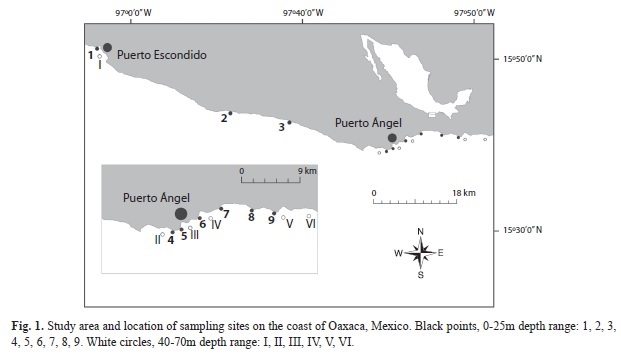
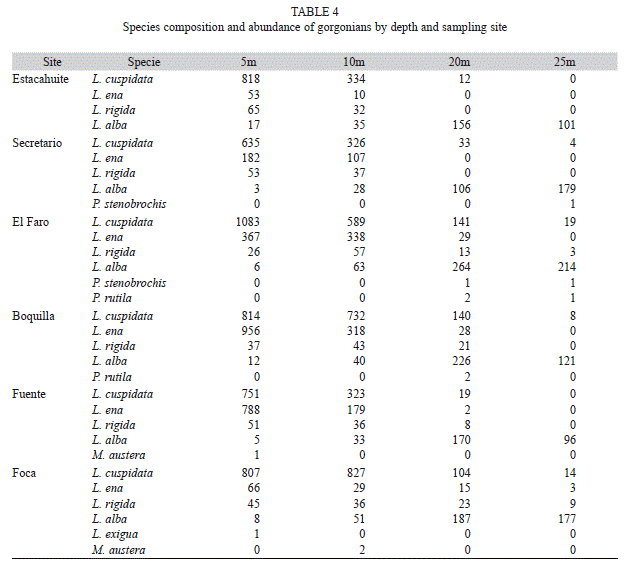
<body><![CDATA[<br> <font size="2"></font>    <br> <font size="2">Fifteen sites were examined along 70km of coastline using SCUBA (<a href="/img/revistas/rbt/v61n3/a13i1.jpg">Fig. 1</a>). Bathymetric features, such as terraces and slope breaks, naturally divide the area into two types of sites: (1) adjacent to the coast, with a depth range from 0 to 25m, and (2) sites &gt;100m from the coast, with a depth range from 40 to 70m. This division is likely related to the rate of sea level rise during the last 15 000 years and its effects on coastal erosion (Barrie &amp; Conway 2002). All of the sites had rocky substratum, which is characteristic of the study area.    <br>     <br> </font><font size="2"><span style="font-weight: bold;">Taxonomy and species composition: </span>To study the species composition, gorgonian colonies were identified <span style="font-style: italic;">in situ</span> and collected for later validation. The census was conducted at 15 sites, nine sites were in the 0-25m depth range and six in the 40-70m depth range. Since the sampling effort may affect the final number of observed species, each site was visited the same number of times until no more species were recorded, resulting in a total of 10 visits per site.</font>    <br> <font size="2"></font>    <br> <font size="2">The specimens were preserved by airdrying or fixed in 70% ethanol and identified through an analysis of the external morphology of the colony and the characteristics and composition of the sclerites following Bayer (1961) and Breedy &amp; Guzm&aacute;n (2002). A small fragment of each colony was placed in a hypochlorite sodium solution to separate the calcium carbonate sclerites from the organic material. Afterwards they were washed with water and examined under a light microscope (Olympus CX31). The specimens found were deposited in the Biological Collection of the Universidad del Mar, Oaxaca, Mexico, no. MHNUMAR-002B-01 - MHNUMAR-002B-27.    <br> <br style="font-weight: bold;"> <span style="font-weight: bold;">Gorgonian assemblages in relation to depth (5-25m) and sites:</span> The species composition and relative abundance of gorgonians was determined for six of the nine sites in the 5-25m depth range (4, 5, 6, 7, 8 and 9). Stratified random sampling was conducted in each of the six study sites. Sampling was carried out along three 10m line transects at four depths (5, 10, 20 and 25m). These transects were marked with a 10m plastic tape to indicate ten consecutive 1m<sup>2</sup> quadrats, which formed a total area of 10m<sup>2</sup> for each transect. All gorgonians within each quadrat were identified and counted.    <br>     <br> For the assemblage structure analysis, the original data were log(x+1) transformed to down-weight the contributions of dominant species relative to less common species (Clarke &amp; Green 1988) and a Bray-Curtis dissimilarity matrix was constructed (Clarke et al. 2006). A two-way crossed similarity analysis (ANOSIM) with replicates was used to discover differences in the assemblage structures of gorgonians at different depths (5, 10, 20 and 25m) and among sites.    <br>     ]]></body>
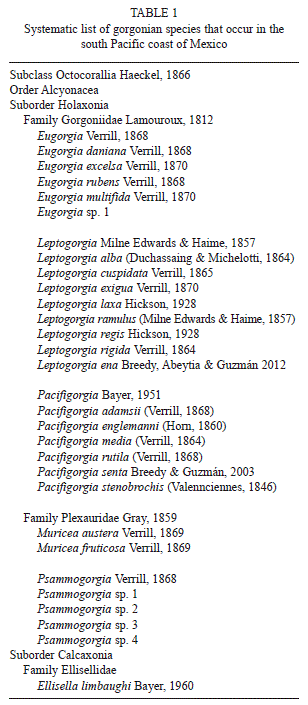
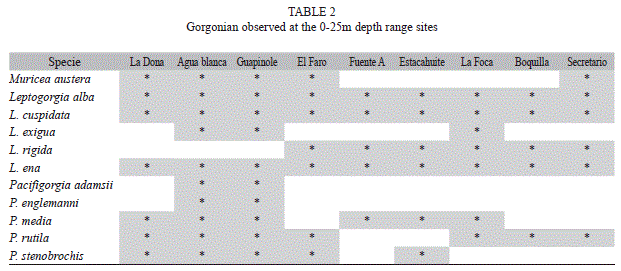
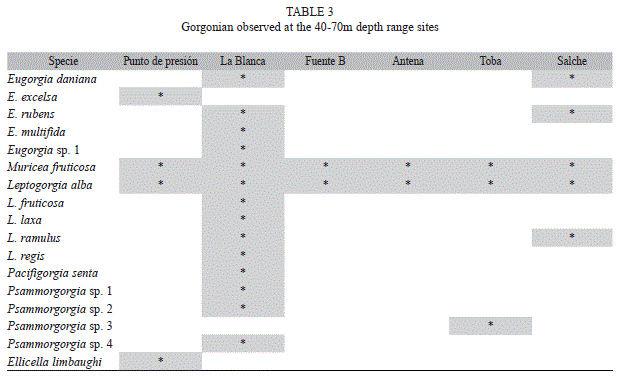
<body><![CDATA[<br> An analysis of similarity percentage (SIMPER) was used to identify the species responsible for major differences between depth groups. Analyses were performed with the program PRIMER 6 (Clarke 1993).    <br>     <br> </font><span style="font-weight: bold;">Results    <br>     <br> </span><font size="-1"><span style="font-weight: bold;">Taxonomy and species composition:</span> In total, 27 gorgonian species belonging to six genera and three families were found, although six species require confirmation (<a href="/img/revistas/rbt/v61n3/a13t1.gif">Table 1</a>).    <br> </font><span style="font-weight: bold;"></span>    <br> <font size="2">The composition of gorgonians varied with depth. Of the 27 species observed, 11 were found within the 0-25m depth interval (<a  href="/img/revistas/rbt/v61n3/a13t2.gif">Table 2</a>) and 17 were found in the 40-70m depth interval (<a  href="/img/revistas/rbt/v61n3/a13t3.gif">Table 3</a>). <span  style="font-style: italic;">Leptogorgia alba</span> was the only species observed in both depth intervals.    <br>     <br> </font><font size="2">At the 0-25m depth, all species belonged to the genera <span style="font-style: italic;">Leptogorgia </span>(n=5) and <span style="font-style: italic;">Pacifigorgia</span> (n=5), with the exception of Muricea austera. Four species (<span style="font-style: italic;">L. alba, L. cuspidata, L. ena </span>and <span style="font-style: italic;">L. rigida</span>) were present in all sites at 0-25m. <span style="font-style: italic;">Pacifigorgia adamsii</span> and <span style="font-style: italic;">P. englemanni</span> were only found in Guapinole and Agua Blanca, the two sites with the greatest species richness (n=10) (<a href="/img/revistas/rbt/v61n3/a13t1.gif">Table 1</a>).</font>    <br> <font size="2"></font>    ]]></body>
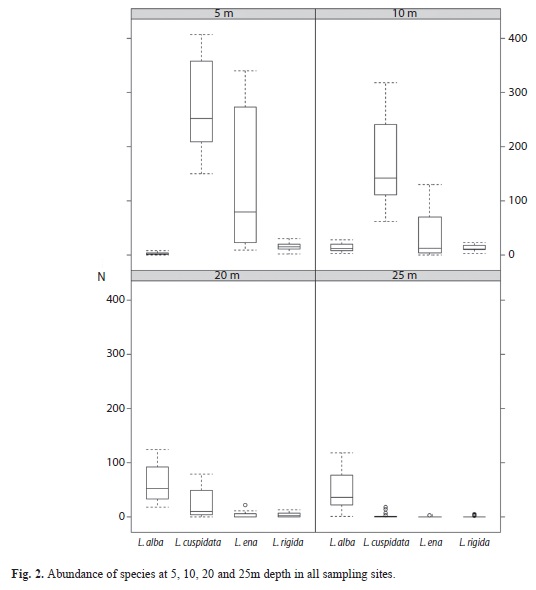
<body><![CDATA[<br> <font size="2">The species in the 40-70m depth interval included seven genera. <span style="font-style: italic;">Leptogorgia</span> had the highest number of species (n=6), whereas only one species was found for <span style="font-style: italic;">Pacifigorgia </span>and <span style="font-style: italic;">Muricea</span>. All species belonging to the genera <span style="font-style: italic;">Eugorgia </span>(n=5) or <span style="font-style: italic;">Psammogorgia </span>(n=4) were found in deeper waters. Only <span style="font-style: italic;">L. alba </span>and <span  style="font-style: italic;">M. fruticosa</span> were present in all sites. Fifty percent of the species found in the 40-70m depth interval (n=9) were observed only in La Blanca, which was the site with the greatest species richness (n=15; <a href="/img/revistas/rbt/v61n3/a13t3.gif">Table 3</a>). <span style="font-style: italic;">E. excelsa </span>and <span style="font-style: italic;">Psammogorgia</span> sp3 were each only found in one site (Punto de Presi&oacute;n and Toba, respectively; <a href="/img/revistas/rbt/v61n3/a13t3.gif">Table 3</a>).</font>    <br> <font size="2"></font>    <br> <font size="2"><span style="font-weight: bold;">Assemblage structure in relation to depth (5-25m) and sites:</span> Eight species were registered in the six shallow sites selected for this analysis. <span style="font-style: italic;">L. cuspidata, L. ena </span>and <span style="font-style: italic;">L. alba</span> were observed in all six sites, but only <span style="font-style: italic;">L. alba</span> was found at all depths (<a href="/img/revistas/rbt/v61n3/a13t4.gif">Table 4</a>).    <br>     <br> </font><font size="2">The similarity analysis (ANOSIM) showed differences in the composition and abundance of species by depth (R global=0.68, p&lt;0.1%) and site (R global=0.32, p&lt;0.1%), suggesting that the main factor in determining the assemblage structure is depth.</font>    <br> <font size="2"></font>    <br> <font size="2">The ANOSIM pair wise comparisons with depth as a factor showed that the least similarity was found between the shallowest and the deepest groups (5 and 25m; R=0.97, p&lt;0.1%). The most similarity was found between the closest&nbsp; depths,&nbsp; both&nbsp; at&nbsp; the&nbsp; deeper&nbsp; (20&nbsp; and 25m; R=0.40, p&lt;0.2%) and shallower depth ranges (5 and 10m; R=0.64 p&lt;0.1%). These findings suggest the existence of two main zones with the same composition but different relative abundance of gorgonian species: a shallow zone at 5-10m depth, and a deep zone&nbsp; at&nbsp; 20-25m&nbsp; depth. The&nbsp; shallow&nbsp; zone&nbsp; is characterized by a relatively large abundance of gorgonians, dominated by colonies of L. cuspidata and L. ena. In contrast, the deepest zone was characterized by relatively low abundance of gorgonians, dominated by L. alba (<a  href="/img/revistas/rbt/v61n3/a13i2.jpg">Fig. 2</a>).</font>    <br>     <br> <font size="2">The species that contributed the most to the dissimilarity (SIMPER analysis) between the two levels of shallow strata (5 and 10m) were <span  style="font-style: italic;">L. cuspidata</span> (49.0%), <span style="font-style: italic;">L. ena</span> (43.3%), <span style="font-style: italic;">L. alba</span> (4.5%) and <span  style="font-style: italic;">L. rigida</span> (3.4%); and the species that contributed the most to the dissimilarity between 20 and 25m assemblage were <span style="font-style: italic;">L. alba</span> (60%), <span style="font-style: italic;">L. cuspidata</span> (30.0%), <span  style="font-style: italic;">L. rigida</span> (5.4%) and <span style="font-style: italic;">L. ena</span> (4.3%).</font>    <br> <font size="2"></font>    ]]></body>
<body><![CDATA[<br> <font style="font-weight: bold;" size="3">Discussion</font>    <br> <font size="2"></font><br style="font-weight: bold;"> <font size="2"><span style="font-weight: bold;">Taxonomy and species composition: </span>The gorgonian fauna along the study area is species-rich, with 27 species found compared to the 10 species recorded in the Gulf of California, Mexico (Reyes-Bonilla <span  style="font-style: italic;">et al.</span> 1997). However, further studies across the Mexican Pacific coast, including a wider bathymetric range, are required to achieve a complete inventory of species richness.</font>    <br> <font size="2"></font>    <br> <font size="2">The gorgonian species richness in the present study area is similar to that of gorgonian communities in other areas of the Tropical eastern Pacific. Thirty species have been reported in Costa Rica (Breedy &amp; Guzm&aacute;n 2003, Breedy &amp; Cort&eacute;s 2008, Breedy 2009), 34 and 38 species respectively have been reported in the Gulfs of Chiriqu&iacute; and Panam&aacute; (Las Perlas Archipelago) in Panam&aacute; (Guzm&aacute;n <span style="font-style: italic;">et al.</span> 2004, 2008) and 25 species have been reported in the Colombian Pacific (Prahl <span  style="font-style: italic;">et al.</span> 1987). Gorgonian species richness in the study area was higher than the one reported for some other regions of the Tropical eastern Pacific: 11 species in El Salvador, 7 in Nicaragua and 13 in Per&uacute; (Breedy &amp; Guzm&aacute;n 2003, 2007, 2009).</font>    <br> <font size="2"></font>    <br> <font size="2">Gorgonian species reported in this study represent&nbsp; new&nbsp; records&nbsp; for&nbsp; the&nbsp; Pacific&nbsp; coast of&nbsp; M&eacute;xico.&nbsp; Twenty&nbsp; five&nbsp; out&nbsp; of&nbsp; 27&nbsp; species were documented in Oaxaca for the first time (the only exceptions are <span style="font-style: italic;">Eugorgia rubens </span>and <span style="font-style: italic;">Eugorgia daniana</span>). <span  style="font-style: italic;">Leptogorgia ramulus, Leptogorgia regis </span>and <span  style="font-style: italic;">Ellisella limbaughi</span> constitute new records for M&eacute;xico. All other species reported&nbsp; here&nbsp; were&nbsp; previously&nbsp; documented as Mexican Pacific gorgonian fauna (Reyes-Bonilla <span style="font-style: italic;">et al.</span> 1997, Breedy &amp; Guzm&aacute;n 2003, 2007, 2009).</font>    <br> <font size="2"></font>    <br> <font size="2"><span style="font-style: italic;">Leptogorgia&nbsp; alba</span>&nbsp; was&nbsp; the&nbsp; only&nbsp; species that was found at all sampling sites and depths. This species is distributed all along the Tropical eastern Pacific coast and reportedly occurs around oceanic islands (e.g. Isla del Coco, Costa Rica and the Galapagos Islands, Ecuador; Breedy <span style="font-style: italic;">et al.</span> 2009). However, in this study we documented a more extensive bathymetric range&nbsp; distribution&nbsp; than&nbsp; previously&nbsp; found&nbsp; for this species (Breedy &amp; Cort&eacute;s 2008), reaching 70m, giving <span  style="font-style: italic;">L. alba</span> the widest depth range of any gorgonian in the Tropical eastern Pacific.</font>    <br> <font size="2"></font>    <br> <font size="2">At the 40-70m depth interval, six genera were identified and 66% of the species were observed, suggesting that deeper areas harbor more gorgonians species than shallow ones. This finding confirms other reports of a higher richness and abundance of gorgonian species at depths greater than 40m (S&aacute;nchez 1999, Ruiz &amp; Rada 2006, Matsumoto <span style="font-style: italic;">et al.</span> 2007, Rossi <span  style="font-style: italic;">et al.</span> 2008, Watanabe <span  style="font-style: italic;">et al.</span> 2009, Gori <span  style="font-style: italic;">et al.</span> 2010). This may be because shallow habitats are more severe due to water movement and competition with algae (Gori <span  style="font-style: italic;">et al.</span> 2011) compared with the relatively stable deeper environments.</font>    ]]></body>
<body><![CDATA[<br> <font size="2"></font>    <br> <font size="2">In the 0-25m depth interval, the species composition was distributed more homogeneously among sites than in the deep strata (40-70m). This suggests a high level of ecological connectivity through superficial water circulation between sites, as has been reported for the Campeche Bank (Jord&aacute;n-Dahlgren 2002), or by a long dispersal range of larvae. In contrast, at the deeper strata (40-70m), 61% of the species seem to be site specific, indicating limited connectivity between sites, which may be due to short dispersal range of the larvae and settlement near the parental colony, as has been observed in <span style="font-style: italic;">Paramuricea clavata</span> (Coma <span  style="font-style: italic;">et al.</span> 1995, Linares <span  style="font-style: italic;">et al.</span> 2007). Studies of tropical reefs have documented the effect of variability in the dispersal capability of larvae on the resulting spatial structure of gorgonian assemblage (Jord&aacute;n-Dahlgren 2002). Quantifying the effect of larval dispersal on gorgonian distribution on the Pacific coast of Mexico requires further study of larval biology, population biology, as well as the oceanographic processes in the study area.</font>    <br> <font size="2"></font>    <br> <font size="2"><span style="font-weight: bold;">Assemblage structure in relation to depth (5-25m) and sites:</span> The main species that&nbsp; characterize&nbsp; the&nbsp; gorgonian&nbsp; assemblages at the 5-25m depth interval were <span  style="font-style: italic;">L. cuspidata, L.&nbsp; ena,&nbsp; L.&nbsp; alba&nbsp; </span>and<span  style="font-style: italic;">&nbsp; L.&nbsp; rigida</span>,&nbsp; because&nbsp; they were the most frequent and abundant species in all sampling sites. These assemblages with few species may be due to high environmental severity conditions of the study area related to high wave regime (Young 1999, Chen <span style="font-style: italic;">et al.</span> 2002), high turbidity and sedimentation by river discharge (Glynn &amp; Leyte-Morales 1997, Granja-Fern&aacute;ndez &amp; L&oacute;pez-P&eacute;rez 2008) that may limit the presence of many species.</font>    <br> <font size="2"></font>    <br> <font size="2">The main four gorgonian species exhibit different spatial distribution patterns along the 5-25m bathymetric profile. <span  style="font-style: italic;">L. cuspidata </span>and <span  style="font-style: italic;">L. ena </span>define the shallower (5-10m) sites and <span  style="font-style: italic;">L. alba</span> the deeper (20-25m) sites. These bathymetrical&nbsp; distribution&nbsp; pattern&nbsp; is&nbsp; not&nbsp; directly related to light because their tissues do not contain symbiotic algae (pers. observ.) as has been observed in all species reported for the Tropical eastern Pacific (Breedy &amp; Guzm&aacute;n 2003, 2007, 2009). According to Fabricius &amp; De&#8217;ath (2008), gorgonians that do not have symbionts do not require light, but instead depend on the flow of water to bring phytoplankton and other suspended food particles to their tentacles. The study area is a region of upwelling so there is enough food available to maintain great abundance of gorgonians.</font>    <br> <font size="2"></font>    <br> <font size="2">A number of previous studies have demonstrated that wave action is an important factor in determining the zoning patterns of gorgonians in shallow habitats (Kinzie 1973, Opresko 1973, Birkeland 1974, Dinesen 1983, Botero 1987, Yoshioka &amp; Yoshioka 1989, S&aacute;nchez <span  style="font-style: italic;">et al.</span> 1998). The greatest abundance of <span style="font-style: italic;">L. cuspidata </span>and <span style="font-style: italic;">L. ena</span> were found at depths of 5 and 10m, suggesting that they are well suited to this specific environment, perhaps due to their ability to grip the substrate. Their strong grip helps the colonies avoid detachment by wave action, which is one of the most significant factors in gorgonian mortality (Grigg 1975, Yoshioka &amp; Yoshioka 1991).</font>    <br> <font size="2"></font>    <br> <font size="2"><span style="font-style: italic;">Leptogorgia alba</span> was the only species present at all depths, but it was more conspicuous at the deeper areas. Its extensive distribution might be related to its tolerance to a wide range&nbsp; of&nbsp; environmental&nbsp; conditions,&nbsp; as&nbsp; has been observed for <span style="font-style: italic;">Eunicella singularis</span> in the Mediterranean Sea (Gori <span style="font-style: italic;">et al.</span> 2010). Its low abundance at 5 and 10m suggest that in this environment this species is less tolerant or efficient than <span  style="font-style: italic;">L. cuspidata </span>and <span  style="font-style: italic;">L. ena</span>. Several studies note that larvae may reach different depths and then not survive due to specific forms of competition (La Barre <span  style="font-style: italic;">et al.</span> 1986, Dai 1990).</font>    ]]></body>
<body><![CDATA[<br> <font size="2"></font>    <br> <font size="2">Further studies of environmental or biological factors that affect the distribution and relative abundance of gorgonian species, like type of substrate, coverage of substrate, and sedimentation in the Tropical eastern Pacific, are required to explain the abundance and distribution patterns of gorgonians species at different sites and depths.</font>    <br> <font size="2"></font>    <br> <font style="font-weight: bold;" size="3">Acknowledgments</font>    <br> <font size="2"></font>    <br> <font size="2">We thank valeria Hern&aacute;ndez Urraca, Imelda P&eacute;rez Maldonado, Fernando D&iacute;az and Gonz&aacute;les for assistance in the field. This manuscript&nbsp; was&nbsp; greatly&nbsp; improved&nbsp; by&nbsp; comments from Eric Jord&aacute;n&nbsp; Dahlgren, Rosa&nbsp; Rodr&iacute;guez Mart&iacute;nez, Lorenzo &Aacute;lvarez Filip and Andr&eacute;s Ram&oacute;n L&oacute;pez P&eacute;rez. This work was supported by&nbsp; the&nbsp; Smithsonian Tropical&nbsp; Research&nbsp; Institute, Panama and Universidad del Mar, Puerto Angel, M&eacute;xico.</font>    <br> <hr style="width: 100%; height: 2px;"><font style="font-weight: bold;"  size="3">References</font>    <br>     <br>     <!-- ref --><div style="text-align: left;"><font size="2">Barrie, J.v. &amp; K.W. Conway. 2002. Rapid sea-level change and coastal evolution on the Pacific margin of Canada. Sediment. Geol. 150: 171-183.    &nbsp;&nbsp;&nbsp;&nbsp;&nbsp;&nbsp;&nbsp;&nbsp;[&#160;<a href="javascript:void(0);" onclick="javascript: window.open('/scielo.php?script=sci_nlinks&ref=1657500&pid=S0034-7744201300040001300001&lng=','','width=640,height=500,resizable=yes,scrollbars=1,menubar=yes,');">Links</a>&#160;]<!-- end-ref --></font>    <br>     <!-- ref --><br> <font size="2">Bayer, F.M. 1961. The shallow water&nbsp; Octocorallia of the West Indian region.&nbsp; Martinus Nijhoff, The Hague, Holland.    &nbsp;&nbsp;&nbsp;&nbsp;&nbsp;&nbsp;&nbsp;&nbsp;[&#160;<a href="javascript:void(0);" onclick="javascript: window.open('/scielo.php?script=sci_nlinks&ref=1657503&pid=S0034-7744201300040001300002&lng=','','width=640,height=500,resizable=yes,scrollbars=1,menubar=yes,');">Links</a>&#160;]<!-- end-ref --></font>    <br>     <!-- ref --><br> <font size="2">Birkeland, C. 1974. The effect of wave action on the population&nbsp; dynamics&nbsp; of&nbsp; <span style="font-style: italic;">Gorgonia&nbsp; ventalina</span>&nbsp; Linnaeus. Stud. Trop. Oceanogr. 12: 115-126.    &nbsp;&nbsp;&nbsp;&nbsp;&nbsp;&nbsp;&nbsp;&nbsp;[&#160;<a href="javascript:void(0);" onclick="javascript: window.open('/scielo.php?script=sci_nlinks&ref=1657506&pid=S0034-7744201300040001300003&lng=','','width=640,height=500,resizable=yes,scrollbars=1,menubar=yes,');">Links</a>&#160;]<!-- end-ref --></font>    <br>     <!-- ref --><br> <font size="2">Botero, L. 1987. Zonaci&oacute;n de octocorales gorgon&aacute;ceos en el &aacute;rea de Santa Marta y&nbsp; Parque Nacional Tayrona, Costa Caribe Colombiana. An. Inst. Inv. Mar. Punta de Betin 17: 61-80.    &nbsp;&nbsp;&nbsp;&nbsp;&nbsp;&nbsp;&nbsp;&nbsp;[&#160;<a href="javascript:void(0);" onclick="javascript: window.open('/scielo.php?script=sci_nlinks&ref=1657509&pid=S0034-7744201300040001300004&lng=','','width=640,height=500,resizable=yes,scrollbars=1,menubar=yes,');">Links</a>&#160;]<!-- end-ref --></font>    ]]></body>
<body><![CDATA[<br>     <!-- ref --><br> <font size="2">Breedy, O. 2009. Octocorals, p. 161-167. <span  style="font-style: italic;">In</span>&nbsp; I.S. Wehrtmann &amp; J. Cort&eacute;s (eds.). Marine biodiversity of Costa Rica, Central America. Monographiae Biologicae 86. Springer verlag, Berlin, Germany.    &nbsp;&nbsp;&nbsp;&nbsp;&nbsp;&nbsp;&nbsp;&nbsp;[&#160;<a href="javascript:void(0);" onclick="javascript: window.open('/scielo.php?script=sci_nlinks&ref=1657512&pid=S0034-7744201300040001300005&lng=','','width=640,height=500,resizable=yes,scrollbars=1,menubar=yes,');">Links</a>&#160;]<!-- end-ref --></font>    <br>     <!-- ref --><br> <font size="2">Breedy, O., R. Abeytia &amp; H.M. Guzman.&nbsp; 2012. A new species of Leptogorgia&nbsp; (Cnidaria: Anthozoa: Octocorallia) from the Mexican Pacific coast. Bull. Mar. Sci. 88: 319-325.    &nbsp;&nbsp;&nbsp;&nbsp;&nbsp;&nbsp;&nbsp;&nbsp;[&#160;<a href="javascript:void(0);" onclick="javascript: window.open('/scielo.php?script=sci_nlinks&ref=1657515&pid=S0034-7744201300040001300006&lng=','','width=640,height=500,resizable=yes,scrollbars=1,menubar=yes,');">Links</a>&#160;]<!-- end-ref --></font>    <br>     <!-- ref --><br> <font size="2">Breedy, O. &amp; J. Cort&eacute;s. 2008. Octocorals&nbsp; (Coelenterata: Anthozoa: Octocorallia) of Isla del Coco, Costa Rica. Rev. Biol. Trop. 56: 71-77.    &nbsp;&nbsp;&nbsp;&nbsp;&nbsp;&nbsp;&nbsp;&nbsp;[&#160;<a href="javascript:void(0);" onclick="javascript: window.open('/scielo.php?script=sci_nlinks&ref=1657518&pid=S0034-7744201300040001300007&lng=','','width=640,height=500,resizable=yes,scrollbars=1,menubar=yes,');">Links</a>&#160;]<!-- end-ref --></font>    <br>     ]]></body>
<body><![CDATA[<!-- ref --><br> <font size="2">Breedy, O. &amp; H.M. Guzm&aacute;n. 2002. A revision of the genus <span style="font-style: italic;">Pacifigorgia</span>&nbsp; (Coelenterata:&nbsp; Octocorallia:&nbsp; Gorgoniidae). Proc. Bio. Soc. Wash. 115: 782-839.    &nbsp;&nbsp;&nbsp;&nbsp;&nbsp;&nbsp;&nbsp;&nbsp;[&#160;<a href="javascript:void(0);" onclick="javascript: window.open('/scielo.php?script=sci_nlinks&ref=1657521&pid=S0034-7744201300040001300008&lng=','','width=640,height=500,resizable=yes,scrollbars=1,menubar=yes,');">Links</a>&#160;]<!-- end-ref --></font>    <br>     <!-- ref --><br> <font size="2">Breedy, O. &amp; H.M. Guzm&aacute;n. 2003. Octocorals from Costa Rica: the genus <span style="font-style: italic;">Pacifigorgia</span> (Coelenterata: Octocorallia: Gorgoniidae). Zootaxa 281: 1-60.    &nbsp;&nbsp;&nbsp;&nbsp;&nbsp;&nbsp;&nbsp;&nbsp;[&#160;<a href="javascript:void(0);" onclick="javascript: window.open('/scielo.php?script=sci_nlinks&ref=1657524&pid=S0034-7744201300040001300009&lng=','','width=640,height=500,resizable=yes,scrollbars=1,menubar=yes,');">Links</a>&#160;]<!-- end-ref --></font>    <br>     <!-- ref --><br> <font size="2">Breedy, O. &amp; H.M. Guzm&aacute;n. 2007. A revision of the genus Leptogorgia Milne Edwards &amp; Haime, 1857 (Coelenterata: Octocorallia: Gorgoniidae) in the eastern Pacific. Zootaxa 1419: 1-90.    &nbsp;&nbsp;&nbsp;&nbsp;&nbsp;&nbsp;&nbsp;&nbsp;[&#160;<a href="javascript:void(0);" onclick="javascript: window.open('/scielo.php?script=sci_nlinks&ref=1657527&pid=S0034-7744201300040001300010&lng=','','width=640,height=500,resizable=yes,scrollbars=1,menubar=yes,');">Links</a>&#160;]<!-- end-ref --></font>    <br>     <!-- ref --><br> <font size="2">Breedy, O. &amp; H.M. Guzm&aacute;n. 2009. A revision of the genus Eugorgia&nbsp; verril,&nbsp; 1868&nbsp; (Coelenterata:&nbsp; Octocorallia: Gorgoniidae). Zootaxa 2151: 1-46.    &nbsp;&nbsp;&nbsp;&nbsp;&nbsp;&nbsp;&nbsp;&nbsp;[&#160;<a href="javascript:void(0);" onclick="javascript: window.open('/scielo.php?script=sci_nlinks&ref=1657530&pid=S0034-7744201300040001300011&lng=','','width=640,height=500,resizable=yes,scrollbars=1,menubar=yes,');">Links</a>&#160;]<!-- end-ref --></font>    <br>     <!-- ref --><br> <font size="2">Breedy, O., H.M. Guzman &amp; S. vargas. 2009. A revision of the genus Eugorgia&nbsp; verrill, 1868 (Coelenterata: Octocorallia: Gorgoniidae. Zootaxa 2151: 1-46.    &nbsp;&nbsp;&nbsp;&nbsp;&nbsp;&nbsp;&nbsp;&nbsp;[&#160;<a href="javascript:void(0);" onclick="javascript: window.open('/scielo.php?script=sci_nlinks&ref=1657533&pid=S0034-7744201300040001300012&lng=','','width=640,height=500,resizable=yes,scrollbars=1,menubar=yes,');">Links</a>&#160;]<!-- end-ref --></font>    <br>     <!-- ref --><br> <font size="2">Chen, G., B. Chapron, R. Ezraty &amp; D. vandemark. A global view of swell and wind sea climate in the ocean by satellite altimeter and scatterometer. 2002. J. Atmos. Oceanic Technol. 19: 1849-1859.    &nbsp;&nbsp;&nbsp;&nbsp;&nbsp;&nbsp;&nbsp;&nbsp;[&#160;<a href="javascript:void(0);" onclick="javascript: window.open('/scielo.php?script=sci_nlinks&ref=1657536&pid=S0034-7744201300040001300013&lng=','','width=640,height=500,resizable=yes,scrollbars=1,menubar=yes,');">Links</a>&#160;]<!-- end-ref --></font>    <br>     <!-- ref --><br> <font size="2">Clarke,&nbsp; K.R. 1993. Non-parametric&nbsp; multivariate analysis of changes in&nbsp; community structure. Aust. J. Ecol. 18: 117-143.    &nbsp;&nbsp;&nbsp;&nbsp;&nbsp;&nbsp;&nbsp;&nbsp;[&#160;<a href="javascript:void(0);" onclick="javascript: window.open('/scielo.php?script=sci_nlinks&ref=1657539&pid=S0034-7744201300040001300014&lng=','','width=640,height=500,resizable=yes,scrollbars=1,menubar=yes,');">Links</a>&#160;]<!-- end-ref --></font>    ]]></body>
<body><![CDATA[<br>     <!-- ref --><br> <font size="2">Clarke,&nbsp; K.R. &amp; R.H. Green. 1988. Statistical&nbsp; design and analysis for a &#8216;biological&nbsp; effects&#8217; study. Mar. Ecol. Prog. Ser. 46: 213-226.    &nbsp;&nbsp;&nbsp;&nbsp;&nbsp;&nbsp;&nbsp;&nbsp;[&#160;<a href="javascript:void(0);" onclick="javascript: window.open('/scielo.php?script=sci_nlinks&ref=1657542&pid=S0034-7744201300040001300015&lng=','','width=640,height=500,resizable=yes,scrollbars=1,menubar=yes,');">Links</a>&#160;]<!-- end-ref --></font>    <br>     <!-- ref --><br> <font size="2">Clarke, K.R., P.J. Somerfield &amp; M.G. Chapman. 2006. On resemblance measures for&nbsp; ecological studies, including taxonomic&nbsp; dissimilarities and a Zero-adjusted Bray-Curtis coefficient for denuded&nbsp; assemblages. J. Exp. Mar. Biol. Ecol. 330: 55-80.    &nbsp;&nbsp;&nbsp;&nbsp;&nbsp;&nbsp;&nbsp;&nbsp;[&#160;<a href="javascript:void(0);" onclick="javascript: window.open('/scielo.php?script=sci_nlinks&ref=1657545&pid=S0034-7744201300040001300016&lng=','','width=640,height=500,resizable=yes,scrollbars=1,menubar=yes,');">Links</a>&#160;]<!-- end-ref --></font>    <br>     <!-- ref --><br> <font size="2">Coma,&nbsp; R., M. Ribes, M. Zabala &amp; J. Gili.&nbsp; 1995. Reproduction&nbsp; and&nbsp; cycle&nbsp; of&nbsp; gonadal&nbsp; development&nbsp; in&nbsp; the Mediterranean gorgonian <span  style="font-style: italic;">Paramuricea clavata</span>. Mar. Ecol. Prog. Ser. 117: 173-183.    &nbsp;&nbsp;&nbsp;&nbsp;&nbsp;&nbsp;&nbsp;&nbsp;[&#160;<a href="javascript:void(0);" onclick="javascript: window.open('/scielo.php?script=sci_nlinks&ref=1657548&pid=S0034-7744201300040001300017&lng=','','width=640,height=500,resizable=yes,scrollbars=1,menubar=yes,');">Links</a>&#160;]<!-- end-ref --></font>    <br>     ]]></body>
<body><![CDATA[<!-- ref --><br> <font size="2">Dai, C.F. 1991. Distribution and adaptive&nbsp; strategies&nbsp; of Alcyonacean corals in Nanwan Bay, Taiwan. Hydrobiologia 216/217: 241-246.    &nbsp;&nbsp;&nbsp;&nbsp;&nbsp;&nbsp;&nbsp;&nbsp;[&#160;<a href="javascript:void(0);" onclick="javascript: window.open('/scielo.php?script=sci_nlinks&ref=1657551&pid=S0034-7744201300040001300018&lng=','','width=640,height=500,resizable=yes,scrollbars=1,menubar=yes,');">Links</a>&#160;]<!-- end-ref --></font>    <br>     <!-- ref --><br> <font size="2">Dinesen, Z. 1983. Patterns in the distribution of soft corals across the central Great Barrier Reef. Coral Reefs 1: 229-236.    &nbsp;&nbsp;&nbsp;&nbsp;&nbsp;&nbsp;&nbsp;&nbsp;[&#160;<a href="javascript:void(0);" onclick="javascript: window.open('/scielo.php?script=sci_nlinks&ref=1657554&pid=S0034-7744201300040001300019&lng=','','width=640,height=500,resizable=yes,scrollbars=1,menubar=yes,');">Links</a>&#160;]<!-- end-ref --></font>    <br>     <!-- ref --><br> <font size="2">Fabricius,&nbsp; K.E. &amp; G. De&#8217;ath. 2008.&nbsp; Photosynthetic symbionts and energy supply determine octocoral biodiversity in coral reefs. Ecology 89: 3163-3173.    &nbsp;&nbsp;&nbsp;&nbsp;&nbsp;&nbsp;&nbsp;&nbsp;[&#160;<a href="javascript:void(0);" onclick="javascript: window.open('/scielo.php?script=sci_nlinks&ref=1657557&pid=S0034-7744201300040001300020&lng=','','width=640,height=500,resizable=yes,scrollbars=1,menubar=yes,');">Links</a>&#160;]<!-- end-ref --></font>    <br>     <!-- ref --><br> <font size="2">Gerhardt, D.J. 1990. Fouling and gastropod predation: consequences of grazing from the octocoral. Mar. Ecol. Prog. Ser. 62: 103-108.    &nbsp;&nbsp;&nbsp;&nbsp;&nbsp;&nbsp;&nbsp;&nbsp;[&#160;<a href="javascript:void(0);" onclick="javascript: window.open('/scielo.php?script=sci_nlinks&ref=1657560&pid=S0034-7744201300040001300021&lng=','','width=640,height=500,resizable=yes,scrollbars=1,menubar=yes,');">Links</a>&#160;]<!-- end-ref --></font>    <br>     <!-- ref --><br> <font size="2">Glynn,&nbsp; P.W.&nbsp; &amp;&nbsp; G.E.&nbsp; Leyte-Morales.&nbsp; 1997.&nbsp; Coral&nbsp; reefs of&nbsp; Huatulco,&nbsp; West&nbsp; M&eacute;xico:&nbsp; Reef&nbsp; development&nbsp; in upwelling Gulf of Tehuantepec. Rev. Biol. Trop. 45: 1033-1047.    &nbsp;&nbsp;&nbsp;&nbsp;&nbsp;&nbsp;&nbsp;&nbsp;[&#160;<a href="javascript:void(0);" onclick="javascript: window.open('/scielo.php?script=sci_nlinks&ref=1657563&pid=S0034-7744201300040001300022&lng=','','width=640,height=500,resizable=yes,scrollbars=1,menubar=yes,');">Links</a>&#160;]<!-- end-ref --></font>    <br>     <!-- ref --><br> <font size="2">Gori, A., S. Rossi, E. Berganzo, J.L. Pretus, M.R.T. Dale &amp;&nbsp; J.M. Gili. 2010. Spatial distributions&nbsp; patterns of the&nbsp; gorgonians&nbsp; Eunicella&nbsp; singularis,&nbsp; Paramuricea clavata and Leptogorgia sarmentosa (Cap de Creus, northwestern Mediterranean Sea). Mar.&nbsp; Biol.&nbsp; 158: 143-158.    &nbsp;&nbsp;&nbsp;&nbsp;&nbsp;&nbsp;&nbsp;&nbsp;[&#160;<a href="javascript:void(0);" onclick="javascript: window.open('/scielo.php?script=sci_nlinks&ref=1657566&pid=S0034-7744201300040001300023&lng=','','width=640,height=500,resizable=yes,scrollbars=1,menubar=yes,');">Links</a>&#160;]<!-- end-ref --></font>    <br>     <!-- ref --><br> <font size="2">Gori,&nbsp; A., S. Rossi, C. Linares, E. Berganzo,&nbsp; C. Orejas, M.R.T.&nbsp; Dale&nbsp; &amp;&nbsp; J.M.&nbsp; Gili.&nbsp; 2011.&nbsp; Size&nbsp; and&nbsp; spatial structure in deep&nbsp; versus shallow populations of the Mediterranean gorgonian Eunicella&nbsp; singularis (Cap de&nbsp; Creus,&nbsp; northwestern&nbsp; Mediterranean&nbsp; Sea).&nbsp; Mar. Biol. 158: 1721-1732.    &nbsp;&nbsp;&nbsp;&nbsp;&nbsp;&nbsp;&nbsp;&nbsp;[&#160;<a href="javascript:void(0);" onclick="javascript: window.open('/scielo.php?script=sci_nlinks&ref=1657569&pid=S0034-7744201300040001300024&lng=','','width=640,height=500,resizable=yes,scrollbars=1,menubar=yes,');">Links</a>&#160;]<!-- end-ref --></font>    ]]></body>
<body><![CDATA[<br>     <!-- ref --><br> <font size="2">Granja-Fern&aacute;ndez, M.R. &amp; R.A. L&oacute;pez-P&eacute;rez. 2008. Sedimentaci&oacute;n&nbsp; en&nbsp; comunidades&nbsp;&nbsp; arrecifales&nbsp; de&nbsp; Bah&iacute;as de Huatulco,&nbsp; Oaxaca, M&eacute;xico. Rev. Biol. Trop. 56: 1179-1187.    &nbsp;&nbsp;&nbsp;&nbsp;&nbsp;&nbsp;&nbsp;&nbsp;[&#160;<a href="javascript:void(0);" onclick="javascript: window.open('/scielo.php?script=sci_nlinks&ref=1657572&pid=S0034-7744201300040001300025&lng=','','width=640,height=500,resizable=yes,scrollbars=1,menubar=yes,');">Links</a>&#160;]<!-- end-ref --></font>    <br>     <!-- ref --><br> <font size="2">Grigg,&nbsp; R.W. 1975. Age structure of a&nbsp; longevous coral: A relative index of habitat suitability and stability. Am. Nat. 109: 647-657.    &nbsp;&nbsp;&nbsp;&nbsp;&nbsp;&nbsp;&nbsp;&nbsp;[&#160;<a href="javascript:void(0);" onclick="javascript: window.open('/scielo.php?script=sci_nlinks&ref=1657575&pid=S0034-7744201300040001300026&lng=','','width=640,height=500,resizable=yes,scrollbars=1,menubar=yes,');">Links</a>&#160;]<!-- end-ref --></font>    <br>     <!-- ref --><br> <font size="2">Guti&eacute;rrez, M., T.L. Capson, H.M. Guzm&aacute;n, E.&nbsp; Qui&ntilde;oa &amp; R. Riguera. 2004. L-galactosa&nbsp; as a natural product: isolation from a&nbsp; marine octocoral of the first a-Lgalactosyl saponin. Tetrahedron Lett. 45: 7833-7836.    &nbsp;&nbsp;&nbsp;&nbsp;&nbsp;&nbsp;&nbsp;&nbsp;[&#160;<a href="javascript:void(0);" onclick="javascript: window.open('/scielo.php?script=sci_nlinks&ref=1657578&pid=S0034-7744201300040001300027&lng=','','width=640,height=500,resizable=yes,scrollbars=1,menubar=yes,');">Links</a>&#160;]<!-- end-ref --></font>    <br>     ]]></body>
<body><![CDATA[<!-- ref --><br> <font size="2">Guti&eacute;rrez,&nbsp; M., T.L. Capson, H.M. Guzm&aacute;n, J.&nbsp; Gonz&aacute;lez, E.&nbsp; Ortega-Barria,&nbsp; E.&nbsp; Qui&ntilde;oa&nbsp; &amp;&nbsp; R.&nbsp; Riguera.&nbsp; 2005. Leptolide, a new furanocembranolide diterpene from Leptogorgia alba. J. Nat. Prod. 68: 614-616.    &nbsp;&nbsp;&nbsp;&nbsp;&nbsp;&nbsp;&nbsp;&nbsp;[&#160;<a href="javascript:void(0);" onclick="javascript: window.open('/scielo.php?script=sci_nlinks&ref=1657581&pid=S0034-7744201300040001300028&lng=','','width=640,height=500,resizable=yes,scrollbars=1,menubar=yes,');">Links</a>&#160;]<!-- end-ref --></font>    <br>     <!-- ref --><br> <font size="2">Guti&eacute;rrez,&nbsp; M., T.L. Capson, H.M. Guzm&aacute;n, J.&nbsp; Gonz&aacute;lez, E.&nbsp; Ortega-Barria,&nbsp; E.&nbsp; Qui&ntilde;oa&nbsp; &amp;&nbsp; R.&nbsp; Riguera.&nbsp; 2006. Antiplasmodial&nbsp; metabolites isolated from the marine&nbsp; octocoral&nbsp; Muricea&nbsp; austera.&nbsp; J.&nbsp; Nat.&nbsp; Prod.&nbsp; 69: 1379-1383.    &nbsp;&nbsp;&nbsp;&nbsp;&nbsp;&nbsp;&nbsp;&nbsp;[&#160;<a href="javascript:void(0);" onclick="javascript: window.open('/scielo.php?script=sci_nlinks&ref=1657584&pid=S0034-7744201300040001300029&lng=','','width=640,height=500,resizable=yes,scrollbars=1,menubar=yes,');">Links</a>&#160;]<!-- end-ref --></font>    <br>     <!-- ref --><br> <font size="2">Guzm&aacute;n, H.M., C.A. Guevara &amp; O. Breedy. 2004. Distribution, diversity and conservation of coral reefs and coral&nbsp; communities in the largest marine&nbsp; protected area of Pacific Panama (Coiba&nbsp; Island). Envir. Conserv. 31: 111-121.    &nbsp;&nbsp;&nbsp;&nbsp;&nbsp;&nbsp;&nbsp;&nbsp;[&#160;<a href="javascript:void(0);" onclick="javascript: window.open('/scielo.php?script=sci_nlinks&ref=1657587&pid=S0034-7744201300040001300030&lng=','','width=640,height=500,resizable=yes,scrollbars=1,menubar=yes,');">Links</a>&#160;]<!-- end-ref --></font>    <br>     <!-- ref --><br> <font size="2">Guzm&aacute;n,&nbsp; H.M., S. Benfield, O. Breedy &amp; J.&nbsp; Mair. 2008. Broadening&nbsp; reef protection across the&nbsp; marine conservation&nbsp; corridor&nbsp; of&nbsp; the&nbsp; Eastern Tropical&nbsp; Pacific: distribution and diversity of reefs in Las Perlas Archipelago, Panama. Envir. Conser. 35: 46-54.    &nbsp;&nbsp;&nbsp;&nbsp;&nbsp;&nbsp;&nbsp;&nbsp;[&#160;<a href="javascript:void(0);" onclick="javascript: window.open('/scielo.php?script=sci_nlinks&ref=1657590&pid=S0034-7744201300040001300031&lng=','','width=640,height=500,resizable=yes,scrollbars=1,menubar=yes,');">Links</a>&#160;]<!-- end-ref --></font>    <br>     <!-- ref --><br> <font size="2">Hern&aacute;ndez-Mu&ntilde;oz,&nbsp; D., P.M. Alcolado &amp; M.&nbsp; Hern&aacute;ndez-Gonz&aacute;lez. 2008. Efectos de&nbsp; un emisario submarino de aguas &#8220;residuales&#8221; urbanas sobre comunidades de octocorales (Octocorallia: Alcyonacea) en Cuba. Rev. Biol. Trop. 56: 65-75.    &nbsp;&nbsp;&nbsp;&nbsp;&nbsp;&nbsp;&nbsp;&nbsp;[&#160;<a href="javascript:void(0);" onclick="javascript: window.open('/scielo.php?script=sci_nlinks&ref=1657593&pid=S0034-7744201300040001300032&lng=','','width=640,height=500,resizable=yes,scrollbars=1,menubar=yes,');">Links</a>&#160;]<!-- end-ref --></font>    <br>     <!-- ref --><br> <font size="2">Jord&aacute;n-Dahlgren, E. 2002. Gorgonian distribution patterns in coral reef environments of&nbsp; the&nbsp; Gulf of Mexico: evidence of&nbsp; sporadic ecological connectivity? Coral Reefs 21: 205-215.    &nbsp;&nbsp;&nbsp;&nbsp;&nbsp;&nbsp;&nbsp;&nbsp;[&#160;<a href="javascript:void(0);" onclick="javascript: window.open('/scielo.php?script=sci_nlinks&ref=1657596&pid=S0034-7744201300040001300033&lng=','','width=640,height=500,resizable=yes,scrollbars=1,menubar=yes,');">Links</a>&#160;]<!-- end-ref --></font>    <br>     <!-- ref --><br> <font size="2">Kinzie, R.A. 1973. The zonation of the West Indian gorgonians. Bull. Mar. Sci. 23: 95-155.    &nbsp;&nbsp;&nbsp;&nbsp;&nbsp;&nbsp;&nbsp;&nbsp;[&#160;<a href="javascript:void(0);" onclick="javascript: window.open('/scielo.php?script=sci_nlinks&ref=1657599&pid=S0034-7744201300040001300034&lng=','','width=640,height=500,resizable=yes,scrollbars=1,menubar=yes,');">Links</a>&#160;]<!-- end-ref --></font>    ]]></body>
<body><![CDATA[<br>     <!-- ref --><br> <font size="2">La Barre, S., J.C. Coll &amp; P.W. Sammarco. 1986. Defensive strategies of soft corals&nbsp; (Coelenterata: Octocorallia) of the Great&nbsp; Barrier Reef. II. The relationship between&nbsp; toxicity&nbsp; and&nbsp; feeding&nbsp; deterrence.&nbsp; Biol.&nbsp; Bull. 171: 565-576.    &nbsp;&nbsp;&nbsp;&nbsp;&nbsp;&nbsp;&nbsp;&nbsp;[&#160;<a href="javascript:void(0);" onclick="javascript: window.open('/scielo.php?script=sci_nlinks&ref=1657602&pid=S0034-7744201300040001300035&lng=','','width=640,height=500,resizable=yes,scrollbars=1,menubar=yes,');">Links</a>&#160;]<!-- end-ref --></font>    <br>     <!-- ref --><br> <font size="2">Lasker, H. 1985. Prey preferences and browsing pressure of the butterflyfish Chaetodon capistratus on Caribbean gorgonians. Mar. Ecol. Prog. Ser. 21: 213-220.    &nbsp;&nbsp;&nbsp;&nbsp;&nbsp;&nbsp;&nbsp;&nbsp;[&#160;<a href="javascript:void(0);" onclick="javascript: window.open('/scielo.php?script=sci_nlinks&ref=1657605&pid=S0034-7744201300040001300036&lng=','','width=640,height=500,resizable=yes,scrollbars=1,menubar=yes,');">Links</a>&#160;]<!-- end-ref --></font>    <br>     <!-- ref --><br> <font size="2">Linares,&nbsp; C., D. Doak, R. Coma, D. D&iacute;az &amp;&nbsp; M. Zabala. 2007. Life history and population viability of a longlived marine invertebrate: the octocoral Paramuricea clavata. Ecology 88: 918-928.    &nbsp;&nbsp;&nbsp;&nbsp;&nbsp;&nbsp;&nbsp;&nbsp;[&#160;<a href="javascript:void(0);" onclick="javascript: window.open('/scielo.php?script=sci_nlinks&ref=1657608&pid=S0034-7744201300040001300037&lng=','','width=640,height=500,resizable=yes,scrollbars=1,menubar=yes,');">Links</a>&#160;]<!-- end-ref --></font>    <br>     ]]></body>
<body><![CDATA[<!-- ref --><br> <font size="2">Matsumoto, A.K., F. Iwase, Y. Imahara &amp; H. Namikawa. 2007. Bathymetric distribution and&nbsp; biodiversity&nbsp; of deep-water&nbsp; octocorals&nbsp;&nbsp; (Coelenterata:&nbsp; Octocorallia) in Sagami Bay and adjacent waters of Japan, p. 231-251.&nbsp; In G. Robert &amp; S. Cairns (eds.).&nbsp; Conservation and adaptive management of seamount and deep-sea coral ecosystems,&nbsp; Rosenstiel School of Marine and Atmospheric Science, University of Miami, USA.    &nbsp;&nbsp;&nbsp;&nbsp;&nbsp;&nbsp;&nbsp;&nbsp;[&#160;<a href="javascript:void(0);" onclick="javascript: window.open('/scielo.php?script=sci_nlinks&ref=1657611&pid=S0034-7744201300040001300038&lng=','','width=640,height=500,resizable=yes,scrollbars=1,menubar=yes,');">Links</a>&#160;]<!-- end-ref --></font>    <br>     <!-- ref --><br> <font size="2">McEnroe, F.J. &amp; W. Fenical. 1978. Structures and synthesis of some new antibacterial sesquiterpenoids from the gorgonian coral&nbsp; Pseudopterogorgia rigida. Tetrahedron 34: 1661-1664.    &nbsp;&nbsp;&nbsp;&nbsp;&nbsp;&nbsp;&nbsp;&nbsp;[&#160;<a href="javascript:void(0);" onclick="javascript: window.open('/scielo.php?script=sci_nlinks&ref=1657614&pid=S0034-7744201300040001300039&lng=','','width=640,height=500,resizable=yes,scrollbars=1,menubar=yes,');">Links</a>&#160;]<!-- end-ref --></font>    <br>     <!-- ref --><br> <font size="2">Opresko, D.M. 1973. Abundance and distribution of shallow-water gorgonians in the area of Miami, Florida. Bull. Marine Sci. 23: 535-558.    &nbsp;&nbsp;&nbsp;&nbsp;&nbsp;&nbsp;&nbsp;&nbsp;[&#160;<a href="javascript:void(0);" onclick="javascript: window.open('/scielo.php?script=sci_nlinks&ref=1657617&pid=S0034-7744201300040001300040&lng=','','width=640,height=500,resizable=yes,scrollbars=1,menubar=yes,');">Links</a>&#160;]<!-- end-ref --></font>    <br>     <!-- ref --><br> <font size="2">Prahl,&nbsp; H.v., D. Escobar &amp; G. Molina. 1987.&nbsp; Octocorales (Octocorallia: Gorgoniidae y&nbsp; Plexauridae) de aguas someras del&nbsp; Pac&iacute;fico Colombiano. Rev. Biol. Trop. 34: 13-33.    &nbsp;&nbsp;&nbsp;&nbsp;&nbsp;&nbsp;&nbsp;&nbsp;[&#160;<a href="javascript:void(0);" onclick="javascript: window.open('/scielo.php?script=sci_nlinks&ref=1657620&pid=S0034-7744201300040001300041&lng=','','width=640,height=500,resizable=yes,scrollbars=1,menubar=yes,');">Links</a>&#160;]<!-- end-ref --></font>    <br>     <!-- ref --><br> <font size="2">Reyes-Bonilla,&nbsp; H., F. Sinsel-Duarte &amp; O.&nbsp; Arizpe.&nbsp; 1997. Gorgonias y corales p&eacute;treos (Anthozoa: Gorgonacea y Scleractinia) de Cabo&nbsp; Pulmo, M&eacute;xico. Rev. Biol. Trop. 45: 1439-1443.    &nbsp;&nbsp;&nbsp;&nbsp;&nbsp;&nbsp;&nbsp;&nbsp;[&#160;<a href="javascript:void(0);" onclick="javascript: window.open('/scielo.php?script=sci_nlinks&ref=1657623&pid=S0034-7744201300040001300042&lng=','','width=640,height=500,resizable=yes,scrollbars=1,menubar=yes,');">Links</a>&#160;]<!-- end-ref --></font>    <br>     <!-- ref --><br> <font size="2">Rodr&iacute;guez, A.D. &amp; C. Ram&iacute;rez. 1994. Further butenolides from the Caribbean octocoral Pterogorgia citrina. J. Nat. Prod. 7: 339-347.    &nbsp;&nbsp;&nbsp;&nbsp;&nbsp;&nbsp;&nbsp;&nbsp;[&#160;<a href="javascript:void(0);" onclick="javascript: window.open('/scielo.php?script=sci_nlinks&ref=1657626&pid=S0034-7744201300040001300043&lng=','','width=640,height=500,resizable=yes,scrollbars=1,menubar=yes,');">Links</a>&#160;]<!-- end-ref --></font>    <br>     <!-- ref --><br> <font size="2">Rossi, S., G. Tsounis, C. Orejas, T. Padr&oacute;n, J.M. Gili, L. Bramanti,&nbsp; N. Teixid&oacute;&nbsp; &amp;&nbsp; J.&nbsp; Gutt.&nbsp; 2008.&nbsp; Survey&nbsp; of deep-dwelling red coral&nbsp; (Corallium rubrum) populations at Cap&nbsp; de Creus (NW Mediterranean). Mar. Biol. 154: 533-545.    &nbsp;&nbsp;&nbsp;&nbsp;&nbsp;&nbsp;&nbsp;&nbsp;[&#160;<a href="javascript:void(0);" onclick="javascript: window.open('/scielo.php?script=sci_nlinks&ref=1657629&pid=S0034-7744201300040001300044&lng=','','width=640,height=500,resizable=yes,scrollbars=1,menubar=yes,');">Links</a>&#160;]<!-- end-ref --></font>    ]]></body>
<body><![CDATA[<br>     <!-- ref --><br> <font size="2">Ruiz, L. &amp; M. Rada. 2006. Octocorales de las aguas profundas del Oriente de venezuela. Invest Mar. valparaiso 34: 71-79.    &nbsp;&nbsp;&nbsp;&nbsp;&nbsp;&nbsp;&nbsp;&nbsp;[&#160;<a href="javascript:void(0);" onclick="javascript: window.open('/scielo.php?script=sci_nlinks&ref=1657632&pid=S0034-7744201300040001300045&lng=','','width=640,height=500,resizable=yes,scrollbars=1,menubar=yes,');">Links</a>&#160;]<!-- end-ref --></font>    <br>     <!-- ref --><br> <font size="2">S&aacute;nchez, J.A. 1999. Black coral-octocoral distribution patterns on Imelda Bank, a deep-water reef, Colombia, Caribbean Sea. Bull. Mar. Sci. 65: 215-225.    &nbsp;&nbsp;&nbsp;&nbsp;&nbsp;&nbsp;&nbsp;&nbsp;[&#160;<a href="javascript:void(0);" onclick="javascript: window.open('/scielo.php?script=sci_nlinks&ref=1657635&pid=S0034-7744201300040001300046&lng=','','width=640,height=500,resizable=yes,scrollbars=1,menubar=yes,');">Links</a>&#160;]<!-- end-ref --></font>    <br>     <!-- ref --><br> <font size="2">S&aacute;nchez, J.A., S. Zea &amp; J.M. D&iacute;az. 1998. Patterns of octocoral and black coral distribution in the oceanic barrier reef-complex&nbsp; of&nbsp; Providencia Island, Southwestern Caribbean. Caribb. J. Sci. 34: 250-264.    &nbsp;&nbsp;&nbsp;&nbsp;&nbsp;&nbsp;&nbsp;&nbsp;[&#160;<a href="javascript:void(0);" onclick="javascript: window.open('/scielo.php?script=sci_nlinks&ref=1657638&pid=S0034-7744201300040001300047&lng=','','width=640,height=500,resizable=yes,scrollbars=1,menubar=yes,');">Links</a>&#160;]<!-- end-ref --></font>    <br>     ]]></body>
<body><![CDATA[<!-- ref --><br> <font size="2">vreeland,&nbsp; H.v.&nbsp; &amp; H.R. Lasker. 1989.&nbsp; Selective feeding of the polychaete&nbsp; Hermodice carunculata Pallas on Caribbean gorgonians. J. Exp. Mar. Biol. Ecol. 129: 265-267.    &nbsp;&nbsp;&nbsp;&nbsp;&nbsp;&nbsp;&nbsp;&nbsp;[&#160;<a href="javascript:void(0);" onclick="javascript: window.open('/scielo.php?script=sci_nlinks&ref=1657641&pid=S0034-7744201300040001300048&lng=','','width=640,height=500,resizable=yes,scrollbars=1,menubar=yes,');">Links</a>&#160;]<!-- end-ref --></font>    <br>     <!-- ref --><br> <font size="2">Watanabe, S., A. Metaxas, J. Sameoto &amp; P. Lawton. 2009. Patterns&nbsp; in abundance and size in two&nbsp; deep-water gorgonian octocorals, in relation to depth and substrate features&nbsp; off Nova Scotia. Deep-Sea Res. 56: 2235-2248.    &nbsp;&nbsp;&nbsp;&nbsp;&nbsp;&nbsp;&nbsp;&nbsp;[&#160;<a href="javascript:void(0);" onclick="javascript: window.open('/scielo.php?script=sci_nlinks&ref=1657644&pid=S0034-7744201300040001300049&lng=','','width=640,height=500,resizable=yes,scrollbars=1,menubar=yes,');">Links</a>&#160;]<!-- end-ref --></font>    <br>     <!-- ref --><br> <font size="2">Yoshioka, P.M. &amp; B.B. Yoshioka. 1989.&nbsp; Effects of wave energy, topographic relief and sediment transport on the distribution of shallow-water gorgonians of Puerto Rico. Coral Reefs 8: 145-152.    &nbsp;&nbsp;&nbsp;&nbsp;&nbsp;&nbsp;&nbsp;&nbsp;[&#160;<a href="javascript:void(0);" onclick="javascript: window.open('/scielo.php?script=sci_nlinks&ref=1657647&pid=S0034-7744201300040001300050&lng=','','width=640,height=500,resizable=yes,scrollbars=1,menubar=yes,');">Links</a>&#160;]<!-- end-ref --></font>    <br>     <!-- ref --><br> <font size="2">Yoshioka, P.M. &amp; B.B. Yoshioka. 1991. A comparison of the survivorship and&nbsp; growth of shallow-water gorgonian species of Puerto Rico. Mar. Ecol. Prog. Ser. 69: 253-260.    &nbsp;&nbsp;&nbsp;&nbsp;&nbsp;&nbsp;&nbsp;&nbsp;[&#160;<a href="javascript:void(0);" onclick="javascript: window.open('/scielo.php?script=sci_nlinks&ref=1657650&pid=S0034-7744201300040001300051&lng=','','width=640,height=500,resizable=yes,scrollbars=1,menubar=yes,');">Links</a>&#160;]<!-- end-ref --></font>    <br>     <!-- ref --><br> <font size="2">Young, I.R. 1999. Seasonal variability of the global ocean wind and wave climate. Int. J. Climatol. 19: 931-950.    &nbsp;&nbsp;&nbsp;&nbsp;&nbsp;&nbsp;&nbsp;&nbsp;[&#160;<a href="javascript:void(0);" onclick="javascript: window.open('/scielo.php?script=sci_nlinks&ref=1657653&pid=S0034-7744201300040001300052&lng=','','width=640,height=500,resizable=yes,scrollbars=1,menubar=yes,');">Links</a>&#160;]<!-- end-ref --></font>    <br>     <!-- ref --><br> <font size="2">Zea, S. 1993. Cover of sponges and other sessile organisms in&nbsp; rocky&nbsp; and&nbsp; coral&nbsp; reefs&nbsp; habitats,&nbsp; of&nbsp; Santa&nbsp; Mata, Colombian Caribbean Sea. Carib. J. Sci. 29: 75-88.    &nbsp;&nbsp;&nbsp;&nbsp;&nbsp;&nbsp;&nbsp;&nbsp;[&#160;<a href="javascript:void(0);" onclick="javascript: window.open('/scielo.php?script=sci_nlinks&ref=1657656&pid=S0034-7744201300040001300053&lng=','','width=640,height=500,resizable=yes,scrollbars=1,menubar=yes,');">Links</a>&#160;]<!-- end-ref --></font>    <br> </div> <font size="2">&nbsp;     <br> <a name="Correspondencia1"></a><a href="#Correspondencia2">*</a>Correspondencia a:    <br> </font><font size="2">Rosalinda Abeytia. </font><font size="2">Unidad Acad&eacute;mica Puerto Morelos. Instituto de Ciencias del Mar y Limnolog&iacute;a, Universidad Nacional Aut&oacute;noma de M&eacute;xico, Ap. Postal 1152, 77500 Canc&uacute;n, QR 77500, M&eacute;xico; r.abeytia@gmail.com</font><font size="2">     ]]></body>
<body><![CDATA[<br> H&eacute;ctor M. Guzm&aacute;n. </font><font size="2">Smithsonian Tropical Research Institute, Apartado 0843-03092, Balboa, Rep&uacute;blica de Panam&aacute;; GuzmanH@si.edu</font>    <br> <font size="2">Odalisca Breedy. </font><font size="2">Centro de Investigaci&oacute;n en Ciencias del Mar y Limnolog&iacute;a, Centro de Investigaci&oacute;n en Estructuras Microsc&oacute;picas, Universidad de Costa Rica, San Jos&eacute;, Costa Rica; odalisca.breedy@ucr.ac.cr    <br> </font><font size="2"><a name="1"></a><a href="#4">1</a>. Unidad Acad&eacute;mica Puerto Morelos. Instituto de Ciencias del Mar y Limnolog&iacute;a, Universidad Nacional Aut&oacute;noma de M&eacute;xico, Ap. Postal 1152, 77500 Canc&uacute;n, QR 77500, M&eacute;xico; r.abeytia@gmail.com</font>    <br> <font size="2"><a name="2"></a><a href="#5">2</a>. Smithsonian Tropical Research Institute, Apartado 0843-03092, Balboa, Rep&uacute;blica de Panam&aacute;; GuzmanH@si.edu</font>    <br> <font size="2"><a name="3"></a><a href="#6">3</a>. Centro de Investigaci&oacute;n en Ciencias del Mar y Limnolog&iacute;a, Centro de Investigaci&oacute;n en Estructuras Microsc&oacute;picas, Universidad de Costa Rica, San Jos&eacute;, Costa Rica; odalisca.breedy@ucr.ac.cr</font><font size="2"></font>    <br> <hr style="width: 100%; height: 2px;">     <div style="text-align: center;"><font size="2"><span  style="font-weight: bold;">Received 29-V-2012.&nbsp;&nbsp; &nbsp;Corrected 01-XI-2012.&nbsp;&nbsp; &nbsp;Accepted 28-XI-2012</span></font><font size="2">    <br> </font></div> </div>      ]]></body><back>
<ref-list>
<ref id="B1">
<nlm-citation citation-type="journal">
<person-group person-group-type="author">
<name>
<surname><![CDATA[Barrie]]></surname>
<given-names><![CDATA[J.V]]></given-names>
</name>
<name>
<surname><![CDATA[Conway]]></surname>
<given-names><![CDATA[K.W]]></given-names>
</name>
</person-group>
<article-title xml:lang="en"><![CDATA[Rapid sea-level change and coastal evolution on the Pacific margin of Canada]]></article-title>
<source><![CDATA[Sediment. Geol]]></source>
<year>2002</year>
<volume>150</volume>
<page-range>171-183</page-range></nlm-citation>
</ref>
<ref id="B2">
<nlm-citation citation-type="book">
<person-group person-group-type="author">
<name>
<surname><![CDATA[Bayer]]></surname>
<given-names><![CDATA[F.M]]></given-names>
</name>
</person-group>
<source><![CDATA[The shallow water Octocorallia of the West Indian region]]></source>
<year>1961</year>
<publisher-loc><![CDATA[^eThe Hague The Hague]]></publisher-loc>
<publisher-name><![CDATA[Martinus Nijhoff]]></publisher-name>
</nlm-citation>
</ref>
<ref id="B3">
<nlm-citation citation-type="journal">
<person-group person-group-type="author">
<name>
<surname><![CDATA[Birkeland]]></surname>
<given-names><![CDATA[C]]></given-names>
</name>
</person-group>
<article-title xml:lang="en"><![CDATA[The effect of wave action on the population dynamics of Gorgonia ventalina Linnaeus]]></article-title>
<source><![CDATA[Stud. Trop. Oceanogr]]></source>
<year>1974</year>
<volume>12</volume>
<page-range>115-126</page-range></nlm-citation>
</ref>
<ref id="B4">
<nlm-citation citation-type="journal">
<person-group person-group-type="author">
<name>
<surname><![CDATA[Botero]]></surname>
<given-names><![CDATA[L]]></given-names>
</name>
</person-group>
<article-title xml:lang="es"><![CDATA[Zonación de octocorales gorgonáceos en el área de Santa Marta y Parque Nacional Tayrona, Costa Caribe Colombiana.]]></article-title>
<source><![CDATA[An. Inst. Inv. Mar. Punta de Betin]]></source>
<year>1987</year>
<volume>17</volume>
<page-range>61-80</page-range></nlm-citation>
</ref>
<ref id="B5">
<nlm-citation citation-type="book">
<person-group person-group-type="author">
<name>
<surname><![CDATA[Breedy]]></surname>
<given-names><![CDATA[O]]></given-names>
</name>
</person-group>
<article-title xml:lang="en"><![CDATA[Octocorals]]></article-title>
<person-group person-group-type="editor">
<name>
<surname><![CDATA[Wehrtmann]]></surname>
<given-names><![CDATA[I.S]]></given-names>
</name>
<name>
<surname><![CDATA[Cortés]]></surname>
<given-names><![CDATA[J]]></given-names>
</name>
</person-group>
<source><![CDATA[Marine biodiversity of Costa Rica, Central America]]></source>
<year>2009</year>
<page-range>p. 161-167</page-range><publisher-loc><![CDATA[^eBerlin Berlin]]></publisher-loc>
<publisher-name><![CDATA[Springer Verlag]]></publisher-name>
</nlm-citation>
</ref>
<ref id="B6">
<nlm-citation citation-type="journal">
<person-group person-group-type="author">
<name>
<surname><![CDATA[Breedy]]></surname>
<given-names><![CDATA[O]]></given-names>
</name>
<name>
<surname><![CDATA[Abeytia]]></surname>
<given-names><![CDATA[R]]></given-names>
</name>
<name>
<surname><![CDATA[Guzman]]></surname>
<given-names><![CDATA[H.M]]></given-names>
</name>
</person-group>
<article-title xml:lang="en"><![CDATA[A new species of Leptogorgia (Cnidaria: Anthozoa: Octocorallia) from the Mexican Pacific coast]]></article-title>
<source><![CDATA[Bull. Mar. Sci]]></source>
<year>2012</year>
<volume>88</volume>
<page-range>319-325</page-range></nlm-citation>
</ref>
<ref id="B7">
<nlm-citation citation-type="journal">
<person-group person-group-type="author">
<name>
<surname><![CDATA[Breedy]]></surname>
<given-names><![CDATA[O]]></given-names>
</name>
<name>
<surname><![CDATA[Cortés]]></surname>
<given-names><![CDATA[J]]></given-names>
</name>
</person-group>
<article-title xml:lang="en"><![CDATA[Octocorals (Coelenterata: Anthozoa: Octocorallia) of Isla del Coco, Costa Rica]]></article-title>
<source><![CDATA[Rev. Biol. Trop.]]></source>
<year>2008</year>
<volume>56</volume>
<page-range>71-77</page-range></nlm-citation>
</ref>
<ref id="B8">
<nlm-citation citation-type="journal">
<person-group person-group-type="author">
<name>
<surname><![CDATA[Breedy]]></surname>
<given-names><![CDATA[O]]></given-names>
</name>
<name>
<surname><![CDATA[Guzmán]]></surname>
<given-names><![CDATA[H.M]]></given-names>
</name>
</person-group>
<article-title xml:lang="en"><![CDATA[A revision of the genus Pacifigorgia: (Coelenterata: Octocorallia: Gorgoniidae)]]></article-title>
<source><![CDATA[Proc. Bio. Soc. Wash]]></source>
<year>2002</year>
<volume>115</volume>
<page-range>782-839</page-range></nlm-citation>
</ref>
<ref id="B9">
<nlm-citation citation-type="journal">
<person-group person-group-type="author">
<name>
<surname><![CDATA[Breedy]]></surname>
<given-names><![CDATA[O]]></given-names>
</name>
<name>
<surname><![CDATA[Guzmán]]></surname>
<given-names><![CDATA[H.M]]></given-names>
</name>
</person-group>
<article-title xml:lang="en"><![CDATA[Octocorals from Costa Rica: the genus Pacifigorgia (Coelenterata: Octocorallia: Gorgoniidae)]]></article-title>
<source><![CDATA[Zootaxa]]></source>
<year>2003</year>
<volume>281</volume>
<page-range>1-60</page-range></nlm-citation>
</ref>
<ref id="B10">
<nlm-citation citation-type="journal">
<person-group person-group-type="author">
<name>
<surname><![CDATA[Breedy]]></surname>
<given-names><![CDATA[O]]></given-names>
</name>
<name>
<surname><![CDATA[Guzmán]]></surname>
<given-names><![CDATA[H.M]]></given-names>
</name>
</person-group>
<article-title xml:lang="en"><![CDATA[A revision of the genus Leptogorgia Milne Edwards & Haime, 1857: (Coelenterata: Octocorallia: Gorgoniidae) in the eastern Pacific]]></article-title>
<source><![CDATA[Zootaxa]]></source>
<year>2007</year>
<volume>1419</volume>
<page-range>1-90</page-range></nlm-citation>
</ref>
<ref id="B11">
<nlm-citation citation-type="journal">
<person-group person-group-type="author">
<name>
<surname><![CDATA[Breedy]]></surname>
<given-names><![CDATA[O]]></given-names>
</name>
<name>
<surname><![CDATA[Guzmán]]></surname>
<given-names><![CDATA[H.M]]></given-names>
</name>
</person-group>
<article-title xml:lang="en"><![CDATA[A revision of the genus Eugorgia verril, 1868: (Coelenterata: Octocorallia: Gorgoniidae)]]></article-title>
<source><![CDATA[Zootaxa]]></source>
<year>2009</year>
<volume>2151</volume>
<page-range>1-46</page-range></nlm-citation>
</ref>
<ref id="B12">
<nlm-citation citation-type="journal">
<person-group person-group-type="author">
<name>
<surname><![CDATA[Breedy]]></surname>
<given-names><![CDATA[O]]></given-names>
</name>
<name>
<surname><![CDATA[Guzman]]></surname>
<given-names><![CDATA[H.M]]></given-names>
</name>
<name>
<surname><![CDATA[Vargas]]></surname>
<given-names><![CDATA[S]]></given-names>
</name>
</person-group>
<article-title xml:lang="en"><![CDATA[A revision of the genus Eugorgia verrill, 1868: Coelenterata: Octocorallia: Gorgoniidae]]></article-title>
<source><![CDATA[Zootaxa]]></source>
<year>2009</year>
<volume>2151</volume>
<page-range>1-46</page-range></nlm-citation>
</ref>
<ref id="B13">
<nlm-citation citation-type="journal">
<person-group person-group-type="author">
<name>
<surname><![CDATA[Chen]]></surname>
<given-names><![CDATA[G]]></given-names>
</name>
<name>
<surname><![CDATA[Chapron]]></surname>
<given-names><![CDATA[B]]></given-names>
</name>
<name>
<surname><![CDATA[Ezraty]]></surname>
<given-names><![CDATA[R]]></given-names>
</name>
<name>
<surname><![CDATA[Vandemark]]></surname>
<given-names><![CDATA[D]]></given-names>
</name>
</person-group>
<article-title xml:lang="en"><![CDATA[A global view of swell and wind sea climate in the ocean by satellite altimeter and scatterometer]]></article-title>
<source><![CDATA[J. Atmos. Oceanic Technol.]]></source>
<year>2002</year>
<volume>19</volume>
<page-range>1849-1859</page-range></nlm-citation>
</ref>
<ref id="B14">
<nlm-citation citation-type="journal">
<person-group person-group-type="author">
<name>
<surname><![CDATA[Clarke]]></surname>
<given-names><![CDATA[K.R]]></given-names>
</name>
</person-group>
<article-title xml:lang="en"><![CDATA[Non-parametric multivariate analysis of changes in community structure]]></article-title>
<source><![CDATA[Aust. J. Ecol]]></source>
<year>1993</year>
<volume>18</volume>
<page-range>117-143</page-range></nlm-citation>
</ref>
<ref id="B15">
<nlm-citation citation-type="journal">
<person-group person-group-type="author">
<name>
<surname><![CDATA[Clarke]]></surname>
<given-names><![CDATA[K.R]]></given-names>
</name>
<name>
<surname><![CDATA[Green]]></surname>
<given-names><![CDATA[R.H]]></given-names>
</name>
</person-group>
<article-title xml:lang="en"><![CDATA[Statistical design and analysis for a &#8216;biological effects&#8217; study]]></article-title>
<source><![CDATA[Mar. Ecol. Prog. Ser.]]></source>
<year>1988</year>
<volume>46</volume>
<page-range>213-226</page-range></nlm-citation>
</ref>
<ref id="B16">
<nlm-citation citation-type="journal">
<person-group person-group-type="author">
<name>
<surname><![CDATA[Clarke]]></surname>
<given-names><![CDATA[K.R]]></given-names>
</name>
<name>
<surname><![CDATA[Somerfield]]></surname>
<given-names><![CDATA[P.J]]></given-names>
</name>
<name>
<surname><![CDATA[Chapman]]></surname>
<given-names><![CDATA[M.G]]></given-names>
</name>
</person-group>
<article-title xml:lang="en"><![CDATA[On resemblance measures for ecological studies, including taxonomic dissimilarities and a Zero-adjusted Bray-Curtis coefficient for denuded assemblages]]></article-title>
<source><![CDATA[J. Exp. Mar. Biol. Ecol.]]></source>
<year>2006</year>
<volume>330</volume>
<page-range>55-80</page-range></nlm-citation>
</ref>
<ref id="B17">
<nlm-citation citation-type="journal">
<person-group person-group-type="author">
<name>
<surname><![CDATA[Coma]]></surname>
<given-names><![CDATA[R]]></given-names>
</name>
<name>
<surname><![CDATA[Ribes]]></surname>
<given-names><![CDATA[M]]></given-names>
</name>
<name>
<surname><![CDATA[Zabala]]></surname>
<given-names><![CDATA[M]]></given-names>
</name>
<name>
<surname><![CDATA[Gili]]></surname>
<given-names><![CDATA[J]]></given-names>
</name>
</person-group>
<article-title xml:lang="en"><![CDATA[Reproduction and cycle of gonadal development in the Mediterranean gorgonian Paramuricea clavata]]></article-title>
<source><![CDATA[Mar. Ecol. Prog. Ser.]]></source>
<year>1995</year>
<volume>117</volume>
<page-range>173-183</page-range></nlm-citation>
</ref>
<ref id="B18">
<nlm-citation citation-type="journal">
<person-group person-group-type="author">
<name>
<surname><![CDATA[Dai]]></surname>
<given-names><![CDATA[C.F]]></given-names>
</name>
</person-group>
<article-title xml:lang="en"><![CDATA[Distribution and adaptive strategies of Alcyonacean corals in Nanwan Bay, Taiwan.]]></article-title>
<source><![CDATA[Hydrobiologia]]></source>
<year>1991</year>
<volume>216/217</volume>
<page-range>241-246</page-range></nlm-citation>
</ref>
<ref id="B19">
<nlm-citation citation-type="journal">
<person-group person-group-type="author">
<name>
<surname><![CDATA[Dinesen]]></surname>
<given-names><![CDATA[Z]]></given-names>
</name>
</person-group>
<article-title xml:lang="en"><![CDATA[Patterns in the distribution of soft corals across the central Great Barrier Reef]]></article-title>
<source><![CDATA[Coral Reefs]]></source>
<year>1983</year>
<volume>1</volume>
<page-range>229-236</page-range></nlm-citation>
</ref>
<ref id="B20">
<nlm-citation citation-type="journal">
<person-group person-group-type="author">
<name>
<surname><![CDATA[Fabricius]]></surname>
<given-names><![CDATA[K.E]]></given-names>
</name>
<name>
<surname><![CDATA[De&#8217;ath]]></surname>
<given-names><![CDATA[G]]></given-names>
</name>
</person-group>
<article-title xml:lang="en"><![CDATA[Photosynthetic symbionts and energy supply determine octocoral biodiversity in coral reefs]]></article-title>
<source><![CDATA[Ecology]]></source>
<year>2008</year>
<volume>89</volume>
<page-range>3163-3173</page-range></nlm-citation>
</ref>
<ref id="B21">
<nlm-citation citation-type="journal">
<person-group person-group-type="author">
<name>
<surname><![CDATA[Gerhardt]]></surname>
<given-names><![CDATA[D.J]]></given-names>
</name>
</person-group>
<article-title xml:lang="en"><![CDATA[Fouling and gastropod predation: consequences of grazing from the octocoral]]></article-title>
<source><![CDATA[Mar. Ecol. Prog. Ser]]></source>
<year>1990</year>
<volume>62</volume>
<page-range>103-108</page-range></nlm-citation>
</ref>
<ref id="B22">
<nlm-citation citation-type="journal">
<person-group person-group-type="author">
<name>
<surname><![CDATA[Glynn]]></surname>
<given-names><![CDATA[P.W]]></given-names>
</name>
<name>
<surname><![CDATA[Leyte-Morales]]></surname>
<given-names><![CDATA[G.E]]></given-names>
</name>
</person-group>
<article-title xml:lang="en"><![CDATA[Coral reefs of Huatulco, West México: Reef development in upwelling Gulf of Tehuantepec]]></article-title>
<source><![CDATA[Rev. Biol. Trop.]]></source>
<year>1997</year>
<volume>45</volume>
<page-range>1033-1047</page-range></nlm-citation>
</ref>
<ref id="B23">
<nlm-citation citation-type="journal">
<person-group person-group-type="author">
<name>
<surname><![CDATA[Gori]]></surname>
<given-names><![CDATA[A]]></given-names>
</name>
<name>
<surname><![CDATA[Rossi]]></surname>
<given-names><![CDATA[S]]></given-names>
</name>
<name>
<surname><![CDATA[Berganzo]]></surname>
<given-names><![CDATA[E]]></given-names>
</name>
<name>
<surname><![CDATA[Pretus]]></surname>
<given-names><![CDATA[J.L]]></given-names>
</name>
<name>
<surname><![CDATA[Dale]]></surname>
<given-names><![CDATA[M.R.T]]></given-names>
</name>
<name>
<surname><![CDATA[Gili]]></surname>
<given-names><![CDATA[J.M]]></given-names>
</name>
</person-group>
<article-title xml:lang="en"><![CDATA[Spatial distributions patterns of the gorgonians Eunicella singularis, Paramuricea clavata and Leptogorgia sarmentosa: (Cap de Creus, northwestern Mediterranean Sea)]]></article-title>
<source><![CDATA[Mar. Biol.]]></source>
<year>2010</year>
<volume>158</volume>
<page-range>143-158</page-range></nlm-citation>
</ref>
<ref id="B24">
<nlm-citation citation-type="journal">
<person-group person-group-type="author">
<name>
<surname><![CDATA[Gori]]></surname>
<given-names><![CDATA[A]]></given-names>
</name>
<name>
<surname><![CDATA[Rossi]]></surname>
<given-names><![CDATA[S]]></given-names>
</name>
<name>
<surname><![CDATA[Linares]]></surname>
<given-names><![CDATA[C]]></given-names>
</name>
<name>
<surname><![CDATA[Berganzo]]></surname>
<given-names><![CDATA[E]]></given-names>
</name>
<name>
<surname><![CDATA[Orejas]]></surname>
<given-names><![CDATA[C]]></given-names>
</name>
<name>
<surname><![CDATA[Dale]]></surname>
<given-names><![CDATA[M.R.T]]></given-names>
</name>
<name>
<surname><![CDATA[Gili]]></surname>
<given-names><![CDATA[J.M]]></given-names>
</name>
</person-group>
<article-title xml:lang="en"><![CDATA[Size and spatial structure in deep versus shallow populations of the Mediterranean gorgonian Eunicella singularis: (Cap de Creus, northwestern Mediterranean Sea)]]></article-title>
<source><![CDATA[Mar. Biol]]></source>
<year>2011</year>
<volume>158</volume>
<page-range>1721-1732</page-range></nlm-citation>
</ref>
<ref id="B25">
<nlm-citation citation-type="journal">
<person-group person-group-type="author">
<name>
<surname><![CDATA[Granja-Fernández]]></surname>
<given-names><![CDATA[M.R]]></given-names>
</name>
<name>
<surname><![CDATA[López-Pérez]]></surname>
<given-names><![CDATA[R.A]]></given-names>
</name>
</person-group>
<article-title xml:lang="es"><![CDATA[Sedimentación en comunidades arrecifales de Bahías de Huatulco, Oaxaca, México]]></article-title>
<source><![CDATA[Rev. Biol. Trop.]]></source>
<year>2008</year>
<volume>56</volume>
<page-range>1179-1187</page-range></nlm-citation>
</ref>
<ref id="B26">
<nlm-citation citation-type="journal">
<person-group person-group-type="author">
<name>
<surname><![CDATA[Grigg]]></surname>
<given-names><![CDATA[R.W]]></given-names>
</name>
</person-group>
<article-title xml:lang="en"><![CDATA[Age structure of a longevous coral: A relative index of habitat suitability and stability]]></article-title>
<source><![CDATA[Am. Nat.]]></source>
<year>1975</year>
<volume>109</volume>
<page-range>647-657</page-range></nlm-citation>
</ref>
<ref id="B27">
<nlm-citation citation-type="journal">
<person-group person-group-type="author">
<name>
<surname><![CDATA[Gutiérrez]]></surname>
<given-names><![CDATA[M]]></given-names>
</name>
<name>
<surname><![CDATA[Capson]]></surname>
<given-names><![CDATA[T.L]]></given-names>
</name>
<name>
<surname><![CDATA[Guzmán]]></surname>
<given-names><![CDATA[H.M]]></given-names>
</name>
<name>
<surname><![CDATA[Quiñoa]]></surname>
<given-names><![CDATA[E]]></given-names>
</name>
<name>
<surname><![CDATA[Riguera]]></surname>
<given-names><![CDATA[R]]></given-names>
</name>
</person-group>
<article-title xml:lang="en"><![CDATA[L-galactosa as a natural product: isolation from a marine octocoral of the first a-Lgalactosyl saponin]]></article-title>
<source><![CDATA[Tetrahedron Lett]]></source>
<year>2004</year>
<volume>45</volume>
<page-range>7833-7836</page-range></nlm-citation>
</ref>
<ref id="B28">
<nlm-citation citation-type="journal">
<person-group person-group-type="author">
<name>
<surname><![CDATA[Gutiérrez]]></surname>
<given-names><![CDATA[M]]></given-names>
</name>
<name>
<surname><![CDATA[Capson]]></surname>
<given-names><![CDATA[T.L]]></given-names>
</name>
<name>
<surname><![CDATA[Guzmán]]></surname>
<given-names><![CDATA[H.M]]></given-names>
</name>
<name>
<surname><![CDATA[González]]></surname>
<given-names><![CDATA[J]]></given-names>
</name>
<name>
<surname><![CDATA[Ortega-Barria]]></surname>
<given-names><![CDATA[E]]></given-names>
</name>
<name>
<surname><![CDATA[Quiñoa]]></surname>
<given-names><![CDATA[E]]></given-names>
</name>
<name>
<surname><![CDATA[Riguera]]></surname>
<given-names><![CDATA[R]]></given-names>
</name>
</person-group>
<article-title xml:lang="en"><![CDATA[Leptolide, a new furanocembranolide diterpene from Leptogorgia alba]]></article-title>
<source><![CDATA[J. Nat. Prod]]></source>
<year>2005</year>
<volume>68</volume>
<page-range>614-616</page-range></nlm-citation>
</ref>
<ref id="B29">
<nlm-citation citation-type="journal">
<person-group person-group-type="author">
<name>
<surname><![CDATA[Gutiérrez]]></surname>
<given-names><![CDATA[M]]></given-names>
</name>
<name>
<surname><![CDATA[Capson]]></surname>
<given-names><![CDATA[T.L]]></given-names>
</name>
<name>
<surname><![CDATA[Guzmán]]></surname>
<given-names><![CDATA[H.M]]></given-names>
</name>
<name>
<surname><![CDATA[González]]></surname>
<given-names><![CDATA[J]]></given-names>
</name>
<name>
<surname><![CDATA[Ortega-Barria]]></surname>
<given-names><![CDATA[E]]></given-names>
</name>
<name>
<surname><![CDATA[Quiñoa]]></surname>
<given-names><![CDATA[E]]></given-names>
</name>
<name>
<surname><![CDATA[Riguera]]></surname>
<given-names><![CDATA[R]]></given-names>
</name>
</person-group>
<article-title xml:lang="en"><![CDATA[Antiplasmodial metabolites isolated from the marine octocoral Muricea austera]]></article-title>
<source><![CDATA[J. Nat. Prod]]></source>
<year>2006</year>
<volume>69</volume>
<page-range>1379-1383</page-range></nlm-citation>
</ref>
<ref id="B30">
<nlm-citation citation-type="journal">
<person-group person-group-type="author">
<name>
<surname><![CDATA[Guzmán]]></surname>
<given-names><![CDATA[H.M]]></given-names>
</name>
<name>
<surname><![CDATA[Guevara]]></surname>
<given-names><![CDATA[C.A]]></given-names>
</name>
<name>
<surname><![CDATA[Breedy]]></surname>
<given-names><![CDATA[O]]></given-names>
</name>
</person-group>
<article-title xml:lang="en"><![CDATA[Distribution, diversity and conservation of coral reefs and coral communities in the largest marine protected area of Pacific Panama (Coiba Island)]]></article-title>
<source><![CDATA[Envir. Conserv]]></source>
<year>2004</year>
<volume>31</volume>
<page-range>111-121</page-range></nlm-citation>
</ref>
<ref id="B31">
<nlm-citation citation-type="journal">
<person-group person-group-type="author">
<name>
<surname><![CDATA[Guzmán]]></surname>
<given-names><![CDATA[H.M]]></given-names>
</name>
<name>
<surname><![CDATA[Benfield]]></surname>
<given-names><![CDATA[S]]></given-names>
</name>
<name>
<surname><![CDATA[Breedy]]></surname>
<given-names><![CDATA[O]]></given-names>
</name>
<name>
<surname><![CDATA[Mair]]></surname>
<given-names><![CDATA[J]]></given-names>
</name>
</person-group>
<article-title xml:lang="en"><![CDATA[Broadening reef protection across the marine conservation corridor of the Eastern Tropical Pacific: distribution and diversity of reefs in Las Perlas Archipelago, Panama]]></article-title>
<source><![CDATA[Envir. Conser]]></source>
<year>2008</year>
<volume>35</volume>
<page-range>46-54</page-range></nlm-citation>
</ref>
<ref id="B32">
<nlm-citation citation-type="journal">
<person-group person-group-type="author">
<name>
<surname><![CDATA[Hernández-Muñoz]]></surname>
<given-names><![CDATA[D]]></given-names>
</name>
<name>
<surname><![CDATA[Alcolado]]></surname>
<given-names><![CDATA[P.M]]></given-names>
</name>
<name>
<surname><![CDATA[Hernández-González]]></surname>
<given-names><![CDATA[M]]></given-names>
</name>
</person-group>
<article-title xml:lang="es"><![CDATA[Efectos de un emisario submarino de aguas &#8220;residuales&#8221; urbanas sobre comunidades de octocorales (Octocorallia: Alcyonacea) en Cuba]]></article-title>
<source><![CDATA[Rev. Biol. Trop]]></source>
<year>2008</year>
<volume>56</volume>
<page-range>65-75</page-range></nlm-citation>
</ref>
<ref id="B33">
<nlm-citation citation-type="journal">
<person-group person-group-type="author">
<name>
<surname><![CDATA[Jordán-Dahlgren]]></surname>
<given-names><![CDATA[E]]></given-names>
</name>
</person-group>
<article-title xml:lang="en"><![CDATA[Gorgonian distribution patterns in coral reef environments of the Gulf of Mexico: evidence of sporadic ecological connectivity?]]></article-title>
<source><![CDATA[Coral Reefs]]></source>
<year>2002</year>
<volume>21</volume>
<page-range>205-215</page-range></nlm-citation>
</ref>
<ref id="B34">
<nlm-citation citation-type="journal">
<person-group person-group-type="author">
<name>
<surname><![CDATA[Kinzie]]></surname>
<given-names><![CDATA[R.A]]></given-names>
</name>
</person-group>
<article-title xml:lang="en"><![CDATA[The zonation of the West Indian gorgonians]]></article-title>
<source><![CDATA[Bull. Mar. Sci]]></source>
<year>1973</year>
<volume>23</volume>
<page-range>95-155</page-range></nlm-citation>
</ref>
<ref id="B35">
<nlm-citation citation-type="journal">
<person-group person-group-type="author">
<name>
<surname><![CDATA[La Barre]]></surname>
<given-names><![CDATA[S]]></given-names>
</name>
<name>
<surname><![CDATA[Coll]]></surname>
<given-names><![CDATA[J.C]]></given-names>
</name>
<name>
<surname><![CDATA[Sammarco]]></surname>
<given-names><![CDATA[P.W]]></given-names>
</name>
</person-group>
<article-title xml:lang="en"><![CDATA[Defensive strategies of soft corals (Coelenterata: Octocorallia) of the Great Barrier Reef.: II. The relationship between toxicity and feeding deterrence]]></article-title>
<source><![CDATA[Biol. Bull]]></source>
<year>1986</year>
<volume>171</volume>
<page-range>565-576</page-range></nlm-citation>
</ref>
<ref id="B36">
<nlm-citation citation-type="journal">
<person-group person-group-type="author">
<name>
<surname><![CDATA[Lasker]]></surname>
<given-names><![CDATA[H]]></given-names>
</name>
</person-group>
<article-title xml:lang="en"><![CDATA[Prey preferences and browsing pressure of the butterflyfish Chaetodon capistratus on Caribbean gorgonians]]></article-title>
<source><![CDATA[Mar. Ecol. Prog. Ser]]></source>
<year>1985</year>
<volume>21</volume>
<page-range>213-220</page-range></nlm-citation>
</ref>
<ref id="B37">
<nlm-citation citation-type="journal">
<person-group person-group-type="author">
<name>
<surname><![CDATA[Linares]]></surname>
<given-names><![CDATA[C]]></given-names>
</name>
<name>
<surname><![CDATA[Doak]]></surname>
<given-names><![CDATA[D]]></given-names>
</name>
<name>
<surname><![CDATA[Coma]]></surname>
<given-names><![CDATA[R]]></given-names>
</name>
<name>
<surname><![CDATA[Díaz]]></surname>
<given-names><![CDATA[D]]></given-names>
</name>
<name>
<surname><![CDATA[Zabala]]></surname>
<given-names><![CDATA[M]]></given-names>
</name>
</person-group>
<article-title xml:lang="en"><![CDATA[Life history and population viability of a longlived marine invertebrate: the octocoral Paramuricea clavata]]></article-title>
<source><![CDATA[Ecology]]></source>
<year>2007</year>
<volume>88</volume>
<page-range>918-928</page-range></nlm-citation>
</ref>
<ref id="B38">
<nlm-citation citation-type="book">
<person-group person-group-type="author">
<name>
<surname><![CDATA[Matsumoto]]></surname>
<given-names><![CDATA[A.K]]></given-names>
</name>
<name>
<surname><![CDATA[Iwase]]></surname>
<given-names><![CDATA[F]]></given-names>
</name>
<name>
<surname><![CDATA[Imahara]]></surname>
<given-names><![CDATA[Y]]></given-names>
</name>
<name>
<surname><![CDATA[Namikawa]]></surname>
<given-names><![CDATA[H]]></given-names>
</name>
</person-group>
<article-title xml:lang="en"><![CDATA[Bathymetric distribution and biodiversity of deep-water octocorals (Coelenterata: Octocorallia) in Sagami Bay and adjacent waters of Japan]]></article-title>
<person-group person-group-type="editor">
<name>
<surname><![CDATA[Robert]]></surname>
<given-names><![CDATA[G]]></given-names>
</name>
<name>
<surname><![CDATA[Cairns]]></surname>
<given-names><![CDATA[S]]></given-names>
</name>
</person-group>
<source><![CDATA[Conservation and adaptive management of seamount and deep-sea coral ecosystems]]></source>
<year>2007</year>
<page-range>p. 231-251</page-range><publisher-loc><![CDATA[University of Miami ]]></publisher-loc>
<publisher-name><![CDATA[Rosenstiel School of Marine and Atmospheric Science]]></publisher-name>
</nlm-citation>
</ref>
<ref id="B39">
<nlm-citation citation-type="journal">
<person-group person-group-type="author">
<name>
<surname><![CDATA[McEnroe]]></surname>
<given-names><![CDATA[F.J]]></given-names>
</name>
<name>
<surname><![CDATA[Fenical]]></surname>
<given-names><![CDATA[W]]></given-names>
</name>
</person-group>
<article-title xml:lang="en"><![CDATA[Structures and synthesis of some new antibacterial sesquiterpenoids from the gorgonian coral Pseudopterogorgia rigida]]></article-title>
<source><![CDATA[Tetrahedron]]></source>
<year>1978</year>
<volume>34</volume>
<page-range>1661-1664</page-range></nlm-citation>
</ref>
<ref id="B40">
<nlm-citation citation-type="journal">
<person-group person-group-type="author">
<name>
<surname><![CDATA[Opresko]]></surname>
<given-names><![CDATA[D.M]]></given-names>
</name>
</person-group>
<article-title xml:lang="en"><![CDATA[Abundance and distribution of shallow-water gorgonians in the area of Miami, Florida]]></article-title>
<source><![CDATA[Bull. Marine Sci]]></source>
<year>1973</year>
<volume>23</volume>
<page-range>535-558</page-range></nlm-citation>
</ref>
<ref id="B41">
<nlm-citation citation-type="journal">
<person-group person-group-type="author">
<name>
<surname><![CDATA[Prahl]]></surname>
<given-names><![CDATA[H.V]]></given-names>
</name>
<name>
<surname><![CDATA[Escobar]]></surname>
<given-names><![CDATA[D]]></given-names>
</name>
<name>
<surname><![CDATA[Molina]]></surname>
<given-names><![CDATA[G]]></given-names>
</name>
</person-group>
<article-title xml:lang="en"><![CDATA[Octocorales (Octocorallia: Gorgoniidae y Plexauridae) de aguas someras del Pacífico Colombiano]]></article-title>
<source><![CDATA[Rev. Biol. Trop]]></source>
<year>1987</year>
<volume>34</volume>
<page-range>13-33</page-range></nlm-citation>
</ref>
<ref id="B42">
<nlm-citation citation-type="journal">
<person-group person-group-type="author">
<name>
<surname><![CDATA[Reyes-Bonilla]]></surname>
<given-names><![CDATA[H]]></given-names>
</name>
<name>
<surname><![CDATA[Sinsel-Duarte]]></surname>
<given-names><![CDATA[F]]></given-names>
</name>
<name>
<surname><![CDATA[Arizpe]]></surname>
<given-names><![CDATA[O]]></given-names>
</name>
</person-group>
<article-title xml:lang="es"><![CDATA[Gorgonias y corales pétreos (Anthozoa: Gorgonacea y Scleractinia) de Cabo Pulmo, México]]></article-title>
<source><![CDATA[Rev. Biol. Trop]]></source>
<year>1997</year>
<volume>45</volume>
<page-range>1439-1443</page-range></nlm-citation>
</ref>
<ref id="B43">
<nlm-citation citation-type="journal">
<person-group person-group-type="author">
<name>
<surname><![CDATA[Rodríguez]]></surname>
<given-names><![CDATA[A.D]]></given-names>
</name>
<name>
<surname><![CDATA[Ramírez]]></surname>
<given-names><![CDATA[C]]></given-names>
</name>
</person-group>
<article-title xml:lang="en"><![CDATA[Further butenolides from the Caribbean octocoral Pterogorgia citrina]]></article-title>
<source><![CDATA[J. Nat. Prod]]></source>
<year>1994</year>
<volume>7</volume>
<page-range>339-347</page-range></nlm-citation>
</ref>
<ref id="B44">
<nlm-citation citation-type="journal">
<person-group person-group-type="author">
<name>
<surname><![CDATA[Rossi]]></surname>
<given-names><![CDATA[S]]></given-names>
</name>
<name>
<surname><![CDATA[Tsounis]]></surname>
<given-names><![CDATA[G]]></given-names>
</name>
<name>
<surname><![CDATA[Orejas]]></surname>
<given-names><![CDATA[C]]></given-names>
</name>
<name>
<surname><![CDATA[Padrón]]></surname>
<given-names><![CDATA[T]]></given-names>
</name>
<name>
<surname><![CDATA[Gili]]></surname>
<given-names><![CDATA[J.M]]></given-names>
</name>
<name>
<surname><![CDATA[Bramanti]]></surname>
<given-names><![CDATA[L]]></given-names>
</name>
<name>
<surname><![CDATA[Teixidó]]></surname>
<given-names><![CDATA[N]]></given-names>
</name>
<name>
<surname><![CDATA[Gutt]]></surname>
<given-names><![CDATA[J]]></given-names>
</name>
</person-group>
<article-title xml:lang="en"><![CDATA[Survey of deep-dwelling red coral (Corallium rubrum) populations at Cap de Creus (NW Mediterranean)]]></article-title>
<source><![CDATA[Mar. Biol]]></source>
<year>2008</year>
<volume>154</volume>
<page-range>533-545</page-range></nlm-citation>
</ref>
<ref id="B45">
<nlm-citation citation-type="journal">
<person-group person-group-type="author">
<name>
<surname><![CDATA[Ruiz]]></surname>
<given-names><![CDATA[L]]></given-names>
</name>
<name>
<surname><![CDATA[Rada]]></surname>
<given-names><![CDATA[M]]></given-names>
</name>
</person-group>
<article-title xml:lang="es"><![CDATA[Octocorales de las aguas profundas del Oriente de Venezuela]]></article-title>
<source><![CDATA[Invest Mar. Valparaiso]]></source>
<year>2006</year>
<volume>34</volume>
<page-range>71-79</page-range></nlm-citation>
</ref>
<ref id="B46">
<nlm-citation citation-type="journal">
<person-group person-group-type="author">
<name>
<surname><![CDATA[Sánchez]]></surname>
<given-names><![CDATA[J.A]]></given-names>
</name>
</person-group>
<article-title xml:lang="en"><![CDATA[Black coral-octocoral distribution patterns on Imelda Bank, a deep-water reef, Colombia, Caribbean Sea]]></article-title>
<source><![CDATA[Bull. Mar. Sci]]></source>
<year>1999</year>
<volume>65</volume>
<page-range>215-225</page-range></nlm-citation>
</ref>
<ref id="B47">
<nlm-citation citation-type="journal">
<person-group person-group-type="author">
<name>
<surname><![CDATA[Sánchez]]></surname>
<given-names><![CDATA[J.A]]></given-names>
</name>
<name>
<surname><![CDATA[Zea]]></surname>
<given-names><![CDATA[S]]></given-names>
</name>
<name>
<surname><![CDATA[Díaz]]></surname>
<given-names><![CDATA[J.M]]></given-names>
</name>
</person-group>
<article-title xml:lang="en"><![CDATA[Patterns of octocoral and black coral distribution in the oceanic barrier reef-complex of Providencia Island, Southwestern Caribbean]]></article-title>
<source><![CDATA[Caribb. J. Sci]]></source>
<year>1998</year>
<volume>34</volume>
<page-range>250-264</page-range></nlm-citation>
</ref>
<ref id="B48">
<nlm-citation citation-type="journal">
<person-group person-group-type="author">
<name>
<surname><![CDATA[Vreeland]]></surname>
<given-names><![CDATA[H.V]]></given-names>
</name>
<name>
<surname><![CDATA[Lasker]]></surname>
<given-names><![CDATA[H.R]]></given-names>
</name>
</person-group>
<article-title xml:lang="en"><![CDATA[Selective feeding of the polychaete Hermodice carunculata Pallas on Caribbean gorgonians]]></article-title>
<source><![CDATA[J. Exp. Mar. Biol. Ecol.]]></source>
<year>1989</year>
<volume>129</volume>
<page-range>265-267</page-range></nlm-citation>
</ref>
<ref id="B49">
<nlm-citation citation-type="journal">
<person-group person-group-type="author">
<name>
<surname><![CDATA[Watanabe]]></surname>
<given-names><![CDATA[S]]></given-names>
</name>
<name>
<surname><![CDATA[Metaxas]]></surname>
<given-names><![CDATA[A]]></given-names>
</name>
<name>
<surname><![CDATA[Sameoto]]></surname>
<given-names><![CDATA[J]]></given-names>
</name>
<name>
<surname><![CDATA[Lawton]]></surname>
<given-names><![CDATA[P]]></given-names>
</name>
</person-group>
<article-title xml:lang="en"><![CDATA[Patterns in abundance and size in two deep-water gorgonian octocorals, in relation to depth and substrate features off Nova Scotia]]></article-title>
<source><![CDATA[Deep-Sea Res]]></source>
<year>2009</year>
<volume>56</volume>
<page-range>2235-2248</page-range></nlm-citation>
</ref>
<ref id="B50">
<nlm-citation citation-type="journal">
<person-group person-group-type="author">
<name>
<surname><![CDATA[Yoshioka]]></surname>
<given-names><![CDATA[P.M]]></given-names>
</name>
<name>
<surname><![CDATA[Yoshioka]]></surname>
<given-names><![CDATA[B.B]]></given-names>
</name>
</person-group>
<article-title xml:lang="en"><![CDATA[Effects of wave energy, topographic relief and sediment transport on the distribution of shallow-water gorgonians of Puerto Rico]]></article-title>
<source><![CDATA[Coral Reefs]]></source>
<year>1989</year>
<volume>8</volume>
<page-range>145-152</page-range></nlm-citation>
</ref>
<ref id="B51">
<nlm-citation citation-type="journal">
<person-group person-group-type="author">
<name>
<surname><![CDATA[Yoshioka]]></surname>
<given-names><![CDATA[P.M]]></given-names>
</name>
<name>
<surname><![CDATA[Yoshioka]]></surname>
<given-names><![CDATA[B.B]]></given-names>
</name>
</person-group>
<article-title xml:lang="en"><![CDATA[A comparison of the survivorship and growth of shallow-water gorgonian species of Puerto Rico]]></article-title>
<source><![CDATA[Mar. Ecol. Prog. Ser.]]></source>
<year>1991</year>
<volume>69</volume>
<page-range>253-260</page-range></nlm-citation>
</ref>
<ref id="B52">
<nlm-citation citation-type="journal">
<person-group person-group-type="author">
<name>
<surname><![CDATA[Young]]></surname>
<given-names><![CDATA[I.R]]></given-names>
</name>
</person-group>
<article-title xml:lang="en"><![CDATA[Seasonal variability of the global ocean wind and wave climate]]></article-title>
<source><![CDATA[Int. J. Climatol]]></source>
<year>1999</year>
<volume>19</volume>
<page-range>931-950</page-range></nlm-citation>
</ref>
<ref id="B53">
<nlm-citation citation-type="journal">
<person-group person-group-type="author">
<name>
<surname><![CDATA[Zea]]></surname>
<given-names><![CDATA[S]]></given-names>
</name>
</person-group>
<article-title xml:lang="en"><![CDATA[Cover of sponges and other sessile organisms in rocky and coral reefs habitats, of Santa Mata, Colombian Caribbean Sea]]></article-title>
<source><![CDATA[Carib. J. Sci]]></source>
<year>1993</year>
<volume>29</volume>
<page-range>75-88</page-range></nlm-citation>
</ref>
</ref-list>
</back>
</article>