<?xml version="1.0" encoding="ISO-8859-1"?><article xmlns:mml="http://www.w3.org/1998/Math/MathML" xmlns:xlink="http://www.w3.org/1999/xlink" xmlns:xsi="http://www.w3.org/2001/XMLSchema-instance">
<front>
<journal-meta>
<journal-id>0034-7744</journal-id>
<journal-title><![CDATA[Revista de Biología Tropical]]></journal-title>
<abbrev-journal-title><![CDATA[Rev. biol. trop]]></abbrev-journal-title>
<issn>0034-7744</issn>
<publisher>
<publisher-name><![CDATA[Universidad de Costa Rica]]></publisher-name>
</publisher>
</journal-meta>
<article-meta>
<article-id>S0034-77442013000400008</article-id>
<title-group>
<article-title xml:lang="en"><![CDATA[Plant regeneration from callus cultures of Vitex trifolia (Lamiales: Lamiaceae): a potential medicinal plant]]></article-title>
<article-title xml:lang="es"><![CDATA[Regeneración de plantas a partir de cultivos de callos de Vitex trifolia (Lamiales: Lamiaceae): una planta medicinal potencial]]></article-title>
</title-group>
<contrib-group>
<contrib contrib-type="author">
<name>
<surname><![CDATA[Samantaray]]></surname>
<given-names><![CDATA[Sanghamitra]]></given-names>
</name>
<xref ref-type="aff" rid="A01"/>
</contrib>
<contrib contrib-type="author">
<name>
<surname><![CDATA[Kumar Bishoyi]]></surname>
<given-names><![CDATA[Ashok]]></given-names>
</name>
</contrib>
<contrib contrib-type="author">
<name>
<surname><![CDATA[Maiti]]></surname>
<given-names><![CDATA[Satyabrata]]></given-names>
</name>
</contrib>
</contrib-group>
<aff id="A01">
<institution><![CDATA[,Central Rice Research Institute (CRRI)  ]]></institution>
<addr-line><![CDATA[ ]]></addr-line>
</aff>
<aff id="A03">
<institution><![CDATA[,Directorate of Medicinal and Aromatic Plants Research Boriavi  ]]></institution>
<addr-line><![CDATA[Anad Gujarat]]></addr-line>
<country>India</country>
</aff>
<pub-date pub-type="pub">
<day>00</day>
<month>09</month>
<year>2013</year>
</pub-date>
<pub-date pub-type="epub">
<day>00</day>
<month>09</month>
<year>2013</year>
</pub-date>
<volume>61</volume>
<numero>3</numero>
<fpage>1083</fpage>
<lpage>1094</lpage>
<copyright-statement/>
<copyright-year/>
<self-uri xlink:href="http://www.scielo.sa.cr/scielo.php?script=sci_arttext&amp;pid=S0034-77442013000400008&amp;lng=en&amp;nrm=iso"></self-uri><self-uri xlink:href="http://www.scielo.sa.cr/scielo.php?script=sci_abstract&amp;pid=S0034-77442013000400008&amp;lng=en&amp;nrm=iso"></self-uri><self-uri xlink:href="http://www.scielo.sa.cr/scielo.php?script=sci_pdf&amp;pid=S0034-77442013000400008&amp;lng=en&amp;nrm=iso"></self-uri><abstract abstract-type="short" xml:lang="en"><p><![CDATA[Vitex trifolia is a shrub species with popular use as a medicinal plant, for which leaves, roots and flowers have been reported to heal different distresses. The increasing exploitation of these plants has endangered its conservation, and has importantly justified the use of biotechnological tools for their propagation. Our aim was to present an efficient protocol for plant regeneration through organogenesis; and simultaneously, to analyze the genetic homogeneity of the established clonal lines by Randomly Amplified Polymorphic DNA (RAPD) and Inter Simple Sequence Repeat (ISSR) markers. Plantlet regeneration was achieved in callus cultures derived from stem, leaf and petiole explants of V. trifolia on a differently supple mented Murashige & Skoog medium, and incubated at 25±2ºC under a light intensity of 61µmol/m2s from cool white fluorescent lamps and a 16h photoperiod. The rate of shoot bud regeneration was positively correlated with the concentration of hormones in the nutrient media. Shoot buds regenerated more rapidly from stem and petiole explants as compared to leaf explants on medium containing 11.10µM BAP in combination with 0.54µMNAA. Addition of 135.74-271.50µM adenine sulphate (Ads) and 0.72-1.44µM gibberellic acid (GA3) to the culture medium increased the growth of shoot buds. The highest rate of shoot bud regeneration responses was obtained in stem explants using 11.10µM BAP in combination with 0.54µM NAA, 271.50µM Ads and 1.44µM GA3. In vitro rooting of the differentiated shoots was achieved in media containing 1.23µM indole butyric acid (IBA) with 2% (w/v) sucrose. Regenerated plantlets were successfully established in soil with 86% survival under field condition. Randomly Amplified Polymorphic DNA and Inter Simple Sequence Repeat markers analyses have confirmed the genetic uniformity of the regenerated plantlets derived from the second up to fifth subcultures. This protocol may help in mass propagation and conservation of this important medicinal plant of great therapeutic potential.]]></p></abstract>
<abstract abstract-type="short" xml:lang="es"><p><![CDATA[Vitex trifolia es una especie arbustiva de uso popular como planta medicinal, sus hojas, raíces y flores se han reportado para la cura de diferentes aflicciones. El aumento de la explotación de estas plantas ha puesto en peligro su conservación y ha justificado el uso de herramientas biotecnológicas para su propagación. El objetivo de esta investigación fue presentar un protocolo eficiente para la regeneración de estas plantas a través de la organogénesis, y analizar la homogeneidad genética de las líneas clonales establecidas por ADN polimórfico amplificado aleatoriamente (RAPD) mediante la repetición de marcadores de inter secuencia simple (ISSR). La regeneración de plántulas se logró en cultivos de callos derivados de explantes de tallo, hoja y pecíolo de V. trifolia en un medio diferenciado Murashige & Skoog, que se incubaron a 25±2ºC bajo una intensidad de luz de 61&#956;mol/m2s con lámparas fluorescentes blancas y un fotoperíodo de 16h. La tasa de regeneración de brotes se correlacionó positivamente con la concentración de las hormonas en el medio nutritivo. Los brotes se regeneraron más rápidamente a partir de explantes de tallo y pecíolos en comparación con explantes de hoja. La mayor tasa de regeneración de brotes se obtuvo en los explantes de tallo utilizando 11.10&#956;M BAP en combinación con 0.54&#956;M NAA, 271.50&#956;M Ads y 1.44&#956;M GA3. Este protocolo puede ayudar a la propagación masiva y conservación de esta importante planta medicinal de gran potencial terapéutico.]]></p></abstract>
<kwd-group>
<kwd lng="en"><![CDATA[in vitro]]></kwd>
<kwd lng="en"><![CDATA[inter simple sequence repeats]]></kwd>
<kwd lng="en"><![CDATA[medicinal plant]]></kwd>
<kwd lng="en"><![CDATA[micropropagation]]></kwd>
<kwd lng="en"><![CDATA[randomly amplified polymorphic DNA]]></kwd>
<kwd lng="en"><![CDATA[plant regeneration]]></kwd>
<kwd lng="es"><![CDATA[in vitro]]></kwd>
<kwd lng="es"><![CDATA[repetición inter secuencia simple]]></kwd>
<kwd lng="es"><![CDATA[plantas medicinales]]></kwd>
<kwd lng="es"><![CDATA[micropropagación]]></kwd>
<kwd lng="es"><![CDATA[ADN polimórfico amplificado aleatoriamente]]></kwd>
<kwd lng="es"><![CDATA[regeneración plantas]]></kwd>
</kwd-group>
</article-meta>
</front><body><![CDATA[ <div style="text-align: justify; font-family: verdana;">     <div style="text-align: center;"><font style="font-weight: bold;"  size="4">Plant regeneration from callus cultures of </font><font  size="4"><span style="font-style: italic;">Vitex trifolia</span></font><font style="font-weight: bold;" size="4"> (Lamiales: Lamiaceae): a potential medicinal plant    <br> </font><font style="font-weight: bold;" size="4">    <br> Regeneraci&oacute;n de plantas a partir de cultivos de callos de </font><font size="4"><span  style="font-style: italic;">Vitex trifolia</span></font><font style="font-weight: bold;" size="4"> (Lamiales: Lamiaceae): un planta medicinal potencial</font><font size="2"><span  style="font-weight: bold;"></span><span style="font-weight: bold;"></span><span  style="font-style: italic;"></span></font>    <br> </div>     <br>     <div style="text-align: center;"><font size="2">Sanghamitra Samantaray<sup><a  href="#1">1</a><a name="3"></a>*</sup>, Ashok Kumar Bishoyi<sup><a href="#2">2</a><a name="4"></a>*</sup> &amp; Satyabrata Maiti<sup><a href="#2">2</a></sup></font>    <br> </div>     <br> <font size="-1"><a name="Correspondencia2"></a>*<a  href="#Correspondencia1">Direcci&oacute;n para correspondencia:</a></font>    <br> <hr style="width: 100%; height: 2px;"><font style="font-weight: bold;"  size="3">Abstract</font>    ]]></body>
<body><![CDATA[<br> <font size="2"></font>    <br> <font size="2"><span style="font-weight: bold;"></span><span  style="font-style: italic;">Vitex trifolia</span> is a shrub species with popular use as a medicinal plant, for which leaves, roots and flowers have been reported to heal different distresses. The increasing exploitation of these plants has endangered its conservation, and has importantly justified the use of biotechnological tools for their propagation. Our aim was to present an efficient protocol for plant regeneration through organogenesis; and simultaneously, to analyze the genetic homogeneity of the established clonal lines by Randomly Amplified Polymorphic DNA&nbsp; (RAPD) and Inter Simple Sequence Repeat (ISSR) markers. Plantlet regeneration&nbsp; was achieved in callus cultures derived from stem, leaf and petiole explants of <span style="font-style: italic;">V. trifolia</span> on a differently supple mented Murashige &amp; Skoog medium, and incubated at 25&plusmn;2&ordm;C under a light intensity of 61&micro;mol/m2s from cool white fluorescent lamps and a 16h photoperiod. The rate of shoot bud regeneration was positively correlated with the concentration of hormones in the nutrient media. Shoot buds regenerated more rapidly from stem and petiole explants as compared to leaf explants on medium containing 11.10&micro;M BAP in combination with 0.54&micro;MNAA. Addition of 135.74-271.50&micro;M adenine sulphate (Ads) and 0.72-1.44&micro;M gibberellic acid (GA<sub>3</sub>) to the culture medium increased the growth of shoot buds. The highest rate of shoot bud regeneration responses was obtained in stem explants using 11.10&micro;M BAP in combination with 0.54&micro;M NAA, 271.50&micro;M Ads and 1.44&micro;M GA<sub>3</sub>. <span  style="font-style: italic;">In vitro</span> rooting of the differentiated shoots was achieved in media containing 1.23&micro;M indole butyric acid (IBA) with 2% (w/v) sucrose. Regenerated plantlets were successfully established in soil with 86% survival under field condition. Randomly Amplified Polymorphic DNA and Inter Simple Sequence Repeat markers analyses have confirmed the genetic uniformity of the regenerated plantlets derived from the second up to fifth subcultures. This protocol may help in mass propagation and conservation of this important medicinal plant of great therapeutic potential. </font>    <br> <font size="2"></font>    <br> <font size="2"><span style="font-weight: bold;">Key&nbsp; words:</span> <span style="font-style: italic;">in vitro</span>, inter simple sequence repeats, medicinal plant,&nbsp; micropropagation,&nbsp; randomly amplified polymorphic DNA, plant regeneration.</font>    <br> <font size="2"></font>    <br> <font style="font-weight: bold;" size="3">Resumen</font>    <br> <font size="2"></font>    <br> <font size="2"><span style="font-style: italic;">Vitex trifolia</span> es una especie arbustiva de uso popular como planta medicinal, sus&nbsp; hojas, ra&iacute;ces y flores se han reportado para la cura de diferentes aflicciones. El aumento de la explotaci&oacute;n de estas plantas ha puesto en peligro su conservaci&oacute;n y ha justificado el&nbsp; uso de herramientas biotecnol&oacute;gicas para su&nbsp; propagaci&oacute;n. El objetivo de esta investigaci&oacute;n fue presentar un protocolo&nbsp; eficiente para la regeneraci&oacute;n de estas plantas a trav&eacute;s de la organog&eacute;nesis, y analizar la homogeneidad gen&eacute;tica de las l&iacute;neas clonales establecidas por ADN polim&oacute;rfico&nbsp; amplificado&nbsp; aleatoriamente (RAPD)&nbsp; mediante la repetici&oacute;n de marcadores de inter&nbsp; secuencia simple (ISSR). La&nbsp; regeneraci&oacute;n de pl&aacute;ntulas se logr&oacute; en cultivos de callos derivados de explantes de tallo, hoja y pec&iacute;olo de V. trifolia en un medio diferenciado Murashige &amp; Skoog, que se&nbsp; incubaron a 25&plusmn;2&ordm;C bajo una intensidad de&nbsp; luz de 61&#956;mol/m2s con l&aacute;mparas fluorescentes blancas y un fotoper&iacute;odo de 16h. La tasa de regeneraci&oacute;n de brotes se correlacion&oacute; positivamente con la&nbsp; concentraci&oacute;n de las hormonas en el medio&nbsp; nutritivo. Los brotes se regeneraron m&aacute;s&nbsp; r&aacute;pidamente a partir de explantes de tallo y pec&iacute;olos en comparaci&oacute;n con explantes de hoja. La mayor tasa de regeneraci&oacute;n de brotes se obtuvo en los explantes de tallo&nbsp; utilizando 11.10&#956;M BAP en combinaci&oacute;n con 0.54&#956;M NAA, 271.50&#956;M Ads y 1.44&#956;M GA3. Este protocolo puede ayudar a la propagaci&oacute;n masiva y conservaci&oacute;n de esta importante planta medicinal de gran potencial terap&eacute;utico.</font>    <br> <font size="2"></font>    <br> <font size="2"><span style="font-weight: bold;">Palabras clave:</span> in vitro, repetici&oacute;n inter secuencia simple, plantas medicinales, micropropagaci&oacute;n, ADN polim&oacute;rfico amplificado aleatoriamente, regeneraci&oacute;n plantas.</font>    ]]></body>
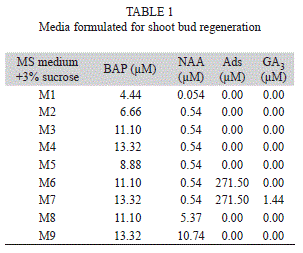
<body><![CDATA[<br> <hr style="width: 100%; height: 2px;"><font size="2">The growing worldwide demand of traditional medicinal plants has made large-scale commercial cultivation and genetic improvement imperative. <span style="font-style: italic;">Vitex trifolia</span> is one of such plants, belonging to the family verbenaceae, which has great therapeutic potential. The root is used in the treatment of painful inflammations, cough and fevers. Leaves are reported to be useful in conditions of loss of memory, loss&nbsp; of&nbsp; hair,&nbsp; leaucoderma&nbsp; and&nbsp; tuberculosis. Flowers are effective in treating fevers and fruits in treating amenorrhoea (Oommen <span style="font-style: italic;">et al.</span> 2000). Besides, the fruits contain an alkaloid, vitricine which is used in treating coryza, fever, headache, photopsia, vertigo, opthalmalgia, glaucoma, rheumatism and neuralgia (Prajapati <span  style="font-style: italic;">et al.</span> 2003). Pharmaceutical companies largely depend upon material procured from naturally occurring stands which are being depleted rapidly.&nbsp; Thus,&nbsp; over&nbsp; exploitation&nbsp; concerns&nbsp; about possible extinction of the species, provide a significant&nbsp; justification&nbsp; for&nbsp; the&nbsp; development of&nbsp; <span  style="font-style: italic;">in&nbsp; vitro</span>&nbsp; propagation&nbsp; techniques&nbsp; for&nbsp; this crop. On the other hand, scarce availability of planting material, slow regeneration in nature and lack of cultivation practices might be the possible reasons for multiplication of this plant species by shoot organogenesis from callus cultures, an effective method for multiplication of medicinal plants (Grewal &amp; Atal 1976, Khanna <span  style="font-style: italic;">et al.</span> 2006). Though <span style="font-style: italic;">in vitro</span> multiplication of <span style="font-style: italic;">V. trifolia</span> was achieved through clonal propagation through meristems culture (Hiregoudar <span  style="font-style: italic;">et al.</span> 2006), to date, there are no reports on plant regeneration via callus culture in this species.</font>    <br> <font size="2"></font>    <br> <font size="2">Generally, organogenic differentiation is considered a useful method in achieving a high frequency of shoot regeneration within a short period of time. However, there is a chance in occurrence&nbsp; of&nbsp; somaclonal&nbsp; variations&nbsp; among the sub-clones of parental line. The frequency of&nbsp; these&nbsp; variations&nbsp; varies&nbsp; with&nbsp; the&nbsp; source of explants, media composition and cultural conditions (Damasco <span style="font-style: italic;">et al.</span> 1996, Salvi <span style="font-style: italic;">et al.</span> 2001). The cryptic genetic defects arising via somaclonal variation in the regenerants is a potential drawback when the propagation of an elite species is intended, due to uncontrol lable and unpredictable nature of variation which seriously limits the utility of the micropropagation system. A number of molecular markers can be used to assess the genetic fidelity of&nbsp; in&nbsp; vitro&nbsp; derived&nbsp; clones.&nbsp; However,&nbsp; RAPD and ISSR markers are very simple, fast, cost effective, highly discriminative and reliable, require a small quantity of DNA, and do not need any prior primer sequence information (Cassells <span style="font-style: italic;">et al.</span> 1997, Lakshmanan <span  style="font-style: italic;">et al.</span> 2007). In this paper we report, for the first time, a rapid micropropagation protocol for <span  style="font-style: italic;">V. trifolia</span> through callus cultures and the genetic homogeneity of established clonal lines using RAPD and ISSR markers.</font>    <br> <font size="2"></font>    <br> <font style="font-weight: bold;" size="3">Materials and Methods</font>    <br> <font size="2"></font><br style="font-weight: bold;"> <font size="2"><span style="font-weight: bold;">Plant material and surface sterilization:</span> This study was conducted at the Directorate of&nbsp; Medicinal&nbsp; and Aromatic&nbsp; Plants&nbsp; Research (DMAPR),&nbsp; Anand,&nbsp; Gujarat,&nbsp; India.&nbsp; Shoots (5-7cm long) collected from healthy plants of <span  style="font-style: italic;">V. trifolia</span> grown at the gene bank of Directorate of Medicinal and Aromatic Plants Research, Boriavi, Anand,&nbsp; Gujarat,&nbsp; India.&nbsp; Shoots&nbsp; were washed in 2% (v/v) detergent solution &#8216;Teepol&#8217; (Qualigen, India) and surface sterilized in 0.1% (w/v) aqueous mercuric chloride (HgCl<sub>2</sub>) solution for 20 minutes after rinsing 4-5 times with sterile distilled water, leaves, petioles and stem internodes were cut in to smaller segments (60x50mm, 50x40mm and ~ 0.5cm, respectively) for use as the explants.</font>    <br> <font size="2"></font>    <br> <font size="2"><span style="font-weight: bold;">Culture medium:</span> The explants were placed on semi-solid (0.8% agar) basal MS medium (Murashige &amp; Skoog 1962) supplemented with different concentrations and combinations of 6-benzylaminopurine (BAP: 0.0, 2.22, 4.44, 6.65, 8.88, 11.10, 13.32&micro;M), kinetin&nbsp; (Kn:&nbsp; 0.0,&nbsp; 2.32,&nbsp; 4.64,&nbsp; 6.96,&nbsp; 9.28,&nbsp; 11.60, 13.92&micro;M),&nbsp;&nbsp; adenine&nbsp;&nbsp; sulphate&nbsp;&nbsp; (Ads:&nbsp;&nbsp; 67.87, 135.75 and 271.50&micro;M), 1-naphthalene acetic acid&nbsp; (NAA:&nbsp; 0.0,&nbsp; ,&nbsp; 2.69,&nbsp; 8.06,&nbsp; 10.74,&nbsp; 13.43, 16.11&micro;M),&nbsp; 2.4-dichlorophenoxy&nbsp; acetic&nbsp; acid (2.4-D:&nbsp; 0.0,&nbsp; 2.26,&nbsp; 4.52,&nbsp; 6.78,&nbsp; 9.04,&nbsp; 11.3, 13.56&micro;M)&nbsp; and&nbsp; gibberellic&nbsp; acid&nbsp; (GA3&nbsp;&nbsp;&nbsp; :&nbsp; 0.00, 0.29, 0.72, 1.44 &micro;M) for callusing and organogenesis. The&nbsp; media&nbsp; pH&nbsp; was&nbsp; adjusted&nbsp; to&nbsp; 5.8 using 0.1N HCl or 0.1N NaOH before autoclaving. Routinely, 25mL of the liquid medium&nbsp; with&nbsp; 0.8%&nbsp; (w/v)&nbsp; agar&nbsp; (Qualigen,&nbsp; India) was dispensed into culture tubes (25x100mm), plugged with non-absorbent cotton and sterilized at 121&ordm;C and 104kPa for 15min. The cultures were maintained by regular subcultures at 4-week intervals on similar fresh medium.</font>    <br> <font size="2"></font>    <br> <font size="2"><span style="font-weight: bold;">Culture condition:</span> At the time of callus initiation, all cultures were incubated at 25&plusmn;2&ordm;C under&nbsp; a&nbsp; light&nbsp; intensity&nbsp; of&nbsp; 61&micro;mol/m<sup>2</sup>s&nbsp; from cool white fluorescent lamps (Philips, India) under 16h photoperiod. For organogenesis, approximately, 200&plusmn;10mg of fresh callus was placed in each culture tube containing different concentrations and combination of cytokinins (BAP,&nbsp; Kn&nbsp; and&nbsp; Ads)&nbsp; and&nbsp; auxins&nbsp; (NAA&nbsp; and 2,4-D). The different regeneration media were presented in <a href="#tab_1">table 1</a>.    ]]></body>
<body><![CDATA[<br>     <br> </font>     <div style="text-align: center;"><a name="tab_1"></a><img alt=""  src="/img/revistas/rbt/v61n3/a08t1.gif"  style="width: 303px; height: 253px;">    <br> </div>     <br> <font size="2">The cultures were incubated separately under 16 and 24h photoperiods with a light intensity of 61&micro;mol/m<sup>2</sup>s from cool white fluorescent lamps at 25&plusmn;2&ordm;C.</font>    <br> <font size="2"></font>    <br> <font size="2"><span style="font-weight: bold;">Induction of rooting and acclimatization:</span> Excised shoots (1-2cm) regenerated from the callus were cultured on rooting medium fortifying with basal MS semi-solid medium either alone or in combination with different concentrations&nbsp; of&nbsp; IBA&nbsp; (0.49,&nbsp; 0.73,&nbsp; 0.98,&nbsp; 1.23&micro;M) or NAA (0.54, 0.81, 1.07, 1.34&micro;M) and 2% (w/v) sucrose for root initiation. One excised shoot was cultured in each tube (25x150mm) containing 15mL of the culture media. The cultures containing different concentrations of IBA and IAA were incubated separately under 16 and 24h photoperiods with cool, white fluorescent lamps at 25&plusmn;2&ordm;C temperature. Rooted plantlets were thoroughly washed to remove the adhering gel and planted in 2.5cm earthen pots containing a sterile mixture of soil, sand and well decomposed manure in the ratio of 1:1:1 (v/v/v), and were kept in the greenhouse for acclimatization.</font>    <br> <font size="2"></font>    <br> <font size="2"><span style="font-weight: bold;">Observations of cultures and presentation of results:</span> Twenty cultures were used per treatment and each experiment was repeated at least three times. The data pertaining to mean percentage of cultures responding to callusing, percentage of organogenic calli/culture, percentage of shoot buds/culture, mean percentage of rooting and number of roots/shoot were statistically analyzed by Duncan&#8217;s multiple range test. Between the treatments, the average figures followed by the same letter were not significantly different at p&lt;0.05 (Harter 1960).</font>    <br> <font size="2"></font>    ]]></body>
<body><![CDATA[<br> <font size="2"><span style="font-weight: bold;">DNA extraction and PCR amplification: </span>DNA was extracted from fresh leaves derived from both micropropagated and field-grown donor plant by the cetyltrimethyl ammonium bromide&nbsp; (CTAB)&nbsp; method&nbsp; (Bousquet&nbsp; <span style="font-style: italic;">et&nbsp; al.</span> 1990) with minor modifications; 1% polyvinylpyrrolidone (PvP) was added to remove polyphenols. DNA quantity was estimated spectrophotometrically (vARIAN, Cary 300, USA) by measuring the absorbance at 260nm. Sixteen plants were assessed from which one is the donor plant and other 15 are in vitro derived plants.</font>    <br> <font size="2"></font>    <br> <font size="2">The RAPD analysis was performed according to Williams <span  style="font-style: italic;">et al.</span> (1990) and ISSR analysis according to Zeitkiewicz <span  style="font-style: italic;">et al.</span> (1994). RAPD and ISSR amplifications were performed routinely using PCR mixture (25&micro;L) containing 25ng&nbsp; of&nbsp; genomic&nbsp; DNA&nbsp; as&nbsp; template,&nbsp; 10&nbsp; X PCR&nbsp; buffer,&nbsp; 200&#956;M&nbsp; dNTPs&nbsp; (MBI&nbsp; Ferment Inc. USA), 1U of Taq polymerase (Bangalore Genei, India) and 15ng of RAPD primer or 40ng of ISSR primer. The amplification was carried out in a thermal cycler (S1000; BioRad, Hercules, USA). In RAPD, PCR was performed at initial temperature of 94&ordm;C for 5min for complete denaturation. The second step consisted of 42 cycles having three ranges of temperature, i.e. 92&ordm;C for 1min for denaturation of template DNA, 37&ordm;C for 1min for primer annealing, 72&ordm;C for 2min for primer extension, followed by running the samples at 72&ordm;C for 7min for complete polymerization. For ISSR the&nbsp; same&nbsp; temperature&nbsp; profile&nbsp; was&nbsp; followed, but the primer annealing temperature was set at&nbsp; 5&ordm;C&nbsp; lower&nbsp; than&nbsp; the&nbsp; melting&nbsp; temperature. The PCR products obtained from RAPD were analyzed in 1.5% agarose gel whereas the ISSR products were analyzed in 2% agarose gel. The size of the amplicons were estimated using O&#8217; Gene RulerTM100 bpplus DNA ladder (MBIFermentas, vilnius, Lithuania) and documented in the GelDoc (Bio-Rad, Hercules, USA).</font>    <br> <font size="2"></font>    <br> <font size="2">Amplified DNA markers were scored as present or absent for both the micropropagated and the mother plants. Electrophoretic DNA bands of low visual intensity that could not be readily differentiated as present or absent were considered ambiguous markers which were not scored.</font>    <br> <font size="2"></font>    <br> <font style="font-weight: bold;" size="3">Results</font>    <br> <font size="2"></font><br style="font-weight: bold;"> <font size="2"><span style="font-weight: bold;">Callus induction:</span> Calli were initiated from stem, petioles and leaves within 18-20 days of culture on MS basal medium supplemented with different concentrations of 2,4-D or NAA in combination with either Kn or BAP. Initially, small greenish white calli developed on the cut ends within 18-20days of inoculation which subsequently covered the entire surface of the explant (<a href="/img/revistas/rbt/v61n3/a08i1.jpg">Fig. 1A</a>). There was no sign of callus initiation in the explants cultured in only MS&nbsp; media&nbsp; devoid of&nbsp; cytokinins&nbsp; and auxins. Globular and greenish calli developed on the surface of the explants 3-4 weeks after culture initiation on MS basal medium supplemented with varying concentrations of BAP with NAA. The medium containing 2,4-D (9.05-11.3&micro;M) and BA (0.04-0.44&micro;M) promoted rapid callus growth from stem, petiole and leaf explants which subsequently turned brown within four weeks&nbsp; of&nbsp; culture.&nbsp; Similarly,&nbsp; also&nbsp; rapid&nbsp; callus induction was obtained in the medium supplemented with TDZ (0.45-2.27&micro;M) + Ads (271.50&micro;M) from the leaf and stem explants which were soft or gelatinous depending on the TDZ level; the rate of callus growth was faster in the first four-weeks of culture after which it declined. Though slow callus growth took place in media supplemented with 11.10&micro;M BAP and 0.54- 2.70&micro;M NAA in stem, petiole and leaf, however the best granular callus growth was observed in the medium containing 0.44&micro;M BAP and 16.11&micro;M NAA. However, callus morphology varied with different plant growth regulators used in the MS culture medium. The appearance of the calluses varied with all the three explant types and media. The calli derived from stem and petiole explants were invariably greener and more granular than the leaf-derived callus on the media containing 0.44 -11.10&micro;M BAP with 0.54-16.11&micro;M NAA. Higher concentration of NAA induced compact calli which is not desirable for plant regeneration. Media containing Kn in combination with either NAA or 2,4-D did not induce any callus growth. Of the three explant types used, early callus growth was observed in stem explants followed by petiole and leaf explants. Leaf explants produced callus at a relatively slow rate. Young leaf and mature stem explants responded better than mature leaf and young stem explants respectively (data not shown).    <br> </font><br style="font-weight: bold;"> <font size="2"><span style="font-weight: bold;">Differentiation of shoots from callus: </span>After eight weeks on callus induction medium (MS+0.44&micro;M BAP+16.11&micro;M NAA) the calli were subcultured into media containing different&nbsp; concentrations&nbsp; of&nbsp; BAP,&nbsp; Kn&nbsp; and&nbsp; NAA for&nbsp; shoot&nbsp; bud&nbsp; regeneration. The&nbsp; calli&nbsp; differentiated into green nodular structures which developed into dark green shoot buds in the media supplemented with 10.0 -13.32&micro;M BAP and 0.54&micro;M NAA. Kinetin or BAP alone did not induce any morphogenic response, and also the combination of BAP or Kn with 2,4-D did not help in regeneration of shoot buds. The addition of adenine sulphate (271.50&micro;M) and GA3&nbsp;&nbsp;&nbsp; (1.44&micro;M) in the culture medium, how-ever, resulted in quick growth of shoot buds within four weeks of culture (<a href="/img/revistas/rbt/v61n3/a08i1.jpg">Fig. 1 B</a> and C). A very high percentage of regeneration was observed in mature stem (86.67%) followed by petiole (76.67%) and leaf (58.33%) explants derived calli cultured in media supplemented with 13.32&micro;M BAP+0.54&micro;M NAA (<a  href="/img/revistas/rbt/v61n3/a08t2.gif">Table 2</a>). Regeneration of shoot buds also took place at low&nbsp; concentration&nbsp; BAP,&nbsp; but&nbsp; less&nbsp; frequently. With the increase of NAA concentration (5.37-10.74&micro;M) in the medium, the rate of regeneration slowed down. The percentage of shoot bud regeneration and the frequency of regenerated shoot/culture varied from 7.25 to 16.0, 3.45 to 10.85, and 2.60 to 9.80 in stem, petiole and leaf explants, respectively (<a  href="#tab_1">Table 1</a>).    <br>     ]]></body>
<body><![CDATA[<br> </font><font size="2">Among the five subcultures at four week intervals, the higher regeneration potential and shoot buds per culture were observed in the 2<sup>nd</sup> subculture. After&nbsp; five&nbsp; to&nbsp; six&nbsp; subcultures of callus, loss of organogenic potential was observed even when cultured on similar medium&nbsp; or&nbsp; modified&nbsp; medium&nbsp; (data&nbsp; not&nbsp; shown). The regeneration frequency in cultures from stem, petiole and leaf explants was found to be best under 16h photoperiod as compared to the cultures under continuous light, which was&nbsp; not&nbsp; conducive&nbsp; to&nbsp; shoot&nbsp; bud&nbsp; regeneration and multiplication.</font>    <br> <font size="2"></font><br style="font-weight: bold;"> <font size="2"><span style="font-weight: bold;">Induction of rooting in regenerated plants: </span>Microshoots&nbsp; regenerated&nbsp; from&nbsp; stem and petiole derived calli were excised and transferred to the medium with or without growth regulators. Half strength MS medium without&nbsp; growth&nbsp; regulators&nbsp; did&nbsp; not&nbsp; promote root induction. Roots were formed on excised shoots grown in &frac12; MS media containing either IBA&nbsp; (0.49-1.23&micro;M)&nbsp; or&nbsp; NAA&nbsp; (0.54-1.34&micro;M) with 2% (w/v) sucrose. A high percentage of shoots (86%) rooted in the medium containing half strength MS basal salts with 1.23&micro;M IBA+2% (w/v) sucrose after 11-12days of culture (<a  href="/img/revistas/rbt/v61n3/a08t3.gif">Table 3</a>). Root initials formed within 7-9 days which developed a good root system in 11-12 days (<a href="/img/revistas/rbt/v61n3/a08i1.jpg">Fig. 1 D</a>). Root initiation was achieved on medium containing either NAA (1.23&micro;M) or IAA (1.43&micro;M) but with intervening callus at the cut end of the shoot. The rooting of microshoots was observed to be best under 16h irradiance which was found to be inhibited in continuous light.</font>    <br> <font size="2"></font>    <br> <font size="2"><span style="font-weight: bold;">Acclimatization of rooted plants:</span> Rooted plantlets were transferred into pots containing soil: sand: well decomposed cow-dung manure, in the ratio of 1:1:1 and kept in the green house for acclimatization. After one month of transfer to soil, about 90% of the plants survived in the green house (<a href="/img/revistas/rbt/v61n3/a08i1.jpg">Fig. 1 E</a>) and were subsequently planted in the field. No morphological variation was noticed.</font>    <br> <font size="2"></font><br style="font-weight: bold;"> <font size="2"><span style="font-weight: bold;">Clonal fidelity: </span>DNA samples from the hardened plantlets of <span style="font-style: italic;">in vitro</span>-grown shoots derived from second up to fifth cycle of shoot multiplication&nbsp; grown&nbsp; in&nbsp; the&nbsp; polyhouse&nbsp; and the donor plants were subjected to RAPD and ISSR&nbsp; analysis. A total&nbsp; of&nbsp; 40&nbsp; plantlets&nbsp; were analyzed&nbsp; taking&nbsp; a&nbsp; minimum&nbsp; 15&nbsp; plants&nbsp; from each culture period along with the donor plant. For RAPD analysis, a total of 60 random primers were used out of which 20 random decamer primers (Operon Technologies, Almeda, USA) were selected. In the case of ISSR, 12 out of 27 primers were selected. A total of 20 selected RAPD primers gave rise to a total of 125 scorable bands ranging from 180 to 3 000bp from&nbsp; which&nbsp; two&nbsp; markers&nbsp; (OPA &amp;&nbsp; OPN&nbsp; 04) showing monomorphic bands are represented in <a  href="/img/revistas/rbt/v61n3/a08i2.jpg">figure 2</a> (<a  href="/img/revistas/rbt/v61n3/a08i2.jpg">A</a> and <a href="/img/revistas/rbt/v61n3/a08i2.jpg">B</a>).The number of bands for each primer varied from 4-9 with an average of 6.25 bands per primer. The highest number of bands (9) was obtained with primer OPA10 and the lowest number of bands (4) amplified in OPA 05, OPA 19 and OPP 10 (<a  href="/img/revistas/rbt/v61n3/a08t4.gif">Table 4</a>). In ISSR analysis, 12 selected primers (Bangalore Genei, India) produced a total of 49 scorable bands&nbsp; ranging&nbsp; from&nbsp; 400&nbsp; to&nbsp; 2&nbsp; 000bp&nbsp; (<a href="/img/revistas/rbt/v61n3/a08t5.gif">Table 5</a>). For each primer, the number of amplified bands varied from 1-7, and a total of 49 bands were generated all of which were found to be monomorphic in nature; a common fragment size (400-1 220bp) amplified with two primers such as (AG)8C and (AC)8C are represented in <a href="/img/revistas/rbt/v61n3/a08i3.jpg">figure 3</a> (<a href="/img/revistas/rbt/v61n3/a08i3.jpg">A</a> and B). The highest number of bands (7) and the lowest number of bands (1) were generated with the primer (CA)6GG and (CT)<sub>8</sub>T, respectively.    <br>     <br> </font><font style="font-weight: bold;" size="3">Discussion</font>    <br> <font size="2"></font>    <br> <font size="2">The present study demonstrated the possibility of exploring the morphogenetic potential in callus derived from stem, petioles and leaves of <span style="font-style: italic;">V. trifolia</span> with the application of various growth&nbsp; regulators.&nbsp; The&nbsp; importance&nbsp; of&nbsp; auxin and&nbsp; cytokinin&nbsp; balance&nbsp; has&nbsp; been&nbsp; reported&nbsp; in regulating the apical dominance as well as morphogenetic events such as shoot formation and multiplication (Li &amp; Bangerth 2003, Werner <span  style="font-style: italic;">et al.</span> 2003, Nakagawa <span style="font-style: italic;">et al.</span> 2005). Also, another factor that may influence the morphogenetic events during <span  style="font-style: italic;">in vitro</span> culture is a possible interaction between the endogenous concentrations of plant growth regulators and those present in the culture media (Mercier <span  style="font-style: italic;">et al.</span> 2003). Our results showed that BAP was more effective for shoot bud proliferation than kinetin also corroborated in Samantaray &amp; Maiti (2008). Moreover, the concentrations 11.10-13.32&micro;M of BAP in the medium favored the shoot bud proliferation and multiplication, which could be the optimum BAP concentration for cytokinin and endogenous auxin balance resulting in shoot bud regeneration. However, in the present study, combination of high concentrations of BAP with low concentrations of NAA enhanced&nbsp; the&nbsp; shoot&nbsp; bud&nbsp; multiplication as reported earlier (Prakash &amp; Staden 2008, Amoos <span  style="font-style: italic;">et al.</span> 2009). The usefulness of different combinations of auxin and cytokinin for the production of organogenic and subsequent plant regeneration was well documented (Irvani <span  style="font-style: italic;">et al.</span> 2010, Bantawa 2011). Besides, the combination of cytokinins and auxins sometimes triggered the rate of shoot bud regeneration in various medicinal plants (Sivanesan &amp; Jeong 2007, Samantaray &amp; Maiti 2008, Samantaray <span  style="font-style: italic;">et al.</span> 2009).</font>    <br> <font size="2"></font>    ]]></body>
<body><![CDATA[<br> <font size="2">Though BAP and NAA played a significant role in shoot bud regeneration, however, addition of adenine sulphate and GA3&nbsp; in the culture medium resulted in quick growth of shoot buds within four weeks of culture which is corroborated with the findings of earlier reports (Mohan &amp; Krishnamurthy 1998, Samantaray &amp; Maiti 2010). The percentage of shoot bud regeneration and the frequency of regenerated&nbsp; shoot/culture&nbsp; varied&nbsp; significantly in stem, petiole and leaf explants. The use of various explants for the production of callus and subsequent regeneration of shoot buds was well documented (Arora &amp; Bhojwani 1989, Cacho <span  style="font-style: italic;">et al.</span> 1991). The differential response could be due to the growth regulators in the medium and explant types (Cacho <span style="font-style: italic;">et al.</span> 1991, Pellegrineschi &amp; Tepfer 1981). Differentiation of callus into green nodular structures followed by dark shoot buds were achieved in the media supplemented with high concentration of BAP and low concentration of NAA as reported earlier&nbsp; (Saxena&nbsp; <span style="font-style: italic;">et&nbsp; al.</span>&nbsp; 1997,&nbsp; Samantaray&nbsp; &amp; Maiti&nbsp; 2011).&nbsp; The&nbsp; regeneration&nbsp; frequency&nbsp; in cultures from stem, petiole and leaf explants was found to be best under 16h photoperiod as compared to the cultures under continuous light which was not conducive to shoot bud regeneration and multiplication. Similar effects of&nbsp; photoperiod&nbsp; on&nbsp; shoot&nbsp; bud&nbsp; regeneration were observed in <span style="font-style: italic;">Sesbania rostrata</span> (Perez-Bermudez <span style="font-style: italic;">et al.</span> 1984), <span style="font-style: italic;">Actinidia deliciosa</span> (Muleo &amp; Morini 1990), <span  style="font-style: italic;">Lavandula latifolia</span> (Calvo &amp; Segura 1989) and <span style="font-style: italic;">Trema orientalis</span> (Samantaray <span style="font-style: italic;">et al.</span> 1995).</font>    <br> <font size="2"></font>    <br> <font size="2">Optimal rooting and growth of microshoots were observed on medium containing low concentration of IBA without intervening callus. Similar observations were made in various medicinal plants such as <span  style="font-style: italic;">Vitex agnuscastus, Filipendula ulmaria, Chlorophytum arundiaceum</span>&nbsp; (Balaraju&nbsp; <span style="font-style: italic;">et&nbsp; al.</span>&nbsp; 2008, Yildirim &amp; Turker&nbsp; 2009,&nbsp; Samantaray&nbsp; &amp;&nbsp; Maiti&nbsp; 2011). On the other hand, the irradiance showed significant effects on rooting induction (Sivanesan &amp; Jeong 2007). The rooting in microshoots performed better under 16h photoperiods compared to continuous light. The rate of rooting dependent on growth regulators and photoperiod&nbsp; was&nbsp; also&nbsp; well&nbsp; documented&nbsp; (Murashige 1974, Rout <span style="font-style: italic;">et al.</span> 1995).</font>    <br> <font size="2"></font>    <br> <font size="2">The occurrence of genetic defects arising from variation in the regenerants seriously affects the true-to-type nature of the plants, which in turn hampers the production of a specific secondary metabolite of commercial value. Hence, the production of genetic uniform and stable plants is a prerequisite for commercial purposes (Shu <span  style="font-style: italic;">et al.</span> 2003). Though many PCR-based techniques such as SSR, RAPD and AFLP have been used to determine somaclonal&nbsp; variation&nbsp; of&nbsp; regenerants,&nbsp; RAPD and ISSR markers were successfully employed for the detection of variations at the genome level among tissue cultured regenerants (Taylor <span style="font-style: italic;">et al.</span> 1995, Choudhuri <span style="font-style: italic;">et al.</span> 2009). The variations can be due to gene amplification, chromosomal irregularities, point mutation and alteration in DNA methylation during <span  style="font-style: italic;">in vitro</span> culture (Saker <span style="font-style: italic;">et al.</span> 2000). In the present study, amplification&nbsp; of&nbsp; genomic&nbsp; DNA of&nbsp; the&nbsp; arbitrarily selected <span  style="font-style: italic;">in vitro</span> derived progenies and that of the donor plant of <span  style="font-style: italic;">V. trifolia</span> was similar which indicates the true-to-type nature of the progenies (Samantaray &amp; Maiti 2008, 2010).</font>    <br> <font size="2"></font>    <br> <font size="2">In conclusion, we established a suitable regeneration system protocol for <span style="font-style: italic;">V. trifolia</span>, a potential medicinal plant, via organogenesis using three different explants viz. stem, leaf and petiole which may be very much useful for mass propagation and genetic transformation. Our results indicate the organogenic potential of <span  style="font-style: italic;">V. trifolia</span> is greatly influenced by NAA and BABesides, the efficient usefulness of RAPD and&nbsp; ISSR&nbsp; techniques&nbsp; in&nbsp; assessing&nbsp; the&nbsp; truetotype nature of the regenerated clones of <span  style="font-style: italic;">V. trifolia</span> was confirmed.</font>    <br> <font size="2"></font>    <br> <font style="font-weight: bold;" size="3">Acknowledgments</font>    <br> <font size="2"></font>    ]]></body>
<body><![CDATA[<br> <font size="2">The authors wish to acknowledge the help of the Directorate of Medicinal and Aromatic Plants Research, Boriavi, Anand for providing necessary facilities. </font>    <br> <hr style="width: 100%; height: 2px;"><font style="font-weight: bold;"  size="3">References</font>    <br> <font size="2"></font>    <br> <font size="2">Amoos,&nbsp; O., J.F. Finnie &amp; J. van Staden.&nbsp; 2009. In vitro propagation of <span style="font-style: italic;">Huernia hystrix</span>: an endangered medicinal and ornamental succulent. Plant Cell Tiss. Org. Cult. 96: 273-278.</font>    <!-- ref --><br> <font size="2"></font>    &nbsp;&nbsp;&nbsp;&nbsp;&nbsp;&nbsp;&nbsp;&nbsp;[&#160;<a href="javascript:void(0);" onclick="javascript: window.open('/scielo.php?script=sci_nlinks&ref=1638623&pid=S0034-7744201300040000800001&lng=','','width=640,height=500,resizable=yes,scrollbars=1,menubar=yes,');">Links</a>&#160;]<!-- end-ref --><!-- ref --><br> <font size="2">Arora,&nbsp; R. &amp; S.S. Bhojwani. 1989. <span  style="font-style: italic;">In vitro</span>&nbsp; propagation and&nbsp; low&nbsp; temperature&nbsp; storage&nbsp; of&nbsp; <span style="font-style: italic;">Saussurea&nbsp; lappa</span> C.B.&nbsp; ClarkeAn endangered plant. Plant Cell&nbsp; Rep. 8: 44-47.    &nbsp;&nbsp;&nbsp;&nbsp;&nbsp;&nbsp;&nbsp;&nbsp;[&#160;<a href="javascript:void(0);" onclick="javascript: window.open('/scielo.php?script=sci_nlinks&ref=1638624&pid=S0034-7744201300040000800002&lng=','','width=640,height=500,resizable=yes,scrollbars=1,menubar=yes,');">Links</a>&#160;]<!-- end-ref --></font>    <br> <font size="2"></font>    <!-- ref --><br> <font size="2">Balaraju,&nbsp; K., P. Agastian, J.P. Preetamraj, S.&nbsp; Arokiyaraj &amp; S. Ignacimuthu. 2008. Micropropagation of <span  style="font-style: italic;">Vitex agnus-castus</span>&nbsp; (verbenaceae)- A valuable&nbsp; medicinal plant. In Vitro Cell. Dev. Biol. Pl. 44: 436-441.    &nbsp;&nbsp;&nbsp;&nbsp;&nbsp;&nbsp;&nbsp;&nbsp;[&#160;<a href="javascript:void(0);" onclick="javascript: window.open('/scielo.php?script=sci_nlinks&ref=1638627&pid=S0034-7744201300040000800003&lng=','','width=640,height=500,resizable=yes,scrollbars=1,menubar=yes,');">Links</a>&#160;]<!-- end-ref --></font>    ]]></body>
<body><![CDATA[<br> <font size="2"></font>    <!-- ref --><br> <font size="2">Bantawa,&nbsp; P., O. Saha-Roy, S.K. Ghosh &amp;&nbsp; T.K.&nbsp; Mondal. 2011. In vitro regeneration of an endangered medicinal plant <span style="font-style: italic;">Picrorhizas crophulariiflora</span>. Biol. Plantar. 55: 169-172.    &nbsp;&nbsp;&nbsp;&nbsp;&nbsp;&nbsp;&nbsp;&nbsp;[&#160;<a href="javascript:void(0);" onclick="javascript: window.open('/scielo.php?script=sci_nlinks&ref=1638630&pid=S0034-7744201300040000800004&lng=','','width=640,height=500,resizable=yes,scrollbars=1,menubar=yes,');">Links</a>&#160;]<!-- end-ref --></font>    <br> <font size="2"></font>    <!-- ref --><br> <font size="2">Bousquet, J., L. Simon &amp; M. Lalonde. 1990. DNA amplification from vegetative and&nbsp; sexual tissues of trees using polymerase chain reaction. Can. J. Forest Res. 20: 254-257.    &nbsp;&nbsp;&nbsp;&nbsp;&nbsp;&nbsp;&nbsp;&nbsp;[&#160;<a href="javascript:void(0);" onclick="javascript: window.open('/scielo.php?script=sci_nlinks&ref=1638633&pid=S0034-7744201300040000800005&lng=','','width=640,height=500,resizable=yes,scrollbars=1,menubar=yes,');">Links</a>&#160;]<!-- end-ref --></font>    <br> <font size="2"></font>    <!-- ref --><br> <font size="2">Cacho, M., M. Moran, M.T. Herriera &amp; J.&nbsp; Fernandez- Tarrago. 1991. Morphogenesis in leaf, hypocotyl and root explants of <span  style="font-style: italic;">Digitalis thapsi</span> L. cultured <span style="font-style: italic;">in vitro</span>. Plant Cell Tiss. Org. Cult. 25: 117-123.    &nbsp;&nbsp;&nbsp;&nbsp;&nbsp;&nbsp;&nbsp;&nbsp;[&#160;<a href="javascript:void(0);" onclick="javascript: window.open('/scielo.php?script=sci_nlinks&ref=1638636&pid=S0034-7744201300040000800006&lng=','','width=640,height=500,resizable=yes,scrollbars=1,menubar=yes,');">Links</a>&#160;]<!-- end-ref --></font>    <br> <font size="2"></font>    ]]></body>
<body><![CDATA[<!-- ref --><br> <font size="2">Cassells, A.C., J.T. Croke &amp; B.M. Doyie. 1997. Evaluation of image analysis, flow cytometry and RAPD analysis for the&nbsp; assessment of somaclonal variation and induced mutation in tissue&nbsp; culture-derived Pelargonium plants. Angew. Bot. 71: 125-130.    &nbsp;&nbsp;&nbsp;&nbsp;&nbsp;&nbsp;&nbsp;&nbsp;[&#160;<a href="javascript:void(0);" onclick="javascript: window.open('/scielo.php?script=sci_nlinks&ref=1638639&pid=S0034-7744201300040000800007&lng=','','width=640,height=500,resizable=yes,scrollbars=1,menubar=yes,');">Links</a>&#160;]<!-- end-ref --></font>    <br> <font size="2"></font>    <!-- ref --><br> <font size="2">Calvo,&nbsp; M.C. &amp; J. Segura. 1989. Plant&nbsp; regeneration from cultured&nbsp; leaves&nbsp; of&nbsp;&nbsp; <span  style="font-style: italic;">Lavandula&nbsp; latifolia</span>&nbsp; Medicus: Influence of growth regulators and illumination conditions. Plant Cell Tiss. Org. Cult. 19: 33-42.    &nbsp;&nbsp;&nbsp;&nbsp;&nbsp;&nbsp;&nbsp;&nbsp;[&#160;<a href="javascript:void(0);" onclick="javascript: window.open('/scielo.php?script=sci_nlinks&ref=1638642&pid=S0034-7744201300040000800008&lng=','','width=640,height=500,resizable=yes,scrollbars=1,menubar=yes,');">Links</a>&#160;]<!-- end-ref --></font>    <br> <font size="2"></font>    <!-- ref --><br> <font size="2">Choudhuri,&nbsp; R.K., A. Pal &amp; T.B. Jha. 2009.&nbsp; Regeneration and characterization of&nbsp; <span style="font-style: italic;">Swertia chirata</span> Buch.-Ham. ex Wall. plants from immature seed cultures. Scientia Hort. 120: 107-114.    &nbsp;&nbsp;&nbsp;&nbsp;&nbsp;&nbsp;&nbsp;&nbsp;[&#160;<a href="javascript:void(0);" onclick="javascript: window.open('/scielo.php?script=sci_nlinks&ref=1638645&pid=S0034-7744201300040000800009&lng=','','width=640,height=500,resizable=yes,scrollbars=1,menubar=yes,');">Links</a>&#160;]<!-- end-ref --></font>    <br> <font size="2"></font>    <!-- ref --><br> <font size="2">Damasco,&nbsp; O.P., G.C. Graham, R.J. Henry,&nbsp; S.W.&nbsp; Adkins, M.K. Smith &amp; I.D.&nbsp; Godwin. 1996. Random amplified&nbsp; polymorphic DNA (RAPD) detection of&nbsp; dwarf off types in micropropagated Cavendish (Musa spp. AAA) bananas. Plant Cell Rep. 16: 118-123.    &nbsp;&nbsp;&nbsp;&nbsp;&nbsp;&nbsp;&nbsp;&nbsp;[&#160;<a href="javascript:void(0);" onclick="javascript: window.open('/scielo.php?script=sci_nlinks&ref=1638648&pid=S0034-7744201300040000800010&lng=','','width=640,height=500,resizable=yes,scrollbars=1,menubar=yes,');">Links</a>&#160;]<!-- end-ref --></font>    <br> <font size="2"></font>    <!-- ref --><br> <font size="2">Grewal, S. &amp; C.K. Atal. 1976. Plantlet formation in callus cultures of <span style="font-style: italic;">Dioscorea deltoidea</span> Wall. Indian J.exp. Biol. 14: 352-353.    &nbsp;&nbsp;&nbsp;&nbsp;&nbsp;&nbsp;&nbsp;&nbsp;[&#160;<a href="javascript:void(0);" onclick="javascript: window.open('/scielo.php?script=sci_nlinks&ref=1638651&pid=S0034-7744201300040000800011&lng=','','width=640,height=500,resizable=yes,scrollbars=1,menubar=yes,');">Links</a>&#160;]<!-- end-ref --></font>    <br> <font size="2"></font>    <!-- ref --><br> <font size="2">Harter, H.L. 1960. Critical value for&nbsp; Duncan&#8217;s multiple range test. Biometrics 16: 671-685.    &nbsp;&nbsp;&nbsp;&nbsp;&nbsp;&nbsp;&nbsp;&nbsp;[&#160;<a href="javascript:void(0);" onclick="javascript: window.open('/scielo.php?script=sci_nlinks&ref=1638654&pid=S0034-7744201300040000800012&lng=','','width=640,height=500,resizable=yes,scrollbars=1,menubar=yes,');">Links</a>&#160;]<!-- end-ref --></font>    <br> <font size="2"></font>    <!-- ref --><br> <font size="2">Hiregoudar,&nbsp; L.v.,&nbsp; H.N.&nbsp; Murthy,&nbsp; J.G.&nbsp; Bhat, A.&nbsp; Nayeem, B.P.&nbsp; Hema,&nbsp; E.J.&nbsp; Hahn&nbsp; &amp;&nbsp; K.Y.&nbsp; Paek.&nbsp; 2006.&nbsp; Rapid clonal propagation of <span style="font-style: italic;">Vitex trifolia</span>. Biol. Plantar. 50: 291-294.    &nbsp;&nbsp;&nbsp;&nbsp;&nbsp;&nbsp;&nbsp;&nbsp;[&#160;<a href="javascript:void(0);" onclick="javascript: window.open('/scielo.php?script=sci_nlinks&ref=1638657&pid=S0034-7744201300040000800013&lng=','','width=640,height=500,resizable=yes,scrollbars=1,menubar=yes,');">Links</a>&#160;]<!-- end-ref --></font>    ]]></body>
<body><![CDATA[<br> <font size="2"></font>    <!-- ref --><br> <font size="2">Irvani, N., M. Solouki, M. Omidi, A.R. Zare &amp; S. Shahnazi. 2010. Callus induction&nbsp; and plant regeneration in <span  style="font-style: italic;">Dorem ammoniacum</span> D., an endangered medicinal plant. Plant Cell Tiss. Org. Cult. 100: 293-299.    &nbsp;&nbsp;&nbsp;&nbsp;&nbsp;&nbsp;&nbsp;&nbsp;[&#160;<a href="javascript:void(0);" onclick="javascript: window.open('/scielo.php?script=sci_nlinks&ref=1638660&pid=S0034-7744201300040000800014&lng=','','width=640,height=500,resizable=yes,scrollbars=1,menubar=yes,');">Links</a>&#160;]<!-- end-ref --></font>    <br> <font size="2"></font>    <!-- ref --><br> <font size="2">Khanna, P.K., A. Ahuja, M. Sharada, G. Ram, K. Koul &amp; M.K. Kaul. 2006. Regeneration via organogenesis in callus cultures of <span  style="font-style: italic;">Argyrolobium roseum</span>. Biol. Plantar. 50: 417-420.    &nbsp;&nbsp;&nbsp;&nbsp;&nbsp;&nbsp;&nbsp;&nbsp;[&#160;<a href="javascript:void(0);" onclick="javascript: window.open('/scielo.php?script=sci_nlinks&ref=1638663&pid=S0034-7744201300040000800015&lng=','','width=640,height=500,resizable=yes,scrollbars=1,menubar=yes,');">Links</a>&#160;]<!-- end-ref --></font>    <br> <font size="2"></font>    <!-- ref --><br> <font size="2">Lakshmanan, v., S.R. venkataramareddy &amp; B. Neelwarne. 2007. Molecular analysis of genetic stability in long term micropropagated shoots of banana using RAPD and ISSR markers. Electron. J. Biotechnol. 10: 1-8.    &nbsp;&nbsp;&nbsp;&nbsp;&nbsp;&nbsp;&nbsp;&nbsp;[&#160;<a href="javascript:void(0);" onclick="javascript: window.open('/scielo.php?script=sci_nlinks&ref=1638666&pid=S0034-7744201300040000800016&lng=','','width=640,height=500,resizable=yes,scrollbars=1,menubar=yes,');">Links</a>&#160;]<!-- end-ref --></font>    <br> <font size="2"></font>    ]]></body>
<body><![CDATA[<!-- ref --><br> <font size="2">Li, C. &amp; H. Bangerth. 2003. Stimulatory effect of Cytokinins and interaction with IAA on the release of lateral buds of pea&nbsp; plants from apical dominance. J. Plant Physiol. 160: 1059-1063.    &nbsp;&nbsp;&nbsp;&nbsp;&nbsp;&nbsp;&nbsp;&nbsp;[&#160;<a href="javascript:void(0);" onclick="javascript: window.open('/scielo.php?script=sci_nlinks&ref=1638669&pid=S0034-7744201300040000800017&lng=','','width=640,height=500,resizable=yes,scrollbars=1,menubar=yes,');">Links</a>&#160;]<!-- end-ref --></font>    <br> <font size="2"></font>    <!-- ref --><br> <font size="2">Mercier, H., B.M. Souza, J.E. Kraus, R.M.&nbsp; Hamasaki &amp; B.&nbsp; Sotta.&nbsp; 2003.&nbsp; Endogenous Auxin&nbsp; and&nbsp; Cytokinin contents associated with shoot formation&nbsp; in leaves of pineapple cultured <span style="font-style: italic;">in vitro</span>. Braz. J. Plant Physiol. 15: 107-112.    &nbsp;&nbsp;&nbsp;&nbsp;&nbsp;&nbsp;&nbsp;&nbsp;[&#160;<a href="javascript:void(0);" onclick="javascript: window.open('/scielo.php?script=sci_nlinks&ref=1638672&pid=S0034-7744201300040000800018&lng=','','width=640,height=500,resizable=yes,scrollbars=1,menubar=yes,');">Links</a>&#160;]<!-- end-ref --></font>    <br> <font size="2"></font>    <!-- ref --><br> <font size="2">Mohan, M.L. &amp; K.v. Krishnamurthy. 1998. Plant regeneration in pigeon pea [<span style="font-style: italic;">Cajanus cajan</span> (L.) Millsp]. Plant Cell Rep. 17: 705-710.    &nbsp;&nbsp;&nbsp;&nbsp;&nbsp;&nbsp;&nbsp;&nbsp;[&#160;<a href="javascript:void(0);" onclick="javascript: window.open('/scielo.php?script=sci_nlinks&ref=1638675&pid=S0034-7744201300040000800019&lng=','','width=640,height=500,resizable=yes,scrollbars=1,menubar=yes,');">Links</a>&#160;]<!-- end-ref --></font>    <br> <font size="2"></font>    <!-- ref --><br> <font size="2">Muleo,&nbsp; R. &amp; S. Morini.1990. Effect of light&nbsp; quality on regeneration from callus of <span style="font-style: italic;">Actinidia deliciosa</span>. Acta Hortic. 280: 155-158.    &nbsp;&nbsp;&nbsp;&nbsp;&nbsp;&nbsp;&nbsp;&nbsp;[&#160;<a href="javascript:void(0);" onclick="javascript: window.open('/scielo.php?script=sci_nlinks&ref=1638678&pid=S0034-7744201300040000800020&lng=','','width=640,height=500,resizable=yes,scrollbars=1,menubar=yes,');">Links</a>&#160;]<!-- end-ref --></font>    <br> <font size="2"></font>    <!-- ref --><br> <font size="2">Murashige, T. 1974. Plant propagation through tissue culture. Annu. Rev. Plant Phys. 25: 135-166.    &nbsp;&nbsp;&nbsp;&nbsp;&nbsp;&nbsp;&nbsp;&nbsp;[&#160;<a href="javascript:void(0);" onclick="javascript: window.open('/scielo.php?script=sci_nlinks&ref=1638681&pid=S0034-7744201300040000800021&lng=','','width=640,height=500,resizable=yes,scrollbars=1,menubar=yes,');">Links</a>&#160;]<!-- end-ref --></font>    <br> <font size="2"></font>    <!-- ref --><br> <font size="2">Murashige,&nbsp; T. &amp; F. Skoog. 1962. A revised&nbsp; medium for rapid growth and bioassay with tobacco tissue cultures. Physiol. Plantar. 15: 473-497.    &nbsp;&nbsp;&nbsp;&nbsp;&nbsp;&nbsp;&nbsp;&nbsp;[&#160;<a href="javascript:void(0);" onclick="javascript: window.open('/scielo.php?script=sci_nlinks&ref=1638684&pid=S0034-7744201300040000800022&lng=','','width=640,height=500,resizable=yes,scrollbars=1,menubar=yes,');">Links</a>&#160;]<!-- end-ref --></font>    <br> <font size="2"></font>    <!-- ref --><br> <font size="2">Nakagawa,&nbsp; H., C.J. Jiang, H. Sakakibara, M.&nbsp; Kojima, I. Honda,&nbsp; H. Ajisaka, T. Nishijima, M.&nbsp; Koshioka, T. Homma, L.N. Mander &amp; H. Takatsuji. 2005. Overexpression of a petunia zinc-finger gene alters cytokinin metabolism and plant forms. Plant J. 41: 512-523.    &nbsp;&nbsp;&nbsp;&nbsp;&nbsp;&nbsp;&nbsp;&nbsp;[&#160;<a href="javascript:void(0);" onclick="javascript: window.open('/scielo.php?script=sci_nlinks&ref=1638687&pid=S0034-7744201300040000800023&lng=','','width=640,height=500,resizable=yes,scrollbars=1,menubar=yes,');">Links</a>&#160;]<!-- end-ref --></font>    ]]></body>
<body><![CDATA[<br> <font size="2"></font>    <!-- ref --><br> <font size="2">Oommen,&nbsp; S., D.K. ved &amp; R. Krishnan. 2000.&nbsp; Tropical Indian Medicinal Plants-Propagation methods, Foundation&nbsp; for Revitalization of Local Health&nbsp; Tradition, Bangalore, India.    &nbsp;&nbsp;&nbsp;&nbsp;&nbsp;&nbsp;&nbsp;&nbsp;[&#160;<a href="javascript:void(0);" onclick="javascript: window.open('/scielo.php?script=sci_nlinks&ref=1638690&pid=S0034-7744201300040000800024&lng=','','width=640,height=500,resizable=yes,scrollbars=1,menubar=yes,');">Links</a>&#160;]<!-- end-ref --></font>    <br> <font size="2"></font>    <!-- ref --><br> <font size="2">Pellegrineschi,&nbsp; A. &amp; D. Tepfer. 1981.&nbsp; Micropropagation and&nbsp; plant&nbsp; regeneration&nbsp; in&nbsp; <span  style="font-style: italic;">Sesbania&nbsp; rostrata</span>.&nbsp; Plant Sci. 88: 113-119.    &nbsp;&nbsp;&nbsp;&nbsp;&nbsp;&nbsp;&nbsp;&nbsp;[&#160;<a href="javascript:void(0);" onclick="javascript: window.open('/scielo.php?script=sci_nlinks&ref=1638693&pid=S0034-7744201300040000800025&lng=','','width=640,height=500,resizable=yes,scrollbars=1,menubar=yes,');">Links</a>&#160;]<!-- end-ref --></font>    <br> <font size="2"></font>    <!-- ref --><br> <font size="2">Perez-Bermudez, P., M.C. Brisa, M.J. Cornezo &amp; J. Segura. 1984. <span style="font-style: italic;">In vitro</span>&nbsp; morphogenesis&nbsp; from excised leaf explants&nbsp; of <span style="font-style: italic;">Digitalis obscura</span> L. Plant&nbsp; Cell&nbsp; Rep. 3: 8-9.    &nbsp;&nbsp;&nbsp;&nbsp;&nbsp;&nbsp;&nbsp;&nbsp;[&#160;<a href="javascript:void(0);" onclick="javascript: window.open('/scielo.php?script=sci_nlinks&ref=1638696&pid=S0034-7744201300040000800026&lng=','','width=640,height=500,resizable=yes,scrollbars=1,menubar=yes,');">Links</a>&#160;]<!-- end-ref --></font>    <br> <font size="2"></font>    ]]></body>
<body><![CDATA[<!-- ref --><br> <font size="2">Prajapati,&nbsp; N.D., S.S. Purohit, A.K. Sharma &amp;&nbsp; T.&nbsp; Kumar. 2003. A Handbook of Medicinal Plants - A Complete Source book. Agrobios, Jodhpur, India.    &nbsp;&nbsp;&nbsp;&nbsp;&nbsp;&nbsp;&nbsp;&nbsp;[&#160;<a href="javascript:void(0);" onclick="javascript: window.open('/scielo.php?script=sci_nlinks&ref=1638699&pid=S0034-7744201300040000800027&lng=','','width=640,height=500,resizable=yes,scrollbars=1,menubar=yes,');">Links</a>&#160;]<!-- end-ref --></font>    <br> <font size="2"></font>    <!-- ref --><br> <font size="2">Prakash, S. &amp; J.v. Staden. 2008. Micropropagation of Searsia dentate. <span style="font-style: italic;">In Vitro </span>Cell Dev. Biol. Pl. 44: 338-341.    &nbsp;&nbsp;&nbsp;&nbsp;&nbsp;&nbsp;&nbsp;&nbsp;[&#160;<a href="javascript:void(0);" onclick="javascript: window.open('/scielo.php?script=sci_nlinks&ref=1638702&pid=S0034-7744201300040000800028&lng=','','width=640,height=500,resizable=yes,scrollbars=1,menubar=yes,');">Links</a>&#160;]<!-- end-ref --></font>    <br> <font size="2"></font>    <!-- ref --><br> <font size="2">Rout, G.R., S. Samantaray &amp; P. Das. 1995. Regeneration of Trema orientalis (Blume) Linn.: Effect of growth regulators,&nbsp; culture conditions, age and source of explants. Israel J. Plant Sci. 43: 391-395.    &nbsp;&nbsp;&nbsp;&nbsp;&nbsp;&nbsp;&nbsp;&nbsp;[&#160;<a href="javascript:void(0);" onclick="javascript: window.open('/scielo.php?script=sci_nlinks&ref=1638705&pid=S0034-7744201300040000800029&lng=','','width=640,height=500,resizable=yes,scrollbars=1,menubar=yes,');">Links</a>&#160;]<!-- end-ref --><br>     <!-- ref --><br> </font><font size="2">Saker, M.M., S.A. Bekheer, H.S. Taha, A.S. Fahmy &amp; H.A. Moursy. 2000. Detection of somaclonal&nbsp; variations in&nbsp; tissue&nbsp; cultured-derived&nbsp; date&nbsp; palm&nbsp; plants&nbsp; using iso-enzyme&nbsp; analysis&nbsp; and&nbsp; RAPD&nbsp; fingerprints.&nbsp; Biol. Plantar. 43: 347-351.    &nbsp;&nbsp;&nbsp;&nbsp;&nbsp;&nbsp;&nbsp;&nbsp;[&#160;<a href="javascript:void(0);" onclick="javascript: window.open('/scielo.php?script=sci_nlinks&ref=1638707&pid=S0034-7744201300040000800030&lng=','','width=640,height=500,resizable=yes,scrollbars=1,menubar=yes,');">Links</a>&#160;]<!-- end-ref --></font>    ]]></body>
<body><![CDATA[<br> <font size="2"></font>    <!-- ref --><br> <font size="2">Salvi,&nbsp; N.D.,&nbsp; L.&nbsp; George&nbsp; &amp;&nbsp; S.&nbsp; Eapen.&nbsp; 2001.&nbsp; Plant&nbsp; regeneration&nbsp; from&nbsp; leaf&nbsp; callus&nbsp; of&nbsp; turmeric&nbsp; and&nbsp; random amplified polymorphic DNA analysis of regenerated plants. Plant Cell Tiss. Org. Cult. 66: 113-119.    &nbsp;&nbsp;&nbsp;&nbsp;&nbsp;&nbsp;&nbsp;&nbsp;[&#160;<a href="javascript:void(0);" onclick="javascript: window.open('/scielo.php?script=sci_nlinks&ref=1638710&pid=S0034-7744201300040000800031&lng=','','width=640,height=500,resizable=yes,scrollbars=1,menubar=yes,');">Links</a>&#160;]<!-- end-ref --></font>    <br> <font size="2"></font>    <!-- ref --><br> <font size="2">Samantaray, S., S.v. Kumar &amp; S. Maiti. 2009. Direct shoot regeneration&nbsp; from&nbsp; immature&nbsp; inflorescence&nbsp; cultures of <span style="font-style: italic;">Chlorophytum&nbsp; arundinaceum </span>and <span style="font-style: italic;">Chlorophytum borivilianum</span>. Biologia 64: 305-309.    &nbsp;&nbsp;&nbsp;&nbsp;&nbsp;&nbsp;&nbsp;&nbsp;[&#160;<a href="javascript:void(0);" onclick="javascript: window.open('/scielo.php?script=sci_nlinks&ref=1638713&pid=S0034-7744201300040000800032&lng=','','width=640,height=500,resizable=yes,scrollbars=1,menubar=yes,');">Links</a>&#160;]<!-- end-ref --></font>    <br> <font size="2"></font>    <!-- ref --><br> <font size="2">Samantaray, S. &amp; S. Maiti. 2008. Rapid plant regeneration and assessment of genetic&nbsp; fidelity of <span  style="font-style: italic;">in vitro</span> raised plants in <span style="font-style: italic;">Aloe&nbsp; barbadensis</span> Mill. using RAPD markers. Acta Bot. Gallica 155: 427-434.    &nbsp;&nbsp;&nbsp;&nbsp;&nbsp;&nbsp;&nbsp;&nbsp;[&#160;<a href="javascript:void(0);" onclick="javascript: window.open('/scielo.php?script=sci_nlinks&ref=1638716&pid=S0034-7744201300040000800033&lng=','','width=640,height=500,resizable=yes,scrollbars=1,menubar=yes,');">Links</a>&#160;]<!-- end-ref --></font>    <br> <font size="2"></font>    ]]></body>
<body><![CDATA[<!-- ref --><br> <font size="2">Samantaray, S. &amp; S. Maiti. 2010. An assessment of genetic fidelity of micropropagated&nbsp; plants of <span style="font-style: italic;">Chlorophytum borivilianum</span>&nbsp; using&nbsp; RAPD&nbsp; markers.&nbsp; Biol.&nbsp; Plantar. 54: 334-338.    &nbsp;&nbsp;&nbsp;&nbsp;&nbsp;&nbsp;&nbsp;&nbsp;[&#160;<a href="javascript:void(0);" onclick="javascript: window.open('/scielo.php?script=sci_nlinks&ref=1638719&pid=S0034-7744201300040000800034&lng=','','width=640,height=500,resizable=yes,scrollbars=1,menubar=yes,');">Links</a>&#160;]<!-- end-ref --></font>    <br> <font size="2"></font>    <!-- ref --><br> <font size="2">Samantaray, S. &amp; S. Maiti. 2011. Factors influencing rapid clonal propagation of&nbsp; <span style="font-style: italic;">Chlorophytum arundinaceum</span> (Liliales: Liliaceae) - an endangered medicinal plant. Int. J. Trop. Biol. 59: 1-11.    &nbsp;&nbsp;&nbsp;&nbsp;&nbsp;&nbsp;&nbsp;&nbsp;[&#160;<a href="javascript:void(0);" onclick="javascript: window.open('/scielo.php?script=sci_nlinks&ref=1638722&pid=S0034-7744201300040000800035&lng=','','width=640,height=500,resizable=yes,scrollbars=1,menubar=yes,');">Links</a>&#160;]<!-- end-ref --></font>    <br> <font size="2"></font>    <!-- ref --><br> <font size="2">Samantaray, S., G.R. Rout &amp; P. Das. 1995.&nbsp; An <span style="font-style: italic;">in vitro</span> study on organogenesis in <span style="font-style: italic;">Trema orientalis</span> (Blume) Linn. Plant Sci. 105: 87-94.    &nbsp;&nbsp;&nbsp;&nbsp;&nbsp;&nbsp;&nbsp;&nbsp;[&#160;<a href="javascript:void(0);" onclick="javascript: window.open('/scielo.php?script=sci_nlinks&ref=1638725&pid=S0034-7744201300040000800036&lng=','','width=640,height=500,resizable=yes,scrollbars=1,menubar=yes,');">Links</a>&#160;]<!-- end-ref --></font>    <br> <font size="2"></font>    <!-- ref --><br> <font size="2">Saxena,&nbsp; C., S.K. Palai, S. Samantaray, G.R.&nbsp; Rout &amp; P. Das.&nbsp; 1997. Plant regeneration from&nbsp; callus&nbsp; cultures of Psoralea corylifolia&nbsp; Linn. Plant Growth Regul. 22: 13-17.    &nbsp;&nbsp;&nbsp;&nbsp;&nbsp;&nbsp;&nbsp;&nbsp;[&#160;<a href="javascript:void(0);" onclick="javascript: window.open('/scielo.php?script=sci_nlinks&ref=1638728&pid=S0034-7744201300040000800037&lng=','','width=640,height=500,resizable=yes,scrollbars=1,menubar=yes,');">Links</a>&#160;]<!-- end-ref --></font>    <br> <font size="2"></font>    <!-- ref --><br> <font size="2">Shu, Q.Y., G.S. Liu, D.M. Qi, C.C. Chu, J. Liu &amp; H.J. Li.&nbsp;&nbsp; &nbsp; 2003. An effective method for axillary&nbsp; bud culture and&nbsp; RAPD&nbsp; analysis&nbsp; of&nbsp; cloned&nbsp; plants&nbsp; in&nbsp; tetraploid black locust. Plant Cell Rep. 22: 175-180.    &nbsp;&nbsp;&nbsp;&nbsp;&nbsp;&nbsp;&nbsp;&nbsp;[&#160;<a href="javascript:void(0);" onclick="javascript: window.open('/scielo.php?script=sci_nlinks&ref=1638731&pid=S0034-7744201300040000800038&lng=','','width=640,height=500,resizable=yes,scrollbars=1,menubar=yes,');">Links</a>&#160;]<!-- end-ref --></font>    <br> <font size="2"></font>    <!-- ref --><br> <font size="2">Sivanesan, I. &amp; B.R. Jeong. 2007. Direct shoot regeneration from nodal explants of&nbsp; <span style="font-style: italic;">Sidacordifolia </span>Linn. <span style="font-style: italic;">In Vitro</span> Cell Dev. Biol. Pl. 43: 436-441.    &nbsp;&nbsp;&nbsp;&nbsp;&nbsp;&nbsp;&nbsp;&nbsp;[&#160;<a href="javascript:void(0);" onclick="javascript: window.open('/scielo.php?script=sci_nlinks&ref=1638734&pid=S0034-7744201300040000800039&lng=','','width=640,height=500,resizable=yes,scrollbars=1,menubar=yes,');">Links</a>&#160;]<!-- end-ref --></font>    <br> <font size="2"></font>    <!-- ref --><br> <font size="2">Taylor, P.W.J., J.R. Geijskes, H.L. Ko, T.A.&nbsp; Fraser, R.J. Henry&nbsp; &amp; R.G. Birch. 1995. Sensitivity&nbsp; of random amplified polymorphic DNA analysis to detect genetic change in sugar cane during tissue culture. Theor. Appl. Genet. 90: 1169-1173.    &nbsp;&nbsp;&nbsp;&nbsp;&nbsp;&nbsp;&nbsp;&nbsp;[&#160;<a href="javascript:void(0);" onclick="javascript: window.open('/scielo.php?script=sci_nlinks&ref=1638737&pid=S0034-7744201300040000800040&lng=','','width=640,height=500,resizable=yes,scrollbars=1,menubar=yes,');">Links</a>&#160;]<!-- end-ref --><br>     ]]></body>
<body><![CDATA[<!-- ref --><br> </font><font size="2">Werner, T., v. Motyka, v. Laucou, R. Smets, H. van Onckelen&nbsp; &amp;&nbsp; T.&nbsp; Schmulling.&nbsp; 2003.&nbsp; Cytokinin-deficient transgenic <span style="font-style: italic;">Arabidopsis</span> plants show multiple developmental alterations indicating opposite&nbsp; functions of cytokinins in the regulation of shoot and root meristem activity. Plant Cell 15: 2532-2550.    &nbsp;&nbsp;&nbsp;&nbsp;&nbsp;&nbsp;&nbsp;&nbsp;[&#160;<a href="javascript:void(0);" onclick="javascript: window.open('/scielo.php?script=sci_nlinks&ref=1638739&pid=S0034-7744201300040000800041&lng=','','width=640,height=500,resizable=yes,scrollbars=1,menubar=yes,');">Links</a>&#160;]<!-- end-ref --></font>    <br> <font size="2"></font>    <!-- ref --><br> <font size="2">Williams, J.G.K., A.R. Kubelik, K.J. Liva, J.A. Rafalski &amp; Tingey S.v. 1990. DNA polymorphisms amplified by arbitrary primers are useful as genetic markers. Nucl. Acids Res. 18: 6531-6535.    &nbsp;&nbsp;&nbsp;&nbsp;&nbsp;&nbsp;&nbsp;&nbsp;[&#160;<a href="javascript:void(0);" onclick="javascript: window.open('/scielo.php?script=sci_nlinks&ref=1638742&pid=S0034-7744201300040000800042&lng=','','width=640,height=500,resizable=yes,scrollbars=1,menubar=yes,');">Links</a>&#160;]<!-- end-ref --></font>    <br> <font size="2"></font>    <!-- ref --><br> <font size="2">Yildirim, A.B.&nbsp; &amp; A.U.&nbsp; Turker.&nbsp; 2009.&nbsp; In&nbsp; vitro&nbsp; adventitious shoot regeneration of the medicinal plant meadowsweet <span style="font-style: italic;">Filipendula ulmaria</span> (L.) Maxim. In vitro Cell Dev. Biol. Pl. 45: 135-144.    &nbsp;&nbsp;&nbsp;&nbsp;&nbsp;&nbsp;&nbsp;&nbsp;[&#160;<a href="javascript:void(0);" onclick="javascript: window.open('/scielo.php?script=sci_nlinks&ref=1638745&pid=S0034-7744201300040000800043&lng=','','width=640,height=500,resizable=yes,scrollbars=1,menubar=yes,');">Links</a>&#160;]<!-- end-ref --></font>    <br> <font size="2"></font>    <!-- ref --><br> <font size="2">Zeitkiewicz, E., A. Rafalski &amp; D. Labuda. 1994. Genome finger&nbsp; printing&nbsp; by&nbsp; simple&nbsp; sequence&nbsp; repeat&nbsp; (SSR)- anchored PCR amplification. Genomics 20: 176-183.    &nbsp;&nbsp;&nbsp;&nbsp;&nbsp;&nbsp;&nbsp;&nbsp;[&#160;<a href="javascript:void(0);" onclick="javascript: window.open('/scielo.php?script=sci_nlinks&ref=1638748&pid=S0034-7744201300040000800044&lng=','','width=640,height=500,resizable=yes,scrollbars=1,menubar=yes,');">Links</a>&#160;]<!-- end-ref --></font>    <br> <font size="2">&nbsp;     <br> <a name="Correspondencia1"></a><a href="#Correspondencia2">*</a>Correspondencia a:    <br> </font><font size="2">Sanghamitra Samantaray. </font><font size="2">Central Rice Research Institute (CRRI). Correspondence. </font><font size="2">     <br> Ashok Kumar Bishoyi. </font><font size="2">Cuttack753006, Orissa, India; smitraray@gmail.com, smitralok@rediffmail.com</font>    <br> <font size="2">Satyabrata Maiti. </font><font size="2">Cuttack753006, Orissa, India; smitraray@gmail.com, smitralok@rediffmail.com    <br> </font><font size="2"><a name="1"></a><a href="#3">1</a>.&nbsp; Central Rice Research Institute (CRRI). Correspondence</font>    <br> <font size="2"><a name="2"></a><a href="#4">2</a>.&nbsp; Cuttack753006, Orissa, India; smitraray@gmail.com, smitralok@rediffmail.com</font>    <br> <font size="2">3.&nbsp; Directorate of Medicinal and Aromatic Plants Research Boriavi, Anad-387310, Gujarat, India; ashokbiotech4@gmail.com, satyabratamaiti@hotmail.com</font>    <br>     ]]></body>
<body><![CDATA[<div style="text-align: center;"><font size="2"><span  style="font-weight: bold;"></span></font> <hr style="width: 100%; height: 2px;"><font size="2"><span  style="font-weight: bold;">Received 06-VI-2012.&nbsp;&nbsp; &nbsp;Corrected 08-XI-2012.&nbsp;&nbsp; &nbsp;Accepted 13-XII-2012</span> </font></div> </div>      ]]></body><back>
<ref-list>
<ref id="B1">
<nlm-citation citation-type="journal">
<person-group person-group-type="author">
<name>
<surname><![CDATA[Amoos]]></surname>
<given-names><![CDATA[O]]></given-names>
</name>
<name>
<surname><![CDATA[Finnie]]></surname>
<given-names><![CDATA[J.F]]></given-names>
</name>
<name>
<surname><![CDATA[van Staden]]></surname>
<given-names><![CDATA[J]]></given-names>
</name>
</person-group>
<article-title xml:lang="en"><![CDATA[In vitro propagation of Huernia hystrix: an endangered medicinal and ornamental succulent]]></article-title>
<source><![CDATA[Plant Cell Tiss. Org. Cult]]></source>
<year>2009</year>
<volume>96</volume>
<page-range>273-278</page-range></nlm-citation>
</ref>
<ref id="B2">
<nlm-citation citation-type="journal">
<person-group person-group-type="author">
<name>
<surname><![CDATA[Arora]]></surname>
<given-names><![CDATA[R]]></given-names>
</name>
<name>
<surname><![CDATA[Bhojwani]]></surname>
<given-names><![CDATA[S.S]]></given-names>
</name>
</person-group>
<article-title xml:lang="en"><![CDATA[In vitro propagation and low temperature storage of Saussurea lappa C.B. ClarkeAn endangered plant]]></article-title>
<source><![CDATA[Plant Cell Rep]]></source>
<year>1989</year>
<volume>8</volume>
<page-range>44-47</page-range></nlm-citation>
</ref>
<ref id="B3">
<nlm-citation citation-type="journal">
<person-group person-group-type="author">
<name>
<surname><![CDATA[Balaraju]]></surname>
<given-names><![CDATA[K]]></given-names>
</name>
<name>
<surname><![CDATA[Agastian]]></surname>
<given-names><![CDATA[P]]></given-names>
</name>
<name>
<surname><![CDATA[Preetamraj]]></surname>
<given-names><![CDATA[J.P]]></given-names>
</name>
<name>
<surname><![CDATA[Arokiyaraj]]></surname>
<given-names><![CDATA[S]]></given-names>
</name>
<name>
<surname><![CDATA[Ignacimuthu]]></surname>
<given-names><![CDATA[S]]></given-names>
</name>
</person-group>
<article-title xml:lang="en"><![CDATA[Micropropagation of Vitex agnus-castus (verbenaceae): A valuable medicinal plant]]></article-title>
<source><![CDATA[In Vitro Cell. Dev. Biol. Pl]]></source>
<year>2008</year>
<volume>44</volume>
<page-range>436-441</page-range></nlm-citation>
</ref>
<ref id="B4">
<nlm-citation citation-type="journal">
<person-group person-group-type="author">
<name>
<surname><![CDATA[Bantawa]]></surname>
<given-names><![CDATA[P]]></given-names>
</name>
<name>
<surname><![CDATA[Saha-Roy]]></surname>
<given-names><![CDATA[O]]></given-names>
</name>
<name>
<surname><![CDATA[Ghosh]]></surname>
<given-names><![CDATA[S.K.]]></given-names>
</name>
<name>
<surname><![CDATA[Mondal]]></surname>
<given-names><![CDATA[T.K]]></given-names>
</name>
</person-group>
<article-title xml:lang="en"><![CDATA[In vitro regeneration of an endangered medicinal plant Picrorhizas crophulariiflora]]></article-title>
<source><![CDATA[Biol. Plantar]]></source>
<year>2011</year>
<volume>55</volume>
<page-range>169-172</page-range></nlm-citation>
</ref>
<ref id="B5">
<nlm-citation citation-type="journal">
<person-group person-group-type="author">
<name>
<surname><![CDATA[Bousquet]]></surname>
<given-names><![CDATA[J]]></given-names>
</name>
<name>
<surname><![CDATA[Simon]]></surname>
<given-names><![CDATA[L]]></given-names>
</name>
<name>
<surname><![CDATA[Lalonde]]></surname>
<given-names><![CDATA[M]]></given-names>
</name>
</person-group>
<article-title xml:lang="en"><![CDATA[DNA amplification from vegetative and sexual tissues of trees using polymerase chain reaction]]></article-title>
<source><![CDATA[Can. J. Forest Res]]></source>
<year>1990</year>
<volume>20</volume>
<page-range>254-257</page-range></nlm-citation>
</ref>
<ref id="B6">
<nlm-citation citation-type="journal">
<person-group person-group-type="author">
<name>
<surname><![CDATA[Cacho]]></surname>
<given-names><![CDATA[M]]></given-names>
</name>
<name>
<surname><![CDATA[Moran]]></surname>
<given-names><![CDATA[M]]></given-names>
</name>
<name>
<surname><![CDATA[Herriera]]></surname>
<given-names><![CDATA[M.T]]></given-names>
</name>
<name>
<surname><![CDATA[Fernandez- Tarrago]]></surname>
<given-names><![CDATA[J]]></given-names>
</name>
</person-group>
<article-title xml:lang="en"><![CDATA[Morphogenesis in leaf, hypocotyl and root explants of Digitalis thapsi L. cultured in vitro.]]></article-title>
<source><![CDATA[Plant Cell Tiss. Org. Cult.]]></source>
<year>1991</year>
<volume>25</volume>
<page-range>117-123</page-range></nlm-citation>
</ref>
<ref id="B7">
<nlm-citation citation-type="journal">
<person-group person-group-type="author">
<name>
<surname><![CDATA[Cassells]]></surname>
<given-names><![CDATA[A.C]]></given-names>
</name>
<name>
<surname><![CDATA[Croke]]></surname>
<given-names><![CDATA[J.T]]></given-names>
</name>
<name>
<surname><![CDATA[Doyie]]></surname>
<given-names><![CDATA[B.M]]></given-names>
</name>
</person-group>
<article-title xml:lang="en"><![CDATA[Evaluation of image analysis, flow cytometry and RAPD analysis for the assessment of somaclonal variation and induced mutation in tissue culture-derived Pelargonium plants.]]></article-title>
<source><![CDATA[Angew. Bot]]></source>
<year>1997</year>
<volume>71</volume>
<page-range>125-130</page-range></nlm-citation>
</ref>
<ref id="B8">
<nlm-citation citation-type="journal">
<person-group person-group-type="author">
<name>
<surname><![CDATA[Calvo]]></surname>
<given-names><![CDATA[M.C]]></given-names>
</name>
<name>
<surname><![CDATA[Segura]]></surname>
<given-names><![CDATA[J]]></given-names>
</name>
</person-group>
<article-title xml:lang="en"><![CDATA[Plant regeneration from cultured leaves of Lavandula latifolia Medicus: Influence of growth regulators and illumination conditions.]]></article-title>
<source><![CDATA[Plant Cell Tiss. Org. Cult.]]></source>
<year>1989</year>
<volume>19</volume>
<page-range>33-42</page-range></nlm-citation>
</ref>
<ref id="B9">
<nlm-citation citation-type="journal">
<person-group person-group-type="author">
<name>
<surname><![CDATA[Choudhuri]]></surname>
<given-names><![CDATA[R.K]]></given-names>
</name>
<name>
<surname><![CDATA[Pal]]></surname>
<given-names><![CDATA[A]]></given-names>
</name>
<name>
<surname><![CDATA[Jha]]></surname>
<given-names><![CDATA[T.B]]></given-names>
</name>
</person-group>
<article-title xml:lang="en"><![CDATA[Regeneration and characterization of Swertia chirata Buch.-Ham. ex Wall. plants from immature seed cultures]]></article-title>
<source><![CDATA[Scientia Hort]]></source>
<year>2009</year>
<volume>120</volume>
<page-range>107-114</page-range></nlm-citation>
</ref>
<ref id="B10">
<nlm-citation citation-type="journal">
<person-group person-group-type="author">
<name>
<surname><![CDATA[Damasco]]></surname>
<given-names><![CDATA[O.P]]></given-names>
</name>
<name>
<surname><![CDATA[Graham]]></surname>
<given-names><![CDATA[G.C]]></given-names>
</name>
<name>
<surname><![CDATA[Henry]]></surname>
<given-names><![CDATA[R.J]]></given-names>
</name>
<name>
<surname><![CDATA[Adkins]]></surname>
<given-names><![CDATA[S.W]]></given-names>
</name>
<name>
<surname><![CDATA[Smith]]></surname>
<given-names><![CDATA[M.K]]></given-names>
</name>
<name>
<surname><![CDATA[Godwin]]></surname>
<given-names><![CDATA[I.D]]></given-names>
</name>
</person-group>
<article-title xml:lang="en"><![CDATA[Random amplified polymorphic DNA (RAPD) detection of dwarf off types in micropropagated Cavendish (Musa spp. AAA) bananas]]></article-title>
<source><![CDATA[Plant Cell Rep.]]></source>
<year>1996</year>
<volume>16</volume>
<page-range>118-123</page-range></nlm-citation>
</ref>
<ref id="B11">
<nlm-citation citation-type="journal">
<person-group person-group-type="author">
<name>
<surname><![CDATA[Grewal]]></surname>
<given-names><![CDATA[S]]></given-names>
</name>
<name>
<surname><![CDATA[Atal]]></surname>
<given-names><![CDATA[C.K]]></given-names>
</name>
</person-group>
<article-title xml:lang="en"><![CDATA[Plantlet formation in callus cultures of Dioscorea deltoidea Wall]]></article-title>
<source><![CDATA[Indian J.exp. Biol]]></source>
<year>1976</year>
<volume>14</volume>
<page-range>352-353</page-range></nlm-citation>
</ref>
<ref id="B12">
<nlm-citation citation-type="journal">
<person-group person-group-type="author">
<name>
<surname><![CDATA[Harter]]></surname>
<given-names><![CDATA[H.L]]></given-names>
</name>
</person-group>
<article-title xml:lang="en"><![CDATA[Critical value for Duncan&#8217;s multiple range test]]></article-title>
<source><![CDATA[Biometrics]]></source>
<year>1960</year>
<volume>16</volume>
<page-range>671-685</page-range></nlm-citation>
</ref>
<ref id="B13">
<nlm-citation citation-type="journal">
<person-group person-group-type="author">
<name>
<surname><![CDATA[Hiregoudar]]></surname>
<given-names><![CDATA[L.V]]></given-names>
</name>
<name>
<surname><![CDATA[Murthy]]></surname>
<given-names><![CDATA[H.N]]></given-names>
</name>
<name>
<surname><![CDATA[Bhat]]></surname>
<given-names><![CDATA[G]]></given-names>
</name>
<name>
<surname><![CDATA[Nayeem]]></surname>
<given-names><![CDATA[A]]></given-names>
</name>
<name>
<surname><![CDATA[Hema]]></surname>
<given-names><![CDATA[B.P]]></given-names>
</name>
<name>
<surname><![CDATA[Hahn]]></surname>
<given-names><![CDATA[E.J]]></given-names>
</name>
<name>
<surname><![CDATA[Paek]]></surname>
<given-names><![CDATA[K.Y]]></given-names>
</name>
</person-group>
<article-title xml:lang="en"><![CDATA[Rapid clonal propagation of Vitex trifolia]]></article-title>
<source><![CDATA[Biol. Plantar]]></source>
<year>2006</year>
<volume>50</volume>
<page-range>291-294</page-range></nlm-citation>
</ref>
<ref id="B14">
<nlm-citation citation-type="journal">
<person-group person-group-type="author">
<name>
<surname><![CDATA[Irvani]]></surname>
<given-names><![CDATA[N]]></given-names>
</name>
<name>
<surname><![CDATA[Solouki]]></surname>
<given-names><![CDATA[M]]></given-names>
</name>
<name>
<surname><![CDATA[Omidi]]></surname>
<given-names><![CDATA[M]]></given-names>
</name>
<name>
<surname><![CDATA[Zare]]></surname>
<given-names><![CDATA[A.R]]></given-names>
</name>
<name>
<surname><![CDATA[Shahnazi]]></surname>
<given-names><![CDATA[S]]></given-names>
</name>
</person-group>
<article-title xml:lang="en"><![CDATA[Callus induction and plant regeneration in Dorem ammoniacum D.: an endangered medicinal plant]]></article-title>
<source><![CDATA[Plant Cell Tiss. Org. Cult]]></source>
<year>2010</year>
<volume>100</volume>
<page-range>293-299</page-range></nlm-citation>
</ref>
<ref id="B15">
<nlm-citation citation-type="journal">
<person-group person-group-type="author">
<name>
<surname><![CDATA[Khanna]]></surname>
<given-names><![CDATA[P.K]]></given-names>
</name>
<name>
<surname><![CDATA[Ahuja]]></surname>
<given-names><![CDATA[A]]></given-names>
</name>
<name>
<surname><![CDATA[Sharada]]></surname>
<given-names><![CDATA[M]]></given-names>
</name>
<name>
<surname><![CDATA[Ram]]></surname>
<given-names><![CDATA[G]]></given-names>
</name>
<name>
<surname><![CDATA[Koul]]></surname>
<given-names><![CDATA[K]]></given-names>
</name>
<name>
<surname><![CDATA[Kaul]]></surname>
<given-names><![CDATA[M.K]]></given-names>
</name>
</person-group>
<article-title xml:lang="en"><![CDATA[Regeneration via organogenesis in callus cultures of Argyrolobium roseum]]></article-title>
<source><![CDATA[Biol. Plantar]]></source>
<year>2006</year>
<volume>50</volume>
<page-range>417-420</page-range></nlm-citation>
</ref>
<ref id="B16">
<nlm-citation citation-type="journal">
<person-group person-group-type="author">
<name>
<surname><![CDATA[Lakshmanan]]></surname>
<given-names><![CDATA[V]]></given-names>
</name>
<name>
<surname><![CDATA[Venkataramareddy]]></surname>
<given-names><![CDATA[S.R]]></given-names>
</name>
<name>
<surname><![CDATA[Neelwarne]]></surname>
<given-names><![CDATA[B]]></given-names>
</name>
</person-group>
<article-title xml:lang="en"><![CDATA[Molecular analysis of genetic stability in long term micropropagated shoots of banana using RAPD and ISSR markers]]></article-title>
<source><![CDATA[Electron J. Biotechnol]]></source>
<year>2007</year>
<volume>10</volume>
<page-range>1-8</page-range></nlm-citation>
</ref>
<ref id="B17">
<nlm-citation citation-type="journal">
<person-group person-group-type="author">
<name>
<surname><![CDATA[Li]]></surname>
<given-names><![CDATA[C]]></given-names>
</name>
<name>
<surname><![CDATA[Bangerth]]></surname>
<given-names><![CDATA[H]]></given-names>
</name>
</person-group>
<article-title xml:lang="en"><![CDATA[Stimulatory effect of Cytokinins and interaction with IAA on the release of lateral buds of pea plants from apical dominance]]></article-title>
<source><![CDATA[J. Plant Physiol.]]></source>
<year>2003</year>
<volume>160</volume>
<page-range>1059-1063</page-range></nlm-citation>
</ref>
<ref id="B18">
<nlm-citation citation-type="journal">
<person-group person-group-type="author">
<name>
<surname><![CDATA[Mercier]]></surname>
<given-names><![CDATA[H]]></given-names>
</name>
<name>
<surname><![CDATA[Souza]]></surname>
<given-names><![CDATA[B.M]]></given-names>
</name>
<name>
<surname><![CDATA[Kraus]]></surname>
<given-names><![CDATA[J.E]]></given-names>
</name>
<name>
<surname><![CDATA[Hamasaki]]></surname>
<given-names><![CDATA[R.M]]></given-names>
</name>
<name>
<surname><![CDATA[Sotta]]></surname>
<given-names><![CDATA[B]]></given-names>
</name>
</person-group>
<article-title xml:lang="en"><![CDATA[Endogenous Auxin and Cytokinin contents associated with shoot formation in leaves of pineapple cultured in vitro]]></article-title>
<source><![CDATA[Braz. J. Plant Physiol]]></source>
<year>2003</year>
<volume>15</volume>
<page-range>107-112</page-range></nlm-citation>
</ref>
<ref id="B19">
<nlm-citation citation-type="journal">
<person-group person-group-type="author">
<name>
<surname><![CDATA[Mohan]]></surname>
<given-names><![CDATA[M.L]]></given-names>
</name>
<name>
<surname><![CDATA[Krishnamurthy]]></surname>
<given-names><![CDATA[K.V]]></given-names>
</name>
</person-group>
<article-title xml:lang="en"><![CDATA[Plant regeneration in pigeon pea [Cajanus cajan (L.) Millsp]]]></article-title>
<source><![CDATA[Plant Cell Rep]]></source>
<year>1998</year>
<volume>17</volume>
<page-range>705-710</page-range></nlm-citation>
</ref>
<ref id="B20">
<nlm-citation citation-type="journal">
<person-group person-group-type="author">
<name>
<surname><![CDATA[Muleo]]></surname>
<given-names><![CDATA[R]]></given-names>
</name>
<name>
<surname><![CDATA[Morini]]></surname>
<given-names><![CDATA[S]]></given-names>
</name>
</person-group>
<article-title xml:lang="en"><![CDATA[Effect of light quality on regeneration from callus of Actinidia deliciosa]]></article-title>
<source><![CDATA[Acta Hortic]]></source>
<year>1990</year>
<volume>280</volume>
<page-range>155-158</page-range></nlm-citation>
</ref>
<ref id="B21">
<nlm-citation citation-type="journal">
<person-group person-group-type="author">
<name>
<surname><![CDATA[Murashige]]></surname>
<given-names><![CDATA[T]]></given-names>
</name>
</person-group>
<article-title xml:lang="en"><![CDATA[Plant propagation through tissue culture]]></article-title>
<source><![CDATA[Annu. Rev. Plant Phys]]></source>
<year>1974</year>
<volume>25</volume>
<page-range>135-166</page-range></nlm-citation>
</ref>
<ref id="B22">
<nlm-citation citation-type="journal">
<person-group person-group-type="author">
<name>
<surname><![CDATA[Murashige]]></surname>
<given-names><![CDATA[T]]></given-names>
</name>
<name>
<surname><![CDATA[Skoog]]></surname>
<given-names><![CDATA[F]]></given-names>
</name>
</person-group>
<article-title xml:lang="en"><![CDATA[A revised medium for rapid growth and bioassay with tobacco tissue cultures]]></article-title>
<source><![CDATA[Physiol. Plantar]]></source>
<year>1962</year>
<volume>15</volume>
<page-range>473-497</page-range></nlm-citation>
</ref>
<ref id="B23">
<nlm-citation citation-type="journal">
<person-group person-group-type="author">
<name>
<surname><![CDATA[Nakagawa]]></surname>
<given-names><![CDATA[H]]></given-names>
</name>
<name>
<surname><![CDATA[Jiang]]></surname>
<given-names><![CDATA[C.J]]></given-names>
</name>
<name>
<surname><![CDATA[Sakakibara]]></surname>
<given-names><![CDATA[H]]></given-names>
</name>
<name>
<surname><![CDATA[Kojima]]></surname>
<given-names><![CDATA[M]]></given-names>
</name>
<name>
<surname><![CDATA[Honda]]></surname>
<given-names><![CDATA[I]]></given-names>
</name>
<name>
<surname><![CDATA[Ajisaka]]></surname>
<given-names><![CDATA[H]]></given-names>
</name>
<name>
<surname><![CDATA[Nishijima]]></surname>
<given-names><![CDATA[T]]></given-names>
</name>
<name>
<surname><![CDATA[Koshioka]]></surname>
<given-names><![CDATA[M]]></given-names>
</name>
<name>
<surname><![CDATA[Homma]]></surname>
<given-names><![CDATA[T]]></given-names>
</name>
<name>
<surname><![CDATA[Mander]]></surname>
<given-names><![CDATA[L.N]]></given-names>
</name>
<name>
<surname><![CDATA[Takatsuji]]></surname>
<given-names><![CDATA[H]]></given-names>
</name>
</person-group>
<article-title xml:lang="en"><![CDATA[Overexpression of a petunia zinc-finger gene alters cytokinin metabolism and plant forms]]></article-title>
<source><![CDATA[Plant J]]></source>
<year>2005</year>
<volume>41</volume>
<page-range>512-523</page-range></nlm-citation>
</ref>
<ref id="B24">
<nlm-citation citation-type="book">
<person-group person-group-type="author">
<name>
<surname><![CDATA[Oommen]]></surname>
<given-names><![CDATA[S]]></given-names>
</name>
<name>
<surname><![CDATA[Ved]]></surname>
<given-names><![CDATA[D.K]]></given-names>
</name>
<name>
<surname><![CDATA[Krishnan]]></surname>
<given-names><![CDATA[R]]></given-names>
</name>
</person-group>
<source><![CDATA[Tropical Indian Medicinal Plants-Propagation methods]]></source>
<year>2000</year>
<publisher-loc><![CDATA[^eBangalore Bangalore]]></publisher-loc>
<publisher-name><![CDATA[Foundation for Revitalization of Local Health Tradition]]></publisher-name>
</nlm-citation>
</ref>
<ref id="B25">
<nlm-citation citation-type="journal">
<person-group person-group-type="author">
<name>
<surname><![CDATA[Pellegrineschi]]></surname>
<given-names><![CDATA[A]]></given-names>
</name>
<name>
<surname><![CDATA[Tepfer]]></surname>
<given-names><![CDATA[D]]></given-names>
</name>
</person-group>
<article-title xml:lang="en"><![CDATA[Micropropagation and plant regeneration in Sesbania rostrata]]></article-title>
<source><![CDATA[Plant Sci]]></source>
<year>1981</year>
<volume>88</volume>
<page-range>113-119</page-range></nlm-citation>
</ref>
<ref id="B26">
<nlm-citation citation-type="journal">
<person-group person-group-type="author">
<name>
<surname><![CDATA[Perez-Bermudez]]></surname>
<given-names><![CDATA[P]]></given-names>
</name>
<name>
<surname><![CDATA[Brisa]]></surname>
<given-names><![CDATA[M.C]]></given-names>
</name>
<name>
<surname><![CDATA[Cornezo]]></surname>
<given-names><![CDATA[M.J]]></given-names>
</name>
<name>
<surname><![CDATA[Segura]]></surname>
<given-names><![CDATA[J]]></given-names>
</name>
</person-group>
<article-title xml:lang="en"><![CDATA[In vitro morphogenesis from excised leaf explants of Digitalis obscura L]]></article-title>
<source><![CDATA[Plant Cell Rep]]></source>
<year>1984</year>
<volume>3</volume>
<page-range>8-9</page-range></nlm-citation>
</ref>
<ref id="B27">
<nlm-citation citation-type="book">
<person-group person-group-type="author">
<name>
<surname><![CDATA[Prajapati]]></surname>
<given-names><![CDATA[N.D]]></given-names>
</name>
<name>
<surname><![CDATA[Purohit]]></surname>
<given-names><![CDATA[S.S]]></given-names>
</name>
<name>
<surname><![CDATA[Sharma]]></surname>
<given-names><![CDATA[A.K]]></given-names>
</name>
<name>
<surname><![CDATA[Kumar]]></surname>
<given-names><![CDATA[T]]></given-names>
</name>
</person-group>
<source><![CDATA[A Handbook of Medicinal Plants: A Complete Source book]]></source>
<year>2003</year>
<publisher-loc><![CDATA[^eJodhpur Jodhpur]]></publisher-loc>
<publisher-name><![CDATA[Agrobios]]></publisher-name>
</nlm-citation>
</ref>
<ref id="B28">
<nlm-citation citation-type="journal">
<person-group person-group-type="author">
<name>
<surname><![CDATA[Prakash]]></surname>
<given-names><![CDATA[S]]></given-names>
</name>
<name>
<surname><![CDATA[Staden]]></surname>
<given-names><![CDATA[J.V]]></given-names>
</name>
</person-group>
<article-title xml:lang="en"><![CDATA[Micropropagation of Searsia dentate]]></article-title>
<source><![CDATA[In Vitro Cell Dev. Biol. Pl.]]></source>
<year>2008</year>
<volume>44</volume>
<page-range>338-341</page-range></nlm-citation>
</ref>
<ref id="B29">
<nlm-citation citation-type="journal">
<person-group person-group-type="author">
<name>
<surname><![CDATA[Rout]]></surname>
<given-names><![CDATA[G.R]]></given-names>
</name>
<name>
<surname><![CDATA[Samantaray]]></surname>
<given-names><![CDATA[S]]></given-names>
</name>
<name>
<surname><![CDATA[Das]]></surname>
<given-names><![CDATA[P]]></given-names>
</name>
</person-group>
<article-title xml:lang="en"><![CDATA[Regeneration of Trema orientalis (Blume) Linn.: Effect of growth regulators, culture conditions, age and source of explants]]></article-title>
<source><![CDATA[Israel J. Plant Sci]]></source>
<year>1995</year>
<volume>43</volume>
<page-range>391-395</page-range></nlm-citation>
</ref>
<ref id="B30">
<nlm-citation citation-type="journal">
<person-group person-group-type="author">
<name>
<surname><![CDATA[Saker]]></surname>
<given-names><![CDATA[M.M]]></given-names>
</name>
<name>
<surname><![CDATA[Bekheer]]></surname>
<given-names><![CDATA[S.A]]></given-names>
</name>
<name>
<surname><![CDATA[Taha]]></surname>
<given-names><![CDATA[H.S]]></given-names>
</name>
<name>
<surname><![CDATA[Fahmy]]></surname>
<given-names><![CDATA[A.S]]></given-names>
</name>
<name>
<surname><![CDATA[Moursy]]></surname>
<given-names><![CDATA[H.A.]]></given-names>
</name>
</person-group>
<article-title xml:lang="en"><![CDATA[Detection of somaclonal variations in tissue cultured-derived date palm plants using iso-enzyme analysis and RAPD fingerprints]]></article-title>
<source><![CDATA[Biol. Plantar]]></source>
<year>2000</year>
<volume>43</volume>
<page-range>347-351</page-range></nlm-citation>
</ref>
<ref id="B31">
<nlm-citation citation-type="journal">
<person-group person-group-type="author">
<name>
<surname><![CDATA[Salvi]]></surname>
<given-names><![CDATA[N.D]]></given-names>
</name>
<name>
<surname><![CDATA[George]]></surname>
<given-names><![CDATA[L]]></given-names>
</name>
<name>
<surname><![CDATA[Eapen]]></surname>
<given-names><![CDATA[S]]></given-names>
</name>
</person-group>
<article-title xml:lang="en"><![CDATA[Plant regeneration from leaf callus of turmeric and random amplified polymorphic DNA analysis of regenerated plants]]></article-title>
<source><![CDATA[Plant Cell Tiss. Org. Cult]]></source>
<year>2001</year>
<volume>66</volume>
<page-range>113-119</page-range></nlm-citation>
</ref>
<ref id="B32">
<nlm-citation citation-type="journal">
<person-group person-group-type="author">
<name>
<surname><![CDATA[Samantaray]]></surname>
<given-names><![CDATA[S]]></given-names>
</name>
<name>
<surname><![CDATA[Kumar]]></surname>
<given-names><![CDATA[S.V]]></given-names>
</name>
<name>
<surname><![CDATA[Maiti]]></surname>
<given-names><![CDATA[S]]></given-names>
</name>
</person-group>
<article-title xml:lang="en"><![CDATA[Direct shoot regeneration from immature inflorescence cultures of Chlorophytum arundinaceum and Chlorophytum borivilianum]]></article-title>
<source><![CDATA[Biologia]]></source>
<year>2009</year>
<volume>64</volume>
<page-range>305-309</page-range></nlm-citation>
</ref>
<ref id="B33">
<nlm-citation citation-type="journal">
<person-group person-group-type="author">
<name>
<surname><![CDATA[Samantaray]]></surname>
<given-names><![CDATA[S]]></given-names>
</name>
<name>
<surname><![CDATA[Maiti]]></surname>
<given-names><![CDATA[S]]></given-names>
</name>
</person-group>
<article-title xml:lang="en"><![CDATA[Rapid plant regeneration and assessment of genetic fidelity of in vitro raised plants in Aloe barbadensis Mill. using RAPD markers]]></article-title>
<source><![CDATA[Acta Bot. Gallica]]></source>
<year>2008</year>
<volume>155</volume>
<page-range>427-434</page-range></nlm-citation>
</ref>
<ref id="B34">
<nlm-citation citation-type="journal">
<person-group person-group-type="author">
<name>
<surname><![CDATA[Samantaray]]></surname>
<given-names><![CDATA[S]]></given-names>
</name>
<name>
<surname><![CDATA[Maiti]]></surname>
<given-names><![CDATA[S]]></given-names>
</name>
</person-group>
<article-title xml:lang="en"><![CDATA[An assessment of genetic fidelity of micropropagated plants of Chlorophytum borivilianum using RAPD markers]]></article-title>
<source><![CDATA[Biol. Plantar]]></source>
<year>2010</year>
<volume>54</volume>
<page-range>334-338</page-range></nlm-citation>
</ref>
<ref id="B35">
<nlm-citation citation-type="journal">
<person-group person-group-type="author">
<name>
<surname><![CDATA[Samantaray]]></surname>
<given-names><![CDATA[S]]></given-names>
</name>
<name>
<surname><![CDATA[Maiti]]></surname>
<given-names><![CDATA[S]]></given-names>
</name>
</person-group>
<article-title xml:lang="en"><![CDATA[Factors influencing rapid clonal propagation of Chlorophytum arundinaceum (Liliales: Liliaceae): an endangered medicinal plant.]]></article-title>
<source><![CDATA[Int. J. Trop. Biol.]]></source>
<year>2011</year>
<volume>59</volume>
<page-range>1-11</page-range></nlm-citation>
</ref>
<ref id="B36">
<nlm-citation citation-type="journal">
<person-group person-group-type="author">
<name>
<surname><![CDATA[Samantaray]]></surname>
<given-names><![CDATA[S]]></given-names>
</name>
<name>
<surname><![CDATA[Rout]]></surname>
<given-names><![CDATA[G.R]]></given-names>
</name>
<name>
<surname><![CDATA[Das]]></surname>
<given-names><![CDATA[P]]></given-names>
</name>
</person-group>
<article-title xml:lang="en"><![CDATA[An in vitro study on organogenesis in Trema orientalis (Blume) Linn.]]></article-title>
<source><![CDATA[Plant Sci.]]></source>
<year>1995</year>
<volume>105</volume>
<page-range>87-94</page-range></nlm-citation>
</ref>
<ref id="B37">
<nlm-citation citation-type="journal">
<person-group person-group-type="author">
<name>
<surname><![CDATA[Saxena]]></surname>
<given-names><![CDATA[C]]></given-names>
</name>
<name>
<surname><![CDATA[Palai]]></surname>
<given-names><![CDATA[S.K]]></given-names>
</name>
<name>
<surname><![CDATA[Samantaray]]></surname>
<given-names><![CDATA[S]]></given-names>
</name>
<name>
<surname><![CDATA[Rout]]></surname>
<given-names><![CDATA[G.R]]></given-names>
</name>
<name>
<surname><![CDATA[Das]]></surname>
<given-names><![CDATA[P]]></given-names>
</name>
</person-group>
<article-title xml:lang="en"><![CDATA[Plant regeneration from callus cultures of Psoralea corylifolia Linn]]></article-title>
<source><![CDATA[Plant Growth Regul.]]></source>
<year>1997</year>
<volume>22</volume>
<page-range>13-17</page-range></nlm-citation>
</ref>
<ref id="B38">
<nlm-citation citation-type="">
<person-group person-group-type="author">
<name>
<surname><![CDATA[Shu]]></surname>
<given-names><![CDATA[Q.Y]]></given-names>
</name>
<name>
<surname><![CDATA[Liu]]></surname>
<given-names><![CDATA[G.S]]></given-names>
</name>
<name>
<surname><![CDATA[Qi]]></surname>
<given-names><![CDATA[D.M]]></given-names>
</name>
<name>
<surname><![CDATA[Chu]]></surname>
<given-names><![CDATA[C.C]]></given-names>
</name>
<name>
<surname><![CDATA[Liu]]></surname>
<given-names><![CDATA[J]]></given-names>
</name>
<name>
<surname><![CDATA[Li]]></surname>
<given-names><![CDATA[H.J]]></given-names>
</name>
</person-group>
<article-title xml:lang="en"><![CDATA[An effective method for axillary bud culture and RAPD analysis of cloned plants in tetraploid black locust]]></article-title>
<source><![CDATA[]]></source>
<year>2003</year>
<volume>22</volume>
<page-range>175-180</page-range></nlm-citation>
</ref>
<ref id="B39">
<nlm-citation citation-type="journal">
<person-group person-group-type="author">
<name>
<surname><![CDATA[Sivanesan]]></surname>
<given-names><![CDATA[I]]></given-names>
</name>
<name>
<surname><![CDATA[Jeong]]></surname>
<given-names><![CDATA[B.R]]></given-names>
</name>
</person-group>
<article-title xml:lang="en"><![CDATA[Direct shoot regeneration from nodal explants of Sidacordifolia Linn.]]></article-title>
<source><![CDATA[In Vitro Cell Dev. Biol. Pl.]]></source>
<year>2007</year>
<volume>43</volume>
<page-range>436-441</page-range></nlm-citation>
</ref>
<ref id="B40">
<nlm-citation citation-type="journal">
<person-group person-group-type="author">
<name>
<surname><![CDATA[Taylor]]></surname>
<given-names><![CDATA[P.W.J]]></given-names>
</name>
<name>
<surname><![CDATA[Geijskes]]></surname>
<given-names><![CDATA[J.R]]></given-names>
</name>
<name>
<surname><![CDATA[Ko]]></surname>
<given-names><![CDATA[H.L]]></given-names>
</name>
<name>
<surname><![CDATA[Fraser]]></surname>
<given-names><![CDATA[T.A]]></given-names>
</name>
<name>
<surname><![CDATA[Henry]]></surname>
<given-names><![CDATA[R.J]]></given-names>
</name>
<name>
<surname><![CDATA[Birch]]></surname>
<given-names><![CDATA[R.G]]></given-names>
</name>
</person-group>
<article-title xml:lang="en"><![CDATA[Sensitivity of random amplified polymorphic DNA analysis to detect genetic change in sugar cane during tissue culture.]]></article-title>
<source><![CDATA[Theor. Appl. Genet]]></source>
<year>1995</year>
<volume>90</volume>
<page-range>1169-1173</page-range></nlm-citation>
</ref>
<ref id="B41">
<nlm-citation citation-type="journal">
<person-group person-group-type="author">
<name>
<surname><![CDATA[Werner]]></surname>
<given-names><![CDATA[T]]></given-names>
</name>
<name>
<surname><![CDATA[Motyka]]></surname>
<given-names><![CDATA[V]]></given-names>
</name>
<name>
<surname><![CDATA[Laucou]]></surname>
<given-names><![CDATA[V]]></given-names>
</name>
<name>
<surname><![CDATA[Smets]]></surname>
<given-names><![CDATA[R]]></given-names>
</name>
<name>
<surname><![CDATA[Van Onckelen]]></surname>
<given-names><![CDATA[H]]></given-names>
</name>
<name>
<surname><![CDATA[Schmulling]]></surname>
<given-names><![CDATA[T]]></given-names>
</name>
</person-group>
<article-title xml:lang="en"><![CDATA[Cytokinin-deficient transgenic Arabidopsis plants show multiple developmental alterations indicating opposite functions of cytokinins in the regulation of shoot and root meristem activity]]></article-title>
<source><![CDATA[Plant Cell]]></source>
<year>2003</year>
<volume>15</volume>
<page-range>2532-2550</page-range></nlm-citation>
</ref>
<ref id="B42">
<nlm-citation citation-type="journal">
<person-group person-group-type="author">
<name>
<surname><![CDATA[Williams]]></surname>
<given-names><![CDATA[J.G.K]]></given-names>
</name>
<name>
<surname><![CDATA[Kubelik]]></surname>
<given-names><![CDATA[A.R]]></given-names>
</name>
<name>
<surname><![CDATA[Liva]]></surname>
<given-names><![CDATA[K.J]]></given-names>
</name>
<name>
<surname><![CDATA[Rafalski]]></surname>
<given-names><![CDATA[J.A]]></given-names>
</name>
<name>
<surname><![CDATA[Tingey]]></surname>
<given-names><![CDATA[S.V]]></given-names>
</name>
</person-group>
<article-title xml:lang="en"><![CDATA[DNA polymorphisms amplified by arbitrary primers are useful as genetic markers]]></article-title>
<source><![CDATA[Nucl. Acids Res]]></source>
<year>1990</year>
<volume>18</volume>
<page-range>6531-6535</page-range></nlm-citation>
</ref>
<ref id="B43">
<nlm-citation citation-type="journal">
<person-group person-group-type="author">
<name>
<surname><![CDATA[Yildirim]]></surname>
<given-names><![CDATA[A.B]]></given-names>
</name>
<name>
<surname><![CDATA[Turker]]></surname>
<given-names><![CDATA[A.U]]></given-names>
</name>
</person-group>
<article-title xml:lang="en"><![CDATA[In vitro adventitious shoot regeneration of the medicinal plant meadowsweet Filipendula ulmaria (L.) Maxim.]]></article-title>
<source><![CDATA[In vitro Cell Dev. Biol. Pl.]]></source>
<year>2009</year>
<volume>45</volume>
<page-range>135-144</page-range></nlm-citation>
</ref>
<ref id="B44">
<nlm-citation citation-type="journal">
<person-group person-group-type="author">
<name>
<surname><![CDATA[Zeitkiewicz]]></surname>
<given-names><![CDATA[E]]></given-names>
</name>
<name>
<surname><![CDATA[Rafalski]]></surname>
<given-names><![CDATA[A]]></given-names>
</name>
<name>
<surname><![CDATA[Labuda]]></surname>
<given-names><![CDATA[D]]></given-names>
</name>
</person-group>
<article-title xml:lang="en"><![CDATA[Genome finger printing by simple sequence repeat (SSR): anchored PCR amplification]]></article-title>
<source><![CDATA[Genomics]]></source>
<year>1994</year>
<volume>20</volume>
<page-range>176-183</page-range></nlm-citation>
</ref>
</ref-list>
</back>
</article>