<?xml version="1.0" encoding="ISO-8859-1"?><article xmlns:mml="http://www.w3.org/1998/Math/MathML" xmlns:xlink="http://www.w3.org/1999/xlink" xmlns:xsi="http://www.w3.org/2001/XMLSchema-instance">
<front>
<journal-meta>
<journal-id>0034-7744</journal-id>
<journal-title><![CDATA[Revista de Biología Tropical]]></journal-title>
<abbrev-journal-title><![CDATA[Rev. biol. trop]]></abbrev-journal-title>
<issn>0034-7744</issn>
<publisher>
<publisher-name><![CDATA[Universidad de Costa Rica]]></publisher-name>
</publisher>
</journal-meta>
<article-meta>
<article-id>S0034-77442013000300036</article-id>
<title-group>
<article-title xml:lang="es"><![CDATA[Efecto inmunosupresor de la infección por Trypanosoma musculi (Mastigophora: Trypanosomatidae) en la toxoplasmosis experimental]]></article-title>
<article-title xml:lang="en"><![CDATA[Immunosuppressor effect of Trypanosoma musculi (Mastigophora: Trypanosomatidae) on experimental toxoplasmosis]]></article-title>
</title-group>
<contrib-group>
<contrib contrib-type="author">
<name>
<surname><![CDATA[Piccolo-Johanning]]></surname>
<given-names><![CDATA[Loretta]]></given-names>
</name>
<xref ref-type="aff" rid="A01"/>
</contrib>
<contrib contrib-type="author">
<name>
<surname><![CDATA[Kellerman-Guterman]]></surname>
<given-names><![CDATA[Vivian]]></given-names>
</name>
<xref ref-type="aff" rid="A01"/>
</contrib>
<contrib contrib-type="author">
<name>
<surname><![CDATA[Valerio-Campos]]></surname>
<given-names><![CDATA[Idalia]]></given-names>
</name>
<xref ref-type="aff" rid="A01"/>
</contrib>
<contrib contrib-type="author">
<name>
<surname><![CDATA[Chinchilla-Carmona]]></surname>
<given-names><![CDATA[Misael]]></given-names>
</name>
<xref ref-type="aff" rid="A01"/>
</contrib>
</contrib-group>
<aff id="A01">
<institution><![CDATA[,Universidad de Ciencias Médicas (UCIMED) Departamento de Investigación y Cátedra de Parasitología Médica ]]></institution>
<addr-line><![CDATA[ San José]]></addr-line>
<country>Costa Rica</country>
</aff>
<pub-date pub-type="pub">
<day>00</day>
<month>06</month>
<year>2013</year>
</pub-date>
<pub-date pub-type="epub">
<day>00</day>
<month>06</month>
<year>2013</year>
</pub-date>
<volume>61</volume>
<numero>2</numero>
<fpage>981</fpage>
<lpage>990</lpage>
<copyright-statement/>
<copyright-year/>
<self-uri xlink:href="http://www.scielo.sa.cr/scielo.php?script=sci_arttext&amp;pid=S0034-77442013000300036&amp;lng=en&amp;nrm=iso"></self-uri><self-uri xlink:href="http://www.scielo.sa.cr/scielo.php?script=sci_abstract&amp;pid=S0034-77442013000300036&amp;lng=en&amp;nrm=iso"></self-uri><self-uri xlink:href="http://www.scielo.sa.cr/scielo.php?script=sci_pdf&amp;pid=S0034-77442013000300036&amp;lng=en&amp;nrm=iso"></self-uri><abstract abstract-type="short" xml:lang="en"><p><![CDATA[The immunosuppression caused by species of the gender Trypanosoma has been widely documented. The influence over experimental infections with Toxoplasma gondii is evident when using Trypanosoma lewisi, a natural parasite of white rats. We decided to test the effect of Trypanosoma musculi from mice, an organism with very similar biological characteristics to T. lewisi, to see if this trypanosomatid could induce a similar effect. Four groups of Swiss mice were inoculated with T. musculi previously to infection with T. gondii, and we determined the survival of the animals, as well as the number of cysts developed in the brain of survivors. We isolated and tested different strains of T. gondii from different sources. In a first experiment, the animals were previously inoculated with T. musculi at different times prior to the infection with Toxoplasma; this allowed us to determine that the immunosuppression process resulted more evident when T. musculi inoculation was made four days before. In a second experiment, we used different inoculi dose and found that it did not influenced the process. Furthermore, the results were negative when evaluating if the amount of the inoculated trypomastigote influenced the process. In order to demonstrate if there were differences in the immnosuppressive effect, related to Toxoplasma strains, groups of mice were inoculated with brain cysts of TFC, TLP, TLW and TBT strains. Excluding the TLP strain, that resulted to be very pathogenic regardless the previous inoculation with T. lewisi, the other strains kept the same pattern of immunosuppression in mice, whose survival time was shorter as the presence of cysts in the brain was higher. These observations were in agreement with an experi- mental immunosuppression model, associated with immunosuppressive diseases, specially cancer and AIDS.]]></p></abstract>
<abstract abstract-type="short" xml:lang="es"><p><![CDATA[La prevalencia de infecciones por Toxoplasma gondii en el ser humano es de 5-90% según la zona geográfica; en Costa Rica por ejemplo, la seroprevalencia es de un 58%, por lo que es importante comprender algunos procesos inmunológicos, propios en estas afectaciones parasitarias. Con el objeto de determinar si el Trypanosoma musculi ejerce procesos de inmunosupresión sobre Toxoplasma gondii se realizó un experimento en el que se inocularon ratones Swiss con T. musculi cuatro, cinco, seis y siete días previos a la infección con T. gondii, ocurriendo la inmunosupresión cuando la inoculación con T. musculi fue hecha cuatro días antes. Además, la cantidad de tripomastigotos inoculados no influyó en el proceso. Se probaron tres cepas de T. gondii aisladas de las heces de un gato casero (TFC), de un Leopardus pardalis (TLP), de un Leopardus wiedii y de la carne de un Bos taurus (TBT). La cepa TLP resultó ser muy patógena, matando a los animales en un tiempo corto, independientemente de la inoculación con T. musculi; para las otras cepas se mantuvo el patrón de inmunosupresión en los ratones. Se reporta entonces un modelo experimental de inmunosupresión, aspecto muy en boga en este momento, por su relación con enfermedades que inducen esta condición en el ser humano, especialmente a enfermedades como el cáncer y el SIDA. Este modelo es más fácil de aplicar experimentalmente que el correspondiente con T. lewisi previamente descrito, el cual usa ratas blancas de más difícil manejo que los ratones usados en este estudio.]]></p></abstract>
<kwd-group>
<kwd lng="en"><![CDATA[Toxoplasma gondii]]></kwd>
<kwd lng="en"><![CDATA[inmunosuppression]]></kwd>
<kwd lng="en"><![CDATA[Trypanosoma musculi]]></kwd>
<kwd lng="en"><![CDATA[experimental model]]></kwd>
<kwd lng="en"><![CDATA[inmmunity]]></kwd>
<kwd lng="es"><![CDATA[Toxoplasma gondii]]></kwd>
<kwd lng="es"><![CDATA[inmunosupresión]]></kwd>
<kwd lng="es"><![CDATA[Trypanosoma musculi]]></kwd>
<kwd lng="es"><![CDATA[modelo experimental]]></kwd>
<kwd lng="es"><![CDATA[inmunidad]]></kwd>
</kwd-group>
</article-meta>
</front><body><![CDATA[ <div style="text-align: justify;">     <div style="text-align: justify;"><font size="2"><span  style="font-family: verdana; font-weight: bold;">    <br> </span></font>     <div style="text-align: center;"><font size="4"><span  style="font-family: verdana; font-weight: bold;">Efecto inmunosupresor de la infecci&oacute;n por </span><span  style="font-family: verdana; font-style: italic;">Trypanosoma musculi</span><span  style="font-family: verdana; font-weight: bold;"> (Mastigophora: Trypanosomatidae) en la toxoplasmosis experimental    <br> </span></font><font size="4"><span  style="font-family: verdana; font-weight: bold;">    <br> Immunosuppressor effect of </span></font><font size="4"><span  style="font-family: verdana; font-style: italic;">Trypanosoma musculi</span><span  style="font-family: verdana; font-weight: bold;"> (Mastigophora: Trypanosomatidae) on experimental toxoplasmosis</span></font><font  size="2"><span style="font-family: verdana;"></span></font><br  style="font-family: verdana;"> </div> <br style="font-family: verdana;">     <div style="text-align: center;"><font size="2"><span  style="font-family: verdana;">Loretta Piccolo-Johanning<sup><a href="#1">1</a><a name="2"></a>*</sup>, Vivian Kellerman-Guterman<a href="#1"><sup>1</sup></a>, Idalia Valerio-Campos<a href="#1"><sup>1</sup></a> &amp; Misael Chinchilla-Carmona<a href="#1"><sup>1</sup></a></span></font><br  style="font-family: verdana;"> </div> <font size="2"><span style="font-family: verdana;">    <br>     <a name="Correspondencia2"></a>*<a href="#Correspondencia1">Direcci&oacute;n     para correspondencia:</a><br style="font-family: verdana;">     ]]></body>
<body><![CDATA[</span></font><font size="2"></font>     <hr style="width: 100%; height: 2px;"><br style="font-family: verdana;">     <font size="3"><span style="font-family: verdana; font-weight: bold;">Abstract</span></font><br      style="font-family: verdana;">     <font size="2"></font><br style="font-family: verdana;">     <font size="2"><span style="font-family: verdana;"><span      style="font-weight: bold;"></span>The immunosuppression caused by     species of     the gender <span style="font-style: italic;">Trypanosoma</span> has     been widely documented. The influence over     ]]></body>
<body><![CDATA[experimental infections with <span style="font-style: italic;">Toxoplasma     gondii</span> is evident when using     <span style="font-style: italic;">Trypanosoma lewisi</span>, a natural     parasite of white rats. We decided to     test the effect of <span style="font-style: italic;">Trypanosoma     musculi</span> from mice, an organism with very     similar biological characteristics to <span style="font-style: italic;">T.     lewisi</span>, to see if this     trypanosomatid could induce a similar effect. Four groups of Swiss mice     were inoculated with <span style="font-style: italic;">T. musculi</span>     ]]></body>
<body><![CDATA[previously to infection with <span style="font-style: italic;">T.     gondii</span>,     and we determined the survival of the animals, as well as the number of     cysts developed in the brain of survivors. We isolated and tested     different strains of <span style="font-style: italic;">T. gondii</span>     from different sources. In a first     experiment, the animals were previously inoculated with <span      style="font-style: italic;">T. musculi</span> at     different times prior to the infection with <span      style="font-style: italic;">Toxoplasma</span>; this allowed us     ]]></body>
<body><![CDATA[to determine that the immunosuppression process resulted more evident     when <span style="font-style: italic;">T. musculi</span> inoculation     was made four days before. In a second     experiment, we used different inoculi dose and found that it did not     influenced the process. Furthermore, the results were negative when     evaluating if the amount of the inoculated trypomastigote influenced     the process. In order to demonstrate if there were differences in the     immnosuppressive effect, related to <span style="font-style: italic;">Toxoplasma</span>     strains, groups of mice     were inoculated with brain cysts of TFC, TLP, TLW and TBT strains.     ]]></body>
<body><![CDATA[Excluding the TLP strain, that resulted to be very pathogenic     regardless the previous inoculation with <span      style="font-style: italic;">T. lewisi</span>, the other strains     kept the same pattern of immunosuppression in mice, whose survival time     was shorter as the presence of cysts in the brain was higher. These     observations were in agreement with an experi- mental immunosuppression     model, associated with immunosuppressive diseases, specially cancer and     AIDS. </span></font><br style="font-family: verdana;">     <font size="2"></font><br style="font-family: verdana;">     <font size="2"><span style="font-family: verdana;"><span     ]]></body>
<body><![CDATA[ style="font-weight: bold;">Key words: </span><span      style="font-style: italic;">Toxoplasma gondii</span>,     inmunosuppression, <span style="font-style: italic;">Trypanosoma     musculi</span>, experimental model, inmmunity.</span></font><br      style="font-family: verdana;">     <font size="2"></font><br style="font-family: verdana;">     <font size="2"></font><br style="font-family: verdana;">     <font size="3"><span style="font-family: verdana; font-weight: bold;">Resumen</span></font><br      style="font-family: verdana;">     <font size="2"></font><br style="font-family: verdana;">     ]]></body>
<body><![CDATA[<font size="2"><span style="font-family: verdana;">La prevalencia de     infecciones por     <span style="font-style: italic;">Toxoplasma gondii</span> en el ser     humano es de 5-90% seg&uacute;n la zona     geogr&aacute;fica; en Costa Rica por ejemplo, la seroprevalencia es de     un 58%, por lo&nbsp; que&nbsp; es&nbsp; importante&nbsp;     comprender&nbsp; algunos&nbsp; procesos inmunol&oacute;gicos, propios     en estas afectaciones parasitarias. Con el objeto&nbsp; de determinar     si el <span style="font-style: italic;">Trypanosoma musculi</span>     ejerce procesos de inmunosupresi&oacute;n     ]]></body>
<body><![CDATA[sobre&nbsp; <span style="font-style: italic;">Toxoplasma gondii</span>     se realiz&oacute; un experimento en el     que se inocularon ratones Swiss con <span style="font-style: italic;">T.     musculi</span> cuatro, cinco, seis y     siete d&iacute;as previos a la infecci&oacute;n con <span      style="font-style: italic;">T. gondii</span>,     ocurriendo la inmunosupresi&oacute;n cuando la inoculaci&oacute;n con     <span style="font-style: italic;">T. musculi</span> fue hecha cuatro     d&iacute;as antes. Adem&aacute;s, la     cantidad de tripomastigotos inoculados no influy&oacute; en el proceso.     ]]></body>
<body><![CDATA[Se&nbsp; probaron&nbsp; tres cepas de <span style="font-style: italic;">T.     gondii</span> aisladas de las heces     de un gato casero (TFC), de un <span style="font-style: italic;">Leopardus     pardalis</span> (TLP), de un     <span style="font-style: italic;">Leopardus wiedii</span> y de la carne     de un <span style="font-style: italic;">Bos taurus</span> (TBT). La     cepa TLP     result&oacute; ser muy pat&oacute;gena,&nbsp; matando a los animales en     un tiempo corto, independientemente de la inoculaci&oacute;n con <span      style="font-style: italic;">T.     ]]></body>
<body><![CDATA[musculi</span>; para las otras cepas se mantuvo el patr&oacute;n de     inmunosupresi&oacute;n en los ratones. Se reporta entonces un modelo     experimental de&nbsp; inmunosupresi&oacute;n, aspecto muy en boga     en&nbsp; este momento, por su relaci&oacute;n con&nbsp; enfermedades     que inducen esta condici&oacute;n en el ser humano, especialmente a     enfermedades como el c&aacute;ncer y el SIDA. Este modelo es m&aacute;s     f&aacute;cil de aplicar experimentalmente que el correspondiente con <span      style="font-style: italic;">T.     lewisi</span> previamente descrito, el cual usa ratas blancas de     m&aacute;s&nbsp; dif&iacute;cil manejo que los ratones usados en este     ]]></body>
<body><![CDATA[estudio.</span></font><br style="font-family: verdana;">     <font size="2"></font><br style="font-family: verdana;">     <font size="2"><span style="font-family: verdana;"><span      style="font-weight: bold;">Palabras&nbsp;&nbsp; clave:&nbsp;</span>     <span style="font-style: italic;">Toxoplasma&nbsp; gondii</span>,&nbsp;&nbsp;     inmunosupresi&oacute;n,     <span style="font-style: italic;">Trypanosoma musculi</span>, modelo     experimental, inmunidad.</span></font><br style="font-family: verdana;">     <font size="2"></font>     <hr style="width: 100%; height: 2px;"><br style="font-family: verdana;">     ]]></body>
<body><![CDATA[<font size="2"><span style="font-family: verdana;">La prevalencia de     infecciones por     <span style="font-style: italic;">Toxoplasma gondii</span> en el ser     humano es de 5-90%, dependiendo de la zona     geogr&aacute;fica (Bojar &amp; Szymanska, 2010). En Costa Rica, la     seroprevalencia es de un 58% (Zapata <span style="font-style: italic;">et     al</span>. 2005). La&nbsp;     presentaci&oacute;n&nbsp; aguda&nbsp; de&nbsp; la&nbsp;     parasitosis&nbsp; es poco frecuente, por lo que en la mayor&iacute;a de     los casos cursa como una enfermedad cr&oacute;nica, debido a que la     ]]></body>
<body><![CDATA[acci&oacute;n inmunol&oacute;gica del hospedero&nbsp;     r&aacute;pidamente&nbsp; bloquea&nbsp; la&nbsp; reproducci&oacute;n del     par&aacute;sito, el cual forma quistes en m&uacute;sculo y cerebro     especialmente, que usualmente se mantienen latentes a lo largo de la     vida del hospedero (Dubey &amp; Jones 2008). En el caso de individuos     inmunodeprimidos ya sea por causas naturales (c&aacute;ncer,     infecciones con VIH, Lupus, entre otros) (Sitoe <span      style="font-style: italic;">et al</span>. 2010) o por     tratamientos excesivos con inmunosupresores, el par&aacute;sito puede     activarse produciendo una toxoplasmosis aguda (Holland 2003, Elmore <span     ]]></body>
<body><![CDATA[ style="font-style: italic;">et     al</span>. 2010, Solene <span style="font-style: italic;">et al</span>.     2010).</span></font><br style="font-family: verdana;">     <font size="2"></font><br style="font-family: verdana;">     <font size="2"><span style="font-family: verdana;">Los fen&oacute;menos     de     inmunosupresi&oacute;n mencionados anteriormente se han estudiado     experimentalmente, tanto para <span style="font-style: italic;">T.     gondii</span> (Kankova <span style="font-style: italic;">et&nbsp; al</span>.&nbsp;     2010&nbsp; &amp;&nbsp; Da&nbsp; Silva&nbsp; <span     ]]></body>
<body><![CDATA[ style="font-style: italic;">et&nbsp; al</span>.&nbsp;     2010)&nbsp; como para otros par&aacute;sitos intracelulares (Uzonna <span      style="font-style: italic;">et     al</span>.1998, Da Silva <span style="font-style: italic;">et al</span>.     2010, Fazzani <span style="font-style: italic;">et al</span>. 2011).     En el caso de la     toxoplasmosis, se han realizado varios estudios que revelan claramente     esta situaci&oacute;n, especialmente en cuanto a infecciones     concomitantes se refiere. El hecho de que la infecci&oacute;n con     tripanosomas africanos induzca procesos de inmunosupresi&oacute;n     ]]></body>
<body><![CDATA[claramente demostrados (Darji <span style="font-style: italic;">et al</span>.     1992, Uzonna <span style="font-style: italic;">et al</span>.1998) dio     origen a varios estudios en las ratas blancas (<span      style="font-style: italic;">Rattus rattus</span>). Estos     animales presentan una clara resistencia natural a la toxoplasmosis, la     cual siempre se manifiesta en ellos como una enfermedad cr&oacute;nica     (Chinchilla <span style="font-style: italic;">et&nbsp; al</span>.&nbsp;     1981,1982,&nbsp; 1985),&nbsp;     independientemente de la cepa del par&aacute;sito y la edad de los     animales (Guerrero <span style="font-style: italic;">et al</span>.1995,     ]]></body>
<body><![CDATA[Albright &amp; Albright 1991). En tales     estudios, se demostr&oacute; que el <span style="font-style: italic;">Trypanosoma     lewisi</span>, un     par&aacute;sito normal de la rata, que no provoca patolog&iacute;a     sobre el animal (ya que la infecci&oacute;n es autolimitada), induce un     efecto inmunosupresor importante que activa la toxoplasmosis en estos     animales. Este efecto se produce tanto al infectar los animales     v&iacute;a intraperitoneal con taquizoitos, la forma m&aacute;s activa     del par&aacute;sito, como con ooquistes, estado evolutivo de     infecci&oacute;n oral del <span style="font-style: italic;">T. gondii</span>     ]]></body>
<body><![CDATA[(Guerrero <span style="font-style: italic;">et al</span>. 1997). <span      style="font-style: italic;">T. musculi</span>     cuyo hospedero es el rat&oacute;n (<span style="font-style: italic;">Mus     musculus</span>), pertenece al mismo     grupo Stercoraria de <span style="font-style: italic;">T. lewisi</span>;     adem&aacute;s presenta     pr&aacute;cticamente las mismas caracter&iacute;sticas     biol&oacute;gicas&nbsp; e&nbsp; inmunol&oacute;gicas&nbsp; del&nbsp;     tripanosom&aacute;tido de ratas (Viens <span      style="font-style: italic;">et al</span>. 1974). Por esta     ]]></body>
<body><![CDATA[raz&oacute;n consideramos que el mismo efecto inmunosupresor     podr&iacute;a presentarse en ratones infectados con <span      style="font-style: italic;">T. musculi</span>. Estos     &uacute;ltimos animales son susceptibles a la mayor&iacute;a de las     cepas de <span style="font-style: italic;">T. gondii</span> por lo que     el estudio trata de agudizar la     infecci&oacute;n cr&oacute;nica o intensificarla en los ratones     infectados con una cepa adecuada del par&aacute;sito. Los estudios     experimentales que han tratado de dilucidar estos supuestos,     constituyen la base de este estudio.</span></font><br     ]]></body>
<body><![CDATA[ style="font-family: verdana;">     <font size="2"></font><br style="font-family: verdana;">     <font size="2"></font><br      style="font-family: verdana; font-weight: bold;">     <font size="3"><span style="font-family: verdana; font-weight: bold;">Materiales     y metodos</span></font><br style="font-family: verdana;">     <font size="2"></font><br style="font-family: verdana;">     <font size="2"><span style="font-family: verdana;"><span      style="font-weight: bold;">Animales:</span>&nbsp;&nbsp;     En&nbsp;&nbsp; todos&nbsp;&nbsp; los&nbsp;&nbsp; experimentos&nbsp;     ]]></body>
<body><![CDATA[se&nbsp; usaron&nbsp; ratones&nbsp; machos&nbsp; y&nbsp; hembras     (<span style="font-style: italic;">Mus&nbsp; musculus&nbsp;</span>     cepa&nbsp; <span style="font-style: italic;">Swiss</span>),&nbsp;     con&nbsp; un&nbsp;     peso promedio de 23g. Para los experimentos varios grupos de cuatro a     cinco animales se mantuvieron bajo las condiciones recomendadas por la     ley No. 7451 sobre Bienestar de los Animales (La Gaceta n&ordm; 44 del     04 marzo de 1998 de Costa Rica), con suministro de alimento y agua ad     libitum por un m&aacute;ximo de 30 d&iacute;as, tiempo l&iacute;mite de     todos los experimentos.</span></font><br style="font-family: verdana;">     ]]></body>
<body><![CDATA[<font size="2"></font><br style="font-family: verdana;">     <font size="2"><span style="font-family: verdana;"><span      style="font-weight: bold;">Par&aacute;sitos:</span> Se emplearon las     cepas 30182 de&nbsp; <span style="font-style: italic;">T.&nbsp; musculi</span>&nbsp;     de&nbsp; la American     Type&nbsp; Culture Collection (ATCC) y las cepas de <span      style="font-style: italic;">T. gondii</span>     siguientes, caracterizadas como cepas de tipo cr&oacute;nico: TFC, TLW,     TLP aisladas de las heces de Felis catus, <span      style="font-style: italic;">Leopardus wiedii</span> y <span     ]]></body>
<body><![CDATA[ style="font-style: italic;">Leopardus     pardalis</span>&nbsp; respectivamente,&nbsp; as&iacute;&nbsp;     como&nbsp;     la&nbsp; cepa TBT aislada de una muestra de carne de un bovino (Bos     taurus). La cepa de <span style="font-style: italic;">T. musculi</span>     se mantuvo en el laboratorio     inocul&aacute;ndola v&iacute;a intraperitoneal (i.p.) semanalmente en     ratones Swiss; las de <span style="font-style: italic;">T. gondii</span>,     por ser de tipo cr&oacute;nico,&nbsp;     se&nbsp; traspasaron&nbsp; cada&nbsp; dos&nbsp; a&nbsp; tres&nbsp;     ]]></body>
<body><![CDATA[meses, por inoculaci&oacute;n de quistes del par&aacute;sito en el     tejido cerebral a ratones sanos. Para los procesos&nbsp; de&nbsp;     inoculaci&oacute;n,&nbsp; sacrificio&nbsp; y&nbsp; disecci&oacute;n     se&nbsp; siguieron&nbsp; los&nbsp; protocolos&nbsp; establecidos&nbsp;     por la ley mencionada.</span></font><br style="font-family: verdana;">     <font size="2"></font><br style="font-family: verdana;">     <font size="2"><span style="font-family: verdana;"><span      style="font-weight: bold;">Modelo experimental: </span>Grupos de     cuatro o cinco ratones fueron inoculados v&iacute;a intraperitoneal con     0.2mL de diluci&oacute;n con 10<sup>6</sup>&nbsp;&nbsp; de     ]]></body>
<body><![CDATA[tripomastigotos de <span style="font-style: italic;">T.     musculi</span>, obtenidos por sangrado&nbsp; de&nbsp; animales&nbsp;     previamente&nbsp; infectados, entre los meses de Julio 2010 a Agosto     2011. Otro grupo de ratones, con caracter&iacute;sticas similares, y     que no fue infectado con el tripanosom&aacute;tido, sirvi&oacute; como     control. Despu&eacute;s de un tiempo establecido para cada experimento,     que vari&oacute; entre cuatro y siete d&iacute;as, los ratones de todos     los grupos fueron inoculados i.p con 0.2mL de quistes de <span      style="font-style: italic;">T. gondii</span>.     Estos quistes fueron obtenidos al extraer cerebros de ratones     ]]></body>
<body><![CDATA[previamente infectados con las diferentes cepas; la cantidad a inocular     se determin&oacute; al establecer el n&uacute;mero de quistes por gramo     de tejido. Se prepararon diluciones del macerado del cerebro, para     establecer el n&uacute;mero de quites a inocular, de acuerdo con los     lineamientos espec&iacute;ficos de cada experimento (Holst &amp;     Chinchilla 1990, Guerrero <span style="font-style: italic;">et al</span>.     1997). Posteriormente, se hizo el     control de supervivencia de&nbsp; los&nbsp; animales,&nbsp; con&nbsp;     un&nbsp; tiempo&nbsp; m&aacute;ximo&nbsp; y final del experimento de 30     d&iacute;as. Despu&eacute;s del mes de infecci&oacute;n, los animales     ]]></body>
<body><![CDATA[supervivientes fueron&nbsp; sacrificados&nbsp; para&nbsp;     determinar&nbsp; en&nbsp; ellos el n&uacute;mero de quistes por gramo     de cerebro, de acuerdo con estudios previos (Holst &amp; Chin- chilla     1990). Todos estos datos y los relativos a la supervivencia, fueron     evaluados al comparar los resultados obtenidos en los ratones inocula-     dos y sin inocular con <span style="font-style: italic;">T. musculi</span>.</span></font><br      style="font-family: verdana;">     <font size="2"></font><br style="font-family: verdana;">     <font size="2"><span style="font-family: verdana;">Con&nbsp; base&nbsp;     en&nbsp;     ]]></body>
<body><![CDATA[los&nbsp; lineamientos&nbsp; anteriores se procedi&oacute; a realizar     los siguientes experimentos espec&iacute;ficos de comprobaci&oacute;n     de la hip&oacute;tesis planteada.</span></font><br      style="font-family: verdana;">     <font size="2"></font><br style="font-family: verdana;">     <font size="2"><span style="font-family: verdana;">1.&nbsp;&nbsp;     &nbsp;Con el objeto     de comprobar si <span style="font-style: italic;">T. musculi</span>     induce un efecto inmunosupresor sobre la     toxoplasmosis experimental, cuatro grupos de cuatro ratones fueron     ]]></body>
<body><![CDATA[inoculados con 10<sup>6</sup> tripomastigotos por animal;     el&nbsp; quinto grupo no fue inoculado y sirvi&oacute; como control.     Posteriormente, los grupos uno, dos, tres y cuatro fueron infectados     con 50 quistes de <span style="font-style: italic;">T. gondii</span>     (cepa TLW) despu&eacute;s de cuatro, cinco,     seis y siete d&iacute;as respectivamente, y el grupo cinco     recibi&oacute; los quistes a los cuatro d&iacute;as, todo de acuerdo     con la metodolog&iacute;a descrita en trabajos previos (Guerrero <span      style="font-style: italic;">et al</span>.     1997). En el experimento que se extendi&oacute; por 30 d&iacute;as, se     ]]></body>
<body><![CDATA[usaron 20 ratones en total.</span></font><br      style="font-family: verdana;">     <font size="2"></font><br style="font-family: verdana;">     <font size="2"><span style="font-family: verdana;">2.&nbsp;&nbsp;     &nbsp;En el     experimento anterior se determin&oacute; que exist&iacute;a     alg&uacute;n efecto inmunosupresor sobre la toxoplasmosis experimental     y que los mejores resultados se obten&iacute;an cuando la     infecci&oacute;n con el tripanosoma se realizaba cuatro d&iacute;as     antes de inducir la toxoplasmosis&nbsp; experimental.&nbsp; Para&nbsp;     ]]></body>
<body><![CDATA[establecer si el n&uacute;mero de tripanosomas infectados era un factor     importante en el proceso, se procedi&oacute; a inocular seis grupos de     cinco ratones con 4x10<sup>7</sup>, 4x10<sup>5</sup>, 4x10<sup>3</sup>,     4x10<sup>1</sup>, 4 y &lt;4 tripomastigotos     por rat&oacute;n en cada grupo, respectivamente; el grupo siete no fue     inoculado con este par&aacute;sito. Despu&eacute;s de cuatro     d&iacute;as, los animales de los siete grupos fueron infectados con     aproximadamente 50 quistes de <span style="font-style: italic;">T.     gondii</span> (cepa TLW). El total de     animales usados fue de </span><span style="font-family: verdana;">35     ]]></body>
<body><![CDATA[en este experimento que se     prolong&oacute; por 30 d&iacute;as.</span></font><br      style="font-family: verdana;">     <font size="2"></font><br style="font-family: verdana;">     <font size="2"><span style="font-family: verdana;">3.&nbsp;&nbsp;     &nbsp;Se     realiz&oacute; un tercer experimento para establecer si el efecto     inmunosupresor presen- taba variantes debidas al tipo de cepa de <span      style="font-style: italic;">T.     gondii</span>. Para cada una de las cepas de este par&aacute;sito, TFC,     ]]></body>
<body><![CDATA[TLW,     TLP y TBT se prepararon dos grupos de cinco ratones, uno de los grupos     se infect&oacute; previamente con <span style="font-style: italic;">T.     musculi</span> y el otro no;     despu&eacute;s de cuatro d&iacute;as los dos grupos se inocularon con     25 quistes de <span style="font-style: italic;">T. gondii</span> de la     cepa respectiva. El in&oacute;culo fue     m&aacute;s bajo con la idea de contar con mayor n&uacute;mero de     sobrevivientes y establecer as&iacute; las diferencias del caso en     cuanto a la cantidad de quistes en el cerebro de los animales. De     ]]></body>
<body><![CDATA[acuerdo con el n&uacute;mero de grupos establecidos, se inocularon un     total de 40 ratones, algunos de los cuales murieron antes de los 30     d&iacute;as, tiempo m&aacute;ximo de duraci&oacute;n del experimento.</span></font><br      style="font-family: verdana;">     <font size="2"></font><br style="font-family: verdana;">     <font size="2"><span style="font-family: verdana;">Para todos los tres     experimentos     espec&iacute;ficos anteriormente descritos, una vez realizadas las     inoculaciones se procedi&oacute; de acuerdo con el modelo experimental     general en el control de supervivencia y determinaci&oacute;n del     ]]></body>
<body><![CDATA[n&uacute;mero de quistes por gramo de cerebro de los supervivientes.</span></font><br      style="font-family: verdana;">     <font size="2"></font><br style="font-family: verdana;">     <font size="2"><span style="font-family: verdana;">Los datos     correspondientes a la     determinaci&oacute;n de las diferencias entre promedios del     n&uacute;mero de quistes de <span style="font-style: italic;">T. gondii</span>     en animales con o sin previa     infecci&oacute;n con <span style="font-style: italic;">T. musculi</span>,     fueron analizados con     ]]></body>
<body><![CDATA[estad&iacute;stica param&eacute;trica y no param&eacute;trica (prueba     de suma de rangos Wilcoxon-Mann-Whitne para ambos casos). Para analizar     la supervivencia de los animales en los diferentes experimentos se     utiliz&oacute; la prueba de estimador de Kaplan-Meier y la prueba t     student, ampliamente conocida y m&aacute;s adecuada para experimentos     con un n&uacute;mero peque&ntilde;o de datos.</span></font><br      style="font-family: verdana;">     <font size="2"></font><br      style="font-family: verdana; font-weight: bold;">     <font size="3"><span style="font-family: verdana; font-weight: bold;">Resultados</span></font><br     ]]></body>
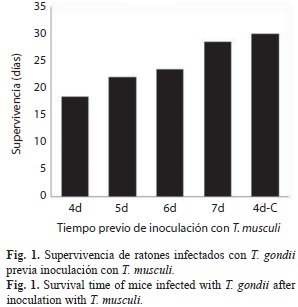
<body><![CDATA[ style="font-family: verdana; font-weight: bold;">     <font size="2"></font><br style="font-family: verdana;">     <font size="2"><span style="font-family: verdana;">En el primer     experimento se     demostr&oacute; que la inoculaci&oacute;n previa con <span      style="font-style: italic;">T. musculi</span> reduce     la supervivencia de los animales infectados con <span      style="font-style: italic;">T. gondii</span> (<a      href="/img/revistas/rbt/v61n2/a36i1.jpg">Fig. 1</a>). En     efecto gran cantidad de taquizo&iacute;tos fueron encontrados en el     ]]></body>
<body><![CDATA[exudado peritoneal de los ratones que murieron antes de los 30     d&iacute;as. El menor promedio de supervivencia se present&oacute; en     aquellos ratones en que la infecci&oacute;n con el tripanosoma fue de     cuatro d&iacute;as antes de la inoculaci&oacute;n con <span      style="font-style: italic;">T. gondii</span>     (p&lt;0.05), aumentando proporcionalmente con el n&uacute;mero de     d&iacute;as de infecci&oacute;n previa (p&lt;0.05). Por lo tanto, se     estableci&oacute; el tiempo previo de cuatro d&iacute;as para la     infecci&oacute;n con <span style="font-style: italic;">T. musculi</span>     para los siguientes experimentos.    ]]></body>
<body><![CDATA[<br>     </span></font><br style="font-family: verdana;">     <font size="2"><span style="font-family: verdana;">Aunque fueron pocos     los datos     obtenidos, porque varios animales no sobrevivieron los 30 d&iacute;as     establecidos como final del experimento, el n&uacute;mero de quistes/g     de cerebro en los animales no inoculados con <span      style="font-style: italic;">T. musculi</span>, 16 561,     fue&nbsp; menor&nbsp; que&nbsp; aquellos&nbsp; que&nbsp; sobrevivieron     de los grupos con tres y cuatro d&iacute;as de inoculaci&oacute;n     ]]></body>
<body><![CDATA[previa con el tripanosoma, 38 720 y 21 069, respectivamente.</span></font><br      style="font-family: verdana;">     <font size="2"></font><br style="font-family: verdana;">     <font size="2"><span style="font-family: verdana;">Al estudiar la     influencia de la     cantidad de tripanosoma inoculados con el efecto inmunosupresor     observado, se determin&oacute; que todos los animales infectados     solamente con <span style="font-style: italic;">T. gondii</span>     sobrevivieron&nbsp; los&nbsp; 30&nbsp;     d&iacute;as,&nbsp; mientras&nbsp; que&nbsp; los otros presentaron     ]]></body>
<body><![CDATA[promedios de supervivencia que oscilaron entre los 20 y 26 d&iacute;as     (<a href="/img/revistas/rbt/v61n2/a36i2.jpg">Fig. 2</a>). Por lo tanto,     el efecto inmunosupresor se mantuvo (p entre     &lt;0.025 y 0.05), pero no existieron diferencias significativas     aplicables a la cantidad de tripomastigotos inoculados (p&gt;0.05). El     n&uacute;mero de quistes por gramo de cerebro en los ratones control     sobrevivientes (datos no presentados) fue mucho menor (3 034), que el     de los animales inmunosuprimidos (alrededor de 11 000).</span></font><br      style="font-family: verdana;">     <br style="font-family: verdana;">     ]]></body>
<body><![CDATA[<font size="2"><span style="font-family: verdana;">En el estudio con     diferentes cepas     de <span style="font-style: italic;">T. gondii</span>, la     supervivencia en general fue m&aacute;s elevada, tal y     como se esperaba, al rebajar el n&uacute;mero de quistes inoculados. La     excepci&oacute;n a esta regla fue la cepa TLP, cuya actividad     patol&oacute;gica ha sido evidente a trav&eacute;s de otras     observaciones (datos no publicados). En efecto, todos los animales     inoculados murieron antes de 30 d&iacute;as, independientemente de la     infecci&oacute;n previa o no con el tripanosoma (<a     ]]></body>
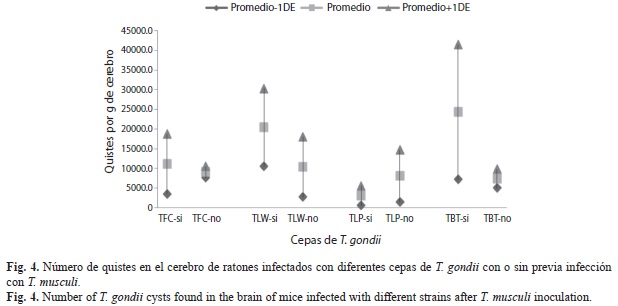
<body><![CDATA[ href="/img/revistas/rbt/v61n2/a36i3.jpg">Fig. 3</a>). Por los datos     obtenidos en cuanto a supervivencia no se deduce ninguna diferencia,     pero cuan- do&nbsp; se&nbsp; hizo&nbsp; el&nbsp; an&aacute;lisis&nbsp;     de&nbsp; quistes&nbsp; por&nbsp; gramo de cerebro en los     supervivientes, se not&oacute; que para&nbsp; las&nbsp; tres&nbsp;     cepas,&nbsp; los&nbsp; animales&nbsp; del&nbsp; grupo control (no     inoculados con <span style="font-style: italic;">T. musculi</span>),     siempre presentaron un menor n&uacute;mero     de quistes (<a href="/img/revistas/rbt/v61n2/a36i4.jpg">Fig. 4</a>) y     las diferencias estad&iacute;sticas (p&lt;0.011)     ]]></body>
<body><![CDATA[fueron significativas.</span></font><br style="font-family: verdana;">     <br style="font-family: verdana;">     <font size="3"><span style="font-family: verdana; font-weight: bold;">Discusion</span></font><br      style="font-family: verdana;">     <font size="2"></font><br style="font-family: verdana;">     <font size="2"><span style="font-family: verdana;">Los procesos de     inmunosupresi&oacute;n son importantes en el sentido que significan un     debilitamiento en las defensas naturales de los seres vivientes, lo que     los convierte en terreno f&eacute;rtil para el desarrollo de     enfermedades causadas fundamentalmente por virus, bacterias y hongos     ]]></body>
<body><![CDATA[(Manzano-Alonso &amp; Castellano- Tortajada 2011, Duncan &amp; Wilkes     2005), pero tambi&eacute;n por par&aacute;sitos. Dentro de estos     &uacute;ltimos, se han observado estos procesos en infecciones de     organismos de mayor tama&ntilde;o como lo son las especies del     g&eacute;nero <span style="font-style: italic;">Schistosoma&nbsp; </span>(Capron     &amp; Capron 1986), as&iacute;     como <span style="font-style: italic;">Strongyloides stercoralis</span>     (Ruano <span style="font-style: italic;">et al</span>. 2005, Basile <span      style="font-style: italic;">et al</span>. 2010,     Corti <span style="font-style: italic;">et al</span>. 2011) entre     ]]></body>
<body><![CDATA[otros. Sin embargo, el mayor impacto se     observa en par&aacute;sitos que por su naturaleza intracelular, o su     acci&oacute;n directa interna sobre &oacute;rganos vitales, son     profundamente&nbsp; afectados&nbsp; por&nbsp; cualquier&nbsp;     alteraci&oacute;n&nbsp; en la inmunidad celular, blanco fundamental de     la inmunosupresi&oacute;n (Ferreira &amp; Borges 2002, Dedet &amp;     Pratlong 2005). Tal es el caso de los tripanosomas del grupo Salivaria     (africanos) (Uzonna <span style="font-style: italic;">et al</span>.     1998), (<span style="font-style: italic;">Trypanosoma cruzi</span>     (Krettli 1977,     ]]></body>
<body><![CDATA[Sztein &amp; Kierszenbaum 1993, Bacal <span style="font-style: italic;">et     al</span>. 2010), <span style="font-style: italic;">Leishmania </span>spp.     (Oliveira <span style="font-style: italic;">et al</span>. 2008), <span      style="font-style: italic;">Toxoplasma gondii</span> (Abedalthagafi <span      style="font-style: italic;">et al</span>. 2009,     Garc&iacute;a <span style="font-style: italic;">et al</span>. 2010,     Sol&eacute;ne <span style="font-style: italic;">et al</span>. 2010) y <span      style="font-style: italic;">Plasmodium     falciparum</span> (Grimwade <span style="font-style: italic;">et al</span>.     2004). El ejemplo m&aacute;s llamativo     ]]></body>
<body><![CDATA[causante de este proceso son las infecciones por VIH (Raju <span      style="font-style: italic;">et al</span>. 2008,     Cruz <span style="font-style: italic;">et al</span>. 2006, Otieno <span      style="font-style: italic;">et al</span>. 2006, Jayawardena <span      style="font-style: italic;">et al</span>. 2008) en las     cuales el curso de la enfermedad es m&aacute;s severo producto del     debilitamiento del sistema inmune. En el caso del <span      style="font-style: italic;">T. gondii</span> cuya     manifestaci&oacute;n usual es una infecci&oacute;n cr&oacute;nica, la     infecci&oacute;n concomitante con VIH desencadena una toxoplasmosis     ]]></body>
<body><![CDATA[diseminada, con graves efectos cl&iacute;nicos sobre algunos pacientes     (Davarpanah <span style="font-style: italic;">et al</span>. 2007,     Sol&eacute;ne <span style="font-style: italic;">et al</span>. 2010).</span></font><br      style="font-family: verdana;">     <font size="2"></font><br style="font-family: verdana;">     <font size="2"><span style="font-family: verdana;">Los conocimientos     que se puedan     aportar al estudio de este fen&oacute;meno inmunol&oacute;gico pueden     ser de utilidad cient&iacute;fica y pr&aacute;ctica, en el     an&aacute;lisis del proceso y sus consecuencias en el campo     ]]></body>
<body><![CDATA[m&eacute;dico. En este sentido, el establecimiento de modelos     experimentales, aunque no necesariamente extrapolables al modelo huma-     no, representan una ayuda importante para realizar tal an&aacute;lisis.     En los estudios previamente realizados usando <span      style="font-style: italic;">T. lewisi</span> como el     organismo capaz de exacerbar las infecciones por <span      style="font-style: italic;">T. gondii</span> (Guerrero <span      style="font-style: italic;">et     al</span>. 1997, Chinchilla <span style="font-style: italic;">et al</span>.     2004) en las ratas blancas, se observan en     ]]></body>
<body><![CDATA[los animales sobrevivientes lesiones pulmonares muy similares, desde el     punto vista patol&oacute;gico, a las que se producen en los individuos     infectados con VIH (Catarinella <span style="font-style: italic;">et al</span>.1998).     Datos como estos y otros     como la inhibici&oacute;n del interfer&oacute;n gamma durante el     proceso (Chinchilla <span style="font-style: italic;">et al</span>.     2005) o el efecto que se manifiesta     inclusive a nivel celular en macr&oacute;fagos peritoneales     (Catarinella <span style="font-style: italic;">et al</span> 1999,     Chinchilla <span style="font-style: italic;">et al</span>. 2004) y     ]]></body>
<body><![CDATA[alveolares     (R&iacute;os <span style="font-style: italic;">et al</span>. 2009),     constituyen informaci&oacute;n     inmunol&oacute;gica b&aacute;sica que eventualmente puede ser     importante en la comprensi&oacute;n de estos fen&oacute;menos.</span></font><br      style="font-family: verdana;">     <font size="2"></font><br style="font-family: verdana;">     <font size="2"><span style="font-family: verdana;">Los resultados     obtenidos en el     modelo expuesto en este estudio, usando tambi&eacute;n <span     ]]></body>
<body><![CDATA[ style="font-style: italic;">T. gondii</span> pero     sustituyendo el <span style="font-style: italic;">T. lewisi</span> por     el T. duttoni, par&aacute;sito de     ratones, reflejan un efecto inmunosupresor similar tanto al analizar la     supervivencia como al determinar el n&uacute;mero de quistes por gramo     de cerebro en los animales sobrevivientes. Al igual que en el modelo     con ratas (Guerrero <span style="font-style: italic;">et al</span>.     1997), en este estudio se nota que el efecto     inmunosupresor se manifiesta en forma m&aacute;s clara cuando la     infecci&oacute;n previa con el tripanosom&aacute;tido se realiza cuatro     ]]></body>
<body><![CDATA[d&iacute;as antes, disminuyendo el efecto conforme el tiempo previo es     m&aacute;s prolongado. Este efecto probablemente&nbsp; es&nbsp;     causado&nbsp; por&nbsp; la&nbsp; inhibici&oacute;n de interfer&oacute;n     gamma, muy importante en el bloqueo de las infecciones agudas por <span      style="font-style: italic;">T.     gondii</span> (Zhao <span style="font-style: italic;">et al</span>.     2007), as&iacute; demostrado por el modelo con la     rata blanca (Chinchilla <span style="font-style: italic;">et al</span>.     2005).</span></font><br style="font-family: verdana;">     <font size="2"></font><br style="font-family: verdana;">     ]]></body>
<body><![CDATA[<font size="2"><span style="font-family: verdana;">La&nbsp;     cantidad&nbsp; de&nbsp;     tripanosomas&nbsp; inoculados no parece ser un factor importante en la     mayor o menor manifestaci&oacute;n del efecto, tal y como se observa en     los datos de supervivencia que se presentan en nuestros resultados. El     n&uacute;mero de quistes de <span style="font-style: italic;">T. gondii</span>     inoculados en este caso fue un     poco m&aacute;s elevado, con el objetivo de observar mejor las     diferencias en supervivencia en relaci&oacute;n con el control como     realmente ocurri&oacute;. Adem&aacute;s, la observaci&oacute;n de que     ]]></body>
<body><![CDATA[la diferencia en cuanto al n&uacute;mero de quistes en el cerebro entre     el grupo control y en los pocos animales que sobrevivieron fue bastante     marcada, independientemente del in&oacute;culo del tripanosoma, nos     indica que el factor que induce el efecto est&aacute; en el     par&aacute;sito o es liberado por &eacute;ste, y que presenta una     actividad tal, que solo necesita la reproducci&oacute;n&nbsp; del&nbsp;     mismo&nbsp; durante&nbsp; cuatro&nbsp; d&iacute;as para ejercer su     acci&oacute;n inhibidora. Productos derivados de protozoarios con esta     capacidad inmunosupresora han sido encontrados en tripanosomas     africanos (Darji <span style="font-style: italic;">et al</span>. 1992,     ]]></body>
<body><![CDATA[1996), as&iacute; como para <span style="font-style: italic;">T. lewisi</span>     (Ndarathi 1991).</span></font><br style="font-family: verdana;">     <font size="2"></font><br style="font-family: verdana;">     <font size="2"><span style="font-family: verdana;">El hecho de que en     los experimentos     con cepas&nbsp; diferentes&nbsp; del&nbsp; <span      style="font-style: italic;">T.&nbsp; gondii</span>,&nbsp;     se&nbsp; observara la inhibici&oacute;n inmunitaria para cualquier     cepa, tanto en la supervivencia de los animales como en el     n&uacute;mero de quistes en el cerebro de los sobrevivientes, confirma     ]]></body>
<body><![CDATA[que el factor inmunosupresor no es espec&iacute;fico, sino que es un     proceso inmune generado por el tripanosom&aacute;tido contra el <span      style="font-style: italic;">T.     gondii</span> a nivel celular como ha sido demostrado en otros estudios     (Mabbott <span style="font-style: italic;">et al</span>. 1995). En el     caso de <span style="font-style: italic;">T. lewisi</span> por     ejemplo, el efecto     fue demostrado tambi&eacute;n para infecciones en ratas blancas de     macr&oacute;fagos alveolares por&nbsp; <span      style="font-style: italic;">Cryptococcus&nbsp;     ]]></body>
<body><![CDATA[neoformans</span>&nbsp; (Gross&nbsp; <span style="font-style: italic;">et&nbsp;     al</span>. 2006), un organismo muy     lejano desde el punto de vista biol&oacute;gico y taxon&oacute;mico del     <span style="font-style: italic;">T. gondii</span>.</span></font><br      style="font-family: verdana;">     <font size="2"></font><br style="font-family: verdana;">     <font size="2"><span style="font-family: verdana;">Este nuevo modelo,     aunque similar     al de <span style="font-style: italic;">T. lewisi</span> ya publicado,     tiene la ventaja de que emplea un animal     ]]></body>
<body><![CDATA[de m&aacute;s f&aacute;cil manejo, el rat&oacute;n blanco (Mus     musculus), en comparaci&oacute;n con la rata blanca (<span      style="font-style: italic;">Rattus rattus</span>).     Este aspecto junto con el aporte para una mejor comprensi&oacute;n de     algunos&nbsp; procesos&nbsp; inmunol&oacute;gicos,&nbsp; propios&nbsp;     de las enfermedades debilitantes del ser humano, es el aporte de este     trabajo. Sin embargo, quedan varias dudas en el sentido de determinar     si este efecto se puede manifestar tambi&eacute;n a nivel celular, como     se ha demostrado espec&iacute;ficamente en macr&oacute;fagos     peritoneales (Catarinella <span style="font-style: italic;">et al</span>.     ]]></body>
<body><![CDATA[1999, Chinchilla <span style="font-style: italic;">et al</span>. 2004)     o     alveolares (R&iacute;os <span style="font-style: italic;">et al</span>.     2009), o el papel de las linfoquinas en     el proceso. Estudios en ambos sentidos se encuentran en proceso.</span></font><br      style="font-family: verdana;">     <font size="2"></font><br style="font-family: verdana;">     <font size="2"><span style="font-family: verdana;">En     conclusi&oacute;n, este estudio     ha aportado los siguientes elementos: 1. La presentaci&oacute;n de un     ]]></body>
<body><![CDATA[modelo de inmunosupresi&oacute;n entre dos par&aacute;sitos de     diferente escala zool&oacute;gica, uno de ellos <span      style="font-style: italic;">T. gondii</span> de     importancia m&eacute;dica. 2. Datos que podr&iacute;an contribuir para     el mayor conocimiento de los procesos de inmunosupresi&oacute;n     producidos por las enfermedades debilitantes y 3. El uso de un animal     de laboratorio, el rat&oacute;n, de m&aacute;s f&aacute;cil manejo, en     este tipo de estudios inmunol&oacute;gicos.</span></font><br      style="font-family: verdana;">     <font size="2"></font><br style="font-family: verdana;">     ]]></body>
<body><![CDATA[<font size="2"></font><br style="font-family: verdana;">     <font size="3"><span style="font-family: verdana; font-weight: bold;">Agradecimientos</span></font><br      style="font-family: verdana;">     <font size="2"></font><br style="font-family: verdana;">     <font size="2"><span style="font-family: verdana;">Este estudio fue     realizado con el     apoyo del departamento de Investigaci&oacute;n de la Universidad de     Ciencias M&eacute;dicas (UCIMED), del Ministerio de Ciencia y     Tecnolog&iacute;a (MICIT) y&nbsp; del&nbsp; Consejo&nbsp;     Nacional&nbsp; para&nbsp; Investigaciones Cient&iacute;ficas y     ]]></body>
<body><![CDATA[Tecnol&oacute;gicas (CONICIT). Agradecemos&nbsp; a&nbsp; Laura     Valerio,&nbsp; Jos&eacute;&nbsp; Bola&ntilde;os y Edwin Valenciano por     el manejo y mantenimiento de los animales de laboratorio y a Juan     Carlos Vanegas por el apoyo brindado en los an&aacute;lisis     estad&iacute;sticos y confecci&oacute;n de figuras.</span></font><br      style="font-family: verdana;">     <font size="2"></font>     <hr style="width: 100%; height: 2px;"><br style="font-family: verdana;">     <font size="3"><span style="font-family: verdana; font-weight: bold;">Referencias</span></font><br      style="font-family: verdana;">     ]]></body>
<body><![CDATA[<font size="2"></font><br style="font-family: verdana;">     <font size="2"><span style="font-family: verdana;">Abedalthagafi,     M.E.,&nbsp; J.&nbsp;     Rushing,&nbsp; D.&nbsp; Garvin,&nbsp;&nbsp; B.&nbsp; Cheson &amp; M.     Ozdemirli. 2009.&nbsp; Asymptomatic diffuse &#8220;encephalitic&#8221;&nbsp;     cerebral&nbsp; toxoplasmosis&nbsp; in&nbsp; a&nbsp; patient with     chronic lymphocytic leukemia: case report and review of the literature.     <!-- ref -->Int. J. Clin. Exp. Pathol. 3: 106-109.    &nbsp;&nbsp;&nbsp;&nbsp;&nbsp;&nbsp;&nbsp;&nbsp;[&#160;<a href="javascript:void(0);" onclick="javascript: window.open('/scielo.php?script=sci_nlinks&ref=1525730&pid=S0034-7744201300030003600001&lng=','','width=640,height=500,resizable=yes,scrollbars=1,menubar=yes,');">Links</a>&#160;]<!-- end-ref --><!-- ref --></span></font><br  style="font-family: verdana;"> <font size="2"></font><br style="font-family: verdana;"> <font size="2"><span style="font-family: verdana;">Albright, J.W. &amp; J.F. Albright. 1991. Rodent trypanosomes: their conflict with the&nbsp; immune system of the host. Parasitol. Today 7: 137-140.    &nbsp;&nbsp;&nbsp;&nbsp;&nbsp;&nbsp;&nbsp;&nbsp;[&#160;<a href="javascript:void(0);" onclick="javascript: window.open('/scielo.php?script=sci_nlinks&ref=1525731&pid=S0034-7744201300030003600002&lng=','','width=640,height=500,resizable=yes,scrollbars=1,menubar=yes,');">Links</a>&#160;]<!-- end-ref --><!-- ref --></span></font><br  style="font-family: verdana;"> <font size="2"></font><br style="font-family: verdana;"> <font size="2"><span style="font-family: verdana;">Bacal, F., C.P. Silva, P.V. Pires, S. Mangini, A.I. Fiorelli, N.G. Stolf &amp; E.A. Bocchi. 2010. Transplantation for Chagas disease: an overview of immunosuppression and reactivation in the last two decades. Clin. Transplant. 24: E29-E34.    &nbsp;&nbsp;&nbsp;&nbsp;&nbsp;&nbsp;&nbsp;&nbsp;[&#160;<a href="javascript:void(0);" onclick="javascript: window.open('/scielo.php?script=sci_nlinks&ref=1525732&pid=S0034-7744201300030003600003&lng=','','width=640,height=500,resizable=yes,scrollbars=1,menubar=yes,');">Links</a>&#160;]<!-- end-ref --><!-- ref --></span></font><br  style="font-family: verdana;"> <font size="2"></font><br style="font-family: verdana;"> <font size="2"><span style="font-family: verdana;">Basile, A., S. Simzar, J. Bentow, F. Antelo, P.&nbsp; Shitabata, S.K. Peng &amp; N. Craft. 2010.&nbsp; Disseminated <span style="font-style: italic;">Strongyloides stercoralis</span>:&nbsp; hyperinfection during medical immunosuppression. J. Am. Acad.&nbsp;&nbsp; Dermatol.&nbsp; 63: 896-902.    &nbsp;&nbsp;&nbsp;&nbsp;&nbsp;&nbsp;&nbsp;&nbsp;[&#160;<a href="javascript:void(0);" onclick="javascript: window.open('/scielo.php?script=sci_nlinks&ref=1525733&pid=S0034-7744201300030003600004&lng=','','width=640,height=500,resizable=yes,scrollbars=1,menubar=yes,');">Links</a>&#160;]<!-- end-ref --><!-- ref --></span></font><br style="font-family: verdana;"> <font size="2"></font><br style="font-family: verdana;"> <font size="2"><span style="font-family: verdana;">Bojar, I. &amp; J. Szymanska. 2010. Environmental exposure of&nbsp; pregnant&nbsp; women to infection with <span style="font-style: italic;">Toxoplasma gondii</span>- state of the art. Ann. Agric.&nbsp; Environ. Med. </span></font><font size="2"><span  style="font-family: verdana;">17:209-214.    &nbsp;&nbsp;&nbsp;&nbsp;&nbsp;&nbsp;&nbsp;&nbsp;[&#160;<a href="javascript:void(0);" onclick="javascript: window.open('/scielo.php?script=sci_nlinks&ref=1525734&pid=S0034-7744201300030003600005&lng=','','width=640,height=500,resizable=yes,scrollbars=1,menubar=yes,');">Links</a>&#160;]<!-- end-ref --><!-- ref --></span></font><br  style="font-family: verdana;"> <font size="2"></font><br style="font-family: verdana;"> <font size="2"><span style="font-family: verdana;">Capron,&nbsp; M.&nbsp; &amp;&nbsp; A.&nbsp; Capron.&nbsp; 1986.&nbsp; Rats,&nbsp; mice&nbsp; and&nbsp; men models&nbsp; for&nbsp; immune&nbsp; effectors&nbsp; mechanisms&nbsp; against schistosomiasis. Parasitol. Today 2: 69-75.    &nbsp;&nbsp;&nbsp;&nbsp;&nbsp;&nbsp;&nbsp;&nbsp;[&#160;<a href="javascript:void(0);" onclick="javascript: window.open('/scielo.php?script=sci_nlinks&ref=1525735&pid=S0034-7744201300030003600006&lng=','','width=640,height=500,resizable=yes,scrollbars=1,menubar=yes,');">Links</a>&#160;]<!-- end-ref --><!-- ref --></span></font><br  style="font-family: verdana;"> <font size="2"></font><br style="font-family: verdana;"> <font size="2"><span style="font-family: verdana;">Catarinella, G., M. Chinchilla, O.M. Guerrero&nbsp; &amp;&nbsp; E. Abrahams. 1998. Effect of <span style="font-style: italic;">Trypanosoma lewisi</span> (Kinetoplastida; Trypanosomatidae) on the infection of white rats with <span style="font-style: italic;">Toxoplasma gondii</span>&nbsp; (Eucoccidia: Sarcocystidae) oocysts. Rev. Biol. Trop. 46: 1121-1123.    &nbsp;&nbsp;&nbsp;&nbsp;&nbsp;&nbsp;&nbsp;&nbsp;[&#160;<a href="javascript:void(0);" onclick="javascript: window.open('/scielo.php?script=sci_nlinks&ref=1525736&pid=S0034-7744201300030003600007&lng=','','width=640,height=500,resizable=yes,scrollbars=1,menubar=yes,');">Links</a>&#160;]<!-- end-ref --><!-- ref --></span></font><br  style="font-family: verdana;"> <font size="2"></font><br style="font-family: verdana;"> <font size="2"><span style="font-family: verdana;">Catarinella, G., M. Chinchilla, O.M. Guerrero &amp; A. Castro. 1999. Infection of white rats peritoneal macrophages wiht&nbsp;&nbsp; <span style="font-style: italic;">Toxoplasma gondii</span>&nbsp; (Coccidia: Sarcocystidae) after&nbsp;&nbsp; <span style="font-style: italic;">Trypanosoma lewisi</span> (Kinetoplastida: Trypanosomatidae) infection. Rev. Biol. Trop. 47: 483-488.    &nbsp;&nbsp;&nbsp;&nbsp;&nbsp;&nbsp;&nbsp;&nbsp;[&#160;<a href="javascript:void(0);" onclick="javascript: window.open('/scielo.php?script=sci_nlinks&ref=1525737&pid=S0034-7744201300030003600008&lng=','','width=640,height=500,resizable=yes,scrollbars=1,menubar=yes,');">Links</a>&#160;]<!-- end-ref --><!-- ref --></span></font><br  style="font-family: verdana;"> <font size="2"></font><br style="font-family: verdana;"> <font size="2"><span style="font-family: verdana;">Chinchilla, M., M. Alfaro &amp; O.M. Guerrero. 1981. Adaptaci&oacute;n natural de rata blanca a <span style="font-style: italic;">Toxoplasma gondii</span>. Rev. Biol. Trop. 29: 273-282.    &nbsp;&nbsp;&nbsp;&nbsp;&nbsp;&nbsp;&nbsp;&nbsp;[&#160;<a href="javascript:void(0);" onclick="javascript: window.open('/scielo.php?script=sci_nlinks&ref=1525738&pid=S0034-7744201300030003600009&lng=','','width=640,height=500,resizable=yes,scrollbars=1,menubar=yes,');">Links</a>&#160;]<!-- end-ref --><!-- ref --></span></font><br style="font-family: verdana;"> <font size="2"></font><br style="font-family: verdana;"> <font size="2"><span style="font-family: verdana;">Chinchilla, M., O.M. Guerrero &amp; A. Castro. 2004. Effect of&nbsp; <span style="font-style: italic;">Trypanosoma&nbsp; lewisi</span>&nbsp; infection&nbsp; on&nbsp; the&nbsp; <span style="font-style: italic;">Toxoplasma&nbsp; gondii</span>&nbsp;&nbsp; multiplication in white rat peritoneal macrophages. Parasitol. Latinoam. 59: 3-7.    &nbsp;&nbsp;&nbsp;&nbsp;&nbsp;&nbsp;&nbsp;&nbsp;[&#160;<a href="javascript:void(0);" onclick="javascript: window.open('/scielo.php?script=sci_nlinks&ref=1525739&pid=S0034-7744201300030003600010&lng=','','width=640,height=500,resizable=yes,scrollbars=1,menubar=yes,');">Links</a>&#160;]<!-- end-ref --><!-- ref --></span></font><br style="font-family: verdana;"> <font size="2"></font><br style="font-family: verdana;"> <font size="2"><span style="font-family: verdana;">Chinchilla, M., O.M. Guerrero &amp; E. Solano. 1982. Lack of multiplication of <span  style="font-style: italic;">Toxoplasma</span> in macrophages of rats in vitro. J. Parasitol. 68: 952-955.    &nbsp;&nbsp;&nbsp;&nbsp;&nbsp;&nbsp;&nbsp;&nbsp;[&#160;<a href="javascript:void(0);" onclick="javascript: window.open('/scielo.php?script=sci_nlinks&ref=1525740&pid=S0034-7744201300030003600011&lng=','','width=640,height=500,resizable=yes,scrollbars=1,menubar=yes,');">Links</a>&#160;]<!-- end-ref --><!-- ref --></span></font><br  style="font-family: verdana;"> <font size="2"></font><br style="font-family: verdana;"> <font size="2"><span style="font-family: verdana;">Chinchilla&nbsp; M., O. M. Guerrero &amp; E.&nbsp; Valenciano. 1985. Efecto de los corticosteroides sobre la&nbsp; adaptaci&oacute;n natural de la rata blanca al&nbsp; <span style="font-style: italic;">Toxoplasma</span>. Rev. Cost. Cienc. M&eacute;d. 6: 113-118.    &nbsp;&nbsp;&nbsp;&nbsp;&nbsp;&nbsp;&nbsp;&nbsp;[&#160;<a href="javascript:void(0);" onclick="javascript: window.open('/scielo.php?script=sci_nlinks&ref=1525741&pid=S0034-7744201300030003600012&lng=','','width=640,height=500,resizable=yes,scrollbars=1,menubar=yes,');">Links</a>&#160;]<!-- end-ref --><!-- ref --></span></font><br style="font-family: verdana;"> <font size="2"></font><br style="font-family: verdana;"> <font size="2"><span style="font-family: verdana;">Chinchilla, M., L. Reyes, O.M. Guerrero-Berm&uacute;dez &amp; A. Castro.&nbsp; 2005. Role of interferon g on the&nbsp; immunosuppression during <span  style="font-style: italic;">Toxoplasma&nbsp; gondii</span> infection by <span style="font-style: italic;">Trypanosoma lewisi</span>. Parasitol. Latinoam. 60: 54-56.    &nbsp;&nbsp;&nbsp;&nbsp;&nbsp;&nbsp;&nbsp;&nbsp;[&#160;<a href="javascript:void(0);" onclick="javascript: window.open('/scielo.php?script=sci_nlinks&ref=1525742&pid=S0034-7744201300030003600013&lng=','','width=640,height=500,resizable=yes,scrollbars=1,menubar=yes,');">Links</a>&#160;]<!-- end-ref --><!-- ref --></span></font><br  style="font-family: verdana;"> <font size="2"></font><br style="font-family: verdana;"> <font size="2"><span style="font-family: verdana;">Corti, M., M.F. Villafa&ntilde;e, N. Trione, D. Risso, J.C. Abu&iacute;n &amp; O. Palmieri. 2011. Infecci&oacute;n por&nbsp; <span style="font-style: italic;">Strongyloides stercoralis</span>:&nbsp; estudio&nbsp; epidemiol&oacute;gico,&nbsp; cl&iacute;nico,&nbsp; diagn&oacute;stico y terap&eacute;utico en 30 pacientes. Rev. Chil. Inf. 28: 217-222.    &nbsp;&nbsp;&nbsp;&nbsp;&nbsp;&nbsp;&nbsp;&nbsp;[&#160;<a href="javascript:void(0);" onclick="javascript: window.open('/scielo.php?script=sci_nlinks&ref=1525743&pid=S0034-7744201300030003600014&lng=','','width=640,height=500,resizable=yes,scrollbars=1,menubar=yes,');">Links</a>&#160;]<!-- end-ref --><!-- ref --></span></font><br style="font-family: verdana;"> <font size="2"></font><br style="font-family: verdana;"> <font size="2"><span style="font-family: verdana;">Cruz,&nbsp; I., J. Nieto, J. Moreno, C. Ca&ntilde;avate, P.&nbsp; Desjeux &amp; J. Alvar. 2006. <span style="font-style: italic;">Leishmania</span>/HIV co-infections in the second decade. Ind. J. Med. Res. 123: 357-388.    &nbsp;&nbsp;&nbsp;&nbsp;&nbsp;&nbsp;&nbsp;&nbsp;[&#160;<a href="javascript:void(0);" onclick="javascript: window.open('/scielo.php?script=sci_nlinks&ref=1525744&pid=S0034-7744201300030003600015&lng=','','width=640,height=500,resizable=yes,scrollbars=1,menubar=yes,');">Links</a>&#160;]<!-- end-ref --><!-- ref --></span></font><br style="font-family: verdana;"> <font size="2"></font><br style="font-family: verdana;"> <font size="2"><span style="font-family: verdana;">Da Silva, R.C., A.V. Da Silva &amp; H. Langoni. 2010. Recrudescence of <span style="font-style: italic;">Toxoplasma gondii</span> infection in chronically infected rats (<span style="font-style: italic;">Rattus norvegicus</span>). Exp. Parasitol. 125: 409-412.    &nbsp;&nbsp;&nbsp;&nbsp;&nbsp;&nbsp;&nbsp;&nbsp;[&#160;<a href="javascript:void(0);" onclick="javascript: window.open('/scielo.php?script=sci_nlinks&ref=1525745&pid=S0034-7744201300030003600016&lng=','','width=640,height=500,resizable=yes,scrollbars=1,menubar=yes,');">Links</a>&#160;]<!-- end-ref --><!-- ref --></span></font><br style="font-family: verdana;"> <font size="2"></font><br style="font-family: verdana;"> <font size="2"><span style="font-family: verdana;">Da Silva, A., G. Vilar, A. Santos, R. Rodrigues, M. Santos &amp; J. Lannes-Vieira. 2010. Trypanosoma cruzi-Induced Central Nervous System&nbsp; Alterations: From the Entry of&nbsp; Inflammatory Cells to Potential&nbsp; Cognitive and Psychiatric Abnormalities.&nbsp; J. Neuroparasitol. 1: 1-13.    &nbsp;&nbsp;&nbsp;&nbsp;&nbsp;&nbsp;&nbsp;&nbsp;[&#160;<a href="javascript:void(0);" onclick="javascript: window.open('/scielo.php?script=sci_nlinks&ref=1525746&pid=S0034-7744201300030003600017&lng=','','width=640,height=500,resizable=yes,scrollbars=1,menubar=yes,');">Links</a>&#160;]<!-- end-ref --><!-- ref --></span></font><br  style="font-family: verdana;"> <font size="2"></font><br style="font-family: verdana;"> <font size="2"><span style="font-family: verdana;">Darji, A., A. Beschin, M. Sileghem, H. Heremans, L. Brys &amp; P. de Baetselier. 1996. In vitro&nbsp; stimulation&nbsp; of immunosuppression caused by <span  style="font-style: italic;">Trypanosoma brucei</span>: active&nbsp; involvement of gamma interferon and&nbsp; tumor necrosis factor in the pathway of&nbsp; suppression. Inf. Immun. 64: 1937-1943.    &nbsp;&nbsp;&nbsp;&nbsp;&nbsp;&nbsp;&nbsp;&nbsp;[&#160;<a href="javascript:void(0);" onclick="javascript: window.open('/scielo.php?script=sci_nlinks&ref=1525747&pid=S0034-7744201300030003600018&lng=','','width=640,height=500,resizable=yes,scrollbars=1,menubar=yes,');">Links</a>&#160;]<!-- end-ref --><!-- ref --></span></font><br  style="font-family: verdana;"> <font size="2"><span style="font-family: verdana;">&nbsp;</span></font><br  style="font-family: verdana;"> <font size="2"><span style="font-family: verdana;">Darji, A., R. Lucas, E. Magez, J. Torreele, M. Palacios, E. Sileghem, S. Bajyana, R. Hamers &amp; P. De Baetselier. 1992. Mechanisms underlying trypanosome elicited- immunosuppression.&nbsp; Ann.&nbsp; Soc.&nbsp; Belge&nbsp; M&eacute;d.&nbsp; Trop. 72: 27-38.    &nbsp;&nbsp;&nbsp;&nbsp;&nbsp;&nbsp;&nbsp;&nbsp;[&#160;<a href="javascript:void(0);" onclick="javascript: window.open('/scielo.php?script=sci_nlinks&ref=1525748&pid=S0034-7744201300030003600019&lng=','','width=640,height=500,resizable=yes,scrollbars=1,menubar=yes,');">Links</a>&#160;]<!-- end-ref --><!-- ref --></span></font><br  style="font-family: verdana;"> <font size="2"></font><br style="font-family: verdana;"> <font size="2"><span style="font-family: verdana;">Davarpanah, M.A., D. Mehrabani, R. Neirami, M. Ghahre- manpoori &amp; M. Darvishi.&nbsp; 2007. Toxoplasmosis in HIV/AIDS patients in Shiraz, southern Iran. Iran. Red Crescent Med. J. 9: 22-27.    &nbsp;&nbsp;&nbsp;&nbsp;&nbsp;&nbsp;&nbsp;&nbsp;[&#160;<a href="javascript:void(0);" onclick="javascript: window.open('/scielo.php?script=sci_nlinks&ref=1525749&pid=S0034-7744201300030003600020&lng=','','width=640,height=500,resizable=yes,scrollbars=1,menubar=yes,');">Links</a>&#160;]<!-- end-ref --><!-- ref --></span></font><br  style="font-family: verdana;"> <font size="2"></font><br style="font-family: verdana;"> <font size="2"><span style="font-family: verdana;">Dedet,&nbsp; J.P. &amp; F. Pratlong. 2005. <span style="font-style: italic;">Leishmania</span>,&nbsp; <span style="font-style: italic;">Trypanosoma</span> and Monoxenous Trypanosomatids as Emerging Opportunistic Agents. J. Euk. Microbiol. 47: 37-39.    &nbsp;&nbsp;&nbsp;&nbsp;&nbsp;&nbsp;&nbsp;&nbsp;[&#160;<a href="javascript:void(0);" onclick="javascript: window.open('/scielo.php?script=sci_nlinks&ref=1525750&pid=S0034-7744201300030003600021&lng=','','width=640,height=500,resizable=yes,scrollbars=1,menubar=yes,');">Links</a>&#160;]<!-- end-ref --><!-- ref --></span></font><br style="font-family: verdana;"> <font size="2"></font><br style="font-family: verdana;"> <font size="2"><span style="font-family: verdana;">Dubey, J.P. &amp; J.L. Jones. 2008. <span style="font-style: italic;">Toxoplasma gondii</span> infection in humans and animals in the United States. Int. J. Parasitol. 38: 1257-1278.    &nbsp;&nbsp;&nbsp;&nbsp;&nbsp;&nbsp;&nbsp;&nbsp;[&#160;<a href="javascript:void(0);" onclick="javascript: window.open('/scielo.php?script=sci_nlinks&ref=1525751&pid=S0034-7744201300030003600022&lng=','','width=640,height=500,resizable=yes,scrollbars=1,menubar=yes,');">Links</a>&#160;]<!-- end-ref --><!-- ref --></span></font><br  style="font-family: verdana;"> <font size="2"></font><br style="font-family: verdana;"> <font size="2"><span style="font-family: verdana;">Duncan,&nbsp; M.D.&nbsp; &amp;&nbsp; D.S. Wilkes.&nbsp; 2005.&nbsp; Transplant-related Immunosuppression. A&nbsp; Review of Immunosuppression and Pulmonary Infections. <span style="font-style: italic;">Proc. Am. Thor. Soc</span>. 2: 449-455.    &nbsp;&nbsp;&nbsp;&nbsp;&nbsp;&nbsp;&nbsp;&nbsp;[&#160;<a href="javascript:void(0);" onclick="javascript: window.open('/scielo.php?script=sci_nlinks&ref=1525752&pid=S0034-7744201300030003600023&lng=','','width=640,height=500,resizable=yes,scrollbars=1,menubar=yes,');">Links</a>&#160;]<!-- end-ref --><!-- ref --></span></font><br style="font-family: verdana;"> <font size="2"></font><br style="font-family: verdana;"> <font size="2"><span style="font-family: verdana;">Elmore,&nbsp; S.A.,&nbsp; J.L.&nbsp; Jones,&nbsp; P.A.&nbsp; Conrad,&nbsp; S.&nbsp; Patton,&nbsp; D.S. Lindsay&nbsp; &amp;&nbsp; J.P.&nbsp; Dubey.&nbsp; 2010.&nbsp; <span style="font-style: italic;">Toxoplasma&nbsp; gondii</span>: epidemiology, feline clinical aspects and prevention. Trends Parasitol. 26: 190-196.    &nbsp;&nbsp;&nbsp;&nbsp;&nbsp;&nbsp;&nbsp;&nbsp;[&#160;<a href="javascript:void(0);" onclick="javascript: window.open('/scielo.php?script=sci_nlinks&ref=1525753&pid=S0034-7744201300030003600024&lng=','','width=640,height=500,resizable=yes,scrollbars=1,menubar=yes,');">Links</a>&#160;]<!-- end-ref --><!-- ref --></span></font><br  style="font-family: verdana;"> <font size="2"></font><br style="font-family: verdana;"> <font size="2"><span style="font-family: verdana;">Fazzani, C., P.A. Guedes, A. Senna, E.B. Souza, H. Goto &amp; J.A.L. Lindoso. 2011. Dynamics of immunosuppression in hamsters with experimental visceral leishmaniasis. Braz. J. Med. Biol. 44: 666-670.    &nbsp;&nbsp;&nbsp;&nbsp;&nbsp;&nbsp;&nbsp;&nbsp;[&#160;<a href="javascript:void(0);" onclick="javascript: window.open('/scielo.php?script=sci_nlinks&ref=1525754&pid=S0034-7744201300030003600025&lng=','','width=640,height=500,resizable=yes,scrollbars=1,menubar=yes,');">Links</a>&#160;]<!-- end-ref --><!-- ref --></span></font><br  style="font-family: verdana;"> <font size="2"></font><br style="font-family: verdana;"> <font size="2"><span style="font-family: verdana;">Ferreira, M.S. &amp; A.S. Borges. 2002. Some Aspects of Protozoan Infections in&nbsp; Immunocompromised Patients - A Review. Mem. Inst. Oswaldo Cruz 97: 443-457.    &nbsp;&nbsp;&nbsp;&nbsp;&nbsp;&nbsp;&nbsp;&nbsp;[&#160;<a href="javascript:void(0);" onclick="javascript: window.open('/scielo.php?script=sci_nlinks&ref=1525755&pid=S0034-7744201300030003600026&lng=','','width=640,height=500,resizable=yes,scrollbars=1,menubar=yes,');">Links</a>&#160;]<!-- end-ref --><!-- ref --></span></font><br  style="font-family: verdana;"> <font size="2"></font><br style="font-family: verdana;"> <font size="2"><span style="font-family: verdana;">Garcia de la Fuente, I., M. Ansari, A.L. Rougemont, R.J. Passweg,&nbsp; F. Gumy-Pause, H. Ozsahin, J.&nbsp; Lobrinus &amp; K. Posfay-Barbe. 2010. Acute Disseminated Fatal Toxoplasmosis After Haploidentical Stem Cell Trans- plantation&nbsp;&nbsp; Despite Atovaquone Prophylaxis in A Young Man. Ped. Inf. Dis. J. 29: 1059-1060.    &nbsp;&nbsp;&nbsp;&nbsp;&nbsp;&nbsp;&nbsp;&nbsp;[&#160;<a href="javascript:void(0);" onclick="javascript: window.open('/scielo.php?script=sci_nlinks&ref=1525756&pid=S0034-7744201300030003600027&lng=','','width=640,height=500,resizable=yes,scrollbars=1,menubar=yes,');">Links</a>&#160;]<!-- end-ref --><!-- ref --></span></font><br  style="font-family: verdana;"> <font size="2"></font><br style="font-family: verdana;"> <font size="2"><span style="font-family: verdana;">Guerrero-Bermudez,&nbsp; O.M., M.&nbsp; Chinchilla-Carmona &amp; A. Castro-Castillo.&nbsp; 1995. Age influence in the&nbsp; natural resistance of white rat and mice&nbsp; to the protozoan <span style="font-style: italic;">Toxoplasma gondii</span>. Rev. Biol. Trop. 43: 1-3.    &nbsp;&nbsp;&nbsp;&nbsp;&nbsp;&nbsp;&nbsp;&nbsp;[&#160;<a href="javascript:void(0);" onclick="javascript: window.open('/scielo.php?script=sci_nlinks&ref=1525757&pid=S0034-7744201300030003600028&lng=','','width=640,height=500,resizable=yes,scrollbars=1,menubar=yes,');">Links</a>&#160;]<!-- end-ref --><!-- ref --></span></font><br style="font-family: verdana;"> <font size="2"></font><br style="font-family: verdana;"> <font size="2"><span style="font-family: verdana;">Guerrero,&nbsp; O.M.,&nbsp; M.&nbsp; Chinchilla&nbsp; &amp;&nbsp; E.&nbsp; Abrahams.&nbsp; 1997. Increasing&nbsp; of <span style="font-style: italic;">Toxoplasma gondii</span>&nbsp; (Coccidia, Sarcocystidae) infections by <span style="font-style: italic;">Trypanosoma lewisi</span> (Kinetoplastida, Trypanosomatidae) in white rats. Rev. Biol. Trop. 45: 877-882.    &nbsp;&nbsp;&nbsp;&nbsp;&nbsp;&nbsp;&nbsp;&nbsp;[&#160;<a href="javascript:void(0);" onclick="javascript: window.open('/scielo.php?script=sci_nlinks&ref=1525758&pid=S0034-7744201300030003600029&lng=','','width=640,height=500,resizable=yes,scrollbars=1,menubar=yes,');">Links</a>&#160;]<!-- end-ref --><!-- ref --></span></font><br  style="font-family: verdana;"> <font size="2"></font><br style="font-family: verdana;"> <font size="2"><span style="font-family: verdana;">Grimwade, K., N. French, D.D. Mbatha, D.D. Zungu, M. Dedicoat&nbsp; &amp;&nbsp; C.F.&nbsp; Gilks.&nbsp; 2004.&nbsp; HIV&nbsp; infection&nbsp; as&nbsp; a cofactor for severe falciparum malaria in adults living in a region of unstable malaria transmission in South Africa. AIDS 2018: 547-554.    &nbsp;&nbsp;&nbsp;&nbsp;&nbsp;&nbsp;&nbsp;&nbsp;[&#160;<a href="javascript:void(0);" onclick="javascript: window.open('/scielo.php?script=sci_nlinks&ref=1525759&pid=S0034-7744201300030003600030&lng=','','width=640,height=500,resizable=yes,scrollbars=1,menubar=yes,');">Links</a>&#160;]<!-- end-ref --><!-- ref --></span></font><br  style="font-family: verdana;"> <font size="2"></font><br style="font-family: verdana;"> <font size="2"><span style="font-family: verdana;">Gross, N., O.M. Guerrero, M. Chinchilla &amp; C. Jarstrand- Hall.&nbsp; 2006.&nbsp; <span style="font-style: italic;">Trypanosoma&nbsp; lewisi</span>-induced&nbsp; immunosupression:&nbsp; The&nbsp;&nbsp; effects&nbsp; on&nbsp; alveolar&nbsp; macrophages activities against <span style="font-style: italic;">Cryptococcus&nbsp;&nbsp; neoformans</span>.&nbsp; Exp. Parasitol. 113: 262-266.    &nbsp;&nbsp;&nbsp;&nbsp;&nbsp;&nbsp;&nbsp;&nbsp;[&#160;<a href="javascript:void(0);" onclick="javascript: window.open('/scielo.php?script=sci_nlinks&ref=1525760&pid=S0034-7744201300030003600031&lng=','','width=640,height=500,resizable=yes,scrollbars=1,menubar=yes,');">Links</a>&#160;]<!-- end-ref --><!-- ref --></span></font><br style="font-family: verdana;"> <font size="2"></font><br style="font-family: verdana;"> <font size="2"><span style="font-family: verdana;">Holland, G.N. 2003. Ocular toxoplasmosis: a global reassessment. Part I: epidemiology and course of disease. Am. J. Ophthalmol. 136: 973-88.    &nbsp;&nbsp;&nbsp;&nbsp;&nbsp;&nbsp;&nbsp;&nbsp;[&#160;<a href="javascript:void(0);" onclick="javascript: window.open('/scielo.php?script=sci_nlinks&ref=1525761&pid=S0034-7744201300030003600032&lng=','','width=640,height=500,resizable=yes,scrollbars=1,menubar=yes,');">Links</a>&#160;]<!-- end-ref --><!-- ref --></span></font><br  style="font-family: verdana;"> <font size="2"></font><br style="font-family: verdana;"> <font size="2"><span style="font-family: verdana;">Holst, I. &amp; M. Chinchilla. 1990. Development and distribution of cysts of an a virulent strain of <span style="font-style: italic;">Toxoplasma</span> and the humoral immune response in mice. Rev. Biol. Trop. 38: 189-93.    &nbsp;&nbsp;&nbsp;&nbsp;&nbsp;&nbsp;&nbsp;&nbsp;[&#160;<a href="javascript:void(0);" onclick="javascript: window.open('/scielo.php?script=sci_nlinks&ref=1525762&pid=S0034-7744201300030003600033&lng=','','width=640,height=500,resizable=yes,scrollbars=1,menubar=yes,');">Links</a>&#160;]<!-- end-ref --><!-- ref --></span></font><br style="font-family: verdana;"> <font size="2"></font><br style="font-family: verdana;"> <font size="2"><span style="font-family: verdana;">Jayawardena, S., S. Singh, O. Burzyantseva &amp; H. Clarke. 2008. Cerebral Toxoplasmosis in Adult Patients with HIV&nbsp; Infection,&nbsp; p.&nbsp; 17-24.&nbsp; <span  style="font-style: italic;">In</span>&nbsp; M.A.&nbsp; Perazella&nbsp; (ed.). Resident Grand Rounds. Series.    &nbsp;&nbsp;&nbsp;&nbsp;&nbsp;&nbsp;&nbsp;&nbsp;[&#160;<a href="javascript:void(0);" onclick="javascript: window.open('/scielo.php?script=sci_nlinks&ref=1525763&pid=S0034-7744201300030003600034&lng=','','width=640,height=500,resizable=yes,scrollbars=1,menubar=yes,');">Links</a>&#160;]<!-- end-ref --><!-- ref --></span></font><br  style="font-family: verdana;"> <font size="2"></font><br style="font-family: verdana;"> <font size="2"><span style="font-family: verdana;">Ka&#328;kov&aacute;,&nbsp; &#352;.,&nbsp; V.&nbsp; Hol&aacute;&#328;,&nbsp; A.&nbsp; Zaj&iacute;cov&aacute;,&nbsp; P.&nbsp; Kodym&nbsp; &amp;&nbsp; J. Fleg.&nbsp; 2010. Modulation of immunity in&nbsp; mice with latent toxoplasmosis &#8211;the&nbsp; experimental support for the&nbsp; immunosuppression hypothesis of&nbsp; <span style="font-style: italic;">Toxoplasma</span>&#8211; induced changes in reproduction of mice and humans. Parasitol. Res. 107: 1421-142.    &nbsp;&nbsp;&nbsp;&nbsp;&nbsp;&nbsp;&nbsp;&nbsp;[&#160;<a href="javascript:void(0);" onclick="javascript: window.open('/scielo.php?script=sci_nlinks&ref=1525764&pid=S0034-7744201300030003600035&lng=','','width=640,height=500,resizable=yes,scrollbars=1,menubar=yes,');">Links</a>&#160;]<!-- end-ref --><!-- ref --></span></font><br  style="font-family: verdana;"> <font size="2"></font><br style="font-family: verdana;"> <font size="2"><span style="font-family: verdana;">Krettli, A.U. 1977. Exacerbation of experimental Trypanosoma cruzi infection in mice by concomitant malaria. J. Protozool. 24: 514-518.    &nbsp;&nbsp;&nbsp;&nbsp;&nbsp;&nbsp;&nbsp;&nbsp;[&#160;<a href="javascript:void(0);" onclick="javascript: window.open('/scielo.php?script=sci_nlinks&ref=1525765&pid=S0034-7744201300030003600036&lng=','','width=640,height=500,resizable=yes,scrollbars=1,menubar=yes,');">Links</a>&#160;]<!-- end-ref --><!-- ref --></span></font><br  style="font-family: verdana;"> <font size="2"></font><br style="font-family: verdana;"> <font size="2"><span style="font-family: verdana;">Mabbott,&nbsp; N.A., I.A. Sutherland &amp; J.M.&nbsp; Sternberg. 1995. Suppressor&nbsp; macrophages&nbsp; in&nbsp;&nbsp; Trypanosoma&nbsp; brucei infection: nitric oxide is related to both suppressive activity and lifespan in vivo. Parasite Immunol. 17: 143-50.    &nbsp;&nbsp;&nbsp;&nbsp;&nbsp;&nbsp;&nbsp;&nbsp;[&#160;<a href="javascript:void(0);" onclick="javascript: window.open('/scielo.php?script=sci_nlinks&ref=1525766&pid=S0034-7744201300030003600037&lng=','','width=640,height=500,resizable=yes,scrollbars=1,menubar=yes,');">Links</a>&#160;]<!-- end-ref --><!-- ref --></span></font><br  style="font-family: verdana;"> <font size="2"></font><br style="font-family: verdana;"> <font size="2"><span style="font-family: verdana;">Manzano-Alonso,&nbsp; M.L. &amp; G.&nbsp; Castellano-Tortajada.&nbsp; 2011. Reactivation of hepatitis B virus infection after cytotoxic chemotherapy or&nbsp; immunosuppressive therapy. World J. Gastroenterology 17: 1531-1537.    &nbsp;&nbsp;&nbsp;&nbsp;&nbsp;&nbsp;&nbsp;&nbsp;[&#160;<a href="javascript:void(0);" onclick="javascript: window.open('/scielo.php?script=sci_nlinks&ref=1525767&pid=S0034-7744201300030003600038&lng=','','width=640,height=500,resizable=yes,scrollbars=1,menubar=yes,');">Links</a>&#160;]<!-- end-ref --><!-- ref --></span></font><br  style="font-family: verdana;"> <font size="2"></font><br style="font-family: verdana;"> <font size="2"><span style="font-family: verdana;">Ndarathi,&nbsp; C.M.&nbsp; 1991.&nbsp; Suppressor&nbsp; and&nbsp; protector&nbsp; factors derived&nbsp; from&nbsp; Trypanosom&nbsp; lewisi.&nbsp; Int.&nbsp; J.&nbsp; Parasitol. 21: 736-69.    &nbsp;&nbsp;&nbsp;&nbsp;&nbsp;&nbsp;&nbsp;&nbsp;[&#160;<a href="javascript:void(0);" onclick="javascript: window.open('/scielo.php?script=sci_nlinks&ref=1525768&pid=S0034-7744201300030003600039&lng=','','width=640,height=500,resizable=yes,scrollbars=1,menubar=yes,');">Links</a>&#160;]<!-- end-ref --><!-- ref --></span></font><br  style="font-family: verdana;"> <font size="2"></font><br style="font-family: verdana;"> <font size="2"><span style="font-family: verdana;">Oliveira, R.A., L.S.V. Silva, V.P. Carvalho, A.F. Coutinho, F.G. Pinheiro, C.G. Lima, J.E. Leandro Jr, G.B. Silva Jr. &amp; E.F. Daher.&nbsp; 2008. Visceral leishmaniasis after renal transplantation: report of 4 cases in northeastern Brazil. Transplant. Inf. Dis. 10: 364-368.    &nbsp;&nbsp;&nbsp;&nbsp;&nbsp;&nbsp;&nbsp;&nbsp;[&#160;<a href="javascript:void(0);" onclick="javascript: window.open('/scielo.php?script=sci_nlinks&ref=1525769&pid=S0034-7744201300030003600040&lng=','','width=640,height=500,resizable=yes,scrollbars=1,menubar=yes,');">Links</a>&#160;]<!-- end-ref --><!-- ref --></span></font><br  style="font-family: verdana;"> <font size="2"></font><br style="font-family: verdana;"> <font size="2"><span style="font-family: verdana;">Otieno, R.O., C. Ouma, J.M. Ongecha, C. Keller, T. Were, E.N. Waindi, M.&nbsp; Michaels, R.D. Day, J.M. Vulule, D.J.&nbsp; Perkins &amp; J. Douglas. 2006. Increased&nbsp; severe anemia in HIV-1-exposed and HIV-1-positive infants and children during acute malaria. AIDS 20: 275-280.    &nbsp;&nbsp;&nbsp;&nbsp;&nbsp;&nbsp;&nbsp;&nbsp;[&#160;<a href="javascript:void(0);" onclick="javascript: window.open('/scielo.php?script=sci_nlinks&ref=1525770&pid=S0034-7744201300030003600041&lng=','','width=640,height=500,resizable=yes,scrollbars=1,menubar=yes,');">Links</a>&#160;]<!-- end-ref --><!-- ref --></span></font><br  style="font-family: verdana;"> <font size="2"></font><br style="font-family: verdana;"> <font size="2"><span style="font-family: verdana;">Raju, R.G., F.E. Chaudhary, F.E. Bilimoria &amp; S.K.&nbsp; Katare. 2008. Diffuse cutaneous leishmaniasis: Co-infection with human&nbsp; immunodeficiency virus (HIV) Ind. J. Dermatol. Venereol. Leprol. 74: 641-643.    &nbsp;&nbsp;&nbsp;&nbsp;&nbsp;&nbsp;&nbsp;&nbsp;[&#160;<a href="javascript:void(0);" onclick="javascript: window.open('/scielo.php?script=sci_nlinks&ref=1525771&pid=S0034-7744201300030003600042&lng=','','width=640,height=500,resizable=yes,scrollbars=1,menubar=yes,');">Links</a>&#160;]<!-- end-ref --><!-- ref --></span></font><br  style="font-family: verdana;"> <font size="2"></font><br style="font-family: verdana;"> <font size="2"><span style="font-family: verdana;">R&iacute;os-Carrera,&nbsp; N.J., M. Chinchilla, O.M.&nbsp; Guerrero&nbsp; &amp; A. Castro. 2009. Efecto inmunosupresor de <span style="font-style: italic;">Trypanosoma lewisi</span> (Kinetoplastidae)&nbsp; sobre la multiplicaci&oacute;n de <span style="font-style: italic;">Toxoplasma gondii</span> (Sarcocystidae) en macr&oacute;fagos alveolares y peritoneales de rata blanca&nbsp; Rev. Biol. Trop. 57: 13-22.    &nbsp;&nbsp;&nbsp;&nbsp;&nbsp;&nbsp;&nbsp;&nbsp;[&#160;<a href="javascript:void(0);" onclick="javascript: window.open('/scielo.php?script=sci_nlinks&ref=1525772&pid=S0034-7744201300030003600043&lng=','','width=640,height=500,resizable=yes,scrollbars=1,menubar=yes,');">Links</a>&#160;]<!-- end-ref --><!-- ref --></span></font><br style="font-family: verdana;"> <font size="2"></font><br style="font-family: verdana;"> <font size="2"><span style="font-family: verdana;">Ruano, A.L., T. Martin, J. Pardo,&nbsp;&nbsp; J.&nbsp; L&oacute;pez-Alb&aacute;n &amp; A. Muro. 2005. Avances en el estudio de la estrongiloidosis. Enf. Emerg. 7: 102-109.    &nbsp;&nbsp;&nbsp;&nbsp;&nbsp;&nbsp;&nbsp;&nbsp;[&#160;<a href="javascript:void(0);" onclick="javascript: window.open('/scielo.php?script=sci_nlinks&ref=1525773&pid=S0034-7744201300030003600044&lng=','','width=640,height=500,resizable=yes,scrollbars=1,menubar=yes,');">Links</a>&#160;]<!-- end-ref --><!-- ref --></span></font><br style="font-family: verdana;"> <font size="2"></font><br style="font-family: verdana;"> <font size="2"><span style="font-family: verdana;">Sitoe, S.P.B.L., B. Rafael, L.R. Meireles, H.F. de Andrade Jr.&nbsp; &amp;&nbsp; R.&nbsp; Thompson.&nbsp; 2010.&nbsp; Preliminary&nbsp; report&nbsp; of HIV and <span style="font-style: italic;">Toxoplasma gondii</span> occurrence in pregnant women from Mozambique. Rev. Inst. Med. Trop. Sao Paulo 52: 291-295.    &nbsp;&nbsp;&nbsp;&nbsp;&nbsp;&nbsp;&nbsp;&nbsp;[&#160;<a href="javascript:void(0);" onclick="javascript: window.open('/scielo.php?script=sci_nlinks&ref=1525774&pid=S0034-7744201300030003600045&lng=','','width=640,height=500,resizable=yes,scrollbars=1,menubar=yes,');">Links</a>&#160;]<!-- end-ref --><!-- ref --></span></font><br  style="font-family: verdana;"> <font size="2"></font><br style="font-family: verdana;"> <font size="2"><span style="font-family: verdana;">Sol&eacute;ne,&nbsp; P.D.,&nbsp; JP.&nbsp; Gangneux,&nbsp; S.&nbsp; Lavou&eacute;,&nbsp; B.&nbsp; Lelong,&nbsp; C. Guiguen, Y. le Tulzo &amp; F.R. Gangneux. 2010. Correlation of Parasite Load&nbsp; Determined by Quantitative PCR&nbsp; to&nbsp; Clinical&nbsp; Outcome&nbsp; in&nbsp; a&nbsp; Heart&nbsp; Transplant Patient&nbsp; with&nbsp; Disseminated&nbsp; Toxoplasmosis. J.&nbsp; Clin. Microbiol. 48: 2541-2545.    &nbsp;&nbsp;&nbsp;&nbsp;&nbsp;&nbsp;&nbsp;&nbsp;[&#160;<a href="javascript:void(0);" onclick="javascript: window.open('/scielo.php?script=sci_nlinks&ref=1525775&pid=S0034-7744201300030003600046&lng=','','width=640,height=500,resizable=yes,scrollbars=1,menubar=yes,');">Links</a>&#160;]<!-- end-ref --><!-- ref --></span></font><br  style="font-family: verdana;"> <font size="2"></font><br style="font-family: verdana;"> <font size="2"><span style="font-family: verdana;">Sztein,&nbsp; M.B. &amp; F. Kierszenbaum. 1993.&nbsp; Mechanisms of development of immunosuppression during <span style="font-style: italic;">Trypanosoma</span> infections. Parasitol. Today 9: 424-428.    &nbsp;&nbsp;&nbsp;&nbsp;&nbsp;&nbsp;&nbsp;&nbsp;[&#160;<a href="javascript:void(0);" onclick="javascript: window.open('/scielo.php?script=sci_nlinks&ref=1525776&pid=S0034-7744201300030003600047&lng=','','width=640,height=500,resizable=yes,scrollbars=1,menubar=yes,');">Links</a>&#160;]<!-- end-ref --><!-- ref --></span></font><br style="font-family: verdana;"> <font size="2"></font><br style="font-family: verdana;"> <font size="2"><span style="font-family: verdana;">Uzonna,&nbsp; J.E.,&nbsp; S.R.&nbsp; Kaushik, Y.&nbsp; Zhang,&nbsp; J.R.&nbsp; Gordon&nbsp; &amp; H. Tabel. 1998. Experimental&nbsp; murine <span  style="font-style: italic;">Trypanosoma congolense&nbsp;</span>&nbsp; infections.&nbsp; II.&nbsp; Role&nbsp; of&nbsp; splenic&nbsp; adherent CD<sup>3+</sup>Thy1.2<sup>+</sup>&nbsp; TCR-&#945;&szlig;<sup>-</sup>&#947;&#948;<sup>-</sup>&nbsp; CD4<sup>+</sup>8<sup>-</sup>&nbsp; and&nbsp;&nbsp; CD3<sup>+</sup> Thy1.2<sup>+</sup>TCR-&#945;&szlig;<sup>-</sup>&#947;&#948;<sup>-&nbsp;</sup> CD4<sup>-</sup>8<sup>-c</sup>ells in the production of IL-4, IL-10, and IFN-&#947; and in Trypanosome-elicited Immunosuppression. <span  style="font-style: italic;">J. Immunol</span>. 161: 6189-6197.    &nbsp;&nbsp;&nbsp;&nbsp;&nbsp;&nbsp;&nbsp;&nbsp;[&#160;<a href="javascript:void(0);" onclick="javascript: window.open('/scielo.php?script=sci_nlinks&ref=1525777&pid=S0034-7744201300030003600048&lng=','','width=640,height=500,resizable=yes,scrollbars=1,menubar=yes,');">Links</a>&#160;]<!-- end-ref --></span></font>    <!-- ref --><br> <font size="2"><span style="font-family: verdana;"></span></font><br  style="font-family: verdana;"> <font size="2"><span style="font-family: verdana;"></span><span  style="font-family: verdana;">Viens,&nbsp; P.G., A.T.&nbsp; Targett,&nbsp; E.&nbsp; Leuchar&nbsp; &amp;&nbsp; A.J.S.&nbsp; Davies. 1974. The immunological response of CBA mice to <span  style="font-style: italic;">Trypanosoma musculi</span>. Initial control of the infection and the effect of t-cell deprivation. Clin. Exp. Immu- nol. 16: 279-294.    &nbsp;&nbsp;&nbsp;&nbsp;&nbsp;&nbsp;&nbsp;&nbsp;[&#160;<a href="javascript:void(0);" onclick="javascript: window.open('/scielo.php?script=sci_nlinks&ref=1525779&pid=S0034-7744201300030003600049&lng=','','width=640,height=500,resizable=yes,scrollbars=1,menubar=yes,');">Links</a>&#160;]<!-- end-ref --><!-- ref --></span></font><br  style="font-family: verdana;"> <font size="2"></font><br style="font-family: verdana;"> <font size="2"><span style="font-family: verdana;">Zapata, M., L. Reyes &amp; I. Holst. 2005. Disminuci&oacute;n en la prevalencia de anticuerpos contra <span style="font-style: italic;">Toxoplasma gondii</span> en adultos del valle central de Costa Rica. Parasitol. Latinoam. 60: 32-37.    &nbsp;&nbsp;&nbsp;&nbsp;&nbsp;&nbsp;&nbsp;&nbsp;[&#160;<a href="javascript:void(0);" onclick="javascript: window.open('/scielo.php?script=sci_nlinks&ref=1525780&pid=S0034-7744201300030003600050&lng=','','width=640,height=500,resizable=yes,scrollbars=1,menubar=yes,');">Links</a>&#160;]<!-- end-ref --><!-- ref --></span></font><br  style="font-family: verdana;"> <font size="2"></font><br style="font-family: verdana;"> <font size="2"><span style="font-family: verdana;">Zhao, Y., D. Wilson, S. Matthews &amp; G.S. Yap. 2007. Rapid Elimination of <span  style="font-style: italic;">Toxoplasma gondii</span> by Gamma Interferon-Primed Mouse Macrophages is Independent of CD40 Signaling. Infect. Immun. 75: 4799-4803.    &nbsp;&nbsp;&nbsp;&nbsp;&nbsp;&nbsp;&nbsp;&nbsp;[&#160;<a href="javascript:void(0);" onclick="javascript: window.open('/scielo.php?script=sci_nlinks&ref=1525781&pid=S0034-7744201300030003600051&lng=','','width=640,height=500,resizable=yes,scrollbars=1,menubar=yes,');">Links</a>&#160;]<!-- end-ref --><br>     ]]></body>
<body><![CDATA[<br> <a name="Correspondencia1"></a><a href="#Correspondencia2">*</a>Correspondencia:    <br> </span></font><font size="2"><span style="font-family: verdana;">Loretta Piccolo-Johanning: </span></font><font size="2"><span  style="font-family: verdana;">Departamento de Investigaci&oacute;n y C&aacute;tedra de Parasitolog&iacute;a M&eacute;dica, Universidad de Ciencias M&eacute;dicas (UCIMED), San Jos&eacute; Costa Rica, Am&eacute;rica Central. </span></font><font  size="2"><span style="font-family: verdana;">loretta_piccolo@hotmail.com</span></font>    <br> <font size="2"><span style="font-family: verdana;">Vivian Kellerman-Guterman: </span></font><font size="2"><span  style="font-family: verdana;">Departamento de Investigaci&oacute;n y C&aacute;tedra de Parasitolog&iacute;a M&eacute;dica, Universidad de Ciencias M&eacute;dicas (UCIMED), San Jos&eacute; Costa Rica, Am&eacute;rica Central. </span></font><font  size="2"><span style="font-family: verdana;">vivik01@hotmail.com</span></font>    <br> <font size="2"><span style="font-family: verdana;">Idalia Valerio-Campos: </span></font><font size="2"><span  style="font-family: verdana;">Departamento de Investigaci&oacute;n y C&aacute;tedra de Parasitolog&iacute;a M&eacute;dica, Universidad de Ciencias M&eacute;dicas (UCIMED), San Jos&eacute; Costa Rica, Am&eacute;rica Central. </span></font><font  size="2"><span style="font-family: verdana;">valerioci@ucimed.com</span></font>    <br> <font size="2"><span style="font-family: verdana;">Misael Chinchilla-Carmona: </span></font><font size="2"><span  style="font-family: verdana;">Departamento de Investigaci&oacute;n y C&aacute;tedra de Parasitolog&iacute;a M&eacute;dica, Universidad de Ciencias M&eacute;dicas (UCIMED), San Jos&eacute; Costa Rica, Am&eacute;rica Central. </span></font><font  size="2"><span style="font-family: verdana;">chinchillacm@ucimed.com</span></font><br  style="font-family: verdana;"> <font size="2"> </font><font size="2"><span style="font-family: verdana;"></span></font><font  size="2"><span style="font-family: verdana;"><a name="1"></a><a  href="#2">1</a>. Departamento de Investigaci&oacute;n y C&aacute;tedra de Parasitolog&iacute;a M&eacute;dica, Universidad de Ciencias M&eacute;dicas (UCIMED), San Jos&eacute; Costa Rica, Am&eacute;rica Central; loretta_piccolo@hotmail.com, vivik01@hotmail.com, valerioci@ucimed.com, chinchillacm@ucimed.com    <br> </span></font> <hr style="width: 100%; height: 2px;">     <div style="text-align: center;"><font size="2"><span  style="font-family: verdana; font-weight: bold;">Recibido 12-IV-2012. Corregido 10-xII-2012. Aceptado 24-I-2013</span></font><br  style="font-family: verdana;"> </div> </div> </div> <font size="2"></font>      ]]></body><back>
<ref-list>
<ref id="B1">
<nlm-citation citation-type="journal">
<person-group person-group-type="author">
<name>
<surname><![CDATA[Abedalthagafi]]></surname>
<given-names><![CDATA[M.E]]></given-names>
</name>
<name>
<surname><![CDATA[Rushing]]></surname>
<given-names><![CDATA[J]]></given-names>
</name>
<name>
<surname><![CDATA[Garvin]]></surname>
<given-names><![CDATA[D]]></given-names>
</name>
<name>
<surname><![CDATA[Cheson]]></surname>
<given-names><![CDATA[B]]></given-names>
</name>
<name>
<surname><![CDATA[Ozdemirli]]></surname>
<given-names><![CDATA[M]]></given-names>
</name>
</person-group>
<article-title xml:lang="en"><![CDATA[Asymptomatic diffuse &#8220;encephalitic&#8221; cerebral toxoplasmosis in a patient with chronic lymphocytic leukemia: case report and review of the literature]]></article-title>
<source><![CDATA[Int. J. Clin. Exp. Pathol]]></source>
<year>2009</year>
<volume>3</volume>
<page-range>106-109</page-range></nlm-citation>
</ref>
<ref id="B2">
<nlm-citation citation-type="journal">
<person-group person-group-type="author">
<name>
<surname><![CDATA[Albright]]></surname>
<given-names><![CDATA[J.W]]></given-names>
</name>
<name>
<surname><![CDATA[Albright]]></surname>
<given-names><![CDATA[J.F]]></given-names>
</name>
</person-group>
<article-title xml:lang="en"><![CDATA[Rodent trypanosomes: their conflict with the immune system of the host]]></article-title>
<source><![CDATA[Parasitol. Today]]></source>
<year>1991</year>
<volume>7</volume>
<page-range>137-140</page-range></nlm-citation>
</ref>
<ref id="B3">
<nlm-citation citation-type="journal">
<person-group person-group-type="author">
<name>
<surname><![CDATA[Bacal]]></surname>
<given-names><![CDATA[F]]></given-names>
</name>
<name>
<surname><![CDATA[Silva]]></surname>
<given-names><![CDATA[C.P]]></given-names>
</name>
<name>
<surname><![CDATA[Pires]]></surname>
<given-names><![CDATA[P.V]]></given-names>
</name>
<name>
<surname><![CDATA[Mangini]]></surname>
<given-names><![CDATA[S]]></given-names>
</name>
<name>
<surname><![CDATA[Fiorelli]]></surname>
<given-names><![CDATA[A.I]]></given-names>
</name>
<name>
<surname><![CDATA[Stolf]]></surname>
<given-names><![CDATA[N.G]]></given-names>
</name>
<name>
<surname><![CDATA[Bocchi]]></surname>
<given-names><![CDATA[E.A]]></given-names>
</name>
</person-group>
<article-title xml:lang="en"><![CDATA[Transplantation for Chagas disease: an overview of immunosuppression and reactivation in the last two decades]]></article-title>
<source><![CDATA[Clin. Transplant]]></source>
<year>2010</year>
<volume>24</volume>
<page-range>E29-E34</page-range></nlm-citation>
</ref>
<ref id="B4">
<nlm-citation citation-type="journal">
<person-group person-group-type="author">
<name>
<surname><![CDATA[Basile]]></surname>
<given-names><![CDATA[A]]></given-names>
</name>
<name>
<surname><![CDATA[Simzar]]></surname>
<given-names><![CDATA[S]]></given-names>
</name>
<name>
<surname><![CDATA[Bentow]]></surname>
<given-names><![CDATA[J]]></given-names>
</name>
<name>
<surname><![CDATA[Antelo]]></surname>
<given-names><![CDATA[F]]></given-names>
</name>
<name>
<surname><![CDATA[Shitabata]]></surname>
<given-names><![CDATA[P]]></given-names>
</name>
<name>
<surname><![CDATA[Peng]]></surname>
<given-names><![CDATA[S.K]]></given-names>
</name>
<name>
<surname><![CDATA[Craft]]></surname>
<given-names><![CDATA[N]]></given-names>
</name>
</person-group>
<article-title xml:lang="en"><![CDATA[Disseminated Strongyloides stercoralis: hyperinfection during medical immunosuppression]]></article-title>
<source><![CDATA[J. Am. Acad. Dermatol]]></source>
<year>2010</year>
<volume>63</volume>
<page-range>896-902</page-range></nlm-citation>
</ref>
<ref id="B5">
<nlm-citation citation-type="journal">
<person-group person-group-type="author">
<name>
<surname><![CDATA[Bojar]]></surname>
<given-names><![CDATA[I]]></given-names>
</name>
<name>
<surname><![CDATA[Szymanska]]></surname>
<given-names><![CDATA[J]]></given-names>
</name>
</person-group>
<article-title xml:lang="en"><![CDATA[Environmental exposure of pregnant women to infection with Toxoplasma gondii- state of the art]]></article-title>
<source><![CDATA[Ann. Agric. Environ. Med]]></source>
<year>2010</year>
<volume>17</volume>
<page-range>209-214</page-range></nlm-citation>
</ref>
<ref id="B6">
<nlm-citation citation-type="journal">
<person-group person-group-type="author">
<name>
<surname><![CDATA[Capron]]></surname>
<given-names><![CDATA[M]]></given-names>
</name>
<name>
<surname><![CDATA[Capron]]></surname>
<given-names><![CDATA[A]]></given-names>
</name>
</person-group>
<article-title xml:lang="en"><![CDATA[Rats, mice and men models for immune effectors mechanisms against schistosomiasis]]></article-title>
<source><![CDATA[Parasitol. Today]]></source>
<year>1986</year>
<volume>2</volume>
<page-range>69-75</page-range></nlm-citation>
</ref>
<ref id="B7">
<nlm-citation citation-type="journal">
<person-group person-group-type="author">
<name>
<surname><![CDATA[Catarinella]]></surname>
<given-names><![CDATA[G]]></given-names>
</name>
<name>
<surname><![CDATA[Chinchilla]]></surname>
<given-names><![CDATA[M]]></given-names>
</name>
<name>
<surname><![CDATA[Guerrero]]></surname>
<given-names><![CDATA[O.M]]></given-names>
</name>
<name>
<surname><![CDATA[Abrahams]]></surname>
<given-names><![CDATA[E]]></given-names>
</name>
</person-group>
<article-title xml:lang="en"><![CDATA[Effect of Trypanosoma lewisi (Kinetoplastida; Trypanosomatidae) on the infection of white rats with Toxoplasma gondii (Eucoccidia: Sarcocystidae) oocysts]]></article-title>
<source><![CDATA[Rev. Biol. Trop]]></source>
<year>1998</year>
<volume>46</volume>
<page-range>1121-1123</page-range></nlm-citation>
</ref>
<ref id="B8">
<nlm-citation citation-type="journal">
<person-group person-group-type="author">
<name>
<surname><![CDATA[Catarinella]]></surname>
<given-names><![CDATA[G]]></given-names>
</name>
<name>
<surname><![CDATA[Chinchilla]]></surname>
<given-names><![CDATA[M]]></given-names>
</name>
<name>
<surname><![CDATA[Guerrero]]></surname>
<given-names><![CDATA[O.M]]></given-names>
</name>
<name>
<surname><![CDATA[Castro]]></surname>
<given-names><![CDATA[A]]></given-names>
</name>
</person-group>
<article-title xml:lang="en"><![CDATA[Infection of white rats peritoneal macrophages wiht Toxoplasma gondii (Coccidia: Sarcocystidae) after Trypanosoma lewisi (Kinetoplastida: Trypanosomatidae) infection]]></article-title>
<source><![CDATA[Rev. Biol. Trop]]></source>
<year>1999</year>
<volume>47</volume>
<page-range>483-488</page-range></nlm-citation>
</ref>
<ref id="B9">
<nlm-citation citation-type="journal">
<person-group person-group-type="author">
<name>
<surname><![CDATA[Chinchilla]]></surname>
<given-names><![CDATA[M]]></given-names>
</name>
<name>
<surname><![CDATA[Alfaro]]></surname>
<given-names><![CDATA[M]]></given-names>
</name>
<name>
<surname><![CDATA[Guerrero]]></surname>
<given-names><![CDATA[O.M]]></given-names>
</name>
</person-group>
<article-title xml:lang="es"><![CDATA[Adaptación natural de rata blanca a Toxoplasma gondii]]></article-title>
<source><![CDATA[Rev. Biol. Trop]]></source>
<year>1981</year>
<volume>29</volume>
<page-range>273-282</page-range></nlm-citation>
</ref>
<ref id="B10">
<nlm-citation citation-type="journal">
<person-group person-group-type="author">
<name>
<surname><![CDATA[Chinchilla]]></surname>
<given-names><![CDATA[M]]></given-names>
</name>
<name>
<surname><![CDATA[Guerrero]]></surname>
<given-names><![CDATA[O.M]]></given-names>
</name>
<name>
<surname><![CDATA[Castro]]></surname>
<given-names><![CDATA[A]]></given-names>
</name>
</person-group>
<article-title xml:lang="en"><![CDATA[Effect of Trypanosoma lewisi infection on the Toxoplasma gondii multiplication in white rat peritoneal macrophages]]></article-title>
<source><![CDATA[Parasitol. Latinoam]]></source>
<year>2004</year>
<volume>59</volume>
<page-range>3-7</page-range></nlm-citation>
</ref>
<ref id="B11">
<nlm-citation citation-type="journal">
<person-group person-group-type="author">
<name>
<surname><![CDATA[Chinchilla]]></surname>
<given-names><![CDATA[M]]></given-names>
</name>
<name>
<surname><![CDATA[Guerrero]]></surname>
<given-names><![CDATA[O.M]]></given-names>
</name>
<name>
<surname><![CDATA[Solano]]></surname>
<given-names><![CDATA[E]]></given-names>
</name>
</person-group>
<article-title xml:lang="en"><![CDATA[Lack of multiplication of Toxoplasma in macrophages of rats in vitro]]></article-title>
<source><![CDATA[J. Parasitol]]></source>
<year>1982</year>
<volume>68</volume>
<page-range>952-955</page-range></nlm-citation>
</ref>
<ref id="B12">
<nlm-citation citation-type="journal">
<person-group person-group-type="author">
<name>
<surname><![CDATA[Chinchilla]]></surname>
<given-names><![CDATA[M]]></given-names>
</name>
<name>
<surname><![CDATA[Guerrero]]></surname>
<given-names><![CDATA[O. M]]></given-names>
</name>
<name>
<surname><![CDATA[Valenciano]]></surname>
<given-names><![CDATA[E]]></given-names>
</name>
</person-group>
<article-title xml:lang="es"><![CDATA[Efecto de los corticosteroides sobre la adaptación natural de la rata blanca al Toxoplasma]]></article-title>
<source><![CDATA[Rev. Cost. Cienc. Méd]]></source>
<year>1985</year>
<volume>6</volume>
<page-range>113-118</page-range></nlm-citation>
</ref>
<ref id="B13">
<nlm-citation citation-type="journal">
<person-group person-group-type="author">
<name>
<surname><![CDATA[Chinchilla]]></surname>
<given-names><![CDATA[M]]></given-names>
</name>
<name>
<surname><![CDATA[Reyes]]></surname>
<given-names><![CDATA[L]]></given-names>
</name>
<name>
<surname><![CDATA[Guerrero-Bermúdez]]></surname>
<given-names><![CDATA[O.M]]></given-names>
</name>
<name>
<surname><![CDATA[Castro]]></surname>
<given-names><![CDATA[A]]></given-names>
</name>
</person-group>
<article-title xml:lang="en"><![CDATA[Role of interferon g on the immunosuppression during Toxoplasma gondii infection by Trypanosoma lewisi]]></article-title>
<source><![CDATA[Parasitol. Latinoam]]></source>
<year>2005</year>
<volume>60</volume>
<page-range>54-56</page-range></nlm-citation>
</ref>
<ref id="B14">
<nlm-citation citation-type="journal">
<person-group person-group-type="author">
<name>
<surname><![CDATA[Corti]]></surname>
<given-names><![CDATA[M]]></given-names>
</name>
<name>
<surname><![CDATA[Villafañe]]></surname>
<given-names><![CDATA[M.F]]></given-names>
</name>
<name>
<surname><![CDATA[Trione]]></surname>
<given-names><![CDATA[N]]></given-names>
</name>
<name>
<surname><![CDATA[Risso]]></surname>
<given-names><![CDATA[D]]></given-names>
</name>
<name>
<surname><![CDATA[Abuín]]></surname>
<given-names><![CDATA[J.C]]></given-names>
</name>
<name>
<surname><![CDATA[Palmieri]]></surname>
<given-names><![CDATA[O]]></given-names>
</name>
</person-group>
<article-title xml:lang="es"><![CDATA[Infección por Strongyloides stercoralis: estudio epidemiológico, clínico, diagnóstico y terapéutico en 30 pacientes]]></article-title>
<source><![CDATA[Rev. Chil. Inf]]></source>
<year>2011</year>
<volume>28</volume>
<page-range>217-222</page-range></nlm-citation>
</ref>
<ref id="B15">
<nlm-citation citation-type="journal">
<person-group person-group-type="author">
<name>
<surname><![CDATA[Cruz]]></surname>
<given-names><![CDATA[I]]></given-names>
</name>
<name>
<surname><![CDATA[Nieto]]></surname>
<given-names><![CDATA[J]]></given-names>
</name>
<name>
<surname><![CDATA[Moreno]]></surname>
<given-names><![CDATA[J]]></given-names>
</name>
<name>
<surname><![CDATA[Cañavate]]></surname>
<given-names><![CDATA[C]]></given-names>
</name>
<name>
<surname><![CDATA[Desjeux]]></surname>
<given-names><![CDATA[P]]></given-names>
</name>
<name>
<surname><![CDATA[Alvar]]></surname>
<given-names><![CDATA[J]]></given-names>
</name>
</person-group>
<article-title xml:lang="en"><![CDATA[Leishmania/HIV co-infections in the second decade]]></article-title>
<source><![CDATA[Ind. J. Med. Res]]></source>
<year>2006</year>
<volume>123</volume>
<page-range>357-388</page-range></nlm-citation>
</ref>
<ref id="B16">
<nlm-citation citation-type="journal">
<person-group person-group-type="author">
<name>
<surname><![CDATA[Da Silva]]></surname>
<given-names><![CDATA[R.C]]></given-names>
</name>
<name>
<surname><![CDATA[Da Silva]]></surname>
<given-names><![CDATA[A.V]]></given-names>
</name>
<name>
<surname><![CDATA[Langoni]]></surname>
<given-names><![CDATA[H]]></given-names>
</name>
</person-group>
<article-title xml:lang="en"><![CDATA[Recrudescence of Toxoplasma gondii infection in chronically infected rats (Rattus norvegicus)]]></article-title>
<source><![CDATA[Exp. Parasitol]]></source>
<year>2010</year>
<volume>125</volume>
<page-range>409-412</page-range></nlm-citation>
</ref>
<ref id="B17">
<nlm-citation citation-type="journal">
<person-group person-group-type="author">
<name>
<surname><![CDATA[Da Silva]]></surname>
<given-names><![CDATA[A]]></given-names>
</name>
<name>
<surname><![CDATA[Vilar]]></surname>
<given-names><![CDATA[G]]></given-names>
</name>
<name>
<surname><![CDATA[Santos]]></surname>
<given-names><![CDATA[A]]></given-names>
</name>
<name>
<surname><![CDATA[Rodrigues]]></surname>
<given-names><![CDATA[R]]></given-names>
</name>
<name>
<surname><![CDATA[Santos]]></surname>
<given-names><![CDATA[M]]></given-names>
</name>
<name>
<surname><![CDATA[Lannes-Vieira]]></surname>
<given-names><![CDATA[J]]></given-names>
</name>
</person-group>
<article-title xml:lang="en"><![CDATA[Trypanosoma cruzi-Induced Central Nervous System Alterations: From the Entry of Inflammatory Cells to Potential Cognitive and Psychiatric Abnormalities]]></article-title>
<source><![CDATA[J. Neuroparasitol]]></source>
<year>2010</year>
<volume>1</volume>
<page-range>1-13</page-range></nlm-citation>
</ref>
<ref id="B18">
<nlm-citation citation-type="journal">
<person-group person-group-type="author">
<name>
<surname><![CDATA[Darji]]></surname>
<given-names><![CDATA[A]]></given-names>
</name>
<name>
<surname><![CDATA[Beschin]]></surname>
<given-names><![CDATA[A]]></given-names>
</name>
<name>
<surname><![CDATA[Sileghem]]></surname>
<given-names><![CDATA[M]]></given-names>
</name>
<name>
<surname><![CDATA[Heremans]]></surname>
<given-names><![CDATA[H]]></given-names>
</name>
<name>
<surname><![CDATA[Brys]]></surname>
<given-names><![CDATA[L]]></given-names>
</name>
<name>
<surname><![CDATA[de Baetselier]]></surname>
<given-names><![CDATA[P]]></given-names>
</name>
</person-group>
<article-title xml:lang="en"><![CDATA[In vitro stimulation of immunosuppression caused by Trypanosoma brucei: active involvement of gamma interferon and tumor necrosis factor in the pathway of suppression]]></article-title>
<source><![CDATA[Inf. Immun]]></source>
<year>1996</year>
<volume>64</volume>
<page-range>1937-1943</page-range></nlm-citation>
</ref>
<ref id="B19">
<nlm-citation citation-type="journal">
<person-group person-group-type="author">
<name>
<surname><![CDATA[Darji]]></surname>
<given-names><![CDATA[A]]></given-names>
</name>
<name>
<surname><![CDATA[Lucas]]></surname>
<given-names><![CDATA[R]]></given-names>
</name>
<name>
<surname><![CDATA[Magez]]></surname>
<given-names><![CDATA[E]]></given-names>
</name>
<name>
<surname><![CDATA[Torreele]]></surname>
<given-names><![CDATA[J]]></given-names>
</name>
<name>
<surname><![CDATA[Palacios]]></surname>
<given-names><![CDATA[M]]></given-names>
</name>
<name>
<surname><![CDATA[Sileghem]]></surname>
<given-names><![CDATA[E]]></given-names>
</name>
<name>
<surname><![CDATA[Bajyana]]></surname>
<given-names><![CDATA[S]]></given-names>
</name>
<name>
<surname><![CDATA[Hamers]]></surname>
<given-names><![CDATA[R]]></given-names>
</name>
<name>
<surname><![CDATA[De Baetselier]]></surname>
<given-names><![CDATA[P]]></given-names>
</name>
</person-group>
<article-title xml:lang="en"><![CDATA[Mechanisms underlying trypanosome elicited-immunosuppression]]></article-title>
<source><![CDATA[Ann. Soc. Belge Méd. Trop]]></source>
<year>1992</year>
<volume>72</volume>
<page-range>27-38</page-range></nlm-citation>
</ref>
<ref id="B20">
<nlm-citation citation-type="journal">
<person-group person-group-type="author">
<name>
<surname><![CDATA[Davarpanah]]></surname>
<given-names><![CDATA[M.A]]></given-names>
</name>
<name>
<surname><![CDATA[Mehrabani]]></surname>
<given-names><![CDATA[D]]></given-names>
</name>
<name>
<surname><![CDATA[Neirami]]></surname>
<given-names><![CDATA[R]]></given-names>
</name>
<name>
<surname><![CDATA[Ghahre- manpoori]]></surname>
<given-names><![CDATA[M]]></given-names>
</name>
<name>
<surname><![CDATA[Darvishi]]></surname>
<given-names><![CDATA[M]]></given-names>
</name>
</person-group>
<article-title xml:lang="en"><![CDATA[Toxoplasmosis in HIV/AIDS patients in Shiraz, southern Iran]]></article-title>
<source><![CDATA[Iran. Red Crescent Med. J]]></source>
<year>2007</year>
<volume>9</volume>
<page-range>22-27</page-range></nlm-citation>
</ref>
<ref id="B21">
<nlm-citation citation-type="journal">
<person-group person-group-type="author">
<name>
<surname><![CDATA[Dedet]]></surname>
<given-names><![CDATA[J.P]]></given-names>
</name>
<name>
<surname><![CDATA[Pratlong]]></surname>
<given-names><![CDATA[F]]></given-names>
</name>
</person-group>
<article-title xml:lang="en"><![CDATA[Leishmania, Trypanosoma and Monoxenous Trypanosomatids as Emerging Opportunistic Agents]]></article-title>
<source><![CDATA[J. Euk. Microbiol]]></source>
<year>2005</year>
<volume>47</volume>
<page-range>37-39</page-range></nlm-citation>
</ref>
<ref id="B22">
<nlm-citation citation-type="journal">
<person-group person-group-type="author">
<name>
<surname><![CDATA[Dubey]]></surname>
<given-names><![CDATA[J.P]]></given-names>
</name>
<name>
<surname><![CDATA[Jones]]></surname>
<given-names><![CDATA[J.L]]></given-names>
</name>
</person-group>
<article-title xml:lang="en"><![CDATA[Toxoplasma gondii infection in humans and animals in the United States]]></article-title>
<source><![CDATA[Int. J. Parasitol]]></source>
<year>2008</year>
<volume>38</volume>
<page-range>1257-1278</page-range></nlm-citation>
</ref>
<ref id="B23">
<nlm-citation citation-type="journal">
<person-group person-group-type="author">
<name>
<surname><![CDATA[Duncan]]></surname>
<given-names><![CDATA[M.D]]></given-names>
</name>
<name>
<surname><![CDATA[Wilkes]]></surname>
<given-names><![CDATA[D.S]]></given-names>
</name>
</person-group>
<article-title xml:lang="en"><![CDATA[Transplant-related Immunosuppression: A Review of Immunosuppression and Pulmonary Infections]]></article-title>
<source><![CDATA[Proc. Am. Thor. Soc]]></source>
<year>2005</year>
<volume>2</volume>
<page-range>449-455</page-range></nlm-citation>
</ref>
<ref id="B24">
<nlm-citation citation-type="journal">
<person-group person-group-type="author">
<name>
<surname><![CDATA[Elmore]]></surname>
<given-names><![CDATA[S.A]]></given-names>
</name>
<name>
<surname><![CDATA[Jones]]></surname>
<given-names><![CDATA[J.L]]></given-names>
</name>
<name>
<surname><![CDATA[Conrad]]></surname>
<given-names><![CDATA[P.A]]></given-names>
</name>
<name>
<surname><![CDATA[Patton]]></surname>
<given-names><![CDATA[S]]></given-names>
</name>
<name>
<surname><![CDATA[Lindsay]]></surname>
<given-names><![CDATA[D.S]]></given-names>
</name>
<name>
<surname><![CDATA[Dubey]]></surname>
<given-names><![CDATA[J.P]]></given-names>
</name>
</person-group>
<article-title xml:lang="en"><![CDATA[Toxoplasma gondii: epidemiology, feline clinical aspects and prevention]]></article-title>
<source><![CDATA[Trends Parasitol]]></source>
<year>2010</year>
<volume>26</volume>
<page-range>190-196</page-range></nlm-citation>
</ref>
<ref id="B25">
<nlm-citation citation-type="journal">
<person-group person-group-type="author">
<name>
<surname><![CDATA[Fazzani]]></surname>
<given-names><![CDATA[C]]></given-names>
</name>
<name>
<surname><![CDATA[Guedes]]></surname>
<given-names><![CDATA[P.A]]></given-names>
</name>
<name>
<surname><![CDATA[Senna]]></surname>
<given-names><![CDATA[A]]></given-names>
</name>
<name>
<surname><![CDATA[Souza]]></surname>
<given-names><![CDATA[E.B]]></given-names>
</name>
<name>
<surname><![CDATA[Goto]]></surname>
<given-names><![CDATA[H]]></given-names>
</name>
<name>
<surname><![CDATA[Lindoso]]></surname>
<given-names><![CDATA[J.A.L]]></given-names>
</name>
</person-group>
<article-title xml:lang="en"><![CDATA[Dynamics of immunosuppression in hamsters with experimental visceral leishmaniasis]]></article-title>
<source><![CDATA[Braz. J. Med. Biol]]></source>
<year>2011</year>
<volume>44</volume>
<page-range>666-670</page-range></nlm-citation>
</ref>
<ref id="B26">
<nlm-citation citation-type="journal">
<person-group person-group-type="author">
<name>
<surname><![CDATA[Ferreira]]></surname>
<given-names><![CDATA[M.S]]></given-names>
</name>
<name>
<surname><![CDATA[Borges]]></surname>
<given-names><![CDATA[A.S]]></given-names>
</name>
</person-group>
<article-title xml:lang="en"><![CDATA[Some Aspects of Protozoan Infections in Immunocompromised Patients - A Review]]></article-title>
<source><![CDATA[Mem. Inst. Oswaldo Cruz]]></source>
<year>2002</year>
<volume>97</volume>
<page-range>443-457</page-range></nlm-citation>
</ref>
<ref id="B27">
<nlm-citation citation-type="journal">
<person-group person-group-type="author">
<name>
<surname><![CDATA[Garcia de la Fuente]]></surname>
<given-names><![CDATA[I]]></given-names>
</name>
<name>
<surname><![CDATA[Ansari]]></surname>
<given-names><![CDATA[M]]></given-names>
</name>
<name>
<surname><![CDATA[Rougemont]]></surname>
<given-names><![CDATA[A.L]]></given-names>
</name>
<name>
<surname><![CDATA[Passweg]]></surname>
<given-names><![CDATA[R.J]]></given-names>
</name>
<name>
<surname><![CDATA[Gumy-Pause]]></surname>
<given-names><![CDATA[F]]></given-names>
</name>
<name>
<surname><![CDATA[Ozsahin]]></surname>
<given-names><![CDATA[H]]></given-names>
</name>
<name>
<surname><![CDATA[Lobrinus]]></surname>
<given-names><![CDATA[J]]></given-names>
</name>
<name>
<surname><![CDATA[Posfay-Barbe]]></surname>
<given-names><![CDATA[K]]></given-names>
</name>
</person-group>
<article-title xml:lang="en"><![CDATA[Acute Disseminated Fatal Toxoplasmosis After Haploidentical Stem Cell Trans- plantation Despite Atovaquone Prophylaxis in A Young Man]]></article-title>
<source><![CDATA[Ped. Inf. Dis. J]]></source>
<year>2010</year>
<volume>29</volume>
<page-range>1059-1060</page-range></nlm-citation>
</ref>
<ref id="B28">
<nlm-citation citation-type="journal">
<person-group person-group-type="author">
<name>
<surname><![CDATA[Guerrero-Bermudez]]></surname>
<given-names><![CDATA[O.M]]></given-names>
</name>
<name>
<surname><![CDATA[Chinchilla-Carmona]]></surname>
<given-names><![CDATA[M]]></given-names>
</name>
<name>
<surname><![CDATA[Castro-Castillo]]></surname>
<given-names><![CDATA[A]]></given-names>
</name>
</person-group>
<article-title xml:lang="en"><![CDATA[Age influence in the natural resistance of white rat and mice to the protozoan Toxoplasma gondii]]></article-title>
<source><![CDATA[Rev. Biol. Trop]]></source>
<year>1995</year>
<volume>43</volume>
<page-range>1-3</page-range></nlm-citation>
</ref>
<ref id="B29">
<nlm-citation citation-type="journal">
<person-group person-group-type="author">
<name>
<surname><![CDATA[Guerrero]]></surname>
<given-names><![CDATA[O.M]]></given-names>
</name>
<name>
<surname><![CDATA[Chinchilla]]></surname>
<given-names><![CDATA[M]]></given-names>
</name>
<name>
<surname><![CDATA[Abrahams]]></surname>
<given-names><![CDATA[E]]></given-names>
</name>
</person-group>
<article-title xml:lang="en"><![CDATA[Increasing of Toxoplasma gondii (Coccidia, Sarcocystidae) infections by Trypanosoma lewisi (Kinetoplastida, Trypanosomatidae) in white rats]]></article-title>
<source><![CDATA[Rev. Biol. Trop]]></source>
<year>1997</year>
<volume>45</volume>
<page-range>877-882</page-range></nlm-citation>
</ref>
<ref id="B30">
<nlm-citation citation-type="journal">
<person-group person-group-type="author">
<name>
<surname><![CDATA[Grimwade]]></surname>
<given-names><![CDATA[K]]></given-names>
</name>
<name>
<surname><![CDATA[French]]></surname>
<given-names><![CDATA[N]]></given-names>
</name>
<name>
<surname><![CDATA[Mbatha]]></surname>
<given-names><![CDATA[D.D]]></given-names>
</name>
<name>
<surname><![CDATA[Zungu]]></surname>
<given-names><![CDATA[D.D]]></given-names>
</name>
<name>
<surname><![CDATA[Dedicoat]]></surname>
<given-names><![CDATA[M]]></given-names>
</name>
<name>
<surname><![CDATA[Gilks]]></surname>
<given-names><![CDATA[C.F]]></given-names>
</name>
</person-group>
<article-title xml:lang="en"><![CDATA[HIV infection as a cofactor for severe falciparum malaria in adults living in a region of unstable malaria transmission in South Africa]]></article-title>
<source><![CDATA[AIDS]]></source>
<year>2004</year>
<volume>2018</volume>
<page-range>547-554</page-range></nlm-citation>
</ref>
<ref id="B31">
<nlm-citation citation-type="journal">
<person-group person-group-type="author">
<name>
<surname><![CDATA[Gross]]></surname>
<given-names><![CDATA[N]]></given-names>
</name>
<name>
<surname><![CDATA[Guerrero]]></surname>
<given-names><![CDATA[O.M]]></given-names>
</name>
<name>
<surname><![CDATA[Chinchilla]]></surname>
<given-names><![CDATA[M]]></given-names>
</name>
<name>
<surname><![CDATA[Jarstrand- Hall]]></surname>
<given-names><![CDATA[C]]></given-names>
</name>
</person-group>
<article-title xml:lang="en"><![CDATA[Trypanosoma lewisi-induced immunosupression: The effects on alveolar macrophages activities against Cryptococcus neoformans]]></article-title>
<source><![CDATA[Exp. Parasitol]]></source>
<year>2006</year>
<volume>113</volume>
<page-range>262-266</page-range></nlm-citation>
</ref>
<ref id="B32">
<nlm-citation citation-type="journal">
<person-group person-group-type="author">
<name>
<surname><![CDATA[Holland]]></surname>
<given-names><![CDATA[G.N]]></given-names>
</name>
</person-group>
<article-title xml:lang="en"><![CDATA[Ocular toxoplasmosis: a global reassessment. Part I: epidemiology and course of disease]]></article-title>
<source><![CDATA[Am. J. Ophthalmol]]></source>
<year>2003</year>
<volume>136</volume>
<page-range>973-88</page-range></nlm-citation>
</ref>
<ref id="B33">
<nlm-citation citation-type="journal">
<person-group person-group-type="author">
<name>
<surname><![CDATA[Holst]]></surname>
<given-names><![CDATA[I]]></given-names>
</name>
<name>
<surname><![CDATA[Chinchilla]]></surname>
<given-names><![CDATA[M]]></given-names>
</name>
</person-group>
<article-title xml:lang="en"><![CDATA[Development and distribution of cysts of an a virulent strain of Toxoplasma and the humoral immune response in mice]]></article-title>
<source><![CDATA[Rev. Biol. Trop]]></source>
<year>1990</year>
<volume>38</volume>
<page-range>189-93</page-range></nlm-citation>
</ref>
<ref id="B34">
<nlm-citation citation-type="">
<person-group person-group-type="author">
<name>
<surname><![CDATA[Jayawardena]]></surname>
<given-names><![CDATA[S]]></given-names>
</name>
<name>
<surname><![CDATA[Singh]]></surname>
<given-names><![CDATA[S]]></given-names>
</name>
<name>
<surname><![CDATA[Burzyantseva]]></surname>
<given-names><![CDATA[O]]></given-names>
</name>
<name>
<surname><![CDATA[Clarke]]></surname>
<given-names><![CDATA[H]]></given-names>
</name>
</person-group>
<article-title xml:lang="en"><![CDATA[Cerebral Toxoplasmosis in Adult Patients with HIV Infection]]></article-title>
<person-group person-group-type="editor">
<name>
<surname><![CDATA[Perazella]]></surname>
<given-names><![CDATA[M.A]]></given-names>
</name>
</person-group>
<source><![CDATA[]]></source>
<year>2008</year>
<page-range>17-24</page-range></nlm-citation>
</ref>
<ref id="B35">
<nlm-citation citation-type="journal">
<person-group person-group-type="author">
<name>
<surname><![CDATA[Ka&#328;ková]]></surname>
<given-names><![CDATA[&#352;]]></given-names>
</name>
<name>
<surname><![CDATA[Holá&#328;]]></surname>
<given-names><![CDATA[V]]></given-names>
</name>
<name>
<surname><![CDATA[Zajícová]]></surname>
<given-names><![CDATA[A]]></given-names>
</name>
<name>
<surname><![CDATA[Kodym]]></surname>
<given-names><![CDATA[P]]></given-names>
</name>
<name>
<surname><![CDATA[Fleg]]></surname>
<given-names><![CDATA[J]]></given-names>
</name>
</person-group>
<article-title xml:lang="en"><![CDATA[Modulation of immunity in mice with latent toxoplasmosis -the experimental support for the immunosuppression hypothesis of Toxoplasma- induced changes in reproduction of mice and humans]]></article-title>
<source><![CDATA[Parasitol. Res]]></source>
<year>2010</year>
<volume>107</volume>
<page-range>1421-142</page-range></nlm-citation>
</ref>
<ref id="B36">
<nlm-citation citation-type="journal">
<person-group person-group-type="author">
<name>
<surname><![CDATA[Krettli]]></surname>
<given-names><![CDATA[A.U]]></given-names>
</name>
</person-group>
<article-title xml:lang="en"><![CDATA[Exacerbation of experimental Trypanosoma cruzi infection in mice by concomitant malaria]]></article-title>
<source><![CDATA[J. Protozool]]></source>
<year>1977</year>
<volume>24</volume>
<page-range>514-518</page-range></nlm-citation>
</ref>
<ref id="B37">
<nlm-citation citation-type="journal">
<person-group person-group-type="author">
<name>
<surname><![CDATA[Mabbott]]></surname>
<given-names><![CDATA[N.A]]></given-names>
</name>
<name>
<surname><![CDATA[Sutherland]]></surname>
<given-names><![CDATA[I.A]]></given-names>
</name>
<name>
<surname><![CDATA[Sternberg]]></surname>
<given-names><![CDATA[J.M]]></given-names>
</name>
</person-group>
<article-title xml:lang="en"><![CDATA[Suppressor macrophages in Trypanosoma brucei infection: nitric oxide is related to both suppressive activity and lifespan in vivo]]></article-title>
<source><![CDATA[Parasite Immunol]]></source>
<year>1995</year>
<volume>17</volume>
<page-range>143-50</page-range></nlm-citation>
</ref>
<ref id="B38">
<nlm-citation citation-type="journal">
<person-group person-group-type="author">
<name>
<surname><![CDATA[Manzano-Alonso]]></surname>
<given-names><![CDATA[M.L]]></given-names>
</name>
<name>
<surname><![CDATA[Castellano-Tortajada]]></surname>
<given-names><![CDATA[G]]></given-names>
</name>
</person-group>
<article-title xml:lang="en"><![CDATA[Reactivation of hepatitis B virus infection after cytotoxic chemotherapy or immunosuppressive therapy]]></article-title>
<source><![CDATA[World J. Gastroenterology]]></source>
<year>2011</year>
<volume>17</volume>
<page-range>1531-1537</page-range></nlm-citation>
</ref>
<ref id="B39">
<nlm-citation citation-type="journal">
<person-group person-group-type="author">
<name>
<surname><![CDATA[Ndarathi]]></surname>
<given-names><![CDATA[C.M]]></given-names>
</name>
</person-group>
<article-title xml:lang="en"><![CDATA[Suppressor and protector factors derived from Trypanosom lewisi]]></article-title>
<source><![CDATA[Int. J. Parasitol]]></source>
<year>1991</year>
<volume>21</volume>
<page-range>736-69</page-range></nlm-citation>
</ref>
<ref id="B40">
<nlm-citation citation-type="journal">
<person-group person-group-type="author">
<name>
<surname><![CDATA[Oliveira]]></surname>
<given-names><![CDATA[R.A]]></given-names>
</name>
<name>
<surname><![CDATA[Silva]]></surname>
<given-names><![CDATA[L.S.V]]></given-names>
</name>
<name>
<surname><![CDATA[Carvalho]]></surname>
<given-names><![CDATA[V.P]]></given-names>
</name>
<name>
<surname><![CDATA[Coutinho]]></surname>
<given-names><![CDATA[A.F]]></given-names>
</name>
<name>
<surname><![CDATA[Pinheiro]]></surname>
<given-names><![CDATA[F.G]]></given-names>
</name>
<name>
<surname><![CDATA[Lima]]></surname>
<given-names><![CDATA[C.G]]></given-names>
</name>
<name>
<surname><![CDATA[Leandro Jr]]></surname>
<given-names><![CDATA[J.E]]></given-names>
</name>
<name>
<surname><![CDATA[Silva Jr]]></surname>
<given-names><![CDATA[G.B]]></given-names>
</name>
<name>
<surname><![CDATA[Daher]]></surname>
<given-names><![CDATA[E.F]]></given-names>
</name>
</person-group>
<article-title xml:lang="en"><![CDATA[Visceral leishmaniasis after renal transplantation: report of 4 cases in northeastern Brazil]]></article-title>
<source><![CDATA[Transplant. Inf. Dis]]></source>
<year>2008</year>
<volume>10</volume>
<page-range>364-368</page-range></nlm-citation>
</ref>
<ref id="B41">
<nlm-citation citation-type="journal">
<person-group person-group-type="author">
<name>
<surname><![CDATA[Otieno]]></surname>
<given-names><![CDATA[R.O]]></given-names>
</name>
<name>
<surname><![CDATA[Ouma]]></surname>
<given-names><![CDATA[C]]></given-names>
</name>
<name>
<surname><![CDATA[Ongecha]]></surname>
<given-names><![CDATA[J.M]]></given-names>
</name>
<name>
<surname><![CDATA[Keller]]></surname>
<given-names><![CDATA[C]]></given-names>
</name>
<name>
<surname><![CDATA[Were]]></surname>
<given-names><![CDATA[T]]></given-names>
</name>
<name>
<surname><![CDATA[Waindi]]></surname>
<given-names><![CDATA[E.N]]></given-names>
</name>
<name>
<surname><![CDATA[Michaels]]></surname>
<given-names><![CDATA[M]]></given-names>
</name>
<name>
<surname><![CDATA[Day]]></surname>
<given-names><![CDATA[R.D]]></given-names>
</name>
<name>
<surname><![CDATA[Vulule]]></surname>
<given-names><![CDATA[J.M]]></given-names>
</name>
<name>
<surname><![CDATA[Perkins]]></surname>
<given-names><![CDATA[D.J]]></given-names>
</name>
<name>
<surname><![CDATA[Douglas]]></surname>
<given-names><![CDATA[J]]></given-names>
</name>
</person-group>
<article-title xml:lang="en"><![CDATA[Increased severe anemia in HIV-1-exposed and HIV-1-positive infants and children during acute malaria]]></article-title>
<source><![CDATA[AIDS]]></source>
<year>2006</year>
<volume>20</volume>
<page-range>275-280</page-range></nlm-citation>
</ref>
<ref id="B42">
<nlm-citation citation-type="journal">
<person-group person-group-type="author">
<name>
<surname><![CDATA[Raju]]></surname>
<given-names><![CDATA[R.G]]></given-names>
</name>
<name>
<surname><![CDATA[Chaudhary]]></surname>
<given-names><![CDATA[F.E]]></given-names>
</name>
<name>
<surname><![CDATA[Bilimoria]]></surname>
<given-names><![CDATA[F.E]]></given-names>
</name>
<name>
<surname><![CDATA[Katare]]></surname>
<given-names><![CDATA[S.K]]></given-names>
</name>
</person-group>
<article-title xml:lang="en"><![CDATA[Diffuse cutaneous leishmaniasis: Co-infection with human immunodeficiency virus (HIV) Ind]]></article-title>
<source><![CDATA[J. Dermatol. Venereol. Leprol]]></source>
<year>2008</year>
<volume>74</volume>
<page-range>641-643</page-range></nlm-citation>
</ref>
<ref id="B43">
<nlm-citation citation-type="journal">
<person-group person-group-type="author">
<name>
<surname><![CDATA[Ríos-Carrera]]></surname>
<given-names><![CDATA[N.J]]></given-names>
</name>
<name>
<surname><![CDATA[Chinchilla]]></surname>
<given-names><![CDATA[M]]></given-names>
</name>
<name>
<surname><![CDATA[Guerrero]]></surname>
<given-names><![CDATA[O.M]]></given-names>
</name>
<name>
<surname><![CDATA[Castro]]></surname>
<given-names><![CDATA[A]]></given-names>
</name>
</person-group>
<source><![CDATA[Rev. Biol. Trop]]></source>
<year></year>
<volume>57</volume>
<page-range>13-22</page-range></nlm-citation>
</ref>
<ref id="B44">
<nlm-citation citation-type="journal">
<person-group person-group-type="author">
<name>
<surname><![CDATA[Ruano]]></surname>
<given-names><![CDATA[A.L]]></given-names>
</name>
<name>
<surname><![CDATA[Martin]]></surname>
<given-names><![CDATA[T]]></given-names>
</name>
<name>
<surname><![CDATA[Pardo]]></surname>
<given-names><![CDATA[J]]></given-names>
</name>
<name>
<surname><![CDATA[López-Albán]]></surname>
<given-names><![CDATA[J]]></given-names>
</name>
<name>
<surname><![CDATA[Muro]]></surname>
<given-names><![CDATA[A]]></given-names>
</name>
</person-group>
<article-title xml:lang="es"><![CDATA[Avances en el estudio de la estrongiloidosis]]></article-title>
<source><![CDATA[Enf. Emerg]]></source>
<year>2005</year>
<volume>7</volume>
<page-range>102-109</page-range></nlm-citation>
</ref>
<ref id="B45">
<nlm-citation citation-type="journal">
<person-group person-group-type="author">
<name>
<surname><![CDATA[Sitoe]]></surname>
<given-names><![CDATA[S.P.B.L]]></given-names>
</name>
<name>
<surname><![CDATA[Rafael]]></surname>
<given-names><![CDATA[B]]></given-names>
</name>
<name>
<surname><![CDATA[Meireles]]></surname>
<given-names><![CDATA[L.R]]></given-names>
</name>
<name>
<surname><![CDATA[de Andrade Jr]]></surname>
<given-names><![CDATA[H.F]]></given-names>
</name>
<name>
<surname><![CDATA[Thompson]]></surname>
<given-names><![CDATA[R]]></given-names>
</name>
</person-group>
<article-title xml:lang="en"><![CDATA[Preliminary report of HIV and Toxoplasma gondii occurrence in pregnant women from Mozambique]]></article-title>
<source><![CDATA[Rev. Inst. Med. Trop. Sao Paulo]]></source>
<year>2010</year>
<volume>52</volume>
<page-range>291-295</page-range></nlm-citation>
</ref>
<ref id="B46">
<nlm-citation citation-type="journal">
<person-group person-group-type="author">
<name>
<surname><![CDATA[Soléne]]></surname>
<given-names><![CDATA[P.D]]></given-names>
</name>
<name>
<surname><![CDATA[Gangneux]]></surname>
<given-names><![CDATA[JP]]></given-names>
</name>
<name>
<surname><![CDATA[Lavoué]]></surname>
<given-names><![CDATA[S]]></given-names>
</name>
<name>
<surname><![CDATA[Lelong]]></surname>
<given-names><![CDATA[B]]></given-names>
</name>
<name>
<surname><![CDATA[Guiguen]]></surname>
<given-names><![CDATA[C]]></given-names>
</name>
<name>
<surname><![CDATA[le Tulzo]]></surname>
<given-names><![CDATA[Y]]></given-names>
</name>
<name>
<surname><![CDATA[Gangneux]]></surname>
<given-names><![CDATA[F.R]]></given-names>
</name>
</person-group>
<article-title xml:lang="en"><![CDATA[Correlation of Parasite Load Determined by Quantitative PCR to Clinical Outcome in a Heart Transplant Patient with Disseminated Toxoplasmosis]]></article-title>
<source><![CDATA[J. Clin. Microbiol]]></source>
<year>2010</year>
<volume>48</volume>
<page-range>2541-2545</page-range></nlm-citation>
</ref>
<ref id="B47">
<nlm-citation citation-type="journal">
<person-group person-group-type="author">
<name>
<surname><![CDATA[Sztein]]></surname>
<given-names><![CDATA[M.B]]></given-names>
</name>
<name>
<surname><![CDATA[Kierszenbaum]]></surname>
<given-names><![CDATA[F]]></given-names>
</name>
</person-group>
<article-title xml:lang="en"><![CDATA[Mechanisms of development of immunosuppression during Trypanosoma infections]]></article-title>
<source><![CDATA[Parasitol. Today]]></source>
<year>1993</year>
<volume>9</volume>
<page-range>424-428</page-range></nlm-citation>
</ref>
<ref id="B48">
<nlm-citation citation-type="journal">
<person-group person-group-type="author">
<name>
<surname><![CDATA[Uzonna]]></surname>
<given-names><![CDATA[J.E]]></given-names>
</name>
<name>
<surname><![CDATA[Kaushik]]></surname>
<given-names><![CDATA[S.R]]></given-names>
</name>
<name>
<surname><![CDATA[Zhang]]></surname>
<given-names><![CDATA[Y]]></given-names>
</name>
<name>
<surname><![CDATA[Gordon]]></surname>
<given-names><![CDATA[J.R]]></given-names>
</name>
<name>
<surname><![CDATA[Tabel]]></surname>
<given-names><![CDATA[H]]></given-names>
</name>
</person-group>
<article-title xml:lang="en"><![CDATA[Experimental murine Trypanosoma congolense infections: II. Role of splenic adherent CD3+Thy1.2+ TCR-&#945;ß-&#947;&#948;- CD4+8- and CD3+ Thy1.2+TCR-&#945;ß-&#947;&#948;- CD4-8-c ells in the production of IL-4, IL-10, and IFN-&#947; and in Trypanosome-elicited Immunosuppression]]></article-title>
<source><![CDATA[J. Immunol.]]></source>
<year>1998</year>
<volume>161</volume>
<page-range>6189-6197</page-range></nlm-citation>
</ref>
<ref id="B49">
<nlm-citation citation-type="journal">
<person-group person-group-type="author">
<name>
<surname><![CDATA[Viens]]></surname>
<given-names><![CDATA[P.G]]></given-names>
</name>
<name>
<surname><![CDATA[Targett]]></surname>
<given-names><![CDATA[A.T]]></given-names>
</name>
<name>
<surname><![CDATA[Leuchar]]></surname>
<given-names><![CDATA[E]]></given-names>
</name>
<name>
<surname><![CDATA[Davies]]></surname>
<given-names><![CDATA[A.J.S]]></given-names>
</name>
</person-group>
<article-title xml:lang="en"><![CDATA[The immunological response of CBA mice to Trypanosoma musculi: Initial control of the infection and the effect of t-cell deprivation]]></article-title>
<source><![CDATA[Clin. Exp. Immunol]]></source>
<year>1974</year>
<volume>16</volume>
<page-range>279-294</page-range></nlm-citation>
</ref>
<ref id="B50">
<nlm-citation citation-type="journal">
<person-group person-group-type="author">
<name>
<surname><![CDATA[Zapata]]></surname>
<given-names><![CDATA[M]]></given-names>
</name>
<name>
<surname><![CDATA[Reyes]]></surname>
<given-names><![CDATA[L]]></given-names>
</name>
<name>
<surname><![CDATA[Holst]]></surname>
<given-names><![CDATA[I]]></given-names>
</name>
</person-group>
<article-title xml:lang="es"><![CDATA[Disminución en la prevalencia de anticuerpos contra Toxoplasma gondii en adultos del valle central de Costa Rica]]></article-title>
<source><![CDATA[Parasitol. Latinoam]]></source>
<year>2005</year>
<volume>60</volume>
<page-range>32-37</page-range></nlm-citation>
</ref>
<ref id="B51">
<nlm-citation citation-type="journal">
<person-group person-group-type="author">
<name>
<surname><![CDATA[Zhao]]></surname>
<given-names><![CDATA[Y]]></given-names>
</name>
<name>
<surname><![CDATA[Wilson]]></surname>
<given-names><![CDATA[D]]></given-names>
</name>
<name>
<surname><![CDATA[Matthews]]></surname>
<given-names><![CDATA[S]]></given-names>
</name>
<name>
<surname><![CDATA[Yap]]></surname>
<given-names><![CDATA[G.S]]></given-names>
</name>
</person-group>
<article-title xml:lang="en"><![CDATA[Rapid Elimination of Toxoplasma gondii by Gamma Interferon-Primed Mouse Macrophages is Independent of CD40 Signaling]]></article-title>
<source><![CDATA[Infect. Immun]]></source>
<year>2007</year>
<volume>75</volume>
<page-range>4799-4803</page-range></nlm-citation>
</ref>
</ref-list>
</back>
</article>