<?xml version="1.0" encoding="ISO-8859-1"?><article xmlns:mml="http://www.w3.org/1998/Math/MathML" xmlns:xlink="http://www.w3.org/1999/xlink" xmlns:xsi="http://www.w3.org/2001/XMLSchema-instance">
<front>
<journal-meta>
<journal-id>0034-7744</journal-id>
<journal-title><![CDATA[Revista de Biología Tropical]]></journal-title>
<abbrev-journal-title><![CDATA[Rev. biol. trop]]></abbrev-journal-title>
<issn>0034-7744</issn>
<publisher>
<publisher-name><![CDATA[Universidad de Costa Rica]]></publisher-name>
</publisher>
</journal-meta>
<article-meta>
<article-id>S0034-77442013000300033</article-id>
<title-group>
<article-title xml:lang="es"><![CDATA[Patrones de uso de sitios naturales y artificiales por Branta bernicla nigricans (Anseriformes: Anatidae) en Guerrero Negro, Baja California Sur, México]]></article-title>
<article-title xml:lang="en"><![CDATA[Habitat use patterns of the Black Brant Branta bernicla nigricans (Anseriformes: Anatidae) in natural and artificial areas of Guerrero Negro, Baja California Sur, Mexico]]></article-title>
</title-group>
<contrib-group>
<contrib contrib-type="author">
<name>
<surname><![CDATA[Martínez Cedillo]]></surname>
<given-names><![CDATA[Israel]]></given-names>
</name>
<xref ref-type="aff" rid="A01"/>
</contrib>
<contrib contrib-type="author">
<name>
<surname><![CDATA[Carmona]]></surname>
<given-names><![CDATA[Roberto]]></given-names>
</name>
<xref ref-type="aff" rid="A01"/>
</contrib>
<contrib contrib-type="author">
<name>
<surname><![CDATA[Ward]]></surname>
<given-names><![CDATA[David H.]]></given-names>
</name>
<xref ref-type="aff" rid="A02"/>
</contrib>
<contrib contrib-type="author">
<name>
<surname><![CDATA[Danemann]]></surname>
<given-names><![CDATA[Gustavo D.]]></given-names>
</name>
<xref ref-type="aff" rid="A03"/>
</contrib>
</contrib-group>
<aff id="A01">
<institution><![CDATA[,Universidad Autónoma de Baja California Sur Departamento de Biología Marina ]]></institution>
<addr-line><![CDATA[La Paz Baja California Sur]]></addr-line>
<country>México</country>
</aff>
<aff id="A02">
<institution><![CDATA[,U. S. Geologial Survey  ]]></institution>
<addr-line><![CDATA[ ]]></addr-line>
<country>Alaska</country>
</aff>
<aff id="A03">
<institution><![CDATA[,Pronatura Noroeste A.C Programa de Conservación de aves ]]></institution>
<addr-line><![CDATA[ ]]></addr-line>
</aff>
<pub-date pub-type="pub">
<day>00</day>
<month>06</month>
<year>2013</year>
</pub-date>
<pub-date pub-type="epub">
<day>00</day>
<month>06</month>
<year>2013</year>
</pub-date>
<volume>61</volume>
<numero>2</numero>
<fpage>927</fpage>
<lpage>935</lpage>
<copyright-statement/>
<copyright-year/>
<self-uri xlink:href="http://www.scielo.sa.cr/scielo.php?script=sci_arttext&amp;pid=S0034-77442013000300033&amp;lng=en&amp;nrm=iso"></self-uri><self-uri xlink:href="http://www.scielo.sa.cr/scielo.php?script=sci_abstract&amp;pid=S0034-77442013000300033&amp;lng=en&amp;nrm=iso"></self-uri><self-uri xlink:href="http://www.scielo.sa.cr/scielo.php?script=sci_pdf&amp;pid=S0034-77442013000300033&amp;lng=en&amp;nrm=iso"></self-uri><abstract abstract-type="short" xml:lang="en"><p><![CDATA[The Black Brant is a common inhabitant of the Western Artic American tundra, which migrates to Southern Pacific coasts during the winter season. Approximately, 31 000 birds (31%) constitute the Mexican population of Brants at Guerrero Negro, Ojo de Liebre, and Exportadora de Sal lagoon complex; nevertheless, there is little information about the distribution patterns and zone usage. At Guerrero Negro Lagoon (GNL), Ojo de Liebre Lagoon (OLL, both natural sites), and at Exportadora de Sal (ESSA, artificial site) we determined by monthly censuses (from November 2006 to April 2007, 08:00-16:00h) and observed: (1) season and site effects on population structure (age groups), and (2) the tide level relationship with the abundance and proportion of feeding birds. Within a total of 150 observation hours and 98 birds, our results showed a general 0.68 proportion of adults, that was higher in winter than in spring. The statistics analysis showed no effects by site on the proportion of feeding birds, but we observed a temporal decrease at ESSA and at GNL. In contrast the proportion of feeding birds at OLL was constant. We observed an increase in the juveniles between winter and spring. This increase is related with the differential migration, which mentions that the juveniles are the last to leave the wintering area. In winter the relations of the tide level with the abundance of Brant were: direct at ESSA, inverse at OLL and no relation found at GNL. In spring, no relation was observed in the sites. The proportion of Brants feeding at OLL (the site with the higher abundance) was independent of the tide level. This is related with two possible behaviors of the geese: (1) they can move through the lagoon and take advantage of the tidal lag, which is up to four hours; and (2) they can modify their feeding strategies, more on floating eelgrass (Zostera marina).]]></p></abstract>
<abstract abstract-type="short" xml:lang="es"><p><![CDATA[En el complejo lagunar Guerrero Negro-Ojo de Liebre-Exportadora de Sal inverna el 31% de la población de Ganso de collar (Branta bernicla nigricans) que utiliza México (31 000 aves en promedio). Nosotros realizamos censos de punto mensuales (noviembre 2006 a abril 2007) en tres sitios para determinar: (1) los efectos de la época del año y del sitio en la estructura poblacional (grupos de edad) y (2) la relación del nivel de marea con la abundan- cia y la proporción de aves alimentándose. La proporción general de adultos fue de 0.68. Esta proporción fue mayor en invierno que en primavera. Por sitio en LGN y ESSA disminuyó y en LOL se mantuvo constante. El incremento de aves inmaduras entre el invierno y la primavera se relaciona con su partida primaveral tardía. La alimentación del Ganso de collar en LOL (el sitio de mayor abundancia) fue independiente del nivel de marea, lo que se puede relacionar con dos conductas: (1) que las aves se muevan a lo largo de la laguna, para aprovechar el desfase, de hasta cuatro horas en el nivel de marea o (2) que modifiquen sus estrategias de alimentación, para consumir el pasto flotante.]]></p></abstract>
<kwd-group>
<kwd lng="en"><![CDATA[Guerrero Negro lagoon]]></kwd>
<kwd lng="en"><![CDATA[Brant]]></kwd>
<kwd lng="en"><![CDATA[feeding]]></kwd>
<kwd lng="en"><![CDATA[age groups]]></kwd>
<kwd lng="en"><![CDATA[winter]]></kwd>
<kwd lng="en"><![CDATA[tides]]></kwd>
<kwd lng="es"><![CDATA[Laguna Guerrero Negro]]></kwd>
<kwd lng="es"><![CDATA[Ganso de collar]]></kwd>
<kwd lng="es"><![CDATA[alimentación]]></kwd>
<kwd lng="es"><![CDATA[invernada]]></kwd>
<kwd lng="es"><![CDATA[mareas]]></kwd>
</kwd-group>
</article-meta>
</front><body><![CDATA[ <div style="text-align: justify;">     <div style="text-align: justify;">     <div style="text-align: center;"><font size="4"><span  style="font-family: verdana; font-weight: bold;">Patrones de uso de sitios naturales y artificiales por </span><span  style="font-family: verdana; font-style: italic;">Branta bernicla nigricans</span><span style="font-family: verdana; font-weight: bold;"> (Anseriformes: Anatidae) en Guerrero Negro, Baja California Sur, M&eacute;xico    <br> </span></font><font size="4"><span  style="font-family: verdana; font-weight: bold;">    <br> Habitat use patterns of the Black Brant </span></font><font size="4"><span  style="font-family: verdana; font-style: italic;">Branta bernicla nigricans</span><span style="font-family: verdana; font-weight: bold;"> (Anseriformes: Anatidae) in natural and artificial areas&nbsp; of Guerrero Negro, Baja California Sur, Mexico</span></font><font size="2"><span  style="font-family: verdana;"><span style="font-weight: bold;"></span></span></font><br  style="font-family: verdana; font-weight: bold;"> </div> <br style="font-family: verdana;">     <div style="text-align: center;"><font size="2"><span  style="font-family: verdana;">Israel Mart&iacute;nez Cedillo<sup><a href="#1">1</a><a name="4"></a>*</sup>, Roberto Carmona<a href="#1"><sup>1</sup></a>, David H. Ward<sup><a  href="#2">2</a><a name="5"></a>*</sup>&nbsp; &amp; Gustavo D. Danemann<sup><a href="#3">3</a><a name="6"></a>*</sup></span></font>    <br> <font size="2"><span style="font-family: verdana;"></span></font></div> <font size="2"><span style="font-family: verdana;"></span></font><font  size="2"><span style="font-family: verdana;"></span></font>    <br>     <font size="2"><span style="font-family: verdana;"><a      name="Correspondencia2"></a>*<a href="#Correspondencia1">Direcci&oacute;n     ]]></body>
<body><![CDATA[para correspondencia:</a></span></font><br style="font-family: verdana;">     <font size="2"></font>     <hr style="width: 100%; height: 2px;"><br style="font-family: verdana;">     <font size="3"><span style="font-family: verdana; font-weight: bold;">Abstract</span></font><br      style="font-family: verdana;">     <font size="2"></font><br style="font-family: verdana;">     <font size="2"><span style="font-family: verdana;"><span      style="font-weight: bold;"></span>The     Black Brant is a common inhabitant of the Western Artic American     tundra, which migrates to Southern Pacific coasts during the winter     ]]></body>
<body><![CDATA[season. Approximately, 31 000 birds (31%) constitute the Mexican     population of Brants at Guerrero Negro, Ojo de Liebre, and Exportadora     de Sal lagoon complex; nevertheless, there is little information about     the distribution patterns and zone usage. At Guerrero Negro Lagoon     (GNL), Ojo de Liebre Lagoon (OLL, both natural sites), and at     Exportadora de Sal (ESSA, artificial site) we determined by monthly     censuses (from November 2006 to April 2007, 08:00-16:00h) and observed:     (1) season and site effects on population structure (age groups), and     (2) the tide level relationship with the abundance and proportion of     feeding birds. Within a total of 150 observation hours and 98 birds,     ]]></body>
<body><![CDATA[our results showed a general 0.68 proportion of adults, that was higher     in winter than in spring. The statistics analysis showed no effects by     site on the proportion of feeding birds, but we observed a temporal     decrease at ESSA and at GNL. In contrast the proportion of feeding     birds at OLL was constant. We observed an increase in the juveniles     between winter and spring. This increase is related with the     differential migration, which mentions that the juveniles are the last     to leave the wintering area. In winter the relations of the tide level     with the abundance of Brant were: direct at ESSA, inverse at OLL and no     relation found at GNL. In spring, no relation was observed in the     ]]></body>
<body><![CDATA[sites. The proportion of Brants feeding at OLL (the site with the     higher abundance) was independent of the tide level. This is related     with two possible behaviors of the geese: (1) they can move through the     lagoon and take advantage of the tidal lag, which is up to four hours;     and (2) they can modify their feeding strategies, more on floating     eelgrass (<span style="font-style: italic;">Zostera marina</span>). </span></font><br      style="font-family: verdana;">     <font size="2"></font><br style="font-family: verdana;">     <font size="2"><span style="font-family: verdana;"><span      style="font-weight: bold;">Key words:</span> Guerrero Negro lagoon,     ]]></body>
<body><![CDATA[Brant, feeding, age groups, winter, tides.</span></font><br      style="font-family: verdana;">     <font size="2"></font><br style="font-family: verdana;">     <font size="3"><span style="font-family: verdana; font-weight: bold;">Resumen</span></font><br      style="font-family: verdana;">     <font size="2"></font><br style="font-family: verdana;">     <font size="2"><span style="font-family: verdana;">En&nbsp; el&nbsp;     complejo&nbsp;     lagunar&nbsp; Guerrero&nbsp;&nbsp; Negro-Ojo&nbsp; de     Liebre-Exportadora de Sal inverna el 31% de la poblaci&oacute;n de     ]]></body>
<body><![CDATA[Ganso de collar (<span style="font-style: italic;">Branta bernicla     nigricans</span>) que utiliza     M&eacute;xico&nbsp; (31 000 aves en promedio). Nosotros&nbsp;     realizamos censos de punto mensuales (noviembre 2006 a abril 2007) en     tres sitios para determinar: (1) los efectos de la &eacute;poca del     a&ntilde;o y del sitio en la estructura poblacional (grupos de edad) y     (2) la relaci&oacute;n del nivel de marea con la abundan- cia y la     proporci&oacute;n de aves aliment&aacute;ndose. La proporci&oacute;n     general de adultos fue de 0.68. Esta proporci&oacute;n fue mayor en     invierno que en primavera. Por sitio en LGN y ESSA disminuy&oacute; y     ]]></body>
<body><![CDATA[en LOL se mantuvo constante. El incremento de&nbsp; aves&nbsp;     inmaduras&nbsp; entre&nbsp; el&nbsp; invierno&nbsp; y&nbsp; la&nbsp;     primavera&nbsp; se relaciona con su partida primaveral tard&iacute;a.     La alimentaci&oacute;n del Ganso de collar en LOL (el sitio de mayor     abundancia) fue&nbsp; independiente del nivel de marea, lo que se&nbsp;     puede relacionar con dos conductas: (1) que las aves se muevan a lo     largo de la laguna, para aprovechar el desfase, de hasta cuatro horas     en el nivel de marea o (2) que modifiquen sus estrategias de     alimentaci&oacute;n, para consumir el pasto flotante.</span></font><br      style="font-family: verdana;">     ]]></body>
<body><![CDATA[<font size="2"></font><br style="font-family: verdana;">     <font size="2"><span style="font-family: verdana;"><span      style="font-weight: bold;">Palabras claves:</span> Laguna Guerrero     Negro, Ganso de collar, alimentaci&oacute;n, invernada, mareas.</span></font><br      style="font-family: verdana;">     <font size="2"></font>     <hr style="width: 100%; height: 2px;"><br style="font-family: verdana;">     <font size="2"><span style="font-family: verdana;">El Ganso de collar     del     Pac&iacute;fico (<span style="font-style: italic;">Branta bernicla     ]]></body>
<body><![CDATA[nigricans</span> Linnaeus 1758) se reproduce     en la tundra alta del &Aacute;rtico occidental y migra hacia el sur     para pasar el invierno por las costas del Pac&iacute;fico; se ha     reportado que alrededor del 74% de su poblaci&oacute;n (estimada en 136     200 aves), inverna en el noroeste de M&eacute;xico (Reed <span      style="font-style: italic;">et al</span>. 1998). </span></font><br      style="font-family: verdana;">     <font size="2"></font><br style="font-family: verdana;">     <font size="2"><span style="font-family: verdana;">Antes de la     d&eacute;cada de 1960     ]]></body>
<body><![CDATA[las costas mexicanas eran poco utilizadas por el Ganso de collar, sin     embargo, a partir de este per&iacute;odo la&nbsp;     poblaci&oacute;n&nbsp; modific&oacute;&nbsp; su&nbsp;     distribuci&oacute;n&nbsp; invernal para incluir lagunas costeras     m&aacute;s sure&ntilde;as (Reed <span style="font-style: italic;">et al</span>.     1998). El cambio en las     &aacute;reas de invernada se atribuye a la modificaci&oacute;n de la     costa oeste de los E.U.A y a la consecuente reducci&oacute;n de las     praderas de pasto marino (<span style="font-style: italic;">Zostera     marina</span> Linnaeus 1753), su principal     ]]></body>
<body><![CDATA[recurso&nbsp; alimenticio&nbsp; en&nbsp; invierno&nbsp; (Reed&nbsp;     <span style="font-style: italic;">et&nbsp; al</span>. 1998). En el     noroeste mexicano la mayor parte de los     gansos invernan en Bah&iacute;a San Quint&iacute;n (Baja California),     en el complejo lagunar Guerrero Negro-Ojo de Liebre, en la Laguna San     Ignacio y en Bah&iacute;a Magdalena (Baja California Sur) y en el Canal     Infiernillo, Sonora (Mallek &amp; Conant 2007). Esta especie     est&aacute; catalogada por el Gobierno Mexicano como amenazada (N.O.M.     2002).</span></font><br style="font-family: verdana;">     <font size="2"></font><br style="font-family: verdana;">     ]]></body>
<body><![CDATA[<font size="2"><span style="font-family: verdana;">Un factor limitante     para la     alimentaci&oacute;n de esta especie en sus &aacute;reas no     reproductivas es la accesibilidad a las praderas de <span      style="font-style: italic;">Zostera</span>, ya que el     Ganso de collar s&oacute;lo puede acceder a estas plantas durante marea     baja o en aguas poco profundas (Mather <span      style="font-style: italic;">et al</span>. 1998, Reed <span      style="font-style: italic;">et al</span>. 1998,     Ganter 2000, Moore <span style="font-style: italic;">et al</span>.     ]]></body>
<body><![CDATA[2004). En diferentes zonas se ha evidenciado     una relaci&oacute;n entre el esfuerzo dedicado a la alimentaci&oacute;n     por parte del Ganso de collar y el nivel de marea (Ward <span      style="font-style: italic;">et al</span>. 2005,     Moore &amp; Black 2006). Incluso se ha reportado que los cambios en los     patrones de la marea han coincidido con los patrones de uso de las     bah&iacute;as por parte de los gansos (Moore &amp; Black 2006). De tal     forma, se ha indicado que las estrategias y patrones migratorios de     esta especie est&aacute;n modelados por gradientes latitudinales en la     fenolog&iacute;a del alimento (pasto) y en las fluctuaciones mareales     ]]></body>
<body><![CDATA[(Moore <span style="font-style: italic;">et al</span>. 2004, Ward <span      style="font-style: italic;">et al</span>. 2005, Moore &amp; Black     2006).</span></font><br style="font-family: verdana;">     <font size="2"></font><br style="font-family: verdana;">     <font size="2"><span style="font-family: verdana;">Pese a que el     complejo     lagunar Guerrero Negro-Ojo de Liebre-Exportadora de Sal (en adelante     GN) es la zona de invernada m&aacute;s importante para estas aves, no     existen trabajos que aborden los patrones de uso de GN por esta     especie. Por lo anterior, en este estudio procuramos determinar en tres     ]]></body>
<body><![CDATA[sitios clave del GN (dos naturales y uno artificial): el efecto de la     &eacute;poca del a&ntilde;o y el sitio en la estructura poblacional     (grupos etarios), y la relaci&oacute;n del nivel de marea con la     abundancia y la proporci&oacute;n de aves aliment&aacute;ndose.</span></font><br      style="font-family: verdana;">     <font size="2"></font><br style="font-family: verdana;">     <font size="2"></font><br style="font-family: verdana;">     <font size="3"><span style="font-family: verdana; font-weight: bold;">Materiales     y m&eacute;todos</span></font><br      style="font-family: verdana; font-weight: bold;">     ]]></body>
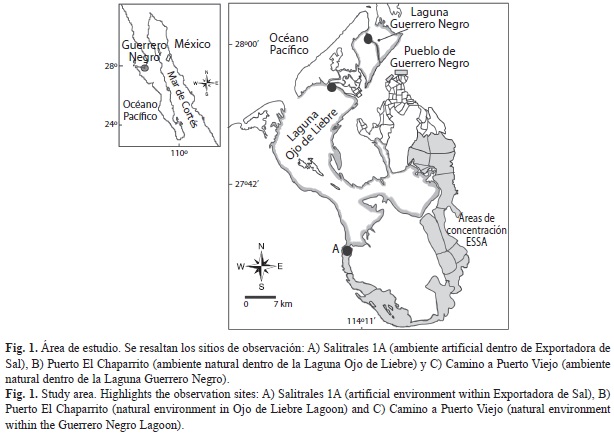
<body><![CDATA[<font size="2"></font><br style="font-family: verdana;">     <font size="2"><span style="font-family: verdana;">El complejo lagunar     Guerrero     Negro-Ojo de Liebre-ESSA se ubica en la costa centro- occidental de la     Pen&iacute;nsula de Baja California, dentro de la Reserva de la     Bi&oacute;sfera del Vizca&iacute;no (28&ordm;13&#8217;9&#8221; - 27&ordm;34&#8217;24&#8221; N y     114&ordm;24&#8217;39&#8221; - 113&ordm;53&#8217;28&#8221; W, <a      href="/img/revistas/rbt/v61n2/a33i1.jpg">Fig. 1</a>). El &aacute;rea     presenta     menos de 100mm de precipitaci&oacute;n anual y una temperatura anual     ]]></body>
<body><![CDATA[promedio que oscila entre los 18 y 22&deg;C (Contreras 1985). El     complejo est&aacute; formado por tres cuerpos de agua: Laguna Ojo de     Liebre (LOL; 57 100ha), Laguna Guerrero Negro&nbsp; (LGN;&nbsp; 2     100ha)&nbsp; y&nbsp; una&nbsp; serie&nbsp; de&nbsp; cuerpos     artificiales concesionados a la Compa&ntilde;&iacute;a Exportadora de     Sal (ESSA; 33 000ha) (Lluch- Cota <span style="font-style: italic;">et     al</span>. 1993).</span></font><br style="font-family: verdana;">     <br style="font-family: verdana;">     <font size="2"><span style="font-family: verdana;">De las 33 000ha de     ESSA s&oacute;lo     ]]></body>
<body><![CDATA[3 314 son utilizadas por el Ganso de collar. Se trata de las dos zonas     de acceso del agua de mar, por lo que son las m&aacute;s similares al     ambiente natural y en ellas existen praderas de pasto marino (Carmona     &amp; Danemann 1998). Para LOL las mayores biomasas de pasto se han     registrado entre septiembre y noviembre, meses en los que     tambi&eacute;n se presenta el mayor crecimiento de los brotes     (Cabello-Pasini <span style="font-style: italic;">et al</span>. 2003,     Cabello- Pasini <span style="font-style: italic;">et al</span>. 2004).</span></font><br      style="font-family: verdana;">     <font size="2"></font><br style="font-family: verdana;">     ]]></body>
<body><![CDATA[<font size="2"><span style="font-family: verdana;">Como puntos de     observaci&oacute;n     seleccionamos en LOL una playa adyacente al puerto &#8220;El Chaparrito&#8221;     (28&ordm;0&#8217;53&#8221; N y 114&ordm;07&#8217;0&#8221; W, <a      href="/img/revistas/rbt/v61n2/a33i1.jpg">Fig. 1</a>), la cual se     caracteriza     por su poca pendiente, sustrato lodoso arcilloso, con presencia de     canales y de pasto; para LGN la playa &#8220;Puerto Viejo&#8221; (27&ordm;55&#8217;9&#8221; N y     114&ordm;11&#8217;6.55&#8221; W, <a href="/img/revistas/rbt/v61n2/a33i1.jpg">Fig. 1</a>),     tambi&eacute;n con poca pendiente y     ]]></body>
<body><![CDATA[presencia de un bajo con vegetaci&oacute;n de marisma (incluido pasto     marino); para ESSA se eligi&oacute; el &aacute;rea de     concentraci&oacute;n Salitrales 1-A (27&ordm;35&#8217;1&#8221; N y 114&ordm;6&#8217;49&#8221;     W; <a href="/img/revistas/rbt/v61n2/a33i1.jpg">Fig. 1</a>), en     &eacute;sta ingresa el agua de mar al sistema, lo que     favorece el estable- cimiento de praderas de pasto (Carmona &amp;     Danemann 1998).</span></font><br style="font-family: verdana;">     <font size="2"></font><br style="font-family: verdana;">     <font size="2"><span style="font-family: verdana;">Entre noviembre de     2006 y abril de     ]]></body>
<body><![CDATA[2007 para cada sitio delimitamos 1 000m de l&iacute;nea de costa.     Dentro de estos l&iacute;mites realizamos censos puntuales con la ayuda     de binoculares (Leica 10x) y telescopios (Swarovsky 15-60x). Para cada     sitio realizamos un promedio de ocho censos al mes, espaciados por una     hora. Completamos cerca de 150h de observaci&oacute;n, repartidas     homog&eacute;neamente entre los tres sitios; dichas observaciones se     realizaron regularmente entre las 08:00 y las 16:00hs.</span></font><br      style="font-family: verdana;">     <font size="2"></font><br style="font-family: verdana;">     <font size="2"><span style="font-family: verdana;">En cada censo     ]]></body>
<body><![CDATA[determinamos: a) la     abundancia (n&uacute;mero de aves), b) actividad de &eacute;stas     (aliment&aacute;ndose o posadas) y c) la proporci&oacute;n del grupo de     edades: adultos e inmaduros. El criterio para diferenciar a los     inmaduros de los adultos fue la presencia de bordes blancos en las     plumas cobertoras en las aves inmaduras (Reed <span      style="font-style: italic;">et al</span>. 1998).     Consideramos la hora del d&iacute;a para relacionarla con el nivel de     marea (Gonz&aacute;lez <span style="font-style: italic;">et al</span>.     2012).</span></font><br style="font-family: verdana;">     ]]></body>
<body><![CDATA[<font size="2"></font><br style="font-family: verdana;">     <font size="2"><span style="font-family: verdana;">Los an&aacute;lisis     se realizaron     con STATISTI- CA 5.0 (StatSoft 1995), con un nivel de significancia (&#945;)     de 0.05 en todos los casos. Para su an&aacute;lisis las variables     abundancia y grupo de edad (proporci&oacute;n de adultos), se agruparon     en dos estaciones del a&ntilde;o: invierno (de noviembre a enero) y     primavera (de febrero a abril). A continuaci&oacute;n se describe los     an&aacute;lisis realizados para cada caso.</span></font><br      style="font-family: verdana;">     ]]></body>
<body><![CDATA[<font size="2"></font><br style="font-family: verdana;">     <font size="2"><span style="font-family: verdana;">Para identificar la     relaci&oacute;n     entre la estructura poblacional (grupo de edad) y la estaci&oacute;n     del a&ntilde;o y la localidad. Se formaron seis grupos de datos, esto     es dos estaciones y tres sitios y se tom&oacute; como variable la     proporci&oacute;n de aves adultas. Mediante an&aacute;lisis de     variancia de dos v&iacute;as, se prob&oacute; el efecto de la     temporalidad, el sitio y su interacci&oacute;n en la proporci&oacute;n     de edad observada; en los casos donde se encontr&oacute; una     ]]></body>
<body><![CDATA[relaci&oacute;n significativa se realizaron pruebas <span      style="font-style: italic;">a posteriori</span> de     Tukey (Zar 1999).</span></font><br style="font-family: verdana;">     <font size="2"></font><br style="font-family: verdana;">     <font size="2"><span style="font-family: verdana;">Para determinar la     relaci&oacute;n     entre el nivel de marea con las abundancias y las proporciones de aves     aliment&aacute;ndose se formaron seis grupos de datos, esto es dos     estaciones del a&ntilde;o y tres sitios, para cada grupo de     informaci&oacute;n se realiz&oacute; una regresi&oacute;n lineal simple     ]]></body>
<body><![CDATA[(Zar 1999), tomando en cuenta, para todos los casos, como variable     independiente el nivel de marea.</span></font><br      style="font-family: verdana;">     <font size="2"></font><br style="font-family: verdana;">     <font size="2"></font><br style="font-family: verdana;">     <font size="3"><span style="font-family: verdana; font-weight: bold;">Resultados</span></font><br      style="font-family: verdana;">     <font size="2"></font><br style="font-family: verdana;">     <font size="2"><span style="font-family: verdana;">Para la     determinaci&oacute;n de los     ]]></body>
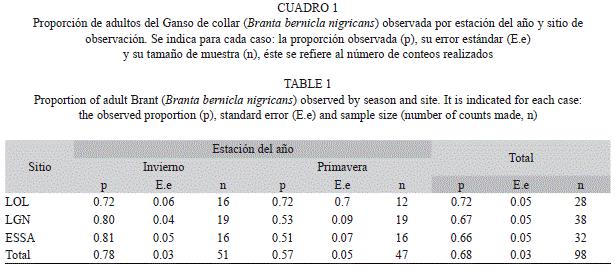
<body><![CDATA[grupos de edad, en invierno se realizaron un total de 51 eventos de     conteo y en primavera 47; estos incluyeron 3 277 y 1 827 aves,     respectivamente. Es decir el grupo de edad se determin&oacute; para un     total de 5 104 aves, a lo largo de 98 campa&ntilde;as de conteo (<a      href="/img/revistas/rbt/v61n2/a33t1.gif">Cuadro     1</a>). La proporci&oacute;n general por grupo de edad fue de 1.47 a 1     a     favor de los adultos (<a href="/img/revistas/rbt/v61n2/a33t1.gif">Cuadro     1</a>). Dicha proporci&oacute;n fue     afectada&nbsp; significativamente&nbsp; por&nbsp; la&nbsp;     ]]></body>
<body><![CDATA[estaci&oacute;n del&nbsp; a&ntilde;o (<a      href="/img/revistas/rbt/v61n2/a33t1.gif">Cuadro&nbsp; 1</a>;&nbsp;     F<sub>1,92</sub>=12.7,&nbsp; p&lt;0.01),&nbsp; con una clara tendencia     a disminuir     entre invierno y primavera. Tambi&eacute;n se pudo apreciar una mayor     proporci&oacute;n de adultos en LOL, aunque esta relaci&oacute;n no fue     significativa (<a href="/img/revistas/rbt/v61n2/a33t1.gif">Cuadro 1</a>;     F<sub>2,92</sub>=0.45, p=0.63). Al comparar la     proporci&oacute;n de adultos, dividida por estaci&oacute;n del     a&ntilde;o y el sitio, tanto en ESSA como LGN, se observ&oacute; una     ]]></body>
<body><![CDATA[tendencia a la disminuci&oacute;n, aunque no significativa; en     contraste, LOL fue el &uacute;nico lugar donde las proporciones se     mantuvieron constantes a lo largo del estudio, en este &uacute;ltimo     caso es resaltable el bajo valor de significancia de la </span><span      style="font-family: verdana;">prueba (<a      href="/img/revistas/rbt/v61n2/a33t1.gif">Cuadro 1</a>; F<sub>2,92</sub>=2.80,     p=0.06).</span></font>    <br>     <font size="2"><span style="font-family: verdana;"></span></font><br      style="font-family: verdana;">     ]]></body>
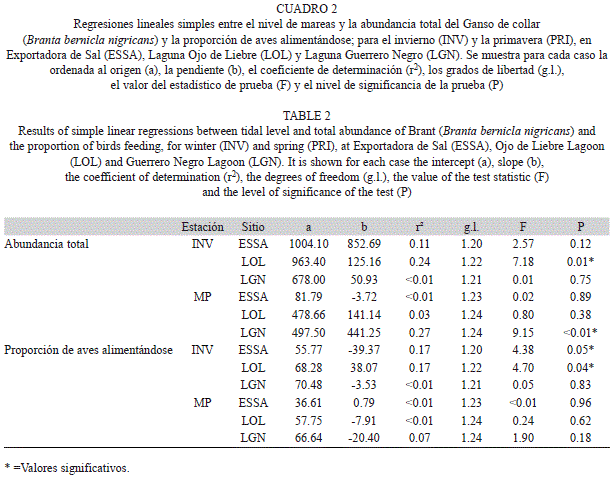
<body><![CDATA[<font size="2"><span style="font-family: verdana;"></span><span      style="font-family: verdana;">En general, las relaciones entre el     nivel de marea y la proporci&oacute;n de aves aliment&aacute;ndose     fueron pobres, s&oacute;lo se presentaron relaciones significativas en     4 de los 12 an&aacute;lisis (<a href="/img/revistas/rbt/v61n2/a33t2.gif">Cuadro     2</a>). Independientemente de su     significancia, en todos los casos el modelo explic&oacute; poco de la     variaci&oacute;n observada (el r<sup>2</sup> m&aacute;s alto fue de     apenas 0.27;     <a href="/img/revistas/rbt/v61n2/a33t2.gif">Cuadro 2</a>). Con respecto     ]]></body>
<body><![CDATA[a las relaciones entre el nivel de marea y las     abundancias totales para el invierno se registraron tres     comportamientos, en ESSA se marc&oacute; una relaci&oacute;n directa,     donde el n&uacute;mero de&nbsp; aves&nbsp; se&nbsp;     increment&oacute;&nbsp; conforme&nbsp; lo&nbsp; hizo&nbsp; el nivel de     marea; en contraste, en LOL, la relaci&oacute;n fue inversa,     disminuyendo el n&uacute;mero de aves a medida que se increment&oacute;     el nivel de marea por &uacute;ltimo en LGN no hubo relaci&oacute;n     aparente (<a href="/img/revistas/rbt/v61n2/a33t2.gif">Cuadro 2</a>).</span></font><br      style="font-family: verdana;">     ]]></body>
<body><![CDATA[<font size="2"></font><br style="font-family: verdana;">     <font size="2"><span style="font-family: verdana;">Las pruebas     estad&iacute;sticas     evidenciaron que s&oacute;lo en LOL hubo relaci&oacute;n significativa,     explicando el modelo el 24% de la variaci&oacute;n observada (<a      href="/img/revistas/rbt/v61n2/a33t2.gif">Cuadro 2</a>;     <a href="/img/revistas/rbt/v61n2/a33i2.jpg">Fig. 2</a>). Las relaciones     entre el nivel de marea y las abundancias     totales para la primavera modificaron su comportamiento, en     comparaci&oacute;n al invierno, tanto en ESSA como en LOL los datos     ]]></body>
<body><![CDATA[presentaron amplias dispersiones, sin tendencia aparente, mientras que     en LGN se observ&oacute; una relaci&oacute;n positiva (<a      href="/img/revistas/rbt/v61n2/a33i2.jpg">Fig. 2</a>). Las     pruebas estad&iacute;sticas corroboraron lo anteriormente descrito,     pues s&oacute;lo para LGN se present&oacute; una relaci&oacute;n     significativa (<a href="/img/revistas/rbt/v61n2/a33t2.gif">Cuadro 2</a>).</span></font><br      style="font-family: verdana;">     <font size="2"></font><br style="font-family: verdana;">     <font size="2"><span style="font-family: verdana;">Con respecto a la     relaci&oacute;n     ]]></body>
<body><![CDATA[entre la proporci&oacute;n del Ganso de collar aliment&aacute;ndose y     el nivel de marea en invierno, se observaron tendencias&nbsp;     diferentes&nbsp; por&nbsp; sitio.&nbsp; En&nbsp; ESSA la     relaci&oacute;n fue negativa, lo que indica que con- forme     aument&oacute; el nivel de marea disminuy&oacute; la proporci&oacute;n     de gansos aliment&aacute;ndose; contrario a este patr&oacute;n en LOL     se encontr&oacute; una relaci&oacute;n positiva (<a      href="/img/revistas/rbt/v61n2/a33i2.jpg">Fig. 2</a>); por su parte     en LGN no se observ&oacute; tendencia. Los an&aacute;lisis     estad&iacute;sticos indicaron que, aunque con bajos porcentajes     ]]></body>
<body><![CDATA[de&nbsp; variaci&oacute;n,&nbsp; tanto&nbsp; en&nbsp; ESSA como&nbsp;     en&nbsp; LOL hubo relaciones significativas, no as&iacute; en LGN     (<a href="/img/revistas/rbt/v61n2/a33t2.gif">Cuadro 2</a>).</span></font><br      style="font-family: verdana;">     <font size="2"></font><br style="font-family: verdana;">     <font size="2"></font><br style="font-family: verdana;">     <font size="3"><span style="font-family: verdana; font-weight: bold;">Discusi&oacute;n</span></font><br      style="font-family: verdana;">     <font size="2"></font><br style="font-family: verdana;">     <font size="2"><span style="font-family: verdana;">La proporci&oacute;n     ]]></body>
<body><![CDATA[general por     grupo de edad coincide con la registrada por Schamber <span      style="font-style: italic;">et al</span>. (2007),     quienes indican un 32% de juveniles para esta laguna, similar al de San     Quint&iacute;n (31%), pero notoriamente superior al 11% registrado para     San Ignacio. Estos resultados son atribuidos a la abundancia y     disponibilidad de pasto y a las interacciones sociales entre grupos     familiares; pues la disponibilidad de alimento provoca una mayor     cohesi&oacute;n familiar (Schamber <span style="font-style: italic;">et     al</span>. 2007).</span></font><br style="font-family: verdana;">     ]]></body>
<body><![CDATA[<font size="2"></font><br style="font-family: verdana;">     <font size="2"><span style="font-family: verdana;">La notoria     disminuci&oacute;n en la     proporci&oacute;n de aves adultas en primavera presumiblemente se     relaciona con los movimientos migratorios de esta especie (Reed <span      style="font-style: italic;">et al</span>.     1998, Poisbleau <span style="font-style: italic;">et al</span>. 2006,     Schamber <span style="font-style: italic;">et al</span>. 2007), pues     se ha     registrado que la partida de las zonas de invernada se produce de     ]]></body>
<body><![CDATA[acuerdo a un estatus de dominancia social, donde los primeros en     salir&nbsp; son&nbsp; los&nbsp; grupos&nbsp; familiares,&nbsp;     seguidos&nbsp; de las parejas con juveniles, los adultos (machos y     hembras en ese orden) y por &uacute;ltimo las aves inmaduras (Poisbleau     <span style="font-style: italic;">et al</span>. 2006). Dado que las     aves inmaduras no se reproducir&aacute;n en     el verano inmediato a su primera migraci&oacute;n al norte,&nbsp;     &eacute;stas&nbsp; pueden&nbsp; partir&nbsp; posteriormente,&nbsp; lo     que adem&aacute;s disminuir&iacute;a la competencia     intraespec&iacute;fica en los sitios de paso, lo que permite explicar     ]]></body>
<body><![CDATA[el aumento primaveral de las aves inmaduras en GN.</span></font><br      style="font-family: verdana;">     <font size="2"></font><br style="font-family: verdana;">     <font size="2"><span style="font-family: verdana;">Por otra parte, la     mayor     proporci&oacute;n de adultos en LOL, la cual se mantuvo constante     durante&nbsp; todo&nbsp; el&nbsp; per&iacute;odo&nbsp; de&nbsp;     estudio&nbsp; (aunque con bajos niveles de significancia), vuelve a     sugerir patrones de dominancia social sobre los recursos alimenticios     (Poisbleau <span style="font-style: italic;">et al</span>. 2006). Es     ]]></body>
<body><![CDATA[decir, en LOL se presentan las mayores     praderas de pastos marinos (Santa Mar&iacute;a Gallegos <span      style="font-style: italic;">et al</span>. 2001,     Cabello-Pasini <span style="font-style: italic;">et al</span>. 2004),     donde, como en otros sitios, es probable     que predominen los grupos familiares (Moore &amp; Black 2006), el grupo     social dominante. As&iacute; una vez empezada la migraci&oacute;n, los     grupos familiares ser&iacute;an los primeros en salir al norte y su     lugar ser&iacute;a ocupado por las aves de los grupos socia- les     siguientes (adultos), lo anterior permitir&iacute;a explicar     ]]></body>
<body><![CDATA[porqu&eacute; la proporci&oacute;n de adultos se mantuvo&nbsp;     constante,&nbsp; a&nbsp; diferencia&nbsp; de&nbsp; ESSA y LGN donde     dichas proporciones disminuyeron, presumiblemente por los movimientos     efectuados por las aves hacia zonas de mayor calidad (como LOL). Esta     idea es apoyada por los resultados de Schamber <span      style="font-style: italic;">et al</span>. (2007), quienes     observaron una mayor proporci&oacute;n de adultos en LOL en     comparaci&oacute;n con Bah&iacute;a San Quint&iacute;n y Laguna San     Ignacio.</span></font><br style="font-family: verdana;">     <font size="2"></font><br style="font-family: verdana;">     ]]></body>
<body><![CDATA[<font size="2"><span style="font-family: verdana;">Efecto nivel de     marea: Es de     resaltar que en&nbsp; otros&nbsp; sitios&nbsp; como&nbsp; la&nbsp;     Bah&iacute;a&nbsp; de&nbsp; Humboldt se ha indicado la estrecha     relaci&oacute;n existente entre las abundancias de estas aves y el     nivel de marea (Moore &amp; Black 2006), en contraste en GN esta     relaci&oacute;n fue poco notoria, lo que pudiera explicarse por las     diferencias en las amplitudes de marea, pues en Guerrero Negro     &eacute;stas son de menor magnitud en comparaci&oacute;n con las de las     zonas norte&ntilde;as (Brown <span style="font-style: italic;">et al</span>.     ]]></body>
<body><![CDATA[1989). A lo que habr&iacute;a que     a&ntilde;adir la fenolog&iacute;a del pasto marino en GN, el cual al     desprenderse (noviembre; Cabello-Pasini <span      style="font-style: italic;">et al</span>. 2003), evita     presumiblemente que las mareas limiten la disponibilidad del recurso.     Aunque no fue un objetivo de este estudio, constantemente se     observ&oacute; al Ganso de collar aliment&aacute;ndose de pasto     desprendido, tanto del varado en la l&iacute;nea de costa     (preferentemente en marea baja) como del flotante en aguas m&aacute;s     profundas, esta conducta presumiblemente permite que, mediante cambios     ]]></body>
<body><![CDATA[en las estrategias de alimentaci&oacute;n, el Ganso de collar responda     a las modificaciones en la accesibilidad del pasto ocasionadas por el     nivel de marea.</span></font><br style="font-family: verdana;">     <font size="2"></font><br style="font-family: verdana;">     <font size="2"><span style="font-family: verdana;">Con respecto a la     relaci&oacute;n     inversa entre la abundancia de aves y el nivel de marea observada en     invierno en LOL, &eacute;sta podr&iacute;a explicarse por el     desplazamiento de los individuos desde la bocana hacia el interior de     la laguna, a medida que sube la marea, buscando nuevos sitios&nbsp;     ]]></body>
<body><![CDATA[de&nbsp; alimentaci&oacute;n.&nbsp; La&nbsp; hip&oacute;tesis&nbsp;     anterior se sustenta en el notorio desfase (de hasta tres horas) en los     niveles de mareas presentes en la bocana y los de la parte interior de     la laguna.</span></font><br style="font-family: verdana;">     <font size="2"></font><br style="font-family: verdana;">     <font size="2"><span style="font-family: verdana;">Adicionalmente, la     ausencia de     relaci&oacute;n en ESSA (&aacute;rea no afectada por la marea) y LGN,     que por su menor tama&ntilde;o presenta un desfase m&aacute;s reducido     (menos de una hora), apoya la idea anterior. Estos movimientos     ]]></body>
<body><![CDATA[permitir&iacute;an explicar, al menos en parte, la baja relaci&oacute;n     entre el nivel de mareas y el comportamiento alimenticio&nbsp;     del&nbsp; Ganso&nbsp; de&nbsp; collar&nbsp; en&nbsp; GN,&nbsp; la cual     contrasta con la determinada para lugares m&aacute;s norte&ntilde;os de     su ruta migratoria (Moore &amp; Black 2006).</span></font><br      style="font-family: verdana;">     <font size="2"></font><br style="font-family: verdana;">     <font size="2"><span style="font-family: verdana;">Es decir, el Ganso     de collar en LOL     (el sitio de mayor abundancia; Mart&iacute;nez 2010) podr&iacute;a     ]]></body>
<body><![CDATA[lograr la aparente independencia alimenticia respecto al nivel de     marea, mediante dos estrategias no excluyentes: (1) movi&eacute;ndose a     lo largo de la laguna, para aprovechar el desfase en el nivel de marea     y/o (2) modificando sus&nbsp; t&eacute;cnicas&nbsp; de&nbsp;     alimentaci&oacute;n,&nbsp; para&nbsp; consumir el pasto desprendido     varado y flotante, esta &uacute;ltima conducta ya ha sido registrada en     otros sitios (Mather <span style="font-style: italic;">et al</span>.     1998).</span></font><br style="font-family: verdana;">     <font size="2"></font><br style="font-family: verdana;">     <font size="2"><span style="font-family: verdana;">La relaci&oacute;n     ]]></body>
<body><![CDATA[positiva entre     la abundancia del Ganso de collar y el nivel de marea vista en LGN en     primavera puede deberse a que la zona, adem&aacute;s de servir de     &aacute;rea de forrajeo, es utilizada como sitio de descanso, similar a     lo indicado en otras localidades (Burger et. al. 1983, Moore &amp;     Black 2006), lo que se reflej&oacute; en que conforme aument&oacute; el     nivel de marea tambi&eacute;n lo hicieran las abundancias, razonamiento     que se refuerza porque a la par del aumento en abundancias se     detect&oacute; una disminuci&oacute;n en la proporci&oacute;n de aves     aliment&aacute;ndose, para las dos estaciones del a&ntilde;o.</span></font><br     ]]></body>
<body><![CDATA[ style="font-family: verdana;">     <font size="2"></font><br style="font-family: verdana;">     <font size="2"><span style="font-family: verdana;">En el &aacute;rea de     estudio el     Ganso de collar fue constantemente observado aliment&aacute;ndose     mediante tres diferentes estrategias: 1) ramoneando&nbsp; el&nbsp;     pasto&nbsp; sumergido,&nbsp; 2)&nbsp; picoteando el pasto flotante en     la columna de agua y 3) aliment&aacute;ndose del pasto varado en la     playa, conductas que ya han sido descritas por otros autores (Einarsen     1965, Mather <span style="font-style: italic;">et al</span>. 1998,     ]]></body>
<body><![CDATA[Reed <span style="font-style: italic;">et al</span>. 1998). Mather <span      style="font-style: italic;">et al</span>. (1998) que     determinaron que el tipo de alimentaci&oacute;n es dependiente del     nivel de marea; los gansos prefirieron ramonear el pasto sumergido que     alimentarse del pasto flotante, o del varado en la playa. Es probable     que en GN las dos &uacute;ltimas conductas sean de mayor importancia     que en otros sitios, por ejemplo, la Bah&iacute;a de Humboldt, donde     hasta un 90% del pasto marino queda expuesto durante la bajamar,     momento que coincide con los apogeos de utilizaci&oacute;n por parte     del Ganso de collar (Wilson &amp; Atkinson 1995, Moore &amp; Black     ]]></body>
<body><![CDATA[2006). Tales conductas alternativas se ven aparentemente favorecidas en     GN por el desprendimiento de los pastos (Cabello-Pasini <span      style="font-style: italic;">et al</span>. 2003) y     presumiblemente, ocasionan una baja relaci&oacute;n entre el nivel de     marea y la abundancia de aves aliment&aacute;ndose encontrada en el     trabajo presente.</span></font><br style="font-family: verdana;">     <font size="2"></font><br style="font-family: verdana;">     <font size="2"><span style="font-family: verdana;">Por otra parte, las     relaciones     significativas entre el nivel de mareas y la proporci&oacute;n de     ]]></body>
<body><![CDATA[gansos aliment&aacute;ndose en inverno en ESSA (negativa) y LOL     (positiva) indican que ESSA funcion&oacute; m&aacute;s como un sitio de     descanso, similarmente a lo indicado para otros ambientes artificiales     (Burger et. al. 1983), pues conforme aument&oacute; el nivel de marea,     si bien se increment&oacute; la abundancia, disminuy&oacute; la     proporci&oacute;n de aves aliment&aacute;ndose. En contraste, en LOL     conforme la marea aument&oacute; disminuy&oacute; la abundancia del     Ganso de collar, pero aument&oacute; la proporci&oacute;n de aves     aliment&aacute;ndose, esto probablemente se relacione con la fidelidad     a las &aacute;reas de alimentaci&oacute;n lo que permite sugerir la     ]]></body>
<body><![CDATA[existencia de exclusi&oacute;n competitiva en los, aparentemente,     mejores sitios de alimentaci&oacute;n, tal como ha sido registrado para     otras zonas (Schamber <span style="font-style: italic;">et al</span>.     2007). El uso de ESSA, circunscrito a     inicios del invierno, probablemente se relacione con la necesidad de     las aves de alimentarse con mayor constancia despu&eacute;s de la     &uacute;ltima etapa de su vuelo migratorio (Burger <span      style="font-style: italic;">et al</span>. 1983, Reed <span      style="font-style: italic;">et     al</span>. 1998, Ward <span style="font-style: italic;">et al</span>.     ]]></body>
<body><![CDATA[2005).</span></font><br style="font-family: verdana;">     <font size="2"></font><br style="font-family: verdana;">     <font size="2"><span style="font-family: verdana;">Recurrentemente se     ha observado que     el Ganso de collar abandona sus &aacute;reas de invernada cuando la     disponibilidad de alimento no puede satisfacer su demanda     energ&eacute;tica (Percival &amp; Evans 1996, Mather <span      style="font-style: italic;">et al</span>. 1998, Reed     <span style="font-style: italic;">et al</span>. 1998, Ganter 2000,     Moore <span style="font-style: italic;">et al</span>. 2004, Ward <span     ]]></body>
<body><![CDATA[ style="font-style: italic;">et al</span>. 2005, Moore     &amp; Black 2006, Shamber <span style="font-style: italic;">et al</span>.     2007). Lo anterior permite recalcar     que para entender la forma en que la especie de inter&eacute;s utiliza     las lagunas peninsulares, es imprescindible llevar a cabo estudios     sobre fenolog&iacute;a comparada de los pastos en las cuatro grandes     lagunas de la zona (San Quint&iacute;n, Guerrero Negro, San Ignacio y     Bah&iacute;a Magdalena).</span></font><br style="font-family: verdana;">     <font size="2"></font><br style="font-family: verdana;">     <font size="2"><span style="font-family: verdana;">En suma, en GN se     ]]></body>
<body><![CDATA[observ&oacute;     una partida temprana de adultos en primavera. El efecto del nivel de     marea fue m&aacute;s acusado en LGN que en LOL, presumiblemente por el     tama&ntilde;o de esta &uacute;ltima (desfase de mareas) y por la     presencia de una alta biomasa de pasto flotante, lo que le permite a la     especie una mayor independencia alimenticia respecto al nivel de marea,     por comparaci&oacute;n con otros sitios de su ruta migratoria.</span></font><br      style="font-family: verdana;">     <font size="2"></font><br style="font-family: verdana;">     <font size="2"></font><br style="font-family: verdana;">     ]]></body>
<body><![CDATA[<font size="3"><span style="font-family: verdana; font-weight: bold;">Agradecimientos</span></font><br      style="font-family: verdana;">     <font size="2"></font><br style="font-family: verdana;">     <font size="2"><span style="font-family: verdana;">A la     compa&ntilde;&iacute;a     Exportadora de Sal S.A de C.V., por el apoyo brindado al presente     trabajo, especialmente al personal de ecolog&iacute;a (Mart&iacute;n     Garc&iacute;a, Ramiro Zaragoza y Fabi&aacute;n Castillo), a Antonio     Guti&eacute;rrez Aguilar, por su disponibilidad y ayuda en campo y a     los jefes: Edmundo Elorduy y Mart&iacute;n Dom&iacute;nguez, por su     ]]></body>
<body><![CDATA[inter&eacute;s en la conservaci&oacute;n. Al personal del laboratorio     de aves de la UABCS por su participaci&oacute;n en el trabajo de campo.     A Pronatura Noroeste A.C., pues este trabajo se enmarc&oacute; dentro     del proyecto &#8220;Conservation of the Brant (<span      style="font-style: italic;">Branta bernicla</span>) and other     migratory waterbirds in the Guerrero Negro-Ojo de Liebre coastal lagoon     complex, Baja California Sur, M&eacute;xico&#8221;. A la Divisi&oacute;n de     Conservaci&oacute;n de H&aacute;bitat de Aves del Servicio de Pesca y     Vida Silvestre de los Estados Unidos de Am&eacute;rica, que a     trav&eacute;s del Acta para la Conservaci&oacute;n de los Humedales de     ]]></body>
<body><![CDATA[Norteam&eacute;rica (NAWCA), financi&oacute; parcialmente este     proyecto, y en especial a Ellen C. Murphy, Coordinadora del Programa     M&eacute;xico.</span></font><br style="font-family: verdana;">     <font size="2"></font>     <hr style="width: 100%; height: 2px;"><br style="font-family: verdana;">     <font size="3"><span style="font-family: verdana; font-weight: bold;">Referencias</span></font><br      style="font-family: verdana;">     <font size="2"></font><br style="font-family: verdana;">     <font size="2"><span style="font-family: verdana;">Brown,&nbsp; J., A.     Colling, D.     ]]></body>
<body><![CDATA[Park, J. Phillips,&nbsp; D.&nbsp; Rothery &amp;&nbsp; J. Wright. 1989.     Waves, tides and&nbsp; shallow-water processes. <span      style="font-style: italic;">In</span> G. Berman (eds.).     <!-- ref -->The Open University, Inglaterra.    &nbsp;&nbsp;&nbsp;&nbsp;&nbsp;&nbsp;&nbsp;&nbsp;[&#160;<a href="javascript:void(0);" onclick="javascript: window.open('/scielo.php?script=sci_nlinks&ref=1528854&pid=S0034-7744201300030003300001&lng=','','width=640,height=500,resizable=yes,scrollbars=1,menubar=yes,');">Links</a>&#160;]<!-- end-ref --></span></font>    <!-- ref --><br> <font size="2"><span style="font-family: verdana;"></span></font><br  style="font-family: verdana;"> <font size="2"><span style="font-family: verdana;"></span><span  style="font-family: verdana;">Burger, J., R. Trout, W. Wander &amp; G. Ritter. 1983. Jamaica Bay studies: IV. Abiotic factors affecting abundance of brant and Canada geese on an east coast estuary. Wilson Bull. 95: 384-403.    &nbsp;&nbsp;&nbsp;&nbsp;&nbsp;&nbsp;&nbsp;&nbsp;[&#160;<a href="javascript:void(0);" onclick="javascript: window.open('/scielo.php?script=sci_nlinks&ref=1528856&pid=S0034-7744201300030003300002&lng=','','width=640,height=500,resizable=yes,scrollbars=1,menubar=yes,');">Links</a>&#160;]<!-- end-ref --><!-- ref --></span></font><br style="font-family: verdana;"> <font size="2"></font><br style="font-family: verdana;"> <font size="2"><span style="font-family: verdana;">Carmona, R. &amp; G. Danemann. 1998. Distribuci&oacute;n espacio- temporal de aves en la salina de Guerrero Negro, Baja California Sur, M&eacute;xico. Cienc. Mar. 24: 389-408.    &nbsp;&nbsp;&nbsp;&nbsp;&nbsp;&nbsp;&nbsp;&nbsp;[&#160;<a href="javascript:void(0);" onclick="javascript: window.open('/scielo.php?script=sci_nlinks&ref=1528857&pid=S0034-7744201300030003300003&lng=','','width=640,height=500,resizable=yes,scrollbars=1,menubar=yes,');">Links</a>&#160;]<!-- end-ref --><!-- ref --></span></font><br style="font-family: verdana;"> <font size="2"></font><br style="font-family: verdana;"> <font size="2"><span style="font-family: verdana;">Cabello-Pasini,&nbsp; A., R. Mu&ntilde;iz-Salazar &amp; D.&nbsp; Ward. 2003. Annual variations of biomass and photosynthesis in <span style="font-style: italic;">Zostera marina</span> at its end of distribution in the North Pacific. Aquat. Bot. 76: 31-47.    &nbsp;&nbsp;&nbsp;&nbsp;&nbsp;&nbsp;&nbsp;&nbsp;[&#160;<a href="javascript:void(0);" onclick="javascript: window.open('/scielo.php?script=sci_nlinks&ref=1528858&pid=S0034-7744201300030003300004&lng=','','width=640,height=500,resizable=yes,scrollbars=1,menubar=yes,');">Links</a>&#160;]<!-- end-ref --><!-- ref --></span></font><br  style="font-family: verdana;"> <font size="2"></font><br style="font-family: verdana;"> <font size="2"><span style="font-family: verdana;">Cabello-Pasini,&nbsp; A., R. Mu&ntilde;iz-Salazar &amp; D.&nbsp; Ward. 2004. Caracterizaci&oacute;n&nbsp; bioqu&iacute;mica del pasto&nbsp; <span  style="font-style: italic;">Zostera marina</span> en el l&iacute;mite sur de su distribuci&oacute;n en el Pac&iacute;fico Norte. Cienc. Mar. 30: 21-34.    &nbsp;&nbsp;&nbsp;&nbsp;&nbsp;&nbsp;&nbsp;&nbsp;[&#160;<a href="javascript:void(0);" onclick="javascript: window.open('/scielo.php?script=sci_nlinks&ref=1528859&pid=S0034-7744201300030003300005&lng=','','width=640,height=500,resizable=yes,scrollbars=1,menubar=yes,');">Links</a>&#160;]<!-- end-ref --><!-- ref --></span></font><br  style="font-family: verdana;"> <font size="2"></font><br style="font-family: verdana;"> <font size="2"><span style="font-family: verdana;">Contreras, F. 1985. Las lagunas costeras mexicanas. Centro de Ecodesarrollo. Secretar&iacute;a de Pesca, M&eacute;xico.    &nbsp;&nbsp;&nbsp;&nbsp;&nbsp;&nbsp;&nbsp;&nbsp;[&#160;<a href="javascript:void(0);" onclick="javascript: window.open('/scielo.php?script=sci_nlinks&ref=1528860&pid=S0034-7744201300030003300006&lng=','','width=640,height=500,resizable=yes,scrollbars=1,menubar=yes,');">Links</a>&#160;]<!-- end-ref --><!-- ref --></span></font><br style="font-family: verdana;"> <font size="2"></font><br style="font-family: verdana;"> <font size="2"><span style="font-family: verdana;">Einarsen, A.S. 1965. Black brant: sea goose of the Pacific coast. University of Washington, Seattle, EE.UU.    &nbsp;&nbsp;&nbsp;&nbsp;&nbsp;&nbsp;&nbsp;&nbsp;[&#160;<a href="javascript:void(0);" onclick="javascript: window.open('/scielo.php?script=sci_nlinks&ref=1528861&pid=S0034-7744201300030003300007&lng=','','width=640,height=500,resizable=yes,scrollbars=1,menubar=yes,');">Links</a>&#160;]<!-- end-ref --><!-- ref --></span></font><br style="font-family: verdana;"> <font size="2"></font><br style="font-family: verdana;"> <font size="2"><span style="font-family: verdana;">Ganter, B. 2000. Seagrass (<span style="font-style: italic;">Zostera</span> spp.) as food for brent geese (<span style="font-style: italic;">Branta bernicla</span>):&nbsp; an&nbsp; overview. Helgol. Mar Res. 54: 63-70.    &nbsp;&nbsp;&nbsp;&nbsp;&nbsp;&nbsp;&nbsp;&nbsp;[&#160;<a href="javascript:void(0);" onclick="javascript: window.open('/scielo.php?script=sci_nlinks&ref=1528862&pid=S0034-7744201300030003300008&lng=','','width=640,height=500,resizable=yes,scrollbars=1,menubar=yes,');">Links</a>&#160;]<!-- end-ref --><!-- ref --></span></font><br  style="font-family: verdana;"> <font size="2"></font><br style="font-family: verdana;"> <font size="2"><span style="font-family: verdana;">Gonz&aacute;lez,&nbsp; J., A. Morales &amp; J.L. Ochoa 2012.&nbsp; Predicci&oacute;n de&nbsp; mareas,&nbsp; Centro&nbsp; de&nbsp;&nbsp; Investigaci&oacute;n&nbsp; Cient&iacute;fica&nbsp; y Educaci&oacute;n&nbsp; Superior de Ensenada, Ensenada, Baja California, M&eacute;xico (Consultado: 1 mayo 2009, http:// oceanografia.cicese.mx/predmar).    &nbsp;&nbsp;&nbsp;&nbsp;&nbsp;&nbsp;&nbsp;&nbsp;[&#160;<a href="javascript:void(0);" onclick="javascript: window.open('/scielo.php?script=sci_nlinks&ref=1528863&pid=S0034-7744201300030003300009&lng=','','width=640,height=500,resizable=yes,scrollbars=1,menubar=yes,');">Links</a>&#160;]<!-- end-ref --><!-- ref --></span></font><br  style="font-family: verdana;"> <font size="2"></font><br style="font-family: verdana;"> <font size="2"><span style="font-family: verdana;">Lluch-Cota, D.B., A. Castellanos-Vera, J. Llinas-Guti&eacute;rrez &amp; A. Ortega-Rubio. 1993. La Reserva de la Bi&oacute;sfera del Vizcaino,&nbsp; p.&nbsp; 358-388.&nbsp;<span style="font-style: italic;"> In</span>&nbsp; S.&nbsp; Salazar-Vallejo&nbsp; &amp; N.E.N.&nbsp; Gonz&aacute;les&nbsp;&nbsp; (eds.).&nbsp; Biodiversidad&nbsp; Marina&nbsp; y Costera&nbsp;&nbsp; de&nbsp; M&eacute;xico.&nbsp; CONABIO-CIQRO,&nbsp;&nbsp; M&eacute;xico, D.F., M&eacute;xico.    &nbsp;&nbsp;&nbsp;&nbsp;&nbsp;&nbsp;&nbsp;&nbsp;[&#160;<a href="javascript:void(0);" onclick="javascript: window.open('/scielo.php?script=sci_nlinks&ref=1528864&pid=S0034-7744201300030003300010&lng=','','width=640,height=500,resizable=yes,scrollbars=1,menubar=yes,');">Links</a>&#160;]<!-- end-ref --><!-- ref --></span></font><br style="font-family: verdana;"> <font size="2"></font><br style="font-family: verdana;"> <font size="2"><span style="font-family: verdana;">Mallek, E. &amp; B. Conant. 2007. Winter waterfowl survey. M&eacute;xico west coast and Baja California. January 2007. U.S. Fish and Wildlife Service.    &nbsp;&nbsp;&nbsp;&nbsp;&nbsp;&nbsp;&nbsp;&nbsp;[&#160;<a href="javascript:void(0);" onclick="javascript: window.open('/scielo.php?script=sci_nlinks&ref=1528865&pid=S0034-7744201300030003300011&lng=','','width=640,height=500,resizable=yes,scrollbars=1,menubar=yes,');">Links</a>&#160;]<!-- end-ref --><!-- ref --></span></font><br  style="font-family: verdana;"> <font size="2"></font><br style="font-family: verdana;"> <font size="2"><span style="font-family: verdana;">Mart&iacute;nez,&nbsp; I. 2010. Distribuci&oacute;n y abundancia&nbsp; del Ganso de collar (<span  style="font-style: italic;">Branta bernicla nigricans</span>) en el complejo lagunar guerrero Negro-Ojo de Liebre-ESSA, M&eacute;xico. Tesis de Maestr&iacute;a, Universidad Aut&oacute;noma de Baja California Sur, La Paz, M&eacute;xico.    &nbsp;&nbsp;&nbsp;&nbsp;&nbsp;&nbsp;&nbsp;&nbsp;[&#160;<a href="javascript:void(0);" onclick="javascript: window.open('/scielo.php?script=sci_nlinks&ref=1528866&pid=S0034-7744201300030003300012&lng=','','width=640,height=500,resizable=yes,scrollbars=1,menubar=yes,');">Links</a>&#160;]<!-- end-ref --><!-- ref --></span></font><br  style="font-family: verdana;"> <font size="2"></font><br style="font-family: verdana;"> <font size="2"><span style="font-family: verdana;">Mather,&nbsp; R.G.,&nbsp; W.I.&nbsp; Montgomery&nbsp; &amp;&nbsp; A.A.&nbsp; Portig.&nbsp; 1998. Exploitation&nbsp; of&nbsp; intertidal&nbsp; <span  style="font-style: italic;">Zostera&nbsp; </span>species&nbsp; by&nbsp; brent geese (<span  style="font-style: italic;">Branta bernigla hrota</span>): why dig for your din- ner? Biol. Environ. 3: 147-152.    &nbsp;&nbsp;&nbsp;&nbsp;&nbsp;&nbsp;&nbsp;&nbsp;[&#160;<a href="javascript:void(0);" onclick="javascript: window.open('/scielo.php?script=sci_nlinks&ref=1528867&pid=S0034-7744201300030003300013&lng=','','width=640,height=500,resizable=yes,scrollbars=1,menubar=yes,');">Links</a>&#160;]<!-- end-ref --><!-- ref --></span></font><br  style="font-family: verdana;"> <font size="2"></font><br style="font-family: verdana;"> <font size="2"><span style="font-family: verdana;">Moore,&nbsp; J.E., M.A. Colwell, R.L. Mathis &amp;&nbsp; J.M. Black. 2004.&nbsp; Staging of Pacific flyway brant in&nbsp; relation to eelgrass abundance and site&nbsp; isolation, with special consideration&nbsp; of&nbsp; Humboldt&nbsp; Bay,&nbsp; California.&nbsp; Biol. Conserv. 115: 475-486.    &nbsp;&nbsp;&nbsp;&nbsp;&nbsp;&nbsp;&nbsp;&nbsp;[&#160;<a href="javascript:void(0);" onclick="javascript: window.open('/scielo.php?script=sci_nlinks&ref=1528868&pid=S0034-7744201300030003300014&lng=','','width=640,height=500,resizable=yes,scrollbars=1,menubar=yes,');">Links</a>&#160;]<!-- end-ref --><!-- ref --></span></font><br  style="font-family: verdana;"> <font size="2"></font><br style="font-family: verdana;"> <font size="2"><span style="font-family: verdana;">Moore,&nbsp; J.E. &amp; J.M. Black. 2006. Slave to&nbsp; tides: spatiotemporal foraging dynamics of spring staging black brant. Condor 108: 661-677.    &nbsp;&nbsp;&nbsp;&nbsp;&nbsp;&nbsp;&nbsp;&nbsp;[&#160;<a href="javascript:void(0);" onclick="javascript: window.open('/scielo.php?script=sci_nlinks&ref=1528869&pid=S0034-7744201300030003300015&lng=','','width=640,height=500,resizable=yes,scrollbars=1,menubar=yes,');">Links</a>&#160;]<!-- end-ref --><!-- ref --></span></font><br  style="font-family: verdana;"> <font size="2"></font><br style="font-family: verdana;"> <font size="2"><span style="font-family: verdana;">NOM-059-ECOL-2001.&nbsp; Protecci&oacute;n ambiental, que&nbsp; determina&nbsp; las&nbsp; especies&nbsp; y&nbsp; subespecies&nbsp; de&nbsp; flora&nbsp; y&nbsp; fauna silvestre terrestre y acu&aacute;tica en peligro de extinci&oacute;n, amenazadas y las sujetas a protecci&oacute;n especial, y que establece especificaciones para su protecci&oacute;n. Diario Oficial de la Federaci&oacute;n 16 de marzo de 2002. M&eacute;xico, D.F., M&eacute;xico.    &nbsp;&nbsp;&nbsp;&nbsp;&nbsp;&nbsp;&nbsp;&nbsp;[&#160;<a href="javascript:void(0);" onclick="javascript: window.open('/scielo.php?script=sci_nlinks&ref=1528870&pid=S0034-7744201300030003300016&lng=','','width=640,height=500,resizable=yes,scrollbars=1,menubar=yes,');">Links</a>&#160;]<!-- end-ref --><!-- ref --></span></font><br  style="font-family: verdana;"> <font size="2"></font><br style="font-family: verdana;"> <font size="2"><span style="font-family: verdana;">Percival,&nbsp; S.M. &amp; P.R. Evans. 1996. Brent&nbsp; Geese <span style="font-style: italic;">Branta</span>&nbsp;&nbsp; <span style="font-style: italic;">bernicla&nbsp;&nbsp; </span>and&nbsp;&nbsp; <span style="font-style: italic;">Zostera</span>;&nbsp;&nbsp; factors&nbsp;&nbsp; affecting&nbsp;&nbsp; the exploitation of a seasonally declining food resource. Ibis 139: 121-128.    &nbsp;&nbsp;&nbsp;&nbsp;&nbsp;&nbsp;&nbsp;&nbsp;[&#160;<a href="javascript:void(0);" onclick="javascript: window.open('/scielo.php?script=sci_nlinks&ref=1528871&pid=S0034-7744201300030003300017&lng=','','width=640,height=500,resizable=yes,scrollbars=1,menubar=yes,');">Links</a>&#160;]<!-- end-ref --><!-- ref --></span></font><br  style="font-family: verdana;"> <font size="2"></font><br style="font-family: verdana;"> <font size="2"><span style="font-family: verdana;">Poisbleau,&nbsp; M., H. Fritz, M. Valeix, P.Y. Perroi,&nbsp; S. Dalloyau &amp; M.M. Lambrechts.&nbsp; 2006. Social dominance correlates and family status in wintering dark-bellied brent geese, <span style="font-style: italic;">Branta bernicla bernicla</span>. Anim. Behav. 71: 1351-1358.    &nbsp;&nbsp;&nbsp;&nbsp;&nbsp;&nbsp;&nbsp;&nbsp;[&#160;<a href="javascript:void(0);" onclick="javascript: window.open('/scielo.php?script=sci_nlinks&ref=1528872&pid=S0034-7744201300030003300018&lng=','','width=640,height=500,resizable=yes,scrollbars=1,menubar=yes,');">Links</a>&#160;]<!-- end-ref --><!-- ref --></span></font><br style="font-family: verdana;"> <font size="2"></font><br style="font-family: verdana;"> <font size="2"><span style="font-family: verdana;">Reed, A., D.H. Ward, D.V. Derksen &amp; J.S. Sedinger. 1998. Brant (<span style="font-style: italic;">Branta bernicla</span>). In The Birds of North America, No. 337. A. Poole &amp; F. Gill (eds.). The Birds of North America, Inc., Filadelfia, PA.    &nbsp;&nbsp;&nbsp;&nbsp;&nbsp;&nbsp;&nbsp;&nbsp;[&#160;<a href="javascript:void(0);" onclick="javascript: window.open('/scielo.php?script=sci_nlinks&ref=1528873&pid=S0034-7744201300030003300019&lng=','','width=640,height=500,resizable=yes,scrollbars=1,menubar=yes,');">Links</a>&#160;]<!-- end-ref --><!-- ref --> </span></font><br  style="font-family: verdana;"> <font size="2"></font><br style="font-family: verdana;"> <font size="2"><span style="font-family: verdana;">Santa&nbsp; Mar&iacute;a Gallegos, N.A., R. Riosmena&nbsp; Rodr&iacute;guez &amp; J.L. S&aacute;nchez Lizaso. 2001. Las praderas de <span style="font-style: italic;">Zostera marina</span> L. en la Reserva de la Biosfera El Vizca&iacute;no, M&eacute;xico. Actas de las I Jornadas sobre Reservas Marinas. Murcia, Espa&ntilde;a,&nbsp; marzo de 1999. Ministerio de Agricultura, Pesca y Alimentaci&oacute;n, Espa&ntilde;a.    &nbsp;&nbsp;&nbsp;&nbsp;&nbsp;&nbsp;&nbsp;&nbsp;[&#160;<a href="javascript:void(0);" onclick="javascript: window.open('/scielo.php?script=sci_nlinks&ref=1528874&pid=S0034-7744201300030003300020&lng=','','width=640,height=500,resizable=yes,scrollbars=1,menubar=yes,');">Links</a>&#160;]<!-- end-ref --><!-- ref --></span></font><br  style="font-family: verdana;"> <font size="2"></font><br style="font-family: verdana;"> <font size="2"><span style="font-family: verdana;">Schamber, J.L., J.S. Sedinger, D.H. Ward &amp;&nbsp; K.R. Hagmeier.&nbsp; 2007.&nbsp; Latitudinal&nbsp;&nbsp; variation&nbsp; in&nbsp; population structure of&nbsp; wintering Pacific Black Brant. J. Field Ornithol. 78: 74-82.    &nbsp;&nbsp;&nbsp;&nbsp;&nbsp;&nbsp;&nbsp;&nbsp;[&#160;<a href="javascript:void(0);" onclick="javascript: window.open('/scielo.php?script=sci_nlinks&ref=1528875&pid=S0034-7744201300030003300021&lng=','','width=640,height=500,resizable=yes,scrollbars=1,menubar=yes,');">Links</a>&#160;]<!-- end-ref --><!-- ref --></span></font><br  style="font-family: verdana;"> <font size="2"></font><br style="font-family: verdana;"> <font size="2"><span style="font-family: verdana;">StatSoft. 1995. Statistica for Windows version 5.0 StatSoft Inc. Tulsa, Oklahoma, EE.UU.    &nbsp;&nbsp;&nbsp;&nbsp;&nbsp;&nbsp;&nbsp;&nbsp;[&#160;<a href="javascript:void(0);" onclick="javascript: window.open('/scielo.php?script=sci_nlinks&ref=1528876&pid=S0034-7744201300030003300022&lng=','','width=640,height=500,resizable=yes,scrollbars=1,menubar=yes,');">Links</a>&#160;]<!-- end-ref --><!-- ref --></span></font><br  style="font-family: verdana;"> <font size="2"></font><br style="font-family: verdana;"> <font size="2"><span style="font-family: verdana;">Ward,&nbsp; D.H.,&nbsp; A.&nbsp; Reed,&nbsp; J.S.&nbsp; Sedinger,&nbsp; J.M.&nbsp; Black,&nbsp; D.V. Derksen &amp; P. Castelli. 2005. North American Brant: effects of changes in habitat and climate on population dynamic. Global Change Biol. 11: 869-880.    &nbsp;&nbsp;&nbsp;&nbsp;&nbsp;&nbsp;&nbsp;&nbsp;[&#160;<a href="javascript:void(0);" onclick="javascript: window.open('/scielo.php?script=sci_nlinks&ref=1528877&pid=S0034-7744201300030003300023&lng=','','width=640,height=500,resizable=yes,scrollbars=1,menubar=yes,');">Links</a>&#160;]<!-- end-ref --><!-- ref --></span></font><br style="font-family: verdana;"> <font size="2"></font><br style="font-family: verdana;"> <font size="2"><span style="font-family: verdana;">Wilson, U.W. &amp; J.B. Atkinson. 1995. Black&nbsp; brant winter and&nbsp; spring-staging&nbsp; use&nbsp; at&nbsp; two&nbsp; Washington&nbsp; coastal areas in relation&nbsp; to eelgrass abundance. Condor 97: 91-98.    &nbsp;&nbsp;&nbsp;&nbsp;&nbsp;&nbsp;&nbsp;&nbsp;[&#160;<a href="javascript:void(0);" onclick="javascript: window.open('/scielo.php?script=sci_nlinks&ref=1528878&pid=S0034-7744201300030003300024&lng=','','width=640,height=500,resizable=yes,scrollbars=1,menubar=yes,');">Links</a>&#160;]<!-- end-ref --><!-- ref --></span></font><br  style="font-family: verdana;"> <font size="2"></font><br style="font-family: verdana;"> <font size="2"><span style="font-family: verdana;">Zar, J.H. 1999. Biostatistical analysis. Prentice Hall, Nueva Jersey, EE.UU     &nbsp;&nbsp;&nbsp;&nbsp;&nbsp;&nbsp;&nbsp;&nbsp;[&#160;<a href="javascript:void(0);" onclick="javascript: window.open('/scielo.php?script=sci_nlinks&ref=1528879&pid=S0034-7744201300030003300025&lng=','','width=640,height=500,resizable=yes,scrollbars=1,menubar=yes,');">Links</a>&#160;]<!-- end-ref --><br>     ]]></body>
<body><![CDATA[<br> <a name="Correspondencia1"></a><a href="#Correspondencia2">*</a>Correspondencia:    <br> </span></font><font size="2"><span style="font-family: verdana;">Israel Mart&iacute;nez Cedillo: </span></font><font size="2"><span  style="font-family: verdana;">Departamento de Biolog&iacute;a Marina, Universidad Aut&oacute;noma de Baja California Sur, Apartado&nbsp; postal 19-B, La Paz 23080, Baja California Sur, M&eacute;xico.<a href="mailto:%20imartinez@uabcs.mx"> </a>imartinez@uabcs.mx</span></font>    <br> <font size="2"><span style="font-family: verdana;">Roberto Carmona: </span></font><font  size="2"><span style="font-family: verdana;">Departamento de Biolog&iacute;a Marina, Universidad Aut&oacute;noma de Baja California Sur, Apartado&nbsp; postal 19-B, La Paz 23080, Baja California Sur, M&eacute;xico. </span></font><font size="2"><span  style="font-family: verdana;">beauty@uabcs.mx</span></font>    <br> <font size="2"><span style="font-family: verdana;">David H. Ward: </span></font><font  size="2"><span style="font-family: verdana;">U. S. Geologial Survey, Alaska Science Center, Anchorage, Alaska. dward@usgs.gov</span></font>    <br> <font size="2"><span style="font-family: verdana;">Gustavo D. Danemann: </span></font><font size="2"><span style="font-family: verdana;">Programa de Conservaci&oacute;n de aves, Pronatura Noroeste A.C. gdanemann@pronatura-noroeste.org</span></font>    <br> <font size="2"><span style="font-family: verdana;"></span></font><font  size="2"><span style="font-family: verdana;"></span></font><font  size="2"><span style="font-family: verdana;"><a name="1"></a><a  href="#4">1</a>. Departamento de Biolog&iacute;a Marina, Universidad Aut&oacute;noma de Baja California Sur, Apartado&nbsp; postal 19-B, La Paz 23080, Baja California Sur, M&eacute;xico; imartinez@uabcs.mx, beauty@uabcs.mx</span></font><br style="font-family: verdana;"> <font size="2"><span style="font-family: verdana;"><a name="2"></a><a  href="#5">2</a>. U. S. Geologial Survey, Alaska Science Center, Anchorage, Alaska; dward@usgs.gov</span></font><br style="font-family: verdana;"> <font size="2"><span style="font-family: verdana;"><a name="3"></a><a  href="#6">3</a>. Programa de Conservaci&oacute;n de aves, Pronatura Noroeste A.C; gdanemann@pronatura-noroeste.org</span></font><br  style="font-family: verdana;"> <font size="2"></font> <hr style="width: 100%; height: 2px;">     <div style="text-align: center;"><font size="2"><span  style="font-family: verdana; font-weight: bold;">Recibido 29-V-2012. Corregido 10-IX-2012. Aceptado 09-X-2012.</span></font><br  style="font-family: verdana;"> </div> <font size="2"><span style="font-family: verdana;"></span></font></div> </div> <font size="2"></font>      ]]></body><back>
<ref-list>
<ref id="B1">
<nlm-citation citation-type="">
<person-group person-group-type="author">
<name>
<surname><![CDATA[Brown]]></surname>
<given-names><![CDATA[J.]]></given-names>
</name>
<name>
<surname><![CDATA[Colling]]></surname>
<given-names><![CDATA[A.]]></given-names>
</name>
<name>
<surname><![CDATA[Park]]></surname>
<given-names><![CDATA[D.]]></given-names>
</name>
<name>
<surname><![CDATA[Phillips]]></surname>
<given-names><![CDATA[J.]]></given-names>
</name>
<name>
<surname><![CDATA[Rothery]]></surname>
<given-names><![CDATA[D.]]></given-names>
</name>
<name>
<surname><![CDATA[Wright]]></surname>
<given-names><![CDATA[J.]]></given-names>
</name>
</person-group>
<article-title xml:lang="en"><![CDATA[Waves, tides and shallow-water processes]]></article-title>
<person-group person-group-type="editor">
<name>
<surname><![CDATA[Berman]]></surname>
<given-names><![CDATA[G.]]></given-names>
</name>
</person-group>
<source><![CDATA[The Open University]]></source>
<year>1989</year>
</nlm-citation>
</ref>
<ref id="B2">
<nlm-citation citation-type="journal">
<person-group person-group-type="author">
<name>
<surname><![CDATA[Burger]]></surname>
<given-names><![CDATA[J.]]></given-names>
</name>
<name>
<surname><![CDATA[Trout]]></surname>
<given-names><![CDATA[R.]]></given-names>
</name>
<name>
<surname><![CDATA[Wander]]></surname>
<given-names><![CDATA[W.]]></given-names>
</name>
<name>
<surname><![CDATA[Ritter]]></surname>
<given-names><![CDATA[G.]]></given-names>
</name>
</person-group>
<article-title xml:lang="en"><![CDATA[Jamaica Bay studies: IV. Abiotic factors affecting abundance of brant and Canada geese on an east coast estuary]]></article-title>
<source><![CDATA[Wilson Bull.]]></source>
<year>1983</year>
<volume>95</volume>
<page-range>384-403</page-range></nlm-citation>
</ref>
<ref id="B3">
<nlm-citation citation-type="journal">
<person-group person-group-type="author">
<name>
<surname><![CDATA[Carmona]]></surname>
<given-names><![CDATA[R.]]></given-names>
</name>
<name>
<surname><![CDATA[Danemann]]></surname>
<given-names><![CDATA[G.]]></given-names>
</name>
</person-group>
<article-title xml:lang="es"><![CDATA[Distribución espacio-temporal de aves en la salina de Guerrero Negro, Baja California Sur, México]]></article-title>
<source><![CDATA[Cienc. Mar.]]></source>
<year>1998</year>
<volume>24</volume>
<page-range>389-408</page-range></nlm-citation>
</ref>
<ref id="B4">
<nlm-citation citation-type="journal">
<person-group person-group-type="author">
<name>
<surname><![CDATA[Cabello-Pasini]]></surname>
</name>
<name>
<surname><![CDATA[Muñiz-Salazar]]></surname>
<given-names><![CDATA[R.]]></given-names>
</name>
<name>
<surname><![CDATA[Ward]]></surname>
<given-names><![CDATA[D.]]></given-names>
</name>
</person-group>
<article-title xml:lang="en"><![CDATA[Annual variations of biomass and photosynthesis in Zostera marina at its end of distribution in the North Pacific]]></article-title>
<source><![CDATA[Aquat. Bot.]]></source>
<year>2003</year>
<volume>76</volume>
<page-range>31-47</page-range></nlm-citation>
</ref>
<ref id="B5">
<nlm-citation citation-type="journal">
<person-group person-group-type="author">
<name>
<surname><![CDATA[Cabello-Pasini]]></surname>
<given-names><![CDATA[A.]]></given-names>
</name>
<name>
<surname><![CDATA[Muñiz-Salazar]]></surname>
<given-names><![CDATA[R.]]></given-names>
</name>
<name>
<surname><![CDATA[Ward]]></surname>
<given-names><![CDATA[D.]]></given-names>
</name>
</person-group>
<article-title xml:lang="es"><![CDATA[Caracterización bioquímica del pasto Zostera marina en el límite sur de su distribución en el Pacífico Norte]]></article-title>
<source><![CDATA[Cienc. Mar.]]></source>
<year>2004</year>
<volume>30</volume>
<page-range>21-34</page-range></nlm-citation>
</ref>
<ref id="B6">
<nlm-citation citation-type="book">
<person-group person-group-type="author">
<name>
<surname><![CDATA[Contreras]]></surname>
<given-names><![CDATA[F.]]></given-names>
</name>
</person-group>
<source><![CDATA[Las lagunas costeras mexicanas]]></source>
<year>1985</year>
<publisher-name><![CDATA[Centro de EcodesarrolloSecretaría de Pesca]]></publisher-name>
</nlm-citation>
</ref>
<ref id="B7">
<nlm-citation citation-type="book">
<person-group person-group-type="author">
<name>
<surname><![CDATA[Einarsen]]></surname>
<given-names><![CDATA[A.S.]]></given-names>
</name>
</person-group>
<source><![CDATA[Black brant: sea goose of the Pacific coast]]></source>
<year>1965</year>
<publisher-loc><![CDATA[^eSeattle Seattle]]></publisher-loc>
<publisher-name><![CDATA[University of Washington]]></publisher-name>
</nlm-citation>
</ref>
<ref id="B8">
<nlm-citation citation-type="journal">
<person-group person-group-type="author">
<name>
<surname><![CDATA[Ganter]]></surname>
<given-names><![CDATA[B.]]></given-names>
</name>
</person-group>
<article-title xml:lang="en"><![CDATA[Seagrass (Zostera spp.) as food for brent geese (Branta bernicla): an overview]]></article-title>
<source><![CDATA[Helgol. Mar Res.]]></source>
<year>2000</year>
<volume>54</volume>
<page-range>63-70</page-range></nlm-citation>
</ref>
<ref id="B9">
<nlm-citation citation-type="">
<person-group person-group-type="author">
<name>
<surname><![CDATA[González]]></surname>
<given-names><![CDATA[J.]]></given-names>
</name>
<name>
<surname><![CDATA[Morales]]></surname>
<given-names><![CDATA[A.]]></given-names>
</name>
<name>
<surname><![CDATA[Ochoa]]></surname>
<given-names><![CDATA[J.L.]]></given-names>
</name>
</person-group>
<source><![CDATA[Predicción de mareas, Centro de Investigación Científica y Educación Superior de Ensenada, Ensenada, Baja California, México]]></source>
<year>2012</year>
</nlm-citation>
</ref>
<ref id="B10">
<nlm-citation citation-type="book">
<person-group person-group-type="author">
<name>
<surname><![CDATA[Lluch-Cota]]></surname>
<given-names><![CDATA[D.B.]]></given-names>
</name>
<name>
<surname><![CDATA[Castellanos-Vera]]></surname>
<given-names><![CDATA[A.]]></given-names>
</name>
<name>
<surname><![CDATA[Llinas-Gutiérrez]]></surname>
<given-names><![CDATA[J.]]></given-names>
</name>
<name>
<surname><![CDATA[Ortega-Rubio]]></surname>
<given-names><![CDATA[A.]]></given-names>
</name>
</person-group>
<article-title xml:lang="es"><![CDATA[La Reserva de la Biósfera del Vizcaino]]></article-title>
<person-group person-group-type="editor">
<name>
<surname><![CDATA[Salazar-Vallejo]]></surname>
<given-names><![CDATA[S.]]></given-names>
</name>
<name>
<surname><![CDATA[Gonzáles]]></surname>
<given-names><![CDATA[N.E.N.]]></given-names>
</name>
</person-group>
<source><![CDATA[Biodiversidad Marina y Costera de México]]></source>
<year>1993</year>
<page-range>358-388</page-range><publisher-loc><![CDATA[^eMéxico, D.F. México, D.F.]]></publisher-loc>
<publisher-name><![CDATA[CONABIO-CIQRO]]></publisher-name>
</nlm-citation>
</ref>
<ref id="B11">
<nlm-citation citation-type="book">
<person-group person-group-type="author">
<name>
<surname><![CDATA[Mallek]]></surname>
<given-names><![CDATA[E.]]></given-names>
</name>
<name>
<surname><![CDATA[Conant]]></surname>
<given-names><![CDATA[B.]]></given-names>
</name>
</person-group>
<source><![CDATA[Winter waterfowl survey: México west coast and Baja California]]></source>
<year>2007</year>
<publisher-name><![CDATA[U.S. Fish and Wildlife Service]]></publisher-name>
</nlm-citation>
</ref>
<ref id="B12">
<nlm-citation citation-type="">
<person-group person-group-type="author">
<name>
<surname><![CDATA[Martínez]]></surname>
<given-names><![CDATA[I.]]></given-names>
</name>
</person-group>
<source><![CDATA[Distribución y abundancia del Ganso de collar (Branta bernicla nigricans) en el complejo lagunar guerrero Negro-Ojo de Liebre-ESSA, México]]></source>
<year>2010</year>
</nlm-citation>
</ref>
<ref id="B13">
<nlm-citation citation-type="journal">
<person-group person-group-type="author">
<name>
<surname><![CDATA[Mather]]></surname>
<given-names><![CDATA[R.G.]]></given-names>
</name>
<name>
<surname><![CDATA[Montgomery]]></surname>
<given-names><![CDATA[W.I.]]></given-names>
</name>
<name>
<surname><![CDATA[Portig]]></surname>
<given-names><![CDATA[A.A.]]></given-names>
</name>
</person-group>
<article-title xml:lang="en"><![CDATA[Exploitation of intertidal Zostera species by brent geese (Branta bernigla hrota): why dig for your dinner?]]></article-title>
<source><![CDATA[Biol. Environ.]]></source>
<year>1998</year>
<volume>3</volume>
<page-range>147-152</page-range></nlm-citation>
</ref>
<ref id="B14">
<nlm-citation citation-type="journal">
<person-group person-group-type="author">
<name>
<surname><![CDATA[Moore]]></surname>
<given-names><![CDATA[J.E.]]></given-names>
</name>
<name>
<surname><![CDATA[Colwell]]></surname>
<given-names><![CDATA[M.A.]]></given-names>
</name>
<name>
<surname><![CDATA[Mathis]]></surname>
<given-names><![CDATA[R.L.]]></given-names>
</name>
<name>
<surname><![CDATA[Black]]></surname>
<given-names><![CDATA[J.M.]]></given-names>
</name>
</person-group>
<article-title xml:lang="en"><![CDATA[Staging of Pacific flyway brant in relation to eelgrass abundance and site isolation, with special consideration of Humboldt Bay, California.]]></article-title>
<source><![CDATA[Biol. Conserv.]]></source>
<year>2004</year>
<volume>115</volume>
<page-range>475-486</page-range></nlm-citation>
</ref>
<ref id="B15">
<nlm-citation citation-type="journal">
<person-group person-group-type="author">
<name>
<surname><![CDATA[Moore]]></surname>
<given-names><![CDATA[J.E.]]></given-names>
</name>
<name>
<surname><![CDATA[Black]]></surname>
<given-names><![CDATA[J.M.]]></given-names>
</name>
</person-group>
<article-title xml:lang="en"><![CDATA[Slave to tides: spatiotemporal foraging dynamics of spring staging black brant]]></article-title>
<source><![CDATA[Condor]]></source>
<year>2006</year>
<volume>108</volume>
<page-range>661-677</page-range></nlm-citation>
</ref>
<ref id="B16">
<nlm-citation citation-type="">
<collab>NOM-059-ECOL-2001</collab>
<source><![CDATA[Protección ambiental, que determina las especies y subespecies de flora y fauna silvestre terrestre y acuática en peligro de extinción, amenazadas y las sujetas a protección especial, y que establece especificaciones para su protección]]></source>
<year></year>
<publisher-loc><![CDATA[^eMéxico, D.F. México, D.F.]]></publisher-loc>
</nlm-citation>
</ref>
<ref id="B17">
<nlm-citation citation-type="journal">
<person-group person-group-type="author">
<name>
<surname><![CDATA[Percival]]></surname>
<given-names><![CDATA[S.M.]]></given-names>
</name>
<name>
<surname><![CDATA[Evans]]></surname>
<given-names><![CDATA[P.R.]]></given-names>
</name>
</person-group>
<article-title xml:lang="en"><![CDATA[Brent Geese Branta bernicla and Zostera; factors affecting the exploitation of a seasonally declining food resource]]></article-title>
<source><![CDATA[Ibis]]></source>
<year>1996</year>
<volume>139</volume>
<page-range>121-128</page-range></nlm-citation>
</ref>
<ref id="B18">
<nlm-citation citation-type="journal">
<person-group person-group-type="author">
<name>
<surname><![CDATA[Poisbleau]]></surname>
<given-names><![CDATA[M.]]></given-names>
</name>
<name>
<surname><![CDATA[Fritz]]></surname>
<given-names><![CDATA[H.]]></given-names>
</name>
<name>
<surname><![CDATA[Valeix]]></surname>
<given-names><![CDATA[M.]]></given-names>
</name>
<name>
<surname><![CDATA[Perroi]]></surname>
<given-names><![CDATA[P.Y.]]></given-names>
</name>
<name>
<surname><![CDATA[Dalloyau]]></surname>
<given-names><![CDATA[S.]]></given-names>
</name>
<name>
<surname><![CDATA[Lambrechts]]></surname>
<given-names><![CDATA[M.M.]]></given-names>
</name>
</person-group>
<article-title xml:lang="en"><![CDATA[Social dominance correlates and family status in wintering dark-bellied brent geese, Branta bernicla bernicla.]]></article-title>
<source><![CDATA[Anim. Behav.]]></source>
<year>2006</year>
<volume>71</volume>
<page-range>1351-1358</page-range></nlm-citation>
</ref>
<ref id="B19">
<nlm-citation citation-type="">
<person-group person-group-type="author">
<name>
<surname><![CDATA[Reed]]></surname>
<given-names><![CDATA[A.]]></given-names>
</name>
<name>
<surname><![CDATA[Ward]]></surname>
<given-names><![CDATA[D.H.]]></given-names>
</name>
<name>
<surname><![CDATA[Derksen]]></surname>
<given-names><![CDATA[D.V.]]></given-names>
</name>
<name>
<surname><![CDATA[Sedinger]]></surname>
<given-names><![CDATA[J.S.]]></given-names>
</name>
</person-group>
<article-title xml:lang="en"><![CDATA[Brant (Branta bernicla).]]></article-title>
<person-group person-group-type="editor">
<name>
<surname><![CDATA[Poole]]></surname>
<given-names><![CDATA[A.]]></given-names>
</name>
<name>
<surname><![CDATA[Gill]]></surname>
<given-names><![CDATA[F.]]></given-names>
</name>
</person-group>
<source><![CDATA[The Birds of North America]]></source>
<year>1998</year>
<publisher-loc><![CDATA[^eFiladelfia Filadelfia]]></publisher-loc>
</nlm-citation>
</ref>
<ref id="B20">
<nlm-citation citation-type="book">
<person-group person-group-type="author">
<name>
<surname><![CDATA[Santa María Gallegos]]></surname>
<given-names><![CDATA[N.A.]]></given-names>
</name>
<name>
<surname><![CDATA[Riosmena Rodríguez]]></surname>
<given-names><![CDATA[R.]]></given-names>
</name>
<name>
<surname><![CDATA[Sánchez Lizaso]]></surname>
<given-names><![CDATA[J.L.]]></given-names>
</name>
</person-group>
<source><![CDATA[Las praderas de Zostera marina L. en la Reserva de la Biosfera El Vizcaíno, México: Actas de las I Jornadas sobre Reservas Marinas]]></source>
<year>2001</year>
<publisher-loc><![CDATA[^eMurcia Murcia]]></publisher-loc>
<publisher-name><![CDATA[Ministerio de Agricultura, Pesca y Alimentación]]></publisher-name>
</nlm-citation>
</ref>
<ref id="B21">
<nlm-citation citation-type="journal">
<person-group person-group-type="author">
<name>
<surname><![CDATA[Schamber]]></surname>
<given-names><![CDATA[J.L.]]></given-names>
</name>
<name>
<surname><![CDATA[Sedinger]]></surname>
<given-names><![CDATA[J.S.]]></given-names>
</name>
<name>
<surname><![CDATA[Ward]]></surname>
<given-names><![CDATA[D.H.]]></given-names>
</name>
<name>
<surname><![CDATA[Hagmeier]]></surname>
<given-names><![CDATA[K.R.]]></given-names>
</name>
</person-group>
<article-title xml:lang="en"><![CDATA[Latitudinal variation in population structure of wintering Pacific Black Brant]]></article-title>
<source><![CDATA[J. Field Ornithol.]]></source>
<year>2007</year>
<volume>78</volume>
<page-range>74-82</page-range></nlm-citation>
</ref>
<ref id="B22">
<nlm-citation citation-type="">
<collab>StatSoft</collab>
<source><![CDATA[Statistica for Windows version 5.0 StatSoft Inc.]]></source>
<year>1995</year>
<publisher-loc><![CDATA[Tulsa^eOklahoma Oklahoma]]></publisher-loc>
</nlm-citation>
</ref>
<ref id="B23">
<nlm-citation citation-type="journal">
<person-group person-group-type="author">
<name>
<surname><![CDATA[Ward]]></surname>
<given-names><![CDATA[D.H.]]></given-names>
</name>
<name>
<surname><![CDATA[Reed]]></surname>
<given-names><![CDATA[A.]]></given-names>
</name>
<name>
<surname><![CDATA[Sedinger]]></surname>
<given-names><![CDATA[J.S.]]></given-names>
</name>
<name>
<surname><![CDATA[Black]]></surname>
<given-names><![CDATA[J.M.]]></given-names>
</name>
<name>
<surname><![CDATA[Derksen]]></surname>
<given-names><![CDATA[D.V.]]></given-names>
</name>
<name>
<surname><![CDATA[Castelli]]></surname>
<given-names><![CDATA[P.]]></given-names>
</name>
</person-group>
<article-title xml:lang="en"><![CDATA[North American Brant: effects of changes in habitat and climate on population dynamic.]]></article-title>
<source><![CDATA[Global Change Biol.]]></source>
<year>2005</year>
<volume>11</volume>
<page-range>869-880</page-range></nlm-citation>
</ref>
<ref id="B24">
<nlm-citation citation-type="journal">
<person-group person-group-type="author">
<name>
<surname><![CDATA[Wilson]]></surname>
<given-names><![CDATA[U.W.]]></given-names>
</name>
<name>
<surname><![CDATA[Atkinson]]></surname>
<given-names><![CDATA[J.B.]]></given-names>
</name>
</person-group>
<article-title xml:lang="en"><![CDATA[Black brant winter and spring-staging use at two Washington coastal areas in relation to eelgrass abundance]]></article-title>
<source><![CDATA[Condor]]></source>
<year>1995</year>
<volume>97</volume>
<page-range>91-98</page-range></nlm-citation>
</ref>
<ref id="B25">
<nlm-citation citation-type="book">
<person-group person-group-type="author">
<name>
<surname><![CDATA[Zar]]></surname>
<given-names><![CDATA[J.H.]]></given-names>
</name>
</person-group>
<source><![CDATA[Biostatistical analysis]]></source>
<year>1999</year>
<publisher-loc><![CDATA[^eNueva Jersey Nueva Jersey]]></publisher-loc>
<publisher-name><![CDATA[Prentice HallEE.UU]]></publisher-name>
</nlm-citation>
</ref>
</ref-list>
</back>
</article>