<?xml version="1.0" encoding="ISO-8859-1"?><article xmlns:mml="http://www.w3.org/1998/Math/MathML" xmlns:xlink="http://www.w3.org/1999/xlink" xmlns:xsi="http://www.w3.org/2001/XMLSchema-instance">
<front>
<journal-meta>
<journal-id>0034-7744</journal-id>
<journal-title><![CDATA[Revista de Biología Tropical]]></journal-title>
<abbrev-journal-title><![CDATA[Rev. biol. trop]]></abbrev-journal-title>
<issn>0034-7744</issn>
<publisher>
<publisher-name><![CDATA[Universidad de Costa Rica]]></publisher-name>
</publisher>
</journal-meta>
<article-meta>
<article-id>S0034-77442013000300031</article-id>
<title-group>
<article-title xml:lang="en"><![CDATA[The role of microhabitat in predation on females with alternative dorsal patterns in a small Costa Rican anole (Squamata: Dactyloidae)]]></article-title>
<article-title xml:lang="es"><![CDATA[Papel del microhábitat en la depredación de hembras con patrones dorsales alternativos en una pequeña lagartija de Costa Rica (Squamata: Dactyloidae)]]></article-title>
</title-group>
<contrib-group>
<contrib contrib-type="author">
<name>
<surname><![CDATA[Paemelaere]]></surname>
<given-names><![CDATA[Evi A.D.]]></given-names>
</name>
<xref ref-type="aff" rid="A01"/>
</contrib>
<contrib contrib-type="author">
<name>
<surname><![CDATA[Guyer]]></surname>
<given-names><![CDATA[Craig]]></given-names>
</name>
<xref ref-type="aff" rid="A01"/>
</contrib>
<contrib contrib-type="author">
<name>
<surname><![CDATA[Stephen Dobson]]></surname>
<given-names><![CDATA[F.]]></given-names>
</name>
<xref ref-type="aff" rid="A01"/>
</contrib>
</contrib-group>
<aff id="A01">
<institution><![CDATA[,Department of Biological Sciences  ]]></institution>
<addr-line><![CDATA[ Auburn]]></addr-line>
<country>USA</country>
</aff>
<aff id="A02">
<institution><![CDATA[,Centre d&#8217;Ecologie Fonctionnelle et Evolutive  ]]></institution>
<addr-line><![CDATA[ ]]></addr-line>
<country>France</country>
</aff>
<pub-date pub-type="pub">
<day>00</day>
<month>06</month>
<year>2013</year>
</pub-date>
<pub-date pub-type="epub">
<day>00</day>
<month>06</month>
<year>2013</year>
</pub-date>
<volume>61</volume>
<numero>2</numero>
<fpage>887</fpage>
<lpage>895</lpage>
<copyright-statement/>
<copyright-year/>
<self-uri xlink:href="http://www.scielo.sa.cr/scielo.php?script=sci_arttext&amp;pid=S0034-77442013000300031&amp;lng=en&amp;nrm=iso"></self-uri><self-uri xlink:href="http://www.scielo.sa.cr/scielo.php?script=sci_abstract&amp;pid=S0034-77442013000300031&amp;lng=en&amp;nrm=iso"></self-uri><self-uri xlink:href="http://www.scielo.sa.cr/scielo.php?script=sci_pdf&amp;pid=S0034-77442013000300031&amp;lng=en&amp;nrm=iso"></self-uri><abstract abstract-type="short" xml:lang="en"><p><![CDATA[Predation is one of the major selective agents influencing evolution of color patterns. Cryptic color patterns decrease detection probability by predators, but their concealing function depends on the background against which patterns are seen; therefore, habitat use and color patterns are tightly linked. in many anole species, females exhibit variation in dorsal color patterns; the drab and perhaps cryptic colors of the patterns suggest a predator avoidance function behind this polymorphism. We tested whether these different color patterns experience different predation rates depending on their micro- habitat. We expected each pattern to form at least one optimal combination with a typically used micro-habitat that would result in lower predation compared to other morphs in the same micro-habitat. We tested this hypothesis for anoles at La Selva, Costa Rica, using clay models resembling a common species at this site: Norops humilis. The first experiment tested for variation in predation on various substrates. We included leaf litter, live leaves, and two size classes of woody stems, using 44 models for each pattern substrate combination. A second experiment tested effects of perch height (10 and 60cm) and diameter (<2cm and &gt;5cm), with 50 models for each pattern perch combination. We found differences in predation rates between the morphs depending on their micro-habitat. Specifically, the striped morph had a significant advantage over the others on green leaves. in the second experiment, striped morphs showed significantly lower predation on low than on high perches, irrespective of perch diameter. Reticulated models had an advantage over other morphs on thin stems for the first experiment, where models were placed about 60cm high. Diameter did not have a significant effect on predation for reticulated morphs when height classes were combined. Dotted models did not experience an advantage over the other morphs in any of the treatments. in leaf litter and on thick perches no morph had any advantage over another, and leaf litter predation rates were generally low. These results support a role for predation in maintaining multiple female morphs within small Costa Rican anoles, such as N. humilis.]]></p></abstract>
<abstract abstract-type="short" xml:lang="es"><p><![CDATA[En los animales, los patrones dorsales de coloración a menudo se asocian con la protección contra la depredación. Con el fin de analizar el papel que tienen los micro-hábitat en la depredación de lagartijas hembras que presentan variaciones en los patrones de coloración dorsal (colores grises, crípticos), se realizó en la Estación Biológica La Selva, Costa Rica un estudio con el objetivo de comprobar si los patrones de diferentes colores provocan cambios en las tasas de depredación en función de a su micro-hábitat; se esperaba que cada patrón formara una combinación óptima utilizando el micro-habitat y que permitiera de esta manera reducir los niveles de depredación. Para evidenciar esta hipótesis se utilizaron modelos de arcilla que asemejan a la especie Norops humilis propia del lugar. Se realizaron dos estudios, el primero analizó modelos colocados en cuatro sustratos diferentes: hojarasca, hojas vivas y dos clases de tamaño de tallos leñosos, los cuales representaban cada hábitat donde es posible observar esta especie. Un segundo experimento estudió el efecto de la altura y el diámetro de la percha en la depredación, para ello se colocaron los modelos sobre tallos de diferentes alturas y diámetros. Fue posible observar en el primer experimento que el morfo rayado tuvo una ventaja significativa sobre los demás morfos en las hojas verdes y que los modelos reticulados tuvieron una ventaja sobre otros morfos en tallos delgados. El segundo estudio mostró que los morfos rayados tienen una tasa de depredación baja en perchas altas, independientemente del diámetro de la percha. Fue posible comprobar que los morfos punteados no experimentaron ventaja sobre otros morfos en ninguno de los dos estudios.]]></p></abstract>
<kwd-group>
<kwd lng="en"><![CDATA[female polymorphism]]></kwd>
<kwd lng="en"><![CDATA[Norops humilis]]></kwd>
<kwd lng="en"><![CDATA[selection]]></kwd>
<kwd lng="en"><![CDATA[predation]]></kwd>
<kwd lng="en"><![CDATA[La Selva Biological Station]]></kwd>
<kwd lng="en"><![CDATA[habitat use]]></kwd>
<kwd lng="es"><![CDATA[poliformismo]]></kwd>
<kwd lng="es"><![CDATA[Norops humilis]]></kwd>
<kwd lng="es"><![CDATA[selección]]></kwd>
<kwd lng="es"><![CDATA[depredación]]></kwd>
<kwd lng="es"><![CDATA[Estación Biológica La Selva]]></kwd>
<kwd lng="es"><![CDATA[hábitat]]></kwd>
</kwd-group>
</article-meta>
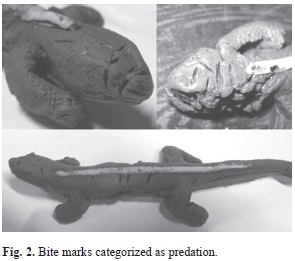
</front><body><![CDATA[ <div style="text-align: center;"><font size="4"><span  style="font-family: verdana; font-weight: bold;">The role of microhabitat in predation on females with alternative dorsal patterns in a small Costa Rican anole (Squamata: Dactyloidae)    <br>     <br> Papel del microh&aacute;bitat en la depredaci&oacute;n de hembras con patrones dorsales alternativos en una peque&ntilde;a lagartija de Costa Rica (Squamata: Dactyloidae)</span></font><font size="4"><span  style="font-family: verdana; font-weight: bold;"></span></font> </div> <br style="font-family: verdana;">     <div style="text-align: center;"><font size="2"><span  style="font-family: verdana;">Evi A.D. Paemelaere<sup><a href="#1">1</a><a  name="3"></a>*</sup>, Craig Guyer<a href="#1"><sup>1</sup></a> &amp; F. Stephen Dobson<sup><a href="#1">1</a>,<a href="#2">2</a><a  name="4"></a>*</sup></span></font>    <br> <br style="font-family: verdana;"> </div> <font size="2"><span style="font-family: verdana;"> <a name="Correspondencia2"></a>*<a href="#Correspondencia1">Direcci&oacute;n para correspondencia:</a><br style="font-family: verdana;"> </span></font> <hr style="width: 100%; height: 2px;"><br style="font-family: verdana;"> <font size="3"><span style="font-family: verdana; font-weight: bold;">Abstract</span></font><br  style="font-family: verdana;"> <br style="font-family: verdana;"> <font size="2"><span style="font-family: verdana;"><span  style="font-weight: bold;"></span></span></font>     <div style="text-align: justify;"><font size="2"><span  style="font-family: verdana;">Predation is one of the major selective agents influencing evolution of color patterns. Cryptic color patterns decrease detection probability by predators, but their concealing function depends on the background against which patterns are seen; therefore, habitat use and color patterns are tightly linked. in many anole species, females exhibit variation in dorsal color patterns; the drab and perhaps cryptic colors of the patterns suggest a predator avoidance function behind this polymorphism. We tested whether these different color patterns experience different predation rates depending on their micro- habitat. We expected each pattern to form at least one optimal combination with a typically used micro-habitat that would result in lower predation compared to other morphs in the same micro-habitat. We tested this hypothesis for anoles at La Selva, Costa Rica, using clay models resembling a common species at this site: <span  style="font-style: italic;">Norops humilis</span>. The first experiment tested for variation in predation on various substrates. We included leaf litter, live leaves, and two size classes of woody stems, using 44 models for each pattern substrate combination. A second experiment tested effects of perch height (10 and 60cm) and diameter (&lt;2cm and &gt;5cm), with 50 models for each pattern perch&nbsp; combination. We found differences in predation rates between the morphs depending&nbsp; on their micro-habitat. Specifically, the striped morph had a significant advantage over the others on green leaves. in the second experiment, striped morphs showed significantly lower predation on low than on high perches, irrespective of perch diameter. Reticulated models had an advantage over other morphs on thin stems for the first experiment, where models were placed about 60cm high. Diameter did not have a significant effect on predation for reticulated morphs when height classes were combined. Dotted models did not experience an advantage over the other morphs in any of the treatments. in leaf litter and on thick perches no morph had any advantage over another, and leaf litter predation rates were generally low. These results support a role for predation in maintaining multiple female morphs within small Costa Rican anoles, such as <span  style="font-style: italic;">N. humilis</span>. </span></font><br  style="font-family: verdana;"> </div> <br style="font-family: verdana;">     <div style="text-align: justify;"><font size="2"><span  style="font-family: verdana;"><span style="font-weight: bold;">Key words: </span>female polymorphism, <span style="font-style: italic;">Norops humilis</span>, selection, predation, La Selva Biological Station, habitat use.</span></font><br style="font-family: verdana;"> </div> <br style="font-family: verdana;"> <font size="3"><span style="font-family: verdana; font-weight: bold;">Resumen</span></font><br  style="font-family: verdana;"> <br style="font-family: verdana;">     <div style="text-align: justify;"><font size="2"><span  style="font-family: verdana;">En los animales, los patrones dorsales de coloraci&oacute;n a menudo se asocian con la protecci&oacute;n contra la depredaci&oacute;n. Con el fin de analizar el papel que tienen los micro-h&aacute;bitat en&nbsp; la&nbsp; depredaci&oacute;n&nbsp; de&nbsp; lagartijas&nbsp; hembras&nbsp; que&nbsp; presentan variaciones en los patrones de&nbsp; coloraci&oacute;n dorsal (colores grises, cr&iacute;pticos),&nbsp; se realiz&oacute; en la Estaci&oacute;n Biol&oacute;gica La Selva, Costa Rica un estudio con el objetivo de comprobar si los patrones de diferentes colores provocan cambios en las tasas de depredaci&oacute;n en funci&oacute;n de a su micro-h&aacute;bitat; se esperaba que cada patr&oacute;n formara una&nbsp; combinaci&oacute;n &oacute;ptima utilizando el micro-habitat y que permitiera de esta manera reducir los niveles de depredaci&oacute;n. Para evidenciar esta hip&oacute;tesis se utilizaron modelos de arcilla que asemejan a la especie <span  style="font-style: italic;">Norops humilis</span> propia del lugar. Se realizaron dos estudios, el primero analiz&oacute; modelos colocados en cuatro sustratos diferentes: hojarasca, hojas vivas y dos clases de tama&ntilde;o de tallos le&ntilde;osos, los cuales representaban cada h&aacute;bitat donde es posible observar esta especie. Un segundo experimento estudi&oacute; el efecto de la&nbsp; altura y el di&aacute;metro de la percha en la depredaci&oacute;n, para ello se colocaron los modelos sobre tallos de diferentes alturas y di&aacute;metros. Fue posible observar en el primer&nbsp; experimento que el morfo rayado&nbsp; tuvo&nbsp; una&nbsp; ventaja&nbsp; significativa&nbsp; sobre&nbsp; los&nbsp; dem&aacute;s morfos en las hojas verdes y que los modelos reticulados tuvieron una ventaja sobre otros morfos en tallos delgados. El segundo estudio mostr&oacute; que los morfos rayados tienen una tasa de depredaci&oacute;n baja en perchas altas, independientemente del di&aacute;metro de la percha. Fue posible comprobar que los morfos punteados no experimentaron ventaja sobre otros morfos en ninguno de los dos estudios.</span></font><br  style="font-family: verdana;"> <br style="font-family: verdana;"> <font size="2"><span style="font-family: verdana;"><span  style="font-weight: bold;">Palabras clave: </span>poliformismo, <span style="font-style: italic;">Norops humilis</span>, selecci&oacute;n, depredaci&oacute;n,&nbsp; Estaci&oacute;n Biol&oacute;gica La Selva, h&aacute;bitat.</span></font><br  style="font-family: verdana;"> </div> <hr style="width: 100%; height: 2px;"><br style="font-family: verdana;">     <div style="text-align: justify;"><font size="2"><span  style="font-family: verdana;">In animals, dorsal color patterns are often associated with protection from predation. Flashing coloration in prey species often func- tions as a warning signal for the predator, while drab color generally decreases visibility (Poulton 1890, Cott 1940, Edmunds 1974). Perception&nbsp; of&nbsp; color&nbsp; patterns,&nbsp; however,&nbsp; depends&nbsp; on the background that the animal is seen against (Endler 1978, Ruxton <span  style="font-style: italic;">et al</span>. 2004, Bond 2007), so that visibility is not inherent to a color pat- tern. Reduced visibility to predators (camouflage) can actually be obtained through color patterns that fail to stand out from the background (crypsis) or patterns that deflect the predator&#8217;s vision from the contours of its prey. in the latter case the colors need not be similar to the background (Cott 1940, Endler 1978, Merilaita &amp; Lind 2005, Cuthill <span style="font-style: italic;">et al</span>. 2007). A camouflaging color pattern can serve a generalist role, forming a compromise by providing camouflage against a variety of backgrounds, but not maximizing camouflage for each back- ground separately (Merilaita <span style="font-style: italic;">et al</span>. 1999, Merilaita <span style="font-style: italic;">et al</span>. 2001). Alternatively, a pattern can be specialized for maximum concealment for a specific micro-habitat element and individuals may select different microhabitats within the heterogeneous environment, so that a variety of&nbsp; color&nbsp; patterns&nbsp; can&nbsp; be&nbsp; maintained&nbsp; within a population (Edmunds 1974, Endler 1978, Endler 1984, Hedrick 1986). in the latter case, predation in heterogeneous environments may result in color polymorphic populations (Ford 1945, Cain &amp; Sheppard 1954).</span></font><br style="font-family: verdana;"> <br style="font-family: verdana;"> <font size="2"><span style="font-family: verdana;">Anoles (Squamata: Dactyloidae) are known to vary in dorsal patterns within populations (e.g. Fitch 1975, Schoener &amp; Schoener 1976). Moreover, these pattern variations are primarily limited to females, and the same patterns re-occur in many species of anoles throughout their range (Savage 2002, Paemelaere <span  style="font-style: italic;">et al</span>. 2011a). These patterns vary in shape and do not appear to differ in color. Common female-only morphs or gynomorphs are the cream-colored vertebral striped and reticulated&nbsp; patterns.&nbsp; The&nbsp; variety&nbsp; of&nbsp; patterns may also include a male-like or andromorph pattern, which differs among species. The color pattern of these anoles consists of varieties of brown and green, suggesting that these patterns help&nbsp; reduce&nbsp; visibility&nbsp; to&nbsp; predators&nbsp; (Collette 1961, Fitch 1975, Macedonia 2001), but the maintenance of this polymorphism has rarely been studied.</span></font><br  style="font-family: verdana;"> <br style="font-family: verdana;"> <font size="2"><span style="font-family: verdana;">In <span  style="font-style: italic;">Norops sagrei</span> (Dum&eacute;ril &amp; Bibron 1837) frequency dependent selection appears to play a role in the maintenance of three female morphs (Calsbeek <span  style="font-style: italic;">et al</span>. 2010), but for <span style="font-style: italic;">N. humilis</span> (Peters 1863), no support was found for this mechanism (Paemelaere <span style="font-style: italic;">et al</span>. 2011b). A comparative study found that female polymorphism in anoles is associated with perch use (Paemelaere 2010). Previous studies indicated that female morphs select different perches. in particular, striped females of <span style="font-style: italic;">N. sagrei</span> appear to select thinner perches (Schoener &amp; Schoener 1976),&nbsp; while&nbsp; in&nbsp; <span style="font-style: italic;">N.&nbsp; polylepis</span>&nbsp; (Peters&nbsp; 1874) striped females select higher perches (Steffen 2010). Both studies tested the hypothesis that dorsal pattern polymorphism in anoles is maintained through differential concealment among alternative morphs that select different back- grounds. Although perch use appears to differ among female morphs, no study has addressed the effect of predation on different morphs.</span></font><br style="font-family: verdana;"> </div> <br style="font-family: verdana;">     <div style="text-align: justify;"><font size="2"><span  style="font-family: verdana;">Methods have been developed to quantify how easily an individual is detected by a predator, depending on the background the individual is seen against (Endler 1990, Endler &amp; Mielke 2005). While these techniques allow for relatively easy assessment of background matching for <span style="font-style: italic;">color </span>polymorphism, such techniques have not been well developed for <span  style="font-style: italic;">pattern </span>polymorphism (Endler &amp; Mielke 2005). Clay models have gained popularity to assess the interactions between predator and prey because predation is difficult to study under natural circumstances (Brodie 1993, Bittner 2003, Howe <span style="font-style: italic;">et al</span>. 2009, Noonan &amp; Comeault 2009, Steffen 2009). The advantage of clay models is that individual variation, such as size and behavior, can be removed. Under the hypothesis of background matching by morphs, we expected to find different predation rates under a variety of pattern-background combinations. Specifically, we expected each morph to match at least one background for which predation of this morph was lower than for other morphs.</span></font><br  style="font-family: verdana;"> </div> <br style="font-family: verdana;"> <font size="3"><span style="font-family: verdana; font-weight: bold;">Materials and methods</span></font><br style="font-family: verdana;"> <br style="font-family: verdana;">     ]]></body>
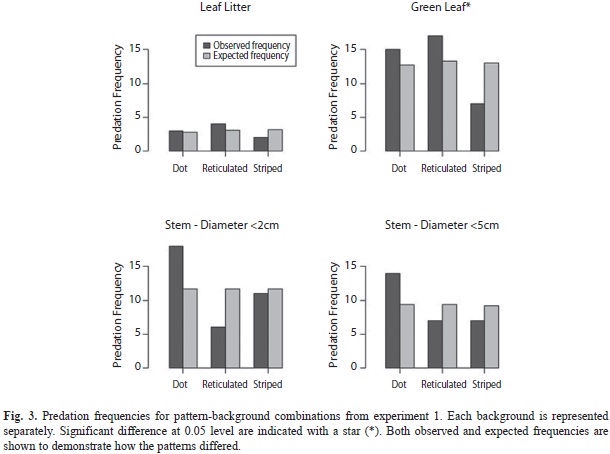
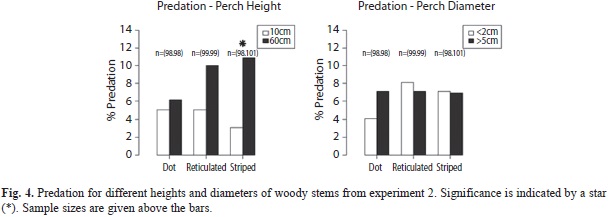
<body><![CDATA[<div style="text-align: justify;"><font size="2"><span  style="font-family: verdana;">We performed two experiments at the La Selva Biological Station, Costa Rica (10&ordm;26&#8217; N - 83&ordm;59&#8217; W). Several species of anoles are found at La Selva that are polymorphic in female dorsal patterns. The most common polymorphic species are <span style="font-style: italic;">Norops humilis</span>, <span  style="font-style: italic;">N. limifrons</span> and <span  style="font-style: italic;">N. capito</span> (Guyer &amp; Donnelly 2004). <span style="font-style: italic;">N. humilis</span> measures up to 45mm snout-vent length (SVL), and perches low on trunks and in the leaf litter (Fitch 1975, Talbot 1979). <span style="font-style: italic;">N. limifrons</span> perches&nbsp; somewhat&nbsp; higher&nbsp; and&nbsp; females&nbsp; grow to 43mm SVL. The larger <span  style="font-style: italic;">N. capito</span> measures up to 93mm SVL and perches on tree trunks at heights similar to <span  style="font-style: italic;">N. limifrons</span> (Fitch 1973, Fitch 1975, Talbot 1979). Predators of these anoles include&nbsp; spiders, birds, snakes, lizards and arthropods (Guyer 1988). Females of the polymorphic anoles at La Selva can have one of three dorsal patterns: a male-like pattern, a reticulated pattern or a vertebral stripe that may vary from cream to brown depending on weather conditions (J.E. Steffen, pers. comm.). The male-like pattern consists of vertebral dots (sometimes no dots present) in <span  style="font-style: italic;">N. humilis</span> and <span  style="font-style: italic;">N. limifrons</span>. in <span style="font-style: italic;">N. capito</span>, the entire dorsum has a lichenous pattern.</span></font><br  style="font-family: verdana;"> <br style="font-family: verdana;"> <font size="2"><span style="font-family: verdana;">We exposed clay models to free-ranging predators. The clay lizards represented the reticulated and striped gynomorph and dotted andromorph modeled after <span  style="font-style: italic;">N. humilis</span> (<a href="/img/revistas/rbt/v61n2/a31i1.jpg">Fig. 1</a>). Each model measured 50mm SVL and the tails measured&nbsp; 70mm.&nbsp; Models&nbsp; were&nbsp; made&nbsp; from non-hardening, odorless, non-toxic modeling clay&nbsp; (VanAken<sup>TM</sup>),&nbsp; and&nbsp; constructed&nbsp; with&nbsp; a self-made mould (SELVA brand silicone rubber&nbsp; HB).&nbsp; The&nbsp; soft&nbsp; clay&nbsp; allowed&nbsp; observation of impressions resulting from predator attacks (Brodie 1993). The brown base color for the models was chosen to match <span  style="font-style: italic;">N. humilis</span> by human eye. The clay did not reflect UV, but UV radiation from the body has not been found in other species of anoles and was therefore not expected in <span style="font-style: italic;">N. humilis</span> (Macedonia <span style="font-style: italic;">et al</span>. 2003). The outline of the reticulated pattern and the vertebral stripe were drawn with a black permanent marker. The same marker was also used for the vertebral dots and for the eyes. All models on perches were placed head down and kept in place by a metal wire through the ventral midsection.</span></font>    <br> </div> <font size="2"><span style="font-family: verdana;"></span></font><font  size="2"><span style="font-family: verdana;"><span  style="font-weight: bold;">    <br> </span></span></font>     <div style="text-align: justify;"><font size="2"><span  style="font-family: verdana;"><span style="font-weight: bold;">Perch substrate: </span>The first study took place in June, 2007. Clay models were placed on four different substrates that represented habitat elements where the polymorphic anoles were seen: leaf litter, green (live) leaves, stems less than 2cm diameter and stems more than 5cm diameter. All stems were woody, to avoid effects of green versus brown stems. On live leaves and stems, models were placed as close to 60cm high as possible, because this is the average perch height of adult <span style="font-style: italic;">N. humilis</span> (Talbot 1979). Each pattern-substrate combination received 44 models, for a total of 528. 11 study plots each contained four replications of each of 12 possible combinations of dorsal pattern and substrate. A random number was assigned to&nbsp; every&nbsp; combination&nbsp; using&nbsp; &#8216;sample(48)&#8217;&nbsp; in R Version&nbsp; 2.8.1 (R Development Core Team 2008), and used as the order in which the combinations were placed within the plot. Models were placed in six rows. The minimum distance between models was two meters, but this distance increased if the pre-determined perch type was located at a slightly greater distance. Models were checked every third day. Models with predation were removed from the plot and damaged&nbsp; models&nbsp; were&nbsp; repaired&nbsp; by&nbsp; smoothing the surface. Because damage from ants increased over time, all models were collected after 12 days.</span></font><br  style="font-family: verdana;"> <br style="font-family: verdana;"> <font size="2"><span style="font-family: verdana;"><span  style="font-weight: bold;">Perch diameter and height:</span> In July 2007, a second study investigated the effect of perch height and diameter on predation. Models were placed vertically on stems of different diameters and at different heights. The diameter of the stem was lower than 2cm or thicker than 5cm. Models were placed at 10cm or 60cm height&nbsp; from&nbsp; the&nbsp; forest&nbsp; floor.&nbsp; Combinations were randomized and placement depended on the availability of perches as described above. For each of 12 combinations of pattern, diameter and height, 50 models were prepared for a total of 600 models. They were placed in plots as described above and left for four days before collecting all of the models and checking them for signs of predation.</span></font><br style="font-family: verdana;"> <br style="font-family: verdana;"> <font size="2"><span style="font-family: verdana;">Both experiments were carried out in disturbed forest (abandoned plantations, secondary growth). All three common polymorphic species were encountered in this type of habitat.&nbsp; Plots&nbsp; were&nbsp; separated&nbsp; by&nbsp; at&nbsp; least&nbsp; 100m. Upon collecting the models, they were placed in Ziploc bags and transported to the lab, where predation marks were recorded. in both experiments, predation rates per pattern per back- ground were summed over the full duration of the experiment. Only V or U-shaped imprints and small symmetric slits and punctures were scored as predation (Brodie 1993, Saporito <span style="font-style: italic;">et al</span>. 2007, Steffen 2009) (<a  href="/img/revistas/rbt/v61n2/a31i2.jpg">Fig. 2</a>). Ant damage was not scored as predation. When multiple predator marks were seen on one individual, a single predation event was scored. Occasionally tails were found to have fallen off of the model onto the ground. Marks on these tails were&nbsp; not&nbsp; included&nbsp; in&nbsp; the&nbsp; analysis.&nbsp; Models that were not retrieved were considered lost. Analyses were run with and without scoring the lost models as predation events. in addition, analyses were ran with serially attacked models removed, because attacks on neighboring models could result from easier detection after one of the models had been approached.</span></font>    <br> </div> <font size="2"><span style="font-family: verdana;"></span></font><font  size="2"><span style="font-family: verdana;">    <br> </span></font>     <div style="text-align: justify;"><font size="2"><span  style="font-family: verdana;">In the first experiment, absence or presence of predation on the model was compared for the different pattern-background combinations. We used a randomization test of independence with&nbsp; 5 000&nbsp; iterations&nbsp; partitioned&nbsp; per&nbsp; background (McDonald 2009). The strength of the association was reported as Cram&eacute;r&#8217;s phi (&#966;<sub>c</sub>), which ranges between 0 and 1, but 0.5 would be considered a strong association, 0.3 medium and 0.1 weak. in the second experiment, this test&nbsp; was&nbsp; also&nbsp; used&nbsp; to&nbsp; determine&nbsp; differences in predation at differing perch heights and on differing perch diameters for each morph. The same randomization test was also used for each experiment to determine differences in predation rate on morphs, independent of the perch they&nbsp; were&nbsp; on. All&nbsp; analyses&nbsp; were&nbsp; completed with proc freq in SAS/STAT &reg; software, Version 9.1.3 for SAS System for Windows.</span></font><br style="font-family: verdana;"> </div> <br style="font-family: verdana;"> <font size="3"><span style="font-family: verdana; font-weight: bold;">Results</span></font><br  style="font-family: verdana;"> <br style="font-family: verdana;">     <div style="text-align: justify;"><font size="2"><span  style="font-family: verdana;"><span style="font-weight: bold;">Perch substrate: </span>Of 515 retrieved models, 111 (21%) showed signs of predation. Overall, predation was highest on dotted (andromorph) models, moderate for reticulated gynomorphs, and&nbsp; lowest&nbsp; for&nbsp; striped&nbsp; gynomorphs&nbsp; (Dotted: 29.8%, Reticulated: 19.5%, Striped: 15.6%, &#935;<sup>2</sup><sub>(2, N=515)</sub>=9.06, p=0.01, &#966;<sub>c</sub>=0.13). For models placed on live leaves, the number of predation events differed significantly&nbsp; between&nbsp; morphs; striped morphs experienced less predation than expected,&nbsp; while&nbsp; the&nbsp; opposite&nbsp; was&nbsp; true&nbsp; for both other morphs (&#935;<sup>2</sup><sub>(2, N=129)</sub>=6.45,&nbsp; p=0.04, &#966;<sub>c</sub>=0.22; <a href="/img/revistas/rbt/v61n2/a31i3.jpg">Fig. 3</a>). On stems with a diameter less than&nbsp; two&nbsp; centimeters,&nbsp; the&nbsp; reticulated&nbsp; model had a lower attack rate and the dotted morph a much higher attack rate than expected (&#935;<sup>2</sup><sub>(2, N=131)</sub>=8.30,&nbsp; p=0.02,&nbsp; &#966;<sub>c</sub>=0.24).&nbsp;&nbsp; Predation&nbsp; in leaf&nbsp; litter&nbsp; was&nbsp; generally&nbsp; very&nbsp; low&nbsp; and&nbsp; did not&nbsp; significantly&nbsp; differ&nbsp; among&nbsp; morphs&nbsp; (&#935;<sup>2</sup><sub>(2, N=123)</sub>=0.81,&nbsp; p=0.67,&nbsp; &#966;<sub>c</sub>=0.08).&nbsp; Similarly,&nbsp; no significant&nbsp; difference&nbsp; was&nbsp; found&nbsp; in&nbsp; predator attacks on models placed on stems greater than five centimeters in diameter (&#935;<sup>2</sup><sub>(2, N=132)</sub>=4.26, p=0.12,&nbsp; &#966;<sub>c</sub>=0.18).&nbsp; When&nbsp; repeating&nbsp; the&nbsp; analysis&nbsp; with&nbsp; lost&nbsp; models&nbsp;&nbsp; scored&nbsp; as&nbsp; predation, results were virtually unchanged (not shown). Removing&nbsp; serially&nbsp; attacked&nbsp; models&nbsp; resulted in similar patterns&nbsp; of predation rates, but low sample&nbsp; size&nbsp; resulting&nbsp; in&nbsp; insignificant&nbsp; differences (not shown).</span></font><br style="font-family: verdana;"> <br style="font-family: verdana; font-weight: bold;"> <font size="2"><span style="font-family: verdana;"><span  style="font-weight: bold;">Perch&nbsp; diameter&nbsp; and&nbsp; height:&nbsp; </span>Of&nbsp; 600 models,&nbsp; 593&nbsp; were&nbsp; retrieved&nbsp; and,&nbsp; of&nbsp; these, 6.7 % showed signs of predation. No significant difference in predation was found for morphs&nbsp; placed&nbsp; at&nbsp; perches&nbsp; less&nbsp; than&nbsp; two&nbsp; or more than five centimeters diameter (Dotted: &#935;<sup>2</sup><sub>(1, N=196)</sub>=0.88, p=0.35, &#966;<sub>c</sub>=-0.07;&nbsp; Reticulated: &#935;<sup>2</sup><sub>(1, N=198)</sub>=0.07, p=0.79,&#966;<sub>c</sub>=0.02;&nbsp; Striped: &#935;<sup>2</sup><sub>(1,&nbsp; N=199)</sub>=0.00,&nbsp; p=0.95,&nbsp; &#966;<sub>c</sub>=0.00;&nbsp; <a  href="/img/revistas/rbt/v61n2/a31i4.jpg">Fig.&nbsp;&nbsp; 4</a>). When comparing predation between low&nbsp; and high perches, dotted and reticulated morphs did not&nbsp; significantly&nbsp; differ&nbsp; in&nbsp; predation&nbsp; (Dotted: &#935;<sup>2</sup><sub>(1, N=196)</sub>=0.10, p=0.76, &#966;<sub>c</sub>=-0.02; Reticulated (&#935;<sup>2</sup><sub>(1,&nbsp; N=198)</sub>=1.73,&nbsp; p=0.19,&nbsp; &#966;<sub>c</sub>=-0.09).&nbsp; Striped morphs,&nbsp; on&nbsp; the&nbsp; other&nbsp;&nbsp; hand,&nbsp; were&nbsp; predated significantly less on the&nbsp; lower perches (&#935;<sup>2</sup><sub>(1, N=199)</sub>=4.95, p&lt;0.03,&nbsp; &#966;<sub>c</sub>=-0.15). in&nbsp; our study, predation did not differ between female pattern morphs (&#935;<sup>2</sup><sub>(1,&nbsp; N=593)</sub>=0.66, p=0.72). Repeating the analysis with lost models scored as predation did not change the conclusions.</span></font><br  style="font-family: verdana;"> </div> <br style="font-family: verdana;"> <font size="3"><span style="font-family: verdana; font-weight: bold;">Discussion</span></font><br  style="font-family: verdana;">     <div style="text-align: justify;"><font size="2"><span  style="font-family: verdana;">    <br> The microhabitat hypothesis for maintaining female polymorphism predicts that predation differs based on pattern-background combinations. Hence, survival would be highest for females selecting the background that provides the best concealment for their pattern. The prolonged survival and consequent higher lifetime reproductive output of these females could be sufficient for polymorphism to be maintained. Our first experiment showed that clay models representing female morphs of common anoles at La Selva differ in the rate of&nbsp; predator&nbsp; attacks,&nbsp; depending&nbsp; on&nbsp; the&nbsp; substrate they were placed on. We also found a higher overall predation rate on dotted morphs compared to the other two, but this difference was not seen in the second experiment. In the second experiment, striped morphs exhibited lower predation rates on relatively low perches, with a non-significant qualitative trend in this direction by reticulated morphs.</span></font><br  style="font-family: verdana;"> <br style="font-family: verdana;"> <font size="2"><span style="font-family: verdana;">The difference between the first and second experiment could be due to differences in the predation rates. Predation in the first study was high compared to the typical predation rate of 5-10% on clay models (Bittner 2003, Husak <span  style="font-style: italic;">et al</span>. 2006). This rate was found in studies leaving models in the field between four and seven days and thus the difference in predation rate may be due to the relatively long time period (12 days) during which models in the first experiment were left in the field. indeed, predation rate per day was 1.75%, so that four days would result in a 7% predation rate. The second study, in which models were left out for four days, predation rate was 6.7%, and thus consistent with predation rates generally seen in clay model studies.</span></font><br  style="font-family: verdana;"> <br style="font-family: verdana;"> <font size="2"><span style="font-family: verdana;">The first study showed that the reticulated morph had a significant advantage over striped and dotted morphs on thin stems, at least when placed at 60cm high (where the second experiment showed that % predation was relatively high). When low (10cm) and high (60cm) heights were combined in the second study, no significant effect of diameter was seen on predation rates for the reticulated morph, though there was a nearly doubled rate of predation at the greater height. The striped morph had lower predation than expected on all substrates, but it had particular advantage over the other two on green leaves. Although the brown coloration of all morphs stands out against the green background of these leaves, the stripe may function as a disruptive pattern (Cott 1940), rendering it more effective on backgrounds that are in strong contrast with the brown body color (Stevens &amp; Cuthill 2006). For stems, the typical, elevated perch for <span style="font-style: italic;">N. humilis</span>, striped morphs were found to experience significantly less predation on low stems, compared to higher perches. Predation on the dotted morph was generally higher than expected. The higher predation rate on the dotted morph in the first study suggests that this andromorph pattern may be the least concealing.</span></font><br  style="font-family: verdana;"> </div> <br style="font-family: verdana;">     ]]></body>
<body><![CDATA[<div style="text-align: justify;"><font size="2"><span  style="font-family: verdana;">Females of <span  style="font-style: italic;">N. humilis</span> spend much time on the leaf litter and predation was low in the leaf litter for all morphs. The lower predation in the leaf litter could be because the different morphs are equally camouflaged in this diverse background.&nbsp; Alternatively,&nbsp; predation&nbsp; on&nbsp; the leaf litter could be lower due to greater activity of predators at greater heights. Anoles have been shown to experience lower predation at lower perch heights (Steffen 2009). This was confirmed by results of the second experiment, where all morphs experienced less predation on low versus high perches, although this was only significant for the striped morph. Lower predation on females in the leaf litter could result in relaxed selection on morphs. Because not all species of female polymorphic anoles frequently roam the leaf litter, this could not explain the occurrence of multiple morphs in those species.</span></font><br  style="font-family: verdana;"> <br style="font-family: verdana;"> <font size="2"><span style="font-family: verdana;">With only the reticulated and striped morph showing a predation advantage at select perches, and considering the higher overall predation rate on dotted andromorphs in the first experiment, results suggest that the gynomorph patterns may have evolved in response to predation, while the dotted morph may not have. Nevertheless, the dotted morph represents the highest frequency of females, and it is the typical male pattern in <span  style="font-style: italic;">N. humilis</span> at La Selva. The high frequency of dotted females could,&nbsp; perhaps,&nbsp; result&nbsp; from&nbsp; its&nbsp; presence&nbsp; in males combined with a dominant allele coding for vertebral dots. In female polymorphic damselflies, the pattern seen in males as well as females was found to be coded by a dominant autosomal allele (Andres &amp; Cordero 1999). Alternatively, dotted females could benefit in other ways; for example a benefit might accrue through increased male attention based on their higher frequency in the population (Cordero 1992, Van Gossum <span  style="font-style: italic;">et al</span>. 2001).</span></font><br style="font-family: verdana;"> <br style="font-family: verdana;"> <font size="2"><span style="font-family: verdana;">If gynomorph patterns have evolved in response to predation, as suggested by our results, then it is not surprising that males have not evolved these pattern variations. Their different morphology, behavior and ecology compared to females are expected to reduce the potential benefit of cryptic patterns. First, males&nbsp; are&nbsp; more&nbsp; vigilant,&nbsp; while&nbsp; females&nbsp; are more focused on food acquisition and perhaps less mobile due to continuous presence of eggs (Bauwens &amp; Thoen 1981, but see Schwarzkopf &amp; Shine 1992, Lee <span  style="font-style: italic;">et al</span>. 1996, Lailvaux <span  style="font-style: italic;">et al</span>. 2003).&nbsp; Males&nbsp; may&nbsp; also&nbsp; use&nbsp; dewlap&nbsp; displays to deter predators (Leal &amp; Rodriguez-Robles 1997). Therefore, to avoid predation females may rely more on camouflage than males. Furthermore, crypsis is affected by movement (Stevens&nbsp; 2007).&nbsp; Predation&nbsp; benefits&nbsp; found&nbsp; in our study apply to motionless individuals. The advantage may disappear in motion and thus be most effective for the less mobile females. Next, the gynomorph patterns may not have the same concealing effect on males as on females due to differences in body shape between slender males and gravid females as seen in <span style="font-style: italic;">Lampropholis delicate</span> (Forsman &amp; Shine 1995, Merilaita &amp; Lind 2005). Finally, colorful dewlap displays by males also defeat the purpose of cryptic patterns (Fleishman 1991).</span></font><br  style="font-family: verdana;"> </div> <br style="font-family: verdana;">     <div style="text-align: justify;"><font size="2"><span  style="font-family: verdana;">Overall, our results supported the hypothesis of differential predation on morphs based on the background against which they were seen. The second prediction of the micro- habitat hypothesis is that individuals select the background that provides the best concealment for their pattern. Future research should test whether these anoles are indeed selecting the perches where predation is lowest for their dorsal pattern.</span></font><br  style="font-family: verdana;"> </div> <br style="font-family: verdana;"> <font size="3"><span style="font-family: verdana; font-weight: bold;">Acknowledgments</span></font>    <br> <font size="2"><span style="font-family: verdana; font-weight: bold;"></span></font><br  style="font-family: verdana;">     <div style="text-align: justify;"><font size="2"><span  style="font-family: verdana; font-weight: bold;"></span><span  style="font-family: verdana;">We are grateful to M. Wooten and B. Zinner&nbsp; for&nbsp; comments&nbsp; on&nbsp; earlier&nbsp; versions&nbsp; of the manuscript. L. Pastorello provided assistance with statistical procedures. M. Paemelaere helped with the design of the mold and construction&nbsp; of&nbsp; models,&nbsp; and&nbsp; A.&nbsp; Liner&nbsp; and R.&nbsp; Conway&nbsp; assisted&nbsp; in&nbsp; the&nbsp; field.&nbsp; We&nbsp; thank R. Saporito for helpful tips on clay model experiments. We also owe our gratitude to the staff of the La Selva Biological station. This research was funded by the Organization for Tropical&nbsp; Studies&nbsp; and&nbsp; the Auburn&nbsp; University Graduate School. This research was approved by IACUC, permit number 2007-1177, and by the Costa Rican Ministry of Environment and Energy (MINAE), permit number 01521.</span></font><br  style="font-family: verdana;"> </div> <hr style="width: 100%; height: 2px;">    <!-- ref --><br> <br style="font-family: verdana;"> <font size="3"><span style="font-family: verdana; font-weight: bold;">References</span></font><br  style="font-family: verdana;"> <br style="font-family: verdana;"> <font size="2"><span style="font-family: verdana;">Andres, J.A. &amp; A. Cordero. 1999. The&nbsp; inheritance&nbsp; of female colour morphs in&nbsp; the damselfly <span style="font-style: italic;">Ceriagrion tenellum</span>&nbsp; (Odonata,&nbsp; Coenagrionidae).&nbsp; Heredity&nbsp; 82: 328-335.    &nbsp;&nbsp;&nbsp;&nbsp;&nbsp;&nbsp;&nbsp;&nbsp;[&#160;<a href="javascript:void(0);" onclick="javascript: window.open('/scielo.php?script=sci_nlinks&ref=1528560&pid=S0034-7744201300030003100001&lng=','','width=640,height=500,resizable=yes,scrollbars=1,menubar=yes,');">Links</a>&#160;]<!-- end-ref --><!-- ref --></span></font><br  style="font-family: verdana;"> <br style="font-family: verdana;"> <font size="2"><span style="font-family: verdana;">Bauwens,&nbsp; D. &amp; C. Thoen. 1981. Escape&nbsp; tactics and vulnerability to predation&nbsp; associated with reproduction in the&nbsp; lizard&nbsp; <span  style="font-style: italic;">Lacerta vivipara</span>. J. Anim. Ecol.&nbsp; 50: 733-743.    &nbsp;&nbsp;&nbsp;&nbsp;&nbsp;&nbsp;&nbsp;&nbsp;[&#160;<a href="javascript:void(0);" onclick="javascript: window.open('/scielo.php?script=sci_nlinks&ref=1528561&pid=S0034-7744201300030003100002&lng=','','width=640,height=500,resizable=yes,scrollbars=1,menubar=yes,');">Links</a>&#160;]<!-- end-ref --><!-- ref --></span></font><br  style="font-family: verdana;"> <br style="font-family: verdana;"> <font size="2"><span style="font-family: verdana;">Bittner, T.D. 2003. Polymorphic clay models of <span style="font-style: italic;">Thamnophis sirtalis</span> suggest patterns of avian predation. Ohio J. Sci. 103: 62-66.    &nbsp;&nbsp;&nbsp;&nbsp;&nbsp;&nbsp;&nbsp;&nbsp;[&#160;<a href="javascript:void(0);" onclick="javascript: window.open('/scielo.php?script=sci_nlinks&ref=1528562&pid=S0034-7744201300030003100003&lng=','','width=640,height=500,resizable=yes,scrollbars=1,menubar=yes,');">Links</a>&#160;]<!-- end-ref --><!-- ref --></span></font><br style="font-family: verdana;"> <br style="font-family: verdana;"> <font size="2"><span style="font-family: verdana;">Bond, A.B. 2007. The evolution of color&nbsp; polymorphism: Crypticity searching images, and apostatic selection. Annu. Rev. Ecol. Evol. Sys. 38: 489-514.    &nbsp;&nbsp;&nbsp;&nbsp;&nbsp;&nbsp;&nbsp;&nbsp;[&#160;<a href="javascript:void(0);" onclick="javascript: window.open('/scielo.php?script=sci_nlinks&ref=1528563&pid=S0034-7744201300030003100004&lng=','','width=640,height=500,resizable=yes,scrollbars=1,menubar=yes,');">Links</a>&#160;]<!-- end-ref --><!-- ref --></span></font><br  style="font-family: verdana;"> <br style="font-family: verdana;"> <font size="2"><span style="font-family: verdana;">Brodie,&nbsp; E.D. 1993. Differential avoidance of&nbsp; coral snake banded patterns by&nbsp; free-ranging avian predators in Costa-Rica. Evolution 47: 227-235.    &nbsp;&nbsp;&nbsp;&nbsp;&nbsp;&nbsp;&nbsp;&nbsp;[&#160;<a href="javascript:void(0);" onclick="javascript: window.open('/scielo.php?script=sci_nlinks&ref=1528564&pid=S0034-7744201300030003100005&lng=','','width=640,height=500,resizable=yes,scrollbars=1,menubar=yes,');">Links</a>&#160;]<!-- end-ref --><!-- ref --></span></font><br  style="font-family: verdana;"> <br style="font-family: verdana;"> <font size="2"><span style="font-family: verdana;">Cain, A.J. &amp; P.M. Sheppard. 1954. The theory of adaptive polymorphism. Am. Nat. 88: 321-326.    &nbsp;&nbsp;&nbsp;&nbsp;&nbsp;&nbsp;&nbsp;&nbsp;[&#160;<a href="javascript:void(0);" onclick="javascript: window.open('/scielo.php?script=sci_nlinks&ref=1528565&pid=S0034-7744201300030003100006&lng=','','width=640,height=500,resizable=yes,scrollbars=1,menubar=yes,');">Links</a>&#160;]<!-- end-ref --><!-- ref --></span></font><br  style="font-family: verdana;"> <br style="font-family: verdana;"> <font size="2"><span style="font-family: verdana;">Calsbeek, R., L. Bonvini &amp; R.M. Cox. 2010. Geographic variation,&nbsp;&nbsp; frequency-dependent selection, and the maintenance of a female-limited polymorphism. Evolution 64: 116-125.    &nbsp;&nbsp;&nbsp;&nbsp;&nbsp;&nbsp;&nbsp;&nbsp;[&#160;<a href="javascript:void(0);" onclick="javascript: window.open('/scielo.php?script=sci_nlinks&ref=1528566&pid=S0034-7744201300030003100007&lng=','','width=640,height=500,resizable=yes,scrollbars=1,menubar=yes,');">Links</a>&#160;]<!-- end-ref --><!-- ref --></span></font><br style="font-family: verdana;"> <br style="font-family: verdana;"> <font size="2"><span style="font-family: verdana;">Collette, B.B. 1961. Correlations between&nbsp; ecology&nbsp; and morphology in anoline&nbsp; lizards from Havana, Cuba and southern&nbsp; Florida. Bull. Mus. Comp. Zool. 125: 137-162.    &nbsp;&nbsp;&nbsp;&nbsp;&nbsp;&nbsp;&nbsp;&nbsp;[&#160;<a href="javascript:void(0);" onclick="javascript: window.open('/scielo.php?script=sci_nlinks&ref=1528567&pid=S0034-7744201300030003100008&lng=','','width=640,height=500,resizable=yes,scrollbars=1,menubar=yes,');">Links</a>&#160;]<!-- end-ref --><!-- ref --></span></font><br style="font-family: verdana;"> <br style="font-family: verdana;"> <font size="2"><span style="font-family: verdana;">Cordero, A. 1992. Density-dependent mating success and color polymorphism in females of the damselfly <span style="font-style: italic;">Ischnura&nbsp; graellsii</span> (Odonata, Coenagrionidae). J.&nbsp; Anim. Ecol. 61: 769-780.    &nbsp;&nbsp;&nbsp;&nbsp;&nbsp;&nbsp;&nbsp;&nbsp;[&#160;<a href="javascript:void(0);" onclick="javascript: window.open('/scielo.php?script=sci_nlinks&ref=1528568&pid=S0034-7744201300030003100009&lng=','','width=640,height=500,resizable=yes,scrollbars=1,menubar=yes,');">Links</a>&#160;]<!-- end-ref --></span></font>    <!-- ref --><br> <font size="2"><span style="font-family: verdana;"></span></font><br  style="font-family: verdana;"> <font size="2"><span style="font-family: verdana;"></span><span  style="font-family: verdana;">Cott, H.B. 1940. Adaptive coloration in animals. Methuen, London, United Kingdom.    &nbsp;&nbsp;&nbsp;&nbsp;&nbsp;&nbsp;&nbsp;&nbsp;[&#160;<a href="javascript:void(0);" onclick="javascript: window.open('/scielo.php?script=sci_nlinks&ref=1528570&pid=S0034-7744201300030003100010&lng=','','width=640,height=500,resizable=yes,scrollbars=1,menubar=yes,');">Links</a>&#160;]<!-- end-ref --><!-- ref --></span></font><br  style="font-family: verdana;"> <br style="font-family: verdana;"> <font size="2"><span style="font-family: verdana;">Cuthill, i.C., T.S. Troscianko, A. Kibblewhite, O. King &amp; M. Stevens. 2007. Edge&nbsp; enhancement in disruptive camouflage. Perception 36: 1399.    &nbsp;&nbsp;&nbsp;&nbsp;&nbsp;&nbsp;&nbsp;&nbsp;[&#160;<a href="javascript:void(0);" onclick="javascript: window.open('/scielo.php?script=sci_nlinks&ref=1528571&pid=S0034-7744201300030003100011&lng=','','width=640,height=500,resizable=yes,scrollbars=1,menubar=yes,');">Links</a>&#160;]<!-- end-ref --><!-- ref --></span></font><br  style="font-family: verdana;"> <br style="font-family: verdana;"> <font size="2"><span style="font-family: verdana;">Dum&eacute;ril, A.M.C. &amp; G. Bibron. 1837. Erp&eacute;tologie g&eacute;n&eacute;rale ou histoire naturelle&nbsp; complete des reptiles. Vol. 4., Paris, France.    &nbsp;&nbsp;&nbsp;&nbsp;&nbsp;&nbsp;&nbsp;&nbsp;[&#160;<a href="javascript:void(0);" onclick="javascript: window.open('/scielo.php?script=sci_nlinks&ref=1528572&pid=S0034-7744201300030003100012&lng=','','width=640,height=500,resizable=yes,scrollbars=1,menubar=yes,');">Links</a>&#160;]<!-- end-ref --><!-- ref --></span></font><br  style="font-family: verdana;"> <br style="font-family: verdana;"> <font size="2"><span style="font-family: verdana;">Edmunds,&nbsp; M. 1974. Defence in animals.&nbsp; Longman, Har- low, United Kingdom.    &nbsp;&nbsp;&nbsp;&nbsp;&nbsp;&nbsp;&nbsp;&nbsp;[&#160;<a href="javascript:void(0);" onclick="javascript: window.open('/scielo.php?script=sci_nlinks&ref=1528573&pid=S0034-7744201300030003100013&lng=','','width=640,height=500,resizable=yes,scrollbars=1,menubar=yes,');">Links</a>&#160;]<!-- end-ref --><!-- ref --></span></font><br  style="font-family: verdana;"> <br style="font-family: verdana;"> <font size="2"><span style="font-family: verdana;">Endler, J.A. 1978. A predator&#8217;s view of animal color pat- terns. Evol. Biol. 11: 319-364.    &nbsp;&nbsp;&nbsp;&nbsp;&nbsp;&nbsp;&nbsp;&nbsp;[&#160;<a href="javascript:void(0);" onclick="javascript: window.open('/scielo.php?script=sci_nlinks&ref=1528574&pid=S0034-7744201300030003100014&lng=','','width=640,height=500,resizable=yes,scrollbars=1,menubar=yes,');">Links</a>&#160;]<!-- end-ref --><!-- ref --></span></font><br  style="font-family: verdana;"> <br style="font-family: verdana;"> <font size="2"><span style="font-family: verdana;">Endler, J.A. 1984. Progressive Background in Moths, and a Quantitative Measure of Crypsis. Biol. J. Linn. Soc. 22: 187-231.    &nbsp;&nbsp;&nbsp;&nbsp;&nbsp;&nbsp;&nbsp;&nbsp;[&#160;<a href="javascript:void(0);" onclick="javascript: window.open('/scielo.php?script=sci_nlinks&ref=1528575&pid=S0034-7744201300030003100015&lng=','','width=640,height=500,resizable=yes,scrollbars=1,menubar=yes,');">Links</a>&#160;]<!-- end-ref --><!-- ref --></span></font><br style="font-family: verdana;"> <br style="font-family: verdana;"> <font size="2"><span style="font-family: verdana;">Endler, J.A. 1990. On the Measurement and Classification of Color in Studies of Animal Color Patterns. Biol. J. Linn. Soc. 41: 315-352.    &nbsp;&nbsp;&nbsp;&nbsp;&nbsp;&nbsp;&nbsp;&nbsp;[&#160;<a href="javascript:void(0);" onclick="javascript: window.open('/scielo.php?script=sci_nlinks&ref=1528576&pid=S0034-7744201300030003100016&lng=','','width=640,height=500,resizable=yes,scrollbars=1,menubar=yes,');">Links</a>&#160;]<!-- end-ref --><!-- ref --></span></font><br  style="font-family: verdana;"> <br style="font-family: verdana;"> <font size="2"><span style="font-family: verdana;">Endler, J.A. &amp; P.W. Mielke. 2005. Comparing entire colour patterns as birds see them.&nbsp; Biol. J. Linn. Soc. 86: 405-431.    &nbsp;&nbsp;&nbsp;&nbsp;&nbsp;&nbsp;&nbsp;&nbsp;[&#160;<a href="javascript:void(0);" onclick="javascript: window.open('/scielo.php?script=sci_nlinks&ref=1528577&pid=S0034-7744201300030003100017&lng=','','width=640,height=500,resizable=yes,scrollbars=1,menubar=yes,');">Links</a>&#160;]<!-- end-ref --><!-- ref --></span></font><br  style="font-family: verdana;"> <br style="font-family: verdana;"> <font size="2"><span style="font-family: verdana;">Fitch,&nbsp; H.S. 1973. A field study of Costa&nbsp; Rican&nbsp; lizards. Univ. Kansas Sci. Bull. 50: 39-126.    &nbsp;&nbsp;&nbsp;&nbsp;&nbsp;&nbsp;&nbsp;&nbsp;[&#160;<a href="javascript:void(0);" onclick="javascript: window.open('/scielo.php?script=sci_nlinks&ref=1528578&pid=S0034-7744201300030003100018&lng=','','width=640,height=500,resizable=yes,scrollbars=1,menubar=yes,');">Links</a>&#160;]<!-- end-ref --><!-- ref --></span></font><br style="font-family: verdana;"> <br style="font-family: verdana;"> <font size="2"><span style="font-family: verdana;">Fitch, H.S. 1975. Sympatry and interrelationships in Costa Rican anoles. Occ. Pap. Mus. Nat. Hist. Univ. Kansas 40: 1-60.    &nbsp;&nbsp;&nbsp;&nbsp;&nbsp;&nbsp;&nbsp;&nbsp;[&#160;<a href="javascript:void(0);" onclick="javascript: window.open('/scielo.php?script=sci_nlinks&ref=1528579&pid=S0034-7744201300030003100019&lng=','','width=640,height=500,resizable=yes,scrollbars=1,menubar=yes,');">Links</a>&#160;]<!-- end-ref --><!-- ref --></span></font><br style="font-family: verdana;"> <br style="font-family: verdana;"> <font size="2"><span style="font-family: verdana;">Fleishman,&nbsp; L.J. 1991. Design features of the&nbsp; displays of anoline lizards, p. 33-48 <span  style="font-style: italic;">In</span> J.B. Losos &amp; G.C. Mayer (eds.). Anolis&nbsp; Newsletter&nbsp; IV. National Museum&nbsp; of Natural History, Smithsonian institution,&nbsp; Washington, D.C., USA.    &nbsp;&nbsp;&nbsp;&nbsp;&nbsp;&nbsp;&nbsp;&nbsp;[&#160;<a href="javascript:void(0);" onclick="javascript: window.open('/scielo.php?script=sci_nlinks&ref=1528580&pid=S0034-7744201300030003100020&lng=','','width=640,height=500,resizable=yes,scrollbars=1,menubar=yes,');">Links</a>&#160;]<!-- end-ref --><!-- ref --></span></font><br  style="font-family: verdana;"> <br style="font-family: verdana;"> <font size="2"><span style="font-family: verdana;">Ford, E.B. 1945. Polymorphism. Biol. Rev. Camb. Philos. Soc. 20: 73-88.    &nbsp;&nbsp;&nbsp;&nbsp;&nbsp;&nbsp;&nbsp;&nbsp;[&#160;<a href="javascript:void(0);" onclick="javascript: window.open('/scielo.php?script=sci_nlinks&ref=1528581&pid=S0034-7744201300030003100021&lng=','','width=640,height=500,resizable=yes,scrollbars=1,menubar=yes,');">Links</a>&#160;]<!-- end-ref --><!-- ref --></span></font><br  style="font-family: verdana;"> <br style="font-family: verdana;"> <font size="2"><span style="font-family: verdana;">Forsman, A. &amp; R. Shine. 1995. The adaptive significance of&nbsp; color&nbsp; pattern&nbsp;&nbsp; polymorphism&nbsp; in&nbsp; the&nbsp; Australian Scincid Lizard <span style="font-style: italic;">Lampropholis delicata</span>. Biol. J. Linn. Soc. 55: 273-291.    &nbsp;&nbsp;&nbsp;&nbsp;&nbsp;&nbsp;&nbsp;&nbsp;[&#160;<a href="javascript:void(0);" onclick="javascript: window.open('/scielo.php?script=sci_nlinks&ref=1528582&pid=S0034-7744201300030003100022&lng=','','width=640,height=500,resizable=yes,scrollbars=1,menubar=yes,');">Links</a>&#160;]<!-- end-ref --><!-- ref --></span></font><br  style="font-family: verdana;"> <br style="font-family: verdana;"> <font size="2"><span style="font-family: verdana;">Guyer, C. 1988. Food supplementation in a tropical main- land anole, <span  style="font-style: italic;">Norops humilis</span>&nbsp; - Demographic Effects. Ecology 69: 350-361.    &nbsp;&nbsp;&nbsp;&nbsp;&nbsp;&nbsp;&nbsp;&nbsp;[&#160;<a href="javascript:void(0);" onclick="javascript: window.open('/scielo.php?script=sci_nlinks&ref=1528583&pid=S0034-7744201300030003100023&lng=','','width=640,height=500,resizable=yes,scrollbars=1,menubar=yes,');">Links</a>&#160;]<!-- end-ref --></span></font>    <!-- ref --><br> <font size="2"><span style="font-family: verdana;"></span></font><br  style="font-family: verdana;"> <font size="2"><span style="font-family: verdana;"></span><span  style="font-family: verdana;">Guyer, C. &amp; M.A. Donnelly. 2004. Amphibians and reptiles of La Selva, Costa Rica, and&nbsp; the Caribbean Slope. University of California, Berkeley, California.    &nbsp;&nbsp;&nbsp;&nbsp;&nbsp;&nbsp;&nbsp;&nbsp;[&#160;<a href="javascript:void(0);" onclick="javascript: window.open('/scielo.php?script=sci_nlinks&ref=1528585&pid=S0034-7744201300030003100024&lng=','','width=640,height=500,resizable=yes,scrollbars=1,menubar=yes,');">Links</a>&#160;]<!-- end-ref --><!-- ref --></span></font><br  style="font-family: verdana;"> <br style="font-family: verdana;"> <font size="2"><span style="font-family: verdana;">Hedrick,&nbsp; P.W. 1986. Genetic-polymorphism in&nbsp; heterogeneous&nbsp; environments&nbsp; -&nbsp; a&nbsp; decade&nbsp; Later. Annu.&nbsp; Rev. Ecol. Syst. 17: 535-566.    &nbsp;&nbsp;&nbsp;&nbsp;&nbsp;&nbsp;&nbsp;&nbsp;[&#160;<a href="javascript:void(0);" onclick="javascript: window.open('/scielo.php?script=sci_nlinks&ref=1528586&pid=S0034-7744201300030003100025&lng=','','width=640,height=500,resizable=yes,scrollbars=1,menubar=yes,');">Links</a>&#160;]<!-- end-ref --><!-- ref --></span></font><br style="font-family: verdana;"> <br style="font-family: verdana;"> <font size="2"><span style="font-family: verdana;">Howe, A., G.L. Lovei &amp; G. Nachman. 2009. Dummy cater- pillars as a simple method to assess predation rates on invertebrates&nbsp; in&nbsp; a tropical agroecosystem. Entomol. Exp. Appl. 131: 325-329.    &nbsp;&nbsp;&nbsp;&nbsp;&nbsp;&nbsp;&nbsp;&nbsp;[&#160;<a href="javascript:void(0);" onclick="javascript: window.open('/scielo.php?script=sci_nlinks&ref=1528587&pid=S0034-7744201300030003100026&lng=','','width=640,height=500,resizable=yes,scrollbars=1,menubar=yes,');">Links</a>&#160;]<!-- end-ref --><!-- ref --></span></font><br  style="font-family: verdana;"> <br style="font-family: verdana;"> <font size="2"><span style="font-family: verdana;">Husak,&nbsp; J.F., J.M. Macedonia, S.F. Fox &amp;&nbsp; R.C.&nbsp; Sauceda. 2006.&nbsp; Predation&nbsp; cost&nbsp; of&nbsp; conspicuous&nbsp; male&nbsp; coloration&nbsp; in&nbsp; collared&nbsp; lizards&nbsp; (<span style="font-style: italic;">Crotaphytus&nbsp; collaris</span>): An experimental&nbsp; test using clay-covered model lizards. Ethology 112: 572-580.    &nbsp;&nbsp;&nbsp;&nbsp;&nbsp;&nbsp;&nbsp;&nbsp;[&#160;<a href="javascript:void(0);" onclick="javascript: window.open('/scielo.php?script=sci_nlinks&ref=1528588&pid=S0034-7744201300030003100027&lng=','','width=640,height=500,resizable=yes,scrollbars=1,menubar=yes,');">Links</a>&#160;]<!-- end-ref --><!-- ref --></span></font><br style="font-family: verdana;"> <br style="font-family: verdana;"> <font size="2"><span style="font-family: verdana;">Lailvaux,&nbsp; S.P.,&nbsp; G.J.&nbsp; Alexander&nbsp; &amp;&nbsp; M.J.&nbsp; Whiting.&nbsp; 2003. Sex-based&nbsp; differences and similarities in&nbsp; locomotor performance, thermal preferences, and escape behaviour in the lizard <span style="font-style: italic;">Platysaurus intermedius</span> <span  style="font-style: italic;">wilhelmi</span>. Physiol. Biochem. Zool. 76: 511-521.    &nbsp;&nbsp;&nbsp;&nbsp;&nbsp;&nbsp;&nbsp;&nbsp;[&#160;<a href="javascript:void(0);" onclick="javascript: window.open('/scielo.php?script=sci_nlinks&ref=1528589&pid=S0034-7744201300030003100028&lng=','','width=640,height=500,resizable=yes,scrollbars=1,menubar=yes,');">Links</a>&#160;]<!-- end-ref --><!-- ref --></span></font><br style="font-family: verdana;"> <br style="font-family: verdana;"> <font size="2"><span style="font-family: verdana;">Leal, M. &amp; J.A. Rodriguez-Robles. 1997. Antipredator responses of the Puerto Rican giant anole, <span style="font-style: italic;">Anolis cuvieri</span> (Squamata: Polychrotidae). Biotropica 29: 372-375.    &nbsp;&nbsp;&nbsp;&nbsp;&nbsp;&nbsp;&nbsp;&nbsp;[&#160;<a href="javascript:void(0);" onclick="javascript: window.open('/scielo.php?script=sci_nlinks&ref=1528590&pid=S0034-7744201300030003100029&lng=','','width=640,height=500,resizable=yes,scrollbars=1,menubar=yes,');">Links</a>&#160;]<!-- end-ref --><!-- ref --></span></font><br style="font-family: verdana;"> <br style="font-family: verdana;"> <font size="2"><span style="font-family: verdana;">Lee,&nbsp; S.J.,&nbsp; M.S.&nbsp; Witter,&nbsp; i.C.&nbsp; Cuthill&nbsp; &amp; A.R.&nbsp; Goldsmith. 1996. Reduction in escape performance as a cost of reproduction&nbsp; in&nbsp; gravid&nbsp; starlings,&nbsp; <span  style="font-style: italic;">Sturnus&nbsp; vulgaris</span>. Proc. R. Soc. Lond. B. Biol. Sci. 263: 619-623.    &nbsp;&nbsp;&nbsp;&nbsp;&nbsp;&nbsp;&nbsp;&nbsp;[&#160;<a href="javascript:void(0);" onclick="javascript: window.open('/scielo.php?script=sci_nlinks&ref=1528591&pid=S0034-7744201300030003100030&lng=','','width=640,height=500,resizable=yes,scrollbars=1,menubar=yes,');">Links</a>&#160;]<!-- end-ref --><!-- ref --></span></font><br  style="font-family: verdana;"> <br style="font-family: verdana;"> <font size="2"><span style="font-family: verdana;">Macedonia, J.M. 2001. Habitat light, colour variation, and ultraviolet reflectance in&nbsp; the Grand Cayman anole, <span style="font-style: italic;">Anolis conspersus</span>. Biol. J. Linn. Soc. 73: 299-320.    &nbsp;&nbsp;&nbsp;&nbsp;&nbsp;&nbsp;&nbsp;&nbsp;[&#160;<a href="javascript:void(0);" onclick="javascript: window.open('/scielo.php?script=sci_nlinks&ref=1528592&pid=S0034-7744201300030003100031&lng=','','width=640,height=500,resizable=yes,scrollbars=1,menubar=yes,');">Links</a>&#160;]<!-- end-ref --><!-- ref --></span></font><br  style="font-family: verdana;"> <br style="font-family: verdana;"> <font size="2"><span style="font-family: verdana;">Macedonia,&nbsp; J.M., A.C. Echternacht &amp; J.W.&nbsp; Walguarnery. 2003. Color variation, habitat light, and background contrast in Anolis carolinensis along a geographical transect in Florida. J. Herpetol. 37: 467-478.    &nbsp;&nbsp;&nbsp;&nbsp;&nbsp;&nbsp;&nbsp;&nbsp;[&#160;<a href="javascript:void(0);" onclick="javascript: window.open('/scielo.php?script=sci_nlinks&ref=1528593&pid=S0034-7744201300030003100032&lng=','','width=640,height=500,resizable=yes,scrollbars=1,menubar=yes,');">Links</a>&#160;]<!-- end-ref --><!-- ref --></span></font><br  style="font-family: verdana;"> <br style="font-family: verdana;"> <font size="2"><span style="font-family: verdana;">McDonald, J.H. 2009. Handbook of Biological Statistics. Sparky, Baltimore, Maryland, USA.    &nbsp;&nbsp;&nbsp;&nbsp;&nbsp;&nbsp;&nbsp;&nbsp;[&#160;<a href="javascript:void(0);" onclick="javascript: window.open('/scielo.php?script=sci_nlinks&ref=1528594&pid=S0034-7744201300030003100033&lng=','','width=640,height=500,resizable=yes,scrollbars=1,menubar=yes,');">Links</a>&#160;]<!-- end-ref --><!-- ref --></span></font><br  style="font-family: verdana;"> <br style="font-family: verdana;"> <font size="2"><span style="font-family: verdana;">Merilaita,&nbsp; S. &amp; J. Lind. 2005.&nbsp; Background-matching and disruptive&nbsp; coloration, and the evolution of cryptic coloration.&nbsp; Proc.&nbsp; R.&nbsp; Soc.&nbsp; Biol.&nbsp; Sci.&nbsp; Ser.&nbsp; B&nbsp; 272: 665-670.    &nbsp;&nbsp;&nbsp;&nbsp;&nbsp;&nbsp;&nbsp;&nbsp;[&#160;<a href="javascript:void(0);" onclick="javascript: window.open('/scielo.php?script=sci_nlinks&ref=1528595&pid=S0034-7744201300030003100034&lng=','','width=640,height=500,resizable=yes,scrollbars=1,menubar=yes,');">Links</a>&#160;]<!-- end-ref --><!-- ref --></span></font><br  style="font-family: verdana;"> <br style="font-family: verdana;"> <font size="2"><span style="font-family: verdana;">Merilaita, S., A. Lyytinen &amp; J. Mappes. 2001. Selection for cryptic coloration in a visually heterogeneous habitat. Proc. R. Soc. Lond. B. Biol. Sci. 268: 1925-1929.    &nbsp;&nbsp;&nbsp;&nbsp;&nbsp;&nbsp;&nbsp;&nbsp;[&#160;<a href="javascript:void(0);" onclick="javascript: window.open('/scielo.php?script=sci_nlinks&ref=1528596&pid=S0034-7744201300030003100035&lng=','','width=640,height=500,resizable=yes,scrollbars=1,menubar=yes,');">Links</a>&#160;]<!-- end-ref --><!-- ref --></span></font><br  style="font-family: verdana;"> <br style="font-family: verdana;"> <font size="2"><span style="font-family: verdana;">Merilaita, S., J. Tuomi &amp; V. Jormalainen. 1999. Optimization of cryptic coloration in heterogeneous habitats. Biol. J. Linn. Soc. 67: 151-161.    &nbsp;&nbsp;&nbsp;&nbsp;&nbsp;&nbsp;&nbsp;&nbsp;[&#160;<a href="javascript:void(0);" onclick="javascript: window.open('/scielo.php?script=sci_nlinks&ref=1528597&pid=S0034-7744201300030003100036&lng=','','width=640,height=500,resizable=yes,scrollbars=1,menubar=yes,');">Links</a>&#160;]<!-- end-ref --><!-- ref --></span></font><br  style="font-family: verdana;"> <br style="font-family: verdana;"> <font size="2"><span style="font-family: verdana;">Noonan, B.P. &amp; A.A. Comeault. 2009. The role of predator selection on polymorphic&nbsp; aposematic poison frogs. Biol. Lett. 5: 51-54.    &nbsp;&nbsp;&nbsp;&nbsp;&nbsp;&nbsp;&nbsp;&nbsp;[&#160;<a href="javascript:void(0);" onclick="javascript: window.open('/scielo.php?script=sci_nlinks&ref=1528598&pid=S0034-7744201300030003100037&lng=','','width=640,height=500,resizable=yes,scrollbars=1,menubar=yes,');">Links</a>&#160;]<!-- end-ref --><!-- ref --></span></font><br  style="font-family: verdana;"> <br style="font-family: verdana;"> <font size="2"><span style="font-family: verdana;">Paemelaere,&nbsp; E.A.D. 2010. Evolution of female&nbsp; polymorphism in a Neotropical radiation of lizards. Biological Sciences. Auburn&nbsp; University, Auburn, Alabama, USA.    &nbsp;&nbsp;&nbsp;&nbsp;&nbsp;&nbsp;&nbsp;&nbsp;[&#160;<a href="javascript:void(0);" onclick="javascript: window.open('/scielo.php?script=sci_nlinks&ref=1528599&pid=S0034-7744201300030003100038&lng=','','width=640,height=500,resizable=yes,scrollbars=1,menubar=yes,');">Links</a>&#160;]<!-- end-ref --><!-- ref --></span></font><br style="font-family: verdana;"> <br style="font-family: verdana;"> <font size="2"><span style="font-family: verdana;">Paemelaere,&nbsp; E.A.D.,&nbsp; C.&nbsp; Guyer&nbsp; &amp;&nbsp; F.S.&nbsp; Dobson.&nbsp; 2011a. A phylogenetic framework for the&nbsp;&nbsp; evolution&nbsp; of female&nbsp; polymorphism in anoles. Biol. J.&nbsp; Linn. Soc. 104: 303-317.    &nbsp;&nbsp;&nbsp;&nbsp;&nbsp;&nbsp;&nbsp;&nbsp;[&#160;<a href="javascript:void(0);" onclick="javascript: window.open('/scielo.php?script=sci_nlinks&ref=1528600&pid=S0034-7744201300030003100039&lng=','','width=640,height=500,resizable=yes,scrollbars=1,menubar=yes,');">Links</a>&#160;]<!-- end-ref --><!-- ref --></span></font><br style="font-family: verdana;"> <br style="font-family: verdana;"> <font size="2"><span style="font-family: verdana;">Paemelaere, E.A.D., C. Guyer &amp; F.S. Dobson. 2011b. Survival of alternative dorsal-pattern morphs in females of&nbsp; the&nbsp;&nbsp; anole&nbsp; <span  style="font-style: italic;">Norops&nbsp; humilis</span>.&nbsp; Herpetologica&nbsp;&nbsp; 67: 420-427.    &nbsp;&nbsp;&nbsp;&nbsp;&nbsp;&nbsp;&nbsp;&nbsp;[&#160;<a href="javascript:void(0);" onclick="javascript: window.open('/scielo.php?script=sci_nlinks&ref=1528601&pid=S0034-7744201300030003100040&lng=','','width=640,height=500,resizable=yes,scrollbars=1,menubar=yes,');">Links</a>&#160;]<!-- end-ref --><!-- ref --></span></font><br  style="font-family: verdana;"> <br style="font-family: verdana;"> <font size="2"><span style="font-family: verdana;">Peters,&nbsp; W.C.H.&nbsp; 1863.&nbsp; &Uuml;ber&nbsp; einige&nbsp; neue Arten&nbsp; der&nbsp; Saurier-Gattung <span style="font-style: italic;">Anolis</span>. Ber. Akad.&nbsp; Wiss. Berlin 1863: 135-149.    &nbsp;&nbsp;&nbsp;&nbsp;&nbsp;&nbsp;&nbsp;&nbsp;[&#160;<a href="javascript:void(0);" onclick="javascript: window.open('/scielo.php?script=sci_nlinks&ref=1528602&pid=S0034-7744201300030003100041&lng=','','width=640,height=500,resizable=yes,scrollbars=1,menubar=yes,');">Links</a>&#160;]<!-- end-ref --><!-- ref --></span></font><br  style="font-family: verdana;"> <br style="font-family: verdana;"> <font size="2"><span style="font-family: verdana;">Peters, W.C.H. 1874. &Uuml;ber neue Saurier (Sp&aelig;riodactylus, Anolis,&nbsp; Phrynosoma,&nbsp;&nbsp; Tropidolepisma,&nbsp; Lygosoma, Ophioscincus) aus Centralamerica, Mexico und Australien. Ber. Akad. Wiss. Berlin 1863: 738-747.    &nbsp;&nbsp;&nbsp;&nbsp;&nbsp;&nbsp;&nbsp;&nbsp;[&#160;<a href="javascript:void(0);" onclick="javascript: window.open('/scielo.php?script=sci_nlinks&ref=1528603&pid=S0034-7744201300030003100042&lng=','','width=640,height=500,resizable=yes,scrollbars=1,menubar=yes,');">Links</a>&#160;]<!-- end-ref --><!-- ref --></span></font><br  style="font-family: verdana;"> <br style="font-family: verdana;"> <font size="2"><span style="font-family: verdana;">Poulton, E.B. 1890. The Colour of Animals: Their Meaning and Use. Kegan Paul, Trench, Trubner, London, United Kingdom.    &nbsp;&nbsp;&nbsp;&nbsp;&nbsp;&nbsp;&nbsp;&nbsp;[&#160;<a href="javascript:void(0);" onclick="javascript: window.open('/scielo.php?script=sci_nlinks&ref=1528604&pid=S0034-7744201300030003100043&lng=','','width=640,height=500,resizable=yes,scrollbars=1,menubar=yes,');">Links</a>&#160;]<!-- end-ref --><!-- ref --></span></font><br style="font-family: verdana;"> <br style="font-family: verdana;"> <font size="2"><span style="font-family: verdana;">R Development Core Team, T. 2008. R: A Language and Environment for Statistical Computing. . R Foundation for Statistical Computing, Vienna, Austria.    &nbsp;&nbsp;&nbsp;&nbsp;&nbsp;&nbsp;&nbsp;&nbsp;[&#160;<a href="javascript:void(0);" onclick="javascript: window.open('/scielo.php?script=sci_nlinks&ref=1528605&pid=S0034-7744201300030003100044&lng=','','width=640,height=500,resizable=yes,scrollbars=1,menubar=yes,');">Links</a>&#160;]<!-- end-ref --><!-- ref --></span></font><br  style="font-family: verdana;"> <br style="font-family: verdana;"> <font size="2"><span style="font-family: verdana;">Ruxton, G.D., T.N. Sherratt &amp; R.C. Speed. 2004. Avoiding Attack: The Evolutionary Ecology of Crypsis, Warning Signals and Mimicry. Oxford University, Oxford, United Kingdom.    &nbsp;&nbsp;&nbsp;&nbsp;&nbsp;&nbsp;&nbsp;&nbsp;[&#160;<a href="javascript:void(0);" onclick="javascript: window.open('/scielo.php?script=sci_nlinks&ref=1528606&pid=S0034-7744201300030003100045&lng=','','width=640,height=500,resizable=yes,scrollbars=1,menubar=yes,');">Links</a>&#160;]<!-- end-ref --><!-- ref --></span></font><br  style="font-family: verdana;"> <br style="font-family: verdana;"> <font size="2"><span style="font-family: verdana;">Saporito,&nbsp; R.A., R. Zuercher, M. Roberts, K.G.&nbsp; Gerow &amp; M.A.&nbsp; Donnelly.&nbsp; 2007.&nbsp; Experimental&nbsp; evidence&nbsp; for aposematism in the dendrobatid poison frog <span style="font-style: italic;">Oophaga pumilio</span>. Copeia 1006-1011.    &nbsp;&nbsp;&nbsp;&nbsp;&nbsp;&nbsp;&nbsp;&nbsp;[&#160;<a href="javascript:void(0);" onclick="javascript: window.open('/scielo.php?script=sci_nlinks&ref=1528607&pid=S0034-7744201300030003100046&lng=','','width=640,height=500,resizable=yes,scrollbars=1,menubar=yes,');">Links</a>&#160;]<!-- end-ref --><!-- ref --></span></font><br  style="font-family: verdana;"> <br style="font-family: verdana;"> <font size="2"><span style="font-family: verdana;">Savage,&nbsp;&nbsp; J.M.&nbsp; 2002.&nbsp; The&nbsp; Amphibians&nbsp; and&nbsp;&nbsp; Reptiles&nbsp; of Costa&nbsp; Rica: A Herpetofauna&nbsp; between&nbsp; Two&nbsp; Continents, between Two Seas. The University of Chicago, Chicago, illinois, USA.    &nbsp;&nbsp;&nbsp;&nbsp;&nbsp;&nbsp;&nbsp;&nbsp;[&#160;<a href="javascript:void(0);" onclick="javascript: window.open('/scielo.php?script=sci_nlinks&ref=1528608&pid=S0034-7744201300030003100047&lng=','','width=640,height=500,resizable=yes,scrollbars=1,menubar=yes,');">Links</a>&#160;]<!-- end-ref --><!-- ref --></span></font><br style="font-family: verdana;"> <br style="font-family: verdana;"> <font size="2"><span style="font-family: verdana;">Schoener, T.W. &amp; A. Schoener. 1976. Ecological context of female pattern polymorphism in lizard <span style="font-style: italic;">Anolis sagrei</span>. Evolution 30: 650-658.    &nbsp;&nbsp;&nbsp;&nbsp;&nbsp;&nbsp;&nbsp;&nbsp;[&#160;<a href="javascript:void(0);" onclick="javascript: window.open('/scielo.php?script=sci_nlinks&ref=1528609&pid=S0034-7744201300030003100048&lng=','','width=640,height=500,resizable=yes,scrollbars=1,menubar=yes,');">Links</a>&#160;]<!-- end-ref --><!-- ref --></span></font><br style="font-family: verdana;"> <br style="font-family: verdana;"> <font size="2"><span style="font-family: verdana;">Schwarzkopf, L. &amp; R. Shine. 1992. Costs of reproduction in lizards - escape tactics and susceptibility to predation. Beh. Ecol. Soc. 31: 17-25.    &nbsp;&nbsp;&nbsp;&nbsp;&nbsp;&nbsp;&nbsp;&nbsp;[&#160;<a href="javascript:void(0);" onclick="javascript: window.open('/scielo.php?script=sci_nlinks&ref=1528610&pid=S0034-7744201300030003100049&lng=','','width=640,height=500,resizable=yes,scrollbars=1,menubar=yes,');">Links</a>&#160;]<!-- end-ref --><!-- ref --></span></font><br  style="font-family: verdana;"> <br style="font-family: verdana;"> <font size="2"><span style="font-family: verdana;">Steffen, J.E. 2009. Perch-height specific&nbsp;&nbsp; predation&nbsp; on tropical lizard clay models:&nbsp; implications for habitat selection in mainland neotropical lizards. Rev. Biol. Trop. 57: 859-864.    &nbsp;&nbsp;&nbsp;&nbsp;&nbsp;&nbsp;&nbsp;&nbsp;[&#160;<a href="javascript:void(0);" onclick="javascript: window.open('/scielo.php?script=sci_nlinks&ref=1528611&pid=S0034-7744201300030003100050&lng=','','width=640,height=500,resizable=yes,scrollbars=1,menubar=yes,');">Links</a>&#160;]<!-- end-ref --><!-- ref --></span></font><br  style="font-family: verdana;"> <br style="font-family: verdana;"> <font size="2"><span style="font-family: verdana;">Steffen, J.E. 2010. Perch height differences among female <span style="font-style: italic;">Anolis polylepis</span> exhibiting&nbsp; dorsal pattern polymorphism. Rept. Amph. Conserv. Nat. Hist. 17: 89-94.    &nbsp;&nbsp;&nbsp;&nbsp;&nbsp;&nbsp;&nbsp;&nbsp;[&#160;<a href="javascript:void(0);" onclick="javascript: window.open('/scielo.php?script=sci_nlinks&ref=1528612&pid=S0034-7744201300030003100051&lng=','','width=640,height=500,resizable=yes,scrollbars=1,menubar=yes,');">Links</a>&#160;]<!-- end-ref --><!-- ref --></span></font><br  style="font-family: verdana;"> <br style="font-family: verdana;"> <font size="2"><span style="font-family: verdana;">Stevens,&nbsp; M. 2007. Predator perception and the&nbsp; interrelation between different forms of protective coloration. Proc. R. Soc. Biol. Sci. Ser. B 274: 1457-1464.    &nbsp;&nbsp;&nbsp;&nbsp;&nbsp;&nbsp;&nbsp;&nbsp;[&#160;<a href="javascript:void(0);" onclick="javascript: window.open('/scielo.php?script=sci_nlinks&ref=1528613&pid=S0034-7744201300030003100052&lng=','','width=640,height=500,resizable=yes,scrollbars=1,menubar=yes,');">Links</a>&#160;]<!-- end-ref --><!-- ref --></span></font><br  style="font-family: verdana;"> <br style="font-family: verdana;"> <font size="2"><span style="font-family: verdana;">Stevens,&nbsp; M. &amp; i.C.&nbsp; Cuthill. 2006. Disruptive&nbsp; coloration, crypsis and edge detection in early visual processing. Proc. R. Soc. Biol. Sci. Ser. B 273: 2141-2147.    &nbsp;&nbsp;&nbsp;&nbsp;&nbsp;&nbsp;&nbsp;&nbsp;[&#160;<a href="javascript:void(0);" onclick="javascript: window.open('/scielo.php?script=sci_nlinks&ref=1528614&pid=S0034-7744201300030003100053&lng=','','width=640,height=500,resizable=yes,scrollbars=1,menubar=yes,');">Links</a>&#160;]<!-- end-ref --><!-- ref --></span></font><br style="font-family: verdana;"> <br style="font-family: verdana;"> <font size="2"><span style="font-family: verdana;">Talbot, J.J. 1979. Time budget, niche&nbsp; overlap,&nbsp; inter- and intraspecific aggression in <span style="font-style: italic;">Anolis humilis</span> and <span  style="font-style: italic;">Anolis limifrons</span> in Costa Rica. Copeia 472-481.    &nbsp;&nbsp;&nbsp;&nbsp;&nbsp;&nbsp;&nbsp;&nbsp;[&#160;<a href="javascript:void(0);" onclick="javascript: window.open('/scielo.php?script=sci_nlinks&ref=1528615&pid=S0034-7744201300030003100054&lng=','','width=640,height=500,resizable=yes,scrollbars=1,menubar=yes,');">Links</a>&#160;]<!-- end-ref --><!-- ref --></span></font><br style="font-family: verdana;"> <br style="font-family: verdana;"> <font size="2"><span style="font-family: verdana;">Van Gossum, H., R. Stoks &amp; L. De Bruyn. 2001. Reversible&nbsp; frequency-dependent&nbsp;&nbsp; switches&nbsp; in&nbsp; male&nbsp; mate choice. Proc. R. Soc. Lond. B. Biol. Sci. 268: 83-85.    &nbsp;&nbsp;&nbsp;&nbsp;&nbsp;&nbsp;&nbsp;&nbsp;[&#160;<a href="javascript:void(0);" onclick="javascript: window.open('/scielo.php?script=sci_nlinks&ref=1528616&pid=S0034-7744201300030003100055&lng=','','width=640,height=500,resizable=yes,scrollbars=1,menubar=yes,');">Links</a>&#160;]<!-- end-ref --><br>     <br> <a name="Correspondencia1"></a><a href="#Correspondencia2">*</a>Correspondencia:    <br> </span></font><font size="2"><span style="font-family: verdana;">Evi A.D. Paemelaere: </span></font><font size="2"><span  style="font-family: verdana;">Department of Biological Sciences, 331 Funchess Hall, Auburn University, Auburn, AL 36849, USA. paemeev@auburn.edu</span></font>    <br> <font size="2"><span style="font-family: verdana;">Craig Guyer: </span></font><font  size="2"><span style="font-family: verdana;">Department of Biological Sciences, 331 Funchess Hall, Auburn University, Auburn, AL 36849, USA. </span></font><font size="2"><span  style="font-family: verdana;">guyercr@auburn.edu</span></font>    <br> <font size="2"><span style="font-family: verdana;">F. Stephen Dobson: </span></font><font  size="2"><span style="font-family: verdana;">Department of Biological Sciences, 331 Funchess Hall, Auburn University, Auburn, AL 36849, USA/ </span></font><font size="2"><span  style="font-family: verdana;">Centre d&#8217;Ecologie Fonctionnelle et Evolutive, UMR CNRS 5175, 1919 route de Mende, 34293 Montpellier Cedex 5, France. fsdobson@msn.com</span></font><font  size="2"><span style="font-family: verdana;"></span></font><font  size="2"><span style="font-family: verdana;"></span></font><br  style="font-family: verdana;"> <font size="2"><span style="font-family: verdana;">1. Department of Biological Sciences, 331 Funchess Hall, Auburn University, Auburn, AL 36849, USA; paemeev@auburn.edu, guyercr@auburn.edu</span></font><br style="font-family: verdana;"> <font size="2"><span style="font-family: verdana;">2. Centre d&#8217;Ecologie Fonctionnelle et Evolutive, UMR CNRS 5175, 1919 route de Mende, 34293 Montpellier Cedex 5, France; fsdobson@msn.com    <br> </span></font><font size="2"><span style="font-family: verdana;"><a  name="1"></a><a href="#3">1</a>. Department of Biological Sciences, 331 Funchess Hall, Auburn University, Auburn, AL 36849, USA; paemeev@auburn.edu, guyercr@auburn.edu</span></font><br style="font-family: verdana;"> <font size="2"><span style="font-family: verdana;"><a name="2"></a><a  href="#4">2</a>. Centre d&#8217;Ecologie Fonctionnelle et Evolutive, UMR CNRS 5175, 1919 route de Mende, 34293 Montpellier Cedex 5, France; fsdobson@msn.com</span></font><br  style="font-family: verdana;"> <hr style="width: 100%; height: 2px;">     <div style="text-align: center;"><font size="2"><span  style="font-family: verdana; font-weight: bold;">Received 12-IV-2012. Corrected 20-IX-2012. Accepted 22-X-2012.</span></font>    <br> </div>      ]]></body><back>
<ref-list>
<ref id="B1">
<nlm-citation citation-type="journal">
<person-group person-group-type="author">
<name>
<surname><![CDATA[Andres]]></surname>
<given-names><![CDATA[J.A]]></given-names>
</name>
<name>
<surname><![CDATA[Cordero]]></surname>
<given-names><![CDATA[A]]></given-names>
</name>
</person-group>
<article-title xml:lang="en"><![CDATA[The inheritance of female colour morphs in the damselfly Ceriagrion tenellum (Odonata, Coenagrionidae)]]></article-title>
<source><![CDATA[Heredity]]></source>
<year>1999</year>
<volume>82</volume>
<page-range>328-335</page-range></nlm-citation>
</ref>
<ref id="B2">
<nlm-citation citation-type="journal">
<person-group person-group-type="author">
<name>
<surname><![CDATA[Bauwens]]></surname>
<given-names><![CDATA[D]]></given-names>
</name>
<name>
<surname><![CDATA[Thoen]]></surname>
<given-names><![CDATA[C]]></given-names>
</name>
</person-group>
<article-title xml:lang="en"><![CDATA[Escape tactics and vulnerability to predation associated with reproduction in the lizard Lacerta vivipara]]></article-title>
<source><![CDATA[J. Anim. Ecol]]></source>
<year>1981</year>
<volume>50</volume>
<page-range>733-743</page-range></nlm-citation>
</ref>
<ref id="B3">
<nlm-citation citation-type="journal">
<person-group person-group-type="author">
<name>
<surname><![CDATA[Bittner]]></surname>
<given-names><![CDATA[T.D]]></given-names>
</name>
</person-group>
<article-title xml:lang="en"><![CDATA[Polymorphic clay models of Thamnophis sirtalis suggest patterns of avian predation]]></article-title>
<source><![CDATA[Ohio J. Sci]]></source>
<year>2003</year>
<volume>103</volume>
<page-range>62-66</page-range></nlm-citation>
</ref>
<ref id="B4">
<nlm-citation citation-type="journal">
<person-group person-group-type="author">
<name>
<surname><![CDATA[Bond]]></surname>
<given-names><![CDATA[A.B]]></given-names>
</name>
</person-group>
<article-title xml:lang="en"><![CDATA[The evolution of color polymorphism: Crypticity searching images, and apostatic selection]]></article-title>
<source><![CDATA[Annu. Rev. Ecol. Evol. Sys]]></source>
<year>2007</year>
<volume>38</volume>
<page-range>489-514</page-range></nlm-citation>
</ref>
<ref id="B5">
<nlm-citation citation-type="journal">
<person-group person-group-type="author">
<name>
<surname><![CDATA[Brodie]]></surname>
<given-names><![CDATA[E.D]]></given-names>
</name>
</person-group>
<article-title xml:lang="en"><![CDATA[Differential avoidance of coral snake banded patterns by free-ranging avian predators in Costa-Rica]]></article-title>
<source><![CDATA[Evolution]]></source>
<year>1993</year>
<volume>47</volume>
<page-range>227-235</page-range></nlm-citation>
</ref>
<ref id="B6">
<nlm-citation citation-type="journal">
<person-group person-group-type="author">
<name>
<surname><![CDATA[Cain]]></surname>
<given-names><![CDATA[A.J]]></given-names>
</name>
<name>
<surname><![CDATA[Sheppard]]></surname>
<given-names><![CDATA[P.M]]></given-names>
</name>
</person-group>
<article-title xml:lang="en"><![CDATA[The theory of adaptive polymorphism]]></article-title>
<source><![CDATA[Am. Nat]]></source>
<year>1954</year>
<volume>88</volume>
<page-range>321-326</page-range></nlm-citation>
</ref>
<ref id="B7">
<nlm-citation citation-type="journal">
<person-group person-group-type="author">
<name>
<surname><![CDATA[Calsbeek]]></surname>
<given-names><![CDATA[R]]></given-names>
</name>
<name>
<surname><![CDATA[Bonvini]]></surname>
</name>
<name>
<surname><![CDATA[Cox]]></surname>
<given-names><![CDATA[R.M]]></given-names>
</name>
</person-group>
<article-title xml:lang="en"><![CDATA[Geographic variation, frequency-dependent selection, and the maintenance of a female-limited polymorphism]]></article-title>
<source><![CDATA[Evolution]]></source>
<year>2010</year>
<volume>64</volume>
<page-range>116-125</page-range></nlm-citation>
</ref>
<ref id="B8">
<nlm-citation citation-type="journal">
<person-group person-group-type="author">
<name>
<surname><![CDATA[Collette]]></surname>
<given-names><![CDATA[B.B]]></given-names>
</name>
</person-group>
<article-title xml:lang="en"><![CDATA[Correlations between ecology and morphology in anoline lizards from Havana, Cuba and southern Florida]]></article-title>
<source><![CDATA[Bull. Mus. Comp. Zool]]></source>
<year>1961</year>
<volume>125</volume>
<page-range>137-162</page-range></nlm-citation>
</ref>
<ref id="B9">
<nlm-citation citation-type="journal">
<person-group person-group-type="author">
<name>
<surname><![CDATA[Cordero]]></surname>
<given-names><![CDATA[A]]></given-names>
</name>
</person-group>
<article-title xml:lang="en"><![CDATA[Density-dependent mating success and color polymorphism in females of the damselfly Ischnura graellsii (Odonata, Coenagrionidae)]]></article-title>
<source><![CDATA[J. Anim. Ecol]]></source>
<year>1992</year>
<volume>61</volume>
<page-range>769-780</page-range></nlm-citation>
</ref>
<ref id="B10">
<nlm-citation citation-type="">
<person-group person-group-type="author">
<name>
<surname><![CDATA[Cott]]></surname>
<given-names><![CDATA[H.B]]></given-names>
</name>
</person-group>
<source><![CDATA[Adaptive coloration in animals]]></source>
<year>1940</year>
<publisher-loc><![CDATA[Methuen^eLondon London]]></publisher-loc>
</nlm-citation>
</ref>
<ref id="B11">
<nlm-citation citation-type="journal">
<person-group person-group-type="author">
<name>
<surname><![CDATA[Cuthill]]></surname>
<given-names><![CDATA[I.C]]></given-names>
</name>
<name>
<surname><![CDATA[Troscianko]]></surname>
<given-names><![CDATA[T.S]]></given-names>
</name>
<name>
<surname><![CDATA[Kibblewhite]]></surname>
<given-names><![CDATA[A]]></given-names>
</name>
<name>
<surname><![CDATA[King]]></surname>
<given-names><![CDATA[O]]></given-names>
</name>
<name>
<surname><![CDATA[Stevens]]></surname>
<given-names><![CDATA[M]]></given-names>
</name>
</person-group>
<article-title xml:lang="en"><![CDATA[Edge enhancement in disruptive camouflage]]></article-title>
<source><![CDATA[Perception]]></source>
<year>2007</year>
<volume>36</volume>
<page-range>1399</page-range></nlm-citation>
</ref>
<ref id="B12">
<nlm-citation citation-type="">
<person-group person-group-type="author">
<name>
<surname><![CDATA[Duméril]]></surname>
<given-names><![CDATA[A.M.C]]></given-names>
</name>
<name>
<surname><![CDATA[Bibron]]></surname>
<given-names><![CDATA[G]]></given-names>
</name>
</person-group>
<source><![CDATA[Erpétologie générale ou histoire naturelle complete des reptiles]]></source>
<year>1837</year>
<volume>4</volume>
<publisher-loc><![CDATA[^eParis Paris]]></publisher-loc>
</nlm-citation>
</ref>
<ref id="B13">
<nlm-citation citation-type="book">
<person-group person-group-type="author">
<name>
<surname><![CDATA[Edmunds]]></surname>
<given-names><![CDATA[M]]></given-names>
</name>
</person-group>
<source><![CDATA[Defence in animals]]></source>
<year>1974</year>
<publisher-loc><![CDATA[Harlow ]]></publisher-loc>
<publisher-name><![CDATA[Longman]]></publisher-name>
</nlm-citation>
</ref>
<ref id="B14">
<nlm-citation citation-type="journal">
<person-group person-group-type="author">
<name>
<surname><![CDATA[Endler]]></surname>
<given-names><![CDATA[J.A]]></given-names>
</name>
</person-group>
<article-title xml:lang="en"><![CDATA[A predator&#8217;s view of animal color patterns]]></article-title>
<source><![CDATA[Evol. Biol]]></source>
<year>1978</year>
<volume>11</volume>
<page-range>319-364</page-range></nlm-citation>
</ref>
<ref id="B15">
<nlm-citation citation-type="journal">
<person-group person-group-type="author">
<name>
<surname><![CDATA[Endler]]></surname>
<given-names><![CDATA[J.A]]></given-names>
</name>
</person-group>
<article-title xml:lang="en"><![CDATA[Progressive Background in Moths, and a Quantitative Measure of Crypsis]]></article-title>
<source><![CDATA[Biol. J. Linn. Soc]]></source>
<year>1984</year>
<volume>22</volume>
<page-range>187-231</page-range></nlm-citation>
</ref>
<ref id="B16">
<nlm-citation citation-type="journal">
<person-group person-group-type="author">
<name>
<surname><![CDATA[Endler]]></surname>
<given-names><![CDATA[J.A]]></given-names>
</name>
</person-group>
<article-title xml:lang="en"><![CDATA[On the Measurement and Classification of Color in Studies of Animal Color Patterns]]></article-title>
<source><![CDATA[Biol. J. Linn. Soc]]></source>
<year>1990</year>
<volume>41</volume>
<page-range>315-352</page-range></nlm-citation>
</ref>
<ref id="B17">
<nlm-citation citation-type="journal">
<person-group person-group-type="author">
<name>
<surname><![CDATA[Endler]]></surname>
<given-names><![CDATA[J.A]]></given-names>
</name>
<name>
<surname><![CDATA[Mielke]]></surname>
<given-names><![CDATA[P.W]]></given-names>
</name>
</person-group>
<article-title xml:lang="en"><![CDATA[Comparing entire colour patterns as birds see them]]></article-title>
<source><![CDATA[Biol. J. Linn. Soc]]></source>
<year>2005</year>
<volume>86</volume>
<page-range>405-431</page-range></nlm-citation>
</ref>
<ref id="B18">
<nlm-citation citation-type="journal">
<person-group person-group-type="author">
<name>
<surname><![CDATA[Fitch]]></surname>
<given-names><![CDATA[H.S]]></given-names>
</name>
</person-group>
<article-title xml:lang="en"><![CDATA[A field study of Costa Rican lizards]]></article-title>
<source><![CDATA[Univ. Kansas Sci. Bull]]></source>
<year>1973</year>
<volume>50</volume>
<page-range>39-126</page-range></nlm-citation>
</ref>
<ref id="B19">
<nlm-citation citation-type="journal">
<person-group person-group-type="author">
<name>
<surname><![CDATA[Fitch]]></surname>
<given-names><![CDATA[H.S]]></given-names>
</name>
</person-group>
<article-title xml:lang="en"><![CDATA[Sympatry and interrelationships in Costa Rican anoles]]></article-title>
<source><![CDATA[Occ. Pap. Mus. Nat. Hist. Univ. Kansas]]></source>
<year>1975</year>
<volume>40</volume>
<page-range>1-60</page-range></nlm-citation>
</ref>
<ref id="B20">
<nlm-citation citation-type="book">
<person-group person-group-type="author">
<name>
<surname><![CDATA[Fleishman]]></surname>
<given-names><![CDATA[L.J]]></given-names>
</name>
</person-group>
<article-title xml:lang="en"><![CDATA[Design features of the displays of anoline lizards]]></article-title>
<person-group person-group-type="editor">
<name>
<surname><![CDATA[Losos]]></surname>
<given-names><![CDATA[J.B]]></given-names>
</name>
<name>
<surname><![CDATA[Mayer]]></surname>
<given-names><![CDATA[G.C]]></given-names>
</name>
</person-group>
<source><![CDATA[Anolis Newsletter IV]]></source>
<year>1991</year>
<page-range>33-48</page-range><publisher-loc><![CDATA[Washington, D.C ]]></publisher-loc>
<publisher-name><![CDATA[National Museum of Natural History, Smithsonian institution]]></publisher-name>
</nlm-citation>
</ref>
<ref id="B21">
<nlm-citation citation-type="journal">
<person-group person-group-type="author">
<name>
<surname><![CDATA[Ford]]></surname>
<given-names><![CDATA[E.B]]></given-names>
</name>
</person-group>
<article-title xml:lang="en"><![CDATA[Polymorphism]]></article-title>
<source><![CDATA[Biol. Rev. Camb. Philos. Soc]]></source>
<year>1945</year>
<volume>20</volume>
<page-range>73-88</page-range></nlm-citation>
</ref>
<ref id="B22">
<nlm-citation citation-type="journal">
<person-group person-group-type="author">
<name>
<surname><![CDATA[Forsman]]></surname>
<given-names><![CDATA[A]]></given-names>
</name>
<name>
<surname><![CDATA[Shine]]></surname>
<given-names><![CDATA[R]]></given-names>
</name>
</person-group>
<article-title xml:lang="en"><![CDATA[The adaptive significance of color pattern polymorphism in the Australian Scincid Lizard Lampropholis delicata]]></article-title>
<source><![CDATA[Biol. J. Linn. Soc]]></source>
<year>1995</year>
<volume>55</volume>
<page-range>273-291</page-range></nlm-citation>
</ref>
<ref id="B23">
<nlm-citation citation-type="journal">
<person-group person-group-type="author">
<name>
<surname><![CDATA[Guyer]]></surname>
<given-names><![CDATA[C]]></given-names>
</name>
</person-group>
<article-title xml:lang="en"><![CDATA[Food supplementation in a tropical main- land anole, Norops humilis - Demographic Effects]]></article-title>
<source><![CDATA[Ecology]]></source>
<year>1988</year>
<volume>69</volume>
<page-range>350-361</page-range></nlm-citation>
</ref>
<ref id="B24">
<nlm-citation citation-type="book">
<person-group person-group-type="author">
<name>
<surname><![CDATA[Guyer]]></surname>
<given-names><![CDATA[C]]></given-names>
</name>
<name>
<surname><![CDATA[Donnelly]]></surname>
<given-names><![CDATA[M.A]]></given-names>
</name>
</person-group>
<source><![CDATA[Amphibians and reptiles of La Selva, Costa Rica, and the Caribbean Slope]]></source>
<year>2004</year>
<publisher-loc><![CDATA[Berkeley^eCalifornia California]]></publisher-loc>
<publisher-name><![CDATA[University of California]]></publisher-name>
</nlm-citation>
</ref>
<ref id="B25">
<nlm-citation citation-type="journal">
<person-group person-group-type="author">
<name>
<surname><![CDATA[Hedrick]]></surname>
<given-names><![CDATA[P.W]]></given-names>
</name>
</person-group>
<article-title xml:lang="en"><![CDATA[Genetic-polymorphism in heterogeneous environments - a decade Later]]></article-title>
<source><![CDATA[Annu. Rev. Ecol. Syst]]></source>
<year>1986</year>
<volume>17</volume>
<page-range>535-566</page-range></nlm-citation>
</ref>
<ref id="B26">
<nlm-citation citation-type="journal">
<person-group person-group-type="author">
<name>
<surname><![CDATA[Howe]]></surname>
<given-names><![CDATA[A]]></given-names>
</name>
<name>
<surname><![CDATA[Lovei]]></surname>
<given-names><![CDATA[G.L]]></given-names>
</name>
<name>
<surname><![CDATA[Nachman]]></surname>
<given-names><![CDATA[G]]></given-names>
</name>
</person-group>
<article-title xml:lang="en"><![CDATA[Dummy cater- pillars as a simple method to assess predation rates on invertebrates in a tropical agroecosystem]]></article-title>
<source><![CDATA[Entomol. Exp. Appl]]></source>
<year>2009</year>
<volume>131</volume>
<page-range>325-329</page-range></nlm-citation>
</ref>
<ref id="B27">
<nlm-citation citation-type="journal">
<person-group person-group-type="author">
<name>
<surname><![CDATA[Husak]]></surname>
<given-names><![CDATA[J.F]]></given-names>
</name>
<name>
<surname><![CDATA[Macedonia]]></surname>
<given-names><![CDATA[J.M]]></given-names>
</name>
<name>
<surname><![CDATA[Fox]]></surname>
<given-names><![CDATA[S.F]]></given-names>
</name>
<name>
<surname><![CDATA[Sauceda]]></surname>
<given-names><![CDATA[R.C]]></given-names>
</name>
</person-group>
<article-title xml:lang="en"><![CDATA[Predation cost of conspicuous male coloration in collared lizards (Crotaphytus collaris): An experimental test using clay-covered model lizards]]></article-title>
<source><![CDATA[Ethology]]></source>
<year>2006</year>
<volume>112</volume>
<page-range>572-580</page-range></nlm-citation>
</ref>
<ref id="B28">
<nlm-citation citation-type="journal">
<person-group person-group-type="author">
<name>
<surname><![CDATA[Lailvaux]]></surname>
<given-names><![CDATA[S.P]]></given-names>
</name>
<name>
<surname><![CDATA[Alexander]]></surname>
<given-names><![CDATA[G.J]]></given-names>
</name>
<name>
<surname><![CDATA[Whiting]]></surname>
<given-names><![CDATA[M.J]]></given-names>
</name>
</person-group>
<article-title xml:lang="en"><![CDATA[Sex-based differences and similarities in locomotor performance, thermal preferences, and escape behaviour in the lizard Platysaurus intermedius wilhelmi]]></article-title>
<source><![CDATA[Physiol. Biochem. Zool]]></source>
<year>2003</year>
<volume>76</volume>
<page-range>511-521</page-range></nlm-citation>
</ref>
<ref id="B29">
<nlm-citation citation-type="journal">
<person-group person-group-type="author">
<name>
<surname><![CDATA[Leal]]></surname>
<given-names><![CDATA[M]]></given-names>
</name>
<name>
<surname><![CDATA[Rodriguez-Robles]]></surname>
<given-names><![CDATA[J.A]]></given-names>
</name>
</person-group>
<article-title xml:lang="en"><![CDATA[Antipredator responses of the Puerto Rican giant anole, Anolis cuvieri (Squamata: Polychrotidae)]]></article-title>
<source><![CDATA[Biotropica]]></source>
<year>1997</year>
<volume>29</volume>
<page-range>372-375</page-range></nlm-citation>
</ref>
<ref id="B30">
<nlm-citation citation-type="journal">
<person-group person-group-type="author">
<name>
<surname><![CDATA[Lee]]></surname>
<given-names><![CDATA[S.J]]></given-names>
</name>
<name>
<surname><![CDATA[Witter]]></surname>
<given-names><![CDATA[M.S]]></given-names>
</name>
<name>
<surname><![CDATA[Cuthill]]></surname>
<given-names><![CDATA[I.C]]></given-names>
</name>
<name>
<surname><![CDATA[Goldsmith]]></surname>
<given-names><![CDATA[A.R]]></given-names>
</name>
</person-group>
<article-title xml:lang="en"><![CDATA[Reduction in escape performance as a cost of reproduction in gravid starlings, Sturnus vulgaris]]></article-title>
<source><![CDATA[Proc. R. Soc. Lond. B. Biol. Sci]]></source>
<year>1996</year>
<volume>263</volume>
<page-range>619-623</page-range></nlm-citation>
</ref>
<ref id="B31">
<nlm-citation citation-type="journal">
<person-group person-group-type="author">
<name>
<surname><![CDATA[Macedonia]]></surname>
<given-names><![CDATA[J.M]]></given-names>
</name>
</person-group>
<article-title xml:lang="en"><![CDATA[Habitat light, colour variation, and ultraviolet reflectance in the Grand Cayman anole, Anolis conspersus]]></article-title>
<source><![CDATA[Biol. J. Linn. Soc]]></source>
<year>2001</year>
<volume>73</volume>
<page-range>299-320</page-range></nlm-citation>
</ref>
<ref id="B32">
<nlm-citation citation-type="journal">
<person-group person-group-type="author">
<name>
<surname><![CDATA[Macedonia]]></surname>
<given-names><![CDATA[J.M]]></given-names>
</name>
<name>
<surname><![CDATA[Echternacht]]></surname>
<given-names><![CDATA[A.C]]></given-names>
</name>
<name>
<surname><![CDATA[Walguarnery]]></surname>
<given-names><![CDATA[J.W]]></given-names>
</name>
</person-group>
<article-title xml:lang="en"><![CDATA[Color variation, habitat light, and background contrast in Anolis carolinensis along a geographical transect in Florida]]></article-title>
<source><![CDATA[J. Herpetol]]></source>
<year>2003</year>
<volume>37</volume>
<page-range>467-478</page-range></nlm-citation>
</ref>
<ref id="B33">
<nlm-citation citation-type="book">
<person-group person-group-type="author">
<name>
<surname><![CDATA[McDonald]]></surname>
<given-names><![CDATA[J.H]]></given-names>
</name>
</person-group>
<source><![CDATA[Handbook of Biological Statistics]]></source>
<year>2009</year>
<publisher-loc><![CDATA[Baltimore^eMaryland Maryland]]></publisher-loc>
<publisher-name><![CDATA[Sparky]]></publisher-name>
</nlm-citation>
</ref>
<ref id="B34">
<nlm-citation citation-type="journal">
<person-group person-group-type="author">
<name>
<surname><![CDATA[Merilaita]]></surname>
<given-names><![CDATA[S]]></given-names>
</name>
<name>
<surname><![CDATA[Lind]]></surname>
<given-names><![CDATA[J]]></given-names>
</name>
</person-group>
<article-title xml:lang="en"><![CDATA[Background-matching and disruptive coloration, and the evolution of cryptic coloration]]></article-title>
<source><![CDATA[Proc. R. Soc. Biol. Sci. Ser. B]]></source>
<year>2005</year>
<volume>272</volume>
<page-range>665-670</page-range></nlm-citation>
</ref>
<ref id="B35">
<nlm-citation citation-type="journal">
<person-group person-group-type="author">
<name>
<surname><![CDATA[Merilaita]]></surname>
<given-names><![CDATA[S]]></given-names>
</name>
<name>
<surname><![CDATA[Lyytinen]]></surname>
<given-names><![CDATA[A]]></given-names>
</name>
<name>
<surname><![CDATA[Mappes]]></surname>
<given-names><![CDATA[J]]></given-names>
</name>
</person-group>
<article-title xml:lang="en"><![CDATA[Selection for cryptic coloration in a visually heterogeneous habitat]]></article-title>
<source><![CDATA[Proc. R. Soc. Lond. B. Biol. Sci]]></source>
<year>2001</year>
<volume>268</volume>
<page-range>1925-1929</page-range></nlm-citation>
</ref>
<ref id="B36">
<nlm-citation citation-type="journal">
<person-group person-group-type="author">
<name>
<surname><![CDATA[Merilaita]]></surname>
<given-names><![CDATA[S]]></given-names>
</name>
<name>
<surname><![CDATA[Tuomi]]></surname>
<given-names><![CDATA[J]]></given-names>
</name>
<name>
<surname><![CDATA[Jormalainen]]></surname>
<given-names><![CDATA[V]]></given-names>
</name>
</person-group>
<article-title xml:lang="en"><![CDATA[Optimization of cryptic coloration in heterogeneous habitats]]></article-title>
<source><![CDATA[Biol. J. Linn. Soc]]></source>
<year>1999</year>
<volume>67</volume>
<page-range>151-161</page-range></nlm-citation>
</ref>
<ref id="B37">
<nlm-citation citation-type="journal">
<person-group person-group-type="author">
<name>
<surname><![CDATA[Noonan]]></surname>
<given-names><![CDATA[B.P]]></given-names>
</name>
<name>
<surname><![CDATA[Comeault]]></surname>
<given-names><![CDATA[A.A]]></given-names>
</name>
</person-group>
<article-title xml:lang="en"><![CDATA[The role of predator selection on polymorphic aposematic poison frogs]]></article-title>
<source><![CDATA[Biol. Lett]]></source>
<year>2009</year>
<volume>5</volume>
<page-range>51-54</page-range></nlm-citation>
</ref>
<ref id="B38">
<nlm-citation citation-type="book">
<person-group person-group-type="author">
<name>
<surname><![CDATA[Paemelaere]]></surname>
<given-names><![CDATA[E.A.D]]></given-names>
</name>
</person-group>
<source><![CDATA[Evolution of female polymorphism in a Neotropical radiation of lizards]]></source>
<year>2010</year>
<publisher-loc><![CDATA[Auburn^eAlabama Alabama]]></publisher-loc>
<publisher-name><![CDATA[Biological Sciences. Auburn University]]></publisher-name>
</nlm-citation>
</ref>
<ref id="B39">
<nlm-citation citation-type="">
<person-group person-group-type="author">
<name>
<surname><![CDATA[Paemelaere]]></surname>
<given-names><![CDATA[.A.D]]></given-names>
</name>
<name>
<surname><![CDATA[Guyer]]></surname>
<given-names><![CDATA[C]]></given-names>
</name>
<name>
<surname><![CDATA[Dobson]]></surname>
<given-names><![CDATA[F.S]]></given-names>
</name>
</person-group>
<article-title xml:lang="en"><![CDATA[A phylogenetic framework for the evolution of female polymorphism in anoles]]></article-title>
<source><![CDATA[]]></source>
<year>2011</year>
<month>a</month>
<volume>104</volume>
<page-range>303-317</page-range></nlm-citation>
</ref>
<ref id="B40">
<nlm-citation citation-type="journal">
<person-group person-group-type="author">
<name>
<surname><![CDATA[Paemelaere]]></surname>
<given-names><![CDATA[E.A.D]]></given-names>
</name>
<name>
<surname><![CDATA[Guyer]]></surname>
<given-names><![CDATA[C]]></given-names>
</name>
<name>
<surname><![CDATA[Dobson]]></surname>
<given-names><![CDATA[F.S]]></given-names>
</name>
</person-group>
<article-title xml:lang="en"><![CDATA[Survival of alternative dorsal-pattern morphs in females of the anole Norops humilis]]></article-title>
<source><![CDATA[Herpetologica]]></source>
<year>2011</year>
<month>b</month>
<volume>67</volume>
<page-range>420-427</page-range></nlm-citation>
</ref>
<ref id="B41">
<nlm-citation citation-type="journal">
<person-group person-group-type="author">
<name>
<surname><![CDATA[Peters]]></surname>
<given-names><![CDATA[W.C.H]]></given-names>
</name>
</person-group>
<article-title xml:lang="de"><![CDATA[Über einige neue Arten der Saurier-Gattung Anolis]]></article-title>
<source><![CDATA[Ber. Akad. Wiss. Berlin]]></source>
<year>1863</year>
<volume>1863</volume>
<page-range>135-149</page-range></nlm-citation>
</ref>
<ref id="B42">
<nlm-citation citation-type="journal">
<person-group person-group-type="author">
<name>
<surname><![CDATA[Peters]]></surname>
<given-names><![CDATA[W.C.H]]></given-names>
</name>
</person-group>
<article-title xml:lang="zz"><![CDATA[Über neue Saurier (Spæriodactylus, Anolis, Phrynosoma, Tropidolepisma, Lygosoma, Ophioscincus) aus Centralamerica, Mexico und Australien]]></article-title>
<source><![CDATA[Ber. Akad. Wiss. Berlin]]></source>
<year>1874</year>
<volume>1863</volume>
<page-range>738-747</page-range></nlm-citation>
</ref>
<ref id="B43">
<nlm-citation citation-type="book">
<person-group person-group-type="author">
<name>
<surname><![CDATA[Poulton]]></surname>
<given-names><![CDATA[E.B]]></given-names>
</name>
</person-group>
<source><![CDATA[The Colour of Animals: Their Meaning and Use]]></source>
<year>1890</year>
<publisher-loc><![CDATA[^eLondon London]]></publisher-loc>
<publisher-name><![CDATA[Kegan Paul, Trench, Trubner]]></publisher-name>
</nlm-citation>
</ref>
<ref id="B44">
<nlm-citation citation-type="book">
<collab>R Development Core Team, T</collab>
<source><![CDATA[R: A Language and Environment for Statistical Computing]]></source>
<year>2008</year>
<publisher-loc><![CDATA[Vienna ]]></publisher-loc>
<publisher-name><![CDATA[R Foundation for Statistical Computing]]></publisher-name>
</nlm-citation>
</ref>
<ref id="B45">
<nlm-citation citation-type="book">
<person-group person-group-type="author">
<name>
<surname><![CDATA[Ruxton]]></surname>
<given-names><![CDATA[G.D]]></given-names>
</name>
<name>
<surname><![CDATA[Sherratt]]></surname>
<given-names><![CDATA[T.N]]></given-names>
</name>
<name>
<surname><![CDATA[Speed]]></surname>
<given-names><![CDATA[R.C]]></given-names>
</name>
</person-group>
<source><![CDATA[Avoiding Attack: The Evolutionary Ecology of Crypsis, Warning Signals and Mimicry]]></source>
<year>2004</year>
<publisher-loc><![CDATA[Oxford ]]></publisher-loc>
<publisher-name><![CDATA[Oxford University]]></publisher-name>
</nlm-citation>
</ref>
<ref id="B46">
<nlm-citation citation-type="journal">
<person-group person-group-type="author">
<name>
<surname><![CDATA[Saporito]]></surname>
<given-names><![CDATA[R.A]]></given-names>
</name>
<name>
<surname><![CDATA[Zuercher]]></surname>
<given-names><![CDATA[R]]></given-names>
</name>
<name>
<surname><![CDATA[Roberts]]></surname>
<given-names><![CDATA[M]]></given-names>
</name>
<name>
<surname><![CDATA[Gerow]]></surname>
<given-names><![CDATA[K.G]]></given-names>
</name>
<name>
<surname><![CDATA[Donnelly]]></surname>
<given-names><![CDATA[M.A]]></given-names>
</name>
</person-group>
<article-title xml:lang="en"><![CDATA[Experimental evidence for aposematism in the dendrobatid poison frog Oophaga pumilio]]></article-title>
<source><![CDATA[Copeia]]></source>
<year>2007</year>
<page-range>1006-1011</page-range></nlm-citation>
</ref>
<ref id="B47">
<nlm-citation citation-type="book">
<person-group person-group-type="author">
<name>
<surname><![CDATA[Savage]]></surname>
<given-names><![CDATA[J.M]]></given-names>
</name>
</person-group>
<source><![CDATA[The Amphibians and Reptiles of Costa Rica: A Herpetofauna between Two Continents, between Two Seas]]></source>
<year>2002</year>
<publisher-loc><![CDATA[Chicago^eIllinois Illinois]]></publisher-loc>
<publisher-name><![CDATA[The University of Chicago]]></publisher-name>
</nlm-citation>
</ref>
<ref id="B48">
<nlm-citation citation-type="journal">
<person-group person-group-type="author">
<name>
<surname><![CDATA[Schoener]]></surname>
<given-names><![CDATA[T.W]]></given-names>
</name>
<name>
<surname><![CDATA[Schoener]]></surname>
<given-names><![CDATA[A]]></given-names>
</name>
</person-group>
<article-title xml:lang="en"><![CDATA[Ecological context of female pattern polymorphism in lizard Anolis sagrei]]></article-title>
<source><![CDATA[Evolution]]></source>
<year>1976</year>
<volume>30</volume>
<page-range>650-658</page-range></nlm-citation>
</ref>
<ref id="B49">
<nlm-citation citation-type="journal">
<person-group person-group-type="author">
<name>
<surname><![CDATA[Schwarzkopf]]></surname>
<given-names><![CDATA[L]]></given-names>
</name>
<name>
<surname><![CDATA[Shine]]></surname>
<given-names><![CDATA[R]]></given-names>
</name>
</person-group>
<article-title xml:lang="en"><![CDATA[Costs of reproduction in lizards - escape tactics and susceptibility to predation]]></article-title>
<source><![CDATA[Beh. Ecol. Soc]]></source>
<year>1992</year>
<volume>31</volume>
<page-range>17-25</page-range></nlm-citation>
</ref>
<ref id="B50">
<nlm-citation citation-type="journal">
<person-group person-group-type="author">
<name>
<surname><![CDATA[Steffen]]></surname>
<given-names><![CDATA[J.E]]></given-names>
</name>
</person-group>
<article-title xml:lang="en"><![CDATA[Perch-height specific predation on tropical lizard clay models: implications for habitat selection in mainland neotropical lizards]]></article-title>
<source><![CDATA[Rev. Biol. Trop]]></source>
<year>2009</year>
<volume>57</volume>
<page-range>859-86</page-range></nlm-citation>
</ref>
<ref id="B51">
<nlm-citation citation-type="journal">
<person-group person-group-type="author">
<name>
<surname><![CDATA[Steffen]]></surname>
<given-names><![CDATA[J.E]]></given-names>
</name>
</person-group>
<article-title xml:lang="en"><![CDATA[Perch height differences among female Anolis polylepis exhibiting dorsal pattern polymorphism]]></article-title>
<source><![CDATA[Rept. Amph. Conserv. Nat. Hist]]></source>
<year>2010</year>
<volume>17</volume>
<page-range>89-94</page-range></nlm-citation>
</ref>
<ref id="B52">
<nlm-citation citation-type="journal">
<person-group person-group-type="author">
<name>
<surname><![CDATA[Stevens]]></surname>
<given-names><![CDATA[M]]></given-names>
</name>
</person-group>
<article-title xml:lang="en"><![CDATA[Predator perception and the interrelation between different forms of protective coloration]]></article-title>
<source><![CDATA[Proc. R. Soc. Biol. Sci. Ser. B]]></source>
<year>2007</year>
<volume>274</volume>
<page-range>1457-1464</page-range></nlm-citation>
</ref>
<ref id="B53">
<nlm-citation citation-type="journal">
<person-group person-group-type="author">
<name>
<surname><![CDATA[Stevens]]></surname>
<given-names><![CDATA[M]]></given-names>
</name>
<name>
<surname><![CDATA[Cuthill]]></surname>
<given-names><![CDATA[I.C]]></given-names>
</name>
</person-group>
<article-title xml:lang="en"><![CDATA[Disruptive coloration, crypsis and edge detection in early visual processing]]></article-title>
<source><![CDATA[Proc. R. Soc. Biol. Sci. Ser. B]]></source>
<year>2006</year>
<volume>273</volume>
<page-range>2141-2147</page-range></nlm-citation>
</ref>
<ref id="B54">
<nlm-citation citation-type="journal">
<person-group person-group-type="author">
<name>
<surname><![CDATA[Talbot]]></surname>
<given-names><![CDATA[J.J]]></given-names>
</name>
</person-group>
<article-title xml:lang="en"><![CDATA[Time budget, niche overlap, inter- and intraspecific aggression in Anolis humilis and Anolis limifrons in Costa Rica]]></article-title>
<source><![CDATA[Copeia]]></source>
<year>1979</year>
<page-range>472-481</page-range></nlm-citation>
</ref>
<ref id="B55">
<nlm-citation citation-type="journal">
<person-group person-group-type="author">
<name>
<surname><![CDATA[Van Gossum]]></surname>
<given-names><![CDATA[H]]></given-names>
</name>
<name>
<surname><![CDATA[Stoks]]></surname>
<given-names><![CDATA[R]]></given-names>
</name>
<name>
<surname><![CDATA[De Bruyn]]></surname>
<given-names><![CDATA[L]]></given-names>
</name>
</person-group>
<article-title xml:lang="en"><![CDATA[Reversible frequency-dependent switches in male mate choice]]></article-title>
<source><![CDATA[Proc. R. Soc. Lond. B. Biol. Sci]]></source>
<year>2001</year>
<volume>268</volume>
<page-range>83-85</page-range></nlm-citation>
</ref>
</ref-list>
</back>
</article>