<?xml version="1.0" encoding="ISO-8859-1"?><article xmlns:mml="http://www.w3.org/1998/Math/MathML" xmlns:xlink="http://www.w3.org/1999/xlink" xmlns:xsi="http://www.w3.org/2001/XMLSchema-instance">
<front>
<journal-meta>
<journal-id>0034-7744</journal-id>
<journal-title><![CDATA[Revista de Biología Tropical]]></journal-title>
<abbrev-journal-title><![CDATA[Rev. biol. trop]]></abbrev-journal-title>
<issn>0034-7744</issn>
<publisher>
<publisher-name><![CDATA[Universidad de Costa Rica]]></publisher-name>
</publisher>
</journal-meta>
<article-meta>
<article-id>S0034-77442013000300030</article-id>
<title-group>
<article-title xml:lang="es"><![CDATA[Alimentación de dos especies de anfibios (Anura: Hylidae) en la estación de bajas temperaturas y su relación con la acumulación de energía en Santa Fe, Argentina]]></article-title>
<article-title xml:lang="en"><![CDATA[Feeding of two amphibian species (Anura: Hylidae) during the low temperatures season and its relationship with energy storage in Santa Fe, Argentina]]></article-title>
</title-group>
<contrib-group>
<contrib contrib-type="author">
<name>
<surname><![CDATA[Antoniazzi]]></surname>
<given-names><![CDATA[Carolina Elizabet]]></given-names>
</name>
<xref ref-type="aff" rid="A01"/>
</contrib>
<contrib contrib-type="author">
<name>
<surname><![CDATA[López]]></surname>
<given-names><![CDATA[Javier Alejandro]]></given-names>
</name>
<xref ref-type="aff" rid="A01"/>
</contrib>
<contrib contrib-type="author">
<name>
<surname><![CDATA[Duré]]></surname>
<given-names><![CDATA[Marta]]></given-names>
</name>
<xref ref-type="aff" rid="A03"/>
</contrib>
<contrib contrib-type="author">
<name>
<surname><![CDATA[Falico]]></surname>
<given-names><![CDATA[Diego Alejandro]]></given-names>
</name>
<xref ref-type="aff" rid="A02"/>
</contrib>
</contrib-group>
<aff id="A01">
<institution><![CDATA[,Universidad Nacional del Litoral Facultad de Humanidades y Ciencias Departamento de Ciencias Naturales]]></institution>
<addr-line><![CDATA[ Santa Fe]]></addr-line>
<country>Argentina</country>
</aff>
<aff id="A02">
<institution><![CDATA[,Instituto Nacional de Limnología (CONICET-UNL)  ]]></institution>
<addr-line><![CDATA[ Santa Fe]]></addr-line>
<country>Argentina</country>
</aff>
<aff id="A03">
<institution><![CDATA[,Centro de Ecología Aplicada del Litoral (CONICET)  ]]></institution>
<addr-line><![CDATA[ Corrientes]]></addr-line>
<country>Argentina</country>
</aff>
<pub-date pub-type="pub">
<day>00</day>
<month>06</month>
<year>2013</year>
</pub-date>
<pub-date pub-type="epub">
<day>00</day>
<month>06</month>
<year>2013</year>
</pub-date>
<volume>61</volume>
<numero>2</numero>
<fpage>875</fpage>
<lpage>886</lpage>
<copyright-statement/>
<copyright-year/>
<self-uri xlink:href="http://www.scielo.sa.cr/scielo.php?script=sci_arttext&amp;pid=S0034-77442013000300030&amp;lng=en&amp;nrm=iso"></self-uri><self-uri xlink:href="http://www.scielo.sa.cr/scielo.php?script=sci_abstract&amp;pid=S0034-77442013000300030&amp;lng=en&amp;nrm=iso"></self-uri><self-uri xlink:href="http://www.scielo.sa.cr/scielo.php?script=sci_pdf&amp;pid=S0034-77442013000300030&amp;lng=en&amp;nrm=iso"></self-uri><abstract abstract-type="short" xml:lang="en"><p><![CDATA[In environments with thermal and pluvial seasonality such as those of the Middle Paraná River floodplain (Province of Santa Fe, Argentina), most amphibian species reproduce during the warm season and drastically diminish their activity during winter. Even though, a few species remain active during the cold season, such as Hypsiboas pulchellus that has its reproductive peak during the autumn-winter period (and the consequent energy demand). The objective of this study was to analyze and compare the feeding and development of fat bodies during the low temperature season for H. pulchellus and Dendropsophus nanus. We analyzed entire gastrointestinal tract contents of both species (H. pulchellus=110 specimens; D. nanus=114 specimens) and applied an index (IRI%) that combines prey abundance, volume and frequency to describe frogs diets; we used fat bodies weights as indicators of stored energy reserves. We compared diet between species with a niche overlap index (Ojk: 0-1) and used null models to ascribe statistical significance to evaluate overlap; and we analyzed variation in empty guts proportions through months and between species. Also, using ANCOVAs we explored differences in fat bodies, number and volume of prey consumed along months, between species and sexes. The most important preys in H. pulchellus diet during the cold season were Araneae (IRI%=34.96), Chironomidae (IRI%=33.08), Tipulidae (IRI%=11.44) and Gryllidae (IRI%=7.31); while for D. nanus, Chironomidae (IRI%=48.14), Tipulidae (IRI%=18.41), Psychodidae (IRI%=7.44) and Araneae (IRI%=7.34). Diet overlap between species was elevated (Ojk=0.78) and higher than expected by chance (mean simulated indices: Ojk=0.04; p[observed&#8805;expected]<0.01; p[observed&#8804;expected]=1). In H. pulchellus there was a monthly variation in number of prey per gut, while in D. nanus there was a difference in fat bodies development between sexes. Fat bodies development, number of prey per gut and preys volume also varied between species. Despite diet similarity between H. pulchellus and D. nanus, each species showed a different strategy to accumulate energy and support their activity during the cold season. The low rate of gastrointestinal emptiness in H. pulchellus (<10% in any analyzed month) together with the poor development of their fat bodies, allows us to point out that, to sustain the breeding elevated energy demands, this species continues with a high feeding rate even at the low temperatures of cold season. On the other hand, the rate of gastrointestinal emptiness of D. nanus was higher than that of H. pulchellus (May=17.24%, July=22.22% and August=35.71%), while their fat bodies were well developed. Thus, D. nanus would depend more on their stored reserves to sustain the energy demands of being active during the low temperatures season and hence would reach the reproductive season in spring-summer in good body condition.]]></p></abstract>
<abstract abstract-type="short" xml:lang="es"><p><![CDATA[Existe escasa información sobre la alimentación de las especies de anfibios activas durante la estación fría o las estrategias de utilización de reservas lipídicas como fuente de energía durante el periodo de bajas temperaturas. Por lo tanto, se analizaron las estrategias de obtención y acumulación energética durante la estación de bajas temperaturas en un anfibio que se reproduce principalmente en otoño-invierno, Hypsiboas pulchellus (Hp), y uno que lo hace en primavera-verano, Dendropsophus nanus (Dn). Para ello se analizó la alimentación de ambas especies y se utilizó el peso de los cuerpos grasos (CG) como indicador del desarrollo de las reservas energéticas. Si bien se encontró una elevada similitud en la dieta entre las especies, esto no implicó la ausencia de diferencias en las estrategias de obtención energética entre ellas. El bajo índice de vacuidad gastrointestinal de Hp, acompañado de CG poco desarrollados, permite señalar que, para sostener la elevada demanda energética de la actividad reproductiva concentrada en el otoño-invierno, esta especie continúa alimentándose aún en temperaturas bajas. Por otro lado, el índice de vacuidad de Dn fue mayor al de Hp, mientras que sus CG se encontraron bien desarrollados, por lo que esta especie utilizaría en mayor medida sus reservas lipídicas como fuente de energía para transitar el período de bajas temperaturas y llegar en buenas condiciones a la temporada reproductiva en la próxima primavera-verano.]]></p></abstract>
<kwd-group>
<kwd lng="en"><![CDATA[Hypsiboas pulchellus]]></kwd>
<kwd lng="en"><![CDATA[Dendropsophus nanus]]></kwd>
<kwd lng="en"><![CDATA[diet]]></kwd>
<kwd lng="en"><![CDATA[fat bodies]]></kwd>
<kwd lng="en"><![CDATA[cold season]]></kwd>
<kwd lng="en"><![CDATA[energy source]]></kwd>
<kwd lng="es"><![CDATA[Hypsiboas pulchellus]]></kwd>
<kwd lng="es"><![CDATA[Dendropsophus nanus]]></kwd>
<kwd lng="es"><![CDATA[dieta]]></kwd>
<kwd lng="es"><![CDATA[cuerpos grasos]]></kwd>
<kwd lng="es"><![CDATA[estación de bajas temperaturas]]></kwd>
<kwd lng="es"><![CDATA[fuente de energía]]></kwd>
</kwd-group>
</article-meta>
</front><body><![CDATA[ <div style="text-align: justify;">     <div style="text-align: justify;">     <div style="text-align: center;"><font size="4"><span  style="font-family: verdana; font-weight: bold;">Alimentaci&oacute;n de dos especies de anfibios (Anura: Hylidae) en la estaci&oacute;n de bajas temperaturas y su relaci&oacute;n con la acumulaci&oacute;n de energ&iacute;a en Santa Fe, Argentina    <br> </span></font><font size="4"><span  style="font-family: verdana; font-weight: bold;">    <br> Feeding of two amphibian species </span></font><font size="4"><span  style="font-family: verdana; font-weight: bold;">(Anura: Hylidae) during the low temperatures season and its relationship with energy&nbsp; storage in Santa Fe, Argentina</span></font><font size="2"><span  style="font-family: verdana;"><span style="font-weight: bold;"></span></span></font><br  style="font-family: verdana;"> </div> <br style="font-family: verdana;">     <div style="text-align: center;"><font size="2"><span  style="font-family: verdana;">Carolina Elizabet Antoniazzi<sup><a href="#1">1</a><a name="4"></a>*,<a href="#2">2</a><a  name="5"></a>*</sup>, Javier Alejandro L&oacute;pez<sup><a href="#1">1</a>,<a href="#2">2</a></sup>, Marta Dur&eacute;<sup><a href="#3">3</a><a name="6"></a>*</sup>&nbsp; &amp; Diego Alejandro Falico<a href="#2"><sup>2</sup></a></span></font><br  style="font-family: verdana;"> </div> <font size="2"><span style="font-family: verdana;">    <br>     <a name="Correspondencia2"></a>*<a href="#Correspondencia1">Direcci&oacute;n     para correspondencia:</a><br style="font-family: verdana;">     </span></font><font size="2"></font>     ]]></body>
<body><![CDATA[<hr style="width: 100%; height: 2px;"><br style="font-family: verdana;">     <font size="3"><span style="font-family: verdana; font-weight: bold;">Abstract</span></font><br      style="font-family: verdana;">     <font size="2"></font><br style="font-family: verdana;">     <font size="2"><span style="font-family: verdana;"><span      style="font-weight: bold;"></span>In     environments with thermal and pluvial seasonality such as those of the     Middle Paran&aacute; River floodplain (Province of Santa Fe,     Argentina), most amphibian species reproduce during the warm season and     drastically diminish their activity during winter. Even though, a few     ]]></body>
<body><![CDATA[species remain active during the cold season, such as <span      style="font-style: italic;">Hypsiboas     pulchellus</span> that has its reproductive peak during the     autumn-winter     period (and the consequent energy demand). The objective of this study     was to analyze and compare the feeding and development of fat bodies     during the low temperature season for <span style="font-style: italic;">H.     pulchellus</span> and <span style="font-style: italic;">Dendropsophus     nanus</span>. We analyzed entire gastrointestinal tract contents of     both     ]]></body>
<body><![CDATA[species (<span style="font-style: italic;">H. pulchellus</span>=110     specimens; <span style="font-style: italic;">D. nanus</span>=114     specimens) and     applied an index (IRI%) that combines prey abundance, volume and     frequency to describe frogs diets; we used fat bodies weights as     indicators of stored energy reserves. We compared diet between species     with a niche overlap index (Ojk: 0-1) and used null models to ascribe     statistical significance to evaluate overlap; and we analyzed variation     in empty guts proportions through months and between species. Also,     using ANCOVAs we explored differences in fat bodies, number and volume     ]]></body>
<body><![CDATA[of prey consumed along months, between species and sexes. The most     important preys in <span style="font-style: italic;">H. pulchellus</span>     diet during the cold season were     Araneae (IRI%=34.96), Chironomidae (IRI%=33.08), Tipulidae (IRI%=11.44)     and Gryllidae (IRI%=7.31); while for <span style="font-style: italic;">D.     nanus</span>, Chironomidae&nbsp;     (IRI%=48.14), Tipulidae (IRI%=18.41), Psychodidae (IRI%=7.44) and     Araneae&nbsp; (IRI%=7.34). Diet overlap between species was elevated     (Ojk=0.78) and higher than&nbsp; expected by chance (mean simulated     indices: Ojk=0.04; p[observed&#8805;expected]&lt;0.01;     ]]></body>
<body><![CDATA[p[observed&#8804;expected]=1). In <span style="font-style: italic;">H.     pulchellus</span> there was a monthly variation     in number of prey per gut, while in <span style="font-style: italic;">D.     nanus</span> there was a difference in     fat bodies development between sexes. Fat bodies development, number of     prey per gut and preys volume also varied between species. Despite diet     similarity between <span style="font-style: italic;">H. pulchellus</span>     and <span style="font-style: italic;">D. nanus</span>, each species     showed a     different strategy to accumulate energy and support their activity     ]]></body>
<body><![CDATA[during the cold season. The low rate of gastrointestinal emptiness in     <span style="font-style: italic;">H. pulchellus</span> (&lt;10% in any     analyzed month) together with the poor     development of their fat bodies, allows us to point out that, to     sustain the breeding elevated energy demands, this species continues     with a high feeding rate even at the low temperatures of cold season.     On the other hand, the rate of gastrointestinal emptiness of <span      style="font-style: italic;">D. nanus</span>     was higher than that of <span style="font-style: italic;">H. pulchellus</span>     (May=17.24%, July=22.22% and     ]]></body>
<body><![CDATA[August=35.71%), while their fat bodies were well developed. Thus, <span      style="font-style: italic;">D.     nanus</span> would depend more on their stored reserves to sustain the     energy     demands of being active during the low temperatures season and hence     would reach the reproductive season in spring-summer in good body     condition. </span></font><br style="font-family: verdana;">     <font size="2"></font><br      style="font-family: verdana; font-weight: bold;">     <font size="2"><span style="font-family: verdana;"><span     ]]></body>
<body><![CDATA[ style="font-weight: bold;">Key words:</span> <span      style="font-style: italic;">Hypsiboas pulchellus</span>,     <span style="font-style: italic;">Dendropsophus nanus</span>, diet, fat     bodies, cold season, energy source.</span></font><br      style="font-family: verdana;">     <font size="2"></font><br style="font-family: verdana;">     <font size="3"><span style="font-family: verdana; font-weight: bold;">Resumen</span></font><br      style="font-family: verdana;">     <font size="2"></font><br style="font-family: verdana;">     <font size="2"><span style="font-family: verdana;">Existe&nbsp; escasa     ]]></body>
<body><![CDATA[informaci&oacute;n sobre la&nbsp; alimentaci&oacute;n de las especies     de anfibios activas durante la estaci&oacute;n fr&iacute;a o las&nbsp;     estrategias&nbsp; de utilizaci&oacute;n de reservas&nbsp;     lip&iacute;dicas como fuente de energ&iacute;a durante el periodo de     bajas temperaturas. Por lo tanto, se&nbsp; analizaron las estrategias     de obtenci&oacute;n y acumulaci&oacute;n energ&eacute;tica durante la     estaci&oacute;n de bajas temperaturas en un anfibio que se&nbsp;     reproduce principalmente en oto&ntilde;o-invierno, <span      style="font-style: italic;">Hypsiboas pulchellus</span>     (Hp), y uno que lo hace en primavera-verano, <span     ]]></body>
<body><![CDATA[ style="font-style: italic;">Dendropsophus nanus</span> (Dn).     Para ello se analiz&oacute; la alimentaci&oacute;n&nbsp; de&nbsp; ambas     especies y&nbsp; se&nbsp; utiliz&oacute;&nbsp; el&nbsp; peso&nbsp;     de&nbsp; los&nbsp; cuerpos&nbsp; grasos&nbsp; (CG)&nbsp; como     indicador&nbsp; del&nbsp; desarrollo&nbsp; de&nbsp; las&nbsp;     reservas&nbsp; energ&eacute;ticas.&nbsp; Si bien se encontr&oacute; una     elevada similitud en la&nbsp; dieta entre las especies, esto no     implic&oacute; la ausencia de diferencias en las estrategias de     obtenci&oacute;n energ&eacute;tica entre ellas. El bajo &iacute;ndice     de vacuidad gastrointestinal de Hp, acompa&ntilde;ado de CG poco     ]]></body>
<body><![CDATA[desarrollados, permite se&ntilde;alar que, para sostener la elevada     demanda energ&eacute;tica de la actividad reproductiva     concentrada&nbsp; en&nbsp; el&nbsp; oto&ntilde;o-invierno, esta especie     contin&uacute;a aliment&aacute;ndose a&uacute;n en temperaturas bajas.     Por otro lado, el &iacute;ndice de vacuidad de Dn fue mayor al de Hp,     mientras que sus CG se encontraron bien desarrollados, por lo que esta     especie utilizar&iacute;a en mayor&nbsp; medida sus reservas     lip&iacute;dicas como fuente de energ&iacute;a para transitar el     per&iacute;odo de bajas temperaturas y llegar en buenas condiciones a     la temporada reproductiva en la pr&oacute;xima primavera-verano.</span></font><br     ]]></body>
<body><![CDATA[ style="font-family: verdana;">     <font size="2"></font><br style="font-family: verdana;">     <font size="2"><span style="font-family: verdana;"><span      style="font-weight: bold;">Palabras clave:</span> <span      style="font-style: italic;">Hypsiboas     pulchellus</span>,&nbsp; <span style="font-style: italic;">Dendropsophus     nanus</span>, dieta, cuerpos grasos,     estaci&oacute;n de bajas temperaturas, fuente de energ&iacute;a.</span></font><br      style="font-family: verdana;">     <font size="2"></font><br style="font-family: verdana;">     ]]></body>
<body><![CDATA[<font size="2"></font>     <hr style="width: 100%; height: 2px;"><br style="font-family: verdana;">     <font size="2"><span style="font-family: verdana;">En las regiones de     climas con     estacionalidad t&eacute;rmica y pluviom&eacute;trica, la mayor&iacute;a     de las especies de los ensambles locales de anfibios se alimentan y     reproducen en la estaci&oacute;n c&aacute;lida y lluviosa     (S&aacute;nchez <span style="font-style: italic;">et al</span>. 2007,     L&oacute;pez <span style="font-style: italic;">et al</span>. 2011).     Sin embargo, en     ]]></body>
<body><![CDATA[los meses m&aacute;s fr&iacute;os, la mayor&iacute;a de las especies     entran en hibernaci&oacute;n, disminuyendo&nbsp;     dr&aacute;sticamente&nbsp; la&nbsp; actividad&nbsp; de sus poblaciones     (L&oacute;pez <span style="font-style: italic;">et al</span>. 2011).     Las bajas temperaturas inducen a bajas     tasas metab&oacute;licas, y los cuerpos grasos son la principal fuente     de energ&iacute;a acumulada para sobrevivir durante varios&nbsp;     meses&nbsp; (Prado&nbsp; &amp;&nbsp; Hadad&nbsp; 2005,&nbsp; Wells     2007). No obstante, en los ambientes subtropicales del r&iacute;o     Paran&aacute; Medio muchos anfibios poseen un per&iacute;odo de     ]]></body>
<body><![CDATA[actividad muy prolongado (Iriondo <span style="font-style: italic;">et     al</span>. 2007), el cual abarca no solo     la fase reproductiva (casi exclusivamente durante la estaci&oacute;n     c&aacute;lida) sino que se extiende durante gran parte del a&ntilde;o,     incluso pueden permanecer en actividad una vez pasado el oto&ntilde;o     (L&oacute;pez <span style="font-style: italic;">et al</span>. 2011).</span></font><br      style="font-family: verdana;">     <font size="2"></font><br style="font-family: verdana;">     <font size="2"><span style="font-family: verdana;">Pese a esto, los     estudios sobre     ]]></body>
<body><![CDATA[alimentaci&oacute;n de anfibios se han centrado principalmente en la     estaci&oacute;n c&aacute;lida (e.g. Basso 1990, Peltzer &amp;     Lajmanovich 2000, Dur&eacute; &amp; Kehr 2004, L&oacute;pez <span      style="font-style: italic;">et al</span>.     2007, 2009) y solo algunos pocos han tenido en cuenta la     estaci&oacute;n fr&iacute;a (Maneyro &amp; da Rosa 2004,     Guimar&atilde;es <span style="font-style: italic;">et al</span>.     2011). Esta situaci&oacute;n ha derivado en     escasa informaci&oacute;n sobre lo que ocurre con la     alimentaci&oacute;n de aquellas&nbsp; especies&nbsp; activas&nbsp;     ]]></body>
<body><![CDATA[durante&nbsp; la&nbsp; estaci&oacute;n fr&iacute;a o las estrategias de     utilizaci&oacute;n de reservas lip&iacute;dicas como fuente de     energ&iacute;a durante el periodo de bajas temperaturas.</span></font><br      style="font-family: verdana;">     <font size="2"></font><br style="font-family: verdana;">     <font size="2"><span style="font-family: verdana;">Los&nbsp;     anfibios&nbsp;     activos&nbsp; durante&nbsp; el&nbsp; periodo oto&ntilde;o-invierno son     sometidos a presiones selectivas&nbsp; dadas&nbsp; por&nbsp; las&nbsp;     bajas&nbsp; temperaturas, por ejemplo, afectando la disponibilidad y     ]]></body>
<body><![CDATA[calidad de alimentos (Wunder 1984). Si bien la mayor&iacute;a de las     especies que habitan el litoral fluvial Argentino poseen una     reproducci&oacute;n restringida a la primavera-verano (S&aacute;nchez     <span style="font-style: italic;">et al</span>. 2007, L&oacute;pez <span      style="font-style: italic;">et al</span>. 2011), existen algunas     que&nbsp;     pueden&nbsp; reproducirse&nbsp; durante&nbsp; la&nbsp; estaci&oacute;n     de bajas temperaturas (S&aacute;nchez <span style="font-style: italic;">et     al</span>. 2007). Estas especies     deber&iacute;an contar con una estrategia de obtenci&oacute;n de     ]]></body>
<body><![CDATA[energ&iacute;a (alimentaci&oacute;n y reservas energ&eacute;ticas)     distinta a las empleadas por aquellas que, si bien contin&uacute;an en     actividad durante el oto&ntilde;o-invierno, no precisan la elevada     cantidad de energ&iacute;a que demanda el evento reproductivo. Por tal     motivo, el objetivo de &eacute;ste trabajo fue analizar y comparar la     alimentaci&oacute;n y el desarrollo de los cuerpos grasos durante la     temporada de bajas temperaturas de <span style="font-style: italic;">Hypsiboas     pulchellus</span> y <span style="font-style: italic;">Dendropsophus     nanus</span>, en ambientes de la planicie de inundaci&oacute;n del     r&iacute;o     ]]></body>
<body><![CDATA[Paran&aacute; Medio.</span></font><br style="font-family: verdana;">     <font size="2"></font><br style="font-family: verdana;">     <font style="font-weight: bold;" size="3"><span      style="font-family: verdana;">Materiales y m&eacute;todos</span></font><br      style="font-family: verdana;">     <font size="2"></font><br style="font-family: verdana;">     <font size="2"><span style="font-family: verdana;"><span      style="font-weight: bold;">&Aacute;rea de estudio y captura de     los ejemplares:</span> Los muestreos se llevaron a cabo en la isla     Sirgadero y     ]]></body>
<body><![CDATA[la Reserva de la Ciudad Universitaria de la Universidad Nacional del     Litoral (31&ordm;40&#8217;18.20&#8221; S - 60&ordm;37&#8217;04.37&#8221; W), ambientes ubicados     en las cercan&iacute;as de la ciudad de Santa Fe (Provincia de Santa     Fe, Argentina) y correspondientes a la planicie aluvial del r&iacute;o     Paran&aacute; Medio. La regi&oacute;n presenta un clima templado,     subh&uacute;medo-h&uacute;medo, mesotermal, con reg&iacute;menes     pluviales con una marcada estaci&oacute;n lluviosa en verano (Panigatti     <span style="font-style: italic;">et al</span>. 1981). Las medias de     temperaturas del &aacute;rea de estudio     registradas en un per&iacute;odo de 8 a&ntilde;os (2004-2012) fueron     ]]></body>
<body><![CDATA[para la estaci&oacute;n c&aacute;lida (noviembre-marzo): media     temperatura m&aacute;xima 31.16&plusmn;2.63&ordm;C, media m&iacute;nima     19.68&plusmn;1.33&ordm;C; y para la estaci&oacute;n fr&iacute;a     (abril-octubre): media temperatura m&aacute;xima     21.24&plusmn;3.23&ordm;C,&nbsp; media&nbsp; m&iacute;nima&nbsp;     11.71&plusmn;2.27&ordm;C. La media de la temperatura m&iacute;nima para     dicho per&iacute;odo registradas en el mes m&aacute;s fr&iacute;o     (julio) fue&nbsp; de&nbsp; 9.23&plusmn;3.72&ordm;C,&nbsp;     mientras&nbsp; que&nbsp; la&nbsp; media de la temperatura m&aacute;xima     para el mes m&aacute;s c&aacute;lido (enero) fue     ]]></body>
<body><![CDATA[34.94&plusmn;4.08&ordm;C. Las temperaturas m&aacute;xima y     m&iacute;nima registradas para el&nbsp; per&iacute;odo&nbsp;     muestreado&nbsp; (de&nbsp; mayo&nbsp; a&nbsp; septiembre 2005) fueron     en promedio 28.71&plusmn;0.62&ordm;C y 3.42&plusmn;1.79&ordm;C,     respectivamente (Centro de Informaciones Meteorol&oacute;gicas,     Facultad de Ingenier&iacute;a y Ciencias H&iacute;dricas, Universidad     Nacional del Litoral).</span></font><br style="font-family: verdana;">     <font size="2"></font><br style="font-family: verdana;">     <font size="2"><span style="font-family: verdana;">En el lapso     comprendido entre mayo     ]]></body>
<body><![CDATA[y septiembre 2005 se recolectaron 110 espec&iacute;menes adultos de <span      style="font-style: italic;">H.     pulchellus</span> (103 machos&nbsp; y 7 hembras) y 114     espec&iacute;menes     adultos de <span style="font-style: italic;">D. nanus</span> (55     machos y 59 hembras). La captura de los     anfibios se realiz&oacute; mensualmente en la reserva universitaria y     en cinco cuerpos de agua de la isla Sirgadero. A mediados de cada mes     se visit&oacute; un sitio de muestreo por d&iacute;a, hasta completar     los seis ambientes seleccionados. Cada mes, en cada ambiente, se     ]]></body>
<body><![CDATA[realiz&oacute; un esfuerzo de captura manual de dos horas a partir del     crep&uacute;sculo. Los espec&iacute;menes capturados fueron     inmediatamente sacrificados mediante la aplicaci&oacute;n de un     anest&eacute;sico de uso humano (benzoca&iacute;na) sobre la piel de la     cabeza y vientre, y fijados in situ con una soluci&oacute;n al 10% de     formalina amortiguada en el transcurso de no m&aacute;s de una hora     posterior a la eutanasia (McDiarmid 1994, Angulo <span      style="font-style: italic;">et al</span>. 2006). Los     ejemplares se encuentran depositados en la colecci&oacute;n de     referencia del Laboratorio de Herpetolog&iacute;a del Instituto     ]]></body>
<body><![CDATA[Nacional de Limnolog&iacute;a (INALI: CONICET-UNL).</span></font><br      style="font-family: verdana;">     <font size="2"></font><br      style="font-family: verdana; font-weight: bold;">     <font size="2"><span style="font-family: verdana;"><span      style="font-weight: bold;">Metodolog&iacute;a de laboratorio:</span>     Se midi&oacute; la longitud hocico-cloaca de cada ejemplar con un     calibre digital de precisi&oacute;n 0.01mm y se registr&oacute; su peso     en una balanza digital de precisi&oacute;n 0.00001g. </span></font><br      style="font-family: verdana;">     ]]></body>
<body><![CDATA[<font size="2"></font><br style="font-family: verdana;">     <font size="2"><span style="font-family: verdana;">Los cuerpos grasos     son     &oacute;rganos especiales donde se acumulan sustancias de reserva     (l&iacute;pidos) y se encuentran ubicados en el extremo anterior&nbsp;     de&nbsp; las&nbsp; g&oacute;nadas&nbsp; (Duellman&nbsp; &amp; Trueb     1986).&nbsp; El&nbsp; peso&nbsp; de&nbsp; los&nbsp; cuerpos&nbsp;     grasos&nbsp; var&iacute;a de acuerdo con la temperatura y el alimento     disponible (J&oslash;rgensen 1986), por lo tanto es un buen indicador     del estado nutricional del organismo (J&oslash;rgensen 1992). Tras la     ]]></body>
<body><![CDATA[disecci&oacute;n de los ejemplares se extrajeron y pesaron los dos     cuerpos grasos en una balanza digital con precisi&oacute;n de 0.00001g.     Se utiliz&oacute; este m&eacute;todo debido a que los mismos poseen     forma irregular, lo que dificulta una medici&oacute;n precisa (Vitt     &amp; Ohmart 1975). La masa de los cuerpos grasos se utiliz&oacute;     para estimar las reservas ener&eacute;ticas de los individuos (Martori     <span style="font-style: italic;">et al</span>. 2005).</span></font><br      style="font-family: verdana;">     <font size="2"></font><br style="font-family: verdana;">     <font size="2"><span style="font-family: verdana;">Para el     ]]></body>
<body><![CDATA[an&aacute;lisis de la     dieta, se extrajo el tracto digestivo completo de cada individuo.     Posteriormente, bajo lupa binocular, se cuantificaron y clasificaron     los &iacute;tems alimentarios hasta el menor nivel taxon&oacute;mico     posible, debido a su grado de digesti&oacute;n (usualmente familia). Se     tomaron las medidas de longitud total y ancho m&aacute;ximo del cuerpo     de las presas con un calibre digital de precisi&oacute;n 0.01mm.     &Eacute;stas medidas fueron utilizadas para estimar el volumen usando     la f&oacute;rmula de esferoide (Dunham 1983, Dur&eacute; &amp; Kehr     2004, L&oacute;pez <span style="font-style: italic;">et al</span>.     ]]></body>
<body><![CDATA[2007), V=4/3 &#960; (1/2 L) (1/2 A)<sup>2</sup>, donde     V=volumen de&nbsp; la&nbsp; presa;&nbsp; &#960;=3.14159;&nbsp;     L=longitud&nbsp; m&aacute;xima de la presa; y A=ancho m&aacute;ximo de     la presa. Se consider&oacute; la longitud y el ancho m&aacute;ximo del     cuerpo de la presa descartando ap&eacute;ndices como antenas, patas,     ovipositores u ornamentaciones del cuerpo tales como espinas o artejos,     entre otros (Parmelee 1999). Siguiendo el criterio de Cuevas &amp;     Martori (2007), en caso de&nbsp; presas&nbsp; desarticuladas,&nbsp;     el&nbsp; tama&ntilde;o&nbsp; original de la presa fue estimado por     comparaci&oacute;n con presas de referencia.    ]]></body>
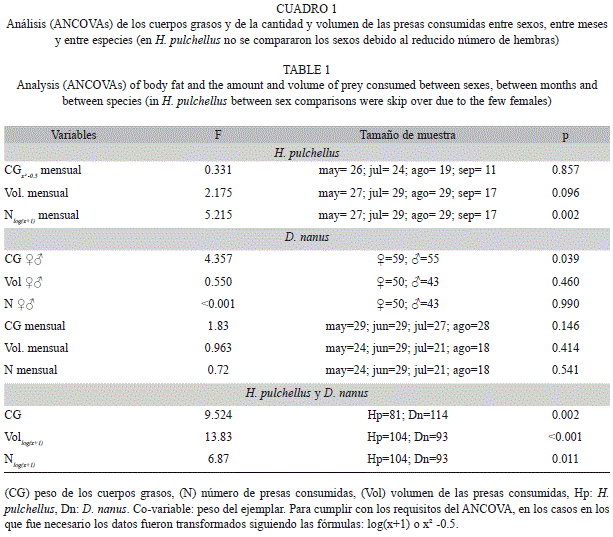
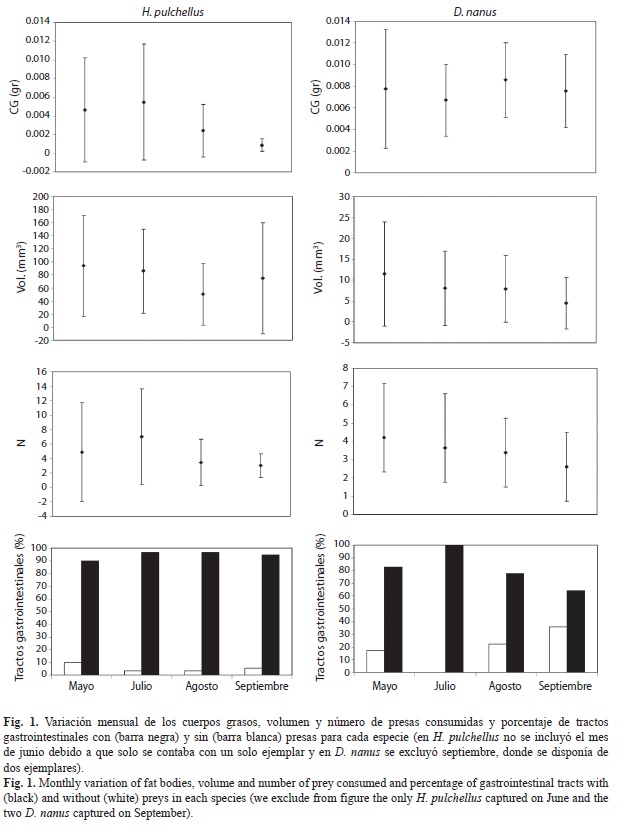
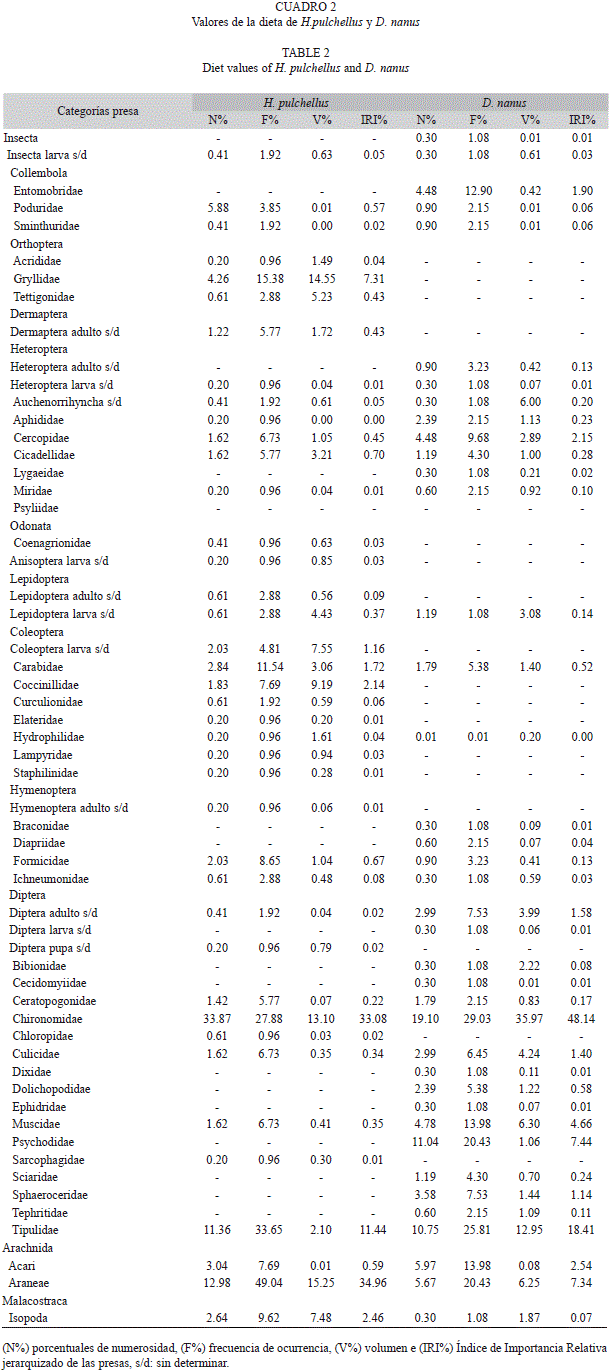
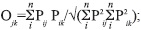
<body><![CDATA[<br> <br style="font-family: verdana;"> </span></font><font size="2"><span style="font-family: verdana;">La contribuci&oacute;n de cada categor&iacute;a de alimento a la dieta de las especies se calcul&oacute; usando tres medidas: n&uacute;mero, volumen y frecuencia de&nbsp; ocurrencia&nbsp; para&nbsp; cada&nbsp; &iacute;tem&nbsp; presa, las cuales fueron combinadas utilizando el &Iacute;ndice de Importancia Relativa de Pinkas <span style="font-style: italic;">et al</span>. (1971): IRI=% FO (%N+%V), donde %FO es la frecuencia de ocurrencia porcentual de la categor&iacute;a de alimento en los tractos digestivos analizados, %N es el porcentaje num&eacute;rico de la categor&iacute;a de alimento y %V el porcentaje volum&eacute;trico de la misma. Ya que el resultado del&nbsp; IRI&nbsp; son&nbsp; valores&nbsp; sin&nbsp; un&nbsp; l&iacute;mite&nbsp; superior, para facilitar la interpretaci&oacute;n y la realizaci&oacute;n de comparaciones se efectu&oacute; una jerarquizaci&oacute;n mediante su transformaci&oacute;n a porcentajes (IRI%) (Cuevas &amp; Martori 2007). </span></font><br  style="font-family: verdana;"> <font size="2"></font><br style="font-family: verdana;"> <font size="2"><span style="font-family: verdana;">Debido a la diferencia en el n&uacute;mero de ejemplares de cada especie, para poder comparar la diversidad de presas consumidas se realiz&oacute; un an&aacute;lisis de rarefacci&oacute;n con el pro- grama EcoSim 7.72 (Gotelli &amp; Graves 1996, Gotelli&nbsp; &amp;&nbsp; Entsminger&nbsp; 2004).&nbsp; En&nbsp; el&nbsp; an&aacute;lisis, se calcul&oacute;&nbsp; la diversidad de Shannon-Weaver (1949) en base al logaritmo neperiano (<span  style="font-style: italic;">ln</span>). Con el programa MVSP (Versi&oacute;n 3.13c) se determin&oacute; la equitatividad de las presas consumidas utilizando el &iacute;ndice de Pielou (1966), el cual se calcul&oacute; como la proporci&oacute;n de la diversidad observada en relaci&oacute;n a la m&aacute;xima diversidad esperada. Adem&aacute;s, para evaluar la similitud de las dietas entre las dos especies se utiliz&oacute; el &iacute;ndice sim&eacute;trico de solapamiento propuesto por Pianka (1973):     <br> <br style="font-family: verdana;"> </span></font>     <div style="text-align: center;"><img alt=""  src="/img/revistas/rbt/v61n2/a30f1.jpg"  style="width: 141px; height: 30px;">    <br> </div> <br style="font-family: verdana;"> <font size="2"><span style="font-family: verdana;">donde P<sub>ij</sub> y P<sub>ik</sub> representan las proporciones del recurso<span style="font-style: italic;"> i</span> utilizado por las especies<span style="font-style: italic;"> j</span> y <span style="font-style: italic;">k</span> respectivamente; y<span style="font-style: italic;"> n</span> el n&uacute;mero total de estados del recurso; este &iacute;ndice genera valores entre 0 (sin solapamiento) y 1 (con solapamiento total). El an&aacute;lisis se realiz&oacute; con el programa EcoSim 7.72 (Gotelli &amp; Entsminger 2004) con </span></font><font  size="2"><span style="font-family: verdana;">base en los valores del IRI% de las presas. Para determinar si el solapamiento observado difiere del esperado por azar, se realiz&oacute; un an&aacute;lisis de randomizaci&oacute;n que ofrece el programa EcoSim (Gotelli &amp; Entsminger 2003). Este programa realiza permutaciones de Monte Carlo para crear &#8220;pseudo-comunidades&#8221; (Pianka 1974), y compara estad&iacute;sticamente los patrones en estas pseudocomunidades y la matriz real de datos. Para los an&aacute;lisis aqu&iacute; efectuados, se realizaron 1 000 permutaciones con base en la matriz original de datos, reteniendo la amplitud del nicho (Dur&eacute; &amp; Kehr 2004).</span></font><br  style="font-family: verdana;"> <font size="2"></font><br style="font-family: verdana;"> <font size="2"><span style="font-family: verdana;">Debido a que el peso de los ejemplares (PC) y la longitud hocico-cloaca (LHC) </span></font><font  size="2"><span style="font-family: verdana;">se encuentran altamente correlacionados (<span style="font-style: italic;">H. pulchellus</span>: Spearman r=0.88, p=0.0001; <span style="font-style: italic;">D. nanus</span>: Pearson r=0.92, p=0.0001), para representar el tama&ntilde;o de los anuros en los an&aacute;lisis multivariados se utiliz&oacute; solamente el PC. Se realizaron an&aacute;lisis de ANCOVA con el programa SPSS 11.55 (Statistical Package for Social Sciences Incorporated, Chicago IL, USA) para comparar el peso de los cuerpos grasos (CG), el volumen (Vol) y cantidad (N) de presas ingeridas entre sexos, entre meses y entre especies, usando el PC de los ejemplares como covariable. Cuando fue necesario, para cumplir los requisitos del an&aacute;lisis las variables fueron transformadas mediante una de las siguientes f&oacute;rmulas: log(x+1) o x&sup2; -0.5. Para este an&aacute;lisis se consideraron todos los ejemplares que pose&iacute;an al menos una presa en sus contenidos gastrointestinales. Adem&aacute;s, para el an&aacute;lisis entre meses se excluy&oacute; el &uacute;nico ejemplar de <span style="font-style: italic;">H. pulchellus</span> capturado en el mes de junio y los &uacute;nicos dos ejemplares de <span style="font-style: italic;">D. nanus</span> capturados en septiembre. Para <span style="font-style: italic;">H. pulchellus</span> no se realizaron las comparaciones entre sexos debido al escaso n&uacute;mero de hembras (n&#9792;=7). </span></font><br  style="font-family: verdana;"> <font size="3"><span style="font-family: verdana;">    <br> <span style="font-weight: bold;">Resultados</span></span></font><br  style="font-family: verdana;"> <font size="2"></font><br style="font-family: verdana;"> <font size="2"><span style="font-family: verdana;">El 78.64% de los machos de <span style="font-style: italic;">H. pulchellus</span> (n=103) conten&iacute;an cuerpos grasos con un peso medio de 0.0038&plusmn;0.005g; mientras que las hembras (n=7) no pose&iacute;an cuerpos grasos desarrollados. El peso medio de los cuerpos grasos de todos los ejemplares de <span style="font-style: italic;">D. nanus</span> fue 0.0075&plusmn;0.0041g; el de los machos (n=55) 0.0064&plusmn;0.0034g y el de las hembras (n=59) 0.0085&plusmn;0.0043g. Los resultados de los ANCOVAs sobre la variaci&oacute;n de los cuerpos grasos entre sexo (solo para <span  style="font-style: italic;">D. nanus</span>), entre meses y entre especies se detallan en el <a  href="/img/revistas/rbt/v61n2/a30t1.gif">cuadro 1</a>.</span></font><br  style="font-family: verdana;"> <font size="2"></font><br style="font-family: verdana;"> <font size="2"><span style="font-family: verdana;">En <span  style="font-style: italic;">H. pulchellus</span>, de los 110 ejemplares analizados, 104 conten&iacute;an alimentos. En todos los meses, m&aacute;s del 90% de los ejemplares pose&iacute;an contenidos en sus tractos digestivos (<a href="/img/revistas/rbt/v61n2/a30i1.jpg">Fig. 1</a>). Se contabilizaron 493 presas, las que fueron clasificadas en 40 categor&iacute;as taxon&oacute;micas (<a href="/img/revistas/rbt/v61n2/a30t2.gif">Cuadro 2</a>). Las presas m&aacute;s importantes en su dieta fueron Araneae (IRI%=34.96), Chironomidae (IRI%=33.08), Tipulidae (IRI%=11.44) y Gryllidae (IRI%=7.31). Los restantes &iacute;tems alimentarios fueron considerados como presas de consumo secundario debido al bajo valor alcanzado con &eacute;ste &iacute;ndice. El n&uacute;mero medio de presas consumidas por todos los ejemplares de <span  style="font-style: italic;">H. pulchellus</span> fue 4.74&plusmn;5.42 y el volumen promedio de 75.08&plusmn;68.45mm3. Las hembras de <span style="font-style: italic;">H. pulchellus</span> pose&iacute;an en sus tractos digestivos un promedio de 5.16&plusmn;6.27 presas, con un volumen promedio de 79.69&plusmn;111.99mm3 por gramo del ejemplar. En tanto, en los machos el promedio fue de 4.71&plusmn;5.40 presas, y el volumen promedio de 74.80&plusmn;65.79mm3. Se encontr&oacute; una variaci&oacute;n mensual en el n&uacute;mero de presas consumidas, siendo julio el mes diferente (Fisher, p&lt;0.05).    <br>     <br style="font-family: verdana;">     </span></font><br style="font-family: verdana;">     <font size="2"><span style="font-family: verdana;">En <span      style="font-style: italic;">D. nanus</span>, de los 114 ejemplares     ]]></body>
<body><![CDATA[analizados&nbsp; 93&nbsp; conten&iacute;an&nbsp; alimentos.&nbsp;     Se&nbsp; observ&oacute; una mayor cantidad de tractos     gastrointestinales vac&iacute;os en los meses invernales de julio y     agosto (<a href="/img/revistas/rbt/v61n2/a30i1.jpg">Fig. 1</a>). Se     contabilizaron 326 presas, las que fueron     clasificadas en 39 categor&iacute;as taxon&oacute;micas (<a      href="/img/revistas/rbt/v61n2/a30t2.gif">Cuadro 2</a>). Las     presas m&aacute;s importantes en su dieta fueron Chironomidae     (IRI%=48.14), Tipulidae (IRI%=18.41), Psychodidae (IRI%=7.44) y Araneae     (IRI%=7.34). El n&uacute;mero medio de presas consumidas por todos los     ]]></body>
<body><![CDATA[ejemplares de <span style="font-style: italic;">D. nanus</span> fue     3.51&plusmn;2.58, y el volumen promedio de     8.15&plusmn;2.58mm<sup>3</sup>. Las hembras de <span      style="font-style: italic;">D. nanus</span> presentaron en sus tractos     digestivos un promedio de 3.70&plusmn;2.60 presas, con un volumen     promedio de 9.95&plusmn;10.47mm<sup>3</sup>. En tanto, en los machos el     promedio     fue de 3.27&plusmn;2.58 presas, y el volumen promedio de     5.41&plusmn;5.16mm<sup>3</sup>. Los resultados de los ANCO-VAs sobre la     variaci&oacute;n entre sexos de ambas especies, entre meses y entre     ]]></body>
<body><![CDATA[especie del Vol y N de presas se expresan en el <a      href="/img/revistas/rbt/v61n2/a30t1.gif">cuadro 1</a>.</span></font><br      style="font-family: verdana;">     <font size="2"></font><br style="font-family: verdana;">     <font size="2"><span style="font-family: verdana;">La diversidad de     contenidos     gastrointestinales esperada seg&uacute;n la curva de rarefacci&oacute;n     para 93 ejemplares fue 2.53 en <span style="font-style: italic;">H.     pulchellus</span> y 2.91 en <span style="font-style: italic;">D. nanus</span>.     La     ]]></body>
<body><![CDATA[equitatividad en <span style="font-style: italic;">H. pulchellus</span>     fue de 0.69 y la riqueza de 40     categor&iacute;as presa. En cambio, la equitatividad en <span      style="font-style: italic;">D. nanus</span> fue de     0.79 y la riqueza de 49 categor&iacute;as presa. El solapamiento del     nicho tr&oacute;fico observado entre <span style="font-style: italic;">H.     pulchellus</span> y <span style="font-style: italic;">D. nanus</span>&nbsp;     fue&nbsp; elevado&nbsp; (Ojk=0.78)&nbsp; y&nbsp; superior&nbsp; al     esperado por azar (media de los &iacute;ndices simulados: Ojk=0.04;     p[observed&#8805;expected]&lt;0.01; p[observed&#8804;expected]=1).</span></font><br     ]]></body>
<body><![CDATA[ style="font-family: verdana;">     <font size="2"></font><br style="font-family: verdana;">     <font size="3"><span style="font-family: verdana; font-weight: bold;">Discusi&oacute;n</span></font><br      style="font-family: verdana;">     <font size="2"></font><br style="font-family: verdana;">     <font size="2"><span style="font-family: verdana;">En la planicie     aluvial del     r&iacute;o Paran&aacute; Medio, tanto <span style="font-style: italic;">H.     pulchellus</span> como <span style="font-style: italic;">D. nanus</span>     se     ]]></body>
<body><![CDATA[alimentaron durante la temporada de bajas temperaturas. Se     observ&oacute; que ambas especies consumieron en com&uacute;n varios     tipos de presa, principalmente algunas&nbsp; familias&nbsp; de&nbsp;     d&iacute;pteros&nbsp; (quiron&oacute;midos y tip&uacute;lidos). Esto     condujo al elevado solapamiento del nicho tr&oacute;fico y la similitud     entre la diversidad, equitatividad y riqueza de presas encontradas. Si     bien no se realiz&oacute; una comparaci&oacute;n con la oferta     ambiental de presas, el gran consumo de d&iacute;pteros, principalmente     adultos de quiron&oacute;midos, se explicar&iacute;a por la abundancia     y diversidad de estos insectos durante la estaci&oacute;n de bajas     ]]></body>
<body><![CDATA[temperaturas en los ambientes de la planicie aluvial del r&iacute;o     Paran&aacute; Medio (Montalto &amp; Paggi 2006, Zilli <span      style="font-style: italic;">et al</span>. 2008). En     <span style="font-style: italic;">H. pulchellus</span>, se concuerda     con lo obtenido por Maneyro &amp; da Rosa     (2004) quienes mencionan a las ara&ntilde;as y d&iacute;pteros, como     las presas m&aacute;s importantes en la dieta de esta especie durante     la temporada fr&iacute;a en Uruguay.</span></font><br      style="font-family: verdana;">     <font size="2"></font><br style="font-family: verdana;">     ]]></body>
<body><![CDATA[<font size="2"><span style="font-family: verdana;">Por otro lado, al     comparar la dieta     de estas especies entre la temporada fr&iacute;a aqu&iacute; analizada     y las temporadas c&aacute;lidas respecto a otros trabajos, se     observ&oacute; que los d&iacute;pteros siguen siendo el &iacute;tem     presa m&aacute;s importante (Basso1990, Maneyro &amp; da Rosa 2004).</span></font><br      style="font-family: verdana;">     <font size="2"></font><br style="font-family: verdana;">     <font size="2"><span style="font-family: verdana;">Por otra parte, se     ha demostrado     ]]></body>
<body><![CDATA[que el volumen y n&uacute;mero de presas consumidas se encuentran     relacionados con el tama&ntilde;o del depredador. La diferencia entre     las dos especies en la cantidad y volumen de presas en los contenidos     gastrointestinales, refleja la incorporaci&oacute;n de presas     m&aacute;s numerosas y voluminosas por parte de <span      style="font-style: italic;">H. pulchellus</span>, lo que     probablemente se relacione con su mayor tama&ntilde;o corporal y ancho     de boca (L&oacute;pez <span style="font-style: italic;">et al</span>.     2005, da Rosa <span style="font-style: italic;">et al</span>. 2011) e     implique una     ]]></body>
<body><![CDATA[optimizaci&oacute;n de la actividad de forrajeo.</span></font><br      style="font-family: verdana;">     <font size="2"></font><br style="font-family: verdana;">     <font size="2"><span style="font-family: verdana;">Las bajas     temperaturas de la     estaci&oacute;n de oto&ntilde;o-invierno no afectar&iacute;a por igual     a todas las especies de anuros de la planicie aluvial del     Paran&aacute;, ya que, a diferencia de lo ocurrido en <span      style="font-style: italic;">D. nanus</span>, se     encontr&oacute; que <span style="font-style: italic;">H. pulchellus</span>     ]]></body>
<body><![CDATA[posee contenidos en casi todos los     tractos digestivos analizados durante toda la estaci&oacute;n     fr&iacute;a. En esta especie se hallaron los cuerpos grasos poco     desarrollados durante el per&iacute;odo oto&ntilde;o-invierno evaluado     y s&oacute;lo los machos pose&iacute;an alg&uacute;n grado de     desarrollo de los cuerpos grasos. Esto podr&iacute;a deberse a que en     las hembras los cuerpos grasos exhiben tama&ntilde;o m&iacute;nimo     durante el per&iacute;odo de desove (D&iacute;az-P&aacute;ez &amp;     Ortiz 2001). Teniendo en cuenta que <span style="font-style: italic;">H.     pulchellus</span> se reproduce en     ]]></body>
<body><![CDATA[invierno (Basso 1990, Peltzer &amp; Lajmanovich 2007, L&oacute;pez <span      style="font-style: italic;">et     al</span>. 2011), el mayor desarrollo de los cuerpos grasos en los     machos se     relacionar&iacute;a con las actividades energ&eacute;ticamente     demandantes que se encuentran realizando &eacute;stos&nbsp;     durante&nbsp; la&nbsp; temporada&nbsp; de&nbsp; apareamiento&nbsp;     (establecer&nbsp; los&nbsp; sitios&nbsp; de&nbsp; canto,&nbsp; defender     estos sitios de machos competidores, emitir el canto reproductivo para     atraer a las hembras potenciales para el apareamiento) (Wells 2007,     ]]></body>
<body><![CDATA[Navas <span style="font-style: italic;">et al</span>. 2008, Quiroga     &amp; Sanabria 2012). En una     poblaci&oacute;n del sur de Brasil, Sol&eacute; &amp; Pelz (2007)     encontraron que la mayor parte de los machos de <span      style="font-style: italic;">H. pulchellus</span>     ten&iacute;an presas en el est&oacute;mago mientras se encontraban en     el lugar&nbsp;</span></font><font size="2"><span      style="font-family: verdana;"></span></font><font size="2"><span      style="font-family: verdana;">de reproducci&oacute;n y sugirieron     que existe una gran congruencia de los h&aacute;bitats de     ]]></body>
<body><![CDATA[alimentaci&oacute;n y apareamiento. El extremadamente bajo     &iacute;ndice de vacuidad encontrado en los machos de <span      style="font-style: italic;">H. pulchellus</span> de     la Isla Sirgadero y Reserva Universitaria concuerda con las     observaciones realizadas por estos autores. Entonces, durante la     prolongada temporada de canto reproductivo de esta especie (Basso 1990,     Peltzer &amp; Lajmanovich 2007), los machos se valdr&iacute;an en parte     de sus reservas lip&iacute;dicas y en parte de las presas ingeridas     para sustentar esa actividad energ&eacute;ticamente demandante.</span></font><br      style="font-family: verdana;">     ]]></body>
<body><![CDATA[<font size="2"></font><br style="font-family: verdana;">     <font size="2"><span style="font-family: verdana;">Por otra parte, el     per&iacute;odo     de actividad de las especies suele ser m&aacute;s prolongado que el     reproductivo (Vaira 2002, L&oacute;pez <span      style="font-style: italic;">et al</span>. 2011) e implica, entre     otras cuestiones, el tiempo dedicado a la recuperaci&oacute;n y     acumulaci&oacute;n de reservas energ&eacute;ticas mediante la     alimentaci&oacute;n (Duellman &amp; Trueb 1986). En este sentido, a     diferencia de <span style="font-style: italic;">H. pulchellus</span>, <span     ]]></body>
<body><![CDATA[ style="font-style: italic;">D. nanus</span> posee un pico de actividad     y     reproducci&oacute;n concentrado en la primavera-verano (Basso 1990,     Peltzer &amp; Lajmanovich 2007, S&aacute;nchez <span      style="font-style: italic;">et al</span>. 2007), por lo que     los ejemplares analizados para la temporada de bajas temperaturas no se     encontrar&iacute;an sometidos a los requerimientos energ&eacute;ticos     de la actividad reproductiva. Esto contribuir&iacute;a a explicar el     mayor n&uacute;mero de tractos digestivos vac&iacute;os hallados en los     ejemplares de <span style="font-style: italic;">D. nanus</span>     ]]></body>
<body><![CDATA[activos durante el oto&ntilde;o-invierno.     Adem&aacute;s, las bajas temperaturas implicar&iacute;an una     restricci&oacute;n fisiol&oacute;gica para la actividad de forrajeo de     esta especie (Wells 2007). Existen diversos estudios que han intentado     dilucidar el bajo consumo de los anuros en estaciones fr&iacute;as,     sugiriendo: a) un ritmo m&aacute;s lento del paso de alimentos a     trav&eacute;s del sistema digestivo (Lillywhite <span      style="font-style: italic;">et al</span>. 1973); b) una     disminuci&oacute;n en la tasa de ingesta (Lillywhite&nbsp; <span      style="font-style: italic;">et&nbsp;     ]]></body>
<body><![CDATA[al</span>.&nbsp; 1973);&nbsp; c)&nbsp; un&nbsp; movimiento m&aacute;s     lento de     las presas que podr&iacute;a afectar la respuesta de     alimentaci&oacute;n de los anuros depre- dadores (Ewert 1987); o d) una     disminuci&oacute;n r&aacute;pida en las tasas metab&oacute;licas, por     la cual los anfibios que pasan el invierno pueden sobrevivir durante     muchos meses sin alimento (Koskela &amp; Pasanen 1974, Morton 1981,     L&oacute;pez Jurado 1982).</span></font><br      style="font-family: verdana;">     <font size="2"></font><br style="font-family: verdana;">     ]]></body>
<body><![CDATA[<font size="2"><span style="font-family: verdana;">A diferencia de lo     ocurrido con los     con- tenidos gastrointestinales, se encontr&oacute; que <span      style="font-style: italic;">D. nanus</span> posee     sus cuerpos grasos bien desarrollados durante la temporada fr&iacute;a.     Esto sugiere que, como la mayor&iacute;a de los anfibios de climas     templados (Feder &amp; Burggren 1992), los ejemplares de <span      style="font-style: italic;">D. nanus</span> que     se encuentra activos durante estos meses fr&iacute;os,     utilizar&iacute;an sus reservas lip&iacute;dicas acumuladas durante la     ]]></body>
<body><![CDATA[temporada c&aacute;lida anterior para pasar el invierno. Cabe destacar     que en las hembras de <span style="font-style: italic;">D. nanus</span>,     de mayor tama&ntilde;o que los machos,     se observ&oacute; una acumulaci&oacute;n superior de reservas en forma     de cuerpos grasos. Este aumento post reproductivo en el tama&ntilde;o     de los cuerpos grasos, as&iacute; como la diferencia entre sexos en la     acumulaci&oacute;n de reservas energ&eacute;ticas tambi&eacute;n fueron     encontradas en otras especies de anuros de climas templados (Quiroga     &amp; Sanabria 2012). La inversi&oacute;n energ&eacute;tica en la     producci&oacute;n de &oacute;vulos es muy elevada (Wells 2007), debido     ]]></body>
<body><![CDATA[a esto las hembras de <span style="font-style: italic;">D. nanus</span>     necesitar&iacute;an de una fuerte     acumulaci&oacute;n de reservas lip&iacute;dicas para afrontar la     maduraci&oacute;n gonadal y encontrarse preparadas&nbsp; para&nbsp;     el&nbsp; evento&nbsp; reproductivo&nbsp; de la pr&oacute;xima temporada     (en primavera-verano; Basso 1990, Peltzer &amp; Lajmanovich 2007,     S&aacute;nchez <span style="font-style: italic;">et al</span>. 2007).</span></font><br      style="font-family: verdana;">     <font size="2"></font><br style="font-family: verdana;">     <font size="2"><span style="font-family: verdana;">Los resultados del     ]]></body>
<body><![CDATA[presente trabajo     permiten sugerir que existen diferentes estrategias energ&eacute;ticas     seg&uacute;n el per&iacute;odo reproductivo y para mantener la     actividad durante la temporada de bajas temperaturas en cada especie.     Estas diferencias, aunque m&aacute;s leves, tambi&eacute;n se     registraron entre sexos dentro de cada especie. Por un lado, <span      style="font-style: italic;">H.     pulchellus</span> contin&uacute;a aliment&aacute;ndose&nbsp;     a&uacute;n&nbsp;     con&nbsp; temperaturas&nbsp; bajas&nbsp; (dentro del espectro de     ]]></body>
<body><![CDATA[temperaturas que se registran en la planicie aluvial del r&iacute;o     Paran&aacute; Medio), y esta ser&iacute;a una forma de mantener el     elevado gasto energ&eacute;tico que implica la reproducci&oacute;n     concentrada en los meses de oto&ntilde;o-invierno (Peltzer &amp;     Lajmanovich 2007). Los cuerpos grasos proveer&iacute;an una fuente     extra de energ&iacute;a para mantener las exigencias del cortejo en los     machos. Por otro lado, la actividad de alimentaci&oacute;n de <span      style="font-style: italic;">D. nanus</span>     durante esta estaci&oacute;n de bajas temperaturas fue ostensiblemente     menor que&nbsp; la&nbsp; de&nbsp; <span style="font-style: italic;">H.&nbsp;     ]]></body>
<body><![CDATA[pulchellus</span>,&nbsp; pero&nbsp;     sus&nbsp; cuerpos grasos se encontraron bien desarrollados, por lo que     principalmente obtendr&iacute;an la energ&iacute;a para pasar el     oto&ntilde;o-invierno y llegar en buenas condiciones a la temporada     reproductiva en primavera-verano con &eacute;stas acumulaciones     lip&iacute;dicas (Peltzer &amp; Lajmanovich 2007, Quiroga &amp;     Sanabria 2012). Finalmente, ser&iacute;a inte- resante que en estudios     futuros se integraran las variables energ&eacute;ticas y     diet&eacute;ticas de otras especies para comprender y predecir mejor     sus estrategias y comportamiento.</span></font><br     ]]></body>
<body><![CDATA[ style="font-family: verdana;">     <font size="2"></font><br style="font-family: verdana;">     <font size="2"></font><br style="font-family: verdana;">     <font size="3"><span style="font-family: verdana; font-weight: bold;">Agradecimientos</span></font><br      style="font-family: verdana;">     <font size="2"></font><br style="font-family: verdana;">     <font size="2"><span style="font-family: verdana;">El presente estudio     forma parte del     trabajo de la tesina de Licenciatura de Carolina E. Antoniazzi. Los     autores agradecen a Romina Ghirardi y Pablo A. Scarabotti por su     ]]></body>
<body><![CDATA[colaboraci&oacute;n en los muestreos y distintas etapas de la     realizaci&oacute;n del presente trabajo. A Danilo Demonte, Andrea     Previtali y Andr&eacute;s M. Attademo por las sugerencias realizadas     sobre la versi&oacute;n presentada como tesina de licenciatura. A     Eduardo Schaefer por las sugerencias y aportes en el trabajo. A tres     revisores an&oacute;nimos por los aportes en el manuscrito.</span></font><br      style="font-family: verdana;">     <font size="2"></font>     <hr style="width: 100%; height: 2px;"><br style="font-family: verdana;">     <font size="2"></font><font style="font-weight: bold;" size="3"><span     ]]></body>
<body><![CDATA[ style="font-family: verdana;">Referencias</span></font><br      style="font-family: verdana;">     <font size="2"></font><br style="font-family: verdana;">     <font size="2"><span style="font-family: verdana;">Angulo, A., J.V.     Rueda-Almonacid,     J.V. Rodr&iacute;guez-Mahecha &amp; E. La Marca (eds.). 2006.     T&eacute;cnicas de inventario y monitoreo para los anfibios de la     regi&oacute;n tropical andina. Conservaci&oacute;n Internacional. Serie     Manuales de Campo&nbsp; N&ordm; 2. Panamericana Formas e Impresos S.A.,     <!-- ref -->Bogot&aacute; D.C., Colombia.    &nbsp;&nbsp;&nbsp;&nbsp;&nbsp;&nbsp;&nbsp;&nbsp;[&#160;<a href="javascript:void(0);" onclick="javascript: window.open('/scielo.php?script=sci_nlinks&ref=1515762&pid=S0034-7744201300030003000001&lng=','','width=640,height=500,resizable=yes,scrollbars=1,menubar=yes,');">Links</a>&#160;]<!-- end-ref --><!-- ref --></span></font><br  style="font-family: verdana;"> <font size="2"></font><br style="font-family: verdana;"> <font size="2"><span style="font-family: verdana;">Basso, N. 1990. Estrategias adaptativas de una comunidad subtropical de anuros. Cuad. de Herp., Serie Mono- graf&iacute;as 1: 1-70.    &nbsp;&nbsp;&nbsp;&nbsp;&nbsp;&nbsp;&nbsp;&nbsp;[&#160;<a href="javascript:void(0);" onclick="javascript: window.open('/scielo.php?script=sci_nlinks&ref=1515763&pid=S0034-7744201300030003000002&lng=','','width=640,height=500,resizable=yes,scrollbars=1,menubar=yes,');">Links</a>&#160;]<!-- end-ref --><!-- ref --></span></font><br  style="font-family: verdana;"> <font size="2"></font><br style="font-family: verdana;"> <font size="2"><span style="font-family: verdana;">Cuevas, M.F. &amp; R. Martori. 2007. Diversidad tr&oacute;fica de dos especies sint&oacute;picas del g&eacute;nero <span style="font-style: italic;">Leptodactylus </span>(Anura: Leptodactylidae) del sudeste de la provincia de C&oacute;rdoba, Argentina. Cuad. de Herp. 21: 7-19.    &nbsp;&nbsp;&nbsp;&nbsp;&nbsp;&nbsp;&nbsp;&nbsp;[&#160;<a href="javascript:void(0);" onclick="javascript: window.open('/scielo.php?script=sci_nlinks&ref=1515764&pid=S0034-7744201300030003000003&lng=','','width=640,height=500,resizable=yes,scrollbars=1,menubar=yes,');">Links</a>&#160;]<!-- end-ref --><!-- ref --></span></font><br  style="font-family: verdana;"> <font size="2"></font><br style="font-family: verdana;"> <font size="2"><span style="font-family: verdana;">da Rosa, I., A. Canavero, R. Maneyro &amp; A. Camargo. 2011. Trophic niche variation and individual specialization in <span style="font-style: italic;">Hypsiboas pulchellus</span> (Dum&eacute;ril and Bibron, 1841) (Anura,&nbsp; Hylidae) from Uruguay. South Am. J.&nbsp; Herpetol. 6: 98-106.    &nbsp;&nbsp;&nbsp;&nbsp;&nbsp;&nbsp;&nbsp;&nbsp;[&#160;<a href="javascript:void(0);" onclick="javascript: window.open('/scielo.php?script=sci_nlinks&ref=1515765&pid=S0034-7744201300030003000004&lng=','','width=640,height=500,resizable=yes,scrollbars=1,menubar=yes,');">Links</a>&#160;]<!-- end-ref --><!-- ref --></span></font><br style="font-family: verdana;"> <font size="2"></font><br style="font-family: verdana;"> <font size="2"><span style="font-family: verdana;">D&iacute;az-P&aacute;ez, H. &amp; J.C. Ortiz. 2001. The reproductive cycle of <span  style="font-style: italic;">Pleurodema thaul</span> (Anura, Leptodactylidae) in central Chile. Amphibia-Reptilia 22: 431-445.    &nbsp;&nbsp;&nbsp;&nbsp;&nbsp;&nbsp;&nbsp;&nbsp;[&#160;<a href="javascript:void(0);" onclick="javascript: window.open('/scielo.php?script=sci_nlinks&ref=1515766&pid=S0034-7744201300030003000005&lng=','','width=640,height=500,resizable=yes,scrollbars=1,menubar=yes,');">Links</a>&#160;]<!-- end-ref --><!-- ref --></span></font><br  style="font-family: verdana;"> <font size="2"></font><br style="font-family: verdana;"> <font size="2"><span style="font-family: verdana;">Duellman, W.E. &amp; L. Trueb. 1986. Biology of the Amphibia.&nbsp; Mcgraw-Hill&nbsp; Book&nbsp;&nbsp; Company,&nbsp; Nueva&nbsp; York, EEUU.    &nbsp;&nbsp;&nbsp;&nbsp;&nbsp;&nbsp;&nbsp;&nbsp;[&#160;<a href="javascript:void(0);" onclick="javascript: window.open('/scielo.php?script=sci_nlinks&ref=1515767&pid=S0034-7744201300030003000006&lng=','','width=640,height=500,resizable=yes,scrollbars=1,menubar=yes,');">Links</a>&#160;]<!-- end-ref --><!-- ref --></span></font><br  style="font-family: verdana;"> <font size="2"></font><br style="font-family: verdana;"> <font size="2"><span style="font-family: verdana;">Dunham, A.E. 1983. Realized niche overlap,&nbsp; resource abundance&nbsp; and&nbsp; intensity&nbsp; of&nbsp; interspecific&nbsp; competition, p. 261-280. <span  style="font-style: italic;">In</span> R.D. Huey, E.R. Pianka &amp; T.W. Schoener (eds.). Lizards Ecology: studies of a model organism.&nbsp; Harvard&nbsp; University,&nbsp; Cambridge,&nbsp; Massachusetts, EEUU.    &nbsp;&nbsp;&nbsp;&nbsp;&nbsp;&nbsp;&nbsp;&nbsp;[&#160;<a href="javascript:void(0);" onclick="javascript: window.open('/scielo.php?script=sci_nlinks&ref=1515768&pid=S0034-7744201300030003000007&lng=','','width=640,height=500,resizable=yes,scrollbars=1,menubar=yes,');">Links</a>&#160;]<!-- end-ref --><!-- ref --></span></font><br style="font-family: verdana;"> <font size="2"></font><br style="font-family: verdana;"> <font size="2"><span style="font-family: verdana;">Dur&eacute;,&nbsp; M.I. &amp; A.I. Kehr. 2004. Influence of&nbsp; microhabitat on the trophic ecology of&nbsp; two leptodactylids from northeastern Argentina. Herpetologica 60: 295-303.    &nbsp;&nbsp;&nbsp;&nbsp;&nbsp;&nbsp;&nbsp;&nbsp;[&#160;<a href="javascript:void(0);" onclick="javascript: window.open('/scielo.php?script=sci_nlinks&ref=1515769&pid=S0034-7744201300030003000008&lng=','','width=640,height=500,resizable=yes,scrollbars=1,menubar=yes,');">Links</a>&#160;]<!-- end-ref --><!-- ref --></span></font><br style="font-family: verdana;"> <font size="2"></font><br style="font-family: verdana;"> <font size="2"><span style="font-family: verdana;">Ewert, J.P. 1987. Neuroethology of releasing mechanisms: Prey catching in toads. Behav. Brain Sci. 10: 337-405.    &nbsp;&nbsp;&nbsp;&nbsp;&nbsp;&nbsp;&nbsp;&nbsp;[&#160;<a href="javascript:void(0);" onclick="javascript: window.open('/scielo.php?script=sci_nlinks&ref=1515770&pid=S0034-7744201300030003000009&lng=','','width=640,height=500,resizable=yes,scrollbars=1,menubar=yes,');">Links</a>&#160;]<!-- end-ref --><!-- ref --></span></font><br style="font-family: verdana;"> <font size="2"></font><br style="font-family: verdana;"> <font size="2"><span style="font-family: verdana;">Feder, M.E. &amp; W.W. Burggren. 1992. Environmental physiology of the&nbsp; amphibians. University of Chicago, Chicago, EEUU.    &nbsp;&nbsp;&nbsp;&nbsp;&nbsp;&nbsp;&nbsp;&nbsp;[&#160;<a href="javascript:void(0);" onclick="javascript: window.open('/scielo.php?script=sci_nlinks&ref=1515771&pid=S0034-7744201300030003000010&lng=','','width=640,height=500,resizable=yes,scrollbars=1,menubar=yes,');">Links</a>&#160;]<!-- end-ref --><!-- ref --></span></font><br style="font-family: verdana;"> <font size="2"></font><br style="font-family: verdana;"> <font size="2"><span style="font-family: verdana;">Gotelli, N.J. &amp; G.R. Graves. 1996. Null models in ecology. Smithsonian Institution Washington, D.C., EEUU.    &nbsp;&nbsp;&nbsp;&nbsp;&nbsp;&nbsp;&nbsp;&nbsp;[&#160;<a href="javascript:void(0);" onclick="javascript: window.open('/scielo.php?script=sci_nlinks&ref=1515772&pid=S0034-7744201300030003000011&lng=','','width=640,height=500,resizable=yes,scrollbars=1,menubar=yes,');">Links</a>&#160;]<!-- end-ref --><!-- ref --></span></font><br style="font-family: verdana;"> <font size="2"></font><br style="font-family: verdana;"> <font size="2"><span style="font-family: verdana;">Gotelli, N.J. &amp; G.L. Entsminger. 2003. Swap algorithms in null model analysis. Ecology 84: 532-535.    &nbsp;&nbsp;&nbsp;&nbsp;&nbsp;&nbsp;&nbsp;&nbsp;[&#160;<a href="javascript:void(0);" onclick="javascript: window.open('/scielo.php?script=sci_nlinks&ref=1515773&pid=S0034-7744201300030003000012&lng=','','width=640,height=500,resizable=yes,scrollbars=1,menubar=yes,');">Links</a>&#160;]<!-- end-ref --><!-- ref --></span></font><br style="font-family: verdana;"> <font size="2"></font><br style="font-family: verdana;"> <font size="2"><span style="font-family: verdana;">Gotelli,&nbsp; N.J.&nbsp; &amp;&nbsp; G.L.&nbsp; Entsminger.&nbsp; 2004.&nbsp; EcoSim:&nbsp; Null models software for&nbsp; ecology. Version 7.0. Acquired Intelligence Inc. &amp; Kesey-Bear, Jericho.    &nbsp;&nbsp;&nbsp;&nbsp;&nbsp;&nbsp;&nbsp;&nbsp;[&#160;<a href="javascript:void(0);" onclick="javascript: window.open('/scielo.php?script=sci_nlinks&ref=1515774&pid=S0034-7744201300030003000013&lng=','','width=640,height=500,resizable=yes,scrollbars=1,menubar=yes,');">Links</a>&#160;]<!-- end-ref --><br>     <!-- ref --><br> Guimar&atilde;es, T.S., G.B. Figueiredo, D.O. Mesquita &amp; M.M. Vasconcellos.&nbsp; 2011.&nbsp; Ecology&nbsp; of&nbsp;&nbsp; <span style="font-style: italic;">Hypsiboas&nbsp; albopunctatus</span> (Anura: Hylidae) in a Neotropical Savanna. J. Herpetol. 45: 244-250.    &nbsp;&nbsp;&nbsp;&nbsp;&nbsp;&nbsp;&nbsp;&nbsp;[&#160;<a href="javascript:void(0);" onclick="javascript: window.open('/scielo.php?script=sci_nlinks&ref=1515776&pid=S0034-7744201300030003000014&lng=','','width=640,height=500,resizable=yes,scrollbars=1,menubar=yes,');">Links</a>&#160;]<!-- end-ref --><!-- ref --></span></font><br  style="font-family: verdana;"> <font size="2"></font><br style="font-family: verdana;"> <font size="2"><span style="font-family: verdana;">Iriondo, M.H., J.C. Paggi &amp; M.J. Parma (eds.). 2007. The Middle Paran&aacute; River:&nbsp; Limnology of a Subtropical Wetland. Springer, Heidelberg, Alemania.    &nbsp;&nbsp;&nbsp;&nbsp;&nbsp;&nbsp;&nbsp;&nbsp;[&#160;<a href="javascript:void(0);" onclick="javascript: window.open('/scielo.php?script=sci_nlinks&ref=1515777&pid=S0034-7744201300030003000015&lng=','','width=640,height=500,resizable=yes,scrollbars=1,menubar=yes,');">Links</a>&#160;]<!-- end-ref --><!-- ref --></span></font><br  style="font-family: verdana;"> <font size="2"></font><br style="font-family: verdana;"> <font size="2"><span style="font-family: verdana;">J&oslash;rgensen, C.B. 1986. External and internal&nbsp; control&nbsp; of patterns of feeding, growth and gonadal function in a temperate zone anuran, the toad Bufo bufo. J. Zool. (London) 216: 211-241.    &nbsp;&nbsp;&nbsp;&nbsp;&nbsp;&nbsp;&nbsp;&nbsp;[&#160;<a href="javascript:void(0);" onclick="javascript: window.open('/scielo.php?script=sci_nlinks&ref=1515778&pid=S0034-7744201300030003000016&lng=','','width=640,height=500,resizable=yes,scrollbars=1,menubar=yes,');">Links</a>&#160;]<!-- end-ref --><!-- ref --></span></font><br  style="font-family: verdana;"> <font size="2"></font><br style="font-family: verdana;"> <font size="2"><span style="font-family: verdana;">J&oslash;rgensen, C.B. 1992. Growth and reproduction. <span style="font-style: italic;">In</span> M.E. Feder &amp; W.W. Burggren (eds.). Environmental physiology of the&nbsp; Amphibians. University of Chicago, Chicago, EEUU.    &nbsp;&nbsp;&nbsp;&nbsp;&nbsp;&nbsp;&nbsp;&nbsp;[&#160;<a href="javascript:void(0);" onclick="javascript: window.open('/scielo.php?script=sci_nlinks&ref=1515779&pid=S0034-7744201300030003000017&lng=','','width=640,height=500,resizable=yes,scrollbars=1,menubar=yes,');">Links</a>&#160;]<!-- end-ref --><!-- ref --></span></font><br style="font-family: verdana;"> <font size="2"></font><br style="font-family: verdana;"> <font size="2"><span style="font-family: verdana;">Koskela, P. &amp; S. Pasanen. 1974. The wintering of the common frog, <span style="font-style: italic;">Rana temporaria</span> L., in northern Finland. Aquilo (Zool.) 15: 1-17.    &nbsp;&nbsp;&nbsp;&nbsp;&nbsp;&nbsp;&nbsp;&nbsp;[&#160;<a href="javascript:void(0);" onclick="javascript: window.open('/scielo.php?script=sci_nlinks&ref=1515780&pid=S0034-7744201300030003000018&lng=','','width=640,height=500,resizable=yes,scrollbars=1,menubar=yes,');">Links</a>&#160;]<!-- end-ref --><!-- ref --></span></font><br  style="font-family: verdana;"> <font size="2"></font><br style="font-family: verdana;"> <font size="2"><span style="font-family: verdana;">Lillywhite, H.B., P. Licht &amp; P. Chelgren. 1973. The role of behavioral thermoregulation in the growth energetics of the toad, <span style="font-style: italic;">Bufo boreas</span>. Ecology 54: 375-83.    &nbsp;&nbsp;&nbsp;&nbsp;&nbsp;&nbsp;&nbsp;&nbsp;[&#160;<a href="javascript:void(0);" onclick="javascript: window.open('/scielo.php?script=sci_nlinks&ref=1515781&pid=S0034-7744201300030003000019&lng=','','width=640,height=500,resizable=yes,scrollbars=1,menubar=yes,');">Links</a>&#160;]<!-- end-ref --><!-- ref --></span></font><br style="font-family: verdana;"> <font size="2"></font><br style="font-family: verdana;"> <font size="2"><span style="font-family: verdana;">L&oacute;pez,&nbsp; J.A.,&nbsp; P.M.&nbsp; Peltzer&nbsp; &amp;&nbsp; R.C.&nbsp; Lajmanovich.&nbsp; 2005. Dieta y solapamiento del subnicho tr&oacute;fico de nueve especies de leptodact&iacute;lidos en el Parque General San Mart&iacute;n (Argentina). Rev. Esp. Herp. 19: 19-31.    &nbsp;&nbsp;&nbsp;&nbsp;&nbsp;&nbsp;&nbsp;&nbsp;[&#160;<a href="javascript:void(0);" onclick="javascript: window.open('/scielo.php?script=sci_nlinks&ref=1515782&pid=S0034-7744201300030003000020&lng=','','width=640,height=500,resizable=yes,scrollbars=1,menubar=yes,');">Links</a>&#160;]<!-- end-ref --><!-- ref --></span></font><br  style="font-family: verdana;"> <font size="2"></font><br style="font-family: verdana;"> <font size="2"><span style="font-family: verdana;">L&oacute;pez, J.A., R. Ghirardi, P.A. Scarabotti &amp; M.C. Medrano. 2007. Feeding ecology of <span style="font-style: italic;">Elachistocleis bicolor</span> in a riparian locality of the middle Paran&aacute; River. Herp. J. </span></font><font size="2"><span  style="font-family: verdana;">17: 48-53.    &nbsp;&nbsp;&nbsp;&nbsp;&nbsp;&nbsp;&nbsp;&nbsp;[&#160;<a href="javascript:void(0);" onclick="javascript: window.open('/scielo.php?script=sci_nlinks&ref=1515783&pid=S0034-7744201300030003000021&lng=','','width=640,height=500,resizable=yes,scrollbars=1,menubar=yes,');">Links</a>&#160;]<!-- end-ref --><!-- ref --></span></font><br  style="font-family: verdana;"> <font size="2"></font><br style="font-family: verdana;"> <font size="2"><span style="font-family: verdana;">L&oacute;pez,&nbsp; J.A., P.A. Scarabotti, M.C. Medrano&nbsp; &amp; R. Ghirardi. 2009. Is the red spotted green frog <span style="font-style: italic;">Hypsiboas punctatus</span> (Anura: Hylidae) selecting its preys? The importance of prey availability. Rev. Biol. Trop. 57: 847-857.    &nbsp;&nbsp;&nbsp;&nbsp;&nbsp;&nbsp;&nbsp;&nbsp;[&#160;<a href="javascript:void(0);" onclick="javascript: window.open('/scielo.php?script=sci_nlinks&ref=1515784&pid=S0034-7744201300030003000022&lng=','','width=640,height=500,resizable=yes,scrollbars=1,menubar=yes,');">Links</a>&#160;]<!-- end-ref --><!-- ref --></span></font><br style="font-family: verdana;"> <font size="2"></font><br style="font-family: verdana;"> <font size="2"><span style="font-family: verdana;">L&oacute;pez, J.A., P.A. Scarabotti &amp; R. Ghirardi. 2011. Seasonal patterns of abundance and recruitment in an amphibian assemblage&nbsp; from the Paran&aacute; River floodplain. Interciencia 36: 538-544.    &nbsp;&nbsp;&nbsp;&nbsp;&nbsp;&nbsp;&nbsp;&nbsp;[&#160;<a href="javascript:void(0);" onclick="javascript: window.open('/scielo.php?script=sci_nlinks&ref=1515785&pid=S0034-7744201300030003000023&lng=','','width=640,height=500,resizable=yes,scrollbars=1,menubar=yes,');">Links</a>&#160;]<!-- end-ref --><!-- ref --></span></font><br  style="font-family: verdana;"> <font size="2"></font><br style="font-family: verdana;"> <font size="2"><span style="font-family: verdana;">L&oacute;pez Jurado, L.F. 1982. Estudios sobre el sapo corredor (<span style="font-style: italic;">Bufo calamita</span>) en el Sur&nbsp; de Espa&ntilde;a. Do&ntilde;ana Act. Vert 9: 71-84.    &nbsp;&nbsp;&nbsp;&nbsp;&nbsp;&nbsp;&nbsp;&nbsp;[&#160;<a href="javascript:void(0);" onclick="javascript: window.open('/scielo.php?script=sci_nlinks&ref=1515786&pid=S0034-7744201300030003000024&lng=','','width=640,height=500,resizable=yes,scrollbars=1,menubar=yes,');">Links</a>&#160;]<!-- end-ref --><!-- ref --></span></font><br  style="font-family: verdana;"> <font size="2"></font><br style="font-family: verdana;"> <font size="2"><span style="font-family: verdana;">Maneyro,&nbsp; R. &amp; I. da Rosa. 2004. Temporal&nbsp; and spatial changes in the diet of <span  style="font-style: italic;">Hyla pulchella</span> (Anura, Hylidae) in southern Uruguay. Phyllomedusa 3: 101-113.    &nbsp;&nbsp;&nbsp;&nbsp;&nbsp;&nbsp;&nbsp;&nbsp;[&#160;<a href="javascript:void(0);" onclick="javascript: window.open('/scielo.php?script=sci_nlinks&ref=1515787&pid=S0034-7744201300030003000025&lng=','','width=640,height=500,resizable=yes,scrollbars=1,menubar=yes,');">Links</a>&#160;]<!-- end-ref --><!-- ref --></span></font><br  style="font-family: verdana;"> <font size="2"></font><br style="font-family: verdana;"> <font size="2"><span style="font-family: verdana;">Martori, R., L. Aun, A. Birri Rozzi, C. Gim&eacute;nez &amp; E. Heredia. 2005. Reproducci&oacute;n comparada de tres especies de anuros sint&oacute;picos de una localidad del sudeste de C&oacute;rdoba. Cuad. de Herp. 18: 43-59.    &nbsp;&nbsp;&nbsp;&nbsp;&nbsp;&nbsp;&nbsp;&nbsp;[&#160;<a href="javascript:void(0);" onclick="javascript: window.open('/scielo.php?script=sci_nlinks&ref=1515788&pid=S0034-7744201300030003000026&lng=','','width=640,height=500,resizable=yes,scrollbars=1,menubar=yes,');">Links</a>&#160;]<!-- end-ref --><!-- ref --></span></font><br  style="font-family: verdana;"> <font size="2"></font><br style="font-family: verdana;"> <font size="2"><span style="font-family: verdana;">McDiarmid, R.W. 1994. Preparing amphibians as scientific specimens, p. 289-296. <span  style="font-style: italic;">In</span>&nbsp; W.R. Heyer, M.A. Donnelly, R.W.&nbsp; McDiarmid, L.C. Hayek &amp; M.S. Foster (eds.). Measuring and Monitoring Biological Diversity. Standard Methods for Amphibians. Smithsonian Institution, Washington D.C., EEUU.    &nbsp;&nbsp;&nbsp;&nbsp;&nbsp;&nbsp;&nbsp;&nbsp;[&#160;<a href="javascript:void(0);" onclick="javascript: window.open('/scielo.php?script=sci_nlinks&ref=1515789&pid=S0034-7744201300030003000027&lng=','','width=640,height=500,resizable=yes,scrollbars=1,menubar=yes,');">Links</a>&#160;]<!-- end-ref --><!-- ref --></span></font><br  style="font-family: verdana;"> <font size="2"></font><br style="font-family: verdana;"> <font size="2"><span style="font-family: verdana;">Montalto, L. &amp; A.C. Paggi. 2006. Diversity of chironomid larvae in a marginal fluvial&nbsp; wetland of the Middle Paran&aacute; River&nbsp; floodplain, Argentina. Ann. Limnol. - Int. J. Lim 42: 289-300.    &nbsp;&nbsp;&nbsp;&nbsp;&nbsp;&nbsp;&nbsp;&nbsp;[&#160;<a href="javascript:void(0);" onclick="javascript: window.open('/scielo.php?script=sci_nlinks&ref=1515790&pid=S0034-7744201300030003000028&lng=','','width=640,height=500,resizable=yes,scrollbars=1,menubar=yes,');">Links</a>&#160;]<!-- end-ref --><!-- ref --></span></font><br  style="font-family: verdana;"> <font size="2"></font><br style="font-family: verdana;"> <font size="2"><span style="font-family: verdana;">Morton, M.L. 1981. Seasonal changes in total body lipid and liver weight in the Yosemite toad. Copeia 1981: 234-238.    &nbsp;&nbsp;&nbsp;&nbsp;&nbsp;&nbsp;&nbsp;&nbsp;[&#160;<a href="javascript:void(0);" onclick="javascript: window.open('/scielo.php?script=sci_nlinks&ref=1515791&pid=S0034-7744201300030003000029&lng=','','width=640,height=500,resizable=yes,scrollbars=1,menubar=yes,');">Links</a>&#160;]<!-- end-ref --><!-- ref --></span></font><br style="font-family: verdana;"> <font size="2"></font><br style="font-family: verdana;"> <font size="2"><span style="font-family: verdana;">Navas, C.A., Gomes F.R. &amp; J.E. Carvalho. 2008. Review: Thermal&nbsp; relationship&nbsp; and&nbsp;&nbsp; exercise&nbsp; physiology&nbsp; in anuran&nbsp;&nbsp; amphibians:&nbsp; integration&nbsp; and&nbsp;&nbsp; evolutionary implications. Comp. Biochem. Physiol. 51: 344-362.    &nbsp;&nbsp;&nbsp;&nbsp;&nbsp;&nbsp;&nbsp;&nbsp;[&#160;<a href="javascript:void(0);" onclick="javascript: window.open('/scielo.php?script=sci_nlinks&ref=1515792&pid=S0034-7744201300030003000030&lng=','','width=640,height=500,resizable=yes,scrollbars=1,menubar=yes,');">Links</a>&#160;]<!-- end-ref --><!-- ref --></span></font><br  style="font-family: verdana;"> <font size="2"></font><br style="font-family: verdana;"> <font size="2"><span style="font-family: verdana;">Panigatti, J., J. Weber &amp; O. Pillati. 1981. Estado actual y futuro de los problemas de suelo de Santa Fe. INTA, Rafaela, Santa Fe, Argentina.    &nbsp;&nbsp;&nbsp;&nbsp;&nbsp;&nbsp;&nbsp;&nbsp;[&#160;<a href="javascript:void(0);" onclick="javascript: window.open('/scielo.php?script=sci_nlinks&ref=1515793&pid=S0034-7744201300030003000031&lng=','','width=640,height=500,resizable=yes,scrollbars=1,menubar=yes,');">Links</a>&#160;]<!-- end-ref --><!-- ref --></span></font><br  style="font-family: verdana;"> <font size="2"></font><br style="font-family: verdana;"> <font size="2"><span style="font-family: verdana;">Parmelee,&nbsp; J.R. 1999. Trophic ecology of a&nbsp; tropical anuran&nbsp; assemblage.&nbsp; Scientific&nbsp; papers,&nbsp; Natural&nbsp; History Museum. Univer. Kansas 11: 1-59.    &nbsp;&nbsp;&nbsp;&nbsp;&nbsp;&nbsp;&nbsp;&nbsp;[&#160;<a href="javascript:void(0);" onclick="javascript: window.open('/scielo.php?script=sci_nlinks&ref=1515794&pid=S0034-7744201300030003000032&lng=','','width=640,height=500,resizable=yes,scrollbars=1,menubar=yes,');">Links</a>&#160;]<!-- end-ref --><!-- ref --></span></font><br style="font-family: verdana;"> <font size="2"></font><br style="font-family: verdana;"> <font size="2"><span style="font-family: verdana;">Peltzer, P.M. &amp; R.C. Lajmanovich. 2000.&nbsp; Dieta de <span style="font-style: italic;">Hyla nana</span> (Anura: Hylidae) en charcas temporarias de la llanura aluvial&nbsp; del r&iacute;o Paran&aacute;, Argentina. Bol. Soc. Herp. Esp. 11: 71-73.    &nbsp;&nbsp;&nbsp;&nbsp;&nbsp;&nbsp;&nbsp;&nbsp;[&#160;<a href="javascript:void(0);" onclick="javascript: window.open('/scielo.php?script=sci_nlinks&ref=1515795&pid=S0034-7744201300030003000033&lng=','','width=640,height=500,resizable=yes,scrollbars=1,menubar=yes,');">Links</a>&#160;]<!-- end-ref --><!-- ref --></span></font><br  style="font-family: verdana;"> <font size="2"></font><br style="font-family: verdana;"> <font size="2"><span style="font-family: verdana;">Peltzer, P.M. &amp; R.C. Lajmanovich. 2007. Amphibians, p. 341-360. <span  style="font-style: italic;">In</span> M.H. Iriondo, J.C. Paggi &amp; M.J. Parma (eds.). The&nbsp; Middle&nbsp; Paran&aacute;&nbsp; River.&nbsp; Limnology&nbsp; of&nbsp; a Subtropical Wetland. Springer-Verlag Berlin, Heidelberg, Alemania.    &nbsp;&nbsp;&nbsp;&nbsp;&nbsp;&nbsp;&nbsp;&nbsp;[&#160;<a href="javascript:void(0);" onclick="javascript: window.open('/scielo.php?script=sci_nlinks&ref=1515796&pid=S0034-7744201300030003000034&lng=','','width=640,height=500,resizable=yes,scrollbars=1,menubar=yes,');">Links</a>&#160;]<!-- end-ref --><!-- ref --></span></font><br  style="font-family: verdana;"> <font size="2"></font><br style="font-family: verdana;"> <font size="2"><span style="font-family: verdana;">Pianka, E.R. 1973. The estructure of lizard communities. Ann. Rev. Ecol. Syst. 4: 53-74.    &nbsp;&nbsp;&nbsp;&nbsp;&nbsp;&nbsp;&nbsp;&nbsp;[&#160;<a href="javascript:void(0);" onclick="javascript: window.open('/scielo.php?script=sci_nlinks&ref=1515797&pid=S0034-7744201300030003000035&lng=','','width=640,height=500,resizable=yes,scrollbars=1,menubar=yes,');">Links</a>&#160;]<!-- end-ref --><!-- ref --></span></font><br  style="font-family: verdana;"> <font size="2"></font><br style="font-family: verdana;"> <font size="2"><span style="font-family: verdana;">Pianka, E.R. 1974. Niche overlap and diffuse competition. PNAS 71: 2141-2145.    &nbsp;&nbsp;&nbsp;&nbsp;&nbsp;&nbsp;&nbsp;&nbsp;[&#160;<a href="javascript:void(0);" onclick="javascript: window.open('/scielo.php?script=sci_nlinks&ref=1515798&pid=S0034-7744201300030003000036&lng=','','width=640,height=500,resizable=yes,scrollbars=1,menubar=yes,');">Links</a>&#160;]<!-- end-ref --><!-- ref --></span></font><br  style="font-family: verdana;"> <font size="2"></font><br style="font-family: verdana;"> <font size="2"><span style="font-family: verdana;">Pielou, E.C. 1966. The measurement of diversity in different types of biological collections. J. Theoret. Biol. 13: 131-144.    &nbsp;&nbsp;&nbsp;&nbsp;&nbsp;&nbsp;&nbsp;&nbsp;[&#160;<a href="javascript:void(0);" onclick="javascript: window.open('/scielo.php?script=sci_nlinks&ref=1515799&pid=S0034-7744201300030003000037&lng=','','width=640,height=500,resizable=yes,scrollbars=1,menubar=yes,');">Links</a>&#160;]<!-- end-ref --><!-- ref --></span></font><br style="font-family: verdana;"> <font size="2"></font><br style="font-family: verdana;"> <font size="2"><span style="font-family: verdana;">Pinkas, L., M.S. Oliphant &amp; Z.L. Iverson. 1971. Food habit of&nbsp; albacore&nbsp; bluefin,&nbsp; tuna&nbsp; and&nbsp; bonito&nbsp; in&nbsp; California water. California Department of Fishing Game. Fish. Bull. 152: 1105.    &nbsp;&nbsp;&nbsp;&nbsp;&nbsp;&nbsp;&nbsp;&nbsp;[&#160;<a href="javascript:void(0);" onclick="javascript: window.open('/scielo.php?script=sci_nlinks&ref=1515800&pid=S0034-7744201300030003000038&lng=','','width=640,height=500,resizable=yes,scrollbars=1,menubar=yes,');">Links</a>&#160;]<!-- end-ref --><!-- ref --></span></font><br  style="font-family: verdana;"> <font size="2"></font><br style="font-family: verdana;"> <font size="2"><span style="font-family: verdana;">Prado,&nbsp; C.P.A.&nbsp; &amp;&nbsp; C.F.B.&nbsp; Haddad.&nbsp; 2005.&nbsp; Size-fecundity relationships and&nbsp; reproductive investment in female frogs in the Pantanal, South-Western Brazil. Herp. J. 15: 181-189.    &nbsp;&nbsp;&nbsp;&nbsp;&nbsp;&nbsp;&nbsp;&nbsp;[&#160;<a href="javascript:void(0);" onclick="javascript: window.open('/scielo.php?script=sci_nlinks&ref=1515801&pid=S0034-7744201300030003000039&lng=','','width=640,height=500,resizable=yes,scrollbars=1,menubar=yes,');">Links</a>&#160;]<!-- end-ref --><!-- ref --></span></font><br  style="font-family: verdana;"> <font size="2"></font><br style="font-family: verdana;"> <font size="2"><span style="font-family: verdana;">Quiroga,&nbsp; L. &amp; E. Sanabria. 2012. Do&nbsp; reproductive parameters of <span  style="font-style: italic;">Rhinella arenarum </span>(Hensel, 1867) (Anura: Bufonidae) vary between the&nbsp; reproductive and postreproductive period?. Bel. J. Zool. 42: 68-73.    &nbsp;&nbsp;&nbsp;&nbsp;&nbsp;&nbsp;&nbsp;&nbsp;[&#160;<a href="javascript:void(0);" onclick="javascript: window.open('/scielo.php?script=sci_nlinks&ref=1515802&pid=S0034-7744201300030003000040&lng=','','width=640,height=500,resizable=yes,scrollbars=1,menubar=yes,');">Links</a>&#160;]<!-- end-ref --><!-- ref --><br> <br style="font-family: verdana;"> </span></font><font size="2"><span style="font-family: verdana;">S&aacute;nchez, L.C., P.M. Peltzer, A.S. Manzano &amp; R.C. Lajmanovich. 2007. Din&aacute;mica de&nbsp; un ensamble de anuros en un humedal&nbsp; del tramo inferior del R&iacute;o Paran&aacute;, Argentina Interciencia 32: 463-470.    &nbsp;&nbsp;&nbsp;&nbsp;&nbsp;&nbsp;&nbsp;&nbsp;[&#160;<a href="javascript:void(0);" onclick="javascript: window.open('/scielo.php?script=sci_nlinks&ref=1515803&pid=S0034-7744201300030003000041&lng=','','width=640,height=500,resizable=yes,scrollbars=1,menubar=yes,');">Links</a>&#160;]<!-- end-ref --><!-- ref --></span></font><br  style="font-family: verdana;"> <font size="2"></font><br style="font-family: verdana;"> <font size="2"><span style="font-family: verdana;">Shannon, C.E. &amp; W. Weaver. 1949. The&nbsp; Mathematical Theory of&nbsp; Communications. University of Illinois, Urbana, Illinois, EEUU.    &nbsp;&nbsp;&nbsp;&nbsp;&nbsp;&nbsp;&nbsp;&nbsp;[&#160;<a href="javascript:void(0);" onclick="javascript: window.open('/scielo.php?script=sci_nlinks&ref=1515804&pid=S0034-7744201300030003000042&lng=','','width=640,height=500,resizable=yes,scrollbars=1,menubar=yes,');">Links</a>&#160;]<!-- end-ref --><!-- ref --></span></font><br  style="font-family: verdana;"> <font size="2"></font><br style="font-family: verdana;"> <font size="2"><span style="font-family: verdana;">Sol&eacute;, M. &amp; B. Pelz. 2007. Do male tree frogs feed during the breeding season? Stomach flushing of five syntopic hylid species in Rio Grande do Sul, Brazil. J. N. Hist. 41: 2757-2763.    &nbsp;&nbsp;&nbsp;&nbsp;&nbsp;&nbsp;&nbsp;&nbsp;[&#160;<a href="javascript:void(0);" onclick="javascript: window.open('/scielo.php?script=sci_nlinks&ref=1515805&pid=S0034-7744201300030003000043&lng=','','width=640,height=500,resizable=yes,scrollbars=1,menubar=yes,');">Links</a>&#160;]<!-- end-ref --><!-- ref --></span></font><br  style="font-family: verdana;"> <font size="2"></font><br style="font-family: verdana;"> <font size="2"><span style="font-family: verdana;">Vaira, M. 2002. Anurans of a subtropical montane forest in northwestern Argentina: ecological survey and a proposed list of species of conservation concern. Biodiv. Conserv. 11: 1047-1062.    &nbsp;&nbsp;&nbsp;&nbsp;&nbsp;&nbsp;&nbsp;&nbsp;[&#160;<a href="javascript:void(0);" onclick="javascript: window.open('/scielo.php?script=sci_nlinks&ref=1515806&pid=S0034-7744201300030003000044&lng=','','width=640,height=500,resizable=yes,scrollbars=1,menubar=yes,');">Links</a>&#160;]<!-- end-ref --><!-- ref --></span></font><br style="font-family: verdana;"> <font size="2"></font><br style="font-family: verdana;"> <font size="2"><span style="font-family: verdana;">Vitt, L.J. &amp; R.D. Ohmart. 1975. Ecology, reproduction and reproductive effort of&nbsp; the iguanid lizard <span style="font-style: italic;">Urosaurus graciosus</span> on the Lower Colorado River. Herpetologica 31: 56-65.    &nbsp;&nbsp;&nbsp;&nbsp;&nbsp;&nbsp;&nbsp;&nbsp;[&#160;<a href="javascript:void(0);" onclick="javascript: window.open('/scielo.php?script=sci_nlinks&ref=1515807&pid=S0034-7744201300030003000045&lng=','','width=640,height=500,resizable=yes,scrollbars=1,menubar=yes,');">Links</a>&#160;]<!-- end-ref --><!-- ref --></span></font><br style="font-family: verdana;"> <font size="2"></font><br style="font-family: verdana;"> <font size="2"><span style="font-family: verdana;">Wells, K.D. 2007. The Ecology and Behavior&nbsp; of Amphibians. The University of Chicago, Chicago, EEUU.    &nbsp;&nbsp;&nbsp;&nbsp;&nbsp;&nbsp;&nbsp;&nbsp;[&#160;<a href="javascript:void(0);" onclick="javascript: window.open('/scielo.php?script=sci_nlinks&ref=1515808&pid=S0034-7744201300030003000046&lng=','','width=640,height=500,resizable=yes,scrollbars=1,menubar=yes,');">Links</a>&#160;]<!-- end-ref --><!-- ref --></span></font><br  style="font-family: verdana;"> <font size="2"></font><br style="font-family: verdana;"> <font size="2"><span style="font-family: verdana;">Wunder, B.A. 1984. Strategies for, and&nbsp; environmental cueing mechanisms of, seasonal changes in thermoregulatory&nbsp; parameters&nbsp; of&nbsp; small&nbsp; mammals,&nbsp; p.&nbsp; 165-172.&nbsp; <span  style="font-style: italic;">In </span>J.F. Merritt (ed.). Winter Ecology&nbsp; of Small Mammals.&nbsp; Carnegie&nbsp; Museum&nbsp; of&nbsp; Natural&nbsp; History, Pittsburg, Pennsylvania, EEUU.    &nbsp;&nbsp;&nbsp;&nbsp;&nbsp;&nbsp;&nbsp;&nbsp;[&#160;<a href="javascript:void(0);" onclick="javascript: window.open('/scielo.php?script=sci_nlinks&ref=1515809&pid=S0034-7744201300030003000047&lng=','','width=640,height=500,resizable=yes,scrollbars=1,menubar=yes,');">Links</a>&#160;]<!-- end-ref --><!-- ref --></span></font><br  style="font-family: verdana;"> <font size="2"></font><br style="font-family: verdana;"> <font size="2"><span style="font-family: verdana;">Zilli, F.L., L. Montalto &amp; M.R. Marchese. 2008. Benthic invertebrate&nbsp; assemblages&nbsp;&nbsp; and&nbsp; functional&nbsp; feeding groups in the&nbsp; Paran&aacute; River floodplain (Argentina). Limnologica 38: 159-171.    &nbsp;&nbsp;&nbsp;&nbsp;&nbsp;&nbsp;&nbsp;&nbsp;[&#160;<a href="javascript:void(0);" onclick="javascript: window.open('/scielo.php?script=sci_nlinks&ref=1515810&pid=S0034-7744201300030003000048&lng=','','width=640,height=500,resizable=yes,scrollbars=1,menubar=yes,');">Links</a>&#160;]<!-- end-ref --><br>     <br> <a name="Correspondencia1"></a><a href="#Correspondencia2">*</a>Correspondencia:    ]]></body>
<body><![CDATA[<br> </span></font><font size="2"><span style="font-family: verdana;">Carolina Elizabet Antoniazzi: </span></font><font size="2"><span  style="font-family: verdana;">Universidad Nacional del Litoral, Facultad de Humanidades y Ciencias, Departamento de Ciencias Naturales, Ciudad Universitaria, Paraje el Pozo S/N (3000), Santa Fe, Argentina/ </span></font><font size="2"><span  style="font-family: verdana;">Instituto Nacional de Limnolog&iacute;a (CONICET-UNL), Ciudad Universitaria, Paraje el Pozo&nbsp; S/N (3000), Santa Fe, Argentina. </span></font><font  size="2"><span style="font-family: verdana;">caroantoniazzi@gmail.com</span></font>    <br> <font size="2"><span style="font-family: verdana;">Javier Alejandro L&oacute;pez: </span></font><font size="2"><span  style="font-family: verdana;">Universidad Nacional del Litoral, Facultad de Humanidades y Ciencias, Departamento de Ciencias Naturales, Ciudad Universitaria, Paraje el Pozo S/N (3000), Santa Fe, Argentina/ </span></font><font size="2"><span  style="font-family: verdana;">Instituto Nacional de Limnolog&iacute;a (CONICET-UNL), Ciudad Universitaria, Paraje el Pozo&nbsp; S/N (3000), Santa Fe, Argentina. </span></font><font  size="2"><span style="font-family: verdana;">jalopez@inali.unl.edu.ar</span></font>    <br> <font size="2"><span style="font-family: verdana;">Marta Dur&eacute;: </span></font><font  size="2"><span style="font-family: verdana;"> Centro de Ecolog&iacute;a Aplicada del Litoral (CONICET), Ruta Provincial 5, Kil&oacute;metro 2,5 (291), Corrientes, Argentina. </span></font><font  size="2"><span style="font-family: verdana;">martadure@yahoo.com</span></font>    <br> <font size="2"><span style="font-family: verdana;">Diego Alejandro Falico: </span></font><font size="2"><span  style="font-family: verdana;">Instituto Nacional de Limnolog&iacute;a (CONICET-UNL), Ciudad Universitaria, Paraje el Pozo&nbsp; S/N (3000), Santa Fe, Argentina. </span></font><font  size="2"><span style="font-family: verdana;">dialefalico@gmail.com</span></font><br  style="font-family: verdana;"> <font size="2"> </font><font size="2"><span style="font-family: verdana;"></span></font><font  size="2"><span style="font-family: verdana;"></span></font><font  size="2"><span style="font-family: verdana;"><a name="1"></a><a  href="#4">1</a>. Universidad Nacional del Litoral, Facultad de Humanidades y Ciencias, Departamento de Ciencias Naturales, Ciudad Universitaria, Paraje el Pozo S/N (3000), Santa Fe, Argentina; caroantoniazzi@gmail.com</span></font><br  style="font-family: verdana;"> <font size="2"><span style="font-family: verdana;"><a name="2"></a><a  href="#5">2</a>. Instituto Nacional de Limnolog&iacute;a (CONICET-UNL), Ciudad Universitaria, Paraje el Pozo&nbsp; S/N (3000), Santa Fe, Argentina; jalopez@inali.unl.edu.ar, dialefalico@gmail.com</span></font><br style="font-family: verdana;"> <font size="2"><span style="font-family: verdana;"><a name="3"></a><a  href="#6">3</a>. Centro de Ecolog&iacute;a Aplicada del Litoral (CONICET), Ruta Provincial 5, Kil&oacute;metro 2,5 (291), Corrientes, Argentina; martadure@yahoo.com</span></font><br  style="font-family: verdana;"> <font size="2"></font> <hr style="width: 100%; height: 2px;">     <div style="text-align: center;"><font style="font-weight: bold;"  size="2"><span style="font-family: verdana;">Recibido 19-IV-2012. Corregido 30-VIII-2012. Aceptado 25-IX-2012.</span></font><br  style="font-family: verdana;"> </div> </div> </div> <font size="2"></font>      ]]></body><back>
<ref-list>
<ref id="B1">
<nlm-citation citation-type="book">
<person-group person-group-type="author">
<name>
<surname><![CDATA[Angulo]]></surname>
<given-names><![CDATA[A.]]></given-names>
</name>
<name>
<surname><![CDATA[Rueda-Almonacid]]></surname>
<given-names><![CDATA[J.V.]]></given-names>
</name>
<name>
<surname><![CDATA[Rodríguez-Mahecha]]></surname>
<given-names><![CDATA[J.V.]]></given-names>
</name>
<name>
<surname><![CDATA[La Marca]]></surname>
<given-names><![CDATA[E.]]></given-names>
</name>
</person-group>
<source><![CDATA[Técnicas de inventario y monitoreo para los anfibios de la región tropical andina: Conservación Internacional]]></source>
<year>2006</year>
<volume>2</volume>
<publisher-loc><![CDATA[^eBogotá D.C. Bogotá D.C.]]></publisher-loc>
<publisher-name><![CDATA[Panamericana Formas e Impresos S.A.]]></publisher-name>
</nlm-citation>
</ref>
<ref id="B2">
<nlm-citation citation-type="journal">
<person-group person-group-type="author">
<name>
<surname><![CDATA[Basso]]></surname>
<given-names><![CDATA[N.]]></given-names>
</name>
</person-group>
<article-title xml:lang="es"><![CDATA[Estrategias adaptativas de una comunidad subtropical de anuros.]]></article-title>
<source><![CDATA[Cuad. de Herp., Serie Monografías]]></source>
<year>1990</year>
<volume>1</volume>
<page-range>1-70</page-range></nlm-citation>
</ref>
<ref id="B3">
<nlm-citation citation-type="journal">
<person-group person-group-type="author">
<name>
<surname><![CDATA[Cuevas]]></surname>
<given-names><![CDATA[M.F.]]></given-names>
</name>
<name>
<surname><![CDATA[Martori]]></surname>
<given-names><![CDATA[R.]]></given-names>
</name>
</person-group>
<article-title xml:lang="es"><![CDATA[Diversidad trófica de dos especies sintópicas del género Leptodactylus (Anura: Leptodactylidae) del sudeste de la provincia de Córdoba, Argentina]]></article-title>
<source><![CDATA[Cuad. de Herp.]]></source>
<year>2007</year>
<volume>21</volume>
<page-range>7-19</page-range></nlm-citation>
</ref>
<ref id="B4">
<nlm-citation citation-type="journal">
<person-group person-group-type="author">
<name>
<surname><![CDATA[da Rosa]]></surname>
<given-names><![CDATA[I.]]></given-names>
</name>
<name>
<surname><![CDATA[Canavero]]></surname>
<given-names><![CDATA[A.]]></given-names>
</name>
<name>
<surname><![CDATA[Maneyro]]></surname>
<given-names><![CDATA[R.]]></given-names>
</name>
<name>
<surname><![CDATA[Camargo]]></surname>
<given-names><![CDATA[A.]]></given-names>
</name>
</person-group>
<article-title xml:lang="en"><![CDATA[Trophic niche variation and individual specialization in Hypsiboas pulchellus (Duméril and Bibron, 1841) (Anura, Hylidae) from Uruguay]]></article-title>
<source><![CDATA[South Am. J. Herpetol.]]></source>
<year>2011</year>
<volume>6</volume>
<page-range>98-106</page-range></nlm-citation>
</ref>
<ref id="B5">
<nlm-citation citation-type="journal">
<person-group person-group-type="author">
<name>
<surname><![CDATA[Díaz-Páez]]></surname>
<given-names><![CDATA[H.]]></given-names>
</name>
<name>
<surname><![CDATA[Ortiz]]></surname>
<given-names><![CDATA[J.C.]]></given-names>
</name>
</person-group>
<article-title xml:lang="en"><![CDATA[The reproductive cycle of Pleurodema thaul (Anura, Leptodactylidae) in central Chile.]]></article-title>
<source><![CDATA[Amphibia-Reptilia]]></source>
<year>2001</year>
<volume>22</volume>
<page-range>431-445</page-range></nlm-citation>
</ref>
<ref id="B6">
<nlm-citation citation-type="book">
<person-group person-group-type="author">
<name>
<surname><![CDATA[Duellman]]></surname>
<given-names><![CDATA[W.E.]]></given-names>
</name>
<name>
<surname><![CDATA[Trueb]]></surname>
<given-names><![CDATA[L.]]></given-names>
</name>
</person-group>
<source><![CDATA[Biology of the Amphibia]]></source>
<year>1986</year>
<publisher-loc><![CDATA[^eNueva York Nueva York]]></publisher-loc>
<publisher-name><![CDATA[Mcgraw-Hill Book Company]]></publisher-name>
</nlm-citation>
</ref>
<ref id="B7">
<nlm-citation citation-type="book">
<person-group person-group-type="author">
<name>
<surname><![CDATA[Dunham]]></surname>
<given-names><![CDATA[A.E.]]></given-names>
</name>
</person-group>
<article-title xml:lang="en"><![CDATA[Realized niche overlap, resource abundance and intensity of interspecific competition]]></article-title>
<person-group person-group-type="editor">
<name>
<surname><![CDATA[Huey]]></surname>
<given-names><![CDATA[R.D.]]></given-names>
</name>
<name>
<surname><![CDATA[Pianka]]></surname>
<given-names><![CDATA[E.R.]]></given-names>
</name>
<name>
<surname><![CDATA[Schoener]]></surname>
<given-names><![CDATA[T.W.]]></given-names>
</name>
</person-group>
<source><![CDATA[Lizards Ecology: studies of a model organism]]></source>
<year>1983</year>
<page-range>261-280</page-range><publisher-loc><![CDATA[Cambridge^eMassachusetts Massachusetts]]></publisher-loc>
<publisher-name><![CDATA[Harvard University]]></publisher-name>
</nlm-citation>
</ref>
<ref id="B8">
<nlm-citation citation-type="journal">
<person-group person-group-type="author">
<name>
<surname><![CDATA[Duré]]></surname>
<given-names><![CDATA[M.I.]]></given-names>
</name>
<name>
<surname><![CDATA[Kehr]]></surname>
<given-names><![CDATA[A.I.]]></given-names>
</name>
</person-group>
<article-title xml:lang="en"><![CDATA[Influence of microhabitat on the trophic ecology of two leptodactylids from northeastern Argentina.]]></article-title>
<source><![CDATA[Herpetologica]]></source>
<year>2004</year>
<volume>60</volume>
<page-range>295-303</page-range></nlm-citation>
</ref>
<ref id="B9">
<nlm-citation citation-type="journal">
<person-group person-group-type="author">
<name>
<surname><![CDATA[Ewert]]></surname>
<given-names><![CDATA[J.P.]]></given-names>
</name>
</person-group>
<article-title xml:lang="en"><![CDATA[Neuroethology of releasing mechanisms: Prey catching in toads]]></article-title>
<source><![CDATA[Behav. Brain Sci.]]></source>
<year>1987</year>
<volume>10</volume>
<page-range>337-405</page-range></nlm-citation>
</ref>
<ref id="B10">
<nlm-citation citation-type="book">
<person-group person-group-type="author">
<name>
<surname><![CDATA[Feder]]></surname>
<given-names><![CDATA[M.E.]]></given-names>
</name>
<name>
<surname><![CDATA[Burggren]]></surname>
<given-names><![CDATA[W.W.]]></given-names>
</name>
</person-group>
<source><![CDATA[Environmental physiology of the amphibians]]></source>
<year>1992</year>
<publisher-loc><![CDATA[^eChicago Chicago]]></publisher-loc>
<publisher-name><![CDATA[University of Chicago]]></publisher-name>
</nlm-citation>
</ref>
<ref id="B11">
<nlm-citation citation-type="book">
<person-group person-group-type="author">
<name>
<surname><![CDATA[Gotelli]]></surname>
<given-names><![CDATA[N.J.]]></given-names>
</name>
<name>
<surname><![CDATA[Graves]]></surname>
<given-names><![CDATA[G.R.]]></given-names>
</name>
</person-group>
<source><![CDATA[Null models in ecology]]></source>
<year>1996</year>
<publisher-name><![CDATA[Smithsonian Institution Washington, D.C.]]></publisher-name>
</nlm-citation>
</ref>
<ref id="B12">
<nlm-citation citation-type="journal">
<person-group person-group-type="author">
<name>
<surname><![CDATA[Gotelli]]></surname>
<given-names><![CDATA[N.J.]]></given-names>
</name>
<name>
<surname><![CDATA[Entsminger]]></surname>
<given-names><![CDATA[G.L.]]></given-names>
</name>
</person-group>
<article-title xml:lang="en"><![CDATA[Swap algorithms in null model analysis.]]></article-title>
<source><![CDATA[Ecology]]></source>
<year>2003</year>
<volume>84</volume>
<page-range>532-535</page-range></nlm-citation>
</ref>
<ref id="B13">
<nlm-citation citation-type="book">
<person-group person-group-type="author">
<name>
<surname><![CDATA[Gotelli]]></surname>
<given-names><![CDATA[N.J.]]></given-names>
</name>
<name>
<surname><![CDATA[Entsminger]]></surname>
<given-names><![CDATA[G.L.]]></given-names>
</name>
</person-group>
<source><![CDATA[EcoSim: Null models software for ecology]]></source>
<year>2004</year>
<publisher-loc><![CDATA[Jericho ]]></publisher-loc>
<publisher-name><![CDATA[Acquired Intelligence IncKesey-Bear]]></publisher-name>
</nlm-citation>
</ref>
<ref id="B14">
<nlm-citation citation-type="journal">
<person-group person-group-type="author">
<name>
<surname><![CDATA[Guimarães]]></surname>
<given-names><![CDATA[T.S.]]></given-names>
</name>
<name>
<surname><![CDATA[Figueiredo]]></surname>
<given-names><![CDATA[G.B.]]></given-names>
</name>
<name>
<surname><![CDATA[Mesquita]]></surname>
<given-names><![CDATA[D.O.]]></given-names>
</name>
<name>
<surname><![CDATA[Vasconcellos]]></surname>
<given-names><![CDATA[M.M.]]></given-names>
</name>
</person-group>
<article-title xml:lang="en"><![CDATA[Ecology of Hypsiboas albopunctatus (Anura: Hylidae) in a Neotropical Savanna]]></article-title>
<source><![CDATA[J. Herpetol.]]></source>
<year>2011</year>
<volume>45</volume>
<page-range>244-250</page-range></nlm-citation>
</ref>
<ref id="B15">
<nlm-citation citation-type="book">
<person-group person-group-type="author">
<name>
<surname><![CDATA[Iriondo]]></surname>
<given-names><![CDATA[M.H.]]></given-names>
</name>
<name>
<surname><![CDATA[Paggi]]></surname>
<given-names><![CDATA[J.C.]]></given-names>
</name>
<name>
<surname><![CDATA[Parma]]></surname>
<given-names><![CDATA[M.J.]]></given-names>
</name>
</person-group>
<source><![CDATA[The Middle Paraná River: Limnology of a Subtropical Wetland]]></source>
<year>2007</year>
<publisher-loc><![CDATA[^eHeidelberg Heidelberg]]></publisher-loc>
<publisher-name><![CDATA[Springer]]></publisher-name>
</nlm-citation>
</ref>
<ref id="B16">
<nlm-citation citation-type="journal">
<person-group person-group-type="author">
<name>
<surname><![CDATA[Jørgensen]]></surname>
<given-names><![CDATA[C.B.]]></given-names>
</name>
</person-group>
<article-title xml:lang="en"><![CDATA[External and internal control of patterns of feeding, growth and gonadal function in a temperate zone anuran, the toad Bufo bufo]]></article-title>
<source><![CDATA[J. Zool.]]></source>
<year>1986</year>
<volume>216</volume>
<page-range>211-241</page-range></nlm-citation>
</ref>
<ref id="B17">
<nlm-citation citation-type="book">
<person-group person-group-type="author">
<name>
<surname><![CDATA[Jørgensen]]></surname>
<given-names><![CDATA[C.B.]]></given-names>
</name>
</person-group>
<article-title xml:lang="en"><![CDATA[Growth and reproduction]]></article-title>
<person-group person-group-type="editor">
<name>
<surname><![CDATA[Feder]]></surname>
<given-names><![CDATA[M.E.]]></given-names>
</name>
<name>
<surname><![CDATA[Burggren]]></surname>
<given-names><![CDATA[W.W.]]></given-names>
</name>
</person-group>
<source><![CDATA[Environmental physiology of the Amphibians]]></source>
<year>1992</year>
<publisher-loc><![CDATA[^eChicago Chicago]]></publisher-loc>
<publisher-name><![CDATA[University of Chicago]]></publisher-name>
</nlm-citation>
</ref>
<ref id="B18">
<nlm-citation citation-type="journal">
<person-group person-group-type="author">
<name>
<surname><![CDATA[Koskela]]></surname>
<given-names><![CDATA[P.]]></given-names>
</name>
<name>
<surname><![CDATA[Pasanen]]></surname>
<given-names><![CDATA[S.]]></given-names>
</name>
</person-group>
<article-title xml:lang="en"><![CDATA[The wintering of the common frog, Rana temporaria L., in northern Finland]]></article-title>
<source><![CDATA[Aquilo (Zool.)]]></source>
<year>1974</year>
<volume>15</volume>
<page-range>1-17</page-range></nlm-citation>
</ref>
<ref id="B19">
<nlm-citation citation-type="journal">
<person-group person-group-type="author">
<name>
<surname><![CDATA[Lillywhite]]></surname>
<given-names><![CDATA[H.B.]]></given-names>
</name>
<name>
<surname><![CDATA[Licht]]></surname>
<given-names><![CDATA[P.]]></given-names>
</name>
<name>
<surname><![CDATA[Chelgren]]></surname>
<given-names><![CDATA[P.]]></given-names>
</name>
</person-group>
<article-title xml:lang="en"><![CDATA[The role of behavioral thermoregulation in the growth energetics of the toad, Bufo boreas]]></article-title>
<source><![CDATA[Ecology]]></source>
<year>1973</year>
<volume>54</volume>
<page-range>375-83</page-range></nlm-citation>
</ref>
<ref id="B20">
<nlm-citation citation-type="journal">
<person-group person-group-type="author">
<name>
<surname><![CDATA[López]]></surname>
<given-names><![CDATA[J.A.]]></given-names>
</name>
<name>
<surname><![CDATA[Peltzer]]></surname>
<given-names><![CDATA[P.M.]]></given-names>
</name>
<name>
<surname><![CDATA[Lajmanovich]]></surname>
<given-names><![CDATA[R.C.]]></given-names>
</name>
</person-group>
<article-title xml:lang="es"><![CDATA[Dieta y solapamiento del subnicho trófico de nueve especies de leptodactílidos en el Parque General San Martín (Argentina).]]></article-title>
<source><![CDATA[Rev. Esp. Herp.]]></source>
<year>2005</year>
<volume>19</volume>
<page-range>19-31</page-range></nlm-citation>
</ref>
<ref id="B21">
<nlm-citation citation-type="journal">
<person-group person-group-type="author">
<name>
<surname><![CDATA[López]]></surname>
<given-names><![CDATA[J.A.]]></given-names>
</name>
<name>
<surname><![CDATA[Ghirardi]]></surname>
<given-names><![CDATA[R.]]></given-names>
</name>
<name>
<surname><![CDATA[Scarabotti]]></surname>
<given-names><![CDATA[P.A.]]></given-names>
</name>
<name>
<surname><![CDATA[Medrano]]></surname>
<given-names><![CDATA[M.C.]]></given-names>
</name>
</person-group>
<article-title xml:lang="en"><![CDATA[Feeding ecology of Elachistocleis bicolor in a riparian locality of the middle Paraná River]]></article-title>
<source><![CDATA[Herp. J.]]></source>
<year>2007</year>
<volume>17</volume>
<page-range>48-53</page-range></nlm-citation>
</ref>
<ref id="B22">
<nlm-citation citation-type="journal">
<person-group person-group-type="author">
<name>
<surname><![CDATA[López]]></surname>
<given-names><![CDATA[J.A.]]></given-names>
</name>
<name>
<surname><![CDATA[Scarabotti]]></surname>
<given-names><![CDATA[P.A.]]></given-names>
</name>
<name>
<surname><![CDATA[Medrano]]></surname>
<given-names><![CDATA[M.C.]]></given-names>
</name>
<name>
<surname><![CDATA[Ghirardi]]></surname>
<given-names><![CDATA[R.]]></given-names>
</name>
</person-group>
<article-title xml:lang="en"><![CDATA[Is the red spotted green frog Hypsiboas punctatus (Anura: Hylidae) selecting its preys? The importance of prey availability.]]></article-title>
<source><![CDATA[Rev. Biol. Trop.]]></source>
<year>2009</year>
<volume>57</volume>
<page-range>847-857</page-range></nlm-citation>
</ref>
<ref id="B23">
<nlm-citation citation-type="journal">
<person-group person-group-type="author">
<name>
<surname><![CDATA[López]]></surname>
<given-names><![CDATA[J.A.]]></given-names>
</name>
<name>
<surname><![CDATA[Scarabotti]]></surname>
<given-names><![CDATA[P.A.]]></given-names>
</name>
<name>
<surname><![CDATA[Ghirardi]]></surname>
<given-names><![CDATA[R.]]></given-names>
</name>
</person-group>
<article-title xml:lang="en"><![CDATA[Seasonal patterns of abundance and recruitment in an amphibian assemblage from the Paraná River floodplain]]></article-title>
<source><![CDATA[Interciencia]]></source>
<year>2011</year>
<volume>36</volume>
<page-range>538-544</page-range></nlm-citation>
</ref>
<ref id="B24">
<nlm-citation citation-type="journal">
<person-group person-group-type="author">
<name>
<surname><![CDATA[López Jurado]]></surname>
<given-names><![CDATA[L.F.]]></given-names>
</name>
</person-group>
<article-title xml:lang="es"><![CDATA[Estudios sobre el sapo corredor (Bufo calamita) en el Sur de España]]></article-title>
<source><![CDATA[Doñana Act. Vert]]></source>
<year>1982</year>
<volume>9</volume>
<page-range>71-84</page-range></nlm-citation>
</ref>
<ref id="B25">
<nlm-citation citation-type="journal">
<person-group person-group-type="author">
<name>
<surname><![CDATA[Maneyro]]></surname>
<given-names><![CDATA[R.]]></given-names>
</name>
<name>
<surname><![CDATA[da Rosa]]></surname>
<given-names><![CDATA[I.]]></given-names>
</name>
</person-group>
<article-title xml:lang="en"><![CDATA[Temporal and spatial changes in the diet of Hyla pulchella (Anura, Hylidae) in southern Uruguay]]></article-title>
<source><![CDATA[Phyllomedusa]]></source>
<year>2004</year>
<volume>3</volume>
<page-range>101-113</page-range></nlm-citation>
</ref>
<ref id="B26">
<nlm-citation citation-type="journal">
<person-group person-group-type="author">
<name>
<surname><![CDATA[Martori]]></surname>
<given-names><![CDATA[R.]]></given-names>
</name>
<name>
<surname><![CDATA[Aun]]></surname>
<given-names><![CDATA[L.]]></given-names>
</name>
<name>
<surname><![CDATA[Birri Rozzi]]></surname>
<given-names><![CDATA[A.]]></given-names>
</name>
<name>
<surname><![CDATA[Giménez]]></surname>
<given-names><![CDATA[C.]]></given-names>
</name>
<name>
<surname><![CDATA[Heredia]]></surname>
<given-names><![CDATA[E.]]></given-names>
</name>
</person-group>
<article-title xml:lang="es"><![CDATA[Reproducción comparada de tres especies de anuros sintópicos de una localidad del sudeste de Córdoba]]></article-title>
<source><![CDATA[Cuad. de Herp.]]></source>
<year>2005</year>
<volume>18</volume>
<page-range>43-59</page-range></nlm-citation>
</ref>
<ref id="B27">
<nlm-citation citation-type="book">
<person-group person-group-type="author">
<name>
<surname><![CDATA[McDiarmid]]></surname>
<given-names><![CDATA[R.W.]]></given-names>
</name>
</person-group>
<article-title xml:lang="en"><![CDATA[Preparing amphibians as scientific specimens]]></article-title>
<person-group person-group-type="editor">
<name>
<surname><![CDATA[Heyer]]></surname>
<given-names><![CDATA[W.R.]]></given-names>
</name>
<name>
<surname><![CDATA[Donnelly]]></surname>
<given-names><![CDATA[M.A.]]></given-names>
</name>
<name>
<surname><![CDATA[McDiarmid]]></surname>
<given-names><![CDATA[R.W.]]></given-names>
</name>
<name>
<surname><![CDATA[Hayek]]></surname>
<given-names><![CDATA[L.C.]]></given-names>
</name>
<name>
<surname><![CDATA[Foster]]></surname>
<given-names><![CDATA[M.S.]]></given-names>
</name>
</person-group>
<source><![CDATA[Measuring and Monitoring Biological Diversity: Standard Methods for Amphibians]]></source>
<year>1994</year>
<page-range>289-296</page-range><publisher-loc><![CDATA[^eWashington D.C. Washington D.C.]]></publisher-loc>
<publisher-name><![CDATA[Smithsonian Institution]]></publisher-name>
</nlm-citation>
</ref>
<ref id="B28">
<nlm-citation citation-type="journal">
<person-group person-group-type="author">
<name>
<surname><![CDATA[Montalto]]></surname>
<given-names><![CDATA[L.]]></given-names>
</name>
<name>
<surname><![CDATA[Paggi]]></surname>
<given-names><![CDATA[A.C.]]></given-names>
</name>
</person-group>
<article-title xml:lang="en"><![CDATA[Diversity of chironomid larvae in a marginal fluvial wetland of the Middle Paraná River floodplain, Argentina.]]></article-title>
<source><![CDATA[Ann. Limnol. - Int. J. Lim]]></source>
<year>2006</year>
<volume>42</volume>
<page-range>289-300</page-range></nlm-citation>
</ref>
<ref id="B29">
<nlm-citation citation-type="journal">
<person-group person-group-type="author">
<name>
<surname><![CDATA[Morton]]></surname>
<given-names><![CDATA[M.L.]]></given-names>
</name>
</person-group>
<article-title xml:lang="en"><![CDATA[Seasonal changes in total body lipid and liver weight in the Yosemite toad]]></article-title>
<source><![CDATA[Copeia]]></source>
<year>1981</year>
<volume>1981</volume>
<page-range>234-238</page-range></nlm-citation>
</ref>
<ref id="B30">
<nlm-citation citation-type="journal">
<person-group person-group-type="author">
<name>
<surname><![CDATA[Navas]]></surname>
<given-names><![CDATA[C.A.]]></given-names>
</name>
<name>
<surname><![CDATA[Gomes]]></surname>
<given-names><![CDATA[F.R.]]></given-names>
</name>
<name>
<surname><![CDATA[Carvalho]]></surname>
<given-names><![CDATA[J.E.]]></given-names>
</name>
</person-group>
<article-title xml:lang="en"><![CDATA[Review: Thermal relationship and exercise physiology in anuran amphibians: integration and evolutionary implications]]></article-title>
<source><![CDATA[Comp. Biochem. Physiol.]]></source>
<year>2008</year>
<volume>51</volume>
<page-range>344-362</page-range></nlm-citation>
</ref>
<ref id="B31">
<nlm-citation citation-type="book">
<person-group person-group-type="author">
<name>
<surname><![CDATA[Panigatti]]></surname>
<given-names><![CDATA[J.]]></given-names>
</name>
<name>
<surname><![CDATA[Weber]]></surname>
<given-names><![CDATA[J.]]></given-names>
</name>
<name>
<surname><![CDATA[Pillati]]></surname>
<given-names><![CDATA[O.]]></given-names>
</name>
</person-group>
<source><![CDATA[Estado actual y futuro de los problemas de suelo de Santa Fe]]></source>
<year>1981</year>
<publisher-loc><![CDATA[Rafaela^eSanta Fe Santa Fe]]></publisher-loc>
<publisher-name><![CDATA[INTA]]></publisher-name>
</nlm-citation>
</ref>
<ref id="B32">
<nlm-citation citation-type="journal">
<person-group person-group-type="author">
<name>
<surname><![CDATA[Parmelee]]></surname>
<given-names><![CDATA[J.R.]]></given-names>
</name>
</person-group>
<article-title xml:lang="en"><![CDATA[Trophic ecology of a tropical anuran assemblage: Scientific papers, Natural History Museum]]></article-title>
<source><![CDATA[Univer. Kansas]]></source>
<year>1999</year>
<volume>11</volume>
<page-range>1-59</page-range></nlm-citation>
</ref>
<ref id="B33">
<nlm-citation citation-type="journal">
<person-group person-group-type="author">
<name>
<surname><![CDATA[Peltzer]]></surname>
<given-names><![CDATA[P.M.]]></given-names>
</name>
<name>
<surname><![CDATA[Lajmanovich]]></surname>
<given-names><![CDATA[R.C.]]></given-names>
</name>
</person-group>
<article-title xml:lang="es"><![CDATA[Dieta de Hyla nana (Anura: Hylidae) en charcas temporarias de la llanura aluvial del río Paraná, Argentina]]></article-title>
<source><![CDATA[Bol. Soc. Herp. Esp.]]></source>
<year>2000</year>
<volume>11</volume>
<page-range>71-73</page-range></nlm-citation>
</ref>
<ref id="B34">
<nlm-citation citation-type="book">
<person-group person-group-type="author">
<name>
<surname><![CDATA[Peltzer]]></surname>
<given-names><![CDATA[P.M.]]></given-names>
</name>
<name>
<surname><![CDATA[Lajmanovich]]></surname>
<given-names><![CDATA[R.C.]]></given-names>
</name>
</person-group>
<article-title xml:lang="en"><![CDATA[Amphibians]]></article-title>
<person-group person-group-type="editor">
<name>
<surname><![CDATA[Iriondo]]></surname>
<given-names><![CDATA[M.H.]]></given-names>
</name>
<name>
<surname><![CDATA[Paggi]]></surname>
<given-names><![CDATA[J.C.]]></given-names>
</name>
<name>
<surname><![CDATA[Parma]]></surname>
<given-names><![CDATA[M.J.]]></given-names>
</name>
</person-group>
<source><![CDATA[The Middle Paraná River: Limnology of a Subtropical Wetland]]></source>
<year>2007</year>
<page-range>341-360</page-range><publisher-loc><![CDATA[^eHeidelberg Heidelberg]]></publisher-loc>
<publisher-name><![CDATA[Springer-Verlag Berlin]]></publisher-name>
</nlm-citation>
</ref>
<ref id="B35">
<nlm-citation citation-type="journal">
<person-group person-group-type="author">
<name>
<surname><![CDATA[Pianka]]></surname>
<given-names><![CDATA[E.R.]]></given-names>
</name>
</person-group>
<article-title xml:lang="en"><![CDATA[The estructure of lizard communities]]></article-title>
<source><![CDATA[Ann. Rev. Ecol. Syst.]]></source>
<year>1973</year>
<volume>4</volume>
<page-range>53-74</page-range></nlm-citation>
</ref>
<ref id="B36">
<nlm-citation citation-type="journal">
<person-group person-group-type="author">
<name>
<surname><![CDATA[Pianka]]></surname>
<given-names><![CDATA[E.R.]]></given-names>
</name>
</person-group>
<article-title xml:lang="en"><![CDATA[Niche overlap and diffuse competition]]></article-title>
<source><![CDATA[PNAS]]></source>
<year>1974</year>
<volume>71</volume>
<page-range>2141-2145</page-range></nlm-citation>
</ref>
<ref id="B37">
<nlm-citation citation-type="journal">
<person-group person-group-type="author">
<name>
<surname><![CDATA[Pielou]]></surname>
<given-names><![CDATA[E.C.]]></given-names>
</name>
</person-group>
<article-title xml:lang="en"><![CDATA[The measurement of diversity in different types of biological collections]]></article-title>
<source><![CDATA[J. Theoret. Biol.]]></source>
<year>1966</year>
<volume>13</volume>
<page-range>131-144</page-range></nlm-citation>
</ref>
<ref id="B38">
<nlm-citation citation-type="journal">
<person-group person-group-type="author">
<name>
<surname><![CDATA[Pinkas]]></surname>
<given-names><![CDATA[L.]]></given-names>
</name>
<name>
<surname><![CDATA[Oliphant]]></surname>
<given-names><![CDATA[M.S.]]></given-names>
</name>
<name>
<surname><![CDATA[Iverson]]></surname>
<given-names><![CDATA[Z.L.]]></given-names>
</name>
</person-group>
<article-title xml:lang="en"><![CDATA[Food habit of albacore bluefin, tuna and bonito in California water. California Department of Fishing Game]]></article-title>
<source><![CDATA[Fish. Bull.]]></source>
<year>1971</year>
<volume>152</volume>
<page-range>1105</page-range></nlm-citation>
</ref>
<ref id="B39">
<nlm-citation citation-type="journal">
<person-group person-group-type="author">
<name>
<surname><![CDATA[Prado]]></surname>
<given-names><![CDATA[C.P.A.]]></given-names>
</name>
<name>
<surname><![CDATA[Haddad]]></surname>
<given-names><![CDATA[C.F.B.]]></given-names>
</name>
</person-group>
<article-title xml:lang="en"><![CDATA[Size-fecundity relationships and reproductive investment in female frogs in the Pantanal, South-Western Brazil]]></article-title>
<source><![CDATA[Herp. J.]]></source>
<year>2005</year>
<volume>15</volume>
<page-range>181-189</page-range></nlm-citation>
</ref>
<ref id="B40">
<nlm-citation citation-type="journal">
<person-group person-group-type="author">
<name>
<surname><![CDATA[Quiroga]]></surname>
<given-names><![CDATA[L.]]></given-names>
</name>
<name>
<surname><![CDATA[Sanabria]]></surname>
<given-names><![CDATA[E.]]></given-names>
</name>
</person-group>
<article-title xml:lang="en"><![CDATA[Do reproductive parameters of Rhinella arenarum (Hensel, 1867) (Anura: Bufonidae) vary between the reproductive and postreproductive period?]]></article-title>
<source><![CDATA[Bel. J. Zool.]]></source>
<year>2012</year>
<volume>42</volume>
<page-range>68-73</page-range></nlm-citation>
</ref>
<ref id="B41">
<nlm-citation citation-type="journal">
<person-group person-group-type="author">
<name>
<surname><![CDATA[Sánchez]]></surname>
<given-names><![CDATA[L.C.]]></given-names>
</name>
<name>
<surname><![CDATA[Peltzer]]></surname>
<given-names><![CDATA[P.M.]]></given-names>
</name>
<name>
<surname><![CDATA[Manzano]]></surname>
<given-names><![CDATA[A.S.]]></given-names>
</name>
<name>
<surname><![CDATA[Lajmanovich]]></surname>
<given-names><![CDATA[R.C.]]></given-names>
</name>
</person-group>
<article-title xml:lang="es"><![CDATA[Dinámica de un ensamble de anuros en un humedal del tramo inferior del Río Paraná, Argentina]]></article-title>
<source><![CDATA[Interciencia]]></source>
<year>2007</year>
<volume>32</volume>
<page-range>463-470</page-range></nlm-citation>
</ref>
<ref id="B42">
<nlm-citation citation-type="book">
<person-group person-group-type="author">
<name>
<surname><![CDATA[Shannon]]></surname>
<given-names><![CDATA[C.E.]]></given-names>
</name>
<name>
<surname><![CDATA[Weaver]]></surname>
<given-names><![CDATA[W.]]></given-names>
</name>
</person-group>
<source><![CDATA[The Mathematical Theory of Communications]]></source>
<year>1949</year>
<publisher-loc><![CDATA[Urbana^eIllinois Illinois]]></publisher-loc>
<publisher-name><![CDATA[University of Illinois]]></publisher-name>
</nlm-citation>
</ref>
<ref id="B43">
<nlm-citation citation-type="journal">
<person-group person-group-type="author">
<name>
<surname><![CDATA[Solé]]></surname>
<given-names><![CDATA[M.]]></given-names>
</name>
<name>
<surname><![CDATA[Pelz]]></surname>
<given-names><![CDATA[B.]]></given-names>
</name>
</person-group>
<article-title xml:lang="en"><![CDATA[Do male tree frogs feed during the breeding season? Stomach flushing of five syntopic hylid species in Rio Grande do Sul, Brazil]]></article-title>
<source><![CDATA[J. N. Hist.]]></source>
<year>2007</year>
<volume>41</volume>
<page-range>2757-2763</page-range></nlm-citation>
</ref>
<ref id="B44">
<nlm-citation citation-type="journal">
<person-group person-group-type="author">
<name>
<surname><![CDATA[Vaira]]></surname>
<given-names><![CDATA[M.]]></given-names>
</name>
</person-group>
<article-title xml:lang="en"><![CDATA[Anurans of a subtropical montane forest in northwestern Argentina: ecological survey and a proposed list of species of conservation concern]]></article-title>
<source><![CDATA[Biodiv. Conserv.]]></source>
<year>2002</year>
<volume>11</volume>
<page-range>1047-1062</page-range></nlm-citation>
</ref>
<ref id="B45">
<nlm-citation citation-type="journal">
<person-group person-group-type="author">
<name>
<surname><![CDATA[Vitt]]></surname>
<given-names><![CDATA[L.J.]]></given-names>
</name>
<name>
<surname><![CDATA[Ohmart]]></surname>
<given-names><![CDATA[R.D.]]></given-names>
</name>
</person-group>
<article-title xml:lang="en"><![CDATA[Ecology, reproduction and reproductive effort of the iguanid lizard Urosaurus graciosus on the Lower Colorado River]]></article-title>
<source><![CDATA[Herpetologica]]></source>
<year>1975</year>
<volume>31</volume>
<page-range>56-65</page-range></nlm-citation>
</ref>
<ref id="B46">
<nlm-citation citation-type="book">
<person-group person-group-type="author">
<name>
<surname><![CDATA[Wells]]></surname>
<given-names><![CDATA[K.D.]]></given-names>
</name>
</person-group>
<source><![CDATA[The Ecology and Behavior of Amphibians]]></source>
<year>2007</year>
<publisher-loc><![CDATA[^eChicago Chicago]]></publisher-loc>
<publisher-name><![CDATA[The University of Chicago]]></publisher-name>
</nlm-citation>
</ref>
<ref id="B47">
<nlm-citation citation-type="book">
<person-group person-group-type="author">
<name>
<surname><![CDATA[Wunder]]></surname>
<given-names><![CDATA[B.A.]]></given-names>
</name>
</person-group>
<article-title xml:lang="en"><![CDATA[Strategies for, and environmental cueing mechanisms of, seasonal changes in thermoregulatory parameters of small mammals]]></article-title>
<person-group person-group-type="editor">
<name>
<surname><![CDATA[Merritt]]></surname>
<given-names><![CDATA[J.F.]]></given-names>
</name>
</person-group>
<source><![CDATA[Winter Ecology of Small Mammals]]></source>
<year>1984</year>
<page-range>165-172</page-range><publisher-loc><![CDATA[Pittsburg^ePennsylvania Pennsylvania]]></publisher-loc>
<publisher-name><![CDATA[Carnegie Museum of Natural History]]></publisher-name>
</nlm-citation>
</ref>
<ref id="B48">
<nlm-citation citation-type="journal">
<person-group person-group-type="author">
<name>
<surname><![CDATA[Zilli]]></surname>
<given-names><![CDATA[F.L.]]></given-names>
</name>
<name>
<surname><![CDATA[Montalto]]></surname>
<given-names><![CDATA[L.]]></given-names>
</name>
<name>
<surname><![CDATA[Marchese]]></surname>
<given-names><![CDATA[M.R.]]></given-names>
</name>
</person-group>
<article-title xml:lang="en"><![CDATA[Benthic invertebrate assemblages and functional feeding groups in the Paraná River floodplain (Argentina).]]></article-title>
<source><![CDATA[Limnologica]]></source>
<year>2008</year>
<volume>38</volume>
<page-range>159-171</page-range></nlm-citation>
</ref>
</ref-list>
</back>
</article>