<?xml version="1.0" encoding="ISO-8859-1"?><article xmlns:mml="http://www.w3.org/1998/Math/MathML" xmlns:xlink="http://www.w3.org/1999/xlink" xmlns:xsi="http://www.w3.org/2001/XMLSchema-instance">
<front>
<journal-meta>
<journal-id>0034-7744</journal-id>
<journal-title><![CDATA[Revista de Biología Tropical]]></journal-title>
<abbrev-journal-title><![CDATA[Rev. biol. trop]]></abbrev-journal-title>
<issn>0034-7744</issn>
<publisher>
<publisher-name><![CDATA[Universidad de Costa Rica]]></publisher-name>
</publisher>
</journal-meta>
<article-meta>
<article-id>S0034-77442013000300029</article-id>
<title-group>
<article-title xml:lang="es"><![CDATA[Hyphessobrycon taphorni y H. eschwartzae (Teleostei: Characidae) dos nuevas especies de peces de la cuenca del río Madre de Dios, Perú]]></article-title>
<article-title xml:lang="en"><![CDATA[Hyphessobrycon taphorni and H. eschwartzae (Teleostei: Characidae) two new species of fish in the basin of Madre de Dios river, Peru]]></article-title>
</title-group>
<contrib-group>
<contrib contrib-type="author">
<name>
<surname><![CDATA[García-Alzate]]></surname>
<given-names><![CDATA[Carlos A.]]></given-names>
</name>
<xref ref-type="aff" rid="A01"/>
</contrib>
<contrib contrib-type="author">
<name>
<surname><![CDATA[Román-Valencia]]></surname>
<given-names><![CDATA[César]]></given-names>
</name>
<xref ref-type="aff" rid="A02"/>
</contrib>
<contrib contrib-type="author">
<name>
<surname><![CDATA[Ortega]]></surname>
<given-names><![CDATA[Hernán]]></given-names>
</name>
<xref ref-type="aff" rid="A03"/>
</contrib>
</contrib-group>
<aff id="A01">
<institution><![CDATA[,Universidad del Atlántico Facultad de Ciencias Básicas Departamento de Biología]]></institution>
<addr-line><![CDATA[ Barranquilla]]></addr-line>
<country>Colombia</country>
</aff>
<aff id="A02">
<institution><![CDATA[,Universidad del Quindío Laboratorio de Ictiología ]]></institution>
<addr-line><![CDATA[Armenia Quindío]]></addr-line>
<country>Colombia</country>
</aff>
<aff id="A03">
<institution><![CDATA[,Universidad Nacional Mayor de San Marcos Museo de Historia Natural Departamento de Ictiología]]></institution>
<addr-line><![CDATA[ Lima]]></addr-line>
<country>Perú</country>
</aff>
<pub-date pub-type="pub">
<day>00</day>
<month>06</month>
<year>2013</year>
</pub-date>
<pub-date pub-type="epub">
<day>00</day>
<month>06</month>
<year>2013</year>
</pub-date>
<volume>61</volume>
<numero>2</numero>
<fpage>859</fpage>
<lpage>873</lpage>
<copyright-statement/>
<copyright-year/>
<self-uri xlink:href="http://www.scielo.sa.cr/scielo.php?script=sci_arttext&amp;pid=S0034-77442013000300029&amp;lng=en&amp;nrm=iso"></self-uri><self-uri xlink:href="http://www.scielo.sa.cr/scielo.php?script=sci_abstract&amp;pid=S0034-77442013000300029&amp;lng=en&amp;nrm=iso"></self-uri><self-uri xlink:href="http://www.scielo.sa.cr/scielo.php?script=sci_pdf&amp;pid=S0034-77442013000300029&amp;lng=en&amp;nrm=iso"></self-uri><abstract abstract-type="short" xml:lang="en"><p><![CDATA[Hyphessobrycon with 129 valid species, is a genus of fish that has a great diversity of species in the Neotropical ichthyofauna, reaches its greatest diversity in the Amazon basin with about 70% of these species, is highly desired by hobbyists because of their beauty and color, and are still meeting new species. We analyzed specimens from the Departamento de Ictiología, Museo de Historia Natural de la Universidad Mayor de San Marcos, Lima, Perú (MUSM); and measurements of the specimens were taken point to point with digital calipers. Observations of bone and cartilage structures were made on cleared and stained (C&S) samples. The morphometric relationships between species using 21 variables were explored using a principal component analysis (PCA). Here we describe two new species, Hyphessobrycon taphorni and H. eschwartzae from the Madre de Dios River drainage, Peru. Hyphessobrycon taphorni sp. n. can be distinguished by the number of dorsal-fin rays (iii, 8), by the number of: pored lateral-line scales (4-5), teeth in the outer premaxillary row (1-2), teeth in the inner premaxillary row (7-8), by: the caudal-peduncle length (11.4-16.4% SL), number of lateral scales (28-29, except from H. loretoensis which has 29-30) and absence of a humeral spot (vs. present), it differs from H. loretoensis by the number of: scales between the lateral line and the anal fin origin (4 vs. 3) and maxillary teeth (2 vs. 3-4), and it differs from H. agulha by the number of branched pectoral-fin rays (11-12 vs. 9-10). Hyphessobrycon eschwartzae sp. n. is distinguished by the number of: simple anal-fin rays (iv), teeth on the dentary (13-15), teeth in the inner premaxillary row (6), teeth in the outer premaxillary row (3, except from H. heterorhabdus and H. loretoensis which have 3-4); it differs from H. loretoensis by the number of: pored lateral-line scales (7 vs. 9-10), scales between the lateral line and the dorsal-fin origin (5 vs. 3-4); it differs from H. agulha in the number of lateral scales (30-31 vs. 33-34), by the number of: predorsal scales (9 vs. 10), maxillary teeth (4 vs. 0-1); in having in life a red lateral stripe above the dark lateral stripe that extends from the posterior part of the opercle to the caudal peduncle (vs. absent) and by the presence of bony hooks in mature males only on the anal fin (vs. hooks on all fins, including the caudal).]]></p></abstract>
<abstract abstract-type="short" xml:lang="es"><p><![CDATA[Hyphessobrycon con 129 especies válidas, es un género de peces que presenta una gran diversidad de especies dentro de la ictiofauna neotropical, alcanza su mayor diversidad en la cuenca del Amazonas con alrededor del 70% de estas especies, es altamente apetecido por los acuaristas por su belleza y colorido y aún se están conociendo nuevas especies. Las medidas de los ejemplares se tomaron punto a punto con calibrador digital. Observaciones de las estructuras óseas y de cartílago se hicieron sobre muestras clareadas y teñidas (C&T). Las relaciones morfométricas entre especies fueron exploradas mediante un análisis de componentes principales (ACP) en 21 variables. Se des- criben dos especies nuevas, Hyphessobrycon taphorni y H. eschwartzae de la cuenca del río Madre de Dios, Perú. Hyphessobrycon taphorni sp. n. puede distinguirse por: el número de radios de la aleta dorsal (iii, 8), cuatro a cinco escamas con poros en la línea lateral, uno a dos dientes en la fila externa del premaxilar, siete a ocho dientes en la fila interna del premaxilar, por la longitud del pedúnculo caudal (11.4-16.4% LE), por el número de escamas laterales (28- 29; excepto en H. loretoensis con 29-30) y por la ausencia de una mancha humeral (vs. presencia), se diferencia de H. loretoensis por el número de escamas entre la línea lateral y la aleta anal (cuatro vs. tres) y los dientes del maxilar (dos vs. tres a cuatro), y se distingue de H. agulha por el número de radios ramificados en las aletas pectorales (11- 12 vs. 9-10). Hyphessobrycon eschwartzae sp. n. puede distinguirse por el número de radios simples en la aleta anal (iv), por 13 a 15 dientes en el dentario; 6 dientes en la fila interna del premaxilar; tres dientes en la fila externa del premaxilar (excepto en H. heterorhabdus y H. loretoensis con tres a cuatro), se diferencia de H. loretoensis por el número: de escamas con poros en la línea lateral (siete vs. nueve a diez); escamas entre la línea lateral y la aleta dorsal (cinco vs. tres a cuatro), se diferencia de H. agulha por el número de escamas: laterales (30-31 vs. 33-34), predorsales (9 vs. 10), dientes en el maxilar (cuatro vs. cero a uno) por presentar en vida una banda lateral roja por encima de la banda oscura que se extiende desde la parte posterior del opérculo hasta el pedúnculo caudal (vs. ausencia), y por la presencia de ganchos óseos en machos maduros solo en la aleta anal (vs. todas las aletas incluye la caudal).]]></p></abstract>
<kwd-group>
<kwd lng="en"><![CDATA[new taxon]]></kwd>
<kwd lng="en"><![CDATA[Tetragonopterinae]]></kwd>
<kwd lng="en"><![CDATA[Characid fish]]></kwd>
<kwd lng="en"><![CDATA[South America]]></kwd>
<kwd lng="en"><![CDATA[Peruvian Amazon]]></kwd>
<kwd lng="es"><![CDATA[nuevo taxon]]></kwd>
<kwd lng="es"><![CDATA[Tetragonopterinae]]></kwd>
<kwd lng="es"><![CDATA[pez carácido]]></kwd>
<kwd lng="es"><![CDATA[Sur América]]></kwd>
<kwd lng="es"><![CDATA[Amazonia Peruana]]></kwd>
</kwd-group>
</article-meta>
</front><body><![CDATA[ <div style="text-align: justify;">     <div style="text-align: center;"><font size="4"><span  style="font-family: verdana; font-style: italic;">Hyphessobrycon taphorni </span><span style="font-family: verdana; font-weight: bold;">y </span><span style="font-family: verdana; font-style: italic;">H. eschwartzae</span><span style="font-family: verdana; font-weight: bold;"> (Teleostei: Characidae) dos nuevas especies de peces de la cuenca del r&iacute;o Madre de Dios, Per&uacute;    <br> </span></font><font size="4"><span  style="font-family: verdana; font-style: italic;">    <br> Hyphessobrycon taphorni </span></font><font size="4"><span  style="font-family: verdana; font-weight: bold;">and </span></font><font  size="4"><span style="font-family: verdana; font-weight: bold;"></span><span  style="font-family: verdana; font-style: italic;">H. eschwartzae</span><span style="font-family: verdana; font-weight: bold;"> (Teleostei: Characidae) two new species of fish in the basin of Madre de Dios river, Peru</span></font><font size="2"><span  style="font-family: verdana;"><span style="font-style: italic;"></span></span></font><br  style="font-family: verdana;"> </div> <br style="font-family: verdana;">     <div style="text-align: center;"><font size="2"><span  style="font-family: verdana;">Carlos A. Garc&iacute;a-Alzate<sup><a href="#1">1</a><a name="4"></a>*,<a  href="#2">2</a><a name="5"></a>*</sup>, C&eacute;sar Rom&aacute;n-Valencia<a href="#2"><sup>2</sup></a>&nbsp; &amp; Hern&aacute;n Ortega<sup><a href="#3">3</a><a name="6"></a>*</sup></span></font><br  style="font-family: verdana;"> </div> <font size="2"><span style="font-family: verdana;"></span></font>    <br>     <font size="2"><span style="font-family: verdana;"><a      name="Correspondencia2"></a>*<a href="#Correspondencia1">Direcci&oacute;n     para correspondencia:</a></span></font><br style="font-family: verdana;">     <hr style="width: 100%; height: 2px;"><br style="font-family: verdana;">     ]]></body>
<body><![CDATA[<font size="3"><span style="font-family: verdana; font-weight: bold;">Abstract</span></font><br      style="font-family: verdana;">     <br style="font-family: verdana;">     <font size="2"><span style="font-family: verdana;"><span      style="font-style: italic;"></span><span style="font-style: italic;">Hyphessobrycon     </span>with 129 valid     species, is a genus of fish that has a great diversity of species in     the Neotropical ichthyofauna, reaches its greatest diversity in the     Amazon basin with about 70% of these species, is highly desired by     hobbyists because of their beauty and color, and are still meeting new     ]]></body>
<body><![CDATA[species. We analyzed specimens from the Departamento de     Ictiolog&iacute;a, Museo de Historia Natural de la Universidad Mayor de     San Marcos, Lima, Per&uacute; (MUSM); and measurements of the specimens     were taken point to point with digital calipers. Observations of bone     and cartilage structures were made on cleared and stained (C&amp;S)     samples. The morphometric relationships between species using&nbsp;     21&nbsp; variables were explored using a principal component analysis     (PCA). Here we&nbsp; describe two new species, <span      style="font-style: italic;">Hyphessobrycon taphorni     </span>and <span style="font-style: italic;">H. eschwartzae</span>     ]]></body>
<body><![CDATA[from the&nbsp; Madre de Dios River drainage, Peru.     <span style="font-style: italic;">Hyphessobrycon taphorni </span>sp.     n. can be distinguished by the number of     dorsal-fin rays (iii, 8), by the number of: pored lateral-line scales     (4-5), teeth in the outer premaxillary row (1-2), teeth in the inner     premaxillary row (7-8), by: the caudal-peduncle length (11.4-16.4% SL),     number of lateral scales (28-29, except from <span      style="font-style: italic;">H. loretoensis</span> which has     29-30) and absence of a humeral spot (vs. present), it differs from <span      style="font-style: italic;">H.     ]]></body>
<body><![CDATA[loretoensis</span> by the number of: scales between the lateral line     and the     anal fin origin (4 vs. 3) and maxillary teeth (2 vs. 3-4), and it     differs from <span style="font-style: italic;">H. agulha</span> by the     number of branched pectoral-fin rays     (11-12 vs. 9-10). <span style="font-style: italic;">Hyphessobrycon     eschwartzae</span> sp. n. is distinguished by     the number of: simple anal-fin rays (iv), teeth on the dentary (13-15),     teeth in the inner premaxillary row (6), teeth in the outer     premaxillary row (3, except from <span style="font-style: italic;">H.     ]]></body>
<body><![CDATA[heterorhabdus</span> and <span style="font-style: italic;">H.     loretoensis</span>     which have 3-4); it differs from <span style="font-style: italic;">H.     loretoensis</span> by the number of: pored     lateral-line scales (7 vs. 9-10), scales between the lateral line and     the dorsal-fin origin (5 vs. 3-4); it differs from <span      style="font-style: italic;">H. agulha</span> in the     number of lateral scales (30-31 vs. 33-34), by the number of: predorsal     scales (9 vs. 10), maxillary teeth (4 vs. 0-1); in having in life a red     lateral stripe above the dark lateral stripe that extends from the     ]]></body>
<body><![CDATA[posterior part of the opercle to the caudal peduncle (vs. absent) and     by the presence of bony hooks in mature males only on the anal fin (vs.     hooks on all fins, including the caudal). Rev. </span></font><br      style="font-family: verdana;">     <br style="font-family: verdana; font-weight: bold;">     <font size="2"><span style="font-family: verdana;"><span      style="font-weight: bold;">Key words:</span> new taxon,     Tetragonopterinae, Characid fish, South America, Peruvian Amazon.</span></font><br      style="font-family: verdana;">     <br style="font-family: verdana;">     ]]></body>
<body><![CDATA[<font size="3"><span style="font-family: verdana; font-weight: bold;">Resumen</span></font><br      style="font-family: verdana;">     <br style="font-family: verdana;">     <font size="2"><span style="font-family: verdana;"><span      style="font-style: italic;">Hyphessobrycon&nbsp;</span> con&nbsp;     129&nbsp; especies&nbsp; v&aacute;lidas,&nbsp; es&nbsp; un     g&eacute;nero de peces que presenta una gran diversidad de especies     dentro de la ictiofauna neotropical, alcanza su mayor diversidad en     la&nbsp; cuenca del Amazonas con alrededor del 70% de estas especies,     es altamente apetecido por los acuaristas por su belleza y colorido y     ]]></body>
<body><![CDATA[a&uacute;n se est&aacute;n conociendo nuevas especies. Las medidas de     los ejemplares se tomaron punto a punto con calibrador digital.     Observaciones de las estructuras &oacute;seas y de cart&iacute;lago se     hicieron sobre muestras clareadas y te&ntilde;idas (C&amp;T).&nbsp; Las     relaciones morfom&eacute;tricas entre especies&nbsp; fueron exploradas     mediante un an&aacute;lisis de componentes principales (ACP) en     21&nbsp; variables. Se des- criben dos especies&nbsp; nuevas,     <span style="font-style: italic;">Hyphessobrycon taphorni </span>y <span      style="font-style: italic;">H. eschwartzae</span> de la cuenca del     r&iacute;o     ]]></body>
<body><![CDATA[Madre de Dios, Per&uacute;. <span style="font-style: italic;">Hyphessobrycon     taphorni </span>sp. n. puede     distinguirse por: el n&uacute;mero de radios de la aleta dorsal (iii,     8), cuatro a cinco escamas con poros en la l&iacute;nea lateral, uno a     dos dientes en la fila externa del premaxilar, siete a ocho dientes en     la fila interna del premaxilar, por la longitud del ped&uacute;nculo     caudal (11.4-16.4% LE), por el n&uacute;mero de escamas laterales (28- </span><span      style="font-family: verdana;">29; excepto en <span      style="font-style: italic;">H. loretoensis</span> con     29-30) y por la ausencia de una mancha humeral (vs. presencia), se     ]]></body>
<body><![CDATA[diferencia de <span style="font-style: italic;">H. loretoensis</span>     por el n&uacute;mero de escamas entre la     l&iacute;nea lateral y&nbsp; la&nbsp; aleta anal (cuatro vs. tres) y     los dientes&nbsp; del maxilar (dos vs. tres a cuatro), y se distingue     de <span style="font-style: italic;">H. agulha</span> por el     n&uacute;mero de radios ramificados en las aletas     pectorales (11- 12&nbsp; vs. 9-10). <span style="font-style: italic;">Hyphessobrycon     eschwartzae</span>&nbsp;     sp. n. puede distinguirse por el n&uacute;mero de&nbsp; radios simples     en la aleta anal (iv), por 13 a 15 dientes en el dentario; 6 dientes en     ]]></body>
<body><![CDATA[la fila interna del premaxilar; tres dientes en la fila externa del     premaxilar (excepto en <span style="font-style: italic;">H.     heterorhabdus</span> y <span style="font-style: italic;">H. loretoensis</span>     con tres     a&nbsp; cuatro), se diferencia de <span style="font-style: italic;">H.     loretoensis</span> por&nbsp; el     n&uacute;mero: de escamas con poros en la l&iacute;nea lateral (siete     vs. nueve a diez); escamas entre la l&iacute;nea lateral y la aleta     dorsal (cinco vs. tres a cuatro), se diferencia de <span      style="font-style: italic;">H. agulha</span> por el     ]]></body>
<body><![CDATA[n&uacute;mero de escamas: laterales (30-31 vs. 33-34), predorsales (9     vs. 10), dientes en el maxilar (cuatro vs. cero a uno) por presentar en     vida una banda lateral roja por encima de la banda oscura que se     extiende desde la parte posterior del op&eacute;rculo hasta el     ped&uacute;nculo caudal (vs. ausencia), y por la presencia de ganchos     &oacute;seos en machos maduros solo en la aleta anal (vs. todas las     aletas incluye la caudal).</span></font><br      style="font-family: verdana;">     <br style="font-family: verdana; font-weight: bold;">     <font size="2"><span style="font-family: verdana;"><span     ]]></body>
<body><![CDATA[ style="font-weight: bold;">Palabras clave:</span> nuevo taxon,     Tetragonopterinae, pez car&aacute;cido, Sur Am&eacute;rica, Amazonia     Peruana.</span></font><br style="font-family: verdana;">     <hr style="width: 100%; height: 2px;"><br style="font-family: verdana;">     <font size="2"><span style="font-family: verdana;"><span      style="font-style: italic;">Hyphessobrycon&nbsp;</span> es&nbsp;     un&nbsp; g&eacute;nero&nbsp; de&nbsp; peces que presenta una gran     diversidad de especies dentro de la ictiofauna Neotropical, con 129     v&aacute;lidas (Eschmeyer &amp; Fricke 2011), alcanza su mayor     diversidad en la cuenca del Amazonas con m&aacute;s del 50% de estas     ]]></body>
<body><![CDATA[especies, se distribuyen desde el sur de M&eacute;xico y en     Centroam&eacute;rica hasta la laguna de Mar Chiquita en Buenos Aires,     Argentina en Suram&eacute;rica (Miquelarena &amp; L&oacute;pez 2010).     Mirande (2010) incluye al g&eacute;nero dentro de la subfamilia     Tetragonopterinae, aunque la resoluci&oacute;n taxon&oacute;mica y sus     relaciones filogen&eacute;ticas son t&oacute;picos todav&iacute;a bajo     investigaci&oacute;n, en <span style="font-style: italic;">Hyphessobrycon     </span>a&uacute;n no existe un     consenso para definir su posici&oacute;n filogen&eacute;tica; sin     embargo, algunos trabajos indican evidencias sobre unidades     ]]></body>
<body><![CDATA[monofil&eacute;ticas dentro de <span style="font-style: italic;">Hyphessobrycon     </span>(Mirande 2010, Javonillo     <span style="font-style: italic;">et al</span>. 2010, Oliveira <span      style="font-style: italic;">et al</span>. 2011). En <span      style="font-style: italic;">Hyphessobrycon </span>se reconocen seis     grupos de especies basados en modelos de coloraci&oacute;n     (G&eacute;ry1977), uno de estos es heterorhabdus, se caracteriza por     presentar una banda oscura en la parte lateral del cuerpo, continua o     no con una mancha caudal (Garc&iacute;a-Alzate <span      style="font-style: italic;">et al</span>. 2008a, 2010a).</span></font><br     ]]></body>
<body><![CDATA[ style="font-family: verdana;">     <br style="font-family: verdana;">     <font size="2"><span style="font-family: verdana;">Catorce especies de <span      style="font-style: italic;">Hyphessobrycon     </span>han sido reportadas para Per&uacute; (Ortega <span      style="font-style: italic;">et al</span>. 2011): <span      style="font-style: italic;">H. agulha</span>     Fowler, <span style="font-style: italic;">H. bentosi</span> Durbin en     Eigenmann, <span style="font-style: italic;">H. copelandi </span>Durbin     en     ]]></body>
<body><![CDATA[Eigenamnn, <span style="font-style: italic;">H. eques</span>     (Steindachner), <span style="font-style: italic;">H. erythrostigma</span>     Fowler, <span style="font-style: italic;">H. frankei</span>     Zarske &amp; G&eacute;ry, <span style="font-style: italic;">H.     gracilior</span> G&eacute;ry,<span style="font-style: italic;"> H.     innesi </span>Myers, <span style="font-style: italic;">H.     loretoensis</span> Ladiges, <span style="font-style: italic;">H.     minimus</span> Drubin, <span style="font-style: italic;">H.     nigricinctus </span>Zarske &amp;     G&eacute;ry, <span style="font-style: italic;">H.&nbsp; peruvianus</span>&nbsp;     ]]></body>
<body><![CDATA[Ladiges,&nbsp; <span style="font-style: italic;">H.&nbsp;     robustulus</span>&nbsp; Cope y <span style="font-style: italic;">H.     tenuis</span> G&eacute;ry, de las cuales <span      style="font-style: italic;">H. agulha</span>,     <span style="font-style: italic;">H. loretoensis</span> y <span      style="font-style: italic;">H. nigricinctus</span> se distribuyen en     la cuenca del     r&iacute;o Madre de Dios y pertenecen al grupo heterorhabdus, donde se     incluye las especies descritas aqu&iacute;. Este trabajo presenta un     nuevo aporte al describir dos especies m&aacute;s de este conjunto de     ]]></body>
<body><![CDATA[especies registradas para la cuenca del r&iacute;o Madre de Dios del     Per&uacute;, parte de los resultados de la revisi&oacute;n     sistem&aacute;tica que contin&uacute;a el primer autor (C. G-A.).</span></font><br      style="font-family: verdana;">     <br style="font-family: verdana;">     <br style="font-family: verdana;">     <font size="3"><span style="font-family: verdana; font-weight: bold;">Materiales     y m&eacute;todos</span></font><br style="font-family: verdana;">     <br style="font-family: verdana;">     <font size="2"><span style="font-family: verdana;">Los&nbsp;     ]]></body>
<body><![CDATA[ejemplares&nbsp;     examinados&nbsp; pertenecen a la colecci&oacute;n de peces del     departamento de Ictiolog&iacute;a, Museo de Historia Natural de la     Universidad Mayor de San Marcos, Lima, Per&uacute; (MUSM) y se     depositaron adem&aacute;s en la colecci&oacute;n de peces del Museo de     Historia Natural de la Universidad de Auburn, Alabama, USA (AUM) y en     la colecci&oacute;n de peces del laboratorio de Ictiolog&iacute;a de la     Universidad del Quind&iacute;o, Armenia, Colombia (IUQ). Las medidas de     los ejemplares se tomaron con un calibrador digital, punto a punto,     hasta d&eacute;cimas de mil&iacute;metro, los conteos de radios,     ]]></body>
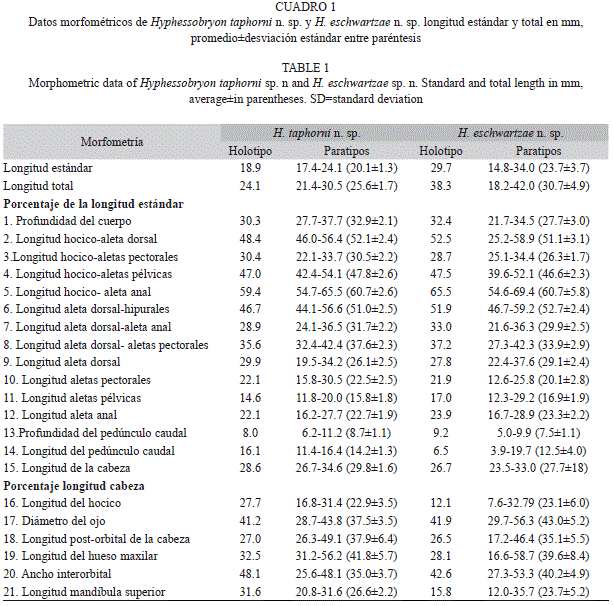
<body><![CDATA[escamas y dientes con estereoscopio y aguja de disecci&oacute;n, en     descripci&oacute;n los conteos del holotipo con asterisco (*).</span></font><br      style="font-family: verdana;">     <font size="2"><span style="font-family: verdana;">&nbsp;</span></font><br      style="font-family: verdana;">     <font size="2"><span style="font-family: verdana;">Las medidas y     conteos (<a href="/img/revistas/rbt/v61n2/a29t1.gif">Cuadro 1</a>) se     realizaron sobre el lado izquierdo de los ejemplares, excepto cuando     &eacute;stos estaban deteriorados en tal lado. Medidas y conteos     siguieron a Fink &amp; Weitzman (1974: 1-2), se expresaron como     ]]></body>
<body><![CDATA[porcentaje de la longitud est&aacute;ndar (% LE) y porcentaje de la     longitud cabeza (% LC). Las medidas del material tipo de <span      style="font-style: italic;">Hyphessobrycon     </span>agulha fueron tomadas a partir de fotos digitales, usando el     programa     Scion Image, bajo Windows versi&oacute;n 4.0.3.2. Los 21 caracteres     morfom&eacute;tricos utilizados en &eacute;ste trabajo (<a      href="/img/revistas/rbt/v61n2/a29t1.gif">Cuadro 1</a>),     fueron &uacute;tiles para realizar un an&aacute;lisis de componentes     principales (ACP), se utiliz&oacute; el m&eacute;todo Burnaby para     ]]></body>
<body><![CDATA[eliminar la influencia de la talla sobre la forma, por medio del     programa PAST versi&oacute;n 1.81 (Hammer <span      style="font-style: italic;">et al</span>. 2008). El rango de     medidas m&iacute;nimas y m&aacute;ximas de cada lote examinado y en la     descripci&oacute;n el n&uacute;mero de ejemplares se present&oacute;     entre par&eacute;ntesis. Las observaciones de estructuras &oacute;seas     y cart&iacute;lagos se&nbsp; hicieron&nbsp; sobre&nbsp;     ejemplares&nbsp; transparentados y te&ntilde;idos (C&amp;T) de acuerdo     con los m&eacute;todos descritos&nbsp; por&nbsp; Taylor&nbsp;     &amp;&nbsp; Van&nbsp; Dyke&nbsp; (1985)&nbsp; y Song &amp; Parenti     ]]></body>
<body><![CDATA[(1995). La nomenclatura de huesos se bas&oacute; en Weitzman (1962) y     Vari (1995). Abreviaciones institucionales sigue a Sabaj-P&eacute;rez     (2010).</span></font><br style="font-family: verdana;">     <br style="font-family: verdana;">     <font size="2"><span style="font-family: verdana;"><span      style="font-weight: bold;">Material de comparaci&oacute;n     examinado:</span> <span style="font-style: italic;">Hyphessobrycon&nbsp;     agulha</span>:&nbsp; Colombia, Amazonas,     Leticia: IAvH-P 8345, (19), afluente Quebrada Matamat&aacute;, mar     2001. IAvH-P 8335, (37); afluente&nbsp; Quebrada&nbsp; Matamat&aacute;,     ]]></body>
<body><![CDATA[Amazonas,&nbsp; 18 mar.&nbsp; 2001.&nbsp; IAvH-P 8332,&nbsp; (4);&nbsp;     afluente&nbsp; Qda. Matamat&aacute;,&nbsp; 02&nbsp; jul&nbsp;     2001.&nbsp; IAvH-P 8333,&nbsp; (52); afluente&nbsp; R&iacute;o&nbsp;     Purit&eacute;,&nbsp; 25&nbsp; mar&nbsp; 2001.&nbsp; IAvH-P 9025, (85);     Quebrada Sufragio frente a la Estaci&oacute;n Zafire, 15 dic. 2002.     IAvH-P 9046,&nbsp; (14); Quebrada afluente del Calder&oacute;n, 45min     al norte de&nbsp; la&nbsp; Estaci&oacute;n&nbsp; Zafire,&nbsp; 11&nbsp;     dic&nbsp; 2002.&nbsp; IAvH-P 9071, (38); Quebrada afluente del     Calder&oacute;n, 45 min. al norte de la Estaci&oacute;n Zafire, 12 dic     2002. IAvH-P 9407, (25); Quebrada 2 afluente del r&iacute;o     ]]></body>
<body><![CDATA[Purit&eacute; a 3 horas de Salados Varios, PNN Amacayacu, 25 mar 2003.     Per&uacute;, Madre de Dios: MUSM 23173, (9); Quebrada Km. 43 Tambopata.     MUSM 23173, (1 C&amp;T); Quebrada Km. 43 Tambopata. MUSM 25315, (9);     Quebrada Km. 43 Tambopata. MUSM 25315, (1 C&amp;T); Quebrada Km. 43     Tambopata.</span></font><br style="font-family: verdana;">     <br style="font-family: verdana; font-weight: bold; font-style: italic;">     <font size="2"><span style="font-family: verdana;"><span      style="font-weight: bold; font-style: italic;">H.&nbsp;     amaronensis:&nbsp;     </span>(V&eacute;ase&nbsp; Garc&iacute;a-Alzate <span     ]]></body>
<body><![CDATA[ style="font-style: italic;">et al</span>. 2008c). <span      style="font-style: italic;">H. compressus</span>:     (V&eacute;ase Garc&iacute;a- Alzate&nbsp; <span      style="font-style: italic;">et&nbsp; al</span>.&nbsp; 2010b).     <span style="font-style: italic;">H.&nbsp; fernandezi</span>:&nbsp;     (V&eacute;ase Garc&iacute;a-Alzate <span style="font-style: italic;">et     al</span>.     2008b). <span style="font-style: italic; font-weight: bold;">H.     heterorhabdus</span>:&nbsp; CAS&nbsp; 44415,&nbsp; Syntype,&nbsp;     (1)&nbsp; (16.9mm&nbsp; de LE), Brazil, Para, 1894; ICNMNH 5063, (10)     ]]></body>
<body><![CDATA[(17.8-23.9mm de LE), Colombia, Amazonas, R&iacute;o Pur&eacute;,     Leticia 02&deg; 07&#8217;05&#8221; S- 69&deg;37&#8217;50&#8221; W, 8 ene 2000; MCP 41577 (5)     (19.5-23.6mm de LE),&nbsp; Brazil,&nbsp; Para,&nbsp;     Igarap&eacute;&nbsp; Acu&iacute;,&nbsp; 01&deg;35&#8217;46&#8221;     S-48&deg;44&#8217;26&#8221;&nbsp; W,&nbsp; 21&nbsp; oct&nbsp; 2006;&nbsp; IUQ&nbsp;     1961, (3&nbsp; C&amp;T)&nbsp; (28.3-34.6mm&nbsp; de&nbsp; LE),&nbsp;     Colombia, R&iacute;o&nbsp;&nbsp; Pur&eacute;,&nbsp;&nbsp;     Leticia,&nbsp;&nbsp; Amazonas,&nbsp;&nbsp; 02&deg;07&#8217;05&#8221;     S-69&deg;37&#8217;50&#8221;&nbsp; O,&nbsp; 8&nbsp; ene&nbsp; 2000;&nbsp; IUQ&nbsp;     1963,&nbsp; (1 C&amp;T) (33.1mm de LE), Brazil, Para, Igarap&eacute;     ]]></body>
<body><![CDATA[Acu&iacute;, 01&deg;35&#8217;46&#8221; S- 48&deg;44&#8217;26&#8221; W. <span      style="font-style: italic; font-weight: bold;">H. melanostichos</span>:     MCP     39808, (5) (20.7-25.7mm de LE), Brasil, Rio Doze de Outubro, entre     Comodro e Vilhena, 12&ordm;35&#8217;&#8217;46&#8221; S-60&ordm;00&#8217;30&#8221; W, 14 jul 2004. <span      style="font-style: italic; font-weight: bold;">H.     nigricinctus</span>: MUSM 26791, (1) (32.04mm de LE), Per&uacute;,     Cusco,     Quispicanchi, Camanti Cuenca Araza, R&iacute;o San Lorenzo,     Quebrada&nbsp; Ilahuala,&nbsp; 396msnm,&nbsp; 26&nbsp; oct&nbsp; 2005;     ]]></body>
<body><![CDATA[MUSM&nbsp; 26786,&nbsp; (5)&nbsp; (30.8-34.3mm&nbsp; de&nbsp; LE),     Per&uacute;, Cusco, Quispicanchi, CamantiCuenca Araza, R&iacute;o San     Lorenzo, Quebrada Ilahuala, 396 msnm, 26 oct 2005.<span      style="font-weight: bold; font-style: italic;"> H. notidanus</span>:     MCP     38676 (2 paratipos) (24.8-25.7mm de LE), Brasil, rio Doze de Outubro,     entre Comodoro e Vilhena, 12&ordm;58&#8217;39&#8221; S-60&ordm;00&#8217;30&#8221; W, 14 jul     2004; MCP 38676 (1C&amp;T) Brasil, rio Doze de Outubro, entre Comodoro     e Vilhena, 12&ordm;58&#8217;39&#8221; S-60&ordm;00&#8217;30&#8221; W, 14 jul 2004. <span      style="font-weight: bold; font-style: italic;">H.     ]]></body>
<body><![CDATA[oritoensis</span>: (V&eacute;ase Garc&iacute;a-Alzate <span      style="font-style: italic;">et al</span>. 2008a). <span      style="font-weight: bold; font-style: italic;">H.     paucilepis</span>: (V&eacute;ase Garc&iacute;a-Alzate <span      style="font-style: italic;">et al</span>. 2008b). <span      style="font-weight: bold; font-style: italic;">H.     taguae</span>:&nbsp; (V&eacute;ase&nbsp; Garc&iacute;a-Alzate&nbsp; <span      style="font-style: italic;">et&nbsp;     al</span>.&nbsp; 2008c). <span      style="font-weight: bold; font-style: italic;">H.&nbsp; tortuguerae</span>:&nbsp;     ]]></body>
<body><![CDATA[(V&eacute;ase&nbsp;     Garc&iacute;a-Alzate&nbsp; <span style="font-style: italic;">et&nbsp;     al</span>. 2010b). <span style="font-weight: bold; font-style: italic;">H.     tuyensis</span>:     (V&eacute;ase Garc&iacute;a-Alzate <span style="font-style: italic;">et     al</span>. 2008b). <span style="font-weight: bold; font-style: italic;">H.vilmae</span>:     MCP 38881     (5) (28.0- 30.6mm de LE), Brasil, Rio Papagaio frente al balneario do     pub&iacute;, Mato Grosso 13&ordm;33&#8217;35&#8221; S-58&ordm;24&#8217;31&#8221; W, 13 jul 2004.</span></font><br      style="font-family: verdana;">     ]]></body>
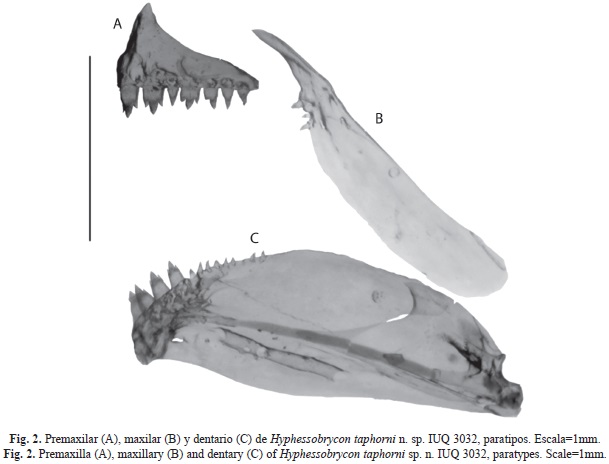
<body><![CDATA[<br style="font-family: verdana;">     <br style="font-family: verdana;">     <font size="3"><span style="font-family: verdana; font-weight: bold;">Resultados</span></font><br      style="font-family: verdana;">     <br> </div> <font size="2"><span style="font-family: verdana;"><span  style="font-style: italic;">Hyphessobrycon taphorni </span>n. sp. (<a href="/img/revistas/rbt/v61n2/a29t1.gif">Cuadro 1</a>, <a  href="/img/revistas/rbt/v61n2/a29i1.jpg">Figs. 1</a> y <a  href="/img/revistas/rbt/v61n2/a29i2.jpg">2</a>)</span></font><br  style="font-family: verdana;"> <font size="2"><span style="font-family: verdana;"><span  style="font-weight: bold;">    <br> </span></span></font>     <div style="text-align: justify;"><font size="2"><span  style="font-family: verdana;"><span style="font-weight: bold;">Holotipo</span>:&nbsp;&nbsp; &nbsp;MUSM&nbsp;&nbsp; &nbsp;42391,&nbsp;&nbsp; &nbsp;18.9mm LE, macho; Per&uacute;, aguajal pozo Paiche, R&iacute;o Tambopata,&nbsp; cuenca&nbsp; del&nbsp; r&iacute;o&nbsp; Madre&nbsp; de&nbsp; Dios, 12&deg;29&#8217;4.2&#8221; S - 68&deg;57&#8217;9.09&#8221; O, 22 feb 2004. Col. M. Hidalgo.</span></font><br  style="font-family: verdana;"> </div> <br style="font-family: verdana;">     <div style="text-align: justify;"><font size="2"><span  style="font-family: verdana;"><span style="font-weight: bold;">Paratipos</span>: Todos de Per&uacute;, departamento Madre&nbsp; de&nbsp; Dios:&nbsp; MUSM&nbsp; 22042,&nbsp; (95)&nbsp; (17.7-22.9mm LE), colectados con el holotipo. AUM 56757,&nbsp; (2),&nbsp; Aguajal&nbsp; de&nbsp; aguas&nbsp; negras,&nbsp; pozo minero, R&iacute;o Tambopata, cuenca del R&iacute;o Madre de&nbsp; Dios,&nbsp; 12&deg;38&#8217;9.84&#8221;&nbsp; S-69&deg;25&#8217;35.8&#8221;&nbsp; O,&nbsp; 21 ene 2004, Col. M. Hidalgo. AUM 56758, (2), Aguajal&nbsp; este,&nbsp; r&iacute;o Tambopata,&nbsp; cuenca&nbsp; del&nbsp; r&iacute;o Madre de Dios, 20 feb. 2004, Col. M. Hidalgo. MUSM 5562, (60) (19.2-22.9mm LE); Lago Sandoval, Las Piedras, R&iacute;o Tambopata, 12&deg;36&#8217;17.76&#8221; S-69&deg;02&#8217;40.29&#8221; O, 23 ene 1990, Col H. Ortega y col. MUSM 5581, (4) (20.5- 24.1mm LE); Laguna Sandoval, Las Piedras, R&iacute;o Tambopata, 12&deg;36&#8217;17.76&#8221; S-69&deg;02&#8217;40.29&#8221; O, 24 ene 1990, Col. H. Ortega <span  style="font-style: italic;">et al</span>. 2011, MUSM 5588, (80) (21.1-29.3mm LE); Tambopata, Las Piedras, quebrada a 2km de la laguna Sandoval, 12&deg; 36&#8217;17&#8221; S-69&deg;03&#8217;23&#8221; O, 23 ene 1990, Cols. H. Ortega y col. MUSM 9584, (11) (18.2-21.4mm LE); Lago Sandoval, Tambopata,&nbsp; cuenca&nbsp; del&nbsp; r&iacute;o&nbsp; Madre&nbsp; de&nbsp; Dios, 12&deg;36&#8217;17.76&#8221; S-69&deg;02&#8217;40.29&#8221; O, 15 may 1996, Cols. F. Chang &amp; P. de Rham. MUSM 21703, (15) (18.6-22.1mm LE); Aguajal aguas negras, Agujal Sat&eacute;lite, rio Tambopata, cuenca del r&iacute;o Madre de Dios, 12&deg;39&#8217;22&#8221; S-69&deg;26&#8217;28&#8221; O, 22 ene 2004, Col M. Hidalgo. MUSM 21824, (58) (20.2-21.9mm LE); Aguajal de aguas negras, pozo minero, r&iacute;o Tambopata, cuenca del Madre de&nbsp; Dios,&nbsp; 12&deg;38&#8217;9.84&#8221;&nbsp; S-69&deg;25&#8217;35.8&#8221;&nbsp; O,&nbsp; 21 ene 2004, Col. M. Hidalgo. MUSM 21994, (272)&nbsp; (17.5-22.5mm&nbsp; LE); Aguajal&nbsp; Este,&nbsp; R&iacute;o Tambopata,&nbsp; cuenca&nbsp; del&nbsp; r&iacute;o&nbsp; Madre&nbsp; de&nbsp; Dios,</span></font><br  style="font-family: verdana;">     <br> </div> <font size="2"><span style="font-family: verdana;">20&nbsp; feb.&nbsp; 2004,&nbsp; Col.&nbsp; M.&nbsp; Hidalgo.&nbsp; IUQ&nbsp; 3032, (2&nbsp; C&amp;T)&nbsp; (18.5-20.3mm&nbsp; LE); Aguajal&nbsp; aguas negras, Agujal Sat&eacute;lite, rio Tambopata, cuenca del r&iacute;o Madre de Dios, 12&deg;39&#8217;22&#8221; S-69&deg;26&#8217;28&#8221; O, 22 ene 2004, Col M. Hidalgo. IUQ 3034; (2 C&amp;T) (19.3-20.4mm LE); Aguajal Este, R&iacute;o Tambopata, cuenca del R&iacute;o Madre de Dios, 20 feb. 2004, Col. M. Hidalgo.</span></font><br  style="font-family: verdana;"> <br style="font-family: verdana;">     <div style="text-align: justify;"><font size="2"><span  style="font-family: verdana;"><span style="font-weight: bold;">Diagnosis</span>: Se incluye en el grupo <span style="font-style: italic;">heterorhabdus</span>, al presentar una franja lateral oscura. <span style="font-style: italic;">Hyphessobrycon&nbsp; taphorni&nbsp;</span> puede&nbsp; distinguirse de todos los cong&eacute;neres de otros grupos de especies del g&eacute;nero <span style="font-style: italic;">Hyphessobrycon </span>conocidos (definidos arriba) de la cuenca del r&iacute;o Madre de Dios que tambi&eacute;n poseen la banda lateral conspicua y oscura, <span style="font-style: italic;">H. nigricinctus</span>, <span  style="font-style: italic;">H. agulha</span> y <span  style="font-style: italic;">H. loretoensis</span> por el n&uacute;mero de radios de la aleta dorsal (iii, 8 vs. ii, 9), por el n&uacute;mero de escamas con poros en la l&iacute;nea lateral (cuatro a cinco vs. seis a 24); de dientes en la fila externa del pre- maxilar (uno a dos vs. tres a cuatro); y en la fila interna del premaxilar (siete a ocho vs. cinco); por&nbsp; la&nbsp; longitud&nbsp; del&nbsp; ped&uacute;nculo&nbsp; caudal&nbsp; (11.4-16.4% LE vs. 4.6-10.0% LE); por el n&uacute;mero de escamas laterales (28-29 vs. 31-37 excepto de <span style="font-style: italic;">H. loretoensis</span> con 29-30); por la ausencia de una mancha humeral (vs. presencia) y por presentar el segundo infraorbital m&aacute;s ancho de la serie orbital (vs. tercer infraorbital m&aacute;s ancho de la serie); se diferencia de <span style="font-style: italic;">H. loretoensis</span> por el n&uacute;mero de escamas entre la l&iacute;nea lateral y la aleta anal (cuatro vs. tres) y por el n&uacute;mero de dientes del maxilar (dos vs. tres a cuatro), y se distingue de <span style="font-style: italic;">H. agulha</span> por el n&uacute;mero de radios ramificados en las aletas pectorales (11-12 vs. nueve a 10).</span></font><br  style="font-family: verdana;"> <span style="font-family: verdana;"><span style="font-weight: bold;">    ]]></body>
<body><![CDATA[<br> </span></span><font size="2"><span style="font-family: verdana;"><span  style="font-weight: bold;">Diagnosis</span>:&nbsp; <span style="font-style: italic;">Hyphessobrycon&nbsp; taphorni&nbsp;</span> n. sp. is a member of the <span style="font-style: italic;">heterorhabdus </span>species group, because it shares with those species a dark midlateral stripe and so differs from congeners in the other species groups of <span style="font-style: italic;">Hyphessobrycon </span>(defined above). H. taphorni differs from the species that share a dark, conspicuous midlateral stripe found in the Madre de Dios River drainage, <span style="font-style: italic;">H. nigricinctus</span>, <span style="font-style: italic;">H. agulha</span> and <span style="font-style: italic;">H. loretoensis</span> in the number of dorsal-fin rays&nbsp; (iii, 8 vs. ii, 9), in the number of pored lateral- line scales (four or five vs. six to 24); in the number of teeth in the outer premaxillary row (one or two vs. three or four); and in the number of teeth in the internal row of premaxillary teeth (seven or eight vs. five); in the caudal- peduncle length (11.4-16.4 % SL vs. 4.6-10.0 % SL); in the number of lateral scales (28-29 vs. 31-37 except <span style="font-style: italic;">H. loretoensis</span> with 29-30); in the absence of a humeral spot (vs. humeral spot present) and in having the second infraorbital&nbsp; bone&nbsp; wider&nbsp; than&nbsp; the&nbsp; orbital&nbsp; series&nbsp; (vs. third infraorbital bone wider than the series); it differs from <span style="font-style: italic;">H. loretoensis</span> by the number of scales between the lateral line and the anal fin (four vs. three) and by the number of teeth on the maxillary (two vs. three or four), and it differs from <span  style="font-style: italic;">H. agulha</span> in the number of branched pectoral-fin rays (11-12 vs. 9-10).</span></font><br style="font-family: verdana;"> </div> <br style="font-family: verdana;">     <div style="text-align: justify;"><font size="2"><span  style="font-family: verdana;"><span style="font-weight: bold;">Descripci&oacute;n</span>: Datos morfom&eacute;tricos del material tipo se registran en el <a  href="/img/revistas/rbt/v61n2/a29t1.gif">cuadro 1</a>. Cuerpo comprimido y delgado, la profundidad del cuerpo mayor entre la inserci&oacute;n de las aletas p&eacute;lvicas y el origen de la aleta dorsal. Perfil dorsal de la cabeza convexa desde el labio superior a una vertical en medio de la &oacute;rbita del ojo; recta de este &uacute;ltimo punto hasta el extremo posterior de la espina supraoccipital, y moderadamente convexa desde ac&aacute; hasta el inicio de la aleta dorsal. Base de la aleta dorsal ligeramente convexa, e inmediatamente despu&eacute;s recta desde la parte posterior de la aleta dorsal al inicio de la aleta adiposa, y ligeramente c&oacute;ncava desde ac&aacute; hasta la base del l&oacute;bulo caudal superior. Perfil ventral de la cabeza convexa desde el labio inferior hasta la inserci&oacute;n de la aleta anal, y desde ac&aacute; hasta el l&oacute;bulo caudal inferior ligeramente c&oacute;ncavo.</span></font><br  style="font-family: verdana;"> <br style="font-family: verdana;"> <font size="2"><span style="font-family: verdana;">Cabeza y hocico largos, mand&iacute;bulas iguales, boca terminal; labios blandos y flexibles, hilera externa de dientes del premaxilar no expuesta. Premaxilar con el proceso lateral corto y redondeado sobre el etmoides, dos filas de dientes (<a href="/img/revistas/rbt/v61n2/a29i2.jpg">Fig. 2</a>), fila externa con uno* (4) o dos (46) todos tric&uacute;spides, fila interna con siete* (14) u ocho (36) pentac&uacute;spides disminuyen gradualmente de tama&ntilde;o a medida que se aleja de la s&iacute;nfisis. Maxilar largo y estrecho, margen posterior recto y anterior convexo, extremo&nbsp; posterior&nbsp; alcanza&nbsp; el&nbsp; borde&nbsp; ventral del segundo infraorbital, con dos (50) dientes tric&uacute;spides. Dentario con margen ventral convexo, cinco (50) dientes frontales heptac&uacute;spides seguido por dos* (31) o tres (19) dientes c&oacute;nicos m&aacute;s peque&ntilde;os (<a href="/img/revistas/rbt/v61n2/a29i2.jpg">Fig. 2</a>).</span></font><br  style="font-family: verdana;"> <br style="font-family: verdana;"> <font size="2"><span style="font-family: verdana;">Escamas cicloideas. L&iacute;nea lateral con cuatro&nbsp; (37)&nbsp; o&nbsp; cinco*&nbsp; escamas&nbsp; (13)&nbsp; con&nbsp; poros. Serie lateral con 28 (14) o 29* (36) escamas, incluyen las escamas con poros. Cinco escamas horizontales entre el origen de la aleta dorsal y la l&iacute;nea lateral sin incluir las escama de la serie predorsal situada justo en la parte anterior del primer radio de la aleta dorsal (50). Cuatro escamas horizontales entre el origen de la aleta anal y la l&iacute;nea lateral (50). Cuatro escamas horizontales entre el origen de las aletas p&eacute;lvicas y la l&iacute;nea lateral (50). Escamas predorsales 10 (4), 11*(40) o 12 (6). Cuatro* a siete escamas en una simple hilera en la base anterior de los radios de la aleta anal.</span></font><br  style="font-family: verdana;"> </div> <br style="font-family: verdana;">     <div style="text-align: justify;"><font size="2"><span  style="font-family: verdana;">Radios en la aleta dorsal ii, 8, i, (50). Radios&nbsp; en&nbsp; la&nbsp; aleta&nbsp; anal&nbsp; iii,&nbsp; 20&nbsp; (2),&nbsp; 21&nbsp; (2), 22*(40) o 23 (6). Radios en las aletas p&eacute;lvicas i, 7 (50). Radios en las aletas pectorales ii, 11 (46) o 12* (4). Aleta caudal bifurcada, l&oacute;bulos superiores e inferiores puntiagudos y similares en tama&ntilde;o. Radios principales de la aleta caudal 10+10 (4). Radios procurrentes de la aleta caudal 10 (4). N&uacute;mero total de v&eacute;rtebras 33.</span></font><br  style="font-family: verdana;"> <br style="font-family: verdana;"> <font size="2"><span style="font-family: verdana;">Ectopterigoide alargado y estrecho no en contacto con el cuadrado y se extiende por el margen antero ventral del mesopterogoide. Metapterigoide sin proyecci&oacute;n ventral y no en contacto con el simpl&eacute;ctico. Margen dorsal del palatino con dos o tres proyecciones que se sobreponen al margen anterior del mesopterigoide. Cinco huesos infraorbitales presentes, segundo infraorbital m&aacute;s ancho de la serie, tercer infraorbital no en contacto con el canal late- rosensorial del preop&eacute;rculo, quinto infraorbital m&aacute;s peque&ntilde;o de la serie, canal sensorial de los infraorbitales sobrepasan el primer infraorbital y se contin&uacute;a con el antorbital. Supraorbital ausente. Etmoides lateral es un hueso largo y c&oacute;ncavo que se conecta por cart&iacute;lago al margen lateral del frontal y con una prolongaci&oacute;n laminar &oacute;sea que se extiende hacia el v&oacute;mer con un foramen lateral incompleto sobre la regi&oacute;n ventral. Margen postero medial de la espina supraoccipital con una proyecci&oacute;n &oacute;sea en forma de lamela que se extiende hasta el margen dorsal del complejo neural.</span></font><br  style="font-family: verdana;"> <br style="font-family: verdana;"> <font size="2"><span style="font-family: verdana;">Rinosfenoide &oacute;seo, con una banda de cart&iacute;lago sobre todo su margen. Orbitoesfenoide &oacute;seo, grande y alargado, presenta cart&iacute;lago en la regi&oacute;n ventral anterior. Primer arco branquial con 19 braquiespinas, dos en el hypobranquial, 10 en el ceratobraquial y siete en el epibranquial. Pteriog&oacute;foros proximales de los radios de la aleta dorsal insertados entre las espinas neurales nueve y 16; 22 pterig&oacute;foros proximales en la aleta anal, los tres iniciales insertados entre las espinas hemales 11 y 12, alcanzan el borde ventral del centrum de la espina hemal 12. Cuatro supraneurales alargados, con cart&iacute;lago en la parte superior e inferior, insertados sobre la cuarta y octava espina neural. Aleta p&eacute;lvica corta, su extremo posterior no alcanza el origen de la aleta anal. Hueso p&eacute;lvico corto, recto y angosto, con cart&iacute;lago en el extremo anterior. Proceso isquial largo, curvo y con cart&iacute;lago.</span></font><br  style="font-family: verdana;"> </div> <br style="font-family: verdana; font-weight: bold;">     <div style="text-align: justify;"><font size="2"><span  style="font-family: verdana;"><span style="font-weight: bold;">Color en alcohol: </span>Dorso y cabeza marr&oacute;n oscuro, cromat&oacute;foros densamente concentrados en la superficie dorsal del cuerpo, m&aacute;s intenso en la cabeza y en la base de la aleta dorsal. Una banda oscura conspicua y recta en la parte lateral del cuerpo que cubre dos a tres escamas y se extiende desde la parte dorsal posterior del op&eacute;rculo hasta el ped&uacute;nculo caudal, se contin&uacute;a entre los radios medios caudales. Sin mancha humeral. Presenta una densa concentraci&oacute;n de cromat&oacute;foros en la base de la aleta anal. &Aacute;rea ventral del cuerpo amarillo claro. &Aacute;rea posterior de las escamas de la regi&oacute;n dorsal por encima de la banda lateral del cuerpo oscuras. Aleta dorsal con gran concentraci&oacute;n de cromat&oacute;foros oscuros&nbsp; a&nbsp; lo&nbsp; largo&nbsp; del&nbsp; margen&nbsp; distal. Aleta adiposa hialina. Aleta caudal con cromat&oacute;foros oscuros concentrados en los radios medios y el margen distal. Aleta anal con gran concentraci&oacute;n de cromat&oacute;foros oscuros principalmente en&nbsp; la&nbsp; membrana&nbsp; interradial&nbsp; y&nbsp; en&nbsp; la&nbsp; margen distal de los radios anteriores. Aletas ventral y p&eacute;lvica con cromat&oacute;foros en la margen distal.</span></font><br  style="font-family: verdana;"> <font size="2"><span style="font-family: verdana;">&nbsp;</span></font><br  style="font-family: verdana;"> <font size="2"><span style="font-family: verdana;"><span  style="font-weight: bold;">Distribuci&oacute;n:</span>&nbsp; <span style="font-style: italic;">Hyphessobrycon&nbsp; taphorni </span>se&nbsp; conoce&nbsp; de&nbsp; la&nbsp; parte&nbsp; baja&nbsp; del&nbsp; R&iacute;o&nbsp; Tambopata y afluentes del lago Sandoval, Alta Amazonia, Per&uacute;.</span></font><br  style="font-family: verdana;"> </div> <br style="font-family: verdana;">     <div style="text-align: justify;"><font size="2"><span  style="font-family: verdana;"><span style="font-weight: bold;">Etimolog&iacute;a</span>: El ep&iacute;teto espec&iacute;fico <span style="font-style: italic;">taphorni </span>alusivo al colega Donald C. Taphorn por su gran contribuci&oacute;n al estudio y reconocimiento de la diversidad sobre los peces neotropicales.</span></font><br  style="font-family: verdana;"> <br style="font-family: verdana;"> <font size="2"><span style="font-family: verdana;"><span  style="font-weight: bold;">Dimorfismo sexual: </span>Machos con ganchos en las aletas anal y p&eacute;lvicas, con nueve pares de ganchos sobre el tercer radio simple de la aleta anal; entre 10 y 20 pares de ganchos desde el primero al sexto radio ramificado de la aleta anal; con 15 ganchos en el radio simple y 20 a 25 pares de ganchos en los radios ramificados de las aletas p&eacute;lvicas, ubicadas sobre la rama interna del radio en cada segmento con uno a dos pares de ganchos sobre cada porci&oacute;n.</span></font><br  style="font-family: verdana;"> </div>     <br> <font size="2"><span style="font-family: verdana;"><span  style="font-style: italic;">Hyphessobrycon eschwartzae</span> n. sp. (<a href="/img/revistas/rbt/v61n2/a29t1.gif">Cuadro 1</a>, <a  href="/img/revistas/rbt/v61n2/a29i3.jpg">Figs. 3</a>-<a  href="/img/revistas/rbt/v61n2/a29i5.jpg">5</a>)    <br> <span style="font-weight: bold;">    <br> </span></span></font>     <div style="text-align: justify;"><font size="2"><span  style="font-family: verdana;"><span style="font-weight: bold;">Holotipo</span>: MUSM 42392, 29.7mm LE, hembra, La Cachuela, Rio Madre de Dios, Tambopata,&nbsp; Madre&nbsp; de&nbsp; Dios,&nbsp; 12&deg;16&#8217;38.2&#8221;&nbsp; S -69&deg;09&#8217;8.12&#8221; O, 8 jul 2003, Col. M. Hidalgo.</span></font><br style="font-family: verdana;"> <br style="font-family: verdana;"> <font size="2"><span style="font-family: verdana;"><span  style="font-weight: bold;">Paratipos</span>: Todos de Per&uacute;, departamento de Madre de Dios: AUM 51350, (12) (15.7- 28.0mm LE); R&iacute;o Planch&oacute;n, cruzando el puente de la carretera Interoce&aacute;nica, 36.3km N de Puerto Maldonado, Rio Inambari, 01 ago 2010, Cols.&nbsp; N.&nbsp; Lujan,&nbsp; D.&nbsp; Taphorn.&nbsp; AUM&nbsp; 51374, (16) (17.5-23.7mm LE); R&iacute;o Buyuyoc, en el puente de la carretera Interoce&aacute;nica, 91.1km N de Puerto Maldonado, 01 ago 2010, Cols. N. Lujan, D. Taphorn. MUSM 22474, (111) (14.8-30.5mm LE); recolectados con el holotipo.&nbsp; MUSM&nbsp; 3684,&nbsp; (16)&nbsp; (25.6-29.0mm&nbsp; LE); R&iacute;o Tambopata, Quebrada 500 m del campamento,&nbsp; Sandia,&nbsp; Puno,&nbsp; 26&nbsp; ago&nbsp; 1992,&nbsp; Cols. F. Chang &amp; J. Moscoso. MUSM 9771, (26) (17.6-25.1mm LE); R&iacute;o Madre de Dios, km 29, Tambopata,&nbsp; 12&deg;42&#8217;26.22&#8221;&nbsp; S-69&deg;26&#8217;54.03&#8221;&nbsp; O, 22 may1996, Col. D. de Rham. MUSM 21221, (143) (23.9-31.6mm LE); quebrada Km 14 en la carretera a San Juan cuenca del R&iacute;o Manuripe Alegr&iacute;a, 12&deg;0&#8217;57.41&#8221; S-69&deg;03&#8217;43.39&#8221; O, 11 jul 2003, Col. H. Ortega. MUSM 22893, (30) (23.8-27.4mm&nbsp; LE);&nbsp; Quebrada&nbsp; Planch&oacute;n&nbsp; (km 40), Tambopata, 12&deg;16&#8217;34.94&#8221; S-69&deg;09&#8217;8.12&#8221; O, 13 jul 2003, Col. H. Ortega. MUSM 25093, (150)&nbsp; (21.1-28.5mm&nbsp; LE);&nbsp; Quebrada&nbsp; Agua- jal,&nbsp; cuenca&nbsp; del&nbsp; R&iacute;o&nbsp; Manuripe,&nbsp; Tambopata, 12&deg;19&#8217;21.07&#8221;&nbsp; S-69&deg;09&#8217;59.9&#8221;&nbsp; O,&nbsp; 7&nbsp; jul&nbsp; 2004, Col. M. Hidalgo. MUSM 25109, (26) (18.1- 28.1mm LE); Quebrada&nbsp;&nbsp; Mavila, cuenca del R&iacute;o Madre de Dios. Tambopata, 12&deg;19&#8217;21.07&#8221; S-69&deg;09&#8217;59.9&#8221; O, 9 jul 2004, Col. M. Hidalgo. MUSM 25182, (24) (23.4-27.2mm LE); Quebrada&nbsp; Km&nbsp; 45&nbsp; r&iacute;o&nbsp; Manuripe,&nbsp; Tambopata, 12&deg;13&#8217;42.52&#8221; S-69&deg;08&#8217;23.08&#8221; O, 8 jul 2004, Col M. Hidalgo. MUSM 25243, (110) (16.1- 27.2mm LE); Quebrada Planch&oacute;n (km 40), Tambopata,&nbsp; 12&deg;16&#8217;38.23&#8221;&nbsp; S-69&deg;09&#8217;8.29&#8221;&nbsp; O, 8 jul 2004, Col. M. Hidalgo. MUSM 25315, (440)&nbsp;&nbsp; (16.3-30.6mm&nbsp;&nbsp; LE);&nbsp;&nbsp; Quebrada&nbsp;&nbsp; Km 43&nbsp; r&iacute;o&nbsp; Manuripe,&nbsp; Tambopata,&nbsp; 12&deg;14&#8217;59.18&#8221; S-69&deg;08&#8217;49.13&#8221; O, 7 jul 2004, Col M. Hidalgo. IUQ3033, (3 C&amp;T) (24.1-30.1mm LE); Quebrada KM 14 en la carretera a San Juan cuenca del R&iacute;o Manuripe Alegr&iacute;a, 11 jul 2003, Col. H. Ortega.</span></font><br  style="font-family: verdana;"> </div> <br style="font-family: verdana;">     <div style="text-align: justify;"><font size="2"><span  style="font-family: verdana;"><span style="font-weight: bold;">Diagnosis</span>: Se asigna al grupo <span style="font-style: italic;">heterorhabdus </span>por poseer una franja lateral oscura, <span style="font-style: italic;">Hyphessobrycon eschwartzae</span> puede distinguir- se de todos los otros <span  style="font-style: italic;">Hyphessobrycon </span>conocidos de la cuenca del r&iacute;o Madre de Dios que tambi&eacute;n tienen la franja horizontal: <span style="font-style: italic;">H. nigricinctus</span> <span style="font-style: italic;">H.agulha</span>, <span style="font-style: italic;">H. loretoensis</span> y <span style="font-style: italic;">H. taphorni</span> por el n&uacute;mero de: radios simples en la aleta anal (iv vs. iii); dientes: en el dentario (13-15 vs. cinco a 11); en la fila interna del premaxilar (seis vs. cinco); en la fila externa del premaxilar (tres vs. cuatro excepto en <span  style="font-style: italic;">H. heterorhabdus</span> y <span  style="font-style: italic;">H. loretoensis</span> con tres a cuatro); se diferencia de <span  style="font-style: italic;">H. loretoensis</span> por el n&uacute;mero de: escamas con poros en la l&iacute;nea lateral (siete vs. nueve a 10); escamas entre la l&iacute;nea lateral y la aleta dorsal (cinco vs. tres a cuatro); se diferencia de <span  style="font-style: italic;">H. heterorhabdus</span> por el n&uacute;mero de: escamas laterales (30-31 vs. 35-37); escamas con poros en el l&iacute;nea lateral (siete vs. 23-24); dientes en el maxilar (cuatro vs. dos); se diferencia de <span  style="font-style: italic;">H. agulha</span>&nbsp; por&nbsp; el&nbsp; n&uacute;mero&nbsp; de&nbsp; escamas:&nbsp; laterales (30-31 vs. 33-34); predorsales (nueve vs. 10); de dientes en el maxilar (cuatro vs. cero a uno); tambi&eacute;n por presentar, en vivo una banda lateral roja por encima de la banda oscura, que se extiende desde la parte posterior del op&eacute;rculo hasta&nbsp; el&nbsp; ped&uacute;nculo&nbsp; caudal&nbsp; (vs.&nbsp; ausencia),&nbsp; y por la presencia de ganchos &oacute;seos en machos maduros en la aleta anal (vs. todas las aletas e incluye la caudal).</span></font><br  style="font-family: verdana;"> <br style="font-family: verdana;"> <font size="2"><span style="font-family: verdana;"><span  style="font-weight: bold;">Diagnosis</span>:&nbsp; <span style="font-style: italic;">Hyphessobrycon&nbsp; eschwartzae</span> is&nbsp; a&nbsp; member&nbsp; of&nbsp; the&nbsp; heterorhabdus&nbsp; species group because it shares with those species a dark midlateral stripe. It can be distinguished from all other species of <span style="font-style: italic;">Hyphessobrycon </span>known from the Madre de Dios River drainage that also have a dark midlateral stripe: <span  style="font-style: italic;">H. nigricinctus</span>, <span  style="font-style: italic;">H. agulha</span>, <span style="font-style: italic;">H. loretoensis</span> and<span style="font-style: italic;"> H. taphornin</span>. sp. by the number of: simple anal- fin rays (iv vs. iii); teeth: in the dentary (13-15 vs. five to 11); in the internal premaxillary row&nbsp; (six vs. five); in the external premaxillary row (three vs. four, except <span  style="font-style: italic;">H. heterorhabdus</span> and <span style="font-style: italic;">H. loretoensis</span> that each have three or four); it differs from <span style="font-style: italic;">H. loretoensis</span> in the number of pored lateral-line scales (seven vs. nine to 10); in the number of scales between the lateral line and the dorsal fin (five vs. three or four); it differs from <span  style="font-style: italic;">H. heterorhabdus</span> in the number of lateral scales (30-31 vs. 35-37); in the number of pored lateral-line scales (seven vs. 23-24); in the number of maxillary teeth (four vs. two); it differs from <span style="font-style: italic;">H. agulha</span> in scale counts: lateral (30-31 vs. 33-34); predorsal (nine vs.10); in the number of maxillary teeth (four vs. none or one); and also in having in life a red midlateral stripe located above the dark lateral stripe, that extends from the posterior part of the opercle to the caudal peduncle (vs. red stripe absent), and by the presence of bony hooks in mature males on only the anal fin (vs. mature males with bony hooks on all fins including caudal).</span></font><br style="font-family: verdana;"> </div>     ]]></body>
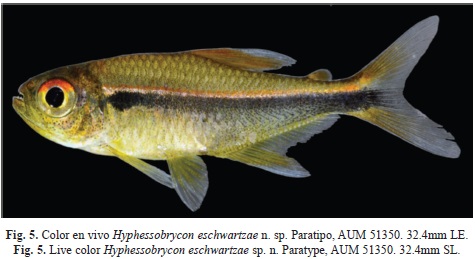
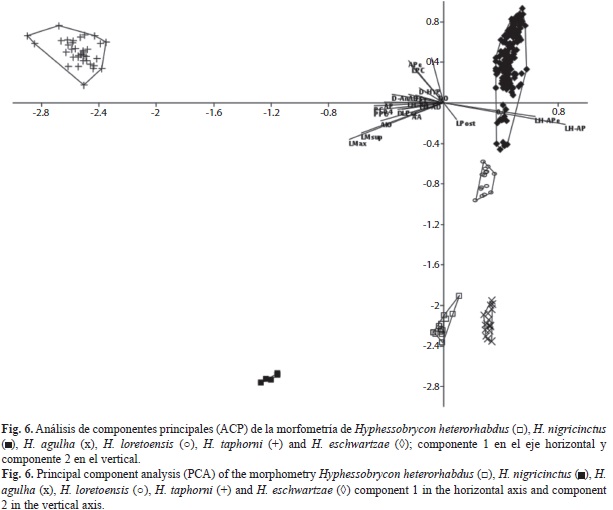
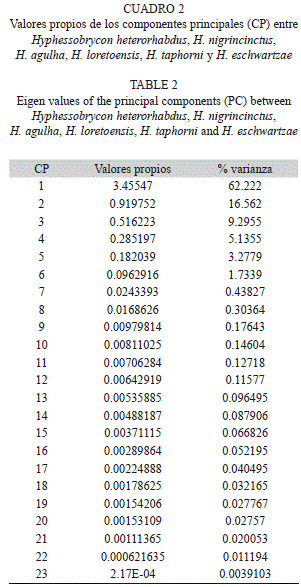
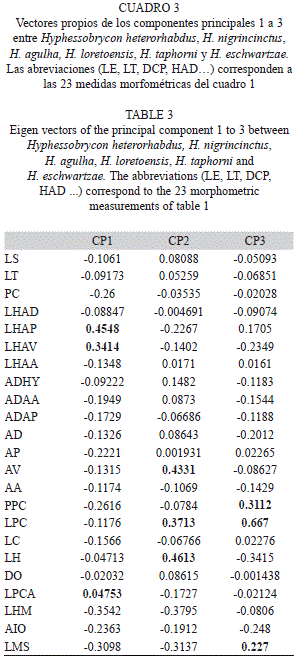
<body><![CDATA[<div style="text-align: justify;"><font size="2"><span  style="font-family: verdana;"><span style="font-weight: bold;">    <br> Descripci&oacute;n</span>: Datos morfom&eacute;tricos de los tipos se consignaron en el <a  href="/img/revistas/rbt/v61n2/a29t1.gif">cuadro 1</a>. Cuerpo comprimido y delgado, la profundidad del cuerpo mayor entre la inserci&oacute;n de las aletas p&eacute;lvicas y el origen de la aleta dorsal. Perfil dorsal de la cabeza recta desde el labio superior hasta el extremo posterior de la espina supraoccipital, y moderadamente convexa desde ac&aacute; hasta el inicio de la aleta dorsal. Base de la aleta dorsal convexa, e inmediatamente despu&eacute;s recta desde la parte posterior de la aleta dorsal al inicio de la aleta adiposa y c&oacute;ncava desde ac&aacute; hasta la base del l&oacute;bulo caudal superior. Perfil ventral de la cabeza convexa desde el labio inferior hasta la inserci&oacute;n de la aleta anal y desde all&iacute;&nbsp; hasta el l&oacute;bulo caudal inferior c&oacute;ncavo.</span></font>    <br> <font size="2"><span style="font-family: verdana;"></span></font><br  style="font-family: verdana;"> <font size="2"><span style="font-family: verdana;">Cabeza y hocico largos, mand&iacute;bulas desiguales, boca terminal; labios blandos y flexibles, hilera externa de dientes del premaxilar expuesta. Premaxilar con el proceso lateral largo y agudo y se inserta sobre el etmoides, dos filas de dientes (<a  href="/img/revistas/rbt/v61n2/a29i4.jpg">Fig. 4</a>),fila externa con dos dientes&nbsp; (202),&nbsp; todos&nbsp; tric&uacute;spides,&nbsp; fila&nbsp; interna con cinco dientes (202), los cuatro anteriores pentac&uacute;spides y el lateral c&oacute;nico o tric&uacute;spide, disminuyen gradualmente de tama&ntilde;o a medida que se aleja de la s&iacute;nfisis. Maxilar largo y ancho, margen posterior recto y anterior convexo, extremo posterior alcanza el borde ventral del segundo infraorbital con tres* (201) o cuatro (1) dientes tric&uacute;spides. Dentario con margen ventral convexo, cuatro (202) dientes frontales heptacuspides seguido por ocho* (100), nueve (52) o 10 (50) dientes c&oacute;nicos m&aacute;s peque&ntilde;os (<a  href="/img/revistas/rbt/v61n2/a29i4.jpg">Fig. 4</a>).</span></font><br  style="font-family: verdana;"> <br style="font-family: verdana;"> <font size="2"><span style="font-family: verdana;">Escamas cicloideas. L&iacute;nea lateral con seis* (109) o siete escamas (93) con poros. Serie lateral con 30 (109) o 31* (93) escamas, incluyen las escamas con poros. Cinco escamas horizontales entre el origen de la aleta dorsal y la l&iacute;nea lateral, sin incluir las escama de la serie predorsal, situada justo en la parte anterior del primer radio de la aleta dorsal (202). Cuatro escamas horizontales entre el origen de la aleta anal y la l&iacute;nea lateral (202). Cuatro escamas (202) horizontales entre el origen de las aletas p&eacute;lvicas y la l&iacute;nea lateral. Escamas predorsales nueve (14), 10*(9) u 11 (179). Cinco* a seis escamas en una simple hilera en la base anterior de los radios de la aleta anal.</span></font><br style="font-family: verdana;"> </div> <br style="font-family: verdana;">     <div style="text-align: justify;"><font size="2"><span  style="font-family: verdana;">Radios en la aleta dorsal i,9,i (202). Radios en la aleta anal iv, 19 (7), 20 (107), 21*(68) o 22 (20). Radios en las aletas p&eacute;lvicas i, 7 (202). Radios en las aletas pectorales ii, 10* (159) o 11 (43). Aleta caudal bifurcada, l&oacute;bulos superiores e inferiores puntiagudos y similares en tama&ntilde;o. Radios principales de la aleta caudal 10+10 (3). Radios procurrentes de la aleta caudal nueve (3). N&uacute;mero total de v&eacute;rtebras 32-33.</span></font><br style="font-family: verdana;"> <br style="font-family: verdana;"> <font size="2"><span style="font-family: verdana;">Ectopterigoide alargado y estrecho no en contacto con el cuadrado se extiende por el margen antero ventral del mesopterogoide con una banda de cart&iacute;lago sobre todo el margen superior. Metapterigoide sin proyecci&oacute;n ventral y no en contacto con el simpl&eacute;ctico. Margen dorsal del palatino con dos o tres proyecciones que se sobreponen al margen anterior del mesopterigoide. Cinco huesos infraorbitales presentes, tercer infraorbital mas ancho de la serie, no en contacto con el canal laterosensorial del preop&eacute;rculo, quinto infraorbital m&aacute;s peque&ntilde;o de la serie, canal sensorial de los infraorbitales no sobrepasan el primer infraorbital. Supraorbital ausente. Etmoides lateral es un hueso largo y c&oacute;ncavo que se conecta por cart&iacute;lago al margen lateral del frontal y con una prolongaci&oacute;n laminar &oacute;sea que se extiende hacia el v&oacute;mer con un foramen lateral incompleto sobre la regi&oacute;n ventral. Margen postero medial de la espina supraoccipital&nbsp; con&nbsp; una&nbsp; proyecci&oacute;n&nbsp; &oacute;sea&nbsp; en forma de lamela que se extiende hasta el margen dorsal del complejo neural.</span></font><br  style="font-family: verdana;"> <br style="font-family: verdana;"> <font size="2"><span style="font-family: verdana;">Rinosfenoide &oacute;seo, con una banda de cart&iacute;lago sobre el margen anterior y posterior. Orbitoesfenoide &oacute;seo, grande y alargado, presenta cart&iacute;lago en la regi&oacute;n ventral anterior. Primer arco branquial con 16 branquiespinas, dos en el hypobranquial, seis en el ceratobraquial y siete en el epibranquial. Pteriog&oacute;foros proximales de los radios de la aleta dorsal insertados entre las espinas neurales nueve y 16; 19 pterig&oacute;foros proximales en la aleta anal, los dos iniciales insertados entre las espinas hemales 11 y 12, alcanzan el borde ventral del centrum de la espina hemal 12. Cuatro supraneurales alargados, insertados sobre la cuarta y octava espina neural. Aleta p&eacute;lvica larga, su extremo posterior alcanza el origen de la aleta anal. Hueso p&eacute;lvico es una estructura alargada, se localiza paralelo al &aacute;rea central del cuerpo; hueso p&eacute;lvico corto, recto y angosto, se observ&oacute; cart&iacute;lago en el extremo anterior y con el proceso isquial largo, curvo y con cart&iacute;lago.</span></font><br  style="font-family: verdana;"> </div> <br style="font-family: verdana;">     <div style="text-align: justify;"><font size="2"><span  style="font-family: verdana;"><span style="font-weight: bold;">Color en alcohol: </span>Dorso y cabeza marr&oacute;n oscuro, cromat&oacute;foros densamente concentrados en la superficie dorsal del cuerpo, m&aacute;s intenso en la cabeza. Una banda lateral oscura que cubre dos series horizontales de escamas y se extiende desde la parte posterior de la mancha humeral hasta los radios medios caudales. Mancha humeral horizontal alargada. Presenta una densa concentraci&oacute;n de cromat&oacute;foros entre la base de la aleta anal y la banda lateral entre una vertical sobre los primeros radios anales y la base de la aleta caudal. &Aacute;rea ventral del cuerpo amarillo claro. &Aacute;rea posterior de las escamas, de la regi&oacute;n dorsal por encima de la banda lateral del cuerpo, oscuras. Aletas dorsal, pectoral, p&eacute;lvica, adiposa y anal hialinas. Aleta caudal con cromat&oacute;foros oscuros concentrados en los radios medios y el margen distal.</span></font><br  style="font-family: verdana;"> <br style="font-family: verdana;"> <font size="2"><span style="font-family: verdana;"><span  style="font-weight: bold;">Color en vivo:</span> Cuerpo verde amarillento, &aacute;rea predorsal anaranjado claro, &aacute;rea preventral plateado amarillento, margen superior del ojo rojo, &aacute;rea dorsal de la cabeza marr&oacute;n oscuro, &aacute;rea ventral verde-amarillento con peque&ntilde;as manchas negras los infraorbitales, preop&eacute;rculo y op&eacute;rculo, &aacute;rea opercular verde-amarillenta. Con una banda lateral negra que se extiende desde la parte posterior de la mancha humeral hasta los radios medios caudales, por encima de esta una banda lateral anaranjada desde la parte posterodorsal del op&eacute;rculo y se extiende hasta el l&oacute;bulo superior de la aleta caudal. Con una gran concentraci&oacute;n de cromat&oacute;foros entre una vertical trazada al inicio de los radios dorsales y el ped&uacute;nculo caudal, m&aacute;s conspicuo en la base inferior del ped&uacute;nculo caudal, mancha humeral horizontal alargada. Radios de la aleta dorsal anaranjados, base de los radios principales de la aleta caudal verde amarillentos, base de la aleta anal amarillo, que se extiende sobre los radios anteriores de la aleta. Radios de las aletas p&eacute;lvicas y pectorales verde-amarillento (<a  href="/img/revistas/rbt/v61n2/a29i5.jpg">Fig. 5</a>).</span></font><br  style="font-family: verdana;"> </div> <br style="font-family: verdana;">     <div style="text-align: justify;"><font size="2"><span  style="font-family: verdana;"><span style="font-weight: bold;">Distribuci&oacute;n: </span><span style="font-style: italic;">Hyphessobrycon eschwartzae</span> se conoce solo de su localidad tipo.</span></font><br  style="font-family: verdana;"> <br style="font-family: verdana;"> <font size="2"><span style="font-family: verdana;"><span  style="font-weight: bold;">Etimolog&iacute;a</span>:&nbsp;&nbsp; &nbsp;El&nbsp;&nbsp; &nbsp;ep&iacute;teto&nbsp;&nbsp; &nbsp;espec&iacute;fico <span style="font-style: italic;">eschwartzae </span>en honor a la artista Eugenia Schwartz en agradecimiento por su apoyo econ&oacute;mico que permiti&oacute; la recolecta de espec&iacute;menes que forman parte del material tipo en esta investigaci&oacute;n.</span></font><br  style="font-family: verdana;"> <br style="font-family: verdana; font-weight: bold;"> <font size="2"><span style="font-family: verdana;"><span  style="font-weight: bold;">Dimorfismo sexual</span>: Machos con ganchos en la aleta anal, con cinco pares de peque&ntilde;os ganchos redondeados sobre el cuarto radio simple de la aleta anal seguido entre seis y 10 pares de ganchos desde el primero al tercer radio ramificado de la aleta anal.</span></font><br style="font-family: verdana;"> <font size="2"><span style="font-family: verdana;"><span  style="font-weight: bold;">    <br> Comentarios:</span> El an&aacute;lisis de componentes principales (ACP) mostr&oacute; diferencias entre <span  style="font-style: italic;">H. heterorhabdus</span>, H. nigrincinctus, <span  style="font-style: italic;">H. agulha</span>, <span  style="font-style: italic;">H. loretoensis</span>, <span  style="font-style: italic;">H. taphorni</span> y <span style="font-style: italic;">H. eschwartzae</span> en el primer componente por la longitud hocico- aleta pectoral, la longitud hocico-aleta ventral y la longitud postorbital de la cabeza como las variables m&aacute;s importantes. En el segundo componente las longitudes de las aletas ventrales, del ped&uacute;nculo caudal y del hocico fueron las m&aacute;s importantes, mientras que el componente tres fue mejor explicado por la longitud postor- bital de la cabeza, la profundidad del ped&uacute;nculo caudal y la longitud de la mand&iacute;bula superior. El primer componente explic&oacute; el 62.22% de la variabilidad total y el segundo componente el 16.56%, entre el primer y tercer componente se explic&oacute; el 88.07% de la variaci&oacute;n (<a href="/img/revistas/rbt/v61n2/a29i6.jpg">Fig. 6</a>, <a href="/img/revistas/rbt/v61n2/a29t2.gif">Cuadro 2</a> y <a  href="/img/revistas/rbt/v61n2/a29t3.gif">3</a>).</span></font><br  style="font-family: verdana;"> </div> <font size="2"><span style="font-family: verdana;"></span></font><font  size="3"><span style="font-family: verdana; font-weight: bold;">    <br> </span></font> <font size="3"><span style="font-family: verdana; font-weight: bold;">Discusi&oacute;n</span></font><br  style="font-family: verdana;">     <div style="text-align: justify;">    <br> <font size="2"><span style="font-family: verdana;">La definici&oacute;n <span style="font-style: italic;">Hyphessobrycon </span>fue inicialmente&nbsp; propuesta&nbsp; por&nbsp; Durbin&nbsp; (en&nbsp; Eigenmann 1908), y reevaluada por Garc&iacute;a-Alzate <span  style="font-style: italic;">et al</span>. (2008a, b, 2010a) basado en caracteres osteol&oacute;gicos, y a trav&eacute;s de un an&aacute;lisis de parsimonia global, se sugieren como sinapomorf&iacute;as: el proceso de transformaci&oacute;n del tripus no extendido hacia el margen ventral del tercer centrum, claustrum sin ap&oacute;fisis &oacute;sea, con una banda de cart&iacute;lago sobre la base de los radios procurrentes y en ambos l&oacute;bulos. La especie tipo del g&eacute;nero,<span style="font-style: italic;"> Hyphessobrycon compressus</span>, comparte un&nbsp; car&aacute;cter&nbsp; exclusivo&nbsp; y&nbsp; una&nbsp; sin&nbsp; apomorf&iacute;as con <span style="font-style: italic;">H. tortuguerae</span>, <span style="font-style: italic;">H. savagei</span>; especies que se distribuyen en Centroam&eacute;rica, al igual que la especie tipo, &eacute;sta es que el proceso lateral del centrum no se extiende hasta el margen ventroposterior del basioccipital y tres exclusivos sinapom&oacute;rf&iacute;cos con <span style="font-style: italic;">H. tortuguerae</span>. Estos son: siete dientes en la fila interna del diente premaxilar, cuadrado con un foramen en la regi&oacute;n ventral y el margen ventral del epi&oacute;tico con dos for&aacute;menes, no presentes en otras especies incluidas actualmente en el g&eacute;nero <span  style="font-style: italic;">Hyphessobrycon </span>distribuidas en Sudam&eacute;rica, esto sustenta la hip&oacute;tesis de que el g&eacute;nero <span style="font-style: italic;">Hyphessobrycon&nbsp; sensu&nbsp;</span> <span style="font-style: italic;">stricto&nbsp; </span>se&nbsp; limita&nbsp; s&oacute;lo a las especies de Am&eacute;rica Central y algunos representantes se distribuyen en el Choc&oacute; Bio- geogr&aacute;fico de la costa pac&iacute;fica de Colombia.</span></font><br  style="font-family: verdana;"> <br style="font-family: verdana;"> <font size="2"><span style="font-family: verdana;">De inter&eacute;s particular el grupo <span style="font-style: italic;">heterorhabdus</span>, definido por presentar una banda oscura en la parte lateral del cuerpo (G&eacute;ry 1977, Garc&iacute;a- Alzate <span  style="font-style: italic;">et al</span>. 2008a), se plantea como grupo monofil&eacute;tico, con base en dos sinapomorf&iacute;as: 13 a 14 epipleurales y metapterigoide sin proyecci&oacute;n ventral y no en contacto con el simpl&eacute;ctico (Garc&iacute;a-Alzate <span style="font-style: italic;">et al</span>. 2008a; 2010a). Estas dos sinapomorfias se observan en las dos especies aqu&iacute; descritas. Es as&iacute; que <span style="font-style: italic;">Hyphessobrycon eschwartzae</span> se encuentra m&aacute;s relacionada con <span style="font-style: italic;">H. agulha</span> y <span style="font-style: italic;">H. amapaensis</span> con base en un car&aacute;cter exclusivo y compartido: 6 o menos branquiespinas en el primer ceratobranquial y una sinapomorf&iacute;a homoplasica donde el extremo posterior del pter&oacute;tico se proyecta hasta el &aacute;rea medial con relaci&oacute;n al extra escapular y compartida con <span  style="font-style: italic;">H. tuyensis</span>, <span  style="font-style: italic;">H. paucilepise</span> <span style="font-style: italic;">H. fernandezi</span>, especies que pertenecen al grupo <span style="font-style: italic;">heterorhabdus</span>. Mientras que <span  style="font-style: italic;">H. taphorni</span> m&aacute;s relacionada con <span style="font-style: italic;">H. notidanus</span> e <span style="font-style: italic;">H. nigricinctus</span> con base en una car&aacute;cter exclusivo que corresponde al mesopterogiode en contacto con la regi&oacute;n dorsal desde la parte media del mesopterigoide, as&iacute; mismo <span  style="font-style: italic;">H. taphorni</span> presenta el segundo infraorbital m&aacute;s ancho de la serie orbital, &eacute;ste car&aacute;cter es una autoapomorf&iacute;a para esta especie.</span></font><br style="font-family: verdana;"> <br style="font-family: verdana;"> <font size="2"><span style="font-family: verdana;">La presencia de <span  style="font-style: italic;">Hyphessobrycon eschwartzae</span> y <span style="font-style: italic;">H. taphorni</span> para la cuenca alta del r&iacute;o Madre de Dios y el creciente deterioro de muchos de los r&iacute;os de estas &aacute;reas causado principalmente por actividades como la miner&iacute;a de oro con mercurio, la construcci&oacute;n de represas (por ejemplo el proyecto hidroel&eacute;ctrico del Inambari) y la deforestaci&oacute;n acelerada que modifican las condiciones naturales de los ambientes acu&aacute;ticos, hacen prioritario el establecimiento de mecanismos y estrategias de conservaci&oacute;n en estas &aacute;reas y de la ictiofauna que en ellas se encuentra, para evitar que estas especies desaparezcan antes de avanzar en su conocimiento cient&iacute;fico.</span></font>    ]]></body>
<body><![CDATA[<br> </div> <br style="font-family: verdana; font-weight: bold;"> <font size="3"><span style="font-family: verdana; font-weight: bold;">Agradecimientos</span></font><br  style="font-family: verdana;"> <br style="font-family: verdana;">     <div style="text-align: justify;"><font size="2"><span  style="font-family: verdana;">Apoyo financiero fue recibido de la Universidad del Quind&iacute;o, Vicerrector&iacute;a de Investigaciones (proyectos 464 y 553). A las siguientes personas que proporcionaron material a su cargo: Mark Sabaj P&eacute;rez (ANSP), Karsten Hartel (MCZ), Gustavo Casas Andreu (IBUAM-P),&nbsp; Carlos Alberto&nbsp; Lucena&nbsp; (MCP). John Fong (CAS), James Maclaine (BMNH) por el suministro de fotograf&iacute;as de ejemplares tipo. Nathan Luj&aacute;n por la fotograf&iacute;a en vida de <span  style="font-style: italic;">Hyphessobrycon eschwartzae</span> (<a href="/img/revistas/rbt/v61n2/a29i5.jpg">Fig. 5</a>). Giannina Trevejo y Jessica Espino por su colaboraci&oacute;n en el trabajo de laboratorio durante nuestra estancia en MUSM en Per&uacute;.</span></font><br  style="font-family: verdana;"> </div> <hr style="width: 100%; height: 2px;">    <!-- ref --><br> <br style="font-family: verdana;"> <font size="3"><span style="font-family: verdana; font-weight: bold;">Referencias</span></font><br  style="font-family: verdana;"> <br style="font-family: verdana;"> <font size="2"><span style="font-family: verdana;">Eigenmann,&nbsp; C.H. 1908. Zoological results of&nbsp; the Thayer Brazilian&nbsp; Expedition.&nbsp;&nbsp; Preliminary&nbsp; descriptions&nbsp; of new genera and species of Tetragonopterid characins. Bull. Mus. Comp. Zool. 52: 93-106.    &nbsp;&nbsp;&nbsp;&nbsp;&nbsp;&nbsp;&nbsp;&nbsp;[&#160;<a href="javascript:void(0);" onclick="javascript: window.open('/scielo.php?script=sci_nlinks&ref=1527146&pid=S0034-7744201300030002900001&lng=','','width=640,height=500,resizable=yes,scrollbars=1,menubar=yes,');">Links</a>&#160;]<!-- end-ref --><!-- ref --></span></font><br style="font-family: verdana;"> <br style="font-family: verdana;"> <font size="2"><span style="font-family: verdana;">Eschmeyer, W.N. &amp; R. Fricke (eds.). 2011. Catalog of Fishes electronic version (Consultado: 24 agosto 2011, http://www.calacademy.org/research/ichthyology/catalog/fishcatsearch.html).    &nbsp;&nbsp;&nbsp;&nbsp;&nbsp;&nbsp;&nbsp;&nbsp;[&#160;<a href="javascript:void(0);" onclick="javascript: window.open('/scielo.php?script=sci_nlinks&ref=1527147&pid=S0034-7744201300030002900002&lng=','','width=640,height=500,resizable=yes,scrollbars=1,menubar=yes,');">Links</a>&#160;]<!-- end-ref --></span></font>    <!-- ref --><br> <font size="2"><span style="font-family: verdana;"></span></font><br  style="font-family: verdana;"> <font size="2"><span style="font-family: verdana;"></span><span  style="font-family: verdana;">Fink, W.L. &amp; S.H. Weitzman. 1974. Theso-called Cheirodontin fishes of CentralAmerica with descriptions of two&nbsp; new species (Pisces: Characidae). Smith.&nbsp; Cont. Zool. 172: 1-45.    &nbsp;&nbsp;&nbsp;&nbsp;&nbsp;&nbsp;&nbsp;&nbsp;[&#160;<a href="javascript:void(0);" onclick="javascript: window.open('/scielo.php?script=sci_nlinks&ref=1527149&pid=S0034-7744201300030002900003&lng=','','width=640,height=500,resizable=yes,scrollbars=1,menubar=yes,');">Links</a>&#160;]<!-- end-ref --><!-- ref --></span></font><br  style="font-family: verdana;"> <br style="font-family: verdana;"> <font size="2"><span style="font-family: verdana;">Garc&iacute;a-Alzate, C.A., C. Rom&aacute;n-Valencia &amp; D.C. Taphorn. 2008a. <span  style="font-style: italic;">Hyphessobrycon oritoensis</span>&nbsp; (Characiformes: Characidae), a new species from the Putumayo River drainage, Colombian Amazon. Zootaxa 1813: 42-50.    &nbsp;&nbsp;&nbsp;&nbsp;&nbsp;&nbsp;&nbsp;&nbsp;[&#160;<a href="javascript:void(0);" onclick="javascript: window.open('/scielo.php?script=sci_nlinks&ref=1527150&pid=S0034-7744201300030002900004&lng=','','width=640,height=500,resizable=yes,scrollbars=1,menubar=yes,');">Links</a>&#160;]<!-- end-ref --><!-- ref --></span></font><br  style="font-family: verdana;"> <br style="font-family: verdana;"> <font size="2"><span style="font-family: verdana;">Garc&iacute;a-Alzate, C.A., C. Rom&aacute;n-Valencia &amp; D.C. Taphorn. 2008b.&nbsp; Taxonomic revision of the&nbsp; <span style="font-style: italic;">Hyphessobrycon heterorhabdus</span>-group&nbsp;&nbsp; (Teleostei:&nbsp; Characidae)&nbsp; from Venezuela, with description of two new species. Vert. Zool. 58: 139-157.    &nbsp;&nbsp;&nbsp;&nbsp;&nbsp;&nbsp;&nbsp;&nbsp;[&#160;<a href="javascript:void(0);" onclick="javascript: window.open('/scielo.php?script=sci_nlinks&ref=1527151&pid=S0034-7744201300030002900005&lng=','','width=640,height=500,resizable=yes,scrollbars=1,menubar=yes,');">Links</a>&#160;]<!-- end-ref --><!-- ref --></span></font><br  style="font-family: verdana;"> <br style="font-family: verdana;"> <font size="2"><span style="font-family: verdana;">Garc&iacute;a-Alzate,&nbsp; C.A., C. Rom&aacute;n-Valencia &amp; D.&nbsp; Taphorn. 2008c. Two new species of <span style="font-style: italic;">Hyphessobrycon </span>(Pisces: Characiformes:&nbsp; Characidae) from Putumayo River, with keys to the Colombian Hyphessobrycon heterorhabdus-group species. Brenesia 70: 33-46.    &nbsp;&nbsp;&nbsp;&nbsp;&nbsp;&nbsp;&nbsp;&nbsp;[&#160;<a href="javascript:void(0);" onclick="javascript: window.open('/scielo.php?script=sci_nlinks&ref=1527152&pid=S0034-7744201300030002900006&lng=','','width=640,height=500,resizable=yes,scrollbars=1,menubar=yes,');">Links</a>&#160;]<!-- end-ref --><!-- ref --></span></font><br  style="font-family: verdana;"> <br style="font-family: verdana;"> <font size="2"><span style="font-family: verdana;">Garc&iacute;a-Alzate, C.A., C. Rom&aacute;n-Valencia &amp; S. Prada-Pedreros. 2010a. Tres nuevas especies de <span style="font-style: italic;">Hyphessobrycon </span>grupo heterorhabdus (Teleostei: Characiformes: Characidae), con clave para especies de la cuenca del R&iacute;o Orinoco. Caldasia 32: 415-433.    &nbsp;&nbsp;&nbsp;&nbsp;&nbsp;&nbsp;&nbsp;&nbsp;[&#160;<a href="javascript:void(0);" onclick="javascript: window.open('/scielo.php?script=sci_nlinks&ref=1527153&pid=S0034-7744201300030002900007&lng=','','width=640,height=500,resizable=yes,scrollbars=1,menubar=yes,');">Links</a>&#160;]<!-- end-ref --><!-- ref --></span></font><br  style="font-family: verdana;"> <br style="font-family: verdana;"> <font size="2"><span style="font-family: verdana;">Garc&iacute;a-Alzate, C.A., C. Rom&aacute;n-Valencia &amp; D.C. Taphorn. 2010b. A new species of <span style="font-style: italic;">Hyphessobrycon </span>(Teleostei: Characiformes: Characidae) from the San Juan River drainage, Pacific versant of Colombia. Zootaxa 2349: 55-64.    &nbsp;&nbsp;&nbsp;&nbsp;&nbsp;&nbsp;&nbsp;&nbsp;[&#160;<a href="javascript:void(0);" onclick="javascript: window.open('/scielo.php?script=sci_nlinks&ref=1527154&pid=S0034-7744201300030002900008&lng=','','width=640,height=500,resizable=yes,scrollbars=1,menubar=yes,');">Links</a>&#160;]<!-- end-ref --><!-- ref --></span></font><br  style="font-family: verdana;"> <br style="font-family: verdana;"> <font size="2"><span style="font-family: verdana;">G&eacute;ry, J. 1977. Characoids of the World. THF, Neptune City, Nueva Jersey, EEUU.    &nbsp;&nbsp;&nbsp;&nbsp;&nbsp;&nbsp;&nbsp;&nbsp;[&#160;<a href="javascript:void(0);" onclick="javascript: window.open('/scielo.php?script=sci_nlinks&ref=1527155&pid=S0034-7744201300030002900009&lng=','','width=640,height=500,resizable=yes,scrollbars=1,menubar=yes,');">Links</a>&#160;]<!-- end-ref --><!-- ref --></span></font><br  style="font-family: verdana;"> <br style="font-family: verdana;"> <font size="2"><span style="font-family: verdana;">Hammer, &Oslash;., D.A.T. Harper &amp; P.D. Ryan.&nbsp; 2008. PAST: Paleontological Statistics,&nbsp; ver. 1.81. Paleontological Museum,&nbsp;&nbsp; University&nbsp; of&nbsp; Oslo,&nbsp; Norway.&nbsp; (Tambi&eacute;n disponible en l&iacute;nea: http://folk.uio.no/ohammer/past/index.html).    &nbsp;&nbsp;&nbsp;&nbsp;&nbsp;&nbsp;&nbsp;&nbsp;[&#160;<a href="javascript:void(0);" onclick="javascript: window.open('/scielo.php?script=sci_nlinks&ref=1527156&pid=S0034-7744201300030002900010&lng=','','width=640,height=500,resizable=yes,scrollbars=1,menubar=yes,');">Links</a>&#160;]<!-- end-ref --><!-- ref --></span></font><br  style="font-family: verdana;"> <br style="font-family: verdana;"> <font size="2"><span style="font-family: verdana;">Javonillo,&nbsp; R.,&nbsp; L.R.&nbsp; Malabarba,&nbsp; S.H.&nbsp; Weitzman&nbsp; &amp;&nbsp; J.R. Burns. 2010. Relationships among major lineages of characid fishes (Teleostei: Ostariophysi: Characiformes), based on molecular sequence data. Mol. Phyl. Evol. 54: 498-511.    &nbsp;&nbsp;&nbsp;&nbsp;&nbsp;&nbsp;&nbsp;&nbsp;[&#160;<a href="javascript:void(0);" onclick="javascript: window.open('/scielo.php?script=sci_nlinks&ref=1527157&pid=S0034-7744201300030002900011&lng=','','width=640,height=500,resizable=yes,scrollbars=1,menubar=yes,');">Links</a>&#160;]<!-- end-ref --><!-- ref --></span></font><br  style="font-family: verdana;"> <br style="font-family: verdana;"> <font size="2"><span style="font-family: verdana;">Miquelarena, A.M. &amp; H.L. L&oacute;pez. 2010. <span style="font-style: italic;">Hyphessobrycon nicolasi</span> (Teleostei: Characidae) a new species from the&nbsp;&nbsp; Uruguay&nbsp; River&nbsp; basin&nbsp; in&nbsp; the&nbsp;&nbsp; Mesopotamian Region, Argentina. Neot. Ichthy. 8: 1-6.    &nbsp;&nbsp;&nbsp;&nbsp;&nbsp;&nbsp;&nbsp;&nbsp;[&#160;<a href="javascript:void(0);" onclick="javascript: window.open('/scielo.php?script=sci_nlinks&ref=1527158&pid=S0034-7744201300030002900012&lng=','','width=640,height=500,resizable=yes,scrollbars=1,menubar=yes,');">Links</a>&#160;]<!-- end-ref --><!-- ref --></span></font><br style="font-family: verdana;"> <br style="font-family: verdana;"> <font size="2"><span style="font-family: verdana;">Mirande,&nbsp; M. 2010. Phylogeny of the family&nbsp; Characidae (Teleostei: Characiformes): from characters to taxonomy. Neot. Ichthy. 8: 385-568.    &nbsp;&nbsp;&nbsp;&nbsp;&nbsp;&nbsp;&nbsp;&nbsp;[&#160;<a href="javascript:void(0);" onclick="javascript: window.open('/scielo.php?script=sci_nlinks&ref=1527159&pid=S0034-7744201300030002900013&lng=','','width=640,height=500,resizable=yes,scrollbars=1,menubar=yes,');">Links</a>&#160;]<!-- end-ref --><!-- ref --></span></font><br  style="font-family: verdana;"> <br style="font-family: verdana;"> <font size="2"><span style="font-family: verdana;">Oliveira, C., G.S. Avelino, K.T. Abe, T.C. Mariguela, R.C. Benine,&nbsp; G.&nbsp; Orti,&nbsp; R.P.&nbsp; Vari&nbsp; &amp;&nbsp; R.M.&nbsp; Correa.&nbsp; 2011. Phylogenetic relationships within the speciose family Characidae (Teleostei: Ostariophysi: Characiformes) based on multilocus analysis and extensive in group sampling. BMC Evol. Biol. 11: 275.    &nbsp;&nbsp;&nbsp;&nbsp;&nbsp;&nbsp;&nbsp;&nbsp;[&#160;<a href="javascript:void(0);" onclick="javascript: window.open('/scielo.php?script=sci_nlinks&ref=1527160&pid=S0034-7744201300030002900014&lng=','','width=640,height=500,resizable=yes,scrollbars=1,menubar=yes,');">Links</a>&#160;]<!-- end-ref --><!-- ref --></span></font><br  style="font-family: verdana;"> <br style="font-family: verdana;"> <font size="2"><span style="font-family: verdana;">Ortega, H., M. Hidalgo, E. Correa, J. Espino, L. Chocano, G. Trevejo, V. Meza, A.M Cortijo &amp; R. Quispe. 2011. Lista anotada de los peces de aguas continentales del Per&uacute;: Estado actual del conocimiento,&nbsp; distribuci&oacute;n, usos&nbsp;&nbsp; y&nbsp; aspectos&nbsp; de&nbsp; conservaci&oacute;n.&nbsp;&nbsp; Ministerio&nbsp; del Ambiente, Direcci&oacute;n general de Diversidad Biol&oacute;gica-Museo de Historia Natural, UNMSM.    &nbsp;&nbsp;&nbsp;&nbsp;&nbsp;&nbsp;&nbsp;&nbsp;[&#160;<a href="javascript:void(0);" onclick="javascript: window.open('/scielo.php?script=sci_nlinks&ref=1527161&pid=S0034-7744201300030002900015&lng=','','width=640,height=500,resizable=yes,scrollbars=1,menubar=yes,');">Links</a>&#160;]<!-- end-ref --><!-- ref --></span></font><br style="font-family: verdana;"> <br style="font-family: verdana;"> <font size="2"><span style="font-family: verdana;">Sabaj-Perez,&nbsp; N.H. (ed.). 2010. Standard&nbsp; symbolic codes institutions&nbsp; resource&nbsp;&nbsp; collections&nbsp; in&nbsp; Herpetology and&nbsp; Ichthyology: an on line reference,&nbsp; version 1.5. Electronically&nbsp; accessible&nbsp; at&nbsp;&nbsp; http.//www.asih.org/. American&nbsp; Society&nbsp; Ichthyologist and Herpetologist, Washington D.C., EEUU.    &nbsp;&nbsp;&nbsp;&nbsp;&nbsp;&nbsp;&nbsp;&nbsp;[&#160;<a href="javascript:void(0);" onclick="javascript: window.open('/scielo.php?script=sci_nlinks&ref=1527162&pid=S0034-7744201300030002900016&lng=','','width=640,height=500,resizable=yes,scrollbars=1,menubar=yes,');">Links</a>&#160;]<!-- end-ref --><!-- ref --></span></font><br  style="font-family: verdana;"> <br style="font-family: verdana;"> <font size="2"><span style="font-family: verdana;">Song, J. &amp; L. Parenti. 1995. Clearing and staining whole fish&nbsp; specimens&nbsp; for&nbsp; simultaneous&nbsp; demonstration&nbsp; of bone, cartilage and nerves. Copeia 114-118.    &nbsp;&nbsp;&nbsp;&nbsp;&nbsp;&nbsp;&nbsp;&nbsp;[&#160;<a href="javascript:void(0);" onclick="javascript: window.open('/scielo.php?script=sci_nlinks&ref=1527163&pid=S0034-7744201300030002900017&lng=','','width=640,height=500,resizable=yes,scrollbars=1,menubar=yes,');">Links</a>&#160;]<!-- end-ref --><!-- ref --></span></font><br style="font-family: verdana;"> <br style="font-family: verdana;"> <font size="2"><span style="font-family: verdana;">Taylor, W.R. &amp; G.C. Van Dyke. 1985.&nbsp; Revised procedures for staining and&nbsp; clearing small fishes and other vertebrates for bone and cartilage study.&nbsp; Cybium 9: 107-119.    &nbsp;&nbsp;&nbsp;&nbsp;&nbsp;&nbsp;&nbsp;&nbsp;[&#160;<a href="javascript:void(0);" onclick="javascript: window.open('/scielo.php?script=sci_nlinks&ref=1527164&pid=S0034-7744201300030002900018&lng=','','width=640,height=500,resizable=yes,scrollbars=1,menubar=yes,');">Links</a>&#160;]<!-- end-ref --><!-- ref --></span></font><br style="font-family: verdana;"> <br style="font-family: verdana;"> <font size="2"><span style="font-family: verdana;">Vari, R.P. 1995. The neotropical fish family Ctenoluciidae (Teleostei: Ostariophysi:&nbsp; Characiformes) supra and intra familial phylogenetic relationships, with a revisionary study. Smith. Cont. Zoo. 564: 1-96.    &nbsp;&nbsp;&nbsp;&nbsp;&nbsp;&nbsp;&nbsp;&nbsp;[&#160;<a href="javascript:void(0);" onclick="javascript: window.open('/scielo.php?script=sci_nlinks&ref=1527165&pid=S0034-7744201300030002900019&lng=','','width=640,height=500,resizable=yes,scrollbars=1,menubar=yes,');">Links</a>&#160;]<!-- end-ref --><!-- ref --></span></font><br  style="font-family: verdana;"> <br style="font-family: verdana;"> <font size="2"><span style="font-family: verdana;">Weitzman, S.H. 1962. The osteology of <span style="font-style: italic;">Brycon moorei</span>, a generalized characid fish, with an osteological definition of the family. Stan. Ichth. Bull. 8: 3-77.    &nbsp;&nbsp;&nbsp;&nbsp;&nbsp;&nbsp;&nbsp;&nbsp;[&#160;<a href="javascript:void(0);" onclick="javascript: window.open('/scielo.php?script=sci_nlinks&ref=1527166&pid=S0034-7744201300030002900020&lng=','','width=640,height=500,resizable=yes,scrollbars=1,menubar=yes,');">Links</a>&#160;]<!-- end-ref --><br>     <br> <a name="Correspondencia1"></a><a href="#Correspondencia2">*</a>Correspondencia:    <br> </span></font><font size="2"><span style="font-family: verdana;">Carlos A. Garc&iacute;a-Alzate: </span></font><font size="2"><span  style="font-family: verdana;">Universidad del Atl&aacute;ntico, Departamento de Biolog&iacute;a, Facultad de Ciencias B&aacute;sicas, Ciudadela Universitaria, Km 7 antigua v&iacute;a a Puerto Colombia, Barranquilla, Colombia/</span></font><font  size="2"><span style="font-family: verdana;">Universidad del Quind&iacute;o, Laboratorio de Ictiolog&iacute;a, A. A. 2639, Armenia, Quind&iacute;o, Colombia. </span></font><font size="2"><span  style="font-family: verdana;">carlosalzate@mail.uniatlantico.edu.co</span></font>    <br> <font size="2"><span style="font-family: verdana;">C&eacute;sar Rom&aacute;n-Valencia: </span></font><font size="2"><span  style="font-family: verdana;">Universidad del Quind&iacute;o, Laboratorio de Ictiolog&iacute;a, A. A. 2639, Armenia, Quind&iacute;o, Colombia. ceroman@uniquindio.edu.co</span></font>    <br> <font size="2"><span style="font-family: verdana;">Hern&aacute;n Ortega: </span></font><font size="2"><span  style="font-family: verdana;">Departamento de Ictiolog&iacute;a, Museo de Historia Natural, Universidad Nacional Mayor de&nbsp; San Marcos, Apartado 14-0434, Lima 14, Per&uacute;. hortega.musm@gmail.com</span></font><br style="font-family: verdana;"> <font size="2"> </font><font size="2"><span style="font-family: verdana;"></span></font><font  size="2"><span style="font-family: verdana;"></span></font><font  size="2"><span style="font-family: verdana;"><a name="1"></a><a  href="#4">1</a>.&nbsp; Universidad del Atl&aacute;ntico, Departamento de Biolog&iacute;a, Facultad de Ciencias B&aacute;sicas, Ciudadela Universitaria, Km 7 antigua v&iacute;a a Puerto Colombia, Barranquilla, Colombia; carlosalzate@mail.uniatlantico.edu.co</span></font><br  style="font-family: verdana;"> <font size="2"><span style="font-family: verdana;"><a name="2"></a><a  href="#5">2</a>.&nbsp; Universidad del Quind&iacute;o, Laboratorio de Ictiolog&iacute;a, A. A. 2639, Armenia, Quind&iacute;o, Colombia; ceroman@uniquindio.edu.co</span></font><br  style="font-family: verdana;"> <font size="2"><span style="font-family: verdana;"><a name="3"></a><a  href="#6">3</a>.&nbsp; Departamento de Ictiolog&iacute;a, Museo de Historia Natural, Universidad Nacional Mayor de&nbsp; San Marcos, Apartado 14-0434, Lima 14, Per&uacute;; hortega.musm@gmail.com</span></font><br style="font-family: verdana;"> <hr style="width: 100%; height: 2px;">     <div style="text-align: center;"><font size="2"><span  style="font-family: verdana; font-weight: bold;">Recibido 08-V-2012. Corregido 02-IX-2012.&nbsp;&nbsp; &nbsp;Aceptado 02-X-2012.</span></font><br  style="font-family: verdana;"> </div>      ]]></body><back>
<ref-list>
<ref id="B1">
<nlm-citation citation-type="journal">
<person-group person-group-type="author">
<name>
<surname><![CDATA[Eigenmann]]></surname>
<given-names><![CDATA[C.H.]]></given-names>
</name>
</person-group>
<article-title xml:lang="en"><![CDATA[Zoological results of the Thayer Brazilian Expedition: Preliminary descriptions of new genera and species of Tetragonopterid characins]]></article-title>
<source><![CDATA[Bull. Mus. Comp. Zool.]]></source>
<year>1908</year>
<volume>52</volume>
<page-range>93-106</page-range></nlm-citation>
</ref>
<ref id="B2">
<nlm-citation citation-type="">
<person-group person-group-type="author">
<name>
<surname><![CDATA[Eschmeyer]]></surname>
<given-names><![CDATA[W.N.]]></given-names>
</name>
<name>
<surname><![CDATA[Fricke]]></surname>
<given-names><![CDATA[R.]]></given-names>
</name>
</person-group>
<source><![CDATA[Catalog of Fishes electronic version]]></source>
<year>2011</year>
</nlm-citation>
</ref>
<ref id="B3">
<nlm-citation citation-type="journal">
<person-group person-group-type="author">
<name>
<surname><![CDATA[Fink]]></surname>
<given-names><![CDATA[W.L.]]></given-names>
</name>
<name>
<surname><![CDATA[Weitzman]]></surname>
<given-names><![CDATA[S.H.]]></given-names>
</name>
</person-group>
<article-title xml:lang="en"><![CDATA[Theso-called Cheirodontin fishes of CentralAmerica with descriptions of two new species (Pisces: Characidae).]]></article-title>
<source><![CDATA[Smith. Cont. Zool.]]></source>
<year>1974</year>
<volume>172</volume>
<page-range>1-45</page-range></nlm-citation>
</ref>
<ref id="B4">
<nlm-citation citation-type="journal">
<person-group person-group-type="author">
<name>
<surname><![CDATA[García-Alzate]]></surname>
<given-names><![CDATA[C.A.]]></given-names>
</name>
<name>
<surname><![CDATA[Román-Valencia]]></surname>
<given-names><![CDATA[C.]]></given-names>
</name>
<name>
<surname><![CDATA[Taphorn]]></surname>
<given-names><![CDATA[D.C.]]></given-names>
</name>
</person-group>
<article-title xml:lang="en"><![CDATA[Hyphessobrycon oritoensis (Characiformes: Characidae), a new species from the Putumayo River drainage, Colombian Amazon]]></article-title>
<source><![CDATA[Zootaxa]]></source>
<year>2008</year>
<volume>1813</volume>
<page-range>42-50</page-range></nlm-citation>
</ref>
<ref id="B5">
<nlm-citation citation-type="journal">
<person-group person-group-type="author">
<name>
<surname><![CDATA[García-Alzate]]></surname>
<given-names><![CDATA[C.A.]]></given-names>
</name>
<name>
<surname><![CDATA[Román-Valencia]]></surname>
<given-names><![CDATA[C.]]></given-names>
</name>
<name>
<surname><![CDATA[Taphorn]]></surname>
<given-names><![CDATA[D.C.]]></given-names>
</name>
</person-group>
<article-title xml:lang="en"><![CDATA[Taxonomic revision of the Hyphessobrycon heterorhabdus-group (Teleostei: Characidae) from Venezuela, with description of two new species.]]></article-title>
<source><![CDATA[Vert. Zool.]]></source>
<year>2008</year>
<volume>58</volume>
<page-range>139-157</page-range></nlm-citation>
</ref>
<ref id="B6">
<nlm-citation citation-type="journal">
<person-group person-group-type="author">
<name>
<surname><![CDATA[García-Alzate]]></surname>
<given-names><![CDATA[C.A.]]></given-names>
</name>
<name>
<surname><![CDATA[Román-Valencia]]></surname>
<given-names><![CDATA[C.]]></given-names>
</name>
<name>
<surname><![CDATA[Taphorn]]></surname>
<given-names><![CDATA[D.]]></given-names>
</name>
</person-group>
<article-title xml:lang="en"><![CDATA[Two new species of Hyphessobrycon (Pisces: Characiformes: Characidae) from Putumayo River, with keys to the Colombian Hyphessobrycon heterorhabdus-group species]]></article-title>
<source><![CDATA[Brenesia]]></source>
<year>2008</year>
<volume>70</volume>
<page-range>33-46</page-range></nlm-citation>
</ref>
<ref id="B7">
<nlm-citation citation-type="journal">
<person-group person-group-type="author">
<name>
<surname><![CDATA[García-Alzate]]></surname>
<given-names><![CDATA[C.A.]]></given-names>
</name>
<name>
<surname><![CDATA[Román-Valencia]]></surname>
<given-names><![CDATA[C.]]></given-names>
</name>
<name>
<surname><![CDATA[Prada-Pedreros]]></surname>
<given-names><![CDATA[S.]]></given-names>
</name>
</person-group>
<article-title xml:lang="es"><![CDATA[Tres nuevas especies de Hyphessobrycon grupo heterorhabdus (Teleostei: Characiformes: Characidae), con clave para especies de la cuenca del Río Orinoco.]]></article-title>
<source><![CDATA[Caldasia]]></source>
<year>2010</year>
<volume>32</volume>
<page-range>415-433</page-range></nlm-citation>
</ref>
<ref id="B8">
<nlm-citation citation-type="journal">
<person-group person-group-type="author">
<name>
<surname><![CDATA[García-Alzate]]></surname>
<given-names><![CDATA[C.A.]]></given-names>
</name>
<name>
<surname><![CDATA[Román-Valencia]]></surname>
<given-names><![CDATA[C.]]></given-names>
</name>
<name>
<surname><![CDATA[Taphorn]]></surname>
<given-names><![CDATA[D.C.]]></given-names>
</name>
</person-group>
<article-title xml:lang="en"><![CDATA[A new species of Hyphessobrycon (Teleostei: Characiformes: Characidae) from the San Juan River drainage, Pacific versant of Colombia.]]></article-title>
<source><![CDATA[Zootaxa]]></source>
<year>2010</year>
<volume>2349</volume>
<page-range>55-64</page-range></nlm-citation>
</ref>
<ref id="B9">
<nlm-citation citation-type="book">
<person-group person-group-type="author">
<name>
<surname><![CDATA[Géry]]></surname>
<given-names><![CDATA[J.]]></given-names>
</name>
</person-group>
<source><![CDATA[Characoids of the World]]></source>
<year>1977</year>
<publisher-loc><![CDATA[Neptune City^eNueva Jersey Nueva Jersey]]></publisher-loc>
<publisher-name><![CDATA[THF]]></publisher-name>
</nlm-citation>
</ref>
<ref id="B10">
<nlm-citation citation-type="book">
<person-group person-group-type="author">
<name>
<surname><![CDATA[Hammer]]></surname>
<given-names><![CDATA[Ø.]]></given-names>
</name>
<name>
<surname><![CDATA[Harper]]></surname>
<given-names><![CDATA[D.A.T.]]></given-names>
</name>
<name>
<surname><![CDATA[Ryan]]></surname>
<given-names><![CDATA[P.D.]]></given-names>
</name>
</person-group>
<source><![CDATA[PAST: Paleontological Statistics]]></source>
<year>2008</year>
<publisher-name><![CDATA[Paleontological MuseumUniversity of Oslo]]></publisher-name>
</nlm-citation>
</ref>
<ref id="B11">
<nlm-citation citation-type="journal">
<person-group person-group-type="author">
<name>
<surname><![CDATA[Javonillo]]></surname>
<given-names><![CDATA[R.]]></given-names>
</name>
<name>
<surname><![CDATA[Malabarba]]></surname>
<given-names><![CDATA[L.R.]]></given-names>
</name>
<name>
<surname><![CDATA[Weitzman]]></surname>
<given-names><![CDATA[S.H.]]></given-names>
</name>
<name>
<surname><![CDATA[Burns]]></surname>
<given-names><![CDATA[J.R.]]></given-names>
</name>
</person-group>
<article-title xml:lang="en"><![CDATA[Relationships among major lineages of characid fishes (Teleostei: Ostariophysi: Characiformes), based on molecular sequence data]]></article-title>
<source><![CDATA[Mol. Phyl. Evol.]]></source>
<year>2010</year>
<volume>54</volume>
<page-range>498-511</page-range></nlm-citation>
</ref>
<ref id="B12">
<nlm-citation citation-type="journal">
<person-group person-group-type="author">
<name>
<surname><![CDATA[Miquelarena]]></surname>
<given-names><![CDATA[A.M.]]></given-names>
</name>
<name>
<surname><![CDATA[López]]></surname>
<given-names><![CDATA[H.L.]]></given-names>
</name>
</person-group>
<article-title xml:lang="en"><![CDATA[Hyphessobrycon nicolasi (Teleostei: Characidae) a new species from the Uruguay River basin in the Mesopotamian Region, Argentina]]></article-title>
<source><![CDATA[Neot. Ichthy]]></source>
<year>2010</year>
<volume>8</volume>
<page-range>1-6</page-range></nlm-citation>
</ref>
<ref id="B13">
<nlm-citation citation-type="journal">
<person-group person-group-type="author">
<name>
<surname><![CDATA[Mirande]]></surname>
<given-names><![CDATA[M.]]></given-names>
</name>
</person-group>
<article-title xml:lang="en"><![CDATA[Phylogeny of the family Characidae (Teleostei: Characiformes): from characters to taxonomy]]></article-title>
<source><![CDATA[Neot. Ichthy.]]></source>
<year>2010</year>
<volume>8</volume>
<page-range>385-568</page-range></nlm-citation>
</ref>
<ref id="B14">
<nlm-citation citation-type="journal">
<person-group person-group-type="author">
<name>
<surname><![CDATA[Oliveira]]></surname>
<given-names><![CDATA[C.]]></given-names>
</name>
<name>
<surname><![CDATA[Avelino]]></surname>
<given-names><![CDATA[G.S.]]></given-names>
</name>
<name>
<surname><![CDATA[Abe]]></surname>
<given-names><![CDATA[K.T.]]></given-names>
</name>
<name>
<surname><![CDATA[Mariguela]]></surname>
<given-names><![CDATA[T.C.]]></given-names>
</name>
<name>
<surname><![CDATA[Benine]]></surname>
<given-names><![CDATA[R.C.]]></given-names>
</name>
<name>
<surname><![CDATA[Orti]]></surname>
<given-names><![CDATA[G.]]></given-names>
</name>
<name>
<surname><![CDATA[Vari]]></surname>
<given-names><![CDATA[R.P.]]></given-names>
</name>
<name>
<surname><![CDATA[Correa]]></surname>
<given-names><![CDATA[R.M.]]></given-names>
</name>
</person-group>
<article-title xml:lang="en"><![CDATA[Phylogenetic relationships within the speciose family Characidae (Teleostei: Ostariophysi: Characiformes) based on multilocus analysis and extensive in group sampling]]></article-title>
<source><![CDATA[BMC Evol. Biol.]]></source>
<year>2011</year>
<volume>11</volume>
<page-range>275</page-range></nlm-citation>
</ref>
<ref id="B15">
<nlm-citation citation-type="book">
<person-group person-group-type="author">
<name>
<surname><![CDATA[Ortega]]></surname>
<given-names><![CDATA[H.]]></given-names>
</name>
<name>
<surname><![CDATA[Hidalgo]]></surname>
<given-names><![CDATA[M.]]></given-names>
</name>
<name>
<surname><![CDATA[Correa]]></surname>
<given-names><![CDATA[E.]]></given-names>
</name>
<name>
<surname><![CDATA[Espino]]></surname>
<given-names><![CDATA[J.]]></given-names>
</name>
<name>
<surname><![CDATA[Chocano]]></surname>
<given-names><![CDATA[L.]]></given-names>
</name>
<name>
<surname><![CDATA[Trevejo]]></surname>
<given-names><![CDATA[G.]]></given-names>
</name>
<name>
<surname><![CDATA[Meza]]></surname>
<given-names><![CDATA[V.]]></given-names>
</name>
<name>
<surname><![CDATA[Cortijo]]></surname>
<given-names><![CDATA[A.M]]></given-names>
</name>
<name>
<surname><![CDATA[Quispe]]></surname>
<given-names><![CDATA[R.]]></given-names>
</name>
</person-group>
<source><![CDATA[Lista anotada de los peces de aguas continentales del Perú: Estado actual del conocimiento, distribución, usos y aspectos de conservación]]></source>
<year>2011</year>
<publisher-name><![CDATA[Ministerio del Ambiente, Dirección general de Diversidad Biológica-Museo de Historia Natural, UNMSM]]></publisher-name>
</nlm-citation>
</ref>
<ref id="B16">
<nlm-citation citation-type="book">
<person-group person-group-type="author">
<name>
<surname><![CDATA[Sabaj-Perez]]></surname>
<given-names><![CDATA[N.H.]]></given-names>
</name>
</person-group>
<source><![CDATA[Standard symbolic codes institutions resource collections in Herpetology and Ichthyology: an on line reference]]></source>
<year>2010</year>
<publisher-loc><![CDATA[^eWashington D.C. Washington D.C.]]></publisher-loc>
<publisher-name><![CDATA[American Society Ichthyologist and Herpetologist]]></publisher-name>
</nlm-citation>
</ref>
<ref id="B17">
<nlm-citation citation-type="journal">
<person-group person-group-type="author">
<name>
<surname><![CDATA[Song]]></surname>
<given-names><![CDATA[J.]]></given-names>
</name>
<name>
<surname><![CDATA[Parenti]]></surname>
<given-names><![CDATA[L.]]></given-names>
</name>
</person-group>
<article-title xml:lang="en"><![CDATA[Clearing and staining whole fish specimens for simultaneous demonstration of bone, cartilage and nerves]]></article-title>
<source><![CDATA[Copeia]]></source>
<year>1995</year>
<page-range>114-118</page-range></nlm-citation>
</ref>
<ref id="B18">
<nlm-citation citation-type="journal">
<person-group person-group-type="author">
<name>
<surname><![CDATA[Taylor]]></surname>
<given-names><![CDATA[W.R.]]></given-names>
</name>
<name>
<surname><![CDATA[Van Dyke]]></surname>
<given-names><![CDATA[G.C.]]></given-names>
</name>
</person-group>
<article-title xml:lang="en"><![CDATA[Revised procedures for staining and clearing small fishes and other vertebrates for bone and cartilage study]]></article-title>
<source><![CDATA[Cybium]]></source>
<year>1985</year>
<page-range>107-119</page-range><publisher-name><![CDATA[9]]></publisher-name>
</nlm-citation>
</ref>
<ref id="B19">
<nlm-citation citation-type="journal">
<person-group person-group-type="author">
<name>
<surname><![CDATA[Vari]]></surname>
<given-names><![CDATA[R.P.]]></given-names>
</name>
</person-group>
<article-title xml:lang="en"><![CDATA[The neotropical fish family Ctenoluciidae (Teleostei: Ostariophysi: Characiformes) supra and intra familial phylogenetic relationships, with a revisionary study]]></article-title>
<source><![CDATA[Smith. Cont. Zoo.]]></source>
<year>1995</year>
<volume>564</volume>
<page-range>1-96</page-range></nlm-citation>
</ref>
<ref id="B20">
<nlm-citation citation-type="journal">
<person-group person-group-type="author">
<name>
<surname><![CDATA[Weitzman]]></surname>
<given-names><![CDATA[S.H.]]></given-names>
</name>
</person-group>
<article-title xml:lang="en"><![CDATA[The osteology of Brycon moorei, a generalized characid fish, with an osteological definition of the family]]></article-title>
<source><![CDATA[Stan. Ichth. Bull.]]></source>
<year>1962</year>
<volume>8</volume>
<page-range>3-77</page-range></nlm-citation>
</ref>
</ref-list>
</back>
</article>