<?xml version="1.0" encoding="ISO-8859-1"?><article xmlns:mml="http://www.w3.org/1998/Math/MathML" xmlns:xlink="http://www.w3.org/1999/xlink" xmlns:xsi="http://www.w3.org/2001/XMLSchema-instance">
<front>
<journal-meta>
<journal-id>0034-7744</journal-id>
<journal-title><![CDATA[Revista de Biología Tropical]]></journal-title>
<abbrev-journal-title><![CDATA[Rev. biol. trop]]></abbrev-journal-title>
<issn>0034-7744</issn>
<publisher>
<publisher-name><![CDATA[Universidad de Costa Rica]]></publisher-name>
</publisher>
</journal-meta>
<article-meta>
<article-id>S0034-77442013000300024</article-id>
<title-group>
<article-title xml:lang="en"><![CDATA[Comparative age and growth of common snook Centropomus undecimalis (Pisces: Centropomidae) from coastal and riverine areas in Southern Mexico]]></article-title>
</title-group>
<contrib-group>
<contrib contrib-type="author">
<name>
<surname><![CDATA[Perera-Garcia]]></surname>
<given-names><![CDATA[Martha A.]]></given-names>
</name>
<xref ref-type="aff" rid="A01"/>
</contrib>
<contrib contrib-type="author">
<name>
<surname><![CDATA[Mendoza-Carranza]]></surname>
<given-names><![CDATA[Manuel]]></given-names>
</name>
<xref ref-type="aff" rid="A02"/>
</contrib>
<contrib contrib-type="author">
<name>
<surname><![CDATA[Contreras-Sánchez]]></surname>
<given-names><![CDATA[Wilfrido]]></given-names>
</name>
<xref ref-type="aff" rid="A03"/>
</contrib>
<contrib contrib-type="author">
<name>
<surname><![CDATA[Ferrara]]></surname>
<given-names><![CDATA[Allyse]]></given-names>
</name>
<xref ref-type="aff" rid="A04"/>
</contrib>
<contrib contrib-type="author">
<name>
<surname><![CDATA[Huerta-Ortiz]]></surname>
<given-names><![CDATA[Maricela]]></given-names>
</name>
<xref ref-type="aff" rid="A03"/>
</contrib>
<contrib contrib-type="author">
<name>
<surname><![CDATA[Hernández-Gómez]]></surname>
<given-names><![CDATA[Raúl E.]]></given-names>
</name>
<xref ref-type="aff" rid="A01"/>
</contrib>
</contrib-group>
<aff id="A01">
<institution><![CDATA[,Universidad Juárez Autónoma de Tabasco División Académica Multidisciplinaria de los Ríos ]]></institution>
<addr-line><![CDATA[Tenosique Tabasco]]></addr-line>
<country>México</country>
</aff>
<aff id="A02">
<institution><![CDATA[,El Colegio de la Frontera Sur (ECOSUR)  ]]></institution>
<addr-line><![CDATA[ Tabasco]]></addr-line>
<country>México</country>
</aff>
<aff id="A03">
<institution><![CDATA[,Universidad Juárez Autónoma de Tabasco División Académica de Ciencias Biológicas ]]></institution>
<addr-line><![CDATA[Villahermosa Tabasco]]></addr-line>
<country>México</country>
</aff>
<aff id="A04">
<institution><![CDATA[,Nicholls State University Department of Biological Sciences ]]></institution>
<addr-line><![CDATA[ ]]></addr-line>
<country>USA</country>
</aff>
<pub-date pub-type="pub">
<day>00</day>
<month>06</month>
<year>2013</year>
</pub-date>
<pub-date pub-type="epub">
<day>00</day>
<month>06</month>
<year>2013</year>
</pub-date>
<volume>61</volume>
<numero>2</numero>
<fpage>807</fpage>
<lpage>819</lpage>
<copyright-statement/>
<copyright-year/>
<self-uri xlink:href="http://www.scielo.sa.cr/scielo.php?script=sci_arttext&amp;pid=S0034-77442013000300024&amp;lng=en&amp;nrm=iso"></self-uri><self-uri xlink:href="http://www.scielo.sa.cr/scielo.php?script=sci_abstract&amp;pid=S0034-77442013000300024&amp;lng=en&amp;nrm=iso"></self-uri><self-uri xlink:href="http://www.scielo.sa.cr/scielo.php?script=sci_pdf&amp;pid=S0034-77442013000300024&amp;lng=en&amp;nrm=iso"></self-uri><abstract abstract-type="short" xml:lang="en"><p><![CDATA[Common snook Centropomus unidecimalis is an important commercial and fishery species in Southern Mexico, however the high exploitation rates have resulted in a strong reduction of its abundances. Since, the information about its population structure is scarce, the objective of the present research was to determine and compare the age structure in four important fishery sites. For this, age and growth of common snook were determined from specimens collected monthly, from July 2006 to March 2008, from two coastal (Barra Bosque and Barra San Pedro) and two riverine (San Pedro and Tres Brazos) commercial fishery sites in Tabasco, Mexico. Age was determined using sectioned saggitae otoliths and data analyzed by von Bertalanffy and Levenberg-Marquardt among others. Estimated ages ranged from 2 to 17 years. Monthly patterns of marginal increment formation and the percentage of otoliths with opaque rings on the outer edge demonstrated that a single annulus was formed each year. The von Bertalanffy parameters were calculated for males and females using linear adjustment and the non-linear method of Levenberg-Marquardt. The von Bertalanffy growth equations were FLt=109.21(1-e-0.21(t+0.57)) for Barra Bosque, FLt=94.56(1-e-0.27(t+0.48)) for Barra San Pedro, FLt=97.15(1-e-0.17(t+1.32)) for San Pedro and FLt=83.77(1-e-0.26(t+0.49)) for Tres Brazos. According to (Hotelling&#8217;s T², p<0.05) test growth was significantly greater for females than for males. Based on the Chen test, von Bertalanffy growth curves were different among the study sites (RSS, p<0.05). Based on the observed differences in growth parameters among sampling sites (coastal and riverine environments) future research need to be conducted on migration and population genetics, in order to delineate the stock structure of this population and support management programs.]]></p></abstract>
<abstract abstract-type="short" xml:lang="es"><p><![CDATA[El robalo blanco Centropomus undecimalis representa un ingreso monetario significativo y un recurso alimentario para todas las comunidades rurales cercanas a su distribución. Se determinó la edad y crecimiento de esta especie. Los organismos se recolectaron mensualmente en los desembarcos de la pesca artesanal de las cooperativas de mayor contribución en la zona costera (Barra Bosque y San Pedro) y ribereña (San Pedro y Tres Brazos) entre julio 2006 y marzo 2008. La edad se determinó mediante otolitos seccionados. La edad estimada fue de 2 a 17 años. Mensualmente se estableció la formación anillos opacos y traslúcidos. Para ambas zonas de estudio agrupadas, se validó el retrocálculo por comparación de tres métodos (Fraser-Lee, Dahl-Lea y Whitney-Carlander), se encontraron diferencias significativas (ANCOVA, p<0.05) entre el promedio de la longitud observada y la longitud retrocalculada. Las constantes de la ecuación de von Bertalanffy fueron calculadas para cada sexo y combinados, se empleó el método no lineal de Levenberg-Marquardt&#8217;s. La edad estimada para el robalo blanco fue de 2 a 17 años. Se encontraron diferencias significativas en el crecimiento entre sexos (T² Hotelling, p<0.05). Los parámetros de crecimiento para ambos sexos fueron, zona costera: Barra Bosque Lf t=109.21(1-e-0.21(t+0.57)), Barra San Pedro Lf t=94.56(1-e-0.27(t+0.48)), y para la zona ribereña: San Pedro Lf t=97.15(1-e-0.17(t+1.32)) y Tres Brazos Lf t=83.77(1- e-0.26(t+0.49)). Se encontraron diferencias significativas en las curvas de crecimiento de von Bertalanffy entre las poblaciones comparadas (RSS, p<0.05).]]></p></abstract>
<kwd-group>
<kwd lng="en"><![CDATA[Centropomidae]]></kwd>
<kwd lng="en"><![CDATA[otolith]]></kwd>
<kwd lng="en"><![CDATA[population structure]]></kwd>
<kwd lng="en"><![CDATA[growth rate artisanal fishery]]></kwd>
<kwd lng="es"><![CDATA[Centropomus undecimalis]]></kwd>
<kwd lng="es"><![CDATA[edad]]></kwd>
<kwd lng="es"><![CDATA[crecimiento]]></kwd>
<kwd lng="es"><![CDATA[retrocálculo]]></kwd>
<kwd lng="es"><![CDATA[pesca artesanal]]></kwd>
</kwd-group>
</article-meta>
</front><body><![CDATA[ <div style="text-align: center;"><font size="4"><span  style="font-family: verdana; font-weight: bold;">Comparative age and growth of common snook </span><span  style="font-family: verdana; font-style: italic;">Centropomus undecimalis</span><span style="font-family: verdana; font-weight: bold;"> (Pisces: Centropomidae) from coastal and riverine areas in Southern Mexico</span></font><br  style="font-family: verdana;"> </div>     <div style="text-align: justify;"><br style="font-family: verdana;">     <div style="text-align: center;"><font size="2"><span  style="font-family: verdana;">Martha A. Perera-Garcia<sup><a href="#1">1</a><a name="5"></a>*</sup>, Manuel Mendoza-Carranza<sup><a href="#2">2</a><a name="6"></a>*</sup>, Wilfrido Contreras-S&aacute;nchez<sup><a href="#3">3</a><a name="7"></a>*</sup>, </span></font><font size="2"><span style="font-family: verdana;">Allyse Ferrara<sup><a href="#4">4</a><a name="8"></a>*</sup>, Maricela Huerta-Ortiz<a href="#3"><sup>3</sup></a> &amp; Ra&uacute;l E. Hern&aacute;ndez-G&oacute;mez<a href="#1"><sup>1</sup></a></span></font><br  style="font-family: verdana;"> </div> <font size="2"><span style="font-family: verdana;"></span></font>    <br> <font size="2"><span style="font-family: verdana;"><a  name="Correspondencia2"></a>*<a href="#Correspondencia1">Direcci&oacute;n para correspondencia:</a> </span></font><br  style="font-family: verdana;"> </div> <hr  style="width: 100%; height: 2px; margin-left: 0px; margin-right: 0px;">     <div style="text-align: justify;"><font size="3"><span  style="font-family: verdana; font-weight: bold;">Abstract</span></font>    <br> <font size="2"><span style="font-family: verdana;"></span></font><br  style="font-family: verdana;"> <font size="2"><span style="font-family: verdana;"></span><span  style="font-family: verdana;">Common snook <span  style="font-style: italic;">Centropomus unidecimalis</span> is an important commercial and fishery species in Southern Mexico, however the high exploitation rates have resulted in a strong reduction of its abundances. Since, the information about its population structure is scarce, the objective of the present research was to determine and compare the age structure in four important fishery sites. For this, age and growth of common snook were determined from specimens collected monthly, from July 2006 to March 2008, from two coastal (Barra Bosque and Barra San Pedro) and two riverine (San Pedro and Tres Brazos) commercial fishery sites in Tabasco, Mexico. Age was determined using sectioned <span style="font-style: italic;">saggitae</span> otoliths and data analyzed by von Bertalanffy and Levenberg-Marquardt among others. Estimated ages ranged from 2 to 17 years. Monthly patterns of marginal increment formation and the percentage of otoliths with opaque rings on the outer edge demonstrated that a single annulus was formed each year. The von Bertalanffy parameters were calculated for males and females using linear adjustment and the non-linear method of Levenberg-Marquardt. The von Bertalanffy growth equations were FL<sub>t</sub>=109.21(1-e<sup>-0.21(t+0.57)</sup>) for Barra Bosque, FL<sub>t</sub>=94.56(1-e<sup>-0.27(t+0.48)</sup>) for Barra San Pedro, FL<sub>t</sub>=97.15(1-e<sup>-0.17(t+1.32)</sup>) for San Pedro and FL<sub>t</sub>=83.77(1-e<sup>-0.26(t+0.49)</sup>) for Tres Brazos. According to (Hotelling&#8217;s </span></font><font size="2"><span  style="font-family: verdana;">T<sup>2</sup>, p&lt;0.05) test growth was significantly greater for females than for males. Based on the Chen test, von Bertalanffy growth curves were different among the study sites (RSS, p&lt;0.05). Based on the observed differences in growth parameters among sampling sites (coastal and riverine environments) future research need to be conducted on migration and population genetics, in order to delineate the stock structure of this population and support management programs. </span></font><br  style="font-family: verdana;"> <br style="font-family: verdana;"> <font size="2"><span style="font-family: verdana;"><span  style="font-weight: bold;">Key words:</span> Centropomidae, otolith, population structure, growth rate artisanal fishery.</span></font><br  style="font-family: verdana;">     <br> <font size="3"><span style="font-family: verdana;"><span  style="font-weight: bold;">Resumen</span></span></font>    <br> <font size="3"><span style="font-family: verdana;"></span></font><br  style="font-family: verdana;"> <font size="3"><span style="font-family: verdana;"></span></font><font  size="2"> <span style="font-family: verdana;">El robalo blanco <span  style="font-style: italic;">Centropomus undecimalis</span> representa un ingreso monetario significativo y un recurso alimentario para todas las comunidades rurales cercanas a su distribuci&oacute;n. Se determin&oacute; la edad y crecimiento de esta especie. Los organismos se recolectaron mensualmente en los desembarcos de la pesca artesanal de las cooperativas de mayor contribuci&oacute;n en la zona costera (Barra Bosque y San Pedro) y ribere&ntilde;a (San Pedro y Tres Brazos) entre julio 2006 y marzo 2008. La edad se determin&oacute; mediante otolitos seccionados. La edad estimada fue de 2 a 17 a&ntilde;os. Mensualmente se estableci&oacute; la formaci&oacute;n anillos opacos y trasl&uacute;cidos. Para ambas zonas de estudio agrupadas, se valid&oacute; el retroc&aacute;lculo por comparaci&oacute;n de tres m&eacute;todos (Fraser-Lee, Dahl-Lea y Whitney-Carlander), se encontraron diferencias significativas (ANCOVA, p&lt;0.05) entre el promedio de la longitud observada y la longitud retrocalculada. Las constantes de la ecuaci&oacute;n de von Bertalanffy&nbsp; fueron calculadas para cada sexo y combinados, se emple&oacute; el m&eacute;todo no lineal de Levenberg-Marquardt&#8217;s. La edad estimada para el robalo blanco fue de 2 a 17 a&ntilde;os. Se encontraron diferencias significativas en el crecimiento entre sexos (T<sup>2</sup> Hotelling, p&lt;0.05). Los par&aacute;metros de crecimiento para ambos sexos fueron, zona costera: Barra Bosque Lf<sub>t</sub>=109.21(1-e<sup>-0.21(t+0.57)</sup>), Barra San Pedro Lf<sub>t</sub>=94.56(1-e<sup>-0.27(t+0.48)</sup>), y para la zona ribere&ntilde;a: San Pedro Lf<sub>t</sub>=97.15(1-e<sup>-0.17(t+1.32)</sup>) y Tres Brazos Lf<sub>t</sub>=83.77(1- e<sup>-0.26(t+0.49)</sup>). Se encontraron diferencias significativas en las curvas de crecimiento de von Bertalanffy entre las poblaciones comparadas (RSS, p&lt;0.05).</span></font>    <br> <font size="2"><span style="font-family: verdana;"></span></font><br  style="font-family: verdana;"> <font size="2"><span style="font-family: verdana;"></span></font><font  size="2"> <span style="font-family: verdana;"><span style="font-weight: bold;">Palabras clave:</span> <span style="font-style: italic;">Centropomus undecimalis</span>, edad, crecimiento, retroc&aacute;lculo, pesca artesanal.</span></font>    <br> <font size="2"><span style="font-family: verdana;"></span></font></div> <hr  style="width: 100%; height: 2px; margin-left: 0px; margin-right: 0px;">     ]]></body>
<body><![CDATA[<div style="text-align: justify;"><font size="2"><span  style="font-family: verdana;"></span></font><br  style="font-family: verdana;"> <font size="2"><span style="font-family: verdana;"></span></font><font  size="2"><span style="font-family: verdana;">Common snook, <span style="font-style: italic;">Centropomus undecimalis</span>, is a protandric hermaphrodite species with </span></font><font  size="2"><span style="font-family: verdana;">a diadromous life history (Taylor <span style="font-style: italic;">et al</span>. 2000, Tavares &amp; Luque 2003, Muller &amp; Taylor 2006), distributed in the Eastern Atlantic Ocean from Northern Florida, USA to Southern Brazil (Rivas 1986, Brennan <span style="font-style: italic;">et al</span>. 2006). Common snook is abundant in coastal states of Gulf of Mexico (Tamaulipas, Veracruz, and Tabasco) (Caballero 2003, Zarza-Meza <span style="font-style: italic;">et al</span>. 2006). </span></font><font size="2"><span  style="font-family: verdana;">However, in recent years, the high exploitation rates by the commercial and recreational fisheries had resulted in a strong decrease of its abundance in many coastal areas of the Gulf of Mexico (Chac&oacute;n 1993, Quiroga &amp; Sol&iacute;s 1999, Caballero 2003, Muller &amp; Taylor 2006). </span></font><br  style="font-family: verdana;"> <br style="font-family: verdana;"> <font size="2"><span style="font-family: verdana;">The increase in fishing mortality changes population structure, particularly age structure and reproduction efficiency (Cadima 2003). The impacts of increased fishing mortality are usually more acute in tropical regions, where food availability is often lower as well as metabolic demands greater than in temperate regions (Brennan <span style="font-style: italic;">et al</span>. 2006, Stevens <span style="font-style: italic;">et al</span>. 2007). Age structure is useful to compare population&#8217;s dynamics under different exploitation rates or different environments occupied by species (Sparre &amp; Venema 1997). Periodic assessments&nbsp; regarding age, growth, and abundance are basic to determine the effects due to changes of environmental variables and catch rates over the&nbsp; exploited populations (Pauly <span style="font-style: italic;">et al</span>. 2002).</span></font><br style="font-family: verdana;"> <br style="font-family: verdana;"> <font size="2"><span style="font-family: verdana;">Comparative studies about common snook in Florida, USA, showed differences in the growth and reproductive parameters of two populations (Eastern and Western) of Florida. This was related to the reproductive isolation between these two populations and differences in exploitation rates (Marshall 1958, Aliaume <span style="font-style: italic;">et al</span>. 2000, Taylor <span  style="font-style: italic;">et al</span>. 2000, Muller &amp; Taylor 2006). In M&eacute;xico, both studies about age and growth of common snook has been limited to coastal zones; these studies have been observed by Caballero (2003), who identified nine age-classes using whole otoliths readings, indicating that it is a slow growing species with a longevity from 21 to 28 years old.</span></font>    <br> <font size="2"><span style="font-family: verdana;"></span></font><br  style="font-family: verdana;"> <font size="2"><span style="font-family: verdana;"></span></font><font  size="2"><span style="font-family: verdana;">Considering that common snook is a diadromous species with a life cycle which is strongly related to riverine migrations, it is important to know its population dynamic along its distribution range and to test for populational differences regarding its life cycle and reproductive migration along rivers. In Tabasco, the fishery of common snook is strongly related to its life cycle. The highest catches are in accordance with its reproductive migrations between riverine and coastal marine areas; during winter, the mature individuals migrate upstream whereas in summer they migrate to coastal areas to spawn (Perera-Garc&iacute;a <span  style="font-style: italic;">et al</span>. 2008, Perera-Garcia <span style="font-style: italic;">et al</span>. 2011). However, this movement as well as age structure of spawning aggregations are poorly understood (McDowall 1999).</span></font>    <br> <font size="2"><span style="font-family: verdana;"></span></font><br  style="font-family: verdana;"> <font size="2"><span style="font-family: verdana;"></span></font><font  size="2"><span style="font-family: verdana;">In Tabasco state, small-scale fishery fleets exploit common snook within coastal marine and riverine environments by using special gillnets made out of multifilament nylon (Perera-Garc&iacute;a <span style="font-style: italic;">et al</span>. 2008). This species represents a significant monetary income and alimentary resource for all rural communities nearby its distribution. Based on the economical importance of this species and its life cycle, the aim of this study was to determine and compare the age structure and growth rates of common snook individuals, collected from small scalefisheries of two coastal and two riverine areas in Tabasco, Mexico.</span></font><br  style="font-family: verdana;"> <br style="font-family: verdana;"> <font style="font-weight: bold;" size="3"><span  style="font-family: verdana;">Materials and methods</span></font>    <br> <font style="font-weight: bold;" size="3"><span  style="font-family: verdana;"></span></font><br  style="font-family: verdana;"> <font style="font-weight: bold;" size="3"><span  style="font-family: verdana;"></span></font><font size="2"><span  style="font-family: verdana;"><span style="font-weight: bold;">Study area and sampling survey:</span> Common snook individuals and otoliths were obtained from four commercial landing points located in coastal and riverine areas during monthly sampling surveys conducted from July 2006 to March 2008. Fish were obtained from small-scale fisheries by using multifilament gillnets with a six centimeters (cm) mesh size, 10-100m length and 2m height.</span></font>    <br> <font size="2"><span style="font-family: verdana;"></span></font><br  style="font-family: verdana;"> <font size="2"><span style="font-family: verdana;"></span></font><font  size="2"><span style="font-family: verdana;">We sampled two coastal areas, Barra Bosque located in the Grijalva River mouth (18&deg;36&#8217;52&#8217;&#8217; N - 92&deg;41&#8217;07&#8217;&#8217; W) and Barra San Pedro located at the San Pedro and San Pablo River mouth (18&deg;38&#8217;59&#8217;&#8217; N - 92&deg;41&#8217;07&#8217;&#8217; W), as well as in two riverine areas, Tres Brazos (18&deg;23&#8217;50&#8217;&#8217; N - 92&deg;38&#8217;52&#8217;&#8217; W) and San Pedro (17&deg;46&#8217;13&#8217;&#8217; N - 91&deg;09&#8217;17&#8217;&#8217; W) located along the Usumacinta River (<a href="/img/revistas/rbt/v61n2/a24i1.jpg">Fig. 1</a>). A total of 104 and 114 individuals from Barra Bosque and Barra San Pedro were respectively collected, while 36 and 314 individuals were collected from Tres Brazos and San Pedro, respectively. </span></font><font size="2"><span  style="font-family: verdana;">For each specimen, fork length (FL, in cm) and somatic weight (SW, in g) were obtained, sex was determined macroscopically by gonads observation, and the right <span  style="font-style: italic;">sagittae </span>otoliths were extracted by cutting inside the operculum area, and were stored for later processing.    <br> </span></font><font size="2"><span style="font-family: verdana;"><span  style="font-weight: bold;">    <br> Laboratory samples processing:</span> A low speed Buehler&reg; IsoMet&reg; 1000 saw equipped with diamond wafering blades was used to cut 0.5 millimeters (mm) transverse sections from each right <span style="font-style: italic;">sagittae </span>otolith (Taylor <span style="font-style: italic;">et al</span>. 2000).&nbsp; </span></font><font  size="2"><span style="font-family: verdana;">Otolith sections were polished with sandpaper (2000 caliber); afterwards, sections were mounted on clean slides with Crystal Bond<sup>TM</sup> #509 thermoplastic cement (Electron Microscopy Supply, Inc.).</span></font>    <br> <font size="2"><span style="font-family: verdana;"></span></font><br  style="font-family: verdana;"> <font size="2"><span style="font-family: verdana;"></span></font><font  size="2"><span style="font-family: verdana;">Images of 7.5 megapixels of each otolith section were obtained under transmitted light using a stereoscopic microscope Stemi DV4 (Carl-Zeiss) fitted with a Cannon<sup>TM</sup> Power Shot G6 digital camera. Then, the age of each individual was obtained by two different readers by direct counting of the age marks (opaque and translucent bands) (Taylor <span  style="font-style: italic;">et al</span>. 2000, Campana 2005). Disagreement between readers was addressed by a concert read. However, if differences in age determination were persisting, the otolith was discarded (Beamish &amp; McFarlane 1983, Taylor <span  style="font-style: italic;">et al</span>. 2000). Eighty-six (13.15%) collected otoliths were discarded. Additionally, the distance from the otolith core to the edge along <span  style="font-style: italic;">sulcus </span>ridge (otolith radius) and the distance from the core to each opaque band were measured with a micrometer (<a  href="/img/revistas/rbt/v61n2/a24i2.jpg">Fig. 2</a>).    <br> </span></font><font size="2"><span style="font-family: verdana;"></span></font><font  size="2"><span style="font-family: verdana;">    <br> In order to test for seasonality in the bands formation, a cross correlation analysis was performed between the monthly proportion of marginal translucent and opaque bands with the monthly average sea surface temperature of the sampled period (Perera-Garcia <span style="font-style: italic;">et al</span>. 2011). The monthly average sea surface temperature along the fishing area was estimated from weekly sea surface temperature images taken from module MODIS on Aqua (Ocean Watch North Pacific Demonstration Project, 2012).</span></font>    ]]></body>
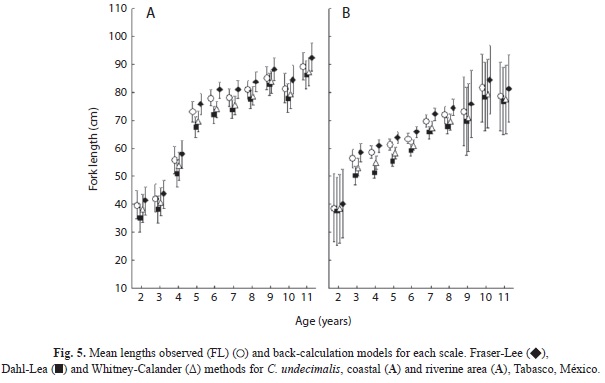
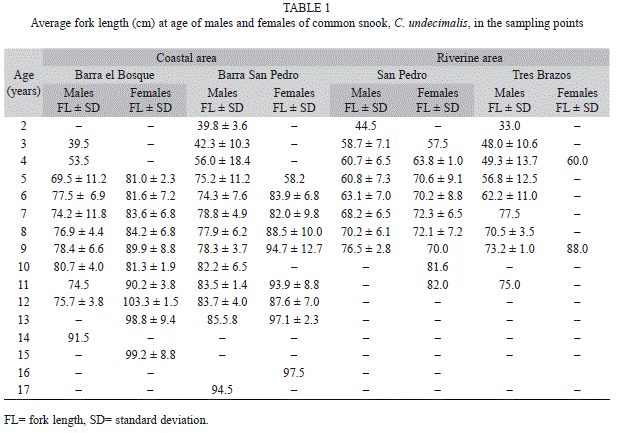
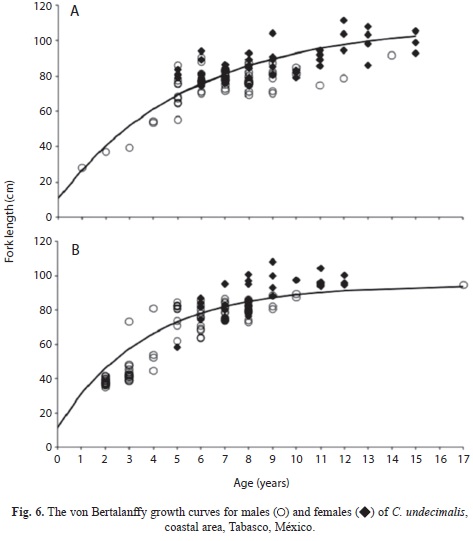
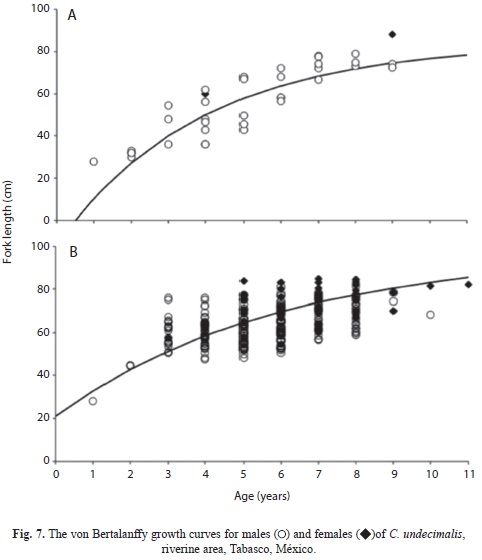
<body><![CDATA[<br> <font size="2"><span style="font-family: verdana;"></span></font><br  style="font-family: verdana;"> <font size="2"><span style="font-family: verdana;"></span></font><font  size="2"><span style="font-family: verdana;">The von Bertalanffy (1957) growth model was fitted to the observed length-at-age and weight-at-age. The model was described by the equations: L<sub>t</sub> =L<sub>&#8734;</sub> (1-e<sup>-k (t-to)</sup>) and W<sup>t</sup>=W<sub>&#8734;</sub> (1-exp<sup>&#8211;k (t-to)</sup>)<sup>b</sup>, where: L<sub>t</sub> = average fork length at age <sub>t</sub>; L<sub>&#8734;</sub> = asymptotic fork length; W<sub>t</sub> = average weight at age <sub>t</sub>; W<sub>&#8734;</sub> = asymptotic weight; t<sub>0</sub> = hypothetical length or weight at age zero; <span  style="font-style: italic;">k</span> is the growth coefficient; and b is the slope of the length-weight relationship.</span></font>    <br> <font size="2"><span style="font-family: verdana;"></span></font><br  style="font-family: verdana;"> <font size="2"><span style="font-family: verdana;"></span></font><font  size="2"><span style="font-family: verdana;">Growth parameters were estimated for combined sexes using Ford-Walford&#8217;s linear methods (Walford 1946) for a first estimation, and were calculated linearizing the VBGF; these first estimates were used as &#8220;seeds&#8221; to estimate the final growth parameters by means of a non-linear regression using Levenberg- Marquardt&#8217;s algorithm (Saila <span style="font-style: italic;">et al</span>. 1988, Sparre &amp; Venema 1997, Rico <span style="font-style: italic;">et al</span>. 2001).One year old specimens were not collected, therefore the average FL for this age class was calculated in 28cm, based on back-calculated lengths and also comparing with published data (Mejia &amp; Lara 2007).</span></font>    <br> <font size="2"><span style="font-family: verdana;"></span></font><br  style="font-family: verdana;"> <font size="2"><span style="font-family: verdana;"></span></font><font  size="2"><span style="font-family: verdana;">The length-weight relationship was determined by using the nonlinear equation: SW=aFL<sup>b</sup> where: SW is the somatic weight, a is the intercept (initial growth coefficient or condition factor), FL is the fork length, and <span  style="font-style: italic;">b</span> is the slope (growth coefficient, which indicates the isometric or allometric growth) (Ricker 1973). Data for growth by length and the weight-length relationship were used to obtain the weight for each age. To determine the relationship between otolith radius (OR) and FL we used the regression: FL=aOR<sup>b</sup> for both sexes combined (Ricker 1973, Ehrhardt 1992).</span></font>    <br> <font size="2"><span style="font-family: verdana;"></span></font><br  style="font-family: verdana;"> <font size="2"><span style="font-family: verdana;"></span></font><font  size="2"><span style="font-family: verdana;">For determining back-calculation, we used three methods which were developed using scales to back-calculate FL (found in Francis, 1990): the Fraser-Lee (1910) model, L<sub>i</sub>=(R<sub>i</sub>/R<sub>C</sub>)*(L<sub>c</sub>-c)+c, the Dahl-Lea (1910) model, L<sub>i</sub>=(R<sub>i</sub>/R<sub>C</sub>)*L<sub>c</sub>, and the Whitney-Carlander model, L<sub>i</sub>=-(a/b)+(FL+a/b)(S<sub>i</sub>/S<sub>c</sub>), where L<sub>i</sub>=age at which the first ring was formed; R<sub>i</sub>=distance to each ring (distance from core to i<sup>th</sup> ring); R<sub>C</sub>=otolith radius or periphery distance; L<sub>c</sub>=average FL; and c=correction factor (intercept of the regression equation for OR on FL). Average FL-at-observed-age was used to support the back-calculation procedures (Ricker 1992, Iba&ntilde;ez <span style="font-style: italic;">et al</span>. 2008).</span></font>    <br> <font size="2"><span style="font-family: verdana;"></span></font><br  style="font-family: verdana;"> <font size="2"><span style="font-family: verdana;"></span></font><font  size="2"><span style="font-family: verdana;">To assess the formation of annual growth bands, the monthly frequency of otolith edge or margin translucence of each sectioned otolith was recorded. Monthly ratios of marginal translucence were compared using X<sup>2 </sup>test. An analysis of covariance (ANCOVA) defined differences among the slopes with FL as the covariable (Zar 1999). An ANCOVA was used to test for differences between observed FL and back-calculated FL (Zar 1999). Hotelling&#8217;s T<sup>2</sup>-test was used to compare growth curves of males and females; this test assumes that the estimates of L<sub>&#8734;</sub>, <span  style="font-style: italic;">k</span> and t<sub>0</sub> of combined sexes were obtained from normal distributions (Bernard 1981). The differences in the von Bertalanffy growth parameters among the four sample sites were compared by using the residual sum of squares analyses (RSS) (Chen <span  style="font-style: italic;">et al</span>. 1992). A multiple correlation analysis and an analysis of covariance (ANCOVA) were applied to the FL-SW regressions to assess differences between the sexes (Sokal &amp; Rohlf 1996, Zar 1999).</span></font><br  style="font-family: verdana;"> <br style="font-family: verdana;"> <font size="3"><span style="font-family: verdana;"><span  style="font-weight: bold;">Results</span></span></font>    <br> <font size="3"><span style="font-family: verdana;"></span></font><br  style="font-family: verdana;"> <font size="3"><span style="font-family: verdana;"></span></font><font  size="2"><span style="font-family: verdana;">The fork length of common snook individuals from Barra Bosque ranged from 38 to 111.5cm (average&plusmn;SD), while in Barra San Pedro ranged from 33 to 108cm, (average&plusmn;SD), in San Pedro from 44 to 88.5cm (average&plusmn;SD) and in Tres Brazos from 30 to 88cm (average&plusmn;SD). The ANCOVA analyses show that the FL-SW relationship was not statistically different between males and females for all sampling points. Accordingly, we herein present the general equations for the FL-SW relationship for each sampling point: Barra Bosque SW=0.0062*FL<sup>2.6</sup> (r<sup>2</sup>=0.91), Barra San Pedro SW=0.0042*FL<sup>3.0</sup> (r<sup>2</sup>=0.97); and riverine area were: San Pedro SW=0.0067*FL<sup>3.0</sup> (r<sup>2</sup>=0.90) and Tres Brazos SW=0.0058*FL<sup>3.0</sup> (r<sup>2</sup>=0.92).</span></font>    <br> <font size="2"><span style="font-family: verdana;"></span></font><br  style="font-family: verdana;"> <font size="2"><span style="font-family: verdana;"></span></font><font  size="2"><span style="font-family: verdana;">The marginal bands formation in the otoliths of the common snook was related with seasonal variation temperature. Translucent bands are formed predominantly during months with low sea surface temperature from November to April (Average temperature=25.9&plusmn;0.75&ordm;C), whereas the greatest proportions (0.70&gt;) of translucent bands occurred during January to April (<a  href="/img/revistas/rbt/v61n2/a24i3.jpg">Fig. 3</a>). Opaque marginal band formation has been related to a high temperature period from May to September (Average temperature=29.1&plusmn;0.43&ordm;C), meanwhile the greatest proportion (0.60&sup3;) of opaque bands occurred during May to August (<a  href="/img/revistas/rbt/v61n2/a24i3.jpg">Fig. 3</a>).    <br> </span></font><font size="2"><span style="font-family: verdana;"></span></font><font  size="2"><span style="font-family: verdana;">    <br> The cross correlation showed a significant correlation (0.60&gt;) among low temperatures with high proportions of translucent bands almost during two months before and after lowest sea surface temperature (<a  href="/img/revistas/rbt/v61n2/a24i4.jpg">Fig. 4</a>). In the case of opaque bands, the cross correlation function showed a significant correlation (0.60&gt;) among high temperatures and highest proportions of opaque bands almost during one month before and after the highest temperatures. </span></font><font size="2"><span  style="font-family: verdana;">Monthly patterns in marginal bands proportions showed that the formation of a pair of bands (translucent-opaque) occurring during one year approximately (<a  href="/img/revistas/rbt/v61n2/a24i4.jpg">Fig. 4</a>).    <br> </span></font><font size="2"><span style="font-family: verdana;"></span></font><font  size="2"><span style="font-family: verdana;">    ]]></body>
<body><![CDATA[<br> Linear relationships were found between FL and OR of common snook for each site at the coastal and riverine areas. Correlation coefficients between FL and OR were significant (p&lt;0.01) for each site indicating that the otolith radius was correlated with FL for ages 2-17: </span></font>    <br> <font size="2"><span style="font-family: verdana;"></span></font><br  style="font-family: verdana;"> <font size="2"><span style="font-family: verdana;"></span></font>    <br> </div>     <div style="text-align: center;"><font size="2"><span  style="font-family: verdana;">Barra Bosque</span></font><br  style="font-family: verdana;"> <font size="2"><span style="font-family: verdana;">FL=35.931+5.016*OR (n=104, r<sup>2</sup>=0.82, p&lt;0.01)</span></font>    <br> <font size="2"><span style="font-family: verdana;"></span></font><br  style="font-family: verdana;"> <font size="2"><span style="font-family: verdana;"></span></font>    <br> <font size="2"><span style="font-family: verdana;">Barra San Pedro</span></font><br  style="font-family: verdana;"> <font size="2"><span style="font-family: verdana;">FL=16.773+6.601*OR (n=114, r<sup>2</sup>=0.88, p&lt;0.01)</span></font>    <br> <font size="2"><span style="font-family: verdana;"></span></font>    <br> <font size="2"><span style="font-family: verdana;"></span></font><br  style="font-family: verdana;"> <font size="2"><span style="font-family: verdana;"></span></font>    <br> <font size="2"><span style="font-family: verdana;">San Pedro</span></font><br  style="font-family: verdana;"> <font size="2"><span style="font-family: verdana;">FL=16.030+6.665*OR (n=314, r<sup>2</sup>=0.75, p&lt;0.01)</span></font>    <br> <font size="2"><span style="font-family: verdana;"></span></font><br  style="font-family: verdana;"> <font size="2"><span style="font-family: verdana;"></span></font>    ]]></body>
<body><![CDATA[<br> <font size="2"><span style="font-family: verdana;">Tres Brazos</span></font><br  style="font-family: verdana;"> <font size="2"><span style="font-family: verdana;">FL=14.568+6.741*OR (n=36, r<sup>2</sup>=0.42, p&lt;0.01)</span></font>    <br> </div>     <div style="text-align: justify;">     <div style="text-align: center;"><font size="2"><span  style="font-family: verdana;"></span></font><br  style="font-family: verdana;"> </div> <font size="2"><span style="font-family: verdana;"></span></font>    <br> <font size="2"><span style="font-family: verdana;">The significant relation between FL and OR for each site supports the use of otoliths to determine age and growth rates and to perform back-calculations of size-at-age for common snook. However, because so few specimens were collected in Tres Brazos, these results must be considered with caution. Covariance analysis showed differences (F=21.28, p&lt;0.001) in the FL-OR relationship for the different sampling sites, thus there were geographical differences in otoliths and fish growth rates. Fish from the coastal area were larger-at-age and therefore grew faster than fish from riverine areas. </span></font>    <br> <font size="2"><span style="font-family: verdana;"></span></font><br  style="font-family: verdana;"> <font size="2"><span style="font-family: verdana;"></span></font><font  size="2"><span style="font-family: verdana;">The Whitney-Carlander method overestimated FL when compared to observed lengths-at-age, whereas the other methods underestimated FL (<a  href="/img/revistas/rbt/v61n2/a24i5.jpg">Fig. 5</a>). The mean observed FL at age and those obtained by back-calculation methods for the coastal and riverine grouped areas were different (ANCOVA, F=13.02, p&lt;0.05; F=45.09, p&lt;0.05). However, Tukey&#8217;s test failed to find differences (p&gt;0.05) in the back-calculated mean FL of snook from the coastal area, which was obtained by the Dahl-Lea and Fraser-Lee methods, and the observed FL using the Whitney-Carlander method. </span></font><font  size="2"><span style="font-family: verdana;">Although some discrepancies were found (calculated lengths for snook age two were similar for the coastal and the riverine areas), backcalculated FL was greater for the area of snook age five and older.</span></font>    <br> <font size="2"><span style="font-family: verdana;"></span></font><br  style="font-family: verdana;"> <font size="2"><span style="font-family: verdana;"></span></font><font  size="2"><span style="font-family: verdana;">Estimated ages ranged from two to 16 years (in Barra San Pedro) with females having larger coefficients and larger sizes in all four sites. The population of <span  style="font-style: italic;">C. undecimalis</span> in the riverine area was younger with a maximum age of 11 years (female in San Pedro and males in Tres Brazos), whereas, the coastal population included larger and older individuals up to 17 years of age (<a  href="/img/revistas/rbt/v61n2/a24t1.gif">Table 1</a>).</span></font>    <br> <font size="2"><span style="font-family: verdana;"></span></font><br  style="font-family: verdana;"> <font size="2"><span style="font-family: verdana;"></span></font><font  size="2"><span style="font-family: verdana;">The von Bertalanffy growth parameters of sexes combined for coastal areas were:</span></font><br  style="font-family: verdana;"> <font size="2"><span style="font-family: verdana;">Barra Bosque FL<sub>t</sub>=109.21(1-e<sup>-0.21(t+1.39)</sup>), Barra San Pedro FLt=94.56(1-e<sup>-0.27(t+0.23)</sup>); for the riverine areas were: San Pedro FL<sub>t</sub>=97.15(1-e<sup>-0.17(t+0.91)</sup>) and Tres Brazos FL<sub>t</sub>=83.76(1-e<sup>-0.26(t+0.49)</sup>). The growth curves for the coastal and riverine areas are presented herein (<a  href="/img/revistas/rbt/v61n2/a24i6.jpg">Fig. 6</a> and <a  href="/img/revistas/rbt/v61n2/a24i7.jpg">7</a>). Significant differences in the growth parameters were found between males and females, where Hotelling&#8217;s T<sup>2</sup>-test is for Barra Bosque (T<sup>2</sup> <sub>obs</sub>=771.13&gt;T<sup>2</sup>=12.19, p&lt;0.001), for Barra San Pedro (T<sup>2</sup> <sub>obs</sub>=936.54&gt;T<sup>2</sup>=12.11, p&lt;0.001) and for San Pedro (T<sup>2</sup> <sub>obs</sub>=720.64&gt;T<sup>2</sup>=11.61, p&lt;0.001).    <br> </span></font><font size="2"><span style="font-family: verdana;"></span></font><font  size="2"><span style="font-family: verdana;">    <br> </span></font> <font size="2"><span style="font-family: verdana;">The average size of males was smaller than the average size of females of the same age. Additionally, the residual sum of square, RSS, indicated that the von Bertalanffy growth curves varied among areas (F=74.08, p&lt;0.05).</span></font>    ]]></body>
<body><![CDATA[<br> <font size="2"><span style="font-family: verdana;"></span></font><br  style="font-family: verdana;"> <font size="2"><span style="font-family: verdana;"></span></font><font  size="3"><span style="font-family: verdana;"><span  style="font-weight: bold;">Discussion</span></span></font>    <br> <font size="3"><span style="font-family: verdana;"></span></font><br  style="font-family: verdana;"> <font size="3"><span style="font-family: verdana;"></span></font><font  size="2"><span style="font-family: verdana;">In our study area, the translucent band was deposited mostly during the summer, with regard to high temperature and food abundance. </span></font><font size="2"><span  style="font-family: verdana;">The opaque band formed each winter, has been attributed to slow growth with regard to reproduction, spawning and low temperature (Tucker and Campbell 1988, Taylor <span  style="font-style: italic;">et al</span>. 2000, Chen <span style="font-style: italic;">et al</span>. 2008). During the reproductive period, the metabolic energy appeared to have been diverted from somatic growth, resulting in the formation of narrow opaque zones as compared to relatively wider translucent zones (Lorenzo <span style="font-style: italic;">et al</span>. 2002, Villamil <span style="font-style: italic;">et al</span>. 2002, Kallianiotis <span style="font-style: italic;">et al</span>. 2005). Seasonal deposition of age marks in otoliths of <span style="font-style: italic;">C. undecimalis</span> was consistent across sampling years and sites. This pattern of annular marks on hard structures has been related to both temporal variations in availability of food resources and temperature (Cappo <span style="font-style: italic;">et al</span>. 2000, Melo &amp; Felix 2004, Lin &amp; Tzeng 2009).</span></font>    <br> <font size="2"><span style="font-family: verdana;"></span></font><br  style="font-family: verdana;"> <font size="2"><span style="font-family: verdana;"></span></font><font  size="2"><span style="font-family: verdana;">The highly correlated linear regression of FL and OR of <span style="font-style: italic;">C. undecimalis</span> showed that rings on otoliths are suitable structures to estimate individual growth rates and can be used to back calculate sizes at previous ages (Aliaume <span  style="font-style: italic;">et al</span>. 2000, Taylor <span style="font-style: italic;">et al</span>. 2000, Cabrera 2002). The different growth rates observed in males and females were related to sex change (Villamil <span  style="font-style: italic;">et al</span>. 2002, Munday <span style="font-style: italic;">et al</span>. 2004, Walter &amp; McCormick 2004). In common snook, growth increments were larger for females, indicating that females had faster growth rates and were larger-at-age than males (Taylor <span  style="font-style: italic;">et al</span>. 2000, Patterson <span style="font-style: italic;">et al</span>. 2005). Growth rates (<span style="font-style: italic;">k</span>) were faster in the coastal area than in the riverine area and may be related to greater abundance of food and lower population density in the coastal area (Caballero 2003, Aliaume <span style="font-style: italic;">et al</span>. 2005, Steven <span style="font-style: italic;">et al</span>. 2007).</span></font>    <br> <font size="2"><span style="font-family: verdana;"></span></font><br  style="font-family: verdana;"> <font size="2"><span style="font-family: verdana;"></span></font><font  size="2"><span style="font-family: verdana;">Our sizes-at-age were similar to those reported for common snook in Puerto Rico and Florida (Aliaume <span  style="font-style: italic;">et al</span>. 2000, Patterson <span style="font-style: italic;">et al</span>. 2005, Taylor <span style="font-style: italic;">et al</span>. 2000), although we had to account for sub-annual increments or narrow translucent, &#8220;false,&#8221; rings (Campana 2001). Additionally, in the case of older specimens, opaque rings on the otoliths edge were closely and accounted for most of the reconciled discrepancies (Villamil <span  style="font-style: italic;">et al</span>. 2002, Wilson <span  style="font-style: italic;">et al</span>. 2009).</span></font>    <br> <font size="2"><span style="font-family: verdana;"></span></font><br  style="font-family: verdana;"> <font size="2"><span style="font-family: verdana;"></span></font><font  size="2"><span style="font-family: verdana;">Most of the specimens collected from the coastal area of Tabasco, were mature females over five years old, whereas, specimens collected in the riverine area were mostly males. The differences in the size-at-age ranges for males and females of the common snook, between coastal and riverine areas, is consequence of sexual segregation, a general characteristic of the common snook populations, which is normally associated with reproduction, migration, competition or environmental factors that influence growth and determine the size (Peters <span style="font-style: italic;">et al</span>. 1998, Aliaume <span style="font-style: italic;">et al</span>. 2005, Patterson <span style="font-style: italic;">et al</span>. 2005, Chen <span  style="font-style: italic;">et al</span>. 2008). Barra Bosque and Barra San Pedro, are defined as areas of recruitment for spawning and breeding then is common to find old females in advanced reproductive stages (Perera-Garcia <span style="font-style: italic;">et al</span>. 2008); whereas in the riverine area, younger common snooks are found, this segregation is related to migration and reproductive habits of this species. </span></font><font size="2"><span  style="font-family: verdana;">Stevens <span  style="font-style: italic;">et al</span>. (2007) observed <span style="font-style: italic;">C. undecimalis</span> in prejuvenil stage (&lt;15cm) and juvenile (15 to 35cm standard length) are abundant in estuarine habitats. However, they found that juveniles dominate riparian habitats. On the other hand, juveniles migrate into certain sizes within freshwater tributaries, which later on cause them to have difficulties for returning into isolated localities, due to their dependence on water levels that established connectivity with adjacent habitats. This could indicate the reason of the results obtained in this study in the riverine area, where the range of size and age of the adult populations of the common snook are lower.</span></font>    <br> <font size="2"><span style="font-family: verdana;"></span></font><br  style="font-family: verdana;"> <font size="2"><span style="font-family: verdana;"></span></font><font  size="2"><span style="font-family: verdana;">Because growth parameters of<span style="font-style: italic;"> C. undecimalis</span>&nbsp; that inhabit coastal and riverine areas of Tabasco, Mexico are significantly different, it is imperative that future research be conducted on migration and detailed population genetics in order to delineate the stock structure of this population. A permanent monitoring program of landing data and angler effort is necessary to support management programs. More important, future research focusing on harvest levels and mortality parameters should be conducted over a much larger area of Mexican coastal areas with the aim to conduct a multistate stock assessment, in order to determine stock condition.</span></font>    <br> <font size="2"><span style="font-family: verdana;"></span></font><br  style="font-family: verdana;"> <font size="2"><span style="font-family: verdana;"></span></font><font  style="font-weight: bold;" size="3"><span style="font-family: verdana;">Acknowledgments</span></font>    <br> <font style="font-weight: bold;" size="3"><span  style="font-family: verdana;"></span></font><br  style="font-family: verdana;"> <font style="font-weight: bold;" size="3"><span  style="font-family: verdana;"></span></font><font size="2"><span  style="font-family: verdana;">The authors are grateful to the fishermen and fishing cooperatives for sharing their data. Also, we are thankful to Ron Taylor (Fish and Wildlife Research Institute, FFWC) for his critical and useful comments on the manuscript. This study was funded by the Consejo Nacional de Ciencia y Tecnolog&iacute;a (CONACyT) and El Colegio de la Frontera Sur (ECOSUR). </span></font><br  style="font-family: verdana;"> <font size="2"><span style="font-family: verdana;"></span></font><font  size="2"><span style="font-family: verdana;"></span></font><br  style="font-family: verdana;"> </div> <hr  style="width: 100%; height: 2px; margin-left: 0px; margin-right: 0px;">     <div style="text-align: justify;"><br style="font-family: verdana;"> <font style="font-weight: bold;" size="3"><span  style="font-family: verdana;">References</span></font>    <!-- ref --><br> <font style="font-weight: bold;" size="3"><span  style="font-family: verdana;"></span></font><br  style="font-family: verdana;"> <font style="font-weight: bold;" size="3"><span  style="font-family: verdana;"></span></font><font size="2"><span  style="font-family: verdana;">Aliaume, C., A. Zerbi, J. Joyeux &amp; J.M. Miller. 2000. Growth of juvenile <span  style="font-style: italic;">Centropomus undecimalis</span> in a tropical island. Environ. Biol. Fish. 59: 299-308.    &nbsp;&nbsp;&nbsp;&nbsp;&nbsp;&nbsp;&nbsp;&nbsp;[&#160;<a href="javascript:void(0);" onclick="javascript: window.open('/scielo.php?script=sci_nlinks&ref=1521397&pid=S0034-7744201300030002400001&lng=','','width=640,height=500,resizable=yes,scrollbars=1,menubar=yes,');">Links</a>&#160;]<!-- end-ref --></span></font>    <!-- ref --><br> <font size="2"><span style="font-family: verdana;"></span></font><br  style="font-family: verdana;"> <font size="2"><span style="font-family: verdana;"></span></font><font  size="2"><span style="font-family: verdana;">Aliaume, C., A. Zerbi &amp; J.M. Miller. 2005. Juvenile snook species in Puerto Rico estuaries: distribution, abundance and habitat description. Proc. Gulf Carib. Fish. Inst. 47: 499-519.    &nbsp;&nbsp;&nbsp;&nbsp;&nbsp;&nbsp;&nbsp;&nbsp;[&#160;<a href="javascript:void(0);" onclick="javascript: window.open('/scielo.php?script=sci_nlinks&ref=1521399&pid=S0034-7744201300030002400002&lng=','','width=640,height=500,resizable=yes,scrollbars=1,menubar=yes,');">Links</a>&#160;]<!-- end-ref --></span></font>    <!-- ref --><br> <font size="2"><span style="font-family: verdana;"></span></font><br  style="font-family: verdana;"> <font size="2"><span style="font-family: verdana;"></span></font><font  size="2"><span style="font-family: verdana;">Beamish, R.J. &amp; G.A. McFarlane. 1983. The forgotten&nbsp; requirement for age validation in fisheries biology. Trans. Am. Fish. Soc. 112: 735-743.    &nbsp;&nbsp;&nbsp;&nbsp;&nbsp;&nbsp;&nbsp;&nbsp;[&#160;<a href="javascript:void(0);" onclick="javascript: window.open('/scielo.php?script=sci_nlinks&ref=1521401&pid=S0034-7744201300030002400003&lng=','','width=640,height=500,resizable=yes,scrollbars=1,menubar=yes,');">Links</a>&#160;]<!-- end-ref --></span></font>    <!-- ref --><br> <font size="2"><span style="font-family: verdana;"></span></font><br  style="font-family: verdana;"> <font size="2"><span style="font-family: verdana;"></span></font><font  size="2"><span style="font-family: verdana;">Bernard, D.R. 1981. Multivariate analysis as a means of comparing growth in fish. Can. J. Fish. Aquat. Sci. 38:233-236.    &nbsp;&nbsp;&nbsp;&nbsp;&nbsp;&nbsp;&nbsp;&nbsp;[&#160;<a href="javascript:void(0);" onclick="javascript: window.open('/scielo.php?script=sci_nlinks&ref=1521403&pid=S0034-7744201300030002400004&lng=','','width=640,height=500,resizable=yes,scrollbars=1,menubar=yes,');">Links</a>&#160;]<!-- end-ref --></span></font>    <!-- ref --><br> <font size="2"><span style="font-family: verdana;"></span></font><br  style="font-family: verdana;"> <font size="2"><span style="font-family: verdana;"></span></font><font  size="2"><span style="font-family: verdana;">Brennan, N.P., C.D. Meaghan &amp; M.L. Kenneth. 2006. Predator-free enclosures improve post-release survival of stocked common snook. J. Exp. Mar. Biol. Ecol. 335: 302-311.    &nbsp;&nbsp;&nbsp;&nbsp;&nbsp;&nbsp;&nbsp;&nbsp;[&#160;<a href="javascript:void(0);" onclick="javascript: window.open('/scielo.php?script=sci_nlinks&ref=1521405&pid=S0034-7744201300030002400005&lng=','','width=640,height=500,resizable=yes,scrollbars=1,menubar=yes,');">Links</a>&#160;]<!-- end-ref --></span></font>    <!-- ref --><br> <font size="2"><span style="font-family: verdana;"></span></font><br  style="font-family: verdana;"> <font size="2"><span style="font-family: verdana;"></span></font><font  size="2"><span style="font-family: verdana;">Caballero, C.V. 2003. Estudio biol&oacute;gico pesquero del robalo <span style="font-style: italic;">Centropomus undecimalis</span> en el suroeste de Campeche. Tesis de Maestr&iacute;a, Universidad Nacional Aut&oacute;noma de M&eacute;xico, M&eacute;xico, D.F., M&eacute;xico.    &nbsp;&nbsp;&nbsp;&nbsp;&nbsp;&nbsp;&nbsp;&nbsp;[&#160;<a href="javascript:void(0);" onclick="javascript: window.open('/scielo.php?script=sci_nlinks&ref=1521407&pid=S0034-7744201300030002400006&lng=','','width=640,height=500,resizable=yes,scrollbars=1,menubar=yes,');">Links</a>&#160;]<!-- end-ref --></span></font>    <!-- ref --><br> <font size="2"><span style="font-family: verdana;"></span></font><br  style="font-family: verdana;"> <font size="2"><span style="font-family: verdana;"></span></font><font  size="2"><span style="font-family: verdana;">Cabrera, N.E. 2002. Edad y crecimiento del robalo Centropomus nigrescens G&uuml;nter 1864 en el sistema lagunar Chacahua-Pastor&iacute;a. Tesis de grado, Universidad del Mar, Campus Puerto &Aacute;ngel, Oaxaca, M&eacute;xico.    &nbsp;&nbsp;&nbsp;&nbsp;&nbsp;&nbsp;&nbsp;&nbsp;[&#160;<a href="javascript:void(0);" onclick="javascript: window.open('/scielo.php?script=sci_nlinks&ref=1521409&pid=S0034-7744201300030002400007&lng=','','width=640,height=500,resizable=yes,scrollbars=1,menubar=yes,');">Links</a>&#160;]<!-- end-ref --> </span></font>    <!-- ref --><br> <font size="2"><span style="font-family: verdana;"></span></font><br  style="font-family: verdana;"> <font size="2"><span style="font-family: verdana;"></span></font><font  size="2"><span style="font-family: verdana;">Cadima, E.L. 2003. Fish stock assessment manual. FAO, Roma, Italia.    &nbsp;&nbsp;&nbsp;&nbsp;&nbsp;&nbsp;&nbsp;&nbsp;[&#160;<a href="javascript:void(0);" onclick="javascript: window.open('/scielo.php?script=sci_nlinks&ref=1521411&pid=S0034-7744201300030002400008&lng=','','width=640,height=500,resizable=yes,scrollbars=1,menubar=yes,');">Links</a>&#160;]<!-- end-ref --></span></font>    <!-- ref --><br> <font size="2"><span style="font-family: verdana;"></span></font><br  style="font-family: verdana;"> <font size="2"><span style="font-family: verdana;"></span></font><font  size="2"><span style="font-family: verdana;">Campana, S.E. 2001. Accuracy, precision and quality control in age determination, including a review of the use and abuse of age validation methods. J. Fish. Biol. 59: 197-242.    &nbsp;&nbsp;&nbsp;&nbsp;&nbsp;&nbsp;&nbsp;&nbsp;[&#160;<a href="javascript:void(0);" onclick="javascript: window.open('/scielo.php?script=sci_nlinks&ref=1521413&pid=S0034-7744201300030002400009&lng=','','width=640,height=500,resizable=yes,scrollbars=1,menubar=yes,');">Links</a>&#160;]<!-- end-ref --></span></font>    <!-- ref --><br> <font size="2"><span style="font-family: verdana;"></span></font><br  style="font-family: verdana;"> <font size="2"><span style="font-family: verdana;"></span></font><font  size="2"><span style="font-family: verdana;">Campana, S.E. 2005. Otolith science entering the 21<sup>st</sup> century. Mar. Freshwater Res. 56: 485-495.    &nbsp;&nbsp;&nbsp;&nbsp;&nbsp;&nbsp;&nbsp;&nbsp;[&#160;<a href="javascript:void(0);" onclick="javascript: window.open('/scielo.php?script=sci_nlinks&ref=1521415&pid=S0034-7744201300030002400010&lng=','','width=640,height=500,resizable=yes,scrollbars=1,menubar=yes,');">Links</a>&#160;]<!-- end-ref --> </span></font>    <!-- ref --><br> <font size="2"><span style="font-family: verdana;"></span></font><br  style="font-family: verdana;"> <font size="2"><span style="font-family: verdana;"></span></font><font  size="2"><span style="font-family: verdana;">Cappo, M., P. Eden, S.J. Newman &amp; S. Robertson. 2000. A new approach to validation of periodicity and timing of opaque zone formation in the otoliths of eleven species of <span style="font-style: italic;">Lutjanus </span>from the central Great Barrier. Fish. Bull. 98: 474-488.    &nbsp;&nbsp;&nbsp;&nbsp;&nbsp;&nbsp;&nbsp;&nbsp;[&#160;<a href="javascript:void(0);" onclick="javascript: window.open('/scielo.php?script=sci_nlinks&ref=1521417&pid=S0034-7744201300030002400011&lng=','','width=640,height=500,resizable=yes,scrollbars=1,menubar=yes,');">Links</a>&#160;]<!-- end-ref --></span></font>    <!-- ref --><br> <font size="2"><span style="font-family: verdana;"></span></font><br  style="font-family: verdana;"> <font size="2"><span style="font-family: verdana;"></span></font><font  size="2"><span style="font-family: verdana;">Chac&oacute;n, D. 1993. Aspectos biom&eacute;tricos de una poblaci&oacute;n de s&aacute;balo, <span  style="font-style: italic;">Megalops atlanticus</span> (Pisces: Megalopidae). Rev. Biol. Trop. 41: 13-18.    &nbsp;&nbsp;&nbsp;&nbsp;&nbsp;&nbsp;&nbsp;&nbsp;[&#160;<a href="javascript:void(0);" onclick="javascript: window.open('/scielo.php?script=sci_nlinks&ref=1521419&pid=S0034-7744201300030002400012&lng=','','width=640,height=500,resizable=yes,scrollbars=1,menubar=yes,');">Links</a>&#160;]<!-- end-ref --></span></font>    <!-- ref --><br> <font size="2"><span style="font-family: verdana;"></span></font><br  style="font-family: verdana;"> <font size="2"><span style="font-family: verdana;"></span></font><font  size="2"><span style="font-family: verdana;">Chen Y., D.A. Jackson &amp; H.H. Harvey. 1992. A comparison of von Bertalanffy and polynominal functions in modeling fish growth data. Can. J. Fish. Aquat. Sci. 49: 1228-1235.    &nbsp;&nbsp;&nbsp;&nbsp;&nbsp;&nbsp;&nbsp;&nbsp;[&#160;<a href="javascript:void(0);" onclick="javascript: window.open('/scielo.php?script=sci_nlinks&ref=1521421&pid=S0034-7744201300030002400013&lng=','','width=640,height=500,resizable=yes,scrollbars=1,menubar=yes,');">Links</a>&#160;]<!-- end-ref --></span></font>    <!-- ref --><br> <font size="2"><span style="font-family: verdana;"></span></font><br  style="font-family: verdana;"> <font size="2"><span style="font-family: verdana;"></span></font><font  size="2"><span style="font-family: verdana;">Chen F., Y. Chen &amp; D. He. 2008. Age and growth of <span style="font-style: italic;">Schizopygopsis younghusbandi</span> <span style="font-style: italic;">younghusbandi </span>in the Yarlung Zangbo River in Tibet, China. Environ. Biol. Fish. 82: 1-8.    &nbsp;&nbsp;&nbsp;&nbsp;&nbsp;&nbsp;&nbsp;&nbsp;[&#160;<a href="javascript:void(0);" onclick="javascript: window.open('/scielo.php?script=sci_nlinks&ref=1521423&pid=S0034-7744201300030002400014&lng=','','width=640,height=500,resizable=yes,scrollbars=1,menubar=yes,');">Links</a>&#160;]<!-- end-ref --></span></font>    <!-- ref --><br> <font size="2"><span style="font-family: verdana;"></span></font><br  style="font-family: verdana;"> <font size="2"><span style="font-family: verdana;"></span></font><font  size="2"><span style="font-family: verdana;">Ocean Warch North Pacific Demonstration Project. 2012. Coastwatch and SWFSC, Environmental Research Division, NOAA, EUA. (Downloaded: May 2012, http://las.pfeg.noaa.gov/oceanWatch/oceanwatch.php).    &nbsp;&nbsp;&nbsp;&nbsp;&nbsp;&nbsp;&nbsp;&nbsp;[&#160;<a href="javascript:void(0);" onclick="javascript: window.open('/scielo.php?script=sci_nlinks&ref=1521425&pid=S0034-7744201300030002400015&lng=','','width=640,height=500,resizable=yes,scrollbars=1,menubar=yes,');">Links</a>&#160;]<!-- end-ref --></span></font>    <!-- ref --><br> <font size="2"><span style="font-family: verdana;"></span></font><br  style="font-family: verdana;"> <font size="2"><span style="font-family: verdana;"></span></font><font  size="2"><span style="font-family: verdana;">Ehrhardt, N. 1992. Age and growth of swordfish, <span style="font-style: italic;">Xiphias gladius</span>, in the Northwestern Atlantic. Bull. Mar. Sci. 50: 292-301.    &nbsp;&nbsp;&nbsp;&nbsp;&nbsp;&nbsp;&nbsp;&nbsp;[&#160;<a href="javascript:void(0);" onclick="javascript: window.open('/scielo.php?script=sci_nlinks&ref=1521427&pid=S0034-7744201300030002400016&lng=','','width=640,height=500,resizable=yes,scrollbars=1,menubar=yes,');">Links</a>&#160;]<!-- end-ref --></span></font>    <!-- ref --><br> <font size="2"><span style="font-family: verdana;"></span></font><br  style="font-family: verdana;"> <font size="2"><span style="font-family: verdana;"></span></font><font  size="2"><span style="font-family: verdana;">Francis, R.I.C.C. 1990. Back-calculation of fish length: a critical review. J. Fish. Biol. 36: 883-902.    &nbsp;&nbsp;&nbsp;&nbsp;&nbsp;&nbsp;&nbsp;&nbsp;[&#160;<a href="javascript:void(0);" onclick="javascript: window.open('/scielo.php?script=sci_nlinks&ref=1521429&pid=S0034-7744201300030002400017&lng=','','width=640,height=500,resizable=yes,scrollbars=1,menubar=yes,');">Links</a>&#160;]<!-- end-ref --> </span></font>    <!-- ref --><br> <font size="2"><span style="font-family: verdana;"></span></font><br  style="font-family: verdana;"> <font size="2"><span style="font-family: verdana;"></span></font><font  size="2"><span style="font-family: verdana;">Iba&ntilde;ez, A.L., J.R. Britton &amp; I.G. Cowx. 2008. Relationship between scale growth checks, circuli formation rate and somatic growth in <span  style="font-style: italic;">Rutilus rutilus</span> (L.) a fish farmreared cyprinid. J. Fish. Biol. 72: 1023-1034.    &nbsp;&nbsp;&nbsp;&nbsp;&nbsp;&nbsp;&nbsp;&nbsp;[&#160;<a href="javascript:void(0);" onclick="javascript: window.open('/scielo.php?script=sci_nlinks&ref=1521431&pid=S0034-7744201300030002400018&lng=','','width=640,height=500,resizable=yes,scrollbars=1,menubar=yes,');">Links</a>&#160;]<!-- end-ref --></span></font>    <!-- ref --><br> <font size="2"><span style="font-family: verdana;"></span></font><br  style="font-family: verdana;"> <font size="2"><span style="font-family: verdana;"></span></font><font  size="2"><span style="font-family: verdana;">Kallianiotis, A., M. Torre &amp; A. Argyry. 2005. Age, growth, mortality, reproduction, and feeding habits of the striped seabream, <span style="font-style: italic;">Lithognathus mormyrus</span> (Pisces:Sparidae), in the coastal waters of the Thracian Sea, Greece. Sci. Mar. 69: 391-404.    &nbsp;&nbsp;&nbsp;&nbsp;&nbsp;&nbsp;&nbsp;&nbsp;[&#160;<a href="javascript:void(0);" onclick="javascript: window.open('/scielo.php?script=sci_nlinks&ref=1521433&pid=S0034-7744201300030002400019&lng=','','width=640,height=500,resizable=yes,scrollbars=1,menubar=yes,');">Links</a>&#160;]<!-- end-ref --></span></font>    <!-- ref --><br> <font size="2"><span style="font-family: verdana;"></span></font><br  style="font-family: verdana;"> <font size="2"><span style="font-family: verdana;"></span></font><font  size="2"><span style="font-family: verdana;">Lin, Y. &amp; W. Tzeng. 2009. Validation of annulus in otolith and estimation of growth rate for Japanese eel <span style="font-style: italic;">Anguilla japonica</span> in tropical southern Taiwan. Environ. Biol. Fish. 84: 79-87.    &nbsp;&nbsp;&nbsp;&nbsp;&nbsp;&nbsp;&nbsp;&nbsp;[&#160;<a href="javascript:void(0);" onclick="javascript: window.open('/scielo.php?script=sci_nlinks&ref=1521435&pid=S0034-7744201300030002400020&lng=','','width=640,height=500,resizable=yes,scrollbars=1,menubar=yes,');">Links</a>&#160;]<!-- end-ref --></span></font>    <!-- ref --><br> <font size="2"><span style="font-family: verdana;"></span></font><br  style="font-family: verdana;"> <font size="2"><span style="font-family: verdana;"></span></font><font  size="2"><span style="font-family: verdana;">Lorenzo, J.M., J.G. Pajuelo, M. M&eacute;ndez-Villamil, J. Coca &amp; A.G. Ramos. 2002. Age, growth, reproduction and mortality of the striped seabream, <span  style="font-style: italic;">Lithognathus mormyrus</span> (Pisces, Sparidae), off the Canary Islands (Central-east Atlantic). J. Appl. Ichthyol. 18: 204-209.    &nbsp;&nbsp;&nbsp;&nbsp;&nbsp;&nbsp;&nbsp;&nbsp;[&#160;<a href="javascript:void(0);" onclick="javascript: window.open('/scielo.php?script=sci_nlinks&ref=1521437&pid=S0034-7744201300030002400021&lng=','','width=640,height=500,resizable=yes,scrollbars=1,menubar=yes,');">Links</a>&#160;]<!-- end-ref --></span></font>    <!-- ref --><br> <font size="2"><span style="font-family: verdana;"></span></font><br  style="font-family: verdana;"> <font size="2"><span style="font-family: verdana;"></span></font><font  size="2"><span style="font-family: verdana;">Marshall, A.R. 1958. A survey of the snook fishery of Florida, with studies of the biology of the principal species, <span style="font-style: italic;">Centropomus undecimalis</span> (Bloch). FL. Board Conserv. Mar. Res. Lab. Tech. Ser. 22-37 p.    &nbsp;&nbsp;&nbsp;&nbsp;&nbsp;&nbsp;&nbsp;&nbsp;[&#160;<a href="javascript:void(0);" onclick="javascript: window.open('/scielo.php?script=sci_nlinks&ref=1521439&pid=S0034-7744201300030002400022&lng=','','width=640,height=500,resizable=yes,scrollbars=1,menubar=yes,');">Links</a>&#160;]<!-- end-ref --></span></font>    <!-- ref --><br> <font size="2"><span style="font-family: verdana;"></span></font><br  style="font-family: verdana;"> <font size="2"><span style="font-family: verdana;"></span></font><font  size="2"><span style="font-family: verdana;">McDowall, R.M. 1999. Different kinds of diadromy: different kinds of conservation problems. J. Mar. Sci. 56: 410-413.    &nbsp;&nbsp;&nbsp;&nbsp;&nbsp;&nbsp;&nbsp;&nbsp;[&#160;<a href="javascript:void(0);" onclick="javascript: window.open('/scielo.php?script=sci_nlinks&ref=1521441&pid=S0034-7744201300030002400023&lng=','','width=640,height=500,resizable=yes,scrollbars=1,menubar=yes,');">Links</a>&#160;]<!-- end-ref --></span></font>    <!-- ref --><br> <font size="2"><span style="font-family: verdana;"></span></font><br  style="font-family: verdana;"> <font size="2"><span style="font-family: verdana;"></span></font><font  size="2"><span style="font-family: verdana;">Mejia, M.N. &amp; M.D. Lara. 2007. Edad y crecimiento del robalo blanco (<span style="font-style: italic;">Centropomus undecimalis</span>) (Bloch, 1792) en el Puerto Barra San Pedro, municipio de Centla, Tabasco. Tesis de grado, Universidad Ju&aacute;rez Aut&oacute;noma de Tabasco, Tabasco, M&eacute;xico.    &nbsp;&nbsp;&nbsp;&nbsp;&nbsp;&nbsp;&nbsp;&nbsp;[&#160;<a href="javascript:void(0);" onclick="javascript: window.open('/scielo.php?script=sci_nlinks&ref=1521443&pid=S0034-7744201300030002400024&lng=','','width=640,height=500,resizable=yes,scrollbars=1,menubar=yes,');">Links</a>&#160;]<!-- end-ref --></span></font>    <!-- ref --><br> <font size="2"><span style="font-family: verdana;"></span></font><br  style="font-family: verdana;"> <font size="2"><span style="font-family: verdana;"></span></font><font  size="2"><span style="font-family: verdana;">Melo, B.F.N. &amp; U.R. Felix. 2004. Estructura de tallas y edad del marlin rayado <span  style="font-style: italic;">Tetrapturus audaz</span> (Pisces:Xiphidae) en Cabo San Lucas, Baja California Sur, M&eacute;xico. Rev. Biol. Trop. 52: 981-989.    &nbsp;&nbsp;&nbsp;&nbsp;&nbsp;&nbsp;&nbsp;&nbsp;[&#160;<a href="javascript:void(0);" onclick="javascript: window.open('/scielo.php?script=sci_nlinks&ref=1521445&pid=S0034-7744201300030002400025&lng=','','width=640,height=500,resizable=yes,scrollbars=1,menubar=yes,');">Links</a>&#160;]<!-- end-ref --></span></font>    <!-- ref --><br> <font size="2"><span style="font-family: verdana;"></span></font><br  style="font-family: verdana;"> <font size="2"><span style="font-family: verdana;"></span></font><font  size="2"><span style="font-family: verdana;">Muller, R.G. &amp; R.G. Taylor. 2006. The 2006 stock assessment update of common snook, <span  style="font-style: italic;">Centropomus undecimalis</span>. Florida Marine Research Institute. St. Petersburg, Florida, USA.    &nbsp;&nbsp;&nbsp;&nbsp;&nbsp;&nbsp;&nbsp;&nbsp;[&#160;<a href="javascript:void(0);" onclick="javascript: window.open('/scielo.php?script=sci_nlinks&ref=1521447&pid=S0034-7744201300030002400026&lng=','','width=640,height=500,resizable=yes,scrollbars=1,menubar=yes,');">Links</a>&#160;]<!-- end-ref --></span></font>    <!-- ref --><br> <font size="2"><span style="font-family: verdana;"></span></font><br  style="font-family: verdana;"> <font size="2"><span style="font-family: verdana;"></span></font><font  size="2"><span style="font-family: verdana;">Munday, P.L., L. Alyson, J. Hodges, J. Howard Choat &amp; N. Gust. 2004. Sex specific growth effects in protogynous hermaphrodites. Can. J. Fish. Aquat. Sci. 45: 1514-1524.    &nbsp;&nbsp;&nbsp;&nbsp;&nbsp;&nbsp;&nbsp;&nbsp;[&#160;<a href="javascript:void(0);" onclick="javascript: window.open('/scielo.php?script=sci_nlinks&ref=1521449&pid=S0034-7744201300030002400027&lng=','','width=640,height=500,resizable=yes,scrollbars=1,menubar=yes,');">Links</a>&#160;]<!-- end-ref --></span></font>    <!-- ref --><br> <font size="2"><span style="font-family: verdana;"></span></font><br  style="font-family: verdana;"> <font size="2"><span style="font-family: verdana;"></span></font><font  size="2"><span style="font-family: verdana;">Patterson, H.M., R.G. Taylor &amp; R.S. McBride. 2005. Coastal origin of common snook, <span  style="font-style: italic;">Centropomus undecimalis</span>, in Florida Bay. Gulf Carib. Res. 17: 25-30.    &nbsp;&nbsp;&nbsp;&nbsp;&nbsp;&nbsp;&nbsp;&nbsp;[&#160;<a href="javascript:void(0);" onclick="javascript: window.open('/scielo.php?script=sci_nlinks&ref=1521451&pid=S0034-7744201300030002400028&lng=','','width=640,height=500,resizable=yes,scrollbars=1,menubar=yes,');">Links</a>&#160;]<!-- end-ref --></span></font>    <!-- ref --><br> <font size="2"><span style="font-family: verdana;"></span></font><br  style="font-family: verdana;"> <font size="2"><span style="font-family: verdana;"></span></font><font  size="2"><span style="font-family: verdana;">Pauly, D., V. Christensen, S. Guenette, T.J. Pitcher &amp; D. Zeller. 2002. Towards sustainability in world fisheries. Nature 418: 689-695.    &nbsp;&nbsp;&nbsp;&nbsp;&nbsp;&nbsp;&nbsp;&nbsp;[&#160;<a href="javascript:void(0);" onclick="javascript: window.open('/scielo.php?script=sci_nlinks&ref=1521453&pid=S0034-7744201300030002400029&lng=','','width=640,height=500,resizable=yes,scrollbars=1,menubar=yes,');">Links</a>&#160;]<!-- end-ref --></span></font>    <!-- ref --><br> <font size="2"><span style="font-family: verdana;"></span></font><br  style="font-family: verdana;"> <font size="2"><span style="font-family: verdana;"></span></font><font  size="2"><span style="font-family: verdana;">Perera-Garc&iacute;a, M.A., M. Mendoza-Carranza &amp; S. P&aacute;ramo-Delgadillo. 2008. Din&aacute;mica reproductiva y poblacional del robalo <span  style="font-style: italic;">Centropomus undecimalis</span>, en Barra San Pedro, Centla, M&eacute;xico. Universidad y Ciencia 24: 49-59.    &nbsp;&nbsp;&nbsp;&nbsp;&nbsp;&nbsp;&nbsp;&nbsp;[&#160;<a href="javascript:void(0);" onclick="javascript: window.open('/scielo.php?script=sci_nlinks&ref=1521455&pid=S0034-7744201300030002400030&lng=','','width=640,height=500,resizable=yes,scrollbars=1,menubar=yes,');">Links</a>&#160;]<!-- end-ref --></span></font>    <!-- ref --><br> <font size="2"><span style="font-family: verdana;"></span></font><br  style="font-family: verdana;"> <font size="2"><span style="font-family: verdana;"></span></font><font  size="2"><span style="font-family: verdana;">Perera-Garc&iacute;a, M.A., M. Mendoza-Carranza, W.M. Contreras-S&aacute;nchez, M. Huerta-Ort&iacute;z &amp; E. P&eacute;rez-S&aacute;nchez. 2011. Reproductive biology of common snook <span style="font-style: italic;">Centropomus undecimalis</span> (Perciformes: Centropomidae) in two tropical habitats. Rev. Biol. Trop. 59: 669-681.    &nbsp;&nbsp;&nbsp;&nbsp;&nbsp;&nbsp;&nbsp;&nbsp;[&#160;<a href="javascript:void(0);" onclick="javascript: window.open('/scielo.php?script=sci_nlinks&ref=1521457&pid=S0034-7744201300030002400031&lng=','','width=640,height=500,resizable=yes,scrollbars=1,menubar=yes,');">Links</a>&#160;]<!-- end-ref --></span></font>    <!-- ref --><br> <font size="2"><span style="font-family: verdana;"></span></font><br  style="font-family: verdana;"> <font size="2"><span style="font-family: verdana;"></span></font><font  size="2"><span style="font-family: verdana;">Peters, K.M., R.E. Matheson Jr. &amp; R.G. Taylor. 1998. Reproduction and early life history of common snook, <span style="font-style: italic;">Centropomus undecimalis</span> (Bloch), in Florida. Bull. Mar. Sci. 62: 509-529.    &nbsp;&nbsp;&nbsp;&nbsp;&nbsp;&nbsp;&nbsp;&nbsp;[&#160;<a href="javascript:void(0);" onclick="javascript: window.open('/scielo.php?script=sci_nlinks&ref=1521459&pid=S0034-7744201300030002400032&lng=','','width=640,height=500,resizable=yes,scrollbars=1,menubar=yes,');">Links</a>&#160;]<!-- end-ref --></span></font>    <!-- ref --><br> <font size="2"><span style="font-family: verdana;"></span></font><br  style="font-family: verdana;"> <font size="2"><span style="font-family: verdana;"></span></font><font  size="2"><span style="font-family: verdana;">Quiroga, B.C. &amp; C.F. Sol&iacute;s. 1999. Estado actual de la pesquer&iacute;a de robalo en M&eacute;xico. Pesquer&iacute;as Relevantes de M&eacute;xico. XXX Aniversario del INP. SEMARNAP/INP. (IV): 559-578.    &nbsp;&nbsp;&nbsp;&nbsp;&nbsp;&nbsp;&nbsp;&nbsp;[&#160;<a href="javascript:void(0);" onclick="javascript: window.open('/scielo.php?script=sci_nlinks&ref=1521461&pid=S0034-7744201300030002400033&lng=','','width=640,height=500,resizable=yes,scrollbars=1,menubar=yes,');">Links</a>&#160;]<!-- end-ref --></span></font>    <!-- ref --><br> <font size="2"><span style="font-family: verdana;"></span></font><br  style="font-family: verdana;"> <font size="2"><span style="font-family: verdana;"></span></font><font  size="2"><span style="font-family: verdana;">Ricker, W.E. 1973. Linear regressions in Fisheries Research. J. Fish. Board Can. 30: 409-434.    &nbsp;&nbsp;&nbsp;&nbsp;&nbsp;&nbsp;&nbsp;&nbsp;[&#160;<a href="javascript:void(0);" onclick="javascript: window.open('/scielo.php?script=sci_nlinks&ref=1521463&pid=S0034-7744201300030002400034&lng=','','width=640,height=500,resizable=yes,scrollbars=1,menubar=yes,');">Links</a>&#160;]<!-- end-ref --> </span></font>    <!-- ref --><br> <font size="2"><span style="font-family: verdana;"></span></font><br  style="font-family: verdana;"> <font size="2"><span style="font-family: verdana;"></span></font><font  size="2"><span style="font-family: verdana;">Ricker, W.E. 1992. Back-calculation of fish lengths based on proportionality between scale and length increments. Can. J. Fish. Aquat. Sci. 49: 1018-1026.    &nbsp;&nbsp;&nbsp;&nbsp;&nbsp;&nbsp;&nbsp;&nbsp;[&#160;<a href="javascript:void(0);" onclick="javascript: window.open('/scielo.php?script=sci_nlinks&ref=1521465&pid=S0034-7744201300030002400035&lng=','','width=640,height=500,resizable=yes,scrollbars=1,menubar=yes,');">Links</a>&#160;]<!-- end-ref --></span></font>    <!-- ref --><br> <font size="2"><span style="font-family: verdana;"></span></font><br  style="font-family: verdana;"> <font size="2"><span style="font-family: verdana;"></span></font><font  size="2"><span style="font-family: verdana;">Rico, V., J.M. Lorenzo &amp; J.A. Gonz&aacute;lez. 2001. Edad y crecimiento del besugo americano <span  style="font-style: italic;">Beryx splendens</span> Lowe, 1834 (Osteichthyes, Berycidae) en aguas de las islas Canarias. Bol. Inst. Esp. Oceanogr. 17: 121-128.    &nbsp;&nbsp;&nbsp;&nbsp;&nbsp;&nbsp;&nbsp;&nbsp;[&#160;<a href="javascript:void(0);" onclick="javascript: window.open('/scielo.php?script=sci_nlinks&ref=1521467&pid=S0034-7744201300030002400036&lng=','','width=640,height=500,resizable=yes,scrollbars=1,menubar=yes,');">Links</a>&#160;]<!-- end-ref --></span></font>    <!-- ref --><br> <font size="2"><span style="font-family: verdana;"></span></font><br  style="font-family: verdana;"> <font size="2"><span style="font-family: verdana;"></span></font><font  size="2"><span style="font-family: verdana;">Rivas, L.R. 1986. Sistematic review of the perciform fishes of the genus <span style="font-style: italic;">Centropomus</span>. Copeia 3: 579-611.    &nbsp;&nbsp;&nbsp;&nbsp;&nbsp;&nbsp;&nbsp;&nbsp;[&#160;<a href="javascript:void(0);" onclick="javascript: window.open('/scielo.php?script=sci_nlinks&ref=1521469&pid=S0034-7744201300030002400037&lng=','','width=640,height=500,resizable=yes,scrollbars=1,menubar=yes,');">Links</a>&#160;]<!-- end-ref --> </span></font>    <!-- ref --><br> <font size="2"><span style="font-family: verdana;"></span></font><br  style="font-family: verdana;"> <font size="2"><span style="font-family: verdana;"></span></font><font  size="2"><span style="font-family: verdana;">Saila, S.B., C.W. Recksiek &amp; M.H. Prager. 1988. Basic fishery science programs. A compendium of microcomputer programs and manual of operation. Dev. Aquacult. Fish. Sci. 18: 1-230.    &nbsp;&nbsp;&nbsp;&nbsp;&nbsp;&nbsp;&nbsp;&nbsp;[&#160;<a href="javascript:void(0);" onclick="javascript: window.open('/scielo.php?script=sci_nlinks&ref=1521471&pid=S0034-7744201300030002400038&lng=','','width=640,height=500,resizable=yes,scrollbars=1,menubar=yes,');">Links</a>&#160;]<!-- end-ref --></span></font>    <!-- ref --><br> <font size="2"><span style="font-family: verdana;"></span></font><br  style="font-family: verdana;"> <font size="2"><span style="font-family: verdana;"></span></font><font  size="2"><span style="font-family: verdana;">Sokal, R.R. &amp; F.J. Rohlf. 1996. Biometry: The Principles and Practice of Statistics in Biological Research. Freeman, New York, USA.    &nbsp;&nbsp;&nbsp;&nbsp;&nbsp;&nbsp;&nbsp;&nbsp;[&#160;<a href="javascript:void(0);" onclick="javascript: window.open('/scielo.php?script=sci_nlinks&ref=1521473&pid=S0034-7744201300030002400039&lng=','','width=640,height=500,resizable=yes,scrollbars=1,menubar=yes,');">Links</a>&#160;]<!-- end-ref --></span></font>    <!-- ref --><br> <font size="2"><span style="font-family: verdana;"></span></font><br  style="font-family: verdana;"> <font size="2"><span style="font-family: verdana;"></span></font><font  size="2"><span style="font-family: verdana;">Sparre, P. &amp; S.C. Venema. 1997. Introducci&oacute;n a la evaluaci&oacute;n de recursos pesqueros tropicales, Parte 1 manual. FAO, Santiago de Chile, Chile.    &nbsp;&nbsp;&nbsp;&nbsp;&nbsp;&nbsp;&nbsp;&nbsp;[&#160;<a href="javascript:void(0);" onclick="javascript: window.open('/scielo.php?script=sci_nlinks&ref=1521475&pid=S0034-7744201300030002400040&lng=','','width=640,height=500,resizable=yes,scrollbars=1,menubar=yes,');">Links</a>&#160;]<!-- end-ref --></span></font>    <!-- ref --><br> <font size="2"><span style="font-family: verdana;"></span></font><br  style="font-family: verdana;"> <font size="2"><span style="font-family: verdana;"></span></font><font  size="2"><span style="font-family: verdana;">Stevens, P.W., D.A. Blewett &amp; G.R. Poulakis. 2007. Variable habitat use by juvenile common snook, <span style="font-style: italic;">Centropomus undecimalis</span> (PISCES: CENTROPOMIDAE): applying a life-history model in a southwest Florida estuary. B. Mar. Sci. 80: 93-108.    &nbsp;&nbsp;&nbsp;&nbsp;&nbsp;&nbsp;&nbsp;&nbsp;[&#160;<a href="javascript:void(0);" onclick="javascript: window.open('/scielo.php?script=sci_nlinks&ref=1521477&pid=S0034-7744201300030002400041&lng=','','width=640,height=500,resizable=yes,scrollbars=1,menubar=yes,');">Links</a>&#160;]<!-- end-ref --></span></font>    <!-- ref --><br> <font size="2"><span style="font-family: verdana;"></span></font><br  style="font-family: verdana;"> <font size="2"><span style="font-family: verdana;"></span></font><font  size="2"><span style="font-family: verdana;">Tavares, L.E.R. &amp; J.L. Luque. 2003. A new species of <span style="font-style: italic;">Acantholochus </span>(Copepoda: Bomolochidae) parasitic on <span style="font-style: italic;">Centropomus undecimalis</span> (Osteichthyes:Centropomidae) from the coastal zone of the State of Rio de Janeiro, Brazil. Mem. Inst. 98: 241-245.    &nbsp;&nbsp;&nbsp;&nbsp;&nbsp;&nbsp;&nbsp;&nbsp;[&#160;<a href="javascript:void(0);" onclick="javascript: window.open('/scielo.php?script=sci_nlinks&ref=1521479&pid=S0034-7744201300030002400042&lng=','','width=640,height=500,resizable=yes,scrollbars=1,menubar=yes,');">Links</a>&#160;]<!-- end-ref --></span></font>    <!-- ref --><br> <font size="2"><span style="font-family: verdana;"></span></font><br  style="font-family: verdana;"> <font size="2"><span style="font-family: verdana;"></span></font><font  size="2"><span style="font-family: verdana;">Taylor, G.R., J.A. Wittington &amp; H.J. Grier. 2000. Age growth, maduration and protandric sex reversal in the common snook <span style="font-style: italic;">Centropomus undecimalis</span>, from the east and west coasts of south Florida. Fish. Bull. 98: 612-624.    &nbsp;&nbsp;&nbsp;&nbsp;&nbsp;&nbsp;&nbsp;&nbsp;[&#160;<a href="javascript:void(0);" onclick="javascript: window.open('/scielo.php?script=sci_nlinks&ref=1521481&pid=S0034-7744201300030002400043&lng=','','width=640,height=500,resizable=yes,scrollbars=1,menubar=yes,');">Links</a>&#160;]<!-- end-ref --></span></font>    <!-- ref --><br> <font size="2"><span style="font-family: verdana;"></span></font><br  style="font-family: verdana;"> <font size="2"><span style="font-family: verdana;"></span></font><font  size="2"><span style="font-family: verdana;">Tucker, J.W. &amp; S.W. Campbell. 1988. Spawning season for common snook along the east central Florida coast. Florida Scientist 51: 1-6.    &nbsp;&nbsp;&nbsp;&nbsp;&nbsp;&nbsp;&nbsp;&nbsp;[&#160;<a href="javascript:void(0);" onclick="javascript: window.open('/scielo.php?script=sci_nlinks&ref=1521483&pid=S0034-7744201300030002400044&lng=','','width=640,height=500,resizable=yes,scrollbars=1,menubar=yes,');">Links</a>&#160;]<!-- end-ref --></span></font>    <!-- ref --><br> <font size="2"><span style="font-family: verdana;"></span></font><br  style="font-family: verdana;"> <font size="2"><span style="font-family: verdana;"></span></font><font  size="2"><span style="font-family: verdana;">Villamil, M.M., J.M. Lorenzo, J.G. Pajuelo, A. Ramos &amp; J. Coca. 2002. Aspects of the life history of the salema, <span style="font-style: italic;">Sarpa salpa </span>(Pisces: Sparidae), off the Canarian Archipelago (central-east Atlantic). Environ. Biol. Fish. 63: 183-192.    &nbsp;&nbsp;&nbsp;&nbsp;&nbsp;&nbsp;&nbsp;&nbsp;[&#160;<a href="javascript:void(0);" onclick="javascript: window.open('/scielo.php?script=sci_nlinks&ref=1521485&pid=S0034-7744201300030002400045&lng=','','width=640,height=500,resizable=yes,scrollbars=1,menubar=yes,');">Links</a>&#160;]<!-- end-ref --></span></font>    <!-- ref --><br> <font size="2"><span style="font-family: verdana;"></span></font><br  style="font-family: verdana;"> <font size="2"><span style="font-family: verdana;"></span></font><font  size="2"><span style="font-family: verdana;">Walford, L.A. 1946. A new graphic method of describing the growth of animals. Biol. Bull. 90: 141-147.    &nbsp;&nbsp;&nbsp;&nbsp;&nbsp;&nbsp;&nbsp;&nbsp;[&#160;<a href="javascript:void(0);" onclick="javascript: window.open('/scielo.php?script=sci_nlinks&ref=1521487&pid=S0034-7744201300030002400046&lng=','','width=640,height=500,resizable=yes,scrollbars=1,menubar=yes,');">Links</a>&#160;]<!-- end-ref --> </span></font>    <!-- ref --><br> <font size="2"><span style="font-family: verdana;"></span></font><br  style="font-family: verdana;"> <font size="2"><span style="font-family: verdana;"></span></font><font  size="2"><span style="font-family: verdana;">Walter, P.W.P. &amp; M.I. McCormick. 2004. Otolith-check formation and accelerated growth associated with sex change in an annual protogynous tropical fish. Mar. Ecol. Prog. Ser. 266: 201-212.    &nbsp;&nbsp;&nbsp;&nbsp;&nbsp;&nbsp;&nbsp;&nbsp;[&#160;<a href="javascript:void(0);" onclick="javascript: window.open('/scielo.php?script=sci_nlinks&ref=1521489&pid=S0034-7744201300030002400047&lng=','','width=640,height=500,resizable=yes,scrollbars=1,menubar=yes,');">Links</a>&#160;]<!-- end-ref --></span></font>    <!-- ref --><br> <font size="2"><span style="font-family: verdana;"></span></font><br  style="font-family: verdana;"> <font size="2"><span style="font-family: verdana;"></span></font><font  size="2"><span style="font-family: verdana;">Wilson, J.A., L. Vigliola &amp; M.G. Meekan. 2009. The back-calculation of size and growth from otoliths: validation and comparison of models at an individual level. J. Exp. Mar. Biol. Ecol. 368: 9-21.    &nbsp;&nbsp;&nbsp;&nbsp;&nbsp;&nbsp;&nbsp;&nbsp;[&#160;<a href="javascript:void(0);" onclick="javascript: window.open('/scielo.php?script=sci_nlinks&ref=1521491&pid=S0034-7744201300030002400048&lng=','','width=640,height=500,resizable=yes,scrollbars=1,menubar=yes,');">Links</a>&#160;]<!-- end-ref --> </span></font>    <!-- ref --><br> <font size="2"><span style="font-family: verdana;"></span></font><br  style="font-family: verdana;"> <font size="2"><span style="font-family: verdana;"></span></font><font  size="2"><span style="font-family: verdana;">Zar, J.H. 1999. Biostatistical Analysis. Prentice-Hall, New Jersey, USA.    &nbsp;&nbsp;&nbsp;&nbsp;&nbsp;&nbsp;&nbsp;&nbsp;[&#160;<a href="javascript:void(0);" onclick="javascript: window.open('/scielo.php?script=sci_nlinks&ref=1521493&pid=S0034-7744201300030002400049&lng=','','width=640,height=500,resizable=yes,scrollbars=1,menubar=yes,');">Links</a>&#160;]<!-- end-ref --></span></font>    <!-- ref --><br> <font size="2"><span style="font-family: verdana;"></span></font><br  style="font-family: verdana;"> <font size="2"><span style="font-family: verdana;"></span></font><font  size="2"><span style="font-family: verdana;">Zarza-Meza, A.E., J.B. Villalobos, C.P. V&aacute;squez &amp; P.T. &Aacute;lvarez. 2006. Cultivo experimental del robalo <span style="font-style: italic;">Centropomus undecimalis</span> (Bloch, 1792) y chucumite <span style="font-style: italic;">Centropomus parallelus</span> (Poey, 1860) (Perciformes: Centropomidae) en agua dulce en un estanque de concreto en Alvarado, Veracruz, M&eacute;xico. Vet. M&eacute;x. 37: 327-333.    &nbsp;&nbsp;&nbsp;&nbsp;&nbsp;&nbsp;&nbsp;&nbsp;[&#160;<a href="javascript:void(0);" onclick="javascript: window.open('/scielo.php?script=sci_nlinks&ref=1521495&pid=S0034-7744201300030002400050&lng=','','width=640,height=500,resizable=yes,scrollbars=1,menubar=yes,');">Links</a>&#160;]<!-- end-ref --></span></font>    <br> <font size="2"><span style="font-family: verdana;"></span></font>    ]]></body>
<body><![CDATA[<br> <font size="2"><span style="font-family: verdana;"><a  name="Correspondencia1"></a><a href="#Correspondencia2">*</a>Correspondencia:</span></font>    <br> <font size="2"><span style="font-family: verdana;"></span></font><font  size="2"><span style="font-family: verdana;">Martha A. Perera-Garcia: </span></font><font size="2"><span  style="font-family: verdana;"> Divisi&oacute;n Acad&eacute;mica Multidisciplinaria de los R&iacute;os, Universidad Ju&aacute;rez Aut&oacute;noma de Tabasco, Col. Solidaridad S/N, C.P. 86901, Tenosique, Tabasco, M&eacute;xico. martha.perera@damr.ujat.mx</span></font>    <br> <font size="2"><span style="font-family: verdana;">Manuel Mendoza-Carranza: </span></font><font size="2"><span  style="font-family: verdana;">El Colegio de la Frontera Sur (ECOSUR), Carretera Villahermosa/Reforma, Kil&oacute;metro 15.5, Rancher&iacute;a Guineo 2a. Secci&oacute;n, C.P. 86280, Villahermosa, Tabasco, M&eacute;xico. mcarranza@ecosur.mx</span></font>    <br> <font size="2"><span style="font-family: verdana;">Wilfrido Contreras-S&aacute;nchez: </span></font><font size="2"><span  style="font-family: verdana;">Divisi&oacute;n Acad&eacute;mica de Ciencias Biol&oacute;gicas, Universidad Ju&aacute;rez Aut&oacute;noma de Tabasco, Apdo. Postal 967. C.P.86101, M&eacute;xico. Villahermosa, Tabasco, M&eacute;xico. contrerw@hotmail.com</span></font>    <br> <font size="2"><span style="font-family: verdana;">Allyse Ferrara: </span></font><font  size="2"><span style="font-family: verdana;">Nicholls State University, Department of Biological Sciences, 223 Gouaux Hall, Thibodaux, LA 70310, USA. allyse.ferrara@nicholls.edu</span></font><font size="2"><span  style="font-family: verdana;"></span></font>    <br> <font size="2"><span style="font-family: verdana;">Maricela Huerta-Ortiz: </span></font><font size="2"><span  style="font-family: verdana;">Divisi&oacute;n Acad&eacute;mica de Ciencias Biol&oacute;gicas, Universidad Ju&aacute;rez Aut&oacute;noma de Tabasco, Apdo. Postal 967. C.P.86101, M&eacute;xico. Villahermosa, Tabasco, M&eacute;xico. </span></font><font size="2"><span  style="font-family: verdana;">mahuor13@hotmail.com</span></font>    <br> <font size="2"><span style="font-family: verdana;">Ra&uacute;l E. Hern&aacute;ndez-G&oacute;mez: </span></font><font size="2"><span  style="font-family: verdana;"> Divisi&oacute;n Acad&eacute;mica Multidisciplinaria de los R&iacute;os, Universidad Ju&aacute;rez Aut&oacute;noma de Tabasco, Col. Solidaridad S/N, C.P. 86901, Tenosique, Tabasco, M&eacute;xico</span></font><font size="2"><span  style="font-family: verdana;"></span></font><br  style="font-family: verdana;"> <font size="2"><span style="font-family: verdana;"></span></font><font  size="2"><span style="font-family: verdana;"><a name="1"></a><a  href="#5">1</a>. Divisi&oacute;n Acad&eacute;mica Multidisciplinaria de los R&iacute;os, Universidad Ju&aacute;rez Aut&oacute;noma de Tabasco, Col. Solidaridad S/N, C.P. 86901, Tenosique, Tabasco, M&eacute;xico; martha.perera@damr.ujat.mx</span></font><br  style="font-family: verdana;"> <font size="2"><span style="font-family: verdana;"><a name="2"></a><a  href="#6">2</a>. El Colegio de la Frontera Sur (ECOSUR), Carretera Villahermosa/Reforma, Kil&oacute;metro 15.5, Rancher&iacute;a Guineo 2a. Secci&oacute;n, C.P. 86280, Villahermosa, Tabasco, M&eacute;xico; mcarranza@ecosur.mx</span></font><br  style="font-family: verdana;"> <font size="2"><span style="font-family: verdana;"><a name="3"></a><a  href="#7">3</a>. Divisi&oacute;n Acad&eacute;mica de Ciencias Biol&oacute;gicas, Universidad Ju&aacute;rez Aut&oacute;noma de Tabasco, Apdo. Postal 967. C.P.86101, M&eacute;xico. Villahermosa, Tabasco, M&eacute;xico; contrerw@hotmail.com, mahuor13@hotmail.com</span></font><br style="font-family: verdana;"> <font size="2"><span style="font-family: verdana;"><a name="4"></a><a  href="#8">4</a>. Nicholls State University, Department of Biological Sciences, 223 Gouaux Hall, Thibodaux, LA 70310, USA; allyse.ferrara@nicholls.edu</span></font> </div> <hr  style="width: 100%; height: 2px; margin-left: 0px; margin-right: 0px;">     <div style="text-align: center;"><font style="font-weight: bold;"  size="2"><span style="font-family: verdana;">Received 13-XII-2011. Corrected 25-VIII-2012. Accepted 24-IX-2012.</span></font>    <br> </div>     <div></div>     ]]></body>
<body><![CDATA[ ]]></body><back>
<ref-list>
<ref id="B1">
<nlm-citation citation-type="journal">
<person-group person-group-type="author">
<name>
<surname><![CDATA[Aliaume]]></surname>
<given-names><![CDATA[C.]]></given-names>
</name>
<name>
<surname><![CDATA[Zerbi]]></surname>
<given-names><![CDATA[A.]]></given-names>
</name>
<name>
<surname><![CDATA[Joyeux]]></surname>
<given-names><![CDATA[J.]]></given-names>
</name>
<name>
<surname><![CDATA[Miller]]></surname>
<given-names><![CDATA[J.M.]]></given-names>
</name>
</person-group>
<article-title xml:lang="en"><![CDATA[Growth of juvenile Centropomus undecimalis in a tropical island]]></article-title>
<source><![CDATA[Environ. Biol. Fish.]]></source>
<year>2000</year>
<volume>59</volume>
<page-range>299-308</page-range></nlm-citation>
</ref>
<ref id="B2">
<nlm-citation citation-type="journal">
<person-group person-group-type="author">
<name>
<surname><![CDATA[Aliaume]]></surname>
<given-names><![CDATA[C.]]></given-names>
</name>
<name>
<surname><![CDATA[Zerbi]]></surname>
<given-names><![CDATA[A.]]></given-names>
</name>
<name>
<surname><![CDATA[Miller]]></surname>
<given-names><![CDATA[J.M.]]></given-names>
</name>
</person-group>
<article-title xml:lang="en"><![CDATA[Juvenile snook species in Puerto Rico estuaries: distribution, abundance and habitat description]]></article-title>
<source><![CDATA[Proc. Gulf Carib. Fish. Inst.]]></source>
<year>2005</year>
<volume>47</volume>
<page-range>499-519</page-range></nlm-citation>
</ref>
<ref id="B3">
<nlm-citation citation-type="journal">
<person-group person-group-type="author">
<name>
<surname><![CDATA[Beamish]]></surname>
<given-names><![CDATA[R.J.]]></given-names>
</name>
<name>
<surname><![CDATA[McFarlane]]></surname>
<given-names><![CDATA[G.A.]]></given-names>
</name>
</person-group>
<article-title xml:lang="en"><![CDATA[The forgotten requirement for age validation in fisheries biology.]]></article-title>
<source><![CDATA[Trans. Am. Fish. Soc.]]></source>
<year>1983</year>
<volume>112</volume>
<page-range>735-743</page-range></nlm-citation>
</ref>
<ref id="B4">
<nlm-citation citation-type="journal">
<person-group person-group-type="author">
<name>
<surname><![CDATA[Bernard]]></surname>
<given-names><![CDATA[D.R.]]></given-names>
</name>
</person-group>
<article-title xml:lang="en"><![CDATA[Multivariate analysis as a means of comparing growth in fish]]></article-title>
<source><![CDATA[Can. J. Fish. Aquat. Sci.]]></source>
<year>1981</year>
<volume>38</volume>
<page-range>233-236</page-range></nlm-citation>
</ref>
<ref id="B5">
<nlm-citation citation-type="journal">
<person-group person-group-type="author">
<name>
<surname><![CDATA[Brennan]]></surname>
<given-names><![CDATA[N.P.]]></given-names>
</name>
<name>
<surname><![CDATA[Meaghan]]></surname>
<given-names><![CDATA[C.D.]]></given-names>
</name>
<name>
<surname><![CDATA[Kenneth]]></surname>
<given-names><![CDATA[M.L.]]></given-names>
</name>
</person-group>
<article-title xml:lang="en"><![CDATA[Predator-free enclosures improve post-release survival of stocked common snook]]></article-title>
<source><![CDATA[J. Exp. Mar. Biol. Ecol.]]></source>
<year>2006</year>
<volume>335</volume>
<page-range>302-311</page-range></nlm-citation>
</ref>
<ref id="B6">
<nlm-citation citation-type="">
<person-group person-group-type="author">
<name>
<surname><![CDATA[Caballero]]></surname>
<given-names><![CDATA[C.V.]]></given-names>
</name>
</person-group>
<source><![CDATA[Estudio biológico pesquero del robalo Centropomus undecimalis en el suroeste de Campeche]]></source>
<year>2003</year>
</nlm-citation>
</ref>
<ref id="B7">
<nlm-citation citation-type="">
<person-group person-group-type="author">
<name>
<surname><![CDATA[Cabrera]]></surname>
<given-names><![CDATA[N.E.]]></given-names>
</name>
</person-group>
<source><![CDATA[Edad y crecimiento del robalo Centropomus nigrescens Günter 1864 en el sistema lagunar Chacahua-Pastoría]]></source>
<year>2002</year>
</nlm-citation>
</ref>
<ref id="B8">
<nlm-citation citation-type="book">
<person-group person-group-type="author">
<name>
<surname><![CDATA[Cadima]]></surname>
<given-names><![CDATA[E.L.]]></given-names>
</name>
</person-group>
<source><![CDATA[Fish stock assessment manual]]></source>
<year>2003</year>
<publisher-loc><![CDATA[^eRoma Roma]]></publisher-loc>
<publisher-name><![CDATA[FAO]]></publisher-name>
</nlm-citation>
</ref>
<ref id="B9">
<nlm-citation citation-type="journal">
<person-group person-group-type="author">
<name>
<surname><![CDATA[Campana]]></surname>
<given-names><![CDATA[S.E.]]></given-names>
</name>
</person-group>
<article-title xml:lang="en"><![CDATA[Accuracy, precision and quality control in age determination, including a review of the use and abuse of age validation methods]]></article-title>
<source><![CDATA[J. Fish. Biol.]]></source>
<year>2001</year>
<volume>59</volume>
<page-range>197-242</page-range></nlm-citation>
</ref>
<ref id="B10">
<nlm-citation citation-type="journal">
<person-group person-group-type="author">
<name>
<surname><![CDATA[Campana]]></surname>
<given-names><![CDATA[S.E.]]></given-names>
</name>
</person-group>
<article-title xml:lang="en"><![CDATA[Otolith science entering the 21st century.]]></article-title>
<source><![CDATA[Mar. Freshwater Res.]]></source>
<year>2005</year>
<volume>56</volume>
<page-range>485-495</page-range></nlm-citation>
</ref>
<ref id="B11">
<nlm-citation citation-type="journal">
<person-group person-group-type="author">
<name>
<surname><![CDATA[Cappo]]></surname>
<given-names><![CDATA[M.]]></given-names>
</name>
<name>
<surname><![CDATA[Eden]]></surname>
<given-names><![CDATA[P.]]></given-names>
</name>
<name>
<surname><![CDATA[Newman]]></surname>
<given-names><![CDATA[S.J.]]></given-names>
</name>
<name>
<surname><![CDATA[Robertson]]></surname>
<given-names><![CDATA[S.]]></given-names>
</name>
</person-group>
<article-title xml:lang="en"><![CDATA[A new approach to validation of periodicity and timing of opaque zone formation in the otoliths of eleven species of Lutjanus from the central Great Barrier]]></article-title>
<source><![CDATA[Fish. Bull.]]></source>
<year>2000</year>
<volume>98</volume>
<page-range>474-488</page-range></nlm-citation>
</ref>
<ref id="B12">
<nlm-citation citation-type="journal">
<person-group person-group-type="author">
<name>
<surname><![CDATA[Chacón]]></surname>
<given-names><![CDATA[D.]]></given-names>
</name>
</person-group>
<article-title xml:lang="es"><![CDATA[Aspectos biométricos de una población de sábalo, Megalops atlanticus (Pisces: Megalopidae)]]></article-title>
<source><![CDATA[Rev. Biol. Trop.]]></source>
<year>1993</year>
<volume>41</volume>
<page-range>13-18</page-range></nlm-citation>
</ref>
<ref id="B13">
<nlm-citation citation-type="journal">
<person-group person-group-type="author">
<name>
<surname><![CDATA[Chen]]></surname>
<given-names><![CDATA[Y.]]></given-names>
</name>
<name>
<surname><![CDATA[Jackson]]></surname>
<given-names><![CDATA[D.A.]]></given-names>
</name>
<name>
<surname><![CDATA[Harvey]]></surname>
<given-names><![CDATA[H.H.]]></given-names>
</name>
</person-group>
<article-title xml:lang="en"><![CDATA[A comparison of von Bertalanffy and polynominal functions in modeling fish growth data]]></article-title>
<source><![CDATA[Can. J. Fish. Aquat. Sci.]]></source>
<year>1992</year>
<volume>49</volume>
<page-range>1228-1235</page-range></nlm-citation>
</ref>
<ref id="B14">
<nlm-citation citation-type="journal">
<person-group person-group-type="author">
<name>
<surname><![CDATA[Chen]]></surname>
<given-names><![CDATA[F.]]></given-names>
</name>
<name>
<surname><![CDATA[Chen]]></surname>
<given-names><![CDATA[Y.]]></given-names>
</name>
<name>
<surname><![CDATA[He]]></surname>
<given-names><![CDATA[D.]]></given-names>
</name>
</person-group>
<article-title xml:lang="en"><![CDATA[Age and growth of Schizopygopsis younghusbandi younghusbandi in the Yarlung Zangbo River in Tibet, China.]]></article-title>
<source><![CDATA[Environ. Biol. Fish.]]></source>
<year>2008</year>
<volume>82</volume>
<page-range>1-8</page-range></nlm-citation>
</ref>
<ref id="B15">
<nlm-citation citation-type="">
<collab>Ocean Warch North Pacific Demonstration Project</collab>
<source><![CDATA[Coastwatch and SWFSC, Environmental Research Division, NOAA, EUA]]></source>
<year>2012</year>
</nlm-citation>
</ref>
<ref id="B16">
<nlm-citation citation-type="journal">
<person-group person-group-type="author">
<name>
<surname><![CDATA[Ehrhardt]]></surname>
<given-names><![CDATA[N.]]></given-names>
</name>
</person-group>
<article-title xml:lang="en"><![CDATA[Age and growth of swordfish, Xiphias gladius, in the Northwestern Atlantic]]></article-title>
<source><![CDATA[Bull. Mar. Sci.]]></source>
<year>1992</year>
<volume>50</volume>
<page-range>292-301</page-range></nlm-citation>
</ref>
<ref id="B17">
<nlm-citation citation-type="journal">
<person-group person-group-type="author">
<name>
<surname><![CDATA[Francis]]></surname>
<given-names><![CDATA[R.I.C.C.]]></given-names>
</name>
</person-group>
<article-title xml:lang="en"><![CDATA[Back-calculation of fish length: a critical review]]></article-title>
<source><![CDATA[J. Fish. Biol.]]></source>
<year>1990</year>
<volume>36</volume>
<page-range>883-902</page-range></nlm-citation>
</ref>
<ref id="B18">
<nlm-citation citation-type="journal">
<person-group person-group-type="author">
<name>
<surname><![CDATA[Ibañez]]></surname>
<given-names><![CDATA[A.L.]]></given-names>
</name>
<name>
<surname><![CDATA[Britton]]></surname>
<given-names><![CDATA[J.R.]]></given-names>
</name>
<name>
<surname><![CDATA[Cowx]]></surname>
<given-names><![CDATA[I.G.]]></given-names>
</name>
</person-group>
<article-title xml:lang="en"><![CDATA[Relationship between scale growth checks, circuli formation rate and somatic growth in Rutilus rutilus (L.) a fish farmreared cyprinid]]></article-title>
<source><![CDATA[J. Fish. Biol.]]></source>
<year>2008</year>
<volume>72</volume>
<page-range>1023-1034</page-range></nlm-citation>
</ref>
<ref id="B19">
<nlm-citation citation-type="journal">
<person-group person-group-type="author">
<name>
<surname><![CDATA[Kallianiotis]]></surname>
<given-names><![CDATA[A.]]></given-names>
</name>
<name>
<surname><![CDATA[Torre]]></surname>
<given-names><![CDATA[M.]]></given-names>
</name>
<name>
<surname><![CDATA[Argyry]]></surname>
<given-names><![CDATA[A.]]></given-names>
</name>
</person-group>
<article-title xml:lang="en"><![CDATA[Age, growth, mortality, reproduction, and feeding habits of the striped seabream, Lithognathus mormyrus (Pisces:Sparidae), in the coastal waters of the Thracian Sea, Greece]]></article-title>
<source><![CDATA[Sci. Mar.]]></source>
<year>2005</year>
<volume>69</volume>
<page-range>391-404</page-range></nlm-citation>
</ref>
<ref id="B20">
<nlm-citation citation-type="journal">
<person-group person-group-type="author">
<name>
<surname><![CDATA[Lin]]></surname>
<given-names><![CDATA[Y.]]></given-names>
</name>
<name>
<surname><![CDATA[Tzeng]]></surname>
<given-names><![CDATA[W.]]></given-names>
</name>
</person-group>
<article-title xml:lang="en"><![CDATA[Validation of annulus in otolith and estimation of growth rate for Japanese eel Anguilla japonica in tropical southern Taiwan]]></article-title>
<source><![CDATA[Environ. Biol. Fish.]]></source>
<year>2009</year>
<volume>84</volume>
<page-range>79-87</page-range></nlm-citation>
</ref>
<ref id="B21">
<nlm-citation citation-type="journal">
<person-group person-group-type="author">
<name>
<surname><![CDATA[Lorenzo]]></surname>
<given-names><![CDATA[J.M.]]></given-names>
</name>
<name>
<surname><![CDATA[Pajuelo]]></surname>
<given-names><![CDATA[J.G.]]></given-names>
</name>
<name>
<surname><![CDATA[Méndez-Villamil]]></surname>
<given-names><![CDATA[M.]]></given-names>
</name>
<name>
<surname><![CDATA[Coca]]></surname>
<given-names><![CDATA[J.]]></given-names>
</name>
<name>
<surname><![CDATA[Ramos]]></surname>
<given-names><![CDATA[A.G.]]></given-names>
</name>
</person-group>
<article-title xml:lang="en"><![CDATA[Age, growth, reproduction and mortality of the striped seabream, Lithognathus mormyrus (Pisces, Sparidae), off the Canary Islands (Central-east Atlantic).]]></article-title>
<source><![CDATA[J. Appl. Ichthyol.]]></source>
<year>2002</year>
<volume>18</volume>
<page-range>204-209</page-range></nlm-citation>
</ref>
<ref id="B22">
<nlm-citation citation-type="journal">
<person-group person-group-type="author">
<name>
<surname><![CDATA[Marshall]]></surname>
<given-names><![CDATA[A.R.]]></given-names>
</name>
</person-group>
<article-title xml:lang="en"><![CDATA[A survey of the snook fishery of Florida, with studies of the biology of the principal species, Centropomus undecimalis (Bloch)]]></article-title>
<source><![CDATA[FL. Board Conserv. Mar. Res. Lab. Tech. Ser.]]></source>
<year>1958</year>
<page-range>22-37</page-range></nlm-citation>
</ref>
<ref id="B23">
<nlm-citation citation-type="journal">
<person-group person-group-type="author">
<name>
<surname><![CDATA[McDowall]]></surname>
<given-names><![CDATA[R.M.]]></given-names>
</name>
</person-group>
<article-title xml:lang="en"><![CDATA[Different kinds of diadromy: different kinds of conservation problems]]></article-title>
<source><![CDATA[J. Mar. Sci.]]></source>
<year>1999</year>
<volume>56</volume>
<page-range>410-413</page-range></nlm-citation>
</ref>
<ref id="B24">
<nlm-citation citation-type="">
<person-group person-group-type="author">
<name>
<surname><![CDATA[Mejia]]></surname>
<given-names><![CDATA[M.N.]]></given-names>
</name>
<name>
<surname><![CDATA[Lara]]></surname>
<given-names><![CDATA[M.D.]]></given-names>
</name>
</person-group>
<source><![CDATA[Edad y crecimiento del robalo blanco (Centropomus undecimalis) (Bloch, 1792) en el Puerto Barra San Pedro, municipio de Centla, Tabasco]]></source>
<year>2007</year>
</nlm-citation>
</ref>
<ref id="B25">
<nlm-citation citation-type="journal">
<person-group person-group-type="author">
<name>
<surname><![CDATA[Melo]]></surname>
<given-names><![CDATA[B.F.N.]]></given-names>
</name>
<name>
<surname><![CDATA[Felix]]></surname>
<given-names><![CDATA[U.R.]]></given-names>
</name>
</person-group>
<article-title xml:lang="es"><![CDATA[Estructura de tallas y edad del marlin rayado Tetrapturus audaz (Pisces:Xiphidae) en Cabo San Lucas, Baja California Sur, México]]></article-title>
<source><![CDATA[Rev. Biol. Trop.]]></source>
<year>2004</year>
<volume>52</volume>
<page-range>981-989</page-range></nlm-citation>
</ref>
<ref id="B26">
<nlm-citation citation-type="book">
<person-group person-group-type="author">
<name>
<surname><![CDATA[Muller]]></surname>
<given-names><![CDATA[R.G.]]></given-names>
</name>
<name>
<surname><![CDATA[Taylor]]></surname>
<given-names><![CDATA[R.G.]]></given-names>
</name>
</person-group>
<source><![CDATA[The 2006 stock assessment update of common snook, Centropomus undecimalis]]></source>
<year>2006</year>
<publisher-loc><![CDATA[^eFlorida Florida]]></publisher-loc>
<publisher-name><![CDATA[Florida Marine Research Institute. St. Petersburg]]></publisher-name>
</nlm-citation>
</ref>
<ref id="B27">
<nlm-citation citation-type="journal">
<person-group person-group-type="author">
<name>
<surname><![CDATA[Munday]]></surname>
<given-names><![CDATA[P.L.]]></given-names>
</name>
<name>
<surname><![CDATA[Alyson]]></surname>
<given-names><![CDATA[L.]]></given-names>
</name>
<name>
<surname><![CDATA[Hodges]]></surname>
<given-names><![CDATA[J.]]></given-names>
</name>
<name>
<surname><![CDATA[Howard Choat]]></surname>
<given-names><![CDATA[J.]]></given-names>
</name>
<name>
<surname><![CDATA[Gust]]></surname>
<given-names><![CDATA[N.]]></given-names>
</name>
</person-group>
<article-title xml:lang="en"><![CDATA[Sex specific growth effects in protogynous hermaphrodites]]></article-title>
<source><![CDATA[Can. J. Fish. Aquat. Sci.]]></source>
<year>2004</year>
<volume>45</volume>
<page-range>1514-1524</page-range></nlm-citation>
</ref>
<ref id="B28">
<nlm-citation citation-type="journal">
<person-group person-group-type="author">
<name>
<surname><![CDATA[Patterson]]></surname>
<given-names><![CDATA[H.M.]]></given-names>
</name>
<name>
<surname><![CDATA[Taylor]]></surname>
<given-names><![CDATA[R.G.]]></given-names>
</name>
<name>
<surname><![CDATA[McBride]]></surname>
<given-names><![CDATA[R.S.]]></given-names>
</name>
</person-group>
<article-title xml:lang="en"><![CDATA[Coastal origin of common snook, Centropomus undecimalis, in Florida Bay]]></article-title>
<source><![CDATA[Gulf Carib. Res.]]></source>
<year>2005</year>
<volume>17</volume>
<page-range>25-30</page-range></nlm-citation>
</ref>
<ref id="B29">
<nlm-citation citation-type="journal">
<person-group person-group-type="author">
<name>
<surname><![CDATA[Pauly]]></surname>
<given-names><![CDATA[D.]]></given-names>
</name>
<name>
<surname><![CDATA[Christensen]]></surname>
<given-names><![CDATA[V.]]></given-names>
</name>
<name>
<surname><![CDATA[Guenette]]></surname>
<given-names><![CDATA[S.]]></given-names>
</name>
<name>
<surname><![CDATA[Pitcher]]></surname>
<given-names><![CDATA[T.J.]]></given-names>
</name>
<name>
<surname><![CDATA[Zeller]]></surname>
<given-names><![CDATA[D.]]></given-names>
</name>
</person-group>
<article-title xml:lang="en"><![CDATA[Towards sustainability in world fisheries]]></article-title>
<source><![CDATA[Nature]]></source>
<year>2002</year>
<volume>418</volume>
<page-range>689-695</page-range></nlm-citation>
</ref>
<ref id="B30">
<nlm-citation citation-type="journal">
<person-group person-group-type="author">
<name>
<surname><![CDATA[Perera-García]]></surname>
<given-names><![CDATA[M.A.]]></given-names>
</name>
<name>
<surname><![CDATA[Mendoza-Carranza]]></surname>
<given-names><![CDATA[M.]]></given-names>
</name>
<name>
<surname><![CDATA[Páramo-Delgadillo]]></surname>
<given-names><![CDATA[S.]]></given-names>
</name>
</person-group>
<article-title xml:lang="es"><![CDATA[Dinámica reproductiva y poblacional del robalo Centropomus undecimalis, en Barra San Pedro, Centla, México]]></article-title>
<source><![CDATA[Universidad y Ciencia]]></source>
<year>2008</year>
<volume>24</volume>
<page-range>49-59</page-range></nlm-citation>
</ref>
<ref id="B31">
<nlm-citation citation-type="journal">
<person-group person-group-type="author">
<name>
<surname><![CDATA[Perera-García]]></surname>
<given-names><![CDATA[M.A.]]></given-names>
</name>
<name>
<surname><![CDATA[Mendoza-Carranza]]></surname>
<given-names><![CDATA[M.]]></given-names>
</name>
<name>
<surname><![CDATA[Contreras-Sánchez]]></surname>
<given-names><![CDATA[W.M.]]></given-names>
</name>
<name>
<surname><![CDATA[Huerta-Ortíz]]></surname>
<given-names><![CDATA[M.]]></given-names>
</name>
<name>
<surname><![CDATA[Pérez-Sánchez]]></surname>
<given-names><![CDATA[E.]]></given-names>
</name>
</person-group>
<article-title xml:lang="en"><![CDATA[Reproductive biology of common snook Centropomus undecimalis (Perciformes: Centropomidae) in two tropical habitats]]></article-title>
<source><![CDATA[Rev. Biol. Trop.]]></source>
<year>2011</year>
<volume>59</volume>
<page-range>669-681</page-range></nlm-citation>
</ref>
<ref id="B32">
<nlm-citation citation-type="journal">
<person-group person-group-type="author">
<name>
<surname><![CDATA[Peters]]></surname>
<given-names><![CDATA[K.M.]]></given-names>
</name>
<name>
<surname><![CDATA[Matheson Jr.]]></surname>
<given-names><![CDATA[R.E.]]></given-names>
</name>
<name>
<surname><![CDATA[Taylor]]></surname>
<given-names><![CDATA[R.G.]]></given-names>
</name>
</person-group>
<article-title xml:lang="en"><![CDATA[Reproduction and early life history of common snook, Centropomus undecimalis (Bloch), in Florida]]></article-title>
<source><![CDATA[Bull. Mar. Sci.]]></source>
<year>1998</year>
<volume>62</volume>
<page-range>509-529</page-range></nlm-citation>
</ref>
<ref id="B33">
<nlm-citation citation-type="book">
<person-group person-group-type="author">
<name>
<surname><![CDATA[Quiroga]]></surname>
<given-names><![CDATA[B.C.]]></given-names>
</name>
<name>
<surname><![CDATA[Solís]]></surname>
<given-names><![CDATA[C.F.]]></given-names>
</name>
</person-group>
<source><![CDATA[Estado actual de la pesquería de robalo en México: Pesquerías Relevantes de México]]></source>
<year>1999</year>
<volume>IV</volume>
<page-range>559-578</page-range><publisher-name><![CDATA[SEMARNAP/INP]]></publisher-name>
</nlm-citation>
</ref>
<ref id="B34">
<nlm-citation citation-type="journal">
<person-group person-group-type="author">
<name>
<surname><![CDATA[Ricker]]></surname>
<given-names><![CDATA[W.E.]]></given-names>
</name>
</person-group>
<article-title xml:lang="en"><![CDATA[Linear regressions in Fisheries Research]]></article-title>
<source><![CDATA[J. Fish. Board Can.]]></source>
<year>1973</year>
<volume>30</volume>
<page-range>409-434</page-range></nlm-citation>
</ref>
<ref id="B35">
<nlm-citation citation-type="journal">
<person-group person-group-type="author">
<name>
<surname><![CDATA[Ricker]]></surname>
<given-names><![CDATA[W.E.]]></given-names>
</name>
</person-group>
<article-title xml:lang="en"><![CDATA[Back-calculation of fish lengths based on proportionality between scale and length increments]]></article-title>
<source><![CDATA[Can. J. Fish. Aquat. Sci.]]></source>
<year>1992</year>
<volume>49</volume>
<page-range>1018-1026</page-range></nlm-citation>
</ref>
<ref id="B36">
<nlm-citation citation-type="journal">
<person-group person-group-type="author">
<name>
<surname><![CDATA[Rico]]></surname>
<given-names><![CDATA[V.]]></given-names>
</name>
<name>
<surname><![CDATA[Lorenzo]]></surname>
<given-names><![CDATA[J.M.]]></given-names>
</name>
<name>
<surname><![CDATA[González]]></surname>
<given-names><![CDATA[J.A.]]></given-names>
</name>
</person-group>
<article-title xml:lang="es"><![CDATA[Edad y crecimiento del besugo americano Beryx splendens Lowe, 1834 (Osteichthyes, Berycidae) en aguas de las islas Canarias]]></article-title>
<source><![CDATA[Bol. Inst. Esp. Oceanogr.]]></source>
<year>2001</year>
<volume>17</volume>
<page-range>121-128</page-range></nlm-citation>
</ref>
<ref id="B37">
<nlm-citation citation-type="journal">
<person-group person-group-type="author">
<name>
<surname><![CDATA[Rivas]]></surname>
<given-names><![CDATA[L.R.]]></given-names>
</name>
</person-group>
<article-title xml:lang="en"><![CDATA[Sistematic review of the perciform fishes of the genus Centropomus]]></article-title>
<source><![CDATA[Copeia]]></source>
<year>1986</year>
<volume>3</volume>
<page-range>579-611</page-range></nlm-citation>
</ref>
<ref id="B38">
<nlm-citation citation-type="journal">
<person-group person-group-type="author">
<name>
<surname><![CDATA[Saila]]></surname>
<given-names><![CDATA[S.B.]]></given-names>
</name>
<name>
<surname><![CDATA[Recksiek]]></surname>
<given-names><![CDATA[C.W.]]></given-names>
</name>
<name>
<surname><![CDATA[Prager]]></surname>
<given-names><![CDATA[M.H.]]></given-names>
</name>
</person-group>
<article-title xml:lang="en"><![CDATA[Basic fishery science programs: A compendium of microcomputer programs and manual of operation]]></article-title>
<source><![CDATA[Dev. Aquacult. Fish. Sci.]]></source>
<year>1988</year>
<volume>18</volume>
<page-range>1-230</page-range></nlm-citation>
</ref>
<ref id="B39">
<nlm-citation citation-type="book">
<person-group person-group-type="author">
<name>
<surname><![CDATA[Sokal]]></surname>
<given-names><![CDATA[R.R.]]></given-names>
</name>
<name>
<surname><![CDATA[Rohlf]]></surname>
<given-names><![CDATA[F.J.]]></given-names>
</name>
</person-group>
<source><![CDATA[Biometry: The Principles and Practice of Statistics in Biological Research]]></source>
<year>1996</year>
<publisher-loc><![CDATA[^eNew York New York]]></publisher-loc>
<publisher-name><![CDATA[Freeman]]></publisher-name>
</nlm-citation>
</ref>
<ref id="B40">
<nlm-citation citation-type="book">
<person-group person-group-type="author">
<name>
<surname><![CDATA[Sparre]]></surname>
<given-names><![CDATA[P.]]></given-names>
</name>
<name>
<surname><![CDATA[Venema]]></surname>
<given-names><![CDATA[S.C.]]></given-names>
</name>
</person-group>
<source><![CDATA[Introducción a la evaluación de recursos pesqueros tropicales, Parte 1 manual]]></source>
<year>1997</year>
<publisher-loc><![CDATA[^eSantiago de Chile Santiago de Chile]]></publisher-loc>
<publisher-name><![CDATA[FAO]]></publisher-name>
</nlm-citation>
</ref>
<ref id="B41">
<nlm-citation citation-type="journal">
<person-group person-group-type="author">
<name>
<surname><![CDATA[Stevens]]></surname>
<given-names><![CDATA[P.W.]]></given-names>
</name>
<name>
<surname><![CDATA[Blewett]]></surname>
<given-names><![CDATA[D.A.]]></given-names>
</name>
<name>
<surname><![CDATA[Poulakis]]></surname>
<given-names><![CDATA[G.R.]]></given-names>
</name>
</person-group>
<article-title xml:lang="en"><![CDATA[Variable habitat use by juvenile common snook, Centropomus undecimalis (PISCES: CENTROPOMIDAE): applying a life-history model in a southwest Florida estuary]]></article-title>
<source><![CDATA[B. Mar. Sci.]]></source>
<year>2007</year>
<volume>80</volume>
<page-range>93-108</page-range></nlm-citation>
</ref>
<ref id="B42">
<nlm-citation citation-type="journal">
<person-group person-group-type="author">
<name>
<surname><![CDATA[Tavares]]></surname>
<given-names><![CDATA[L.E.R.]]></given-names>
</name>
<name>
<surname><![CDATA[Luque]]></surname>
<given-names><![CDATA[J.L.]]></given-names>
</name>
</person-group>
<article-title xml:lang="en"><![CDATA[A new species of Acantholochus (Copepoda: Bomolochidae) parasitic on Centropomus undecimalis (Osteichthyes:Centropomidae) from the coastal zone of the State of Rio de Janeiro, Brazil.]]></article-title>
<source><![CDATA[Mem. Inst.]]></source>
<year>2003</year>
<volume>98</volume>
<page-range>241-245</page-range></nlm-citation>
</ref>
<ref id="B43">
<nlm-citation citation-type="journal">
<person-group person-group-type="author">
<name>
<surname><![CDATA[Taylor]]></surname>
<given-names><![CDATA[G.R.]]></given-names>
</name>
<name>
<surname><![CDATA[Wittington]]></surname>
<given-names><![CDATA[J.A.]]></given-names>
</name>
<name>
<surname><![CDATA[Grier]]></surname>
<given-names><![CDATA[H.J.]]></given-names>
</name>
</person-group>
<article-title xml:lang="en"><![CDATA[Age growth, maduration and protandric sex reversal in the common snook Centropomus undecimalis, from the east and west coasts of south Florida]]></article-title>
<source><![CDATA[Fish. Bull.]]></source>
<year>2000</year>
<volume>98</volume>
<page-range>612-624</page-range></nlm-citation>
</ref>
<ref id="B44">
<nlm-citation citation-type="journal">
<person-group person-group-type="author">
<name>
<surname><![CDATA[Tucker]]></surname>
<given-names><![CDATA[J.W.]]></given-names>
</name>
<name>
<surname><![CDATA[Campbell]]></surname>
<given-names><![CDATA[S.W.]]></given-names>
</name>
</person-group>
<article-title xml:lang="en"><![CDATA[Spawning season for common snook along the east central Florida coast]]></article-title>
<source><![CDATA[Florida Scientist]]></source>
<year>1988</year>
<volume>51</volume>
<page-range>1-6</page-range></nlm-citation>
</ref>
<ref id="B45">
<nlm-citation citation-type="journal">
<person-group person-group-type="author">
<name>
<surname><![CDATA[Villamil]]></surname>
<given-names><![CDATA[M.M.]]></given-names>
</name>
<name>
<surname><![CDATA[Lorenzo]]></surname>
<given-names><![CDATA[J.M.]]></given-names>
</name>
<name>
<surname><![CDATA[Pajuelo]]></surname>
<given-names><![CDATA[J.G.]]></given-names>
</name>
<name>
<surname><![CDATA[Ramos]]></surname>
<given-names><![CDATA[A.]]></given-names>
</name>
<name>
<surname><![CDATA[Coca]]></surname>
<given-names><![CDATA[J.]]></given-names>
</name>
</person-group>
<article-title xml:lang="en"><![CDATA[Aspects of the life history of the salema, Sarpa salpa (Pisces: Sparidae), off the Canarian Archipelago (central-east Atlantic)]]></article-title>
<source><![CDATA[Environ. Biol. Fish.]]></source>
<year>2002</year>
<volume>63</volume>
<page-range>183-192</page-range></nlm-citation>
</ref>
<ref id="B46">
<nlm-citation citation-type="journal">
<person-group person-group-type="author">
<name>
<surname><![CDATA[Walford]]></surname>
<given-names><![CDATA[L.A.]]></given-names>
</name>
</person-group>
<article-title xml:lang="en"><![CDATA[A new graphic method of describing the growth of animals]]></article-title>
<source><![CDATA[Biol. Bull.]]></source>
<year>1946</year>
<volume>90</volume>
<page-range>141-147</page-range></nlm-citation>
</ref>
<ref id="B47">
<nlm-citation citation-type="journal">
<person-group person-group-type="author">
<name>
<surname><![CDATA[Walter]]></surname>
<given-names><![CDATA[P.W.P.]]></given-names>
</name>
<name>
<surname><![CDATA[McCormick]]></surname>
<given-names><![CDATA[M.I.]]></given-names>
</name>
</person-group>
<article-title xml:lang="en"><![CDATA[Otolith-check formation and accelerated growth associated with sex change in an annual protogynous tropical fish]]></article-title>
<source><![CDATA[Mar. Ecol. Prog. Ser.]]></source>
<year>2004</year>
<volume>266</volume>
<page-range>201-212</page-range></nlm-citation>
</ref>
<ref id="B48">
<nlm-citation citation-type="journal">
<person-group person-group-type="author">
<name>
<surname><![CDATA[Wilson]]></surname>
<given-names><![CDATA[J.A.]]></given-names>
</name>
<name>
<surname><![CDATA[Vigliola]]></surname>
<given-names><![CDATA[L.]]></given-names>
</name>
<name>
<surname><![CDATA[Meekan]]></surname>
<given-names><![CDATA[M.G.]]></given-names>
</name>
</person-group>
<article-title xml:lang="en"><![CDATA[The back-calculation of size and growth from otoliths: validation and comparison of models at an individual level]]></article-title>
<source><![CDATA[J. Exp. Mar. Biol. Ecol.]]></source>
<year>2009</year>
<volume>368</volume>
<page-range>9-21</page-range></nlm-citation>
</ref>
<ref id="B49">
<nlm-citation citation-type="book">
<person-group person-group-type="author">
<name>
<surname><![CDATA[Zar]]></surname>
<given-names><![CDATA[J.H.]]></given-names>
</name>
</person-group>
<source><![CDATA[Biostatistical Analysis]]></source>
<year>1999</year>
<publisher-loc><![CDATA[^eNew Jersey New Jersey]]></publisher-loc>
<publisher-name><![CDATA[Prentice-Hall]]></publisher-name>
</nlm-citation>
</ref>
<ref id="B50">
<nlm-citation citation-type="journal">
<person-group person-group-type="author">
<name>
<surname><![CDATA[Zarza-Meza]]></surname>
<given-names><![CDATA[A.E.]]></given-names>
</name>
<name>
<surname><![CDATA[Villalobos]]></surname>
<given-names><![CDATA[J.B.]]></given-names>
</name>
<name>
<surname><![CDATA[Vásquez]]></surname>
<given-names><![CDATA[C.P.]]></given-names>
</name>
<name>
<surname><![CDATA[Álvarez]]></surname>
<given-names><![CDATA[P.T.]]></given-names>
</name>
</person-group>
<article-title xml:lang="es"><![CDATA[Cultivo experimental del robalo Centropomus undecimalis (Bloch, 1792) y chucumite Centropomus parallelus (Poey, 1860) (Perciformes: Centropomidae) en agua dulce en un estanque de concreto en Alvarado, Veracruz, México]]></article-title>
<source><![CDATA[Vet. Méx.]]></source>
<year>2006</year>
<volume>37</volume>
<page-range>327-333</page-range></nlm-citation>
</ref>
</ref-list>
</back>
</article>