<?xml version="1.0" encoding="ISO-8859-1"?><article xmlns:mml="http://www.w3.org/1998/Math/MathML" xmlns:xlink="http://www.w3.org/1999/xlink" xmlns:xsi="http://www.w3.org/2001/XMLSchema-instance">
<front>
<journal-meta>
<journal-id>0034-7744</journal-id>
<journal-title><![CDATA[Revista de Biología Tropical]]></journal-title>
<abbrev-journal-title><![CDATA[Rev. biol. trop]]></abbrev-journal-title>
<issn>0034-7744</issn>
<publisher>
<publisher-name><![CDATA[Universidad de Costa Rica]]></publisher-name>
</publisher>
</journal-meta>
<article-meta>
<article-id>S0034-77442013000300021</article-id>
<title-group>
<article-title xml:lang="en"><![CDATA[Reproductive traits and population structure of Astyanax aeneus (Characiformes: Characidae) from a subtropical river in Mexico]]></article-title>
<article-title xml:lang="es"><![CDATA[Rasgos reproductivos y estructura de la población de Astyanax aeneus (Characiformes: Characidae) de un río subtropical en México]]></article-title>
</title-group>
<contrib-group>
<contrib contrib-type="author">
<name>
<surname><![CDATA[Trujillo-Jiménez]]></surname>
<given-names><![CDATA[Patricia]]></given-names>
</name>
<xref ref-type="aff" rid="A01"/>
</contrib>
<contrib contrib-type="author">
<name>
<surname><![CDATA[Sedeño-Díaz]]></surname>
<given-names><![CDATA[Jacinto Elias]]></given-names>
</name>
<xref ref-type="aff" rid="A02"/>
</contrib>
<contrib contrib-type="author">
<name>
<surname><![CDATA[Camargo]]></surname>
<given-names><![CDATA[Julio A.]]></given-names>
</name>
<xref ref-type="aff" rid="A03"/>
</contrib>
<contrib contrib-type="author">
<name>
<surname><![CDATA[López-López]]></surname>
<given-names><![CDATA[Eugenia]]></given-names>
</name>
<xref ref-type="aff" rid="A04"/>
</contrib>
</contrib-group>
<aff id="A01">
<institution><![CDATA[,Universidad Autónoma del Estado de Morelos Centro de Investigaciones Biológicas ]]></institution>
<addr-line><![CDATA[Cuernavaca Morelos]]></addr-line>
<country>Mexico</country>
</aff>
<aff id="A02">
<institution><![CDATA[,Programa Ambiental  ]]></institution>
<addr-line><![CDATA[ Mexico, D.F.]]></addr-line>
<country>Mexico</country>
</aff>
<aff id="A03">
<institution><![CDATA[,Universidad de Alcalá Facultad de Biología Departamento de Ecología]]></institution>
<addr-line><![CDATA[ Madrid]]></addr-line>
<country>Spain</country>
</aff>
<aff id="A04">
<institution><![CDATA[,Escuela Nacional de Ciencias Biológicas Laboratorio de Ictiología y Limnología ]]></institution>
<addr-line><![CDATA[ Mexico, D.F.]]></addr-line>
<country>Mexico</country>
</aff>
<pub-date pub-type="pub">
<day>00</day>
<month>06</month>
<year>2013</year>
</pub-date>
<pub-date pub-type="epub">
<day>00</day>
<month>06</month>
<year>2013</year>
</pub-date>
<volume>61</volume>
<numero>2</numero>
<fpage>769</fpage>
<lpage>786</lpage>
<copyright-statement/>
<copyright-year/>
<self-uri xlink:href="http://www.scielo.sa.cr/scielo.php?script=sci_arttext&amp;pid=S0034-77442013000300021&amp;lng=en&amp;nrm=iso"></self-uri><self-uri xlink:href="http://www.scielo.sa.cr/scielo.php?script=sci_abstract&amp;pid=S0034-77442013000300021&amp;lng=en&amp;nrm=iso"></self-uri><self-uri xlink:href="http://www.scielo.sa.cr/scielo.php?script=sci_pdf&amp;pid=S0034-77442013000300021&amp;lng=en&amp;nrm=iso"></self-uri><abstract abstract-type="short" xml:lang="en"><p><![CDATA[Champotón River is an unknown area within the Mesoamerican hotspot in Southestern México. Reproductive traits and population structure of Astyanax aeneus were analyzed along an environmental gradient of the upper, middle and lower sections of the river, where diverse environmental factors were recorded. For this, nets were cast for 1h at each site and A. aeneus were collected from all sections with sweep nets (5 and 10m long by 5m deep, 0.03m mesh size) and a casting net (0.05m mesh size). At each study site and campaign, a total of 80 specimens (in average) were collected and were fixed in 10% formaldehyde for further analysis. Population structure by size was analyzed for each study site, based on the relative frequencies by standard length classes. The length-weight relationship was determined, and the identification of gonadal developmental stages, reproductive period, size at first sexual maturity, relative fecundity, sex ratio and somatic indexes (gonadosomatic, hepatosomatic and Fulton&#8217;s condition factor) were also assessed. Seven size classes were found in the upper and middle sections, and nine downstream, with seasonal and spatial pattern in size-class frequency distribution. Size at first maturity was 45.7mm for females and 40.8mm for males. The maximum relative fecundity was recorded at the downstream site and was positively correlated with body weight and standard length. Sex ratio (1.8:1 males: females) differed significantly from expected values (1:1). Gonadosomatic index scores indicated that the reproductive period of this species in the Champotón River was from April to July, during the warm and wet season. Hepatosomatic index was negatively correlated with the Gonadosomatic index, evidencing transfer of energy from the liver towards gamete production. This strategy enabled A. aeneus to maintain robustness during the study period with tiny changes in condition factor. A. aeneus in the Champotón River, as opposed to South American river congeneric species of similar size, shows early sexual maturity, a short reproductive period with high gonadosomatic index values, and high fecundity, a trade-off for the short reproductive period. Spatio-temporal segregation was evident: breeders congregate down- stream, while juveniles prefer the upper reaches. This pattern allows A. aenus to be successful in a river with high frequency of hurricanes.]]></p></abstract>
<abstract abstract-type="short" xml:lang="es"><p><![CDATA[El Río Champotón es un área de desconocimiento científico dentro del hotspot de Mesoamérica en el sureste de México. Las características reproductivas y la estructura de la población de Astyanax aeneus fueron analizadas a lo largo de un gradiente ambiental en la porción dulceacuícola del río. Se estudiaron tres sitios: en la parte alta del río San Juan Carpizo, en la porción media San Antonio del Río y río abajo en Ulumal, en cinco períodos entre 2007 y 2008. Se registraron diversos factores ambientales en cada sitio de estudio. Los ejemplares de A. aeneus se recolectaron con redes de arrastre de 5 y 10m de largo por 5m de profundidad (0.03m malla) y atarraya (con luz de malla de 0.05m). Las redes fueron lanzadas durante 1 hora en cada sitio. En cada visita se recolectaron un promedio de 80 especímenes en cada sitio de estudio que se preservaron en formaldehído al 10% para su posterior análisis. Para cada sitio de estudio se analizó la estructura de la población por talla, con base en las frecuencias relativas de las clases de longitud estándar. Se determinó la relación peso-talla, se identificaron las etapas del desarrollo gonadal, la época reproductiva, el tamaño de primera madurez sexual, la fecundidad absoluta y relativa, la proporción de sexos y los índices somáticos (gonadosomático, hepatosomático y el factor de condición de Fulton). Se obtuvieron siete clases de talla en la parte alta y media del río y nueve río abajo, con un patrón de distribución estacional y espacial en las frecuencias de clase de tallas. La talla de primera madurez fue de 45.7mm en hembras y 40.8mm en machos. La máxima fecundidad absoluta se registró río abajo y se correlacionó positivamente con el peso corporal y la longitud estándar. La proporción de sexos (1.8:1 machos: hembras) difiere significativamente de los valores esperados (1:1). Los resultados del índice gonadosomático (IGS) indican que el período reproductivo en el Río Champotón es en julio, durante la temporada húmeda y cálida. El índice hepatosomático se correlacionó negativamente con el IGS, evidenciando la transferencia de energía desde el hígado hacia la producción de gametos. Esta estrategia permitió que A. aeneus mantuviera una condición robusta durante el periodo de estudio con pequeños cambios en el factor de condición. Nuestros resultados indican que A. aeneus en el río Champotón, a diferencia de otras especies del mismo género y de la misma talla en ríos de Sudamérica, presenta una maduración sexual precoz, una temporada reproductiva corta con elevados valores del IGS, y una elevada fecundidad, lo que compensa la temporada de reproducción corta. También se percibe una tendencia a la segregación espacial y temporal: los reproductores se congregan aguas abajo y los juveniles prefieren las partes más altas. Este patrón permite a A. aeneus tener éxito en un río con una alta frecuencia de huracanes.]]></p></abstract>
<kwd-group>
<kwd lng="en"><![CDATA[Astyanax aeneus]]></kwd>
<kwd lng="en"><![CDATA[fish life history]]></kwd>
<kwd lng="en"><![CDATA[first maturity]]></kwd>
<kwd lng="en"><![CDATA[absolute fecundity]]></kwd>
<kwd lng="en"><![CDATA[trade-off]]></kwd>
<kwd lng="en"><![CDATA[hurricanes]]></kwd>
<kwd lng="en"><![CDATA[environmental gradient]]></kwd>
<kwd lng="es"><![CDATA[Astyanax aeneus]]></kwd>
<kwd lng="es"><![CDATA[primera maduración]]></kwd>
<kwd lng="es"><![CDATA[fecundidad absoluta]]></kwd>
<kwd lng="es"><![CDATA[historia de vida]]></kwd>
<kwd lng="es"><![CDATA[huracanes]]></kwd>
<kwd lng="es"><![CDATA[gradiente ambiental]]></kwd>
</kwd-group>
</article-meta>
</front><body><![CDATA[ <div style="text-align: center;"><font size="4"><span  style="font-family: verdana; font-weight: bold;">Reproductive traits and population structure of <span style="font-style: italic;">Astyanax aeneus</span> (Characiformes: Characidae) from a subtropical river in Mexico    <br> </span></font><font size="4"><span  style="font-family: verdana; font-weight: bold;">    <br> Rasgos reproductivos y estructura de la poblaci&oacute;n de </span></font><font size="4"><span  style="font-family: verdana; font-weight: bold;"><span  style="font-style: italic;">Astyanax aeneus</span> (Characiformes: Characidae) de un r&iacute;o subtropical en M&eacute;xico. </span></font><font size="2"><span  style="font-family: verdana;"><span style="font-weight: bold;"></span></span></font><br  style="font-family: verdana;"> </div>     <div style="text-align: justify;"><br style="font-family: verdana;">     <div style="text-align: center;"><font size="2"><span  style="font-family: verdana;">Patricia Trujillo-Jim&eacute;nez<sup><a href="#1">1</a><a name="5"></a>*</sup>, Jacinto Elias Sede&ntilde;o-D&iacute;az<sup><a href="#2">2</a><a  name="6"></a>*</sup>, Julio A. Camargo<sup><a href="#3">3</a><a name="7"></a>*</sup> &amp; Eugenia L&oacute;pez-L&oacute;pez<sup><a href="#4">4</a><a name="8"></a>*</sup></span></font><br  style="font-family: verdana;"> </div>     <br> <font size="2"><span style="font-family: verdana;"><a  name="Correspondencia2"></a>*<a href="#Correspondencia1">Direcci&oacute;n para correspondencia:</a></span></font>    <br> </div> <hr  style="width: 100%; height: 2px; margin-left: 0px; margin-right: 0px;">     <div style="text-align: justify;"><br style="font-family: verdana;">     <font size="3"><span style="font-family: verdana; font-weight: bold;">Abstract</span></font><br      style="font-family: verdana;">     ]]></body>
<body><![CDATA[<font size="2"></font><br style="font-family: verdana;">     <font size="2"><span style="font-family: verdana;">Champot&oacute;n     River is an     unknown area within the Mesoamerican hotspot in Southestern     M&eacute;xico. </span></font><font size="2"><span      style="font-family: verdana;">Reproductive traits and population     structure of <span style="font-style: italic;">Astyanax     aeneus</span> were analyzed along an environmental gradient of the     upper,     middle and lower sections of the river, where diverse environmental     ]]></body>
<body><![CDATA[factors were recorded. For this, nets were cast for 1h at each site and     <span style="font-style: italic;">A. aeneus</span> were collected from     all sections with sweep nets (5 and 10m     long by 5m deep, 0.03m mesh size) and a casting net (0.05m mesh size).     At each study site and campaign, a total of 80 specimens (in average)     were collected and were fixed in 10% formaldehyde for further analysis.     Population structure by size was analyzed for each study site, based on     the relative frequencies by standard length classes. The length-weight     relationship was determined, and the identification of gonadal     developmental stages, reproductive period, size at first sexual     ]]></body>
<body><![CDATA[maturity, relative fecundity, sex ratio and somatic indexes     (gonadosomatic, hepatosomatic and Fulton&#8217;s condition factor) were also     assessed. Seven size classes were found in the upper and middle     sections, and nine downstream, with seasonal and spatial pattern in     size-class frequency distribution. Size at first maturity was 45.7mm     for females and 40.8mm for males. The maximum relative fecundity was     recorded at the downstream site and was positively correlated with body     weight and standard length. Sex ratio (1.8:1 males: females) differed     significantly from expected values (1:1). Gonadosomatic index scores     indicated that the reproductive period of this species in the     ]]></body>
<body><![CDATA[Champot&oacute;n River was from April to July, during the warm and wet     season. Hepatosomatic index was negatively correlated with the     Gonadosomatic index, evidencing transfer of energy from the liver     towards gamete production. This strategy enabled <span      style="font-style: italic;">A. aeneus</span> to maintain     robustness&nbsp; during the study period with tiny changes in condition     factor. <span style="font-style: italic;">A. aeneus</span> in the     Champot&oacute;n River, as opposed to South     American river congeneric species of similar size, shows early sexual     maturity, a short reproductive period with high gonadosomatic index     ]]></body>
<body><![CDATA[values, and high fecundity, a trade-off for the short reproductive     period. Spatio-temporal segregation was evident: breeders congregate     down- stream, while juveniles prefer the upper reaches. This pattern     allows A. aenus to be successful in a river with high frequency of     hurricanes. </span></font><br style="font-family: verdana;">     <font size="2"></font><br style="font-family: verdana;">     <font size="2"><span style="font-family: verdana;"><span      style="font-weight: bold;">Key words: </span><span      style="font-style: italic;">Astyanax aeneus</span>, fish     life history, first maturity, absolute fecundity, trade-off,     ]]></body>
<body><![CDATA[hurricanes, environmental gradient.</span></font><br      style="font-family: verdana;">     <font size="2"></font><br style="font-family: verdana;">     <font size="3"><span style="font-family: verdana; font-weight: bold;">Resumen</span></font><br      style="font-family: verdana;">     <font size="2"></font><br style="font-family: verdana;">     <font size="2"><span style="font-family: verdana;">El&nbsp; R&iacute;o     Champot&oacute;n es un &aacute;rea de&nbsp; desconocimiento     cient&iacute;fico dentro del <span style="font-style: italic;">hotspot     </span>de Mesoam&eacute;rica en el     ]]></body>
<body><![CDATA[sureste de M&eacute;xico. Las caracter&iacute;sticas reproductivas y la     estructura de la poblaci&oacute;n de <span style="font-style: italic;">Astyanax     aeneus</span> fueron analizadas     a lo largo de un gradiente ambiental en la porci&oacute;n     dulceacu&iacute;cola del r&iacute;o. Se estudiaron tres sitios: en la     parte alta del r&iacute;o San Juan Carpizo, en la porci&oacute;n media     San Antonio del R&iacute;o y r&iacute;o abajo en Ulumal, en cinco     per&iacute;odos entre 2007 y 2008. Se registraron diversos factores     ambientales en cada sitio de estudio. Los ejemplares de <span      style="font-style: italic;">A.&nbsp; aeneus</span>     ]]></body>
<body><![CDATA[se recolectaron con redes de arrastre de 5 y 10m de largo por 5m de     profundidad&nbsp; (0.03m malla) y atarraya (con luz de malla&nbsp; de     0.05m). Las redes fueron lanzadas durante 1 hora en cada sitio. En cada     visita se&nbsp; recolectaron un promedio de 80 espec&iacute;menes en     cada sitio de estudio que se preservaron en formaldeh&iacute;do al 10%     para su posterior an&aacute;lisis. Para cada sitio de estudio se     analiz&oacute; la estructura de la poblaci&oacute;n por talla, con base     en las frecuencias relativas de las clases de longitud est&aacute;ndar.     Se determin&oacute; la relaci&oacute;n&nbsp; peso-talla, se     identificaron las etapas del&nbsp; desarrollo gonadal, la &eacute;poca     ]]></body>
<body><![CDATA[reproductiva,&nbsp; el&nbsp; tama&ntilde;o de primera madurez sexual,     la fecundidad absoluta y relativa, la proporci&oacute;n&nbsp; de sexos     y los&nbsp; &iacute;ndices&nbsp; som&aacute;ticos&nbsp;     (gonadosom&aacute;tico,&nbsp; hepatosom&aacute;tico y el factor&nbsp;     de condici&oacute;n de Fulton). Se obtuvieron siete clases de talla en     la parte alta y media del r&iacute;o y nueve r&iacute;o abajo, con un     patr&oacute;n de distribuci&oacute;n estacional y espacial en las&nbsp;     frecuencias de clase de tallas. La talla de&nbsp; primera madurez fue     de 45.7mm en hembras y 40.8mm en machos. La m&aacute;xima     fecundidad&nbsp; absoluta se registr&oacute; r&iacute;o abajo y     ]]></body>
<body><![CDATA[se&nbsp; correlacion&oacute; positivamente con el peso&nbsp; corporal y     la longitud est&aacute;ndar. La proporci&oacute;n de sexos (1.8:1     machos: hembras) difiere significativamente de los valores esperados     (1:1). Los resultados del &iacute;ndice gonadosom&aacute;tico (IGS)     indican que el per&iacute;odo reproductivo en el R&iacute;o     Champot&oacute;n es en julio, durante la temporada h&uacute;meda y     c&aacute;lida. El &iacute;ndice hepatosom&aacute;tico se     correlacion&oacute; negativamente con el IGS, evidenciando la&nbsp;     transferencia de energ&iacute;a desde el h&iacute;gado hacia&nbsp; la     producci&oacute;n de gametos. Esta&nbsp; estrategia permiti&oacute; que     ]]></body>
<body><![CDATA[<span style="font-style: italic;">A. aeneus</span> mantuviera&nbsp; una     condici&oacute;n robusta durante el     periodo de estudio con peque&ntilde;os cambios en el factor de     condici&oacute;n. Nuestros resultados indican que <span      style="font-style: italic;">A. aeneus</span> en el     r&iacute;o Champot&oacute;n, a diferencia de otras especies del mismo     g&eacute;nero y de la misma talla en r&iacute;os de Sudam&eacute;rica,     presenta una maduraci&oacute;n sexual precoz, una&nbsp; temporada     reproductiva corta con elevados&nbsp; valores del IGS, y una elevada     fecundidad, lo que compensa la temporada de reproducci&oacute;n corta.     ]]></body>
<body><![CDATA[Tambi&eacute;n se percibe una tendencia a la segregaci&oacute;n     espacial y temporal: los reproductores se congregan aguas abajo y     los&nbsp; juveniles prefieren las partes m&aacute;s altas. Este     patr&oacute;n permite a <span style="font-style: italic;">A. aeneus</span>     tener &eacute;xito en un r&iacute;o     con una alta frecuencia de huracanes.</span></font><br      style="font-family: verdana;">     <font size="2"></font><br style="font-family: verdana;">     <font size="2"><span style="font-family: verdana;"><span      style="font-weight: bold;">Palabras clave:</span> <span     ]]></body>
<body><![CDATA[ style="font-style: italic;">Astyanax aeneus</span>,     primera&nbsp;&nbsp; maduraci&oacute;n,&nbsp; fecundidad&nbsp;     absoluta,&nbsp; historia&nbsp; de&nbsp; vida,&nbsp; huracanes,     gradiente ambiental.</span></font><br style="font-family: verdana;">     <font size="2"></font></div>     <hr      style="width: 100%; height: 2px; margin-left: 0px; margin-right: 0px;">     <div style="text-align: justify;"><br style="font-family: verdana;">     <font size="2"><span style="font-family: verdana;">Organisms use     various strategies in     ]]></body>
<body><![CDATA[order to achieve a favorable interaction with the environment in terms     of energy, fitting life-history stages that require high energy cost     investment with stages of higher resource availability. A further     strategy involves acquiring resources when they are available and     abundant in order to accumulate reserves for use in periods of high     energy demand (Stearns 1994). In wild animals,&nbsp; cycles&nbsp;     of&nbsp; adipose&nbsp; tissue&nbsp; degradation&nbsp; and&nbsp;     accumulation&nbsp; lead&nbsp; to&nbsp; the&nbsp; existence of different     energetic states (favorable, stable and&nbsp; deficient)&nbsp;     (Wunder&nbsp; 1992).&nbsp; These&nbsp; states are influenced by     ]]></body>
<body><![CDATA[exogenous factors (climatic variations, food availability, competition     and predation among others) as well as endogenous agents, particularly     reproduction, an event to which many of the available resources are     allocated. Reproduction is related to life- history theory, where     continuous trade-offs occur between the ontogenetic process and     reproductive traits affected by the environment (Stearns 1994).</span></font><br      style="font-family: verdana;">     <font size="2"></font><br style="font-family: verdana;">     <font size="2"><span style="font-family: verdana;">To determine the     impact of ontogeny     ]]></body>
<body><![CDATA[and environment on reproductive traits, evaluation has been made of the     physiological condition of animals, which is affected by factors such     as nutritional condition, health status, and physiological     deterioration (Ryan &amp; Rand 1993). These factors result from the     interaction of endogenous elements such as metabolic rate, age and sex     with exogenous elements such as food availability, climatic conditions     and season of the year (Jones et al. 1999).</span></font><br      style="font-family: verdana;">     <font size="2"></font><br style="font-family: verdana;">     <font size="2"><span style="font-family: verdana;">The&nbsp;     ]]></body>
<body><![CDATA[energy&nbsp; costs&nbsp;     of&nbsp; reproduction&nbsp; have been an essential part of almost all     life-history studies and are always discussed in terms of resource     allocation (Stearns 1994, Mazzoni &amp; Iglesias-R&iacute;os 2007).     Likewise, the reproductive effort involves the allocation of energy,     among others. Kinnison et al. (2001) stated there are four major     life-history traits (migratory behavior, reproductive period,     fecundity, and egg size) which generate trade-offs among themselves in     the establishment of any reproductive strategy. Stearns (1994) reports     the existence of trade-offs at the phenotypical and genotypical levels,     ]]></body>
<body><![CDATA[and at an intermediate level between these two (the intermediate     structure). The intermediate structure may regulate correlations of     gene expression through two compromises: age vs size at sexual maturity     and reproductive investment vs survival.</span></font><br      style="font-family: verdana;">     <font size="2"></font><br style="font-family: verdana;">     <font size="2"><span style="font-family: verdana;">Asymptotic length     and length at     first maturity are covarying life-history parameters that depend on     individual growth rates, which are in turn affected by habitat     ]]></body>
<body><![CDATA[conditions. Therefore, the evolution of these life-history parameters     is adjusted in response to environmental conditions, i.e. the     theoretical maximum length attained&nbsp; by&nbsp; individuals&nbsp;     of&nbsp; different&nbsp; species or populations may vary depending on     their habitat, so that length at first maturity is also modified.     Length at first maturity, duration of the&nbsp; maturation&nbsp;     cycle,&nbsp; and&nbsp; type&nbsp; of&nbsp; spawning are     environmentally-shaped reproductive traits determining&nbsp;     population&nbsp; survival&nbsp; (Louren&ccedil;o et al. 2008).</span></font><br      style="font-family: verdana;">     ]]></body>
<body><![CDATA[<font size="2"></font><br style="font-family: verdana;">     <font size="2"><span style="font-family: verdana;">Most studies     comparing life     histories in different types of habitat or in different species have     considered relatively broad spatio-temporal scales (Magalh&acirc;es et     al. 2003). However, few studies have focused on population variation at     a small spatial scale, which is important in order to understand how     fish populations persist under stress induced by environmental     variability. To face local variability in habitat conditions, fish may     display different patterns of energy allocation among survival, growth     ]]></body>
<body><![CDATA[and reproduction (Gertum et al. 2008).</span></font><br      style="font-family: verdana;">     <font size="2"></font><br style="font-family: verdana;">     <font size="2"><span style="font-family: verdana;">An&nbsp;     interesting&nbsp;     aspect&nbsp; of&nbsp; fish&nbsp; biology&nbsp; is the&nbsp;     variety&nbsp; of&nbsp; reproductive&nbsp; strategies&nbsp; used by     different fish groups. Knowledge of the reproductive biology of a     species is essential to understand its population dynamics as well as     to guide the management and conservation of organisms and their     ]]></body>
<body><![CDATA[environment. The success of any species is determined ultimately by the     reproductive capacity of its members in variable environments, and such     a capacity keeps populations viable (Dala-Corte &amp; Azevedo 2010).</span></font><br      style="font-family: verdana;">     <font size="2"></font><br style="font-family: verdana;">     <font size="2"><span style="font-family: verdana;">The general pattern     of reproduction     displayed by a species or a population characterizes&nbsp; its&nbsp;     strategies,&nbsp; while&nbsp; reproductive&nbsp; tactics are traits     that vary within this pattern and are evoked in response to     ]]></body>
<body><![CDATA[environmental fluctuations. Length at first gonadal maturation, sex     ratio, spawning periods and type of spawning, oocyte maturation, and     fecundity are examples of variable traits in the reproductive strategy     of each species (Gomiero et al. 2008).</span></font><br      style="font-family: verdana;">     <font size="2"></font><br style="font-family: verdana;">     <font size="2"><span style="font-family: verdana;">The aim of this     study was to     examine spatio-temporal variation in the population structure and     reproductive biology of <span style="font-style: italic;">Astyanax     ]]></body>
<body><![CDATA[aeneus</span> (G&uuml;nther 1860) along a     longitudinal gradient in the Champot&oacute;n River, through analysis     of the reproductive period and its potential correlations with abiotic     and biotic variables as well as determination of reproductive cycle     stages, sex ratio, size at first maturity and reproduction-related     morphological indexes. This type of study has been proposed because, in     addition to clearing up aspects related to the biology of a species, it     provides valuable information on the potential effects of environmental     changes on species reproduction and survival.</span></font><br      style="font-family: verdana;">     ]]></body>
<body><![CDATA[<font size="2"></font><br style="font-family: verdana;">     <font size="3"><span style="font-family: verdana; font-weight: bold;">Materials     and methods</span></font><br      style="font-family: verdana; font-weight: bold;">     <font size="2"></font><br style="font-family: verdana;">     <font size="2"><span style="font-family: verdana;"><span      style="font-weight: bold;">Study area: </span>The Southeastern Mexico     has the most extensive and diverse aquatic ecosystems in Mexico, which     are of great importance in terms of productivity and biodiversity. The     Champot&oacute;n River basin is classified as a priority hydrological     ]]></body>
<body><![CDATA[region by the National Commission for the Knowledge and Use of     Biodiversity; the river is within the so-called Mesoamerican hotspot     (Myers et al. 2000).</span></font><br style="font-family: verdana;">     <font size="2"></font><br style="font-family: verdana;">     <font size="2"><span style="font-family: verdana;">The Champot&oacute;n     River     (19&deg;24&#8217;10&#8217;&#8217;N - 90&deg;46&#8217;15&#8217;&#8217;W and 19&deg;16&#8217;47&#8217;&#8217; N -     90&deg;27&#8217;18&#8217;&#8217; W), the main surface stream in the Yucat&aacute;n     Peninsula, is located in the humid subtropics of Southeastern Mexico,     and contains high amounts of karstic material. This coastal river is     ]]></body>
<body><![CDATA[55km in length to its mouth; no tributaries add to its flow and its     course can be divided into a freshwater portion with salinity up to 1.2     practical salinity units, and an estuary where salinity reaches 10 to     35 practical salinity units, except during the hurricane season when     conditions may decrease salinity (L&oacute;pez-L&oacute;pez et al.     2009).</span></font><br style="font-family: verdana;">     <font size="2"></font><br style="font-family: verdana;">     <font size="2"><span style="font-family: verdana;">The climatic regime     is hot subhumid     with summer rain (June to September) and occasional winter     ]]></body>
<body><![CDATA[precipitation as a result of the windy (Northerly) and hurricane     seasons. The surrounding vegetation consists of mangrove swamps in the     lower reaches and medium to low perennial rain forest in the rest of     the basin. In 2007, the region was affected by several hurricanes     (mostly from August to October), with a maximum precipitation of     295.8mm and caused the river overflow.</span></font><br      style="font-family: verdana;">     <font size="2"></font><br style="font-family: verdana;">     <font size="2"><span style="font-family: verdana;">Three study sites     were selected in     ]]></body>
<body><![CDATA[the freshwater portion of the river (<a      href="/img/revistas/rbt/v61n2/a21i1.jpg">Fig. 1</a>): San Juan Carpizo     (SJC)     (19&ordm;18&#8217;29&#8221; N - 90&ordm;28&#8217;40&#8221; W) in the upper portion of the river     (51.6km away from the river mouth), San Antonio del R&iacute;o (SAR)     (19&ordm;19&#8217;33&#8221; N and 90&ordm;33&#8217;39&#8221; W) in the middle portion (39km     away from the river mouth), and Ulumal (U) (19&ordm;16.&#8217;30&#8221; N -     90&ordm;37&#8217;25&#8221; W) in the middle portion named &#8220;downstream&#8221; (25km away     from the river mouth). Five campaigns were conducted at the study sites     that include the seasonal changes affecting the study area: Winter in     ]]></body>
<body><![CDATA[January, Spring and dry season in April, Summer (rainy season) in July,     and November 2007 the Fall (hurricane effects) and Winter (with post     hurricane effects) February 2008.    <br> </span></font><font size="2"><span style="font-family: verdana;"><span  style="font-weight: bold;">    <br>     Methods: </span>Diverse environmental     factors were recorded at each site using a Quanta multiparametric     sonde: dissolved oxygen&nbsp; (DO mg/L), temperature (&ordm;C), pH and     salinity (PSU). Biochemical oxygen demand (BOD5 mg/L) was quantified     according to American Public Health Association procedures (2005).</span></font><br     ]]></body>
<body><![CDATA[ style="font-family: verdana;">     <font size="2"></font><br style="font-family: verdana;">     <font size="2"><span style="font-family: verdana;">For&nbsp;     habitat&nbsp;     characterization&nbsp; the&nbsp; following&nbsp; variables&nbsp;     were&nbsp; recorded:&nbsp; altitude&nbsp; above sea level (m), using an     altimeter, maximum depth (m) using a depth sounder and maximum     amplitude. The precipitation and air temperature values were obtained     from the Mexican National Weather Service (Servicio     Meteorol&oacute;gico Nacional 2008).</span></font><br     ]]></body>
<body><![CDATA[ style="font-family: verdana;">     <font size="2"></font><br style="font-family: verdana;">     <font size="2"><span style="font-family: verdana;"><span      style="font-style: italic;">A. aeneus</span> were collected between     the 8h and 16h range, with sweep nets 5 and 10m long by 5m deep (0.03m     mesh size) and a 0.05m mesh size casting net. Nets were cast for 1hr at     each site covering about 100m, in order to pro- vide a representative     sample of fish fauna per site. All depths of the river were covered,     and pools as well as riffles and areas with vegetation were considered.     Each campaign collected an average of 80 specimens at each study site;     ]]></body>
<body><![CDATA[all fish were fixed in 10% formaldehyde for further analysis.</span></font><br      style="font-family: verdana;">     <font size="2"></font><br style="font-family: verdana;">     <font size="2"><span style="font-family: verdana;">We analyzed a total     of 1 286     specimens, all of them were measured (standard length=Ls in&nbsp;     mm)&nbsp; with&nbsp; a&nbsp; digital&nbsp; caliper&nbsp; model&nbsp;     CD-8 and an Ohaus analytical balance Explorer (0.0001g), total (Wt),     eviscerated weight (We), liver&nbsp; weight&nbsp; (Wh)&nbsp; and&nbsp;     gonad&nbsp; weight&nbsp; (Wg) were measured.</span></font><br     ]]></body>
<body><![CDATA[ style="font-family: verdana;">     <font size="2"></font><br style="font-family: verdana;">     <font size="2"><span style="font-family: verdana;">Population structure     was analyzed     by size, based&nbsp; on&nbsp; the&nbsp; relative&nbsp;     frequencies&nbsp; of&nbsp; standard length classes of each study site.     Standard length varied from 13 to 95mm. Nine length&nbsp; classes&nbsp;     were&nbsp; established&nbsp; according&nbsp; to the methodology     proposed from Vitule et al. (2008),&nbsp; with&nbsp; closed&nbsp;     intervals&nbsp; of&nbsp; 10mm&nbsp; and each interval with a code:     ]]></body>
<body><![CDATA[Class 1 (11-20mm); Class 2 (21-30mm) and so on until Class 9 (91-     100mm). Significant differences were deter- mined from the length     classes frequencies with a Chi-square test X<sup>2</sup> (p&lt;0.05).</span></font><br      style="font-family: verdana;">     <font size="2"></font><br style="font-family: verdana;">     <font size="2"><span style="font-family: verdana;">The&nbsp;     length-weight&nbsp;     relationship&nbsp; for&nbsp; each sex was derived using the equation:     Wt=aLs<sup>b</sup>. Significant&nbsp;&nbsp;     &nbsp;differences&nbsp;&nbsp;     ]]></body>
<body><![CDATA[&nbsp;were&nbsp;&nbsp; &nbsp;determined between coefficient <span      style="font-style: italic;">b</span> of     females and males. The Kruskal-Wallis test was used to confirm the     existence of significant differences with <span      style="font-style: italic;">p</span> set at p=0.05 (Samat et al.     2008).</span></font><br style="font-family: verdana;">     <font size="2"></font><br style="font-family: verdana;">     <font size="2"><span style="font-family: verdana;">The identification     of gonadal     developmental stages was made using the gonad characteristics: size,     ]]></body>
<body><![CDATA[shape, color and oocytes color, following&nbsp; Vitule&nbsp; et&nbsp;     al.&nbsp; (2007).&nbsp; The&nbsp; stages of gonadal maturation in     females were classified according to the following criteria:     immature=undeveloped&nbsp; gonads&nbsp; consisting&nbsp; of a small     filament of translucent color; maturation 1=intermediate size ovary     with pale-white oocytes, small visible to naked eye; maturation 2=more     developed ovary with yellow oocytes; ripe ovary=fully developed ovary     filling ventral region of the abdominal cavity, with yellow oocytes;     post spawning=ovary was very flaccid and little significant presence of     ripe oocytes. The&nbsp; stages&nbsp; of&nbsp; gonadal&nbsp;     ]]></body>
<body><![CDATA[maturation&nbsp; in&nbsp; males were classified according to the     following criteria: immature=undeveloped testis consisting&nbsp;     of&nbsp; a&nbsp; small&nbsp; translucent&nbsp; filament;&nbsp;     maturation 1=intermediate size testis with translucent white colour;     maturation 2=large testis, opaque white colour; ripe testis = fully     developed testis; post spawning = flaccid testis.</span></font><br      style="font-family: verdana;">     <font size="2"></font><br style="font-family: verdana;">     <font size="2"><span style="font-family: verdana;">The&nbsp;     reproductive&nbsp;     ]]></body>
<body><![CDATA[period&nbsp; was&nbsp; defined&nbsp; as the time at which the largest     relative frequency of females and males with mature gonads or gonads in     post-spawning were noted and maximum mean monthly GSI values were     recorded.</span></font><br style="font-family: verdana;">     <font size="2"></font><br style="font-family: verdana;">     <font size="2"><span style="font-family: verdana;">To estimate the     first sexual     maturity (L<sub>50</sub>) size of females and males, data were inserted     in a     logistical model as follows: P=1/(1+e-r(Ls- L<sub>50</sub>)) according     ]]></body>
<body><![CDATA[to the     Environmental Protection Agency&#8217;s probit method (Environmental     Protection Agency 2011), where P is the proportion of mature     individuals; Ls is the standard length for proportion P; r is a     constant; and L<sub>50</sub> is the mean size at first sexual maturity,     which was     taken to be the size at which 50% of individuals were mature (Vazzoler     1996).</span></font><br style="font-family: verdana;">     <font size="2"></font><br style="font-family: verdana;">     <font size="2"><span style="font-family: verdana;">Relative fecundity     ]]></body>
<body><![CDATA[(RF) was     obtained by counting the number of oocytes absolute fecundity (AF) in     88 mature females and expressed in relation to body weight (Adebisi     1987). Pearson&#8217;s correlation coefficient (p&lt;0.05) was used to find     correlations between RF and biometric factors (Ls and W). Regression     fitting was applied to the relationships RF <span      style="font-style: italic;">vs</span> Ls and RF <span      style="font-style: italic;">vs</span> W. The sex     ratio was determined as the proportion of females to males expressed as     a percentage of the total sample. The chi-square C<sup>2</sup>     ]]></body>
<body><![CDATA[(p&lt;0.05) test     was used to confirm a significant difference in sex ratio.</span></font><br      style="font-family: verdana;">     <font size="2"></font><br style="font-family: verdana;">     <font size="2"><span style="font-family: verdana;">Gonadosomatic index     (GSI),     hepatosomatic index (HSI) and Fulton&#8217;s condition factor (K), were     estimated in immature individuals, females and males using the     following equations: GSI=(Wg/We)*100; HSI=(Wh/We)*100 and K=(We/Ls<sup>3</sup>).     One-way analysis of variance (ANOVA) followed by Tukey&#8217;s test     ]]></body>
<body><![CDATA[(p&lt;0.0001) was used to compare differences in K values among     immature individuals, females and males.</span></font><br      style="font-family: verdana;">     <font size="2"></font><br style="font-family: verdana;">     <font size="2"><span style="font-family: verdana;">Correlations between     GSI values and     mean water temperature, precipitation and between HSI and K values were     evaluated with Spearman&#8217;s correlation using XLSTATPro 2010.2.03     software. A two-matrix discriminant analysis (DA) was used. One matrix     included the physico-chemical parameters of water (dissolved oxygen,     ]]></body>
<body><![CDATA[temperature), biochemical oxygen demand (BOD<sub>5</sub>), and habitat     characteristics (water depth, maximum width, altitude) as well as     precipitation. The second matrix included the morphological indices     (GSI, HSI, K), sex, standard length (Ls), size classes and gonadal     stages. Data were all log (x+1) transformed. Biological indexes, sex,     Ls, size classes and gonadal stages were square root-transformed. The     analysis was performed with XLSTAT-Pro 2010.2.03.</span></font><br      style="font-family: verdana;">     <font size="2"></font><br style="font-family: verdana;">     <font size="3"><span style="font-family: verdana; font-weight: bold;">Results</span></font><br     ]]></body>
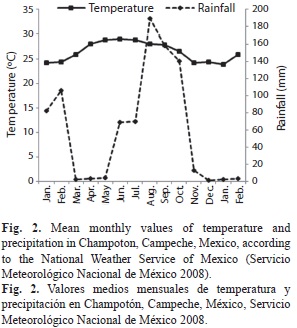
<body><![CDATA[ style="font-family: verdana;">     <font size="2"></font><br style="font-family: verdana;">     <font size="2"><span style="font-family: verdana;">Rainfall records of     the Mexican     National Weather Service (Servicio Meteorol&oacute;gico Nacional 2008)     showed that the annual mean precipitation in the area was 61.81mm     during the study period, with a minimum mean value of 0.57mm in the dry     season (March and May), and a maximum mean value of 161mm in the     hurricane season (August and October) (<a      href="/img/revistas/rbt/v61n2/a21i2.jpg">Fig. 2</a>). Overflowing of     ]]></body>
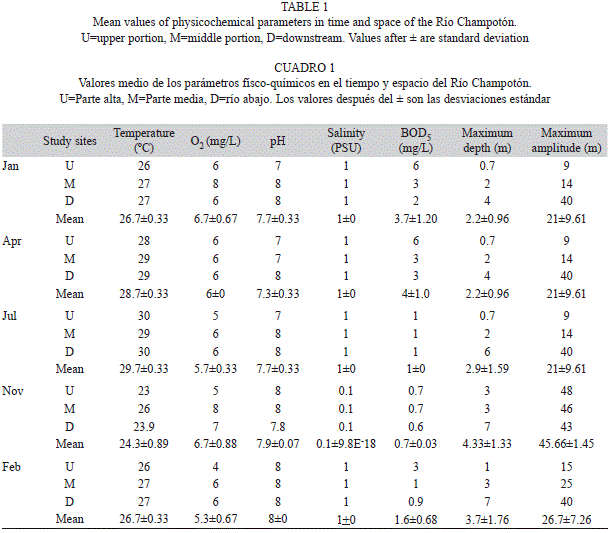
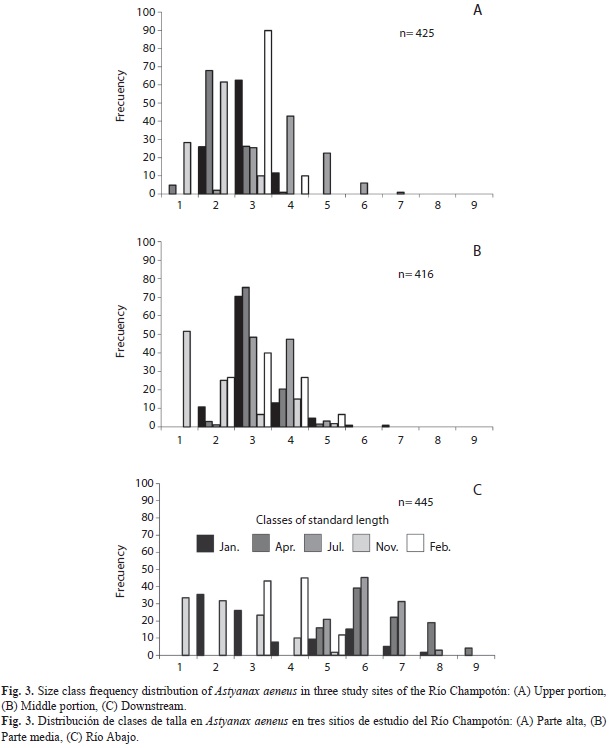
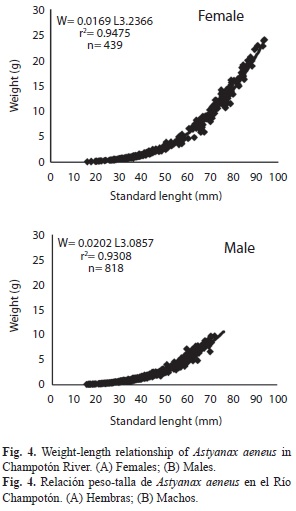
<body><![CDATA[the     river took place in September and continued through November     (amplitudes of the river, average 29m, minimum 15m SJC, maximum 47m in     U) (<a href="/img/revistas/rbt/v61n2/a21t1.gif">Table 1</a>). Mean air     temperature fluctuated: the maximum values were     recorded in June and July during the summer period (28.3 and     28.2&ordm;C, respectively) and the minimum value in January 2008     (22.8&ordm;C) (<a href="/img/revistas/rbt/v61n2/a21i2.jpg">Fig. 2</a>).    <br> </span></font><font size="2"><span style="font-family: verdana;">    <br> Maximum temperature values were recorded in April and July (28.7 and 29.7&ordm;C, respectively) and the minimum in November (24.3&ordm;C). DO levels were highest in January and November (6.7mg/L both months) and lowest in July and February (5.7 and 5.3mg/L respectively), and pH values remained constant throughout the study period (range of 7.3 to 8). Salinity oscillated from 0.1 PSU in November at all study sites to 1.2 PSU in July at U. BOD5 attained minimum values in November and maximum values in April at all sites (<a href="/img/revistas/rbt/v61n2/a21t1.gif">Table 1</a>).</span></font><br  style="font-family: verdana;"> <font size="2"></font><br style="font-family: verdana;"> <font size="2"><span style="font-family: verdana;"><span  style="font-weight: bold;">Population structure by size:</span> A spatial and seasonal pattern was noted in the size-class frequency distribution. The downstream site was the only one where all nine class sizes were detected, (<a href="/img/revistas/rbt/v61n2/a21i3.jpg">Fig. 3 a</a>, <a href="/img/revistas/rbt/v61n2/a21i3.jpg">b</a> and<a  href="/img/revistas/rbt/v61n2/a21i3.jpg"> c</a>); furthermore, classes 6 and 7 had the highest frequencies in April and July (<a  href="/img/revistas/rbt/v61n2/a21i3.jpg">Fig. 3c</a>). At the upper and middle portion of the river only seven classes (1 to 7) were detected. Youngest organisms had a strong seasonal distributional pattern, class 1 was present only in April at the upper site, and in November at all study sites (<a href="/img/revistas/rbt/v61n2/a21i3.jpg">Fig. 3b</a>). Based on chi-square (x<sup>2</sup>) tests (p&lt;0.05), significant differences were found between the size-class frequencies at the various study sites.</span></font><br  style="font-family: verdana;"> <font size="2"></font><br style="font-family: verdana;"> <font size="2"><span style="font-family: verdana;"><span  style="font-weight: bold;">Length-weight relationship: </span>The length- weight relationship is shown in <a  href="/img/revistas/rbt/v61n2/a21i4.jpg">Fig. 4</a>, along with its mathematical expression: parameter <span style="font-style: italic;">b</span> was 3.23 for females and 3.08 for males. The Kruskal-Wallis test found no significant differences between the sexes (p&gt;0.05).    ]]></body>
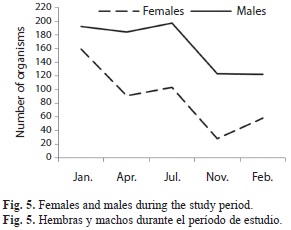
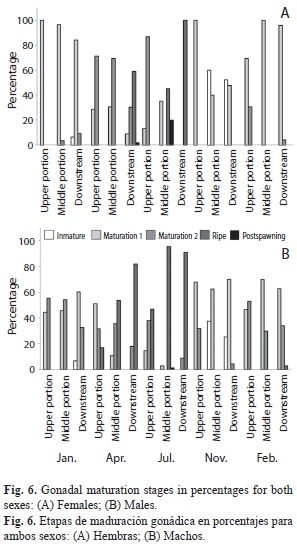
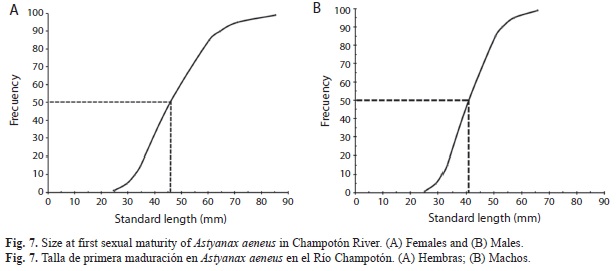
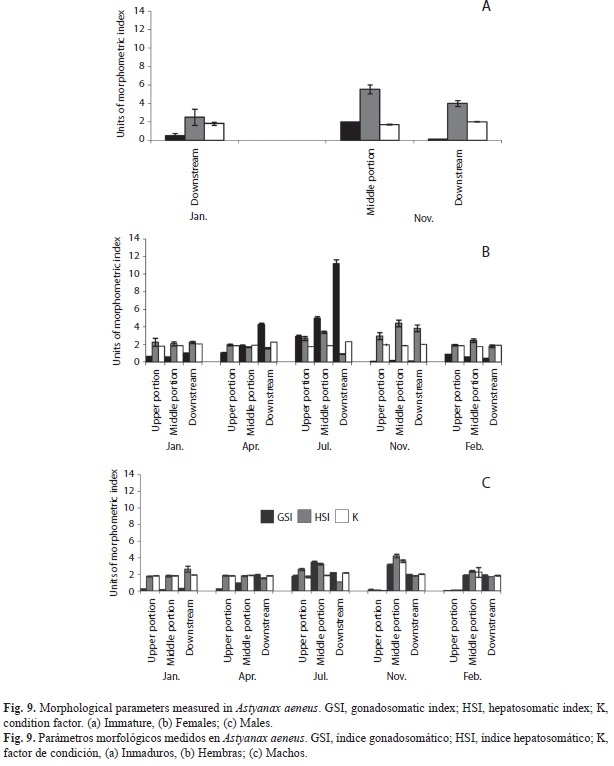
<body><![CDATA[<br> </span></font><font size="2"><span style="font-family: verdana;"><span  style="font-weight: bold;">    <br> Reproduction:&nbsp; </span>From&nbsp; the&nbsp; 1 286&nbsp; specimens&nbsp; collected,&nbsp; 818&nbsp; (63.60%)&nbsp; were&nbsp; males, 438 (34.05%) were females and 30 (2.33%) immature. Sex ratio was 1.87:1 (males:females), differing significantly from the expected 1:1 (x<sup>2</sup> p&lt;0.05). Males were significantly dominant during the whole period of study (<a  href="/img/revistas/rbt/v61n2/a21i5.jpg">Fig. 5</a>).    <br> </span></font><font size="2"><span style="font-family: verdana;">    <br> Immature individuals were detected in the middle and downstream sites only in January and November (<a  href="/img/revistas/rbt/v61n2/a21i6.jpg">Figs. 6a and b</a>). Females and males in maturity stage 1 were recorded during all sites and months studied, except for the downstream site in July, with the maximum abundance occurring in January at all three sites, and the minimum abundance in all study sites in April and July (<a  href="/img/revistas/rbt/v61n2/a21i6.jpg">Figs. 6a and b</a>).</span></font><br style="font-family: verdana;"> <br style="font-family: verdana;"> <font size="2"><span style="font-family: verdana;">Females in maturity stage 2 were recorded in the middle and in the downstream sites in January and in April (respectively), and a peak was&nbsp; detected&nbsp; in&nbsp; the&nbsp; upper&nbsp; river&nbsp; site&nbsp; during July. Males in stage 2 were present during all months and at all sites, except for the middle site in July and November (<a  href="/img/revistas/rbt/v61n2/a21i6.jpg">Figs. 6a and b</a>). Mature females and males were found in the middle and downstream sites in April and July; females were most abundant at the downstream site in July (100%), while males were more abundant in the middle site in July (95.65%). Females with gonads in post-spawning stage were present at the downstream site in April, and showed low values in the middle site in July, while males with testes in post-spawning stage were found only in the middle site in July (<a href="/img/revistas/rbt/v61n2/a21i6.jpg">Figs. 6a and b</a>). These data suggest that the reproductive period is from early spring to midsummer (from April to July).</span></font><br  style="font-family: verdana;"> <font size="2"></font><br style="font-family: verdana;"> <font size="2"><span style="font-family: verdana;">Size at first maturity was 45.7mm for females and 40.8mm for males (<a  href="/img/revistas/rbt/v61n2/a21i7.jpg">Figs. 7a </a>and <a  href="/img/revistas/rbt/v61n2/a21i7.jpg">b</a>).&nbsp; AF&nbsp; ranged&nbsp; from&nbsp; 432&nbsp; oocytes&nbsp; to&nbsp; 11 890 oocytes&nbsp; in&nbsp; one&nbsp; female&nbsp; of&nbsp; 75.2mm&nbsp; length. The lowest mean RF was at the middle site (RF=435.91&plusmn;49.24 oocytes/g), while the highest was recorded at the downstream site during&nbsp; July&nbsp; and&nbsp; April&nbsp; (RF=652.68&plusmn;29.69&nbsp; and 394.8&plusmn;29.11&nbsp;&nbsp; oocytes/g,&nbsp;&nbsp; respectively).&nbsp;&nbsp; RF was significantly correlated with Ls (r=0.58 p&lt;0.05)&nbsp; and&nbsp; W&nbsp; (r=0.53,&nbsp; p&lt;0.05),&nbsp; while&nbsp; AF was significantly correlated with Ls (r=0.58, p&lt;0.05) and W (r=0.53, p&lt;0.05) (<a  href="/img/revistas/rbt/v61n2/a21i8.jpg">Figs. 8a</a> y <a href="/img/revistas/rbt/v61n2/a21i8.jpg">b</a>).    <br> </span></font><font size="2"><span style="font-family: verdana;"><span  style="font-weight: bold;">    <br>     Somatic indices:</span> Immature     individuals were only found at the downstream site in January and     November, and at the middle site in November with low GSI values; while     HSI values of fishes from the middle site showed a peak in November     ]]></body>
<body><![CDATA[(5.49&plusmn;0.52), and values of Somatic indices: Immature individuals     were only found at the downstream site in January and November, and at     the middle site in November with low GSI values; while HSI values of     fishes from the middle site showed a peak in November     (5.49&plusmn;0.52), and values of K fluctuated from 1.69&plusmn;0.05 in     the middle site to 2.02&plusmn;0.04 in the downstream site, both in     November (<a href="/img/revistas/rbt/v61n2/a21i9.jpg">Fig. 9a</a>).</span></font><br      style="font-family: verdana;">     <font size="2"></font><br style="font-family: verdana;">     <font size="2"><span style="font-family: verdana;">GSI values of     ]]></body>
<body><![CDATA[females from the     upper site ranged from 0.64&plusmn;0.04 in January to 2.93&plusmn;0.48     in&nbsp; July,&nbsp; while&nbsp; males&nbsp; showed&nbsp; lower&nbsp;     values K fluctuated from 1.69&plusmn;0.05 in the middle site to     2.02&plusmn;0.04 in the downstream site, both in November (<a      href="/img/revistas/rbt/v61n2/a21i9.jpg">Fig. 9a</a>).     GSI values of females from the upper site ranged from 0.64&plusmn;0.04     in January to 2.93&plusmn;0.48 in&nbsp; July,&nbsp; while&nbsp;     males&nbsp; showed&nbsp; lower&nbsp; values (0.06&plusmn;0.006 in     February to 1.77&plusmn;0.15 in July). In the middle site both females     ]]></body>
<body><![CDATA[and males attained&nbsp; peak&nbsp; values&nbsp; in&nbsp; July&nbsp;     (4.98&plusmn;0.46&nbsp; and 3.48&plusmn;0.11 respectively); both sexes     had relatively low values in other months. Females from the downstream     site had high GSI values in April (4.27&plusmn;0.31) and July     (11.21&plusmn;0.44); males had&nbsp; lower&nbsp; values&nbsp;     than&nbsp; females&nbsp; and&nbsp; attained their maximum value in     April (2.25&plusmn;0.09) (<a href="/img/revistas/rbt/v61n2/a21i9.jpg">Figs.     9b</a> and <a href="/img/revistas/rbt/v61n2/a21i9.jpg">c</a>).</span></font><br      style="font-family: verdana;">     <font size="2"></font><br style="font-family: verdana;">     ]]></body>
<body><![CDATA[<font size="2"><span style="font-family: verdana;">HSI&nbsp;     scores&nbsp; in&nbsp;     females&nbsp; from&nbsp; the&nbsp; upper site&nbsp; ranged&nbsp;     from&nbsp; 1.94&plusmn;0.08&nbsp; in&nbsp; February&nbsp; to     2.98&plusmn;0.41 in November, while males showed their minimum value in     January (1.75&plusmn;0.06) and their maximum in November     (3.24&plusmn;0.13). At the middle section, females had their mini- mum     HSI value in April (1.72&plusmn;0.05) and males in January and April     (1.82&plusmn;0.08 both months); besides, females and males had higher     values in July and November (females 3.4&plusmn;0.14 and     ]]></body>
<body><![CDATA[4.42&plusmn;0.37, respectively and males 3.25&plusmn;0.08 and     4.22&plusmn;0.22, respectively) (<a      href="/img/revistas/rbt/v61n2/a21i9.jpg">Figs. 9b</a> and <a      href="/img/revistas/rbt/v61n2/a21i9.jpg">c</a>).</span></font><br      style="font-family: verdana;">     <font size="2"></font><br style="font-family: verdana;">     <font size="2"><span style="font-family: verdana;">The lowest K values     for both sexes     from the upper site occurred in July (1.73&plusmn;0.03 and     1.71&plusmn;0.02 in females and males, respectively), while the highest     ]]></body>
<body><![CDATA[values were registered for females in January (2.37&plusmn;0.04) and     for males in November (2.02&plusmn;0.02). At the middle site, the     lowest K value was recorded in both females (1.76&plusmn;0.3) and males     (1.71&plusmn;0.02) in February, and the highest for both sexes too     (1.92&plusmn;0.03 females and 1.91&plusmn;0.02 males) in April.     At&nbsp; the&nbsp; downstream&nbsp; site&nbsp; the&nbsp; lowest&nbsp; K     value in females was in November and February (1.9&plusmn;0.03 in both     months), and the highest in July (2.33&plusmn;0.02), while in males,     the lowest&nbsp; value&nbsp; occurred&nbsp; in April&nbsp;     (1.86&plusmn;0.03)&nbsp; and February (1.87&plusmn;0.06), and the     ]]></body>
<body><![CDATA[highest in July (2.20&plusmn;0.03) (<a      href="/img/revistas/rbt/v61n2/a21i9.jpg">Figs. 9b</a> and <a      href="/img/revistas/rbt/v61n2/a21i9.jpg">c</a>).</span></font><br      style="font-family: verdana;">     <font size="2"></font><br style="font-family: verdana;">     <font size="2"><span style="font-family: verdana;">The correlation test     between GSI     and abiotic (temperature and precipitation) and biotic factors (HSI and     K) revealed no significant correlation&nbsp; except&nbsp; with&nbsp;     regard&nbsp; to&nbsp; temperature, which displayed a significant     ]]></body>
<body><![CDATA[correlation (p&lt;0.0001).</span></font><br      style="font-family: verdana;">     <font size="2"></font><br style="font-family: verdana;">     <font size="2"><span style="font-family: verdana;">Discriminant     analysis revealed that     standard length (Wilks&#8217; Lambda 0.344, p=0.0001), somatic&nbsp;     indexes&nbsp; (K&nbsp; Wilks&#8217;&nbsp; Lambda&nbsp; 0.692, p=0.0001), GSI     (Wilks&#8217; Lambda 0.296, p=0.0001); HSI (Wilks&#8217; Lambda 0.541,     p=0.0001),&nbsp; gonadal&nbsp; stages&nbsp; (Wilks&#8217;&nbsp; Lambda 0.402,     p=0.0001); relative fecundity (Wilks&#8217; Lambda 0.671, p=0.0001), size     ]]></body>
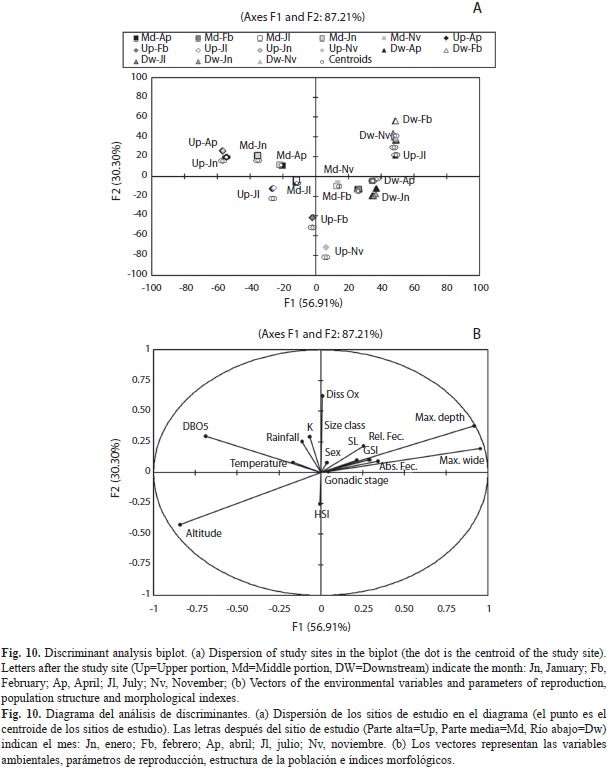
<body><![CDATA[classes (Wilks&#8217; Lambda 0.383, p=0.0001), and sex (Wilks&#8217; Lambda 0.864,     p=0.0001) were significant variables in the test model and allowed the     formation of four groups in the first two components (Axes I and II:     87.22 % of the variance explained) (<a      href="/img/revistas/rbt/v61n2/a21i10.jpg">Figs. 10a</a> and <a      href="/img/revistas/rbt/v61n2/a21i10.jpg">b</a>).</span></font><br      style="font-family: verdana;">     <font size="2"></font><br style="font-family: verdana;">     <font size="2"><span style="font-family: verdana;">In the biplot of the     discriminant     ]]></body>
<body><![CDATA[analysis the upper and middle sites during November and February, and     the downstream site during April and January were characterized by     their high values for gonadal maturation stages and HSI. The downstream     site in July, November and February was characterized by their high     values for standard length, GSI, RF, a higher males / females ratio and     the largest size classes. Additionally, this site was strongly     correlated with greater water depth, river width, and dissolved oxygen.     The upper and middle sections, were more closely correlated with a high     temperature, precipitation, BOD5, K and higher altitude in January and     April, while the down-stream site was correlated with the widest and     ]]></body>
<body><![CDATA[deepest portion of the river (<a      href="/img/revistas/rbt/v61n2/a21i10.jpg">Figs. 10a</a> and <a      href="/img/revistas/rbt/v61n2/a21i10.jpg">b</a>).</span></font><br      style="font-family: verdana;">     <br style="font-family: verdana;">     <font size="3"><span style="font-family: verdana; font-weight: bold;">Discussion</span></font><br      style="font-family: verdana;">     <font size="2"></font><br style="font-family: verdana;">     <font size="2"><span style="font-family: verdana;">The genus <span      style="font-style: italic;">Astyanax </span>is made up of     ]]></body>
<body><![CDATA[small- size species not exceeding 120mm in maximum&nbsp; length&nbsp;     (Miller&nbsp; et&nbsp; al.&nbsp; 2005).&nbsp; <span      style="font-style: italic;">A.&nbsp; aeneus</span> (size     range 13-95mm) is a large-size species within&nbsp; this&nbsp;     genus,&nbsp; like&nbsp; <span style="font-style: italic;">A.&nbsp;     janeiroensis</span>&nbsp; (25- 115mm)&nbsp;     (Mazzoni&nbsp; et&nbsp; al.&nbsp; 2005),&nbsp; as&nbsp; opposed to     smaller species from the Paragua&ccedil;u River, Brazil, with standard     length ranges 13-42mm (Santos&nbsp; &amp;&nbsp; Novaes&nbsp;     2008)&nbsp; and&nbsp; intermediate size species such as <span     ]]></body>
<body><![CDATA[ style="font-style: italic;">A. aurocaudatus</span>     from the Cauca River, Colombia (14-74mm) (Rom&aacute;n- Valencia &amp;     Ruiz 2005).</span></font><br style="font-family: verdana;">     <font size="2"></font><br style="font-family: verdana;">     <font size="2"><span style="font-family: verdana;">Size-class frequency     distribution     of <span style="font-style: italic;">A. aeneus</span> evidenced the     differential use of spatial resources     (sites) over time (study periods) in the longitudinal gradient of     Champot&oacute;n River.&nbsp; This&nbsp; may&nbsp; be&nbsp; the&nbsp;     ]]></body>
<body><![CDATA[result&nbsp; of&nbsp; different factors: period and location for     reproduction, spatio-temporal variations in environmental     conditions,&nbsp; and&nbsp; food&nbsp; availability.&nbsp; The&nbsp;     largest classes (&gt;70mm), were found only at the downstream site, the     deepest and widest site of the freshwater portion of the river, where     floating cages are used for rearing fish that are feed with pellet     food; this food is also available to wild fish. Smaller size classes     had higher frequencies at the upper and shallow section of the river,     with submerged and riparian vegetation which can be used by fish as a     shelter or feeding area, while intermediate size classes had highest     ]]></body>
<body><![CDATA[frequencies at the middle site, this is consistent with other characids     findings (Sabino &amp; Castro 1990, Barreto &amp; Aranha 2005). In     contrast Mazzoni et al. (2004), found that juvenile fish of <span      style="font-style: italic;">A.     janeiroensis</span> were located downstream while adult organisms are     located     in the upper reaches of the Ubatiba river. Vitule et al. (2008) found     that the size-class distribution of <span style="font-style: italic;">Deuterodon     langei</span> differs along the     Paran&aacute; River basin: a higher number of large- size individuals     ]]></body>
<body><![CDATA[were located at the upper and middle portion and juveniles occurred in     higher abundance at the downstream.</span></font><br      style="font-family: verdana;">     <font size="2"></font><br style="font-family: verdana;">     <font size="2"><span style="font-family: verdana;">A positive&nbsp;     allometric&nbsp;     growth&nbsp; was&nbsp; found in <span style="font-style: italic;">A.     aeneus</span>, meaning a greater increment     in weight than in length (Orsi et al. 2002), perhaps related in turn to     the reproductive period. Carvalho et al. (2009) report allometric     ]]></body>
<body><![CDATA[growth in <span style="font-style: italic;">A. fasciatus</span>,     stating that the data may be skewed since most     specimens were adults. A higher number of adult fish was also found in     the present study.</span></font><br style="font-family: verdana;">     <font size="2"></font><br style="font-family: verdana;">     <font size="2"><span style="font-family: verdana;">Species with     external fertilization     and no parental care tend to have intermediate levels of fecundity,     e.g. <span style="font-style: italic;">A. henseli</span> (5 375     oocytes) (Dala-Corte &amp; Azevedo 2010), and     ]]></body>
<body><![CDATA[low fecundity is commonly found in small-size species with traits that     increase the probabilities of egg and larval survival such as internal     fertilization and parental care, e.g. <span style="font-style: italic;">Bryconamericus     iheringii</span> (1 600     oocytes); <span style="font-style: italic;">Bryconamericus stramineus</span>     (1 100 oocytes) (Lampert et al.     2004, 2007). From this standpoint, <span style="font-style: italic;">A.     aeneus</span> has intermediate levels of     fecundity.</span></font><br style="font-family: verdana;">     <font size="2"></font><br style="font-family: verdana;">     ]]></body>
<body><![CDATA[<font size="2"><span style="font-family: verdana;">Sex differences in     body size and     length- weight relationship are the most frequent sexual dimorphism in     fish (Nikolsky 1963). Females of <span style="font-style: italic;">A.     aeneus</span> were larger than males, this     same trait was reported in other Characiformes (Agostinho &amp;     J&uacute;lio-J&uacute;nior 1999) e.g. <span style="font-style: italic;">Astyanax     bimaculatus</span>, <span style="font-style: italic;">A.     schubarti</span> (Nomura 1975), <span style="font-style: italic;">A.     eigenmanniorum</span> (Barl&aacute; et al. 1988),     ]]></body>
<body><![CDATA[<span style="font-style: italic;">A. fasciatus</span> (Mora et al.     1997, Nomura 1975), <span style="font-style: italic;">A. scabripinnis</span>     (Veloso-J&uacute;nior et al. 2009), as opposed to <span      style="font-style: italic;">A. aurocaudatus</span> in     which males are larger than females (Rom&aacute;n-Valencia &amp; Ruiz     2005). Large females size is advantageous since fecundity is increased,     while large males are at greater advantage during reproduction of     producing potentially more, and larger, offspring (Nikolsky 1963). Sex     ratio is an important trait in estimating reproductive biomass and     total population fecundity and is also one of the factors determining     ]]></body>
<body><![CDATA[the reproductive&nbsp; potential&nbsp; of&nbsp; a&nbsp;     population&nbsp; (Marshall et al. 2006). An imbalance in the sex ratio,     particularly in adults, is relatively common in fish and is related to     sex differences in growth, mortality and/or the energy costs of     reproduction and the formation of preponderantly male reproductive     groups (Potts &amp; Wootton 1984, Marshall et al. 1998). In <span      style="font-style: italic;">A. aeneus</span>     the sex ratio was&nbsp; skewed&nbsp; towards&nbsp; males.&nbsp;     This&nbsp; same&nbsp; trait has been reported in <span      style="font-style: italic;">A. bimaculatus</span>     ]]></body>
<body><![CDATA[<span style="font-style: italic;">vittatus </span>(Gurgel &amp; Alves     2001); <span style="font-style: italic;">Characidium</span> sp. n.     (Mazzoni et al.     2002); <span style="font-style: italic;">Astyanax scabripinnis paranae</span>     (Louzada &amp; Orsi 2003);     <span style="font-style: italic;">Hemibrycon </span>sp.     (Rom&aacute;n-Valencia &amp; Botero 2006). Wootton     (1998) found that some fish species with external fertilization had a     higher male ratio during the reproductive cycle. However, most females     have high levels of fecundity, which is advantageous since males are     ]]></body>
<body><![CDATA[able to fertilize a larger number of oocytes, thus increasing the odds     of perpetuation of the species.</span></font><br      style="font-family: verdana;">     <font size="2"></font><br style="font-family: verdana;">     <font size="2"><span style="font-family: verdana;">The optimal first     reproduction size     depends on many factors, including the relative allocation of energy     between gonadal and somatic growth (Mazzoni et al. 2005). In species of     the genus <span style="font-style: italic;">Astyanax</span>, size at     first maturity varies from 41 to 78mm     ]]></body>
<body><![CDATA[(Veregue &amp; Orsi 2003, Mazzoni et al. 2005, Dala-Corte &amp; Azevedo     2010). <span style="font-style: italic;">A. aeneus</span> reaches     sexual maturity at 45.7mm in females and     40.8mm in males, smaller sizes than those in <span      style="font-style: italic;">A. janeiroensis</span> (55mm     Mazzoni et al. 2005) and <span style="font-style: italic;">A.     bimaculatus</span> (69mm Agostinho et al. 1984);     these species attain a similar size (Ls) in the course of their life     cycle. Interpretation of the selection forces acting on the genus     <span style="font-style: italic;">Astyanax </span>suggests that early     ]]></body>
<body><![CDATA[reproduction may be&nbsp; related&nbsp;     to&nbsp; an&nbsp; adaptive&nbsp; behavior&nbsp; to&nbsp; offset the     stochastic mortality imposed by unstable hydrological systems (Mazzoni     &amp; Petito 1999), such as the Champot&oacute;n River which is     affected by the hurricane season (August and October). According to the     National Weather Service, the frequency and intensity of hurricanes has     risen in recent years: in 2007 five hurricanes were formed; in 2008     there were eight hurricanes, three of which were storms category four,     while the most severe season was in 2010 when seven moderate and five     strong hurricanes occurred (Servicio Meteorol&oacute;gico Nacional,     ]]></body>
<body><![CDATA[2007, 2008 &amp; 2010). Dala-Corte &amp; Azevedo (2010) point out that     the reproductive tactic of small size at first maturity results in a     rapid recruitment and, under favorable conditions, this may increases     the number of juveniles produced thereby contributing to total     population increase. Mazzoni &amp; Iglesias-Rios (2002) found     variations in life history&nbsp; traits&nbsp; in&nbsp; <span      style="font-style: italic;">Geophagus&nbsp;     brasiliensis</span>&nbsp; living in contrasting habitats (upper reaches     and     fluvial-lagunar conditions). The size at sexual maturity was smaller in     ]]></body>
<body><![CDATA[the population living in the river (with unstable conditions), while     population living in the lagoon was larger; this trait has been shown     to be regulated by environmental conditions.</span></font>    <br> <font size="2"><span style="font-family: verdana;"></span></font><br  style="font-family: verdana;"> <font size="2"><span style="font-family: verdana;"></span><span  style="font-family: verdana;">Environmental conditions permitting, extended reproductive periods are more common than short ones (Kramer 1978). However, tropical freshwater fishes (in particular cyprinids, characids and silurids, which comprise most&nbsp; of&nbsp; the&nbsp; tropical&nbsp; freshwater&nbsp; forms)&nbsp; are an interesting exception to this generalization since they have seasonal reproductive periods (Vazzoler &amp; Menezes 1992). Characidae species have their reproductive period between April&nbsp; and&nbsp; September&nbsp; (Vazzoler&nbsp; &amp;&nbsp; Menezes 1992, Lampert et al. 2004, 2007, Gon&ccedil;alves et al. 2005). Reproduction season of <span style="font-style: italic;">A. aeneus</span> is from April to July (spring and summer sea- sons), with a reproductive peak in July, when water levels rise. In tropical regions, various species take this event as a signal to carry out reproduction, as stated previously for <span style="font-style: italic;">A. fasciatus</span> (Mora et al. 1997); <span style="font-style: italic;">A. bimaculatus</span> (Braga 2001); <span style="font-style: italic;">A. aurocaudatus </span>(Rom&aacute;n-Valencia &amp; Ruiz 2005); <span style="font-style: italic;">A. scabrippinnis</span> (Abilhoa 2007); <span style="font-style: italic;">A. henseli</span> (Dala-Corte &amp; Azevedo 2010). Like- wise, Lowe-McConnell (1987) found that in tropical&nbsp; regions&nbsp; spawning&nbsp; is&nbsp; stimulated&nbsp; by local rainfall or a rise in water levels. Lampert et al. (2004, 2007) found no correlation between reproductive traits and abiotic factors in Characidae from Rio Grande do Sul, Brazil in a subtropical region. However, the same authors recognize that a temperature increase may unleash the beginning of gonadal maturation. <span  style="font-style: italic;">A. aeneus</span> reveals that the beginning of the reproductive period takes place when there is an increase in temperature values as was detected by the positive correlation between GSI and water temperature, lending added sup- port to the above-mentioned hypothesis.</span></font><br  style="font-family: verdana;"> <font size="2"></font><br style="font-family: verdana;"> <font size="2"><span style="font-family: verdana;">A gradual increase in GSI values indicates the period of gonadal maturation while an abrupt fall signals the spawning season (Htun- Han 1978). A better reproductive condition based on GSI of <span style="font-style: italic;">A. aeneus</span> was during July. GSI variability was higher in females than in males, due to existing differences between ovaries and testes in terms of volume, mass, and&nbsp; energy&nbsp; demands&nbsp; for&nbsp; gamete&nbsp; production; this same trait was noted in <span style="font-style: italic;">A. fasciatus</span> from Brazil (Carvalho et al. 2009).</span></font><br  style="font-family: verdana;"> <font size="2"></font><br style="font-family: verdana;"> <font size="2"><span style="font-family: verdana;">HSI has been used to evidence the potential transfer of energy from the liver in order to maintain relevant biological events such as reproduction. During the reproductive period individuals allocate less effort to food procurement and consume reserves stored in the liver, eliciting a reduction in HSI values, particularly in females (Nikolsky 1963). In <span  style="font-style: italic;">A. aeneus</span>, higher HSI values were found during periods of reproductive inactivity. This is interpreted as an increase in the reserve materials stored in the liver for subsequent use in gamete production. In females low HSI values prior to and during reproduction may result from the transfer of energy materials stored in the liver toward gonadal maturation and the breeding event (Santos et al. 1996, Zimmerman 1997). <span style="font-style: italic;">A. henseli</span> had higher HSI values before the breeding period and lower values at its reproductive peak, suggesting greater use of liver reserves for vitellogenesis and gonadal maturation (Dala-Corte &amp; Azevedo 2010).</span></font><br style="font-family: verdana;"> <font size="2"><span style="font-family: verdana;">&nbsp;</span></font><br  style="font-family: verdana;"> <font size="3"><span style="font-family: verdana; font-weight: bold;">Acknowledgments</span></font><br  style="font-family: verdana;"> <font size="2"></font><br style="font-family: verdana;"> <font size="2"><span style="font-family: verdana;">The study was supported by the National Science and Technology Council (CONACyT- M&eacute;xico) and the government of the state Campeche (Project: 31173) and the Secretariat of Research and Posgraduate Studies (SIP) of the National Polytechnic Institute (IPN-M&eacute;xico).</span></font><br  style="font-family: verdana;"> <font size="2"></font></div> <hr  style="width: 100%; height: 2px; margin-left: 0px; margin-right: 0px;">     <!-- ref --><div style="text-align: justify;"><br  style="font-family: verdana; font-weight: bold;"> <font size="3"><span style="font-family: verdana; font-weight: bold;">References</span></font><br  style="font-family: verdana;"> <font size="2"></font><br style="font-family: verdana;"> <font size="2"><span style="font-family: verdana;">Adebisi, A.A. 1987. The relationships between fecundities, gonadosomatic indices and eggs sizes of some fishes of Ogun River,&nbsp; Nigeria. Arch. Hydrobiol. Stuttgart 111: 151-156.    &nbsp;&nbsp;&nbsp;&nbsp;&nbsp;&nbsp;&nbsp;&nbsp;[&#160;<a href="javascript:void(0);" onclick="javascript: window.open('/scielo.php?script=sci_nlinks&ref=1513042&pid=S0034-7744201300030002100001&lng=','','width=640,height=500,resizable=yes,scrollbars=1,menubar=yes,');">Links</a>&#160;]<!-- end-ref --><!-- ref --></span></font><br style="font-family: verdana;"> <font size="2"></font><br style="font-family: verdana;"> <font size="2"><span style="font-family: verdana;">Agostinho, C.A., S. Molinari, A.A. Agostinho &amp; J. Verani. 1984. Ciclo reprodutivo e primeira matura&ccedil;&atilde;o sexual de&nbsp; f&ecirc;meas&nbsp; do&nbsp; lambari&nbsp; <span style="font-style: italic;">Astyanax&nbsp; bimaculatus</span>&nbsp; (L.) (Osteichthyes-Characidae) do rio Iva&iacute;.&nbsp; Estado&nbsp; do Paran&aacute;. Rev. Braz. Biol. 44: 31-36.    &nbsp;&nbsp;&nbsp;&nbsp;&nbsp;&nbsp;&nbsp;&nbsp;[&#160;<a href="javascript:void(0);" onclick="javascript: window.open('/scielo.php?script=sci_nlinks&ref=1513043&pid=S0034-7744201300030002100002&lng=','','width=640,height=500,resizable=yes,scrollbars=1,menubar=yes,');">Links</a>&#160;]<!-- end-ref --><!-- ref --></span></font><br  style="font-family: verdana;"> <font size="2"></font><br style="font-family: verdana;"> <font size="2"><span style="font-family: verdana;">Agostinho,&nbsp; A.A.&nbsp; &amp;&nbsp; H.F.&nbsp; Julio-Junior.&nbsp; 1999.&nbsp; Peixes&nbsp; da bacia do alto rio Paran&aacute;, p. 374-400. <span  style="font-style: italic;">In</span> R.H. Lowe- McConnell (ed). Estudos ecol&oacute;gicos de comunidades de peixes tropicais. Universidade de S&atilde;o Paulo, S&atilde;o Paulo, Brasil.    &nbsp;&nbsp;&nbsp;&nbsp;&nbsp;&nbsp;&nbsp;&nbsp;[&#160;<a href="javascript:void(0);" onclick="javascript: window.open('/scielo.php?script=sci_nlinks&ref=1513044&pid=S0034-7744201300030002100003&lng=','','width=640,height=500,resizable=yes,scrollbars=1,menubar=yes,');">Links</a>&#160;]<!-- end-ref --><!-- ref --></span></font><br  style="font-family: verdana;"> <font size="2"></font><br style="font-family: verdana;"> <font size="2"><span style="font-family: verdana;">Abilhoa, V. 2007. Aspectos da hist&oacute;ria natural de <span style="font-style: italic;">Astyanax scabripinnis </span>Jenyns (Teleostei,&nbsp; Characidae) em um riacho de floresta com arauc&aacute;ria no sul do Brasil. Rev. Braz. Zool. 24: 997-1005.    &nbsp;&nbsp;&nbsp;&nbsp;&nbsp;&nbsp;&nbsp;&nbsp;[&#160;<a href="javascript:void(0);" onclick="javascript: window.open('/scielo.php?script=sci_nlinks&ref=1513045&pid=S0034-7744201300030002100004&lng=','','width=640,height=500,resizable=yes,scrollbars=1,menubar=yes,');">Links</a>&#160;]<!-- end-ref --><!-- ref --></span></font><br  style="font-family: verdana;"> <font size="2"></font><br style="font-family: verdana;"> <font size="2"><span style="font-family: verdana;">American Public Health Association. 2005.&nbsp;&nbsp; Standard methods:&nbsp; for&nbsp; the&nbsp; examination&nbsp; of&nbsp; water&nbsp; and&nbsp; wastewater. American&nbsp; Public Health Association, Baltimore, Maryland, USA.    &nbsp;&nbsp;&nbsp;&nbsp;&nbsp;&nbsp;&nbsp;&nbsp;[&#160;<a href="javascript:void(0);" onclick="javascript: window.open('/scielo.php?script=sci_nlinks&ref=1513046&pid=S0034-7744201300030002100005&lng=','','width=640,height=500,resizable=yes,scrollbars=1,menubar=yes,');">Links</a>&#160;]<!-- end-ref --><!-- ref --></span></font><br  style="font-family: verdana;"> <font size="2"></font><br style="font-family: verdana;"> <font size="2"><span style="font-family: verdana;">Barl&aacute;,&nbsp; M.J., L.R. Freyre, L.M. Giraudo, M.&nbsp; Guti&eacute;rrez &amp; E.D. Sendra. 1988. Age and growth of <span style="font-style: italic;">Astyanax eigenmanniorum</span>&nbsp; (Cope) (Pisces, Characiformes) from San&nbsp; Roque&nbsp; lake, Argentina.&nbsp; Stud.&nbsp; Neotrop.&nbsp; Fauna Environ. 23: 177-188.    &nbsp;&nbsp;&nbsp;&nbsp;&nbsp;&nbsp;&nbsp;&nbsp;[&#160;<a href="javascript:void(0);" onclick="javascript: window.open('/scielo.php?script=sci_nlinks&ref=1513047&pid=S0034-7744201300030002100006&lng=','','width=640,height=500,resizable=yes,scrollbars=1,menubar=yes,');">Links</a>&#160;]<!-- end-ref --><!-- ref --></span></font><br  style="font-family: verdana;"> <font size="2"></font><br style="font-family: verdana;"> <font size="2"><span style="font-family: verdana;">Barreto, A.P. &amp; J.M.R. Aranha. 2005. Assembl&eacute;ia de peixes de um riacho da&nbsp; Floresta Atl&acirc;ntica: composi&ccedil;&atilde;o e distribui&ccedil;&atilde;o espacial (Guaraque&ccedil;aba, Paran&aacute;, Brasil). Acta Sci. Biol. Sci. 27: 153-160.    &nbsp;&nbsp;&nbsp;&nbsp;&nbsp;&nbsp;&nbsp;&nbsp;[&#160;<a href="javascript:void(0);" onclick="javascript: window.open('/scielo.php?script=sci_nlinks&ref=1513048&pid=S0034-7744201300030002100007&lng=','','width=640,height=500,resizable=yes,scrollbars=1,menubar=yes,');">Links</a>&#160;]<!-- end-ref --><!-- ref --></span></font><br style="font-family: verdana;"> <font size="2"></font><br style="font-family: verdana;"> <font size="2"><span style="font-family: verdana;">Braga, F.M.S. 2001. Reprodu&ccedil;&atilde;o de peixes (Osteichthyes) em afluentes do&nbsp; reservat&oacute;rio de Volta Grande, Rio Grande, sudeste do Brasil. Iheringia,&nbsp; Ser.&nbsp; Zool. 91: 67-74.    &nbsp;&nbsp;&nbsp;&nbsp;&nbsp;&nbsp;&nbsp;&nbsp;[&#160;<a href="javascript:void(0);" onclick="javascript: window.open('/scielo.php?script=sci_nlinks&ref=1513049&pid=S0034-7744201300030002100008&lng=','','width=640,height=500,resizable=yes,scrollbars=1,menubar=yes,');">Links</a>&#160;]<!-- end-ref --><!-- ref --></span></font><br  style="font-family: verdana;"> <font size="2"></font><br style="font-family: verdana;"> <font size="2"><span style="font-family: verdana;">Carvalho, P.A., A.L. Paschoalini, G.B. Santos, E. Rizzo &amp; N. Bazzoli. 2009. Reproductive biology of <span style="font-style: italic;">Astyanax fasciatus</span> (Pisces: Characiformes) in a&nbsp; reservoir in southeastern Brazil. J. Appl. Ichthyol. 25: 306-313.    &nbsp;&nbsp;&nbsp;&nbsp;&nbsp;&nbsp;&nbsp;&nbsp;[&#160;<a href="javascript:void(0);" onclick="javascript: window.open('/scielo.php?script=sci_nlinks&ref=1513050&pid=S0034-7744201300030002100009&lng=','','width=640,height=500,resizable=yes,scrollbars=1,menubar=yes,');">Links</a>&#160;]<!-- end-ref --></span></font><br  style="font-family: verdana;"> <font size="2"><span style="font-family: verdana;">    <!-- ref --><br> Dala-Corte, R. &amp; M.A. Azevedo. 2010. Biologia reprodutiva de <span style="font-style: italic;">Astyanax henseli&nbsp; </span>(Teleostei, Characidae) do curso superior do rio dos Sinos, RS, Brasil. Iher&iacute;ngia Ser Zool. 100: 259-266.    &nbsp;&nbsp;&nbsp;&nbsp;&nbsp;&nbsp;&nbsp;&nbsp;[&#160;<a href="javascript:void(0);" onclick="javascript: window.open('/scielo.php?script=sci_nlinks&ref=1513052&pid=S0034-7744201300030002100010&lng=','','width=640,height=500,resizable=yes,scrollbars=1,menubar=yes,');">Links</a>&#160;]<!-- end-ref --><!-- ref --></span></font><br  style="font-family: verdana;"> <font size="2"></font><br style="font-family: verdana;"> <font size="2"><span style="font-family: verdana;">Environmental&nbsp; Protection Agency (EPA). 2011.&nbsp; Statistical Analysis for Biological&nbsp; Methods. (Downloaded: 23 March 2011,&nbsp; http://www.epa.gov/nerleerd/stat2.htm.    &nbsp;&nbsp;&nbsp;&nbsp;&nbsp;&nbsp;&nbsp;&nbsp;[&#160;<a href="javascript:void(0);" onclick="javascript: window.open('/scielo.php?script=sci_nlinks&ref=1513053&pid=S0034-7744201300030002100011&lng=','','width=640,height=500,resizable=yes,scrollbars=1,menubar=yes,');">Links</a>&#160;]<!-- end-ref --><!-- ref -->).</span></font><br  style="font-family: verdana;"> <font size="2"></font><br style="font-family: verdana;"> <font size="2"><span style="font-family: verdana;">Gertum, B.F., S. Carvalho &amp; S.M. Hartz. 2008. Life-history of the South American darter,<span  style="font-style: italic;"> Characidium pterosticum </span>(Crenuchidae): evidence for small scale spatial variation&nbsp; in a piedmont stream. Neotrop.&nbsp; Ichthyol. 6: 591-598.    &nbsp;&nbsp;&nbsp;&nbsp;&nbsp;&nbsp;&nbsp;&nbsp;[&#160;<a href="javascript:void(0);" onclick="javascript: window.open('/scielo.php?script=sci_nlinks&ref=1513054&pid=S0034-7744201300030002100012&lng=','','width=640,height=500,resizable=yes,scrollbars=1,menubar=yes,');">Links</a>&#160;]<!-- end-ref --><!-- ref --></span></font><br style="font-family: verdana;"> <font size="2"></font><br style="font-family: verdana;"> <font size="2"><span style="font-family: verdana;">Gomiero, L.M., L. Garuana &amp; F.M.S. Braga. 2008. Reproduction of <span style="font-style: italic;">Oligosarcus hepsetus</span> (Cuvier, 1829) (Characiformes) in the Serrado Mar State Park, S&atilde;o Paulo, Brazil. Braz. J. Biol. 68: 187-192.    &nbsp;&nbsp;&nbsp;&nbsp;&nbsp;&nbsp;&nbsp;&nbsp;[&#160;<a href="javascript:void(0);" onclick="javascript: window.open('/scielo.php?script=sci_nlinks&ref=1513055&pid=S0034-7744201300030002100013&lng=','','width=640,height=500,resizable=yes,scrollbars=1,menubar=yes,');">Links</a>&#160;]<!-- end-ref --><!-- ref --></span></font><br  style="font-family: verdana;"> <font size="2"></font><br style="font-family: verdana;"> <font size="2"><span style="font-family: verdana;">Gon&ccedil;alves, T.K., M.A. Azevedo, L.R.&nbsp; Malabarba&nbsp; &amp; C.B. Fialho. 2005. Reproductive biology and development of sexually dimorphic structures in <span style="font-style: italic;">Aphyocharax anisitsi&nbsp;</span> (Ostariophysi: Characidae). Neotrop.&nbsp; Ichthyol. </span><span style="font-family: verdana;">3: 433-438.    &nbsp;&nbsp;&nbsp;&nbsp;&nbsp;&nbsp;&nbsp;&nbsp;[&#160;<a href="javascript:void(0);" onclick="javascript: window.open('/scielo.php?script=sci_nlinks&ref=1513056&pid=S0034-7744201300030002100014&lng=','','width=640,height=500,resizable=yes,scrollbars=1,menubar=yes,');">Links</a>&#160;]<!-- end-ref --><!-- ref --></span></font><br style="font-family: verdana;"> <font size="2"></font><br style="font-family: verdana;"> <font size="2"><span style="font-family: verdana;">Gurgel,&nbsp; B.H.C.&nbsp; &amp;&nbsp; M.V. Alves.&nbsp; 2001.&nbsp; Estrutura&nbsp; populacional de <span style="font-style: italic;">Astyanax&nbsp; bimaculatus vittatus</span> (Castelnau, 1855) (Characidae, Tetragonopterinae) do Rio Cear&aacute;- Mirim, Po&ccedil;o Branco, RN. Rev. Ceres 48: 159-168.    &nbsp;&nbsp;&nbsp;&nbsp;&nbsp;&nbsp;&nbsp;&nbsp;[&#160;<a href="javascript:void(0);" onclick="javascript: window.open('/scielo.php?script=sci_nlinks&ref=1513057&pid=S0034-7744201300030002100015&lng=','','width=640,height=500,resizable=yes,scrollbars=1,menubar=yes,');">Links</a>&#160;]<!-- end-ref --><!-- ref --></span></font><br style="font-family: verdana;"> <font size="2"></font><br style="font-family: verdana;"> <font size="2"><span style="font-family: verdana;">Htun-Han, M. 1978. The reproductive biology of the dab <span style="font-style: italic;">Limanda limanda</span> (L) in the North Sea: Gonadosomatic index, Hepatosomatic index and Condition factor. J. Fish Biol. 13: 369-378.    &nbsp;&nbsp;&nbsp;&nbsp;&nbsp;&nbsp;&nbsp;&nbsp;[&#160;<a href="javascript:void(0);" onclick="javascript: window.open('/scielo.php?script=sci_nlinks&ref=1513058&pid=S0034-7744201300030002100016&lng=','','width=640,height=500,resizable=yes,scrollbars=1,menubar=yes,');">Links</a>&#160;]<!-- end-ref --><!-- ref --></span></font><br style="font-family: verdana;"> <font size="2"></font><br style="font-family: verdana;"> <font size="2"><span style="font-family: verdana;">Jones, R.E., R.J. Petrell &amp; D. Pauly. 1999. Using modified length-weight relationships to assess the condition of fish. Aquacult. Eng. 20: 261-276.    &nbsp;&nbsp;&nbsp;&nbsp;&nbsp;&nbsp;&nbsp;&nbsp;[&#160;<a href="javascript:void(0);" onclick="javascript: window.open('/scielo.php?script=sci_nlinks&ref=1513059&pid=S0034-7744201300030002100017&lng=','','width=640,height=500,resizable=yes,scrollbars=1,menubar=yes,');">Links</a>&#160;]<!-- end-ref --><!-- ref --></span></font><br  style="font-family: verdana;"> <font size="2"></font><br style="font-family: verdana;"> <font size="2"><span style="font-family: verdana;">Kinnison,&nbsp; M.T., M.J. Unwin, A.P. Hendry &amp;&nbsp; T.P. Quinn. 2001. Migratory costs and the evolution of egg size and number in introduced and&nbsp; indigenous Salmon populations. Evolution 55: 1656-1667.    &nbsp;&nbsp;&nbsp;&nbsp;&nbsp;&nbsp;&nbsp;&nbsp;[&#160;<a href="javascript:void(0);" onclick="javascript: window.open('/scielo.php?script=sci_nlinks&ref=1513060&pid=S0034-7744201300030002100018&lng=','','width=640,height=500,resizable=yes,scrollbars=1,menubar=yes,');">Links</a>&#160;]<!-- end-ref --><!-- ref --></span></font><br  style="font-family: verdana;"> <font size="2"></font><br style="font-family: verdana;"> <font size="2"><span style="font-family: verdana;">Kramer, L.D. 1978. Reproductive seasonality in the fishes of a tropical stream. Ecology 59: 976-985.    &nbsp;&nbsp;&nbsp;&nbsp;&nbsp;&nbsp;&nbsp;&nbsp;[&#160;<a href="javascript:void(0);" onclick="javascript: window.open('/scielo.php?script=sci_nlinks&ref=1513061&pid=S0034-7744201300030002100019&lng=','','width=640,height=500,resizable=yes,scrollbars=1,menubar=yes,');">Links</a>&#160;]<!-- end-ref --><!-- ref --><br> <br style="font-family: verdana;"> </span></font><font size="2"><span style="font-family: verdana;">Lampert, R.V., M.A. Azevedo &amp; C.B. Fialho. 2004. Reproductive biology of&nbsp; <span  style="font-style: italic;">Bryconamericus iheringii</span> (Ostariophysi:&nbsp; Characidae) from rio Vacaca&iacute;, RS,&nbsp; Brazil. Neotrop. Ichthyol. 2: 209-215.    &nbsp;&nbsp;&nbsp;&nbsp;&nbsp;&nbsp;&nbsp;&nbsp;[&#160;<a href="javascript:void(0);" onclick="javascript: window.open('/scielo.php?script=sci_nlinks&ref=1513062&pid=S0034-7744201300030002100020&lng=','','width=640,height=500,resizable=yes,scrollbars=1,menubar=yes,');">Links</a>&#160;]<!-- end-ref --><!-- ref --></span></font><br  style="font-family: verdana;"> <font size="2"></font><br style="font-family: verdana;"> <font size="2"><span style="font-family: verdana;">Lampert,&nbsp; V.R.,&nbsp; M.A.&nbsp; Azevedo&nbsp; &amp;&nbsp; C.B.&nbsp;&nbsp; Fialho.&nbsp; 2007. Reproductive Biology of<span style="font-style: italic;"> Bryconamericus stramineus</span> Eigenmann,&nbsp; 1908&nbsp; (Ostariophysi:&nbsp; Characidae)&nbsp; from rio Ibicu&iacute;, RS, Brazil. Braz. Arch. Biol. Technol. 50: 995-1004.    &nbsp;&nbsp;&nbsp;&nbsp;&nbsp;&nbsp;&nbsp;&nbsp;[&#160;<a href="javascript:void(0);" onclick="javascript: window.open('/scielo.php?script=sci_nlinks&ref=1513063&pid=S0034-7744201300030002100021&lng=','','width=640,height=500,resizable=yes,scrollbars=1,menubar=yes,');">Links</a>&#160;]<!-- end-ref --><!-- ref --></span></font><br  style="font-family: verdana;"> <font size="2"></font><br style="font-family: verdana;"> <font size="2"><span style="font-family: verdana;">Louren&ccedil;o,&nbsp; S.L.,&nbsp; A.L.&nbsp; Mateus&nbsp; &amp;&nbsp; G.N.&nbsp; Machado.&nbsp; 2008. Sincronia na reprodu&ccedil;&atilde;o de <span  style="font-style: italic;">Moenkhausia sanctaefilomenae</span> (Steindachner) (Characiformes: Characidae) na&nbsp; plan&iacute;cie&nbsp; de inunda&ccedil;&atilde;o do rio Cuiab&aacute;, Pantanal Mato-grossense, Brasil. Rev. Braz. Zool. 25: 20-27.    &nbsp;&nbsp;&nbsp;&nbsp;&nbsp;&nbsp;&nbsp;&nbsp;[&#160;<a href="javascript:void(0);" onclick="javascript: window.open('/scielo.php?script=sci_nlinks&ref=1513064&pid=S0034-7744201300030002100022&lng=','','width=640,height=500,resizable=yes,scrollbars=1,menubar=yes,');">Links</a>&#160;]<!-- end-ref --><!-- ref --></span></font><br  style="font-family: verdana;"> <font size="2"></font><br style="font-family: verdana;"> <font size="2"><span style="font-family: verdana;">L&oacute;pez-L&oacute;pez,&nbsp;&nbsp; E.,&nbsp; J.E.&nbsp; Sede&ntilde;o-D&iacute;az,&nbsp; F.&nbsp;&nbsp; L&oacute;pez-Romero &amp;&nbsp; P.&nbsp; Trujillo-Jim&eacute;nez.&nbsp; 2009.&nbsp; Spatial&nbsp; and&nbsp; seasonal distribution patterns of fish&nbsp; assemblages in the R&iacute;o Champot&oacute;n,&nbsp; southeastern M&eacute;xico. Rev. Fish Biol. Fisher. 21: 127-142.    &nbsp;&nbsp;&nbsp;&nbsp;&nbsp;&nbsp;&nbsp;&nbsp;[&#160;<a href="javascript:void(0);" onclick="javascript: window.open('/scielo.php?script=sci_nlinks&ref=1513065&pid=S0034-7744201300030002100023&lng=','','width=640,height=500,resizable=yes,scrollbars=1,menubar=yes,');">Links</a>&#160;]<!-- end-ref --><!-- ref --></span></font><br  style="font-family: verdana;"> <font size="2"></font><br style="font-family: verdana;"> <font size="2"><span style="font-family: verdana;">Louzada, V.A.M. &amp; M.L. Orsi. 2003. Biologia reprodutiva de <span style="font-style: italic;">Astyanax scabripinnis&nbsp; paranae </span>(Eigenmann) (Osteichthyes, Characidae), do ribeir&atilde;o das marrecas, bacia&nbsp; do&nbsp; rio Tibagi,&nbsp; Paran&aacute;.&nbsp; Rev.&nbsp; Braz.&nbsp; Zool.&nbsp; 20: 97-105.    &nbsp;&nbsp;&nbsp;&nbsp;&nbsp;&nbsp;&nbsp;&nbsp;[&#160;<a href="javascript:void(0);" onclick="javascript: window.open('/scielo.php?script=sci_nlinks&ref=1513066&pid=S0034-7744201300030002100024&lng=','','width=640,height=500,resizable=yes,scrollbars=1,menubar=yes,');">Links</a>&#160;]<!-- end-ref --><!-- ref --></span></font><br  style="font-family: verdana;"> <font size="2"></font><br style="font-family: verdana;"> <font size="2"><span style="font-family: verdana;">Lowe-McConnell, R. 1987. Ecological studies in tropical fish&nbsp; communities.&nbsp; Cambridge&nbsp; University,&nbsp; London, United Kingdom.    &nbsp;&nbsp;&nbsp;&nbsp;&nbsp;&nbsp;&nbsp;&nbsp;[&#160;<a href="javascript:void(0);" onclick="javascript: window.open('/scielo.php?script=sci_nlinks&ref=1513067&pid=S0034-7744201300030002100025&lng=','','width=640,height=500,resizable=yes,scrollbars=1,menubar=yes,');">Links</a>&#160;]<!-- end-ref --><!-- ref --></span></font><br  style="font-family: verdana;"> <font size="2"></font><br style="font-family: verdana;"> <font size="2"><span style="font-family: verdana;">Magalh&acirc;es,&nbsp; M.F., I.J. Schlosser &amp; M.J.&nbsp; Collares-Pereida. 2003. The role of life history in the&nbsp; relationship between&nbsp; population&nbsp;&nbsp; dynamics&nbsp; and&nbsp; environmental variability in two Mediterranean stream fishes. J. Fish Biol. 63: 300-317.    &nbsp;&nbsp;&nbsp;&nbsp;&nbsp;&nbsp;&nbsp;&nbsp;[&#160;<a href="javascript:void(0);" onclick="javascript: window.open('/scielo.php?script=sci_nlinks&ref=1513068&pid=S0034-7744201300030002100026&lng=','','width=640,height=500,resizable=yes,scrollbars=1,menubar=yes,');">Links</a>&#160;]<!-- end-ref --><!-- ref --></span></font><br  style="font-family: verdana;"> <font size="2"></font><br style="font-family: verdana;"> <font size="2"><span style="font-family: verdana;">Marshall,&nbsp; C.T., O.S. Kjesbu, N.A. Yaragina, P.&nbsp; Solemdal &amp; O. Ulltang. 1998. Is spawner biomass a sensitive measure of the reproductive and recruitment potential of northeast Arctic cod? Can. J. Fish. Aquat. Sci. 55: 1766-1783.    &nbsp;&nbsp;&nbsp;&nbsp;&nbsp;&nbsp;&nbsp;&nbsp;[&#160;<a href="javascript:void(0);" onclick="javascript: window.open('/scielo.php?script=sci_nlinks&ref=1513069&pid=S0034-7744201300030002100027&lng=','','width=640,height=500,resizable=yes,scrollbars=1,menubar=yes,');">Links</a>&#160;]<!-- end-ref --><!-- ref --></span></font><br style="font-family: verdana;"> <font size="2"></font><br style="font-family: verdana;"> <font size="2"><span style="font-family: verdana;">Marshall, C.T., C. L. Needle, A. Thorsen, O.S. Kjesbu &amp; N.A. Yaragina. 2006. Systematic bias in estimates of reproductive potential of an Atlantic cod (<span  style="font-style: italic;">Gadus morhua</span>) stock: implications for stock-recruit theory and management. Can. J. Fish. Aquat. Sci. 63: 980-994.    &nbsp;&nbsp;&nbsp;&nbsp;&nbsp;&nbsp;&nbsp;&nbsp;[&#160;<a href="javascript:void(0);" onclick="javascript: window.open('/scielo.php?script=sci_nlinks&ref=1513070&pid=S0034-7744201300030002100028&lng=','','width=640,height=500,resizable=yes,scrollbars=1,menubar=yes,');">Links</a>&#160;]<!-- end-ref --><!-- ref --></span></font><br  style="font-family: verdana;"> <font size="2"></font><br style="font-family: verdana;"> <font size="2"><span style="font-family: verdana;">Mazzoni, R., E.P. Caramaschi &amp; N. Fenerich-Verani. 2002. Reproductive biology of Characidiinae (<span style="font-style: italic;">Osteichthyes</span>, Characidae) from the Ubatiba river, Maric&aacute;-RJ. Braz. J. Biol. 62: 487-494.    &nbsp;&nbsp;&nbsp;&nbsp;&nbsp;&nbsp;&nbsp;&nbsp;[&#160;<a href="javascript:void(0);" onclick="javascript: window.open('/scielo.php?script=sci_nlinks&ref=1513071&pid=S0034-7744201300030002100029&lng=','','width=640,height=500,resizable=yes,scrollbars=1,menubar=yes,');">Links</a>&#160;]<!-- end-ref --><!-- ref --></span></font><br  style="font-family: verdana;"> <font size="2"></font><br style="font-family: verdana;"> <font size="2"><span style="font-family: verdana;">Mazzoni,&nbsp; R. &amp; R. Iglesias-Rios. 2002.&nbsp; Environmentally related life history variations in <span style="font-style: italic;">Geophagus brasiliensis</span>. J. Fish Biol. 61: 1606-1618.    &nbsp;&nbsp;&nbsp;&nbsp;&nbsp;&nbsp;&nbsp;&nbsp;[&#160;<a href="javascript:void(0);" onclick="javascript: window.open('/scielo.php?script=sci_nlinks&ref=1513072&pid=S0034-7744201300030002100030&lng=','','width=640,height=500,resizable=yes,scrollbars=1,menubar=yes,');">Links</a>&#160;]<!-- end-ref --><!-- ref --></span></font><br  style="font-family: verdana;"> <font size="2"></font><br style="font-family: verdana;"> <font size="2"><span style="font-family: verdana;">Mazzoni,&nbsp; R. &amp; R. Iglesias-Rios. 2007. Patterns&nbsp; of investment&nbsp; of&nbsp; the&nbsp; reproductive&nbsp; strategy&nbsp; of&nbsp; two&nbsp; stream- dwelling Characidae. Braz. J. Biol. 67: 695-699.    &nbsp;&nbsp;&nbsp;&nbsp;&nbsp;&nbsp;&nbsp;&nbsp;[&#160;<a href="javascript:void(0);" onclick="javascript: window.open('/scielo.php?script=sci_nlinks&ref=1513073&pid=S0034-7744201300030002100031&lng=','','width=640,height=500,resizable=yes,scrollbars=1,menubar=yes,');">Links</a>&#160;]<!-- end-ref --><!-- ref --></span></font><br  style="font-family: verdana;"> <font size="2"></font><br style="font-family: verdana;"> <font size="2"><span style="font-family: verdana;">Mazzoni,&nbsp; R., R.S. Mendon&ccedil;a &amp; E.P.&nbsp; Caramaschi. 2005. Reproductive biology of <span style="font-style: italic;">Astyanax&nbsp;&nbsp; janeiroensis</span> (Osteichthyes, Characidae)&nbsp; from the Ubatiba River, Maric&aacute;, RJ, Brazil. Braz. J. Biol. 65: 643-649.    &nbsp;&nbsp;&nbsp;&nbsp;&nbsp;&nbsp;&nbsp;&nbsp;[&#160;<a href="javascript:void(0);" onclick="javascript: window.open('/scielo.php?script=sci_nlinks&ref=1513074&pid=S0034-7744201300030002100032&lng=','','width=640,height=500,resizable=yes,scrollbars=1,menubar=yes,');">Links</a>&#160;]<!-- end-ref --><!-- ref --></span></font><br style="font-family: verdana;"> <font size="2"></font><br style="font-family: verdana;"> <font size="2"><span style="font-family: verdana;">Mazzoni, R. &amp; J.T. Petito. 1999. Reproductive biology of a Tetragonopterinae (<span  style="font-style: italic;">Osteichthyes</span>, Characidae) of the Ubatiba fluvial system, Maric&aacute;-RJ. Braz. Arch. Biol. Tech. 42: 455-461.    &nbsp;&nbsp;&nbsp;&nbsp;&nbsp;&nbsp;&nbsp;&nbsp;[&#160;<a href="javascript:void(0);" onclick="javascript: window.open('/scielo.php?script=sci_nlinks&ref=1513075&pid=S0034-7744201300030002100033&lng=','','width=640,height=500,resizable=yes,scrollbars=1,menubar=yes,');">Links</a>&#160;]<!-- end-ref --><!-- ref --></span></font><br  style="font-family: verdana;"> <font size="2"></font><br style="font-family: verdana;"> <font size="2"><span style="font-family: verdana;">Mazzoni, R., S.A. Schubart &amp; R. Iglesias-Rios. 2004. Longitudinal segregation of <span  style="font-style: italic;">Astyanax janeiroensis</span> in Rio Ubatiba: a&nbsp; Neotropical stream of south-east Brazil. Ecol. Freshw. Fish. 13: 231-234.    &nbsp;&nbsp;&nbsp;&nbsp;&nbsp;&nbsp;&nbsp;&nbsp;[&#160;<a href="javascript:void(0);" onclick="javascript: window.open('/scielo.php?script=sci_nlinks&ref=1513076&pid=S0034-7744201300030002100034&lng=','','width=640,height=500,resizable=yes,scrollbars=1,menubar=yes,');">Links</a>&#160;]<!-- end-ref --><!-- ref --></span></font><br  style="font-family: verdana;"> <font size="2"></font><br style="font-family: verdana;"> <font size="2"><span style="font-family: verdana;">Miller, R.R., W.L. Minckley &amp; S.M. Norris.&nbsp; 2005. Freshwater&nbsp; fishes&nbsp; of&nbsp; Mexico.&nbsp; University&nbsp; of&nbsp; Michigan, Museum of Zoology, Chicago, USA.    &nbsp;&nbsp;&nbsp;&nbsp;&nbsp;&nbsp;&nbsp;&nbsp;[&#160;<a href="javascript:void(0);" onclick="javascript: window.open('/scielo.php?script=sci_nlinks&ref=1513077&pid=S0034-7744201300030002100035&lng=','','width=640,height=500,resizable=yes,scrollbars=1,menubar=yes,');">Links</a>&#160;]<!-- end-ref --><!-- ref --></span></font><br style="font-family: verdana;"> <font size="2"></font><br style="font-family: verdana;"> <font size="2"><span style="font-family: verdana;">Mora, J.M., P. Cabrera &amp; B.W. Alvarado. 1997. Crecimiento y maduraci&oacute;n sexual de <span  style="font-style: italic;">Astyanax fasciatus</span> (Pisces: Characidae) en el embalse Arenal, Guanacaste, Costa Rica. Rev. Biol. Trop. 45: 855-859.    &nbsp;&nbsp;&nbsp;&nbsp;&nbsp;&nbsp;&nbsp;&nbsp;[&#160;<a href="javascript:void(0);" onclick="javascript: window.open('/scielo.php?script=sci_nlinks&ref=1513078&pid=S0034-7744201300030002100036&lng=','','width=640,height=500,resizable=yes,scrollbars=1,menubar=yes,');">Links</a>&#160;]<!-- end-ref --><!-- ref --></span></font><br  style="font-family: verdana;"> <font size="2"></font><br style="font-family: verdana;"> <font size="2"><span style="font-family: verdana;">Myers,&nbsp; N., A. Russell, C.G. Mittermeier,&nbsp; G.A.B. Mittermeier da Fonseca &amp; J. Kent. 2000. Biodiversity hotspots for conservation priorities. Nature 403: 853-858.    &nbsp;&nbsp;&nbsp;&nbsp;&nbsp;&nbsp;&nbsp;&nbsp;[&#160;<a href="javascript:void(0);" onclick="javascript: window.open('/scielo.php?script=sci_nlinks&ref=1513079&pid=S0034-7744201300030002100037&lng=','','width=640,height=500,resizable=yes,scrollbars=1,menubar=yes,');">Links</a>&#160;]<!-- end-ref --><!-- ref --></span></font><br  style="font-family: verdana;"> <font size="2"></font><br style="font-family: verdana;"> <font size="2"><span style="font-family: verdana;">Nikolsky, G.V. 1963. The ecology of fishes.&nbsp; Academic, London, United Kingdom.    &nbsp;&nbsp;&nbsp;&nbsp;&nbsp;&nbsp;&nbsp;&nbsp;[&#160;<a href="javascript:void(0);" onclick="javascript: window.open('/scielo.php?script=sci_nlinks&ref=1513080&pid=S0034-7744201300030002100038&lng=','','width=640,height=500,resizable=yes,scrollbars=1,menubar=yes,');">Links</a>&#160;]<!-- end-ref --></span></font>    <!-- ref --><br> <font size="2"><span style="font-family: verdana;"></span></font><br  style="font-family: verdana;"> <font size="2"><span style="font-family: verdana;"></span><span  style="font-family: verdana;">Nomura, H. 1975. Compara&ccedil;&atilde;o da idade e do crescimento de tr&ecirc;s esp&eacute;cies de peixes do g&ecirc;nero <span  style="font-style: italic;">Astyanax </span>Baird &amp;&nbsp; Girard,&nbsp; 1854&nbsp; (Osteichthyes,&nbsp; Characidae)&nbsp; do&nbsp; rio Mogi Gua&ccedil;u, SP. Rev. Bras. Biol. 35: 531-547.    &nbsp;&nbsp;&nbsp;&nbsp;&nbsp;&nbsp;&nbsp;&nbsp;[&#160;<a href="javascript:void(0);" onclick="javascript: window.open('/scielo.php?script=sci_nlinks&ref=1513082&pid=S0034-7744201300030002100039&lng=','','width=640,height=500,resizable=yes,scrollbars=1,menubar=yes,');">Links</a>&#160;]<!-- end-ref --><!-- ref --></span></font><br  style="font-family: verdana;"> <font size="2"></font><br style="font-family: verdana;"> <font size="2"><span style="font-family: verdana;">Orsi,&nbsp;&nbsp; M.L.,&nbsp; O.A.&nbsp; Shibatta&nbsp; &amp;&nbsp; A.T.&nbsp; Silva-Souza.&nbsp; 2002. Caracteriza&ccedil;&atilde;o biol&oacute;gica de popula&ccedil;&otilde;es de peixes do rio Tibagi, localidade de&nbsp; Sertan&oacute;polis, p. 425-432. <span style="font-style: italic;">In</span> M.E. Medri,&nbsp; O.A. Shibatta, E. Bianchini &amp; J.A. Pimienta. (eds.). A Bacia do Rio Tibagi. Universidade Estadual de Londrina, Paran&aacute;, Brasil.    &nbsp;&nbsp;&nbsp;&nbsp;&nbsp;&nbsp;&nbsp;&nbsp;[&#160;<a href="javascript:void(0);" onclick="javascript: window.open('/scielo.php?script=sci_nlinks&ref=1513083&pid=S0034-7744201300030002100040&lng=','','width=640,height=500,resizable=yes,scrollbars=1,menubar=yes,');">Links</a>&#160;]<!-- end-ref --><!-- ref --></span></font><br  style="font-family: verdana;"> <font size="2"></font><br style="font-family: verdana;"> <font size="2"><span style="font-family: verdana;">Potts, G.W. &amp; R.J. Wootton. 1984. Fish&nbsp; reproduction strategies&nbsp; and&nbsp; tactics.&nbsp; Academic,&nbsp; London,&nbsp; United Kingdom.    &nbsp;&nbsp;&nbsp;&nbsp;&nbsp;&nbsp;&nbsp;&nbsp;[&#160;<a href="javascript:void(0);" onclick="javascript: window.open('/scielo.php?script=sci_nlinks&ref=1513084&pid=S0034-7744201300030002100041&lng=','','width=640,height=500,resizable=yes,scrollbars=1,menubar=yes,');">Links</a>&#160;]<!-- end-ref --><!-- ref --></span></font><br  style="font-family: verdana;"> <font size="2"></font><br style="font-family: verdana;"> <font size="2"><span style="font-family: verdana;">Rom&aacute;n-Valencia, C. &amp; A. Botero. 2006. Trophic and reproductive ecology of a species of <span style="font-style: italic;">Hemibrycon </span>(Pisces: Characidae) in Tinajas creek, Quind&iacute;o River drainage, upper Cauca basin, Colombia. Rev. Mus. Argent. Cienc. Nat. 8: 1-8.    &nbsp;&nbsp;&nbsp;&nbsp;&nbsp;&nbsp;&nbsp;&nbsp;[&#160;<a href="javascript:void(0);" onclick="javascript: window.open('/scielo.php?script=sci_nlinks&ref=1513085&pid=S0034-7744201300030002100042&lng=','','width=640,height=500,resizable=yes,scrollbars=1,menubar=yes,');">Links</a>&#160;]<!-- end-ref --><!-- ref --></span></font><br style="font-family: verdana;"> <font size="2"></font><br style="font-family: verdana;"> <font size="2"><span style="font-family: verdana;">Rom&aacute;n-Valencia,&nbsp; C.&nbsp; &amp;&nbsp; R.&nbsp; Ruiz.&nbsp; 2005.&nbsp; Diet&nbsp; and&nbsp; reproduction&nbsp;&nbsp;&nbsp; aspects&nbsp;&nbsp;&nbsp; of&nbsp;&nbsp;&nbsp;&nbsp; <span style="font-style: italic;">Astyanax aurocaudatus</span> (Teleostei:Characidae)&nbsp; from&nbsp; the&nbsp; upper&nbsp; part&nbsp; of&nbsp; the Cauca River, Colombia.&nbsp; Dahlia. Rev. Assoc. Colm. Ictiol. 8: 9-17.    &nbsp;&nbsp;&nbsp;&nbsp;&nbsp;&nbsp;&nbsp;&nbsp;[&#160;<a href="javascript:void(0);" onclick="javascript: window.open('/scielo.php?script=sci_nlinks&ref=1513086&pid=S0034-7744201300030002100043&lng=','','width=640,height=500,resizable=yes,scrollbars=1,menubar=yes,');">Links</a>&#160;]<!-- end-ref --></span></font>    ]]></body>
<body><![CDATA[<!-- ref --><br> <font size="2"><span style="font-family: verdana;"></span></font><br  style="font-family: verdana;"> <font size="2"><span style="font-family: verdana;"></span><span  style="font-family: verdana;">Ryan, J.M. &amp; A.S. Rand. 1993. Species&nbsp; recognition and sexual selection as a unitary problem in animal communication. Evolution 47: 647-657.    &nbsp;&nbsp;&nbsp;&nbsp;&nbsp;&nbsp;&nbsp;&nbsp;[&#160;<a href="javascript:void(0);" onclick="javascript: window.open('/scielo.php?script=sci_nlinks&ref=1513088&pid=S0034-7744201300030002100044&lng=','','width=640,height=500,resizable=yes,scrollbars=1,menubar=yes,');">Links</a>&#160;]<!-- end-ref --><!-- ref --></span></font><br  style="font-family: verdana;"> <font size="2"></font><br style="font-family: verdana;"> <font size="2"><span style="font-family: verdana;">Sabino, J. &amp; R.C. Castro. 1990. Alimenta&ccedil;&atilde;o, per&iacute;odo de atividade e distribui&ccedil;&atilde;o&nbsp; espacial dos peixes de um riacho de floresta atl&acirc;ntica (sudeste do Brasil). Rev. Bras. Biol. 50: 23-36.    &nbsp;&nbsp;&nbsp;&nbsp;&nbsp;&nbsp;&nbsp;&nbsp;[&#160;<a href="javascript:void(0);" onclick="javascript: window.open('/scielo.php?script=sci_nlinks&ref=1513089&pid=S0034-7744201300030002100045&lng=','','width=640,height=500,resizable=yes,scrollbars=1,menubar=yes,');">Links</a>&#160;]<!-- end-ref --><!-- ref --></span></font><br style="font-family: verdana;"> <font size="2"></font><br style="font-family: verdana;"> <font size="2"><span style="font-family: verdana;">Samat, A., M.N. Shukor, A.G. Mazlan, A. Arshad &amp; M.Y. Fatimah. 2008. Length-weight relationship and condition&nbsp; factor&nbsp; of&nbsp; <span  style="font-style: italic;">Pterygoplichthys pardalis</span> (Pisces: Loricariidae) in Malaysia Peninsula.&nbsp; Res.&nbsp; J. Fisher. Hydrobiol. 3: 48-53.    &nbsp;&nbsp;&nbsp;&nbsp;&nbsp;&nbsp;&nbsp;&nbsp;[&#160;<a href="javascript:void(0);" onclick="javascript: window.open('/scielo.php?script=sci_nlinks&ref=1513090&pid=S0034-7744201300030002100046&lng=','','width=640,height=500,resizable=yes,scrollbars=1,menubar=yes,');">Links</a>&#160;]<!-- end-ref --><!-- ref --></span></font><br  style="font-family: verdana;"> <font size="2"></font><br style="font-family: verdana;"> <font size="2"><span style="font-family: verdana;">Santos, R.S., S.J. Hawkinis &amp; R.D. Nash. 1996. Reproductive phenology of the Azorean rock pool blenny a fish alternative mating tactics. J. Fish Biol. 48: 842-858.    &nbsp;&nbsp;&nbsp;&nbsp;&nbsp;&nbsp;&nbsp;&nbsp;[&#160;<a href="javascript:void(0);" onclick="javascript: window.open('/scielo.php?script=sci_nlinks&ref=1513091&pid=S0034-7744201300030002100047&lng=','','width=640,height=500,resizable=yes,scrollbars=1,menubar=yes,');">Links</a>&#160;]<!-- end-ref --><!-- ref --></span></font><br  style="font-family: verdana;"> <font size="2"></font><br style="font-family: verdana;"> <font size="2"><span style="font-family: verdana;">Santos, A.C.A. &amp; J.L.C. Novaes. 2008. Population structu- re of two <span style="font-style: italic;">Astyanax </span>Baird &amp; Girard, 1854 (Teleostei, Characidae)&nbsp; species&nbsp; from&nbsp; Upper&nbsp; Paragua&ccedil;u&nbsp; River. Braz. Arch. Biol. Technol. 51: 105-112.    &nbsp;&nbsp;&nbsp;&nbsp;&nbsp;&nbsp;&nbsp;&nbsp;[&#160;<a href="javascript:void(0);" onclick="javascript: window.open('/scielo.php?script=sci_nlinks&ref=1513092&pid=S0034-7744201300030002100048&lng=','','width=640,height=500,resizable=yes,scrollbars=1,menubar=yes,');">Links</a>&#160;]<!-- end-ref --><!-- ref --></span></font><br  style="font-family: verdana;"> <font size="2"></font><br style="font-family: verdana;"> <font size="2"><span style="font-family: verdana;">Servicio&nbsp; Meteorol&oacute;gico Nacional. 2007.&nbsp; Resumen de la temporada de ciclones tropicales 2008. (Downloaded: 15 Novembrer 2010, http://smn.cna.gob.mx/ciclones/tempo2007/RTCT-2007.pdf.    &nbsp;&nbsp;&nbsp;&nbsp;&nbsp;&nbsp;&nbsp;&nbsp;[&#160;<a href="javascript:void(0);" onclick="javascript: window.open('/scielo.php?script=sci_nlinks&ref=1513093&pid=S0034-7744201300030002100049&lng=','','width=640,height=500,resizable=yes,scrollbars=1,menubar=yes,');">Links</a>&#160;]<!-- end-ref --><!-- ref --></span></font><br  style="font-family: verdana;"> <font size="2"></font><br style="font-family: verdana;"> <font size="2"><span style="font-family: verdana;">Servicio&nbsp; Meteorol&oacute;gico Nacional.&nbsp;&nbsp; 2008.&nbsp; Resumen de la temporada de ciclones tropicales 2008. (Downloaded: 15 Novembrer 2010, http://smn.cna.gob.mx/ciclones/tempo2008/RTCT-2008.pdf.    &nbsp;&nbsp;&nbsp;&nbsp;&nbsp;&nbsp;&nbsp;&nbsp;[&#160;<a href="javascript:void(0);" onclick="javascript: window.open('/scielo.php?script=sci_nlinks&ref=1513094&pid=S0034-7744201300030002100050&lng=','','width=640,height=500,resizable=yes,scrollbars=1,menubar=yes,');">Links</a>&#160;]<!-- end-ref --><!-- ref --></span></font><br  style="font-family: verdana;"> <font size="2"></font><br style="font-family: verdana;"> <font size="2"><span style="font-family: verdana;">Servicio&nbsp; Meteorol&oacute;gico&nbsp;&nbsp; Nacional. 2010.&nbsp; Resumen de la temporada de ciclones tropicales 2010. (Downloaded: 15 Novembrer 2010, http://smn.cna.gob.mx/ciclones/tempo2010/RTCT-2010.pdf.    &nbsp;&nbsp;&nbsp;&nbsp;&nbsp;&nbsp;&nbsp;&nbsp;[&#160;<a href="javascript:void(0);" onclick="javascript: window.open('/scielo.php?script=sci_nlinks&ref=1513095&pid=S0034-7744201300030002100051&lng=','','width=640,height=500,resizable=yes,scrollbars=1,menubar=yes,');">Links</a>&#160;]<!-- end-ref --><!-- ref --></span></font><br  style="font-family: verdana;"> <font size="2"><span style="font-family: verdana;">&nbsp;</span></font><br  style="font-family: verdana;"> <font size="2"><span style="font-family: verdana;">Stearns, S.C. 1994. The evolution of life histories. Oxford University, Oxford, United Kingdom.    &nbsp;&nbsp;&nbsp;&nbsp;&nbsp;&nbsp;&nbsp;&nbsp;[&#160;<a href="javascript:void(0);" onclick="javascript: window.open('/scielo.php?script=sci_nlinks&ref=1513096&pid=S0034-7744201300030002100052&lng=','','width=640,height=500,resizable=yes,scrollbars=1,menubar=yes,');">Links</a>&#160;]<!-- end-ref --><!-- ref --></span></font><br  style="font-family: verdana;"> <font size="2"></font><br style="font-family: verdana;"> <font size="2"><span style="font-family: verdana;">Vazzoler, A.E.A.M. 1996. Biologia da reprodu&ccedil;&atilde;o de peixes tele&oacute;steos: Teoria&nbsp; e pr&aacute;tica. EDUEM/SBI, S&atilde;o Paulo, Brasil.    &nbsp;&nbsp;&nbsp;&nbsp;&nbsp;&nbsp;&nbsp;&nbsp;[&#160;<a href="javascript:void(0);" onclick="javascript: window.open('/scielo.php?script=sci_nlinks&ref=1513097&pid=S0034-7744201300030002100053&lng=','','width=640,height=500,resizable=yes,scrollbars=1,menubar=yes,');">Links</a>&#160;]<!-- end-ref --><!-- ref --></span></font><br  style="font-family: verdana;"> <font size="2"></font><br style="font-family: verdana;"> <font size="2"><span style="font-family: verdana;">Vazzoler, A.E.A.M. &amp; N.A. Menezes. 1992.&nbsp; Sintese dos conhecimentos sobre o&nbsp; comportamento reprodutivo dos&nbsp; Characiformes&nbsp; da Am&eacute;rica&nbsp; do&nbsp; Sul&nbsp; (Teleostei, Ostariophysi). Rev. Bras. Biol. 52: 627-640.    &nbsp;&nbsp;&nbsp;&nbsp;&nbsp;&nbsp;&nbsp;&nbsp;[&#160;<a href="javascript:void(0);" onclick="javascript: window.open('/scielo.php?script=sci_nlinks&ref=1513098&pid=S0034-7744201300030002100054&lng=','','width=640,height=500,resizable=yes,scrollbars=1,menubar=yes,');">Links</a>&#160;]<!-- end-ref --><!-- ref --></span></font><br style="font-family: verdana;"> <font size="2"></font><br style="font-family: verdana;"> <font size="2"><span style="font-family: verdana;">Veloso-J&uacute;nior, V.C., R.J. Guimar&atilde;es-Cruz, M.D.M. Barros, R.S.L. Barata &amp; J.E. Santos. 2009. Reproduction of the&nbsp; lambari <span  style="font-style: italic;">Astyanax scabripinnis</span> (Jenyns,&nbsp; 1842) (Pisces:Characidae) in a small stream in Southeastern Brazil. J. Appl. Ichthyol. 25: 314-320.    &nbsp;&nbsp;&nbsp;&nbsp;&nbsp;&nbsp;&nbsp;&nbsp;[&#160;<a href="javascript:void(0);" onclick="javascript: window.open('/scielo.php?script=sci_nlinks&ref=1513099&pid=S0034-7744201300030002100055&lng=','','width=640,height=500,resizable=yes,scrollbars=1,menubar=yes,');">Links</a>&#160;]<!-- end-ref --><!-- ref --></span></font><br  style="font-family: verdana;"> <font size="2"></font><br style="font-family: verdana;"> <font size="2"><span style="font-family: verdana;">Veregue, A.M. &amp; M.L. Orsi. 2003. Biologia reprodutiva de <span style="font-style: italic;">Astyanax scabripinnis paranae</span> (Eigenmann) (Ostei- chthyes: Characidae) do ribeirao das Marrecas, bacia do rio Tibagi, Paran&aacute;. Rev. Bras. Zool. 20: 97-105.    &nbsp;&nbsp;&nbsp;&nbsp;&nbsp;&nbsp;&nbsp;&nbsp;[&#160;<a href="javascript:void(0);" onclick="javascript: window.open('/scielo.php?script=sci_nlinks&ref=1513100&pid=S0034-7744201300030002100056&lng=','','width=640,height=500,resizable=yes,scrollbars=1,menubar=yes,');">Links</a>&#160;]<!-- end-ref --><!-- ref --></span></font><br  style="font-family: verdana;"> <font size="2"></font><br style="font-family: verdana;"> <font size="2"><span style="font-family: verdana;">Vitule, J.R.S., F.F. Gazola-Silva &amp; J.M.R. Aranha. 2007. Desenvolvimento gonadal de <span  style="font-style: italic;">Deuterodon langei</span> Travassos&nbsp; (Teleostei:&nbsp; Characidae).&nbsp; Acta&nbsp; Biol.&nbsp; Parana. 36: 113-119.    &nbsp;&nbsp;&nbsp;&nbsp;&nbsp;&nbsp;&nbsp;&nbsp;[&#160;<a href="javascript:void(0);" onclick="javascript: window.open('/scielo.php?script=sci_nlinks&ref=1513101&pid=S0034-7744201300030002100057&lng=','','width=640,height=500,resizable=yes,scrollbars=1,menubar=yes,');">Links</a>&#160;]<!-- end-ref --><!-- ref --></span></font><br  style="font-family: verdana;"> <font size="2"></font><br style="font-family: verdana;"> <font size="2"><span style="font-family: verdana;">Vitule, J.R.S., M.B. Renn&oacute; &amp; J.M.A. Rocha. 2008. Population structure and reproduction of Deuterodon langei Travassos, 1957 (Teleostei, Characidae) in a Neotropical stream basin from the Atlantic Forest, Southern Brazil. Braz. Arch. Biol. Technol. 51: 1187-1198.    &nbsp;&nbsp;&nbsp;&nbsp;&nbsp;&nbsp;&nbsp;&nbsp;[&#160;<a href="javascript:void(0);" onclick="javascript: window.open('/scielo.php?script=sci_nlinks&ref=1513102&pid=S0034-7744201300030002100058&lng=','','width=640,height=500,resizable=yes,scrollbars=1,menubar=yes,');">Links</a>&#160;]<!-- end-ref --><!-- ref --></span></font><br  style="font-family: verdana;"> <font size="2"></font><br style="font-family: verdana;"> <font size="2"><span style="font-family: verdana;">Winemiller, K.O. 1989. Patterns of variation in life history among South American fishes&nbsp; in seasonal environments. Oecologia 81: 225-241.    &nbsp;&nbsp;&nbsp;&nbsp;&nbsp;&nbsp;&nbsp;&nbsp;[&#160;<a href="javascript:void(0);" onclick="javascript: window.open('/scielo.php?script=sci_nlinks&ref=1513103&pid=S0034-7744201300030002100059&lng=','','width=640,height=500,resizable=yes,scrollbars=1,menubar=yes,');">Links</a>&#160;]<!-- end-ref --><!-- ref --></span></font><br  style="font-family: verdana;"> <font size="2"></font><br style="font-family: verdana;"> <font size="2"><span style="font-family: verdana;">Winemiller, K.O. &amp; D.B. Jepsen. 1998. Effects of seasonality and fish movement on tropical river food webs. J. Fish Biol. 53: 267-296.    &nbsp;&nbsp;&nbsp;&nbsp;&nbsp;&nbsp;&nbsp;&nbsp;[&#160;<a href="javascript:void(0);" onclick="javascript: window.open('/scielo.php?script=sci_nlinks&ref=1513104&pid=S0034-7744201300030002100060&lng=','','width=640,height=500,resizable=yes,scrollbars=1,menubar=yes,');">Links</a>&#160;]<!-- end-ref --><!-- ref --></span></font><br  style="font-family: verdana;"> <font size="2"></font><br style="font-family: verdana;"> <font size="2"><span style="font-family: verdana;">Winemiller,&nbsp; K.O.&nbsp; &amp;&nbsp; K.A.&nbsp; Rose.&nbsp; 1992.&nbsp; Patterns&nbsp; of&nbsp; life history&nbsp; diversification&nbsp;&nbsp; in&nbsp; North&nbsp; American&nbsp; fishes: implications for population regulation. Can. J. Fisher. Aquat. Sci. 49: 2196-2218.    &nbsp;&nbsp;&nbsp;&nbsp;&nbsp;&nbsp;&nbsp;&nbsp;[&#160;<a href="javascript:void(0);" onclick="javascript: window.open('/scielo.php?script=sci_nlinks&ref=1513105&pid=S0034-7744201300030002100061&lng=','','width=640,height=500,resizable=yes,scrollbars=1,menubar=yes,');">Links</a>&#160;]<!-- end-ref --><!-- ref --></span></font><br  style="font-family: verdana;"> <font size="2"></font><br style="font-family: verdana;"> <font size="2"><span style="font-family: verdana;">Wootton, J.R. 1998. Ecology of teleost fishes. Kluwer Academic, New York, USA.    &nbsp;&nbsp;&nbsp;&nbsp;&nbsp;&nbsp;&nbsp;&nbsp;[&#160;<a href="javascript:void(0);" onclick="javascript: window.open('/scielo.php?script=sci_nlinks&ref=1513106&pid=S0034-7744201300030002100062&lng=','','width=640,height=500,resizable=yes,scrollbars=1,menubar=yes,');">Links</a>&#160;]<!-- end-ref --><!-- ref --></span></font><br  style="font-family: verdana;"> <font size="2"></font><br style="font-family: verdana;"> <font size="2"><span style="font-family: verdana;">Wunder, B.A. 1992. Morphophysiological indicators of the energy state of small&nbsp; mammals, p. 83-104. <span style="font-style: italic;">In</span> T.E. Tomasi &amp; T.H. Horton (eds.). Mammalian energetics: Interdisciplinary reviews of metabolism&nbsp; and reproduction. Cornell University, New York, USA.    &nbsp;&nbsp;&nbsp;&nbsp;&nbsp;&nbsp;&nbsp;&nbsp;[&#160;<a href="javascript:void(0);" onclick="javascript: window.open('/scielo.php?script=sci_nlinks&ref=1513107&pid=S0034-7744201300030002100063&lng=','','width=640,height=500,resizable=yes,scrollbars=1,menubar=yes,');">Links</a>&#160;]<!-- end-ref --><!-- ref --></span></font><br  style="font-family: verdana;"> <font size="2"></font><br style="font-family: verdana;"> <font size="2"><span style="font-family: verdana;">XLSTAT. 2010. Statistical software for MS&nbsp; Excel. Ver. 2010-2.01.    &nbsp;&nbsp;&nbsp;&nbsp;&nbsp;&nbsp;&nbsp;&nbsp;[&#160;<a href="javascript:void(0);" onclick="javascript: window.open('/scielo.php?script=sci_nlinks&ref=1513108&pid=S0034-7744201300030002100064&lng=','','width=640,height=500,resizable=yes,scrollbars=1,menubar=yes,');">Links</a>&#160;]<!-- end-ref --><!-- ref --></span></font><br  style="font-family: verdana;"> <font size="2"></font><br style="font-family: verdana;"> <font size="2"><span style="font-family: verdana;">Zimmerman,&nbsp; M. 1997. Maturity and fecundity&nbsp; of arrow tooth flounder, <span  style="font-style: italic;">Atheresthes stomias</span>, from the Gulf of Alaska. Fish. Bull. 95: 598-611.    &nbsp;&nbsp;&nbsp;&nbsp;&nbsp;&nbsp;&nbsp;&nbsp;[&#160;<a href="javascript:void(0);" onclick="javascript: window.open('/scielo.php?script=sci_nlinks&ref=1513109&pid=S0034-7744201300030002100065&lng=','','width=640,height=500,resizable=yes,scrollbars=1,menubar=yes,');">Links</a>&#160;]<!-- end-ref --></span></font>    <br> <font size="2"><span style="font-family: verdana;"></span></font>    <br> <font size="2"><span style="font-family: verdana;"><a  name="Correspondencia1"></a><a href="#Correspondencia2">*</a>Correspondencia:</span></font>    <br> <font size="2"><span style="font-family: verdana;"></span></font><font  size="2"><span style="font-family: verdana;">Patricia Trujillo-Jim&eacute;nez: </span></font><font size="2"><span  style="font-family: verdana;">Centro de Investigaciones Biol&oacute;gicas, Universidad Aut&oacute;noma del Estado de Morelos, Av.&nbsp; Universidad 1001, Col. Chamilpa, C.P. 62209, Cuernavaca, Morelos, Mexico. trujill@uaem.mx</span></font>    <br> <font size="2"><span style="font-family: verdana;">Jacinto Elias Sede&ntilde;o-D&iacute;az: </span></font><font size="2"><span  style="font-family: verdana;">Programa Ambiental, Av. Wilfrido Massieu s/n. Esq. Av. Luis Enrique Erro. Col. Zacatenco, Mexico, D.F., Mexico. jsedeno@ipn.mx</span></font>    <br> <font size="2"><span style="font-family: verdana;">Julio A. Camargo: </span></font><font  size="2"><span style="font-family: verdana;">Departamento de Ecolog&iacute;a, Facultad de Biolog&iacute;a, Universidad de Alcal&aacute;, Ctra. Madrid-Barcelona km. 33,6 28871 Alcal&aacute; de Henares, Madrid, Spain. julio.camargo@uah.es</span></font>    <br> <font size="2"><span style="font-family: verdana;">Eugenia L&oacute;pez-L&oacute;pez: </span></font><font size="2"><span  style="font-family: verdana;">Laboratorio de Ictiolog&iacute;a y Limnolog&iacute;a, Escuela Nacional de Ciencias Biol&oacute;gicas, IPN, Prol. de Carpio y Plan de Ayala s/n, Col. Sto. Tom&aacute;s, Mexico, D.F., 11340 Mexico. eulopez@ipn.mx    <br> </span></font><font size="2"><span style="font-family: verdana;"><a  name="1"></a><a href="#5">1</a>. Centro de Investigaciones Biol&oacute;gicas, Universidad Aut&oacute;noma del Estado de Morelos, Av.&nbsp; Universidad 1001, Col. Chamilpa, C.P. 62209, Cuernavaca, Morelos, Mexico; trujill@uaem.mx</span></font><br  style="font-family: verdana;"> <font size="2"><span style="font-family: verdana;"><a name="2"></a><a  href="#6">2</a>. Programa Ambiental, Av. Wilfrido Massieu s/n. Esq. Av. Luis Enrique Erro. Col. Zacatenco, Mexico, D.F., Mexico; jsedeno@ipn.mx</span></font><br  style="font-family: verdana;"> <font size="2"><span style="font-family: verdana;"><a name="3"></a><a  href="#7">3</a>. Departamento de Ecolog&iacute;a, Facultad de Biolog&iacute;a, Universidad de Alcal&aacute;, Ctra. Madrid-Barcelona km. 33,6 28871 Alcal&aacute; de Henares, Madrid, Spain; julio.camargo@uah.es</span></font><br  style="font-family: verdana;"> <font size="2"><span style="font-family: verdana;"><a name="4"></a><a  href="#8">4</a>. Laboratorio de Ictiolog&iacute;a y Limnolog&iacute;a, Escuela Nacional de Ciencias Biol&oacute;gicas, IPN, Prol. de Carpio y Plan de Ayala s/n, Col. Sto. Tom&aacute;s, Mexico, D.F., 11340 Mexico; eulopez@ipn.mx</span></font><br  style="font-family: verdana;"> <font size="2"></font></div> <hr  style="width: 100%; height: 2px; margin-left: 0px; margin-right: 0px;">     ]]></body>
<body><![CDATA[<div style="text-align: center;"><font size="2"><span  style="font-family: verdana; font-weight: bold;">Received 14-V-2012. Corrected 10-IX-2012.&nbsp;&nbsp; &nbsp;Accepted 03-X-2012.</span></font><br  style="font-family: verdana;"> </div>      ]]></body><back>
<ref-list>
<ref id="B1">
<nlm-citation citation-type="journal">
<person-group person-group-type="author">
<name>
<surname><![CDATA[Adebisi]]></surname>
<given-names><![CDATA[A.A.]]></given-names>
</name>
</person-group>
<article-title xml:lang="en"><![CDATA[The relationships between fecundities, gonadosomatic indices and eggs sizes of some fishes of Ogun River, Nigeria.]]></article-title>
<source><![CDATA[Arch. Hydrobiol. Stuttgart]]></source>
<year>1987</year>
<volume>111</volume>
<page-range>151-156</page-range></nlm-citation>
</ref>
<ref id="B2">
<nlm-citation citation-type="journal">
<person-group person-group-type="author">
<name>
<surname><![CDATA[Agostinho]]></surname>
<given-names><![CDATA[C.A.]]></given-names>
</name>
<name>
<surname><![CDATA[Molinari]]></surname>
<given-names><![CDATA[S.]]></given-names>
</name>
<name>
<surname><![CDATA[Agostinho]]></surname>
<given-names><![CDATA[A.A.]]></given-names>
</name>
<name>
<surname><![CDATA[Verani]]></surname>
<given-names><![CDATA[J.]]></given-names>
</name>
</person-group>
<article-title xml:lang="pt"><![CDATA[Ciclo reprodutivo e primeira maturação sexual de fêmeas do lambari Astyanax bimaculatus (L.) (Osteichthyes-Characidae) do rio Ivaí.: Estado do Paraná.]]></article-title>
<source><![CDATA[Rev. Braz. Biol.]]></source>
<year>1984</year>
<volume>44</volume>
<page-range>31-36</page-range></nlm-citation>
</ref>
<ref id="B3">
<nlm-citation citation-type="book">
<person-group person-group-type="author">
<name>
<surname><![CDATA[Agostinho]]></surname>
<given-names><![CDATA[A.A.]]></given-names>
</name>
<name>
<surname><![CDATA[Julio-Junior]]></surname>
<given-names><![CDATA[H.F.]]></given-names>
</name>
</person-group>
<article-title xml:lang="pt"><![CDATA[Peixes da bacia do alto rio Paraná]]></article-title>
<person-group person-group-type="editor">
<name>
<surname><![CDATA[Lowe- McConnell]]></surname>
<given-names><![CDATA[R.H.]]></given-names>
</name>
</person-group>
<source><![CDATA[Estudos ecológicos de comunidades de peixes tropicais.]]></source>
<year>1999</year>
<page-range>374-400</page-range><publisher-loc><![CDATA[^eSão Paulo São Paulo]]></publisher-loc>
<publisher-name><![CDATA[Universidade de São Paulo]]></publisher-name>
</nlm-citation>
</ref>
<ref id="B4">
<nlm-citation citation-type="journal">
<person-group person-group-type="author">
<name>
<surname><![CDATA[Abilhoa]]></surname>
<given-names><![CDATA[V.]]></given-names>
</name>
</person-group>
<article-title xml:lang="pt"><![CDATA[Aspectos da história natural de Astyanax scabripinnis Jenyns (Teleostei, Characidae) em um riacho de floresta com araucária no sul do Brasil.]]></article-title>
<source><![CDATA[Rev. Braz. Zool.]]></source>
<year>2007</year>
<volume>24</volume>
<page-range>997-1005</page-range></nlm-citation>
</ref>
<ref id="B5">
<nlm-citation citation-type="book">
<collab>American Public Health Association</collab>
<source><![CDATA[Standard methods:: for the examination of water and wastewater.]]></source>
<year>2005</year>
<publisher-loc><![CDATA[Baltimore^eMaryland Maryland]]></publisher-loc>
<publisher-name><![CDATA[American Public Health Association]]></publisher-name>
</nlm-citation>
</ref>
<ref id="B6">
<nlm-citation citation-type="journal">
<person-group person-group-type="author">
<name>
<surname><![CDATA[Barlá]]></surname>
<given-names><![CDATA[M.J.]]></given-names>
</name>
<name>
<surname><![CDATA[Freyre]]></surname>
<given-names><![CDATA[L.R.]]></given-names>
</name>
<name>
<surname><![CDATA[Giraudo]]></surname>
<given-names><![CDATA[L.M.]]></given-names>
</name>
<name>
<surname><![CDATA[Gutiérrez]]></surname>
<given-names><![CDATA[M.]]></given-names>
</name>
<name>
<surname><![CDATA[Sendra]]></surname>
<given-names><![CDATA[E.D.]]></given-names>
</name>
</person-group>
<article-title xml:lang="en"><![CDATA[Age and growth of Astyanax eigenmanniorum (Cope) (Pisces, Characiformes) from San Roque lake, Argentina.]]></article-title>
<source><![CDATA[Stud. Neotrop. Fauna Environ.]]></source>
<year>1988</year>
<volume>23</volume>
<page-range>177-188</page-range></nlm-citation>
</ref>
<ref id="B7">
<nlm-citation citation-type="journal">
<person-group person-group-type="author">
<name>
<surname><![CDATA[Barreto]]></surname>
<given-names><![CDATA[A.P.]]></given-names>
</name>
<name>
<surname><![CDATA[Aranha]]></surname>
<given-names><![CDATA[J.M.R.]]></given-names>
</name>
</person-group>
<article-title xml:lang="pt"><![CDATA[Assembléia de peixes de um riacho da Floresta Atlântica:: composição e distribuição espacial (Guaraqueçaba, Paraná, Brasil).]]></article-title>
<source><![CDATA[Acta Sci. Biol. Sci.]]></source>
<year>2005</year>
<volume>27</volume>
<page-range>153-160</page-range></nlm-citation>
</ref>
<ref id="B8">
<nlm-citation citation-type="journal">
<person-group person-group-type="author">
<name>
<surname><![CDATA[Braga]]></surname>
<given-names><![CDATA[F.M.S.]]></given-names>
</name>
</person-group>
<article-title xml:lang="pt"><![CDATA[Reprodução de peixes (Osteichthyes) em afluentes do reservatório de Volta Grande, Rio Grande, sudeste do Brasil.]]></article-title>
<source><![CDATA[Iheringia, Ser. Zool.]]></source>
<year>2001</year>
<volume>91</volume>
<page-range>67-74</page-range></nlm-citation>
</ref>
<ref id="B9">
<nlm-citation citation-type="journal">
<person-group person-group-type="author">
<name>
<surname><![CDATA[Carvalho]]></surname>
<given-names><![CDATA[P.A.]]></given-names>
</name>
<name>
<surname><![CDATA[Paschoalini]]></surname>
<given-names><![CDATA[A.L.]]></given-names>
</name>
<name>
<surname><![CDATA[Santos]]></surname>
<given-names><![CDATA[G.B.]]></given-names>
</name>
<name>
<surname><![CDATA[Rizzo]]></surname>
<given-names><![CDATA[E.]]></given-names>
</name>
<name>
<surname><![CDATA[Bazzoli]]></surname>
<given-names><![CDATA[N.]]></given-names>
</name>
</person-group>
<article-title xml:lang="en"><![CDATA[Reproductive biology of Astyanax fasciatus (Pisces: Characiformes) in a reservoir in southeastern Brazil.]]></article-title>
<source><![CDATA[J. Appl. Ichthyol.]]></source>
<year>2009</year>
<volume>25</volume>
<page-range>306-313</page-range></nlm-citation>
</ref>
<ref id="B10">
<nlm-citation citation-type="journal">
<person-group person-group-type="author">
<name>
<surname><![CDATA[Dala-Corte]]></surname>
<given-names><![CDATA[R.]]></given-names>
</name>
<name>
<surname><![CDATA[Azevedo]]></surname>
<given-names><![CDATA[M.A.]]></given-names>
</name>
</person-group>
<article-title xml:lang="pt"><![CDATA[Biologia reprodutiva de Astyanax henseli (Teleostei, Characidae) do curso superior do rio dos Sinos, RS, Brasil.]]></article-title>
<source><![CDATA[Iheríngia Ser Zool.]]></source>
<year>2010</year>
<volume>100</volume>
<page-range>259-266</page-range></nlm-citation>
</ref>
<ref id="B11">
<nlm-citation citation-type="">
<collab>Environmental Protection Agency</collab>
<source><![CDATA[Statistical Analysis for Biological Methods.]]></source>
<year>2011</year>
</nlm-citation>
</ref>
<ref id="B12">
<nlm-citation citation-type="journal">
<person-group person-group-type="author">
<name>
<surname><![CDATA[Gertum]]></surname>
<given-names><![CDATA[B.F.]]></given-names>
</name>
<name>
<surname><![CDATA[Carvalho]]></surname>
<given-names><![CDATA[S.]]></given-names>
</name>
<name>
<surname><![CDATA[Hartz]]></surname>
<given-names><![CDATA[S.M.]]></given-names>
</name>
</person-group>
<article-title xml:lang="en"><![CDATA[Life-history of the South American darter, Characidium pterosticum (Crenuchidae):: evidence for small scale spatial variation in a piedmont stream.]]></article-title>
<source><![CDATA[Neotrop. Ichthyol.]]></source>
<year>2008</year>
<volume>6</volume>
<page-range>591-598</page-range></nlm-citation>
</ref>
<ref id="B13">
<nlm-citation citation-type="journal">
<person-group person-group-type="author">
<name>
<surname><![CDATA[Gomiero]]></surname>
<given-names><![CDATA[L.M.]]></given-names>
</name>
<name>
<surname><![CDATA[Garuana]]></surname>
<given-names><![CDATA[L.]]></given-names>
</name>
<name>
<surname><![CDATA[Braga]]></surname>
<given-names><![CDATA[F.M.S.]]></given-names>
</name>
</person-group>
<article-title xml:lang="en"><![CDATA[Reproduction of Oligosarcus hepsetus (Cuvier, 1829) (Characiformes) in the Serrado Mar State Park, São Paulo, Brazil.]]></article-title>
<source><![CDATA[Braz. J. Biol.]]></source>
<year>2008</year>
<volume>68</volume>
<page-range>187-192</page-range></nlm-citation>
</ref>
<ref id="B14">
<nlm-citation citation-type="journal">
<person-group person-group-type="author">
<name>
<surname><![CDATA[Gonçalves]]></surname>
<given-names><![CDATA[T.K.]]></given-names>
</name>
<name>
<surname><![CDATA[Azevedo]]></surname>
<given-names><![CDATA[M.A.]]></given-names>
</name>
<name>
<surname><![CDATA[Malabarba]]></surname>
<given-names><![CDATA[L.R.]]></given-names>
</name>
<name>
<surname><![CDATA[Fialho]]></surname>
<given-names><![CDATA[C.B.]]></given-names>
</name>
</person-group>
<article-title xml:lang="en"><![CDATA[Reproductive biology and development of sexually dimorphic structures in Aphyocharax anisitsi (Ostariophysi: Characidae)]]></article-title>
<source><![CDATA[Neotrop. Ichthyol.]]></source>
<year>2005</year>
<volume>3</volume>
<page-range>433-438</page-range></nlm-citation>
</ref>
<ref id="B15">
<nlm-citation citation-type="journal">
<person-group person-group-type="author">
<name>
<surname><![CDATA[Gurgel]]></surname>
<given-names><![CDATA[B.H.C.]]></given-names>
</name>
<name>
<surname><![CDATA[Alves]]></surname>
<given-names><![CDATA[M.V.]]></given-names>
</name>
</person-group>
<article-title xml:lang="es"><![CDATA[Estrutura populacional de Astyanax bimaculatus vittatus (Castelnau, 1855) (Characidae, Tetragonopterinae) do Rio Ceará- Mirim, Poço Branco, RN.]]></article-title>
<source><![CDATA[Rev. Ceres]]></source>
<year>2001</year>
<volume>48</volume>
<page-range>159-168</page-range></nlm-citation>
</ref>
<ref id="B16">
<nlm-citation citation-type="journal">
<person-group person-group-type="author">
<name>
<surname><![CDATA[Htun-Han]]></surname>
<given-names><![CDATA[M.]]></given-names>
</name>
</person-group>
<article-title xml:lang="en"><![CDATA[The reproductive biology of the dab Limanda limanda (L) in the North Sea:: Gonadosomatic index, Hepatosomatic index and Condition factor.]]></article-title>
<source><![CDATA[J. Fish Biol.]]></source>
<year>1978</year>
<volume>13</volume>
<page-range>369-378</page-range></nlm-citation>
</ref>
<ref id="B17">
<nlm-citation citation-type="journal">
<person-group person-group-type="author">
<name>
<surname><![CDATA[Jones]]></surname>
<given-names><![CDATA[R.E.]]></given-names>
</name>
<name>
<surname><![CDATA[Petrell]]></surname>
<given-names><![CDATA[R.J.]]></given-names>
</name>
<name>
<surname><![CDATA[Pauly]]></surname>
<given-names><![CDATA[D.]]></given-names>
</name>
</person-group>
<article-title xml:lang="en"><![CDATA[Using modified length-weight relationships to assess the condition of fish.]]></article-title>
<source><![CDATA[Aquacult. Eng.]]></source>
<year>1999</year>
<volume>20</volume>
<page-range>261-276</page-range></nlm-citation>
</ref>
<ref id="B18">
<nlm-citation citation-type="journal">
<person-group person-group-type="author">
<name>
<surname><![CDATA[Kinnison]]></surname>
<given-names><![CDATA[M.T.]]></given-names>
</name>
<name>
<surname><![CDATA[Unwin]]></surname>
<given-names><![CDATA[M.J.]]></given-names>
</name>
<name>
<surname><![CDATA[Hendry]]></surname>
<given-names><![CDATA[A.P.]]></given-names>
</name>
<name>
<surname><![CDATA[Quinn]]></surname>
<given-names><![CDATA[T.P.]]></given-names>
</name>
</person-group>
<article-title xml:lang="en"><![CDATA[Migratory costs and the evolution of egg size and number in introduced and indigenous Salmon populations.]]></article-title>
<source><![CDATA[Evolution]]></source>
<year>2001</year>
<volume>55</volume>
<page-range>1656-1667</page-range></nlm-citation>
</ref>
<ref id="B19">
<nlm-citation citation-type="journal">
<person-group person-group-type="author">
<name>
<surname><![CDATA[Kramer]]></surname>
<given-names><![CDATA[L.D.]]></given-names>
</name>
</person-group>
<article-title xml:lang="en"><![CDATA[Reproductive seasonality in the fishes of a tropical stream.]]></article-title>
<source><![CDATA[Ecology]]></source>
<year>1978</year>
<volume>59</volume>
<page-range>976-985</page-range></nlm-citation>
</ref>
<ref id="B20">
<nlm-citation citation-type="journal">
<person-group person-group-type="author">
<name>
<surname><![CDATA[Lampert]]></surname>
<given-names><![CDATA[R.V.]]></given-names>
</name>
<name>
<surname><![CDATA[Azevedo]]></surname>
<given-names><![CDATA[M.A.]]></given-names>
</name>
<name>
<surname><![CDATA[Fialho]]></surname>
<given-names><![CDATA[C.B.]]></given-names>
</name>
</person-group>
<article-title xml:lang="en"><![CDATA[Reproductive biology of Bryconamericus iheringii (Ostariophysi: Characidae) from rio Vacacaí, RS, Brazil.]]></article-title>
<source><![CDATA[Neotrop. Ichthyol.]]></source>
<year>2004</year>
<volume>2</volume>
<page-range>209-215</page-range></nlm-citation>
</ref>
<ref id="B21">
<nlm-citation citation-type="journal">
<person-group person-group-type="author">
<name>
<surname><![CDATA[Lampert]]></surname>
<given-names><![CDATA[V.R.]]></given-names>
</name>
<name>
<surname><![CDATA[Azevedo]]></surname>
<given-names><![CDATA[M.A.]]></given-names>
</name>
<name>
<surname><![CDATA[Fialho]]></surname>
<given-names><![CDATA[C.B.]]></given-names>
</name>
</person-group>
<article-title xml:lang="en"><![CDATA[Reproductive Biology of Bryconamericus stramineus Eigenmann, 1908 (Ostariophysi: Characidae) from rio Ibicuí, RS, Brazil.]]></article-title>
<source><![CDATA[Braz. Arch. Biol. Technol.]]></source>
<year>2007</year>
<volume>50</volume>
<page-range>995-1004</page-range></nlm-citation>
</ref>
<ref id="B22">
<nlm-citation citation-type="journal">
<person-group person-group-type="author">
<name>
<surname><![CDATA[Lourenço]]></surname>
<given-names><![CDATA[S.L.]]></given-names>
</name>
<name>
<surname><![CDATA[Mateus]]></surname>
<given-names><![CDATA[A.L.]]></given-names>
</name>
<name>
<surname><![CDATA[Machado]]></surname>
<given-names><![CDATA[G.N.]]></given-names>
</name>
</person-group>
<article-title xml:lang="pt"><![CDATA[Sincronia na reprodução de Moenkhausia sanctaefilomenae (Steindachner) (Characiformes: Characidae) na planície de inundação do rio Cuiabá, Pantanal Mato-grossense, Brasil.]]></article-title>
<source><![CDATA[Rev. Braz. Zool.]]></source>
<year>2008</year>
<volume>25</volume>
<page-range>20-27</page-range></nlm-citation>
</ref>
<ref id="B23">
<nlm-citation citation-type="journal">
<person-group person-group-type="author">
<name>
<surname><![CDATA[López-López]]></surname>
<given-names><![CDATA[E.]]></given-names>
</name>
<name>
<surname><![CDATA[Sedeño-Díaz]]></surname>
<given-names><![CDATA[J.E.]]></given-names>
</name>
<name>
<surname><![CDATA[López-Romero]]></surname>
<given-names><![CDATA[F.]]></given-names>
</name>
<name>
<surname><![CDATA[Trujillo-Jiménez]]></surname>
<given-names><![CDATA[P.]]></given-names>
</name>
</person-group>
<article-title xml:lang="en"><![CDATA[Spatial and seasonal distribution patterns of fish assemblages in the Río Champotón, southeastern México.]]></article-title>
<source><![CDATA[Rev. Fish Biol. Fisher.]]></source>
<year>2009</year>
<volume>21</volume>
<page-range>127-142</page-range></nlm-citation>
</ref>
<ref id="B24">
<nlm-citation citation-type="journal">
<person-group person-group-type="author">
<name>
<surname><![CDATA[Louzada]]></surname>
<given-names><![CDATA[V.A.M.]]></given-names>
</name>
<name>
<surname><![CDATA[Orsi]]></surname>
<given-names><![CDATA[M.L.]]></given-names>
</name>
</person-group>
<article-title xml:lang="pt"><![CDATA[Biologia reprodutiva de Astyanax scabripinnis paranae (Eigenmann) (Osteichthyes, Characidae), do ribeirão das marrecas, bacia do rio Tibagi, Paraná.]]></article-title>
<source><![CDATA[Rev. Braz. Zool.]]></source>
<year>2003</year>
<volume>20</volume>
<page-range>97-105</page-range></nlm-citation>
</ref>
<ref id="B25">
<nlm-citation citation-type="book">
<person-group person-group-type="author">
<name>
<surname><![CDATA[Lowe-McConnell]]></surname>
<given-names><![CDATA[R.]]></given-names>
</name>
</person-group>
<source><![CDATA[Ecological studies in tropical fish communities.]]></source>
<year>1987</year>
<publisher-loc><![CDATA[^eLondon London]]></publisher-loc>
<publisher-name><![CDATA[Cambridge University]]></publisher-name>
</nlm-citation>
</ref>
<ref id="B26">
<nlm-citation citation-type="journal">
<person-group person-group-type="author">
<name>
<surname><![CDATA[Magalhâes]]></surname>
<given-names><![CDATA[M.F.]]></given-names>
</name>
<name>
<surname><![CDATA[Schlosser]]></surname>
<given-names><![CDATA[I.J.]]></given-names>
</name>
<name>
<surname><![CDATA[Collares-Pereida]]></surname>
<given-names><![CDATA[M.J.]]></given-names>
</name>
</person-group>
<article-title xml:lang="en"><![CDATA[The role of life history in the relationship between population dynamics and environmental variability in two Mediterranean stream fishes.]]></article-title>
<source><![CDATA[J. Fish Biol.]]></source>
<year>2003</year>
<volume>63</volume>
<page-range>300-317</page-range></nlm-citation>
</ref>
<ref id="B27">
<nlm-citation citation-type="journal">
<person-group person-group-type="author">
<name>
<surname><![CDATA[Marshall]]></surname>
<given-names><![CDATA[C.T.]]></given-names>
</name>
<name>
<surname><![CDATA[Kjesbu]]></surname>
<given-names><![CDATA[O.S.]]></given-names>
</name>
<name>
<surname><![CDATA[Yaragina]]></surname>
<given-names><![CDATA[N.A.]]></given-names>
</name>
<name>
<surname><![CDATA[Solemdal]]></surname>
<given-names><![CDATA[P.]]></given-names>
</name>
<name>
<surname><![CDATA[Ulltang]]></surname>
<given-names><![CDATA[O.]]></given-names>
</name>
</person-group>
<article-title xml:lang="en"><![CDATA[Is spawner biomass a sensitive measure of the reproductive and recruitment potential of northeast Arctic cod?]]></article-title>
<source><![CDATA[Can. J. Fish. Aquat. Sci.]]></source>
<year>1998</year>
<volume>55</volume>
<page-range>1766-1783</page-range></nlm-citation>
</ref>
<ref id="B28">
<nlm-citation citation-type="journal">
<person-group person-group-type="author">
<name>
<surname><![CDATA[Marshall]]></surname>
<given-names><![CDATA[C.T.]]></given-names>
</name>
<name>
<surname><![CDATA[Needle]]></surname>
<given-names><![CDATA[C. L.]]></given-names>
</name>
<name>
<surname><![CDATA[Thorsen]]></surname>
<given-names><![CDATA[A.]]></given-names>
</name>
<name>
<surname><![CDATA[Kjesbu]]></surname>
<given-names><![CDATA[O.S.]]></given-names>
</name>
<name>
<surname><![CDATA[Yaragina]]></surname>
<given-names><![CDATA[N.A.]]></given-names>
</name>
</person-group>
<article-title xml:lang="en"><![CDATA[Systematic bias in estimates of reproductive potential of an Atlantic cod (Gadus morhua) stock:: implications for stock-recruit theory and management.]]></article-title>
<source><![CDATA[Can. J. Fish. Aquat. Sci.]]></source>
<year>2006</year>
<volume>63</volume>
<page-range>980-994</page-range></nlm-citation>
</ref>
<ref id="B29">
<nlm-citation citation-type="journal">
<person-group person-group-type="author">
<name>
<surname><![CDATA[Mazzoni]]></surname>
<given-names><![CDATA[R.]]></given-names>
</name>
<name>
<surname><![CDATA[Caramaschi]]></surname>
<given-names><![CDATA[E.P.]]></given-names>
</name>
<name>
<surname><![CDATA[Fenerich-Verani]]></surname>
<given-names><![CDATA[N.]]></given-names>
</name>
</person-group>
<article-title xml:lang="en"><![CDATA[Reproductive biology of Characidiinae (Osteichthyes, Characidae) from the Ubatiba river, Maricá-RJ.]]></article-title>
<source><![CDATA[Braz. J. Biol.]]></source>
<year>2002</year>
<volume>62</volume>
<page-range>487-494</page-range></nlm-citation>
</ref>
<ref id="B30">
<nlm-citation citation-type="journal">
<person-group person-group-type="author">
<name>
<surname><![CDATA[Mazzoni]]></surname>
<given-names><![CDATA[R.]]></given-names>
</name>
<name>
<surname><![CDATA[Iglesias-Rios]]></surname>
<given-names><![CDATA[R.]]></given-names>
</name>
</person-group>
<article-title xml:lang="en"><![CDATA[Environmentally related life history variations in Geophagus brasiliensis.]]></article-title>
<source><![CDATA[J. Fish Biol.]]></source>
<year>2002</year>
<volume>61</volume>
<page-range>1606-1618.</page-range></nlm-citation>
</ref>
<ref id="B31">
<nlm-citation citation-type="journal">
<person-group person-group-type="author">
<name>
<surname><![CDATA[Mazzoni]]></surname>
<given-names><![CDATA[R.]]></given-names>
</name>
<name>
<surname><![CDATA[Iglesias-Rios]]></surname>
<given-names><![CDATA[R.]]></given-names>
</name>
</person-group>
<article-title xml:lang="en"><![CDATA[Patterns of investment of the reproductive strategy of two stream- dwelling Characidae.]]></article-title>
<source><![CDATA[Braz. J. Biol.]]></source>
<year>2007</year>
<volume>67</volume>
<page-range>695-699</page-range></nlm-citation>
</ref>
<ref id="B32">
<nlm-citation citation-type="journal">
<person-group person-group-type="author">
<name>
<surname><![CDATA[Mazzoni]]></surname>
<given-names><![CDATA[R.]]></given-names>
</name>
<name>
<surname><![CDATA[Mendonça]]></surname>
<given-names><![CDATA[R.S.]]></given-names>
</name>
<name>
<surname><![CDATA[Caramaschi]]></surname>
<given-names><![CDATA[E.P.]]></given-names>
</name>
</person-group>
<article-title xml:lang="en"><![CDATA[Reproductive biology of Astyanax janeiroensis (Osteichthyes, Characidae) from the Ubatiba River, Maricá, RJ, Brazil.]]></article-title>
<source><![CDATA[Braz. J. Biol.]]></source>
<year>2005</year>
<volume>65</volume>
<page-range>643-649</page-range></nlm-citation>
</ref>
<ref id="B33">
<nlm-citation citation-type="journal">
<person-group person-group-type="author">
<name>
<surname><![CDATA[Mazzoni]]></surname>
<given-names><![CDATA[R.]]></given-names>
</name>
<name>
<surname><![CDATA[Petito]]></surname>
<given-names><![CDATA[J.T.]]></given-names>
</name>
</person-group>
<article-title xml:lang="en"><![CDATA[Reproductive biology of a Tetragonopterinae (Osteichthyes, Characidae) of the Ubatiba fluvial system, Maricá-RJ.]]></article-title>
<source><![CDATA[Braz. Arch. Biol. Tech.]]></source>
<year>1999</year>
<volume>42</volume>
<page-range>455-461</page-range></nlm-citation>
</ref>
<ref id="B34">
<nlm-citation citation-type="journal">
<person-group person-group-type="author">
<name>
<surname><![CDATA[Mazzoni]]></surname>
<given-names><![CDATA[R.]]></given-names>
</name>
<name>
<surname><![CDATA[Schubart]]></surname>
<given-names><![CDATA[S.A.]]></given-names>
</name>
<name>
<surname><![CDATA[Iglesias-Rios]]></surname>
<given-names><![CDATA[R.]]></given-names>
</name>
</person-group>
<article-title xml:lang="en"><![CDATA[Longitudinal segregation of Astyanax janeiroensis in Rio Ubatiba:: a Neotropical stream of south-east Brazil.]]></article-title>
<source><![CDATA[Ecol. Freshw. Fish.]]></source>
<year>2004</year>
<volume>13</volume>
<page-range>231-234</page-range></nlm-citation>
</ref>
<ref id="B35">
<nlm-citation citation-type="book">
<person-group person-group-type="author">
<name>
<surname><![CDATA[Miller]]></surname>
<given-names><![CDATA[R.R.]]></given-names>
</name>
<name>
<surname><![CDATA[Minckley]]></surname>
<given-names><![CDATA[W.L.]]></given-names>
</name>
<name>
<surname><![CDATA[Norris]]></surname>
<given-names><![CDATA[S.M.]]></given-names>
</name>
</person-group>
<source><![CDATA[Freshwater fishes of Mexico.]]></source>
<year>2005</year>
<publisher-loc><![CDATA[^eChicago Chicago]]></publisher-loc>
<publisher-name><![CDATA[University of MichiganMuseum of Zoology]]></publisher-name>
</nlm-citation>
</ref>
<ref id="B36">
<nlm-citation citation-type="journal">
<person-group person-group-type="author">
<name>
<surname><![CDATA[Mora]]></surname>
<given-names><![CDATA[J.M.]]></given-names>
</name>
<name>
<surname><![CDATA[Cabrera]]></surname>
<given-names><![CDATA[P.]]></given-names>
</name>
<name>
<surname><![CDATA[Alvarado]]></surname>
<given-names><![CDATA[B.W.]]></given-names>
</name>
</person-group>
<article-title xml:lang="es"><![CDATA[Crecimiento y maduración sexual de Astyanax fasciatus (Pisces: Characidae) en el embalse Arenal, Guanacaste, Costa Rica.]]></article-title>
<source><![CDATA[Rev. Biol. Trop.]]></source>
<year>1997</year>
<volume>45</volume>
<page-range>855-859</page-range></nlm-citation>
</ref>
<ref id="B37">
<nlm-citation citation-type="journal">
<person-group person-group-type="author">
<name>
<surname><![CDATA[Myers]]></surname>
<given-names><![CDATA[N.]]></given-names>
</name>
<name>
<surname><![CDATA[Russell]]></surname>
<given-names><![CDATA[A.]]></given-names>
</name>
<name>
<surname><![CDATA[Mittermeier]]></surname>
<given-names><![CDATA[C.G.]]></given-names>
</name>
<name>
<surname><![CDATA[Mittermeier da Fonseca]]></surname>
<given-names><![CDATA[G.A.B.]]></given-names>
</name>
<name>
<surname><![CDATA[Kent]]></surname>
<given-names><![CDATA[J.]]></given-names>
</name>
</person-group>
<article-title xml:lang="en"><![CDATA[Biodiversity hotspots for conservation priorities.]]></article-title>
<source><![CDATA[Nature]]></source>
<year>2000</year>
<volume>403</volume>
<page-range>853-858</page-range></nlm-citation>
</ref>
<ref id="B38">
<nlm-citation citation-type="book">
<person-group person-group-type="author">
<name>
<surname><![CDATA[Nikolsky]]></surname>
<given-names><![CDATA[G.V.]]></given-names>
</name>
</person-group>
<source><![CDATA[The ecology of fishes.]]></source>
<year>1963</year>
<publisher-loc><![CDATA[^eLondon London]]></publisher-loc>
<publisher-name><![CDATA[Academic]]></publisher-name>
</nlm-citation>
</ref>
<ref id="B39">
<nlm-citation citation-type="journal">
<person-group person-group-type="author">
<name>
<surname><![CDATA[Nomura]]></surname>
<given-names><![CDATA[H.]]></given-names>
</name>
</person-group>
<article-title xml:lang="pt"><![CDATA[Comparação da idade e do crescimento de três espécies de peixes do gênero Astyanax Baird & Girard, 1854 (Osteichthyes, Characidae) do rio Mogi Guaçu, SP.]]></article-title>
<source><![CDATA[Rev. Bras. Biol.]]></source>
<year>1975</year>
<volume>35</volume>
<page-range>531-547</page-range></nlm-citation>
</ref>
<ref id="B40">
<nlm-citation citation-type="book">
<person-group person-group-type="author">
<name>
<surname><![CDATA[Orsi]]></surname>
<given-names><![CDATA[M.L.]]></given-names>
</name>
<name>
<surname><![CDATA[Shibatta]]></surname>
<given-names><![CDATA[O.A.]]></given-names>
</name>
<name>
<surname><![CDATA[Silva-Souza]]></surname>
<given-names><![CDATA[A.T.]]></given-names>
</name>
</person-group>
<article-title xml:lang="pt"><![CDATA[Caracterização biológica de populações de peixes do rio Tibagi, localidade de Sertanópolis]]></article-title>
<person-group person-group-type="editor">
<name>
<surname><![CDATA[Medri]]></surname>
<given-names><![CDATA[M.E.]]></given-names>
</name>
<name>
<surname><![CDATA[Shibatta]]></surname>
<given-names><![CDATA[O.A.]]></given-names>
</name>
<name>
<surname><![CDATA[Bianchini]]></surname>
<given-names><![CDATA[E.]]></given-names>
</name>
<name>
<surname><![CDATA[Pimienta]]></surname>
<given-names><![CDATA[J.A.]]></given-names>
</name>
</person-group>
<source><![CDATA[A Bacia do Rio Tibagi.]]></source>
<year>2002</year>
<page-range>425-432</page-range><publisher-loc><![CDATA[^eParaná Paraná]]></publisher-loc>
<publisher-name><![CDATA[Universidade Estadual de Londrina]]></publisher-name>
</nlm-citation>
</ref>
<ref id="B41">
<nlm-citation citation-type="book">
<person-group person-group-type="author">
<name>
<surname><![CDATA[Potts]]></surname>
<given-names><![CDATA[G.W.]]></given-names>
</name>
<name>
<surname><![CDATA[Wootton]]></surname>
<given-names><![CDATA[R.J.]]></given-names>
</name>
</person-group>
<source><![CDATA[Fish reproduction strategies and tactics.]]></source>
<year>1984</year>
<publisher-loc><![CDATA[^eLondon London]]></publisher-loc>
<publisher-name><![CDATA[Academic]]></publisher-name>
</nlm-citation>
</ref>
<ref id="B42">
<nlm-citation citation-type="journal">
<person-group person-group-type="author">
<name>
<surname><![CDATA[Román-Valencia]]></surname>
<given-names><![CDATA[C]]></given-names>
</name>
<name>
<surname><![CDATA[Botero]]></surname>
<given-names><![CDATA[A.]]></given-names>
</name>
</person-group>
<article-title xml:lang="en"><![CDATA[Trophic and reproductive ecology of a species of Hemibrycon (Pisces: Characidae) in Tinajas creek, Quindío River drainage, upper Cauca basin, Colombia.]]></article-title>
<source><![CDATA[Rev. Mus. Argent. Cienc. Nat.]]></source>
<year>2006</year>
<volume>8</volume>
<page-range>1-8</page-range></nlm-citation>
</ref>
<ref id="B43">
<nlm-citation citation-type="journal">
<person-group person-group-type="author">
<name>
<surname><![CDATA[Román-Valencia]]></surname>
<given-names><![CDATA[C.]]></given-names>
</name>
<name>
<surname><![CDATA[Ruiz]]></surname>
<given-names><![CDATA[R.]]></given-names>
</name>
</person-group>
<article-title xml:lang="en"><![CDATA[Diet and reproduction aspects of Astyanax aurocaudatus (Teleostei:Characidae) from the upper part of the Cauca River, Colombia.]]></article-title>
<source><![CDATA[Dahlia. Rev. Assoc. Colm. Ictiol.]]></source>
<year>2005</year>
<volume>8</volume>
<page-range>9-17</page-range></nlm-citation>
</ref>
<ref id="B44">
<nlm-citation citation-type="journal">
<person-group person-group-type="author">
<name>
<surname><![CDATA[Ryan]]></surname>
<given-names><![CDATA[J.M.]]></given-names>
</name>
<name>
<surname><![CDATA[Rand]]></surname>
<given-names><![CDATA[A.S.]]></given-names>
</name>
</person-group>
<article-title xml:lang="en"><![CDATA[Species recognition and sexual selection as a unitary problem in animal communication.]]></article-title>
<source><![CDATA[Evolution]]></source>
<year>1993</year>
<volume>47</volume>
<page-range>647-657</page-range></nlm-citation>
</ref>
<ref id="B45">
<nlm-citation citation-type="journal">
<person-group person-group-type="author">
<name>
<surname><![CDATA[Sabino]]></surname>
<given-names><![CDATA[J.]]></given-names>
</name>
<name>
<surname><![CDATA[Castro]]></surname>
<given-names><![CDATA[R.C.]]></given-names>
</name>
</person-group>
<article-title xml:lang="pt"><![CDATA[Alimentação, período de atividade e distribuição espacial dos peixes de um riacho de floresta atlântica (sudeste do Brasil).]]></article-title>
<source><![CDATA[Rev. Bras. Biol.]]></source>
<year>1990</year>
<volume>50</volume>
<page-range>23-36</page-range></nlm-citation>
</ref>
<ref id="B46">
<nlm-citation citation-type="journal">
<person-group person-group-type="author">
<name>
<surname><![CDATA[Samat]]></surname>
<given-names><![CDATA[A.]]></given-names>
</name>
<name>
<surname><![CDATA[Shukor]]></surname>
<given-names><![CDATA[M.N.]]></given-names>
</name>
<name>
<surname><![CDATA[Mazlan]]></surname>
<given-names><![CDATA[A.G.]]></given-names>
</name>
<name>
<surname><![CDATA[Arshad]]></surname>
<given-names><![CDATA[A.]]></given-names>
</name>
<name>
<surname><![CDATA[Fatimah]]></surname>
<given-names><![CDATA[M.Y.]]></given-names>
</name>
</person-group>
<article-title xml:lang="en"><![CDATA[Length-weight relationship and condition factor of Pterygoplichthys pardalis (Pisces: Loricariidae) in Malaysia Peninsula.]]></article-title>
<source><![CDATA[Res. J. Fisher. Hydrobiol.]]></source>
<year>2008</year>
<volume>3</volume>
<page-range>48-53</page-range></nlm-citation>
</ref>
<ref id="B47">
<nlm-citation citation-type="journal">
<person-group person-group-type="author">
<name>
<surname><![CDATA[Santos]]></surname>
<given-names><![CDATA[R.S.]]></given-names>
</name>
<name>
<surname><![CDATA[Hawkinis]]></surname>
<given-names><![CDATA[S.J.]]></given-names>
</name>
<name>
<surname><![CDATA[Nash]]></surname>
<given-names><![CDATA[R.D.]]></given-names>
</name>
</person-group>
<article-title xml:lang="en"><![CDATA[Reproductive phenology of the Azorean rock pool blenny a fish alternative mating tactics.]]></article-title>
<source><![CDATA[J. Fish Biol.]]></source>
<year>1996</year>
<volume>48</volume>
<page-range>842-858</page-range></nlm-citation>
</ref>
<ref id="B48">
<nlm-citation citation-type="journal">
<person-group person-group-type="author">
<name>
<surname><![CDATA[Santos]]></surname>
<given-names><![CDATA[A.C.A.]]></given-names>
</name>
<name>
<surname><![CDATA[Novaes]]></surname>
<given-names><![CDATA[J.L.C.]]></given-names>
</name>
</person-group>
<article-title xml:lang="en"><![CDATA[Population structure of two Astyanax Baird & Girard, 1854 (Teleostei, Characidae) species from Upper Paraguaçu River.]]></article-title>
<source><![CDATA[Braz. Arch. Biol. Technol.]]></source>
<year>2008</year>
<volume>51</volume>
<page-range>105-112</page-range></nlm-citation>
</ref>
<ref id="B49">
<nlm-citation citation-type="">
<collab>Servicio Meteorológico Nacional</collab>
<source><![CDATA[Resumen de la temporada de ciclones tropicales 2008.]]></source>
<year>2007</year>
</nlm-citation>
</ref>
<ref id="B50">
<nlm-citation citation-type="">
<collab>Servicio Meteorológico Nacional</collab>
<source><![CDATA[Resumen de la temporada de ciclones tropicales 2008.]]></source>
<year>2008</year>
</nlm-citation>
</ref>
<ref id="B51">
<nlm-citation citation-type="">
<collab>Servicio Meteorológico Nacional</collab>
<source><![CDATA[Resumen de la temporada de ciclones tropicales 2010.]]></source>
<year>2010</year>
</nlm-citation>
</ref>
<ref id="B52">
<nlm-citation citation-type="book">
<person-group person-group-type="author">
<name>
<surname><![CDATA[Stearns]]></surname>
<given-names><![CDATA[S.C.]]></given-names>
</name>
</person-group>
<source><![CDATA[The evolution of life histories.]]></source>
<year>1994</year>
<publisher-loc><![CDATA[^eOxford Oxford]]></publisher-loc>
<publisher-name><![CDATA[Oxford University]]></publisher-name>
</nlm-citation>
</ref>
<ref id="B53">
<nlm-citation citation-type="book">
<person-group person-group-type="author">
<name>
<surname><![CDATA[Vazzoler]]></surname>
<given-names><![CDATA[A.E.A.M.]]></given-names>
</name>
</person-group>
<source><![CDATA[Biologia da reprodução de peixes teleósteos:: Teoria e prática.]]></source>
<year>1996</year>
<publisher-loc><![CDATA[^eSão Paulo São Paulo]]></publisher-loc>
<publisher-name><![CDATA[EDUEM/SBI]]></publisher-name>
</nlm-citation>
</ref>
<ref id="B54">
<nlm-citation citation-type="journal">
<person-group person-group-type="author">
<name>
<surname><![CDATA[Vazzoler]]></surname>
<given-names><![CDATA[A.E.A.M.]]></given-names>
</name>
<name>
<surname><![CDATA[Menezes]]></surname>
<given-names><![CDATA[N.A.]]></given-names>
</name>
</person-group>
<article-title xml:lang="pt"><![CDATA[Sintese dos conhecimentos sobre o comportamento reprodutivo dos Characiformes da América do Sul (Teleostei, Ostariophysi).]]></article-title>
<source><![CDATA[Rev. Bras. Biol.]]></source>
<year>1992</year>
<volume>52</volume>
<page-range>627-640</page-range></nlm-citation>
</ref>
<ref id="B55">
<nlm-citation citation-type="journal">
<person-group person-group-type="author">
<name>
<surname><![CDATA[Veloso-Júnior]]></surname>
<given-names><![CDATA[V.C.]]></given-names>
</name>
<name>
<surname><![CDATA[Guimarães-Cruz]]></surname>
<given-names><![CDATA[R.J.]]></given-names>
</name>
<name>
<surname><![CDATA[Barros]]></surname>
<given-names><![CDATA[M.D.M.]]></given-names>
</name>
<name>
<surname><![CDATA[Barata]]></surname>
<given-names><![CDATA[R.S.L.]]></given-names>
</name>
<name>
<surname><![CDATA[Santos]]></surname>
<given-names><![CDATA[J.E.]]></given-names>
</name>
</person-group>
<article-title xml:lang="en"><![CDATA[Reproduction of the lambari Astyanax scabripinnis (Jenyns, 1842) (Pisces:Characidae) in a small stream in Southeastern Brazil.]]></article-title>
<source><![CDATA[J. Appl. Ichthyol.]]></source>
<year>2009</year>
<volume>25</volume>
<page-range>314-320</page-range></nlm-citation>
</ref>
<ref id="B56">
<nlm-citation citation-type="journal">
<person-group person-group-type="author">
<name>
<surname><![CDATA[Veregue]]></surname>
<given-names><![CDATA[A.M.]]></given-names>
</name>
<name>
<surname><![CDATA[Orsi]]></surname>
<given-names><![CDATA[M.L.]]></given-names>
</name>
</person-group>
<article-title xml:lang="es"><![CDATA[Biologia reprodutiva de Astyanax scabripinnis paranae (Eigenmann) (Ostei- chthyes:: Characidae) do ribeirao das Marrecas, bacia do rio Tibagi, Paraná.]]></article-title>
<source><![CDATA[Rev. Bras. Zool.]]></source>
<year>2003</year>
<volume>20</volume>
<page-range>97-105</page-range></nlm-citation>
</ref>
<ref id="B57">
<nlm-citation citation-type="journal">
<person-group person-group-type="author">
<name>
<surname><![CDATA[Vitule]]></surname>
<given-names><![CDATA[J.R.S.]]></given-names>
</name>
<name>
<surname><![CDATA[Gazola-Silva]]></surname>
<given-names><![CDATA[F.F.]]></given-names>
</name>
<name>
<surname><![CDATA[Aranha]]></surname>
<given-names><![CDATA[J.M.R.]]></given-names>
</name>
</person-group>
<article-title xml:lang="pt"><![CDATA[Desenvolvimento gonadal de Deuterodon langei Travassos (Teleostei: Characidae).]]></article-title>
<source><![CDATA[Acta Biol. Parana.]]></source>
<year>2007</year>
<volume>36</volume>
<page-range>113-119</page-range></nlm-citation>
</ref>
<ref id="B58">
<nlm-citation citation-type="journal">
<person-group person-group-type="author">
<name>
<surname><![CDATA[Vitule]]></surname>
<given-names><![CDATA[J.R.S.]]></given-names>
</name>
<name>
<surname><![CDATA[Rennó]]></surname>
<given-names><![CDATA[M.B.]]></given-names>
</name>
<name>
<surname><![CDATA[Rocha]]></surname>
<given-names><![CDATA[J.M.A.]]></given-names>
</name>
</person-group>
<article-title xml:lang="en"><![CDATA[Population structure and reproduction of Deuterodon langei Travassos, 1957 (Teleostei, Characidae) in a Neotropical stream basin from the Atlantic Forest, Southern Brazil.]]></article-title>
<source><![CDATA[Braz. Arch. Biol. Technol.]]></source>
<year>2008</year>
<volume>51</volume>
<page-range>1187-1198</page-range></nlm-citation>
</ref>
<ref id="B59">
<nlm-citation citation-type="journal">
<person-group person-group-type="author">
<name>
<surname><![CDATA[Winemiller]]></surname>
<given-names><![CDATA[K.O.]]></given-names>
</name>
</person-group>
<article-title xml:lang="en"><![CDATA[Patterns of variation in life history among South American fishes in seasonal environments.]]></article-title>
<source><![CDATA[Oecologia]]></source>
<year>1989</year>
<volume>81</volume>
<page-range>225-241</page-range></nlm-citation>
</ref>
<ref id="B60">
<nlm-citation citation-type="journal">
<person-group person-group-type="author">
<name>
<surname><![CDATA[Winemiller]]></surname>
<given-names><![CDATA[K.O.]]></given-names>
</name>
<name>
<surname><![CDATA[Jepsen]]></surname>
<given-names><![CDATA[D.B.]]></given-names>
</name>
</person-group>
<article-title xml:lang="en"><![CDATA[Effects of seasonality and fish movement on tropical river food webs.]]></article-title>
<source><![CDATA[J. Fish Biol.]]></source>
<year>1998</year>
<volume>53</volume>
<page-range>267-296</page-range></nlm-citation>
</ref>
<ref id="B61">
<nlm-citation citation-type="journal">
<person-group person-group-type="author">
<name>
<surname><![CDATA[Winemiller]]></surname>
<given-names><![CDATA[K.O.]]></given-names>
</name>
<name>
<surname><![CDATA[Rose]]></surname>
<given-names><![CDATA[K.A.]]></given-names>
</name>
</person-group>
<article-title xml:lang="en"><![CDATA[Patterns of life history diversification in North American fishes:: implications for population regulation.]]></article-title>
<source><![CDATA[Can. J. Fisher. Aquat. Sci.]]></source>
<year>1992</year>
<volume>49</volume>
<page-range>2196-2218</page-range></nlm-citation>
</ref>
<ref id="B62">
<nlm-citation citation-type="book">
<person-group person-group-type="author">
<name>
<surname><![CDATA[Wootton]]></surname>
<given-names><![CDATA[J.R.]]></given-names>
</name>
</person-group>
<source><![CDATA[Ecology of teleost fishes.]]></source>
<year>1998</year>
<publisher-loc><![CDATA[^eNew York New York]]></publisher-loc>
<publisher-name><![CDATA[Kluwer Academic]]></publisher-name>
</nlm-citation>
</ref>
<ref id="B63">
<nlm-citation citation-type="book">
<person-group person-group-type="author">
<name>
<surname><![CDATA[Wunder]]></surname>
<given-names><![CDATA[B.A.]]></given-names>
</name>
</person-group>
<article-title xml:lang="en"><![CDATA[Morphophysiological indicators of the energy state of small mammals]]></article-title>
<person-group person-group-type="editor">
<name>
<surname><![CDATA[Tomasi]]></surname>
<given-names><![CDATA[T.E.]]></given-names>
</name>
<name>
<surname><![CDATA[Horton]]></surname>
<given-names><![CDATA[T.H.]]></given-names>
</name>
</person-group>
<source><![CDATA[Mammalian energetics:: Interdisciplinary reviews of metabolism and reproduction.]]></source>
<year>1992</year>
<page-range>83-104</page-range><publisher-loc><![CDATA[^eNew York New York]]></publisher-loc>
<publisher-name><![CDATA[Cornell University]]></publisher-name>
</nlm-citation>
</ref>
<ref id="B64">
<nlm-citation citation-type="">
<collab>XLSTAT</collab>
<source><![CDATA[Statistical software for MS Excel.]]></source>
<year>2010</year>
</nlm-citation>
</ref>
<ref id="B65">
<nlm-citation citation-type="journal">
<person-group person-group-type="author">
<name>
<surname><![CDATA[Zimmerman]]></surname>
<given-names><![CDATA[M.]]></given-names>
</name>
</person-group>
<article-title xml:lang="en"><![CDATA[Maturity and fecundity of arrow tooth flounder, Atheresthes stomias, from the Gulf of Alaska.]]></article-title>
<source><![CDATA[Fish. Bull.]]></source>
<year>1997</year>
<volume>95</volume>
<page-range>598-611</page-range></nlm-citation>
</ref>
</ref-list>
</back>
</article>