<?xml version="1.0" encoding="ISO-8859-1"?><article xmlns:mml="http://www.w3.org/1998/Math/MathML" xmlns:xlink="http://www.w3.org/1999/xlink" xmlns:xsi="http://www.w3.org/2001/XMLSchema-instance">
<front>
<journal-meta>
<journal-id>0034-7744</journal-id>
<journal-title><![CDATA[Revista de Biología Tropical]]></journal-title>
<abbrev-journal-title><![CDATA[Rev. biol. trop]]></abbrev-journal-title>
<issn>0034-7744</issn>
<publisher>
<publisher-name><![CDATA[Universidad de Costa Rica]]></publisher-name>
</publisher>
</journal-meta>
<article-meta>
<article-id>S0034-77442013000300013</article-id>
<title-group>
<article-title xml:lang="en"><![CDATA[Density and reproduction of the Queen Conch Eustrombus gigas (Mesogastropoda: Strombidae) at Cabo Cruz, Desembarco del Granma National Park, Cuba]]></article-title>
<article-title xml:lang="es"><![CDATA[Densidad y reproducción de la concha reina Eustrombus gigas (Mesogastropoda: Strombidae) en Cabo Cruz, Parque Nacional Desembarco del Granma, Cuba]]></article-title>
</title-group>
<contrib-group>
<contrib contrib-type="author">
<name>
<surname><![CDATA[Cala]]></surname>
<given-names><![CDATA[Yuself R.]]></given-names>
</name>
<xref ref-type="aff" rid="A01"/>
</contrib>
<contrib contrib-type="author">
<name>
<surname><![CDATA[de Jesús-Navarrete]]></surname>
<given-names><![CDATA[Alberto]]></given-names>
</name>
<xref ref-type="aff" rid="A02"/>
</contrib>
<contrib contrib-type="author">
<name>
<surname><![CDATA[Ocaña]]></surname>
<given-names><![CDATA[Frank A.]]></given-names>
</name>
<xref ref-type="aff" rid="A03"/>
</contrib>
<contrib contrib-type="author">
<name>
<surname><![CDATA[Oliva-Rivera]]></surname>
<given-names><![CDATA[José]]></given-names>
</name>
<xref ref-type="aff" rid="A02"/>
</contrib>
</contrib-group>
<aff id="A01">
<institution><![CDATA[,El Colegio de la Frontera Sur Programa de doctorado en Ecología y Desarrollo Sustentable ]]></institution>
<addr-line><![CDATA[Chetumal Quintana Roo]]></addr-line>
<country>México</country>
</aff>
<aff id="A02">
<institution><![CDATA[,El Colegio de la Frontera Sur (ECOSUR) Departamento de Aprovechamiento y Manejo de Recursos Acuáticos ]]></institution>
<addr-line><![CDATA[Chetumal ]]></addr-line>
<country>México</country>
</aff>
<aff id="A03">
<institution><![CDATA[,Centro de Investigaciones y Servicios Ambientales y Tecnológicos (CISAT)  ]]></institution>
<addr-line><![CDATA[ ]]></addr-line>
<country>Cuba</country>
</aff>
<pub-date pub-type="pub">
<day>00</day>
<month>06</month>
<year>2013</year>
</pub-date>
<pub-date pub-type="epub">
<day>00</day>
<month>06</month>
<year>2013</year>
</pub-date>
<volume>61</volume>
<numero>2</numero>
<fpage>645</fpage>
<lpage>655</lpage>
<copyright-statement/>
<copyright-year/>
<self-uri xlink:href="http://www.scielo.sa.cr/scielo.php?script=sci_arttext&amp;pid=S0034-77442013000300013&amp;lng=en&amp;nrm=iso"></self-uri><self-uri xlink:href="http://www.scielo.sa.cr/scielo.php?script=sci_abstract&amp;pid=S0034-77442013000300013&amp;lng=en&amp;nrm=iso"></self-uri><self-uri xlink:href="http://www.scielo.sa.cr/scielo.php?script=sci_pdf&amp;pid=S0034-77442013000300013&amp;lng=en&amp;nrm=iso"></self-uri><abstract abstract-type="short" xml:lang="en"><p><![CDATA[The queen conch Eustrombus gigas is an important fisheries resource in the Caribbean region. In Cuba Island the studies about this resource are very scarce and particularly in the Southeastern regions of the country. With the aim to get important fishery information about this gastropod, adult Queen Conch density and frequency of reproductive activity were evaluated in Cabo Cruz, Cuba, during 2009-2010. Data from three seasons were obtained (rainy, dry and cold fronts periods) from three different areas: Farito, Guafe and Laguna. The highest density was observed in cold fronts season (468.5ind./ha) and the lowest occurred during the dry season (268.5ind./ha). The highest density was reported at Laguna (520.4ind./ha) and the lowest at Farito (290.9ind./ha). In total, 158 reproductive events were observed. The highest frequency was reported in rainy season (36%), followed by dry (9%) and cold fronts (5%) seasons. Reproductive behavior (mating and egg laying) was related to temperature and photoperiod. Reproductive activity was observed during the whole year, which suggests the existence of an important Queen Conch reserve in the Southeastern region of Cuba and an apparently self-sufficient population for recruitment. From our results we may conclude that, the population&#8217;s sustainable exploitation is viable if the following management measures are observed: functional zoning within the area, rotation of fishing areas and a closed season. We recommend that the Laguna site should be protected as a reproduction zone and banned for fishing activities.]]></p></abstract>
<abstract abstract-type="short" xml:lang="es"><p><![CDATA[El Eustrombus gigas es un recurso pesquero importante en la región del Caribe. En Cuba, los estudios acerca de este recurso son muy escasos y en la zona Sur-oriental del país son casi nulos. En este trabajo se evalúa la densidad de adultos y frecuencia de la evidencia reproductiva de Eustrombus gigas Linneus 1758 en Cabo Cruz, Cuba, en el periodo 2009-2010. Se obtuvieron datos de tres períodos (lluvias, seca y frentes fríos) en tres zonas: Farito, Guafe y Laguna. La mayor densidad de adultos se observó en frentes fríos (468.5ind./ha) y la menor en seca (268.5ind./ ha). Por zonas, la mayor densidad de adultos se reportó en Laguna (520.4ind./ha) y la menor en Farito (290.9ind./ha). Se observaron 158 evidencias reproductivas. La mayor frecuencia se reportó en lluvias (36%). La temperatura se relacionó con la frecuencia de desove y cantidad de masas de huevos, y el fotoperiodo con la cantidad de agregaciones y frecuencia de cópula. Se observó actividad reproductiva intensa durante todo el año, lo que sugiere una importante reserva de la especie en la región sur-oriental de Cuba y una aparente autosuficiencia de la población para el reclutamiento. La explotación sostenible de la población es viable y Laguna debe ser protegida como zona de reproducción.]]></p></abstract>
<kwd-group>
<kwd lng="en"><![CDATA[Caribbean Sea]]></kwd>
<kwd lng="en"><![CDATA[reproduction evidence]]></kwd>
<kwd lng="en"><![CDATA[fishery management]]></kwd>
<kwd lng="en"><![CDATA[protected areas]]></kwd>
<kwd lng="en"><![CDATA[Eustrombus gigas]]></kwd>
<kwd lng="es"><![CDATA[Mar Caribe]]></kwd>
<kwd lng="es"><![CDATA[reproducción]]></kwd>
<kwd lng="es"><![CDATA[manejo pesquero]]></kwd>
<kwd lng="es"><![CDATA[áreas protegidas]]></kwd>
<kwd lng="es"><![CDATA[Eustrombus gigas]]></kwd>
</kwd-group>
</article-meta>
</front><body><![CDATA[ <div style="text-align: justify;">     <div style="text-align: center;"><font style="font-weight: bold;"  size="4"><span style="font-family: verdana;">Density and reproduction of the Queen Conch </span></font><font style="font-style: italic;" size="4"><span  style="font-family: verdana;">Eustrombus gigas</span></font><font  style="font-weight: bold;" size="4"><span style="font-family: verdana;"> (Mesogastropoda: Strombidae) at Cabo Cruz, Desembarco del Granma National Park, Cuba    <br> </span></font><font style="font-weight: bold;" size="4"><span  style="font-family: verdana;">    <br> Densidad y reproducci&oacute;n de la concha reina </span></font><font style="font-style: italic;" size="4"><span  style="font-family: verdana;">Eustrombus gigas</span></font><font  style="font-weight: bold;" size="4"><span style="font-family: verdana;"> (Mesogastropoda: Strombidae) en Cabo Cruz, Parque Nacional Desembarco del Granma, Cuba</span></font><font size="2"><span  style="font-family: verdana;"><span style="font-weight: bold;"></span><span  style="font-weight: bold;"></span> </span></font><br  style="font-family: verdana;"> </div> <br style="font-family: verdana;">     <div style="text-align: center;"><font size="2"><span  style="font-family: verdana;">Yuself R. Cala<sup><a href="#1">1</a><a  name="4"></a>*</sup>, Alberto de Jes&uacute;s-Navarrete<sup><a href="#2">2</a><a name="5"></a>*</sup>, Frank A. Oca&ntilde;a<sup><a href="#3">3</a><a name="6"></a>*</sup> &amp; Jos&eacute; Oliva-Rivera<a href="#2"><sup>2</sup></a></span></font><br  style="font-family: verdana;"> </div> <font size="2"><span style="font-family: verdana;"></span></font><font  size="2"><span style="font-family: verdana;">    <br> <a name="Correspondencia1"></a>*<a href="#Correspondencia2">Direcci&oacute;n para correspondencia:</a></span></font><br style="font-family: verdana;"> <hr style="width: 100%; height: 2px;"><br style="font-family: verdana;"> <font style="font-weight: bold;" size="3"><span  style="font-family: verdana;">Abstract</span></font><br  style="font-family: verdana;"> <br style="font-family: verdana;"> <font size="2"><span style="font-family: verdana;"><span  style="font-weight: bold;"></span>The queen conch <span style="font-style: italic;">Eustrombus gigas</span> is an important fisheries resource in the Caribbean region. In Cuba Island the studies about this resource are very scarce and particularly in the Southeastern regions of the country. With the aim to get important fishery information about this gastropod, adult Queen Conch density and frequency of reproductive activity were evaluated in Cabo Cruz, Cuba, during 2009-2010. Data from three seasons were obtained (rainy, dry and cold fronts periods) from three different areas: Farito, Guafe and Laguna. The highest density was observed in cold fronts season (468.5ind./ha) and the lowest occurred during the dry season (268.5ind./ha). The highest density was reported at Laguna (520.4ind./ha) and the lowest at Farito (290.9ind./ha). In total, 158 reproductive events were observed. The highest frequency was reported in rainy season (36%), followed by dry (9%) and cold fronts (5%) seasons. Reproductive behavior (mating and egg laying) was related to temperature and photoperiod. Reproductive activity was observed during the whole year, which suggests the existence of an important Queen Conch reserve in the Southeastern region of Cuba and an apparently self-sufficient population for recruitment. From our results we may conclude that, the population&#8217;s sustainable exploitation is viable if the following management measures are observed: functional zoning within the area, rotation of fishing areas and a closed season. We recommend that the Laguna site should be protected as a reproduction zone and banned for fishing activities. </span></font><br  style="font-family: verdana;"> <br style="font-family: verdana;"> <font size="2"><span style="font-family: verdana;"><span  style="font-weight: bold;">Key words:</span> Caribbean Sea, reproduction evidence, fishery management, protected areas, <span  style="font-style: italic;">Eustrombus gigas</span>.</span></font><br style="font-family: verdana;"> <br style="font-family: verdana; font-weight: bold;"> <font style="font-weight: bold;" size="3"><span  style="font-family: verdana;">Resumen</span></font><br  style="font-family: verdana;"> <br style="font-family: verdana;"> <font size="2"><span style="font-family: verdana;">El <span  style="font-style: italic;">Eustrombus gigas</span> es un recurso pesquero importante en la regi&oacute;n del Caribe. En Cuba, los estudios acerca de este recurso son muy escasos y en la zona Sur-oriental del pa&iacute;s son casi nulos. En este trabajo se eval&uacute;a la densidad de adultos y frecuencia de la evidencia reproductiva de <span style="font-style: italic;">Eustrombus gigas</span> Linneus 1758 en Cabo Cruz, Cuba, en el periodo 2009-2010. Se obtuvieron datos de tres per&iacute;odos (lluvias, seca y frentes fr&iacute;os) en tres zonas: Farito, Guafe y Laguna. La mayor densidad de adultos se observ&oacute; en frentes fr&iacute;os (468.5ind./ha) y la menor en seca (268.5ind./ ha). Por zonas, la mayor densidad de adultos se report&oacute; en Laguna (520.4ind./ha) y la menor en Farito (290.9ind./ha). Se observaron 158 evidencias reproductivas. La mayor frecuencia se report&oacute; en lluvias (36%). La temperatura se relacion&oacute; con la frecuencia de desove y cantidad de masas de huevos, y el fotoperiodo con la cantidad de agregaciones y frecuencia de c&oacute;pula. Se observ&oacute; actividad reproductiva intensa durante todo el a&ntilde;o, lo que sugiere una importante reserva de la especie en la regi&oacute;n sur-oriental de Cuba y una aparente autosuficiencia de la poblaci&oacute;n para el reclutamiento. La explotaci&oacute;n sostenible de la poblaci&oacute;n es viable y Laguna debe ser protegida como zona de reproducci&oacute;n.</span></font><br  style="font-family: verdana;"> <br style="font-family: verdana; font-weight: bold;"> <font size="2"><span style="font-family: verdana;"><span  style="font-weight: bold;">Palabras clave:</span> Mar Caribe, reproducci&oacute;n, manejo pesquero, &aacute;reas protegidas, <span style="font-style: italic;">Eustrombus gigas</span>.    <br>     <br style="font-family: verdana;">     </span></font>     <hr style="width: 100%; height: 2px;"><br style="font-family: verdana;">     ]]></body>
<body><![CDATA[<font size="2"><span style="font-family: verdana;">The queen conch <span      style="font-style: italic;">Eustrombus gigas</span>     (Linnaeus 1758), formerly known as <span style="font-style: italic;">Strombus     gigas</span> (Petuch 2004, Petuch     &amp; Roberts 2007), is one of the most valuable coastal resources in     the Caribbean region (de Jes&uacute;s-Navarrete &amp; Oliva- Rivera     1997, Theile 2001, Brito-Manzano <span style="font-style: italic;">et     al.</span> 2006). This large mollusk has a     high aesthetic and ecological value throughout the Caribbean Sea and     surrounding areas from Southern Florida in     ]]></body>
<body><![CDATA[the United States to Brazil (Abbott</span></font><font size="2"><span      style="font-family: verdana;"> 1974). The species is one of the     most important coastal resources for the region and is second in     importance after the spiny lobster (<span style="font-style: italic;">Panulirus     argus</span> Latreille 1804)     (Appeldoorn 1994a, de Jes&uacute;s-Navarrete &amp; Oliva-Rivera 1997).</span></font><br      style="font-family: verdana;">     <br style="font-family: verdana;">     <font size="2"><span style="font-family: verdana;">At the regional     level in the     ]]></body>
<body><![CDATA[Caribbean, over-exploitation and habitat destruction have caused a     decrease in abundance of the resource (Glazer &amp; Kidney 2004), and     for that reason, queen conch has been included in Appendix II of the     list of Convention on International Trade in Endangered Species of Wild     Fauna and Flora (CITES) since 1992 (Stoner <span      style="font-style: italic;">et al.</span> 1992, 1996) and in     the Red List of Threatened Animals of the International Union for     Conservation of Nature-IUCN 1994-as a &#8216;commercially threatened&#8217; species     (G&oacute;mez-Campos <span style="font-style: italic;">et al.</span>     2010).</span></font><br style="font-family: verdana;">     ]]></body>
<body><![CDATA[<br style="font-family: verdana;">     <font size="2"><span style="font-family: verdana;">This situation has     led to a variety     of management measures including the total fisheries closure, closed     seasons, catch quotas, and minimum sizes for harvest (Appeldoorn     1994a), as well as the development of its culture as an alternative use     and ecological restoration of damaged populations (Davis 2000). Marine     protected areas have been established in many countries to protect wild     populations (Appeldoorn 1994b, Stoner 1997).</span></font><br      style="font-family: verdana;">     ]]></body>
<body><![CDATA[<br style="font-family: verdana;">     <font size="2"><span style="font-family: verdana;">There are many     studies of this     species in the Caribbean region (Randall 1964,     Appeldoorn 1990, Glazer &amp; Berg 1992, Stoner <span      style="font-style: italic;">et al.</span> 1996, Basurto <span      style="font-style: italic;">et al.</span> 2005, Jared <span      style="font-style: italic;">et al.</span> 2006,     &Aacute;vila-Poveda &amp; Baqueiro-C&aacute;rdenas 2006,     G&oacute;mez-Campos <span style="font-style: italic;">et al.</span>     ]]></body>
<body><![CDATA[2010, Stoner <span style="font-style: italic;">et al.</span> 2012a),     but few have     been conducted in Cuba. For the Eastern coast of Cuba, Alcolado (1976)     studied the growth, morphological variations of the shell and other     biological data. Some commercial fishing assessments were made by     Formoso (2001) and &Aacute;lvarez-Lemus &amp; Formoso (2005). Recently,     Cala (2006) addressed socio-environmental problems associated with this     resource, the conflicts of use and impacts over the distribution area     of <span style="font-style: italic;">E. gigas</span> at Cabo Cruz. He     proposed two strategic guidelines to     ]]></body>
<body><![CDATA[strengthen the management plan of the Desembarco del Granma National     Park focusing on the conch protection as a flagship species.</span></font><br      style="font-family: verdana;">     <br style="font-family: verdana;">     <font size="2"><span style="font-family: verdana;">The reproductive     evidence studies     (aggregations, mating, spawning and presence of egg masses) are scarce     for this species. Stoner &amp; Ray (2000) carried out a study in The     Bahamas, showing a relationship between conch density and frequency of     reproduction. For example, no mating was observed when densities were     ]]></body>
<body><![CDATA[less than 56 adults (ind./ha). Recently, Stoner <span      style="font-style: italic;">et al.</span> (2012a) found     that similar densities were required for mating in two new study sites     (47 and 64 adults ind./ha for Berry Islands and Andros Island in the     Bahamas, respectively). At Banco Chinchorro, Mexico, de     Jes&uacute;s-Navarrete <span style="font-style: italic;">et al.</span>     (2003) reported very low reproductive     activity, also related to the adults low density because of     overfishing, and indicated the existence of an Allee effect in the     population. At Cabo Cruz, Alcolado (1976) reported an average density     ]]></body>
<body><![CDATA[of 750ind./ha, which is higher than other Caribbean areas, but he did     not report the occurrence of reproductive activities, leaving an     information gap for <span style="font-style: italic;">E. gigas</span>     in Cuban waters.</span></font><br style="font-family: verdana;">     <br style="font-family: verdana;">     <font size="2"><span style="font-family: verdana;">This paper presents     an analysis of     adult density, physical variables and reproductive activity for <span      style="font-style: italic;">E.     gigas</span> at Cabo Cruz, one of the least studied sites of the Cuban     ]]></body>
<body><![CDATA[archipelago, with the goal of providing information for conch fisheries     management in Cuba in this area. The results will contribute to update     the management plan of Desembarco del Granma National Park, with     relevant information on the reproduction of <span      style="font-style: italic;">E. gigas</span> in the study area.     It is also the first of its kind in the Southeastern region of Cuba.</span></font><br      style="font-family: verdana;">     <br style="font-family: verdana;">     <font style="font-weight: bold;" size="3"><span      style="font-family: verdana;">Materials and methods</span></font><br     ]]></body>
<body><![CDATA[ style="font-family: verdana;">     <br style="font-family: verdana;">     <font size="2"><span style="font-family: verdana;"><span      style="font-weight: bold;">Study area:</span> Cabo Cruz is located in     the Southeastern region of Cuba (19&deg;50&#8217;14.1&#8217;&#8217; N - 77&deg;44&#8217;15.7&#8217;&#8217;     W) where the protected area     Desembarco del Granma National Park occupies 32 576ha. The study area     is located on the reef lagoon of Cabo Cruz, in the most Western region     of the park. This lagoon is characterized by extensive sandy bottoms     with patches of <span style="font-style: italic;">Thalassia testudinum</span>     ]]></body>
<body><![CDATA[(Banks &amp; Sol ex K.D.     Koenig) and <span style="font-style: italic;">Syringodium filiforme</span>     (K&uuml;tzing     in Hohenacker). There is also significant abundance of some macroalgae     species, mainly of the genera     <span style="font-style: italic;">Dictyota</span>, <span      style="font-style: italic;">Penicillus</span> and <span      style="font-style: italic;">Ceramium</span> (Alcolado 1976). Lagoon     depth ranges     from 0-6m.</span></font><br style="font-family: verdana;">     ]]></body>
<body><![CDATA[<br style="font-family: verdana;">     <font size="2"><span style="font-family: verdana;">Surveys were     conducted at three     different zones into the reef lagoon: Guafe (19&deg;50&#8217;828&#8217;&#8217; N -     77&deg;44&#8217;711&#8217;&#8217; W), Farito (19&deg;50&#8217;320&#8217;&#8217; N - 77&deg;44&#8217;581&#8217;&#8217;     W) and Laguna (19&deg;50&#8217;225&#8217;&#8217; N - 77&deg;44&#8217;188&#8217;&#8217;     W). In addition, three climatic seasons were analyzed: rainy     (May-August), dry (September-December) and cold fronts (January-April,     although, these events begin usually after December) (G&oacute;nzalez     1999). For this study, we analyzed the cold fronts average in the     ]]></body>
<body><![CDATA[previous year before establishing January-April as the cold front     season. Sampling was conducted     between July 2009 and September 2010.</span></font><br      style="font-family: verdana;">     <br style="font-family: verdana;">     <font size="2"><span style="font-family: verdana;">For each zone, the     water column salinity (UPS, Mean&plusmn;SE) was     measured using a portable refractometer (RF20 model) and the Practical     Salinity scale. A temperature &amp; light data logger HOBO was     programmed to take readings every 30min of other abiotic variables such     ]]></body>
<body><![CDATA[as temperature (&deg;C, Mean&plusmn;SE), photoperiod (hours,     Mean&plusmn;SE) and light intensity (lum/ft&sup2;, Mean&plusmn;SE).</span></font><br      style="font-family: verdana;">     <br style="font-family: verdana;">     <font size="2"><span style="font-family: verdana;">Conch sampling: In     each study zone     three sampling sites were established, each with three transects of     100x2m (400m<sup>2</sup>). To evaluate conch population density, we     measured the perpendicular distance of each conch to     the transect line using 1m length PVC pipes. The density was calculated     ]]></body>
<body><![CDATA[using the Distance Sampling software v. 6.0, considering the     perpendicular distance and using the cosine function and the normal     expansion series (Buckland <span style="font-style: italic;">et al.</span>     1993). The total density and adult     density was determined for each zone and season (ind./ ha,     Mean&plusmn;SE).The conchs were collected at each zone by free diving.     The siphonal length (SL) and the lip thickness (LT) were registered     with a caliper with a precision of 0.1mm.</span></font><br      style="font-family: verdana;">     <br style="font-family: verdana;">     ]]></body>
<body><![CDATA[<font size="2"><span style="font-family: verdana;">All conchs were     classified as     juveniles or adults taking the lip thickness as an indicator of sexual     maturity. The range of variation in lip thickness measurement that     determines the age at sexual maturity and the onset of adult age are     highly variable (G&oacute;mez-Campo <span style="font-style: italic;">et     al.</span> 2010); this can be &gt;1mm     as used by Perez-Perez &amp; Aldana-Aranda (2000) to 14.2mm as used by     Appeldoorn (1988). For this study, we took into account the presence of     an extended lip and the conchs withlip thickness &lt;8.0mm were     ]]></body>
<body><![CDATA[classified as juveniles and those with lip thickness &#8805;8.0mm as adults     (Stoner <span style="font-style: italic;">et al.</span> 2012b).</span></font><br      style="font-family: verdana;">     <br style="font-family: verdana;">     <font size="2"><span style="font-family: verdana;">The absolute     frequency of the     following reproductive events was recorded at each transect as follows:     a) copulation: penis into the female canal, b) spawning: females laying     egg mass, c) aggregation: conch group (more than five individuals) and     d) egg masses: solitary egg masses (P&eacute;rez-P&eacute;rez &amp;     ]]></body>
<body><![CDATA[Aldana-Aranda 2003 with     modifications).</span></font><br style="font-family: verdana;">     <br style="font-family: verdana;">     <font size="2"><span style="font-family: verdana;">To compare the adult     density among     zones and seasons, a two-way analysis of variance (ANOVA) was used.     Values of salinity and temperature were compared both spatially and     temporally with one-way ANOVA. In order to fulfill homoscedasticity     requirements, all data were transformed to log (x+1). ANOVA was     followed by multiple range tests to achieve <span     ]]></body>
<body><![CDATA[ style="font-style: italic;">post hoc</span> comparisons.</span></font><br      style="font-family: verdana;">     <br style="font-family: verdana;">     <font size="2"><span style="font-family: verdana;">Pearson correlation     analysis was used to evaluate the possible relationship     between reproductive activities. To evaluate the relationship between     reproductive activities with abiotic variables, a multiple linear     regression analysis was performed; prior this analysis, a Pearson     correlation test was accomplished to avoid the use of auto-correlated     independent variables (abiotic variables) in the model. The model was     ]]></body>
<body><![CDATA[constructed using a stepwise backward technique. For the removal of     predictor variables we considered as selection criteria the p-value     (0.05 to 0.1 for add and delete     respectively). Statistical tests were performed with Statgraphics     Centurion XVI software v. 16.1.03. The statistical differences were     considered with a 95% significance level (Zar 1999).</span></font><br      style="font-family: verdana;">     <br style="font-family: verdana;">     <font style="font-weight: bold;" size="3"><span      style="font-family: verdana;">Results</span></font><br     ]]></body>
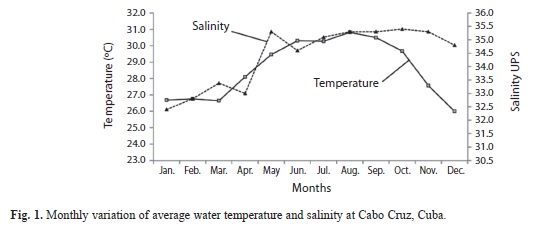
<body><![CDATA[ style="font-family: verdana;">     <br style="font-family: verdana;">     <font size="2"><span style="font-family: verdana;">The average water     temperature was     lowest in the dry season in December (26&plusmn;0.44&deg;C) and highest     in the rainy season in August (28.8&plusmn;0.05&deg;C) (<a href="#fig_1">Fig.     1</a>),     statistically significant differences among     monthly temperatures were found (ANOVA, p&lt;0.05).Salinity had minimum     values in January (32.4&plusmn;0.4UPS) and maximum in October     ]]></body>
<body><![CDATA[(35.4&plusmn;0.2UPS) (<a href="#fig_1">Fig. 1</a>). No significant     differences were detected     in salinity either among zones or between season (ANOVA, p&lt;0.05).</span></font><br      style="font-family: verdana;">     <br style="font-family: verdana;">     <font size="2"><span style="font-family: verdana;">The photoperiod     varied among the     study months, with minimum values in November (10.07&plusmn;0.4hr) in     dry season and maximum values in July (12.73&plusmn;0.1hr) during the     rainy season (<a href="/img/revistas/rbt/v61n2/a13i2.jpg">Fig. 2</a>).     ]]></body>
<body><![CDATA[Significant differences     were detected in     photoperiod either among months and climatic seasons (ANOVA,     p&lt;0.05). A multiple range test was subsequently applied and showed     that the cold front season was different from the rainy and dry season.    <br>     <br> <br style="font-family: verdana;"> </span></font>     <div style="text-align: center;"><a name="fig_1"></a><img alt=""  src="/img/revistas/rbt/v61n2/a13i1.jpg"  style="width: 533px; height: 235px;">    <br>     <br> </div> <font size="2"><span style="font-family: verdana;">Light intensity filtered through the water column showed the lowest value in November during the dry season (12.89&plusmn;2.8lum/ft&sup2;) and maximum (97.24&plusmn;6.5lum/ft&sup2;) in the cold front season (January) (<a  href="/img/revistas/rbt/v61n2/a13i2.jpg">Fig. 2</a>). Significant differences were detected in light intensity among months and climatic seasons (ANOVA, p&lt;0.05). A multiple range test confirmed differences among the three seasons.</span></font><br  style="font-family: verdana;"> <br style="font-family: verdana;"> <font size="2"><span style="font-family: verdana;">Density considering the whole population by zone and season at the study area showed higher values at Farito during the dry season (1 767&plusmn;213.68ind./ha) and lower (247&plusmn;30.4ind./ha) at Guafe during the rainy season. No significant differences were detected among seasons (ANOVA, p&gt;0.05). Spatial analysis showed that higher density occurred at Farito (1 723&plusmn;19.2ind./ha) and lower at Guafe (511&plusmn;22.3ind./ha). No significant differences were detected among zones (ANOVA, p&gt;0.05).</span></font><br  style="font-family: verdana;"> <br style="font-family: verdana;"> <font size="2"><span style="font-family: verdana;">Density of adult individuals showed values ranging from 124.96&plusmn;9.7ind./ha at Farito in dry season to 674.07&plusmn;122.3ind./ha at Laguna during the cold fronts season. The highest density for season was observed in cold fronts season (468.5&plusmn;53.3ind./ha) and lowest in the dry season (268.5&plusmn;24.5ind./ha). For the study zone, the adults highest density was observed at Laguna (520.4&plusmn;10.1ind./ha) and lowest at Farito (290.9&plusmn;19.2ind./ha) (<a href="/img/revistas/rbt/v61n2/a13i3.jpg">Fig. 3</a>). There were no significant differences either between areas or between seasons in the adult&#8217;s density (ANOVA, p&gt;0.05).</span></font><br  style="font-family: verdana;"> <br style="font-family: verdana;"> <font size="2"><span style="font-family: verdana;">During the whole three seasons we observed 158 reproductive events. The highest frequency of reproductive events was observed in the rainy season (36%), followed by dry (9%) and cold front (5%) (<a href="/img/revistas/rbt/v61n2/a13i4.jpg">Fig. 4A</a>). Spatially, a total of 73 adult aggregations of more than five individuals were reported, distributed at the study zone during the three seasons, although they were observed much more often at Laguna and Farito (6% and 10%, respectively) (<a  href="/img/revistas/rbt/v61n2/a13i4.jpg">Fig. 4B</a>). Copulation was observed on 25 occasions.    ]]></body>
<body><![CDATA[<br> <br style="font-family: verdana;"> </span></font> <font size="2"><span style="font-family: verdana;">Only one copulation was observed at Guafe during the study (0.3%) and other three copulation were observed at Farito (1.2%); however, this reproductive evidence was more frequent at Laguna (3.7%). It is important to note that Laguna was the only site where we observed spawning activities (2.5%) and 42 egg masses (7.5%). The rest of the egg masses were observed at Farito (1.2%) and Guafe (0.3%).</span></font><br style="font-family: verdana;"> <br style="font-family: verdana;"> <font size="2"><span style="font-family: verdana;">We found a significant correlation between the frequency of spawning and mating at the study area (r=0.84, p=0.0012, n=81) and between the copulation frequency and the absolute number of egg masses (r=0.73, p=0.0161, n=81). The rest of the reproductive evidence did not show correlations (Pearson, p&gt;0.05) (<a  href="/img/revistas/rbt/v61n2/a13t1.gif">Table 1</a>).</span></font><br style="font-family: verdana;"> <br style="font-family: verdana;"> <font size="2"><span style="font-family: verdana;">The absolute frequency of aggregations was positively correlated with photoperiod (r=0.39, p&lt;0.05), just as occurred with the frequency of mating (r=0.40, p&lt;0.05), likewise, the temperature was positively correlated with the number of egg masses (r=0.52, p&lt;0.05) and spawning frequency (r=0.35, p&lt;0.05). The multiple regression models explained significantly 23% of the variance of the aggregation frequency and 12% in the copulation frequency, including the photoperiod as predictor variable that affect both aggregations frequency and copulation frequency directly. Similarly, the multiple regression models explained significantly the 24% of the variance in the number of egg masses and 12% in spawning frequency, including in both cases the temperature as a predictor variable (<a href="/img/revistas/rbt/v61n2/a13t2.gif">Table 2</a>).</span></font><br  style="font-family: verdana;"> <br style="font-family: verdana;"> <font style="font-weight: bold;" size="3"><span  style="font-family: verdana;">Discussion</span></font><br  style="font-family: verdana;"> <br style="font-family: verdana;"> <font size="2"><span style="font-family: verdana;">Important variations in density have been reported, both in populations of <span  style="font-style: italic;">E. gigas</span> subjected to exploitation by fisheries, as in those located in non-take areas and have been attributed primarily to fluctuations in the environmental conditions, biological interactions and the fishing pressure (Weil &amp; Laughling 1984, G&oacute;mez-Campos <span  style="font-style: italic;">et al.</span> 2005). In other cases, changes have been associated with variations in recruitment (Roughgarden <span style="font-style: italic;">et al.</span> 1988, de Jes&uacute;s-Navarrete <span style="font-style: italic;">et al.</span> 2003). Mean density considering the whole population at the study area was higher (1 108&plusmn;207ind./ha) than other areas of the Caribbean. In despite that statistical analysis showed no significantly differences in density among zones, the adult density at Laguna represented up to 52% of the total density of the study area indicating that these conchs have a preference for that zone. At a seasonal scale, there were no differences in density maybe related with the protection regime that exist at Desembarco del Granma National Park.</span></font><br  style="font-family: verdana;"> <br style="font-family: verdana;"> <font size="2"><span style="font-family: verdana;">Chiquillo-Espitia <span  style="font-style: italic;">et al.</span> (1997) found that 18% of the conchs with lip thickness &#8805;5mm in three fishing zones at Colombia were still immature. In addition, the estimated age at which the conch produces the flared lip is among 3-3.5 years, although it varies between populations and depending on the environmental factors that regulate growth (Alcolado 1976, Appeldoorn 1988). Even after the lip is fully formed, the reproduction capacity is reached some month later (Hesse 1976, Egan 1985, Appeldoorn 1988). In this sense, we have been conservative in the morphometric selection of adult, pending that the necessary histological studies must be performed in this zone, allowing good criteria in the differentiation of adult population.    <br>     <br style="font-family: verdana;">     </span></font><font size="2"><span style="font-family: verdana;">Appeldoorn     (1988) proposed three     possible mechanisms to explain the relationship between adult conch     density and reproductive success, all related to the density of     breeding adults, and Stoner <span style="font-style: italic;">et al.</span>     (2012a) mentioned that it is     necessary to maintain a density higher than 100ind./ha to ensure     ]]></body>
<body><![CDATA[reproduction. Although these parameters may vary     geographically, adult densities reported in this study are higher than     the minimum threshold and consequently the frequency of reproductive     activities is high.</span></font><br style="font-family: verdana;">     <br style="font-family: verdana;">     <font size="2"><span style="font-family: verdana;">The low density of     adults at Farito     in dry season may be explained for the fact that adult conch carry out     an ontogenetic migration to deeper zones and then they return to     shallow waters to breed (Lagos-Bayona 1994, de Jes&uacute;s- Navarrete     ]]></body>
<body><![CDATA[<span style="font-style: italic;">et al.</span> 2003). Samplings were     conducted on November and Farito is     located very close to the communication channel between the reef lagoon     and the open sea, and it is possible at that time the migration to     shallow areas may not yet have begun. In turn, Laguna presented the     highest density of adult conch in cold front season which could be     related to the initiation of reproductive aggregations that showed a     peak immediately after that, in the rainy season (<a      href="/img/revistas/rbt/v61n2/a13i4.jpg">Fig.     4A</a>). Guafe did     ]]></body>
<body><![CDATA[not showed high adult density or reproductive evidence, although we     observed some of this evidence and that there were also adults groups,     this zone can be managed as a &#8220;sacrifice zone&#8221; for the fishery     management of the conch at Cabo Cruz.</span></font><br      style="font-family: verdana;">     <br style="font-family: verdana;">     <font size="2"><span style="font-family: verdana;">Despite the high     total density of     adults in this study, the fishery management strategies for <span      style="font-style: italic;">E. gigas</span>     ]]></body>
<body><![CDATA[should be focused to catch only the excess production or even to set a     quota below this excess, taking into account the local needs and     maintaining an abundance level on the population, where the     reproductive encounter rate be maintained above the lower limit of     possible mating (Appeldoorn 1988, Dugan &amp; Davis 1993, Basurto <span      style="font-style: italic;">et     al.</span> 2000). This avoids the population imbalance, to maintain the     global     biomass and to prevent the decrease on size and sexual maturity     (Harmelin <span style="font-style: italic;">et al.</span> 1995).     ]]></body>
<body><![CDATA[Recent studies suggest a sustainable     exploitation of the conch as a management strategy to minimize the size     decrease of individuals due to the possible impact of crowding (Bene     &amp; Tewfik 2003). Furthermore, it promotes the maintenance of an     annual recruitment rate, avoiding the consequent reduction in fertility     due to low encounter rate between breeding pairs (Allee effect),     changes that could be induced by overfishing of the conch (Roberts     &amp; Polunin 1991, Alcal&aacute; 1998, de Jes&uacute;s-Navarrete <span      style="font-style: italic;">et     al.</span> 2003, Stoner <span style="font-style: italic;">et al.</span>     ]]></body>
<body><![CDATA[2012a). Many of these changes have been     observed in stocks subject to fishing pressure (de     Jes&uacute;s-Navarrete <span style="font-style: italic;">et al. </span></span></font><font      size="2"><span style="font-family: verdana;">2003, Stoner <span      style="font-style: italic;">et al.</span> 2012a) and must     be taken into consideration when planning a sustainable fishery of     conch at Cabo Cruz.</span></font><br style="font-family: verdana;">     <br style="font-family: verdana;">     <font size="2"><span style="font-family: verdana;">The high density of     adults conch in     ]]></body>
<body><![CDATA[all study zones and the low variability of the physical parameters with     exception for the light intensity filtering through the water column,     combined with the favorable characteristics of the substrate, seems to     promote good conditions for the reproduction of <span      style="font-style: italic;">E. gigas</span> (Alcolado     1976) and has been possible to observe reproductive activity throughout     the year. The wider reproduction period (aggregation, mating, spawning     females and egg masses) has been reported the year round by Cruz (1986)     and Corral &amp; Ogawa (1987) at Banco Chinchorro, Mexico. The shortest     period (May- September) was reported at Florida (D&#8217;Assaro 1965) and     ]]></body>
<body><![CDATA[other variations have been reported in the reproduction period for     different parts of the Caribbean (Randall 1964, Appeldoorn <span      style="font-style: italic;">et al.</span> 1987,     Davis <span style="font-style: italic;">et al.</span> 1987, Stoner <span      style="font-style: italic;">et al.</span> 1992, Weill &amp; Laughling     1994).</span></font><br style="font-family: verdana;">     <br style="font-family: verdana;">     <font size="2"><span style="font-family: verdana;">High reproductive     activity during the rainy season at Laguna was observed,     possibly, because it is protected by the reef crest and has substrate     ]]></body>
<body><![CDATA[with a predominance of sand and patches of <span      style="font-style: italic;">T. testudinum</span>, according to     Alcolado (1976) this characteristics are suitable for the conch     reproduction. Guafe, in shallow waters, has the influence of runoff and     the substrate is muddy with much sediment in suspension and Farito is a     transition zone between the shallow zone of Laguna and the deep zone of     Cabo Cruz, with substrate entirely covered with dense seagrass, so none     of the two zones are adequate for the reproduction. Even with these     results, it would be useful to develop more detailed studies that allow     the identification of reproductive peaks throughout the year and a more     ]]></body>
<body><![CDATA[appropriate species management.</span></font><br      style="font-family: verdana;">     <br style="font-family: verdana;">     <font size="2"><span style="font-family: verdana;"><span      style="font-weight: bold;">Reproductive activity and abiotic     factors:</span> In the most of animal species the periods of     reproduction     activity are determined by daylight variations along the year     (photoperiod), temperature, food availability and ecological     interactions (Martinet &amp; Mondain-Monval 1991).     ]]></body>
<body><![CDATA[Reproductive evidence was observed along the year in this study but was     more abundant during the rainy season when temperatures were higher. It     was also found, that a direct relationship exists between the number of     aggregations and the photoperiod as well as between mating frequency     and photoperiod; most of the groups and organisms mated when the     daylight exceed 12hr. Stoner <span style="font-style: italic;">et al.</span>     (1992) found a linear direct     relationship between mating frequency and temperature and they     suggested that, as with temperature, photoperiod may influence the     production of mature gametes or have a direct effect on the behavior of     ]]></body>
<body><![CDATA[conch. Light intensity does not seem to have an effect over the     frequency of reproductive activities, but it is recommended a deeper     study in this issue.</span></font><br style="font-family: verdana;">     <font size="2">&nbsp;    <br> </font><font size="2"><span style="font-family: verdana;">Spawning frequency and the amount of egg masses increases proportionally with temperature showing the importance of this variable in the reproduction of <span style="font-style: italic;">E. gigas</span> as reported by several authors (Alcolado 1976, Stoner <span style="font-style: italic;">et al.</span> 1992, Davis 1998). The significant relationship between mating and spawning frequencies corroborates, in a way, one of the mechanisms proposed by Appeldoorn (1988) that refers a positive feedback between spawning and gametogenesis in females. According to the hypothesis of Appeldoorn (1988), copulation stimulates oocyte development and maturation, leading more frequent spawning.</span></font><br  style="font-family: verdana;"> <br style="font-family: verdana;"> <font size="2"><span style="font-family: verdana;">It is considered that the number of aggregations per zone is related with the search for mating (Brownell &amp; Stevely 1981) and could be linked to food abundance at the substrate features instead of the reproductive activity (Alcolado 1976). Nevertheless it is possible that Guafe has higher values of organic matter in the sediment in relation with the other zones because of coastal runoff (Cala 2006) and a high number of groups feeding should be expected but this did not happen. In Cabo Cruz exists an intense reproductive activity of <span  style="font-style: italic;">E. gigas</span> all year round with a high density of adult conchs in the three studied zones. This suggest not only an important stock for this species it the Southeastern shelf of Cuba else a possible self-sufficiency of this population to guarantee a relatively stable recruitment too.</span></font><br  style="font-family: verdana;"> <br style="font-family: verdana;"> <font size="2"><span style="font-family: verdana;">From the previous, an adequate regulatory exploitation of the population is viable taking into account that the Laguna site reached the higher absolute frequency of reproductive evidences during the study period, mostly during the rainy season (March-June). This aspect is important for the establishment of temporal closures and the functional zonation of the protected area. In addition, Laguna zone must be proposed as a reproductive activity area, and Guafe and Farito as potential fishing areas with a closure season from March to June. To conduct a wider spatial and temporal study will first benefit the knowledge of the distribution of this species and second the decision making because it could be proposed a yearly rotation of the fishing zones and a monitoring program of <span style="font-style: italic;">E. gigas</span> and its habitat as part of the National Park Management Plan (Cala 2006).</span></font><br  style="font-family: verdana;"> <br style="font-family: verdana;"> <font style="font-weight: bold;" size="3"><span  style="font-family: verdana;">Acknowledgments</span></font><br  style="font-family: verdana;"> <br style="font-family: verdana;"> <font size="2"><span style="font-family: verdana;">This research was conducted under the support of Consejo Nacional de Ciencia y Tecnolog&iacute;a, M&eacute;xico, doctoral concession number 228610. Centro Nacional de &Aacute;reas Protegidas de Cuba gave field materials. We thank the useful assistance of C. Ocano, O. De la Hera and A. Galindo during field work. Comments of A.W. Stoner, P.M. Alcolado, J.C. P&eacute;rez, D. Gonzales and M. Mendoza contributed to improve the manuscript.</span></font><br  style="font-family: verdana;">     <br> <hr style="width: 100%; height: 2px;">    <!-- ref --><br> <br style="font-family: verdana;"> <font style="font-weight: bold;" size="3"><span  style="font-family: verdana;">References</span></font><br  style="font-family: verdana;"> <br style="font-family: verdana;"> <font size="2"><span style="font-family: verdana;">Abbott, R.T. 1974. American seashells. Van Nostrand Reinhold, New York, USA.    &nbsp;&nbsp;&nbsp;&nbsp;&nbsp;&nbsp;&nbsp;&nbsp;[&#160;<a href="javascript:void(0);" onclick="javascript: window.open('/scielo.php?script=sci_nlinks&ref=1513984&pid=S0034-7744201300030001300001&lng=','','width=640,height=500,resizable=yes,scrollbars=1,menubar=yes,');">Links</a>&#160;]<!-- end-ref --><!-- ref --></span></font><br  style="font-family: verdana;"> <br style="font-family: verdana;"> <font size="2"><span style="font-family: verdana;">Alcal&aacute;, A.C. 1988. Effects of marine reserves on coral fish abundance and yields of Philippine coral reefs. Ambio 17: 194-199.    &nbsp;&nbsp;&nbsp;&nbsp;&nbsp;&nbsp;&nbsp;&nbsp;[&#160;<a href="javascript:void(0);" onclick="javascript: window.open('/scielo.php?script=sci_nlinks&ref=1513985&pid=S0034-7744201300030001300002&lng=','','width=640,height=500,resizable=yes,scrollbars=1,menubar=yes,');">Links</a>&#160;]<!-- end-ref --><!-- ref --></span></font><br style="font-family: verdana;"> <br style="font-family: verdana;"> <font size="2"><span style="font-family: verdana;">Alcolado, P.M. 1976. Growth, morphological variations of the shell and some biological data of the conch (Cobo) Strombusgigas L. (Mollusca, Mesogastropoda). Acad. Cienc. Cub. Ser. Oceanol. 34: 1-36.    &nbsp;&nbsp;&nbsp;&nbsp;&nbsp;&nbsp;&nbsp;&nbsp;[&#160;<a href="javascript:void(0);" onclick="javascript: window.open('/scielo.php?script=sci_nlinks&ref=1513986&pid=S0034-7744201300030001300003&lng=','','width=640,height=500,resizable=yes,scrollbars=1,menubar=yes,');">Links</a>&#160;]<!-- end-ref --><!-- ref --> </span></font><br  style="font-family: verdana;"> <br style="font-family: verdana;"> <font size="2"><span style="font-family: verdana;">&Aacute;lvarez-Lemus, J.A. &amp; M. Formoso. 2005. Gesti&oacute;n del <span  style="font-style: italic;">Strombus gigas</span> (Linnaeus, 1758) en la Rep&uacute;blica de Cuba. CITES, La Habana, Cuba.    &nbsp;&nbsp;&nbsp;&nbsp;&nbsp;&nbsp;&nbsp;&nbsp;[&#160;<a href="javascript:void(0);" onclick="javascript: window.open('/scielo.php?script=sci_nlinks&ref=1513987&pid=S0034-7744201300030001300004&lng=','','width=640,height=500,resizable=yes,scrollbars=1,menubar=yes,');">Links</a>&#160;]<!-- end-ref --><!-- ref --></span></font><br  style="font-family: verdana;"> <br style="font-family: verdana;"> <font size="2"><span style="font-family: verdana;">Appeldoorn, R.S. 1990. Growth of juvenile queen conch <span style="font-style: italic;">Strombus gigas</span> <span style="font-style: italic;">L.</span>, of La Parguera, Puerto Rico. J. Shellfish Res. 9:59-62.    &nbsp;&nbsp;&nbsp;&nbsp;&nbsp;&nbsp;&nbsp;&nbsp;[&#160;<a href="javascript:void(0);" onclick="javascript: window.open('/scielo.php?script=sci_nlinks&ref=1513988&pid=S0034-7744201300030001300005&lng=','','width=640,height=500,resizable=yes,scrollbars=1,menubar=yes,');">Links</a>&#160;]<!-- end-ref --><!-- ref --></span></font><br  style="font-family: verdana;"> <br style="font-family: verdana;"> <font size="2"><span style="font-family: verdana;">Appeldoorn, R.S. 1994a. Queen conch management and research: status, needs and priorities, p. 301-319. <span style="font-style: italic;">In</span> R.S. Appeldoorn &amp; B. Rodriguez (eds.). Queen Conch Biology, fisheries and mariculture. Fundaci&oacute;n Cient&iacute;fica Los Roques, Caracas, Venezuela.    &nbsp;&nbsp;&nbsp;&nbsp;&nbsp;&nbsp;&nbsp;&nbsp;[&#160;<a href="javascript:void(0);" onclick="javascript: window.open('/scielo.php?script=sci_nlinks&ref=1513989&pid=S0034-7744201300030001300006&lng=','','width=640,height=500,resizable=yes,scrollbars=1,menubar=yes,');">Links</a>&#160;]<!-- end-ref --><!-- ref --></span></font><br style="font-family: verdana;"> <br style="font-family: verdana;"> <font size="2"><span style="font-family: verdana;">Appeldoorn, R.S. 1994b. Spatial variability in the morphology of Queen Conch and its implication for management regulations, p. 145-157. <span style="font-style: italic;">In</span> R.S. Appeldoorn &amp; B. Rodr&iacute;guez (eds.). Queen Conch biology, fisheries and mariculture. Fundaci&oacute;n Cient&iacute;fica Los Roques, Caracas, Venezuela.    &nbsp;&nbsp;&nbsp;&nbsp;&nbsp;&nbsp;&nbsp;&nbsp;[&#160;<a href="javascript:void(0);" onclick="javascript: window.open('/scielo.php?script=sci_nlinks&ref=1513990&pid=S0034-7744201300030001300007&lng=','','width=640,height=500,resizable=yes,scrollbars=1,menubar=yes,');">Links</a>&#160;]<!-- end-ref --><!-- ref --></span></font><br style="font-family: verdana;"> <br style="font-family: verdana;"> <font size="2"><span style="font-family: verdana;">Appeldoorn, R.S., G.D. Dennis &amp; O. Monterrosa-Lopez. 1987. Review of shared demersal resources of Puerto Rico and the Lesser Antilles region, p. 36-57. <span  style="font-style: italic;">In</span> R. Mahon (ed.). Report and proceedings of the expert consultation of shared fishery resources of the Lesser Antilles region. FAO Fish. Rep.    &nbsp;&nbsp;&nbsp;&nbsp;&nbsp;&nbsp;&nbsp;&nbsp;[&#160;<a href="javascript:void(0);" onclick="javascript: window.open('/scielo.php?script=sci_nlinks&ref=1513991&pid=S0034-7744201300030001300008&lng=','','width=640,height=500,resizable=yes,scrollbars=1,menubar=yes,');">Links</a>&#160;]<!-- end-ref --><!-- ref --></span></font><br style="font-family: verdana;"> <br style="font-family: verdana;"> <font size="2"><span style="font-family: verdana;">&Aacute;vila-Poveda, O.H. &amp; E.R. Baqueiro-C&aacute;rdenas. 2006. Size at sexual maturity in the queen conch <span style="font-style: italic;">Strombus gigas</span> from Colombia. Bol. Invest. Mar. Cost. 35: 223-233.    &nbsp;&nbsp;&nbsp;&nbsp;&nbsp;&nbsp;&nbsp;&nbsp;[&#160;<a href="javascript:void(0);" onclick="javascript: window.open('/scielo.php?script=sci_nlinks&ref=1513992&pid=S0034-7744201300030001300009&lng=','','width=640,height=500,resizable=yes,scrollbars=1,menubar=yes,');">Links</a>&#160;]<!-- end-ref --><!-- ref --></span></font><br style="font-family: verdana;"> <br style="font-family: verdana;"> <font size="2"><span style="font-family: verdana;">Basurto-Origel, M., O. Cruz-Dom&iacute;nguez, D. Mart&iacute;nez-V&aacute;zquez &amp; P. Cadena-Romero. 2000. Caracol, p. 712-744. <span style="font-style: italic;">In</span> M.A. Cisneros-Mata, L.F. Bel&eacute;ndez- Moreno, E. Z&aacute;rate-Becerra, M.T. Gaspar-Dillanes, L. L&oacute;pez-Gonz&aacute;lez, C. Saucedo-Ru&iacute;z &amp; J. Tovar-&Aacute;vila (eds.). Sustentabilidad y pesca responsable en M&eacute;xico; evaluaci&oacute;n y manejo. INP-SAGARPA, M&eacute;xico.    &nbsp;&nbsp;&nbsp;&nbsp;&nbsp;&nbsp;&nbsp;&nbsp;[&#160;<a href="javascript:void(0);" onclick="javascript: window.open('/scielo.php?script=sci_nlinks&ref=1513993&pid=S0034-7744201300030001300010&lng=','','width=640,height=500,resizable=yes,scrollbars=1,menubar=yes,');">Links</a>&#160;]<!-- end-ref --><!-- ref --></span></font><br  style="font-family: verdana;"> <br style="font-family: verdana;"> <font size="2"><span style="font-family: verdana;">Basurto-Origel, M., P. Cadena, G. Escobedo &amp; F. Fern&aacute;ndez. 2005. Evaluaci&oacute;n de la poblaci&oacute;n de <span style="font-style: italic;">Strombus gigas</span> en los bancos de Cozumel y Chinchorro y recomendaciones para su aprovechamiento sostenible. Instituto Nacional de la Pesca, Puerto Morelos, M&eacute;xico.    &nbsp;&nbsp;&nbsp;&nbsp;&nbsp;&nbsp;&nbsp;&nbsp;[&#160;<a href="javascript:void(0);" onclick="javascript: window.open('/scielo.php?script=sci_nlinks&ref=1513994&pid=S0034-7744201300030001300011&lng=','','width=640,height=500,resizable=yes,scrollbars=1,menubar=yes,');">Links</a>&#160;]<!-- end-ref --><!-- ref --></span></font><br style="font-family: verdana;"> <br style="font-family: verdana;"> <font size="2"><span style="font-family: verdana;">Brito-Manzano, N., D. Aldana-Aranda, E. de la Cruz-Lazaro &amp; M. Estrada-Botello. 2006. Organog&eacute;nesis larvaria de <span style="font-style: italic;">Strombus gigas</span> (Mesograstropoda: Strombidae) en el arrecife Alacranes durante el periodo m&aacute;ximo de su &eacute;poca reproductiva. Univ. Ciencia 22: 75-82.    &nbsp;&nbsp;&nbsp;&nbsp;&nbsp;&nbsp;&nbsp;&nbsp;[&#160;<a href="javascript:void(0);" onclick="javascript: window.open('/scielo.php?script=sci_nlinks&ref=1513995&pid=S0034-7744201300030001300012&lng=','','width=640,height=500,resizable=yes,scrollbars=1,menubar=yes,');">Links</a>&#160;]<!-- end-ref --><!-- ref --></span></font><br  style="font-family: verdana;"> <br style="font-family: verdana;"> <font size="2"><span style="font-family: verdana;">Buckland, S.T., D.R Anderson, K.P Burnham &amp; J.L. Laake. 1993. Distance sampling estimating abundance of biological populations. Chapman &amp; Hall, Londres, Inglaterra.    &nbsp;&nbsp;&nbsp;&nbsp;&nbsp;&nbsp;&nbsp;&nbsp;[&#160;<a href="javascript:void(0);" onclick="javascript: window.open('/scielo.php?script=sci_nlinks&ref=1513996&pid=S0034-7744201300030001300013&lng=','','width=640,height=500,resizable=yes,scrollbars=1,menubar=yes,');">Links</a>&#160;]<!-- end-ref --><!-- ref --></span></font><br style="font-family: verdana;"> <br style="font-family: verdana;"> <font size="2"><span style="font-family: verdana;">Cala, Y.R. 2006. Bases para el manejo integrado del <span style="font-style: italic;">Strombus gigas L. </span>1758 en el sector costero Monigote-Las Coloradas, Cuba. Tesis de Maestr&iacute;a, Universidad de Oriente, Santiago de Cuba, Cuba.    &nbsp;&nbsp;&nbsp;&nbsp;&nbsp;&nbsp;&nbsp;&nbsp;[&#160;<a href="javascript:void(0);" onclick="javascript: window.open('/scielo.php?script=sci_nlinks&ref=1513997&pid=S0034-7744201300030001300014&lng=','','width=640,height=500,resizable=yes,scrollbars=1,menubar=yes,');">Links</a>&#160;]<!-- end-ref --><!-- ref --></span></font><br  style="font-family: verdana;"> <br style="font-family: verdana;"> <font size="2"><span style="font-family: verdana;">Corral, J.L. &amp; J. Ogawa. 1987. Cultivo masivo de larvas de caracol <span style="font-style: italic;">Strombus gigas</span> en estanques de concreto. Proc. Gulf Caribb. Fish. Inst. 38: 345-351.    &nbsp;&nbsp;&nbsp;&nbsp;&nbsp;&nbsp;&nbsp;&nbsp;[&#160;<a href="javascript:void(0);" onclick="javascript: window.open('/scielo.php?script=sci_nlinks&ref=1513998&pid=S0034-7744201300030001300015&lng=','','width=640,height=500,resizable=yes,scrollbars=1,menubar=yes,');">Links</a>&#160;]<!-- end-ref --><!-- ref --></span></font><br  style="font-family: verdana;"> <br style="font-family: verdana;"> <font size="2"><span style="font-family: verdana;">Cruz, R. 1986. Avances en la experimentaci&oacute;n de producci&oacute;n masiva de caracol en Quintana Roo, M&eacute;xico. Proc. Gulf Caribb. Fish. Inst. 37: 12-20.    &nbsp;&nbsp;&nbsp;&nbsp;&nbsp;&nbsp;&nbsp;&nbsp;[&#160;<a href="javascript:void(0);" onclick="javascript: window.open('/scielo.php?script=sci_nlinks&ref=1513999&pid=S0034-7744201300030001300016&lng=','','width=640,height=500,resizable=yes,scrollbars=1,menubar=yes,');">Links</a>&#160;]<!-- end-ref --><!-- ref --></span></font><br  style="font-family: verdana;"> <br style="font-family: verdana;"> <font size="2"><span style="font-family: verdana;">D&#8217;Assaro, C.N. 1965. Organogenesis, development, and metamorphosis in the queen conch, <span style="font-style: italic;">Strombus gigas</span>, with notes on breeding habits. Bull. Mar. Sci. 15: 359-416.    &nbsp;&nbsp;&nbsp;&nbsp;&nbsp;&nbsp;&nbsp;&nbsp;[&#160;<a href="javascript:void(0);" onclick="javascript: window.open('/scielo.php?script=sci_nlinks&ref=1514000&pid=S0034-7744201300030001300017&lng=','','width=640,height=500,resizable=yes,scrollbars=1,menubar=yes,');">Links</a>&#160;]<!-- end-ref --><!-- ref --></span></font><br style="font-family: verdana;"> <br style="font-family: verdana;"> <font size="2"><span style="font-family: verdana;">Davis, M., C. Hesse &amp; G. Hodgkins. 1987. Commercial hatchery produced queen conch, <span  style="font-style: italic;">Strombus gigas</span>, seed for the research and grow-out market. Proc. Gulf Caribb. Fish. Inst. 38: 326-335.    &nbsp;&nbsp;&nbsp;&nbsp;&nbsp;&nbsp;&nbsp;&nbsp;[&#160;<a href="javascript:void(0);" onclick="javascript: window.open('/scielo.php?script=sci_nlinks&ref=1514001&pid=S0034-7744201300030001300018&lng=','','width=640,height=500,resizable=yes,scrollbars=1,menubar=yes,');">Links</a>&#160;]<!-- end-ref --><!-- ref --></span></font><br  style="font-family: verdana;"> <br style="font-family: verdana;"> <font size="2"><span style="font-family: verdana;">Davis, M. 1998. The effects of natural foods, temperature and salinity on the length of larval life for the tropical gastropod <span style="font-style: italic;">Strombus gigas</span>. Tesis de Doctorado, Florida Institute of Technology, Florida, USA.    &nbsp;&nbsp;&nbsp;&nbsp;&nbsp;&nbsp;&nbsp;&nbsp;[&#160;<a href="javascript:void(0);" onclick="javascript: window.open('/scielo.php?script=sci_nlinks&ref=1514002&pid=S0034-7744201300030001300019&lng=','','width=640,height=500,resizable=yes,scrollbars=1,menubar=yes,');">Links</a>&#160;]<!-- end-ref --><!-- ref --></span></font><br  style="font-family: verdana;"> <br style="font-family: verdana;"> <font size="2"><span style="font-family: verdana;">Davis, M. 2000. The combined effects of temperature and salinity on growth, development, and survival for tropical gastropod veligers of Strombusgigas. J. Shellfish Res. 19: 883-889.    &nbsp;&nbsp;&nbsp;&nbsp;&nbsp;&nbsp;&nbsp;&nbsp;[&#160;<a href="javascript:void(0);" onclick="javascript: window.open('/scielo.php?script=sci_nlinks&ref=1514003&pid=S0034-7744201300030001300020&lng=','','width=640,height=500,resizable=yes,scrollbars=1,menubar=yes,');">Links</a>&#160;]<!-- end-ref --><!-- ref --></span></font><br  style="font-family: verdana;"> <br style="font-family: verdana;"> <font size="2"><span style="font-family: verdana;">de Jes&uacute;s-Navarrete, A. &amp; J. Oliva-Rivera. 1997. Densidad, crecimiento y reclutamiento del caracol rosado <span style="font-style: italic;">Strombus gigas L. </span>(Gaster&oacute;poda: Strombidae) en Quintana Roo, M&eacute;xico. Rev. Biol. Trop 45: 797-801.    &nbsp;&nbsp;&nbsp;&nbsp;&nbsp;&nbsp;&nbsp;&nbsp;[&#160;<a href="javascript:void(0);" onclick="javascript: window.open('/scielo.php?script=sci_nlinks&ref=1514004&pid=S0034-7744201300030001300021&lng=','','width=640,height=500,resizable=yes,scrollbars=1,menubar=yes,');">Links</a>&#160;]<!-- end-ref --><!-- ref --></span></font><br  style="font-family: verdana;"> <br style="font-family: verdana;"> <font size="2"><span style="font-family: verdana;">de Jes&uacute;s-Navarrete, A., A. Medina-Quej &amp; J. Oliva-Rivera. 2003. Changes in the queen conch (<span style="font-style: italic;">Strombus gigas</span> L.) population structure at Banco Chinchorro, Quintana Roo, Mexico, 1990-1997. Bull. Mar. Sci. 73: 219-229.    &nbsp;&nbsp;&nbsp;&nbsp;&nbsp;&nbsp;&nbsp;&nbsp;[&#160;<a href="javascript:void(0);" onclick="javascript: window.open('/scielo.php?script=sci_nlinks&ref=1514005&pid=S0034-7744201300030001300022&lng=','','width=640,height=500,resizable=yes,scrollbars=1,menubar=yes,');">Links</a>&#160;]<!-- end-ref --></span></font><br style="font-family: verdana;"> <font size="2">&nbsp;    <!-- ref --><br> </font><font size="2"><span style="font-family: verdana;">Dugan,&nbsp; J.E. &amp; G.E. Davis. 1993. Applications&nbsp; of marine refugia&nbsp; to&nbsp; coastal&nbsp; fisheries&nbsp; management.&nbsp; J.&nbsp; Fish. Aquat. Sci. 50: 2029-2042.    &nbsp;&nbsp;&nbsp;&nbsp;&nbsp;&nbsp;&nbsp;&nbsp;[&#160;<a href="javascript:void(0);" onclick="javascript: window.open('/scielo.php?script=sci_nlinks&ref=1514007&pid=S0034-7744201300030001300023&lng=','','width=640,height=500,resizable=yes,scrollbars=1,menubar=yes,');">Links</a>&#160;]<!-- end-ref --><!-- ref --></span></font><br style="font-family: verdana;"> <br style="font-family: verdana;"> <font size="2"><span style="font-family: verdana;">Formoso, M. 2001. Stock assessment and fishery management of queen conch <span style="font-style: italic;">Strombus gigas</span> in major fishing grounds of the Cuban Shelf. Queen Conch Conference, Juan Dolio, Puerto Rico.    &nbsp;&nbsp;&nbsp;&nbsp;&nbsp;&nbsp;&nbsp;&nbsp;[&#160;<a href="javascript:void(0);" onclick="javascript: window.open('/scielo.php?script=sci_nlinks&ref=1514008&pid=S0034-7744201300030001300024&lng=','','width=640,height=500,resizable=yes,scrollbars=1,menubar=yes,');">Links</a>&#160;]<!-- end-ref --><!-- ref --></span></font><br style="font-family: verdana;"> <br style="font-family: verdana;"> <font size="2"><span style="font-family: verdana;">Glazer, R. &amp; C.J. Berg Jr. 1992.Growth and mortality of the queen conch, <span  style="font-style: italic;">Strombus gigas</span>, in Florida, a progress report. Proc. Gulf Caribb. Fish. Inst. 42: 153-157.    &nbsp;&nbsp;&nbsp;&nbsp;&nbsp;&nbsp;&nbsp;&nbsp;[&#160;<a href="javascript:void(0);" onclick="javascript: window.open('/scielo.php?script=sci_nlinks&ref=1514009&pid=S0034-7744201300030001300025&lng=','','width=640,height=500,resizable=yes,scrollbars=1,menubar=yes,');">Links</a>&#160;]<!-- end-ref --><!-- ref --><br> <br style="font-family: verdana;"> </span></font><font size="2"><span style="font-family: verdana;">Glazer, R. &amp; J.A. Kidney. 2004. Habitat&nbsp; associations of adult queen conch (<span  style="font-style: italic;">Strombus gigas</span> L.) in an unfished Florida Keys back reef: applications to essential fish habitat. Bull. Mar. Sci. 75: 205-224.    &nbsp;&nbsp;&nbsp;&nbsp;&nbsp;&nbsp;&nbsp;&nbsp;[&#160;<a href="javascript:void(0);" onclick="javascript: window.open('/scielo.php?script=sci_nlinks&ref=1514010&pid=S0034-7744201300030001300026&lng=','','width=640,height=500,resizable=yes,scrollbars=1,menubar=yes,');">Links</a>&#160;]<!-- end-ref --><!-- ref --></span></font><br  style="font-family: verdana;"> <br style="font-family: verdana;"> <font size="2"><span style="font-family: verdana;">G&oacute;mez-Campo, K., M. Rueda, C. Garc&iacute;a-Valencia,&nbsp; F. Ballesteros &amp; L.E. Mej&iacute;a. 2005. Densidad y distribuci&oacute;n de la estructura poblacional de <span style="font-style: italic;">Strombus gigas</span>- <span  style="font-style: italic;">Linnaeus,</span> 1758&nbsp; (Mollusca: Strombidae) asociada a diferentes h&aacute;bitats en el Archipi&eacute;lago Nuestra Se&ntilde;ora del Rosario, Caribe&nbsp; colombiano. Proc. Gulf Caribb. Fish. Inst. 58: 399-406.    &nbsp;&nbsp;&nbsp;&nbsp;&nbsp;&nbsp;&nbsp;&nbsp;[&#160;<a href="javascript:void(0);" onclick="javascript: window.open('/scielo.php?script=sci_nlinks&ref=1514011&pid=S0034-7744201300030001300027&lng=','','width=640,height=500,resizable=yes,scrollbars=1,menubar=yes,');">Links</a>&#160;]<!-- end-ref --><!-- ref --></span></font><br style="font-family: verdana;"> <br style="font-family: verdana;"> <font size="2"><span style="font-family: verdana;">G&oacute;mez-Campo,&nbsp; K.,&nbsp; M.&nbsp; Rueda&nbsp; &amp;&nbsp; C.&nbsp;&nbsp; Garc&iacute;a-Valencia. 2010.&nbsp; Distribuci&oacute;n espacial, abundancia&nbsp; y&nbsp; relaci&oacute;n con&nbsp; caracter&iacute;sticas del h&aacute;bitat del caracol&nbsp; Pala <span style="font-style: italic;">Eustrombus gigas</span> (Linnaeus) (Mollusca: Strombidae) en el archipi&eacute;lago&nbsp; Nuestra Se&ntilde;ora del Rosario, Caribe Colombiano. Bol. Invest. Mar. Cost. 39: 137-159.    &nbsp;&nbsp;&nbsp;&nbsp;&nbsp;&nbsp;&nbsp;&nbsp;[&#160;<a href="javascript:void(0);" onclick="javascript: window.open('/scielo.php?script=sci_nlinks&ref=1514012&pid=S0034-7744201300030001300028&lng=','','width=640,height=500,resizable=yes,scrollbars=1,menubar=yes,');">Links</a>&#160;]<!-- end-ref --><!-- ref --></span></font><br  style="font-family: verdana;"> <br style="font-family: verdana;"> <font size="2"><span style="font-family: verdana;">G&oacute;nzalez, P.C. 1999. Climatolog&iacute;a de los frentes fr&iacute;os que han afectado a Cuba desde&nbsp; 1916-17 hasta 1996-97. Rev. Cub. Met. 6: 15-19.    &nbsp;&nbsp;&nbsp;&nbsp;&nbsp;&nbsp;&nbsp;&nbsp;[&#160;<a href="javascript:void(0);" onclick="javascript: window.open('/scielo.php?script=sci_nlinks&ref=1514013&pid=S0034-7744201300030001300029&lng=','','width=640,height=500,resizable=yes,scrollbars=1,menubar=yes,');">Links</a>&#160;]<!-- end-ref --><!-- ref --></span></font><br  style="font-family: verdana;"> <br style="font-family: verdana;"> <font size="2"><span style="font-family: verdana;">Harmelin, J.G., F. Bachet &amp; F. Garc&iacute;a. 1995. Mediterranean marine reserves: fish&nbsp; indices as a test of protection efficiency. Mar. Ecol. 16: 233-250.    &nbsp;&nbsp;&nbsp;&nbsp;&nbsp;&nbsp;&nbsp;&nbsp;[&#160;<a href="javascript:void(0);" onclick="javascript: window.open('/scielo.php?script=sci_nlinks&ref=1514014&pid=S0034-7744201300030001300030&lng=','','width=640,height=500,resizable=yes,scrollbars=1,menubar=yes,');">Links</a>&#160;]<!-- end-ref --><!-- ref --></span></font><br  style="font-family: verdana;"> <br style="font-family: verdana;"> <font size="2"><span style="font-family: verdana;">Jared,&nbsp; M., M. Taylor, K. Roy &amp; M.&nbsp; Hellberg.&nbsp; 2006. A molecular phylogenetic analysis of strombid gastropod morphological diversity. Mol. Phylogenet. Evol.</span></font><font  size="2"><span style="font-family: verdana;"> 41: 436-434.    &nbsp;&nbsp;&nbsp;&nbsp;&nbsp;&nbsp;&nbsp;&nbsp;[&#160;<a href="javascript:void(0);" onclick="javascript: window.open('/scielo.php?script=sci_nlinks&ref=1514015&pid=S0034-7744201300030001300031&lng=','','width=640,height=500,resizable=yes,scrollbars=1,menubar=yes,');">Links</a>&#160;]<!-- end-ref --><!-- ref --></span></font><br  style="font-family: verdana;"> <br style="font-family: verdana;"> <font size="2"><span style="font-family: verdana;">Lagos-Bayona, A.L. 1994. Algunos aspectos biol&oacute;gicos y pesqueros del caracol pala Strombus gigas <span style="font-style: italic;">Linnaeus</span>, 1758&nbsp; (Mollusca:&nbsp; Gastropoda:&nbsp;&nbsp; Strombidae),&nbsp; en&nbsp; el Archipi&eacute;lago de San&nbsp; Bernardo y ensayos sobre su cultivo en laboratorio. Tesis de Licenciatura, Universidad de Bogot&aacute;, Bogot&aacute;, Colombia.    &nbsp;&nbsp;&nbsp;&nbsp;&nbsp;&nbsp;&nbsp;&nbsp;[&#160;<a href="javascript:void(0);" onclick="javascript: window.open('/scielo.php?script=sci_nlinks&ref=1514016&pid=S0034-7744201300030001300032&lng=','','width=640,height=500,resizable=yes,scrollbars=1,menubar=yes,');">Links</a>&#160;]<!-- end-ref --><!-- ref --></span></font><br  style="font-family: verdana;"> <br style="font-family: verdana;"> <font size="2"><span style="font-family: verdana;">Martinet, L. &amp; M. Mondain-Monval. 1991. Rythmes de&nbsp; reproduction&nbsp; etfacteurs&nbsp; de&nbsp; l&#8217;environnement,&nbsp; p. 589-610.&nbsp; <span  style="font-style: italic;">In</span> C. Thibault &amp; M.C.&nbsp; Levasseur (eds.). La&nbsp; reproductionchez&nbsp; les&nbsp; mamm&iacute;feres&nbsp; et&nbsp; l&acute;homme. Ellipses-INRA, Par&iacute;s, Francia.    &nbsp;&nbsp;&nbsp;&nbsp;&nbsp;&nbsp;&nbsp;&nbsp;[&#160;<a href="javascript:void(0);" onclick="javascript: window.open('/scielo.php?script=sci_nlinks&ref=1514017&pid=S0034-7744201300030001300033&lng=','','width=640,height=500,resizable=yes,scrollbars=1,menubar=yes,');">Links</a>&#160;]<!-- end-ref --><!-- ref --></span></font><br  style="font-family: verdana;"> <br style="font-family: verdana;"> <font size="2"><span style="font-family: verdana;">P&eacute;rez-P&eacute;rez,&nbsp; M.&nbsp; &amp;&nbsp; D. Aldana-Aranda.&nbsp; 2003.&nbsp; Actividad reproductiva de <span style="font-style: italic;">Strombus&nbsp; gigas</span> (Mesogasteropoda: Strombidae) en diferentes h&aacute;bitats del Arrecife Alacranes, Yucat&aacute;n. Rev. Biol. Trop. 51: 119-126.    &nbsp;&nbsp;&nbsp;&nbsp;&nbsp;&nbsp;&nbsp;&nbsp;[&#160;<a href="javascript:void(0);" onclick="javascript: window.open('/scielo.php?script=sci_nlinks&ref=1514018&pid=S0034-7744201300030001300034&lng=','','width=640,height=500,resizable=yes,scrollbars=1,menubar=yes,');">Links</a>&#160;]<!-- end-ref --><!-- ref --></span></font><br  style="font-family: verdana;"> <br style="font-family: verdana;"> <font size="2"><span style="font-family: verdana;">Petuch, E.J. 2004.Cenozoic Seas. The View from Eastern North America. CRC, Boca Raton, Florida, USA.    &nbsp;&nbsp;&nbsp;&nbsp;&nbsp;&nbsp;&nbsp;&nbsp;[&#160;<a href="javascript:void(0);" onclick="javascript: window.open('/scielo.php?script=sci_nlinks&ref=1514019&pid=S0034-7744201300030001300035&lng=','','width=640,height=500,resizable=yes,scrollbars=1,menubar=yes,');">Links</a>&#160;]<!-- end-ref --><!-- ref --></span></font><br  style="font-family: verdana;"> <br style="font-family: verdana;"> <font size="2"><span style="font-family: verdana;">Petuch,&nbsp; E.J. &amp; C.E. Roberts. 2007. The&nbsp; Geology of the Everglades&nbsp; and Adjacent&nbsp; Areas.&nbsp; CRC,&nbsp; New York, USA.    &nbsp;&nbsp;&nbsp;&nbsp;&nbsp;&nbsp;&nbsp;&nbsp;[&#160;<a href="javascript:void(0);" onclick="javascript: window.open('/scielo.php?script=sci_nlinks&ref=1514020&pid=S0034-7744201300030001300036&lng=','','width=640,height=500,resizable=yes,scrollbars=1,menubar=yes,');">Links</a>&#160;]<!-- end-ref --><!-- ref --><br> <br style="font-family: verdana;"> </span></font><font size="2"><span style="font-family: verdana;">Randall,&nbsp; J.E. 1964. Contributions to the&nbsp; biology of the queen&nbsp; conch,&nbsp; <span style="font-style: italic;">Strombus&nbsp; gigas</span>.&nbsp; Bull.&nbsp; Mar.&nbsp; Sci.&nbsp; 14: 246-295.    &nbsp;&nbsp;&nbsp;&nbsp;&nbsp;&nbsp;&nbsp;&nbsp;[&#160;<a href="javascript:void(0);" onclick="javascript: window.open('/scielo.php?script=sci_nlinks&ref=1514021&pid=S0034-7744201300030001300037&lng=','','width=640,height=500,resizable=yes,scrollbars=1,menubar=yes,');">Links</a>&#160;]<!-- end-ref --><!-- ref --></span></font><br style="font-family: verdana;"> <br style="font-family: verdana;"> <font size="2"><span style="font-family: verdana;">Roberts, C.M. &amp; N.V. Polunin. 1991. Are marine reserves effective in management of reef fisheries? Rev. Fish. Biol. Fish. 1: 65-91.    &nbsp;&nbsp;&nbsp;&nbsp;&nbsp;&nbsp;&nbsp;&nbsp;[&#160;<a href="javascript:void(0);" onclick="javascript: window.open('/scielo.php?script=sci_nlinks&ref=1514022&pid=S0034-7744201300030001300038&lng=','','width=640,height=500,resizable=yes,scrollbars=1,menubar=yes,');">Links</a>&#160;]<!-- end-ref --><!-- ref --></span></font><br  style="font-family: verdana;"> <br style="font-family: verdana;"> <font size="2"><span style="font-family: verdana;">Roughgarden,&nbsp; J.,&nbsp; S.&nbsp; Ganes&nbsp; &amp;&nbsp; H.&nbsp;&nbsp; Possingham.&nbsp;&nbsp; 1988. Recruitment dynamics in complex life cycles. Science 228: 1460-1466.    &nbsp;&nbsp;&nbsp;&nbsp;&nbsp;&nbsp;&nbsp;&nbsp;[&#160;<a href="javascript:void(0);" onclick="javascript: window.open('/scielo.php?script=sci_nlinks&ref=1514023&pid=S0034-7744201300030001300039&lng=','','width=640,height=500,resizable=yes,scrollbars=1,menubar=yes,');">Links</a>&#160;]<!-- end-ref --><!-- ref --></span></font><br style="font-family: verdana;"> <br style="font-family: verdana;"> <font size="2"><span style="font-family: verdana;">Stoner, A.W. 1997.The Status of Queen Conch, <span style="font-style: italic;">Strombus gigas</span>, Research in the&nbsp; Caribbean. Mar. Fish. Rev. 59: 14-22.    &nbsp;&nbsp;&nbsp;&nbsp;&nbsp;&nbsp;&nbsp;&nbsp;[&#160;<a href="javascript:void(0);" onclick="javascript: window.open('/scielo.php?script=sci_nlinks&ref=1514024&pid=S0034-7744201300030001300040&lng=','','width=640,height=500,resizable=yes,scrollbars=1,menubar=yes,');">Links</a>&#160;]<!-- end-ref --><!-- ref --></span></font><br style="font-family: verdana;"> <br style="font-family: verdana;"> <font size="2"><span style="font-family: verdana;">Stoner, A.W. &amp; M. Ray. 2000. Evidence for Allee effects in&nbsp; an&nbsp; over-harvested&nbsp;&nbsp; marine&nbsp; gastropod:&nbsp; density- dependent copulation and egg production. Mar. Ecol. Prog. Ser. 202: 297-302.    &nbsp;&nbsp;&nbsp;&nbsp;&nbsp;&nbsp;&nbsp;&nbsp;[&#160;<a href="javascript:void(0);" onclick="javascript: window.open('/scielo.php?script=sci_nlinks&ref=1514025&pid=S0034-7744201300030001300041&lng=','','width=640,height=500,resizable=yes,scrollbars=1,menubar=yes,');">Links</a>&#160;]<!-- end-ref --><!-- ref --></span></font><br  style="font-family: verdana;"> <br style="font-family: verdana;"> <font size="2"><span style="font-family: verdana;">Stoner, A.W., V.J. Sandt &amp; I.F. Boidron-Metairon. 1992. Seasonality&nbsp;&nbsp; in&nbsp;&nbsp; reproductive&nbsp;&nbsp; activity&nbsp;&nbsp; and&nbsp;&nbsp; larval abundance&nbsp; of&nbsp; queen&nbsp; conch&nbsp; <span style="font-style: italic;">Strombus&nbsp; gigas</span>.&nbsp; Fish. Bull. 90: 161-170.    &nbsp;&nbsp;&nbsp;&nbsp;&nbsp;&nbsp;&nbsp;&nbsp;[&#160;<a href="javascript:void(0);" onclick="javascript: window.open('/scielo.php?script=sci_nlinks&ref=1514026&pid=S0034-7744201300030001300042&lng=','','width=640,height=500,resizable=yes,scrollbars=1,menubar=yes,');">Links</a>&#160;]<!-- end-ref --><!-- ref --></span></font><br style="font-family: verdana;"> <br style="font-family: verdana;"> <font size="2"><span style="font-family: verdana;">Stoner, A.W., M. Ray, R.A. Glazer &amp; K.J. McCarthy. 1996. Metamorphic responses to natural substrata in a gastropod larva: decisions related to post-larval growth and habitat preference. J. Exp. Mar. Biol. Ecol. 205: 229-243.    &nbsp;&nbsp;&nbsp;&nbsp;&nbsp;&nbsp;&nbsp;&nbsp;[&#160;<a href="javascript:void(0);" onclick="javascript: window.open('/scielo.php?script=sci_nlinks&ref=1514027&pid=S0034-7744201300030001300043&lng=','','width=640,height=500,resizable=yes,scrollbars=1,menubar=yes,');">Links</a>&#160;]<!-- end-ref --><!-- ref --></span></font><br  style="font-family: verdana;"> <br style="font-family: verdana;"> <font size="2"><span style="font-family: verdana;">Stoner, A.W., M. Davis &amp; C.J. Booker.&nbsp; 2012a. Negative consequences&nbsp; of Allee&nbsp; Effect&nbsp; are&nbsp; compounded&nbsp; by fishing&nbsp; pressure: comparison of queen conch&nbsp; reproduction in fishing grounds and a&nbsp; marine protected area. Bull. Mar. Sci. 88: 89-104.    &nbsp;&nbsp;&nbsp;&nbsp;&nbsp;&nbsp;&nbsp;&nbsp;[&#160;<a href="javascript:void(0);" onclick="javascript: window.open('/scielo.php?script=sci_nlinks&ref=1514028&pid=S0034-7744201300030001300044&lng=','','width=640,height=500,resizable=yes,scrollbars=1,menubar=yes,');">Links</a>&#160;]<!-- end-ref --><!-- ref --></span></font><br  style="font-family: verdana;"> <br style="font-family: verdana;"> <font size="2"><span style="font-family: verdana;">Stoner, A.W., K.M. Mueller, N.J.&nbsp; Brown-Peterson, M.H. Davis &amp; C.J. Booker.&nbsp; 2012b.&nbsp; Maturation&nbsp; and&nbsp; age in queen conch (<span style="font-style: italic;">Strombus&nbsp; gigas</span>): urgent need for changes in harvest criteria. Fish. Res. 131-133: 76-84.    &nbsp;&nbsp;&nbsp;&nbsp;&nbsp;&nbsp;&nbsp;&nbsp;[&#160;<a href="javascript:void(0);" onclick="javascript: window.open('/scielo.php?script=sci_nlinks&ref=1514029&pid=S0034-7744201300030001300045&lng=','','width=640,height=500,resizable=yes,scrollbars=1,menubar=yes,');">Links</a>&#160;]<!-- end-ref --><!-- ref --></span></font><br  style="font-family: verdana;"> <br style="font-family: verdana;"> <font size="2"><span style="font-family: verdana;">Theile, S. 2001. Queen conch fisheries and their management in the Caribbean.&nbsp; TRAFFIC Europe, CITES, Bruselas, B&eacute;lgica.    &nbsp;&nbsp;&nbsp;&nbsp;&nbsp;&nbsp;&nbsp;&nbsp;[&#160;<a href="javascript:void(0);" onclick="javascript: window.open('/scielo.php?script=sci_nlinks&ref=1514030&pid=S0034-7744201300030001300046&lng=','','width=640,height=500,resizable=yes,scrollbars=1,menubar=yes,');">Links</a>&#160;]<!-- end-ref --><!-- ref --></span></font><br  style="font-family: verdana;"> <br style="font-family: verdana;"> <font size="2"><span style="font-family: verdana;">Weil, M.E. &amp; R. Laughlin. 1984. Biology, population dynamics, and reproduction of the queen conch <span style="font-style: italic;">Strombus gigas</span>&nbsp; Linn&eacute;&nbsp; in the Archipi&eacute;lago de Los Roques National Park. J. Shellfish Res. 4: 45-62.    &nbsp;&nbsp;&nbsp;&nbsp;&nbsp;&nbsp;&nbsp;&nbsp;[&#160;<a href="javascript:void(0);" onclick="javascript: window.open('/scielo.php?script=sci_nlinks&ref=1514031&pid=S0034-7744201300030001300047&lng=','','width=640,height=500,resizable=yes,scrollbars=1,menubar=yes,');">Links</a>&#160;]<!-- end-ref --><!-- ref --></span></font><br  style="font-family: verdana;"> <br style="font-family: verdana;"> <font size="2"><span style="font-family: verdana;">Weil, E. &amp; R.A. Laughlin. 1994. Laboratory cultures of larvae of <span style="font-style: italic;">Strombus gigas L.&nbsp;</span> in the Dos Mosquises Marine Station, Los Roques National Park, Venezuela:&nbsp; final results, p. 275-293. <span  style="font-style: italic;">In</span> R.S. Appeldoorn &amp; B. Rodr&iacute;guez (eds.). Queen conch biology, fisheries and&nbsp; mariculture. Fundaci&oacute;n Cient&iacute;fica Los&nbsp; Roques, Caracas, Venezuela.    &nbsp;&nbsp;&nbsp;&nbsp;&nbsp;&nbsp;&nbsp;&nbsp;[&#160;<a href="javascript:void(0);" onclick="javascript: window.open('/scielo.php?script=sci_nlinks&ref=1514032&pid=S0034-7744201300030001300048&lng=','','width=640,height=500,resizable=yes,scrollbars=1,menubar=yes,');">Links</a>&#160;]<!-- end-ref --><!-- ref --></span></font><br style="font-family: verdana;"> <br style="font-family: verdana;"> <font size="2"><span style="font-family: verdana;">Zar, J.H. 1999. Biostatistical Analysis. Prentice-Hall, Upper Saddle River, USA.    &nbsp;&nbsp;&nbsp;&nbsp;&nbsp;&nbsp;&nbsp;&nbsp;[&#160;<a href="javascript:void(0);" onclick="javascript: window.open('/scielo.php?script=sci_nlinks&ref=1514033&pid=S0034-7744201300030001300049&lng=','','width=640,height=500,resizable=yes,scrollbars=1,menubar=yes,');">Links</a>&#160;]<!-- end-ref --><br>     <br> <a name="Correspondencia2"></a><a href="#Correspondencia1">*</a>Correspondencia a    <br> </span></font><font size="-1"><span style="font-family: verdana;">Yuself R. Cala</span></font><font size="2"><span style="font-family: verdana;">. Programa de doctorado en Ecolog&iacute;a y Desarrollo Sustentable, El Colegio de la Frontera Sur, Unidad Chetumal. Ave.</span></font><font size="2"><span  style="font-family: verdana;"> Centenario, Km. 5,5, Col. Antorchista. Chetumal. Quintana Roo, M&eacute;xico; sgigas21824@gmail.com.</span></font><br style="font-family: verdana;"> <font size="2"><span style="font-family: verdana;">Alberto de Jes&uacute;s-Navarrete</span></font><font size="2"><span  style="font-family: verdana;">. Departamento de Aprovechamiento y Manejo de Recursos Acu&aacute;ticos, El Colegio de la&nbsp; Frontera Sur (ECOSUR), Unidad Chetumal, M&eacute;xico; anavarre@ecosur.mx.</span></font><br style="font-family: verdana;"> <font size="2"><span style="font-family: verdana;">Frank A. Oca&ntilde;a</span></font><font  size="2"><span style="font-family: verdana;">. Centro de Investigaciones y Servicios Ambientales y Tecnol&oacute;gicos (CISAT), Holgu&iacute;n, Cuba; frankocisat@gmail.com.    <br> </span></font><font size="2"><span style="font-family: verdana;">Jos&eacute; Oliva-Rivera. </span></font><font size="2"><span  style="font-family: verdana;">Departamento de Aprovechamiento y Manejo de Recursos Acu&aacute;ticos, El Colegio de la&nbsp; Frontera Sur (ECOSUR), Unidad Chetumal, M&eacute;xico; joliva@ecosur.mx.    ]]></body>
<body><![CDATA[<br> </span></font><font size="2"><span style="font-family: verdana;"><a  name="1"></a><a href="#4">1</a>. Programa de doctorado en Ecolog&iacute;a y Desarrollo Sustentable, El Colegio de la Frontera Sur, Unidad Chetumal. Ave.</span></font><font size="2"><span  style="font-family: verdana;"> Centenario, Km. 5,5, Col. Antorchista. Chetumal. Quintana Roo, M&eacute;xico; sgigas21824@gmail.com</span></font><br style="font-family: verdana;"> <font size="2"><span style="font-family: verdana;"><a name="2"></a><a  href="#5">2</a>. Departamento de Aprovechamiento y Manejo de Recursos Acu&aacute;ticos, El Colegio de la&nbsp; Frontera Sur (ECOSUR), Unidad Chetumal, M&eacute;xico; anavarre@ecosur.mx, joliva@ecosur.mx</span></font><br  style="font-family: verdana;"> <font size="2"><span style="font-family: verdana;"><a name="3"></a><a  href="#6">3</a>. Centro de Investigaciones y Servicios Ambientales y Tecnol&oacute;gicos (CISAT), Holgu&iacute;n, Cuba; frankocisat@gmail.com</span></font>    <br> <hr  style="width: 100%; height: 2px; font-weight: bold; margin-left: auto; margin-right: auto;">     <div style="text-align: center;"><font style="font-weight: bold;"  size="2"><span style="font-family: verdana;"></span></font><font  style="font-weight: bold;" size="2"><span style="font-family: verdana;">Received 15-II-2012. Corrected 20-IX-2012.&nbsp;&nbsp; &nbsp; Accepted 18-X-2012.</span></font></div> </div>      ]]></body><back>
<ref-list>
<ref id="B1">
<nlm-citation citation-type="book">
<person-group person-group-type="author">
<name>
<surname><![CDATA[Abbott]]></surname>
<given-names><![CDATA[R.T.]]></given-names>
</name>
</person-group>
<source><![CDATA[American seashells.]]></source>
<year>1974</year>
<publisher-loc><![CDATA[^eNew York New York]]></publisher-loc>
<publisher-name><![CDATA[Van Nostrand Reinhold]]></publisher-name>
</nlm-citation>
</ref>
<ref id="B2">
<nlm-citation citation-type="journal">
<person-group person-group-type="author">
<name>
<surname><![CDATA[Alcalá]]></surname>
<given-names><![CDATA[A.C.]]></given-names>
</name>
</person-group>
<article-title xml:lang="en"><![CDATA[Effects of marine reserves on coral fish abundance and yields of Philippine coral reefs.]]></article-title>
<source><![CDATA[Ambio]]></source>
<year>1988</year>
<volume>17</volume>
<page-range>194-199</page-range></nlm-citation>
</ref>
<ref id="B3">
<nlm-citation citation-type="journal">
<person-group person-group-type="author">
<name>
<surname><![CDATA[Alcolado]]></surname>
<given-names><![CDATA[P.M.]]></given-names>
</name>
</person-group>
<article-title xml:lang="en"><![CDATA[Growth, morphological variations of the shell and some biological data of the conch (Cobo) Strombusgigas L. (Mollusca, Mesogastropoda).]]></article-title>
<source><![CDATA[Acad. Cienc. Cub. Ser. Oceanol.]]></source>
<year>1976</year>
<volume>34</volume>
<page-range>1-36</page-range></nlm-citation>
</ref>
<ref id="B4">
<nlm-citation citation-type="book">
<person-group person-group-type="author">
<name>
<surname><![CDATA[Álvarez-Lemus]]></surname>
<given-names><![CDATA[J.A.]]></given-names>
</name>
<name>
<surname><![CDATA[Formoso]]></surname>
<given-names><![CDATA[M.]]></given-names>
</name>
</person-group>
<source><![CDATA[Gestión del Strombus gigas (Linnaeus, 1758) en la República de Cuba.]]></source>
<year>2005</year>
<publisher-loc><![CDATA[^eLa Habana La Habana]]></publisher-loc>
<publisher-name><![CDATA[CITES]]></publisher-name>
</nlm-citation>
</ref>
<ref id="B5">
<nlm-citation citation-type="journal">
<person-group person-group-type="author">
<name>
<surname><![CDATA[Appeldoorn]]></surname>
<given-names><![CDATA[R.S.]]></given-names>
</name>
</person-group>
<article-title xml:lang="en"><![CDATA[Growth of juvenile queen conch Strombus gigas L., of La Parguera, Puerto Rico.]]></article-title>
<source><![CDATA[J. Shellfish Res.]]></source>
<year>1990</year>
<volume>9</volume>
<page-range>59-62</page-range></nlm-citation>
</ref>
<ref id="B6">
<nlm-citation citation-type="book">
<person-group person-group-type="author">
<name>
<surname><![CDATA[Appeldoorn]]></surname>
<given-names><![CDATA[R.S.]]></given-names>
</name>
</person-group>
<article-title xml:lang="en"><![CDATA[Queen conch management and research:: status, needs and priorities]]></article-title>
<person-group person-group-type="editor">
<name>
<surname><![CDATA[Appeldoorn]]></surname>
<given-names><![CDATA[R.S.]]></given-names>
</name>
<name>
<surname><![CDATA[Rodriguez]]></surname>
<given-names><![CDATA[B.]]></given-names>
</name>
</person-group>
<source><![CDATA[Queen Conch Biology, fisheries and mariculture.]]></source>
<year>1994</year>
<page-range>301-319</page-range><publisher-loc><![CDATA[^eCaracas Caracas]]></publisher-loc>
<publisher-name><![CDATA[Fundación Científica Los Roques]]></publisher-name>
</nlm-citation>
</ref>
<ref id="B7">
<nlm-citation citation-type="book">
<person-group person-group-type="author">
<name>
<surname><![CDATA[Appeldoorn]]></surname>
<given-names><![CDATA[R.S.]]></given-names>
</name>
</person-group>
<article-title xml:lang="en"><![CDATA[Spatial variability in the morphology of Queen Conch and its implication for management regulations]]></article-title>
<person-group person-group-type="editor">
<name>
<surname><![CDATA[Appeldoorn]]></surname>
<given-names><![CDATA[R.S.]]></given-names>
</name>
<name>
<surname><![CDATA[Rodríguez]]></surname>
<given-names><![CDATA[B.]]></given-names>
</name>
</person-group>
<source><![CDATA[Queen Conch biology, fisheries and mariculture.]]></source>
<year>1994</year>
<page-range>145-157</page-range><publisher-loc><![CDATA[^eCaracas Caracas]]></publisher-loc>
<publisher-name><![CDATA[Fundación Científica Los Roques]]></publisher-name>
</nlm-citation>
</ref>
<ref id="B8">
<nlm-citation citation-type="">
<person-group person-group-type="author">
<name>
<surname><![CDATA[Appeldoorn]]></surname>
<given-names><![CDATA[R.S.]]></given-names>
</name>
<name>
<surname><![CDATA[Dennis]]></surname>
<given-names><![CDATA[G.D.]]></given-names>
</name>
<name>
<surname><![CDATA[Monterrosa-Lopez]]></surname>
<given-names><![CDATA[O.]]></given-names>
</name>
</person-group>
<article-title xml:lang="en"><![CDATA[Review of shared demersal resources of Puerto Rico and the Lesser Antilles region]]></article-title>
<person-group person-group-type="editor">
<name>
<surname><![CDATA[Mahon]]></surname>
<given-names><![CDATA[R.]]></given-names>
</name>
</person-group>
<source><![CDATA[Report and proceedings of the expert consultation of shared fishery resources of the Lesser Antilles region.]]></source>
<year>1987</year>
<page-range>36-57</page-range></nlm-citation>
</ref>
<ref id="B9">
<nlm-citation citation-type="journal">
<person-group person-group-type="author">
<name>
<surname><![CDATA[Ávila-Poveda]]></surname>
<given-names><![CDATA[O.H.]]></given-names>
</name>
<name>
<surname><![CDATA[Baqueiro-Cárdenas]]></surname>
<given-names><![CDATA[E.R.]]></given-names>
</name>
</person-group>
<article-title xml:lang="en"><![CDATA[Size at sexual maturity in the queen conch Strombus gigas from Colombia.]]></article-title>
<source><![CDATA[Bol. Invest. Mar. Cost.]]></source>
<year>2006</year>
<volume>35</volume>
<page-range>223-233</page-range></nlm-citation>
</ref>
<ref id="B10">
<nlm-citation citation-type="book">
<person-group person-group-type="author">
<name>
<surname><![CDATA[Basurto-Origel]]></surname>
<given-names><![CDATA[M.]]></given-names>
</name>
<name>
<surname><![CDATA[Cruz-Domínguez]]></surname>
<given-names><![CDATA[O.]]></given-names>
</name>
<name>
<surname><![CDATA[Martínez-Vázquez]]></surname>
<given-names><![CDATA[D.]]></given-names>
</name>
<name>
<surname><![CDATA[Cadena-Romero]]></surname>
<given-names><![CDATA[P.]]></given-names>
</name>
</person-group>
<article-title xml:lang="es"><![CDATA[Caracol]]></article-title>
<person-group person-group-type="editor">
<name>
<surname><![CDATA[Cisneros-Mata]]></surname>
<given-names><![CDATA[M.A.]]></given-names>
</name>
<name>
<surname><![CDATA[Beléndez- Moreno]]></surname>
<given-names><![CDATA[L.F.]]></given-names>
</name>
<name>
<surname><![CDATA[Zárate-Becerra]]></surname>
<given-names><![CDATA[E.]]></given-names>
</name>
<name>
<surname><![CDATA[Gaspar-Dillanes]]></surname>
<given-names><![CDATA[M.T.]]></given-names>
</name>
<name>
<surname><![CDATA[López-González]]></surname>
<given-names><![CDATA[L.]]></given-names>
</name>
<name>
<surname><![CDATA[Saucedo-Ruíz]]></surname>
<given-names><![CDATA[C.]]></given-names>
</name>
<name>
<surname><![CDATA[Tovar-Ávila]]></surname>
<given-names><![CDATA[J.]]></given-names>
</name>
</person-group>
<source><![CDATA[Sustentabilidad y pesca responsable en México;: evaluación y manejo.]]></source>
<year>2000</year>
<page-range>712-744</page-range><publisher-name><![CDATA[INP-SAGARPA]]></publisher-name>
</nlm-citation>
</ref>
<ref id="B11">
<nlm-citation citation-type="book">
<person-group person-group-type="author">
<name>
<surname><![CDATA[Basurto-Origel]]></surname>
<given-names><![CDATA[M.]]></given-names>
</name>
<name>
<surname><![CDATA[Cadena]]></surname>
<given-names><![CDATA[P.]]></given-names>
</name>
<name>
<surname><![CDATA[Escobedo]]></surname>
<given-names><![CDATA[G.]]></given-names>
</name>
<name>
<surname><![CDATA[Fernández]]></surname>
<given-names><![CDATA[F.]]></given-names>
</name>
</person-group>
<source><![CDATA[Evaluación de la población de Strombus gigas en los bancos de Cozumel y Chinchorro y recomendaciones para su aprovechamiento sostenible.]]></source>
<year>2005</year>
<publisher-loc><![CDATA[Puerto Morelos ]]></publisher-loc>
<publisher-name><![CDATA[Instituto Nacional de la Pesca]]></publisher-name>
</nlm-citation>
</ref>
<ref id="B12">
<nlm-citation citation-type="journal">
<person-group person-group-type="author">
<name>
<surname><![CDATA[Brito-Manzano]]></surname>
<given-names><![CDATA[N.]]></given-names>
</name>
<name>
<surname><![CDATA[Aldana-Aranda]]></surname>
<given-names><![CDATA[D.]]></given-names>
</name>
<name>
<surname><![CDATA[de la Cruz-Lazaro]]></surname>
<given-names><![CDATA[E.]]></given-names>
</name>
<name>
<surname><![CDATA[Estrada-Botello]]></surname>
<given-names><![CDATA[M.]]></given-names>
</name>
</person-group>
<article-title xml:lang="es"><![CDATA[Organogénesis larvaria de Strombus gigas (Mesograstropoda: Strombidae) en el arrecife Alacranes durante el periodo máximo de su época reproductiva.]]></article-title>
<source><![CDATA[Univ. Ciencia]]></source>
<year>2006</year>
<volume>22</volume>
<page-range>75-82</page-range></nlm-citation>
</ref>
<ref id="B13">
<nlm-citation citation-type="book">
<person-group person-group-type="author">
<name>
<surname><![CDATA[Buckland]]></surname>
<given-names><![CDATA[S.T.]]></given-names>
</name>
<name>
<surname><![CDATA[Anderson]]></surname>
<given-names><![CDATA[D.R]]></given-names>
</name>
<name>
<surname><![CDATA[Burnham]]></surname>
<given-names><![CDATA[K.P]]></given-names>
</name>
<name>
<surname><![CDATA[Laake]]></surname>
<given-names><![CDATA[J.L.]]></given-names>
</name>
</person-group>
<source><![CDATA[Distance sampling estimating abundance of biological populations.]]></source>
<year>1993</year>
<publisher-loc><![CDATA[^eLondres Londres]]></publisher-loc>
<publisher-name><![CDATA[Chapman & Hall]]></publisher-name>
</nlm-citation>
</ref>
<ref id="B14">
<nlm-citation citation-type="">
<person-group person-group-type="author">
<name>
<surname><![CDATA[Cala]]></surname>
<given-names><![CDATA[Y.R.]]></given-names>
</name>
</person-group>
<source><![CDATA[Bases para el manejo integrado del Strombus gigas L. 1758 en el sector costero Monigote-Las Coloradas, Cuba.]]></source>
<year>2006</year>
</nlm-citation>
</ref>
<ref id="B15">
<nlm-citation citation-type="journal">
<person-group person-group-type="author">
<name>
<surname><![CDATA[Corral]]></surname>
<given-names><![CDATA[J.L.]]></given-names>
</name>
<name>
<surname><![CDATA[Ogawa]]></surname>
<given-names><![CDATA[J.]]></given-names>
</name>
</person-group>
<article-title xml:lang="es"><![CDATA[Cultivo masivo de larvas de caracol Strombus gigas en estanques de concreto.]]></article-title>
<source><![CDATA[Proc. Gulf Caribb. Fish. Inst.]]></source>
<year>1987</year>
<volume>38</volume>
<page-range>345-351</page-range></nlm-citation>
</ref>
<ref id="B16">
<nlm-citation citation-type="journal">
<person-group person-group-type="author">
<name>
<surname><![CDATA[Cruz]]></surname>
<given-names><![CDATA[R.]]></given-names>
</name>
</person-group>
<article-title xml:lang="es"><![CDATA[Avances en la experimentación de producción masiva de caracol en Quintana Roo, México.]]></article-title>
<source><![CDATA[Proc. Gulf Caribb. Fish. Inst.]]></source>
<year>1986</year>
<volume>37</volume>
<page-range>12-20</page-range></nlm-citation>
</ref>
<ref id="B17">
<nlm-citation citation-type="journal">
<person-group person-group-type="author">
<name>
<surname><![CDATA[D&#8217;Assaro]]></surname>
<given-names><![CDATA[C.N.]]></given-names>
</name>
</person-group>
<article-title xml:lang="en"><![CDATA[Organogenesis, development, and metamorphosis in the queen conch, Strombus gigas, with notes on breeding habits.]]></article-title>
<source><![CDATA[Bull. Mar. Sci.]]></source>
<year>1965</year>
<volume>15</volume>
<page-range>359-416</page-range></nlm-citation>
</ref>
<ref id="B18">
<nlm-citation citation-type="journal">
<person-group person-group-type="author">
<name>
<surname><![CDATA[Davis]]></surname>
<given-names><![CDATA[M.]]></given-names>
</name>
<name>
<surname><![CDATA[Hesse]]></surname>
<given-names><![CDATA[C.]]></given-names>
</name>
<name>
<surname><![CDATA[Hodgkins]]></surname>
<given-names><![CDATA[G.]]></given-names>
</name>
</person-group>
<article-title xml:lang="en"><![CDATA[Commercial hatchery produced queen conch, Strombus gigas, seed for the research and grow-out market.]]></article-title>
<source><![CDATA[Proc. Gulf Caribb. Fish. Inst.]]></source>
<year>1987</year>
<volume>38</volume>
<page-range>326-335</page-range></nlm-citation>
</ref>
<ref id="B19">
<nlm-citation citation-type="">
<person-group person-group-type="author">
<name>
<surname><![CDATA[Davis]]></surname>
<given-names><![CDATA[M.]]></given-names>
</name>
</person-group>
<source><![CDATA[The effects of natural foods, temperature and salinity on the length of larval life for the tropical gastropod Strombus gigas.]]></source>
<year>1998</year>
</nlm-citation>
</ref>
<ref id="B20">
<nlm-citation citation-type="journal">
<person-group person-group-type="author">
<name>
<surname><![CDATA[Davis]]></surname>
<given-names><![CDATA[M.]]></given-names>
</name>
</person-group>
<article-title xml:lang="en"><![CDATA[The combined effects of temperature and salinity on growth, development, and survival for tropical gastropod veligers of Strombusgigas.]]></article-title>
<source><![CDATA[J. Shellfish Res.]]></source>
<year>2000</year>
<volume>19</volume>
<page-range>883-889</page-range></nlm-citation>
</ref>
<ref id="B21">
<nlm-citation citation-type="journal">
<person-group person-group-type="author">
<name>
<surname><![CDATA[de Jesús-Navarrete]]></surname>
<given-names><![CDATA[A.]]></given-names>
</name>
<name>
<surname><![CDATA[Oliva-Rivera]]></surname>
<given-names><![CDATA[J.]]></given-names>
</name>
</person-group>
<article-title xml:lang="es"><![CDATA[Densidad, crecimiento y reclutamiento del caracol rosado Strombus gigas L. (Gasterópoda: Strombidae) en Quintana Roo, México.]]></article-title>
<source><![CDATA[Rev. Biol. Trop]]></source>
<year>1997</year>
<volume>45</volume>
<page-range>797-801</page-range></nlm-citation>
</ref>
<ref id="B22">
<nlm-citation citation-type="journal">
<person-group person-group-type="author">
<name>
<surname><![CDATA[de Jesús-Navarrete]]></surname>
<given-names><![CDATA[A.]]></given-names>
</name>
<name>
<surname><![CDATA[Medina-Quej]]></surname>
<given-names><![CDATA[A.]]></given-names>
</name>
<name>
<surname><![CDATA[Oliva-Rivera]]></surname>
<given-names><![CDATA[J.]]></given-names>
</name>
</person-group>
<article-title xml:lang="en"><![CDATA[Changes in the queen conch (Strombus gigas L.) population structure at Banco Chinchorro, Quintana Roo, Mexico, 1990-1997.]]></article-title>
<source><![CDATA[Bull. Mar. Sci.]]></source>
<year>2003</year>
<volume>73</volume>
<page-range>219-229</page-range></nlm-citation>
</ref>
<ref id="B23">
<nlm-citation citation-type="journal">
<person-group person-group-type="author">
<name>
<surname><![CDATA[Dugan]]></surname>
<given-names><![CDATA[J.E.]]></given-names>
</name>
<name>
<surname><![CDATA[Davis]]></surname>
<given-names><![CDATA[G.E.]]></given-names>
</name>
</person-group>
<article-title xml:lang="en"><![CDATA[Applications of marine refugia to coastal fisheries management.]]></article-title>
<source><![CDATA[J. Fish. Aquat. Sci.]]></source>
<year>1993</year>
<volume>50</volume>
<page-range>2029-2042</page-range></nlm-citation>
</ref>
<ref id="B24">
<nlm-citation citation-type="confpro">
<person-group person-group-type="author">
<name>
<surname><![CDATA[Formoso]]></surname>
<given-names><![CDATA[M.]]></given-names>
</name>
</person-group>
<source><![CDATA[Stock assessment and fishery management of queen conch Strombus gigas in major fishing grounds of the Cuban Shelf.]]></source>
<year>2001</year>
<conf-name><![CDATA[ Queen Conch Conference]]></conf-name>
<conf-loc> </conf-loc>
<publisher-loc><![CDATA[Juan Dolio ]]></publisher-loc>
</nlm-citation>
</ref>
<ref id="B25">
<nlm-citation citation-type="journal">
<person-group person-group-type="author">
<name>
<surname><![CDATA[Glazer]]></surname>
<given-names><![CDATA[R.]]></given-names>
</name>
<name>
<surname><![CDATA[Berg Jr.]]></surname>
<given-names><![CDATA[C.J.]]></given-names>
</name>
</person-group>
<article-title xml:lang="en"><![CDATA[Growth and mortality of the queen conch, Strombus gigas, in Florida, a progress report.]]></article-title>
<source><![CDATA[Proc. Gulf Caribb. Fish. Inst.]]></source>
<year>1992</year>
<volume>42</volume>
<page-range>153-157</page-range></nlm-citation>
</ref>
<ref id="B26">
<nlm-citation citation-type="journal">
<person-group person-group-type="author">
<name>
<surname><![CDATA[Glazer]]></surname>
<given-names><![CDATA[R.]]></given-names>
</name>
<name>
<surname><![CDATA[Kidney]]></surname>
<given-names><![CDATA[J.A.]]></given-names>
</name>
</person-group>
<article-title xml:lang="en"><![CDATA[Habitat associations of adult queen conch (Strombus gigas L.) in an unfished Florida Keys back reef:: applications to essential fish habitat.]]></article-title>
<source><![CDATA[Bull. Mar. Sci.]]></source>
<year>2004</year>
<volume>75</volume>
<page-range>205-224</page-range></nlm-citation>
</ref>
<ref id="B27">
<nlm-citation citation-type="journal">
<person-group person-group-type="author">
<name>
<surname><![CDATA[Gómez-Campo]]></surname>
<given-names><![CDATA[K.]]></given-names>
</name>
<name>
<surname><![CDATA[Rueda]]></surname>
<given-names><![CDATA[M.]]></given-names>
</name>
<name>
<surname><![CDATA[García-Valencia]]></surname>
<given-names><![CDATA[C.]]></given-names>
</name>
<name>
<surname><![CDATA[Ballesteros]]></surname>
<given-names><![CDATA[F.]]></given-names>
</name>
<name>
<surname><![CDATA[Mejía]]></surname>
<given-names><![CDATA[L.E.]]></given-names>
</name>
</person-group>
<article-title xml:lang="es"><![CDATA[Densidad y distribución de la estructura poblacional de Strombus gigas- Linnaeus, 1758 (Mollusca: Strombidae) asociada a diferentes hábitats en el Archipiélago Nuestra Señora del Rosario, Caribe colombiano.]]></article-title>
<source><![CDATA[Proc. Gulf Caribb. Fish. Inst.]]></source>
<year>2005</year>
<volume>58</volume>
<page-range>399-406</page-range></nlm-citation>
</ref>
<ref id="B28">
<nlm-citation citation-type="journal">
<person-group person-group-type="author">
<name>
<surname><![CDATA[Gómez-Campo]]></surname>
<given-names><![CDATA[K.]]></given-names>
</name>
<name>
<surname><![CDATA[Rueda]]></surname>
<given-names><![CDATA[M.]]></given-names>
</name>
<name>
<surname><![CDATA[García-Valencia]]></surname>
<given-names><![CDATA[C.]]></given-names>
</name>
</person-group>
<article-title xml:lang="es"><![CDATA[Distribución espacial, abundancia y relación con características del hábitat del caracol Pala Eustrombus gigas (Linnaeus) (Mollusca: Strombidae) en el archipiélago Nuestra Señora del Rosario, Caribe Colombiano.]]></article-title>
<source><![CDATA[Bol. Invest. Mar. Cost.]]></source>
<year>2010</year>
<volume>39</volume>
<page-range>137-159</page-range></nlm-citation>
</ref>
<ref id="B29">
<nlm-citation citation-type="journal">
<person-group person-group-type="author">
<name>
<surname><![CDATA[Gónzalez]]></surname>
<given-names><![CDATA[P.C.]]></given-names>
</name>
</person-group>
<article-title xml:lang="es"><![CDATA[Climatología de los frentes fríos que han afectado a Cuba desde 1916-17 hasta 1996-97.]]></article-title>
<source><![CDATA[Rev. Cub. Met.]]></source>
<year>1999</year>
<volume>6</volume>
<page-range>15-19</page-range></nlm-citation>
</ref>
<ref id="B30">
<nlm-citation citation-type="journal">
<person-group person-group-type="author">
<name>
<surname><![CDATA[Harmelin]]></surname>
<given-names><![CDATA[J.G.]]></given-names>
</name>
<name>
<surname><![CDATA[Bachet]]></surname>
<given-names><![CDATA[F.]]></given-names>
</name>
<name>
<surname><![CDATA[García]]></surname>
<given-names><![CDATA[F.]]></given-names>
</name>
</person-group>
<article-title xml:lang="en"><![CDATA[Mediterranean marine reserves: fish indices as a test of protection efficiency.]]></article-title>
<source><![CDATA[Mar. Ecol.]]></source>
<year>1995</year>
<volume>16</volume>
<page-range>233-250</page-range></nlm-citation>
</ref>
<ref id="B31">
<nlm-citation citation-type="journal">
<person-group person-group-type="author">
<name>
<surname><![CDATA[Jared]]></surname>
<given-names><![CDATA[M.]]></given-names>
</name>
<name>
<surname><![CDATA[Taylor]]></surname>
<given-names><![CDATA[M.]]></given-names>
</name>
<name>
<surname><![CDATA[Roy]]></surname>
<given-names><![CDATA[K.]]></given-names>
</name>
<name>
<surname><![CDATA[Hellberg]]></surname>
<given-names><![CDATA[M.]]></given-names>
</name>
</person-group>
<article-title xml:lang="en"><![CDATA[A molecular phylogenetic analysis of strombid gastropod morphological diversity.]]></article-title>
<source><![CDATA[Mol. Phylogenet. Evol.]]></source>
<year>2006</year>
<volume>41</volume>
<page-range>436-434</page-range></nlm-citation>
</ref>
<ref id="B32">
<nlm-citation citation-type="">
<person-group person-group-type="author">
<name>
<surname><![CDATA[Lagos-Bayona]]></surname>
<given-names><![CDATA[A.L.]]></given-names>
</name>
</person-group>
<source><![CDATA[Algunos aspectos biológicos y pesqueros del caracol pala Strombus gigas Linnaeus, 1758 (Mollusca: Gastropoda: Strombidae), en el Archipiélago de San Bernardo y ensayos sobre su cultivo en laboratorio.]]></source>
<year>1994</year>
</nlm-citation>
</ref>
<ref id="B33">
<nlm-citation citation-type="book">
<person-group person-group-type="author">
<name>
<surname><![CDATA[Martinet]]></surname>
<given-names><![CDATA[L.]]></given-names>
</name>
<name>
<surname><![CDATA[Mondain-Monval]]></surname>
<given-names><![CDATA[M.]]></given-names>
</name>
</person-group>
<article-title xml:lang="fr"><![CDATA[Rythmes de reproduction etfacteurs de l&#8217;environnement]]></article-title>
<person-group person-group-type="editor">
<name>
<surname><![CDATA[Thibault]]></surname>
<given-names><![CDATA[C.]]></given-names>
</name>
<name>
<surname><![CDATA[Levasseur]]></surname>
<given-names><![CDATA[M.C.]]></given-names>
</name>
</person-group>
<source><![CDATA[La reproductionchez les mammíferes et l´homme.]]></source>
<year>1991</year>
<page-range>589-610</page-range><publisher-loc><![CDATA[^eParís París]]></publisher-loc>
<publisher-name><![CDATA[Ellipses-INRA]]></publisher-name>
</nlm-citation>
</ref>
<ref id="B34">
<nlm-citation citation-type="journal">
<person-group person-group-type="author">
<name>
<surname><![CDATA[Pérez-Pérez]]></surname>
<given-names><![CDATA[M.]]></given-names>
</name>
<name>
<surname><![CDATA[Aldana-Aranda]]></surname>
<given-names><![CDATA[D.]]></given-names>
</name>
</person-group>
<article-title xml:lang="es"><![CDATA[Actividad reproductiva de Strombus gigas (Mesogasteropoda: Strombidae) en diferentes hábitats del Arrecife Alacranes, Yucatán.]]></article-title>
<source><![CDATA[Rev. Biol. Trop.]]></source>
<year>2003</year>
<volume>51</volume>
<page-range>119-126</page-range></nlm-citation>
</ref>
<ref id="B35">
<nlm-citation citation-type="book">
<person-group person-group-type="author">
<name>
<surname><![CDATA[Petuch]]></surname>
<given-names><![CDATA[E.J.]]></given-names>
</name>
</person-group>
<source><![CDATA[Cenozoic Seas.: The View from Eastern North America.]]></source>
<year>2004</year>
<publisher-loc><![CDATA[Boca Raton^eFlorida Florida]]></publisher-loc>
<publisher-name><![CDATA[CRC]]></publisher-name>
</nlm-citation>
</ref>
<ref id="B36">
<nlm-citation citation-type="book">
<person-group person-group-type="author">
<name>
<surname><![CDATA[Petuch]]></surname>
<given-names><![CDATA[E.J.]]></given-names>
</name>
<name>
<surname><![CDATA[Roberts]]></surname>
<given-names><![CDATA[C.E.]]></given-names>
</name>
</person-group>
<source><![CDATA[The Geology of the Everglades and Adjacent Areas.]]></source>
<year>2007</year>
<publisher-loc><![CDATA[^eNew York New York]]></publisher-loc>
<publisher-name><![CDATA[CRC]]></publisher-name>
</nlm-citation>
</ref>
<ref id="B37">
<nlm-citation citation-type="journal">
<person-group person-group-type="author">
<name>
<surname><![CDATA[Randall]]></surname>
<given-names><![CDATA[J.E.]]></given-names>
</name>
</person-group>
<article-title xml:lang="en"><![CDATA[Contributions to the biology of the queen conch, Strombus gigas.]]></article-title>
<source><![CDATA[Bull. Mar. Sci.]]></source>
<year>1964</year>
<volume>14</volume>
<page-range>246-295</page-range></nlm-citation>
</ref>
<ref id="B38">
<nlm-citation citation-type="journal">
<person-group person-group-type="author">
<name>
<surname><![CDATA[Roberts]]></surname>
<given-names><![CDATA[C.M.]]></given-names>
</name>
<name>
<surname><![CDATA[Polunin]]></surname>
<given-names><![CDATA[N.V.]]></given-names>
</name>
</person-group>
<article-title xml:lang="en"><![CDATA[Are marine reserves effective in management of reef fisheries?]]></article-title>
<source><![CDATA[Rev. Fish. Biol. Fish.]]></source>
<year>1991</year>
<volume>1</volume>
<page-range>65-91</page-range></nlm-citation>
</ref>
<ref id="B39">
<nlm-citation citation-type="journal">
<person-group person-group-type="author">
<name>
<surname><![CDATA[Roughgarden]]></surname>
<given-names><![CDATA[J.]]></given-names>
</name>
<name>
<surname><![CDATA[Ganes]]></surname>
<given-names><![CDATA[S.]]></given-names>
</name>
<name>
<surname><![CDATA[Possingham]]></surname>
<given-names><![CDATA[H.]]></given-names>
</name>
</person-group>
<article-title xml:lang="en"><![CDATA[Recruitment dynamics in complex life cycles.]]></article-title>
<source><![CDATA[Science]]></source>
<year>1988</year>
<volume>228</volume>
<page-range>1460-1466</page-range></nlm-citation>
</ref>
<ref id="B40">
<nlm-citation citation-type="journal">
<person-group person-group-type="author">
<name>
<surname><![CDATA[Stoner]]></surname>
<given-names><![CDATA[A.W.]]></given-names>
</name>
</person-group>
<article-title xml:lang="en"><![CDATA[The Status of Queen Conch, Strombus gigas,: Research in the Caribbean.]]></article-title>
<source><![CDATA[Mar. Fish. Rev.]]></source>
<year>1997</year>
<volume>59</volume>
<page-range>14-22</page-range></nlm-citation>
</ref>
<ref id="B41">
<nlm-citation citation-type="journal">
<person-group person-group-type="author">
<name>
<surname><![CDATA[Stoner]]></surname>
<given-names><![CDATA[A.W.]]></given-names>
</name>
<name>
<surname><![CDATA[Ray]]></surname>
<given-names><![CDATA[M.]]></given-names>
</name>
</person-group>
<article-title xml:lang="en"><![CDATA[Evidence for Allee effects in an over-harvested marine gastropod: density- dependent copulation and egg production.]]></article-title>
<source><![CDATA[Mar. Ecol. Prog. Ser.]]></source>
<year>2000</year>
<volume>202</volume>
<page-range>297-302</page-range></nlm-citation>
</ref>
<ref id="B42">
<nlm-citation citation-type="journal">
<person-group person-group-type="author">
<name>
<surname><![CDATA[Stoner]]></surname>
<given-names><![CDATA[A.W.]]></given-names>
</name>
<name>
<surname><![CDATA[Sandt]]></surname>
<given-names><![CDATA[V.J.]]></given-names>
</name>
<name>
<surname><![CDATA[Boidron-Metairon]]></surname>
<given-names><![CDATA[I.F.]]></given-names>
</name>
</person-group>
<article-title xml:lang="en"><![CDATA[Seasonality in reproductive activity and larval abundance of queen conch Strombus gigas.]]></article-title>
<source><![CDATA[Fish. Bull.]]></source>
<year>1992</year>
<volume>90</volume>
<page-range>161-170</page-range></nlm-citation>
</ref>
<ref id="B43">
<nlm-citation citation-type="journal">
<person-group person-group-type="author">
<name>
<surname><![CDATA[Stoner]]></surname>
<given-names><![CDATA[A.W.]]></given-names>
</name>
<name>
<surname><![CDATA[Ray]]></surname>
<given-names><![CDATA[M.]]></given-names>
</name>
<name>
<surname><![CDATA[Glazer]]></surname>
<given-names><![CDATA[R.A.]]></given-names>
</name>
<name>
<surname><![CDATA[McCarthy]]></surname>
<given-names><![CDATA[K.J.]]></given-names>
</name>
</person-group>
<article-title xml:lang="en"><![CDATA[Metamorphic responses to natural substrata in a gastropod larva:: decisions related to post-larval growth and habitat preference.]]></article-title>
<source><![CDATA[J. Exp. Mar. Biol. Ecol.]]></source>
<year>1996</year>
<volume>205</volume>
<page-range>229-243</page-range></nlm-citation>
</ref>
<ref id="B44">
<nlm-citation citation-type="journal">
<person-group person-group-type="author">
<name>
<surname><![CDATA[Stoner]]></surname>
<given-names><![CDATA[A.W.]]></given-names>
</name>
<name>
<surname><![CDATA[Davis]]></surname>
<given-names><![CDATA[M.]]></given-names>
</name>
<name>
<surname><![CDATA[Booker]]></surname>
<given-names><![CDATA[C.J.]]></given-names>
</name>
</person-group>
<article-title xml:lang="en"><![CDATA[Negative consequences of Allee Effect are compounded by fishing pressure:: comparison of queen conch reproduction in fishing grounds and a marine protected area.]]></article-title>
<source><![CDATA[Bull. Mar. Sci.]]></source>
<year>2012</year>
<volume>88</volume>
<page-range>89-104</page-range></nlm-citation>
</ref>
<ref id="B45">
<nlm-citation citation-type="journal">
<person-group person-group-type="author">
<name>
<surname><![CDATA[Stoner]]></surname>
<given-names><![CDATA[A.W.]]></given-names>
</name>
<name>
<surname><![CDATA[Mueller]]></surname>
<given-names><![CDATA[K.M.]]></given-names>
</name>
<name>
<surname><![CDATA[Brown-Peterson]]></surname>
<given-names><![CDATA[N.J.]]></given-names>
</name>
<name>
<surname><![CDATA[Davis]]></surname>
<given-names><![CDATA[M.H.]]></given-names>
</name>
<name>
<surname><![CDATA[Booker]]></surname>
<given-names><![CDATA[C.J.]]></given-names>
</name>
</person-group>
<article-title xml:lang="en"><![CDATA[Maturation and age in queen conch (Strombus gigas):: urgent need for changes in harvest criteria.]]></article-title>
<source><![CDATA[Fish. Res.]]></source>
<year>2012</year>
<volume>131-133</volume>
<page-range>76-84</page-range></nlm-citation>
</ref>
<ref id="B46">
<nlm-citation citation-type="book">
<person-group person-group-type="author">
<name>
<surname><![CDATA[Theile]]></surname>
<given-names><![CDATA[S.]]></given-names>
</name>
</person-group>
<source><![CDATA[Queen conch fisheries and their management in the Caribbean.]]></source>
<year>2001</year>
<publisher-loc><![CDATA[Bruselas ]]></publisher-loc>
<publisher-name><![CDATA[TRAFFIC EuropeCITES]]></publisher-name>
</nlm-citation>
</ref>
<ref id="B47">
<nlm-citation citation-type="journal">
<person-group person-group-type="author">
<name>
<surname><![CDATA[Weil]]></surname>
<given-names><![CDATA[M.E.]]></given-names>
</name>
<name>
<surname><![CDATA[Laughlin]]></surname>
<given-names><![CDATA[R.]]></given-names>
</name>
</person-group>
<article-title xml:lang="en"><![CDATA[Biology, population dynamics, and reproduction of the queen conch Strombus gigas Linné in the Archipiélago de Los Roques National Park.]]></article-title>
<source><![CDATA[J. Shellfish Res.]]></source>
<year>1984</year>
<volume>4</volume>
<page-range>45-62</page-range></nlm-citation>
</ref>
<ref id="B48">
<nlm-citation citation-type="book">
<person-group person-group-type="author">
<name>
<surname><![CDATA[Weil]]></surname>
<given-names><![CDATA[E.]]></given-names>
</name>
<name>
<surname><![CDATA[Laughlin]]></surname>
<given-names><![CDATA[R.A.]]></given-names>
</name>
</person-group>
<article-title xml:lang="en"><![CDATA[Laboratory cultures of larvae of Strombus gigas L. in the Dos Mosquises Marine Station, Los Roques National Park, Venezuela:: final results]]></article-title>
<person-group person-group-type="editor">
<name>
<surname><![CDATA[Appeldoorn]]></surname>
<given-names><![CDATA[R.S.]]></given-names>
</name>
<name>
<surname><![CDATA[Rodríguez]]></surname>
<given-names><![CDATA[B.]]></given-names>
</name>
</person-group>
<source><![CDATA[Queen conch biology, fisheries and mariculture.]]></source>
<year>1994</year>
<page-range>275-293</page-range><publisher-loc><![CDATA[^eCaracas Caracas]]></publisher-loc>
<publisher-name><![CDATA[Fundación Científica Los Roques]]></publisher-name>
</nlm-citation>
</ref>
<ref id="B49">
<nlm-citation citation-type="book">
<person-group person-group-type="author">
<name>
<surname><![CDATA[Zar]]></surname>
<given-names><![CDATA[J.H.]]></given-names>
</name>
</person-group>
<source><![CDATA[Biostatistical Analysis.]]></source>
<year>1999</year>
<publisher-loc><![CDATA[Upper Saddle River ]]></publisher-loc>
<publisher-name><![CDATA[Prentice-Hall]]></publisher-name>
</nlm-citation>
</ref>
</ref-list>
</back>
</article>