<?xml version="1.0" encoding="ISO-8859-1"?><article xmlns:mml="http://www.w3.org/1998/Math/MathML" xmlns:xlink="http://www.w3.org/1999/xlink" xmlns:xsi="http://www.w3.org/2001/XMLSchema-instance">
<front>
<journal-meta>
<journal-id>0034-7744</journal-id>
<journal-title><![CDATA[Revista de Biología Tropical]]></journal-title>
<abbrev-journal-title><![CDATA[Rev. biol. trop]]></abbrev-journal-title>
<issn>0034-7744</issn>
<publisher>
<publisher-name><![CDATA[Universidad de Costa Rica]]></publisher-name>
</publisher>
</journal-meta>
<article-meta>
<article-id>S0034-77442013000300007</article-id>
<title-group>
<article-title xml:lang="en"><![CDATA[Use of a Geographic Information System and lichens to map air pollution in a tropical city: San José, Costa Rica]]></article-title>
<article-title xml:lang="es"><![CDATA[Uso del Sistema de Información Geográfica y líquenes para mapear la contaminación del aire en una ciudad tropical: San José, Costa Rica]]></article-title>
</title-group>
<contrib-group>
<contrib contrib-type="author">
<name>
<surname><![CDATA[Neurohr Bustamante]]></surname>
<given-names><![CDATA[Erich]]></given-names>
</name>
<xref ref-type="aff" rid="A01"/>
</contrib>
<contrib contrib-type="author">
<name>
<surname><![CDATA[Monge-Nájera]]></surname>
<given-names><![CDATA[Julián]]></given-names>
</name>
<xref ref-type="aff" rid="A01"/>
</contrib>
<contrib contrib-type="author">
<name>
<surname><![CDATA[Méndez-Estrada]]></surname>
<given-names><![CDATA[Víctor Hugo]]></given-names>
</name>
<xref ref-type="aff" rid="A01"/>
</contrib>
</contrib-group>
<aff id="A01">
<institution><![CDATA[,Universidad Estatal a Distancia Laboratorio de Ecología Urbana ]]></institution>
<addr-line><![CDATA[ San José]]></addr-line>
<country>Costa Rica</country>
</aff>
<pub-date pub-type="pub">
<day>00</day>
<month>06</month>
<year>2013</year>
</pub-date>
<pub-date pub-type="epub">
<day>00</day>
<month>06</month>
<year>2013</year>
</pub-date>
<volume>61</volume>
<numero>2</numero>
<fpage>557</fpage>
<lpage>563</lpage>
<copyright-statement/>
<copyright-year/>
<self-uri xlink:href="http://www.scielo.sa.cr/scielo.php?script=sci_arttext&amp;pid=S0034-77442013000300007&amp;lng=en&amp;nrm=iso"></self-uri><self-uri xlink:href="http://www.scielo.sa.cr/scielo.php?script=sci_abstract&amp;pid=S0034-77442013000300007&amp;lng=en&amp;nrm=iso"></self-uri><self-uri xlink:href="http://www.scielo.sa.cr/scielo.php?script=sci_pdf&amp;pid=S0034-77442013000300007&amp;lng=en&amp;nrm=iso"></self-uri><abstract abstract-type="short" xml:lang="en"><p><![CDATA[There are no studies of air pollution bio-indicators based on Geographic Information Systems (GIS) for Costa Rica. In this study we present the results of a project that analyzed tree trunk lichens as bioindicators of air pollution in 40 urban parks located along the passage of wind through the city of San Jose in 2008 and 2009. The data were processed with GIS and are presented in an easy to understand color coded isoline map. Our results are consistent with the generally accepted view that lichens respond to the movement of air masses, decreasing their cover in the polluted areas. Furthermore, lichen cover matched the concentration of atmospheric nitrogen oxides from a previous study of the same area. Our maps should be incorporated to urban regulatory plans for the city of San José to zone the location of schools, hospitals and other facilities in need of clean air and to inexpensively assess the risk for breast cancer and respiratory diseases in several neighborhoods throughout the city.]]></p></abstract>
<abstract abstract-type="short" xml:lang="es"><p><![CDATA[En Costa Rica no hay estudios de la contaminación del aire basados en los Sistemas de Información Geográfica (SIG). En este artículo se muestran los resultados de un estudio que analizó los líquenes en troncos de árboles de 40 parques urbanos situados a lo largo del paso del viento por la ciudad de San José, durante los años 2008 y 2009. Los datos fueron procesados mediante SIG y se presentan de manera simple en un mapa de isolíneas con códigos de color. Los resultados concuerdan con la opinión generalmente aceptada de que los líquenes reaccionan ante la circulación de masas de aire al decrecer su cobertura en las zonas más contaminadas. Además, la cobertura de líquenes coincidió con la concentración de óxidos de nitrógeno en la atmósfera, tomada de un estudio previo en la misma zona. Nuestros mapas deben incorporarse en los planes reguladores de la ciudad de San José para zonificar la ubicación de escuelas, hospitales y otros edificios que demanden aire puro, así como para identificar de manera económica el riesgo de cáncer de pecho y enfermedades respiratorias en los diferentes barrios de la ciudad.]]></p></abstract>
<kwd-group>
<kwd lng="en"><![CDATA[air quality color code]]></kwd>
<kwd lng="en"><![CDATA[environmental monitoring]]></kwd>
<kwd lng="en"><![CDATA[dispersion mapping]]></kwd>
<kwd lng="en"><![CDATA[lichenology]]></kwd>
<kwd lng="es"><![CDATA[calidad del aire]]></kwd>
<kwd lng="es"><![CDATA[código de color]]></kwd>
<kwd lng="es"><![CDATA[bioindicadores]]></kwd>
<kwd lng="es"><![CDATA[monitoreo ambiental]]></kwd>
<kwd lng="es"><![CDATA[mapa de dispersión]]></kwd>
<kwd lng="es"><![CDATA[ciudad tropical]]></kwd>
<kwd lng="es"><![CDATA[liquenología]]></kwd>
</kwd-group>
</article-meta>
</front><body><![CDATA[ <div style="text-align: justify;">     <div style="text-align: center;"><font size="4"><span  style="font-family: verdana; font-weight: bold;">Use of a Geographic Information System and lichens to map air pollution in a tropical city: San Jos&eacute;, Costa Rica    <br> </span></font><font size="4"><span  style="font-family: verdana; font-weight: bold;">Uso del Sistema de Informaci&oacute;n Geogr&aacute;fica y l&iacute;quenes para mapear la contaminaci&oacute;n del aire en una ciudad tropical: San Jos&eacute;, Costa Rica</span></font><font size="2"><span  style="font-family: verdana;"><span style="font-weight: bold;"></span></span></font><br  style="font-family: verdana; font-weight: bold;"> </div> <br style="font-family: verdana;">     <div style="text-align: center;"><font size="2"><span  style="font-family: verdana;">Erich Neurohr Bustamante<sup><a href="#1">1</a><a name="2"></a>*</sup>, Juli&aacute;n Monge-N&aacute;jera<a href="#1"><sup>1</sup></a> &amp; V&iacute;ctor Hugo M&eacute;ndez-Estrada<a href="#1"><sup>1</sup></a></span></font>    <br> <br style="font-family: verdana;"> </div> <font style="font-family: verdana;" size="-1"><a name="Correspondencia2"></a>*<a  href="#Correspondencia1">Direcci&oacute;n para correspondencia:</a></font><br style="font-family: verdana;"> <font size="2"></font></div> <hr  style="width: 100%; height: 2px; margin-left: 0px; margin-right: 0px;">     <div style="text-align: justify;"><br style="font-family: verdana;"> <font size="3"><span style="font-family: verdana; font-weight: bold;">Abstract</span></font><br  style="font-family: verdana;"> <font size="2"></font><br style="font-family: verdana;"> <font size="2"><span style="font-family: verdana;"><span  style="font-weight: bold;"></span>There are no studies of air pollution bio-indicators based on Geographic Information Systems (GIS) for Costa Rica. In this study we present the results of a project that analyzed tree trunk lichens as bioindicators of air pollution in 40 urban parks located along the passage of wind through the city of San Jose in 2008 and 2009. The data were processed with GIS and are presented in an easy to understand color coded isoline map. Our results are consistent with the generally accepted view that lichens respond to the movement of air masses, decreasing their cover in the polluted areas. Furthermore, lichen cover matched the concentration of atmospheric nitrogen oxides from a previous study of the same area. Our maps should be incorporated to urban regulatory plans for the city of San Jos&eacute; to zone the location of schools, hospitals and other facilities in need of clean air and to inexpensively assess the risk for breast cancer and respiratory diseases in several neighborhoods throughout the city. </span></font><br  style="font-family: verdana;"> <font size="2"></font><br style="font-family: verdana;"> <font size="2"><span style="font-family: verdana;"><span  style="font-weight: bold;">Key words:</span> air quality color code, environmental monitoring, dispersion mapping, lichenology.</span></font><br  style="font-family: verdana;"> <font size="2"></font><br style="font-family: verdana;"> <font size="3"><span style="font-family: verdana; font-weight: bold;">Resumen</span></font>    <br> <font size="2"><span style="font-family: verdana; font-weight: bold;"></span></font><br  style="font-family: verdana;"> <font size="2"><span style="font-family: verdana; font-weight: bold;"></span><span  style="font-family: verdana;">En Costa Rica no hay estudios de la contaminaci&oacute;n del aire basados en los Sistemas de Informaci&oacute;n Geogr&aacute;fica (SIG). En este art&iacute;culo se muestran los resultados de un estudio que analiz&oacute; los l&iacute;quenes en troncos de &aacute;rboles de 40 parques urbanos situados a lo largo del paso del viento por la ciudad de San Jos&eacute;, durante los a&ntilde;os 2008 y 2009. Los datos fueron procesados mediante SIG y se presentan de manera simple en un mapa de isol&iacute;neas con c&oacute;digos de color. Los resultados concuerdan con la opini&oacute;n generalmente aceptada de que los l&iacute;quenes reaccionan ante la circulaci&oacute;n de masas de aire al decrecer su cobertura en las zonas m&aacute;s contaminadas. Adem&aacute;s, la cobertura de l&iacute;quenes coincidi&oacute; con la concentraci&oacute;n de &oacute;xidos de nitr&oacute;geno en la atm&oacute;sfera, tomada de un estudio previo en la misma zona. Nuestros mapas deben incorporarse en los planes reguladores de la ciudad de San Jos&eacute; para zonificar la ubicaci&oacute;n de escuelas, hospitales y otros edificios que demanden aire puro, as&iacute; como para identificar de manera econ&oacute;mica el riesgo de c&aacute;ncer de pecho y enfermedades respiratorias en los diferentes barrios de la ciudad.</span></font>    <br> <font size="2"><span style="font-family: verdana;"></span></font><br  style="font-family: verdana;"> <font size="2"><span style="font-family: verdana;"></span><span  style="font-family: verdana;"><span style="font-weight: bold;">Palabras clave: </span>calidad del aire, c&oacute;digo de color, bioindicadores, monitoreo ambiental, mapa de dispersi&oacute;n, ciudad tropical, liquenolog&iacute;a.</span></font><br  style="font-family: verdana;"> <font size="2"></font></div> <hr  style="width: 100%; height: 2px; margin-left: 0px; margin-right: 0px;">     <div style="text-align: justify;"><br style="font-family: verdana;"> <font size="2"><span style="font-family: verdana;">Even though most lichen bioindicator studies have been done in temperate regions, lichens have also been used as bioindicators in tropical cities, albeit infrequently. For example, a recent review of lichen biomonitoring studies conducted in one of the largest tropical countries, India, found that despite the obvious advantages of this technique, it has seldom been used in that country (Shukla &amp; Upreti 2012). The same applies to other tropical ecosystems and therefore, studies with lichens as bioindicators from tropical regions have special value (Monge-N&aacute;jera <span style="font-style: italic;">et al</span>. 2002b, Anze <span style="font-style: italic;">et al</span>. 2007).</span></font><br  style="font-family: verdana;"> <font size="2"></font><br style="font-family: verdana;"> <font size="2"><span style="font-family: verdana;">Old methods like the Index of Air Purity (IAP) require more work and time than new methods such as the Random Points Method (Monge-N&aacute;jera <span  style="font-style: italic;">et al</span>. 2002a,b), but even so they old methods are still used (e.g. Fern&aacute;ndez-Salegui <span  style="font-style: italic;">et al</span>. 2003, McCarthy <span style="font-style: italic;">et al</span>. 2009, K&auml;ffer <span style="font-style: italic;">et al</span>. 2011, Estrabou <span style="font-style: italic;">et al</span>. 2011). In Europe, the IAP has been replaced by the European standard methodology (Llop <span style="font-style: italic;">et al</span>. 2011). A lichen standard cannot be produced for the tropics for lack of updated taxonomic studies (Hawksworth <span  style="font-style: italic;">et al</span>. 2005), but fortunately bioindication does not need identification to the species level and the method of Monge-N&aacute;jera <span  style="font-style: italic;">et al</span>. (2002a,b) is adapted to the ecological and financial conditions of tropical countries.</span></font><br style="font-family: verdana;"> <font size="2"></font><br style="font-family: verdana;"> <font size="2"><span style="font-family: verdana;">Lichen bioindication has shown that air pollutants follow air currents in large and small </span></font><font  size="2"><span style="font-family: verdana;">scales. For example, the topographic conditions make the Columbia River Gorge an &#8216;exhaust pipe&#8217; for air pollutants, which is reflected in deposition and lichen thallus nitrogen (Fenn <span style="font-style: italic;">et al</span>. 2007). Some lichens have evolved resistance to particular contaminants and therefore their presence is not evidence of clean air (Fenn <span style="font-style: italic;">et al</span>. 2007).</span></font><br  style="font-family: verdana;"> <font size="2"></font><br style="font-family: verdana;"> <font size="2"><span style="font-family: verdana;">To our knowledge, the oldest use of a Geographic Information System (GIS) to analyze </span></font><font  size="2"><span style="font-family: verdana;">and predict traffic pollution was by Moragues &amp; Alcaide (1996), who quantified the human population, wildlife and historic sites affected by different pollution levels, albeit without using lichens. In the field of applied lichenology, GIS have more recently been used to follow the lichen re-colonization of the once highly polluted Ruhr Basin in Germany (Kricke &amp; Beige 2004), and to map lichen species distribution in Germany and Italy (Loppi 2004), but despite its potential (Wei <span  style="font-style: italic;">et al</span>. 2012) the technique is surprisingly rare in studies of how pollution changes with the evolution of cities (Monge-N&aacute;jera <span  style="font-style: italic;">et al</span>. 2002a,b, Shochat <span  style="font-style: italic;">et al</span>. 2006).</span></font>    <br> <font size="2"><span style="font-family: verdana;"></span></font><br  style="font-family: verdana;"> <font size="2"><span style="font-family: verdana;"></span></font><font  size="2"><span style="font-family: verdana;">Specifically in Costa Rica, where this study was conducted, the law states that the use of natural resources must be sustainable, including greenhouse gases and gases that affect the ozone layer (Costa Rica 1993). The use of lichens as bioindicators in Costa Rican ecosystems started in the 1970s with the work of Luis Fournier and collaborators, who used transplants, cell counts and natural communities to assess the air pollution across eleven stations in San Jos&eacute;, the capital city (M&eacute;ndez &amp; Fournier 1980). A decade later, colonies of the European standard lichen, <span style="font-style: italic;">Hypogymnia physodes</span>, were transplanted from Germany&nbsp; to San Jos&eacute;, Costa Rica where they survived for months and acquired the appearance of the surrounding local lichens. Thus, from the point of view of biomonitoring, the local species reacted to air pollution like the European standard lichen (Gr&uuml;ninger &amp; Monge-N&aacute;jera 1988). Subsequently, it was shown that primary and secondary school students could learn to properly assess air pollution in their tropical communities by simply measuring lichen cover on urban tree trunks, as inspired by the data previously collected in European high schools (M&eacute;ndez-Estrada <span style="font-style: italic;">et al</span>. 1999).</span></font>    ]]></body>
<body><![CDATA[<br> <font size="2"><span style="font-family: verdana;"></span></font><br  style="font-family: verdana;"> <font size="2"><span style="font-family: verdana;"></span></font><font  size="2"><span style="font-family: verdana;">Another study conducted in Costa Rica but designed for world-wide use, compared three methods to measure lichen cover on tree trunks: (1) the 100 uniform squares template traditionally used in North America, (2) the European 200 uniform points template and (3) computer-generated random points templates (10cm X 20cm), utilizing a 100-point or a 50-point version. The 50 random points template was the best because it reduced time and costs by nearly 50% while maintaining acceptable reliability values (Monge-N&aacute;jera <span style="font-style: italic;">et al</span>. 2002b).</span></font>    <br> <font size="2"><span style="font-family: verdana;"></span></font><br  style="font-family: verdana;"> <font size="2"><span style="font-family: verdana;"></span></font><font  size="2"><span style="font-family: verdana;">The only study in Costa Rica that analyzed the species composition of urban lichen communities found that low cover sites had species resistant to vehicle gases (S&aacute;enz <span  style="font-style: italic;">et al</span>. 2007); these were predominantly foliose species with narrow lobes (<span style="font-style: italic;">Physcia </span>and <span  style="font-style: italic;">Dirinaria</span>) and the crustose <span  style="font-style: italic;">Lecanora </span>(a lichen with relatively lower contact air surface). In the beginning of the 21st century, the average lichen cover in the Eastern part of San Jos&eacute; was 36%, a relatively high value that probably reflected a reduction of lead in gasoline and an increase in green areas (Monge-N&aacute;jera <span style="font-style: italic;">et al</span>. 2002a, S&aacute;enz <span style="font-style: italic;">et al</span>. 2007).</span></font>    <br> <font size="2"><span style="font-family: verdana;"></span></font><br  style="font-family: verdana;"> <font size="2"><span style="font-family: verdana;"></span></font><font  size="2"><span style="font-family: verdana;">The most recent study in Costa Rica analyzed 40 parks located along the passage of wind through San Jos&eacute; (Neurohr <span style="font-style: italic;">et al</span>. 2011). The study corroborated the hypothesis that air pollution was lower in areas where the wind entered the city and viceversa. It also found that dry season cover was lower, a pattern that contrasts with temperate habitats, which are more influenced by temperature than by rain (Neurohr <span  style="font-style: italic;">et al</span>. 2011).</span></font>    <br> <font size="2"><span style="font-family: verdana;"></span></font><br  style="font-family: verdana;"> <font size="2"><span style="font-family: verdana;"></span></font><font  size="2"><span style="font-family: verdana;">The aim of this article is to complement the previous study (Neurohr <span  style="font-style: italic;">et al</span>. 2011) with a detailed GIS map of air pollution and to compare published atmospheric nitrogen oxides (NO<sub>x</sub>) levels with our lichen cover data. Our hypotheses are that pollution is heterogeneous along the city and that nitrogen oxide levels match pollution reflected in lichen cover. </span></font>    <br> <font size="2"><span style="font-family: verdana;"></span></font><br  style="font-family: verdana;"> <font size="2"><span style="font-family: verdana;"></span></font><font  size="3"><span style="font-family: verdana;"><span  style="font-weight: bold;">Materials and methods</span></span></font>    <br> <font size="2"><span style="font-family: verdana;"></span></font><br  style="font-family: verdana;"> <font size="2"><span style="font-family: verdana;"></span></font><font  size="2"><span style="font-family: verdana;">The city of San Jos&eacute;, Costa Rica (9&deg;56&#8217;16&#8217;&#8217; N - 84&deg;06&#8217;55&#8217;&#8217; W) is located at a mean altitude of 1 200m on what was originally a tropical forest. The rainy season is from May through November (around 2 000mm) and temperatures usually range from 20&deg;C to 28&deg;C. The central region, represented in our study, had 350 000 inhabitants in 2010 (Municipalidad de San Jos&eacute; 2010, Tribunal Supremo de Elecciones 2011), and has nearly 200 small parks, many of them with lichens on the tree trunks.</span></font>    <br> <font size="2"><span style="font-family: verdana;"></span></font><br  style="font-family: verdana;"> <font size="2"><span style="font-family: verdana;"></span></font><font  size="2"><span style="font-family: verdana;">We studied the lichen cover on tree trunks in a computer-generated random sample of 40 parks located in the central part of the city. Instead of considering the taxonomic constitution of the community, which is not reliable because the taxonomy of these tropical species has not been updated, we decided to include only the overall cover of foliose lichens, which is a reliable method (Monge-N&aacute;jera <span style="font-style: italic;">et al</span>. 2002b).</span></font>    <br> <font size="2"><span style="font-family: verdana;"></span></font><br  style="font-family: verdana;"> <font size="2"><span style="font-family: verdana;"></span></font><font  size="2"><span style="font-family: verdana;">To measure the lichen cover we used a 10x20cm template with random points, applying it 1.5m above ground to the side with greater lichen coverage; see Monge-N&aacute;jera <span  style="font-style: italic;">et al</span>. (2002b) for a detailed description and validation of this method, and Neurohr <span style="font-style: italic;">et al</span>. (2011) for a statistical analysis of lichen cover in relation to the wind path. </span></font>    <br> <font size="2"><span style="font-family: verdana;"></span></font><br  style="font-family: verdana;"> <font size="2"><span style="font-family: verdana;"></span></font><font  size="2"><span style="font-family: verdana;">Lichen cover values were processed with ArcGIS (V 9.3) software to produce a GIS map of pollution isolines with a color code that can be understood by the general public. The most familiar of these codes is the traffic light, associating red with danger, yellow with intermediate conditions, and green with safety. The isoline algorithm used is based on the uniform distribution of the value differences between two adjacent points.</span></font>    <br> <font size="2"><span style="font-family: verdana;"></span></font><br  style="font-family: verdana;"> <font size="2"><span style="font-family: verdana;"></span></font><font  size="2"><span style="font-family: verdana;">For comparison, we produced a map of nitrogen oxides based on data from the University of Costa Rica Foundation for Research (FUNDEVI) (2007). The FUNDEVI study used a United States Environmental Protection Agency dispersion model to map nitrogen pollution in the San Jos&eacute; urban zone (FUNDEVI 2007). We applied a Binomial test (quantitativeskills.com) to the hypothesis that the nitrogen and lichen maps matched; for this, we divided each map into 180 square cells and selected 90 cells with a random number generator (the chosen cells were the same of both maps to make matching possible). We then recorded if the pollution level in each cell was low, intermediate or high. If the level was the same in both maps, we noted it as a match, and viceversa. The results in quantitativeskills.com indicated that the minimal sample size for the test was 17 cells, thus our sample of 90 cells was high above the minimum sample size.</span></font>    ]]></body>
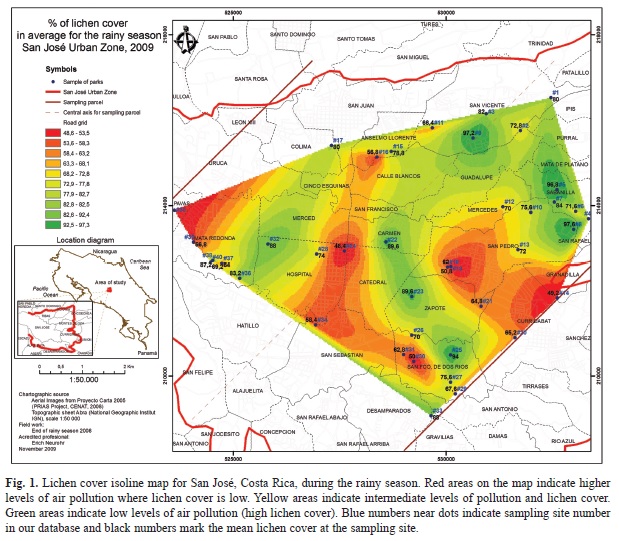
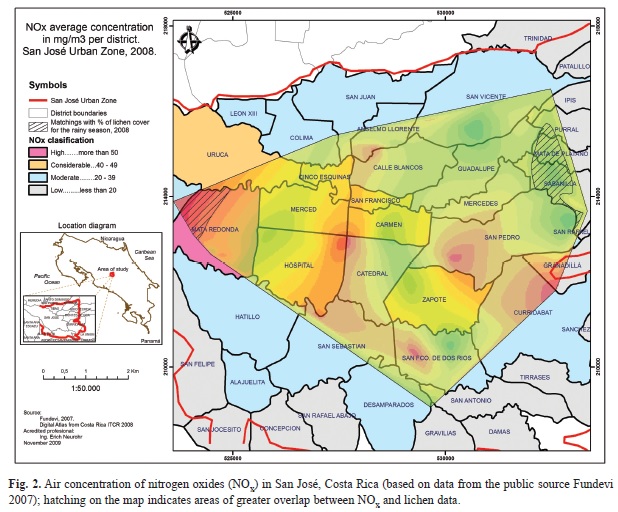
<body><![CDATA[<br> <font size="2"><span style="font-family: verdana;"></span></font><br  style="font-family: verdana;"> <font size="2"><span style="font-family: verdana;"></span></font><font  size="3"><span style="font-family: verdana;"><span  style="font-weight: bold;">Results</span></span></font>    <br> <font size="2"><span style="font-family: verdana;"></span></font><br  style="font-family: verdana;"> <font size="2"><span style="font-family: verdana;"></span></font><font  size="2"><span style="font-family: verdana;">The areas of San Jos&eacute;, Costa Rica with low lichen cover -reflecting higher levels of air pollution- are located in three main sections. A smaller section in the West of the city around the Mata Redonda neighborhood; a larger section surrounding the hospital and market areas of Carmen, Catedral, Hospital and Merced (extending North to San Francisco and Calle Blancos), and another small section in Southeast area that includes San Pedro and Curridabat (<a href="/img/revistas/rbt/v61n2/a07i1.jpg">Fig. 1</a>).</span></font>    <br> <font size="2"><span style="font-family: verdana;"></span></font><br  style="font-family: verdana;"> <font size="2"><span style="font-family: verdana;"></span></font><font  size="2"><span style="font-family: verdana;">The area with higher lichen cover &#8211;and less pollution- is located in the Northeast, where the dominating winds enter the city, and matches the densely populated neighborhoods of Anselmo Llorente, Guadalupe, San Rafael, Sabanilla and Mata de Pl&aacute;tano (<a href="/img/revistas/rbt/v61n2/a07i1.jpg">Fig. 1</a>). This is a positive finding considering that large numbers of middle and low class people live in this part of the city.</span></font>    <br> <font size="2"><span style="font-family: verdana;"></span></font><br  style="font-family: verdana;"> <font size="2"><span style="font-family: verdana;"></span></font><font  size="2"><span style="font-family: verdana;">A statistical comparison of the lichen and nitrogen map (<a href="/img/revistas/rbt/v61n2/a07i2.jpg">Fig. 2</a>) indicates that lichen cover matches the air concentration of nitrogen oxides: 72 of the 90 cells in which we divided the maps, have the same level of air pollution (Binomial test p&lt;0.0001).</span></font>    <br> <font size="2"><span style="font-family: verdana;"></span></font><br  style="font-family: verdana;"> <font size="2"><span style="font-family: verdana;"></span></font><font  size="2"><span style="font-family: verdana;">The areas of Calle Blancos, Mata Redonda, downtown San Jos&eacute;, San Pedro, Curridabat, San Sebasti&aacute;n and San Francisco de Dos R&iacute;os have the lowest means of lichen cover, and consequently the highest levels of pollution. The lowest levels of nitrogen oxides were recorded in Guadalupe and Sabanilla, which correspondingly resulted in increased levels of lichen cover (<a href="/img/revistas/rbt/v61n2/a07i1.jpg">Figs. 1</a> and <a href="/img/revistas/rbt/v61n2/a07i2.jpg">2</a>).</span></font>    <br> <font size="2"><span style="font-family: verdana;"></span></font><br  style="font-family: verdana;"> <font size="2"><span style="font-family: verdana;"></span></font><font  size="3"><span style="font-family: verdana;"><span  style="font-weight: bold;">Discussion</span></span></font>    <br> <font size="2"><span style="font-family: verdana;"></span></font><br  style="font-family: verdana;"> <font size="2"><span style="font-family: verdana;"></span></font><font  size="2"><span style="font-family: verdana;">The lichen cover that we found in San Jos&eacute; has a clear relation with the nitrogen oxide levels of pollution from automotive traffic origin. Automobiles are the primary source of urban air pollutants in cities such as San Jos&eacute;, with low levels of industrial development (Pujol 2002). Our results differ from research conducted in heavily industrialized cities, in which the lower lichen cover values are strongly associated with the location of factories and other industrial facilities (Chiras 2006, Wannaza <span  style="font-style: italic;">et al</span>. 2012). These associations are in agreement with our results since San Jos&eacute; is used for commerce and services, rather than for factories and industrial activities. In the case of San Jos&eacute;, it is advantageous that some densely populated areas of the city have low levels of air pollution.</span></font>    <br> <font size="2"><span style="font-family: verdana;"></span></font><br  style="font-family: verdana;"> <font size="2"><span style="font-family: verdana;"></span></font><font  size="2"><span style="font-family: verdana;">Our study not only adds to the recent but growing list of projects that use GIS to study air pollution through lichens in urban areas (Conti &amp; Cecchetti 2001, Shochat <span  style="font-style: italic;">et al</span>. 2006), but for Costa Rica and Latin America it is innovative by presenting isolines that were mathematically produced by GIS rather than by a more subjective interpretation from sampling points as done in earlier research (M&eacute;ndez &amp; Fournier 1980, Monge-N&aacute;jera et al. 2002a, Kricke &amp; Beige 2004, Ferreira <span  style="font-style: italic;">et al</span>. 2012).</span></font>    <br> <font size="2"><span style="font-family: verdana;"></span></font><br  style="font-family: verdana;"> <font size="2"><span style="font-family: verdana;"></span></font><font  size="2"><span style="font-family: verdana;">In conclusion, our hypotheses that pollution is heterogeneous along the city and that vehicular pollutants match lichen cover are in agreement with the data we obtained. Furthermore, we encourage the use of isoline maps to present better distribution results for large area studies regarding lichen biomonitoring, as done by other recent researchers such as Ferreira <span  style="font-style: italic;">et al</span>. (2012) for pollution from cement factories. We believe the laypersons would benefit from the &#8220;traffic light&#8221; color code maps: these can help them identify areas with higher levels of pollutants to persuade the authorities to take measures for improving air quality. Our color code GIS maps of air pollution should be incorporated when developing urban regulatory plans for the city of San Jos&eacute;: the location of schools, hospitals and other facilities in need of clean air can be zoned appropriately, and traffic routes can be changed to mitigate the harmful effects of the atmospheric pollution on the urban inhabitants (Fuga <span style="font-style: italic;">et al</span>. 2008).</span></font>    <br> <font size="2"><span style="font-family: verdana;"></span></font><br  style="font-family: verdana;"> <font size="2"><span style="font-family: verdana;"></span></font><font  size="2"><span style="font-family: verdana;">Nitrogen oxides are particularly important because they are indicators for traffic-related air pollution and because there is a connection between post-menopausal breast cancer and exposure to nitrogen dioxide (Crouse <span  style="font-style: italic;">et al</span>. 2010). The way in which lichen cover corresponds with air concentration of nitrogen oxides in San Jos&eacute;, as found in the present study, can be utilized to inexpensively and rapidly&nbsp; assess the risk for breast cancer in several neighborhoods throughout the city.</span></font>    ]]></body>
<body><![CDATA[<br> <font size="2"><span style="font-family: verdana;"></span></font><br  style="font-family: verdana;"> <font size="2"><span style="font-family: verdana;"></span></font><font  size="2"><span style="font-family: verdana;">Real-time pollution maps in cellular telephones allow drivers to avoid undesirable routes (Ehrlich 2009). If the cost of real time systems were reduced to levels affordable for tropical countries, this might be the first real alternative to lichen biomonitoring. Until then, lichens are the most realistic option for Latin America, Africa and other predominantly tropical regions. A third option is a web portal where users can add their own biomonitoring lichen data to demographic and socio-economic indicators (Centre for Development Finance 2010).</span></font>    <br> <font size="2"><span style="font-family: verdana;"></span></font><br  style="font-family: verdana;"> <font size="2"><span style="font-family: verdana;"></span></font><font  size="3"><span style="font-family: verdana;"><span  style="font-weight: bold;">Acknowledgments</span></span></font>    <br> <font size="2"><span style="font-family: verdana;"></span></font><br  style="font-family: verdana;"> <font size="2"><span style="font-family: verdana;"></span></font><font  size="2"><span style="font-family: verdana;">We thank Liis Marmor, Stefano Loppi, Juri Nascimbene, Katherine Williams and four anonymous reviewers for comments on an earlier draft; Ifigenia Bustamante for her assistance in collecting the lichen cover data, Jonathan Arias for his help with the maps and Karla Vega for her assistance in the map matching test.</span></font>    <br> <font size="2"><span style="font-family: verdana;"></span></font></div> <hr  style="width: 100%; height: 2px; margin-left: 0px; margin-right: 0px;">     <div style="text-align: justify;"><font size="2"><span  style="font-family: verdana;"></span></font><br  style="font-family: verdana;"> <font size="2"><span style="font-family: verdana;"></span></font><font  size="3"><span style="font-family: verdana;"><span  style="font-weight: bold;">References</span></span></font>    <!-- ref --><br> <font size="2"><span style="font-family: verdana;"></span></font><br  style="font-family: verdana;"> <font size="2"><span style="font-family: verdana;"></span></font><font  size="2"><span style="font-family: verdana;">Anze, R., M. Franken, M. Zaballa, M.R. Pinto, G. Zeballos, M.A. Cuadros, A. Canseco, A. De La Rocha, V.H. Estellano &amp; S. Del Granado. 2007. Bioindicadores en la detecci&oacute;n de la contaminaci&oacute;n atmosf&eacute;rica en Bolivia. Redesma 1: 53-74.    &nbsp;&nbsp;&nbsp;&nbsp;&nbsp;&nbsp;&nbsp;&nbsp;[&#160;<a href="javascript:void(0);" onclick="javascript: window.open('/scielo.php?script=sci_nlinks&ref=1512128&pid=S0034-7744201300030000700001&lng=','','width=640,height=500,resizable=yes,scrollbars=1,menubar=yes,');">Links</a>&#160;]<!-- end-ref --></span></font>    <!-- ref --><br> <font size="2"><span style="font-family: verdana;"></span></font><br  style="font-family: verdana;"> <font size="2"><span style="font-family: verdana;"></span></font><font  size="2"><span style="font-family: verdana;">Centre for Development Finance. 2010. India Online Pollution Map. Centre for Development Finance, Taramani, Chennai, India (Downloaded: April 10, 2012, http://www.indiapollutionmap.org).    &nbsp;&nbsp;&nbsp;&nbsp;&nbsp;&nbsp;&nbsp;&nbsp;[&#160;<a href="javascript:void(0);" onclick="javascript: window.open('/scielo.php?script=sci_nlinks&ref=1512130&pid=S0034-7744201300030000700002&lng=','','width=640,height=500,resizable=yes,scrollbars=1,menubar=yes,');">Links</a>&#160;]<!-- end-ref --></span></font>    <!-- ref --><br> <font size="2"><span style="font-family: verdana;"></span></font><br  style="font-family: verdana;"> <font size="2"><span style="font-family: verdana;"></span></font><font  size="2"><span style="font-family: verdana;">Chiras, D.D. 2006. Environmental Science. Jones &amp; Bartlett, Subdury, Massachusetts, USA.    &nbsp;&nbsp;&nbsp;&nbsp;&nbsp;&nbsp;&nbsp;&nbsp;[&#160;<a href="javascript:void(0);" onclick="javascript: window.open('/scielo.php?script=sci_nlinks&ref=1512132&pid=S0034-7744201300030000700003&lng=','','width=640,height=500,resizable=yes,scrollbars=1,menubar=yes,');">Links</a>&#160;]<!-- end-ref --> </span></font>    <!-- ref --><br> <font size="2"><span style="font-family: verdana;"></span></font><br  style="font-family: verdana;"> <font size="2"><span style="font-family: verdana;"></span></font><font  size="2"><span style="font-family: verdana;">Conti, M.E. &amp; G. Cecchetti. 2001. Biological monitoring: lichens as bioindicators of air pollution assesment &#8211; a review. Environ. Pollut. 114: 471-492.    &nbsp;&nbsp;&nbsp;&nbsp;&nbsp;&nbsp;&nbsp;&nbsp;[&#160;<a href="javascript:void(0);" onclick="javascript: window.open('/scielo.php?script=sci_nlinks&ref=1512134&pid=S0034-7744201300030000700004&lng=','','width=640,height=500,resizable=yes,scrollbars=1,menubar=yes,');">Links</a>&#160;]<!-- end-ref --></span></font>    <!-- ref --><br> <font size="2"><span style="font-family: verdana;"></span></font><br  style="font-family: verdana;"> <font size="2"><span style="font-family: verdana;"></span></font><font  size="2"><span style="font-family: verdana;">Costa Rica. 1993. Ley de Tr&aacute;nsito por V&iacute;as P&uacute;blicas Terrestres: art&iacute;culos 34-36. Asamblea Legislativa, San Jos&eacute;, Costa Rica.    &nbsp;&nbsp;&nbsp;&nbsp;&nbsp;&nbsp;&nbsp;&nbsp;[&#160;<a href="javascript:void(0);" onclick="javascript: window.open('/scielo.php?script=sci_nlinks&ref=1512136&pid=S0034-7744201300030000700005&lng=','','width=640,height=500,resizable=yes,scrollbars=1,menubar=yes,');">Links</a>&#160;]<!-- end-ref --></span></font>    <!-- ref --><br> <font size="2"><span style="font-family: verdana;"></span></font><br  style="font-family: verdana;"> <font size="2"><span style="font-family: verdana;"></span></font><font  size="2"><span style="font-family: verdana;">Crouse, D., M.S. Goldberg, N. Ross, H. Chen &amp; F. Labr&egrave;che. 2010. Postmenopausal Breast Cancer Is Associated with Exposure to Traffic-Related Air Pollution in Montreal, Canada: A Case-Control Study. Environ. Health Persp. 118: 1578-1583.    &nbsp;&nbsp;&nbsp;&nbsp;&nbsp;&nbsp;&nbsp;&nbsp;[&#160;<a href="javascript:void(0);" onclick="javascript: window.open('/scielo.php?script=sci_nlinks&ref=1512138&pid=S0034-7744201300030000700006&lng=','','width=640,height=500,resizable=yes,scrollbars=1,menubar=yes,');">Links</a>&#160;]<!-- end-ref --></span></font>    <!-- ref --><br> <font size="2"><span style="font-family: verdana;"></span></font><br  style="font-family: verdana;"> <font size="2"><span style="font-family: verdana;"></span></font><font  size="2"><span style="font-family: verdana;">Ehrlich, D. 2009. Mapping out traffic pollution. Gigaom, San Francisco, California (Downloaded: April 10, 2012, http://gigaom.com/cleantech/mapping-out-traffic-pollution/).    &nbsp;&nbsp;&nbsp;&nbsp;&nbsp;&nbsp;&nbsp;&nbsp;[&#160;<a href="javascript:void(0);" onclick="javascript: window.open('/scielo.php?script=sci_nlinks&ref=1512140&pid=S0034-7744201300030000700007&lng=','','width=640,height=500,resizable=yes,scrollbars=1,menubar=yes,');">Links</a>&#160;]<!-- end-ref --></span></font>    <!-- ref --><br> <font size="2"><span style="font-family: verdana;"></span></font><br  style="font-family: verdana;"> <font size="2"><span style="font-family: verdana;"></span></font><font  size="2"><span style="font-family: verdana;">Estrabou, C., E. Filippini, J.P. Soria, G. Schelotto &amp; J.M. Rodr&iacute;guez. 2011. Air quality monitoring system using lichens as bioindicators in Central Argentina. Environ. Monit. Assess. 182: 375-383.    &nbsp;&nbsp;&nbsp;&nbsp;&nbsp;&nbsp;&nbsp;&nbsp;[&#160;<a href="javascript:void(0);" onclick="javascript: window.open('/scielo.php?script=sci_nlinks&ref=1512142&pid=S0034-7744201300030000700008&lng=','','width=640,height=500,resizable=yes,scrollbars=1,menubar=yes,');">Links</a>&#160;]<!-- end-ref --></span></font>    <!-- ref --><br> <font size="2"><span style="font-family: verdana;"></span></font><br  style="font-family: verdana;"> <font size="2"><span style="font-family: verdana;"></span></font><font  size="2"><span style="font-family: verdana;">Fenn, M.E., L. Geiser, R. Bachman, T.J. Blubaugh &amp; A. Bytnerowicz. 2007. Atmospheric deposition inputs and effects on lichen chemistry and indicator species in the Columbia River Gorge, USA. Environ. Pollut. 146: 77-91.    &nbsp;&nbsp;&nbsp;&nbsp;&nbsp;&nbsp;&nbsp;&nbsp;[&#160;<a href="javascript:void(0);" onclick="javascript: window.open('/scielo.php?script=sci_nlinks&ref=1512144&pid=S0034-7744201300030000700009&lng=','','width=640,height=500,resizable=yes,scrollbars=1,menubar=yes,');">Links</a>&#160;]<!-- end-ref --></span></font>    <!-- ref --><br> <font size="2"><span style="font-family: verdana;"></span></font><br  style="font-family: verdana;"> <font size="2"><span style="font-family: verdana;"></span></font><font  size="2"><span style="font-family: verdana;">Fern&aacute;ndez-Salegui, A.B., A. Terr&oacute;n &amp; E. Barreno. 2003. Biomonitorizaci&oacute;n de la calidad del aire en los alrededores de La Robla (Le&oacute;n, noroeste de Espa&ntilde;a) diez a&ntilde;os despu&eacute;s. LAZAROA 27: 29-41.    &nbsp;&nbsp;&nbsp;&nbsp;&nbsp;&nbsp;&nbsp;&nbsp;[&#160;<a href="javascript:void(0);" onclick="javascript: window.open('/scielo.php?script=sci_nlinks&ref=1512146&pid=S0034-7744201300030000700010&lng=','','width=640,height=500,resizable=yes,scrollbars=1,menubar=yes,');">Links</a>&#160;]<!-- end-ref --></span></font>    <!-- ref --><br> <font size="2"><span style="font-family: verdana;"></span></font><br  style="font-family: verdana;"> <font size="2"><span style="font-family: verdana;"></span></font><font  size="2"><span style="font-family: verdana;">Ferreira, A.B., J.O. Santos, S.O. Souza, W.N.S. J&uacute;nior, J. do Patroc&iacute;nio &amp; H. Alvesa. 2012. Use of passive biomonitoring to evaluate the environmental impact of emissions from cement industries in Sergipe State, northeast Brazil. Microchem. J. 103: 15-20</span></font>    &nbsp;&nbsp;&nbsp;&nbsp;&nbsp;&nbsp;&nbsp;&nbsp;[&#160;<a href="javascript:void(0);" onclick="javascript: window.open('/scielo.php?script=sci_nlinks&ref=1512148&pid=S0034-7744201300030000700011&lng=','','width=640,height=500,resizable=yes,scrollbars=1,menubar=yes,');">Links</a>&#160;]<!-- end-ref --><!-- ref --><br> <font size="2"><span style="font-family: verdana;"></span></font><br  style="font-family: verdana;"> <font size="2"><span style="font-family: verdana;"></span></font><font  size="2"><span style="font-family: verdana;">Fuga, A., M. Saiki, M. Marcelli &amp; P. Saldiva. 2008. Atmospheric pollutants monitoring by analysis of epiphytic lichens. Environ. Pollut. 151: 334-340.    &nbsp;&nbsp;&nbsp;&nbsp;&nbsp;&nbsp;&nbsp;&nbsp;[&#160;<a href="javascript:void(0);" onclick="javascript: window.open('/scielo.php?script=sci_nlinks&ref=1512149&pid=S0034-7744201300030000700012&lng=','','width=640,height=500,resizable=yes,scrollbars=1,menubar=yes,');">Links</a>&#160;]<!-- end-ref --></span></font>    <!-- ref --><br> <font size="2"><span style="font-family: verdana;"></span></font><br  style="font-family: verdana;"> <font size="2"><span style="font-family: verdana;"></span></font><font  size="2"><span style="font-family: verdana;">FUNDEVI. 2007. Estudio de an&aacute;lisis y prospecci&oacute;n del sistema urbano de la Gran &Aacute;rea Metropolitana GAM. Informe final. FUNDEVI, San Jos&eacute;, Costa Rica.    &nbsp;&nbsp;&nbsp;&nbsp;&nbsp;&nbsp;&nbsp;&nbsp;[&#160;<a href="javascript:void(0);" onclick="javascript: window.open('/scielo.php?script=sci_nlinks&ref=1512151&pid=S0034-7744201300030000700013&lng=','','width=640,height=500,resizable=yes,scrollbars=1,menubar=yes,');">Links</a>&#160;]<!-- end-ref --></span></font>    ]]></body>
<body><![CDATA[<!-- ref --><br> <font size="2"><span style="font-family: verdana;"></span></font><br  style="font-family: verdana;"> <font size="2"><span style="font-family: verdana;"></span></font><font  size="2"><span style="font-family: verdana;">Gr&uuml;ninger, W. &amp; J. Monge-N&aacute;jera. 1988. Use of temperate lichen <span  style="font-style: italic;">Hypogymnnia physdes</span> (Parmeliaceae) to evaluate air pollution in the Tropics. Rev. Biol. Trop. 36: 545-547.    &nbsp;&nbsp;&nbsp;&nbsp;&nbsp;&nbsp;&nbsp;&nbsp;[&#160;<a href="javascript:void(0);" onclick="javascript: window.open('/scielo.php?script=sci_nlinks&ref=1512153&pid=S0034-7744201300030000700014&lng=','','width=640,height=500,resizable=yes,scrollbars=1,menubar=yes,');">Links</a>&#160;]<!-- end-ref --></span></font>    <!-- ref --><br> <font size="2"><span style="font-family: verdana;"></span></font><br  style="font-family: verdana;"> <font size="2"><span style="font-family: verdana;"></span></font><font  size="2"><span style="font-family: verdana;">Hawksworth, D.L., T. Iturriaga &amp; A. Crespo. 2005. L&iacute;quenes como bioindicadores inmediatos de contaminaci&oacute;n y cambios medio-ambientales en los tr&oacute;picos. Rev. Iberoam. Micol. 22: 71-82.    &nbsp;&nbsp;&nbsp;&nbsp;&nbsp;&nbsp;&nbsp;&nbsp;[&#160;<a href="javascript:void(0);" onclick="javascript: window.open('/scielo.php?script=sci_nlinks&ref=1512155&pid=S0034-7744201300030000700015&lng=','','width=640,height=500,resizable=yes,scrollbars=1,menubar=yes,');">Links</a>&#160;]<!-- end-ref --></span></font>    <!-- ref --><br> <font size="2"><span style="font-family: verdana;"></span></font><br  style="font-family: verdana;"> <font size="2"><span style="font-family: verdana;"></span></font><font  size="2"><span style="font-family: verdana;">K&auml;ffer, M.I., S.M.A. Martins, C. Alves, V.C. Pereira, J. Fachel &amp; V.M.F. Vargas. 2011. Corticolous lichens as environmental indicators in urban areas in southern Brazil. Ecol. Ind. 11: 1319-1332.    &nbsp;&nbsp;&nbsp;&nbsp;&nbsp;&nbsp;&nbsp;&nbsp;[&#160;<a href="javascript:void(0);" onclick="javascript: window.open('/scielo.php?script=sci_nlinks&ref=1512157&pid=S0034-7744201300030000700016&lng=','','width=640,height=500,resizable=yes,scrollbars=1,menubar=yes,');">Links</a>&#160;]<!-- end-ref --></span></font>    <!-- ref --><br> <font size="2"><span style="font-family: verdana;"></span></font><br  style="font-family: verdana;"> <font size="2"><span style="font-family: verdana;"></span></font><font  size="2"><span style="font-family: verdana;">Kricke, R. &amp; G.B. Beige. 2004. Changes in epiphytic lichen flora in urban environments. Lichens in a changing pollution environment. Engl. Nat. Res. Rep. 525: 27-30.    &nbsp;&nbsp;&nbsp;&nbsp;&nbsp;&nbsp;&nbsp;&nbsp;[&#160;<a href="javascript:void(0);" onclick="javascript: window.open('/scielo.php?script=sci_nlinks&ref=1512159&pid=S0034-7744201300030000700017&lng=','','width=640,height=500,resizable=yes,scrollbars=1,menubar=yes,');">Links</a>&#160;]<!-- end-ref --></span></font>    <!-- ref --><br> <font size="2"><span style="font-family: verdana;"></span></font><br  style="font-family: verdana;"> <font size="2"><span style="font-family: verdana;"></span></font><font  size="2"><span style="font-family: verdana;">Llop, E., P. Pinho, P. Matos, M.J. Pereira &amp; C. Branquinho. 2011. The use of lichen functional groups as indicators of air quality in a Mediterranean urban environment. Ecol. Ind. 13: 215-221.    &nbsp;&nbsp;&nbsp;&nbsp;&nbsp;&nbsp;&nbsp;&nbsp;[&#160;<a href="javascript:void(0);" onclick="javascript: window.open('/scielo.php?script=sci_nlinks&ref=1512161&pid=S0034-7744201300030000700018&lng=','','width=640,height=500,resizable=yes,scrollbars=1,menubar=yes,');">Links</a>&#160;]<!-- end-ref --></span></font>    ]]></body>
<body><![CDATA[<!-- ref --><br> <font size="2"><span style="font-family: verdana;"></span></font><br  style="font-family: verdana;"> <font size="2"><span style="font-family: verdana;"></span></font><font  size="2"><span style="font-family: verdana;">Loppi, S. 2004. Mapping the effects of air pollution, nitrogen deposition, agriculture and dust by the diversity of epiphytic lichens in central Italy. Lichens in a changing pollution environment. Engl. Nat. Res. Rep. 525: 37-41.    &nbsp;&nbsp;&nbsp;&nbsp;&nbsp;&nbsp;&nbsp;&nbsp;[&#160;<a href="javascript:void(0);" onclick="javascript: window.open('/scielo.php?script=sci_nlinks&ref=1512163&pid=S0034-7744201300030000700019&lng=','','width=640,height=500,resizable=yes,scrollbars=1,menubar=yes,');">Links</a>&#160;]<!-- end-ref --></span></font>    <!-- ref --><br> <font size="2"><span style="font-family: verdana;"></span></font><br  style="font-family: verdana;"> <font size="2"><span style="font-family: verdana;"></span></font><font  size="2"><span style="font-family: verdana;">McCarthy, D.P., B. Craig &amp; U. Brand. 2009. Lichen Monitoring of Urban Air Quality, Hamilton, Ontario. Develop. Environ. Sci. 9: 247-267.    &nbsp;&nbsp;&nbsp;&nbsp;&nbsp;&nbsp;&nbsp;&nbsp;[&#160;<a href="javascript:void(0);" onclick="javascript: window.open('/scielo.php?script=sci_nlinks&ref=1512165&pid=S0034-7744201300030000700020&lng=','','width=640,height=500,resizable=yes,scrollbars=1,menubar=yes,');">Links</a>&#160;]<!-- end-ref --></span></font>    <!-- ref --><br> <font size="2"><span style="font-family: verdana;"></span></font><br  style="font-family: verdana;"> <font size="2"><span style="font-family: verdana;"></span></font><font  size="2"><span style="font-family: verdana;">M&eacute;ndez-Estrada, V.H., M. Rivas-Rossi &amp; J. Monge-N&aacute;jera. 1999. Los l&iacute;quenes como bioindicadores y su uso por parte de estudiantes para monitorear la contaminaci&oacute;n atmosf&eacute;rica. I Congreso Interuniversitario de Biodiversidad. Ciudad de la Investigaci&oacute;n, Universidad de Costa Rica. Universidad de Costa Rica, San Jos&eacute;, Costa Rica.    &nbsp;&nbsp;&nbsp;&nbsp;&nbsp;&nbsp;&nbsp;&nbsp;[&#160;<a href="javascript:void(0);" onclick="javascript: window.open('/scielo.php?script=sci_nlinks&ref=1512167&pid=S0034-7744201300030000700021&lng=','','width=640,height=500,resizable=yes,scrollbars=1,menubar=yes,');">Links</a>&#160;]<!-- end-ref --></span></font>    <!-- ref --><br> <font size="2"><span style="font-family: verdana;"></span></font><br  style="font-family: verdana;"> <font size="2"><span style="font-family: verdana;"></span></font><font  size="2"><span style="font-family: verdana;">M&eacute;ndez, O. &amp; L. Fournier. 1980. Los l&iacute;quenes como indicadores de la contaminaci&oacute;n atmosf&eacute;rica en el &aacute;rea metropolitana de San Jos&eacute;, Costa Rica. Rev. Biol. Trop. 28: 31-39.    &nbsp;&nbsp;&nbsp;&nbsp;&nbsp;&nbsp;&nbsp;&nbsp;[&#160;<a href="javascript:void(0);" onclick="javascript: window.open('/scielo.php?script=sci_nlinks&ref=1512169&pid=S0034-7744201300030000700022&lng=','','width=640,height=500,resizable=yes,scrollbars=1,menubar=yes,');">Links</a>&#160;]<!-- end-ref --></span></font>    <!-- ref --><br> <font size="2"><span style="font-family: verdana;"></span></font><br  style="font-family: verdana;"> <font size="2"><span style="font-family: verdana;"></span></font><font  size="2"><span style="font-family: verdana;">Monge-N&aacute;jera, J., M.I. Gonz&aacute;lez, M. Rivas &amp; V.H. M&eacute;ndez. 2002a. Twenty years of lichen cover change in a tropical habitat (Costa Rica) and its relation with air pollution. Rev. Biol. Trop. 50: 309-319.    &nbsp;&nbsp;&nbsp;&nbsp;&nbsp;&nbsp;&nbsp;&nbsp;[&#160;<a href="javascript:void(0);" onclick="javascript: window.open('/scielo.php?script=sci_nlinks&ref=1512171&pid=S0034-7744201300030000700023&lng=','','width=640,height=500,resizable=yes,scrollbars=1,menubar=yes,');">Links</a>&#160;]<!-- end-ref --></span></font>    ]]></body>
<body><![CDATA[<!-- ref --><br> <font size="2"><span style="font-family: verdana;"></span></font><br  style="font-family: verdana;"> <font size="2"><span style="font-family: verdana;"></span></font><font  size="2"><span style="font-family: verdana;">Monge-N&aacute;jera, J., M.I. Gonz&aacute;lez, M. Rivas &amp; V.H. M&eacute;ndez. 2002b. A new method to assess air pollution using lichens as bioindicators. Rev. Biol. Trop. 50: 321-325.    &nbsp;&nbsp;&nbsp;&nbsp;&nbsp;&nbsp;&nbsp;&nbsp;[&#160;<a href="javascript:void(0);" onclick="javascript: window.open('/scielo.php?script=sci_nlinks&ref=1512173&pid=S0034-7744201300030000700024&lng=','','width=640,height=500,resizable=yes,scrollbars=1,menubar=yes,');">Links</a>&#160;]<!-- end-ref --></span></font>    <!-- ref --><br> <font size="2"><span style="font-family: verdana;"></span></font><br  style="font-family: verdana;"> <font size="2"><span style="font-family: verdana;"></span></font><font  size="2"><span style="font-family: verdana;">Moragues, A. &amp; T. Alcaide. 1996. The use of a geographical information system to assess the effect of traffic pollution. Sci. Total Environ. 189-190: 267-273.    &nbsp;&nbsp;&nbsp;&nbsp;&nbsp;&nbsp;&nbsp;&nbsp;[&#160;<a href="javascript:void(0);" onclick="javascript: window.open('/scielo.php?script=sci_nlinks&ref=1512175&pid=S0034-7744201300030000700025&lng=','','width=640,height=500,resizable=yes,scrollbars=1,menubar=yes,');">Links</a>&#160;]<!-- end-ref --></span></font>    <!-- ref --><br> <font size="2"><span style="font-family: verdana;"></span></font><br  style="font-family: verdana;"> <font size="2"><span style="font-family: verdana;"></span></font><font  size="2"><span style="font-family: verdana;">Municipalidad de San Jos&eacute;. 2010. Informaci&oacute;n b&aacute;sica del Cant&oacute;n de San Jos&eacute;. Municipalidad de San Jos&eacute;, San Jos&eacute;, Costa Rica.    &nbsp;&nbsp;&nbsp;&nbsp;&nbsp;&nbsp;&nbsp;&nbsp;[&#160;<a href="javascript:void(0);" onclick="javascript: window.open('/scielo.php?script=sci_nlinks&ref=1512177&pid=S0034-7744201300030000700026&lng=','','width=640,height=500,resizable=yes,scrollbars=1,menubar=yes,');">Links</a>&#160;]<!-- end-ref --></span></font>    <!-- ref --><br> <font size="2"><span style="font-family: verdana;"></span></font><br  style="font-family: verdana;"> <font size="2"><span style="font-family: verdana;"></span></font><font  size="2"><span style="font-family: verdana;">Neurohr, E., J. Monge-N&aacute;jera &amp; M.I. Gonz&aacute;lez. 2011. Air pollution in a tropical city: the relationship between wind direction and lichen bio-indicators in San Jos&eacute;, Costa Rica. Rev. Biol. Trop. 59: 899-905.    &nbsp;&nbsp;&nbsp;&nbsp;&nbsp;&nbsp;&nbsp;&nbsp;[&#160;<a href="javascript:void(0);" onclick="javascript: window.open('/scielo.php?script=sci_nlinks&ref=1512179&pid=S0034-7744201300030000700027&lng=','','width=640,height=500,resizable=yes,scrollbars=1,menubar=yes,');">Links</a>&#160;]<!-- end-ref --></span></font>    <!-- ref --><br> <font size="2"><span style="font-family: verdana;"></span></font><br  style="font-family: verdana;"> <font size="2"><span style="font-family: verdana;"></span></font><font  size="2"><span style="font-family: verdana;">Pujol, R. 2002. Estudio de indicadores urbanos en el &aacute;rea metropolitana de San Jos&eacute;. Flota vehicular. ProDUSUCR, San Jos&eacute;, Costa Rica.    &nbsp;&nbsp;&nbsp;&nbsp;&nbsp;&nbsp;&nbsp;&nbsp;[&#160;<a href="javascript:void(0);" onclick="javascript: window.open('/scielo.php?script=sci_nlinks&ref=1512181&pid=S0034-7744201300030000700028&lng=','','width=640,height=500,resizable=yes,scrollbars=1,menubar=yes,');">Links</a>&#160;]<!-- end-ref --></span></font>    ]]></body>
<body><![CDATA[<!-- ref --><br> <font size="2"><span style="font-family: verdana;"></span></font><br  style="font-family: verdana;"> <font size="2"><span style="font-family: verdana;"></span></font><font  size="2"><span style="font-family: verdana;">S&aacute;enz, A.E., F. Flores, L. Madrigal &amp; J.F. Di Stefano. 2007. Estimaci&oacute;n del grado de contaminaci&oacute;n del aire por medio de la cobertura de l&iacute;quenes sobre troncos de &aacute;rboles en la ciudad de San Jos&eacute;, Costa Rica. Brenesia 68: 29-35.    &nbsp;&nbsp;&nbsp;&nbsp;&nbsp;&nbsp;&nbsp;&nbsp;[&#160;<a href="javascript:void(0);" onclick="javascript: window.open('/scielo.php?script=sci_nlinks&ref=1512183&pid=S0034-7744201300030000700029&lng=','','width=640,height=500,resizable=yes,scrollbars=1,menubar=yes,');">Links</a>&#160;]<!-- end-ref --></span></font>    <!-- ref --><br> <font size="2"><span style="font-family: verdana;"></span></font><br  style="font-family: verdana;"> <font size="2"><span style="font-family: verdana;"></span></font><font  size="2"><span style="font-family: verdana;">Shochat, E., P. Warren &amp; S.H. Faeth. 2006. Future directions in urban ecology. Trends Ecol. Evol. 21: 661-662.    &nbsp;&nbsp;&nbsp;&nbsp;&nbsp;&nbsp;&nbsp;&nbsp;[&#160;<a href="javascript:void(0);" onclick="javascript: window.open('/scielo.php?script=sci_nlinks&ref=1512185&pid=S0034-7744201300030000700030&lng=','','width=640,height=500,resizable=yes,scrollbars=1,menubar=yes,');">Links</a>&#160;]<!-- end-ref --></span></font>    <!-- ref --><br> <font size="2"><span style="font-family: verdana;"></span></font><br  style="font-family: verdana;"> <font size="2"><span style="font-family: verdana;"></span></font><font  size="2"><span style="font-family: verdana;">Shukla, V. &amp; D.K. Upreti. 2012. Air Quality Monitoring with Lichens in India. Heavy Metals and Polycyclic Aromatic Hydrocarbons. Environ. Chem. Sust. World 1: 277-294.    &nbsp;&nbsp;&nbsp;&nbsp;&nbsp;&nbsp;&nbsp;&nbsp;[&#160;<a href="javascript:void(0);" onclick="javascript: window.open('/scielo.php?script=sci_nlinks&ref=1512187&pid=S0034-7744201300030000700031&lng=','','width=640,height=500,resizable=yes,scrollbars=1,menubar=yes,');">Links</a>&#160;]<!-- end-ref --></span></font>    <!-- ref --><br> <font size="2"><span style="font-family: verdana;"></span></font><br  style="font-family: verdana;"> <font size="2"><span style="font-family: verdana;"></span></font><font  size="2"><span style="font-family: verdana;">Tribunal Supremo de Elecciones. 2011. San Jos&eacute;, Costa Rica. (Downloaded: April 10, 2012, http://www.tse.go.cr/tseficha/datos/sanjose.pdf.    &nbsp;&nbsp;&nbsp;&nbsp;&nbsp;&nbsp;&nbsp;&nbsp;[&#160;<a href="javascript:void(0);" onclick="javascript: window.open('/scielo.php?script=sci_nlinks&ref=1512189&pid=S0034-7744201300030000700032&lng=','','width=640,height=500,resizable=yes,scrollbars=1,menubar=yes,');">Links</a>&#160;]<!-- end-ref --></span></font>    <!-- ref --><br> <font size="2"><span style="font-family: verdana;"></span></font><br  style="font-family: verdana;"> <font size="2"><span style="font-family: verdana;"></span></font><font  size="2"><span style="font-family: verdana;">Wannaza, E.D., H.A. Carreras, J.H. Rodriguez &amp; M.L. Pignata. 2012. Use of biomonitors for the identification of heavy metals emission sources. Ecol. Indic. 20: 163-169.    &nbsp;&nbsp;&nbsp;&nbsp;&nbsp;&nbsp;&nbsp;&nbsp;[&#160;<a href="javascript:void(0);" onclick="javascript: window.open('/scielo.php?script=sci_nlinks&ref=1512191&pid=S0034-7744201300030000700033&lng=','','width=640,height=500,resizable=yes,scrollbars=1,menubar=yes,');">Links</a>&#160;]<!-- end-ref --></span></font>    ]]></body>
<body><![CDATA[<!-- ref --><br> <font size="2"><span style="font-family: verdana;"></span></font><br  style="font-family: verdana;"> <font size="2"><span style="font-family: verdana;"></span></font><font  size="2"><span style="font-family: verdana;">Wei, H., H. Zhang, M. Jingsong, G. Chen &amp; J. Wang. 2011. The dynamic expression of three-dimensional meteorological thematic fields based on WebGIS. 19th International Conference on Geoinformatics Conference Publications (Shanghai, 24-26 June 2011): 1-5.    &nbsp;&nbsp;&nbsp;&nbsp;&nbsp;&nbsp;&nbsp;&nbsp;[&#160;<a href="javascript:void(0);" onclick="javascript: window.open('/scielo.php?script=sci_nlinks&ref=1512193&pid=S0034-7744201300030000700034&lng=','','width=640,height=500,resizable=yes,scrollbars=1,menubar=yes,');">Links</a>&#160;]<!-- end-ref --></span></font>    <br> <font size="2"><span style="font-family: verdana;"></span></font>    <br> <font size="2"><span style="font-family: verdana;"><a  name="Correspondencia1"></a><a href="#Correspondencia2">*</a>Correspondencia:</span></font>    <br> <font size="2"><span style="font-family: verdana;"></span></font><font  size="2"><span style="font-family: verdana;">Erich Neurohr Bustamante: </span></font><font size="2"><span style="font-family: verdana;">Laboratorio de Ecolog&iacute;a Urbana, Universidad Estatal a Distancia, 2050 San Jos&eacute;, Costa Rica. eneurohr@iecainternacional.com</span></font>    <br> <font size="2"><span style="font-family: verdana;">Juli&aacute;n Monge-N&aacute;jera: </span></font><font size="2"><span  style="font-family: verdana;">Laboratorio de Ecolog&iacute;a Urbana, Universidad Estatal a Distancia, 2050 San Jos&eacute;, Costa Rica. </span></font><font size="2"><span style="font-family: verdana;">julianmonge@gmail.com</span></font>    <br> <font size="2"><span style="font-family: verdana;">V&iacute;ctor Hugo M&eacute;ndez-Estrada: </span></font><font size="2"><span  style="font-family: verdana;">Laboratorio de Ecolog&iacute;a Urbana, Universidad Estatal a Distancia, 2050 San Jos&eacute;, Costa Rica. </span></font><font size="2"><span style="font-family: verdana;">vmendez@uned.ac.cr</span></font><br  style="font-family: verdana;"> <font size="2"> </font><font size="2"><span style="font-family: verdana;"></span></font><font  size="2"><span style="font-family: verdana;"><a name="1"></a><a  href="#2">1</a>. Laboratorio de Ecolog&iacute;a Urbana, Universidad Estatal a Distancia, 2050 San Jos&eacute;, Costa Rica; eneurohr@iecainternacional.com, julianmonge@gmail.com, vmendez@uned.ac.cr</span></font><br style="font-family: verdana;"> </div> <hr  style="width: 100%; height: 2px; margin-left: 0px; margin-right: 0px;">     <div style="text-align: justify;">     <div style="text-align: center;"><font style="font-weight: bold;"  size="2"><span style="font-family: verdana;">Received 23-IV-2012. Corrected 23-IX-2012. Accepted 18-X-2012.</span></font><br  style="font-family: verdana;"> </div> </div>      ]]></body><back>
<ref-list>
<ref id="B1">
<nlm-citation citation-type="journal">
<person-group person-group-type="author">
<name>
<surname><![CDATA[Anze]]></surname>
<given-names><![CDATA[R.]]></given-names>
</name>
<name>
<surname><![CDATA[Franken]]></surname>
<given-names><![CDATA[M.]]></given-names>
</name>
<name>
<surname><![CDATA[Zaballa]]></surname>
<given-names><![CDATA[M.]]></given-names>
</name>
<name>
<surname><![CDATA[Pinto]]></surname>
<given-names><![CDATA[M.R.]]></given-names>
</name>
<name>
<surname><![CDATA[Zeballos]]></surname>
<given-names><![CDATA[G.]]></given-names>
</name>
<name>
<surname><![CDATA[Cuadros]]></surname>
<given-names><![CDATA[M.A.]]></given-names>
</name>
<name>
<surname><![CDATA[Canseco]]></surname>
<given-names><![CDATA[A.]]></given-names>
</name>
<name>
<surname><![CDATA[De La Rocha]]></surname>
<given-names><![CDATA[A.]]></given-names>
</name>
<name>
<surname><![CDATA[Estellano]]></surname>
<given-names><![CDATA[V.H.]]></given-names>
</name>
<name>
<surname><![CDATA[Del Granado]]></surname>
<given-names><![CDATA[S.]]></given-names>
</name>
</person-group>
<article-title xml:lang="es"><![CDATA[Bioindicadores en la detección de la contaminación atmosférica en Bolivia.]]></article-title>
<source><![CDATA[Redesma]]></source>
<year>2007</year>
<volume>1</volume>
<page-range>53-74</page-range></nlm-citation>
</ref>
<ref id="B2">
<nlm-citation citation-type="book">
<collab>Centre for Development Finance</collab>
<source><![CDATA[India Online Pollution Map.]]></source>
<year>2010</year>
<publisher-loc><![CDATA[Taramani^eChennai Chennai]]></publisher-loc>
<publisher-name><![CDATA[Centre for Development Finance]]></publisher-name>
</nlm-citation>
</ref>
<ref id="B3">
<nlm-citation citation-type="book">
<person-group person-group-type="author">
<name>
<surname><![CDATA[Chiras]]></surname>
<given-names><![CDATA[D.D.]]></given-names>
</name>
</person-group>
<source><![CDATA[Environmental Science.]]></source>
<year>2006</year>
<publisher-loc><![CDATA[Subdury^eMassachusetts Massachusetts]]></publisher-loc>
<publisher-name><![CDATA[Jones & Bartlett]]></publisher-name>
</nlm-citation>
</ref>
<ref id="B4">
<nlm-citation citation-type="journal">
<person-group person-group-type="author">
<name>
<surname><![CDATA[Conti]]></surname>
<given-names><![CDATA[M.E.]]></given-names>
</name>
<name>
<surname><![CDATA[Cecchetti]]></surname>
<given-names><![CDATA[G.]]></given-names>
</name>
</person-group>
<article-title xml:lang="en"><![CDATA[Biological monitoring:: lichens as bioindicators of air pollution assesment - a review.]]></article-title>
<source><![CDATA[Environ. Pollut.]]></source>
<year>2001</year>
<volume>114</volume>
<page-range>471-492</page-range></nlm-citation>
</ref>
<ref id="B5">
<nlm-citation citation-type="book">
<collab>Costa Rica.</collab>
<source><![CDATA[Ley de Tránsito por Vías Públicas Terrestres:: artículos 34-36.]]></source>
<year>1993</year>
<publisher-loc><![CDATA[^eSan José San José]]></publisher-loc>
<publisher-name><![CDATA[Asamblea Legislativa]]></publisher-name>
</nlm-citation>
</ref>
<ref id="B6">
<nlm-citation citation-type="journal">
<person-group person-group-type="author">
<name>
<surname><![CDATA[Crouse]]></surname>
<given-names><![CDATA[D.]]></given-names>
</name>
<name>
<surname><![CDATA[Goldberg]]></surname>
<given-names><![CDATA[M.S.]]></given-names>
</name>
<name>
<surname><![CDATA[Ross]]></surname>
<given-names><![CDATA[N.]]></given-names>
</name>
<name>
<surname><![CDATA[Chen]]></surname>
<given-names><![CDATA[H.]]></given-names>
</name>
<name>
<surname><![CDATA[Labrèche]]></surname>
<given-names><![CDATA[F.]]></given-names>
</name>
</person-group>
<article-title xml:lang="en"><![CDATA[Postmenopausal Breast Cancer Is Associated with Exposure to Traffic-Related Air Pollution in Montreal, Canada:: A Case-Control Study]]></article-title>
<source><![CDATA[Environ. Health Persp.]]></source>
<year>2010</year>
<volume>118</volume>
<page-range>1578-1583</page-range></nlm-citation>
</ref>
<ref id="B7">
<nlm-citation citation-type="book">
<person-group person-group-type="author">
<name>
<surname><![CDATA[Ehrlich]]></surname>
<given-names><![CDATA[D.]]></given-names>
</name>
</person-group>
<source><![CDATA[Mapping out traffic pollution.]]></source>
<year>2009</year>
<publisher-loc><![CDATA[San Francisco^eCalifornia California]]></publisher-loc>
<publisher-name><![CDATA[Gigaom]]></publisher-name>
</nlm-citation>
</ref>
<ref id="B8">
<nlm-citation citation-type="journal">
<person-group person-group-type="author">
<name>
<surname><![CDATA[Estrabou]]></surname>
<given-names><![CDATA[C.]]></given-names>
</name>
<name>
<surname><![CDATA[Filippini]]></surname>
<given-names><![CDATA[E.]]></given-names>
</name>
<name>
<surname><![CDATA[Soria]]></surname>
<given-names><![CDATA[J.P.]]></given-names>
</name>
<name>
<surname><![CDATA[Schelotto]]></surname>
<given-names><![CDATA[G.]]></given-names>
</name>
<name>
<surname><![CDATA[Rodríguez]]></surname>
<given-names><![CDATA[J.M.]]></given-names>
</name>
</person-group>
<article-title xml:lang="en"><![CDATA[Air quality monitoring system using lichens as bioindicators in Central Argentina.]]></article-title>
<source><![CDATA[Environ. Monit. Assess.]]></source>
<year>2011</year>
<volume>182</volume>
<page-range>375-383</page-range></nlm-citation>
</ref>
<ref id="B9">
<nlm-citation citation-type="journal">
<person-group person-group-type="author">
<name>
<surname><![CDATA[Fenn]]></surname>
<given-names><![CDATA[M.E.]]></given-names>
</name>
<name>
<surname><![CDATA[Geiser]]></surname>
<given-names><![CDATA[L.]]></given-names>
</name>
<name>
<surname><![CDATA[Bachman]]></surname>
<given-names><![CDATA[R.]]></given-names>
</name>
<name>
<surname><![CDATA[Blubaugh]]></surname>
<given-names><![CDATA[T.J.]]></given-names>
</name>
<name>
<surname><![CDATA[Bytnerowicz]]></surname>
<given-names><![CDATA[A.]]></given-names>
</name>
</person-group>
<article-title xml:lang="en"><![CDATA[Atmospheric deposition inputs and effects on lichen chemistry and indicator species in the Columbia River Gorge, USA.]]></article-title>
<source><![CDATA[Environ. Pollut.]]></source>
<year>2007</year>
<volume>146</volume>
<page-range>77-91</page-range></nlm-citation>
</ref>
<ref id="B10">
<nlm-citation citation-type="journal">
<person-group person-group-type="author">
<name>
<surname><![CDATA[Fernández-Salegui]]></surname>
<given-names><![CDATA[A.B.]]></given-names>
</name>
<name>
<surname><![CDATA[Terrón]]></surname>
<given-names><![CDATA[A.]]></given-names>
</name>
<name>
<surname><![CDATA[Barreno]]></surname>
<given-names><![CDATA[E.]]></given-names>
</name>
</person-group>
<article-title xml:lang="es"><![CDATA[Biomonitorización de la calidad del aire en los alrededores de La Robla (León, noroeste de España) diez años después.]]></article-title>
<source><![CDATA[LAZAROA]]></source>
<year>2003</year>
<volume>27</volume><volume>29-41</volume>
</nlm-citation>
</ref>
<ref id="B11">
<nlm-citation citation-type="journal">
<person-group person-group-type="author">
<name>
<surname><![CDATA[Ferreira]]></surname>
<given-names><![CDATA[A.B.]]></given-names>
</name>
<name>
<surname><![CDATA[Santos]]></surname>
<given-names><![CDATA[J.O.]]></given-names>
</name>
<name>
<surname><![CDATA[Souza]]></surname>
<given-names><![CDATA[S.O.]]></given-names>
</name>
<name>
<surname><![CDATA[Júnior]]></surname>
<given-names><![CDATA[W.N.S.]]></given-names>
</name>
<name>
<surname><![CDATA[Patrocínio]]></surname>
<given-names><![CDATA[J. do]]></given-names>
</name>
<name>
<surname><![CDATA[Alvesa]]></surname>
<given-names><![CDATA[H.]]></given-names>
</name>
</person-group>
<article-title xml:lang="en"><![CDATA[Use of passive biomonitoring to evaluate the environmental impact of emissions from cement industries in Sergipe State, northeast Brazil.]]></article-title>
<source><![CDATA[Microchem. J.]]></source>
<year>2012</year>
<volume>103</volume>
<page-range>15-20</page-range></nlm-citation>
</ref>
<ref id="B12">
<nlm-citation citation-type="journal">
<person-group person-group-type="author">
<name>
<surname><![CDATA[Fuga]]></surname>
<given-names><![CDATA[A.]]></given-names>
</name>
<name>
<surname><![CDATA[Saiki]]></surname>
<given-names><![CDATA[M.]]></given-names>
</name>
<name>
<surname><![CDATA[Marcelli]]></surname>
<given-names><![CDATA[M.]]></given-names>
</name>
<name>
<surname><![CDATA[Saldiva.]]></surname>
<given-names><![CDATA[P.]]></given-names>
</name>
</person-group>
<article-title xml:lang="en"><![CDATA[Atmospheric pollutants monitoring by analysis of epiphytic lichens.]]></article-title>
<source><![CDATA[Environ. Pollut.]]></source>
<year>2008</year>
<volume>151</volume>
<page-range>334-340.</page-range></nlm-citation>
</ref>
<ref id="B13">
<nlm-citation citation-type="book">
<collab>FUNDEVI.</collab>
<source><![CDATA[Estudio de análisis y prospección del sistema urbano de la Gran Área Metropolitana GAM.: Informe final.]]></source>
<year>2007</year>
<publisher-loc><![CDATA[San José ]]></publisher-loc>
<publisher-name><![CDATA[FUNDEVI]]></publisher-name>
</nlm-citation>
</ref>
<ref id="B14">
<nlm-citation citation-type="journal">
<person-group person-group-type="author">
<name>
<surname><![CDATA[Grüninger]]></surname>
<given-names><![CDATA[W.]]></given-names>
</name>
<name>
<surname><![CDATA[Monge-Nájera]]></surname>
<given-names><![CDATA[J.]]></given-names>
</name>
</person-group>
<article-title xml:lang="en"><![CDATA[Use of temperate lichen Hypogymnnia physdes (Parmeliaceae) to evaluate air pollution in the Tropics.]]></article-title>
<source><![CDATA[Rev. Biol. Trop.]]></source>
<year>1988</year>
<volume>36</volume>
<page-range>545-547.</page-range></nlm-citation>
</ref>
<ref id="B15">
<nlm-citation citation-type="journal">
<person-group person-group-type="author">
<name>
<surname><![CDATA[Hawksworth]]></surname>
<given-names><![CDATA[D.L.]]></given-names>
</name>
<name>
<surname><![CDATA[Iturriaga]]></surname>
<given-names><![CDATA[T.]]></given-names>
</name>
<name>
<surname><![CDATA[Crespo.]]></surname>
<given-names><![CDATA[A.]]></given-names>
</name>
</person-group>
<article-title xml:lang="en"><![CDATA[Líquenes como bioindicadores inmediatos de contaminación y cambios medio-ambientales en los trópicos.]]></article-title>
<source><![CDATA[Rev. Iberoam. Micol.]]></source>
<year>2005</year>
<volume>22</volume>
<page-range>71-82.</page-range></nlm-citation>
</ref>
<ref id="B16">
<nlm-citation citation-type="journal">
<person-group person-group-type="author">
<name>
<surname><![CDATA[Käffer]]></surname>
<given-names><![CDATA[M.I.]]></given-names>
</name>
<name>
<surname><![CDATA[Martins]]></surname>
<given-names><![CDATA[S.M.A.]]></given-names>
</name>
<name>
<surname><![CDATA[Alves]]></surname>
<given-names><![CDATA[C.]]></given-names>
</name>
<name>
<surname><![CDATA[Pereira]]></surname>
<given-names><![CDATA[V.C.]]></given-names>
</name>
<name>
<surname><![CDATA[Fachel]]></surname>
<given-names><![CDATA[J.]]></given-names>
</name>
<name>
<surname><![CDATA[Vargas.]]></surname>
<given-names><![CDATA[V.M.F.]]></given-names>
</name>
</person-group>
<article-title xml:lang="en"><![CDATA[Corticolous lichens as environmental indicators in urban areas in southern Brazil.]]></article-title>
<source><![CDATA[Ecol. Ind.]]></source>
<year>2011</year>
<volume>11</volume>
<page-range>1319-1332.</page-range></nlm-citation>
</ref>
<ref id="B17">
<nlm-citation citation-type="journal">
<person-group person-group-type="author">
<name>
<surname><![CDATA[Kricke]]></surname>
<given-names><![CDATA[R.]]></given-names>
</name>
<name>
<surname><![CDATA[Beige.]]></surname>
<given-names><![CDATA[G.B.]]></given-names>
</name>
</person-group>
<article-title xml:lang="en"><![CDATA[Changes in epiphytic lichen flora in urban environments.: Lichens in a changing pollution environment.]]></article-title>
<source><![CDATA[Engl. Nat. Res. Rep.]]></source>
<year>2004</year>
<volume>525</volume>
<page-range>27-30.</page-range></nlm-citation>
</ref>
<ref id="B18">
<nlm-citation citation-type="journal">
<person-group person-group-type="author">
<name>
<surname><![CDATA[Llop]]></surname>
<given-names><![CDATA[E.]]></given-names>
</name>
<name>
<surname><![CDATA[Pinho]]></surname>
<given-names><![CDATA[P.]]></given-names>
</name>
<name>
<surname><![CDATA[Matos]]></surname>
<given-names><![CDATA[P.]]></given-names>
</name>
<name>
<surname><![CDATA[Pereira]]></surname>
<given-names><![CDATA[M.J.]]></given-names>
</name>
<name>
<surname><![CDATA[Branquinho.]]></surname>
<given-names><![CDATA[C.]]></given-names>
</name>
</person-group>
<article-title xml:lang="en"><![CDATA[The use of lichen functional groups as indicators of air quality in a Mediterranean urban environment.]]></article-title>
<source><![CDATA[Ecol. Ind.]]></source>
<year>2011</year>
<volume>13</volume>
<page-range>215-221.</page-range></nlm-citation>
</ref>
<ref id="B19">
<nlm-citation citation-type="journal">
<person-group person-group-type="author">
<name>
<surname><![CDATA[Loppi]]></surname>
<given-names><![CDATA[S.]]></given-names>
</name>
</person-group>
<article-title xml:lang="en"><![CDATA[Mapping the effects of air pollution, nitrogen deposition, agriculture and dust by the diversity of epiphytic lichens in central Italy.: Lichens in a changing pollution environment.]]></article-title>
<source><![CDATA[Engl. Nat. Res. Rep.]]></source>
<year>2004</year>
<volume>525</volume>
<page-range>37-41.</page-range></nlm-citation>
</ref>
<ref id="B20">
<nlm-citation citation-type="journal">
<person-group person-group-type="author">
<name>
<surname><![CDATA[McCarthy]]></surname>
<given-names><![CDATA[D.P.]]></given-names>
</name>
<name>
<surname><![CDATA[Craig]]></surname>
<given-names><![CDATA[B.]]></given-names>
</name>
<name>
<surname><![CDATA[Brand.]]></surname>
<given-names><![CDATA[U.]]></given-names>
</name>
</person-group>
<article-title xml:lang="en"><![CDATA[Lichen Monitoring of Urban Air Quality, Hamilton, Ontario.]]></article-title>
<source><![CDATA[Develop. Environ. Sci.]]></source>
<year>2009</year>
<volume>9</volume>
<page-range>247-267.</page-range></nlm-citation>
</ref>
<ref id="B21">
<nlm-citation citation-type="book">
<person-group person-group-type="author">
<name>
<surname><![CDATA[Méndez-Estrada]]></surname>
<given-names><![CDATA[V.H.]]></given-names>
</name>
<name>
<surname><![CDATA[Rivas-Rossi]]></surname>
<given-names><![CDATA[M.]]></given-names>
</name>
<name>
<surname><![CDATA[Monge-Nájera]]></surname>
<given-names><![CDATA[J.]]></given-names>
</name>
</person-group>
<source><![CDATA[Los líquenes como bioindicadores y su uso por parte de estudiantes para monitorear la contaminación atmosférica.: I Congreso Interuniversitario de Biodiversidad. Ciudad de la Investigación, Universidad de Costa Rica.]]></source>
<year>1999</year>
<publisher-loc><![CDATA[San José ]]></publisher-loc>
<publisher-name><![CDATA[Universidad de Costa Rica]]></publisher-name>
</nlm-citation>
</ref>
<ref id="B22">
<nlm-citation citation-type="journal">
<person-group person-group-type="author">
<name>
<surname><![CDATA[Méndez]]></surname>
<given-names><![CDATA[O.]]></given-names>
</name>
<name>
<surname><![CDATA[Fournier.]]></surname>
<given-names><![CDATA[L.]]></given-names>
</name>
</person-group>
<article-title xml:lang="es"><![CDATA[Los líquenes como indicadores de la contaminación atmosférica en el área metropolitana de San José, Costa Rica.]]></article-title>
<source><![CDATA[Rev. Biol. Trop.]]></source>
<year>1980</year>
<volume>28</volume>
<page-range>31-39.</page-range></nlm-citation>
</ref>
<ref id="B23">
<nlm-citation citation-type="journal">
<person-group person-group-type="author">
<name>
<surname><![CDATA[Monge-Nájera]]></surname>
<given-names><![CDATA[J.]]></given-names>
</name>
<name>
<surname><![CDATA[González]]></surname>
<given-names><![CDATA[M.I.]]></given-names>
</name>
<name>
<surname><![CDATA[Rivas]]></surname>
<given-names><![CDATA[M.]]></given-names>
</name>
<name>
<surname><![CDATA[Méndez]]></surname>
<given-names><![CDATA[V.H.]]></given-names>
</name>
</person-group>
<article-title xml:lang="en"><![CDATA[Twenty years of lichen cover change in a tropical habitat (Costa Rica) and its relation with air pollution.]]></article-title>
<source><![CDATA[Rev. Biol. Trop.]]></source>
<year>2002</year>
<volume>50</volume>
<page-range>309-319.</page-range></nlm-citation>
</ref>
<ref id="B24">
<nlm-citation citation-type="journal">
<person-group person-group-type="author">
<name>
<surname><![CDATA[Monge-Nájera]]></surname>
<given-names><![CDATA[J.]]></given-names>
</name>
<name>
<surname><![CDATA[González]]></surname>
<given-names><![CDATA[M.I.]]></given-names>
</name>
<name>
<surname><![CDATA[Rivas]]></surname>
<given-names><![CDATA[M.]]></given-names>
</name>
<name>
<surname><![CDATA[Méndez.]]></surname>
<given-names><![CDATA[V.H.]]></given-names>
</name>
</person-group>
<article-title xml:lang="en"><![CDATA[A new method to assess air pollution using lichens as bioindicators.]]></article-title>
<source><![CDATA[Rev. Biol. Trop.]]></source>
<year>2002</year>
<volume>50</volume>
<page-range>321-325.</page-range></nlm-citation>
</ref>
<ref id="B25">
<nlm-citation citation-type="journal">
<person-group person-group-type="author">
<name>
<surname><![CDATA[Moragues]]></surname>
<given-names><![CDATA[A.]]></given-names>
</name>
<name>
<surname><![CDATA[Alcaide.]]></surname>
<given-names><![CDATA[T.]]></given-names>
</name>
</person-group>
<article-title xml:lang="en"><![CDATA[The use of a geographical information system to assess the effect of traffic pollution.]]></article-title>
<source><![CDATA[Sci. Total Environ.]]></source>
<year>1996</year>
<volume>189-190</volume>
<page-range>267-273.</page-range></nlm-citation>
</ref>
<ref id="B26">
<nlm-citation citation-type="book">
<collab>Municipalidad de San José.</collab>
<source><![CDATA[Información básica del Cantón de San José.]]></source>
<year>2010</year>
<publisher-loc><![CDATA[San José ]]></publisher-loc>
<publisher-name><![CDATA[Municipalidad de San José]]></publisher-name>
</nlm-citation>
</ref>
<ref id="B27">
<nlm-citation citation-type="journal">
<person-group person-group-type="author">
<name>
<surname><![CDATA[Neurohr]]></surname>
<given-names><![CDATA[E.]]></given-names>
</name>
<name>
<surname><![CDATA[Monge-Nájera]]></surname>
<given-names><![CDATA[J.]]></given-names>
</name>
<name>
<surname><![CDATA[González.]]></surname>
<given-names><![CDATA[M.I.]]></given-names>
</name>
</person-group>
<article-title xml:lang="en"><![CDATA[Air pollution in a tropical city: the relationship between wind direction and lichen bio-indicators in San José, Costa Rica.]]></article-title>
<source><![CDATA[Rev. Biol. Trop.]]></source>
<year>2011</year>
<volume>59</volume>
<page-range>899-905.</page-range></nlm-citation>
</ref>
<ref id="B28">
<nlm-citation citation-type="book">
<person-group person-group-type="author">
<name>
<surname><![CDATA[Pujol]]></surname>
<given-names><![CDATA[R.]]></given-names>
</name>
</person-group>
<source><![CDATA[Estudio de indicadores urbanos en el área metropolitana de San José.: Flota vehicular.]]></source>
<year>2002</year>
<publisher-loc><![CDATA[San José ]]></publisher-loc>
<publisher-name><![CDATA[ProDUSUCR]]></publisher-name>
</nlm-citation>
</ref>
<ref id="B29">
<nlm-citation citation-type="journal">
<person-group person-group-type="author">
<name>
<surname><![CDATA[Sáenz]]></surname>
<given-names><![CDATA[A.E.]]></given-names>
</name>
<name>
<surname><![CDATA[Flores]]></surname>
<given-names><![CDATA[F.]]></given-names>
</name>
<name>
<surname><![CDATA[Madrigal]]></surname>
<given-names><![CDATA[L.]]></given-names>
</name>
<name>
<surname><![CDATA[Di Stefano.]]></surname>
<given-names><![CDATA[J.F.]]></given-names>
</name>
</person-group>
<article-title xml:lang="es"><![CDATA[Estimación del grado de contaminación del aire por medio de la cobertura de líquenes sobre troncos de árboles en la ciudad de San José, Costa Rica.]]></article-title>
<source><![CDATA[Brenesia]]></source>
<year>2007</year>
<volume>68</volume>
<page-range>29-35.</page-range></nlm-citation>
</ref>
<ref id="B30">
<nlm-citation citation-type="journal">
<person-group person-group-type="author">
<name>
<surname><![CDATA[Shochat]]></surname>
<given-names><![CDATA[E.]]></given-names>
</name>
<name>
<surname><![CDATA[Warren]]></surname>
<given-names><![CDATA[P.]]></given-names>
</name>
<name>
<surname><![CDATA[Faeth.]]></surname>
<given-names><![CDATA[S.H.]]></given-names>
</name>
</person-group>
<article-title xml:lang="en"><![CDATA[Future directions in urban ecology.]]></article-title>
<source><![CDATA[Trends Ecol. Evol.]]></source>
<year>2006</year>
<volume>21</volume>
<page-range>661-662.</page-range></nlm-citation>
</ref>
<ref id="B31">
<nlm-citation citation-type="journal">
<person-group person-group-type="author">
<name>
<surname><![CDATA[Shukla]]></surname>
<given-names><![CDATA[V.]]></given-names>
</name>
<name>
<surname><![CDATA[Upreti.]]></surname>
<given-names><![CDATA[D.K.]]></given-names>
</name>
</person-group>
<article-title xml:lang="en"><![CDATA[Air Quality Monitoring with Lichens in India.: Heavy Metals and Polycyclic Aromatic Hydrocarbons.]]></article-title>
<source><![CDATA[Environ. Chem. Sust. World 1]]></source>
<year>2012</year>
<page-range>277-294.</page-range></nlm-citation>
</ref>
<ref id="B32">
<nlm-citation citation-type="">
<collab>Tribunal Supremo de Elecciones.</collab>
<source><![CDATA[]]></source>
<year>2011</year>
<publisher-loc><![CDATA[San José ]]></publisher-loc>
</nlm-citation>
</ref>
<ref id="B33">
<nlm-citation citation-type="journal">
<person-group person-group-type="author">
<name>
<surname><![CDATA[Wannaza]]></surname>
<given-names><![CDATA[E.D.]]></given-names>
</name>
<name>
<surname><![CDATA[Carreras]]></surname>
<given-names><![CDATA[H.A.]]></given-names>
</name>
<name>
<surname><![CDATA[Rodriguez]]></surname>
<given-names><![CDATA[J.H.]]></given-names>
</name>
<name>
<surname><![CDATA[Pignata]]></surname>
<given-names><![CDATA[M.L.]]></given-names>
</name>
</person-group>
<article-title xml:lang="en"><![CDATA[Use of biomonitors for the identification of heavy metals emission sources.]]></article-title>
<source><![CDATA[Ecol. Indic.]]></source>
<year>2012</year>
<volume>20</volume>
<page-range>163-169.</page-range></nlm-citation>
</ref>
<ref id="B34">
<nlm-citation citation-type="confpro">
<person-group person-group-type="author">
<name>
<surname><![CDATA[Wei]]></surname>
<given-names><![CDATA[H.]]></given-names>
</name>
<name>
<surname><![CDATA[Zhang]]></surname>
<given-names><![CDATA[H.]]></given-names>
</name>
<name>
<surname><![CDATA[Jingsong]]></surname>
<given-names><![CDATA[M.]]></given-names>
</name>
<name>
<surname><![CDATA[Chen]]></surname>
<given-names><![CDATA[G.]]></given-names>
</name>
<name>
<surname><![CDATA[Wang.]]></surname>
<given-names><![CDATA[J.]]></given-names>
</name>
</person-group>
<source><![CDATA[The dynamic expression of three-dimensional meteorological thematic fields based on WebGIS.]]></source>
<year>2011</year>
<conf-name><![CDATA[ 19th International Conference on Geoinformatics Conference Publications]]></conf-name>
<conf-date>24-26 June 2011</conf-date>
<conf-loc>Shanghai Shanghai</conf-loc>
</nlm-citation>
</ref>
</ref-list>
</back>
</article>