<?xml version="1.0" encoding="ISO-8859-1"?><article xmlns:mml="http://www.w3.org/1998/Math/MathML" xmlns:xlink="http://www.w3.org/1999/xlink" xmlns:xsi="http://www.w3.org/2001/XMLSchema-instance">
<front>
<journal-meta>
<journal-id>0034-7744</journal-id>
<journal-title><![CDATA[Revista de Biología Tropical]]></journal-title>
<abbrev-journal-title><![CDATA[Rev. biol. trop]]></abbrev-journal-title>
<issn>0034-7744</issn>
<publisher>
<publisher-name><![CDATA[Universidad de Costa Rica]]></publisher-name>
</publisher>
</journal-meta>
<article-meta>
<article-id>S0034-77442013000300006</article-id>
<title-group>
<article-title xml:lang="en"><![CDATA[Morphology, ecophysiology and germination of seeds of the Neotropical tree Alibertia patinoi (Rubiaceae)]]></article-title>
<article-title xml:lang="es"><![CDATA[Morfología, ecofisiología y germinación de semillas del árbol neotropical]]></article-title>
</title-group>
<contrib-group>
<contrib contrib-type="author">
<name>
<surname><![CDATA[Escobar Escobar]]></surname>
<given-names><![CDATA[Diego Fernando]]></given-names>
</name>
<xref ref-type="aff" rid="A01"/>
</contrib>
<contrib contrib-type="author">
<name>
<surname><![CDATA[Torres G.]]></surname>
<given-names><![CDATA[Alba Marina]]></given-names>
</name>
<xref ref-type="aff" rid="A02"/>
</contrib>
</contrib-group>
<aff id="A01">
<institution><![CDATA[,Universidad del Valle Departamento de Biología ]]></institution>
<addr-line><![CDATA[ Cali]]></addr-line>
<country>Colombia</country>
</aff>
<aff id="A02">
<institution><![CDATA[,Universidad del Valle Departamento de Biología ]]></institution>
<addr-line><![CDATA[ Cali]]></addr-line>
<country>Colombia</country>
</aff>
<pub-date pub-type="pub">
<day>00</day>
<month>06</month>
<year>2013</year>
</pub-date>
<pub-date pub-type="epub">
<day>00</day>
<month>06</month>
<year>2013</year>
</pub-date>
<volume>61</volume>
<numero>2</numero>
<fpage>547</fpage>
<lpage>556</lpage>
<copyright-statement/>
<copyright-year/>
<self-uri xlink:href="http://www.scielo.sa.cr/scielo.php?script=sci_arttext&amp;pid=S0034-77442013000300006&amp;lng=en&amp;nrm=iso"></self-uri><self-uri xlink:href="http://www.scielo.sa.cr/scielo.php?script=sci_abstract&amp;pid=S0034-77442013000300006&amp;lng=en&amp;nrm=iso"></self-uri><self-uri xlink:href="http://www.scielo.sa.cr/scielo.php?script=sci_pdf&amp;pid=S0034-77442013000300006&amp;lng=en&amp;nrm=iso"></self-uri><abstract abstract-type="short" xml:lang="en"><p><![CDATA[Alibertia patinoi (Rubiaceae). Alibertia patinoi (Rubiaceae) is of economic and cultural importance for communities in the Colombian Pacific and Amazon regions, where it is cultivated and mature fruits are highly appreciated and consumed. Since there is a lack of knowledge of the seed physiology of this species, we describe here the germination behavior and morphometry of seeds of Alibertia patinoi, and relate them to its habitat. Fruits were collected from a mixed food crop and a commercial plantation in Guaimía village, Buenaventura, Colombia, a tropical rain forest area. We measured length, width, thickness, mass (n=1 400), and moisture content of seeds (n=252). Primary dormancy tests were conducted (n=200), followed by imbibition (n=252) and germination dynamics, under different conditions of light and temperature specific to understory and forest clearings (n=300 seeds). Finally, seed storage behavior was established (n=100 seeds). We observed that size and mass of seeds had a narrow range of values that did not differ within or among fruits and that the species did not exhibit primary dormancy. The seeds are recalcitrant, and recently harvested seeds exhibited higher seed moisture content (ca. 44%) and continuous metabolism. The seed germination percentage was observed to be higher under the specific dense canopy forest light and temperature conditions; furthermore, neither enriched far-red light nor darkness conditions inhibited germination. We concluded that rapid germination could be the establishment strategy of this species. Also, the physiological traits (i.e., rapid germination rate, low germination requirements, absence of primary dormancy, and recalcitrant behavior) and seed size and mass, suggest that A. patinoi is adapted to conditions of mature tropical rain forests.]]></p></abstract>
<abstract abstract-type="short" xml:lang="es"><p><![CDATA[La germinación y morfometría de las semillas de Alibertia patinoi se describen y se relacionan con el hábitat de la especie, el Bosque Pluvial Tropical Americano. Se midió la longitud, ancho, grosor, peso y contenido de humedad de las semillas. Se realizaron pruebas de latencia, imbibición y dinámica de la germinación con diferentes condiciones de luz y temperatura específicas de claros y de sotobosque cubierto por un dosel denso. Además, se estableció el comportamiento de almacenamiento de las semillas. El tamaño y peso de las semillas no difieren dentro ni entre frutos. Las semillas recién cosechadas no tienen latencia primaria, presentan alto contenido de humedad (ca. 44%), metabolismo continuo y son recalcitrantes. La germinación tuvo porcentajes altos y en condiciones de luz y temperatura específicas de bosque con follaje denso, y ni la luz enriquecida con rojo lejano ni la oscuridad inhibieron la germinación. Se concluye que la germinación rápida podría ser la estrategia de establecimiento de esta especie. Además, los rasgos fisiológicos, el tamaño y peso de las semillas, sugieren que A. patinoi está adaptada a las condiciones del bosque lluvioso tropical maduro y se comporta como una especie que no es pionera.]]></p></abstract>
<kwd-group>
<kwd lng="en"><![CDATA[climax species]]></kwd>
<kwd lng="en"><![CDATA[far-red light]]></kwd>
<kwd lng="en"><![CDATA[mature tropical rain forest]]></kwd>
<kwd lng="en"><![CDATA[non-pioneer species]]></kwd>
<kwd lng="en"><![CDATA[non-dormant seeds]]></kwd>
<kwd lng="en"><![CDATA[rapid germination strategy]]></kwd>
<kwd lng="en"><![CDATA[recalcitrant seeds]]></kwd>
<kwd lng="es"><![CDATA[luz rojo-lejano]]></kwd>
<kwd lng="es"><![CDATA[bosque pluvial tropical maduro]]></kwd>
<kwd lng="es"><![CDATA[especie no pionera]]></kwd>
<kwd lng="es"><![CDATA[semillas sin latencia]]></kwd>
<kwd lng="es"><![CDATA[estrategia de germinación rápida]]></kwd>
<kwd lng="es"><![CDATA[semilla recalcitrante]]></kwd>
</kwd-group>
</article-meta>
</front><body><![CDATA[ <div style="text-align: justify;">     <div style="text-align: justify;">     <div style="text-align: center;"><font style="font-weight: bold;"  size="4"><span style="font-family: verdana;">Morphology, ecophysiology and germination of seeds of the Neotropical tree <span  style="font-style: italic;">Alibertia patinoi</span> (Rubiaceae)    <br> </span></font><font style="font-weight: bold;" size="4"><span  style="font-family: verdana;">Morfolog&iacute;a, ecofisiolog&iacute;a y germinaci&oacute;n de semillas del &aacute;rbol neotropical</span></font><font  size="2"><span style="font-family: verdana;"></span></font><br  style="font-family: verdana;"> </div> <br style="font-family: verdana;">     <div style="text-align: center;"><font size="2"><span  style="font-family: verdana;">Diego Fernando Escobar Escobar<sup><a href="#1">1</a><a name="3"></a>*&nbsp;</sup> &amp; Alba Marina Torres G.<sup><a href="#2">2</a><a name="4"></a>*</sup></span></font><br  style="font-family: verdana;"> </div> <font size="2"><span style="font-family: verdana;">    <br>     <a name="Correspondencia2"></a>*<a href="#Correspondencia1">Direcci&oacute;n     para correspondencia:</a><br style="font-family: verdana;">     </span></font><font size="2"></font>     <hr style="width: 100%; height: 2px;"><br style="font-family: verdana;">     ]]></body>
<body><![CDATA[<font style="font-weight: bold;" size="3"><span      style="font-family: verdana;">Abstract</span></font><br      style="font-family: verdana;">     <font size="2"></font><br style="font-family: verdana;">     <font size="2"><span style="font-family: verdana;"><span      style="font-weight: bold;"></span><span style="font-style: italic;">Alibertia     patinoi</span> (Rubiaceae). <span style="font-style: italic;">Alibertia     patinoi</span> (Rubiaceae) is of&nbsp; economic     and cultural importance for communities in the Colombian Pacific and     Amazon regions, where it is cultivated and mature fruits are highly     ]]></body>
<body><![CDATA[appreciated and consumed. Since there is a lack of knowledge of the     seed physiology of this species, we describe here the germination     behavior and morphometry of seeds of <span style="font-style: italic;">Alibertia     patinoi</span>, and relate them     to its habitat. Fruits were collected from a mixed food crop and a     commercial plantation in Guaim&iacute;a village, Buenaventura,     Colombia, a tropical rain forest area. We measured length, width,     thickness, mass (n=1 400), and moisture content of seeds (n=252).     Primary dormancy tests were conducted (n=200), followed by imbibition     (n=252) and germination dynamics, under different conditions of light     ]]></body>
<body><![CDATA[and temperature specific to understory and forest clearings (n=300     seeds). Finally, seed storage behavior was established (n=100 seeds).     We observed that size and mass of seeds had a narrow range of values     that did not differ within or among fruits and that the species did not     exhibit primary dormancy. The seeds are recalcitrant, and recently     harvested seeds exhibited higher seed moisture content (ca. 44%) and     continuous metabolism. The seed germination percentage was observed to     be higher under the specific dense canopy forest light and temperature     conditions; furthermore, neither enriched far-red light nor darkness     conditions inhibited germination. We concluded that rapid germination     ]]></body>
<body><![CDATA[could be the establishment strategy of this species. Also, the     physiological traits (i.e., rapid germination rate, low germination     requirements, absence of primary dormancy, and recalcitrant behavior)     and seed size and mass, suggest that <span style="font-style: italic;">A.     patinoi</span> is adapted to     conditions of mature tropical rain forests. </span></font><br      style="font-family: verdana;">     <font size="2"></font><br style="font-family: verdana;">     <font size="2"><span style="font-family: verdana;"><span      style="font-weight: bold;">Key words: </span>climax species, far-red     ]]></body>
<body><![CDATA[light, mature tropical rain forest, non-pioneer species, non-dormant     seeds, rapid germination strategy, recalcitrant seeds.</span></font><br      style="font-family: verdana;">     <font size="2"></font><br style="font-family: verdana;">     <font style="font-weight: bold;" size="3"><span      style="font-family: verdana;">Resumen</span></font><br      style="font-family: verdana;">     <font size="2"></font><br style="font-family: verdana;">     <font size="2"><span style="font-family: verdana;">La     germinaci&oacute;n y     ]]></body>
<body><![CDATA[morfometr&iacute;a de las semillas de <span style="font-style: italic;">Alibertia     patinoi</span> se describen y     se relacionan con el h&aacute;bitat de la especie, el Bosque Pluvial     Tropical Americano. Se midi&oacute; la longitud, ancho, grosor, peso y     contenido de humedad de las semillas. Se realizaron pruebas de     latencia, imbibici&oacute;n y din&aacute;mica de&nbsp; la     germinaci&oacute;n con diferentes condiciones de luz y temperatura     espec&iacute;ficas de claros y de sotobosque cubierto por un dosel     denso. Adem&aacute;s, se estableci&oacute; el comportamiento de     almacenamiento de las semillas. El tama&ntilde;o y&nbsp; peso de las     ]]></body>
<body><![CDATA[semillas no difieren dentro ni&nbsp; entre frutos. Las semillas     reci&eacute;n cosechadas no tienen latencia primaria, presentan alto     contenido de humedad (ca. 44%), metabolismo continuo y son     recalcitrantes. La germinaci&oacute;n tuvo porcentajes altos y en&nbsp;     condiciones de luz y temperatura espec&iacute;ficas&nbsp; de bosque con     follaje denso, y ni la luz&nbsp; enriquecida con rojo lejano ni la     oscuridad inhibieron la germinaci&oacute;n. Se concluye que la     germinaci&oacute;n r&aacute;pida podr&iacute;a ser la estrategia&nbsp;     de establecimiento de esta especie. Adem&aacute;s, los rasgos     fisiol&oacute;gicos, el tama&ntilde;o y peso de&nbsp; las semillas,     ]]></body>
<body><![CDATA[sugieren que <span style="font-style: italic;">A. patinoi</span>     est&aacute; adaptada a las condiciones del     bosque lluvioso tropical maduro y se comporta como una especie que no     es pionera.</span></font><br style="font-family: verdana;">     <font size="2"></font><br style="font-family: verdana;">     <font size="2"><span style="font-family: verdana;"><span      style="font-weight: bold;">Palabras&nbsp; clave:</span> luz     rojo-lejano, bosque&nbsp; pluvial&nbsp; tropical maduro, especie no     pionera, semillas sin latencia, estrategia de germinaci&oacute;n     r&aacute;pida, semilla recalcitrante.</span></font><br     ]]></body>
<body><![CDATA[ style="font-family: verdana;">     <font size="2"></font><br style="font-family: verdana;">     <font size="2"></font>     <hr style="width: 100%; height: 2px;"><br style="font-family: verdana;">     <font size="2"><span style="font-family: verdana;">Seed&nbsp;     biology&nbsp;     constitutes&nbsp; a&nbsp; key&nbsp; element in clarifying the     distribution and abundance patterns of species, and seed ecologists     seek to understand how seed characteristics affect dispersal,     colonization, and establishment of seedlings, and ultimately succession     ]]></body>
<body><![CDATA[and natural regeneration of species (Dalling 2002,     V&aacute;zquez-Y&aacute;nez &amp; Orozco-Segovia 1993).     Information&nbsp; on&nbsp; the&nbsp; physiology&nbsp; and&nbsp; ecology     of seeds from the tropical rainforest is limited and is focused on     pioneer species (V&aacute;zquez- Y&aacute;nez &amp; Orozco-Segovia     1993). Scarcer still are comprehensive studies of the germination     behavior of a non-pioneer species, that is, germination requirements,     kind of dormancy, seed imbibition, response to storage, and germination     dynamics (Baskin &amp; Baskin 1998).</span></font><br      style="font-family: verdana;">     ]]></body>
<body><![CDATA[<font size="2"></font><br style="font-family: verdana;">     <font size="2"><span style="font-family: verdana;">The establishment     and survival of     plant species in the rain forest are better known than germination and     they vary with light condition (Paz <span style="font-style: italic;">et     al</span>. 1999). Seed morphology and     shade tolerance&nbsp; seem&nbsp; to&nbsp; organize&nbsp; the&nbsp;     community of seedlings and saplings. In general, recruitment of both     small and large-seeded species is more frequent in lighter parts of the     understory than&nbsp; in&nbsp; shaded&nbsp; understory&nbsp;     ]]></body>
<body><![CDATA[(Svenning&nbsp; 2000).</span></font><br style="font-family: verdana;">     <font size="2"></font><br style="font-family: verdana;">     <font size="2"><span style="font-family: verdana;">However,&nbsp;     in&nbsp; the&nbsp;     closed-canopied&nbsp; rain&nbsp; forest the establishment of     large-seeded species is favored, and seedlings of about half of the     seed species come from fruits produced in the forest, and half from     fruiting trees from outside the forest (Mart&iacute;nez-Ramos &amp;     Soto-Castro 1993). Large seeds are slowly removed by mammals from their     sites (Paine &amp; Beck 2007), their germination is not regulated by     ]]></body>
<body><![CDATA[light in under- story conditions (Souza &amp; Valio 2001), and the     seedlings grow slowly (Poorter &amp; Rose 2005). Successful     establishment depends on external ecological effects, such as seedling     establishment rate and spatial variation, animal interference,     pathogens and litter accumulation, more than on seed mass itself (Paz     <span style="font-style: italic;">et al</span>. 1999, Svenning &amp;     Wright 2005). For instance, a low ratio     between red (R) and far-red light (FR) occurs in understory and     determines germination and establishment of plants in the canopied     forest (Orozco-Segovia <span style="font-style: italic;">et al</span>.     ]]></body>
<body><![CDATA[1993).</span></font><br style="font-family: verdana;">     <font size="2"></font><br style="font-family: verdana;">     <font size="2"><span style="font-family: verdana;">Although the abiotic     conditions of     the tropical&nbsp; rainforest&nbsp; are&nbsp; highly&nbsp;     variable,&nbsp; there are two groups of environmental conditions     defined by the vegetation. A first group is found in open areas and     forest clearings, where the temperature fluctuates widely and the     amount of radiant energy from the sun is high and has a high ratio of     red/far red. The other group is found on the floor of dense canopy     ]]></body>
<body><![CDATA[forests, in conditions where light quality and quantity, and     temperature fluctuations are low (Swaine &amp; Whitmore 1988).</span></font><br      style="font-family: verdana;">     <font size="2"></font><br style="font-family: verdana;">     <font size="2"><span style="font-family: verdana;">According to the     shade tolerance of     seeds and&nbsp; seedlings,&nbsp; species&nbsp; can&nbsp; be&nbsp;     classified&nbsp; as non-pioneer or pioneer. Following Swaine &amp;     Whitmore&nbsp; (1988),&nbsp; seeds&nbsp; of&nbsp; pioneer&nbsp; species     can only germinate in forest clearings or open areas, where the     ]]></body>
<body><![CDATA[sunlight reaches the ground at least in part of the day. While in     non-pioneer species, seeds can germinate in the shade of the forest,     and the seedlings can establish and survive under the shadow of the     forest (Swaine &amp; Whitmore 1988). Although non-pioneer species can     grow in forest clearings and under the dense canopy, they are more     efficient in the latter site (Baskin &amp; Baskin 1998).</span></font><br      style="font-family: verdana;">     <font size="2"></font><br style="font-family: verdana;">     <font size="2"><span style="font-family: verdana;">Rubiaceae is one of     the plant     ]]></body>
<body><![CDATA[families in the Neotropics with the greatest number of species (Mendoza     <span style="font-style: italic;">et al</span>. 2004). In Colombia it     is one of the most diverse and abundant     families in the Andean region, not the least in the rain forests of the     Amazonian and Choc&oacute; biogeographic regions (Mendoza <span      style="font-style: italic;">et al</span>. 2004).     <span style="font-style: italic;">Alibertia patinoi</span> (Cuatrec.)     Delprete &amp; C. Pers- son is a Rubiaceae     of economic and cultural importance&nbsp; for&nbsp; communities&nbsp;     in&nbsp; the&nbsp; Colombian Pacific and Amazon regions where this is     ]]></body>
<body><![CDATA[cultivated and mature fruits are consumed in juices (Pati&ntilde;o     2002). According to this author, it is a dioecious species, propagated     by seeds, domesticated long ago and apparently without wild     populations. Currently, there is a lack of knowledge on the physiology     of <span style="font-style: italic;">A. patinoi</span> seeds, and this     study aimed to investigate and describe     the physiological and morphological traits of the seeds of <span      style="font-style: italic;">A. patinoi</span>     and to relate them to its habitat.</span></font><br      style="font-family: verdana;">     ]]></body>
<body><![CDATA[<font size="2"></font><br style="font-family: verdana;">     <font size="2"></font><br style="font-family: verdana;">     <font style="font-weight: bold;" size="3"><span      style="font-family: verdana;">Materials and methods</span></font><br      style="font-family: verdana;">     <font size="2"></font><br style="font-family: verdana;">     <font size="2"><span style="font-family: verdana;"><span      style="font-weight: bold;">Collection site:</span> The fruits were     collected from a mixed plantation of about 2ha in the village of     Guaim&iacute;a (3&deg;43&#8217;6.97&#8221; N - 76&deg;57&#8217;47.11&#8221; W), located in the     ]]></body>
<body><![CDATA[Western part of the municipality of Buenaventura, Colombia.&nbsp;&nbsp;     This area corresponds to the Anchicay&aacute; river basin and is     classified as a tropical rain forest according to the system of     Holdridge (Espinal &amp; Montenegro 1963). This is one of the wettest     areas on Earth, being influenced by the proximity to the sea, with a     high relative humidity (between 83 and 92%), mean annual rainfall of     about 6 200mm, 290 days of rain a year and&nbsp; high&nbsp; soil&nbsp;     water&nbsp; excess&nbsp; throughout&nbsp; the year, and nearly constant     mean temperature of 26&deg;C, with extremes between 22.5 and 29.5&deg;C     (IDEAM 2001).</span></font><br style="font-family: verdana;">     ]]></body>
<body><![CDATA[<font size="2"></font><br style="font-family: verdana;">     <font size="2"><span style="font-family: verdana;"><span      style="font-weight: bold;">Reproductive phenology and     geographic distribution:</span> To establish the distribution of the     species     and the reproductive phenology, we consulted the data bases of the     herbaria of the Missouri Botanical Garden (MO), Universidad del&nbsp;     Valle&nbsp; (CUVC),&nbsp; Universidad&nbsp; del&nbsp; Choc&oacute;     (CHOCO), Herbario Nacional Colombiano (COL), and the Colombian     Instituto Amaz&oacute;nico de Investigaciones Cient&iacute;ficas     ]]></body>
<body><![CDATA[(COAH), (THIERS 2012).</span></font><br style="font-family: verdana;">     <font size="2"></font><br style="font-family: verdana;">     <font size="2"><span style="font-family: verdana;"><span      style="font-weight: bold;">Seed morphometrics: </span>We collected     and weighed 10 ripe fruits using a Mettler Toledo PL1501S scale. The     seeds from each fruit were disinfected with 2% sodium hypochlorite     solution for five min, and then were dried indoors under shade and with     aeration for 24h at ambient temperature (<span      style="font-style: italic;">ca.</span> 25&deg;C). The     morphological variables of the seeds measured were length, width,     ]]></body>
<body><![CDATA[thickness, and mass, using a Somet digital calibrator and a Mettler     Toledo AL 204 analytic scale. We counted the total number and     determined the mass of seeds from each fruit. During the measurements,     seed moisture content was estimated according to the ISTA protocol     (1999). Approximately one-third of the seeds from each fruit were     randomly selected and measured. Morphological variables were measured     in a total of 1 400seeds.</span></font><br style="font-family: verdana;">     <font size="2"></font><br style="font-family: verdana;">     <font size="2"><span style="font-family: verdana;"><span      style="font-weight: bold;">Seed moisture content: </span>Eighteen     ]]></body>
<body><![CDATA[replications of 14 recently extracted seeds (n=252) randomly selected     from 20 ripe fruits were used. Seed moisture content was measured on a     fresh weight basis using the constant high- temperature method (i.e.,     130&deg;C for one hour) with 15min pre-drying of ground seeds at     70&deg;C (ISTA&nbsp; 1999).&nbsp; A&nbsp; Krups&nbsp; model&nbsp;     F203&nbsp; electric mill, a Mettler Toledo AL 204 analytic scale, and a     Thomas Scientific precision oven model TSOV2G were used.</span></font><br      style="font-family: verdana;">     <font size="2"></font><br style="font-family: verdana;">     <font size="2"><span style="font-family: verdana;"><span     ]]></body>
<body><![CDATA[ style="font-weight: bold;">Primary dormancy:</span> The germination     tests were conducted with four replications of 50 recently extracted     seeds (n=200), randomly selected from 30 ripe fruits. These seeds were     submitted&nbsp; to&nbsp; dormancy&nbsp; breaking&nbsp; treatments: (1)     Intact seeds pre-treated with distilled water for&nbsp; 24h&nbsp;     (wet&nbsp; control);&nbsp; (2)&nbsp; Seeds&nbsp; mechanically scarified     with a scalpel; (3) Intact seeds (dry control).</span></font><br      style="font-family: verdana;">     <font size="2"></font><br style="font-family: verdana;">     <font size="2"><span style="font-family: verdana;">After treatments,     ]]></body>
<body><![CDATA[the seeds were     placed in Petri dishes of 90mm <span style="font-style: italic;">size </span>with     two layers of wet paper to     germinate in a Kryoven incubator (irradiance 142.7&#956;mol/m2.s) at     constant temperature (31&deg;C) and a 12/12h photoperiod. The test     lasted 23 days. Germination was assessed every 48h from the seventh     day. Petri dishes of 90mm <span style="font-style: italic;">size were     used for this and all germination     tests</span>.</span></font><br style="font-family: verdana;">     <font size="2"></font><br style="font-family: verdana;">     ]]></body>
<body><![CDATA[<font size="2"></font><br style="font-family: verdana;">     <font size="2"><span style="font-family: verdana;"><span      style="font-weight: bold;">Germination dynamics and     determination of the ecological group:</span> To measure the response     of seeds     to their natural environmental&nbsp; conditions,&nbsp; the&nbsp;     experimental&nbsp; conditions of temperature were established according     to climatic data (mean-minimum/mean-maximum annual; mean/mean-maximum     annual) reported for Buenaventura from 1961 to 1990 (IDEAM 2001). The     day/night temperature regimes used (20/30 vs. 25/30&deg;C) had     ]]></body>
<body><![CDATA[different amplitudes (10 vs. 5&deg;C), which correspond to forest     clearings and understory, respectively. The experimental conditions of     light corresponded to buried seeds (continuous darkness), open areas     (12/12h photoperiod), small forest gaps or seeds under litter (15min     lighting with far-red enriched light), sun flecks (15min lighting with     red enriched light), and saturation of red light (lighting for 20.5h     with red light).</span></font><br style="font-family: verdana;">     <font size="2"></font><br style="font-family: verdana;">     <font size="2"><span style="font-family: verdana;">A factorial     experiment (2x5) was     ]]></body>
<body><![CDATA[conducted with two day/night temperature regimes (20/30 and     25/30&deg;C) with 16h for the lower temperature&nbsp; and&nbsp;     8h&nbsp; for&nbsp; the&nbsp; higher&nbsp; temperature, combined with     five light treatments: (1) continuous&nbsp; darkness,&nbsp; (2)&nbsp;     12/12h&nbsp; photoperiod, (3) 15min lighting with far-red enriched     light (730nm), (4) 15min of lighting with red enriched&nbsp;     light&nbsp; (660nm)&nbsp; and&nbsp; (5)&nbsp; lighting&nbsp; for 20.5h     with red light. The seeds were imbibed in darkness in water for 15h     before the light treatments were applied, except for seeds of the     12/12h photoperiod treatment, which were imbibed in the presence of     ]]></body>
<body><![CDATA[light.</span></font><br style="font-family: verdana;">     <font size="2"></font><br style="font-family: verdana;">     <font size="2"><span style="font-family: verdana;">The far-red lighting     was obtained     by filtering the light produced by two incandescent 60W bulbs (Osram     perla) through two layers of Lee 26 filter and one layer of Lee 120     filter (Benvenuti <span style="font-style: italic;">et al</span>.     2001). The red light was generated by two 20W     white fluorescent light tubes (Sylvania F20T12/D). Total darkness was     achieved by storing the Petri dishes in double high-density black     ]]></body>
<body><![CDATA[polypropylene bags.</span></font><br style="font-family: verdana;">     <font size="2"></font><br style="font-family: verdana;">     <font size="2"><span style="font-family: verdana;">To describe the     germination     behavior (distribution of germination in time) and under- stand how     temperature fluctuation affects this behavior, we used seeds treated to     12/12h photoperiod only at alternate temperatures 20/30 and 25/30&deg;C.</span></font><br      style="font-family: verdana;">     <font size="2"></font><br style="font-family: verdana;">     <font size="2"><span style="font-family: verdana;">The germination test     ]]></body>
<body><![CDATA[had four     replications of 75 seeds (n=300) randomly selected extracted from 40     ripe fruits. The 12/12h photoperiod treatment was checked every 48h     from the seventh day until 31 days after the beginning of the test. For     the other treatments there was only one revision after 32 days.</span></font><br      style="font-family: verdana;">     <font size="2"></font><br style="font-family: verdana;">     <font size="2"><span style="font-family: verdana;"><span      style="font-weight: bold;">Behavior of seeds in storage:</span> Seed     behavior was determined by following the Hong &amp; Ellis (1996)     ]]></body>
<body><![CDATA[protocol. A factorial (3x3x2) experiment was conducted with three seed     moisture contents (40.3, 10.6 and 5.9%), three&nbsp; temperatures&nbsp;     (-20,&nbsp; 5&nbsp; and&nbsp; 28&deg;C),&nbsp; and two storage     conditions (initial or no storage: zero month, and final storage: 1     month). The seeds were stored in vacuum sealed aluminum bags. The seeds     were obtained from six ripe fruits and divided into two subgroups, one     to determine seed moisture content and another to determine viability.     Viability was measured by&nbsp; a&nbsp; germination&nbsp; test&nbsp;     with&nbsp; four&nbsp; replications of 25 seeds each (n=100), at     alternate temperatures of 25/30&deg;C and a 12/12h photoperiod, which     ]]></body>
<body><![CDATA[was the optimal condition found in the germination protocol.</span></font><br      style="font-family: verdana;">     <font size="2"></font><br style="font-family: verdana;">     <font size="2"><span style="font-family: verdana;"><span      style="font-weight: bold;">Analysis of physiological     variables:</span> The emergence of the radicle was the criterion of     germination. Germination percentages were transformed with the arc-sine     function to stabilize the variances of the observations (Kuehl 2001).     The mean germination time was calculated as the mean time to achieve     maximum germination of a seed lot. Meanwhile, mean germination rate was     ]]></body>
<body><![CDATA[calculated as the number of seeds germinated per unit of time (Ranal     &amp; Santana 2006).</span></font><br style="font-family: verdana;">     <font size="2"></font><br style="font-family: verdana;">     <font size="2"><span style="font-family: verdana;">The synchrony of     germination was     determined&nbsp; by&nbsp; the&nbsp; Z&nbsp; index,&nbsp; which&nbsp;     measures&nbsp; the synchrony of germination of a seed with another seed     included in the same repetition of a treatment. Z varies between zero     and one; it is one when the seeds germinate at the same time and zero     when at least two seeds can germinate at distinct times (Ranal &amp;     ]]></body>
<body><![CDATA[Santana 2006).</span></font><br style="font-family: verdana;">     <font size="2"></font><br style="font-family: verdana;">     <font size="2"><span style="font-family: verdana;">Depending on the     behaviour of the     data regarding normality and variance, we applied parametric tests for     comparison of measurements&nbsp; (ANOVA, Tukey,&nbsp;     Student&acute;s&nbsp; t-test&nbsp; and Dunnett) or non-parametric tests     (Mann-Whitney). Data were analyzed with the Minitab Statistical     Software program version 16. Differences were considered significant at     &#945;=0.05.</span></font><br style="font-family: verdana;">     ]]></body>
<body><![CDATA[<font size="2"></font><br style="font-family: verdana;">     <font size="2"></font><br style="font-family: verdana;">     <font style="font-weight: bold;" size="3"><span      style="font-family: verdana;">Results</span></font><br      style="font-family: verdana;">     <font size="2"></font><br style="font-family: verdana;">     <font size="2"><span style="font-family: verdana;"><span      style="font-weight: bold;">Reproductive phenology and     geographic distribution: </span>According to the herbaria consulted,     which     ]]></body>
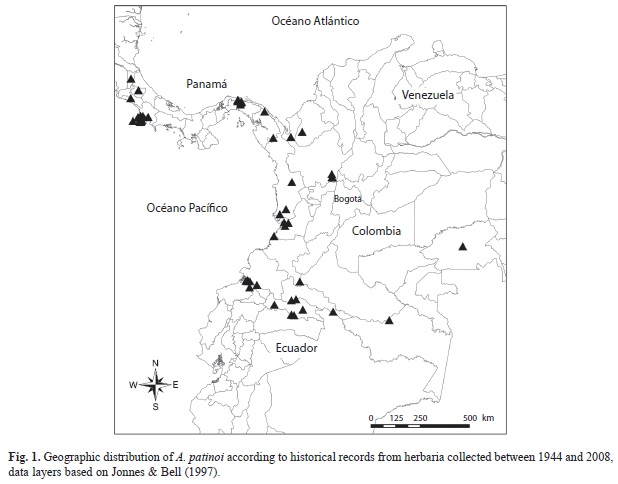
<body><![CDATA[have <span style="font-style: italic;">A. patinoi</span> specimens     collected&nbsp; between&nbsp; 1944&nbsp;     and&nbsp; 2008,&nbsp; this&nbsp; species is distributed along the     American Tropical rainforest (<span style="font-style: italic;">sensu </span>Primack     &amp; Corlett 2005) from     Costa Rica to Northern Ecuador, crossing the Choc&oacute; biogeographic     region and reappearing in the Colombian Amazon, separated from the     Choc&oacute; biogeographic by the Andean Mountains (<a      href="/img/revistas/rbt/v61n2/a06i1.jpg">Fig. 1</a>). In 90% of     the records, this species was registered between 0 and 330m, although     ]]></body>
<body><![CDATA[there were records up to 990m. Ripe fruits&nbsp; were&nbsp; found&nbsp;     year&nbsp; round,&nbsp; but&nbsp; the&nbsp; herbaria records of ripe     fruits were greater during January-February and September, which agrees     with the observations made in Guaim&iacute;a, Buenaventura, where     fruiting had two peaks.<br style="font-family: verdana;">     </span></font><br style="font-family: verdana;">     <font size="2"><span style="font-family: verdana;"><span      style="font-weight: bold;">Seed morphometrics: </span>The seeds     collected in Guaim&iacute;a, Buenaventura, measured 8.8&plusmn;1mm     length; 6.3&plusmn;0.8mm width; 3.6&plusmn;0.6mm thick; and a mass     ]]></body>
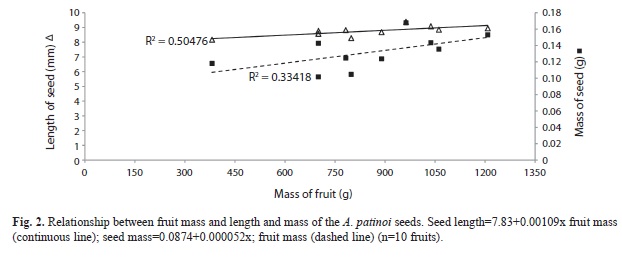
<body><![CDATA[0.13&plusmn;0.03g. Size and mass of seeds were relatively constant in     <span style="font-style: italic;">A. patinoi</span>, with low variation     coefficients within and among fruits.     However, these features varied slightly according to the variation of     fruit mass. Thus, the linear regression of the relationship between     fruit mass and seed length, and between fruit mass and seed mass were     very close to zero (<a href="/img/revistas/rbt/v61n2/a06i2.jpg">Fig. 2</a>).     The first relationship was substantially     linear (<span style="font-style: italic;">sensu </span>Davis 1971) and     statistically significant (p=0.021),     ]]></body>
<body><![CDATA[while the second one was moderately linear (<span      style="font-style: italic;">sensu </span>Davis 1971) and was     not&nbsp; statistically&nbsp; significant&nbsp; (p=0.08)&nbsp;     for&nbsp; the 10 fruits used.</span></font><br      style="font-family: verdana;">     <font size="2"></font><br style="font-family: verdana;">     <font size="2"><span style="font-family: verdana;">The size and mass of     the     seeds of <span style="font-style: italic;">A. patinoi</span> varied     slightly within and among fruits, while seed     ]]></body>
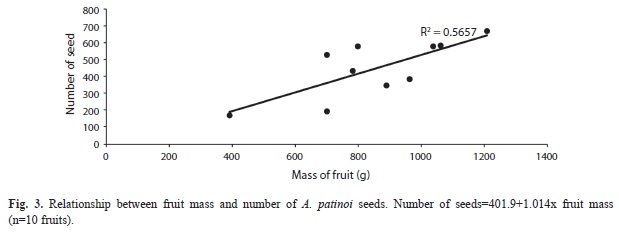
<body><![CDATA[number was highly variable and increased as fruit mass increased. The     relationship&nbsp; between&nbsp; fruit&nbsp; mass&nbsp; and&nbsp;     the&nbsp; number&nbsp; of seeds was positive, substantially linear     (<span style="font-style: italic;">sensu </span>Davis 1971), and     statistically significant (p=0.012) (<a      href="/img/revistas/rbt/v61n2/a06i3.jpg">Fig. 3</a>).</span></font><br      style="font-family: verdana;">     <font size="2"></font><br style="font-family: verdana;">     <font size="2"><span style="font-family: verdana;"><span      style="font-weight: bold;">Seed moisture content: </span><span     ]]></body>
<body><![CDATA[ style="font-style: italic;">A. patinoi</span>     seeds were released from the mother plant with high seed moisture     content (44.3&plusmn;0.8%). In consequence, seeds presented continuous     metabolism characteristic of recalcitrant species; these traits are     typical of non-pioneer seeds of tropical rain forest (Hong &amp; Ellis     1996, Baskin &amp; Baskin1998).</span></font><br      style="font-family: verdana;">     <font size="2"></font><br style="font-family: verdana;">     <font size="2"><span style="font-family: verdana;"><span      style="font-weight: bold;">Dormancy:</span> The germination of     ]]></body>
<body><![CDATA[recently harvested seeds was high (97%) and was not affected by     scarification (ANOVA, p=0.09). The mean germination time of unscarified     seeds&nbsp; was&nbsp; low&nbsp; (13.4d)&nbsp; (Dunnett,&nbsp;     p&lt;0.001) and less than that of scarified seeds (&gt;14.2d).     Therefore, this species does not exhibit primary dormancy (<span      style="font-style: italic;">sensu </span>Baskin     &amp; Baskin 1998).</span></font><br      style="font-family: verdana; font-weight: bold;">     <font style="font-weight: bold;" size="2"></font><br      style="font-family: verdana; font-weight: bold;">     ]]></body>
<body><![CDATA[<font size="2"><span style="font-family: verdana;"><span      style="font-weight: bold;">Determination of the ecological     group and germination dynamics:</span> The seed germination under both     alternating temperature regimes (20/30 vs. 25/30) and under all     lighting conditions, including continuous darkness, was&nbsp;     very&nbsp; high&nbsp; (96.7-99.0%).&nbsp; Further,&nbsp; there was no     difference in percentage germination among treatments with respect to     quality of light (ANOVA, p=0.773). Nor was there an interaction between     lighting condition and temperature&nbsp; (Two&nbsp; way ANOVA,&nbsp;     p=0.609). This means that <span style="font-style: italic;">A. patinoi</span>     ]]></body>
<body><![CDATA[behaves as an typical non-pioneer     species.</span></font><br style="font-family: verdana;">     <font size="2"></font><br style="font-family: verdana;">     <font size="2"><span style="font-family: verdana;">On the other hand,     temperature did     affect germination (ANOVA, p=0.016); the percent- age germination of     seeds incubated at 25/30&deg;C was greater than those incubated at     20/30&deg;C. Mean germination time was less at 25/30&deg;C than at     20/30&deg;C (13.1d or 14.6d, respectively; Student&#8217;s&nbsp;     t-test,&nbsp; p&lt;0.001).&nbsp; Germination&nbsp; rate was greater for     ]]></body>
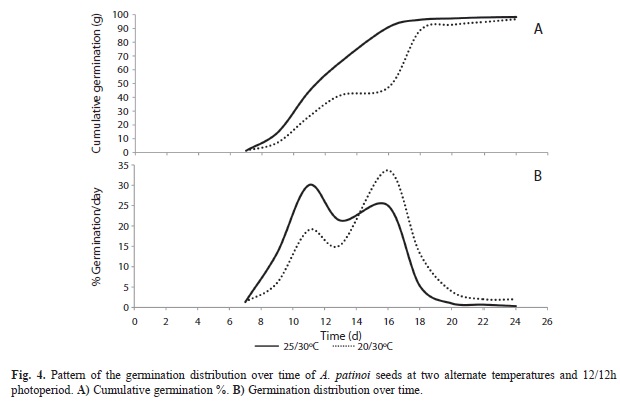
<body><![CDATA[seeds incubated at 25/30&deg;C than 20/30&deg;C(0.08 or 0.07 seeds/d,     respectively, Student&#8217;s t-test, p&lt;0.002). The synchrony index of     germination was not affected by temperature regime (p=0.773).</span></font><br      style="font-family: verdana;">     <font size="2"></font><br style="font-family: verdana;">     <font size="2"><span style="font-family: verdana;">The pattern of     germination     distribution over time (<a href="/img/revistas/rbt/v61n2/a06i4.jpg">Fig.     4</a>) allows us to understand the low     synchrony of germination under both temperature regimes, since seeds     ]]></body>
<body><![CDATA[did not germinate at the same time. Moreover, seeds had an intermittent     germination at both temperatures.</span></font><br      style="font-family: verdana;">     <font size="2"></font><br style="font-family: verdana;">     <font size="2"><span style="font-family: verdana;">The seeds began to     germinate on day     seven and ended on day 25th. Germination occurred intermittently with     two pulses of germination, on days 11th and 16th, one of rapid     germination and one of late germination. When seeds were incubated at     20/30&deg;C, the higher proportion of germination was on day 16th,     ]]></body>
<body><![CDATA[while at 25/30&deg;C the major pulse of germination occurred on day     11th.</span></font><br style="font-family: verdana;">     <font size="2"></font><br style="font-family: verdana;">     <font size="2"><span style="font-family: verdana;"><span      style="font-weight: bold;">Behavior&nbsp; of&nbsp; seeds&nbsp;     in&nbsp; storage:</span>&nbsp; <span style="font-style: italic;">A.&nbsp;     patinoi&nbsp;</span> seeds&nbsp; were&nbsp;     sensitive&nbsp; to&nbsp; desiccation&nbsp; and had recalcitrant storage     behavior. When seed moisture content was high (40.3%), the viability of     the seeds was high (98.8%), but when seed moisture content was below or     ]]></body>
<body><![CDATA[equal to 11%, the viability of seeds was drastically reduced and all     the seeds died. When seeds were stored at low temperatures (5&ordm;C)     for one month and seed moisture content was high (40.3%),&nbsp;     viability&nbsp; was&nbsp; reduced,&nbsp; and&nbsp; 18%&nbsp; of the     seeds died. In contrast, for seeds with high seed moisture content     (40.3%) and stored at extremely low temperatures (-20&ordm;C) for one     month the viability was lost entirely.</span></font><br      style="font-family: verdana;">     <font size="2"></font><br style="font-family: verdana;">     <font size="2"></font><br style="font-family: verdana;">     ]]></body>
<body><![CDATA[<font style="font-weight: bold;" size="3"><span      style="font-family: verdana;">Discussion</span></font><br      style="font-family: verdana;">     <font size="2"></font><br style="font-family: verdana;">     <font size="2"><span style="font-family: verdana;">Size and mass of     seeds are     relatively constant in the population of <span      style="font-style: italic;">A. patinoi </span>studied with slight     variation within a fruit and between fruits of different mass.     According to Baker (1972) and Foster &amp; Janson (1985), each     ]]></body>
<body><![CDATA[vegetation community has an optimal size of seeds that corresponds to     the most frequent size. However, phylogenetic, ontological, habitat,     and ecologic characteristics influence the size of the seeds, with a     range of sizes tending to a most frequent value. <span      style="font-style: italic;">A. patinoi</span> seeds are     within the range of size and mass of the tree species of mature     tropical rainforest (Ng 1978, Foster &amp; Janson1985).</span></font><br      style="font-family: verdana;">     <font size="2"></font><br style="font-family: verdana;">     <font size="2"><span style="font-family: verdana;"><span     ]]></body>
<body><![CDATA[ style="font-style: italic;">A. patinoi</span> seeds are released from     the mother plant with high moisture content (<span      style="font-style: italic;">ca</span>. 44%), continuous     metabolism, and have recalcitrant behavior. Therefore, <span      style="font-style: italic;">A. patinoi </span>would     be restricted to constantly humid locations, where its seeds are     protected from desiccation by a thick layer of leaf litter or by a     dense canopy. The high seed moisture content and continuous metabolism     favor rapid germination, given that the seeds are released ready to     germinate.</span></font><br style="font-family: verdana;">     ]]></body>
<body><![CDATA[<font size="2"></font><br style="font-family: verdana;">     <font size="2"><span style="font-family: verdana;">Percent germination     is high     (&gt;96%) and does not differ under the light conditions tested, nor do     temperature and light interact to affect germination. That is, seeds     germinate equally well in light or darkness, and they germinate at high     percentages under conditions of alternate temperatures with an     amplitude of 5 or 10&deg;C. Therefore, the seeds can germinate under     conditions of dense canopies and thick layers of leaf litter (low     red/far-red ratio and low temperature fluctuation) or buried (darkness     ]]></body>
<body><![CDATA[and low temperature fluctuation) in the tropical rainforest. This     germination behaviour makes <span style="font-style: italic;">A.     patinoi</span> a typical member of the     ecological group &#8220;non-pioneer species&#8221; in the sense of Swaine &amp;     Whitmore (1988), and the requirements of the seeds to germinate are     easily fulfilled under the specific conditions in the mature tropical     rainforest, favoring rapid germination.</span></font><br      style="font-family: verdana;">     <font size="2"></font><br style="font-family: verdana;">     <font size="2"><span style="font-family: verdana;">The low germination     ]]></body>
<body><![CDATA[synchrony under     both temperature regimes is caused by intermittent germination, and the     proportion of seeds germinating close to each peak differs with&nbsp;     temperature. Thus,&nbsp; when&nbsp; the&nbsp; seeds&nbsp; are incubated     at 25/30&deg;C, the proportion of seeds germinating around day 11th is     greater than the proportion germinating around day 16th.When they are     incubated at 20/30&deg;C the proportions were reversed. Therefore,     seeds germinate with higher percentage, faster and at a greater rate at     the alternate temperature of 25/30&deg;C, favored by the lower     amplitude (5&deg;C) or the closeness to the optimal temperature of     ]]></body>
<body><![CDATA[germination (mean&nbsp; 26.6&deg;C).&nbsp; This&nbsp; temperature&nbsp;     fluctuation is characteristic of soils of forests with dense vegetation     cover, indicating that <span style="font-style: italic;">A.     patinoi&nbsp;</span> germinates more efficiently in     shady forests than in clearings and forest gaps, confirming that the     species is a non-pioneer.</span></font><br style="font-family: verdana;">     <font size="2"></font><br style="font-family: verdana;">     <font size="2"><span style="font-family: verdana;">The physiological     characteristics     of <span style="font-style: italic;">A. patinoi</span> seeds are     ]]></body>
<body><![CDATA[typical of non-pioneer species of the tropical     rainforest. Consistent with this, more than 60% of the species from the     tropical rainforest do not have primary dormancy (Baskin &amp; Baskin     1998), and non-pioneer species from rainforests have recalcitrant seeds     regardless of the geographic location (Ng 1978, Hong &amp; Ellis 1996,     Baskin &amp; Baskin 1998).</span></font><br      style="font-family: verdana;">     <font size="2"></font><br style="font-family: verdana;">     <font size="2"><span style="font-family: verdana;">The&nbsp;     rapid&nbsp;     ]]></body>
<body><![CDATA[germination&nbsp; rate&nbsp; (<span style="font-style: italic;">sensu&nbsp;     </span>Ng 1978) is the establishment     strategy of <span style="font-style: italic;">A. patinoi</span>, and     this behaviour is favored by seed     physiological traits such as: (1) lack of primary dormancy; (2) ability     to germinate over a range of light conditions; and (3) recalcitrant     behavior,&nbsp; seeds&nbsp; with&nbsp; high&nbsp; moisture&nbsp;     content, and continuous metabolism. However, ability to germinate     rapidly depends on seeds being exposed to the high temperatures     characteristic of the shady tropical rainforest floor. This     ]]></body>
<body><![CDATA[establishment strategy is the most common in species of trees from the     mature tropical rain- forest, under which all the seeds germinate in a     short period of time, presenting high density of seedlings, not forming     banks of persistent seeds&nbsp; and&nbsp; not&nbsp; presenting&nbsp;     primary&nbsp; dormancy, along with low germination requirements (Ng     1978, V&aacute;zquez-Y&aacute;nez &amp; Orozco-Segovia 1993, Baskin     &amp; Baskin 1998).</span></font><br style="font-family: verdana;">     <font size="2"></font><br style="font-family: verdana;">     <font size="2"><span style="font-family: verdana;">In the mature     tropical rainforest,     ]]></body>
<body><![CDATA[seeds are commonly exposed to constantly high temperature and humidity     and low light intensities that favor the proliferation of pathogenic     microorganisms. Furthermore, in these locations seed predation is so     high that nearly half the seeds produced by over 90% of all the tree     species from the tropical forest die because of fungi and predators (Ng     1978, V&aacute;zques-Yanes &amp; Orozco-Segovia 1993, Dalling 2002,     Mantilla 2004). These conditions favor traits that allow seeds to     survive pathogen attacks but in detriment of the ability to expand to     new territories (Ng 1978, Augspurger 1984, V&aacute;zques-Yanes &amp;     Orozco-Segovia 1993).</span></font><br style="font-family: verdana;">     ]]></body>
<body><![CDATA[<font size="2"></font><br style="font-family: verdana;">     <font size="2"><span style="font-family: verdana;">One trait of seed     survival is rapid     germination, as it diminishes seed death by pathogenesis and predation     because it reduces the time spent as a seed, given that the nutritional     reservoir is greater for seeds than for seedlings. Besides,&nbsp;     seedlings&nbsp; are&nbsp; usually&nbsp; less&nbsp; susceptible to     parasitism and depredation, especially when the seedlings grow slowly     because their cell walls thicken rapidly (Augspurger 1984). In     addition, rapid germination increases the concentration of seedlings     ]]></body>
<body><![CDATA[producing a high offer that satiates the predators or leads them     towards the higher density of seedlings, generally near the mother     plant, allowing seeds to survive and establish themselves at the limit     of the dispersal area (Ng 1978).</span></font><br      style="font-family: verdana;">     <font size="2"></font><br style="font-family: verdana;">     <font size="2"><span style="font-family: verdana;">In conclusion, the     seed     physiological traits (i.e.,&nbsp; rapid&nbsp; germination&nbsp;     rate,&nbsp; low&nbsp; germination requirements, non-primary dormancy,     ]]></body>
<body><![CDATA[and recalcitrant behaviour) of <span style="font-style: italic;">A.     patinoi</span>, as well as seed size and     mass, suggest that this species&nbsp; is&nbsp; well&nbsp; adapted&nbsp;     to&nbsp; its&nbsp; mature&nbsp; tropical rain forest habitat. In     addition, this species is a typical member of the ecological group of     &#8220;non-pioneer species&#8221; in the sense of Swaine &amp; Whitmore (1988).</span></font><br      style="font-family: verdana;">     <font size="2"></font><br style="font-family: verdana;">     <font size="2"></font><br style="font-family: verdana;">     <font style="font-weight: bold;" size="3"><span     ]]></body>
<body><![CDATA[ style="font-family: verdana;">Acknowledgments</span></font><br      style="font-family: verdana;">     <font size="2"></font><br style="font-family: verdana;">     <font size="2"><span style="font-family: verdana;">We wish to thank the     community of     Guaim&iacute;a, Philip A. Silverstone Sopkin, Director of the CUVC     herbarium, Yan A. Ramos, director of the CHOCO herbarium, Mercedes     Andrade for her statistical advice, John Miles for reading the     manuscript, Jorge Rubiano for the mapping, the Group of Research on     Quantum Optics at the Universidad del Valle for the technical support,     ]]></body>
<body><![CDATA[Manuel Giraldo G., Aleyda Acosta, and the personnel from the CUVC     herbarium for their help and support, and COL- CIENCIAS and the Office     of the Governor of Valle del Cauca for funding this research.</span></font><br      style="font-family: verdana;">     <font size="2"></font><br style="font-family: verdana;">     <font size="2"></font>     <hr style="width: 100%; height: 2px;"><br style="font-family: verdana;">     <font style="font-weight: bold;" size="3"><span      style="font-family: verdana;">References</span></font><br      style="font-family: verdana;">     ]]></body>
<body><![CDATA[<font size="2"></font><br style="font-family: verdana;">     <font size="2"><span style="font-family: verdana;">Augspurger, C.K.     1984. Light     requirements of Neotropical tree seedlings: a comparative&nbsp; study     <!-- ref -->of growth and survival. J. Trop. Ecol. 72: 777-795.    &nbsp;&nbsp;&nbsp;&nbsp;&nbsp;&nbsp;&nbsp;&nbsp;[&#160;<a href="javascript:void(0);" onclick="javascript: window.open('/scielo.php?script=sci_nlinks&ref=1509021&pid=S0034-7744201300030000600001&lng=','','width=640,height=500,resizable=yes,scrollbars=1,menubar=yes,');">Links</a>&#160;]<!-- end-ref --><!-- ref --></span></font><br  style="font-family: verdana;"> <font size="2"></font><br style="font-family: verdana;"> <font size="2"><span style="font-family: verdana;">Baker, H.G. 1972. Seed mass in relation to environmental conditions in California. Ecology 53: 997-1010.    &nbsp;&nbsp;&nbsp;&nbsp;&nbsp;&nbsp;&nbsp;&nbsp;[&#160;<a href="javascript:void(0);" onclick="javascript: window.open('/scielo.php?script=sci_nlinks&ref=1509022&pid=S0034-7744201300030000600002&lng=','','width=640,height=500,resizable=yes,scrollbars=1,menubar=yes,');">Links</a>&#160;]<!-- end-ref --><!-- ref --></span></font><br style="font-family: verdana;"> <font size="2"></font><br style="font-family: verdana;"> <font size="2"><span style="font-family: verdana;">Baskin, C.C. &amp; J.M. Baskin. 1998. Seeds. Ecology, biogeography, and evolution of dormancy and germination. San Diego Academic, San Diego, USA.    &nbsp;&nbsp;&nbsp;&nbsp;&nbsp;&nbsp;&nbsp;&nbsp;[&#160;<a href="javascript:void(0);" onclick="javascript: window.open('/scielo.php?script=sci_nlinks&ref=1509023&pid=S0034-7744201300030000600003&lng=','','width=640,height=500,resizable=yes,scrollbars=1,menubar=yes,');">Links</a>&#160;]<!-- end-ref --><!-- ref --></span></font><br  style="font-family: verdana;"> <font size="2"></font><br style="font-family: verdana;"> <font size="2"><span style="font-family: verdana;">Benvenuti, S., M. Macchia &amp; S. Miele. 2001. Light, temperature and burial depth effects on <span  style="font-style: italic;">Rumex obtusifolius</span> seed germination. Weed Res. 41: 177-186.    &nbsp;&nbsp;&nbsp;&nbsp;&nbsp;&nbsp;&nbsp;&nbsp;[&#160;<a href="javascript:void(0);" onclick="javascript: window.open('/scielo.php?script=sci_nlinks&ref=1509024&pid=S0034-7744201300030000600004&lng=','','width=640,height=500,resizable=yes,scrollbars=1,menubar=yes,');">Links</a>&#160;]<!-- end-ref --><!-- ref --></span></font><br  style="font-family: verdana;"> <font size="2"></font><br style="font-family: verdana;"> <font size="2"><span style="font-family: verdana;">Dalling,&nbsp; J. 2002. Ecolog&iacute;a de semillas, p.&nbsp; 345-376 <span  style="font-style: italic;">In</span> M. Guariguata&nbsp; &amp; G. Kattan (eds.). Ecolog&iacute;a y&nbsp; conservaci&oacute;n&nbsp; de&nbsp; bosques&nbsp; Neotropicales.&nbsp; Ediciones&nbsp; LUR, Costa Rica.    &nbsp;&nbsp;&nbsp;&nbsp;&nbsp;&nbsp;&nbsp;&nbsp;[&#160;<a href="javascript:void(0);" onclick="javascript: window.open('/scielo.php?script=sci_nlinks&ref=1509025&pid=S0034-7744201300030000600005&lng=','','width=640,height=500,resizable=yes,scrollbars=1,menubar=yes,');">Links</a>&#160;]<!-- end-ref --><!-- ref --></span></font><br  style="font-family: verdana;"> <font size="2"></font><br style="font-family: verdana;"> <font size="2"><span style="font-family: verdana;">Davis,&nbsp; J.A. 1971. Elementary survey analysis.&nbsp; Prentice- Hall, Englewood, New York, USA.    &nbsp;&nbsp;&nbsp;&nbsp;&nbsp;&nbsp;&nbsp;&nbsp;[&#160;<a href="javascript:void(0);" onclick="javascript: window.open('/scielo.php?script=sci_nlinks&ref=1509026&pid=S0034-7744201300030000600006&lng=','','width=640,height=500,resizable=yes,scrollbars=1,menubar=yes,');">Links</a>&#160;]<!-- end-ref --><!-- ref --></span></font><br  style="font-family: verdana;"> <font size="2"></font><br style="font-family: verdana;"> <font size="2"><span style="font-family: verdana;">Espinal, L.S. &amp; E. Montenegro. 1963. Formaciones vegetales de Colombia. Memoria explicativa sobre el mapa ecol&oacute;gico. Instituto Geogr&aacute;fico Agust&iacute;n&nbsp;&nbsp; Codazzi, Bogot&aacute;, Colombia.    &nbsp;&nbsp;&nbsp;&nbsp;&nbsp;&nbsp;&nbsp;&nbsp;[&#160;<a href="javascript:void(0);" onclick="javascript: window.open('/scielo.php?script=sci_nlinks&ref=1509027&pid=S0034-7744201300030000600007&lng=','','width=640,height=500,resizable=yes,scrollbars=1,menubar=yes,');">Links</a>&#160;]<!-- end-ref --><!-- ref --></span></font><br  style="font-family: verdana;"> <font size="2"></font><br style="font-family: verdana;"> <font size="2"><span style="font-family: verdana;">Foster, S.A. &amp; C.H. Janson. 1985. The&nbsp; relationship between seed size and establishment conditions in tropical woody plants. Ecology 66: 773-780.    &nbsp;&nbsp;&nbsp;&nbsp;&nbsp;&nbsp;&nbsp;&nbsp;[&#160;<a href="javascript:void(0);" onclick="javascript: window.open('/scielo.php?script=sci_nlinks&ref=1509028&pid=S0034-7744201300030000600008&lng=','','width=640,height=500,resizable=yes,scrollbars=1,menubar=yes,');">Links</a>&#160;]<!-- end-ref --><!-- ref --></span></font><br  style="font-family: verdana;"> <font size="2"></font><br style="font-family: verdana;"> <font size="2"><span style="font-family: verdana;">Hong,&nbsp; T.D. &amp; R.H. Ellis. 1996. A protocol to&nbsp; determine seed storage behavior. Technical Bulletin N 1. International Plant Genetic Resources Institute, Italy.    &nbsp;&nbsp;&nbsp;&nbsp;&nbsp;&nbsp;&nbsp;&nbsp;[&#160;<a href="javascript:void(0);" onclick="javascript: window.open('/scielo.php?script=sci_nlinks&ref=1509029&pid=S0034-7744201300030000600009&lng=','','width=640,height=500,resizable=yes,scrollbars=1,menubar=yes,');">Links</a>&#160;]<!-- end-ref --><!-- ref --></span></font><br  style="font-family: verdana;"> <font size="2"></font><br style="font-family: verdana;"> <font size="2"><span style="font-family: verdana;">Instituto de Hidrolog&iacute;a, Meteorolog&iacute;a y Estudios Ambientales de Colombia (IDEAM). 2001. Atlas climatol&oacute;gico colombiano, Colombia. (Downloaded: April 10, 2008, http://www.ideam.gov.co/atlas/mclima.htm).    &nbsp;&nbsp;&nbsp;&nbsp;&nbsp;&nbsp;&nbsp;&nbsp;[&#160;<a href="javascript:void(0);" onclick="javascript: window.open('/scielo.php?script=sci_nlinks&ref=1509030&pid=S0034-7744201300030000600010&lng=','','width=640,height=500,resizable=yes,scrollbars=1,menubar=yes,');">Links</a>&#160;]<!-- end-ref --><!-- ref --></span></font><br  style="font-family: verdana;"> <font size="2"></font><br style="font-family: verdana;"> <font size="2"><span style="font-family: verdana;">International&nbsp; Seed&nbsp; Testing&nbsp; Association&nbsp;&nbsp; (ISTA).&nbsp;&nbsp; 1999. Rules. Proceedings of the International Seed Testing Association. Seed Sci. Technol. 27. Supplement.    &nbsp;&nbsp;&nbsp;&nbsp;&nbsp;&nbsp;&nbsp;&nbsp;[&#160;<a href="javascript:void(0);" onclick="javascript: window.open('/scielo.php?script=sci_nlinks&ref=1509031&pid=S0034-7744201300030000600011&lng=','','width=640,height=500,resizable=yes,scrollbars=1,menubar=yes,');">Links</a>&#160;]<!-- end-ref --><!-- ref --></span></font><br style="font-family: verdana;"> <font size="2"></font><br style="font-family: verdana;"> <font size="2"><span style="font-family: verdana;">Jonnes,&nbsp; P.G. &amp; W.C. Bell. 1997. Cobertura&nbsp; de&nbsp; Am&eacute;rica Latina.&nbsp; Divisi&oacute;n Administrativa.&nbsp; Versi&oacute;n&nbsp; 1.1 Abril 1997 Formato Digital. CIAT, Cali, Colombia.    &nbsp;&nbsp;&nbsp;&nbsp;&nbsp;&nbsp;&nbsp;&nbsp;[&#160;<a href="javascript:void(0);" onclick="javascript: window.open('/scielo.php?script=sci_nlinks&ref=1509032&pid=S0034-7744201300030000600012&lng=','','width=640,height=500,resizable=yes,scrollbars=1,menubar=yes,');">Links</a>&#160;]<!-- end-ref --><!-- ref --></span></font><br  style="font-family: verdana;"> <font size="2"></font><br style="font-family: verdana;"> <font size="2"><span style="font-family: verdana;">Kuehl, R. 2001. Dise&ntilde;o de Experimentos. Thomson-Learning, M&eacute;xico D.F., M&eacute;xico.    &nbsp;&nbsp;&nbsp;&nbsp;&nbsp;&nbsp;&nbsp;&nbsp;[&#160;<a href="javascript:void(0);" onclick="javascript: window.open('/scielo.php?script=sci_nlinks&ref=1509033&pid=S0034-7744201300030000600013&lng=','','width=640,height=500,resizable=yes,scrollbars=1,menubar=yes,');">Links</a>&#160;]<!-- end-ref --><!-- ref --><br> <br style="font-family: verdana;"> </span></font><font size="2"><span style="font-family: verdana;">Mantilla, A. 2004. Ecofisiolog&iacute;a de la&nbsp; germinaci&oacute;n&nbsp; de semillas, p. 901-922. <span style="font-style: italic;">In</span>&nbsp; M.J. Reigosa, N. Pedrol &amp; S.A. Sanchez-Moreira (eds.). La ecofisiolog&iacute;a vegetal: una ciencia de s&iacute;ntesis. Thomson, Espa&ntilde;a.    &nbsp;&nbsp;&nbsp;&nbsp;&nbsp;&nbsp;&nbsp;&nbsp;[&#160;<a href="javascript:void(0);" onclick="javascript: window.open('/scielo.php?script=sci_nlinks&ref=1509034&pid=S0034-7744201300030000600014&lng=','','width=640,height=500,resizable=yes,scrollbars=1,menubar=yes,');">Links</a>&#160;]<!-- end-ref --><!-- ref --></span></font><br  style="font-family: verdana;"> <font size="2"></font><br style="font-family: verdana;"> <font size="2"><span style="font-family: verdana;">Martinez-Ramos,&nbsp; M. &amp; A. Soto-Castro. 1993.&nbsp; Seed rain and advanced regeneration in&nbsp; a&nbsp; tropical rain forest, p. 299-318. <span  style="font-style: italic;">In</span>&nbsp; T.H. Flemming &amp; A. Estrada (eds.). Frugivory and seed dispersal: Ecological and Evolutionary Aspects. Kluwer Academic, Belgium.    &nbsp;&nbsp;&nbsp;&nbsp;&nbsp;&nbsp;&nbsp;&nbsp;[&#160;<a href="javascript:void(0);" onclick="javascript: window.open('/scielo.php?script=sci_nlinks&ref=1509035&pid=S0034-7744201300030000600015&lng=','','width=640,height=500,resizable=yes,scrollbars=1,menubar=yes,');">Links</a>&#160;]<!-- end-ref --><!-- ref --></span></font><br  style="font-family: verdana;"> <font size="2"></font><br style="font-family: verdana;"> <font size="2"><span style="font-family: verdana;">Mendoza, H., B. Ram&iacute;rez &amp; L.C. Jim&eacute;nez. 2004. Rubiaceae de Colombia. Gu&iacute;a ilustrada de g&eacute;neros. Instituto de Investigaci&oacute;n de Recursos Biol&oacute;gicos Alexander von Humboldt, Bogot&aacute;, Colombia.    &nbsp;&nbsp;&nbsp;&nbsp;&nbsp;&nbsp;&nbsp;&nbsp;[&#160;<a href="javascript:void(0);" onclick="javascript: window.open('/scielo.php?script=sci_nlinks&ref=1509036&pid=S0034-7744201300030000600016&lng=','','width=640,height=500,resizable=yes,scrollbars=1,menubar=yes,');">Links</a>&#160;]<!-- end-ref --><!-- ref --></span></font><br style="font-family: verdana;"> <font size="2"></font><br style="font-family: verdana;"> <font size="2"><span style="font-family: verdana;">Ng,&nbsp; F.S.P. 1978. Strategies of establishment&nbsp; in&nbsp; Malayan forest trees, p. 129-162. <span style="font-style: italic;">In</span>&nbsp; P.B. Tomlinson &amp; M.H. Zimmerman (eds.). Tropical trees as living systems. Cambridge University, Cambridge, United Kingdom.    &nbsp;&nbsp;&nbsp;&nbsp;&nbsp;&nbsp;&nbsp;&nbsp;[&#160;<a href="javascript:void(0);" onclick="javascript: window.open('/scielo.php?script=sci_nlinks&ref=1509037&pid=S0034-7744201300030000600017&lng=','','width=640,height=500,resizable=yes,scrollbars=1,menubar=yes,');">Links</a>&#160;]<!-- end-ref --><!-- ref --></span></font><br  style="font-family: verdana;"> <font size="2"></font><br style="font-family: verdana;"> <font size="2"><span style="font-family: verdana;">Orozco-Segovia, A., C. Sanchez-Coronado &amp; C. Vasquez- Yanes. 1993. Light&nbsp; environment&nbsp; and phytochrome- controlled germination in <span  style="font-style: italic;">Piper auritum</span>. Funct. Ecol. 7: 585-590.    &nbsp;&nbsp;&nbsp;&nbsp;&nbsp;&nbsp;&nbsp;&nbsp;[&#160;<a href="javascript:void(0);" onclick="javascript: window.open('/scielo.php?script=sci_nlinks&ref=1509038&pid=S0034-7744201300030000600018&lng=','','width=640,height=500,resizable=yes,scrollbars=1,menubar=yes,');">Links</a>&#160;]<!-- end-ref --><!-- ref --></span></font><br  style="font-family: verdana;"> <font size="2"></font><br style="font-family: verdana;"> <font size="2"><span style="font-family: verdana;">Paine,&nbsp; C.E.T. &amp; H. Beck. 2007. Seed&nbsp; predation by neo- tropical rain forest&nbsp; mammals increases diversity in seedling recruitment. Ecology 88: 3076-3087.    &nbsp;&nbsp;&nbsp;&nbsp;&nbsp;&nbsp;&nbsp;&nbsp;[&#160;<a href="javascript:void(0);" onclick="javascript: window.open('/scielo.php?script=sci_nlinks&ref=1509039&pid=S0034-7744201300030000600019&lng=','','width=640,height=500,resizable=yes,scrollbars=1,menubar=yes,');">Links</a>&#160;]<!-- end-ref --><!-- ref --></span></font><br  style="font-family: verdana;"> <font size="2"></font><br style="font-family: verdana;"> <font size="2"><span style="font-family: verdana;">Pati&ntilde;o,&nbsp; V.M. 2002. Historia y dispersi&oacute;n de&nbsp; los frutales nativos del neotr&oacute;pico. Centro Internacional de Agricultura Tropical, Cali, Colombia.    &nbsp;&nbsp;&nbsp;&nbsp;&nbsp;&nbsp;&nbsp;&nbsp;[&#160;<a href="javascript:void(0);" onclick="javascript: window.open('/scielo.php?script=sci_nlinks&ref=1509040&pid=S0034-7744201300030000600020&lng=','','width=640,height=500,resizable=yes,scrollbars=1,menubar=yes,');">Links</a>&#160;]<!-- end-ref --><!-- ref --></span></font><br style="font-family: verdana;"> <font size="2"></font><br style="font-family: verdana;"> <font size="2"><span style="font-family: verdana;">Paz,&nbsp; H., S.J. Mazer &amp; M. Martinez-Ramos.&nbsp; 1999. Seed mass, seedling emergence, and environmental factors in seven rain forest Psychotria (Rubiaceae). Ecology 80: 1594-1606.    &nbsp;&nbsp;&nbsp;&nbsp;&nbsp;&nbsp;&nbsp;&nbsp;[&#160;<a href="javascript:void(0);" onclick="javascript: window.open('/scielo.php?script=sci_nlinks&ref=1509041&pid=S0034-7744201300030000600021&lng=','','width=640,height=500,resizable=yes,scrollbars=1,menubar=yes,');">Links</a>&#160;]<!-- end-ref --><!-- ref --></span></font><br style="font-family: verdana;"> <font size="2"></font><br style="font-family: verdana;"> <font size="2"><span style="font-family: verdana;">Poorter, L. &amp; S.A. Rose. 2005.&nbsp; Light-dependent changes in the&nbsp; relationship between seed mass and&nbsp; seedling traits:&nbsp; a&nbsp; meta-analysis&nbsp; for&nbsp; rain&nbsp; forest&nbsp; tree&nbsp; species. Oecologia 142: 378-387.    &nbsp;&nbsp;&nbsp;&nbsp;&nbsp;&nbsp;&nbsp;&nbsp;[&#160;<a href="javascript:void(0);" onclick="javascript: window.open('/scielo.php?script=sci_nlinks&ref=1509042&pid=S0034-7744201300030000600022&lng=','','width=640,height=500,resizable=yes,scrollbars=1,menubar=yes,');">Links</a>&#160;]<!-- end-ref --><!-- ref --></span></font><br style="font-family: verdana;"> <font size="2"></font><br style="font-family: verdana;"> <font size="2"><span style="font-family: verdana;">Primack,&nbsp; R. &amp; R. Corlett. 2005. Tropical rain&nbsp; forests: an ecological&nbsp; and&nbsp; biogeographical&nbsp; comparison.&nbsp; Blackwell Science, Oxford, United Kingdom.    &nbsp;&nbsp;&nbsp;&nbsp;&nbsp;&nbsp;&nbsp;&nbsp;[&#160;<a href="javascript:void(0);" onclick="javascript: window.open('/scielo.php?script=sci_nlinks&ref=1509043&pid=S0034-7744201300030000600023&lng=','','width=640,height=500,resizable=yes,scrollbars=1,menubar=yes,');">Links</a>&#160;]<!-- end-ref --><!-- ref --></span></font><br style="font-family: verdana;"> <font size="2"></font><br style="font-family: verdana;"> <font size="2"><span style="font-family: verdana;">Ranal, M.A. &amp; D.G. Santana. 2006. How and why to measure the germination&nbsp; process? Rev. Bras. Bot&acirc;nica 29: 1-11.    &nbsp;&nbsp;&nbsp;&nbsp;&nbsp;&nbsp;&nbsp;&nbsp;[&#160;<a href="javascript:void(0);" onclick="javascript: window.open('/scielo.php?script=sci_nlinks&ref=1509044&pid=S0034-7744201300030000600024&lng=','','width=640,height=500,resizable=yes,scrollbars=1,menubar=yes,');">Links</a>&#160;]<!-- end-ref --><!-- ref --></span></font><br  style="font-family: verdana;"> <font size="2"></font><br style="font-family: verdana;"> <font size="2"><span style="font-family: verdana;">Souza, R.P. &amp; I.F.M. Valio. 2001. Seed size, seed germination, and seedling survival of Brazilian tropical tree species differing&nbsp; in successional status. Biotropica 33: 447-457.    &nbsp;&nbsp;&nbsp;&nbsp;&nbsp;&nbsp;&nbsp;&nbsp;[&#160;<a href="javascript:void(0);" onclick="javascript: window.open('/scielo.php?script=sci_nlinks&ref=1509045&pid=S0034-7744201300030000600025&lng=','','width=640,height=500,resizable=yes,scrollbars=1,menubar=yes,');">Links</a>&#160;]<!-- end-ref --><!-- ref --></span></font><br style="font-family: verdana;"> <font size="2"></font><br style="font-family: verdana;"> <font size="2"><span style="font-family: verdana;">Svenning,&nbsp; J.C. 2000. Small canopy gaps&nbsp; influence plant distributions in the rain forest understory. Biotropica 32: 252-261.    &nbsp;&nbsp;&nbsp;&nbsp;&nbsp;&nbsp;&nbsp;&nbsp;[&#160;<a href="javascript:void(0);" onclick="javascript: window.open('/scielo.php?script=sci_nlinks&ref=1509046&pid=S0034-7744201300030000600026&lng=','','width=640,height=500,resizable=yes,scrollbars=1,menubar=yes,');">Links</a>&#160;]<!-- end-ref --><!-- ref --></span></font><br  style="font-family: verdana;"> <font size="2"></font><br style="font-family: verdana;"> <font size="2"><span style="font-family: verdana;">Svenning,&nbsp; J.C. &amp; J .Wright. 2005. Seed&nbsp; limitation in a Panamanian forest. J. Ecol. 93: 853-862.    &nbsp;&nbsp;&nbsp;&nbsp;&nbsp;&nbsp;&nbsp;&nbsp;[&#160;<a href="javascript:void(0);" onclick="javascript: window.open('/scielo.php?script=sci_nlinks&ref=1509047&pid=S0034-7744201300030000600027&lng=','','width=640,height=500,resizable=yes,scrollbars=1,menubar=yes,');">Links</a>&#160;]<!-- end-ref --><!-- ref --></span></font><br style="font-family: verdana;"> <font size="2"></font><br style="font-family: verdana;"> <font size="2"><span style="font-family: verdana;">Swaine, M.D. &amp; T.C. Whitmore. 1988. On the definition of ecological species groups in Tropical Rain forest. Vegetatio 75: 81-86.    &nbsp;&nbsp;&nbsp;&nbsp;&nbsp;&nbsp;&nbsp;&nbsp;[&#160;<a href="javascript:void(0);" onclick="javascript: window.open('/scielo.php?script=sci_nlinks&ref=1509048&pid=S0034-7744201300030000600028&lng=','','width=640,height=500,resizable=yes,scrollbars=1,menubar=yes,');">Links</a>&#160;]<!-- end-ref --><!-- ref --></span></font><br  style="font-family: verdana;"> <font size="2"></font><br style="font-family: verdana;"> <font size="2"><span style="font-family: verdana;">Thiers,&nbsp; B. 2012. Index Herbariorum: A&nbsp; global directory of public herbaria and&nbsp; associated staff. New York Botanical Garden&#8217;s Virtual Herbarium. (Downloaded: June 24, 2012, http://sweetgum.nybg.org/ih/).    &nbsp;&nbsp;&nbsp;&nbsp;&nbsp;&nbsp;&nbsp;&nbsp;[&#160;<a href="javascript:void(0);" onclick="javascript: window.open('/scielo.php?script=sci_nlinks&ref=1509049&pid=S0034-7744201300030000600029&lng=','','width=640,height=500,resizable=yes,scrollbars=1,menubar=yes,');">Links</a>&#160;]<!-- end-ref --><!-- ref --></span></font><br  style="font-family: verdana;"> <font size="2"></font><br style="font-family: verdana;"> <font size="2"><span style="font-family: verdana;">Vazquez-Yanes, C. &amp; A. Orozco-Segovia. 1993. Patterns of seed longevity and germination in the tropical rainforest. Ann. Rev. Ecol. Syst. 24: 69-87.    &nbsp;&nbsp;&nbsp;&nbsp;&nbsp;&nbsp;&nbsp;&nbsp;[&#160;<a href="javascript:void(0);" onclick="javascript: window.open('/scielo.php?script=sci_nlinks&ref=1509050&pid=S0034-7744201300030000600030&lng=','','width=640,height=500,resizable=yes,scrollbars=1,menubar=yes,');">Links</a>&#160;]<!-- end-ref --><br>     <br> <a name="Correspondencia1"></a><a href="#Correspondencia2">*</a>Correspondencia:    <br> </span></font><font size="2"><span style="font-family: verdana;">Diego Fernando Escobar Escobar: </span></font><font size="2"><span  style="font-family: verdana;">Departamento de Biolog&iacute;a, Universidad del Valle, Ciudad Universitaria Mel&eacute;ndez, A.A.&nbsp; 25360, Cali, Colombia. barescoesco@gmail.com</span></font>    <br> <font size="2"><span style="font-family: verdana;">Alba Marina Torres G: </span></font><font size="2"><span style="font-family: verdana;">Departamento de Biolog&iacute;a, Universidad del Valle, Ciudad Universitaria Mel&eacute;ndez, A.A. 25360, Cali, Colombia. alba.torres@correounivalle.edu.com    <br> </span></font><font size="2"><span style="font-family: verdana;"><a  name="1"></a><a href="#3">1</a>. Departamento de Biolog&iacute;a, Universidad del Valle, Ciudad Universitaria Mel&eacute;ndez, A.A.&nbsp; 25360, Cali, Colombia; barescoesco@gmail.com</span></font><br  style="font-family: verdana;"> <font size="2"><span style="font-family: verdana;"><a name="2"></a><a  href="#4">2</a>. Departamento de Biolog&iacute;a, Universidad del Valle, Ciudad Universitaria Mel&eacute;ndez, A.A. 25360, Cali, Colombia; alba.torres@correounivalle.edu.com</span></font><br  style="font-family: verdana;"> <hr style="width: 100%; height: 2px;">     <div style="text-align: center;"><font style="font-weight: bold;"  size="2"><span style="font-family: verdana;">Received 16-IV-2012. Corrected 05-IX-2012. Accepted 03-X-2012. </span></font><br  style="font-family: verdana;"> </div> <font size="2"><span style="font-family: verdana;"> </span></font></div> </div>     ]]></body>
<body><![CDATA[ ]]></body><back>
<ref-list>
<ref id="B1">
<nlm-citation citation-type="journal">
<person-group person-group-type="author">
<name>
<surname><![CDATA[Augspurger]]></surname>
<given-names><![CDATA[C.K.]]></given-names>
</name>
</person-group>
<article-title xml:lang="en"><![CDATA[Light requirements of Neotropical tree seedlings:: a comparative study of growth and survival]]></article-title>
<source><![CDATA[J. Trop. Ecol.]]></source>
<year>1984</year>
<volume>72</volume>
<page-range>777-795</page-range></nlm-citation>
</ref>
<ref id="B2">
<nlm-citation citation-type="journal">
<person-group person-group-type="author">
<name>
<surname><![CDATA[Baker]]></surname>
<given-names><![CDATA[H.G.]]></given-names>
</name>
</person-group>
<article-title xml:lang="en"><![CDATA[Seed mass in relation to environmental conditions in California.]]></article-title>
<source><![CDATA[Ecology]]></source>
<year>1972</year>
<volume>53</volume>
<page-range>997-1010</page-range></nlm-citation>
</ref>
<ref id="B3">
<nlm-citation citation-type="book">
<person-group person-group-type="author">
<name>
<surname><![CDATA[Baskin]]></surname>
<given-names><![CDATA[C.C.]]></given-names>
</name>
<name>
<surname><![CDATA[Baskin]]></surname>
<given-names><![CDATA[J.M.]]></given-names>
</name>
</person-group>
<source><![CDATA[Seeds.: Ecology, biogeography, and evolution of dormancy and germination.]]></source>
<year>1998</year>
<publisher-loc><![CDATA[^eSan Diego San Diego]]></publisher-loc>
<publisher-name><![CDATA[San Diego Academic]]></publisher-name>
</nlm-citation>
</ref>
<ref id="B4">
<nlm-citation citation-type="journal">
<person-group person-group-type="author">
<name>
<surname><![CDATA[Benvenuti]]></surname>
<given-names><![CDATA[S.]]></given-names>
</name>
<name>
<surname><![CDATA[Macchia]]></surname>
<given-names><![CDATA[M.]]></given-names>
</name>
<name>
<surname><![CDATA[Miele]]></surname>
<given-names><![CDATA[S.]]></given-names>
</name>
</person-group>
<article-title xml:lang="en"><![CDATA[Light, temperature and burial depth effects on Rumex obtusifolius seed germination.]]></article-title>
<source><![CDATA[Weed Res.]]></source>
<year>2001</year>
<volume>41</volume>
<page-range>177-186</page-range></nlm-citation>
</ref>
<ref id="B5">
<nlm-citation citation-type="book">
<person-group person-group-type="author">
<name>
<surname><![CDATA[Dalling]]></surname>
<given-names><![CDATA[J.]]></given-names>
</name>
</person-group>
<article-title xml:lang="es"><![CDATA[Ecología de semillas]]></article-title>
<person-group person-group-type="editor">
<name>
<surname><![CDATA[Guariguata]]></surname>
<given-names><![CDATA[M.]]></given-names>
</name>
<name>
<surname><![CDATA[Kattan]]></surname>
<given-names><![CDATA[G.]]></given-names>
</name>
</person-group>
<source><![CDATA[Ecología y conservación de bosques Neotropicales.]]></source>
<year>2002</year>
<page-range>345-376</page-range><publisher-name><![CDATA[Ediciones LUR]]></publisher-name>
</nlm-citation>
</ref>
<ref id="B6">
<nlm-citation citation-type="book">
<person-group person-group-type="author">
<name>
<surname><![CDATA[Davis]]></surname>
<given-names><![CDATA[J.A.]]></given-names>
</name>
</person-group>
<source><![CDATA[Elementary survey analysis.]]></source>
<year>1971</year>
<publisher-loc><![CDATA[Englewood^eNew York New York]]></publisher-loc>
<publisher-name><![CDATA[Prentice- Hall]]></publisher-name>
</nlm-citation>
</ref>
<ref id="B7">
<nlm-citation citation-type="book">
<person-group person-group-type="author">
<name>
<surname><![CDATA[Espinal]]></surname>
<given-names><![CDATA[L.S.]]></given-names>
</name>
<name>
<surname><![CDATA[Montenegro]]></surname>
<given-names><![CDATA[E.]]></given-names>
</name>
</person-group>
<source><![CDATA[Formaciones vegetales de Colombia.: Memoria explicativa sobre el mapa ecológico.]]></source>
<year>1963</year>
<publisher-loc><![CDATA[^eBogotá Bogotá]]></publisher-loc>
<publisher-name><![CDATA[Instituto Geográfico Agustín Codazzi]]></publisher-name>
</nlm-citation>
</ref>
<ref id="B8">
<nlm-citation citation-type="journal">
<person-group person-group-type="author">
<name>
<surname><![CDATA[Foster]]></surname>
<given-names><![CDATA[S.A.]]></given-names>
</name>
<name>
<surname><![CDATA[Janson]]></surname>
<given-names><![CDATA[C.H.]]></given-names>
</name>
</person-group>
<article-title xml:lang="en"><![CDATA[The relationship between seed size and establishment conditions in tropical woody plants.]]></article-title>
<source><![CDATA[Ecology]]></source>
<year>1985</year>
<volume>66</volume>
<page-range>773-780</page-range></nlm-citation>
</ref>
<ref id="B9">
<nlm-citation citation-type="book">
<person-group person-group-type="author">
<name>
<surname><![CDATA[Hong]]></surname>
<given-names><![CDATA[T.D.]]></given-names>
</name>
<name>
<surname><![CDATA[Ellis]]></surname>
<given-names><![CDATA[R.H.]]></given-names>
</name>
</person-group>
<source><![CDATA[A protocol to determine seed storage behavior.]]></source>
<year>1996</year>
<volume>1</volume>
<publisher-name><![CDATA[International Plant Genetic Resources Institute]]></publisher-name>
</nlm-citation>
</ref>
<ref id="B10">
<nlm-citation citation-type="">
<collab>Instituto de Hidrología, Meteorología y Estudios Ambientales de Colombia</collab>
<source><![CDATA[Atlas climatológico colombiano, Colombia.]]></source>
<year>2001</year>
</nlm-citation>
</ref>
<ref id="B11">
<nlm-citation citation-type="journal">
<collab>International Seed Testing Association</collab>
<article-title xml:lang="en"><![CDATA[Rules.: Proceedings of the International Seed Testing Association.]]></article-title>
<source><![CDATA[Seed Sci. Technol.]]></source>
<year>1999</year>
<volume>27</volume>
<page-range>Supplement</page-range></nlm-citation>
</ref>
<ref id="B12">
<nlm-citation citation-type="book">
<person-group person-group-type="author">
<name>
<surname><![CDATA[Jonnes]]></surname>
<given-names><![CDATA[P.G.]]></given-names>
</name>
<name>
<surname><![CDATA[Bell]]></surname>
<given-names><![CDATA[W.C.]]></given-names>
</name>
</person-group>
<source><![CDATA[Cobertura de América Latina.: División Administrativa]]></source>
<year>1997</year>
<publisher-loc><![CDATA[^eCali Cali]]></publisher-loc>
<publisher-name><![CDATA[CIAT]]></publisher-name>
</nlm-citation>
</ref>
<ref id="B13">
<nlm-citation citation-type="book">
<person-group person-group-type="author">
<name>
<surname><![CDATA[Kuehl]]></surname>
<given-names><![CDATA[R.]]></given-names>
</name>
</person-group>
<source><![CDATA[Diseño de Experimentos.]]></source>
<year>2001</year>
<publisher-loc><![CDATA[^eMéxico D.F. México D.F.]]></publisher-loc>
<publisher-name><![CDATA[Thomson-Learning]]></publisher-name>
</nlm-citation>
</ref>
<ref id="B14">
<nlm-citation citation-type="book">
<person-group person-group-type="author">
<name>
<surname><![CDATA[Mantilla]]></surname>
<given-names><![CDATA[A.]]></given-names>
</name>
</person-group>
<article-title xml:lang="es"><![CDATA[Ecofisiología de la germinación de semillas]]></article-title>
<person-group person-group-type="editor">
<name>
<surname><![CDATA[Reigosa]]></surname>
<given-names><![CDATA[M.J.]]></given-names>
</name>
<name>
<surname><![CDATA[Pedrol]]></surname>
<given-names><![CDATA[N.]]></given-names>
</name>
<name>
<surname><![CDATA[Sanchez-Moreira]]></surname>
<given-names><![CDATA[S.A.]]></given-names>
</name>
</person-group>
<source><![CDATA[La ecofisiología vegetal:: una ciencia de síntesis.]]></source>
<year>2004</year>
<page-range>901-922</page-range><publisher-name><![CDATA[Thomson]]></publisher-name>
</nlm-citation>
</ref>
<ref id="B15">
<nlm-citation citation-type="book">
<person-group person-group-type="author">
<name>
<surname><![CDATA[Martinez-Ramos]]></surname>
<given-names><![CDATA[M.]]></given-names>
</name>
<name>
<surname><![CDATA[Soto-Castro]]></surname>
<given-names><![CDATA[A.]]></given-names>
</name>
</person-group>
<article-title xml:lang="en"><![CDATA[Seed rain and advanced regeneration in a tropical rain forest]]></article-title>
<person-group person-group-type="editor">
<name>
<surname><![CDATA[Flemming]]></surname>
<given-names><![CDATA[.H.]]></given-names>
</name>
<name>
<surname><![CDATA[Estrada]]></surname>
<given-names><![CDATA[A.]]></given-names>
</name>
</person-group>
<source><![CDATA[Frugivory and seed dispersal:: Ecological and Evolutionary Aspects.]]></source>
<year>1993</year>
<page-range>299-318</page-range><publisher-name><![CDATA[Kluwer Academic]]></publisher-name>
</nlm-citation>
</ref>
<ref id="B16">
<nlm-citation citation-type="book">
<person-group person-group-type="author">
<name>
<surname><![CDATA[Mendoza]]></surname>
<given-names><![CDATA[H.]]></given-names>
</name>
<name>
<surname><![CDATA[Ramírez]]></surname>
<given-names><![CDATA[B.]]></given-names>
</name>
<name>
<surname><![CDATA[Jiménez]]></surname>
<given-names><![CDATA[L.C.]]></given-names>
</name>
</person-group>
<source><![CDATA[Rubiaceae de Colombia.: Guía ilustrada de géneros.]]></source>
<year>2004</year>
<publisher-loc><![CDATA[^eBogotá Bogotá]]></publisher-loc>
<publisher-name><![CDATA[Instituto de Investigación de Recursos Biológicos Alexander von Humboldt]]></publisher-name>
</nlm-citation>
</ref>
<ref id="B17">
<nlm-citation citation-type="book">
<person-group person-group-type="author">
<name>
<surname><![CDATA[Ng]]></surname>
<given-names><![CDATA[F.S.P.]]></given-names>
</name>
</person-group>
<article-title xml:lang="en"><![CDATA[Strategies of establishment in Malayan forest trees]]></article-title>
<person-group person-group-type="editor">
<name>
<surname><![CDATA[Tomlinson]]></surname>
<given-names><![CDATA[P.B.]]></given-names>
</name>
<name>
<surname><![CDATA[Zimmerman]]></surname>
<given-names><![CDATA[M.H.]]></given-names>
</name>
</person-group>
<source><![CDATA[Tropical trees as living systems.]]></source>
<year>1978</year>
<page-range>129-162</page-range><publisher-loc><![CDATA[^eCambridge Cambridge]]></publisher-loc>
<publisher-name><![CDATA[Cambridge University]]></publisher-name>
</nlm-citation>
</ref>
<ref id="B18">
<nlm-citation citation-type="journal">
<person-group person-group-type="author">
<name>
<surname><![CDATA[Orozco-Segovia]]></surname>
<given-names><![CDATA[A.]]></given-names>
</name>
<name>
<surname><![CDATA[Sanchez-Coronado]]></surname>
<given-names><![CDATA[C.]]></given-names>
</name>
<name>
<surname><![CDATA[Vasquez- Yanes]]></surname>
<given-names><![CDATA[C.]]></given-names>
</name>
</person-group>
<article-title xml:lang="en"><![CDATA[Light environment and phytochrome- controlled germination in Piper auritum.]]></article-title>
<source><![CDATA[Funct. Ecol.]]></source>
<year>1993</year>
<volume>7</volume>
<page-range>585-590</page-range></nlm-citation>
</ref>
<ref id="B19">
<nlm-citation citation-type="journal">
<person-group person-group-type="author">
<name>
<surname><![CDATA[Paine]]></surname>
<given-names><![CDATA[C.E.T.]]></given-names>
</name>
<name>
<surname><![CDATA[Beck]]></surname>
<given-names><![CDATA[H.]]></given-names>
</name>
</person-group>
<article-title xml:lang="en"><![CDATA[Seed predation by neo- tropical rain forest mammals increases diversity in seedling recruitment.]]></article-title>
<source><![CDATA[Ecology]]></source>
<year>2007</year>
<volume>88</volume>
<page-range>3076-3087</page-range></nlm-citation>
</ref>
<ref id="B20">
<nlm-citation citation-type="book">
<person-group person-group-type="author">
<name>
<surname><![CDATA[Patiño]]></surname>
<given-names><![CDATA[V.M.]]></given-names>
</name>
</person-group>
<source><![CDATA[Historia y dispersión de los frutales nativos del neotrópico.]]></source>
<year>2002</year>
<publisher-loc><![CDATA[^eCali Cali]]></publisher-loc>
<publisher-name><![CDATA[Centro Internacional de Agricultura Tropical]]></publisher-name>
</nlm-citation>
</ref>
<ref id="B21">
<nlm-citation citation-type="journal">
<person-group person-group-type="author">
<name>
<surname><![CDATA[Paz]]></surname>
<given-names><![CDATA[H.]]></given-names>
</name>
<name>
<surname><![CDATA[Mazer]]></surname>
<given-names><![CDATA[S.J.]]></given-names>
</name>
<name>
<surname><![CDATA[Martinez-Ramos]]></surname>
<given-names><![CDATA[M.]]></given-names>
</name>
</person-group>
<article-title xml:lang="en"><![CDATA[Seed mass, seedling emergence, and environmental factors in seven rain forest Psychotria (Rubiaceae).]]></article-title>
<source><![CDATA[Ecology]]></source>
<year>1999</year>
<volume>80</volume>
<page-range>1594-1606</page-range></nlm-citation>
</ref>
<ref id="B22">
<nlm-citation citation-type="journal">
<person-group person-group-type="author">
<name>
<surname><![CDATA[Poorter]]></surname>
<given-names><![CDATA[L.]]></given-names>
</name>
<name>
<surname><![CDATA[Rose]]></surname>
<given-names><![CDATA[S.A.]]></given-names>
</name>
</person-group>
<article-title xml:lang="en"><![CDATA[Light-dependent changes in the relationship between seed mass and seedling traits:: a meta-analysis for rain forest tree species.]]></article-title>
<source><![CDATA[Oecologia]]></source>
<year>2005</year>
<volume>142</volume>
<page-range>378-387</page-range></nlm-citation>
</ref>
<ref id="B23">
<nlm-citation citation-type="book">
<person-group person-group-type="author">
<name>
<surname><![CDATA[Primack]]></surname>
<given-names><![CDATA[R.]]></given-names>
</name>
<name>
<surname><![CDATA[Corlett]]></surname>
<given-names><![CDATA[R.]]></given-names>
</name>
</person-group>
<source><![CDATA[Tropical rain forests:: an ecological and biogeographical comparison.]]></source>
<year>2005</year>
<publisher-loc><![CDATA[^eOxford Oxford]]></publisher-loc>
<publisher-name><![CDATA[Blackwell Science]]></publisher-name>
</nlm-citation>
</ref>
<ref id="B24">
<nlm-citation citation-type="journal">
<person-group person-group-type="author">
<name>
<surname><![CDATA[Ranal]]></surname>
<given-names><![CDATA[M.A.]]></given-names>
</name>
<name>
<surname><![CDATA[Santana]]></surname>
<given-names><![CDATA[D.G.]]></given-names>
</name>
</person-group>
<article-title xml:lang="en"><![CDATA[How and why to measure the germination process?]]></article-title>
<source><![CDATA[Rev. Bras. Botânica]]></source>
<year>2006</year>
<volume>29</volume>
<page-range>1-11.</page-range></nlm-citation>
</ref>
<ref id="B25">
<nlm-citation citation-type="journal">
<person-group person-group-type="author">
<name>
<surname><![CDATA[Souza]]></surname>
<given-names><![CDATA[R.P.]]></given-names>
</name>
<name>
<surname><![CDATA[Valio]]></surname>
<given-names><![CDATA[I.F.M.]]></given-names>
</name>
</person-group>
<article-title xml:lang="en"><![CDATA[Seed size, seed germination, and seedling survival of Brazilian tropical tree species differing in successional status.]]></article-title>
<source><![CDATA[Biotropica]]></source>
<year>2001</year>
<volume>33</volume>
<page-range>447-457</page-range></nlm-citation>
</ref>
<ref id="B26">
<nlm-citation citation-type="journal">
<person-group person-group-type="author">
<name>
<surname><![CDATA[Svenning]]></surname>
<given-names><![CDATA[J.C.]]></given-names>
</name>
</person-group>
<article-title xml:lang="en"><![CDATA[Small canopy gaps influence plant distributions in the rain forest understory.]]></article-title>
<source><![CDATA[Biotropica]]></source>
<year>2000</year>
<volume>32</volume>
<page-range>252-261</page-range></nlm-citation>
</ref>
<ref id="B27">
<nlm-citation citation-type="journal">
<person-group person-group-type="author">
<name>
<surname><![CDATA[Svenning]]></surname>
<given-names><![CDATA[J.C.]]></given-names>
</name>
<name>
<surname><![CDATA[Wright]]></surname>
<given-names><![CDATA[J .]]></given-names>
</name>
</person-group>
<article-title xml:lang="en"><![CDATA[Seed limitation in a Panamanian forest.]]></article-title>
<source><![CDATA[J. Ecol.]]></source>
<year>2005</year>
<volume>93</volume>
<page-range>853-862</page-range></nlm-citation>
</ref>
<ref id="B28">
<nlm-citation citation-type="journal">
<person-group person-group-type="author">
<name>
<surname><![CDATA[Swaine]]></surname>
<given-names><![CDATA[M.D.]]></given-names>
</name>
<name>
<surname><![CDATA[Whitmore]]></surname>
<given-names><![CDATA[T.C.]]></given-names>
</name>
</person-group>
<article-title xml:lang="en"><![CDATA[On the definition of ecological species groups in Tropical Rain forest.]]></article-title>
<source><![CDATA[Vegetatio]]></source>
<year>1988</year>
<volume>75</volume>
<page-range>81-86</page-range></nlm-citation>
</ref>
<ref id="B29">
<nlm-citation citation-type="book">
<person-group person-group-type="author">
<name>
<surname><![CDATA[Thiers]]></surname>
<given-names><![CDATA[B.]]></given-names>
</name>
</person-group>
<source><![CDATA[Index Herbariorum:: A global directory of public herbaria and associated staff.]]></source>
<year>2012</year>
<publisher-name><![CDATA[New York Botanical Garden&#8217;s Virtual Herbarium.]]></publisher-name>
</nlm-citation>
</ref>
<ref id="B30">
<nlm-citation citation-type="journal">
<person-group person-group-type="author">
<name>
<surname><![CDATA[Vazquez-Yanes]]></surname>
<given-names><![CDATA[C.]]></given-names>
</name>
<name>
<surname><![CDATA[Orozco-Segovia]]></surname>
<given-names><![CDATA[A.]]></given-names>
</name>
</person-group>
<article-title xml:lang="en"><![CDATA[Patterns of seed longevity and germination in the tropical rainforest.]]></article-title>
<source><![CDATA[Ann. Rev. Ecol. Syst.]]></source>
<year>1993</year>
<volume>24</volume>
<page-range>69-87</page-range></nlm-citation>
</ref>
</ref-list>
</back>
</article>