<?xml version="1.0" encoding="ISO-8859-1"?><article xmlns:mml="http://www.w3.org/1998/Math/MathML" xmlns:xlink="http://www.w3.org/1999/xlink" xmlns:xsi="http://www.w3.org/2001/XMLSchema-instance">
<front>
<journal-meta>
<journal-id>0034-7744</journal-id>
<journal-title><![CDATA[Revista de Biología Tropical]]></journal-title>
<abbrev-journal-title><![CDATA[Rev. biol. trop]]></abbrev-journal-title>
<issn>0034-7744</issn>
<publisher>
<publisher-name><![CDATA[Universidad de Costa Rica]]></publisher-name>
</publisher>
</journal-meta>
<article-meta>
<article-id>S0034-77442013000100038</article-id>
<title-group>
<article-title xml:lang="en"><![CDATA[Cultivable bacterial diversity along the altitudinal zonation and vegetation range of tropical Eastern Himalaya]]></article-title>
</title-group>
<contrib-group>
<contrib contrib-type="author">
<name>
<surname><![CDATA[Lyngwi]]></surname>
<given-names><![CDATA[Nathaniel A.]]></given-names>
</name>
<xref ref-type="aff" rid="A01"/>
</contrib>
<contrib contrib-type="author">
<name>
<surname><![CDATA[Koijam]]></surname>
<given-names><![CDATA[Khedarani]]></given-names>
</name>
</contrib>
<contrib contrib-type="author">
<name>
<surname><![CDATA[Sharma]]></surname>
<given-names><![CDATA[D.]]></given-names>
</name>
<xref ref-type="aff" rid="A02"/>
</contrib>
<contrib contrib-type="author">
<name>
<surname><![CDATA[Joshi]]></surname>
<given-names><![CDATA[S. R.]]></given-names>
</name>
</contrib>
</contrib-group>
<aff id="A01">
<institution><![CDATA[,North-Eastern Hill University  ]]></institution>
<addr-line><![CDATA[ ]]></addr-line>
</aff>
<aff id="A02">
<institution><![CDATA[,North-Eastern Hill University  ]]></institution>
<addr-line><![CDATA[ ]]></addr-line>
</aff>
<pub-date pub-type="pub">
<day>00</day>
<month>03</month>
<year>2013</year>
</pub-date>
<pub-date pub-type="epub">
<day>00</day>
<month>03</month>
<year>2013</year>
</pub-date>
<volume>61</volume>
<numero>1</numero>
<fpage>467</fpage>
<lpage>490</lpage>
<copyright-statement/>
<copyright-year/>
<self-uri xlink:href="http://www.scielo.sa.cr/scielo.php?script=sci_arttext&amp;pid=S0034-77442013000100038&amp;lng=en&amp;nrm=iso"></self-uri><self-uri xlink:href="http://www.scielo.sa.cr/scielo.php?script=sci_abstract&amp;pid=S0034-77442013000100038&amp;lng=en&amp;nrm=iso"></self-uri><self-uri xlink:href="http://www.scielo.sa.cr/scielo.php?script=sci_pdf&amp;pid=S0034-77442013000100038&amp;lng=en&amp;nrm=iso"></self-uri><abstract abstract-type="short" xml:lang="en"><p><![CDATA[The Northeastern part of India sprawls over an area of 262 379km² in the Eastern Himalayan range. This constitutes a biodiversity hotspot with high levels of biodiversity and endemism; unfortunately, is also a poorly known area, especially on its microbial diversity. In this study, we assessed cultivable soil bacterial diversity and distribution from lowlands to highlands (34 to 3 990m.a.s.l.). Soil physico-chemical parameters and forest types across the different altitudes were characterized and correlated with bacterial distribution and diversity. Microbes from the soil samples were grown in Nutrient, Muller Hinton and Luria-Bertani agar plates and were initially characterized using biochemical methods. Parameters like dehydrogenase and urease activities, temperature, moisture content, pH, carbon content, bulk density of the sampled soil were measured for each site. Representative isolates were also subjected to 16S rDNA sequence analysis. A total of 155 cultivable bacterial isolates were characterized which were analyzed for richness, evenness and diversity indices. The tropical and sub-tropical forests supported higher bacterial diversity compared to temperate pine, temperate conifer, and sub-alpine rhododendron forests. The 16S rRNA phylogenetic analysis revealed that Firmicutes was the most common group followed by Proteobacteria and Bacteroidetes. Species belonging to the genera Bacillus and Pseudomonas were the most abundant. Bacterial CFU showed positive but insignificant correlation with soil parameters like pH (r=0.208), soil temperature (r=0.303), ambient temperature (r=0.443), soil carbon content (r=0.525), soil bulk density (r=0.268), soil urease (r=0.549) and soil dehydrogenase (r=0.492). Altitude (r=0.561) and soil moisture content (r=-0.051) showed negative correlation. Altitudinal gradient along with the vegetation and soil physico-chemical parameters were found to influence bacterial diversity and distribution. This study points out that this is a biome with a vast reservoir of bacteria which decrease with increasing altitudes, and highlights the microbiological importance of the poorly studied Eastern Himalayan range, justifying efforts to explore the prevalence of novel species in the biome.]]></p></abstract>
<abstract abstract-type="short" xml:lang="es"><p><![CDATA[La parte noreste de la India se extiende sobre una superficie de 262 379km² en la cordillera oriental del Himalaya. Es un punto de acceso con altos niveles de biodiversidad y endemismo; desafortunadamente, también es una zona poco conocida, sobre todo su diversidad microbiana. En este estudio se evaluó la diversidad de bacterias cultivables del suelo, su diversidad y distribución de las tierras bajas a las altas (34 a 3 990m.s.n.m). Se caracterizaron los parámetros físico-químicos del suelo y tipos de bosques a lo largo del gradiente altitudinal y se correlacionaron con la distribución y diversidad bacteriana. Los microbios del suelo se cultivaron en placas de agar enriquecido Muller Hinton y Luria-Bertani, e inicialmente se caracterizaron mediante métodos bioquímicos. Parámetros tales como actividad de la deshidrogenasa y ureasa, temperatura, contenido de humedad y de carbono, pH y densidad aparente del suelo se midieron en cada sitio. Aislamientos representativos también se sometieron al análisis secuencial de 16S rADN. Un total de 155 aislamientos bacterianos cultivables se caracterizaron para estimar los índices de riqueza, equidad y diversidad. Los bosques tropicales y subtropicales albergan una mayor diversidad bacteriana en comparación con los bosques templados de pino y coníferas, y los bosques subalpinos de rododendro. El análisis filogenético de 16S rARN reveló que Firmicutes fue el grupo más común, seguido de Proteobacteria y Bacteroidetes. Especies pertenecientes a los géneros Bacillus y Pseudomonas fueron las más abundantes. Las UFC bacterianas mostraron una positiva pero insignificante correlación con los parámetros del suelo, tales como pH (r=0.208), temperatura (r=0.303), temperatura ambiente (r=0.443), contenido de carbón (r=0.525), densidad aparente (r=0.268), ureasa (r=0.549) y deshidrogenasa (r=0.492). La altitud (r=-0.561) y el contenido de humedad del suelo (r=-0.051) mostraron una correlación negativa. Se encontró que el gradiente altitudinal, junto con la vegetación y los parámetros físico-químicos influyeron en la diversidad bacteriana y la distribución. Este estudio señala que este es un bioma con un vasto reservorio de bacterias que disminuyen con la altitud y pone en relieve la importancia microbiológica de la pobremente estudiada zona del este del Himalaya, lo que justifica los esfuerzos para explorar la prevalencia de nuevas especies en el bioma.]]></p></abstract>
<kwd-group>
<kwd lng="en"><![CDATA[cultivable bacteria]]></kwd>
<kwd lng="en"><![CDATA[Eastern Himalyan range]]></kwd>
<kwd lng="en"><![CDATA[tropical region]]></kwd>
<kwd lng="en"><![CDATA[altitude]]></kwd>
<kwd lng="en"><![CDATA[16S rRNA]]></kwd>
<kwd lng="en"><![CDATA[diversity indices]]></kwd>
<kwd lng="es"><![CDATA[bacterias cultivables]]></kwd>
<kwd lng="es"><![CDATA[zona del este del Himalaya]]></kwd>
<kwd lng="es"><![CDATA[región tropical]]></kwd>
<kwd lng="es"><![CDATA[altitud]]></kwd>
<kwd lng="es"><![CDATA[16S rARN]]></kwd>
<kwd lng="es"><![CDATA[índices de diversidad.]]></kwd>
</kwd-group>
</article-meta>
</front><body><![CDATA[ <div style="text-align: justify;">     <div style="text-align: center;"><font  style="font-family: verdana; font-weight: bold;" size="4">Cultivable bacterial diversity along the altitudinal zonation and vegetation range of tropical Eastern Himalaya</font>    <br> </div>     <br>     <div style="text-align: center;"><font style="font-family: verdana;"  size="2">Nathaniel A. Lyngwi<sup><a href="#1">1</a><a name="3"></a>*</sup>, Khedarani Koijam<a href="#1"><sup>1</sup></a>, D. Sharma<sup><a  href="#2">2</a><a name="4"></a>*</sup>&nbsp; &amp; S. R. Joshi<a href="#1"><sup>1</sup></a></font>    <br> </div>     <br> <font style="font-family: verdana;" size="-1"><a name="Correspondencia2"></a>*<a  href="#Correspondencia1">Direcci&oacute;n para correspondencia:</a></font>    <br> <hr style="width: 100%; height: 2px;"><font  style="font-family: verdana; font-weight: bold;" size="3">Abstract</font>    <br> <font style="font-family: verdana;" size="2"></font>    <br> <font style="font-family: verdana;" size="2">The Northeastern part of India sprawls over an area of 262 379km<sup>2</sup> in the Eastern Himalayan range. This constitutes a biodiversity hotspot with high levels of biodiversity and endemism; unfortunately, is also a poorly known area, especially on its microbial diversity. In this study, we assessed cultivable soil bacterial diversity and distribution from lowlands to highlands (34 to 3 990m.a.s.l.). Soil physico-chemical parameters and forest types across the different altitudes were characterized and correlated with bacterial distribution and diversity. Microbes from the soil samples were grown in Nutrient, Muller Hinton and Luria-Bertani agar plates and were initially characterized using biochemical methods. Parameters like dehydrogenase and urease activities, temperature, moisture content, pH, carbon content, bulk density of the sampled soil were measured for each site. Representative isolates were also subjected to 16S rDNA sequence analysis. A total of 155 cultivable bacterial isolates were characterized which were analyzed for richness, evenness and diversity indices. The tropical and sub-tropical forests supported higher bacterial diversity compared to temperate pine, temperate conifer, and sub-alpine rhododendron forests. The 16S rRNA phylogenetic analysis revealed that <span style="font-style: italic;">Firmicutes</span> was the most common group followed by <span style="font-style: italic;">Proteobacteria </span>and<span  style="font-style: italic;"> Bacteroidetes</span>. Species belonging to the genera <span style="font-style: italic;">Bacillus </span>and<span  style="font-style: italic;"> Pseudomonas</span> were the most abundant. Bacterial CFU showed positive but insignificant correlation with soil parameters like pH (r=0.208), soil temperature (r=0.303), ambient temperature (r=0.443), soil carbon content (r=0.525), soil bulk density (r=0.268), soil urease (r=0.549) and soil dehydrogenase (r=0.492). Altitude (r=0.561) and soil moisture content (r=-0.051) showed negative correlation. Altitudinal gradient along with the vegetation and soil physico-chemical parameters were found to influence bacterial diversity and distribution. This study points out that this is a biome with a vast reservoir of bacteria which decrease with increasing altitudes, and highlights the microbiological importance of the poorly studied Eastern Himalayan range, justifying efforts to explore the prevalence of novel species in the biome. </font>    ]]></body>
<body><![CDATA[<br> <font style="font-family: verdana;" size="2"></font>    <br> <font style="font-family: verdana;" size="2"><span  style="font-weight: bold;">Key words:</span> cultivable bacteria, Eastern Himalyan range, tropical region, altitude, 16S rRNA, diversity indices.</font>    <br> <font style="font-family: verdana;" size="2"></font>    <br> <font style="font-family: verdana; font-weight: bold;" size="3">Resumen</font>    <br> <font style="font-family: verdana;" size="2"></font>    <br> <font style="font-family: verdana;" size="2">La&nbsp; parte noreste de la India se extiende&nbsp; sobre una superficie&nbsp; de&nbsp; 262 379km<sup>2</sup> en&nbsp; la&nbsp; cordillera&nbsp; oriental&nbsp; del Himalaya.&nbsp; Es&nbsp; un&nbsp; punto de acceso con altos niveles de biodiversidad y endemismo; desafortunadamente, tambi&eacute;n es una zona poco conocida, sobre todo su diversidad microbiana. En este estudio se evalu&oacute; la diversidad de bacterias cultivables del suelo, su diversidad y distribuci&oacute;n de las tierras bajas a las altas (34 a 3 990m.s.n.m). Se caracterizaron los par&aacute;metros f&iacute;sico-qu&iacute;micos del suelo y tipos de bosques a lo largo del gradiente altitudinal y se correlacionaron con la distribuci&oacute;n y diversidad bacteriana. Los microbios del suelo&nbsp; se cultivaron en placas de agar enriquecido&nbsp; Muller Hinton y Luria-Bertani, e inicialmente se caracterizaron mediante&nbsp; m&eacute;todos&nbsp; bioqu&iacute;micos. Par&aacute;metros&nbsp; tales&nbsp; como actividad de la deshidrogenasa y ureasa, temperatura, contenido de humedad y de carbono, pH y densidad aparente del suelo se midieron en cada sitio. Aislamientos representativos tambi&eacute;n se sometieron al an&aacute;lisis secuencial de 16S rADN. Un total de 155 aislamientos bacterianos cultivables se caracterizaron para estimar los &iacute;ndices de riqueza, equidad y diversidad. Los bosques&nbsp; tropicales y subtropicales albergan una mayor diversidad bacteriana en comparaci&oacute;n con los bosques templados de pino y con&iacute;feras, y los bosques subalpinos de rododendro. El an&aacute;lisis filogen&eacute;tico de 16S rARN revel&oacute; que <span style="font-style: italic;">Firmicutes</span> fue el grupo m&aacute;s com&uacute;n, seguido de <span style="font-style: italic;">Proteobacteria </span>y<span  style="font-style: italic;"> Bacteroidetes</span>. Especies pertenecientes a los g&eacute;neros <span style="font-style: italic;">Bacillus </span>y<span  style="font-style: italic;"> Pseudomonas</span> fueron las&nbsp; m&aacute;s abundantes. Las UFC bacterianas&nbsp; mostraron una positiva&nbsp; pero&nbsp; insignificante&nbsp;&nbsp; correlaci&oacute;n&nbsp; con&nbsp; los&nbsp; par&aacute;metros del suelo,&nbsp; tales como pH (r=0.208), temperatura (r=0.303), temperatura ambiente (r=0.443),&nbsp; contenido de carb&oacute;n&nbsp; (r=0.525),&nbsp; densidad&nbsp;&nbsp; aparente&nbsp; (r=0.268),&nbsp; ureasa (r=0.549) y deshidrogenasa (r=0.492). La altitud (r=-0.561) y el contenido de humedad del suelo (r=-0.051) mostraron una&nbsp; correlaci&oacute;n&nbsp; negativa.&nbsp; Se&nbsp; encontr&oacute;&nbsp; que&nbsp; el&nbsp; gradiente altitudinal,&nbsp; junto&nbsp; con&nbsp; la&nbsp;&nbsp; vegetaci&oacute;n&nbsp; y&nbsp; los&nbsp; par&aacute;metros f&iacute;sico-qu&iacute;micos influyeron en la diversidad&nbsp; bacteriana y la distribuci&oacute;n. Este estudio&nbsp; se&ntilde;ala que este es un bioma con un vasto reservorio de bacterias que disminuyen con la altitud y pone en relieve la importancia microbiol&oacute;gica de la pobremente estudiada zona del este del Himalaya, lo que justifica los esfuerzos para explorar la prevalencia de nuevas especies en el bioma.</font>    <br> <font style="font-family: verdana;" size="2"></font>    <br> <font style="font-family: verdana;" size="2"><span  style="font-weight: bold;">Palabras clave:</span> bacterias cultivables, zona&nbsp; del&nbsp; este del Himalaya,&nbsp; regi&oacute;n&nbsp; tropical,&nbsp; altitud,&nbsp; 16S&nbsp; rARN,&nbsp; &iacute;ndices de diversidad. </font>    <br> <hr style="width: 100%; height: 2px;"><font  style="font-family: verdana;" size="2">The Eastern Himalayan range, one of the biodiversity hotspots (Myers <span  style="font-style: italic;">et al.</span> 2000), is facing&nbsp; imminent&nbsp; threat&nbsp; due&nbsp; to&nbsp; anthropogenic interventions through tourism, agriculture, industrial activities and housing. This hotspot known to harbor plants and animals with high levels of biodiversity and endemism, is poorly understood as far as microbial diversity is concerned. Despite its high potential for biodiversity conservation, Eastern Himalayan range has attracted little attention from scientists and conservationists. As strategies for conserving species and&nbsp; communities focuses&nbsp; as&nbsp; much on species richness and endemism (Lovett <span  style="font-style: italic;">et al.</span> 2000, Myers <span style="font-style: italic;">et al.</span> 2000, Kier &amp; Barthlott 2001), information about the microbiologically unexplored Eastern Himalayan range would greatly increase the potential of finding novel species (Kapur &amp; Jain 2004).</font>    <br> <font style="font-family: verdana;" size="2"></font>    ]]></body>
<body><![CDATA[<br> <font style="font-family: verdana;" size="2">Soil&nbsp; microbiota&nbsp; plays&nbsp; important&nbsp; roles in soil aggregation and cycling of nutrients through cellulose and lignin breakdown, and nitrogen fixation (Donnelly <span  style="font-style: italic;">et al.</span> 1990, Hu &amp; van Bruggen 1997, Atlas &amp; Bartha 2002). The microbial diversity of soil is huge (Alexander 1977,&nbsp; Rondon&nbsp; <span  style="font-style: italic;">et&nbsp; al.</span>&nbsp; 1999, Ward&nbsp; 2002)&nbsp; and hence, a representative estimate of microbial diversity&nbsp; is&nbsp; a&nbsp; prerequisite&nbsp; for&nbsp; understanding the functional activity of microorganisms in ecosystems&nbsp; (Garland&nbsp; &amp;&nbsp; Mills&nbsp; 1994,&nbsp; Zak&nbsp; <span style="font-style: italic;">et al.</span>&nbsp; 1994). The&nbsp; role&nbsp; of&nbsp; soil&nbsp; enzymes&nbsp; is&nbsp; well established&nbsp; by&nbsp; way&nbsp; of&nbsp; relationships&nbsp; among soil enzymes, the environmental factors and biological transformations important to soil fertility (Moore &amp; Russell 1972, Paul &amp; Mclaren 1975, Tabatabai 1977, Bremner &amp; Mulvaney 1978, Brzezinska <span  style="font-style: italic;">et al.</span> 1998, Baum <span  style="font-style: italic;">et al.</span> 2003, Makoi &amp; Ndakidemi 2008, Gao <span style="font-style: italic;">et al.</span> 2010, Sumathi <span style="font-style: italic;">et al.</span> 2012). Our knowledge of soil microbial diversity is limited in part by our inability to culture them and other by the lack of survey in certain areas of the Earth. However, surveying of 16S rRNA genes targeted by primers in soils, as well as other techniques like metagenomics, has permitted a more direct census of studying soil microbial diversity (Kirk <span style="font-style: italic;">et al.</span> 2004, Palmer <span  style="font-style: italic;">et al.</span> 2006).</font>    <br> <font style="font-family: verdana;" size="2"></font>    <br> <font style="font-family: verdana;" size="2">The immense variety of the climatic, edaphic and altitudinal variations have resulted in a great range of diverse and extreme ecological habitats in the Eastern Himalayan range. Lying&nbsp; between&nbsp; 22&ordm;11&#8217;190&#8217;&#8217;&nbsp; -&nbsp; 28&ordm;23&#8217;261&#8217;&#8217;&nbsp; N and 89&ordm;86&#8217;821&#8217;&#8217; - 97&ordm;42&#8217;683&#8217;&#8217; E, and sprawling over 262 379km<sup>2</sup>, Northeastern region of India&nbsp; represents&nbsp; the&nbsp; transition&nbsp; zone&nbsp; between the Indian, Indo-Malayan and Indo-Chinese biogeographic regions and is a meeting place of the Himalayan mountains with peninsular India. The region occupies 7.7% of India&#8217;s total geographical area and supports a rich biodiversity spanning from tropical evergreen forests, temperate conifer, to sub-alpine rhododendron forests. The faunal and floral diversity of this region (Chatterjee <span style="font-style: italic;">et al.</span> 2006) including the mountain forests of Asia (Culmsee <span style="font-style: italic;">et al.</span> 2011) have been well studied. However, information on microbial diversity from this range is relatively sparse and no comprehensive study has so far been made to explore and document the bacterial diversity of the region as a whole.    <br>     <br> </font><font style="font-family: verdana;" size="2">Most studies of bacterial diversity in soils have focused on inland desert or coastal locations (vishniac 1993). Investigations of bacteria in extreme environments such as the Antarctic region soils have focused on abundance and diversity and the influence of climatic conditions. These bacteria were assigned to known genera including <span  style="font-style: italic;">Arthrobacter, Micrococcus, Bacillus </span>and<span style="font-style: italic;"> Pseudomonas</span> (vishniac 1993). This study is the first attempt to assess the bacterial diversity along the high altitudes of the Eastern Himalayan range under different forests types and soil physico-chemical conditions. This aimed at generating a baseline data on the cultivable bacterial diversity from this unique place of the world.</font>    <br> <font style="font-family: verdana;" size="2"></font><br  style="font-weight: bold;"> <font style="font-family: verdana; font-weight: bold;" size="3">Materials and Methods</font>    <br> <font style="font-family: verdana;" size="2"></font>    <br> <font style="font-family: verdana;" size="2"><span  style="font-weight: bold;">Research&nbsp; area:</span>&nbsp; Northeast&nbsp; India&nbsp; in&nbsp; the Eastern&nbsp; Himalayan&nbsp; range&nbsp; is&nbsp; lying&nbsp; between 22&ordm;11&#8217;190&#8217;&#8217; - 28&ordm;23&#8217;261&#8217;&#8217;N and 89&ordm;86&#8217;821&#8217;&#8217; - 97&ordm;42&#8217;683&#8217;&#8217;E, and sprawling over 262 379km<sup>2</sup>; this&nbsp; represents&nbsp; the&nbsp; transition&nbsp; zone&nbsp; between the Indian, Indo-Malayan and Indo-Chinese biogeographic regions, and a meeting place of the Himalayan mountains and peninsular India, characterized by a great range of ecological habitats under different forests types, that were selected for the present study. Soils from 40 different locations covering different altitudes and having different vegetation types (Champion &amp; Seth 1968) were sampled and analyzed during 2008 to 2011. Based on the altitude having&nbsp; specific&nbsp; vegetation&nbsp; and&nbsp; forest&nbsp; types, the sites were grouped into four altitudinal ranges viz., AR-I (34m.a.s.l to 1 000m.a.s.l.), AR-II&nbsp; (1 001m.a.s.l. to 2 000m.a.s.l.),&nbsp; ARIII (2 001m.a.s.l. to 3 000m.a.s.l.) and AR-Iv (3 001m.a.s.l. to 3 990m.a.s.l.).</font>    <br> <font style="font-family: verdana;" size="2"></font>    <br> <font style="font-family: verdana;" size="2"><span  style="font-weight: bold;">Sample collection and sampling site parameters:</span> Soil samples were collected using a sterilized soil corer (inner diameter 5.5cm) from a depth of 10-30cm. In order to document maximum bacterial population and diversity, five soil samples were selected from each location and the samples were pooled before analysis. The soil samples were kept in sterile containers and stored at 4&ordm;C until processing within 24h (Joshi <span style="font-style: italic;">et al.</span> 1991). The geographical location of each sample collection site was recorded using digital GPS (Garmin 7.6).</font>    ]]></body>
<body><![CDATA[<br> <font style="font-family: verdana;" size="2"></font><br  style="font-weight: bold;"> <font style="font-family: verdana;" size="2"><span  style="font-weight: bold;">Soil parameters:</span> The soil&nbsp; temperature was measured on site by using a soil thermometer. Soil pH was measured using a soil-water mixture 1:5 (w/v) with a pH meter. Soil moisture content was determined gravimetrically by oven drying 10g of fresh sieved soil for 24h at 105&ordm;C (Anderson &amp; Ingram 1993). Furthermore, bulk density was determined by Blake &amp; Hartge (1986) method using soil corer, while soil organic carbon was determined by using Walkley &amp; Black&#8217;s rapid titration method as described by Anderson &amp; Ingram (1993).</font>    <br> <font style="font-family: verdana;" size="2"></font><br  style="font-weight: bold;"> <font style="font-family: verdana;" size="2"><span  style="font-weight: bold;">Soil Dehydrogenase activity:</span> The dehydrogenase is used as a general criterion to determine soil microbial activity and is considered a good measure of soil microbial oxidation activity; soil bacterial dehydrogenase activity was estimated following the method as described by Kumar (2011). After incubating at&nbsp; 37&ordm;C&nbsp; for&nbsp; 24h,&nbsp; the&nbsp; formazan&nbsp; formed was extracted with 10mL ethanol and estimated spectrophotometrically at 485nm. The formazan&nbsp; concentration was&nbsp; calculated&nbsp; from its standard curve. The dehydrogenase activity is expressed as gram of formazan formed per gram of dry weight of soil.</font>    <br> <font style="font-family: verdana;" size="2"></font>    <br> <font style="font-family: verdana;" size="2"><span  style="font-weight: bold;">Soil Urease activity:</span> Soil enzymes activities including urease activities are sensors of soil degradation since they integrate information about microbial status and soil physico-chemical conditions (Wick <span style="font-style: italic;">et al.</span> 1998, Aon &amp; Colaneri 2011, Baum <span style="font-style: italic;">et al.</span> 2003); the urease test has also been used to detect bacteria from soil&nbsp; (Zaved&nbsp; <span style="font-style: italic;">et&nbsp; al.</span>&nbsp; 2008).&nbsp; Urease&nbsp; activity&nbsp; in soils was assayed by the buffer method (Tabatabai 1994) which involves the determination of the NH<sub>4</sub>+&nbsp; released when a soil sample&nbsp; is incubated&nbsp; with&nbsp; THAM&nbsp; (Tris hydroxymethyl aminomethane) buffer at the optimal pH (pH 9.0) with or without toluene, and urea (0.2M) at 37&ordm;C for 2h.</font>    <br> <font style="font-family: verdana;" size="2"></font><br  style="font-weight: bold;"> <font style="font-family: verdana;" size="2"><span  style="font-weight: bold;">Isolation, enumeration and preservation&nbsp; of&nbsp; bacteria:</span> The&nbsp; total&nbsp; colony&nbsp; forming units (CFU) of cultivable soil bacteria were determined using a soil dilution plate-count technique. A total of 10g of soil samples were suspended in 100mL sterile 0.85% NaCl solution and mixed by shaking in a shaker incubator at 120rpm for 4-5min to establish a dilution series; these were used as inoculum for plate count of colony forming units (CFU). Aliquots of 100&#956;L from different dilutions were transferred and spread onto Nutrient agar, Muller Hinton agar and Luria-Bertani agar plates in triplicates separately. Three different culture media were used in order to record maximum diversity of cultivable bacteria; however, nutrient agar was considered as the standard media based on the isolation efficiency. The agar plates were incubated at 35-37&ordm;C for 24-48h and colonies formed on the plates were counted for enumeration. Well-isolated colonies with different morphologies were randomly chosen from each plate and streaked on fresh plates. Isolates were checked for purity by re-streaking and then inoculated into nutrient agar slants and stored at 4&ordm;C. Simultaneously, the pure cultures of isolates were preserved in 20% glycerol water at -20&ordm;C (Kumar <span style="font-style: italic;">et al.</span> 2011).</font>    <br> <font style="font-family: verdana;" size="2"></font>    <br> <font style="font-family: verdana;" size="2"><span  style="font-weight: bold;">Growth and preliminary characterization:</span> Colony morphology was determined after two to seven days growth on agar plates incubated at 35-37&ordm;C. Each isolate was subjected to Gram staining and was examined for cellular morphology and arrangement. various tests for biochemical characterization were performed following standard protocols given by Holt <span style="font-style: italic;">et al.</span> (1994).</font>    <br> <font style="font-family: verdana;" size="2"></font><br  style="font-weight: bold;"> <font style="font-family: verdana;" size="2"><span  style="font-weight: bold;">Molecular&nbsp; characterization:</span> A total of 155 selected isolates were subjected to 16S rDNA sequence analysis following the methods as described by Kumar <span style="font-style: italic;">et al.</span> (2011). Briefly, Genomic DNA was extracted using Genomic DNA isolation kit (HiPurA Bacterial and Yeast DNA Purification Spin Kit, HiMedia, India). The 16S rRNA gene sequences were amplified by Gene AMP 9700 (Applied Biosystems, USA) PCR using two universal bacterial 16S rRNA gene primers (i.e., 27F 5&#8217;-AGAGTTTGATCCTGGCTCAG-3&#8217; and 1492R 5&#8217;-TACGGYTACCTTGTTACGACTT-3&#8217;). PCR mixtures (25&#956;L)&nbsp;&nbsp; contained&nbsp;&nbsp; approximately 30ng of DNA, 2&#956;M each forward primer 27F and reverse primer 1492R, 1.5mM of MgCl2 (Taq&nbsp; Buffer),&nbsp; deoxynucleoside&nbsp; triphosphates (250&#956;M each of dATP, dCTP, dGTP and dTTP) and 0.6U of Taq polymerase. PCR cycle used for the reaction comprised an initial denaturation for 5min at 94&ordm;C, and this was followed by 30 cycles each of denaturation at 94&ordm;C for 1min, annealing at 55&ordm;C for 1min, and extension at 72&ordm;C for 2min, and the final extension for 5min at 72&ordm;C. Approximately, 1 500 nucleotides were amplified. For negative controls sterile distilled water was used in place of DNA template. Amplified products were purified using QIAquick Gel Extraction Spin Kit (QIAGEN, Germany).</font>    <br> <font style="font-family: verdana;" size="2"></font>    <br> <font style="font-family: verdana;" size="2">The purified PCR products were bi-directionally sequenced by Genetic Analyzer ABI 3130xL (Applied Biosystems, California, USA) with Big Dye (3.1) Terminator protocol using the forward, reverse and internal primers corresponding&nbsp; to&nbsp; <span style="font-style: italic;">Escherichia&nbsp; coli</span>&nbsp; positions 357F, 926F, 685R and 1100R. Sequencing reaction was performed with 20&#956;L reaction mixture containing approximately 50ng of template DNA and 1pmol of sequencing primers. Post reaction cleanup and resuspension were performed for removal of unincorporated dye terminators from the sequencing reaction using 125mM EDTA, 3M sodium acetate and 70% ethanol. Basic Local Alignment Search Tool (BLAST) was used to determine the phylogenetic neighbors from the nucleotide database of National Centre for Biotechnology Information (NCBI) (Altschul <span style="font-style: italic;">et al.</span> 1997) and EzTaxon (the database of type strains with validly published prokaryotic names available online at http://www.eztaxon.org/) (Chun <span style="font-style: italic;">et al.</span> 2007).</font>    ]]></body>
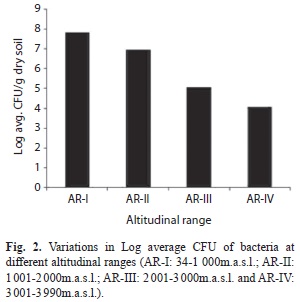
<body><![CDATA[<br> <font style="font-family: verdana;" size="2"></font>    <br> <font style="font-family: verdana;" size="2">The correlation&nbsp; between&nbsp; the&nbsp; different environmental&nbsp; factors,&nbsp; soil&nbsp; physico-chemical parameters and bacterial counts was determined by calculating Pearson product moment correlation&nbsp; coefficients&nbsp; (Zar&nbsp; 1984). The&nbsp; correlations were considered significant if p&lt;0.05. Karl Pearson Correlation Coefficient (Parametric test) was done using Minitab 11.5 Statistical Software to study the influence of soil physico-chemical and environmental parameters on soil bacterial distribution/diversity. The diversity of the bacterial community was calculated using the Shannon-Wiener&#8217;s (H&#8217;) method (Jost 2006).&nbsp; However,&nbsp; the&nbsp; entropy&nbsp; value&nbsp; (H&#8217;)&nbsp; of the Shannon index is not itself a measure of diversity. Conversion of this value to effective number of species, or true Diversity (D), is the key to a unified and intuitive interpretation of diversity (Jost 2006). The complement of Simpson&#8217;s index,&nbsp; (d&#8217;)&nbsp; (Krebs&nbsp; 1978)&nbsp; was also estimated. Bacterial alpha diversity was estimated with Fisher&#8217;s &#945; (Magurran 2004). Evenness (J) of species was evaluated using the formula as given by Pielou (1966). The number of species divided by the square root of the number of individuals results in Species richness, S. Species accumulation curve (Colwell <span  style="font-style: italic;">et al.</span> 2004), show the rate at which new species are found within a community and can be extrapolated to provide an estimate of species richness. It was plotted using PAST 2.10 software (Hammer <span  style="font-style: italic;">et al.</span> 2001).</font>    <br> <font style="font-family: verdana;" size="2"></font><br  style="font-weight: bold;"> <font style="font-family: verdana; font-weight: bold;" size="3">Results</font>    <br> <font style="font-family: verdana;" size="2"></font><br  style="font-weight: bold;"> <font style="font-family: verdana;" size="2"><span  style="font-weight: bold;">Research area and soil physico-chemical properties:</span> Tropical and sub-tropical forests were prevalent at lower altitudes whereas temperate pine to temperate conifer and sub-alpine rhododendron forests were abundant at higher altitudes (<a  href="/img/revistas/rbt/v61n1/a38t1.gif">Table 1</a>). The prevalent vegetations, ambient temperature, soil pH, soil temperature, soil moisture content, soil carbon content and&nbsp; bulk&nbsp; density&nbsp; were&nbsp; found&nbsp; to&nbsp; vary&nbsp; along the altitudes (<a  href="/img/revistas/rbt/v61n1/a38t1.gif">Table 1</a>). Soil physico-chemical factors, ambient temperature and/or substrate availability were found to influence soil bacterial growth and population density at various level of significance (p&lt;0.05) (<a  href="/img/revistas/rbt/v61n1/a38i1.jpg">Fig. 1</a>). Soil carbon was found to have significant positive correlation with soil temperature (r=0.785, p&lt;0.05) (<a  href="/img/revistas/rbt/v61n1/a38i1.jpg">Fig. 1</a>).    <br>     <br> </font><font style="font-family: verdana;" size="2"><span  style="font-weight: bold;">Enzymes activity:</span> The enzymes activities showed negative correlation with altitude, as highest activities for both urease and dehydrogenase enzymes were recorded at lower altitudes and vice versa (<a  href="/img/revistas/rbt/v61n1/a38t1.gif">Table 1</a>). Urease activity ranged from 0.09 to 0.28 (SD=&plusmn;0.0508) (mg) NH<sub>4</sub>+/g of dry soil, whereas that of dehydrogenase varied from 0.07 to 0.16 (SD=&plusmn;0.04788) (mg) TPF/g of dry soil. A significant positive correlation was observed between soil dehydrogenase and urease activity. Soil carbon was found to have significant positive correlation with urease and dehydrogenase activity (<a  href="/img/revistas/rbt/v61n1/a38i1.jpg">Fig. </a><a  href="/img/revistas/rbt/v61n1/a38i1.jpg">1</a>).</font>    <br> <font style="font-family: verdana;" size="2"></font>    <br> <font style="font-family: verdana;" size="2"><span  style="font-weight: bold;">Cultivable bacteria:</span> The bacterial colonies observed on agar plates ranged&nbsp; from 1.8x10<sup>3</sup> to 3.2x10<sup>8</sup>&nbsp; (SD=&plusmn;6.3x10<sup>7</sup>)&nbsp; cfu/g&nbsp; of dry soil. There was significant variation in the soil physico-chemical parameters and bacterial CFU counts along the altitudinal gradient (<a href="/img/revistas/rbt/v61n1/a38t1.gif">Table 1</a>). The CFU counts of bacteria decreased with increasing altitude, as highest CFU counts were recorded at lower altitudes and lowest CFU counts were recorded at higher altitudes (<a href="/img/revistas/rbt/v61n1/a38t1.gif">Table 1</a>, <a  href="#fig_2">Fig. 2</a>). Soil bacterial distribution showed positive but insignificant correlation with soil pH, soil temperature, ambient temperature, soil carbon content, soil bulk density, urease and dehydrogenase activities whereas altitude and soil moisture content showed negative correlation (<a href="/img/revistas/rbt/v61n1/a38i1.jpg">Fig. 1</a>).    <br>     <br> </font>     ]]></body>
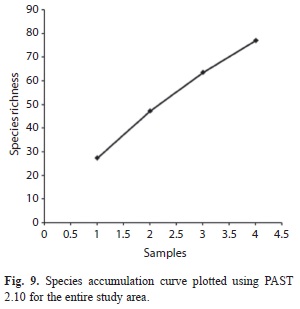
<body><![CDATA[<div style="text-align: center;"><a name="fig_2"></a><img alt=""  src="/img/revistas/rbt/v61n1/a38i2.jpg"  style="width: 300px; height: 302px;">    <br> </div>     <br> <font style="font-family: verdana;" size="2"><span  style="font-weight: bold;">Phylogenetic diversity of bacterial isolates:</span> A total of 155 bacterial isolates (<a href="/img/revistas/rbt/v61n1/a38t2.gif">Table 2</a>) were obtained using cultivation based method from the entire altitude (34-3 990m.a.s.l) under the study area. Characterized isolates belonged to <span style="font-style: italic;">Proteobacteria, Firmicutes </span>and<span style="font-style: italic;"> Bacteroidetes</span>, which comprised of <span  style="font-style: italic;">Alpha-, Betaand Gamma-Proteobacteria, Bacilli </span>and<span style="font-style: italic;"> Flavobacteria</span> (<a href="/img/revistas/rbt/v61n1/a38t3.gif">Table 3</a>), distributed to 27 genera and 77 species. From among the 155 isolates; 103 belonged to Firmicutes, 47 to Proteobacteria (two to <span style="font-style: italic;">&#945;-Proteobacteria</span>, 34 to <span style="font-style: italic;">&#947;-Proteobacteria</span> and 11 to <span style="font-style: italic;">&#946;-Proteobacteria</span>) and five to Bacteroidetes. The phylogentic trees for the respective groups (Betaand <span style="font-style: italic;">Gamma-Proteobacteria</span>, <span style="font-style: italic;">Firmicutes</span> and <span style="font-style: italic;">Flavobacteria</span>) are constructed using rooted Neighbor-joining tree based on 16S rRNA (more than 1,400 bases) gene sequences of the isolates and the related species obtained from the database of type strains with validly published prokaryotic names at the EzTaxon server. The scale bars given in the phylogenetic trees correspond to the expected number of changes per nucleotide position (<a  href="/img/revistas/rbt/v61n1/a38i3.jpg">Figs. 3</a>-<a  href="/img/revistas/rbt/v61n1/a38i6c.jpg">6C</a>).    <br>     <br> </font> <font style="font-family: verdana;" size="2">The predominant phyla characterized in the entire stretch of altitudes were <span style="font-style: italic;">Firmicutes</span> followed&nbsp; by&nbsp; <span style="font-style: italic;">Proteobacteria&nbsp; </span>and<span style="font-style: italic;">&nbsp; Bacteroidetes</span>&nbsp; (<a href="/img/revistas/rbt/v61n1/a38i7.jpg">Fig.&nbsp; 7</a>).&nbsp; These&nbsp; three&nbsp; phyla&nbsp; were&nbsp; found to&nbsp; occur&nbsp; in&nbsp; all&nbsp; the&nbsp; four&nbsp; altitudinal&nbsp; ranges with&nbsp; varying&nbsp; density.&nbsp; Under&nbsp; <span style="font-style: italic;">Proteobacteria, &#946;-Proteobacteria </span>and<span style="font-style: italic;"> &#947;-Proteobacteria</span> were isolated from all the four altitudinal ranges whereas <span style="font-style: italic;">&#945;-Proteobacteria</span> was isolated only from AR-III and AR-Iv. <span style="font-style: italic;">Bacillus </span>and<span  style="font-style: italic;"> Lysinibacillus</span> were the dominant genus under the class Bacilli. Similarly, <span style="font-style: italic;">Serratia </span>and<span  style="font-style: italic;"> Pseudomonas</span> belonging to class <span style="font-style: italic;">&#947;-Proteobacteria</span> were frequently characterized from all the altitudinal ranges. Under <span style="font-style: italic;">&#946;-Proteobacteria, Burkholderia </span>and<span style="font-style: italic;"> Chromobacteria</span> were dominant. <span style="font-style: italic;">Sphingobium </span>and<span  style="font-style: italic;"> Ponticoccus</span> were the isolated genera under <span style="font-style: italic;">&#945;-Proteobacteria</span>. Chryseobacterium was the only genus identified under <span style="font-style: italic;">Flavobacteria</span> (<a  href="/img/revistas/rbt/v61n1/a38t3.gif">Table 3</a>). The genus Bacillus was the most dominant among all the isolated genera followed by <span style="font-style: italic;">Pseudomonas</span> and <span style="font-style: italic;">Lysinibacillus</span>. Similarly, diversity index of genus <span style="font-style: italic;">Bacillus</span> (0.353) was found to be the highest followed by <span style="font-style: italic;">Pseudomonas</span> (0.242) and <span style="font-style: italic;">Lysinibacillus</span> (0.176) (<a href="/img/revistas/rbt/v61n1/a38i8.jpg">Fig. 8</a>).    <br> </font>    <br> <font style="font-family: verdana;" size="2"><span  style="font-weight: bold;">Diversity indices and data analyses:</span> Shannon-Wiener&#8217;s index (H&#8217;), Diversity (D), Complement of Simpson&#8217;s index (d&#8217;), Fisher&#8217;s alpha index, richness and evenness index for the studied range was found to be 3.92, 50.40, 0.966, 60.77, 6.18 and 0.903, respectively (<a  href="/img/revistas/rbt/v61n1/a38t4.gif">Table 4</a>). The Shannon-Wiener&#8217;s index (H&#8217;) for the entire range varied from 2.99 to 3.35. The calculated values for Shannon-Wiener&#8217;s, Diversity, complement of&nbsp; Simpson&#8217;s&nbsp; indices and species richness decreased with increasing altitude. However, Fisher&#8217;s alpha did not follow the same trend of diversity (<a  href="/img/revistas/rbt/v61n1/a38t4.gif">Table 4</a>). The highest value for most of the diversity indices as well as species richness was recorded for the lowest altitudinal range AR-I (H&#8217;=3.35, D=28.50, d&#8217;=0.955, S=4.81). Genus wise, the individual diversity index varied from 0.033 to </font><font style="font-family: verdana;" size="2">0.353 with Bacillus (0.353) having the highest diversity index, followed by <span style="font-style: italic;">Pseudomonas</span> 0.242) and&nbsp; <span style="font-style: italic;">Lysinibacillus</span>&nbsp; (0.177)&nbsp; (<a href="#fig_8">Fig.&nbsp; 8</a>). The species accumulation curve displayed an increasing trend that did not level off (<a href="#fig_9">Fig. 9</a>).    <br>     <br> </font>     <div style="text-align: center;"><a name="fig_9"></a><img alt=""  src="/img/revistas/rbt/v61n1/a38i9.jpg"  style="width: 300px; height: 309px;">    ]]></body>
<body><![CDATA[<br> </div> <font style="font-family: verdana;" size="2">    <br> </font><font style="font-family: verdana;" size="2"><span  style="font-weight: bold;">Accession numbers of&nbsp; nucleotide sequences:</span> The 16S rDNA nucleotide partial sequences were submitted to GenBank and accessions were obtained (<a  href="/img/revistas/rbt/v61n1/a38t2.gif">Table 2</a>).</font>    <br> <font style="font-family: verdana;" size="2"></font><br  style="font-weight: bold;"> <font style="font-family: verdana; font-weight: bold;" size="3">Discussion</font>    <br> <font style="font-family: verdana;" size="2"></font>    <br> <font style="font-family: verdana;" size="2">Ecological&nbsp; factors&nbsp; and&nbsp; altitudinal&nbsp; gradient&nbsp; are&nbsp; known&nbsp; to&nbsp; influence&nbsp; distribution&nbsp; of soil micro-organisms (Lomolino 2001). The cultivable bacterial diversity across the altitude showed variation&nbsp; in&nbsp; the&nbsp; region&nbsp; revealing spatial trend and correlation with soil parameters and forest types. The variability in population densities of cultivable soil bacteria can be attributed to soil properties, physico-chemical conditions&nbsp; and&nbsp; vegetations&nbsp; which are among the most important factors that influence soil microbial growth, population density and diversity (Atlas 1984, Dimitriu &amp; Grayston 2010). Alpine and sub-alpine regions situated at higher altitude with sparse vegetation represent different soil physico-chemical factors when&nbsp; compared&nbsp; to&nbsp; tropical&nbsp; and sub-tropical evergreen or deciduous forests at lower altitudes. Tropical and sub-tropical forest prevalent at lower altitudes supported higher bacterial diversity compared to temperate pine, temperate conifer and sub-alpine rhododendron forests at higher altitudes as measured by Shannon-Wiener&#8217;s (H&#8217;), Complement of Simpson&#8217;s (d&#8217;) indices and Diversity (D). This variation in bacterial diversity may be attributed to the types of forests as vegetations are known to affect soil microbial diversity and community structures (Kowalchuk <span  style="font-style: italic;">et al.</span> 2002, Grayston &amp; Prescott 2005, Han <span  style="font-style: italic;">et al.</span> 2007, Thomson <span  style="font-style: italic;">et al.</span> 2010). The value of the Shannon-Wiener&#8217;s Index (H&#8217;) usually lies between 1.5 and 3.5 for ecological data and rarely exceeds 4.0 (May 1975). In this study, we found that the entire study area has high value of H&#8217; (H&#8217;&gt;3.5; <a href="/img/revistas/rbt/v61n1/a38t4.gif">Table 4</a>) and of Fisher&#8217;s &#945; suggesting prevalence of diversity in the region.</font>    <br> <font style="font-family: verdana;" size="2"></font>    <br> <font style="font-family: verdana;" size="2">Richness and evenness of bacterial communities reflect selective pressure that shape diversity within communities. Measuring these parameters is most useful when assessing the relationships of soil physico-chemical and environmental parameters on bacterial diversity&nbsp; in&nbsp; soil&nbsp; (Kapur&nbsp; &amp;&nbsp; Jain&nbsp; 2004).&nbsp; However, in the present study correlation was found to be insignificant. Similar findings have been reported by Bryant <span  style="font-style: italic;">et al.</span> (2008) and Fierer <span style="font-style: italic;">et al.</span> (2011). The insignificant decrease in diversity with altitude is attributed to higher bacterial diversity at sub-tropical and temperate soil. One of the possible reasons for higher bacterial diversity&nbsp; at&nbsp; intermediate&nbsp; elevation&nbsp; could&nbsp; be due to the fact that the trees of sub-tropical and temperate regions including Cedrus, Pinus and Taxus in Himalayan range are known to exert slightly stimulatory effect on the microorganisms and therefore support relatively higher microbial population (Pandey <span  style="font-style: italic;">et al.</span> 2006). Similar effects of vegetations on soil microbial&nbsp; diversity&nbsp; and&nbsp; community&nbsp; structures&nbsp; has also been reported by several other workers (Kowalchuk <span  style="font-style: italic;">et al.</span> 2002, Grayston &amp; Prescott 2005, Han <span style="font-style: italic;">et al.</span> 2007, Thomson <span style="font-style: italic;">et al.</span> 2010). The present study corroborates with the findings of Collins &amp; Cavigelli (2003) and Fierer et al (2011) who had reported decrease in soil pH with increase in altitude. Insignificant correlation between soil temperature and bacterial diversity could be due to the variation in sampling time and season.</font>    <br> <font style="font-family: verdana;" size="2"></font>    <br> <font style="font-family: verdana;" size="2">Members of the phyla <span  style="font-style: italic;">Proteobacteria </span>and<span  style="font-style: italic;"> Firmicutes</span> are the most abundant soil bacteria, as&nbsp; revealed&nbsp; by&nbsp; analysis&nbsp; of&nbsp; 16S&nbsp; rRNA gene (Janssen 2006, Bruce <span  style="font-style: italic;">et al.</span> 2010, Lin <span  style="font-style: italic;">et al.</span> 2010). In the present study, <span  style="font-style: italic;">&#947;-Proteobacteria</span> was found to be more common as compared to <span style="font-style: italic;">&#946;-Proteobacteria</span>, which could be due to the soil physico-chemical factors as pH is found to influence the distribution of <span style="font-style: italic;">Proteobacteria</span> (Lin <span  style="font-style: italic;">et al.</span> 2010). The abundance of Burkholderia&nbsp; species&nbsp; among&nbsp; <span  style="font-style: italic;">&#946;-Proteobacteria</span>&nbsp; is&nbsp; due to its nutritional versatility as saprophyte and also being a common resident of rhizosphere soil (Estrada-De los Santos <span  style="font-style: italic;">et al.</span> 2001, Coenye &amp; vandamme&nbsp; 2003). Within&nbsp; the&nbsp; <span style="font-style: italic;">Firmicutes</span>, </font><font  style="font-family: verdana;" size="2">75.19% of the isolates belonged to <span style="font-style: italic;">Bacillus</span>. The&nbsp; high&nbsp; number&nbsp; and&nbsp; high&nbsp; diversity&nbsp; index value of <span style="font-style: italic;">Bacillus</span> as compared to the other isolated genera in the study suggests that aerobic or facultative anaerobic, spore-forming bacteria are abundant in the forest soils of this Himalayan range which supports the patterns observed in temperate and tropical soils (Teixeira <span  style="font-style: italic;">et al.</span> 2010). Abundance of <span style="font-style: italic;">Serratia </span>and<span  style="font-style: italic;"> Bacillus</span> species is attributed to their capability of adapting to a wide range of environmental conditions. Both are distributed widely in nature and are commonly found in soil as saprophytic organisms (vilain&nbsp; <span  style="font-style: italic;">et al.</span> 2006). Plants benefit from the presence of <span style="font-style: italic;">B. cereus</span> since it is capable of inhibiting plant diseases and also enhances plant growth (Jensen <span  style="font-style: italic;">et al.</span> 2003). <span style="font-style: italic;">Serratia marcescens</span>, an enterobacteria, on the other hand has a unique ability to produce extracellular enzymes. Several such enzymes have been shown to have the ability to degrade chitin, a substance which mainly comprises fungal cell walls (Hejazi &amp; Falkiner 1997). <span style="font-style: italic;">Lysinibacillus xylanilyticus</span> is a xylan-degrading soil bacteria widely found in forest soil (Lee <span style="font-style: italic;">et al.</span> 2010). <span style="font-style: italic;">B. aryabhattai</span>&nbsp; is&nbsp; recorded&nbsp; in&nbsp; large&nbsp; number in the present study and its abundance in soil indicate good soil health as it performs wide range of enzymatic activities and play active role in soil nutrient decomposition and mineralization (Shivaji <span  style="font-style: italic;">et al.</span> 2009, Yadav <span  style="font-style: italic;">et al.</span> 2011). <span style="font-style: italic;">Bacillus</span> from high altitudes of Eastern Himalayan range&nbsp; has&nbsp; been&nbsp; reported&nbsp; to&nbsp; produce thermostable enzyme (Devi <span style="font-style: italic;">et al.</span> 2010). The cultivation approach showed that certain isolates belonging to <span style="font-style: italic;">Bacillus, Brevibacillus, Lysinibacillus </span>and<span  style="font-style: italic;"> Enterobacter</span> spp. may represent novel species as they have relatively low</font>    <br> <font style="font-family: verdana;" size="2">16S rRNA sequence similarity&#8804;97% (<a href="/img/revistas/rbt/v61n1/a38t2.gif">Table 2</a>) to the known species.</font>    ]]></body>
<body><![CDATA[<br> <font style="font-family: verdana;" size="2"></font>    <br> <font style="font-family: verdana;" size="2">Determination of dehydrogenase and urease activity in general is a criterion used to determine soil microbial activity (Burns 1978, Makoi &amp; Ndakidemi 2008). Dehydrogenase activity is an indicator of potential non-specific intracellular enzyme activity of the total microbial biomass and may be considered a good measure of microbial oxidative activities in soils (Subhani <span  style="font-style: italic;">et al.</span> 2001).</font>    <br> <font style="font-family: verdana;" size="2"></font>    <br> <font style="font-family: verdana;" size="2">The present study is the first broad survey on the bacterial community structure in the Eastern Himalayan soils under different vegetations and soil physico-chemical conditions. This study clearly points out that this biome represents a vast reservoir for bacterial discovery. Moreover, the species accumulation curve showed that the rate of species increase with sampling effort had not yet reached an asymptote, indicating that&nbsp; the&nbsp; diversity&nbsp; of the area had not yet been fully captured. The bacterial diversity data may become a baseline to compare how anthropogenic and climatic interventions in the coming years change the composition and&nbsp; diversity&nbsp; of&nbsp; bacteria&nbsp; across the altitudes of this anthropogenically exposed range. Further functional analyses are required for understanding the functional diversity (Hollister <span style="font-style: italic;">et al.</span> 2010) and its possible exploration for bioprospection potentials and conservation value of the microbiota. Unless the area is protected, human generated disturbances such as tourism, agriculture, industrial activities, transient farming and housing may rapidly reduce the forest cover and with it, the associated microbial biodiversity value of the region in the near future, by exerting severe impacts on its rich but poorly known microflora. Future efforts focused on deep sequencing of soil microbial diversity and novel characterization methodologies to recover and describe taxonomically diverse novel species of this range are required to confirm these first conclusions, and thereby add data needed to support decisions on conservation and sustainable utilization of this biodiversity hotspot.</font>    <br> <font style="font-family: verdana;" size="2"></font>    <br> <font style="font-family: verdana; font-weight: bold;" size="3">Acknowledgment</font>    <br> <font style="font-family: verdana;" size="2"></font>    <br> <font style="font-family: verdana;" size="2">NAL, KK and SRJ acknowledge the financial support received from Department of Information Technology (MC &amp; IT), Government of India to carry out the present study.</font>    <br> <hr style="width: 100%; height: 2px;"><font  style="font-family: verdana; font-weight: bold;" size="3">References</font>    <br> <font style="font-family: verdana;" size="2"></font>    ]]></body>
<body><![CDATA[<!-- ref --><br> <font style="font-family: verdana;" size="2">Alexander, M. 1977. Introduction to soil microbiology. John Wiley &amp; Sons, New York, New York, USA.    &nbsp;&nbsp;&nbsp;&nbsp;&nbsp;&nbsp;&nbsp;&nbsp;[&#160;<a href="javascript:void(0);" onclick="javascript: window.open('/scielo.php?script=sci_nlinks&ref=1838810&pid=S0034-7744201300010003800001&lng=','','width=640,height=500,resizable=yes,scrollbars=1,menubar=yes,');">Links</a>&#160;]<!-- end-ref --></font>    <br> <font style="font-family: verdana;" size="2"></font>    <!-- ref --><br> <font style="font-family: verdana;" size="2">Altschul, S.F., T.L. Madden, A.A. Schaffer, J.&nbsp; Zhang, Z. Zhang, W. Miller &amp; D.J. Lipman. 1997. Gapped BLAST and PSI-BLAST: a new generation of protein database search programs. Nucleic Acids Res. 25: 3389-3402.    &nbsp;&nbsp;&nbsp;&nbsp;&nbsp;&nbsp;&nbsp;&nbsp;[&#160;<a href="javascript:void(0);" onclick="javascript: window.open('/scielo.php?script=sci_nlinks&ref=1838813&pid=S0034-7744201300010003800002&lng=','','width=640,height=500,resizable=yes,scrollbars=1,menubar=yes,');">Links</a>&#160;]<!-- end-ref --></font>    <br> <font style="font-family: verdana;" size="2"></font>    <!-- ref --><br> <font style="font-family: verdana;" size="2">Anderson, J.M. &amp; J.S.I. Ingram. 1993. Tropical soil biology and fertility: A Handbook of Methods. CAB International, Wallingford, Washington, USA.    &nbsp;&nbsp;&nbsp;&nbsp;&nbsp;&nbsp;&nbsp;&nbsp;[&#160;<a href="javascript:void(0);" onclick="javascript: window.open('/scielo.php?script=sci_nlinks&ref=1838816&pid=S0034-7744201300010003800003&lng=','','width=640,height=500,resizable=yes,scrollbars=1,menubar=yes,');">Links</a>&#160;]<!-- end-ref --></font>    <br> <font style="font-family: verdana;" size="2"></font>    <!-- ref --><br> <font style="font-family: verdana;" size="2">Aon, M.A. &amp; A.C. Colaneri. 2001. II. Temporal and spatial evolution of enzymatic activities and physico-chemical properties in an agricultural soil. Appl. Soil Ecol. 18: 255-270.    &nbsp;&nbsp;&nbsp;&nbsp;&nbsp;&nbsp;&nbsp;&nbsp;[&#160;<a href="javascript:void(0);" onclick="javascript: window.open('/scielo.php?script=sci_nlinks&ref=1838819&pid=S0034-7744201300010003800004&lng=','','width=640,height=500,resizable=yes,scrollbars=1,menubar=yes,');">Links</a>&#160;]<!-- end-ref --></font>    <br> <font style="font-family: verdana;" size="2"></font>    <!-- ref --><br> <font style="font-family: verdana;" size="2">Atlas, R.M. 1984. Diversity of microbial communities, p. 1-47. In K.C. Marshall (ed.). Advances in Microbial Ecology. Plenum, New York, New York, USA.    &nbsp;&nbsp;&nbsp;&nbsp;&nbsp;&nbsp;&nbsp;&nbsp;[&#160;<a href="javascript:void(0);" onclick="javascript: window.open('/scielo.php?script=sci_nlinks&ref=1838822&pid=S0034-7744201300010003800005&lng=','','width=640,height=500,resizable=yes,scrollbars=1,menubar=yes,');">Links</a>&#160;]<!-- end-ref --></font>    <br> <font style="font-family: verdana;" size="2"></font>    <!-- ref --><br> <font style="font-family: verdana;" size="2">Atlas, R. &amp; R. Bartha. 2002. Ecolog&iacute;a microbiana y microbiolog&iacute;a ambiental. Pearson Educaci&oacute;n, Madrid.    &nbsp;&nbsp;&nbsp;&nbsp;&nbsp;&nbsp;&nbsp;&nbsp;[&#160;<a href="javascript:void(0);" onclick="javascript: window.open('/scielo.php?script=sci_nlinks&ref=1838825&pid=S0034-7744201300010003800006&lng=','','width=640,height=500,resizable=yes,scrollbars=1,menubar=yes,');">Links</a>&#160;]<!-- end-ref --></font>    <br> <font style="font-family: verdana;" size="2"></font>    <!-- ref --><br> <font style="font-family: verdana;" size="2">Baum, C., P. Leinweber &amp; A. Schlichting. 2003. Effects of chemical conditions in re-wetted peats on temporal variation in microbial biomass and acid phosphatase activity within the growing season. Appl. Soil Ecol. 22: 167-175.    &nbsp;&nbsp;&nbsp;&nbsp;&nbsp;&nbsp;&nbsp;&nbsp;[&#160;<a href="javascript:void(0);" onclick="javascript: window.open('/scielo.php?script=sci_nlinks&ref=1838828&pid=S0034-7744201300010003800007&lng=','','width=640,height=500,resizable=yes,scrollbars=1,menubar=yes,');">Links</a>&#160;]<!-- end-ref --></font>    ]]></body>
<body><![CDATA[<br> <font style="font-family: verdana;" size="2"></font>    <!-- ref --><br> <font style="font-family: verdana;" size="2">Blake,&nbsp; G.R. &amp; K.H. Hartge. 1986. Bulk Density, p. 363-375. In A. Klute (ed.). Methods of soil analysis, part I. Physical and&nbsp; mineralogical&nbsp; methods: Agronomy Monograph. American Society of Agronomy, Madison, USA.    &nbsp;&nbsp;&nbsp;&nbsp;&nbsp;&nbsp;&nbsp;&nbsp;[&#160;<a href="javascript:void(0);" onclick="javascript: window.open('/scielo.php?script=sci_nlinks&ref=1838831&pid=S0034-7744201300010003800008&lng=','','width=640,height=500,resizable=yes,scrollbars=1,menubar=yes,');">Links</a>&#160;]<!-- end-ref --></font>    <br> <font style="font-family: verdana;" size="2"></font>    <!-- ref --><br> <font style="font-family: verdana;" size="2">Bremner, J.M. &amp; R.L. Mulvaney. 1978. Urease activity in soils, p. 149-196. In R.G. Burns (ed.). Soil Enzymes. Academic, London, United Kingdom.    &nbsp;&nbsp;&nbsp;&nbsp;&nbsp;&nbsp;&nbsp;&nbsp;[&#160;<a href="javascript:void(0);" onclick="javascript: window.open('/scielo.php?script=sci_nlinks&ref=1838834&pid=S0034-7744201300010003800009&lng=','','width=640,height=500,resizable=yes,scrollbars=1,menubar=yes,');">Links</a>&#160;]<!-- end-ref --></font>    <br> <font style="font-family: verdana;" size="2"></font>    <!-- ref --><br> <font style="font-family: verdana;" size="2">Bruce, T., I.B. Martinez, O.M. Neto, A.C.P. vicente, R.H.</font><font  style="font-family: verdana;" size="2"> Kruger&nbsp; &amp; F.L. Thompson. 2010. Bacterial&nbsp; community diversity in the Brazilian&nbsp; Atlantic forest soils. Microb. Ecol. 60: 840-849.    &nbsp;&nbsp;&nbsp;&nbsp;&nbsp;&nbsp;&nbsp;&nbsp;[&#160;<a href="javascript:void(0);" onclick="javascript: window.open('/scielo.php?script=sci_nlinks&ref=1838837&pid=S0034-7744201300010003800010&lng=','','width=640,height=500,resizable=yes,scrollbars=1,menubar=yes,');">Links</a>&#160;]<!-- end-ref --></font>    <br> <font style="font-family: verdana;" size="2"></font>    ]]></body>
<body><![CDATA[<!-- ref --><br> <font style="font-family: verdana;" size="2">Bryant, J.A., C. Lamanna, H. Morlon, A.J. Kerkhoff, B.J. Enquist &amp; J.L. Green. 2008. Microbes on mountain slides: Contrasting elevation pattern of bacterial and plant diversity. PNAS 105: 11505-11511.    &nbsp;&nbsp;&nbsp;&nbsp;&nbsp;&nbsp;&nbsp;&nbsp;[&#160;<a href="javascript:void(0);" onclick="javascript: window.open('/scielo.php?script=sci_nlinks&ref=1838840&pid=S0034-7744201300010003800011&lng=','','width=640,height=500,resizable=yes,scrollbars=1,menubar=yes,');">Links</a>&#160;]<!-- end-ref --></font>    <br> <font style="font-family: verdana;" size="2"></font>    <!-- ref --><br> <font style="font-family: verdana;" size="2">Brzezinska, M., Z. Stepniewska &amp; W. Stepniewski. 1998. Soil oxygen status and dehydrogenase&nbsp; activity. Soil Biol. Biochem. 30: 1783-1790.    &nbsp;&nbsp;&nbsp;&nbsp;&nbsp;&nbsp;&nbsp;&nbsp;[&#160;<a href="javascript:void(0);" onclick="javascript: window.open('/scielo.php?script=sci_nlinks&ref=1838843&pid=S0034-7744201300010003800012&lng=','','width=640,height=500,resizable=yes,scrollbars=1,menubar=yes,');">Links</a>&#160;]<!-- end-ref --></font>    <br> <font style="font-family: verdana;" size="2"></font>    <!-- ref --><br> <font style="font-family: verdana;" size="2">Burns, R.G. 1978. Enzvme activitv in soil:&nbsp; Some theoretical and practical&nbsp; considerations, p. 295-340. In R.G. Burns (ed.). Soil Enzymes. Academic, London, United Kingdom.    &nbsp;&nbsp;&nbsp;&nbsp;&nbsp;&nbsp;&nbsp;&nbsp;[&#160;<a href="javascript:void(0);" onclick="javascript: window.open('/scielo.php?script=sci_nlinks&ref=1838846&pid=S0034-7744201300010003800013&lng=','','width=640,height=500,resizable=yes,scrollbars=1,menubar=yes,');">Links</a>&#160;]<!-- end-ref --></font>    <br> <font style="font-family: verdana;" size="2"></font>    <!-- ref --><br> <font style="font-family: verdana;" size="2">Champion,&nbsp; H.G. &amp; S.K. Seth. 1968. A revised&nbsp; survey of the forest types of India. Govt. of India, Delhi, India.    &nbsp;&nbsp;&nbsp;&nbsp;&nbsp;&nbsp;&nbsp;&nbsp;[&#160;<a href="javascript:void(0);" onclick="javascript: window.open('/scielo.php?script=sci_nlinks&ref=1838849&pid=S0034-7744201300010003800014&lng=','','width=640,height=500,resizable=yes,scrollbars=1,menubar=yes,');">Links</a>&#160;]<!-- end-ref --></font>    <br> <font style="font-family: verdana;" size="2"></font>    <!-- ref --><br> <font style="font-family: verdana;" size="2">Chatterjee, S., A. Saikia, P. Dutta, D. Ghosh &amp; S. Werah. 2006.&nbsp; Biodiversity significance of North&nbsp; east India. WWF India, Delhi, India.    &nbsp;&nbsp;&nbsp;&nbsp;&nbsp;&nbsp;&nbsp;&nbsp;[&#160;<a href="javascript:void(0);" onclick="javascript: window.open('/scielo.php?script=sci_nlinks&ref=1838852&pid=S0034-7744201300010003800015&lng=','','width=640,height=500,resizable=yes,scrollbars=1,menubar=yes,');">Links</a>&#160;]<!-- end-ref --></font>    <br> <font style="font-family: verdana;" size="2"></font>    <!-- ref --><br> <font style="font-family: verdana;" size="2">Chun, J., J.H. Lee, Y. Jung, M. Kim, S. Kim, B.K. Kim &amp; Y.W. Lim. 2007. EzTaxon: a web-based tool for the identification of prokaryotes based on 16S ribosomal RNA gene sequences. Int. J. Syst. Evol.&nbsp; Microbiol. 57: 2259-2261.    &nbsp;&nbsp;&nbsp;&nbsp;&nbsp;&nbsp;&nbsp;&nbsp;[&#160;<a href="javascript:void(0);" onclick="javascript: window.open('/scielo.php?script=sci_nlinks&ref=1838855&pid=S0034-7744201300010003800016&lng=','','width=640,height=500,resizable=yes,scrollbars=1,menubar=yes,');">Links</a>&#160;]<!-- end-ref --></font>    <br> <font style="font-family: verdana;" size="2"></font>    <!-- ref --><br> <font style="font-family: verdana;" size="2">Coenye,&nbsp; T. &amp; P. vandamme.&nbsp; 2003. Diversity&nbsp; and significance of <span style="font-style: italic;">Burkholderia</span>&nbsp; species occupying diverse ecological niches. Environ. Microbiol. 5: 719-729.    &nbsp;&nbsp;&nbsp;&nbsp;&nbsp;&nbsp;&nbsp;&nbsp;[&#160;<a href="javascript:void(0);" onclick="javascript: window.open('/scielo.php?script=sci_nlinks&ref=1838858&pid=S0034-7744201300010003800017&lng=','','width=640,height=500,resizable=yes,scrollbars=1,menubar=yes,');">Links</a>&#160;]<!-- end-ref --></font>    ]]></body>
<body><![CDATA[<br> <font style="font-family: verdana;" size="2"></font>    <!-- ref --><br> <font style="font-family: verdana;" size="2">Collins, H.P. &amp; M.A. Cavigelli. 2003. Soil microbial community characteristics along an elevation gradient in the Laguna&nbsp; Mountains of Southern California. Soil Biol. Biochem. 35: 1027-1037.    &nbsp;&nbsp;&nbsp;&nbsp;&nbsp;&nbsp;&nbsp;&nbsp;[&#160;<a href="javascript:void(0);" onclick="javascript: window.open('/scielo.php?script=sci_nlinks&ref=1838861&pid=S0034-7744201300010003800018&lng=','','width=640,height=500,resizable=yes,scrollbars=1,menubar=yes,');">Links</a>&#160;]<!-- end-ref --></font>    <br> <font style="font-family: verdana;" size="2"></font>    <!-- ref --><br> <font style="font-family: verdana;" size="2">Colwell, R.K., C.x. Mao &amp; J. Chang. 2004. Interpolating, extrapolating,&nbsp; and&nbsp; comparing&nbsp; incidence-based&nbsp; species accumulation curves. Ecology 85: 2717-2727.    &nbsp;&nbsp;&nbsp;&nbsp;&nbsp;&nbsp;&nbsp;&nbsp;[&#160;<a href="javascript:void(0);" onclick="javascript: window.open('/scielo.php?script=sci_nlinks&ref=1838864&pid=S0034-7744201300010003800019&lng=','','width=640,height=500,resizable=yes,scrollbars=1,menubar=yes,');">Links</a>&#160;]<!-- end-ref --></font>    <br> <font style="font-family: verdana;" size="2"></font>    <!-- ref --><br> <font style="font-family: verdana;" size="2">Culmsee, H., R. Pitopang, H. Mangopo &amp; S. Sabir. 2011. Tree diversity and phytogeographical patterns of tropical high mountain rain forests in Central Sulawesi, Indonesia. Biodivers. Conserv. 20: 1103-1123.    &nbsp;&nbsp;&nbsp;&nbsp;&nbsp;&nbsp;&nbsp;&nbsp;[&#160;<a href="javascript:void(0);" onclick="javascript: window.open('/scielo.php?script=sci_nlinks&ref=1838867&pid=S0034-7744201300010003800020&lng=','','width=640,height=500,resizable=yes,scrollbars=1,menubar=yes,');">Links</a>&#160;]<!-- end-ref --></font>    <br> <font style="font-family: verdana;" size="2"></font>    ]]></body>
<body><![CDATA[<!-- ref --><br> <font style="font-family: verdana;" size="2">Devi, S.L., P. Khaund &amp; S.R. Joshi. 2010. Thermostable &#945;-amylase&nbsp; from&nbsp; natural&nbsp; variants&nbsp; of&nbsp; <span style="font-style: italic;">Bacillus</span>&nbsp; spp. prevalent in eastern Himalayan range. Afr. J. Microb. Res. 4: 2534-2542.    &nbsp;&nbsp;&nbsp;&nbsp;&nbsp;&nbsp;&nbsp;&nbsp;[&#160;<a href="javascript:void(0);" onclick="javascript: window.open('/scielo.php?script=sci_nlinks&ref=1838870&pid=S0034-7744201300010003800021&lng=','','width=640,height=500,resizable=yes,scrollbars=1,menubar=yes,');">Links</a>&#160;]<!-- end-ref --></font>    <br> <font style="font-family: verdana;" size="2"></font>    <!-- ref --><br> <font style="font-family: verdana;" size="2">Dimitriu, P.A. &amp; S.J. Grayston. 2010. Relationship between soil properties and&nbsp; patterns of bacterial &#946;-diversity across&nbsp;&nbsp; reclaimed&nbsp; and&nbsp; natural&nbsp; boreal&nbsp; forest&nbsp;&nbsp; soils. Microb. Ecol. 59: 563-573.    &nbsp;&nbsp;&nbsp;&nbsp;&nbsp;&nbsp;&nbsp;&nbsp;[&#160;<a href="javascript:void(0);" onclick="javascript: window.open('/scielo.php?script=sci_nlinks&ref=1838873&pid=S0034-7744201300010003800022&lng=','','width=640,height=500,resizable=yes,scrollbars=1,menubar=yes,');">Links</a>&#160;]<!-- end-ref --></font>    <br> <font style="font-family: verdana;" size="2"></font>    <!-- ref --><br> <font style="font-family: verdana;" size="2">Donnelly, P.K., J.A. Entry, D.L. Crawford &amp; Jr. K. Cromack.&nbsp; 1990.&nbsp; Cellulose and&nbsp; lignin&nbsp; degradation in forest soils:&nbsp; response to moisture, temperature, and acidity. Microb. Ecol. 20: 289-295.    &nbsp;&nbsp;&nbsp;&nbsp;&nbsp;&nbsp;&nbsp;&nbsp;[&#160;<a href="javascript:void(0);" onclick="javascript: window.open('/scielo.php?script=sci_nlinks&ref=1838876&pid=S0034-7744201300010003800023&lng=','','width=640,height=500,resizable=yes,scrollbars=1,menubar=yes,');">Links</a>&#160;]<!-- end-ref --></font>    <br> <font style="font-family: verdana;" size="2"></font>    <!-- ref --><br> <font style="font-family: verdana;" size="2">Estrada-De&nbsp;&nbsp; los&nbsp; Santos,&nbsp; P.,&nbsp; R.&nbsp;&nbsp; Bustillos-Cristales&nbsp; &amp;&nbsp; J. Caballero-Mellado. 2001. <span style="font-style: italic;">Burkholderia</span>, a genus rich in plant-associated nitrogen fixers with wide environmental and geographic distribution. Appl. Environ. Microbiol. 67: 2790-2798.    &nbsp;&nbsp;&nbsp;&nbsp;&nbsp;&nbsp;&nbsp;&nbsp;[&#160;<a href="javascript:void(0);" onclick="javascript: window.open('/scielo.php?script=sci_nlinks&ref=1838879&pid=S0034-7744201300010003800024&lng=','','width=640,height=500,resizable=yes,scrollbars=1,menubar=yes,');">Links</a>&#160;]<!-- end-ref --></font>    <br> <font style="font-family: verdana;" size="2"></font>    <!-- ref --><br> <font style="font-family: verdana;" size="2">Fierer, N., C.M. McCain, P. Meir, M. Zimmermann, J.M. Rapp, M.R. Silman &amp; R. Knight. 2011. Microbes do not follow the elevation diversity pattern of plant and animals. Ecology 92: 797-804.    &nbsp;&nbsp;&nbsp;&nbsp;&nbsp;&nbsp;&nbsp;&nbsp;[&#160;<a href="javascript:void(0);" onclick="javascript: window.open('/scielo.php?script=sci_nlinks&ref=1838882&pid=S0034-7744201300010003800025&lng=','','width=640,height=500,resizable=yes,scrollbars=1,menubar=yes,');">Links</a>&#160;]<!-- end-ref --></font>    <br> <font style="font-family: verdana;" size="2"></font>    <!-- ref --><br> <font style="font-family: verdana;" size="2">Gao, Y., P. Zhou, L. Mao, Y. Zhi, C. Zhang &amp; W. Shi. 2010. Effects of plant species coexistence on soil enzyme activities&nbsp; and&nbsp; soil&nbsp; microbial&nbsp; community&nbsp; structure under Cd and Pb combined pollution. J. Environ. Sc. (China). 22: 1040-1048.    &nbsp;&nbsp;&nbsp;&nbsp;&nbsp;&nbsp;&nbsp;&nbsp;[&#160;<a href="javascript:void(0);" onclick="javascript: window.open('/scielo.php?script=sci_nlinks&ref=1838885&pid=S0034-7744201300010003800026&lng=','','width=640,height=500,resizable=yes,scrollbars=1,menubar=yes,');">Links</a>&#160;]<!-- end-ref --></font>    <br> <font style="font-family: verdana;" size="2"></font>    <!-- ref --><br> <font style="font-family: verdana;" size="2">Garland, J.L. &amp; A.L. Mills. 1994. A community-level physiological approach&nbsp; for studying microbial communities, p. 77-83. <span  style="font-style: italic;">In</span> K. Ritz, J. Dighton &amp; K.E. Giller (eds.).&nbsp; Beyond&nbsp; the&nbsp; biomass.&nbsp; John&nbsp; Wiley&nbsp; &amp;&nbsp; Sons, Chichester, United Kingdom.    &nbsp;&nbsp;&nbsp;&nbsp;&nbsp;&nbsp;&nbsp;&nbsp;[&#160;<a href="javascript:void(0);" onclick="javascript: window.open('/scielo.php?script=sci_nlinks&ref=1838888&pid=S0034-7744201300010003800027&lng=','','width=640,height=500,resizable=yes,scrollbars=1,menubar=yes,');">Links</a>&#160;]<!-- end-ref --></font>    ]]></body>
<body><![CDATA[<br> <font style="font-family: verdana;" size="2"></font>    <!-- ref --><br> <font style="font-family: verdana;" size="2">Grayston, S.J.&nbsp; &amp; C.E.&nbsp; Prescott.&nbsp; 2005.&nbsp; Microbial&nbsp; communities in forest floors&nbsp; under four tree species in coastal British&nbsp; Columbia. Soil Biol. Biochem. 37:</font><font  style="font-family: verdana;" size="2"> 1157-1167.    &nbsp;&nbsp;&nbsp;&nbsp;&nbsp;&nbsp;&nbsp;&nbsp;[&#160;<a href="javascript:void(0);" onclick="javascript: window.open('/scielo.php?script=sci_nlinks&ref=1838891&pid=S0034-7744201300010003800028&lng=','','width=640,height=500,resizable=yes,scrollbars=1,menubar=yes,');">Links</a>&#160;]<!-- end-ref --></font>    <br> <font style="font-family: verdana;" size="2"></font>    <!-- ref --><br> <font style="font-family: verdana;" size="2">Han, X.M., R.Q. Wang, J. Liu, M.C. Wang,&nbsp; J. Zhou &amp; W.H. Guo. 2007. Effects of&nbsp; vegetation type on soil microbial community structure and catabolic diversity assessed by polyphasic methods in North China. J. Environ. Sci. 19: 1228-1234.    &nbsp;&nbsp;&nbsp;&nbsp;&nbsp;&nbsp;&nbsp;&nbsp;[&#160;<a href="javascript:void(0);" onclick="javascript: window.open('/scielo.php?script=sci_nlinks&ref=1838894&pid=S0034-7744201300010003800029&lng=','','width=640,height=500,resizable=yes,scrollbars=1,menubar=yes,');">Links</a>&#160;]<!-- end-ref --></font>    <br> <font style="font-family: verdana;" size="2"></font>    <!-- ref --><br> <font style="font-family: verdana;" size="2">Hammer, &Oslash;., D.A.T. Harper &amp; P.D. Ryan.&nbsp; 2001. PAST: Paleontological Statistics Software Package for Education and Data Analysis. Palaeontologia Electronica 4: 1-9.    &nbsp;&nbsp;&nbsp;&nbsp;&nbsp;&nbsp;&nbsp;&nbsp;[&#160;<a href="javascript:void(0);" onclick="javascript: window.open('/scielo.php?script=sci_nlinks&ref=1838897&pid=S0034-7744201300010003800030&lng=','','width=640,height=500,resizable=yes,scrollbars=1,menubar=yes,');">Links</a>&#160;]<!-- end-ref --></font>    <br> <font style="font-family: verdana;" size="2"></font>    ]]></body>
<body><![CDATA[<!-- ref --><br> <font style="font-family: verdana;" size="2">Hejazi, A. &amp; F.R. Falkiner. 1997. Serratia marcescens. J. Med. Microbiol. 46: 903-912.    &nbsp;&nbsp;&nbsp;&nbsp;&nbsp;&nbsp;&nbsp;&nbsp;[&#160;<a href="javascript:void(0);" onclick="javascript: window.open('/scielo.php?script=sci_nlinks&ref=1838900&pid=S0034-7744201300010003800031&lng=','','width=640,height=500,resizable=yes,scrollbars=1,menubar=yes,');">Links</a>&#160;]<!-- end-ref --></font>    <br> <font style="font-family: verdana;" size="2"></font>    <!-- ref --><br> <font style="font-family: verdana;" size="2">Hollister, E.B., C.W. Schadt, A.v.&nbsp; Palumbo,&nbsp; R.J. Ansley &amp; T.W. Boutton. 2010. Structural and&nbsp; functional diversity&nbsp; of&nbsp; soil&nbsp; bacterial&nbsp; and&nbsp; fungal&nbsp; communities following woody plant encroachment in the southern Great Plains. Soil Biol. Biochem. 42: 1816-1824.    &nbsp;&nbsp;&nbsp;&nbsp;&nbsp;&nbsp;&nbsp;&nbsp;[&#160;<a href="javascript:void(0);" onclick="javascript: window.open('/scielo.php?script=sci_nlinks&ref=1838903&pid=S0034-7744201300010003800032&lng=','','width=640,height=500,resizable=yes,scrollbars=1,menubar=yes,');">Links</a>&#160;]<!-- end-ref --></font>    <br> <font style="font-family: verdana;" size="2"></font>    <!-- ref --><br> <font style="font-family: verdana;" size="2">Holt, J.G. 1994. Bergey&#8217;s Manual of&nbsp; Determinative Bacteriology. Williams &amp; Wilkins, Baltimore, Maryland, USA.    &nbsp;&nbsp;&nbsp;&nbsp;&nbsp;&nbsp;&nbsp;&nbsp;[&#160;<a href="javascript:void(0);" onclick="javascript: window.open('/scielo.php?script=sci_nlinks&ref=1838906&pid=S0034-7744201300010003800033&lng=','','width=640,height=500,resizable=yes,scrollbars=1,menubar=yes,');">Links</a>&#160;]<!-- end-ref --></font>    <br> <font style="font-family: verdana;" size="2"></font>    <!-- ref --><br> <font style="font-family: verdana;" size="2">Hu, S.&nbsp; &amp; A.H.C.&nbsp; van&nbsp; Bruggen.&nbsp; 1997.&nbsp; Microbial&nbsp; dynamics associated with&nbsp; multiphasic decomposition of 14C-labeled&nbsp;&nbsp; cellulose&nbsp; in&nbsp; soil.&nbsp; Microb.&nbsp;&nbsp; Ecol.&nbsp; 33: 134-143.    &nbsp;&nbsp;&nbsp;&nbsp;&nbsp;&nbsp;&nbsp;&nbsp;[&#160;<a href="javascript:void(0);" onclick="javascript: window.open('/scielo.php?script=sci_nlinks&ref=1838909&pid=S0034-7744201300010003800034&lng=','','width=640,height=500,resizable=yes,scrollbars=1,menubar=yes,');">Links</a>&#160;]<!-- end-ref --></font>    <!-- ref --><br> <font style="font-family: verdana;" size="2">Janssen, P.H. 2006. Identifying the Dominant soil bacterial taxa in libraries of 16S rRNA and 16S rRNA genes. Appl. Environ. Microbiol. 72: 1719-1728.    &nbsp;&nbsp;&nbsp;&nbsp;&nbsp;&nbsp;&nbsp;&nbsp;[&#160;<a href="javascript:void(0);" onclick="javascript: window.open('/scielo.php?script=sci_nlinks&ref=1838911&pid=S0034-7744201300010003800035&lng=','','width=640,height=500,resizable=yes,scrollbars=1,menubar=yes,');">Links</a>&#160;]<!-- end-ref --></font>    <br> <font style="font-family: verdana;" size="2"></font>    <!-- ref --><br> <font style="font-family: verdana;" size="2">Jensen, G., B. Hansen, J. Eilenberg &amp; J. Mahillon. 2003. The hidden lifestyles of Bacillus cereus and relatives. Environ. Microbiol. 5: 631-640.    &nbsp;&nbsp;&nbsp;&nbsp;&nbsp;&nbsp;&nbsp;&nbsp;[&#160;<a href="javascript:void(0);" onclick="javascript: window.open('/scielo.php?script=sci_nlinks&ref=1838914&pid=S0034-7744201300010003800036&lng=','','width=640,height=500,resizable=yes,scrollbars=1,menubar=yes,');">Links</a>&#160;]<!-- end-ref --></font>    <br> <font style="font-family: verdana;" size="2"></font>    <!-- ref --><br> <font style="font-family: verdana;" size="2">Joshi, S.R., M. Chauhan, G.D. Sharma &amp;&nbsp; R.R.&nbsp; Mishra. 1991.&nbsp; Effect&nbsp; of&nbsp; deforestation&nbsp; on&nbsp; microbes,&nbsp; vAM fungi and their enzymatic activity in Eastern Himalaya,&nbsp;&nbsp; p.&nbsp; 141-152. In G.S.&nbsp; Rajwas (ed.). Studies in Himalayan Ecobiology. Today and Tommorows Publication, New Delhi, India. Jost, L. 2006. Entropy and diversity. Oikos 113: 363-375.    &nbsp;&nbsp;&nbsp;&nbsp;&nbsp;&nbsp;&nbsp;&nbsp;[&#160;<a href="javascript:void(0);" onclick="javascript: window.open('/scielo.php?script=sci_nlinks&ref=1838917&pid=S0034-7744201300010003800037&lng=','','width=640,height=500,resizable=yes,scrollbars=1,menubar=yes,');">Links</a>&#160;]<!-- end-ref --></font>    <br> <font style="font-family: verdana;" size="2"></font>    ]]></body>
<body><![CDATA[<!-- ref --><br> <font style="font-family: verdana;" size="2">Kapur, M. &amp; R.K. Jain. 2004. Microbial diversity: exploring&nbsp; the&nbsp; unexplored&nbsp; also available on-line: http:// crdd.net/open/962/1/Jain2004.1.pdf.    &nbsp;&nbsp;&nbsp;&nbsp;&nbsp;&nbsp;&nbsp;&nbsp;[&#160;<a href="javascript:void(0);" onclick="javascript: window.open('/scielo.php?script=sci_nlinks&ref=1838920&pid=S0034-7744201300010003800038&lng=','','width=640,height=500,resizable=yes,scrollbars=1,menubar=yes,');">Links</a>&#160;]<!-- end-ref --></font>    <br> <font style="font-family: verdana;" size="2"></font>    <!-- ref --><br> <font style="font-family: verdana;" size="2">Kier, G. &amp; W. Barthlott. 2001. Measuring&nbsp; and mapping endemism and species richness: a new methodological approach and its application on the flora of Africa. Biodivers. Conserv. 10: 1513-1529.    &nbsp;&nbsp;&nbsp;&nbsp;&nbsp;&nbsp;&nbsp;&nbsp;[&#160;<a href="javascript:void(0);" onclick="javascript: window.open('/scielo.php?script=sci_nlinks&ref=1838923&pid=S0034-7744201300010003800039&lng=','','width=640,height=500,resizable=yes,scrollbars=1,menubar=yes,');">Links</a>&#160;]<!-- end-ref --><br>     <!-- ref --><br> </font><font style="font-family: verdana;" size="2">Kirk, J.L., L.A. Beaudette, M. Hart, P.&nbsp; Moutoglis, J.N. Klironomos, H. Lee &amp; J.T. Trevors. 2004. Methods of studying&nbsp; soil&nbsp; microbial&nbsp; diversity.&nbsp; J.&nbsp; Microbiol. Methods 58: 169-188.    &nbsp;&nbsp;&nbsp;&nbsp;&nbsp;&nbsp;&nbsp;&nbsp;[&#160;<a href="javascript:void(0);" onclick="javascript: window.open('/scielo.php?script=sci_nlinks&ref=1838925&pid=S0034-7744201300010003800040&lng=','','width=640,height=500,resizable=yes,scrollbars=1,menubar=yes,');">Links</a>&#160;]<!-- end-ref --></font>    <br> <font style="font-family: verdana;" size="2"></font>    <!-- ref --><br> <font style="font-family: verdana;" size="2">Kowalchuk, G.A., D.S. Buma &amp; W. De Boer. 2002. Effects of above-ground plant species composition and diversity on the&nbsp; diversity of soil-borne microorganisms. Antonie Leeuwenhoek 81: 209-520.    &nbsp;&nbsp;&nbsp;&nbsp;&nbsp;&nbsp;&nbsp;&nbsp;[&#160;<a href="javascript:void(0);" onclick="javascript: window.open('/scielo.php?script=sci_nlinks&ref=1838928&pid=S0034-7744201300010003800041&lng=','','width=640,height=500,resizable=yes,scrollbars=1,menubar=yes,');">Links</a>&#160;]<!-- end-ref --></font>    ]]></body>
<body><![CDATA[<br> <font style="font-family: verdana;" size="2"></font>    <!-- ref --><br> <font style="font-family: verdana;" size="2">Krebs, C.J. 1978. Ecology: The Experimental analysis of Distribution and Abundance. Harper and Row, New York, New York, USA.    &nbsp;&nbsp;&nbsp;&nbsp;&nbsp;&nbsp;&nbsp;&nbsp;[&#160;<a href="javascript:void(0);" onclick="javascript: window.open('/scielo.php?script=sci_nlinks&ref=1838931&pid=S0034-7744201300010003800042&lng=','','width=640,height=500,resizable=yes,scrollbars=1,menubar=yes,');">Links</a>&#160;]<!-- end-ref --></font>    <br> <font style="font-family: verdana;" size="2"></font>    <!-- ref --><br> <font style="font-family: verdana;" size="2">Kumar, S. 2011. Fluctuation of soil bacterial dehydrogenase&nbsp; activity&nbsp; in&nbsp; response&nbsp; to&nbsp; the&nbsp; application&nbsp; of Endosulfan and Chlorpyrifos. J. Cell Tissue Res. 11: 2847-2851.    &nbsp;&nbsp;&nbsp;&nbsp;&nbsp;&nbsp;&nbsp;&nbsp;[&#160;<a href="javascript:void(0);" onclick="javascript: window.open('/scielo.php?script=sci_nlinks&ref=1838934&pid=S0034-7744201300010003800043&lng=','','width=640,height=500,resizable=yes,scrollbars=1,menubar=yes,');">Links</a>&#160;]<!-- end-ref --></font>    <br> <font style="font-family: verdana;" size="2"></font>    <!-- ref --><br> <font style="font-family: verdana;" size="2">Kumar, R., C. Acharya &amp; S.R. Joshi. 2011. Isolation and analyses&nbsp; of&nbsp; uranium&nbsp; tolerant&nbsp; <span  style="font-style: italic;">Serratia&nbsp; marcescens</span> strains and their utilization for aerobic uranium U(vI) bioadsorption. J. Microbiol. 49: 568-574.    &nbsp;&nbsp;&nbsp;&nbsp;&nbsp;&nbsp;&nbsp;&nbsp;[&#160;<a href="javascript:void(0);" onclick="javascript: window.open('/scielo.php?script=sci_nlinks&ref=1838937&pid=S0034-7744201300010003800044&lng=','','width=640,height=500,resizable=yes,scrollbars=1,menubar=yes,');">Links</a>&#160;]<!-- end-ref --></font>    <br> <font style="font-family: verdana;" size="2"></font>    ]]></body>
<body><![CDATA[<!-- ref --><br> <font style="font-family: verdana;" size="2">Lee, C.S., Y.T. Jung, S. Park, T.K. Oh &amp; J.H. Yoon. 2010. </font><font  style="font-family: verdana;" size="2"><span  style="font-style: italic;">Lysinibacillus xylanilyticus </span>sp. nov., a xylan-degrading bacterium isolated&nbsp; from forest humus. Int. J. Syst. Evol. Microbiol. 60: 281-286.    &nbsp;&nbsp;&nbsp;&nbsp;&nbsp;&nbsp;&nbsp;&nbsp;[&#160;<a href="javascript:void(0);" onclick="javascript: window.open('/scielo.php?script=sci_nlinks&ref=1838940&pid=S0034-7744201300010003800045&lng=','','width=640,height=500,resizable=yes,scrollbars=1,menubar=yes,');">Links</a>&#160;]<!-- end-ref --></font>    <br> <font style="font-family: verdana;" size="2"></font>    <!-- ref --><br> <font style="font-family: verdana;" size="2">Lin, Y.T., Y.J.&nbsp; Huang, S.L. Tang, W.B.&nbsp; Whitman, D.C. Coleman&nbsp; &amp; C.Y. Chiu. 2010. Bacterial community diversity in undisturbed&nbsp; perhumid&nbsp; Montane&nbsp; forest soils in Taiwan. Microb. Ecol. 59: 369-378.    &nbsp;&nbsp;&nbsp;&nbsp;&nbsp;&nbsp;&nbsp;&nbsp;[&#160;<a href="javascript:void(0);" onclick="javascript: window.open('/scielo.php?script=sci_nlinks&ref=1838943&pid=S0034-7744201300010003800046&lng=','','width=640,height=500,resizable=yes,scrollbars=1,menubar=yes,');">Links</a>&#160;]<!-- end-ref --></font>    <br> <font style="font-family: verdana;" size="2"></font>    <!-- ref --><br> <font style="font-family: verdana;" size="2">Lomolino, M.v. 2001. Elevation gradients of species density: historical and prospective views. Glob. Ecol. Biogeogr. 10: 3-13.    &nbsp;&nbsp;&nbsp;&nbsp;&nbsp;&nbsp;&nbsp;&nbsp;[&#160;<a href="javascript:void(0);" onclick="javascript: window.open('/scielo.php?script=sci_nlinks&ref=1838946&pid=S0034-7744201300010003800047&lng=','','width=640,height=500,resizable=yes,scrollbars=1,menubar=yes,');">Links</a>&#160;]<!-- end-ref --></font>    <br> <font style="font-family: verdana;" size="2"></font>    <!-- ref --><br> <font style="font-family: verdana;" size="2">Lovett, J.C., S. Rudd, J.&nbsp; Taplin &amp;&nbsp; C. Frimodt-Moller. </font><font  style="font-family: verdana;" size="2">2000.&nbsp; Patterns of plant diversity in Africa&nbsp; south of the Sahara and their&nbsp; implications for conservation management. Biodivers. Conserv. 9: 37-46.    &nbsp;&nbsp;&nbsp;&nbsp;&nbsp;&nbsp;&nbsp;&nbsp;[&#160;<a href="javascript:void(0);" onclick="javascript: window.open('/scielo.php?script=sci_nlinks&ref=1838949&pid=S0034-7744201300010003800048&lng=','','width=640,height=500,resizable=yes,scrollbars=1,menubar=yes,');">Links</a>&#160;]<!-- end-ref --></font>    <br> <font style="font-family: verdana;" size="2"></font>    <!-- ref --><br> <font style="font-family: verdana;" size="2">Magurran,&nbsp; A.E.&nbsp; 2004.&nbsp; Measuring&nbsp; biological&nbsp;&nbsp; diversity.Blackwell, Oxford, United Kingdom.    &nbsp;&nbsp;&nbsp;&nbsp;&nbsp;&nbsp;&nbsp;&nbsp;[&#160;<a href="javascript:void(0);" onclick="javascript: window.open('/scielo.php?script=sci_nlinks&ref=1838952&pid=S0034-7744201300010003800049&lng=','','width=640,height=500,resizable=yes,scrollbars=1,menubar=yes,');">Links</a>&#160;]<!-- end-ref --></font>    <br> <font style="font-family: verdana;" size="2"></font>    <!-- ref --><br> <font style="font-family: verdana;" size="2">Makoi, J.H.J.R. &amp; P.A. Ndakidemi. 2008.&nbsp; Selected soil enzymes:&nbsp; Examples&nbsp; of&nbsp; their&nbsp; potential&nbsp; roles&nbsp; in&nbsp; the ecosystem. Afr. J. Biotechnol. 7: 181-191.    &nbsp;&nbsp;&nbsp;&nbsp;&nbsp;&nbsp;&nbsp;&nbsp;[&#160;<a href="javascript:void(0);" onclick="javascript: window.open('/scielo.php?script=sci_nlinks&ref=1838955&pid=S0034-7744201300010003800050&lng=','','width=640,height=500,resizable=yes,scrollbars=1,menubar=yes,');">Links</a>&#160;]<!-- end-ref --></font>    <br> <font style="font-family: verdana;" size="2"></font>    <!-- ref --><br> <font style="font-family: verdana;" size="2">May, R.M. 1975. Patterns of species abundance and diversity, p. 81-120. <span style="font-style: italic;">In</span> M.L. Cody &amp; J.M. Diamond (eds.). Ecology and Evolution of Communities. Harvard University, Cambridge, Massachusetts, USA.    &nbsp;&nbsp;&nbsp;&nbsp;&nbsp;&nbsp;&nbsp;&nbsp;[&#160;<a href="javascript:void(0);" onclick="javascript: window.open('/scielo.php?script=sci_nlinks&ref=1838958&pid=S0034-7744201300010003800051&lng=','','width=640,height=500,resizable=yes,scrollbars=1,menubar=yes,');">Links</a>&#160;]<!-- end-ref --></font>    ]]></body>
<body><![CDATA[<br> <font style="font-family: verdana;" size="2"></font>    <!-- ref --><br> <font style="font-family: verdana;" size="2">Moore, A.W. &amp; J.S. Russell. 1972. Factors affecting dehydrogenase activity as an index of soil fertility. Plant Soil 37: 675-82.    &nbsp;&nbsp;&nbsp;&nbsp;&nbsp;&nbsp;&nbsp;&nbsp;[&#160;<a href="javascript:void(0);" onclick="javascript: window.open('/scielo.php?script=sci_nlinks&ref=1838961&pid=S0034-7744201300010003800052&lng=','','width=640,height=500,resizable=yes,scrollbars=1,menubar=yes,');">Links</a>&#160;]<!-- end-ref --></font>    <br> <font style="font-family: verdana;" size="2"></font>    <!-- ref --><br> <font style="font-family: verdana;" size="2">Myers,&nbsp; N., R.A. Muttermeier, C.A.&nbsp; Muttermeier,&nbsp; G.A.B. DaFornseca&nbsp; &amp; J. Kent. 2000. Biodiversity&nbsp; hotspots for conservation priorities. Nature 403: 853-858.    &nbsp;&nbsp;&nbsp;&nbsp;&nbsp;&nbsp;&nbsp;&nbsp;[&#160;<a href="javascript:void(0);" onclick="javascript: window.open('/scielo.php?script=sci_nlinks&ref=1838964&pid=S0034-7744201300010003800053&lng=','','width=640,height=500,resizable=yes,scrollbars=1,menubar=yes,');">Links</a>&#160;]<!-- end-ref --></font>    <br> <font style="font-family: verdana;" size="2"></font>    <!-- ref --><br> <font style="font-family: verdana;" size="2">Palmer, C., E.M. Bik, M.B. Eisen, P.B. Eckburg, T.R. Sana, P.K.&nbsp; Wolber,&nbsp; D.A.&nbsp; Relman &amp;&nbsp; P.O. Brown.&nbsp; 2006. Rapid quantitative&nbsp; profiling of complex microbial populations. Nucleic Acids Res. 34: e5.    &nbsp;&nbsp;&nbsp;&nbsp;&nbsp;&nbsp;&nbsp;&nbsp;[&#160;<a href="javascript:void(0);" onclick="javascript: window.open('/scielo.php?script=sci_nlinks&ref=1838967&pid=S0034-7744201300010003800054&lng=','','width=640,height=500,resizable=yes,scrollbars=1,menubar=yes,');">Links</a>&#160;]<!-- end-ref --></font>    <br> <font style="font-family: verdana;" size="2"></font>    ]]></body>
<body><![CDATA[<!-- ref --><br> <font style="font-family: verdana;" size="2">Pandey, A., P. Trivedi, B. Kumar, B. Chaurasia &amp; L.M.S. </font><font  style="font-family: verdana;" size="2">Palni. 2006. Soil microbial diversity from the Himalaya: Need for documentation and conservation. p. 64, vol. 5, NBA Scientific Bulletin, Chennai, India.    &nbsp;&nbsp;&nbsp;&nbsp;&nbsp;&nbsp;&nbsp;&nbsp;[&#160;<a href="javascript:void(0);" onclick="javascript: window.open('/scielo.php?script=sci_nlinks&ref=1838970&pid=S0034-7744201300010003800055&lng=','','width=640,height=500,resizable=yes,scrollbars=1,menubar=yes,');">Links</a>&#160;]<!-- end-ref --></font>    <br> <font style="font-family: verdana;" size="2"></font>    <!-- ref --><br> <font style="font-family: verdana;" size="2">Paul, E.A. &amp; A.D. Mclaren. 1975. Biochemistry of the soil subsystem, p. 1-36. <span style="font-style: italic;">In</span> E.A.&nbsp; Paul &amp; A.D. McLaren (eds.). Soil Biochemistry. Marcel Dekker, New York, USA.    &nbsp;&nbsp;&nbsp;&nbsp;&nbsp;&nbsp;&nbsp;&nbsp;[&#160;<a href="javascript:void(0);" onclick="javascript: window.open('/scielo.php?script=sci_nlinks&ref=1838973&pid=S0034-7744201300010003800056&lng=','','width=640,height=500,resizable=yes,scrollbars=1,menubar=yes,');">Links</a>&#160;]<!-- end-ref --></font>    <br> <font style="font-family: verdana;" size="2"></font>    <!-- ref --><br> <font style="font-family: verdana;" size="2">Pielou, E.C. 1966. The measurement of diversity in different types of biological&nbsp; collections. J. Theor. Biol. 13: 131-144.    &nbsp;&nbsp;&nbsp;&nbsp;&nbsp;&nbsp;&nbsp;&nbsp;[&#160;<a href="javascript:void(0);" onclick="javascript: window.open('/scielo.php?script=sci_nlinks&ref=1838976&pid=S0034-7744201300010003800057&lng=','','width=640,height=500,resizable=yes,scrollbars=1,menubar=yes,');">Links</a>&#160;]<!-- end-ref --></font>    <br> <font style="font-family: verdana;" size="2"></font>    <!-- ref --><br> <font style="font-family: verdana;" size="2">Rondon,&nbsp; M.R.,&nbsp; M.&nbsp; Robert,&nbsp; G.&nbsp; Handelsman&nbsp; &amp;&nbsp; J.&nbsp; Handelsman. 1999. The Earth&#8217;s&nbsp; bounty: assessing and accessing soil microbial diversity. Trends Biotechnol. 17: 403-409.    &nbsp;&nbsp;&nbsp;&nbsp;&nbsp;&nbsp;&nbsp;&nbsp;[&#160;<a href="javascript:void(0);" onclick="javascript: window.open('/scielo.php?script=sci_nlinks&ref=1838979&pid=S0034-7744201300010003800058&lng=','','width=640,height=500,resizable=yes,scrollbars=1,menubar=yes,');">Links</a>&#160;]<!-- end-ref --></font>    <br> <font style="font-family: verdana;" size="2"></font>    <!-- ref --><br> <font style="font-family: verdana;" size="2">Shivaji, S., P. Chaturvedi, Z. Begum, P.K. Pin, R. Manorama, D.A. Padmanaban, Y.S. Shouche, S. Pawar, P. vaishampayan, C.B.S. Dutt, G.N.R. Datta, K. Manchanda, U.R. Rao, P.M. Bhargava &amp;&nbsp; J.v.&nbsp; Narlikar. 2009. <span style="font-style: italic;">Janibacter hoylei</span> sp. nov., <span style="font-style: italic;">Bacillus isronensis</span> sp. nov. and <span style="font-style: italic;">Bacillus aryabhatta</span>i sp. nov., isolated from&nbsp;&nbsp; cryotubes&nbsp; used&nbsp; for&nbsp; collecting&nbsp; air&nbsp; from the upper atmosphere. Int. J. Syst. Evol. Microbiol. 59: 2977-2986.    &nbsp;&nbsp;&nbsp;&nbsp;&nbsp;&nbsp;&nbsp;&nbsp;[&#160;<a href="javascript:void(0);" onclick="javascript: window.open('/scielo.php?script=sci_nlinks&ref=1838982&pid=S0034-7744201300010003800059&lng=','','width=640,height=500,resizable=yes,scrollbars=1,menubar=yes,');">Links</a>&#160;]<!-- end-ref --></font>    <br> <font style="font-family: verdana;" size="2"></font>    <!-- ref --><br> <font style="font-family: verdana;" size="2">Subhani, A.,&nbsp; H.&nbsp; Changyong, x.&nbsp; Zhengmiao,&nbsp; L.&nbsp; Min&nbsp; &amp; M.&nbsp; El-ghamy.&nbsp; 2001.&nbsp; Impact of soil environment and agronomic practices on microbial/dehydrogenase enzyme activity in soil. A review.&nbsp; Pakistan J. Biol. Sci. 4: 333-338.    &nbsp;&nbsp;&nbsp;&nbsp;&nbsp;&nbsp;&nbsp;&nbsp;[&#160;<a href="javascript:void(0);" onclick="javascript: window.open('/scielo.php?script=sci_nlinks&ref=1838985&pid=S0034-7744201300010003800060&lng=','','width=640,height=500,resizable=yes,scrollbars=1,menubar=yes,');">Links</a>&#160;]<!-- end-ref --></font>    <br> <font style="font-family: verdana;" size="2"></font>    <!-- ref --><br> <font style="font-family: verdana;" size="2">Sumathi, T., A. Janardhan, A. Srilakhmi,&nbsp; D.v.R. Sai Gopal &amp; G. Narasimha. 2012. Impact of indigenous microorganisms on soil microbial and enzyme activities. Arch. Appl. Sci. Res. 4: 1065-1073.    &nbsp;&nbsp;&nbsp;&nbsp;&nbsp;&nbsp;&nbsp;&nbsp;[&#160;<a href="javascript:void(0);" onclick="javascript: window.open('/scielo.php?script=sci_nlinks&ref=1838988&pid=S0034-7744201300010003800061&lng=','','width=640,height=500,resizable=yes,scrollbars=1,menubar=yes,');">Links</a>&#160;]<!-- end-ref --></font>    ]]></body>
<body><![CDATA[<br> <font style="font-family: verdana;" size="2"></font>    <!-- ref --><br> <font style="font-family: verdana;" size="2">Tabatabai, M.A. 1977. Effect of trace elements on urease activity in soils. Soil Biol. Biochem. 9: 9-13.    &nbsp;&nbsp;&nbsp;&nbsp;&nbsp;&nbsp;&nbsp;&nbsp;[&#160;<a href="javascript:void(0);" onclick="javascript: window.open('/scielo.php?script=sci_nlinks&ref=1838991&pid=S0034-7744201300010003800062&lng=','','width=640,height=500,resizable=yes,scrollbars=1,menubar=yes,');">Links</a>&#160;]<!-- end-ref --></font>    <br> <font style="font-family: verdana;" size="2"></font>    <!-- ref --><br> <font style="font-family: verdana;" size="2">Tabatabai, M.A. 1994. Soil enzymes, p. 797-798. <span style="font-style: italic;">In</span> R.W. Weaver, J.R. Angle &amp; P.S. Bottomley (eds.). Methods of Soil Analysis, part 2. Soil Science Society of America, Madison, USA.    &nbsp;&nbsp;&nbsp;&nbsp;&nbsp;&nbsp;&nbsp;&nbsp;[&#160;<a href="javascript:void(0);" onclick="javascript: window.open('/scielo.php?script=sci_nlinks&ref=1838994&pid=S0034-7744201300010003800063&lng=','','width=640,height=500,resizable=yes,scrollbars=1,menubar=yes,');">Links</a>&#160;]<!-- end-ref --></font>    <br> <font style="font-family: verdana;" size="2"></font>    <!-- ref --><br> <font style="font-family: verdana;" size="2">Teixeira, L.C.R.S., R.S. Peixoto, J.C. Cury, W.J. Sul, v.H. Pellizari,&nbsp; J. Tiedje &amp; A.S. Rosado. 2010.&nbsp; Bacterial diversity in rhizosphere soil from Antarctic vascular plants of&nbsp; Admiralty Bay, maritime Antarctica.&nbsp; The ISME Journal 4: 989-1001.    &nbsp;&nbsp;&nbsp;&nbsp;&nbsp;&nbsp;&nbsp;&nbsp;[&#160;<a href="javascript:void(0);" onclick="javascript: window.open('/scielo.php?script=sci_nlinks&ref=1838997&pid=S0034-7744201300010003800064&lng=','','width=640,height=500,resizable=yes,scrollbars=1,menubar=yes,');">Links</a>&#160;]<!-- end-ref --></font>    <br> <font style="font-family: verdana;" size="2"></font>    ]]></body>
<body><![CDATA[<!-- ref --><br> <font style="font-family: verdana;" size="2">Thomson, B.C., N. Ostle, N. McNamara, M.J. Bailey, A.S. Whiteley &amp; R.I. Griffiths. 2010.&nbsp; vegetation affects the&nbsp; relative&nbsp; abundances&nbsp; of&nbsp; dominant&nbsp; soil&nbsp; bacteria taxa and soil respiration rates in an upland grassland soil. Microb. Ecol. 59: 335-343.    &nbsp;&nbsp;&nbsp;&nbsp;&nbsp;&nbsp;&nbsp;&nbsp;[&#160;<a href="javascript:void(0);" onclick="javascript: window.open('/scielo.php?script=sci_nlinks&ref=1839000&pid=S0034-7744201300010003800065&lng=','','width=640,height=500,resizable=yes,scrollbars=1,menubar=yes,');">Links</a>&#160;]<!-- end-ref --></font>    <br> <font style="font-family: verdana;" size="2"></font>    <!-- ref --><br> <font style="font-family: verdana;" size="2">Vilain, S., Y. Luo, M. Hildreth &amp; v. Brozel. 2006. Analysis of the life cycle of the soil saprophyte Bacillus cereus in&nbsp; liquid&nbsp; soil&nbsp; extract and in soil. Appl. Environ. Microbiol. 72: 4970-4977.    &nbsp;&nbsp;&nbsp;&nbsp;&nbsp;&nbsp;&nbsp;&nbsp;[&#160;<a href="javascript:void(0);" onclick="javascript: window.open('/scielo.php?script=sci_nlinks&ref=1839003&pid=S0034-7744201300010003800066&lng=','','width=640,height=500,resizable=yes,scrollbars=1,menubar=yes,');">Links</a>&#160;]<!-- end-ref --><br>     <!-- ref --><br> Vishniac, H.S. 1993. The microbiology of Antarctic soils, p. 297-341. <span style="font-style: italic;">In</span> E.I. Friedmann (ed.). Antarctic microbiology. Wiley-Liss, New York, USA. Ward, B.B. 2002. How many species of&nbsp; prokaryotes are there. PNAS 99: 10234-10236.    &nbsp;&nbsp;&nbsp;&nbsp;&nbsp;&nbsp;&nbsp;&nbsp;[&#160;<a href="javascript:void(0);" onclick="javascript: window.open('/scielo.php?script=sci_nlinks&ref=1839005&pid=S0034-7744201300010003800067&lng=','','width=640,height=500,resizable=yes,scrollbars=1,menubar=yes,');">Links</a>&#160;]<!-- end-ref --></font>    <br> <font style="font-family: verdana;" size="2"></font>    <!-- ref --><br> <font style="font-family: verdana;" size="2">Wick, B., R.F. K&uuml;hne &amp; P.L.G. vlek. 1998. Soil microbiological parameters as indicators of soil quality under improved&nbsp; fallow management systems in southwestern Nigeria. Plant Soil 202: 97-107.    &nbsp;&nbsp;&nbsp;&nbsp;&nbsp;&nbsp;&nbsp;&nbsp;[&#160;<a href="javascript:void(0);" onclick="javascript: window.open('/scielo.php?script=sci_nlinks&ref=1839008&pid=S0034-7744201300010003800068&lng=','','width=640,height=500,resizable=yes,scrollbars=1,menubar=yes,');">Links</a>&#160;]<!-- end-ref --></font>    ]]></body>
<body><![CDATA[<br> <font style="font-family: verdana;" size="2"></font>    <!-- ref --><br> <font style="font-family: verdana;" size="2">Yadav, S., R. Kaushik, K.A. Saxena &amp; K.D. Arora. 2011. Genetic and functional diversity of <span style="font-style: italic;">Bacillus</span> strains in the soils long-term irrigated with paper and pulp mill effluent. J. Gen. Appl. Microbiol. 57: 183 195.    &nbsp;&nbsp;&nbsp;&nbsp;&nbsp;&nbsp;&nbsp;&nbsp;[&#160;<a href="javascript:void(0);" onclick="javascript: window.open('/scielo.php?script=sci_nlinks&ref=1839011&pid=S0034-7744201300010003800069&lng=','','width=640,height=500,resizable=yes,scrollbars=1,menubar=yes,');">Links</a>&#160;]<!-- end-ref --></font>    <br> <font style="font-family: verdana;" size="2"></font>    <!-- ref --><br> <font style="font-family: verdana;" size="2">Zak, J.C., M.R. Willig, D.L. Moorhead &amp; H.G. Wildman. 1994. Functional diversity of microbial communities: a quantitative approach. Soil Biol.&nbsp; Biochem.&nbsp; 26: 1101-1108.    &nbsp;&nbsp;&nbsp;&nbsp;&nbsp;&nbsp;&nbsp;&nbsp;[&#160;<a href="javascript:void(0);" onclick="javascript: window.open('/scielo.php?script=sci_nlinks&ref=1839014&pid=S0034-7744201300010003800070&lng=','','width=640,height=500,resizable=yes,scrollbars=1,menubar=yes,');">Links</a>&#160;]<!-- end-ref --></font>    <br> <font style="font-family: verdana;" size="2"></font>    <!-- ref --><br> <font style="font-family: verdana;" size="2">Zar, J.H. 1984. Biostatistical Analysis. Prentice Hall, Upper Saddle River, New Jersey, USA.    &nbsp;&nbsp;&nbsp;&nbsp;&nbsp;&nbsp;&nbsp;&nbsp;[&#160;<a href="javascript:void(0);" onclick="javascript: window.open('/scielo.php?script=sci_nlinks&ref=1839017&pid=S0034-7744201300010003800071&lng=','','width=640,height=500,resizable=yes,scrollbars=1,menubar=yes,');">Links</a>&#160;]<!-- end-ref --></font>    <br> <font style="font-family: verdana;" size="2"></font>    ]]></body>
<body><![CDATA[<!-- ref --><br> <font style="font-family: verdana;" size="2">Zaved, H.K., M. Mizanur Rahman, M. Mashiar Rahman, A.&nbsp; Rahman,&nbsp; S.M.Y. Arafat&nbsp; &amp;&nbsp; M.&nbsp; Safiur&nbsp; Rahman. 2008. Isolation and characterization of effective bacteria for solid waste degradation for organic manure. KMITL Sci. Tech. J. 8: 44-55.    &nbsp;&nbsp;&nbsp;&nbsp;&nbsp;&nbsp;&nbsp;&nbsp;[&#160;<a href="javascript:void(0);" onclick="javascript: window.open('/scielo.php?script=sci_nlinks&ref=1839020&pid=S0034-7744201300010003800072&lng=','','width=640,height=500,resizable=yes,scrollbars=1,menubar=yes,');">Links</a>&#160;]<!-- end-ref --></font>    <br> <font style="font-family: verdana;" size="2"></font><font  style="font-family: verdana;" size="-1">    <br> <a name="Correspondencia1"></a><a href="#Correspondencia2">*</a>Correspondencia a:</font>    <br> <font style="font-family: verdana;" size="2">Nathaniel A. Lyngwi. </font><font  style="font-family: verdana;" size="2">Microbiology Laboratory, Department of Biotechnology &amp; Bioinformatics North-Eastern Hill University, Shillong Meghalaya, India; nlyngwi@gmail.com. </font><font style="font-family: verdana;" size="2">    <br> </font><font style="font-family: verdana;" size="2">Khedarani Koijam. </font><font  style="font-family: verdana;" size="2">Microbiology Laboratory, Department of Biotechnology &amp; Bioinformatics North-Eastern Hill University, Shillong Meghalaya, India; khedarani_k@yahoo.com. </font>    <br> <font style="font-family: verdana;" size="2">D. Sharma. </font><font  style="font-family: verdana;" size="2">Research Officer, Regional Centre-NAEB, North-Eastern Hill University, Shillong, Meghalaya, India. </font><font  style="font-family: verdana;" size="2">dhrubasharma07@gmail.com</font>    <br> <font style="font-family: verdana;" size="2">S. R. Joshi. </font><font style="font-family: verdana;" size="2">Microbiology Laboratory, Department of Biotechnology &amp; Bioinformatics North-Eastern Hill University, Shillong Meghalaya, India; srjoshi2006@yahoo.co.in.     <br> </font><font style="font-family: verdana;" size="2"><a name="1"></a><a  href="#3">1</a>. Microbiology Laboratory, Department of Biotechnology &amp; Bioinformatics North-Eastern Hill University, Shillong Meghalaya, India; srjoshi2006@yahoo.co.in, khedarani_k@yahoo.com, nlyngwi@gmail.com, dhrubasharma07@gmail.com</font>    <br> <font style="font-family: verdana;" size="2"><a name="2"></a><a  href="#4">2</a>. Research Officer, Regional Centre-NAEB, North-Eastern Hill University, Shillong, Meghalaya, India.</font>    ]]></body>
<body><![CDATA[<br>     <div style="text-align: center;"> <hr style="width: 100%; height: 2px;"><font  style="font-family: verdana; font-weight: bold;" size="2">Received 27-II-2012. Corrected 10-VIII-2012. Accepted 19-IX-2012.</font>    <br> </div> </div> <font style="font-family: verdana;" size="2"></font>      ]]></body><back>
<ref-list>
<ref id="B1">
<nlm-citation citation-type="book">
<person-group person-group-type="author">
<name>
<surname><![CDATA[Alexander]]></surname>
<given-names><![CDATA[M.]]></given-names>
</name>
</person-group>
<source><![CDATA[Introduction to soil microbiology.]]></source>
<year>1977</year>
<publisher-loc><![CDATA[New York^eNew York New York]]></publisher-loc>
<publisher-name><![CDATA[John Wiley & Sons]]></publisher-name>
</nlm-citation>
</ref>
<ref id="B2">
<nlm-citation citation-type="journal">
<person-group person-group-type="author">
<name>
<surname><![CDATA[Altschul]]></surname>
<given-names><![CDATA[S.F.]]></given-names>
</name>
<name>
<surname><![CDATA[Madden]]></surname>
<given-names><![CDATA[T.L.]]></given-names>
</name>
<name>
<surname><![CDATA[Schaffer]]></surname>
<given-names><![CDATA[A.A.]]></given-names>
</name>
<name>
<surname><![CDATA[Zhang]]></surname>
<given-names><![CDATA[J.]]></given-names>
</name>
<name>
<surname><![CDATA[Zhang]]></surname>
<given-names><![CDATA[Z.]]></given-names>
</name>
<name>
<surname><![CDATA[Miller]]></surname>
<given-names><![CDATA[W.]]></given-names>
</name>
<name>
<surname><![CDATA[Lipman.]]></surname>
<given-names><![CDATA[D.J.]]></given-names>
</name>
</person-group>
<article-title xml:lang="en"><![CDATA[Gapped BLAST and PSI-BLAST: a new generation of protein database search programs.]]></article-title>
<source><![CDATA[Nucleic Acids Res.]]></source>
<year>1997</year>
<volume>25</volume>
<page-range>3389-3402.</page-range></nlm-citation>
</ref>
<ref id="B3">
<nlm-citation citation-type="book">
<person-group person-group-type="author">
<name>
<surname><![CDATA[Anderson]]></surname>
<given-names><![CDATA[J.M.]]></given-names>
</name>
<name>
<surname><![CDATA[Ingram.]]></surname>
<given-names><![CDATA[J.S.I.]]></given-names>
</name>
</person-group>
<source><![CDATA[Tropical soil biology and fertility: A Handbook of Methods.]]></source>
<year>1993</year>
<publisher-loc><![CDATA[Wallingford^eWashington Washington]]></publisher-loc>
<publisher-name><![CDATA[CAB International]]></publisher-name>
</nlm-citation>
</ref>
<ref id="B4">
<nlm-citation citation-type="journal">
<person-group person-group-type="author">
<name>
<surname><![CDATA[Aon]]></surname>
<given-names><![CDATA[M.A.]]></given-names>
</name>
<name>
<surname><![CDATA[Colaneri.]]></surname>
<given-names><![CDATA[A.C.]]></given-names>
</name>
</person-group>
<article-title xml:lang="en"><![CDATA[II. Temporal and spatial evolution of enzymatic activities and physico-chemical properties in an agricultural soil.]]></article-title>
<source><![CDATA[Appl. Soil Ecol.]]></source>
<year>2001</year>
<volume>18</volume>
<page-range>255-270.</page-range></nlm-citation>
</ref>
<ref id="B5">
<nlm-citation citation-type="book">
<person-group person-group-type="author">
<name>
<surname><![CDATA[Atlas]]></surname>
<given-names><![CDATA[R.M.]]></given-names>
</name>
</person-group>
<article-title xml:lang="en"><![CDATA[Diversity of microbial communities]]></article-title>
<person-group person-group-type="editor">
<name>
<surname><![CDATA[Marshall]]></surname>
<given-names><![CDATA[K.C.]]></given-names>
</name>
</person-group>
<source><![CDATA[Advances in Microbial Ecology.]]></source>
<year>1984</year>
<page-range>1-47</page-range><publisher-loc><![CDATA[New York^eNew York New York]]></publisher-loc>
<publisher-name><![CDATA[Plenum]]></publisher-name>
</nlm-citation>
</ref>
<ref id="B6">
<nlm-citation citation-type="book">
<person-group person-group-type="author">
<name>
<surname><![CDATA[Atlas]]></surname>
<given-names><![CDATA[R.]]></given-names>
</name>
<name>
<surname><![CDATA[Bartha.]]></surname>
<given-names><![CDATA[R.]]></given-names>
</name>
</person-group>
<source><![CDATA[Ecología microbiana y microbiología ambiental.]]></source>
<year>2002</year>
<publisher-loc><![CDATA[Madrid. ]]></publisher-loc>
<publisher-name><![CDATA[Pearson Educación]]></publisher-name>
</nlm-citation>
</ref>
<ref id="B7">
<nlm-citation citation-type="journal">
<person-group person-group-type="author">
<name>
<surname><![CDATA[Baum]]></surname>
<given-names><![CDATA[C.]]></given-names>
</name>
<name>
<surname><![CDATA[Leinweber]]></surname>
<given-names><![CDATA[P.]]></given-names>
</name>
<name>
<surname><![CDATA[Schlichting.]]></surname>
<given-names><![CDATA[A.]]></given-names>
</name>
</person-group>
<article-title xml:lang="en"><![CDATA[Effects of chemical conditions in re-wetted peats on temporal variation in microbial biomass and acid phosphatase activity within the growing season.]]></article-title>
<source><![CDATA[Appl. Soil Ecol.]]></source>
<year>2003</year>
<volume>22</volume>
<page-range>167-175.</page-range></nlm-citation>
</ref>
<ref id="B8">
<nlm-citation citation-type="book">
<person-group person-group-type="author">
<name>
<surname><![CDATA[Blake]]></surname>
<given-names><![CDATA[G.R.]]></given-names>
</name>
<name>
<surname><![CDATA[Hartge.]]></surname>
<given-names><![CDATA[K.H.]]></given-names>
</name>
</person-group>
<article-title xml:lang="en"><![CDATA[Bulk Density]]></article-title>
<person-group person-group-type="editor">
<name>
<surname><![CDATA[Klute]]></surname>
<given-names><![CDATA[A.]]></given-names>
</name>
</person-group>
<source><![CDATA[Physical and mineralogical methods: Agronomy Monograph.]]></source>
<year>1986</year>
<page-range>363-375.</page-range><publisher-loc><![CDATA[Madison ]]></publisher-loc>
<publisher-name><![CDATA[American Society of Agronomy]]></publisher-name>
</nlm-citation>
</ref>
<ref id="B9">
<nlm-citation citation-type="book">
<person-group person-group-type="author">
<name>
<surname><![CDATA[Bremner]]></surname>
<given-names><![CDATA[J.M.]]></given-names>
</name>
<name>
<surname><![CDATA[Mulvaney.]]></surname>
<given-names><![CDATA[R.L.]]></given-names>
</name>
</person-group>
<article-title xml:lang="en"><![CDATA[Urease activity in soils]]></article-title>
<person-group person-group-type="editor">
<name>
<surname><![CDATA[Burns]]></surname>
<given-names><![CDATA[R.G.]]></given-names>
</name>
</person-group>
<source><![CDATA[Soil Enzymes.]]></source>
<year>1978</year>
<page-range>149-196.</page-range><publisher-loc><![CDATA[London ]]></publisher-loc>
<publisher-name><![CDATA[Academic]]></publisher-name>
</nlm-citation>
</ref>
<ref id="B10">
<nlm-citation citation-type="journal">
<person-group person-group-type="author">
<name>
<surname><![CDATA[Bruce]]></surname>
<given-names><![CDATA[T.]]></given-names>
</name>
<name>
<surname><![CDATA[Martinez]]></surname>
<given-names><![CDATA[I.B.]]></given-names>
</name>
<name>
<surname><![CDATA[Neto]]></surname>
<given-names><![CDATA[O.M.]]></given-names>
</name>
<name>
<surname><![CDATA[vicente]]></surname>
<given-names><![CDATA[A.C.P.]]></given-names>
</name>
<name>
<surname><![CDATA[Kruger]]></surname>
<given-names><![CDATA[R.H.]]></given-names>
</name>
<name>
<surname><![CDATA[Thompson.]]></surname>
<given-names><![CDATA[F.L.]]></given-names>
</name>
</person-group>
<article-title xml:lang="en"><![CDATA[Bacterial community diversity in the Brazilian Atlantic forest soils.]]></article-title>
<source><![CDATA[Microb. Ecol.]]></source>
<year>2010</year>
<volume>60</volume>
<page-range>840-849.</page-range></nlm-citation>
</ref>
<ref id="B11">
<nlm-citation citation-type="journal">
<person-group person-group-type="author">
<name>
<surname><![CDATA[Bryant]]></surname>
<given-names><![CDATA[J.A.]]></given-names>
</name>
<name>
<surname><![CDATA[Lamanna]]></surname>
<given-names><![CDATA[C.]]></given-names>
</name>
<name>
<surname><![CDATA[Morlon]]></surname>
<given-names><![CDATA[H.]]></given-names>
</name>
<name>
<surname><![CDATA[Kerkhoff]]></surname>
<given-names><![CDATA[A.J.]]></given-names>
</name>
<name>
<surname><![CDATA[Enquist]]></surname>
<given-names><![CDATA[B.J.]]></given-names>
</name>
<name>
<surname><![CDATA[Green.]]></surname>
<given-names><![CDATA[J.L.]]></given-names>
</name>
</person-group>
<article-title xml:lang="en"><![CDATA[Microbes on mountain slides: Contrasting elevation pattern of bacterial and plant diversity.]]></article-title>
<source><![CDATA[PNAS]]></source>
<year>2008</year>
<volume>105</volume>
<page-range>11505-11511.</page-range></nlm-citation>
</ref>
<ref id="B12">
<nlm-citation citation-type="journal">
<person-group person-group-type="author">
<name>
<surname><![CDATA[Brzezinska]]></surname>
<given-names><![CDATA[M.]]></given-names>
</name>
<name>
<surname><![CDATA[Stepniewska]]></surname>
<given-names><![CDATA[Z.]]></given-names>
</name>
<name>
<surname><![CDATA[Stepniewski.]]></surname>
<given-names><![CDATA[W.]]></given-names>
</name>
</person-group>
<article-title xml:lang="en"><![CDATA[Soil oxygen status and dehydrogenase activity.]]></article-title>
<source><![CDATA[Soil Biol. Biochem.]]></source>
<year>1998</year>
<volume>30</volume>
<page-range>1783-1790.</page-range></nlm-citation>
</ref>
<ref id="B13">
<nlm-citation citation-type="book">
<person-group person-group-type="author">
<name>
<surname><![CDATA[Burns]]></surname>
<given-names><![CDATA[R.G.]]></given-names>
</name>
</person-group>
<article-title xml:lang="en"><![CDATA[Enzvme activitv in soil: Some theoretical and practical considerations]]></article-title>
<person-group person-group-type="editor">
<name>
<surname><![CDATA[Burns]]></surname>
<given-names><![CDATA[R.G.]]></given-names>
</name>
</person-group>
<source><![CDATA[Soil Enzymes.]]></source>
<year>1978</year>
<page-range>295-340.</page-range><publisher-loc><![CDATA[London ]]></publisher-loc>
<publisher-name><![CDATA[Academic]]></publisher-name>
</nlm-citation>
</ref>
<ref id="B14">
<nlm-citation citation-type="book">
<person-group person-group-type="author">
<name>
<surname><![CDATA[Champion]]></surname>
<given-names><![CDATA[H.G.]]></given-names>
</name>
<name>
<surname><![CDATA[Seth.]]></surname>
<given-names><![CDATA[S.K.]]></given-names>
</name>
</person-group>
<source><![CDATA[A revised survey of the forest types of India.]]></source>
<year>1968</year>
<publisher-loc><![CDATA[Delhi ]]></publisher-loc>
<publisher-name><![CDATA[Govt. of India]]></publisher-name>
</nlm-citation>
</ref>
<ref id="B15">
<nlm-citation citation-type="book">
<person-group person-group-type="author">
<name>
<surname><![CDATA[Chatterjee]]></surname>
<given-names><![CDATA[S.]]></given-names>
</name>
<name>
<surname><![CDATA[Saikia]]></surname>
<given-names><![CDATA[A.]]></given-names>
</name>
<name>
<surname><![CDATA[Dutta]]></surname>
<given-names><![CDATA[P.]]></given-names>
</name>
<name>
<surname><![CDATA[Ghosh]]></surname>
<given-names><![CDATA[D.]]></given-names>
</name>
<name>
<surname><![CDATA[Werah.]]></surname>
<given-names><![CDATA[S.]]></given-names>
</name>
</person-group>
<source><![CDATA[Biodiversity significance of North east India.]]></source>
<year>2006</year>
<publisher-loc><![CDATA[Delhi ]]></publisher-loc>
<publisher-name><![CDATA[WWF India]]></publisher-name>
</nlm-citation>
</ref>
<ref id="B16">
<nlm-citation citation-type="journal">
<person-group person-group-type="author">
<name>
<surname><![CDATA[Chun]]></surname>
<given-names><![CDATA[J.]]></given-names>
</name>
<name>
<surname><![CDATA[Lee]]></surname>
<given-names><![CDATA[J.H.]]></given-names>
</name>
<name>
<surname><![CDATA[Jung]]></surname>
<given-names><![CDATA[Y.]]></given-names>
</name>
<name>
<surname><![CDATA[Kim]]></surname>
<given-names><![CDATA[M.]]></given-names>
</name>
<name>
<surname><![CDATA[Kim]]></surname>
<given-names><![CDATA[S.]]></given-names>
</name>
<name>
<surname><![CDATA[Kim]]></surname>
<given-names><![CDATA[B.K.]]></given-names>
</name>
<name>
<surname><![CDATA[Lim.]]></surname>
<given-names><![CDATA[Y.W.]]></given-names>
</name>
</person-group>
<article-title xml:lang="en"><![CDATA[EzTaxon: a web-based tool for the identification of prokaryotes based on 16S ribosomal RNA gene sequences.]]></article-title>
<source><![CDATA[Int. J. Syst. Evol. Microbiol.]]></source>
<year>2007</year>
<volume>57</volume>
<page-range>2259-2261.</page-range></nlm-citation>
</ref>
<ref id="B17">
<nlm-citation citation-type="journal">
<person-group person-group-type="author">
<name>
<surname><![CDATA[Coenye]]></surname>
<given-names><![CDATA[T.]]></given-names>
</name>
<name>
<surname><![CDATA[vandamme.]]></surname>
<given-names><![CDATA[P.]]></given-names>
</name>
</person-group>
<article-title xml:lang="en"><![CDATA[Diversity and significance of Burkholderia species occupying diverse ecological niches.]]></article-title>
<source><![CDATA[Environ. Microbiol.]]></source>
<year>2003</year>
<volume>5</volume>
<page-range>719-729.</page-range></nlm-citation>
</ref>
<ref id="B18">
<nlm-citation citation-type="journal">
<person-group person-group-type="author">
<name>
<surname><![CDATA[Collins]]></surname>
<given-names><![CDATA[H.P.]]></given-names>
</name>
<name>
<surname><![CDATA[Cavigelli.]]></surname>
<given-names><![CDATA[M.A.]]></given-names>
</name>
</person-group>
<article-title xml:lang="en"><![CDATA[Soil microbial community characteristics along an elevation gradient in the Laguna Mountains of Southern California.]]></article-title>
<source><![CDATA[Soil Biol. Biochem.]]></source>
<year>2003</year>
<volume>35</volume>
<page-range>1027-1037.</page-range></nlm-citation>
</ref>
<ref id="B19">
<nlm-citation citation-type="journal">
<person-group person-group-type="author">
<name>
<surname><![CDATA[Colwell]]></surname>
<given-names><![CDATA[R.K.]]></given-names>
</name>
<name>
<surname><![CDATA[Mao]]></surname>
<given-names><![CDATA[C.x.]]></given-names>
</name>
<name>
<surname><![CDATA[Chang.]]></surname>
<given-names><![CDATA[J.]]></given-names>
</name>
</person-group>
<article-title xml:lang="en"><![CDATA[Interpolating, extrapolating, and comparing incidence-based species accumulation curves.]]></article-title>
<source><![CDATA[Ecology]]></source>
<year>2004</year>
<volume>85</volume>
<page-range>2717-2727.</page-range></nlm-citation>
</ref>
<ref id="B20">
<nlm-citation citation-type="journal">
<person-group person-group-type="author">
<name>
<surname><![CDATA[Culmsee]]></surname>
<given-names><![CDATA[H.]]></given-names>
</name>
<name>
<surname><![CDATA[Pitopang]]></surname>
<given-names><![CDATA[R.]]></given-names>
</name>
<name>
<surname><![CDATA[Mangopo]]></surname>
<given-names><![CDATA[H.]]></given-names>
</name>
<name>
<surname><![CDATA[Sabir.]]></surname>
<given-names><![CDATA[S.]]></given-names>
</name>
</person-group>
<article-title xml:lang="en"><![CDATA[Tree diversity and phytogeographical patterns of tropical high mountain rain forests in Central Sulawesi, Indonesia.]]></article-title>
<source><![CDATA[Biodivers. Conserv.]]></source>
<year>2011</year>
<volume>20</volume>
<page-range>1103-1123.</page-range></nlm-citation>
</ref>
<ref id="B21">
<nlm-citation citation-type="journal">
<person-group person-group-type="author">
<name>
<surname><![CDATA[Devi]]></surname>
<given-names><![CDATA[S.L.]]></given-names>
</name>
<name>
<surname><![CDATA[Khaund]]></surname>
<given-names><![CDATA[P.]]></given-names>
</name>
<name>
<surname><![CDATA[Joshi.]]></surname>
<given-names><![CDATA[S.R.]]></given-names>
</name>
</person-group>
<article-title xml:lang="en"><![CDATA[Thermostable &#945;-amylase from natural variants of Bacillus spp. prevalent in eastern Himalayan range.]]></article-title>
<source><![CDATA[Afr. J. Microb. Res.]]></source>
<year>2010</year>
<volume>4</volume>
<page-range>2534-2542.</page-range></nlm-citation>
</ref>
<ref id="B22">
<nlm-citation citation-type="journal">
<person-group person-group-type="author">
<name>
<surname><![CDATA[Dimitriu]]></surname>
<given-names><![CDATA[P.A.]]></given-names>
</name>
<name>
<surname><![CDATA[Grayston.]]></surname>
<given-names><![CDATA[S.J.]]></given-names>
</name>
</person-group>
<article-title xml:lang="en"><![CDATA[Relationship between soil properties and patterns of bacterial &#946;-diversity across reclaimed and natural boreal forest soils.]]></article-title>
<source><![CDATA[Microb. Ecol.]]></source>
<year>2010</year>
<volume>59</volume>
<page-range>563-573.</page-range></nlm-citation>
</ref>
<ref id="B23">
<nlm-citation citation-type="journal">
<person-group person-group-type="author">
<name>
<surname><![CDATA[Donnelly]]></surname>
<given-names><![CDATA[P.K.]]></given-names>
</name>
<name>
<surname><![CDATA[Entry]]></surname>
<given-names><![CDATA[J.A.]]></given-names>
</name>
<name>
<surname><![CDATA[Crawford]]></surname>
<given-names><![CDATA[D.L.]]></given-names>
</name>
<name>
<surname><![CDATA[Cromack.]]></surname>
<given-names><![CDATA[K.]]></given-names>
</name>
</person-group>
<article-title xml:lang="en"><![CDATA[Cellulose and lignin degradation in forest soils: response to moisture, temperature, and acidity.]]></article-title>
<source><![CDATA[Microb. Ecol.]]></source>
<year>1990</year>
<volume>20</volume>
<page-range>289-295.</page-range></nlm-citation>
</ref>
<ref id="B24">
<nlm-citation citation-type="journal">
<person-group person-group-type="author">
<name>
<surname><![CDATA[Estrada-De los Santos]]></surname>
<given-names><![CDATA[P.]]></given-names>
</name>
<name>
<surname><![CDATA[Bustillos-Cristales]]></surname>
<given-names><![CDATA[R.]]></given-names>
</name>
<name>
<surname><![CDATA[Caballero-Mellado.]]></surname>
<given-names><![CDATA[J.]]></given-names>
</name>
</person-group>
<article-title xml:lang="en"><![CDATA[Burkholderia, a genus rich in plant-associated nitrogen fixers with wide environmental and geographic distribution.]]></article-title>
<source><![CDATA[Appl. Environ. Microbiol.]]></source>
<year>2001</year>
<volume>67</volume>
<page-range>2790-2798.</page-range></nlm-citation>
</ref>
<ref id="B25">
<nlm-citation citation-type="journal">
<person-group person-group-type="author">
<name>
<surname><![CDATA[Fierer]]></surname>
<given-names><![CDATA[N.]]></given-names>
</name>
<name>
<surname><![CDATA[McCain]]></surname>
<given-names><![CDATA[C.M.]]></given-names>
</name>
<name>
<surname><![CDATA[Meir]]></surname>
<given-names><![CDATA[P.]]></given-names>
</name>
<name>
<surname><![CDATA[Zimmermann]]></surname>
<given-names><![CDATA[M.]]></given-names>
</name>
<name>
<surname><![CDATA[Rapp]]></surname>
<given-names><![CDATA[J.M.]]></given-names>
</name>
<name>
<surname><![CDATA[Silman]]></surname>
<given-names><![CDATA[M.R.]]></given-names>
</name>
<name>
<surname><![CDATA[Knight.]]></surname>
</name>
</person-group>
<article-title xml:lang="en"><![CDATA[Microbes do not follow the elevation diversity pattern of plant and animals.]]></article-title>
<source><![CDATA[Ecology]]></source>
<year>2011</year>
<volume>92</volume>
<page-range>797-804.</page-range></nlm-citation>
</ref>
<ref id="B26">
<nlm-citation citation-type="journal">
<person-group person-group-type="author">
<name>
<surname><![CDATA[Gao]]></surname>
<given-names><![CDATA[Y.]]></given-names>
</name>
<name>
<surname><![CDATA[Zhou]]></surname>
<given-names><![CDATA[P.]]></given-names>
</name>
<name>
<surname><![CDATA[Mao]]></surname>
<given-names><![CDATA[L.]]></given-names>
</name>
<name>
<surname><![CDATA[Zhi]]></surname>
<given-names><![CDATA[Y.]]></given-names>
</name>
<name>
<surname><![CDATA[Zhang]]></surname>
<given-names><![CDATA[C.]]></given-names>
</name>
<name>
<surname><![CDATA[Shi.]]></surname>
<given-names><![CDATA[W.]]></given-names>
</name>
</person-group>
<article-title xml:lang="en"><![CDATA[Effects of plant species coexistence on soil enzyme activities and soil microbial community structure under Cd and Pb combined pollution.]]></article-title>
<source><![CDATA[J. Environ. Sc.]]></source>
<year>2010</year>
<volume>22</volume>
<page-range>1040-1048.</page-range></nlm-citation>
</ref>
<ref id="B27">
<nlm-citation citation-type="book">
<person-group person-group-type="author">
<name>
<surname><![CDATA[Garland]]></surname>
<given-names><![CDATA[J.L.]]></given-names>
</name>
<name>
<surname><![CDATA[Mills.]]></surname>
<given-names><![CDATA[A.L.]]></given-names>
</name>
</person-group>
<article-title xml:lang="en"><![CDATA[A community-level physiological approach for studying microbial communities]]></article-title>
<person-group person-group-type="editor">
<name>
<surname><![CDATA[Ritz]]></surname>
<given-names><![CDATA[K.]]></given-names>
</name>
<name>
<surname><![CDATA[Dighton]]></surname>
<given-names><![CDATA[J.]]></given-names>
</name>
<name>
<surname><![CDATA[Giller]]></surname>
<given-names><![CDATA[K.E.]]></given-names>
</name>
</person-group>
<source><![CDATA[Beyond the biomass.]]></source>
<year>1994</year>
<page-range>77-83.</page-range><publisher-name><![CDATA[John Wiley & Sons, Chichester]]></publisher-name>
</nlm-citation>
</ref>
<ref id="B28">
<nlm-citation citation-type="journal">
<person-group person-group-type="author">
<name>
<surname><![CDATA[Grayston]]></surname>
<given-names><![CDATA[S.J.]]></given-names>
</name>
<name>
<surname><![CDATA[Prescott.]]></surname>
<given-names><![CDATA[C.E.]]></given-names>
</name>
</person-group>
<article-title xml:lang="en"><![CDATA[Microbial communities in forest floors under four tree species in coastal British Columbia.]]></article-title>
<source><![CDATA[Soil Biol. Biochem.]]></source>
<year>2005</year>
<volume>37</volume>
<page-range>1157-1167.</page-range></nlm-citation>
</ref>
<ref id="B29">
<nlm-citation citation-type="journal">
<person-group person-group-type="author">
<name>
<surname><![CDATA[Han]]></surname>
<given-names><![CDATA[X.M.]]></given-names>
</name>
<name>
<surname><![CDATA[Wang]]></surname>
<given-names><![CDATA[R.Q.]]></given-names>
</name>
<name>
<surname><![CDATA[Liu]]></surname>
<given-names><![CDATA[J.]]></given-names>
</name>
<name>
<surname><![CDATA[Wang]]></surname>
<given-names><![CDATA[M.C.]]></given-names>
</name>
<name>
<surname><![CDATA[Zhou]]></surname>
<given-names><![CDATA[J.]]></given-names>
</name>
<name>
<surname><![CDATA[Guo.]]></surname>
<given-names><![CDATA[W.H.]]></given-names>
</name>
</person-group>
<article-title xml:lang="en"><![CDATA[Effects of vegetation type on soil microbial community structure and catabolic diversity assessed by polyphasic methods in North China.]]></article-title>
<source><![CDATA[J. Environ. Sci.]]></source>
<year>2007</year>
<volume>19</volume>
<page-range>1228-1234.</page-range></nlm-citation>
</ref>
<ref id="B30">
<nlm-citation citation-type="journal">
<person-group person-group-type="author">
<name>
<surname><![CDATA[Hammer]]></surname>
<given-names><![CDATA[Ø.]]></given-names>
</name>
<name>
<surname><![CDATA[Harper]]></surname>
<given-names><![CDATA[D.A.T.]]></given-names>
</name>
<name>
<surname><![CDATA[Ryan.]]></surname>
<given-names><![CDATA[P.D.]]></given-names>
</name>
</person-group>
<article-title xml:lang="en"><![CDATA[PAST: Paleontological Statistics Software Package for Education and Data Analysis.]]></article-title>
<source><![CDATA[Palaeontologia Electronica]]></source>
<year>2001</year>
<volume>4</volume>
<page-range>1-9.</page-range></nlm-citation>
</ref>
<ref id="B31">
<nlm-citation citation-type="journal">
<person-group person-group-type="author">
<name>
<surname><![CDATA[Hejazi]]></surname>
<given-names><![CDATA[A.]]></given-names>
</name>
<name>
<surname><![CDATA[Falkiner.]]></surname>
<given-names><![CDATA[F.R.]]></given-names>
</name>
</person-group>
<article-title xml:lang="en"><![CDATA[Serratia marcescens.]]></article-title>
<source><![CDATA[J. Med. Microbiol.]]></source>
<year>1997</year>
<volume>46</volume>
<page-range>903-912.</page-range></nlm-citation>
</ref>
<ref id="B32">
<nlm-citation citation-type="journal">
<person-group person-group-type="author">
<name>
<surname><![CDATA[Hollister]]></surname>
<given-names><![CDATA[E.B.]]></given-names>
</name>
<name>
<surname><![CDATA[Schadt]]></surname>
<given-names><![CDATA[C.W.]]></given-names>
</name>
<name>
<surname><![CDATA[Palumbo]]></surname>
<given-names><![CDATA[A.v.]]></given-names>
</name>
<name>
<surname><![CDATA[Ansley]]></surname>
<given-names><![CDATA[R.J.]]></given-names>
</name>
<name>
<surname><![CDATA[Boutton.]]></surname>
<given-names><![CDATA[T.W.]]></given-names>
</name>
</person-group>
<article-title xml:lang="en"><![CDATA[Structural and functional diversity of soil bacterial and fungal communities following woody plant encroachment in the southern Great Plains.]]></article-title>
<source><![CDATA[Soil Biol. Biochem.]]></source>
<year>2010</year>
<volume>42</volume>
<page-range>1816-1824.</page-range></nlm-citation>
</ref>
<ref id="B33">
<nlm-citation citation-type="book">
<person-group person-group-type="author">
<name>
<surname><![CDATA[Holt]]></surname>
<given-names><![CDATA[J.G.]]></given-names>
</name>
</person-group>
<source><![CDATA[Bergey's Manual of Determinative Bacteriology.]]></source>
<year>1994</year>
<publisher-loc><![CDATA[Baltimore^eMaryland Maryland]]></publisher-loc>
<publisher-name><![CDATA[Williams & Wilkins]]></publisher-name>
</nlm-citation>
</ref>
<ref id="B34">
<nlm-citation citation-type="journal">
<person-group person-group-type="author">
<name>
<surname><![CDATA[Hu]]></surname>
<given-names><![CDATA[S.]]></given-names>
</name>
<name>
<surname><![CDATA[van Bruggen.]]></surname>
<given-names><![CDATA[A.H.C.]]></given-names>
</name>
</person-group>
<article-title xml:lang="en"><![CDATA[Microbial dynamics associated with multiphasic decomposition of 14C-labeled cellulose in soil.]]></article-title>
<source><![CDATA[Microb. Ecol.]]></source>
<year>1997</year>
<volume>33</volume>
<page-range>134-143.</page-range></nlm-citation>
</ref>
<ref id="B35">
<nlm-citation citation-type="journal">
<person-group person-group-type="author">
<name>
<surname><![CDATA[Janssen]]></surname>
<given-names><![CDATA[P.H.]]></given-names>
</name>
</person-group>
<article-title xml:lang="en"><![CDATA[Identifying the Dominant soil bacterial taxa in libraries of 16S rRNA and 16S rRNA genes.]]></article-title>
<source><![CDATA[Appl. Environ. Microbiol.]]></source>
<year>2006</year>
<volume>72</volume>
<page-range>1719-1728.</page-range></nlm-citation>
</ref>
<ref id="B36">
<nlm-citation citation-type="journal">
<person-group person-group-type="author">
<name>
<surname><![CDATA[Jensen]]></surname>
<given-names><![CDATA[G.]]></given-names>
</name>
<name>
<surname><![CDATA[Hansen]]></surname>
<given-names><![CDATA[B.]]></given-names>
</name>
<name>
<surname><![CDATA[Eilenberg]]></surname>
<given-names><![CDATA[J.]]></given-names>
</name>
<name>
<surname><![CDATA[Mahillon.]]></surname>
<given-names><![CDATA[J.]]></given-names>
</name>
</person-group>
<article-title xml:lang="en"><![CDATA[The hidden lifestyles of Bacillus cereus and relatives.]]></article-title>
<source><![CDATA[Environ. Microbiol.]]></source>
<year>2003</year>
<volume>5</volume>
<page-range>631-640.</page-range></nlm-citation>
</ref>
<ref id="B37">
<nlm-citation citation-type="book">
<person-group person-group-type="author">
<name>
<surname><![CDATA[Joshi]]></surname>
<given-names><![CDATA[S.R.]]></given-names>
</name>
<name>
<surname><![CDATA[Chauhan]]></surname>
<given-names><![CDATA[M.]]></given-names>
</name>
<name>
<surname><![CDATA[Sharma]]></surname>
<given-names><![CDATA[G.D.]]></given-names>
</name>
<name>
<surname><![CDATA[Mishra.]]></surname>
<given-names><![CDATA[R.R.]]></given-names>
</name>
</person-group>
<article-title xml:lang="en"><![CDATA[Effect of deforestation on microbes, vAM fungi and their enzymatic activity in Eastern Himalaya]]></article-title>
<person-group person-group-type="editor">
<name>
<surname><![CDATA[Rajwas]]></surname>
<given-names><![CDATA[G.S.]]></given-names>
</name>
</person-group>
<source><![CDATA[Studies in Himalayan Ecobiology.]]></source>
<year>1991</year>
<page-range>141-152.</page-range><publisher-loc><![CDATA[New Delhi ]]></publisher-loc>
<publisher-name><![CDATA[Today and Tommorows Publication]]></publisher-name>
</nlm-citation>
</ref>
<ref id="B38">
<nlm-citation citation-type="">
<person-group person-group-type="author">
<name>
<surname><![CDATA[Kapur]]></surname>
<given-names><![CDATA[M.]]></given-names>
</name>
<name>
<surname><![CDATA[Jain.]]></surname>
<given-names><![CDATA[R.K.]]></given-names>
</name>
</person-group>
<source><![CDATA[Microbial diversity: exploring the unexplored also available on-line]]></source>
<year>2004</year>
</nlm-citation>
</ref>
<ref id="B39">
<nlm-citation citation-type="journal">
<person-group person-group-type="author">
<name>
<surname><![CDATA[Kier]]></surname>
<given-names><![CDATA[G.]]></given-names>
</name>
<name>
<surname><![CDATA[Barthlott.]]></surname>
<given-names><![CDATA[W.]]></given-names>
</name>
</person-group>
<article-title xml:lang="en"><![CDATA[Measuring and mapping endemism and species richness: a new methodological approach and its application on the flora of Africa.]]></article-title>
<source><![CDATA[Biodivers. Conserv.]]></source>
<year>2001</year>
<volume>10</volume>
<page-range>1513-1529.</page-range></nlm-citation>
</ref>
<ref id="B40">
<nlm-citation citation-type="journal">
<person-group person-group-type="author">
<name>
<surname><![CDATA[Kirk]]></surname>
<given-names><![CDATA[J.L.]]></given-names>
</name>
<name>
<surname><![CDATA[Beaudette]]></surname>
<given-names><![CDATA[L.A.]]></given-names>
</name>
<name>
<surname><![CDATA[Hart]]></surname>
<given-names><![CDATA[M.]]></given-names>
</name>
<name>
<surname><![CDATA[Moutoglis]]></surname>
<given-names><![CDATA[P.]]></given-names>
</name>
<name>
<surname><![CDATA[Klironomos]]></surname>
<given-names><![CDATA[J.N.]]></given-names>
</name>
<name>
<surname><![CDATA[Lee]]></surname>
<given-names><![CDATA[H.]]></given-names>
</name>
<name>
<surname><![CDATA[Trevors.]]></surname>
<given-names><![CDATA[J.T.]]></given-names>
</name>
</person-group>
<article-title xml:lang="en"><![CDATA[Methods of studying soil microbial diversity.]]></article-title>
<source><![CDATA[J. Microbiol. Methods]]></source>
<year>2004</year>
<volume>58</volume>
<page-range>169-188.</page-range></nlm-citation>
</ref>
<ref id="B41">
<nlm-citation citation-type="book">
<person-group person-group-type="author">
<name>
<surname><![CDATA[Kowalchuk]]></surname>
<given-names><![CDATA[G.A.]]></given-names>
</name>
<name>
<surname><![CDATA[Buma]]></surname>
<given-names><![CDATA[D.S.]]></given-names>
</name>
<name>
<surname><![CDATA[De Boer.]]></surname>
<given-names><![CDATA[W.]]></given-names>
</name>
</person-group>
<source><![CDATA[Effects of above-ground plant species composition and diversity on the diversity of soil-borne microorganisms.]]></source>
<year>2002</year>
<volume>81</volume>
<page-range>209-520.</page-range><publisher-name><![CDATA[Antonie Leeuwenhoek]]></publisher-name>
</nlm-citation>
</ref>
<ref id="B42">
<nlm-citation citation-type="book">
<person-group person-group-type="author">
<name>
<surname><![CDATA[Krebs]]></surname>
<given-names><![CDATA[C.J.]]></given-names>
</name>
</person-group>
<source><![CDATA[Ecology: The Experimental analysis of Distribution and Abundance.]]></source>
<year>1978</year>
<publisher-loc><![CDATA[New York^eNew York New York]]></publisher-loc>
<publisher-name><![CDATA[Harper and Row]]></publisher-name>
</nlm-citation>
</ref>
<ref id="B43">
<nlm-citation citation-type="journal">
<person-group person-group-type="author">
<name>
<surname><![CDATA[Kumar]]></surname>
<given-names><![CDATA[S.]]></given-names>
</name>
</person-group>
<article-title xml:lang="en"><![CDATA[Fluctuation of soil bacterial dehydrogenase activity in response to the application of Endosulfan and Chlorpyrifos.]]></article-title>
<source><![CDATA[J. Cell Tissue Res.]]></source>
<year>2011</year>
<volume>11</volume>
<page-range>2847-2851.</page-range></nlm-citation>
</ref>
<ref id="B44">
<nlm-citation citation-type="journal">
<person-group person-group-type="author">
<name>
<surname><![CDATA[Kumar]]></surname>
<given-names><![CDATA[R.]]></given-names>
</name>
<name>
<surname><![CDATA[Acharya]]></surname>
<given-names><![CDATA[C.]]></given-names>
</name>
<name>
<surname><![CDATA[Joshi.]]></surname>
<given-names><![CDATA[S.R.]]></given-names>
</name>
</person-group>
<article-title xml:lang="en"><![CDATA[Isolation and analyses of uranium tolerant Serratia marcescens strains and their utilization for aerobic uranium U(vI) bioadsorption.]]></article-title>
<source><![CDATA[J. Microbiol.]]></source>
<year>2011</year>
<volume>49</volume>
<page-range>568-574.</page-range></nlm-citation>
</ref>
<ref id="B45">
<nlm-citation citation-type="journal">
<person-group person-group-type="author">
<name>
<surname><![CDATA[Lee]]></surname>
<given-names><![CDATA[C.S.]]></given-names>
</name>
<name>
<surname><![CDATA[Jung]]></surname>
<given-names><![CDATA[Y.T.]]></given-names>
</name>
<name>
<surname><![CDATA[Park]]></surname>
<given-names><![CDATA[S.]]></given-names>
</name>
<name>
<surname><![CDATA[Oh]]></surname>
<given-names><![CDATA[T.K.]]></given-names>
</name>
<name>
<surname><![CDATA[Yoon.]]></surname>
<given-names><![CDATA[J.H.]]></given-names>
</name>
</person-group>
<article-title xml:lang="en"><![CDATA[Lysinibacillus xylanilyticus sp. nov., a xylan-degrading bacterium isolated from forest humus.]]></article-title>
<source><![CDATA[Int. J. Syst. Evol. Microbiol.]]></source>
<year>2010</year>
<volume>60</volume>
<page-range>281-286.</page-range></nlm-citation>
</ref>
<ref id="B46">
<nlm-citation citation-type="journal">
<person-group person-group-type="author">
<name>
<surname><![CDATA[Lin]]></surname>
<given-names><![CDATA[Y.T.]]></given-names>
</name>
<name>
<surname><![CDATA[Huang]]></surname>
<given-names><![CDATA[Y.J.]]></given-names>
</name>
<name>
<surname><![CDATA[Tang]]></surname>
<given-names><![CDATA[S.L.]]></given-names>
</name>
<name>
<surname><![CDATA[Whitman]]></surname>
<given-names><![CDATA[W.B.]]></given-names>
</name>
<name>
<surname><![CDATA[Coleman]]></surname>
<given-names><![CDATA[D.C.]]></given-names>
</name>
<name>
<surname><![CDATA[Chiu.]]></surname>
<given-names><![CDATA[C.Y.]]></given-names>
</name>
</person-group>
<article-title xml:lang="en"><![CDATA[Bacterial community diversity in undisturbed perhumid Montane forest soils in Taiwan.]]></article-title>
<source><![CDATA[Microb. Ecol.]]></source>
<year>2010</year>
<volume>59</volume>
<page-range>369-378.</page-range></nlm-citation>
</ref>
<ref id="B47">
<nlm-citation citation-type="journal">
<person-group person-group-type="author">
<name>
<surname><![CDATA[Lomolino]]></surname>
<given-names><![CDATA[M.v.]]></given-names>
</name>
</person-group>
<article-title xml:lang="en"><![CDATA[Elevation gradients of species density: historical and prospective views.]]></article-title>
<source><![CDATA[Glob. Ecol. Biogeogr.]]></source>
<year>2001</year>
<volume>10</volume>
<page-range>3-13.</page-range></nlm-citation>
</ref>
<ref id="B48">
<nlm-citation citation-type="journal">
<person-group person-group-type="author">
<name>
<surname><![CDATA[Lovett]]></surname>
<given-names><![CDATA[J.C.]]></given-names>
</name>
<name>
<surname><![CDATA[Rudd]]></surname>
<given-names><![CDATA[S.]]></given-names>
</name>
<name>
<surname><![CDATA[Taplin]]></surname>
<given-names><![CDATA[J.]]></given-names>
</name>
<name>
<surname><![CDATA[Frimodt-Moller.]]></surname>
<given-names><![CDATA[C.]]></given-names>
</name>
</person-group>
<article-title xml:lang="en"><![CDATA[Patterns of plant diversity in Africa south of the Sahara and their implications for conservation management.]]></article-title>
<source><![CDATA[Biodivers. Conserv.]]></source>
<year>2000</year>
<volume>9</volume>
<page-range>37-46.</page-range></nlm-citation>
</ref>
<ref id="B49">
<nlm-citation citation-type="book">
<person-group person-group-type="author">
<name>
<surname><![CDATA[Magurran]]></surname>
<given-names><![CDATA[A.E.]]></given-names>
</name>
</person-group>
<source><![CDATA[Measuring biological diversity.]]></source>
<year>2004</year>
<publisher-loc><![CDATA[Oxford ]]></publisher-loc>
<publisher-name><![CDATA[Blackwell]]></publisher-name>
</nlm-citation>
</ref>
<ref id="B50">
<nlm-citation citation-type="journal">
<person-group person-group-type="author">
<name>
<surname><![CDATA[Makoi]]></surname>
<given-names><![CDATA[J.H.J.R.]]></given-names>
</name>
<name>
<surname><![CDATA[Ndakidemi.]]></surname>
<given-names><![CDATA[P.A.]]></given-names>
</name>
</person-group>
<article-title xml:lang="en"><![CDATA[Selected soil enzymes: Examples of their potential roles in the ecosystem.]]></article-title>
<source><![CDATA[Afr. J. Biotechnol.]]></source>
<year>2008</year>
<volume>7</volume>
<page-range>181-191.</page-range></nlm-citation>
</ref>
<ref id="B51">
<nlm-citation citation-type="book">
<person-group person-group-type="author">
<name>
<surname><![CDATA[May]]></surname>
<given-names><![CDATA[R.M.]]></given-names>
</name>
</person-group>
<article-title xml:lang="en"><![CDATA[Patterns of species abundance and diversity]]></article-title>
<person-group person-group-type="editor">
<name>
<surname><![CDATA[Cody]]></surname>
<given-names><![CDATA[M.L.]]></given-names>
</name>
<name>
<surname><![CDATA[Diamond]]></surname>
<given-names><![CDATA[J.M.]]></given-names>
</name>
</person-group>
<source><![CDATA[Ecology and Evolution of Communities.]]></source>
<year>1975</year>
<page-range>81-120.</page-range><publisher-loc><![CDATA[Cambridge^eMassachusetts Massachusetts]]></publisher-loc>
<publisher-name><![CDATA[Harvard University]]></publisher-name>
</nlm-citation>
</ref>
<ref id="B52">
<nlm-citation citation-type="journal">
<person-group person-group-type="author">
<name>
<surname><![CDATA[Moore]]></surname>
<given-names><![CDATA[A.W.]]></given-names>
</name>
<name>
<surname><![CDATA[Russell.]]></surname>
<given-names><![CDATA[J.S.]]></given-names>
</name>
</person-group>
<article-title xml:lang="en"><![CDATA[Factors affecting dehydrogenase activity as an index of soil fertility.]]></article-title>
<source><![CDATA[Plant Soil]]></source>
<year>1972</year>
<volume>37</volume>
<page-range>675-82.</page-range></nlm-citation>
</ref>
<ref id="B53">
<nlm-citation citation-type="journal">
<person-group person-group-type="author">
<name>
<surname><![CDATA[Myers]]></surname>
<given-names><![CDATA[N.]]></given-names>
</name>
<name>
<surname><![CDATA[Muttermeier]]></surname>
<given-names><![CDATA[R.A.]]></given-names>
</name>
<name>
<surname><![CDATA[Muttermeier]]></surname>
<given-names><![CDATA[C.A.]]></given-names>
</name>
<name>
<surname><![CDATA[DaFornseca]]></surname>
<given-names><![CDATA[G.A.B.]]></given-names>
</name>
<name>
<surname><![CDATA[Kent.]]></surname>
<given-names><![CDATA[J.]]></given-names>
</name>
</person-group>
<article-title xml:lang="en"><![CDATA[Biodiversity hotspots for conservation priorities.]]></article-title>
<source><![CDATA[Nature]]></source>
<year>2000</year>
<volume>403</volume>
<page-range>853-858.</page-range></nlm-citation>
</ref>
<ref id="B54">
<nlm-citation citation-type="journal">
<person-group person-group-type="author">
<name>
<surname><![CDATA[Palmer]]></surname>
<given-names><![CDATA[C.]]></given-names>
</name>
<name>
<surname><![CDATA[Bik]]></surname>
<given-names><![CDATA[E.M.]]></given-names>
</name>
<name>
<surname><![CDATA[Eisen]]></surname>
<given-names><![CDATA[M.B.]]></given-names>
</name>
<name>
<surname><![CDATA[Eckburg]]></surname>
<given-names><![CDATA[P.B.]]></given-names>
</name>
<name>
<surname><![CDATA[Sana]]></surname>
<given-names><![CDATA[T.R.]]></given-names>
</name>
<name>
<surname><![CDATA[Wolber]]></surname>
<given-names><![CDATA[P.K.]]></given-names>
</name>
<name>
<surname><![CDATA[Relman]]></surname>
<given-names><![CDATA[D.A.]]></given-names>
</name>
<name>
<surname><![CDATA[Brown.]]></surname>
<given-names><![CDATA[P.O.]]></given-names>
</name>
</person-group>
<article-title xml:lang="en"><![CDATA[Rapid quantitative profiling of complex microbial populations.]]></article-title>
<source><![CDATA[Nucleic Acids Res.]]></source>
<year>2006</year>
<volume>34</volume>
<page-range>e5.</page-range></nlm-citation>
</ref>
<ref id="B55">
<nlm-citation citation-type="book">
<person-group person-group-type="author">
<name>
<surname><![CDATA[Pandey]]></surname>
<given-names><![CDATA[A.]]></given-names>
</name>
<name>
<surname><![CDATA[Trivedi]]></surname>
<given-names><![CDATA[P.]]></given-names>
</name>
<name>
<surname><![CDATA[Kumar]]></surname>
<given-names><![CDATA[B.]]></given-names>
</name>
<name>
<surname><![CDATA[Chaurasia]]></surname>
<given-names><![CDATA[B.]]></given-names>
</name>
<name>
<surname><![CDATA[Palni.]]></surname>
<given-names><![CDATA[L.M.S.]]></given-names>
</name>
</person-group>
<source><![CDATA[Soil microbial diversity from the Himalaya: Need for documentation and conservation.]]></source>
<year>2006</year>
<volume>5</volume>
<page-range>64</page-range><publisher-loc><![CDATA[Chennai ]]></publisher-loc>
<publisher-name><![CDATA[NBA Scientific Bulletin]]></publisher-name>
</nlm-citation>
</ref>
<ref id="B56">
<nlm-citation citation-type="book">
<person-group person-group-type="author">
<name>
<surname><![CDATA[Paul]]></surname>
<given-names><![CDATA[E.A.]]></given-names>
</name>
<name>
<surname><![CDATA[Mclaren.]]></surname>
<given-names><![CDATA[A.D.]]></given-names>
</name>
</person-group>
<article-title xml:lang="en"><![CDATA[Biochemistry of the soil subsystem]]></article-title>
<person-group person-group-type="editor">
<name>
<surname><![CDATA[Paul]]></surname>
<given-names><![CDATA[E.A.]]></given-names>
</name>
<name>
<surname><![CDATA[McLaren]]></surname>
<given-names><![CDATA[A.D.]]></given-names>
</name>
</person-group>
<source><![CDATA[Soil Biochemistry.]]></source>
<year>1975</year>
<page-range>1-36</page-range><publisher-loc><![CDATA[New York ]]></publisher-loc>
<publisher-name><![CDATA[Marcel Dekker]]></publisher-name>
</nlm-citation>
</ref>
<ref id="B57">
<nlm-citation citation-type="journal">
<person-group person-group-type="author">
<name>
<surname><![CDATA[Pielou]]></surname>
<given-names><![CDATA[E.C.]]></given-names>
</name>
</person-group>
<article-title xml:lang="en"><![CDATA[The measurement of diversity in different types of biological collections.]]></article-title>
<source><![CDATA[J. Theor. Biol.]]></source>
<year>1966</year>
<volume>13</volume>
<page-range>131-144.</page-range></nlm-citation>
</ref>
<ref id="B58">
<nlm-citation citation-type="journal">
<person-group person-group-type="author">
<name>
<surname><![CDATA[Rondon]]></surname>
<given-names><![CDATA[M.R.]]></given-names>
</name>
<name>
<surname><![CDATA[Robert]]></surname>
<given-names><![CDATA[M.]]></given-names>
</name>
<name>
<surname><![CDATA[Handelsman]]></surname>
<given-names><![CDATA[G.]]></given-names>
</name>
<name>
<surname><![CDATA[Handelsman.]]></surname>
<given-names><![CDATA[J.]]></given-names>
</name>
</person-group>
<article-title xml:lang="en"><![CDATA[The Earth's bounty: assessing and accessing soil microbial diversity.]]></article-title>
<source><![CDATA[Trends Biotechnol.]]></source>
<year>1999</year>
<volume>17</volume>
<page-range>403-409.</page-range></nlm-citation>
</ref>
<ref id="B59">
<nlm-citation citation-type="journal">
<person-group person-group-type="author">
<name>
<surname><![CDATA[Shivaji]]></surname>
<given-names><![CDATA[S.]]></given-names>
</name>
<name>
<surname><![CDATA[Chaturvedi]]></surname>
<given-names><![CDATA[P.]]></given-names>
</name>
<name>
<surname><![CDATA[Begum]]></surname>
<given-names><![CDATA[Z.]]></given-names>
</name>
<name>
<surname><![CDATA[Pin]]></surname>
<given-names><![CDATA[P.K.]]></given-names>
</name>
<name>
<surname><![CDATA[Manorama]]></surname>
<given-names><![CDATA[R.]]></given-names>
</name>
<name>
<surname><![CDATA[Padmanaban]]></surname>
<given-names><![CDATA[D.A.]]></given-names>
</name>
<name>
<surname><![CDATA[Shouche]]></surname>
<given-names><![CDATA[Y.S.]]></given-names>
</name>
<name>
<surname><![CDATA[Pawar]]></surname>
<given-names><![CDATA[S.]]></given-names>
</name>
<name>
<surname><![CDATA[vaishampayan]]></surname>
<given-names><![CDATA[P.]]></given-names>
</name>
<name>
<surname><![CDATA[Dutt]]></surname>
<given-names><![CDATA[C.B.S.]]></given-names>
</name>
<name>
<surname><![CDATA[Datta]]></surname>
<given-names><![CDATA[G.N.R.]]></given-names>
</name>
<name>
<surname><![CDATA[Manchanda]]></surname>
<given-names><![CDATA[K.]]></given-names>
</name>
<name>
<surname><![CDATA[Rao]]></surname>
<given-names><![CDATA[U.R.]]></given-names>
</name>
<name>
<surname><![CDATA[Bhargava]]></surname>
<given-names><![CDATA[P.M.]]></given-names>
</name>
<name>
<surname><![CDATA[Narlikar.]]></surname>
<given-names><![CDATA[J.v.]]></given-names>
</name>
</person-group>
<article-title xml:lang="en"><![CDATA[Janibacter hoylei sp. nov., Bacillus isronensis sp. nov. and Bacillus aryabhattai sp. nov., isolated from cryotubes used for collecting air from the upper atmosphere.]]></article-title>
<source><![CDATA[Int. J. Syst. Evol. Microbiol.]]></source>
<year>2009</year>
<volume>59</volume>
<page-range>2977-2986.</page-range></nlm-citation>
</ref>
<ref id="B60">
<nlm-citation citation-type="journal">
<person-group person-group-type="author">
<name>
<surname><![CDATA[Subhani]]></surname>
<given-names><![CDATA[A.]]></given-names>
</name>
<name>
<surname><![CDATA[Changyong, x.]]></surname>
<given-names><![CDATA[H.]]></given-names>
</name>
<name>
<surname><![CDATA[Zhengmiao]]></surname>
<given-names><![CDATA[L. Min]]></given-names>
</name>
<name>
<surname><![CDATA[El-ghamy.]]></surname>
<given-names><![CDATA[M.]]></given-names>
</name>
</person-group>
<article-title xml:lang="en"><![CDATA[Impact of soil environment and agronomic practices on microbial/dehydrogenase enzyme activity in soil.: A review.]]></article-title>
<source><![CDATA[Pakistan J. Biol. Sci.]]></source>
<year>2001</year>
<volume>4</volume>
<page-range>333-338.</page-range></nlm-citation>
</ref>
<ref id="B61">
<nlm-citation citation-type="journal">
<person-group person-group-type="author">
<name>
<surname><![CDATA[Sumathi]]></surname>
<given-names><![CDATA[T.]]></given-names>
</name>
<name>
<surname><![CDATA[Janardhan]]></surname>
<given-names><![CDATA[A.]]></given-names>
</name>
<name>
<surname><![CDATA[Srilakhmi]]></surname>
<given-names><![CDATA[A.]]></given-names>
</name>
<name>
<surname><![CDATA[Sai Gopal]]></surname>
<given-names><![CDATA[D.v.R.]]></given-names>
</name>
<name>
<surname><![CDATA[Narasimha.]]></surname>
<given-names><![CDATA[G.]]></given-names>
</name>
</person-group>
<article-title xml:lang="en"><![CDATA[Impact of indigenous microorganisms on soil microbial and enzyme activities.]]></article-title>
<source><![CDATA[Arch. Appl. Sci. Res.]]></source>
<year>2012</year>
<volume>4</volume>
<page-range>1065-1073.</page-range></nlm-citation>
</ref>
<ref id="B62">
<nlm-citation citation-type="journal">
<person-group person-group-type="author">
<name>
<surname><![CDATA[Tabatabai]]></surname>
<given-names><![CDATA[M.A.]]></given-names>
</name>
</person-group>
<article-title xml:lang="en"><![CDATA[Effect of trace elements on urease activity in soils.]]></article-title>
<source><![CDATA[Soil Biol. Biochem.]]></source>
<year>1977</year>
<volume>9</volume>
<page-range>9-13.</page-range></nlm-citation>
</ref>
<ref id="B63">
<nlm-citation citation-type="">
<person-group person-group-type="author">
<name>
<surname><![CDATA[Tabatabai]]></surname>
<given-names><![CDATA[M.A.]]></given-names>
</name>
</person-group>
<article-title xml:lang="en"><![CDATA[Soil enzymes]]></article-title>
<person-group person-group-type="editor">
<name>
<surname><![CDATA[Weaver]]></surname>
<given-names><![CDATA[R.W.]]></given-names>
</name>
<name>
<surname><![CDATA[Angle]]></surname>
<given-names><![CDATA[J.R.]]></given-names>
</name>
<name>
<surname><![CDATA[Bottomley]]></surname>
<given-names><![CDATA[P.S.]]></given-names>
</name>
</person-group>
<source><![CDATA[Methods of Soil Analysis, part 2.: Soil Science Society of America]]></source>
<year>1994</year>
<page-range>797-798.</page-range><publisher-loc><![CDATA[Madison ]]></publisher-loc>
</nlm-citation>
</ref>
<ref id="B64">
<nlm-citation citation-type="journal">
<person-group person-group-type="author">
<name>
<surname><![CDATA[Teixeira]]></surname>
<given-names><![CDATA[L.C.R.S.]]></given-names>
</name>
<name>
<surname><![CDATA[Peixoto]]></surname>
<given-names><![CDATA[R.S.]]></given-names>
</name>
<name>
<surname><![CDATA[Cury]]></surname>
<given-names><![CDATA[J.C.]]></given-names>
</name>
<name>
<surname><![CDATA[Sul]]></surname>
<given-names><![CDATA[W.J.]]></given-names>
</name>
<name>
<surname><![CDATA[Pellizari]]></surname>
<given-names><![CDATA[v.H.]]></given-names>
</name>
<name>
<surname><![CDATA[Tiedje]]></surname>
<given-names><![CDATA[J.]]></given-names>
</name>
<name>
<surname><![CDATA[Rosado.]]></surname>
<given-names><![CDATA[A.S.]]></given-names>
</name>
</person-group>
<article-title xml:lang="en"><![CDATA[Bacterial diversity in rhizosphere soil from Antarctic vascular plants of Admiralty Bay, maritime Antarctica.]]></article-title>
<source><![CDATA[The ISME Journal]]></source>
<year>2010</year>
<volume>4</volume>
<page-range>989-1001.</page-range></nlm-citation>
</ref>
<ref id="B65">
<nlm-citation citation-type="journal">
<person-group person-group-type="author">
<name>
<surname><![CDATA[Thomson]]></surname>
<given-names><![CDATA[B.C.]]></given-names>
</name>
<name>
<surname><![CDATA[Ostle]]></surname>
<given-names><![CDATA[N.]]></given-names>
</name>
<name>
<surname><![CDATA[McNamara]]></surname>
<given-names><![CDATA[N.]]></given-names>
</name>
<name>
<surname><![CDATA[Bailey]]></surname>
<given-names><![CDATA[M.J.]]></given-names>
</name>
<name>
<surname><![CDATA[Whiteley]]></surname>
<given-names><![CDATA[A.S.]]></given-names>
</name>
<name>
<surname><![CDATA[Griffiths.]]></surname>
<given-names><![CDATA[R.I.]]></given-names>
</name>
</person-group>
<article-title xml:lang="en"><![CDATA[vegetation affects the relative abundances of dominant soil bacteria taxa and soil respiration rates in an upland grassland soil.]]></article-title>
<source><![CDATA[Microb. Ecol.]]></source>
<year>2010</year>
<volume>59</volume>
<page-range>335-343.</page-range></nlm-citation>
</ref>
<ref id="B66">
<nlm-citation citation-type="journal">
<person-group person-group-type="author">
<name>
<surname><![CDATA[Vilain]]></surname>
<given-names><![CDATA[S.]]></given-names>
</name>
<name>
<surname><![CDATA[Luo]]></surname>
<given-names><![CDATA[Y.]]></given-names>
</name>
<name>
<surname><![CDATA[Hildreth]]></surname>
<given-names><![CDATA[M.]]></given-names>
</name>
<name>
<surname><![CDATA[Brozel.]]></surname>
<given-names><![CDATA[v.]]></given-names>
</name>
</person-group>
<article-title xml:lang="en"><![CDATA[Analysis of the life cycle of the soil saprophyte Bacillus cereus in liquid soil extract and in soil.]]></article-title>
<source><![CDATA[Appl. Environ. Microbiol.]]></source>
<year>2006</year>
<volume>72</volume>
<page-range>4970-4977.</page-range></nlm-citation>
</ref>
<ref id="B67">
<nlm-citation citation-type="book">
<person-group person-group-type="author">
<name>
<surname><![CDATA[Vishniac]]></surname>
<given-names><![CDATA[H.S.]]></given-names>
</name>
</person-group>
<article-title xml:lang="en"><![CDATA[The microbiology of Antarctic soils]]></article-title>
<person-group person-group-type="editor">
<name>
<surname><![CDATA[Friedmann]]></surname>
<given-names><![CDATA[E.I.]]></given-names>
</name>
</person-group>
<source><![CDATA[Antarctic microbiology.: Wiley-Liss, New York, USA. Ward, B.B. 2002. How many species of prokaryotes are there.]]></source>
<year>1993</year>
<volume>99</volume>
<page-range>297-341.</page-range><page-range>10234-10236.</page-range><publisher-name><![CDATA[PNAS]]></publisher-name>
</nlm-citation>
</ref>
<ref id="B68">
<nlm-citation citation-type="journal">
<person-group person-group-type="author">
<name>
<surname><![CDATA[Wick]]></surname>
<given-names><![CDATA[B.]]></given-names>
</name>
<name>
<surname><![CDATA[Kühne]]></surname>
<given-names><![CDATA[R.F.]]></given-names>
</name>
<name>
<surname><![CDATA[vlek.]]></surname>
<given-names><![CDATA[P.L.G.]]></given-names>
</name>
</person-group>
<article-title xml:lang="en"><![CDATA[Soil microbiological parameters as indicators of soil quality under improved fallow management systems in southwestern Nigeria.]]></article-title>
<source><![CDATA[Plant Soil]]></source>
<year>1998</year>
<volume>202</volume>
<page-range>97-107.</page-range></nlm-citation>
</ref>
<ref id="B69">
<nlm-citation citation-type="journal">
<person-group person-group-type="author">
<name>
<surname><![CDATA[Yadav]]></surname>
<given-names><![CDATA[S.]]></given-names>
</name>
<name>
<surname><![CDATA[Kaushik]]></surname>
<given-names><![CDATA[R.]]></given-names>
</name>
<name>
<surname><![CDATA[Saxena]]></surname>
<given-names><![CDATA[K.A.]]></given-names>
</name>
<name>
<surname><![CDATA[Arora.]]></surname>
<given-names><![CDATA[K.D.]]></given-names>
</name>
</person-group>
<article-title xml:lang="en"><![CDATA[Genetic and functional diversity of Bacillus strains in the soils long-term irrigated with paper and pulp mill effluent.]]></article-title>
<source><![CDATA[J. Gen. Appl. Microbiol.]]></source>
<year>2011</year>
<volume>57</volume>
<page-range>183 195.</page-range></nlm-citation>
</ref>
<ref id="B70">
<nlm-citation citation-type="journal">
<person-group person-group-type="author">
<name>
<surname><![CDATA[Zak]]></surname>
<given-names><![CDATA[J.C.]]></given-names>
</name>
<name>
<surname><![CDATA[Willig]]></surname>
<given-names><![CDATA[M.R.]]></given-names>
</name>
<name>
<surname><![CDATA[Moorhead]]></surname>
<given-names><![CDATA[D.L.]]></given-names>
</name>
<name>
<surname><![CDATA[Wildman.]]></surname>
<given-names><![CDATA[H.G.]]></given-names>
</name>
</person-group>
<article-title xml:lang="en"><![CDATA[Functional diversity of microbial communities: a quantitative approach.]]></article-title>
<source><![CDATA[Soil Biol. Biochem.]]></source>
<year>1994</year>
<volume>26</volume>
<page-range>1101-1108.</page-range></nlm-citation>
</ref>
<ref id="B71">
<nlm-citation citation-type="">
<person-group person-group-type="author">
<name>
<surname><![CDATA[Zar]]></surname>
<given-names><![CDATA[J.H.]]></given-names>
</name>
</person-group>
<source><![CDATA[Biostatistical Analysis.: Prentice Hall, Upper Saddle River, New Jersey, USA.]]></source>
<year>1984</year>
</nlm-citation>
</ref>
<ref id="B72">
<nlm-citation citation-type="journal">
<person-group person-group-type="author">
<name>
<surname><![CDATA[Zaved]]></surname>
<given-names><![CDATA[H.K.]]></given-names>
</name>
<name>
<surname><![CDATA[Mizanur Rahman]]></surname>
<given-names><![CDATA[M.]]></given-names>
</name>
<name>
<surname><![CDATA[Mashiar Rahman]]></surname>
<given-names><![CDATA[M.]]></given-names>
</name>
<name>
<surname><![CDATA[Rahman]]></surname>
<given-names><![CDATA[A.]]></given-names>
</name>
<name>
<surname><![CDATA[Arafat]]></surname>
<given-names><![CDATA[S.M.Y.]]></given-names>
</name>
<name>
<surname><![CDATA[Safiur Rahman.]]></surname>
<given-names><![CDATA[M.]]></given-names>
</name>
</person-group>
<article-title xml:lang="en"><![CDATA[Isolation and characterization of effective bacteria for solid waste degradation for organic manure.]]></article-title>
<source><![CDATA[KMITL Sci. Tech. J.]]></source>
<year>2008</year>
<volume>8</volume>
<page-range>44-55.</page-range></nlm-citation>
</ref>
</ref-list>
</back>
</article>