<?xml version="1.0" encoding="ISO-8859-1"?><article xmlns:mml="http://www.w3.org/1998/Math/MathML" xmlns:xlink="http://www.w3.org/1999/xlink" xmlns:xsi="http://www.w3.org/2001/XMLSchema-instance">
<front>
<journal-meta>
<journal-id>0034-7744</journal-id>
<journal-title><![CDATA[Revista de Biología Tropical]]></journal-title>
<abbrev-journal-title><![CDATA[Rev. biol. trop]]></abbrev-journal-title>
<issn>0034-7744</issn>
<publisher>
<publisher-name><![CDATA[Universidad de Costa Rica]]></publisher-name>
</publisher>
</journal-meta>
<article-meta>
<article-id>S0034-77442013000100035</article-id>
<title-group>
<article-title xml:lang="es"><![CDATA[Variación estacional de la composición proximal en tres especies de importancia comercial del Golfo de Nicoya, Puntarenas, Costa Rica]]></article-title>
<article-title xml:lang="en"><![CDATA[Seasonal variation of proximate composition in three commercially important species in the Gulf of Nicoya, Puntarenas, Costa Rica]]></article-title>
</title-group>
<contrib-group>
<contrib contrib-type="author">
<name>
<surname><![CDATA[Fonseca Rodríguez]]></surname>
<given-names><![CDATA[Cristian]]></given-names>
</name>
<xref ref-type="aff" rid="A01"/>
</contrib>
<contrib contrib-type="author">
<name>
<surname><![CDATA[Chavarría Solera]]></surname>
<given-names><![CDATA[Fabián]]></given-names>
</name>
<xref ref-type="aff" rid="A01"/>
</contrib>
<contrib contrib-type="author">
<name>
<surname><![CDATA[Mejía-Arana]]></surname>
<given-names><![CDATA[Fernando]]></given-names>
</name>
<xref ref-type="aff" rid="A01"/>
</contrib>
</contrib-group>
<aff id="A01">
<institution><![CDATA[,Universidad Nacional  ]]></institution>
<addr-line><![CDATA[ Puntarenas]]></addr-line>
<country>Costa Rica</country>
</aff>
<pub-date pub-type="pub">
<day>00</day>
<month>03</month>
<year>2013</year>
</pub-date>
<pub-date pub-type="epub">
<day>00</day>
<month>03</month>
<year>2013</year>
</pub-date>
<volume>61</volume>
<numero>1</numero>
<fpage>429</fpage>
<lpage>437</lpage>
<copyright-statement/>
<copyright-year/>
<self-uri xlink:href="http://www.scielo.sa.cr/scielo.php?script=sci_arttext&amp;pid=S0034-77442013000100035&amp;lng=en&amp;nrm=iso"></self-uri><self-uri xlink:href="http://www.scielo.sa.cr/scielo.php?script=sci_abstract&amp;pid=S0034-77442013000100035&amp;lng=en&amp;nrm=iso"></self-uri><self-uri xlink:href="http://www.scielo.sa.cr/scielo.php?script=sci_pdf&amp;pid=S0034-77442013000100035&amp;lng=en&amp;nrm=iso"></self-uri><abstract abstract-type="short" xml:lang="en"><p><![CDATA[Nutritional value of seafood for human consumption is worldwide recognized. Some information have been generated in other countries, nevertheless, there is limited information describing the chemical composition of some fishery important species caught in the Gulf of Nicoya. For this reason, we studied the levels of proximal components of the edible parts (fresh) of three commercially important species. The meat samples of snook Centropomus unionesis, the shrimp Trachypenaeus byrdi and the bivalve Polymesoda radiata, were collected from the Puntarenas local fish market during the fishing season of February 2009 to January 2010. Proximate composition analysis was determined according to AOAC methodology, and evaluated the moisture content, and protein and lipid composition of shellfish meats. The results indicated that the moisture content ranged from 74.6-80.6g/100g for snook 76.9-80.0g/100g for shrimp and 77.9-89.5g/100g for green mussel. After the moisture, the protein was the most abundant chemical fraction (6.8 to 21g/100g) showing the highest values in February for the shrimp and green mussel, and December for snook. The largest fluctuations in the lipid content were found in the snook, ranging from 0.7g/100g to 5.6g/100g; the highest values in this fraction were found in shrimp, green mussel and snook, for July, February and April samples respectively. Considering these results, we concluded that fish and shrimp species studied are a good alternative for human consumption as a source of protein and low lipid content.]]></p></abstract>
<abstract abstract-type="short" xml:lang="es"><p><![CDATA[La información disponible sobre la composición química de algunos recursos pesqueros que se capturan en el Golfo de Nicoya es muy limitada. Por tal razón se determinaron los niveles de los componentes proximales de las partes comestibles (fresco) de tres especies de importancia comercial. Las muestras fueron adquiridas en el Mercado de Puntarenas entre febrero 2009 y enero 2001 durante la temporada de pesca. Los análisis de la composición proximal se determinaron según la metodología de AOAC. Los resultados indicaron que el contenido de humedad varió entre 74.6-80.6g/100g en robalo (Centropomus unionesis), 76.9-80.0g/100g en camarón (Trachypenaeus byrdi) y 77.9-89.5g/100g en almeja verde (Poymesoda radiata). Después de la humedad la fracción química más abundante fue la proteína presentando los valores más altos en diciembre para el robalo y febrero para el camarón y la almeja verde. Las mayores fluctuaciones en el contenido de lípidos se presentaron en el robalo, variando desde 0.7g/100g hasta 5.6g/100g. Los valores más altos en esta fracción fueron encontrados en julio, febrero y abril en camarones, almeja y robalo respectivamente. Se concluye que la especie de pescado y camarón estudiados son una buena alternativa para el consumo humano por ser una fuente importante de proteínas y por su bajo contenido en lípidos.]]></p></abstract>
<kwd-group>
<kwd lng="en"><![CDATA[Polymesoda radiata]]></kwd>
<kwd lng="en"><![CDATA[Trachypenaeus byrdi]]></kwd>
<kwd lng="en"><![CDATA[Centropomus unionesis]]></kwd>
<kwd lng="en"><![CDATA[proximate composition]]></kwd>
<kwd lng="en"><![CDATA[Gulf of Nicoya]]></kwd>
<kwd lng="en"><![CDATA[Costa Rica]]></kwd>
<kwd lng="es"><![CDATA[Poymesoda radiata]]></kwd>
<kwd lng="es"><![CDATA[Trachypenaeus byrdi]]></kwd>
<kwd lng="es"><![CDATA[Centropomus unionesis]]></kwd>
<kwd lng="es"><![CDATA[composición proximal]]></kwd>
<kwd lng="es"><![CDATA[Golfo de Nicoya]]></kwd>
<kwd lng="es"><![CDATA[Costa Rica]]></kwd>
</kwd-group>
</article-meta>
</front><body><![CDATA[ <div style="text-align: justify;">     <div style="text-align: center;"><font  style="font-family: verdana; font-weight: bold;" size="4">Variaci&oacute;n estacional de la composici&oacute;n proximal en tres especies de importancia comercial del Golfo de Nicoya, Puntarenas, Costa Rica    <br> </font><font style="font-family: verdana; font-weight: bold;" size="4">Seasonal variation of proximate composition in three commercially important species in the Gulf of Nicoya, Puntarenas, Costa Rica</font><font  style="font-family: verdana;" size="2"><span style="font-weight: bold;"></span></font>    <br> </div> <font style="font-family: verdana;" size="2">    <br> </font>     <div style="text-align: center;"><font style="font-family: verdana;"  size="2">Cristian Fonseca Rodr&iacute;guez<sup><a href="#1">1</a><a  name="2"></a>*</sup>, Fabi&aacute;n Chavarr&iacute;a Solera<a href="#1"><sup>1</sup></a> &amp; Fernando Mej&iacute;a-Arana<a href="#1"><sup>1</sup></a></font>    <br>     <br> </div> <font style="font-family: verdana;" size="-1"><a name="Correspondencia2"></a>*<a  href="#Correspondencia1">Direcci&oacute;n para correspondencia:</a></font>    <br> <hr style="width: 100%; height: 2px;"><font  style="font-family: verdana; font-weight: bold;" size="3">Abstract</font>    <br> <font style="font-family: verdana;" size="2"></font><br  style="font-weight: bold;"> <font style="font-family: verdana;" size="2">Nutritional value of seafood for human consumption is worldwide recognized. Some information have been generated in other countries, nevertheless, there is limited information describing the chemical composition of some fishery important species caught in the Gulf of Nicoya. For this reason, we studied the levels of proximal components of the edible parts (fresh) of three commercially important species. The meat samples of snook <span style="font-style: italic;">Centropomus unionesis</span>, the shrimp <span style="font-style: italic;">Trachypenaeus byrdi</span> and the bivalve <span style="font-style: italic;">Polymesoda radiata</span>, were collected from the Puntarenas local fish market during the fishing season of February 2009 to January 2010. Proximate composition analysis was determined according to AOAC methodology, and evaluated the moisture content, and protein and lipid composition of shellfish meats. The results indicated that the moisture content ranged from 74.6-80.6g/100g for snook 76.9-80.0g/100g for shrimp and 77.9-89.5g/100g for green mussel. After the moisture, the protein was the most abundant chemical fraction (6.8 to 21g/100g) showing the highest values in February for the shrimp and green mussel, and December for snook. The largest fluctuations in the lipid content were found in the snook, ranging from 0.7g/100g to 5.6g/100g; the highest values in this fraction were found in shrimp, green mussel and snook, for July, February and April samples respectively. Considering these results, we concluded that fish and shrimp species studied are a good alternative for human consumption as a source of protein and low lipid content. </font>    ]]></body>
<body><![CDATA[<br> <font style="font-family: verdana;" size="2"></font><br  style="font-weight: bold;"> <font style="font-family: verdana;" size="2"><span  style="font-weight: bold;">Key words:</span> <span  style="font-style: italic;">Polymesoda radiata</span>, <span  style="font-style: italic;">Trachypenaeus byrdi</span>, <span  style="font-style: italic;">Centropomus unionesis</span>, proximate composition, Gulf of Nicoya, Costa Rica.</font>    <br> <font style="font-family: verdana;" size="2"></font><br  style="font-weight: bold;"> <font style="font-family: verdana; font-weight: bold;" size="3">Resumen</font>    <br> <font style="font-family: verdana;" size="2"></font>    <br> <font style="font-family: verdana;" size="2">La informaci&oacute;n disponible sobre la&nbsp;&nbsp; composici&oacute;n qu&iacute;mica de algunos recursos pesqueros que se capturan en el Golfo de Nicoya es muy limitada. Por tal raz&oacute;n se determinaron los niveles de los componentes proximales de las partes comestibles (fresco) de tres especies de importancia comercial. Las muestras fueron adquiridas en el Mercado de Puntarenas entre febrero 2009 y enero 2001 durante la temporada de pesca. Los an&aacute;lisis de la composici&oacute;n proximal se determinaron seg&uacute;n la metodolog&iacute;a de AOAC. Los resultados indicaron que el contenido de&nbsp; humedad vari&oacute; entre 74.6-80.6g/100g en robalo (<span style="font-style: italic;">Centropomus unionesis</span>), 76.9-80.0g/100g en camar&oacute;n (<span style="font-style: italic;">Trachypenaeus&nbsp;&nbsp; byrdi</span>)&nbsp; y 77.9-89.5g/100g en almeja verde (<span style="font-style: italic;">Poymesoda&nbsp; radiata</span>). Despu&eacute;s de la humedad la fracci&oacute;n qu&iacute;mica m&aacute;s abundante fue la prote&iacute;na presentando los valores m&aacute;s altos en diciembre para el robalo&nbsp; y febrero para el camar&oacute;n y la almeja verde. Las mayores fluctuaciones en el contenido de l&iacute;pidos se presentaron en el robalo, variando desde 0.7g/100g hasta 5.6g/100g.&nbsp; Los valores m&aacute;s altos en esta&nbsp; fracci&oacute;n fueron encontrados en julio, febrero y abril en camarones, almeja y robalo&nbsp; respectivamente. Se concluye que la especie&nbsp; de pescado y camar&oacute;n estudiados son una&nbsp; buena alternativa para el consumo humano por ser una fuente importante de prote&iacute;nas y por su bajo contenido en l&iacute;pidos.</font>    <br> <font style="font-family: verdana;" size="2"></font><br  style="font-weight: bold;"> <font style="font-family: verdana;" size="2"><span  style="font-weight: bold;">Palabras clave:</span> Poymesoda radiata, <span  style="font-style: italic;">Trachypenaeus byrdi</span>, <span  style="font-style: italic;">Centropomus unionesis</span>,&nbsp; composici&oacute;n proximal, Golfo de Nicoya, Costa Rica.</font>    <br> <hr style="width: 100%; height: 2px;"><font  style="font-family: verdana;" size="2">El pescado y los mariscos constituyen recursos alimenticios importantes para la mayor&iacute;a de las sociedades por su valioso aporte de nutrientes en la dieta humana a lo largo del&nbsp; mundo&nbsp; (Chukwu&nbsp; &amp;&nbsp; Mohammed&nbsp; 2009). Se sabe que constituyen una fuente alta en prote&iacute;na, minerales y vitaminas esenciales de valioso&nbsp; valor&nbsp; biol&oacute;gico&nbsp; (Karakoltsidis&nbsp; <span style="font-style: italic;">et&nbsp; al. </span>1995, Astorga <span  style="font-style: italic;">et al. </span>2007, Fuentes <span  style="font-style: italic;">et al. </span>2009, &Ouml;zden 2010a). M&aacute;s aun, por su bajo contenido en grasas y calidad de &aacute;cidos grasos, muchas investigaciones reportan los efectos ben&eacute;ficos del consumo de estos organismos para una buena&nbsp; salud&nbsp; (Shahidi&nbsp; &amp;&nbsp; Botta&nbsp; 1994,&nbsp; Wykes 1995, Daviglus <span style="font-style: italic;">et al. </span>1997, Tanakol <span style="font-style: italic;">et al. </span>1999, Izquierdo <span style="font-style: italic;">et al. </span>2000, Castro-Gonz&aacute;lez <span style="font-style: italic;">et al. </span>2007, &Ouml;zden 2010b).</font>    <br> <font style="font-family: verdana;" size="2"></font>    <br> <font style="font-family: verdana;" size="2">La carne de pescado contiene como ingredientes b&aacute;sicos, en proporci&oacute;n variable, agua, prote&iacute;nas, grasas, carbohidratos, ceniza y otros nutrientes importantes y sustancias como minerales y vitaminas (Stansby 1962). La FAO (1991) ha informado que normalmente los peces contienen 72% de agua, 19% de prote&iacute;nas y 8% de grasa. Sin embargo, estos valores no son est&aacute;ticos y por el contrario experimentan variaciones de acuerdo a los cambios ambientales y en relaci&oacute;n con su edad, sexo, h&aacute;bitat y estaciones (Nazrul &amp; Razzaq 2005), por lo que&nbsp; el&nbsp; aporte&nbsp; nutricional&nbsp; de&nbsp; estos&nbsp; recursos, depender&aacute; de los factores ambientales y biol&oacute;gicos imperantes al momento de su captura, de ah&iacute; la importancia de conocer la variaci&oacute;n estacional de estos componentes bioqu&iacute;micos.</font>    <br> <font style="font-family: verdana;" size="2"></font>    <br> <font style="font-family: verdana;" size="2">Muchos trabajos han determinado los contenidos sobre composici&oacute;n proximal del pescado a nivel mundial y los resultados no solo proporcionan informaci&oacute;n que ayuda a entender el balance energ&eacute;tico y ecol&oacute;gico de las especies (Giese &amp; Pearse 1974), sino que adem&aacute;s permiten determinar el valor alimenticio de su carne. El conocimiento del aporte nutricional de las especies marinas ha sido motivo de extensos estudios en varios pa&iacute;ses, entre los que destaca las hechas en M&eacute;xico (Castro-Gonz&aacute;lez&nbsp; <span style="font-style: italic;">et&nbsp; al.&nbsp;</span> 1998,&nbsp; L&oacute;pez&nbsp; <span style="font-style: italic;">et&nbsp; al. </span>2006, Badillo-Zapata <span style="font-style: italic;">et al. </span>2010), Venezuela (Izquierdo <span style="font-style: italic;">et al. </span>2000, Izquierdo <span style="font-style: italic;">et al. </span>2001, Cabrera&nbsp; <span style="font-style: italic;">et&nbsp; al.&nbsp;</span> 2005),&nbsp; Chile&nbsp; (Romero&nbsp; <span  style="font-style: italic;">et&nbsp; al. </span>2000) y otras latitudes, que informan la composici&oacute;n proximal de algunas especies marinas del Oc&eacute;ano Pac&iacute;fico (Krzynowek &amp; Murphy 1987, Vlieg 1988, Dignam <span style="font-style: italic;">et al. </span>1995). No obstante, la informaci&oacute;n acerca de los valores nutricionales y composici&oacute;n qu&iacute;mica de las especies que se consumen en el Costa Rica es escasa y entre los trabajos efectuados a la fecha se encuentran los realizados en moluscos por B&aacute;ez (1985) en <span style="font-style: italic;">Polymesoda inflata</span>; Blanco &amp; Montero (1992) en <span style="font-style: italic;">Strombus galeatus</span>; Cruz &amp; Villalobos (1993) en <span style="font-style: italic;">Mytella guyanensis</span>; Jim&eacute;nez-Arce (1993) en <span style="font-style: italic;">Strombus gracilior</span>; Ruiz <span style="font-style: italic;">et al. </span>(1998) en <span  style="font-style: italic;">Polymesoda radiata</span> y Fonseca <span style="font-style: italic;">et al. </span>(2011) en <span  style="font-style: italic;">Tagelus peruvianus</span>.</font>    ]]></body>
<body><![CDATA[<br> <font style="font-family: verdana;" size="2"></font>    <br> <font style="font-family: verdana;" size="2">En Costa Rica el robalo (<span  style="font-style: italic;">Centropomus unionesis</span> Bocourt 1868), la almeja verde (<span style="font-style: italic;">Poymesoda radiata</span> Hamley 1844) y el camar&oacute;n conchudo&nbsp; (<span style="font-style: italic;">Trachypenaeus&nbsp; byrdi</span>&nbsp; Burkenroad 1934) se encuentran dentro de los alimentos marinos de consumo cotidiano (Ruiz 1995), en su mayor&iacute;a por las poblaciones humanas aleda&ntilde;as a la zona costera, por lo que estos recursos representan una fuente importante de alimento y de recursos econ&oacute;micos (Piedra 1999). Sin embargo, la falta de una organizada estad&iacute;stica pesquera no permite evaluar su potencial, por lo que estas especies han sido poco estudiadas. Por lo tanto, teniendo en cuenta que hay inter&eacute;s en los efectos beneficiosos sobre la salud humana relacionados con el consumo de alimentos marinos, la necesidad de desarrollar investigaciones que sirvan de soporte para establecer la importancia que desde el punto de vista nutricional tienen las especies marinas de Costa Rica y que son escasos los estudios respecto a la composici&oacute;n qu&iacute;mica nutricional de este tipo de alimentos, el objetivo de esta investigaci&oacute;n fue brindar informaci&oacute;n sobre la variaci&oacute;n estacional en la composici&oacute;n proximal de la carne de <span  style="font-style: italic;">C. unionesis, P. radiata </span>y<span  style="font-style: italic;"> T. byrdi</span> capturados en el Golfo de Nicoya.</font>    <br> <font style="font-family: verdana;" size="2"></font>    <br> <font style="font-family: verdana; font-weight: bold;" size="3">Materiales y M&eacute;todos</font>    <br> <font style="font-family: verdana;" size="2"></font><br  style="font-weight: bold;"> <font style="font-family: verdana;" size="2"><span  style="font-weight: bold;">Obtenci&oacute;n de muestras:</span> Mensualmente, entre febrero 2009 y enero 2010, fueron obtenidos cinco espec&iacute;menes de <span  style="font-style: italic;">C. unionesis</span>, 30 de<span  style="font-style: italic;"> P. radiata </span>y 30 de <span style="font-style: italic;">T. byrdi</span> procedentes del Mercado de Puntarenas y de pescadores artesanales. Las muestras fueron colocadas en una hielera con hielo y trasladadas inmediatamente al laboratorio donde a cada pescado le fue determinado las medidas biom&eacute;tricas (longitud total y peso total) para posteriormente ser eviscerados, lavados y cortados, obteni&eacute;ndose filetes de 1cm de espesor aproximadamente. Las almejas fueron medidas (longitud total) utilizando un vernier Fowler (&plusmn;0.05mm de precisi&oacute;n) y pesadas en una balanza electr&oacute;nica AND GX-2000 (&plusmn;0.01g de precisi&oacute;n). Luego el tejido blando de los individuos fue removido y drenado por 10min, registrando su peso fresco. Los camarones fueron medidos (vernier Fowler&plusmn;0.05mm de precisi&oacute;n) y pesados (balanza electr&oacute;nica AND GX-2000&plusmn;0.01g de precisi&oacute;n), posteriormente se separ&oacute; la cabeza y se extrajo la concha. Finalmente, todo el material fresco de las tres especies fue deshidratado en horno a 100&ordm;C por 24hr obteni&eacute;ndose la humedad seg&uacute;n la metodolog&iacute;a de AOAC (1984). El material seco fue molido y homogeneizado para realizar los an&aacute;lisis qu&iacute;micos correspondientes.</font>    <br> <font style="font-family: verdana;" size="2"></font>    <br> <font style="font-family: verdana;" size="2"><span  style="font-weight: bold;">An&aacute;lisis qu&iacute;micos:</span> A cada una de las muestras le fue realizado el an&aacute;lisis proximal por triplicado seg&uacute;n los m&eacute;todos recomendados por la AOAC (1984): el contenido de prote&iacute;na bruta (Nx6.25) utilizando el m&eacute;todo de Kjeldhal en un equipo LABCONCO, el extracto et&eacute;reo fue determinado utilizando un equipo extractor continuo Soxhlet (Lab-Line Instruments, Inc., ILL, USA) con &eacute;ter de petr&oacute;leo (J.T. Baker, USA). Las cenizas se obtuvieron por calcinaci&oacute;n lenta, incrementando la temperatura hasta 500&ordm;C por 12hr.</font>    <br> <font style="font-family: verdana;" size="2"></font>    <br> <font style="font-family: verdana;" size="2">El&nbsp; tratamiento&nbsp; estad&iacute;stico&nbsp; de&nbsp; los&nbsp; datos se realiz&oacute; utilizando el paquete estad&iacute;stico Statgraphics Centurion XV, mediante el cual se determin&oacute; la estad&iacute;stica descriptiva (media y desviaci&oacute;n est&aacute;ndar). El supuesto de normalidad de los datos fue probado mediante la prueba de Shapiro-Wilks y la homogeneidad de la varianza fue evaluada usando la prueba de Levene. Se realizaron correlaciones de Pearson entre los compuestos qu&iacute;micos y para cada par&aacute;metro evaluado se realiz&oacute; un ANOVA de una v&iacute;a, seguida de comparaciones m&uacute;ltiples de Tukey, para determinar si existe diferencia significativa entre la composici&oacute;n bioqu&iacute;mica durante los meses de muestreos a un nivel de significancia del 5%. Los datos son reportados como promedio&plusmn;desviaci&oacute;n est&aacute;ndar.</font>    <br> <font style="font-family: verdana;" size="2"></font><br  style="font-weight: bold;"> <font style="font-family: verdana; font-weight: bold;" size="3">Resultados</font>    ]]></body>
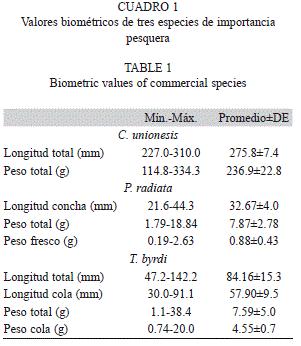
<body><![CDATA[<br> <font style="font-family: verdana;" size="2"></font>    <br> <font style="font-family: verdana;" size="2">En el <a href="#tab_1">cuadro 1</a> se muestran los valores biom&eacute;tricos de las tres especies estudiadas. Los individuos de robalo mostraron una longitud total&nbsp; promedio&nbsp; de&nbsp; 275.8&plusmn;7.4mm&nbsp; y&nbsp; un&nbsp; peso total promedio de 236.9&plusmn;22.8g. La almeja present&oacute; una longitud de la concha promedio de 32.67&plusmn;4.0mm, un peso total promedio de 7.87&plusmn;2.78g&nbsp; y&nbsp; un&nbsp; peso&nbsp; fresco&nbsp; promedio&nbsp; de 0.88&plusmn;0.43g.&nbsp; El&nbsp; camar&oacute;n&nbsp; conchudo&nbsp; present&oacute; una longitud total promedio de 84.16&plusmn;15.3mm, longitud promedio de la cola 57.90&plusmn;9.5mm, peso total promedio 7.59&plusmn;5.0g y peso cola promedio de 4.55&plusmn;0.7g.    <br>     <br> </font>     <div style="text-align: center;"><a name="tab_1"></a><img alt=""  src="/img/revistas/rbt/v61n1/a35t1.gif"  style="width: 301px; height: 346px;">    <br> </div>     <br> <font style="font-family: verdana;" size="2">La composici&oacute;n proximal en base h&uacute;meda obtenida para <span  style="font-style: italic;">T. byrdi, P. radiata </span>y<span style="font-style: italic;"> C. unionesis</span> se presenta en el <a  href="/img/revistas/rbt/v61n1/a35t2.gif">cuadro 2</a>.    <br>     <br> </font><font style="font-family: verdana;" size="2">El contenido m&iacute;nimo y m&aacute;ximo de humedad detectado para el camar&oacute;n conchudo (<span style="font-style: italic;">T. byrdi</span>) fue 76.9 y 80.0g por 100g (febrero-noviembre) con un promedio de 78.47g por 100g. El contenido de cenizas en esta especie vari&oacute; de 1.4 a 2.0g por 100g a trav&eacute;s del a&ntilde;o (promedio de 1.62g por 100g) y mostraron un aumento significativo desde enero hasta junio. Las prote&iacute;nas var&iacute;an de 16.7 a 21.0g por 100g con un promedio de 19.08g por 100g e incrementando significativamente (p&lt;0.05) de diciembre a febrero. El m&iacute;nimo del extracto et&eacute;reo encontrado fue en noviembre (0.09g por 100g) y el m&aacute;ximo en diciembre 1.09g por 100g (p&lt;0.05). Se encontr&oacute; una correlaci&oacute;n inversa entre la variaci&oacute;n&nbsp; de&nbsp; humedad&nbsp; y&nbsp; cenizas&nbsp; (Pearson, r=-0.69, p&lt;0.05), humedad y prote&iacute;nas (Pearson, r=-0.89, p&lt;0.05) y una correlaci&oacute;n positiva entre las cenizas y las prote&iacute;nas (Pearson, r=0.66, p&lt;0.05).</font>    <br> <font style="font-family: verdana;" size="2"></font>    ]]></body>
<body><![CDATA[<br> <font style="font-family: verdana;" size="2">La&nbsp; almeja&nbsp; verde&nbsp; (<span style="font-style: italic;">P.&nbsp; radiata</span>)&nbsp; present&oacute; un promedio en el contenido de humedad de 83.32g por 100g, variando durante todo el a&ntilde;o entre&nbsp; 77.9g&nbsp; por&nbsp; 100g&nbsp; (febrero)&nbsp; y&nbsp; 89.5g&nbsp; por 100g (octubre), encontr&aacute;ndose una correlaci&oacute;n significativa (p&lt;0.05) con el extracto et&eacute;reo y las prote&iacute;nas Pearson, r=-0.85 y r=-0.86 respectivamente y ligeramente con las cenizas (Pearson, r=-0.61, p&lt;0.05). La ceniza varia de 1.1 a 2.6g por 100g (septiembre-febrero) con un promedio de 1.62g por 100g y una diferencia significativa (p&lt;0.05) entre el m&iacute;nimo y m&aacute;ximo valor. El contenido de prote&iacute;nas de esta especie present&oacute; un m&aacute;ximo en febrero (13.5g por 100g),&nbsp; un&nbsp; m&iacute;nimo&nbsp; en&nbsp; octubre&nbsp; (6.8g&nbsp; por </font><font  style="font-family: verdana;" size="2">100g) (p&lt;0.05) y un promedio de 10.89g por 100g. La fracci&oacute;n lip&iacute;dica vari&oacute; significativamente (p&lt;0.05) de 1.0 a 3.5g por 100g (agosto-febrero) y un promedio de 2.07g por 100g.</font>    <br> <font style="font-family: verdana;" size="2"></font>    <br> <font style="font-family: verdana;" size="2">La humedad detectada para el robalo (<span style="font-style: italic;">C. unionesis</span>) vari&oacute; entre 74.6 a 80.6g por 100g (abril-septiembre), con un promedio de 77.38g por 100g. La variaci&oacute;n de la humedad del tejido blando en las muestras de robalo manifiestan una correlaci&oacute;n inversa con las cenizas (Pearson, r=-0.71, p&lt;0.05) y con el extracto et&eacute;reo (Pearson, r=-0.83, p&lt;0.05). El contenido de ceniza fue el m&aacute;s bajo de las tres especies estudiadas, variando de 0.8 a 1.2g por 100g donde el valor m&aacute;s bajo encontrado (p&lt;0.05) fue en septiembre. El contenido de prote&iacute;na estuvo en un rango de 17.6 a 20.9g por 100g (septiembre-diciembre) con un promedio de 19.25. La prote&iacute;na en esta especie increment&oacute; significativamente (p&lt;0.05) de septiembre a diciembre. El extracto et&eacute;reo vari&oacute; de 0.7 a 5.6g por 100g y un promedio de 2.51g por 100g. El m&iacute;nimo valor obtenido fue en agosto y el m&aacute;ximo en abril (p&lt;0.05).</font>    <br> <font style="font-family: verdana;" size="2"></font>    <br> <font style="font-family: verdana; font-weight: bold;" size="3">Discusi&oacute;n</font>    <br> <font style="font-family: verdana;" size="2"></font>    <br> <font style="font-family: verdana;" size="2">La composici&oacute;n qu&iacute;mica constituye un criterio importante al seleccionar los alimentos sobre todo en aquellos pa&iacute;ses donde el nivel de cultura alimentaria es elevada, ya que los alimentos proporcionan la energ&iacute;a y los nutrimentos necesarios para el desarrollo, el mantenimiento y la realizaci&oacute;n de las actividades fisiol&oacute;gicas en el hombre (Guerra 2003).</font>    <br> <font style="font-family: verdana;" size="2"></font>    <br> <font style="font-family: verdana;" size="2">Andrade (2000) recalca la calidad nutricional de los camarones, aduciendo que &eacute;stos son ricos en prote&iacute;nas e igual a cualquier otra prote&iacute;na de origen animal, as&iacute; como tambi&eacute;n bajos en calor&iacute;as y grasas (con un rango cercano a 0.5 a 1.0%) lo cual queda demostrado con los resultados obtenidos en esta investigaci&oacute;n. Se encontraron valores promedio de humedad, ceniza, l&iacute;pidos y prote&iacute;nas para el camar&oacute;n T. byrdi de 78.47, 1.62, 1.29, 19.08g por 100g, respectivamente. Similares resultados han sido obtenidos por Rivas (2000) en camar&oacute;n azul silvestre&nbsp; <span style="font-style: italic;">Litopenaeus&nbsp; stylirostris</span>&nbsp; (humedad 75.85 %, ceniza 1.92%, l&iacute;pidos 1.82 % y prote&iacute;nas 21.30), Wong (2004) citado por Tamarit (2008) en el camar&oacute;n marino Litopenaus vannamei (76.1% humedad, 20.3% prote&iacute;nas, 0.9% l&iacute;pidos, 1.3% cenizas y 1.4% carbohidratos), INCAP (2007) y para otras especies de camar&oacute;n en diferentes latitudes como lo informan Heu <span  style="font-style: italic;">et al. </span>(2003) para <span style="font-style: italic;">Pandalus borealis </span>y<span style="font-style: italic;">&nbsp; Trachypena&nbsp; curvirostris</span>&nbsp; en&nbsp; Korea,&nbsp; Yanar &amp;&nbsp; &Ccedil;elik&nbsp; (2006)&nbsp; para&nbsp; P<span  style="font-style: italic;">enaeus&nbsp; semisulcatus </span>y<span  style="font-style: italic;"> Metapenaeus monoceros</span> del Mediterr&aacute;neo Oriental, Turqu&iacute;a y &Ouml;zden (2010a) para Parapenaus longirostris en Turqu&iacute;a.</font>    <br> <font style="font-family: verdana;" size="2"></font>    ]]></body>
<body><![CDATA[<br> <font style="font-family: verdana;" size="2">La composici&oacute;n proximal de <span style="font-style: italic;">C. unionesis</span> en el presente estudio fue muy similar a la reportada para otra especie del mismo g&eacute;nero (<span style="font-style: italic;">C.&nbsp; undecimalis</span>)&nbsp; en&nbsp; Brasil&nbsp; por&nbsp; Menezes&nbsp; <span style="font-style: italic;">et al.&nbsp;</span> (2008)&nbsp; (79.62,&nbsp; 1.09,&nbsp; 2.5&nbsp; y&nbsp; 18.29g/100g de humedad, ceniza, l&iacute;pidos y prote&iacute;nas respectivamente), en Venezuela por Izquierdo <span style="font-style: italic;">et al. </span>(2000) (77.12, 1.60, 1.66, y 21.61g/100g de humedad, ceniza, l&iacute;pidos y prote&iacute;nas, respectivamente) y similar a otras de especies reportadas para el Pac&iacute;fico americano (Castro-Gonz&aacute;lez <span style="font-style: italic;">et al. </span>1998, Romero <span style="font-style: italic;">et al. </span>2000, L&oacute;pez <span style="font-style: italic;">et al. </span>2006, Badillo-Zapata <span  style="font-style: italic;">et al. </span>2010).</font>    <br> <font style="font-family: verdana;" size="2"></font>    <br> <font style="font-family: verdana;" size="2">De acuerdo con Varlik <span  style="font-style: italic;">et al. </span>(2004) citado por &Ouml;zden <span style="font-style: italic;">et al. </span>(2010), los peces son usualmente clasificados como grasos (&gt;8g/100g), moderadamente grasos (4-8g/100g) y magros (&lt;4g/100g). Por esto, considerando los resultados, la especie estudiada en este trabajo es considerada una especie magra, lo cual puede ser m&aacute;s atractivo para los consumidores que prefieren carnes blancas. Similares resultados han sido reportados por &Ouml;zden <span  style="font-style: italic;">et al. </span>(2010) para <span  style="font-style: italic;">Solea solea </span>y<span style="font-style: italic;"> Merlangius merlangus</span>, Izquierdo <span style="font-style: italic;">et al. </span>(2001) para el robalo <span style="font-style: italic;">C. undecimalis</span> y Romero <span style="font-style: italic;">et al. </span>(2000).</font>    <br> <font style="font-family: verdana;" size="2"></font>    <br> <font style="font-family: verdana;" size="2">El&nbsp; an&aacute;lisis&nbsp; de&nbsp; la&nbsp; composici&oacute;n&nbsp; proximal de la almeja verde en esta investigaci&oacute;n present&oacute; valores promedios de humedad, ceniza, extracto et&eacute;reo y prote&iacute;nas de 83.32, 1.81, 2.07 y 10.89g/100g, respectivamente. Ruiz <span style="font-style: italic;">et al. </span>(1998) reportaron para almejas con longitud total y peso de carne promedio (32.29&plusmn;7.63mm y 1.36&plusmn;3.75g) porcentajes de humedad, ceniza, l&iacute;pidos y prote&iacute;nas de 90.1, 0.6, 0.9 y 7.8%, valores que a excepci&oacute;n de la humedad, son inferiores a los reportados en este trabajo. Estas diferencias pueden ser atribuidas a factores como la alimentaci&oacute;n, ubicaci&oacute;n geogr&aacute;fica, &eacute;poca, edad y sexo (Caballero <span  style="font-style: italic;">et al. </span>1997, &Ouml;zden <span style="font-style: italic;">et al. </span>2010). Se observ&oacute; adem&aacute;s, que existe una relaci&oacute;n inversa entre el contenido de humedad y de materia grasa en las muestras de almeja verde y robalo, lo cual est&aacute; descrito en la literatura (Gruger <span style="font-style: italic;">et al. </span>1964, Romero <span style="font-style: italic;">et al. </span>1996).</font>    <br> <font style="font-family: verdana;" size="2"></font>    <br> <font style="font-family: verdana;" size="2">Por otra parte, se ha observado que la frecuencia de los cambios en la composici&oacute;n de los constituyentes bioqu&iacute;micos de cualquier organismo oscila con la variaci&oacute;n de los cambios&nbsp; ambientales,&nbsp; entre&nbsp; ellos&nbsp; la&nbsp; dieta,&nbsp; &eacute;poca de captura y la temperatura del agua, adem&aacute;s de algunas diferencias biol&oacute;gicas tales como la edad, sexo y tama&ntilde;o de las especies (Love 1957,&nbsp; Shearer&nbsp; 1994,&nbsp; Lie&nbsp; 2001,&nbsp; Rasmussen 2001, Nazrul &amp; Razzaq 2005). Love (1957) indic&oacute; que la disponibilidad de alimento en diferentes &eacute;pocas del a&ntilde;o tiene un efecto considerable sobre los componentes del tejido, particularmente las grasas. Las especies estudiadas presentaron variaciones de los compuestos nutricionales a lo largo del periodo de estudio lo cual evidencia que la composici&oacute;n proximal del m&uacute;sculo en organismos marinos puede cambiar estacionalmente de acuerdo a diferentes factores, entre ellos la especie y de un individuo a otro dependiendo de la edad, el sexo, el ambiente, estaci&oacute;n del a&ntilde;o, la dieta y origen geogr&aacute;fico coincidiendo con lo expresado por Love 1957, Shearer 1994, Andrade 2000, Lie 2001,&nbsp; Rasmussen&nbsp; 2001,&nbsp; Nazrul&nbsp; &amp;&nbsp; Razzaq 2005, Erkan <span  style="font-style: italic;">et al. </span>2007 y &Ouml;zden <span  style="font-style: italic;">et al. </span>2010.</font>    <br> <font style="font-family: verdana;" size="2"></font>    <br> <font style="font-family: verdana;" size="2">El pescado y los mariscos son una valiosa fuente de prote&iacute;nas de alta calidad y de otros productos org&aacute;nicos, siendo esta prote&iacute;na la &uacute;nica que contiene todos los amino&aacute;cidos esenciales en la proporci&oacute;n adecuada, y por lo tanto, llamada&nbsp; prote&iacute;na&nbsp; completa,&nbsp; comparable&nbsp; solo con la prote&iacute;na presente en la leche y el huevo (Nazrul &amp; Razzaq 2005).</font>    <br> <font style="font-family: verdana;" size="2"></font>    ]]></body>
<body><![CDATA[<br> <font style="font-family: verdana;" size="2">Bajo esta primicia, el contenido de prote&iacute;nas promedio determinado en este estudio para <span style="font-style: italic;">C. unionesis </span>y<span style="font-style: italic;"> T. byrdi</span> (19.08g/100g y 19.25g/100g, respectivamente) fueron similares a los reportados en la carne de bovino (20 a 22%), pollo (20%) y cerdo (19 a 20%) que satisfacen los requerimientos m&iacute;nimos diarios en la dieta del hombre (Stansby 1963, Bourgeois &amp; Le Roux 1986). Por lo tanto, estos resultados permiten concluir que las especies estudiadas son una buena alternativa para el consumo humano, por su bajo contenido en grasas, ricas en &aacute;cidos grasos n-3 (no determinados en este estudio) (Luzia <span style="font-style: italic;">et al. </span>2003, Castro-Gonz&aacute;lez <span style="font-style: italic;">et al. </span>2007, Tawfik 2009) y por el aporte proteico, principalmente durante los meses de diciembre, enero y febrero para <span style="font-style: italic;">C. unionesis </span>y<span style="font-style: italic;"> P. radiata</span> y durante febrero, mayo y septiembre para <span style="font-style: italic;">T. byrdi</span>.</font>    <br> <font style="font-family: verdana;" size="2"></font>    <br> <font style="font-family: verdana;" size="2">Se recomienda continuar estudios sobre el valor nutricional de otras especies de pescado y mariscos en Costa Rica.</font>    <br> <font style="font-family: verdana;" size="2"></font>    <br> <font style="font-family: verdana; font-weight: bold;" size="3">Agradecimientos</font>    <br> <font style="font-family: verdana;" size="2"></font>    <br> <font style="font-family: verdana;" size="2">Este trabajo es una contribuci&oacute;n de la Universidad Nacional (Escuela de Ciencias Biol&oacute;gicas), por medio del proyecto 053451, &#8220;Estrategia de Manejo Participativa de las Pesquer&iacute;as del Golfo de Nicoya, Costa Rica&#8221;. Se le agradece a Rosa Soto por su colaboraci&oacute;n en la revisi&oacute;n del documento.</font>    <br> <hr style="width: 100%; height: 2px;"><font  style="font-family: verdana; font-weight: bold;" size="3">Referencias</font>    <br> <font style="font-family: verdana;" size="2"></font>    <!-- ref --><br> <font style="font-family: verdana;" size="2">Andrade,&nbsp; G. 2000. Los camarones y su&nbsp; importancia en la alimentaci&oacute;n. Fondo&nbsp; Nacional de Investigaciones Agropecuarias, Maracay, Venezuela.&nbsp; (Consultado el 14&nbsp; junio de 2011,&nbsp; http://sian.inia.gob.ve/repositorio/ revistas_tec/FonaiapDivulga/fd65/texto/camarones.htm).    &nbsp;&nbsp;&nbsp;&nbsp;&nbsp;&nbsp;&nbsp;&nbsp;[&#160;<a href="javascript:void(0);" onclick="javascript: window.open('/scielo.php?script=sci_nlinks&ref=1829947&pid=S0034-7744201300010003500001&lng=','','width=640,height=500,resizable=yes,scrollbars=1,menubar=yes,');">Links</a>&#160;]<!-- end-ref --></font>    <br> <font style="font-family: verdana;" size="2"></font>    <!-- ref --><br> <font style="font-family: verdana;" size="2">AOAC.&nbsp; 1984. Official methods of analysis.&nbsp; Association of&nbsp; Official Analytical&nbsp; Chemists. Washington&nbsp; D.C., EE.UU.    &nbsp;&nbsp;&nbsp;&nbsp;&nbsp;&nbsp;&nbsp;&nbsp;[&#160;<a href="javascript:void(0);" onclick="javascript: window.open('/scielo.php?script=sci_nlinks&ref=1829950&pid=S0034-7744201300010003500002&lng=','','width=640,height=500,resizable=yes,scrollbars=1,menubar=yes,');">Links</a>&#160;]<!-- end-ref --></font>    <br> <font style="font-family: verdana;" size="2"></font>    <!-- ref --><br> <font style="font-family: verdana;" size="2">Astorga, M., E. Rodr&iacute;guez &amp; C. D&iacute;az. 2007. Comparison of minerals and trace&nbsp; element concentration in two mollusks from the Strait of Magellan (Chile). J. Food Comp. Anal. 20: 273-279.    &nbsp;&nbsp;&nbsp;&nbsp;&nbsp;&nbsp;&nbsp;&nbsp;[&#160;<a href="javascript:void(0);" onclick="javascript: window.open('/scielo.php?script=sci_nlinks&ref=1829953&pid=S0034-7744201300010003500003&lng=','','width=640,height=500,resizable=yes,scrollbars=1,menubar=yes,');">Links</a>&#160;]<!-- end-ref --></font>    <br> <font style="font-family: verdana;" size="2"></font>    <!-- ref --><br> <font style="font-family: verdana;" size="2">Badillo-Zapata, D., G. Correa-Reyes, L.&nbsp; D&#8217;Abramo,&nbsp; J. Lazo, J. Toro-V&aacute;zquez &amp; M. Viana. 2010. Effect of replacing dietary fish oil with&nbsp; vegetable oils on the fatty acid&nbsp; composition of muscle tissue of juvenile California halibut (<span style="font-style: italic;">Paralichthys californicus</span>). Cienc. Mar. 36: 121-133.    &nbsp;&nbsp;&nbsp;&nbsp;&nbsp;&nbsp;&nbsp;&nbsp;[&#160;<a href="javascript:void(0);" onclick="javascript: window.open('/scielo.php?script=sci_nlinks&ref=1829956&pid=S0034-7744201300010003500004&lng=','','width=640,height=500,resizable=yes,scrollbars=1,menubar=yes,');">Links</a>&#160;]<!-- end-ref --></font>    ]]></body>
<body><![CDATA[<br> <font style="font-family: verdana;" size="2"></font>    <!-- ref --><br> <font style="font-family: verdana;" size="2">B&aacute;ez, R. 1985. Evaluaci&oacute;n de algunos aspectos de la biolog&iacute;a del molusco <span style="font-style: italic;">Polymesoda inflata</span> (Philipp, 1851) (Bivalvia:&nbsp; Corbiculidae), en el manglar de Pochote, Puntarenas, Costa Rica. Tesis de&nbsp; Licenciatura, Universidad de Costa Rica, San Jos&eacute;, Costa Rica.    &nbsp;&nbsp;&nbsp;&nbsp;&nbsp;&nbsp;&nbsp;&nbsp;[&#160;<a href="javascript:void(0);" onclick="javascript: window.open('/scielo.php?script=sci_nlinks&ref=1829959&pid=S0034-7744201300010003500005&lng=','','width=640,height=500,resizable=yes,scrollbars=1,menubar=yes,');">Links</a>&#160;]<!-- end-ref --></font>    <br> <font style="font-family: verdana;" size="2"></font>    <!-- ref --><br> <font style="font-family: verdana;" size="2">Blanco, A. &amp; M. Montero. 1992.&nbsp; Composici&oacute;n&nbsp; qu&iacute;miconutricional de la carne de cambute, <span  style="font-style: italic;">Strombus galeatus </span>(Mesogastropoda: Strombidae). Rev. Biol. Trop. 40: 89-93.    &nbsp;&nbsp;&nbsp;&nbsp;&nbsp;&nbsp;&nbsp;&nbsp;[&#160;<a href="javascript:void(0);" onclick="javascript: window.open('/scielo.php?script=sci_nlinks&ref=1829962&pid=S0034-7744201300010003500006&lng=','','width=640,height=500,resizable=yes,scrollbars=1,menubar=yes,');">Links</a>&#160;]<!-- end-ref --></font>    <br> <font style="font-family: verdana;" size="2"></font>    <!-- ref --><br> <font style="font-family: verdana;" size="2">Bourgeois, C. &amp; P. Le Roux. 1986. Prote&iacute;nas animales. El Manual Moderno, M&eacute;xico D.F., M&eacute;xico.    &nbsp;&nbsp;&nbsp;&nbsp;&nbsp;&nbsp;&nbsp;&nbsp;[&#160;<a href="javascript:void(0);" onclick="javascript: window.open('/scielo.php?script=sci_nlinks&ref=1829965&pid=S0034-7744201300010003500007&lng=','','width=640,height=500,resizable=yes,scrollbars=1,menubar=yes,');">Links</a>&#160;]<!-- end-ref --></font>    <br> <font style="font-family: verdana;" size="2"></font>    ]]></body>
<body><![CDATA[<!-- ref --><br> <font style="font-family: verdana;" size="2">Caballero, A., J. Cabrera &amp; Y. Solano. 1997. Descripci&oacute;n del crecimiento y madurez sexual de una poblaci&oacute;n de&nbsp; <span style="font-style: italic;">Crassostrea&nbsp; columbensis</span>&nbsp; (Mollusca:&nbsp; Bivalvia). Rev. Biol. Trop. 44-45: 335-339.    &nbsp;&nbsp;&nbsp;&nbsp;&nbsp;&nbsp;&nbsp;&nbsp;[&#160;<a href="javascript:void(0);" onclick="javascript: window.open('/scielo.php?script=sci_nlinks&ref=1829968&pid=S0034-7744201300010003500008&lng=','','width=640,height=500,resizable=yes,scrollbars=1,menubar=yes,');">Links</a>&#160;]<!-- end-ref --></font>    <br> <font style="font-family: verdana;" size="2"></font>    <!-- ref --><br> <font style="font-family: verdana;" size="2">Cabrera,&nbsp; T.,&nbsp; G.&nbsp; Cabrera,&nbsp; J.&nbsp; Rosas, A.&nbsp; Vel&aacute;squez&nbsp; &amp;&nbsp; M. Silva. 2005. Variaci&oacute;n de l&iacute;pidos y &aacute;cidos grasos en camarones marinos consumidos en Venezuela. ALAN 55: 194-200.    &nbsp;&nbsp;&nbsp;&nbsp;&nbsp;&nbsp;&nbsp;&nbsp;[&#160;<a href="javascript:void(0);" onclick="javascript: window.open('/scielo.php?script=sci_nlinks&ref=1829971&pid=S0034-7744201300010003500009&lng=','','width=640,height=500,resizable=yes,scrollbars=1,menubar=yes,');">Links</a>&#160;]<!-- end-ref --></font>    <br> <font style="font-family: verdana;" size="2"></font>    <!-- ref --><br> <font style="font-family: verdana;" size="2">Castro-Gonz&aacute;lez, M., J. Silencio, M. Ju&aacute;rez, S. Monta&ntilde;o &amp; F. P&eacute;rez-Gil. 1998. Composici&oacute;n qu&iacute;mica de la fauna de acompa&ntilde;amiento del camar&oacute;n de Veracruz (Golfo de M&eacute;xico). Rev. Biol. Trop. 46: 249-256.    &nbsp;&nbsp;&nbsp;&nbsp;&nbsp;&nbsp;&nbsp;&nbsp;[&#160;<a href="javascript:void(0);" onclick="javascript: window.open('/scielo.php?script=sci_nlinks&ref=1829974&pid=S0034-7744201300010003500010&lng=','','width=640,height=500,resizable=yes,scrollbars=1,menubar=yes,');">Links</a>&#160;]<!-- end-ref --></font>    <br> <font style="font-family: verdana;" size="2"></font>    <!-- ref --><br> <font style="font-family: verdana;" size="2">Castro-Gonz&aacute;lez,&nbsp; M.,&nbsp; V.A.&nbsp; Ojeda,&nbsp; B.S.&nbsp; Monta&ntilde;o,&nbsp; C.E. Ledesma &amp; R.F. P&eacute;rez-Gil. 2007. Evaluaci&oacute;n de los &aacute;cidos grasos n-3 de 18 especies de pescados marinos mexicanos&nbsp; como alimentos funcionales. ALAN 57: 85-93.    &nbsp;&nbsp;&nbsp;&nbsp;&nbsp;&nbsp;&nbsp;&nbsp;[&#160;<a href="javascript:void(0);" onclick="javascript: window.open('/scielo.php?script=sci_nlinks&ref=1829977&pid=S0034-7744201300010003500011&lng=','','width=640,height=500,resizable=yes,scrollbars=1,menubar=yes,');">Links</a>&#160;]<!-- end-ref --></font>    <br> <font style="font-family: verdana;" size="2"></font>    <!-- ref --><br> <font style="font-family: verdana;" size="2">Chukwu,&nbsp; O. &amp; I. Mohammed. 2009. Effects&nbsp; of Drying Methods&nbsp; on&nbsp; Proximate&nbsp;&nbsp; Compositions&nbsp; of&nbsp; Catfish (<span style="font-style: italic;">Clarias gariepinus</span>). World J. Agric. Sci. 5: 114-116.    &nbsp;&nbsp;&nbsp;&nbsp;&nbsp;&nbsp;&nbsp;&nbsp;[&#160;<a href="javascript:void(0);" onclick="javascript: window.open('/scielo.php?script=sci_nlinks&ref=1829980&pid=S0034-7744201300010003500012&lng=','','width=640,height=500,resizable=yes,scrollbars=1,menubar=yes,');">Links</a>&#160;]<!-- end-ref --></font>    <br> <font style="font-family: verdana;" size="2"></font>    <!-- ref --><br> <font style="font-family: verdana;" size="2">Cruz, R.A. &amp; C.R. Villalobos. 1993. Monthly changes in tissue&nbsp; weight&nbsp; and&nbsp; biochemical&nbsp; composition&nbsp; of&nbsp; the mussel <span style="font-style: italic;">Mytella guyanensis</span> (Bivalvia: Mytillidae) in Costa Rica. Rev. Biol. Trop. 41: 93-96.    &nbsp;&nbsp;&nbsp;&nbsp;&nbsp;&nbsp;&nbsp;&nbsp;[&#160;<a href="javascript:void(0);" onclick="javascript: window.open('/scielo.php?script=sci_nlinks&ref=1829983&pid=S0034-7744201300010003500013&lng=','','width=640,height=500,resizable=yes,scrollbars=1,menubar=yes,');">Links</a>&#160;]<!-- end-ref --></font>    <br> <font style="font-family: verdana;" size="2"></font>    <!-- ref --><br> <font style="font-family: verdana;" size="2">Daviglus,&nbsp; M.L., J. Stamler, A.J. Orencia, A.R.&nbsp; Dyer, K. Liu,&nbsp; P. Greenland, M.K. Walsh, D.&nbsp; Morris &amp; R.B. Shekelle. 1997. <span style="font-style: italic;">Fish&nbsp; consumption and the 30-year risk of fatal myocardial infarction</span>. N. Engl. J. Med. 336: 1046-1053.    &nbsp;&nbsp;&nbsp;&nbsp;&nbsp;&nbsp;&nbsp;&nbsp;[&#160;<a href="javascript:void(0);" onclick="javascript: window.open('/scielo.php?script=sci_nlinks&ref=1829986&pid=S0034-7744201300010003500014&lng=','','width=640,height=500,resizable=yes,scrollbars=1,menubar=yes,');">Links</a>&#160;]<!-- end-ref --></font>    ]]></body>
<body><![CDATA[<br> <font style="font-family: verdana;" size="2"></font>    <!-- ref --><br> <font style="font-family: verdana;" size="2">Dignam, C.A., B.A. Burlingame, J.M. Arthur, R.J. Quigley &amp;&nbsp; G.C.&nbsp; Milligan.&nbsp; 1995.&nbsp; The&nbsp; pacific&nbsp; Islands&nbsp; food composition tables. South Pacific Commission, New Zealand Institute for Crop &amp; Food Research, Christchurch, Nueva Zealanda.    &nbsp;&nbsp;&nbsp;&nbsp;&nbsp;&nbsp;&nbsp;&nbsp;[&#160;<a href="javascript:void(0);" onclick="javascript: window.open('/scielo.php?script=sci_nlinks&ref=1829989&pid=S0034-7744201300010003500015&lng=','','width=640,height=500,resizable=yes,scrollbars=1,menubar=yes,');">Links</a>&#160;]<!-- end-ref --></font>    <br> <font style="font-family: verdana;" size="2"></font>    <!-- ref --><br> <font style="font-family: verdana;" size="2">Erkan,&nbsp; N., &Ouml;. &Ouml;zden, D. &Uuml;&ccedil;ok-Alakavuk, S.Y. Tosun, C. Varl&#305;k &amp; T. Baygar. 2007. Istanbul&#8217; da&nbsp; sat&#305;lan karideslerin&nbsp; sodyum&nbsp; metabis&uuml;lfit&nbsp; d&uuml;zeyinin&nbsp; tespiti.&nbsp; J. Fish. Sci. 1: 26-33.    &nbsp;&nbsp;&nbsp;&nbsp;&nbsp;&nbsp;&nbsp;&nbsp;[&#160;<a href="javascript:void(0);" onclick="javascript: window.open('/scielo.php?script=sci_nlinks&ref=1829992&pid=S0034-7744201300010003500016&lng=','','width=640,height=500,resizable=yes,scrollbars=1,menubar=yes,');">Links</a>&#160;]<!-- end-ref --></font>    <br> <font style="font-family: verdana;" size="2"></font>    <!-- ref --><br> <font style="font-family: verdana;" size="2">FAO, 1991. Fish for Food and&nbsp; Development. Food and Agriculture&nbsp;&nbsp; Organization&nbsp; of&nbsp; the&nbsp; United&nbsp; Nations, Rome, Italy.    &nbsp;&nbsp;&nbsp;&nbsp;&nbsp;&nbsp;&nbsp;&nbsp;[&#160;<a href="javascript:void(0);" onclick="javascript: window.open('/scielo.php?script=sci_nlinks&ref=1829995&pid=S0034-7744201300010003500017&lng=','','width=640,height=500,resizable=yes,scrollbars=1,menubar=yes,');">Links</a>&#160;]<!-- end-ref --></font>    <br> <font style="font-family: verdana;" size="2"></font>    ]]></body>
<body><![CDATA[<!-- ref --><br> <font style="font-family: verdana;" size="2">Fonseca,&nbsp; C., C. Mar&iacute;n-Vindas, F.&nbsp; Chavarr&iacute;a-Solera, R.A. Cruz&nbsp; &amp; P. Toledo. 2011. Variaci&oacute;n&nbsp; estacional de la composici&oacute;n&nbsp; proximal&nbsp; del&nbsp; mejill&oacute;n&nbsp; Tagelus&nbsp; peruvianus&nbsp; (Bivalvia: Solecurtidae) del Golfo de&nbsp; Nicoya,&nbsp; Puntarenas,&nbsp; Costa&nbsp; Rica.&nbsp; Rev.&nbsp; Biol.&nbsp; Trop.&nbsp; 54: 1517-1523.    &nbsp;&nbsp;&nbsp;&nbsp;&nbsp;&nbsp;&nbsp;&nbsp;[&#160;<a href="javascript:void(0);" onclick="javascript: window.open('/scielo.php?script=sci_nlinks&ref=1829998&pid=S0034-7744201300010003500018&lng=','','width=640,height=500,resizable=yes,scrollbars=1,menubar=yes,');">Links</a>&#160;]<!-- end-ref --></font>    <br> <font style="font-family: verdana;" size="2"></font>    <!-- ref --><br> <font style="font-family: verdana;" size="2">Fuentes, A., I. Fern&aacute;ndez-Segovia, I. Escriche &amp; J. Serra. 2009. Comparison of physicochemical&nbsp; parameters and composition of mussels (<span style="font-style: italic;">Mytilus alloprovincialis Lmk.</span>) from different Spanish origins. Food Chem. 112: 295-302.    &nbsp;&nbsp;&nbsp;&nbsp;&nbsp;&nbsp;&nbsp;&nbsp;[&#160;<a href="javascript:void(0);" onclick="javascript: window.open('/scielo.php?script=sci_nlinks&ref=1830001&pid=S0034-7744201300010003500019&lng=','','width=640,height=500,resizable=yes,scrollbars=1,menubar=yes,');">Links</a>&#160;]<!-- end-ref --></font>    <br> <font style="font-family: verdana;" size="2"></font>    <!-- ref --><br> <font style="font-family: verdana;" size="2">Giese,&nbsp; A. &amp; J. Pearse. 1974. Introduction&nbsp; general principles, p 1-41. <span style="font-style: italic;">In</span> A.C.&nbsp; Giese &amp; J.S. Pearse (eds.). Reproduction&nbsp;&nbsp; of&nbsp; marine&nbsp; invertebrates.&nbsp; Academic, New York, EEUU.    &nbsp;&nbsp;&nbsp;&nbsp;&nbsp;&nbsp;&nbsp;&nbsp;[&#160;<a href="javascript:void(0);" onclick="javascript: window.open('/scielo.php?script=sci_nlinks&ref=1830004&pid=S0034-7744201300010003500020&lng=','','width=640,height=500,resizable=yes,scrollbars=1,menubar=yes,');">Links</a>&#160;]<!-- end-ref --></font>    <br> <font style="font-family: verdana;" size="2"></font>    <!-- ref --><br> <font style="font-family: verdana;" size="2">Gruger, H., R. Nelson &amp; M. Stansby. 1964.&nbsp; Fatty acid composition of oils from 21 species of marine fish, freshwater fish and shellfish. J. Am. Oils Chem. Soc. 41: 662-667.    &nbsp;&nbsp;&nbsp;&nbsp;&nbsp;&nbsp;&nbsp;&nbsp;[&#160;<a href="javascript:void(0);" onclick="javascript: window.open('/scielo.php?script=sci_nlinks&ref=1830007&pid=S0034-7744201300010003500021&lng=','','width=640,height=500,resizable=yes,scrollbars=1,menubar=yes,');">Links</a>&#160;]<!-- end-ref --></font>    <br> <font style="font-family: verdana;" size="2"></font>    <!-- ref --><br> <font style="font-family: verdana;" size="2">Guerra,&nbsp; M.&nbsp; 2003.&nbsp; Evaluaci&oacute;n&nbsp; de&nbsp; la&nbsp; calidad&nbsp; del&nbsp; camar&oacute;n blanco <span style="font-style: italic;">Litopenaeus&nbsp; schmitti</span> cultivado. Tesis de Licenciatura, Universidad de la Habana, La Habana, Cuba.    &nbsp;&nbsp;&nbsp;&nbsp;&nbsp;&nbsp;&nbsp;&nbsp;[&#160;<a href="javascript:void(0);" onclick="javascript: window.open('/scielo.php?script=sci_nlinks&ref=1830010&pid=S0034-7744201300010003500022&lng=','','width=640,height=500,resizable=yes,scrollbars=1,menubar=yes,');">Links</a>&#160;]<!-- end-ref --></font>    <br> <font style="font-family: verdana;" size="2"></font>    <!-- ref --><br> <font style="font-family: verdana;" size="2">Heu, M.S., J.S. Kim &amp; F. Shahidi. 2003. Components and nutritional quality of shrimp processing byproducts. Food Chem. 82: 235-242.    &nbsp;&nbsp;&nbsp;&nbsp;&nbsp;&nbsp;&nbsp;&nbsp;[&#160;<a href="javascript:void(0);" onclick="javascript: window.open('/scielo.php?script=sci_nlinks&ref=1830013&pid=S0034-7744201300010003500023&lng=','','width=640,height=500,resizable=yes,scrollbars=1,menubar=yes,');">Links</a>&#160;]<!-- end-ref --></font>    <br> <font style="font-family: verdana;" size="2"></font>    <!-- ref --><br> <font style="font-family: verdana;" size="2">INCAP. 2007. Tabla de Composici&oacute;n de Alimentos de Centroam&eacute;rica. INCAP, OPS, Guatemala.    &nbsp;&nbsp;&nbsp;&nbsp;&nbsp;&nbsp;&nbsp;&nbsp;[&#160;<a href="javascript:void(0);" onclick="javascript: window.open('/scielo.php?script=sci_nlinks&ref=1830016&pid=S0034-7744201300010003500024&lng=','','width=640,height=500,resizable=yes,scrollbars=1,menubar=yes,');">Links</a>&#160;]<!-- end-ref --></font>    ]]></body>
<body><![CDATA[<br> <font style="font-family: verdana;" size="2"></font>    <!-- ref --><br> <font style="font-family: verdana;" size="2">Izquierdo, P., G. Torres, Y. Barboza, S. M&aacute;rquez &amp; M. Allara. 2000. An&aacute;lisis proximal, perfil de &aacute;cidos grasos, amino&aacute;cidos esenciales y contenido de minerales en doce especies de pescado de importancia&nbsp; comercial en Venezuela. ALAN 50: 187-194.    &nbsp;&nbsp;&nbsp;&nbsp;&nbsp;&nbsp;&nbsp;&nbsp;[&#160;<a href="javascript:void(0);" onclick="javascript: window.open('/scielo.php?script=sci_nlinks&ref=1830019&pid=S0034-7744201300010003500025&lng=','','width=640,height=500,resizable=yes,scrollbars=1,menubar=yes,');">Links</a>&#160;]<!-- end-ref --></font>    <br> <font style="font-family: verdana;" size="2"></font>    <!-- ref --><br> <font style="font-family: verdana;" size="2">Izquierdo, P., G. Torres, M. Allara, E. Marquez, Y. Barboza &amp; E. Sanchez. 2001. An&aacute;lisis proximal, contenido de amino&aacute;cidos esenciales y&nbsp; relaci&oacute;n calcio/fosforo en algunas especies de pescado. FCV-LUZ 2: 95-100.    &nbsp;&nbsp;&nbsp;&nbsp;&nbsp;&nbsp;&nbsp;&nbsp;[&#160;<a href="javascript:void(0);" onclick="javascript: window.open('/scielo.php?script=sci_nlinks&ref=1830022&pid=S0034-7744201300010003500026&lng=','','width=640,height=500,resizable=yes,scrollbars=1,menubar=yes,');">Links</a>&#160;]<!-- end-ref --></font>    <br> <font style="font-family: verdana;" size="2"></font>    <!-- ref --><br> <font style="font-family: verdana;" size="2">Jim&eacute;nez-Arce, G. 1993. Composici&oacute;n qu&iacute;mico-nutricional en diferentes tallas y&nbsp; sexos del cambute <span style="font-style: italic;">Strombus gracilior</span>&nbsp; (Mesogastropoda: Strombidae) de Playa Panam&aacute;, Costa Rica. Rev. Biol. Trop. 41: 345-349.    &nbsp;&nbsp;&nbsp;&nbsp;&nbsp;&nbsp;&nbsp;&nbsp;[&#160;<a href="javascript:void(0);" onclick="javascript: window.open('/scielo.php?script=sci_nlinks&ref=1830025&pid=S0034-7744201300010003500027&lng=','','width=640,height=500,resizable=yes,scrollbars=1,menubar=yes,');">Links</a>&#160;]<!-- end-ref --></font>    <br> <font style="font-family: verdana;" size="2"></font>    ]]></body>
<body><![CDATA[<!-- ref --><br> <font style="font-family: verdana;" size="2">Karakoltsidis,&nbsp; P.,&nbsp; A.&nbsp; Zotos&nbsp; &amp;&nbsp; S.&nbsp; Constantinides.&nbsp; 1995. Composition&nbsp; of the commercially&nbsp; important mediterranean finfish, crustaceans and mollusks. J. Food Comp. Anal. 8: 258-273.    &nbsp;&nbsp;&nbsp;&nbsp;&nbsp;&nbsp;&nbsp;&nbsp;[&#160;<a href="javascript:void(0);" onclick="javascript: window.open('/scielo.php?script=sci_nlinks&ref=1830028&pid=S0034-7744201300010003500028&lng=','','width=640,height=500,resizable=yes,scrollbars=1,menubar=yes,');">Links</a>&#160;]<!-- end-ref --></font>    <br> <font style="font-family: verdana;" size="2"></font>    <!-- ref --><br> <font style="font-family: verdana;" size="2">Krzynowek, J. &amp; J. Murphy. 1987. Proximate Composition, Energy, Fatty Acid, Sodium, and Cholesterol Content of Finfish, Shellfish, and their Products. NOAA Tech. Rep NMFS 55, Washington D.C., EE.UU.    &nbsp;&nbsp;&nbsp;&nbsp;&nbsp;&nbsp;&nbsp;&nbsp;[&#160;<a href="javascript:void(0);" onclick="javascript: window.open('/scielo.php?script=sci_nlinks&ref=1830031&pid=S0034-7744201300010003500029&lng=','','width=640,height=500,resizable=yes,scrollbars=1,menubar=yes,');">Links</a>&#160;]<!-- end-ref --></font>    <br> <font style="font-family: verdana;" size="2"></font>    <!-- ref --><br> <font style="font-family: verdana;" size="2">Lie,&nbsp; &Oslash;. 2001. Fish qualitythe role of&nbsp; nutrition. Aquac. Res. 32: 341-348.    &nbsp;&nbsp;&nbsp;&nbsp;&nbsp;&nbsp;&nbsp;&nbsp;[&#160;<a href="javascript:void(0);" onclick="javascript: window.open('/scielo.php?script=sci_nlinks&ref=1830034&pid=S0034-7744201300010003500030&lng=','','width=640,height=500,resizable=yes,scrollbars=1,menubar=yes,');">Links</a>&#160;]<!-- end-ref --></font>    <br> <font style="font-family: verdana;" size="2"></font>    <!-- ref --><br> <font style="font-family: verdana;" size="2">L&oacute;pez,&nbsp; L., E. Durazo, A. Rodr&iacute;guez-G&oacute;mez,&nbsp; C. True &amp; M. Viana. 2006.&nbsp; Composici&oacute;n proximal y perfil de &aacute;cidos grasos de juveniles silvestres y cultivados de <span  style="font-style: italic;">Totoaba macdonaldi</span>. Cienc. Mar. 32: 303-309.    &nbsp;&nbsp;&nbsp;&nbsp;&nbsp;&nbsp;&nbsp;&nbsp;[&#160;<a href="javascript:void(0);" onclick="javascript: window.open('/scielo.php?script=sci_nlinks&ref=1830037&pid=S0034-7744201300010003500031&lng=','','width=640,height=500,resizable=yes,scrollbars=1,menubar=yes,');">Links</a>&#160;]<!-- end-ref --></font>    <br> <font style="font-family: verdana;" size="2"></font>    <!-- ref --><br> <font style="font-family: verdana;" size="2">Love,&nbsp; R.M. 1957. The biochemical&nbsp; composition of fish, p. 401-418. <span style="font-style: italic;">In</span> M.E. Brown (ed.). The Physiology of Fish. Academic, New York, EE.UU.    &nbsp;&nbsp;&nbsp;&nbsp;&nbsp;&nbsp;&nbsp;&nbsp;[&#160;<a href="javascript:void(0);" onclick="javascript: window.open('/scielo.php?script=sci_nlinks&ref=1830040&pid=S0034-7744201300010003500032&lng=','','width=640,height=500,resizable=yes,scrollbars=1,menubar=yes,');">Links</a>&#160;]<!-- end-ref --></font>    <br> <font style="font-family: verdana;" size="2"></font>    <!-- ref --><br> <font style="font-family: verdana;" size="2">Luzia,&nbsp; L.A.,&nbsp; G.R.&nbsp; Sampaio,&nbsp; C.M.&nbsp; Castellucci&nbsp; &amp;&nbsp; E.A. Torres. 2003. The influence of season&nbsp; on&nbsp; the lipid profiles of five&nbsp; commercially important species of Brazilian fish. Food Chem. 83: 93-97.    &nbsp;&nbsp;&nbsp;&nbsp;&nbsp;&nbsp;&nbsp;&nbsp;[&#160;<a href="javascript:void(0);" onclick="javascript: window.open('/scielo.php?script=sci_nlinks&ref=1830043&pid=S0034-7744201300010003500033&lng=','','width=640,height=500,resizable=yes,scrollbars=1,menubar=yes,');">Links</a>&#160;]<!-- end-ref --></font>    <br> <font style="font-family: verdana;" size="2"></font>    <!-- ref --><br> <font style="font-family: verdana;" size="2">Menezes,&nbsp; M.E., G. Macema, C.M. Baz&iacute;lio de&nbsp; Omena, J. Duarte de Freitas &amp; A.E. Goulart. 2008. Composi&ccedil;&atilde;o centesimal, colesterol e&nbsp; perfil&nbsp; de &aacute;cidos graxos dos peixes tainha (<span style="font-style: italic;">Mugil cephalus</span>) e camurim (<span style="font-style: italic;">Centropomus undecimalis</span>) da Lagoa Munda&uacute;, AL/Brasil. Rev. Inst. Adolfo Lutz 67: 89-95.    &nbsp;&nbsp;&nbsp;&nbsp;&nbsp;&nbsp;&nbsp;&nbsp;[&#160;<a href="javascript:void(0);" onclick="javascript: window.open('/scielo.php?script=sci_nlinks&ref=1830046&pid=S0034-7744201300010003500034&lng=','','width=640,height=500,resizable=yes,scrollbars=1,menubar=yes,');">Links</a>&#160;]<!-- end-ref --></font>    ]]></body>
<body><![CDATA[<br> <font style="font-family: verdana;" size="2"></font>    <!-- ref --><br> <font style="font-family: verdana;" size="2">Nazrul,&nbsp; I. &amp; A. Razzaq. 2005. Seasonal&nbsp; variation of the proximate composition&nbsp; of freshwater gobi, <span  style="font-style: italic;">Glossogius giuris</span> (Hamilton) from the River Padma. Pak. J. Biol. Sci. 8:532-536.    &nbsp;&nbsp;&nbsp;&nbsp;&nbsp;&nbsp;&nbsp;&nbsp;[&#160;<a href="javascript:void(0);" onclick="javascript: window.open('/scielo.php?script=sci_nlinks&ref=1830049&pid=S0034-7744201300010003500035&lng=','','width=640,height=500,resizable=yes,scrollbars=1,menubar=yes,');">Links</a>&#160;]<!-- end-ref --></font>    <br> <font style="font-family: verdana;" size="2"></font>    <!-- ref --><br> <font style="font-family: verdana;" size="2">&Ouml;zden, &Ouml;. 2010a. Seasonal differences in the trace metal and&nbsp; macrominerals&nbsp; in&nbsp; shrimp&nbsp; (<span  style="font-style: italic;">Parapenaus&nbsp; longirostris</span>) from Marmara Sea. Environ. Monit. Assess. 162: 191-199.    &nbsp;&nbsp;&nbsp;&nbsp;&nbsp;&nbsp;&nbsp;&nbsp;[&#160;<a href="javascript:void(0);" onclick="javascript: window.open('/scielo.php?script=sci_nlinks&ref=1830052&pid=S0034-7744201300010003500036&lng=','','width=640,height=500,resizable=yes,scrollbars=1,menubar=yes,');">Links</a>&#160;]<!-- end-ref --></font>    <br> <font style="font-family: verdana;" size="2"></font>    <!-- ref --><br> <font style="font-family: verdana;" size="2">&Ouml;zden,&nbsp; &Ouml;. 2010b. Micro, macro mineral and&nbsp; proximate composition of Atlantic bonito&nbsp; and horse mackerel: a monthly differentiation. Int. J. Food Sci. Technol. 45: 578-586.    &nbsp;&nbsp;&nbsp;&nbsp;&nbsp;&nbsp;&nbsp;&nbsp;[&#160;<a href="javascript:void(0);" onclick="javascript: window.open('/scielo.php?script=sci_nlinks&ref=1830055&pid=S0034-7744201300010003500037&lng=','','width=640,height=500,resizable=yes,scrollbars=1,menubar=yes,');">Links</a>&#160;]<!-- end-ref --></font>    <br> <font style="font-family: verdana;" size="2"></font>    ]]></body>
<body><![CDATA[<!-- ref --><br> <font style="font-family: verdana;" size="2">&Ouml;zden, &Ouml;., N. Erkan &amp; S. Ulusoy. 2010. Determination of mineral composition in three commercial fish species (<span  style="font-style: italic;">Solea&nbsp;&nbsp; solea,&nbsp;&nbsp; Mullus&nbsp; surmuletus&nbsp; </span>and&nbsp;<span  style="font-style: italic;">&nbsp; Merlangius merlangus</span>). Environ. Monit. Assess. 170: 353-363.    &nbsp;&nbsp;&nbsp;&nbsp;&nbsp;&nbsp;&nbsp;&nbsp;[&#160;<a href="javascript:void(0);" onclick="javascript: window.open('/scielo.php?script=sci_nlinks&ref=1830058&pid=S0034-7744201300010003500038&lng=','','width=640,height=500,resizable=yes,scrollbars=1,menubar=yes,');">Links</a>&#160;]<!-- end-ref --></font>    <br> <font style="font-family: verdana;" size="2"></font>    <!-- ref --><br> <font style="font-family: verdana;" size="2">Piedra, C.L. 1999. La pesquer&iacute;a de la almeja verde (<span style="font-style: italic;">Polymesoda&nbsp; radiata</span>):&nbsp;&nbsp; implicaciones&nbsp; para&nbsp; su&nbsp; manejo. Programa Regional en Manejo y&nbsp; conservaci&oacute;n&nbsp; de Vida Silvestre para Mesoam&eacute;rica y el Caribe. Informe t&eacute;cnico. UNA, Heredia, Costa Rica.    &nbsp;&nbsp;&nbsp;&nbsp;&nbsp;&nbsp;&nbsp;&nbsp;[&#160;<a href="javascript:void(0);" onclick="javascript: window.open('/scielo.php?script=sci_nlinks&ref=1830061&pid=S0034-7744201300010003500039&lng=','','width=640,height=500,resizable=yes,scrollbars=1,menubar=yes,');">Links</a>&#160;]<!-- end-ref --></font>    <br> <font style="font-family: verdana;" size="2"></font>    <!-- ref --><br> <font style="font-family: verdana;" size="2">Rasmussen, R.S. 2001. Quality of farmed salmonids with emphasis on proximate&nbsp; composition, yield and sensory characteristics. Aquac. Res. 32: 767-786.    &nbsp;&nbsp;&nbsp;&nbsp;&nbsp;&nbsp;&nbsp;&nbsp;[&#160;<a href="javascript:void(0);" onclick="javascript: window.open('/scielo.php?script=sci_nlinks&ref=1830064&pid=S0034-7744201300010003500040&lng=','','width=640,height=500,resizable=yes,scrollbars=1,menubar=yes,');">Links</a>&#160;]<!-- end-ref --></font>    <br> <font style="font-family: verdana;" size="2"></font>    <!-- ref --><br> <font style="font-family: verdana;" size="2">Rivas, M.E. 2000. Efecto del contenido de prote&iacute;na en el alimento de camar&oacute;n azul&nbsp; (Litopenaeus stylirostris) cultivado sobre la actividad proteol&iacute;tica y par&aacute;metros calorim&eacute;tricos y su relaci&oacute;n con la p&eacute;rdida de textura durante su almacenamiento en congelaci&oacute;n. Tesis de Maestr&iacute;a, Universidad de Sonora, Sonora, M&eacute;xico.    &nbsp;&nbsp;&nbsp;&nbsp;&nbsp;&nbsp;&nbsp;&nbsp;[&#160;<a href="javascript:void(0);" onclick="javascript: window.open('/scielo.php?script=sci_nlinks&ref=1830067&pid=S0034-7744201300010003500041&lng=','','width=640,height=500,resizable=yes,scrollbars=1,menubar=yes,');">Links</a>&#160;]<!-- end-ref --></font>    <br> <font style="font-family: verdana;" size="2"></font>    <!-- ref --><br> <font style="font-family: verdana;" size="2">Romero, N., P. Robert, L. Masson, C. Luck &amp; L. Buschmann. 1996. Composici&oacute;n en &aacute;cidos grasos y aporte de colesterol de conservas de jurel, sardina, salm&oacute;n y at&uacute;n al natural. ALAN 46: 75-77.    &nbsp;&nbsp;&nbsp;&nbsp;&nbsp;&nbsp;&nbsp;&nbsp;[&#160;<a href="javascript:void(0);" onclick="javascript: window.open('/scielo.php?script=sci_nlinks&ref=1830070&pid=S0034-7744201300010003500042&lng=','','width=640,height=500,resizable=yes,scrollbars=1,menubar=yes,');">Links</a>&#160;]<!-- end-ref --></font>    <br> <font style="font-family: verdana;" size="2"></font>    <!-- ref --><br> <font style="font-family: verdana;" size="2">Romero,&nbsp; N., P. Robert, L. Mansson &amp; R.&nbsp; Pined. 2000. Composici&oacute;n&nbsp; de &aacute;cidos grasos y proximal&nbsp; de siete especies de pescado de Isla de&nbsp; Pascua. ALAN 50: 304-308.    &nbsp;&nbsp;&nbsp;&nbsp;&nbsp;&nbsp;&nbsp;&nbsp;[&#160;<a href="javascript:void(0);" onclick="javascript: window.open('/scielo.php?script=sci_nlinks&ref=1830073&pid=S0034-7744201300010003500043&lng=','','width=640,height=500,resizable=yes,scrollbars=1,menubar=yes,');">Links</a>&#160;]<!-- end-ref --></font>    <br> <font style="font-family: verdana;" size="2"></font>    <!-- ref --><br> <font style="font-family: verdana;" size="2">Ruiz, E. 1995. Ciclo reproductivo, Estructura poblacional y Composici&oacute;n bioqu&iacute;mica&nbsp; (Proximal) de la almeja verde <span style="font-style: italic;">Polymesoda radiata</span> (Hanley, 1844) (Bivalvia: Corbiculidae), en la&nbsp; desembocadura del R&iacute;o Bebedero, Guanacaste, Costa Rica. Tesis de Licenciatura, Universidad Nacional, Heredia, Costa Rica.    &nbsp;&nbsp;&nbsp;&nbsp;&nbsp;&nbsp;&nbsp;&nbsp;[&#160;<a href="javascript:void(0);" onclick="javascript: window.open('/scielo.php?script=sci_nlinks&ref=1830076&pid=S0034-7744201300010003500044&lng=','','width=640,height=500,resizable=yes,scrollbars=1,menubar=yes,');">Links</a>&#160;]<!-- end-ref --></font>    ]]></body>
<body><![CDATA[<br> <font style="font-family: verdana;" size="2"></font>    <!-- ref --><br> <font style="font-family: verdana;" size="2">Ruiz, E., J. Cabrera, R.A. Cruz &amp; J. Palacios. 1998. Crecimiento y ciclo reproductivo de <span style="font-style: italic;">Polymesoda radiata</span> (Bivalvia:Corbiculidae) en Costa Rica.&nbsp; Rev.&nbsp; Biol. Trop. 46: 643-648.    &nbsp;&nbsp;&nbsp;&nbsp;&nbsp;&nbsp;&nbsp;&nbsp;[&#160;<a href="javascript:void(0);" onclick="javascript: window.open('/scielo.php?script=sci_nlinks&ref=1830079&pid=S0034-7744201300010003500045&lng=','','width=640,height=500,resizable=yes,scrollbars=1,menubar=yes,');">Links</a>&#160;]<!-- end-ref --></font>    <br> <font style="font-family: verdana;" size="2"></font>    <!-- ref --><br> <font style="font-family: verdana;" size="2">Shahidi, F. &amp; J.R. Botta. 1994. Seafoods: Chemistry, Processing Technology and&nbsp; quality. Chapman &amp; Hall, Londres, Inglaterra.    &nbsp;&nbsp;&nbsp;&nbsp;&nbsp;&nbsp;&nbsp;&nbsp;[&#160;<a href="javascript:void(0);" onclick="javascript: window.open('/scielo.php?script=sci_nlinks&ref=1830082&pid=S0034-7744201300010003500046&lng=','','width=640,height=500,resizable=yes,scrollbars=1,menubar=yes,');">Links</a>&#160;]<!-- end-ref --></font>    <br> <font style="font-family: verdana;" size="2"></font>    <!-- ref --><br> <font style="font-family: verdana;" size="2">Shearer, D.K. 1994. Factors affecting the proximate composition of cultured fishes with emphasis on salmonids. Aquaculture 119: 63-88.    &nbsp;&nbsp;&nbsp;&nbsp;&nbsp;&nbsp;&nbsp;&nbsp;[&#160;<a href="javascript:void(0);" onclick="javascript: window.open('/scielo.php?script=sci_nlinks&ref=1830085&pid=S0034-7744201300010003500047&lng=','','width=640,height=500,resizable=yes,scrollbars=1,menubar=yes,');">Links</a>&#160;]<!-- end-ref --></font>    <br> <font style="font-family: verdana;" size="2"></font>    ]]></body>
<body><![CDATA[<!-- ref --><br> <font style="font-family: verdana;" size="2">Stansby, M. 1962. Analytical Methods, Industrial Fishery Technology. Chapman &amp; Hall, Londres, Inglaterra.    &nbsp;&nbsp;&nbsp;&nbsp;&nbsp;&nbsp;&nbsp;&nbsp;[&#160;<a href="javascript:void(0);" onclick="javascript: window.open('/scielo.php?script=sci_nlinks&ref=1830088&pid=S0034-7744201300010003500048&lng=','','width=640,height=500,resizable=yes,scrollbars=1,menubar=yes,');">Links</a>&#160;]<!-- end-ref --></font>    <br> <font style="font-family: verdana;" size="2"></font>    <!-- ref --><br> <font style="font-family: verdana;" size="2">Stansby, M. 1963. Industrial Fishery Technology. Chapman &amp; Hall, Londres, Inglaterra.    &nbsp;&nbsp;&nbsp;&nbsp;&nbsp;&nbsp;&nbsp;&nbsp;[&#160;<a href="javascript:void(0);" onclick="javascript: window.open('/scielo.php?script=sci_nlinks&ref=1830091&pid=S0034-7744201300010003500049&lng=','','width=640,height=500,resizable=yes,scrollbars=1,menubar=yes,');">Links</a>&#160;]<!-- end-ref --></font>    <br> <font style="font-family: verdana;" size="2"></font>    <!-- ref --><br> <font style="font-family: verdana;" size="2">Tamarit, Y. 2008. Caracterizaci&oacute;n de la&nbsp; textura sensorial e instrumental del&nbsp; camar&oacute;n de cultivo <span  style="font-style: italic;">Litopenaeus vannamei</span> en la camaronera de Tunas de Zaza. Tesis de Maestr&iacute;a, Universidad de la Habana, La Habana, Cuba.    &nbsp;&nbsp;&nbsp;&nbsp;&nbsp;&nbsp;&nbsp;&nbsp;[&#160;<a href="javascript:void(0);" onclick="javascript: window.open('/scielo.php?script=sci_nlinks&ref=1830094&pid=S0034-7744201300010003500050&lng=','','width=640,height=500,resizable=yes,scrollbars=1,menubar=yes,');">Links</a>&#160;]<!-- end-ref --></font>    <br> <font style="font-family: verdana;" size="2"></font>    <!-- ref --><br> <font style="font-family: verdana;" size="2">Tanakol, R., Z. Yazici, E. Sener &amp; E. Sencer. 1999. Fatty acid composition of 19 species of fish from the Black Sea and Marmara Sea. Lipids 34: 291-297.    &nbsp;&nbsp;&nbsp;&nbsp;&nbsp;&nbsp;&nbsp;&nbsp;[&#160;<a href="javascript:void(0);" onclick="javascript: window.open('/scielo.php?script=sci_nlinks&ref=1830097&pid=S0034-7744201300010003500051&lng=','','width=640,height=500,resizable=yes,scrollbars=1,menubar=yes,');">Links</a>&#160;]<!-- end-ref --></font>    <br> <font style="font-family: verdana;" size="2"></font>    <!-- ref --><br> <font style="font-family: verdana;" size="2">Tawfik, M.S. 2009. Proximate composition and fatty acids profiles in most common&nbsp; available fish species in Saudi Martket. Asian J. Clin. Nutr. 1: 50-57.    &nbsp;&nbsp;&nbsp;&nbsp;&nbsp;&nbsp;&nbsp;&nbsp;[&#160;<a href="javascript:void(0);" onclick="javascript: window.open('/scielo.php?script=sci_nlinks&ref=1830100&pid=S0034-7744201300010003500052&lng=','','width=640,height=500,resizable=yes,scrollbars=1,menubar=yes,');">Links</a>&#160;]<!-- end-ref --></font>    <br> <font style="font-family: verdana;" size="2">&nbsp;</font>    <!-- ref --><br> <font style="font-family: verdana;" size="2">Vlieg,&nbsp; P. 1988. Proximate composition of&nbsp; New&nbsp; Zealand Marine Finfish and Shellfish. Biotechnology Division Dpt. Scientific and Industrial Research, Roodeplaat, New Zealand.    &nbsp;&nbsp;&nbsp;&nbsp;&nbsp;&nbsp;&nbsp;&nbsp;[&#160;<a href="javascript:void(0);" onclick="javascript: window.open('/scielo.php?script=sci_nlinks&ref=1830103&pid=S0034-7744201300010003500053&lng=','','width=640,height=500,resizable=yes,scrollbars=1,menubar=yes,');">Links</a>&#160;]<!-- end-ref --></font>    <br> <font style="font-family: verdana;" size="2"></font>    <!-- ref --><br> <font style="font-family: verdana;" size="2">Wykes, A. 1995. Effects of fish oils and&nbsp; polyunsatured omega-3 fatty acids in health and disease, Bibliography-A. National Institutes of Health NIH, Maryland, EE.UU.    &nbsp;&nbsp;&nbsp;&nbsp;&nbsp;&nbsp;&nbsp;&nbsp;[&#160;<a href="javascript:void(0);" onclick="javascript: window.open('/scielo.php?script=sci_nlinks&ref=1830106&pid=S0034-7744201300010003500054&lng=','','width=640,height=500,resizable=yes,scrollbars=1,menubar=yes,');">Links</a>&#160;]<!-- end-ref --></font>    ]]></body>
<body><![CDATA[<br> <font style="font-family: verdana;" size="2"></font>    <!-- ref --><br> <font style="font-family: verdana;" size="2">Yanar, Y. &amp; M. &Ccedil;elik. 2006. Seasonal amino acid profiles and mineral contents of green tiger shrimp (<span  style="font-style: italic;">Penaeus semisulcatus&nbsp;</span> De Haan, 1844) and speckled shrimp (<span style="font-style: italic;">Metapenaeus monoceros</span> Fabricus,&nbsp; 1789) from the Eastern Mediterranean. Food Chem. 94: 33-36.    &nbsp;&nbsp;&nbsp;&nbsp;&nbsp;&nbsp;&nbsp;&nbsp;[&#160;<a href="javascript:void(0);" onclick="javascript: window.open('/scielo.php?script=sci_nlinks&ref=1830109&pid=S0034-7744201300010003500055&lng=','','width=640,height=500,resizable=yes,scrollbars=1,menubar=yes,');">Links</a>&#160;]<!-- end-ref --><br>     <br> <a name="Correspondencia1"></a><a href="#Correspondencia2">*</a>Correspondencia a:    <br> </font><font style="font-family: verdana;" size="2">Cristian Fonseca Rodr&iacute;guez. </font><font style="font-family: verdana;" size="2">Estaci&oacute;n de Biolog&iacute;a Marina, Escuela de Ciencias Biol&oacute;gicas, Universidad Nacional. Puntarenas, Costa Rica; cfonseca@una.ac.cr</font>    <br> <font style="font-family: verdana;" size="2">Fabi&aacute;n Chavarr&iacute;a Solera. </font><font style="font-family: verdana;" size="2">Estaci&oacute;n de Biolog&iacute;a Marina, Escuela de Ciencias Biol&oacute;gicas, Universidad Nacional. Puntarenas, Costa Rica; fbnchs@gmail.com</font>    <br> <font style="font-family: verdana;" size="2">Fernando Mej&iacute;a-Arana. </font><font style="font-family: verdana;" size="2">Estaci&oacute;n de Biolog&iacute;a Marina, Escuela de Ciencias Biol&oacute;gicas, Universidad Nacional. Puntarenas, Costa Rica; yonando30@gmail.com.     <br> </font><font style="font-family: verdana;" size="2"><a name="1"></a><a  href="#2">1</a>. Estaci&oacute;n de Biolog&iacute;a Marina, Escuela de Ciencias Biol&oacute;gicas, Universidad Nacional. Puntarenas, Costa Rica; cfonseca@una.ac.cr, fbnchs@gmail.com, yonando30@gmail.com</font>    <br>     <div style="text-align: center;"><font  style="font-family: verdana; font-weight: bold;" size="2"></font> <hr style="width: 100%; height: 2px;"><font  style="font-family: verdana; font-weight: bold;" size="2">Recibido 21-X-2011.&nbsp;&nbsp; &nbsp;Corregido 21-VII-2012.&nbsp;&nbsp; &nbsp;Aceptado 20-VIII-2012</font><font  style="font-family: verdana;" size="2"> </font></div> </div> <font style="font-family: verdana;" size="2"></font>     ]]></body>
<body><![CDATA[ ]]></body><back>
<ref-list>
<ref id="B1">
<nlm-citation citation-type="book">
<person-group person-group-type="author">
<name>
<surname><![CDATA[Andrade]]></surname>
<given-names><![CDATA[G.]]></given-names>
</name>
</person-group>
<source><![CDATA[Los camarones y su importancia en la alimentación.]]></source>
<year>2000</year>
<publisher-loc><![CDATA[^eMaracay Maracay]]></publisher-loc>
<publisher-name><![CDATA[Fondo Nacional de Investigaciones Agropecuarias]]></publisher-name>
</nlm-citation>
</ref>
<ref id="B2">
<nlm-citation citation-type="book">
<collab>AOAC</collab>
<source><![CDATA[Official methods of analysis]]></source>
<year>1984</year>
<publisher-loc><![CDATA[^eWashington D.C. Washington D.C.]]></publisher-loc>
<publisher-name><![CDATA[Association of Official Analytical Chemists]]></publisher-name>
</nlm-citation>
</ref>
<ref id="B3">
<nlm-citation citation-type="journal">
<person-group person-group-type="author">
<name>
<surname><![CDATA[Astorga]]></surname>
<given-names><![CDATA[M.]]></given-names>
</name>
<name>
<surname><![CDATA[Rodríguez]]></surname>
<given-names><![CDATA[E.]]></given-names>
</name>
<name>
<surname><![CDATA[Díaz]]></surname>
<given-names><![CDATA[C.]]></given-names>
</name>
</person-group>
<article-title xml:lang="en"><![CDATA[Comparison of minerals and trace element concentration in two mollusks from the Strait of Magellan (Chile).]]></article-title>
<source><![CDATA[J. Food Comp. Anal.]]></source>
<year>2007</year>
<volume>20</volume>
<page-range>273-279</page-range></nlm-citation>
</ref>
<ref id="B4">
<nlm-citation citation-type="journal">
<person-group person-group-type="author">
<name>
<surname><![CDATA[Badillo-Zapata]]></surname>
<given-names><![CDATA[D.]]></given-names>
</name>
<name>
<surname><![CDATA[Correa-Reyes]]></surname>
<given-names><![CDATA[G.]]></given-names>
</name>
<name>
<surname><![CDATA[D&#8217;Abramo]]></surname>
<given-names><![CDATA[L.]]></given-names>
</name>
<name>
<surname><![CDATA[Lazo]]></surname>
<given-names><![CDATA[J.]]></given-names>
</name>
<name>
<surname><![CDATA[Toro-Vázquez]]></surname>
<given-names><![CDATA[J.]]></given-names>
</name>
<name>
<surname><![CDATA[Viana]]></surname>
<given-names><![CDATA[M.]]></given-names>
</name>
</person-group>
<article-title xml:lang="en"><![CDATA[Effect of replacing dietary fish oil with vegetable oils on the fatty acid composition of muscle tissue of juvenile California halibut (Paralichthys californicus).]]></article-title>
<source><![CDATA[Cienc. Mar.]]></source>
<year>2010</year>
<volume>36</volume>
<page-range>121-133</page-range></nlm-citation>
</ref>
<ref id="B5">
<nlm-citation citation-type="">
<person-group person-group-type="author">
<name>
<surname><![CDATA[Báez]]></surname>
<given-names><![CDATA[R.]]></given-names>
</name>
</person-group>
<source><![CDATA[Evaluación de algunos aspectos de la biología del molusco Polymesoda inflata (Philipp, 1851) (Bivalvia: Corbiculidae), en el manglar de Pochote, Puntarenas, Costa Rica.]]></source>
<year>1985</year>
</nlm-citation>
</ref>
<ref id="B6">
<nlm-citation citation-type="journal">
<person-group person-group-type="author">
<name>
<surname><![CDATA[Blanco]]></surname>
<given-names><![CDATA[A.]]></given-names>
</name>
<name>
<surname><![CDATA[Montero]]></surname>
<given-names><![CDATA[M.]]></given-names>
</name>
</person-group>
<article-title xml:lang="es"><![CDATA[Composición químiconutricional de la carne de cambute, Strombus galeatus (Mesogastropoda: Strombidae).]]></article-title>
<source><![CDATA[Rev. Biol. Trop.]]></source>
<year>1992</year>
<volume>40</volume>
<page-range>89-93</page-range></nlm-citation>
</ref>
<ref id="B7">
<nlm-citation citation-type="book">
<person-group person-group-type="author">
<name>
<surname><![CDATA[Bourgeois]]></surname>
<given-names><![CDATA[C.]]></given-names>
</name>
<name>
<surname><![CDATA[Le Roux]]></surname>
<given-names><![CDATA[P.]]></given-names>
</name>
</person-group>
<source><![CDATA[Proteínas animales]]></source>
<year>1986</year>
<publisher-loc><![CDATA[^eMéxico D.F. México D.F.]]></publisher-loc>
<publisher-name><![CDATA[El Manual Moderno]]></publisher-name>
</nlm-citation>
</ref>
<ref id="B8">
<nlm-citation citation-type="journal">
<person-group person-group-type="author">
<name>
<surname><![CDATA[Caballero]]></surname>
<given-names><![CDATA[A.]]></given-names>
</name>
<name>
<surname><![CDATA[Cabrera]]></surname>
<given-names><![CDATA[J.]]></given-names>
</name>
<name>
<surname><![CDATA[Solano]]></surname>
<given-names><![CDATA[Y.]]></given-names>
</name>
</person-group>
<article-title xml:lang="es"><![CDATA[Descripción del crecimiento y madurez sexual de una población de Crassostrea columbensis (Mollusca: Bivalvia).]]></article-title>
<source><![CDATA[Rev. Biol. Trop.]]></source>
<year>1997</year>
<volume>44-45</volume>
<page-range>335-339</page-range></nlm-citation>
</ref>
<ref id="B9">
<nlm-citation citation-type="journal">
<person-group person-group-type="author">
<name>
<surname><![CDATA[Cabrera]]></surname>
<given-names><![CDATA[T.]]></given-names>
</name>
<name>
<surname><![CDATA[Cabrera]]></surname>
<given-names><![CDATA[G.]]></given-names>
</name>
<name>
<surname><![CDATA[Rosas]]></surname>
<given-names><![CDATA[J.]]></given-names>
</name>
<name>
<surname><![CDATA[Velásquez]]></surname>
<given-names><![CDATA[A.]]></given-names>
</name>
<name>
<surname><![CDATA[Silva]]></surname>
<given-names><![CDATA[M.]]></given-names>
</name>
</person-group>
<article-title xml:lang="es"><![CDATA[Variación de lípidos y ácidos grasos en camarones marinos consumidos en Venezuela]]></article-title>
<source><![CDATA[ALAN]]></source>
<year>2005</year>
<volume>55</volume>
<page-range>194-200</page-range></nlm-citation>
</ref>
<ref id="B10">
<nlm-citation citation-type="journal">
<person-group person-group-type="author">
<name>
<surname><![CDATA[Castro-González]]></surname>
<given-names><![CDATA[M.]]></given-names>
</name>
<name>
<surname><![CDATA[Silencio]]></surname>
<given-names><![CDATA[J.]]></given-names>
</name>
<name>
<surname><![CDATA[Juárez]]></surname>
<given-names><![CDATA[M.]]></given-names>
</name>
<name>
<surname><![CDATA[Montaño]]></surname>
<given-names><![CDATA[S.]]></given-names>
</name>
<name>
<surname><![CDATA[Pérez-Gil]]></surname>
<given-names><![CDATA[F.]]></given-names>
</name>
</person-group>
<article-title xml:lang="es"><![CDATA[Composición química de la fauna de acompañamiento del camarón de Veracruz (Golfo de México).]]></article-title>
<source><![CDATA[Rev. Biol. Trop.]]></source>
<year>1998</year>
<volume>46</volume>
<page-range>249-256</page-range></nlm-citation>
</ref>
<ref id="B11">
<nlm-citation citation-type="journal">
<person-group person-group-type="author">
<name>
<surname><![CDATA[Castro-González]]></surname>
<given-names><![CDATA[M.]]></given-names>
</name>
<name>
<surname><![CDATA[Ojeda]]></surname>
<given-names><![CDATA[V.A.]]></given-names>
</name>
<name>
<surname><![CDATA[Montaño]]></surname>
<given-names><![CDATA[B.S.]]></given-names>
</name>
<name>
<surname><![CDATA[Ledesma]]></surname>
<given-names><![CDATA[C.E.]]></given-names>
</name>
<name>
<surname><![CDATA[Pérez-Gil]]></surname>
<given-names><![CDATA[R.F.]]></given-names>
</name>
</person-group>
<article-title xml:lang="es"><![CDATA[Evaluación de los ácidos grasos n-3 de 18 especies de pescados marinos mexicanos como alimentos funcionales.]]></article-title>
<source><![CDATA[ALAN]]></source>
<year>2007</year>
<volume>57</volume>
<page-range>85-93</page-range></nlm-citation>
</ref>
<ref id="B12">
<nlm-citation citation-type="journal">
<person-group person-group-type="author">
<name>
<surname><![CDATA[Chukwu]]></surname>
<given-names><![CDATA[O]]></given-names>
</name>
<name>
<surname><![CDATA[Mohammed]]></surname>
<given-names><![CDATA[I.]]></given-names>
</name>
</person-group>
<article-title xml:lang="en"><![CDATA[Effects of Drying Methods on Proximate Compositions of Catfish (Clarias gariepinus).]]></article-title>
<source><![CDATA[World J. Agric. Sci.]]></source>
<year>2009</year>
<volume>5</volume>
<page-range>114-116</page-range></nlm-citation>
</ref>
<ref id="B13">
<nlm-citation citation-type="journal">
<person-group person-group-type="author">
<name>
<surname><![CDATA[Cruz]]></surname>
<given-names><![CDATA[R.A.]]></given-names>
</name>
<name>
<surname><![CDATA[Villalobos]]></surname>
<given-names><![CDATA[C.R.]]></given-names>
</name>
</person-group>
<article-title xml:lang="en"><![CDATA[Monthly changes in tissue weight and biochemical composition of the mussel Mytella guyanensis (Bivalvia: Mytillidae) in Costa Rica]]></article-title>
<source><![CDATA[Rev. Biol. Trop.]]></source>
<year>1993</year>
<volume>41</volume>
<page-range>93-96</page-range></nlm-citation>
</ref>
<ref id="B14">
<nlm-citation citation-type="journal">
<person-group person-group-type="author">
<name>
<surname><![CDATA[Daviglus]]></surname>
<given-names><![CDATA[M.L.]]></given-names>
</name>
<name>
<surname><![CDATA[Stamler]]></surname>
<given-names><![CDATA[J.]]></given-names>
</name>
<name>
<surname><![CDATA[Orencia]]></surname>
<given-names><![CDATA[A.J.]]></given-names>
</name>
<name>
<surname><![CDATA[Dyer]]></surname>
<given-names><![CDATA[A.R.]]></given-names>
</name>
<name>
<surname><![CDATA[Liu]]></surname>
<given-names><![CDATA[K.]]></given-names>
</name>
<name>
<surname><![CDATA[Greenland]]></surname>
<given-names><![CDATA[P.]]></given-names>
</name>
<name>
<surname><![CDATA[Walsh]]></surname>
<given-names><![CDATA[M.K.]]></given-names>
</name>
<name>
<surname><![CDATA[Morris]]></surname>
<given-names><![CDATA[D.]]></given-names>
</name>
<name>
<surname><![CDATA[Shekelle]]></surname>
<given-names><![CDATA[R.B.]]></given-names>
</name>
</person-group>
<article-title xml:lang="en"><![CDATA[Fish consumption and the 30-year risk of fatal myocardial infarction.]]></article-title>
<source><![CDATA[N. Engl. J. Med.]]></source>
<year>1997</year>
<volume>336</volume>
<page-range>1046-1053</page-range></nlm-citation>
</ref>
<ref id="B15">
<nlm-citation citation-type="book">
<person-group person-group-type="author">
<name>
<surname><![CDATA[Dignam]]></surname>
<given-names><![CDATA[C.A.]]></given-names>
</name>
<name>
<surname><![CDATA[Burlingame]]></surname>
<given-names><![CDATA[B.A.]]></given-names>
</name>
<name>
<surname><![CDATA[Arthur]]></surname>
<given-names><![CDATA[J.M.]]></given-names>
</name>
<name>
<surname><![CDATA[Quigley]]></surname>
<given-names><![CDATA[R.J.]]></given-names>
</name>
<name>
<surname><![CDATA[Milligan]]></surname>
<given-names><![CDATA[G.C.]]></given-names>
</name>
</person-group>
<source><![CDATA[The pacific Islands food composition tables]]></source>
<year>1995</year>
<publisher-loc><![CDATA[^eChristchurch Christchurch]]></publisher-loc>
<publisher-name><![CDATA[South Pacific Commission, New Zealand Institute for Crop & Food Research]]></publisher-name>
</nlm-citation>
</ref>
<ref id="B16">
<nlm-citation citation-type="journal">
<person-group person-group-type="author">
<name>
<surname><![CDATA[Erkan]]></surname>
<given-names><![CDATA[N]]></given-names>
</name>
<name>
<surname><![CDATA[Özden]]></surname>
<given-names><![CDATA[Ö.]]></given-names>
</name>
<name>
<surname><![CDATA[Üçok-Alakavuk]]></surname>
<given-names><![CDATA[D.]]></given-names>
</name>
<name>
<surname><![CDATA[Tosun]]></surname>
<given-names><![CDATA[S.Y.]]></given-names>
</name>
<name>
<surname><![CDATA[Varl&#305;k]]></surname>
<given-names><![CDATA[C.]]></given-names>
</name>
<name>
<surname><![CDATA[Baygar]]></surname>
<given-names><![CDATA[T.]]></given-names>
</name>
</person-group>
<article-title xml:lang="tr"><![CDATA[Istanbul&#8217; da sat&#305;lan karideslerin sodyum metabisülfit düzeyinin tespiti]]></article-title>
<source><![CDATA[J. Fish. Sci.]]></source>
<year>2007</year>
<volume>1</volume>
<page-range>26-33</page-range></nlm-citation>
</ref>
<ref id="B17">
<nlm-citation citation-type="book">
<collab>FAO</collab>
<source><![CDATA[Fish for Food and Development]]></source>
<year>1991</year>
<publisher-loc><![CDATA[^eRome Rome]]></publisher-loc>
<publisher-name><![CDATA[Food and Agriculture Organization of the United Nations]]></publisher-name>
</nlm-citation>
</ref>
<ref id="B18">
<nlm-citation citation-type="journal">
<person-group person-group-type="author">
<name>
<surname><![CDATA[Fonseca]]></surname>
<given-names><![CDATA[C.]]></given-names>
</name>
<name>
<surname><![CDATA[Marín-Vindas]]></surname>
<given-names><![CDATA[C.]]></given-names>
</name>
<name>
<surname><![CDATA[Chavarría-Solera]]></surname>
<given-names><![CDATA[F.]]></given-names>
</name>
<name>
<surname><![CDATA[Cruz]]></surname>
<given-names><![CDATA[R.A.]]></given-names>
</name>
<name>
<surname><![CDATA[Toledo]]></surname>
<given-names><![CDATA[P.]]></given-names>
</name>
</person-group>
<article-title xml:lang="es"><![CDATA[Variación estacional de la composición proximal del mejillón Tagelus peruvianus (Bivalvia: Solecurtidae) del Golfo de Nicoya, Puntarenas, Costa Rica.]]></article-title>
<source><![CDATA[Rev. Biol. Trop.]]></source>
<year>2011</year>
<volume>54</volume>
<page-range>1517-1523</page-range></nlm-citation>
</ref>
<ref id="B19">
<nlm-citation citation-type="journal">
<person-group person-group-type="author">
<name>
<surname><![CDATA[Fuentes]]></surname>
<given-names><![CDATA[A.]]></given-names>
</name>
<name>
<surname><![CDATA[Fernández-Segovia]]></surname>
<given-names><![CDATA[I.]]></given-names>
</name>
<name>
<surname><![CDATA[Escriche]]></surname>
<given-names><![CDATA[I.]]></given-names>
</name>
<name>
<surname><![CDATA[Serra]]></surname>
<given-names><![CDATA[J.]]></given-names>
</name>
</person-group>
<article-title xml:lang="en"><![CDATA[Comparison of physicochemical parameters and composition of mussels (Mytilus alloprovincialis Lmk.) from different Spanish origins.]]></article-title>
<source><![CDATA[Food Chem.]]></source>
<year>2009</year>
<volume>112</volume>
<page-range>295-302</page-range></nlm-citation>
</ref>
<ref id="B20">
<nlm-citation citation-type="book">
<person-group person-group-type="author">
<name>
<surname><![CDATA[Giese]]></surname>
<given-names><![CDATA[A]]></given-names>
</name>
<name>
<surname><![CDATA[Pearse]]></surname>
<given-names><![CDATA[J.]]></given-names>
</name>
</person-group>
<article-title xml:lang="en"><![CDATA[Introduction general principles]]></article-title>
<person-group person-group-type="editor">
<name>
<surname><![CDATA[Giese]]></surname>
<given-names><![CDATA[A.C.]]></given-names>
</name>
<name>
<surname><![CDATA[Pearse]]></surname>
<given-names><![CDATA[J.S.]]></given-names>
</name>
</person-group>
<source><![CDATA[Reproduction of marine invertebrates]]></source>
<year>1974</year>
<page-range>1-41</page-range><publisher-loc><![CDATA[^eNew York New York]]></publisher-loc>
<publisher-name><![CDATA[Academic]]></publisher-name>
</nlm-citation>
</ref>
<ref id="B21">
<nlm-citation citation-type="journal">
<person-group person-group-type="author">
<name>
<surname><![CDATA[Gruger]]></surname>
<given-names><![CDATA[H.]]></given-names>
</name>
<name>
<surname><![CDATA[Nelson]]></surname>
<given-names><![CDATA[R.]]></given-names>
</name>
<name>
<surname><![CDATA[Stansby]]></surname>
<given-names><![CDATA[M.]]></given-names>
</name>
</person-group>
<article-title xml:lang="en"><![CDATA[Fatty acid composition of oils from 21 species of marine fish, freshwater fish and shellfish.]]></article-title>
<source><![CDATA[J. Am. Oils Chem. Soc.]]></source>
<year>1964</year>
<volume>41</volume>
<page-range>662-667</page-range></nlm-citation>
</ref>
<ref id="B22">
<nlm-citation citation-type="">
<person-group person-group-type="author">
<name>
<surname><![CDATA[Guerra]]></surname>
<given-names><![CDATA[M.]]></given-names>
</name>
</person-group>
<source><![CDATA[Evaluación de la calidad del camarón blanco Litopenaeus schmitti cultivado]]></source>
<year>2003</year>
</nlm-citation>
</ref>
<ref id="B23">
<nlm-citation citation-type="journal">
<person-group person-group-type="author">
<name>
<surname><![CDATA[Heu]]></surname>
<given-names><![CDATA[M.S.]]></given-names>
</name>
<name>
<surname><![CDATA[Kim]]></surname>
<given-names><![CDATA[J.S.]]></given-names>
</name>
<name>
<surname><![CDATA[Shahidi]]></surname>
<given-names><![CDATA[F.]]></given-names>
</name>
</person-group>
<article-title xml:lang="en"><![CDATA[Components and nutritional quality of shrimp processing byproducts.]]></article-title>
<source><![CDATA[Food Chem.]]></source>
<year>2003</year>
<volume>82</volume>
<page-range>235-242</page-range></nlm-citation>
</ref>
<ref id="B24">
<nlm-citation citation-type="book">
<collab>INCAP</collab>
<source><![CDATA[Tabla de Composición de Alimentos de Centroamérica]]></source>
<year>2007</year>
<publisher-name><![CDATA[INCAPOPS]]></publisher-name>
</nlm-citation>
</ref>
<ref id="B25">
<nlm-citation citation-type="journal">
<person-group person-group-type="author">
<name>
<surname><![CDATA[Izquierdo]]></surname>
<given-names><![CDATA[P.]]></given-names>
</name>
<name>
<surname><![CDATA[Torres]]></surname>
<given-names><![CDATA[G.]]></given-names>
</name>
<name>
<surname><![CDATA[Barboza]]></surname>
<given-names><![CDATA[Y.]]></given-names>
</name>
<name>
<surname><![CDATA[Márquez]]></surname>
<given-names><![CDATA[S.]]></given-names>
</name>
<name>
<surname><![CDATA[Allara]]></surname>
<given-names><![CDATA[M.]]></given-names>
</name>
</person-group>
<article-title xml:lang="es"><![CDATA[Análisis proximal, perfil de ácidos grasos, aminoácidos esenciales y contenido de minerales en doce especies de pescado de importancia comercial en Venezuela.]]></article-title>
<source><![CDATA[ALAN]]></source>
<year>2000</year>
<volume>50</volume>
<page-range>187-194</page-range></nlm-citation>
</ref>
<ref id="B26">
<nlm-citation citation-type="journal">
<person-group person-group-type="author">
<name>
<surname><![CDATA[Izquierdo]]></surname>
<given-names><![CDATA[P.]]></given-names>
</name>
<name>
<surname><![CDATA[Torres]]></surname>
<given-names><![CDATA[G.]]></given-names>
</name>
<name>
<surname><![CDATA[Allara]]></surname>
<given-names><![CDATA[M.]]></given-names>
</name>
<name>
<surname><![CDATA[Marquez]]></surname>
<given-names><![CDATA[E.]]></given-names>
</name>
<name>
<surname><![CDATA[Barboza]]></surname>
<given-names><![CDATA[Y.]]></given-names>
</name>
<name>
<surname><![CDATA[Sanchez]]></surname>
<given-names><![CDATA[E.]]></given-names>
</name>
</person-group>
<article-title xml:lang="es"><![CDATA[Análisis proximal, contenido de aminoácidos esenciales y relación calcio/fosforo en algunas especies de pescado]]></article-title>
<source><![CDATA[FCV-LUZ]]></source>
<year>2001</year>
<volume>2</volume>
<page-range>95-100</page-range></nlm-citation>
</ref>
<ref id="B27">
<nlm-citation citation-type="journal">
<person-group person-group-type="author">
<name>
<surname><![CDATA[Jiménez-Arce]]></surname>
<given-names><![CDATA[G.]]></given-names>
</name>
</person-group>
<article-title xml:lang="es"><![CDATA[Composición químico-nutricional en diferentes tallas y sexos del cambute Strombus gracilior (Mesogastropoda: Strombidae) de Playa Panamá, Costa Rica.]]></article-title>
<source><![CDATA[Rev. Biol. Trop.]]></source>
<year>1993</year>
<volume>41</volume>
<page-range>345-349</page-range></nlm-citation>
</ref>
<ref id="B28">
<nlm-citation citation-type="journal">
<person-group person-group-type="author">
<name>
<surname><![CDATA[Karakoltsidis]]></surname>
<given-names><![CDATA[P.]]></given-names>
</name>
<name>
<surname><![CDATA[Zotos]]></surname>
<given-names><![CDATA[A.]]></given-names>
</name>
<name>
<surname><![CDATA[Constantinides]]></surname>
<given-names><![CDATA[S.]]></given-names>
</name>
</person-group>
<article-title xml:lang="en"><![CDATA[Composition of the commercially important mediterranean finfish, crustaceans and mollusks.]]></article-title>
<source><![CDATA[J. Food Comp. Anal.]]></source>
<year>1995</year>
<volume>8</volume>
<page-range>258-273</page-range></nlm-citation>
</ref>
<ref id="B29">
<nlm-citation citation-type="">
<person-group person-group-type="author">
<name>
<surname><![CDATA[Krzynowek]]></surname>
<given-names><![CDATA[J.]]></given-names>
</name>
<name>
<surname><![CDATA[Murphy]]></surname>
<given-names><![CDATA[J.]]></given-names>
</name>
</person-group>
<source><![CDATA[Proximate Composition, Energy, Fatty Acid, Sodium, and Cholesterol Content of Finfish, Shellfish, and their Products]]></source>
<year>1987</year>
<volume>55</volume>
<publisher-loc><![CDATA[^eWashington D.C. Washington D.C.]]></publisher-loc>
</nlm-citation>
</ref>
<ref id="B30">
<nlm-citation citation-type="journal">
<person-group person-group-type="author">
<name>
<surname><![CDATA[Lie]]></surname>
<given-names><![CDATA[Ø.]]></given-names>
</name>
</person-group>
<article-title xml:lang="en"><![CDATA[Fish qualitythe role of nutrition]]></article-title>
<source><![CDATA[Aquac. Res.]]></source>
<year>2001</year>
<volume>32</volume>
<page-range>341-348</page-range></nlm-citation>
</ref>
<ref id="B31">
<nlm-citation citation-type="journal">
<person-group person-group-type="author">
<name>
<surname><![CDATA[López]]></surname>
<given-names><![CDATA[L.]]></given-names>
</name>
<name>
<surname><![CDATA[Durazo]]></surname>
<given-names><![CDATA[E.]]></given-names>
</name>
<name>
<surname><![CDATA[Rodríguez-Gómez]]></surname>
<given-names><![CDATA[A.]]></given-names>
</name>
<name>
<surname><![CDATA[True]]></surname>
<given-names><![CDATA[C.]]></given-names>
</name>
<name>
<surname><![CDATA[Viana]]></surname>
<given-names><![CDATA[M.]]></given-names>
</name>
</person-group>
<article-title xml:lang="es"><![CDATA[Composición proximal y perfil de ácidos grasos de juveniles silvestres y cultivados de Totoaba macdonaldi.]]></article-title>
<source><![CDATA[Cienc. Mar.]]></source>
<year>2006</year>
<volume>32</volume>
<page-range>303-309</page-range></nlm-citation>
</ref>
<ref id="B32">
<nlm-citation citation-type="book">
<person-group person-group-type="author">
<name>
<surname><![CDATA[Love]]></surname>
<given-names><![CDATA[R.M.]]></given-names>
</name>
</person-group>
<article-title xml:lang="en"><![CDATA[The biochemical composition of fish]]></article-title>
<person-group person-group-type="editor">
<name>
<surname><![CDATA[Bro]]></surname>
<given-names><![CDATA[M.E.]]></given-names>
</name>
</person-group>
<source><![CDATA[The Physiology of Fish]]></source>
<year>1957</year>
<page-range>401-418</page-range><publisher-loc><![CDATA[^eNew York New York]]></publisher-loc>
<publisher-name><![CDATA[Academic]]></publisher-name>
</nlm-citation>
</ref>
<ref id="B33">
<nlm-citation citation-type="journal">
<person-group person-group-type="author">
<name>
<surname><![CDATA[Luzia]]></surname>
<given-names><![CDATA[L.A.]]></given-names>
</name>
<name>
<surname><![CDATA[Sampaio]]></surname>
<given-names><![CDATA[G.R.]]></given-names>
</name>
<name>
<surname><![CDATA[Castellucci]]></surname>
<given-names><![CDATA[C.M.]]></given-names>
</name>
<name>
<surname><![CDATA[Torres]]></surname>
<given-names><![CDATA[E.A.]]></given-names>
</name>
</person-group>
<article-title xml:lang="en"><![CDATA[The influence of season on the lipid profiles of five commercially important species of Brazilian fish.]]></article-title>
<source><![CDATA[Food Chem.]]></source>
<year>2003</year>
<volume>83</volume>
<page-range>93-97</page-range></nlm-citation>
</ref>
<ref id="B34">
<nlm-citation citation-type="journal">
<person-group person-group-type="author">
<name>
<surname><![CDATA[Menezes]]></surname>
<given-names><![CDATA[M.E.]]></given-names>
</name>
<name>
<surname><![CDATA[Macema]]></surname>
<given-names><![CDATA[G.]]></given-names>
</name>
<name>
<surname><![CDATA[Bazílio de Omena]]></surname>
<given-names><![CDATA[C.M.]]></given-names>
</name>
<name>
<surname><![CDATA[Duarte de Freitas]]></surname>
<given-names><![CDATA[J.]]></given-names>
</name>
<name>
<surname><![CDATA[Goulart]]></surname>
<given-names><![CDATA[A.E.]]></given-names>
</name>
</person-group>
<article-title xml:lang="pt"><![CDATA[Composição centesimal, colesterol e perfil de ácidos graxos dos peixes tainha (Mugil cephalus) e camurim (Centropomus undecimalis) da Lagoa Mundaú, AL/Brasil.]]></article-title>
<source><![CDATA[Rev. Inst. Adolfo Lutz]]></source>
<year>2008</year>
<volume>67</volume>
<page-range>89-95</page-range></nlm-citation>
</ref>
<ref id="B35">
<nlm-citation citation-type="journal">
<person-group person-group-type="author">
<name>
<surname><![CDATA[Nazrul]]></surname>
<given-names><![CDATA[I.]]></given-names>
</name>
<name>
<surname><![CDATA[Razzaq]]></surname>
<given-names><![CDATA[A.]]></given-names>
</name>
</person-group>
<article-title xml:lang="en"><![CDATA[Seasonal variation of the proximate composition of freshwater gobi, Glossogius giuris (Hamilton) from the River Padma.]]></article-title>
<source><![CDATA[Pak. J. Biol. Sci.]]></source>
<year>2005</year>
<volume>8</volume>
<page-range>532-536</page-range></nlm-citation>
</ref>
<ref id="B36">
<nlm-citation citation-type="journal">
<person-group person-group-type="author">
<name>
<surname><![CDATA[Özden]]></surname>
<given-names><![CDATA[Ö.]]></given-names>
</name>
</person-group>
<article-title xml:lang="en"><![CDATA[Seasonal differences in the trace metal and macrominerals in shrimp (Parapenaus longirostris) from Marmara Sea.]]></article-title>
<source><![CDATA[Environ. Monit. Assess.]]></source>
<year>2010</year>
<volume>162</volume>
<page-range>191-199</page-range></nlm-citation>
</ref>
<ref id="B37">
<nlm-citation citation-type="journal">
<person-group person-group-type="author">
<name>
<surname><![CDATA[Özden]]></surname>
<given-names><![CDATA[Ö.]]></given-names>
</name>
</person-group>
<article-title xml:lang="en"><![CDATA[Micro, macro mineral and proximate composition of Atlantic bonito and horse mackerel:: a monthly differentiation]]></article-title>
<source><![CDATA[Int. J. Food Sci. Technol.]]></source>
<year>2010</year>
<volume>45</volume>
<page-range>578-58</page-range></nlm-citation>
</ref>
<ref id="B38">
<nlm-citation citation-type="journal">
<person-group person-group-type="author">
<name>
<surname><![CDATA[Özden]]></surname>
<given-names><![CDATA[Ö.]]></given-names>
</name>
<name>
<surname><![CDATA[Erkan]]></surname>
<given-names><![CDATA[N.]]></given-names>
</name>
<name>
<surname><![CDATA[Ulusoy]]></surname>
<given-names><![CDATA[S.]]></given-names>
</name>
</person-group>
<article-title xml:lang="en"><![CDATA[Determination of mineral composition in three commercial fish species (Solea solea, Mullus surmuletus and Merlangius merlangus).]]></article-title>
<source><![CDATA[Environ. Monit. Assess.]]></source>
<year>2010</year>
<volume>170</volume>
<page-range>353-363</page-range></nlm-citation>
</ref>
<ref id="B39">
<nlm-citation citation-type="book">
<person-group person-group-type="author">
<name>
<surname><![CDATA[Piedra]]></surname>
<given-names><![CDATA[C.L.]]></given-names>
</name>
</person-group>
<source><![CDATA[La pesquería de la almeja verde (Polymesoda radiata):: implicaciones para su manejo. Programa Regional en Manejo y conservación de Vida Silvestre para Mesoamérica y el Caribe.]]></source>
<year>1999</year>
<publisher-loc><![CDATA[^eHeredia Heredia]]></publisher-loc>
<publisher-name><![CDATA[UNA]]></publisher-name>
</nlm-citation>
</ref>
<ref id="B40">
<nlm-citation citation-type="journal">
<person-group person-group-type="author">
<name>
<surname><![CDATA[Rasmussen]]></surname>
<given-names><![CDATA[R.S.]]></given-names>
</name>
</person-group>
<article-title xml:lang="en"><![CDATA[Quality of farmed salmonids with emphasis on proximate composition, yield and sensory characteristics.]]></article-title>
<source><![CDATA[Aquac. Res.]]></source>
<year>2001</year>
<volume>32</volume>
<page-range>767-786</page-range></nlm-citation>
</ref>
<ref id="B41">
<nlm-citation citation-type="">
<person-group person-group-type="author">
<name>
<surname><![CDATA[Rivas]]></surname>
<given-names><![CDATA[M.E.]]></given-names>
</name>
</person-group>
<source><![CDATA[Efecto del contenido de proteína en el alimento de camarón azul (Litopenaeus stylirostris) cultivado sobre la actividad proteolítica y parámetros calorimétricos y su relación con la pérdida de textura durante su almacenamiento en congelación.]]></source>
<year>2000</year>
</nlm-citation>
</ref>
<ref id="B42">
<nlm-citation citation-type="journal">
<person-group person-group-type="author">
<name>
<surname><![CDATA[Romero]]></surname>
<given-names><![CDATA[N.]]></given-names>
</name>
<name>
<surname><![CDATA[Robert]]></surname>
<given-names><![CDATA[P.]]></given-names>
</name>
<name>
<surname><![CDATA[Masson]]></surname>
<given-names><![CDATA[L.]]></given-names>
</name>
<name>
<surname><![CDATA[Luck]]></surname>
<given-names><![CDATA[C.]]></given-names>
</name>
<name>
<surname><![CDATA[Buschmann]]></surname>
<given-names><![CDATA[L.]]></given-names>
</name>
</person-group>
<article-title xml:lang="es"><![CDATA[Composición en ácidos grasos y aporte de colesterol de conservas de jurel, sardina, salmón y atún al natural.]]></article-title>
<source><![CDATA[ALAN]]></source>
<year>1996</year>
<volume>46</volume>
<page-range>75-77</page-range></nlm-citation>
</ref>
<ref id="B43">
<nlm-citation citation-type="journal">
<person-group person-group-type="author">
<name>
<surname><![CDATA[Romero]]></surname>
<given-names><![CDATA[N.]]></given-names>
</name>
<name>
<surname><![CDATA[Robert]]></surname>
<given-names><![CDATA[P.]]></given-names>
</name>
<name>
<surname><![CDATA[Mansson]]></surname>
<given-names><![CDATA[L.]]></given-names>
</name>
<name>
<surname><![CDATA[Pined]]></surname>
<given-names><![CDATA[R.]]></given-names>
</name>
</person-group>
<article-title xml:lang="es"><![CDATA[Composición de ácidos grasos y proximal de siete especies de pescado de Isla de Pascua]]></article-title>
<source><![CDATA[ALAN]]></source>
<year>2000</year>
<volume>50</volume>
<page-range>304-308</page-range></nlm-citation>
</ref>
<ref id="B44">
<nlm-citation citation-type="">
<person-group person-group-type="author">
<name>
<surname><![CDATA[Ruiz]]></surname>
<given-names><![CDATA[E.]]></given-names>
</name>
</person-group>
<source><![CDATA[Ciclo reproductivo, Estructura poblacional y Composición bioquímica (Proximal) de la almeja verde Polymesoda radiata (Hanley, 1844) (Bivalvia: Corbiculidae), en la desembocadura del Río Bebedero, Guanacaste, Costa Rica.]]></source>
<year>1995</year>
</nlm-citation>
</ref>
<ref id="B45">
<nlm-citation citation-type="journal">
<person-group person-group-type="author">
<name>
<surname><![CDATA[Ruiz]]></surname>
<given-names><![CDATA[E.]]></given-names>
</name>
<name>
<surname><![CDATA[Cabrera]]></surname>
<given-names><![CDATA[J.]]></given-names>
</name>
<name>
<surname><![CDATA[Cruz]]></surname>
<given-names><![CDATA[R.A.]]></given-names>
</name>
<name>
<surname><![CDATA[Palacios]]></surname>
<given-names><![CDATA[J.]]></given-names>
</name>
</person-group>
<article-title xml:lang="es"><![CDATA[Crecimiento y ciclo reproductivo de Polymesoda radiata (Bivalvia:Corbiculidae) en Costa Rica]]></article-title>
<source><![CDATA[Rev. Biol. Trop.]]></source>
<year>1998</year>
<volume>46</volume>
<page-range>643-648</page-range></nlm-citation>
</ref>
<ref id="B46">
<nlm-citation citation-type="book">
<person-group person-group-type="author">
<name>
<surname><![CDATA[Shahidi]]></surname>
<given-names><![CDATA[F.]]></given-names>
</name>
<name>
<surname><![CDATA[Botta]]></surname>
<given-names><![CDATA[J.R.]]></given-names>
</name>
</person-group>
<source><![CDATA[Seafoods:: Chemistry, Processing Technology and quality]]></source>
<year>1994</year>
<publisher-loc><![CDATA[^eLondres Londres]]></publisher-loc>
<publisher-name><![CDATA[Chapman & Hall]]></publisher-name>
</nlm-citation>
</ref>
<ref id="B47">
<nlm-citation citation-type="journal">
<person-group person-group-type="author">
<name>
<surname><![CDATA[Shearer]]></surname>
<given-names><![CDATA[D.K.]]></given-names>
</name>
</person-group>
<article-title xml:lang="en"><![CDATA[Factors affecting the proximate composition of cultured fishes with emphasis on salmonids.]]></article-title>
<source><![CDATA[Aquaculture]]></source>
<year>1994</year>
<volume>119</volume>
<page-range>63-88</page-range></nlm-citation>
</ref>
<ref id="B48">
<nlm-citation citation-type="book">
<person-group person-group-type="author">
<name>
<surname><![CDATA[Stansby]]></surname>
<given-names><![CDATA[M.]]></given-names>
</name>
</person-group>
<source><![CDATA[Analytical Methods, Industrial Fishery Technology]]></source>
<year>1962</year>
<publisher-loc><![CDATA[^eLondres Londres]]></publisher-loc>
<publisher-name><![CDATA[Chapman & Hall]]></publisher-name>
</nlm-citation>
</ref>
<ref id="B49">
<nlm-citation citation-type="book">
<person-group person-group-type="author">
<name>
<surname><![CDATA[Stansby]]></surname>
<given-names><![CDATA[M.]]></given-names>
</name>
</person-group>
<source><![CDATA[Industrial Fishery Technology]]></source>
<year>1963</year>
<publisher-loc><![CDATA[^eLondres Londres]]></publisher-loc>
<publisher-name><![CDATA[Chapman & Hall]]></publisher-name>
</nlm-citation>
</ref>
<ref id="B50">
<nlm-citation citation-type="">
<person-group person-group-type="author">
<name>
<surname><![CDATA[Tamarit]]></surname>
<given-names><![CDATA[Y.]]></given-names>
</name>
</person-group>
<source><![CDATA[Caracterización de la textura sensorial e instrumental del camarón de cultivo Litopenaeus vannamei en la camaronera de Tunas de Zaza]]></source>
<year>2008</year>
</nlm-citation>
</ref>
<ref id="B51">
<nlm-citation citation-type="journal">
<person-group person-group-type="author">
<name>
<surname><![CDATA[Tanakol]]></surname>
<given-names><![CDATA[R.]]></given-names>
</name>
<name>
<surname><![CDATA[Yazici]]></surname>
<given-names><![CDATA[Z.]]></given-names>
</name>
<name>
<surname><![CDATA[Sener]]></surname>
<given-names><![CDATA[E.]]></given-names>
</name>
<name>
<surname><![CDATA[Sencer]]></surname>
<given-names><![CDATA[E.]]></given-names>
</name>
</person-group>
<article-title xml:lang="en"><![CDATA[Fatty acid composition of 19 species of fish from the Black Sea and Marmara Sea]]></article-title>
<source><![CDATA[Lipids]]></source>
<year>1999</year>
<volume>34</volume>
<page-range>291-297</page-range></nlm-citation>
</ref>
<ref id="B52">
<nlm-citation citation-type="journal">
<person-group person-group-type="author">
<name>
<surname><![CDATA[Tawfik]]></surname>
<given-names><![CDATA[M.S.]]></given-names>
</name>
</person-group>
<article-title xml:lang="en"><![CDATA[Proximate composition and fatty acids profiles in most common available fish species in Saudi Martket]]></article-title>
<source><![CDATA[Asian J. Clin. Nutr.]]></source>
<year>2009</year>
<volume>1</volume>
<page-range>50-57</page-range></nlm-citation>
</ref>
<ref id="B53">
<nlm-citation citation-type="book">
<person-group person-group-type="author">
<name>
<surname><![CDATA[Vlieg]]></surname>
<given-names><![CDATA[P.]]></given-names>
</name>
</person-group>
<source><![CDATA[Proximate composition of New Zealand Marine Finfish and Shellfish]]></source>
<year>1988</year>
<publisher-loc><![CDATA[^eRoodeplaat Roodeplaat]]></publisher-loc>
<publisher-name><![CDATA[Biotechnology Division Dpt. Scientific and Industrial Research]]></publisher-name>
</nlm-citation>
</ref>
<ref id="B54">
<nlm-citation citation-type="book">
<person-group person-group-type="author">
<name>
<surname><![CDATA[Wykes]]></surname>
<given-names><![CDATA[A.]]></given-names>
</name>
</person-group>
<source><![CDATA[Effects of fish oils and polyunsatured omega-3 fatty acids in health and disease, Bibliography-A]]></source>
<year>1995</year>
<publisher-loc><![CDATA[^eMaryland Maryland]]></publisher-loc>
<publisher-name><![CDATA[National Institutes of Health NIH]]></publisher-name>
</nlm-citation>
</ref>
<ref id="B55">
<nlm-citation citation-type="journal">
<person-group person-group-type="author">
<name>
<surname><![CDATA[Yanar]]></surname>
<given-names><![CDATA[Y.]]></given-names>
</name>
<name>
<surname><![CDATA[Çelik]]></surname>
<given-names><![CDATA[M.]]></given-names>
</name>
</person-group>
<article-title xml:lang="en"><![CDATA[Seasonal amino acid profiles and mineral contents of green tiger shrimp (Penaeus semisulcatus De Haan, 1844) and speckled shrimp (Metapenaeus monoceros Fabricus, 1789) from the Eastern Mediterranean]]></article-title>
<source><![CDATA[Food Chem.]]></source>
<year>2006</year>
<volume>94</volume>
<page-range>33-36</page-range></nlm-citation>
</ref>
</ref-list>
</back>
</article>