<?xml version="1.0" encoding="ISO-8859-1"?><article xmlns:mml="http://www.w3.org/1998/Math/MathML" xmlns:xlink="http://www.w3.org/1999/xlink" xmlns:xsi="http://www.w3.org/2001/XMLSchema-instance">
<front>
<journal-meta>
<journal-id>0034-7744</journal-id>
<journal-title><![CDATA[Revista de Biología Tropical]]></journal-title>
<abbrev-journal-title><![CDATA[Rev. biol. trop]]></abbrev-journal-title>
<issn>0034-7744</issn>
<publisher>
<publisher-name><![CDATA[Universidad de Costa Rica]]></publisher-name>
</publisher>
</journal-meta>
<article-meta>
<article-id>S0034-77442013000100023</article-id>
<title-group>
<article-title xml:lang="en"><![CDATA[Phytochemistry, anti-inflammatory and analgesic activities of the aqueous leaf extract of Lagenaria breviflora (Cucurbitaceae) in laboratory animals]]></article-title>
</title-group>
<contrib-group>
<contrib contrib-type="author">
<name>
<surname><![CDATA[Adedapo]]></surname>
<given-names><![CDATA[Adeolu]]></given-names>
</name>
<xref ref-type="aff" rid="A01"/>
</contrib>
<contrib contrib-type="author">
<name>
<surname><![CDATA[Adewuyi]]></surname>
<given-names><![CDATA[Temitayo]]></given-names>
</name>
<xref ref-type="aff" rid="A01"/>
</contrib>
<contrib contrib-type="author">
<name>
<surname><![CDATA[Sofidiya]]></surname>
<given-names><![CDATA[Margaret]]></given-names>
</name>
<xref ref-type="aff" rid="A02"/>
</contrib>
</contrib-group>
<aff id="A01">
<institution><![CDATA[,University of Ibadan  ]]></institution>
<addr-line><![CDATA[ ]]></addr-line>
<country>Nigeria</country>
</aff>
<aff id="A02">
<institution><![CDATA[,University of Lagos  ]]></institution>
<addr-line><![CDATA[ ]]></addr-line>
<country>Nigeria</country>
</aff>
<pub-date pub-type="pub">
<day>00</day>
<month>03</month>
<year>2013</year>
</pub-date>
<pub-date pub-type="epub">
<day>00</day>
<month>03</month>
<year>2013</year>
</pub-date>
<volume>61</volume>
<numero>1</numero>
<fpage>281</fpage>
<lpage>290</lpage>
<copyright-statement/>
<copyright-year/>
<self-uri xlink:href="http://www.scielo.sa.cr/scielo.php?script=sci_arttext&amp;pid=S0034-77442013000100023&amp;lng=en&amp;nrm=iso"></self-uri><self-uri xlink:href="http://www.scielo.sa.cr/scielo.php?script=sci_abstract&amp;pid=S0034-77442013000100023&amp;lng=en&amp;nrm=iso"></self-uri><self-uri xlink:href="http://www.scielo.sa.cr/scielo.php?script=sci_pdf&amp;pid=S0034-77442013000100023&amp;lng=en&amp;nrm=iso"></self-uri><abstract abstract-type="short" xml:lang="en"><p><![CDATA[The plant, and especially the fruit of Lagenaria breviflora is widely used in folklore medicine in West Africa as a herbal remedy for the treatment of human measles, digestive disorders, and as wound antiseptics (e.g. umbilical incision wound), while livestock farmers use it for Newcastle disease and coccidiosis treatment in various animal species, especially poultry. The purpose of this study was to contribute with new information on this plant leaves extract effect, as few studies have considered their effects. We collected fresh leaves of Lagenaria breviflora from the school farm of the University of Ibadan, Nigeria in May 2011. Dried leaves were ground and a 200g sample was used to prepare the extract. The grounded leaves material was allowed to shake in 1 000mL distilled water for 48h, in an orbital shaker at room temperature of 24°C. The obtained extract was filtered and concentrated to dryness under reduced pressure at 40ºC, and the thick solution was lyophilized, for a final extract yield of 12.6%. Standard phytochemical methods were used to test the presence of saponins, alkaloids, tannins, anthraquinones, cardiac glycosides, cyanogenetic glycosides and flavonoids. The anti-inflammatory activity of the aqueous leaf extract of the plant was assessed using carrageenan-induced paw edema and histamine-induced paw edema in rats. The analgesic effect was determined using the acetic acid writhing method as well as formalin test in mice. Our results showed that the extract at 100 and 200mg/ kg body weight significantly reduced the formation of the oedema induced by carrageenan and histamine. In the acetic acid-induced writhing model, the extract showed a good analgesic effect characterized by reduction in the number of writhes when compared to the control. The extract caused dose-dependent decrease of licking time and licking frequency in rats injected with 2.5% formalin, signifying its analgesic effect. These results were however less than those of indomethacin, the reference drug used in this study. Since the plant extract reduced significantly the formation of oedema induced by carrageenan and histamine, as well as reduced the number of writhes in acetic acid-induced writhing models and dose-dependent decrease of licking frequency in rats injected with 2.5% formalin, the results have validated the basis for the traditional use of Lagenaria breviflora against inflamed purulent wounds, swellings, and bruises seen in some infectious diseases such as New Castle disease.]]></p></abstract>
<abstract abstract-type="short" xml:lang="es"><p><![CDATA[La planta, y sobre todo el fruto de Lagenaria breviflora es ampliamente utilizada en medicina tradicional en África occidental como un remedio herbal para el tratamiento del sarampión humano, trastornos digestivos y como antiséptico de la herida umbilical (por ejemplo, herida de incisión), mientras que los ganaderos la utilizan para tratar la enfermedad de Newcastle y la coccidiosis en varias especies animales, especialmente aves de corral. El propósito de este estudio fue analizar el efecto del extracto de esta planta, ya que hay pocos estudios sobre la temática. Se recolectaron hojas frescas de Lagenaria breviflora en la finca demostrativa de enseñanza de la Universidad de Iba- dan, Nigeria, en mayo 2011. Las hojas secas se trituraron y una muestra de 200g fue utilizada para preparar el extracto. El material se mezcló en 1 000ml de agua destilada durante 48 horas, en un agitador orbital a temperatura ambiente de 24 C. El extracto obtenido se filtró y se concentró hasta sequedad a una presión baja y a 40 C, la solución espesa se liofilizó, para un rendimiento de extracto final de 12.6. Para probar la presencia de saponinas, alcaloides, taninos, antraquinonas, glucósidos cardíacos, glucósidos cianogénicos y flavonoides se utilizaron los métodos fitoquímicos estándares. La actividad anti-inflamatoria del extracto acuoso de hojas de la planta se evaluó mediante la inducción de un edema por carragenina e histamina en la pata de las ratas. El efecto analgésico se determinó utilizando el método de contorsiones inducidas por ácido acético y la prueba de formalina en ratones. Nuestros resultados mostraron que el extracto de 100 y 200mg/kg de peso corporal redujo significativamente la formación de edema inducido por la carragenina e histamina. En el modelo de contorsiones inducidas por ácido acético, el extracto mostró un buen efecto analgésico caracterizado por una reducción en el número de retortijones en comparación con el control. El extracto causó una disminución dependiente de la dosis en el tiempo y frecuencia de lameo en ratas inyectadas con 2.5% de formalina, demostrando su efecto analgésico. Estos resultados sin embargo fueron menores que los de la indometacina, fármaco de referencia utilizado en este estudio. El extracto de la planta redujo significativamente la formación de edema inducido por carragenina e histamina, así como la baja en el número de retortijones por ácido acético y una disminución de la dosis-dependiente de la frecuencia de lameo en ratas inyectadas con formalina al 2.5%, los resultados validan el uso tradicional de Lagenaria breviflora contra la inflamación de las heridas purulentas, inflamaciones y contusiones que se dan en algunas enfermedades infecciosas como la enfermedad de New Castle.]]></p></abstract>
<kwd-group>
<kwd lng="en"><![CDATA[Lagenaria breviflora]]></kwd>
<kwd lng="en"><![CDATA[anti-inflammation]]></kwd>
<kwd lng="en"><![CDATA[analgesic]]></kwd>
<kwd lng="en"><![CDATA[histamine]]></kwd>
<kwd lng="en"><![CDATA[carrageenan]]></kwd>
<kwd lng="en"><![CDATA[rats]]></kwd>
<kwd lng="en"><![CDATA[mice]]></kwd>
<kwd lng="es"><![CDATA[Lagenaria breviflora]]></kwd>
<kwd lng="es"><![CDATA[anti-inflamatorio]]></kwd>
<kwd lng="es"><![CDATA[analgésico]]></kwd>
<kwd lng="es"><![CDATA[histamina]]></kwd>
<kwd lng="es"><![CDATA[carragenina]]></kwd>
<kwd lng="es"><![CDATA[ratas]]></kwd>
</kwd-group>
</article-meta>
</front><body><![CDATA[  <font size="2"></font>     <div style="font-family: verdana; text-align: center;"><span  style="font-weight: bold;"><font size="4">Phytochemistry, anti-inflammatory and analgesic activities of the aqueous leaf extract of Lagenaria breviflora (Cucurbitaceae) in laboratory animals</font></span><font  size="2">    <br> </font></div>     <div style="text-align: justify;"><br style="font-family: verdana;">     <div style="text-align: center;"><font size="2"><span  style="font-family: verdana;">Adeolu Adedapo<sup><a href="#1">1</a><a  name="3"></a>*</sup>, Temitayo Adewuyi<a href="#1"><sup>1</sup></a>&nbsp; &amp; Margaret Sofidiya<sup><a  href="#2">2</a><a name="4"></a>*</sup></span></font><br  style="font-family: verdana;"> </div> <font size="2"><span style="font-family: verdana;"></span></font><font  size="2"><span style="font-family: verdana;">    <br>     <a name="Correspondencia2"></a>*<a href="#Correspondencia1">Direcci&oacute;n     para correspondencia:</a><br style="font-family: verdana;">     </span></font><font size="2"></font>     <hr style="width: 100%; height: 2px;"><br style="font-family: verdana;">     ]]></body>
<body><![CDATA[<font size="2"></font><font size="3"><span      style="font-weight: bold; font-family: verdana;">Abstract</span></font><br      style="font-family: verdana;">     <font size="2"></font><br style="font-family: verdana;">     <font size="2"><span style="font-family: verdana;">The plant, and     especially the fruit     of </span><span style="font-style: italic; font-family: verdana;">Lagenaria     breviflora</span><span style="font-family: verdana;"> is widely used in     folklore medicine in West Africa as a herbal remedy for the treatment     of human measles, digestive disorders, and as wound antiseptics (e.g.     ]]></body>
<body><![CDATA[umbilical incision wound), while livestock farmers use it for Newcastle     disease and coccidiosis treatment in various animal species, especially     poultry. The purpose of this study was to contribute with new     information on this plant leaves extract effect, as few studies have     considered their effects. We collected fresh leaves of </span><span      style="font-style: italic; font-family: verdana;">Lagenaria breviflora</span><span      style="font-family: verdana;"> from the school farm of the University     of Ibadan, Nigeria in May 2011. Dried leaves were ground and a 200g     sample was used to prepare the extract. The grounded leaves material     was allowed to shake in 1 000mL distilled water for 48h, in an orbital     ]]></body>
<body><![CDATA[shaker at room temperature of 24&deg;C. The obtained extract was     filtered and concentrated to dryness under reduced&nbsp; pressure at     40&ordm;C, and the thick solution was lyophilized, for a final extract     yield of 12.6%. Standard phytochemical methods were used to test the     presence of saponins,&nbsp; alkaloids, tannins, anthraquinones, cardiac     glycosides, cyanogenetic glycosides and&nbsp; flavonoids. The     anti-inflammatory activity of the aqueous leaf extract of the plant was     assessed using carrageenan-induced paw edema and histamine-induced paw     edema in rats. The analgesic effect was determined using the acetic     acid writhing method as well as formalin test in mice. Our results     ]]></body>
<body><![CDATA[showed that the extract at 100 and 200mg/ kg body weight significantly     reduced the formation of the oedema induced by carrageenan and     histamine. In the acetic acid-induced writhing model, the extract     showed a good analgesic effect characterized by reduction in the number     of writhes when compared to the control. The extract caused     dose-dependent decrease of licking time and licking frequency in rats     injected with 2.5% formalin, signifying its analgesic effect. These     results were however less than those of indomethacin, the reference     drug used in this study. Since the plant extract reduced significantly     the formation of oedema induced by carrageenan and histamine, as well     ]]></body>
<body><![CDATA[as reduced the number of writhes in acetic acid-induced writhing models     and dose-dependent decrease of licking frequency in rats injected with     2.5% formalin, the results have validated the basis for the traditional     use of </span><span style="font-style: italic; font-family: verdana;">Lagenaria     breviflora</span><span style="font-family: verdana;"> against inflamed     purulent wounds, swellings, and bruises seen in some infectious     diseases such as New Castle disease. </span></font><br      style="font-family: verdana;">     <font size="2"></font><br style="font-family: verdana;">     <font size="2"><span style="font-weight: bold; font-family: verdana;">Key     ]]></body>
<body><![CDATA[words: </span><span style="font-style: italic; font-family: verdana;">Lagenaria     breviflora</span><span style="font-family: verdana;">,     anti-inflammation, analgesic,     histamine, carrageenan, rats, mice.</span></font><br      style="font-family: verdana;">     <font size="2"></font><br style="font-family: verdana;">     <font size="3"><span style="font-weight: bold; font-family: verdana;">Resumen</span></font><br      style="font-family: verdana;">     <font size="2"></font><br style="font-family: verdana;">     <font size="2"><span style="font-family: verdana;">La&nbsp; planta, y     ]]></body>
<body><![CDATA[sobre todo el     fruto de&nbsp; </span><span      style="font-style: italic; font-family: verdana;">Lagenaria breviflora</span><span      style="font-family: verdana;"> es ampliamente&nbsp; utilizada en     medicina tradicional en&nbsp; &Aacute;frica&nbsp; occidental como un     remedio herbal para el tratamiento del sarampi&oacute;n humano,&nbsp;     trastornos&nbsp; digestivos y como antis&eacute;ptico de&nbsp; la     herida umbilical (por ejemplo, herida de incisi&oacute;n), mientras que     los ganaderos la utilizan para tratar la enfermedad de Newcastle y la     coccidiosis en varias especies animales, especialmente aves de corral.     ]]></body>
<body><![CDATA[El prop&oacute;sito de este estudio fue analizar el efecto del extracto     de esta planta, ya que hay pocos estudios sobre la tem&aacute;tica. Se     recolectaron hojas frescas de </span><span      style="font-style: italic; font-family: verdana;">Lagenaria breviflora</span><span      style="font-family: verdana;"> en la finca demostrativa de     ense&ntilde;anza de la Universidad de Iba- dan, Nigeria, en mayo 2011.     Las hojas secas se trituraron y una muestra de 200g fue utilizada para     preparar el extracto. El material se mezcl&oacute; en 1 000ml de agua     destilada durante 48 horas, en un agitador orbital a temperatura     ambiente de 24&deg;C.&nbsp; El extracto obtenido se filtr&oacute; y     ]]></body>
<body><![CDATA[se&nbsp; concentr&oacute; hasta sequedad a una presi&oacute;n baja y a     40&deg;C, la soluci&oacute;n espesa se liofiliz&oacute;, para un     rendimiento de extracto final de 12.6. Para probar la presencia de     saponinas, alcaloides, taninos, antraquinonas,&nbsp; gluc&oacute;sidos     card&iacute;acos, gluc&oacute;sidos&nbsp; cianog&eacute;nicos y     flavonoides se utilizaron los m&eacute;todos fitoqu&iacute;micos     est&aacute;ndares.&nbsp; La&nbsp;&nbsp; actividad&nbsp;     anti-inflamatoria&nbsp; del&nbsp; extracto acuoso de hojas de la planta     se evalu&oacute; mediante la inducci&oacute;n de un edema por     carragenina e histamina en la pata de las ratas. El efecto     ]]></body>
<body><![CDATA[analg&eacute;sico se determin&oacute; utilizando el m&eacute;todo de     contorsiones inducidas por &aacute;cido ac&eacute;tico y la prueba de     formalina en ratones. Nuestros resultados mostraron que el extracto de     100 y 200mg/kg de peso corporal redujo significativamente la     formaci&oacute;n de edema inducido por la carragenina e&nbsp;     histamina. En el modelo de contorsiones inducidas por &aacute;cido     ac&eacute;tico, el extracto mostr&oacute; un buen efecto     analg&eacute;sico caracterizado por una reducci&oacute;n en el     n&uacute;mero de retortijones en comparaci&oacute;n con el control. El     extracto caus&oacute; una disminuci&oacute;n dependiente de la dosis en     ]]></body>
<body><![CDATA[el tiempo y frecuencia de&nbsp; lameo en ratas inyectadas con 2.5% de     formalina, demostrando su efecto analg&eacute;sico. Estos resultados     sin embargo fueron menores&nbsp; que los de la indometacina,     f&aacute;rmaco de&nbsp; referencia utilizado en este estudio. El     extracto de la planta redujo significativamente la formaci&oacute;n de     edema inducido por&nbsp; carragenina e histamina, as&iacute; como la     baja&nbsp; en&nbsp; el n&uacute;mero de retortijones por     &aacute;cido&nbsp; ac&eacute;tico&nbsp; y una disminuci&oacute;n de     la&nbsp; dosis-dependiente de la frecuencia de lameo en ratas     inyectadas con formalina al 2.5%,&nbsp; los resultados validan el uso     ]]></body>
<body><![CDATA[tradicional de </span><span      style="font-style: italic; font-family: verdana;">Lagenaria breviflora</span>     <span style="font-family: verdana;">contra la inflamaci&oacute;n de las     heridas purulentas,&nbsp;     inflamaciones&nbsp; y&nbsp; contusiones&nbsp; que&nbsp; se&nbsp;     dan&nbsp; en algunas enfermedades infecciosas como la enfermedad de New     Castle.</span></font><br style="font-family: verdana;">     <font size="2"></font><br style="font-family: verdana;">     <font size="2"><span style="font-family: verdana;"><span      style="font-weight: bold;">Palabras&nbsp; clave:</span> </span><span     ]]></body>
<body><![CDATA[ style="font-style: italic; font-family: verdana;">Lagenaria breviflora</span><span      style="font-family: verdana;">,&nbsp; anti-inflamatorio,     analg&eacute;sico, histamina, carragenina, ratas.</span></font><br      style="font-family: verdana;">     <font size="2"></font>     <hr style="width: 100%; height: 2px;"><br style="font-family: verdana;">     <font size="2"><span style="font-family: verdana;">The inflammation     process is a     pathophysiological response of mammalian tissues to a variety of     hostile agents including infectious organisms, toxic chemical     ]]></body>
<body><![CDATA[substances, physical injury or tumor growth leading to local     accumulation of plasmic fluid and blood cells (Sobota et al. 2000).     Although a defense mechanism, the complex events and mediators involved     in the inflammatory reaction can induce, maintain and aggravate many     disorders. The use of nonsteroidal&nbsp; anti-inflammatory&nbsp;     drugs&nbsp; (NSAIDs) in the treatment of diseases associated with     inflammatory reactions has adverse effects which pose a major problem     in their clinical use (Vasudevan et al. 2007). Hence, new anti-     inflammatory and analgesic drugs lacking such effects are being     searched as alternatives to NSAIDs. According to Kumara (2001), plant     ]]></body>
<body><![CDATA[based drugs in traditional medicine are being paid much attention     because of their minimal side effects, cheapness and also the fact that     80% of the world population still rely on them.</span></font><br      style="font-family: verdana;">     <font size="2"></font><br style="font-family: verdana;">     <font size="2"><span style="font-family: verdana;">Several plants have     been used in     folkloric medicine for the treatment and prevention of infectious and     non-infectious diseases in man and his animals, and this has led to     renewed scientific interest in the use of plants for these purposes     ]]></body>
<body><![CDATA[(Oridupa et al. 2011). Besides, there is global resurgence in the use     of herbal preparations and in some developing countries like Nigeria;     it is being gradually integrated into the primary and secondary health     care systems. Nearly all societies have used herbal materials as     sources of medicines and the development of these herbal medicines have     depended on the local botanical flora (Adedapo et al. 2009). </span></font><br      style="font-family: verdana;">     <font size="2"></font><br style="font-family: verdana;">     <font size="2"><span style="font-style: italic; font-family: verdana;">Lagenaria     breviflora</span><span style="font-family: verdana;">, a perennial     ]]></body>
<body><![CDATA[climber of the family Cucurbitaceae was used in this study. It occurs     from Senegal to West Cameroons, and is generally widespread in tropical     Africa (Oridupa et al. 2011). The whole fruit of </span><span      style="font-style: italic; font-family: verdana;">Lagenaria breviflora</span><span      style="font-family: verdana;"> Roberts is used for the prevention and     treatment of Newcastle disease in poultry and measles in humans     (Yasuyuki et al.&nbsp; 2005, Hanno&nbsp; et&nbsp; al. 2009, Adedapo     &amp; Bankole 2011). The plant has also been reported for its     antibacterial (Tomori et al. 2007), anti- implantation (Elujoba et al.     1985), miracicidal and cercaricidal activities (Ajayi et al. 2002), and     ]]></body>
<body><![CDATA[haematinic and immuno-stimulatory activities (Saba et al. 2009a, Saba     et al. 2009b, Onasanwo et al. 2011a, Onasanwo et al. 2011b).</span></font><br      style="font-family: verdana;">     <font size="2"></font><br style="font-family: verdana;">     <font size="2"><span style="font-family: verdana;">For this species,     many studies have     been carried out on the various parts of the plant but no significant     work has been done on leaves, which are in even more quantity and     easily available, as compared to the fruit of the plant. Not much is     also said concerning the phytochemical constituents of the leaves of     ]]></body>
<body><![CDATA[this plant. The present study was therefore undertaken to investigate     the phytochemical constituents, anti- inflammatory, analgesic and     safety potentials of the aqueous leaf extract of </span><span      style="font-style: italic; font-family: verdana;">Lagenaria breviflora</span><span      style="font-family: verdana;"> Roberts and their effect in     experimental animals, especially that virtually, all infectious     diseases involves inflammation and pain.</span></font><br      style="font-family: verdana;">     <font size="2"></font><br      style="font-weight: bold; font-family: verdana;">     ]]></body>
<body><![CDATA[<font size="3"><span style="font-weight: bold; font-family: verdana;">Materials     and     methods</span></font><br style="font-family: verdana;">     <font size="2"></font><br style="font-family: verdana;">     <font size="2"><span style="font-weight: bold; font-family: verdana;">Plant     material     and preparation of extracts</span></font>    <br> <font size="2"><span style="font-weight: bold; font-family: verdana;"></span></font>    <br> <font size="2"><span style="font-weight: bold; font-family: verdana;"></span><span  style="font-family: verdana;">Fresh leaves of </span><span  style="font-style: italic; font-family: verdana;">Lagenaria breviflora</span><span  style="font-family: verdana;"> Roberts were collected from the school farm of University of Ibadan, Nigeria in May 2011, the rainy season period in the country. The leaves from adult plants were collected in the field and were identified by botanists; a voucher specimen (UIH ADE/001/2011) was deposited at the herbarium of the Department of Botany, University of Ibadan. The leaves were dried under shade for one week, grounded and 200g of plant material were shaken in 1 000mL of distilled water in an orbital shaker at 24&deg;C, for 48h. The obtained extract was then filtered using a Buckner funnel and Whatman No. 1 filter paper. Each filtrate was concentrated to dryness under reduced pressure at 40&ordm;C using a rotary evaporator. The thick solution was lyophilized using freeze drying system for biological investigations, for a final extract yield of 12.6%.</span></font><br  style="font-family: verdana;"> <font size="2"></font><br style="font-family: verdana;"> <font size="2"><span style="font-weight: bold; font-family: verdana;">Animals</span></font><br  style="font-family: verdana;"> <font size="2"><span style="font-family: verdana;">The experimental animals used in this study were male Wistar rats weighing between 100 and 150g as well as mice weighing between 20 and 25g. They were maintained at the Experimental Animal House of the Faculty of Veterinary Medicine, University of Ibadan in rat cages and fed on commercial rabbit cubes (Ladokun and Son&nbsp; Livestock&nbsp; Feeds, Nigeria Ltd). The animals were allowed to clean fresh water ad </span><span  style="font-style: italic; font-family: verdana;">libitum </span><span  style="font-family: verdana;">in bottles. All experimental protocols were in compliance with University of Ibadan Ethics Committee on Research in Animals, as well as internationally accepted principles for laboratory animal use and care.</span></font><br  style="font-family: verdana;"> <font size="2"></font><br style="font-family: verdana;"> <font size="2"><span style="font-weight: bold; font-family: verdana;">Chemicals</span></font><br  style="font-family: verdana;"> <font size="2"><span style="font-family: verdana;">Carrageenan and acetic acid were obtained from Sigma-Aldrich (Chemie Gmbh, Steinheim, Denmark). The standard drugs used in the various&nbsp; experiments&nbsp; were&nbsp; indomethacin and histamine obtained from Sigma-Aldrich.</span></font><br  style="font-family: verdana;"> <font size="2"><span style="font-family: verdana;">All the chemicals and drugs used were of analytical grade.</span></font><br style="font-family: verdana;"> <font size="2"></font><br style="font-family: verdana;"> <font size="2"><span style="font-weight: bold; font-family: verdana;">Phytochemical screening</span></font>    <br> <font size="2"><span style="font-weight: bold; font-family: verdana;"></span></font>    ]]></body>
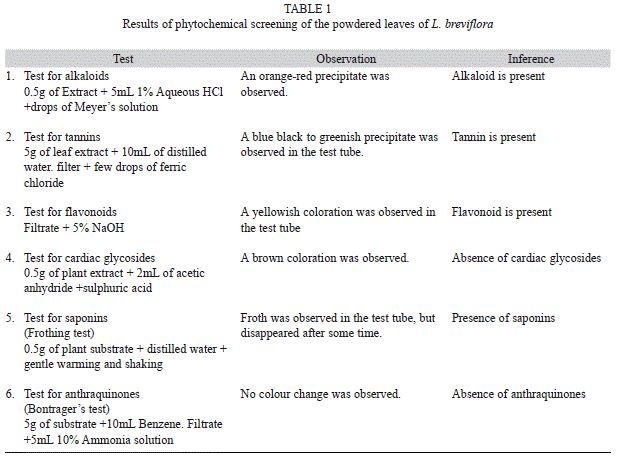
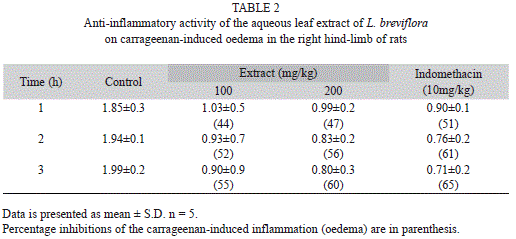
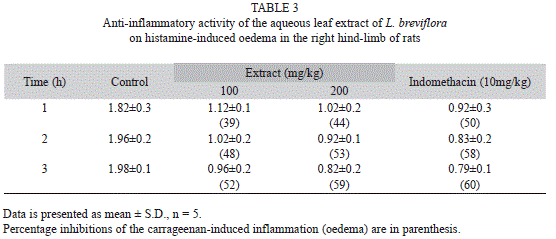
<body><![CDATA[<br> <font size="2"><span style="font-weight: bold; font-family: verdana;"></span><span  style="font-family: verdana;">Standard phytochemical methods were used to test for the presence of saponins, alkaloids, tannins, anthraquinones, cardiac glycosides, cyanogenetic glycosides and flavonoids, following standard methods, as described below:</span></font><br  style="font-family: verdana;"> <font size="2"></font><br style="font-family: verdana;"> <font size="2"><span style="font-weight: bold; font-family: verdana;">Saponins: </span><span style="font-family: verdana;">About one gram of the powdered extract sample was boiled with 10mL of distilled water for ten minutes (Abate 1989). The samples were filtered using a Buckner funnel and Whatman No 1 filter paper while hot, cooled and the following tests were carried out:</span></font><br style="font-family: verdana;"> <font size="2"></font><br style="font-family: verdana;"> <font size="2"><span style="font-family: verdana;">a.&nbsp;&nbsp; &nbsp;Frothing: 2.5mL of the filtrate was diluted to 10mL of water and was shaken vigorously for two minutes. Frothing observed indicates a positive test.</span></font><br  style="font-family: verdana;"> <font size="2"><span style="font-family: verdana;">b.&nbsp;&nbsp; &nbsp;Emulsification: 2.5mL of the filtrate was shaken vigorously for two minutes with a few drops of olive oil. An emulsified layer indicated a positive test.</span></font><br  style="font-family: verdana;"> <font size="2"></font><br style="font-family: verdana;"> <font size="2"><span style="font-weight: bold; font-family: verdana;">Alkaloids: </span><span style="font-family: verdana;">About one gram of the powdered sample was extracted with 10mL of 10% hydrochloric acid by boiling for five minutes on a water bath (Shale et al. 1999). The extract was filtered using a Buckner funnel and Whatman No. 1 filter paper and the pH of the filtrate was adjusted&nbsp; to&nbsp; about&nbsp; six&nbsp; by&nbsp; adding&nbsp; a&nbsp; few drops of a diluted ammonia solution and tested with litmus paper after which few drops of Dragendorff&#8217;s, Mayer&#8217;s and Wagner&#8217;s reagent were added separately to aliquots of the filtrate in different test tubes. A reddish brown, cream and reddish brown precipitate, respectively, indicated a positive test.</span></font><br  style="font-family: verdana;"> <font size="2"></font><br  style="font-weight: bold; font-family: verdana;"> <font size="2"><span style="font-weight: bold; font-family: verdana;">Tannins: </span><span style="font-family: verdana;">About one gram of the powdered sample was boiled with 10mL of distilled water for five minutes, filtered while hot and a few drops of ferric chloride reagent was added to the filtrate (Gupta et al. 2005). A red colouration indicates a positive test.</span></font><br style="font-family: verdana;"> <font size="2"></font><br style="font-family: verdana;"> <font size="2"><span style="font-weight: bold; font-family: verdana;">Anthraquinones:</span><span  style="font-family: verdana;"> One gram of the powdered sample&nbsp; was&nbsp; extracted&nbsp; with&nbsp; 10mL&nbsp; of 10% sulphuric acid, containing traces of ferric chloride solution for 15 minutes (Moody et al. 2006). It was filtered while hot and the cooled filtrate was extracted while hot with two equal volumes of 97% chloroform. The presence of a rose pink colour in the aqueous layer indicated a positive test.</span></font><br style="font-family: verdana;"> <font size="2"></font><br style="font-family: verdana;"> <font size="2"><span style="font-weight: bold; font-family: verdana;">Cardiac glycosides: </span><span style="font-family: verdana;">One gram of the powdered sample was extracted with 10mL of 80% alcohol for five minutes on a water bath; the extract was filtered and diluted with an equal volume of distilled water. A few drops of lead acetate solution was added, shaken, and filtered after standing for a few minutes. The filtrate was extracted with aliquots of chloroform. The combined chloroform extracts were divided into two portions and Keller Killiani and Kedde tests were carried out on them (Sawadogo et al. 2006).</span></font><br  style="font-family: verdana;"> <font size="2"></font><br style="font-family: verdana;"> <font size="2"><span style="font-weight: bold; font-family: verdana;">Keller Killiani test: </span><span style="font-family: verdana;">The extract was evaporated to dryness and 3mL of ferric chloride reagent was added to the cooled residue in a clean test tube. Two ml of concentrated sulphuric acid was gently poured down the side of the test tube. A purple or reddish brown ring at the interface and green colour in acetic acid layer indicated a positive test for 2-de-oxy sugar.</span></font><br  style="font-family: verdana;"> <font size="2"></font><br style="font-family: verdana;"> <font size="2"><span style="font-weight: bold; font-family: verdana;">Kedde test: </span><span style="font-family: verdana;">The dry residue was mixed with 1mL of 2% 3,5-dinitrobenzoic acid in ethanol. The solution was made alkaline with five percent sodium hydroxide. A brown purple colour indicated a positive test for the presence of unsaturated lactone ring.</span></font><br  style="font-family: verdana;"> <font size="2"></font><br style="font-family: verdana;"> <font size="2"><span style="font-weight: bold; font-family: verdana;">Cyanogenetic glycosides: </span><span style="font-family: verdana;">Half a gram of the powdered sample was placed in three different test tubes A, B, C. Test tubes A and B were mixed with water with a suspended moist sodium picrate paper in the neck of the tube, trapped by means of cork. Test tubes B and C were kept at room temperature while test tube A was placed in boiling water bath&nbsp; (Sawadogo et al. 2006). At the end of about half an hour, a change in colour of the sodium picrate paper indicated a positive test.</span></font><br  style="font-family: verdana;"> <font size="2"></font><br  style="font-weight: bold; font-family: verdana;"> <font size="2"><span style="font-weight: bold; font-family: verdana;">Flavonoids: </span><span style="font-family: verdana;">A small quantity of the extract was dissolved in diluted sodium hydroxide (4%) and hydrochloric acid was added to the mixture (Sawadogo et al. 2006). A yellow solution that turns colorless on addition of hydrochloric acid indicated the presence of flavonoids.</span></font><br style="font-family: verdana;"> <font size="2"></font><br style="font-family: verdana;"> <font size="2"><span style="font-weight: bold; font-family: verdana;">Acute toxicity test</span></font>    <br> <font size="2"><span style="font-weight: bold; font-family: verdana;"></span></font>    <br> <font size="2"><span style="font-weight: bold; font-family: verdana;"></span><span  style="font-family: verdana;">The acute toxicity of </span><span  style="font-style: italic; font-family: verdana;">L. breviflora</span><span  style="font-family: verdana;"> aqueous extract was determined in rats according to&nbsp; the&nbsp; method&nbsp; of&nbsp; Hilaly&nbsp; et&nbsp; al.&nbsp; (2004)&nbsp; with slight modifications. Rats fasted for 16h were randomly divided into five groups of six rats each. Graded doses of the plant&#8217;s extract (200, 400, 800,&nbsp; 1 600&nbsp; and&nbsp; 3 200mg/kg&nbsp; p.o.)&nbsp; were separately administered to the rats in each of the groups by means of bulbed steel needle. All the rats in the groups were then allowed free access to food and water, and were observed over a period of 48h for acute toxicity signs. The number of deaths within this period of time was recorded.</span></font><br  style="font-family: verdana;"> <font size="2"></font><br style="font-family: verdana;"> <font size="2"><span style="font-weight: bold; font-family: verdana;">Anti-inflammatory activity tests</span></font><br style="font-family: verdana;"> <font size="2"></font><br style="font-family: verdana;"> <font size="2"><span style="font-family: verdana;">Carrageenan-induced paw edema: Twenty animals used in this study were divided into four groups of five animals each. The first group served as the control, the second, third and fourth group received, respectively, indomethacin (10mg/kg body weight), and the </span><span  style="font-style: italic; font-family: verdana;">L. breviflora</span><span  style="font-family: verdana;">&nbsp; extract&nbsp; at&nbsp; two&nbsp; doses&nbsp; of&nbsp; 100&nbsp; and 200mg/kg. The plant extract and indomethacin were dissolved in distilled water. Carrageenan solution (0.1ml of&nbsp; 1%&nbsp; carrageenan&nbsp; solution) was injected into the sub-plantar region of the right hind paw of the rats 1h after intraperitoneal administration of distilled water, indomethacin and extract (Silva et al. 2005). The paw volume was measured after administration of drug and extract using a micrometer screw gauge at: 0hr, 1hr, 2hr and 3hr.</span></font><br style="font-family: verdana;"> <font size="2"></font><br style="font-family: verdana;"> <font size="2"><span style="font-family: verdana;">The anti-inflammatory effect of the extract was calculated with the use of the following equation: anti-inflammatory activity (%)=(1- D/C) X 100, where D represented the average paw volume after the extract was administered to the rats and C was the paw volume in the control groups. The percentage inhibition of the inflammation was calculated from the formula: % inhibition = </span><span  style="font-style: italic; font-family: verdana;">D0-Dt/D0</span><span  style="font-family: verdana;"> X 100 where </span><span  style="font-style: italic; font-family: verdana;">D0</span><span  style="font-family: verdana;"> was the average inflammation (hind paw oedema) of the control group at a given time; and </span><span  style="font-style: italic; font-family: verdana;">Dt</span><span  style="font-family: verdana;"> was the average inflammation of the drug treated (i.e. extracts or reference indomethacin) rats at the same time (Gupta et al. 2005, Sawadogo et al. 2006).</span></font><br  style="font-family: verdana;"> <font size="2"></font><br style="font-family: verdana;"> <font size="2"><span style="font-family: verdana;">Histamine induced paw edema: For this test we used the method of Perianayagam et al. (2006), the paw edema was produced by subplantar administration of 0.1% freshly prepared solution of histamine into the right hind paw of the rats. Sixteen rats divided into four groups of four rats per group were used. The paw volume was recorded before 0h and 1h after the histamine injection. The four groups of the rats were pre-treated with the plant extract (100, 200mg/ kg), 2mL/kg of distilled water (vehicle control) or 10mg/kg indomethacin (reference drug). These were administered intraperitoneally 1hr before eliciting paw edema. The anti-inflammatory activity was calculated as described for carrageenan-induced edema.</span></font><br  style="font-family: verdana;"> <font size="2"></font><br style="font-family: verdana;"> <font size="2"><span style="font-weight: bold; font-family: verdana;">Analgesic activity tests</span></font><br style="font-family: verdana;"> <font size="2"></font><br style="font-family: verdana;"> <font size="2"><span style="font-family: verdana;">Acetic acid-induced writhing in rats: The acetic acid-induced writhing test measures abdominal constrictions together with stretching of the hind limbs resulting from intraperitoneal (i.p.) injection of 0.7% acetic acid (10mL/ kg). This was carried out according to the procedures described by Sawadogo et al. (2006). Four groups of five animals per group were used in this study comprising the control (2mL/ kg distilled water), indomethacin (10mg/kg), or plant extract (100, 200mg/kg). After 30min, acetic acid was administered intraperitoneally.</span></font><br  style="font-family: verdana;"> <font size="2"><span style="font-family: verdana;">The number of writhing movements was counted for 30min.</span></font><br style="font-family: verdana;"> <font size="2"></font><br style="font-family: verdana;"> <font size="2"><span style="font-weight: bold; font-family: verdana;">Formalin test in rats: </span><span style="font-family: verdana;">The procedure was essentially similar to that described by Correa &amp; Calixto (1993). Formalin solution (0.05mL of 2.5% formalin) was injected into the sub- plantar of the right hind paw. The number of times and the time spent licking the injected paw was recorded and was considered as indicative of pain. The animals were pretreated with indomethacin and plant extract (100 and 200mg/kg) 30min before being administered with formalin, and the responses were observed for 30 min.</span></font><br  style="font-family: verdana;"> <font size="2"></font><br style="font-family: verdana;"> <font size="2"><span style="font-family: verdana;">The data were expressed as mean &plusmn;S.D. Where applicable the difference in response to test drugs was determined by student&#8217;s t-test. p&lt;0.05 was considered significant.</span></font><br style="font-family: verdana;"> <font size="2"></font><br style="font-family: verdana;"> <font size="3"><span style="font-weight: bold; font-family: verdana;">Results</span></font><br  style="font-family: verdana;"> <font size="2"></font><br style="font-family: verdana;"> <font size="2"><span style="font-weight: bold; font-family: verdana;">Phytochemical screening</span></font>    <br> <font size="2"><span style="font-weight: bold; font-family: verdana;"></span></font>    <br> <font size="2"><span style="font-weight: bold; font-family: verdana;"></span><span  style="font-family: verdana;">Phytochemical screening of </span><span  style="font-style: italic; font-family: verdana;">L. breviflora</span><span  style="font-family: verdana;"> leaves showed the presence of alkaloids, tannin, flavonoids and saponins. Anthraquinones and cardiac glycosides were however absent (<a  href="/img/revistas/rbt/v61n1/a23t1.gif">Table 1</a>).</span></font><br  style="font-family: verdana;"> <font size="2"></font><br style="font-family: verdana;"> <font size="2"><span style="font-weight: bold; font-family: verdana;">Acute toxicity test</span></font>    <br> <font size="2"><span style="font-weight: bold; font-family: verdana;"></span></font>    <br> <font size="2"><span style="font-weight: bold; font-family: verdana;"></span><span  style="font-family: verdana;">No deaths were recorded in the control, 200 and 400mg/kg dose groups. All animals that received 800 and 1 600mg/kg doses died. Behavioral changes exhibited by the animals included dullness, lethargy and anorexia, with severity depending&nbsp; on&nbsp; the&nbsp; dose.&nbsp; Dull&nbsp; animals that did not die later recovered and became active.</span></font><br  style="font-family: verdana;"> <font size="2"></font><br style="font-family: verdana;"> <font size="2"><span style="font-weight: bold; font-family: verdana;">Anti-inflammatory activity test</span></font><br style="font-family: verdana;"> <font size="2"></font><br style="font-family: verdana;"> <font size="2"><span style="font-weight: bold; font-family: verdana;">Carrageenan-induced&nbsp;&nbsp; &nbsp;paw&nbsp;&nbsp; &nbsp;edema: </span><span  style="font-family: verdana;">When compared&nbsp; to&nbsp; the&nbsp; control,&nbsp; the&nbsp; extract and indomethacin significantly reduced the paw edema hours after carrageenan injection. For instance, the 100 mg/kg extract produced its highest&nbsp; effect&nbsp; at&nbsp; 3h&nbsp; (55%)&nbsp; after&nbsp; carrageenan injection, while the 200mg/kg extract was more effective 3h (60%) after injection. The reference drug, indomethacin produced time-dependent reduction as the effect was more pronounced at 3h (65%) of carrageenan administration (<a  href="/img/revistas/rbt/v61n1/a23t2.gif">Table 2</a>).    <br> </span></font><br style="font-family: verdana;"> <font size="2"><span style="font-weight: bold; font-family: verdana;">Histamine-induced paw edema:</span><span style="font-family: verdana;"> Inhibition of histamine-induced edema was observed in this study. The anti-histaminic activity of the 100mg/kg extract was most pronounced at&nbsp; 3h&nbsp; (52%)&nbsp; while&nbsp; that&nbsp; of&nbsp; the&nbsp; 200mg/kg (59%), and indomethacin (60%) was also at 3h (<a  href="/img/revistas/rbt/v61n1/a23t3.gif">Table 3</a>).    <br>     <br>     ]]></body>
<body><![CDATA[</span></font>     <font size="2"><span style="font-weight: bold; font-family: verdana;">Anti-nociceptive     activity tests</span></font><br style="font-family: verdana;">     <font size="2"></font><br style="font-family: verdana;">     <font size="2"><span style="font-weight: bold; font-family: verdana;">Acetic     acid-induced writhing: </span><span style="font-family: verdana;">The     effect of&nbsp; the&nbsp; aqueous&nbsp; leaf&nbsp; extract&nbsp;     of&nbsp; </span><span style="font-style: italic; font-family: verdana;">L.&nbsp;     breviflora </span><span style="font-family: verdana;">on writhing     response in mice showed that the extract at 100 and 200mg/kg caused 48     ]]></body>
<body><![CDATA[and 61% inhibition, respectively, on the writhing response induced by     acetic acid. An 82% inhibition was observed with indomethacin, the     reference drug used in the study (<a      href="/img/revistas/rbt/v61n1/a23t4.gif">Table 4</a>).</span></font><br      style="font-family: verdana;">     <font size="2"></font><br style="font-family: verdana;">     <font size="2"><span style="font-style: italic; font-family: verdana;">Formalin     test: </span><span style="font-family: verdana;">In this study, the     extract caused a     dose-dependent decrease in licking time by the mice injected with     ]]></body>
<body><![CDATA[formalin. The indomethacin group showed better analgesic effect than     the two doses. The analgesic effects of these groups were significantly     different from that of control at p&lt;0.05 (<a      href="/img/revistas/rbt/v61n1/a23t5.gif">Table 5</a>).</span></font><br      style="font-family: verdana;">     <font size="2"></font><br style="font-family: verdana;">     <font size="3"><span style="font-weight: bold; font-family: verdana;">Discussion</span></font><br      style="font-family: verdana;">     <font size="2"></font><br style="font-family: verdana;">     <font size="2"><span style="font-family: verdana;">Phytochemical     ]]></body>
<body><![CDATA[analysis of the     leaves of </span><span      style="font-style: italic; font-family: verdana;">Lagenaria breviflora</span><span      style="font-family: verdana;"> showed the presence of tannins,&nbsp;     saponins,&nbsp; alkaloids&nbsp; and&nbsp; flavonoids. The&nbsp;     presence&nbsp; of&nbsp; flavonoids&nbsp; and&nbsp; tannins&nbsp; in the     leaves of this plant is likely to be responsible for the     anti-inflammatory and analgesic effects observed. Flavonoids and     tannins are phenolic compounds and plant phenolics are also a major     group of compounds that act as primary antioxidants or free radical     ]]></body>
<body><![CDATA[scavengers (Adedapo et al. 2008a, 2008b, Ayoola et al. 2008). Tannins     and saponins are also found to be effective antioxidants,     antimicrobial, and anti-carcinogenic agents (Lai et al. 2010).     Flavonoids are known to target prostaglandins which are involved in the     late phase of acute inflammation and pain perception (Rajnarayana et     al. 2001, Chakraborty et al. 2004). Hence, the presence of flavonoids     may be contributory to the anti-inflammatory and analgesic activities     of aqueous leaf extract of the plant.</span></font><br      style="font-family: verdana;">     <font size="2"></font><br style="font-family: verdana;">     ]]></body>
<body><![CDATA[<font size="2"><span style="font-family: verdana;">The results of the     acute toxicity     study however showed that from 800mg/kg dose, all the mice used in this     study died. This might suggest that at a dose of 800mg/kg and above,     the leaves from this plant are toxic, signifying that caution must be     exercised in its use for medicinal purpose.</span></font><br      style="font-family: verdana;">     <font size="2"></font><br style="font-family: verdana;">     <font size="2"><span style="font-family: verdana;">The results of this     investigation     ]]></body>
<body><![CDATA[revealed that the aqueous extract of the leaves of </span><span      style="font-style: italic; font-family: verdana;">L. breviflora </span><span      style="font-family: verdana;">possessed a dose dependent activity     against carrageenan- and histamine-induced paw oedema in rats. The     activity of the 200mg/ kg of the extract was slightly less effective     than that of indomethacin. Carrageenan-induced hind paw edema is the     standard experimental model of acute inflammation; it is the phlogistic     agent of choice for testing anti-inflammatory drugs as it is not known     to be antigenic and is devoid of apparent systemic effects. Moreover,     the experimental model exhibits a high degree of reproducibility     ]]></body>
<body><![CDATA[(Winter et al. 1962). Carrageenan-induced edema is a biphasic response.     The first phase is mediated through the release of histamine, serotonin     and kinins whereas the second phase is related to the release of     prostaglandin and slow reacting sub- stances which peak at 3h (Vinegar     et al. 1969). The carrageenan-induced inflammation model which is a     predictive test for anti-inflammatory agent acts by inhibiting the     mediators of acute inflammation (Ozaki 1990, Mossai et al. 1995, Silva     et al. 2005), therefore, the result is an indication that </span><span      style="font-style: italic; font-family: verdana;">L. breviflora</span>     can be effective in acute inflammatory disorders.</font><br     ]]></body>
<body><![CDATA[ style="font-family: verdana;">     <font size="2"></font><br style="font-family: verdana;">     <font size="2"><span style="font-family: verdana;">In&nbsp; the&nbsp;     histamine-induced&nbsp; paw&nbsp; edema, 200mg/kg&nbsp; of&nbsp;     the&nbsp; extract&nbsp; exhibited&nbsp;&nbsp; inhibitory effect than     the reference drug at 2h. It should be noted that the early phase     (1-2h) in the induced paw edema model is mainly mediated by histamine,     serotonin and the increase of prostaglandin (PG) synthesis in the     surroundings of the damaged tissues. The late phase on the other hand,     is mainly mediated by bradykinin, leukotrienes, polymorphonuclear cells     ]]></body>
<body><![CDATA[and PGs produced in tissue microphages (Antonio &amp; Souza-Brito 1998,     Cuman et al. 2001, Linardi et al. 2002, Vasudevan et al. 2007). The     results of the present study suggest that the suppression of     inflammation at the early phase was as a result of the antihistamine     activity of the plant extract.</span></font><br      style="font-family: verdana;">     <font size="2"></font><br style="font-family: verdana;">     <font size="2"><span style="font-family: verdana;">The abdominal     constriction response     induced by acetic acid is a sensitive procedure to establish     ]]></body>
<body><![CDATA[peripherally acting analgesics. This response is thought to involve     local peritoneal receptors (Chakraborty et al. 2004). The acetic acid     induced writhing test, a non specific but nevertheless sensitive method     widely used for analgesic screening (Le Bars et al. 2001). The number     of writhing movements during a 30min observation&nbsp; in&nbsp;     the&nbsp; control&nbsp; group&nbsp; was&nbsp; 61.4 &plusmn; 2.3. In     this study, the reference drug gave an 82% inhibition of writhing in     the animals while&nbsp; the&nbsp; 200mg/kg&nbsp; dose&nbsp; gave&nbsp;     61%&nbsp; inhibition showing that it is not as effective as the     reference drug. Acetic acid has been found to cause an increase in     ]]></body>
<body><![CDATA[peritoneal fluid levels of prostaglandins (PGE2 and PGF2), hence     causing inflammatory pain by inducing capillary permeability     (Amico-Roxas et al. 1984). The observed effects in the present study     suggest that nonetheless </span><span      style="font-style: italic; font-family: verdana;">L. breviflora</span>     had an inhibitory effect on prostaglandins synthesis.</font><br      style="font-family: verdana;">     <font size="2"></font><br style="font-family: verdana;">     <font size="2"><span style="font-family: verdana;">The formalin test     has been     ]]></body>
<body><![CDATA[described as a convenient method for producing and quantifying pain in     rats (Dubuisson &amp; Dennis 1977, Tjolsen et al. 1992). The test     employs an adequate painful stimulus to which the animals show a     spontaneous response and it is sensitive to commonly used analgesics.     The pain stimulus, a continuous rather than a transient one, may have     resemblance to some kind of clinical pain, and observations are made on     animals which are restrained only lightly or not at all (Hunskaar et     al. 1985, Ghannadi et al. 2005). Intraplantar injection of 2.5%     formalin evoked a characteristic licking response in the Wistar rats.     In this study, the extract caused a dose-dependent decrease in licking     ]]></body>
<body><![CDATA[frequency on rats injected with formalin, showing the analgesic effect     of the extract. However, the active doses of the plant extract showed     lower potency in bringing about analgesia than that of the reference     drug.</span></font><br style="font-family: verdana;">     <font size="2"></font><br style="font-family: verdana;">     <font size="2"><span style="font-family: verdana;">Since the plant     extract reduced     significantly the formation of oedema induced by carrageenan and     histamine, as well as reduced the number of writhes in acetic     acid-induced writhing models and dose-dependent decrease of licking     ]]></body>
<body><![CDATA[frequency in rats injected with 2.5% formalin, the results have     validated the basis for the traditional use of </span><span      style="font-style: italic; font-family: verdana;">L. breviflora</span><span      style="font-family: verdana;"> against infectious diseases such as New     Castle disease which is characterized by inflammation and pain.</span></font><br      style="font-family: verdana;">     <font size="2"></font><br style="font-family: verdana;">     <font size="3"><span style="font-weight: bold; font-family: verdana;">Acknowledgments</span></font><br      style="font-family: verdana;">     <font size="2"></font><br style="font-family: verdana;">     ]]></body>
<body><![CDATA[<font size="2"><span style="font-family: verdana;">We acknowledge the     assistance of     the technical staff of Pharmacognosy laboratory of the University of     Lagos with respect to phytochemical screening of the leaves of the     plant used in this study.</span></font><br style="font-family: verdana;">     <font size="2"></font>     <hr style="width: 100%; height: 2px;"><br style="font-family: verdana;">     <font size="3"><span style="font-weight: bold; font-family: verdana;">References</span></font><br      style="font-family: verdana;">     <font size="2"></font><br style="font-family: verdana;">     ]]></body>
<body><![CDATA[<font size="2"><span style="font-family: verdana;">Abate, G. 1989.</span><span      style="font-style: italic; font-family: verdana;"> In</span><span      style="font-family: verdana;"> S. Demissew (ed.). Ethiopian     Traditional Medicine, p. 3-5.&nbsp; Este Debdabe. Department of     <!-- ref -->Biology, Science Faculty, Addis Ababa&nbsp; University, Ethiopia.    &nbsp;&nbsp;&nbsp;&nbsp;&nbsp;&nbsp;&nbsp;&nbsp;[&#160;<a href="javascript:void(0);" onclick="javascript: window.open('/scielo.php?script=sci_nlinks&ref=1835645&pid=S0034-7744201300010002300001&lng=','','width=640,height=500,resizable=yes,scrollbars=1,menubar=yes,');">Links</a>&#160;]<!-- end-ref --><!-- ref --></span></font><br  style="font-family: verdana;"> <font size="2"></font><br style="font-family: verdana;"> <font size="2"><span style="font-family: verdana;">Adedapo, A.A., S. Koduru, F.O. Jimoh, P.J. Masika &amp; A.J. Afolayan. 2008a. Evaluation of the medicinal potentials of the methanol extracts of the leaves and stem of </span><span style="font-style: italic; font-family: verdana;">Halleria lucida</span><span style="font-family: verdana;">. Bioresource. Tech. 99: 4158-4163.    &nbsp;&nbsp;&nbsp;&nbsp;&nbsp;&nbsp;&nbsp;&nbsp;[&#160;<a href="javascript:void(0);" onclick="javascript: window.open('/scielo.php?script=sci_nlinks&ref=1835646&pid=S0034-7744201300010002300002&lng=','','width=640,height=500,resizable=yes,scrollbars=1,menubar=yes,');">Links</a>&#160;]<!-- end-ref --><!-- ref --></span></font><br style="font-family: verdana;"> <font size="2"></font><br style="font-family: verdana;"> <font size="2"><span style="font-family: verdana;">Adedapo, A.A., F.O. Jimoh, A.J. Afolayan &amp; P.J. Masika. 2008b. Antioxidant activities and phenolic&nbsp; contents of the methanol extracts of the stems of </span><span  style="font-style: italic; font-family: verdana;">Acokanthera oppositifolia</span><span style="font-family: verdana;"> and </span><span  style="font-style: italic; font-family: verdana;">Adenia gummifera</span><span  style="font-family: verdana;">. BMC Complement. Alternat. Med. 8:54.    &nbsp;&nbsp;&nbsp;&nbsp;&nbsp;&nbsp;&nbsp;&nbsp;[&#160;<a href="javascript:void(0);" onclick="javascript: window.open('/scielo.php?script=sci_nlinks&ref=1835647&pid=S0034-7744201300010002300003&lng=','','width=640,height=500,resizable=yes,scrollbars=1,menubar=yes,');">Links</a>&#160;]<!-- end-ref --><!-- ref --></span></font><br  style="font-family: verdana;"> <font size="2"></font><br style="font-family: verdana;"> <font size="2"><span style="font-family: verdana;">Adedapo, A.A., F.O. Jimoh, A.J. Afolayan &amp; P.J. Masika. 2009. Antioxidant activities of the methanol extracts of the leaves and stems of </span><span  style="font-style: italic; font-family: verdana;">Celtis africana</span><span  style="font-family: verdana;">. Rec. Nat. Prod. 3: 23-31.    &nbsp;&nbsp;&nbsp;&nbsp;&nbsp;&nbsp;&nbsp;&nbsp;[&#160;<a href="javascript:void(0);" onclick="javascript: window.open('/scielo.php?script=sci_nlinks&ref=1835648&pid=S0034-7744201300010002300004&lng=','','width=640,height=500,resizable=yes,scrollbars=1,menubar=yes,');">Links</a>&#160;]<!-- end-ref --><!-- ref --></span></font><br  style="font-family: verdana;"> <font size="2"></font><br style="font-family: verdana;"> <font size="2"><span style="font-family: verdana;">Adedapo,&nbsp; A.A. &amp; B.O. Bankole. 2011.&nbsp; Ethnoveterinary survey&nbsp; of&nbsp; poultry&nbsp;&nbsp; management&nbsp; in&nbsp; some&nbsp; selected farms&nbsp; in Ibadan, Nigeria. Recent Prog.&nbsp; Med. Plant 31: 305-316.    &nbsp;&nbsp;&nbsp;&nbsp;&nbsp;&nbsp;&nbsp;&nbsp;[&#160;<a href="javascript:void(0);" onclick="javascript: window.open('/scielo.php?script=sci_nlinks&ref=1835649&pid=S0034-7744201300010002300005&lng=','','width=640,height=500,resizable=yes,scrollbars=1,menubar=yes,');">Links</a>&#160;]<!-- end-ref --><!-- ref --></span></font><br style="font-family: verdana;"> <font size="2"></font><br style="font-family: verdana;"> <font size="2"><span style="font-family: verdana;">Ajayi, G.O., N.C. Awujo &amp; L.E. Abulu. 2002. The miracicidal&nbsp; and&nbsp; cercaricidal&nbsp;&nbsp; activity&nbsp; of&nbsp; the&nbsp; methanolic extracts of&nbsp; </span><span  style="font-style: italic; font-family: verdana;">Lagenaria breviflora</span><span  style="font-family: verdana;"> Robert Family Cucurbitaceae fruit on </span><span  style="font-style: italic; font-family: verdana;">Schistosoma&nbsp; mansoni</span><span style="font-family: verdana;">.&nbsp; Nig. Qtr. J. Hosp. Med. 12: 57-59.    &nbsp;&nbsp;&nbsp;&nbsp;&nbsp;&nbsp;&nbsp;&nbsp;[&#160;<a href="javascript:void(0);" onclick="javascript: window.open('/scielo.php?script=sci_nlinks&ref=1835650&pid=S0034-7744201300010002300006&lng=','','width=640,height=500,resizable=yes,scrollbars=1,menubar=yes,');">Links</a>&#160;]<!-- end-ref --><!-- ref --></span></font><br style="font-family: verdana;"> <font size="2"></font><br style="font-family: verdana;"> <font size="2"><span style="font-family: verdana;">Amico-Roxas, M., A. Caruso, S. Trombadore, R. Scifo &amp; U.&nbsp; Scapagnini.&nbsp; 1984.&nbsp; Gangliosides&nbsp; antinociceptive effects&nbsp; in&nbsp; rodents. Arch.&nbsp; Intl.&nbsp; Pharmacodyn.&nbsp; Ther. 272: 103-117.    &nbsp;&nbsp;&nbsp;&nbsp;&nbsp;&nbsp;&nbsp;&nbsp;[&#160;<a href="javascript:void(0);" onclick="javascript: window.open('/scielo.php?script=sci_nlinks&ref=1835651&pid=S0034-7744201300010002300007&lng=','','width=640,height=500,resizable=yes,scrollbars=1,menubar=yes,');">Links</a>&#160;]<!-- end-ref --><!-- ref --></span></font><br  style="font-family: verdana;"> <font size="2"></font><br style="font-family: verdana;"> <font size="2"><span style="font-family: verdana;">Antonio,&nbsp; M.A. &amp; A.R.M. Souza-Brito. 1998.&nbsp; Oral antiinflammatory&nbsp; and&nbsp; anti&nbsp; ulcerogenic&nbsp; activities&nbsp; of&nbsp; a hydroalcoholic extract and partitioned&nbsp; fractions&nbsp; of </span><span  style="font-style: italic; font-family: verdana;">Turnea ulmifolia&nbsp;</span><span style="font-family: verdana;"> (Turneaceae). J. Ethnopharmacol. 61: 215-228.    &nbsp;&nbsp;&nbsp;&nbsp;&nbsp;&nbsp;&nbsp;&nbsp;[&#160;<a href="javascript:void(0);" onclick="javascript: window.open('/scielo.php?script=sci_nlinks&ref=1835652&pid=S0034-7744201300010002300008&lng=','','width=640,height=500,resizable=yes,scrollbars=1,menubar=yes,');">Links</a>&#160;]<!-- end-ref --><!-- ref --></span></font><br  style="font-family: verdana;"> <font size="2"></font><br style="font-family: verdana;"> <font size="2"><span style="font-family: verdana;">Ayoola, G.A., H.A.B. Coker, S.A. Adesegun, A.A. Adepoju-Bello, K. Obaweya, E.C. Ezennia &amp; T.O. Atangbayila. 2008. Phytochemical Screening and Antioxidant Activities of Some Selected Medicinal&nbsp; Plants Used for Malaria Therapy in Southwestern Nigeria. Trop. J. Pharm. Res. 7: 1019-1024.    &nbsp;&nbsp;&nbsp;&nbsp;&nbsp;&nbsp;&nbsp;&nbsp;[&#160;<a href="javascript:void(0);" onclick="javascript: window.open('/scielo.php?script=sci_nlinks&ref=1835653&pid=S0034-7744201300010002300009&lng=','','width=640,height=500,resizable=yes,scrollbars=1,menubar=yes,');">Links</a>&#160;]<!-- end-ref --><!-- ref --></span></font><br  style="font-family: verdana;"> <font size="2"></font><br style="font-family: verdana;"> <font size="2"><span style="font-family: verdana;">Chakraborty, A., R.K.B. Devi, S. Rita, K. Sharatchandra &amp; T.I. Singh. 2004. Preliminary studies on anti-inflammatory and analgesic activities of </span><span  style="font-style: italic; font-family: verdana;">Spilanthes acmella</span><span  style="font-family: verdana;"> in experimental animal models. Indian J. Pharmacol. 36 (3): 148-150.    &nbsp;&nbsp;&nbsp;&nbsp;&nbsp;&nbsp;&nbsp;&nbsp;[&#160;<a href="javascript:void(0);" onclick="javascript: window.open('/scielo.php?script=sci_nlinks&ref=1835654&pid=S0034-7744201300010002300010&lng=','','width=640,height=500,resizable=yes,scrollbars=1,menubar=yes,');">Links</a>&#160;]<!-- end-ref --><!-- ref --></span></font><br  style="font-family: verdana;"> <font size="2"></font><br style="font-family: verdana;"> <font size="2"><span style="font-family: verdana;">Correa, C.R. &amp; J.B. Calixto. 1993. Evidence of participation of B1 and B2 kinin receptors in formalin-induced nociceptive response in mouse. Br. J. Pharmacol. 110: 193-198.    &nbsp;&nbsp;&nbsp;&nbsp;&nbsp;&nbsp;&nbsp;&nbsp;[&#160;<a href="javascript:void(0);" onclick="javascript: window.open('/scielo.php?script=sci_nlinks&ref=1835655&pid=S0034-7744201300010002300011&lng=','','width=640,height=500,resizable=yes,scrollbars=1,menubar=yes,');">Links</a>&#160;]<!-- end-ref --><!-- ref --></span></font><br style="font-family: verdana;"> <font size="2"></font><br style="font-family: verdana;"> <font size="2"><span style="font-family: verdana;">Cuman, R.K.N., C.A. Bersani-Amadio &amp; Z.B. Fortes. 2001. Influence of type 2 diabetes on the inflammatory response in rat. Inflammation Res. 50: 460-465.    &nbsp;&nbsp;&nbsp;&nbsp;&nbsp;&nbsp;&nbsp;&nbsp;[&#160;<a href="javascript:void(0);" onclick="javascript: window.open('/scielo.php?script=sci_nlinks&ref=1835656&pid=S0034-7744201300010002300012&lng=','','width=640,height=500,resizable=yes,scrollbars=1,menubar=yes,');">Links</a>&#160;]<!-- end-ref --><!-- ref --></span></font><br  style="font-family: verdana;"> <font size="2"></font><br style="font-family: verdana;"> <font size="2"><span style="font-family: verdana;">Dubuisson, D. &amp; S.G. Dennis. 1977. The formalin test: a quantitative study of the analgesic effects of morphine, meperidine and brain stem stimulation in rats and cats. Pain 4: 161-174.    &nbsp;&nbsp;&nbsp;&nbsp;&nbsp;&nbsp;&nbsp;&nbsp;[&#160;<a href="javascript:void(0);" onclick="javascript: window.open('/scielo.php?script=sci_nlinks&ref=1835657&pid=S0034-7744201300010002300013&lng=','','width=640,height=500,resizable=yes,scrollbars=1,menubar=yes,');">Links</a>&#160;]<!-- end-ref --><!-- ref --></span></font><br style="font-family: verdana;"> <font size="2"></font><br style="font-family: verdana;"> <font size="2"><span style="font-family: verdana;">Elujoba,&nbsp; A.A.,&nbsp; S.O.&nbsp; Olagbende&nbsp; &amp;&nbsp; S.K.&nbsp; Adesina.&nbsp; 1985. Anti-implantation&nbsp; activity of the fruit of&nbsp; </span><span  style="font-style: italic; font-family: verdana;">Lagenaria breviflora</span><span  style="font-family: verdana;"> Robert. J. Ethnopharmacol. 13: 281-288.    &nbsp;&nbsp;&nbsp;&nbsp;&nbsp;&nbsp;&nbsp;&nbsp;[&#160;<a href="javascript:void(0);" onclick="javascript: window.open('/scielo.php?script=sci_nlinks&ref=1835658&pid=S0034-7744201300010002300014&lng=','','width=640,height=500,resizable=yes,scrollbars=1,menubar=yes,');">Links</a>&#160;]<!-- end-ref --><!-- ref --></span></font><br  style="font-family: verdana;"> <font size="2"></font><br style="font-family: verdana;"> <font size="2"><span style="font-family: verdana;">Ghannadi, A., V. Hajhashemi &amp; H. Jafarabadi.&nbsp; 2005. An investigation of the analgesic and anti-inflammatory effects of Nigella&nbsp; sativa seed polyphenols. J. Med. Food. 8: 488-493.    &nbsp;&nbsp;&nbsp;&nbsp;&nbsp;&nbsp;&nbsp;&nbsp;[&#160;<a href="javascript:void(0);" onclick="javascript: window.open('/scielo.php?script=sci_nlinks&ref=1835659&pid=S0034-7744201300010002300015&lng=','','width=640,height=500,resizable=yes,scrollbars=1,menubar=yes,');">Links</a>&#160;]<!-- end-ref --><!-- ref --></span></font><br style="font-family: verdana;"> <font size="2"></font><br style="font-family: verdana;"> <font size="2"><span style="font-family: verdana;">Gupta,&nbsp; M.,&nbsp; U.K.&nbsp; Mazunder,&nbsp; R.&nbsp; Sambath&nbsp;&nbsp; Kumbar,&nbsp; P. Gomath,&nbsp; Y.&nbsp; Rajeshwar,&nbsp; B.B.&nbsp; Kakoti&nbsp; &amp;&nbsp; V.&nbsp; Tamil Selven. 2005. Anti-inflammatory, analgesic and antipyretic&nbsp; effects&nbsp; of&nbsp; methanol&nbsp; extract&nbsp; from&nbsp; </span><span  style="font-style: italic; font-family: verdana;">Bauhina racemosa</span><span  style="font-family: verdana;"> stem bark in animal models. J. Ethnopharmacol. 98: 267-273.    &nbsp;&nbsp;&nbsp;&nbsp;&nbsp;&nbsp;&nbsp;&nbsp;[&#160;<a href="javascript:void(0);" onclick="javascript: window.open('/scielo.php?script=sci_nlinks&ref=1835660&pid=S0034-7744201300010002300016&lng=','','width=640,height=500,resizable=yes,scrollbars=1,menubar=yes,');">Links</a>&#160;]<!-- end-ref --><!-- ref --></span></font><br  style="font-family: verdana;"> <font size="2"></font><br style="font-family: verdana;"> <font size="2"><span style="font-family: verdana;">Hanno,&nbsp; S., H. Christoph &amp; S.R. Susanne.&nbsp; 2009. Gourds afloat:&nbsp; adapted&nbsp; phytogeny&nbsp; reveals&nbsp; an Asian&nbsp; origin of&nbsp; the gourd family (Cucurbitaceae) and&nbsp; numerous oversea dispersal events. Proc. N. Soc. 276: 843-845.    &nbsp;&nbsp;&nbsp;&nbsp;&nbsp;&nbsp;&nbsp;&nbsp;[&#160;<a href="javascript:void(0);" onclick="javascript: window.open('/scielo.php?script=sci_nlinks&ref=1835661&pid=S0034-7744201300010002300017&lng=','','width=640,height=500,resizable=yes,scrollbars=1,menubar=yes,');">Links</a>&#160;]<!-- end-ref --><!-- ref --></span></font><br  style="font-family: verdana;"> <font size="2"></font><br style="font-family: verdana;"> <font size="2"><span style="font-family: verdana;">Hilaly, J.E., Z.H. Israili &amp; B. Lyoussi. 2004.&nbsp; Acute and chronic toxicological studies of </span><span  style="font-style: italic; font-family: verdana;">Ajuga iva </span><span  style="font-family: verdana;">in experimental animals. J. Ethnopharmacol. 91: 43-30.    &nbsp;&nbsp;&nbsp;&nbsp;&nbsp;&nbsp;&nbsp;&nbsp;[&#160;<a href="javascript:void(0);" onclick="javascript: window.open('/scielo.php?script=sci_nlinks&ref=1835662&pid=S0034-7744201300010002300018&lng=','','width=640,height=500,resizable=yes,scrollbars=1,menubar=yes,');">Links</a>&#160;]<!-- end-ref --><!-- ref --></span></font><br  style="font-family: verdana;"> <font size="2"></font><br style="font-family: verdana;"> <font size="2"><span style="font-family: verdana;">Hunskaar, S., O.B. Fasmer &amp; K. Hole. 1985. Formalin test in mice: a useful technique for evaluating wild analgesics. J. Neurosci. Meth. 4: 69-76.    &nbsp;&nbsp;&nbsp;&nbsp;&nbsp;&nbsp;&nbsp;&nbsp;[&#160;<a href="javascript:void(0);" onclick="javascript: window.open('/scielo.php?script=sci_nlinks&ref=1835663&pid=S0034-7744201300010002300019&lng=','','width=640,height=500,resizable=yes,scrollbars=1,menubar=yes,');">Links</a>&#160;]<!-- end-ref --><!-- ref --></span></font><br  style="font-family: verdana;"> <font size="2"></font><br style="font-family: verdana;"> <font size="2"><span style="font-family: verdana;">Kumara,&nbsp; N.K.V.M.R. 2001. Identification of&nbsp; strategies to improve&nbsp; research&nbsp; on&nbsp; medicinal&nbsp; plants&nbsp; used&nbsp; in&nbsp; Sri Lanka. </span><span  style="font-style: italic; font-family: verdana;">In</span><span  style="font-family: verdana;"> WHO Symposium. University of Ruhuna, Galle, Sri Lanka.    &nbsp;&nbsp;&nbsp;&nbsp;&nbsp;&nbsp;&nbsp;&nbsp;[&#160;<a href="javascript:void(0);" onclick="javascript: window.open('/scielo.php?script=sci_nlinks&ref=1835664&pid=S0034-7744201300010002300020&lng=','','width=640,height=500,resizable=yes,scrollbars=1,menubar=yes,');">Links</a>&#160;]<!-- end-ref --><!-- ref --></span></font><br style="font-family: verdana;"> <font size="2"></font><br style="font-family: verdana;"> <font size="2"><span style="font-family: verdana;">Lai, F.R., Q.B. Wen, L. Li, H. Wu &amp; X.F. Li. 2010. Antioxidant&nbsp; activities&nbsp; of&nbsp; water-soluble&nbsp; polysaccharide extracted&nbsp; from mung bean (</span><span  style="font-style: italic; font-family: verdana;">Vigna radiata</span><span  style="font-family: verdana;"> L.)&nbsp; hull with ultrasonic assisted treatment. Carbohyd. Polym. 81: 323-329.    &nbsp;&nbsp;&nbsp;&nbsp;&nbsp;&nbsp;&nbsp;&nbsp;[&#160;<a href="javascript:void(0);" onclick="javascript: window.open('/scielo.php?script=sci_nlinks&ref=1835665&pid=S0034-7744201300010002300021&lng=','','width=640,height=500,resizable=yes,scrollbars=1,menubar=yes,');">Links</a>&#160;]<!-- end-ref --><!-- ref --></span></font><br  style="font-family: verdana;"> <font size="2"></font><br style="font-family: verdana;"> <font size="2"><span style="font-family: verdana;">Le&nbsp; Bars,&nbsp; D.,&nbsp; M.&nbsp; Gozariu&nbsp; &amp;&nbsp; S.&nbsp; Cadden.&nbsp; 2001. Animal models of nociception. Pharmacol. Rev. 53: 597-652.    &nbsp;&nbsp;&nbsp;&nbsp;&nbsp;&nbsp;&nbsp;&nbsp;[&#160;<a href="javascript:void(0);" onclick="javascript: window.open('/scielo.php?script=sci_nlinks&ref=1835666&pid=S0034-7744201300010002300022&lng=','','width=640,height=500,resizable=yes,scrollbars=1,menubar=yes,');">Links</a>&#160;]<!-- end-ref --><!-- ref --></span></font><br  style="font-family: verdana;"> <font size="2"></font><br style="font-family: verdana;"> <font size="2"><span style="font-family: verdana;">Linardi,&nbsp; A.,&nbsp; S.K.P.&nbsp; Costa,&nbsp; G.R.&nbsp; DeSilva&nbsp; &amp;&nbsp; E.&nbsp; Antunes. 2002. Involvement of kinins, mast cells, and sensory neurons&nbsp; in&nbsp; the&nbsp; plasma&nbsp; exudation&nbsp; and&nbsp; paw&nbsp; edema induced by staphylococcal entrotoxin B in the mouse. Eur. J. Pharmacol. 399: 235-242.    &nbsp;&nbsp;&nbsp;&nbsp;&nbsp;&nbsp;&nbsp;&nbsp;[&#160;<a href="javascript:void(0);" onclick="javascript: window.open('/scielo.php?script=sci_nlinks&ref=1835667&pid=S0034-7744201300010002300023&lng=','','width=640,height=500,resizable=yes,scrollbars=1,menubar=yes,');">Links</a>&#160;]<!-- end-ref --><!-- ref --></span></font><br  style="font-family: verdana;"> <font size="2"></font><br style="font-family: verdana;"> <font size="2"><span style="font-family: verdana;">Moody, J.O., V.A. Robert, J.D. Connolly &amp; P.J. Houghton. 2006.&nbsp; Anti-inflammatory activities of the&nbsp; methanol extracts and an isolated&nbsp; furanoditerpene constituent of&nbsp; </span><span  style="font-style: italic; font-family: verdana;">Sphenocentrum jollyanum </span><span style="font-family: verdana;">Pierre&nbsp; (Menispermaceae). J. Ethnopharmacol. 104: 87-91.    &nbsp;&nbsp;&nbsp;&nbsp;&nbsp;&nbsp;&nbsp;&nbsp;[&#160;<a href="javascript:void(0);" onclick="javascript: window.open('/scielo.php?script=sci_nlinks&ref=1835668&pid=S0034-7744201300010002300024&lng=','','width=640,height=500,resizable=yes,scrollbars=1,menubar=yes,');">Links</a>&#160;]<!-- end-ref --><!-- ref --></span></font><br  style="font-family: verdana;"> <font size="2"></font><br style="font-family: verdana;"> <font size="2"><span style="font-family: verdana;">Mossai, J.S., S. Rafatullah, A.M. Galal &amp; M.A. Al-Yahya. 1995.&nbsp; Pharmacological studies of </span><span  style="font-style: italic; font-family: verdana;">Rhus&nbsp; retinorrhea</span><span style="font-family: verdana;">. Intl. J. Pharmacol. 33: 242-246.    &nbsp;&nbsp;&nbsp;&nbsp;&nbsp;&nbsp;&nbsp;&nbsp;[&#160;<a href="javascript:void(0);" onclick="javascript: window.open('/scielo.php?script=sci_nlinks&ref=1835669&pid=S0034-7744201300010002300025&lng=','','width=640,height=500,resizable=yes,scrollbars=1,menubar=yes,');">Links</a>&#160;]<!-- end-ref --><!-- ref --></span></font><br style="font-family: verdana;"> <font size="2"></font><br style="font-family: verdana;"> <font size="2"><span style="font-family: verdana;">Onasanwo,&nbsp; S.A., A.B. Saba, O.A. Oridupa,&nbsp; A.A. Oyagbemi &amp; B.V. Owoyele. 2011a. Anti-nociceptive and anti-inflammatory properties of the ethanolic extract of </span><span  style="font-style: italic; font-family: verdana;">Lagenaria breviflora</span><span  style="font-family: verdana;"> whole fruit in rat and mice. Niger. J. Physiol. Sci. 26:71-6.    &nbsp;&nbsp;&nbsp;&nbsp;&nbsp;&nbsp;&nbsp;&nbsp;[&#160;<a href="javascript:void(0);" onclick="javascript: window.open('/scielo.php?script=sci_nlinks&ref=1835670&pid=S0034-7744201300010002300026&lng=','','width=640,height=500,resizable=yes,scrollbars=1,menubar=yes,');">Links</a>&#160;]<!-- end-ref --><!-- ref --></span></font><br style="font-family: verdana;"> <font size="2"></font><br style="font-family: verdana;"> <font size="2"><span style="font-family: verdana;">Onasanwo,&nbsp; S.A., N. Singh, A.B. Saba, A.A.&nbsp; Oyagbemi, O.A. Oridupa &amp; G. Palit.&nbsp; 2011b. Anti-ulcerogenic and in vitro antioxidant activities of </span><span  style="font-style: italic; font-family: verdana;">Lagenaria breviflora</span><span  style="font-family: verdana;"> (LB) whole fruit ethanolic extract in laboratory animals. Pharmacognosy. Res. 3:2-8.    &nbsp;&nbsp;&nbsp;&nbsp;&nbsp;&nbsp;&nbsp;&nbsp;[&#160;<a href="javascript:void(0);" onclick="javascript: window.open('/scielo.php?script=sci_nlinks&ref=1835671&pid=S0034-7744201300010002300027&lng=','','width=640,height=500,resizable=yes,scrollbars=1,menubar=yes,');">Links</a>&#160;]<!-- end-ref --><!-- ref --></span></font><br  style="font-family: verdana;"> <font size="2"></font><br style="font-family: verdana;"> <font size="2"><span style="font-family: verdana;">Oridupa, O.A., A.B. Saba &amp; L.K. Sulaiman. 2011. Preliminary report on the antiviral activity of the ethanolic fruit extract of </span><span  style="font-style: italic; font-family: verdana;">Lagenaria breviflora</span><span  style="font-family: verdana;"> Roberts on New- castle Disease virus. Trop. Vet. 29 (1): 22-33.    &nbsp;&nbsp;&nbsp;&nbsp;&nbsp;&nbsp;&nbsp;&nbsp;[&#160;<a href="javascript:void(0);" onclick="javascript: window.open('/scielo.php?script=sci_nlinks&ref=1835672&pid=S0034-7744201300010002300028&lng=','','width=640,height=500,resizable=yes,scrollbars=1,menubar=yes,');">Links</a>&#160;]<!-- end-ref --><!-- ref --></span></font><br style="font-family: verdana;"> <font size="2"></font><br style="font-family: verdana;"> <font size="2"><span style="font-family: verdana;">Ozaki,&nbsp; Y.&nbsp; 1990. Anti-inflammatory&nbsp; effects&nbsp; of&nbsp; </span><span  style="font-style: italic; font-family: verdana;">Curcuma xanthorrhiza</span><span  style="font-family: verdana;"> Roxb, and its&nbsp; active principle. Chem. Pharm. Bull. 38: 1045-1048.    &nbsp;&nbsp;&nbsp;&nbsp;&nbsp;&nbsp;&nbsp;&nbsp;[&#160;<a href="javascript:void(0);" onclick="javascript: window.open('/scielo.php?script=sci_nlinks&ref=1835673&pid=S0034-7744201300010002300029&lng=','','width=640,height=500,resizable=yes,scrollbars=1,menubar=yes,');">Links</a>&#160;]<!-- end-ref --><!-- ref --></span></font><br  style="font-family: verdana;"> <font size="2"></font><br style="font-family: verdana;"> <font size="2"><span style="font-family: verdana;">Perianayagam,&nbsp; J.B.,&nbsp; S.K.&nbsp; Sharma&nbsp; &amp;&nbsp; K.K.&nbsp; Pillai.&nbsp; 2006. Anti-inflammatory&nbsp; activity of </span><span  style="font-style: italic; font-family: verdana;">Trichodesma&nbsp; indicum</span><span style="font-family: verdana;"> root extract in experimental&nbsp; animals. J. Ethnopharmacol. 104: 410-414.    &nbsp;&nbsp;&nbsp;&nbsp;&nbsp;&nbsp;&nbsp;&nbsp;[&#160;<a href="javascript:void(0);" onclick="javascript: window.open('/scielo.php?script=sci_nlinks&ref=1835674&pid=S0034-7744201300010002300030&lng=','','width=640,height=500,resizable=yes,scrollbars=1,menubar=yes,');">Links</a>&#160;]<!-- end-ref --><!-- ref --></span></font><br  style="font-family: verdana;"> <font size="2"></font><br style="font-family: verdana;"> <font size="2"><span style="font-family: verdana;">Rajnarayana,&nbsp; K.,&nbsp; M.S.&nbsp; Reddy,&nbsp; M.R.&nbsp; Chaluvadi&nbsp; &amp;&nbsp; D.R. Krishna.&nbsp; 2001.&nbsp; Bioflavonoids&nbsp; classification,&nbsp; pharmacological,&nbsp;&nbsp; biochemical effects and therapeutic potential. Indian J. Pharmacol. 33:2-16.    &nbsp;&nbsp;&nbsp;&nbsp;&nbsp;&nbsp;&nbsp;&nbsp;[&#160;<a href="javascript:void(0);" onclick="javascript: window.open('/scielo.php?script=sci_nlinks&ref=1835675&pid=S0034-7744201300010002300031&lng=','','width=640,height=500,resizable=yes,scrollbars=1,menubar=yes,');">Links</a>&#160;]<!-- end-ref --><!-- ref --></span></font><br  style="font-family: verdana;"> <font size="2"></font><br style="font-family: verdana;"> <font size="2"><span style="font-family: verdana;">Saba, A.B., O.A. Oridupa &amp; S.O. Ofuegbe. 2009a. Evaluation of haematological and serum electrolyte changes in Wistar rats administered with ethanolic extract of whole fruit of </span><span style="font-style: italic; font-family: verdana;">Lagenaria breviflora</span><span style="font-family: verdana;"> Roberts. J. Med. Plants Res. 3: 758-762.    &nbsp;&nbsp;&nbsp;&nbsp;&nbsp;&nbsp;&nbsp;&nbsp;[&#160;<a href="javascript:void(0);" onclick="javascript: window.open('/scielo.php?script=sci_nlinks&ref=1835676&pid=S0034-7744201300010002300032&lng=','','width=640,height=500,resizable=yes,scrollbars=1,menubar=yes,');">Links</a>&#160;]<!-- end-ref --><!-- ref --></span></font><br style="font-family: verdana;"> <font size="2"></font><br style="font-family: verdana;"> <font size="2"><span style="font-family: verdana;">Saba, A.B., O.A. Oridupa, M.O. Oyeyemi &amp; O.D. Osanyigbe.&nbsp; 2009b.&nbsp; Spermatozoa&nbsp; morphology&nbsp; and&nbsp; cha- racteristics&nbsp; of&nbsp; male Wistar rats administered with ethanolic&nbsp; extract&nbsp; of&nbsp; </span><span  style="font-style: italic; font-family: verdana;">Lagenaria&nbsp; breviflora</span><span style="font-family: verdana;">&nbsp; Roberts. Afr. J. Biotech. 8: 1170-1175.    &nbsp;&nbsp;&nbsp;&nbsp;&nbsp;&nbsp;&nbsp;&nbsp;[&#160;<a href="javascript:void(0);" onclick="javascript: window.open('/scielo.php?script=sci_nlinks&ref=1835677&pid=S0034-7744201300010002300033&lng=','','width=640,height=500,resizable=yes,scrollbars=1,menubar=yes,');">Links</a>&#160;]<!-- end-ref --><!-- ref --></span></font><br  style="font-family: verdana;"> <font size="2"></font><br style="font-family: verdana;"> <font size="2"><span style="font-family: verdana;">Sawadogo, W.R., R. Boly, M. Lompo &amp; N. Some. 2006. Anti-inflammatory, analgesic and antipyretic&nbsp; activities of </span><span  style="font-style: italic; font-family: verdana;">Dicliptera verticillata</span><span style="font-family: verdana;">.&nbsp; Intl.&nbsp; J. Pharmacol. 2: 435-438.    &nbsp;&nbsp;&nbsp;&nbsp;&nbsp;&nbsp;&nbsp;&nbsp;[&#160;<a href="javascript:void(0);" onclick="javascript: window.open('/scielo.php?script=sci_nlinks&ref=1835678&pid=S0034-7744201300010002300034&lng=','','width=640,height=500,resizable=yes,scrollbars=1,menubar=yes,');">Links</a>&#160;]<!-- end-ref --><!-- ref --></span></font><br  style="font-family: verdana;"> <font size="2"></font><br style="font-family: verdana;"> <font size="2"><span style="font-family: verdana;">Shale, T.L., W.A. Stirk &amp; J. Van Staden. 1999. Screening of medicinal plants used in Lesotho for antibacterial and anti-inflammatory activity. J.&nbsp; Ethnopharmacol. 67: 347-354.    &nbsp;&nbsp;&nbsp;&nbsp;&nbsp;&nbsp;&nbsp;&nbsp;[&#160;<a href="javascript:void(0);" onclick="javascript: window.open('/scielo.php?script=sci_nlinks&ref=1835679&pid=S0034-7744201300010002300035&lng=','','width=640,height=500,resizable=yes,scrollbars=1,menubar=yes,');">Links</a>&#160;]<!-- end-ref --><!-- ref --></span></font><br style="font-family: verdana;"> <font size="2"></font><br style="font-family: verdana;"> <font size="2"><span style="font-family: verdana;">Silva,&nbsp; G.N., F.R. Martins &amp; M.E. Matheus.&nbsp; 2005. Investigation&nbsp; of&nbsp;&nbsp; anti-inflammatory and antinociceptive activities of </span><span  style="font-style: italic; font-family: verdana;">Lantana trifolia</span><span  style="font-family: verdana;">. J.&nbsp; Ethnopharmacol. 100: 254-259.    &nbsp;&nbsp;&nbsp;&nbsp;&nbsp;&nbsp;&nbsp;&nbsp;[&#160;<a href="javascript:void(0);" onclick="javascript: window.open('/scielo.php?script=sci_nlinks&ref=1835680&pid=S0034-7744201300010002300036&lng=','','width=640,height=500,resizable=yes,scrollbars=1,menubar=yes,');">Links</a>&#160;]<!-- end-ref --><!-- ref --></span></font><br  style="font-family: verdana;"> <font size="2"></font><br style="font-family: verdana;"> <font size="2"><span style="font-family: verdana;">Sobota, R., M. Szwed, A. Kasza, M. Bugno &amp; T. Kordula. 2000. Parthenolide inhibits activation of signal transducers and activators of transcription (STATs) induced by cytokines of the IL-6 family. Bioch. Biophys. Res. Comm. 267: 329-333.    &nbsp;&nbsp;&nbsp;&nbsp;&nbsp;&nbsp;&nbsp;&nbsp;[&#160;<a href="javascript:void(0);" onclick="javascript: window.open('/scielo.php?script=sci_nlinks&ref=1835681&pid=S0034-7744201300010002300037&lng=','','width=640,height=500,resizable=yes,scrollbars=1,menubar=yes,');">Links</a>&#160;]<!-- end-ref --><!-- ref --></span></font><br  style="font-family: verdana;"> <font size="2"></font><br style="font-family: verdana;"> <font size="2"><span style="font-family: verdana;">Tjolsen, A., D.G. Berge, S. Hunskaar, J.H. Rosland &amp; K. Hole.&nbsp; 1992. The formalin test: an&nbsp; evaluation of the method. Pain 51: 5-17.    &nbsp;&nbsp;&nbsp;&nbsp;&nbsp;&nbsp;&nbsp;&nbsp;[&#160;<a href="javascript:void(0);" onclick="javascript: window.open('/scielo.php?script=sci_nlinks&ref=1835682&pid=S0034-7744201300010002300038&lng=','','width=640,height=500,resizable=yes,scrollbars=1,menubar=yes,');">Links</a>&#160;]<!-- end-ref --><!-- ref --></span></font><br  style="font-family: verdana;"> <font size="2"></font><br style="font-family: verdana;"> <font size="2"><span style="font-family: verdana;">Tomori, O.A., A.B. Saba &amp; H.O.&nbsp; Dada-Adegbola. 2007. Antibacterial&nbsp; activity of ethanolic extract&nbsp; of whole fruit of </span><span  style="font-style: italic; font-family: verdana;">Lagenaria breviflora</span><span  style="font-family: verdana;">&nbsp; Robert. J. Anim. Vet. Adv. 6: 752-757.    &nbsp;&nbsp;&nbsp;&nbsp;&nbsp;&nbsp;&nbsp;&nbsp;[&#160;<a href="javascript:void(0);" onclick="javascript: window.open('/scielo.php?script=sci_nlinks&ref=1835683&pid=S0034-7744201300010002300039&lng=','','width=640,height=500,resizable=yes,scrollbars=1,menubar=yes,');">Links</a>&#160;]<!-- end-ref --><!-- ref --></span></font><br style="font-family: verdana;"> <font size="2"></font><br style="font-family: verdana;"> <font size="2"><span style="font-family: verdana;">Vasudevan, M., K.K. Gunman &amp; M. Parle. 2007. Antinociceptive and&nbsp; anti-inflammatory effects of </span><span  style="font-style: italic; font-family: verdana;">Thespesia&nbsp; populnea</span><span style="font-family: verdana;"> bark extract. J.&nbsp; Ethnopharmacol. 109: 264-270.    &nbsp;&nbsp;&nbsp;&nbsp;&nbsp;&nbsp;&nbsp;&nbsp;[&#160;<a href="javascript:void(0);" onclick="javascript: window.open('/scielo.php?script=sci_nlinks&ref=1835684&pid=S0034-7744201300010002300040&lng=','','width=640,height=500,resizable=yes,scrollbars=1,menubar=yes,');">Links</a>&#160;]<!-- end-ref --><!-- ref --></span></font><br  style="font-family: verdana;"> <font size="2"></font><br style="font-family: verdana;"> <font size="2"><span style="font-family: verdana;">Vinegar, R., W. Schreiber &amp; R. Hugo. 1969. Biphasic development of carrageenin oedema in rats. J. Pharmacol. Exp. Ther. 166: 96-103.    &nbsp;&nbsp;&nbsp;&nbsp;&nbsp;&nbsp;&nbsp;&nbsp;[&#160;<a href="javascript:void(0);" onclick="javascript: window.open('/scielo.php?script=sci_nlinks&ref=1835685&pid=S0034-7744201300010002300041&lng=','','width=640,height=500,resizable=yes,scrollbars=1,menubar=yes,');">Links</a>&#160;]<!-- end-ref --><!-- ref --></span></font><br  style="font-family: verdana;"> <font size="2"></font><br style="font-family: verdana;"> <font size="2"><span style="font-family: verdana;">Winter, C.A., E.A. Risley &amp; G.W. Nuss. 1962. Carrageenan induced edema in hind paw of the rat as an assay for anti-inflammatory drugs. Proc. Soc. Exp. Biol. Med. 111: 544-547.    &nbsp;&nbsp;&nbsp;&nbsp;&nbsp;&nbsp;&nbsp;&nbsp;[&#160;<a href="javascript:void(0);" onclick="javascript: window.open('/scielo.php?script=sci_nlinks&ref=1835686&pid=S0034-7744201300010002300042&lng=','','width=640,height=500,resizable=yes,scrollbars=1,menubar=yes,');">Links</a>&#160;]<!-- end-ref --><!-- ref --></span></font><br style="font-family: verdana;"> <font size="2"></font><br style="font-family: verdana;"> <font size="2"><span style="font-family: verdana;">Yasuyuki, M., M. Patrick, F. Hiroshi &amp; M. Hiroko. 2005. Diversity&nbsp; of landraces of the&nbsp; white-flowered Gourd (</span><span  style="font-style: italic; font-family: verdana;">Lagenaria siceraria</span><span  style="font-family: verdana;">) and its wild relatives in Kenya. Genet. Res. Crop. Evol. 52: 737-747.    &nbsp;&nbsp;&nbsp;&nbsp;&nbsp;&nbsp;&nbsp;&nbsp;[&#160;<a href="javascript:void(0);" onclick="javascript: window.open('/scielo.php?script=sci_nlinks&ref=1835687&pid=S0034-7744201300010002300043&lng=','','width=640,height=500,resizable=yes,scrollbars=1,menubar=yes,');">Links</a>&#160;]<!-- end-ref --><br>     <br> <a name="Correspondencia1"></a><a href="#Correspondencia2">*</a>Correspondencia:    <br> </span></font><font size="2"><span style="font-family: verdana;">Adeolu Adedapo: </span></font><font size="2"><span  style="font-family: verdana;">Department of Veterinary Physiology, Biochemistry and Pharmacology, University of Ibadan, Nigeria. adedapo3a@ yahoo.co.uk</span></font>    ]]></body>
<body><![CDATA[<br> <font size="2"><span style="font-family: verdana;">Temitayo Adewuyi: </span></font><font size="2"><span  style="font-family: verdana;">Department of Veterinary Physiology, Biochemistry and Pharmacology, University of Ibadan, Nigeria. </span></font><font size="2"><span  style="font-family: verdana;">temitayoemmanuel12@yahoo.com</span></font>    <br> <font size="2"><span style="font-family: verdana;">Margaret Sofidiya: </span></font><font  size="2"><span style="font-family: verdana;">Department of Pharmacognosy, University of Lagos, Nigeria. toyin_sofidiya@yahoo.co.uk</span></font><br  style="font-family: verdana;"> <font size="2"><span style="font-family: verdana;"></span></font><font  size="2"><span style="font-family: verdana;"><a name="1"></a><a  href="#3">1</a>. Department of Veterinary Physiology, Biochemistry and Pharmacology, University of Ibadan, Nigeria; adedapo3a@ yahoo.co.uk, temitayoemmanuel12@yahoo.com</span></font><br  style="font-family: verdana;"> <font size="2"><span style="font-family: verdana;"><a name="2"></a><a  href="#4">2</a>. Department of Pharmacognosy, University of Lagos, Nigeria; toyin_sofidiya@yahoo.co.uk</span></font><br  style="font-family: verdana;"> <font size="2"></font> <hr style="width: 100%; height: 2px;"></div>     <div style="font-family: verdana; text-align: center;"><span  style="font-weight: bold;"><font size="2">Received 10-I-2012.&nbsp;&nbsp; &nbsp;Corrected 20-V-2012.&nbsp;&nbsp; &nbsp;Accepted 21-VI-2012.</font></span><font  size="2">    <br> </font></div>      ]]></body><back>
<ref-list>
<ref id="B1">
<nlm-citation citation-type="book">
<person-group person-group-type="author">
<name>
<surname><![CDATA[Abate]]></surname>
<given-names><![CDATA[G.]]></given-names>
</name>
</person-group>
<person-group person-group-type="editor">
<name>
<surname><![CDATA[Demissew]]></surname>
<given-names><![CDATA[S.]]></given-names>
</name>
</person-group>
<source><![CDATA[Ethiopian Traditional Medicine]]></source>
<year>1989</year>
<page-range>3-5</page-range><publisher-name><![CDATA[Department of Biology, Science Faculty, Addis Ababa University]]></publisher-name>
</nlm-citation>
</ref>
<ref id="B2">
<nlm-citation citation-type="journal">
<person-group person-group-type="author">
<name>
<surname><![CDATA[Adedapo]]></surname>
<given-names><![CDATA[A.A.]]></given-names>
</name>
<name>
<surname><![CDATA[Koduru]]></surname>
<given-names><![CDATA[S.]]></given-names>
</name>
<name>
<surname><![CDATA[Jimoh]]></surname>
<given-names><![CDATA[F.O.]]></given-names>
</name>
<name>
<surname><![CDATA[Masika]]></surname>
<given-names><![CDATA[P.J.]]></given-names>
</name>
<name>
<surname><![CDATA[Afolayan]]></surname>
<given-names><![CDATA[A.J.]]></given-names>
</name>
</person-group>
<article-title xml:lang="en"><![CDATA[Evaluation of the medicinal potentials of the methanol extracts of the leaves and stem of Halleria lucida]]></article-title>
<source><![CDATA[Bioresource. Tech.]]></source>
<year>2008</year>
<volume>99</volume>
<page-range>4158-4163</page-range></nlm-citation>
</ref>
<ref id="B3">
<nlm-citation citation-type="journal">
<person-group person-group-type="author">
<name>
<surname><![CDATA[Adedapo]]></surname>
<given-names><![CDATA[A.A.]]></given-names>
</name>
<name>
<surname><![CDATA[Jimoh]]></surname>
<given-names><![CDATA[F.O.]]></given-names>
</name>
<name>
<surname><![CDATA[Afolayan]]></surname>
<given-names><![CDATA[A.J.]]></given-names>
</name>
<name>
<surname><![CDATA[Masika]]></surname>
<given-names><![CDATA[P.J.]]></given-names>
</name>
</person-group>
<article-title xml:lang="en"><![CDATA[Antioxidant activities and phenolic contents of the methanol extracts of the stems of Acokanthera oppositifolia and Adenia gummifera. BMC Complement]]></article-title>
<source><![CDATA[Alternat. Med.]]></source>
<year>2008</year>
<volume>8</volume>
<page-range>54</page-range></nlm-citation>
</ref>
<ref id="B4">
<nlm-citation citation-type="journal">
<person-group person-group-type="author">
<name>
<surname><![CDATA[Adedapo]]></surname>
<given-names><![CDATA[A.A.]]></given-names>
</name>
<name>
<surname><![CDATA[Jimoh]]></surname>
<given-names><![CDATA[F.O.]]></given-names>
</name>
<name>
<surname><![CDATA[Afolayan]]></surname>
<given-names><![CDATA[A.J.]]></given-names>
</name>
<name>
<surname><![CDATA[Masika]]></surname>
<given-names><![CDATA[P.J.]]></given-names>
</name>
</person-group>
<article-title xml:lang="en"><![CDATA[Antioxidant activities of the methanol extracts of the leaves and stems of Celtis africana]]></article-title>
<source><![CDATA[Rec. Nat. Prod]]></source>
<year>2009</year>
<volume>3</volume>
<page-range>23-31</page-range></nlm-citation>
</ref>
<ref id="B5">
<nlm-citation citation-type="journal">
<person-group person-group-type="author">
<name>
<surname><![CDATA[Adedapo]]></surname>
<given-names><![CDATA[A.A.]]></given-names>
</name>
<name>
<surname><![CDATA[Bankole]]></surname>
<given-names><![CDATA[B.O.]]></given-names>
</name>
</person-group>
<article-title xml:lang="en"><![CDATA[Ethnoveterinary survey of poultry management in some selected farms in Ibadan, Nigeria]]></article-title>
<source><![CDATA[Recent Prog. Med. Plant]]></source>
<year>2011</year>
<volume>31</volume>
<page-range>305-316</page-range></nlm-citation>
</ref>
<ref id="B6">
<nlm-citation citation-type="journal">
<person-group person-group-type="author">
<name>
<surname><![CDATA[Ajayi]]></surname>
<given-names><![CDATA[G.O.]]></given-names>
</name>
<name>
<surname><![CDATA[Awujo]]></surname>
<given-names><![CDATA[N.C.]]></given-names>
</name>
<name>
<surname><![CDATA[Abulu]]></surname>
<given-names><![CDATA[L.E.]]></given-names>
</name>
</person-group>
<article-title xml:lang="en"><![CDATA[The miracicidal and cercaricidal activity of the methanolic extracts of Lagenaria breviflora Robert Family Cucurbitaceae fruit on Schistosoma mansoni.]]></article-title>
<source><![CDATA[Nig. Qtr. J. Hosp. Med.]]></source>
<year>2002</year>
<volume>12</volume>
<page-range>57-59</page-range></nlm-citation>
</ref>
<ref id="B7">
<nlm-citation citation-type="journal">
<person-group person-group-type="author">
<name>
<surname><![CDATA[Amico-Roxas]]></surname>
<given-names><![CDATA[M.]]></given-names>
</name>
<name>
<surname><![CDATA[Caruso]]></surname>
<given-names><![CDATA[A.]]></given-names>
</name>
<name>
<surname><![CDATA[Trombadore]]></surname>
<given-names><![CDATA[S.]]></given-names>
</name>
<name>
<surname><![CDATA[Scifo]]></surname>
<given-names><![CDATA[R.]]></given-names>
</name>
<name>
<surname><![CDATA[Scapagnini]]></surname>
<given-names><![CDATA[U.]]></given-names>
</name>
</person-group>
<article-title xml:lang="en"><![CDATA[Gangliosides antinociceptive effects in rodents]]></article-title>
<source><![CDATA[Arch. Intl. Pharmacodyn. Ther.]]></source>
<year>1984</year>
<volume>272</volume>
<page-range>103-117</page-range></nlm-citation>
</ref>
<ref id="B8">
<nlm-citation citation-type="journal">
<person-group person-group-type="author">
<name>
<surname><![CDATA[Antonio]]></surname>
<given-names><![CDATA[M.A.]]></given-names>
</name>
<name>
<surname><![CDATA[Souza-Brito]]></surname>
<given-names><![CDATA[A.R.M.]]></given-names>
</name>
</person-group>
<article-title xml:lang="en"><![CDATA[Oral anti-inflammatory and anti ulcerogenic activities of a hydroalcoholic extract and partitioned fractions of Turnea ulmifolia (Turneaceae)]]></article-title>
<source><![CDATA[J. Ethnopharmacol.]]></source>
<year>1998</year>
<volume>61</volume>
<page-range>215-228</page-range></nlm-citation>
</ref>
<ref id="B9">
<nlm-citation citation-type="journal">
<person-group person-group-type="author">
<name>
<surname><![CDATA[Ayoola]]></surname>
<given-names><![CDATA[G.A]]></given-names>
</name>
<name>
<surname><![CDATA[Coker]]></surname>
<given-names><![CDATA[H.A.B.]]></given-names>
</name>
<name>
<surname><![CDATA[Adesegun]]></surname>
<given-names><![CDATA[S.A.]]></given-names>
</name>
<name>
<surname><![CDATA[Adepoju-Bello]]></surname>
<given-names><![CDATA[A.A.]]></given-names>
</name>
<name>
<surname><![CDATA[Obaweya]]></surname>
<given-names><![CDATA[K.]]></given-names>
</name>
<name>
<surname><![CDATA[Ezennia]]></surname>
<given-names><![CDATA[E.C.]]></given-names>
</name>
<name>
<surname><![CDATA[Atangbayila]]></surname>
<given-names><![CDATA[T.O.]]></given-names>
</name>
</person-group>
<article-title xml:lang="en"><![CDATA[Phytochemical Screening and Antioxidant Activities of Some Selected Medicinal Plants Used for Malaria Therapy in Southwestern Nigeria]]></article-title>
<source><![CDATA[Trop. J. Pharm. Res.]]></source>
<year>2008</year>
<volume>7</volume>
<page-range>1019-1024</page-range></nlm-citation>
</ref>
<ref id="B10">
<nlm-citation citation-type="journal">
<person-group person-group-type="author">
<name>
<surname><![CDATA[Chakraborty]]></surname>
<given-names><![CDATA[A.]]></given-names>
</name>
<name>
<surname><![CDATA[Devi]]></surname>
<given-names><![CDATA[R.K.B.]]></given-names>
</name>
<name>
<surname><![CDATA[Rita]]></surname>
<given-names><![CDATA[S.]]></given-names>
</name>
<name>
<surname><![CDATA[Sharatchandra]]></surname>
<given-names><![CDATA[K.]]></given-names>
</name>
<name>
<surname><![CDATA[Singh]]></surname>
<given-names><![CDATA[T.I.]]></given-names>
</name>
</person-group>
<article-title xml:lang="en"><![CDATA[Preliminary studies on anti-inflammatory and analgesic activities of Spilanthes acmella in experimental animal models]]></article-title>
<source><![CDATA[Indian J. Pharmacol.]]></source>
<year>2004</year>
<volume>36</volume>
<numero>3</numero>
<issue>3</issue>
<page-range>148-150</page-range></nlm-citation>
</ref>
<ref id="B11">
<nlm-citation citation-type="journal">
<person-group person-group-type="author">
<name>
<surname><![CDATA[Correa]]></surname>
<given-names><![CDATA[C.R.]]></given-names>
</name>
<name>
<surname><![CDATA[Calixto]]></surname>
<given-names><![CDATA[J.B.]]></given-names>
</name>
</person-group>
<article-title xml:lang="en"><![CDATA[Evidence of participation of B1 and B2 kinin receptors in formalin-induced nociceptive response in mouse]]></article-title>
<source><![CDATA[Br. J. Pharmacol.]]></source>
<year>1993</year>
<volume>110</volume>
<page-range>193-198</page-range></nlm-citation>
</ref>
<ref id="B12">
<nlm-citation citation-type="journal">
<person-group person-group-type="author">
<name>
<surname><![CDATA[Cuman]]></surname>
<given-names><![CDATA[R.K.N.]]></given-names>
</name>
<name>
<surname><![CDATA[Bersani-Amadio]]></surname>
<given-names><![CDATA[C.A.]]></given-names>
</name>
<name>
<surname><![CDATA[Fortes]]></surname>
<given-names><![CDATA[Z.B.]]></given-names>
</name>
</person-group>
<article-title xml:lang="en"><![CDATA[Influence of type 2 diabetes on the inflammatory response in rat.]]></article-title>
<source><![CDATA[Inflammation Res.]]></source>
<year>2001</year>
<volume>50</volume>
<page-range>460-465</page-range></nlm-citation>
</ref>
<ref id="B13">
<nlm-citation citation-type="journal">
<person-group person-group-type="author">
<name>
<surname><![CDATA[Dubuisson]]></surname>
<given-names><![CDATA[D.]]></given-names>
</name>
<name>
<surname><![CDATA[Dennis]]></surname>
<given-names><![CDATA[S.G.]]></given-names>
</name>
</person-group>
<article-title xml:lang="en"><![CDATA[The formalin test: a quantitative study of the analgesic effects of morphine, meperidine and brain stem stimulation in rats and cats]]></article-title>
<source><![CDATA[Pain]]></source>
<year>1977</year>
<volume>4</volume>
<page-range>161-174</page-range></nlm-citation>
</ref>
<ref id="B14">
<nlm-citation citation-type="journal">
<person-group person-group-type="author">
<name>
<surname><![CDATA[Elujoba]]></surname>
<given-names><![CDATA[A.A.]]></given-names>
</name>
<name>
<surname><![CDATA[Olagbende]]></surname>
<given-names><![CDATA[S.O.]]></given-names>
</name>
<name>
<surname><![CDATA[Adesina]]></surname>
<given-names><![CDATA[S.K.]]></given-names>
</name>
</person-group>
<article-title xml:lang="en"><![CDATA[Anti-implantation activity of the fruit of Lagenaria breviflora Robert]]></article-title>
<source><![CDATA[J. Ethnopharmacol.]]></source>
<year>1985</year>
<volume>13</volume>
<page-range>281-288</page-range></nlm-citation>
</ref>
<ref id="B15">
<nlm-citation citation-type="journal">
<person-group person-group-type="author">
<name>
<surname><![CDATA[Ghannadi]]></surname>
<given-names><![CDATA[A.]]></given-names>
</name>
<name>
<surname><![CDATA[Hajhashemi]]></surname>
<given-names><![CDATA[V.]]></given-names>
</name>
<name>
<surname><![CDATA[Jafarabadi]]></surname>
<given-names><![CDATA[H.]]></given-names>
</name>
</person-group>
<article-title xml:lang="en"><![CDATA[An investigation of the analgesic and anti-inflammatory effects of Nigella sativa seed polyphenols]]></article-title>
<source><![CDATA[J. Med. Food.]]></source>
<year>2005</year>
<volume>8</volume>
<page-range>488-493</page-range></nlm-citation>
</ref>
<ref id="B16">
<nlm-citation citation-type="journal">
<person-group person-group-type="author">
<name>
<surname><![CDATA[Gupta]]></surname>
<given-names><![CDATA[M.]]></given-names>
</name>
<name>
<surname><![CDATA[Mazunder]]></surname>
<given-names><![CDATA[U.K.]]></given-names>
</name>
<name>
<surname><![CDATA[Sambath Kumbar]]></surname>
<given-names><![CDATA[R.]]></given-names>
</name>
<name>
<surname><![CDATA[Gomath]]></surname>
<given-names><![CDATA[P.]]></given-names>
</name>
<name>
<surname><![CDATA[Rajeshwar]]></surname>
<given-names><![CDATA[Y.]]></given-names>
</name>
<name>
<surname><![CDATA[Kakoti]]></surname>
<given-names><![CDATA[B.B.]]></given-names>
</name>
<name>
<surname><![CDATA[Tamil Selven]]></surname>
<given-names><![CDATA[V.]]></given-names>
</name>
</person-group>
<article-title xml:lang="en"><![CDATA[Anti-inflammatory, analgesic and anti- pyretic effects of methanol extract from Bauhina racemosa stem bark in animal models.]]></article-title>
<source><![CDATA[J. Ethnopharmacol.]]></source>
<year>2005</year>
<volume>98</volume>
<page-range>267-273</page-range></nlm-citation>
</ref>
<ref id="B17">
<nlm-citation citation-type="journal">
<person-group person-group-type="author">
<name>
<surname><![CDATA[Hanno]]></surname>
<given-names><![CDATA[S.]]></given-names>
</name>
<name>
<surname><![CDATA[Christoph]]></surname>
<given-names><![CDATA[H.]]></given-names>
</name>
<name>
<surname><![CDATA[Susanne]]></surname>
<given-names><![CDATA[S.R.]]></given-names>
</name>
</person-group>
<article-title xml:lang="en"><![CDATA[Gourds afloat: adapted phytogeny reveals an Asian origin of the gourd family (Cucurbitaceae) and numerous oversea dispersal events]]></article-title>
<source><![CDATA[Proc. N. Soc.]]></source>
<year>2009</year>
<volume>276</volume>
<page-range>843-845</page-range></nlm-citation>
</ref>
<ref id="B18">
<nlm-citation citation-type="journal">
<person-group person-group-type="author">
<name>
<surname><![CDATA[Hilaly]]></surname>
<given-names><![CDATA[J.E.]]></given-names>
</name>
<name>
<surname><![CDATA[Israili]]></surname>
<given-names><![CDATA[Z.H.]]></given-names>
</name>
<name>
<surname><![CDATA[Lyoussi]]></surname>
<given-names><![CDATA[B.]]></given-names>
</name>
</person-group>
<article-title xml:lang="en"><![CDATA[Acute and chronic toxicological studies of Ajuga iva in experimental animals]]></article-title>
<source><![CDATA[J. Ethnopharmacol.]]></source>
<year>2004</year>
<volume>91</volume>
<page-range>43-30</page-range></nlm-citation>
</ref>
<ref id="B19">
<nlm-citation citation-type="journal">
<person-group person-group-type="author">
<name>
<surname><![CDATA[Hunskaar]]></surname>
<given-names><![CDATA[S.]]></given-names>
</name>
<name>
<surname><![CDATA[Fasmer]]></surname>
<given-names><![CDATA[O.B.]]></given-names>
</name>
<name>
<surname><![CDATA[Hole]]></surname>
<given-names><![CDATA[K.]]></given-names>
</name>
</person-group>
<article-title xml:lang="en"><![CDATA[Formalin test in mice: a useful technique for evaluating wild analgesics]]></article-title>
<source><![CDATA[J. Neurosci. Meth.]]></source>
<year>1985</year>
<volume>4</volume>
<page-range>69-76.</page-range></nlm-citation>
</ref>
<ref id="B20">
<nlm-citation citation-type="book">
<person-group person-group-type="author">
<name>
<surname><![CDATA[Kumara]]></surname>
<given-names><![CDATA[N.K.V.M.R.]]></given-names>
</name>
</person-group>
<article-title xml:lang="en"><![CDATA[Identification of strategies to improve research on medicinal plants used in Sri Lanka.]]></article-title>
<source><![CDATA[WHO Symposium.]]></source>
<year>2001</year>
<publisher-loc><![CDATA[Galle^eSri Lanka Sri Lanka]]></publisher-loc>
<publisher-name><![CDATA[University of Ruhuna]]></publisher-name>
</nlm-citation>
</ref>
<ref id="B21">
<nlm-citation citation-type="journal">
<person-group person-group-type="author">
<name>
<surname><![CDATA[Lai]]></surname>
<given-names><![CDATA[F.R.]]></given-names>
</name>
<name>
<surname><![CDATA[Wen]]></surname>
<given-names><![CDATA[Q.B.]]></given-names>
</name>
<name>
<surname><![CDATA[Li]]></surname>
<given-names><![CDATA[L.]]></given-names>
</name>
<name>
<surname><![CDATA[Wu]]></surname>
<given-names><![CDATA[H.]]></given-names>
</name>
<name>
<surname><![CDATA[Li]]></surname>
<given-names><![CDATA[X.F.]]></given-names>
</name>
</person-group>
<article-title xml:lang="en"><![CDATA[Antioxidant activities of water-soluble polysaccharide extracted from mung bean (Vigna radiata L.) hull with ultrasonic assisted treatment]]></article-title>
<source><![CDATA[Carbohyd. Polym.]]></source>
<year>2010</year>
<volume>81</volume>
<page-range>323-329.</page-range></nlm-citation>
</ref>
<ref id="B22">
<nlm-citation citation-type="journal">
<person-group person-group-type="author">
<name>
<surname><![CDATA[Le Bars]]></surname>
<given-names><![CDATA[D.]]></given-names>
</name>
<name>
<surname><![CDATA[Gozariu]]></surname>
<given-names><![CDATA[M.]]></given-names>
</name>
<name>
<surname><![CDATA[Cadden]]></surname>
<given-names><![CDATA[S.]]></given-names>
</name>
</person-group>
<article-title xml:lang="en"><![CDATA[Animal models of nociception]]></article-title>
<source><![CDATA[Pharmacol. Rev.]]></source>
<year>2001</year>
<volume>53</volume>
<page-range>597-652</page-range></nlm-citation>
</ref>
<ref id="B23">
<nlm-citation citation-type="journal">
<person-group person-group-type="author">
<name>
<surname><![CDATA[Linardi]]></surname>
<given-names><![CDATA[A.]]></given-names>
</name>
<name>
<surname><![CDATA[Costa]]></surname>
<given-names><![CDATA[S.K.P.]]></given-names>
</name>
<name>
<surname><![CDATA[DeSilva]]></surname>
<given-names><![CDATA[G.R.]]></given-names>
</name>
<name>
<surname><![CDATA[Antunes]]></surname>
<given-names><![CDATA[E.]]></given-names>
</name>
</person-group>
<article-title xml:lang="en"><![CDATA[Involvement of kinins, mast cells, and sensory neurons in the plasma exudation and paw edema induced by staphylococcal entrotoxin B in the mouse]]></article-title>
<source><![CDATA[Eur. J. Pharmacol.]]></source>
<year>2002</year>
<volume>399</volume>
<page-range>235-242</page-range></nlm-citation>
</ref>
<ref id="B24">
<nlm-citation citation-type="journal">
<person-group person-group-type="author">
<name>
<surname><![CDATA[Moody]]></surname>
<given-names><![CDATA[J.O.]]></given-names>
</name>
<name>
<surname><![CDATA[Robert]]></surname>
<given-names><![CDATA[V.A.]]></given-names>
</name>
<name>
<surname><![CDATA[Connolly]]></surname>
<given-names><![CDATA[J.D.]]></given-names>
</name>
<name>
<surname><![CDATA[Houghton]]></surname>
<given-names><![CDATA[P.J.]]></given-names>
</name>
</person-group>
<article-title xml:lang="en"><![CDATA[Anti-inflammatory activities of the methanol extracts and an isolated furanoditerpene constituent of Sphenocentrum jollyanum Pierre (Menispermaceae)]]></article-title>
<source><![CDATA[J. Ethnopharmacol.]]></source>
<year>2006</year>
<volume>104</volume>
<page-range>87-91</page-range></nlm-citation>
</ref>
<ref id="B25">
<nlm-citation citation-type="journal">
<person-group person-group-type="author">
<name>
<surname><![CDATA[Mossai]]></surname>
<given-names><![CDATA[J.S.]]></given-names>
</name>
<name>
<surname><![CDATA[Rafatullah]]></surname>
<given-names><![CDATA[S.]]></given-names>
</name>
<name>
<surname><![CDATA[Galal]]></surname>
<given-names><![CDATA[A.M.]]></given-names>
</name>
<name>
<surname><![CDATA[Al-Yahya]]></surname>
<given-names><![CDATA[M.A.]]></given-names>
</name>
</person-group>
<article-title xml:lang="en"><![CDATA[Pharmacological studies of Rhus retinorrhea]]></article-title>
<source><![CDATA[Intl. J. Pharmacol.]]></source>
<year>1995</year>
<volume>33</volume>
<page-range>242-246</page-range></nlm-citation>
</ref>
<ref id="B26">
<nlm-citation citation-type="journal">
<person-group person-group-type="author">
<name>
<surname><![CDATA[Onasanwo]]></surname>
<given-names><![CDATA[S.A.]]></given-names>
</name>
<name>
<surname><![CDATA[Saba]]></surname>
<given-names><![CDATA[A.B.]]></given-names>
</name>
<name>
<surname><![CDATA[Oridupa]]></surname>
<given-names><![CDATA[O.A.]]></given-names>
</name>
<name>
<surname><![CDATA[Oyagbemi]]></surname>
<given-names><![CDATA[A.A.]]></given-names>
</name>
<name>
<surname><![CDATA[Owoyele]]></surname>
<given-names><![CDATA[B.V.]]></given-names>
</name>
</person-group>
<article-title xml:lang="en"><![CDATA[Anti-nociceptive and anti-inflammatory properties of the ethanolic extract of Lagenaria breviflora whole fruit in rat and mice]]></article-title>
<source><![CDATA[Niger. J. Physiol. Sci.]]></source>
<year>2011</year>
<volume>26</volume>
<page-range>71-6</page-range></nlm-citation>
</ref>
<ref id="B27">
<nlm-citation citation-type="journal">
<person-group person-group-type="author">
<name>
<surname><![CDATA[Onasanwo]]></surname>
<given-names><![CDATA[S.A.]]></given-names>
</name>
<name>
<surname><![CDATA[Singh]]></surname>
<given-names><![CDATA[N.]]></given-names>
</name>
<name>
<surname><![CDATA[Saba]]></surname>
<given-names><![CDATA[A.B.]]></given-names>
</name>
<name>
<surname><![CDATA[Oyagbemi]]></surname>
<given-names><![CDATA[A.A.]]></given-names>
</name>
<name>
<surname><![CDATA[Oridupa]]></surname>
<given-names><![CDATA[O.A.]]></given-names>
</name>
<name>
<surname><![CDATA[Palit]]></surname>
<given-names><![CDATA[G.]]></given-names>
</name>
</person-group>
<article-title xml:lang="en"><![CDATA[Anti-ulcerogenic and in vitro antioxidant activities of Lagenaria breviflora (LB) whole fruit ethanolic extract in laboratory animals.]]></article-title>
<source><![CDATA[Pharmacognosy. Res.]]></source>
<year>2011</year>
<volume>3</volume>
<page-range>2-8</page-range></nlm-citation>
</ref>
<ref id="B28">
<nlm-citation citation-type="journal">
<person-group person-group-type="author">
<name>
<surname><![CDATA[Oridupa]]></surname>
<given-names><![CDATA[O.A.]]></given-names>
</name>
<name>
<surname><![CDATA[Saba]]></surname>
<given-names><![CDATA[A.B.]]></given-names>
</name>
<name>
<surname><![CDATA[Sulaiman]]></surname>
<given-names><![CDATA[L.K.]]></given-names>
</name>
</person-group>
<article-title xml:lang="en"><![CDATA[Preliminary report on the antiviral activity of the ethanolic fruit extract of Lagenaria breviflora Roberts on New- castle Disease virus]]></article-title>
<source><![CDATA[Trop. Vet.]]></source>
<year>2011</year>
<volume>29</volume>
<numero>1</numero>
<issue>1</issue>
<page-range>22-33</page-range></nlm-citation>
</ref>
<ref id="B29">
<nlm-citation citation-type="journal">
<person-group person-group-type="author">
<name>
<surname><![CDATA[Ozaki]]></surname>
<given-names><![CDATA[Y.]]></given-names>
</name>
</person-group>
<article-title xml:lang="en"><![CDATA[Anti-inflammatory effects of Curcuma xanthorrhiza Roxb, and its active principle]]></article-title>
<source><![CDATA[Chem. Pharm. Bull.]]></source>
<year>1990</year>
<volume>38</volume>
<page-range>1045-1048</page-range></nlm-citation>
</ref>
<ref id="B30">
<nlm-citation citation-type="journal">
<person-group person-group-type="author">
<name>
<surname><![CDATA[Perianayagam]]></surname>
<given-names><![CDATA[J.B.]]></given-names>
</name>
<name>
<surname><![CDATA[Sharma]]></surname>
<given-names><![CDATA[S.K.]]></given-names>
</name>
<name>
<surname><![CDATA[Pillai]]></surname>
<given-names><![CDATA[K.K.]]></given-names>
</name>
</person-group>
<article-title xml:lang="en"><![CDATA[Anti-inflammatory activity of Trichodesma indicum root extract in experimental animals]]></article-title>
<source><![CDATA[J. Ethnopharmacol.]]></source>
<year>2006</year>
<volume>104</volume>
<page-range>410-414</page-range></nlm-citation>
</ref>
<ref id="B31">
<nlm-citation citation-type="journal">
<person-group person-group-type="author">
<name>
<surname><![CDATA[Rajnarayana]]></surname>
<given-names><![CDATA[K.]]></given-names>
</name>
<name>
<surname><![CDATA[Reddy]]></surname>
<given-names><![CDATA[M.S.]]></given-names>
</name>
<name>
<surname><![CDATA[Chaluvadi]]></surname>
<given-names><![CDATA[M.R.]]></given-names>
</name>
<name>
<surname><![CDATA[Krishna]]></surname>
<given-names><![CDATA[D.R.]]></given-names>
</name>
</person-group>
<article-title xml:lang="en"><![CDATA[Bioflavonoids classification, pharmacological, biochemical effects and therapeutic potential]]></article-title>
<source><![CDATA[Indian J. Pharmacol.]]></source>
<year>2001</year>
<volume>33</volume>
<page-range>2-16</page-range></nlm-citation>
</ref>
<ref id="B32">
<nlm-citation citation-type="journal">
<person-group person-group-type="author">
<name>
<surname><![CDATA[Saba]]></surname>
<given-names><![CDATA[A.B.]]></given-names>
</name>
<name>
<surname><![CDATA[Oridupa]]></surname>
<given-names><![CDATA[O.A.]]></given-names>
</name>
<name>
<surname><![CDATA[Ofuegbe]]></surname>
<given-names><![CDATA[S.O.]]></given-names>
</name>
</person-group>
<article-title xml:lang="en"><![CDATA[Evaluation of haematological and serum electrolyte changes in Wistar rats administered with ethanolic extract of whole fruit of Lagenaria breviflora Roberts]]></article-title>
<source><![CDATA[J. Med. Plants Res.]]></source>
<year>2009</year>
<volume>3</volume>
<page-range>758-762</page-range></nlm-citation>
</ref>
<ref id="B33">
<nlm-citation citation-type="journal">
<person-group person-group-type="author">
<name>
<surname><![CDATA[Saba]]></surname>
<given-names><![CDATA[A.B.]]></given-names>
</name>
<name>
<surname><![CDATA[Oridupa]]></surname>
<given-names><![CDATA[O.A.]]></given-names>
</name>
<name>
<surname><![CDATA[Oyeyemi]]></surname>
<given-names><![CDATA[M.O.]]></given-names>
</name>
<name>
<surname><![CDATA[Osanyigbe]]></surname>
<given-names><![CDATA[O.D.]]></given-names>
</name>
</person-group>
<article-title xml:lang="en"><![CDATA[Spermatozoa morphology and characteristics of male Wistar rats administered with ethanolic extract of Lagenaria breviflora Roberts]]></article-title>
<source><![CDATA[Afr. J. Biotech.]]></source>
<year>2009</year>
<volume>8</volume>
<page-range>1170-1175</page-range></nlm-citation>
</ref>
<ref id="B34">
<nlm-citation citation-type="journal">
<person-group person-group-type="author">
<name>
<surname><![CDATA[Sawadogo]]></surname>
<given-names><![CDATA[W.R.]]></given-names>
</name>
<name>
<surname><![CDATA[Boly]]></surname>
<given-names><![CDATA[R.]]></given-names>
</name>
<name>
<surname><![CDATA[Lompo]]></surname>
<given-names><![CDATA[M.]]></given-names>
</name>
<name>
<surname><![CDATA[Some]]></surname>
<given-names><![CDATA[N.]]></given-names>
</name>
</person-group>
<article-title xml:lang="en"><![CDATA[Anti-inflammatory, analgesic and antipyretic activities of Dicliptera verticillata]]></article-title>
<source><![CDATA[Intl. J. Pharmacol.]]></source>
<year>2006</year>
<volume>2</volume>
<page-range>435-438</page-range></nlm-citation>
</ref>
<ref id="B35">
<nlm-citation citation-type="journal">
<person-group person-group-type="author">
<name>
<surname><![CDATA[Shale]]></surname>
<given-names><![CDATA[T.L.]]></given-names>
</name>
<name>
<surname><![CDATA[Stirk]]></surname>
<given-names><![CDATA[W.A.]]></given-names>
</name>
<name>
<surname><![CDATA[Van Staden]]></surname>
<given-names><![CDATA[J.]]></given-names>
</name>
</person-group>
<article-title xml:lang="en"><![CDATA[Screening of medicinal plants used in Lesotho for antibacterial and anti-inflammatory activity]]></article-title>
<source><![CDATA[J. Ethnopharmacol.]]></source>
<year>1999</year>
<volume>67</volume>
<page-range>347-354</page-range></nlm-citation>
</ref>
<ref id="B36">
<nlm-citation citation-type="journal">
<person-group person-group-type="author">
<name>
<surname><![CDATA[Silva]]></surname>
<given-names><![CDATA[G.N.]]></given-names>
</name>
<name>
<surname><![CDATA[Martins]]></surname>
<given-names><![CDATA[F.R.]]></given-names>
</name>
<name>
<surname><![CDATA[Matheus]]></surname>
<given-names><![CDATA[M.E.]]></given-names>
</name>
</person-group>
<article-title xml:lang="en"><![CDATA[Investigation of anti-inflammatory and antinociceptive activities of Lantana trifolia]]></article-title>
<source><![CDATA[J. Ethnopharmacol.]]></source>
<year>2005</year>
<volume>100</volume>
<page-range>254-259</page-range></nlm-citation>
</ref>
<ref id="B37">
<nlm-citation citation-type="journal">
<person-group person-group-type="author">
<name>
<surname><![CDATA[Sobota]]></surname>
<given-names><![CDATA[R.]]></given-names>
</name>
<name>
<surname><![CDATA[Szwed]]></surname>
<given-names><![CDATA[M.]]></given-names>
</name>
<name>
<surname><![CDATA[Kasza]]></surname>
<given-names><![CDATA[A.]]></given-names>
</name>
<name>
<surname><![CDATA[Bugno]]></surname>
<given-names><![CDATA[M.]]></given-names>
</name>
<name>
<surname><![CDATA[Kordula]]></surname>
<given-names><![CDATA[T.]]></given-names>
</name>
</person-group>
<article-title xml:lang="en"><![CDATA[Parthenolide inhibits activation of signal transducers and activators of transcription (STATs) induced by cytokines of the IL-6 family]]></article-title>
<source><![CDATA[Bioch. Biophys. Res. Comm.]]></source>
<year>2000</year>
<volume>267</volume>
<page-range>329-333</page-range></nlm-citation>
</ref>
<ref id="B38">
<nlm-citation citation-type="journal">
<person-group person-group-type="author">
<name>
<surname><![CDATA[Tjolsen]]></surname>
<given-names><![CDATA[A.]]></given-names>
</name>
<name>
<surname><![CDATA[Berge]]></surname>
<given-names><![CDATA[D.G.]]></given-names>
</name>
<name>
<surname><![CDATA[Hunskaar]]></surname>
<given-names><![CDATA[S.]]></given-names>
</name>
<name>
<surname><![CDATA[Rosland]]></surname>
<given-names><![CDATA[J.H.]]></given-names>
</name>
<name>
<surname><![CDATA[Hole]]></surname>
<given-names><![CDATA[K.]]></given-names>
</name>
</person-group>
<article-title xml:lang="en"><![CDATA[The formalin test: an evaluation of the method]]></article-title>
<source><![CDATA[Pain]]></source>
<year>1992</year>
<volume>51</volume>
<page-range>5-17</page-range></nlm-citation>
</ref>
<ref id="B39">
<nlm-citation citation-type="journal">
<person-group person-group-type="author">
<name>
<surname><![CDATA[Tomori]]></surname>
<given-names><![CDATA[O.A]]></given-names>
</name>
<name>
<surname><![CDATA[Saba]]></surname>
<given-names><![CDATA[A.B.]]></given-names>
</name>
<name>
<surname><![CDATA[Dada-Adegbola]]></surname>
<given-names><![CDATA[H.O.]]></given-names>
</name>
</person-group>
<article-title xml:lang="en"><![CDATA[Antibacterial activity of ethanolic extract of whole fruit of Lagenaria breviflora Robert]]></article-title>
<source><![CDATA[J. Anim. Vet. Adv.]]></source>
<year>2007</year>
<volume>6</volume>
<page-range>752-757</page-range></nlm-citation>
</ref>
<ref id="B40">
<nlm-citation citation-type="journal">
<person-group person-group-type="author">
<name>
<surname><![CDATA[Vasudevan]]></surname>
<given-names><![CDATA[M.]]></given-names>
</name>
<name>
<surname><![CDATA[Gunman]]></surname>
<given-names><![CDATA[K.K.]]></given-names>
</name>
<name>
<surname><![CDATA[Parle]]></surname>
<given-names><![CDATA[M.]]></given-names>
</name>
</person-group>
<article-title xml:lang="en"><![CDATA[Antinociceptive and anti-inflammatory effects of Thespesia populnea bark extract]]></article-title>
<source><![CDATA[J. Ethnopharmacol.]]></source>
<year>2007</year>
<volume>109</volume>
<page-range>264-270</page-range></nlm-citation>
</ref>
<ref id="B41">
<nlm-citation citation-type="journal">
<person-group person-group-type="author">
<name>
<surname><![CDATA[Vinegar]]></surname>
<given-names><![CDATA[R.]]></given-names>
</name>
<name>
<surname><![CDATA[Schreiber]]></surname>
<given-names><![CDATA[W.]]></given-names>
</name>
<name>
<surname><![CDATA[Hugo]]></surname>
<given-names><![CDATA[R.]]></given-names>
</name>
</person-group>
<article-title xml:lang="en"><![CDATA[Biphasic development of carrageenin oedema in rats]]></article-title>
<source><![CDATA[. Pharmacol. Exp. Ther.]]></source>
<year>1969</year>
<volume>166</volume>
<page-range>96-103.</page-range></nlm-citation>
</ref>
<ref id="B42">
<nlm-citation citation-type="journal">
<person-group person-group-type="author">
<name>
<surname><![CDATA[Winter]]></surname>
<given-names><![CDATA[C.A.]]></given-names>
</name>
<name>
<surname><![CDATA[Risley]]></surname>
<given-names><![CDATA[E.A.]]></given-names>
</name>
<name>
<surname><![CDATA[Nuss]]></surname>
<given-names><![CDATA[G.W.]]></given-names>
</name>
</person-group>
<article-title xml:lang="en"><![CDATA[Carrageenan induced edema in hind paw of the rat as an assay for anti-inflammatory drugs]]></article-title>
<source><![CDATA[Proc. Soc. Exp. Biol. Med.]]></source>
<year>1962</year>
<volume>111</volume>
<page-range>544-547</page-range></nlm-citation>
</ref>
<ref id="B43">
<nlm-citation citation-type="journal">
<person-group person-group-type="author">
<name>
<surname><![CDATA[Yasuyuki]]></surname>
<given-names><![CDATA[M.]]></given-names>
</name>
<name>
<surname><![CDATA[Patrick]]></surname>
<given-names><![CDATA[M.]]></given-names>
</name>
<name>
<surname><![CDATA[Hiroshi]]></surname>
<given-names><![CDATA[F.]]></given-names>
</name>
<name>
<surname><![CDATA[Hiroko]]></surname>
<given-names><![CDATA[M.]]></given-names>
</name>
</person-group>
<article-title xml:lang="en"><![CDATA[Diversity of landraces of the white-flowered Gourd (Lagenaria siceraria) and its wild relatives in Kenya]]></article-title>
<source><![CDATA[Genet. Res. Crop. Evol.]]></source>
<year>2005</year>
<volume>52</volume>
<page-range>737-747</page-range></nlm-citation>
</ref>
</ref-list>
</back>
</article>