<?xml version="1.0" encoding="ISO-8859-1"?><article xmlns:mml="http://www.w3.org/1998/Math/MathML" xmlns:xlink="http://www.w3.org/1999/xlink" xmlns:xsi="http://www.w3.org/2001/XMLSchema-instance">
<front>
<journal-meta>
<journal-id>0034-7744</journal-id>
<journal-title><![CDATA[Revista de Biología Tropical]]></journal-title>
<abbrev-journal-title><![CDATA[Rev. biol. trop]]></abbrev-journal-title>
<issn>0034-7744</issn>
<publisher>
<publisher-name><![CDATA[Universidad de Costa Rica]]></publisher-name>
</publisher>
</journal-meta>
<article-meta>
<article-id>S0034-77442013000100022</article-id>
<title-group>
<article-title xml:lang="es"><![CDATA[Bioacústica del canto de advertencia de Ceratophrys cranwelli (Anura: Ceratophrydae)]]></article-title>
<article-title xml:lang="en"><![CDATA[Bioacoustic of the advertisement call of Ceratophrys cranwelli (Anura: Ceratophryidae)]]></article-title>
</title-group>
<contrib-group>
<contrib contrib-type="author">
<name>
<surname><![CDATA[Valetti]]></surname>
<given-names><![CDATA[Julián Alonso]]></given-names>
</name>
<xref ref-type="aff" rid="A01"/>
</contrib>
<contrib contrib-type="author">
<name>
<surname><![CDATA[Salas]]></surname>
<given-names><![CDATA[Nancy Edith]]></given-names>
</name>
<xref ref-type="aff" rid="A01"/>
</contrib>
<contrib contrib-type="author">
<name>
<surname><![CDATA[Martino]]></surname>
<given-names><![CDATA[Adolfo Ludovico]]></given-names>
</name>
<xref ref-type="aff" rid="A01"/>
</contrib>
</contrib-group>
<aff id="A01">
<institution><![CDATA[,Universidad Nacional de Río Cuarto  ]]></institution>
<addr-line><![CDATA[ Río Cuarto]]></addr-line>
<country>Argentina</country>
</aff>
<pub-date pub-type="pub">
<day>00</day>
<month>03</month>
<year>2013</year>
</pub-date>
<pub-date pub-type="epub">
<day>00</day>
<month>03</month>
<year>2013</year>
</pub-date>
<volume>61</volume>
<numero>1</numero>
<fpage>273</fpage>
<lpage>280</lpage>
<copyright-statement/>
<copyright-year/>
<self-uri xlink:href="http://www.scielo.sa.cr/scielo.php?script=sci_arttext&amp;pid=S0034-77442013000100022&amp;lng=en&amp;nrm=iso"></self-uri><self-uri xlink:href="http://www.scielo.sa.cr/scielo.php?script=sci_abstract&amp;pid=S0034-77442013000100022&amp;lng=en&amp;nrm=iso"></self-uri><self-uri xlink:href="http://www.scielo.sa.cr/scielo.php?script=sci_pdf&amp;pid=S0034-77442013000100022&amp;lng=en&amp;nrm=iso"></self-uri><abstract abstract-type="short" xml:lang="en"><p><![CDATA[The advertisement call plays an important role in the life history of anuran amphibians, mainly during the breeding season. Call features represent an important character to discriminate species, and sound emissions are very effective to assure or reinforce genetic incompatibility, especially in the case of sibling species. Since frogs are ectotherms, acoustic properties of their calls will vary with temperature. In this study, we described the advertisement call of C. cranwelli, quantifying the temperature effect on its components. The acoustic emissions were recorded during 2007 using a DAT record Sony&#8482; TCD-100 with stereo microphone ECM-MS907 Sony&#8482; and tape TDK&#8482; DAT-RGX 60. As males emit their calls floating in temporary ponds, water temperatures were registered after recording the advertisement calls with a digital thermometer TES 1 300±0.1°C. Altogether, 54 calls from 18 males were analyzed. The temporal variables of each advertisement call were measured using oscillograms and sonograms and the analyses of dominant frequency were performed using a spectrogram. Multiple correlation analysis was used to identify the temperature-dependent acoustic variables and the temperature effect on these variables was quantified using linear regression models. The advertisement call of C. cranwelli consists of a single pulse group. Call duration, Pulse duration and Pulse interval decreased with the temperature, whereas the Pulse rate increased with temperature. The temperature-dependent variables were standardized at 25°C according to the linear regression model obtained. The acoustic variables that were correlated with the temperature are the variables which emissions depend on laryngeal muscles and the temperature constraints the contractile properties of muscles. Our results indicated that temperature explains an important fraction of the variability in some acoustic variables (79% in the Pulse rate), and demonstrated the importance of considering the effect of temperature in acoustic components. The results suggest that acoustic variables show geographic variation to compare data with previous works.]]></p></abstract>
<abstract abstract-type="short" xml:lang="es"><p><![CDATA[El canto de advertencia en anuros es especie-específico, pero como los anfibios son organismos ectotermos, las variables acústicas pueden estar afectadas por la temperatura. Se describe el canto de advertencia de Ceratophrys cranwelli cuantificando el efecto de la temperatura sobre sus componentes. Los cantos se grabaron in situ y se registró la temperatura del sitio de canto. Un total de 54 cantos de 18 individuos fueron digitalizados y analizados. Las variables temporales de cada canto de advertencia fueron medidas a partir de los oscilogramas y sonogramas, mientras que el análisis de frecuencia se realizó a través del espectrograma. Mediante análisis de correlación múltiple se identificaron las variables acústicas temperatura-dependientes y el efecto de la temperatura fue cuantificado mediante los modelos de regresión lineal obtenidos. C. cranwelli posee un canto de advertencia simple pulsado. Las variables Duración del canto, Duración del pulso e Intervalo entre pulso decrecen con la temperatura, en tanto que la Tasa de pulsos está directamente correlacionada con la temperatura. Las variables temperatura-dependientes fueron estandarizadas a 25ºC según el modelo de regresión lineal obtenido para ser comparadas con datos publicados. Se demuestra la importante variabilidad que produce la temperatura en algunas propiedades del canto de C. cranwelli.]]></p></abstract>
<kwd-group>
<kwd lng="en"><![CDATA[Ceratophrys cranwelli]]></kwd>
<kwd lng="en"><![CDATA[bioacoustics]]></kwd>
<kwd lng="en"><![CDATA[temperature effects]]></kwd>
<kwd lng="en"><![CDATA[ethology]]></kwd>
<kwd lng="es"><![CDATA[Ceratophrys cranwelli]]></kwd>
<kwd lng="es"><![CDATA[bioacústica]]></kwd>
<kwd lng="es"><![CDATA[efecto de temperatura]]></kwd>
<kwd lng="es"><![CDATA[etología]]></kwd>
</kwd-group>
</article-meta>
</front><body><![CDATA[ <div style="text-align: justify;">     <div style="text-align: justify;">     <div style="text-align: center;"><font style="font-weight: bold;"  size="4"><span style="font-family: verdana;">Bioac&uacute;stica del canto de advertencia de </span></font><font style="font-style: italic;" size="4"><span  style="font-family: verdana;">Ceratophrys cranwelli</span></font><font  style="font-weight: bold;" size="4"><span style="font-family: verdana;"> (Anura: Ceratophrydae)    <br> </span></font><font style="font-weight: bold;" size="4"><span  style="font-family: verdana;">Bioacoustic of the advertisement call of </span></font><font style="font-style: italic;" size="4"><span  style="font-family: verdana;">Ceratophrys cranwelli</span></font><font  style="font-weight: bold;" size="4"><span style="font-family: verdana;"> </span></font><font style="font-weight: bold;" size="4"><span  style="font-family: verdana;">(Anura: Ceratophrydae)</span></font><font  size="2"><span style="font-family: verdana;"><span  style="font-weight: bold;"></span></span></font></div> <br style="font-family: verdana;">     <div style="text-align: center;"><font size="2"><span  style="font-family: verdana;">Juli&aacute;n Alonso Valetti<sup><a href="#1">1</a><a name="2"></a>*</sup>, Nancy Edith Salas<a href="#1"><sup>1</sup></a> &amp; Adolfo Ludovico Martino<a  href="#1"><sup>1</sup></a></span></font><br  style="font-family: verdana;"> </div> <font size="2"><span style="font-family: verdana;">    <br> <a name="Correspondencia2"></a>*<a href="#Correspondencia1">Dirrecci&oacute;n para correspondencia:</a><br style="font-family: verdana;"> </span></font> <hr style="width: 100%; height: 2px;"><font style="font-weight: bold;"  size="3"><span style="font-family: verdana;">Abstract    <br> <br style="font-family: verdana;"> </span></font><font size="2"><span style="font-family: verdana;"><span  style="font-weight: bold;"></span>The advertisement call plays an important role in the life history of anuran amphibians, mainly during the breeding season. Call features represent an important character to discriminate species, and sound emissions are very effective to assure or reinforce genetic incompatibility, especially in the case of sibling species. Since frogs are ectotherms, acoustic properties of their calls will vary with temperature. In this study, we described the advertisement call of <span  style="font-style: italic;">C. cranwelli</span>, quantifying the temperature effect on its components. The acoustic emissions were recorded during 2007 using a DAT record Sony&#8482; TCD-100 with stereo microphone ECM-MS907 Sony&#8482; and tape TDK&#8482; DAT-RGX 60. As males emit their calls floating in temporary ponds, water temperatures were registered after recording the advertisement calls with a digital thermometer TES 1 300&plusmn;0.1&deg;C. Altogether, 54 calls from 18 males were analyzed. The temporal variables of each advertisement call were measured using oscillograms and sonograms and the analyses of dominant frequency were performed using a spectrogram. Multiple correlation analysis was used to identify the&nbsp; temperature-dependent acoustic variables and the temperature effect on these variables was quantified using linear regression models. The advertisement call of <span style="font-style: italic;">C. cranwelli</span> consists of a single pulse group. Call duration, Pulse duration and Pulse interval decreased with the temperature, whereas the Pulse rate increased with temperature. The temperature-dependent variables were standardized at 25&deg;C according to the linear regression model obtained. The acoustic variables that were correlated with the temperature are the variables which emissions depend on laryngeal muscles and the temperature constraints the contractile properties of muscles. Our results indicated that temperature explains an important fraction of the variability in some acoustic variables (79% in the Pulse rate), and demonstrated the importance of considering the effect of temperature in acoustic components. The results suggest that acoustic variables show geographic variation to compare data with previous works. </span></font><br  style="font-family: verdana;"> <br style="font-family: verdana;"> <font size="2"><span style="font-family: verdana;"><span  style="font-weight: bold;">Key words:</span> <span  style="font-style: italic;">Ceratophrys cranwelli</span>, bioacoustics, temperature effects, ethology.</span></font><br  style="font-family: verdana;"> <br style="font-family: verdana;"> <font style="font-weight: bold;" size="3"><span  style="font-family: verdana;">Resumen    <br> <br style="font-family: verdana;"> </span></font><font size="2"><span style="font-family: verdana;">El&nbsp; canto de advertencia en anuros es&nbsp; especie-espec&iacute;fico,&nbsp; pero&nbsp; como&nbsp; los&nbsp; anfibios&nbsp; son&nbsp; organismos&nbsp; ectotermos,&nbsp; las&nbsp; variables&nbsp; ac&uacute;sticas&nbsp; pueden&nbsp; estar&nbsp; afectadas&nbsp; por la&nbsp; temperatura.&nbsp; Se&nbsp; describe&nbsp; el&nbsp; canto&nbsp; de&nbsp; advertencia&nbsp; de <span style="font-style: italic;">Ceratophrys cranwelli</span>&nbsp; cuantificando el efecto de la temperatura&nbsp; sobre sus componentes. Los cantos se&nbsp; grabaron in situ y se registr&oacute; la temperatura del sitio de canto. Un total de 54 cantos de&nbsp; 18 individuos fueron digitalizados y&nbsp; analizados. Las variables temporales de cada&nbsp; canto de advertencia fueron medidas a partir&nbsp; de los oscilogramas y sonogramas, mientras&nbsp; que el an&aacute;lisis de frecuencia se realiz&oacute; a&nbsp; trav&eacute;s del espectrograma. Mediante an&aacute;lisis&nbsp; de correlaci&oacute;n m&uacute;ltiple se identificaron las variables ac&uacute;sticas temperatura-dependientes y el efecto de la temperatura fue cuantificado mediante los modelos de regresi&oacute;n lineal obtenidos. <span style="font-style: italic;">C. cranwelli</span> posee un canto de advertencia simple pulsado. Las variables&nbsp; Duraci&oacute;n del canto, Duraci&oacute;n del pulso e Intervalo entre pulso decrecen con la temperatura, en tanto que la Tasa de pulsos&nbsp; est&aacute; directamente correlacionada&nbsp; con&nbsp; la&nbsp; temperatura. Las variables temperatura-dependientes fueron estandarizadas a 25&ordm;C seg&uacute;n el modelo de regresi&oacute;n lineal obtenido para ser comparadas con datos publicados. Se&nbsp; demuestra la importante variabilidad que produce la temperatura en algunas&nbsp; propiedades del canto de <span  style="font-style: italic;">C. cranwelli</span>.</span></font><br  style="font-family: verdana;"> <br style="font-family: verdana; font-weight: bold;"> <font size="2"><span style="font-family: verdana;"><span  style="font-weight: bold;">Palabras clave:</span> <span  style="font-style: italic;">Ceratophrys cranwelli</span>, bioac&uacute;stica, efecto de temperatura, etolog&iacute;a.    <br>     </span></font>     ]]></body>
<body><![CDATA[<hr style="width: 100%; height: 2px;"><font size="2"><span      style="font-family: verdana;"></span></font><font size="2"><span      style="font-family: verdana;">Las se&ntilde;ales sonoras     constituyen un importante&nbsp; mecanismo&nbsp; de&nbsp;     comunicaci&oacute;n&nbsp; en los anfibios anuros, tanto a nivel intra     como interespec&iacute;fico (Duellman &amp; Trueb 1986),     cumpliendo&nbsp; una&nbsp; funci&oacute;n&nbsp; estructuradora&nbsp; en     las comunidades (Barrio 1964). El canto de advertencia act&uacute;a en     la orientaci&oacute;n de ambos sexos&nbsp; hacia&nbsp; los&nbsp;     sitios&nbsp; de&nbsp; reproducci&oacute;n,&nbsp; en la&nbsp;     ]]></body>
<body><![CDATA[formaci&oacute;n&nbsp; de&nbsp; agregaciones&nbsp; reproductivas, en la     localizaci&oacute;n y discriminaci&oacute;n por parte de las hembras de     los machos coespec&iacute;ficos. Por&nbsp; lo&nbsp; tanto,&nbsp;     estas&nbsp; emisiones&nbsp; sonoras&nbsp; son     especie-espec&iacute;ficas (Gerhardt &amp; Davis 1988) y son muy     importantes en sus historias de vida (Schneider&nbsp; &amp;&nbsp;     Sinsch&nbsp; 1992,&nbsp; Schneider&nbsp; <span      style="font-style: italic;">et&nbsp; al.</span> 1993,     M&aacute;rquez &amp; Bosch 1995, Schneider &amp; Sinsch 1999, Martino     &amp; Sinsch 2002). Debido a la condici&oacute;n ectot&eacute;rmica de     ]]></body>
<body><![CDATA[los anuros, la actividad ac&uacute;stica y las variables relacionadas     con el canto est&aacute;n potencialmente influenciadas por la     temperatura (Duellman &amp; Trueb 1986). Se ha demostrado la     correlaci&oacute;n de la temperatura con variables temporales del canto     de advertencia en diferentes especies de anfibios anuros&nbsp;     (Blair&nbsp; 1958,&nbsp; Zweifel&nbsp; 1959,&nbsp; Gerhardt 1978, Gayou     1984, Schneider &amp; Sinsch 1992, Schneider <span      style="font-style: italic;">et al.</span> 1993,     M&aacute;rquez &amp; Bosch 1995, Navas 1996, Schneider &amp; Sinsch     1999, Esteban <span style="font-style: italic;">et al.</span> 2002,     ]]></body>
<body><![CDATA[Martino &amp; Sinsch 2002, Heyer &amp; Reid     2003, Sinsch &amp; Juraske 2006).</span></font><br      style="font-family: verdana;">     <br style="font-family: verdana;">     <font size="2"><span style="font-family: verdana;">Barrio (1980)     distingue las     poblaciones diploides del g&eacute;nero <span      style="font-style: italic;">Ceratophrys</span> como <span      style="font-style: italic;">C.     cranwelli</span>,&nbsp; especie&nbsp; de&nbsp; amplia&nbsp;     ]]></body>
<body><![CDATA[distribuci&oacute;n&nbsp; en el Chaco argentino y el Gran Chaco     paraguayo, mientras que las poblaciones octoploides de <span      style="font-style: italic;">C. ornata</span> (Bell     1843) se distribuyen en la regi&oacute;n pampeana de Argentina. Barrio     (1980) aporta datos bioac&uacute;sticos de ambas especies de     <span style="font-style: italic;">Ceratophrys</span> y no obtuvo     diferencias entre los cantos de advertencia de     estas dos entidades, pero en el an&aacute;lisis no se consider&oacute;     el efecto de la temperatura sobre sus componentes.</span></font><br      style="font-family: verdana;">     ]]></body>
<body><![CDATA[<br style="font-family: verdana;">     <font size="2"><span style="font-family: verdana;">En el presente     trabajo se describe     el canto de advertencia de <span style="font-style: italic;">C.     cranwelli</span> cuantificando el efecto de la     temperatura sobre las diferentes variables ac&uacute;sticas.</span></font><br      style="font-family: verdana;">     <br style="font-family: verdana;">     <font style="font-weight: bold;" size="3"><span      style="font-family: verdana;">Materiales y m&eacute;todos</span></font><br     ]]></body>
<body><![CDATA[ style="font-family: verdana; font-weight: bold;">     <br style="font-family: verdana;">     <font size="2"><span style="font-family: verdana;"><span      style="font-weight: bold;">&Aacute;rea&nbsp; de&nbsp;     estudio:&nbsp;</span> El&nbsp; trabajo&nbsp; de&nbsp; campo se     realiz&oacute;     al Noreste de la localidad de Alejandro&nbsp; Roca&nbsp;     (33&ordm;22&#8217;&nbsp; S&nbsp; -&nbsp; 63&ordm;40&#8217;&nbsp; W,&nbsp; altitud     210m.s.n.m.), departamento Ju&aacute;rez Celman, Provincia de     C&oacute;rdoba, Argentina. El predio corresponde a una Reserva     ]]></body>
<body><![CDATA[&#8220;Recreativa&#8221; Natural y tiene dependencia municipal. Cuenta con 42     hect&aacute;reas, 16 de ellas est&aacute;n representadas por&nbsp;     un&nbsp; cuerpo&nbsp; de&nbsp; agua&nbsp; permanente&nbsp; y&nbsp;     otras ocho son inundables durante las estaciones de lluvias. Debido a     la escasa pendiente y a las depresiones presentes en el lugar se     produce la acumulaci&oacute;n de agua en la &eacute;poca con la     consecuente formaci&oacute;n de charcas temporarias. El clima de la     regi&oacute;n es templado-sub-h&uacute;medo, con un r&eacute;gimen de     precipitaciones medios anuales de 900mm, concentrados en el periodo     primavera-verano (Valetti 2003).</span></font><br     ]]></body>
<body><![CDATA[ style="font-family: verdana;">     <br style="font-family: verdana;">     <font size="2"><span style="font-family: verdana;"><span      style="font-weight: bold;">Descripci&oacute;n de la especie:</span>     Es un anuro de la familia <span style="font-style: italic;">Ceratophryidae</span>     de tama&ntilde;o mediano     (70-130mm). Se lo conoce vulgarmente con el nombre de &#8220;escuerzo grande&#8221;     y por su aspecto y tama&ntilde;o es temido por los lugare&ntilde;os. Su     cabeza es grande y chata de contorno casi circular. Sus ojos son     prominentes y dorsales con pupilas lenticulares. Una     ]]></body>
<body><![CDATA[caracter&iacute;stica distintiva respecto de <span      style="font-style: italic;">C. ornata</span> son sus crestas     triangulares en el borde superior de sus p&aacute;rpados. Es de color     marr&oacute;n claro con manchas alargadas oscuras dispuestas     sim&eacute;tricamente en el dorso, y el vientre es blanco amarillento.     Sus extremidades poseen bandas oscuras transversales. En los machos se     observa el saco vocal de color negro (Barrio 1980, Cei 1980, Gallardo     1987). Di Tada (1999) expresa que esta especie se reproduce en cuerpos     de agua temporarios y que posee ciclos de reproducci&oacute;n     trianuales. Su distribuci&oacute;n geogr&aacute;fica se relaciona con     ]]></body>
<body><![CDATA[el Chaco de Argentina, Bolivia, Paraguay y sudeste de Brasil. En el     extremo sudeste de su distribuci&oacute;n se encuentra en     simpatr&iacute;a con la especie cr&iacute;ptica <span      style="font-style: italic;">C. ornata</span> (Cei 1980, Di     Tada 1999).</span></font><br style="font-family: verdana;">     <br style="font-family: verdana;">     <font size="2"><span style="font-family: verdana;"><span      style="font-weight: bold;">Trabajo de campo:</span> El d&iacute;a 15     de Diciembre de 2007, luego de una intensa lluvia de 90mm, los machos     de <span style="font-style: italic;">C. cranwelli</span> comenzaron su     ]]></body>
<body><![CDATA[actividad ac&uacute;stica a las 21:30h y     permanecieron activos hasta las 05:00h del d&iacute;a posterior en una     laguna temporaria de aproximadamente 900m<sup>2</sup>. Los individuos     vocalizaban     semi-sumergidos en el interior de la laguna de agua clara de 5 a 30cm     de profundidad. El registro de las series de cantos pertenecientes a <span      style="font-style: italic;">C.     cranwelli</span> se realiz&oacute; desde las 22:00hr hasta las 03:00hr     mediante&nbsp; un&nbsp; grabador&nbsp; Sony&#8482; TCD-100&nbsp; con     micr&oacute;fono est&eacute;reo ECM-MS907 Sony&#8482; y cintas de registro     ]]></body>
<body><![CDATA[TDK&#8482; DA-RXG 60. Debido a que los machos vocalizaban a una distancia     mayor a dos metros entre ellos, los registros ac&uacute;sticos se     realizaron de a uno por vez, y como el lugar de canto era en el     interior de la laguna, la temperatura del agua en el sitio de canto de     cada individuo fue registrada inmediatamente despu&eacute;s de la     grabaci&oacute;n ac&uacute;stica mediante un term&oacute;metro digital     TES 1 300&plusmn;0.1&deg;C.</span></font><br      style="font-family: verdana;">     <br style="font-family: verdana;">     <font size="2"><span style="font-family: verdana;"><span     ]]></body>
<body><![CDATA[ style="font-weight: bold;">Trabajo de laboratorio:</span> Los     registros ac&uacute;sticos se procesaron mediante el uso del programa     Canary 1.2 (Charif <span style="font-style: italic;">et al.</span>     1995). Los cantos&nbsp; se&nbsp;     digitalizaron&nbsp; a&nbsp; 44 100Hz&nbsp; y&nbsp; 16bits y fueron     medidos mediante el uso de oscilogramas, sonogramas, y espectrogramas     seg&uacute;n Valetti <span style="font-style: italic;">et al.</span>     (2009). Los par&aacute;metros     ac&uacute;sticos medidos fueron: (1) Duraci&oacute;n del canto [ms],     (2) Intervalo entre cantos [ms], (3) N&uacute;mero de pulsos por canto,     ]]></body>
<body><![CDATA[(4) Duraci&oacute;n del pulso [ms], (5) Intervalo entre pulsos [ms],     (6) Tasa de pulsos [pulsos/s], (7) Frecuencia dominante [Hz]. Se     analizaron tres cantos de 18 individuos (54 cantos en total) y para los     an&aacute;lisis posteriores se calcul&oacute; la media     aritm&eacute;tica de cada variable ac&uacute;stica por individuo.</span></font><br      style="font-family: verdana;">     <br style="font-family: verdana;">     <font size="2"><span style="font-family: verdana;">Mediante un     an&aacute;lisis de     correlaci&oacute;n m&uacute;ltiple se&nbsp; identificaron&nbsp;     ]]></body>
<body><![CDATA[las&nbsp; variables&nbsp; ac&uacute;sticas que dependen de la     temperatura, de aqu&iacute; en adelante temperatura-dependientes     (p&lt;0.05) y posteriormente se cuantific&oacute; el efecto de la     temperatura&nbsp; sobre&nbsp; estas&nbsp; variables&nbsp; mediante     an&aacute;lisis de regresi&oacute;n lineal. Las variables     temperatura-dependientes fueron estandarizadas a 25&ordm;C utilizando     los modelos de regresi&oacute;n lineal obtenidos&nbsp; (Heyer&nbsp;     &amp;&nbsp; Reid,&nbsp; 2003)&nbsp; para&nbsp; poder ser comparadas con     las del trabajo de Barrio (1980). Todos los an&aacute;lisis     estad&iacute;sticos fueron realizados con el programa Statgraphics Plus     ]]></body>
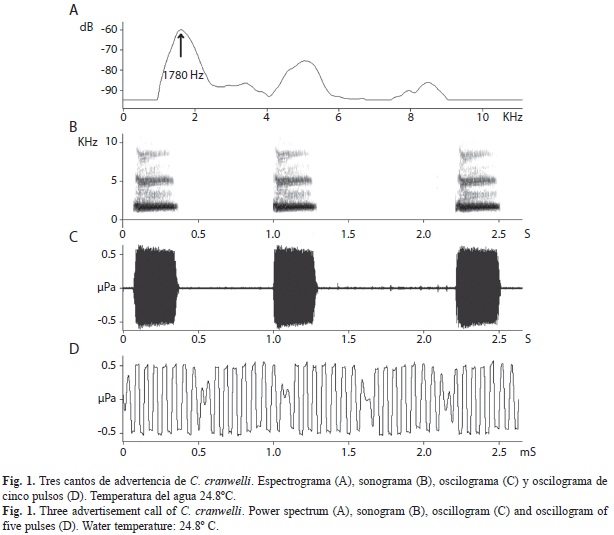
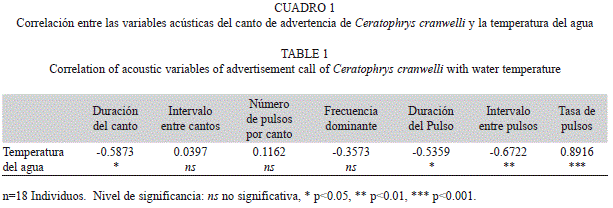
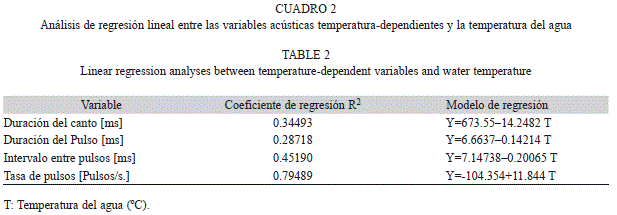
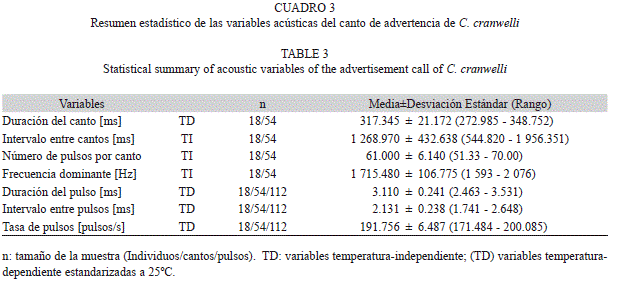
<body><![CDATA[5.0. Los registros ac&uacute;sticos digitalizados se depositaron en la     sonoteca particular del Dr. Adolfo Martino en la c&aacute;tedra de     Ecolog&iacute;a General, Departamento de Ciencias Naturales,     Universidad Nacional de R&iacute;o Cuarto, Argentina.</span></font><br      style="font-family: verdana;">     <br style="font-family: verdana;">     <font style="font-weight: bold;" size="3"><span      style="font-family: verdana;">Resultados    <br> <br style="font-family: verdana;"> </span></font><font size="2"><span style="font-family: verdana;">El canto de advertencia de <span style="font-style: italic;">C. cranwelli</span> est&aacute; constituidos por un n&uacute;mero variable de pulsos (<a href="/img/revistas/rbt/v61n1/a22i1.jpg">Fig. 1</a>). La intensidad del canto var&iacute;a, es&nbsp; elevada&nbsp; en&nbsp; los&nbsp; pulsos&nbsp; del&nbsp; centro&nbsp; y&nbsp; baja en los pulsos de los extremos del canto. De esta manera, al observarse en el oscilograma (<a  href="/img/revistas/rbt/v61n1/a22i1.jpg">Fig. 1</a>), el canto muestra una forma de &#8220;huso&#8221;. La&nbsp; Duraci&oacute;n&nbsp; de&nbsp; los&nbsp; pulsos&nbsp; y&nbsp; los&nbsp; Intervalos entre pulsos no var&iacute;an a lo largo del canto. El an&aacute;lisis del sonograma muestra que la Frecuencia fundamental corresponde a la Frecuencia dominante. Esta frecuencia tiene un valor promedio de 1 715Hz, y es seguida por un n&uacute;mero variable de arm&oacute;nicos de mayor frecuencia y menor intensidad.</span></font><br  style="font-family: verdana;"> <br style="font-family: verdana;"> <font size="2"><span style="font-family: verdana;">El an&aacute;lisis de correlaci&oacute;n m&uacute;ltiple muestra que cuatro variables son temperatura-dependientes&nbsp; (<a  href="/img/revistas/rbt/v61n1/a22t1.gif">Cuadro&nbsp; 1</a>).&nbsp; La&nbsp; Duraci&oacute;n&nbsp; del&nbsp; canto, la&nbsp; Duraci&oacute;n&nbsp; del&nbsp; pulso&nbsp; y&nbsp; el&nbsp; Intervalo&nbsp; entre pulsos disminuyen al aumentar la variable Temperatura, mientras que la Tasa de pulsos aumenta con el incremento de la Temperatura (<a  href="/img/revistas/rbt/v61n1/a22t2.gif">Cuadro 2</a>). En la <a href="/img/revistas/rbt/v61n1/a22i2.jpg">figura 2</a> se pueden observar las regresiones lineales de las variables temperatura-dependientes. La temperatura explica la variabilidad en las componentes ac&uacute;sticas temperatura-dependientes desde el 28% en la Duraci&oacute;n del pulso hasta el 79% en la variable Tasa de pulsos (<a href="/img/revistas/rbt/v61n1/a22t2.gif">Cuadro 2</a>).</span></font><br  style="font-family: verdana;"> <br style="font-family: verdana;"> <font size="2"><span style="font-family: verdana;">En el <a  href="/img/revistas/rbt/v61n1/a22t3.gif">cuadro 3</a> se muestran los valores medios y desviaciones est&aacute;ndar de las variables ac&uacute;sticas del canto de advertencia de <span  style="font-style: italic;">C. cranwelli</span>. Las variables temperatura-dependientes fueron previamente estandarizadas a 25&ordm;C de temperatura seg&uacute;n el modelo de regresi&oacute;n lineal obtenido.</span></font><br style="font-family: verdana;"> <br style="font-family: verdana;"> <font size="2"><span style="font-family: verdana;">La Duraci&oacute;n del canto de advertencia es de 317ms a 25&ordm;C disminuyendo 14.2ms por cada grado cent&iacute;grado de temperatura que se incrementa (<a  href="/img/revistas/rbt/v61n1/a22t2.gif">Cuadro 2</a>). El N&uacute;mero de pulsos por cantos es de 61 y es independiente de la temperatura. La disminuci&oacute;n tanto de la Duraci&oacute;n del pulso como el Intervalo entre pulsos, respecto al&nbsp; incremento&nbsp; de&nbsp; la&nbsp; Temperatura,&nbsp; producen una disminuci&oacute;n de la Duraci&oacute;n del canto, sin afectar de manera significativa el N&uacute;mero de pulsos por canto.</span></font><br  style="font-family: verdana;"> <br style="font-family: verdana;"> <font style="font-weight: bold;" size="3"><span  style="font-family: verdana;">Discusi&oacute;n    <br> <br style="font-family: verdana;"> </span></font><font size="2"><span style="font-family: verdana;">Las propiedades de los cantos de advertencia en los anfibios anuros est&aacute;n controladas principalmente por las contracciones musculares&nbsp; del&nbsp; tronco&nbsp; y&nbsp; de&nbsp; la&nbsp; laringe,&nbsp; induciendo el&nbsp; pasaje&nbsp; de&nbsp; aire&nbsp; desde&nbsp; los&nbsp; pulmones&nbsp; hacia los sacos vocales y atravesando el aparato lar&iacute;ngeo que es el lugar donde se produce el sonido (Duellman &amp; Trueb 1986). En este sentido, en estudios previos se ha demostrado que la temperatura condiciona las propiedades contr&aacute;ctiles de los m&uacute;sculos del tronco y de la laringe involucrados en la producci&oacute;n del canto (Martin 1972, Manz 1975, Pough <span style="font-style: italic;">et al.</span> 1992).&nbsp; Por&nbsp; lo&nbsp; tanto,&nbsp; como&nbsp; estos&nbsp; organismos son ectotermos, las propiedades ac&uacute;sticas de sus&nbsp; cantos&nbsp; son&nbsp; afectadas&nbsp; por&nbsp; la&nbsp; temperatura en la cual se producen dichas emisiones. Las variables ac&uacute;sticas que se correlacionaron con la temperatura del agua son aquellas variables cuyas&nbsp; emisiones&nbsp; dependen&nbsp; de&nbsp; los&nbsp; m&uacute;sculos del&nbsp; tronco&nbsp; y&nbsp; m&uacute;sculos&nbsp; lar&iacute;ngeos&nbsp; (Schmidt 1965, Martin &amp; Gans 1972, Schneider 1977, Schneider 1988,&nbsp; Pough&nbsp; <span style="font-style: italic;">et&nbsp; al.</span>&nbsp; 1992).&nbsp; En&nbsp; los h&iacute;lidos, los cuales tienen cantos constituidos de una serie de pulsos repetidos, los m&uacute;sculos lar&iacute;ngeos abren y cierran la laringe en sincron&iacute;a con los m&uacute;sculos del tronco para producir los pulsos regularmente espaciados que resultan importantes en el reconocimiento espec&iacute;fico (Gerhardt 1991, Girgenrath &amp; Marsh 1997). En general, la temperatura podr&iacute;a estar encubriendo diferencias o similitudes en propiedades ac&uacute;sticas entre especies cuando sus cantos de advertencias est&aacute;n siendo comparados a diferentes magnitudes de la misma.</span></font><br  style="font-family: verdana;"> <br style="font-family: verdana;"> <font size="2"><span style="font-family: verdana;">La familia <span  style="font-style: italic;">Ceratophryidae</span> posee tres g&eacute;neros, <span style="font-style: italic;">Chacophrys</span>, <span style="font-style: italic;">Lepidobatrachus</span> y Ceratophrys (Pyron &amp; Wiens 2011). El canto de advertencia de <span  style="font-style: italic;">C. cranwelli</span> responde a la estructura temporal de canto simple (&#8220;single periodic pulse train&#8221;, Littlejohn 2001), al igual que los cantos de todas las especies de la familia <span style="font-style: italic;">Ceratophryidae</span> descritos (Barrio 1963, 1968, 1980, Lescano 2011). En el trabajo de Barrio (1980) los valores de las variables ac&uacute;sticas est&aacute;n expresados para una temperatura de 25&ordm;C en la localidad de Bell Ville. La Duraci&oacute;n del canto de los individuos estudiados en dicha localidad tuvo un valor promedio de 350ms con cantos desde 320 a 400m. En este trabajo la Duraci&oacute;n media del canto de advertencia fue de 317ms, con valores entre 272 y 348ms. La cantidad de pulsos por canto vari&oacute; entre 53-70 con una media de 61, en tanto que para la localidad de Bell Ville este n&uacute;mero fue mayor (70 pulsos promedio con valores entre 63 y 80). La Tasa de pulsos por segundos fue menor en la poblaci&oacute;n estudiada comparada con la de Bell Ville (191.8, con valores entre 171-200, y 198, con valores entre 190-210, respectivamente).</span></font><font size="2"><span  style="font-family: verdana;"> La Frecuencia dominante tambi&eacute;n resulta algo diferente entre las dos poblaciones. La media fue de 1 715Hz, con valores en un &aacute;mbito de 1 593-2 076, en tanto que Barrio (1980) reporta valores en un &aacute;mbito de 1 250-1 500 Hz.</span></font><br style="font-family: verdana;"> <br style="font-family: verdana;"> <font size="2"><span style="font-family: verdana;">Si bien los cantos de advertencia en los anuros son especie-espec&iacute;ficos (Gerhardt &amp; Davis 1988), determinadas propiedades del canto pueden variar con la temperatura, como se ha demostrado en este trabajo, y con la presencia de diferentes condiciones ecol&oacute;gicas en los ambientes (Gerhardt 1991). La variaci&oacute;n geogr&aacute;fica en las propiedades ac&uacute;sticas de los anuros puede ser debida a distinta presiones selectivas (Castellano <span style="font-style: italic;">et al.</span> 2003), esto sumado a los procesos estoc&aacute;sticos como la deriva g&eacute;nica (Smith &amp; Hunter 2005). La variaci&oacute;n geogr&aacute;fica del canto ha sido demostrada en numerosas especies de anuros. Particularmente en el &aacute;rea central de Argentina, Bionda <span  style="font-style: italic;">et al.</span> (2006) y Baraquet <span  style="font-style: italic;">et al.</span> (2007) encontraron variaciones geogr&aacute;ficas en el canto de advertencia de <span style="font-style: italic;">Physalaemus biligonigerus</span> y <span style="font-style: italic;">Hypsiboas pulchellus</span>, respectivamente. Barrio (1980)&nbsp; encontr&oacute;&nbsp; diferencias&nbsp; ac&uacute;sticas&nbsp; entre dos poblaciones distantes en aproximadamente 400km (Sumampa, Provincia de Santiago del Estero y Bell Ville, Provincia de C&oacute;rdoba). Dado que la localidad del presente trabajo se encuentra a 125 y 440km respecto de las poblaciones Bell Ville y Sumampa, las diferencias respecto al trabajo de Barrio (1980) podr&iacute;an deberse a variaciones geogr&aacute;ficas.</span></font><br style="font-family: verdana;"> <br style="font-family: verdana;"> <font size="2"><span style="font-family: verdana;">Los resultados demuestran la importancia de la temperatura en la variabilidad de ciertas propiedades del canto en <span style="font-style: italic;">C. cranwelli</span>, siendo la Tasa&nbsp; de&nbsp; pulsos&nbsp; una&nbsp; de&nbsp; las&nbsp; variables&nbsp; m&aacute;s importantes en la discriminaci&oacute;n de los machos conespec&iacute;ficos por parte de las hembras cuando est&aacute;n en simpatr&iacute;a con otras especies relacionadas (Sinsch 1990, Martino &amp; Sinsch 2002, Holloway <span style="font-style: italic;">et al.</span> 2006). Por lo tanto, resulta importante realizar un an&aacute;lisis bioac&uacute;stico entre el par de especies <span  style="font-style: italic;">C. cranwelli</span>/<span style="font-style: italic;">C. ornata</span> en un amplio rango de temperaturas y distintas localidades para evaluar si existen diferencias en los cantos de advertencia de estas dos especies. </span></font><br  style="font-family: verdana;"> <br style="font-family: verdana;"> <font style="font-weight: bold;" size="3"><span  style="font-family: verdana;">Agradecimientos    ]]></body>
<body><![CDATA[<br> <br style="font-family: verdana;"> </span></font><font size="2"><span style="font-family: verdana;">La secretar&iacute;a de Medio ambiente y recursos naturales de la municipalidad de Alejandro Roca, C&oacute;rdoba, permiti&oacute; realizar los trabajos de&nbsp; campo&nbsp; en&nbsp; la&nbsp; reserva&nbsp; natural&nbsp; municipal &#8220;Juan Carlos Fano&#8221;. Nuestros estudios fueron autorizados por la Secretar&iacute;a Ambiente de la provincia&nbsp; de&nbsp; C&oacute;rdoba, Argentina.&nbsp; La&nbsp; Secretar&iacute;a de Ciencia y T&eacute;cnica (SECyT-UNRC) subsidi&oacute; en parte esta investigaci&oacute;n (PPI 18/ C350). Al valioso aporte de los cuatro revisores an&oacute;nimos que permitieron mejorar la versi&oacute;n final del manuscrito.</span></font><br style="font-family: verdana;"> <hr style="width: 100%; height: 2px;">    <!-- ref --><br> <font style="font-weight: bold;" size="3"><span  style="font-family: verdana;">Referencias</span></font><br  style="font-family: verdana;"> <br style="font-family: verdana;"> <font size="2"><span style="font-family: verdana;">Baraquet, M., N. Salas &amp; I. Di Tada. 2007.&nbsp; Variaci&oacute;n geogr&aacute;fica en el canto de advertencia de <span style="font-style: italic;">Hypsiboas pulchellus</span> (Anura, Hylidae) en Argentina. Rev. Esp. Herp. 21: 107-118.    &nbsp;&nbsp;&nbsp;&nbsp;&nbsp;&nbsp;&nbsp;&nbsp;[&#160;<a href="javascript:void(0);" onclick="javascript: window.open('/scielo.php?script=sci_nlinks&ref=1833824&pid=S0034-7744201300010002200001&lng=','','width=640,height=500,resizable=yes,scrollbars=1,menubar=yes,');">Links</a>&#160;]<!-- end-ref --><!-- ref --></span></font><br style="font-family: verdana;"> <br style="font-family: verdana;"> <font size="2"><span style="font-family: verdana;">Barrio,&nbsp; A. 1963. Consideraciones sobre&nbsp; comportamiento y&nbsp; &#8220;grito&nbsp; agresivo&#8221;&nbsp; propio de algunas especies de Ceratophrynidae (Anura). Physis 24: 143-148.    &nbsp;&nbsp;&nbsp;&nbsp;&nbsp;&nbsp;&nbsp;&nbsp;[&#160;<a href="javascript:void(0);" onclick="javascript: window.open('/scielo.php?script=sci_nlinks&ref=1833825&pid=S0034-7744201300010002200002&lng=','','width=640,height=500,resizable=yes,scrollbars=1,menubar=yes,');">Links</a>&#160;]<!-- end-ref --><!-- ref --></span></font><br style="font-family: verdana;"> <br style="font-family: verdana;"> <font size="2"><span style="font-family: verdana;">Barrio, A. 1964. Caracteres eto-ecol&oacute;gicos&nbsp;&nbsp; diferenciales&nbsp; entre&nbsp; <span style="font-style: italic;">Odontophrynus&nbsp; americanus</span>&nbsp; (Dumeril&nbsp; et Bibron) y <span style="font-style: italic;">O. occidentales</span> (Berg) (Anura, Leptodactylidae). Physis 24: 385-390.    &nbsp;&nbsp;&nbsp;&nbsp;&nbsp;&nbsp;&nbsp;&nbsp;[&#160;<a href="javascript:void(0);" onclick="javascript: window.open('/scielo.php?script=sci_nlinks&ref=1833826&pid=S0034-7744201300010002200003&lng=','','width=640,height=500,resizable=yes,scrollbars=1,menubar=yes,');">Links</a>&#160;]<!-- end-ref --><!-- ref --></span></font><br  style="font-family: verdana;"> <br style="font-family: verdana;"> <font size="2"><span style="font-family: verdana;">Barrio, A. 1968. Revisi&oacute;n del g&eacute;nero <span style="font-style: italic;">Lepidobatrachus</span> Budgett (Anura, Ceratophrynidae). Physis 28: 95-166.    &nbsp;&nbsp;&nbsp;&nbsp;&nbsp;&nbsp;&nbsp;&nbsp;[&#160;<a href="javascript:void(0);" onclick="javascript: window.open('/scielo.php?script=sci_nlinks&ref=1833827&pid=S0034-7744201300010002200004&lng=','','width=640,height=500,resizable=yes,scrollbars=1,menubar=yes,');">Links</a>&#160;]<!-- end-ref --><!-- ref --></span></font><br style="font-family: verdana;"> <br style="font-family: verdana;"> <font size="2"><span style="font-family: verdana;">Barrio, A. 1980. Una nueva especie de&nbsp;&nbsp; <span style="font-style: italic;">Ceratophrys</span> (Anura: Ceratophryidae)&nbsp;&nbsp; del&nbsp;&nbsp; Dominio&nbsp; Chaque&ntilde;o. Physis 39: 21-30.    &nbsp;&nbsp;&nbsp;&nbsp;&nbsp;&nbsp;&nbsp;&nbsp;[&#160;<a href="javascript:void(0);" onclick="javascript: window.open('/scielo.php?script=sci_nlinks&ref=1833828&pid=S0034-7744201300010002200005&lng=','','width=640,height=500,resizable=yes,scrollbars=1,menubar=yes,');">Links</a>&#160;]<!-- end-ref --><!-- ref --></span></font><br  style="font-family: verdana;"> <br style="font-family: verdana;"> <font size="2"><span style="font-family: verdana;">Bell, T. 1843. Reptiles. <span style="font-style: italic;">In</span> C. Darwin. Zoology of the voyage of H.M.S. Beagle under&nbsp; the command of Capt. Fitzroy R.N. during the years 1832 to 1836. Smith, Elder &amp; Co., Londres, Reino Unido.    &nbsp;&nbsp;&nbsp;&nbsp;&nbsp;&nbsp;&nbsp;&nbsp;[&#160;<a href="javascript:void(0);" onclick="javascript: window.open('/scielo.php?script=sci_nlinks&ref=1833829&pid=S0034-7744201300010002200006&lng=','','width=640,height=500,resizable=yes,scrollbars=1,menubar=yes,');">Links</a>&#160;]<!-- end-ref --><!-- ref --></span></font><br  style="font-family: verdana;"> <br style="font-family: verdana;"> <font size="2"><span style="font-family: verdana;">Bionda, C., N. Salas &amp; I. Di Tada. 2006. Variaci&oacute;n bioac&uacute;stica&nbsp; en&nbsp; poblaciones&nbsp; de&nbsp; <span style="font-style: italic;">Physalaemus&nbsp; biligonigerus</span> (Anura:&nbsp;&nbsp; Leptodactylidae)&nbsp; en&nbsp; C&oacute;rdoba,&nbsp; Argentina. Rev. Esp. Herp. 20: 95-104.    &nbsp;&nbsp;&nbsp;&nbsp;&nbsp;&nbsp;&nbsp;&nbsp;[&#160;<a href="javascript:void(0);" onclick="javascript: window.open('/scielo.php?script=sci_nlinks&ref=1833830&pid=S0034-7744201300010002200007&lng=','','width=640,height=500,resizable=yes,scrollbars=1,menubar=yes,');">Links</a>&#160;]<!-- end-ref --><!-- ref --></span></font><br  style="font-family: verdana;"> <br style="font-family: verdana;"> <font size="2"><span style="font-family: verdana;">Blair, W.F. 1958. Mating call in the&nbsp; speciation&nbsp; of anuran amphibian. Am. Nat. 92: 27-51.    &nbsp;&nbsp;&nbsp;&nbsp;&nbsp;&nbsp;&nbsp;&nbsp;[&#160;<a href="javascript:void(0);" onclick="javascript: window.open('/scielo.php?script=sci_nlinks&ref=1833831&pid=S0034-7744201300010002200008&lng=','','width=640,height=500,resizable=yes,scrollbars=1,menubar=yes,');">Links</a>&#160;]<!-- end-ref --><!-- ref --></span></font><br  style="font-family: verdana;"> <br style="font-family: verdana;"> <font size="2"><span style="font-family: verdana;">Castellano, S., C. Giacoma &amp; M. Ryan. 2003. Call degradation in diploid and tetraploid green toads. Biol. J. Linn. Soc. 78: 11-26.    &nbsp;&nbsp;&nbsp;&nbsp;&nbsp;&nbsp;&nbsp;&nbsp;[&#160;<a href="javascript:void(0);" onclick="javascript: window.open('/scielo.php?script=sci_nlinks&ref=1833832&pid=S0034-7744201300010002200009&lng=','','width=640,height=500,resizable=yes,scrollbars=1,menubar=yes,');">Links</a>&#160;]<!-- end-ref --><!-- ref --></span></font><br  style="font-family: verdana;"> <br style="font-family: verdana;"> <font size="2"><span style="font-family: verdana;">Cei,&nbsp; J.M. 1980. Amphibians of Argentina.&nbsp; Monit. Zool. Ital. Monogr. N&ordm; 2, Torino.    &nbsp;&nbsp;&nbsp;&nbsp;&nbsp;&nbsp;&nbsp;&nbsp;[&#160;<a href="javascript:void(0);" onclick="javascript: window.open('/scielo.php?script=sci_nlinks&ref=1833833&pid=S0034-7744201300010002200010&lng=','','width=640,height=500,resizable=yes,scrollbars=1,menubar=yes,');">Links</a>&#160;]<!-- end-ref --><!-- ref --></span></font><br  style="font-family: verdana;"> <br style="font-family: verdana;"> <font size="2"><span style="font-family: verdana;">Charif, R.A., S. Mitchell &amp; C.W. Clarck. 1995. Canary 1.2 user&#8217;s manual. Cornell&nbsp; Laboratory of Ornithology, Ithaca, Nueva York, EE.UU.    &nbsp;&nbsp;&nbsp;&nbsp;&nbsp;&nbsp;&nbsp;&nbsp;[&#160;<a href="javascript:void(0);" onclick="javascript: window.open('/scielo.php?script=sci_nlinks&ref=1833834&pid=S0034-7744201300010002200011&lng=','','width=640,height=500,resizable=yes,scrollbars=1,menubar=yes,');">Links</a>&#160;]<!-- end-ref --><!-- ref --></span></font><br  style="font-family: verdana;"> <br style="font-family: verdana;"> <font size="2"><span style="font-family: verdana;">Di Tada, E.I. 1999. Patrones de distribuci&oacute;n de los Anfibios Anuros de la provincia de C&oacute;rdoba. Tesis doctoral en Ciencias Biol&oacute;gicas, Universidad Nacional de C&oacute;rdoba, C&oacute;rdoba, Argentina.    &nbsp;&nbsp;&nbsp;&nbsp;&nbsp;&nbsp;&nbsp;&nbsp;[&#160;<a href="javascript:void(0);" onclick="javascript: window.open('/scielo.php?script=sci_nlinks&ref=1833835&pid=S0034-7744201300010002200012&lng=','','width=640,height=500,resizable=yes,scrollbars=1,menubar=yes,');">Links</a>&#160;]<!-- end-ref --><!-- ref --></span></font><br  style="font-family: verdana;"> <br style="font-family: verdana;"> <font size="2"><span style="font-family: verdana;">Duellman, W.E. &amp; L. Trueb. 1986. Biology of Amphibians. McGraw-Hill Book, Nueva York, EE.UU.    &nbsp;&nbsp;&nbsp;&nbsp;&nbsp;&nbsp;&nbsp;&nbsp;[&#160;<a href="javascript:void(0);" onclick="javascript: window.open('/scielo.php?script=sci_nlinks&ref=1833836&pid=S0034-7744201300010002200013&lng=','','width=640,height=500,resizable=yes,scrollbars=1,menubar=yes,');">Links</a>&#160;]<!-- end-ref --><!-- ref --></span></font><br  style="font-family: verdana;"> <br style="font-family: verdana;"> <font size="2"><span style="font-family: verdana;">Esteban, M., M.J. S&aacute;nchez-Herr&aacute;iz, L.J. Barbadillo, J. Castanet &amp; R. M&aacute;rquez.&nbsp; 2002. Effects of age, size and temperature on the advertisement calls&nbsp; of&nbsp; two Spanish populations of&nbsp; <span style="font-style: italic;">Pelodytes punctatus</span>. Amphibia Reptilia 23: 249-258.    &nbsp;&nbsp;&nbsp;&nbsp;&nbsp;&nbsp;&nbsp;&nbsp;[&#160;<a href="javascript:void(0);" onclick="javascript: window.open('/scielo.php?script=sci_nlinks&ref=1833837&pid=S0034-7744201300010002200014&lng=','','width=640,height=500,resizable=yes,scrollbars=1,menubar=yes,');">Links</a>&#160;]<!-- end-ref --><!-- ref --></span></font><br  style="font-family: verdana;"> <br style="font-family: verdana;"> <font size="2"><span style="font-family: verdana;">Gallardo,&nbsp; J.M. 1987. Anfibios Argentinos.&nbsp; Gu&iacute;a para su identificaci&oacute;n. Biblioteca&nbsp; Mosaico, Lib. Agropecuaria, Buenos Aires, Argentina.    &nbsp;&nbsp;&nbsp;&nbsp;&nbsp;&nbsp;&nbsp;&nbsp;[&#160;<a href="javascript:void(0);" onclick="javascript: window.open('/scielo.php?script=sci_nlinks&ref=1833838&pid=S0034-7744201300010002200015&lng=','','width=640,height=500,resizable=yes,scrollbars=1,menubar=yes,');">Links</a>&#160;]<!-- end-ref --><!-- ref --></span></font><br  style="font-family: verdana;"> <br style="font-family: verdana;"> <font size="2"><span style="font-family: verdana;">Gayou,&nbsp; D.C. 1984. Effects of temperature on&nbsp; the mating call of <span  style="font-style: italic;">Hyla versicolor</span>. Copeia 3: 733-738.    &nbsp;&nbsp;&nbsp;&nbsp;&nbsp;&nbsp;&nbsp;&nbsp;[&#160;<a href="javascript:void(0);" onclick="javascript: window.open('/scielo.php?script=sci_nlinks&ref=1833839&pid=S0034-7744201300010002200016&lng=','','width=640,height=500,resizable=yes,scrollbars=1,menubar=yes,');">Links</a>&#160;]<!-- end-ref --></span></font><br style="font-family: verdana;"> <font size="2"><span style="font-family: verdana;">    <!-- ref --><br> Gerhardt,&nbsp; H.C.&nbsp; &amp;&nbsp; M.S.&nbsp; Davis.&nbsp; 1988.&nbsp; Variation&nbsp; in&nbsp; the coding of species identity in the advertisement calls of <span style="font-style: italic;">Litoria verreauxi</span> (Anura: Hylidae). Evolution 42: 556-565.    &nbsp;&nbsp;&nbsp;&nbsp;&nbsp;&nbsp;&nbsp;&nbsp;[&#160;<a href="javascript:void(0);" onclick="javascript: window.open('/scielo.php?script=sci_nlinks&ref=1833841&pid=S0034-7744201300010002200017&lng=','','width=640,height=500,resizable=yes,scrollbars=1,menubar=yes,');">Links</a>&#160;]<!-- end-ref --><!-- ref --></span></font><br  style="font-family: verdana;"> <br style="font-family: verdana;"> <font size="2"><span style="font-family: verdana;">Gerhardt,&nbsp; H.C. 1978. Temperature coupling in&nbsp; the vocal communication system of the&nbsp; gray tree frog, <span style="font-style: italic;">Hyla versicolor</span>. Science 199: 992-994.    &nbsp;&nbsp;&nbsp;&nbsp;&nbsp;&nbsp;&nbsp;&nbsp;[&#160;<a href="javascript:void(0);" onclick="javascript: window.open('/scielo.php?script=sci_nlinks&ref=1833842&pid=S0034-7744201300010002200018&lng=','','width=640,height=500,resizable=yes,scrollbars=1,menubar=yes,');">Links</a>&#160;]<!-- end-ref --><!-- ref --></span></font><br  style="font-family: verdana;"> <br style="font-family: verdana;"> <font size="2"><span style="font-family: verdana;">Gerhardt,&nbsp; H.C.&nbsp; 1991&nbsp; Female&nbsp; mate&nbsp; choice&nbsp; in&nbsp; treefrogs: static&nbsp; and dynamic acoustic criteria.&nbsp; Anim. Behav. 42: 615-635.    &nbsp;&nbsp;&nbsp;&nbsp;&nbsp;&nbsp;&nbsp;&nbsp;[&#160;<a href="javascript:void(0);" onclick="javascript: window.open('/scielo.php?script=sci_nlinks&ref=1833843&pid=S0034-7744201300010002200019&lng=','','width=640,height=500,resizable=yes,scrollbars=1,menubar=yes,');">Links</a>&#160;]<!-- end-ref --><!-- ref --></span></font><br style="font-family: verdana;"> <br style="font-family: verdana;"> <font size="2"><span style="font-family: verdana;">Girgenrath, M. &amp; R.L. Marsh. 1997. In vivo performance of trunk muscles in tree frogs during calling. J. Exp. Biol. 200: 3101-3108.    &nbsp;&nbsp;&nbsp;&nbsp;&nbsp;&nbsp;&nbsp;&nbsp;[&#160;<a href="javascript:void(0);" onclick="javascript: window.open('/scielo.php?script=sci_nlinks&ref=1833844&pid=S0034-7744201300010002200020&lng=','','width=640,height=500,resizable=yes,scrollbars=1,menubar=yes,');">Links</a>&#160;]<!-- end-ref --><!-- ref --></span></font><br  style="font-family: verdana;"> <br style="font-family: verdana;"> <font size="2"><span style="font-family: verdana;">Heyer, W.R. &amp; Y.R. Reid. 2003. Does&nbsp;&nbsp; advertisement call variation coincide&nbsp; with genetic variation in the genetically&nbsp; diverse frog taxon currently known as <span style="font-style: italic;">Leptodactylus fuscus</span> (Amphibia:&nbsp; Leptodactylidae)? An. Acad. Bras. Ci&ecirc;ncias 75: 39-54.    &nbsp;&nbsp;&nbsp;&nbsp;&nbsp;&nbsp;&nbsp;&nbsp;[&#160;<a href="javascript:void(0);" onclick="javascript: window.open('/scielo.php?script=sci_nlinks&ref=1833845&pid=S0034-7744201300010002200021&lng=','','width=640,height=500,resizable=yes,scrollbars=1,menubar=yes,');">Links</a>&#160;]<!-- end-ref --><!-- ref --></span></font><br  style="font-family: verdana;"> <br style="font-family: verdana;"> <font size="2"><span style="font-family: verdana;">Holloway, A.K., D.C. Cannatella, H.C. Gerhardt &amp; D.M. Hillis.&nbsp; 2006. Polyploids with different&nbsp; origins and ancestors form a single sexual polyploid species. Am. Nat. 167: E88-E101.    &nbsp;&nbsp;&nbsp;&nbsp;&nbsp;&nbsp;&nbsp;&nbsp;[&#160;<a href="javascript:void(0);" onclick="javascript: window.open('/scielo.php?script=sci_nlinks&ref=1833846&pid=S0034-7744201300010002200022&lng=','','width=640,height=500,resizable=yes,scrollbars=1,menubar=yes,');">Links</a>&#160;]<!-- end-ref --><!-- ref --></span></font><br  style="font-family: verdana;"> <br style="font-family: verdana;"> <font size="2"><span style="font-family: verdana;">Lescano,&nbsp; J. 2011. Description of the&nbsp; advertisement and distress call of <span  style="font-style: italic;">Chacophrys</span> pierottii and comments on the&nbsp; advertisement call of <span  style="font-style: italic;">Lepidobatrachus&nbsp; llanensis</span> (Anura: Ceratophryidae). J. Nat. Hist. 45: 2929-2938.    &nbsp;&nbsp;&nbsp;&nbsp;&nbsp;&nbsp;&nbsp;&nbsp;[&#160;<a href="javascript:void(0);" onclick="javascript: window.open('/scielo.php?script=sci_nlinks&ref=1833847&pid=S0034-7744201300010002200023&lng=','','width=640,height=500,resizable=yes,scrollbars=1,menubar=yes,');">Links</a>&#160;]<!-- end-ref --><!-- ref --></span></font><br  style="font-family: verdana;"> <br style="font-family: verdana;"> <font size="2"><span style="font-family: verdana;">Littlejohn, M.J. 2001. Patterns of differentiation in temporal properties of acoustic&nbsp; signals of anurans, p.102-120. <span style="font-style: italic;">In</span> M.J. Ryan (ed.). Anuran&nbsp; communication. Smithsonian Institution, Washington, EE.UU.    &nbsp;&nbsp;&nbsp;&nbsp;&nbsp;&nbsp;&nbsp;&nbsp;[&#160;<a href="javascript:void(0);" onclick="javascript: window.open('/scielo.php?script=sci_nlinks&ref=1833848&pid=S0034-7744201300010002200024&lng=','','width=640,height=500,resizable=yes,scrollbars=1,menubar=yes,');">Links</a>&#160;]<!-- end-ref --><!-- ref --></span></font><br  style="font-family: verdana;"> <br style="font-family: verdana;"> <font size="2"><span style="font-family: verdana;">Manz, R. 1975. Die Fusionsfrequenzen der Kehlkopfmuskeln und eines&nbsp; Beinmuskels in Abhaengigkeit von der&nbsp; Temperatur bei europaeischen&nbsp;&nbsp; Froschlurchen (Anura). Zool. Jb. Physiol. 79: 221-245.    &nbsp;&nbsp;&nbsp;&nbsp;&nbsp;&nbsp;&nbsp;&nbsp;[&#160;<a href="javascript:void(0);" onclick="javascript: window.open('/scielo.php?script=sci_nlinks&ref=1833849&pid=S0034-7744201300010002200025&lng=','','width=640,height=500,resizable=yes,scrollbars=1,menubar=yes,');">Links</a>&#160;]<!-- end-ref --><!-- ref --></span></font><br  style="font-family: verdana;"> <br style="font-family: verdana;"> <font size="2"><span style="font-family: verdana;">M&aacute;rquez, R. &amp; J. Bosch. 1995. Advertisement calls of the midwife toads <span  style="font-style: italic;">Alytes</span>&nbsp; (Amphibia, Anura, Discoglossidae) in continental Spain. J. Zool. Systemat. Evol. Res. 33: 185-192.    &nbsp;&nbsp;&nbsp;&nbsp;&nbsp;&nbsp;&nbsp;&nbsp;[&#160;<a href="javascript:void(0);" onclick="javascript: window.open('/scielo.php?script=sci_nlinks&ref=1833850&pid=S0034-7744201300010002200026&lng=','','width=640,height=500,resizable=yes,scrollbars=1,menubar=yes,');">Links</a>&#160;]<!-- end-ref --><!-- ref --></span></font><br style="font-family: verdana;"> <br style="font-family: verdana;"> <font size="2"><span style="font-family: verdana;">Martin, W.F. 1972. Evolution of vocalizations in the genus Bufo, p. 279-309. <span  style="font-style: italic;">In</span> W.F.&nbsp; Blair (ed.). Evolution in the genus Bufo. University of Texas, Austin, EE.UU.    &nbsp;&nbsp;&nbsp;&nbsp;&nbsp;&nbsp;&nbsp;&nbsp;[&#160;<a href="javascript:void(0);" onclick="javascript: window.open('/scielo.php?script=sci_nlinks&ref=1833851&pid=S0034-7744201300010002200027&lng=','','width=640,height=500,resizable=yes,scrollbars=1,menubar=yes,');">Links</a>&#160;]<!-- end-ref --><!-- ref --></span></font><br  style="font-family: verdana;"> <br style="font-family: verdana;"> <font size="2"><span style="font-family: verdana;">Martin, W.F. &amp; C. Gans. 1972. Muscular control of vocal tract during release signalling in the toad <span style="font-style: italic;">Bufo valliceps</span>. J. Morphol. 137: 1-27.    &nbsp;&nbsp;&nbsp;&nbsp;&nbsp;&nbsp;&nbsp;&nbsp;[&#160;<a href="javascript:void(0);" onclick="javascript: window.open('/scielo.php?script=sci_nlinks&ref=1833852&pid=S0034-7744201300010002200028&lng=','','width=640,height=500,resizable=yes,scrollbars=1,menubar=yes,');">Links</a>&#160;]<!-- end-ref --><!-- ref --></span></font><br style="font-family: verdana;"> <br style="font-family: verdana;"> <font size="2"><span style="font-family: verdana;">Martino, A.L. &amp; U. Sinsch. 2002. Speciation by polyploidy in <span style="font-style: italic;">Odontophrynus&nbsp; americanus</span>.&nbsp; J. Zool. Lond. 257: 67-81.    &nbsp;&nbsp;&nbsp;&nbsp;&nbsp;&nbsp;&nbsp;&nbsp;[&#160;<a href="javascript:void(0);" onclick="javascript: window.open('/scielo.php?script=sci_nlinks&ref=1833853&pid=S0034-7744201300010002200029&lng=','','width=640,height=500,resizable=yes,scrollbars=1,menubar=yes,');">Links</a>&#160;]<!-- end-ref --><!-- ref --></span></font><br  style="font-family: verdana;"> <br style="font-family: verdana;"> <font size="2"><span style="font-family: verdana;">Navas, C.A. 1996. The effect of temperature on the voval activityof tropical anurans: A comparison of high and low-elevation species. J. Herpetol. 30: 488-495.    &nbsp;&nbsp;&nbsp;&nbsp;&nbsp;&nbsp;&nbsp;&nbsp;[&#160;<a href="javascript:void(0);" onclick="javascript: window.open('/scielo.php?script=sci_nlinks&ref=1833854&pid=S0034-7744201300010002200030&lng=','','width=640,height=500,resizable=yes,scrollbars=1,menubar=yes,');">Links</a>&#160;]<!-- end-ref --><!-- ref --></span></font><br  style="font-family: verdana;"> <br style="font-family: verdana;"> <font size="2"><span style="font-family: verdana;">Pough, F., W. Magnusson, M.J. Ryan, K. Wells &amp; T. Taigen. 1992. Behavioral energetics, p. 395-436. <span  style="font-style: italic;">In</span> M.E. Feder &amp; W.W. Burggren (eds.). Environmental Physiology of Amphibians, Chicago University, Chicago, Illinois, EE.UU.    &nbsp;&nbsp;&nbsp;&nbsp;&nbsp;&nbsp;&nbsp;&nbsp;[&#160;<a href="javascript:void(0);" onclick="javascript: window.open('/scielo.php?script=sci_nlinks&ref=1833855&pid=S0034-7744201300010002200031&lng=','','width=640,height=500,resizable=yes,scrollbars=1,menubar=yes,');">Links</a>&#160;]<!-- end-ref --><!-- ref --></span></font><br  style="font-family: verdana;"> <br style="font-family: verdana;"> <font size="2"><span style="font-family: verdana;">Pyron, R.A. &amp; J.J. Wiens. 2011. A large-scale phylogeny of Amphibia including over 2,800 species, and a revised classification of extant frogs, salamanders, and caecilians. Mol. Phylogenet. Evol. 61: 543-583.    &nbsp;&nbsp;&nbsp;&nbsp;&nbsp;&nbsp;&nbsp;&nbsp;[&#160;<a href="javascript:void(0);" onclick="javascript: window.open('/scielo.php?script=sci_nlinks&ref=1833856&pid=S0034-7744201300010002200032&lng=','','width=640,height=500,resizable=yes,scrollbars=1,menubar=yes,');">Links</a>&#160;]<!-- end-ref --><!-- ref --></span></font><br  style="font-family: verdana;"> <br style="font-family: verdana;"> <font size="2"><span style="font-family: verdana;">Schmidt, R.S. 1965. Larynx control and call production in frogs. Copeia 1965: 143-147.    &nbsp;&nbsp;&nbsp;&nbsp;&nbsp;&nbsp;&nbsp;&nbsp;[&#160;<a href="javascript:void(0);" onclick="javascript: window.open('/scielo.php?script=sci_nlinks&ref=1833857&pid=S0034-7744201300010002200033&lng=','','width=640,height=500,resizable=yes,scrollbars=1,menubar=yes,');">Links</a>&#160;]<!-- end-ref --><!-- ref --></span></font><br  style="font-family: verdana;"> <br style="font-family: verdana;"> <font size="2"><span style="font-family: verdana;">Schneider, H. 1977. Acoustic behaviour and physiology of vocalization in the&nbsp; European tree frog, <span style="font-style: italic;">Hyla arborea</span> (L.). <span  style="font-style: italic;">In</span> D.H. Taylor &amp; S.I. Guttman (eds.). The reproductive&nbsp; biology&nbsp; of&nbsp; amphibians,&nbsp; Nueva&nbsp; York, Plenum, EE.UU.    &nbsp;&nbsp;&nbsp;&nbsp;&nbsp;&nbsp;&nbsp;&nbsp;[&#160;<a href="javascript:void(0);" onclick="javascript: window.open('/scielo.php?script=sci_nlinks&ref=1833858&pid=S0034-7744201300010002200034&lng=','','width=640,height=500,resizable=yes,scrollbars=1,menubar=yes,');">Links</a>&#160;]<!-- end-ref --><!-- ref --></span></font><br style="font-family: verdana;"> <br style="font-family: verdana;"> <font size="2"><span style="font-family: verdana;">Schneider, H. 1988. Peripheral and central mechanisms of vocalization, p. 537-558. <span  style="font-style: italic;">In</span> B. Fritzsch, M.J. Ryan, W. Wilczynsky, T.E. Hetherington &amp; W. Walkowiak (eds.). The evolution of the Amphibian Auditory System, Wiley, Nueva York, EE.UU.    &nbsp;&nbsp;&nbsp;&nbsp;&nbsp;&nbsp;&nbsp;&nbsp;[&#160;<a href="javascript:void(0);" onclick="javascript: window.open('/scielo.php?script=sci_nlinks&ref=1833859&pid=S0034-7744201300010002200035&lng=','','width=640,height=500,resizable=yes,scrollbars=1,menubar=yes,');">Links</a>&#160;]<!-- end-ref --><!-- ref --></span></font><br  style="font-family: verdana;"> <br style="font-family: verdana;"> <font size="2"><span style="font-family: verdana;">Schneider, H. &amp; U. Sinsch. 1992. Mating call variation in lake frogs referred to as <span  style="font-style: italic;">Rana ridibunda</span> Pallas, 1771: taxonomic implications, Zeitschrift f&uuml;r Zoologische Systematik und Evolutionsforschung 30: 297-315.    &nbsp;&nbsp;&nbsp;&nbsp;&nbsp;&nbsp;&nbsp;&nbsp;[&#160;<a href="javascript:void(0);" onclick="javascript: window.open('/scielo.php?script=sci_nlinks&ref=1833860&pid=S0034-7744201300010002200036&lng=','','width=640,height=500,resizable=yes,scrollbars=1,menubar=yes,');">Links</a>&#160;]<!-- end-ref --><!-- ref --></span></font><br  style="font-family: verdana;"> <br style="font-family: verdana;"> <font size="2"><span style="font-family: verdana;">Schneider, H. &amp; U. Sinsch. 1999. Taxonomic reassessment of Middle Eastern lake&nbsp; frogs: Bioacoustic variation among populations consideres as <span  style="font-style: italic;">Rana ridibunda</span>, <span style="font-style: italic;">R. bedriagae</span> or <span  style="font-style: italic;">R. levantina</span>. J. Zool.&nbsp; Systemat. Evol. Res. 57: 57-65.    &nbsp;&nbsp;&nbsp;&nbsp;&nbsp;&nbsp;&nbsp;&nbsp;[&#160;<a href="javascript:void(0);" onclick="javascript: window.open('/scielo.php?script=sci_nlinks&ref=1833861&pid=S0034-7744201300010002200037&lng=','','width=640,height=500,resizable=yes,scrollbars=1,menubar=yes,');">Links</a>&#160;]<!-- end-ref --><!-- ref --></span></font><br style="font-family: verdana;"> <br style="font-family: verdana;"> <font size="2"><span style="font-family: verdana;">Schneider, H, U. Sinsch &amp; S. Sofianidout. 1993. The water frogs&nbsp; of&nbsp; Greecebioacoustic&nbsp; evidence&nbsp; for&nbsp; a&nbsp; new species. Zeitschrift&nbsp; f&uuml;r Zoologische Systematik und Evolutionsforschung 31: 47-63.    &nbsp;&nbsp;&nbsp;&nbsp;&nbsp;&nbsp;&nbsp;&nbsp;[&#160;<a href="javascript:void(0);" onclick="javascript: window.open('/scielo.php?script=sci_nlinks&ref=1833862&pid=S0034-7744201300010002200038&lng=','','width=640,height=500,resizable=yes,scrollbars=1,menubar=yes,');">Links</a>&#160;]<!-- end-ref --><!-- ref --></span></font><br  style="font-family: verdana;"> <br style="font-family: verdana;"> <font size="2"><span style="font-family: verdana;">Sinsch,&nbsp; U. 1990. Froschlurche (Anura) der&nbsp; zentralperuanischen Anden:&nbsp; Artdiagnose, Taxonomie,&nbsp; Habitate, Verhaltens&ouml;kologie. Salamandra 26: 177-214.    &nbsp;&nbsp;&nbsp;&nbsp;&nbsp;&nbsp;&nbsp;&nbsp;[&#160;<a href="javascript:void(0);" onclick="javascript: window.open('/scielo.php?script=sci_nlinks&ref=1833863&pid=S0034-7744201300010002200039&lng=','','width=640,height=500,resizable=yes,scrollbars=1,menubar=yes,');">Links</a>&#160;]<!-- end-ref --><!-- ref --></span></font><br style="font-family: verdana;"> <br style="font-family: verdana;"> <font size="2"><span style="font-family: verdana;">Sinsch,&nbsp; U.&nbsp; &amp;&nbsp; N.&nbsp; Juraske.&nbsp; 2006.&nbsp; Advertisement&nbsp; calls&nbsp; of hemiphractine&nbsp; marsupial frogs: I. <span  style="font-style: italic;">Gastrotheca marsupiata</span>&nbsp; group. Herpetologia&nbsp; Bonnensis&nbsp; II.&nbsp; Proceedings of the 13th Congress of the Societas Europaea Herpetologica 145-148.    &nbsp;&nbsp;&nbsp;&nbsp;&nbsp;&nbsp;&nbsp;&nbsp;[&#160;<a href="javascript:void(0);" onclick="javascript: window.open('/scielo.php?script=sci_nlinks&ref=1833864&pid=S0034-7744201300010002200040&lng=','','width=640,height=500,resizable=yes,scrollbars=1,menubar=yes,');">Links</a>&#160;]<!-- end-ref --><!-- ref --></span></font><br  style="font-family: verdana;"> <br style="font-family: verdana;"> <font size="2"><span style="font-family: verdana;">Smith, M.J. &amp; D. Hunter. 2005. Temporal and geographic variation&nbsp; in&nbsp; the&nbsp; advertisement&nbsp; call&nbsp; of&nbsp; the&nbsp; booroolong frog (<span style="font-style: italic;">Litoria booroolongensis</span>: Anura: Hylidae). Ethology 111: 1103-1115.    &nbsp;&nbsp;&nbsp;&nbsp;&nbsp;&nbsp;&nbsp;&nbsp;[&#160;<a href="javascript:void(0);" onclick="javascript: window.open('/scielo.php?script=sci_nlinks&ref=1833865&pid=S0034-7744201300010002200041&lng=','','width=640,height=500,resizable=yes,scrollbars=1,menubar=yes,');">Links</a>&#160;]<!-- end-ref --><!-- ref --></span></font><br  style="font-family: verdana;"> <br style="font-family: verdana;"> <font size="2"><span style="font-family: verdana;">Valetti, J.A. 2003. Monitoreo Ac&uacute;stico de una Comunidad de Anfibios en una Reserva Natural (Alejandro Roca, C&oacute;rdoba, Argentina). Tesis de grado de Licenciatura en Ciencias Biol&oacute;gicas. Universidad Nacional de R&iacute;o Cuarto, R&iacute;o Cuarto, Argentina.    &nbsp;&nbsp;&nbsp;&nbsp;&nbsp;&nbsp;&nbsp;&nbsp;[&#160;<a href="javascript:void(0);" onclick="javascript: window.open('/scielo.php?script=sci_nlinks&ref=1833866&pid=S0034-7744201300010002200042&lng=','','width=640,height=500,resizable=yes,scrollbars=1,menubar=yes,');">Links</a>&#160;]<!-- end-ref --><!-- ref --></span></font><br  style="font-family: verdana;"> <br style="font-family: verdana;"> <font size="2"><span style="font-family: verdana;">Valetti, J.A., N.E. Salas &amp; A.L. Martino. 2009. A new polyploid&nbsp; species&nbsp; of&nbsp; <span style="font-style: italic;">Pleurodema</span>&nbsp; (Anura:&nbsp; Leiuperidae) from Sierra de Comechingones, C&oacute;rdoba, Argentina and&nbsp; redescription&nbsp; of&nbsp;&nbsp; <span style="font-style: italic;">Pleurodema&nbsp; kriegi</span>&nbsp; (M&uuml;ller, 1926). Zootaxa 2073: 1-21.    &nbsp;&nbsp;&nbsp;&nbsp;&nbsp;&nbsp;&nbsp;&nbsp;[&#160;<a href="javascript:void(0);" onclick="javascript: window.open('/scielo.php?script=sci_nlinks&ref=1833867&pid=S0034-7744201300010002200043&lng=','','width=640,height=500,resizable=yes,scrollbars=1,menubar=yes,');">Links</a>&#160;]<!-- end-ref --><!-- ref --></span></font><br style="font-family: verdana;"> <br style="font-family: verdana;"> <font size="2"><span style="font-family: verdana;">Zweifel,&nbsp; R.G. 1959. Effect of temperature on&nbsp; call of the frog <span style="font-style: italic;">Bombina variegata</span>. Copeia 1959: 322-327.    &nbsp;&nbsp;&nbsp;&nbsp;&nbsp;&nbsp;&nbsp;&nbsp;[&#160;<a href="javascript:void(0);" onclick="javascript: window.open('/scielo.php?script=sci_nlinks&ref=1833868&pid=S0034-7744201300010002200044&lng=','','width=640,height=500,resizable=yes,scrollbars=1,menubar=yes,');">Links</a>&#160;]<!-- end-ref --><br>     <br> <a name="Correspondencia1"></a><a href="#Correspondencia2">*</a>Correspondencia:    <br> </span></font><font size="2"><span style="font-family: verdana;"></span></font><font  size="2"><span style="font-family: verdana;">Juli&aacute;n Alonso Valetti. </span></font><font size="2"><span  style="font-family: verdana;">Ecolog&iacute;a,&nbsp; Departamento&nbsp; de&nbsp; Ciencias&nbsp; Naturales,&nbsp; Facultad&nbsp; de&nbsp; Ciencias&nbsp; Exactas,&nbsp; F&iacute;sico-Qu&iacute;micas&nbsp; y&nbsp; Naturales, Universidad Nacional de R&iacute;o Cuarto, Ruta Nacional N&deg; 8-km 601, (X5804BYA) R&iacute;o Cuarto, Argentina; jvaletti@exa.unrc.edu.ar.    <br> </span></font><font size="2"><span style="font-family: verdana;">Nancy Edith Salas . </span></font><font size="2"><span  style="font-family: verdana;">Ecolog&iacute;a,&nbsp; Departamento&nbsp; de&nbsp; Ciencias&nbsp; Naturales,&nbsp; Facultad&nbsp; de&nbsp; Ciencias&nbsp; Exactas,&nbsp; F&iacute;sico-Qu&iacute;micas&nbsp; y&nbsp; Naturales, Universidad Nacional de R&iacute;o Cuarto, Ruta Nacional N&deg; 8-km 601, (X5804BYA) R&iacute;o Cuarto, Argentina;&nbsp; nsalas@exa.unrc.edu.ar.    ]]></body>
<body><![CDATA[<br> </span></font><font size="2"><span style="font-family: verdana;">Adolfo Ludovico Martino. </span></font><font size="2"><span  style="font-family: verdana;">Ecolog&iacute;a,&nbsp; Departamento&nbsp; de&nbsp; Ciencias&nbsp; Naturales,&nbsp; Facultad&nbsp; de&nbsp; Ciencias&nbsp; Exactas,&nbsp; F&iacute;sico-Qu&iacute;micas&nbsp; y&nbsp; Naturales, Universidad Nacional de R&iacute;o Cuarto, Ruta Nacional N&deg; 8-km 601, (X5804BYA) R&iacute;o Cuarto, Argentina; amartino@exa.unrc.edu.ar.    <br> </span></font><font size="2"><span style="font-family: verdana;"><a  name="1"></a><a href="#2">1</a> Ecolog&iacute;a,&nbsp; Departamento&nbsp; de&nbsp; Ciencias&nbsp; Naturales,&nbsp; Facultad&nbsp; de&nbsp; Ciencias&nbsp; Exactas,&nbsp; F&iacute;sico-Qu&iacute;micas&nbsp; y&nbsp; Naturales, Universidad Nacional de R&iacute;o Cuarto, Ruta Nacional N&deg; 8-km 601, (X5804BYA) R&iacute;o Cuarto, Argentina; jvaletti@exa.unrc.edu.ar, nsalas@exa.unrc.edu.ar, amartino@exa.unrc.edu.ar</span></font>    <br> <hr style="width: 100%; height: 2px;">     <div style="text-align: center;"><font style="font-weight: bold;"  size="2"><span style="font-family: verdana;">Recibido 10-I-2012.&nbsp;&nbsp; &nbsp;Corregido 18-VII-2012.&nbsp;&nbsp; &nbsp;Aceptado 20-VIII-2012.</span></font><br  style="font-family: verdana;"> </div> </div> </div> <font size="2"> </font>      ]]></body><back>
<ref-list>
<ref id="B1">
<nlm-citation citation-type="journal">
<person-group person-group-type="author">
<name>
<surname><![CDATA[Baraquet]]></surname>
<given-names><![CDATA[M.]]></given-names>
</name>
<name>
<surname><![CDATA[Salas]]></surname>
<given-names><![CDATA[N.]]></given-names>
</name>
<name>
<surname><![CDATA[Di Tada]]></surname>
<given-names><![CDATA[I.]]></given-names>
</name>
</person-group>
<article-title xml:lang="es"><![CDATA[Variación geográfica en el canto de advertencia de Hypsiboas pulchellus (Anura, Hylidae) en Argentina.]]></article-title>
<source><![CDATA[Rev. Esp. Herp.]]></source>
<year>2007</year>
<volume>21</volume>
<page-range>107-118</page-range></nlm-citation>
</ref>
<ref id="B2">
<nlm-citation citation-type="journal">
<person-group person-group-type="author">
<name>
<surname><![CDATA[Barrio]]></surname>
<given-names><![CDATA[A.]]></given-names>
</name>
</person-group>
<article-title xml:lang="es"><![CDATA[Consideraciones sobre comportamiento y grito agresivo propio de algunas especies de Ceratophrynidae (Anura)]]></article-title>
<source><![CDATA[Physis]]></source>
<year>1963</year>
<volume>24</volume>
<page-range>143-148</page-range></nlm-citation>
</ref>
<ref id="B3">
<nlm-citation citation-type="journal">
<person-group person-group-type="author">
<name>
<surname><![CDATA[Barrio]]></surname>
<given-names><![CDATA[A.]]></given-names>
</name>
</person-group>
<article-title xml:lang="es"><![CDATA[Caracteres eto-ecológicos diferenciales entre Odontophrynus americanus (Dumeril et Bibron) y O. occidentales (Berg) (Anura, Leptodactylidae).]]></article-title>
<source><![CDATA[Physis]]></source>
<year>1964</year>
<volume>24</volume>
<page-range>385-390</page-range></nlm-citation>
</ref>
<ref id="B4">
<nlm-citation citation-type="journal">
<person-group person-group-type="author">
<name>
<surname><![CDATA[Barrio]]></surname>
<given-names><![CDATA[A.]]></given-names>
</name>
</person-group>
<article-title xml:lang="es"><![CDATA[Revisión del género Lepidobatrachus Budgett (Anura, Ceratophrynidae).]]></article-title>
<source><![CDATA[Physis]]></source>
<year>1968</year>
<volume>28</volume>
<page-range>95-166</page-range></nlm-citation>
</ref>
<ref id="B5">
<nlm-citation citation-type="journal">
<person-group person-group-type="author">
<name>
<surname><![CDATA[Barrio]]></surname>
<given-names><![CDATA[A.]]></given-names>
</name>
</person-group>
<article-title xml:lang="es"><![CDATA[Una nueva especie de Ceratophrys (Anura: Ceratophryidae) del Dominio Chaqueño]]></article-title>
<source><![CDATA[Physis]]></source>
<year>1980</year>
<volume>39</volume>
<page-range>21-30</page-range></nlm-citation>
</ref>
<ref id="B6">
<nlm-citation citation-type="book">
<person-group person-group-type="author">
<name>
<surname><![CDATA[Bell]]></surname>
<given-names><![CDATA[T.]]></given-names>
</name>
</person-group>
<article-title xml:lang="en"><![CDATA[Reptiles]]></article-title>
<person-group person-group-type="editor">
<name>
<surname><![CDATA[Darwin]]></surname>
<given-names><![CDATA[C.]]></given-names>
</name>
</person-group>
<source><![CDATA[Zoology of the voyage of H.M.S. Beagle under the command of Capt. Fitzroy R.N. during the years 1832 to 1836.]]></source>
<year>1843</year>
<publisher-loc><![CDATA[Londres ]]></publisher-loc>
<publisher-name><![CDATA[Smith, Elder & Co.]]></publisher-name>
</nlm-citation>
</ref>
<ref id="B7">
<nlm-citation citation-type="journal">
<person-group person-group-type="author">
<name>
<surname><![CDATA[Bionda]]></surname>
<given-names><![CDATA[C.]]></given-names>
</name>
<name>
<surname><![CDATA[Salas]]></surname>
<given-names><![CDATA[N.]]></given-names>
</name>
<name>
<surname><![CDATA[Di Tada]]></surname>
<given-names><![CDATA[I.]]></given-names>
</name>
</person-group>
<article-title xml:lang="es"><![CDATA[Variación bioacústica en poblaciones de Physalaemus biligonigerus (Anura: Leptodactylidae) en Córdoba, Argentina.]]></article-title>
<source><![CDATA[Rev. Esp. Herp.]]></source>
<year>2006</year>
<volume>20</volume>
<page-range>95-104</page-range></nlm-citation>
</ref>
<ref id="B8">
<nlm-citation citation-type="journal">
<person-group person-group-type="author">
<name>
<surname><![CDATA[Blair]]></surname>
<given-names><![CDATA[W.F.]]></given-names>
</name>
</person-group>
<article-title xml:lang="en"><![CDATA[Mating call in the speciation of anuran amphibian.]]></article-title>
<source><![CDATA[Am. Nat.]]></source>
<year>1958</year>
<volume>92</volume>
<page-range>27-51</page-range></nlm-citation>
</ref>
<ref id="B9">
<nlm-citation citation-type="journal">
<person-group person-group-type="author">
<name>
<surname><![CDATA[Castellano]]></surname>
<given-names><![CDATA[S.]]></given-names>
</name>
<name>
<surname><![CDATA[Giacoma]]></surname>
<given-names><![CDATA[C.]]></given-names>
</name>
<name>
<surname><![CDATA[Ryan]]></surname>
<given-names><![CDATA[M.]]></given-names>
</name>
</person-group>
<article-title xml:lang="en"><![CDATA[Call degradation in diploid and tetraploid green toads.]]></article-title>
<source><![CDATA[Biol. J. Linn. Soc.]]></source>
<year>2003</year>
<volume>78</volume>
<page-range>11-26</page-range></nlm-citation>
</ref>
<ref id="B10">
<nlm-citation citation-type="">
<person-group person-group-type="author">
<name>
<surname><![CDATA[Cei]]></surname>
<given-names><![CDATA[J.M.]]></given-names>
</name>
</person-group>
<source><![CDATA[Amphibians of Argentina]]></source>
<year>1980</year>
<volume>2</volume>
<publisher-loc><![CDATA[Torino ]]></publisher-loc>
</nlm-citation>
</ref>
<ref id="B11">
<nlm-citation citation-type="book">
<person-group person-group-type="author">
<name>
<surname><![CDATA[Charif]]></surname>
<given-names><![CDATA[R.A.]]></given-names>
</name>
<name>
<surname><![CDATA[Mitchell]]></surname>
<given-names><![CDATA[S.]]></given-names>
</name>
<name>
<surname><![CDATA[Clarck]]></surname>
<given-names><![CDATA[C.W.]]></given-names>
</name>
</person-group>
<source><![CDATA[Canary 1.2 user&#8217;s manual]]></source>
<year>1995</year>
<publisher-loc><![CDATA[Ithaca^eNueva York Nueva York]]></publisher-loc>
<publisher-name><![CDATA[Cornell Laboratory of Ornithology]]></publisher-name>
</nlm-citation>
</ref>
<ref id="B12">
<nlm-citation citation-type="">
<person-group person-group-type="author">
<name>
<surname><![CDATA[Di Tada]]></surname>
<given-names><![CDATA[E.I.]]></given-names>
</name>
</person-group>
<source><![CDATA[Patrones de distribución de los Anfibios Anuros de la provincia de Córdoba.]]></source>
<year>1999</year>
</nlm-citation>
</ref>
<ref id="B13">
<nlm-citation citation-type="book">
<person-group person-group-type="author">
<name>
<surname><![CDATA[Duellman]]></surname>
<given-names><![CDATA[W.E.]]></given-names>
</name>
<name>
<surname><![CDATA[Trueb]]></surname>
<given-names><![CDATA[L.]]></given-names>
</name>
</person-group>
<source><![CDATA[Biology of Amphibians.]]></source>
<year>1986</year>
<publisher-loc><![CDATA[^eNueva York Nueva York]]></publisher-loc>
<publisher-name><![CDATA[McGraw-Hill Book]]></publisher-name>
</nlm-citation>
</ref>
<ref id="B14">
<nlm-citation citation-type="journal">
<person-group person-group-type="author">
<name>
<surname><![CDATA[Esteban]]></surname>
<given-names><![CDATA[M.]]></given-names>
</name>
<name>
<surname><![CDATA[Sánchez-Herráiz]]></surname>
<given-names><![CDATA[M.J.]]></given-names>
</name>
<name>
<surname><![CDATA[Barbadillo]]></surname>
<given-names><![CDATA[L.J.]]></given-names>
</name>
<name>
<surname><![CDATA[Castanet]]></surname>
<given-names><![CDATA[J.]]></given-names>
</name>
<name>
<surname><![CDATA[Márquez]]></surname>
<given-names><![CDATA[R.]]></given-names>
</name>
</person-group>
<article-title xml:lang="es"><![CDATA[Effects of age, size and temperature on the advertisement calls of two Spanish populations of Pelodytes punctatus.]]></article-title>
<source><![CDATA[Amphibia Reptilia]]></source>
<year>2002</year>
<volume>23</volume>
<page-range>249-258</page-range></nlm-citation>
</ref>
<ref id="B15">
<nlm-citation citation-type="book">
<person-group person-group-type="author">
<name>
<surname><![CDATA[Gallardo]]></surname>
<given-names><![CDATA[J.M.]]></given-names>
</name>
</person-group>
<source><![CDATA[Anfibios Argentinos.: Guía para su identificación]]></source>
<year>1987</year>
<publisher-loc><![CDATA[Buenos Aires ]]></publisher-loc>
<publisher-name><![CDATA[Lib. Agropecuaria]]></publisher-name>
</nlm-citation>
</ref>
<ref id="B16">
<nlm-citation citation-type="journal">
<person-group person-group-type="author">
<name>
<surname><![CDATA[Gayou]]></surname>
<given-names><![CDATA[D.C.]]></given-names>
</name>
</person-group>
<article-title xml:lang="en"><![CDATA[Effects of temperature on the mating call of Hyla versicolor.]]></article-title>
<source><![CDATA[Copeia]]></source>
<year>1984</year>
<volume>3</volume>
<page-range>733-738</page-range></nlm-citation>
</ref>
<ref id="B17">
<nlm-citation citation-type="journal">
<person-group person-group-type="author">
<name>
<surname><![CDATA[Gerhardt]]></surname>
<given-names><![CDATA[H.C.]]></given-names>
</name>
<name>
<surname><![CDATA[Davis]]></surname>
<given-names><![CDATA[M.S.]]></given-names>
</name>
</person-group>
<article-title xml:lang="en"><![CDATA[Variation in the coding of species identity in the advertisement calls of Litoria verreauxi (Anura: Hylidae).]]></article-title>
<source><![CDATA[Evolution]]></source>
<year>1988</year>
<volume>42</volume>
<page-range>556-565</page-range></nlm-citation>
</ref>
<ref id="B18">
<nlm-citation citation-type="journal">
<person-group person-group-type="author">
<name>
<surname><![CDATA[Gerhardt]]></surname>
<given-names><![CDATA[H.C.]]></given-names>
</name>
</person-group>
<article-title xml:lang="en"><![CDATA[Temperature coupling in the vocal communication system of the gray tree frog, Hyla versicolor.]]></article-title>
<source><![CDATA[Science]]></source>
<year>1978</year>
<volume>199</volume>
</nlm-citation>
</ref>
<ref id="B19">
<nlm-citation citation-type="journal">
<person-group person-group-type="author">
<name>
<surname><![CDATA[Gerhardt]]></surname>
<given-names><![CDATA[H.C.]]></given-names>
</name>
</person-group>
<article-title xml:lang="en"><![CDATA[Female mate choice in treefrogs:: static and dynamic acoustic criteria]]></article-title>
<source><![CDATA[Anim. Behav.]]></source>
<year>1991</year>
<volume>42</volume>
<page-range>615-635</page-range></nlm-citation>
</ref>
<ref id="B20">
<nlm-citation citation-type="journal">
<person-group person-group-type="author">
<name>
<surname><![CDATA[Girgenrath]]></surname>
<given-names><![CDATA[M.]]></given-names>
</name>
<name>
<surname><![CDATA[Marsh]]></surname>
<given-names><![CDATA[R.L.]]></given-names>
</name>
</person-group>
<article-title xml:lang="en"><![CDATA[In vivo performance of trunk muscles in tree frogs during calling]]></article-title>
<source><![CDATA[J. Exp. Biol.]]></source>
<year>1997</year>
<volume>200</volume>
<page-range>3101-3108</page-range></nlm-citation>
</ref>
<ref id="B21">
<nlm-citation citation-type="journal">
<person-group person-group-type="author">
<name>
<surname><![CDATA[Heyer]]></surname>
<given-names><![CDATA[W.R.]]></given-names>
</name>
<name>
<surname><![CDATA[Reid]]></surname>
<given-names><![CDATA[Y.R.]]></given-names>
</name>
</person-group>
<article-title xml:lang="en"><![CDATA[Does advertisement call variation coincide with genetic variation in the genetically diverse frog taxon currently known as Leptodactylus fuscus (Amphibia: Leptodactylidae)?]]></article-title>
<source><![CDATA[An. Acad. Bras. Ciências]]></source>
<year>2003</year>
<volume>75</volume>
<page-range>39-54</page-range></nlm-citation>
</ref>
<ref id="B22">
<nlm-citation citation-type="journal">
<person-group person-group-type="author">
<name>
<surname><![CDATA[Holloway]]></surname>
<given-names><![CDATA[A.K.]]></given-names>
</name>
<name>
<surname><![CDATA[Cannatella]]></surname>
<given-names><![CDATA[D.C.]]></given-names>
</name>
<name>
<surname><![CDATA[Gerhardt]]></surname>
<given-names><![CDATA[H.C.]]></given-names>
</name>
<name>
<surname><![CDATA[Hillis]]></surname>
<given-names><![CDATA[D.M.]]></given-names>
</name>
</person-group>
<article-title xml:lang="en"><![CDATA[Polyploids with different origins and ancestors form a single sexual polyploid species.]]></article-title>
<source><![CDATA[Am. Nat.]]></source>
<year>2006</year>
<volume>167</volume>
<page-range>E88-E101</page-range></nlm-citation>
</ref>
<ref id="B23">
<nlm-citation citation-type="journal">
<person-group person-group-type="author">
<name>
<surname><![CDATA[Lescano]]></surname>
<given-names><![CDATA[J.]]></given-names>
</name>
</person-group>
<article-title xml:lang="en"><![CDATA[Description of the advertisement and distress call of Chacophrys pierottii and comments on the advertisement call of Lepidobatrachus llanensis (Anura: Ceratophryidae).]]></article-title>
<source><![CDATA[J. Nat. Hist.]]></source>
<year>2011</year>
<volume>45</volume>
<page-range>2929-2938</page-range></nlm-citation>
</ref>
<ref id="B24">
<nlm-citation citation-type="book">
<person-group person-group-type="author">
<name>
<surname><![CDATA[Littlejohn]]></surname>
<given-names><![CDATA[M.J.]]></given-names>
</name>
</person-group>
<article-title xml:lang="en"><![CDATA[Patterns of differentiation in temporal properties of acoustic signals of anurans]]></article-title>
<person-group person-group-type="editor">
<name>
<surname><![CDATA[Ryan]]></surname>
<given-names><![CDATA[M.J.]]></given-names>
</name>
</person-group>
<source><![CDATA[Anuran communication]]></source>
<year>2001</year>
<page-range>102-120</page-range><publisher-loc><![CDATA[^eWashington Washington]]></publisher-loc>
<publisher-name><![CDATA[Smithsonian Institution]]></publisher-name>
</nlm-citation>
</ref>
<ref id="B25">
<nlm-citation citation-type="journal">
<person-group person-group-type="author">
<name>
<surname><![CDATA[Manz]]></surname>
<given-names><![CDATA[R.]]></given-names>
</name>
</person-group>
<article-title xml:lang="de"><![CDATA[Die Fusionsfrequenzen der Kehlkopfmuskeln und eines Beinmuskels in Abhaengigkeit von der Temperatur bei europaeischen Froschlurchen (Anura).]]></article-title>
<source><![CDATA[Zool. Jb. Physiol.]]></source>
<year>1975</year>
<volume>79</volume>
<page-range>221-245</page-range></nlm-citation>
</ref>
<ref id="B26">
<nlm-citation citation-type="journal">
<person-group person-group-type="author">
<name>
<surname><![CDATA[Márquez]]></surname>
<given-names><![CDATA[R.]]></given-names>
</name>
<name>
<surname><![CDATA[Bosch]]></surname>
<given-names><![CDATA[J.]]></given-names>
</name>
</person-group>
<article-title xml:lang="en"><![CDATA[Advertisement calls of the midwife toads Alytes (Amphibia, Anura, Discoglossidae) in continental Spain]]></article-title>
<source><![CDATA[J. Zool. Systemat. Evol. Res.]]></source>
<year>1995</year>
<volume>33</volume>
<page-range>185-192</page-range></nlm-citation>
</ref>
<ref id="B27">
<nlm-citation citation-type="book">
<person-group person-group-type="author">
<name>
<surname><![CDATA[Martin]]></surname>
<given-names><![CDATA[W.F.]]></given-names>
</name>
</person-group>
<article-title xml:lang="en"><![CDATA[Evolution of vocalizations in the genus Bufo]]></article-title>
<person-group person-group-type="editor">
<name>
<surname><![CDATA[Blair]]></surname>
<given-names><![CDATA[W.F.]]></given-names>
</name>
</person-group>
<source><![CDATA[Evolution in the genus Bufo]]></source>
<year>1972</year>
<page-range>279-309</page-range><publisher-loc><![CDATA[^eAustin Austin]]></publisher-loc>
<publisher-name><![CDATA[University of Texas]]></publisher-name>
</nlm-citation>
</ref>
<ref id="B28">
<nlm-citation citation-type="journal">
<person-group person-group-type="author">
<name>
<surname><![CDATA[Martin]]></surname>
<given-names><![CDATA[W.F.]]></given-names>
</name>
<name>
<surname><![CDATA[Gans]]></surname>
<given-names><![CDATA[C.]]></given-names>
</name>
</person-group>
<article-title xml:lang="en"><![CDATA[Muscular control of vocal tract during release signalling in the toad Bufo valliceps.]]></article-title>
<source><![CDATA[J. Morphol.]]></source>
<year>1972</year>
<volume>137</volume>
<page-range>1-27</page-range></nlm-citation>
</ref>
<ref id="B29">
<nlm-citation citation-type="journal">
<person-group person-group-type="author">
<name>
<surname><![CDATA[Martino]]></surname>
<given-names><![CDATA[A.L.]]></given-names>
</name>
<name>
<surname><![CDATA[Sinsch]]></surname>
<given-names><![CDATA[U.]]></given-names>
</name>
</person-group>
<article-title xml:lang="en"><![CDATA[Speciation by polyploidy in Odontophrynus americanus]]></article-title>
<source><![CDATA[J. Zool. Lond.]]></source>
<year>2002</year>
<volume>257</volume>
<page-range>67-81</page-range></nlm-citation>
</ref>
<ref id="B30">
<nlm-citation citation-type="journal">
<person-group person-group-type="author">
<name>
<surname><![CDATA[Navas]]></surname>
<given-names><![CDATA[C.A.]]></given-names>
</name>
</person-group>
<article-title xml:lang="en"><![CDATA[The effect of temperature on the voval activityof tropical anurans:: A comparison of high and low-elevation species]]></article-title>
<source><![CDATA[J. Herpetol.]]></source>
<year>1996</year>
<volume>30</volume>
<page-range>488-495</page-range></nlm-citation>
</ref>
<ref id="B31">
<nlm-citation citation-type="book">
<person-group person-group-type="author">
<name>
<surname><![CDATA[Pough]]></surname>
<given-names><![CDATA[F.]]></given-names>
</name>
<name>
<surname><![CDATA[Magnusson]]></surname>
<given-names><![CDATA[W.]]></given-names>
</name>
<name>
<surname><![CDATA[Ryan]]></surname>
<given-names><![CDATA[M.J.]]></given-names>
</name>
<name>
<surname><![CDATA[Wells]]></surname>
<given-names><![CDATA[K.]]></given-names>
</name>
<name>
<surname><![CDATA[Taigen]]></surname>
<given-names><![CDATA[T.]]></given-names>
</name>
</person-group>
<article-title xml:lang="en"><![CDATA[Behavioral energetics]]></article-title>
<person-group person-group-type="editor">
<name>
<surname><![CDATA[Feder]]></surname>
<given-names><![CDATA[M.E.]]></given-names>
</name>
<name>
<surname><![CDATA[Burggren]]></surname>
<given-names><![CDATA[W.W.]]></given-names>
</name>
</person-group>
<source><![CDATA[Environmental Physiology of Amphibians]]></source>
<year>1992</year>
<page-range>395-436</page-range><publisher-loc><![CDATA[Chicago^eIllinois Illinois]]></publisher-loc>
<publisher-name><![CDATA[Chicago University]]></publisher-name>
</nlm-citation>
</ref>
<ref id="B32">
<nlm-citation citation-type="journal">
<person-group person-group-type="author">
<name>
<surname><![CDATA[Pyron]]></surname>
<given-names><![CDATA[R.A.]]></given-names>
</name>
<name>
<surname><![CDATA[Wiens]]></surname>
<given-names><![CDATA[J.J.]]></given-names>
</name>
</person-group>
<article-title xml:lang="en"><![CDATA[A large-scale phylogeny of Amphibia including over 2,800 species, and a revised classification of extant frogs, salamanders, and caecilians.]]></article-title>
<source><![CDATA[Mol. Phylogenet. Evol.]]></source>
<year>2011</year>
<volume>61</volume>
<page-range>543-583</page-range></nlm-citation>
</ref>
<ref id="B33">
<nlm-citation citation-type="journal">
<person-group person-group-type="author">
<name>
<surname><![CDATA[Schmidt]]></surname>
<given-names><![CDATA[R.S.]]></given-names>
</name>
</person-group>
<article-title xml:lang="en"><![CDATA[Larynx control and call production in frogs.]]></article-title>
<source><![CDATA[Copeia]]></source>
<year>1965</year>
<volume>1965</volume>
<page-range>143-147</page-range></nlm-citation>
</ref>
<ref id="B34">
<nlm-citation citation-type="book">
<person-group person-group-type="author">
<name>
<surname><![CDATA[Schneider]]></surname>
<given-names><![CDATA[H.]]></given-names>
</name>
</person-group>
<article-title xml:lang="en"><![CDATA[Acoustic behaviour and physiology of vocalization in the European tree frog, Hyla arborea (L.).]]></article-title>
<person-group person-group-type="editor">
<name>
<surname><![CDATA[Taylor]]></surname>
<given-names><![CDATA[D.H.]]></given-names>
</name>
<name>
<surname><![CDATA[Guttman]]></surname>
<given-names><![CDATA[S.I.]]></given-names>
</name>
</person-group>
<source><![CDATA[The reproductive biology of amphibians]]></source>
<year>1977</year>
<publisher-loc><![CDATA[^eNueva York Nueva York]]></publisher-loc>
<publisher-name><![CDATA[Plenum]]></publisher-name>
</nlm-citation>
</ref>
<ref id="B35">
<nlm-citation citation-type="">
<person-group person-group-type="author">
<name>
<surname><![CDATA[Schneider]]></surname>
<given-names><![CDATA[H.]]></given-names>
</name>
</person-group>
<article-title xml:lang="en"><![CDATA[Peripheral and central mechanisms of vocalization]]></article-title>
<person-group person-group-type="editor">
<name>
<surname><![CDATA[Fritzsch]]></surname>
<given-names><![CDATA[B.]]></given-names>
</name>
<name>
<surname><![CDATA[Ryan]]></surname>
<given-names><![CDATA[M.J.]]></given-names>
</name>
<name>
<surname><![CDATA[Wilczynsky]]></surname>
<given-names><![CDATA[W.]]></given-names>
</name>
<name>
<surname><![CDATA[Hetherington]]></surname>
<given-names><![CDATA[T.E.]]></given-names>
</name>
<name>
<surname><![CDATA[Walkowiak]]></surname>
<given-names><![CDATA[W.]]></given-names>
</name>
</person-group>
<source><![CDATA[The evolution of the Amphibian Auditory System]]></source>
<year>1988</year>
<page-range>537-558</page-range><publisher-loc><![CDATA[Wiley^eNueva York Nueva York]]></publisher-loc>
</nlm-citation>
</ref>
<ref id="B36">
<nlm-citation citation-type="journal">
<person-group person-group-type="author">
<name>
<surname><![CDATA[Schneider]]></surname>
<given-names><![CDATA[H.]]></given-names>
</name>
<name>
<surname><![CDATA[Sinsch]]></surname>
<given-names><![CDATA[U.]]></given-names>
</name>
</person-group>
<article-title xml:lang="en"><![CDATA[Mating call variation in lake frogs referred to as Rana ridibunda Pallas, 1771:: taxonomic implications]]></article-title>
<source><![CDATA[Zeitschrift für Zoologische Systematik und Evolutionsforschung]]></source>
<year>1992</year>
<volume>30</volume>
<page-range>297-315</page-range></nlm-citation>
</ref>
<ref id="B37">
<nlm-citation citation-type="journal">
<person-group person-group-type="author">
<name>
<surname><![CDATA[Schneider]]></surname>
<given-names><![CDATA[H.]]></given-names>
</name>
<name>
<surname><![CDATA[Sinsch]]></surname>
<given-names><![CDATA[U.]]></given-names>
</name>
</person-group>
<article-title xml:lang="en"><![CDATA[Taxonomic reassessment of Middle Eastern lake frogs:: Bioacoustic variation among populations consideres as Rana ridibunda, R. bedriagae or R. levantina.]]></article-title>
<source><![CDATA[J. Zool. Systemat. Evol. Res.]]></source>
<year>1999</year>
<volume>57</volume>
<page-range>57-65</page-range></nlm-citation>
</ref>
<ref id="B38">
<nlm-citation citation-type="journal">
<person-group person-group-type="author">
<name>
<surname><![CDATA[Schneider]]></surname>
<given-names><![CDATA[H]]></given-names>
</name>
<name>
<surname><![CDATA[Sinsc]]></surname>
<given-names><![CDATA[U.]]></given-names>
</name>
<name>
<surname><![CDATA[Sofianidout]]></surname>
<given-names><![CDATA[S.]]></given-names>
</name>
</person-group>
<article-title xml:lang="en"><![CDATA[The water frogs of Greecebioacoustic evidence for a new species.]]></article-title>
<source><![CDATA[Zeitschrift für Zoologische Systematik und Evolutionsforschung]]></source>
<year>1993</year>
<volume>31</volume>
<page-range>47-63</page-range></nlm-citation>
</ref>
<ref id="B39">
<nlm-citation citation-type="journal">
<person-group person-group-type="author">
<name>
<surname><![CDATA[Sinsch]]></surname>
<given-names><![CDATA[U.]]></given-names>
</name>
</person-group>
<article-title xml:lang="en"><![CDATA[Froschlurche (Anura) der zentralperuanischen Anden:: Artdiagnose, Taxonomie, Habitate, Verhaltensökologie]]></article-title>
<source><![CDATA[Salamandra]]></source>
<year>1990</year>
<volume>26</volume>
<page-range>177-214</page-range></nlm-citation>
</ref>
<ref id="B40">
<nlm-citation citation-type="confpro">
<person-group person-group-type="author">
<name>
<surname><![CDATA[Sinsch]]></surname>
<given-names><![CDATA[U.]]></given-names>
</name>
<name>
<surname><![CDATA[Juraske]]></surname>
<given-names><![CDATA[N.]]></given-names>
</name>
</person-group>
<source><![CDATA[Advertisement calls of hemiphractine marsupial frogs:: I. Gastrotheca marsupiata group]]></source>
<year>2006</year>
<conf-name><![CDATA[ Proceedings of the 13th Congress of the Societas Europaea Herpetologica]]></conf-name>
<conf-loc> </conf-loc>
<page-range>145-148</page-range></nlm-citation>
</ref>
<ref id="B41">
<nlm-citation citation-type="journal">
<person-group person-group-type="author">
<name>
<surname><![CDATA[Smith]]></surname>
<given-names><![CDATA[M.J.]]></given-names>
</name>
<name>
<surname><![CDATA[Hunter]]></surname>
<given-names><![CDATA[D.]]></given-names>
</name>
</person-group>
<article-title xml:lang="en"><![CDATA[Temporal and geographic variation in the advertisement call of the booroolong frog (Litoria booroolongensis: Anura: Hylidae)]]></article-title>
<source><![CDATA[Ethology]]></source>
<year>2005</year>
<volume>111</volume>
<page-range>1103-1115</page-range></nlm-citation>
</ref>
<ref id="B42">
<nlm-citation citation-type="">
<person-group person-group-type="author">
<name>
<surname><![CDATA[Valetti]]></surname>
<given-names><![CDATA[J.A.]]></given-names>
</name>
</person-group>
<source><![CDATA[Monitoreo Acústico de una Comunidad de Anfibios en una Reserva Natural (Alejandro Roca, Córdoba, Argentina).]]></source>
<year>2003</year>
</nlm-citation>
</ref>
<ref id="B43">
<nlm-citation citation-type="journal">
<person-group person-group-type="author">
<name>
<surname><![CDATA[Valetti]]></surname>
<given-names><![CDATA[J.A.]]></given-names>
</name>
<name>
<surname><![CDATA[Salas]]></surname>
<given-names><![CDATA[N.E.]]></given-names>
</name>
<name>
<surname><![CDATA[Martino]]></surname>
<given-names><![CDATA[A.L.]]></given-names>
</name>
</person-group>
<article-title xml:lang="en"><![CDATA[A new polyploid species of Pleurodema (Anura: Leiuperidae) from Sierra de Comechingones, Córdoba, Argentina and redescription of Pleurodema kriegi (Müller, 1926)]]></article-title>
<source><![CDATA[Zootaxa]]></source>
<year>2009</year>
<volume>2073</volume>
<page-range>1-21</page-range></nlm-citation>
</ref>
<ref id="B44">
<nlm-citation citation-type="journal">
<person-group person-group-type="author">
<name>
<surname><![CDATA[Zweifel]]></surname>
<given-names><![CDATA[R.G.]]></given-names>
</name>
</person-group>
<article-title xml:lang="en"><![CDATA[Effect of temperature on call of the frog Bombina variegata.]]></article-title>
<source><![CDATA[Copeia]]></source>
<year>1959</year>
<volume>1959</volume>
<page-range>322-327</page-range></nlm-citation>
</ref>
</ref-list>
</back>
</article>