<?xml version="1.0" encoding="ISO-8859-1"?><article xmlns:mml="http://www.w3.org/1998/Math/MathML" xmlns:xlink="http://www.w3.org/1999/xlink" xmlns:xsi="http://www.w3.org/2001/XMLSchema-instance">
<front>
<journal-meta>
<journal-id>0034-7744</journal-id>
<journal-title><![CDATA[Revista de Biología Tropical]]></journal-title>
<abbrev-journal-title><![CDATA[Rev. biol. trop]]></abbrev-journal-title>
<issn>0034-7744</issn>
<publisher>
<publisher-name><![CDATA[Universidad de Costa Rica]]></publisher-name>
</publisher>
</journal-meta>
<article-meta>
<article-id>S0034-77442013000100020</article-id>
<title-group>
<article-title xml:lang="en"><![CDATA[Intraspecific variation in body size and shape in an Andean highland anole species, Anolis ventrimaculatus (Squamata: Dactyloidae)]]></article-title>
</title-group>
<contrib-group>
<contrib contrib-type="author">
<name>
<surname><![CDATA[Calderón-Espinosa]]></surname>
<given-names><![CDATA[Martha L.]]></given-names>
</name>
<xref ref-type="aff" rid="A01"/>
</contrib>
<contrib contrib-type="author">
<name>
<surname><![CDATA[Ortega-León]]></surname>
<given-names><![CDATA[Angela M.]]></given-names>
</name>
<xref ref-type="aff" rid="A02"/>
</contrib>
<contrib contrib-type="author">
<name>
<surname><![CDATA[Zamora-Abrego]]></surname>
<given-names><![CDATA[Joan G.]]></given-names>
</name>
<xref ref-type="aff" rid="A03"/>
</contrib>
</contrib-group>
<aff id="A01">
<institution><![CDATA[,Universidad Nacional de Colombia  ]]></institution>
<addr-line><![CDATA[ Bogotá]]></addr-line>
<country>Colombia</country>
</aff>
<aff id="A02">
<institution><![CDATA[,Universidad de Córdoba  ]]></institution>
<addr-line><![CDATA[ ]]></addr-line>
<country>Colombia</country>
</aff>
<aff id="A03">
<institution><![CDATA[,Universidad Nacional  ]]></institution>
<addr-line><![CDATA[ Medellín]]></addr-line>
<country>Colombia</country>
</aff>
<pub-date pub-type="pub">
<day>00</day>
<month>03</month>
<year>2013</year>
</pub-date>
<pub-date pub-type="epub">
<day>00</day>
<month>03</month>
<year>2013</year>
</pub-date>
<volume>61</volume>
<numero>1</numero>
<fpage>255</fpage>
<lpage>262</lpage>
<copyright-statement/>
<copyright-year/>
<self-uri xlink:href="http://www.scielo.sa.cr/scielo.php?script=sci_arttext&amp;pid=S0034-77442013000100020&amp;lng=en&amp;nrm=iso"></self-uri><self-uri xlink:href="http://www.scielo.sa.cr/scielo.php?script=sci_abstract&amp;pid=S0034-77442013000100020&amp;lng=en&amp;nrm=iso"></self-uri><self-uri xlink:href="http://www.scielo.sa.cr/scielo.php?script=sci_pdf&amp;pid=S0034-77442013000100020&amp;lng=en&amp;nrm=iso"></self-uri><abstract abstract-type="short" xml:lang="en"><p><![CDATA[Variation in body characteristics related to lizard locomotion has been poorly studied at the intraspecific level in Anolis species. Local adaptation due to habitat heterogeneity has been reported in some island species. However, studies of mainland species are particularly scarce and suggest different patterns: high variability among highland lizards and poorly differentiated populations in one Amazonian species. We characterized inter population variation of body size and shape in the highland Andean Anolis ventrimaculatus, an endemic species from Western Colombia. A total of 15 morphometric variables were measured in specimens from the reptile collection of the Instituto de Ciencias Naturales, Universidad Nacional, Colombia. The study included individuals from seven different highland localities. We found size and shape sexual dimorphism, both of which varied among localities. Patterns of variation in body proportions among populations were different in both males and females, suggesting that either sexual or natural selective factors are different in each locality and between sexes. Since this species exhibits a fragmented distribution in highlands, genetic divergence may also be a causal factor of the observed variation. Ecological, behavioral, additional morphological as well as phylogenetic data, may help to understand the evolutionary processes behind the geographic patterns found in this species.]]></p></abstract>
<abstract abstract-type="short" xml:lang="es"><p><![CDATA[La diversificación fenotípica al interior de una especie en características de dimensiones corporales relacionadas con la locomoción de los lagartos, se ha estudiado poco en especies de Anolis. Los datos de algunas especies de isla revelan patrones distintos de variación geográfica y sugieren que la adaptación local, debida a la heterogeneidad del hábitat, ocurre a este nivel. Los estudios de especies de continente son particularmente escasos y sugieren patrones distintos: un lagarto altoandino altamente variable y poblaciones poco diferenciadas en una especie amazónica. Caracterizamos la variación inter poblacional en el tamaño y forma del cuerpo del lagarto altoandino Anolis ventrimaculatus, especie endémica del Oeste de Colombia. Encontramos variación geográfica en el dimorfismo sexual en tamaño y forma. El patrón de variación en las proporciones corporales entre poblaciones fue distinto en machos y en hembras, sugiriendo que las presiones de selección sexual o natural son diferentes en cada localidad. Dado que la especie exhibe una distribución fragmentada en alta montaña, la divergencia genética entre poblaciones puede ser otro factor causal de la variación observada. Datos ecológicos, etológicos y morfológicos adicionales, así como información filogenética puede contribuir al entendimiento de los procesos evolutivos responsables del patrón de variación geográfica encontrado en esta especie.]]></p></abstract>
<kwd-group>
<kwd lng="en"><![CDATA[Anolis ventrimaculatus]]></kwd>
<kwd lng="en"><![CDATA[intraspecific variation]]></kwd>
<kwd lng="en"><![CDATA[Mainland]]></kwd>
<kwd lng="en"><![CDATA[South America]]></kwd>
<kwd lng="es"><![CDATA[Anolis ventrimaculatus]]></kwd>
<kwd lng="es"><![CDATA[variación intraespecífica]]></kwd>
<kwd lng="es"><![CDATA[continente]]></kwd>
<kwd lng="es"><![CDATA[Sur América]]></kwd>
</kwd-group>
</article-meta>
</front><body><![CDATA[ <div style="text-align: center;"><font size="4"><span  style="font-weight: bold; font-family: verdana;">Intraspecific variation in body size and shape in an Andean highland anole species, <span  style="font-style: italic;">Anolis ventrimaculatus</span> (Squamata: Dactyloidae)</span></font><br style="font-family: verdana;"> </div> <br style="font-family: verdana;">     <div style="text-align: justify;">     <div style="text-align: center;"><font size="2"><span  style="font-family: verdana;">Martha L. Calder&oacute;n-Espinosa<sup><a href="#1">1</a><a name="4"></a>*</sup>, Angela M. Ortega-Le&oacute;n<sup><a href="#2">2</a><a name="5"></a>*</sup> &amp; Joan G. Zamora-Abrego<sup><a href="#3">3</a><a name="6"></a>*</sup></span></font><br  style="font-family: verdana;"> </div>     <br> </div> <font size="2"><span style="font-family: verdana;"><a  name="Correspondencia2"></a>*<a href="#Correspondencia1">Direcci&oacute;n para correspondencia</a></span></font><a href="#Correspondencia1"><font  size="2"><span style="font-family: verdana;"></span></font>:</a><font  size="2"><span style="font-family: verdana;"></span></font><br  style="font-family: verdana;">     <div> </div> <hr  style="width: 100%; height: 2px; margin-left: 0px; margin-right: 0px;">     <div style="text-align: justify;"></div> <br style="font-family: verdana;">     <div style="text-align: justify;"><font size="3"><span  style="font-weight: bold; font-family: verdana;">Abstract    <br> <br style="font-family: verdana;"> </span></font><font size="2"><span style="font-family: verdana;">Variation in body characteristics related to lizard locomotion has been poorly studied at the intraspecific level in </span><span  style="font-style: italic; font-family: verdana;">Anolis </span><span  style="font-family: verdana;">species. Local adaptation due to habitat heterogeneity has been reported in some island species. However, studies of mainland species are particularly scarce and suggest different patterns: high variability among highland lizards and poorly differentiated populations in one Amazonian species. We characterized inter population variation of body size and shape in the highland Andean </span><span style="font-style: italic; font-family: verdana;">Anolis ventrimaculatus</span><span style="font-family: verdana;">, an endemic species from Western Colombia. A total of 15 morphometric variables were measured in specimens from the reptile collection of the Instituto de Ciencias Naturales, Universidad Nacional, Colombia. The study included individuals from seven different highland localities. We found size and shape sexual dimorphism, both of which varied among localities. Patterns of variation in body proportions among populations were different in both males and females, suggesting that either sexual or natural selective factors are different in each locality and between sexes. Since this species exhibits a fragmented distribution in highlands, genetic divergence may also be a causal factor of the observed variation. Ecological, behavioral, additional morphological as well as phylogenetic data, may help to understand the evolutionary processes behind the geographic patterns found in this species. </span></font><br  style="font-family: verdana;"> </div> <br style="font-family: verdana;"> <font size="2"><span style="font-weight: bold; font-family: verdana;">Key words:</span><span style="font-family: verdana;"> </span><span  style="font-style: italic; font-family: verdana;">Anolis ventrimaculatus</span><span style="font-family: verdana;">, intraspecific variation, Mainland, South America.</span></font><br  style="font-family: verdana;"> <br style="font-family: verdana;">     <div style="text-align: justify;"><font size="3"><span  style="font-weight: bold; font-family: verdana;">Resumen</span></font><br  style="font-family: verdana;"> <font size="2"><span style="font-weight: bold; font-family: verdana;"></span></font><br  style="font-family: verdana;"> <font size="2"><span style="font-weight: bold; font-family: verdana;"></span><span  style="font-family: verdana;">La diversificaci&oacute;n fenot&iacute;pica al interior de una especie en caracter&iacute;sticas de dimensiones corporales relacionadas con la locomoci&oacute;n de los lagartos, se ha estudiado poco en especies de </span><span  style="font-style: italic; font-family: verdana;">Anolis</span><span  style="font-family: verdana;">. Los datos de algunas especies de isla revelan patrones distintos de variaci&oacute;n geogr&aacute;fica y sugieren que la adaptaci&oacute;n local, debida a la heterogeneidad del h&aacute;bitat, ocurre&nbsp; a este nivel. Los estudios de especies de continente son particularmente escasos y&nbsp; sugieren patrones distintos: un lagarto&nbsp; altoandino altamente variable y poblaciones poco diferenciadas en una especie amaz&oacute;nica. Caracterizamos la variaci&oacute;n inter poblacional en el tama&ntilde;o y forma del cuerpo del lagarto altoandino </span><span  style="font-style: italic; font-family: verdana;">Anolis ventrimaculatus</span><span style="font-family: verdana;">, especie end&eacute;mica del Oeste de Colombia. Encontramos variaci&oacute;n geogr&aacute;fica en el&nbsp; dimorfismo&nbsp; sexual en tama&ntilde;o y forma. El patr&oacute;n de variaci&oacute;n en las proporciones corporales entre poblaciones fue distinto en machos y en hembras, sugiriendo que las presiones de selecci&oacute;n sexual o natural son diferentes en cada localidad. Dado que la especie exhibe una distribuci&oacute;n fragmentada en alta monta&ntilde;a, la divergencia gen&eacute;tica entre&nbsp; poblaciones puede ser otro factor causal de la variaci&oacute;n observada. Datos ecol&oacute;gicos, etol&oacute;gicos y morfol&oacute;gicos adicionales, as&iacute; como informaci&oacute;n filogen&eacute;tica puede contribuir al entendimiento de los procesos&nbsp; evolutivos responsables del patr&oacute;n de&nbsp; variaci&oacute;n geogr&aacute;fica encontrado en esta especie.</span></font><br style="font-family: verdana;"> <br style="font-weight: bold; font-family: verdana;"> <font size="2"><span style="font-weight: bold; font-family: verdana;">Palabras clave:</span><span style="font-family: verdana;"> </span><span  style="font-style: italic; font-family: verdana;">Anolis ventrimaculatus</span><span style="font-family: verdana;">, variaci&oacute;n intraespec&iacute;fica, continente, Sur Am&eacute;rica.</span></font><br style="font-family: verdana;"> </div>     <div style="text-align: justify;"></div> <hr  style="width: 100%; height: 2px; margin-left: 0px; margin-right: 0px;">     ]]></body>
<body><![CDATA[<div style="text-align: justify;"></div> <br style="font-family: verdana;">     <div style="text-align: justify;"><font size="2"><span  style="font-family: verdana;">The study of among-species variation of characters involved in locomotion in </span><span  style="font-style: italic; font-family: verdana;">Anolis </span><span  style="font-family: verdana;">species (body size and shape and lamellae number) has revealed different patterns in islands versus continental areas (Irschick et al. 1997, Velazco &amp; Herrel 2007, Pinto et al. 2008, Schaad &amp; Poe 2010). These differences suggest that the evolutionary processes that underlie diversity in these morphological characteristics, depend on several selective factors that influence the optimal fit between morphology, behavior and the use of vegetation structure, and that these factors are different in islands versus mainland regions (Macrini et al. 2003, Losos 2009).</span></font><br  style="font-family: verdana;"> <br style="font-family: verdana;"> <font size="2"><span style="font-family: verdana;">The evaluation of intraspecific geographic variation in body proportions is one strategy to identify the selective factors that have influenced&nbsp; evolution&nbsp; of&nbsp; body&nbsp; size.&nbsp; Exploration of morphological variation in some island species like </span><span  style="font-style: italic; font-family: verdana;">Anolis oculatus</span><span  style="font-family: verdana;"> from the Lesser Antilles,&nbsp; suggest&nbsp; that&nbsp; habitat&nbsp; heterogeneity may create natural selection pressures that determine, partially, variation in scutellation and&nbsp; body&nbsp; proportions&nbsp; (Malhotra&nbsp; &amp;&nbsp; Thorpe 1997, Knox et al. 2001, Thorpe et al. 2005), and that selective forces maintain this variation despite homogenizing effects of genetic flux&nbsp; (Stenson et al. 2002).</span></font><br  style="font-family: verdana;"> <br style="font-family: verdana;"> <font size="2"><span style="font-family: verdana;">Intraspecific variation within South American mainland </span><span  style="font-style: italic; font-family: verdana;">Anolis </span><span  style="font-family: verdana;">is almost unknown. The only species that have been studied in this context are the Andean A. mariarum (Bock </span><span  style="font-style: italic; font-family: verdana;">et al</span><span  style="font-family: verdana;">. 2009) and the Amazonian species (Vitt </span><span  style="font-style: italic; font-family: verdana;">A. fuscoauratuset al</span><span  style="font-family: verdana;">. 2003). Populations of </span><span  style="font-style: italic; font-family: verdana;">A. mariarum</span><span  style="font-family: verdana;"> from different elevations exhibited substantial variation in body size, body shape and scale counts. In this study, variation was not clearly related to climatic differences among sites. In contrast, </span><span  style="font-style: italic; font-family: verdana;">A. fuscoauratus</span><span  style="font-family: verdana;"> from the Amazon, exhibited little morphological variation (Vitt </span><span  style="font-style: italic; font-family: verdana;">et al</span><span  style="font-family: verdana;">. 2003) even when the study sites varied in number of Anolis species and total lizard species community composition. In this species, minor morphological variation mirrors low genetic divergence (Glor </span><span  style="font-style: italic; font-family: verdana;">et al</span><span  style="font-family: verdana;">. 2001).</span></font><br  style="font-family: verdana;"> <br style="font-family: verdana;"> <font size="2"><span style="font-style: italic; font-family: verdana;">Anolis ventrimaculatus</span><span style="font-family: verdana;"> is a mainland highland endemic species from Western Colombia, and exhibits a fragmented distribution throughout the mountains of the Western Cordillera (Ayala &amp; Castro, unpublished). According to Ayala &amp; Castro, this species inhabits dense and shady vegetation in temperate, humid sites, and is usually observed climbing on thick ferns. At a broad geographic scale, it seems that this species occurs only in lower montane wet forest, but there is no detailed ecological information about variation in local habitat structure and we do not know if there is local variation in microhabitat use. Based on studies of other </span><span  style="font-style: italic; font-family: verdana;">Anolis </span><span  style="font-family: verdana;">distributed across the same area (Castro &amp; Ayala, unpublished), it seems that lizard community composition is variable among sites where </span><span  style="font-style: italic; font-family: verdana;">A. ventrimaculatus</span><span  style="font-family: verdana;"> occurs, and that ecological interactions could be different at each site. The present study aims to characterize geographic variation in body dimensions within this species in order to detect local patterns, and to offer hypotheses as to what factors might have driven the evolution of body proportions in high Andean anoles.</span></font><br style="font-family: verdana;"> </div> <br style="font-family: verdana;">     <div style="text-align: justify;">     <div style="text-align: justify;"><font size="3"><span  style="font-weight: bold; font-family: verdana;">Matherials and methods</span></font><br style="font-family: verdana;"> <font size="2"><span style="font-weight: bold; font-family: verdana;"></span></font><br  style="font-family: verdana;"> <font size="2"><span style="font-weight: bold; font-family: verdana;">Sampled localities and morphological data: </span><span  style="font-family: verdana;">We examined preserved specimens of the reptile collection (Colecciones Zool&oacute;gicas-&Aacute;rea Reptiles) of the Instituto de Ciencias Naturales, Universidad Nacional, Colombia. The studied organisms came from seven different populations of </span><span  style="font-style: italic; font-family: verdana;">Anolis ventrimaculatus</span><span style="font-family: verdana;"> that were separated by a minimum of 9.65km up to 272km (maximum) in a straight-line distance. Sampled localities included in this study were: 1-Antioquia, Frontino-Nutibara and Urrao, n=38, (ICN-R 9244-49, 9251, 9254, 9257, 9335-44, 9346-53); 2-Valle del Cauca, El Cairo, n=25, (ICN-R 9350-62, 9364-68, 9370, 9373, 9689- 93); 3-Risaralda, Mistrat&oacute;, n=15, (ICN-R 9707- 13, 9716-19, 9721-22, 9724, 9727); 4-Valle del Cauca, Lago Calima, n=16, (ICN-R 3540-55); 5-Quind&iacute;o,&nbsp; Calarc&aacute;-Filandia,&nbsp; n=14,&nbsp; (ICN-R 5790,&nbsp; 5792-96,&nbsp; 9693-96,&nbsp; 9698,&nbsp; 9700,&nbsp; 9703- 06); 6-Valle del Cauca, Pe&ntilde;as Blancas, n=19 (ICN-R 3555-74, 9333); 7-Risaralda, Pueblo Rico, n=17, (ICN-R 9630-40, 9649-54)]. Elevations for localities oscillated from 1 140 to 2 225m. A total of 144 adult </span><span  style="font-style: italic; font-family: verdana;">A. ventrimaculatus</span><span  style="font-family: verdana;"> were analyzed: 57 males and 87 females.</span></font><br  style="font-family: verdana;"> <br style="font-family: verdana;"> <font size="2"><span style="font-family: verdana;">Data for 15 morphometric variables were obtained&nbsp; with&nbsp; a&nbsp; digital caliper&nbsp; (precision 0.1mm), as follows: (1) Snout Vent Length- (SVL): from the tip of the nose to the posterior end of the cloaca, (2) Trunk length: distance between&nbsp; the&nbsp; axilla&nbsp; and&nbsp; the&nbsp; groin,&nbsp; (3)&nbsp; Tail length: from the base of the tail to the distal end, (4) Humerus length: from the insertion to the pectoral girdle to the elbow, (5) Ulna length: from&nbsp; the&nbsp; elbow&nbsp; to&nbsp; the&nbsp; center&nbsp; of&nbsp; the wrist, (6) Metacarpus length: from the center of the wrist to the base of the IV finger, (7) Femur length: from the insertion of the pelvic girdle to the knee, (8) Tibia Length: from the knee to the base of the foot, (9) Metatarsus length: from the posterior end of the foot to the base of the IV toe, (10) Toe length: from the base of the IV toe insertion to its tip, including the fingernail, (11) Lamella number: under the second and third phalanges of the fourth toe, (12) Head Length: from the posterior end of the jaw to the tip of the nose, (13) Head Width: at the widest point of the head from a dorsal view, (14) Head Depth: at the highest point of the head from a lateral view, and (15) Length of mouth opening: from the tip of the rostral scale to the joint between last supra and infra labial scales. Most measurements were taken by one of the authors (G.Z) with the exception of </span><span style="font-style: italic; font-family: verdana;">A. ventrimaculatus</span><span style="font-family: verdana;"> from Pueblo Rico (n=17); in this case, a second measurement was taken from a random sample of individuals measured by G.Z.; the variation between the two measurements averaged less than 5%. All variables were Log</span><sup  style="font-family: verdana;">10</sup><span  style="font-family: verdana;"> transformed before all subsequent analyses. Size effect was removed through regression analyses of log SVL on each log transformed morphometric variable.</span></font><br  style="font-family: verdana;"> </div> <br style="font-weight: bold; font-family: verdana;"> <font size="2"><span style="font-weight: bold; font-family: verdana;">Sexual dimorphism: </span><span style="font-family: verdana;">We used averaged snout vent length (SVL) of adult lizards to estimate Sexual Size Dimorphism index (SSDi) according to the equation:</span></font><br  style="font-family: verdana;"> <br style="font-family: verdana;"> </div>     <div></div>     <div style="font-family: verdana; text-align: justify;"><font size="2">SSDi=(SVL of the larger sex/SVL of the smaller sex)-1    <br> </font></div>     <div style="text-align: justify;"></div> <br style="font-family: verdana;">     <div style="text-align: justify;"><font size="2"><span  style="font-family: verdana;">We expressed this value as positive if females were larger and negative if males were larger (Lovich &amp; Gibbons 1992). Additionally, we compared body size between males and females through t-tests.</span></font><br style="font-family: verdana;"> </div> <br style="font-family: verdana;">     <div style="text-align: justify;"><font size="2"><span  style="font-family: verdana;">We also explored sexual shape dimorphism.&nbsp; Body&nbsp; dimension&nbsp; proportions&nbsp; (each variable value/SVL) were compared between sexes and among localities, through MANOVA analysis. We also evaluated shape and size dimorphism within the two localities (Frontino- Nutibara and Urrao-El Cairo, localities one and two, respectively) that had the highest sample sizes.</span></font><br  style="font-family: verdana;"> </div> <br style="font-family: verdana;">     ]]></body>
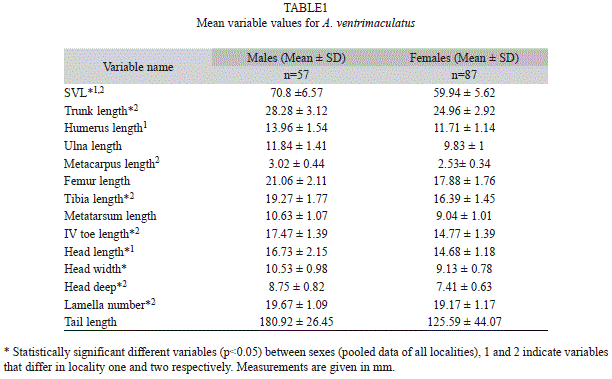
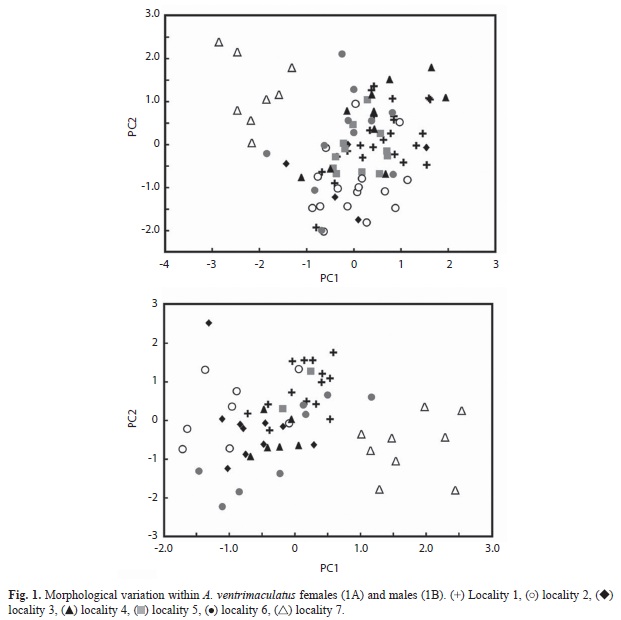
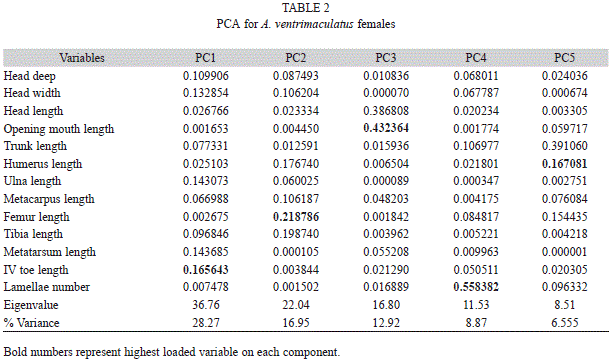
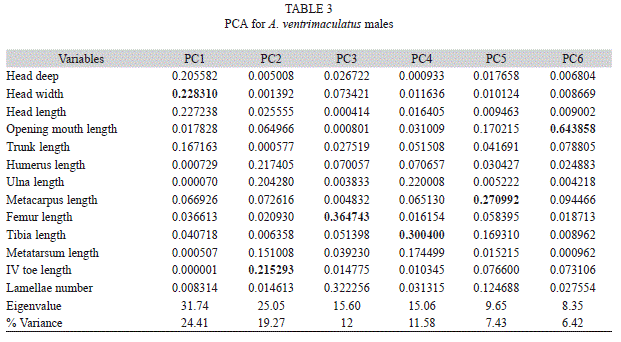
<body><![CDATA[<div style="text-align: justify;"><font size="2"><span  style="font-weight: bold; font-family: verdana;">Within species variation: </span><span style="font-family: verdana;">We performed multivariate tests to describe geographic variation in morphometric characters of </span><span  style="font-style: italic; font-family: verdana;">A. ventrimaculatus</span><span  style="font-family: verdana;">. Males and females were analyzed separately. We used principal component analysis (PCA) followed by discriminant function analyses (DFA) to describe and test within species variation. All statistical tests were performed in Statistica v. 4.0.</span></font><br style="font-family: verdana;"> </div> <br style="font-family: verdana;">     <div style="text-align: justify;"><font size="3"><span  style="font-weight: bold; font-family: verdana;">Results</span></font><br  style="font-family: verdana;"> <font size="2"><span style="font-weight: bold; font-family: verdana;"></span></font><br  style="font-family: verdana;"> <font size="2"><span style="font-weight: bold; font-family: verdana;">Sexual size dimorphism: </span><span  style="font-style: italic; font-family: verdana;">Anolis ventrimaculatus</span><span style="font-family: verdana;"> exhibited sexual size dimorphism, and males showed the largest sizes (n=144, t=-9.7006, p&lt;0.0001) (<a href="/img/revistas/rbt/v61n1/a20t1.gif">Table&nbsp; 1</a>).&nbsp; SSDi differed among localities (-2.077 to -2.31), and this apparent variation might be related to the variation observed in female body size among populations (see below).&nbsp; The same pattern of SSD, with males larger than females, was recovered within the two localities that were evaluated (<a href="/img/revistas/rbt/v61n1/a20t1.gif">Table 1</a>).</span></font><br  style="font-family: verdana;"> <font size="2"><span style="font-family: verdana;"></span></font><br  style="font-family: verdana;"> <font size="2"><span style="font-weight: bold; font-family: verdana;">Shape dimorphism:</span><span style="font-family: verdana;"> Analysis of pooled data from all localities indicated that head height, trunk length and toe length and lamella number varied between males and females of </span><span  style="font-style: italic; font-family: verdana;">A. ventrimaculatus</span><span  style="font-family: verdana;">, after removing the effects of body size (<a href="/img/revistas/rbt/v61n1/a20t1.gif">Table 1</a>). MANOVA results revealed that most morphometric variables were different&nbsp; among&nbsp; localities&nbsp; (F</span><sub  style="font-family: verdana;">78</sub><span  style="font-family: verdana;">=6.78,&nbsp; p&lt;0.001), some were different between sexes (F</span><sub style="font-family: verdana;">13</sub><span  style="font-family: verdana;">=9.17, p&lt;0.001),&nbsp; and&nbsp; there&nbsp; was&nbsp; a&nbsp; significant&nbsp; interaction between sex and locality (F</span><sub style="font-family: verdana;">78</sub><span  style="font-family: verdana;">=4.81, p&lt;0.001), suggesting that patterns of sexual dimorphism also varied among localities. A </span><span  style="font-style: italic; font-family: verdana;">t</span><span  style="font-family: verdana;"> test of residuals of each variable within the two evaluated localities revealed that patterns of sexual differences in body proportions varied between localities. In locality one, sexes were dimorphic in head (t=-262765, p&lt;0.05) and humerus length (t=-248342, p&lt;0.05) (larger in males). Sex differences in locality two included trunk length (t=2718861, p&lt;0.05) (larger in females),&nbsp; head&nbsp; length&nbsp; (t=-432121,&nbsp; p&lt;0.05), height (t=-210117, p&lt;0.05), length of mouth opening (t=-298496, p&lt;0.05), metacarpus (t=- 266225, p&lt;0.05), fourth toe length (t=-215446, p&lt;0.05) (all larger in males), and lamellae number (t=-296365, p&lt;0.01) (slightly more in males) (<a  href="/img/revistas/rbt/v61n1/a20t1.gif">Table 1</a>).</span></font><br  style="font-family: verdana;"> <br style="font-family: verdana;"> <font size="2"><span style="font-weight: bold; font-family: verdana;">Within species variation: </span><span style="font-family: verdana;">Geographic variation was evaluated independently for males and females due to sexual dimorphism. </span></font><br style="font-family: verdana;"> <font size="2"><span style="font-family: verdana;">Interlocality&nbsp; variation&nbsp; of&nbsp; body&nbsp; size&nbsp; was not&nbsp; observed&nbsp; in&nbsp; males&nbsp; of&nbsp; </span><span  style="font-style: italic; font-family: verdana;">A.&nbsp; ventrimaculatus</span><span style="font-family: verdana;"> (F=1.5, p&gt;0.05, n=57), but variation in female SVL was marginally significant (F=2.2, p =0.045, n=87).</span></font><br  style="font-family: verdana;"> <br style="font-family: verdana;"> <font size="2"><span style="font-family: verdana;">Geographic variation in other characteristics was observed for both males and females after removing body size effect. Females from locality 7 (Pueblo Rico) formed a distinctive group under PCA analysis (<a  href="/img/revistas/rbt/v61n1/a20i1.jpg">Fig. 1</a>). Five principal component analysis was required to explain 80% of the variation (<a  href="/img/revistas/rbt/v61n1/a20t2.gif">Table 2</a>). Toe length, femur length, head length, lamellae number and humerus length were the variables with highest load on each component, respectively. Individuals from this locality were correctly assigned with&nbsp; 99&nbsp; to&nbsp; 100%&nbsp; assignation&nbsp; probabilities, based on DFA analysis. Minor variation exists among other localitied assignation probabilities to these localities ranged from 4 to 98%.</span></font><br  style="font-family: verdana;"> <font size="2"><span style="font-family: verdana;"></span></font><br  style="font-family: verdana;"> <font size="2"><span style="font-family: verdana;">Males also exhibited geographic variation (<a href="/img/revistas/rbt/v61n1/a20i1.jpg">Fig. 1</a>). Six principal components were required to explain 80% of the variation (<a href="/img/revistas/rbt/v61n1/a20t3.gif">Table 3</a>). Length of head, toe, femur, tibia, metacarpus, and mouth opening were highest loading variables on each component, respectively. Apparently, males exhibited higher variation than females, as was visualized in PCA graphs, with individuals from locality 7, but also from other localities, segregating in quite well defined groups. DFA analysis supported this observation, since all individuals from localities, 2, 3 and 7 were correctly grouped with relatively high assignation probabilities (100% to locality 7, and 47-99% in other localities).</span></font><br  style="font-family: verdana;"> </div> <br style="font-family: verdana;">     <div style="text-align: justify;"><font size="3"><span      style="font-weight: bold; font-family: verdana;">Discussion</span></font><br      style="font-family: verdana;">     <font size="2"><span style="font-weight: bold; font-family: verdana;"></span></font><br      style="font-family: verdana;">     <font size="2"><span style="font-weight: bold; font-family: verdana;">Sexual     size and     shape dimorphism:</span><span style="font-family: verdana;"> Sexual     ]]></body>
<body><![CDATA[dimorphism, with males larger than females,&nbsp;&nbsp; can&nbsp;&nbsp;     be&nbsp;&nbsp; explained&nbsp;&nbsp; through&nbsp;&nbsp; three     different evolutionary scenarios: sexual selection,&nbsp;     intersexual&nbsp; niche&nbsp; divergence&nbsp; and&nbsp; differences in     reproductive roles (Darwin 1859, 1871, in Butler &amp; Losos 2002).     Males of </span><span style="font-style: italic; font-family: verdana;">A.     ventrimaculatus</span><span style="font-family: verdana;"> are     territorial (Kattan 1984) suggesting that male competition could drive     sexual differences observed in body size.</span></font><br      style="font-family: verdana;">     ]]></body>
<body><![CDATA[<br style="font-family: verdana;">     <font size="2"><span style="font-family: verdana;">Shape dimorphism     also occurs in     this species and seems to involve different characteristics at each     locality. This result suggests that a plethora of factors could be     affecting intersexual interaction and that they may vary at each     locality. Variation in intersexual interactions would&nbsp; be&nbsp;     then&nbsp; translated&nbsp; into&nbsp; variation in microhabitat use     between males and females&nbsp; among&nbsp; localities.&nbsp; Since     microhabitat use (movement through vegetation structure) is influenced     ]]></body>
<body><![CDATA[by body size and shape, a necessary&nbsp; result&nbsp; would&nbsp;     be&nbsp; different&nbsp; degrees of sexual dimorphism in these     characteristics among localities.</span></font><br      style="font-family: verdana;">     <br style="font-family: verdana;">     <font size="2"><span style="font-family: verdana;">Geographic     intraspecific variation     in body size and&nbsp; body&nbsp; shape&nbsp; dimorphism&nbsp; in&nbsp;     </span><span style="font-style: italic; font-family: verdana;">Anolis </span><span      style="font-family: verdana;">has not been widely explored. Cox &amp;     ]]></body>
<body><![CDATA[Cals- beek (2009) described variation in sexual size dimorphism in </span><span      style="font-style: italic; font-family: verdana;">A. sagre</span><span      style="font-family: verdana;">i, and concluded that it is not     explained by geographical variation in sexual selection forces, but by     differences in environmental requirements that affect male growth&nbsp;     rates.&nbsp; Interspecific&nbsp; interactions&nbsp; may also influence     the degree of sexual dimorphism in </span><span      style="font-style: italic; font-family: verdana;">Anolis </span><span      style="font-family: verdana;">(Losos 2009), therefore it is possible     that differences in community composition at each locality where</span><span     ]]></body>
<body><![CDATA[ style="font-style: italic; font-family: verdana;"> A. ventrimaculatus</span><span      style="font-family: verdana;"> occurs, have a local affect on resource     partitioning and then, generate geographic variation in those selective     forces that drive sexual dimorphism evolution in this species.     Nevertheless, the causes underlying variation in </span><span      style="font-style: italic; font-family: verdana;">A. ventrimaculatus</span><span      style="font-family: verdana;"> sexual dimorphism are unknown.</span></font><br      style="font-family: verdana;">     <br style="font-weight: bold; font-family: verdana;">     <font size="2"><span style="font-weight: bold; font-family: verdana;">Geographic     ]]></body>
<body><![CDATA[variation: </span><span style="font-family: verdana;">Phenotypic     variation within </span><span      style="font-style: italic; font-family: verdana;">A. ventrimaculatus</span><span      style="font-family: verdana;"> was characterized and exhibited quite     different patterns within males and&nbsp; females. Variation seemed to     be higher in males, and involved more body variables than in females.     In both sexes, individuals from locality 7 (Pueblo Rico) appeared as     the most differentiated. Variation in head dimensions may be explained     under different scenarios involving sexual selection or natural     selection. Preliminary observations suggest that individuals from the     ]]></body>
<body><![CDATA[localities sampled all feed on the same items (Barrag&aacute;n &amp;     Calder&oacute;n- Espinosa,&nbsp; unpublished),&nbsp; but&nbsp; it&nbsp;     is&nbsp; unknown if&nbsp; there&nbsp; are&nbsp; differences&nbsp;     in&nbsp; prey&nbsp; size&nbsp; among localities. If so, this could be     related to variation in head length in both sexes and in mouth opening     in males. However, head dimensions may also vary due to differential     male-male interactions at each locality.</span></font><br      style="font-family: verdana;">     <br style="font-family: verdana;">     <font size="2"><span style="font-family: verdana;">Variation in those     ]]></body>
<body><![CDATA[body variables     related to habitat use or locomotion (limb length and lamellae number)     could be the result of local divergence in habitat use. Unfortunately,     ecological&nbsp; and&nbsp; behavioral&nbsp; data&nbsp; for&nbsp;     this&nbsp; species are very scarce. Nocturnal perch use has been     described for a single population of </span><span      style="font-style: italic; font-family: verdana;">A. ventrimaculatus</span><span      style="font-family: verdana;"> (Kattan 1984), and diurnal habitat use     has not been studied in detail, although some observations suggest that     </span><span style="font-style: italic; font-family: verdana;">A.     ]]></body>
<body><![CDATA[ventrimaculatus</span><span style="font-family: verdana;"> can be     considered as a small bush and fern climber (Ayala &amp; Castro,     unpublished). Given that the localities where these lizards were     captured apparently have the same vegetation type (lower montane wet     forest), should future studies reveal variation in habitat use among     populations, we would expect this variation to be explained by     differences in the lizard communities at each site. If our prediction     is correct, community composition would be interpreted as the primary     influence on </span><span      style="font-style: italic; font-family: verdana;">A. ventrimaculatus</span><span     ]]></body>
<body><![CDATA[ style="font-family: verdana;"> behavior and morphology, rather than     differences in habitat structure. However, minor variation in     vegetation type, and thus in habitat structure is also possible. These     are two main aspects to be explored within the distributional range of     this species. Additionally, it should be noted that </span><span      style="font-style: italic; font-family: verdana;">A. ventrimaculatus</span><span      style="font-family: verdana;"> exhibits a fragmented distribution     across its range, thus, it is also possible that genetic divergence has     played its part as a causative agent of the morphometric variation     observed.</span></font><br style="font-family: verdana;">     ]]></body>
<body><![CDATA[<br style="font-family: verdana;">     <font size="2"><span style="font-family: verdana;">At the present time     data are     lacking to corroborate any of our hypothesis about causes of underlying     variation in body size dimensions in this species, but the patterns     detected here form a baseline to direct further studies.</span></font><br      style="font-family: verdana;">     <br style="font-family: verdana;">     <font size="3"><span style="font-weight: bold; font-family: verdana;">Acknowledgments</span></font><br      style="font-family: verdana;">     ]]></body>
<body><![CDATA[<font size="2"><span style="font-family: verdana;">We thank A.     Barrag&aacute;n for     helping us with measurements of some individuals. D. Irschick, R.&nbsp;     Moreno&nbsp; and&nbsp; five&nbsp; anonymous&nbsp; reviewers made&nbsp;     very&nbsp; helpful&nbsp; comments&nbsp; that&nbsp; improved this     manuscript. L. Raz corrected the English writing of the manuscript.</span></font><br      style="font-family: verdana;">     </div>     <div style="text-align: justify;"></div> <hr  style="width: 100%; height: 2px; margin-left: 0px; margin-right: 0px;">     <div style="text-align: justify;"></div> <br style="font-family: verdana;">     ]]></body>
<body><![CDATA[<!-- ref --><div style="text-align: justify;"><font size="3"><span  style="font-weight: bold; font-family: verdana;">References</span></font><br  style="font-family: verdana;"> <br style="font-family: verdana;"> <font size="2"><span style="font-family: verdana;">Bock,&nbsp; B.C., A.M. Ortega, A.M. Zapata &amp; V.&nbsp; P&aacute;ez. 2009. Microgeographic&nbsp; body size variation in a&nbsp; high elevation Andean anole (</span><span  style="font-style: italic; font-family: verdana;">Anolis&nbsp; mariarum</span><span  style="font-family: verdana;">, Squamata, Polychrotidae). Rev. Biol. Trop. 57: 1253-1262.    &nbsp;&nbsp;&nbsp;&nbsp;&nbsp;&nbsp;&nbsp;&nbsp;[&#160;<a href="javascript:void(0);" onclick="javascript: window.open('/scielo.php?script=sci_nlinks&ref=1833377&pid=S0034-7744201300010002000001&lng=','','width=640,height=500,resizable=yes,scrollbars=1,menubar=yes,');">Links</a>&#160;]<!-- end-ref --><!-- ref --></span></font><br style="font-family: verdana;"> <br style="font-family: verdana;"> <font size="2"><span style="font-family: verdana;">Butler,&nbsp; M.A.&nbsp; &amp;&nbsp; J.B.&nbsp; Losos.&nbsp; 2002.&nbsp; Multivariate&nbsp; sexual dimorphism, sexual selection and adaptation in Greater&nbsp; Antilles&nbsp; </span><span  style="font-style: italic; font-family: verdana;">Anolis&nbsp; </span><span  style="font-family: verdana;">lizards.&nbsp; Ecol.&nbsp; Monograph.&nbsp; 72: 541-559.    &nbsp;&nbsp;&nbsp;&nbsp;&nbsp;&nbsp;&nbsp;&nbsp;[&#160;<a href="javascript:void(0);" onclick="javascript: window.open('/scielo.php?script=sci_nlinks&ref=1833378&pid=S0034-7744201300010002000002&lng=','','width=640,height=500,resizable=yes,scrollbars=1,menubar=yes,');">Links</a>&#160;]<!-- end-ref --><!-- ref --></span></font><br  style="font-family: verdana;"> <br style="font-family: verdana;"> <font size="2"><span style="font-family: verdana;">Cox,&nbsp; R.M. &amp; R. Calsbeek. 2009. Sex&nbsp; specific&nbsp; selection and intraspecific variation in sexual size dimorphism. Evolution 64: 798-809.    &nbsp;&nbsp;&nbsp;&nbsp;&nbsp;&nbsp;&nbsp;&nbsp;[&#160;<a href="javascript:void(0);" onclick="javascript: window.open('/scielo.php?script=sci_nlinks&ref=1833379&pid=S0034-7744201300010002000003&lng=','','width=640,height=500,resizable=yes,scrollbars=1,menubar=yes,');">Links</a>&#160;]<!-- end-ref --><!-- ref --></span></font><br  style="font-family: verdana;"> <br style="font-family: verdana;"> <font size="2"><span style="font-family: verdana;">Darwin,&nbsp; C. 1859. On the origin of species by&nbsp; means of natural&nbsp; selection,&nbsp; or&nbsp; the&nbsp; preservation&nbsp; of&nbsp; favoured races in the struggle for life. John Murray, London, United Kingdom.    &nbsp;&nbsp;&nbsp;&nbsp;&nbsp;&nbsp;&nbsp;&nbsp;[&#160;<a href="javascript:void(0);" onclick="javascript: window.open('/scielo.php?script=sci_nlinks&ref=1833380&pid=S0034-7744201300010002000004&lng=','','width=640,height=500,resizable=yes,scrollbars=1,menubar=yes,');">Links</a>&#160;]<!-- end-ref --><!-- ref --></span></font><br  style="font-family: verdana;"> <br style="font-family: verdana;"> <font size="2"><span style="font-family: verdana;">Darwin, C. 1871. The descent of man and selection in relation to sex. John Murray, London, United Kingdom.    &nbsp;&nbsp;&nbsp;&nbsp;&nbsp;&nbsp;&nbsp;&nbsp;[&#160;<a href="javascript:void(0);" onclick="javascript: window.open('/scielo.php?script=sci_nlinks&ref=1833381&pid=S0034-7744201300010002000005&lng=','','width=640,height=500,resizable=yes,scrollbars=1,menubar=yes,');">Links</a>&#160;]<!-- end-ref --><!-- ref --></span></font><br  style="font-family: verdana;"> <br style="font-family: verdana;"> <font size="2"><span style="font-family: verdana;">Glor, R.E., L.J. Vitt &amp; A. Larson. 2001. A molecular phylogenetic&nbsp; analysis&nbsp; of&nbsp;&nbsp; diversification&nbsp; in&nbsp; Amazonian </span><span  style="font-style: italic; font-family: verdana;">Anolis </span><span  style="font-family: verdana;">lizards. Mol. Ecol. 10: 2661-2668.    &nbsp;&nbsp;&nbsp;&nbsp;&nbsp;&nbsp;&nbsp;&nbsp;[&#160;<a href="javascript:void(0);" onclick="javascript: window.open('/scielo.php?script=sci_nlinks&ref=1833382&pid=S0034-7744201300010002000006&lng=','','width=640,height=500,resizable=yes,scrollbars=1,menubar=yes,');">Links</a>&#160;]<!-- end-ref --><!-- ref --></span></font><br  style="font-family: verdana;"> <br style="font-family: verdana;"> <font size="2"><span style="font-family: verdana;">Irschick,&nbsp; D.,&nbsp; L.J.&nbsp; Vitt,&nbsp; P.A.&nbsp; Zani&nbsp; &amp;&nbsp; J.B.&nbsp; Losos.&nbsp; 1997. A&nbsp; comparison&nbsp; of&nbsp; evolutionary&nbsp; radiations&nbsp; in&nbsp; mainland&nbsp; and&nbsp; Caribbean&nbsp; </span><span  style="font-style: italic; font-family: verdana;">Anolis</span><span  style="font-family: verdana;">&nbsp;&nbsp; lizards.&nbsp; Ecology&nbsp; 78: 2191-2203.    &nbsp;&nbsp;&nbsp;&nbsp;&nbsp;&nbsp;&nbsp;&nbsp;[&#160;<a href="javascript:void(0);" onclick="javascript: window.open('/scielo.php?script=sci_nlinks&ref=1833383&pid=S0034-7744201300010002000007&lng=','','width=640,height=500,resizable=yes,scrollbars=1,menubar=yes,');">Links</a>&#160;]<!-- end-ref --><!-- ref --></span></font><br  style="font-family: verdana;"> <br style="font-family: verdana;"> <font size="2"><span style="font-family: verdana;">Kattan, G. 1984. Sleeping perch selection in the lizard Anolis ventrimaculatus. Biotropica 16: 328-329.    &nbsp;&nbsp;&nbsp;&nbsp;&nbsp;&nbsp;&nbsp;&nbsp;[&#160;<a href="javascript:void(0);" onclick="javascript: window.open('/scielo.php?script=sci_nlinks&ref=1833384&pid=S0034-7744201300010002000008&lng=','','width=640,height=500,resizable=yes,scrollbars=1,menubar=yes,');">Links</a>&#160;]<!-- end-ref --><!-- ref --></span></font><br  style="font-family: verdana;"> <br style="font-family: verdana;"> <font size="2"><span style="font-family: verdana;">Knox, A.K., J.B. Losos &amp; C.J. Schneider. 2001. Adaptive radiation versus intraspecific differentiation: morphological variation Caribbean <span  style="font-style: italic;">Anolis&nbsp; </span>lizards.&nbsp; J. Evol. Biol. 14: 904-909.    &nbsp;&nbsp;&nbsp;&nbsp;&nbsp;&nbsp;&nbsp;&nbsp;[&#160;<a href="javascript:void(0);" onclick="javascript: window.open('/scielo.php?script=sci_nlinks&ref=1833385&pid=S0034-7744201300010002000009&lng=','','width=640,height=500,resizable=yes,scrollbars=1,menubar=yes,');">Links</a>&#160;]<!-- end-ref --><!-- ref --></span></font><br  style="font-family: verdana;"> <br style="font-family: verdana;"> <font size="2"><span style="font-family: verdana;">Losos, J.B. 2009. Lizards in an evolutionary tree. University of California, Berkeley, USA.    &nbsp;&nbsp;&nbsp;&nbsp;&nbsp;&nbsp;&nbsp;&nbsp;[&#160;<a href="javascript:void(0);" onclick="javascript: window.open('/scielo.php?script=sci_nlinks&ref=1833386&pid=S0034-7744201300010002000010&lng=','','width=640,height=500,resizable=yes,scrollbars=1,menubar=yes,');">Links</a>&#160;]<!-- end-ref --><!-- ref --></span></font><br  style="font-family: verdana;"> <br style="font-family: verdana;"> <font size="2"><span style="font-family: verdana;">Lovich, J.E. &amp; J.W. Gibbons. 1992. A review of techniques for&nbsp; quantifying&nbsp; sexual&nbsp; size&nbsp;&nbsp; dimorphism.&nbsp; Growth Develop. Aging 56: 269-281.    &nbsp;&nbsp;&nbsp;&nbsp;&nbsp;&nbsp;&nbsp;&nbsp;[&#160;<a href="javascript:void(0);" onclick="javascript: window.open('/scielo.php?script=sci_nlinks&ref=1833387&pid=S0034-7744201300010002000011&lng=','','width=640,height=500,resizable=yes,scrollbars=1,menubar=yes,');">Links</a>&#160;]<!-- end-ref --><!-- ref --></span></font><br  style="font-family: verdana;"> <br style="font-family: verdana;"> <font size="2"><span style="font-family: verdana;">Macrini,&nbsp; T.E.,&nbsp; D.J.&nbsp; Irschick&nbsp; &amp;&nbsp; J.B.&nbsp; Losos.&nbsp; 2003.&nbsp; Ecomorphological differences in&nbsp; toepad characteristics between Mainland&nbsp; and Island Anoles. J. Herpetol. 37: 52-58.    &nbsp;&nbsp;&nbsp;&nbsp;&nbsp;&nbsp;&nbsp;&nbsp;[&#160;<a href="javascript:void(0);" onclick="javascript: window.open('/scielo.php?script=sci_nlinks&ref=1833388&pid=S0034-7744201300010002000012&lng=','','width=640,height=500,resizable=yes,scrollbars=1,menubar=yes,');">Links</a>&#160;]<!-- end-ref --><!-- ref --></span></font><br style="font-family: verdana;"> <br style="font-family: verdana;"> <font size="2"><span style="font-family: verdana;">Malhotra, A. &amp; R. Thorpe. 1997. Size and shape variation in a Lesser Antillean anole </span><span  style="font-style: italic; font-family: verdana;">Anolis oculatus</span><span  style="font-family: verdana;"> (Sauria: Iguanidae), in&nbsp; relation to habitat. Biol. J. Lin. Soc. 60: 53-72.    &nbsp;&nbsp;&nbsp;&nbsp;&nbsp;&nbsp;&nbsp;&nbsp;[&#160;<a href="javascript:void(0);" onclick="javascript: window.open('/scielo.php?script=sci_nlinks&ref=1833389&pid=S0034-7744201300010002000013&lng=','','width=640,height=500,resizable=yes,scrollbars=1,menubar=yes,');">Links</a>&#160;]<!-- end-ref --><!-- ref --></span></font><br  style="font-family: verdana;"> <br style="font-family: verdana;"> <font size="2"><span style="font-family: verdana;">Pinto, G., D.L. Mahler, L.J. Harmon &amp; J.B. Losos. 2008. Testing the island effect in adaptive&nbsp; radiation: rates and&nbsp; patterns&nbsp; of&nbsp;&nbsp; morphological&nbsp; diversification&nbsp; in Caribbean and mainland </span><span  style="font-style: italic; font-family: verdana;">Anolis </span><span  style="font-family: verdana;">lizards. Proc. R. Soc. B 275: 2947-2757.    &nbsp;&nbsp;&nbsp;&nbsp;&nbsp;&nbsp;&nbsp;&nbsp;[&#160;<a href="javascript:void(0);" onclick="javascript: window.open('/scielo.php?script=sci_nlinks&ref=1833390&pid=S0034-7744201300010002000014&lng=','','width=640,height=500,resizable=yes,scrollbars=1,menubar=yes,');">Links</a>&#160;]<!-- end-ref --><!-- ref --></span></font><br  style="font-family: verdana;"> <br style="font-family: verdana;"> <font size="2"><span style="font-family: verdana;">Schaad, E. &amp; S. Poe. 2010. Patterns of ecomorphological convergence&nbsp; among&nbsp;&nbsp; mainland&nbsp; and&nbsp; island&nbsp; </span><span  style="font-style: italic; font-family: verdana;">Anolis </span><span  style="font-family: verdana;">lizards. Biol. J. Lin. Soc. 101: 852-859.    &nbsp;&nbsp;&nbsp;&nbsp;&nbsp;&nbsp;&nbsp;&nbsp;[&#160;<a href="javascript:void(0);" onclick="javascript: window.open('/scielo.php?script=sci_nlinks&ref=1833391&pid=S0034-7744201300010002000015&lng=','','width=640,height=500,resizable=yes,scrollbars=1,menubar=yes,');">Links</a>&#160;]<!-- end-ref --><!-- ref --></span></font><br  style="font-family: verdana;"> <br style="font-family: verdana;"> <font size="2"><span style="font-family: verdana;">Stenson, A.G., A. Malhotra &amp; R.S. Thorpe.&nbsp; 2002. Population differentiation and&nbsp; nuclear gene flow in the Dominican&nbsp; anole (</span><span  style="font-style: italic; font-family: verdana;">Anolis oculatus</span><span  style="font-family: verdana;">). Mol. Ecol. 11: 1679-1688.    &nbsp;&nbsp;&nbsp;&nbsp;&nbsp;&nbsp;&nbsp;&nbsp;[&#160;<a href="javascript:void(0);" onclick="javascript: window.open('/scielo.php?script=sci_nlinks&ref=1833392&pid=S0034-7744201300010002000016&lng=','','width=640,height=500,resizable=yes,scrollbars=1,menubar=yes,');">Links</a>&#160;]<!-- end-ref --><!-- ref --></span></font><br  style="font-family: verdana;"> <br style="font-family: verdana;"> <font size="2"><span style="font-family: verdana;">Thorpe, R.S., J.T. Reardon &amp; A. Malhotra. 2005. Common Garden and Natural Selection&nbsp; Experiments Support Ecotypic&nbsp; Differentiation in the Dominican Anole (</span><span  style="font-style: italic; font-family: verdana;">Anolis oculatus</span><span  style="font-family: verdana;">). Am. Nat. 165: 495-504.    &nbsp;&nbsp;&nbsp;&nbsp;&nbsp;&nbsp;&nbsp;&nbsp;[&#160;<a href="javascript:void(0);" onclick="javascript: window.open('/scielo.php?script=sci_nlinks&ref=1833393&pid=S0034-7744201300010002000017&lng=','','width=640,height=500,resizable=yes,scrollbars=1,menubar=yes,');">Links</a>&#160;]<!-- end-ref --><!-- ref --></span></font><br  style="font-family: verdana;"> <br style="font-family: verdana;"> <font size="2"><span style="font-family: verdana;">Velazco, J.A. &amp; A. Herrel. 2007. Ecomorphology of </span><span  style="font-style: italic; font-family: verdana;">Anolis </span><span  style="font-family: verdana;">lizards of the Choco&#8217; region in Colombia and comparisons with Greater Antillean ecomorphs. Biol. J. Lin. Soc. 92: 29-39.    &nbsp;&nbsp;&nbsp;&nbsp;&nbsp;&nbsp;&nbsp;&nbsp;[&#160;<a href="javascript:void(0);" onclick="javascript: window.open('/scielo.php?script=sci_nlinks&ref=1833394&pid=S0034-7744201300010002000018&lng=','','width=640,height=500,resizable=yes,scrollbars=1,menubar=yes,');">Links</a>&#160;]<!-- end-ref --><!-- ref --></span></font><br style="font-family: verdana;"> <br style="font-family: verdana;"> <font size="2"><span style="font-family: verdana;">Vitt, L., T.C.S. Avila-Pires, P.A. Zani, S.S.&nbsp; Sartorius &amp; M.C. Esp&oacute;sito. 2003. Life above ground: ecology of </span><span  style="font-style: italic; font-family: verdana;">Anolis&nbsp; fuscoauratus</span><span style="font-family: verdana;"> in the Amazon rain forest,&nbsp; and comparisons with its nearest relatives. Can. J. Zool. 81: 142-156.    &nbsp;&nbsp;&nbsp;&nbsp;&nbsp;&nbsp;&nbsp;&nbsp;[&#160;<a href="javascript:void(0);" onclick="javascript: window.open('/scielo.php?script=sci_nlinks&ref=1833395&pid=S0034-7744201300010002000019&lng=','','width=640,height=500,resizable=yes,scrollbars=1,menubar=yes,');">Links</a>&#160;]<!-- end-ref --></span></font>    ]]></body>
<body><![CDATA[<br> <font size="2"><span style="font-family: verdana;"></span></font>    <br> <font size="2"><span style="font-family: verdana;"><a  name="Correspondencia1"></a><a href="#Correspondencia2">*</a>Correspondencia:</span></font>    <br> <font size="2"><span style="font-family: verdana;"></span></font><font  size="2"><span style="font-family: verdana;">Martha L. Calder&oacute;n-Espinosa: </span></font><font size="2"><span  style="font-family: verdana;">Grupo de Biodiversidad y Sistem&aacute;tica Molecular, Instituto de Ciencias Naturales, Universidad Nacional de Colombia, Sede Bogot&aacute;, Colombia. mlcalderone@unal.edu.co</span></font>    <br> <font size="2"><span style="font-family: verdana;">Angela M. Ortega-Le&oacute;n: </span></font><font size="2"><span  style="font-family: verdana;">Grupo de Biodiversidad, Departamento de Biolog&iacute;a, Universidad de C&oacute;rdoba, Colombia. amortega@sinu.unicordoba.edu.co</span></font>    <br> <font size="2"><span style="font-family: verdana;">Joan G. Zamora-Abrego: </span></font><font size="2"><span  style="font-family: verdana;">Grupo de Ecolog&iacute;a y Conservaci&oacute;n de Fauna Silvestre, Departamento de Ciencias Forestales, Universidad Nacional, Sede Medell&iacute;n, Colombia. jogzamoraab@unal.edu.co    <br> </span></font><font size="2"><span style="font-family: verdana;"><a  name="1"></a><a href="#4">1</a>. Grupo de Biodiversidad y Sistem&aacute;tica Molecular, Instituto de Ciencias Naturales, Universidad Nacional de Colombia, Sede Bogot&aacute;, Colombia; mlcalderone@unal.edu.co</span></font><br  style="font-family: verdana;"> <font size="2"><span style="font-family: verdana;"><a name="2"></a><a  href="#5">2</a>. Grupo de Biodiversidad, Departamento de Biolog&iacute;a, Universidad de C&oacute;rdoba, Colombia; amortega@sinu.unicordoba.edu.co</span></font><br  style="font-family: verdana;"> <font size="2"><span style="font-family: verdana;"><a name="3"></a><a  href="#6">3</a>. Grupo de Ecolog&iacute;a y Conservaci&oacute;n de Fauna Silvestre, Departamento de Ciencias Forestales, Universidad Nacional, Sede Medell&iacute;n, Colombia; jogzamoraab@unal.edu.co</span></font><br  style="font-family: verdana;"> </div>     <div style="text-align: justify;"></div> <hr  style="width: 100%; height: 2px; margin-left: 0px; margin-right: 0px;">     <div style="text-align: justify;"></div>     <div style="text-align: justify;"> </div>     <div style="font-family: verdana; text-align: center;"><span  style="font-weight: bold;"><font size="2">Received 31-X-2011.&nbsp;&nbsp; &nbsp;Corrected 20-VII-2012.&nbsp;&nbsp; &nbsp;Accepted 20-VIII-2012.</font></span><span  style="font-weight: bold;"></span><font size="2"><span  style="font-weight: bold;"></span></font></div>     ]]></body>
<body><![CDATA[ ]]></body><back>
<ref-list>
<ref id="B1">
<nlm-citation citation-type="journal">
<person-group person-group-type="author">
<name>
<surname><![CDATA[Bock]]></surname>
<given-names><![CDATA[B.C.]]></given-names>
</name>
<name>
<surname><![CDATA[Ortega]]></surname>
<given-names><![CDATA[A.M.]]></given-names>
</name>
<name>
<surname><![CDATA[Zapata]]></surname>
<given-names><![CDATA[A.M.]]></given-names>
</name>
<name>
<surname><![CDATA[Páez]]></surname>
<given-names><![CDATA[V.]]></given-names>
</name>
</person-group>
<article-title xml:lang="en"><![CDATA[Microgeographic body size variation in a high elevation Andean anole (Anolis mariarum, Squamata, Polychrotidae).]]></article-title>
<source><![CDATA[Rev. Biol. Trop.]]></source>
<year>2009</year>
<volume>57</volume>
<page-range>1253-1262</page-range></nlm-citation>
</ref>
<ref id="B2">
<nlm-citation citation-type="journal">
<person-group person-group-type="author">
<name>
<surname><![CDATA[Butler]]></surname>
<given-names><![CDATA[M.A.]]></given-names>
</name>
<name>
<surname><![CDATA[Losos]]></surname>
<given-names><![CDATA[J.B.]]></given-names>
</name>
</person-group>
<article-title xml:lang="en"><![CDATA[Multivariate sexual dimorphism, sexual selection and adaptation in Greater Antilles Anolis lizards]]></article-title>
<source><![CDATA[Ecol. Monograph.]]></source>
<year>2002</year>
<volume>72</volume>
<page-range>541-559</page-range></nlm-citation>
</ref>
<ref id="B3">
<nlm-citation citation-type="journal">
<person-group person-group-type="author">
<name>
<surname><![CDATA[Cox]]></surname>
<given-names><![CDATA[R.M.]]></given-names>
</name>
<name>
<surname><![CDATA[Calsbeek]]></surname>
<given-names><![CDATA[R.]]></given-names>
</name>
</person-group>
<article-title xml:lang="en"><![CDATA[Sex specific selection and intraspecific variation in sexual size dimorphism]]></article-title>
<source><![CDATA[Evolution]]></source>
<year>2009</year>
<volume>64</volume>
<page-range>798-809</page-range></nlm-citation>
</ref>
<ref id="B4">
<nlm-citation citation-type="book">
<person-group person-group-type="author">
<name>
<surname><![CDATA[Darwin]]></surname>
<given-names><![CDATA[C.]]></given-names>
</name>
</person-group>
<source><![CDATA[On the origin of species by means of natural selection, or the preservation of favoured races in the struggle for life]]></source>
<year>1859</year>
<publisher-loc><![CDATA[^eLondon London]]></publisher-loc>
<publisher-name><![CDATA[John Murray]]></publisher-name>
</nlm-citation>
</ref>
<ref id="B5">
<nlm-citation citation-type="book">
<person-group person-group-type="author">
<name>
<surname><![CDATA[Darwin]]></surname>
<given-names><![CDATA[C.]]></given-names>
</name>
</person-group>
<source><![CDATA[The descent of man and selection in relation to sex]]></source>
<year>1871</year>
<publisher-loc><![CDATA[^eLondon London]]></publisher-loc>
<publisher-name><![CDATA[John Murray]]></publisher-name>
</nlm-citation>
</ref>
<ref id="B6">
<nlm-citation citation-type="journal">
<person-group person-group-type="author">
<name>
<surname><![CDATA[Glor]]></surname>
<given-names><![CDATA[R.E]]></given-names>
</name>
<name>
<surname><![CDATA[Vitt]]></surname>
<given-names><![CDATA[L.J.]]></given-names>
</name>
<name>
<surname><![CDATA[Larson]]></surname>
<given-names><![CDATA[A.]]></given-names>
</name>
</person-group>
<article-title xml:lang="en"><![CDATA[A molecular phylogenetic analysis of diversification in Amazonian Anolis lizards]]></article-title>
<source><![CDATA[Mol. Ecol.]]></source>
<year>2001</year>
<volume>10</volume>
<page-range>2661-2668</page-range></nlm-citation>
</ref>
<ref id="B7">
<nlm-citation citation-type="journal">
<person-group person-group-type="author">
<name>
<surname><![CDATA[Irschick]]></surname>
<given-names><![CDATA[D.]]></given-names>
</name>
<name>
<surname><![CDATA[Vitt]]></surname>
<given-names><![CDATA[L.J.]]></given-names>
</name>
<name>
<surname><![CDATA[Zani]]></surname>
<given-names><![CDATA[P.A.]]></given-names>
</name>
<name>
<surname><![CDATA[Losos.]]></surname>
<given-names><![CDATA[J.B.]]></given-names>
</name>
</person-group>
<article-title xml:lang="en"><![CDATA[A comparison of evolutionary radiations in mainland and Caribbean Anolis lizards.]]></article-title>
<source><![CDATA[Ecology]]></source>
<year>1997</year>
<volume>78</volume>
<page-range>2191-2203</page-range></nlm-citation>
</ref>
<ref id="B8">
<nlm-citation citation-type="journal">
<person-group person-group-type="author">
<name>
<surname><![CDATA[Kattan]]></surname>
<given-names><![CDATA[G.]]></given-names>
</name>
</person-group>
<article-title xml:lang="en"><![CDATA[Sleeping perch selection in the lizard Anolis ventrimaculatus]]></article-title>
<source><![CDATA[Biotropica]]></source>
<year>1984</year>
<volume>16</volume>
<page-range>328-329</page-range></nlm-citation>
</ref>
<ref id="B9">
<nlm-citation citation-type="journal">
<person-group person-group-type="author">
<name>
<surname><![CDATA[Knox]]></surname>
<given-names><![CDATA[A.K.]]></given-names>
</name>
<name>
<surname><![CDATA[Losos]]></surname>
<given-names><![CDATA[J.B.]]></given-names>
</name>
<name>
<surname><![CDATA[Schneider]]></surname>
<given-names><![CDATA[C.J.]]></given-names>
</name>
</person-group>
<article-title xml:lang="en"><![CDATA[Adaptive radiation versus intraspecific differentiation: morphological variation Caribbean Anolis lizards]]></article-title>
<source><![CDATA[J. Evol. Biol.]]></source>
<year>2001</year>
<volume>14</volume>
<page-range>904-909.</page-range></nlm-citation>
</ref>
<ref id="B10">
<nlm-citation citation-type="book">
<person-group person-group-type="author">
<name>
<surname><![CDATA[Losos]]></surname>
<given-names><![CDATA[J.B.]]></given-names>
</name>
</person-group>
<source><![CDATA[Lizards in an evolutionary tree]]></source>
<year>2009</year>
<publisher-loc><![CDATA[^eBerkeley Berkeley]]></publisher-loc>
<publisher-name><![CDATA[University of California]]></publisher-name>
</nlm-citation>
</ref>
<ref id="B11">
<nlm-citation citation-type="journal">
<person-group person-group-type="author">
<name>
<surname><![CDATA[Lovich]]></surname>
<given-names><![CDATA[J.E.]]></given-names>
</name>
<name>
<surname><![CDATA[Gibbons]]></surname>
<given-names><![CDATA[J.W.]]></given-names>
</name>
</person-group>
<article-title xml:lang="en"><![CDATA[A review of techniques for quantifying sexual size dimorphism]]></article-title>
<source><![CDATA[Growth Develop. Aging]]></source>
<year>1992</year>
<volume>56</volume>
<page-range>269-281.</page-range></nlm-citation>
</ref>
<ref id="B12">
<nlm-citation citation-type="journal">
<person-group person-group-type="author">
<name>
<surname><![CDATA[Macrini]]></surname>
<given-names><![CDATA[T.E.]]></given-names>
</name>
<name>
<surname><![CDATA[Irschick]]></surname>
<given-names><![CDATA[D.J.]]></given-names>
</name>
<name>
<surname><![CDATA[Losos]]></surname>
<given-names><![CDATA[J.B.]]></given-names>
</name>
</person-group>
<article-title xml:lang="en"><![CDATA[Ecomorphological differences in toepad characteristics between Mainland and Island Anoles]]></article-title>
<source><![CDATA[J. Herpetol.]]></source>
<year>2003</year>
<volume>37</volume>
<page-range>52-58.</page-range></nlm-citation>
</ref>
<ref id="B13">
<nlm-citation citation-type="journal">
<person-group person-group-type="author">
<name>
<surname><![CDATA[Malhotra]]></surname>
<given-names><![CDATA[A.]]></given-names>
</name>
<name>
<surname><![CDATA[Thorpe]]></surname>
<given-names><![CDATA[R.]]></given-names>
</name>
</person-group>
<article-title xml:lang="en"><![CDATA[Size and shape variation in a Lesser Antillean anole Anolis oculatus (Sauria: Iguanidae), in relation to habitat]]></article-title>
<source><![CDATA[Biol. J. Lin. Soc.]]></source>
<year>1997</year>
<volume>60</volume>
<page-range>53-72</page-range></nlm-citation>
</ref>
<ref id="B14">
<nlm-citation citation-type="journal">
<person-group person-group-type="author">
<name>
<surname><![CDATA[Pinto]]></surname>
<given-names><![CDATA[G.]]></given-names>
</name>
<name>
<surname><![CDATA[Mahler]]></surname>
<given-names><![CDATA[D.L.]]></given-names>
</name>
<name>
<surname><![CDATA[Harmon]]></surname>
<given-names><![CDATA[L.J.]]></given-names>
</name>
<name>
<surname><![CDATA[Losos]]></surname>
<given-names><![CDATA[J.B.]]></given-names>
</name>
</person-group>
<article-title xml:lang="en"><![CDATA[Testing the island effect in adaptive radiation: rates and patterns of morphological diversification in Caribbean and mainland Anolis lizards]]></article-title>
<source><![CDATA[Proc. R. Soc. B]]></source>
<year>2008</year>
<volume>275</volume>
<page-range>2947-2757</page-range></nlm-citation>
</ref>
<ref id="B15">
<nlm-citation citation-type="journal">
<person-group person-group-type="author">
<name>
<surname><![CDATA[Schaad]]></surname>
<given-names><![CDATA[E.]]></given-names>
</name>
<name>
<surname><![CDATA[Poe]]></surname>
<given-names><![CDATA[S.]]></given-names>
</name>
</person-group>
<article-title xml:lang="en"><![CDATA[Patterns of ecomorphological convergence among mainland and island Anolis lizards]]></article-title>
<source><![CDATA[Biol. J. Lin. Soc.]]></source>
<year>2010</year>
<volume>101</volume>
<page-range>852-859</page-range></nlm-citation>
</ref>
<ref id="B16">
<nlm-citation citation-type="journal">
<person-group person-group-type="author">
<name>
<surname><![CDATA[Stenson]]></surname>
<given-names><![CDATA[A.G.]]></given-names>
</name>
<name>
<surname><![CDATA[Malhotra]]></surname>
<given-names><![CDATA[A.]]></given-names>
</name>
<name>
<surname><![CDATA[Thorpe]]></surname>
<given-names><![CDATA[R.S.]]></given-names>
</name>
</person-group>
<article-title xml:lang="en"><![CDATA[Population differentiation and nuclear gene flow in the Dominican anole (Anolis oculatus)]]></article-title>
<source><![CDATA[Mol. Ecol.]]></source>
<year>2002</year>
<volume>11</volume>
<page-range>1679-1688</page-range></nlm-citation>
</ref>
<ref id="B17">
<nlm-citation citation-type="journal">
<person-group person-group-type="author">
<name>
<surname><![CDATA[Thorpe]]></surname>
<given-names><![CDATA[R.S.]]></given-names>
</name>
<name>
<surname><![CDATA[Reardon]]></surname>
<given-names><![CDATA[J.T.]]></given-names>
</name>
<name>
<surname><![CDATA[Malhotra]]></surname>
<given-names><![CDATA[A.]]></given-names>
</name>
</person-group>
<article-title xml:lang="en"><![CDATA[Common Garden and Natural Selection Experiments Support Ecotypic Differentiation in the Dominican Anole (Anolis oculatus).]]></article-title>
<source><![CDATA[Am. Nat.]]></source>
<year>2005</year>
<volume>165</volume>
<page-range>495-504</page-range></nlm-citation>
</ref>
<ref id="B18">
<nlm-citation citation-type="journal">
<person-group person-group-type="author">
<name>
<surname><![CDATA[Velazco]]></surname>
<given-names><![CDATA[J.A.]]></given-names>
</name>
<name>
<surname><![CDATA[Herrel]]></surname>
<given-names><![CDATA[A.]]></given-names>
</name>
</person-group>
<article-title xml:lang="en"><![CDATA[Ecomorphology of Anolis lizards of the Choco&#8217; region in Colombia and comparisons with Greater Antillean ecomorphs]]></article-title>
<source><![CDATA[Biol. J. Lin. Soc.]]></source>
<year>2007</year>
<volume>92</volume>
<page-range>29-39</page-range></nlm-citation>
</ref>
<ref id="B19">
<nlm-citation citation-type="journal">
<person-group person-group-type="author">
<name>
<surname><![CDATA[Vitt]]></surname>
<given-names><![CDATA[L.]]></given-names>
</name>
<name>
<surname><![CDATA[Avila-Pires]]></surname>
<given-names><![CDATA[T.C.S.]]></given-names>
</name>
<name>
<surname><![CDATA[Zani]]></surname>
<given-names><![CDATA[P.A.]]></given-names>
</name>
<name>
<surname><![CDATA[Sartorius]]></surname>
<given-names><![CDATA[S.S.]]></given-names>
</name>
<name>
<surname><![CDATA[Espósito]]></surname>
<given-names><![CDATA[M.C.]]></given-names>
</name>
</person-group>
<article-title xml:lang="en"><![CDATA[Life above ground: ecology of Anolis fuscoauratus in the Amazon rain forest, and comparisons with its nearest relatives]]></article-title>
<source><![CDATA[Can. J. Zool.]]></source>
<year>2003</year>
<volume>81</volume>
<page-range>142-156</page-range></nlm-citation>
</ref>
</ref-list>
</back>
</article>