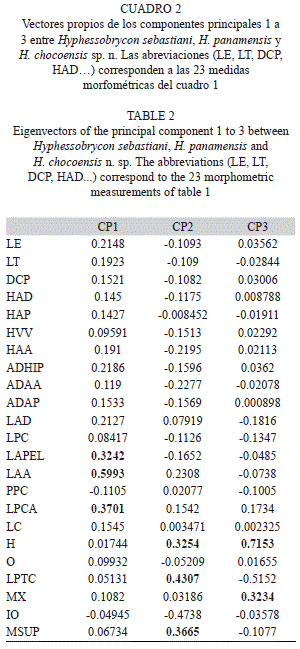
<?xml version="1.0" encoding="ISO-8859-1"?><article xmlns:mml="http://www.w3.org/1998/Math/MathML" xmlns:xlink="http://www.w3.org/1999/xlink" xmlns:xsi="http://www.w3.org/2001/XMLSchema-instance">
<front>
<journal-meta>
<journal-id>0034-7744</journal-id>
<journal-title><![CDATA[Revista de Biología Tropical]]></journal-title>
<abbrev-journal-title><![CDATA[Rev. biol. trop]]></abbrev-journal-title>
<issn>0034-7744</issn>
<publisher>
<publisher-name><![CDATA[Universidad de Costa Rica]]></publisher-name>
</publisher>
</journal-meta>
<article-meta>
<article-id>S0034-77442013000100014</article-id>
<title-group>
<article-title xml:lang="es"><![CDATA[Una nueva especie de Hyphessobrycon (Characiformes: Characidae) de la cuenca del río Telembí, vertiente sur del Pacífico, Colombia]]></article-title>
<article-title xml:lang="en"><![CDATA[A new species of Hyphessobrycon (Characiformes: Characidae) from the Telembí River drain- age, Southern Pacific slope of Colombia]]></article-title>
</title-group>
<contrib-group>
<contrib contrib-type="author">
<name>
<surname><![CDATA[García-Alzate]]></surname>
<given-names><![CDATA[Carlos A.]]></given-names>
</name>
<xref ref-type="aff" rid="A01"/>
</contrib>
<contrib contrib-type="author">
<name>
<surname><![CDATA[Román-Valencia]]></surname>
<given-names><![CDATA[César]]></given-names>
</name>
<xref ref-type="aff" rid="A02"/>
</contrib>
<contrib contrib-type="author">
<name>
<surname><![CDATA[Taphorn]]></surname>
<given-names><![CDATA[Donald C.]]></given-names>
</name>
<xref ref-type="aff" rid="A03"/>
</contrib>
</contrib-group>
<aff id="A01">
<institution><![CDATA[,Universidad del Atlántico  ]]></institution>
<addr-line><![CDATA[Barranquilla Atlántico]]></addr-line>
<country>Colombia</country>
</aff>
<aff id="A02">
<institution><![CDATA[,Universidad del Quindío  ]]></institution>
<addr-line><![CDATA[Armenia Quindío]]></addr-line>
<country>Colombia</country>
</aff>
<aff id="A03">
<institution><![CDATA[,1822 North Charles Street  ]]></institution>
<addr-line><![CDATA[Belleville Illinois]]></addr-line>
<country>USA</country>
</aff>
<pub-date pub-type="pub">
<day>00</day>
<month>03</month>
<year>2013</year>
</pub-date>
<pub-date pub-type="epub">
<day>00</day>
<month>03</month>
<year>2013</year>
</pub-date>
<volume>61</volume>
<numero>1</numero>
<fpage>181</fpage>
<lpage>192</lpage>
<copyright-statement/>
<copyright-year/>
<self-uri xlink:href="http://www.scielo.sa.cr/scielo.php?script=sci_arttext&amp;pid=S0034-77442013000100014&amp;lng=en&amp;nrm=iso"></self-uri><self-uri xlink:href="http://www.scielo.sa.cr/scielo.php?script=sci_abstract&amp;pid=S0034-77442013000100014&amp;lng=en&amp;nrm=iso"></self-uri><self-uri xlink:href="http://www.scielo.sa.cr/scielo.php?script=sci_pdf&amp;pid=S0034-77442013000100014&amp;lng=en&amp;nrm=iso"></self-uri><abstract abstract-type="short" xml:lang="en"><p><![CDATA[The genus Hyphessobrycon is included within the subfamily Tetragonopterinae. The species are generally small, do not exceed 70mm of standard length, are economically important as ornamental fish, with 128 valid species distributed from Southern Mexico to Rio La Plata in Argentina. The collections of fish were made with seines, in a single biotope, along shore in backwaters and working downstream. Measurements of the specimens were taken point to point with digital calipers. Observations of bone and cartilage structures were made on cleared and stained (C&S) specimens. The morphometric relationships between species were explored using a principal component analysis (PCA)using 21 variables. We described a new species, Hyphessobrycon chocoensis, from the Telembí River drainage of the Pacific versant of Colombia. The new species, Hyphessobrycon chocoensis, is distinguished from congeners not of the flammeus species group by: having a diffuse humeral spot, in lacking a dark spot on the dorsal fin and caudal peduncle. It is distinguished from members its species group by the number of rays in the dorsal fin (ii, 8, i), by the number of branched anal-fin rays (25-26) and by having a diffuse humeral spot. It differs from H. tortuguerae in the number of teeth on the maxilla (1-2), by the number of predorsal scales and the high number of scales between the lateral line and the anal fin (6-7). Hyphessobrycon chocoensis can be distinguished from the other known species of Hyphessobrycon from the Pacific Coast of Colombia in having: a high number of pored lateral-line scales, by the snout to dorsal-fin length, by caudal-peduncle depth and by eye diameter. In addition, it differs from H. columbianus by the distance from the dorsal fin to the anal fin, by the length of the upper jaw, and by snout length. It differs from H. condotensis in having a high number of scales between the lateral line and the dorsal fin, and by the number of simple rays in the anal fin. H. chocoensis is distinguished from H. sebastiani by the number of transverse scales and the number of scales between the lateral line and the dorsal fin. A taxonomic key is provided to aid with the identification of the species of Hyphessobrycon from the Pacific Coast of Colombia.]]></p></abstract>
<abstract abstract-type="short" xml:lang="es"><p><![CDATA[El género Hyphessobrycon, se incluye dentro de la subfamilia Tetragonopterinae. Las especies generalmente son pequeñas, no sobrepasan los 70mm de longitud estándar, son importantes económicamente como peces ornamentales, con 128 especies validas que se distribuyen desde el sur de México hasta Río de La Plata en Argentina. Se describe una nueva especie de Hyphessobrycon (Characiformes: Characidae) de la cuenca del río Barbacoas, vertiente sur del Pacífico, Colombia, Hyphessobrycon chocoensis de la cuenca del río Telembí, vertiente del Pacífico Colombiano. Las recolectas de los peces fueron realizadas con redes de arrastres y se hicieron en un solo biotopo, zona litoral de remanso y a favor de la corriente. Las medidas de los ejemplares se tomaron punto a punto con un calibrador digital Las observaciones de estructuras óseas y cartílagos se hicieron sobre ejemplares clareados y teñidos (C&T). Las relaciones morfométricas entre especies fueron exploradas empleando 21 variables mediante un análisis de componentes principales (ACP). La nueva especie de Hyphessobrycon, H. chocoensis se distingue de sus congéneres no miembros del grupo flammeus por tener una mancha humeral difusa, no tener una mancha oscura en la aleta dorsal o en el pedúnculo caudal. Se distingue de las demás especies del grupo por el número de radios de la aleta dorsal (ii, 8, i), por el número de radios ramificados en la aleta anal (25-26) y por presentar la mancha humeral difusa, se diferencia de H. tortuguerae por el número de dientes en el maxilar (1-2), por el número de escamas pre- dorsales (10-12) y un alto número de escamas entre la línea lateral y la aleta anal (6-7). Hyphessobrycon chocoensis se puede separar de todos los otros Hyphessobrycon conocidos de las cuencas del Pacifico Colombiano por presentar: un alto número de escamas con poros en la línea lateral, por la longitud hocico-aleta dorsal, por la profundidad del pedúnculo caudal y por el diámetro del ojo. Además, se distingue de H. columbianus por la longitud aleta dorsal- aleta anal, por la longitud de la mandíbula superior, por la longitud del hocico. Del mismo modo se diferencia de H. condotensis por tener un alto número de escamas entre la línea lateral y la aleta dorsal, por una mayor cantidad de radios simples en la aleta anal. H. chocoensis se aparta de H. sebastiani por el número de escamas en la parte: lateral del cuerpo y entre la línea lateral y la aleta dorsal. Se incluye una clave taxonómica práctica de las especies presentes en la vertiente del Pacifico de Colombia.]]></p></abstract>
<kwd-group>
<kwd lng="en"><![CDATA[new taxon]]></kwd>
<kwd lng="en"><![CDATA[new species]]></kwd>
<kwd lng="en"><![CDATA[tropical fish]]></kwd>
<kwd lng="en"><![CDATA[Choco iogeographic area]]></kwd>
<kwd lng="en"><![CDATA[tetra]]></kwd>
<kwd lng="es"><![CDATA[nuevo taxón]]></kwd>
<kwd lng="es"><![CDATA[nueva especie]]></kwd>
<kwd lng="es"><![CDATA[pez neotropical]]></kwd>
<kwd lng="es"><![CDATA[Chocó biogeográfico]]></kwd>
<kwd lng="es"><![CDATA[sardina]]></kwd>
</kwd-group>
</article-meta>
</front><body><![CDATA[ <div style="text-align: center;"><font style="font-weight: bold;"  size="4"><span style="font-family: verdana;">Una nueva especie de <span  style="font-style: italic;">Hyphessobrycon </span>(Characiformes: Characidae) de la cuenca del r&iacute;o Telemb&iacute;, vertiente sur del Pac&iacute;fico, Colombia    <br> </span></font><font style="font-weight: bold;" size="4"><span  style="font-family: verdana;">A new species of Hyphessobrycon (</span></font><font  style="font-weight: bold;" size="4"><span style="font-family: verdana;">Characiformes: Characidae) from the </span></font><font style="font-weight: bold;"  size="4"><span style="font-family: verdana;">Telemb&iacute; River drain-age, Southern Pacific slope of Colombia</span></font><font  size="2"><span style="font-weight: bold; font-family: verdana;"></span></font><br  style="font-family: verdana;"> </div> <br style="font-family: verdana;">     <div style="text-align: center;"><font size="2"><span  style="font-family: verdana;">Carlos A. Garc&iacute;a-Alzate<sup><a href="#1">1</a><a name="4"></a>*</sup>, C&eacute;sar Rom&aacute;n-Valencia<sup><a href="#2">2</a><a name="5"></a>*</sup>&nbsp; &amp; Donald C. Taphorn<sup><a href="#3">3</a><a name="6"></a>*    <br> <br style="font-family: verdana;"> </sup></span></font></div> <font size="2"><span style="font-family: verdana;"><a  name="Correspondencia2"></a>*<a href="#Correspondencia1">Direcci&oacute;n para correspondencia</a></span></font><a href="#Correspondencia1">:</a><font  size="2"><span style="font-family: verdana;"></span></font><br  style="font-family: verdana;"> <hr  style="width: 100%; height: 2px; margin-left: 0px; margin-right: 0px;"><font  size="3"><span style="font-weight: bold; font-family: verdana;">Abstract</span></font>    <br> <font size="2"><span style="font-weight: bold; font-family: verdana;"></span></font>    <br>     <div style="text-align: justify;"><font size="2"><span  style="font-weight: bold; font-family: verdana;"></span><span  style="font-family: verdana;">The genus <span  style="font-style: italic;">Hyphessobrycon</span> is included within the subfamily Tetragonopterinae. The species are generally small, do not exceed 70mm of standard length, are economically important as ornamental fish, with 128 valid species distributed from Southern Mexico to Rio La Plata in Argentina. The collections of fish were made with seines, in a single biotope, along shore in backwaters and working downstream. Measurements of the specimens were taken point to point with digital calipers. Observations of bone and cartilage structures were made on cleared and stained (C&amp;S) specimens. The morphometric relationships between species were explored using a principal component analysis (PCA)using 21 variables. We described a new species, <span style="font-style: italic;">Hyphessobrycon</span> <span  style="font-style: italic;">chocoensis</span>, from the Telemb&iacute; River drainage of the Pacific versant of Colombia. The new species, <span style="font-style: italic;">Hyphessobrycon chocoensis</span>, is distinguished from congeners not of the &#8220;flammeus&#8221; species group by: having a diffuse humeral spot, in lacking a dark spot on the dorsal fin and caudal peduncle. It is distinguished from members its species group by the number of rays in the dorsal fin (ii, 8, i), by the number of branched anal-fin rays (25-26) and by having a diffuse humeral spot. It differs from <span  style="font-style: italic;">H. tortuguerae</span> in the number of teeth on the maxilla (1-2), by the number of predorsal scales and the high number of scales between the lateral line and the anal fin (6-7). <span style="font-style: italic;">Hyphessobrycon chocoensis</span> can be distinguished from the other known species of <span style="font-style: italic;">Hyphessobrycon</span> from the Pacific Coast of Colombia in having: a high number of pored lateral-line scales, by the snout to dorsal-fin length, by caudal-peduncle depth and by eye diameter. In addition, it differs from <span style="font-style: italic;">H. columbianus</span> by the distance from the dorsal fin to the anal fin, by the length of the upper jaw, and by snout length. It differs from H. condotensis in having a high number of scales between the lateral line and the dorsal fin, and by the number of simple rays in the anal fin. <span style="font-style: italic;">H. chocoensis</span> is distinguished from <span  style="font-style: italic;">H. sebastiani</span> by the number of transverse scales and the number of scales between the lateral line and the dorsal fin. A taxonomic key is provided to aid with the identification of the species of <span style="font-style: italic;">Hyphessobrycon</span> from the Pacific Coast of Colombia. </span></font><br  style="font-family: verdana;"> </div> <br style="font-family: verdana;"> <font size="2"><span style="font-weight: bold; font-family: verdana;">Key words:</span><span style="font-family: verdana;"> new taxon, new species, tropical fish, Choco iogeographic area, tetra.</span></font><br  style="font-family: verdana;"> <br style="font-family: verdana;"> <font size="3"><span style="font-weight: bold; font-family: verdana;">Resumen</span></font><br  style="font-family: verdana;"> <br style="font-family: verdana;">     <div style="text-align: justify;"><font size="2"><span  style="font-family: verdana;">El g&eacute;nero <span  style="font-style: italic;">Hyphessobrycon</span>, se incluye&nbsp; dentro de la subfamilia&nbsp; Tetragonopterinae.&nbsp; Las&nbsp; especies&nbsp; generalmente&nbsp; son&nbsp; peque&ntilde;as,&nbsp; no&nbsp; sobrepasan&nbsp; los&nbsp; 70mm&nbsp; de&nbsp; longitud est&aacute;ndar, son importantes econ&oacute;micamente&nbsp; como&nbsp; peces ornamentales, con 128 especies validas que se distribuyen desde el sur de M&eacute;xico hasta R&iacute;o de La Plata en Argentina. Se&nbsp; describe una nueva especie de&nbsp; <span style="font-style: italic;">Hyphessobrycon</span> (Characiformes: Characidae) de la cuenca del r&iacute;o Barbacoas, vertiente sur del Pac&iacute;fico, Colombia, <span style="font-style: italic;">Hyphessobrycon chocoensis</span> de la cuenca del r&iacute;o Telemb&iacute;, vertiente del Pac&iacute;fico Colombiano. Las recolectas de los peces fueron realizadas con redes de arrastres y se&nbsp; hicieron en un solo biotopo, zona litoral de remanso y a favor de la corriente. Las medidas&nbsp; de los ejemplares se tomaron punto a&nbsp; punto con un calibrador digital Las observaciones de estructuras &oacute;seas y cart&iacute;lagos se hicieron sobre ejemplares clareados y te&ntilde;idos (C&amp;T). Las relaciones morfom&eacute;tricas entre especies fueron exploradas empleando&nbsp; 21 variables mediante un an&aacute;lisis de&nbsp; componentes principales (ACP). La nueva&nbsp; especie de <span  style="font-style: italic;">Hyphessobrycon</span>, <span  style="font-style: italic;">H. chocoensis</span> se&nbsp; distingue de sus cong&eacute;neres no miembros del grupo &#8220;flammeus&#8221; por tener una mancha humeral difusa, no tener una mancha oscura en la aleta dorsal o en el ped&uacute;nculo caudal. Se distingue de las dem&aacute;s especies del grupo&nbsp; por&nbsp; el n&uacute;mero de radios de la aleta dorsal (ii, 8, i), por el n&uacute;mero de radios ramificados en la aleta anal (25-26) y por presentar la mancha humeral difusa, se diferencia de <span  style="font-style: italic;">H.&nbsp; tortuguerae</span> por el n&uacute;mero de dientes en el maxilar (1-2), por el n&uacute;mero de escamas pre- dorsales (10-12) y un alto n&uacute;mero de escamas entre la l&iacute;nea lateral y la aleta anal (6-7). <span style="font-style: italic;">Hyphessobrycon chocoensis</span> se puede separar de todos los otros <span style="font-style: italic;">Hyphessobrycon</span> conocidos de las cuencas del Pacifico Colombiano por presentar: un alto n&uacute;mero de escamas&nbsp; con poros en la l&iacute;nea lateral, por la longitud hocico-aleta dorsal, por la profundidad del ped&uacute;nculo caudal y por el di&aacute;metro del ojo. Adem&aacute;s, se distingue de <span style="font-style: italic;">H. columbianus</span> por la longitud aleta dorsal- aleta anal, por la longitud de la mand&iacute;bula superior, por la longitud del hocico. Del mismo modo se diferencia de <span style="font-style: italic;">H. condotensis</span> por tener un alto n&uacute;mero de escamas entre la l&iacute;nea lateral y la aleta dorsal, por una mayor cantidad de radios simples en la aleta anal. <span style="font-style: italic;">H. chocoensis</span> se aparta de <span style="font-style: italic;">H. sebastiani</span> por el n&uacute;mero de escamas en la parte: lateral del cuerpo y entre la l&iacute;nea lateral y la aleta dorsal. Se incluye una clave taxon&oacute;mica pr&aacute;ctica de las especies presentes en la vertiente del Pacifico de Colombia.</span></font><br  style="font-family: verdana;"> </div> <br style="font-family: verdana;"> <font size="2"><span style="font-weight: bold; font-family: verdana;">Palabras clave.</span><span style="font-family: verdana;"> nuevo tax&oacute;n, nueva especie, pez neotropical, Choc&oacute; biogeogr&aacute;fico, sardina.</span></font><br  style="font-family: verdana;"> <br style="font-family: verdana;"> <hr  style="width: 100%; height: 2px; margin-left: 0px; margin-right: 0px;">     <div style="text-align: justify;"><font size="2"><span  style="font-family: verdana;">El g&eacute;nero <span  style="font-style: italic;">Hyphessobrycon</span>, se incluye dentro de la subfamilia Tetragonopterinae (sensu Mirande, 2010). Las especies generalmente son peque&ntilde;as, no sobrepasan los 70mm de longitud est&aacute;ndar, muchas son de importancia econ&oacute;- mica como peces ornamentales, y actualmente est&aacute;n distribuidos en todas las grandes cuencas de la regi&oacute;n neotropical, desde el sur de M&eacute;xico hasta el r&iacute;o de la Plata en Argentina.</span></font><br style="font-family: verdana;"> <br style="font-family: verdana;"> <font size="2"><span style="font-family: verdana;">Aunque 157 especies han sido ubicados en <span style="font-style: italic;">Hyphessobrycon</span>, debido al reconocimiento de sin&oacute;nimos o la reubicaci&oacute;n de algunas especies en&nbsp; otros&nbsp; g&eacute;neros,&nbsp; hoy&nbsp; se&nbsp; consideran&nbsp; v&aacute;lidas 128 especies (Eschmeyer &amp; Fricke 2011). De estas, 21 especies de <span style="font-style: italic;">Hyphessobrycon</span> han sido identificadas para Colombia (Garc&iacute;a-Alzate <span style="font-style: italic;">et al</span>. 2010c): <span style="font-style: italic;">H. acaciae</span> Garc&iacute;a-Alzate, Rom&aacute;n- Valencia&nbsp; &amp;&nbsp; Prada-Pedreros,&nbsp; <span  style="font-style: italic;">H.&nbsp; amaronensis</span> Garc&iacute;a-Alzate,&nbsp; Rom&aacute;n-Valencia&nbsp; &amp;&nbsp; Taphorn, <span style="font-style: italic;">H.&nbsp; bentosi</span>&nbsp; Durbin,&nbsp; <span style="font-style: italic;">H.&nbsp; columbianus</span>&nbsp; Zarske &amp;&nbsp; G&eacute;ry,&nbsp; <span  style="font-style: italic;">H.&nbsp; condotensis</span>&nbsp; Regan,&nbsp; <span style="font-style: italic;">H.&nbsp; diancistrus</span> Weitzman, <span style="font-style: italic;">H. ecuadoriensis</span> Eigenmann &amp; Henn, <span  style="font-style: italic;">H. erythrostigma</span> Fowler, <span  style="font-style: italic;">H. heterorhabdus</span> (Ulrey), <span style="font-style: italic;">H. mavro</span> Garc&iacute;a-Alzate, Rom&aacute;n-Valencia &amp; Prada-Pedreros, <span  style="font-style: italic;">H. metae</span> Eigenmann &amp; Henn, <span style="font-style: italic;">H. niger</span> Garc&iacute;a-Alzate, Rom&aacute;n-Valencia &amp; Prada-Pedreros, <span style="font-style: italic;">H. ocasoensis</span> Garc&iacute;a-Alzate &amp; Rom&aacute;n-Valencia, <span style="font-style: italic;">H. oritoensis</span> Garc&iacute;a-Alzate, Rom&aacute;n-Valencia &amp; Taphorn, <span style="font-style: italic;">H. panamensis</span> Durbin, <span style="font-style: italic;">H. poecilioides</span> Eigenmann, <span style="font-style: italic;">H. proteus</span> Eigenmann, <span style="font-style: italic;">H. sweglesi</span> G&eacute;ry, <span style="font-style: italic;">H. sebastiani</span> Garc&iacute;a-Alzate, Rom&aacute;n-Valencia&nbsp; &amp;&nbsp; Taphorn,&nbsp; <span style="font-style: italic;">H.&nbsp; saizi&nbsp;</span> G&eacute;ry, <span style="font-style: italic;">H. taguae</span> Garc&iacute;a-Alzate, Rom&aacute;n-Valencia &amp; Taphorn,&nbsp; de&nbsp; las&nbsp; cuales&nbsp; tres&nbsp; se&nbsp; distribuyen en el Choc&oacute; biogeogr&aacute;fico, vertiente Pac&iacute;fico Colombiano y pertenecen al grupo <span style="font-style: italic;">flammeus</span>: <span style="font-style: italic;">H. columbianus</span>, <span style="font-style: italic;">H. condotensis</span> y <span style="font-style: italic;">H. sebastiani</span>.</span></font><br style="font-family: verdana;"> <br style="font-family: verdana;"> <font size="2"><span style="font-family: verdana;">En <span  style="font-style: italic;">Hyphessobrycon</span> aun no existe un consenso para la definici&oacute;n de clados filogen&eacute;ticos,&nbsp; sin&nbsp; embargo,&nbsp; se&nbsp; han&nbsp; reconocido seis grupos convenientes, pero artificiales, de especies basados en modelos de pigmentaci&oacute;n (G&eacute;ry 1977, Weitzman &amp; Palmer, 1997). Estos son: (a) especies que carecen completamente de marcas negras en el cuerpo (<span style="font-style: italic;">H. panamensis</span>); (b) especies con una o dos manchas humerales (<span style="font-style: italic;">H. flammeus</span>); (c) especies con solo una mancha en el ped&uacute;nculo caudal (<span style="font-style: italic;">H. minimus</span>); (d) especies con una mancha humeral y peduncular (<span style="font-style: italic;">H. tropis</span>); (e) especies con un patr&oacute;n longitudinal, consistente en una franja horizontal lateral que se extiende desde la regi&oacute;n humeral hasta la caudal o, a veces, una franja interrumpida con la mancha humeral aun visible (<span  style="font-style: italic;">H. heterorhabdus</span>); y (f) especies con una mancha oscura en la aleta dorsal (<span style="font-style: italic;">H. callistus</span>). Todos los&nbsp; grupos&nbsp; de&nbsp; especies&nbsp; tienen&nbsp; representantes en Colombia. Actualmente Garc&iacute;a-Alzate &amp; Rom&aacute;n-Valencia (2008) y Garc&iacute;a-Alzate <span style="font-style: italic;">et al</span>. (2008a, b, c, 2010 a, b, c, 2011) estudian la taxonom&iacute;a alfa de las especies del grupo <span  style="font-style: italic;">heterorhabdus </span>presentes en Colombia y Venezuela. El objetivo del presente trabajo fue describir una nueva especie de <span style="font-style: italic;">Hyphessobrycon</span> del grupo <span style="font-style: italic;">flammeus </span>encontrada en la cuenca del r&iacute;o Telemb&iacute; en la vertiente del Pacifico de Colombia. Se incluye una clave taxon&oacute;mica de las especies trans-andinas de Colombia.</span></font><br  style="font-family: verdana;"> </div> <br style="font-family: verdana;"> <font size="3"><span style="font-weight: bold; font-family: verdana;">Materiales y m&eacute;todos</span></font><br style="font-family: verdana;"> <br style="font-family: verdana;">     <div style="text-align: justify;"><font size="2"><span     ]]></body>
<body><![CDATA[ style="font-family: verdana;">Las recolectas de     los peces se     realizaron con arrastres con una malla fina (ojo de malla 6.0&nbsp;     por&nbsp; 3.5mm)&nbsp; de&nbsp; 3.85m&nbsp; de&nbsp; longitud&nbsp; por     1.65m de ancho. Las capturas se hicieron en un solo biotopo zona     litoral de remanso y a favor de la corriente. Los ejemplares se     depositaron en la colecci&oacute;n de peces del museo de la     Universidad&nbsp; de Auburn, Alabama,&nbsp; USA (AUM) y en la     colecci&oacute;n de peces del laboratorio de Ictiolog&iacute;a del     programa de Biolog&iacute;a, Universidad del Quind&iacute;o, Armenia,     ]]></body>
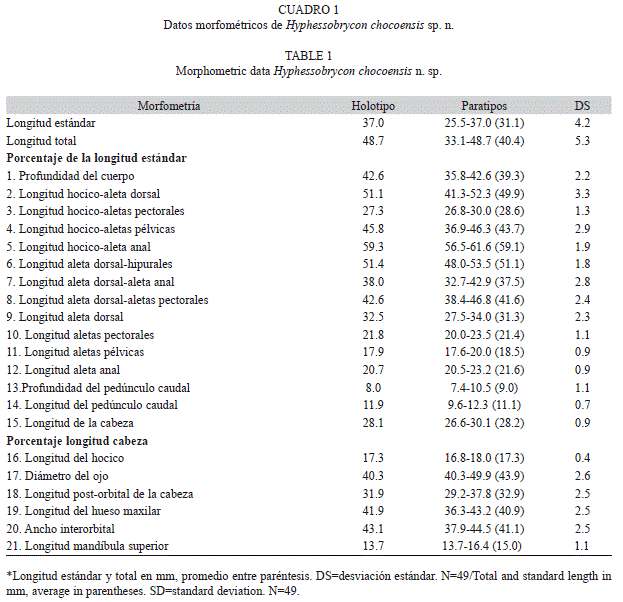
<body><![CDATA[Colombia (IUQ). Las medidas de los ejemplares se tomaron punto a punto     con un calibrador digital, los datos del holotipo se indican con     asterisco (*). Las medidas y conteos (<a      href="/img/revistas/rbt/v61n1/a14t1.gif">Cuadro 1</a>) se realizaron,     siempre     que fue posible, sobre el lado izquierdo de los ejemplares. Medidas y     conteos siguen a Fink &amp; Weitzman (1974) y se expresaron como     porcentaje de la longitud est&aacute;ndar (LE) y porcentaje de la     longitud cabeza (LC). Las medidas del material tipo de <span      style="font-style: italic;">Hyphessobrycon</span>     ]]></body>
<body><![CDATA[<span style="font-style: italic;">condotensis </span>y <span      style="font-style: italic;">H. ecuadoriensis</span> (grupo <span      style="font-style: italic;">flammeus</span>) fueron tomadas a partir     de fotos digitales, con el programa Scion Image, bajo Windows     versi&oacute;n 4.0.3.2. Las relaciones morfom&eacute;tricas entre     especies fueron exploradas empleando 21 variables (<a      href="/img/revistas/rbt/v61n1/a14t1.gif">Cuadro 1</a>). Se     realiz&oacute; un an&aacute;lisis de componentes principales (ACP), se     utiliz&oacute; el m&eacute;todo Burnaby para eliminar la influencia de     la talla sobre la forma, por medio del programa PAST versi&oacute;n     ]]></body>
<body><![CDATA[1.81 (Hammer <span style="font-style: italic;">et al</span>. 2008). El     n&uacute;mero de ejemplares y el rango de     medidas m&iacute;nimas y m&aacute;ximas de cada lote examinado se     presentan en par&eacute;ntesis.</span></font><br      style="font-family: verdana;">     <br style="font-family: verdana;">     <font size="2"><span style="font-family: verdana;">Las observaciones de     estructuras     &oacute;seas y cart&iacute;lagos se hicieron sobre ejemplares clareados     y te&ntilde;idos (C&amp;T) de acuerdo a los m&eacute;todos descritos     ]]></body>
<body><![CDATA[por Taylor &amp; Van Dyke (1985) y Song &amp; Parenti (1995). La     nomenclatura de huesos se&nbsp; bas&oacute;&nbsp; en Weitzman&nbsp;     (1962)&nbsp; y Vari&nbsp; (1995). Coordenadas y altitud fueron     registradas con un&nbsp; sistema&nbsp; electr&oacute;nico&nbsp;     port&aacute;til&nbsp; de&nbsp; posici&oacute;n global Magellan     GPS4000XL. En la descripci&oacute;n el n&uacute;mero de ejemplares se     presenta entre par&eacute;ntesis. Abreviaciones institucionales (IUQ,     AUM y del material examinado) siguen a Sabaj-P&eacute;rez (2010).</span></font><br      style="font-family: verdana;">     <br style="font-family: verdana;">     ]]></body>
<body><![CDATA[<font size="2"><span style="font-weight: bold; font-family: verdana;">Material&nbsp;&nbsp;     de&nbsp;&nbsp; comparaci&oacute;n&nbsp;&nbsp; examinado:     <span style="font-style: italic;">Hyphessobrycon</span>&nbsp;     <span style="font-style: italic;">condotensis</span>:</span><span      style="font-family: verdana;"> BMNH     1913.10.1.19-21,&nbsp;     syntypes&nbsp; (3)&nbsp; (25.9-31.2mm de LE), Colombia, R&iacute;o     Condoto and R&iacute;o San Juan, 1913. ICNMHN 2278, (2) (27.6-34.7mm de     LE) Colombia, V&iacute;a de Pep&eacute;, Baud&oacute; Choc&oacute;.</span></font><br      style="font-family: verdana;">     ]]></body>
<body><![CDATA[<font size="2"><span style="font-weight: bold; font-family: verdana;"><span      style="font-style: italic;">Hyphessobrycon</span>     <span style="font-style: italic;">columbianus</span></span><span      style="font-family: verdana;"><span style="font-style: italic;">: </span>IMCN     242, (5)     (29.8-39.8mm&nbsp; de&nbsp; LE)&nbsp; Colombia,&nbsp; R&iacute;o&nbsp;     Guati, Acand&iacute;, Choc&oacute;, 1 ago 1995; MCNG 47820, (1),     Colombia, R&iacute;o Guat&iacute;, Choc&oacute;, 15 ago 1995.</span><span      style="font-weight: bold; font-family: verdana;"> <span      style="font-style: italic;">Hyphessobrycon</span>     ]]></body>
<body><![CDATA[<span style="font-style: italic;">compressus</span></span><span      style="font-family: verdana;"><span style="font-style: italic;">: </span>FMNH     4641,     holotipo, M&eacute;xico, Obispo, Vera Cruz; FMNH 4662, paratipos (1     C&amp;T) (29.2mm de LE) recolectado con el holotipo; BMNH-1905.12.6.45,     paratipos, (2) (30.6-31.6mm de LE) M&eacute;xico, Obispo, Vera Cruz;     IBUAM-P 8538, (2) (24.5- 31.2mm de LE) M&eacute;xico, Trinitaria, Flor     de Caf&eacute;, Chris, 3 jul 1993; ANSP 124774, (12) (30.3-35.6mm de     LE) M&eacute;xico, R&iacute;o Usumacinta casi unido con Pasi&oacute;n,     cerca Sayache, 18 ago 1961; ANSP 124774, (3 C&amp;T) (30.6-35.6mm de     ]]></body>
<body><![CDATA[LE) M&eacute;xico, R&iacute;o Usumacinta casi unido con Pasi&oacute;n,     cerca Sayache, 18 ago 1961.</span><span      style="font-weight: bold; font-family: verdana;"> <span      style="font-style: italic;">Hyphessobrycon</span>     <span style="font-style: italic;">ecuadoriensis</span></span><span      style="font-family: verdana;"><span style="font-style: italic;">: </span>CAS     61602,     holotipo (24.3mm de LE) Ecuador, Los R&iacute;os, cerca a Vinces. BMNH     1924.3.3.44-45, paratipos (2) (22.6-25.5mm de LE), Ecuador, Los     R&iacute;os, cerca a Vinces; MEPN 85-117, (4), Ecuador, Brazo del     ]]></body>
<body><![CDATA[R&iacute;o Bravo 1km aguas arriba del salto del Bravo, Esmeraldas, 11     ago 1985. </span><span style="font-weight: bold; font-family: verdana;"><span      style="font-style: italic;">Hyphessobrycon</span>     panamensis</span><span style="font-family: verdana;"><span      style="font-style: italic;">: </span>MCZ 20688,     syntype (1) (23.5mm de LE) R&iacute;o Boquer&oacute;n, vertiente     Atl&aacute;ntico, Panam&aacute;. AMNH 31802, (13) (27.6- 33.4mm de LE)     Panam&aacute;, Zona del canal de Panam&aacute;, Quebrada Juan Grande     Cerca a Gamboa, 1978; IUQ 601, (1 C&amp;T) (25.5mm de LE) Colombia,     Nari&ntilde;o, Tumaco, El Pinde, afluente r&iacute;o Pianurbi en la     ]]></body>
<body><![CDATA[v&iacute;a Llorente-Guayacana, 19 jul&nbsp; 2000;&nbsp; IUQ&nbsp;     2285,&nbsp; (19)&nbsp; (26.5-34.3mm&nbsp; de LE)&nbsp; Costa&nbsp;     Rica,&nbsp; Lim&oacute;n,&nbsp; r&iacute;o&nbsp; Cocolis,&nbsp; 35km SE     de Shiroles, 6 oct 1979. </span><span      style="font-weight: bold; font-family: verdana;"><span      style="font-style: italic;">Hyphessobrycon</span>     <span style="font-style: italic;">sebastiani</span>:</span><span      style="font-family: verdana;">&nbsp; IUQ&nbsp;     1942,&nbsp; holotipo,&nbsp; (39.5&nbsp; mm SL, male) Colombia, Pacific     versant, Choc&oacute;, Istmina, San Juan River drainage, Patecucho     ]]></body>
<body><![CDATA[Creek,&nbsp; approximately&nbsp; 5&deg;09&#8217;&nbsp; N-76&deg;40&#8217;&nbsp;     W,&nbsp; 7 August 2002, T. Silirio. Ver Garc&iacute;a-Alzate <span      style="font-style: italic;">et     al</span>.&nbsp; (2010a).&nbsp; </span><span      style="font-weight: bold; font-family: verdana;"><span      style="font-style: italic;">Hyphessobrycon</span>&nbsp;     <span style="font-style: italic;">savagei</span></span><span      style="font-family: verdana;">:&nbsp; IUQ 2310,     (30) (25.5-39.9mm de LE) Costa Rica, Quebrada Puntarenas, 200m SE del     R&iacute;o Nuevo Salama, 5 ene 1967.</span><span     ]]></body>
<body><![CDATA[ style="font-weight: bold; font-family: verdana;"> <span      style="font-style: italic;">Hyphessobrycon</span>     <span style="font-style: italic;">tortuguerae</span></span><span      style="font-family: verdana;">: IUQ 2284, (23)     (22.4-36.4mm de LE) Costa Rica, R&iacute;o Muerto, Alajuela S., Upala,     25 abr 1968.</span></font><br style="font-family: verdana;">     </div>     <br style="font-family: verdana;">     <br style="font-family: verdana;">     <font size="3"><span style="font-weight: bold; font-family: verdana;">Resultados</span></font><br     ]]></body>
<body><![CDATA[ style="font-family: verdana;">     <br style="font-family: verdana;">     <font size="2"><span      style="font-weight: bold; font-family: verdana; font-style: italic;">Hyphessobrycon     chocoensis</span><span style="font-family: verdana;"> sp. n. (<a      href="/img/revistas/rbt/v60n1/a14i1.jpg">Figs. 1</a>-<a      href="/img/revistas/rbt/v60n1/a14i4.jpg">4</a>)<br      style="font-family: verdana;">     </span></font><br style="font-family: verdana;">     <div style="text-align: justify;"><font size="2"><span  style="font-weight: bold; font-family: verdana;">Holotipo</span><span  style="font-family: verdana;">: IUQ 3035, 37.1mm de LE, macho, Colombia, Nari&ntilde;o, Barbacoas, Quebrada la Tundera afluente del r&iacute;o Quigualp&iacute;, 01&deg;39 39 N - 78&deg;09 04 W, 45 msnm, 16 jul 2008. Cols. C. Rom&aacute;n-Valencia, C. Garc&iacute;a-Alzate, R. Ruiz-C, V. Tovar Sr, V. Tovar Jr. &amp; H. Cortes.</span></font><br  style="font-family: verdana;"> <br style="font-family: verdana;"> <font size="2"><span style="font-weight: bold; font-family: verdana;">Paratipos</span><span  style="font-family: verdana;">: IUQ 2275, (9) (20.3-37.7mm de&nbsp; LE)&nbsp; y&nbsp; IUQ&nbsp; 3036,&nbsp; (1&nbsp; C&amp;T)&nbsp; (36.7mm&nbsp; de LE) recolectados con el holotipo; IUQ 2274, (39) (15.9-39.6mm de LE), Colombia, Nari&ntilde;o, Barbacoas, Alto r&iacute;o Yamund&eacute; afluente del r&iacute;o Telemb&iacute;, 01&deg;39 39 N - 78&deg;09 04 W,&nbsp; 43 msnm, 16 jul 2008, Cols. C. Rom&aacute;n-Valencia, C. Garc&iacute;a-Alzate, R. Ruiz-C, V. Tovar Sr, V. Tovar Jr. &amp; H. Cortes; AUM 55075, (3) (17.9- 24.6mm de LE) Colombia, Nari&ntilde;o, Barbacoas, Alto&nbsp; r&iacute;o&nbsp; Yamund&eacute;&nbsp; afluente&nbsp; del&nbsp; r&iacute;o&nbsp; Telemb&iacute;, 01&deg;39 39 N - 78&deg;09 04 W, 43 msnm, 16 jul 2008, Cols. C. Rom&aacute;n-Valencia, C. Garc&iacute;a- Alzate, R. Ruiz-C, V. Tovar Sr, V. Tovar Jr. &amp; H. Cortes; IUQ 3044, (3 C&amp;T) (16.4-35.6mm de LE), Colombia, Nari&ntilde;o, Barbacoas, Alto r&iacute;o Yamund&eacute; afluente del r&iacute;o Telemb&iacute;, 01&deg;39 39 N - 78&deg;09 04 W, 43 msnm, 16 jul 2008, Cols. C. Rom&aacute;n-Valencia, C. Garc&iacute;a-Alzate, R. Ruiz-C, V. Tovar Sr, V. Tovar Jr. &amp; H. Cortes.</span></font><br  style="font-family: verdana;"> <br style="font-family: verdana;"> <font size="2"><span style="font-weight: bold; font-family: verdana;">Diagnosis</span><span  style="font-family: verdana;">: <span style="font-style: italic;">Hyphessobrycon&nbsp; chocoensis </span>se distingue de sus cong&eacute;neres no miembros del grupo &#8220;<span  style="font-style: italic;">flammeus</span>&#8221; por tener una mancha humeral difusa, no tener una mancha oscura en la aleta dorsal o en el ped&uacute;nculo caudal. Se distingue de las dem&aacute;s especies del grupo por el n&uacute;mero de radios de la aleta dorsal (ii, 8, i vs. iii, 8; ii, 9), por el n&uacute;mero de radios ramificados en la aleta anal (25-26 vs. 15-24; excepto <span  style="font-style: italic;">H. sebastiani</span> con 25-28) y por pre- sentar la mancha humeral difusa (vs. una o dos manchas humerales bien definidas), se diferen- cia de H. tortuguerae por el n&uacute;mero de dientes en el maxilar (1-2 vs. 3-10), por el n&uacute;mero de escamas&nbsp; predorsales&nbsp; (10-12&nbsp; vs.&nbsp; 13-15)&nbsp; y&nbsp; un alto n&uacute;mero de escamas entre la l&iacute;nea lateral y la aleta anal (6-7 vs. 5). <span style="font-style: italic;">Hyphessobrycon chocoensis</span> se puede separar de todos los otros <span style="font-style: italic;">Hyphessobrycon</span> del grupo <span style="font-style: italic;">flammeus </span>conocidos de las cuencas del Pacifico Colombiano por presentar: un alto n&uacute;mero de escamas con poros en la l&iacute;nea lateral (13-31 vs. 7-10); por la longitud hocico-aleta dorsal (41.3-52.3% LE vs. 53.6-57.5 % LE); por la profundidad del ped&uacute;nculo caudal (7.4-10.5 % LE vs. 11.2-17.8 % LE); por la longitud del hocico (16.8-18.0 % LC vs. 18.3-30.7 % LC). Adem&aacute;s, se distingue de <span style="font-style: italic;">H. columbianus</span> por la longitud aleta dorsal- aleta anal (32.7-42.9 % LE vs. 44.0-46.1 % LE); por la longitud de la mand&iacute;bula superior (13.7-16.4 % LC vs. 18.2-30.7 % LC); por la longitud del hocico (16.8-18.0 % LC vs. 21.0- 30.8 % LC). Del mismo modo se diferencia de <span style="font-style: italic;">H. condotensis</span> por tener un alto n&uacute;mero de escamas entre la l&iacute;nea lateral y la aleta dorsal (7-8 vs. 6), por una mayor cantidad de radios simples en la aleta anal (iv vs. iii). <span style="font-style: italic;">H. chocoensis</span> se aparta de <span  style="font-style: italic;">H. sebastiani</span> por el n&uacute;mero de escamas en: la parte lateral del cuerpo (31-33 vs. 35-36), entre la l&iacute;nea lateral y la aleta dorsal (7 vs. 8); predorsales (10-11 vs. 12-13).</span></font><br style="font-family: verdana;"> </div> <br style="font-family: verdana;">     ]]></body>
<body><![CDATA[<div style="text-align: justify;"><font size="2"><span  style="font-weight: bold; font-family: verdana;">Descripci&oacute;n</span><span  style="font-family: verdana;">: Datos morfom&eacute;tricos del holotipo y paratipos se presentan en el <a  href="/img/revistas/rbt/v61n1/a14t1.gif">cuadro 1</a>. Cuerpo corto y profundo, la profundidad del cuerpo mayor entre la inserci&oacute;n de las aletas p&eacute;lvicas y el origen de la aleta dorsal. Perfil dorsal parcialmente c&oacute;ncavo desde el labio superior hocico hasta el extremo posterior de la espina supraoccipital, y convexo desde este punto hasta el inicio de la aleta dorsal. Base de la aleta dorsal convexa, e inmediatamente despu&eacute;s recta hasta la parte anterior de la aleta adiposa y c&oacute;ncava desde ac&aacute; hasta la base del l&oacute;bulo caudal superior. Perfil ventral de la cabeza convexa desde el labio inferior hasta la inserci&oacute;n de la aleta anal, base de la aleta anal moderadamente convexo y desde all&iacute; hasta el l&oacute;bulo caudal inferior c&oacute;ncavo.</span></font><br  style="font-family: verdana;"> <br style="font-family: verdana;"> <font size="2"><span style="font-family: verdana;">Cabeza y hocico cortos, boca terminal; labios blandos y flexibles, hilera externa de dientes del premaxilar no expuesta. Premaxilar con el proceso lateral largo y agudo que se inserta en el etmoides, con dos hileras de dientes (<a  href="/img/revistas/rbt/v60n1/a14i2.jpg">Fig. 2</a>), serie externa con tres (26) &oacute; cuatro* (23) dientes tric&uacute;spides, serie interna con cinco (49) dientes pentac&uacute;spides que, disminuyen gradualmente de tama&ntilde;o a medida que se aleja de la s&iacute;nfisis. Maxilar largo y angosto con dos (49) dientes tric&uacute;spides, margen posterior recto y anterior convexo, extremo posterior no alcanza el borde ventral del segundo infraorbital. Dentario con margen ventral convexo, cinco (49)&nbsp; dientes&nbsp; frontales&nbsp; pentac&uacute;spides&nbsp; seguido por cinco* (30) &oacute; seis (19) dientes tric&uacute;spides m&aacute;s peque&ntilde;os (<a href="/img/revistas/rbt/v60n1/a14i2.jpg">Fig. 2</a>).</span></font><br  style="font-family: verdana;"> <br style="font-family: verdana;"> <font size="2"><span style="font-family: verdana;">Escamas cicloideas, l&iacute;nea lateral con 13 (12),&nbsp; 14&nbsp; (15),&nbsp; 31*&nbsp; (22)&nbsp; escamas&nbsp; con&nbsp; poros. Serie lateral con 31* (7), 32 (7), 33 (35) esca- mas, incluye las escamas con poros. Escamas horizontales entre el origen de la aleta dorsal y la l&iacute;nea lateral sin incluir las escamas de la serie predorsal situada justo en la parte anterior del primer radio de la aleta dorsal siete* (44), ocho (5). Cinco (49) escamas horizontales entre el origen de la aleta anal y la l&iacute;nea lateral. Cinco (49) escamas horizontales entre el origen de las aletas p&eacute;lvicas y la l&iacute;nea lateral. Escamas pre- dorsales 10 (30), 11* (19). Cinco* (46) &oacute; siete (3) escamas en una simple hilera en la base anterior de los radios de la aleta anal.</span></font><br  style="font-family: verdana;"> <br style="font-family: verdana;"> <font size="2"><span style="font-family: verdana;">Radios en la aleta dorsal ii, 8, i (49). Radios en la aleta anal iii* (9) o iv (49), 25* (34) o 26 (15). Radios en las aletas p&eacute;lvicas i, 7 (6), ii, 6* (43). Radios en las aletas pectorales ii, 10*(49). Aleta caudal bifurcada, l&oacute;bulos superiores e inferiores puntiagudos y similares en tama&ntilde;o. Radios principales de la aleta caudal 9+10 (1). Ocho radios procurrentes de la aleta caudal. N&uacute;mero total de v&eacute;rtebras 33.</span></font><br style="font-family: verdana;"> </div> <br style="font-family: verdana;">     <div style="text-align: justify;"><font size="2"><span  style="font-family: verdana;">Ectopterigoide alargado y estrecho se inserta sobre el margen anterior del cuadrado y se extiende por el margen antero ventral del mesopterogoide con una banda de cart&iacute;lago sobre todo el margen superior. Metapterigoide con una proyecci&oacute;n ventral que se contacta con el simplectico y se contin&uacute;a sobre el cuadrado. Seis huesos infraorbitales presentes, tercer infraorbital m&aacute;s ancho de la serie, no en contac- to con el canal laterosensorial del preop&eacute;rculo, sexto&nbsp; infraorbital&nbsp; m&aacute;s&nbsp; peque&ntilde;o&nbsp; de&nbsp; la&nbsp; serie, canal sensorial de los infraorbitales sobrepasan el primer infraorbital y se contin&uacute;a hacia el maxilar. Supraorbital ausente. Etmoides lateral es un hueso largo y c&oacute;ncavo que se conecta por cart&iacute;lago al margen lateral del frontal y con una prolongaci&oacute;n laminar &oacute;sea que se extiende hacia el v&oacute;mer. Rinosfenoide &oacute;seo, con una banda&nbsp; de&nbsp; cart&iacute;lago&nbsp; sobre&nbsp; el&nbsp; margen&nbsp; anterior y posterior. Orbitoesfenoide &oacute;seo, grande y alargado, presenta cart&iacute;lago en la regi&oacute;n ventral anterior. Primer arco branquial con 19 braquiespinas, dos en el hipobranquial, nueve en el ceratobraquial y ocho en el epibranquial. Pteriogi&oacute;foros proximales de los radios de la aleta dorsal insertados entre las espinas neurales nueve y 17; 26 pterig&oacute;foros proximales en la aleta anal, los dos iniciales insertados entre las espinas hemales 12 y 13, alcanzan el borde ventral del centrum de la espina hemal 13. Cuatro&nbsp; supraneurales&nbsp; alargados,&nbsp; insertados&nbsp; sobre la cuarta y octava espina neural. Aleta p&eacute;lvica larga, su extremo posterior alcanza el origen de la aleta anal. Hueso p&eacute;lvico largo, recto y angosto, se observ&oacute; cart&iacute;lago en su extremo anterior y con el proceso isquial largo, curvo y con cart&iacute;lago.</span></font><br  style="font-family: verdana;"> <br style="font-family: verdana;"> <font size="2"><span style="font-weight: bold; font-family: verdana;">Dimorfismo sexual:</span><span style="font-family: verdana;"> Los machos adultos con un par de ganchos &oacute;seos grandes, curvos dorsalmente, ubicados a ambos lados del cuarto radio simple y del primer al cuarto radio ramificado de la aleta anal (<a  href="/img/revistas/rbt/v60n1/a14i3.jpg">Fig. 3</a>).</span></font><br  style="font-family: verdana;"> <br style="font-family: verdana;"> <font size="2"><span style="font-weight: bold; font-family: verdana;">Color en alcohol:</span><span style="font-family: verdana;"> Regi&oacute;n dorsal y cabeza marr&oacute;n oscuro. Fuerte concentraci&oacute;n de cromat&oacute;foros a lo largo del perfil dorsal, m&aacute;s conspicuo en la cabeza. Margen posterior de las escamas dorsales del margen lateral oscuras&nbsp; por&nbsp; una&nbsp; mayor&nbsp; concentraci&oacute;n&nbsp; de&nbsp; peque&ntilde;os cromat&oacute;foros. Con una mancha humeral difusa. Aletas transl&uacute;cidas, con melan&oacute;foros concentrados en la margen posterior. Hocico, labios y maxilar marr&oacute;n claro, margen ventral del cuerpo color amarillo claro. Membranas interradiales de las aletas pares e impares con cromat&oacute;foros peque&ntilde;os, distribuidos a lo largo de los radios (<a href="/img/revistas/rbt/v60n1/a14i1.jpg">Fig. 1</a>).</span></font><br style="font-family: verdana;"> </div> <br style="font-family: verdana;"> <font size="2"><span style="font-weight: bold; font-family: verdana;">Distribuci&oacute;n</span><span  style="font-family: verdana;">: <span style="font-style: italic;">Hyphessobrycon chocoensis</span> se conoce de su localidad tipo (<a href="/img/revistas/rbt/v60n1/a14i4.jpg">Fig. 4</a>).</span></font><br  style="font-family: verdana;"> <br style="font-family: verdana;">     <div style="text-align: justify;"><font size="2"><span  style="font-weight: bold; font-family: verdana;">Etimolog&iacute;a</span><span  style="font-family: verdana;">: Ep&iacute;teto espec&iacute;fico alusivo al choc&oacute; biogeogr&aacute;fico &aacute;rea de distribuci&oacute;n de las especies del grupo <span  style="font-style: italic;">flammeus </span>en Colombia.</span></font><br  style="font-family: verdana;"> </div> <br style="font-family: verdana;">     <div style="text-align: justify;"><font size="2"><span  style="font-weight: bold; font-family: verdana;">Comentarios</span><span  style="font-family: verdana;">: El an&aacute;lisis de componentes principales (ACP) mostr&oacute; diferencias entre <span  style="font-style: italic;">H. sebastiani</span>, <span  style="font-style: italic;">H. panamensis</span> e <span style="font-style: italic;">H. chocoensis</span> en el primer componente por la longitud de la aleta anal, la longitud de las aletas p&eacute;lvicas y la longitud del ped&uacute;nculo caudal como las variables m&aacute;s importantes. En el segundo componente la longitud postorbital de la cabeza, la longitud de la mand&iacute;bula superior y la longitud de hocico fue- ron las m&aacute;s importantes, mientras que el componente tres fue mejor explicado por la longitud del maxilar y la longitud de hocico. El primer componente explic&oacute; el 81.93% de la variabilidad total y el segundo componente el 15.67%, entre el primer y tercer componente se explic&oacute; el 98.15% de la variaci&oacute;n&nbsp; (<a  href="/img/revistas/rbt/v60n1/a14i5.jpg">Fig. 5</a>, <a  href="/img/revistas/rbt/v61n1/a14t2.gif">Cuadro 2</a>).</span></font>    <br> <font size="2"><span style="font-family: verdana;"></span></font></div> <font size="2"><span style="font-family: verdana;"><a  href="/img/revistas/rbt/v61n1/a14f1.jpg">Clave taxon&oacute;mica de las especies de Hyphessobrycon presentes en la vertiente del Pac&iacute;fico, Colombia</a>    <br>     <br> </span></font> <font size="3"><span style="font-weight: bold; font-family: verdana;">Discusion</span></font><br  style="font-family: verdana;"> <br style="font-family: verdana;">     <div style="text-align: justify;"><font size="2"><span  style="font-family: verdana;">Mirande (2010) y Oliveira <span style="font-style: italic;">et al</span>. (2011) en sus an&aacute;lisis con algunas especies del g&eacute;nero plantean que <span style="font-style: italic;">Hyphessobrycon</span> es parafil&eacute;tico, sin&nbsp; embargo,&nbsp; sus&nbsp; resultados&nbsp; permiten&nbsp; dilucidar que es posible hallar unidades o grupos naturales dentro del g&eacute;nero <span style="font-style: italic;">Hyphessobrycon</span> como lo hemos planteado en sendos trabajos. Weitzman &amp; Palmer (1997), Garc&iacute;a-Alzate (2009), Garc&iacute;a-Alzate <span style="font-style: italic;">et al</span>. (2008a, b, c, 2010 a, b, c, 2011) demuestran que los modelos de coloraci&oacute;n presentes en <span style="font-style: italic;">Hyphessobrycon</span> pueden ser &uacute;tiles como caracteres taxon&oacute;micos y en sistem&aacute;tica entre algunas especies de este g&eacute;nero y podr&iacute;an ser la base para evaluar sus relaciones filogen&eacute;ticas. </span></font><br  style="font-family: verdana;"> <br style="font-family: verdana;"> <font size="2"><span style="font-family: verdana;">Las especies de Norteam&eacute;rica: <span style="font-style: italic;">Hyphessobrycon</span> <span style="font-style: italic;">compressus </span>(especie tipo del g&eacute;nero <span style="font-style: italic;">Hyphessobrycon</span>), y Centroam&eacute;rica <span style="font-style: italic;">H. tortuguerae</span>, <span style="font-style: italic;">H. savagei</span>, <span  style="font-style: italic;">H. milleri</span> y <span  style="font-style: italic;">H. panamensis</span> registran tres sinapomorfias: 1- siete dientes en la fila interna del premaxilar, 2- cuadrado con un foramen redondeado en la regi&oacute;n ventral y 3- margen ventral del epi&oacute;tico con dos for&aacute;menes peque&ntilde;os (Garc&iacute;a-Alzate, 2009). Estas especies est&aacute;n estrechamente relacionadas con las que se distribuyen en el Choc&oacute; biogeogr&aacute;fico, caso de <span style="font-style: italic;">H. columbianus</span>, <span style="font-style: italic;">H. sebastiani</span>, <span style="font-style: italic;">H. condotensis</span>, <span style="font-style: italic;">H. ecuadoriensis</span> y <span style="font-style: italic;">H. chocoensis</span>. Esto conlleva a concluir que las especies cisandinas probablemente no sean miembros del g&eacute;nero <span style="font-style: italic;">Hyphessobrycon</span> (sensu stricto); en este sentido Weitzman &amp; Malabarba (1998), S. H. Weitzman (com. pers.) y Garc&iacute;a-Alzate <span style="font-style: italic;">et al</span>. (2008b) indicaron que alrededor del 90% de las especies actualmente asignadas a <span style="font-style: italic;">Hyphessobrycon </span>deben incluirse en otros g&eacute;neros.</span></font><br style="font-family: verdana;"> <br style="font-family: verdana;"> <font size="2"><span style="font-family: verdana;">Los peces de la familia Characidae generalmente poseen ganchos en las aletas anal, p&eacute;lvica, pectoral y m&aacute;s raramente en la dorsal y caudal. El arreglamiento de los ganchos en la aleta anal parecidas a armaduras anales como lo cita Eigenmann (1918) no son muy comunes en <span  style="font-style: italic;">Hyphessobrycon</span>. Adem&aacute;s, la presencia de ganchos, pero con diferente condici&oacute;n solo est&aacute;n presentes en <span  style="font-style: italic;">H. compressus</span>, <span  style="font-style: italic;">H. savagei</span>, <span style="font-style: italic;">H. tortuguerae</span>, <span style="font-style: italic;">H. panamensis</span>, <span  style="font-style: italic;">H. ecuadoriensis</span>,&nbsp; <span style="font-style: italic;">H.&nbsp; sebastiani</span>&nbsp; y&nbsp; <span style="font-style: italic;">H.&nbsp; chocoensis</span>&nbsp; (<a href="/img/revistas/rbt/v60n1/a14i3.jpg">Fig. 3</a>, Garc&iacute;a-Alzate <span style="font-style: italic;">et al</span>. 2010a: <a href="/img/revistas/rbt/v60n1/a14i3.jpg">Fig. 3</a>); lo que podr&iacute;a&nbsp; sugerir&nbsp; alg&uacute;n&nbsp; tipo&nbsp; de&nbsp; relaci&oacute;n&nbsp; entre estas especies.</span></font><br  style="font-family: verdana;"> </div> <br style="font-family: verdana;">     <div style="text-align: justify;"><font size="2"><span  style="font-family: verdana;">Dahl (1971) report&oacute; a <span style="font-style: italic;">H. panamensis </span>en los r&iacute;os San Juan, Atrato y en la desembocadura del r&iacute;o Magdalena. Otros autores (Weitzman &amp; Palmer 1997, Bussing 1987, Zarske &amp; G&eacute;ry 2002, Lima &amp; Malabarba en Reis <span style="font-style: italic;">et al</span>. 2003) han planteado que <span style="font-style: italic;">H. panamensis</span> se distribuye en todas estas &aacute;reas. Sin embargo, esta especie corresponde a <span  style="font-style: italic;">H. sebastiani</span>, e <span style="font-style: italic;">H. panamensis</span> se distribuye s&oacute;lo en Panam&aacute; y Costa Rica. Entonces en la actualidad las especies del grupo <span  style="font-style: italic;">flammeus </span>transandinas presentan la siguiente&nbsp; distribuci&oacute;n:&nbsp; <span style="font-style: italic;">H. columbianus</span> en la parte baja del r&iacute;o Atrato, en el r&iacute;o Acandi y sus tributarios, mientras <span style="font-style: italic;">H. condotensis</span> en el r&iacute;o Condoto y cuenca baja del r&iacute;o San Juan, <span  style="font-style: italic;">H. sebastiani</span> en la cuenca media del r&iacute;o San Juan, en la cuenca alta del r&iacute;o Atrato y en sus tributarios, <span style="font-style: italic;">H. chocoensis</span> en el r&iacute;o Quigualp&iacute; (cuenca del r&iacute;o Telembi) y finalmente <span  style="font-style: italic;">H. ecuadoriensis</span> desde el r&iacute;o Mira pasando hasta la cuenca del r&iacute;o Santiago en la costa pac&iacute;fica de Ecuador.</span></font><br  style="font-family: verdana;"> </div> <br style="font-family: verdana;"> <font size="3"><span style="font-weight: bold; font-family: verdana;">Agradecimientos</span></font>    <br> <font size="2"><span style="font-weight: bold; font-family: verdana;"></span></font>    ]]></body>
<body><![CDATA[<br>     <div style="text-align: justify;"><font size="2"><span  style="font-weight: bold; font-family: verdana;"></span><span  style="font-family: verdana;">Se recibi&oacute; financiaci&oacute;n de la Universidad del Quind&iacute;o - Vicerrector&iacute;a de Investigaciones (Proyecto&nbsp; 464&nbsp; y&nbsp; 553). A las&nbsp; siguientes&nbsp; personas por permitir acceso al material bajo su cuidado: Mark Sabaj P&eacute;rez (ANSP), Janeth Mu&ntilde;oz Saba (ICMNH), Karsten Hartel (MCZ), Gustavo Casas Andreu (IBUAM-P), Francisco Provenzano (MBUCV) y Carlos Alberto Lucena (MCP). John Fong (CAS) y James Maclaine (BMNH) por el env&iacute;o de las fotograf&iacute;as del material tipo. La familia Tovar (Mar&iacute;a, Jhon, V&iacute;ctor padre e hijo) por su generosa hospitalidad y ayuda en Barbacoas, Nari&ntilde;o. Raquel Ruiz-C (IUQ) asisti&oacute; en el trabajo de campo y Juan D. Garc&iacute;a en laboratorio.</span></font><br  style="font-family: verdana;"> </div> <br style="font-family: verdana;"> <hr  style="width: 100%; height: 2px; margin-left: 0px; margin-right: 0px;">    <!-- ref --><br> <font size="3"><span style="font-weight: bold; font-family: verdana;">Referencias</span></font><br  style="font-family: verdana;"> <br style="font-family: verdana;"> <font size="2"><span style="font-family: verdana;">Bussing, W.A. 1987. Peces de las aguas&nbsp; continentales de Costa Rica. Universidad&nbsp; de Costa Rica, San Jos&eacute;, Costa Rica.    &nbsp;&nbsp;&nbsp;&nbsp;&nbsp;&nbsp;&nbsp;&nbsp;[&#160;<a href="javascript:void(0);" onclick="javascript: window.open('/scielo.php?script=sci_nlinks&ref=1831913&pid=S0034-7744201300010001400001&lng=','','width=640,height=500,resizable=yes,scrollbars=1,menubar=yes,');">Links</a>&#160;]<!-- end-ref --><!-- ref --></span></font><br  style="font-family: verdana;"> <br style="font-family: verdana;"> <font size="2"><span style="font-family: verdana;">Dahl, G. 1971. Los Peces del Norte de Colombia. Inderena, Bogot&aacute;, Colombia.    &nbsp;&nbsp;&nbsp;&nbsp;&nbsp;&nbsp;&nbsp;&nbsp;[&#160;<a href="javascript:void(0);" onclick="javascript: window.open('/scielo.php?script=sci_nlinks&ref=1831914&pid=S0034-7744201300010001400002&lng=','','width=640,height=500,resizable=yes,scrollbars=1,menubar=yes,');">Links</a>&#160;]<!-- end-ref --><!-- ref --></span></font><br  style="font-family: verdana;"> <br style="font-family: verdana;"> <font size="2"><span style="font-family: verdana;">Eigenmann, C.H. 1918. The American Characidae. Part 2. Mem. Mus. Comp. Zoo. 43: 103-208.    &nbsp;&nbsp;&nbsp;&nbsp;&nbsp;&nbsp;&nbsp;&nbsp;[&#160;<a href="javascript:void(0);" onclick="javascript: window.open('/scielo.php?script=sci_nlinks&ref=1831915&pid=S0034-7744201300010001400003&lng=','','width=640,height=500,resizable=yes,scrollbars=1,menubar=yes,');">Links</a>&#160;]<!-- end-ref --><!-- ref --></span></font><br  style="font-family: verdana;"> <br style="font-family: verdana;"> <font size="2"><span style="font-family: verdana;">Eschmeyer, W.N. &amp; R. Fricke. 2011. Catalog&nbsp; of Fishes electronic version. California Academy of Sciences, California,&nbsp; EEUU.&nbsp;&nbsp; (Consultado: 24 agosto 2011, http://www.calacademy.org/research/ichthyology/catalog/fishcatsearch.html).    &nbsp;&nbsp;&nbsp;&nbsp;&nbsp;&nbsp;&nbsp;&nbsp;[&#160;<a href="javascript:void(0);" onclick="javascript: window.open('/scielo.php?script=sci_nlinks&ref=1831916&pid=S0034-7744201300010001400004&lng=','','width=640,height=500,resizable=yes,scrollbars=1,menubar=yes,');">Links</a>&#160;]<!-- end-ref --><!-- ref --></span></font><br  style="font-family: verdana;"> <br style="font-family: verdana;"> <font size="2"><span style="font-family: verdana;">Fink, W.L. &amp; S.H. Weitzman. 1974. The so-called Cheiro- dontin fishes of Central America with descriptions of two new species (Pisces: Characidae). Smith.&nbsp; Cont. Zoo. 172: 1-45.    &nbsp;&nbsp;&nbsp;&nbsp;&nbsp;&nbsp;&nbsp;&nbsp;[&#160;<a href="javascript:void(0);" onclick="javascript: window.open('/scielo.php?script=sci_nlinks&ref=1831917&pid=S0034-7744201300010001400005&lng=','','width=640,height=500,resizable=yes,scrollbars=1,menubar=yes,');">Links</a>&#160;]<!-- end-ref --><!-- ref --></span></font><br style="font-family: verdana;"> <br style="font-family: verdana;"> <font size="2"><span style="font-family: verdana;">Garc&iacute;a-Alzate, C.A. 2009. An&aacute;lisis filogen&eacute;tico y biogeogr&aacute;fico de las especies de&nbsp; <span style="font-style: italic;">Hyphessobrycon</span> (Characiformes: Characidae)&nbsp; grupo&nbsp; heterorhabdus.&nbsp; Tesis de Doctorado, Universidad Central de&nbsp; Venezuela, Caracas, Venezuela.    &nbsp;&nbsp;&nbsp;&nbsp;&nbsp;&nbsp;&nbsp;&nbsp;[&#160;<a href="javascript:void(0);" onclick="javascript: window.open('/scielo.php?script=sci_nlinks&ref=1831918&pid=S0034-7744201300010001400006&lng=','','width=640,height=500,resizable=yes,scrollbars=1,menubar=yes,');">Links</a>&#160;]<!-- end-ref --><!-- ref --></span></font><br  style="font-family: verdana;"> <br style="font-family: verdana;"> <font size="2"><span style="font-family: verdana;">Garc&iacute;a-Alzate, C.A. &amp; C. Rom&aacute;n-Valencia. 2008. Hyphessobrycon&nbsp; <span  style="font-style: italic;">ocasoensis&nbsp; </span>sp.n.&nbsp; (Teleostei,&nbsp; Characidae) una&nbsp; nueva&nbsp; especie para&nbsp; el Alto&nbsp; Cauca,&nbsp; Colombia. Anim. Biol. Conserv. 31: 11-23.    &nbsp;&nbsp;&nbsp;&nbsp;&nbsp;&nbsp;&nbsp;&nbsp;[&#160;<a href="javascript:void(0);" onclick="javascript: window.open('/scielo.php?script=sci_nlinks&ref=1831919&pid=S0034-7744201300010001400007&lng=','','width=640,height=500,resizable=yes,scrollbars=1,menubar=yes,');">Links</a>&#160;]<!-- end-ref --><!-- ref --></span></font><br style="font-family: verdana;"> <br style="font-family: verdana;"> <font size="2"><span style="font-family: verdana;">Garc&iacute;a-Alzate, C.A., C. Rom&aacute;n-Valencia &amp; D.C. Taphorn. 2008a. <span  style="font-style: italic;">Hyphessobrycon</span> <span style="font-style: italic;">oritoensis </span>(Characiformes: Characidae), a new species from the Putumayo River drainage, Colombian Amazon. Zootaxa 1813: 42-50.    &nbsp;&nbsp;&nbsp;&nbsp;&nbsp;&nbsp;&nbsp;&nbsp;[&#160;<a href="javascript:void(0);" onclick="javascript: window.open('/scielo.php?script=sci_nlinks&ref=1831920&pid=S0034-7744201300010001400008&lng=','','width=640,height=500,resizable=yes,scrollbars=1,menubar=yes,');">Links</a>&#160;]<!-- end-ref --><!-- ref --></span></font><br  style="font-family: verdana;"> <br style="font-family: verdana;"> <font size="2"><span style="font-family: verdana;">Garc&iacute;a-Alzate, C.A., C. Rom&aacute;n-Valencia &amp; D.C. Taphorn. 2008b.&nbsp; Taxonomic revision of the&nbsp; <span style="font-style: italic;">Hyphessobrycon</span> <span style="font-style: italic;">heterorhabdus</span>-group&nbsp;&nbsp; (Teleostei:&nbsp; Characidae)&nbsp; from Venezuela, with description of two new species. Vert. Zool. 58: 139-157.    &nbsp;&nbsp;&nbsp;&nbsp;&nbsp;&nbsp;&nbsp;&nbsp;[&#160;<a href="javascript:void(0);" onclick="javascript: window.open('/scielo.php?script=sci_nlinks&ref=1831921&pid=S0034-7744201300010001400009&lng=','','width=640,height=500,resizable=yes,scrollbars=1,menubar=yes,');">Links</a>&#160;]<!-- end-ref --><!-- ref --></span></font><br  style="font-family: verdana;"> <br style="font-family: verdana;"> <font size="2"><span style="font-family: verdana;">Garc&iacute;a-Alzate, C.A., C. Rom&aacute;n-Valencia &amp; D.C. Taphorn. 2008c. Two new species of the genus&nbsp; <span style="font-style: italic;">Hyphessobrycon</span>&nbsp; (Pisces:&nbsp;&nbsp; Characiformes: Characidae) from Putumayo River, with keys to the Colombian <span style="font-style: italic;">Hyphessobrycon</span> <span style="font-style: italic;">heterorhabdus</span>-group species. Brenesia 40: 33-46.    &nbsp;&nbsp;&nbsp;&nbsp;&nbsp;&nbsp;&nbsp;&nbsp;[&#160;<a href="javascript:void(0);" onclick="javascript: window.open('/scielo.php?script=sci_nlinks&ref=1831922&pid=S0034-7744201300010001400010&lng=','','width=640,height=500,resizable=yes,scrollbars=1,menubar=yes,');">Links</a>&#160;]<!-- end-ref --><!-- ref --></span></font><br style="font-family: verdana;"> <br style="font-family: verdana;"> <font size="2"><span style="font-family: verdana;">Garc&iacute;a-Alzate, C.A., C. Rom&aacute;n-Valencia &amp; D.C. Taphorn. 2010a. A new species of <span style="font-style: italic;">Hyphessobrycon</span> (Teleostei: Characiformes: Characidae) from the San Juan River drainage, Pacific versant of Colombia. Zootaxa 2349: 55-64.    &nbsp;&nbsp;&nbsp;&nbsp;&nbsp;&nbsp;&nbsp;&nbsp;[&#160;<a href="javascript:void(0);" onclick="javascript: window.open('/scielo.php?script=sci_nlinks&ref=1831923&pid=S0034-7744201300010001400011&lng=','','width=640,height=500,resizable=yes,scrollbars=1,menubar=yes,');">Links</a>&#160;]<!-- end-ref --><!-- ref --></span></font><br  style="font-family: verdana;"> <br style="font-family: verdana;"> <font size="2"><span style="font-family: verdana;">Garc&iacute;a-Alzate, C.A., C. Rom&aacute;n-Valencia &amp; M. Gonz&aacute;lez. 2010b. An&aacute;lisis morfogeom&eacute;trico de las especies de Hyphesssobrycon grupo <span style="font-style: italic;">heterohabdus </span>de Venezuela. Rev. Biol. Trop. 58: 801-811.    &nbsp;&nbsp;&nbsp;&nbsp;&nbsp;&nbsp;&nbsp;&nbsp;[&#160;<a href="javascript:void(0);" onclick="javascript: window.open('/scielo.php?script=sci_nlinks&ref=1831924&pid=S0034-7744201300010001400012&lng=','','width=640,height=500,resizable=yes,scrollbars=1,menubar=yes,');">Links</a>&#160;]<!-- end-ref --><!-- ref --></span></font><br  style="font-family: verdana;"> <br style="font-family: verdana;"> <font size="2"><span style="font-family: verdana;">Garc&iacute;a-Alzate, C.A., C. Rom&aacute;n-Valencia &amp; S. Prada-Pedreros. 2010c. Tres nuevas especies de <span style="font-style: italic;">Hyphessobrycon</span> grupo <span style="font-style: italic;">heterorhabdus </span>(Teleostei: Characiformes: Characidae), con clave para especies de la cuenca del r&iacute;o Orinoco. Caldasia 32: 415-433.    &nbsp;&nbsp;&nbsp;&nbsp;&nbsp;&nbsp;&nbsp;&nbsp;[&#160;<a href="javascript:void(0);" onclick="javascript: window.open('/scielo.php?script=sci_nlinks&ref=1831925&pid=S0034-7744201300010001400013&lng=','','width=640,height=500,resizable=yes,scrollbars=1,menubar=yes,');">Links</a>&#160;]<!-- end-ref --><!-- ref --></span></font><br  style="font-family: verdana;"> <br style="font-family: verdana;"> <font size="2"><span style="font-family: verdana;">Garc&iacute;a-Alzate,&nbsp; C.A., R. Ruiz-C., C.&nbsp; Rom&aacute;n-Valencia, M. Gonz&aacute;lez&nbsp; &amp;&nbsp; D.&nbsp; Lopera.&nbsp; 2011.&nbsp; Morfolog&iacute;a&nbsp; de&nbsp; las especies de <span style="font-style: italic;">Hyphessobrycon</span> (Characiformes: Characidae), grupo <span style="font-style: italic;">heterorhabdus</span>, en Colombia. Rev. Biol. Trop. 59: 709-725.    &nbsp;&nbsp;&nbsp;&nbsp;&nbsp;&nbsp;&nbsp;&nbsp;[&#160;<a href="javascript:void(0);" onclick="javascript: window.open('/scielo.php?script=sci_nlinks&ref=1831926&pid=S0034-7744201300010001400014&lng=','','width=640,height=500,resizable=yes,scrollbars=1,menubar=yes,');">Links</a>&#160;]<!-- end-ref --><!-- ref --></span></font><br  style="font-family: verdana;"> <br style="font-family: verdana;"> <font size="2"><span style="font-family: verdana;">G&eacute;ry, J. 1977. Characoids of the World. THF, Neptune City, Nueva Jersey, EEUU.    &nbsp;&nbsp;&nbsp;&nbsp;&nbsp;&nbsp;&nbsp;&nbsp;[&#160;<a href="javascript:void(0);" onclick="javascript: window.open('/scielo.php?script=sci_nlinks&ref=1831927&pid=S0034-7744201300010001400015&lng=','','width=640,height=500,resizable=yes,scrollbars=1,menubar=yes,');">Links</a>&#160;]<!-- end-ref --><!-- ref --></span></font><br  style="font-family: verdana;"> <br style="font-family: verdana;"> <font size="2"><span style="font-family: verdana;">Hammer, &Oslash;., D.A.T. Harper &amp; P.D. Ryan.&nbsp; 2008. PAST: Paleontological Statistics,&nbsp; ver. 1.81. Paleontological Museum,&nbsp; University of Oslo, Noruega. (tambi&eacute;n disponible en l&iacute;nea: http://folk.uio.no/ohammer/past/index.html).    &nbsp;&nbsp;&nbsp;&nbsp;&nbsp;&nbsp;&nbsp;&nbsp;[&#160;<a href="javascript:void(0);" onclick="javascript: window.open('/scielo.php?script=sci_nlinks&ref=1831928&pid=S0034-7744201300010001400016&lng=','','width=640,height=500,resizable=yes,scrollbars=1,menubar=yes,');">Links</a>&#160;]<!-- end-ref --><!-- ref --></span></font><br  style="font-family: verdana;"> <br style="font-family: verdana;"> <font size="2"><span style="font-family: verdana;">Mirande, M. 2010. Phylogeny of the family&nbsp; Characidae (Teleostei: Characiformes): from characters to taxo- nomy. Neot. Ichth. 8: 385-568.    &nbsp;&nbsp;&nbsp;&nbsp;&nbsp;&nbsp;&nbsp;&nbsp;[&#160;<a href="javascript:void(0);" onclick="javascript: window.open('/scielo.php?script=sci_nlinks&ref=1831929&pid=S0034-7744201300010001400017&lng=','','width=640,height=500,resizable=yes,scrollbars=1,menubar=yes,');">Links</a>&#160;]<!-- end-ref --><!-- ref --></span></font><br  style="font-family: verdana;"> <br style="font-family: verdana;"> <font size="2"><span style="font-family: verdana;">Oliveira, C., G.S. Avelino, K.T. Abe, T.C.&nbsp; Mariguela, R.C. Benine, G. Orti, R.P. Vari, R.M. Correa. 2011. Phylogenetic relationships within the speciose family Characidae (Teleostei: Ostariophysi: Characiformes) based on multilocus&nbsp; analysis and extensive ingroup sampling. BMC Evol. Biol. 11: 275.    &nbsp;&nbsp;&nbsp;&nbsp;&nbsp;&nbsp;&nbsp;&nbsp;[&#160;<a href="javascript:void(0);" onclick="javascript: window.open('/scielo.php?script=sci_nlinks&ref=1831930&pid=S0034-7744201300010001400018&lng=','','width=640,height=500,resizable=yes,scrollbars=1,menubar=yes,');">Links</a>&#160;]<!-- end-ref --><!-- ref --></span></font><br style="font-family: verdana;"> <br style="font-family: verdana;"> <font size="2"><span style="font-family: verdana;">Reis, R.E., S.O. Kullander &amp; C.J.Jr. Ferraris. 2003. Check list of&nbsp; the&nbsp; freshwater&nbsp; fishes&nbsp; of&nbsp; South&nbsp; and&nbsp; Central America. CLOFFSCA. i-xi + 1-729.    &nbsp;&nbsp;&nbsp;&nbsp;&nbsp;&nbsp;&nbsp;&nbsp;[&#160;<a href="javascript:void(0);" onclick="javascript: window.open('/scielo.php?script=sci_nlinks&ref=1831931&pid=S0034-7744201300010001400019&lng=','','width=640,height=500,resizable=yes,scrollbars=1,menubar=yes,');">Links</a>&#160;]<!-- end-ref --><!-- ref --></span></font><br style="font-family: verdana;"> <br style="font-family: verdana;"> <font size="2"><span style="font-family: verdana;">Sabaj-Perez, N.H. 2010. Standard symbolic codes institutions resource collections in Herpetology and Ichthyology: an on line reference, version 1.5. American Society Ichthyologist and Herpetologist, Washington, D.C., EEUU. (Consultado:&nbsp; 04 octubre 2012, http.// www.asih.org/).    &nbsp;&nbsp;&nbsp;&nbsp;&nbsp;&nbsp;&nbsp;&nbsp;[&#160;<a href="javascript:void(0);" onclick="javascript: window.open('/scielo.php?script=sci_nlinks&ref=1831932&pid=S0034-7744201300010001400020&lng=','','width=640,height=500,resizable=yes,scrollbars=1,menubar=yes,');">Links</a>&#160;]<!-- end-ref --><!-- ref --></span></font><br style="font-family: verdana;"> <br style="font-family: verdana;"> <font size="2"><span style="font-family: verdana;">Song, J. &amp; L. Parenti. 1995. Clearing and staining whole fish specimens for&nbsp; simultaneous&nbsp; demonstration&nbsp; of bone, cartilage and nerves. Copeia 1995: 114-118.    &nbsp;&nbsp;&nbsp;&nbsp;&nbsp;&nbsp;&nbsp;&nbsp;[&#160;<a href="javascript:void(0);" onclick="javascript: window.open('/scielo.php?script=sci_nlinks&ref=1831933&pid=S0034-7744201300010001400021&lng=','','width=640,height=500,resizable=yes,scrollbars=1,menubar=yes,');">Links</a>&#160;]<!-- end-ref --><!-- ref --></span></font><br  style="font-family: verdana;"> <br style="font-family: verdana;"> <font size="2"><span style="font-family: verdana;">Taylor, W.R. &amp; G.C. Van Dyke. 1985.&nbsp; Revised procedures for staining and&nbsp; clearing small fishes and other vertebrates for bone and cartilage study.&nbsp; Cybium 9: 107-119.    &nbsp;&nbsp;&nbsp;&nbsp;&nbsp;&nbsp;&nbsp;&nbsp;[&#160;<a href="javascript:void(0);" onclick="javascript: window.open('/scielo.php?script=sci_nlinks&ref=1831934&pid=S0034-7744201300010001400022&lng=','','width=640,height=500,resizable=yes,scrollbars=1,menubar=yes,');">Links</a>&#160;]<!-- end-ref --><!-- ref --></span></font><br style="font-family: verdana;"> <br style="font-family: verdana;"> <font size="2"><span style="font-family: verdana;">Vari, R.P. 1995. The neotropical fish family Ctenoluciidae (Teleostei: Ostariophysi:&nbsp; Characiformes) supra and intrafamilial phylogenetic relationships, with a revi- sionary study. Smith. Cont. Zoo. 564: 1-96.    &nbsp;&nbsp;&nbsp;&nbsp;&nbsp;&nbsp;&nbsp;&nbsp;[&#160;<a href="javascript:void(0);" onclick="javascript: window.open('/scielo.php?script=sci_nlinks&ref=1831935&pid=S0034-7744201300010001400023&lng=','','width=640,height=500,resizable=yes,scrollbars=1,menubar=yes,');">Links</a>&#160;]<!-- end-ref --><!-- ref --></span></font><br  style="font-family: verdana;"> <br style="font-family: verdana;"> <font size="2"><span style="font-family: verdana;">Weitzman, S.H. 1962. The osteology of&nbsp;<span style="font-style: italic;"> Brycon meeki</span>, a generalized characid fish, with an osteological definition of the family. Stan. Ichth. Bull. 8: 3-77.    &nbsp;&nbsp;&nbsp;&nbsp;&nbsp;&nbsp;&nbsp;&nbsp;[&#160;<a href="javascript:void(0);" onclick="javascript: window.open('/scielo.php?script=sci_nlinks&ref=1831936&pid=S0034-7744201300010001400024&lng=','','width=640,height=500,resizable=yes,scrollbars=1,menubar=yes,');">Links</a>&#160;]<!-- end-ref --><!-- ref --></span></font><br  style="font-family: verdana;"> <br style="font-family: verdana;"> <font size="2"><span style="font-family: verdana;">Weitzman,&nbsp; S.H.&nbsp; &amp;&nbsp; L.&nbsp; Palmer.&nbsp; 1997. A new&nbsp; species&nbsp; of <span style="font-style: italic;">Hyphessobrycon</span>&nbsp; (Teleostei:&nbsp;&nbsp; Characidae)&nbsp; from&nbsp; the Neblina region of&nbsp; Venezuela and Brazil, with comments&nbsp;&nbsp; on&nbsp; the&nbsp; putative&nbsp; &#8220;rosy&nbsp; tetra&nbsp; clade&#8221;.&nbsp;&nbsp; Ichth. Explor. Fresh. 7: 209-242.    &nbsp;&nbsp;&nbsp;&nbsp;&nbsp;&nbsp;&nbsp;&nbsp;[&#160;<a href="javascript:void(0);" onclick="javascript: window.open('/scielo.php?script=sci_nlinks&ref=1831937&pid=S0034-7744201300010001400025&lng=','','width=640,height=500,resizable=yes,scrollbars=1,menubar=yes,');">Links</a>&#160;]<!-- end-ref --><!-- ref --></span></font><br  style="font-family: verdana;"> <br style="font-family: verdana;"> <font size="2"><span style="font-family: verdana;">Weitzman, S.H. &amp; L.R. Malabarba. 1998.&nbsp; Perspectives about the Phylogeny and&nbsp; Classification of the Characidae&nbsp; (Teleostei:&nbsp; Characiformes),&nbsp; p.&nbsp; 161-169.&nbsp; <span  style="font-style: italic;">In</span> L.R. Malabarba, R.E. Reis, R.P. Vari, Z.M.S. Lucena &amp; C.A.S. Lucena (eds.). Phylogeny and&nbsp; Classification&nbsp; of&nbsp; Neotropical&nbsp; Fishes.&nbsp;&nbsp; EDIPUCRS,&nbsp; Porto Alegre, Brasil.    &nbsp;&nbsp;&nbsp;&nbsp;&nbsp;&nbsp;&nbsp;&nbsp;[&#160;<a href="javascript:void(0);" onclick="javascript: window.open('/scielo.php?script=sci_nlinks&ref=1831938&pid=S0034-7744201300010001400026&lng=','','width=640,height=500,resizable=yes,scrollbars=1,menubar=yes,');">Links</a>&#160;]<!-- end-ref --><!-- ref --></span></font><br  style="font-family: verdana;"> <br style="font-family: verdana;"> <font size="2"><span style="font-family: verdana;">Zarske, A. &amp; J. G&eacute;ry. 2002. Der Blaurote&nbsp; Kolumbien-Salmler&nbsp; <span  style="font-style: italic;">Hyphessobrycon</span>&nbsp; <span style="font-style: italic;">columbianus&nbsp; </span>n.&nbsp; sp.&nbsp; -&nbsp; ein neuer Salmler (Teleostei; Characiformes, Characidae) aus&nbsp; dem kolumbianischen <span style="font-style: italic;">Darien</span>. Das&nbsp; Aquarium 391: 22-30.    &nbsp;&nbsp;&nbsp;&nbsp;&nbsp;&nbsp;&nbsp;&nbsp;[&#160;<a href="javascript:void(0);" onclick="javascript: window.open('/scielo.php?script=sci_nlinks&ref=1831939&pid=S0034-7744201300010001400027&lng=','','width=640,height=500,resizable=yes,scrollbars=1,menubar=yes,');">Links</a>&#160;]<!-- end-ref --></span></font><br style="font-family: verdana;">     ]]></body>
<body><![CDATA[<br> <a name="Correspondencia1"></a><a href="#Correspondencia2">*</a><font  size="-1"><span style="font-family: verdana;">Correspondencia:</span></font><br  style="font-family: verdana;"> <font size="2"><span style="font-family: verdana;">Carlos A. Garc&iacute;a-Alzate: </span></font><font size="2"><span  style="font-family: verdana;">Departamento de Biolog&iacute;a, Universidad del Atl&aacute;ntico, km 7 antigua v&iacute;a a Puerto Colombia, Barranquilla, Atl&aacute;ntico Colombia. carlosalzate@mail.uniatlantico.edu.co</span></font>    <br> <font size="2"><span style="font-family: verdana;">C&eacute;sar Rom&aacute;n-Valencia: </span></font><font size="2"><span  style="font-family: verdana;">Universidad del Quind&iacute;o, Laboratorio de Ictiolog&iacute;a, A. A. 2639, Armenia, Quind&iacute;o, Colombia. ceroman@uniquindio.edu.co</span></font>    <br> <font size="2"><span style="font-family: verdana;">Donald C. Taphorn: </span></font><font size="2"><span  style="font-family: verdana;">1822 North Charles Street, Belleville, Illinois, 62221, USA. taphorn@gmail.com    <br> </span></font><font size="2"><span style="font-family: verdana;"><a  name="1"></a><a href="#4">1</a>. Departamento de Biolog&iacute;a, Universidad del Atl&aacute;ntico, km 7 antigua v&iacute;a a Puerto Colombia, Barranquilla, Atl&aacute;ntico Colombia; carlosalzate@mail.uniatlantico.edu.co</span></font><br  style="font-family: verdana;"> <font size="2"><span style="font-family: verdana;"><a name="2"></a><a  href="#5">2</a>. Universidad del Quind&iacute;o, Laboratorio de Ictiolog&iacute;a, A. A. 2639, Armenia, Quind&iacute;o, Colombia; ceroman@uniquindio.edu.co</span></font><br  style="font-family: verdana;"> <font size="2"><span style="font-family: verdana;"><a name="3"></a><a  href="#6">3</a>. 1822 North Charles Street, Belleville, Illinois, 62221, USA; taphorn@gmail.com</span></font><br  style="font-family: verdana;"> <hr  style="width: 100%; height: 2px; margin-left: 0px; margin-right: 0px;">     <div style="text-align: center;"><font style="font-family: verdana;"  size="-1"><span style="font-weight: bold;">Recibido 07-XI-2011.&nbsp;&nbsp; &nbsp;Corregido 24-VI-2012.&nbsp;&nbsp; &nbsp;Aceptado 26-VII-2012</span></font><span  style="font-family: verdana;"></span><br style="font-family: verdana;"> </div>      ]]></body><back>
<ref-list>
<ref id="B1">
<nlm-citation citation-type="book">
<person-group person-group-type="author">
<name>
<surname><![CDATA[Bussing]]></surname>
<given-names><![CDATA[W.A.]]></given-names>
</name>
</person-group>
<source><![CDATA[Peces de las aguas continentales de Costa Rica]]></source>
<year>1987</year>
<publisher-loc><![CDATA[^eSan José San José]]></publisher-loc>
<publisher-name><![CDATA[Universidad de Costa Rica]]></publisher-name>
</nlm-citation>
</ref>
<ref id="B2">
<nlm-citation citation-type="book">
<person-group person-group-type="author">
<name>
<surname><![CDATA[Dahl]]></surname>
<given-names><![CDATA[G.]]></given-names>
</name>
</person-group>
<source><![CDATA[Los Peces del Norte de Colombia]]></source>
<year>1971</year>
<publisher-loc><![CDATA[^eBogotá Bogotá]]></publisher-loc>
<publisher-name><![CDATA[Inderena]]></publisher-name>
</nlm-citation>
</ref>
<ref id="B3">
<nlm-citation citation-type="journal">
<person-group person-group-type="author">
<name>
<surname><![CDATA[Eigenmann]]></surname>
<given-names><![CDATA[C.H.]]></given-names>
</name>
</person-group>
<article-title xml:lang="en"><![CDATA[The American Characidae: Part 2.]]></article-title>
<source><![CDATA[Mem. Mus. Comp. Zoo.]]></source>
<year>1918</year>
<volume>43</volume>
<page-range>103-208</page-range></nlm-citation>
</ref>
<ref id="B4">
<nlm-citation citation-type="book">
<person-group person-group-type="author">
<name>
<surname><![CDATA[Eschmeyer]]></surname>
<given-names><![CDATA[W.N.]]></given-names>
</name>
<name>
<surname><![CDATA[Fricke]]></surname>
<given-names><![CDATA[R.]]></given-names>
</name>
</person-group>
<source><![CDATA[Catalog of Fishes electronic version]]></source>
<year>2011</year>
<publisher-loc><![CDATA[^eCalifornia California]]></publisher-loc>
<publisher-name><![CDATA[California Academy of Sciences]]></publisher-name>
</nlm-citation>
</ref>
<ref id="B5">
<nlm-citation citation-type="journal">
<person-group person-group-type="author">
<name>
<surname><![CDATA[Fink]]></surname>
<given-names><![CDATA[W.L.]]></given-names>
</name>
<name>
<surname><![CDATA[Weitzman]]></surname>
<given-names><![CDATA[S.H.]]></given-names>
</name>
</person-group>
<article-title xml:lang="en"><![CDATA[The so-called Cheirodontin fishes of Central America with descriptions of two new species (Pisces: Characidae)]]></article-title>
<source><![CDATA[Smith. Cont. Zoo.]]></source>
<year>1974</year>
<volume>172</volume>
<page-range>1-45</page-range></nlm-citation>
</ref>
<ref id="B6">
<nlm-citation citation-type="">
<person-group person-group-type="author">
<name>
<surname><![CDATA[García-Alzate]]></surname>
<given-names><![CDATA[C.A.]]></given-names>
</name>
</person-group>
<source><![CDATA[filogenético y biogeográfico de las especies de Hyphessobrycon (Characiformes: Characidae) grupo heterorhabdus]]></source>
<year>2009</year>
</nlm-citation>
</ref>
<ref id="B7">
<nlm-citation citation-type="journal">
<person-group person-group-type="author">
<name>
<surname><![CDATA[García-Alzate]]></surname>
<given-names><![CDATA[C.A.]]></given-names>
</name>
<name>
<surname><![CDATA[Román-Valencia]]></surname>
<given-names><![CDATA[C.]]></given-names>
</name>
</person-group>
<article-title xml:lang="es"><![CDATA[Hyphessobrycon ocasoensis sp.n. (Teleostei, Characidae) una nueva especie para el Alto Cauca, Colombia]]></article-title>
<source><![CDATA[Anim. Biol. Conserv.]]></source>
<year>2008</year>
<volume>31</volume>
<page-range>11-23</page-range></nlm-citation>
</ref>
<ref id="B8">
<nlm-citation citation-type="journal">
<person-group person-group-type="author">
<name>
<surname><![CDATA[García-Alzate]]></surname>
<given-names><![CDATA[C.A.]]></given-names>
</name>
<name>
<surname><![CDATA[Román-Valencia]]></surname>
<given-names><![CDATA[C.]]></given-names>
</name>
<name>
<surname><![CDATA[Taphorn]]></surname>
<given-names><![CDATA[D.C.]]></given-names>
</name>
</person-group>
<article-title xml:lang="en"><![CDATA[Hyphessobrycon oritoensis (Characiformes: Characidae), a new species from the Putumayo River drainage, Colombian Amazon]]></article-title>
<source><![CDATA[Zootaxa]]></source>
<year>2008</year>
<volume>1813</volume>
<page-range>42-50</page-range></nlm-citation>
</ref>
<ref id="B9">
<nlm-citation citation-type="journal">
<person-group person-group-type="author">
<name>
<surname><![CDATA[García-Alzate]]></surname>
<given-names><![CDATA[C.A.]]></given-names>
</name>
<name>
<surname><![CDATA[Román-Valencia]]></surname>
<given-names><![CDATA[C.]]></given-names>
</name>
<name>
<surname><![CDATA[Taphorn]]></surname>
<given-names><![CDATA[D.C.]]></given-names>
</name>
</person-group>
<article-title xml:lang="en"><![CDATA[Taxonomic revision of the Hyphessobrycon heterorhabdus-group (Teleostei: Characidae) from Venezuela, with description of two new species.]]></article-title>
<source><![CDATA[Vert. Zool]]></source>
<year>2008</year>
<volume>58</volume>
<page-range>139-157</page-range></nlm-citation>
</ref>
<ref id="B10">
<nlm-citation citation-type="journal">
<person-group person-group-type="author">
<name>
<surname><![CDATA[García-Alzate]]></surname>
<given-names><![CDATA[C.A.]]></given-names>
</name>
<name>
<surname><![CDATA[Román-Valencia]]></surname>
<given-names><![CDATA[C.]]></given-names>
</name>
<name>
<surname><![CDATA[Taphorn]]></surname>
<given-names><![CDATA[D.C.]]></given-names>
</name>
</person-group>
<article-title xml:lang="en"><![CDATA[new species of the genus Hyphessobrycon (Pisces: Characiformes: Characidae) from Putumayo River, with keys to the Colombian Hyphessobrycon heterorhabdus-group species.]]></article-title>
<source><![CDATA[Brenesia]]></source>
<year>2008</year>
<volume>40</volume>
<page-range>33-46</page-range></nlm-citation>
</ref>
<ref id="B11">
<nlm-citation citation-type="journal">
<person-group person-group-type="author">
<name>
<surname><![CDATA[García-Alzate]]></surname>
<given-names><![CDATA[C.A.]]></given-names>
</name>
<name>
<surname><![CDATA[Román-Valencia]]></surname>
<given-names><![CDATA[C.]]></given-names>
</name>
<name>
<surname><![CDATA[Taphorn]]></surname>
<given-names><![CDATA[D.C.]]></given-names>
</name>
</person-group>
<article-title xml:lang="en"><![CDATA[A new species of Hyphessobrycon (Teleostei: Characiformes: Characidae) from the San Juan River drainage, Pacific versant of Colombia]]></article-title>
<source><![CDATA[Zootaxa]]></source>
<year>2010</year>
<volume>2349</volume>
<page-range>55-64</page-range></nlm-citation>
</ref>
<ref id="B12">
<nlm-citation citation-type="journal">
<person-group person-group-type="author">
<name>
<surname><![CDATA[García-Alzate]]></surname>
<given-names><![CDATA[C.A.]]></given-names>
</name>
<name>
<surname><![CDATA[Román-Valencia]]></surname>
<given-names><![CDATA[C.]]></given-names>
</name>
<name>
<surname><![CDATA[González]]></surname>
<given-names><![CDATA[M.]]></given-names>
</name>
</person-group>
<article-title xml:lang="es"><![CDATA[Análisis morfogeométrico de las especies de Hyphesssobrycon grupo heterohabdus de Venezuela]]></article-title>
<source><![CDATA[Rev. Biol. Trop.]]></source>
<year>2010</year>
<volume>58</volume>
<page-range>801-811</page-range></nlm-citation>
</ref>
<ref id="B13">
<nlm-citation citation-type="journal">
<person-group person-group-type="author">
<name>
<surname><![CDATA[García-Alzate]]></surname>
<given-names><![CDATA[C.A.]]></given-names>
</name>
<name>
<surname><![CDATA[Román-Valencia]]></surname>
<given-names><![CDATA[C.]]></given-names>
</name>
<name>
<surname><![CDATA[Prada-Pedreros]]></surname>
<given-names><![CDATA[S.]]></given-names>
</name>
</person-group>
<article-title xml:lang="es"><![CDATA[Tres nuevas especies de Hyphessobrycon grupo heterorhabdus (Teleostei: Characiformes: Characidae), con clave para especies de la cuenca del río Orinoco.]]></article-title>
<source><![CDATA[Caldasia]]></source>
<year>2010</year>
<volume>32</volume>
<page-range>415-433</page-range></nlm-citation>
</ref>
<ref id="B14">
<nlm-citation citation-type="journal">
<person-group person-group-type="author">
<name>
<surname><![CDATA[García-Alzate]]></surname>
<given-names><![CDATA[C.A.]]></given-names>
</name>
<name>
<surname><![CDATA[Ruiz-C.]]></surname>
<given-names><![CDATA[R.]]></given-names>
</name>
<name>
<surname><![CDATA[Román-Valencia]]></surname>
<given-names><![CDATA[C.]]></given-names>
</name>
<name>
<surname><![CDATA[González]]></surname>
<given-names><![CDATA[M.]]></given-names>
</name>
<name>
<surname><![CDATA[Lopera]]></surname>
<given-names><![CDATA[D.]]></given-names>
</name>
</person-group>
<article-title xml:lang="es"><![CDATA[Morfología de las especies de Hyphessobrycon (Characiformes: Characidae), grupo heterorhabdus, en Colombia.]]></article-title>
<source><![CDATA[Rev. Biol. Trop.]]></source>
<year>2011</year>
<volume>59</volume>
<page-range>709-725</page-range></nlm-citation>
</ref>
<ref id="B15">
<nlm-citation citation-type="book">
<person-group person-group-type="author">
<name>
<surname><![CDATA[Géry]]></surname>
<given-names><![CDATA[J.]]></given-names>
</name>
</person-group>
<source><![CDATA[Characoids of the World]]></source>
<year>1977</year>
<publisher-loc><![CDATA[Neptune City^eNueva Jersey Nueva Jersey]]></publisher-loc>
<publisher-name><![CDATA[THF]]></publisher-name>
</nlm-citation>
</ref>
<ref id="B16">
<nlm-citation citation-type="book">
<person-group person-group-type="author">
<name>
<surname><![CDATA[Hammer]]></surname>
<given-names><![CDATA[Ø]]></given-names>
</name>
<name>
<surname><![CDATA[Harper]]></surname>
<given-names><![CDATA[D.A.T.]]></given-names>
</name>
<name>
<surname><![CDATA[Ryan]]></surname>
<given-names><![CDATA[P.D.]]></given-names>
</name>
</person-group>
<source><![CDATA[PAST: Paleontological Statistics]]></source>
<year>2008</year>
<volume>1.81.</volume>
<publisher-name><![CDATA[Paleontological MuseumUniversity of Oslo]]></publisher-name>
</nlm-citation>
</ref>
<ref id="B17">
<nlm-citation citation-type="journal">
<person-group person-group-type="author">
<name>
<surname><![CDATA[Mirande]]></surname>
<given-names><![CDATA[M.]]></given-names>
</name>
</person-group>
<article-title xml:lang="en"><![CDATA[Phylogeny of the family Characidae (Teleostei: Characiformes): from characters to taxonomy.]]></article-title>
<source><![CDATA[Neot. Ichth.]]></source>
<year>2010</year>
<volume>8</volume>
<page-range>385-568</page-range></nlm-citation>
</ref>
<ref id="B18">
<nlm-citation citation-type="journal">
<person-group person-group-type="author">
<name>
<surname><![CDATA[Oliveira]]></surname>
<given-names><![CDATA[C.]]></given-names>
</name>
<name>
<surname><![CDATA[Avelino]]></surname>
<given-names><![CDATA[G.S.]]></given-names>
</name>
<name>
<surname><![CDATA[Abe]]></surname>
<given-names><![CDATA[K.T.]]></given-names>
</name>
<name>
<surname><![CDATA[Mariguela]]></surname>
<given-names><![CDATA[T.C.]]></given-names>
</name>
<name>
<surname><![CDATA[Benine]]></surname>
<given-names><![CDATA[R.C.]]></given-names>
</name>
<name>
<surname><![CDATA[Orti]]></surname>
<given-names><![CDATA[G.]]></given-names>
</name>
<name>
<surname><![CDATA[Vari]]></surname>
<given-names><![CDATA[R.P.]]></given-names>
</name>
<name>
<surname><![CDATA[Correa]]></surname>
<given-names><![CDATA[R.M.]]></given-names>
</name>
</person-group>
<article-title xml:lang="en"><![CDATA[Phylogenetic relationships within the speciose family Characidae (Teleostei: Ostariophysi: Characiformes) based on multilocus analysis and extensive ingroup sampling]]></article-title>
<source><![CDATA[BMC Evol. Biol.]]></source>
<year>2011</year>
<volume>11</volume>
<page-range>275</page-range></nlm-citation>
</ref>
<ref id="B19">
<nlm-citation citation-type="book">
<person-group person-group-type="author">
<name>
<surname><![CDATA[Reis]]></surname>
<given-names><![CDATA[R.E.]]></given-names>
</name>
<name>
<surname><![CDATA[Kullander]]></surname>
<given-names><![CDATA[S.O.]]></given-names>
</name>
<name>
<surname><![CDATA[Ferraris]]></surname>
<given-names><![CDATA[C.J.Jr.]]></given-names>
</name>
</person-group>
<source><![CDATA[Check list of the freshwater fishes of South and Central America]]></source>
<year>2003</year>
<volume>i-xi</volume>
<page-range>1-729</page-range><publisher-name><![CDATA[CLOFFSCA]]></publisher-name>
</nlm-citation>
</ref>
<ref id="B20">
<nlm-citation citation-type="book">
<person-group person-group-type="author">
<name>
<surname><![CDATA[Sabaj-Perez]]></surname>
<given-names><![CDATA[N.H]]></given-names>
</name>
</person-group>
<source><![CDATA[Standard symbolic codes institutions resource collections in Herpetology and Ichthyology: an on line reference, version 1.5.]]></source>
<year>2010</year>
<publisher-loc><![CDATA[^eWashington, D.C. Washington, D.C.]]></publisher-loc>
<publisher-name><![CDATA[American Society Ichthyologist and HerpetologistEEUU]]></publisher-name>
</nlm-citation>
</ref>
<ref id="B21">
<nlm-citation citation-type="journal">
<person-group person-group-type="author">
<name>
<surname><![CDATA[Song]]></surname>
<given-names><![CDATA[J.]]></given-names>
</name>
<name>
<surname><![CDATA[Parenti]]></surname>
<given-names><![CDATA[L.]]></given-names>
</name>
</person-group>
<article-title xml:lang="en"><![CDATA[Clearing and staining whole fish specimens for simultaneous demonstration of bone, cartilage and nerves]]></article-title>
<source><![CDATA[Copeia]]></source>
<year>1995</year>
<volume>1995</volume>
<page-range>114-118</page-range></nlm-citation>
</ref>
<ref id="B22">
<nlm-citation citation-type="journal">
<person-group person-group-type="author">
<name>
<surname><![CDATA[Taylor]]></surname>
<given-names><![CDATA[W.R.]]></given-names>
</name>
<name>
<surname><![CDATA[Van Dyke]]></surname>
<given-names><![CDATA[G.C.]]></given-names>
</name>
</person-group>
<article-title xml:lang="en"><![CDATA[Revised procedures for staining and clearing small fishes and other vertebrates for bone and cartilage study]]></article-title>
<source><![CDATA[Cybium]]></source>
<year>1985</year>
<volume>9</volume>
<page-range>107-119</page-range></nlm-citation>
</ref>
<ref id="B23">
<nlm-citation citation-type="journal">
<person-group person-group-type="author">
<name>
<surname><![CDATA[Vari]]></surname>
<given-names><![CDATA[R.P.]]></given-names>
</name>
</person-group>
<article-title xml:lang="en"><![CDATA[The neotropical fish family Ctenoluciidae (Teleostei: Ostariophysi: Characiformes) supra and intrafamilial phylogenetic relationships, with a revisionary study]]></article-title>
<source><![CDATA[Smith. Cont. Zoo.]]></source>
<year>1995</year>
<volume>564</volume>
<page-range>1-96</page-range></nlm-citation>
</ref>
<ref id="B24">
<nlm-citation citation-type="journal">
<person-group person-group-type="author">
<name>
<surname><![CDATA[Weitzman]]></surname>
<given-names><![CDATA[S.H.]]></given-names>
</name>
</person-group>
<article-title xml:lang="en"><![CDATA[The osteology of Brycon meeki, a generalized characid fish, with an osteological definition of the family]]></article-title>
<source><![CDATA[Stan. Ichth. Bull.]]></source>
<year>1962</year>
<volume>8</volume>
<page-range>3-77</page-range></nlm-citation>
</ref>
<ref id="B25">
<nlm-citation citation-type="journal">
<person-group person-group-type="author">
<name>
<surname><![CDATA[Weitzman]]></surname>
<given-names><![CDATA[S.H.]]></given-names>
</name>
<name>
<surname><![CDATA[Palmer]]></surname>
<given-names><![CDATA[L.]]></given-names>
</name>
</person-group>
<article-title xml:lang="en"><![CDATA[A new species of Hyphessobrycon (Teleostei: Characidae) from the Neblina region of Venezuela and Brazil, with comments on the putative rosy tetra clade.]]></article-title>
<source><![CDATA[Ichth. Explor. Fresh]]></source>
<year>1997</year>
<volume>7</volume>
<page-range>209-242</page-range></nlm-citation>
</ref>
<ref id="B26">
<nlm-citation citation-type="book">
<person-group person-group-type="author">
<name>
<surname><![CDATA[Weitzman]]></surname>
<given-names><![CDATA[S.H.]]></given-names>
</name>
<name>
<surname><![CDATA[Malabarba]]></surname>
<given-names><![CDATA[L.R.]]></given-names>
</name>
</person-group>
<article-title xml:lang="en"><![CDATA[Perspectives about the Phylogeny and Classification of the Characidae (Teleostei: Characiformes)]]></article-title>
<person-group person-group-type="editor">
<name>
<surname><![CDATA[Malabarba]]></surname>
<given-names><![CDATA[L.R.]]></given-names>
</name>
<name>
<surname><![CDATA[Reis]]></surname>
<given-names><![CDATA[R.E.]]></given-names>
</name>
<name>
<surname><![CDATA[Vari]]></surname>
<given-names><![CDATA[R.P.]]></given-names>
</name>
<name>
<surname><![CDATA[Lucena]]></surname>
<given-names><![CDATA[Z.M.S.]]></given-names>
</name>
<name>
<surname><![CDATA[Lucena]]></surname>
<given-names><![CDATA[C.A.S.]]></given-names>
</name>
</person-group>
<source><![CDATA[Phylogeny and Classification of Neotropical Fishes]]></source>
<year>1998</year>
<page-range>161-169</page-range><publisher-loc><![CDATA[^ePorto Alegre Porto Alegre]]></publisher-loc>
<publisher-name><![CDATA[EDIPUCRS]]></publisher-name>
</nlm-citation>
</ref>
<ref id="B27">
<nlm-citation citation-type="journal">
<person-group person-group-type="author">
<name>
<surname><![CDATA[Zarske]]></surname>
<given-names><![CDATA[A.]]></given-names>
</name>
<name>
<surname><![CDATA[Géry]]></surname>
<given-names><![CDATA[J.]]></given-names>
</name>
</person-group>
<article-title xml:lang="de"><![CDATA[Der Blaurote Kolumbien- Salmler Hyphessobrycon columbianus n. sp. - ein neuer Salmler (Teleostei; Characiformes, Characidae) aus dem kolumbianischen Darien.]]></article-title>
<source><![CDATA[Das Aquarium]]></source>
<year>2002</year>
<volume>391</volume>
<page-range>22-30</page-range></nlm-citation>
</ref>
</ref-list>
</back>
</article>