<?xml version="1.0" encoding="ISO-8859-1"?><article xmlns:mml="http://www.w3.org/1998/Math/MathML" xmlns:xlink="http://www.w3.org/1999/xlink" xmlns:xsi="http://www.w3.org/2001/XMLSchema-instance">
<front>
<journal-meta>
<journal-id>0034-7744</journal-id>
<journal-title><![CDATA[Revista de Biología Tropical]]></journal-title>
<abbrev-journal-title><![CDATA[Rev. biol. trop]]></abbrev-journal-title>
<issn>0034-7744</issn>
<publisher>
<publisher-name><![CDATA[Universidad de Costa Rica]]></publisher-name>
</publisher>
</journal-meta>
<article-meta>
<article-id>S0034-77442013000100012</article-id>
<title-group>
<article-title xml:lang="en"><![CDATA[Biodiversity of freshwater fish of a protected river in India: comparison with unprotected habitat]]></article-title>
</title-group>
<contrib-group>
<contrib contrib-type="author">
<name>
<surname><![CDATA[Kumar Sarkar]]></surname>
<given-names><![CDATA[Uttam]]></given-names>
</name>
<xref ref-type="aff" rid="A01"/>
</contrib>
<contrib contrib-type="author">
<name>
<surname><![CDATA[Kumar Pathak]]></surname>
<given-names><![CDATA[Ajey]]></given-names>
</name>
<xref ref-type="aff" rid="A01"/>
</contrib>
<contrib contrib-type="author">
<name>
<surname><![CDATA[Kumar Tyagi]]></surname>
<given-names><![CDATA[Lalit]]></given-names>
</name>
<xref ref-type="aff" rid="A01"/>
</contrib>
<contrib contrib-type="author">
<name>
<surname><![CDATA[Mohan Srivastava]]></surname>
<given-names><![CDATA[Satyendra]]></given-names>
</name>
<xref ref-type="aff" rid="A01"/>
</contrib>
<contrib contrib-type="author">
<name>
<surname><![CDATA[Prakash Singh]]></surname>
<given-names><![CDATA[Shri]]></given-names>
</name>
<xref ref-type="aff" rid="A01"/>
</contrib>
<contrib contrib-type="author">
<name>
<surname><![CDATA[Kumar Dubey]]></surname>
<given-names><![CDATA[Vineet]]></given-names>
</name>
<xref ref-type="aff" rid="A01"/>
</contrib>
</contrib-group>
<aff id="A01">
<institution><![CDATA[,National Bureau of Fish Genetic Resources  ]]></institution>
<addr-line><![CDATA[ ]]></addr-line>
<country>India</country>
</aff>
<pub-date pub-type="pub">
<day>00</day>
<month>03</month>
<year>2013</year>
</pub-date>
<pub-date pub-type="epub">
<day>00</day>
<month>03</month>
<year>2013</year>
</pub-date>
<volume>61</volume>
<numero>1</numero>
<fpage>161</fpage>
<lpage>172</lpage>
<copyright-statement/>
<copyright-year/>
<self-uri xlink:href="http://www.scielo.sa.cr/scielo.php?script=sci_arttext&amp;pid=S0034-77442013000100012&amp;lng=en&amp;nrm=iso"></self-uri><self-uri xlink:href="http://www.scielo.sa.cr/scielo.php?script=sci_abstract&amp;pid=S0034-77442013000100012&amp;lng=en&amp;nrm=iso"></self-uri><self-uri xlink:href="http://www.scielo.sa.cr/scielo.php?script=sci_pdf&amp;pid=S0034-77442013000100012&amp;lng=en&amp;nrm=iso"></self-uri><abstract abstract-type="short" xml:lang="en"><p><![CDATA[In India, freshwater environments are experiencing serious threats to biodiversity, and there is an urgent priority for the search of alternative techniques to promote fish biodiversity conservation and management. With this aim, the present study was undertaken to assess the fish biodiversity within and outside a river protected area, and to evaluate whether the protected river area provides some benefits to riverine fish biodiversity. To assess this, the pattern of freshwater fish diversity was studied in river Gerua, along with some physicochemical conditions, from April 2000 to March 2004. For this, a comparison was made between a 15km stretch of a protected area (Katerniaghat Wildlife Sanctuary), and an unprotected one 85km downstream. In each site some physicochemical conditions were obtained, and fish were caught by normal gears and the diversity per site described. Our results showed that water temperature resulted warmest during the pre-monsoon season (25ºC) and low during the winter (14-15ºC); turbidity considerably varied by season. In the protected area, a total of 87 species belonging to eight orders, 22 families and 52 genera were collected; while a maximum of 59 species belonging to six orders, 20 families and 42 genera were recorded from the unprotected areas. Cyprinids were found to be the most dominant genera and Salmostoma bacaila was the most numerous species in the sanctuary area. Other numerous species were Eutropiichthys vacha, Notopterus notopterus, Clupisoma garua and Bagarius bagarius. The results indicated more species, greater abundances, larger individuals, and higher number of endangered fishes within the sanctuary area when compared to the unprotected area. Analysis on the mean abundance of endangered and vulnerable species for the evaluated areas in the sanctuary versus unprotected ones indicated significant differences in fish abundance (p<0.05). These results showed that this riverine protected area could be important for conservation and management of fish diversity in the region, especially for resident and threatened species.]]></p></abstract>
<abstract abstract-type="short" xml:lang="es"><p><![CDATA[En India los ambientes de agua dulce están experimentando una grave amenaza para la biodiversidad; ante esto es urgente investigar técnicas alternativas que promuevan la biodiversidad y manejo de los peces. El presente estudio se realizó con el objetivo de evaluar la biodiversidad de los peces dentro y fuera del área protegida del río Gerua, India, para evaluar si el área protegida provee beneficios a la biodiversidad de los peces fluviales. Para evaluar el patrón de diversidad de los peces de agua dulce y las condiciones físico-químicas se estudió el río entre abril 2000 y marzo 2004. Se realizó una comparación en un tramo de 15km de un área protegida (Santuario de Vida Silvestre Katerniaghat) y un tramo sin protección de 85km aguas abajo. En cada sitio se obtuvieron algunas variables fisicoquímicas, los peces fueron capturados con varias artes de pesca y se describió la diversidad por sitio. Nuestros resultados mostraron que la temperatura del agua es mayor como resultado de la temporada de pre-monzón (25ºC) y menor durante el invierno (14-15ºC), la turbidez varía considerablemente según la temporada. En el área protegida, se recolectaron un total de 87 especies pertenecientes a ocho órdenes, 22 familias y 52 géneros, mientras que un máximo de 59 especies pertenecientes a seis órdenes, 20 familias y 42 géneros se registraron en las áreas no protegidas. El género más abundante pertenece a los Ciprínidos y Salmostoma bacaila fue la especie más abundante en el área del santuario. Otras especies numerosas fueron: Eutropiichthys vacha, Notopterus notopterus, Clupisoma garúa y Bagarius bagarius. Los resultados indicaron más especies, mayores abundancias, individuos más grandes y mayor número de peces con categoría de peligro de extinción dentro del área del santuario cuando se compara con la zona no protegida. El análisis de la abundancia promedio de peces en peligro de extinción y vulnerables de las áreas evaluadas en el santuario frente a las desprotegidos indicó diferencias significativas (p<0.05). Los resultados mostraron que esta área protegida ribereña podría ser importante para la conservación y manejo de la diversidad de los peces en la región, especialmente para los residentes y las especies amenazadas.]]></p></abstract>
<kwd-group>
<kwd lng="en"><![CDATA[protected area]]></kwd>
<kwd lng="en"><![CDATA[fish diversity]]></kwd>
<kwd lng="en"><![CDATA[river Gerua]]></kwd>
<kwd lng="en"><![CDATA[aquatic sanctuary]]></kwd>
<kwd lng="en"><![CDATA[conservation]]></kwd>
<kwd lng="en"><![CDATA[India]]></kwd>
<kwd lng="es"><![CDATA[área protegida]]></kwd>
<kwd lng="es"><![CDATA[diversidad de peces]]></kwd>
<kwd lng="es"><![CDATA[Río Gerua]]></kwd>
<kwd lng="es"><![CDATA[Santuario acuático]]></kwd>
<kwd lng="es"><![CDATA[conservación]]></kwd>
<kwd lng="es"><![CDATA[India]]></kwd>
</kwd-group>
</article-meta>
</front><body><![CDATA[ <div style="text-align: center;"><font size="2"><font  style="font-weight: bold;" size="4"><span style="font-family: verdana;">Biodiversity of freshwater fish of a protected river in India: comparison with unprotected habitat</span></font></font><br  style="font-family: verdana;"> </div>     <div style="text-align: justify;">    <br>     <div style="text-align: center;"><font size="2"><font size="2"><span  style="font-family: verdana;">Uttam Kumar Sarkar<sup><a href="#1">1</a><a name="2"></a>*</sup>, Ajey Kumar Pathak<a href="#1"><sup>1</sup></a>, Lalit Kumar Tyagi<a href="#1"><sup>1</sup></a>, Satyendra Mohan Srivastava<a href="#1"><sup>1</sup></a>, Shri Prakash Singh<a href="#1"><sup>1</sup></a> &amp; Vineet Kumar Dubey<a href="#1"><sup>1</sup></a></span></font></font><br  style="font-family: verdana;"> </div> <br style="font-family: verdana;"> <font size="2"><font size="2"><span style="font-family: verdana;"><a  name="Correspondencia2"></a>*<a href="#Correspondencia1">Direcci&oacute;n para correspondencia:</a></span></font></font><br  style="font-family: verdana;"> <font size="2"><font size="2"><span style="font-family: verdana;"></span></font> </font></div>     <div></div> <hr  style="width: 100%; height: 2px; margin-left: 0px; margin-right: 0px;">     <div style="text-align: justify;"></div>     <div style="text-align: justify;"><font size="2"><font  style="font-weight: bold;" size="3"><span style="font-family: verdana;">Abstract</span></font></font>    <br> <font size="2"><font style="font-weight: bold;" size="3"><span  style="font-family: verdana;"></span></font></font><br  style="font-family: verdana;"> <font size="2"><font style="font-weight: bold;" size="3"><span  style="font-family: verdana;"></span></font><font size="2"><span  style="font-family: verdana;">In India, freshwater environments are experiencing serious threats to biodiversity, and there is an urgent priority for the search of alternative techniques to promote fish biodiversity conservation and management. With this aim, the present study was undertaken to assess the fish biodiversity within and outside a river protected area, and to evaluate whether the protected river area provides some benefits to riverine fish biodiversity. To assess this, the pattern of freshwater fish diversity was studied in river Gerua, along with some physicochemical conditions, from April 2000 to March 2004. For this, a comparison was made between a 15km stretch of a protected area (Katerniaghat Wildlife Sanctuary), and an unprotected one 85km downstream. In each site some physicochemical conditions were obtained, and fish were caught by normal gears and the diversity per site described. Our results showed that water temperature resulted warmest during the pre-monsoon season (25&ordm;C) and low during the winter (14-15&ordm;C); turbidity considerably varied by season. In the protected area, a total of 87 species belonging to eight orders, 22 families and 52 genera were collected; while a maximum of 59 species belonging to six orders, 20 families and 42 genera were recorded from the unprotected areas. Cyprinids were found to be the most dominant genera and <span style="font-style: italic;">Salmostoma bacaila</span> was the most numerous species in the sanctuary area. Other numerous species were <span style="font-style: italic;">Eutropiichthys vacha</span>, <span  style="font-style: italic;">Notopterus notopterus</span>, <span  style="font-style: italic;">Clupisoma garua</span> and <span style="font-style: italic;">Bagarius bagarius</span>. The results indicated more species, greater abundances, larger individuals, and higher number of endangered fishes within the sanctuary area when compared to the unprotected area. Analysis on the mean abundance of endangered and vulnerable species for the evaluated areas in the sanctuary versus unprotected ones indicated significant differences in fish abundance (p&lt;0.05). These results showed that this riverine protected area could be important for conservation and management of fish diversity in the region, especially for resident and threatened species. </span></font></font><br  style="font-family: verdana;"> <font size="2"></font><br style="font-family: verdana;"> <font size="2"><font size="2"><span style="font-family: verdana;"><span  style="font-weight: bold;">Key words: </span>protected area, fish diversity, river Gerua, aquatic sanctuary, conservation, India.</span></font></font>    <br> </div> <font size="2"><font size="2"><span style="font-family: verdana;"></span></font></font><br  style="font-family: verdana;">     <div style="text-align: justify;"><font size="2"><font size="2"><span  style="font-family: verdana;"></span></font><font size="3"><span  style="font-family: verdana; font-weight: bold;">Resumen</span></font></font>    ]]></body>
<body><![CDATA[<br> <font size="2"><font size="3"><span  style="font-family: verdana; font-weight: bold;"></span></font></font><br  style="font-family: verdana;"> <font size="2"><font size="3"><span  style="font-family: verdana; font-weight: bold;"></span></font><font  size="2"><span style="font-family: verdana;">En India los ambientes de agua dulce est&aacute;n experimentando una grave amenaza para la biodiversidad; ante esto es urgente investigar t&eacute;cnicas alternativas que promuevan la biodiversidad y manejo de los peces. El presente estudio se realiz&oacute; con el objetivo de evaluar la biodiversidad de los peces dentro y fuera del &aacute;rea protegida del r&iacute;o Gerua, India, para evaluar si el &aacute;rea protegida provee beneficios a la biodiversidad de los peces fluviales. Para evaluar el patr&oacute;n de diversidad de los peces de agua dulce y las condiciones f&iacute;sico-qu&iacute;micas se estudi&oacute; el r&iacute;o entre abril 2000 y marzo 2004. Se realiz&oacute; una comparaci&oacute;n en un tramo de 15km de un &aacute;rea protegida (Santuario de Vida Silvestre Katerniaghat) y un tramo sin protecci&oacute;n de 85km aguas abajo. En cada sitio se obtuvieron algunas variables fisicoqu&iacute;micas, los peces fueron capturados con varias artes de pesca y se describi&oacute; la diversidad por sitio. Nuestros resultados mostraron que la temperatura del agua es mayor como resultado de la temporada de pre-monz&oacute;n (25&ordm;C) y menor durante el invierno (14-15&ordm;C), la turbidez var&iacute;a considerablemente seg&uacute;n la temporada. En el &aacute;rea protegida, se recolectaron un total de 87 especies pertenecientes a ocho &oacute;rdenes, 22 familias y 52 g&eacute;neros, mientras que un m&aacute;ximo de 59 especies pertenecientes a seis &oacute;rdenes, 20 familias y 42 g&eacute;neros se registraron en las &aacute;reas no protegidas. El g&eacute;nero m&aacute;s abundante pertenece a los Cipr&iacute;nidos y <span style="font-style: italic;">Salmostoma bacaila </span>fue la especie m&aacute;s abundante en el &aacute;rea del santuario. Otras especies numerosas fueron: <span style="font-style: italic;">Eutropiichthys vacha</span>, <span style="font-style: italic;">Notopterus notopterus</span>, <span  style="font-style: italic;">Clupisoma gar&uacute;a</span> y <span style="font-style: italic;">Bagarius bagarius</span>. Los resultados indicaron m&aacute;s especies, mayores abundancias, individuos m&aacute;s grandes y&nbsp; mayor n&uacute;mero de peces con categor&iacute;a de peligro de extinci&oacute;n dentro del &aacute;rea del santuario cuando se compara con la zona no protegida. El an&aacute;lisis de la abundancia promedio de peces en peligro de extinci&oacute;n y vulnerables de las &aacute;reas evaluadas en el santuario frente a las desprotegidos indic&oacute; diferencias significativas (p&lt;0.05). Los resultados mostraron que esta &aacute;rea protegida ribere&ntilde;a podr&iacute;a ser importante para la conservaci&oacute;n y manejo de la diversidad de los peces en la regi&oacute;n, especialmente para los residentes y las especies amenazadas. </span></font></font>    <br> <font size="2"><font size="2"><span style="font-family: verdana;"></span></font></font><br  style="font-family: verdana;"> <font size="2"><font size="2"><span style="font-family: verdana;"></span></font><font  size="2"><span style="font-family: verdana;"><span  style="font-weight: bold;">Palabras clave: </span>&aacute;rea protegida, diversidad de peces, R&iacute;o Gerua, Santuario acu&aacute;tico, conservaci&oacute;n, India.</span></font></font>    <br> </div> <font size="2"><font size="2"><span style="font-family: verdana;"></span></font> </font>     <div style="text-align: justify;"></div> <hr  style="width: 100%; height: 2px; margin-left: 0px; margin-right: 0px;">     <div style="text-align: justify;"></div>     <div style="text-align: justify;"><font size="2"><font size="2"><span  style="font-family: verdana;"></span></font><font size="2"><span  style="font-family: verdana;">Freshwater is critical to human society and sustains all terrestrial and aquatic ecosystems (Millennium Ecosystem Assessment 2005). Worldwide, freshwater fishes are the most diverse of all vertebrate groups, but are also the most highly threatened through anthropogenic activities such as river management works, dam building, and land use change in the watersheds (Duncan &amp; Lockwood 2001, Dudgeon <span style="font-style: italic;">et al</span>. 2006, De Silva <span style="font-style: italic;">et al</span>. 2007, Nel <span style="font-style: italic;">et al</span>. 2009). Therefore, studies are being executed to develop tools for freshwater biodiversity conservation (Margules &amp; Pressey 2000, Saunders <span style="font-style: italic;">et al</span>. 2002, Moilanen <span style="font-style: italic;">et al</span>. 2008), and various methods and strategies have been proposed (Dugan <span style="font-style: italic;">et al</span>. 2002, Suski &amp; Cooke 2007). The need to protected freshwater habitats, rare or endangered species, and intact waterways have been widely justified (Lake 1980, Moyle &amp; Sato 1991, Sarkar <span style="font-style: italic;">et al</span>. 2008). </span></font></font>    <br> <font size="2"><font size="2"><span style="font-family: verdana;"></span></font></font><br  style="font-family: verdana;"> <font size="2"><font size="2"><span style="font-family: verdana;"></span></font><font  size="2"><span style="font-family: verdana;">India has developed a network of 605 protected areas covering approximately 4.74% of the total geographical area of the country in the form of 509 wildlife sanctuaries, 96 National Parks, and three conservation reserves under "Wild life (Protection) Act" (NBAP 2008). The total protected areas have been earmarked for extensive conservation of habitats and ecosystems. However, a review of the protected area network in India reveals a poor representation of freshwater fish biodiversity in that network. Recently, the Ministry of Environment and Forests, Government of India, has prepared National Biodiversity Action Plan to help conserving biological diversity in both terrestrial and aquatic ecosystems (MOEF 2008). India has very rich aquatic biodiversity spanning the country. In India there is about 2 319 fish species that have so far been documented, of which about 838 fishes inhabit freshwaters (Lakra &amp; Sarkar 2010).</span></font></font>    <br> <font size="2"><font size="2"><span style="font-family: verdana;"></span></font></font><br  style="font-family: verdana;"> <font size="2"><font size="2"><span style="font-family: verdana;"></span></font><font  size="2"><span style="font-family: verdana;">The Gerua River originates in the Himalayan mountains, crosses through the Royal Bardi National Park in Nepal, and enters India at the Katerniaghat Wildlife Sanctuary (listed as the Kateraniaghat Pashu Vihar Sanctuary by the United Nations Environment Programme 2005) in the Terai region, Bahraich district, Uttar Pradesh. The River is large with a mean annual discharge near 1 500m<sup>3</sup>/s (Agrawala <span style="font-style: italic;">et al</span>. 2003). The width of the river channel varies considerably with location, discharge, and the number of channels on a cross section. The presence of protected area on the upper stretch and forest cover on the mid stretch of river tend to have positive impact on its aquatic habitat. No major degradation of the habitat exists within the sanctuary, except occasional secretive use of insecticides by local fishermen, illegal poaching, fishing by small mesh and large catches of fish by the contractors in the buffer area of the sanctuary. Downstream of the sanctuary, the Girijapuri Barrage diverts some of the water flow of Gerua River for irrigation and then joins the Ghagra River, which is one of the major tributary of River Ganges. </span></font></font>    <br> <font size="2"><font size="2"><span style="font-family: verdana;"></span></font></font><br  style="font-family: verdana;"> <font size="2"><font size="2"><span style="font-family: verdana;"></span></font><font  size="2"><span style="font-family: verdana;">In India, studies on freshwater fishes in rivers were primarily focused on the catch data of fishes of commercial value (Vishwanath <span style="font-style: italic;">et al</span>. 1998, Sarkar &amp; Bain 2007, Raghavan <span style="font-style: italic;">et al</span>. 2008, Sarkar <span  style="font-style: italic;">et al</span>. 2010). A review of published literature shows that very few studies on fish diversity have been completed in India (Biju <span style="font-style: italic;">et al</span>. 1999, Sarkar &amp; Bain 2007, Sarkar <span style="font-style: italic;">et al</span>. 2008). Besides, conservation information on the pattern of fish biodiversity, abundance of threatened and endangered fishes, and threats in the rivers and streams are very limited in India (Husain 1983, Sarkar <span style="font-style: italic;">et al</span>. 2010, Lakra <span style="font-style: italic;">et al</span>. 2010). Nevertheless, recently, it has been observed to decline rapidly due to environmental degradation like urbanization, damming, abstraction of waters for irrigation and power generation, and pollution. These environmental impacts have induced severe stress on freshwater fish diversity (Sarkar <span style="font-style: italic;">et al</span>. 2008). In view of the worldwide significance of Indian freshwater fishes, effective planning for conservation and management strategies are now important and a pressing challenge. The objectives of this study were to evaluate fish species diversity, composition, individual sizes, habitat, and threats within and outside a river protected area. Our purpose was also to assess whether this protected river area provides benefits to freshwater fishes so that this concept can be used further in India and other developing countries.</span></font></font>    <br> <font size="2"><font size="2"><span style="font-family: verdana;"></span></font></font><br  style="font-family: verdana;"> <font size="2"><font size="2"><span style="font-family: verdana;"></span></font><font  size="3"><span style="font-family: verdana;"><span  style="font-weight: bold;">Materials and methods</span></span></font></font>    ]]></body>
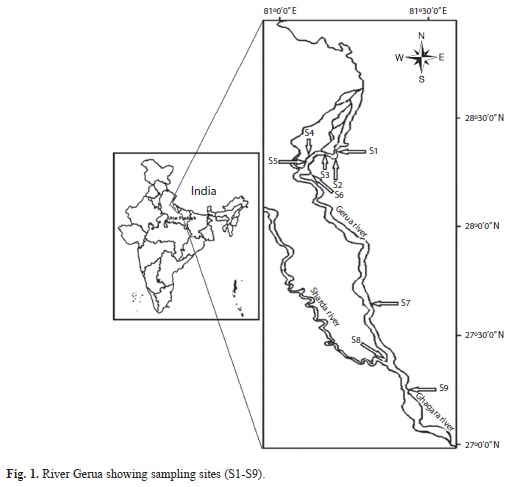
<body><![CDATA[<br> <font size="2"><font size="3"><span style="font-family: verdana;"></span></font></font><br  style="font-family: verdana;"> <font size="2"><font size="3"><span style="font-family: verdana;"></span></font><font  size="2"><span style="font-family: verdana;"><span  style="font-weight: bold;">Study site: </span>The studies were made in two section of the river Gerua. One section of 15km stretch within the Katraniaghat Wildlife Sanctuary (28&ordm;20-"12.54" N and 81&ordm;06-"57.76" E to 28&ordm;22-"11.27" N and 81&ordm;12-"96" E). The second section of 85km stretch belonged to a downstream unprotected area. In the protected area, most of the sampling sites were shaded by dense riparian vegetation. The surrounding land in the sanctuary is protected for conservation purposes and is composed of grasslands, deep forest, terrestrial wild animals and marshy lowlands. The unprotected sites were mainly composed of agricultural land use pattern, rural hamlets with relatively less riparian vegetation. </span></font></font>    <br> <font size="2"><font size="2"><span style="font-family: verdana;"></span></font></font><br  style="font-family: verdana; font-weight: bold;"> <font size="2"><font size="2"><span style="font-family: verdana;"></span></font><font  size="2"><span style="font-family: verdana;"><span  style="font-weight: bold;">Field sampling and analysis: </span>The field portion of the study started in April 2000 and continued until March 2004. Field sampling was done annually by the seasons: pre-monsoon (March-May), monsoon (June-September), and winter (October-February). Fishes were collected from nine sampling sites identified as S1 to S9; four sites within sanctuary, and five sites outside this protected area (<a href="/img/revistas/rbt/v61n1/a12i1.jpg">Fig. 1</a>). Fishing is prohibited in all sanctuary sites although some poaching was observed, nevertheless, it was very common outside the sanctuary. The sampling sites (approximately 200m long) were selected in upstream, midstream, and downstream areas within the sanctuary and outside the protected area. Sites were selected to include multiple representative habitats: mid-channel, shoreline, run and riffle, small channels and wetlands connected ditches, shallow ponds, and pools. Habitat features measured were: water depth (m), water temperature (oC), transparency (cm), water flow (km/hr), conductivity ( &#956; S/cm). Water depth was the average of seven to 10 measurements covering the channel portion of the sampling site at the time of sampling. Water temperature and conductivity were measured by Cyber Scan Waterproof PC 300 multiparameter equipment.    <br> </span></font></font><font size="2"><font size="2"><span  style="font-family: verdana;"></span></font></font><br  style="font-family: verdana;"> <font size="2"><font size="2"><span style="font-family: verdana;"></span></font><font  size="2"><span style="font-family: verdana;">Fishes were collected with gill nets (mesh 2.5x2.5cm; 3x3cm; 7x7cm; length x breadth=75x1.3m, 50x1m, and 30x1m). At each site, a standard set of gill nets was deployed overnight (17:00-07:00h) and fishing was carried out by using the expertise of local fisher folks. To confirm whether all the species of fish were collected from gill nets, additional data was obtained on number of occasions from the local markets, where fish were sold, and look after the presence of any species that were caught by variety of gears (traps, harpoons, hooked lines, cast nets, among others). Unless collected directly from the source, the habitat from which the fish originated was not traced, no quantification of fish abundance data was attempted for any of these additional sources, since reliable information was usually not available. All specimens collected were identified using the classification system of Talwar &amp; Jhingran (1991). Any color, spots, maximum size and other characters of the fishes caught were recorded. Fish samples were preserved in 10% formalin solution.</span></font></font>    <br> <font size="2"><font size="2"><span style="font-family: verdana;"></span></font></font><br  style="font-family: verdana;"> <font size="2"><font size="2"><span style="font-family: verdana;"></span></font><font  size="2"><span style="font-family: verdana;">Species relative abundance (RA) in the catch was computed by the following formula:</span></font></font>    <br> <font size="2"><font size="2"><span style="font-family: verdana;"></span></font></font><br  style="font-family: verdana;">     <div style="text-align: center;"><font size="2"><font size="2"><span  style="font-family: verdana;"></span></font></font>    <br> <img alt="" src="/img/revistas/rbt/v61n1/a12f1.jpg"  style="width: 72px; height: 41px;"></div> <font size="2"><font size="2"><span style="font-family: verdana;"></span></font><font  size="2"><span style="font-family: verdana;">Where:</span></font></font><br  style="font-family: verdana;"> <font size="2"><font size="2"><span style="font-family: verdana;">N=Total number of individuals of specific species</span></font></font><br style="font-family: verdana;"> <font size="2"><font size="2"><span style="font-family: verdana;">S=Total number of all fishes </span></font></font>    <br> <font size="2"><font size="2"><span style="font-family: verdana;"></span></font></font><br  style="font-family: verdana;"> <font size="2"><font size="2"><span style="font-family: verdana;"></span></font><font  size="2"><span style="font-family: verdana;">The species diversity index was calculated using the Shannon-Weiner Information </span></font></font>    <br> <font size="2"><font size="2"><span style="font-family: verdana;"></span></font><font  size="2"><span style="font-family: verdana;">Function (Shannon &amp; Wiener 1963):</span></font></font>    <br> <font size="2"><font size="2"><span style="font-family: verdana;"></span></font></font>    ]]></body>
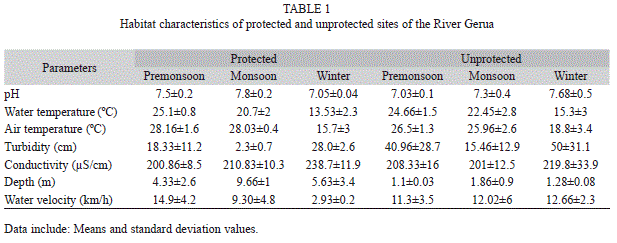
<body><![CDATA[<br>     <div style="text-align: center;"><font size="2"><font size="2"><span  style="font-family: verdana;"></span></font></font><img alt=""  src="/img/revistas/rbt/v61n1/a12f2.jpg"  style="width: 162px; height: 30px;">    <br> </div> <font size="2"><font size="2"><span style="font-family: verdana;"></span></font></font><br  style="font-family: verdana;"> <font size="2"><font size="2"><span style="font-family: verdana;"></span></font><font  size="2"><span style="font-family: verdana;">Where:</span></font></font><br  style="font-family: verdana;"> <font size="2"><font size="2"><span style="font-family: verdana;">ni=total number of individuals of specific species</span></font></font><br style="font-family: verdana;"> <font size="2"><font size="2"><span style="font-family: verdana;">N=total number of individuals of all species</span></font></font>    <br> <font size="2"><font size="2"><span style="font-family: verdana;"></span></font></font><br  style="font-family: verdana;"> <font size="2"><font size="2"><span style="font-family: verdana;"></span></font><font  size="2"><span style="font-family: verdana;">We used Jacquard&#8217;s index to compare the similarity of the species in the sampling sites within the sanctuary and outside:</span></font></font>    <br> <font size="2"><font size="2"><span style="font-family: verdana;"></span></font></font><br  style="font-family: verdana;">     <div style="text-align: center;"><font size="2"><font size="2"><span  style="font-family: verdana;"></span></font><font size="2"><span  style="font-family: verdana;"></span></font></font><br  style="font-family: verdana;"> <img alt="" src="/img/revistas/rbt/v61n1/a12f3.jpg"  style="width: 86px; height: 41px;"></div> <font size="2"><font size="2"><span style="font-family: verdana;">Where:</span></font></font><br  style="font-family: verdana;"> <font size="2"><font size="2"><span style="font-family: verdana;">Sj is the similarity between any two zones X and Y</span></font></font><br style="font-family: verdana;"> <font size="2"><font size="2"><span style="font-family: verdana;">j the number of species common to both the zones X and Y</span></font></font><br  style="font-family: verdana;"> <font size="2"><font size="2"><span style="font-family: verdana;">x the total number of species in zone X and Y </span></font></font>    <br> <font size="2"><font size="2"><span style="font-family: verdana;"></span></font></font><br  style="font-family: verdana;"> <font size="2"><font size="2"><span style="font-family: verdana;"></span></font><font  size="2"><span style="font-family: verdana;">The similarity in species composition within the sanctuary and unprotected area of the Gerua River was obtained from the Jacquard's index similarity coefficients generated by using the EstimatesS (version 5.0.1) software (Colwell 1997).</span></font></font>    <br> <font size="2"><font size="2"><span style="font-family: verdana;"></span></font></font><br  style="font-family: verdana;"> <font size="2"><font size="2"><span style="font-family: verdana;"></span></font><font  size="2"><span style="font-family: verdana;">A data matrix was constructed with presence and absence of fish species for each of the sampling sites in the sanctuary and unprotected areas. Analysis of variance was conducted to test the presence and abundance of fish species across the sampling sites. We used the Duncan&#8217;s new multiple range test to identify the sites that differed, and calculations were performed using SPSS software package (SPSS 2006). References to conservation status categories within this paper (endangered species, vulnerable species among others) are based on CAMP (1998) and IUCN (2010). Data regarding threats faced by the fish fauna within the sanctuary and unprotected river areas were obtained from direct observations and interactions with local stakeholders and fisherman.</span></font></font>    <br> <font size="2"><font size="2"><span style="font-family: verdana;"></span></font></font><br  style="font-family: verdana;"> <font size="2"><font size="2"><span style="font-family: verdana;"></span></font><font  size="3"><span style="font-family: verdana; font-weight: bold;">Results</span></font></font>    <br> <font size="2"><font size="3"><span  style="font-family: verdana; font-weight: bold;"></span></font></font><br  style="font-family: verdana;"> <font size="2"><font size="3"><span  style="font-family: verdana; font-weight: bold;"></span></font><font  size="2"><span style="font-family: verdana;"><span  style="font-weight: bold;">Physicochemical environment:</span> There were physicochemical environmental attributes that showed little variation over season and river reach, and there were some that varied considerably. <a href="/img/revistas/rbt/v61n1/a12t1.gif">Table 1</a> presents mean values and standard deviations across seasons and sites in the sanctuary and unprotected sites. Hydrogen ion concentration (pH) was rather stable across seasons and river sites in the sanctuary and unprotected reaches. The pH across seasons varied slightly (7.0-7.8), and mean pH value in the sanctuary was similar (7.4) to unprotected sites (7.3). Likewise, conductivity recorded in the sanctuary area varied from 201-239 &#956; S/cm across seasons and was slightly higher in winter. In the unprotected area, conductivity was observed between 201-220&#956;S/cm across seasons and again it was higher in winter. The sanctuary river water was very similar (mean 217 &#956; S/cm) to the unprotected river water (210 &#956; S/cm). Air temperature did not vary much between sites in the sanctuary (28&ordm;C) and unprotected sites (26&ordm;C). However, through the air temperatures were warm (28-26&ordm;C) premonsoon and monsoon seasons and dropped much lower in winter (16-19&ordm;C).     ]]></body>
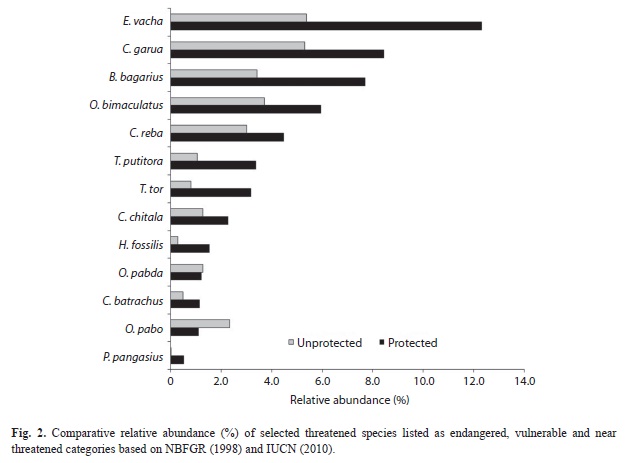
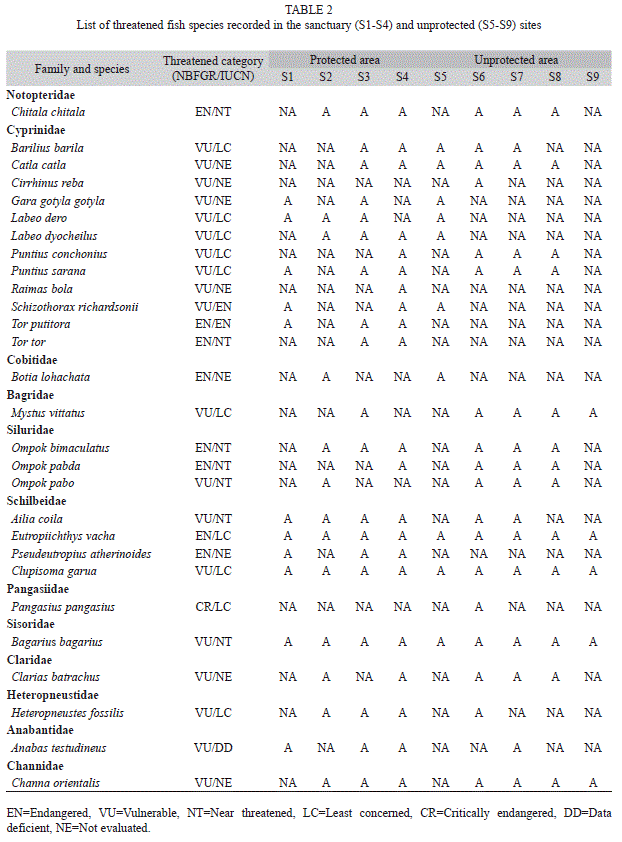
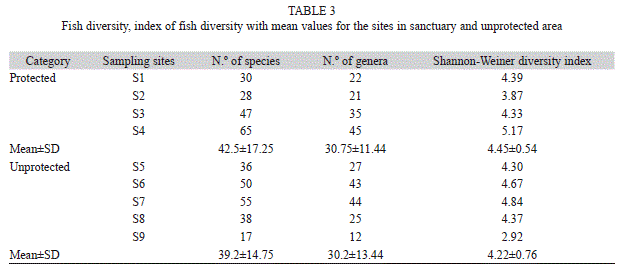
<body><![CDATA[<br>     <br> </span></font></font><font size="2"><font size="2"><span  style="font-family: verdana;"></span></font><font size="2"><span  style="font-family: verdana;">Water temperature was warmest during the premonsoon season (25&ordm;C), cooled some in monsoon season (21-22&ordm;C), and declined during the winter (14-15&ordm;C). Turbidity varied by season considerably with the monsoon season with lowest transparency (2-15cm) with downstream sites being the most transparent. Other season had much clearer water (18-50cm) with the clearest water downstream of the sanctuary. There was clearly deeper water in the sanctuary (4-10m) compared to the unprotected sites (1-2m). Both river sections observed deeper water column during the monsoon season due to greater river flows. Current velocity in the sanctuary area varied from slow (2.93cm/s) to moderately swift (14.9cm/s) across seasons. In the unprotected river velocity were higher than the sanctuary waters, and ranged from 11-13cm/s. However, water depth was much shallower and expected cross section area was much less. That may explain the differences between the sanctuary and unprotected river in terms of current velocity.</span></font></font>    <br> <font size="2"><font size="2"><span style="font-family: verdana;"></span></font></font><br  style="font-family: verdana;"> <font size="2"><font size="2"><span style="font-family: verdana;"></span></font><font  size="2"><span style="font-family: verdana;"><span  style="font-weight: bold;">Fish communities across sites:</span> A total of 6 220 fish were collected from the sanctuary river waters and unprotected river sites, and there were 87 species representing 22 families and 52 genera. The Cyprinidae was the dominant family with 40 species consisting almost half (49%) of all fishes collected. Following, the family Bagridae had seven species and 8% of all fish collected. Then, the Schilbeidae had five species represented 6% of all fish collected. Overall, the most numerous species was a Cyprinid <span style="font-style: italic;">Salmostoma bacaila </span>in terms of relative abundance (RA) with 11% and 1 113 individuals. The next most numerous were the Schilbeid <span style="font-style: italic;">Eutropiichthys vacha</span> (8%), Notopterid <span style="font-style: italic;">Notopterus notopterus</span> (6%), Schilbeid <span style="font-style: italic;">Clupisoma</span> <span  style="font-style: italic;">garua </span>(5%) and Sisorid <span  style="font-style: italic;">Bagarius bagarius</span> (5%). While the relative abundance of two Indian major carps, <span  style="font-style: italic;">Catla catla</span> and <span style="font-style: italic;">Labeo rohita</span>, was relatively low (&lt;1.5%). However, a bottom dwelling Indian major carp <span style="font-style: italic;">Cirrhinus mrigala</span> was more abundant (2%). </span></font></font>    <br> <font size="2"><font size="2"><span style="font-family: verdana;"></span></font></font><br  style="font-family: verdana;"> <font size="2"><font size="2"><span style="font-family: verdana;"></span></font><font  size="2"><span style="font-family: verdana;">In the collections, there was an abundance of threatened fishes (3 848 individuals, 28 species) like Chitala chitala, Notopterus notopterus, Ompok bimaculatus, Bagarius bagarius, Tor putitora, Tor tor, Eutropiicthys vacha, Pangasius pangasius and others (<a href="/img/revistas/rbt/v61n1/a12i2.jpg">Fig. 2</a>). In this study, 28 endangered and vulnerable species by Indian classifications (National Bureau of Fish Genetic Resources, 1998) constituted almost of third (31%) of the fish collected (<a href="/img/revistas/rbt/v61n1/a12t2.gif">Table 2</a>). Under conservation status as per IUCN (2010) two species (<span style="font-style: italic;">Schizothorax richardsonii </span>and<span  style="font-style: italic;"> Tor putitora</span>) were categorized as endangered, seven species were near threatened, 10 under least concern, and one species under data deficient. Among minor carps, <span  style="font-style: italic;">Labeo bata </span>and<span style="font-style: italic;"> Cirrhinus reba</span> showed higher relative abundance. Among exotic species, <span style="font-style: italic;">Cyprinus carpio</span> was recorded inside the sanctuary.    <br> </span></font></font><br style="font-family: verdana;"> <font size="2"><font size="2"><span style="font-family: verdana;"></span></font><font  size="2"><span style="font-family: verdana;">Of the 87 species recorded from the sanctuary river waters, 12 species (14%) that are oriented to coolwater habitat, 46 species (53%) are warmwater and also recognized as food fish, 13 species (15%) as good aquarium fishes, and 4 species (5%) considered as high profile game fishes in India (<span  style="font-style: italic;">Tor tor, T. putitora, Aorichthys aor </span>and<span style="font-style: italic;"> Bagarius bagarius</span>). The study also showed new record in maximum length of six freshwater fish species: <span  style="font-style: italic;">Notopterus notopterus</span> (35cm), <span style="font-style: italic;">Gudusia chapra</span> (20cm), <span style="font-style: italic;">Barilius barila</span> (13cm), <span style="font-style: italic;">Ompok pabo</span> (28cm), <span style="font-style: italic;">Xenentodon cancila</span> (31.5cm) and <span style="font-style: italic;">Salmostoma bacaila</span> (20.5cm).</span></font></font>    <br> <font size="2"><font size="2"><span style="font-family: verdana;"></span></font></font><br  style="font-family: verdana;"> <font size="2"><font size="2"><span style="font-family: verdana;"></span></font><font  size="2"><span style="font-family: verdana;">The Shannon-Weiner diversity index across all sites in the sanctuary ranged between 3.8-5.2 with a mean of 4.4 as compared to 2.9-4.8 with a mean of 4.2 at sites that were in unprotected areas (<a href="/img/revistas/rbt/v61n1/a12t3.gif">Table 3</a>). The Mann-Whitney test of the Shannon-Weiner diversity index values between the sanctuary sites and unprotected sites were non-significant (p=0.63). The Jacqard&#8217;s similarity index in the sites of protected and unprotected areas showed more similarity across the sites regardless if they were in sanctuary waters or unprotected waters.</span></font></font>    <br> <font size="2"><font size="2"><span style="font-family: verdana;"></span></font></font><br  style="font-family: verdana; font-weight: bold;"> <font size="2"><font size="2"><span style="font-family: verdana;"></span></font><font  size="2"><span style="font-family: verdana;"><span  style="font-weight: bold;">Comparison between sanctuary river sites and unprotected sites:</span> In this study, diversity of freshwater fish in the study area showed a considerable difference between the sanctuary and unprotected river sites (<a  href="/img/revistas/rbt/v61n1/a12t3.gif">Table 3</a>). Among four sites studied in the sanctuary, site S4 had the maximum diversity in terms of species (65) and genera (45) and site S2 had the lowest (28 species and 21 genera). In the unprotected river, site S7 had the maximum diversity (55 species and 44 genera) and site S9 had the lowest (17 species and 12 genera). Genera like <span style="font-style: italic;">Labeo</span> (8 species) and <span style="font-style: italic;">Puntius</span> (7 species) were dominated in the protected area followed by unprotected area (7 and 6 species).</span></font></font>    <br> <font size="2"><font size="2"><span style="font-family: verdana;"></span></font></font><br  style="font-family: verdana;"> <font size="2"><font size="2"><span style="font-family: verdana;"></span></font><font  size="2"><span style="font-family: verdana;">Within the sanctuary three sites (S1, S2, S4) were distinct in fish composition while for the unprotected sites two were unique (S8, S9). </span></font></font>    <br> <font size="2"><font size="2"><span style="font-family: verdana;"></span></font></font>    <br> <font size="2"><font size="2"><span style="font-family: verdana;">This study showed a distinct variation (p&lt;0.05) in the relative abundance of 13 threatened fish species in the sanctuary sites and unprotected sites (<a href="/img/revistas/rbt/v61n1/a12i2.jpg">Fig. 2</a>). Many of the threatened fishes were found abundant in the sanctuary areas than the unprotected areas. Fish species like, E. vacha, C. gerua followed by <span style="font-style: italic;">B. bagarius, O. bimaculatus, C. reba, T. tor </span>and<span style="font-style: italic;"> T. putitora</span> were the most abundant species in both protected and unprotected areas. In the unprotected areas, species like <span  style="font-style: italic;">O. pabda </span>and<span style="font-style: italic;"> O. pabo</span> were recorded quite higher in abundance than the protected areas.</span></font></font>    ]]></body>
<body><![CDATA[<br> <font size="2"><font size="2"><span style="font-family: verdana;"></span></font></font><br  style="font-family: verdana; font-weight: bold;"> <font size="2"><font size="2"><span style="font-family: verdana;"></span></font><font  size="3"><span style="font-family: verdana;"><span  style="font-weight: bold;">Discussion</span></span></font></font>    <br> <font size="2"><font size="3"><span style="font-family: verdana;"></span></font></font><br  style="font-family: verdana;"> <font size="2"><font size="3"><span style="font-family: verdana;"></span></font><font  size="2"><span style="font-family: verdana;">In the present study, the diversity of species in the protected and unprotected areas varied considerably from site S1 to S9. On comparison, it was found that all the sites in the protected areas not necessarily showed rich fish diversity than the sites located in the unprotected areas. This variation is of high interest depending on the site specific habitat characteristics. For instance, the river habitat in the sanctuary area at sites S3 and S4 was highly diverse including a network of small channels, wetlands, presence of instream structures (undercut banks, woody logs and debris, overhanging vegetation, among others), and dense riparian vegetation which could be greatly responsible for high species diversity. Moreover, these sites were located downstream from a barrage forming larger pool habitats supporting fishes to accumulate in certain habitats. Low human disruption and maintenance of ecological integrity in the sanctuary area can be another reason for more diversity and fish abundance. However, sites that did not follow the same pattern might be attributed to fast free flowing river water (site 1 &amp; 2) which prevents fishes for accumulating in certain habitats.</span></font></font>    <br> <font size="2"><font size="2"><span style="font-family: verdana;"></span></font></font><br  style="font-family: verdana;"> <font size="2"><font size="2"><span style="font-family: verdana;"></span></font><font  size="2"><span style="font-family: verdana;">In the present study, water depth was clearly deeper in the sanctuary area as compared to the unprotected sites. In flowing waters the number of fish species were more numerous with increasing water depth (Sheldon 1968, Bain 1995). Sarkar &amp; Bain (2007) analysed habitat relationships in River Gerua at the sanctuary site, and found three grouped fish species occupying distinct habitats. The deepest habitat had the highest species diversity. Large rivers differ from small streams in several attributes like lack of light penetration to bed, greater depths and velocities on average, greater ratio of volume to margins, and greater physical stability (Dunne &amp; Leopold 1978). Deeper habitats can influence fish species diversity and abundance in the Gerua River. Finally, unprotected sites are known to have higher fishing intensity. When a river is in a sanctuary setting there are a number effects that come with protection of human activities, and it could be hard to pinpoint the cause of increased diversity and abundance.</span></font></font>    <br> <font size="2"><font size="2"><span style="font-family: verdana;"></span></font></font><br  style="font-family: verdana;"> <font size="2"><font size="2"><span style="font-family: verdana;"></span></font><font  size="2"><span style="font-family: verdana;">As described earlier, the diversity of a certain site in the studied river does not directly depends on the protected area boundaries, and can be reflected in rich species diversity of sites S6 and S7 of the unprotected areas; this could be attributed to site specific suitable environmental conditions. In addition, these sites were seen in supporting large group of macrophytes which diversify aquatic habitats and provide support for more fish and greater numbers (Growns &amp; Gehrke 2003, Sarkar <span  style="font-style: italic;">et al</span>. 2008, 2010). In contrast, the minimum species diversity at S9 might be due to more distance from the protected area, effect of sedimentation, loss of breeding and spawning grounds, and over harvesting. Loss and reduction in diversity and abundance of fishes were consistent with and declining water quality and loss of habitats as a cause of human activities. Fish communities in riverine systems typically follow a pattern of increasing species diversity and abundance from upstream to downstream (Bayley &amp; Li 1994). We documented a contrasting, inverse relation for species diversity and abundance downstream direction on the river.</span></font></font>    <br> <font size="2"><font size="2"><span style="font-family: verdana;"></span></font></font><br  style="font-family: verdana;"> <font size="2"><font size="2"><span style="font-family: verdana;"></span></font><font  size="2"><span style="font-family: verdana;">The Shannon-Weiner diversity index of the sites within sanctuary and unprotected sites slightly differed from S1 to S8, and considerable difference was observed in S9. This site indicated the maximum effect of protection because it was the furthest from the sanctuary. The Jacqard's index showed the site wise differentiation in species composition in the protected and unprotected areas. The possible reason of low similarity index in the unprotected areas might be the differences of the land use pattern, high sedimentation rate, suburban communal sewage, overfishing, and agricultural runoff. Paller <span style="font-style: italic;">et al</span>. (2000) found higher minor variation in Jacqard's index among the undisturbed sites, while Jacqard's index was low at the disturbed site. This pattern is consistent with Paller <span style="font-style: italic;">et al</span>. (2000).</span></font></font>    <br> <font size="2"><font size="2"><span style="font-family: verdana;"></span></font></font><br  style="font-family: verdana;"> <font size="2"><font size="2"><span style="font-family: verdana;"></span></font><font  size="2"><span style="font-family: verdana;">Most importantly, the relative abundance of threatened fishes listed as endangered and vulnerable within the sanctuary and unprotected sites differed significantly. This might be due to differences in the land use pattern, intensity of human interference, turbidity, depth, water flow, wind, and differences in fish life histories (Mosquera <span style="font-style: italic;">et al</span>. 2000). However, many factors are involved and real benefit of the protection has many consequences for the habitat and the river. This finding is consistent with the study by McClanahan &amp; Kaunda (1996) that also found higher fish abundances inside than outside protected areas. </span></font></font>    <br> <font size="2"><font size="2"><span style="font-family: verdana;"></span></font></font><br  style="font-family: verdana;"> <font size="2"><font size="2"><span style="font-family: verdana;"></span></font><font  size="2"><span style="font-family: verdana;">The composition of 12 endangered freshwater fishes at sites in the sanctuary and unprotected area were relatively heterogeneous. Three of endangered fishes (<span  style="font-style: italic;">B. bagarius, C. gerua </span>and<span style="font-style: italic;"> E. vacha</span>) were present at all the sites including the unprotected area indicating long range of distribution. The endangered mahseer, <span style="font-style: italic;">T. putitora </span>and<span  style="font-style: italic;"> T. tor</span>, exhibited a restricted range of distribution in the unprotected sites. A migratory large catfish, P. pangasius, was present at single location (S6) which is located nearest to the sanctuary area, indicating need of special conservation planning for this species. The present study also showed distinct variation in distribution pattern, size classes and abundance of the migratory species like <span style="font-style: italic;">B. bagarius, T. tor, P. pangassius, W. attu, S. silondia </span>and<span style="font-style: italic;"> C. chitala</span>. In the sanctuary a unique behavior was observed with the Feather back, <span style="font-style: italic;">C. chitala</span>, which showed frequent sightings in the river with river dolphins (<span style="font-style: italic;">Platanista gangetica gangetica</span>).</span></font></font>    <br> <font size="2"><font size="2"><span style="font-family: verdana;"></span></font></font><br  style="font-family: verdana;"> <font size="2"><font size="2"><span style="font-family: verdana;"></span></font><font  size="2"><span style="font-family: verdana;">This study recorded maximum length values (TL) that exceeded the earlier records for six freshwater fishes (Talwar &amp; Jhingran 1991), indicating that the protection of habitat can influence on fish length attainment. This study showed, with more species, greater abundances and larger individuals, and additionally showed higher number and densities of endangered fishes within the sanctuary area. Sarkar <span style="font-style: italic;">et al</span>. 2007 reported a record size (22.5cm TL) of clupeid (<span style="font-style: italic;">Gudusia chapra</span>) from another protected area. In the protected river, there are other studies which recorded higher abundances of fish (Mosquera <span style="font-style: italic;">et al</span>. 2000), greater sizes of individuals (Moyle &amp; Sato 1991), Bayle-Sempere &amp; Ramos-Espla 1993, Dufour <span style="font-style: italic;">et al</span>. 1995), and greater biomass (Francour 1991).</span></font></font>    <br> <font size="2"><font size="2"><span style="font-family: verdana;"></span></font></font><br  style="font-family: verdana;"> <font size="2"><font size="2"><span style="font-family: verdana;"></span></font><font  size="2"><span style="font-family: verdana;">This study is the first of its kind for the River Gerua in India which showed that a protected area is an effective tool that can benefit freshwater fish conservation, including species with high conservation value. This conclusion is new because the role of protected areas has been shown to benefits river habitats, rare and endangered species, and intact river systems (Saunders <span  style="font-style: italic;">et al</span>. 2002, Lake 1980, Sarkar <span style="font-style: italic;">et al</span>. 2008, Allan &amp; Flecker 1993, Braun <span style="font-style: italic;">et al</span>. 2000, Saunders <span style="font-style: italic;">et al</span>. 2002).</span></font></font>    <br> <font size="2"><font size="2"><span style="font-family: verdana;"></span></font></font><br  style="font-family: verdana;"> <font size="2"><font size="2"><span style="font-family: verdana;"></span></font><font  size="2"><span style="font-family: verdana;">In conclusion, it is found that freshwater protected areas commonly result in increased fish abundances for those threatened fishes which are extremely important for biodiversity conservation and management. Our observations also indicated that these areas, within wildlife sanctuaries, can be used as freshwater aquatic sanctuary (FAS), if additional measures are taken to protect these aquatic resources against actual threats.</span></font></font>    ]]></body>
<body><![CDATA[<br> <font size="2"><font size="2"><span style="font-family: verdana;"></span></font></font><br  style="font-family: verdana;"> <font size="2"><font size="2"><span style="font-family: verdana;"></span></font><font  size="3"><span style="font-family: verdana; font-weight: bold;">Acknowledgments</span></font></font>    <br> <font size="2"><font size="3"><span  style="font-family: verdana; font-weight: bold;"></span></font></font><br  style="font-family: verdana;"> <font size="2"><font size="3"><span  style="font-family: verdana; font-weight: bold;"></span></font><font  size="2"><span style="font-family: verdana;">We thank Director, NBFGR for providing necessary facilities and guidance. Authors are indebted to Chief Wildlife Warden, Department of Forest, Govt. of Uttar Pradesh, India for providing necessary permission to carry out survey and encouragements to carrying out the research work. We are grateful to Divisional Forest Officer, Katerniaghat Wild Life Sanctuary, Baharaich, Uttar Pradesh, India for his all sorts of help in carrying out inventory within sanctuary.</span></font></font>    <br> </div> <font size="2"><font size="2"><span style="font-family: verdana;"></span></font> </font>     <div style="text-align: justify;"></div> <hr  style="width: 100%; height: 2px; margin-left: 0px; margin-right: 0px;">     <div style="text-align: justify;"></div>     <div style="text-align: justify;"><font size="2"><font size="2"><span  style="font-family: verdana;"></span></font><font size="3"><span  style="font-family: verdana; font-weight: bold;">References</span></font></font>    <!-- ref --><br> <font size="2"><font size="3"><span  style="font-family: verdana; font-weight: bold;"></span></font></font><br  style="font-family: verdana;"> <font size="2"><font size="3"><span  style="font-family: verdana; font-weight: bold;"></span></font><font  size="2"><span style="font-family: verdana;">Allan, J.D. &amp; A.S. Flecker. 1993. Biodiversity conservation in running waters: identifying the major factors that threaten destruction of riverine species and ecosystems. Bioscience 43: 33-43.    &nbsp;&nbsp;&nbsp;&nbsp;&nbsp;&nbsp;&nbsp;&nbsp;[&#160;<a href="javascript:void(0);" onclick="javascript: window.open('/scielo.php?script=sci_nlinks&ref=1831406&pid=S0034-7744201300010001200001&lng=','','width=640,height=500,resizable=yes,scrollbars=1,menubar=yes,');">Links</a>&#160;]<!-- end-ref --></span></font></font>    <!-- ref --><br> <font size="2"><font size="2"><span style="font-family: verdana;"></span></font></font><br  style="font-family: verdana;"> <font size="2"><font size="2"><span style="font-family: verdana;"></span></font><font  size="2"><span style="font-family: verdana;">Agrawala, S., V. Raksakulthai, M. van Aalst, P. Larsen, J. Smith &amp; J. Reynolds. 2003. Development and climate change in Nepal: Focus on water resources and hydropower. Environment Directorate, Paris, France.    &nbsp;&nbsp;&nbsp;&nbsp;&nbsp;&nbsp;&nbsp;&nbsp;[&#160;<a href="javascript:void(0);" onclick="javascript: window.open('/scielo.php?script=sci_nlinks&ref=1831408&pid=S0034-7744201300010001200002&lng=','','width=640,height=500,resizable=yes,scrollbars=1,menubar=yes,');">Links</a>&#160;]<!-- end-ref --> </span></font></font>    ]]></body>
<body><![CDATA[<!-- ref --><br> <font size="2"><font size="2"><span style="font-family: verdana;"></span></font></font><br  style="font-family: verdana;"> <font size="2"><font size="2"><span style="font-family: verdana;"></span></font><font  size="2"><span style="font-family: verdana;">Bain, M.B. 1995. Habitat at the local scale: multivariate patterns for stream fishes. Bull. Fran&ccedil;ais de la P&ecirc;che et la Piscicult 337/338/339:165-177.    &nbsp;&nbsp;&nbsp;&nbsp;&nbsp;&nbsp;&nbsp;&nbsp;[&#160;<a href="javascript:void(0);" onclick="javascript: window.open('/scielo.php?script=sci_nlinks&ref=1831410&pid=S0034-7744201300010001200003&lng=','','width=640,height=500,resizable=yes,scrollbars=1,menubar=yes,');">Links</a>&#160;]<!-- end-ref --></span></font></font>    <!-- ref --><br> <font size="2"><font size="2"><span style="font-family: verdana;"></span></font></font><br  style="font-family: verdana;"> <font size="2"><font size="2"><span style="font-family: verdana;"></span></font><font  size="2"><span style="font-family: verdana;">Bayley, P.O. &amp; H. Li. 1994. Riverine fisheries, p. 251-281. <span style="font-style: italic;">In</span> P. Calow &amp; G.E. Petts (eds.). The river handbook: hydrological and ecological principles. Blackwell, Boston, USA.    &nbsp;&nbsp;&nbsp;&nbsp;&nbsp;&nbsp;&nbsp;&nbsp;[&#160;<a href="javascript:void(0);" onclick="javascript: window.open('/scielo.php?script=sci_nlinks&ref=1831412&pid=S0034-7744201300010001200004&lng=','','width=640,height=500,resizable=yes,scrollbars=1,menubar=yes,');">Links</a>&#160;]<!-- end-ref --></span></font></font>    <!-- ref --><br> <font size="2"><font size="2"><span style="font-family: verdana;"></span></font></font><br  style="font-family: verdana;"> <font size="2"><font size="2"><span style="font-family: verdana;"></span></font><font  size="2"><span style="font-family: verdana;">Bayle-Sempere, J.T. &amp; A. Ramos-Espla. 1993. Some population parameters as bioindicators to assess the "reserve effect" on the fish assemblage, p. 189-214. In C.F. Boudouresque, M. Avon &amp; C. Pergent-Martini (eds.). Qualit&eacute; du milieu marin-Indicateurs biologiques et physicochimiques. GIS Posidonie Publ., Marseille, France.    &nbsp;&nbsp;&nbsp;&nbsp;&nbsp;&nbsp;&nbsp;&nbsp;[&#160;<a href="javascript:void(0);" onclick="javascript: window.open('/scielo.php?script=sci_nlinks&ref=1831414&pid=S0034-7744201300010001200005&lng=','','width=640,height=500,resizable=yes,scrollbars=1,menubar=yes,');">Links</a>&#160;]<!-- end-ref --></span></font></font>    <!-- ref --><br> <font size="2"><font size="2"><span style="font-family: verdana;"></span></font></font><br  style="font-family: verdana;"> <font size="2"><font size="2"><span style="font-family: verdana;"></span></font><font  size="2"><span style="font-family: verdana;">Braun, D.P., L.B Bach, K.A. Ciruna &amp; A.T. Warner. 2000. Watershed-scale abatement of threats to freshwater biodiversity: the Nature Conservancy's freshwater initiative. Proceeding of the Water Environment Federation, Vancouver, Canada.    &nbsp;&nbsp;&nbsp;&nbsp;&nbsp;&nbsp;&nbsp;&nbsp;[&#160;<a href="javascript:void(0);" onclick="javascript: window.open('/scielo.php?script=sci_nlinks&ref=1831416&pid=S0034-7744201300010001200006&lng=','','width=640,height=500,resizable=yes,scrollbars=1,menubar=yes,');">Links</a>&#160;]<!-- end-ref --></span></font></font>    <!-- ref --><br> <font size="2"><font size="2"><span style="font-family: verdana;"></span></font></font><br  style="font-family: verdana;"> <font size="2"><font size="2"><span style="font-family: verdana;"></span></font><font  size="2"><span style="font-family: verdana;">Biju, C.R., K. Raju Thomas &amp; C.R. Ajithkumar. 1999. Fishes of Parambikulam Wild Life Sanctuary, Palakkad District, Kerala. J. Bombay Nat. Hist. Soc. 96: 82-86.    &nbsp;&nbsp;&nbsp;&nbsp;&nbsp;&nbsp;&nbsp;&nbsp;[&#160;<a href="javascript:void(0);" onclick="javascript: window.open('/scielo.php?script=sci_nlinks&ref=1831418&pid=S0034-7744201300010001200007&lng=','','width=640,height=500,resizable=yes,scrollbars=1,menubar=yes,');">Links</a>&#160;]<!-- end-ref --></span></font></font>    ]]></body>
<body><![CDATA[<!-- ref --><br> <font size="2"><font size="2"><span style="font-family: verdana;"></span></font></font><br  style="font-family: verdana;"> <font size="2"><font size="2"><span style="font-family: verdana;"></span></font><font  size="2"><span style="font-family: verdana;">Colwell, R.K. 1997. User's guide to EstimateS 5: statistical estimation of species richness and shared species from samples. Version 5.0.1. University of Connecticut, Storrs, USA.    &nbsp;&nbsp;&nbsp;&nbsp;&nbsp;&nbsp;&nbsp;&nbsp;[&#160;<a href="javascript:void(0);" onclick="javascript: window.open('/scielo.php?script=sci_nlinks&ref=1831420&pid=S0034-7744201300010001200008&lng=','','width=640,height=500,resizable=yes,scrollbars=1,menubar=yes,');">Links</a>&#160;]<!-- end-ref --></span></font></font>    <!-- ref --><br> <font size="2"><font size="2"><span style="font-family: verdana;"></span></font></font><br  style="font-family: verdana;"> <font size="2"><font size="2"><span style="font-family: verdana;"></span></font><font  size="2"><span style="font-family: verdana;">De Silva, S.S., W. Abery Nigel &amp; T.T. Nguyen Thury. 2007. Endemic freshwater finfish of Asia: distribution and conservation status. Divers. Distrib. 13: 172-184.    &nbsp;&nbsp;&nbsp;&nbsp;&nbsp;&nbsp;&nbsp;&nbsp;[&#160;<a href="javascript:void(0);" onclick="javascript: window.open('/scielo.php?script=sci_nlinks&ref=1831422&pid=S0034-7744201300010001200009&lng=','','width=640,height=500,resizable=yes,scrollbars=1,menubar=yes,');">Links</a>&#160;]<!-- end-ref --></span></font></font>    <!-- ref --><br> <font size="2"><font size="2"><span style="font-family: verdana;"></span></font></font><br  style="font-family: verdana;"> <font size="2"><font size="2"><span style="font-family: verdana;"></span></font><font  size="2"><span style="font-family: verdana;">Dugan, P.J., E. Baran, R. Tharme, M. Prein, M. Ahmed, P. Amerasinghe, C. Brown, M. Dey, G. Jayasinghe &amp; M. Niasse. 2002. The contribution of aquatic ecosystems and fisheries to food security and livelihoods: A research agend. Colombo, Sri Lanka.    &nbsp;&nbsp;&nbsp;&nbsp;&nbsp;&nbsp;&nbsp;&nbsp;[&#160;<a href="javascript:void(0);" onclick="javascript: window.open('/scielo.php?script=sci_nlinks&ref=1831424&pid=S0034-7744201300010001200010&lng=','','width=640,height=500,resizable=yes,scrollbars=1,menubar=yes,');">Links</a>&#160;]<!-- end-ref --></span></font></font>    <!-- ref --><br> <font size="2"><font size="2"><span style="font-family: verdana;"></span></font></font><br  style="font-family: verdana;"> <font size="2"><font size="2"><span style="font-family: verdana;"></span></font><font  size="2"><span style="font-family: verdana;">Dudgeon, D., A.H. Arthington, M.O. Gessner, Z. Kwabata, D.J. Knowler, C. Leveque, R.J. Naiman, A. Prieur- Richaed, D. Soto, M.L.J. Stiassny &amp; C.A. Sullivan. 2006. Fresh water biodiversity: importance, threats, status and conservation challenges. Biol. Rev. 81: 163-182.    &nbsp;&nbsp;&nbsp;&nbsp;&nbsp;&nbsp;&nbsp;&nbsp;[&#160;<a href="javascript:void(0);" onclick="javascript: window.open('/scielo.php?script=sci_nlinks&ref=1831426&pid=S0034-7744201300010001200011&lng=','','width=640,height=500,resizable=yes,scrollbars=1,menubar=yes,');">Links</a>&#160;]<!-- end-ref --></span></font></font>    <!-- ref --><br> <font size="2"><font size="2"><span style="font-family: verdana;"></span></font></font><br  style="font-family: verdana;"> <font size="2"><font size="2"><span style="font-family: verdana;"></span></font><font  size="2"><span style="font-family: verdana;">Dufour, V., J.Y. Jouvenel &amp; R. Galzin. 1995. Study of a reef fish assemblage: comparison of population distribution between depths in protected and unprotected areas over one decade. Aquat. Liv. Res. 8: 17-25.    &nbsp;&nbsp;&nbsp;&nbsp;&nbsp;&nbsp;&nbsp;&nbsp;[&#160;<a href="javascript:void(0);" onclick="javascript: window.open('/scielo.php?script=sci_nlinks&ref=1831428&pid=S0034-7744201300010001200012&lng=','','width=640,height=500,resizable=yes,scrollbars=1,menubar=yes,');">Links</a>&#160;]<!-- end-ref --></span></font></font>    ]]></body>
<body><![CDATA[<!-- ref --><br> <font size="2"><font size="2"><span style="font-family: verdana;"></span></font></font><br  style="font-family: verdana;"> <font size="2"><font size="2"><span style="font-family: verdana;"></span></font><font  size="2"><span style="font-family: verdana;">Duncan, J. &amp; J.L. Lockwood. 2001. Extinction in a field of bullets: a search for the cause in the decline of the world's freshwater fishes. Biol. Cons. 102: 97-105.    &nbsp;&nbsp;&nbsp;&nbsp;&nbsp;&nbsp;&nbsp;&nbsp;[&#160;<a href="javascript:void(0);" onclick="javascript: window.open('/scielo.php?script=sci_nlinks&ref=1831430&pid=S0034-7744201300010001200013&lng=','','width=640,height=500,resizable=yes,scrollbars=1,menubar=yes,');">Links</a>&#160;]<!-- end-ref --></span></font></font>    <!-- ref --><br> <font size="2"><font size="2"><span style="font-family: verdana;"></span></font></font><br  style="font-family: verdana;"> <font size="2"><font size="2"><span style="font-family: verdana;"></span></font><font  size="2"><span style="font-family: verdana;">Dunne, T. &amp; L.B. Leopold. 1978. Water in Environmental Planning. W.H. Freeman, New York, USA.    &nbsp;&nbsp;&nbsp;&nbsp;&nbsp;&nbsp;&nbsp;&nbsp;[&#160;<a href="javascript:void(0);" onclick="javascript: window.open('/scielo.php?script=sci_nlinks&ref=1831432&pid=S0034-7744201300010001200014&lng=','','width=640,height=500,resizable=yes,scrollbars=1,menubar=yes,');">Links</a>&#160;]<!-- end-ref --> </span></font></font>    <!-- ref --><br> <font size="2"><font size="2"><span style="font-family: verdana;"></span></font></font><br  style="font-family: verdana;"> <font size="2"><font size="2"><span style="font-family: verdana;"></span></font><font  size="2"><span style="font-family: verdana;">Francour, P. 1991. The effect protection level on a coastal fish community at Scandola, Corsica. Revue d'Ecologie (Terre Vie) 46: 65-81.    &nbsp;&nbsp;&nbsp;&nbsp;&nbsp;&nbsp;&nbsp;&nbsp;[&#160;<a href="javascript:void(0);" onclick="javascript: window.open('/scielo.php?script=sci_nlinks&ref=1831434&pid=S0034-7744201300010001200015&lng=','','width=640,height=500,resizable=yes,scrollbars=1,menubar=yes,');">Links</a>&#160;]<!-- end-ref --></span></font></font>    <!-- ref --><br> <font size="2"><font size="2"><span style="font-family: verdana;"></span></font></font><br  style="font-family: verdana;"> <font size="2"><font size="2"><span style="font-family: verdana;"></span></font><font  size="2"><span style="font-family: verdana;">Growns, I. &amp; P.C. Gehrke. 2003. A comparison of fish assemblage associated with different riparian vegetation types in the Hawksbury-epan River system. Fish Manag. Ecol. 10: 209-220.    &nbsp;&nbsp;&nbsp;&nbsp;&nbsp;&nbsp;&nbsp;&nbsp;[&#160;<a href="javascript:void(0);" onclick="javascript: window.open('/scielo.php?script=sci_nlinks&ref=1831436&pid=S0034-7744201300010001200016&lng=','','width=640,height=500,resizable=yes,scrollbars=1,menubar=yes,');">Links</a>&#160;]<!-- end-ref --></span></font></font>    <!-- ref --><br> <font size="2"><font size="2"><span style="font-family: verdana;"></span></font></font><br  style="font-family: verdana;"> <font size="2"><font size="2"><span style="font-family: verdana;"></span></font><font  size="2"><span style="font-family: verdana;">Husain, A. 1983. Fish fauna of Corbett National Park, Uttaranchal. "CHEETAL". J.W.I.P.S. India 2: 39-42.    &nbsp;&nbsp;&nbsp;&nbsp;&nbsp;&nbsp;&nbsp;&nbsp;[&#160;<a href="javascript:void(0);" onclick="javascript: window.open('/scielo.php?script=sci_nlinks&ref=1831438&pid=S0034-7744201300010001200017&lng=','','width=640,height=500,resizable=yes,scrollbars=1,menubar=yes,');">Links</a>&#160;]<!-- end-ref --> </span></font></font>    ]]></body>
<body><![CDATA[<!-- ref --><br> <font size="2"><font size="2"><span style="font-family: verdana;"></span></font></font><br  style="font-family: verdana;"> <font size="2"><font size="2"><span style="font-family: verdana;"></span></font><font  size="2"><span style="font-family: verdana;">IUCN. 2010. IUCN Red List of Threatened Species (Downloaded: May 2011, www.iucnredlist.org).    &nbsp;&nbsp;&nbsp;&nbsp;&nbsp;&nbsp;&nbsp;&nbsp;[&#160;<a href="javascript:void(0);" onclick="javascript: window.open('/scielo.php?script=sci_nlinks&ref=1831440&pid=S0034-7744201300010001200018&lng=','','width=640,height=500,resizable=yes,scrollbars=1,menubar=yes,');">Links</a>&#160;]<!-- end-ref --></span></font></font>    <!-- ref --><br> <font size="2"><font size="2"><span style="font-family: verdana;"></span></font></font><br  style="font-family: verdana;"> <font size="2"><font size="2"><span style="font-family: verdana;"></span></font><font  size="2"><span style="font-family: verdana;">Lake, P.S. 1980. Conservation, p. 163-173. <span style="font-style: italic;">In</span> W.D. Williams (ed.). An ecological basis for water resource management. Australian University, Canberra, Australia.    &nbsp;&nbsp;&nbsp;&nbsp;&nbsp;&nbsp;&nbsp;&nbsp;[&#160;<a href="javascript:void(0);" onclick="javascript: window.open('/scielo.php?script=sci_nlinks&ref=1831442&pid=S0034-7744201300010001200019&lng=','','width=640,height=500,resizable=yes,scrollbars=1,menubar=yes,');">Links</a>&#160;]<!-- end-ref --> </span></font></font>    <!-- ref --><br> <font size="2"><font size="2"><span style="font-family: verdana;"></span></font></font><br  style="font-family: verdana;"> <font size="2"><font size="2"><span style="font-family: verdana;"></span></font><font  size="2"><span style="font-family: verdana;">Lakra, W.S. &amp; U.K. Sarkar. 2010. NBFGR-Marching ahead in cataloguing and conserving fish genetic resources of India. Fishing Chimes 30: 102-107.    &nbsp;&nbsp;&nbsp;&nbsp;&nbsp;&nbsp;&nbsp;&nbsp;[&#160;<a href="javascript:void(0);" onclick="javascript: window.open('/scielo.php?script=sci_nlinks&ref=1831444&pid=S0034-7744201300010001200020&lng=','','width=640,height=500,resizable=yes,scrollbars=1,menubar=yes,');">Links</a>&#160;]<!-- end-ref --></span></font></font>    <!-- ref --><br> <font size="2"><font size="2"><span style="font-family: verdana;"></span></font></font><br  style="font-family: verdana;"> <font size="2"><font size="2"><span style="font-family: verdana;"></span></font><font  size="2"><span style="font-family: verdana;">Margules, R.C. &amp; L.R. Pressey. 2000. Systematic conservation planning. Nature 405: 243-253.    &nbsp;&nbsp;&nbsp;&nbsp;&nbsp;&nbsp;&nbsp;&nbsp;[&#160;<a href="javascript:void(0);" onclick="javascript: window.open('/scielo.php?script=sci_nlinks&ref=1831446&pid=S0034-7744201300010001200021&lng=','','width=640,height=500,resizable=yes,scrollbars=1,menubar=yes,');">Links</a>&#160;]<!-- end-ref --></span></font></font>    <!-- ref --><br> <font size="2"><font size="2"><span style="font-family: verdana;"></span></font></font><br  style="font-family: verdana;"> <font size="2"><font size="2"><span style="font-family: verdana;"></span></font><font  size="2"><span style="font-family: verdana;">Millennium Ecosystem Assessment. 2005. Ecosystems and Human Well-being: Desertification Synthesis. World Resources Institute, Washington, D.C., USA.    &nbsp;&nbsp;&nbsp;&nbsp;&nbsp;&nbsp;&nbsp;&nbsp;[&#160;<a href="javascript:void(0);" onclick="javascript: window.open('/scielo.php?script=sci_nlinks&ref=1831448&pid=S0034-7744201300010001200022&lng=','','width=640,height=500,resizable=yes,scrollbars=1,menubar=yes,');">Links</a>&#160;]<!-- end-ref --></span></font></font>    ]]></body>
<body><![CDATA[<!-- ref --><br> <font size="2"><font size="2"><span style="font-family: verdana;"></span></font></font><br  style="font-family: verdana;"> <font size="2"><font size="2"><span style="font-family: verdana;"></span></font><font  size="2"><span style="font-family: verdana;">Ministry of Environment and Forests. 2008. India. (Downloaded: May 2011, http://www.moef.nic.in/report/report.html).    &nbsp;&nbsp;&nbsp;&nbsp;&nbsp;&nbsp;&nbsp;&nbsp;[&#160;<a href="javascript:void(0);" onclick="javascript: window.open('/scielo.php?script=sci_nlinks&ref=1831450&pid=S0034-7744201300010001200023&lng=','','width=640,height=500,resizable=yes,scrollbars=1,menubar=yes,');">Links</a>&#160;]<!-- end-ref --></span></font></font>    <!-- ref --><br> <font size="2"><font size="2"><span style="font-family: verdana;"></span></font></font><br  style="font-family: verdana;"> <font size="2"><font size="2"><span style="font-family: verdana;"></span></font><font  size="2"><span style="font-family: verdana;">Moilanen, A., J. Leathwick &amp; J. Elith. 2008. A method for spatial freshwater conservation prioritization. Freshwat. Biol. 53: 577-592.    &nbsp;&nbsp;&nbsp;&nbsp;&nbsp;&nbsp;&nbsp;&nbsp;[&#160;<a href="javascript:void(0);" onclick="javascript: window.open('/scielo.php?script=sci_nlinks&ref=1831452&pid=S0034-7744201300010001200024&lng=','','width=640,height=500,resizable=yes,scrollbars=1,menubar=yes,');">Links</a>&#160;]<!-- end-ref --></span></font></font>    <!-- ref --><br> <font size="2"><font size="2"><span style="font-family: verdana;"></span></font></font><br  style="font-family: verdana;"> <font size="2"><font size="2"><span style="font-family: verdana;"></span></font><font  size="2"><span style="font-family: verdana;">McClanahan, T.R. &amp; A.B. Kaunda. 1996. Fishery recovery in a coral reef marine park and its effect on the adjacent fishery. Cons. Biol. 10: 1187-1199.    &nbsp;&nbsp;&nbsp;&nbsp;&nbsp;&nbsp;&nbsp;&nbsp;[&#160;<a href="javascript:void(0);" onclick="javascript: window.open('/scielo.php?script=sci_nlinks&ref=1831454&pid=S0034-7744201300010001200025&lng=','','width=640,height=500,resizable=yes,scrollbars=1,menubar=yes,');">Links</a>&#160;]<!-- end-ref --></span></font></font>    <!-- ref --><br> <font size="2"><font size="2"><span style="font-family: verdana;"></span></font></font><br  style="font-family: verdana;"> <font size="2"><font size="2"><span style="font-family: verdana;"></span></font><font  size="2"><span style="font-family: verdana;">Mosquera, I., I.M. Cote, S. Jennings &amp; S. Reynolds. 2000. Conservation benefits of marine reserves for fish populations. Animal Cons. 3: 321-332.    &nbsp;&nbsp;&nbsp;&nbsp;&nbsp;&nbsp;&nbsp;&nbsp;[&#160;<a href="javascript:void(0);" onclick="javascript: window.open('/scielo.php?script=sci_nlinks&ref=1831456&pid=S0034-7744201300010001200026&lng=','','width=640,height=500,resizable=yes,scrollbars=1,menubar=yes,');">Links</a>&#160;]<!-- end-ref --></span></font></font>    <!-- ref --><br> <font size="2"><font size="2"><span style="font-family: verdana;"></span></font></font><br  style="font-family: verdana;"> <font size="2"><font size="2"><span style="font-family: verdana;"></span></font><font  size="2"><span style="font-family: verdana;">Moyle, P.B. &amp; G.M. Sato. 1991. On the design of preserves to protect native fishes, p. 155-169. <span  style="font-style: italic;">In</span> W.L. Minckley &amp; J.E. Deacon (eds.). Battle against extinction: native fish management in the American West, The University of Arizona, Tucson, USA.    &nbsp;&nbsp;&nbsp;&nbsp;&nbsp;&nbsp;&nbsp;&nbsp;[&#160;<a href="javascript:void(0);" onclick="javascript: window.open('/scielo.php?script=sci_nlinks&ref=1831458&pid=S0034-7744201300010001200027&lng=','','width=640,height=500,resizable=yes,scrollbars=1,menubar=yes,');">Links</a>&#160;]<!-- end-ref --></span></font></font>    ]]></body>
<body><![CDATA[<!-- ref --><br> <font size="2"><font size="2"><span style="font-family: verdana;"></span></font></font><br  style="font-family: verdana;"> <font size="2"><font size="2"><span style="font-family: verdana;"></span></font><font  size="2"><span style="font-family: verdana;">Conservation Assessment and Management Plan. 1998. Report. Workshop for freshwater fishes of India, organized by Zoo Outreach Organization and National Bureau of Fish Genetic Resources, Lucknow, held at NBFGR, September 1997. Zoo Outreach Organization, Coimbatore, India.    &nbsp;&nbsp;&nbsp;&nbsp;&nbsp;&nbsp;&nbsp;&nbsp;[&#160;<a href="javascript:void(0);" onclick="javascript: window.open('/scielo.php?script=sci_nlinks&ref=1831460&pid=S0034-7744201300010001200028&lng=','','width=640,height=500,resizable=yes,scrollbars=1,menubar=yes,');">Links</a>&#160;]<!-- end-ref --></span></font></font>    <!-- ref --><br> <font size="2"><font size="2"><span style="font-family: verdana;"></span></font></font><br  style="font-family: verdana;"> <font size="2"><font size="2"><span style="font-family: verdana;"></span></font><font  size="2"><span style="font-family: verdana;">National Biodiversity Action Plan. 2008. Government of India. Ministry of Environment and Forests. F. No &#8211; J 22018/25/29/99-CS (BC)-Vol. VI.    &nbsp;&nbsp;&nbsp;&nbsp;&nbsp;&nbsp;&nbsp;&nbsp;[&#160;<a href="javascript:void(0);" onclick="javascript: window.open('/scielo.php?script=sci_nlinks&ref=1831462&pid=S0034-7744201300010001200029&lng=','','width=640,height=500,resizable=yes,scrollbars=1,menubar=yes,');">Links</a>&#160;]<!-- end-ref --></span></font></font>    <!-- ref --><br> <font size="2"><font size="2"><span style="font-family: verdana;"></span></font></font><br  style="font-family: verdana;"> <font size="2"><font size="2"><span style="font-family: verdana;"></span></font><font  size="2"><span style="font-family: verdana;">Nel, J.L., D.J. Roux, R. Abell, P. Ashton, R.M. Cowling, J.V. Higgins, M. Thieme &amp; J.H. Viers. 2009. Progress and challenges in freshwater conservation planning. Aquatic Conserv: Mar. Freshw. Ecosyst. 19: 474-485.    &nbsp;&nbsp;&nbsp;&nbsp;&nbsp;&nbsp;&nbsp;&nbsp;[&#160;<a href="javascript:void(0);" onclick="javascript: window.open('/scielo.php?script=sci_nlinks&ref=1831464&pid=S0034-7744201300010001200030&lng=','','width=640,height=500,resizable=yes,scrollbars=1,menubar=yes,');">Links</a>&#160;]<!-- end-ref --></span></font></font>    <!-- ref --><br> <font size="2"><font size="2"><span style="font-family: verdana;"></span></font></font><br  style="font-family: verdana;"> <font size="2"><font size="2"><span style="font-family: verdana;"></span></font><font  size="2"><span style="font-family: verdana;">Paller, M.H., M.J.M. Reichert, J.M. Dean &amp; J.C. Seigle. 2000. Use of fish community data to evaluate restoration success of a riparian stream. Ecol. Engin. 15: 171-187.    &nbsp;&nbsp;&nbsp;&nbsp;&nbsp;&nbsp;&nbsp;&nbsp;[&#160;<a href="javascript:void(0);" onclick="javascript: window.open('/scielo.php?script=sci_nlinks&ref=1831466&pid=S0034-7744201300010001200031&lng=','','width=640,height=500,resizable=yes,scrollbars=1,menubar=yes,');">Links</a>&#160;]<!-- end-ref --></span></font></font>    <!-- ref --><br> <font size="2"><font size="2"><span style="font-family: verdana;"></span></font></font><br  style="font-family: verdana;"> <font size="2"><font size="2"><span style="font-family: verdana;"></span></font><font  size="2"><span style="font-family: verdana;">Raghavan, R., G. Prasad, P.H. Anvar Ali &amp; B. Pereira. 2008. Fish fauna of Chalakudy River, part of Western Ghats biodiversity hotspot, Kerala, India: patterns of distribution, threats and conservation needs. Biodivers. Conserv. 17: 3119-3131.    &nbsp;&nbsp;&nbsp;&nbsp;&nbsp;&nbsp;&nbsp;&nbsp;[&#160;<a href="javascript:void(0);" onclick="javascript: window.open('/scielo.php?script=sci_nlinks&ref=1831468&pid=S0034-7744201300010001200032&lng=','','width=640,height=500,resizable=yes,scrollbars=1,menubar=yes,');">Links</a>&#160;]<!-- end-ref --></span></font></font>    ]]></body>
<body><![CDATA[<!-- ref --><br> <font size="2"><font size="2"><span style="font-family: verdana;"></span></font></font><br  style="font-family: verdana;"> <font size="2"><font size="2"><span style="font-family: verdana;"></span></font><font  size="2"><span style="font-family: verdana;">Saunders, D.L., J.J. Meeuwig &amp; A.C.J. Vincent. 2002. Freshwater Protected Areas: Strategies for Conservation. Conserv. Biol. 16: 30-41.    &nbsp;&nbsp;&nbsp;&nbsp;&nbsp;&nbsp;&nbsp;&nbsp;[&#160;<a href="javascript:void(0);" onclick="javascript: window.open('/scielo.php?script=sci_nlinks&ref=1831470&pid=S0034-7744201300010001200033&lng=','','width=640,height=500,resizable=yes,scrollbars=1,menubar=yes,');">Links</a>&#160;]<!-- end-ref --></span></font></font>    <!-- ref --><br> <font size="2"><font size="2"><span style="font-family: verdana;"></span></font></font><br  style="font-family: verdana;"> <font size="2"><font size="2"><span style="font-family: verdana;"></span></font><font  size="2"><span style="font-family: verdana;">Sarkar, U.K., D. Kapoor, S.K. Paul, A.K. Pathak, V.S. Basheer, P.K. Deepak, S.K. Srivastava &amp; L.K. Tyagi. 2007. Fish biodiversity in the water bodies of Samaspur bird sanctuary, Uttar Pradesh: Towards developing a freshwater aquatic sanctuary. J. Bombay Nat. Hist. Soc. 104: 51-54.    &nbsp;&nbsp;&nbsp;&nbsp;&nbsp;&nbsp;&nbsp;&nbsp;[&#160;<a href="javascript:void(0);" onclick="javascript: window.open('/scielo.php?script=sci_nlinks&ref=1831472&pid=S0034-7744201300010001200034&lng=','','width=640,height=500,resizable=yes,scrollbars=1,menubar=yes,');">Links</a>&#160;]<!-- end-ref --></span></font></font>    <!-- ref --><br> <font size="2"><font size="2"><span style="font-family: verdana;"></span></font></font><br  style="font-family: verdana;"> <font size="2"><font size="2"><span style="font-family: verdana;"></span></font><font  size="2"><span style="font-family: verdana;">Sarkar, U.K. &amp; M.B. Bain. 2007. Priority habitats for the conservation of large river fish in the Ganges river basin. Aquatic Conserv: Mar. Freshw. Ecosyst. 17: 349- 359.    &nbsp;&nbsp;&nbsp;&nbsp;&nbsp;&nbsp;&nbsp;&nbsp;[&#160;<a href="javascript:void(0);" onclick="javascript: window.open('/scielo.php?script=sci_nlinks&ref=1831474&pid=S0034-7744201300010001200035&lng=','','width=640,height=500,resizable=yes,scrollbars=1,menubar=yes,');">Links</a>&#160;]<!-- end-ref --></span></font></font>    <!-- ref --><br> <font size="2"><font size="2"><span style="font-family: verdana;"></span></font></font><br  style="font-family: verdana;"> <font size="2"><font size="2"><span style="font-family: verdana;"></span></font><font  size="2"><span style="font-family: verdana;">Sarkar, U.K., A.K. Pathak &amp; W.S. Lakra. 2008. Conservation of freshwater fish resources of India: New approaches, assessment and challenges. Biodivers. Conserv. 17: 2495-2511.    &nbsp;&nbsp;&nbsp;&nbsp;&nbsp;&nbsp;&nbsp;&nbsp;[&#160;<a href="javascript:void(0);" onclick="javascript: window.open('/scielo.php?script=sci_nlinks&ref=1831476&pid=S0034-7744201300010001200036&lng=','','width=640,height=500,resizable=yes,scrollbars=1,menubar=yes,');">Links</a>&#160;]<!-- end-ref --></span></font></font>    <!-- ref --><br> <font size="2"><font size="2"><span style="font-family: verdana;"></span></font></font><br  style="font-family: verdana;"> <font size="2"><font size="2"><span style="font-family: verdana;"></span></font><font  size="2"><span style="font-family: verdana;">Sarkar, U.K., B.K. Gupta &amp; W.S. Lakra. 2010. Biodiversity, ecohydrology, threat status and conservation priority of freshwater fishes of River Gomti, a tributary of River Ganga (India). Environmentalist 30: 3-17.    &nbsp;&nbsp;&nbsp;&nbsp;&nbsp;&nbsp;&nbsp;&nbsp;[&#160;<a href="javascript:void(0);" onclick="javascript: window.open('/scielo.php?script=sci_nlinks&ref=1831478&pid=S0034-7744201300010001200037&lng=','','width=640,height=500,resizable=yes,scrollbars=1,menubar=yes,');">Links</a>&#160;]<!-- end-ref --></span></font></font>    ]]></body>
<body><![CDATA[<!-- ref --><br> <font size="2"><font size="2"><span style="font-family: verdana;"></span></font></font><br  style="font-family: verdana;"> <font size="2"><font size="2"><span style="font-family: verdana;"></span></font><font  size="2"><span style="font-family: verdana;">Shannon, C.E. &amp; W. Weiner. 1963. The Mathematical Theory of Communication. Urbana, Illinois, USA.    &nbsp;&nbsp;&nbsp;&nbsp;&nbsp;&nbsp;&nbsp;&nbsp;[&#160;<a href="javascript:void(0);" onclick="javascript: window.open('/scielo.php?script=sci_nlinks&ref=1831480&pid=S0034-7744201300010001200038&lng=','','width=640,height=500,resizable=yes,scrollbars=1,menubar=yes,');">Links</a>&#160;]<!-- end-ref --> </span></font></font>    <br> <font size="2"><font size="2"><span style="font-family: verdana;"></span></font></font>    <!-- ref --><br> <font size="2"><font size="2"><span style="font-family: verdana;"></span></font><font  size="2"><span style="font-family: verdana;"></span></font><font  size="2"><span style="font-family: verdana;">Sheldon, A.L. 1968. Species diversity and longitudinal succession in stream fishes. Ecology 49: 194-198.    &nbsp;&nbsp;&nbsp;&nbsp;&nbsp;&nbsp;&nbsp;&nbsp;[&#160;<a href="javascript:void(0);" onclick="javascript: window.open('/scielo.php?script=sci_nlinks&ref=1831483&pid=S0034-7744201300010001200039&lng=','','width=640,height=500,resizable=yes,scrollbars=1,menubar=yes,');">Links</a>&#160;]<!-- end-ref --></span></font></font>    <!-- ref --><br> <font size="2"><font size="2"><span style="font-family: verdana;">&nbsp;</span></font></font><br  style="font-family: verdana;"> <font size="2"><font size="2"><span style="font-family: verdana;">Statistical Package for the Social Sciences (SPSS). 2006. SPSS 15.0 Base User's Guide. SPSS Inc., Chicago, USA.    &nbsp;&nbsp;&nbsp;&nbsp;&nbsp;&nbsp;&nbsp;&nbsp;[&#160;<a href="javascript:void(0);" onclick="javascript: window.open('/scielo.php?script=sci_nlinks&ref=1831485&pid=S0034-7744201300010001200040&lng=','','width=640,height=500,resizable=yes,scrollbars=1,menubar=yes,');">Links</a>&#160;]<!-- end-ref --></span></font></font>    <!-- ref --><br> <font size="2"><font size="2"><span style="font-family: verdana;"></span></font></font><br  style="font-family: verdana;"> <font size="2"><font size="2"><span style="font-family: verdana;"></span></font><font  size="2"><span style="font-family: verdana;">Suski, C.D. &amp; S.J. Cooke. 2007. Conservation of aquatic resources through the use of freshwater protected areas: opportunities and challenges. Biodivers. Conserv. 16: 2015-2029.    &nbsp;&nbsp;&nbsp;&nbsp;&nbsp;&nbsp;&nbsp;&nbsp;[&#160;<a href="javascript:void(0);" onclick="javascript: window.open('/scielo.php?script=sci_nlinks&ref=1831487&pid=S0034-7744201300010001200041&lng=','','width=640,height=500,resizable=yes,scrollbars=1,menubar=yes,');">Links</a>&#160;]<!-- end-ref --></span></font></font>    <!-- ref --><br> <font size="2"><font size="2"><span style="font-family: verdana;"></span></font></font><br  style="font-family: verdana;"> <font size="2"><font size="2"><span style="font-family: verdana;"></span></font><font  size="2"><span style="font-family: verdana;">Talwar, P.K. &amp; A.G. Jhingran. 1991. Inland fishes of India and adjacent, countries, New Delhi, India.    &nbsp;&nbsp;&nbsp;&nbsp;&nbsp;&nbsp;&nbsp;&nbsp;[&#160;<a href="javascript:void(0);" onclick="javascript: window.open('/scielo.php?script=sci_nlinks&ref=1831489&pid=S0034-7744201300010001200042&lng=','','width=640,height=500,resizable=yes,scrollbars=1,menubar=yes,');">Links</a>&#160;]<!-- end-ref --></span></font></font>    <!-- ref --><br> <font size="2"><font size="2"><span style="font-family: verdana;"></span></font></font><br  style="font-family: verdana;"> <font size="2"><font size="2"><span style="font-family: verdana;"></span></font><font  size="2"><span style="font-family: verdana;">United Nations Environment Programme. 2005. World database on protected areas. United Nations Environment Programme and the World Conservation Monitoring Centre (Downloaded: May 2011, http://www.unep-wcmc.org/resources/publications/UNEP_WCMC_bio_series/).    &nbsp;&nbsp;&nbsp;&nbsp;&nbsp;&nbsp;&nbsp;&nbsp;[&#160;<a href="javascript:void(0);" onclick="javascript: window.open('/scielo.php?script=sci_nlinks&ref=1831491&pid=S0034-7744201300010001200043&lng=','','width=640,height=500,resizable=yes,scrollbars=1,menubar=yes,');">Links</a>&#160;]<!-- end-ref --></span></font></font>    <!-- ref --><br> <font size="2"><font size="2"><span style="font-family: verdana;"></span></font></font><br  style="font-family: verdana;"> <font size="2"><font size="2"><span style="font-family: verdana;"></span></font><font  size="2"><span style="font-family: verdana;">Vishwanath, W., W. Manojkumar &amp; L. Kosygin. 1998. Biodiversity of freshwater fishes of Manipur, India. Italian J. Zool. 65: 321-324.    &nbsp;&nbsp;&nbsp;&nbsp;&nbsp;&nbsp;&nbsp;&nbsp;[&#160;<a href="javascript:void(0);" onclick="javascript: window.open('/scielo.php?script=sci_nlinks&ref=1831493&pid=S0034-7744201300010001200044&lng=','','width=640,height=500,resizable=yes,scrollbars=1,menubar=yes,');">Links</a>&#160;]<!-- end-ref --></span></font></font>    <br> <font size="2"><font size="2"><span style="font-family: verdana;"></span></font></font>    <br> <font size="2"><font size="2"><span style="font-family: verdana;"><a  name="Correspondencia1"></a><a href="#Correspondencia2">*</a>Correspondencia a:</span></font></font>    <br> <font size="2"><font size="2"><span style="font-family: verdana;"></span></font><font  size="2"><span style="font-family: verdana;">Uttam Kumar Sarkar. </span></font><font  size="2"><span style="font-family: verdana;">National Bureau of Fish Genetic Resources, Canal Ring Road, Dilkusha, Lucknow- 226002, India; </span></font><font  size="2"><span style="font-family: verdana;">nbfgr@sancharnet.in, </span></font><font  size="2"><span style="font-family: verdana;">usarkar1@</span></font><font  size="2"><span style="font-family: verdana;">rediffmail.com. </span></font></font>    <br> <font size="2"><font size="2"><span style="font-family: verdana;">Ajey Kumar Pathak. </span></font><font size="2"><span  style="font-family: verdana;">National Bureau of Fish Genetic Resources, Canal Ring Road, Dilkusha, Lucknow- 226002, India; </span></font><font  size="2"><span style="font-family: verdana;">akpathak@nbfgr.res.in.</span></font></font>    <br> <font size="2"><font size="2"><span style="font-family: verdana;">Lalit Kumar Tyagi. </span></font><font size="2"><span  style="font-family: verdana;">National Bureau of Fish Genetic Resources, Canal Ring Road, Dilkusha, Lucknow- 226002, India; </span></font><font  size="2"><span style="font-family: verdana;">tyagi_lk@rediffmail.com.</span></font></font>    ]]></body>
<body><![CDATA[<br> <font size="2"><font size="2"><span style="font-family: verdana;">Satyendra Mohan Srivastava. </span></font><font size="2"><span  style="font-family: verdana;">National Bureau of Fish Genetic Resources, Canal Ring Road, Dilkusha, Lucknow- 226002, India; </span></font><font  size="2"><span style="font-family: verdana;">smsrivastava@nbfgr.res.in</span></font></font>    <br> <font size="2"><font size="2"><span style="font-family: verdana;">Shri Prakash Singh. </span></font><font size="2"><span style="font-family: verdana;">National Bureau of Fish Genetic Resources, Canal Ring Road, Dilkusha, Lucknow- 226002, India; </span></font><font  size="2"><span style="font-family: verdana;">spsingh@nabfgr.res.in</span></font></font>    <br> <font size="2"><font size="2"><span style="font-family: verdana;">Vineet Kumar Dubey. </span></font><font size="2"><span  style="font-family: verdana;">National Bureau of Fish Genetic Resources, Canal Ring Road, Dilkusha, Lucknow- 226002, India; </span></font><font  size="2"><span style="font-family: verdana;">vineet_dubey26@yahoo.co.in</span></font><font  size="2"><span style="font-family: verdana;"></span></font><font  size="2"><span style="font-family: verdana;">    <br> </span></font></font><font size="2"><font size="2"><span  style="font-family: verdana;"><a name="1"></a><a href="#2">1</a>. National Bureau of Fish Genetic Resources, Canal Ring Road, Dilkusha, Lucknow- 226002, India; usarkar1@</span></font><font  size="2"><span style="font-family: verdana;">rediffmail.com, nbfgr@sancharnet.in, akpathak@nbfgr.res.in, tyagi_lk@rediffmail.com, smsrivastava@nbfgr.res.in, spsingh@nabfgr.res.in, vineet_dubey26@yahoo.co.in</span></font></font><font  size="2"><font size="2"><span style="font-family: verdana;"></span></font><font  size="2"><span style="font-family: verdana;"></span></font></font>    <br> </div> <font size="2"><font size="2"><span style="font-family: verdana;"></span></font> </font>     <div style="text-align: justify;"></div> <hr  style="width: 100%; height: 2px; margin-left: 0px; margin-right: 0px;">     <div style="text-align: justify;"></div>     <div style="text-align: center;"><font size="2"><font  style="font-weight: bold;" size="2"><span style="font-family: verdana;">Received 06-XII-2011. Corrected 30-IX-2012. Accepted 30-X-2012</span></font></font> </div>     <div style="text-align: justify;"></div>      ]]></body><back>
<ref-list>
<ref id="B1">
<nlm-citation citation-type="journal">
<person-group person-group-type="author">
<name>
<surname><![CDATA[Allan]]></surname>
<given-names><![CDATA[J.D.]]></given-names>
</name>
<name>
<surname><![CDATA[Flecker.]]></surname>
<given-names><![CDATA[A.S.]]></given-names>
</name>
</person-group>
<article-title xml:lang="es"><![CDATA[Biodiversity conservation in running waters: identifying the major factors that threaten destruction of riverine species and ecosystems.]]></article-title>
<source><![CDATA[Bioscience]]></source>
<year>1993</year>
<volume>43</volume>
<page-range>33-43.</page-range></nlm-citation>
</ref>
<ref id="B2">
<nlm-citation citation-type="book">
<person-group person-group-type="author">
<name>
<surname><![CDATA[Agrawala]]></surname>
<given-names><![CDATA[S.]]></given-names>
</name>
<name>
<surname><![CDATA[Raksakulthai]]></surname>
<given-names><![CDATA[V.]]></given-names>
</name>
<name>
<surname><![CDATA[Aalst]]></surname>
<given-names><![CDATA[M.]]></given-names>
</name>
<name>
<surname><![CDATA[Larsen]]></surname>
<given-names><![CDATA[P.]]></given-names>
</name>
<name>
<surname><![CDATA[Smith]]></surname>
<given-names><![CDATA[J.]]></given-names>
</name>
<name>
<surname><![CDATA[Reynolds]]></surname>
<given-names><![CDATA[J.]]></given-names>
</name>
</person-group>
<source><![CDATA[Development and climate change in Nepal: Focus on water resources and hydropower]]></source>
<year>2003</year>
<publisher-loc><![CDATA[^eParis Paris]]></publisher-loc>
<publisher-name><![CDATA[Environment Directorate]]></publisher-name>
</nlm-citation>
</ref>
<ref id="B3">
<nlm-citation citation-type="journal">
<person-group person-group-type="author">
<name>
<surname><![CDATA[Bain]]></surname>
<given-names><![CDATA[M.B.]]></given-names>
</name>
</person-group>
<article-title xml:lang="en"><![CDATA[Habitat at the local scale: multivariate patterns for stream fishes]]></article-title>
<source><![CDATA[Bull. Français de la Pêche et la Piscicult]]></source>
<year>1995</year>
<numero>337/338/339</numero>
<issue>337/338/339</issue>
<page-range>165-177</page-range></nlm-citation>
</ref>
<ref id="B4">
<nlm-citation citation-type="book">
<person-group person-group-type="author">
<name>
<surname><![CDATA[Bayley]]></surname>
<given-names><![CDATA[P.O.]]></given-names>
</name>
<name>
<surname><![CDATA[Li]]></surname>
<given-names><![CDATA[H.]]></given-names>
</name>
</person-group>
<article-title xml:lang="en"><![CDATA[Riverine fisheries]]></article-title>
<person-group person-group-type="editor">
<name>
<surname><![CDATA[Calow]]></surname>
<given-names><![CDATA[P.]]></given-names>
</name>
<name>
<surname><![CDATA[Petts]]></surname>
<given-names><![CDATA[G.E.]]></given-names>
</name>
</person-group>
<source><![CDATA[The river handbook: hydrological and ecological principles]]></source>
<year>1994</year>
<page-range>251-281</page-range><publisher-loc><![CDATA[^eBoston Boston]]></publisher-loc>
<publisher-name><![CDATA[Blackwell]]></publisher-name>
</nlm-citation>
</ref>
<ref id="B5">
<nlm-citation citation-type="book">
<person-group person-group-type="author">
<name>
<surname><![CDATA[Bayle-Sempere]]></surname>
<given-names><![CDATA[J.T.]]></given-names>
</name>
<name>
<surname><![CDATA[Ramos-Espla]]></surname>
<given-names><![CDATA[A.]]></given-names>
</name>
</person-group>
<article-title xml:lang="en"><![CDATA[Some population parameters as bioindicators to assess the "reserve effect" on the fish assemblage]]></article-title>
<person-group person-group-type="editor">
<name>
<surname><![CDATA[Boudouresque]]></surname>
<given-names><![CDATA[C.F.]]></given-names>
</name>
<name>
<surname><![CDATA[Avon]]></surname>
<given-names><![CDATA[M.]]></given-names>
</name>
<name>
<surname><![CDATA[Pergent-Martini]]></surname>
<given-names><![CDATA[C.]]></given-names>
</name>
</person-group>
<source><![CDATA[Qualité du milieu marin-Indicateurs biologiques et physicochimiques]]></source>
<year>1993</year>
<page-range>189-214</page-range><publisher-loc><![CDATA[^eMarseille Marseille]]></publisher-loc>
<publisher-name><![CDATA[GIS Posidonie Publ.]]></publisher-name>
</nlm-citation>
</ref>
<ref id="B6">
<nlm-citation citation-type="">
<person-group person-group-type="author">
<name>
<surname><![CDATA[Braun]]></surname>
<given-names><![CDATA[D.P.]]></given-names>
</name>
<name>
<surname><![CDATA[Bach]]></surname>
<given-names><![CDATA[L.B.]]></given-names>
</name>
<name>
<surname><![CDATA[Ciruna]]></surname>
<given-names><![CDATA[K.A.]]></given-names>
</name>
<name>
<surname><![CDATA[Warner]]></surname>
<given-names><![CDATA[A.T.]]></given-names>
</name>
</person-group>
<source><![CDATA[Watershed-scale abatement of threats to freshwater biodiversity: the Nature Conservancy's freshwater initiative]]></source>
<year>2000</year>
<publisher-loc><![CDATA[^eVancouver Vancouver]]></publisher-loc>
</nlm-citation>
</ref>
<ref id="B7">
<nlm-citation citation-type="journal">
<person-group person-group-type="author">
<name>
<surname><![CDATA[Biju]]></surname>
<given-names><![CDATA[C.R.]]></given-names>
</name>
<name>
<surname><![CDATA[Raju Thomas]]></surname>
<given-names><![CDATA[K.]]></given-names>
</name>
<name>
<surname><![CDATA[Ajithkumar]]></surname>
<given-names><![CDATA[C.R.]]></given-names>
</name>
</person-group>
<article-title xml:lang="en"><![CDATA[Fishes of Parambikulam Wild Life Sanctuary, Palakkad District, Kerala]]></article-title>
<source><![CDATA[J. Bombay Nat. Hist. Soc.]]></source>
<year>1999</year>
<volume>96</volume>
<page-range>82-86</page-range></nlm-citation>
</ref>
<ref id="B8">
<nlm-citation citation-type="book">
<person-group person-group-type="author">
<name>
<surname><![CDATA[Colwell]]></surname>
<given-names><![CDATA[R.K.]]></given-names>
</name>
</person-group>
<source><![CDATA[User's guide to EstimateS 5: statistical estimation of species richness and shared species from samples]]></source>
<year>1997</year>
<publisher-loc><![CDATA[^eStorrs Storrs]]></publisher-loc>
<publisher-name><![CDATA[University of Connecticut]]></publisher-name>
</nlm-citation>
</ref>
<ref id="B9">
<nlm-citation citation-type="journal">
<person-group person-group-type="author">
<name>
<surname><![CDATA[De Silva]]></surname>
<given-names><![CDATA[S.S.]]></given-names>
</name>
<name>
<surname><![CDATA[Abery Nigel]]></surname>
<given-names><![CDATA[W.]]></given-names>
</name>
<name>
<surname><![CDATA[Nguyen Thury]]></surname>
<given-names><![CDATA[T.T.]]></given-names>
</name>
</person-group>
<article-title xml:lang="en"><![CDATA[Endemic freshwater finfish of Asia: distribution and conservation status]]></article-title>
<source><![CDATA[Divers. Distrib]]></source>
<year>2007</year>
<volume>13</volume>
<page-range>172-184</page-range></nlm-citation>
</ref>
<ref id="B10">
<nlm-citation citation-type="">
<person-group person-group-type="author">
<name>
<surname><![CDATA[Dugan]]></surname>
<given-names><![CDATA[P.J.]]></given-names>
</name>
<name>
<surname><![CDATA[Baran]]></surname>
<given-names><![CDATA[E.]]></given-names>
</name>
<name>
<surname><![CDATA[Tharme]]></surname>
<given-names><![CDATA[R.]]></given-names>
</name>
<name>
<surname><![CDATA[Prein]]></surname>
<given-names><![CDATA[M.]]></given-names>
</name>
<name>
<surname><![CDATA[Ahmed]]></surname>
<given-names><![CDATA[M.]]></given-names>
</name>
<name>
<surname><![CDATA[Amerasinghe]]></surname>
<given-names><![CDATA[P.]]></given-names>
</name>
<name>
<surname><![CDATA[Brown]]></surname>
<given-names><![CDATA[C.]]></given-names>
</name>
<name>
<surname><![CDATA[Dey]]></surname>
<given-names><![CDATA[M.]]></given-names>
</name>
<name>
<surname><![CDATA[Jayasinghe]]></surname>
<given-names><![CDATA[G.]]></given-names>
</name>
<name>
<surname><![CDATA[Niasse]]></surname>
<given-names><![CDATA[M.]]></given-names>
</name>
</person-group>
<source><![CDATA[The contribution of aquatic ecosystems and fisheries to food security and livelihoods: A research agend]]></source>
<year>2002</year>
<publisher-loc><![CDATA[^eColombo Colombo]]></publisher-loc>
</nlm-citation>
</ref>
<ref id="B11">
<nlm-citation citation-type="journal">
<person-group person-group-type="author">
<name>
<surname><![CDATA[Dudgeon]]></surname>
<given-names><![CDATA[D.]]></given-names>
</name>
<name>
<surname><![CDATA[Arthington]]></surname>
<given-names><![CDATA[A.H.]]></given-names>
</name>
<name>
<surname><![CDATA[Gessner]]></surname>
<given-names><![CDATA[M.O.]]></given-names>
</name>
<name>
<surname><![CDATA[Kwabata]]></surname>
<given-names><![CDATA[Z.]]></given-names>
</name>
<name>
<surname><![CDATA[Knowler]]></surname>
<given-names><![CDATA[D.J.]]></given-names>
</name>
<name>
<surname><![CDATA[Leveque]]></surname>
<given-names><![CDATA[C.]]></given-names>
</name>
<name>
<surname><![CDATA[Naiman]]></surname>
<given-names><![CDATA[R.J.]]></given-names>
</name>
<name>
<surname><![CDATA[Prieur- Richaed]]></surname>
<given-names><![CDATA[A.]]></given-names>
</name>
<name>
<surname><![CDATA[Soto]]></surname>
<given-names><![CDATA[D.]]></given-names>
</name>
<name>
<surname><![CDATA[Stiassny]]></surname>
<given-names><![CDATA[M.L.J.]]></given-names>
</name>
<name>
<surname><![CDATA[Sullivan]]></surname>
<given-names><![CDATA[C.A.]]></given-names>
</name>
</person-group>
<article-title xml:lang="en"><![CDATA[Fresh water biodiversity: importance, threats, status and conservation challenges]]></article-title>
<source><![CDATA[Biol. Rev]]></source>
<year>2006</year>
<volume>81</volume>
<page-range>163-182</page-range></nlm-citation>
</ref>
<ref id="B12">
<nlm-citation citation-type="journal">
<person-group person-group-type="author">
<name>
<surname><![CDATA[Dufour]]></surname>
<given-names><![CDATA[V.]]></given-names>
</name>
<name>
<surname><![CDATA[Jouvenel]]></surname>
<given-names><![CDATA[J.Y.]]></given-names>
</name>
<name>
<surname><![CDATA[Galzin]]></surname>
<given-names><![CDATA[R.]]></given-names>
</name>
</person-group>
<article-title xml:lang="en"><![CDATA[Study of a reef fish assemblage: comparison of population distribution between depths in protected and unprotected areas over one decade]]></article-title>
<source><![CDATA[Aquat. Liv. Res]]></source>
<year>1995</year>
<volume>8</volume>
<page-range>17-25</page-range></nlm-citation>
</ref>
<ref id="B13">
<nlm-citation citation-type="journal">
<person-group person-group-type="author">
<name>
<surname><![CDATA[Duncan]]></surname>
<given-names><![CDATA[J.]]></given-names>
</name>
<name>
<surname><![CDATA[Lockwood]]></surname>
<given-names><![CDATA[J.L.]]></given-names>
</name>
</person-group>
<article-title xml:lang="en"><![CDATA[Extinction in a field of bullets: a search for the cause in the decline of the world's freshwater fishes]]></article-title>
<source><![CDATA[Biol. Cons.]]></source>
<year>2001</year>
<volume>102</volume>
<page-range>97-105</page-range></nlm-citation>
</ref>
<ref id="B14">
<nlm-citation citation-type="book">
<person-group person-group-type="author">
<name>
<surname><![CDATA[Dunne]]></surname>
<given-names><![CDATA[T.]]></given-names>
</name>
<name>
<surname><![CDATA[Leopold]]></surname>
<given-names><![CDATA[L.B.]]></given-names>
</name>
</person-group>
<source><![CDATA[Water in Environmental Planning]]></source>
<year>1978</year>
<publisher-loc><![CDATA[^eNew York New York]]></publisher-loc>
<publisher-name><![CDATA[W.H. Freeman]]></publisher-name>
</nlm-citation>
</ref>
<ref id="B15">
<nlm-citation citation-type="journal">
<person-group person-group-type="author">
<name>
<surname><![CDATA[Francour]]></surname>
<given-names><![CDATA[P.]]></given-names>
</name>
</person-group>
<article-title xml:lang="en"><![CDATA[The effect protection level on a coastal fish community at Scandola, Corsica]]></article-title>
<source><![CDATA[Revue d'Ecologie (Terre Vie)]]></source>
<year>1991</year>
<volume>46</volume>
<page-range>65-81</page-range></nlm-citation>
</ref>
<ref id="B16">
<nlm-citation citation-type="journal">
<person-group person-group-type="author">
<name>
<surname><![CDATA[Growns]]></surname>
<given-names><![CDATA[I.]]></given-names>
</name>
<name>
<surname><![CDATA[Gehrke]]></surname>
<given-names><![CDATA[P.C.]]></given-names>
</name>
</person-group>
<article-title xml:lang="en"><![CDATA[A comparison of fish assemblage associated with different riparian vegetation types in the Hawksbury-epan River system]]></article-title>
<source><![CDATA[Fish Manag. Ecol.]]></source>
<year>2003</year>
<volume>10</volume>
<page-range>209-220</page-range></nlm-citation>
</ref>
<ref id="B17">
<nlm-citation citation-type="journal">
<person-group person-group-type="author">
<name>
<surname><![CDATA[Husain]]></surname>
<given-names><![CDATA[A.]]></given-names>
</name>
</person-group>
<article-title xml:lang="en"><![CDATA[Fish fauna of Corbett National Park, Uttaranchal: "CHEETAL". J.W.I.P.S.]]></article-title>
<source><![CDATA[India]]></source>
<year>1983</year>
<volume>2</volume>
<page-range>39-42</page-range></nlm-citation>
</ref>
<ref id="B18">
<nlm-citation citation-type="">
<source><![CDATA[IUCN Red List of Threatened Species]]></source>
<year></year>
</nlm-citation>
</ref>
<ref id="B19">
<nlm-citation citation-type="book">
<person-group person-group-type="author">
<name>
<surname><![CDATA[Lake]]></surname>
<given-names><![CDATA[P.S.]]></given-names>
</name>
</person-group>
<article-title xml:lang="en"><![CDATA[Conservation]]></article-title>
<person-group person-group-type="editor">
<name>
<surname><![CDATA[Williams]]></surname>
<given-names><![CDATA[W.D.]]></given-names>
</name>
</person-group>
<source><![CDATA[An ecological basis for water resource management]]></source>
<year>1980</year>
<page-range>163-173</page-range><publisher-loc><![CDATA[^eCanberra Canberra]]></publisher-loc>
<publisher-name><![CDATA[Australian University]]></publisher-name>
</nlm-citation>
</ref>
<ref id="B20">
<nlm-citation citation-type="journal">
<person-group person-group-type="author">
<name>
<surname><![CDATA[Lakra]]></surname>
<given-names><![CDATA[W.S.]]></given-names>
</name>
<name>
<surname><![CDATA[Sarkar]]></surname>
<given-names><![CDATA[U.K.]]></given-names>
</name>
</person-group>
<article-title xml:lang="en"><![CDATA[NBFGR-Marching ahead in cataloguing and conserving fish genetic resources of India]]></article-title>
<source><![CDATA[Fishing Chimes]]></source>
<year>2010</year>
<volume>30</volume>
<page-range>102-107</page-range></nlm-citation>
</ref>
<ref id="B21">
<nlm-citation citation-type="journal">
<person-group person-group-type="author">
<name>
<surname><![CDATA[Margules]]></surname>
<given-names><![CDATA[R.C.]]></given-names>
</name>
<name>
<surname><![CDATA[Pressey]]></surname>
<given-names><![CDATA[L.R.]]></given-names>
</name>
</person-group>
<article-title xml:lang="en"><![CDATA[Systematic conservation planning]]></article-title>
<source><![CDATA[Nature]]></source>
<year>2000</year>
<volume>405</volume>
<page-range>243-253</page-range></nlm-citation>
</ref>
<ref id="B22">
<nlm-citation citation-type="book">
<collab>Millennium Ecosystem Assessment</collab>
<source><![CDATA[Ecosystems and Human Well-being: Desertification Synthesis]]></source>
<year>2005</year>
<publisher-loc><![CDATA[^eWashington, D.C. Washington, D.C.]]></publisher-loc>
<publisher-name><![CDATA[World Resources Institute]]></publisher-name>
</nlm-citation>
</ref>
<ref id="B23">
<nlm-citation citation-type="">
<collab>Ministry of Environment and Forests</collab>
<source><![CDATA[]]></source>
<year>2008</year>
</nlm-citation>
</ref>
<ref id="B24">
<nlm-citation citation-type="journal">
<person-group person-group-type="author">
<name>
<surname><![CDATA[Moilanen]]></surname>
<given-names><![CDATA[A.]]></given-names>
</name>
<name>
<surname><![CDATA[Leathwick]]></surname>
<given-names><![CDATA[J.]]></given-names>
</name>
<name>
<surname><![CDATA[Elith]]></surname>
<given-names><![CDATA[J.]]></given-names>
</name>
</person-group>
<article-title xml:lang="en"><![CDATA[A method for spatial freshwater conservation prioritization]]></article-title>
<source><![CDATA[Freshwat. Biol.]]></source>
<year>2008</year>
<volume>53</volume>
<page-range>577-592</page-range></nlm-citation>
</ref>
<ref id="B25">
<nlm-citation citation-type="journal">
<person-group person-group-type="author">
<name>
<surname><![CDATA[McClanahan]]></surname>
<given-names><![CDATA[T.R.]]></given-names>
</name>
<name>
<surname><![CDATA[Kaunda]]></surname>
<given-names><![CDATA[A.B.]]></given-names>
</name>
</person-group>
<article-title xml:lang="en"><![CDATA[Fishery recovery in a coral reef marine park and its effect on the adjacent fishery]]></article-title>
<source><![CDATA[Cons. Biol]]></source>
<year>1996</year>
<volume>10</volume>
<page-range>1187-1199</page-range></nlm-citation>
</ref>
<ref id="B26">
<nlm-citation citation-type="journal">
<person-group person-group-type="author">
<name>
<surname><![CDATA[Mosquera]]></surname>
<given-names><![CDATA[I.]]></given-names>
</name>
<name>
<surname><![CDATA[Cote]]></surname>
<given-names><![CDATA[I.M.]]></given-names>
</name>
<name>
<surname><![CDATA[Jennings]]></surname>
<given-names><![CDATA[S.]]></given-names>
</name>
<name>
<surname><![CDATA[Reynolds]]></surname>
<given-names><![CDATA[S.]]></given-names>
</name>
</person-group>
<article-title xml:lang="en"><![CDATA[Conservation benefits of marine reserves for fish populations]]></article-title>
<source><![CDATA[Animal Cons]]></source>
<year>2000</year>
<volume>3</volume>
<page-range>321-332</page-range></nlm-citation>
</ref>
<ref id="B27">
<nlm-citation citation-type="book">
<person-group person-group-type="author">
<name>
<surname><![CDATA[Moyle]]></surname>
<given-names><![CDATA[P.B.]]></given-names>
</name>
<name>
<surname><![CDATA[Sato]]></surname>
<given-names><![CDATA[G.M.]]></given-names>
</name>
</person-group>
<article-title xml:lang="en"><![CDATA[On the design of preserves to protect native fishes]]></article-title>
<person-group person-group-type="editor">
<name>
<surname><![CDATA[Minckley]]></surname>
<given-names><![CDATA[W.L.]]></given-names>
</name>
<name>
<surname><![CDATA[Deacon]]></surname>
<given-names><![CDATA[J.E.]]></given-names>
</name>
</person-group>
<source><![CDATA[Battle against extinction: native fish management in the American West]]></source>
<year>1991</year>
<page-range>155-169</page-range><publisher-loc><![CDATA[Tucson ]]></publisher-loc>
<publisher-name><![CDATA[The University of Arizona]]></publisher-name>
</nlm-citation>
</ref>
<ref id="B28">
<nlm-citation citation-type="confpro">
<source><![CDATA[Conservation Assessment and Management Plan]]></source>
<year>1998</year>
<conf-name><![CDATA[ Report. Workshop for freshwater fishes of India]]></conf-name>
<conf-date>September 1997</conf-date>
<conf-loc>Lucknow </conf-loc>
<publisher-loc><![CDATA[^eCoimbatore Coimbatore]]></publisher-loc>
<publisher-name><![CDATA[Zoo Outreach Organization]]></publisher-name>
</nlm-citation>
</ref>
<ref id="B29">
<nlm-citation citation-type="book">
<collab>Government of India</collab>
<source><![CDATA[National Biodiversity Action Plan]]></source>
<year>2008</year>
<volume>VI</volume>
<publisher-name><![CDATA[Ministry of Environment and Forests]]></publisher-name>
</nlm-citation>
</ref>
<ref id="B30">
<nlm-citation citation-type="journal">
<person-group person-group-type="author">
<name>
<surname><![CDATA[Nel]]></surname>
<given-names><![CDATA[J.L.]]></given-names>
</name>
<name>
<surname><![CDATA[Roux]]></surname>
<given-names><![CDATA[D.J.]]></given-names>
</name>
<name>
<surname><![CDATA[Abell]]></surname>
<given-names><![CDATA[R.]]></given-names>
</name>
<name>
<surname><![CDATA[Ashton]]></surname>
<given-names><![CDATA[P.]]></given-names>
</name>
<name>
<surname><![CDATA[Cowling]]></surname>
<given-names><![CDATA[R.M.]]></given-names>
</name>
<name>
<surname><![CDATA[Higgins]]></surname>
<given-names><![CDATA[J.V.]]></given-names>
</name>
<name>
<surname><![CDATA[Thieme]]></surname>
<given-names><![CDATA[M.]]></given-names>
</name>
<name>
<surname><![CDATA[Viers]]></surname>
<given-names><![CDATA[J.H.]]></given-names>
</name>
</person-group>
<article-title xml:lang="en"><![CDATA[Progress and challenges in freshwater conservation planning]]></article-title>
<source><![CDATA[Aquatic Conserv: Mar. Freshw. Ecosyst]]></source>
<year>2009</year>
<volume>19</volume>
<page-range>474-485</page-range></nlm-citation>
</ref>
<ref id="B31">
<nlm-citation citation-type="journal">
<person-group person-group-type="author">
<name>
<surname><![CDATA[Paller]]></surname>
<given-names><![CDATA[M.H.]]></given-names>
</name>
<name>
<surname><![CDATA[Reichert]]></surname>
<given-names><![CDATA[M.J.M.]]></given-names>
</name>
<name>
<surname><![CDATA[Dean]]></surname>
<given-names><![CDATA[J.M.]]></given-names>
</name>
<name>
<surname><![CDATA[Seigle]]></surname>
<given-names><![CDATA[J.C.]]></given-names>
</name>
</person-group>
<article-title xml:lang="en"><![CDATA[Use of fish community data to evaluate restoration success of a riparian stream]]></article-title>
<source><![CDATA[Ecol. Engin]]></source>
<year>2000</year>
<volume>15</volume>
<page-range>171-187</page-range></nlm-citation>
</ref>
<ref id="B32">
<nlm-citation citation-type="journal">
<person-group person-group-type="author">
<name>
<surname><![CDATA[Raghavan]]></surname>
<given-names><![CDATA[R.]]></given-names>
</name>
<name>
<surname><![CDATA[Prasad]]></surname>
<given-names><![CDATA[G.]]></given-names>
</name>
<name>
<surname><![CDATA[Anvar Ali]]></surname>
<given-names><![CDATA[P.H.]]></given-names>
</name>
<name>
<surname><![CDATA[Pereira]]></surname>
<given-names><![CDATA[B.]]></given-names>
</name>
</person-group>
<article-title xml:lang="en"><![CDATA[Fish fauna of Chalakudy River, part of Western Ghats biodiversity hotspot, Kerala, India: patterns of distribution, threats and conservation needs]]></article-title>
<source><![CDATA[Biodivers. Conserv.]]></source>
<year>2008</year>
<volume>17</volume>
<page-range>3119-3131</page-range></nlm-citation>
</ref>
<ref id="B33">
<nlm-citation citation-type="journal">
<person-group person-group-type="author">
<name>
<surname><![CDATA[Saunders]]></surname>
<given-names><![CDATA[D.L.]]></given-names>
</name>
<name>
<surname><![CDATA[Meeuwig]]></surname>
<given-names><![CDATA[J.J.]]></given-names>
</name>
<name>
<surname><![CDATA[Vincent]]></surname>
<given-names><![CDATA[A.C.J.]]></given-names>
</name>
</person-group>
<article-title xml:lang="en"><![CDATA[Freshwater Protected Areas: Strategies for Conservation]]></article-title>
<source><![CDATA[Conserv. Biol]]></source>
<year>2002</year>
<volume>16</volume>
<page-range>30-41</page-range></nlm-citation>
</ref>
<ref id="B34">
<nlm-citation citation-type="journal">
<person-group person-group-type="author">
<name>
<surname><![CDATA[Sarkar]]></surname>
<given-names><![CDATA[U.K.]]></given-names>
</name>
<name>
<surname><![CDATA[Kapoor]]></surname>
<given-names><![CDATA[D.]]></given-names>
</name>
<name>
<surname><![CDATA[Paul]]></surname>
<given-names><![CDATA[S.K.]]></given-names>
</name>
<name>
<surname><![CDATA[Pathak]]></surname>
<given-names><![CDATA[A.K.]]></given-names>
</name>
<name>
<surname><![CDATA[Basheer]]></surname>
<given-names><![CDATA[V.S.]]></given-names>
</name>
<name>
<surname><![CDATA[Deepak]]></surname>
<given-names><![CDATA[P.K.]]></given-names>
</name>
<name>
<surname><![CDATA[Srivastava]]></surname>
<given-names><![CDATA[S.K.]]></given-names>
</name>
<name>
<surname><![CDATA[Tyagi]]></surname>
<given-names><![CDATA[L.K.]]></given-names>
</name>
</person-group>
<article-title xml:lang="en"><![CDATA[Fish biodiversity in the water bodies of Samaspur bird sanctuary, Uttar Pradesh: Towards developing a freshwater aquatic sanctuary]]></article-title>
<source><![CDATA[J. Bombay Nat. Hist. Soc]]></source>
<year>2007</year>
<volume>104</volume>
<page-range>51-54</page-range></nlm-citation>
</ref>
<ref id="B35">
<nlm-citation citation-type="journal">
<person-group person-group-type="author">
<name>
<surname><![CDATA[Sarkar]]></surname>
<given-names><![CDATA[U.K.]]></given-names>
</name>
<name>
<surname><![CDATA[Bain]]></surname>
<given-names><![CDATA[M.B.]]></given-names>
</name>
</person-group>
<article-title xml:lang="en"><![CDATA[Priority habitats for the conservation of large river fish in the Ganges river basin]]></article-title>
<source><![CDATA[Aquatic Conserv: Mar Freshw. Ecosyst]]></source>
<year>2007</year>
<volume>17</volume>
<page-range>349- 359</page-range></nlm-citation>
</ref>
<ref id="B36">
<nlm-citation citation-type="journal">
<person-group person-group-type="author">
<name>
<surname><![CDATA[Sarkar]]></surname>
<given-names><![CDATA[U.K.]]></given-names>
</name>
<name>
<surname><![CDATA[Pathak]]></surname>
<given-names><![CDATA[A.K.]]></given-names>
</name>
<name>
<surname><![CDATA[Lakra]]></surname>
<given-names><![CDATA[W.S.]]></given-names>
</name>
</person-group>
<article-title xml:lang="en"><![CDATA[Conservation of freshwater fish resources of India: New approaches, assessment and challenges]]></article-title>
<source><![CDATA[Biodivers. Conserv.]]></source>
<year>2008</year>
<volume>17</volume>
<page-range>2495-2511</page-range></nlm-citation>
</ref>
<ref id="B37">
<nlm-citation citation-type="journal">
<person-group person-group-type="author">
<name>
<surname><![CDATA[Sarkar]]></surname>
<given-names><![CDATA[U.K.]]></given-names>
</name>
<name>
<surname><![CDATA[Gupta]]></surname>
<given-names><![CDATA[B.K.]]></given-names>
</name>
<name>
<surname><![CDATA[Lakra]]></surname>
<given-names><![CDATA[W.S.]]></given-names>
</name>
</person-group>
<article-title xml:lang="en"><![CDATA[Biodiversity, ecohydrology, threat status and conservation priority of freshwater fishes of River Gomti, a tributary of River Ganga (India)]]></article-title>
<source><![CDATA[Environmentalist]]></source>
<year>2010</year>
<volume>30</volume>
<page-range>3-17</page-range></nlm-citation>
</ref>
<ref id="B38">
<nlm-citation citation-type="">
<person-group person-group-type="author">
<name>
<surname><![CDATA[Shannon]]></surname>
<given-names><![CDATA[C.E.]]></given-names>
</name>
<name>
<surname><![CDATA[Weiner]]></surname>
<given-names><![CDATA[W.]]></given-names>
</name>
</person-group>
<source><![CDATA[The Mathematical Theory of Communication]]></source>
<year>1963</year>
<publisher-loc><![CDATA[Urbana^eIllinois Illinois]]></publisher-loc>
</nlm-citation>
</ref>
<ref id="B39">
<nlm-citation citation-type="journal">
<person-group person-group-type="author">
<name>
<surname><![CDATA[Sheldon]]></surname>
<given-names><![CDATA[A.L.]]></given-names>
</name>
</person-group>
<article-title xml:lang="en"><![CDATA[Species diversity and longitudinal succession in stream fishes]]></article-title>
<source><![CDATA[Ecology]]></source>
<year>1968</year>
<volume>49</volume>
<page-range>194-198</page-range></nlm-citation>
</ref>
<ref id="B40">
<nlm-citation citation-type="book">
<source><![CDATA[Statistical Package for the Social Sciences (SPSS)]]></source>
<year>2006</year>
<publisher-loc><![CDATA[Chicago ]]></publisher-loc>
<publisher-name><![CDATA[Base User's Guide. SPSS Inc.]]></publisher-name>
</nlm-citation>
</ref>
<ref id="B41">
<nlm-citation citation-type="journal">
<person-group person-group-type="author">
<name>
<surname><![CDATA[Suski]]></surname>
<given-names><![CDATA[C.D.]]></given-names>
</name>
<name>
<surname><![CDATA[Cooke]]></surname>
<given-names><![CDATA[S.J.]]></given-names>
</name>
</person-group>
<article-title xml:lang="en"><![CDATA[Conservation of aquatic resources through the use of freshwater protected areas: opportunities and challenges]]></article-title>
<source><![CDATA[Biodivers. Conserv.]]></source>
<year>2007</year>
<volume>16</volume>
<page-range>2015-2029</page-range></nlm-citation>
</ref>
<ref id="B42">
<nlm-citation citation-type="">
<person-group person-group-type="author">
<name>
<surname><![CDATA[Talwar]]></surname>
<given-names><![CDATA[P.K.]]></given-names>
</name>
<name>
<surname><![CDATA[Jhingran]]></surname>
<given-names><![CDATA[A.G.]]></given-names>
</name>
</person-group>
<source><![CDATA[Inland fishes of India and adjacent, countries]]></source>
<year>1991</year>
<publisher-loc><![CDATA[New Delhi ]]></publisher-loc>
</nlm-citation>
</ref>
<ref id="B43">
<nlm-citation citation-type="">
<collab>United Nations Environment Programme</collab>
<source><![CDATA[World database on protected areas: United Nations Environment Programme and the World Conservation Monitoring Centre]]></source>
<year>2005</year>
</nlm-citation>
</ref>
<ref id="B44">
<nlm-citation citation-type="journal">
<person-group person-group-type="author">
<name>
<surname><![CDATA[Vishwanath]]></surname>
<given-names><![CDATA[W.]]></given-names>
</name>
<name>
<surname><![CDATA[Manojkumar]]></surname>
<given-names><![CDATA[W.]]></given-names>
</name>
<name>
<surname><![CDATA[Kosygin]]></surname>
<given-names><![CDATA[L.]]></given-names>
</name>
</person-group>
<article-title xml:lang="en"><![CDATA[Biodiversity of freshwater fishes of Manipur: India]]></article-title>
<source><![CDATA[Italian J. Zool.]]></source>
<year>1998</year>
<volume>65</volume>
<page-range>321-324</page-range></nlm-citation>
</ref>
</ref-list>
</back>
</article>