<?xml version="1.0" encoding="ISO-8859-1"?><article xmlns:mml="http://www.w3.org/1998/Math/MathML" xmlns:xlink="http://www.w3.org/1999/xlink" xmlns:xsi="http://www.w3.org/2001/XMLSchema-instance">
<front>
<journal-meta>
<journal-id>0034-7744</journal-id>
<journal-title><![CDATA[Revista de Biología Tropical]]></journal-title>
<abbrev-journal-title><![CDATA[Rev. biol. trop]]></abbrev-journal-title>
<issn>0034-7744</issn>
<publisher>
<publisher-name><![CDATA[Universidad de Costa Rica]]></publisher-name>
</publisher>
</journal-meta>
<article-meta>
<article-id>S0034-77442013000100006</article-id>
<title-group>
<article-title xml:lang="en"><![CDATA[Genealogical approaches to the temporal origins of the Central American gap: Speciation and divergence in Pacific Chthamalus (Sessilia: Chthamalidae)]]></article-title>
</title-group>
<contrib-group>
<contrib contrib-type="author">
<name>
<surname><![CDATA[Meyers]]></surname>
<given-names><![CDATA[Meredith K.]]></given-names>
</name>
<xref ref-type="aff" rid="A01"/>
</contrib>
<contrib contrib-type="author">
<name>
<surname><![CDATA[Pankey]]></surname>
<given-names><![CDATA[M. Sabrina]]></given-names>
</name>
<xref ref-type="aff" rid="A02"/>
</contrib>
<contrib contrib-type="author">
<name>
<surname><![CDATA[Wares]]></surname>
<given-names><![CDATA[John P.]]></given-names>
</name>
<xref ref-type="aff" rid="A01"/>
</contrib>
</contrib-group>
<aff id="A01">
<institution><![CDATA[,University of Georgia  ]]></institution>
<addr-line><![CDATA[Athens Georgia]]></addr-line>
<country>United States of America</country>
</aff>
<aff id="A02">
<institution><![CDATA[,University of Georgia  ]]></institution>
<addr-line><![CDATA[Athens Georgia]]></addr-line>
<country>United States of America</country>
</aff>
<aff id="A03">
<institution><![CDATA[,University of California Santa Barbara  ]]></institution>
<addr-line><![CDATA[Barbara California]]></addr-line>
<country>United States of America</country>
</aff>
<pub-date pub-type="pub">
<day>00</day>
<month>03</month>
<year>2013</year>
</pub-date>
<pub-date pub-type="epub">
<day>00</day>
<month>03</month>
<year>2013</year>
</pub-date>
<volume>61</volume>
<numero>1</numero>
<fpage>75</fpage>
<lpage>88</lpage>
<copyright-statement/>
<copyright-year/>
<self-uri xlink:href="http://www.scielo.sa.cr/scielo.php?script=sci_arttext&amp;pid=S0034-77442013000100006&amp;lng=en&amp;nrm=iso"></self-uri><self-uri xlink:href="http://www.scielo.sa.cr/scielo.php?script=sci_abstract&amp;pid=S0034-77442013000100006&amp;lng=en&amp;nrm=iso"></self-uri><self-uri xlink:href="http://www.scielo.sa.cr/scielo.php?script=sci_pdf&amp;pid=S0034-77442013000100006&amp;lng=en&amp;nrm=iso"></self-uri><abstract abstract-type="short" xml:lang="en"><p><![CDATA[A large section of the tropical Eastern Pacific coastline is nearly devoid of reef or consolidated habitat, and is known as the Central American Gap as it is associated with a biogeographic transition in fish and invertebrate species. We analyze phylogeographic data for intertidal barnacles (Chthamalus) to identify relevant temporal patterns that describe the origins of this biogeographic transition (the Mexican-Panamic Transition Zone). These contrasts of populations on either side of the transition zone include two pairs of closely related species (C. panamensis and C. hedgecocki; C. southwardorum and a Southern form of C. southwardorum), as well as gene flow data within one species (C. panamensis) that currently is found on both sides of the boundary between provinces. Using sequence data from a prior phylogenetic study, we used traditional (net nucleotide divergence) measures as well as coalescent analyses that incorporate the isolation-migration model to identify the likely time of separation between Northern and Southern taxa in two species pairs. A total of 67 individuals were sequenced at two mitochondrial (cytochrome c oxidase I, 16S) and one nuclear (elongation factor 1-alpha) gene regions. Our analyses indicate that the regional isolation of these intertidal barnacles occurred approximately 315-400kya, with subsequent expansion of C. panamensis from the Southern region into the North much more recently. There are insufficient survey data to conclusively document the absence of species from this group within the Central American Gap region near the Gulf of Tehuantepec. However, appropriate habitat is quite sparse in this region and other environmental factors, including upwelling and water temperature, are likely to be associated with isolation of many species in the Mexican and Panamic provinces sensu stricto. Some taxa may maintain gene flow across this region, but very few genetic studies have been completed on such taxa. Until further work is done, distinguishing between prior hypotheses of a faunal gap, or a faunal transition zone, is somewhat speculative. Additional taxonomic revision will be necessary in Chthamalus but is beyond the scope of this paper.]]></p></abstract>
<abstract abstract-type="short" xml:lang="es"><p><![CDATA[La taxonomía del complejo de especies de cirripedios (Chthamalus) se ha confundido en la literatura desde hace casi 30 años, por lo tanto analizamos datos de su filogeografía para identificar modelos temporales relevantes que describan los orígenes de la zona de transición entre las provincias Mexicana y Panameña. Estos contrastes de poblaciones a ambos lados de la zona de transición incluyen a dos pares de especies estrechamente relacionadas, así como datos de flujo de genes dentro de una especie que actualmente es encontrada en ambos lados del límite entre provincias. Usando datos de secuencia de un estudio previo de filogenética, usamos medidas tradicionales, así como análisis de coalescencia que incorporan el modelo de migración y aislamiento para identificar el tiempo probable de la separación entre los taxa del norte y del sur en dos pares de especies. Nuestros análisis indican que el aislamiento regional de estos ciripedios ocurrió aproximadamente hace 315-400 mil años, con una extensión subsecuente de Chthamalus panamensis de la región del sur hacia el norte mucho más reciente. No hay datos suficientes para documentar conclusivamente la ausencia de especies de este grupo dentro de la región de Centro América cerca del Golfo de Tehuantepec. Sin embargo, el hábitat apropiado es bastante escaso en esta región y otros factores ambientales, incluyendo corrientes y temperatura acuática, probablemente están relacionados con el aislamiento de muchas especies en estas provincias. Algunos taxa pueden mantener el flujo de genes a través de esta región, pero muy pocos estudios genéticos han sido realizados en tales taxa. Hasta que no se desarrollen trabajos adicionales, la distinción entre hipótesis previas de un gap faunal o de una zona de transición faunal es algo especulativo.]]></p></abstract>
<kwd-group>
<kwd lng="en"><![CDATA[Pacific]]></kwd>
<kwd lng="en"><![CDATA[intertidal]]></kwd>
<kwd lng="en"><![CDATA[barnacle]]></kwd>
<kwd lng="en"><![CDATA[phylogeography]]></kwd>
<kwd lng="en"><![CDATA[transition zone]]></kwd>
<kwd lng="en"><![CDATA[Central American Gap]]></kwd>
<kwd lng="en"><![CDATA[Chthamalus]]></kwd>
<kwd lng="es"><![CDATA[océano Pacífico]]></kwd>
<kwd lng="es"><![CDATA[zona intermareal]]></kwd>
<kwd lng="es"><![CDATA[cirripedios]]></kwd>
<kwd lng="es"><![CDATA[filogeografía]]></kwd>
<kwd lng="es"><![CDATA[zona de transición]]></kwd>
<kwd lng="es"><![CDATA[Centro América]]></kwd>
</kwd-group>
</article-meta>
</front><body><![CDATA[  <font size="2"> </font>     <div style="text-align: justify;">     <div style="text-align: center;"><font size="2"><font  style="font-family: verdana; font-weight: bold;" size="4">Genealogical approaches to the temporal origins of the Central American gap: Speciation and divergence in Pacific </font><font  style="font-family: verdana; font-style: italic;" size="4">Chthamalus</font><font  style="font-family: verdana; font-weight: bold;" size="4"> (Sessilia: Chthamalidae)</font>    <br> </font></div> <font size="2">    <br> </font>     <div style="text-align: center;"><font size="2"><font  style="font-family: verdana;" size="2">Meredith K. Meyers<sup><a  href="#1">1</a><a name="4"></a>*</sup>, M. Sabrina Pankey<sup><a href="#2">2</a><a name="5"></a>*,<a href="#3">3</a><a  name="6"></a>*</sup> &amp; John P. Wares<sup><a href="#1">1</a>,<a href="#2">2</a></sup></font></font>    <br> </div> <font size="2"><font style="font-family: verdana;" size="2"></font>    <br> <font style="font-family: verdana;" size="3"><font size="-1"><a  name="Correspondencia2"></a>*<a href="#Correspondencia1">Direcci&oacute;n para correspondencia:</a></font><span style="font-weight: bold;">    <br> </span></font> </font> <hr style="width: 100%; height: 2px;"><font size="2"><font  style="font-family: verdana;" size="3"><span style="font-weight: bold;">Abstract</span>    <br>     ]]></body>
<body><![CDATA[<br> </font><font style="font-family: verdana;" size="2">A large section of the tropical Eastern Pacific coastline is nearly devoid of reef or consolidated habitat, and is known as the Central American Gap as it is associated with a biogeographic transition in fish and invertebrate species. We analyze phylogeographic data for intertidal barnacles (<span style="font-style: italic;">Chthamalus</span>) to identify relevant </font><font style="font-family: verdana;"  size="2">temporal patterns that describe the origins of this biogeographic transition (the Mexican-Panamic Transition Zone). These contrasts of populations on either side of the transition zone include two pairs of closely related species (<span style="font-style: italic;">C. panamensis and C. hedgecocki; C. southwardorum </span>and<span style="font-style: italic;"> a Southern form of C. southwardorum</span>), as </font><font  style="font-family: verdana;" size="2">well as gene flow data within one species (<span style="font-style: italic;">C. panamensis</span>) that currently is found on both sides of the boundary between provinces. Using sequence data from a prior phylogenetic study, we used traditional (net nucleotide divergence) measures as well as coalescent analyses that incorporate the isolation-migration model to identify the likely time of separation between Northern and Southern taxa in two species pairs. A total of 67 individuals were sequenced at two mitochondrial (cytochrome c oxidase I, 16S) and one nuclear (elongation factor 1-alpha) gene regions. Our analyses indicate that the regional isolation of these intertidal barnacles occurred approximately 315-400kya, with subsequent expansion of <span  style="font-style: italic;">C. panamensis</span> from the Southern region into the North much more recently. There are insufficient survey data to conclusively document the absence of species from this group within the Central American Gap region near the Gulf of Tehuantepec. However, appropriate habitat is quite sparse in this region and other environmental factors, including upwelling and water temperature, are likely to be associated with isolation of many species in the Mexican and Panamic provinces sensu stricto. Some taxa may maintain gene flow across this region, but very few genetic studies have been completed on such taxa. Until further work is done, distinguishing between prior hypotheses of a faunal gap, or a faunal transition zone, is somewhat speculative. Additional taxonomic revision will be necessary in <span style="font-style: italic;">Chthamalus</span> but is beyond the scope of this paper. </font>    <br>     <br> <font style="font-family: verdana;" size="2"><span  style="font-weight: bold;">Key words:</span> Pacific, intertidal, barnacle, phylogeography, transition zone, Central American Gap, <span style="font-style: italic;">Chthamalus</span>.</font>    <br>     <br> <font style="font-family: verdana;" size="3"><span  style="font-weight: bold;">Resumen</span>    <br>     <br> </font><font style="font-family: verdana;" size="2">La taxonom&iacute;a del complejo de especies de cirripedios (<span style="font-style: italic;">Chthamalus</span>) se ha confundido en la literatura desde hace casi 30 a&ntilde;os, por lo tanto analizamos datos de su filogeograf&iacute;a para identificar modelos temporales relevantes que describan los or&iacute;genes de la zona de transici&oacute;n entre las provincias Mexicana y Paname&ntilde;a. Estos contrastes de poblaciones a ambos lados de la zona de transici&oacute;n incluyen a dos pares de especies estrechamente relacionadas, as&iacute; como datos de flujo de genes dentro de una especie que actualmente es encontrada en ambos lados del l&iacute;mite </font><font style="font-family: verdana;" size="2">entre provincias. Usando datos de secuencia de un estudio previo de filogen&eacute;tica, usamos medidas tradicionales, as&iacute; como an&aacute;lisis de coalescencia que incorporan el modelo de migraci&oacute;n y aislamiento para identificar el tiempo probable de la separaci&oacute;n entre los taxa del norte y del sur en dos pares de especies. Nuestros an&aacute;lisis indican que el aislamiento regional de estos ciripedios ocurri&oacute; aproximadamente hace 315-400 mil a&ntilde;os, con una extensi&oacute;n subsecuente de <span  style="font-style: italic;">Chthamalus panamensis</span> de la regi&oacute;n del sur hacia el norte mucho m&aacute;s reciente. No hay datos suficientes para documentar conclusivamente la ausencia de especies </font><font style="font-family: verdana;"  size="2">de este grupo dentro de la regi&oacute;n de Centro Am&eacute;rica cerca del Golfo de Tehuantepec. Sin embargo, el h&aacute;bitat apropiado es bastante escaso en esta regi&oacute;n y otros factores ambientales, incluyendo corrientes y temperatura acu&aacute;tica, probablemente est&aacute;n relacionados con el aislamiento de muchas especies en estas provincias. Algunos taxa pueden mantener el flujo de genes a trav&eacute;s de esta regi&oacute;n, pero muy pocos estudios gen&eacute;ticos han sido realizados en tales taxa. Hasta que no se desarrollen trabajos adicionales, la distinci&oacute;n entre hip&oacute;tesis previas de un &#8220;gap&#8221; faunal o de una zona de transici&oacute;n faunal es algo especulativo.</font>    <br>     <br> <font style="font-family: verdana;" size="2"><span  style="font-weight: bold;">Palabras clave:</span> oc&eacute;ano Pac&iacute;fico, zona intermareal, cirripedios, filogeograf&iacute;a, zona de transici&oacute;n, Centro Am&eacute;rica.</font>    <br> </font> <hr style="width: 100%; height: 2px;"><font size="2"><font  style="font-family: verdana;" size="2">The conundrum of marine speciation has become a common subject of investigation in recent years. The long dispersal potential of many marine organisms and the paucity of absolute physical barriers would suggest the existence of a small number of widespread species, and yet in actuality marine systems are incredibly diverse, with high levels of endemism (Palumbi 1994). What we have come to recognize is the dynamic nature of habitat and species distributions through time. Histories of </font><font  style="font-family: verdana;" size="2">allopatry, expansion, and habitat loss are not always readily apparent from contemporary species distributions (McGovern <span  style="font-style: italic;">et al.</span> 2010). It is of interest to characterize these historical events when they appear to have influenced large numbers of taxa. In particular, what ancient and contemporary forces separate particular marine provinces, and ecoregions within provinces (Spalding <span style="font-style: italic;">et al.</span> 2007)? The origins of biogeographic transition zones may be environmental in nature (associated with habitat) or may be caused by ancient events that are no longer concordant with environmental patterns.</font>    ]]></body>
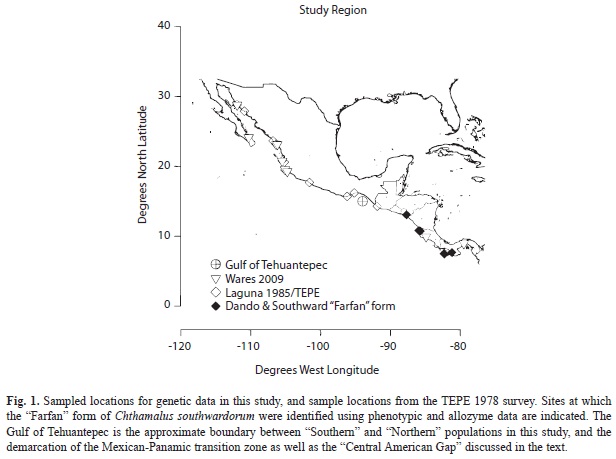
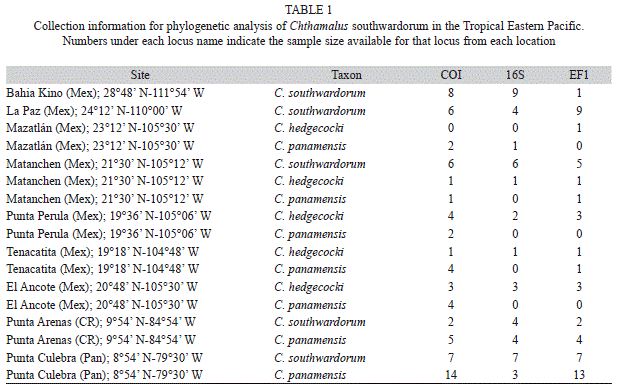
<body><![CDATA[<br>     <br> <font style="font-family: verdana;" size="2">One such transition zone is found along the Mexican coast of the Tropical Eastern </font><font style="font-family: verdana;" size="2">Pacific (TEP) ocean between roughly 13-15&deg;N latitude. Called the &#8220;Central American Gap&#8221; (CAG) by some (Hastings 2000, Pitombo &amp; Burton 2007) and the Mexican-Panamic transition zone (MPTZ) in other sources (Laguna1990), this region separates the Mexican and Panamic sensu stricto marine provinces with a &#8220;stretch of coastline over 1 200km in length dominated by sandy/muddy shores and mangrove- lined lagoons&#8221; (Hastings 2000). This region is known to influence the distribution of rocky shore and reef fish, as well as invertebrates, and is a likely factor in the separation of cryptic species in the region.</font>    <br>     <br> <font style="font-family: verdana;" size="2">The widespread barnacle genus <span style="font-style: italic;">Chthamalus</span> has been the subject of several biogeographic studies in the TEP (Laguna 1990, Wares 2001, Pitombo &amp; Burton 2007, Wares <span style="font-style: italic;">et al.</span> 2009). Very low levels of morphological variation have made determining species distributions difficult, and until recently many species in the &#8216;<span  style="font-style: italic;">fissus</span> group&#8217; (defined by two minute but verified synapomorphies) were considered </font><font  style="font-family: verdana;" size="2">a single species or species complex (Dando 1987). Recent phylogenetic studies have indicated that cryptic diversity is yet to be fully explored in this group, with fine-scale morphological variation and DNA barcoding being used to fully describe two new species, <span  style="font-style: italic;">C. hedgecocki </span>and<span style="font-style: italic;"> C. southwardorum</span> (Pitombo&amp; Burton 2007). Based on morphology alone, the latter is reported to be distributed from Bahio Kino, Mexico, to Puerto Chicama, Per&uacute;, but molecular data were previously only available from the Northernmost samples. Pitombo &amp; Burton (2007) predicted that a sibling species group may still exist in this widespread species range, which crosses the CAG; this prediction was founded in part on allozyme data presented by Dando &amp; Southward (1980), but no formal revision or analysis has been completed to date.</font>    <br>     <br> <font style="font-family: verdana;" size="2">To evaluate both the potential for further cryptic diversity and the insights this diversity can provide for understanding the temporal habitat dynamics of the CAG, we have analyzed previously sampled populations of <span style="font-style: italic;">C. southwardorum</span> from sites North and South of this faunal transition and use mitochondrial and nuclear sequence-based markers to measure genetic differentiation among these sites. The same methods are applied to a closely related species pair, <span  style="font-style: italic;">C. hedgecocki </span>and<span style="font-style: italic;"> C. panamensis</span>, that are found in more wave-exposed coastal habitats. We use analytical approaches based on coalescent theory that allow the co-estimation of divergence times among populations and the migration rates among them (the isolation-migration model; Hey &amp; Nielsen 2004). This approach enables us to separate the effects of ancestral polymorphism and gene flow at loci where alleles are shared between the two regions. Using substitution rates generated from a phylogenetic analysis of the genus (Wares <span  style="font-style: italic;">et al.</span> 2009), we have also evaluated the likely time frame at which these regional populations could have become isolated from one another.</font>    <br>     <br> <font style="font-family: verdana; font-weight: bold;" size="3">Materials and Methods</font>    <br>     <br> <font style="font-family: verdana;" size="2"><span  style="font-weight: bold;">Study system:</span> The taxonomy of this species complex has been confused in the literature for nearly 30 years. This has been in part because although data were available to indicate there were two pairs of <span style="font-style: italic;">Chthamalus</span> along this coast (Northern and Southern pairs of wave-exposed habitat and wave-sheltered habitat species), the taxonomy was only partially updated by Pitombo &amp; Burton (2007), after a series of intervening papers that applied unofficial and inconsistent nomenclature. The four species evaluated here, with an attempt at taxonomic history for each, are: <span style="font-style: italic;">C. panamensis</span> Pilsbry &#8211; though its exact distribution has been in question given the difficulty in field identification of this species, panamensis has been consistently used for this taxon. Found in wave-exposed coastal habitats, this species resides primarily in Southern locations in the TEP. Pitombo &amp; Burton (2007) indicated that it may range as far North as 20&deg;N.</font>    ]]></body>
<body><![CDATA[<br>     <br> <font style="font-family: verdana;" size="2"><span  style="font-style: italic;">C. hedgecocki</span> Pitombo &amp; Burton &#8211; originally part of the <span style="font-style: italic;">C. fissus</span> (Darwin) species </font><font style="font-family: verdana;" size="2">complex (Hedgecock 1979), this species was distinguished from the rest of the complex using phenotypic and electrophoretic data by Dando &amp; Southward (1980) and unofficially called <span  style="font-style: italic;">C. &#8220;mexicanus&#8221;</span>. The same name was also used by Laguna (1990), but this species was officially described as <span style="font-style: italic;">C. hedgecocki</span> in Pitombo &amp; Burton (2007). It is found in waveexposed coastal habitats, primarily at Northern </font><font  style="font-family: verdana;" size="2">locations in this region.</font>    <br>     <br> <font style="font-family: verdana;" size="2"><span  style="font-style: italic;">C. southwardorum</span> Pitombo &amp; Burton &#8211; as with <span style="font-style: italic;">C. hedgecocki</span>, this was originally distinguished as a separate taxon by Dando &amp; Southward (1980) and unofficially called <span style="font-style: italic;">C. &#8220;cortesianus&#8221;</span> (Laguna 1990). Formally described as <span style="font-style: italic;">C. southwardorum</span> in Pitombo &amp; Burton (2007), it can be found in wavesheltered coastal habitats, solely at Northern locations in this region.</font>    <br>     <br> <font style="font-family: verdana;" size="2"><span  style="font-style: italic;">C. southwardorum</span> &#8220;Farfan&#8221; form &#8211; named for the putative type locality in Panama (at which 100% of individuals were of this form in 1978, P. Dando <span style="font-style: italic;">pers. comm.</span>), populations of this form were identified as distinct by Dando &amp; Southward (1980) but with no formal description. It has been confused in the literature with <span  style="font-style: italic;">C. southwardorum</span> sensu stricto, which may influence our understanding of regional biogeography. The &#8220;Farfan&#8221; form is found in wave-sheltered coastal habitats, solely at Southern locations in this region. Recent data further suggest a difference between the forms (Wares <span  style="font-style: italic;">et al.</span> 2009), though the nomenclature of the <span style="font-style: italic;">C. southwardorum</span> A and B clades is inconsistent in that source.</font>    <br>     <br> <font style="font-family: verdana;" size="2">Note that other congeneric species, including <span style="font-style: italic;">C. fissus </span>and<span  style="font-style: italic;"> C. anisopoma</span>, may be sympatric with these taxa in the Gulf of California or along the Baja California peninsula, but are more readily distinguished from this complex.</font>    <br>     <br> <font style="font-family: verdana;" size="2"><span  style="font-style: italic;">Chthamalus</span> individuals were collected in 2005-2006 from seven primary locations in the TEP (<a href="/img/revistas/rbt/v61n1/a06i1.jpg">Fig. 1</a>, <a href="/img/revistas/rbt/v61n1/a06t1.gif">Table 1</a>) as part of a global phylogeny of the group (Wares <span style="font-style: italic;">et al.</span> 2009). Species in this complex are largely indistinguishable in the field based on external morphology (Pitombo &amp; Burton 2007; P. Dando, <span style="font-style: italic;">pers. comm.</span>). Thus, it was not possible to sample directly for particular species, but rather the available specimens were defined using standard DNA barcoding approaches with the mitochondrial cytochrome oxidase I (COI) locus (Wares <span  style="font-style: italic;">et al.</span> 2009). Specimens of <span style="font-style: italic;">C. southwardorum</span> were found in five locations (Table 1, Fig. 1), with three locations North of the CAG and two locations to the South. Specimens of <span style="font-style: italic;">C. hedgecocki </span>and<span  style="font-style: italic;"> C. panamensis</span> were identified from three additional locations (Table 1). Molecular PCR and sequencing techniques are described in Wares <span style="font-style: italic;">et al.</span> (2009). Two sequences at the 16S locus from the previous study, one each from <span  style="font-style: italic;">C. panamensis</span> and <span  style="font-style: italic;">C. southwardorum</span>, were excluded from analysis after being identified as either erroneously labeled or product of contamination. Removal of these two sequences results in the reciprocal monophyly of <span  style="font-style: italic;">C. southwardorum</span> and the clade containing <span  style="font-style: italic;">C. hedgecocki </span>and<span  style="font-style: italic;"> C. panamensis</span> (Wares <span style="font-style: italic;">et al.</span> 2009).    ]]></body>
<body><![CDATA[<br>     <br> </font></font><font size="2"><font style="font-family: verdana;"  size="2"><span style="font-weight: bold;">Phylogenetic analysis:</span> Here we use previously reported (Wares <span style="font-style: italic;">et al.</span> 2009) aligned sequence data for two mitochondrial gene regions (COI and 16S rDNA) and one nuclear locus (elongation factor 1-alpha, EF1) from the locations indicated in <a href="/img/revistas/rbt/v61n1/a06t1.gif">table 1</a> and <a href="/img/revistas/rbt/v61n1/a06i1.jpg">figure 1</a>. Additional nuclear sequence data are available for these specimens, but provide little phylogenetic signal at this level and considerable homoplasy (Wares <span  style="font-style: italic;">et al.</span> 2009). The separation of locations by the CAG is used for all a <span style="font-style: italic;">priori </span>structuring of data in subsequent analysis. Due to difficulty in amplifying some loci from some individuals, not all locations/individuals/loci are equally represented (<a  href="/img/revistas/rbt/v61n1/a06t1.gif">Table 1</a>).</font>    <br>     <br> <font style="font-family: verdana;" size="2">Sequence data at the EF1 nuclear locus were directly sequenced and polymorphism </font><font style="font-family: verdana;" size="2">within sequences was recoded as ambiguity, either unknown &#8220;N&#8221; in mitochondrial data or appropriate IUPAC ambiguity codes for nuclear data. Phylogenetic reconstructions were performed on the concatenated data using MrBayes v3.1.2 (Ronquist &amp; Huelsenbeck 2003) with model estimation unlinked across loci. Bayesian estimation followed 5x10<sup>6</sup> generations of four MCMC chains, with a burn-in fraction of 25%. Data from the EF1 locus were analyzed with ambiguity represented as heterozygous sites for phylogenetic analysis.</font>    <br> <br style="font-weight: bold;"> <font style="font-family: verdana;" size="2"><span  style="font-weight: bold;">Coalescent analysis:</span> We analyzed the data as multilocus observations from the Northern and Southern sites using the program IMa2 (Hey &amp; Nielsen 2004), which applies the isolation-migration model for estimation of the relative importance of migration and time since divergence. The IMa2 program uses a Markov Chain Monte Carlo method for assessing posterior probability densities of six model parameters: time of divergence, migration from North to South, migration from South to North, and effective population sizes for the two regional populations as well as their ancestral source population. Substitution rate estimates for each locus (Wares <span style="font-style: italic;">et al.</span> 2009) were included to allow the time since divergence to be estimated from the coalescent model. These rates, in units of substitutions per locus/year, are: mtCOI (1.83x10<sup>-5</sup>); mt16S (7.65x10<sup>-6</sup>); nEF1 (1.86x10<sup>-6</sup>). The nEF1 data were separated into haplotypes for coalescent analysis using the PHASE algorithm (Stephens <span style="font-style: italic;">et al.</span> 2001) as implemented in DNAsp (Librado &amp; Rozas 2009). This analysis was repeated for the taxon pair <span  style="font-style: italic;">C. hedgecocki </span>&#8211;<span style="font-style: italic;"> C. panamensis</span>, and for Northern and Southern populations of <span style="font-style: italic;">C. panamensis</span>. Priors allowed for population mutation rates ranging from 10-100 (most likely estimate based on &#960; of 15 was used for final calculations with a maximal range of 30, see below), migration parameter from 0-5, and separation time of four coalescent units. A burn-in period of 10 000 steps was used, followed by a run duration of 10<sup>8</sup> steps with 20 geometrically heated chains.</font>    <br>     <br> <font style="font-family: verdana;" size="2">Given the potential for spatial and temporal concordance of separation between the </font><font style="font-family: verdana;" size="2">Northern and Southern species pairs, temporal association was tested using the msBayes pipeline (Hickerson <span style="font-style: italic;">et al.</span> 2006). This approach uses approximate Bayesian computation (ABC) simulation approaches to evaluate the most likely isolation scenarios associated with empirical data; in our case we used 106 simulated data sets and an upper prior on ancestral effective size equal to the upper prior on current effective size (otherwise default parameters for analysis).</font>    <br>     <br> <font style="font-family: verdana;" size="3"><span  style="font-weight: bold;">Results</span>    <br>     ]]></body>
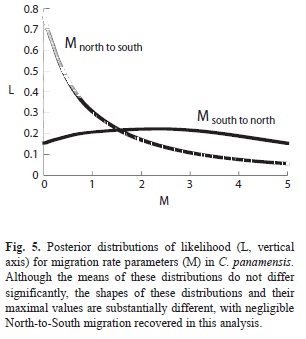
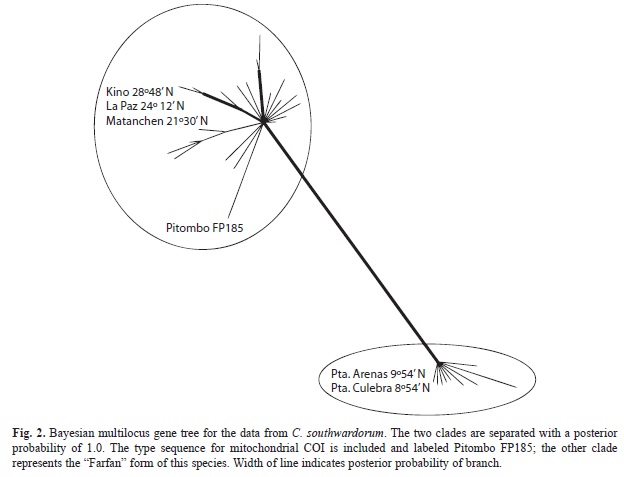
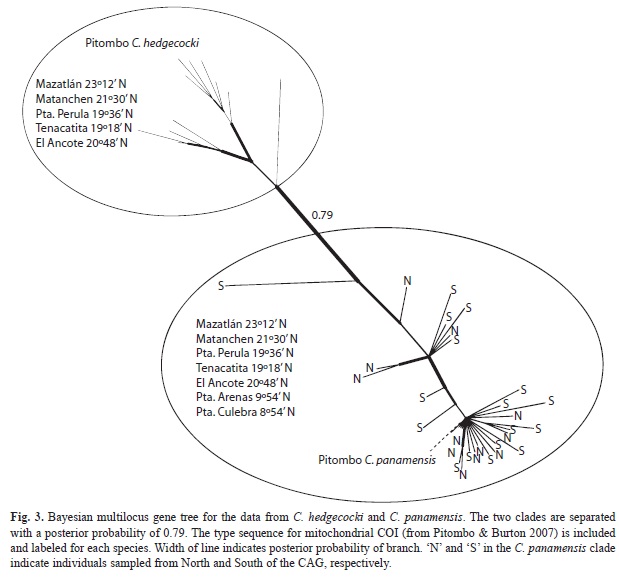
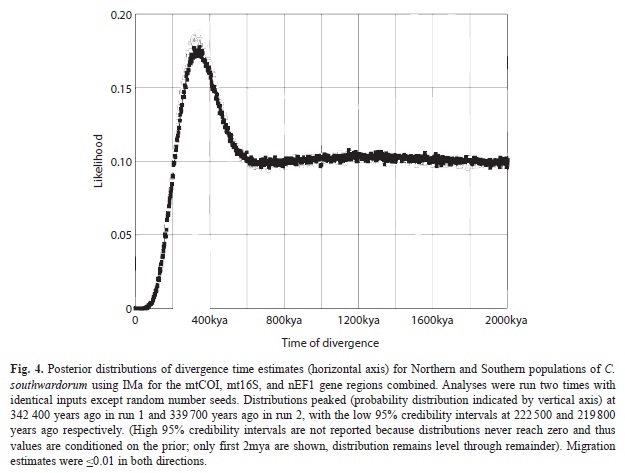
<body><![CDATA[<br> </font><font style="font-family: verdana;" size="2"><span  style="font-weight: bold;">Phylogenetic analysis:</span> Data from <span  style="font-style: italic;">C. southwardorum, C. panamensis, </span>and<span  style="font-style: italic;"> C. hedgecocki</span> used in this study are as in Wares <span  style="font-style: italic;">et al.</span> (2009) but with more focused analysis of genealogical relationships. Genbank voucher numbers for all sequence data are provided in Wares <span  style="font-style: italic;">et al.</span> (2009). Bayesian phylogenies for each taxon pair are shown in <a  href="/img/revistas/rbt/v61n1/a06i2.jpg">figures 2</a> and <a  href="/img/revistas/rbt/v61n1/a06i3.jpg">3</a>; similar results were obtained from likelihood bootstrap analysis and parsimony analysis (results not shown). Net nucleotide divergence (Nei &amp; Li 1979)Li - Proceedings of the National Academy of Sciences - 1979 between the Northern and Southern populations of <span style="font-style: italic;">C. southwardorum</span> was 0.0288&plusmn;0.0043 for COI, 0.0047&plusmn;0.0019 for 16S, and 0.0019&plusmn;0.0013 for EF1 (0.0044&plusmn;0.0016 after haplotype phase calculated). Given the substitution rates indicated above, these d<sub>A</sub> values would suggest divergence times of approximately 5.11x10<sup>5</sup>, 1.69x10<sup>5</sup>, and 5.32x10<sup>5</sup> years, respectively (mean 4.04x10<sup>5</sup>).    <br>     <br> </font></font><font size="2"><font style="font-family: verdana;"  size="2">For comparison, the divergence of the <span style="font-style: italic;">C. panamensis </span>&#8211;<span  style="font-style: italic;"> C. hedgecocki</span> species pair involves net nucleotide divergences of 0.0210&plusmn;0.0040 for COI, 0.0091&plusmn;0.0051 for 16S, and 0.0034&plusmn;0.0025 for EF1. These values suggest divergence times at each locus of approximately 3.73x10<sup>5</sup>, 3.27x10<sup>5</sup>, 4.81x10<sup>5</sup> (mean 3.98x10⁵) years.</font>    <br>     <br> <font style="font-family: verdana;" size="2"><span  style="font-weight: bold;">Coalescent analysis:</span> Homogeneity of populations in the Northern and Southern regions for each taxon was indicated from Hudson&#8217;s (2000) Snn statistic (p&gt;0.05 in all cases). Coalescent analysis of the nEF1 locus produced similar results for <span style="font-style: italic;">C. southwardorum</span> whether using phased or unphased sequences (results not shown); each supported negligible migration between populations of <span  style="font-style: italic;">C. southwardorum</span>, though the age estimation based on the nEF1 locus alone is relatively uninformative as there is considerably less polymorphism. Overall, the IMa2 analyses ran sufficiently long to reach good convergence as determined by effective sample size (ESS) values and very similar likelihood distributions (<a href="/img/revistas/rbt/v61n1/a06i4.jpg">Fig. 4</a>). Effective size estimates were consistent between runs, with the ancestral effective population size 9.27-9.54x10<sup>4</sup>, and current effective population sizes of 1.45-1.47x10<sup>5</sup> (Northern) and 2.36x10<sup>5</sup> (Southern). Migration rate estimates between the two regional populations were consistently negligible (&#8804;0.0001 migrants per 1 000 generations in either direction). Posterior probability distributions of divergence time estimates peaked approximately 340kya in all runs, with minimum 95% limits at around 220kya (<a href="/img/revistas/rbt/v61n1/a06i4.jpg">Fig. 4</a>). High 95% limits are not reported because the distributions have fat tails and thus these maximum (and mean) values are conditioned on the prior. Our time distribution range was set to correspond with the time since the rise of the Isthmus of Panama (~three million years ago).    <br>     <br> </font></font><font size="2"><font style="font-family: verdana;"  size="2">An identical analysis performed on the <span style="font-style: italic;">C. panamensis </span>&#8211;<span  style="font-style: italic;"> C. hedgecocki</span> species pair was consistent with the above results. Migration rate estimates between the two taxa were consistently negligible (&#8804;0.001 migrants per 1 000 generations in either direction). However, the posterior probability distribution of divergence time estimates exhibited an increasing function with time, meaning no useful estimate of divergence is possible with these data.</font>    <br>     <br> <font style="font-family: verdana;" size="2">Full analysis of the <span  style="font-style: italic;">C. panamensis</span> data in IMa2 indicated maximal population sizes in current Northern and Southern regions (e.g. limited only by the prior, as discussed here prior maximum on theta is 30; see Discussion). The ancestral population substitution rate estimate was approximately what would be predicted from &#960; (13.9; 95% range 8.26- 24.38). Migration rate 2Nm from the South to the North was estimated at (mean) 2.46 (0.16, 4.84) and from North to South at 1.48 (0.03, 4.58). Plots of migration rates between the two regions are substantially different, with a maximal posterior probability from South to North of 2.36 and from North to South of 0.003 (<a href="#fig_5">Fig. 5</a>). The time of separation of the Northern and Southern populations, coestimated with migration, is approximately 166 830 years given our substitution rate estimates (95% range of 47 400-922 000).     <br>     ]]></body>
<body><![CDATA[<br> </font></font>     <div style="text-align: center;"><a name="fig_5"></a><img alt=""  src="/img/revistas/rbt/v61n1/a06i5.jpg"  style="width: 306px; height: 339px;">    <br> </div> <font size="2">    <br> <font style="font-family: verdana;" size="2">Analysis in msBayes of the coalescentbased divergence times of the two species pairs indicated high probability that separation of the two lineages of <span style="font-style: italic;">C. southwardorum</span>, and <span style="font-style: italic;">C. panamensis </span>and<span  style="font-style: italic;"> C. hedgecocki</span>, was temporally concordant. With local multinomial logit regression, the posterior probability for a single divergence time between the two pairs was 0.929, with remaining probability allowed for two distinct divergence times. The estimated time of simultaneous divergence using this approach, with the calculations of Huang <span  style="font-style: italic;">et al.</span> (2011), is 315 000 years (assuming a generation time of one year and the substitution rates noted above).</font>    <br>     <br> <font style="font-family: verdana;" size="3"><span  style="font-weight: bold;">Discussion</span>    <br>     <br> </font><font style="font-family: verdana;" size="2">Our results suggest a temporal pattern of increasing isolation among TEP chthamalid barnacles; the deepest separation of the four species evaluated suggests that the sheltered-exposed species pairs were separated approximately one million years ago, based on net nucleotide divergences ranging from 7.5- 8% at mitochondrial COI. The focus of this study, the potential for geographic isolation of species across the CAG, allows us to evaluate the potential for a single environmental change promoting separation of Northern and Southern lineages of both the wave-sheltered and waveexposed forms. Based on classical approaches </font><font style="font-family: verdana;" size="2">such as net nucleotide divergence, as well as two different coalescent estimators, our results are surprisingly consistent in estimating a separation time between <span style="font-style: italic;">C. hedgecocki</span> and <span style="font-style: italic;">C. panamensis</span>, and the type and &#8220;Farfan&#8221; forms of <span style="font-style: italic;">C. southwardorum</span>, of approximately 400kya, corresponding with the timing of one of the mid-Pleistocene high sea level stands (Muhs <span style="font-style: italic;">et al.</span> 2004). These results also indicate strongly (92.9% posterior probability) that isolation of <span  style="font-style: italic;">C. southwardorum</span> Northern and Southern populations was temporally concordant with the isolation of <span style="font-style: italic;">C. hedgecocki</span> and <span style="font-style: italic;">C. panamensis</span>. It remains to be determined if this apparent vicariant event is associated with a biogeographic transition zone between the Mexican and Panamic provinces (requiring further analysis of species that do cross the region) or a true habitat and faunal gap (Audzijonyte &amp; Vrijenhoek 2010).</font>    <br>     <br> <font style="font-family: verdana;" size="2">Estimation of gene flow between these two taxon pairs (treating the Southern populations of <span style="font-style: italic;">C. southwardorum</span> as a distinct taxon, or at least separate population) indicates negligible gene flow between the Northern and Southern forms of both the wave-sheltered (<span  style="font-style: italic;">C. southwardorum</span>) and wave-exposed (<span  style="font-style: italic;">C. hedgecocki, C. panamensis</span>) taxa. However, additional analysis of the one taxon for which we have samples spanning the region, <span style="font-style: italic;">C. panamensi</span>s, indicates that a more recent (~160kya) expansion from the Southern populations to the North is likely to be the cause of the current distribution, both geographic and in terms of genetic diversity. All of these results are also supported by the inclusion of data from one additional nuclear locus, though sample sizes were too small to provide sufficient additional information (results not shown).</font>    ]]></body>
<body><![CDATA[<br>     <br> <font style="font-family: verdana;" size="2">Conclusions from our analyses must be tempered by the sparse samples available for this study. Most of the sequence data are from a single mitochondrial locus, sequenced at two distinct regions (mtCOI and mt16S). It should be emphasized that the data obtained were initially part of a separate phylogenetic analysis in which cryptic species were distinguished, without reference to external morphology in field collections. Samples of <span style="font-style: italic;">C. southwardorum</span> were not recovered from sites immediately North of the CAG, nor were any chthamalids identified within the CAG during the NSF-funded Tropical Eastern Pacific Expedition of Newman in 1978 (W. Newman, P. Dando, E. Southward, <span  style="font-style: italic;">pers. comm.</span>). Thus, the opportunistic sample size reflects both the sampling effort and PCR success in these samples. Considering the reciprocal monophyly of regional samples at mitochondrial gene regions and extensive lineage sorting at nuclear gene regions, the results appear to be robust to sample size (Rosenberg 2007). One problematic result of the coalescent analyses was the estimate of Ne in populations of <span  style="font-style: italic;">C. panamensis</span> being predicated on the maximum of the prior distribution. This is often the case when the data are limiting, and may be associated with the signal of expansion noted above. </font>    <br>     <br> <font style="font-family: verdana;" size="2">Briggs (1974) and Brusca &amp; Wallerstein (1979) first indicated that a zoogeographic break in the marine fauna existed at approximately 15&deg; N (roughly the Gulf of Tehuantepec). There are a number of strong environmental shifts associated with this coastal region (Udvardy 1975, Hayden &amp; Dolan 1976). There are significant sea surface temperature and wind stresses associated with the Gulf of Tehuantepec (Sun &amp; Yu 2006), generating strong upwelling in the Gulf and offshore movement of surface waters (Kessler 2006, Barton <span  style="font-style: italic;">et al.</span> 2009). Upwelling patterns alone have previously been associated with divergence of regional barnacle populations (Dando &amp; Southward 1981). The coast in this region is predominantly sandy (Robertson &amp; Cramer 2009, W. A. Newman, <span style="font-style: italic;">pers. comm.</span>), with little consolidated habitat for barnacles or reef organisms to persist. A remaining concern is whether this region represents a true faunal &#8216;gap&#8217; or transition zone, a question that requires integration across more taxa (Audzijonyte &amp; Vrijenhoek 2010).</font>    <br>     <br> <font style="font-family: verdana;" size="2">While certain groups of species that require consolidated habitat have reduced diversity or abundance in this region, indicating a gap, the patterns of distribution in most taxa may still be consistent with an overlap zone between two biogeographic provinces. Reid (2002) provides such data for littorinid snails, and Laguna (1990) illustrates this in the distribution of barnacles along the tropical Eastern Pacific coast. Notably, there is a clear demarcation between the Mexican and Panamic provinces <span style="font-style: italic;">sensu stricto</span>, but there are a number of barnacle species defined by Laguna (1990) as being of the Panamic province <span  style="font-style: italic;">sensu lato</span> that do broadly overlap this transition zone and the CAG.</font>    <br>     <br> <font style="font-family: verdana;" size="2">The present study makes it apparent that at least one of these species (called <span style="font-style: italic;">C. &#8220;mexicanus&#8221;</span> at the time, but presently <span style="font-style: italic;">C. southwardorum</span>) does not readily cross this region. Though the samples in the present study are sparse, it is consistent with information from the TEPE survey, with no representatives of <span style="font-style: italic;">C. southwardorum</span> (or the &#8220;Farfan&#8221; form) collected between 9&deg;54&#8217; N and 21&deg;30&#8217; N. Based on allozyme data from the earlier survey, what is now <span  style="font-style: italic;">C. southwardorum</span> was found in high abundance in the Northern Gulf of California&nbsp; (and 100% of our Chthamalus from Bahia Kino are <span style="font-style: italic;">C. southwardorum</span>), but collections between Bahia Chamela (19&deg;30&#8217; N), Salina Cruz (16&deg; N) and at Isla Sacrificios (15&deg;42&#8217; N) recovered only <span  style="font-style: italic;">C. hedgecocki</span> (P. Dando, W. Newman, pers. comm.). In the Southern range, as far North as Murci&eacute;lagos, Costa Rica (10&deg;48&#8217; N) only <span  style="font-style: italic;">C. panamensis</span> were recovered at the time. Certainly, even when multiple species are present, one may be extremely rare or microhabitat specific. It is an open question whether genetic analysis of other species in this region (group IV in Laguna 1990) would indicate a population genetic pattern consistent with the divergence of <span style="font-style: italic;">C. southwardorum</span>.</font>    <br>     <br> <font style="font-family: verdana;" size="2">The generality of results presented here to the broader faunal distribution patterns of the Tropical Eastern Pacific remains ambiguous. It is clear that for some taxa that require (or form) consolidated substrate or reef habitat, the lack of such habitat in this region (the Central American Gap) is a significant demarcation in diversity along this coast (Hastings 2000, D&iacute;az- Jaimes <span  style="font-style: italic;">et al.</span> 2006, Vargas <span style="font-style: italic;">et al.</span> 2008). Studies that have focused only on the apparent distribution of species suggest, however, that the effect of these habitat gaps on marine diversity is minimal and the association of transition zones with gaps like the CAG is possibly stochastic (Robertson &amp; Cramer 2009). Robertson &amp; Cramer (2009) note that because the appearance of the CAG as a &#8220;distinctive entity&#8221; in their analysis is in part because of an absence of data, rather than information on the potential for migration or gene flow across the region, additional range-wide genetic analysis of fish and other taxa is warranted. The small number of population genetic studies that span this region suggest there are many cryptic populations along the TEP coast (Hellberg 1998, Arnaud <span style="font-style: italic;">et al.</span> 2000, D&iacute;az-Jaimes <span style="font-style: italic;">et al.</span> 2006, Wares <span style="font-style: italic;">et al.</span> 2009, Saarman <span style="font-style: italic;">et al.</span> 2010), and in many cases the break in diversity could be spatially associated with the CAG (D&iacute;az-Jaimes <span style="font-style: italic;">et al.</span> 2006, Hurtado <span style="font-style: italic;">et al.</span> 2007, Pitombo &amp; Burton 2007). In the intertidal snail Nerita, two species are known to span this region; one exhibits a strong break while the other does not (Hurtado <span style="font-style: italic;">et al.</span> 2007) L.A. Frey, M .&nbsp; Gaube , P.&nbsp; Pfeiler , E . Markow, T.A.</font><font  style="font-family: verdana;" size="2"> Geographical subdivision, demographic history and gene flow in two sympatric species of intertidal snails, Nerita scabricosta and Neritafuniculata ,from the tropical eastern Pacific </font><font  style="font-family: verdana;" size="2">MarineBiology Marine Biology</font><font  style="font-family: verdana;" size="2"> Mar.Biol. 1863-1873 151 5 Baja California differentiation fish gulf-of-california human mitochondrial-NA patterns penaeus-stylirostris population growth rockyshore sequences 2007&nbsp; 0025-3162 Doi10.1007/S00227-007-0620-5, suggesting that knowledge of both habitat and interactions between life history, behavior, and physical oceanography may be necessary to predict the effect of this habitat break on coastal diversity.</font>    ]]></body>
<body><![CDATA[<br>     <br> <font style="font-family: verdana;" size="2">Robertson &amp; Cramer (2009) noted that the CAG may have formed recently relative </font><font style="font-family: verdana;" size="2">to the origins of many taxa in their study, and that more work must be done to assess intraspecific genetic variation among populations of TEP fish taxa on either side of the CAG. Although they argue that the distribution of species suggests gene flow has the potential to be quite high even across this substantial habitat gap &#8211; placing the emphasis on other forms of environmental variation for driving the diversity patterns of this coast &#8211; we show that for species with long (2-3 weeks; Miller <span style="font-style: italic;">et al.</span> 1989) effective larval dispersal, gene flow is negligible. On recent time scales, the CAG may be promoting intraspecific diversification. It is important to note that the CAG may have distinct effects on different groups of organisms; the delimitation based on absence of reef fishes (Robertson &amp; Cramer 2009) is quite narrow (15-16&deg; N). It may be that more vagile organisms like pelagic fish are less sensitive to such barriers (Lessios &amp; Robertson 2006), while benthic invertebrates or demersal fish have less opportunity to complete such a journey and successfully recruit (Waters <span style="font-style: italic;">et al.</span> 2007). For intertidal invertebrates, and in particular the Cirripedia, this region is certainly an area of faunal transition (Laguna 1990), separating the Mexican and Panamic provinces. The mechanism for diversification may be more than simply habitat availability, as Laguna (1990; also W. A. Newman, P. Dando, <span  style="font-style: italic;">pers. comm.</span>) points to earlier work that suggests local currents and upwelling could act as dispersal barriers in this depositional shoreline region. Eventually, with addition of more locational information and microhabitat environmental data, there may be more explicit ways to evaluate the mechanism by which these species have been separated (Glor &amp; Warren 2011). A more thorough spatial survey will be necessary to fully generate models that are useful for microhabitat identification (Lozier <span style="font-style: italic;">et al.</span> 2009).</font>    <br>     <br> <font style="font-family: verdana;" size="2">Assuming an average age of the isolating event between these Northern and Southern lineages of around 400kya (<a  href="/img/revistas/rbt/v61n1/a06i4.jpg">Fig. 4</a>), it is not clear what model of isolation best fits these data. The analytical approaches used here are necessarily indirect (Slatkin 1985) and can have their limitations (Wares &amp; Cunningham 2005), but the concordant results between two distinct estimators suggests our temporal estimate is robust. Hickerson &amp; Meyer (2008) developed a method for comparing the likelihood of &#8220;soft&#8221; vicariance (in which an effectively panmictic species then becomes isolated across some stretch of its geographic range because of habitat </font><font style="font-family: verdana;"  size="2">or climate change) versus peripatric events in which a colonization from one side of the boundary establishes a new lineage on the other side. However, these methods require data from a larger number of taxa. Separating the influences of temporal isolation and recurrent gene flow is often critical in assessing alternate historical scenarios that could produce patterns of extant diversity (McGovern <span  style="font-style: italic;">et al.</span> 2010). </font>    <br>     <br> <font style="font-family: verdana;" size="2">The question of whether the two subgroups, Northern and Southern, of <span  style="font-style: italic;">C. southwardorum</span> merit taxonomic revision is a question that has been addressed but only informally. The regional populations were considered likely to represent separate taxa based on the relative mobilities of Ald and Pgk allozymes, and some </font><font  style="font-family: verdana;" size="2">coloration differences between exposed-shore populations and sheltered populations in the Mexican (now <span style="font-style: italic;">C. hedgecocki </span>and<span style="font-style: italic;"> C. southwardorum</span>) and Panamic (now <span style="font-style: italic;">C. panamensis</span> and the Southern group of <span style="font-style: italic;">C. southwardorum</span>) provinces (Dando &amp; Southward 1980), and tergal groove morphology separating the two Panamic species. The exposed coast forms have orange tergal-scutal tissue flaps (with two pale spots on the flap in <span  style="font-style: italic;">C. hedgecocki</span>), and the sheltered coast forms are brown or &#8220;orange-brown&#8221; for the same tissues (P. Dando, pers. comm.). Pitombo &amp; Burton (2007) also note that <span style="font-style: italic;">C. southwardorum</span> could consist of two sibling species, but this was untested in that study. At present it is simply referred </font><font style="font-family: verdana;" size="2">to as the &#8220;Farfan&#8221; form to avoid any further taxonomic confusion in this group; full taxonomic designation will require integration of phenotypic and genetic identifiers, and will be handled separately. What may be of most general interest about these results &#8211; particularly in designing future studies of taxa that apparently cross this coastal region &#8211; is that for <span style="font-style: italic;">Chthamalus</span>, the speciation of inshore (sheltered) and outer coast (exposed) forms clearly happened first (Wares <span  style="font-style: italic;">et al.</span> 2009), followed by the latitudinal divergence associated here with the CAG. The generality of this result should be examined further.</font>    <br>     <br> <font style="font-family: verdana;" size="3"><span  style="font-weight: bold;">Acknowledgments</span>    <br>     <br> </font><font style="font-family: verdana;" size="2">The authors would like to express their appreciation first and foremost to Bill Newman, Eve Southward, and Paul Dando, who dug into their files to recover historical surveys of the chthamalid fauna to assist our study. We certainly appreciate the decades of work these scientists and the late Alan Southward put into study of the Cirripedia, and these species in particular. Fabio Pitombo, Liza Gomez Daglio, and John Binford contributed significantly to early data collection efforts in this project. Carolyn Embach provided technical editing services. This work was partially supported by the National Science Foundation (OCE-1029526 to JPW) and the U.S.-Israel Binational Science Foundation (grant # 2004/239 to JPW).</font>    ]]></body>
<body><![CDATA[<br> <font style="font-family: verdana;" size="3"><span  style="font-weight: bold;"></span></font> </font> <hr style="width: 100%; height: 2px;"><font size="2"><font  style="font-family: verdana;" size="3"><span style="font-weight: bold;">References</span>    <br>     <!-- ref --><br> </font><font style="font-family: verdana;" size="2">Arnaud, S., M. Monteforte, N. Galtier, F. Bonhomme &amp; F. Blanc. 2000. Population structure and genetic variability of pearl oyster <span style="font-style: italic;">Pinctada mazatlanica</span> along Pacific coasts from Mexico to Panama. Conserv. Genet. 1: 299-307.    &nbsp;&nbsp;&nbsp;&nbsp;&nbsp;&nbsp;&nbsp;&nbsp;[&#160;<a href="javascript:void(0);" onclick="javascript: window.open('/scielo.php?script=sci_nlinks&ref=1825532&pid=S0034-7744201300010000600001&lng=','','width=640,height=500,resizable=yes,scrollbars=1,menubar=yes,');">Links</a>&#160;]<!-- end-ref --></font>    <br>     <!-- ref --><br> <font style="font-family: verdana;" size="2">Audzijonyte, A. &amp; R.C. Vrijenhoek. 2010. When gaps really are gaps: Statistical phylogeography of hydrothermal vent invertebrates. Evolution 64: 2369-2384.    &nbsp;&nbsp;&nbsp;&nbsp;&nbsp;&nbsp;&nbsp;&nbsp;[&#160;<a href="javascript:void(0);" onclick="javascript: window.open('/scielo.php?script=sci_nlinks&ref=1825535&pid=S0034-7744201300010000600002&lng=','','width=640,height=500,resizable=yes,scrollbars=1,menubar=yes,');">Links</a>&#160;]<!-- end-ref --></font>    <br>     <!-- ref --><br> <font style="font-family: verdana;" size="2">Barton, E.D., M.F. Lavin &amp; A. Trasvina. 2009. Coastal circulation and hydrography in the Gulf of Tehuantepec, Mexico, during winter. Cont. Shelf Res. 29: 485-500.    &nbsp;&nbsp;&nbsp;&nbsp;&nbsp;&nbsp;&nbsp;&nbsp;[&#160;<a href="javascript:void(0);" onclick="javascript: window.open('/scielo.php?script=sci_nlinks&ref=1825538&pid=S0034-7744201300010000600003&lng=','','width=640,height=500,resizable=yes,scrollbars=1,menubar=yes,');">Links</a>&#160;]<!-- end-ref --></font>    ]]></body>
<body><![CDATA[<br>     <!-- ref --><br> <font style="font-family: verdana;" size="2">Briggs, J.C. 1974. Marine Zoogeography. McGraw-Hill, New York, USA.    &nbsp;&nbsp;&nbsp;&nbsp;&nbsp;&nbsp;&nbsp;&nbsp;[&#160;<a href="javascript:void(0);" onclick="javascript: window.open('/scielo.php?script=sci_nlinks&ref=1825541&pid=S0034-7744201300010000600004&lng=','','width=640,height=500,resizable=yes,scrollbars=1,menubar=yes,');">Links</a>&#160;]<!-- end-ref --></font>    <br>     <!-- ref --><br> <font style="font-family: verdana;" size="2">Brusca, R.C. &amp; B.R. Wallerstein. 1979. Zoogeographic patterns of idoteid isopods in the northeast Pacific, with a review of shallow-water zoogeography for the region. Bull. Biol. Soc. Wash. 3: 67-105.    &nbsp;&nbsp;&nbsp;&nbsp;&nbsp;&nbsp;&nbsp;&nbsp;[&#160;<a href="javascript:void(0);" onclick="javascript: window.open('/scielo.php?script=sci_nlinks&ref=1825544&pid=S0034-7744201300010000600005&lng=','','width=640,height=500,resizable=yes,scrollbars=1,menubar=yes,');">Links</a>&#160;]<!-- end-ref --> </font>    <br>     <!-- ref --><br> <font style="font-family: verdana;" size="2">Dando, P.R. 1987. Biochemical genetics of barnacles and their taxonomy, p. 73-88. <span style="font-style: italic;">In</span> A.J. Southward (ed.). Barnacle Biology. A.A. Balkema, Rotterdam, The Netherlands.    &nbsp;&nbsp;&nbsp;&nbsp;&nbsp;&nbsp;&nbsp;&nbsp;[&#160;<a href="javascript:void(0);" onclick="javascript: window.open('/scielo.php?script=sci_nlinks&ref=1825547&pid=S0034-7744201300010000600006&lng=','','width=640,height=500,resizable=yes,scrollbars=1,menubar=yes,');">Links</a>&#160;]<!-- end-ref --></font>    <br>     ]]></body>
<body><![CDATA[<!-- ref --><br> <font style="font-family: verdana; color: rgb(0, 0, 0);" size="2">Dando, P.R. &amp; A.J. Southward. 1980. Speciation studies on chthamalid barnacles from the tropical Pacific Coast of North America: a combined approach using biochemical genetics, morphology and ecology. 2nd International Congress of Systematic and Evolutionary Biology Chemosystematics: Principles and Practice, Vancouver, British Columbia, Canada.    &nbsp;&nbsp;&nbsp;&nbsp;&nbsp;&nbsp;&nbsp;&nbsp;[&#160;<a href="javascript:void(0);" onclick="javascript: window.open('/scielo.php?script=sci_nlinks&ref=1825550&pid=S0034-7744201300010000600007&lng=','','width=640,height=500,resizable=yes,scrollbars=1,menubar=yes,');">Links</a>&#160;]<!-- end-ref --></font><br style="color: rgb(204, 0, 0);">     <!-- ref --><br> <font style="font-family: verdana;" size="2">Dando, P.R. &amp; A.J. Southward. 1981. Existence of Atlantic and Mediterranean Forms of Chthamalus-Montagui (Crustacea, Cirripedia) in the Western Mediterranean. Mar. Biol. Lett. 2: 239-248.    &nbsp;&nbsp;&nbsp;&nbsp;&nbsp;&nbsp;&nbsp;&nbsp;[&#160;<a href="javascript:void(0);" onclick="javascript: window.open('/scielo.php?script=sci_nlinks&ref=1825552&pid=S0034-7744201300010000600008&lng=','','width=640,height=500,resizable=yes,scrollbars=1,menubar=yes,');">Links</a>&#160;]<!-- end-ref --></font>    <br>     <!-- ref --><br> <font style="font-family: verdana;" size="2">D&iacute;az-Jaimes, P., M.D. Barbosa-Salda&ntilde;a &amp; M. Uribe-Alcocer. 2006. Allozyme variation in eastern Pacific brown shrimp <span style="font-style: italic;">Farfantepenaeus californiensis</span> populations. Fish. Sci. 72: 696-698.    &nbsp;&nbsp;&nbsp;&nbsp;&nbsp;&nbsp;&nbsp;&nbsp;[&#160;<a href="javascript:void(0);" onclick="javascript: window.open('/scielo.php?script=sci_nlinks&ref=1825555&pid=S0034-7744201300010000600009&lng=','','width=640,height=500,resizable=yes,scrollbars=1,menubar=yes,');">Links</a>&#160;]<!-- end-ref --></font>    <br>     <!-- ref --><br> <font style="font-family: verdana;" size="2">Glor, R.E. &amp; D. Warren. 2011. Testing ecological explanations for biogeographic boundaries. Evolution 65: 673-683.    &nbsp;&nbsp;&nbsp;&nbsp;&nbsp;&nbsp;&nbsp;&nbsp;[&#160;<a href="javascript:void(0);" onclick="javascript: window.open('/scielo.php?script=sci_nlinks&ref=1825558&pid=S0034-7744201300010000600010&lng=','','width=640,height=500,resizable=yes,scrollbars=1,menubar=yes,');">Links</a>&#160;]<!-- end-ref --></font>    ]]></body>
<body><![CDATA[<br>     <!-- ref --><br> <font style="font-family: verdana;" size="2">Hastings, P.A. 2000. Biogeography of the Tropical Eastern Pacific: distribution and phylogeny of chaenopsid fishes. Zool. J. Linn. Soc. 128: 319-335.    &nbsp;&nbsp;&nbsp;&nbsp;&nbsp;&nbsp;&nbsp;&nbsp;[&#160;<a href="javascript:void(0);" onclick="javascript: window.open('/scielo.php?script=sci_nlinks&ref=1825561&pid=S0034-7744201300010000600011&lng=','','width=640,height=500,resizable=yes,scrollbars=1,menubar=yes,');">Links</a>&#160;]<!-- end-ref --></font>    <br>     <!-- ref --><br> <font style="font-family: verdana;" size="2">Hayden, B.P. &amp; R. Dolan. 1976. Coastal marine fauna and marine climates of the Americas. J. Biogeogr. 3: 71-81.    &nbsp;&nbsp;&nbsp;&nbsp;&nbsp;&nbsp;&nbsp;&nbsp;[&#160;<a href="javascript:void(0);" onclick="javascript: window.open('/scielo.php?script=sci_nlinks&ref=1825564&pid=S0034-7744201300010000600012&lng=','','width=640,height=500,resizable=yes,scrollbars=1,menubar=yes,');">Links</a>&#160;]<!-- end-ref --></font>    <br>     <!-- ref --><br> <font style="font-family: verdana;" size="2">Hedgecock, D. 1979. Biochemical genetic variation and evidence of speciation in <span style="font-style: italic;">Chthamalus</span> barnacles of the tropical eastern Pacific ocean. Mar. Biol. 54: 207-214.    &nbsp;&nbsp;&nbsp;&nbsp;&nbsp;&nbsp;&nbsp;&nbsp;[&#160;<a href="javascript:void(0);" onclick="javascript: window.open('/scielo.php?script=sci_nlinks&ref=1825567&pid=S0034-7744201300010000600013&lng=','','width=640,height=500,resizable=yes,scrollbars=1,menubar=yes,');">Links</a>&#160;]<!-- end-ref --></font>    <br>     ]]></body>
<body><![CDATA[<!-- ref --><br> <font style="font-family: verdana;" size="2">Hellberg, M.E. 1998. Sympatric sea shells along the sea&#8217;s shore: the geography of speciation in the marine gastropod <span  style="font-style: italic;">Tegula</span>. Evolution 52: 1311-1324.    &nbsp;&nbsp;&nbsp;&nbsp;&nbsp;&nbsp;&nbsp;&nbsp;[&#160;<a href="javascript:void(0);" onclick="javascript: window.open('/scielo.php?script=sci_nlinks&ref=1825570&pid=S0034-7744201300010000600014&lng=','','width=640,height=500,resizable=yes,scrollbars=1,menubar=yes,');">Links</a>&#160;]<!-- end-ref --></font>    <br>     <!-- ref --><br> <font style="font-family: verdana;" size="2">Hey, J. &amp; R. Nielsen. 2004. Multilocus Methods for Estimating Population Sizes, Migration Rates and Divergence Time, With Applications to the Divergence of <span style="font-style: italic;">Drosophila pseudoobscura</span> and <span style="font-style: italic;">D. persimilis</span>. Genetics 167: 747-760.    &nbsp;&nbsp;&nbsp;&nbsp;&nbsp;&nbsp;&nbsp;&nbsp;[&#160;<a href="javascript:void(0);" onclick="javascript: window.open('/scielo.php?script=sci_nlinks&ref=1825573&pid=S0034-7744201300010000600015&lng=','','width=640,height=500,resizable=yes,scrollbars=1,menubar=yes,');">Links</a>&#160;]<!-- end-ref --></font>    <br>     <!-- ref --><br> <font style="font-family: verdana;" size="2">Hickerson, M.J. &amp; C.P. Meyer. 2008. Testing comparative phylogeographic models of marine vicariance and dispersal using a hierarchical Bayesian approach. BMC Evol. Biol. 8: 322-322.    &nbsp;&nbsp;&nbsp;&nbsp;&nbsp;&nbsp;&nbsp;&nbsp;[&#160;<a href="javascript:void(0);" onclick="javascript: window.open('/scielo.php?script=sci_nlinks&ref=1825576&pid=S0034-7744201300010000600016&lng=','','width=640,height=500,resizable=yes,scrollbars=1,menubar=yes,');">Links</a>&#160;]<!-- end-ref --></font>    <br>     <!-- ref --><br> <font style="font-family: verdana;" size="2">Hickerson, M.J., E.A. Stahl &amp; H.A. Lessios. 2006. Test for simultaneous divergence using approximate Bayesian computation. Evolution 60: 2435-2453.    &nbsp;&nbsp;&nbsp;&nbsp;&nbsp;&nbsp;&nbsp;&nbsp;[&#160;<a href="javascript:void(0);" onclick="javascript: window.open('/scielo.php?script=sci_nlinks&ref=1825579&pid=S0034-7744201300010000600017&lng=','','width=640,height=500,resizable=yes,scrollbars=1,menubar=yes,');">Links</a>&#160;]<!-- end-ref --></font>    <br>     <!-- ref --><br> <font style="font-family: verdana;" size="2">Huang, W., N. Takebayashi, Y. Qi &amp; M.J. Hickerson. 2011. MTML-msBayes: Approximate Bayesian comparative phylogeographic inference from multiple taxa and multiple loci with rate heterogeneity. BMC Bioinformatics 12: 1.    &nbsp;&nbsp;&nbsp;&nbsp;&nbsp;&nbsp;&nbsp;&nbsp;[&#160;<a href="javascript:void(0);" onclick="javascript: window.open('/scielo.php?script=sci_nlinks&ref=1825582&pid=S0034-7744201300010000600018&lng=','','width=640,height=500,resizable=yes,scrollbars=1,menubar=yes,');">Links</a>&#160;]<!-- end-ref --></font>    <br>     <!-- ref --><br> <font style="font-family: verdana;" size="2">Hudson, R.R. 2000. A new statistic for detecting genetic differentiation. Genetics 155: 2011-2014.    &nbsp;&nbsp;&nbsp;&nbsp;&nbsp;&nbsp;&nbsp;&nbsp;[&#160;<a href="javascript:void(0);" onclick="javascript: window.open('/scielo.php?script=sci_nlinks&ref=1825585&pid=S0034-7744201300010000600019&lng=','','width=640,height=500,resizable=yes,scrollbars=1,menubar=yes,');">Links</a>&#160;]<!-- end-ref --></font>    <br>     <!-- ref --><br> <font style="font-family: verdana;" size="2">Hurtado, L.A., M. Frey, P. Gaube, E. Pfeiler &amp; T.A. Markow. 2007. Geographical subdivision, demographic history and gene flow in two sympatric species of intertidal snails, <span  style="font-style: italic;">Nerita scabricosta </span>and<span  style="font-style: italic;"> Nerita funiculata</span>, from the tropical eastern Pacific. Mar. Biol. 151: 1863-1873.    &nbsp;&nbsp;&nbsp;&nbsp;&nbsp;&nbsp;&nbsp;&nbsp;[&#160;<a href="javascript:void(0);" onclick="javascript: window.open('/scielo.php?script=sci_nlinks&ref=1825588&pid=S0034-7744201300010000600020&lng=','','width=640,height=500,resizable=yes,scrollbars=1,menubar=yes,');">Links</a>&#160;]<!-- end-ref --></font>    ]]></body>
<body><![CDATA[<br>     <!-- ref --><br> <font style="font-family: verdana;" size="2">Kessler, W.S. 2006. The circulation of the eastern tropical Pacific: A review. Prog. Oceanogr. 69: 181-217.    &nbsp;&nbsp;&nbsp;&nbsp;&nbsp;&nbsp;&nbsp;&nbsp;[&#160;<a href="javascript:void(0);" onclick="javascript: window.open('/scielo.php?script=sci_nlinks&ref=1825591&pid=S0034-7744201300010000600021&lng=','','width=640,height=500,resizable=yes,scrollbars=1,menubar=yes,');">Links</a>&#160;]<!-- end-ref --></font>    <br>     <!-- ref --><br> <font style="font-family: verdana;" size="2">Laguna, J.E. 1990. Shore Barnacles (Cirripedia, Thoracica) and a Revision of their Provincialism and Transition Zones in the Tropical Eastern Pacific. Bull. Mar. Sci. 46: 406-424.    &nbsp;&nbsp;&nbsp;&nbsp;&nbsp;&nbsp;&nbsp;&nbsp;[&#160;<a href="javascript:void(0);" onclick="javascript: window.open('/scielo.php?script=sci_nlinks&ref=1825594&pid=S0034-7744201300010000600022&lng=','','width=640,height=500,resizable=yes,scrollbars=1,menubar=yes,');">Links</a>&#160;]<!-- end-ref --></font>    <br>     <!-- ref --><br> <font style="font-family: verdana;" size="2">Lessios, H.A. &amp; D.R. Robertson. 2006. Crossing the impassable: genetic connections in 20 reef fishes across the eastern Pacific barrier. Proc. R. Soc. Lond., Ser. B: Biol. Sci. 273: 2201-2208.    &nbsp;&nbsp;&nbsp;&nbsp;&nbsp;&nbsp;&nbsp;&nbsp;[&#160;<a href="javascript:void(0);" onclick="javascript: window.open('/scielo.php?script=sci_nlinks&ref=1825597&pid=S0034-7744201300010000600023&lng=','','width=640,height=500,resizable=yes,scrollbars=1,menubar=yes,');">Links</a>&#160;]<!-- end-ref --></font>    <br>     ]]></body>
<body><![CDATA[<!-- ref --><br> <font style="font-family: verdana;" size="2">Librado, P. &amp; J. Rozas. 2009. DnaSP v5: a software for comprehensive analysis of DNA polymorphism data. Bioinformatics 25: 1451-1452.    &nbsp;&nbsp;&nbsp;&nbsp;&nbsp;&nbsp;&nbsp;&nbsp;[&#160;<a href="javascript:void(0);" onclick="javascript: window.open('/scielo.php?script=sci_nlinks&ref=1825600&pid=S0034-7744201300010000600024&lng=','','width=640,height=500,resizable=yes,scrollbars=1,menubar=yes,');">Links</a>&#160;]<!-- end-ref --></font>    <br>     <!-- ref --><br> <font style="font-family: verdana;" size="2">Lozier, J.D., P. Aniello &amp; M.J. Hickerson. 2009. Predicting the distribution of Sasquatch in western North America: anything goes with ecological niche modelling. J. Biogeogr. 36: 1623-1627.    &nbsp;&nbsp;&nbsp;&nbsp;&nbsp;&nbsp;&nbsp;&nbsp;[&#160;<a href="javascript:void(0);" onclick="javascript: window.open('/scielo.php?script=sci_nlinks&ref=1825603&pid=S0034-7744201300010000600025&lng=','','width=640,height=500,resizable=yes,scrollbars=1,menubar=yes,');">Links</a>&#160;]<!-- end-ref --></font>    <br>     <!-- ref --><br> <font style="font-family: verdana;" size="2">McGovern, T.M., C.C. Keever, C.A. Saski, M.W. Hart &amp; P.B. Marko. 2010. Divergence genetics analysis reveals historical population genetic processes leading to contrasting phylogeographic patterns in codistributed species. Mol. Ecol. 19: 5043-5060.    &nbsp;&nbsp;&nbsp;&nbsp;&nbsp;&nbsp;&nbsp;&nbsp;[&#160;<a href="javascript:void(0);" onclick="javascript: window.open('/scielo.php?script=sci_nlinks&ref=1825606&pid=S0034-7744201300010000600026&lng=','','width=640,height=500,resizable=yes,scrollbars=1,menubar=yes,');">Links</a>&#160;]<!-- end-ref --></font>    <br>     <!-- ref --><br> <font style="font-family: verdana;" size="2">Miller, K.M., S.M. Blower, D. Hedgecock, &amp; J. Roughgarden. 1989. Comparison of larval and adult stages of Chthamalus dalli and Chthamalus fissus (Cirripedia: Thoracica). J. Crust. Biol. 9: 242-256.    &nbsp;&nbsp;&nbsp;&nbsp;&nbsp;&nbsp;&nbsp;&nbsp;[&#160;<a href="javascript:void(0);" onclick="javascript: window.open('/scielo.php?script=sci_nlinks&ref=1825609&pid=S0034-7744201300010000600027&lng=','','width=640,height=500,resizable=yes,scrollbars=1,menubar=yes,');">Links</a>&#160;]<!-- end-ref --></font>    <br> <font style="font-family: verdana;" size="2">&nbsp;</font>    <!-- ref --><br> <font style="font-family: verdana;" size="2">Muhs, D.R., J.F. Wehmiller, K.R. Simmons &amp; L.L. York. 2004. Quaternary sea level history of the United States, p. 147-183. In A.R. Gillespie, S.C. Porter &amp; B.F. Atwater (eds.). The quaternary period in the United States. Elsevier, Amsterdam, The Netherlands.    &nbsp;&nbsp;&nbsp;&nbsp;&nbsp;&nbsp;&nbsp;&nbsp;[&#160;<a href="javascript:void(0);" onclick="javascript: window.open('/scielo.php?script=sci_nlinks&ref=1825612&pid=S0034-7744201300010000600028&lng=','','width=640,height=500,resizable=yes,scrollbars=1,menubar=yes,');">Links</a>&#160;]<!-- end-ref --></font>    <br>     <!-- ref --><br> <font style="font-family: verdana;" size="2">Nei, M. &amp; W.H. Li. 1979. Mathematical model for studying genetic variation in terms of restriction endonucleases. Proc. Natl. Acad. Sci. USA 76: 5269-5273.    &nbsp;&nbsp;&nbsp;&nbsp;&nbsp;&nbsp;&nbsp;&nbsp;[&#160;<a href="javascript:void(0);" onclick="javascript: window.open('/scielo.php?script=sci_nlinks&ref=1825615&pid=S0034-7744201300010000600029&lng=','','width=640,height=500,resizable=yes,scrollbars=1,menubar=yes,');">Links</a>&#160;]<!-- end-ref --></font>    <br>     <!-- ref --><br> <font style="font-family: verdana;" size="2">Palumbi, S.R. 1994. Genetic divergence, reproductive isolation, and marine speciation. Annu. Rev. Ecol. Syst. 25: 547-572.    &nbsp;&nbsp;&nbsp;&nbsp;&nbsp;&nbsp;&nbsp;&nbsp;[&#160;<a href="javascript:void(0);" onclick="javascript: window.open('/scielo.php?script=sci_nlinks&ref=1825618&pid=S0034-7744201300010000600030&lng=','','width=640,height=500,resizable=yes,scrollbars=1,menubar=yes,');">Links</a>&#160;]<!-- end-ref --></font>    ]]></body>
<body><![CDATA[<br>     <!-- ref --><br> <font style="font-family: verdana;" size="2">Pitombo, F.B. &amp; R.O.N. Burton. 2007. Systematics and biogeography of Tropical Eastern Pacific Chthamalus with descriptions of two new species ( Cirripedia , Thoracica ). Zootaxa 30: 1-30.    &nbsp;&nbsp;&nbsp;&nbsp;&nbsp;&nbsp;&nbsp;&nbsp;[&#160;<a href="javascript:void(0);" onclick="javascript: window.open('/scielo.php?script=sci_nlinks&ref=1825621&pid=S0034-7744201300010000600031&lng=','','width=640,height=500,resizable=yes,scrollbars=1,menubar=yes,');">Links</a>&#160;]<!-- end-ref --></font>    <br>     <!-- ref --><br> <font style="font-family: verdana;" size="2">Reid, D.G. 2002. The genus <span style="font-style: italic;">Nodilittorina</span> von Martens, 1897 (Gastropoda: Littorinidae) in the eastern Pacific Ocean, with a discussion of biogeographic provinces of the rocky-shore fauna. Veliger 45: 85-170.    &nbsp;&nbsp;&nbsp;&nbsp;&nbsp;&nbsp;&nbsp;&nbsp;[&#160;<a href="javascript:void(0);" onclick="javascript: window.open('/scielo.php?script=sci_nlinks&ref=1825624&pid=S0034-7744201300010000600032&lng=','','width=640,height=500,resizable=yes,scrollbars=1,menubar=yes,');">Links</a>&#160;]<!-- end-ref --></font>    <br>     <!-- ref --><br> <font style="font-family: verdana;" size="2">Robertson, D.R. &amp; K.L. Cramer. 2009. Shore fishes and biogeographic subdivisions of the Tropical Eastern Pacific. Mar. Ecol. Prog. Ser. 380: 1-17.    &nbsp;&nbsp;&nbsp;&nbsp;&nbsp;&nbsp;&nbsp;&nbsp;[&#160;<a href="javascript:void(0);" onclick="javascript: window.open('/scielo.php?script=sci_nlinks&ref=1825627&pid=S0034-7744201300010000600033&lng=','','width=640,height=500,resizable=yes,scrollbars=1,menubar=yes,');">Links</a>&#160;]<!-- end-ref --></font>    <br>     ]]></body>
<body><![CDATA[<!-- ref --><br> <font style="font-family: verdana;" size="2">Ronquist, F. &amp; J.P. Huelsenbeck. 2003. MRBAYES 3: Bayesian phylogenetic inference under mixed models. Bioinformatics 19: 1572-1574.    &nbsp;&nbsp;&nbsp;&nbsp;&nbsp;&nbsp;&nbsp;&nbsp;[&#160;<a href="javascript:void(0);" onclick="javascript: window.open('/scielo.php?script=sci_nlinks&ref=1825630&pid=S0034-7744201300010000600034&lng=','','width=640,height=500,resizable=yes,scrollbars=1,menubar=yes,');">Links</a>&#160;]<!-- end-ref --></font>    <br>     <!-- ref --><br> <font style="font-family: verdana;" size="2">Rosenberg, N.A. 2007. Statistical tests for taxonomic distinctiveness from observations of monophyly. Evolution 61: 317-323.    &nbsp;&nbsp;&nbsp;&nbsp;&nbsp;&nbsp;&nbsp;&nbsp;[&#160;<a href="javascript:void(0);" onclick="javascript: window.open('/scielo.php?script=sci_nlinks&ref=1825633&pid=S0034-7744201300010000600035&lng=','','width=640,height=500,resizable=yes,scrollbars=1,menubar=yes,');">Links</a>&#160;]<!-- end-ref --></font>    <br>     <!-- ref --><br> <font style="font-family: verdana;" size="2">Saarman, N.P., K.D. Louie &amp; H. Hamilton. 2010. Genetic differentiation across eastern Pacific oceanographic barriers in the threatened seahorse <span style="font-style: italic;">Hippocampus </span></font><font  style="font-family: verdana;" size="2"><span  style="font-style: italic;">ingens</span>. Conserv. Genet. 11: 1989-2000.    &nbsp;&nbsp;&nbsp;&nbsp;&nbsp;&nbsp;&nbsp;&nbsp;[&#160;<a href="javascript:void(0);" onclick="javascript: window.open('/scielo.php?script=sci_nlinks&ref=1825636&pid=S0034-7744201300010000600036&lng=','','width=640,height=500,resizable=yes,scrollbars=1,menubar=yes,');">Links</a>&#160;]<!-- end-ref --></font>    <br>     <!-- ref --><br> <font style="font-family: verdana;" size="2">Slatkin, M. 1985. Gene flow in natural populations. Annu. Rev. Ecol. Syst. 16: 393-430.    &nbsp;&nbsp;&nbsp;&nbsp;&nbsp;&nbsp;&nbsp;&nbsp;[&#160;<a href="javascript:void(0);" onclick="javascript: window.open('/scielo.php?script=sci_nlinks&ref=1825639&pid=S0034-7744201300010000600037&lng=','','width=640,height=500,resizable=yes,scrollbars=1,menubar=yes,');">Links</a>&#160;]<!-- end-ref --></font>    <br>     <!-- ref --><br> <font style="font-family: verdana;" size="2">Spalding, M.D., H.E. Fox, G.R. Allen, N. Davidson, Z.A. Ferda&ntilde;a, M. Finlayson, B.S. Halpern, M.A. Jorge, A. Lombana, S.A. Lourie, K.D. Martin, E. McManus, J. Molnar, C.A. Recchia &amp; J. Robertson. 2007. Marine Ecoregions of the World: A Bioregionalization of Coastal and Shelf Areas. Bioscience 57: 573-573.    &nbsp;&nbsp;&nbsp;&nbsp;&nbsp;&nbsp;&nbsp;&nbsp;[&#160;<a href="javascript:void(0);" onclick="javascript: window.open('/scielo.php?script=sci_nlinks&ref=1825642&pid=S0034-7744201300010000600038&lng=','','width=640,height=500,resizable=yes,scrollbars=1,menubar=yes,');">Links</a>&#160;]<!-- end-ref --></font>    <br>     <!-- ref --><br> <font style="font-family: verdana;" size="2">Stephens, M., N. Smith &amp; P. Donnelly. 2001. A new statistical method for haplotype reconstruction from population data. Am. J. Hum. Genet. 68: 978-989.    &nbsp;&nbsp;&nbsp;&nbsp;&nbsp;&nbsp;&nbsp;&nbsp;[&#160;<a href="javascript:void(0);" onclick="javascript: window.open('/scielo.php?script=sci_nlinks&ref=1825645&pid=S0034-7744201300010000600039&lng=','','width=640,height=500,resizable=yes,scrollbars=1,menubar=yes,');">Links</a>&#160;]<!-- end-ref --></font>    <br>     <!-- ref --><br> <font style="font-family: verdana;" size="2">Sun, F.P. &amp; J.Y. Yu. 2006. Impacts of Central America gap winds on the SST annual cycle in the eastern Pacific warm pool. Geophys. Res. Lett., 33, L06710. (doi:1 0.1029/2005GL024700).    &nbsp;&nbsp;&nbsp;&nbsp;&nbsp;&nbsp;&nbsp;&nbsp;[&#160;<a href="javascript:void(0);" onclick="javascript: window.open('/scielo.php?script=sci_nlinks&ref=1825648&pid=S0034-7744201300010000600040&lng=','','width=640,height=500,resizable=yes,scrollbars=1,menubar=yes,');">Links</a>&#160;]<!-- end-ref --></font>    ]]></body>
<body><![CDATA[<br>     <!-- ref --><br> <font style="font-family: verdana;" size="2">Udvardy, M.D.F. 1975. A classification of the biogeographical provinces of the world. IUCN Occasional Paper No. 18, Morges, Switzerland.    &nbsp;&nbsp;&nbsp;&nbsp;&nbsp;&nbsp;&nbsp;&nbsp;[&#160;<a href="javascript:void(0);" onclick="javascript: window.open('/scielo.php?script=sci_nlinks&ref=1825651&pid=S0034-7744201300010000600041&lng=','','width=640,height=500,resizable=yes,scrollbars=1,menubar=yes,');">Links</a>&#160;]<!-- end-ref --></font>    <br>     <!-- ref --><br> <font style="font-family: verdana;" size="2">Vargas, S., H.M. Guzman &amp; O. Breedy. 2008. Distribution patterns of the genus <span style="font-style: italic;">Pacifigorgia</span> (Octocorallia: Gorgoniidae): track compatibility analysis and parsimony analysis of endemicity. J. Biogeogr. 35: 241-247.    &nbsp;&nbsp;&nbsp;&nbsp;&nbsp;&nbsp;&nbsp;&nbsp;[&#160;<a href="javascript:void(0);" onclick="javascript: window.open('/scielo.php?script=sci_nlinks&ref=1825654&pid=S0034-7744201300010000600042&lng=','','width=640,height=500,resizable=yes,scrollbars=1,menubar=yes,');">Links</a>&#160;]<!-- end-ref --></font>    <br>     <!-- ref --><br> <font style="font-family: verdana;" size="2">Wares, J.P. 2001. Patterns of speciation inferred from mitochondrial DNA in North American <span style="font-style: italic;">Chthamalus</span> (Cirripedia: Balanomorpha: Chthamaloidea). Mol. Phylogen. Evol. 18: 104-116.    &nbsp;&nbsp;&nbsp;&nbsp;&nbsp;&nbsp;&nbsp;&nbsp;[&#160;<a href="javascript:void(0);" onclick="javascript: window.open('/scielo.php?script=sci_nlinks&ref=1825657&pid=S0034-7744201300010000600043&lng=','','width=640,height=500,resizable=yes,scrollbars=1,menubar=yes,');">Links</a>&#160;]<!-- end-ref --></font>    <br>     ]]></body>
<body><![CDATA[<!-- ref --><br> <font style="font-family: verdana;" size="2">Wares, J.P. &amp; C.W. Cunningham. 2005. Diversification predates glaciation in Balanus glandula. Biol. Bull. 208: 60-68.    &nbsp;&nbsp;&nbsp;&nbsp;&nbsp;&nbsp;&nbsp;&nbsp;[&#160;<a href="javascript:void(0);" onclick="javascript: window.open('/scielo.php?script=sci_nlinks&ref=1825660&pid=S0034-7744201300010000600044&lng=','','width=640,height=500,resizable=yes,scrollbars=1,menubar=yes,');">Links</a>&#160;]<!-- end-ref --><br>     <!-- ref --><br> </font> <font style="font-family: verdana;" size="2">Wares, J.P., M.S. Pankey, F.B. Pitombo, L.G. Daglio &amp; Y. Achituv. 2009. A &#8220;shallow phylogeny&#8221; of shallow barnacles (<span  style="font-style: italic;">Chthamalus</span>). PLoS One 4: e5567-e5567.    &nbsp;&nbsp;&nbsp;&nbsp;&nbsp;&nbsp;&nbsp;&nbsp;[&#160;<a href="javascript:void(0);" onclick="javascript: window.open('/scielo.php?script=sci_nlinks&ref=1825662&pid=S0034-7744201300010000600045&lng=','','width=640,height=500,resizable=yes,scrollbars=1,menubar=yes,');">Links</a>&#160;]<!-- end-ref --></font>    <br>     <!-- ref --><br> <font style="font-family: verdana;" size="2">Waters, J.M., G.A. McCulloch &amp; J.A. Eason. 2007. Marine biogeographical structure in two highly dispersive gastropods: implications for trans-Tasman dispersal. J. Biogeogr. 34: 678-687.    &nbsp;&nbsp;&nbsp;&nbsp;&nbsp;&nbsp;&nbsp;&nbsp;[&#160;<a href="javascript:void(0);" onclick="javascript: window.open('/scielo.php?script=sci_nlinks&ref=1825665&pid=S0034-7744201300010000600046&lng=','','width=640,height=500,resizable=yes,scrollbars=1,menubar=yes,');">Links</a>&#160;]<!-- end-ref --></font>    <br>     <br> <font style="font-family: verdana;" size="-1"><a name="Correspondencia1"></a><a  href="#Correspondencia2">*</a>Correspondencia a:</font>    <br> <font style="font-family: verdana;" size="2">Meredith K. Meyers. </font><font  style="font-family: verdana;" size="2">Odum School of Ecology, University of Georgia, Athens, Georgia, United States of America; mkmeyers@uga.edu</font>    ]]></body>
<body><![CDATA[<br> <font style="font-family: verdana;" size="2">M. Sabrina Pankey. </font><font  style="font-family: verdana;" size="2">Department of Genetics, University of Georgia, Athens, Georgia, United States of America. </font><font style="font-family: verdana;"  size="2">Department of Ecology, Evolution, and Marine Biology, University of California Santa Barbara, Santa Barbara, California, United States of America; sabrina.pankey@lifesci.ucsb.edu.</font><font  style="font-family: verdana;" size="2">    <br> John P. Wares. </font><font style="font-family: verdana;" size="2">Odum School of Ecology, University of Georgia, Athens, Georgia, United States of America. </font><font style="font-family: verdana;"  size="2">Department of Genetics, University of Georgia, Athens, Georgia, United States of America; jpwares@uga.edu    <br> </font></font><font size="2"><font style="font-family: verdana;"  size="2"><a name="1"></a><a href="#4">1</a>. Odum School of Ecology, University of Georgia, Athens, Georgia, United States of America; mkmeyers@uga.edu</font>    <br> <font style="font-family: verdana;" size="2"><a name="2"></a><a  href="#5">2</a>. Department of Genetics, University of Georgia, Athens, Georgia, United States of America; jpwares@uga.edu</font>    <br> <font style="font-family: verdana;" size="2"><a name="3"></a><a  href="#6">3</a>. Department of Ecology, Evolution, and Marine Biology, University of California Santa Barbara, Santa Barbara, California, United States of America; sabrina.pankey@lifesci.ucsb.edu</font></font>    <br> <hr style="width: 100%; height: 2px;">     <div style="text-align: center;"><font size="2"><font  style="font-family: verdana; font-weight: bold;" size="2">Received 16-I-2012. Corrected 07-VIII-2012. Accepted 09-IX-2012.</font>    <br> </font></div> </div>      ]]></body><back>
<ref-list>
<ref id="B1">
<nlm-citation citation-type="journal">
<person-group person-group-type="author">
<name>
<surname><![CDATA[Arnaud]]></surname>
<given-names><![CDATA[S.]]></given-names>
</name>
<name>
<surname><![CDATA[Monteforte]]></surname>
<given-names><![CDATA[M.]]></given-names>
</name>
<name>
<surname><![CDATA[Galtier]]></surname>
<given-names><![CDATA[N.]]></given-names>
</name>
<name>
<surname><![CDATA[Bonhomme]]></surname>
<given-names><![CDATA[F.]]></given-names>
</name>
<name>
<surname><![CDATA[Blanc]]></surname>
<given-names><![CDATA[F.]]></given-names>
</name>
</person-group>
<article-title xml:lang="en"><![CDATA[Population structure and genetic variability of pearl oyster Pinctada mazatlanica along Pacific coasts from Mexico to Panama.]]></article-title>
<source><![CDATA[Conserv. Genet.]]></source>
<year>2000</year>
<volume>1</volume>
<page-range>299-307</page-range></nlm-citation>
</ref>
<ref id="B2">
<nlm-citation citation-type="journal">
<person-group person-group-type="author">
<name>
<surname><![CDATA[Audzijonyte]]></surname>
<given-names><![CDATA[A.]]></given-names>
</name>
<name>
<surname><![CDATA[Vrijenhoek]]></surname>
<given-names><![CDATA[R.C.]]></given-names>
</name>
</person-group>
<article-title xml:lang="en"><![CDATA[When gaps really are gaps:: Statistical phylogeography of hydrothermal vent invertebrates]]></article-title>
<source><![CDATA[Evolution]]></source>
<year>2010</year>
<volume>64</volume>
<page-range>2369-2384</page-range></nlm-citation>
</ref>
<ref id="B3">
<nlm-citation citation-type="journal">
<person-group person-group-type="author">
<name>
<surname><![CDATA[Barton]]></surname>
<given-names><![CDATA[E.D.]]></given-names>
</name>
<name>
<surname><![CDATA[Lavin]]></surname>
<given-names><![CDATA[M.F.]]></given-names>
</name>
<name>
<surname><![CDATA[Trasvina]]></surname>
<given-names><![CDATA[A.]]></given-names>
</name>
</person-group>
<article-title xml:lang="en"><![CDATA[Coastal circulation and hydrography in the Gulf of Tehuantepec, Mexico, during winter.]]></article-title>
<source><![CDATA[Cont. Shelf Res.]]></source>
<year>2009</year>
<volume>29</volume>
<page-range>485-500</page-range></nlm-citation>
</ref>
<ref id="B4">
<nlm-citation citation-type="book">
<person-group person-group-type="author">
<name>
<surname><![CDATA[Briggs]]></surname>
<given-names><![CDATA[J.C.]]></given-names>
</name>
</person-group>
<source><![CDATA[Marine Zoogeography]]></source>
<year>1974</year>
<publisher-loc><![CDATA[^eNew York New York]]></publisher-loc>
<publisher-name><![CDATA[McGraw-Hill]]></publisher-name>
</nlm-citation>
</ref>
<ref id="B5">
<nlm-citation citation-type="journal">
<person-group person-group-type="author">
<name>
<surname><![CDATA[Brusca]]></surname>
<given-names><![CDATA[R.C.]]></given-names>
</name>
<name>
<surname><![CDATA[Wallerstein]]></surname>
<given-names><![CDATA[B.R.]]></given-names>
</name>
</person-group>
<article-title xml:lang="en"><![CDATA[Zoogeographic patterns of idoteid isopods in the northeast Pacific, with a review of shallow-water zoogeography for the region]]></article-title>
<source><![CDATA[Bull. Biol. Soc. Wash.]]></source>
<year>1979</year>
<volume>3</volume>
<page-range>67-105</page-range></nlm-citation>
</ref>
<ref id="B6">
<nlm-citation citation-type="book">
<person-group person-group-type="author">
<name>
<surname><![CDATA[Dando]]></surname>
<given-names><![CDATA[P.R.]]></given-names>
</name>
</person-group>
<article-title xml:lang="en"><![CDATA[Biochemical genetics of barnacles and their taxonomy]]></article-title>
<person-group person-group-type="editor">
<name>
<surname><![CDATA[Southward]]></surname>
<given-names><![CDATA[A.J.]]></given-names>
</name>
</person-group>
<source><![CDATA[Barnacle Biology]]></source>
<year>1987</year>
<page-range>73-88</page-range><publisher-loc><![CDATA[^eRotterdam Rotterdam]]></publisher-loc>
<publisher-name><![CDATA[A.A. Balkema]]></publisher-name>
</nlm-citation>
</ref>
<ref id="B7">
<nlm-citation citation-type="confpro">
<person-group person-group-type="author">
<name>
<surname><![CDATA[Dando]]></surname>
<given-names><![CDATA[P.R.]]></given-names>
</name>
<name>
<surname><![CDATA[Southward]]></surname>
<given-names><![CDATA[A.J.]]></given-names>
</name>
</person-group>
<source><![CDATA[Speciation studies on chthamalid barnacles from the tropical Pacific Coast of North America:: a combined approach using biochemical genetics, morphology and ecology]]></source>
<year>1980</year>
<conf-name><![CDATA[ 2nd International Congress of Systematic and Evolutionary Biology Chemosystematics: Principles and Practice]]></conf-name>
<conf-loc>Vancouver British Columbia</conf-loc>
</nlm-citation>
</ref>
<ref id="B8">
<nlm-citation citation-type="journal">
<person-group person-group-type="author">
<name>
<surname><![CDATA[Dando]]></surname>
<given-names><![CDATA[P.R.]]></given-names>
</name>
<name>
<surname><![CDATA[Southward]]></surname>
<given-names><![CDATA[A.J.]]></given-names>
</name>
</person-group>
<article-title xml:lang="en"><![CDATA[Existence of Atlantic and Mediterranean Forms of Chthamalus-Montagui (Crustacea, Cirripedia) in the Western Mediterranean]]></article-title>
<source><![CDATA[Mar. Biol. Lett.]]></source>
<year>1981</year>
<volume>2</volume>
<page-range>239-248</page-range></nlm-citation>
</ref>
<ref id="B9">
<nlm-citation citation-type="journal">
<person-group person-group-type="author">
<name>
<surname><![CDATA[Díaz-Jaimes]]></surname>
<given-names><![CDATA[P.]]></given-names>
</name>
<name>
<surname><![CDATA[Barbosa-Saldaña]]></surname>
<given-names><![CDATA[M.D.]]></given-names>
</name>
<name>
<surname><![CDATA[Uribe-Alcocer]]></surname>
<given-names><![CDATA[M.]]></given-names>
</name>
</person-group>
<article-title xml:lang="en"><![CDATA[Allozyme variation in eastern Pacific brown shrimp Farfantepenaeus californiensis populations]]></article-title>
<source><![CDATA[Fish. Sci.]]></source>
<year>2006</year>
<volume>72</volume>
<page-range>696-698</page-range></nlm-citation>
</ref>
<ref id="B10">
<nlm-citation citation-type="journal">
<person-group person-group-type="author">
<name>
<surname><![CDATA[Glor]]></surname>
<given-names><![CDATA[R.E.]]></given-names>
</name>
<name>
<surname><![CDATA[Warren]]></surname>
<given-names><![CDATA[D.]]></given-names>
</name>
</person-group>
<article-title xml:lang="en"><![CDATA[Testing ecological explanations for biogeographic boundaries]]></article-title>
<source><![CDATA[Evolution]]></source>
<year>2011</year>
<volume>65</volume>
<page-range>673-683</page-range></nlm-citation>
</ref>
<ref id="B11">
<nlm-citation citation-type="journal">
<person-group person-group-type="author">
<name>
<surname><![CDATA[Hastings]]></surname>
<given-names><![CDATA[P.A.]]></given-names>
</name>
</person-group>
<article-title xml:lang="en"><![CDATA[Biogeography of the Tropical Eastern Pacific:: distribution and phylogeny of chaenopsid fishes]]></article-title>
<source><![CDATA[Zool. J. Linn. Soc.]]></source>
<year>2000</year>
<volume>128</volume>
<page-range>319-335</page-range></nlm-citation>
</ref>
<ref id="B12">
<nlm-citation citation-type="journal">
<person-group person-group-type="author">
<name>
<surname><![CDATA[Hayden]]></surname>
<given-names><![CDATA[B.P.]]></given-names>
</name>
<name>
<surname><![CDATA[Dolan]]></surname>
<given-names><![CDATA[R.]]></given-names>
</name>
</person-group>
<article-title xml:lang="en"><![CDATA[Coastal marine fauna and marine climates of the Americas]]></article-title>
<source><![CDATA[J. Biogeogr.]]></source>
<year>1976</year>
<volume>3</volume>
<page-range>71-81</page-range></nlm-citation>
</ref>
<ref id="B13">
<nlm-citation citation-type="journal">
<person-group person-group-type="author">
<name>
<surname><![CDATA[Hedgecock]]></surname>
<given-names><![CDATA[D.]]></given-names>
</name>
</person-group>
<article-title xml:lang="en"><![CDATA[Biochemical genetic variation and evidence of speciation in Chthamalus barnacles of the tropical eastern Pacific ocean]]></article-title>
<source><![CDATA[Mar. Biol.]]></source>
<year>1979</year>
<volume>54</volume>
<page-range>207-214</page-range></nlm-citation>
</ref>
<ref id="B14">
<nlm-citation citation-type="journal">
<person-group person-group-type="author">
<name>
<surname><![CDATA[Hellberg]]></surname>
<given-names><![CDATA[M.E.]]></given-names>
</name>
</person-group>
<article-title xml:lang="en"><![CDATA[Sympatric sea shells along the sea&#8217;s shore:: the geography of speciation in the marine gastropod Tegula]]></article-title>
<source><![CDATA[Evolution]]></source>
<year>1998</year>
<volume>52</volume>
<page-range>1311-1324</page-range></nlm-citation>
</ref>
<ref id="B15">
<nlm-citation citation-type="journal">
<person-group person-group-type="author">
<name>
<surname><![CDATA[Hey]]></surname>
<given-names><![CDATA[J.]]></given-names>
</name>
<name>
<surname><![CDATA[Nielsen]]></surname>
<given-names><![CDATA[R.]]></given-names>
</name>
</person-group>
<article-title xml:lang="en"><![CDATA[Multilocus Methods for Estimating Population Sizes, Migration Rates and Divergence Time, With Applications to the Divergence of Drosophila pseudoobscura and D. persimilis.]]></article-title>
<source><![CDATA[Genetics]]></source>
<year>2004</year>
<volume>167</volume>
<page-range>747-760</page-range></nlm-citation>
</ref>
<ref id="B16">
<nlm-citation citation-type="journal">
<person-group person-group-type="author">
<name>
<surname><![CDATA[Hickerson]]></surname>
<given-names><![CDATA[M.J.]]></given-names>
</name>
<name>
<surname><![CDATA[Meyer]]></surname>
<given-names><![CDATA[C.P.]]></given-names>
</name>
</person-group>
<article-title xml:lang="en"><![CDATA[Testing comparative phylogeographic models of marine vicariance and dispersal using a hierarchical Bayesian approach]]></article-title>
<source><![CDATA[BMC Evol. Biol.]]></source>
<year>2008</year>
<volume>8</volume>
<page-range>322-322</page-range></nlm-citation>
</ref>
<ref id="B17">
<nlm-citation citation-type="journal">
<person-group person-group-type="author">
<name>
<surname><![CDATA[Hickerson]]></surname>
<given-names><![CDATA[M.J.]]></given-names>
</name>
<name>
<surname><![CDATA[Stahl]]></surname>
<given-names><![CDATA[E.A.]]></given-names>
</name>
<name>
<surname><![CDATA[Lessios]]></surname>
<given-names><![CDATA[H.A.]]></given-names>
</name>
</person-group>
<article-title xml:lang="en"><![CDATA[Test for simultaneous divergence using approximate Bayesian computation.]]></article-title>
<source><![CDATA[Evolution]]></source>
<year>2006</year>
<volume>60</volume>
<page-range>2435-2453</page-range></nlm-citation>
</ref>
<ref id="B18">
<nlm-citation citation-type="journal">
<person-group person-group-type="author">
<name>
<surname><![CDATA[Huang]]></surname>
<given-names><![CDATA[W.]]></given-names>
</name>
<name>
<surname><![CDATA[Takebayashi]]></surname>
<given-names><![CDATA[N.]]></given-names>
</name>
<name>
<surname><![CDATA[Qi]]></surname>
<given-names><![CDATA[Y.]]></given-names>
</name>
<name>
<surname><![CDATA[Hickerson]]></surname>
<given-names><![CDATA[M.J.]]></given-names>
</name>
</person-group>
<article-title xml:lang="en"><![CDATA[MTML-msBayes:: Approximate Bayesian comparative phylogeographic inference from multiple taxa and multiple loci with rate heterogeneity]]></article-title>
<source><![CDATA[BMC Bioinformatics]]></source>
<year>2011</year>
<volume>12</volume>
<page-range>1</page-range></nlm-citation>
</ref>
<ref id="B19">
<nlm-citation citation-type="journal">
<person-group person-group-type="author">
<name>
<surname><![CDATA[Hudson]]></surname>
<given-names><![CDATA[R.R.]]></given-names>
</name>
</person-group>
<article-title xml:lang="en"><![CDATA[A new statistic for detecting genetic differentiation.]]></article-title>
<source><![CDATA[Genetics]]></source>
<year>2000</year>
<volume>155</volume>
<page-range>2011-2014</page-range></nlm-citation>
</ref>
<ref id="B20">
<nlm-citation citation-type="journal">
<person-group person-group-type="author">
<name>
<surname><![CDATA[Hurtado]]></surname>
<given-names><![CDATA[L.A.]]></given-names>
</name>
<name>
<surname><![CDATA[Frey]]></surname>
<given-names><![CDATA[M.]]></given-names>
</name>
<name>
<surname><![CDATA[Gaube]]></surname>
<given-names><![CDATA[P.]]></given-names>
</name>
<name>
<surname><![CDATA[Pfeiler]]></surname>
<given-names><![CDATA[E.]]></given-names>
</name>
<name>
<surname><![CDATA[Markow]]></surname>
<given-names><![CDATA[T.A.]]></given-names>
</name>
</person-group>
<article-title xml:lang="en"><![CDATA[Geographical subdivision, demographic history and gene flow in two sympatric species of intertidal snails, Nerita scabricosta and Nerita funiculata, from the tropical eastern Pacific.]]></article-title>
<source><![CDATA[Mar. Biol.]]></source>
<year>2007</year>
<volume>151</volume>
<page-range>1863-1873</page-range></nlm-citation>
</ref>
<ref id="B21">
<nlm-citation citation-type="journal">
<person-group person-group-type="author">
<name>
<surname><![CDATA[Kessler]]></surname>
<given-names><![CDATA[W.S.]]></given-names>
</name>
</person-group>
<article-title xml:lang="en"><![CDATA[The circulation of the eastern tropical Pacific:: A review]]></article-title>
<source><![CDATA[Prog. Oceanogr.]]></source>
<year>2006</year>
<volume>69</volume>
<page-range>181-217</page-range></nlm-citation>
</ref>
<ref id="B22">
<nlm-citation citation-type="journal">
<person-group person-group-type="author">
<name>
<surname><![CDATA[Laguna]]></surname>
<given-names><![CDATA[J.E.]]></given-names>
</name>
</person-group>
<article-title xml:lang="en"><![CDATA[Shore Barnacles (Cirripedia, Thoracica) and a Revision of their Provincialism and Transition Zones in the Tropical Eastern Pacific]]></article-title>
<source><![CDATA[Bull. Mar. Sci.]]></source>
<year>1990</year>
<volume>46</volume>
<page-range>406-424</page-range></nlm-citation>
</ref>
<ref id="B23">
<nlm-citation citation-type="journal">
<person-group person-group-type="author">
<name>
<surname><![CDATA[Lessios]]></surname>
<given-names><![CDATA[H.A.]]></given-names>
</name>
<name>
<surname><![CDATA[Robertson]]></surname>
<given-names><![CDATA[D.R.]]></given-names>
</name>
</person-group>
<article-title xml:lang="en"><![CDATA[Crossing the impassable:: genetic connections in 20 reef fishes across the eastern Pacific barrier]]></article-title>
<source><![CDATA[Proc. R. Soc. Lond., Ser. B: Biol. Sci.]]></source>
<year>2006</year>
<volume>273</volume>
<page-range>2201-2208</page-range></nlm-citation>
</ref>
<ref id="B24">
<nlm-citation citation-type="journal">
<person-group person-group-type="author">
<name>
<surname><![CDATA[Librado]]></surname>
<given-names><![CDATA[P.]]></given-names>
</name>
<name>
<surname><![CDATA[Rozas]]></surname>
<given-names><![CDATA[J.]]></given-names>
</name>
</person-group>
<article-title xml:lang="en"><![CDATA[DnaSP v5:: a software for comprehensive analysis of DNA polymorphism data]]></article-title>
<source><![CDATA[Bioinformatics]]></source>
<year>2009</year>
<volume>25</volume>
<page-range>1451-1452</page-range></nlm-citation>
</ref>
<ref id="B25">
<nlm-citation citation-type="journal">
<person-group person-group-type="author">
<name>
<surname><![CDATA[Lozier]]></surname>
<given-names><![CDATA[J.D.]]></given-names>
</name>
<name>
<surname><![CDATA[Aniello]]></surname>
<given-names><![CDATA[P.]]></given-names>
</name>
<name>
<surname><![CDATA[Hickerson]]></surname>
<given-names><![CDATA[M.J.]]></given-names>
</name>
</person-group>
<article-title xml:lang="en"><![CDATA[Predicting the distribution of Sasquatch in western North America:: anything goes with ecological niche modelling]]></article-title>
<source><![CDATA[J. Biogeogr.]]></source>
<year>2009</year>
<volume>36</volume>
<page-range>1623-1627</page-range></nlm-citation>
</ref>
<ref id="B26">
<nlm-citation citation-type="journal">
<person-group person-group-type="author">
<name>
<surname><![CDATA[McGovern]]></surname>
<given-names><![CDATA[T.M.]]></given-names>
</name>
<name>
<surname><![CDATA[Keever]]></surname>
<given-names><![CDATA[C.C.]]></given-names>
</name>
<name>
<surname><![CDATA[Saski]]></surname>
<given-names><![CDATA[C.A.]]></given-names>
</name>
<name>
<surname><![CDATA[Hart]]></surname>
<given-names><![CDATA[M.W.]]></given-names>
</name>
<name>
<surname><![CDATA[Marko]]></surname>
<given-names><![CDATA[P.B.]]></given-names>
</name>
</person-group>
<article-title xml:lang="en"><![CDATA[Divergence genetics analysis reveals historical population genetic processes leading to contrasting phylogeographic patterns in codistributed species]]></article-title>
<source><![CDATA[Mol. Ecol.]]></source>
<year>2010</year>
<volume>19</volume>
<page-range>5043-5060</page-range></nlm-citation>
</ref>
<ref id="B27">
<nlm-citation citation-type="journal">
<person-group person-group-type="author">
<name>
<surname><![CDATA[Miller]]></surname>
<given-names><![CDATA[K.M]]></given-names>
</name>
<name>
<surname><![CDATA[Blower]]></surname>
<given-names><![CDATA[S.M.]]></given-names>
</name>
<name>
<surname><![CDATA[Hedgecock]]></surname>
<given-names><![CDATA[D.]]></given-names>
</name>
<name>
<surname><![CDATA[Roughgarden]]></surname>
<given-names><![CDATA[J.]]></given-names>
</name>
</person-group>
<article-title xml:lang="en"><![CDATA[Comparison of larval and adult stages of Chthamalus dalli and Chthamalus fissus (Cirripedia: Thoracica)]]></article-title>
<source><![CDATA[J. Crust. Biol.]]></source>
<year>1989</year>
<volume>9</volume>
<page-range>242-256</page-range></nlm-citation>
</ref>
<ref id="B28">
<nlm-citation citation-type="">
<person-group person-group-type="author">
<name>
<surname><![CDATA[Muhs]]></surname>
<given-names><![CDATA[D.R.]]></given-names>
</name>
<name>
<surname><![CDATA[Wehmiller]]></surname>
<given-names><![CDATA[J.F.]]></given-names>
</name>
<name>
<surname><![CDATA[Simmons]]></surname>
<given-names><![CDATA[K.R.]]></given-names>
</name>
<name>
<surname><![CDATA[York]]></surname>
<given-names><![CDATA[L.L.]]></given-names>
</name>
</person-group>
<article-title xml:lang="en"><![CDATA[Quaternary sea level history of the United States]]></article-title>
<person-group person-group-type="editor">
<name>
<surname><![CDATA[Gillespie]]></surname>
<given-names><![CDATA[A.R.]]></given-names>
</name>
<name>
<surname><![CDATA[Porter]]></surname>
<given-names><![CDATA[S.C.]]></given-names>
</name>
<name>
<surname><![CDATA[Atwater]]></surname>
<given-names><![CDATA[B.F.]]></given-names>
</name>
</person-group>
<source><![CDATA[The quaternary period in the United States]]></source>
<year>2004</year>
<page-range>147-183</page-range><publisher-loc><![CDATA[Elsevier^eAmsterdam Amsterdam]]></publisher-loc>
</nlm-citation>
</ref>
<ref id="B29">
<nlm-citation citation-type="journal">
<person-group person-group-type="author">
<name>
<surname><![CDATA[Nei]]></surname>
<given-names><![CDATA[M.]]></given-names>
</name>
<name>
<surname><![CDATA[Li]]></surname>
<given-names><![CDATA[W.H.]]></given-names>
</name>
</person-group>
<article-title xml:lang="en"><![CDATA[Mathematical model for studying genetic variation in terms of restriction endonucleases.]]></article-title>
<source><![CDATA[Proc. Natl. Acad. Sci. USA]]></source>
<year>1979</year>
<volume>76</volume>
<page-range>5269-5273</page-range></nlm-citation>
</ref>
<ref id="B30">
<nlm-citation citation-type="journal">
<person-group person-group-type="author">
<name>
<surname><![CDATA[Palumbi]]></surname>
<given-names><![CDATA[S.R.]]></given-names>
</name>
</person-group>
<article-title xml:lang="en"><![CDATA[Genetic divergence, reproductive isolation, and marine speciation]]></article-title>
<source><![CDATA[Annu. Rev. Ecol. Syst.]]></source>
<year>1994</year>
<volume>25</volume>
<page-range>547-572</page-range></nlm-citation>
</ref>
<ref id="B31">
<nlm-citation citation-type="journal">
<person-group person-group-type="author">
<name>
<surname><![CDATA[Pitombo]]></surname>
<given-names><![CDATA[F.B.]]></given-names>
</name>
<name>
<surname><![CDATA[Burton]]></surname>
<given-names><![CDATA[R.O.N.]]></given-names>
</name>
</person-group>
<article-title xml:lang="en"><![CDATA[Systematics and biogeography of Tropical Eastern Pacific Chthamalus with descriptions of two new species ( Cirripedia , Thoracica )]]></article-title>
<source><![CDATA[Zootaxa]]></source>
<year>2007</year>
<volume>30</volume>
<page-range>1-30</page-range></nlm-citation>
</ref>
<ref id="B32">
<nlm-citation citation-type="journal">
<person-group person-group-type="author">
<name>
<surname><![CDATA[Reid]]></surname>
<given-names><![CDATA[D.G.]]></given-names>
</name>
</person-group>
<article-title xml:lang="en"><![CDATA[The genus Nodilittorina von Martens, 1897 (Gastropoda: Littorinidae) in the eastern Pacific Ocean, with a discussion of biogeographic provinces of the rocky-shore fauna]]></article-title>
<source><![CDATA[Veliger]]></source>
<year>2002</year>
<volume>45</volume>
<page-range>85-170</page-range></nlm-citation>
</ref>
<ref id="B33">
<nlm-citation citation-type="journal">
<person-group person-group-type="author">
<name>
<surname><![CDATA[Robertson]]></surname>
<given-names><![CDATA[D.R.]]></given-names>
</name>
<name>
<surname><![CDATA[Cramer]]></surname>
<given-names><![CDATA[K.L.]]></given-names>
</name>
</person-group>
<article-title xml:lang="en"><![CDATA[Shore fishes and biogeographic subdivisions of the Tropical Eastern Pacific.]]></article-title>
<source><![CDATA[Mar. Ecol. Prog. Ser.]]></source>
<year>2009</year>
<volume>380</volume>
<page-range>1-17</page-range></nlm-citation>
</ref>
<ref id="B34">
<nlm-citation citation-type="journal">
<person-group person-group-type="author">
<name>
<surname><![CDATA[Ronquist]]></surname>
<given-names><![CDATA[F.]]></given-names>
</name>
<name>
<surname><![CDATA[Huelsenbeck]]></surname>
<given-names><![CDATA[J.P.]]></given-names>
</name>
</person-group>
<article-title xml:lang="en"><![CDATA[MRBAYES 3:: Bayesian phylogenetic inference under mixed models]]></article-title>
<source><![CDATA[Bioinformatics]]></source>
<year>2003</year>
<volume>19</volume>
<page-range>1572-1574</page-range></nlm-citation>
</ref>
<ref id="B35">
<nlm-citation citation-type="journal">
<person-group person-group-type="author">
<name>
<surname><![CDATA[Rosenberg]]></surname>
<given-names><![CDATA[N.A.]]></given-names>
</name>
</person-group>
<article-title xml:lang="en"><![CDATA[Statistical tests for taxonomic distinctiveness from observations of monophyly.]]></article-title>
<source><![CDATA[Evolution]]></source>
<year>2007</year>
<volume>61</volume>
<page-range>317-323</page-range></nlm-citation>
</ref>
<ref id="B36">
<nlm-citation citation-type="journal">
<person-group person-group-type="author">
<name>
<surname><![CDATA[Saarman]]></surname>
<given-names><![CDATA[N.P.]]></given-names>
</name>
<name>
<surname><![CDATA[Louie]]></surname>
<given-names><![CDATA[K.D.]]></given-names>
</name>
<name>
<surname><![CDATA[Hamilton]]></surname>
<given-names><![CDATA[H.]]></given-names>
</name>
</person-group>
<article-title xml:lang="en"><![CDATA[Genetic differentiation across eastern Pacific oceanographic barriers in the threatened seahorse Hippocampus ingens]]></article-title>
<source><![CDATA[Conserv. Genet.]]></source>
<year>2010</year>
<volume>11</volume>
<page-range>1989-2000</page-range></nlm-citation>
</ref>
<ref id="B37">
<nlm-citation citation-type="journal">
<person-group person-group-type="author">
<name>
<surname><![CDATA[Slatkin]]></surname>
<given-names><![CDATA[M.]]></given-names>
</name>
</person-group>
<article-title xml:lang="en"><![CDATA[Gene flow in natural populations]]></article-title>
<source><![CDATA[Annu. Rev. Ecol. Syst.]]></source>
<year>1985</year>
<volume>16</volume>
<page-range>393-430</page-range></nlm-citation>
</ref>
<ref id="B38">
<nlm-citation citation-type="journal">
<person-group person-group-type="author">
<name>
<surname><![CDATA[Spalding]]></surname>
<given-names><![CDATA[M.D.]]></given-names>
</name>
<name>
<surname><![CDATA[Fox]]></surname>
<given-names><![CDATA[H.E.]]></given-names>
</name>
<name>
<surname><![CDATA[Allen]]></surname>
<given-names><![CDATA[G.R.]]></given-names>
</name>
<name>
<surname><![CDATA[Davidson]]></surname>
<given-names><![CDATA[N.]]></given-names>
</name>
<name>
<surname><![CDATA[Ferdaña]]></surname>
<given-names><![CDATA[Z.A.]]></given-names>
</name>
<name>
<surname><![CDATA[Finlayson]]></surname>
<given-names><![CDATA[M.]]></given-names>
</name>
<name>
<surname><![CDATA[Halpern]]></surname>
<given-names><![CDATA[B.S.]]></given-names>
</name>
<name>
<surname><![CDATA[Jorge]]></surname>
<given-names><![CDATA[M.A.]]></given-names>
</name>
<name>
<surname><![CDATA[Lombana]]></surname>
<given-names><![CDATA[A.]]></given-names>
</name>
<name>
<surname><![CDATA[Lourie]]></surname>
<given-names><![CDATA[S.A.]]></given-names>
</name>
<name>
<surname><![CDATA[Martin]]></surname>
<given-names><![CDATA[K.D.]]></given-names>
</name>
<name>
<surname><![CDATA[McManus]]></surname>
<given-names><![CDATA[E.]]></given-names>
</name>
<name>
<surname><![CDATA[Molnar]]></surname>
<given-names><![CDATA[J.]]></given-names>
</name>
<name>
<surname><![CDATA[Recchia]]></surname>
<given-names><![CDATA[C.A.]]></given-names>
</name>
<name>
<surname><![CDATA[Robertson]]></surname>
<given-names><![CDATA[J.]]></given-names>
</name>
</person-group>
<article-title xml:lang="en"><![CDATA[Marine Ecoregions of the World:: A Bioregionalization of Coastal and Shelf Areas.]]></article-title>
<source><![CDATA[Bioscience]]></source>
<year>2007</year>
<volume>57</volume>
<page-range>573-573</page-range></nlm-citation>
</ref>
<ref id="B39">
<nlm-citation citation-type="journal">
<person-group person-group-type="author">
<name>
<surname><![CDATA[Stephens]]></surname>
<given-names><![CDATA[M.]]></given-names>
</name>
<name>
<surname><![CDATA[Smith]]></surname>
<given-names><![CDATA[N.]]></given-names>
</name>
<name>
<surname><![CDATA[Donnelly]]></surname>
<given-names><![CDATA[P.]]></given-names>
</name>
</person-group>
<article-title xml:lang="en"><![CDATA[A new statistical method for haplotype reconstruction from population data.]]></article-title>
<source><![CDATA[Am. J. Hum. Genet.]]></source>
<year>2001</year>
<volume>68</volume>
<page-range>978-989</page-range></nlm-citation>
</ref>
<ref id="B40">
<nlm-citation citation-type="journal">
<person-group person-group-type="author">
<name>
<surname><![CDATA[Sun]]></surname>
<given-names><![CDATA[F.P.]]></given-names>
</name>
<name>
<surname><![CDATA[Yu.]]></surname>
<given-names><![CDATA[J.Y.]]></given-names>
</name>
</person-group>
<article-title xml:lang="en"><![CDATA[Impacts of Central America gap winds on the SST annual cycle in the eastern Pacific warm pool.]]></article-title>
<source><![CDATA[Geophys. Res. Lett.]]></source>
<year>2006</year>
<volume>33</volume>
</nlm-citation>
</ref>
<ref id="B41">
<nlm-citation citation-type="">
<person-group person-group-type="author">
<name>
<surname><![CDATA[Udvardy]]></surname>
<given-names><![CDATA[M.D.F.]]></given-names>
</name>
</person-group>
<source><![CDATA[A classification of the biogeographical provinces of the world.]]></source>
<year>1975</year>
<volume>18</volume>
<publisher-loc><![CDATA[^eMorges Morges]]></publisher-loc>
</nlm-citation>
</ref>
<ref id="B42">
<nlm-citation citation-type="journal">
<person-group person-group-type="author">
<name>
<surname><![CDATA[Vargas]]></surname>
<given-names><![CDATA[S.]]></given-names>
</name>
<name>
<surname><![CDATA[Guzman]]></surname>
<given-names><![CDATA[H.M.]]></given-names>
</name>
<name>
<surname><![CDATA[Breedy]]></surname>
<given-names><![CDATA[O.]]></given-names>
</name>
</person-group>
<article-title xml:lang="en"><![CDATA[Distribution patterns of the genus Pacifigorgia (Octocorallia: Gorgoniidae):: track compatibility analysis and parsimony analysis of endemicity]]></article-title>
<source><![CDATA[J. Biogeogr.]]></source>
<year>2008</year>
<volume>35</volume>
<page-range>241-247</page-range></nlm-citation>
</ref>
<ref id="B43">
<nlm-citation citation-type="journal">
<person-group person-group-type="author">
<name>
<surname><![CDATA[Wares]]></surname>
<given-names><![CDATA[J.P.]]></given-names>
</name>
</person-group>
<article-title xml:lang="en"><![CDATA[Patterns of speciation inferred from mitochondrial DNA in North American Chthamalus (Cirripedia: Balanomorpha: Chthamaloidea).]]></article-title>
<source><![CDATA[Mol. Phylogen. Evol.]]></source>
<year>2001</year>
<volume>18</volume>
<page-range>104-116</page-range></nlm-citation>
</ref>
<ref id="B44">
<nlm-citation citation-type="journal">
<person-group person-group-type="author">
<name>
<surname><![CDATA[Wares]]></surname>
<given-names><![CDATA[J.P.]]></given-names>
</name>
<name>
<surname><![CDATA[Cunningham]]></surname>
<given-names><![CDATA[C.W.]]></given-names>
</name>
</person-group>
<article-title xml:lang="en"><![CDATA[Diversification predates glaciation in Balanus glandula.]]></article-title>
<source><![CDATA[Biol. Bull.]]></source>
<year>2005</year>
<volume>208</volume>
<page-range>60-68</page-range></nlm-citation>
</ref>
<ref id="B45">
<nlm-citation citation-type="journal">
<person-group person-group-type="author">
<name>
<surname><![CDATA[Wares]]></surname>
<given-names><![CDATA[J.P.]]></given-names>
</name>
<name>
<surname><![CDATA[Pankey]]></surname>
<given-names><![CDATA[M.S.]]></given-names>
</name>
<name>
<surname><![CDATA[Pitombo]]></surname>
<given-names><![CDATA[F.B.]]></given-names>
</name>
<name>
<surname><![CDATA[Daglio]]></surname>
<given-names><![CDATA[L.G.]]></given-names>
</name>
<name>
<surname><![CDATA[Achituv]]></surname>
<given-names><![CDATA[Y.]]></given-names>
</name>
</person-group>
<article-title xml:lang="en"><![CDATA[A shallow phylogeny of shallow barnacles (Chthamalus)]]></article-title>
<source><![CDATA[PLoS One]]></source>
<year>2009</year>
<volume>4</volume>
<page-range>e5567-e5567</page-range></nlm-citation>
</ref>
<ref id="B46">
<nlm-citation citation-type="journal">
<person-group person-group-type="author">
<name>
<surname><![CDATA[Waters]]></surname>
<given-names><![CDATA[J.M.]]></given-names>
</name>
<name>
<surname><![CDATA[McCulloch]]></surname>
<given-names><![CDATA[G.A.]]></given-names>
</name>
<name>
<surname><![CDATA[Eason]]></surname>
<given-names><![CDATA[J.A.]]></given-names>
</name>
</person-group>
<article-title xml:lang="en"><![CDATA[Marine biogeographical structure in two highly dispersive gastropods:: implications for trans-Tasman dispersal.]]></article-title>
<source><![CDATA[J. Biogeogr.]]></source>
<year>2007</year>
<volume>34</volume>
<page-range>678-687</page-range></nlm-citation>
</ref>
</ref-list>
</back>
</article>