<?xml version="1.0" encoding="ISO-8859-1"?><article xmlns:mml="http://www.w3.org/1998/Math/MathML" xmlns:xlink="http://www.w3.org/1999/xlink" xmlns:xsi="http://www.w3.org/2001/XMLSchema-instance">
<front>
<journal-meta>
<journal-id>0034-7744</journal-id>
<journal-title><![CDATA[Revista de Biología Tropical]]></journal-title>
<abbrev-journal-title><![CDATA[Rev. biol. trop]]></abbrev-journal-title>
<issn>0034-7744</issn>
<publisher>
<publisher-name><![CDATA[Universidad de Costa Rica]]></publisher-name>
</publisher>
</journal-meta>
<article-meta>
<article-id>S0034-77442013000100003</article-id>
<title-group>
<article-title xml:lang="en"><![CDATA[Breeding period in the mangrove crab Goniopsis cruentata (Decapoda: Grapsidae) in Northeast Brazil]]></article-title>
</title-group>
<contrib-group>
<contrib contrib-type="author">
<name>
<surname><![CDATA[Pereira Rodrigues de Lira]]></surname>
<given-names><![CDATA[José Jonathas]]></given-names>
</name>
<xref ref-type="aff" rid="A01"/>
</contrib>
<contrib contrib-type="author">
<name>
<surname><![CDATA[dos Santos Calado]]></surname>
<given-names><![CDATA[Tereza Cristina]]></given-names>
</name>
<xref ref-type="aff" rid="A02"/>
</contrib>
<contrib contrib-type="author">
<name>
<surname><![CDATA[Leitão Câmara de Araújo]]></surname>
<given-names><![CDATA[Marina de Sá]]></given-names>
</name>
<xref ref-type="aff" rid="A03"/>
</contrib>
</contrib-group>
<aff id="A01">
<institution><![CDATA[,Universidade Federal do Ceará (UFC)  ]]></institution>
<addr-line><![CDATA[Ceará ]]></addr-line>
<country>Brazil</country>
</aff>
<aff id="A02">
<institution><![CDATA[,Universidade Federal de Alagoas (UFAL)  ]]></institution>
<addr-line><![CDATA[Alagoas ]]></addr-line>
<country>Brazil</country>
</aff>
<aff id="A03">
<institution><![CDATA[,Universidade Federal de Pernambuco (UFPE)  ]]></institution>
<addr-line><![CDATA[Pernambuco ]]></addr-line>
<country>Brazil</country>
</aff>
<pub-date pub-type="pub">
<day>00</day>
<month>03</month>
<year>2013</year>
</pub-date>
<pub-date pub-type="epub">
<day>00</day>
<month>03</month>
<year>2013</year>
</pub-date>
<volume>61</volume>
<numero>1</numero>
<fpage>29</fpage>
<lpage>38</lpage>
<copyright-statement/>
<copyright-year/>
<self-uri xlink:href="http://www.scielo.sa.cr/scielo.php?script=sci_arttext&amp;pid=S0034-77442013000100003&amp;lng=en&amp;nrm=iso"></self-uri><self-uri xlink:href="http://www.scielo.sa.cr/scielo.php?script=sci_abstract&amp;pid=S0034-77442013000100003&amp;lng=en&amp;nrm=iso"></self-uri><self-uri xlink:href="http://www.scielo.sa.cr/scielo.php?script=sci_pdf&amp;pid=S0034-77442013000100003&amp;lng=en&amp;nrm=iso"></self-uri><abstract abstract-type="short" xml:lang="en"><p><![CDATA[The brachyuran crabs are iteroparous species which present a high diversification of reproduction patterns, which may have evolved as a species-specific response to environmental conditions. Tropical species commonly present a year-round reproduction due to stable environment conditions. Goniopsis cruentata is a crab species widely distributed along the Western Atlantic, inhabiting practically every microhabitat in the mangrove ecosystem. The aim of the present study is to determine the breeding period of the crab Goniopsis cruentata in Northeastern Brazil and also to evaluate the influence of water salinity, rainfall and air and water temperature on it. A total of 71 ovigerous females, captured from August-2007 to July-2008, were used to assess the breeding period of this species. It was analyzed by the monthly proportion of ovigerous females. A correlation was applied to verify the influence of the abiotic factors on the breeding period. The present population bred seasonal-continuously with peaks in the dry period, which was not associated with monthly variations of salinity, rainfall and air and water temperatures. Therefore, according to statistical analyses, our hypothesis was refuted. However, breeding was intensified in the dry period, when salinity and temperatures were higher and rainfall was lower. We conclude that, even though breeding is not related to monthly variation of environmental factors, it occurs in periods of higher salinity and temperatures and lower rainfall.]]></p></abstract>
<abstract abstract-type="short" xml:lang="es"><p><![CDATA[Los cangrejos Brachyura son especies iteróparas, que presentan alta diversificación en los patrones de reproducción, que pueden haber evolucionado como una respuesta específica de la especie a las condiciones ambientales. Las especies tropicales frecuentemente presentan una reproducción en todo el año debido a las condiciones estables del medio. El cangrejo Goniopsis cruentata es una especie ampliamente distribuida en largo del Atlántico occidental, y que habita prácticamente cada micro-hábitat en el ecosistema de manglar. El objetivo del presente estudio fue evaluar el periodo de reproducción del cangrejo G. cruentata en el noreste de Brasil. Un total de 71 hembras ovadas, fueron capturadas entre agosto 2007 y julio 2008, y utilizadas para obtener el periodo de reproducción de esta especie. Nuestra hipótesis es que, ya que las zonas tropicales no presentan gran variación de las temperaturas, las oscilaciones temporales de la salinidad son el principal factor que influye en la actividad reproductiva de G. cruentata. Se analizó el período reproductivo mediante la proporción mensual de hembras ovadas. Una correlación fue aplicada para evaluar la influencia de los factores abióticos limitantes (salinidad, pluviosidad, temperatura del aire y del agua) en la época de crianza. La población se reproduce continuamente con picos estacionales en el período seco, lo que no fue asociado a las variaciones mensuales de salinidad, precipitación y temperatura del aire y del agua. Por lo tanto, nuestra hipótesis fue refutada. Sin embargo, la reproducción se intensificó en el período seco, cuando la salinidad y las temperaturas fueron más altas y la precipitación fue menor. Se concluye que, a pesar de que la reproducción no está relacionada con la variación mensual de los factores ambientales limitantes, ella ocurre en períodos de mayor salinidad y temperatura, y baja precipitación.]]></p></abstract>
<kwd-group>
<kwd lng="en"><![CDATA[life-history]]></kwd>
<kwd lng="en"><![CDATA[reproduction]]></kwd>
<kwd lng="en"><![CDATA[ovigerous females]]></kwd>
<kwd lng="en"><![CDATA[environmental parameters]]></kwd>
<kwd lng="en"><![CDATA[mangroves]]></kwd>
<kwd lng="es"><![CDATA[historia de vida]]></kwd>
<kwd lng="es"><![CDATA[reproducción]]></kwd>
<kwd lng="es"><![CDATA[hembras ovadas]]></kwd>
<kwd lng="es"><![CDATA[parámetros ambientales]]></kwd>
<kwd lng="es"><![CDATA[manglar.]]></kwd>
</kwd-group>
</article-meta>
</front><body><![CDATA[ <div style="text-align: justify;">     <div style="text-align: center;"><font  style="font-family: verdana; font-weight: bold;" size="4">Breeding period in the mangrove crab </font><font style="font-family: verdana;"  size="4"><span style="font-style: italic;">Goniopsis cruentata</span> <span  style="font-weight: bold;">(Decapoda: Grapsidae) in Northeast Brazil</span></font>    <br> </div> <font style="font-family: verdana;" size="2">    <br> </font>     <div style="text-align: center;"><font style="font-family: verdana;"  size="2">Jos&eacute; Jonathas Pereira Rodrigues de Lira<sup><a  href="#1">1</a><a name="4"></a>*</sup>, Tereza Cristina dos Santos Calado<sup><a href="#2">2</a><a name="5"></a>*</sup> &amp; </font><font  style="font-family: verdana;" size="2">Marina de S&aacute; Leit&atilde;o C&acirc;mara de Ara&uacute;jo<sup><a href="#3">3</a><a  name="6"></a>*</sup></font>    <br>     <br> </div> <font style="font-family: verdana;" size="3"><font size="-1"><a  name="Correspondencia2"></a>*<a href="#Correspondencia1">Direcci&oacute;n para correspondencia:</a></font><br style="font-weight: bold;"> <span style="font-weight: bold;"></span></font> <hr style="width: 100%; height: 2px;"><font  style="font-family: verdana;" size="3"><span style="font-weight: bold;">Abstract</span>    <br>     <br> </font><font style="font-family: verdana;" size="2">The brachyuran crabs are iteroparous species which present a high diversification of reproduction patterns, which may have evolved as a species-specific response to environmental conditions. Tropical species commonly present a year-round reproduction due to stable environment conditions. Goniopsis cruentata is a crab species widely distributed along the Western Atlantic, inhabiting practically every microhabitat in the mangrove ecosystem. The aim of the present study is to determine the breeding period of the crab <span style="font-style: italic;">Goniopsis cruentata</span> in Northeastern Brazil and also to evaluate the influence of water salinity, rainfall and air and water </font><font style="font-family: verdana;" size="2">temperature on it. A total of 71 ovigerous females, captured from August-2007 to July-2008, were used to assess the breeding period of this species. It was analyzed by the monthly proportion of ovigerous females. A correlation was applied to verify the influence of the abiotic factors on the breeding period. The present population </font><font  style="font-family: verdana;" size="2">bred seasonal-continuously with peaks in the dry period, which was not associated with monthly variations of salinity, rainfall and air and water temperatures. Therefore, according to statistical analyses, our hypothesis was refuted. However, breeding was intensified in the dry period, when salinity and temperatures were higher and rainfall was lower. We conclude that, even though breeding is not related to monthly variation of environmental factors, it occurs in periods of higher salinity and temperatures and lower rainfall. </font>    <br> <font style="font-family: verdana;" size="2"></font>    ]]></body>
<body><![CDATA[<br> <font style="font-family: verdana;" size="2"><span  style="font-weight: bold;">Key words:</span> life-history, reproduction, ovigerous females, environmental parameters, mangroves.</font>    <br> <font style="font-family: verdana;" size="2"></font>    <br> <font style="font-family: verdana;" size="3"><span  style="font-weight: bold;">Resumen</span>    <br>     <br> </font><font style="font-family: verdana;" size="2">Los cangrejos Brachyura son especies iter&oacute;paras, que presentan alta diversificaci&oacute;n en los patrones de reproducci&oacute;n, que pueden haber evolucionado como una respuesta espec&iacute;fica de la especie a las condiciones ambientales. Las especies tropicales frecuentemente presentan una reproducci&oacute;n en todo el a&ntilde;o debido a las condiciones estables del medio. El cangrejo Goniopsis cruentata es una especie ampliamente distribuida en largo del Atl&aacute;ntico occidental, y que habita pr&aacute;cticamente cada micro-h&aacute;bitat en el ecosistema de manglar. El objetivo del presente estudio fue evaluar el periodo de reproducci&oacute;n del cangrejo <span style="font-style: italic;">G. cruentata</span> en el noreste de Brasil. Un total de 71 hembras ovadas, fueron capturadas entre agosto 2007 y julio 2008, y utilizadas para obtener el periodo de reproducci&oacute;n de esta especie. Nuestra hip&oacute;tesis es que, ya que las zonas tropicales no presentan gran variaci&oacute;n de las temperaturas, las oscilaciones temporales de la salinidad son el principal factor que influye en la actividad reproductiva de G. cruentata. Se analiz&oacute; el per&iacute;odo reproductivo mediante la proporci&oacute;n mensual de hembras ovadas. Una correlaci&oacute;n fue aplicada para evaluar la influencia de los factores abi&oacute;ticos limitantes (salinidad, pluviosidad, temperatura del aire y del agua) en la &eacute;poca de crianza. La poblaci&oacute;n se reproduce continuamente con picos estacionales en el per&iacute;odo seco, lo que no fue asociado a las variaciones mensuales de salinidad, precipitaci&oacute;n y temperatura del aire y del agua. Por lo tanto, nuestra hip&oacute;tesis fue refutada. Sin embargo, la reproducci&oacute;n se intensific&oacute; en el per&iacute;odo seco, cuando la salinidad y las temperaturas fueron m&aacute;s altas y la precipitaci&oacute;n fue menor. Se concluye que, a pesar de que la reproducci&oacute;n no est&aacute; relacionada con la variaci&oacute;n mensual de los factores ambientales limitantes, ella ocurre en per&iacute;odos de mayor salinidad y temperatura, y baja precipitaci&oacute;n.</font>    <br> <font style="font-family: verdana;" size="2"></font>    <br> <font style="font-family: verdana;" size="2"><span  style="font-weight: bold;">Palabras clave:</span> historia de vida, reproducci&oacute;n, hembras ovadas, par&aacute;metros ambientales, manglar.</font>    <br> <hr style="width: 100%; height: 2px;"><font  style="font-family: verdana;" size="2">Reproduction is one of the most studied topics on life history of an organism (Stearns 1976, Stearns 2000). It is distinguished in two extreme strategies, semelparity and iteroparity (Cole 1954, Gadgil &amp; Bossert 1970, Stearns 1976, Bryant &amp; Hartnoll 1995). Among iteroparous organisms, the reproduction may be subdivided in two categories: 1) reproduction restricted to specific(s) period(s) of the year, known as seasonal iteroparity or seasonal reproduction or 2) continuous reproduction throughout the year, known as continuous iteroparity (Bell 1976, Sastry 1983, Pinheiro &amp; Fransozo 2002, Negreiros-Fransozo <span style="font-style: italic;">et al.</span> 2002, Litulo 2005). These iteroparity categories evolve in response to the survival of the offspring (Bell 1976). Therefore, seasonal iteroparity may emerge when the offspring experienced higher survival rates only in one, or more, periods of year, whereas continuous iteroparity is the strategy expected to occur when the offspring presents high rates of survival during the entire year.</font>    <br> <font style="font-family: verdana;" size="2"></font>    <br> <font style="font-family: verdana;" size="2">Brachyuran crabs are iteroparous species which present a high diversification of reproduction patterns (Hartnoll &amp; Gould 1988), which may have evolved as a species-specific response to environmental conditions. Some of them, such as photoperiod, rainfall, lunar cycle, temperature, and food supply have proved to be strongly related to the reproductive period (Sastry 1983, Adiyodi 1988, Litulo 2005, Skov <span  style="font-style: italic;">et al.</span> 2005, Castiglioni &amp; Negreiros-Fransozo 2006). These factors (also known as extrinsic factors) act as signals of suitable and unsuitable periods for reproduction, whereas the physiological aspects (the intrinsic factors) are the interface between the organism and its environment (Zera &amp; Harshman 2001, Ricklefs &amp; Wikelski 2002). Both extrinsic and intrinsic factors trigger the ecdysis, mating and gonadal development (Sastry 1983) in order to overlap periods of high habitat quality for larval development (Boolootian <span  style="font-style: italic;">et al.</span> 1959, Sastry 1983, Cobo 2002a, Cobo 2002b).</font>    ]]></body>
<body><![CDATA[<br> <font style="font-family: verdana;" size="2"></font>    <br> <font style="font-family: verdana;" size="2">Some authors have stated that the reproductive periodicity in <span style="font-style: italic;">Goniopsis cruentata </span></font><font style="font-family: verdana;" size="2">(Latreille, 1803) (Grapsidae) follows a continuous pattern in subtropical mangroves (Silva &amp; Oshiro 2002, Cobo &amp; Fransozo 2003), region that present a well-known seasonal variation in environmental conditions. In these studies, however, ovigerous females did not occur in every month of collection effort. Therefore, reproduction is not completely aseasonal.</font>    <br> <font style="font-family: verdana;" size="2"></font>    <br> <font style="font-family: verdana;" size="2">Mangroves are characterized by high salinity variation. This variation is due to tidal fluctuations (Hogarth 2007) and rainfall variations, both causing changes in salinity. Even though its effects are less pronounced in a latitudinal gradient than others, such as those from temperature and photoperiod (Sastry 1983), salinity is an important factor regulating biological activity in estuarine areas (&Aacute;lvarez &amp; Ewald 1990).</font>    <br> <font style="font-family: verdana;" size="2"></font>    <br> <font style="font-family: verdana;" size="2">The aim of the present study is to evaluate the breeding period of the crab <span style="font-style: italic;">Goniopsis cruentata</span> in Northeastern Brazil and also the influence of water salinity, pluviosity and air and water temperature on it.</font>    <br> <font style="font-family: verdana;" size="2"></font><br  style="font-weight: bold;"> <font style="font-family: verdana;" size="3"><span  style="font-weight: bold;">Material and methods</span>    <br> <br style="font-weight: bold;"> </font><font style="font-family: verdana;" size="2"><span  style="font-weight: bold;">Study site and species:</span> The study was performed in the Munda&uacute;/Manguaba Esturine Complex (<a  href="/img/revistas/rbt/v61n1/a03i1.jpg">Fig. 1</a>), City of Macei&oacute;, State of Alagoas, Brazil (35&ordm;42&#8217;30&#8221;-35&ordm;57&#8217;00&#8221;W and 9&ordm;35&#8217;00&#8221;-9&ordm;45&#8217;00&#8221;S) (Calado &amp; Sousa 2003). The climate is tropical, with an annual mean temperature of 25&deg;C from 2000 to 2006, and an annual mean rainfall of 1 504 mm&sup3; from 1998 to 2008. These data were provided by the Secretaria de Estado do Meio ambiente e dos Recursos h&iacute;dricos&#8211;SEMARHN, state of Alagoas, Brazil. The area presents two welldefined seasons, the rainy season, from March to August, and the dry season, from September to February (Eskinazi-Le&ccedil;a 1976, Calado &amp; Sousa 2003, Ara&uacute;jo &amp; Calado 2008). From 1965, the lowest values of salinities always occur during the rainy period with values as lower as 2. In the canals, salinities are often around 28, and near the outfall closely to 37 (Calado &amp; Sousa 2003). Marques (2001) designated the area as an eco-complex for the presence of estuaries, lagoons, mangroves, rivers, tropical forests, dunes, and sandbars. The species Goniopsis cruentata is a mangrove crab typically found wandering on the substratum above the tide level, in burrows of other crabs crevices and climbing in mangrove trees, practically occupying every microhabitat in the mangrove ecosystem (Cobo &amp; Fransozo 2003). According to Melo (1996), the distribution of <span style="font-style: italic;">G. cruentata</span> ranges from Bermudas to Brazil (Western Atlantic), and from Senegal to Angola (Eastern Atlantic), also occurring in the Panama Pacific coast (Abele &amp; Kim 1989).     <br> </font>    <br> <font style="font-family: verdana;" size="2"><span  style="font-weight: bold;">Field procedures:</span> Samplings were monthly accomplished from August-2007 to July-2008 in four areas (<a href="/img/revistas/rbt/v61n1/a03i1.jpg">Fig. 1</a>), to maximize the number of collected individuals, by three collectors during 50 minutes in each region. These regions were chosen taking into account the accessibility and the abundance of the species. For the statistical analysis, however, the data were grouped, since there was no difference among the sampling stations according to previous statistical tests. Therefore, the collected crabs were considered as a unique population. The crabs were manually captured during full moon diurnal tides, starting during the ebb and finishing at the flood tide. Air and water temperature were measured with a toluene thermometer. Samples of water from the lagoons were obtained at the margin of the mangrove of each station, for salinity measurement. These procedures were accomplished before crab catching effort. In April-2008 there was no collection for reasons beyond control. The rainfall data to the studied period were provided by the SEMARHN.</font>    ]]></body>
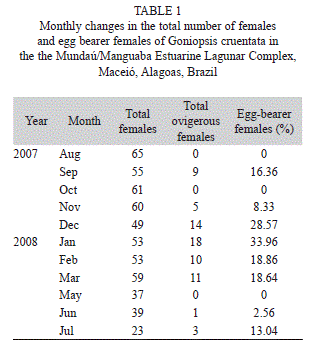
<body><![CDATA[<br> <font style="font-family: verdana;" size="2"></font>    <br> <font style="font-family: verdana;" size="2"><span  style="font-weight: bold;">Laboratory procedures:</span> The salinity measurement was done in the hydrochemistry laboratory of the Federal University of Alagoas, Brazil. The captured crabs were sexed by abdomen morphology, being triangular shaped in the males and round shaped in the females. The female crabs had their carapace width measured by a Vernier calliper (precision of 0.05mm) and the egg-bearing condition was recorded to assess the breeding period of the species, following the classification proposed by Pinheiro &amp; Fransozo (2002). The egg stage of development was established as a way to infer the optimal time for spawning. Hence, the embryonic development was determined in two stages, according to Okamori &amp; Cobo (2003): (1) initial stage, when there was no sign of cleavage or cellular differentiation, and egg totally filled with yolk; (2) final stage, when the embryo is fully differentiated, with clear segmentation of limbs and well-developed eyes. The breeding period was assessed by the monthly proportion of ovigerous females in relation to total females. To test the association between the monthly proportions of ovigerous females in relation to the total females with the rainfall, and the mean values of water salinity and air and water temperature, multiple regression analysis were performed. This proportion was arc-sin transformed to meet the assumptions of Zar (1999). The rainy and dry periods were defined a priori, based on Eskinazi- Le&ccedil;a (1976). Among rainy and dry periods (as defined a priori), the absolute frequency of ovigerous was compared by applying a chisquare test (&#967;2). Salinity, rainfall and air and water temperature were compared among these two periods by a Kruskall-Wallis ANOVA. Each statistical test was performed using the program Statistica 7.0, with a significance level of 5%. The tests were applied after normality analysis of the data. </font>    <br> <font style="font-family: verdana;" size="2"></font>    <br> <font style="font-family: verdana;" size="3"><span  style="font-weight: bold;">Results</span>    <br>     <br> </font><font style="font-family: verdana;" size="2">A total of 554 females were captured, being 71 ovigerous females. The ranged from </font><font style="font-family: verdana;" size="2">22.45 to 42.45, with a mean size of 31.85&plusmn;4.80. The number of the total females and the percentage of the ovigerous females in each month are shown in the <a href="#tab_1">table 1</a>. The ovigerous females were recorded almost all over the year, with higher proportions from December-2007 to March-2008 and they were not found in August and October-2007 and May-2008 (<a href="/img/revistas/rbt/v61n1/a03i1.jpg">Fig. 1</a>). From the 71 egg-bearer females collected, 76% were incubating eggs in initial stage and 24% in final stage of development, the majority of the latter occurring from November to December-2007.    <br>     <br> </font>     <div style="text-align: center;"><a name="tab_1"></a><img alt=""  src="/img/revistas/rbt/v61n1/a03t1.gif"  style="width: 316px; height: 347px;">    <br> </div> <font style="font-family: verdana;" size="2">    ]]></body>
<body><![CDATA[<br> </font><font style="font-family: verdana;" size="2">The salinity ranged from 0.53 to 27.75, with a mean of 17.40&plusmn;8.5. The lower water temperature was 19.88&ordm;C, the highest 29.13&ordm;C, with mean of 26.19&plusmn;2.91. The temperature ranged from 19.5&ordm;C to 30.63&ordm;C, with a mean of 26.45&plusmn;3.23. The monthly rainfall varied from 5.4 to 569mm&sup3;, with mean of 173.89&plusmn;184.97. No association between the monthly proportion of ovigerous females and the analyzed environmental parameters was observed (F4,6=0.67, p&gt;0.05) (<a  href="/img/revistas/rbt/v61n1/a03i1.jpg">Fig. 1</a>). A higher frequency of ovigerous females was found during the dry period (from September to February) (&#967;&sup2;=4.2, d.f=1, p=0.04), in which were observed higher salinity (H1,11=4.80, p=0.029), water (H1,11=4.03, p=0.044) and air temperatures (H1,11=4.03, p=0.044) and lower rainfall (H1,11=7.5, p=0.006). Salinity and rainfall presented significant oscillations during the sampling period, as it can be seen in <a  href="/img/revistas/rbt/v61n1/a03i2.jpg">figure 2A</a> and B, while temperature was stable (<a  href="/img/revistas/rbt/v61n1/a03i2.jpg">Fig. 2C</a>).    <br>     <br> </font><font style="font-family: verdana; font-weight: bold;">Discussion    <br> </font><font style="font-family: verdana;" size="2">    <br> </font><font style="font-family: verdana;" size="2">The ovigerous females of <span style="font-style: italic;">G. cruentata</span> occurred throughout the year with a peak in the dry period. Therefore, the present population followed a seasonal-continuous breeding, according to the classification of Pinheiro &amp; Fransozo (2002). A continuous breeding season guarantees a year-round larvae supply, ensuring a continuous recruitment pattern to the population (D&iacute;az &amp; Conde 1989, Negreiros-Fransozo <span  style="font-style: italic;">et al.</span> 2002, Litulo <span style="font-style: italic;">et al.</span> 2005). Additionally, prolonged reproduction indicates that individuals produce several broods during the breeding period or breed asynchronously (Litulo <span  style="font-style: italic;">et al.</span> 2005) and that the species presents high genetic tolerance to environmental conditions (Cobo 2002a).</font>    <br> <font style="font-family: verdana;" size="2"></font>    <br> <font style="font-family: verdana;" size="2">The continuous breeding period of the present population is similar to others of the same species, in low (Moura <span  style="font-style: italic;">et al.</span> 2000) and high latitudes (Silva &amp; Oshiro 2002; Cobo &amp; Fransozo 2003), even though the reproductive period can vary along a latitudinal gradient (Sastry 1983, Jones &amp; Simons 1983, D&iacute;az &amp; Conde 1989, Emmerson 1994, Bryant &amp; Hartnoll 1995, Lardies <span  style="font-style: italic;">et al.</span> 2004, Cobo 2002a, Cobo 2002b, Castiglioni <span style="font-style: italic;">et al.</span> 2007). Factors that are independent of latitude, such as intertidal zonation, can lead to this non-variance of the breeding period. Species that live upper on the shore tend to breed in restricted periods and species living lower on the shore, such as G. cruentata, may present extended breeding activity (Boolootian <span style="font-style: italic;">et al.</span> 1959, Pillay &amp; Ono 1978, Sastry 1983, Emmerson 1994, Morgan &amp; Christy 1995, Yamaguchi 2001).</font>    <br> <font style="font-family: verdana;" size="2"></font>    <br> <font style="font-family: verdana;" size="2">The low frequency of egg-bearer females throughout the study period was also observed to this species (Silva &amp; Oshiro 2002, Cobo &amp; Fransozo 2003), and is not an uncommon result among brachyuran crabs (Seiple &amp; Salmon 1987, Mantelatto &amp; Fransozo 1997, Negreiros- Fransozo <span style="font-style: italic;">et al.</span> 2002, Pinheiro &amp; Fransozo 2002, Mantelatto <span  style="font-style: italic;">et al.</span> 2003, Lima <span style="font-style: italic;">et al.</span> 2006, Castiglioni <span style="font-style: italic;">et al.</span> 2007, C&eacute;sar <span style="font-style: italic;">et al.</span> 2007), what can be due to a cryptic habit of these crabs in relation to the non-ovigerous females. Additional catch effort is totally not recommended since it will cause bias in the determination of the period of breeding activity. Therein, even though one can think that there is a lack of data, it must be the biological pattern of a species, but still offering valuable data for the understanding of the reproduction of the species. </font>    <br> <font style="font-family: verdana;" size="2"></font>    ]]></body>
<body><![CDATA[<br> <font style="font-family: verdana;" size="2">The monthly proportion of ovigerous females was not correlated to any of the analyzed environmental parameters. However, other authors have observed a correlation between the abiotic factors and the abundance of ovigerous females, as Cobo &amp; Fransozo (2003) for <span  style="font-style: italic;">G. cruentata</span> and Castiglioni <span style="font-style: italic;">et al.</span> (2011) for <span style="font-style: italic;">Sesarma rectum</span> Randall, 1840. This difference probably occurs due to the more stable environment conditions in the present area, which may mask their influence on the biological activities in the populations located at lower latitudes.</font>    <br> <font style="font-family: verdana;" size="2"></font>    <br> <font style="font-family: verdana;" size="2">The higher frequency of ovigerous females observed in the dry period suggests that higher salinity and air and water temperatures, and lower rainfall may promote an intensification of the breeding activity. In fact, there is some empirical evidence that higher salinities favor a shorter period of larval development and improve the larvae survival in the initial stages of development (Saigusa 1981, &Aacute;lvarez &amp; Ewald 1990, Anger <span style="font-style: italic;">et al.</span> 1990, Steele &amp; Steele 1991, Anger <span style="font-style: italic;">et al.</span> 1998, Bas &amp; Spivak 2000, G&eacute;lin <span  style="font-style: italic;">et al.</span> 2001, Paula <span  style="font-style: italic;">et al.</span> 2001, Spivak &amp; Cuesta 2009). Therefore, offspring released in the dry period may experience higher survival rates than that released in the rainy period. Water temperature, higher in the dry period, may also provide a shorter larval development (Emmerson 1994, Paula <span  style="font-style: italic;">et al.</span> 2001, Christy 2003). Hence, breeding in periods of both higher salinities and water temperatures may represent a predation avoidance tactic, since larvae is too vulnerable to predation (Emmerson 1994). On the other hand, the sudden elevation of rainfall and a small decrease of the temperature between February and March may have compelled to come back to the ordinary production of eggs after two months, in May (or after one month, in April when no collection was done).</font>    <br> <font style="font-family: verdana;" size="2"></font>    <br> <font style="font-family: verdana;" size="2">In the case of terrestrial and semi-terrestrial crabs, air temperature is of greater importance than water temperature to the adult life. It acts as a trigger to the gonad development (Wear 1974, Sastry 1983, Zimmerman &amp; Felder 1991, Lardies <span style="font-style: italic;">et al.</span> 2004), and crabs exposed to low temperatures present a longer embryogenesis, leading to a longer incubation period (Wear 1974, Yamaguchi 2001). A faster gonad development, which may occur in tropical areas due to higher temperatures, enables the crab hatches more than one batch of eggs in the optimal time for egg release, maximizing its reproductive effort (Jones &amp; Simons 1983, Ituarte <span style="font-style: italic;">et al.</span> 2004). This fact may represent a selective advantage to breed in the dry period. </font>    <br> <font style="font-family: verdana;" size="2"></font>    <br> <font style="font-family: verdana;" size="2">The breeding period clearly occurs when rainfall was lower, i.e. in the dry period, even though not correlated to the monthly values of rainfall. This data did not corroborate with that of Cobo &amp; Fransozo (2003) to the same species, in a higher latitude tropical area, when highest proportion of ovigerous females occurred in periods of higher rainfall. In fact, breeding is commonly assumed to be positively correlated with the rainfall (Litulo 2004, Litulo 2005, Liu &amp; Jeng 2005), when the channels in the estuary are deeper and the larvae reach the sea more easily to complete its development (Saigusa 1981), being less susceptible to predation (Morgan &amp; Christy 1995). The rainfall increases the flux of river water, enlarging the lading of nutrients to the estuary, favoring the productivity of the phytoplankton (Mallin <span style="font-style: italic;">et al.</span> 1993) and, hence, the larval development.</font>    <br> <font style="font-family: verdana;" size="2"></font>    <br> <font style="font-family: verdana;" size="2">Although not measured in the present study, the major food availability (phytoplankton) to the larvae in the summer (dry period the present area), may also favors breeding activity (Boolootian <span  style="font-style: italic;">et al.</span> 1959, Sastry 1983, Emmerson 1994, Castiglioni <span  style="font-style: italic;">et al.</span> 2007). This higher nutrition source is due to the higher photoperiod in this season (Cobo &amp; Fransozo 2003, Litulo <span style="font-style: italic;">et al.</span> 2005), which favors phytoplankton productivity. Sunlight is, in fact, a limiting factor to phytoplankton production. However, in the Northeastern Brazil, the photoperiod does not present significant differences among stations of the year (Passavante &amp; Feitosa 2004). The phytoplankton production is mainly affected by the suspended material on the surface water, higher on the rainy period. It leads to a decrease in the photic layer and, consequently, in the phytoplankton production (Resurrei&ccedil;&atilde;o <span style="font-style: italic;">et al.</span> 1996).</font>    <br> <font style="font-family: verdana;" size="2"></font>    ]]></body>
<body><![CDATA[<br> <font style="font-family: verdana;" size="2">The fourteen ovigerous females incubating&nbsp; eggs in final stage of development in November and December, within the dry period, can indicate that it is, in fact, the most suitable period for larval release. A low occurrence of ovigerous females was observed in the rainy period, indicating that this period, on the other hand, is not so favorable for larval survival. In fact, breeding all over the year may be a strategy to guarantee reproduction during non-favorable environmental conditions (Litulo 2005), what can be considered as a risk-spreading strategy (Stearns 1976). In general, is assumed that the breeding season is timed to reach the best conditions for larval survival and recruitment (Pillay &amp; Ono 1978, D&iacute;az &amp; Conde 1989, Cobo 2002a, Cobo 2002b).</font>    <br> <font style="font-family: verdana;" size="2"></font>    <br> <font style="font-family: verdana;" size="2">Bas &amp; Spivak (2000), studying species of Grapsids from Argentina, cited that the salinity tolerance of the embryos can vary in different broods of females of the same species. Thus, each female can incubate their eggs in a different occasion, probably in periods similar to that in which their parental female released them. The larvae tolerance to salinity depends on the previous history experienced by the parental female (Bas &amp; Spivak 2000), and that fact may explain the continuous breeding activity of <span style="font-style: italic;">G. cruentata</span>.</font>    <br> <font style="font-family: verdana;" size="2"></font>    <br> <font style="font-family: verdana;" size="2">We conclude that the breeding period of <span style="font-style: italic;">G. cruentata</span> is seasonal-continuous, being not regulated by temporal fluctuations of air and water temperature, salinity and rainfall. However, the dry period provide the best conditions to breeding activity of this species (higher air and water temperature, higher salinity and lower rainfall). Future researches may focus on the response of physiological characteristics, gametogenesis, incubation period, and on the larval ecology and recruitment pattern to environmental variations for a completely understand of breeding activity. </font>    <br> <font style="font-family: verdana;" size="2"></font><br  style="font-weight: bold;"> <font style="font-family: verdana;" size="3"><span  style="font-weight: bold;">Acknowledgment</span>    <br>     <br> </font><font style="font-family: verdana;" size="2">The authors are thankful to Paulo Cardoso and Cristiane Farrapeira, for their suggestions to this manuscript. The first author is grateful to the Conselho Nacional de Desenvolvimento Cient&iacute;fico e Tecnol&oacute;gico-CNPq, for the fellowship granted (process number 112334/2007-5).</font>    <br> <hr style="width: 100%; height: 2px;"><font  style="font-family: verdana; font-weight: bold;" size="3">References    <br>     ]]></body>
<body><![CDATA[<!-- ref --><br> </font><font style="font-family: verdana;" size="2">Abele, L.G. &amp; W. Kim. 1989. The Decapod Crustaceans of the Panama Canal. Smithson. Contrib. Zool. 482: 1-46.    &nbsp;&nbsp;&nbsp;&nbsp;&nbsp;&nbsp;&nbsp;&nbsp;[&#160;<a href="javascript:void(0);" onclick="javascript: window.open('/scielo.php?script=sci_nlinks&ref=1824569&pid=S0034-7744201300010000300001&lng=','','width=640,height=500,resizable=yes,scrollbars=1,menubar=yes,');">Links</a>&#160;]<!-- end-ref --></font>    <br> <font style="font-family: verdana;" size="2"></font>    <!-- ref --><br> <font style="font-family: verdana;" size="2">Adiyodi, R.G. 1988. Reproduction and development, p. 139-185. <span  style="font-style: italic;">In</span> W.W. Burggren &amp; B.R. McMahon (eds.). Biology of the Land Crabs. Cambridge University, Cambridge, United Kingdom.    &nbsp;&nbsp;&nbsp;&nbsp;&nbsp;&nbsp;&nbsp;&nbsp;[&#160;<a href="javascript:void(0);" onclick="javascript: window.open('/scielo.php?script=sci_nlinks&ref=1824572&pid=S0034-7744201300010000300002&lng=','','width=640,height=500,resizable=yes,scrollbars=1,menubar=yes,');">Links</a>&#160;]<!-- end-ref --></font>    <br> <font style="font-family: verdana;" size="2"></font>    <!-- ref --><br> <font style="font-family: verdana;" size="2">&Aacute;lvarez, Z. &amp; J. Ewald. 1990. Efectos de la salinidad y la dieta sobre el desarrollo larvario de <span style="font-style: italic;">Sesarma ricordi</span> (Milne Edwards, 1853) (Decapoda: Grapsidae). Sci. Mar. 54: 55-60.    &nbsp;&nbsp;&nbsp;&nbsp;&nbsp;&nbsp;&nbsp;&nbsp;[&#160;<a href="javascript:void(0);" onclick="javascript: window.open('/scielo.php?script=sci_nlinks&ref=1824575&pid=S0034-7744201300010000300003&lng=','','width=640,height=500,resizable=yes,scrollbars=1,menubar=yes,');">Links</a>&#160;]<!-- end-ref --></font>    <br> <font style="font-family: verdana;" size="2"></font>    <!-- ref --><br> <font style="font-family: verdana;" size="2">Anger, K., J. Harms, M. Mont&uacute; &amp; C. Bekker. 1990. Effects of salinity on the larval development of a semiterrestrial tropical crab, <span style="font-style: italic;">Sesarma angustipes</span> (Decapoda: Grapsidae). Mar. Ecol. Prog. Ser. 62: 89-94.    &nbsp;&nbsp;&nbsp;&nbsp;&nbsp;&nbsp;&nbsp;&nbsp;[&#160;<a href="javascript:void(0);" onclick="javascript: window.open('/scielo.php?script=sci_nlinks&ref=1824578&pid=S0034-7744201300010000300004&lng=','','width=640,height=500,resizable=yes,scrollbars=1,menubar=yes,');">Links</a>&#160;]<!-- end-ref --></font>    <br> <font style="font-family: verdana;" size="2"></font>    <!-- ref --><br> <font style="font-family: verdana;" size="2">Anger, K., E. Spivak &amp; T. Luppi. 1998. Effects of reduced salinities on development and bioenergetics of early larval shore crab, <span style="font-style: italic;">Carcinus maenas</span>. J. Exp. Mar. Biol. Ecol. 220: 287-304.    &nbsp;&nbsp;&nbsp;&nbsp;&nbsp;&nbsp;&nbsp;&nbsp;[&#160;<a href="javascript:void(0);" onclick="javascript: window.open('/scielo.php?script=sci_nlinks&ref=1824581&pid=S0034-7744201300010000300005&lng=','','width=640,height=500,resizable=yes,scrollbars=1,menubar=yes,');">Links</a>&#160;]<!-- end-ref --></font>    <br> <font style="font-family: verdana;" size="2"></font>    <!-- ref --><br> <font style="font-family: verdana;" size="2">Ara&uacute;jo, M.S.L.C. &amp; T.C.S. Calado. 2008. Bioecologia do caranguejo-U&ccedil;&aacute; <span style="font-style: italic;">Ucides cordatus</span> (Linnaeus) no Complexo Estuarino Lagunar Munda&uacute;/Manguaba (CELMM), Alagoas, Brasil. Rev. Gest. Cost. Integr. 8: 169-181.    &nbsp;&nbsp;&nbsp;&nbsp;&nbsp;&nbsp;&nbsp;&nbsp;[&#160;<a href="javascript:void(0);" onclick="javascript: window.open('/scielo.php?script=sci_nlinks&ref=1824584&pid=S0034-7744201300010000300006&lng=','','width=640,height=500,resizable=yes,scrollbars=1,menubar=yes,');">Links</a>&#160;]<!-- end-ref --></font>    <br> <font style="font-family: verdana;" size="2"></font>    <!-- ref --><br> <font style="font-family: verdana;" size="2">Bas, C.C. &amp; E.D. Spivak. 2000. Effect of salinity on embryos of two southeastern atlantic estuarine grapsid crab species cultured <span  style="font-style: italic;">in vitro</span>. J. Crustac. Biol. 20: 647-656.    &nbsp;&nbsp;&nbsp;&nbsp;&nbsp;&nbsp;&nbsp;&nbsp;[&#160;<a href="javascript:void(0);" onclick="javascript: window.open('/scielo.php?script=sci_nlinks&ref=1824587&pid=S0034-7744201300010000300007&lng=','','width=640,height=500,resizable=yes,scrollbars=1,menubar=yes,');">Links</a>&#160;]<!-- end-ref --></font>    ]]></body>
<body><![CDATA[<br> <font style="font-family: verdana;" size="2"></font>    <!-- ref --><br> <font style="font-family: verdana;" size="2">Bell, G. 1976. On Breeding More Than Once. Am. Nat. 110: 57-77.    &nbsp;&nbsp;&nbsp;&nbsp;&nbsp;&nbsp;&nbsp;&nbsp;[&#160;<a href="javascript:void(0);" onclick="javascript: window.open('/scielo.php?script=sci_nlinks&ref=1824590&pid=S0034-7744201300010000300008&lng=','','width=640,height=500,resizable=yes,scrollbars=1,menubar=yes,');">Links</a>&#160;]<!-- end-ref --></font>    <br> <font style="font-family: verdana;" size="2"></font>    <!-- ref --><br> <font style="font-family: verdana;" size="2">Boolootian, R.A., A.C. Giese, A. Farmanfarmaian &amp; J. Tucker. 1959. Reproductive cycles of five west coast crabs. Physiol. Zool. 32: 213-220.    &nbsp;&nbsp;&nbsp;&nbsp;&nbsp;&nbsp;&nbsp;&nbsp;[&#160;<a href="javascript:void(0);" onclick="javascript: window.open('/scielo.php?script=sci_nlinks&ref=1824593&pid=S0034-7744201300010000300009&lng=','','width=640,height=500,resizable=yes,scrollbars=1,menubar=yes,');">Links</a>&#160;]<!-- end-ref --></font>    <br> <font style="font-family: verdana;" size="2"></font>    <!-- ref --><br> <font style="font-family: verdana;" size="2">Bryant, D. &amp; R.G. Hartnoll. 1995. Reproductive investment in two spider crabs with different breeding strategies. J. Exp. Mar. Biol. Ecol. 188: 261-275.    &nbsp;&nbsp;&nbsp;&nbsp;&nbsp;&nbsp;&nbsp;&nbsp;[&#160;<a href="javascript:void(0);" onclick="javascript: window.open('/scielo.php?script=sci_nlinks&ref=1824596&pid=S0034-7744201300010000300010&lng=','','width=640,height=500,resizable=yes,scrollbars=1,menubar=yes,');">Links</a>&#160;]<!-- end-ref --></font>    <br> <font style="font-family: verdana;" size="2"></font>    ]]></body>
<body><![CDATA[<!-- ref --><br> <font style="font-family: verdana;" size="2">Calado, T.C.S. &amp; E.C. Sousa. 2003. Crust&aacute;ceos do Complexo Estuarino/Lagunar Munda&uacute;/ Manguaba, Alagoas. FAPEAL, Macei&oacute;, Alagoas, Brazil.    &nbsp;&nbsp;&nbsp;&nbsp;&nbsp;&nbsp;&nbsp;&nbsp;[&#160;<a href="javascript:void(0);" onclick="javascript: window.open('/scielo.php?script=sci_nlinks&ref=1824599&pid=S0034-7744201300010000300011&lng=','','width=640,height=500,resizable=yes,scrollbars=1,menubar=yes,');">Links</a>&#160;]<!-- end-ref --></font>    <br> <font style="font-family: verdana;" size="2"></font>    <!-- ref --><br> <font style="font-family: verdana;" size="2">Castiglioni, D.S. &amp; M.L. Negreiros-Fransozo. 2006. Ciclo reprodutivo do caranguejo violonista Uca rapax (Smith) (Crustacea: Brachyura: Ocypodidae) habitante de um estu&aacute;rio degradado em Paraty, Rio de Janeiro, Brasil. Rev. Bras. Zool. 23: 331-339.    &nbsp;&nbsp;&nbsp;&nbsp;&nbsp;&nbsp;&nbsp;&nbsp;[&#160;<a href="javascript:void(0);" onclick="javascript: window.open('/scielo.php?script=sci_nlinks&ref=1824602&pid=S0034-7744201300010000300012&lng=','','width=640,height=500,resizable=yes,scrollbars=1,menubar=yes,');">Links</a>&#160;]<!-- end-ref --></font>    <br> <font style="font-family: verdana;" size="2"></font>    <!-- ref --><br> <font style="font-family: verdana;" size="2">Castiglioni, D.S., M.L. Negreiros-Fransozo &amp; C.F. Cardoso. 2007. Breeding season and molt cycle of the fiddler crab <span  style="font-style: italic;">Uca rapax</span> (Brachyura: Ocypodidae) in a subtropical estuary, Brazil, South America. Gulf. Caribb. Res. 19: 11-20.    &nbsp;&nbsp;&nbsp;&nbsp;&nbsp;&nbsp;&nbsp;&nbsp;[&#160;<a href="javascript:void(0);" onclick="javascript: window.open('/scielo.php?script=sci_nlinks&ref=1824605&pid=S0034-7744201300010000300013&lng=','','width=640,height=500,resizable=yes,scrollbars=1,menubar=yes,');">Links</a>&#160;]<!-- end-ref --><br>     <!-- ref --><br> </font><font style="font-family: verdana;" size="2">Castiglioni, D.S., P.J.A. Oliveira, J.S.S. Silva &amp; P.A. Coelho. 2011. Population dynamics of Sesarma rectum (Crustacea: Brachyura: Grapsidae) in the Ariquind&aacute; River mangrove, North-east of Brazil. J. Mar. Biol. Ass. U.K. 91: 1395-1401.    &nbsp;&nbsp;&nbsp;&nbsp;&nbsp;&nbsp;&nbsp;&nbsp;[&#160;<a href="javascript:void(0);" onclick="javascript: window.open('/scielo.php?script=sci_nlinks&ref=1824607&pid=S0034-7744201300010000300014&lng=','','width=640,height=500,resizable=yes,scrollbars=1,menubar=yes,');">Links</a>&#160;]<!-- end-ref --></font>    ]]></body>
<body><![CDATA[<br> <font style="font-family: verdana;" size="2"></font>    <!-- ref --><br> <font style="font-family: verdana;" size="2">C&eacute;sar, I.I., L.C. Armendariz &amp; R.V. Becerra. 2007. Fecundity of <span style="font-style: italic;">Uca uruguayensis</span> and <span  style="font-style: italic;">Chasmagnathus granulates</span> (Decapoda, Brachyura) from the &#8220;Ref&uacute;gio de Vida Silvestre&#8221;, Bah&iacute;a Samboromb&oacute;n, Argentina. Braz. J. Biol. 67: 749-753.    &nbsp;&nbsp;&nbsp;&nbsp;&nbsp;&nbsp;&nbsp;&nbsp;[&#160;<a href="javascript:void(0);" onclick="javascript: window.open('/scielo.php?script=sci_nlinks&ref=1824610&pid=S0034-7744201300010000300015&lng=','','width=640,height=500,resizable=yes,scrollbars=1,menubar=yes,');">Links</a>&#160;]<!-- end-ref --></font>    <br> <font style="font-family: verdana;" size="2"></font>    <!-- ref --><br> <font style="font-family: verdana;" size="2">Christy, J.H. 2003. Reproductive timing and larval dispersal of intertidal crabs: the predator avoidance hypothesis. Rev. Chil. Hist. Nat. 76: 177-185.    &nbsp;&nbsp;&nbsp;&nbsp;&nbsp;&nbsp;&nbsp;&nbsp;[&#160;<a href="javascript:void(0);" onclick="javascript: window.open('/scielo.php?script=sci_nlinks&ref=1824613&pid=S0034-7744201300010000300016&lng=','','width=640,height=500,resizable=yes,scrollbars=1,menubar=yes,');">Links</a>&#160;]<!-- end-ref --></font>    <br> <font style="font-family: verdana;" size="2"></font>    <!-- ref --><br> <font style="font-family: verdana;" size="2">Cobo, V.J. 2002a. Breeding period of the arrow crab <span style="font-style: italic;">Stenorhynchus seticornis</span> from Couves Island, southeastern Brazilian coast. J. Mar. Biol. Ass. U.K. 82: 1031-1032.    &nbsp;&nbsp;&nbsp;&nbsp;&nbsp;&nbsp;&nbsp;&nbsp;[&#160;<a href="javascript:void(0);" onclick="javascript: window.open('/scielo.php?script=sci_nlinks&ref=1824616&pid=S0034-7744201300010000300017&lng=','','width=640,height=500,resizable=yes,scrollbars=1,menubar=yes,');">Links</a>&#160;]<!-- end-ref --></font>    <br> <font style="font-family: verdana;" size="2"></font>    ]]></body>
<body><![CDATA[<!-- ref --><br> <font style="font-family: verdana;" size="2">Cobo, V.J. 2002b. Breeding period of the spider crab <span style="font-style: italic;">Mithraculus forceps</span> (A. Milne Edwards) (Crustacea: Majidae: Mithracinae) in the southeastern Brazilian coast. Rev. Bras. Zool. 19: 229-234.    &nbsp;&nbsp;&nbsp;&nbsp;&nbsp;&nbsp;&nbsp;&nbsp;[&#160;<a href="javascript:void(0);" onclick="javascript: window.open('/scielo.php?script=sci_nlinks&ref=1824619&pid=S0034-7744201300010000300018&lng=','','width=640,height=500,resizable=yes,scrollbars=1,menubar=yes,');">Links</a>&#160;]<!-- end-ref --></font>    <br> <font style="font-family: verdana;" size="2"></font>    <!-- ref --><br> <font style="font-family: verdana;" size="2">Cobo, V.J. &amp; A. Fransozo. 2003. External factors determining breeding season in the red mangrove crab <span  style="font-style: italic;">Goniopsis cruentata</span> (Latreille) (Crustacea: Brachyura: Grapsidae) on the S&atilde;o Paulo state northern coast, Brazil. Rev. Bras. Zool. 20: 213-217.    &nbsp;&nbsp;&nbsp;&nbsp;&nbsp;&nbsp;&nbsp;&nbsp;[&#160;<a href="javascript:void(0);" onclick="javascript: window.open('/scielo.php?script=sci_nlinks&ref=1824622&pid=S0034-7744201300010000300019&lng=','','width=640,height=500,resizable=yes,scrollbars=1,menubar=yes,');">Links</a>&#160;]<!-- end-ref --></font>    <br> <font style="font-family: verdana;" size="2"></font>    <!-- ref --><br> <font style="font-family: verdana;" size="2">Cole, L.C. 1954. The population consequences of life histories phenomena. Q. Rev. Biol. 29: 103-137.    &nbsp;&nbsp;&nbsp;&nbsp;&nbsp;&nbsp;&nbsp;&nbsp;[&#160;<a href="javascript:void(0);" onclick="javascript: window.open('/scielo.php?script=sci_nlinks&ref=1824625&pid=S0034-7744201300010000300020&lng=','','width=640,height=500,resizable=yes,scrollbars=1,menubar=yes,');">Links</a>&#160;]<!-- end-ref --></font>    <br> <font style="font-family: verdana;" size="2"></font>    <!-- ref --><br> <font style="font-family: verdana;" size="2">D&iacute;az, H. &amp; J.E. Conde. 1989. Population dynamics and life history of the mangrove crab <span style="font-style: italic;">Aratus pisonii</span> (Brachyura: Grapsidae) in a marine environment. Bull. Mar. Sci. 45: 148-163.    &nbsp;&nbsp;&nbsp;&nbsp;&nbsp;&nbsp;&nbsp;&nbsp;[&#160;<a href="javascript:void(0);" onclick="javascript: window.open('/scielo.php?script=sci_nlinks&ref=1824628&pid=S0034-7744201300010000300021&lng=','','width=640,height=500,resizable=yes,scrollbars=1,menubar=yes,');">Links</a>&#160;]<!-- end-ref --></font>    <br> <font style="font-family: verdana;" size="2"></font>    <!-- ref --><br> <font style="font-family: verdana;" size="2">Emmerson, W.D. 1994. Seasonal breeding cycles and sex ratios of eight species of crabs from Mgazana, a mangrove estuary in Transkei, Southern Africa. J. Crustac. Biol. 14: 568-578.    &nbsp;&nbsp;&nbsp;&nbsp;&nbsp;&nbsp;&nbsp;&nbsp;[&#160;<a href="javascript:void(0);" onclick="javascript: window.open('/scielo.php?script=sci_nlinks&ref=1824631&pid=S0034-7744201300010000300022&lng=','','width=640,height=500,resizable=yes,scrollbars=1,menubar=yes,');">Links</a>&#160;]<!-- end-ref --></font>    <br> <font style="font-family: verdana;" size="2"></font>    <!-- ref --><br> <font style="font-family: verdana;" size="2">Eskinazi-Le&ccedil;a, E. 1976. Taxonomia e distribui&ccedil;&atilde;o das diatom&aacute;ceas (Bacillariophyceae) na laguna Munda&uacute;, Alagoas, Brasil. Doctoral Thesis, Federal University of Pernambuco, Recife, Brazil.    &nbsp;&nbsp;&nbsp;&nbsp;&nbsp;&nbsp;&nbsp;&nbsp;[&#160;<a href="javascript:void(0);" onclick="javascript: window.open('/scielo.php?script=sci_nlinks&ref=1824634&pid=S0034-7744201300010000300023&lng=','','width=640,height=500,resizable=yes,scrollbars=1,menubar=yes,');">Links</a>&#160;]<!-- end-ref --> </font>    <br> <font style="font-family: verdana;" size="2"></font>    <!-- ref --><br> <font style="font-family: verdana;" size="2">Gadgil, M. &amp; W.H. Bossert. 1970. Life historical consequences of natural selection. Am. Nat. 104: 1-24.    &nbsp;&nbsp;&nbsp;&nbsp;&nbsp;&nbsp;&nbsp;&nbsp;[&#160;<a href="javascript:void(0);" onclick="javascript: window.open('/scielo.php?script=sci_nlinks&ref=1824637&pid=S0034-7744201300010000300024&lng=','','width=640,height=500,resizable=yes,scrollbars=1,menubar=yes,');">Links</a>&#160;]<!-- end-ref --></font>    ]]></body>
<body><![CDATA[<br> <font style="font-family: verdana;" size="2"></font>    <!-- ref --><br> <font style="font-family: verdana;" size="2">G&eacute;lin, A., A. J. Crivelli, E. Rosecchi &amp; P. Kerambrun. 2001. Can salinity changes affect reproductive success in the brown shrimp <span style="font-style: italic;">Crangon crangon</span>? J. Crustac. Biol. 21: 905-911.    &nbsp;&nbsp;&nbsp;&nbsp;&nbsp;&nbsp;&nbsp;&nbsp;[&#160;<a href="javascript:void(0);" onclick="javascript: window.open('/scielo.php?script=sci_nlinks&ref=1824640&pid=S0034-7744201300010000300025&lng=','','width=640,height=500,resizable=yes,scrollbars=1,menubar=yes,');">Links</a>&#160;]<!-- end-ref --></font>    <br> <font style="font-family: verdana;" size="2"></font>    <!-- ref --><br> <font style="font-family: verdana;" size="2">Hartnoll, R.G. &amp; P. Gould. 1988. Brachyuran life history strategies and the optimization of egg production, p.&nbsp; l-9. <span  style="font-style: italic;">In</span> A.A Fincham &amp; P.S. Rainbow (eds.). Aspectsof Decapod Crustacean Biology. Clarendon, Oxford, United Kingdom.    &nbsp;&nbsp;&nbsp;&nbsp;&nbsp;&nbsp;&nbsp;&nbsp;[&#160;<a href="javascript:void(0);" onclick="javascript: window.open('/scielo.php?script=sci_nlinks&ref=1824643&pid=S0034-7744201300010000300026&lng=','','width=640,height=500,resizable=yes,scrollbars=1,menubar=yes,');">Links</a>&#160;]<!-- end-ref --></font>    <br> <font style="font-family: verdana;" size="2"></font>    <!-- ref --><br> <font style="font-family: verdana;" size="2">Hogarth, P.J. 2007. The Biology of Mangroves and Seagrasses. Oxford University, Oxford, United Kingdom.    &nbsp;&nbsp;&nbsp;&nbsp;&nbsp;&nbsp;&nbsp;&nbsp;[&#160;<a href="javascript:void(0);" onclick="javascript: window.open('/scielo.php?script=sci_nlinks&ref=1824646&pid=S0034-7744201300010000300027&lng=','','width=640,height=500,resizable=yes,scrollbars=1,menubar=yes,');">Links</a>&#160;]<!-- end-ref --> </font>    <br> <font style="font-family: verdana;" size="2"></font>    ]]></body>
<body><![CDATA[<!-- ref --><br> <font style="font-family: verdana;" size="2">Ituarte, R.B., E.D. Spivak &amp; T.A. Luppi. 2004. Female reproductive cycle of the southwestern Atlantic estuarine crab <span  style="font-style: italic;">Chasmagnathus granulatus</span> (Brachyura: Grapsoidea: Varunidae). Sci. Mar. 68: 127-137.    &nbsp;&nbsp;&nbsp;&nbsp;&nbsp;&nbsp;&nbsp;&nbsp;[&#160;<a href="javascript:void(0);" onclick="javascript: window.open('/scielo.php?script=sci_nlinks&ref=1824649&pid=S0034-7744201300010000300028&lng=','','width=640,height=500,resizable=yes,scrollbars=1,menubar=yes,');">Links</a>&#160;]<!-- end-ref --></font>    <br> <font style="font-family: verdana;" size="2"></font>    <!-- ref --><br> <font style="font-family: verdana;" size="2">Jones, M.B. &amp; M.J. Simons. 1983. Latitudinal variation in reproductive characteristics of a mud crab, Helice crassa (Grapsidae). Bull. Mar. Sci. 33: 656-670.    &nbsp;&nbsp;&nbsp;&nbsp;&nbsp;&nbsp;&nbsp;&nbsp;[&#160;<a href="javascript:void(0);" onclick="javascript: window.open('/scielo.php?script=sci_nlinks&ref=1824652&pid=S0034-7744201300010000300029&lng=','','width=640,height=500,resizable=yes,scrollbars=1,menubar=yes,');">Links</a>&#160;]<!-- end-ref --></font>    <br> <font style="font-family: verdana;" size="2"></font>    <!-- ref --><br> <font style="font-family: verdana;" size="2">Lardies, M.A., J.M. Rojas &amp; I.S. Wehrtmann. 2004. Breeding biology and population structure of the intertidal crab <span  style="font-style: italic;">Petrolisthes laevigatus</span> (Anomura: Porcellanidae) in central-southern Chile. J. Nat. Hist. 38: 375-388.    &nbsp;&nbsp;&nbsp;&nbsp;&nbsp;&nbsp;&nbsp;&nbsp;[&#160;<a href="javascript:void(0);" onclick="javascript: window.open('/scielo.php?script=sci_nlinks&ref=1824655&pid=S0034-7744201300010000300030&lng=','','width=640,height=500,resizable=yes,scrollbars=1,menubar=yes,');">Links</a>&#160;]<!-- end-ref --></font>    <br> <font style="font-family: verdana;" size="2"></font>    <!-- ref --><br> <font style="font-family: verdana;" size="2">Lima, G.V., M.R.S. Soares &amp; L.M.Y. Oshiro. 2006. Reproductive biology of the sesarmid crab Armases rubripes (Decapoda: Brachyura) from an estuarine area of the Sahy river, Sepetiba Bay, Rio de Janeiro, Brazil. Ilher&iacute;ngia 96: 47-52.    &nbsp;&nbsp;&nbsp;&nbsp;&nbsp;&nbsp;&nbsp;&nbsp;[&#160;<a href="javascript:void(0);" onclick="javascript: window.open('/scielo.php?script=sci_nlinks&ref=1824658&pid=S0034-7744201300010000300031&lng=','','width=640,height=500,resizable=yes,scrollbars=1,menubar=yes,');">Links</a>&#160;]<!-- end-ref --></font>    <br> <font style="font-family: verdana;" size="2"></font>    <!-- ref --><br> <font style="font-family: verdana;" size="2">Litulo, C. 2004. Reproductive aspects of a tropical population of the fiddler crab <span style="font-style: italic;">Uca annulipes</span> (H. Milne Edwards, 1837) (Brachyura: Ocypodidae) at Costa do Sol Mangrove, Maputo Bay, southern Mozambique. Hydrobiologia 525: 167-173.    &nbsp;&nbsp;&nbsp;&nbsp;&nbsp;&nbsp;&nbsp;&nbsp;[&#160;<a href="javascript:void(0);" onclick="javascript: window.open('/scielo.php?script=sci_nlinks&ref=1824661&pid=S0034-7744201300010000300032&lng=','','width=640,height=500,resizable=yes,scrollbars=1,menubar=yes,');">Links</a>&#160;]<!-- end-ref --></font>    <br> <font style="font-family: verdana;" size="2"></font>    <!-- ref --><br> <font style="font-family: verdana;" size="2">Litulo, C. 2005. External factors determining the reproductive periodicity in a tropical population of the hairy crab <span  style="font-style: italic;">Pilumnus vespertilio</span> (Decapoda: Brachyura: Pilumnidae). Raf. Bull. Zool. 53: 115-118.    &nbsp;&nbsp;&nbsp;&nbsp;&nbsp;&nbsp;&nbsp;&nbsp;[&#160;<a href="javascript:void(0);" onclick="javascript: window.open('/scielo.php?script=sci_nlinks&ref=1824664&pid=S0034-7744201300010000300033&lng=','','width=640,height=500,resizable=yes,scrollbars=1,menubar=yes,');">Links</a>&#160;]<!-- end-ref --></font>    <br> <font style="font-family: verdana;" size="2"></font>    <!-- ref --><br> <font style="font-family: verdana;" size="2">Litulo, C., Y. Mahanjane &amp; F.L.M. Mantelatto. 2005. Population biology and breeding period of the sandbubbler crab <span  style="font-style: italic;">Dotilla fenestrata</span> (Brachyura: Ocypodidae) from Southern Mozambique. Aquat. Ecol. 39: 305-313.    &nbsp;&nbsp;&nbsp;&nbsp;&nbsp;&nbsp;&nbsp;&nbsp;[&#160;<a href="javascript:void(0);" onclick="javascript: window.open('/scielo.php?script=sci_nlinks&ref=1824667&pid=S0034-7744201300010000300034&lng=','','width=640,height=500,resizable=yes,scrollbars=1,menubar=yes,');">Links</a>&#160;]<!-- end-ref --></font>    ]]></body>
<body><![CDATA[<br> <font style="font-family: verdana;" size="2"></font>    <!-- ref --><br> <font style="font-family: verdana;" size="2">Liu, H.C. &amp; M.S. Jeng. 2005. Reproduction of <span style="font-style: italic;">Epigrapsus notatus</span> (Brachyura: Gecarcinidae) in Taiwan. J. Crustac. Biol. 25: 135-140.    &nbsp;&nbsp;&nbsp;&nbsp;&nbsp;&nbsp;&nbsp;&nbsp;[&#160;<a href="javascript:void(0);" onclick="javascript: window.open('/scielo.php?script=sci_nlinks&ref=1824670&pid=S0034-7744201300010000300035&lng=','','width=640,height=500,resizable=yes,scrollbars=1,menubar=yes,');">Links</a>&#160;]<!-- end-ref --></font>    <br> <font style="font-family: verdana;" size="2"></font>    <!-- ref --><br> <font style="font-family: verdana;" size="2">Mallin, M.A., H.W. Paerl, J. Rudek &amp; P.W. Bates. 1993. Regulation of estuarine primary production by watershed rainfall and river flow. Mar. Ecol. Prog. Ser. 93: 199-203.    &nbsp;&nbsp;&nbsp;&nbsp;&nbsp;&nbsp;&nbsp;&nbsp;[&#160;<a href="javascript:void(0);" onclick="javascript: window.open('/scielo.php?script=sci_nlinks&ref=1824673&pid=S0034-7744201300010000300036&lng=','','width=640,height=500,resizable=yes,scrollbars=1,menubar=yes,');">Links</a>&#160;]<!-- end-ref --></font>    <br> <font style="font-family: verdana;" size="2"></font>    <!-- ref --><br> <font style="font-family: verdana;" size="2">Mantelatto, F.L.M. &amp; A. Fransozo. 1997. Fecundity of the crab <span style="font-style: italic;">Callinectes ornatus</span> Ordway 1863 (Decapoda, Brachyura, Portunidae) from the Ubatuba region, S&atilde;o Paulo, Brazil. Crustaceana 70: 214-226.    &nbsp;&nbsp;&nbsp;&nbsp;&nbsp;&nbsp;&nbsp;&nbsp;[&#160;<a href="javascript:void(0);" onclick="javascript: window.open('/scielo.php?script=sci_nlinks&ref=1824676&pid=S0034-7744201300010000300037&lng=','','width=640,height=500,resizable=yes,scrollbars=1,menubar=yes,');">Links</a>&#160;]<!-- end-ref --></font>    <br> <font style="font-family: verdana;" size="2"></font>    ]]></body>
<body><![CDATA[<!-- ref --><br> <font style="font-family: verdana;" size="2">Mantelatto, F.L.M., F.C.R. Faria &amp; R.B. Garcia. 2003. Biological aspects of <span style="font-style: italic;">Mithraculus forceps</span> (Brachyura: Mithracidae) from Anchieta Island, Ubatuba, Brazil. J. Mar. Biol. Ass. U.K. 83: 789-791.    &nbsp;&nbsp;&nbsp;&nbsp;&nbsp;&nbsp;&nbsp;&nbsp;[&#160;<a href="javascript:void(0);" onclick="javascript: window.open('/scielo.php?script=sci_nlinks&ref=1824679&pid=S0034-7744201300010000300038&lng=','','width=640,height=500,resizable=yes,scrollbars=1,menubar=yes,');">Links</a>&#160;]<!-- end-ref --></font>    <br> <font style="font-family: verdana;" size="2"></font>    <!-- ref --><br> <font style="font-family: verdana;" size="2">Marques, J.G.W. 2001. Aspectos ecol&oacute;gicos da etnoictiologia dos pescadores no Complexo Estuarino &#8211; Lagunar Munda&uacute;/Manguaba. Doctoral thesis, State University of Campinas, Campinas, Brazil.    &nbsp;&nbsp;&nbsp;&nbsp;&nbsp;&nbsp;&nbsp;&nbsp;[&#160;<a href="javascript:void(0);" onclick="javascript: window.open('/scielo.php?script=sci_nlinks&ref=1824682&pid=S0034-7744201300010000300039&lng=','','width=640,height=500,resizable=yes,scrollbars=1,menubar=yes,');">Links</a>&#160;]<!-- end-ref --></font>    <br> <font style="font-family: verdana;" size="2"></font>    <!-- ref --><br> <font style="font-family: verdana;" size="2">Melo, G.A.S. 1996. Manual de identifica&ccedil;&atilde;o dos Brachyura (caranguejos e siris) do litoral brasileiro. FAPESP/ Pl&ecirc;iade, S&atilde;o Paulo, Brazil.    &nbsp;&nbsp;&nbsp;&nbsp;&nbsp;&nbsp;&nbsp;&nbsp;[&#160;<a href="javascript:void(0);" onclick="javascript: window.open('/scielo.php?script=sci_nlinks&ref=1824685&pid=S0034-7744201300010000300040&lng=','','width=640,height=500,resizable=yes,scrollbars=1,menubar=yes,');">Links</a>&#160;]<!-- end-ref --></font>    <br> <font style="font-family: verdana;" size="2"></font>    <!-- ref --><br> <font style="font-family: verdana;" size="2">Morgan, S.G. &amp; J.H. Christy. 1995. Adaptative significance of the timing of larval release by crabs. Am. Nat. 145: 457-479.    &nbsp;&nbsp;&nbsp;&nbsp;&nbsp;&nbsp;&nbsp;&nbsp;[&#160;<a href="javascript:void(0);" onclick="javascript: window.open('/scielo.php?script=sci_nlinks&ref=1824688&pid=S0034-7744201300010000300041&lng=','','width=640,height=500,resizable=yes,scrollbars=1,menubar=yes,');">Links</a>&#160;]<!-- end-ref --></font>    <br> <font style="font-family: verdana;" size="2"></font>    <!-- ref --><br> <font style="font-family: verdana;" size="2">Moura, N.F.O., P.A. Coelho-Filho &amp; P.A. Coelho. 2000. Population structure of <span style="font-style: italic;">Goniopsis cruentata</span> (Latreille 1803) in the Paripe estuary, Brazil. Nauplius 8: 73-78.    &nbsp;&nbsp;&nbsp;&nbsp;&nbsp;&nbsp;&nbsp;&nbsp;[&#160;<a href="javascript:void(0);" onclick="javascript: window.open('/scielo.php?script=sci_nlinks&ref=1824691&pid=S0034-7744201300010000300042&lng=','','width=640,height=500,resizable=yes,scrollbars=1,menubar=yes,');">Links</a>&#160;]<!-- end-ref --></font>    <br> <font style="font-family: verdana;" size="2"></font>    <!-- ref --><br> <font style="font-family: verdana;" size="2">Negreiros-Fransozo, M.L., A. Fransozo &amp; G. Bertini. 2002. Reproductive cycle and recruitment period of <span  style="font-style: italic;">Ocypode quadrata</span> (Decapoda: Ocypodidae) at a Sandy beach in southeastern Brazil. J. Crustac. Biol. 22: 157-161.    &nbsp;&nbsp;&nbsp;&nbsp;&nbsp;&nbsp;&nbsp;&nbsp;[&#160;<a href="javascript:void(0);" onclick="javascript: window.open('/scielo.php?script=sci_nlinks&ref=1824694&pid=S0034-7744201300010000300043&lng=','','width=640,height=500,resizable=yes,scrollbars=1,menubar=yes,');">Links</a>&#160;]<!-- end-ref --></font>    <br> <font style="font-family: verdana;" size="2"></font>    <!-- ref --><br> <font style="font-family: verdana;" size="2">Okamori, C.M. &amp; V.J. Cobo. 2003. Fecundity of the arrow crab <span style="font-style: italic;">Stenorhyncus seticornis</span> in the southern Brazilian coast. J. Mar. Biol. Ass. UK 83: 979-980.    &nbsp;&nbsp;&nbsp;&nbsp;&nbsp;&nbsp;&nbsp;&nbsp;[&#160;<a href="javascript:void(0);" onclick="javascript: window.open('/scielo.php?script=sci_nlinks&ref=1824697&pid=S0034-7744201300010000300044&lng=','','width=640,height=500,resizable=yes,scrollbars=1,menubar=yes,');">Links</a>&#160;]<!-- end-ref --></font>    ]]></body>
<body><![CDATA[<br> <font style="font-family: verdana;" size="2"></font>    <!-- ref --><br> <font style="font-family: verdana;" size="2">Paula, J., R.N. Mendes, S. Paci, P. McLaughlin, F. Gherardi &amp; W. Emmerson. 2001. Combined effects of temperature and salinity on the larval development of the estuarine mud prawn <span  style="font-style: italic;">Upogebia africana</span> (Crustacea: Thalassinidea). Hydrobiologia 449: 141-148.    &nbsp;&nbsp;&nbsp;&nbsp;&nbsp;&nbsp;&nbsp;&nbsp;[&#160;<a href="javascript:void(0);" onclick="javascript: window.open('/scielo.php?script=sci_nlinks&ref=1824700&pid=S0034-7744201300010000300045&lng=','','width=640,height=500,resizable=yes,scrollbars=1,menubar=yes,');">Links</a>&#160;]<!-- end-ref --></font>    <br> <font style="font-family: verdana;" size="2"></font>    <!-- ref --><br> <font style="font-family: verdana;" size="2">Passavante, J.Z.O. &amp; F.A.N. Feitosa. 2004. Din&acirc;mica da Produtividade Fitoplanct&ocirc;nica na Zona Costeira, p. 425-439. <span  style="font-style: italic;">In</span> E. Eskinazi-Le&ccedil;a, S. Neumann-Leit&atilde;o &amp; M.F. Costa (eds.). Oceanografia: Um Cen&aacute;rio Tropical. Baga&ccedil;o, Recife, Brazil.    &nbsp;&nbsp;&nbsp;&nbsp;&nbsp;&nbsp;&nbsp;&nbsp;[&#160;<a href="javascript:void(0);" onclick="javascript: window.open('/scielo.php?script=sci_nlinks&ref=1824703&pid=S0034-7744201300010000300046&lng=','','width=640,height=500,resizable=yes,scrollbars=1,menubar=yes,');">Links</a>&#160;]<!-- end-ref --></font>    <br> <font style="font-family: verdana;" size="2"></font>    <!-- ref --><br> <font style="font-family: verdana;" size="2">Pillay, K.K. &amp; Y. Ono. 1978. The breeding cycles of two species of grapsid crabs (Crustacea: Decapoda) from the north coast of Kyushu, Japan. Mar. Biol. 45: 237-248.    &nbsp;&nbsp;&nbsp;&nbsp;&nbsp;&nbsp;&nbsp;&nbsp;[&#160;<a href="javascript:void(0);" onclick="javascript: window.open('/scielo.php?script=sci_nlinks&ref=1824706&pid=S0034-7744201300010000300047&lng=','','width=640,height=500,resizable=yes,scrollbars=1,menubar=yes,');">Links</a>&#160;]<!-- end-ref --></font>    <br> <font style="font-family: verdana;" size="2"></font>    ]]></body>
<body><![CDATA[<!-- ref --><br> <font style="font-family: verdana;" size="2">Pinheiro, M.A.A. &amp; A. Fransozo. 2002. Reproduction of the speckled swimming crab <span style="font-style: italic;">Arenaeus cribrarius</span> (Brachyura: Portunidae) on the Brazilian coast near 23&ordm;30&#8217;S. J. Crustac. Biol. 22: 416-428.    &nbsp;&nbsp;&nbsp;&nbsp;&nbsp;&nbsp;&nbsp;&nbsp;[&#160;<a href="javascript:void(0);" onclick="javascript: window.open('/scielo.php?script=sci_nlinks&ref=1824709&pid=S0034-7744201300010000300048&lng=','','width=640,height=500,resizable=yes,scrollbars=1,menubar=yes,');">Links</a>&#160;]<!-- end-ref --></font>    <br> <font style="font-family: verdana;" size="2"></font>    <!-- ref --><br> <font style="font-family: verdana;" size="2">Resurrei&ccedil;&atilde;o, M.G., J.Z.O. Passavante &amp; S.J. Macedo. 1996. Estudo da plataforma continental na &aacute;rea do Recife (Brasil): varia&ccedil;&atilde;o sazonal da biomassa fitoplanct&ocirc;nica </font><font style="font-family: verdana;"  size="2">(08&ordm;03&#8217;38&#8221; Lat. S; 34&ordm;42&#8217;28&#8221; &agrave; 34&ordm;52&#8217;00&#8221; Long. W). Trab. Oceanogr&aacute;ficos 24: 39-59.    &nbsp;&nbsp;&nbsp;&nbsp;&nbsp;&nbsp;&nbsp;&nbsp;[&#160;<a href="javascript:void(0);" onclick="javascript: window.open('/scielo.php?script=sci_nlinks&ref=1824712&pid=S0034-7744201300010000300049&lng=','','width=640,height=500,resizable=yes,scrollbars=1,menubar=yes,');">Links</a>&#160;]<!-- end-ref --></font>    <br> <font style="font-family: verdana;" size="2"></font>    <!-- ref --><br> <font style="font-family: verdana;" size="2">Ricklefs, R.E. &amp; M. Wikelski. 2002. The physiology/life history nexus. Trends Ecol. Evol. 17: 462-468.    &nbsp;&nbsp;&nbsp;&nbsp;&nbsp;&nbsp;&nbsp;&nbsp;[&#160;<a href="javascript:void(0);" onclick="javascript: window.open('/scielo.php?script=sci_nlinks&ref=1824715&pid=S0034-7744201300010000300050&lng=','','width=640,height=500,resizable=yes,scrollbars=1,menubar=yes,');">Links</a>&#160;]<!-- end-ref --> </font>    <br> <font style="font-family: verdana;" size="2"></font>    <!-- ref --><br> <font style="font-family: verdana;" size="2">Saigusa, M. 1981. Adaptive significance of a semilunar rhythm in the terrestrial crab <span style="font-style: italic;">Sesarma</span>. Biol. Bull. 160: 311-321.    &nbsp;&nbsp;&nbsp;&nbsp;&nbsp;&nbsp;&nbsp;&nbsp;[&#160;<a href="javascript:void(0);" onclick="javascript: window.open('/scielo.php?script=sci_nlinks&ref=1824718&pid=S0034-7744201300010000300051&lng=','','width=640,height=500,resizable=yes,scrollbars=1,menubar=yes,');">Links</a>&#160;]<!-- end-ref --></font>    <br> <font style="font-family: verdana;" size="2"></font>    <!-- ref --><br> <font style="font-family: verdana;" size="2">Sastry, A.N. 1983. Ecological aspects of reproduction, p. 179-270. <span  style="font-style: italic;">In</span> F.J. Vernberg &amp; W.B. Vernberg (eds.). The Biology of Crustacea - Environmental Adaptations. Academic, London, United Kingdom.    &nbsp;&nbsp;&nbsp;&nbsp;&nbsp;&nbsp;&nbsp;&nbsp;[&#160;<a href="javascript:void(0);" onclick="javascript: window.open('/scielo.php?script=sci_nlinks&ref=1824721&pid=S0034-7744201300010000300052&lng=','','width=640,height=500,resizable=yes,scrollbars=1,menubar=yes,');">Links</a>&#160;]<!-- end-ref --></font>    <br> <font style="font-family: verdana;" size="2"></font>    <!-- ref --><br> <font style="font-family: verdana;" size="2">Seiple, W.H. &amp; M. Salmon. 1987. Reproductive, growth and life-history between two species of grapsid crabs, <span  style="font-style: italic;">Sesarma cinereum </span>and<span  style="font-style: italic;"> S. reticulatum</span>. Mar. Biol. 94: 1-6.    &nbsp;&nbsp;&nbsp;&nbsp;&nbsp;&nbsp;&nbsp;&nbsp;[&#160;<a href="javascript:void(0);" onclick="javascript: window.open('/scielo.php?script=sci_nlinks&ref=1824724&pid=S0034-7744201300010000300053&lng=','','width=640,height=500,resizable=yes,scrollbars=1,menubar=yes,');">Links</a>&#160;]<!-- end-ref --><br>     <!-- ref --><br> </font><font style="font-family: verdana;" size="2">Silva, Z.S. &amp; L.M.Y. Oshiro. 2002. Aspectos reprodutivos de <span style="font-style: italic;">Goniopsis cruentata</span> (Latreille) (Crustacea, Brachyura, Grapsidae) na Ba&iacute;a de Sepetiba, Rio de Janeiro, Brasil. Rev. Bras. Zool. 19: 907-914.    &nbsp;&nbsp;&nbsp;&nbsp;&nbsp;&nbsp;&nbsp;&nbsp;[&#160;<a href="javascript:void(0);" onclick="javascript: window.open('/scielo.php?script=sci_nlinks&ref=1824726&pid=S0034-7744201300010000300054&lng=','','width=640,height=500,resizable=yes,scrollbars=1,menubar=yes,');">Links</a>&#160;]<!-- end-ref --></font>    <br> <font style="font-family: verdana;" size="2"></font>    ]]></body>
<body><![CDATA[<!-- ref --><br> <font style="font-family: verdana;" size="2">Skov, M.W., R.G. Hartnoll, R.K. Ruwa, J.P. Shunula, M. Vannini &amp; S. Cannici. 2005. Marching to a different drummer: crabs synchronize reproduction to a 14-month-tidal cycle. Ecology 86: 1164-1171.    &nbsp;&nbsp;&nbsp;&nbsp;&nbsp;&nbsp;&nbsp;&nbsp;[&#160;<a href="javascript:void(0);" onclick="javascript: window.open('/scielo.php?script=sci_nlinks&ref=1824729&pid=S0034-7744201300010000300055&lng=','','width=640,height=500,resizable=yes,scrollbars=1,menubar=yes,');">Links</a>&#160;]<!-- end-ref --></font>    <br> <font style="font-family: verdana;" size="2"></font>    <!-- ref --><br> <font style="font-family: verdana;" size="2">Spivak, E.D. &amp; J.A. Cuesta. 2009. The effect of salinity on larval development of <span style="font-style: italic;">Uca tangeri</span> (Eydoux, 1835) (Brachyura: Ocypodidae) and new findings of the zoeal morphology. Sci. Mar. 73: 297-305.    &nbsp;&nbsp;&nbsp;&nbsp;&nbsp;&nbsp;&nbsp;&nbsp;[&#160;<a href="javascript:void(0);" onclick="javascript: window.open('/scielo.php?script=sci_nlinks&ref=1824732&pid=S0034-7744201300010000300056&lng=','','width=640,height=500,resizable=yes,scrollbars=1,menubar=yes,');">Links</a>&#160;]<!-- end-ref --></font>    <br> <font style="font-family: verdana;" size="2"></font>    <!-- ref --><br> <font style="font-family: verdana;" size="2">Stearns, S.C. 1976. Life-history tactics: a review of the ideas. Q. Rev. Biol. 51: 3-47.    &nbsp;&nbsp;&nbsp;&nbsp;&nbsp;&nbsp;&nbsp;&nbsp;[&#160;<a href="javascript:void(0);" onclick="javascript: window.open('/scielo.php?script=sci_nlinks&ref=1824735&pid=S0034-7744201300010000300057&lng=','','width=640,height=500,resizable=yes,scrollbars=1,menubar=yes,');">Links</a>&#160;]<!-- end-ref --></font>    <br> <font style="font-family: verdana;" size="2"></font>    <!-- ref --><br> <font style="font-family: verdana;" size="2">Stearns, S.C. 2000. Life history evolution: successes, limitations, and prospects. Naturwissenschaften 87: 476-486.    &nbsp;&nbsp;&nbsp;&nbsp;&nbsp;&nbsp;&nbsp;&nbsp;[&#160;<a href="javascript:void(0);" onclick="javascript: window.open('/scielo.php?script=sci_nlinks&ref=1824738&pid=S0034-7744201300010000300058&lng=','','width=640,height=500,resizable=yes,scrollbars=1,menubar=yes,');">Links</a>&#160;]<!-- end-ref --></font>    <br> <font style="font-family: verdana;" size="2"></font>    <!-- ref --><br> <font style="font-family: verdana;" size="2">Steele, D.H. &amp; V.J. Steele. 1991. Effects of salinity on the survival, growth rate, and reproductive output of <span  style="font-style: italic;">Gammarus lawrencianus</span> (Crustacea: Amphipoda). Mar. Ecol. Prog. Ser. 78: 49-56.    &nbsp;&nbsp;&nbsp;&nbsp;&nbsp;&nbsp;&nbsp;&nbsp;[&#160;<a href="javascript:void(0);" onclick="javascript: window.open('/scielo.php?script=sci_nlinks&ref=1824741&pid=S0034-7744201300010000300059&lng=','','width=640,height=500,resizable=yes,scrollbars=1,menubar=yes,');">Links</a>&#160;]<!-- end-ref --></font>    <br> <font style="font-family: verdana;" size="2"></font>    <!-- ref --><br> <font style="font-family: verdana;" size="2">Wear, R.G. 1974. Incubation in British decapods Crustacea, and the effects of temperature on the rate and success of embryonic development. J. Mar. Biol. Ass. UK 54: 745-762.    &nbsp;&nbsp;&nbsp;&nbsp;&nbsp;&nbsp;&nbsp;&nbsp;[&#160;<a href="javascript:void(0);" onclick="javascript: window.open('/scielo.php?script=sci_nlinks&ref=1824744&pid=S0034-7744201300010000300060&lng=','','width=640,height=500,resizable=yes,scrollbars=1,menubar=yes,');">Links</a>&#160;]<!-- end-ref --></font>    <br> <font style="font-family: verdana;" size="2"></font>    <!-- ref --><br> <font style="font-family: verdana;" size="2">Yamaguchi, T. 2001. The breeding period of the fiddler crab, <span style="font-style: italic;">Uca lactea</span> (Decapoda: Brachyura: Ocypodidae) in Japan. Crustac. Int. J. Crustac. Res. 74: 285-293.    &nbsp;&nbsp;&nbsp;&nbsp;&nbsp;&nbsp;&nbsp;&nbsp;[&#160;<a href="javascript:void(0);" onclick="javascript: window.open('/scielo.php?script=sci_nlinks&ref=1824747&pid=S0034-7744201300010000300061&lng=','','width=640,height=500,resizable=yes,scrollbars=1,menubar=yes,');">Links</a>&#160;]<!-- end-ref --></font>    ]]></body>
<body><![CDATA[<br> <font style="font-family: verdana;" size="2"></font>    <!-- ref --><br> <font style="font-family: verdana;" size="2">Zar, J.H. 1999. Bioestatistical Analysis. Prentice Hall, New Jersey, USA</font>    &nbsp;&nbsp;&nbsp;&nbsp;&nbsp;&nbsp;&nbsp;&nbsp;[&#160;<a href="javascript:void(0);" onclick="javascript: window.open('/scielo.php?script=sci_nlinks&ref=1824750&pid=S0034-7744201300010000300062&lng=','','width=640,height=500,resizable=yes,scrollbars=1,menubar=yes,');">Links</a>&#160;]<!-- end-ref --><br> <font style="font-family: verdana;" size="2"></font>    <!-- ref --><br> <font style="font-family: verdana;" size="2">Zera, A.J. &amp; G.L. Harshman. 2001. The physiology of life history trade-offs in animals. Annu. Rev. Ecol. Syst. 32: 95-126.    &nbsp;&nbsp;&nbsp;&nbsp;&nbsp;&nbsp;&nbsp;&nbsp;[&#160;<a href="javascript:void(0);" onclick="javascript: window.open('/scielo.php?script=sci_nlinks&ref=1824752&pid=S0034-7744201300010000300063&lng=','','width=640,height=500,resizable=yes,scrollbars=1,menubar=yes,');">Links</a>&#160;]<!-- end-ref --></font>    <br> <font style="font-family: verdana;" size="2"></font>    <br> <font style="font-family: verdana;" size="2">Zimmerman, T.L. &amp; D.L. Felder. 1991. Reproductive ecology of an intertidal brachyuran crab, <span style="font-style: italic;">Sesarma</span> sp. (nr. <span style="font-style: italic;">reticulatum</span>), from the Gulf of Mexico. Biol. Bull.</font>    <br> <font style="font-family: verdana;" size="2">181: 387-401.</font>    <br>     <br> <a name="Correspondencia1"></a><font style="font-family: verdana;"  size="-1"><a href="#Correspondencia2">*</a>Correspondencia a:    ]]></body>
<body><![CDATA[<br> </font><font style="font-family: verdana;" size="2">Jos&eacute; Jonathas Pereira Rodrigues de Lira. </font><font  style="font-family: verdana;" size="2">Universidade Federal do Cear&aacute; (UFC), Departamento de Biologia, Laborat&oacute;rio de Histologia e Reprodu&ccedil;&atilde;o Animal, Av. Humberto Monte, s/n, Campus do Pici, Pici, CEP 60455-900-Fortaleza, Cear&aacute;, Brazil; jose.jonathas@hotmail.com</font>    <br> <font style="font-family: verdana;" size="2">Tereza Cristina dos Santos Calado. </font><font style="font-family: verdana;" size="2">Universidade Federal de Alagoas (UFAL), Laborat&oacute;rios Integrados de Ci&ecirc;ncias do Mar e Naturais (LABMAR), Av.&nbsp; Aristeu de Andrade, 452, Farol, CEP 57051-090-Macei&oacute;, Alagoas, Brazil; terezacalado@hotmail.com</font>    <br> <font style="font-family: verdana;" size="2">Marina de S&aacute; Leit&atilde;o C&acirc;mara de Ara&uacute;jo. </font><font  style="font-family: verdana;" size="2">Universidade Federal de Pernambuco (UFPE), Departamento de Oceanografia (DOCEAN), Laborat&oacute;rio de Carcinologia (Labcarci), Av. Arquitetura, s/n, Cidade Universit&aacute;ria, CEP 50670-901-Recife, Pernambuco, Brazil; mslc.araujo@gmail.com    <br> </font><font style="font-family: verdana;" size="2"><a name="1"></a><a  href="#4">1</a>. Universidade Federal do Cear&aacute; (UFC), Departamento de Biologia, Laborat&oacute;rio de Histologia e Reprodu&ccedil;&atilde;o Animal, Av. Humberto Monte, s/n, Campus do Pici, Pici, CEP 60455-900-Fortaleza, Cear&aacute;, Brazil; jose.jonathas@hotmail.com</font>    <br> <font style="font-family: verdana;" size="2"><a name="2"></a><a  href="#5">2</a>. Universidade Federal de Alagoas (UFAL), Laborat&oacute;rios Integrados de Ci&ecirc;ncias do Mar e Naturais (LABMAR), Av.&nbsp; Aristeu de Andrade, 452, Farol, CEP 57051-090-Macei&oacute;, Alagoas, Brazil; terezacalado@hotmail.com</font>    <br> <font style="font-family: verdana;" size="2"><a name="3"></a><a  href="#6">3</a>. Universidade Federal de Pernambuco (UFPE), Departamento de Oceanografia (DOCEAN), Laborat&oacute;rio de Carcinologia (Labcarci), Av. Arquitetura, s/n, Cidade Universit&aacute;ria, CEP 50670-901-Recife, Pernambuco, Brazil; mslc.araujo@gmail.com</font>    <br>     <div style="text-align: center;"> <hr style="width: 100%; height: 2px;"><font  style="font-family: verdana; font-weight: bold;" size="2">Received 01-III-2012. Corrected 03-VII-2012. Accepted 09-VIII-2012.</font>    <br> </div> </div> <font style="font-family: verdana;" size="2"></font>      ]]></body><back>
<ref-list>
<ref id="B1">
<nlm-citation citation-type="journal">
<person-group person-group-type="author">
<name>
<surname><![CDATA[Abele]]></surname>
<given-names><![CDATA[L.G.]]></given-names>
</name>
<name>
<surname><![CDATA[Kim.]]></surname>
<given-names><![CDATA[W.]]></given-names>
</name>
</person-group>
<article-title xml:lang="en"><![CDATA[The Decapod Crustaceans of the Panama Canal.: Smithson.]]></article-title>
<source><![CDATA[Contrib. Zool.]]></source>
<year>1989</year>
<volume>482</volume>
<page-range>1-46.</page-range></nlm-citation>
</ref>
<ref id="B2">
<nlm-citation citation-type="book">
<person-group person-group-type="author">
<name>
<surname><![CDATA[Adiyodi]]></surname>
<given-names><![CDATA[R.G.]]></given-names>
</name>
</person-group>
<article-title xml:lang="en"><![CDATA[Reproduction and development]]></article-title>
<person-group person-group-type="editor">
<name>
<surname><![CDATA[Burggren]]></surname>
<given-names><![CDATA[W.W.]]></given-names>
</name>
<name>
<surname><![CDATA[McMahon]]></surname>
<given-names><![CDATA[B.R.]]></given-names>
</name>
</person-group>
<source><![CDATA[Biology of the Land Crabs]]></source>
<year>1988</year>
<page-range>139-185</page-range><publisher-loc><![CDATA[^eCambridge Cambridge]]></publisher-loc>
<publisher-name><![CDATA[Cambridge University]]></publisher-name>
</nlm-citation>
</ref>
<ref id="B3">
<nlm-citation citation-type="journal">
<person-group person-group-type="author">
<name>
<surname><![CDATA[Álvarez]]></surname>
<given-names><![CDATA[Z.]]></given-names>
</name>
<name>
<surname><![CDATA[Ewald]]></surname>
<given-names><![CDATA[J.]]></given-names>
</name>
</person-group>
<article-title xml:lang="es"><![CDATA[Efectos de la salinidad y la dieta sobre el desarrollo larvario de Sesarma ricordi (Milne Edwards, 1853) (Decapoda: Grapsidae)]]></article-title>
<source><![CDATA[Sci. Mar.]]></source>
<year>1990</year>
<volume>54</volume>
<page-range>55-60</page-range></nlm-citation>
</ref>
<ref id="B4">
<nlm-citation citation-type="journal">
<person-group person-group-type="author">
<name>
<surname><![CDATA[Anger]]></surname>
<given-names><![CDATA[K.]]></given-names>
</name>
<name>
<surname><![CDATA[Harms]]></surname>
<given-names><![CDATA[J.]]></given-names>
</name>
<name>
<surname><![CDATA[Montú]]></surname>
<given-names><![CDATA[M.]]></given-names>
</name>
<name>
<surname><![CDATA[Bekker]]></surname>
<given-names><![CDATA[C.]]></given-names>
</name>
</person-group>
<article-title xml:lang="en"><![CDATA[Effects of salinity on the larval development of a semiterrestrial tropical crab, Sesarma angustipes (Decapoda: Grapsidae)]]></article-title>
<source><![CDATA[Mar. Ecol. Prog. Ser]]></source>
<year>1990</year>
<volume>62</volume>
<page-range>89-94</page-range></nlm-citation>
</ref>
<ref id="B5">
<nlm-citation citation-type="journal">
<person-group person-group-type="author">
<name>
<surname><![CDATA[Anger]]></surname>
<given-names><![CDATA[K.]]></given-names>
</name>
<name>
<surname><![CDATA[Spivak]]></surname>
<given-names><![CDATA[E.]]></given-names>
</name>
<name>
<surname><![CDATA[Luppi]]></surname>
<given-names><![CDATA[T.]]></given-names>
</name>
</person-group>
<article-title xml:lang="en"><![CDATA[Effects of reduced salinities on development and bioenergetics of early larval shore crab, Carcinus maenas]]></article-title>
<source><![CDATA[J. Exp. Mar. Biol. Ecol]]></source>
<year>1998</year>
<volume>220</volume>
<page-range>287-304</page-range></nlm-citation>
</ref>
<ref id="B6">
<nlm-citation citation-type="journal">
<person-group person-group-type="author">
<name>
<surname><![CDATA[Araújo]]></surname>
<given-names><![CDATA[M.S.L.C.]]></given-names>
</name>
<name>
<surname><![CDATA[Calado]]></surname>
<given-names><![CDATA[T.C.S.]]></given-names>
</name>
</person-group>
<article-title xml:lang="pt"><![CDATA[Bioecologia do caranguejo-Uçá Ucides cordatus (Linnaeus) no Complexo Estuarino Lagunar Mundaú/Manguaba (CELMM), Alagoas, Brasil]]></article-title>
<source><![CDATA[Rev. Gest. Cost. Integr]]></source>
<year>2008</year>
<volume>8</volume>
<page-range>169-181</page-range></nlm-citation>
</ref>
<ref id="B7">
<nlm-citation citation-type="journal">
<person-group person-group-type="author">
<name>
<surname><![CDATA[Bas]]></surname>
<given-names><![CDATA[C.C.]]></given-names>
</name>
<name>
<surname><![CDATA[Spivak]]></surname>
<given-names><![CDATA[E.D.]]></given-names>
</name>
</person-group>
<article-title xml:lang="en"><![CDATA[Effect of salinity on embryos of two southeastern atlantic estuarine grapsid crab species cultured in vitro]]></article-title>
<source><![CDATA[J. Crustac. Biol]]></source>
<year>2000</year>
<volume>20</volume>
<page-range>647-656</page-range></nlm-citation>
</ref>
<ref id="B8">
<nlm-citation citation-type="journal">
<person-group person-group-type="author">
<name>
<surname><![CDATA[Bell]]></surname>
<given-names><![CDATA[G.]]></given-names>
</name>
</person-group>
<article-title xml:lang="en"><![CDATA[On Breeding More Than Once]]></article-title>
<source><![CDATA[Am. Nat]]></source>
<year>1976</year>
<volume>110</volume>
<page-range>57-77</page-range></nlm-citation>
</ref>
<ref id="B9">
<nlm-citation citation-type="journal">
<person-group person-group-type="author">
<name>
<surname><![CDATA[Boolootian]]></surname>
<given-names><![CDATA[R.A.]]></given-names>
</name>
<name>
<surname><![CDATA[Giese]]></surname>
<given-names><![CDATA[A.C.]]></given-names>
</name>
<name>
<surname><![CDATA[Farmanfarmaian]]></surname>
<given-names><![CDATA[A.]]></given-names>
</name>
<name>
<surname><![CDATA[Tucker]]></surname>
<given-names><![CDATA[J.]]></given-names>
</name>
</person-group>
<article-title xml:lang="en"><![CDATA[Reproductive cycles of five west coast crabs]]></article-title>
<source><![CDATA[Physiol. Zool]]></source>
<year>1959</year>
<volume>32</volume>
<page-range>213-220</page-range></nlm-citation>
</ref>
<ref id="B10">
<nlm-citation citation-type="journal">
<person-group person-group-type="author">
<name>
<surname><![CDATA[Bryant]]></surname>
<given-names><![CDATA[D.]]></given-names>
</name>
<name>
<surname><![CDATA[Hartnoll]]></surname>
<given-names><![CDATA[R.G.]]></given-names>
</name>
</person-group>
<article-title xml:lang="en"><![CDATA[Reproductive investment in two spider crabs with different breeding strategies]]></article-title>
<source><![CDATA[J. Exp. Mar. Biol. Ecol]]></source>
<year>1995</year>
<volume>188</volume>
<page-range>261-275</page-range></nlm-citation>
</ref>
<ref id="B11">
<nlm-citation citation-type="book">
<person-group person-group-type="author">
<name>
<surname><![CDATA[Calado]]></surname>
<given-names><![CDATA[T.C.S.]]></given-names>
</name>
<name>
<surname><![CDATA[Sousa]]></surname>
<given-names><![CDATA[E.C.]]></given-names>
</name>
</person-group>
<source><![CDATA[Crustáceos do Complexo Estuarino/Lagunar Mundaú/ Manguaba, Alagoas]]></source>
<year>2003</year>
<publisher-loc><![CDATA[Maceió^eAlagoas Alagoas]]></publisher-loc>
<publisher-name><![CDATA[FAPEAL]]></publisher-name>
</nlm-citation>
</ref>
<ref id="B12">
<nlm-citation citation-type="journal">
<person-group person-group-type="author">
<name>
<surname><![CDATA[Castiglioni]]></surname>
<given-names><![CDATA[D.S.]]></given-names>
</name>
<name>
<surname><![CDATA[Negreiros-Fransozo]]></surname>
<given-names><![CDATA[M.L.]]></given-names>
</name>
</person-group>
<article-title xml:lang="es"><![CDATA[Ciclo reprodutivo do caranguejo violonista Uca rapax (Smith) (Crustacea: Brachyura: Ocypodidae) habitante de um estuário degradado em Paraty, Rio de Janeiro, Brasil]]></article-title>
<source><![CDATA[Rev. Bras. Zool]]></source>
<year>2006</year>
<volume>23</volume>
<page-range>331-339</page-range></nlm-citation>
</ref>
<ref id="B13">
<nlm-citation citation-type="journal">
<person-group person-group-type="author">
<name>
<surname><![CDATA[Castiglioni]]></surname>
<given-names><![CDATA[D.S.]]></given-names>
</name>
<name>
<surname><![CDATA[Negreiros-Fransozo]]></surname>
<given-names><![CDATA[M.L.]]></given-names>
</name>
<name>
<surname><![CDATA[Cardoso]]></surname>
<given-names><![CDATA[C.F.]]></given-names>
</name>
</person-group>
<article-title xml:lang="en"><![CDATA[Breeding season and molt cycle of the fiddler crab Uca rapax (Brachyura: Ocypodidae) in a subtropical estuary, Brazil, South America]]></article-title>
<source><![CDATA[Gulf. Caribb. Res]]></source>
<year>2007</year>
<volume>19</volume>
<page-range>11-20</page-range></nlm-citation>
</ref>
<ref id="B14">
<nlm-citation citation-type="journal">
<person-group person-group-type="author">
<name>
<surname><![CDATA[Castiglioni]]></surname>
<given-names><![CDATA[D.S.]]></given-names>
</name>
<name>
<surname><![CDATA[Oliveira]]></surname>
<given-names><![CDATA[P.J.A.]]></given-names>
</name>
<name>
<surname><![CDATA[Silva]]></surname>
<given-names><![CDATA[J.S.S.]]></given-names>
</name>
<name>
<surname><![CDATA[Coelho]]></surname>
<given-names><![CDATA[P.A.]]></given-names>
</name>
</person-group>
<article-title xml:lang="en"><![CDATA[Population dynamics of Sesarma rectum (Crustacea: Brachyura: Grapsidae) in the Ariquindá River mangrove, North-east of Brazil]]></article-title>
<source><![CDATA[J. Mar. Biol. Ass. U.K.]]></source>
<year>2011</year>
<volume>91</volume>
<page-range>1395-1401</page-range></nlm-citation>
</ref>
<ref id="B15">
<nlm-citation citation-type="journal">
<person-group person-group-type="author">
<name>
<surname><![CDATA[César]]></surname>
<given-names><![CDATA[I.I.]]></given-names>
</name>
<name>
<surname><![CDATA[Armendariz]]></surname>
<given-names><![CDATA[L.C.]]></given-names>
</name>
<name>
<surname><![CDATA[Becerra]]></surname>
<given-names><![CDATA[R.V.]]></given-names>
</name>
</person-group>
<article-title xml:lang="en"><![CDATA[Fecundity of Uca uruguayensis and Chasmagnathus granulates (Decapoda, Brachyura) from the "Refúgio de Vida Silvestre, Bahía Samborombón, Argentina]]></article-title>
<source><![CDATA[Braz. J. Biol]]></source>
<year>2007</year>
<volume>67</volume>
<page-range>749-753</page-range></nlm-citation>
</ref>
<ref id="B16">
<nlm-citation citation-type="journal">
<person-group person-group-type="author">
<name>
<surname><![CDATA[Christy]]></surname>
<given-names><![CDATA[J.H.]]></given-names>
</name>
</person-group>
<article-title xml:lang="en"><![CDATA[Reproductive timing and larval dispersal of intertidal crabs: the predator avoidance hypothesis]]></article-title>
<source><![CDATA[Rev. Chil. Hist. Nat]]></source>
<year>2003</year>
<volume>76</volume>
<page-range>177-185</page-range></nlm-citation>
</ref>
<ref id="B17">
<nlm-citation citation-type="journal">
<person-group person-group-type="author">
<name>
<surname><![CDATA[Cobo]]></surname>
<given-names><![CDATA[V.J.]]></given-names>
</name>
</person-group>
<article-title xml:lang="en"><![CDATA[Breeding period of the arrow crab Stenorhynchus seticornis from Couves Island, southeastern Brazilian coast]]></article-title>
<source><![CDATA[J. Mar. Biol. Ass. U.K.]]></source>
<year>2002</year>
<volume>82</volume>
<page-range>1031-1032</page-range></nlm-citation>
</ref>
<ref id="B18">
<nlm-citation citation-type="journal">
<person-group person-group-type="author">
<name>
<surname><![CDATA[Cobo]]></surname>
<given-names><![CDATA[V.J.]]></given-names>
</name>
</person-group>
<article-title xml:lang="en"><![CDATA[Breeding period of the spider crab Mithraculus forceps (A. Milne Edwards) (Crustacea: Majidae: Mithracinae) in the southeastern Brazilian coast]]></article-title>
<source><![CDATA[Rev. Bras. Zool.]]></source>
<year>2002</year>
<volume>19</volume>
<page-range>229-234</page-range></nlm-citation>
</ref>
<ref id="B19">
<nlm-citation citation-type="journal">
<person-group person-group-type="author">
<name>
<surname><![CDATA[Cobo]]></surname>
<given-names><![CDATA[V.J.]]></given-names>
</name>
<name>
<surname><![CDATA[Fransozo]]></surname>
<given-names><![CDATA[A.]]></given-names>
</name>
</person-group>
<article-title xml:lang="en"><![CDATA[External factors determining breeding season in the red mangrove crab Goniopsis cruentata (Latreille) (Crustacea: Brachyura: Grapsidae) on the São Paulo state northern coast, Brazil]]></article-title>
<source><![CDATA[Rev. Bras. Zool]]></source>
<year>2003</year>
<volume>20</volume>
<page-range>213-217</page-range></nlm-citation>
</ref>
<ref id="B20">
<nlm-citation citation-type="journal">
<person-group person-group-type="author">
<name>
<surname><![CDATA[Cole]]></surname>
<given-names><![CDATA[L.C.]]></given-names>
</name>
</person-group>
<article-title xml:lang="en"><![CDATA[The population consequences of life histories phenomena]]></article-title>
<source><![CDATA[Q. Rev. Biol]]></source>
<year>1954</year>
<volume>29</volume>
<page-range>103-137</page-range></nlm-citation>
</ref>
<ref id="B21">
<nlm-citation citation-type="journal">
<person-group person-group-type="author">
<name>
<surname><![CDATA[Díaz]]></surname>
<given-names><![CDATA[H.]]></given-names>
</name>
<name>
<surname><![CDATA[Conde]]></surname>
<given-names><![CDATA[J.E.]]></given-names>
</name>
</person-group>
<article-title xml:lang="en"><![CDATA[Population dynamics and life history of the mangrove crab Aratus pisonii (Brachyura: Grapsidae) in a marine environment]]></article-title>
<source><![CDATA[Bull. Mar. Sci]]></source>
<year>1989</year>
<volume>45</volume>
<page-range>148-163</page-range></nlm-citation>
</ref>
<ref id="B22">
<nlm-citation citation-type="journal">
<person-group person-group-type="author">
<name>
<surname><![CDATA[Emmerson]]></surname>
<given-names><![CDATA[W.D.]]></given-names>
</name>
</person-group>
<article-title xml:lang="en"><![CDATA[Seasonal breeding cycles and sex ratios of eight species of crabs from Mgazana, a mangrove estuary in Transkei, Southern Africa]]></article-title>
<source><![CDATA[J. Crustac. Biol]]></source>
<year>1994</year>
<volume>14</volume>
<page-range>568-578</page-range></nlm-citation>
</ref>
<ref id="B23">
<nlm-citation citation-type="">
<person-group person-group-type="author">
<name>
<surname><![CDATA[Eskinazi-Leça]]></surname>
<given-names><![CDATA[E.]]></given-names>
</name>
</person-group>
<source><![CDATA[Taxonomia e distribuição das diatomáceas (Bacillariophyceae) na laguna Mundaú, Alagoas, Brasil]]></source>
<year>1976</year>
</nlm-citation>
</ref>
<ref id="B24">
<nlm-citation citation-type="journal">
<person-group person-group-type="author">
<name>
<surname><![CDATA[Gadgil]]></surname>
<given-names><![CDATA[M.]]></given-names>
</name>
<name>
<surname><![CDATA[Bossert]]></surname>
<given-names><![CDATA[W.H.]]></given-names>
</name>
</person-group>
<article-title xml:lang="en"><![CDATA[Life historical consequences of natural selection]]></article-title>
<source><![CDATA[Am. Nat]]></source>
<year>1970</year>
<volume>104</volume>
<page-range>1-24</page-range></nlm-citation>
</ref>
<ref id="B25">
<nlm-citation citation-type="journal">
<person-group person-group-type="author">
<name>
<surname><![CDATA[Gélin]]></surname>
<given-names><![CDATA[A.]]></given-names>
</name>
<name>
<surname><![CDATA[Crivelli]]></surname>
<given-names><![CDATA[A. J.]]></given-names>
</name>
<name>
<surname><![CDATA[Rosecchi]]></surname>
<given-names><![CDATA[E.]]></given-names>
</name>
<name>
<surname><![CDATA[Kerambrun]]></surname>
<given-names><![CDATA[P.]]></given-names>
</name>
</person-group>
<article-title xml:lang="en"><![CDATA[Can salinity changes affect reproductive success in the brown shrimp Crangon crangon?]]></article-title>
<source><![CDATA[J. Crustac. Biol]]></source>
<year>2001</year>
<volume>21</volume>
<page-range>905-911</page-range></nlm-citation>
</ref>
<ref id="B26">
<nlm-citation citation-type="">
<person-group person-group-type="author">
<name>
<surname><![CDATA[Hartnoll]]></surname>
<given-names><![CDATA[R.G.]]></given-names>
</name>
<name>
<surname><![CDATA[Gould]]></surname>
<given-names><![CDATA[P.]]></given-names>
</name>
</person-group>
<article-title xml:lang="en"><![CDATA[Brachyuran life history strategies and the optimization of egg production]]></article-title>
<person-group person-group-type="editor">
<name>
<surname><![CDATA[Fincham]]></surname>
<given-names><![CDATA[A.A]]></given-names>
</name>
<name>
<surname><![CDATA[Rainbow]]></surname>
<given-names><![CDATA[P.S.]]></given-names>
</name>
</person-group>
<source><![CDATA[Aspects of Decapod Crustacean Biology]]></source>
<year>1988</year>
<page-range>l-9</page-range><publisher-loc><![CDATA[Clarendon^eOxford Oxford]]></publisher-loc>
</nlm-citation>
</ref>
<ref id="B27">
<nlm-citation citation-type="book">
<person-group person-group-type="author">
<name>
<surname><![CDATA[Hogarth]]></surname>
<given-names><![CDATA[P.J.]]></given-names>
</name>
</person-group>
<source><![CDATA[The Biology of Mangroves and Seagrasses]]></source>
<year>2007</year>
<publisher-loc><![CDATA[^eOxford Oxford]]></publisher-loc>
<publisher-name><![CDATA[Oxford University]]></publisher-name>
</nlm-citation>
</ref>
<ref id="B28">
<nlm-citation citation-type="journal">
<person-group person-group-type="author">
<name>
<surname><![CDATA[Ituarte]]></surname>
<given-names><![CDATA[R.B.]]></given-names>
</name>
<name>
<surname><![CDATA[Spivak]]></surname>
<given-names><![CDATA[E.D.]]></given-names>
</name>
<name>
<surname><![CDATA[Luppi]]></surname>
<given-names><![CDATA[T.A.]]></given-names>
</name>
</person-group>
<article-title xml:lang="en"><![CDATA[Female reproductive cycle of the southwestern Atlantic estuarine crab Chasmagnathus granulatus (Brachyura: Grapsoidea: Varunidae)]]></article-title>
<source><![CDATA[Sci. Mar]]></source>
<year>2004</year>
<volume>68</volume>
<page-range>127-137</page-range></nlm-citation>
</ref>
<ref id="B29">
<nlm-citation citation-type="journal">
<person-group person-group-type="author">
<name>
<surname><![CDATA[Jones]]></surname>
<given-names><![CDATA[M.B.]]></given-names>
</name>
<name>
<surname><![CDATA[Simons]]></surname>
<given-names><![CDATA[M.J.]]></given-names>
</name>
</person-group>
<article-title xml:lang="en"><![CDATA[Latitudinal variation in reproductive characteristics of a mud crab, Helice crassa (Grapsidae)]]></article-title>
<source><![CDATA[Bull. Mar. Sci.]]></source>
<year>1983</year>
<volume>33</volume>
<page-range>656-670</page-range></nlm-citation>
</ref>
<ref id="B30">
<nlm-citation citation-type="journal">
<person-group person-group-type="author">
<name>
<surname><![CDATA[Lardies]]></surname>
<given-names><![CDATA[M.A.]]></given-names>
</name>
<name>
<surname><![CDATA[Rojas]]></surname>
<given-names><![CDATA[J.M.]]></given-names>
</name>
<name>
<surname><![CDATA[Wehrtmann]]></surname>
<given-names><![CDATA[I.S.]]></given-names>
</name>
</person-group>
<article-title xml:lang="en"><![CDATA[Breeding biology and population structure of the intertidal crab Petrolisthes laevigatus (Anomura: Porcellanidae) in central-southern Chile]]></article-title>
<source><![CDATA[J. Nat. Hist]]></source>
<year>2004</year>
<volume>38</volume>
<page-range>375-388</page-range></nlm-citation>
</ref>
<ref id="B31">
<nlm-citation citation-type="journal">
<person-group person-group-type="author">
<name>
<surname><![CDATA[Lima]]></surname>
<given-names><![CDATA[G.V.]]></given-names>
</name>
<name>
<surname><![CDATA[Soares]]></surname>
<given-names><![CDATA[M.R.S.]]></given-names>
</name>
<name>
<surname><![CDATA[Oshiro]]></surname>
<given-names><![CDATA[L.M.Y.]]></given-names>
</name>
</person-group>
<article-title xml:lang="en"><![CDATA[Reproductive biology of the sesarmid crab Armases rubripes (Decapoda: Brachyura) from an estuarine area of the Sahy river, Sepetiba Bay, Rio de Janeiro, Brazil]]></article-title>
<source><![CDATA[Ilheríngia]]></source>
<year>2006</year>
<volume>96</volume>
<page-range>47-52</page-range></nlm-citation>
</ref>
<ref id="B32">
<nlm-citation citation-type="journal">
<person-group person-group-type="author">
<name>
<surname><![CDATA[Litulo]]></surname>
<given-names><![CDATA[C.]]></given-names>
</name>
</person-group>
<article-title xml:lang="en"><![CDATA[Reproductive aspects of a tropical population of the fiddler crab Uca annulipes (H. Milne Edwards, 1837) (Brachyura: Ocypodidae) at Costa do Sol Mangrove, Maputo Bay, southern Mozambique]]></article-title>
<source><![CDATA[Hydrobiologia]]></source>
<year>2004</year>
<volume>525</volume>
<page-range>167-173</page-range></nlm-citation>
</ref>
<ref id="B33">
<nlm-citation citation-type="journal">
<person-group person-group-type="author">
<name>
<surname><![CDATA[Litulo]]></surname>
<given-names><![CDATA[C.]]></given-names>
</name>
</person-group>
<article-title xml:lang="en"><![CDATA[External factors determining the reproductive periodicity in a tropical population of the hairy crab Pilumnus vespertilio (Decapoda: Brachyura: Pilumnidae)]]></article-title>
<source><![CDATA[Raf. Bull. Zool.]]></source>
<year>2005</year>
<volume>53</volume>
<page-range>115-118</page-range></nlm-citation>
</ref>
<ref id="B34">
<nlm-citation citation-type="journal">
<person-group person-group-type="author">
<name>
<surname><![CDATA[Litulo]]></surname>
<given-names><![CDATA[C.]]></given-names>
</name>
<name>
<surname><![CDATA[Mahanjane]]></surname>
<given-names><![CDATA[Y.]]></given-names>
</name>
<name>
<surname><![CDATA[Mantelatto]]></surname>
<given-names><![CDATA[F.L.M.]]></given-names>
</name>
</person-group>
<article-title xml:lang="en"><![CDATA[Population biology and breeding period of the sandbubbler crab Dotilla fenestrata (Brachyura: Ocypodidae) from Southern Mozambique]]></article-title>
<source><![CDATA[Aquat. Ecol]]></source>
<year>2005</year>
<volume>39</volume>
<page-range>305-313</page-range></nlm-citation>
</ref>
<ref id="B35">
<nlm-citation citation-type="journal">
<person-group person-group-type="author">
<name>
<surname><![CDATA[Liu]]></surname>
<given-names><![CDATA[H.C.]]></given-names>
</name>
<name>
<surname><![CDATA[Jeng]]></surname>
<given-names><![CDATA[M.S.]]></given-names>
</name>
</person-group>
<article-title xml:lang="en"><![CDATA[Reproduction of Epigrapsus notatus (Brachyura: Gecarcinidae) in Taiwan]]></article-title>
<source><![CDATA[J. Crustac. Biol]]></source>
<year>2005</year>
<volume>25</volume>
<page-range>135-140</page-range></nlm-citation>
</ref>
<ref id="B36">
<nlm-citation citation-type="journal">
<person-group person-group-type="author">
<name>
<surname><![CDATA[Mallin]]></surname>
<given-names><![CDATA[M.A.]]></given-names>
</name>
<name>
<surname><![CDATA[Paerl]]></surname>
<given-names><![CDATA[H.W.]]></given-names>
</name>
<name>
<surname><![CDATA[Rudek]]></surname>
<given-names><![CDATA[J.]]></given-names>
</name>
<name>
<surname><![CDATA[Bates]]></surname>
<given-names><![CDATA[P.W.]]></given-names>
</name>
</person-group>
<article-title xml:lang="en"><![CDATA[Regulation of estuarine primary production by watershed rainfall and river flow]]></article-title>
<source><![CDATA[Mar. Ecol. Prog. Ser.]]></source>
<year>1993</year>
<volume>93</volume>
<page-range>199-203</page-range></nlm-citation>
</ref>
<ref id="B37">
<nlm-citation citation-type="journal">
<person-group person-group-type="author">
<name>
<surname><![CDATA[Mantelatto]]></surname>
<given-names><![CDATA[F.L.M.]]></given-names>
</name>
<name>
<surname><![CDATA[Fransozo]]></surname>
<given-names><![CDATA[A.]]></given-names>
</name>
</person-group>
<article-title xml:lang="en"><![CDATA[Fecundity of the crab Callinectes ornatus Ordway 1863 (Decapoda, Brachyura, Portunidae) from the Ubatuba region, São Paulo, Brazil]]></article-title>
<source><![CDATA[Crustaceana]]></source>
<year>1997</year>
<volume>70</volume>
<page-range>214-226</page-range></nlm-citation>
</ref>
<ref id="B38">
<nlm-citation citation-type="journal">
<person-group person-group-type="author">
<name>
<surname><![CDATA[Mantelatto]]></surname>
<given-names><![CDATA[F.L.M.]]></given-names>
</name>
<name>
<surname><![CDATA[Faria]]></surname>
<given-names><![CDATA[F.C.R.]]></given-names>
</name>
<name>
<surname><![CDATA[Garcia]]></surname>
<given-names><![CDATA[R.B.]]></given-names>
</name>
</person-group>
<article-title xml:lang="en"><![CDATA[Biological aspects of Mithraculus forceps (Brachyura: Mithracidae) from Anchieta Island, Ubatuba, Brazil]]></article-title>
<source><![CDATA[J. Mar. Biol. Ass. U.K.]]></source>
<year>2003</year>
<volume>83</volume>
<page-range>789-791</page-range></nlm-citation>
</ref>
<ref id="B39">
<nlm-citation citation-type="">
<person-group person-group-type="author">
<name>
<surname><![CDATA[Marques]]></surname>
<given-names><![CDATA[J.G.W.]]></given-names>
</name>
</person-group>
<source><![CDATA[Aspectos ecológicos da etnoictiologia dos pescadores no Complexo Estuarino - Lagunar Mundaú/Manguaba]]></source>
<year>2001</year>
</nlm-citation>
</ref>
<ref id="B40">
<nlm-citation citation-type="book">
<person-group person-group-type="author">
<name>
<surname><![CDATA[Melo]]></surname>
<given-names><![CDATA[G.A.S.]]></given-names>
</name>
</person-group>
<source><![CDATA[Manual de identificação dos Brachyura (caranguejos e siris) do litoral brasileiro]]></source>
<year>1996</year>
<publisher-loc><![CDATA[^eSão Paulo São Paulo]]></publisher-loc>
<publisher-name><![CDATA[FAPESP/ Plêiade]]></publisher-name>
</nlm-citation>
</ref>
<ref id="B41">
<nlm-citation citation-type="journal">
<person-group person-group-type="author">
<name>
<surname><![CDATA[Morgan]]></surname>
<given-names><![CDATA[S.G.]]></given-names>
</name>
<name>
<surname><![CDATA[Christy]]></surname>
<given-names><![CDATA[J.H.]]></given-names>
</name>
</person-group>
<article-title xml:lang="en"><![CDATA[Adaptative significance of the timing of larval release by crabs]]></article-title>
<source><![CDATA[Am. Nat]]></source>
<year>1995</year>
<volume>145</volume>
<page-range>457-479</page-range></nlm-citation>
</ref>
<ref id="B42">
<nlm-citation citation-type="journal">
<person-group person-group-type="author">
<name>
<surname><![CDATA[Moura]]></surname>
<given-names><![CDATA[N.F.O.]]></given-names>
</name>
<name>
<surname><![CDATA[Coelho-Filho]]></surname>
<given-names><![CDATA[P.A.]]></given-names>
</name>
<name>
<surname><![CDATA[Coelho]]></surname>
<given-names><![CDATA[P.A.]]></given-names>
</name>
</person-group>
<article-title xml:lang="en"><![CDATA[Population structure of Goniopsis cruentata (Latreille 1803) in the Paripe estuary, Brazil]]></article-title>
<source><![CDATA[Nauplius]]></source>
<year>2000</year>
<volume>8</volume>
<page-range>73-78</page-range></nlm-citation>
</ref>
<ref id="B43">
<nlm-citation citation-type="journal">
<person-group person-group-type="author">
<name>
<surname><![CDATA[Negreiros-Fransozo]]></surname>
<given-names><![CDATA[M.L.]]></given-names>
</name>
<name>
<surname><![CDATA[Fransozo]]></surname>
<given-names><![CDATA[A.]]></given-names>
</name>
<name>
<surname><![CDATA[Bertini]]></surname>
<given-names><![CDATA[G.]]></given-names>
</name>
</person-group>
<article-title xml:lang="en"><![CDATA[Reproductive cycle and recruitment period of Ocypode quadrata (Decapoda: Ocypodidae) at a Sandy beach in southeastern Brazil]]></article-title>
<source><![CDATA[J. Crustac. Biol]]></source>
<year>2002</year>
<volume>22</volume>
<page-range>157-161</page-range></nlm-citation>
</ref>
<ref id="B44">
<nlm-citation citation-type="journal">
<person-group person-group-type="author">
<name>
<surname><![CDATA[Okamori]]></surname>
<given-names><![CDATA[C.M.]]></given-names>
</name>
<name>
<surname><![CDATA[Cobo]]></surname>
<given-names><![CDATA[V.J.]]></given-names>
</name>
</person-group>
<article-title xml:lang="en"><![CDATA[Fecundity of the arrow crab Stenorhyncus seticornis in the southern Brazilian coast]]></article-title>
<source><![CDATA[J. Mar. Biol. Ass. UK]]></source>
<year>2003</year>
<volume>83</volume>
<page-range>979-980</page-range></nlm-citation>
</ref>
<ref id="B45">
<nlm-citation citation-type="journal">
<person-group person-group-type="author">
<name>
<surname><![CDATA[Paula]]></surname>
<given-names><![CDATA[J.]]></given-names>
</name>
<name>
<surname><![CDATA[Mendes]]></surname>
<given-names><![CDATA[R.N.]]></given-names>
</name>
<name>
<surname><![CDATA[Paci]]></surname>
<given-names><![CDATA[S.]]></given-names>
</name>
<name>
<surname><![CDATA[McLaughlin]]></surname>
<given-names><![CDATA[P.]]></given-names>
</name>
<name>
<surname><![CDATA[Gherardi]]></surname>
<given-names><![CDATA[F.]]></given-names>
</name>
<name>
<surname><![CDATA[Emmerson]]></surname>
<given-names><![CDATA[W.]]></given-names>
</name>
</person-group>
<article-title xml:lang="en"><![CDATA[Combined effects of temperature and salinity on the larval development of the estuarine mud prawn Upogebia africana (Crustacea: Thalassinidea)]]></article-title>
<source><![CDATA[Hydrobiologia]]></source>
<year>2001</year>
<volume>449</volume>
<page-range>141-148</page-range></nlm-citation>
</ref>
<ref id="B46">
<nlm-citation citation-type="">
<person-group person-group-type="author">
<name>
<surname><![CDATA[Passavante]]></surname>
<given-names><![CDATA[J.Z.O.]]></given-names>
</name>
<name>
<surname><![CDATA[Feitosa]]></surname>
<given-names><![CDATA[F.A.N.]]></given-names>
</name>
</person-group>
<article-title xml:lang="pt"><![CDATA[Dinâmica da Produtividade Fitoplanctônica na Zona Costeira]]></article-title>
<person-group person-group-type="editor">
<name>
<surname><![CDATA[Eskinazi-Leça]]></surname>
<given-names><![CDATA[E.]]></given-names>
</name>
<name>
<surname><![CDATA[Neumann-Leitão]]></surname>
<given-names><![CDATA[S.]]></given-names>
</name>
<name>
<surname><![CDATA[Costa]]></surname>
<given-names><![CDATA[M.F.]]></given-names>
</name>
</person-group>
<source><![CDATA[Oceanografia: Um Cenário Tropical]]></source>
<year>2004</year>
<page-range>425-439</page-range><publisher-loc><![CDATA[Bagaço^eRecife Recife]]></publisher-loc>
</nlm-citation>
</ref>
<ref id="B47">
<nlm-citation citation-type="journal">
<person-group person-group-type="author">
<name>
<surname><![CDATA[Pillay]]></surname>
<given-names><![CDATA[K.K.]]></given-names>
</name>
<name>
<surname><![CDATA[Ono]]></surname>
<given-names><![CDATA[Y.]]></given-names>
</name>
</person-group>
<article-title xml:lang="en"><![CDATA[The breeding cycles of two species of grapsid crabs (Crustacea: Decapoda) from the north coast of Kyushu, Japan]]></article-title>
<source><![CDATA[Mar. Biol]]></source>
<year>1978</year>
<volume>45</volume>
<page-range>237-248</page-range></nlm-citation>
</ref>
<ref id="B48">
<nlm-citation citation-type="journal">
<person-group person-group-type="author">
<name>
<surname><![CDATA[Pinheiro]]></surname>
<given-names><![CDATA[M.A.A.]]></given-names>
</name>
<name>
<surname><![CDATA[Fransozo]]></surname>
<given-names><![CDATA[A.]]></given-names>
</name>
</person-group>
<article-title xml:lang="en"><![CDATA[Reproduction of the speckled swimming crab Arenaeus cribrarius (Brachyura: Portunidae) on the Brazilian coast near 2330S]]></article-title>
<source><![CDATA[J. Crustac. Biol.]]></source>
<year>2002</year>
<volume>22</volume>
<page-range>416-428</page-range></nlm-citation>
</ref>
<ref id="B49">
<nlm-citation citation-type="journal">
<person-group person-group-type="author">
<name>
<surname><![CDATA[Resurreição]]></surname>
<given-names><![CDATA[M.G.]]></given-names>
</name>
<name>
<surname><![CDATA[Passavante]]></surname>
<given-names><![CDATA[J.Z.O.]]></given-names>
</name>
<name>
<surname><![CDATA[Macedo]]></surname>
<given-names><![CDATA[S.J.]]></given-names>
</name>
</person-group>
<article-title xml:lang="pt"><![CDATA[Estudo da plataforma continental na área do Recife (Brasil): variação sazonal da biomassa fitoplanctônica (080338 Lat. S; 344228 à 345200 Long. W)]]></article-title>
<source><![CDATA[Trab. Oceanográficos]]></source>
<year>1996</year>
<volume>24</volume>
<page-range>39-59</page-range></nlm-citation>
</ref>
<ref id="B50">
<nlm-citation citation-type="journal">
<person-group person-group-type="author">
<name>
<surname><![CDATA[Ricklefs]]></surname>
<given-names><![CDATA[R.E.]]></given-names>
</name>
<name>
<surname><![CDATA[Wikelski]]></surname>
<given-names><![CDATA[M.]]></given-names>
</name>
</person-group>
<article-title xml:lang="en"><![CDATA[The physiology/life history nexus]]></article-title>
<source><![CDATA[Trends Ecol. Evol.]]></source>
<year>2002</year>
<volume>17</volume>
<page-range>462-468</page-range></nlm-citation>
</ref>
<ref id="B51">
<nlm-citation citation-type="journal">
<person-group person-group-type="author">
<name>
<surname><![CDATA[Saigusa]]></surname>
<given-names><![CDATA[M.]]></given-names>
</name>
</person-group>
<article-title xml:lang="en"><![CDATA[Adaptive significance of a semilunar rhythm in the terrestrial crab Sesarma]]></article-title>
<source><![CDATA[Biol. Bull.]]></source>
<year>1981</year>
<volume>160</volume>
<page-range>311-321</page-range></nlm-citation>
</ref>
<ref id="B52">
<nlm-citation citation-type="book">
<person-group person-group-type="author">
<name>
<surname><![CDATA[Sastry]]></surname>
<given-names><![CDATA[A.N.]]></given-names>
</name>
</person-group>
<article-title xml:lang="en"><![CDATA[Ecological aspects of reproduction]]></article-title>
<person-group person-group-type="editor">
<name>
<surname><![CDATA[Vernberg]]></surname>
<given-names><![CDATA[F.J.]]></given-names>
</name>
<name>
<surname><![CDATA[Vernberg]]></surname>
<given-names><![CDATA[W.B.]]></given-names>
</name>
</person-group>
<source><![CDATA[The Biology of Crustacea - Environmental Adaptations]]></source>
<year>1983</year>
<page-range>179-270</page-range><publisher-loc><![CDATA[^eLondon London]]></publisher-loc>
<publisher-name><![CDATA[Academic]]></publisher-name>
</nlm-citation>
</ref>
<ref id="B53">
<nlm-citation citation-type="journal">
<person-group person-group-type="author">
<name>
<surname><![CDATA[Seiple]]></surname>
<given-names><![CDATA[W.H.]]></given-names>
</name>
<name>
<surname><![CDATA[Salmon]]></surname>
<given-names><![CDATA[M.]]></given-names>
</name>
</person-group>
<article-title xml:lang="en"><![CDATA[Reproductive, growth and life-history between two species of grapsid crabs, Sesarma cinereum and S. reticulatum]]></article-title>
<source><![CDATA[Mar. Biol]]></source>
<year>1987</year>
<volume>94</volume>
<page-range>1-6</page-range></nlm-citation>
</ref>
<ref id="B54">
<nlm-citation citation-type="journal">
<person-group person-group-type="author">
<name>
<surname><![CDATA[Silva]]></surname>
<given-names><![CDATA[Z.S.]]></given-names>
</name>
<name>
<surname><![CDATA[Oshiro]]></surname>
<given-names><![CDATA[L.M.Y.]]></given-names>
</name>
</person-group>
<article-title xml:lang="es"><![CDATA[Aspectos reprodutivos de Goniopsis cruentata (Latreille) (Crustacea, Brachyura, Grapsidae) na Baía de Sepetiba, Rio de Janeiro, Brasil]]></article-title>
<source><![CDATA[Rev. Bras. Zool]]></source>
<year>2002</year>
<volume>19</volume>
<page-range>907-914</page-range></nlm-citation>
</ref>
<ref id="B55">
<nlm-citation citation-type="journal">
<person-group person-group-type="author">
<name>
<surname><![CDATA[Skov]]></surname>
<given-names><![CDATA[M.W.]]></given-names>
</name>
<name>
<surname><![CDATA[Hartnoll]]></surname>
<given-names><![CDATA[R.G.]]></given-names>
</name>
<name>
<surname><![CDATA[Ruwa]]></surname>
<given-names><![CDATA[R.K.]]></given-names>
</name>
<name>
<surname><![CDATA[Shunula]]></surname>
<given-names><![CDATA[J.P.]]></given-names>
</name>
<name>
<surname><![CDATA[Vannini]]></surname>
<given-names><![CDATA[M.]]></given-names>
</name>
<name>
<surname><![CDATA[Cannici]]></surname>
<given-names><![CDATA[S.]]></given-names>
</name>
</person-group>
<article-title xml:lang="en"><![CDATA[Marching to a different drummer: crabs synchronize reproduction to a 14-month-tidal cycle]]></article-title>
<source><![CDATA[Ecology]]></source>
<year>2005</year>
<volume>86</volume>
<page-range>1164-1171</page-range></nlm-citation>
</ref>
<ref id="B56">
<nlm-citation citation-type="journal">
<person-group person-group-type="author">
<name>
<surname><![CDATA[Spivak]]></surname>
<given-names><![CDATA[E.D.]]></given-names>
</name>
<name>
<surname><![CDATA[Cuesta]]></surname>
<given-names><![CDATA[J.A.]]></given-names>
</name>
</person-group>
<article-title xml:lang="en"><![CDATA[The effect of salinity on larval development of Uca tangeri (Eydoux, 1835) (Brachyura: Ocypodidae) and new findings of the zoeal morphology]]></article-title>
<source><![CDATA[Sci. Mar.]]></source>
<year>2009</year>
<volume>73</volume>
<page-range>297-305</page-range></nlm-citation>
</ref>
<ref id="B57">
<nlm-citation citation-type="journal">
<person-group person-group-type="author">
<name>
<surname><![CDATA[Stearns]]></surname>
<given-names><![CDATA[S.C.]]></given-names>
</name>
</person-group>
<article-title xml:lang="en"><![CDATA[Life-history tactics: a review of the ideas]]></article-title>
<source><![CDATA[Q. Rev. Biol]]></source>
<year>1976</year>
<volume>51</volume>
<page-range>3-47</page-range></nlm-citation>
</ref>
<ref id="B58">
<nlm-citation citation-type="journal">
<person-group person-group-type="author">
<name>
<surname><![CDATA[Stearns]]></surname>
<given-names><![CDATA[S.C.]]></given-names>
</name>
</person-group>
<article-title xml:lang="en"><![CDATA[Life history evolution: successes, limitations, and prospects]]></article-title>
<source><![CDATA[Naturwissenschaften]]></source>
<year>2000</year>
<volume>87</volume>
<page-range>476-486</page-range></nlm-citation>
</ref>
<ref id="B59">
<nlm-citation citation-type="journal">
<person-group person-group-type="author">
<name>
<surname><![CDATA[Steele]]></surname>
<given-names><![CDATA[D.H.]]></given-names>
</name>
<name>
<surname><![CDATA[Steele]]></surname>
<given-names><![CDATA[V.J.]]></given-names>
</name>
</person-group>
<article-title xml:lang="en"><![CDATA[Effects of salinity on the survival, growth rate, and reproductive output of Gammarus lawrencianus (Crustacea: Amphipoda)]]></article-title>
<source><![CDATA[Mar. Ecol. Prog. Ser.]]></source>
<year>1991</year>
<volume>78</volume>
<page-range>49-56</page-range></nlm-citation>
</ref>
<ref id="B60">
<nlm-citation citation-type="journal">
<person-group person-group-type="author">
<name>
<surname><![CDATA[Wear]]></surname>
<given-names><![CDATA[R.G.]]></given-names>
</name>
</person-group>
<article-title xml:lang="en"><![CDATA[Incubation in British decapods Crustacea, and the effects of temperature on the rate and success of embryonic development]]></article-title>
<source><![CDATA[J. Mar. Biol. Ass. UK]]></source>
<year>1974</year>
<volume>54</volume>
<page-range>745-762</page-range></nlm-citation>
</ref>
<ref id="B61">
<nlm-citation citation-type="journal">
<person-group person-group-type="author">
<name>
<surname><![CDATA[Yamaguchi]]></surname>
<given-names><![CDATA[T.]]></given-names>
</name>
</person-group>
<article-title xml:lang="en"><![CDATA[The breeding period of the fiddler crab, Uca lactea (Decapoda: Brachyura: Ocypodidae) in Japan]]></article-title>
<source><![CDATA[Crustac. Int. J. Crustac. Res.]]></source>
<year>2001</year>
<volume>74</volume>
<page-range>285-293</page-range></nlm-citation>
</ref>
<ref id="B62">
<nlm-citation citation-type="book">
<person-group person-group-type="author">
<name>
<surname><![CDATA[Zar]]></surname>
<given-names><![CDATA[J.H.]]></given-names>
</name>
</person-group>
<source><![CDATA[Bioestatistical Analysis]]></source>
<year>1999</year>
<publisher-loc><![CDATA[^eNew Jersey New Jersey]]></publisher-loc>
<publisher-name><![CDATA[Prentice Hall]]></publisher-name>
</nlm-citation>
</ref>
<ref id="B63">
<nlm-citation citation-type="journal">
<person-group person-group-type="author">
<name>
<surname><![CDATA[Zera]]></surname>
<given-names><![CDATA[A.J.]]></given-names>
</name>
<name>
<surname><![CDATA[Harshman]]></surname>
<given-names><![CDATA[G.L.]]></given-names>
</name>
</person-group>
<article-title xml:lang="en"><![CDATA[The physiology of life history trade-offs in animals]]></article-title>
<source><![CDATA[Annu. Rev. Ecol. Syst.]]></source>
<year>2001</year>
<volume>32</volume>
<page-range>95-126</page-range></nlm-citation>
</ref>
<ref id="B64">
<nlm-citation citation-type="journal">
<person-group person-group-type="author">
<name>
<surname><![CDATA[Zimmerman]]></surname>
<given-names><![CDATA[T.L.]]></given-names>
</name>
<name>
<surname><![CDATA[Felder]]></surname>
<given-names><![CDATA[D.L.]]></given-names>
</name>
</person-group>
<article-title xml:lang="en"><![CDATA[Reproductive ecology of an intertidal brachyuran crab, Sesarma sp. (nr. reticulatum), from the Gulf of Mexico]]></article-title>
<source><![CDATA[Biol. Bull]]></source>
<year>1991</year>
<volume>181</volume>
<page-range>387-401</page-range></nlm-citation>
</ref>
</ref-list>
</back>
</article>